



Services on Demand
Journal

Article
 English (pdf)
 Article in xml format
 Article references
 Automatic translation
 Send this article by e-mail
Indicators
Related links
-
 Cited by Google
 -
 Similars in Google
Share

 Permalink
Journal of Contemporary Management
On-line version ISSN 1815-7440
JCMAN vol.22 spe Meyerton 2025
https://doi.org/10.35683/jcm24.034.292
RESEARCH ARTICLES
Social media's influence on corporate communication: A case study of a communications organisation in South Africa
Nereshnee GovenderI, ; Siyabonga L MziziII
IWriting Centre, Durban University of Technology, South Africa. Email: nereshneeg@.dut.ac.za; ORCID: https://orcid.org/0000-0001-9613-0341
IIDepartment of Public Relations Management, Durban University of Technology, South Africa. Email: bobomzizz@.gmail.com; ORCID: https://orcid.org/0000-0002-7182-095X
ABSTRACT
PURPOSE OF THE STUDY: Social media has gained traction in the business world; however, not all communication practitioners use it to its fullest and understand its value in reshaping communication in organisations. Furthermore, there is limited research on the influence of social media in organisations in developing countries. This study responds to these shortfalls by offering insight to managers and communications practitioners on ways in which to navigate the fast-paced landscape of social media
DESIGN/METHODOLOGY/APPROACH: This study analysed social media's influence on corporate communication using an interpretative, qualitative research approach. It used a case study organisation in the communications sector in South Africa as the unit of analysis. The study explored the organisation's social media platforms (Facebook and X) to determine how social media can be enhanced to maintain effective corporate communication with key stakeholders. Data was gathered through semi-structured interviews and a focus group discussion with employees and key external stakeholders
FINDINGS: Some of the findings include - poor levels of engagement on social media platforms; the need for more time and resources to be invested; and the need for a high level of responsiveness, monitoring and review. The findings offer innovative perspectives on how social media can be incorporated into corporate communication strategies and serve as a knowledge base for communications organisations to understand social media's influence on corporate communication
RECOMMENDATIONS/VALUE: The study offers managers and organisations the knowledge and capacity to make more informed decisions when developing and implementing communications strategies. The study concludes that making use of social media in an organisation requires constant time, monitoring and evaluation and well-trained employees
MANAGERIAL IMPLICATIONS: Communications strategies and plans should be monitored and reviewed, research should be conducted regularly on developments and trends, and communications organisations should assess their online presence in order to maintain effective corporate communications with key stakeholders and succeed in a competitive industry
JEL CLASSIFICATION: L29
Keywords: Corporate communications, monitoring and review; social media participation; stakeholders.
1. INTRODUCTION
Organisations around the globe are adopting social media for a variety of purposes, including marketing, reputation management, internal and external communications, recruiting, customer services, public relations and corporate social responsibility (Dwivedi, 2021; Zerfass & Brockhaus, 2023). Social media is changing the way organisations communicate today and is providing valuable opportunities for collaboration, participation, and engagement. Therefore, in today's fast-paced corporate world, social media is considered a strategic communication partner, enabling new ways for modern organisations to engage stakeholders in meaningful conversations to strengthen relations (Mzizi et al., 2023).
Social media platforms have created a new digital society and have changed the way organisations and people communicate. The new digital era has allowed consumers to become active users rather than passive individuals, and this has changed how society operates. Advancements in digital technology, particularly the Internet, play a significant role in informing, educating, and connecting people globally (Zerfass & Brockhaus, 2023). Social media has gained traction in the business world and provides the necessary platform to market an organisation's services, to communicate with audiences, to avert possible crises and to build mutually beneficial relationships. Social media, particularly Facebook and X (Twitter), has brought a new era of communication to the business world, which can influence whether an organisation evolves or perishes. These platforms are reshaping communication in organisations and have become essential for sustainability, success and survival in modern organisations. Social media offers organisations opportunities to communicate their messages with their key stakeholders through various platforms, including blogs, wikis, social network sites, video sharing sites, etc.
Apart from the instantaneous nature of social media, it is also inexpensive compared to traditional media such as print. Researchers such as Duffett (2015:499) express that "Technological innovation has grown at an unprecedented rate over the past couple of decades, especially in terms of online social media platforms." Facebook and X (Twitter) have become powerful mediums for collaborating and networking and have been integrated into many organisations' communications strategies as they impact the growth and success of organisations (Duffett et al., 2017; Irbo & Mohammed, 2020). More than using social media to share information and messages, the power of social media is that it typifies the principles of participation, engagement, dialogue, collaboration and sharing. Online communication platforms such as Facebook and X (Twitter) are platforms where users can create online communities and enable the sharing of information in diverse formats (Lubua et al., 2017). Social media has changed how organisations communicate with key stakeholders, and this requires that organisations learn how to embrace and adapt to new media, especially for communication purposes. Social media platforms such as Facebook and X (Twitter) provide valuable opportunities for organisations to engage stakeholders in a dialogic communication. This further requires organisations to ensure that employees are able to adapt to technology changes and embrace the social media revolution. Technology developments call for changes within organisations, "it involves people and cultures as much as technology, tasks, and structures [and] corporate communication plays an important role in this process" (Zerfass & Brockhaus, 2023:238). These authors maintain that it can be used to orient employees, "encourage and motivate participation and foster acceptance among employees" (Zerfass & Brockhaus, 2023:238). Corporate communications involve communication activities: "enacted by or on behalf of a business that support the internal and external coordination of action as well as the clarification of interests between the company and its stakeholders, and thus contribute to the definition or achievement of corporate goals. These communication activities are symbolic actions through which organizational members (especially senior management, communication officers, other employees) or agents (e.g., communication agencies) participate in or initiate conversations in various public spheres to create understanding and influence the knowledge, attitudes and actions of stakeholders or the company itself" (Zerfass & Link, 2022:239).
Although the corporate sector has experienced rapid growth in the use of social media, not all communications practitioners and managers use it to its fullest and understand the value it can bring to their organisations (Lubua & Scott, 2019; Inya, 2017; Skinner et al., 2016). This is more so the case in the South African context, and these are gaps that the researchers address. This research found that inadequate resources and training are available in the case study organisation to develop employees' understanding of the uses and benefits of social media in enhancing corporate communication in the organisation. Furthermore, there is limited research on the influence of social media in organisations in developing countries. This study responds to these shortfalls by offering insight to managers and communications practitioners on ways in which to navigate the fast-paced landscape of social media. In doing so, it further provides recommendations on improving and maintaining social media functions that will propel organisations to new levels of success and sustainability. This study explored the influence of social media on corporate communication. A case study approach was used with a communications organisation in South Africa serving as the unit of analysis. In communications organisations, such as the case study herein referred to as 'Woke Communications', a significant part of their function is to navigate social media to remain relevant and develop and maintain positive relationships with key stakeholders in the communications sector.
Woke Communications was established 67 years ago and represents communications professionals in countries across Southern Africa. It is a registered Section 21 company and has many stakeholders in other African countries such as Lesotho, Eswatini (Swaziland), Botswana, and Namibia. With over 2500 affiliated external stakeholder members, Woke Communications' activities include training and development, engaging in research in the sector, writing for publication, planning and sponsoring conferences and mentoring and coaching. The organisation aims to unite communications consultants countrywide and to provide a forum for networking and professional development, as well as to foster relationships with industries and international communication specialists.
This research was grounded in an interpretative research philosophy. This study is exploratory in nature to understand the role of social media in organisational communication, identify the gaps and offer recommendations on ways in which social media can be used to strengthen corporate communication. A qualitative research strategy was employed, and data collection comprised interviews, a focus group discussion and observation of two social media platforms, namely, Facebook and X (Twitter). The researchers meticulously examined the data to identify common themes, trends, ideas, and patterns of meaning. Thematic analysis was used to explore the data collected from research participants. Analysing the challenges and opportunities of social media in the corporate sector enabled the researchers to understand the phenomenon better and offer recommendations for organisations to make more informed strategic decisions when developing and implementing their communication plans.
The next section provides a discussion on the System Theory approach, which underpins the theoretical framework of this study. The systems theory foregrounds the value of an open systems approach in embracing a dialogic, mutually interactive and beneficial relationship between the organisation and its publics. This is followed by a discussion on social media use in organisations and the rise of social media in organisational communication. Thereafter, the research design and methodology used in this study are discussed. The paper then presents and discusses the findings from the social media observation, interviews and focus group discussion. Finally, the findings of the study are summarised and discussed, and recommendations are provided to practitioners, managers and organisations on how to effectively incorporate social media in their integrated organisational communication strategies.
2. LITERATURE REVIEW
2.1 Systems theory approach in corporate communications
Systems theory proposes that all aspects of an organisation are interrelated. Researchers proffer that the systems theory approach enables internal and external stakeholders in an organisation to understand the interrelatedness of the different functions in an organisation and how simultaneously interacting with the external environment contributes to the overall functioning, stability and survival of an organisation (Langer, 2014; Musheke & Phiri, 2021; Mzizi et al., 2023). Mzizi (2021) suggests that the systems theory approach has a universal appeal in research as it provides a meta-language to address problems in various disciplines. The interconnectedness of different aspects of an organisation is essential for the growth and productivity of the organisation. In a communications organisation, functioning as an open system is imperative, and each sector of the organisation needs to support each other to be able to execute tasks and responsibilities efficiently. This will contribute to the entire system or organisation functioning as a unified whole. Importantly, the external environment is in constant change, hence organisations need to be able to adapt as they are part of the social system.
In this case study organisation, the system is made up of individuals and publics or key stakeholders, and organisations rely on these stakeholders by means of engagement, dialogue and sharing of knowledge and good practice. These inputs can be transformed into organisational outputs via social media. These outputs can be modified and adapted based on the feedback offered; they can be shared on platforms such as Facebook and X (Twitter) to encourage further discussion, debates, and ways of connecting like-minded individuals and organisations. The feedback function in the communications sector serves as a significant instrument, and the feedback loop highlights the application of the systems theory approach in the practice of communications. The feedback function strengthens the relationship between an organisation and its internal and external subsystems.
Employing the systems theory provides a framework to analyse how social media continues to influence the coherent flow of information and how these impacts on organisational communication. Systems theory is a valuable approach from which to assess the way in which social media is used in organisations. In the case study organisation, which is a communications regulatory body, the communication function is key as the organisation promotes dialogic interactions within the organisation as well as with the practitioners it engages with and the communications organisations that are affiliated to it. In the communications sector, open communication, dialogue, and networking all form part of the main functions in order to contribute to organisational success. Communications practitioners and researchers value dialogic approaches that promote mutual interaction between the organisation and its publics, and this is aligned to an open systems approach (Reitz, 2012; Hiscock, 2019; Musheke & Phiri, 2021).
The researchers in this study suggest that social media enables organisations to operate as open systems where they can, in real time, respond to the public's needs. Reitz (2012:1) suggests that "System theorists believe that organisations that function as an open system have a greater chance of survival than organisations that function as a closed system due to the exchange of inputs and outputs between the organisation and its publics." Operating and serving as an open system enables an organisation to adapt to and be more responsive to changes in the environment due to its communication and mutual understanding with the public (Lubbe, 2004; Reitz, 2012). Therefore, social media such as Facebook and X (Twitter) can promote a dialogic approach between an organisation and its public and are aligned to the open systems approach. "Social media have the potential to enhance the openness of the system because of the dual creator ability and the synchronicity of the unique environment" (Reitz, 2012:44). Open systems embrace evolving processes, and it is important for communications organisations to be flexible and able to adapt to environmental changes.
2.2 Social media use in organisations
Despite the rapid growth of social media globally, South African organisations have been slow in terms of keeping up to speed with social media developments. In terms of communications organisations in South Africa, social media is critical as it directly impacts their operations and how information and messages are shared. Mzizi (2021:1) suggests that "the changing dynamics of the public sphere requires stakeholders to engage their publics in conversation and create and sustain organisational relationships."
Changes in technology, changing demographics, and social norms have created both challenges and possibilities for communications organisations. Social media is putting pressure on those in the communications industry, such as Woke Communications, to reassess their communications strategies and adapt and reengineer their plans to reflect the changes in the industry and stakeholders' needs. Authors, Cavico et al. (2013:26) describe social media as "web-based internet networks where users can share information and communicate with other users in a collective manner." The researchers draw on the definition by Marlowe et al. (2017) who describe social media as "collaborative media creation and sharing on a large scale" (2017:8). This definition is aligned to the core role of Woke Communications as they are responsible as a governing body in the communications sector to ensure that key stakeholders are kept informed of industry developments, current trends, training opportunities, and opportunities for networking and collaboration. Social media has become popular in society and the workplace, and an important quality is that it can promote dialogue, engagement, the exchange of ideas and knowledge sharing and has the ability to access many people at the same time. These characteristics are important and can benefit all organisations; however, it is significantly valuable in the communications sector as communications organisations' key roles and responsibilities are focused on enabling communication, establishing mutually beneficial relationships, and promoting interaction and collaboration.
The Internet has led to the rapid flow of information, and communications organisations need to keep pace and adapt to changes in the sector. Social media's interactive process enables engagement, discussion, exchanging ideas and sharing knowledge, hence should be embraced by organisations as a means to meet stakeholders' needs. The industry faces major changes as media fragments and the Internet enable consumers to fundamentally redefine their relationship with an organisation (Waddington, 2013). While there are several reasons for the popularity of social media, a significant quality is that it provides a space for individuals to interact in real time. In the workplace context, social media provides employees with a platform to interact more frequently with key stakeholders. This can contribute to alleviating crisis situations, exchanging ideas, sharing knowledge and creating opportunities for collaboration and building mutually beneficial relationships, educating, and connecting people around the world.
In a South African communications landscape study conducted in 2014, authors Azionya et al. (2014) report that the changing environment as a result of the technology trends in the sector is "driven by volatility, uncertainty, complexity and filled with ambiguity (VUCA), and these characteristics are all indicative of the postmodern communication environment in which organisations currently function." This complex environment requires organisations to understand their contexts, identify challenges and assume greater accountability in meeting the needs of their key publics (Fielding & Du-Plooy-Clliers, 2014; Ju & Jia, 2019). Hence, this study focuses on how communications organisations adapt to changes in the sector. Inasmuch as organisations have become increasingly cognisant of the power of social media, it is important to understand the challenges, gaps and pitfalls to be able to respond to them.
Although research on social media and corporate communication is growing globally, the majority of research recorded is from well-developed nations (Mzizi et al., 2023). Therefore, it is vital to analyse the influence of social media on corporate communications from a South African perspective to understand what needs to be done to develop communication strategies that will contribute to organisational growth and success.
The purpose of this study was to provide an account of how social media is used in a South African communications organisation, identify the gaps or areas that can be enhanced in order to contribute to improved organisational communication, growth and success. This paper further explores the value of social media presence and the importance of being responsive to stakeholders' needs and maintaining healthy relationships. Social media research suggests that organisations are aware of the value and benefit of having a strong online presence (Dwivedi et al., 2021); however, to be effective, social media requires constant time and monitoring and evaluation. A strong online presence enables open discussions with audiences, exchange of ideas and promotes knowledge sharing and engagement. It is critical that organisations understand social media as an ever-evolving instrument that can be used to augment knowledge and provide new ways to collaborate. Employees in the communications industry need to be responsive to industry trends and changes to remain relevant in the sector. Platforms such as Facebook and X (Twitter) provide a space for organisations to keep abreast of trends in the field and contribute to online conversations. Communications organisations have a central role in maintaining presence, monitoring and controlling content and creating social media interaction with stakeholders (Mzizi et al., 2023; Shonubi & Akintaro, 2016; Stieglitz & Dang-Xuan, 2012). It is important to understand the level of preparedness of staff within communications organisations in understanding social media and using it to its full potential to contribute to the organisation's success. This study provides recommendations on how organisations can use social media to enhance corporate communication.
In the South African context, NGOs, for example, have not fully embraced using social media, and this is true of other organisations in the country (Komodromos, 2017). There are multilayered factors that contribute to this, including limited resources, staff not trained in the field, and insufficient money, and these can severely hinder the effective execution of social media. It is against this background that this study unpacks the uses and benefits of social media and the challenges experienced, to be able to offer recommendations on how social media can be enhanced to maintain effective and strategic corporate communication with key stakeholders. Furthermore, this study aims to provide communications organisations with knowledge and capacity to make more informed decisions when developing and implementing communications strategies.
3. METHODOLOGY
3.1 Research design
The aim of this study was to analyse and understand the influence of social media in corporate communications through engaging with employees and key external stakeholders. This study was embedded in an interpretivist research philosophy. Interpretivism is based on the view that reality is subjective and socially constructed. Hence, researchers can understand one's reality through their in-depth experiences of that reality. Nickerson (2023:1) maintains that "Interpretivism is an approach to social science that asserts that understanding the beliefs, motivations, and reasoning of individuals in a social situation is essential to decoding the meaning of the data that can be collected around a phenomenon." The interpretivist paradigm and qualitative methods enable researchers to "gain further depth through seeking experiences and perceptions of a particular social context" (Alharahsheh & Pius, 2020:39). In this study, the researchers sought to understand the lived experiences of participants on the phenomenon of social media and its influence on corporate communication. A case study approach was used in this study. A single case, which, as defined by Creswell & Poth (2018), is where researchers select one bounded case to explore an issue. This study used a communications organisation, Woke Communications, in South Africa as the unit of analysis.
Using a qualitative strategy enabled the researchers to engage with participants (employees and key external stakeholders) and observe social media platforms to generate rich, deep data on the phenomenon being researched (Elo et al., 2014). Saunders et al. (2019:149) maintain that qualitative approaches to research enable "recollection and interpretation of lived experiences to create meaning". In addition, Denzin and Lincoln (2008:139) define qualitative research as "a situated activity that locates the observer in the world. It consists of a set of interpretive, material practices that make the world visible." The qualitative strategy employed enabled the researchers to gain diversity in responses to the area being explored.
3.2 Sampling method
Non-probability purposive sampling was used to meet the objectives of the research. This enabled the researchers to focus on specific characteristics of the population and thereby fulfil the study's aim, which was to analyse the influence of social media on corporate communication. The specific characteristics were that participants needed to be associated with Woke Communications either as an employee or affiliated organisation, or stakeholders. In a non-probability sample, subjects are usually selected based on their accessibility, or by the researcher's purposive personal judgement (Mugera, 2013:1). The population in this study is Woke Communications-affiliated public relations practitioners and public relations and communications practitioners employed at the organisation (five participants who are permanent employees and five key external stakeholders).
3.3 Data collection methods
Data collection involved soliciting in-depth data from interviews and a focus group discussion from five participants who are permanent employees and five key external stakeholders. In addition, the researcher undertook observation of Facebook and X (Twitter) for a period of 30 days. The researchers conducted face-to-face semi-structured interviews and a focus group discussion. The questions were open-ended to enable participants to share detailed experiences of the phenomenon being analysed.
3.4 Data analysis
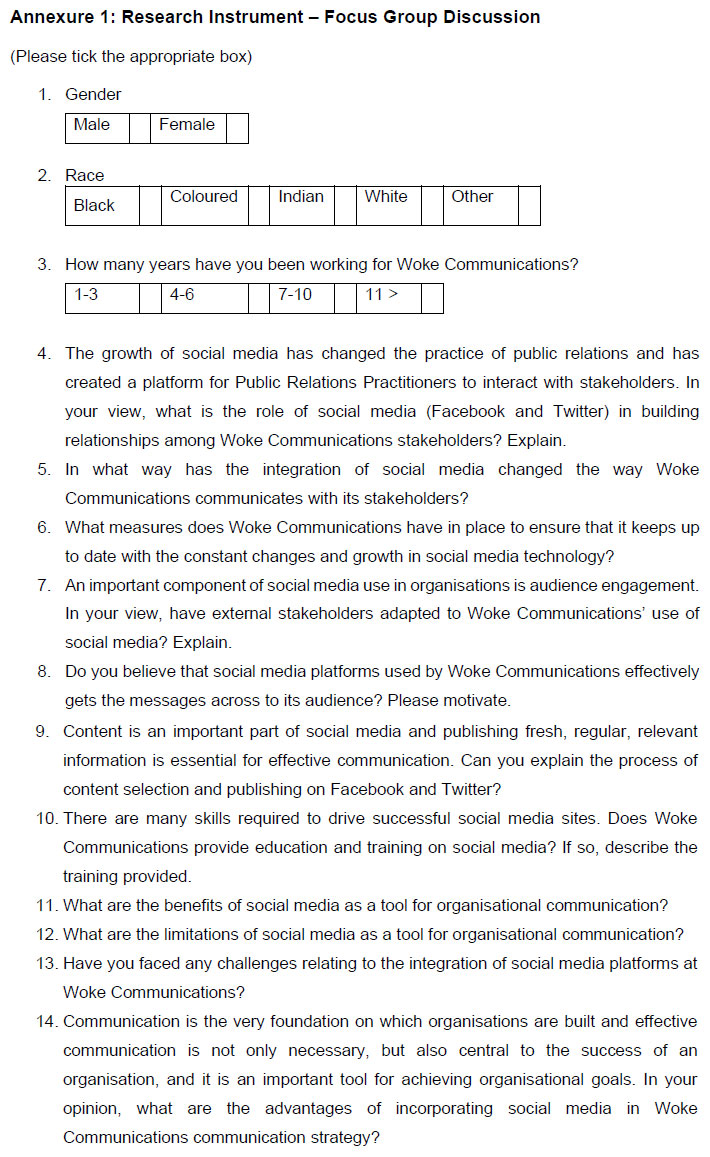
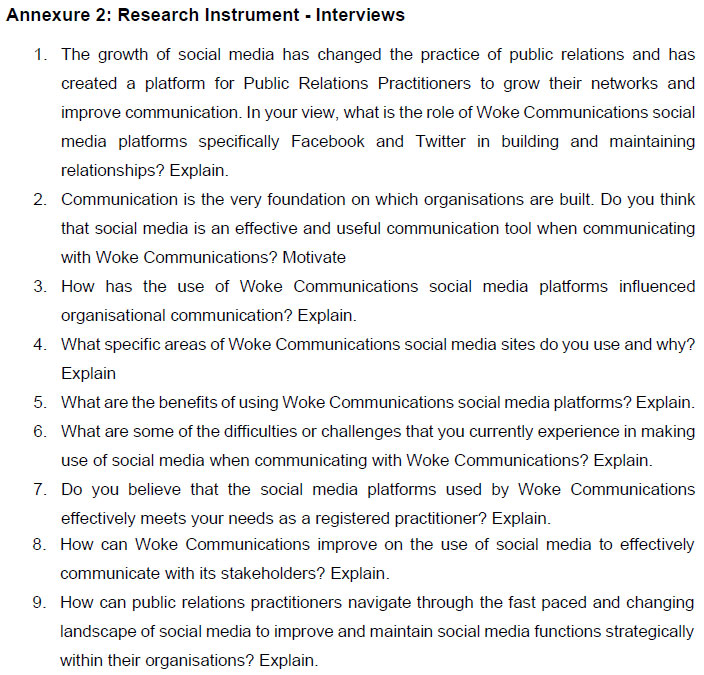
Data was analysed using thematic analysis. Thematic analysis served as a tool for shedding light on the lived realities of the participants. This study was exploratory, where the objective was to understand complex phenomena, particularly the influence of social media in strengthening corporate communications. The researchers employed an interactive, open-ended interview guide to explore the perceptions of employees and key external stakeholders on the organisation's use of social media. The open-ended questions focused on drawing information on the influence of social media on corporate communication and if and how it contributes to the success of an organisation. The structured interview schedule for employees presented nine questions (see Annexure 2), and the focus group had 14 questions (see Annexure 1). The preliminary questions in the focus group used a nominal scale, and 11 questions were open-ended, enabling deep, in-depth responses from participants. Data was transcribed verbatim.
The data from the observation of the social media platforms and interviews, and focus group discussions were analysed using a simple six-step process (Assarroudi et al., 2018). In working with the data, the researchers firstly familiarised themselves with the data by reading over the transcripts from the interviews and focus groups and content from the social media platform; this enabled the identification of key patterns or themes. The interviews and focus group discussions were audio recorded, and field notes were taken while the discussions took place and after the interviews and focus group. This was a valuable activity as it allowed researchers to clearly understand, manage and assimilate the data. Preliminary notes were taken at the initial reading stage of the data analysis, and this enabled the capturing of key ideas and patterns.
In the second step, important aspects of the data were identified, and codes were generated. The interview data and focus group data were transcribed, read, re-read and coded. Generating codes served as a way to organise data gathered and categorise them into groups. The third step involved reviewing the codes and the identification of broader themes. In the fourth step, the researchers reviewed the identified themes and compared them to the coded data. This was an important process as it enabled the researchers to ensure that they told a compelling story about the data. In the fifth step, the researchers defined the themes and determined the final themes to be used to discuss the data. The final stage, which is evident below in the findings and analysis section, is where the researchers wrote up the detailed analysis.
3.5 Pilot testing
This study used a pilot test before commencing with the main research. The rigour of the pretesting contributed to the validity of the study. Participants of the pilot test were external publics who are affiliated members of Woke Communications. The testing allowed the researchers to ensure that the questions were clear and easy to understand. The pre-test findings assisted the researchers in developing and modifying the quality of the final research instruments.
3.6 Trustworthiness of the research
In qualitative research, validity is often referred to as trustworthiness (Lincoln and Guba, 1985) of a study, which can be achieved by credibility, authenticity, transferability, dependability, and confirmability. The trustworthy approach is often used in qualitative research. In this study, the researchers ensured that the study was carried out fairly and ethically and that the findings attained in the study depict the accurate experiences of the research participants.
3.7 Limitations
The sample was limited to Woke Communications practitioners who engage with social media platforms at the organisation. At the time of the study, the organisation was downsizing as a result of financial constraints, and the researchers had to work with a smaller sample. In addition, the study observed social media platforms, namely Facebook and X (Twitter) only and therefore cannot be generalised to other social media platforms used by organisations.
3.8 Ethical considerations
This study received ethical clearance; the ethics protocol number is FREC No.:/18FREC. The communications organisation provided gatekeepers' consent. Study participants provided consent and were advised that participation was voluntary, and should they wish to withdraw at any point, they would be able to. Participants engaged in the study with full information and without undue influence. No incentives were provided to participants. Participants were presented with a detailed letter outlining the aim and objectives of the study. The letter of information further outlined that the research will not pose any potential harm to participants. They were informed that on completion of the study, the research results would be made available to them upon request. Participants agreed upon the venue for the data collection to ensure that they were comfortable. Participants were advised that their responses would be coded, and pseudonyms would be used to protect their identities. The data gathered was assimilated with integrity and care, and the researchers aimed for accuracy in the discussion of the data. Furthermore, the researchers were consistent and meticulous when analysing the data.
4. FINDINGS AND DISCUSSION
This study aimed to explore social media's influence on corporate communication. The main objective of this study was to assess how a communications organisation in South Africa, Woke Communications, has adapted to the use of social media in its corporate communications strategy. Themes emerged from the data collection and will be used to discuss the findings. The three themes explored include: building an online presence; researching, monitoring and reviewing social media; and training of employees.
The findings show that there is evidence of sharing, connecting and interacting on social media sites, namely Facebook and X (Twitter); however, social media is still not fully integrated into Woke Communications' communications strategy. The findings revealed that the central principle of social media is its ability to share information and content with other users. This study found that it is inadequate to merely have a Facebook page and an X (Twitter) account without a well-planned social media presence. Having a well-planned social media presence also requires that the organisation engages in research and reviews, and monitors its platforms to meet the needs of key stakeholders. Furthermore, it requires that organisations have well-trained employees who are able to understand the fast-paced digital trends and reengineer and adapt to ensure that the organisation remains relevant.
4.1 Theme one: Building an online presence
"We cannot just be unwilling subjects of technology; we need to engage with it critically." -Respondent
The first theme that emerged from the collected data is building an online presence, and this area was one in which participants felt the organisation neglected. Participants called for a greater online presence. They expressed concern about lost opportunities in terms of building key relationships, collaborating, developing mutually beneficial partnerships, knowledge sharing and keeping pace with trends in the communications sector. Participants expressed that Woke Communications need to embrace technological developments and use the opportunity and advantages it offers. Awethu, an interview participant, explains; "We are in the fourth industrial revolution, some of us are told that we are beyond the fourth industrial revolution. We need to advance to the latest modes of communication. One has to admit that the greatest form of communication [is] happening in the modern form of communication. Communication is critical and in an environment which is ostensibly understood to be a networking environment a practitioners' concern is within the nature of the function." Adding to Awethu's view of embracing changes in technology, Pamela suggests that employees in the communications industry need to make efforts to understand technology changes as it directly impacts the work they do and contributes to the growth and success of their organisations: "We need to take note that in this age, we cannot just be unwilling subjects of technology we need to engage with it critically". These findings were aligned with views from external stakeholders who, during the focus group discussion, expressed the importance of understanding the latest trends in the industry and engaging in meaningful discussions with key communications stakeholders. Francis expresses; "We need to follow other practitioners to see what is happening and keep up with the latest trends". Participant Lemaya further states: "[Woke Communications] should be more immediate, maybe be a conversation starter". This comment foregrounds the significant role the organisation can play in the communications sector in South Africa. Lemay further advises that discussion forums will help Woke Communications to build a strong network of like-minded practitioners. As suggested by research participants, the organisation can take a leading role in facilitating dialogue and interactions among communications stakeholders. This could have a positive impact on building the online presence of Woke Communications and creating ways in which stakeholders can network, engage and share knowledge and best practices. This will not only build the profile of Woke Communications but also contribute to the growth and development of the communications industry.
Lemay further reported on the benefits that well well-planned social media presence can offer: "[Woke Communications] should be more interactive, shoot more videos go live more... that can touch the youth ... make short videos to be more hands on." Lemay's suggestions relate to an organisation not merely having social media accounts, but being proactive and using the opportunities that social media can provide. This participant further highlights the importance of targeting the younger generation with the aim of tapping into this target market and building its reach. Lemay adds that engagement and interaction through discussion forums will contribute to knowledge sharing among like-minded practitioners and "networking opportunities as an information gathering practice".
These findings showed that social media can have a significant influence on how organisations communicate with their stakeholders and the various opportunities and benefits social media offer. It is recommended that time and resources be invested to build a strong online presence. Woke Communications has a wide reach within South Africa, in Africa and internationally and as a result, effective use of online platforms such as Facebook and X (Twitter) will open up opportunities for communication practitioners to build mutually beneficial relationships, share knowledge on best practice, engage in dialogue, collaborate and keep abreast of trends in the sector. Recommendations include shooting more videos; posting more regularly on events, activities, training programmes and responding to user comments and sharing industry success stories. These activities will contribute to a strong online presence for the organisation.
4.2 Theme two: Researching, reviewing and monitoring social media
"...we have to use social media, if we don't, then we go into complete oblivion". -
Respondent
The data showed that there is a need for communications organisations to engage in research on social media, particularly in terms of understanding their audiences and keeping up to speed with new developments in the sector. Participants in this study underscored the need to empower the younger generation of communications practitioners who are, in most cases, technologically savvy and knowledgeable on social media use and benefits. Rudy notes that:
"It is vital ... the younger practitioners are spending their time on Facebook and Twitter, so we have to use social media, if we don't then we go into complete oblivion". This participant emphasises how the younger generation of communications practitioners can and should be used to set agendas on social media and promote dialogue and interaction. Almaney (1974:42) suggests that "it is inconceivable to have an organisation without communication and is also inconceivable to have an efficient organisation without efficient communication". These views are aligned with this study, which analyses how social media has become an integral communication medium in terms of communicating with key stakeholders.
In responding to how public relations practitioners navigate through the fast-paced environment and changing landscape of social media to improve and maintain social media usage/functions in organisations, Awethu explains; "There are many disciplines using platforms, there is a big need to evaluate and monitor and to review the social media platforms on a more consistent and structured basis ... let it be systemic, and people assigned to monitor the trends as they move so rapid in the 4th industrial revolution and alertness to technical approaches and user interfaces. There must be consistent alignment of what Woke Communications desires to do going forward, with what is happening technologically and in the face of the new smart tools that are happening in media." Awethu affirms the importance of Woke Communications adapting to changes in the social media environment to remain relevant and responsive. Researchers have explored how various organisations used social media to establish dialogic relationships and affirm the benefits of using social media to encourage participation and build relationships with stakeholders (Sundstrom & Levenshus, 2017). Systems theory researchers claim that communication, both internally and externally, is vital in ensuring organisational growth and that all organisations need to monitor and evaluate how they process information (Almaney, 1974; Gunaratne, 2008; Modaff et al., 2009).
The findings suggest that it is imperative for organisations to measure the effectiveness of their communication, and reviewing and monitoring social media can contribute to organisations' understanding of what is working well, not so well and what to improve on. Furthermore, employees must be trained on how to effectively use the platform and monitor it. This is discussed further in theme three.
4.3 Theme three: Training of employees on social media
"We will be called the donkey in the industry because everybody is moving fast and furious and everybody is getting with it." - Respondent
Participants expressed concern that Woke Communications did not effectively use social media to communicate with key stakeholders. Participant Nkosi notes that Woke Communications ought to invest more resources in terms of using social media to develop strategic relationships with key external stakeholders: "Social media is there to grow relations between the organisation and the public. Woke Communications has not done that yet... They should be spearheading social media." Another participant, Sam, further highlights the leading role that the organisation should be playing in the industry, expressing that: "Woke Communications could serve as a networking platform for people in the industry". Meanwhile, Logan insists that she does not see Woke Communications striving to build relationships; "I feel like they are old fashioned and they not keeping up with the trend so I'm not sure from my opinion if they are actually doing what they supposed to be doing when it comes to building and maintaining relationships." These views suggest that there are evidently challenges in maximising social media use at Woke Communications. Participants suggested that Woke Communications needs to engage more consistently on social media platforms. It was also suggested that employees use the platform to engage on industry issues, social issues and take a leading role in disseminating information and promoting engagement and collaboration. Recent research by Pekkala (2020) indicates that knowledge-intensive organisations are increasingly training their employees to successfully engage in social media communication. This affirms the need for organisations to invest time and resources to train and equip their employees to be able to navigate social media and to contribute to organisational success.
Commenting on how the use of social media platforms has influenced organisational communication, Thobeka explained: ".....there are multiplicity of platforms upon which communication should take place so I think that has influenced /Woke Communications/ to be more innovative and more flexible in the modes of communication and more alert to the management of and control of social media as a platform of disseminating its own agenda.' Participant Awethu expresses: "There should be constant and thematic approach towards social media and other platforms like e-mails and WhatsApp groups. Organisations need to be more constant in their approach when using social media'.
Organisations need to build their online presence to engage in information exchange and promote sharing experiences and ideas. Participant Sanele advises that organisations need to: "be there, show up, and engage on social issues". These views are supported by Cartwright et al. (2021), who suggest that organisational steps towards building greater investment in social media will propel organisations to new levels of connectiveness, performance, competitiveness and sustainability.
In responding to the advantages of incorporating social media in Woke Communications' communication strategy, Grace explained: "I would say that if we don't incorporate social media, we will be called the donkey in the industry because everybody is moving fast and furious and everybody is getting with it...New times is social media." It is suggested that Woke Communications realign their communication strategies to ensure that social media platforms are being employed in their fully dialogic potential.
The findings reveal that Woke Communications did not create and promote effective communication processes that can lead to fruitful discussions and relationships with different publics. Woke Communications should acquire the services of social media experts who can train employees in maximising social media use in the organisation. From the findings, it was evident that the communications industry is evolving at a rapid pace and that organisations need to reengineer their communications strategies to adapt to industry advances, as this will determine if they succeed or perish. Communications strategies and plans should be monitored and reviewed, research should be conducted regularly on developments and trends, and organisations should constantly assess their online presence in order to succeed in a competitive industry. Building a well-planned and strong social media presence, researching and reviewing and monitoring social media, and training of employees will unreservedly contribute to enhancing and maintaining effective corporate communications with key stakeholders. The findings enabled the researchers to offer recommendations on how social media can be incorporated into corporate communication strategies. It further serves as a knowledge base for communications organisations to understand social media's influence on corporate communication.
5. MANAGERIAL IMPLICATIONS
The findings of this study identifies clear, actionable steps that communication managers can initiate to harness social media effectively. It is imperative that orgainsations treat social media as a strategic function by allocating dedicated budget, time and either trained in-house staff or external specialists rather than leaving it as an ad-hoc task; assign clear roles for content creation, monitoring and rapid response. Additionally, organisations must put governance in place - documented workflows, escalation paths for crises, so that performance can be measured and improved. Organisations are further required to invest in continuous upskilling of staff identified to take on social media responsibilities - to ensure message alignment. Of significant value for organisations and managers will be to engage in regular research, monitoring and review cycles. Implementing these into the communications plan will enable content to be targeted and adapted from real audience insights. Finally, the integration of social media into broader corporate and crisis-communication strategies will help sustain dialogic engagement, protect organisationsal reputation and strengthen stakeholder relationships.
6. CONCLUSION
Developments in technology have contributed to a rapid shift in the way in which organisations communicate with their key stakeholders. Social media, particularly Facebook and X (Twitter), has created a new era of communication in the business sector and is fast influencing the sustainability, success and survival of organisations. Social media is considered a strategic communication partner, enabling new ways for organisations to build, strengthen and maintain relationships with key stakeholders. Organisations use social media for different purposes to achieve their aims and objectives, and the underlying interactivity of social media is significant in enhancing corporate communication. However, more than using social media to share information and messages, the power of social media is that it typifies the principles of participation, engagement, dialogue, collaboration and sharing. Social media can be used to augment knowledge and provide new ways to collaborate, which is essential in the communications sector. Understanding the pitfalls in social media use will enable organisations to be more responsive to stakeholders' needs. Organisations, particularly those in developing countries such as South Africa, need to embrace the opportunities social media offer, research, review and monitor the environment, train their employees and maintain a strong online presence if they want to remain relevant in the competitive marketplace.
Conflict of interest: The authors declare no conflict of interest with respect to the research, authorship and publication of the article.
Data availability: The data used for this article can be found in Mzizi, S.L. (2021). The influence of social media on organisational communication: A case study of the Public Relations Institute of Southern Africa. Master's thesis, Durban University of Technology.
Ethical clearance and informed consent statement: The researchers obtained ethical clearance prior to data collection and informed consent from all the participants in this study.
Funding: The authors did not receive any financial support for research, authorship and publication of the article.
Prior publication: This article represents a substantial reworking (more than 50%) of Siyabonga L Mzizi, PhD thesis, which has been submitted, entitled 'The influence of social media on organisational communication: A case study of the Public Relations Institute of Southern Africa', at the Department of Public Relations and Communications, Faculty of Management Sciences, Durban University of Technology, Durban, with Dr Govender (Supervisor). [https://hdl.handle.net/10321/3934]
REFERENCES
Alharahsheh, H.H. & Pius, A. 2020. A Review of key paradigms: positivism VS interpretivism. Global Academic Journal of Humanities and Social Sciences, 2(3):39-43. [Internet: https://api.semanticscholar.org/CorpusID:243844057; downloaded on 18 June 2022]. [ Links ]
Assarroudi, A., Nabavi, F.H., Armat, M.R., Ebadi, M.A. & Vaismoradi, M. 2018. Directed qualitative content analysis: the description and elaboration of its underpinning methods and data analysis process. Journal of Research in Nursing, 23(1):42-55. [https://doi.org/10.1177/1744987117741667]. [ Links ]
Azionya, C., Benecke, R., Crystal, A., Davis, C., Levy, N., Muir, C., Oksiutycz, A., Verwey, S. & Ferreira, M. 2014. Global Alliance for Public Relations and Communication Management. The Department of Strategic Communication, University of Johannesburg. [ Links ]
Cartwright, S., Davies, I. & Archer-Brown, C. 2021. Managing relationships on social media in business-to-business organisations. Journal of Business Research, 125:120-134. [ Links ]
Cavico, F.J., Mujtaba, B.G., Muffler, S.C. & Samuel, M. 2013. Social media and employment-at-will: Tort law and practical considerations for employees, managers and organizations. New Mass and Mass Communication,1:25-41.[Internet: http://www.iiste.org/Journals/index.php/NMMC/article/view/4605/4998; downloaded 16 May 2022]. [ Links ]
Creswell, J.W. & Poth, C.N. 2018. Qualitative inquiry and research design: Choosing Among Five Approaches. Los Angeles. Sage Publications. [ Links ]
Denzin, N.K. & Lincoln, Y.S. 2008. Strategies of qualitative inquiry. Dissertation: University of Innsbruck. Los Angeles. California. Sage Publications Incorporated. [ Links ]
Dwivedi, Y.K., Ismagilova, E., Hughes, D.L., Carlson, J., Filieri, R., Jacobson, J., Jain, V., Karjaluoto, H., Kefi, H., Krishen, A.S. & Kumar, V. 2021. Setting the future of digital and social media marketing research: Perspectives and research propositions. International Journal of Information Management, 59:102168. [https://doi.org/10.1016/i.iiinfomgt.2020.102168]. [ Links ]
Duffett, R.G. 2015. Facebook advertising's influence on intention-to-purchase and purchase amongst Millennials. Internet Research, 25(4):498-526. [https://doi.org/10.1108/IntR-01-2014-0020]. [ Links ]
Elo, S., Kääriäinen, M., Kanste, O., Pölkki, T., Utriainen, K. & Kyngäs, H. 2014. Qualitative Content Analysis. SAGE Open, 4(1):1-10. [https://doi.org/10.1007/978-3-030-30199-65]. [ Links ]
Fielding, M.L. & Du-Plooy-Clliers, F. 2014. Effective Business Communication in Organisations, preparing messages that communicate. 4th ed. Cape Town: Juta and Company Ltd. [ Links ]
Gunaratne, S.A. 2008. Understanding systems theory: Transition from equilibrium to entropy. Asian Journal of Communication, 18(3):175-192. [https://doi.org/10.1080/01292980802207033]. [ Links ]
Hiscock, R. 2019. Paradigm lost? A historical review of the application of systems theory to public relations since 1975. Public Relations Inquiry, 8(3):201-223. [https://doi.org/10.1177/2046147X19872239]. [ Links ]
lmaney, A. 1974. Communication and the systems theory of organization. The Journal of Business Communication, 12(1):35-43. [https://doi.org/10.1177/002194367401200106]. [ Links ]
Inya, A.E. 2017. Influence of Social Media on Public Relations Practices in Universities in South-East, Nigeria. Global Journal of Human-Social Science Research, 17(3):45-52. [Internet: https://socialscienceresearch.org/index.php/GJHSS/article/view/2237; downloaded 10 June 2023]. [ Links ]
Irbo, M.M. & Mohammed, A.A. 2020. Social media, business capabilities and performance: A review of literature. African Journal of Business Management, 14(9):271-277. [https://doi.org/10.5897/AJBM2019.8825]. [ Links ]
Ju, R. & Jia, M. 2019. Information and Communication Technology, Uncertainty Reduction, and Dual Identification in Chinese Organizations. Journal of International & Interdisciplinary Business Research, 6(1):64-80. [https://doi.org/10.58809/CUPU8731]. [ Links ]
Komodromos, M. 2017. Social networking: how small organisations are using Facebook and Twitter in engaging customers. International Journal of Technology Marketing, 12(2):142-150. [https://doi.org/10.1504/IJTMKT.2017.083368]. [ Links ]
Langer, E. 2014. What's Trending. Social media and its effects on organizational communication. Journal of Undergraduate Research XVII, 1-14. [ Links ]
Lincoln, Y.S. & Guba, E.G. 1985. Naturalistic enquiry. Newbury Park: Sage Publications. [ Links ]
Lubbe, B. 2004. Applying an open systems public relations model to destination image development. Communication: South African Journal for Communication Theory and Research, 30(1):131-150. [https://doi.org/10.1080/02500160408537990]. [ Links ]
Lubua, E.W., Semlambo, A. & Pretorius P.D. 2017. Factors Affecting the Use of Social Media in the Learning Process. South African Journal of Information Management, 19:1-12. [https://doi.org/10.4102/saiim.v19i1.764]. [ Links ]
Marlowe, J.M., Bartley, A. & Collins, F. 2017. Digital belongings: The intersections of social cohesion, connectivity and digital media. Ethnicities, 17(1):85-102. [https://doi.org/10.1177/1468796816654174]. [ Links ]
Modaff, D.P., DeWine, S. & Butler, J. 2007. Organizational communication: Foundations, challenges, and misunderstandings. (2nd ed.). Boston, MA: Pearson. [ Links ]
Mugera, W. 2013. Non-Probability Sampling Techniques. Nairobi, Kenya: University of Nairobi. [ Links ]
Musheke, M. & Phiri, J. 2021. The Effects of Effective Communication on Organizational Performance Based on the Systems Theory. Open Journal of Business and Management, 9:659-671. [https://doi.org/10.4236/ojbm.2021.92034]. [ Links ]
Mzizi, S.L., Govender, N. & Govender, V. 2023. The influence of social media in building organizational relationships in the Public Relations industry in South Africa. Interdisciplinary Journal of Economics and Business Law, Special Issue, 12:8-30. [ Links ]
Nickerson, C. 2023. Interpretivism Paradigm & Research Philosophy. Simply Sociology. [Internet: https://simplysociology.com/interpretivism-paradigm.html: downloaded 20 May 2023]. [ Links ]
Pekkala, K. 2020. Managing the communicative organization: A qualitative analysis of knowledge-intensive companies. Corporate Communications: An International Journal, 25(3):551-571. [https://doi.org/10.1108/CCIJ-02-2020-0040]. [ Links ]
Reitz, A. 2012. Social Media's Function in Organizations: A Functional Analysis Approach University of Northern Colorado, United States. Global Media Journal - Canadian Edition, 5(2):41-56. [ Links ]
Saunders, M., Lewis, P. & Thornhill, A. 2019. Research methods for business students. 8th ed. United Kingdom: Pearson Education Limited. [ Links ]
Shonubi, A.O. & Akintaro, A.A. 2016. The impact of effective communication on organizational performance. The International Journal of Social Sciences and Humanities Invention, 3(3):1904-1914. [https://valleyinternational.net/index.php/theiisshi/article/view/352]. [ Links ]
Skinner, C., Von Essen, L., Mersham, G. & Motau, S. 2016. Handbook of Public Relations. 11th ed. Cape Town: Oxford University Press. [ Links ]
Sundstrom, B. & Levenshus, A.B. 2017. The art of engagement: dialogic strategies on Twitter. Journal of Communication Management, 21(1):17-33. [https://doi.org/10.1108/JCOM-07-2015-0057]. [ Links ]
Stieglitz, S. & Dang-Xuan, L. 2012. Social media and political communication: a social media analytics framework. Social Network Analysis and Mining, 2(3):1-15. [https://doi.org/10.1007/s13278-012-0079-3]. [ Links ]
Waddington, S. 2013. The future of public relations. [Internet: https://wadds.co.uk/blog/2013/01/23/the-future-of-public-relations; downloaded 14 May 2022]. [ Links ]
Zerfass, A. & Link, J. 2022. Communication management: structures, processes, and business models for value creation through corporate communications. In. Research Handbook on Strategic Communication Edited by Jesper Falkheimer and Mats Heide. pp. 237-258. [https://doi.org/10.4337/9781800379893.00024]. [ Links ]
Zerfass, A. & Brockhaus, J. 2023. Handbook on Digital Corporate Communication. In Vilma Luoma-aho, Mark Badham. UK: Edward Elgar Publishing Limited. [ Links ]
* corresponding author