Services on Demand
Journal

Article
 English (pdf)
 Article in xml format
 Article references
 Automatic translation
 Send this article by e-mail
Indicators
Related links
-
 Cited by Google
 -
 Similars in Google
Share

 Permalink
South African Journal of Bioethics and Law
On-line version ISSN 1999-7639
SAJBL vol.18 n.1 Cape Town Apr. 2025
https://doi.org/10.7196/SAJBL.2025.v18i1.2221
ARTICLE
Policing teenage pregnancies: Complexities and implications
A StrodeI; S BhamjeeII; J TooheyII
IBA, LLB LLM, PhD; School of Law, University of KwaZulu-Natal, Pietermaritzburg, South Africa
IILLB LLM, PhD; School of Law, University of KwaZulu-Natal, Pietermaritzburg, South Africa
ABSTRACT
South Africa has an unacceptably high rate of teenage pregnancies. Of particular concern is the number of pregnancies in 10 - 14-year-olds. In this age group, there has been a 48.7% increase in deliveries, with 2 726 taking place pre-Covid-19 (2017 - 2018) and 4 053 in 2020 - 2021. In response to these figures, there has been a range of calls for criminal law to play a greater role in deterring teenagers from engaging in underage sex which results in pregnancy. This article helps to explore the complexities and implications of a criminal law approach by firstly providing an overview of the existing legal framework regulating adolescent sexual and reproductive health rights; secondly, examining sexual offences that limit adolescent rights and their practical implications; and thirdly, discussing public health and rights consequences that may flow from using criminal law as part of a comprehensive strategy to address teenage pregnancy. It concludes that although both civil law and criminal law have a common goal - the promotion of sexual reproductive health rights of children and the protection against unhealthy and exploitative engagements - there is a disjuncture between their approaches, practically and ideologically. Civil law and its structures endeavour to create an educative, empowering and safe space where adolescents can get the support and services they need. Criminal law creates a hostile and disenfranchising space which research has shown creates a barrier to accessing sexual and reproductive health and rights (SRHR) owing to fear of reprimand, stigmatisation, re-victimisation, community ostracism, and familial or partner rejection. A concern is the divergent and perhaps even counter-intuitive ways in which these two mechanisms seek to achieve the common goal.
South Africa has an unacceptably high rate of teenage pregnancies. Of particular concern is the number of pregnancies in younger adolescents aged 10 - 14. In this age group, there has been a 48.7% increase in deliveries, with 2 726 taking place pre-COVID-19(2017/2018) and 4 053 in the last assessment period (2020/21).[1] These figures do not include pregnancies that did not carry to term (either through an abortion or any of a myriad of other reasons, e.g., miscarriage. In response, there has been a range of calls for teenage pregnancy to be categorised as a 'notifiable incident' with a view not only to investigate whether such was the result of an unlawful sexual encounter (e.g., rape or statutory rape) but more so to prevent further pregnancies,[2,3] through the assumed deterrent effect of criminalisation.[4-6] If criminal law is used in the manner envisaged by advocates for this call, it would mean a focus on pregnancies in girls below the age of 16, making reportable some sexual encounters in this age group which may, in fact, be lawful.[5-8,10-15] Consensual sex is not a criminal offence for anyone over the age of 16,[5,12-14] and for this reason, our submissions will not focus on this age category.[5]
The complexities and implications of reliance on a c riminal law approach to pregnancies of children falling within the under 16-years age category would need to be fully described through the lens of what sexual reproductive health measures are lawful, juxtaposed against the limitations present in the criminal law. A further observation is that the identified 10 - 14-year age group (referred to in the statistics above) straddles two of the statutorily identified categories with mandatory reporting obligations (girls under the age of 12 and girls between the ages of 12 and 15).[5]
Objectives
This article aims to contribute to the discussion on whether criminal law should be used to address the current high rate of teenage pregnancies. First, the paper provides an overview of the existing legal framework regulating adolescent sexual and reproductive health rights. Second, it examines sexual offences within the legal framework that limit adolescent rights and their practical implications. Third, this study highlights challenges and potential adverse consequences that flow from using criminal law as part of a comprehensive public health strategy to address teenage pregnancy.
Methods
This paper reviewed adolescent sexual and reproductive health rights by identifying key provisions in the South African Constitution, 1996,[7] and relevant civil and criminal statutory enactments and their interpretation, application and development through case law. Such an examination requires consideration of the legal implications of using criminal law as a mechanism to respond to the national public health challenge of high teenage pregnancy, particularly among girls under 16. Applying this review method assists in weighing considerations of the impact on adolescent rights, where legal interventions are applied against the broader societal implications. In this regard, civil law provides detailed content on the sexual and reproductive health rights of adolescents, while criminal law sets out the circumstances in which certain sexual behaviour is a criminal offence and the consequences thereof.
Results
Older adolescents have sexual and reproductive health rights, facilitating access to sexual and reproductive health services
Section 12 of the Constitution[7] provides that everyone has the right to make 'sexual and reproductive health choices', and section 27 includes that everyone has access to 'reproductive healthcare'.[7] Thus, like adults, teenage girls are entitled to these rights and can access these services independently unless there is a justification for limiting unassisted access.[4] Within this progressive constitutional framework, civil law adopts a pragmatic approach.[8,9] Based on the principle that children have evolving capacities, legislation allows adolescents, generally from the age of 12 to independently access HIV testing, medical treatment, and contraceptives.[8,9] Girls below the age of 12 are generally not able to unilaterally consent to or request contraceptives or medical treatment. Although circumstances may exist where they would be able to,[8,13] this is the exception rather than the rule.[8,9,13] In contrast, all girls can unilaterally, independently and without parental assistance request and consent to an abortion. [8,10,11]
Adolescent sex and criminal law
Criminal law is used as a means for protecting children in the context of sex.[4,5] The Criminal Law (Sexual Offences and Related Matters) Amendment Act[5] (SORMA), in its Preamble, explicitly notes that one of its aims is to address the 'sexual exploitation of children', with Chapter 3 entirely devoted to 'sexual offences against children'.[5] SORMA establishes the age of consent to sex at 16. Below 16, SORMA criminalises sexual acts between children and other persons in certain contexts, even where sex is consensual.[5]
For instance, SORMA [5] confirms the crime of statutory rape, making this crime applicable to victims between the ages of 12 and 16. It is not the crime of statutory rape in instances where both persons are between the ages of 12 and 16 and the age gap between the younger partner and the older partner is two years or less. [5] Children who are 14 - 15 can lawfully engage in sexual intercourse with an older partner who is (at a maximum) 17 years old.[13,14] If, however, in circumstances where there is an age gap of more than two years, the older person commits the crime and may be subject to criminal prosecution.[13,14] There are no mandatory reporting obligations if sexual conduct is not a statutory offence. In instances where SORMA regulates adolescent sex in these and other age categories, there are no express criminal provisions linked to teenage pregnancy, although pregnancy is clear and irrefutable evidence of sexual activity.
Section 54 of SORMA,[5] as amended, broadens mandatory reporting obligations not only to any person with 'knowledge' but now also to any person with 'reasonable belief or suspicion' of any sexual offence against a child.[5] SORMA is clear that reports must be made to the police. Failing to comply with this reporting obligation is a criminal offence resulting in a fine, imprisonment (up to a maximum of five years) or both.[5] The statutorily created mandatory reporting obligation applies to 'anyone', which is all-encompassing. For present purposes, it is necessary to note that this includes healthcare providers, social workers, school counselors and teachers.
Depending on the age of the child victim, the charge would be rape or statutory rape.
Advocacy for adolescent pregnancies to be made mandatorily reportable to the police, would potentially bring non-criminal sexual conduct within the ambit of the criminal law, when acknowledging that this group straddles two of the statutorily identified age group categories. It would seek to make mandatory the reporting of sex for an age category (12 - 16) that may not in fact be a sexual offence. This could potentionally undo the strides made since Teddy Bear in which the Constitutional Court found that certain aspects of SORMA regulating consensual, under-age sex to be inconsistent with the Constitution as they violated adolescent sexual and reproductive health rights.[4] This resulted in parliament amending SORMA to narrow the scope of statutory rape. This advocacy for a change in SORMA gain would lead to it being broadened beyond its original wording, making what was lawful, unlawful.
Whether a pregnancy resulted lawfully or because of a sexual offence would only be determined after the report is made to the police and then investigated. The charge investigated would be either rape or statutory rape. Reporting triggers investigation which would require the person making the report to divulge information about the child victim. As SORMA [5] requires reporting of even mere suspicion and further creates a defence of 'good faith' reporting, it would appear that any suspicion of sexual activity of a child must be reported and can be done without deeper investigation or probing from the person making the report. All that they would have to do is report their suspicion (in this case, the suspected pregnancy, not even confirmation of it) to the police, together with the name and other details of the pregnant child. Determining whether a sexual offence has occurred would be left to the police, who would interview the identified child to establish whether a crime has been committed, which would include asking them for the name of their sexual partner and that person's age and even investigating whether the child is in fact pregnant. Currently, then, while pregnancy is clear evidence of sexual intercourse in a teenager under the age of 16, it does not mean that the crime of statutory rape has been committed as, for example, the pregnancy may be the result of a relationship between two peers who are close in age. It would however, create a suspicion that an offence had been perpetrated against children under the age of 16.
For girls under 12, pregnancy will (and must) trigger mandatory reporting because sexual intercourse in this age group is unequivocally a criminal offence. However, this obligation appears to be seldom applied in practice. Research with social workers in KwaZulu-Natal found that most did not report consensual, under-age sex as they found this to be of little value. [19,20] Instead, social workers tend to offer alternative interventions such as counseling.[19,20] As regards teenage pregnancy and criminalisation, it must be made clear that not every case of teenage pregnancy is by itself evidence of a criminal offence, and there should be discerning consideration before resorting to the criminal process.
This brings into focus the 12 - 16-year age group as a 'gap' regarding the reporting of the suspicion of a sexual offence perpetrated, for present purposes evidenced by pregnancy (but also evidenced by abortion requests, request for contraceptives, and HIV and/other STI testing). In context, unless there is 'knowledge, reasonable belief or suspicion'[5] that the pregnancy was a result of a sexual offence, SORMA[5] does not make reporting mandatory. In the absence of such suspicion, for this age group, there is no obligation to report to the police. These instances would identify a disjuncture between civil law and criminal law.
It is worth noting that while girls under the age of 12 can independently consent to abortion,[10] it is submitted that even though it is lawful for girls of this age to access the service, it would still be required for doctors, nurses etc. to report these incidents to the police, simply because abortion is evidence of sexual intercourse, because 'consensual' sex with a child under the age of 12 is the crime of rape, as a child of this age is irrebuttably unable to consent.[5,16] All instances that evidence sexual intercourse (including pregnancy) would trigger mandatory reporting and must be reported to the police.[5]
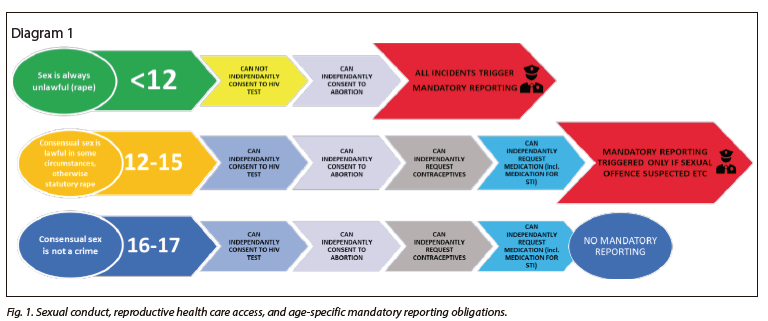
Fig. 1 provides an overview of what girls within the statutorily defined age groupings can access, when sexual activity is a criminal offence, and the reporting obligations for the relevant age groupings when sexual offences are suspected of having occurred.
Expanding the ambit of the criminal law -adopting a criminal law approach for teenage pregnancies (human rights implications and complexities)
The use of criminal law would require laying a charge of rape or statutory rape against the father of the unborn child (or even the aborted fetus). Generally, mandatory reporting obligations aim at linking vulnerable persons who have suffered harm or are at risk of harm with state services that can intervene in order to protect them, empower them, and support them.[11] In this instance, reporting takes the form of laying a charge at the local police station but does not in any way link the teenage pregnant mother to social services to support her.[11] The focus turns primarily to investigation and prosecution so that the offender can be punished. Expanding the ambit of the criminal law in respect of teenage pregnancies presents a number of negative implications, not least if doing so still will not support the psycho-social needs of the child victim.
In the matter of Centre for Child Law v Director of Public Prosecutions, Johannesburg and Others,[15] the Constitutional Court cautioned against excessive use of criminal law against adolescents, citing the following reasons:
• exposing adolescents to harmful consequences in the criminal justice system
• failing to protect children from other harms associated with the criminal justice system
• diminishing the role and involvement of social services in addressing the behaviour in question
• failing to recognise the relevance and importance of alternate approaches to prevention other than punitive measures associated with the criminal justice system.[12]
From the above, it is clear that using the criminal justice system to address behavioural issues such as consensual underage sex sets in motion a range of consequential harms that significantly outweigh any potential benefits.[4,15] As such, the social implications may have negative repercussions associated with stigmatisation and/or discrimination against teenage pregnant mothers, limiting the pursuit of coparenting, child support or aggravating the risk of violence from families or partners.[1,4-6,12-14] Making pregnancy mandatorily reportable to the police will also compel the teenage pregnant girl to provide evidence against the father of her child, which violates her right to privacy and dignity. This may inevitably promote willful non-disclosure for fear of these negative social repercussions eventuating.
From Fig. 1, it is clear that mandatory reporting applies only in cases involving children under the age of 16. Notably, the criminal law approach does, through the aim of criminalising sexual predation, seek to address one of the root causes of teenage pregnancy in young girls. However, it is ineffective and unsuited for addressing the wide range of factors that facilitate teenage pregnancies and unhealthy sexual practice choices, such as poor socio-economic conditions, high levels of gender-based violence, inadequate school-based health education, and limited access to health services.[1,14] Consequentially, a criminal law approach focusing on teenage pregnancy per se may deter young girls from accessing health services owing to fears that doing so will automatically engage criminal law and the consequences thereof.[12] Targeted sexual reproductive healthcare requires a relationship of trust between patient and healthcare provider, which will be undermined if younger adolescents are afraid of the possible criminal law consequences resultant from certain sexual disclosures. This would have several negative effects on delivering healthcare services, when doing so might mean that girls may withhold information, which could mean that they do not receive appropriate healthcare and support.[4]
Discussion
The use of criminal law to address public health issues is a highly and long-contested issue, especially concerning the appropriateness within the context of HIV and COVID-19. More recently, these discussions have extended to the complexities of using criminal law to address the problem of teenage pregnancy, indicating that there are a number of negative implications on children. In the context of pregnancy in girls under 16, the following nuanced approaches are recommended:
1. The criminal law could be used if the teenage pregnancy is the result of rape or statutory rape in girls under the age of 16.
While being pregnant is not a crime, it can serve as evidence in instances where the older sexual partner could be charged and prosecuted for the crime of rape or statutory rape. This would align with SORMA's aim of protecting children from exploitative sexual incidents and harmful (albeit consensual) sexual behaviours. However, where advocates wish to encourage the use of criminal sanctions on pregnant adolescents, there would have to be proper consideration of whether the pregnancy is as a result of a sexual offence or lawful sexual intercourse. Currently, pregnancy in the 12 - 16-year category may not automatically be evidence of a criminal offence where sexual intercourse is statutorily lawful because it occurred within the peer-group situation.[4,5,15,16] The Constitutional Court has already found that involving criminal law in the consensual sexual lives of adolescents (12 - 16) violates their rights to privacy and dignity and is not in their best interests,[4] and it is thus unlikely that making pregnancy of children in this group mandatorily reportable would pass constitutional muster. All cases of pregnancy in girls under the age of 12 are mandatorily reportable because sex with children in this group is always a sexual offence (rape), so sexual intercourse with these children (and by necessary implication includes their being pregnant) is already catered for through SORMA.[5]
2. There are limits to a criminal law approach as a response to teenage pregnancy in girls under the age of 16
A few points are offered concerning the limits in applying criminal law. Firstly, it could only be used in relation to teenage pregnancies in girls under the age of 16. The age of consent to sex is 16 and, after this age, consensual sex is not a criminal offence. Potentially, all cases of pregnancy in children under the age of 16 could be as a result of rape or statutory rape. Secondly, the argument that criminal law can be used to reduce pregnancy and adjoining physical and psycho-social risks related to pregnancy in young mothers has been dismissed by the Constitutional Court because there was insufficient evidence to conclude that pregnancies would be reduced by criminalising consensual peer-group sex for 12 - 16-year-olds.[5] Thirdly, existing criminal provisions through SORMA are sufficient to prosecute sexual offences against children (evidenced by pregnancy), and there are already mandatory reporting obligations for this. However, for girls aged 12 - 15, pregnancy without suspicion of a sexual offence having occurred does not make reporting to the police mandatory.
Conclusion
Adopting the criminal law approach thus exacerbates the 'harm and risk' to adolescents by 'undermining support structures, preventing adolescents from seeking help, and potentially driving adolescent sexual behaviour underground1,[5,17] particularly when this approach means that seeking medical care and advice triggers a criminal law intervention. Further, it can also lead to pregnant teenagers not freely disclosing details of their circumstances owing to fear of potential consequences and subsequent negative implications on the socio-economic dynamics within the context of their immediate familial, community and/or partner support.[5,17,18] Applying this approach deters younger adolescents from using health services, which is particularly concerning, given that current statistics indicate increases in the occurrences of pregnancy within the age range of 10 - 14 years.[1] Studies indicate that this concern is compounded by evidence of age-disparate relationships among girls in this cohort. Evidence shows that partners are typically at least four years older [4,13,14,18] than they are. It is submitted that energy, resources and policies should rather be focused on dealing with the roots of problems; but to do this; a keener view of what problem requires addressing will aid in determining how that problem ought to be addressed and whether the appropriate tool is criminal law or not.
There is a disjuncture between the approaches in civil and criminal law and the sexual reproductive health rights of girls over the age of 12. In essence, there is a conflict between the pragmatic and protective approaches in civil and criminal law, respectively. In terms of civil law, girls over the age of 12 may access sexual and reproductive health services, which supports the rights-based approach and public health objectives, even though their consensual sexual relationships may be illegal. However, it is unlikely that the use of criminal law as an approach to address pregnancies in girls aged 12 - 16 will cause this statistic to improve. A valid concern is that progressive results with respect to reducing the rate of teenage pregnancies will be much more challenging to attain when teenage pregnancies are given criminal status.[5]
The paternalistic approach of criminal law bluntly criminalises a wide range of consensual sexual relationships; broadening its ambit will undoubtedly have a negative effect as children would become discouraged from accessing healthcare when the consequence is not health interventions but rather criminal prosecution. The paper finds that it is unlikely that the use of criminal law as an approach to address pregnancies in girls aged 12 - 16 will cause a dramatic shift towards better achieving the healthcare goal identified as the fostering of healthy sexual practices. Instead, adverse health and human rights implications will follow, further exacerbating the real problem - unhealthy and exploitative sexual relationships perpetrated against children.
Declaration. None.
Acknowledgements. None.
Author contributions. AS: First draft of the paper and contributed to editing the final version.
Funding. No funding occurred in the development of this paper.
Conflict of interest. None.
References
1. Barron P, Subedar H, Letsoko M, Makua M, Pillay Y. Teenage births and pregnancies in South Africa, 2017-2021-a reflection of a troubled country: Analysis of public sector data. S Afr Med J 2022;112(4):252-258. [ Links ]
2. Kekeletso K. To: Minister of Health - Dr Joe Phaahla. Make pregnancies of minors a notifiable incidence. https://awethu.amandla.mobi/petitions/make-pregnancies-by-minors-a-notifiable-incidence?source=whatsapp-share-button&utm_source=whatsapp&share=294d7912-d4e1-4561-8a87-f52e5de8470a (accessed 2 January 2024).
3. Wicks B. Concerns over calls to force healthcare providers to report teen pregnancies to police. News24. 2023. https://www.news24.com/news24/southafrica/news/concerns-over-calls-to-force-healthcare-providers-to-report-teen-pregnancies-to-police-20231003 (accessed 28 March 2024).
4. Teddy Bear Clinic for Abused Children and Another v Minister of Justice and Constitutional Development and Another (CCT 12/13) [2013] ZACC 35.
5. Republic of South Africa: Criminal Law (Sexual Offences and Related Matters) Amendment Act 32 of 2007.
6. Donovan P. Can statutory rape laws be effective in preventing adolescent pregnancy? Family Planning Perspectives 1997;29(1):30-40. [ Links ]
7. Republic of South Africa: Constitution of the Republic of South Africa, 1996.
8. Strode A, Essack Z. Facilitating access to adolescent sexual and reproductive health services through legislative reform: Lessons from the South African experience. S Afr Med J 2017;107(9):741-744. [ Links ]
9. Strode A, Slack C, Essack Z. Child consent in South African law: Implications for researchers, service providers and policymakers. S Afr Med J 2010;100(4). [ Links ]
10. Republic of South Africa: Choice on Termination of Pregnancy Act, 92 of 1996.
11. Christian Lawyers Association of SA v Minister of Health 1998 (4) SA 1113 (T).
12. Strode A, Toohey J, Slack C, Bhamjee S. Reporting underage consensual sex after the Teddy Bear case: A different perspective. S Afr J Bioethics and Law 2013;6(2):45-47. [ Links ]
13. Bhamjee S, Essack Z, Strode AE. Amendments to the Sexual Offences Act dealing with consensual underage sex: Implications for doctors and researchers. S Afr Med J 2016;106(3):256-259. [ Links ]
14. Strode A, Badul C. Mandatory reporting obligations within the context of health research: Grappling with some of the ethical-legal complexities. S Afr J Bioethics and Law 2023;16(1):4-8. [ Links ]
15. Centre for Child Law v Director of Public Prosecutions, Johannesburg and Others (2022) ZACC 35.
16. Republic of South Africa: The Children's Act, 38 of 2005.
17. Jonas K, Crutzen R, van den Borne B, Sewpaul R, Reddy P. Teenage pregnancy rates and associations with other health risk behaviours: A three-wave cross-sectional study among South African school-going adolescents. Reproductive Health 2016; 13:1-4.
18. Maughan-Brown B, Kenyon C, Lurie MN. Partner age differences and concurrency in South Africa: Implications for HIV-infection risk among young women. AIDS and Behavior 2014; 18:2469-2476. [ Links ]
19. Essack Z, Strode A. The mandatory reporting of consensual, underage sex: Knowledge, practices and perspectives of social workers in KwaZulu-Natal. S Afr J Bioethics and Law 2015;8(2):21-25. [ Links ]
20. Essack Z, Toohey J, Strode A. Reflecting on adolescents' evolving sexual and reproductive health rights: Canvassing the opinion of social workers in KwaZulu-Natal, South Africa. Reproductive Health Matters 2016;24(47):195-204. [ Links ]
 Correspondence:
A Strode
strodea@ukzn.ac.za
Received 13 May 2024
Accepted 10 February 2025