



Services on Demand
Journal

Article
 English (pdf)
 Article in xml format
 Article references
 Automatic translation
 Send this article by e-mail
Indicators
Related links
-
 Cited by Google
 -
 Similars in Google
Share

 Permalink
Law, Democracy and Development
On-line version ISSN 2077-4907Print version ISSN 1028-1053
Law democr. Dev. vol.29 Cape Town 2025
https://doi.org/10.17159/2077-4907/2025/ldd.v29.13
ARTICLES
A case study of selected rural communities' knowledge of the law and their rights regarding their access to water, energy and food in South Africa
Willemien Du PlessisI; Saul NgaravaII
IExtraordinary Professor, Faculty of Law, North-West University, Potchefstroom South Africa. https://orcid.org/0000-0002-0907-5063
IIResearcher, Copernicus Institute of Sustainable Development, Utrecht University, Netherlands. https://orcid.org/0000-0002-8462-0287
ABSTRACT
The Constitution of the Republic of South Africa, 1996 provides for a right to access sufficient water and food. The right to access to water is elaborated upon in other legislation, while the right to access to food has not been developed in South African law. The Constitution places an obligation on local government to provide services that include water and energy provisioning. Local government is also responsible for indigent policies and by-laws directed towards providing basic access to water, energy and food to deserving households. Each municipality follows its own rules in this regard, but in principle it should provide a core minimum volume of water and a kilowatt of electricity to cover at least the most important of necessities. Where a municipality cannot provide electricity to the community, it should provide an alternative form of energy. It seems that the right to access food is realised via the social security grant system. Based on our empirical research, it seems that most households exist solely on these grants. This article provides a case study of selected rural communities' knowledge of the law and their rights regarding their access to water, energy and food. To this end, the researchers undertook 1,184 household surveys in three rural areas in South Africa. The results make it clear that there are real concerns as to whether the Constitution and legislation reaches people on the ground and that more measures are needed in order to improve the situation.
Keywords: awareness of rights and legislation; right of access to water; energy and food; South Africa; traditional communities
1 INTRODUCTION
The Constitution of the Republic of South Africa, 1996 ("Constitution") provides for a right to access to sufficient water and food in its Bill of Rights.1 The right to access to water is elaborated upon in water legislation,2 whereas the right to access to food has not been much developed in South African law.3 The Constitution places an obligation on local government to provide services that include, amongst other things, water and energy provisioning.4 The municipalities are responsible, furthermore, for indigent policies and by-laws aimed at providing deserving households with basic access to water, energy and food.5
Each municipality follows its own rules in this regard, but in principle it should provide at least a core minimum volume of water and a kilowatt of electricity to indigent households.6 However, this assists households only to a limited extent. Where a municipality or Eskom7 cannot provide electricity to the community, the municipality should provide an alternative form of energy.8 Some municipalities make provision for access to food, but most of them would appear to rely on the social security grant system - for example, the R350 monthly grant (formally known as the social relief of distress grant) for the unemployed may serve this purpose.9 Some families subsist entirely on these grants.10 Indeed, our empirical research, as will be shown later, indicates that approximately 68% of the households surveyed depend on social grants for survival, while 74.04% of the respondents indicated they were unemployed. This differs markedly from the official unemployment statistics of 32.9.11
These findings are based on research funded by the National Research Foundation of South Africa and the Dutch Research Council12 to investigate the water-energy-food nexus in relation to households and to determine whether the establishment of water-energy-food communities could contribute to social justice.13 During our study, it became clear that there were real grounds for concern as to whether the Constitution and legislation were reaching the people on the ground. We concluded that some intervention was needed to improve the situation.14 To this end, our survey questionnaire at first focused on water-energy-food security and decision-making in households. Based on the initial findings, though, we included questions dealing with communities' awareness of the law, their rights under the Constitution, and the local institutions through which they might raise their concerns; they were also asked whether they could freely raise issues in their communities. One of the aims of the project was to make recommendations on how households could establish water-energy-food communities on the pathway to social justice. Before we could propose such legal measures, however, we needed to establish if community members know their rights and the legislation pertaining to access to water, energy and food - hence the emphasis on awareness, which is the focus of this article.
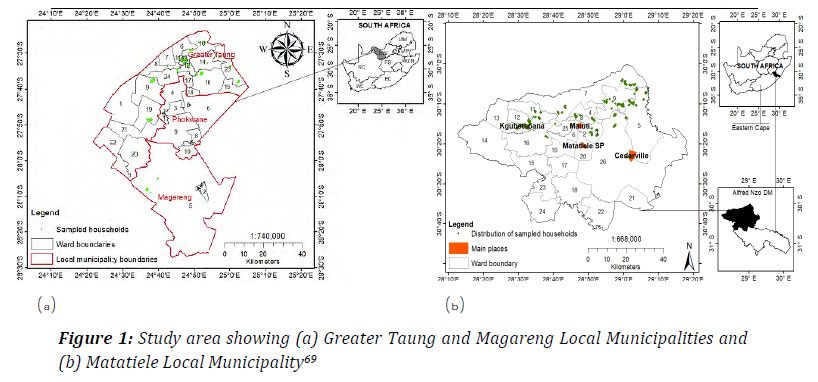
The study was conducted in three rural local municipalities in South Africa, with these being areas which are governed either by traditional leaders or (in one instance) by a communal property association. The three study areas were the Greater Taung Local Municipality (North West Province), Matatiele Local Municipality (Eastern Cape Province), and Magareng Local Municipality (Northern Cape); in regard to the latter, our focus in this municipality was on the Majeng community (Ward 5), which had settled on restituted land. The study, as is evident, was conducted in peri-urban or rural settlements, and not in urban areas. Against that backdrop, the aim of this article is, first, to report on our findings as regards the awareness these communities have of their right to access water, energy and food and their knowledge of public participation instruments, and, secondly, on this basis, to recommend appropriate interventions.
The next section of the article presents a brief overview of the need for awareness of law in general, after which we discuss our methodology and the results of the household surveys in relation to awareness and public participation. The study compares these findings with other empirical studies relevant to awareness of the law. We also indicate the measures we took to increase the communities' awareness of water, energy and food rights and legislation; thereafter, we present our conclusions.
2 THE NEED FOR THE AWARENESS OF LAW IN GENERAL
In relation to the need for the awareness of law, Wintersteiger states that
[l]egal exclusion masks a more insidious process where juridical administrative processes fail. Not only are people unable to understand the law in order to access basic entitlements and fend off actions by more powerful actors, but legal ignorance also concerns the legitimation of the limits of the authority of government; in other words, the capacity to hold power to account involves educated citizens' collective understanding and participation in the legal and political order.15
In his study on human rights awareness in Uganda, Mubangizi refers to legal ignorance in relation to the adage that ignorance of the law is no excuse (ignorantia legis neminem excusat).16 This means that a person cannot merely state that he or she has no knowledge of the law in order to avoid liability;17 a person may rely on this saying only if he or she is bona fide and genuine.18 Popescu questions whether it is still even possible to expect the inhabitants of a country to know its laws, as the law in modern society has become ever more complex.19 In South Africa, the Supreme Court of Appeal has said that in a world where legislation is complex and confusing, and it is not possible for everyone to know every legal rule, it is assumed that when a person works in a specific sphere (for example, a government official working in water, energy and food), he or she should be familiar at least with the law applicable to that sphere,.20 But, as Rowell notes, making the assumption that people know relevant laws and policies without determining whether this is in fact the case
[may] undermine the law's ability to effect its own purposes. Inaccurate presumptions can lead to inaccurate predictions of how people will respond to legal rules and incentives, and can also lead to individualized instances of injustice (where someone is, for example, punished for having acted knowingly when s/he in fact lacked knowledge).21
As stated above, the Constitution specifically provides that everyone has a right of access to sufficient food and water,22 while the Constitutional Court in Joseph v City of Johannesburg23 stated that in particular circumstances a person also has a right to access to energy. These socio-economic rights should be progressively realised. The National Water Act 36 of 1998, the Water Services Act 108 of 1997, and the Electricity Regulation Act 4 of 2006 were, among other such acts, promulgated to give effect to such rights. While there is currently no legislation dealing with access to food or food security, some policy documents do exist in this regard.24
Not everyone, however, is aware of their rights or legislation and policies that regulate water, energy and food (as will be indicated below). Sadly, it seems that, in the past 10 to 15 years of South Africa's history, the government has not managed to deliver in terms of its constitutional responsibilities. South Africa is mired in service delivery protests, inefficiency and corruption, and general inability to deliver. In the initial period after 1994, the government did much to ensure service delivery, but the backlog that has developed over the past 10 to 15 years is prodigious. In 2021, for example, the World Bank reported that while 89.3% of people in South Africa have access to the electricity grid - an increase from 34% in 199425 - not everyone in rural areas has such access. Moreover, only a few local governments received clean audits in 2 0 2 3.26 Local government is subject to extremely complicated legislation that regulates its governance, administration and finances,27 and the complexity of this legislation may have also contributed to slow service delivery.28
With the dawn of democracy and the advent of the 199429 and 1996 Constitutions, the South African Human Rights Commission30 and various non-governmental organisations (NGOs) conducted awareness-raising campaigns on the right to vote as well as the other rights in the Constitution.31 Unfortunately, this was not continued, and it was left instead to the school curriculum to introduce human rights awareness in the Life Skills Orientation module. However, human rights education forms but a small part of the module even though the latter stretches over all school years.32 Several other awareness campaigns on specific rights have been launched, but these have not necessarily reached everyone.33
With that said, the statement that no one knows about their rights may be too broad, as it is clear that people do know that they should have access to services, with most blaming the municipality or local government for not providing them.34 It may also be that people compare the unequal service delivery evident between more affluent areas and their own non-serviced or less well serviced areas.35 What is more, they certainly participate in protests if they do not receive service delivery.36 People also apply for social grants and make use of the indigent policies to obtain a certain free volume of water and/or kilowatts of energy.37
Nevertheless, not everyone has access to the same type of service delivery. Access to water may entail access to a communal tap, and access to energy may be access to electricity that serves only the basic needs of the household; some people may have access to paraffin only.38 Having access to a tap or a borehole does not address the issue of the quality of the water. Our research found that only a few people in rural areas still grow their own food. Those that do not have gardens or fields mentioned a lack of access to water, the quality of water and energy (amongst others) as reasons for not doing so. Access to food seems to be realised via social grants, where some people prefer to buy food rather than to produce it.39
Some South African law faculties40 offer a module called street law which aims to teach students how to explain the law to members of the community in a more comprehensive manner. As the United Kingdom's Law for Life's "A practical guide to public legal education" notes, a mere explanation of the law is not enough and education programmes should increase people's legal capability.41 The objectives of the Law Society's public legal education programme are explained as follows:
Helping to develop people's legal capability therefore involves more than simply explaining the law. We need to help people to: Recognise and frame the legal dimensions of issues and situations; know where and how to seek further legal information and help, have the confidence and motivation to apply this to their own individual legal situation; and be empowered to critically engage with the law.42
As previously mentioned, the areas where we undertook our empirical research fall under the jurisdiction of traditional councils or community property associations.43 The traditional communities have to comply not only with national and provincial legislation and local by-laws, but also with the African indigenous or customary law that regulates their day-to-day lives. Communities' understanding of the law may thus differ from what we as scholars perceive their understanding to be. As Rowell states,
[t]o guide people's behavior effectively via law, it is important to be able to accurately predict how people will understand the law; inaccurate assumptions about people's subjective knowledge undermine that function. Legal policies adopted on the inaccurate assumption that people will know about them may fail in effecting their underlying goals.44
In 2003, Mubangizi conducted a human rights awareness study ("the 2003 study") in two rural areas in the Eastern Cape and one urban area in eThekwini (formerly Durban), KwaZulu-Natal.45 The majority (66.8%) of the respondents indicated that they had heard about the Constitution. Most of the people who had heard of the Constitution lived in urban areas.46 In regard to water and food, Mubangizi found that
79.5% of the respondents thought that not all people in South Africa had access to sufficient food, 12.7% thought they did and 7.9% did not know. 78.1% of the respondents thought that not all people in South Africa had access to sufficient water, 14.5% thought they did and 7.3% said that they did not know.47
Mubangizi indicated in a study in 2015 ("the 2015 study") that people living in rural areas had less understanding of the Constitution and the institutions that need to stress awareness of the Bill of Rights.48 He refers to a 2013 study by the Foundation for Human Rights ("the 2013 study").49 This study found that fewer than 10% of respondents had read the Bill of Rights or had had it read to them.50 More than 58% were of the opinion that government should do more to increase awareness of the Bill of Rights.51 The Foundation undertook a similar study in 2018 ("the 2018 study"), remarking as follows:
Previous surveys have shown that marginalised and vulnerable people are not able to assert these basic human rights because of a lack of knowledge of their rights or of the mechanisms and institutions that have been established to assist them. The extent to which these rights are being promoted, protected and implemented by the state, as well as the extent to which people have access to them in case of need, is highly uneven.52
Foundation for Human Rights SEJA baseline survey report Department of Justice and Constitutional Development (2018). The Department and the Foundation in collaboration with the European Union participate in the Socio-Economic Justice for All Programme (SEJA).
The 2018 study was undertaken on a countrywide-scale, so the outcomes could differ from those found in a study on a smaller scale of, say, a specific rural area; the 2018 study was, in addition, conducted in urban, town, and rural areas. Here, the majority of respondents indicated that they had not heard of the Constitution or the Bill of Rights.53According to this study, 56% of respondents in the Northern Cape were aware of the Constitution and the Bill of Rights, in contrast to 46% of the North West respondents. Only 45% of respondents in the Eastern Cape indicated awareness.54 The 2018 study states that "[a]wareness levels were also looked at according to the lived poverty index55 ... as poverty levels increased, so the awareness levels of the Constitution or Bill of Rights decreased."56 Most of the respondents were unaware of the Chapter 9 institutions that could assist them in asserting their rights.57
Furthermore (as was the case in our study too),58 the respondents in the 2018 study were asked whether they attended ward committee, IDP and community development forum meetings. Approximately 32% of them indicated that they had attended a ward meeting, while only 5% had attended an IDP meeting. About 39% of respondents living in rural areas had attended ward committee meetings.59 Responses to the question of whether it was easy to contact a local councillor differed in relation to the type of housing the respondents lived in, with 52% of respondents living in traditional areas indicating that it was very easy to contact their local councillors.60
In another study on a limited scale relating to water insecurity in the Vhembe district in Limpopo ("the Vhembe study"), Bulled noticed that
[o]ver 80% of participants felt they had a "right to water" and that this right was shared equally by all South Africans, whether residing in urban or rural spaces. A community elder explained her right to water in relation to South Africa's democracy, saying: "Because when I vote, I do it for better services including water." More commonly, participants noted: "Water is the source of life. We cannot live without water. We are also human beings.61
The majority (over 80%) indicated that they report water-quality problems to, inter alia, their traditional leaders, their local water committees, or elected officials. One person said that she does not participate in local water committees as she does not have enough knowledge to do so.62
The awareness of laws demonstrated in the studies above does not differ from the situation in other developing countries. For instance, in a study undertaken in Malaysia to determine whether the youth are aware of youth development laws, only 20% indicated that they were.63 In a study of the awareness of legislation pertaining to wetlands among Zimbabweans living in communal areas, the majority (61.9%) of respondents indicated that they had no knowledge of such laws. The majority also indicated that they would definitely like to know more about them.64 Only 38.2% indicated that they had such knowledge. In 1976 a study by Enright and Quigley on training on public awareness of legislation indicated that the lack of awareness of laws may be attributed to the following:
[s]tudents exposed to these classes tend to view law as primarily prohibitive and punitive and fail to appreciate the value of the legal system for the protection of individual rights, the management of conflict, and the furtherance of social justice.65
In order to understand whether members of rural communities in South Africa have an adequate grasp of their rights in terms of access to water, energy and food and if they are aware of the existence of legislation in this regard, we conducted 1,182 household surveys in three rural areas in South Africa. The survey questions formed part of a larger survey on water-energy-food security in these areas. We also wanted to find out if community members know of the public participation measures that exist and if they feel free to speak their minds (that is, to exercise their freedom of speech) or are instead inhibited by cultural and gender barriers. The research methodology that was followed is discussed below, whereafter the findings are presented.
3 HOUSEHOLD SURVEYS
3.1 Methodology
Two study areas were purposively selected, namely the Matatiele Local Municipality in the Eastern Cape Province and the Vaalharts irrigation scheme area. Two areas in the Vaalharts - the Magareng Local Municipality in the Northern Cape and the Greater Taung Local Municipality in the North West Province - were chosen (see Figure 1). The focus in the Magareng Local Municipality was on the Majeng community, which has received land in restitution and is headed by a communal property association. It is a loosely knit community made up of the descendants of farmers who lost their land due to racially based legislation post-1913.66 As for the Greater Taung Local Municipality, it was chosen because its land area includes three communities falling under the jurisdiction of traditional councils.
The researchers with fieldworkers and ecochamps (as in the case of Matatiele),67conducted 1184 household surveys in August and September 2022. The research team observed standard fieldwork protocols.68
The mayors and municipal managers of the Matatiele and Greater Taung municipalities, as well as senior traditional leaders and the Majeng Communal Property Association, gave permission for the study to be undertaken.70 The questions focused on access to water, energy and food and on decision-making in relation to these resources. As the water-energy-food(WEF) nexus study included a legal component,71 some questions related to awareness of legislation and existing instruments that promote public participation. This article, as noted before, focuses on the latter component of the research.
3.2 Analytical framework on which the questions were based
Before we analyse the answers to the questionnaire, the research methodology needs to be explained. An ordered logit model was used to assess the socio-economic and institutional factors that affect the awareness and knowledge of legislation promoting public participation in water, energy and food decision-making.72, The ordered logit model was chosen in view of the ordered nature or intensity of community members' awareness of water, energy and food legislation. This ranged in level from no awareness at all to "very little", "some", "quite a bit", and "a great deal". The responses were grouped on the basis of this hierarchical categorisation. The ordered logit model was modelled as
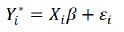
where Yi* is the unobserved value, Xi are explanatory variables, and is the error term. The observation where j can take any observation depending on the level of awareness between 0 (none at all) and 4 (a great deal) is

where μ are the parameters used to estimate β. The summary equation is then as follows:

The probability of selecting an alternative j from an observation i is:

where F is the logistic cdf:
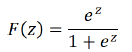
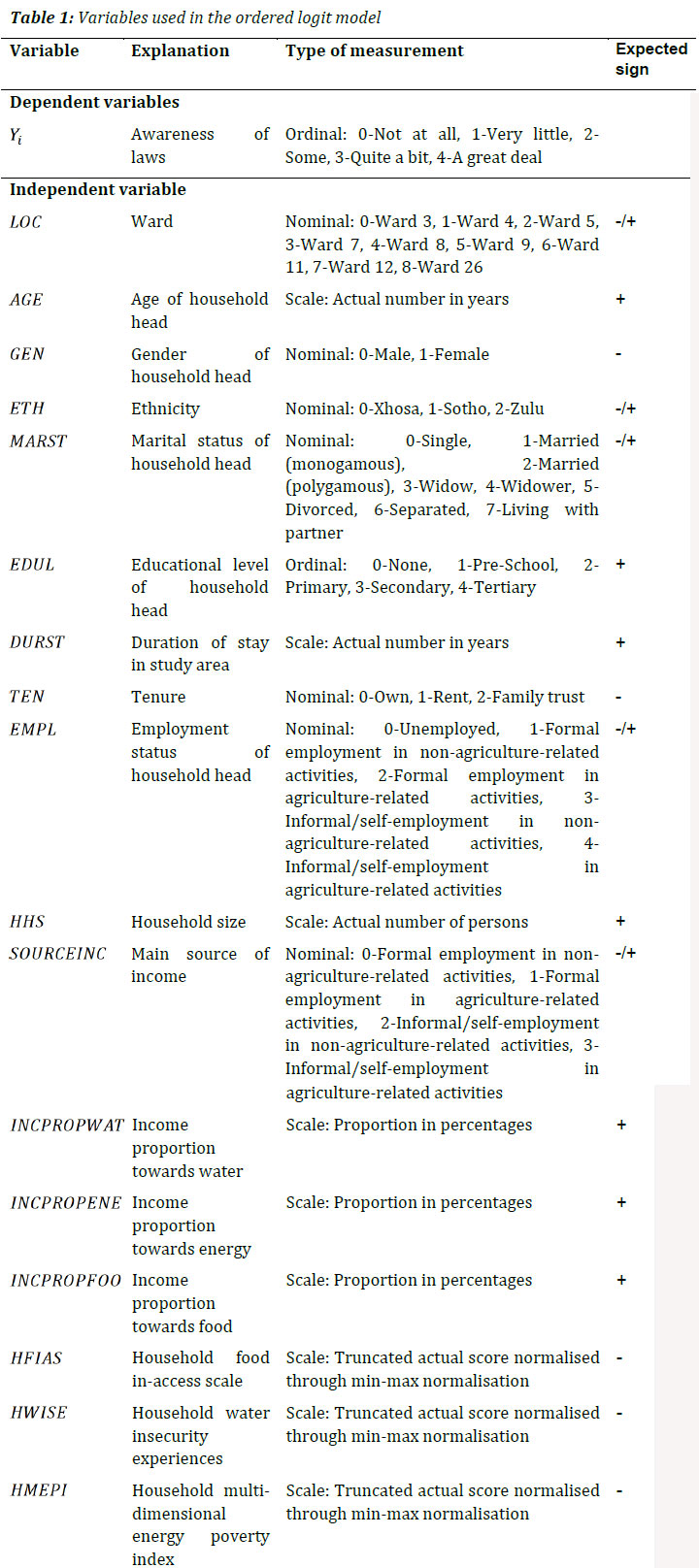
The variables that were used in the ordered logistic model are shown in Table 1. Location, ethnicity, marital status, employment status, and main source of income were hypothesised to be indifferent in their effect on awareness of laws; age, educational level, duration of stay, household size, and proportion of income devoted towards water, energy and food were hypothesised to positively influence awareness of laws; and variables such as gender, tenure, and the household level of water, energy and food insecurity were hypothesised to negatively affect knowledge of laws.
3.3 Knowledge or awareness of laws
The main question relating to the awareness of laws read as follows: "Are you aware of the relevant laws, legislation and regulations concerning water, energy and food (access, equity, diversity, participation and human rights) decisions at the community level?" Of the respondents, 55.41% indicated that they did not know any legislation, 25% that they knew very little about the laws, and 8.53% that they had some knowledge; only 5.91% and 5.15% indicated that they had quite a bit of or a great deal of knowledge.
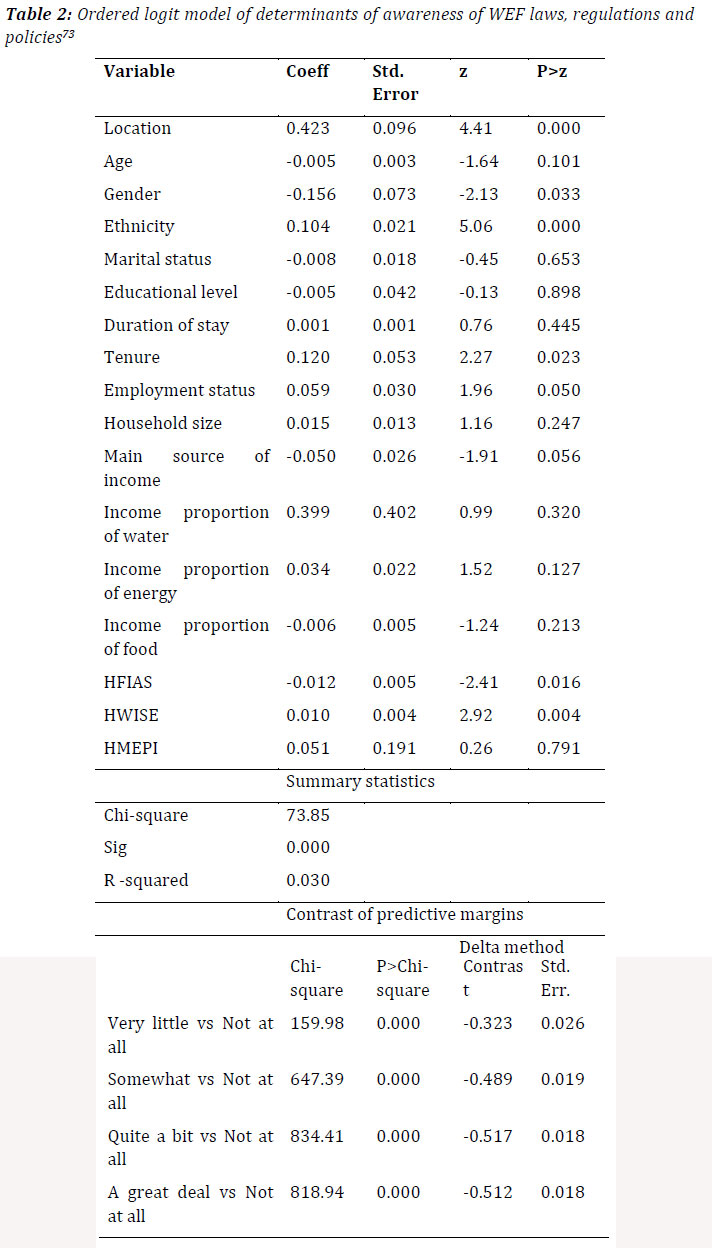
Table 2 shows the determinants of the level of awareness of the laws, regulations and policies concerning WEF. The low R2 indicates that there are other factors that were not included in the model showing the determinants of the level of awareness, even though the overall model was significant at the 1% level. The table shows that location, ethnicity, water insecurity (1% level), gender, tenure, employment status, food insecurity (5% level) and main source of income (10% level) were significant determinants of the level of awareness of WEF laws, regulations and policies.
The majority of respondents were female (63.94%).74 The respondents indicated that 54.14% of females were heading households, in contrast to 45.61% of males. Respondents were predominantly seTswana-, seSotho- and isiXhosa-speakers.75 The education levels of the respondents differed: 41.89% had secondary schooling, 40.62% had primary schooling only, and 8.45% had no schooling at all. Most of them (83.53%) indicated that the household (or a member of the household) "owned" the house. Some reported that it was a family-owned home (14.95%), while 1.52% indicated that they rented the house. In relation to the question, "Are there any women in your household who own or partly own land?", 75.42% of respondents indicated no and 24.58%, yes. We asked those who said yes whether their names appeared in the land ownership and/or rights in land documents76 or were registered with the traditional authority. The 240 respondents who answered this question positively gave mixed answers: 20.27% indicated that this was the case and 17.6% that it was not; 15.2% did not know.
Fully 74.07% of respondents indicated that they were unemployed; only 8.02% were employed in non-agriculture-related activities, while 6.84% indicated they were either working in the informal sector or were self-employed. Some 4.22% had employment in the formal agricultural sector. Of all the respondents, 68.75% indicated that they were dependent on social or pensioner grants. The average household income was R3,460.65.
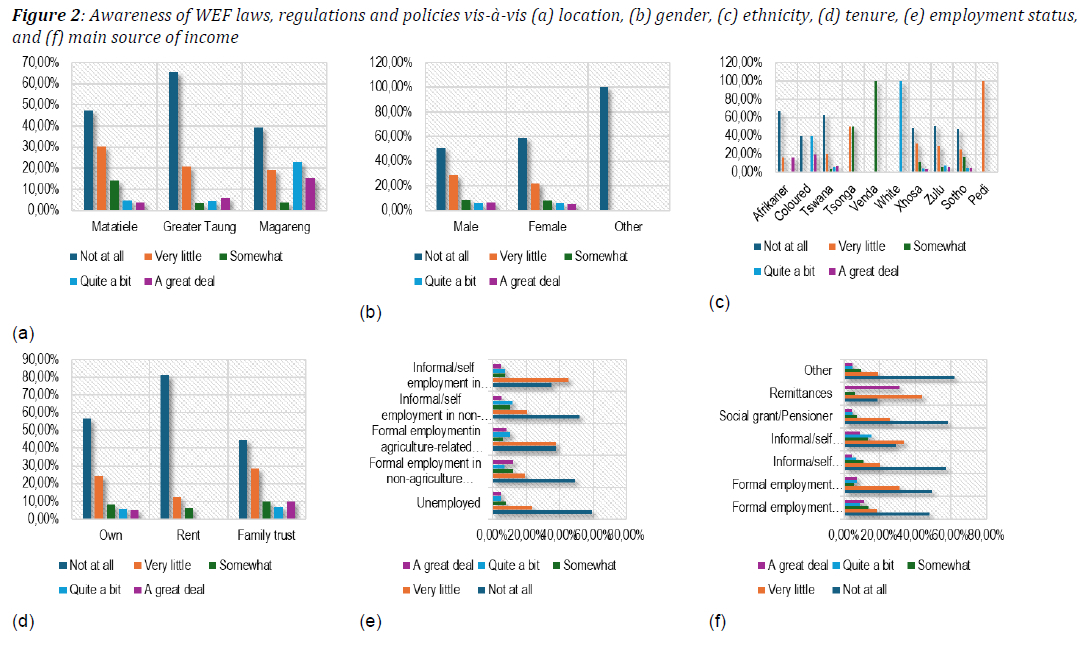
The following paragraphs now focus on the outcome of the questionnaire in relation to awareness of laws in relation to water, energy and food access as well as public participation. The results indicate that respondents from the Magareng and Greater Taung local municipalities were likely to have more knowledge than those from Matatiele. Male respondents were also likely to be more knowledgeable than female ones, as were those who indicated they had owner-tenure; unemployed respondents, as well as those with informal sources of income, were less likely to be knowledgeable.
Figure 2 (overleaf) shows that in all three locations, most of the respondents had very little to no knowledge about water, energy and food laws, regulations and policies. Magareng had the highest number of respondents who had quite a bit and a great deal of knowledge. All genders had a significant number of respondents who had no knowledge, while whites and coloureds had quite a bit of knowledge (it must be noted that the number of white and coloured respondents was extremely low). Regardless of the household tenure, there was little to no knowledge of the laws, while the group with the highest awareness of legislation was those formally employed in non-agricultural and agricultural activities, respectively.
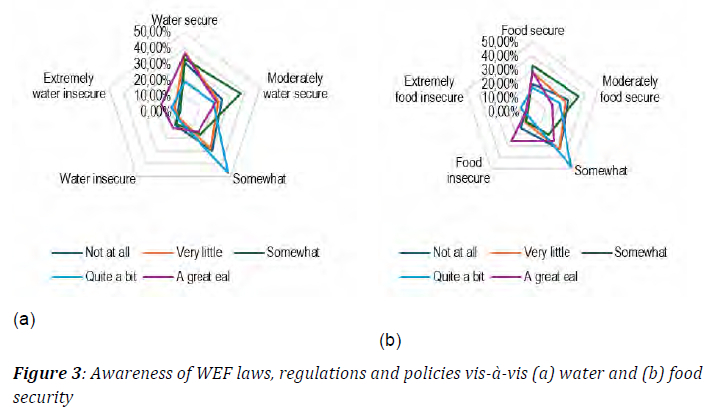
Most of the respondents who were moderately to somewhat water- and food-secure had some and quite a bit of knowledge (Figure 3).
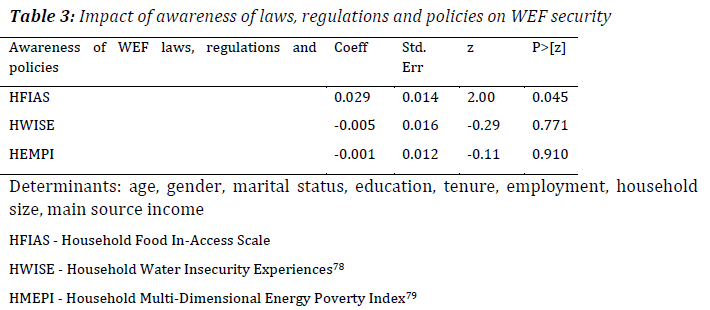
Table 3 shows that awareness of WEF laws, regulations and policies had a significant correlation with on food insecurity. The results indicate that being aware of WEF laws and regulations increases the Household Food in Access Scale (HFIAS)77 by 2.9%.
3.4 Promoting participation
Questions were also posed to determine whether the community participates in local government structures. The majority of respondents (80.74%) indicated that they were aware of the existence of ward committees, while 13.18% did not know of them. These figures changed when we asked about the existence of IDP forums: 42.99% indicated that as far as they were concerned such forums did not exist, 38.85% did not know, and only 18.16% indicated that they knew these forums existed. We also asked if any members of the household were members of such committees: 90.79% of the respondents indicated that none of their household members belonged to these communities.
In order to determine whether members of the household know about their right to freedom of speech and to participate in discussions, we asked them: "Do you feel able and comfortable speaking up in public to help decide on water (like small wells, water supplies, etc.), energy (electrification, alternative energy systems, solar panel instalment, etc.) and food (community land rights, agricultural practices, livestock grazing practices, etc.) related issues in your community?" The options were that they could do so a great deal (31%), quite a bit (14.95%), somewhat (8.09%), very little (16.39%), or not at all (30.57%). The majority of the respondents were seemingly prepared to speak out to assert their rights or ensure service delivery.
As for the question, "Who do you think is responsible for improving water, energy and food security in your community?", 49.16% indicated the local municipality, 30.66% ward committees, 3.97% traditional leaders, 3.12% the district municipality, 1.18% national government, and 0.68% provincial government. Only 11.23% indicated that they should take responsibility themselves. The majority of the respondents seemed to realise that the responsibility for local level service delivery would be with the municipalities, whether the local government, via the ward committees, or the district municipality.80
Respondents were also asked what they saw as the reason for the failure of municipal service delivery.81 The answers varied, but the great majority (72.3%) believed it was due to corruption; 28.12% thought it was due to lack of empowerment, 24.58% due to lack of participation, 15.12% due to inequality, 10.56% due to a lack of cohesion, and 8.61% due to the lack of a right to access to water, energy and food; 9.63% indicated that they did not know.
3.5 Awareness of rights regarding access to water, energy and food
As a follow-up to questions about awareness of legislation, we asked respondents who indicated they were aware of policies whether they had knowledge of any indigent (pro-poor) support policies offering free energy, water and/or food. Here, 47.97% indicated that they did, 30.83% that were unaware of these policies, and 21.2% that they did not know. The next question was: "Which sector has an indigent (pro-poor) policy offering free energy, water and/or food that you are aware of?" Respondents could give more than one answer. Of those who had some or more knowledge, 30.32% indicated that they had knowledge about food, 25% about water, and 23.46% about energy.
When asked if they themselves were beneficiaries of indigent policies, 20.95% indicated that they received free water, 12.33%, free energy, and 9.46%, free food. In the case of respondents who were not beneficiaries, we asked what they thought the reason for this was. They could indicate more than one option. The answers varied again: 42.91% indicated that it was due corruption; 17.15% that it was due to a lack of resources; 11.74% that it was because they were not connected to official water, energy and food amenities; and 10.56% that it was because their household income was more than the allowable income stipulated in the indigent policy; 18.92% indicated that they did not know about the policies, while 8.78% chose to select "other" as the reason.
When asked if these policies were effective, 52.87% stated that they were not and 24.41% that they were but only to a very little extent. On the positive side, 7.85%, 7.6% and 7.26% indicated (respectively) that the policies were somewhat effective, effective a great deal, or effective quite a bit. As to who benefitted from these indigent policies, the answers were again mixed. Some (28.72%) thought that individuals who know influential people or politicians are the ones who benefit; 20.27% did not know; 17.4% said the community (the poor and unrepresented) benefitted; 13.77% thought no one benefitted; 10.39% thought only the rich, the connected, or politicians in the community benefitted; and only 9.46% thought that the poor or unrepresented benefitted. What is clear is that most people are aware of the existence of measures that could be to their benefit but are uncertain about whom these benefits apply to.
As in the earlier studies mentioned above, there is a correlation between education and awareness of laws. At a macro level, it seems that not all people are aware of the Constitution or their specific constitutional rights; indeed, they are mostly unaware of legislation that regulates their daily lives. Still at a macro level, people seem to be unaware of their rights pertaining specifically to water, energy and food, with the exception being the Majeng community members. This may be due to the fact that they actively participated in the restitution process of their land and the establishment of the communal property association.
On a micro level (that is, in regard to what directly impacts on individuals), it seems that most people are aware that municipalities should provide services in one way or another. Some are definitely aware that they can benefit from free water and energy.
This correlates with the fact that more than 70% of the community depends on social grants.
3.6 Comparing the 2013, 2018, 2022, and Vhembe studies
As indicated above in section 2, several studies on awareness of laws have been undertaken over the years, each with their different aims and questions. It is possible to make some deductions, although we acknowledge that the respondents and the questions differ depending on the way a question was phrased. We compared the findings in these studies to determine if people's knowledge of the Constitution and their WEF rights has increased or decreased. The studies show a worrying trend. In the 2013 study, 66.8% of the respondents indicated that they had knowledge of the Constitution, whereas in the 2018 study, only 10% indicated that they had read the Bill of Rights, with 58% indicating that they needed more knowledge. Moreover, the 2018 study found that the majority of respondents had no knowledge of the Constitution; more specifically, 56% in the Northern Cape, 46% in the North-West, and 45% in the Eastern Cape indicated that they had no knowledge.
Our own empirical study, conducted in 2022, finds that 54.1% of respondents had no knowledge of their WEF rights and that only 5.15% indicated that they had knowledge in this regard. A smaller study in Vhembe in relation to water - the Vhembe study noted earlier - indicated that 80% of this community were knowledgeable about their right to water, with some relying on indigenous knowledge. Our research was also undertaken in areas under traditional authorities, but the questions did not focus on traditional law; as such, a study that focuses in particular on traditional customs and practices may deliver different results.82
A similar comparison can be made in relation to public participation structures. The 2018 study found that 32% of respondents attend ward council meetings. In the rural areas, 39% indicated that it is easy to contact their ward councillor. In the Vhembe study, 80% of the community reported their water issues to the traditional leader, water committees and elected ward councillors. In the 2018 study, only 5% indicated that they attend IDP meetings. Our empirical research in the selected areas indicated that 80.74% of respondents were aware of the existence of ward committees, while 42.99% indicated that they had no idea about IDP forums. Our research also finds that more than 70% of respondents indicated that they know that the municipality must provide services to the community - however, they do not necessarily have knowledge about the specific municipality (local or district) that they need to approach.
All in all, despite efforts to raise awareness, there has been a decline in knowledge about the Constitution, which is disconcerting. It seems that even well after 1996 (the year in which South Africa adopted its Constitution), people do not know how to realise their rights in relation to water, energy and food. This is especially true in some of the country's rural areas, where poverty and lack of access to resources are common.
4 RAISING AWARENESS IN THE STUDY-SITE RURAL COMMUNITIES
During our initial field-shops and discussions with community members, we realised that their knowledge of the law was a challenge, which was one of the reasons why we added the above questions to the questionnaire. We also designed pamphlets with information on the communities' rights, and indicated where residents could report challenges with water, energy and food. These pamphlets were translated into the three languages most commonly used in the areas where the research was conducted. We trained fieldworkers in the Majeng and Greater Taung local municipality on the contents of the pamphlets; they then had to provide information to their communities by way of addressing community meetings, schools, church groups or individuals on the contents of the pamphlets. This work was conducted from June 2023 onwards.
A similar process was followed in the Matatiele area under the auspices of Dr Leocadia Zhou and Dr Patrick Nyambo of the University of Fort Hare. The eco-champs of the NGO Environmental Rural Solutions (ERS) explained the law to communities either at household level or at public meetings.
In addition, we conducted a workshop in the Vaalharts area with community members, fieldworkers, traditional leaders, councillors of municipalities, schoolmasters, representatives of schools and the water use association, amongst other organisations. Approximately 100 people attended the workshop. We made them aware of their rights in the Constitution as well as the legislation that applies in the case of water, energy and food. We also gave all communities posters for their traditional offices and delivered posters at municipal offices or libraries. Each traditional leader, as well as the mayor or municipal manager, received a full version of the status quo report on the law, and each person attending the workshop received a summary of the applicable legislation.
Although we know this is a drop in the ocean, we still need to develop policy briefs, as well as more posters and pamphlets, to make these communities aware of their rights; we also have to inform them about multi-actor decision-making and how to establish water-energy-food communities to work towards social justice. Thinking more broadly, more should be done to make communities and individuals aware of their rights and responsibilities under the Constitution, otherwise there will still be legal exclusion.
5 CONCLUDING REMARKS
People should have knowledge at least of their basic rights and how to access the opportunities that come with these rights. As mentioned, it is no longer possible to have knowledge of all laws and legislation, but one should have knowledge of those laws that could improve one's life and well-being, as in this instance, where our project aims to propose ways to establish water-energy-food communities in South Africa to increase the delivery of social justice.
What is true, however, is that if community members are unaware of their rights, the legislation that regulates their access to these resources as well as the instruments available to enable them to realise the rights will not succeed. The courts will require that one have at least some basic knowledge of the law in which one operates. That would be true for the community members who will be involved in such an endeavour.83 Continuous training will have to be undertaken in this regard, especially if the original community members are no longer available. It cannot be presumed that such a community will continue to understand and apply the law.
If the study that Rowell undertook in the USA is applicable to South Africa, then there is hope, as he states that "[w]here there is a gap between people's subjective legal beliefs and formal legal rules, the subjective belief - rather than the rule itself - should be understood as the primary driver of incentives". 84 Likewise, for South Africans to accept that the law can assist them in realising their rights, they should perceive that the law can achieve this.
BIBLIOGRAPHY
Books
Coetzee JH Onshore unconventional natural gas in South Africa: regulating the water-energy-food nexus (PhD University of Tilburg 2024) 72-137. [ Links ]
Steytler N and De Visser J Local government law of South Africa LexisNexis: Durban (2007 annually updated) [ Links ]
Journal articles
Arthur J "The information legislation (PAIA, POPI, RICA) awareness of undergraduate university students: A longitudinal study" 2021 23(1) South African Journal of Information Management 1363 [ Links ]
Bulled N "The effects of water insecurity and emotional distress on civic action for improved water infrastructure in rural South Africa" (2016) 31(1) Medical Anthropology Quarterly 133-154 [ Links ]
Enright WB & Quigley CN "Increasing public awareness of the law and legal system" (1976) 51(4) California State Bar Journal 299-347 [ Links ]
Fuo O "Local government indigent policies in the pursuit of social justice in South Africa through the lenses of Fraser" (2014) 25(1) Stellenbosch Law Review 187-208 [ Links ]
Fuo O "Role of courts in interpreting local government's environmental powers in South Africa" (2015) 18 Commonwealth Journal on Local Governance 4840 [ Links ]
Laili YA, Azhar A, Ayub ZA, Abdullah SAJ, Arshad R & Suhaimi S "Youth awareness on youth development law" (2016) 6(7) International Review of Management and Marketing 277-281 [ Links ]
Marambanyika T & Beckedahl H "The missing link between awareness and the implementation of wetland policy and legislation in communal areas of Zimbabwe" (2016) 24 Wetlands Ecology and Management 545-563 available at https://doi.org/10.1007/s11273-016-9486-y (accessed 27 July 2023) [ Links ]
Monyei C, Adewumi AO & Jenkins KEH "Energy (in)justice in off-grid rural electrification policy: South Africa in focus" (2018) 44 Energy Research & Social Science 152-171 [ Links ]
Mubangizi JC "Human rights education in South Africa: Whose responsibility is it anyway?" (2015) 15(2) African Human Rights Law Journal 496-514 [ Links ]
Mubangizi JC "Protection of human rights in South Africa: Public awareness and perceptions" (2004) 29(1) Journal for Juridical Science 62-87 [ Links ]
Mubangizi JC "The protection of human rights in Uganda: Public awareness and perceptions" (2005) 3 African Journal of Legal Studies 168-186 [ Links ]
Mwakatumbula H, Moshi GC & Mitomo H "Determinants of consumers' knowledge on their rights in telecommunication markets: Case of Tanzania" (2016) 7(2) International Journal of Managing Public Sector Information and Communication Technologies 9-21 [ Links ]
Piyong J, Kanitpong K, Samranjit S, et al "Does law enforcement awareness affect motorcycle helmet use? Evidence from urban cities in Thailand" (2013) 20(3) Global Health Promotion 1714-1724 [ Links ]
Popescu A "The right to legislative information correlated with the nemo censetur ignorare legem principle" (2019) 5(9) Journal of Law and Public Administration 107113 [ Links ]
Rejekiningsih T "Law awareness forming strategies to reinforce the principles of social function of land rights within the moral dimension of citizenship" (2015) 211 Procedia -Social and Behavioral Sciences 69-74 [ Links ]
Rowell A "Legal knowledge, belief, and aspiration" (2019) 51 Arizona State Law Journal 225-291 [ Links ]
Simmonds S and Du Preez P "Discourses shaping human rights education research in South Africa: future considerations" 2017 31(6) South African Journal of Higher Education 9-24 available at https://www.journals.ac.za/index.php/sajhe/article/view/1635 (accessed 20 February 2025) [ Links ]
Skrypniuk OV, Onishchenko NM & Parkhomenko NM "Awareness in law as strategical direction of legal policy" (2019) 10(5) Journal of Advanced Research in Law and Economics 1534 [ Links ]
Van Diemen E "Gordhan promises that 'even if the long wires don't come, electricity will come' at launch of containerised microgrid project" (21 July 2023) Daily Maverick available at https://www.dailymaverick.co.za/article/2023-07-21-gordhan-promises-that-even-if-the-long-wires-dont-come-electricity-will-come/ (accessed 23 July 2023) [ Links ]
Van Niekerk A, Kimemia D, Seedat M & Annegarn H "Energy impoverishment and burns: The case for an expedited, safe and inclusive energy transition in South Africa" (2022) 118(3/4) South African Journal of Science [ Links ]
Viljoen G, Mauger R, Mugadza A, Rantlo J & Du Plessis W "Water-energy-food communities in South Africa: Exploring multi-actor governance instruments contributing to social justice" (2024) European Journal of Comparative Law and Governance (accepted) [ Links ]
Wintersteiger L "Legal education beyond the academy: The neoliberal reorientation of public legal education" (2019) 30 Law and Critique 123-129 [ Links ]
Legislation
Bela Bela Indigent Support By-Law 2021/2022
Communal Property Association Act 28 of 1996 (GN849, GG 17205, 22 May 1996) available at https://www.gov.za/sites/default/files/gcis_document/201409/act28of1996.pdf (accessed 24 February 2025)
Constitution of the Republic of South Africa Act 200 of 1993
Constitution of the Republic of South Africa, 1996
Local Government Municipal Systems Act (32/2000) Mbizana Local Municipality Africa Indigent Support By-Law Local Authority Notice No. 56 of 2017 (GN 3830, 24 April 2017) available at https://www.greengazette.co.za/notices/local-government-municipal-systems-act-32-2000-mbizana-local-municipality-indigent-support-by-law_20170424-ECP-03830-00056.pdf (accessed 24 February 2025)
Local Government: Municipal Finance Management Act 56 of 2003 (GN 464, GG 26019, 13 February 2004) available at https://www.gov.za/sites/default/files/gcis_document/201409/a56-03.pdf (accessed 24 February 2025)
National Water Act 36 of 1998 (GN 1091, GG 19182, 26 August 1998) available at https://www.gov.za/sites/default/files/gcis_document/201409/a36-98.pdf (accessed 24 February 2025)
South African Human Rights Commission Act 40 of 2013 (GN583, GG 37253, 22 January 2014) available at https://www.gov.za/sites/default/files/gcis_document/201409/37253act40of2013sa-humanrightscom22jan2014.pdf (accessed 24 February 2025)
Traditional and Khoi-San Leadership Act 3 of 2019 (and its predecessors) (GN 1550, GG 42865, 28 November 2019) available at https://www.gov.za/sites/default/files/gcis_document/201911/4286528-11act3of2019tradkhoisanleadership.pdf (accessed 24 February 2025)
Water Services Act 108 of 1997 (GN1662, GG 18522, 19 December 1997) available at https://www.gov.za/sites/default/files/gcis_document/201409/a108-97.pdf (accessed 24 February 2025)
Government policies
Alfred Nzo District Municipality Indigent Assistance Policy (July 2009)
Department of Energy "Free Basic Electricity (FBE) Services by Municipalities as Service Authorities" - Gen Not 1693 in GG 25088 of 4 July 2003
Department of Energy "Free basic electricity (FBE) services by municipalities as service authorities" (GN 1693 in GG 25088, 4 July 2003)
Department of Water Affairs and Forestry Free basic water implementation strategy 2007: Consolidating and maintaining Version 4 (April 2007) available at https://www.gov.za/sites/default/files/gcis_document/201409/fbw-strategy-version-4-final-20070402-mk0.pdf (accessed 29 August 2023)
Department of Women, Youth and Persons with Disabilities "Awareness-raising campaigns framework" (GN 2687 in GG 47373 of 28 October 2022) available at https://www.gov.za/sites/default/files/gcis_document/202210/47373gon2687.pdf (accessed 24 February 2024)
Department of Agriculture Integrated Food Security Strategy for South Africa (2002) available at https://www.gov.za/sites/default/files/gcis_document/201409/foodpol0.pdf (accessed 1 April 2025)
Department of Agriculture, Forestry and Fisheries National Policy for Food and Nutrition Security (2013) available at https://www.gov.za/documents/national-policy-food-and-nutrition-security-south-africa (accessed 1 April 2025)
Department: Provincial Government and Local Government National framework for municipal indigent policies (2012) available at https://d7.westerncape.gov.za/text/2012/11/national_framework_for_municipal_indigent_policies.pdf (accessed 13 July 2023)
Electricity basic services support tariff (free basic electricity) (GN 1693, GG 25088, 4 July 2003) available at https://www.gov.za/sites/default/files/gcis_document/201409/250880.pdf (accessed 20 February 2025)
Free basic alternative energy policy: Households energy support programme (GN 391, GG 27690, 2 April 2007) available at https://www.gov.za/sites/default/files/gcis_document/201409/29760.pdf (accessed 20 February 2025)
Integrated National Electrification Programme (n.d.) at https://www.gov.za/about-government/government-programmes/inep (accessed 23 July 2023)
Case law
S v De Blom 1977 (3) SA 513 (A)
Joseph v City of Johannesburg 2010 (4) SA 53 (CC)
Mogale v Speaker of the National Assembly 2023 (9) BCLR 1099 (CC)
Coetzee v Steenkamp (579/2009) [2010] ZANCHC 25 (18 June 2010)
Oliphant v Jonck (09/21910) [2016] ZAGPJHC 76 (30 March 2016)
Reports
Auditor-General of South Africa Consolidated general report on local government audit outcomes MFMA 2021-2022 (31 May 2023) [ Links ]
Conway D & Euston-Brown M Interim off-grid solar electricity for un-electrified informal settlements Sustainable Energy Africa Policy Briefing: Urban Energy (April 2018) [ Links ]
Foundation for Human Rights Report of the AJPCR baseline survey on awareness of, attitude and access to constitutional rights Johannesburg: Foundation for Human Rights (2015) [ Links ]
Foundation for Human Rights SEJA baseline survey report Department of Justice and Constitutional Development (2018) [ Links ]
South African Human Rights Commission Review of regulatory, compliance and reporting burdens imposed on local government by legislation Project 146 Issue Paper 37 (31 July 2019) [ Links ]
Internet sources
"SA's social assistance programmes effective in mitigating poverty" SANews (7 October 2021) available at https://www.sanews.gov.za/africa-south-africa-world/sas-social-assistance-programmes-effective-mitigating-poverty (accessed 13 July 2023) [ Links ]
Amnesty International "Poor service delivery deprives people of dignity and their basic human rights" (5 July 2021) available at https://amnesty.org.za/poor-service-delivery-deprives-people-of-dignity-and-their-basic-human-rights/ (accessed 25 September 2023). [ Links ]
Department of Justice "Measures taken by South Africa to promote and ensure the respect of human rights through teaching, education and publication in accordance with article 25 of the Charter - Chapter 4" (n.d.) available at https://www.justice.gov.za/policy/african%20charter/afr-charter04.html (accessed 25 September 2023) [ Links ]
Felja D, Thorpe T, Feruglio F & Milligan R "A practical guide to public legal education" Law for Life (September 2020) available at https://www.advicenow.org.uk/lawforlife/blog/practical-guide-to-public-legal-education/ (accessed 23 July 2023) [ Links ]
Food and Agricultural Organization (FAO) "Land & Water - Water-energy-food nexus" (n.d.) available at https://www.fao.org/land-water/water/watergovernance/waterfoodenergynexus/en/ (accessed 1 April 2025). [ Links ]
Martin G "900 service delivery protests in South Africa over six months" (20 April 2021) DefenceWeb available at https://www.defenceweb.co.za/featured/900-service-delivery-protests-in-south-africa-over-six-months/ (accessed 25 September 2023) [ Links ]
Masson E "Data shows that service delivery protests will increase, intensify in 2023" (2 February 2023) Mail & Guardian available at https://mg.co.za/news/2023-02-02-data-shows-that-service-delivery-protests-will-increase-intensify-in-2023/ (accessed 25 September 2023) [ Links ]
One World Group Majeng integrated development planning: Business plan submitted to the Commission on Restitution of Land Rights: Regional Land Claims Commission Free State and Northern Cape (January 2011) available at https://oneworldgroup.co.za/wp-content/uploads/2014/12/OneWorld.-2011.-Majeng-Integrated-Development-Planning-Business-Plan.-OneWorld-Sustainable.pdf (accessed 22 September 2023) [ Links ]
South African Government "Highlights of the State of the Nation Address 2023 - social security" (9 February 2023) available at https://www.gov.za/SONA2023-highlights-social-security (accessed 24 February 2024) [ Links ]
South African Government "How do I access free basic municipal services?" (n.d.) available at https://www.gov.za/faq/government-services/how-do-i-access-free-basic-municipal-services#:~:text=The%20services%20currently%20include%20water,qualify%20for%20free%20basic%20services (accessed 24 September 2023) [ Links ]
South African Government "How do I apply for a social grant?" available at https://www.gov.za/faq/services/how-do-i-apply-social-grant (accessed 29 August 2023) [ Links ]
StatsSA "Beyond unemployment - Time-related underemployment in the SA labour market" (16 May 2023) available at https://www.statssa.gov.za/?p=16312#:~:text=South%20Africa's%20unemployment%20rate%20in,the%20fourth%20quarter%20of%202022 (accessed 25 September 2023) [ Links ]
Visagie J, Turok I and Swartz S "What lies behind social unrest in SA and what might be done about it" (22 August 2022) Sunday Times available at https://www.timeslive.co.za/sunday-times-daily/opinion-and-analysis/2021-08-22-what-lies-behind-social-unrest-in-sa-and-what-might-be-done-about-it/ (accessed 25 September 2023) [ Links ]
1 Section 27.
2 National Water Act 36 of 1998 (GN 1091, GG 19182, 26 August 1998) available at https://www.gov.za/sites/default/files/gcis_document/201409/a36-98.pdf (accessed 24 February 2025); Water Services Act 108 of 1997 (GN1662, GG 18522, 19 December 1997) available at https://www.gov.za/sites/default/files/gcis_document/201409/a108-97.pdf (accessed 24 February 2025).
3 There are policies on food security but no legislation exists to address this aspect.
4 Section 156 read with Schedules 4B and 5B of the Constitution.
5 Section 15(1)(c) of the Constitution. See in this regard Department: Provincial Government and Local Government National framework for municipal indigent policies (2012) available at https://d7.westerncape.gov.za/text/2012/11/national_framework_for_municipal_indigent_policies.pdf (accessed 13 July 2023). See also Fuo O "Role of courts in interpreting local government's environmental powers in South Africa" (2015) 18 Commonwealth Journal on Local Governance 4840; Fuo O "Local government indigent policies in the pursuit of social justice in South Africa through the lenses of Fraser" (2014) 25(1) Stellenbosch Law Review 187.
6 Budgets to be submitted in terms of Local Government: Municipal Finance Management Act 56 of 2003 (GN 464, GG 26019, 13 February 2004) available at https://www.gov.za/sites/default/files/gcis_document/201409/a56-03.pdf (accessed 24 February 2025). See also Alfred Nzo District Municipality Indigent Assistance Policy (July 2009); Local Government Municipal Systems Act (32/2000) Mbizana Local Municipality Africa Indigent Support By-Law Local Authority Notice No. 56 of 2017 (GN 3830, 24 April 2017) available at https://www.greengazette.co.za/notices/local-government-municipal-systems-act-32-2000-mbizana-local-municipality-indigent-support-by-law_20170424-ECP-03830-00056.pdf (accessed 24 February 2025); Bela Bela Indigent Support By-Law 2021/2022.
7 The Electricity Supply Commission (original name in Afrikaans: Kommissie), referred to as Eskom Holdings SOC Ltd, was established in 1922, but currently functions in terms of the Eskom Conversion Act 13 of 2001.
8 See, for example, Department of Water Affairs and Forestry Free basic water implementation strategy 2007: Consolidating and maintaining Version 4 (April 2007) available at https://www.gov.za/sites/default/files/gcis_document/201409/fbw-strategy-version-4-final-20070402-mk0.pdf (accessed 29 August 2023); Free basic alternative energy policy: Households energy support programme (GN 391, GG 29760, 2 April 2007) available at https://www.gov.za/sites/default/files/gcis_document/201409/29760.pdf (accessed 20 February 2025); Electricity basic services support tariff (free basic electricity) (GN 1693, GG 25088, 4 July 2003) available at https://www.gov.za/sites/default/files/gcis_document/201409/250880.pdf (accessed 20 February 2025). See also Conway D & Euston-Brown M Interim off-grid solar electricity for un-electrified informal settlements Sustainable Energy Africa Policy Briefing: Urban Energy (April 2018).
9 See South African Government "How do I apply for a social grant?" available at https://www.gov.za/faq/government-services/how-do-i-apply-social-grant (accessed 29 August 2023).
10 South African Government "Highlights of the State of the Nation Address 2023 - social security" (9 February 2023) available at https://www.gov.za/SONA2023-highlights-social-security (accessed 24 February 2024). See also "SA's social assistance programmes effective in mitigating poverty" (7 October 2021) SANews available at https://www.sanews.gov.za/africa-south-africa-world/sas-social-assistance-programmes-effective-mitigating-poverty (accessed 13 July 2023).
11 StatsSA "Beyond unemployment - Time-related underemployment in the SA labour market" (16 May 2023) available at https://www.statssa.gov.za/?p=16312#:~:text=South%20Africa's%20unemployment%20rate%20in,the%20fourth%20quarter%20of%202022 (accessed 25 September 2023).
12 This work is based on research supported by the National Research Foundation (NRF) of South Africa and the Dutch Research Council (de Nederlandse Organisatie voor Wetenschappelijk Onderzoek - NWO) Project UID 129352, entitled 'Water-Energy-Food communities in South Africa: multi-actor nexus governance for social justice?'. The NRF and NWO are thanked for their financial contribution. Any opinion, finding, conclusion or recommendation expressed in this material is that of the authors; the NRF and NWO do not accept any liability in this regard.
13 The grant was allocated to four universities in South Africa and the Netherlands: Utrecht University, Groningen University, the University of Fort Hare, and North-West University. It is an interdisciplinary project and the participants include lawyers, agricultural scientists, agricultural economists, geographers, systems governance specialists, and water scientists.
14 This research was conducted with ethical clearance - Ethics number: NWU-01216-21-A3, approval by the North-West University Faculty of Law Ethics Committee.
15 Wintersteiger L "Legal education beyond the academy: The neoliberal reorientation of public legal education" (2019) 30 Law and Critique 123 available at https://doi.org/10.1007/s10978-019-09244-9 (accessed 25 August 2023).
16 Mubangizi JC "The protection of human rights in Uganda: Public awareness and perceptions" (2005) 3 African Journal of Legal Studies 169. See also Wintersteiger (2019) at 126; Rowell A "Legal knowledge, belief, and aspiration" (2019) 51(1) Arizona State Law Journal 225 at 227.
17 See, for example, Sv De Blom 1977 (3) SA 513 (A); Coetzee v Steenkamp (579/2009) [2010] ZANCHC 25 (18 June 2010).
18 In Oliphant v Jonck (09/21910) [2016] ZAGPJHC 76 (30 March 2016), the court states at para 26 that the excuse must be "genuine and bona fide".
19 Popescu A "The right to legislative information correlated with the nemo censetur ignorare legem principle" (2019) 5(9) Journal of Law and Public Administration 107. See also Arthur J "The information legislation (PAIA, POPI, RICA) awareness of undergraduate university students: A longitudinal study" 2021 23(1) South African Journal of Information Management 1363 available at https://doi.org/10.4102/sajim.v23i1.1363 (accessed 30 August 2023).
20 S v De Blom 1977 (3) SA 513 (A) 514E-F.
21 Rowell (2019) at 229.
22 Section 27.
23 Joseph v City of Johannesburg 2010 (4) SA 53 (CC).
24 See, for example, the Integrated Food Security Strategy for South Africa (2002) and the National Policy for Food and Nutrition Security (2013).
25 This followed as a result of the implementation of the Integrated National Electrification Programme (INEP) as well as a Non-Grid Electrification Programme, which includes access to solar energy. See Van Diemen E "Gordhan promises that 'even if the long wires don't come, electricity will come' at launch of containerised microgrid project" (21 July 2023) Daily Maverick available at https://www.dailymaverick.co.za/article/2023-07-21-gordhan-promises-that-even-if-the-long-wires-dont-come-electricity-will-come/ (accessed 23 July 2023); South African Government Department: Mineral Resources and Energy "Integrated National Electrification Programme" (n.d.) available at https://www.ameu.co.za/INEP%20PROCESSES%20and%20PROGRESS%202022%20-%20SIP09%20AND%20SIP10.pdf#:~:text=The%20Integrated%20National%20Electrification%20Programme%20%28INEP%29%20is%20responsible,on%20their%20own%20to%20receive%20access%20to%20electricity (accessed 23 July 2023).
26 Auditor-General of South Africa Consolidated general report on local government audit outcomes MFMA 2021-2022 (31 May 2023).
27 South African Human Rights Commission Review of regulatory, compliance and reporting burdens imposed on local government by legislation Project 146 Issue Paper 37 (31 July 2019); Steytler N and De Visser J Local government law of South Africa LexisNexis: Durban (2007 annually updated) at chapters 11-14.
28 South African Human Rights Commission (2019).
29 Constitution of the Republic of South Africa Act 200 of 1993 (also referred to as the Interim Constitution).
30 Chapter 9 institution. Section 184 of the Constitution read with South African Human Rights Commission Act 40 of 2013. Section 184(1)(a) and (b) states that the SAHRC "must promote respect for human rights and a culture of human rights", as well as promote the "development and attainment of human rights". The Commission is obliged to educate South Africans on their rights (s 184(2)).
31 Department of Justice "Measures taken by South Africa to promote and ensure the respect of human rights through teaching, education and publication in accordance with article 25 of the Charter - Chapter 4" (n.d.) available at https://www.justice.gov.za/policy/african%20charter/afr-charter04.html (accessed 25 September 2023).
32 See also Simmonds S & Du Preez P "Discourses shaping human rights education research in South Africa: Future considerations" 2017 31(6) South African Journal of Higher Education 9.
33 See, for example, the Department of Women, Youth and Persons with Disabilities "Awareness-raising campaigns framework" (GN 2687 in GG 47373, 28 October 2022) available at https://www.gov.za/sites/default/files/gcis_document/202210/47373gon2687.pdf (accessed 24 February 2024).
34 Martin G "900 service delivery protests in South Africa over six months" (20 April 2021) DefenceWeb available at https://www.defenceweb.co.za/featured/900-service-delivery-protests-in-south-africa-over-six-months/ (accessed 25 September 2023); Masson E "Data shows that service delivery protests will increase, intensify in 2023" (2 February 2023) Mail & Guardian available at https://mg.co.za/news/2023-02-02-data-shows-that-service-delivery-protests-will-increase-intensify-in-2023/ (accessed 25 September 2023).
35 Visagie J, Turok I & Swartz S "What lies behind social unrest in SA and what might be done about it" (22 August 2022) Sunday Times available at https://www.timeslive.co.za/sunday-times-daily/opinion-and-analysis/2021-08-22-what-lies-behind-social-unrest-in-sa-and-what-might-be-done-about-it/ (accessed 25 September 2023).
36 Amnesty International "Poor service delivery deprives people of dignity and their basic human rights" (5 July 2021) available at https://amnesty.org.za/poor-service-delivery-deprives-people-of-dignity-and-their-basic-human-rights/ (accessed 25 September 2023).
37 South African Government "How do I access free basic municipal services?" (n.d.) available at https://www.gov.za/faq/government-services/how-do-i-access-free-basic-municipal-services#:~:text=The%20services%20currently%20indude%20water,qualify%20for%20free%20basic %20services (accessed 24 September 2023).
38 Department of Energy "Free basic electricity (FBE) services by municipalities as service authorities" (GN 1693 in GG 25088, 4 July 2003).
39 See also Monyei C, Adewumi AO & Jenkins KEH "Energy (in)justice in off-grid rural electrification policy: South Africa in focus" (2018) 44 Energy Research & Social Science 152.
40 For example, the LLB programmes of the University of KwaZulu Natal and the North-West University, amongst others.
41 Felja D, Thorpe T, Feruglio F & Milligan R "A practical guide to public legal education" (September 2020) Law for Life available at https://www.advicenow.org.uk/lawforlife/blog/practical-guide-to-public-legal-education/ (accessed 23 July 2023).
42 Van Niekerk A, Kimemia D, Seedat M & Annegarn H "Energy impoverishment and burns: The case for an expedited, safe and inclusive energy transition in South Africa" (2022) 118(3/4) South African Journal of Science.
43 Established in terms of the Traditional and Khoi-San Leadership Act 3 of 2019 (and its predecessors) and the Communal Property Association Act 28 of 1996. The 2019 Act was declared unconstitutional but remains in place until new legislation has been promulgated. See Mogale v Speaker of the National Assembly 2023 (9) BCLR 1099 (CC).
44 Rowell (2019) at 229-230.
45 Mubangizi JC "Protection of human rights in South Africa: Public awareness and perceptions" (2004) 29(1) Journal for Juridical Science 62.
46 Mubangizi (2004) at 67.
47 Mubangizi (2004) at 75.
48 Mubangizi JC "Human rights education in South Africa: Whose responsibility is it anyway?" (2015) 15(2) African Human Rights Law Journal 496.
49 He is referring to the Foundation for Human Rights Baseline survey: Awareness of, and attitudes to human rights (April 2013), which was not accessible to the authors at the time. See also Foundation for Human Rights Report of the AJPCR baseline survey on awareness of, attitude and access to constitutional rights Johannesburg: Foundation for Human Rights (2015).
50 Mubangizi (2015) at 505.
51 Mubangizi (2015) at 505.
52 Foundation for Human Rights SEJA baseline survey report Department of Justice and Constitutional Development (2018). The Department and the Foundation in collaboration with the European Union participate in the Socio-Economic Justice for All Programme (SEJA).
53 Foundation for Human Rights (2018) at 38.
54 Foundation for Human Rights (2018) at 40.
55 The lived poverty index is based on questions "about how frequently people actually go without basic necessities during the course of a year." The questionnaire focused on the last 12 months of such experiences. The questions were phrased as follows: "how often in the past 12 months they or anyone else in their household had gone without(a) Enough food to eat, (b) Enough clean water for home use; (c) Medicines or medical treatment when needed ; (e) Enough fuel to cook their food; (f) Any cash income and (g) Electricity in their home (except for load shedding)." See Foundation for Human Rights (2018) at 40.
56 Foundation for Human Rights (2018) at 40.
57 Foundation for Human Rights (2018) at 41.
58 See the discussion below.
59 Foundation for Human Rights (2018) at 54-55.
60 Foundation for Human Rights (2018) at 58.
61 Bulled N "The effects of water insecurity and emotional distress on civic action for improved water infrastructure in rural South Africa" (2016) 31(1) Medical Anthropology Quarterly 133 at 144.
62 Bulled (2016) at 144.
63 See Laili YA, Azhar A, Ayub ZA, Abdullah SAJ, Arshad R & Suhaimi S "Youth awareness on youth development law" (2016) 6(7) International Review of Management and Marketing 277. See also Rejekiningsih T "Law awareness forming strategies to reinforce the principles of social function of land rights within the moral dimension of citizenship" (2015) 211 Procedia - Social and Behavioral Sciences 69; Skrypniuk OV, Onishchenko NM & Parkhomenko NM "Awareness in law as strategical direction of legal policy" (2019) 10(5) Journal of Advanced Research in Law and Economics 1534.
64 Marambanyika T & Beckedahl H "The missing link between awareness and the implementation of wetland policy and legislation in communal areas of Zimbabwe" (2016) 24 Wetlands Ecology and Management 545 available at https://doi.org/10.1007/s11273-016-9486-y (accessed 27 July 2023).
65 Enright WB & Quigley CN "Increasing public awareness of the law and legal system" (1976) 51(4) California State Bar Journal 299.
66 One World Group Majeng integrated development planning: Business plan submitted to the Commission on Restitution of Land Rights: Regional Land Claims Commission Free State and Northern Cape (January 2011) available at https://oneworldgroup.co.za/wp-content/uploads/2014/12/OneWorld.-2011.-Majeng-Integrated-Development-Planning-Business-Plan.-OneWorld-Sustainable.pdf (accessed 22 September 2023).
67 The fieldworkers and eco-champs received training on how to conduct the surveys and worked under the supervision of the researchers in the project.
68 The postdoctoral fellows in the research team developed a household survey which was adapted to local circumstances. All researchers gave input into the questionnaire. The researchers then ran a trial test of the questionnaires during workshops and field-shops conducted in April 2022. The researchers used handheld devices to record the information. The questionnaires were uploaded in advance. The use of the KoboToolbox (a web-based survey tool) minimised the need for coding. The GPS coordinates of the households surveyed were recorded. The respondents had to give informed consent before the questionnaire was administered. The questionnaires were administered anonymously. The respondents could withdraw at any time during the questioning. The respondents were not preselected, but households that undertake some forms of agriculture were purposively selected, and the snowball technique was used. Not all participating households were engaged in agricultural practices, however. Sometimes respondents referred the researchers to other households. Participation was based on the willingness of the community members to participate.
69 GIS Department (2023), Location of sampled households, University of Fort Hare, Alice, South Africa.
70 The researchers visited these areas, municipalities and traditional leaders on various occasions in order to obtain the necessary permission. The NGO Environmental Rural Solutions in Matatiele and employees at the Vaalharts Water Use Association responsible for its corporate social responsibility assisted in obtaining the final permission as well as facilitating access to traditional leaders and local government officials.
71 See footnote 12. The WEF nexus briefly implies that in decision-making on water, energy and food, as well as in the management of access thereto, trade-offs need to be made. See, for example, the explanation of the Food and Agricultural Organization (FAO) "Land & Water - Water-energy-food nexus" (n.d.) available at https://www.fao.org/land-water/water/watergovernance/waterfoodenergynexus/en/ (accessed 1 April 2025); Coetzee JH Onshore unconventional natural gas in South Africa: regulating the water-energy-food nexus (PhD University of Tilburg 2024) 72-137.
72 Piyong J, Kanitpong K, Samranjit S, et al. "Does law enforcement awareness affect motorcycle helmet use? Evidence from urban cities in Thailand" (2013) 20(3) Global Health Promotion 1714; Mwakatumbula H, Moshi GC & Mitomo H "Determinants of consumers' knowledge on their rights in telecommunication markets: Case of Tanzania" (2016) 7(2) International Journal of Managing Public Sector Information and Communication Technologies 9 at 15.
73 Based on Survey Data (2023).
74 Males constituted 36.06 per cent of the respondents.
75 The household surveys were drafted in English, but the fieldworkers and eco-champs, as well as some of the researchers, were able to conduct the surveys in the preferred language of the respondents, including, seSotho, seTswana, isiXhosa and Afrikaans.
76 The question did not distinguish between the two concepts.
77 The HFIAS measures the household food insecurity levels by utilizing a four-week recall of nine questions on the psychological and behavioural experience. The summation of these questions results in a HFIAS score that lies between zero and twenty-seven. Min-max normalisation is used to index the HFIAS score between zero and one.
78 The HWISE measures the household water insecurity by utilising twelve questions on the experiences of food insecurity with a summation resulting in a score between zero and thirty-six. Min-max normalisation was also used to index the HWISE score between zero and one.
79 The HMEPI measures the household's energy poverty through the consideration of six indicators measuring energy deprivations. Using various weights, the measurements result in an HMEPI between zero and one
80 We did not distinguish in our questions as to which functions would be local or district municipal functions.
81 The question: "What do you think are the reasons for failure in the implementation and upkeep of water, energy and food resources in the community? [answer as many as possible]."
82 One of the students in the project is undertaking such a study in the North West Province.
83 See also Viljoen G, Mauger R, Mugadza A, Rantlo J & Du Plessis W "Water-energy-food communities in South Africa: Exploring multi-actor governance instruments contributing to social justice" (2024) European Journal of Comparative Law and Governance (accepted).
84 Rowell (2019) at 266.