




Services on Demand
Journal

Article
 English (pdf)
 Article in xml format
 Article references
 Automatic translation
 Send this article by e-mail
Indicators
Related links
-
 Cited by Google
 -
 Similars in Google
Share

 Permalink
The African Journal of Information and Communication
On-line version ISSN 2077-7213Print version ISSN 2077-7205
AJIC vol.34 Johannesburg 2024
https://doi.org/10.23962/ajic.i34.17579
ARTICLES
Pastoralists' use of mobile phones for livestock management in Karamoja, Uganda
Rigan Mark AchekeI; Emmanuel EiluII
IMaster's student, Department of Computing, Faculty of Engineering Design and Technology, Uganda Christian University, Mukono. https://orcid.org/0009-0009-9288-9778
IISenior Lecturer, Department of Computing, Faculty of Engineering Design andTechnology, Uganda Christian University, Mukono. https://orcid.org/0000-0002-2482-0535
ABSTRACT
In the semi-arid pastoral region of Karamoja in Uganda, foot and mouth disease and tick infestations remain leading causes of livestock losses and lower milk production, costing the regional economy over USD92 million per year. This study investigated the use of mobile phones for livestock management among pastoralists in Karamoja. A total of 29 pastoralists were convened in focus group discussions (FGDs), and 11 government veterinary extension workers were interviewed. The FGDs and interviews explored the pastoralists' existing uses of mobile phones for livestock management, the challenges they face in pursuing these uses, and the additional uses they would like to see in the future. The findings were then analysed through the lens of the unified theory of acceptance and use of technology (UTAUT), generating lessons that may be useful to the Ugandan government and other stakeholders seeking to support pastoralists' livelihoods.
Keywords: pastoralists, livestock management, mobile phones, unified theory of acceptance and use of technology (UTAUT), Uganda, Karamoja
1. Introduction
The world's arid and semi-arid regions are home to approximately 2.5 billion people (Qader et al. 2021). In many such regions of the developing world, pastoralism is the dominant economic activity practised. In Africa, it has been estimated that 43% of the land is arid or semi-arid, and that 268 million people are pastoralists (FAO, 2018). The largest concentrations of pastoralists on the continent are found in the Horn of Africa countries of Somalia, Eritrea, Ethiopia, Djibouti, Sudan, South Sudan, Kenya, Uganda, and Tanzania (Mkutu, 2001; Bostedt et al., 2023).
Pastoral areas in Uganda constitute around 44% of the country's total land mass, and approximately 10% of Uganda's population are pastoralists (Byakagaba et al., 2018). A study conducted in 2019 revealed that pastoralists own up to 90% of Uganda's national herd, providing meat, hides, skins, and milk for both domestic and international markets (Waiswa, 2019). Pastoralism in Uganda is predominantly practised in a corridor that cuts diagonally through the country from the Ankole region in the southwest to the Karamoja region in the northeast (Wanyama, 2020).
Karamoja region has a population of approximately 1.2 million people (UIA, 2016), and comprises eight districts: Kaabong, Kotido, Abim, Moroto, Napak, Amudat, Nabilatuk, and Nakapiripirit. Close to 80% of Karamoja's population owns livestock, and Karamoja has the highest number of the following livestock types in Uganda: sheep (1.8 million, representing 40.4%), goats (2.6 million, representing 15.2%), cattle (2.4 million representing 16.7%), donkeys (46,000), and camels (10,000) (UBOS, 2024). Karamoja makes substantial economic contributions to Uganda's livestock economy, accounting for 39% of the country's cow milk market, 28% of the goat milk market, 47% of the national sheep products market, and 27% of the national cattle products market (KRSU, 2020).
However, despite Karamoja's substantial economic contributions to Uganda's national livestock economy, the region's pastoralists still face significant challenges. One core challenge is inadequate veterinary services. Diseases such as foot and mouth disease and tick infestations remain the leading causes of livestock losses and lower milk yield in Karamoja, costing the regional economy USD92 million annually (KRSU, 2016; 2022).
A second key challenge for pastoralists is water shortages. Government water development interventions have tended to focus on human consumption, and in total, only about 11% of the water facilities in the Karamoja region are designed for livestock (KRSU, 2016). A third main challenge is insecurity, due to persistent local conflicts involving cattle raiding, robbery, theft, and killings of pastoralists (KRSU, 2022). A World Food Programme (WFP) study found that 49%, 46%, and 42% of households reported livestock robbery in Karamoja's Kaabong, Abim, and Napak districts, respectively (WFP, 2017a). A fourth core challenge is high levels of illiteracy in the region. An estimated 61% of Karamoja's 1.2 million people are illiterate (UNFPA, 2018). Finally, Karamoja is the poorest region in Uganda, with an estimated 82% of its population living in poverty, compared to the national average of 32% (UNFPA, 2018).
This study explored the extent to which Karamoja's pastoralists could benefit from mobile phone-based livestock management. Among the study's core overarching research questions were:
• What are pastoralists' existing uses of mobile phones for livestock management?
• What challenges do pastoralists face in the use of mobile phone-based livestock management?
• What requirements must be met for pastoralists to use mobile phone-based livestock management?
The study's data collection comprised focus group discussions (FGDs) with pastoralists and interviews with government veterinary extension workers. The bulk of the study's findings were developed through qualitative thematic analysis of the content of the pastoralist and extension-worker statements in the FGDs and interviews, respectively. In the article's analysis of the findings, we consider the components of the unified theory of acceptance and use of technology (UTAUT) (Venkatesh et al., 2003), which focuses on four constructs as central to understanding technology adoption: performance expectancy, effort expectancy, social influence, and facilitating conditions.
2. Literature review
African pastoralists'use of mobile phones
Parlasca (2021), based on a review of literature on pastoralists' use of mobile phones, observes that mobile phones have the potential to shape and influence numerous aspects of pastoralists' daily lives. These aspects are diverse and include herd management, nutrition, security, human-wildlife conflict, and access to markets. In the rural areas of Tanzania, there has been significant progress in the use of mobile telephones to improve agro-pastoral livelihoods, especially in the area of access to market information (Mtega & Msungu, 2013; Sife et al., 2017).
Butt (2015) finds that, across East Africa, pastoralists are using mobile phones to check pasture and water conditions, compare market prices, monitor livestock health, avoid wildlife areas, and recover stolen or raided cattle. The use of mobile phones by pastoralists has led to improved efficiency in livestock production. For example, a study conducted by Mdoda and Mdiya (2022) in South Africa's Eastern Cape Province found that the use of mobile phones by livestock farmers led to substantial increases in livestock productivity and farm returns, in livestock information availability, and in knowledge of farming activities. The study further revealed that the use of mobile phones had increased awareness of agricultural events and training opportunities and had promoted information-sharing, dissemination, and the strengthening of farming partnerships among pastoralists (Mdoda & Mdiya, 2022).
In Uganda's Karamoja region, studies have identified a low uptake of mobile phone-based services. For example, while an estimated 65% of people have access to mobile phone services, only 5% use the internet. Furthermore, while 80% of the households are registered on mobile money services, only 31% actually use these services (KRSU, 2022; WFP, 2017). The adoption of mobile phone-based services such as the internet and mobile money faces various challenges, which include low literacy levels, high poverty levels, poor telecommunication network coverage, and high prices for internet services (KRSU, 2022; UNFPA, 2018; WFP, 2017b). It is therefore clear that the introduction of mobile phone-based livestock management services among pastoralists in the Karamoja region will face challenges.
Unified theory of acceptance and use of technology (UTAUT)
Given the social, political, and economic dynamics of the study environment (Karamoja region), we used the UTAUT, proposed by Venkatesh et al. (2003), as a guide in determining the factors influencing the adoption of mobile phone-based livestock management services in Karamoja. The UTAUT model was chosen because it helps to understand the drivers of acceptance.
Several theories have been proposed for understanding the adoption and acceptance of technology in different settings. The most common of these theories is the technology acceptance model (TAM), first advanced by Davis (1986), then modified by Taylor and Todd (1995), and then further extended by Venkatesh and Davis (2000). Also influential is the diffusion of innovations (DOI) model, first advanced by Rogers (1995) and then later extended by Moore and Benbasat (1991). Another prominent model is the theory of planned behaviour (TPB), first put forward by Ajzen (1985) and then modified several times.
Seeking to fuse elements of the prominent theories that had come before, Venkatesh et al. (2003) set out the UTAUT, which emphasises four constructs as key determiners of technology acceptance:
• Performance expectancy: "the degree to which an individual believes that using the system will help him or her to attain gains in job performance" (2003, p. 447). This construct aided our analysis of the various mobile phone-based solutions that would help pastoralists to effectively and efficiently manage their livestock and increase production.
• Effort expectancy: "the degree of ease associated with the use of the system" (2003, p. 450). This construct aided our analysis of how mobile phone-based livestock management services can be made convenient and easy to use for pastoralists.
• Social influence: "the degree to which an individual perceives that important others believe he or she should use the new system" (2003, p. 451). This construct assisted our analysis of community-leader influence on pastoralists' acceptance and use of mobile phone-based solutions.
• Facilitating conditions: "the degree to which an individual believes that an organizational and technical infrastructure exists to support use of the system" (2003, p. 453). This construct assisted our analysis of the kinds of conditions that could facilitate pastoralists' acceptance and use of mobile phone-based solutions.
The UTAUT model has been used to guide various information and communication technology (ICT) adoption studies in the domains of crop and animal husbandry. For example, Beza et al. (2018) used the UTAUT model to identify the drivers of mobile SMS adoption by farmers in Ethiopia. Triandini et al. (2023) used the UTAUT model to analyse the adoption of information technology by poultry farmers in Indonesia. Siregar et al. (2022) used the UTAUT model to investigate green farming adoption in Indonesia. However, while the UTAUT model has been used to guide studies on the adoption of ICT in certain areas in crop and animal husbandry, we are not aware of studies that have used the model to explore the adoption of mobile phone-based livestock management services by pastoralists.
3. Methodology
Study area
As indicated above, the semi-arid Karamoja region in northeastern Uganda has eight districts. This study focused on the two districts-Nabilatuk and Moroto- that have the largest pastoralist groups in Karamoja, namely the Pian pastoralists in Nabilatuk and the Matheniko pastoralists in Moroto.
Participants
The researcher (the first-listed author) visited two pastoralist settlements, known as "manyattas" (a term originating in the Maasai language)-a Pian encampment in Nabilatuk, and a Matheniko encampment in Moroto. Each manyatta consists of over 30 pastoral families. During these visits, the researcher used convenience sampling to identify pastoralists who were available and willing to participate. The study comprised 15 Pian participants and 14 Matheniko participants. In addition, 11 government veterinary extension workers were identified from the departments of veterinary services at the respective districts: five in Nabilatuk District and six in Moroto District were recruited.
Data collection
Focus group discussions (FGDs) were used to obtain the views of the pastoralists. The 15 participants from the Pian ethnic group were divided into three groups of five participants each, while the 14 participants from the Matheniko ethnic group were divided into two groups of seven participants each. There were therefore a total of seven FGDs, which sought the views of the pastoralists regarding:
• existing uses of mobile phones for livestock management;
• challenges faced in the use of mobile phone-based livestock management; and
• requirements for mobile phone-based livestock management.
The FGDs were conducted between July and September 2022. The sessions were conducted under trees in the manyattas. The main language used during the FDGs was the Ngakarimojong language, which the researcher also speaks. The discussions were audio-recorded, and later transcribed and translated into English.
Semi-structured interviews were conducted with the 11 government veterinary extension workers. The interviews took place in person, in their various district offices, in September and October 2022. The language used during the interviews was English. These interviews sought the views of the extension workers on the technological challenges associated with pastoralists' adoption of mobile phone-based livestock management services, and how the adoption of such services could be made more successful. These interviews were audio-recorded, and later transcribed.
Data analysis
After transcription from the audio files, and (in the case of the FGD transcripts) translation into English, the data collected from the FGDs and interviews was coded, themed, and interpreted using thematic data analysis. Thematic analysis is a qualitative analysis process that seeks to identify and present recurring patterns or themes that are present in textual data. In addition, in this study, we analysed the findings in terms of the UTAUT framework.
Ethical procedures
Ethical procedures were followed during the research process. Before the study was undertaken, the university cleared the researcher to conduct the study, and clearance was also obtained from the relevant district authorities and pastoral clan leaders. Informed consent was obtained from each participant. The participants were assured that the data collected would be used for academic purposes only.
4. Findings
The findings presented in this section are divided into three sub-sections:
• existing pastoralist use of mobile phones for livestock management;
• challenges to pastoralists' use of mobile phone-based livestock management; and
• services required by pastoralists for mobile phone-based livestock management.
Existing pastoralist use of mobile phones for livestock management
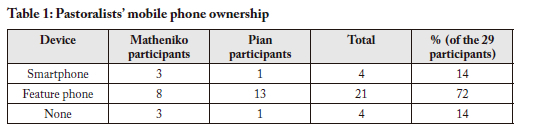
As seen in Table 1, four of the 29 pastoralists owned a smartphone, 21 owned a feature phone, and four did not own any mobile phone.
We now turn to the findings on the pastoralists' existing uses of these phones at the time of the study.
Voice telephony
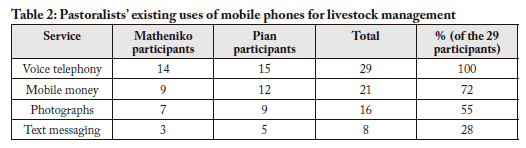
As seen in Table 2 below, the study found that all 29 (100%) of the pastoralists who participated in the FGDs said they used mobile phones to make calls to herders in the field, to contact veterinary extension workers, to contact potential cattle buyers, and to alert other pastoralists to the presence of cattle raiders. Participants who did not own a phone would use someone else's. In the words of one FGD participant:
When any of my cows are sick, I can easily reach the veterinary doctor, who will then come to treat the sick cow.
According to another FGD participant:
The beauty is that the cattle traders are just a phone call away. If I want to sell an animal, I just have to call a cattle trader. I can also make calls to find out the prices of cows in the market before I take my cows to sell.
A third FGD participant stated as follows:
When cattle raiders are within, we alert everybody including the neighbouring communities and the authorities.
Mobile money
As also seen in Table 2, the study found that 21 (72%) of the pastoralists used mobile money transactions when selling their livestock. In the words of one FGD participant:
We use this service to make transactions when selling our livestock in different markets. However, we always need extra help from learned people to make a transaction.
Photographs
Meanwhile, 16 (55%) of the pastoralists used mobile phone cameras to keep pictorial records of animals bought and sold. According to one FGD participant:
I take the pictures of animals that I want to sell. I also take a picture of the cattle trader for accountability and security reasons. If I want to buy a cow from a cattle trader, I take a picture of the cattle trader and a picture of the animal that I am buying.
Text messaging
However, only eight (28%) of the pastoralists said they were using mobile phones to send text messages related to livestock management. Among the cited uses of text messages by the few participants who use them was communication with veterinary extension workers on animal health matters or with law enforcement authorities when cattle raids occurred. Many of the pastoralists said they could not read or write, and thus, among those who did send text messages, most did so with the help of someone who was literate. In the words of one FGD participant:
In situations where you don't have [voice] airtime, the easiest medium you can use to communicate to an extension worker is by SMS. You can be able to text a message with the help of a learned colleague. [...] I still have a challenge with typing. At some point, I had to call someone learned to help me type and send an SMS.
We now turn to the challenges to mobile phone use that the pastoralists identified.
Challenges to pastoralists' use of mobile phone-based livestock management
Insecurity
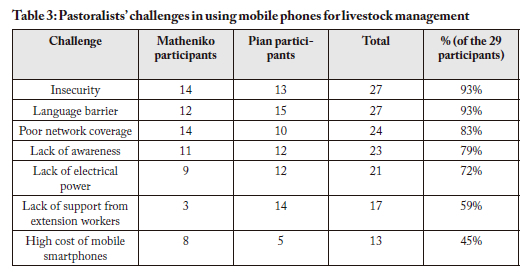
As seen below in Table 3, 27 (93%) of the 29 pastoralists who participated in the FGDs pointed to insecurity as a challenge for mobile phone use for livestock management. Security problems were said to be on the increase in Karamoja, and one of the causes was said to be certain local people, who lived near grazing areas, helping the raiders by communicating via mobile phones. As a result, some heads of pastoral communities were curbing the use of mobile phones by people in their communities. In the words of one FGD participant:
I know of a community where the leader has banned the use of mobile phones for security reason[s].
Language barrier
Table 3 also shows that 27 (93%) of the pastoralists cited language as a barrier to using mobile phones for livestock management. The study found that among the FGD participants, very few were comfortable reading or writing in English. As stated by one of the FGD participants:
Today all things of technology are in English. For sure we cannot read and interpret nor write in English. Of course with this, we are left out. Otherwise, we would love to also have the ability to navigate through these mobile phones.
Poor network coverage
As also seen in Table 3, 24 (83%) of the 29 pastoralists pointed to the difficulty created by the poor mobile telecommunications network coverage in parts of the districts that they inhabit. This was attributed to the region's numerous valleys and hills, which disrupt network signals. In the words of one FGD participant:
Our regions have poor signal networks. We cannot use a mobile phone in these areas.
The network-coverage problem was confirmed by the extension-worker interviewees. According to one:
There is poor network coverage in some areas, especially in remote areas.
In the words of another extension-worker interviewee:
The network is not doing us any good here. In most areas of the Karamoja region, network coverage is so low, sometimes weak or even poor. Sometimes when we want to submit data to the Ministry [...], we are forced to move to town areas in search of strong networks.
Lack of awareness
Twenty-three (79%) of the pastoralists pointed to the challenge of their own lack of awareness of how best to use their mobile phones in support of livestock management. According to one FGD participant:
I am not very familiar with my mobile phone. I majorly use it for calling and receiving calls yet I have several important applications on my phone. However, many of the applications on my phone are very complicated to use.
The extension-worker interviewees confirmed that awareness was a challenge. They pointed to the fact that online livestock-management services, including mobile apps, were being made available to Ugandan farmers by the government, international organisations and NGOs, but that awareness and take-up levels were low among the country's pastoralists. In the words of one of the FGD participants:
For us, we do not know these things, we are not informed at all about these [mobile-based livestock management] services. We just manage our livestock based on the knowledge obtained from our fathers and friends around us.
Lack of electrical power
Twenty-one (72%) of the pastoralists spoke of lack of electrical power as a challenge to mobile phone use. Most of the areas where the pastoralists reside or take their animals for grazing have not obtained power connectivity. Hence, when the phone battery is drained, they have to travel several kilometres to charge their mobile devices. In the words of one pastoralist:
In the process of making calls during raids or insecurity, making transactions or sending texts, [the] device may turn off before even submitting the information.
Another pastoralist stated:
Sometimes when you are in the field, the phone may black out due to low battery and the nearby charging point could be 10 km [away]. This really makes it difficult for us to use these phones at some point.
Lack of support from veterinary extension workers
Seventeen (59%) of the pastoralists said they received insufficient support from extension workers who, it was stated, were supposed to support the pastoralists in, among other things, using mobile phone-based livestock management services. One of the FGD participants said as follows:
There are extension support staff per sub-county [who] are supposed to regular[ly] provide us with support related to managing our livestock, but some of these workers have just ghosted among us [i.e., disappeared].
According to one of the extension-worker interviewees:
About 75% of today's Karamojong pastoral communities have still not realised the real value of integrating mobile-based livestock management services within their daily lives for managing livestock. However, there are initiatives being put in place to have them engaged [...]
High cost of mobile smartphones
Thirteen (45%) of the pastoralists pointed to the challenge created by the cost of mobile smartphones. In the words of one of the FGD participants:
Most of us cannot afford to buy these smart mobile phones [because] we have a number of demanding responsibilities, like buying food for our families so that they don't starve.
According to another FGD participant:
[...] the cost of buying a phone among us is not affordable. We have other priorities like food first in these hunger situations. I cannot buy a phone and stay hungry.
Pastoralists' requirements for mobile phone-based livestock management
Access to a weather information service
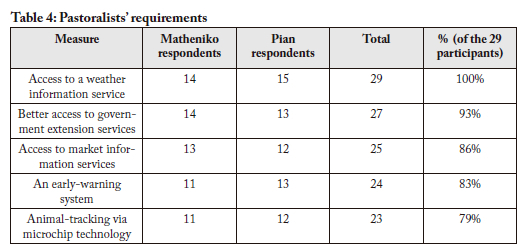
As seen in Table 4 below, all 29 (100%) of the pastoralists pointed to the need for a weather information service accessible via mobile phone. During the FGDs, it was evident that changes in weather patterns made it difficult for pastoralists to locate pastures during the dry season. Pastoralists ended up moving around the region in search of pastures, without knowing exactly where suitable pastures could be found.
One FGD participant stated:
I mostly go to graze my livestock [in] long distant places, but I have no specific geographical location to go [to]. How I wish it was possible to use this phone to detect that it will rain in such a place the next day so that it becomes easy for me to drive my cattle to places with water.
Better access to government extension services
As also seen in Table 4 below, 27 (93%) of the pastoralists spoke of the need for better access to government extension services. One solution proposed was a toll-free veterinary help desk that provides veterinary advice. According to one of the FGD participants:
One of our biggest challenges is buying airtime in times of an emergency. I am always caught off guard, with no money to buy airtime to call for help. A toll-free line would be of great help.
Another FGD participant pointed to the need for more training support from the extension workers:
Government has [made] a number of efforts to help us adopt [...] the use of mobile phones for managing our herds. But, however, we do not receive enough trainings from government trainers. At the end, this affects our output and the results [...].
One extension-worker interviewee pointed to the need for mobile applications that are fully customised to the needs of pastoralists:
Applications developed by the different NGOs and the Government are not customised to suit the life of pastoralists. For example, these applications need someone that can read, write and interpret information within the application.
Access to market information services
Table 4 also shows that 25 (86%) of the pastoralists pointed to the need for market information services via mobile phones. It was evident in the FGDs that the pastoralists were often not aware of the market prices that they could receive for their animals until they reached the market on the market day. Sometimes, this meant walking a very long distance to the market, only to find the prices too low. According to one FGD participant:
I would at least love to have information on cattle prices [at] the different livestock markets in the district. This will make it easy for me to know which market offers better prices.
According to one extension-worker interviewee:
We need a web-based system or SMS-based, alert-based system that informs the pastoralist about the different prices in the different cattle markets within Karamoja region.
An early-warning system
Twenty-four (83%) of the pastoralists spoke of the need for a mobile phone-based system to provide timely information or predictions on matters of security, disease outbreaks, and extreme weather situations. During the FGD, one informant stated as follows:
Besides having systems that predict weather situations, we also need a central form of system that will probably send SMSs to us in situations of cattle raidings and new disease outbreaks within the lives of our animals
Animal-tracking via microchip technology
When informed about the possibility of using microchips, linked to mobile phones, to track their animals, 23 (79%) of the FGD participants were in favour of the idea. In the words of one pastoralist:
We follow footsteps of the stolen cattle, but once it rains, these tracks are totally lost, and this makes it hard to continue with the search.
5. Analysis in terms of the UTAUT framework
We now analyse the findings in terms of the four technology-adoption components of the UTAUT framework: performance expectancy; effort expectancy; social influence; and facilitating conditions.
Performance expectancy
With respect to performance expectancy, which is "the degree to which an individual believes that using the system will help him or her to attain gains in job performance" (Venkatesh et al., 2003, p. 447), the findings suggest that the key performance elements that pastoralists would require in order to more fully adopt mobile phone-based livestock management are:
• Tracking: The use of microchips as a tracking system would help to reduce the level of animal theft among pastoralists in Karamoja.
• Weather and vegetation data: Satellite-derived geographic information system (GIS) weather and vegetation data could help herders to decide where to take their herds.
• Early-warning systems: These systems could provide timely information or predictions on matters of security, disease outbreaks, and severe weather situations.
• Market information: This information would help pastoralists to compare market prices without having to travel to all the possible market locations.
Effort expectancy
With respect to effort expectancy, which is "the degree of ease associated with the use of the system" (Venkatesh et al., 2003, p. 450), it is important to understand the ways in which the above proposed mobile phone-based livestock management services can be made convenient and easy to use for pastoralists. In our analysis, this can be done through the following:
• User-friendly interface: Complexity can be reduced by simplifying technology interfaces and providing user-friendly training materials, thus significantly reducing perceived effort.
• Create awareness: Creating awareness among pastoralists is important. Many pastoralists are not aware of the existing mobile-based livestock management solutions, nor are they aware that a mobile phone can be harnessed in numerous ways for livestock management. This awareness creation can be conducted by extension workers and community leaders.
• Training: More frequent extension visits to pastoralists and intensified training programmes on the use of available technology for livestock management are needed.
• Customised veterinary services mobile application in the local language: A customised veterinary services application, using the predominant local language, would facilitate the use of mobile applications even among non-English speaking pastoralists.
Social influence
With respect to social influence, which is "the degree to which an individual perceives that important others believe he or she should use the new system" (Venkatesh et al., 2003, p. 451), one extension-worker interviewee stated as follows:
The structure of leadership within these communities must be followed. The opinion leaders are always looked at as being influential in these communities.
There is no doubt that the involvement of community leaders in the implementation of mobile-based livestock management services is important. Community leaders' endorsement of the use of a particular mobile application or applications would foster acceptance and usage-in line with Eilu's (2019) finding that social validation may promote positive perceptions of and responses to a product or service.
Facilitating conditions
With respect to the facilitating-conditions construct, which refers to "the degree to which an individual believes that an organisational and technical infrastructure exists to support use of the system" (Venkatesh et al., 2003, p. 453), the findings suggest that pastoralists do not at present have significant faith in either the organisational conditions (e.g., government extension support) or the technical conditions (e.g., phone network coverage, electricity supply) necessary for their fuller adoption of mobile phone-based livestock management. In our analysis, the government could undertake some measures to limit discontent among pastoralists, such as supporting extension workers, subsidising the cost of the technologies used in livestock management, providing reliable electricity, improving security, offering toll-free vet helpline services, and ensuring the improvement of mobile network coverage.
6. Conclusion
Uganda's Karamoja region poses unique challenges to the adoption of mobile phone-based livestock management services for pastoralists. The region is remote, with poor infrastructure; high levels of illiteracy, poverty, and insecurity; and livestock herds that move frequently. The study used the UTAUT model to investigate the challenges and to identify areas of opportunity with respect to pastoralists' adoption and use of mobile phones in support of livestock management. It is hoped that the findings will be useful to the Ugandan government (chiefly the Ministry of Agriculture, Animal Industry and Fisheries), to government extension workers, and to other supporting stakeholders (international agencies and donors, and NGOs) seeking to collaborate with Karamoja pastoralists in ways that can increase pastoralists' adoption and use of appropriate mobile phone-based features in support of sustainable livestock management.
Acknowledgement
This article draws on elements of the first-listed author's Master's research report at Uganda Christian University (Acheke, 2023).
Funding
No funding was received for this study.
Data availability
The data supporting the results of this study is available upon written request to markacheke2@gmail.com or eiluemma@yahoo.co.uk
AI declaration
We declare that no form of AI software was used to generate the data that was used in this article, and no form of AI technology was used in writing the article.
Authors' contributions
R.M.A.: conceptualisation; methodology; data collection; sample analysis; data analysis; validation; data curation; writing - the initial draft; writing - revisions; funding acquisition E.E.: student supervision; journal submission and correspondence Both authors read and approved the final manuscript.
Competing interests
The authors have no competing interests to declare.
References
Abakar, M. F., Seli, D., Lechthaler, F., Schelling, E., Tran, N., Zinsstag, J., & Muñoz, D. C. (2018). Vaccine hesitancy among mobile pastoralists in Chad: A qualitative study. International Journal for Equity in Health, 17, 1-10. https://doi.org/10.1186/s12939-018-0873-2 [ Links ]
Acheke, R. M. (2023). Adoption of mobile phone based livestock management services for pastoral use in Karamoja: A case study of the Pian and Matheniko ethnic group. [Master's research report, Uganda Christian University, Mukono. [ Links ]]
Ajzen, I. (1985). From intentions to actions: A theory of planned behavior. In P. D. J. Kuhl & D. J. Beckmann (Eds.), Action control (pp. 11-39). Springer. http://link.springer.com/chapter/10.1007/978-3-642-69746-3_2
Beza, E., Reidsma, P., Poortvliet, P. M., Belay, M. M., Bijen, B. S., & Kooistra, L. (2018). Exploring farmers' intentions to adopt mobile Short Message Service (SMS) for citizen science in agriculture. Computers and Electronics in Agriculture, 151(August), 295-310. https://doi.org/10.1016/j.compag.2018.06.015 [ Links ]
Bostedt, G., Knutsson, P., Muricho, D., Mureithi, S., Wredle, E., & Nyberg, G. (2023). Adaptive pastoralists-Insights into local and regional patterns in livelihood adaptation choices among pastoralists in Kenya. Pastoralism, 13(26), 1-18. https://doi.org/10.1186/s13570-023-00290-8 [ Links ]
Bugeza, J., Kankya, C., Muleme, J., Akandinda, A., Sserugga, J., Nantima, N., Okori, E., & Odoch, T. (2017). Participatory evaluation of delivery of animal health care services by community animal health workers in Karamoja region of Uganda. PLoS One. https://doi.org/10.1371/journal.pone.0179110
Butt, B. (2015).Herding by mobile phone: Technology,social networks and the "transformation" of pastoral herding in East Africa. Human Ecology, 43, 1-14. https://doi.org/10.1007/s10745-014-9710-4 [ Links ]
Byakagaba, P., Egeru, A., Barasa, B., & Briske, D. (2018). Uganda's rangeland policy: Intentions, consequences and opportunities. Pastoralism, 8(7), 1-16. https://doi.org/10.1186/s13570-017-0111-3 [ Links ]
Creswell, J. W., & Creswell, J. D. (2018). Research design: Qualitative, quantitative and mixed methods approaches (5th ed.). SAGE.
Davis, F. D. (1986). A technology acceptance model for empirically testing new enduser information systems: Theory and results. Sloan School of Management, Massachusetts Institute of Technology (MIT).
Debsu, D. N., Little, P. D., Tiki, W., Guagliardo, S. A. J., & Kitron, U. (2016). Mobile phones for mobile people: The role of information and communication technology (ICT) among livestock traders and Borana pastoralists of southern Ethiopia. Nomadic Peoples, 20, 35-61. https://doi.org/10.3197/np.2016.200104 [ Links ]
Eilu, E. (2019). Anticipated user experience (AUX) framework for implementing electronic participation in a developing country context. [PhD dissertation, Makerere University, Kampala.] http://makir.mak.ac.ug/handle/10570/7163 [ Links ]
Famine Early Warning Systems Network (FEWS NET). (2016). Karamoja, Uganda: Enhanced market analysis 2016. https://fews.net/sites/default/files/documents/reports/Uganda_EMA_20161221_submitted.pdf
Food and Agriculture Organisation of the United Nations (FAO). (2018). Pastoralism in Africa's drylands: Reducing risks, addressing vulnerability and enhancing resilience. https://openknowledge.fao.org/items/b846606a-d25d-4b7c-bef1-95dfc1134a91
Karamoja Resilience Support Unit (KRSU). (2016). Livestock in Karamoja: A review of recent literature. https://karamojaresilience.org/wp-content/uploads/2021/05/krsukaramoja_livestock_review.pdf
KRSU. (2019). Economic value of livestock in Karamoja, Uganda, https://www.celep.info/wp-content/uploads/2019/12/Uganda_tufts_1948_krsu_livestock_economic_v2_press.pdf
KRSU. (2020). Livestock in Karamoja, Uganda: The economic value of agropastoral and pastoral systems. Evidence Brief. https://karamojaresilience.org/wp-content/uploads/2021/07/KRSU-Evidence-Brief-Economic-Value-of-Livestock-Nov-2020.pdf
KRSU. (2022). Livestock in Karamoja: Improving markets and veterinary services, https://karamojaresilience.org/wp-content/uploads/2022/07/Tufts-Livestock-TradeFINAL_online.pdf
Korpelainen, E. (2011). Theories of ICTsystem implementation and adoption - A critical review. Working Paper 11, School of Science, Department of Industrial Engineering and Management, Aalto University, Helsinki.
Koskie, J. (2022, January 14). The importance of usability in software design. IT Business Edge. https://www.itbusinessedge.com/development/the-importance-of-usability-in-software-design
Krueger, R. A. (1994). Focus groups: A practical guide for applied research (2nd ed.). SAGE.
Lwoga, T. E. (2010). Bridging the agricultural knowledge and information divide: The case of selected telecenters and rural radio in Tanzania. The Electronic Journal on Information Systems in Developing Countries, 43(6), 1-14. https://doi.org/10.1002/j.1681-4835.2010.tb00310.x [ Links ]
Mdoda, L., & Mdiya, L. (2022). Factors affecting the using [sic] information and communication technologies (ICTs) by livestock farmers in the Eastern Cape province. Cogent Social Sciences, 8(1), 1-16. https://doi.org/10.1080/23311886.2022.2026017 [ Links ]
Mertz, O., Rasmussen, K., & Rasmussen, L. V. (2016). Weather and resource information as tools for dealing with farmer-pastoralist conflicts in the Sahel. Earth System Dynamics, 7(4), 969-976. https://doi.org/10.5194/esd-7-969-2016 [ Links ]
Mkutu, K. (2001). Pastoralism and conflict in the Horn of Africa. Africa Peace Forum, Saferworld, and University of Bradford. https://www.files.ethz.ch/isn/124889/WebLaikipia.pdf
Moore, G. C., & Benbasat, I. (1991). Development of an instrument to measure the perceptions of adopting an information technology innovation. Information Systems Research, 2, 173-191. https://doi.org/10.1287/isre.2.3.192 [ Links ]
Mtega, W. P., & Msungu, A. C. (2013). Using information and communication technologies for enhancing the accessibility of agricultural information for improved agricultural production in Tanzania. The Electronic Journal of Information Systems in Developing Countries, 56(1), 1-14. https://doi.org/10.1002/j.1681-4835.2013.tb00395.x [ Links ]
Parlasca, M. C. (2021). A vital technology: Review of the literature on mobile phone use among pastoralists. Journal of International Development, 33(4), 780-799. https://doi.org/10.1002/jid.3540 [ Links ]
Qader, S. H., Dash, J., Alegana, V. A., Khwarahm, N. R., Tatem, A. J., & Atkinson, P. M. (2021). The role of earth observation in achieving sustainable agricultural production in arid and semi-arid regions of the world. Remote Sensing, 13, 3382, 1-27. https://doi.org/10.3390/rs13173382 [ Links ]
Quddus, M. A. (2022). Dissemination of technological innovations of livestock in Bangladesh: Adoption levels and behavioral precision. Proceedings of the National Academy of Sciences, India, Section B: Biological Sciences, 92, 461-472. https://doi.org/10.1007/s40011-022-01357-z [ Links ]
Robson, C. (2002). Real world research. Blackwell. https://doi.org/10.1016/S0262-1762(02)80276-0
Rogers, E. M. (1995). Diffusion of innovations (4th ed.). Free Press.
Sife, A. S., Kiondo, E., & Lyimo-Macha, J. G. (2017). Contribution of mobile phones to rural livelihoods and poverty reduction in Morogoro Region, Tanzania. The Electronic Journal of Information Systems in Developing Countries, 42(1), 1-15. https://doi.org/10.1002/j.1681-4835.2010.tb00299.x [ Links ]
Siregar, Z. A., Anggoro, S., Irianto, H. E., & Purnaweni, H. (2022). A systematic literature review: UTAUT model research for green farmer adoption. International Journal on Advanced Science, Engineering and Information Technology, 12(6), 2485-2490. https://doi.org/10.18517/ijaseit.12.6.15834 [ Links ]
SNV. (2012). Improved livelihoods for pastoralists. SNV Practice Brief, Issue 2. https://www.celep.info/wp-content/uploads/2013/03/SNV-Practice-Brief-2-Improved-Livelihoods-for-Pastoralists-26-Jan-2012.pdf
Summers, K.H., Baird, T.D., Woodhouse, E., Christie, M.E., McCabe, J.T., Terta, F., & Peter, N. (2020). Mobile phones and women's empowerment in Maasai communities: How men shape women's social relations and access to phones. Journal of Rural Studies, 77, 126-137. https://doi.org/10.1016/j.jrurstud.2020.04.013 [ Links ]
Taylor, S., & Todd, P. A. (1995). Understanding information technology usage: A test of competing models. Information Systems Research, 6(2), 144-176. https://doi.org/10.1287/isre.6.2.144 [ Links ]
Triandini, E., Satria Wijaya, I. G. N., Suniantara, I. K., Wulandari, R., Pratami, W., Sugiarto, S., Sulyani, A., Larasati, N., & Kuswanto, D. (2023). Analysis adoption of information technology using the UTAUT method on off-taker poultry farmers in Indonesia. Paper presented to 13th Annual International Conference on Industrial Engineering and Operations Management. https://doi.org/10.46254/AN13.20230481
Uganda Bureau of Statistics (UBOS). (2018). The Uganda national household survey (UNHS) 2019/2020. https://www.ubos.org/wp-content/uploads/publications/09_2021Uganda-National-Survey-Report-2019-2020.pdf
UBOS. (2024). The national livestock census 2021 - Abridged version, https://www.ubos.org/wp-content/uploads/publications/National-Livestock-Census-2021-Abridged-Version.pdf
Uganda Investment Authority (UIA). (2016). Karamoja investment profile. https://www.ugandainvest.go.ug/wp-content/uploads/2016/04/uia-Karamoja-profile.pdf
UN Population Fund (UNFPA). (2018). Leaving no one behind in Karamoja. Population Matters Issue Brief 07. https://uganda.unfpa.org/sites/default/files/pub-pdf/Issue%20Brief%207.%20Leaving%20no%20one%20behind%20in%20Karamoja.pdf
Venkatesh, V., & Davis, F. D. (2000). A theoretical extension of the technology acceptance model: Four longitudinal field studies. Management Science, 46(2), 186-204. https://doi.org/10.1287/mnsc.46.2.186.11926 [ Links ]
Venkatesh, V., Morris, M. G., Davis, G. B., & Davis, F. D. (2003). User acceptance of information technology: Toward a unified view. MIS Quarterly, 27(3), 425-478. https://doi.org/10.2307/30036540 [ Links ]
Waiswa, C. D., Mugonola, B., Kalyango, R. S., Opolot, S. J., Tebanyang, E., & Lomuria, V. (2019). Pastoralisin in Uganda. Theory,practice, and policy. https://karamojaresilience.org/wp-content/uploads/2021/05/tufts_1939_pastoralism_uganda_text_book_v10_online.pdf
Wanyama, J. B. (2020). Accounting forpastoralists in Uganda. League for Pastoral Peoples and Endogenous Livestock Development, Ober-Ramstadt, Germany. https://www.pastoralpeoples.org/wp-content/uploads/2020/09/Accounting4pastoralists-UG.pdf
World Food Programme (WFP). (2017a). Food security and nutrition assessmentin Karamoja Sub-Region. https://docs.wfp.org/api/documents/WFP-0000022487/download/Piframe
WFP. (2017b). Karamoja region market assessment in Uganda, https://reliefweb.int/report/uganda/karamoja-region-market-assessment-uganda-final-report
