




Services on Demand
Journal

Article
 English (pdf)
 Article in xml format
 Article references
 Automatic translation
 Send this article by e-mail
Indicators
Related links
-
 Cited by Google
 -
 Similars in Google
Share

 Permalink
The African Journal of Information and Communication
On-line version ISSN 2077-7213Print version ISSN 2077-7205
AJIC vol.34 Johannesburg 2024
https://doi.org/10.23962/aiic.i34.20424
THEMATIC SECTION: BRICS COUNTRIES AND AI SOVEREIGNTY
Brazil's Artificial Intelligence Plan (PBIA) of 2024: Enabler of AI sovereignty?
Germano P. Johansson NetoI; Viviane C. Farias da CostaII; Walter Britto GasparIII
IPhD candidate, University of Brasília (UnB); and Research Fellow, CyberBRICS project, Center for Technology and Society (CTS), Fundação Getulio Vargas (FGV) Law School, Rio de Janeiro. https://orcid.org/0000-0002-9812-1024
IIPostdoctoral Research Fellow, CyberBRICS project, Center for Technology and Society (CTS), Fundação Getulio Vargas (FGV) Law School, Rio de Janeiro; and Researcher, Systems Engineering and Computing Program (PESC-COPPE), Federal University of Rio de Janeiro (UFRJ). https://orcid.org/0000-0002-6492-0653
IIIPhD candidate, Federal University of Rio de Janeiro (UFRJ); and Researcher, CyberBRICS project, Center for Technology and Society (CTS), Fundação Getulio Vargas (FGV) Law School, Rio de Janeiro. https://orcid.org/0000-0002-5585-7963
ABSTRACT
This study assesses the extent to which the Brazilian Artificial Intelligence Plan (PBIA, Plano Brasileiro de Inteligência Artificial) of 2024 supports the country's pursuit of AI sovereignty. The authors map the financial allocations to the PBIA's 54 proposed structural actions against the components of Belli's (2023a; 2023b) key AI sovereignty enablers (KASE) framework: data, algorithms, computing capacity, connectivity, electricity, education, cybersecurity, and regulation. The study finds that the PBIA's structural actions support six of the KASE enablers, in the following order of priority: algorithms, data, computing capacity, education, electricity, and cybersecurity. Close to 50% of the PBIA's proposed investments for structural actions are found to be for actions related to the algorithms enabler in the KASE framework, followed by 20% for actions connected to the data enabler, 20% for actions supporting the computing capacity enabler, and 11% for actions related to the education enabler. Much lower levels of expenditure are set out in the PBIA for the electricity enabler (2%) and the cybersecurity enabler (1%). The authors analyse the implications of the PBIA's prioritisations for Brazil's progress towards AI development and AI sovereignty.
Keywords: artificial intelligence (AI), algorithms, data, computing capacity, education, electricity, cybersecurity, AI sovereignty, key AI sovereignty enablers (KASE), Brazil, Brazilian Artificial Intelligence Plan, Plano Brasileiro de Inteligência Artificial (PBIA)
1. Introduction
Brazil is increasingly adopting artificial intelligence (AI) systems and applications across both the public and private sectors (IBGE, 2023; Kubota, 2024). The aim of this study was to determine the extent to which the country's current AI development path aligns with the public interest (Mazzucato et al., 2022), specifically Brazil's pursuit of AI sovereignty. The concept of AI sovereignty, as set out by Belli (2023a; 2023b), is a function of a country's capacity "to understand, muster and develop AI systems, while retaining control, agency, and ultimately, self-determination over such systems" (2023a, p. 1). Belli (2023a) also states that a nation's AI sovereignty is linked to its ability to "develop, regulate, and utilise AI systems according to its own national interests, values, and strategic obiectives" (2023a, p. 1).
Fostering and maintaining AI sovereignty is critical to countries' effective management of the current phase of accelerated digital transformation, as it requires the development and deployment of trustworthy AI technology-with a focus on transparency, accountability, fairness, and the protection of individual rights and privacy. Another core element of maintaining AI sovereignty is robust cybersecurity-particularly for critical infrastructures that may become vulnerable when interconnected. Belli (2023a) has put forward a "key AI sovereignty enablers (KASE)" framework comprising eight elements:
sound (personal) data governance and algorithmic governance, strong computational capacity, meaningful connectivity, reliable electrical power, a digitally literate population, solid cybersecurity, and last, but not least, an appropriate regulatory framework. (Belli, 2023a, p. 2).
In this study, we examined the extent to which key elements of Brazil's most recent policy statement on AI matters-the Brazilian Artificial Intelligence Plan (PBIA, Plano Brasileiro de Inteligência Artificial) of 2024-are aligned with the eight elements of Belli's (2023a) KASE framework.
2. Brazilian AI policymaking and the PBIA of2024
In the context of the rapidly evolving landscape of AI, the Brazilian government has, in recent years, been seeking to redefine its strategic approach. The Brazilian Artificial Intelligence Strategy (EBIA, Estratégia Brasileira de Inteligência Artificial) was published in 2021 by the Ministry of Science, Technology and Innovation (MCTI, Ministério da Ciência, Tecnologia e Inovação, 2021a; 2021b). This strategy was strongly criticised, both at the time of its inception and during its first steps towards implementation, because of: the generality with which themes are translated into strategic actions; the lack of a clear delineation of the intended governance structure; the lack of definition of deadlines, goals, and measurable indicators for verifying the success of the implementation of the strategy; and the lack of attention to aspects affected by transparency and explainability in AI systems (Curzi & Gaspar, 2021; Magrani, 2021).
Since late 2023, the MCTI has been engaged in a process to develop a revised EBIA (MCTI, 2023; 2024a). The MCTI is seeking to revise the strategy's objectives, axes, targets, and actions to align the EBIA with national interests and priorities. A Bill was published in 2023 (República Federativa do Brasil, 2023), and a Temporary Internal Commission on Artificial Intelligence (CTIA, Comissão Temporária Interna sobre Inteligência Artificial no Brasil) is working towards its finalisation (MCTI, 2024c). The Bill provides for the establishment of obligations and responsibilities for AI providers and operators, including algorithmic impact assessment throughout the AI lifecycle. It also provides for appointing a supervisory authority responsible for applying the law and updating the EBIA as necessary. The Senate has extended the deadline for the completion of the CTIA's work five times, with the most recent deadline being set for mid-December 2024 (MCTI, 2024c).
There has, however, been one significant policy statement in 2024, entitled AI for the Good of All: Brazilian Artificial Intelligence Plan 2024-2028 (IA para o Bem de Todos: Plano Brasileiro de Inteligência Artificial, 2024-2028). Known by its acronym, PBIA, it was published by the MCTI on 30 July (MCTI, 2024b). The PBIA outlines the Brazilian government's intention to enhance people's lives through AI while boosting national capacities and skills. It also emphasises the goal of achieving technological and data sovereignty, stating that Brazil must increase control over its digital landscape. The PBIA emphasises the need for AI to respect dignity, social rights, and cultural diversity, and not to generate inequality and discrimination. It aims for AI to tackle pressing social, environmental, and economic challenges, to enhance overall well-being, and to contribute to Brazil's achievement of the UN's Sustainable Development Goals (SDGs) (MCTI, 2024b).
The PBIA is aligned with other government policies, particularly New Industry Brazil (MDIC, 2024), and highlights a commitment to environmental sustainability through ecological transition (MCTI, 2024b). The PBIA is also aligned to the Brazilian Strategy for Digital Transformation (E-Digital) for 2022-2026 (MCTI, 2018), and to the National Digital Government Strategy (República Federativa do Brasil, 2024), which sets principles, rules, and tools for digital government and increased public efficiency.
The PBIA also seeks to foster international cooperation on fair and mutually beneficial terms, and to ensure ethical and responsible AI use. The PBIA prescribes two sets of actions in pursuit of Brazil's AI goals: 31 immediate-impact actions and 54 structural actions.
PBIA's immediate-impact actions
The PBIA's 31 immediate-impact actions have a total budget allocation from public funding of approximately R$350 million (USD60.4 million1). These actions aim to deliver quick results in critical areas such as health, education, and security, but only count for 1.3% of the total investments of the PBIA. Additionally, 10 immediate-impact actions currently lack defined resource amounts and confirmed funding sources. These actions focus on developing algorithms and AI tools intended for use in public management and essential services.
PBIA's structural actions
The PBIA's 54 structural actions have much larger budget allocations than the immediate-impact actions, with the total allocation for all the structural actions put at approximately R$22.5 billion (USD3.9 billion). These initiatives have a broader scope than the immediate-impact actions, as they aim to establish a foundation for integrating AI across various sectors and enabling profound and sustainable digital transformation over time.
Five key initiatives concentrate R$15.3 billion of the total R$22.5 billion budget for the PBIA's 54 prescribed structural actions. These initiatives are: (1) upgrading Brazil's Santos Dumont supercomputer (Datatechvibe, 2024) so that it ranks among the top five in computational capacity globally, which is allocated R$1.8 billion; (2) investments to scale up the supply of curated national datasets for natural language processing (NLP) training and to build a robust large language model (LLM) in Brazilian Portuguese (set to receive R$1.1 billion); (3) establishing a secure, non-public government cloud for confidential documents (budgeted at R$1 billion); (4) creating data centres powered by renewable energy (with an allocation of R$2.3 billion); and (5) a programme aimed at funding AI projects for the industrial sector (with the highest allocation of all actions, R$9.1 billion directed towards 500 initiatives). This investment will direct resources from two Banco Nacional de Desenvolvimento Econômico e Social (BNDES, Brazilian Economic and Social Development Bank) programmes-the More Production Plan (BNDES, 2024a) and the More Innovation Program (BNDES, 2024b)-to AI projects applied to industry, in alignment with the New Industry Brazil (Nova Indústria Brasil) programme (MDIC, Ministério do Desenvolvimento, Indústria, Comércio e Serviços, 2024) and supporting Brazilian companies that supply specialised AI systems.
3. Methodology
The study was guided by two overarching questions:
• To what extent are the priorities of the PBIA aligned with the pursuit of AI sovereignty?
• To what extent does the PBIA have gaps that could undermine the pursuit of AI sovereignty?
As stated above, the PBIA proposes two sets of actions in pursuit of Brazil's AI goals: 31 immediate-impact actions, and 54 structural actions. We decided to focus our evaluation of the PBIA on its proposed structural actions. This focus was chosen due to the structural actions' longer-term orientations (in comparison to the orientations of the immediate-impact actions), such that the structural actions represent the key strategic changes that the government views as necessary to establish Brazil's core, necessary AI capabilities. Also impacting this choice of focus was the fact that the PBIA proposes much larger budget allocations for the structural actions than for the immediate-impact actions.
The PBIA's structural actions were evaluated in terms of the eight elements of the KASE framework (Belli, 2023a) for pursuit of AI sovereignty, as follows:
1. data: sound (personal) data governance
2. algorithms: sound algorithmic governance
3. computing capacity: strong computational capacity
4. meaningful connectivity
5. electricity: reliable electrical power
6. education: digitally literate population
7. cybersecurity: solid cybersecurity
8. appropriate regulatory framework
In particular, we were concerned with the budget totals for the suite of structural actions linked to each KASE element, so as to generate a picture of the core KASE elements present, and their relative importance, in the federal government's AI planning. We must note that this methodological strategy has limitations, due to the differing characteristics of various types of investment-i.e., the relative costs of different types of action and different measurements of success or "return" on those investments-and due to differing starting points, e.g., Brazil already has significant sustainable electrical power capacity, making the KASE enabler of "reliable electrical power" easy to achieve.
4. Findings
In categorising the PBIA's 54 structural actions in terms of the elements of the KASE framework, we mapped each structural action against the KASE enabler that, in our interpretation, most immediately related to the action's core objectives. The table below provides the matrix that we developed during this mapping process.
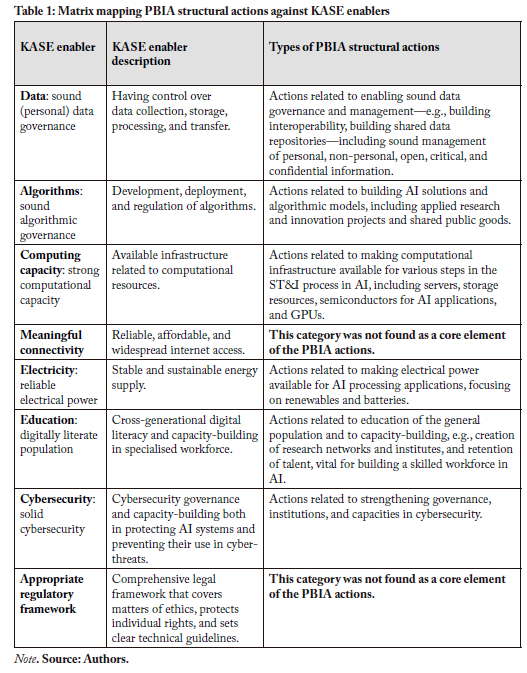
As seen in the table, for two of the eight KASE enablers-meaningful connectivity and appropriate regulatory framework-the study found that none of the PBIA's 54 proposed structural actions had the enabler as a core element. Thus, the remainder of the findings presented in this section relate to the six remaining KASE categories (against which we were able to map PBIA structural actions): data, algorithms, computing capacity, electricity, education, and cybersecurity.
Figure 1 shows the distribution of the PBIA's planned investment in the 54 proposed structural actions, with the total budget allocation from public finance divided across the six KASE categories.
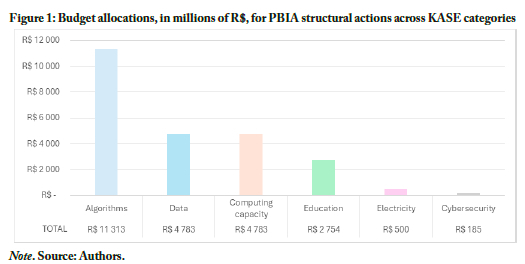
Figure 2 shows the percentage breakdown of planned investment, across the six KASE categories, in the PBIA's 54 proposed structural actions.
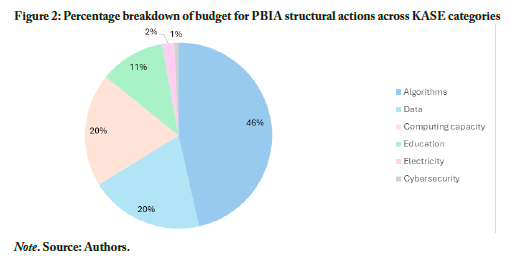
In terms of our mapping, the largest allocation, amounting to R$11.3 billion- nearly half (46%) of the PBIA budget for structural actions-is for structural actions supporting the algorithms component in the KASE framework. These actions target the development of algorithms that can increase the efficiency and effectiveness of public-sector AI applications across sectors such as health, education, and public safety. In this algorithms category, among the actions with the largest investment allocations in the PBIA is the R$9.1 billion assigned to "AI Solutions for NIB Missions". This structural action has the objective of "allocating resources from the More Production Plan and the More Innovation Program to AI projects applied to industry, focusing on the application chains defined in the missions of New Industry Brazil [NIB] and in support of Brazilian companies that supply specialized systems" directed at developing and diffusing AI solutions aligned to industry needs and with the aim to "fund at least 500 AI projects applied to industry by 2028" (MCTI, 2024b, p. 72).
Next, our mapping found that structural actions corresponding to the data and computing capacity enablers in the KASE framework receive the next-largest sets of budget allocations, with each of these categories receiving actions totalling R$4.8 billion (20% of the PBIA budget for structural actions). In the data category, the funding is targeted at supporting the establishment ofrobust frameworks for managing personal, non-personal, and sensitive data. The largest allocation in this category is the aforementioned (in section 2 above) R$1 billion investment in establishing a secure government cloud for confidential documents. In the computing capacity category, the largest allocation is the R$1.8 billion that is directed towards upgrading (as mentioned above in section 2) the country's Santos Dumont supercomputer so as to significantly expand Brazil's high-performance processing capacity. Also in the computing capacity category, R$50 million is to be invested in international partnerships to share AI research and development (R&D) infrastructure.
With respect to PBIA structural actions that we mapped as serving the education component of the KASE framework, there is an allocation of R$2.8 billion (11% of the PBIA budget for structural actions). Large allocations in this category include R$600 million to be invested in business innovation to retain talent for AI innovation, and R$553 million to promote AI R&D.
PBIA structural actions that we assigned to the electricity KASE category are set to receive the relatively small total investment of R$500 million (2% of the PBIA budget for structural actions), underscoring Brazil's current energy surplus and abundant clean-energy sources. The actions in this category are dedicated to promoting the implementation of sustainable and efficient energy infrastructure for data centres and AI facilities, e.g., renewable energy sources, improved cooling technologies, and lower-consumption equipment.
Finally, actions we mapped as serving the cybersecurity KASE category receive the smallest total allocation of R$185 million (1% of the PBIA budget for structural actions).
5. Analysis
The PBIA's proposed structural actions provide a snapshot of Brazil's objectives and strategy for positioning itself as a global player in AI and towards its achievement of AI sovereignty. Our study's findings reveal a significant focus, in financial terms, on the algorithms element of the KASE framework, followed by a relatively strong focus on the data, computing capacity, and education enablers, with low priority given to the KASE framework's electricity and cybersecurity enablers.
In prioritising algorithm development, the PBIA states that it intends to foster innovation, improve public service delivery, and enhance data-driven decision-making processes, thus positioning the country to better compete in the global AI landscape. However, this focus on algorithms cannot alone be expected to substantially transform Brazil's structural digital dependencies, as most of the PBIA resources focused on this element will likely be directed to established industries, thus making the success of the investments in algorithms dependent on capacity in those industries-including capacity with respect to other KASE categories, e.g., computing capacity, meaningful connectivity, and cybersecurity.
Also revealing is the PBIA's relatively strong investment focus, after algorithms, on structural actions related to the KASE categories of data and computing capacity. In the data-related actions, there is an effort to build a strong technical foundation for use by AI initiatives, and to establish-e.g., via the project to build a robust government cloud-strong, trusted data governance. Ensuring that data is used ethically and responsibly can facilitate trust in AI systems and lay the groundwork for effective data-sharing and collaboration across sectors. The PBIA structural actions targeted at enhancing computing capacity-particularly the upgrading of the Santos Dumont supercomputer-have the potential to improve Brazil's ability to develop and deploy AI solutions at scale, and to ensure that public and private sectors can leverage AI effectively to meet their needs.
The PBIA's investments in structural actions supporting the AI education component of the KASE framework are essential for fostering innovation and sustaining longterm growth in the AI sector. Through the PBIA's AI education initiatives, Brazil aims to retain talent and ensure that its workforce is equipped with the necessary skills to thrive in an increasingly digital economy. Such education also has the potential to contribute to greater public understanding and acceptance of AI technologies.
Several of the actions related to the KASE categories of data and education involve either fostering R&D in research institutions and industry or ensuring the adequate use of datasets to improve public and private services. This represents a vision of innovation policy that connects industrial policy efforts to the strengthening of the national innovation ecosystem aligned to public initiatives. The actions related to the KASE computing capacity category are equally related to strengthening existing networks of basic and applied research in Brazilian public institutions and strengthening public institutions' connections to Brazilian industry. Investment in computing capacity also contains elements explicitly connected to reducing dependency on foreign-controlled platforms.
The PBIA's focus on investment-intensive projects, such as the upgrade of the Santos Dumont supercomputer and the development of a robust LLM for Brazilian Portuguese, links to several interlocking strategic priorities. First, there is a clear focus on enhancing Brazil's global competitiveness in high-performance computing. By updating the Santos Dumont supercomputer to rank among the top five most powerful in the world in the coming years, the government aims to position the country as a leader in scientific research, in AI, and in other data-intensive fields. Such computing capacity is essential for advancing national research and keeping pace with global technological advancements.
Second, the government's effort, as mentioned above in section 2, to expand the availability of curated national datasets for NLP highlights the growing need for infrastructure. Processing large-scale data for AI training requires significant computational resources, and without proper investment in infrastructure, Brazil would face limitations in leveraging data effectively for innovation and research. This is especially important for AI and machine-learning projects that depend on data to achieve speed, accuracy, and relevance.
Third, the goal of constructing a robust LLM for Brazilian Portuguese further emphasises the importance of investment in infrastructure. An LLM specifically tailored for Brazilian Portuguese addresses linguistic and cultural needs that global models may not handle effectively. Such models have become essential in various applications, including NLP, translation, and automating communication tasks. Developing an LLM of this magnitude demands substantial computational power, making supercomputing infrastructure critical for its success.
Ultimately, the government's investment in these high-performance computing projects aligns with its broader objectives of digital sovereignty and innovation. By developing its own advanced technology, Brazil could eventually reduce its reliance on foreign systems and gain greater control over its digital infrastructure, enhancing security and fostering technological independence. This approach will not only strengthen the country's digital resilience, but also ensure that it remains competitive on the global stage, while fostering long-term economic growth and innovation through digital transformation. For that accomplishment, projects' interdependence must be closely watched and nurtured.
With respect to the KASE category of electricity, which is crucial for powering data centres and AI applications, Brazil is-as the PBIA's relatively low investment in structural actions in this category shows-already well-positioned, because the country's power production is currently based largely on renewable sources, and current production levels exceed domestic demand.
Finally, however, the relatively low level of PBIA funding directed towards the cybersecurity KASE category raises questions about whether the allocated resources are sufficient to safeguard the growing AI ecosystem. The low investment in cybersecurity seems antithetical to current domestic and global trends, especially considering the ever-expanding taxonomy of potential AI risks and Brazil's national regulatory and institutional efforts to strengthen cybersecurity, as evidenced by its 2023 establishment of a National Cybersecurity Policy (Política Nacional de Cibersegurança) and National Cybersecurity Committee (Comitê Nacional de Cibersegurança) (República Federativa do Brasil, 2023b).
6. Conclusions
While this study has focused on the potential AI sovereignty implications of the specific structural actions proposed in the PBIA, it is important to acknowledge that various other public policies, regulations, and strategic frameworks also shape Brazil's digital ecosystem and, by extension, its approach to AI and progress towards AI sovereignty. The following key policies and legal instruments address matters of data privacy, digital transformation, information security, cybersecurity, and digital government as foundational elements that inevitably interact with AI development and sovereignty matters:
• the Principles, Guarantees, Rights and Duties for the Use of the Internet in Brazil (Princípios, Garantias, Direitos e Deveres para o Uso da Internet no Brasil) (República Federativa do Brasil, 2014)
• the Brazilian Digital Transformation Strategy (E-Digital) (Estratégia Brasileira para a Transformação Digital (E-Digital)) (MCTI, 2018)
• the General Personal Data Protection Law (LGPD, Lei Geral de Proteção de Dados Pessoais) (República Federativa do Brasil, 2018a)
• the National Information Security Policy (PNSI, Política Nacional de Segurança da Informação) (República Federativa do Brasil, 2018b)
• the National Cybersecurity Policy (Política Nacional de Cibersegurança) (República Federativa do Brasil, 2023b)
• the National Digital Government Strategy (Estratégia Nacional de Governo Digital) (República Federativa do Brasil, 2024)
As the country continues to evolve its digital infrastructure, the role of AI and progress towards AI sovereignty will be increasingly intertwined with broader goals of digital transformation, digital governance, and public-sector innovation.
The PBIA foci and investments as showcased in this study raise questions for further research. Should the PBIA's focus on algorithms be understood as a reflection of Brazil's current capacities that are then to be reinforced by the PBIA, or as a prospective effort that aims to develop a somewhat new Brazilian niche in AI development worldwide? To what extent is the PBIA's focus on AI algorithm development a strategy to absorb workforce capacities? Future research could also explore the degree to which the PBIA's structural actions, after implementation, succeed in supporting each of the enablers of the KASE framework.
Also, since the scope of this study is limited to the PBIA, future research could explore how the complementary policy and legal instruments listed above interact with AI governance and development frameworks, impacting on their practical implementation and long-term success. Future research could also include the consideration of other government policies and strategies, such as New Industry Brazil, which include digital- and AI-focused investments.
Acknowledgements
This paper derives from discussions developed under the wider research effort conducted by the CyberBRICS project, in which a mapping of relevant regulatory and policy documents for each core BRICS country was conducted.
Funding
This was produced under the auspices of the CyberBRICS project, which is funded by Fundação Getúlio Vargas (FGV) Law School, Rio de Janeiro.
Data availability
The data supporting the results of this study is available upon written request to Germano P. Johansson Neto at germano.neto@fgv.br
AI declaration
The authors did not use any AI tools for the research or in the preparation of this submission.
Authors' contributions
G.P.J.N.: conceptualisation; methodology; data collection, writing - the initial draft; writing - revisions.
V.C.F.C.: conceptualisation, methodology, writing - the initial draft, writing - revisions.
W.B.G.: conceptualisation; methodology; writing - the initial draft; writing - revisions.
All three authors read and approved the final manuscript.
Competing interests
The authors have no competing interests to declare.
References
Banco Nacional de Desenvolvimento Econômico e Social (BNDES). (2024a). Plano Mais Produção tem R$250 bilhões do BNDES até 2026 para nova política industrial. [More Production Plan has R$250 billion from BNDES until 2026 for new industrial policy.] https://agenciadenoticias.bndes.gov.br/detalhe/noticia/Plano-Mais-Producao-tem-R$-250-bilhoes-do-BNDES-ate-2026-para-nova-politica-industrial
BNDES. (2024b). Apoio do BNDES à inovação alcança R$5,3 bilhões em operações aprovadas em 2023. [BNDES support for innovation reaches R$5.3 billion in operations approved in 2023.] https://www.gov.br/secom/pt-br/assuntos/noticias/2024/02/apoio-do-bndes-a-inovacao-alcanca-r-5-3-bilhoes-em-operacoes-aprovadas-em-2023
Belli, L. (2023a). Exploring the key AI sovereignty enablers (KASE) of Brazil, towards an AI sovereignty stack. Pre-print version. In Carnegie Endowment for International Peace (Eds.), Digital Democracy Network Conference 2023 essay collection. Buenos Aires. https://cyberbrics.info/wp-content/uploads/2023/05/AI-sovereignty.pdf
Belli, L. (2023b). To get its AI foothold, Brazil needs to apply the key AI sovereignty enablers (KASE). In S. Feldstein (Ed.), New digital dilemmas: Resisting autocrats, navigating geopolitics, confronting platforms. Carnegie Endowment for International Peace. http://dx.doi.org/10.2139/ssrn.4465501
Curzi, Y., & Gaspar, W. B. (2021). A Inteligência Artificial no Brasil ainda precisa de uma estratégia. Center for Technology and Society, Fundação Getulio Vargas (CTS-FGV). https://rgdoi.net/10.13140/RG.2.2.22858.75207
Datatechvibe. (2024, November 18). Brazil's LNCC begins upgrade of Santos Dumont supercomputer. https://datatechvibe.com/news/brazils-lncc-begins-upgrade-of-santos-dumont-supercomputer
Instituto Brasileiro de Geografia e Estatística (IBGE). (2023). Indicadores temáticos: Tecnologias digitais avançadas, teletrabalho e cibersegurança (Pesquisa de inovação semestral). Coordenação de Estatísticas Estruturais e Temáticas em Empresas. https://biblioteca.ibge.gov.br/visualizacao/livros/liv102028.pdf
Kubota, L. C. (Ed.). (2024). Digitalização e tecnologias da informação e comunicação: Oportunidades e desafios para o Brasil. Instituto de Pesquisa Econômica Aplicada (Ipea). https://doi.org/10.38116/9786556350660
Magrani, E. (2021). Estratégia Brasileira de Inteligência Artificial: Comentários sobre a Portaria 4.617/2021 do MCTI. empatia.la. https://idl-bnc-idrc.dspacedirect.org/items/9ce53e27-1cad-40a1-b235-eea8252fce5b
Mazzucato, M., Schaake, M., Krier, S., & EntsmingerJ. (2022). Governing artificial intelligence in the public interest. UCL Institute for Innovation and Public Purpose, Working Paper Series (IIPP WP 2022-12). https://www.ucl.ac.uk/bartlett/public-purpose/wp2022-12
Ministério da Ciência, Tecnologia e Inovação (MCTI). (2018). Estratégia Brasileira para a Transformação Digital (E-Digital). [Brazilian Digital Transformation Strategy (E-Digital).] https://www.gov.br/mcti/pt-br/acompanhe-o-mcti/transformacaodigital/arquivosestrategiadigital/digitalstrategy_2022-2026.pdf
MCTI. (2021a). Estratégia Brasileira de Inteligência Artificial (EBIA). Secretaria de Empreendedorismo e Inovação. [Brazilian Artificial Intelligence Strategy.] https://www.gov.br/mcti/pt-br/acompanhe-o-mcti/transformacaodigital/arquivosinteligenciaartificial/ebia-documento_referencia_4-979_2021.pdf
MCTI. (2021b, April 9). Estratégia Brasileira de Inteligência Artificial é publicada no DOU. [Brazilian Artificial Intelligence Strategy is published in the DOU.] https://www.gov.br/mcti/pt-br/acompanhe-o-mcti/noticias/2021/04/estrategia-brasileira-de-inteligencia-artificial-e-publicada-no-dou
MCTI. (2023, December 11). MCTI anuncia revisão da Estratégia Brasileira de Inteligência Artificial. [MCTI announces review of the Brazilian Artificial Intelligence Strategy.] https://www.gov.br/mcti/pt-br/acompanhe-o-mcti/noticias/2023/12/mcti-anuncia-revisao-da-estrategia-brasileira-de-inteligencia-artificial
MCTI. (2024a, February 2). Oficina reúne especialistas para revisar Estratégia Brasileira de Inteligência Artificial. [Workshop brings together experts to review Brazilian Artificial Intelligence Strategy.] https://www.gov.br/mcti/pt-br/acompanhe-o-mcti/noticias/2024/02/oficina-reune-especialistas-para-revisar-estrategia-brasileira-de-inteligencia-artificial
MCTI. (2024b). IA para o Bem de Todos: Plano Brasileiro de Inteligência Artificial 20242028 (PBIA). [AI for the Good of All: Brazilian Artificial Intelligence Plan 20242028.] https://www.gov.br/lncc/pt-br/assuntos/noticias/ultimas-noticias-1/plano-brasileiro-de-inteligencia-artificial-pbia-2024-2028
MCTI. (2024c, November 13). Inteligência Artificial: Comissão terá mais 30 dias para votar relatório final - Agência Senado. [Artificial Intelligence: Commission will have another 30 days to vote on final report - Senate Agency.] https://www12.senado.leg.br/noticias/materias/2024/11/13/inteligencia-artificial-comissao-tera-mais-30-dias-para-votar-relatorio-final
Ministério do Desenvolvimento, Indústria, Comércio e Serviços (MDIC). (2024). Nova Indústria Brasil-Forte, Transformadora e Sustentável: Plano de Ação para a Neoindustrialização 2024-2026. [New Industry Brazil-Strong, Transformative and Sustainable: Action Plan for Neoindustrialization 2024-2026.] Conselho Nacional de Desenvolvimento Industrial (CNDI). https://www.gov.br/mdic/pt-br/composicao/se/cndi/plano-de-acao/nova-industria-brasil-plano-de-acao.pdf
República Federativa do Brasil. (2014). Lei n° 12.965, de 23 de abril de 2014, estabelece Princípios, Garantias, Direitos e Deveres para o Uso da Internet no Brasil. [Law No. 12,965 of 23 April 2014, establishing Principles, Guarantees, Rights and Duties for the Use of the Internet in Brazil.]
República Federativa do Brasil. (2018a). Lei n° 13.709, de 14 de agosto de 2018: Lei Geral de Proteção de Dados Pessoais (LGPD). [Law No. 13,709 of 14 August 2018: General Personal Data Protection Law.] https://iapp.org/resources/article/brazilian-data-protection-law-lgpd-english-translation
República Federativa do Brasil. (2018b). Decreto n° 9.637, de 26 de dezembro de 2018, institui a Política Nacional de Segurança da Informação (PNSI). [Decree No. 9,637 of 26 December 2018, establishing the National Information Security Policy.] https://www.gov.br/gsi/pt-br/ssic/legislacao/dec_9637_traducao_19_nov_2021_limpa.pdf
República Federativa do Brasil. (2023a). Projeto de Lei n° 2338, de 2023, dispõe sobre o Uso da Inteligência Artificial. [Bill No. 2,338 of 2023, providing for the use of Artificial Intelligence.] https://www25.senado.leg.br/web/atividade/materias/-/materia/157233
República Federativa do Brasil. (2023b). Decreto n° 11.856, de 26 de dezembro de 2023, institui a Política Nacional de Cibersegurança e o Comitê Nacional de Cibersegurança (PNCiber). [Decree No. 11,856 of 26 December 2023, establishing the National Cybersecurity Policy and the National Cybersecurity Committee.] https://www.soutocorrea.com.br/en/client-alerts/published-decree-no-11856-2023-establishing-the-national-cybersecurity-policy-and-the-national-cybersecurity-committee
República Federativa do Brasil. (2024). Decreto n° 12.069, de 21 de junho de 2024, dispõe sobre a Estratégia Nacional de Governo Digital e a Rede Nacional de Governo Digital - Rede Gov.br e institui a Estratégia Nacional de Governo Digital para o período de 2024 a 2027. [Decree No. 12,069 of 21 June 2024, providing for the National Digital Government Strategy and the National Digital Government Network - Rede Gov.br and establishing the National Digital Government Strategy for the period from 2024 to 2027.]
1 Based on the exchange rate on 19 November 2024.
