



Services on Demand
Journal

Article
 English (pdf)
 Article in xml format
 Article references
 Automatic translation
 Send this article by e-mail
Indicators
Related links
-
 Cited by Google
 -
 Similars in Google
Share

 Permalink
Educational Research for Social Change
On-line version ISSN 2221-4070
Educ. res. soc. change vol.14 n.2 Port Elizabeth Sep. 2025
https://doi.org/10.17159/2221-4070/v14n2a6
ARTICLES
Ubuntu Pedagogies as a Curriculum Practice to Reimagine Multilingualism in Higher Education Through African Communal Values: A South African Perspective
Xolani KhohlisoI; Mochina MphuthiII; Ernest MpindoIII
ICentral University of Technology. xkhohliso@cut.ac.za; ORCID No: 0000-0002-2462-1296
IICentral University of Technology. mphuthim@cut.ac.za; ORCID No: 0000-0001-9045-1224
IIICentral University of Technology. empindo@cut.ac.za; ORCID No: 0000-0001-6725-7829
ABSTRACT
This systematic review study contributes to the ongoing debate about multilingualism in higher education. The study investigates how Indigenous pedagogies like ubuntu can be utilised as a curriculum practice to reimagine the concept of multilingualism through communal values. Rooted in ubuntu as a philosophy, the study aims to investigate the Global South perspectives that enable ubuntu as a curriculum practice strategy that can enable multilingualism in higher education. This qualitative systematic approach synthesised data obtained from secondary data. The search was informed by a research question designed through the PICo framework: "How do ubuntu pedagogies in South Africa (P) reimagine multilingualism (I) in higher education (Co)?" Data were analysed using thematic analysis. The findings extracted from the 12 articles of the study position ubuntu pedagogies as a valuable tool to advocate for multilingualism in higher education. Further, the findings reveal that ubuntu may create a learning environment that promotes Indigenous psychology and ontologies. These findings imply that higher education can be transformed to allow for pluriversity where multiple languages can be used to promote teaching and learning, and policymakers should translate ubuntu into practice rather than just a philosophy. The study concludes that ubuntu pedagogies offer a transformative lens through which multilingualism in higher education can be reimagined as a communal, inclusive, and decolonial curriculum practice. The study recommends that institutions of higher learning should include ubuntu pedagogies in the way teachers are trained, in teaching practice, and in policies on multilingual use. In addition, training should focus on discussing and applying the ubuntu teaching strategy, encouraging collaborative knowledge production.
Keywords: ubuntu pedagogies, curriculum practice, multilingualism, African communal values, decolonisation
Introduction
Multilingualism in higher education seems to be a deeply contested issue, shaped by enduring colonial language hierarchies and the urgent pursuit of epistemic justice. Across diverse contexts over a decade, scholars have sought ways to shift monolingual pedagogies towards more inclusive and pluralistic models that affirm linguistic diversity (Antony-Newman, 2025; Bamgbose, 2014; Chen et al., 2022; Kiernan et al., 2017; Kubota, 2016). Ndofirepi (2016) highlighted the need to dismantle the coloniality of language by centring Indigenous knowledge systems, while Asfaha et al. (2023), writing from the Global South perspective, advocated for translanguaging pedagogies that legitimise the full spectrum of students' linguistic repertoires. Both reports recognised that language is far more than a communicative tool. Ngũgĩ wa Thiong'o (1981) affirmed that language is a terrain for politics and a site of power, cultural survival, and identity. Ubuntu pedagogies can be used as a tool to dismantle colonial language hierarchies through Indigenous ontologies (Ngũgĩ, 1993).
Praeg (2008) defined ubuntu pedagogies as teaching and learning strategies that are African centred, rooted in the philosophy of ubuntu (I am because we are), advocating for the inclusion of African learning methods in mainstream education. This study views ubuntu pedagogies as tools for an African-centred narrative advocating for multilingualism in higher education and the promotion of communal learning. Tshelane (2022) defined curriculum practice as the process of designing a curriculum that informs the delivery of content, learning assessment, and a rudimentary process of developing instructors professionally. However, this study views curriculum practice as more than just content delivery or assessment of teaching and learning, but a deliberate effort to dismantle the colonial pedagogies that still predominantly inform the implementation of teaching and learning in higher education. The study investigates how ubuntu pedagogies can be used as a curriculum practice tool to promote multilingualism in higher education, using the South African perspective to enable communal values.
There have been various studies conducted regarding multilingualism in higher education. For instance, Sefotho (2022) demonstrated how ubuntu's ethos enables translanguaging practices that bridge home and academic languages in South African classrooms, enhancing cognitive engagement and cultural affirmation. Similarly, Chimbutane (2015) examined how Mozambique's bilingual education policies, while imperfect, have elevated marginalised languages by treating multilingualism as a shared asset rather than a deficit. In Sri Lanka, Canagarajah (2022) explored how universities embrace linguistic hybridity to resist English dominance, proposing pedagogies of negotiation that resonate with ubuntu's emphasis on relationality. Closer to home, Munyaradzi (2024) critiqued neoliberal language policies that commodify multilingualism, urging institutions to adopt ubuntu-informed frameworks that foreground equity over market efficiency.
Despite these significant contributions, few studies critically examined how ubuntu pedagogies might operationalise multilingualism as a curriculum practice, rather than leaving it as a policy aspiration (Maphalala & Nkosi, 2025). Neoliberal systems in higher education continue to privilege individualism and linguistic assimilation, thereby marginalising African communal values (Ngubane & Makua, 2021). This review responds to that gap by asking the question using the population, interest, and context (PICo) framework (Cooke et al., 2012): "How can ubuntu pedagogies in South Africa (P) reimagine multilingualism (I) in higher education (Co) through communal curriculum practices?" The use of a PICo framework as a systematic review framework in qualitative social science was encouraged by Stern et al. (2014), who further differentiated the PICO framework (population, intervention, comparison, and outcome) from PICo when conducting a qualitative systematic review. On the other hand, Mphuthi et al. (2024) demonstrated how PICo could be used for social sciences in the higher education context. The study aims to respond to the research question: "To what extent can ubuntu pedagogies in South Africa be used as a curriculum practice strategy to advocate for multilingualism in higher education?"
Theoretical Framework
The theory guiding this study is ubuntu philosophy. Emanating from Bantu-speaking communities in Africa, Letseka (2012) claimed that ubuntu is about societal connectedness, sharing common values, and people believing in a collective well-being. This paradigm is best defined by an ethos, motho ke motho ka batho [I am because we are]. Ubuntu philosophy is deeply rooted in the belief of communal values and indigenous psychology. Ubuntu emphasises showing compassion, respecting each other, working together, and believing that knowledge is co-created (Gade, 2011). Ubuntu as a teaching perspective challenges the sense of competition and individual progress found in teaching cultures of the West, thereby showing how learning happens as a result of people working together Further, Ngubane and Gumede (2018) opined that in working together as a multilingual approach, ubuntu treats various languages and cultures as an asset rather than an obstacle. In the context of this study, ubuntu provides a culturally rooted lens to interrogate how curriculum practices in higher education can move beyond the tokenistic inclusion of African languages, towards genuine epistemic justice. This basis leads to the critique of neoliberal language policies and the comparison of dialogic teaching, translanguaging, and communal values as useful teaching methods. Thus, ubuntu acts both as a set of values and as a means to build better curriculum and relationships within multilingual higher education (Ngubane & Gumede, 2018).
Methodology and Design
This study employed a systematic literature review design to explore how ubuntu pedagogies can reimagine multilingual education in higher education through communal curriculum practices, especially in the Global South. Following the principles of qualitative evidence synthesis, the review was guided by a clearly defined research question using the PICo framework (Cooke et al, 2012): "How ubuntu pedagogies in South Africa (P) reimagine multilingualism (I) in higher education (Co)?" The design aimed to collate, interpret, and synthesise scholarly work grounded in both African and Global South contexts, with emphasis on decolonial, multilingual, and ubuntu educational philosophies.
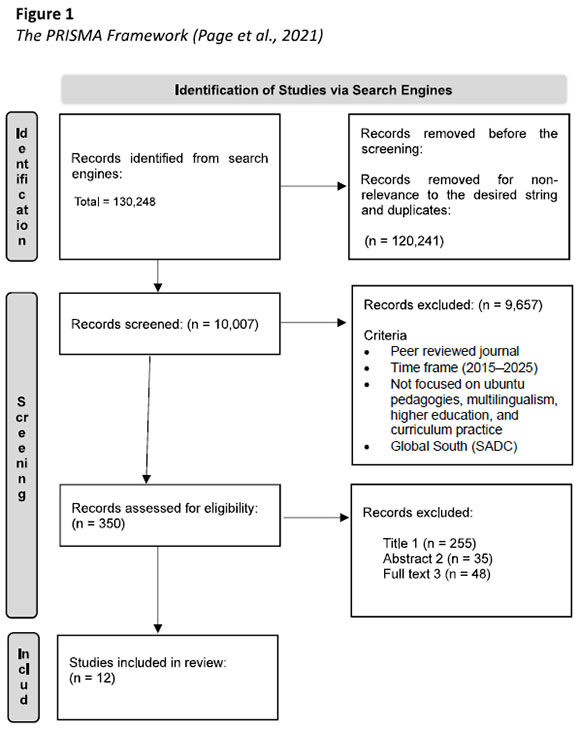
A detailed analysis was carried out using different databases that included ScienceDirect, Web of Science, ProQuest Education Database, and ERIC. Because this study searched for information through the Library Information Services, these databases were relevant to this study because of their accessibility and vastness of information. A clear method was used to identify studies that address ubuntu pedagogies and multilingual practice in higher education. Publications originating from 2015 to 2025 were examined and just 12 met the main criteria decided beforehand for inclusion in the analysis. Then, researchers analysed and combined the chosen articles to respond to the research question.
Various databases were searched for information, seeking to unravel how ubuntu pedagogies could shape education in tertiary institutions. By looking for the right keywords and tuning their search, researchers chose 12 articles that fit the criteria for research and the question being asked. Both in-depth analysis and synthesis were applied to these articles to provide a full explanation of how ubuntu pedagogies can bring fresh ideas to multilingual education in South Africa. As a result, the study provides clear and helpful ideas about how communal curriculum practices impact decolonial educational ideas in multilingual institutions of higher learning.
Inclusion and Exclusion Criteria
Stern et al. (2014) argued that the inclusion and exclusion criteria in qualitative systematic reviews enable researchers to choose only the studies that are relevant and based on the research question. For purposes of this review, the study looked for peer-reviewed articles published over the last 10 years that investigate ubuntu pedagogies, multilingual practices, or focus on a decolonial angle in higher education, employing qualitative and mixed-method designs. Studies were included in the review if they looked at how participants experienced, understood or viewed these practices. For these reasons, the study excluded studies that were published before 2015, studies that were quantitative, and those that were not peer reviewed. In addition, studies that did not relate to collective learning or multilingualism were also excluded. Butler et al. (2016) emphasised that establishing specific guidelines helps avoid bias and ensures only relevant studies are included, especially when investigating a subject such as ubuntu in education. As a result, this approach deepens the review and guarantees that findings support improvements in theory, practice, and policy for higher education.
Inclusion Criteria
• Peer-reviewed articles and book chapters published between 2015 and 2025.
• Research focusing on ubuntu, multilingualism, and/or higher education.
• studies adopting decolonial, communal, or African indigenous frameworks.
• Literature discussing curriculum practice, language policies, or pedagogical innovations.
• Studies situated in the Global South, particularly sub-Saharan Africa.
Exclusion criteria
• Publications prior to 2015.
• Articles that discuss multilingualism without linking to higher education.
• Opinion pieces, blogs, or grey literature lacking academic rigour.
• Studies with a purely cognitive or psycholinguistic approach, without cultural or philosophical framing.
Search Strategy
A full search was conducted to find studies from different categories, for example education, linguistics, African philosophy, and curriculum studies. Olawumi et al. (2024) argued that a search strategy applies various primary, secondary, and alternative search terms.
Search Terms
The keywords used were derived from the core concepts of the study:
• Ubuntu, communal values, indigenous philosophy
• Multilingualism, translanguaging, language diversity
• Higher education, university, curriculum practice
• Decoloniality, decolonial lens, epistemic justice.
Search Strings
• Primary search string: ("ubuntu" AND "multilingualism" AND "higher education")
• Secondary search string: ("ubuntu pedagogy" AND "language policy" AND "curriculum")
• Alternative search string: ("decolonial lens" OR "epistemic justice" AND "language diversity" AND "higher education").
Database Search
The search was conducted across the following academic databases to ensure comprehensive coverage:
• ScienceDirect
• Web of Science
• ProQuest Education Database
• ERIC (Education Resources Information Center).
Filters Applied
To refine the results, the following filters were applied:
• Date range: 2015-2025
• Language: English
• Document type: Peer-reviewed journals, books, and book chapters
• Subject areas: higher education, ubuntu philosophy, multilingualism, African studies.
Study Selection
The studies identified in the search were screened in two stages. In the first stage, the titles and abstracts were considered to decide if a record was relevant. Then, the shortlist was examined in full detail by assessing article texts, furthermore, identifying articles based on the inclusion and exclusion criteria, which were applied in both steps. Any differences of opinion during the selection were worked out by reviewing the articles again and talking about them. Ultimately, 12 articles were selected for in-depth analysis based on their contribution to understanding ubuntu pedagogies in multilingual, decolonial higher education contexts.
Ethical Considerations
The ethical considerations guiding this study were deeply rooted in the principles of ubuntu, which emphasise communal responsibility, dignity, and relational accountability. Although the study was based on a systematic review of secondary sources, and did not involve direct human participants, ethical diligence was upheld through careful representation of the literature and respect for intellectual traditions. All reviewed works are peer-reviewed and publicly available, ensuring transparency and proper attribution to original authors. The study honours the cultural and epistemic integrity of African communities by engaging with ubuntu not merely as a theoretical lens but as a lived philosophy, avoiding appropriation or misrepresentation of Indigenous knowledge systems.
Limitations
This study relied mainly on secondary data as a qualitative systematic review instead of looking at primary real data from students, teachers, or schools using ubuntu methods. The study's findings may not be easily generalised to a broader context because it only covers South Africa. In addition, depending only on English or translated African language works in literature may lead to ignoring sources that give important cultural insights in local languages.
Analysis of the Data
In a systematic literature review, thematic analysis means carefully looking for, organising, and understanding main patterns or themes present in qualitative research (Braun & Clarke, 2006). Thomas and Harden (2008) argued that thematic analysis is about reading and tagging extracted data to note any repeating thoughts, meanings, or connections that answer the research question. Unlike quantitative meta-analysis, which aggregates numerical data, thematic analysis focuses on synthesising rich, descriptive findings to reveal how different studies converge or diverge around key concepts (Thomas & Harden, 2008).
Findings
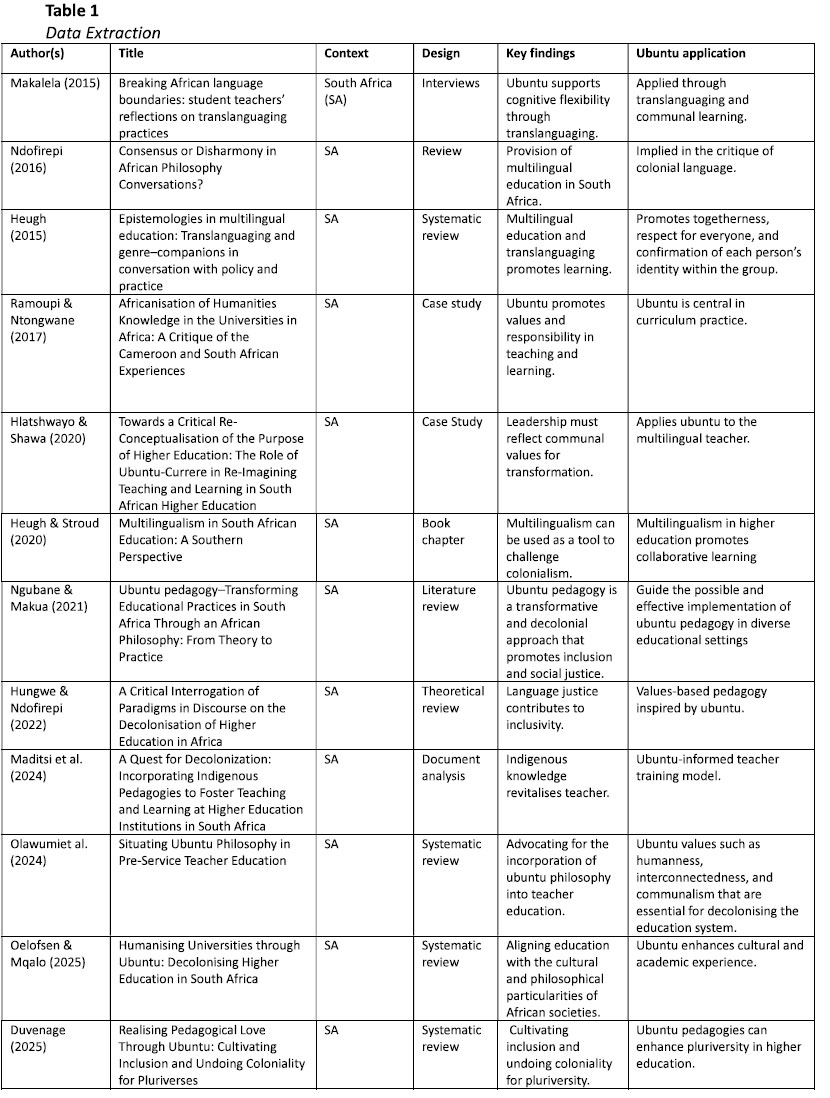
These findings used thematic analysis to examine ubuntu pedagogies as a curriculum practice to reimagine multilingualism in higher education through African communal values, a South African perspective. Through theme analysis, the review reveals that translanguaging, communal learning, language justice, and resistance to neoliberal tendencies are common in ubuntu-influenced multilingual curriculum in South Africa. Table 1 presents the data extraction table reflecting the articles that were used to arrive at the thematic findings.
Introduction of Themes
The systematic review revealed five interrelated themes that collectively illustrate how ubuntu pedagogies can reimagine multilingualism in higher education through communal curriculum practices. These themes highlight the centrality of ubuntu in shaping inclusive, relational, and decolonial educational experiences. First, the use of ubuntu as a pedagogical foundation for translanguaging demonstrates how learners' linguistic resources can be integrated fluidly to promote cognitive engagement and cultural affirmation. Second, the theme of ethical curriculum reform emphasises ubuntu's potential to reshape curriculum design through values of respect, solidarity, and communal accountability. Third, the studies show how language justice and identity affirmation, rooted in ubuntu principles, contribute to dismantling linguistic hierarchies and fostering a stronger sense of belonging among students. The fourth theme is about the struggles between ubuntu and neoliberalism given that the monetisation of multilingualism tends to obstruct efforts to include ubuntu-based practises. And lastly, ubuntu demonstrates how teachers are responsible for applying these principles through mindful and inclusive methods. These five themes together increase our awareness of multilingual education as a decolonial approach and also show how ubuntu can effectively support epistemic justice in African colleges and universities.
Ubuntu Pedagogies Enabling Translanguaging
Olawumi et al. (2024) argued that ubuntu and translanguaging share many common values, which leads to students using multiple languages in their learning process. Furthermore, Oelofsen and Mqalo (2025) believed that translanguaging, in the South African context, helps to boost student involvement, rather than considering translanguaging as a weakness. Hungwe and Ndofirepi (2022) supported this argument by demonstrating that training programmes centred on ubuntu help teachers use inclusive language to welcome students' home languages. This shows that bringing ubuntu into translanguaging helps to reject dominant monolingual ideologies and encourages an inclusive, caring way of learning. Emphasising common identity and respect encourages the use of various languages in classes limited by earlier colonial language structures (Oelofsen & Mqalo, 2025).
In addition, Norro (2022) argued that ubuntu promotes academic literacy by allowing student to engage the content using translanguaging, thereby gaining a linguistic experience that is relatable. The study further discovered that students developed greater confidence and a stronger sense of identity when permitted to use both Indigenous and academic languages interchangeably. This echoes ubuntu's core tenet "I am because we are" in the context of language learning, promoting dialogue over rigid language boundaries. All these case studies indicate that using translanguaging goes beyond being a way to teach and demonstrates the strong epistemological principles behind ubuntu. Translanguaging with ubuntu values at the centre allows students to bring their unique languages into learning and find success as part of a group, instead of being judged by their singular language skills.
Ubuntu and Ethical Curriculum Reform
The second theme stresses how ubuntu supports changes in ethics within the curriculum, creating a different approach than the usual individualistic and competitive education that dominates higher education. Heugh (2015) showed that when education policies are guided by neoliberalism, multilingualism is positioned a marketable skill instead of its real cultural and knowledge-based value. The study further argues that neoliberalism ideas conflict with ubuntu because it places communal values and sense of responsibility above all else in education. Likewise, Ramoupi and Ntonwane (2017) demonstrated that an ubuntu-based curriculum practice promotes language inclusivity and encourages caring for students' cultural and moral lives. When studying South African universities, Ramoupi and Ntonwane (2017) further found that students preferred lessons that valued their lived experiences and the promotion of collaborative activities. These findings suggest that ubuntu offers an ethical compass that guides curriculum design toward justice, dignity, and equity.
Hungwe and Ndofirepi (2022) reinforced this argument by showing that ethical teaching rooted in ubuntu goes beyond merely accommodating diversity; it actively transforms the classroom into a space of solidarity and mutual accountability. Their analysis of teacher preparation programmes indicates that when educators are trained to view students not as isolated individuals but as members of a learning community, both curriculum content and delivery shift accordingly. This perspective redefines success not in terms of individual achievement but in the quality of relationships and collective understanding fostered in the classroom. Thus, ethical curriculum reform through ubuntu is not an add-on to existing structures; it requires a rethinking of the educational purpose itself The studies mentioned above demonstrate that ubuntu has the potential to reshape higher education curriculum into more humane, socially responsive, and culturally grounded experiences that reflect African philosophical traditions.
Ubuntu-Inspired Language Justice and Identity Affirmation
The third theme examines how ubuntu approaches supporting fairness in language use and respecting student identities, mainly in postcolonial environments where African languages have been ignored. Ndofirepi (2016) argued that language should be considered more than just a way to speak with others; language can show the strength and collective identity of a group. Indigenous languages should play a major role in higher education to help decolonise education and give dignity back to marginalised groups. Ubuntu's focus on connection means that language is appreciated rather than regarded as an obstacle. Also, Chingombe and Higgs (2019) explained that because the policy is rarely implemented properly, local languages continue to be excluded in schools and universities. Heugh and Stroud (2020) further argued that real reform calls for working on deep structures, and ubuntu can encourage this shift by considering language as something all community members own and together protect.
This theme is further supported by Makalela (2015), who explored the role of language in identity construction within decolonised classrooms. The study found that students taught in environments that acknowledged their home languages reported greater confidence, cultural affirmation, and academic engagement. Such outcomes align directly with ubuntu's values of mutual respect, shared humanity, and the validation of personal and collective identity. These studies illustrate that language justice is not just a pedagogical concern but a deeply ethical one. Ubuntu-inspired practices enable students to see their languages not as inferior, but as valid mediums of academic expression and intellectual development. By restoring voice and visibility to marginalised linguistic identities, ubuntu pedagogies play a vital role in advancing equity and epistemic justice in multilingual university settings.
Institutional Challenges and Neoliberal Tensions
The next theme centres on the ongoing conflict between community-based ubuntu beliefs and the weight of neoliberal policies in most modern universities. According to Heugh (2015), it is common for languages to be incorporated into policymaking, not because of their cultural relevance but because economists and policymakers consider them more valuable for their financial contribution. In contrast to ubuntu, the instrumentalist view prize only one type of language for identity, moral action and jointly produced knowledge. It is evident from the research that even when ubuntu-based language practices are tried in schools, they do not become established in the system because this system remains influenced by individualism and market priorities (Heugh, 2015).
Both Kamwangamalu (2016) and Maditsi et al. (2024) submitted to this concern through their policy analysis. Their studies explained that while African countries often have good language policies, their practical application is disrupted by slow government action, unmotivated officials, and ancient colonial rules. In places where only top officials make the decisions and everyone must meet set targets, the value of ubuntu is ignored. Maditsi et al.'s (2024) findings indicate that the intervention by policymakers that is inconsistent with the actual practice undermines the attempts to create a platform for native languages to thrive in higher education. It is very challenging to apply ubuntu pedagogies in higher education due to these institutional dynamics that are still colonial. Some educators bring ubuntu values into their classrooms, but the infrastructure that can enable this pedagogical innovation that promotes multilingualism is disrupted by the lack of resources. Consequently, ubuntu's ability to improve education may be confined to small actions instead of acting as a major catalyst for change.
Ubuntu as a Catalyst for Teacher Transformation
This final theme deals with how ubuntu is influencing changes in teacher education and development. The review depicts ubuntu as a significant learning tool for students and for the way educators change their approach to teaching. Olawumi et al. (2024) stated that instilling ubuntu while training teachers can help them practise an ubuntu pedagogy that benefits everyone in the community. Furthermore, Olawumi et al. (2024) discovered that educators who were trained and became aware of ubuntu's priorities, such as interconnection, respect, and responsibility, better recognised cultural and language diversity in their classrooms. Afterwards, teachers began approaching students from a broader view and engaged with what students experience in real life.
Further support for this theme come from Ngubane and Makua (2021) and HIatshwayo and Shawa (2020). Ngubane and Makua (2021) argued that ubuntu-oriented teacher education challenges the dominance of Western epistemologies by placing Indigenous knowledge systems at the heart of curriculum design. His findings suggest that when pre-service teachers are trained through ubuntu, they are more likely to create learning environments rooted in empathy and collaboration. HIatshwayo and Shawa (2020), working in teacher and education development, found that applying ubuntu fostered trust, confidence, and relational learning among both educators and students. These studies collectively show that ubuntu is a transformative force in teacher development, equipping educators to model the very values they wish to instil. In doing so, ubuntu pedagogy becomes a sustainable practice, not only through content, but through the conduct and consciousness of the teachers themselves (Duvenage, 2025).
Theoretical Implications
The findings of this review have significant theoretical implications for curriculum theory, language education, and decolonial pedagogy. Most notably, they validate ubuntu as a robust theoretical framework for reimagining multilingualism not just as a linguistic practice, but as a relational and ethical commitment in higher education. By affirming communal interdependence, ubuntu challenges dominant Western educational theories that prioritise individual achievement and standardisation (Chingombe & Higgs, 2019). The consistent emphasis across the reviewed literature on collaboration, collective identity, and mutual care underscores ubuntu's relevance to theories of social constructivism and critical pedagogy, while also extending these traditions through an African philosophical lens. This positions ubuntu not simply as a cultural add-on but as a foundational worldview with the capacity to reshape pedagogical relationships, curriculum design, and knowledge production on epistemologically just terms.
Furthermore, the findings highlight the limitations of existing multilingual and curriculum theories that treat language as a neutral medium. Ubuntu exposes how language is deeply embedded in power, identity, and belonging issues that are often sidelined in traditional models. By incorporating ubuntu, new theoretical ground is opened for understanding multilingualism as both a social practice and a moral imperative. The review also suggests that ubuntu can bridge the gap between theory and practice in teacher education by rooting reflective practice in communal values. This shift compels theorists to consider not only what knowledge is worth teaching, but also how and with whom it is constructed. Ultimately, these findings support the development of decolonial theories of education that are grounded in Indigenous knowledge systems and that actively resist the neoliberal rationalities currently shaping higher education policy and practice.
Discussion
The review reveals that using ubuntu pedagogy is a meaningful and viable alternative for conventional, mostly monolingual models of higher education. Ubuntu was found in each of the 12 studies to emphasise connections, openness, and linguistic justice. By applying translanguaging, dialogic teaching, and group knowledge building, ubuntu-centred classrooms empower students to help create and share meaning connected to their cultures and languages. Such ideas become especially vital in parts of postcolonial Africa, where curriculum practice has mostly followed Eurocentric standards that marginalise the value of native languages and epistemologies (Khohliso & Mgqwashu, 2024).
At the same time, the analysis points out that ubuntu beliefs are often in conflict with the neoliberal logic embedded in many higher education institutions. Even though some educators are taking steps to implement ubuntu values in education in their classrooms, the culture inside schools usually means they still have to focus on standardisation, market-driven achievements, and meeting rules, rather than on relationships and morality (Mabena, 2023). Research shows that, even with careful language policies, school systems cannot accomplish much unless they have real strategies and necessary intervention (Letseka, 2012). This shows that a more serious commitment is needed from universities to fully incorporate decolonial ideas, not just create empty symbols, to let ubuntu change how the institutions are run.
The findings highlight significant implications for theory, practice, and future research. The findings advocate for the development of curriculum and language theories that prioritise ubuntu pedagogies. The findings further urge educators to adopt ubuntu not only in pedagogy but in the way they relate to students and knowledge itself, and the relationship of learning to the social experiences of learners. For future research, there is a need for longitudinal and comparative studies to evaluate how ubuntu-informed practices evolve over time and across different contexts (Msila, 2025). The study suggests that lawmakers and policymakers should put communal values, multilingualism, and culturally relevant teaching at the heart of legislation and educational plans. Then, ubuntu can serve as a foundation for changing the way education is delivered in Africa.
Conclusion
This review has shown that ubuntu pedagogy offers a transformative lens through which multilingualism in higher education can be reimagined as a communal, inclusive, and decolonial curriculum practice. The 12 articles reviewed consistently demonstrated that ubuntu's relational values of interdependence, dignity, and mutual care create space for language practices that affirm identity, promote epistemic justice, and challenge exclusionary norms rooted in colonial and neoliberal legacies. Whether through translanguaging, ethical curriculum reform, or teacher development, ubuntu emerged not only as a philosophical concept but as a practical framework for reshaping how language and learning are approached in South African universities. At the same time, the findings revealed that institutional constraints, inconsistent policy implementation, and prevailing individualistic logics continue to limit the full realisation of ubuntu in practice. Nonetheless, the review affirms that ubuntu is not merely compatible with the goals of multilingual education, it is essential to achieving them in ways that are locally meaningful and globally relevant.
Recommendations
As the findings suggest, several recommendations are made. First, institutions of higher learning should include ubuntu pedagogies in the way teachers are trained, in teaching practice, and in policies on multilingual use. Furthermore, training should focus on discussing and applying the ubuntu teaching strategy, encouraging collaborative knowledge production. In addition, policymakers and lawmakers have to check and improve national and college education plans by approving laws that secure different languages, reform assessment approaches, and provide finances for building culturally connected course materials. And further work needs to be carried out examining ubuntu's use in different learning contexts through studies that follow students over an extended period and compare outcomes.
References
Antony-Newman, M. (2025). Plurilingualism for social justice: A meta-synthesis. Journal of Multilingual and Multicultural Development, pp. 1-30. https://doi.org/10.1080/01434632.2025.2475915
Asfaha, Y. M., Spotti, M., & Idris, K. (2023). Translanguaging pedagogies in the Global South: Review of classroom practices and interventions. The Routledge handbook of multilingualism (pp. 252-268). Routledge.
Bamgbose, A. (2014). The language factor in development goals. Journal of Multilingual and Multicultural Development, 35(7), 646-657. https://doi.org/10.1080/01434632.2014.908888 [ Links ]
Braun, V., & Clarke, V. (2006). Using thematic analysis in psychology. Qualitative Research in Psychology, 3(2), 77-101. https://doi.org/10.1191/1478088706ap063oa [ Links ]
Butler, A., Hall, H., & Copnell, B. (2016). A guide to writing a qualitative systematic review protocol to enhance evidence-based practice in nursing and health care. Worldviews on Evidence-Based Nursing, 13(3), 241-249. https://doi.org/10.llll/wvn.12134 [ Links ]
Canagarajah, S. (2022). Challenges in decolonizing linguistics: The politics of enregisterment and the divergent uptakes of translingualism. Educational linguistics, 1(1), 25-55. https://doi.org/10.1515/eduling-2021-0005 [ Links ]
Chen, L., Karas, M., Shalizar, M., & Piccardo, E. (2022). From "promising controversies" to negotiated practices: A research synthesis of plurilingual pedagogy in global contexts. TESL Canada Journal, 38(2), 1-35. https://doi.org/10.18806/tesl.v38i2.1354 [ Links ]
Chimbutane, F. (2015). Bilingual education: Enabling classroom interaction and bridging the gap between schools and rural communities in Mozambique. International Journal of Educational Development, 2(1), 101-120. https://hdl.handle.net/10520/EJC186391 [ Links ]
Chingombe, S., & Higgs, P. (2019). Philosophical reflections on ubuntu in the context of cooperative learning. International Research in Higher Education, 4(2), 10-24. http://dx.doi.org/10.5430/irhe.v4n2p10 [ Links ]
Cooke, A., Smith, D., & Booth, A. (2012). Beyond PICO: The SPIDER tool for qualitative evidence synthesis. Qualitative Health Research, 22(10), 1435-1443. https://doi.org/10.1177/1049732312452938 [ Links ]
Duvenage, A. (2025). Realising pedagogical love through ubuntu: Cultivating inclusion and undoing coloniality for pluriversity. In E. Vanderheiden, C. H. Mayer, & A. M. F. Barcelos (Eds.), Pedagogical love in adult education. Springer
Gade, C. B. N. (2011). The historical development of the written discourses on Ubuntu. South African Journal of Philosophy, 30(3), 303-329. https://hdl.handle.net/10520/EJC96149 [ Links ]
Heugh, K. (2015). Epistemologies in multilingual education: Translanguaging and genre-companions in conversation with policy and practice. Language and Education, 29(3), 280-285. https://doi.org/10.1080/09500782.2014.994529 [ Links ]
Heugh, K., & Stroud, C. (2020). Multilingualism in South African education: A southern perspective. In R. Hickey (Ed.), English in multilingual South Africa: The linguistics of contact and change (pp 216238). Cambridge University Press,.
HIatshwayo, M. N., & Shawa, L. B. (2020). Towards a critical re-conceptualization of the purpose of higher education: The role of ubuntu-currere in re-imagining teaching and learning in South African higher education. Higher Education Research & Development, 39(1), 26-38. https://doi.orB/10.1080/07294360.2019.1670146 [ Links ]
Hungwe, J. P., & Ndofirepi, A. P. (2022). A critical interrogation of paradigms in discourse on the decolonisation of higher education in Africa. South African Journal of Higher Education, 36(3), 5471. https://hdl.handle.net/10520/ejc-high_v36_n3_a4 [ Links ]
Kamwangamalu, N. M. (2016). Language policy and economics: The language question in Africa. Palgrave Macmillan.
Khohliso, X. D., & Mgqwashu, E. M. (2024). Perspectives on curriculum as praxis: Implications for higher education pedagogy. Axiom.
Kiernan, J., Meier, J., & Wang, X. (2017). Translingual approaches to reading and writing: Centring students' languages and cultures within reflective practices of translation. L1-Educational Studies in Language and Literature, 1-18. https://doi.org/10.17239/L1ESLL-2017.17.03.04
Kubota, R. (2016). The multi/plural turn, postcolonial theory, and neoliberal multiculturalism: Complicities and implications for applied linguistics. App/Zed Linguistics, 37(4), 474-494. https://doi.org/10.1093/applin/amu045 [ Links ]
Letseka, M. (2012). In defence of ubuntu. Studies in Philosophy and Education, 31(1), 47-60. https://doi.org/10.1007/s11217-011-9267-2 [ Links ]
Mabena, M. I. (2023). Learners' reception of translanguaging pedagogy as a strategy for reading English L2 texts. Journal for Language Teaching, 57(2), 1-24. https://www.ajol.info/index.php/jlt/article/view/263034 [ Links ]
Maditsi, M. E., Rasehlomi, M. M., & Seemise, T. H. (2024). A quest for decolonization: Incorporating Indigenous pedagogies to foster teaching and learning at higher education institutions in South Africa. Journal of Mother-Tongue Biblical Hermeneutics & Theology (MOTBIT), 6(5). https://doi.org/10.38159/motbit.2024653 [ Links ]
Makalela, L. (2015). Breaking African language boundaries: Student teachers' reflections on translanguaging practices. Language Matters, 46(2), 275-292. https://doi.org/10.1080/10228195.2014.986664 [ Links ]
Maphalala, M. C, & Nkosi, N. (2025). Fostering ubuntu in teacher education for South African higher education. Journal of Education and Learning Technology, 6(1), 10-25. https://doi.org/10.38159/jelt.2025612 [ Links ]
Mphuthi, M., Fredericks, B., & Khohliso, X. (2024). Multilingualism: An effective learning and teaching strategy to enhance higher education curriculum practice. In X. D. Khohliso & E. M. Mgqwashu (Eds.), Perspectives on curriculum as praxis: Implications for higher education pedagogy (pp. 3159). Axiom.
Msila, v. (2025). Transforming university through Africanised research: In search of the indigenous. African Identities, 1-14. https://doi.org/10.1080/14725843.2024.2439440.
Munyaradzi, J. (2024). Neoliberalism in South African higher education language policy: A decolonial perspective. Transformation in Higher Education, 9(0), 395. https://doi.org/10.4102/the.v9i0.395 [ Links ]
Ndofirepi, A. P. (2016). Consensus or disharmony in African philosophy conversations? African and Asian Studies, 15(2-3), 194-214. https://doi.org/10.1163/15692108-12341030 [ Links ]
Ngubane, N. I., & Gumede, M. (2018). The use of ubuntu pedagogy to facilitate academic support in a higher education classroom. Indilinga: African Journal of Indigenous Knowledge Systems, 17(2), 245-258. https://hdl.handle.net/10520/EJC-13957f7e32 [ Links ]
Ngubane, N., & Makua, M. (2021). Ubuntu pedagogy-transforming educational practices in South Africa through an African philosophy: From theory to practice. Inkanyiso: Journal of Humanities and Social Sciences, 13(1), 1-12. http://dx.doi.org/10.4102/ink.v13i1.9 [ Links ]
Ngũgĩ wa Thiong'o. (1981). Writers in politics: Essays. East African Publishers.
Ngũgĩ wa Thiong'o. (1993). Moving the center: The struggle for cultural freedoms. James Currey.
Norro, S. (2022). Factors affecting language policy choices in the multilingual context of Namibia: English as the official language and medium of instruction.Apples:Journal of Applied Language Studies, 16(1), 1-20. https://doi.org/10.47862/apples.107212 [ Links ]
Oelofsen, R., & Mqalo, S. (2025). Humanising universities through ubuntu: Decolonising higher education in South Africa. Utafiti, 20(1), 127-142. https://doi.org/10.1163/26836408-15020113 [ Links ]
Olawumi, K. B., Mavuso, M. P., & Duku, N. S. (2024). Situating ubuntu philosophy in pre-service teacher education. International Journal of Learning, Teaching and Educational Research, 23(8), 605-623. https://doi.org/10.26803/ijlter.23.8.31 [ Links ]
Page, M. J., McKenzie, J. E., Bossuyt, P. M., Boutron, I., Hoffmann, T. C, Mulrow, C. D., Shamseer, L, Tetzlaff, J. M., Akl, E. A., Brennan, S. E., & Chou, R. (2021). The PRISMA 2020 statement: An updated guideline for reporting systematic reviews. BMJ, 372. https://doi.org/10.1136/bmj.n71 [ Links ]
Praeg, L. (2008). An answer to the question: What is ubuntu? South African Journal of Philosophy/Suid-Afrikaanse Tydskrif vir Wysbegeerte, 27(A), 367-385. https://doi.org/10.1136/bmi.n71 [ Links ]
Ramoupi, N. L, & Ntongwe, R. N. (2017). Africanisation of humanities knowledge in the universities in Africa: A critique of the Cameroon and South African experiences. In M. Cross & A. Ndofirepi (Eds.), Knowledge and change in African universities (pp. 195-214). Brill.
Sefotho, M. P. M. (2022). Ubuntu translanguaging as a systematic approach to language teaching in multilingual classrooms in South Africa. Journal for Language Teaching, 56(1).https://doi.org/10.56285/jltVol56iss1a5416 [ Links ]
Stern, C, Jordan, Z., & McArthur, A. (2014). Developing the review question and inclusion criteria. American Journal of Nursing, 114(4), 53-56. https://doi.org/10.1097/01.NAJ.0000445689.67800.86 [ Links ]
Thomas, J., & Harden, A. (2008). Methods for the thematic synthesis of qualitative research in systematic reviews. BMC medical research methodology, 8(45), 1-10. https://doi.org/10.1186/1471-2288-8-45 [ Links ]
Tshelane, M. D. (2022). Reimagining responsible research innovations regarding professional teaching standards for curriculum practice. Journal of Culture and Values in Education, 5(1), 92-105. https://doi.org/10.46303/jcve.2022.8 [ Links ]