




Services on Demand
Journal

Article
 English (pdf)
 Article in xml format
 Article references
 Automatic translation
 Send this article by e-mail
Indicators
Related links
-
 Cited by Google
 -
 Similars in Google
Share

 Permalink
Scientia Militaria: South African Journal of Military Studies
On-line version ISSN 2224-0020Print version ISSN 1022-8136
SM vol.53 n.1 Cape Town 2025
https://doi.org/10.5787/53-1-1514
ARTICLES
Navigating Human Capital Challenges: Understanding the Decline in White Members of the South African Navy
Asiel E. Kubu; Strinivasan S. Pillay
Durban University of Technology
ABSTRACT
The concept "human capital" refers to 'the accumulation of competencies, knowledge and skills needed to perform a task' as defined by John C Groth and Gregory M Hebb.2 This implies that, to a degree, the effectiveness of an organisation depends on the quality and effectiveness of its employees. The Republic of South Africa is a sovereign democratic state founded on the values of human dignity, the achievement of equality, and the advancement of human rights.3 As part of the public sector, the Department of Defence is expected to transform in order to ensure inclusiveness of all race groups. The objective of the South African National Defence Force Human Resource Strategy 2010 is to ensure compliance with the overall government intent of transformation. This strategy aims to establish an 'efficient, effective and economical human resource composition of the right quality and quantity' for the Department of Defence.4
In line with the South African National Defence Force Human Resource Strategy 2010, the South African Navy pursued recruitment interventions favouring the appointment of black personnel in order to address inequalities of the past in terms of demographics. This led to fewer white youth being inducted, resulting in a predominantly black South African Navy. To investigate this challenge, the current study adopted mixed research approach (qualitative and quantitative). The qualitative research comprised a literature review on human capital, the transformation process in the South African National Defence Force, the demographics of the country, and interviews with serving white recruits in the South African Navy. Furthermore, a questionnaire survey (quantitative research) targeting white youth was administered in Gauteng, a province in South Africa, to obtain data.
Keywords: Legislation, Constitution, Human Capital, Transformation, Representativity, Department of Defence, South African National Defence Force, South African Navy.
Introduction
On its inception to power in 1994, the then Government of National Unity (GNU) inherited a society marked by social and economic inequalities, as well as serious racial, political, and social divisions. In pursuing national reconciliation, reconstruction and development, the public service was expected to play a role as the executive arm of the state. Consequently, the public service needed to transform into a 'coherent, representative, competent and democratic instrument for implementing government policies and meeting the needs of all South Africans' as in line with section 195(1)5 of the Constitution, to fulfil this role effectively.6
Chapter 10 of the Defence Review (1998) guides the recruitment and appointment process in the Department of Defence (DoD). The Defence Review states people are a valuable resource. The Defence Review reaffirms the DoD position on upholding a non-racial, non-partisan, non-sexist, and non-discriminatory institutional culture.7 The South African National Defence Force (SANDF) consists of seven former forces (statutory and nonstatutory) as part of the integration process in 1994. These forces were Umkhonto weSizwe (African National Congress), Azanian People's Liberation Army, the defence forces of the four former homelands (Bophuthatswana, Transkei, Ciskei and Venda), and the South African Defence Force.
The South African Navy (SAN), as part of the DoD, having benefited the least from this process in terms of manpower, implemented a recruitment strategy in order to ensure representativeness of all race groups within the organisation. Prior to the democratisation of the Republic of South Africa (hereafter "the Republic"), the SAN consisted predominantly of white people, as black people were debarred from joining the organisation. The recruitment strategy after 1994 resulted in a continuous annual decline in the number of white personnel. The reported intakes of 2015-2020 confirmed this trend, highlighting the ongoing decline in the number of white youth joining the SAN.
Research Problem
According to Groth and Hebb, 'Human capital is the original and purest form of equity' significantly influencing future prospects and outcomes.8 The White Paper on Human Resource Management in the Public Service of 1997 addresses human resource management (HRM) in its entirety, and provides guidelines on various aspects of human capital, including provisioning, utilisation, training, and termination of service. The White Paper also establishes a comprehensive framework for change in line with the Constitutional imperatives on representativity in the public service, making the DoD no exception.9
The Defence Review requires the SANDF to be broadly representative of the population that it serves.10 To achieve this goal, the DoD has to pursue improved marketing, selection, and appointment processes for all its service systems. This should occur within the context of achieving the appropriate quality, quantity, and representativity of human capital necessary for practising excellence and accountability.11 In terms of training and development, the DoD adopted the Republic of South Africa Human Resource Development Strategy 2010 to 2030 as its grand strategy. This strategy refers to 'formal and explicit activities that will enhance the ability of all individuals to reach their full potential'.12
The SANDF Human Resource Strategy 2010 aims to ensure the availability of the right number and quality of personnel in the right roles and at the right time.13 The strategy emphasises efficiency and effectiveness, viewing people as the most important and strategic asset of the DoD. The strategy also provides direction for managing human capital in the DoD over the medium to long term, advocating an HR philosophy that ensures a representative, well-disciplined, motivated and satisfied workforce.14 Despite the strategies mentioned above, the SAN has faced a decline in white personnel since 1994 due to normal attrition. This challenge is compounded by a consistent decrease in the number of white youth inducted into the SAN since then.
Research Aim and Approach
The current study intended to establish the reasons for the decline in white personnel, particularly white youth, in the SAN. Without a strategic approach to recruiting white youth, the problem is likely to worsen. To establish the reasons for this decline, a mixed research approach (qualitative and quantitative) was followed in the study. The qualitative research comprised a literature review on human capital and transformation within the SANDF, as well as demographic representation since 1994. Additionally, interviews were conducted with new recruits who were part of the Military Skills Development System (MSDS) of the SAN in 2020.
Pertaining to the quantitative aspect, the study analysed various intakes of the SAN since 2015, focusing on white youth and their attrition after induction. A questionnaire survey targeting white youth in Grades 10 to 12 was administered at various high schools in Gauteng (City of Tshwane Metropolis) during the second and third quarters of 2019.
Research Questions
According to Cameron and Stone, 'with the professionalisation of human resource', there is a requirement for a uniform code of ethics outside colour lines.15 The authors further state, 'ethics is the branch of philosophy concerned with intent, means and consequences of moral behaviour'.16 Strategy in organisations is about ends, ways, and means; therefore, advocating an HR philosophy that ensures a well-disciplined, motivated, and increasingly satisfied workforce. 'Ethics is a study of judgement, right or wrong.'17Similarly, Gildenhuys states, '[e]thics is a moral science, an exposition of what is good or bad and what is right and wrong'.18 This definition is aligned with that of the two authors mentioned above in this paragraph.19
Taking into consideration what Cameron and Stone say about a need for a uniform code of ethics outside colour lines, the SAN promulgated Naval Order No. 4 of 2001 to ensure directing the recruitment processes within its organisation. This order prioritises recruitment, appointment, and retention of all race groups according to the demographic representation of society.20 It is imperative to mention that, despite the guidelines given for appointment using approved DoD numerical targets, the SAN prescribed their own targets as African people at 60 per cent, white people at 23 per cent, coloured people at 15 per cent, and Asian people at 2 per cent.21 The above naval order was supplemented by Naval Order No. 6 of2002, providing guidelines regarding selection and development of candidates for entry in the MSDS programme.22 Taking into consideration the ongoing decline in the number of white people in the SAN - despite the above approved numerical targets - the primary research question that was investigated was:
Does the SAN have an effective and sound human capital strategy to attract competent white youth in sufficient numbers for enlistment after democratisation?
The following secondary research questions were addressed in the study:
• Do school curricula assist youth in making informed career choices after matric?
• Are white youth familiar with the DoD?
• Are white youth interested in joining the SANDF?
• Could the transformation process in the SAN be a factor contributing to the decline in the number of white youth in the SAN?
• Are white youth aware of the career opportunities available in the SAN?
• Is the SAN doing enough to attract suitable white youth to join the organisation?
These research questions were critical in order to establish the rationale behind the declining numbers of white youth. The questionnaire survey administered to Grade 10 to 12 white youth aimed to address the secondary questions. High schools serve as feeders to the MSDS, and the early identification of potential and competent recruits for the SAN in these grades is critical.
Research Objectives
The SAN is required to recruit members in alignment with the race and gender guidelines reflective of the society it serves. Representativity is a constitutional imperative mandating equal employment opportunities for all race groups. Attracting sufficient numbers of white youth for entry remains a challenge however. The primary objective of the current study was therefore to determine whether the HR strategy of the SAN supports the recruitment of competent white youth in sufficient numbers for enlistment.
Literature Review on the Concept Human Capital
People are a very important resource in any organisation; respect is vital to motivate them to serve with distinction and pride. Without human beings, no organisation could survive, as technology alone cannot replace the contribution of people.
There are a number of definitions of the concept "human capital". For instance, Becker defines it as the 'knowledge, information, ideas, skills, and health of individuals'.23According to Smith and Cronje, workers are motivated when they think they are making a positive contribution to the organisation.24 Similarly, Shaw et al. found that human losses (for example, turnover rates) negatively affect organisational performance; however, this effect is moderated when HR investments, such as training, pay, benefits, and justice mechanisms are high.25
Dess and Picken argue, that human capital is about people, their performance and their potential in the workspace. The authors also define the concept "human capital" as the capabilities, knowledge and skills of individuals that ensure organisational success and efficiency.26 Similarly, Bontis et al. emphasise that human capital is about 'the combined intelligence, skills and expertise that gives the organisation its distinctive character'.27
The South African Constitution prohibits discrimination, enshrines fundamental rights, and emphasises openness and accountability. Chapter 2, section 9 prescribes equality and equal employment opportunities for all, prohibiting any form of unfair discrimination.28To uphold the principles of the Constitution, the Department of Public Service and Administration, which oversees public sector policy, approved and promulgated the White Paper on the Transformation of the Public Service. Chapter 10 of White Paper on the Transformation of the Public Service (1995) confirms, representation is foundational to a non-racist, non-sexist democratic society.29
Section 15 of the Employment Equity Act (No. 55 of 1998) states, that affirmative action is a way of making the workplace more representative and fairer ensuring that qualified people from designated groups have equal opportunities in the workplace.30 It is through this intervention that employers are expected and mandated to create action plans to correct historical imbalances in the public sector.
Chapter 5 of the White Paper on Human Resource Management in the Public Service provides a comprehensive policy framework for HRM in the public service.31 This policy document discusses various career management concepts that recognise the value of individuals in the public service. It is the opinion of the current authors that all reputable employers must offer career pathways that support growth within the organisation. This chapter of the White Paper on Human Resource Management in the Public Service emphasises that the employee supervisor is responsible for familiarising him or her with the employee's career aspirations.32 It is the opinion of the current authors that a career development path must be developed for all employees to ensure that their skills are enhanced for own personal and professional growth. Without an effective and sound career management process, organisations cannot retain their workforce. It is, therefore, clear that human capital is critical for the survival of any organisation.
The DoD consists of civilian and uniform members, both having a unique role to play. Civilian members are predominately in a supporting role but exercise oversight of the SANDF. They are governed through various policies, in particular those from the Department of Public Service and Administration, the White Paper on Human Resource Management in the Public Service being one of them. Chapter 3 of the White Paper on Human Resource Management in the Public Service discusses the devolution, increased delegation, and institutional mechanisms in the work environment. It states, '[h]uman resources will, to the greatest extent possible, be managed by those closest to the point of delivery'.33
Chapter 6 of the White Paper on National Defence of 1996 underscores the need for a representative SANDF. The overarching goal is to establish an institution that is professional, efficient, effective, and broadly representative.34 The Minister of Defence and Military Veterans is responsible for overseeing the implementation of these initiatives within the DoD. Both the Defence Review and the White Paper on National Defence (1996) ensure compliance with the Constitution regarding representativity within the SANDF. The SAN, as part of the SANDF and the public service, is expected to uphold this salient constitutional requirement.
Legislative and Policy Framework on Human Capital in the Department of Defence
All organisations depend on labour to attain their output, and people are, therefore, regarded as the most important asset in the DoD. Outputs in the DoD - and in the SANDF in particular - depend on the contributions of each individual as well as the collective efforts of the organisation. The effective retention of defence personnel requires a comprehensive day-to-day personnel maintenance system that affirms conditions of service and benefits. The SANDF Human Resource Strategy 2010 provides direction for the management of human capital over the medium to long term, aiming to establish an efficient, effective, and economically viable HR composition of the right quantity and quality, in the right place, and at the right time.35
Chapter 6 of the White Paper on National Defence (1996) clearly articulates how the recruitment process in the SANDF should be managed. It states that the SANDF will be an all-volunteer force comprising a relatively small regular force that is supported by a sufficiently large part-time force.36 The continuous attrition of highly trained and experienced personnel could compromise the operational readiness of the SANDF. Since 1994, the DoD has made significant strides to improve representativity in its human capital. Recruitment, appointments, and career management are executed in compliance with regulatory criteria set forth in the SANDF Human Resource Strategy 2010.37
The recruitment and selection criteria in the SANDF are based on competencies and academic qualifications specified in the Personnel Management Code (PMC). The PMC also addresses the career management process of SANDF members, and prescribes the responsibilities of the members and the organisation, thereby aligning career planning, development, and utilisation of each serving member.38
The SA HR "philosophy" reiterates the requirements to execute HRM in such a manner as to contribute to a well-disciplined, motivated, and happy force.39 The philosophy therefore focuses on building HR capacity to ensure that the organisation can deliver on its ordered commitment, vision, and mission. The HR component is thus required to be professional, motivated, productive, effective, equitable, and affordable.40 In achieving this, the MSDS programme was developed to provide the SAN with the right calibre of human capital to achieve its end-state in terms of its prescribed vision and mission. This programme was implemented in January 2004, and has since proved effective in appointing the correct calibre of personnel in the Regular Force and in the Reserve Force.
Despite the legislative and policy framework governing representativity within the public service and the DoD, white representation in the SAN remains a challenge. The continuous reduction of white representation could potentially undermine the transformation outcomes the SAN has achieved since 1994.
South African Navy Mandate
The Constitution of the Republic mandates the Defence Force with the protection and defence of the country, its sovereignty, territorial integrity, national interest, and people.41In exercising its constitutional responsibility as part of the SANDF, the SAN must provide a balanced, combat-ready and supported maritime defence capability for the defence and protection of the Republic.42 The primary objective of the SAN is to provide a credible maritime deterrent force. The SAN is also expected to provide suitable platforms -in the form of ships and submarines - to the sanctioned peacekeeping operations and disaster relief missions of the United Nations (UN) and the African Union (AU). Its other responsibility is to assist the police against piracy operations and maritime threats.43 These roles are essential for ensuring that the maritime space and resources of the country are protected at all times.
Based on the above mandate of the SAN, it is the opinion of the current authors that the failure of a state to recognise the importance of the sea could diminish its capacity as a regional power, relinquishing its responsibility to protect its maritime resources. By exercising sea power, the state can safeguard the will of the people and prevent the expropriation of their maritime resources. Budget constraints are recognised as a serious impediment, affecting not only the acquisition, repair, and maintenance of prime mission equipment, but also the compensation of personnel. Without adequate funding, the SAN cannot fulfil its core mission and achieve its primary objective, namely service in the defence of the Republic, for the protection of its sovereignty and territorial integrity.
In addition to budgetary constraints, the SAN must deal with two other human capital challenges, namely representativity and transformation. After more than three decades of transformation efforts, the SAN continues to face racial and skill imbalances, with fewer white youth choosing to join this arm of service than before.44 Failure to address this decline could tarnish the image of the SAN and threaten the constitutional imperative to achieve representativity.
Research Design and Methodology
A research design is a plan that provides a framework for collecting information from respondents, outlining the various steps involved in the study. This is where the problems and objectives of a study are targeted for the sole purpose of structuring the research.45Qualitative research method serves as an umbrella term for a variety of methods and techniques that could not be qualified to research conclusions about the problem investigated.46 Denzin and Lincoln define qualitative research method as 'a situated activity that locates the observer in the world', where the researchers are 'attempting to make sense of, or interpret, phenomena in terms of the meanings people bring to them' in a natural setting.47 This definition makes much sense, according to the authors of the current study. Qualitative analysis is a set of activities that is used after information has been collected. The qualitative research method 'applies from the very start and continues throughout data collection process, as well as after it is completed.'48
Quantitative research methods 'were borrowed by social science from natural sciences such as physics and chemistry, originate from the natural sciences such as physics and chemistry.'49 A quantitative research method analyses the problem by operating numerical data that can be transformed into usable statistics.50 This research method quantifies attitudes, opinions, behaviours and other undefined variable from other larger sample of the population.51 In quantitative research, one uses theory deductively, and places it toward the beginning of the plan for the study.52
In the current study, a mixed research approach was adopted, integrating both quantitative and qualitative methods. Interviews and a survey questionnaire were used for data collection. It is vital to confirm that, during both the qualitative and the quantitative research, no person was forced to participate in the research process. All respondents participated voluntarily, including those already serving in the SAN.
With the professionalisation of human resources, the SAN recognised a need for a uniform code of ethics beyond colour lines as depicted in the Naval Order (No. 6) that guides appointments within the MSDS in terms of race and gender.53 As discussed under a previous heading (see Research Questions), 'ethics is the branch of philosophy concerned with intent, means, and the consequences of moral behaviour'.54 It is also 'a moral science, an exposition of what is good or bad and what is right or wrong'.55
In the current study, interviews (as qualitative method) with MSDS members, and a questionnaire survey involving high school learners (as quantitative method) were administered. Participation was voluntary, with approval obtained from the Gauteng Department of Education and also from the Defence Intelligence Division of the DoD. The research process, as described in the next subsection, was used to establish the reasons for the decline in white representation in the SAN.
Structured Questionnaire
Quantitative research is about gathering and analysing data. It is a means of 'testing objective theories by examining the relationship among variables or a comparison among groups.'56 For the quantitative aspect of the study, a survey questionnaire was administered to Grade 10 to 12 learners. During the survey administered at schools, an assumption was made that it would be insensitive to exclude other race groups; all learners were therefore allowed to participate in the survey, despite the fact that white youth were the targeted population. The respondents totalled 1 509 learners from 29 schools. Only after completion of the questionnaire survey, race groups that were not targeted were eliminated; therefore, a total of 720 white learners formed the sample. The results of white youth in Gauteng (specifically those residing in the City of Tshwane metropolitan area) were therefore analysed. The problem statement related to the decline in the number of white people in the SAN and over-representation of other race groups during intakes.
Interviews with MSDS Members
Qualitative research is a means 'for exploring and understanding the meaning individuals or groups ascribe to a social or human problem.'57 In the qualitative phase, white members of the MSDS population were interviewed. Interviews were conducted between 30 April 2020 and 08 May 2020 with serving MSDS members within the training establishments and units of the SAN in the Western Cape. These units were SAS SIMONSBERG (Simon's Town), SAS SALDANHA (Saldanha Bay), and the SA Naval College (Gordon's Bay). Interviewees, who had been part of intakes between 2015 and 2020, confirmed the reduced intake of white personnel.
Findings
It was evident from the study that most white youth - especially those in high school - have a limited understanding of the transformation process in the public service and the DoD. The survey questionnaire administered to Grade 10 to 12 learners in Gauteng indicated that the decline in the number of white youth in the SAN was not due to transformation. Interviews conducted by the Chief Human Resource of the SANDF with the MSDS however revealed something different. These members indicated that the transformation process in the SAN contributed to the declining figures of white personnel.
Further associated with the transformation process, MSDS members' flagged issues regarding the Performance Management Development System, which assesses individuals against set performance targets. These members viewed the tool as discriminatory, as only black personnel receive performance incentives. Another concern was the dominance of African languages during training, which some felt marginalised white personnel. The MSDS members also indicated that the transformation process affected their career progression. MSDS members appreciated the level of training, discipline, exposure to different cultures, and friendships forged during the training period. Notwithstanding their numbers - as compared to other race groups - these members stated that the recruitment process in the SAN is transparent, as career opportunities are broadly advertised in the printed media. Based on the data collected from the MSDS, the following findings were made:58
• Concerted recruitment drives targeting white youth at various high schools and within their respective communities have not been prioritised in the SAN;
• Sound and proper career guidance at schools has not been given the requisite attention, which affects the ability of the youth to make informed career decisions;
• The SAN has not prioritised programmes on diversity during induction week, and this led to the marginalisation of white members;
• Career managers in the SAN have not sufficiently guided white applicants about career choices after attestation and induction; and
• There is a lack of transparency regarding career management decisions, promotions and the provision of compulsory and discretionary benefits in the SAN.
Before 1994, most uniformed members in the SAN were white people with the number of males exceeding the number of females because of the then recruitment and selection process. It is also important to mention that, before 1994, white females also experienced discrimination, and when they were allowed to join the SAN, they could only be enlisted in the support musterings. This means that white males were the most privileged members at the time.
Only after 1994, did the SAN experience a gradual increase in the number of black youth joining the organisation, even in specialised occupations (combat, technical, and engineering disciplines) that were previously reserved for white males. At the start of integration, it was impossible to fast-track previously disadvantaged communities due to their lack of qualifications and experiences into senior positions and critical musterings to alter the balance materially. The transformation efforts were therefore aggressively pursued to ensure that the previously marginalised were afforded equal opportunities to be considered for careers in the SAN.
Table 1 depicts the gradual increase of black personnel and the corresponding decrease in white members, highlighting progress by the SAN in achieving representativity. In analysing the numbers, cognisance must be taken of the fact that, during the integration process, the SAN was the least preferred arm of service within the SANDF, compared to the South African Army, the South African Air Force, and the South African Military Health Service. This implies that a high percentage of black recruits in the SAN joined as a result of the post-1994 recruitment and selection interventions.
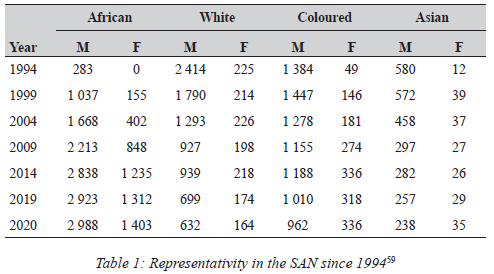
The integration of statutory and non-statutory forces in the SANDF started in 1994, and the SAN was part of the process. During the initial period of integration, the composition of personnel in terms of race within the SAN was as follows: 2 308 black people and 2 639 white personnel (total 4 947), excluding the civilian component. White personnel were, therefore, the majority constituting 53,34 per cent of the SAN. By 2020, the composition of the SAN (uniformed and civilian members) was 6 758, with white personnel accounting for only 796 or 11,77 per cent of the SAN.
Table 2 reflects an exodus of white personnel from the SAN, especially from senior to top management structures due to compulsory age requirements. Other white people -especially junior ranks - used severance packages to exit the SAN. Without an effective feeder system (such as the MSDS) for white youth, the demographics of the Republic, as reflected in the latest census would not have been achieved.60
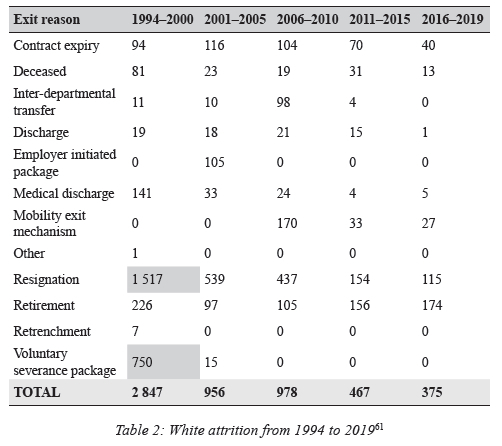
It is apparent from Table 2 that most white personnel exited the SAN during the period of integration when the transformation processes were central to this particular arm of service. Resignation and voluntary severance were the common mechanisms used by white personnel to exit the SAN as highlighted in red above (Table 2). The red highlighting also reflects the period when the biggest number of white personnel exited the SAN. White youth must, however, be recruited annually in sufficient numbers to ensure a representative SAN. The current researchers analysed intakes since 2015 to establish whether the SAN is doing enough to recruit and retain MSDS members inducted into the service.
SAN Intakes: 2015-2020
The SAN serves the common good of the entire population in the Republic, and is duty-bound by the Constitution to ensure that it reflects the demographic diversity of the nation in its services. The current statistics during intakes - as depicted below - is of grave concern, as segments of the population are either unaware of the responsibility of National Defence within a racially diverse and multicultural society, or are just not interested to be part of the DoD. Before any conclusion could be made in terms of this assumption it was important to assess various intakes in the SAN to establish the reasons for the declining numbers of white youth being recruited
Selection and appointment in the SAN follow a rigorous, thorough, and comprehensive process that is subjected to a strict auditable checklist. The SAN Human Resources Plan (FY 2019-2020) outlines the recruitment process for the short to medium term. According to this plan, the MSDS will continue serving as the feeder system to address attrition in the Regular Force and the Reserve Force.62 It is important to mention that Grade 12 learners who are found suitable undergo additional screening to identify those who qualify to study at various academic institutions and colleges. Training evolutions in the SAN are both academic and functional; therefore, additional screening for studying at various colleges and universities is critical.
Figure 1 provided an overview of the selection process, with approximately 21 357 applicants expressing interest in the SAN, 640 were invited for selection. In 2018, approximately 1 764 applicants (8,25 per cent) were white youth, while African applicants constituted 16 451 (77,02 per cent), coloured people 2 914 (13,64 per cent), and Asian people 228 (1,06 per cent). Taking into consideration that 170 MSDS reported, 13 white youth indicated in Figure 1 totalled 7,64 per cent of the intake in 2018.
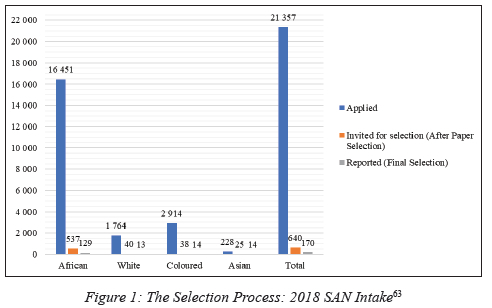
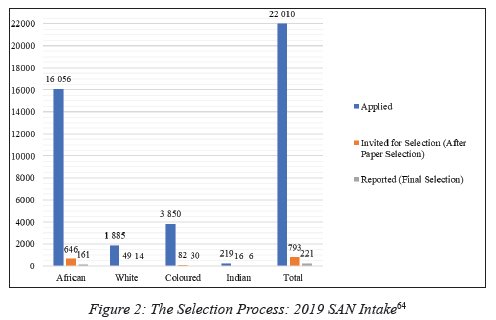
Figure 2 reflects the 22 010 confirmed candidates who submitted application forms at SAN recruiting offices or satellites for the January 2019 intake. Regarding racial distribution, Figure 2 indicates that approximately 1 885 white people (or 8,56 per cent of the applicants), 16 056 African people (72,94 per cent), 3 850 coloured people (17,49 per cent), and 219 Asian people (0,99 per cent) showed interest. For the 2019 MSDS intake, which totalled 221, 14 white applicants (6,33 per cent) reported for training that year.
In terms of the 2020 intake (see Figure 3), 20 760 applicants expressed interest, with 1 439 called up for interviews. Due to the limited number of posts available, only 211 were recommended and eventually reported for basic military training. Of the 20 760 applications received, 181 were white applicants (0,87 per cent of the applicants) of whom a total of 17 were appointed and reported for training. When looking specifically at the number of successful candidates (211), white youth made up 8,05 per cent of the 2020 intake.
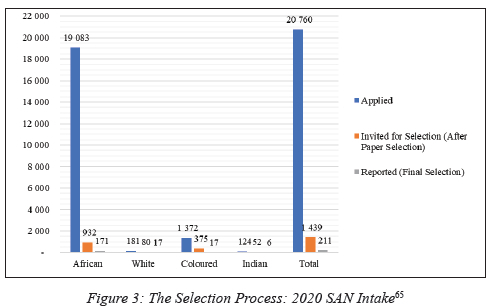
Figures 1, 2 and 3 indicate a relatively consistent trend regarding percentages of applicants from each race group seeking enlistment in the SAN. The average percentage of white applicants remained at approximately 7 per cent, aligning with the population estimates from the latest census.66 This correlation suggests a close alignment between the application rates (of the white population) and their representation in the SAN intake.
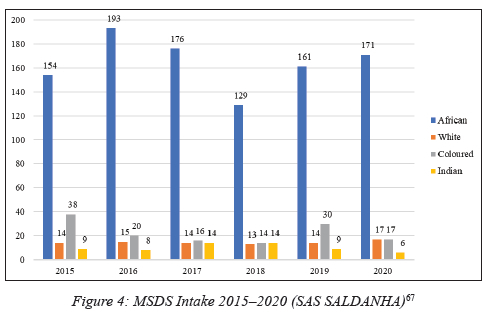
Figure 4 provides an overview of the intake of MSDS members at SAS SALDANHA over a six-year period. SAS SALDANHA is a training establishment for non-commissioned officers (NCOs) in the SAN. Figure 4 reflects MSDS members who completed the entire selection process and were deemed competent for training in the SAN between 2018 and 2020. A total of 1 266 members reported for training over this period, of whom 984 (77,72 per cent) were African people, 87 (6,87 per cent) were white people, 135 (10,66 per cent) were coloured people, and 60 (4,73 per cent) were Asian people.
Patriotism and a sense of security are vital for any country. It is therefore in the interest of SAN to ensure that its enlisted members reflect the demographic diversity of the Republic. Any segment of society that is not integrated into the security layers could pose a potential security threat to the stability of the state. Allowing the numbers of white personnel recruited and retained in the SAN to decline without long-term intervention or strategies contradicts the intentions of the SAN. The SAN must maintain an affordable human capital base across all race groups in accurate proportions to lend legitimacy and credibility to the organisation.
Conclusion
The study on which this article is based, aimed to establish the reasons for the declining numbers of white personnel, particularly youth, in the SAN. The main objective of the study was to determine the factors causing this decline, and to identify potential gaps in the recruitment processes of the SAN for white youth. This is important in order to ensure the SAN remains representative of the white race in the future.
The data collected from the respondents and the literature review indicated that the existing recruitment strategy is insufficient to attract and retain competent white youth. Despite the promulgations of the SANDF Human Resource Strategy 2010, the SAN has yet to revise its strategies to address human capital challenges regarding the recruitment of competent white youth. The 2015-2020 intakes demonstrated a reduction in the number of white youth joining the SAN.
Furthermore, the study found that the SAN has yet to prioritise diversity programmes during the induction of MSDS members to guard against the marginalisation of the white minority. The lack of transparency in career management decisions, promotions, and benefits provision appears to contribute to frustration among white personnel. The SAN must note that, despite the number of white recruits being inducted, failure to develop a sound and effective strategy to retain them will affect sustainability in the short to medium term. The following secondary research objectives were also addressed:
• The study established that the school curriculum does not cover potential career paths, including future employment opportunities in the SAN;
• It was also found that high school learners have limited information about the SANDF and its roles, functions, and responsibilities;
• From the answers provided in terms of transformation, it was clear that white youth, particularly high school learners, have little understanding of the transformation process in the public service and the DoD. The transformation process undertaken in the SAN is, therefore, not the reason why white youth lack interest in joining the SAN;
• The study found that white youth are uncertain about career choices upon completion of Grade 12; and
• It was further found that there is a lack of focused recruitment efforts targeting white youth.
In linking the findings to the literature review, Chapter 2, section 9 of the Constitution of the Republic, prescribes that all persons are entitled to equality and equal employment opportunities. The current study, however, found limited evidence that the SAN prioritises the induction ofwhite youth into the service. The DoD set numerical targets for appointment of race groups using the Defence Review and the White Paper on National Defence (1996) as guidelines. For white people, a quota of 24,35 per cent was prescribed by the DoD; however, the SAN approved 23 per cent according to the naval orders cited above.68 The current representation of white people in the Republic has reduced to approximately 7,3 per cent, rendering the set target unfeasible.69
In terms of the outcome of the study, the demographics of the Republic must be utilised as an instrument or criterion to guide recruitment by race and gender on the part of the SAN, aligning with current estimates of white people comprising approximately 7,3 per cent of the South African population.70 The study found that a concerted recruitment drive targeting white youth at various high schools and within their communities has not been prioritised in the SAN calendar. Failure to have an effective human capital strategy for recruiting white youth could further reduce their representation in the SAN. The recruitment and appointment process must, therefore, be revisited, and during appointments, quotas must be aligned with the demographic composition of the Republic.
The current study used a combination of quantitative and qualitative research approaches. Interviews were utilised as a qualitative approach to help identify possible reasons for the decline in white personnel, and a questionnaire survey, as the quantitative approach, assisted in identifying the gaps in the recruiting process in the SAN. This ensured that the study addressed all issues related to the research aim, objectives, and questions.
The study further established that the current recruitment strategy does not assist in inducting a sufficient number of white youth in the SAN. Comments by MSDS members suggested that the transformation process may significantly contribute to the declining figures of white youth in the SAN. For the SAN to deploy its maritime resources successfully, it is essential to have a workforce that reflects the demographic diversity of the country. This alignment would also ensure international and regional legitimacy and recognition. Taking into consideration the observations and findings of the study, the following recommendations are made:
• The SAN should develop and implement a comprehensive, coherent, and effective career management model across all race groups to help curb the steady exodus of white personnel;
• Equitable treatment during induction week should be ensured, and this should be enforced in all training and career management interventions in the SAN;
• The SAN should utilise the demographics of the Republic to guide the selection and appointment of the youth by race and gender;
• The marginalisation of white personnel should be addressed in the first week by incorporating education and training on transformation into the SAN curriculum for all MSDS members;
• Targeted recruitment interventions should be implemented at high schools to increase the number of white learners enlisted in the SAN; and
• The SAN should devise demographic representativity, and acknowledge that the numerical targets approved by the DoD and the SAN respectively are no longer realistic.
In conclusion, the study was undertaken with the sole purpose of establishing the reasons for the declining number of white personnel, in particular the youth, in the SAN. Analysis of the 2015-2020 intakes indicated that there has been a steady decline in the number of white youth, with retention also presenting a challenge.
A limitation to the study was that it relied on SAN MSDS members who volunteered to participate in the structured interviews. The interviews were used to establish whether the targeted group had knowledge of SAN career opportunities before their enlistment. The opinion of the group regarding the transformation process in the SAN was the focus of the research. As serving members, they might have been exposed to the transformation process in the organisation in some capacity and, therefore, their opinions might have been influenced by their experiences.
For future research, it would be beneficial to examine the entire succession planning for white people in the SAN. The current study focused on recruitment, and not on succession planning. Further, the specific reasons for the exit of white personnel were not investigated. It would be important to understand the reasons why white youth may be leaving the organisation, rather than to rely on assumptions.
1 Vice Admiral (Dr) Asiel E Kubu is a South African Navy officer. He served in the post of Senior Staff Officer Career Management, managing careers of top officers in the SANDF. Other senior appointments were that of Director Naval Personnel, Chief of Naval Staff, and Chief Human Resource respectively. He is a registered member of the South African Board of Peoples Practice. Dr Strinivasan S. Pillay is the head of the Department of Public Management and Economics, in the Faculty of Management Sciences at the Durban University of Technology. His areas of specialisation include the following: public sector human resource management, strategic planning, leadership, change management, managing diversity, and intercultural relations. He is an accredited facilitator, assessor, and moderator.
2 JC Groth & G Hebb, 'Characteristics of Human Capital: International Implications', Research Gate, 2021. <https//www.researchgate.net/publication/321807357-Charecteristics-of-Human-Capital-Intemational-Implications> [Accessed on 1 September 2020].
3 South African Government, Constitution ofthe Republic ofSouth Africa (Pretoria: Government Printer, 1996), Chapter 1, 3.
4 South African Department of Defence (SANDF), Human Resource Strategy 2010 (Pretoria, 2001), 2.
5 See South African Government, Constitution, S195.
6 South African Government, White Paper on the Transformation in the Public Service (Pretoria: Government Printer, 1994), 4. [ Links ]
7 SANDF, South African Defence Review (Pretoria, 1998), 93. [ Links ]
8 Groth & Hebb, 'Characteristics of Human Capital', 1.
9 South African Government, White Paper on Human Resource Management in the Public Service (Pretoria: Government Printer, 1997), 36. [ Links ]
10 SANDF, South African Defence Review, 96.
11 SANDF, Human Resource Strategy 2010, 2.
12 South African Government, The Human Resource Development Strategy for South Africa 2010 to 2023 (Pretoria: Government Printer, 1999), 7. [ Links ]
13 SANDF, Human Resource Strategy 2010, 4.
14 SANDF, Human Resource Strategy 2010, 2.
15 EG Cameron & AB Stone, Serving the Public: A Guide for Practitioners and Students (Pretoria: Van Schaik, 1995), 74. [ Links ]
16 Cameron & Stone, Serving the Public.
17 Cameron & Stone, Serving the Public.
18 JSH Gildenhuys (ed.), Ethics and the Public Sector: Speeches and Papers Presented at the Second Winelands Conference Held at the University of Stellenbosch, 1989 (Cape Town: Juta, 1991), 41. [ Links ]
19 JF Gubrium & JA Holstein, Handbook of Interview Research Methods (London: Sage, 2001), 10. [ Links ]
20 SANDF, Naval Order No. 4 (Simon's Town: Naval Publication Unit, 2001), 5.
21 SANDF, Naval Order No. 4.
22 SANDF, Naval Order No. 6 (Simon's Town: Naval Publication Unit, 2002).
23 GS Becker, Human Capital: A Theoretical and Empirical Analysis with Special Reference to Education (Chicago, IL: University of Chicago Press, 1964), 3.
24 PJ Smith & J Cronje, Management Principle: Contemporary South Africa (Cape Town: Creda Press, 1992), 311.
25 JD Shaw, TY Park & E Kim, 'A Resourced-based Perspective on Human Capital Losses, HRM Investments and Organizational Performance', Strategic Management Journal, 34, 5 (2012), 572.
26 G Dess & JC Picken, Beyond Productivity: How Leading Companies Achieve Superior Performance by Leveraging Their Human Capital (New York, NY: American Management Association, 1999), 8.
27 N Bontis, NC Dragonetti, K Jacobsen & G Roos, 'The Knowledge Toolbox: A Review of Tools Available to Measure and Manage Intangible Resources', European Management Journal, 17 (4) (1999), 391.
28 South African Government, Constitution, S9.
29 South African Government, White Paper on the Transformation in the Public Service (Pretoria: Government Printer, 1994), 37.
30 South African Government, Employment Equity Act, No. 55 (Pretoria: Government Printer, 1998), Section 15, 10.
31 South African Government, White Paper on Human Resource Management in the Public Service, 39.
32 South African Government, White Paper on Human Resource Management in the Public Service, 40.
33 South African Government, White Paper on Human Resource Management in the Public Service, 18.
34 South African Government, White Paper on National Defence (Pretoria: Government Printer, 1996), 25.
35 SANDF, Human Resource Strategy 2010, 2.
36 South African Government, White Paper on National Defence, 26.
37 SANDF, Human Resource Strategy 2010, 21.
38 SANDF, Personnel Management Code (Pretoria, 1999), 10.
39 SANDF, Naval Order No. 6, 5-11.
40 SANDF, Naval Order No. 6.
41 South African Government, Constitution, S200.
42 South African Government, Constitution, 104.
43 CH Bennett & AG Söderlund, South Africa's Navy (Simons Town: Navy Publication Unit, 2008), 9.
44 AE Kubu, Sustainable Human Capital Strategy for White Youth in a Transformed South African Navy (Doctoral Dissertation, Durban University of Technology, Durban, 2022), 90.
45 JW Creswell, Research Design: Qualitative, Quantitative and Mixed Methods Approaches (London: Sage, 2003), 125.
46 Creswell, Research Design.
47 NK Denzin & YS Lincoln, 'Introduction: The Discipline and Practices of Qualitative Research', The Sage Handbook of Qualitative Research (London: Sage, 2005), 3.
48 JF Gubrium & JA Holstein, Handbook ofInterview Research Methods (London: Sage, 2001), 673.
49 V Gabrielian, K Yang & S Spies, 'Qualitative Research Methods', in GJ Miller & K Yang (eds), Handbook of Research Methods in Public Administration (Boca Raton, FL: CRC Press, 2008), 142.
50 Creswell, Research Design, 125.
51 Creswell, Research Design, 125.
52 Creswell, Research Design, 125.
53 SANDF, Naval Order No. 6, 5-11.
54 Cameron & Stone, Serving the Public.
55 JSH Gildenhuys (ed.), Ethics and the Public Sector: Speeches and Papers Presented at the Second Winelands Conference Held at the University of Stellenbosch, 1989 (Cape Town: Juta, 1991), 41.
56 Creswell, Research Design, 22.
57 Creswell, Research Design, 22.
58 Kubu, Sustainable Human Capital Strategy, 90.
59 SANDF, Structured Management Control System, 2020 [data extrapolated from human resource database of structures].
60 Statistics South Africa, 'Statistical Release, Census 2022', 2023. <https://census.statssa.gov.za/assets/documents/2022/P03014_Census_2022_Statistical_Release.pdf> [Assessed on 22 Aug 2024].
61 SANDF, Structured Management Control System, 2020 [data extrapolated from human resource database of structures].
62 SANDF, South African Navy HR Plan (MTEF 2019/2020) (Pretoria: Navy Headquarters, 2019), 4.
63 Adapted from SANDF, South African Navy Recruiting Database, 2020.
64 Adapted from SANDF, South African Navy Recruiting Database.
65 Adapted from SANDF, South African Navy Recruiting Database.
66 Statistics South Africa, 'Statistical Release, Census 2022'; Statistics South Africa, 'Statistical Release, Census 2011', 2011. <https://www.statssa.gov.za/publications/P03014/P030142011.pdf> [Assessed on 30 October 2012]; Statistics South Africa, 'Statistical Release, Census 2016', Community Survey 2016, 2016. <https://www.statssa.gov.za/?page_id=6283> [Assessed on 1 July 2016]
67 Adapted from SANDF, South African Navy Recruiting Database.
68 SANDF, Naval Order No. 4.
69 Statistics South Africa, 'Statistical Release, Census 2022', 3-25.
70 Statistics South Africa, 'Statistical Release, Census 2022', 3-25.
