




Services on Demand
Journal

Article
 English (pdf)
 Article in xml format
 Article references
 Automatic translation
 Send this article by e-mail
Indicators
Related links
-
 Cited by Google
 -
 Similars in Google
Share

 Permalink
Lexikos
On-line version ISSN 2224-0039Print version ISSN 1684-4904
Lexikos vol.35 Stellenbosch 2025
https://doi.org/10.5788/35-1-2040
LEXICOFOCUS
Neologisms and Their Functions in Critical Discourse
Neologismes en hul funksies in die kritiese diskoers
Petra Storjohann
Leibniz-Institutfür Deutsche Sprache, Mannheim, Germany (storiohann@ids-mannheim.de) (https://orcid.org/0000-0001-8752-0874)
ABSTRACT
The contributions of new words to the construction of a discourse are understood as discourse functions. For example, neologisms introduce new ways of thinking by embodying novel conceptual knowledge and influencing collective thought processes. They play a crucial role in distinguishing emerging social practices by clarifying vague concepts and laying the groundwork for further lexical innovation, such as through word formation. Within crisis-related discourse, neologisms become fundamental in shaping linguistic reality, acting as pivotal nodes within a structured network. They have the potential to expose ideological content and cultural values, as these terms can highlight key issues in debates. Terms such as Cancel Culture, Wokeness, and Greenflation capture a range of views and beliefs in societal dialogues across ideological, cultural, and political spectrums. However, when neologisms are documented lexicographically, their roles in discourse are not specified. This paper demonstrates how the key discourse aspects highlighted by new vocabulary are systematically documented in a recently developed German neologism dictionary. Clearly, the novel resource seeks to transcend the constraints of previous lexicographical methods by adopting specific elements of discourse lexicography (Kamper 2006: 350). This paper also explores whether new methods can be utilised for such an endeavour.
Keywords: neologism resource, discourse lexicography, critical discourse analysis, discourse patterns, discourse functions, word embedding
OPSOMMING
Die bydraes van nuwe woorde tot die konstruksie van 'n diskoers word as diskoersfunksies verstaan. Neologismes lei, byvoorbeeld, tot nuwe denkwyses deur nuwe konseptuele kennis te vergestalt en kollek-tiewe denkprosesse te beïnvloed. Hulle speel 'n deurslaggewende rol in die karakterisering van opkomende sosiale praktyke deur vae konsepte te verhelder en die grondslag vir verdere leksikale innovasie, soos d.m.v. woordvorming, te lê. Binne krisisverwante diskoers word neologismes noodsaaklik in die vorming van 'n linguistiese werkükheid deur as sentrale punte binne 'n gestruktureerde netwerk op te tree. Neologismes beskik oor die potensiaal om ideologiese inhoud en kulturele waardes bloot te lê, aangesien hierdie terme belangrike kwessies in debatte kan uitlig. Terme soos "Cancel-Culture", "Wokeness", en "Greenflation" vang 'n reeks sienings en oortuigings in samelewingsgesprekke oor ideologiese, kulturele en politieke spektrums vas. Wanneer neologismes egter leksikografies gedokumenteer word, word hul rolle in diskoers nie gespesifiseer nie. Hierdie artikel demonstreer hoe die sleutelaspekte van diskoers wat deur nuwe woordeskatitems beklemtoon word, sistematies in 'n onlangs ontwikkelde Duitse neologismewoordeboek gedokumenteer word. Dit is duidelik dat dié nuwe hulpbron poog om die beperkings van vorige leksikografiese metodes te oorkom deur spesifieke elemente van die diskoersleksikografie (Kamper 2006: 350) oor te neem. Hierdie artikel verken ook die moontlikheid dat nuwe metodes hiervoor aangewend kan word.
Sleutelwoorde: neologismehulpbron, diskoersleksikografie, kritiese diskoersanalise, diskoerspatrone, diskoersfunksies, woordinbedding
1. Introduction: Critical discourse and neologisms
In addition to the core semantic features that constitute the meaning of a neologism, the study of new words can, in certain cases, uncover argumentation strategies, ideological perspectives, evaluative dimensions, sentiment, discriminatory elements, and the dynamics of (dis)empowerment. Currently, public communication is increasingly shaped by socio-political discourses dominated by crises. Consequently, neologisms that have emerged since 2020 exhibit a strong correlation with crisis-related issues, often reflecting underlying concepts that are contested and revealing ambivalent attitudes.
With respect to German, newly borrowed terms such as Cancel Culture, Wokeness, E-Fuel, and Greenflation encapsulate a diverse array of views and ideologies prevalent in public debates. During the COVID-19 pandemic, numerous emotionally charged compounds emerged, including Maskenmuffel (referring to an individual who, despite official mandates, refuses to wear a face mask in public spaces), Covidiot (a derogatory term for someone exhibiting inappropriate behaviour), and Querdenker (describing a person who opposes widely accepted measures to contain the pandemic, as well as other related government regulations, often motivated by political and ideological convictions).
Emotion-laden terms also feature prominently in debates surrounding the climate movement, with labels such as Klimaextremist ('climate extremist') and Klimaterrorist ('climate terrorist') frequently used in a derogatory manner to describe individuals perceived as disruptive, harmful, or extreme in their environmental activism. These expressions reflect distinct ideological, cultural, and political positions. More broadly, a substantial number of new lexical items, meanings, and phrases have emerged, contributing significantly to the discourse surrounding key contemporary issues, including the climate crisis, COVID-19, the war in Ukraine, the supply chain crisis, the energy crisis, inflation, and immigration. These can be referred to as neo-discourses (Mattfeldt et al. 2025).
In this paper, critical discourse is understood as a social practice in which meaning, positions, and arguments are continuously negotiated through communicative acts. Neologisms can embody specific discourse properties, such as argumentation strategies, divergent perspectives, and sentiment, which can be systematically identified. Critical Discourse Analysis employs an applied, usage-based approach grounded in corpus linguistics. As Baker et al. (2013: 20) note, this approach "examines how ideologies and power relations are expressed in language". Among others, prominent proponents of this method include Partington (2004), Baker (2006), Teubert (2006), Baker et al. (2013), and Collins and Baker (2023). These scholars share a focus on vocabulary in use, treating individual lexical items as discourse objects and analysing the lexical patterns that define the immediate context of a given term (Van Dijk 2008). Through the use of corpora, connections between text and lexis can be uncovered, exposing social structures by revealing their linguistic representation in lexical patterns.
In the field of Critical Discourse Analysis, neologisms have received relatively limited attention, with the focus typically placed on individual keywords. Only a few studies have addressed neologisms in detail, such as Teubert (2002), who explores the use of globalisation, and Koller et al. (2019), who examine the term Brexit from multiple perspectives. However, it is both individual neologisms and clusters of new lexical items that play a crucial role in constructing discourse patterns, representing arguments, and shaping communicative foci. These elements can be systematically unfolded and described both semantically and lexicographically.
This paper pursues three primary objectives. Firstly, it aims to demonstrate the close interconnection between neology and critical discourse by shifting the focus from isolated analyses of individual neologisms to a broader examination of discourse-related clusters of new words and their roles within public debates and discussions. Secondly, it explores complementary methodological approaches to investigating these phenomena. Finally, the paper proposes lexicographic strategies for documenting neo-discourses and their associated terms, with a particular focus on a newly developed German online dictionary designed to capture neologisms that have emerged since 2020, reflecting key concepts and different facets in contemporary discourse. This paper is therefore also an appeal for a more reflective approach as pursued by Critical Lexicography (Chen 2019).
2. The case of Greenflation: Depicting the complexity of meaning and discourse
Corpus-Assisted Discourse Studies (CADS) is a methodological approach that integrates techniques from corpus linguistics with discourse analysis. It involves the use of large corpora and computational tools to analyse linguistic patterns, frequencies, and structures (Partington et al. 2013). CADS enables researchers to uncover implicit meanings, ideologies, and social attitudes within discourse by examining language usage across diverse texts and contexts. This approach is particularly effective for identifying trends, comparing discourses, and providing empirical evidence of linguistic and social practices. By examining textual patterns and constructions, researchers can identify common representations of specific subjects. For instance, Baker et al. (2013) provide an in-depth analysis of how the term Muslim is typically used in context to describe Muslims and how these representations recur in the British press through particular phrases and constructions, illustrating the advantages of corpus-based analysis. Similarly, the present study examines the term Greenflation as represented in DeReKo, the German reference corpus. Beyond analysing collocations and syntagmatic patterns, recent discourse studies have increasingly adopted a new vector-based method of word embedding (Bubenhofer 2022), which serves as a tool for identifying lexical-semantic relationships at the paradigmatic level. This paper argues that both methods should be employed complementarily to investigate discourse, neologisms, and their meanings, roles, and functions.
2.1 Collocation analysis: Syntagmatic level
The study of collocations represents a well-established methodology across various linguistic disciplines, providing a means to conduct systematic semantic analyses of common linguistic patterns. This approach is essential for exploring the contextual environments of terms and, consequently, for elucidating their characteristic features as demonstrated in actual usage.
The meaning attributes of a node's collocates can provide a helpful sketch of the meaning/function of the node within the particular discourse. (Baker et al. 2008: 278)
Using the example of Greenflation, which arose in the context of the energy crisis in Germany around 2021, the analysis of contextual patterns within its related discourse sheds light on communicative signals. The extraction and interpretation of collocates not only reveal important semantic and syntactic structures but also highlight essential discourse properties. In Example 1, numerous indicators of discursiveness can be observed in the immediate vicinity of the term. Greenflation is a key term (Schlagwort) that evokes concerns (Befürchtungen) about rising prices (Inflation) caused by the energy transition (Energiewende).
(1) Ein aktuelles Schlagwort ist "Greenflation", also die Befürchtung, dass die Energiewende die Inflation anheizt. Teilen Sie diese Sorge? (Frankfurter Rundschau, 11.02.2022)
(Translation: A current key term is "greenflation", referring to the concern that the energy transition is driving up inflation. Do you share this concern?)
Typical co-occurrences and keywords can be organised according to various criteria, based on their semantic preferences and/or syntactic features. Among others, this organisation (see Table 1) encompasses qualitative interpretations that facilitate the identification of properties and domains with overlapping themes, discourse markers, and evaluative terms and positions.
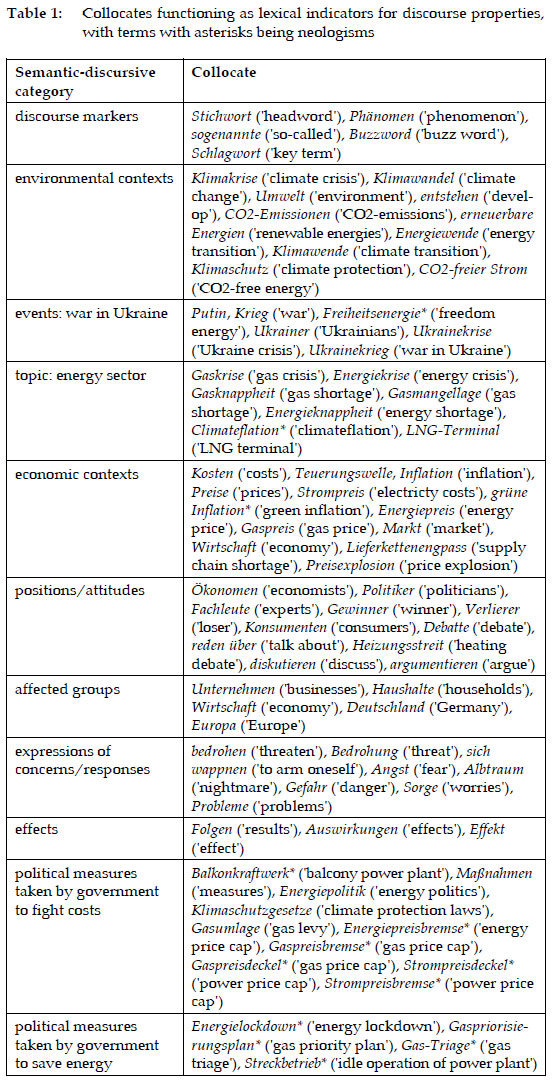
Semantic insights emerge from the interpretation of collocational and syntagmatic contexts, offering crucial information for defining the meaning1 of Green-flation as follows:
bezeichnet gröβere Preissteigerungen für Rohstoffe, die aufgrund des Übergangs von fossiler Energieerzeugung hin zu einer ökologischeren, möglichst CO2-neutralen Stromproduktion sowie der Förderung erneuerbarer Energien entstehen (Translation: refers to larger price increases for raw materials that arise due to the transition from fossil energy production to a more ecological, ideally CO2-neutral electricity generation, as well as the promotion of renewable energies)
Besides paraphrasing a new word, a closer examination of the categories derived from the collocational analysis reveals additional characteristics of its usage in public communication. The controversial nature of the term is inherent in its characterisation as a key term (Schlagwort). This brevity is illustrated by the verbs that frequently co-occur with the noun, such as talk about (reden über) and debate (argumentieren). Furthermore, the discussion surrounding Greenflation often frames it as a subject that threatens (bedrohen), suggesting that individuals must arm themselves (sich wappnen). Concerns and fears are also articulated through accompanying nouns such as Angst ('fear'), Albtraum ('nightmare'), Gefahr ('danger'), and Sorge ('worries'). Patterns such as Die Angst vor der „Green-flation" geht um ('The fear of greenflation is spreading') illustrate the prevalent perception of greenflation as a potential threat. This negative evaluation is further reflected in other co-occurring terms that can be classified into specific domains or topics and closely related discourses. The lexical item Greenflation is deeply embedded in the discourse surrounding the energy crisis ( Gaskrise, Energiekrise).
However, discourse surrounding Greenflation exhibits significant intersections with other prevailing crisis-related narratives. These include the economic crises stemming from the COVID-19 pandemic, as well as inflation driven by increased consumer prices and rising energy costs. Furthermore, new terminologies are emerging in the context of the war in Ukraine (Ukrainekrieg), which is closely linked to escalating energy prices resulting from sanctions imposed on Russian gas and oil imports. Finally, the discourse surrounding the climate crisis (Klimakrise) is of great importance, particularly in the context of Germany's coalition government (12/2021-12/2024), which includes the Green Party. This coalition was actively working to implement new environmental legislation aimed at reducing emissions and promoting the use of alternative renewable energy sources to achieve independence from Russian oil and gas. All of the discourses identified in this context are crisis-related, and as such, they convey negative connotations regarding specific critical socio-political situations.
An examination of the public reports on Greenflation within the underlying corpus reveals the emergence of new concepts, particularly those related to political measures aimed at addressing rising energy prices or promoting energy conservation. These concepts are exemplified by several newly coined terms (indicated with an asterisk in Table 1), such as Energiepreisbremse, Gaspreisbremse, Gaspreisdeckel, Strompreisdeckel, Strompreisbremse, Energielockdown and Streckbetrieb. These highlight a notable lexical growth associated with the discourse surrounding the energy crisis, which contributes to the establishment of new discourse and knowledge structures. Generally, a large number of lexemes co-occur, priming sentiments and emotions when Greenflation is used contextually (see Example 2).
(2) Der Bremer Wirtschaftswissenschaftler Rudolf Hickel, ein Mann, der sowohl die Grünen als auch die Energiewende mit Sympathie betrachtet, ahnt Übles: „Die Greenflation kann noch erhebliche Probleme aufwerfen." Hickel verweist auf eine Addition von marktbedingten und politisch gewollten Preisstei-gerungen, die am Ende vor allem Geringverdiener und Transferbezieher belasten könnten. Zu den Kostensteigerungen bei Rohstoffen gesellten sich noch die bereits 2021 beschlossenen schrittweise wachsenden CO2-Bepreisungen. Die Gesamtwirkung sei in Berlin noch nicht hinreichend analysiert worden. „Ich habe die groβe Sorge." (Döbelner Allgemeine Zeitung, 08.01.2022)
(Translation: Bremen economist Rudolf Hickel, a man who views both the Greens and the energy transition with sympathy, senses trouble: "Green-flation could pose significant problems." Hickel points to a combination of market-driven and politically mandated price increases that could ultimately burden low-income earners and benefit recipients. In addition to rising raw material costs, the gradually increasing CO2 pricing decided in 2021 adds to the strain. The overall impact has not yet been sufficiently analysed in Berlin. "I have major concerns.")
Example 2 also highlights participants in public discourse. Nouns denoting individuals or groups, such as economists, politicians, experts, businesses, households, and consumers, all of which function as subjects or objects, express the concept of who is affected by or concerned with greenflation. Phrases such as Gewinner und Verlierer ('winner and loser') illustrate the controversy and disagreement surrounding the issue. Collocates not only enhance the meaning of Greenflation but also impart their connotations, which are shaped and contextu-alised through their shared environments. Nevertheless, this discursive mark-edness is typically not captured in dictionaries. The evaluation of new concepts and their corresponding terms by speakers cannot be readily found in lexicographic resources. However, this evaluation is evident in the numerous terms with negative connotations that convey effects, fears, concerns, and the various political actions being undertaken. Moreover, semantic categories, as illustrated in Table 1, which resemble frame-semantic slots and contribute to a word's topical and discursive appropriateness, are generally not documented in most reference works.
2.2 Word embedding: Paradigmatic level
By exploring corpora, researchers can systematically extract new words automatically (Klosa and Lüngen 2018) and categorise them into various thematic or semantic fields, domains, or discourses (still mostly manually). However, such lists do not provide insight into the relationships between words within a specific discourse or domain. Until recently, it has also been challenging to compare these words with semantically or conceptually related terms that exhibit varying degrees of similarity. Word embedding, a linguistic distributional method, visually represents lexical networks in a continuous vector space by capturing semantically similar words in the vicinity of a search term (Fankhauser and Kupietz 2019). This method addresses the aforementioned research gap by analysing structures not only at the paradigmatic level but also in relation to search terms based on their semantic proximity, as determined by the comparison of their collocation profiles. its strength lies in its ability to identify commonalities in meaning, operating on the premise that words occurring in similar contexts tend to possess similar meanings (Harris 1954). In contrast to traditional collocation analysis, the advantage of word embedding is its capacity to detect and classify "unseen or out-of-context words" (Rudkowsky et al. 2018: 150).
This paper contends that syntagmatic collocation analysis should be integrated with a paradigmatic investigation of semantically related terms. Distributed word embedding facilitates the exploration of additional dimensions of discourse by identifying words with similar contextual patterns (e.g. synonym searching), recognising neighbouring terms with comparable connotations and extracting clusters of associated words or phrases. Such methods can uncover latent themes or topics within a discourse and identify potential layers of sentiment or media tone, as demonstrated in analyses of press texts (see Rudkowsky et al. 2018).
Recently, the application of word embedding techniques has gained traction in the field of discourse studies (e.g. Bubenhofer 2022). In this context, vis-ualised word vectors facilitate the analysis of meaning by comparing words or phrases based on their semantic similarity, aiding in the exploration of how meanings shift or cluster within various discourses. Word embedding also enables the identification of central themes or concepts within a text by analysing the proximity of word vectors. Additionally, the clustering of words or sentences based on their embedding allows for the identification of distinct segments or topics within a discourse. For contrastive analyses, word embedding can reveal how cultural or ideological perspectives shape word usage and meaning by comparing embeddings across different corpora. Thus, integrating word embedding into discourse studies offers researchers deeper insights into the structure, meaning, and evolution of discourse, establishing it as a valuable tool for linguistic and communicative analysis.
With regard to German, DeReKoVecs is a word embedding tool designed to analyse the underlying data within the DeReKo corpus. The objective is to ascertain whether a close interrelationship exists among the various discourses identified through the collocates of the term Greenflation. Specifically, the investigation focuses on the term Energiekrise ('energy crisis') as the superordinate and lexical representation of the discourse of which Greenflation is a part (Figure 1 below).
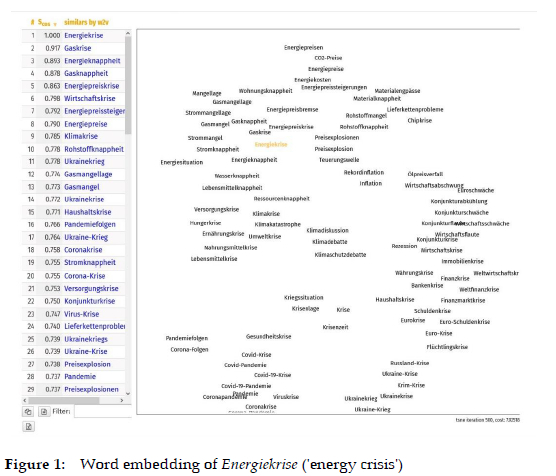
The term Energiekrise is closely associated with terms that specifically delineate the concept of the energy crisis itself. Among these are words indicating a critical shortage of gas, such as Gasknappheit ('gas shortage'), Gaskrise ('gas crisis'), Gasmangel ('gas shortage'), and Gasmangellage ('gas shortage situation'). The escalating costs resulting from this shortage are represented by terms such as Preisexplosion ('price explosion'), Energiepreiskrise ('energy price crisis'), Energiekosten ('energy costs'), Energiepreise ('energy prices') and Teuerungswelle ('wave of inflation'). Additionally, neighbouring terms such as Klimadiskussion ('climate discussion'), Klimadebatte ('climate debate'), Klimaschutzdebatte ('climate protection debate'), Klimakrise ('climate crisis'), and Umweltkrise ('environment crisis') suggest that the discourse surrounding the energy crisis parallels that of the climate crisis. Furthermore, the analysis uncovers a dimension not previously explored through collocation analysis: the supply chain crisis that emerged due to the reduction of gas and oil deliveries from Russia to Germany. This includes terms such as Rohstoffmangel ('shortage of raw materials'), Lieferkettenprobleme ('supply chain problems'), and Materialknappheit ('shortage of raw materials'). The vocabulary associated with the war in Ukraine is also prominently represented by terms such as Ukrainekrieg ('war in Ukraine'), Ukraine-Krise ('Ukraine crisis'), Krim-Krise ('Crimea crisis'), and Russlandkrise ('Russia crisis'). As pointed out before, Greenflation is framed as a consequence of the German energy crisis, arising from both green politics and the ambition to reform the energy sector, as well as the war in Ukraine, which has resulted in the cessation of gas and oil imports from Russia. In this context, semantic prosody tends to be evaluative and negative, often "extending over more than one unit in a linear string" (Stubbs 2001: 65). In this regard, also see Example 3:
(3) Das Jahr 2022 war für uns nicht ganz einfach: Wegen Klimakrise, Kriegskrise, Inflationskrise, Energiekrise und Coronakrise hatten wir nichts zu lachen. (Neue Welt, 28.12.2022)
(Translation: The year 2022 was not easy for us: Due to the climate crisis, the war crisis, the inflation crisis, the energy crisis, and the corona crisis, we had nothing to laugh about.)
Additional terms related to various crises include those linked to the COVID-19 pandemic (Covidkrise), the economic and financial crisis (Wirtschaftskrise), the food crisis (Lebensmittelkrise), the migration crisis (Flüchtlingskrise), and the Euro crisis (Eurokrise). Each of these terms denotes recent or ongoing challenges that demonstrate semantic overlaps with the concept of the energy crisis. Notably, crisis-related terminology is often emotionally charged.2 The dense network of discourses surrounding Greenflation, as evidenced by collocation results, is further corroborated by an examination of the overarching energy crisis discourse and its interconnectedness with other crisis-related discourses as illustrated by Figure 2. Figure 2 is a sketch entailing some lexical indicators retrieved from both corpus-linguistic methods together with some of their interpreted abstract discourse categories.
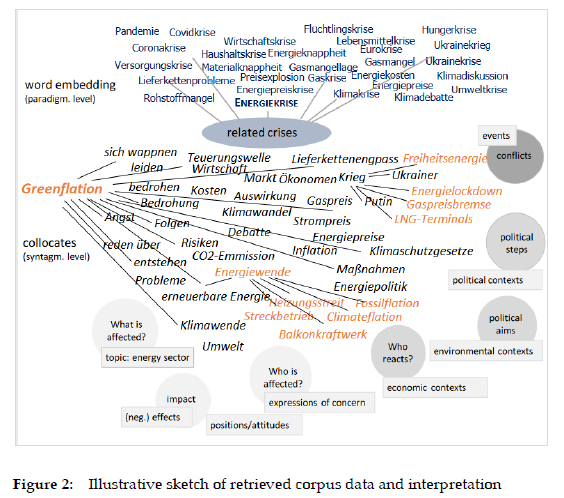
In summary, both methods reveal patterns of negativity and emotionality. The neologism Greenflation frequently co-occurs with other evaluative collocates at a syntagmatic level. Several collocates that co-occur with Greenflation are newly introduced terms (marked in orange), which denote alternative forms of inflation (e.g. Climateflation and Fossilflation) or new political measures to fight rising prices. Collectively, these terms signify the emergence of new discourse strands centred on a shared topic of debate. As a central component of the discourse surrounding the energy crisis in Germany, it is situated within a broader framework of semantically related terms, primarily crisis-related words that carry negative connotations also at a paradigmatic level. Most of these terms denote distressing and problematic events with socio-political implications, both nationally and globally. The prevalence of terms that express sentiment and negative connotations is thus additionally substantiated by the findings from the word embedding analysis.
3. (Some) functions in discourse
In Critical Discourse Studies, discourse functions pertain to the roles that specific linguistic features assume within a given text or discourse, particularly in connection with power, ideology, and social relations (cf. Fairclough 1992). Discourse functions refer to the various communicative purposes that language serves in interaction. These include, for example, informative, expressive, interactional, persuasive, textual, and structuring functions (Wodak and Meyer 2015). Wodak and Meyer (2015: 9) point out:
Discourse serves various functions in society: it is not only a means of transmitting information, but also a way of establishing, maintaining, and challenging social relationships, power structures, and ideologies.
Discourse functions facilitate the transmission of information, and the expression of emotions and personal opinions. Furthermore, lexical elements serving these functions can influence the behaviour of others, or structure argumentative narratives to persuade the audience.
By employing corpora and identifying patterns in language use, insights can be gained into these discourse functions and their influence on the construction of social meanings (cf. Baker 2006). These patterns exemplify communicative strategies that construct identities or positions, legitimise policies and shape public opinion. Certain neologisms can express a specific speaker's stance or attitude, and encapsulate evaluative dimensions concerning particular circumstances. These terms may refer to individuals or to concrete or abstract issues, manifesting either derogatory or positive connotations. Notably, words that have emerged since 2020 exhibit a significant degree of sentiment, as many are related to crises. These sentiments become intrinsic semantic-pragmatic features that affect the subject, domain, or discourse to which they pertain. All such contributions to the construction of critical discourse are understood as discourse functions.
An examination of the term Greenflation reveals how a newly coined term can carry substantial discursive and communicative significance at a particular time or within a specific context. This term emerged during a period of energy transition around 2021, driven by two significant events. Firstly, Germany's reliance on Russian gas and oil was disrupted due to the cessation of deliveries resulting from the war in Ukraine. In some segments of the public, the end of gas and oil imports from Russia is often perceived as the primary cause of rising prices. Additionally, right-wing populism fosters pro-Russian sentiments and opposes European sanctions against Russia, resulting in resistance to German political decisions that support Ukraine. Secondly, German politics have been actively reforming the energy sector by increasing the utilisation of renewable sources and phasing out nuclear power and fossil fuels. This transformation necessitated the acquisition of alternative energy resources within a rapidly inflating global market.
The term Greenflation can be employed to delegitimise certain actions, policies, or beliefs, often by invoking authority, morality, or rationality, particularly in relation to green political initiatives (see Example 4).
(4) Der Übergang in eine grünere, CO2-neutrale Weltwirtschaft treibt die Preise und die Inflation an. Fachleute sprechen von „Greenflation". Für den starken Inflationsschub mögen noch pandemiebedingte Unterbrechungen der Produktion und globale Logistikprobleme verantwortlich sein. Aber das erklart nicht die stark gestiegenen Preise für Energie (Gas, Öl, Kraftstoff und Strom). Emissionshandel und CO2-Abgabe zeigen Wirkung. Teurere Energie ist einerseits politisch gewollt, um von den fossilen Energien wegzukommen, andererseits machen sich auch Angebotsverknappungen in den Förderstaaten bemerkbar. (Giefiener Anzeiger, 02.12.2021)
(Translation: The transition to a greener, CO2-neutral global economy is driving up prices and inflation. Experts refer to this as "greenflation". While production disruptions due to the pandemic and global logistics problems may be responsible for the strong surge in inflation, this does not explain the sharp rise in prices for energy (gas, oil, fuel, and electricity). Emissions trading and CO2 taxes are having an impact. On the one hand, more expensive energy is politically desired in order to move away from fossil fuels; on the other hand, supply shortages in producing countries are also becoming noticeable.)
Consequently, the concept designated by Greenflation is used to challenge the authority of politicians, especially those in the coalition government (12/202112/2024) and the Green Party. As a result, Greenflation has acquired immediate significance in public discourse, contributing to the portrayal of essential knowledge structures associated with this transformation process. These structures encompass the expansion of renewable energy sources and the increased implementation of solar, wind, and geothermal power. Additionally, energy storage has emerged as a focal area, with discussions surrounding battery technologies and other solutions to address the intermittency of renewable energy. The gradual phase-out of fossil fuels, carbon pricing, political measures, awareness campaigns, and issues related to research and innovation all contribute to shaping these new knowledge structures. The contextualisation of such events or issues in terms of time and space can significantly influence their perception and understanding (e.g. as immediate versus long-term, or local versus global). As a loanword, Greenflation is framed both as a local issue that generates socio-economic challenges and as a global concern, given the international nature of the energy market. Within the context of Greenflation and the energy crisis, these topics are extensively reported in the news, featured in newspapers, and debated in television discussions. This underscores the potential of neologisms to introduce new modes of thinking by encapsulating novel conceptual knowledge. In the case of Greenflation, this implies that the transformation of the energy sector may lead to rising costs rather than decreasing prices, thereby influencing and shaping collective thought processes.
Greenflation may be regarded as an inevitable outcome of green politics. Consequently, the term plays a vital role in revealing ideological content, cultural values, and a spectrum of views and beliefs within societal discourse across the political landscape. There are both proponents and opponents of the political strategies that give rise to alternative energy productions and rising costs, as observed among politicians, media representatives, scientists, economists, and climate activists. Controversial positions intensify discussions, particularly regarding the socio-economic impact on low-income households and industries that are heavily dependent on energy for production. These effects contribute to the perception of the concept of greenflation as predominantly destructive, embedding negative connotations of the term as such associations are readily activated. Thus, its semantic prosody is evaluative, frequently reflecting the speaker's stance, which is typically negative. Greenflation is framed within a context of crisis and threat, mirroring ideological positions and shaping public opinion. Overall, Greenflation assigns responsibility for social problems to specific social groups and influences public perception. In this context, language evokes emotional responses that can be instrumental in shaping attitudes and behaviours.
Greenflation is a good example to show how a term is associated with a range of closely interconnected events related to current political decisions, inflation, the climate crisis, the war in Ukraine, sanctions, and the energy crisis. This illustrates how one discourse frequently draws upon and interlinks multiple discourses (e.g. economic, political, and environmental) to construct meaning and shape understanding. Greenflation functions as both an effect and a central node that connects the discourses of the climate crisis, the energy crisis, and the war in Ukraine. In this capacity, new terms can serve as pivotal nodes within a structured discourse network, bridging crucial public debates. As emerging nodes, they contribute to the structuring process of discourse. Once these neologisms become more established in the lexicon, they lay the groundwork for further lexical innovation, as evidenced by word formations such as Greenflation-Warner ('greenflation skeptics') and Greenflation-Faktoren ('greenflation factors'). These developments, in turn, initiate a new cycle of establishing new or specific discourse properties.
In CADS, discourse functions are analysed to reveal the underlying power dynamics, ideologies, and social structures that both shape and are shaped by language. By investigating these functions, researchers can enhance their understanding of how discourse contributes to the construction of social reality and the maintenance or contestation of power. While only some important discourse properties found in the contexts of Greenflation were sketched here, it is essential to recognise that not all neologisms inherently exhibit discourse functions as described here. The roles of new words as individual items within specific contexts, as well as their relationships with other new terms and established words in the lexicon, warrant further examination within CADS. Greenflation and its associated discursive potential are integral to its semantics. Accordingly, this paper posits that lexicographic descriptions should take this into account.
4. Discourse neologisms and discourse lexicography
Within the lexicographic landscape of German reference works, discourse dictionaries ("Diskurswörterbücher") have established themselves as a significant component of specialised lexicography. This branch is dedicated to the systematic documentation and analysis of controversial keywords and phrases that play a pivotal role in particular public discourses. A primary objective of discourse lexicography is to shed light on the dynamic interplay between language and society. It illustrates how words and expressions not only convey meanings but also reflect and shape social attitudes and power structures. Kamper (2006: 350) highlights „die Gebundenheit des Wortschatzes in topikalischen, sprecherbezogenen, textlichen, zeitlichen und funktionalen Hinsichten" (translation: the relevance of vocabulary in topical, speaker-related, textual, temporal, and functional respects), necessitating the examination of relevant texts.
To date, discourse dictionaries have traditionally predominantly focused on the treatment of headwords in various reference works including Brisante Wörter von Agitation bis Zeitgeist (Straufi et al. 1989), Zeitgeschichtliches Wörterbuch: Schlüsselwörter und Orientierungsvokabeln (Stötzel and Eitz 2003), Opfer - Tater - Nichttater: Ein Wörterbuch zum Schulddiskurs 1945-1955 (Kamper 2007), Diskurs-wörterbuch zum Protestdiskurs 1968 (Kamper 2012), and Wörterbuch zum Demokratiediskurs 1967/68 (Kamper 2013). Through discourse analysis, discourse lexicography can enhance the understanding of the mechanisms by which language constructs and influences society. This is particularly relevant in times of heightened political conflict, during which language often serves as a tool for shaping public opinion. Thus, the discourse dictionaries available today (e.g. Kamper 2007, 2012, 2013) reflect critical keywords related to the language of the Third Reich and illustrate new cultural values expressed through the lexis of the student and social movements of 1968, which were integral to a broader global wave of protests and radical political activism during that era.
So far, German discourse lexicography has predominantly adopted a historical approach. Additionally, these reference works have not yet integrated methodologies from corpus linguistics and discourse analysis to examine the usage and significance of lexical units within diverse social, political, and cultural contexts. Concerning critical neologisms, the treatment provided by the aforementioned dictionaries remains unexplored. As previously demonstrated, a substantial number of newly coined words in German possess discursive properties that significantly contribute to their respective discourses. A portion of their meaning is intricately linked to their communicative impact, encompassing attitudes, emotions, beliefs, and personal opinions. Many new terms related to crises cannot be adequately described semantically without incorporating discourse features into their definitions. Analysing controversial terms enables users to comprehend how and why certain neologisms arise within specific social or political contexts, as well as their roles within discourse. Additionally, it allows for an exploration of how neologisms both reflect and influence societal changes or emerging trends. These objectives have not been addressed in earlier neologism dictionaries in German, such as the Neologismenwörterbuch (2006ff.).
The new German neologisms guide IDS Neo2020 includes two new aspects.3Firstly, the descriptions of headwords incorporate discourse features when pertinent. Lexicographically, it embraces key principles of discourse lexicography as articulated by Kamper (2006) in order to be able to shed light on various discourse positions instead of representing generalised stances on new concepts (Chen 2019). A particular challenge of lexicographic descriptions is the attempt to sensitise users about explanations of an item's use as not being prescriptive or stable. As Chen (2019: 377) points out "it is stated that interpretations and explanations are never finished and authoritative, but that they are dynamic and open to new contexts and new information".
A critical approach to discourse and lexicography reflects on the multitude of ideological perspectives and depicts them to illuminate beliefs, attitudes, and power structures in language and society. Although this resource is not explicitly designed as a discourse dictionary for neologisms, sections devoted to discursive aspects are inherently linked to the broader documentation of meaning and usage. Secondly, the new dictionary examines lexical items through complementary corpus methodologies, ensuring methodological consistency with other studies conducted by CADS. By integrating these discourse details, users can become attuned to the contentious applications of new words and recognise the significance of discourse properties as semantic elements of a headword.
In summary, as well as exploring meaning and contextual use, the documentation of neologisms that are integral to contemporary critical discourses should seek to elucidate the intricate interactions among language, power, and society. This approach offers valuable insights into the ways in which language use both influences and is influenced by discourses.
5. Greenflation in IDS Neo2020+
5.1 Headword-related details
In addition to standard information regarding meaning, grammar, synonyms, and examples, each entry in the new neologism dictionary includes a section titled "Background Information". This section is dedicated to extra-linguistic information, emphasising encyclopaedic and discourse knowledge. It provides insights into the historical context, illustrating the relationship between significant events and the emergence of new words, accompanied by an interactive timeline. Users can also access information about the domains or preferential topics associated with the headword, as well as the relevant discourse(s) surrounding it. Furthermore, this section offers explanations of observed controversial viewpoints, cultural biases, evaluative arguments, and discernible power dynamics as revealed in media reports, all of which are supported by corpus examples (see Figure 3)4.
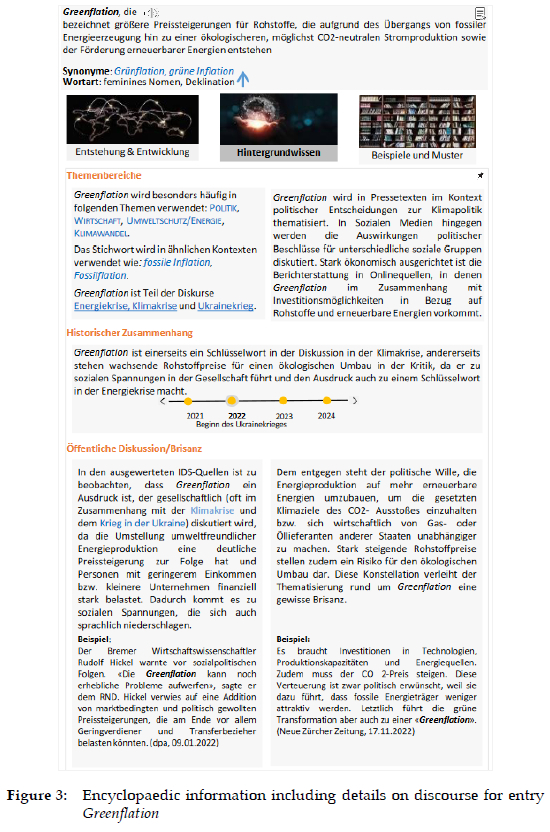
More specifically, the entry informs users that the headword is used in contexts similar to those of Fossilflation and Climateflation. Additional information includes the representation of Greenflation across various text types, such as press articles, social media, and online communications, highlighting the differing thematic focuses within these formats. This section of the dictionary also delineates thematic domains, including politics, economics, environment/ energy, and climate change. It explicitly identifies the relevant discourses, encompassing the energy crisis, climate crisis, and war in Ukraine. Observations regarding the usage of Greenflation in public discourse note its contentious nature and the diversity of perspectives surrounding it. Two distinct stances along with sentiment descriptions, stylistic choices, evaluations, or argumentative frameworks are explicitly documented. On the one hand, the discussion surrounding the pricing and social impacts of Greenflation is frequently framed in the context of arguments put forth by opponents of energy transition initiatives and green policies. On the other hand, proponents advocate sustainability and emphasise the imperative of transforming the energy sector to address climate change. These two opposing perspectives are presented alongside one another to highlight the incompatible discourse positions. corpus examples substantiate the descriptions.
Overall, the information presented in Figure 3 refers to a single headword, offering a focused depiction of single lexical items and their associated communicative contexts. To meet additional consultation needs, such as identifying all new terms associated with a specific discourse (e.g. energy crisis), a second reference module has been developed: the IDS Dashboard.5
5.2 Details for lexical fields
in addition to offering detailed information on headwords, a key objective of the new resource is to present a range of content accessible through a user-friendly dashboard that supports browsing. Employing a masonry-style layout, the various sections integrate information about the project, the dictionary, and neologisms more broadly, making use of multiple formats such as interactive graphs, reports, podcasts, videos, and campaigns (see Storjohann 2024).
To provide an overview of discourses and their associated neologisms, rather than focusing solely on individual words, one section of the dashboard is dedicated to recent public debates characterised by communicative controversy or significant public response. This section highlights various new lexical bundles that contribute to shaping different discourses and frequently represent newly emerging concepts. Numerous approaches and options exist for describing discourses in their entirety. In IDS Neo2020, users can explore the discourses currently dominating public communication, with representative neologisms displayed for quick reference. Prior to engaging with a specific discourse section, the terms that lexically represent these topical fields are presented alongside their frequency trends since their emergence in a comparative format, such as Energiekrise ('energy crisis'), Ukrainekrieg ('War in Ukraine'), and Klimakrise ('climate crisis') in Figure 4.6
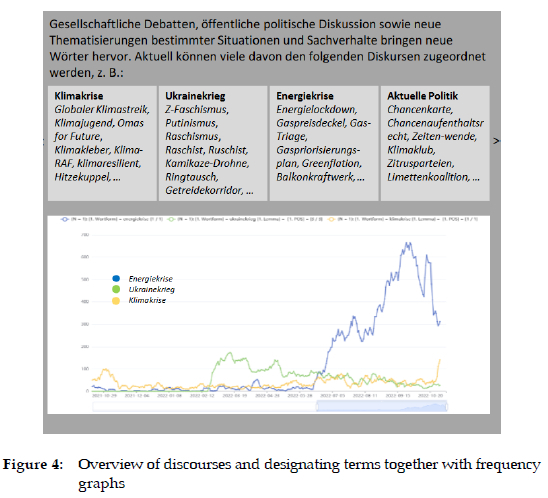
Upon selecting the tile of a specific discourse, users are directed to a new interface that enables the exploration of contemporary discourses in conjunction with newly introduced lexical items. Through a flexible menu, users can customise various display options, organising the information alphabetically (see Figure 5), chronologically, by frequency, by subdomain, or as a network.7
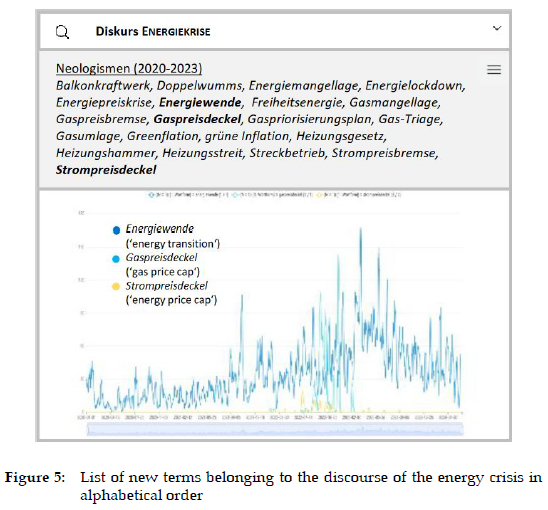
Figure 5 presents a synthesis of frequency graphs alongside alphabetical ordering, thereby providing a comparative visual depiction of the most frequently encountered lexical items associated with Energiewende ('energy transition'), Gaspreisdeckel ('gas price caps'), and Strompreisdeckel ('energy price caps'). This interface includes frequency graphs that compare some of the most prominent terms with their respective discourses.
Moreover, users are afforded the opportunity to gain an understanding of the temporal evolution of the discourse via a timeline that highlights the emergence of neologisms in everyday language, ideally accompanied by corpus examples that validate their early usage (see Figure 6). Concise contextual descriptions of the overarching discourse - encompassing socio-political significance, diverse perspectives, arguments, and public reception - may precede the listing of head-words.
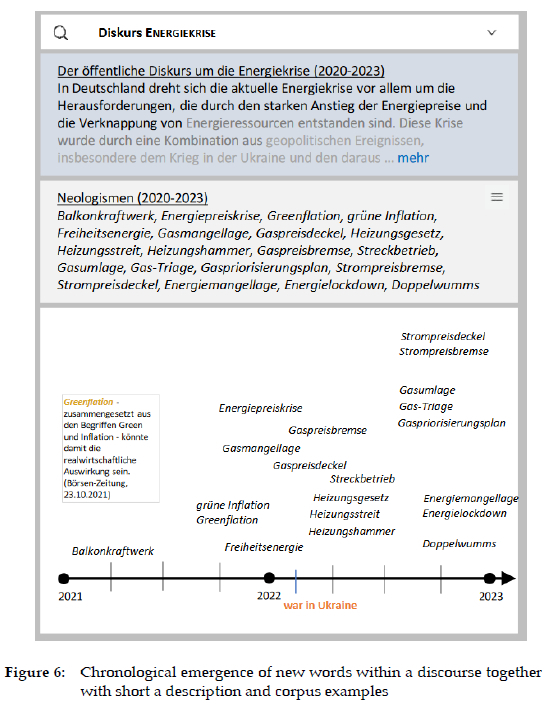
The advantages of these descriptions enhanced by various visualisations are as follows. Firstly, they provide valuable insights into the broader thematic context. The presentation of clusters of neological discourse-related terms, along with various features and usage patterns, elucidates developments within specific segments of the vocabulary. Secondly, they heighten users' awareness of ongoing lexical changes and the domains in which these changes are currently manifesting. Finally, through the concurrent display of numerous lexemes, users can identify areas where a proliferation of new concepts - and, consequently, new knowledge structures - has emerged within a particular domain or thematic subject. In this manner, some discourse functions of neologisms are indirectly illustrated. As previously noted, the documentation of entire discourses complements traditional entries that focus on individual headwords.
6. Limitations of discursive descriptions in IDS Neo2020+
In the field of Critical Discourse Studies, discourse is commonly defined as a socially constructed system of communication that extends beyond linguistic elements and structures. It encompasses the ways in which language is employed in real-world contexts to construct, reflect, and challenge power dynamics, ideologies, and social practices (Wodak 2004). This communicative system can be analysed through a corpus, which consists of a collection of texts that share a common topic and exhibit intertextual references. According to Gardt (2007: 28), key features of discourse include its specific communicative framework and intentions, as well as the construction of reality through communicative actions. Discourse is a form of social practice through which knowledge and concepts are collectively negotiated and shared. It also plays a crucial role in the construction of identities and the formation of shared social knowledge, norms, values, attitudes, and ideologies.
In particular, crisis-related neo-discourses are highly complex. New words that are controversial or emotionally charged, and are integral to such critical neo-discourses, encapsulate multifaceted elements of this intricacy within their semantics. In section 3, the various discourse functions serve as a clear indication of this complexity.8 The analysis of new words extends beyond lexical-semantic approaches as described here in 2.1 and 2.2. The study of contemporary neo-discourses requires an examination of both linguistic elements (e.g. vocabulary, grammar, and sentence structure) and social practices (e.g. speech acts and interactions). Therefore, discourse analysis integrates these aspects to provide a comprehensive understanding of how communication operates at a deeper level.
While corpus-extracted patterns and typical usage structures provide a systematic means of accessing key aspects of discourse such as speakers' perspectives, beliefs, principles, and sentiments, Critical Discourse Studies in fact employs a range of linguistic approaches to analyse how language constructs, sustains and challenges social power relations. For instance, at the grammatical level, studies examine features such as modality and passivisation. Rhetorical analyses focus on framing, argumentation, and presupposition, while pragmatic approaches investigate speech acts, exploring how functions such as promising, ordering, or apologising contribute to the reinforcement or contestation of power dynamics. These diverse analytical perspectives are not mutually exclusive but rather complementary, offering a more comprehensive understanding of discourse as a complex and highly dynamic phenomenon.
Lexicographic projects inherently face limitations in capturing a complete or comprehensive representation of all linguistic and contextual parameters involved. Nevertheless, the lexical approach to meaning reveals essential semantic features that can be documented lexicographically, contributing to definition-building and knowledge representation. This approach also provides insights into the socio-cultural and political contexts relevant to a given moment in a word's usage. Still, any attempt to document discourse within a dictionary remains fragmentary, just as any corpus represents only a portion of the broader discourse it reflects. However, crisis-related neologisms are embedded within discourse structures, where their meanings are shaped and negotiated. This relationship can be explicitly articulated and emphasised through lexicographic representation, offering valuable insights and heightening awareness of the intricate connection between language and society.
7. Conclusion: Neologisms and discourse functions
Crisis-related (critical) discourses are intricate and often intertwined, exhibiting a dynamic rather than static nature. Overall, complementary corpus approaches facilitate a deeper understanding of the semantic and discursive properties, structures, functions, and interrelationships within these discourses. Such methodologies aid lexicographers in representing the complexity of discourse, the knowledge and meanings negotiated by members of the discourse community, and the associations tied to new words. The emergence of new terms and their usage in discussing contemporary social realities shape discourses in a reciprocal manner, just as societal discussions influence the development of new words (Teubert 2010). While the discursive functions of new words may vary, their usage and roles within discourse significantly contribute to their meanings. Given their communicative immediacy, these new words and their meanings are of considerable interest to dictionary users and should be documented in neologism dictionaries in a manner that effectively captures the essential discourse properties reflected in each entry.
Until recently, experience in lexicographically representing the semantic complexity of new discourses and new words has been limited. To this end, the new IDS Neo2020 resource aims to integrate foundational approaches developed by CADS alongside ideas from discourse lexicography. This means that the new dictionary seeks to enhance this representation by incorporating essential new details regarding discourse, as observed in the underlying corpus. Although numerous methodological approaches to discourse analysis exist (see Jager 2012, Wodak and Meyer 2015), the lexicographic approach adopted here emphasises a strong lexical focus, placing new lexical items in the centre of explorative discourse studies. These show that generally, neologisms are terms that denote novel concepts and fulfill various purposes and functions within critical discourses.
While not all of these functions can be precisely documented in neologism dictionaries, it is imperative to include significant aspects of a term's meaning that involve discourse features and contextually defined elements within the lexicographic description. Such elements can be addressed to a certain extent, especially when their discursive functions affect meaning and usage. Specific entry rubrics and sections in the reference guide facilitate multi-level consultation combining lookup with browsing. Users can explore detailed information about headwords, access discourse-relevant information, and examine clusters of new words that represent emerging discourses and highlight various aspects of their characteristics. By providing a comprehensive and nuanced understanding of new words within their discursive contexts, the new resource aims to empower users to engage critically with evolving language practices and contribute to the ongoing dialogue surrounding contemporary social issues.
Endnotes
1. This definition is taken from the entry Greenflation of the new (as yet unpublished) dictionary IDS Neo.
2. In contrast to collocation analysis, this approach examines the paradigmatics of a word; consequently, it concentrates exclusively on nouns while excluding verbs and adjectives.
3. For a more detailed description of the new resource, see Storjohann (2024).
4. Figure 3 illustrates an entry taken from the lexicographic concept. The design of the entry in its final online format may differ upon publication.
5. The dictionary is scheduled to be launched in early 2025, while the dashboard is expected to be released in late 2025.
6. Figures 4 to 6 illustrate examples taken from the lexicographic concept. The design of the display in its final online format may differ upon publication.
7. In this paper, the discussion will be limited to the presentation of a select number of the aforementioned display options.
8. Discourse functions of neologisms are not explicitly marked as information in the dictionary.
References
Dictionaries
IDS Neo2020+: Neue Wörter im Gebrauch. 2025. Mannheim: Leibniz-Institut für Deutsche Sprache. (to appear)
Kamper, H. 2007. Opfer - Tater - Nichttater. Ein Wörterbuch zum Schulddiskurs 1945-1955. Berlin/ New York: De Gruyter. [ Links ]
Kamper, H. 2012. Diskurswörterbuch zum Protestdiskurs 1968. Mannheim: Institut für Deutsche Sprache. [ Links ]
Kamper, H. 2013. Wörterbuch zum Demokratiediskurs 1967/68. Berlin: Akademie-Verlag. [ Links ]
Neologismenwörterbuch. 2006ff. OWID - Online Wortschatz-Informationssystem Deutsch. Mannheim: Leibniz-Institut für Deutsche Sprache. http://www.owid.de/wb/neo/start.html [30 January 2025] [ Links ]
Stötzel, G. and T. Eitz (Eds.). 2003. Zeitgeschichtliches Wörterbuch der deutschen Gegenwartssprache: Schlüsselwörter und Orientierungsvokabeln. Hildesheim: Olms. [ Links ]
Strauβ, G., U. Haβ and G. Harras. 1989. Brisante Wörter von Agitation bis Zeitgeist. Berlin/New York: De Gruyter. [ Links ]
Digital tools
DeReKo (Deutsches Referenzkorpus). https://www.ids-mannheim.de/digspra/kl/projekte/korpora/ [30 January 2025]
DeReKoVecs (word embedding tool). https://corpora.ids-mannheim.de/derekovecs [30 September 2024]
Other references
Baker, P. 2006. Using Corpora in Discourse Analysis. London: Continuum. [ Links ]
Baker, P., C. Gabrielatos and T. McEnery. 2013. Discourse Analysis and Media Attitudes: The Representation of Islam in the British Press. Cambridge: Cambridge University Press. [ Links ]
Baker, P., C. Gabrielatos, M. KhosraviNik, M. Krzyzanowsk, T. McEnery and R. Wodak. 2008. A Useful Methodological Synergy? Combining Critical Discourse Analysis and Corpus Linguistics to Examine Discourses of Refugees and Asylum Seekers in the UK Press. Discourse & Society 19(3): 273-306. [ Links ]
Bubenhofer, N. 2022. Exploration semantischer Raume im Corona-Diskurs. Kamper, H. and A. Plewnia (Eds.). 2022. Sprache in Politik und Gesellschaft: Perspektiven und Zugänge: 197-216. Berlin/Boston: De Gruyter. [ Links ]
Chen, W.G. 2019. Towards a Discourse Approach to Critical Lexicography. International Journal of Lexicography 32(3): 362-388. [ Links ]
Collins, L. and P. Baker. 2023. Language, Discourse and Anxiety. Cambridge: Cambridge University Press. [ Links ]
Gardt, A. 2007. Diskursanalyse. Aktueller theoretischer Ort und methodische Möglichkeiten.
Warnke, I. (Ed.). 2007. Diskurslinguistik nach Foucault: Theorie und Gegenstànde: 27-52. Berlin/ Boston: De Gruyter. [ Links ]
Fairclough, N. 1992. Discourse and Social Change. Cambridge: Polity. [ Links ]
Fankhauser, P. and M. Kupietz. 2019. Analyzing Domain Specific Word Embeddings for a Large Corpus of Contemporary German. Knight, D. (Ed.). 2019. Proceedings of the 10th International Corpus Linguistics Conference, CL2019, Cardiff, Wales, UK, 22-26 July 2019. https://ids-pub.bsz-bw.de/frontdoor/index/index/docId/9117 [30 January 2025]
Harris, Z.S. 1954. Distributional Structure. Word 10(2-3): 146-162. [ Links ]
Jäger, S. 2012. Kritische Diskursanalyse. Eine Einführung. Sixth edition Munster: Unrast-Verlag. [ Links ]
Kamper, H. 2006. Diskurs und Diskurslexikographie. Zur Konzeption eines Wörterbuchs der Nach-kriegsdiskurse. Deutsche Sprache 34(4): 334-353. [ Links ]
Klosa, A. and H. Lüngen. 2018. New German Words: Detection and Description. Čibej, J., V. Gorjanc, I. Kosem and S. Krek (Eds.). 2018. Proceedings of the XVIII EURALEX International Congress, EURALEX 2018, Ljubljana, Slovenia, 17-21 July 2018: 559-569. Ljubljana: Ljubljana University Press.
Koller, v., S. Kopf and M. Miglbauer (Eds.). 2019. Discourses of Brexit. London: Routledge. [ Links ]
Mattfeldt, A., I. Warnke and L. Herford. 2025. Neodiskurse und ihre Morphologie - Bemerkungen zum Substantivprimat. Michel, S. (Ed.). 2025. Diskursmorphologie: Ansatze und Fallstudien zur Schnittstelle zwischen Morphologie und Diskurslinguistik: 121-152. Berlin/Boston: De Gruyter. [ Links ]
Partington, A. 2004. Corpora and Discourse: A Most Congruous Beast. Partington, A., J. Morley and L. Haarman (Eds.). 2004. Corpora and Discourse: 11-20. Bern: Peter Lang. [ Links ]
Partington, A., A. Duguid and C. Taylor. 2013. Patterns and Meanings in Discourse: Theory and Practice in Corpus-assisted Discourse Studies (CADS). Amsterdam/Philadelphia: John Benjamins. [ Links ]
Rudkowsky, E., M. Haselmayer, M. Wastian, M. Jenny, Š. Emrich, and M. Sedlmair. 2018. More than Bags of Words: Sentiment Analysis with Word Embeddings. Communication Methods and Measures 12(2-3): 140-157. [ Links ]
Storjohann, P. 2024. IDS-Neo2020+: A Novel Resource for New German Words in Use. International Journal of Lexicography 37(4): 389-403. [ Links ]
Stubbs, M. 2001. Words and Phrases: Corpus Studies of Lexical Semantics. Oxford: Blackwell. [ Links ]
Teubert, W. 2002. Die Bedeutung von Globalisierung. Panagl, O. and H. Stürmer (Eds.). 2002. Politische Konzepte und verbale Strategien. Brisante Wörter - Begriffsfelder - Sprachbilder: 149-167. Frankfurt a. M. : Peter Lang. [ Links ]
Teubert, W. 2006. Korpuslinguistik, Hermeneutik und die soziale Konstruktion der Wirklichkeit. Linguistik Online 28(3): 41-60. [ Links ]
Teubert, W. 2010. Meaning, Discourse and Society. Cambridge: Cambridge University Press. [ Links ]
Van Dijk, T.A. 2008. Discourse and Context: A Sociocognitive Approach. Cambridge: Cambridge University Press. [ Links ]
Wodak, R. 2004. Critical Discourse Analysis. Seale, C., G. Gobo, J.F. Gubrium and D. Silverman (Eds.). 2004. Qualitative Research Practice: 197-213. London: Sage. [ Links ]
Wodak, R. and M. Meyer. 2015. Methods of Critical Discourse Analysis. Third edition. London: SAGE. [ Links ]
* A version of this paper was presented at the 6th Globalex Workshop on Lexicography and Neology (GWLN-6), held on 3 July 2024 at the University of Pretoria, Hatfield Campus, Pretoria, South Africa.
