




Services on Demand
Journal

Article
 English (pdf)
 Article in xml format
 Article references
 Automatic translation
 Send this article by e-mail
Indicators
Related links
-
 Cited by Google
 -
 Similars in Google
Share

 Permalink
Lexikos
On-line version ISSN 2224-0039Print version ISSN 1684-4904
Lexikos vol.35 Stellenbosch 2025
https://doi.org/10.5788/35-1-2042
LEXICOFOCUS
Semantic Verbal Neology in Spanish Dictionaries: Case Study of the Lexicographic Representation of anestesiar and coreografiar
Semantiese verbale neologie in Spaanse woordeboeke: 'n Gevalle-studie van die leksikografiese voorstelling van anestesiar en coreografiar
Marina BerriI; Victoria de los Ángeles BoschiroliII
IInstituto del Desarrollo Humano, Universidad Nacional de General Sarmiento / CONICET, Argentina (mberri@campus.ungs.edu.ar) (https://orcid.org/0000-0003-2073-8523)
IIInstituto del Desarrollo Humano, Universidad Nacional de General Sarmiento, Argentina (vboschir@campus.ungs.edu.ar) (https://orcid.org/0000-0003-4136-0451)
ABSTRACT
The aim of this paper is to reflect on the lexicographic treatment of semantic verbal neologisms in Spanish general dictionaries. Although semantic neology is a highly productive mechanism for vocabulary production, semantic neologisms seem to pose particular challenges for their inclusion in dictionaries but also in their representation, given the difficulty in detecting them. These difficulties seem to be related to the fact that a semantic neologism can be the result of a variety of changes in their primary meaning, which entails establishing different relationships with the related primary sense in a general dictionary entry or compensating for the absence of that original sense in dictionaries of neologisms. In this study, the focus is on two verbs, anestesiar and coreografiar, that have been recorded as semantic neologisms in the Observatori de Neologia databank BOBNEO. In both cases, their lexicographic relevance is shown quantitatively (based on data from corpora such as CORDE, CORPES, and Spanish Web 2023) and qualitatively, using the Theory of Norms and Exploitations (Hanks 2013). The analysis then focuses on how they are dictionarised in two widely used general online dictionaries, namely the Diccionario de la lengua española and the Diccionario del español actual. The conclusion is that both verbs are under- or misrepresented and possible actions are suggested to correct this situation both in general dictionaries and dictionaries of neologisms.
Keywords: semantic neology, verbs, lexicographic representation, Spanish lexicography, general dictionaries, dictionaries of neologisms, figurative meaning, polysemy
OPSOMMING
Hierdie artikel het besinning oor die leksikografiese hantering van semantiese verbale neologismes in algemene Spaanse woordeboeke ten doel. Alhoewel semantiese neologie 'n hoogs produktiewe werktuig vir woordeskatproduksie is, wil dit voorkom of semantiese neologismes, gegewe die problematiek om hulle op te spoor, besondere uitdagings oplewer in hul insluiting en voorstelling in woordeboeke. Hierdie uitdagings blyk verband te hou daarmee dat semantiese neologismes die resultaat kan wees van verskeie veranderings in hul primêre betekenis, wat kan meebring dat verskillende verhoudings met die verwante primêre betekenis in 'n algemene woordeboek gevestig moet word, of dat daar vir die afwesigheid van daardie oorspronklike betekenis in neologismewoordeboeke gekompenseer moet word. In hierdie studie is die fokus op twee werkwoorde, anestesiar en coreografiar, wat as semantiese neologismes in die Observatori de Neologia-databasis BOBNEO opgeteken is. In albei gevalle word hul leksikografiese relevansie kwantitatief (gebaseer op data uit korpusse soos CORDE, CORPES en Spanish Web 2023), asook kwalitatief met behulp van die Teorie van Norme en Eksploitasies (Hanks 2013) aangedui. Die analise fokus vervolgens op hoe hierdie werkwoorde in twee wyd gebruikte algemene aanlyn woordeboeke, naamlik die Diccionario de la lengua española en die Diccionario del español actual, opgeneem is. Daar word tot die gevolgtrekking gekom dat beide werkwoorde onderverteenwoordig of verkeerd voorgestel word, en moontlikhede word aan die hand gedoen om hierdie situasie in sowel algemene woordeboeke as neologismewoordeboeke reg te stel.
Sleutelwoorde: semantiese neologie, werkwoorde, leksikografiese voorstelling, spaanse leksikografie, algemene woordeboeke, neologismewoordeboeke, figuurlike betekenis, polisemie
1. Introduction
Semantic neology is a productive mechanism through which vocabulary is extended by metaphor, metonymy, expansion, or restriction. The inclusion in dictionaries of semantic neologisms poses specific challenges, since they are harder to detect (automatically or otherwise) than formal neologisms. In Spanish, this problem is particularly salient in relation to the category of verbs. Moreover, their lexicographical treatment in general dictionaries gives rise to further difficulties, since, as will be discussed in this paper, they require the modification of an existing article, either by adding a new sense, in the case of the emergence of a new meaning, or by modifying an existing sense, which may be necessary in the case of extensions, restrictions or other types of displacements. Furthermore, in dictionaries of neologisms, defining a semantic neologism implies referring in some way to a previous meaning that this dictionary does not include.
The aim of this paper is to examine the lexicographic treatment of the semantic verbal neologisms anestesiar ('to anesthetise') and coreografiar ('to choreograph') in two major Spanish dictionaries. For this purpose, the problems involved in the detection and inclusion in dictionaries of semantic neologisms, focusing on the specificities of Spanish lexicography, are first analysed. Then the central tenets of the Theory of Norms and Exploitations (TNE), by Patrick Hanks (2013), will be explained briefly and the main findings from a previous analysis based on this theory will be summarised (Berri and Boschiroli 2023, 2024), where the modifications of meaning and changes in the combinatory patterns of neologisms are accounted for based on the notion of norm. The Theory of Norms and Exploitations provides theoretical tools to analyse modifications in the meaning of a lexical unit that are associated with changes in patterns of co-occurrences, which are typical of semantic neologisms (Renouf 2013, 2020). The distinction between norm and exploitation also provides elements to analyse the lexicographic representation (or dictionarisation, Bernal et al. 2020) of neologisms. The passage from exploitation to norm makes it possible to account for the neological process (Freixa 2022) undergone by semantic neologisms (Berri and Boschiroli 2023, 2024), suggesting it is a useful tool to measure the neologicity of a semantic neologism. Based on these findings, the representation of the semantic neologisms anestesiar and coreografiar in the Real Academia Española's Diccionario de la lengua española (DLE) and the Diccionario del español actual (DEA) will be analysed. Finally, the conclusions will be outlined, focusing on the need to understand the different types of semantic shift and their possible effects both in existing dictionary entries and in dictionaries of neologisms.1
2. The problem of semantic verbal neologisms in Spanish
This work focuses on verbs that are classified as semantic (sense) neologisms (VSN), that is, existing forms for which "a new meaning" emerges and spreads to different degrees (cf. Renouf 2013, 2020). In previous works (Berri and Boschiroli 2023, 2024), we have explored VSN within the framework of Hanks' TNE. It has been argued that TNE can be used as a criterion to measure their different degrees of neologicity - that is, the gradual property of newness in a lexical item (cf. Sablayrolles 2006, Bouzidi 2010, Cañete and Freixa 2014, Adelstein 2019). This paper focuses on two of the verbs previously analysed elsewhere to illustrate the kind of problems that arise when they are dictionarised: anestesiar and coreografiar.
VSN are interesting to study for many reasons. To begin with, when compared to other neologisms, they tend to go under- or undetected. While other neologisms can be spotted automatically because they are formally different, semantic neologisms have traditionally been identified and extracted manually, since they lack internal formal features that helps in recognising them. Given this lack of formal features, the main way to recognise and prove their novelty is by observing their surrounding syntagmatic structures: Their immediate context tends to be different from the one of their original meanings. This is a phenomenon for which, as will become evident, TNE provides an explanation. Finally, verbs have been less researched in the Spanish-speaking tradition (with the remarkable exception of Martínez Linares 2015), despite nominal semantic neologisms being widely studied in connection to their referential function and metonymic nature, especially in studies of polysemy (Adelstein 2022, Straccia 2024, Gerding Salas and Kotz Grabole 2016). This makes this a particularly rich and relevant field to explore.
As well as being underdetected (or, perhaps, as a result of this), VSN seem to be quantitatively underrepresented in both general language and neologism dictionaries. As the figures in Table 1 show, verbs have been at most 10 percent of all the semantic neologisms included in the Real Academia Española's Diccionario de la lengua española (DLE) yearly update - and usually even less. Addition of new senses to existing verbs or amends to existing definitions appear to be a peripheral, albeit slowly growing, phenomenon.
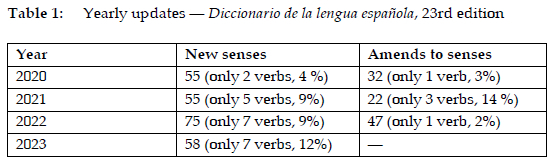
This is consistent with how VSN are found to be represented in dictionaries of neologisms. The Antenario. Diccionario en línea de neologismos de las variedades del español (Antenario), which is updated monthly, had published 1 500 entries by October 2024: 32 entries are semantic neologisms, with only 2 of these being verbs. Out of 2 400 entries in the Diccionario de neologismos del español actual (NEOMA) (2016, no updates), 103 are semantic neologisms, with only 7 verbs.
Neither underdetection nor underrepresentation is entirely surprising. As Adelstein (2022: 330) points out, a large part of semantic neologisms are not usually perceived as neologic, in other words, they do not pass the "neologic feeling" (that is, speakers' perception that a lexical unit is neologic, Bernal et al. 2020) test, because speakers tend not to think of them as new.
3. The role of dictionaries of neologisms in Spanish-language lexicography
Unlike what happens around other national languages, there is a tradition in Spanish lexicography to publish dictionaries of neologisms, such as the Diccionario de neologismos del español actual, Diccionario de neologismos online, Antenario, Diccionario de voces de uso actual, Nuevo diccionario de voces de uso actual, and 1300 neologismos en la prensa argentina. This tradition is a result of the role the Real Academia's dictionaries has had in Spanish lexicography. Despite being highly questioned on different grounds (cf. Lara 2009, Rodríguez Barcia and Moskowitz 2019, Lauría 2022), it is clearly the most prestigious and consulted dictionary for Spanish speakers. But traditionally it has adopted prescriptive, Spain-oriented policies that result in excessive precautions when it comes to including new words and senses to the dictionary.
As a result, dictionaries of neologisms have assumed the role of "filling the gap" between lexical reality and its representation - they fulfil a complementary, transitional, and remedial function (Adelstein and Boschiroli 2020). This work points out that this situation is particularly complex for semantic neologisms because, unlike most formal neologisms, it involves isolating them from the entry they should eventually be added to, that is, independently from the meaning in which they originate.
What exactly semantic neologisms are is a contested issue. There is a tension between their theoretical definition and the guidelines for their detection. Semantic neologisms, as suggested above, have been defined as the creation or emergence of a new meaning for an existing unit (Sablayrolles 2003). However, when it comes to their identification, an item is classified as a semantic neologism when there is a modification (of any kind) in the meaning of the lexical unit as included and represented in dictionaries, according to IULA's Observatori de Neologia (2024: 10). This approach is clearly more practical than trying to determine the nature or status of that change - in other words, whether it is a new meaning, a new sense, or a variation of a meaning. In fact, making this distinction is impossible if you are confronted with the single use you are extracting.
These different perspectives on semantic neology have diverse impacts on lexicographic representation. If what is detected is a change of meaning, rather than a new meaning, it will necessarily affect existing senses and definitions in an entry. On the other hand, if it is a new meaning, it should probably be treated in a new sense.
The results of identifying and recording as a semantic neologism any modification of the meaning of an existing unit will vary widely. The examples collected in the databank of the Observatori de Neologia of the IULA, BOBNEO, illustrate this variety. If the relationship between the "new meaning" and the existing meaning(s) are considered, the following is found:
(a) metaphorical displacements, such as in habitar, whose locative meaning (habitar un lugar, 'to inhabit a place') becomes 'to embrace' (as in habitar la identidad 'to inhabit an identity');
(b) metonymic displacements, as in abrazar 'to hug' ('to protest by symbolically hugging collectively, e.g. by linking arms, something you wish to protect'), where the hugging becomes the form of protest;
(c) meaning extensions, as the direct objects of the neological use of coreografiar are not just musical pieces or dances, but also scenes from films (see Section 5.2);
(d) meaning restrictions, as in delinear 'to outline', whose primary meaning 'to draw the outer shape of a figure' becomes 'to apply eyeliner'; and
(e) changes in the semantic prosody, as in amenazar 'to threaten', in uses where the threat is something usually regarded as positive.
This suggests both prototypical and neological meanings should be considered when dictionarised. Furthermore, there are different scenarios regarding how widespread or frequent the new sense is, ranging from occasional uses, to expanding uses (habitar) and very frequent uses in different domains (anestesiar, dilapidar). This cannot be determined when the use is first recorded and requires further analysis.
Finally, many VSN are derived from nouns, and semantic change may occur in the base (mapear 'to map', coreografiar) (see Section 5.2). To make matters more difficult, some are also semantic calques (mapear). The phenomena that end up being categorised as VSN are so different that it is necessary to adopt clear criteria to decide on their dictionarisation.
4. Theory of Norms and Exploitations (TNE) and semantic neology
The process described in Section 3 can be approached through TNE when analysing VSN (Berri and Boschiroli 2023, 2024). One of TNE's central claims or findings is summarised in Hanks (2013: 171): "When a word develops a new meaning, it develops new phraseological patterns and collocational preferences at the same time". This suggests that new senses or meanings can be discriminated by identifying phraseological patterns - some of which will be highly recurrent, others used just once, and yet others somehow frequently.
Those uses that represent the same pattern are grouped together by carrying out corpus analysis (typically of samples of lines). By sameness of pattern, both syntagmatic and semantic regularity should be understood. These conventional, recurrent uses are called norms. According to Hanks (2013: 92), norms are patterns of ordinary usage in everyday language, with which a particular meaning is associated. Characteristically, norms are presented in dictionaries as separate senses whose meaning is explained through definitions.2
To illustrate this, the norm for the most prototypical, dictionarised use of catapultar ('to catapult') can be represented as follows (Berri and Boschiroli 2023):
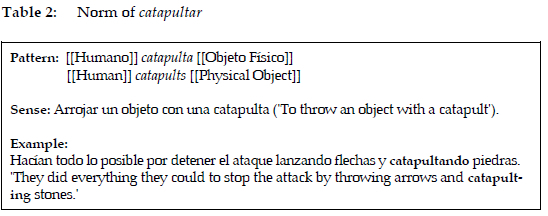
Just as in English, the norm includes a human agent, the goal of the action is a physical object, and the pattern is associated with the meaning of throwing something concrete. However, Hanks (2013) explains that norms can be creatively exploited - a phenomenon he calls exploitation. Exploitations are a deliberate departure from an established pattern of normal word use (that is, from a norm), either in order to talk about new or unusual things, or to say old things in a new, interesting, or unusual way. Example (1) illustrates one such use of catupultar, in the passive voice:
(1) Se intensifican (...) vínculos que ya existían y, a la vez, se catapultan otros hacia el olvido.
('Existing relationships become stronger, and, at the same time, others are catapulted into oblivion.')
In this case, the verb is undoubtedly used figuratively: the object is an abstract entity (a relationship) whereas the agent is unclear. The combinatory pattern does not match the one of the norm.
According to Hanks, an exploitation can be an isolated event (analogous to a nonce word or a hapax), or may end up expanding in use. If it becomes more frequent, a new norm can emerge (with a new meaning and a different pattern).
This passage from exploitation to norm is usually gradual. Hanks (2013: 92) characterises the space between one stage and the other as a grey area. This can be assimilated to what has been called a neological process, defined as the "set of phenomena that occur around a word from the moment it first appears to its full establishment in use or, in other cases, its disappearance" (Freixa 2022: 51, our translation). This process involves changes in three levels: linguistic, cognitive, and social. At the linguistic or structural level, lexicalisation takes place. This is defined as the formal process that spans from the creation of the word until it becomes fixed and includes both semantic and formal aspects. Parallelly, at the cognitive level, hypostatisation takes place, that is, the lexicalised unit is incorporated into the mental lexicon of the speakers. Finally, at the social level, institutionalisation takes place, that is the widespread use of the neological item in a community, which often leads to its dictionarisation.
Given this diachronic dimension, it can be concluded that TNE is a relevant framework for studying neologicity, especially in understanding how semantic neology should be addressed and how it is dictionarised.
5. Case studies
In this work, the focus is on two verbs whose neologicity have been described in terms of norms and exploitations (cf. Berri and Boschiroli 2023, 2024): anestesiar and coreografiar.
These non-core neological uses will be dated based on information from Corpus diacrónico del español (CORDE) and Corpus de referencia del español actual (CREA), the Real Academia's historical corpora. Their frequency will be determined by looking at their most frequent collocations using the Word Sketch and Concordances functions in Sketch Engine as well as their corpus Spanish Web 2023 (esTenTen23). Entries from two recently updated general Spanish dictionaries will be analysed: (1) the Real Academia's Diccionario de la lengua española (DLE 23.7), and (2) Diccionario del español actual (DEA), a corpus-based general language dictionary first published in the 1990s, whose third edition was published online in 2023.
5.1 Case 1: anestesiar
Like its equivalent in English, the conventional meaning of anestesiar is in the medical sense. Below are typical examples and the norm associated with this pattern:
(2) No podían anestesiarme completamente porque mi presión sanguínea era muy baja.
('I couldn't be fully anesthetised because my blood pressure was too low.')
(3) anestesiar el ojo de un paciente afectado por glaucoma ('to anesthetise the eye of a glaucoma patient')
A full description of the pattern could include a specification of lexical sets associated with the semantic types. The description could also include the fact that the purpose is usually surgery, and that it is implied that the human in the second slot is a patient.
However, there are other uses that have been recorded extensively and move away from the norm, as can be seen at syntagmatic level:
(4) Más que confundido, el consumidor está anestesiado, abrumado ante el exceso de estímulos y ahora prácticamente solo responde al precio. ('The consumer is not so much confused as it is numbed, overwhelmed by the excess of stimuli, and now they almost only respond to price.')
(5) Berlusconi ha conseguido anestesiar a buena parte de la población. ('Berlusconi has managed to numb a large part of the population.')
In (4), the human is not a patient, but a consumer, and instead of drugs, there are stimuli. In (5), Berlusconi is a politician, instead of a doctor, and the goal is the population.
As a matter of fact, these variations to the norm are not new. A search of the form "anestesiad*" in CORDE shows that, in total, there are 10 variations out of 28 examples between 1884 and 1969. The first recorded literary example (6) is from 1905 "anestesiada para el sentimiento", 'numb for feelings'), but already in 1929 there is an example from the press ("anestesiado por el miedo", 'numbed by fear').
(6) La veo anestesiada para el sentimiento. (1905) ('She seems to be numb for feelings.')
(7) En el fondo de la caverna … anestesiado por el miedo, estaba un hombre - yo - ... Todo mi ser temblaba, sudando … (1929) ('numbed by fear')
These are not occasional exploitations either. Sketch Engine's Word Sketch of the lemma anestesiar reveals that there are some regular collocations, such as the nouns sociedad 'society', conciencia/consciencia 'consciousness', ciudadanía 'citizens' or sensibilidad 'sensitivity', or the adverbs emocionalmente 'emotionally' and moralmente 'morally', that co-occur consistently and repeatedly with the verb. Moreover, whereas in the Word Sketch there are 677 cases of concordances with paciente 'patient' and 300 with dolor 'pain' - which, according to CORPES, are the two most frequent noun co-occurrences of anestesiar - there are 509 of sociedad and 401 of conciencia/consciencia. This suggests they are frequent patterns.
Based on this data, these new uses can be described as a secondary pattern:
The analysis has shown regular lexical sets as second argument, and also an overall negative prosody in connection to the meaning, which has moved from the physical to the emotional.
How is this secondary norm accounted for in general dictionaries? Despite its frequency and age, there is no record or trace of this pattern in the DLE. Anestesiar is represented as a monosemous verb in its medical meaning. The noun base anestesia is used in the definition, but there are no further explanations in the noun either.
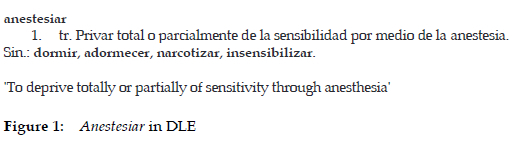
The DEA, on the other hand, looks more promising. Unlike the DLE, it does offer two senses and two explanations:
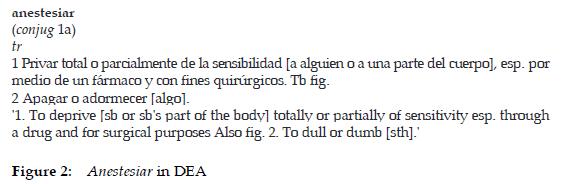
Sense 1 is, unsurprisingly, the medical sense. The style of the definition is noticeably similar to the pattern description of the first norm (Table 3), suggesting it is based on corpus data. However, after the definition there is a label "tb fig." ('also figurative'), suggesting there is a non-conventional use which in fact is not explained.3

Contrasting with the analytic style of the definition of the first sense, in the second sense two near synonyms (apagar 'to deaden' and adormecer 'to benumb') are given as explanations. These are highly polysemous verbs which could easily replace the first meaning, so the result is confusing.
The dictionary offers an advanced view display, where a variety of real-life examples are shown:
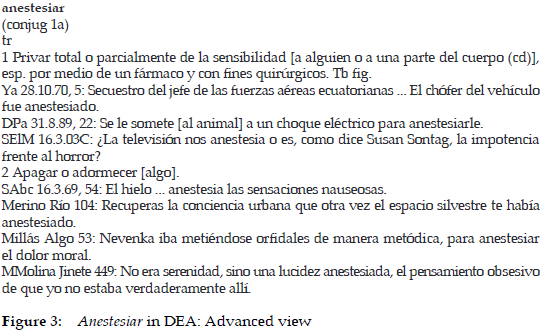
In sense 1, the first two examples illustrate the conventional meaning, whereas the third one ('Does TV numb us or is it, as Susan Sontag says, impotence in the face of horror?') matches the second norm given in Table 4. However, the examples in the second sense mix the medical meaning ('ice... anesthetises nauseous feelings', in the first sentence) with exploitations (such as 'wilderness had anesthetised/numbed you', in the third example, or 'numb lucidity', in the last one).
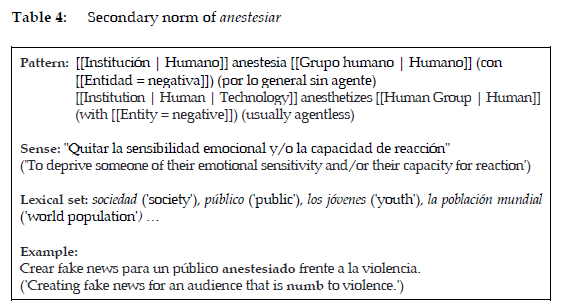
As a result, while the prototypical norm is properly represented, the new one, albeit hinted at, is not. Beyond the first norm, what is shown reads, indeed, like a grey area. Neither of the strategies adopted (the "figurative" label in sense 1, the synonymic definition in sense 2, the examples) account for the semantic and phraseological specificity of the secondary norm.
5.2 Case 2: coreografiar
The second case is coreografiar ('to choreograph'). The conventional primary norm, which is the same as in English (associated with dance and music), can be described as follows:
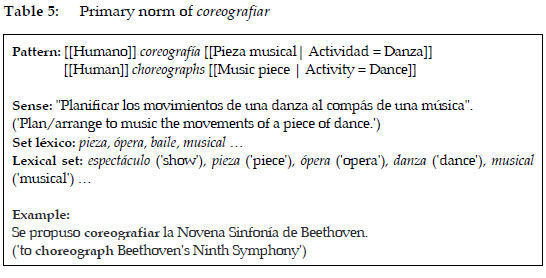
In this case, exploitations such as example (8) were found, where "his own ending" means "his death". This was probably not in relation to music, a show, or dancing. Instead, the verb is used creatively in an original pattern.
(8) ¿Fue capaz de coreografiar su propio final? ¿Convirtió su muerte en su actuación definitiva?
('Did he manage to choreograph his own ending? Did he turn his life into his final performance?')
Apart from exploitations, other uses that appear regularly and frequently in the corpus were also found. These include coreografiar una escena de sexo ('to choreograph a sex scene') and coreografiar una escena de acción ('to choreograph an action scene'), both associated to cinema:
(9) ¿Qué porcentaje de esa mirada intimista permanecerá con vida en un relato repleto de escenas de acción coreografiadas hasta el más mínimo detalle? ('What percentage of that intimist look will survive in a narrative that is full of action scenes that were choreographed to the last detail?')
(10) La británica se encarga de coreografiar las escenas sexuales de las películas. ('The Briton is in charge of choreographing sex scenes in films.')
These secondary uses seem to be quite more recent than the ones in the previous case. A search of "coreografi*" in CREA reveals that out of 44 results, four deviate from the primary norm, starting in 2002. Two of these are exploitations, the other two recurrent secondary uses, such as the ones identified in examples (9) and (10):
(11) Los empleados de traje y corbata entraban, comían, tomaban café, salían, y el amplio espacio libre entre las mesas y el discreto paso rápido de los camareros y los trajes de los comensales contribuían a crear un ambiente coreografiado. (2001) ('The employees in suits and ties would come in, eat, have coffee, leave, and the ample room between the tables and the discreet, quick step of the waiters and the diners' outfits contributed to create a choreographed setting.')
(12) violencia …. cuidadosamente coreografiada [en un film] (2003) ('carefully choreographed violence' [in a film]')
Moreover, the Word Sketch of the verb shows it is a very frequent phenomenon. There are fewer numbers of primary sense collocations (69 altogether, including ballet, baile 'dance', danza 'dance', and rutina 'routine') than of secondary sense collocations (121, including secuencia 'sequence', escena 'scene', and pelea 'fight'). This shows that recurrent new uses cannot be regarded as mere exploitations and need to be described in terms of a new norm.
However, in this case, if the focus is on the sense and the phraseological pattern, rather than a new norm, there seems to be an extension of the existing norm. The prosody has not changed, and although the music element has become optional, the basic meaning of 'planned sequence of movements' remains. As a result, the extended norm shown in Table 6 is proposed, rather than a separate new one.
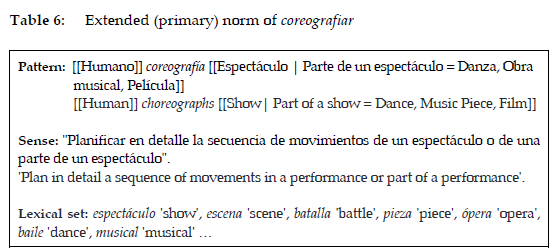
As in the case of anestesiar, the DLE only records the primary norm in connection to dance. Also, the definition cross-refers to the noun, focused entirely on the dance meaning.
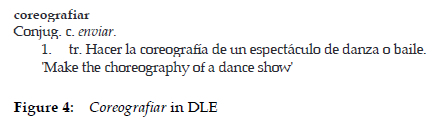
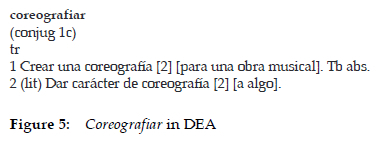
And once again, the DEA offers two senses and definitions. The first one explains the prototypical sense; the definition is analytical and, like that of the Real Academia, cross-refers to the noun ('to create a choreography [for a musical piece]'). The second one would be expected to explain the recurrent variations described before. However, this sense refers to literary uses (labelled as such with the abbreviation "lit."), which are rather cryptically explained as 'Give the character of choreography', without any specification of the object.
The examples in the advanced view of sense are not entirely helpful in terms of specifying the second definition.
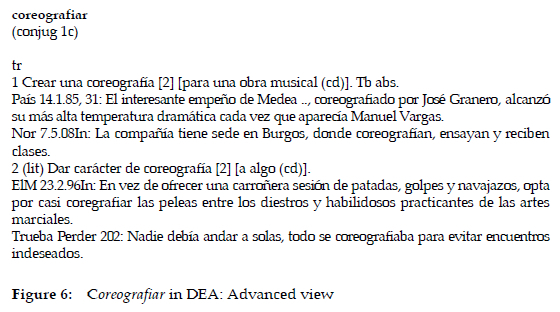
Although the first example does show one of the collocations we identified as typical of the extended use of the verb ("... opta por coreografiar las peleas entre diestros y habilidosos practicantes de las artes marciales" 'chooses to almost choreograph the fights among the skilled, dexterous martial arts practitioners'), the use of casi 'almost' seems to suggest at this historical point it might have still been an exploitation, like the one found in the second example, where the verb's object is todo 'everything', too vague to complement the lack of precision of the explanation. Adding to the confusion, the first example is not literary, as the label suggests. The whole of the second sense, then, fails to account for a regular use, and the extended uses remain mis- or unrepresented.
6. Discussion
To assess the adequacy of the lexicographic representation of anestesiar and coreografiar, it is necessary to take a step back and clarify the role of monolingual general dictionaries aimed at human users is in terms of the kind of lexical information they should dictionarise. Of the many answers to this question, the focus here is on two.
The first is Hanks (2013: 90-91) who, considering the content of dictionaries, argues: "The facts recorded in dictionaries are, or should be, the very facts about the shared linguistic conventions on which participants in conversation rely." The second is Kilgarriff's (1992) claim that a usage-type deserves to be listed in a dictionary when it is "sufficiently frequent and insufficiently predictable".
In the present analysis of semantic neological verbs, it was found that their structural and semantic reality differs significantly from their representation in general dictionaries. Looking at the dictionary entries analysed from Hanks' and Kilgarriff's perspectives, a number of observations can be made.
Firstly, although it makes sense to record explicitly new uses whose stabilisation is not entirely predictable - that is, whose neological process is not complete - the analysis shows that major general dictionaries tend to ignore altogether documented variations from primary norms, in spite of their low degree of neologicity.4
On the other hand, when these uses are recorded, as in DEA, there are several inconsistencies. First, examples mix exploitations (that are not frequent) with stabilised secondary uses (that are frequent, hence socially shared and not predictable). Second, the use of the label "fig." for figurative uses is unpredictable: Sometimes it is included (as in anestesiar) whereas sometimes not (as in coreografiar). It also seems to cover unlikely cases, that is, unusual uses, rather than conventionalised ones. It thus loses any explanatory power it may have - hence, it is unsuitable as a replacement for definitions.
Moreover, in these cases, both the label "fig." and those inaccurately broad definitions that cover new meanings, extended meanings and exploitations do not specify collocations. As a result, they fail to grasp both the structural and semantic stability that is characteristic of a secondary use. Overall, there seems to be a confusion between exploitations and those uses that fall into the grey area described by Hanks and that are closer to a brand-new norm, as in the case of anestesiar, or a modification or extension of a previous norm, as in coreografiar.
7. Concluding remarks
To conclude, some considerations need to be taken into account when dictionarising VSN. Regarding general dictionaries, especially pertaining updating them, it is important to adopt a systematic approach to the inclusion of VSN that anticipates how to deal with the grey area between exploitations and secondary or new norms. This should specify the criteria to be applied to distinguish these cases, as well as how extended and "new" meanings will be described - whether and how they will be incorporated into existing definitions, or as subsenses, and what kind of explanations there should be for them, ideally accounting for the most frequent collocations. The use of the label "fig." could perhaps be reserved for (very) grey area examples, where the collocations are increasingly vague and the meaning increasingly despecified, such as the ones in the examples below:
(13) Es preciso coreografiar una experiencia de cliente memorable y positiva, donde todos los empleados cuentan. ('It is necessary to choreograph an experience that invites and motivates employees to contribute willingly and happily to their potential at work.')
(14) Un buen tramo del evento [una conferencia de prensa] de 4 horas de duración, en gran parte coreografiado, se centró en … (A large part of the 4-hour-long event [a press conference], largely choreo-graphed, focused on …)
Regarding dictionaries of neologisms, given their remedial role in Spanish lexicography, they seem to be the best place to account for the grey area. The systematic inclusion of VSN needs to be planned, and there is a need for ways to account for different "semantic modifications" of existing meanings explicitly, such as the extension of coreografiar (from dance to movies). On the one hand, there should thus be room for grey area cases, while on the other, primary senses should be made explicit somehow (for example, in a note) to account for their status.
Finally, regarding the detection and recording of VSN, existing protocols need to be refined to implement more systematic ways of detecting them, possibly including new technology.
Endnotes
1. This paper is the result of our concerns as members of the Red de neología del español Antenas Neológicas network (https://www.upf.edu/web/antenas/presentacion), with nodes from six Spanish speaking countries (Argentina, Chile, Colombia, Mexico, Peru, and Spain). One of our main tasks is extracting press neologisms, both automatically and manually, and recording them in the Observatori de neologismos databank BOBNEO (Institut de Lingüística Aplicada, Universitat Pompeu Fabra https://bobneo.upf.edu/inicio.html). We also work actively as writers and editors in a recent development of Antenas, the Antenario, an online dictionary of neologisms of six different varieties of Spanish.
2. Hanks developed the Pattern Dictionary of English Verbs (PDEV), available at https://pdev.org.uk/. For Spanish, the project Verbario (https://www.tecling.com/verbario/) describes the patterns of verbs in Spanish (Renau and Nazar, in process).
3. The label "fig." has been widely discussed and debated in the literature. For a critical review of its use in Spanish lexicography, see Martínez Gajardo (2011), and for general lexicography, see Battaner Arias (2010).
4. This is not only the case in the dictionaries we analyzed, but also in other general language dictionaries that were not included in this study, such as the Larousse and the Diccionario de uso del español.
References
A. Dictionaries
Adelstein, A., I. Kuguel and G. Resnik. 2008. 1300 neologismos en la prensa argentina. Los Polvorines: Universidad Nacional de General Sarmiento. [ Links ]
Alvar Ezquerra, M. 1994. Diccionario de voces de uso actual. Madrid: Arco/Libros. [ Links ]
Alvar Ezquerra, M. 2003. Nuevo diccionario de voces de uso actual. Madrid: Arco/Libros. Antenario. Diccionario de neologismos de variedades del español. https://antenario.wordpress.com/ [4 December 2024]
Diccionario de la lengua española (DLE). Twenty-third edition. https://dle.rae.es/ [4 December 2024]
Diccionario del español actual (DEA). Third edition. https://www.fbbva.es/diccionario/ [5 December 2024]
Diccionario de neologismos del español actual (NEOMA).https://www.um.es/neologismos/ [4 December 2024]
Diccionario de neologismos online. https://repositori.upf.edu/handle/10230/5993?locale-attribute=es [2 September 2024]
Larousse. https://red-larousse.com.mx/Dictionary [4 December 2024]
Moliner, M. 1967. Diccionario de uso del español. Madrid: Gredos. Verbario. http://www.verbario.com/ [4 December 2024]
B. Digital tools
BOBNEO. Observatori de Neologia. https://bobneo.upf.edu/ [4 December 2024]
Corpus diacrónico del español (CORDE).https://www.rae.es/banco-de-datos/corde [4 December 2024]
Corpus de referencia del español actual (CREA).https://www.rae.es/banco-de-datos/crea [4 December 2024]
Sketch Engine. https://www.sketchengine.eu/ [4 December 2024]
C. Other literature
Adelstein, A. 2019. Hacia una definición de neologicidad en semántica. Perassi, M.L and M. Tapia (Eds.). 2019. Palabras como puentes. Estudios lexicológicos, lexicográficos y terminológicos desde el Cono Sur: 209-230. Córdoba: Editorial Buena Vista. [ Links ]
Adelstein, A. 2022. Neología y semántica: grados de neologicidad en el ámbito nominal. Bernal, E., J. Freixa and S. Torner (Eds.). 2022. La neología del español. Del uso al diccionario:: 327-345. Madrid/Frankfurt am Main: Vervuert. [ Links ]
Adelstein, A. and V. Boschiroli. 2020. Dictionarization and Lexical Variation in Dictionaries of Spanish Neologisms. Word 66(4): 292-316. [ Links ]
Berri, M. and V. Boschiroli. 2023. Neologicidad metafórica y grados de inestabilidad. Hernández, P.C. and M.G. Galvani Gelusini (Eds.). 2023. Estudios SAEL 2023: 75-88. San Miguel de Tucumán: Editorial Humanitas. [ Links ]
Berri, M. and V. Boschiroli. 2024. La neología semántica de los verbos: criterios estructurales para determinar grados de neologicidad. Annali - Sezione romanza 66(1): 31-48. [ Links ]
Battaner Arias, P. 2010. La marca figurado como marca de uso. Bernal, E., S. Torner and J. DeCesaris (Eds.). 2010. Estudis de lexicografía 2003-2005: 39-60. Barcelona: Institut Universitaria de Lingüística Aplicada. [ Links ]
Bernal, E., J. Freixa and S. Torner. 2020. Criterios para la diccionarización de neologismos: De la teoría a la práctica. Revista Signos 53(104): 592-618. [ Links ]
Bouzidi, B. 2010. Néologicité et temporalité dans le processus néologique. Synergies Algérie 9: 27-36. [ Links ]
Cañete, P. and J. Freixa. 2014. Filtros de neologicidad e inclusión lexicográfica. Camus, B. (Ed.). 2014. Morfología y diccionarios: 9-18. A Coruña: Universidade da Coruña. [ Links ]
Freixa, J. 2022. El proceso neológico. Bernal, E., J. Freixa and S. Torner (Eds.). 2022. La neología del español. Del uso al diccionario: 51-72. Madrid/Frankfurt am Main: Vervuert. [ Links ]
Gerding Salas, C. and G. Kotz Grabole. 2016. Distancia semántica y neológica léxica. Literatura y lingüística 33: 289-312. [ Links ]
Hanks, P. 2013. Lexical Analysis. Norms and Exploitations. Cambridge, MA: MIT Press. [ Links ]
Kilgarriff, A. 1992. Polysemy. Unpublished PhD dissertation. Brighton: University of Sussex at Brighton. [ Links ]
Lara, L.F. 2009. Lengua histórica y normatividad. Mexico: El Colegio de México.
Lauría, D. 2022. Lengua y política. Historia crítica de los diccionarios del español de la Argentina. Buenos Aires: Eudeba. [ Links ]
Martínez Gajardo, C. 2011. Revisión crítico-bibliográfica en torno a la marca fig. en diccionarios de uso del español. Boletín de filología 46(2): 219-234. [ Links ]
Martínez Linares, A. 2015. Cuestiones en torno al tratamiento de los neologismos semánticos: entre la intuición, el análisis lingüístico y el diccionario. Cunitá, A. and C. Lupu (Eds.). 2015. Neologie, neologism. Concepte, analize: 69-100. Bucarest: Universidad de Bucarest. [ Links ]
Renouf, A. 2013. A Finer Definition of Neology in English: The Life-cycle of a Word. Hasselgârd, H., J. Ebeling and S. Oksefjell Ebeling (Eds.). 2013. Corpus Perspectives on Patterns of Lexis: 177-208. Amsterdam: John Benjamins. [ Links ]
Renouf, A. 2020. Semantic Neology: Challenges in Matching Corpus-based Semantic Change to Real-world Change. Rautionaho, P., A. Nurmi. and J. Klemola (Eds.). 2020. Corpora and the Changing Society: Studies in the Evolution of English: 79-111. Amsterdam: John Benjamins. [ Links ]
Rodríguez Barcia, S. and A. Moskowitz. 2019. An Authentic Pan-Hispanic Language Policy? Spain as the Point of Reference in the Spanish Royal Academy's Diccionario de la lengua española. International Journal of Lexicography 32(4): 498-527. [ Links ]
Sablayrolles, J.F. 2003. Le sentiment néologique. Sablayrolles, J.F. (Ed.). 2003. L'innovation lexicale: 156-167. Paris: Honoré Champion. [ Links ]
Sablayrolles, J.F. 2006. La neologie aujourd'hui. Gruaz, C. (Ed.). 2006. À la recherche du mot: de la langue au discours: 141-160. Limoges: Éditions Lambert-Lucas. [ Links ]
Straccia, J. 2024. Aspecto léxico y resemantización. RASAL Lingüística 2: 69-89. [ Links ]
* A version of this paper was presented at the 6th Globalex Workshop on Lexicography and Neology (GWLN-6), held on 3 July 2024 at the University of Pretoria, Hatfield Campus, Pretoria, South Africa.
