



Services on Demand
Journal

Article
 English (pdf)
 Article in xml format
 Article references
 Automatic translation
 Send this article by e-mail
Indicators
Related links
-
 Cited by Google
 -
 Similars in Google
Share

 Permalink
South African Journal of Industrial Engineering
On-line version ISSN 2224-7890
S. Afr. J. Ind. Eng. vol.35 n.3 Pretoria Nov. 2024
https://doi.org/10.7166/35-3-3100
SPECIAL EDITION
Illuminating a novel enterprise engineering method making architecture practical - part two
M. Auret*; L.D. Erasmus
Defence and Security Cluste, Council for Scientific and Industrial Research, South Africa
ABSTRACT
The current work expands on previous practical experience, and presents a practical engineering method to define enterprises. This method employs a series of architecture reference models to create an optimised enterprise free of legacy problems and hidden agendas. Building on the performance and organisation reference models (PRM and ORM), as previously discussed, the method examines the design of the ORM and clarifies the derivation of the business reference model (BRM) from it. By relying on heuristics and self-discovery, this method offers significant potential for optimising organisations. This previously unpublished engineering approach, which has a proven track record, provides a notable, novel, and practical means of designing a fit-for-purpose enterprise architecture.
OPSOMMING
Die huidige werk brei uit op vorige praktiese ervaring, en bied 'n praktiese ingenieursmetode om ondernemings te definieer. Hierdie metode gebruik 'n reeks argitektuurverwysingsmodelle om 'n optimale onderneming te skep wat vry is van nalatenskapprobleme en verborge agendas. Voortbouend op die prestasie- en organisasieverwysingsmodelle (PRM en ORM), soos voorheen bespreek, ondersoek die metode die ontwerp van die ORM en verduidelik die afleiding van die besigheidsverwysingsmodel (BRM) daaruit. Deur op heuristiek en selfontdekking staat te maak, bied hierdie metode aansienlike potensiaal vir die optimering van organisasies. Hierdie voorheen ongepubliseerde ingenieursbenadering, wat 'n bewese rekord het, bied 'n noemenswaardige, nuwe en praktiese manier om 'n geskikte ondernemingsargitektuur te ontwerp.
1. INTRODUCTION
In a previous work [1], the Framework for Enterprise Architecture Focus Plus (FEAF+) framework was introduced as an innovative approach to designing an enterprise architecture that emphasises 'fit-for-purpose' and dismantles the negative influences of legacy systems and hidden agendas. The framework and method leveraged a sequence of architectural reference models to systematically define an optimised enterprise architecture.
This paper, part two of the series, investigates the method in greater depth by illuminating the organisation reference model (ORM) in greater detail. It explores the design aspects of ORM to ensure alignment between organisational structure and desired performance. The process of deriving the business reference model (BRM) from the ORM is discussed to demonstrate how the method ensures traceability between business goals and the resulting solution architecture.
This paper effectively builds on the foundation laid in [1] by further exploring the design aspects of the BRM. The paper provides a light at the end of the tunnel by drawing on previous contexts, offers significant potential for organisational optimisation through this previously unpublished engineering method, and justifies how BRM is derived from it.
Future papers will provide details on the remaining reference models (service, information, and technology reference models), thereby continuing to shine a light at the end of an enterprise engineering tunnel.
2. LITERATURE REVIEW
Enterprise Architecture (EA) is integral to organisational design, as it provides a structured framework to align strategy with business goals, ensuring that the organisational structure supports strategic objectives [2]. EA facilitates business process automation and contributes to long-term cost reduction and enterprise agility [2]. Moreover, it is crucial to define the EA aspects and their relationships with human elements in an organisation [3]. Furthermore, EA plays a critical role in reducing business risks by providing a holistic view of an organisation's environment and integrating it into its overall business strategy [4]. EA is a strategic tool that shapes organisational design by aligning architecture components and business strategies, supporting business process automation, and improving enterprise agility [2]. It is also a proactive risk management tool, especially in the cybersecurity space [4]. However, the effectiveness of EA can vary depending on organisational characteristics and its implementation, which requires a clear understanding of its impact on organisational performance [5]. Effective governance is necessary to ensure the consistency and timeliness of the EA output [6]. The role of EA is to connect people, processes, and technology to maximise corporate IT and business performance [7]. Finally, the organisational impact of systems can be analysed using EA models [8].
An effective enterprise engineering method must ensure that human requirements are adequately specified and that it facilitates the achievement of organisational objectives. The literature suggests that aligning business processes with enterprise information systems is crucial for this purpose. It is important to translate enterprise objectives into quantifiable goals that inform information systems, thereby ensuring that software requirements are consistent with business objectives [9] - although it should be stressed that the EA referred to in this document extends beyond IT or software systems. It is important to guide business processes towards corporate goals and market requirements, suggesting that the design of business processes and the supporting architecture aspects should closely align with these goals [10]. However, achieving and sustaining such an alignment presents challenges [11], which identifies the knowledge and cultural gaps between business and IT functions as key factors contributing to misalignment. Umoh and Sampaio [11] propose REFINTO, a framework that facilitates business-IT alignment through collaborative and iterative processes. The role of governance ensures that the architecture supports organisational strategies and goals, which are essential for realising human requirements and objectives [12]. In summary, an effective enterprise engineering method must incorporate mechanisms to align EA requirements and organisational objectives. This involves addressing knowledge and cultural gaps, fostering collaboration among stakeholders, and implementing robust governance. Such alignment is critical for the successful specification and facilitation of human requirements in enterprise engineering endeavours.
Business Architecture models are multifaceted, and serve to delineate the essential business processes, activities, steps, and functions in an organisation. These models provide a structured representation of an organisation's business know-how, which is crucial for understanding, communicating, and analysing how business processes are performed, the goals they achieve, the information they use, and the applications that support them [13]. They also facilitate the alignment of business architectures, supporting the integration of business model and enterprise architecture management processes [14]. Interestingly, while business architecture models are critical for providing insights into the operations of an enterprise, they also play a significant role in optimising roles and responsibilities in supply chain processes [15]. Moreover, they are instrumental in the planning and design of enterprise architectures that assist in project management activities, as demonstrated in the case of CV. Aksata Creative Design [16]. However, it is important to note that the implementation of these models can be complex, and methodologies that describe components in relation to their behavioural attributes and dependencies are necessary for validation and to ensure alignment with business vision and strategy [17]. In summary, business architecture models are essential tools for organisations to visualise and analyse their business processes and strategies. They support decision-making, facilitate the alignment of business and IT, and help to define roles and responsibilities in an organisation. The successful implementation of these models requires careful consideration of their complexity and of the methodologies used for their validation to ensure that they effectively support the organisation's objectives.
Systems thinking plays a pivotal role in the business process by enabling a comprehensive understanding of complex business patterns and fostering the creation of processes that accurately reflect real-world behaviour [18]. This holistic approach is crucial for capturing the essence of business activities and ensuring that the design specifications are well-structured and aligned with the organisation's strategic goals [19]. Interestingly, while systems thinking is fundamental, the literature also highlights the importance of other factors, such as process competence, which has been shown to influence positively the creative quality of business process redesign [20]. Furthermore, the application of systems thinking principles in conjunction with other methodologies, such as trend analysis in the hospitality industry [21] and the integration of workflow optimisation in the aerospace and defence industries [22], demonstrates its versatility and adaptability across various sectors. In summary, systems thinking is an essential component of business process design that provides a framework for understanding and representing the interrelated elements of business activities. It complements other competencies and methodologies, contributing to the strategic alignment and effectiveness of business process design.
3. OVERVIEW OF PREVIOUS WORK
FEAF+ is an architectural framework that uses natural classification laws to order enterprise definitions sequentially [1]. It emphasises the application of order in architecture and incorporates reference models for the derivation of structure and content. The framework is guided by principles such as fit-for-purpose, eliminating the negative effects of legacy and politics, and maintaining hierarchy and affiliation between concepts through a cascading-of-goals effect [1].
This framework is used to devise enterprise architectures that use six reference models to identify the minimum set of parameters necessary to depict an enterprise [1]. These models are performance, organisation, business, service, information, and technology reference models, as depicted in Figure 1. Each reference model has a specific function in the development of subsequent models. For example, PRM is used to establish the objectives and goals of an enterprise architecture [1]. This information then informs the ORM, which determines the organisational structure and capabilities needed to fulfil those objectives [1]. This framework emphasises a sequential approach in which higher-level models, such as PRM, guide lower-level models, such as ORM and eventually the technology reference model (TRM) [1]. This approach ensures that the architecture aligns with business needs and avoids solutions without a clear purpose [1]. By following this structured method, the approach aims to produce consistent and reusable enterprise architecture designs [1].
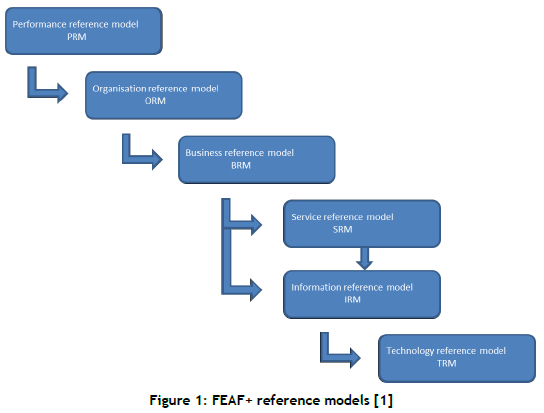
The six reference models leveraged by the framework reference models to design an enterprise architecture in Figure 1 are as follows [1]:
• Performance reference model (PRM): Defines the objectives and goals that the enterprise architecture must achieve.
• Organisation reference model (ORM): Identifies the organisational structure and capacity needed to achieve the objectives outlined in the PRM.
• Business reference model (BRM): Defines the business functions, processes, and activities required to meet the ORM requirements.
• Service reference model (SRM): Describes the necessary applications and systems to facilitate the business requirements described in the BRM.
• Information reference model (IRM): Defines the necessary information for operating the business and integrating different systems.
• Technology reference model (TRM): Identifies the necessary technology infrastructure to support the services and information specified in the SRM and IRM.
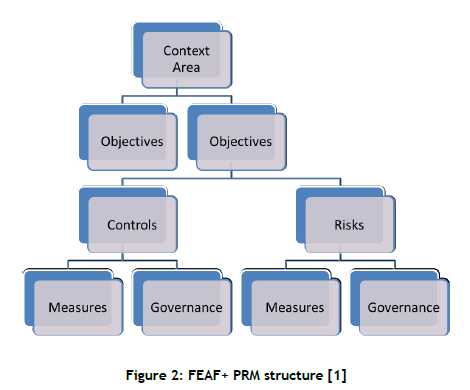
The performance reference model (PRM) [1] is a key component of FEAF+ that focuses on defining the objectives that an enterprise aims to achieve. These objectives are established using the goals, objectives, controls, and risks shown in Figure 2. PRMs are built around context areas, which represent specific areas of focus in an enterprise. For each context area, the objectives are set to detail the desired outcomes. Controls are then identified as the necessary actions or decisions to achieve these objectives. The effectiveness of these controls is assessed using the defined measures displayed in Figure 2. Governance in Figure 2 ensures compliance with controls through established rules, policies, or the like. Finally, potential obstacles to achieving objectives, controls, or measures are recognised as risks in Figure 2. The hierarchical structure of the PRM allows for the cascading of goals, where a higher-level PRM's objective serves as the context for a lower-level PRM. This facilitates the transformation of strategic objectives into operational ones. The use of the template presented in [1] streamlines the creation and documentation of the PRM using this structure. The PRM establishes a framework for defining the clear and measurable goals and the controls needed to achieve them while managing risks and ensuring proper governance in the enterprise [1].
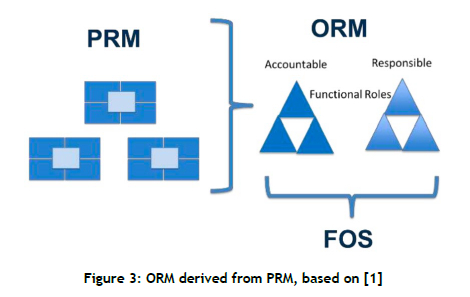
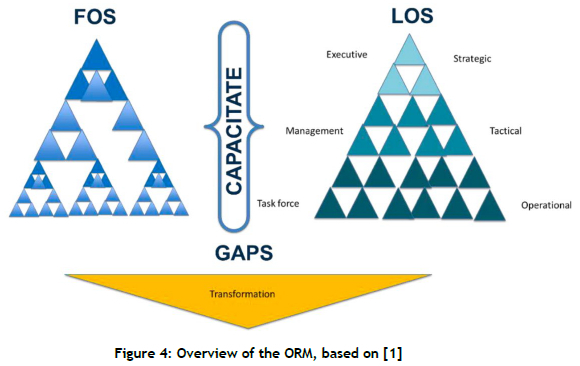
The organisation reference model (ORM) is a vital aspect of an effective enterprise engineering method. This model helps to specify and facilitate human requirements to realise the objectives detailed in the PRM, as depicted in Figure 3. A key feature of the ORM is the differentiation between accountability and responsibility. Accountability involves the obligation to justify one's actions, while responsibility entails executing and monitoring processes and outcomes to achieve a specified goal [1]. The functional organisation is derived by identifying the accountability and responsibility that address the objectives of the PRM [1]. By distinguishing between functional organisations (roles) and line organisations (positions), the ORM provides two perspectives: a functional organisation structure (FOS), which describes an ideal organisational structure, and an existing line organisation structure (LOS), as illustrated in Figure 4. The primary objective of the ORM is to harmonise these two perspectives, a process known as capacitation. This process considers factors such as location, quantity, skill, competency, experience, and accreditation, as well as any necessary vetting and authorisation. Both accountable and responsible structures must exist in the FOS, and are essential for achieving a successful outcome.
The ORM recognises the influence of cultural and social factors on organisational design, an area that was not addressed before for FEAF+ and that is outside the scope of this paper.
The purpose of the ORM is to create a functional organisational structure that clarifies the responsibilities and duties of various activities [1]. This structure is designed to ensure that individuals assigned to these activities have the necessary capabilities and capacity to achieve PRM [1]. The organisational structure is organised in a hierarchical format, and staffed with appropriate human resources.
The ORM also considers the existing line organisation, which represents the organisational structure for which positions have already been defined and staffed [1], referred to as the line organisation structure (LOS). This means that the functional organisational expectation must be considered and transformed in such a way that it can meet the objectives outlined in the PRM [1]. If this is not achieved, it may not be possible to achieve the objectives outlined in the PRM.
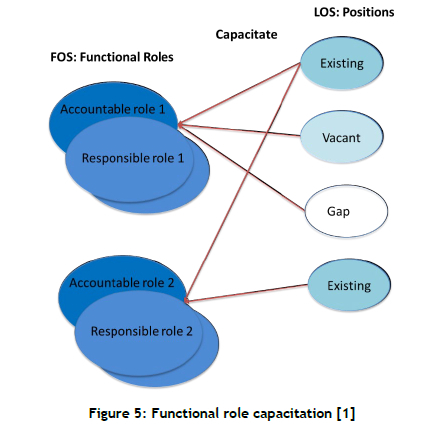
Capacitation necessitates the alignment of the LOS with the FOS [1], as demonstrated in Figure 4. This alignment can be achieved by mapping an FOS requirement to one or more organisational positions in the LOS [1]. Any gaps identified during the capacitation process may result in the need for organisational transformation (as shown in Figure 4) or a reassessment of objectives in the PRM [1].
Thus the ORM is effective to the extent that the LOS can equip individuals with the appropriate skill sets to perform the roles specified in the FOS. The extent to which mapping is successful determines an enterprise's ability to attain its set objectives. However, assessing this degree of success is beyond the scope of this paper.
The efficacy of the PRM and its subsequent impact illuminate the cascading effect of the PRM, and the corresponding ORM requirements are directly derived from the established controls [1]. The ORM is established on the basis of the functional expectations it is meant to fulfil, and is subsequently transformed into functional roles. The FOS is formulated by defining the sum of the human intervention roles necessary to achieve the PRM directly [1]. The ORM determines organisational requirements by encompassing the definition of responsibilities and accountabilities for attaining controls within the business risk management framework [1].
4. BUSINESS REFERENCE MODEL
The BRM specifies the anticipated business domain, functions, processes, activities, and procedures that must be executed to satisfy the prerequisites of the preceding PRM and ORM reference models. The purpose of the BRM is to collaborate with the design of the preceding reference models. In addition, it has a direct, cascading relationship with organisational references, implying that there should be no business reference that cannot be linked to the appropriate organisational reference design. Without this, unnecessary or non-essential business operations may occur.
4.1. Business reference model definition
The BRM in the FEAF+ framework acts as a lynchpin in designing an enterprise architecture that is integrated with an organisation's core business functions. The BRM serves a multifaceted purpose in the FEAF+ framework. Primarily, it focuses on outlining the essential business functions, processes, activities, and steps. These elements are crucial for fulfilling the requirements established in the ORM [1].
The BRM extends its scope beyond merely delineating procedures; it accentuates the alignment with the outcomes of the cascading-of-goals effect and fit-for-purpose goals. This entails a thorough examination of the proposed solutions, encompassing their design and the expected reactions to process events. The BRM serves as a link between business objectives and organisational structures, ensuring that no business reference is present without a corresponding design in the organisational structure that enables its execution. By doing so, it prevents the development of redundant or unnecessary business references, thus avoiding situations where 'business is not being conducted' or where activities occur that are not essential, which are often common in legacy businesses.
The BRM plays a vital role in these two key scenarios:
• Enterprise architecture design: In the process of creating or updating an enterprise architecture, the BRM plays a crucial role. By delineating the business references, it guarantees that the architecture corresponds with the main functionalities of the organisation and avoids any solutions that do not fulfil the actual requirements.
• Business process improvement: Business process improvement (BPI) initiatives can benefit from using the BRM as an asset. With the help of the BRM, organisations could efficiently analyse documented processes and pinpoint areas of inefficiencies, redundancies, and opportunities for optimisation.
There are two primary situations in which leveraging the BRM would be highly recommended:
• Enterprise architecture development: Organisations often rely on a BRM when developing or refining their enterprise architecture. This ensures that the architecture is aligned with the key business functions and avoids solutions that do not address actual needs.
• Business process reengineering (BPR): The BRM functions as a useful reference point during efforts to improve efficiency. It assists in identifying the current processes, evaluating their effectiveness, and creating modified models for enhanced efficiency.
A well-defined BRM exhibits several key characteristics:
• It seamlessly integrates with both the ORM and the PRM. This ensures that the identified business processes have a clear connection to the organisational structure (ORM) and contribute to achieving the overall performance objectives outlined in the PRM.
• It encompasses all essential business processes without unnecessary redundancy. The process should be clearly defined, consistent, and documented in a clear and understandable manner.
• It links business processes to measurable outcomes that contribute to achieving the organisation's goals. This allows performance evaluation and continuous improvement initiatives.
• If the BRM outlines business processes that fail to align with the organisational structure (ORM) or do not contribute to the performance objectives (PRM), this suggests a deficiency in the architecture. An inadequate BRM that overlooks vital business operations or presents inconsistencies in its process definitions emphasises the need for revision. In such cases, additional refinement might be necessary if the BRM does not provide clear definitions of the outcomes of the business processes or neglects to establish mechanisms to assess their contributions to the organisation's objectives.
The BRM in FEAF+ offers a unique perspective by emphasising the role of systems thinking in business process design. This encourages a holistic approach that considers not only individual processes, but also their interactions and potential impacts in the broader organisational ecosystem. In addition, the BRM's focus on bridging the business and organisational domains adds a novel dimension by ensuring a clear connection between processes and the structures responsible for their execution.
While the core concept of defining business processes is a well-established practice in enterprise architecture frameworks, FEAF+ BRM injects a layer of innovation through its emphasis on systems thinking and organisational alignment.
4.1.1. Business reference model construct
Deriving a robust BRM in the FEAF+ framework requires a multi-pronged approach using three key modelling techniques: event-driven process chains (EPCs), functional allocation diagrams (FADs), and integration definition for function modelling (IDEF0). Each technique offers a unique perspective on the business reference that will be used in the BRM. EPCs, with their focus on events and sequences, will provide a clear visual roadmap of the 'what' and 'when' in the BRM, depicting the flow of activities triggered by specific events. FADs, on the other hand, delve deeper into the 'what' by assigning functionalities and tasks to specific elements and roles in the organisation, ensuring clear accountability and ownership for each process step. Although the IDEF0 is not our primary focus, its contribution lies in potentially informing the detailed breakdown of complex functions in the BRM, providing a more granular view where necessary. By leveraging the strengths of each of these techniques, we could create a comprehensive and well-defined BRM that not only outlines the business reference but also assigns responsibility and fosters seamless integration with the overall enterprise architecture.
4.1.2. Event-driven process chain
The event-driven processing chain (EPC) was developed in Germany during the 1990s [23]. EPCs are a common method for modelling business processes, offering a way to visualise and analyse workflows and their components [24, 25, 26]. EPCs are particularly useful in business process reengineering (BPR), enterprise resource planning (ERP), and workflow management (WFM) systems, with tools such as SAP R/3 and ARIS employing EPCs for process modelling [24]. However, EPCs have been criticised for lacking well-defined syntax and semantics, which could lead to ambiguities in process modelling [24]. Interestingly, research has addressed these shortcomings by translating EPCs into formal representations such as coloured Petri nets (CPNs) and Boolean nets, which provide well-defined semantics and enable formal analysis [24, 25]. This translation facilitates the verification of EPC correctness, and allows the application of various analysis techniques [24].
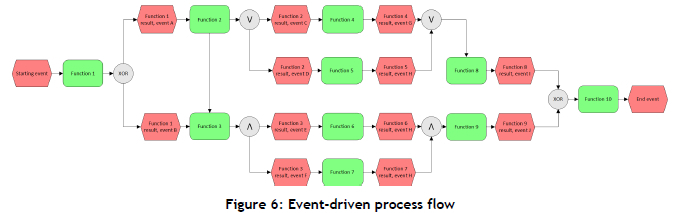
EPCs consist of four main elements [23]:
• Events: These are occurrences that either initiate or complete a process, which can be either internal (occurring within the system) or external (triggered by an external source). In an EPC diagram, these are typically portrayed as rounded rectangles.
• Functions: Activities or tasks performed to accomplish a particular objective are typically depicted as rectangles in the diagram.
• Connectors: Arrows are used to connect events and functions, demonstrate the order of activities, and highlight the cause-and-effect relationships between them.
• Logical operators (AND/OR): Symbols that indicate decision points in a process where multiple conditions must be met (AND) or only one (OR) to proceed to the next step. These symbols are commonly used to represent logical operations in a process.
The advantages of using EPCs are that they present a clear visual representation of processes, which simplifies communication and comprehension for both technical and nontechnical stakeholders [23]. EPCs also enable a thorough examination of the current processes, allowing for the detection of inefficiencies, repetitive actions, and possibilities for optimisation. In addition, EPCs function in comprehensive, well-documented processes that facilitate knowledge transfer and training. Furthermore, they can be used to standardise procedures across various departments or locations in an organisation [23].
EPCs have a wide range of applications, including business process reengineering, which involves identifying and redesigning processes for increased efficiency; developing information systems, where EPCs define the functional requirements of an information system to support specific business processes; supply chain management, where EPCs map out the flow of materials and information in a supply chain network; and quality management, where EPCs visualise quality control procedures and identify potential risks [23].
EPCs serve as an effective means of comprehending, evaluating, and optimising business operations. Their graphical representation and emphasis on occurrences make them a useful resource for diverse stakeholders in a company. Despite their initial lack of formal semantics, advancements in research have provided methods to formalise EPCs and to extend their capabilities, thereby enhancing their utility in business process engineering. These developments have ensured that EPCs remained a robust and adaptable language for modern business needs.
4.1.3. Functional allocation diagram
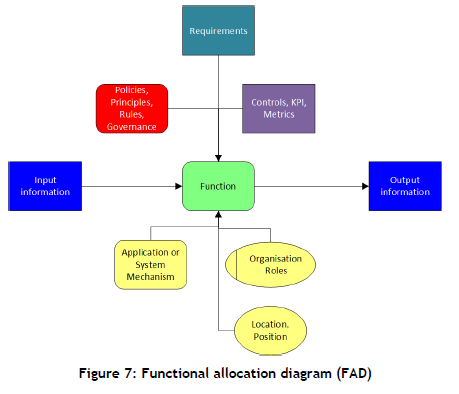
Functional allocation diagrams (FADs) serve as a tool to delineate responsibilities in business references, effectively answering the 'what' question by mapping out what elements are needed for specific functions. The ARIS platform, which is based on the architecture of integrated information systems framework, provides a comprehensive approach to business process architecture that includes FADs as components [27, 28]. These diagrams are instrumental in clarifying the roles and responsibilities, thereby facilitating better coordination and communication among stakeholders. Interestingly, while FADs help in understanding the allocation of functions, they are part of a broader context in which enterprise architecture (EA) and business process management (BPM) converge. Moreover, the importance of capturing the intentional dimensions of enterprise architecture, such as motivations and goals, is highlighted as a complementary aspect to the structural and functional elements that are typically associated with FADs [29].
FADs use a simple visual representation [30]:
• Functions: Rectangles represent activities or tasks that constitute a business process.
• Resources: These mechanisms are used to fulfil the function, usually depicted at the bottom, and may consist of:
o Applications/System: Application or system used as medium to fulfil the function.
o Organisation roles: Roles that are either responsible or accountable for the function to be performed.
o Location/Position: Physical or logical location or position in which this function must be conducted.
• Govern or control: Represents the aspects that constrain, limit, provides context of the function, usually depicted at the top, and may consist of
o Policies, principles, rules, governance: Any aspect that defines the compliance expectations.
o Controls, KPI, metrics: The effectiveness of controls and the defined measures.
o Requirement: Fulfilling the expectation of the function.
• Information: Reflects the explicit or tacit information used by the function:
o Input information: Information the function has to its disposal, or required to perform its purpose, usually depicted at the left flowing into the function.
o Output information: Information the function devised, created, or resulted in while performing its purpose, usually depicted at the right.
• Arrows: Functions are associated with the various aspects that influence them, as indicated by the arrows.
FADs effectively eliminate ambiguity by explicitly allocating ownership to each process function [30]. This fosters accountability and facilitates monitoring of performance. By mapping functions to roles, FADs help to identify any potential gaps between the required functions and the existing organisational structure [30]. This enables the necessary adjustments to ensure effective process execution. The visual representation of FADs promotes clear communication among business analysts, process owners, and stakeholders about their roles and responsibilities. Furthermore, FADs can pinpoint bottlenecks or misaligned responsibilities, guiding process improvement initiatives to enhance efficiency [30].
In the context of BRM development in FEAF+, FADs complement the information captured in EPCs. While EPCs map out the 'when' of business processes, FADs provide the missing piece by detailing the 'what' -the resources, governance and information for executing each function. This comprehensive understanding of processes, activities, and ownership is crucial for establishing a well-defined BRM that aligns with the organisational structure and facilitates successful implementation.
4.1.4. Integration definition for function modelling
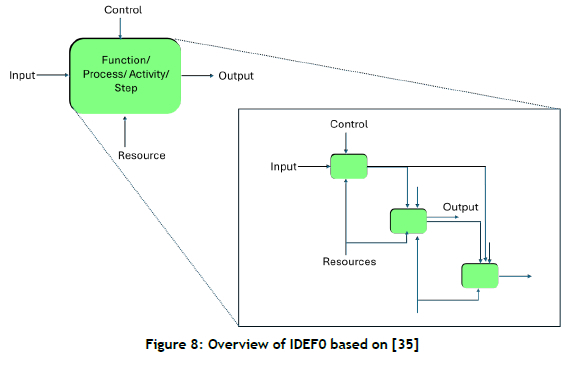
IDEF0, as a function modelling methodology, provides a structured framework to define the 'how' in system processes. It is an extension of the structured analysis and design technique (SADT), and has been standardised by IEEE, emphasising its widespread acceptance and utility in describing systems [31]. Moreover, the use of IDEF0 in various domains, from fixture design activities [32] to intelligent transportation systems [33] and even in the medical field [34], highlights its versatility.
While EPCs and FADs are the primary tools for delineating the 'when' and 'what' in the BRM, IDEF0 can offer an additional layer of specificity to describe the 'how'. IDEF0 illustrates the functionality of a system using boxes and arrows.
In the context of BRM development in EPCs and FADs, the IDEF0 can serve as a valuable tool for further breaking down the complex functions identified in EPCs. If an EPC reveals a particularly intricate process step, an IDEF0 diagram could be used to delve deeper, breaking the function down into its constituent subfunctions, inputs, outputs, controls, and mechanisms. This granular view could be particularly beneficial for tasks that involve multiple steps or that require specific tools or resources. However, it is essential to recognise that the IDEF0 plays a supplementary role in BRM development. The primary focus remains on using EPCs to map the overall process flow and FADs to assign complementary aspects, with the IDEF0 introduced strategically to provide a more detailed breakdown of specific, complex functions. This combined approach ensures a comprehensive BRM that captures the big picture, while also offering flexibility to address intricate functionalities when needed.
4.2. Guide to deciphering business reference models
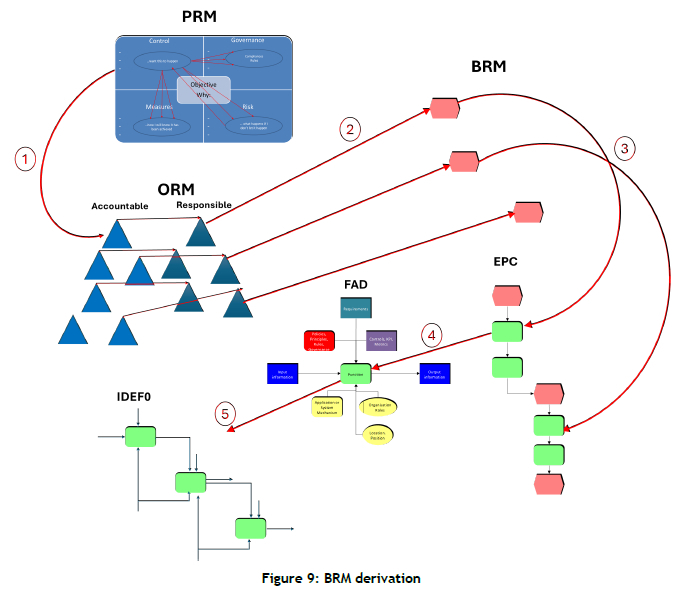
Deriving the BRM in FEAF+ involves a meticulously orchestrated interplay between several reference models. The performance reference model (PRM) lays the foundation for establishing an organisation's overarching objectives as the 'why's. These objectives translate into desired organisational accountabilities and responsibilities in the organisation reference model (ORM) [1], effectively becoming the 'who's. Subsequent objectives and organisational roles are materialised as events that needs to be achieved, and functions that explain how it is achieved, represented as business reference models (BRM), are depicted as 'how's. This approach is depicted in Figure 9.
4.2.1. Business reference model derivation
In the intricate world of business architecture, the BRM serves as a pivotal framework, delineating the functional landscape of an organisation. Its derivation is a meticulous process that begins with the performance reference model (PRM), a foundation that encapsulates the controls that are integral to an enterprise's or organisation's objective.
Using the PRM as the foundational starting point, the following sequence of steps guides the derivation of the BRM in conjunction with the responsibilities defined in the ORM, as referenced in Figure 9:
Step 1 : Establishing organisational roles is the genesis of crafting a BRM. Herein lies in the identification of accountability and responsibility for the PRM's control segment. This foundational step ensures that each control is not merely a directive but is championed by a designated custodian, ensuring its active management and execution.
Step 2: Defining equivalent events comes after establishing the organisational roles. Equivalent events mirror the delineated PRM controls and the associated organisational responsibilities defined in the ORM. These events are not stand-alone occurrences; they are the responsibilities of the roles identified in the previous step, thus creating a cohesive structure in which controls and events are inextricably linked, ensuring a cascading-of-goals. This ensures that the control, organisation, and events formulate a direct interlink that will assist with removing redundancies or other agendas.
Step 3: Functional description through accountability: The accountability role is not passive; it actively defines the functions that are necessary to actualise the PRM controls - that is, equivalent events. This is where the event-driven process chain (EPC) comes into play, specifying the functions and their sequence into the 'how'. The EPC translates accountability into actionable functions that needs to be performed by the responsible roles, charting the course for achieving the predefined events.
Step 4: Detailing functions with a dedicated FAD ensure that each function identified through the EPC is further elaborated using a FAD. The FAD is a granular view that identifies the resources and governance aspects pertinent to each function. It is a closer look into the 'what' of operations, providing clarity on resource allocation and oversight mechanisms.
Step 5: Decomposing functions is the quest to stride further in the BRM journey by the decomposition of each function into specific processes or activities. This abstraction is crucial, as it breaks down complex functions into manageable portions, making the BRM not just a theoretical construct but a practical guide to business operations.
The BRM is a structured approach to defining an organisation's functional domain. It serves as a blueprint that aligns performance controls with operational roles, events, and processes. This ensures that every part of the business is focused on achieving its goals by translating these goals into specific, actionable objectives. By following these steps, organisations can transform abstract models into concrete operational guidelines, creating a robust and resilient business architecture.
In conclusion, the BRM derivation process in FEAF+ is a powerful approach. It starts with the 'why' from the PRM, translates it into a sequence of events and control points in the EPCs as the 'how', and assigns clear ownership through FADs based on the ORM as the 'who', and offers the flexibility to delve deeper into intricate activities with IDEF0. This comprehensive approach ensures a well-defined BRM that captures both the big picture and intricate details, leading to a robust and well-aligned enterprise architecture.
5. CONCLUSION AND RECOMMENDATIONS
Space has prohibited the discussion of the full extent of FEAF+ and its reference models in one paper alone. Performance and organisation reference models were discussed in [1], and organisation and business reference models were discussed in this paper.
The series of papers already published and still to come is an invitation to the research community to investigate a practical method based on engineering experience.
For fellow enterprise engineers, this series presents a useful framework for practically designing enterprises through their description in respect of performance, organisation, business process, technology, applications, and information.
Later papers will delve into the remaining reference models to provide clarity and direction by aligning business and solution architectures, drawing on the preceding context.
Future work resulting from this paper and recommendations for consideration include the following:
• The remaining reference models to be discussed in this series of papers are the service reference model (SRM), the information reference model (IRM), and the technology reference model (TRM).
• A paper that is based on practical engineering experience in applying the concept of 'power maps' and using 'sensors and triggers' to steer organisational behaviour effectively to consider in the ORM for the impact of cultural and social aspects on organisational design.
• Quantitative measurement of the degree of success of the enterprise, based on the instantiated reference models of FEAF+.
• A documented solution realisation approach for FEAF+.
FEAF+ has become a well-respected element in enterprise engineering practice over several decades, receiving positive feedback and references from numerous corporate and large enterprises [1]. However, it is necessary for FEAF+ to gain recognition in the research community, as this would facilitate the incorporation of research results and enhancement initiatives for the concept and its approach.
REFERENCES
[1] M. Auret and L. Erasmus, "A novel enterprise engineering method to make architecture practical," in ISEM 2023 Proceedings, Somerset West, South Africa, 2 - 4 October 2023. [ Links ]
[2] C. van Zijl and J.-P. van Belle, "Organisational impact of enterprise architecture and business process capability in South African organisations," International Journal of Trade, Economics and Finance, vol. 5, no. 5, pp. 405-413, 2015. [ Links ]
[3] K. Ahsan, H. Shah, and P. Kingston, "The role of enterprise architecture in healthcare-IT," in 2009 Sixth International Conference on Information Technology: New Generations, Las Vegas, NV, USA, 2009. [ Links ]
[4] L. Judijanto, S. I. Wahjono, D. Hindarto, and D. Djunarto, "Edge of enterprise architecture in addressing cyber security threats and business risks," International Journal Software Engineering and Computer Science (IJSECS), vol. 3, no. 3, pp. 386-396, 2023. [ Links ]
[5] P. Närman, P. Johnson, and L. Gingnell, "Using enterprise architecture to analyse how organisational structure impact motivation and learning," Enterprise Information Systems, vol. 10, no. 5, pp. 523562, 2014. [ Links ]
[6] R. Winter and J. Schelp, "Enterprise architecture governance: The need for a business-to-IT approach," in Proceedings of the 2008 ACM Symposium on Applied Computing, 2008, pp. 548-552. [ Links ]
[7] K. Kasemsap, "The role of information system within enterprise architecture and their impact on business performance," in Web design and development: Concepts, methodologies, tools, and applications, 2016, pp. 147-169. [ Links ]
[8] P. Gustafsson, D. Hook, U. Franke, and P. Johnson, "Modeling the IT impact on organisational structure," in 2009 IEEE International Enterprise Distributed Object Computing Conference, Auckland, New Zealand, 2009. [ Links ]
[9] R. Champion and T. Moores, "Exploiting an enterprise model during systems' requirements capture and analysis," in Proceedings of the Second International Conference on Requirements Engineering, Springs, CO, USA, 1996. [ Links ]
[10] K. Mertins and R. Jochem, "Requirements of business process design," in K. Mertins and R. Jochem, Quality-oriented design of business processes, New York, Springer Science+Business Media, 1999, pp. 9-15. [ Links ]
[11] E. Umoh and P. R. F. Sampaio, "The 'REFINTO' framework and tool: Supporting business-IT alignment in enterprise financial application development," in 2014 IEEE 18th International Enterprise Distributed Object Computing Conference Workshops and Demonstrations, Ulm, Germany, 2014, pp. 406-409. [ Links ]
[12] L. N. Amali, M. R. Katili, S. Suhada, and T. A. Labuga, "Business process monitoring system in supporting information technology governance," Bulletin of Electrical Engineering and Informatics, vol. 10, no. 5, pp. 2884-2891, 2021. [ Links ]
[13] G. Antunes, J. Barateiro, A. Caetano, and J. Borbinha, "Analysis of federated enterprise architecture models," in ECIS 2015 Completed Research Papers, 2015. [ Links ]
[14] J. Petrikina, P. Drews, I. Schirmer, and K. Zimmermann, "Integrating business models and enterprise architecture," in 2014 IEEE 18th International Enterprise Distributed Object Computing Conference Workshops and Demonstrations, Ulm, Germany, 2014, pp. 47-56. [ Links ]
[15] J. Razmi, F. Jolai, and B. Hezarkhani, "Designing collaborative roles and responsibilities in supply chain," International Journal of Management Practice, vol. 3, no. 1, pp. 96-114, 2008. [ Links ]
[16] L. Azizi and I. D. Sumitra, "Perancangan enterprise architecture menggunakan TOGAF ADM dan critical path method pada project management [Enterprise architecture design using TOGAF ADM and critical path method in project management]," Jurnal Tata Kelola Dan Kerangka Kerja Teknologi Informasi, vol. 6, no. 2, pp. 36-44, 2021. [ Links ]
[17] J. Essien, "Enterprise architecture models: Description of integrated components for validation," International Journal of Advances in Scientific Research and Engineering, vol. 5, no. 4, pp. 109-117, 2019. [ Links ]
[18] A. van Rensburg, "Principles for modelling business processes," in 2011 IEEE International Conference on Industrial Engineering and Engineering Management, Singapore, 2011, pp. 1710-1714. [ Links ]
[19] M. Lind, D. Rudmark, and U. Seigerroth, "Design science research for business process design: Organisational transition at Intersport Sweden," in Human benefit through the diffusion of information systems design science research, 2010. [ Links ]
[20] K. Figl and B. Weber, "Individual creativity in designing business processes," in CAiSE 2012 Workshops, LNBIP 112, Berlin Heidelberg, 2012, pp. 294-306. [ Links ]
[21] L. Honchar, I. Holubets, V. Rusavska, S. Neilenko, A. Poplavska, and M. Bratitsel, "Key concepts of designing business processes in hospitality enterprises: Trend analysis," WSEAS Transactions on Environment and Development, vol. 18, pp. 1216-1225, 2022. [ Links ]
[22] J. R. Abollado and E. Shehab, "A systems approach for the definition of lean workflows in global aerospace manufacturing companies," Procedia CIRP, vol. 70, pp. 446-450, 2018. [ Links ]
[23] CIO Wiki, "Event-driven process chain (EPC)," CIO Wiki, 8 March 2024. Accessed 01 June 2024. [Online]. Available: https://cio-wiki.org/wiki/Event-Driven_Process_Chain_%28EPC%29 [ Links ]
[24] W. van der Aalst, "Formalization and verification of event-driven process chains," Computing Science Reports, Vol. 9801, Technische Universiteit Eindhoven, Eindhoven, The Netherlands, 1998. [ Links ]
[25] P. Langner, C. Schneider, and J. Wehler, "Petri net based certification of event-driven process chains," in Application and Theory of Petri Nets 1998, 1998, pp. 286-385. [ Links ]
[26] P. Loos and T. Allweyer, "Object-orientation in business process modeling through applying event driven process chains (EPC) in UML," in Proceedings Second International Enterprise Distributed Object Computing, La Jolla, CA, USA, 2002, pp. 102-112. [ Links ]
[27] A.-W. Scheer and M. Nüttgens, "ARIS architecture and reference models for business process management," in Business process management. Lecture notes in computer science, vol. 1806, Berlin, Heidelberg, Springer, 2000, pp. 376-389. [ Links ]
[28] K. Wagner and J. Klueckmann, "Business process design as the basis for compliance management, enterprise architecture and business rules," in AGILITY by ARIS business process management, Berlin, Heidelberg, Springer, 2006, pp. 117-127. [ Links ]
[29] E. Yu, M. Strohmaier, and X. Deng, "Exploring intentional modeling and analysis for enterprise architecture," in 2006 10th IEEE International Enterprise Distributed Object Computing Conference Workshops (EDOCW'06), Hong Kong, China, 2006. [ Links ]
[30] R. Davis, "Model assignments and the function allocation diagram," in ARIS design platform, London, Springer, 2007, pp. 229-244. [ Links ]
[31] Q. Li and Y. Chen, "IDEF0 function modeling," in Modeling and analysis of enterprise and information systems, Berlin, Heidelberg, Springer, 2009, pp. 98-122. [ Links ]
[32] J. Cecil, "Computer aided fixture design: Using information intensive function models in the development of automated fixture design systems," Journal of Manufacturing Systems, vol. 21, no. 1, pp. 58-71, 2002. [ Links ]
[33] B. Wu, M. Yang, and T. Liu, "Modeling and analysis for IOT-based intelligent transportation system based on IDEF methods," in ICTIS 2013: Improving Multimodal Transportation Systems - Information, Safety, and Integration, Wuhan, China, 2013, pp. 810-816. [ Links ]
[34] M. N. Lakhoua and F. Khanchel, "Application of structured analysis design technique on a pathology process," WSEAS Transactions on Biology and Biomedicine, vol. 20, pp. 222-227, 2023. [ Links ]
[35] V. González-Prida Díaz, L. Barbera Martínez, J. Gómez Fernández, and A. Crespo Márquez, "Contractual and quality aspects on warranty: Best practices for the warranty management and its maturity assessment," International Journal of Quality & Reliability Management, vol. 29, no. 3, pp. 320-348, 2012. [ Links ]
[36] ConceptDraw, "Event-driven process chain diagrams," CS Odessa Corp., 2024. Accessed: 1 June 2024. [Online]. Available: https://www.conceptdraw.com/solution-park/business-process-EPC [ Links ]
[37] Shreenithnaik, "SAP Community - ARIS architect and recommendations on diagram elements," SAP, 11 January 2022. Accessed 01 June 2024. [Online]. Available: https://community.sap.com/t5/technology-q-a/aris-architect-and-recommendations-on-diagram-elements/qaq-p/12521915 [ Links ]
[38] H. Stuart, "The effect of organisational structure on corporate identity management," Corporate Reputation Review, vol. 2, pp. 151-164, 1999. [ Links ]
[39] T. Dong, H. Cai, and B. Xu, "A business process modeling approach based on semantic event-driven process chains," in The 2010 14th International Conference on Computer Supported Cooperative Work in Design, Shanghai, China, 2010, pp. 201-206. [ Links ]
[40] K. van Hee, O. Oanea, and N. Sidorova, "Colored Petri nets to verify extended event-driven process chains," in CoopIS/DOA/ODBASE 2005, On the move to meaningful internet systems, 2005, pp. 183201. [ Links ]
[41] V. Stefanov and B. List, "A performance measurement perspective for event-driven process chains," in 16th International Workshop on Database and Expert Systems Applications (DEXA'05), Copenhagen, Denmark, 2005, pp. 967-971. [ Links ]
[42] S. Makhubela and The Open Group Architecture Forum, "TOGAF® digital business reference model (DBRM)," 2022. Accessed: 01 June 2024. [Online]. Available: https://pubs.opengroup.org/togaf-standard/reference-models/digital-business-reference-model.html [ Links ]
Available online 29 Nov 2024
* Corresponding author mauret@csir.co.za
ORCID® identifiers
M. Auret: https://orcid.org/0009-0001-1574-0082
L.D. Erasmus: https://orcid.org/0000-0003-0668-6755