



Services on Demand
Journal

Article
 English (pdf)
 Article in xml format
 Article references
 Automatic translation
 Send this article by e-mail
Indicators
Related links
-
 Cited by Google
 -
 Similars in Google
Share

 Permalink
South African Journal of Industrial Engineering
On-line version ISSN 2224-7890
S. Afr. J. Ind. Eng. vol.36 n.1 Pretoria May. 2025
https://doi.org/10.7166/36-1-3164
GENERAL ARTICLES
Developing a Sustainability Framework for Engineering Consulting Firms in South Africa
M.K. JosephI, ; M.D. HlubiII
IThe Independent Institute of Education, Johannesburg, South Africa
IIMilpark Business School, Milpark Education, Cape Town, South Africa
ABSTRACT
Engineering consulting firms' influence on South Africa's economy is apparent in strategic development projects in the public and private sectors. In this study, a framework for the sustainability of firms was developed that engineering consulting firms could use to survive for extended periods. A convergent mixed methods design was adopted for the study, in which qualitative and quantitative data were collected in parallel and analysed separately. Participants in the study were executives of engineering consulting firms in South Africa with engineering backgrounds. Inductive thematic analysis was used to analyse the qualitative data, and inferential statistical analysis was used to analyse the quantitative data. Thereafter the two sets of data were integrated using a cross-data comparison joint display. This article describes how the factors that affect the sustainability of engineering consulting firms are both internal and external.
OPSOMMING
Ingenieurskonsultasie-ondernemings se invloed op Suid-Afrika se ekonomie is duidelik in strategiese ontwikkelingsprojekte in die openbare en private sektore. In hierdie studie is 'n raamwerk vir die volhoubaarheid van firmas ontwikkel wat ingenieurskonsultasie-ondernemings kan gebruik om vir lang tydperke te oorleef. 'n Konvergente gemengde metode-ontwerp is vir die studie aanvaar, waarin kwalitatiewe en kwantitatiewe data parallel ingesamel en afsonderlik ontleed is. Deelnemers aan die studie was bestuurders van ingenieurskonsultasie-ondernemings in Suid-Afrika met ingenieurs-agtergronde. Induktiewe tematiese analise is gebruik om die kwalitatiewe data te ontleed, en inferensiële statistiese analise is gebruik om die kwantitatiewe data te ontleed. Daarna is die twee stelle data geïntegreer deur gebruik te maak van 'n kruis-data vergelyking gesamentlike vertoon. Hierdie artikel beskryf hoe die faktore wat die volhoubaarheid van ingenieurskonsultasie-ondernemings beïnvloed beide intern en ekstern is.
1. INTRODUCTION
The term 'engineering consulting firms' used in this study refers to the engineering consulting firms that operate in South Africa, whether multinational corporations or small, medium, or micro-enterprises (SMMEs). Sustainability helps firms to obtain the benefits of market organisation and efficient business operations through cost reduction programmes [30]. New-generation technologies are a significant source of innovation and, if correctly applied, could provide smaller engineering consulting firms with the ability to compete effectively in the industry [1]. Engineering consulting firms are struggling to sustain themselves. The lack of adoption of intelligent engineering tools and intelligent system applications that ensure the delivery of valuable services exacerbates the problem of not achieving sustainability. Firms are not investing in developing the skills of the staff. The objective of this study was to develop a sustainability framework that addressed the survival and sustainability of engineering consulting firms in South Africa. In this article we identify the factors affecting the sustainability of engineering consulting firms.
The main research question was: How does one develop a framework for the sustainability of engineering consulting firms in South Africa? The research sub-questions are presented in section 3. In this article, the literature review, the research methodology, data analysis and results, the discussion, and the conclusion are presented.
2. LITERATURE REVIEW
The literature on the sustainability of engineering consulting firms defines various sustainability schemes, such as taking advantage of project control tools to track budgets and to enhance the planning of projects, which would help to maximise a firm's cost-effectiveness. The concept of sustainability applied in this study refers to a firm's ability to sustain a competitive advantage for a longer period. A firm is said to have a competitive advantage when it deploys value-creating strategies that are not concurrently used by any current or prospective rivals, and when these competitors are not able to replicate the advantages of that strategy [2].
Adoption of artificial intelligence: According to [3], the great success of a firm's digital transformation methods will largely depend on the adoption of the latest technologies - and now artificial intelligence (AI) - by the community, namely its staff, vendors, business associates, and clients. Other experts [4] have observed that, in the South African economy, there is a high failure rate of SMME business activity and that, as a result, SMMEs are not able to realise their dreams of growing and developing their business and so contributing to South Africa's sustainable economic growth.
The concept of the competitive advantage of a consulting firm applied in this study is defined by [5] as a function of either providing comparable client value more efficiently than its rivals, or offering services at an equivalent cost but in a unique way that creates more client value than its rivals can offer, and thus demands premium prices. [6] defines sustainable competitive advantage as a comprehensive set of actions that create a long-lasting edge over competitors. [7] points out that, in the future, human capital, knowledge, and the application of knowledge could become the source and foundation of a competitive edge, given the emergence of globalisation and the Fourth Industrial Revolution (4IR).
2.1. Sustainability frameworks
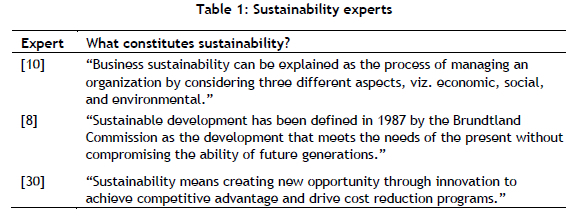
Although there are many theories on what constitutes sustainability, as shown in Table 1, there is no available framework in the literature that would be relevant to the sustainability of engineering consulting firms specifically in South Africa. In that context, a particular role is played by the United Nations sustainable development goal 9, "Industry, Innovation and Infrastructure", which considers the association between building resilient infrastructure, promoting sustainable industrialisation, and fostering innovation [8]. According to [9], the United Nations sustainable development goals (SDGs) provide a framework with the goals and measurements of sustainability of firms for the year 2030.
Other sustainability frameworks [11] show that, in the development of a framework, one ought to begin by identifying the constructs and variables through the literature on sustainability; next one would gather sustainability definitions; then decide on the sustainability themes to be addressed by the framework; and finally set goals for each theme.
2.2. AI for engineering consulting firms
[12] argues that the AI revolution, combined with the substantial growth of the internet, will affect how firms operate, how they market their services, and how they are managed, and that this would have an impact on job patterns. Makridakis [12] notes the market capitalisation of digital firms compared with traditional firms. [13] stresses that, for a firm to adopt the new technologies fully, the future circumstances and the relevant governance, teams, and adaptation approach must be considered.
2.2.1. Other technologies for the sustainability of engineering consulting firms
Engineering consulting firms must adapt to and embrace digitalisation and the digital engineering revolution if they are to survive in the future. Ramanathan [31] points out that digital engineering is driving the next-generation smart products, services, and operations to enhance end-user value.
2.3. Applicable theories
The resource-based view (RBV) and the technology acceptance model (TAM) are the two theories that the researcher identified to help explain the links between the constructs in the quantitative study.
2.3.1. Resource-based view (RBV)
A resource-based approach to strategy analysis [19] has five stages: identifying and classifying the firm's resources, identifying the firm's capabilities, appraising the regenerating potential of resources and capabilities, selecting a strategy, and identifying the resource gap. The internal resources and capabilities provide the basic direction for the firm's strategy. There is a lack of knowledge about the regulation of the engineering consulting industry, and this has an impact on the sustainability of engineering firms. To address the gap in the literature, this study was informed by the RBV in order to develop a framework that describes the importance of resources for building capabilities, competency, and innovation, and so improving the firm's profitability and sustainability. The concept of sustainability applied in this study refers to a firm's ability to sustain a competitive advantage for a long period; and the RBV helps to understand how firms grow and sustain themselves.
2.3.2. Technology acceptance model
The technology acceptance model (TAM) theory has been applied in this study to evaluate the motivation of engineering consulting firms to adopt a range of technologies [15]. User acceptance of technologies determines the success or failure of a firm's projects. The TAM theory is linked to the second research question of this study.
2.3.2.1 TAM theory & sustainability in engineering consulting firms
In a study of the current advances of China's engineering consulting industry [16], the TAM is applied to construct a model of digital administration that influences the Engineers' willingness to adopt knowledge transfer in entire-process engineering consulting projects. In their study of the extended TAM for the adoption of information and communication technology (ICT) in the US construction industry, [17] argue that innovation in construction is guided by industry-level solutions, firm-level solutions, and project-level solutions, driven by project complexity, innovation policies, and environmental sustainability. Organisations could adopt information technology to enhance their environmental efficiency to meet environmental regulations, improve firms' profitability, and strengthen their competitiveness in the market [14].
2.4. Key gaps in the literature
No specific sustainability framework is available that engineering consulting firms in South Africa could adopt. Such firms are susceptible to unstable market economic conditions, and they are the first to be negatively affected during an economic downturn. Based on the theories outlined in section 2.3, the need for firms to adopt ICT was evident. Firms' resources and capabilities that improve profitability were also discussed, and these paved the way to develop the research sub-questions. In this paper, a sustainability framework for engineering consulting firms in South Africa is developed.
3. RESEARCH METHODOLOGY
A convergent parallel mixed methods design was adopted in this study. The reliability of the study was confirmed in the findings that were extracted from the quantitative and qualitative methods that were used [18]. The criticality of combining the quantitative and qualitative research methods was to advance and enhance the study's findings while exploring how the development of a sustainability framework for engineering consulting firms in South Africa could be accomplished. The researcher chose a convergent design, in which the collection of qualitative and quantitative data (Figure 1 [27]) occurred simultaneously.
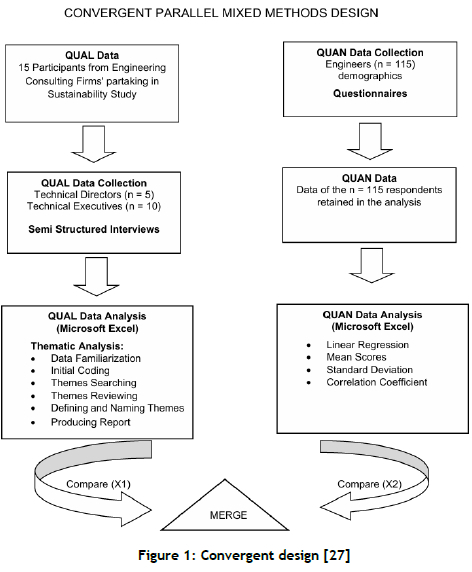
The convergent parallel mixed method uses qualitative and quantitative methods to achieve a triangulated outcome. According to Dawadi, Shrestha, and Giri [28], in the analysis phase, a researcher can always look for common concepts across both sets of results. Integration in convergent design can be done by presenting the findings of the qualitative study, followed by the quantitative study, or vice versa. The convergent parallel mixed method is the approach that was followed in this study. Dewasiri, Weerakoon, and Azeez [29] state that the validation of study findings by two different methods is valuable because it confirms the superior accuracy, validity, and generalisability of the findings compared with using a single methodology. In addition, the authors state that the use of mixed methods is not relevant to all research investigations.
3.1. Qualitative method
The interviews were conducted using the Zoom online platform as a digital communication tool. A semi-structured interview questionnaire was used to guide the interviews, which were audio recorded. The conversations were transcribed using Microsoft 365 software. The process included preparing and organising the data, transcribing it, coding it, producing categories, and thereafter producing themes.
The qualitative interviews were conducted between 28 September 2022 and 31 May 2023 with the directors and executives of engineering consulting firms. These were done in order to understand their experiences of the sustainability strategies of their firms. In developing a qualitative perspective for a framework for the sustainability of engineering consulting firms, the researcher followed the grounded theory approach.
Inductive thematic analysis (coding) was used in analysing the data collected from the interviews. The outcome of this process of data collection and analysis was a framework that could support the sustainability of engineering consulting firms in South Africa.
3.2. Quantitative method
The method used to gather the primary quantitative data for this study was an online Survey Monkey questionnaire that used closed-ended structured and self-administered questions. The rationale for the use of Survey Monkey for data collection was that the study was conducted when the COVID-19 pandemic was prevalent and social distancing had to be observed. It also made it easier and cheaper to collect data from individuals who were stationed in different locations. The data was collected for the eighteen months from 11 October 2022 to 4 January 2024. Some of the Survey Monkey results were received only in January 2024, so the quantitative data collection took rather long.
The quantitative data was used to test the RBV theory, which predicted that staff retention and the use of the latest technology could have a positive impact on the sustainability of engineering consulting firms in South Africa. Considering the main objective of this study, which was to develop a sustainability framework for engineering consulting firms in South Africa, a predetermined hypothesis was developed and tested following the deductive methodological approach. The correlation coefficient and linear regression were used to measure the strength of the relationship between the variables. [19] points out that, "at the business strategy level, exploration of the relationships between resources, competition, and profitability include the analysis of competitive imitation, the probability of returns to innovation, the role of imperfect information in creating profitability differences between firms and how the process of resources accumulation can sustain competitive advantage".
3.3. Research design
3.3.1. Phase 1 : Overview of sampling and qualitative data collection strategy
To meet the three main objectives of this study, in this first phase the researcher collected and analysed the primary data. As discussed above, the first objective of this study was to explore the profitability and sustainability of engineering consulting firms in South Africa. Second, the researcher sought to determine whether skilled or experienced individuals had an impact on the sustainability of engineering consulting companies in South Africa. The third objective was to determine sustainability strategies for engineering consulting firms.
Sampling for qualitative research: The target population of this research was engineering firms that provide diverse engineering consulting services in South Africa. Databases from engineering institutions affiliated to the Engineering Council of South Africa were used as the sampling frame. The Engineering Council of South Africa has a population of about 34,000 registered engineering professionals in its database [20]. The researcher could not test every individual in this population, which meant that, for this study, a representative sample of the population was selected for testing.
In the qualitative part of this study, the researcher proposed to interview a target of five participants who might be either directors or executives of engineering consulting firms, and around 10 experienced engineers who were working for engineering consulting firms. The researcher applied a purposive sampling method owing to the proximity of the participants. [21] argues that "qualitative sampling is based on purposive selection, the sample size is flexible and not predetermined, and the goal is not to make generalisable claims but develop in-depth understandings with the richest evidence possible".
Purposive sampling method: According to [22], a sample of thirty-five interviews is recommended by [23] for grounded theory research. However, [22] recommends a total of twenty to thirty interviews.
3.3.2. Phase 2: Overview of sampling and quantitative data collection strategy
Questions linked to the quantitative method
The second phase aimed to answer the two research questions that were linked to the quantitative method that the researcher used for both sets of primary data:
1) What is the link between the adoption of technologies and the sustainability of South African engineering consulting firms?
2) What is the link between a firm's resource heterogeneity and the sustainability of engineering consulting firms in South Africa?
The questionnaires were used, first, to determine whether there was a correlation between the retention of experienced individuals and the sustainability of engineering consulting firms in South Africa. Second, the data collected through the questionnaire was able to determine whether there was a correlation between 4IR technologies and the sustainability of engineering consulting firms.
Simple random sampling method: quantitative
The simple random sample method was used in data collection. The sample size from a population of 22 000 consulting engineers was 377.412, calculated using the Krejcie and Morgan (2001) equation, which is given below:
s = X2 NP (1-P) / d2(N-1) + X2 P (1-P)
s = required sample size
X2 = the table value of chi-square for 1 degree of freedom at the desired confidence level (3.841)N = the population size
P = the population proportion (assumed to be 0.50, since this would provide the maximum sample size)
d = the degree of accuracy expressed as a proportion of 0.05
Using a simple random sampling procedure gave each member of the population an equal chance of being selected to be part of the sample [24]. The copies of the questionnaires were distributed to a target sample of engineering professionals.
3.3.3. Phase3: Procedure for analysis of data from interviews
Data analysis
The process of generating the sustainability framework, as outlined in this interpretative research, was intended to enable South African engineering consulting firms to sustain themselves into the future. The researcher's main aim was to develop a sustainability framework as the final product of this study.
Grounded theory methodology
The grounded theory approach was employed in this research to develop a sustainability framework that could be adopted by engineering consulting firms in South Africa. Grounded theory was linked to the primary research question.
Three strategies for analysis
The researcher prepared and organised the data for analysis - in this case, text data in the transcripts from the interviews. Inductive thematic analysis was used to analyse the qualitative data. The manual qualitative data analysis yielded deeper understanding and flexibility, and allowed the researcher to consider the context of each piece of data, unlike what happens when using ATLAS.ti. Thereafter, the researcher reduced the data into themes through a process of coding and then condensing the codes. Finally, the researcher presented the results of the data analysis in the form of graphs, figures, tables, and a discussion.
Quantitative procedures
Statistical Product and Service Solutions (SPSS) was used, and Pearson's correlation coefficient and linear regression were used to measure the strength of the relationships between the variables.
3.4. Process for developing framework
3.4.1. Development of conceptual framework
Figure 2 outlines the methodology that was followed to develop the new framework. [25] notes that the literature review could provide significant elements of sustainability, since it was used to develop the questions for the interviews.
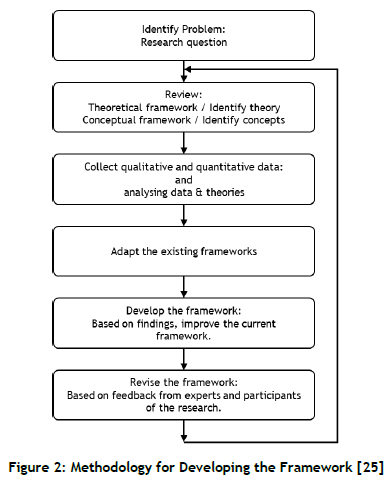
This section of the article illustrates the process that was followed in comparing the categories provided by the content analysis of journal articles and the interview data [25].
3.4.2. Ethical considerations
Ethical clearance was obtained from Milpark Business School before the study was conducted. All the participants' information remains anonymised and confidential.
4. RESULTS
The Survey Monkey software program was used to collect the quantitative data and to administer the questionnaires. Once the independent data analysis of the two sets of data had been completed, the outcomes were merged into one data set to confirm convergence or divergence, since this study used a mixed methods approach.
4.1. Qualitative data analysis
The participants' characteristics and the analysis of the qualitative data are presented in this section.
4.1.1. Participants' characteristics
A total of 15 engineering consulting professionals who were engineering executives were interviewed, They had varying levels of experience in the engineering consulting industry and came from diverse backgrounds and industries. The median length of experience of the consulting engineers was 15 years (range: 5-21 years). Of the 15 participants, only one female participated in the study; the remaining 14 were males. Eighty per cent of the participants were members of professional engineering bodies affiliated to their engineering disciplines. Most of the participants stated that they were registered with ECSA, either as professional engineers or technologists or as engineering candidates.
4.2. Inductive thematic analysis
Inductive thematic analysis was used to analyse the qualitative data. The six themes that emerged from the interview data were from the grouped categories: (i) the sustainability fit in an engineering consulting firm; (ii) the influences of 4IR in engineering consulting firms; (iii) sustainability strategies in engineering consulting firms; (iv) the effectiveness of staff retention strategies in engineering consulting firms; (v) the profitability of engineering consulting firms; and (vi) the impacts of adverse market conditions on engineering consulting firms. Sample verbatim reflections from the participants are used below.
4.2.1. Sustainability fit in an engineering consulting firm
Participant #4 reflected on sustainability fit: "In all the three SDGs, because [company name] does work in the rural area electrification. There are a lot of impacts that you can have on the community when you're doing that work, so you have to look at the environmental impact of what you are doing because if you do things that will affect the community". Participant #13 said: "What I would say is critical to the sustainability of engineering firms would be regulation. There is a regulation in terms of what rates we can charge and all that is according to the consulting engineers of South Africa. So, if that can be regulated, I think it would go a long way in helping the upcoming consulting engineers to be more sustainable."
4.2.2. The influence of 4IR in engineering consulting firms
When the participants were asked about the 4IR technologies that their organisation had adopted in the previous 12 months, they mentioned various types. This is how Participant #10 responded to this question: "One of the firms was forced into conducting remote training for their clients. Online cloud collaborating with no actual machine, using virtual machines. That part of the business grew a lot during Covid-19 pandemic season. Some of the technologies were always available, but were dedicated to training only the firm's staff." Participant #3 reflected in the following way: "I don't think we've entered as South Africa the Fourth Industrial Revolution where the machines are going to do the work for us."
Participant #8 described the 4IR technologies that their organisation had adopted in the previous 12 months: "We are shifting more into wireless technology, and this is more suitable for hazardous area applications. We have also adopted Bluetooth apps that use cell phones, and this is new in the industry. However, there is a cybersecurity concern with using wireless technology in supporting industrial technology."
What was common to the technologies adopted by the different engineering firms was remote or wireless sharing, even though this could be seen as a cybersecurity threat. This was echoed by Participant #14: "We are now using iPads in the plants where people are doing construction work, we don't have to use big drawings and print paper anymore. These are all intrinsically safe iPad devices that go out to hazardous areas, you can do your orders, and you can do everything on these smart devices. So, a lot of things happening smartly, and safely."
4.2.3. Sustainability strategies in engineering consulting firms
When asked about the sustainability strategy that was recommended to engineering firms that wished to survive into the next century, Participant #1 reflected as follows: "Our strategy is basically from a sustainability perspective is that we are saying to our customers, look we can provide you if you only want to procure, we are giving an EPCM configuration. It's not your normal, traditional EPCM style; here you've got an option of selecting what the demand is. So out of the cubes that we have in our box of offerings to the client, they can select which cube is the best fit for them." Sixty-seven sustainability strategies and their emphases differed from firm to firm, as indicated by Participant #6, who responded as follows:
We don't pay lip service to legislation and government and all that in terms of the BEE requirements and employment equity. I think in terms of our sustainability is also looking at the demographics and the politics and adapting your business model to fit in with the next five years, which is dictated to by government and legislation; and just making sure that we take a cognisant of what we do and we take all with us, Again, that comes with caution because you can survive honestly, or you can survive dishonestly.
In response to this question, participant #12 had this to say:
In terms of client service and product offering, they would need to be scalable. This means that your business is easily scalable so that during tough times you can scale down your overheads in terms of premises, as an example. In other words, if you need additional facilities, rather rent it as opposed to purchase it. This allows you to easily reduce your overheads when there's an economic downturn.
4.2.4. Effectiveness of staff retention strategies
The role that individuals play in engineering consulting firms is crucial; without them, no engineering consulting firm can execute its projects. Some of the views expressed by the participants suggested that people are the lifeblood of engineering consulting firms. On the question of staff retention strategies, Participant #11 commented: "As an organisation, to meet our current business needs and for the future growth of the company is essentially dependent on our people; and a lot of the time it's our experienced, skilled people that have been with our firm for a long time. I believe that experienced employees and retention are an important part of the sustainability of any organisation and the growth of it."
Staff retention strategies are crucial for engineering consulting firms because, even when they are bidding for project work, experience and capabilities are the basic requirements that clients demand.
Participant #15 said: "You know, when we do proposals, one of the things or the main component that a client will investigate is, do you have resources, and the starting point is just the availability of resources, and then you can answer the question and say 'Yes', and then the next thing is they want to see the CVs. But they also know that they are depending on your people, and what I've also been experiencing lately is that most of our major clients, and strictly in South Africa, themselves don't have a lot of experienced people. They are now dependent on consultants or engineering firms to be the one that comes with this experience."
The importance of retaining skilled and talented staff was confirmed by Participant #14, who said:
I think experience is important; experience skill set is key to maintaining how we do things. Yes, but equally important is having a talent pipeline to grow the business you know. With the new generations that are coming in, the millennials and so on, they come in with very different ideas, very different approaches with smart, the smart technology; they're techno-smart and they're coming and improving the way we do things, you know, so the older employees, they have their core company's skill set in terms of experience, how we do things; and the transfer of knowledge to those youngsters that are coming in our, in the talent pipeline, it improves the way we as a business operate.
4.2.5. The profitability of engineering consulting firms
Consulting firms exist to create employment and to make a profit; and if they were not able to make a profit, they would not be sustainable. In response to this question, Participant #10 said: "Sustainability is a building block of our profitability. Using efficient technology that uses less energy consumption and reduces the cost of energy. Also, adopting green energy solutions improves company reputation, which in turn positively influences our company profitability."
The participants offered diverse perspectives on the sustainability of their businesses influencing their profitability. For instance, Participant #11 commented: Profitability is directly related to people. If you do not have the employees, whether it be the right skill set, or the right mental wellness and health, you do not have profitability. Essentially, our business as an engineering firm comes down to the engineers and the people that we have on our team. So, making sure that there is consistency and fair opportunities for all our people, which will then result in optimised profitability.
Another view on the influence of sustainability on profitability was this as reflected by Participant#11: I'll say it's a bit of both; you cannot be sustainable if you're not profitable, you'll close shop. But then again you can't just straightaway look for profitability, you've got to build relations and build a reputation. So, profitability for me would be linked to the brand; and then again, sustainability requires that a brand is known and profitable for you to be sustainable. Impacts of adverse market conditions on engineering firms
4.2.6. The impacts of adverse market conditions on Engineering firms
Consulting firms operate under fluctuating market conditions, and so they should take unfavourable market conditions into account. Participant #1 responded by saying:
What we have done now is taken company insurance, where you look at the loss of income. We had to have insurance in the place where we have to say, these are our current purchase orders that we have, and should anything happen, we can claim a portion of those purchase order values we hedge against the unforeseen circumstances.
In implementing provisions for adverse market conditions, some engineering firms are offered remote access to the client's plant and need not be located close by to provide their services.
According to participant #11:
What we do is like with some of the companies that we do work with if they allow us, and we've got remote access to the plant. We put the PC in there, and we can dial in from outside, and then it's going to be at a cost, but I mean it's the same thing as if they had a breakdown and they call us out.
Participant#10 reflected:
Using virtual machines is part of the business that grew a lot during [the] COVID-19 pandemic; as a result, clients are now saving on travel expenses. If you consider the firm's virtual engineering platforms and simulators [and] everything from the cloud, there is no longer a need to travel to the factory as often as before, and this strategy has made it easier to deploy staff to different projects, that they are billable, and only go to the site for implementation. We don't need to be at the machine to see what the problem is, we can just dial in and rectify the problem.
Besides providing for remote access to client sites, other participants indicated that they optimised the cost of their overheads by making their firms scalable. Participant #12 noted:
In terms of client service or product offering, then, is to be scalable. This means that your business is easily scalable so that during tough times you can scale down your overheads in terms of premises as an example. In other words, if you need additional facilities rather rent it as opposed to purchase it. This allows you to easily reduce your overheads when there's an economic downturn.
4.3. Respondents in the quantitative study
The respondents in the quantitative part of the study were engineers, technologists, and technicians employed at various South African engineering consulting firms. The quantitative data was collected between 11 October 2022 to 4 January 2024. Some of the responses through Survey Monkey were very late, so it took until January 2024 to complete the data collection.
4.4. Quantitative data analysis results
4.4.1. Hypothesis
The null hypothesis is provided below; the alternate hypothesis was tested.
• Null hypothesis (H0): There is no link between the adoption of 4IR technologies and the sustainability of an engineering consulting firm.
• Alternate hypothesis (H1): There is a link between the adoption of 4IR technologies and the sustainability of an engineering consulting firm.
4.4.2. Pearson's correlation coefficient - adaptation of technologies & sustainability
The researcher used Pearson's correlation coefficient (r) as an advanced quantitative analytical method to yield the results that described the relationship between two variables (constructs), namely the adoption of the latest technologies (Part D) and the sustainability of engineering consulting firms (Part F). The strength of the relationship between Part D and Part F was found to be 0.43.
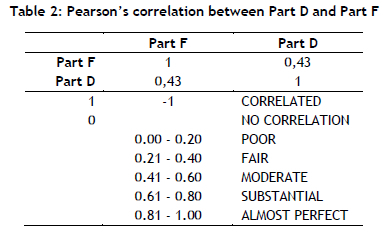
The results of 0.43, the relationship between Part D and Part F indicated that there was a moderate correlation between the adoption of the latest technologies and the sustainability of engineering consulting firms. The two variables were correlated, and the strength of their relationship was moderate.
The Pearson's correlation range is between -1 and 1, with values from +1 (perfect positive correlation) to -1 (perfect negative correlation), with 0 indicating no correlation. If 4IR technologies were adopted by engineering firms, this would advance their sustainability.
p-values:
p > 0.05 = H0: there is no linear relationship between the firm's sustainability and the firm's adaptation to the latest technology.
p < 0.05 = H1 : there is a linear relationship between the firm's sustainability and the firm's adoption to the latest technology.
In this case, the significant value is significance F = 9.29777E-17, which is far less than the p-value of 0.05. This means that the null hypothesis is rejected, and the alternate hypothesis is accepted.
4.4.3. Linear regression - sustainability & resource heterogeneity
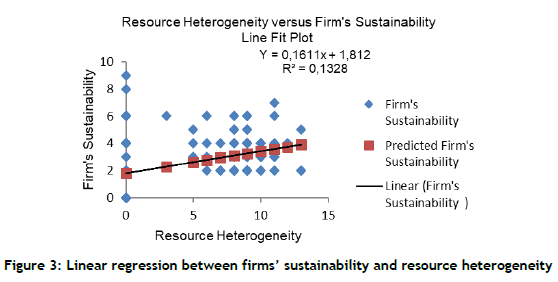
In this section, the researcher used linear regression as an advanced quantitative analytical method to yield the results that describe the relationship between two variables, namely firms' resource heterogeneity and the sustainability of engineering consulting firms.
The equation of linear regression is similar to the slope formula that we have encountered before in earlier studies, such as linear equations in two variables. It is given by the equation:
y = a + bx
Equation: Linear regression equation
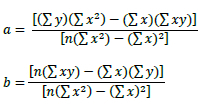
where:
y - dependent variable
X - independent variable (regression of 'y' on 'x')
a = intercept
b = slope
Firms' sustainability is a dependent variable, whereas resource heterogeneity is an independent variable. The value of R2 is 0.13282487, which means that 13 per cent of the values fit the regression model, and that 13 per cent of the independent variables (resource heterogeneity) are explained by the dependent variables (firms' sustainability). The R2 value of 0.13282487 means that there is a weak relationship between resource heterogeneity and the sustainability of a firm, even though it is not perfect. The p-values are given below.
p > 0.05 = H0: there is no linear relationship between firms' sustainability and the firms' resource heterogeneity.
p < 0.05 = H1: there is a linear relationship between firms' sustainability and the firms' resource heterogeneity .
Significance F = 6.22195E-05
The significance F value means that one either accepts or rejects the hypothesis. F = 6.22195E-05 is far less than the alpha or p-value of 0.05, which means that the null hypothesis is rejected, and the alternate hypothesis is accepted. It is therefore concluded that there is a linear relationship between firms' sustainability and firms' resource heterogeneity.
tStat = This value is used to predict the p-value.
In this case,
p-value:
Slope = 0 H0: the intercept = 0.
Slope ≠ 0 H1: the intercept ≠ 0.
In this case, the Y-intercept has a value of 1.55063E-09 and the slope has a value of 6.22195E-05; thus both values are p < 0.05, and therefore the alternate hypothesis is accepted. This is interpreted as meaning that firms' resource heterogeneity is a significant variable that has an impact on the sustainability of engineering consulting firms in South Africa.
4.4.4. Linear regression - firms' sustainability and technology adoption
As indicated in Figure 4, firms' sustainability is a dependent variable, whereas technology adaptation is an independent variable.
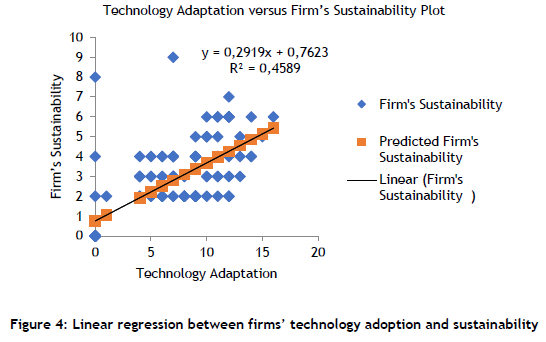
In this section, the researcher used linear regression as an advanced quantitative analytical method to yield the results that describe the relationship between two variables, namely technology adaptation and the sustainability of engineering consulting firms.
R2 ranges from 0 to 1. The value of R2 is 0.45, which means that 45 per cent of the values fit the regression model, and that 45 per cent of the independent variables (technology adoption) are explained by the dependent variables (firms' sustainability). The R2 value of 0.45 means that there is a strong relationship between technology adaptation and the sustainability of a firm, even though it is not perfect.
p-value:
p > 0.05 = H0: there is no linear relationship between firms' sustainability and firms' adaptation to the latest technology.
p < 0.05 = H1 : there is a linear relationship between firms' sustainability and firms' adaptation to the latest technology .
Significance F = 9.29777E-17
In this case, the significant value is significance F = 9.29777E-17 - far less than the p-value of 0.05 - which means that the null hypothesis is rejected and the alternate hypothesis is accepted. It is therefore concluded that there is a linear relationship between firms' sustainability and firms' adaptation to the latest technology.
tStat = This value is used to predict the p-value.
In this case:
p-value:
Slope = 0 H0: the intercept = 0.
Slope ≠ 0 H1: the intercept ≠ 0.
In this case, the y-intercept has a p-value of 0.00199059 and the slope has a p-value of 9.29777E 17; so both values are p < 0.05. Therefore, the alternate hypothesis is accepted. This is interpreted as meaning that firms' technology adoption is a significant variable that has an impact on the sustainability of engineering consulting firms in South Africa.
4.5. Merging qualitative & quantitative results
Data integration was achieved using visual joint displays that bring data together visually to draw out new understandings of the sustainability phenomenon. The convergent design joint display implemented in this section is presented as statistics-by-themes or as side-by-side comparisons. Merging focused on the mapping of the qualitative and the quantitative results. The combination of qualitative and quantitative data was achieved by implementing the joint comparison display (convergent design joint display) methodology. In accordance with the principle of the comparison of results, the qualitative and quantitative data collection and the analysis methods are separated, and the results are merged using a comparison process.
4.5.1. Framework
Six key sustainability concepts were identified in this study that were aligned with the primary research question of the study. These sustainability concepts were common to both the qualitative and the quantitative parts of the study. Figure 5 [27] illustrates the six pillars of the sustainability framework (own illustration).
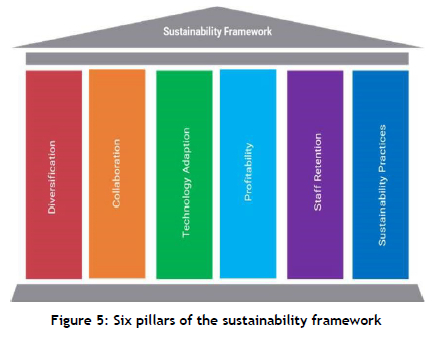
Pillar #01 - Diversification: If companies made the workplace a better place for employees to operate in, that would result in higher profitability and greater sustainability for the company. It is therefore important for engineering consulting firms to concentrate on diversity, empowerment, and inclusion.
Pillar #02 - Collaboration: Clients regard engineering consulting firms as their business partners; and engineering consulting firms form partnerships with one another to enhance their skills.
Pillar #03 - Technology adaptation: According to some of the participants, when firms use efficient technology, they are likely to reduce their energy consumption and thus the cost of energy.
Pillar #04 - Profitability: Profitability can be viewed in the context of working efficiently and optimising the firm's internal systems and procedures.
Pillar #05 - Staff retention: In the business of engineering consulting firms, the engineers and the individuals that they have in their teams are critical to the firms' success. If a firm does not have the right employees - whether in respect of the right skill set or their mental wellness and health - it cannot become profitable.
Pillar #06 - Sustainability practices: When engineering consulting firms support local communities, other stakeholders also want to partner with these firms. Likewise, as soon as their clients become aware of these initiatives, they too want to partner with the firms, and this ultimately contributes to their profitability.
4.5.2. The new framework for the sustainability of engineering firms in South Africa
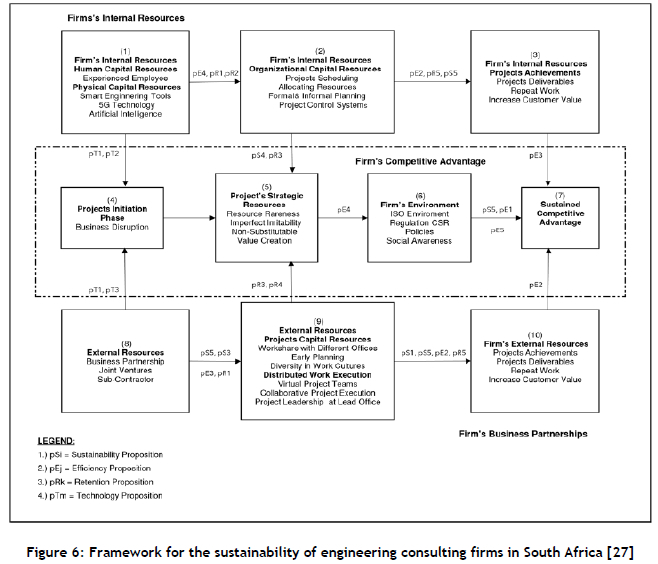
The sustainability business model developed in this study could be adopted by any engineering consulting firm, irrespective of its formation. The business model could also help such firms to achieve long-term sustainability and to maximise their profitability [26]. The six pillars are key to the development of a sustainability framework for engineering consulting firms.
The sustainability framework would allow an engineering consulting firm to appreciate it's in-house strategic talent fully, to take account of its dynamic business environment. It also helps to align the firm's business structure strategically with its competitive business environment. The factors affecting the sustainability of engineering consulting firms are both internal and external.
A firm's internal resources: In implementing the sustainability framework (Figure 6) a business disruption is triggered by the initiation of a project.
Diverse workforce: In this project's initial phase, internal resources are assigned to the project. Human capital resources are selected and assigned based on the level of skill and experience required in the project.
Organisation's capital resources: Organisation's capital resources are characterised as project support tools that are used to manage and control the project.
Internal project deliverables: When the project's deliverables are met on time, are of excellent quality, and are on budget, the project increases the client's value, and the engineering consulting firm is likely to receive repeat work from this client. Firms' competitive advantage: To guarantee a successful
project, engineering consulting firms ought to maintain their competitiveness.
i. Business interruption
Business interruption is what happens in the phase when a project is initiated, be it a basic engineering phase or a detailed engineering phase.
ii. Projects' strategic resources
For an engineering consulting firm to maintain its competitiveness and complete a successful project, it must assign strategic project resources.
lii Firms' working environment
An engineering consulting firm needs to adhere to environmental regulations and support the communities in which it operates. By implementing corporate social investment, they maintain their competitive advantage and increase their profitability.
Firms' business partnerships: An engineering consulting firm may not have all the skills and resources that are required to execute a mega-sized project. This is when using external resources is considered.
Collaboration: At the beginning of a project, external resources are mobilised to support it. The structure of the project with external resources could be arranged as a joint venture or through the use of subcontractors. This business partnership structure is a distinct concept, and would be unique to a particular project.
External resources: The external resources used in a project could come from within the same company in supporting a project team in a different country, or they could be in the form of a project team from another company being used under a joint venture agreement. These could be virtual teams that operate from their parent companies in support of a project that is managed in a different office.
External project deliverables: When a project is completed in partnership with other stakeholders and business partners, the value of the client is increased, and the value of the external resources is realised by the project's leadership in the lead office.
Sustained competitive advantage: When the project deliverables are delivered on budget and on time, they of a high quality, and the customer's value is increased, the firm's competitive advantage is maintained for a longer period.
5. DISCUSSION
The six pillars of the sustainability framework are shown in Figure 5. By adopting a collaborative project execution and implementation philosophy, as indicated in Figure 6, an engineering consulting firm could leverage its alliances and achieve a competitive advantage. In line with the grounded theory, it is important to state that this new framework development is generated or 'grounded' in data from individuals who have experience in the engineering consulting industry. A grounded theory analysis procedure was used to develop the sustainability framework, as stated earlier. It is evident from the quantitative data results that, if the technologies were adopted by engineering consulting firms, this would advance their sustainability. As in the linear regression results (Figure 3), it could be predicted that a change in resource heterogeneity would have a direct impact on the firm's sustainability. As shown in Figure 5, profitability is one of the pillars of sustainability; and it is clear from the literature [30] that sustainability drives cost reduction. The sustainability framework could guide practitioners in adopting the perspective of sustainability implementation [30]. This would also be the case in Figure 6. The lack of technological adoption by engineering consulting firms, especially SMMEs is a concern.
6. CONCLUSION
A framework for the sustainability of engineering consulting firms was developed that such firms could use to survive for extended periods. Factors were identified to develop this framework. A convergent mixed methods design was adopted, in which qualitative and quantitative data was collected in parallel and analysed separately. In this study, some sustainability difficulties facing engineering firms were identified, such as a lack of diversity in service or product offerings, and a lack of technological adaptation by engineering consulting firms, especially SMMEs. The secondary objectives were met. The researcher used inferential statistical analysis to determine the correlation between the retention of skilled and experienced individuals and the sustainability of engineering consulting firms. That analysis concluded that there is a link between 4IR technologies and the sustainability of engineering consulting firms in South Africa.
The unreliable energy supply in South Africa discourages domestic and foreign investments in capital projects and this has caused significant harm to the survival of engineering firms. Leveraging external resources in the form of business partnerships, sub-contracting, and joint ventures could help engineering consulting firms to sustain themselves for longer periods. Engineering consulting firms in South Africa are also faced with the problem of complying with the requirements of the United Nations SDGs. Industries are embracing greener and cleaner energy solutions. This is a global challenge, it is not exclusive to South Africa. Thus engineering firms ought to embrace and adopt these new technologies. There is a need for future research on how 4IR technologies and smart tools could be used by engineering consulting firms to improve their sustainability in South Africa. We recommend technology adoption by engineering consulting firms and the use of smart tools to enhance their sustainability and their profitability. For instance, generative AI could increase productivity and enhance customer service. Future research could focus on the use of such tools in engineering consulting firms.
REFERENCES
[1] Muthanna, A. 2019. Critical qualitative inquiry and methodological awareness: The effectiveness of face-to-face interviews in changing/enhancing participants' beliefs and practices. International Journal of Research Studies in Education, 8(2), 59-66. [ Links ]
[2] Barney, J. 1991. Firm resources and sustained competitive advantage. Journal of Management, 17(1), 99-120. [ Links ]
[3] Almeida, F., Duarte Santos, J., & Augusto Monteiro, J. 2020. The challenges and opportunities in the digitalization of companies in a post-COVID-19 world. IEEE Engineering Management Review, 48(3), 97-103. [ Links ]
[4] Mogashoa, M. & Selebi, O. 2021. Innovation capacity: A perspective on innovation capabilities of consulting engineering firms. The Southern African Journal of Entrepreneurship and Small Business Management, 13(1), 1-10. [ Links ]
[5] Dold, L. 2017. Competitive advantage. Engineering, 11(12), 33-35. [ Links ]
[6] Coyne, K. P. 1992. Sustainable competitive advantage. Business Horizons, 1(1), 54-61. [ Links ]
[7] Setyawati, I. 2020. Human capital to achieve company competitive advantage an investment, Journal Ekonomi, 9(1), 32-37. [ Links ]
[8] Mondini, G. 2019. Sustainability assessment: From Brundtland report to sustainable development goals. Valori e Valutazioni, 23(1), 129-137. [ Links ]
[9] Faludi, J., Hoffenson, S., Kwok, S. Y., Saidani, M., Hallstedt, S. I., Telenko, C., & Martinez, V. 2020. A research roadmap for sustainable design methods and tools. Sustainability, 12(19), 1-28. [ Links ]
[10] Bose, M. & Mahajan, R. 2018. Business sustainability: Exploring the meaning and significance. IMI Konnect, 7(2), 8-13. [ Links ]
[11] Lalendle, C., Goedhals-Gerber, L., & Van Eeden, J. 2021. A monitoring and evaluation sustainability framework for road freight transporters in South Africa. Sustainability, 13(14), 7558. [ Links ]
[12] Makridakis, S. 2017. The forthcoming artificial intelligence (AI) revolution: Its impact on society and firms. Futures, 90(1), 46-60. [ Links ]
[13] Farrow, E. 2020. Organisational artificial intelligence future scenarios: Futurists insights and implications for the organizational adaptation approach, leader and team. Journal of Futures Studies, 24(3), 1-15. [ Links ]
[14] Antoni, D., Jie, F., & Abareshi, A. 2020. Critical factors in information technology capability for enhancing firm's environmental performance: Case of Indonesian ICT sector. International Journal of Agile Systems and Management, 13(2), 159-181. [ Links ]
[15] McCord, M. 2006. Technology acceptance model. In R. Reynolds, R. Woods, & J. Baker (Eds.), Handbook of research on electronic surveys and measurements, IGI Global Scientific Publishing, 306308. [ Links ]
[16] Wang, Q. & Ding, M. 2023. A study on the impact of digital management on willingness to transfer knowledge in whole-process engineering consulting projects. Buildings, 13(4), 943. [ Links ]
[17] Sorce, J. & Issa, R. R. A. 2021. Extended technology acceptance model (TAM) for the adoption of information and communications technology (ICT) in the US construction industry. Journal of Information Technology in Construction, 26(1), 227-248. [ Links ]
[18] Bazeley, P. 2019. A practical introduction to mixed methods for business & management. London: SAGE Publications. [ Links ]
[19] Grant, R. M. 1991. The resource-based theory of competitive advantage: Implications for strategy formulation. California Management Review, 33(3), 114-135. [ Links ]
[20] ECSA. 2021. ECSA Transformation. Available online: https://www.ecsa.co.za/about/SitePages/Transformation.aspx Accessed on 20/05/2025 [ Links ]
[21] Staller, K. M. 2021. Big enough? Sampling in qualitative inquiry. Qualitative Social Work, 20(4), 897904. [ Links ]
[22] Kumar, S., Kumar, R. S., Govindaraj, M., & Prabhu, N. R. V. 2020. Sampling framework for personal interviews in qualitative research. PalArch's Journal of Archaeology of Egypt/Egyptology, 17(7), 7102-7114. [ Links ]
[23] Mokwana, R. M. 2021. Exploring the sustainability of SMEs in the textile and clothing industry to create employment in South Africa. Master's dissertation, North-West University. [ Links ]
[24] Lohr, S. L. 2021. Sampling, design and analysis 3rd ed. Chapman and Hall/CRC, Taylor & Francis. [ Links ]
[25] Joseph, M. K. 2013. A framework for rural women empowerment using information and communication technologies. Doctoral dissertation, University of Johannesburg. [ Links ]
[26] Svoboda, P. 2019. Family business: Sustainability model. Acta Oeconomica Pragensia, 27(1), 45-60. [ Links ]
[27] Hlubi, D. 2024. Framework for the sustainability of engineering firms in South Africa. Unpublished thesis, Milpark Business School. [ Links ]
[28] Dawadi, S., Shrestha, S., & Giri, R. A. 2021. Mixed-methods research: A discussion on its types, challenges, and criticisms. Journal of Practical Studies in Education, 2(2), 25-36. [ Links ]
[29] Dewasiri, N. J., Weerakoon, Y. K. B., & Azeez, A. A. 2018. Mixed methods in finance research: The rationale and research designs. International Journal of Qualitative Methods, 17(1), 1-13. [ Links ]
[30] Chofreh, A. G. & Goni, F. A. 2017. Review of frameworks for sustainability implementation. Sustainable Development, 25(3), 180-188. [ Links ]
[31] Ramanathan, N. 2020. Digital engineering practices enhance technologies of tomorrow. Control Engineering, 67(4), 30-32. [ Links ]
Submitted by authors 20 Dec 2024
Accepted for publication 28 Mar 2025
Available online 30 May 2025
ORCID® identifiers
M.K. Joseph
https://orcid.org/0000-0003-0686-163X
M.D. Hlubi
https://orcid.org/0009-0005-7080-2572
* Corresponding author: mjoseph@iie.ac.za