Services on Demand
Journal

Article
 English (pdf)
 Article in xml format
 Article references
 Automatic translation
 Send this article by e-mail
Indicators
Related links
-
 Cited by Google
 -
 Similars in Google
Share

 Permalink
South African Journal of Industrial Engineering
On-line version ISSN 2224-7890
S. Afr. J. Ind. Eng. vol.36 n.2 Pretoria Aug. 2025
https://doi.org/10.7166/36-2-3171
GENERAL ARTICLES
Understanding Customer Needs and Preferences in Head-mounted Display Virtual Reality Experiences
K. Kim*
Department of Industrial-Data Enginerring, Hongik University, Seoul, Republic of Korea
ABSTRACT
This study investigated consumer perceptions of head-mounted display-based virtual reality systems, focusing on factors influencing adoption, usage, and purchase decisions. Using a survey of 112 participants, the research examined the technological, psychological, and economic considerations shaping user experiences. Factor analysis identified six critical dimensions: usefulness, usability, capabilities, content and system satisfaction, engagement, and risk. Regression analyses revealed that engagement is the primary driver of purchase intention, while usefulness predominantly influences usage intentions and future adoption perspectives. Content and system satisfaction emerged as an additional determinant across both adoption and purchase behaviours. Despite positive perceptions of immersion, realism, and originality, users expressed concerns about content quality and cost. These findings underscore the need to enhance engagement and usefulness, alongside improving content and system satisfaction, to foster a broader acceptance and integration of head-mounted display virtual reality technologies. Limitations in the survey's regional focus are acknowledged, suggesting the need for cross-cultural studies. This research offers actionable insights for the developers and stakeholders of head-mounted display virtual reality systems, contributing to the advancement and popularisation of VR systems.
OPSOMMING
Hierdie studie het verbruikerspersepsies van kopgemonteerde skerm-gebaseerde virtuele realiteitstelsels ondersoek, met die fokus op faktore wat aanvaarding, gebruik en aankoopbesluite beïnvloed. Deur gebruik te maak van 'n opname van 112 deelnemers, het die navorsing die tegnologiese, sielkundige en ekonomiese oorwegings ondersoek wat gebruikerservarings vorm. Faktorontleding het ses kritieke dimensies geïdentifiseer: bruikbaarheid, vermoëns, inhoud- en stelseltevredenheid, betrokkenheid en risiko. Regressie-ontledings het aan die lig gebring dat betrokkenheid die primêre dryfveer van aankoopvoorneme is, terwyl bruikbaarheid hoofsaaklik gebruiksvoornemens en toekomstige aanvaardingsperspektiewe beïnvloed. Inhoud- en stelseltevredenheid het na vore gekom as 'n bykomende determinant oor beide aanvaarding- en aankoopgedrag. Ten spyte van positiewe persepsies van onderdompeling, realisme en oorspronklikheid, het gebruikers kommer uitgespreek oor inhoudkwaliteit en -koste. Hierdie bevindinge beklemtoon die behoefte om betrokkenheid en bruikbaarheid te verbeter, tesame met die verbetering van inhoud- en stelseltevredenheid, om 'n breër aanvaarding en integrasie van kopgemonteerde skerm-virtuele realiteittegnologieë te bevorder. Beperkings in die opname se streeksfokus word erken, wat die behoefte aan kruiskulturele studies aandui. Hierdie navorsing bied bruikbare insigte vir die ontwikkelaars en belanghebbendes van kopgemonteerde skerm-virtuele realiteitstelsels, wat bydra tot die bevordering en popularisering van VR-stelsels.
1. INTRODUCTION
Recent advances in virtual reality (VR) technology have been rapid, expanding its potential applications in various fields. In particular, head-mounted display (HMD)-based VR systems have garnered significant attention in diverse domains such as education, gaming, healthcare, and industry, owing to their ability to deliver high levels of immersion and realism. Despite these technological advances, research remains limited on how consumers perceive HMD-based VR systems and the factors influencing their usage and purchase decisions. Meanwhile, studies have been conducted to examine the factors driving the growth of VR video and the barriers hindering its development [1].
This study aimed to investigate the current state of consumer perceptions of HMD-based VR systems, and sought to explore the barriers that individuals perceive when using HMD-based VR systems, and the values that they expect from such technology. It also aimed to identify the key factors needed to overcome these barriers and to promote the adoption and use of HMD VR. In addition, by analysing both positive and negative perceptions of HMD-based VR systems, this study aimed to propose strategic directions for enhancing consumer acceptance and adoption.
In particular, the study examined the technological, psychological, and economic factors that consumers consider important when selecting HMD-based VR systems. It also identified current perceptual limitations and potential areas for improvement. Through this analysis, the study aimed to propose a consumer-centric approach to the HMD VR market and to provide practical insights that contribute to the adoption and diffusion of the technology.
As is widely acknowledged, VR technology is not without its drawbacks. One of the best-known side effects associated with the use of VR technology is motion sickness [1]. Despite advances in VR technology, users continue to experience cybersickness [2]. Cybersickness not only causes discomfort, but also has the potential to have a negative impact on the sustained use of VR systems and to influence purchase decisions. While completely eliminating cybersickness remains a technological challenge, identifying strategies to mitigate or effectively manage it continues to be a critical area of research. If effective solutions were proposed to reduce the negative effects of cybersickness on user experience, they could significantly enhance the adoption and public acceptance of VR technology.
However, VR technology also offers a wide range of advantages. The immersive experience provided by VR enhances user satisfaction and fosters loyalty towards the device [3]. VR holds the potential to improve quality of life [4]. To implement VR effectively in classrooms, the attitude of educators plays an important role [5]. It is essential to examine the factors that influence purchase intentions and attitudes toward VR technology.
The article is structured as follows: Section 2 explores the factors that may influence the use and purchase decision-making processes for HMD-based VR systems. Section 3 outlines the research methodology, including the survey design and analytical techniques. Section 4 presents the empirical results, and is followed by Section 5, which discusses the implications of these findings and summarised the study's conclusions, limitations, and suggestions for future research.
2. FACTORS INFLUENCING ADOPTION AND CONSUMER ACCEPTANCE OF VIRTUAL REALITY
To understand consumer perceptions of HMD-based VR systems better, it is important to explore the research that has identified the factors influencing their adoption and use and purchase decisions about them. This section synthesises prior studies on key factors - such as perceived usefulness, usability, content quality, system satisfaction, perceived risk, price sensitivity, performance expectations, and enjoyment - that have a significant impact on consumer acceptance of VR technology. By reviewing these dimensions, this section lays a theoretical foundation for analysing the survey results presented later in this paper.
2.1. Usefulness
The perceived usefulness of VR devices has a significant impact on users' intentions to adopt VR technology [5, 6]. It also influences users' intentions to accept [7] and to reuse the technology [8]. Moreover, it is suggested that usefulness plays a more critical role than perceived ease of use in determining acceptance intentions [7]. A positive attitude could be achieved if educators had the right perceptions of VR and of its usefulness [5].
2.2. Usability
The intention to use VR is influenced by the perceived ease of use of the technology [5, 6]. Ease of use also affects the intention to accept VR devices [7], and perceived ease of use also has an impact on the intention to reuse VR technology [8]. Interaction user experience (UX) in VR plays a critical role in enhancing immersion, which, in turn, has a positive effect on customer satisfaction and loyalty [3]. This, in turn, is expected to influence customers' intentions to use the technology. Hand tracking and haptics have been identified as factors that influence the growth of VR video [1].
2.3. Content satisfaction
Content satisfaction has a positive impact on the intention for continued usage, with satisfaction derived from the substantive quality of content having a particularly strong influence [9]. In addition, studies suggest that content diversity can ultimately encourage consumers' voluntary acceptance intentions [7]. Content diversity has also been shown to influence significantly perceived ease of use, perceived enjoyment, and perceived usefulness [7]. Therefore, it is anticipated that content would have a significant impact on users' intention to adopt VR technology. It has been confirmed that content quality positively influences customer attitudes, which in turn has a positive impact on their intention to revisit the technology [10]. The sense of presence experienced through virtual reality tourism content has been found to have a significant influence on usage intentions [11]. It has been observed that leisure satisfaction derived from VR content has a significant impact on the intention for continued usage [12]. The effects of arousal, enjoyment, and satisfaction associated with virtual reality tourism content have been found to elicit usage intentions [11]. However, other studies have reported that the influence of content quality factors on the intention to use and purchase virtual reality devices was not statistically significant [13]. Therefore, it was necessary to examine this issue empirically in our study. Video quality was one of the most significant hurdles in the VR industry [1]. Content offerings have been identified as a factor influencing the growth of VR video [1].
2.4. System satisfaction
Satisfaction with VR systems has a positive impact on the intention for continued usage [9]. In addition, system quality positively influences customer attitudes, which subsequently leads to a positive impact on their intention to revisit the technology [10].
2.5. Risk
Perceived risk has been found to have a significant impact on the intention to use virtual reality devices [13]. However, other studies have shown that anxiety about VR devices has a significant and negative impact on perceived value, but does not negatively affect usage intentions [14]. It is necessary, therefore, to examine the risks or anxieties associated with VR devices. Three causes of VR sickness - hardware, content, and human factors - have been investigated as elements contributing to the associated risks [15].
2.6. Price
The price-effectiveness variable was not found to have a significant impact on the intention to use virtual reality devices. However, it was identified as a direct factor influencing the formation of purchase intention [13]. In addition, the perceived cost of VR devices was found to affect perceived value negatively, but it did not have a negative impact on usage intentions [14]. It is likely that price-related factors could influence either usage or purchase intentions. The cost of VR hardware has been identified as one of the factors influencing the growth of VR video [1].
2.7. Performance
Performance expectancy regarding VR devices was found to have a significant impact on perceived value, but did not have a significant effect on usage intentions [14]. Moreover, visually enhanced VR was not effective in reducing cybersickness [15]. Therefore, it is possible that the impact on usage intentions may be minimal or negligible. It has been demonstrated that higher resolution in virtual reality devices increases the level of presence experienced by users, supporting the general inferential hypothesis [16]. However, it is necessary to verify its impact on usage and purchase decision-making.
2.8. Enjoyment
The perceived enjoyment of VR devices has been shown to have a significant impact on both perceived value and usage intentions [14]. In addition, the enjoyment of virtual reality tourism content has been shown to elicit usage intentions [11]. An analysis was conducted on the factors influencing the impact of the perceived enjoyment of VR content on the intention to reuse [8].
3. STUDY METHOD
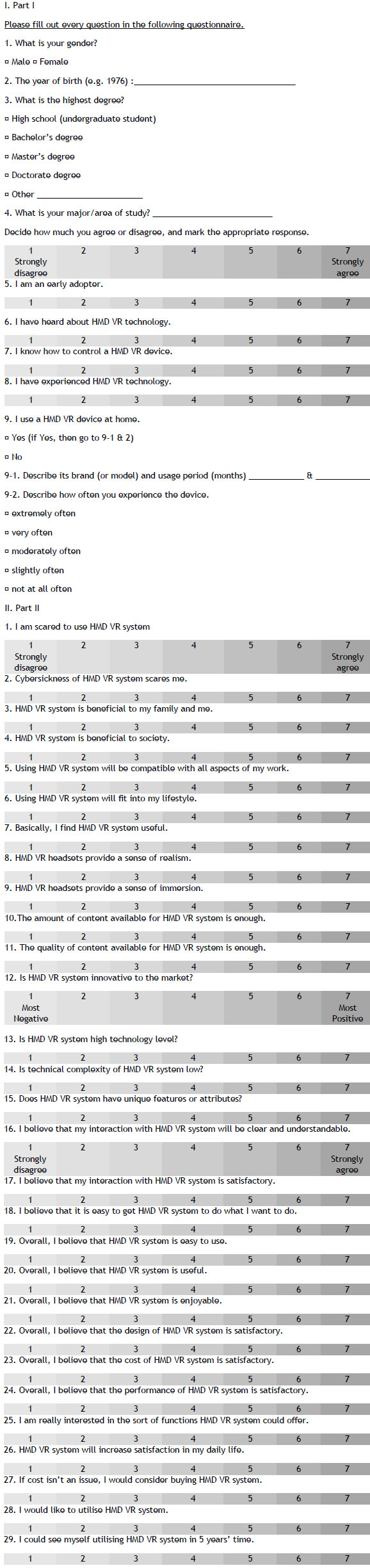
This study explored the expectations of potential users about HMD-based VR systems. A questionnaire was developed on the basis of a comprehensive review of the literature that addressed various issues related to HMD-based VR systems. The questionnaire was structured into two sections (see Appendix A). The first section evaluated participants' perceptions of HMD-based VR systems, while the second section had items addressing prior experiences with and preferences for these systems. The responses were recorded on a seven-point Likert scale.
The data were collected through the survey, which was designed to examine individual preferences concerning the barriers and values associated with the use of HMD-based VR systems. A total of 112 subjects were recruited through an advertisement at Hongik University and personal networks. The voluntary nature of their participation was emphasised during the recruitment, and no monetary compensation was provided. The participants were given a web link to the questionnaire, and they completed it at their convenience. No demographic information was collected.
The study investigated factors relevant to the use and purchase decision-making processes for HMD-based VR systems. Factor analysis was used to categorise the identified issues into distinct groups. In addition, multiple regression analyses were conducted to identify the key factors that were necessary to promote the broader adoption and popularisation of HMD-based VR systems.
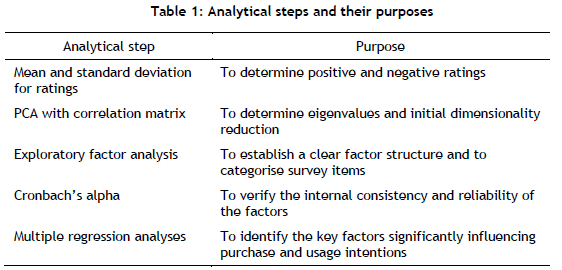
The analytical approach undertaken in this research involved several sequential steps, each serving a specific purpose. Table 1 summarises these analytical steps and their respective objectives.
4. RESULTS
As noted earlier, 112 individuals participated in the survey, which was conducted over about two months, starting in August 2023. Of the participants, 81 were male, and 31 were female. The majority of the participants (96) were undergraduate students, while eight had completed a bachelor's degree, and eight held a Master's degree or higher. The participants' average age was 24.9 years (SD = 5.51), with ages ranging from 18 to 53.
Regarding academic backgrounds, 79 participants were from the College of Engineering, 11 were from management, and the remaining 22 were from design and science disciplines (design: 13, science: six, liberal arts: three).
The mean and standard deviation of the ratings for each survey item are shown in Table 2. The level of early adopter tendency was neutral (M = 4.1, SD = 1.44). Familiarity with VR technology was also neutral (M = 4.5, SD = 2.05). In contrast, familiarity with VR control methods and the extent of VR experience were relatively low, with mean scores of 3.1 (SD = 1.94) and 3.5 (SD = 2.23) respectively. The participants had heard about VR technology, but they had not experienced it enough.
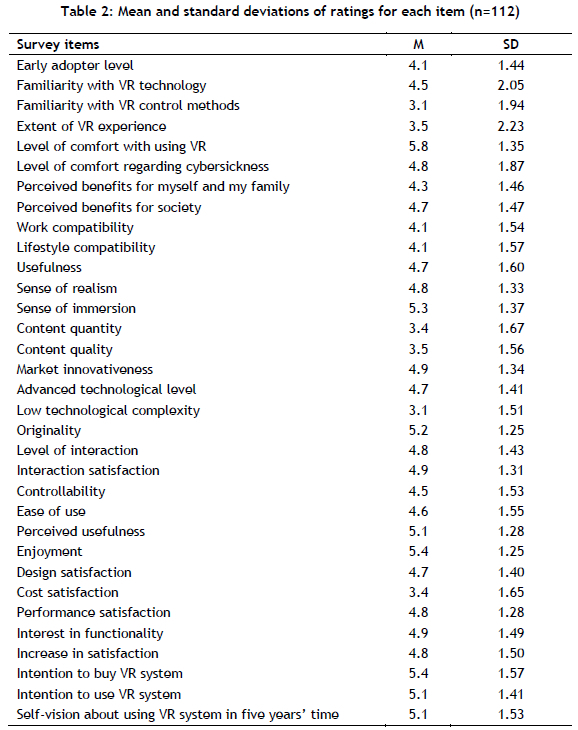
The survey items yielded the following findings: The participants were generally not afraid to use HMD VR systems (M = 5.8, SD = 1.35), and believed that HMD VR headsets provided a strong sense of immersion (M = 5.3, SD = 1.37). However, dissatisfaction was noted about the quantity and quality of content (M = 3.4, SD = 1.67; M = 3.5, SD = 1.56), and participants did not perceive the technology as having low complexity (M = 3.1, SD = 1.51). On the positive side, the participants believed that VR offered a high level of originality (m = 5.2, SD = 1.25) and provided enjoyment and usefulness (M = 5.4, SD = 1.25; M = 5.1, SD = 1.28). Although there was a tendency for dissatisfaction with the cost (M = 3.4, SD = 1.65), the participants ultimately revealed tendencies towards purchase and usage intentions (M = 5.4, SD = 1.57; M = 5.1, SD = 1.41).
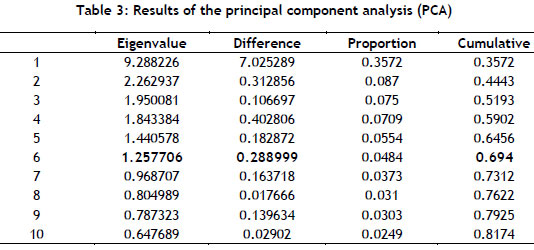
The internal consistency of the survey responses was assessed by measuring the intercorrelation among the two-paired questionnaire items. The values of Cronbach's alpha for the two-paired features of usefulness and benefit were 0.75 and 0.84, indicating that the participants were answering the questions consistently.Because there were so many items, we checked whether dimension reduction could be made by performing principal component analysis (PCA) with the correlation matrix. We obtained six eigenvalues above the point of 1.0, which explained 69.40% of the variance (Table 3). Therefore, the individual items could be grouped into six factors.
To establish a factor structure and to derive important design and operational factors among many aspects of VR technology, exploratory factor analysis was performed. The results of this analysis are shown in Table 4.
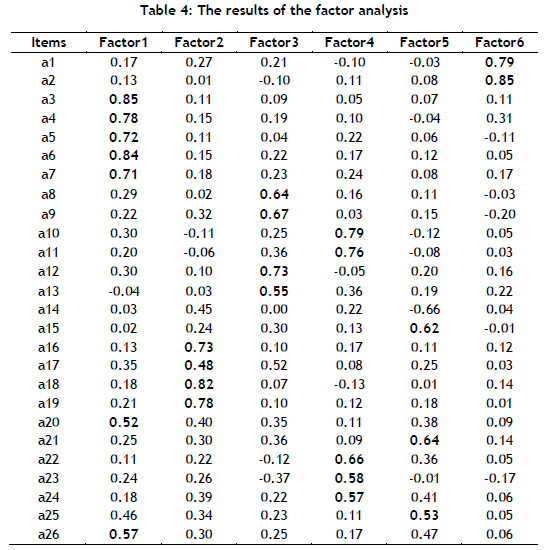
Although the factor loading of a17 was similar, it was assigned to factor 2 owing to its similarity to other variables. The ambiguous item a14 was removed from the analysis. The six factors identified were categorised and labelled as usefulness, usability, capabilities, content and system satisfaction, engagement, and risk.
Factor 1 is a dominating factor that explains 18.0% of the total variance of the data. The first factor, Usefulness, encompasses the survey items related to perceived benefits for oneself, one's family, and society, as well as work and lifestyle compatibility, overall usefulness, perceived usefulness, and an increase in satisfaction. Factor 2, Usability, includes the survey items related to the level of interaction, interaction satisfaction, controllability, and ease of use. Factor 3, Capabilities, consists of the survey items: sense of realism and immersion, market innovativeness, and advanced technological level. Factor 4, Content and system satisfaction, includes the survey items related to content quantity and quality, design, cost, and performance satisfaction. Factor 5, Engagement, consists of originality, enjoyment, and interest in functionality. Last, Factor 6 consists of the survey items about Risk.
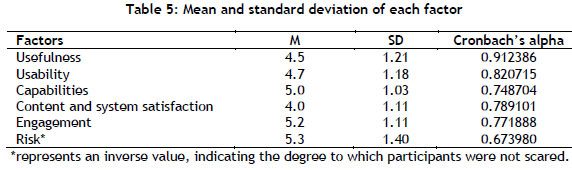
The means, standard deviations, and Cronbach's alphas of the factors are listed in Table 5, which shows that all the factor items were well grouped. All the factors were at or above neutral (>4) levels, with their means ranging from 4.0 to 5.3. The current content and system items were at an average level. Participants perceived the Capabilities and Engagement of VR to be at a high level, while considering it to be relatively less risky.
To determine which of the six factors strongly influenced various dependent variables, multiple regression analyses were performed using SAS 9.4 (Table 6). The data we used were the average scores for each factor, since each factor had several items. The three dependent variables we selected were intention of buying a VR system, intention of use with VR system, and self-vision about using VR system in five years' time.
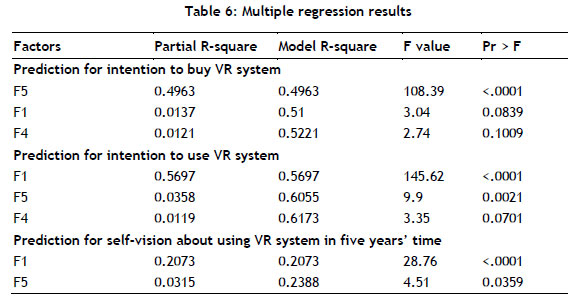
Using the intention to buy VR systems as the dependent variable and the six factors as the independent variables, we performed a stepwise regression analysis to select the relevant independent variables. The results of the regression analysis indicated a significant difference for the intention to buy VR systems regarding three variables (F(3, 108)= 39.33, p<.0001). R2 was 0.5088. The three variables that were selected were Engagement, Usefulness, and Content and system satisfaction.
Using the intention to use VR systems as the dependent variable and the six factors as the independent variables, we performed a stepwise regression analysis to select the relevant independent variables. The results of the regression analysis indicated a significant difference for the intention to use VR systems regarding three variables (F(3, 108)= 58.08, p<.0001). R2 was 0.6067. The three variables that were selected were Usefulness, Engagement, and Content and system satisfaction.
Using self-vision about using VR systems in five years' time as the dependent variable and the six factors as the independent variables, we performed a stepwise regression analysis to select the relevant independent variables. The results of the regression analysis indicated a significant difference for self-vision about using VR systems in five years' time regarding four variables (F(2, 109)= 17.10, p<.0001). R2 was 0.2248. The two variables that were selected were Usefulness and Engagement.
The variable with the greatest influence on VR purchase intention was Engagement. In addition, the variable that most significantly affected usage intention and future usage intention was Usefulness. Content and system satisfaction was also identified as a factor that influenced both purchase intention and usage intention.
5. DISCUSSION AND CONCLUSIONS
One-hundred and twelve subjects participated in the survey to investigate the current state of consumer perceptions of HMD-based VR systems. We identified the underlying factor structures of HMD VR needs and preferences: usefulness, usability, capabilities, content and system satisfaction, engagement, and risk.
From multiple regression analyses, three main factors for the intention to buy VR systems were derived: Usefulness, Engagement, and Content and system satisfaction, which explained 50.88% of the variance that accounted for users' VR system-purchasing intentions. The most important factor was Engagement, which accounted for 49.63% of the total variance contributing to VR system-purchasing intention. By identifying this, we could advise HMD VR designers and manufacturers that fostering engagement should receive the highest priority to achieve success with HMD VR.
From the regression analyses, three main factors for the intention to use VR systems were derived: Usefulness, Engagement, and Content and system satisfaction, which explained 60.67% of the variance that accounted for users' intention to use VR systems. Again, the most important factor was Usefulness, which accounted for 56.97% of the total variance contributing to the intention to use VR systems.
From the regression analyses, two main factors for the self-vision about using HMD VR systems in five years' time were derived: Usefulness and Engagement, which explained 22.48% of the variance. The most important factor was Usefulness, which accounted for 20.73% of the total variance. The most important factors were Usefulness and Engagement, which contributed to all the dependent variables. They should be enhanced and given more attention to facilitate the popularisation and success of HMD VR.
The most significant factor influencing the intention to purchase VR systems was Engagement, while the most critical factor affecting the intention to use VR systems and the self-vision of using HMD VR five years from now was Usefulness. To encourage users to purchase HMD VR systems, Engagement must be improved, and the Usefulness of HMD VR must be enhanced to increase both the current usage intention and future usage intention. Content and system satisfaction was also identified as a factor that influenced both purchase intention and usage intention; therefore, it is another aspect that must be enhanced.
Engagement was above neutral, whereas Usefulness and Content and system satisfaction were somewhat average. Therefore, improving these elements could be expected to promote the adoption and use of VR.
We developed a questionnaire for HMD VR systems to assess user needs and preferences. The questionnaire was divided into two sections. The first section focused on participants' perceptions of HMD VR systems, while the second section addressed their prior experiences of and preferences for these systems. This study aimed to investigate the expectations of potential users about HMD VR systems, given the lack of well-established user-centred guidelines.
A limitation of this research was the focus on the Korean population in recruiting participants for the survey, without considering other populations such as those from the United States, China, or other regions. Including diverse populations in the survey might have yielded different implications and broader insights, as levels of experience and familiarity with HMD-based VR systems can vary significantly in different cultural contexts. Nevertheless, this research makes significant contributions to understanding the needs and preferences for HMD VR systems by identifying the underlying factor structures and key dimensions that influence their popularisation and success. While it is evident that HMD VR systems will see increased usage in the future, this study highlights critical areas that require further attention and focus to advance the development and adoption of these systems.
ACKNOWLEDGMENT
This work was supported by the National Research Foundation (NRF) of Korea grant funded by the Korean government (MSIt) (No. 2022R1F1A1066216).
REFERENCES
[1] M. Zaiets, Factors influencing the mass adoption of VR video platforms. Degree project, KTH Royal Institute of Technology Stockholm, Sweden, 2021. [ Links ]
[2] D. Saredakis, A. Szpak, B. Birckhead, H. A. D. Keage, A. Rizzo, and T. Loetscher, Factors associated with virtual reality sickness in head-mounted displays: A systematic review and meta-analysis. Frontiers in Human Neuroscience, 14, 96, 2020. [ Links ]
[3] S. Hudson, S. Matson-Barkat, N. Pallamin, and G. Jegou, With or without you? Interaction and immersion in a virtual reality experience. Journal of Business Research, 100, pp. 459-468, 2019. [ Links ]
[4] L. N. Lee, M. J. Kim, and W. J. Hwang, Potential of augmented reality and virtual reality technologies to promote wellbeing in older adults. Applied Sciences, 9(17), 3556, 2019. [ Links ]
[5] M. Raja, and G. Lakshmi Priya, Factors affecting the intention to use virtual reality in education. Psychology and Education, 57(9), pp. 2014-2022, 2020. [ Links ]
[6] H.-J. Jang, and G.-Y. Noh, Extended technology acceptance model of VR head-mounted display in early stage of diffusion. Journal of Digital Convergence, 15(5), pp. 353-361, 2017. [ Links ]
[7] Q. Q. Chen, and H. J. Park, Consumer study on the acceptance of VR headsets based on the extended TAM. Journal of Digital Convergence, 16(6), pp. 117-126, 2018. [ Links ]
[8] R. Qiao, and D. Han, A study on the reuse intention of virtual reality (VR) content using technology acceptance model. Journal of Korea Game Society, 19(5), pp. 115-132, 2019. [ Links ]
[9] H.-J. Jang, and K.-H. Kim, Study on the influence of VR characteristics on user satisfaction and intention to use continuously: Focusing on VR presence, user characteristics, and VR sickness. The Journal of the Korea Contents Association, 18(5), pp. 420-431, 2018. [ Links ]
[10] M. Lee, S. A. Lee, M. Jeong, and H. Oh, Quality of virtual reality and its impacts on behavioral intention. International Journal of Hospitality Management, 90, 102595, 2020. [ Links ]
[11] Y. Kim, and H. Seo, A study on the presence experience and effect of users tourism virtual reality contents. Journal of Tourism and Leisure Research, 32(7), pp. 217-231, 2020. [ Links ]
[12] S.-J. Kwon, The effect of fun factors of virtual reality (VR) content leisure satisfaction and reusage intention as leisure activities. Korean Journal of Leisure, Recreation & Park, 45(2), pp. 51 -60, 2021. [ Links ]
[13] W. Choi, D. Kang, and S. Choi, Understanding factors influencing usage and purchase intention of a VR device: An extension of UTAUT2. Information Society & Media, 18(3), pp. 173-208, 2017. [ Links ]
[14] Z.-Y. Li, S.-J. Yoon, and Z.-Y. Liu, A study on factors affecting the use intention of virtual reality (VR) devices: Based on UTAUT and VAM model. Journal of the Korea Society of Computer and Information, 24(4), pp. 35-43, 2019. [ Links ]
[15] E. Chang, H. T. Kim, and B. Yoo, Virtual reality sickness: A review of causes and measurements. International Journal of Human-Computer Interaction, 36(17), pp. 1658-1682, 2020. [ Links ]
[16] Y.-H. So, The impact of presence experience on resolution of virtual reality device. The Journal of the Korea Contents Association, 19(7), pp. 393-401, 2019. [ Links ]
Submitted by authors 2 Jan 2025
Accepted for publication 21 Jul 2025
Available online 29 Aug 2025
* Corresponding author: kyungdoh.kim@hongik.ac.kr
ORCID® identifiers
K. Kim: https://orcid.org/0000-0003-1062-6261
Evaluating preferences for HMD VR design and operation
Welcome to the HMD VR survey!
The purpose of this survey is to see what you expect or have experienced with regard to HMD VR design and operation. A head-mounted display (HMD) is a display device, worn on the head that has a small display optic. HMD VR can display only virtual images. In answering, please consider the following.
Read each statement. Decide how much you agree or disagree, or how positively or negatively you think, and mark the appropriate response.
The survey consists of two parts. The first part is about your demographic information. Part I comprises 9 questions. The second part will ask you about what you expect or have experienced with regard to HMD VR system. There are 29 questions about preferences about HMD VR design and operation in Part II.
It takes about 10 minutes total to complete the whole survey.