



Services on Demand
Journal

Article
 English (pdf)
 Article in xml format
 Article references
 Automatic translation
 Send this article by e-mail
Indicators
Related links
-
 Cited by Google
 -
 Similars in Google
Share

 Permalink
South African Journal of Enology and Viticulture
On-line version ISSN 2224-7904Print version ISSN 0253-939X
S. Afr. J. Enol. Vitic. vol.45 n.2 Stellenbosch 2024
https://doi.org/10.21548/45-2-6234
ARTICLES
Salicylic Acid Treatment Improves the Shelf Life and Quality of 'Cheonghyang' Grapes during Cold Storage
M. Zebro; J.Y. Heo*
Department of Plant Science, Gangneung-Wonju National University, Gangneung, Republic of Korea
ABSTRACT
The storage capacity of 'Cheonghyang' grapes, a promising grape cultivar developed in South Korea, is a critical factor affecting their commercial viability. This study investigates the impact of salicylic acid (SA) treatment on the storage capacity of 'Cheonghyang' grapes. The effects of SA treatment at different concentrations were assessed by comparing fruit characteristics and enzyme activity related to shelf life after two and four weeks of cold storage in comparison with an untreated control group. The findings reveal that SA-treated grapes exhibited reduced water loss and improved firmness, leading to a lower occurrence of unmarketable berries. Furthermore, enzymes involved in pectin degradation, such as pectate lyase and polygalacturonase, were reduced in the SA-treated group, while antioxidant activity-related enzymes, including catalase, peroxidase and superoxide dismutase, were more active than in the control group. The most effective control of enzyme activities was observed at an SA concentration of 2 mM, which demonstrated the least decline in fruit quality among the tested SA concentrations in this study. These results indicate that SA is a highly effective substance for maintaining the storability of 'Cheonghyang' grapes under conditions of low-temperature storage after harvest.
Key words: Antioxidant property, enzyme activity, Vitis
INTRODUCTION
'Cheonghyang' is a grape cultivar that was developed in Korea in 2009 (Park et al., 2014). It is a triploid grape, which means it has low fertility and can produce seedless berries with just one application of gibberellic acid at 100 ppm at the full bloom stage (Park et al., 2022a). While most grapes in Korea begin to mature around 30 August (Park et al., 2022b), 'Cheonghyang' offers a competitive advantage by ripening early, allowing for supply from early August, a period when grapes are typically scarce in Korea.
Despite its advantage of early ripening, 'Cheonghyang' grapes face challenges related to storability. For instance, 'Campbell Early', a major grape variety in South Korea, can be stored for two to three months at an optimal temperature of 0°C with 85% to 95% relative humidity (Ha et al., 2008). Similarly, 'Shine Muscat', another popular variety, can be stored for up to three months at 10°C with 99% relative humidity (Matsumoto & Ikoma, 2016). In contrast, 'Cheonghyang' grapes have relatively poor storability, which poses a challenge to ensuring a consistent supply and production of this variety.
Maintaining the quality of grapes is crucial for the grape industry in Korea, where grapes are grown primarily for fresh consumption (Kim et al., 2021). Consistent fruit quality from harvest to distribution is essential to meet consumer demands. Even after grape harvest, various metabolic processes continue, and water loss due to transpiration can cause the shrivelling and dropping of berries (Lufu et al., 2020). In addition, active oxygen generated during cold storage can lead to cell damage, resulting in the deterioration of grape quality during such storage (Vazquez-Hernandez et al., 2020). 'Cheonghyang' grapes are relatively susceptible to water loss during storage, which contributes to their low storability.
In recent times, various strategies have been explored to enhance the storability of grapes after harvest. These strategies include the use of substances such as salicylic acid (SA), 1-methylcyclopropene and Aloe vera gel (Lo'Ay et al., 2019; Ehtesham Nia et al., 2022; Leng et al., 2022). Research has demonstrated that SA, in particular, can reduce water loss and the softening rate, thereby improving the storability of grapes. Given these promising findings, it is plausible that the storability of 'Cheonghyang' grapes could be similarly enhanced through the judicious application of SA. However, the effects of SA on the shelf life of fruit crops are influenced by the concentration of the treatment and the specific cultivar (García-Pastor et al., 2020; Changwal et al., 2021). Therefore, a comprehensive evaluation of the effects of SA on 'Cheonghyang' grapes is essential before considering its commercial use.
In this study, we aimed to investigate the effect of different concentrations of SA on the shelf life of 'Cheonghyang' grapes during cold storage. We closely monitored changes in water content, quality and antioxidant enzyme activities of the berries after SA treatment. The results of this study are expected to provide valuable insights into the optimal conditions for SA application, ultimately enhancing the storability of 'Cheonghyang' grapes and ensuring a consistent supply of high-quality fruit for consumers.
MATERIAL AND METHODS
Plant material and salicylic acid treatment
This study was conducted in 2022 using five 10-year-old 'Cheonghyang' vines planted in the vineyards of the Gangwon-do Agricultural Research and Extension Services located in Chuncheon. Grapes for this experiment were produced through a dipping treatment of 100 ppm gibberellic acid at the full bloom stage and were harvested on 202208-10. The harvested grapes were immediately transported to the plant-breeding laboratory of Gangneung-Wonju National University located in Gangneung, Gangwon-do. From them, only 96 clusters with a uniform size and without mechanical or pest damage were used. They were randomly divided into four treatment groups, and each treatment group was immersed in water or a salicylic acid solution with different concentrations for 15 minutes. The salicylic acid concentrations applied for this experiment were 1 mM, 2 mM and 4 mM, while the clusters immersed in water were used as the control group. Grape clusters immersed in water or SA were dried at room temperature for two hours and were then stored in a chamber with a storage environment of 5°C and 85% humidity.
Change of grape quality during cold storage
The quality of the grapes stored in a cold environment was evaluated by assessing multiple parameters. These parameters included the water loss rate of the grape clusters, the incidence of unmarketable berries, berry firmness, soluble sugar content (SSC) and titratable acidity (TA) for each treatment group. Following this assessment, the effect of applying salicylic acid (SA) on the shelf life of 'Cheonghyang' grapes was compared using data collected from each treatment group. This experiment was conducted at two-week intervals for a maximum of four weeks.
To calculate the water loss rate of the grape clusters, the following formula was used:
Water loss rate of grape cluster (%) = (cluster weight (g) after storage / cluster weight (g) before storage) χ 100. The rate of occurrence of unmarketable berries was determined using the following formula: Occurrence rate of unmarketable berries (%) = (number of berries without marketability / total number of berries) χ 100
Unmarketable berries refer to those that are more than half browned, dried or desiccated, or have mould on the surface and are difficult to consume. To assess the rate of water loss in the clusters and the occurrence of unmarketable berries, 12 clusters were utilised for each treatment group. Berry firmness was measured using a durometer (FHT-05, Landtek, China) on the same berries employed for colour measurement, with the results expressed in Newtons (N). For the measurement of soluble sugar content (SSC) and titratable acidity (TA) in the berries, four replications were performed for each treatment group. Each replication consisted of three clusters of grapes. SSC was determined using a pocket refractometer (PAL-1, Atago, Japan) with the juice extracted from 20 berries randomly selected for each replication group (five berries per cluster, totalling four clusters). The SSC value was expressed as °Brix. TA was measured using a pocket acid meter (PAL-Easy ACID2, Atago, Japan) by diluting the juice used for SSC measurement with distilled water in a ratio of 1:39. Each TA value was expressed as a percentage.
Change of antioxidant properties in grapes during cold storage
For the measurement of antioxidant properties such as total phenols and total flavonoids, berry skins were randomly obtained from 12 clusters for each treatment group and dried for 10 days at 60°C. The dried berries were then powdered, and an extract was obtained for each treatment group using methanol (Lee & Heo, 2023).
To measure the total phenol content, the Folin-Ciocalteu method was applied as described in Geleta et al. (2023). A total of 25 μL of the extracted solution was mixed with 125 μL of Folin-Ciocalteu reagent, followed by the addition of 37.5 μL of 20% sodium bicarbonate and 62.5 μL of distilled water. The sample was left at room temperature for 60 minutes, and the absorbance was measured using a microplate reader/spectrophotometer at 765 nm against a blank without extract. Gallic acid was used as the standard, and the outcome data were expressed as mg gallic acid equivalent per gram dry weight (mg GAE/g).
To measure the total flavonoid content, 25 μΐι of the extracted solution was added to a solution containing 75 μL methanol, 5 μL of 10% aluminium chloride and 5 μL of one mole sodium acetate. The mixed solution was left at room temperature for 30 minutes, and then the absorbance was measured at 415 nm relative to the blank. Quercetin was used as the standard, and the results were expressed as quercetin per dry weight (mg QE/g).
Change of antioxidant activity in grapes during cold storage
Changes in antioxidant activity were assessed using 2,2-diphenyl-1-picrylhydrazyl (DPPH) radical-scavenging activity according to the method described by Lee et al. (2023). To measure the DPPH radical-scavenging activity of the samples, 100 μL of the extract solution was mixed with 3 mL of 0.004% DPPH solution and incubated in a dark room for 30 minutes. After that, the absorbance was measured at 517 nm using a spectrophotometer. Methanol solutions of the tested extracts and DPPH solution were used as blank and control measurements, respectively. The percentage of DPPH radical-scavenging ability was calculated as follows: DPPH radical-scavenging ability (%) = [(Abscontrol - Abssample) / Abscontrol] χ 100, where Abscontrol and Abssample are the absorbance values of the control and the tested sample, respectively.
Measurement of polygalacturonase and pectate lyase activities
To extract polygalacturonase and pectate lyase enzymes from grape peel, a 0.4 g sample of grape peel was first ground using a mortal and pestle in liquid nitrogen to fine powder and homogenised in a solution containing Tris-HCl (20 mM, pH 7.0), cysteine-HCl (20 mM), EDTA (20 mM), and Triton X-100 (0.05%). This mixture was then subjected to centrifugation at 12 000 χ rpm for 30 minutes at 4°C using a refrigerated centrifuge (Combi-514R, Hanil scientific ind, Incheon, Korea) to obtain a clear supernatant suitable for enzyme assays. For the polygalacturonase assay, the reaction mixture was composed of 0.2 mL of sodium acetate (200 mM, pH 4.5), 0.1 mL of NaCl (200 mM), 0.3 mL of polygalacturonic acid (PGA, 1% aqueous solution adjusted to pH 4.5), and 0.05 mL of the enzyme extract in a total volume of 1.0 mL. The reaction started with the addition of PGA substrate and was incubated at 37°C for one hour. To terminate the reaction, 3,5-dinitro salicylic acid (DNS) was added, followed by heating the mixture in a boiling water bath for 10 minutes. The formation of reducing groups was determined by measuring the absorbance at 540 nm using a spectrophotometer (UV-5490, Neogen, Seoul, Korea). One unit of PG enzyme activity was defined as the amount required to liberate 1 nmol of galacturonic acid per minute under these conditions. For the pectate lyase assay, the reaction mixture consisted of 4 mM sodium acetate buffer (pH 4.5), 0.3 mL of polygalacturonic acid (PGA, 1% aqueous solution adjusted to pH 4.5), and 0.1 mL of enzyme preparation, in a total reaction volume of 1 mL. The reaction tubes were incubated at 37°C for 30 minutes and then boiled to halt the reaction. Pectate lyase activity was determined by measuring the increase in absorbance at 235 nm using a spectrophotometer, compared to a control with preboiled enzyme. One unit of pectate lyase activity was expressed as the amount of enzyme required to liberate 1 nmol of aldehyde groups from PGA per minute under these assay conditions. Both the polygalacturonase and pectate lyase activities were assessed following the method of Baraiya et al. (2016).
Measurement of antioxidant enzyme activity
The activity of three antioxidant enzymes, namely catalase (CAT), peroxidase (POD) and superoxide dismutase (SOD), were assessed using the method established by Zebro and Heo (2024). Initially, 0.4 grams of fresh grape peel samples were carefully ground to a fine powder using a mortar and pestle in liquid nitrogen. Subsequently, 3 mL of a 100 mM PBS buffer with a pH of 7.8 were added to the homogenised powder. The resulting mixture was then evenly divided into two separate 1.5 mL centrifuge tubes, and the samples were subjected to centrifugation at 10 000 x rpm for 20 minutes at a temperature of 4°C using a refrigerated centrifuge (Combi-514R, Hanil scientific indus, Incheon, Korea). The supernatant obtained after centrifugation was carefully collected and transferred to new centrifuge tubes, making it ready for the analysis of the antioxidant enzyme activity. To assess the CAT activity, 100 μL of the crude enzyme solution was placed in a cuvette on a cuvette stand. Subsequently, 1 mL of a reaction solution containing 30% H2O2 and 100 mM PBS (pH 7.0) was added to the 100 μL sample. The absorbance at 240 nm was measured, recording dynamic changes every 15 seconds for a total duration of 75 seconds. To determine POD activity, 100 μL of the crude enzyme solution was placed in a cuvette on a cuvette stand. A reaction solution comprising 0.2% guaiacol, 100 mM PBS (pH 7.0) and 30% H2O2 was then added to the 100 μL sample. The absorbance at 470 nm was measured, recording dynamic changes every 15 seconds for a total duration of 75 seconds. In assessing SOD activity, 100 μL of the crude enzyme solution was mixed with 1 mL of a reaction solution comprising 100 mM PBS (pH 7.8), 1 mM EDTA-2Na, 130 mM methionine, 750 μΜ nitroblue tetrazolium (NBT) and 20 μΜ riboflavin. These samples were exposed to light at an intensity of 4 000 lux for 15 minutes, and their absorbance at 560 nm was measured in a dark environment. All enzyme activities were measured using a spectrophotometer.
Data analysis
The data presented from this study were analysed statistically using SPSS software (Version 28; IBM, New York, USA). All performed analyses were carried out in triplicate. Mean and standard errors (SE) were calculated. The statistical significance of the data was assessed by one-way analysis of variance, and mean comparisons were performed using the Duncan test to examine if differences between treatments and storage time were significant at P < 0.05. The overall least significance difference (P < 0.05) was calculated and used to detect significant differences between all treatments and the control set. To explore potential relationships among the presented parameters, we calculated Pearson's correlation coefficients.
RESULTS
Effects of SA treatment on soluble sugar content and titratable acidity
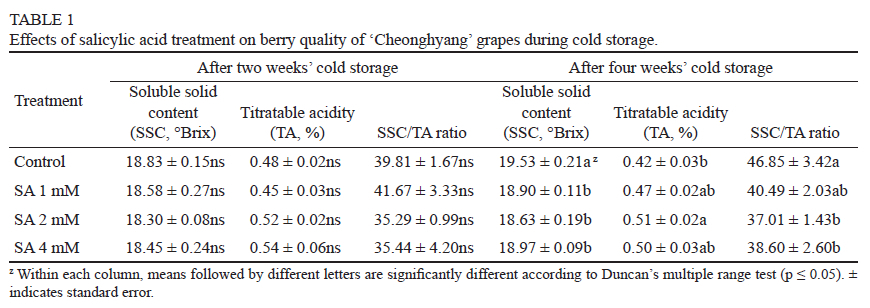
In this study, we evaluated the effect of SA treatment on the fruit characteristics of 'Cheonghyang' grapes. Two weeks after cold storage, the soluble sugar content ranged from 18.30°Brix to 18.83°Brix, with the control group exhibiting the highest soluble sugar content (Table 1). While a significant difference was noted between the control group and the SA treatment groups, there were no statistically significant differences among the various SA treatments (Table 1). At four weeks after cold storage, there was a general trend of increased soluble sugar content across all treatments when compared to the two-week measurement. Notably, the control group displayed relatively higher values in comparison to the SA-treated groups (Table 1). In contrast, titratable acidity exhibited a slight decrease in the fourth week compared to the second week of cold storage, with the control group showing the lowest levels of acidity (Table 1). Consequently, a higher SSC/TA ratio was observed in the control group after four weeks of cold storage (Table 1).
Effect of SA treatment on antioxidant properties
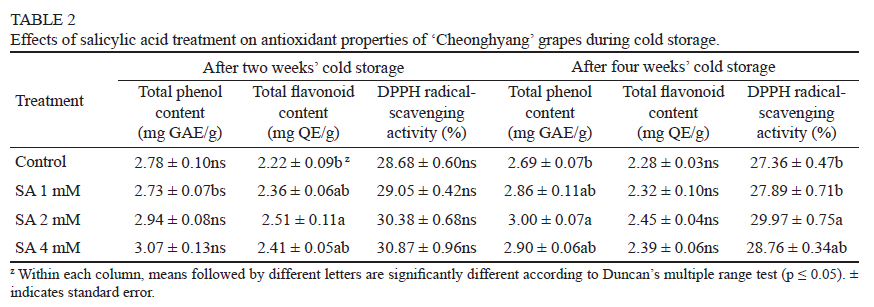
The effects of SA on the total phenol content, total flavonoid content and DPPH radical-scavenging activity were assessed throughout the cold storage period. During the second week of cold storage, the total phenol content ranged from 2.73 mg to 3.07 mg GAE/g, the total flavonoid content ranged from 2.22 mg to 2.51 mg QE/g, and the DPPH radical-scavenging ability ranged from 28.68% to 30.87% (Table 2). By the fourth week of cold storage, these parameters were within the range of 2.69 mg to 3.00 mg GAE/g, 2.28 mg to 2.45 mg QE/g, and 27.36% to 29.97%, respectively (Table 2). There was a decrease in total phenol content and DPPH radical-scavenging ability when compared to the values observed during the second week of cold storage. Nonetheless, the SA-treated samples exhibited relatively high levels of total phenol content and DPPH scavenging ability during both the second and fourth weeks of cold storage, with particularly noteworthy values recorded at a concentration of 2 mM SA (Table 2). *
Effect of SA treatment on water loss, berry firmness and the occurrence of unmarketable berries
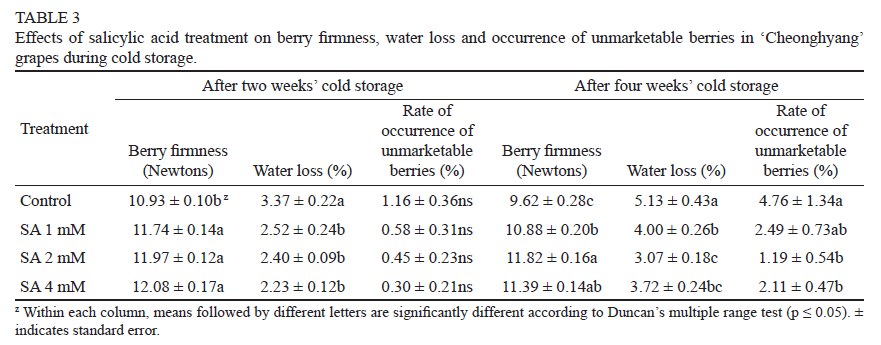
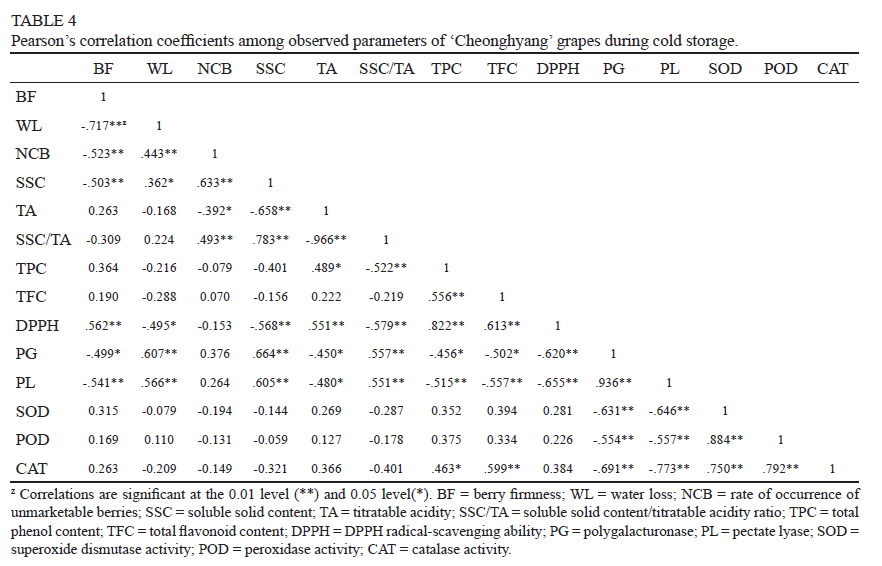
The water loss rates in clusters decreased over time, ranging from 2.23% to 3.37% after two weeks, and 3.07% to 5.13% after four weeks of cold storage, irrespective of salicylic acid (SA) treatment (Table 3). SA application reduced water loss in clusters compared to the non-SA-treated group, with the least reduction at 4 mM SA in the second week and 2 mM SA in the fourth week. Berry firmness declined after four weeks, but the SA-treated groups showed smaller declines than the control group, with a significant difference in berry firmness observed in the fourth week. The SA 2 mM group, with the lowest cluster water loss, exhibited the highest berry firmness in the fourth week (Table 3). The occurrence of unmarketable berries, primarily due to berry softening, remained low, ranging from 0.30% to 1.16% in the second week and increasing to 1.19% to 4.76% by the fourth week, with SA 4 mM and 2 mM showing the lowest rates of occurrence (Table 3). An analysis revealed a close correlation between the occurrence of unmarketable berries, cluster water loss and berry firmness, suggesting these factors significantly influenced the occurrence of unmarketable berries, as shown in Table 4.
Effect of SA treatment on pectate lyase and polygalacturonase activity
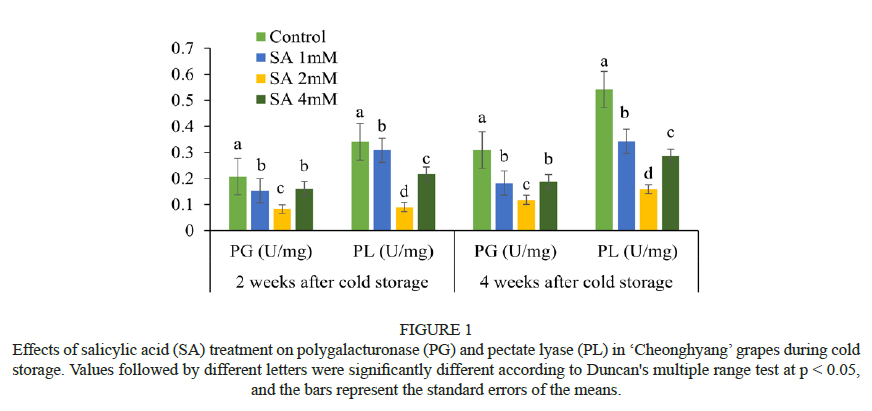
The effects of SA treatment on the activities of pectate lyase and polygalacturonase in 'Cheonghyang' grapes were evaluated at different concentrations of SA. The activity of pectate lyase and polygalacturonase measured in the second week of cold storage ranged from 0.082 U/mg to 0.207 U/mg and 0.090 U/mg to 0.341 U/mg, respectively (Fig. 1). Compared to the untreated group, the activity of pectate lyase in the salicylic acid-treated group showed a reduction by 22.71% to 60.39%, and the activity of polygalacturonase decreased by 9.38% to 73.61%. The activity of pectate lyase and polygalacturonase measured in the fourth week of storage was observed in the range of 0.118 U/mg to 0.310 U/mg and 0.159 U/mg to 0.542 U/mg, respectively (Fig. 1). It was found that the enzyme activity tended to increase compared to the second week. However, similar to the second week, there was a significant reduction in enzyme activity in the SA treatment group compared to the untreated group in the fourth week of cold storage (Fig. 1). The SA 2 mM treatment group exhibited the most suppressed activation level among all the groups examined in this study.
Influence of SA on antioxidant enzyme activities
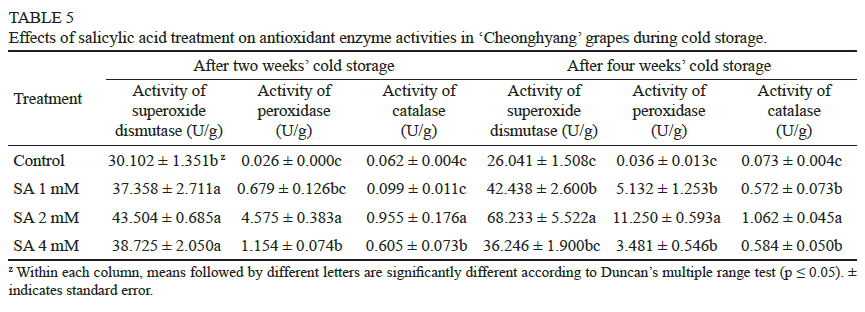
The influence of SA on the activities of antioxidant enzymes during cold storage was investigated. Unlike pectate lyase and polygalacturonase, all SA-treated groups exhibited significantly higher antioxidant enzyme activity when compared to the untreated groups. However, the activation patterns varied slightly depending on the specific reactive oxygen enzyme. For instance, in the case of SOD activity, concentrations of 1 mM and 2 mM SA demonstrated increased activity after four weeks of cold storage in contrast to two weeks, while the control and 4 mM SA displayed a minor decline after four weeks (Table 5). Nevertheless, SOD activity consistently exhibited its highest activity at the 2 mM SA concentration, regardless of the duration of storage. In the context of CAT activity, expression levels differed across treatment groups. Specifically, the control and 2 mM SA exhibited a slight increase, while 1 mM SA showed a substantial increase, and 4 mM SA indicated a tendency to decrease (Table 5). Notably, the rate of increase in CAT activity was most pronounced at the 1 mM SA concentration, although the absolute highest activity was confirmed at 2 mM SA. Unlike the SOD and CAT activity, POD activity demonstrated increased activity after four weeks compared to two weeks in all treatment groups, and its peak activity was consistently observed in the 2 mM SA concentration (Table 5).
DISCUSSION AND CONCLUSION
In this experiment we found that the grapes treated with SA maintained their quality more effectively during cold storage than grapes that were not treated with SA. SSC and TA levels in all treatments progressively accumulated and decreased respectively over the prolonged cold storage period. It is known that a gradual reduction in TA levels during storage may be attributed physiologically to an increase in membrane permeability, indicating that acids stored in cell vacuoles are being respired and transformed into sugars (Nasser et al., 2022). It further has been reported that the increase in SSC resulted from the transformation of acids to sugars, as well as from water loss (Sha et al., 2022). The reason lies in transpiration, which causes the movement of water from inside the fruit to the outside environment (Machado et al., 2022). Bangar et al. (2022) also show that high rates of transpiration lead to dehydration and reduced quality and shelf life of grapes. In this study, we also observed that all SA applications for 'Cheonghyang' inhibited the increase in SSC and the decrease in TA and the rate of water loss compared to the control after four weeks of cold storage, strongly indicating that SA applications maintained shelf life, as they might suppress transpiration (as shown by Hazarika & Marak, 2022).
Maintaining berry firmness is regarded as one of the critical factors in the shelf life of grapes (Park et al., 2022b), as firm berries are less prone to quality loss compared to soft berries. In this study, berries treated with SA application exhibited better firmness during cold storage. Similarly, a study conducted by Nia et al. (2022) found that treating berries with SA significantly enhanced berry firmness and reduced weight loss compared to the untreated berries. Previous reports have shown that pectate lyase and polygalacturonase enzymes are responsible for the degradation of pectin (Hou et al., 2022; Rashidi et al., 2023), a key component of the middle lamella and primary cell walls of plant tissues. Pectin is a complex polysaccharide that provides structural support to plant cells and helps maintain their integrity. It forms a gel-like substance that holds the cell walls together, giving fruit their firmness and texture. Pectate lyase and polygalacturonase are enzymes that break down pectin by cleaving its chemical bonds (Al Hinai et al, 2021). During cold storage of grapes, the activity of pectate lyase and polygalacturonase enzymes increases, leading to the degradation of pectin (Baraiya et al., 2016). This enzymatic degradation causes the cell walls to become more flexible and the fruit to soften, and it is possible to slow down the degradation of pectin and maintain fruit firmness for a longer period by inhibiting pectate lyase and polygalacturonase enzymes. We also observed that SA application inhibited the activity of these enzymes in 'Cheonghyang' berries. It is believed that SA can act as a signalling molecule, activating defence-related genes and pathways (Kaur et al., 2022), thereby inducing the expression of genes that encode inhibitors of pectate lyase and polygalacturonase. Based on previous reports, it can be assumed that SA might bind to the active sites of these enzymes, disrupting the enzymesubstrate interaction in 'Cheonghyang' grapes (Wang et al., 2022; Ma et al, 2023). Hence, SA application prevented the degradation of pectin and contributed to maintaining berry firmness.
Cold storage is known to be an effective method for maintaining grape quality. Grapes, however, experience oxidative stress during cold storage, leading to the production of reactive oxygen species (ROS) (Elatafi & Fang, 2022). Elevated ROS levels in fruit during cold storage not only affect membrane integrity, but also react with unsaturated fatty acids, causing lipid oxidation (Singh et al., 2023). Therefore, controlling ROS levels is important for extending the shelf life of grapes. Numerous researchers have demonstrated the role of SA in regulating various physiological processes that protect plants from abiotic stress by inhibiting the production of ROS (Liu et al., 2022; Gharibiyan et al, 2023; Song et al., 2023). Supapvanich et al. (2017) have also shown that SA application can help maintain fruit quality by increasing antioxidant defences through the regulation of CAT, POD and SOD activities. SOD converts O2- - to H2O2, which is then eliminated by the combined action of CAT and POD (Amani et al., 2023). It is suggested that the enhanced activity of antioxidant enzymes in SA-treated fruit accelerates the clearance of O2' - generated during cold storage (Meng et al., 2023). In this study, we found a higher activation of CAT, POD and SOD with the application of SA, indicating that SA can help scavenge ROS and protect cell membranes, proteins and DNA, ultimately maintaining the quality of 'Cheonghyang' grapes. In addition, SA aids in the production of phenolic compounds that scavenge free radicals and prevent lipid peroxidation (Bayram & Decker, 2023), further reducing grape degradation during storage. The study found that the groups treated with SA exhibited higher levels of antioxidant enzyme activities, total phenol content and DPPH radicals, supporting this hypothesis.
The quality of 'Cheonghyang' grapes was found to be affected differently depending on the concentration of SA used during cold storage. The SA treatment groups demonstrated the ability to maintain grape quality and efficiently regulate the activation pattern of key enzymes associated with cold storage. These results suggest that SA can be an effective method for maintaining the quality of 'Cheonghyang' grapes after harvest. Selecting the appropriate concentration of SA is crucial for extending the shelf life of grapes. If the concentration is too low, it may not enhance antioxidant enzyme activity or stimulate cell defence-related enzymes (Champa et al., 2015). On the other hand, if the concentration is too high, it can damage tissue, reduce cell viability, and induce oxidative stress (Hazarika & Marak, 2022).
In conclusion, this study demonstrates that salicylic acid (SA) treatment can significantly enhance the storability of 'Cheonghyang' grapes during cold storage. The treatment with 2 mM SA is superior because it effectively preserves the firmness of the berries, reduces water loss, minimises the number of unmarketable berries, limits the synthesis of pectin-degrading enzymes, improves the formation of antioxidant activity enzymes, and enhances antioxidant properties. These combined characteristics help prolong the shelf life, improve marketability and enhance the overall quality of 'Cheonghyang' grapes during cold storage. These findings have important implications for the grape industry, as they offer a practical solution to improve the commercial viability of 'Cheonghyang' grapes and ensure a consistent supply of high-quality fruit for consumers. Further research and field trials are warranted to validate these findings and optimise the application of SA in grape production.
LITERATURE CITED
Al Hinai, T.Z.S., Vreeburg, R.A.M., Mackay, C.L., Murray, L., Sadler, I.H. & Fry, S.C., 2021. Fruit softening: Evidence for pectate lyase action in vivo in date (Phoenix dactylifera) and rosaceous fruit cell walls. Ann. Bot. 128(5), 511-525. [ Links ]
Amani, G., Shamili, M., Imani, A., Mousavi, A., Rezai, H. & Daneshvar, S., 2023. Overexpression of genes related to the antioxidant responses and salt tolerance of almond (Prunus dulcis) scions. Erwerbs-Obstbau 65, 1545-1555. [ Links ]
Bangar, S.P., Whiteside, W.S., Ozogul, F., Dunno, K.D., Cavender, G.A. & Dawson, P., 2022. Development of starch-based films reinforced with cellulosic nanocrystals and essential oil to extend the shelf life of red grapes. Food Biosci. 47, 101621. [ Links ]
Baraiya, N., Ramana Rao, T. & Thakkar, V., 2016. Composite coating as a carrier of antioxidants improves the postharvest shelf life and quality of table grapes (Vitis vinifera L. var. Thompson Seedless). J. Agric. Sci. Technol. 18(1), 93-107. [ Links ]
Bayram, I. & Decker, E.A., 2023. Underlying mechanisms of synergistic antioxidant interactions during lipid oxidation. Trends Food Sci. Technol. 133, 219-230. [ Links ]
Champa, W.H., Gill, M., Mahajan, B. & Arora, N., 2015. Preharvest salicylic acid treatments to improve quality and postharvest life of table grapes (Vitis vinifera L.) cv. Flame Seedless. J. Food Sci. Technol. 52, 3607-3616. [ Links ]
Changwal, C., Shukla, T., Hussain, Z., Singh, N., Kar, A., Singh, VP., Abdin, M.Z. & Arora, A., 2021. Regulation of postharvest tomato fruit ripening by endogenous salicylic acid. Front. Plant Sci. 12, 663943. [ Links ]
Ehtesham Nia, A., Taghipour, S. & Siahmansour, S., 2022. Putrescine with aloe vera gel coating improves bioactive compounds and quality of table grape under cold storage. J. Food Sci. Technol. 59(10), 4085-4096. [ Links ]
Elatafi, E. & Fang, J., 2022. Effect of silver nitrate (AgNO3) and nano-silver (Ag-NPs) on physiological characteristics of grapes and quality during storage period. Horticulturae 8(5), 419. [ Links ]
García-Pastor, M.E., Zapata, P.J., Castillo, S., Martínez-Romero, D., Guillén, F., Valero, D. & Serrano M., 2020. The effects of salicylic acid and its derivatives on increasing pomegranate fruit quality and bioactive compounds at harvest and during storage. Front. Plant Sci. 11, 668. [ Links ]
Geleta, B.T., Lee, J.C. & Heo, J.Y., 2023. Antioxidant activity and mineral content in unripe fruits of 10 apple cultivars growing in the northern part of Korea. Horticulturae 9(1), 114. [ Links ]
Gharibiyan, P., Roozban, M.R., Rahemi, M. & Vahdati, K., 2023. Exogenous salicylic acid improves growth and physiological status of two Pistacia species under salinity stress. Erwerbs-Obstbau 65, 1441-1452. [ Links ]
Ha, H.S., Hwang, H.S., Yang, Y.J. & Park, P.M., 2008. Analysis of quality changes and losses to indicate storability of 'Campbell Early' grape as related to marketing conditions. Kor. J. Hort. Sci. Technol. 26(3), 277-283. [ Links ]
Hazarika, T. & Marak, T., 2022. Salicylic acid and oxalic acid in enhancing the quality and extending the shelf life of grape cv. Thompson seedless. Food Sci. Technol. Int. 28(6), 463-475. [ Links ]
Hou, J., Yan, D., Huang, M., Zeng, K. & Yao, S., 2022. Alteration of pectin metabolism in blood orange fruit (Citrus sinensis cv. Tarocco) in response to vesicle collapse. Food Qual. Saf. 6, fyac050. [ Links ]
Kaur, G., Tak, Y. & Asthir, B., 2022. Salicylic acid: A key signal molecule ameliorating plant stresses. Cereal Res. Commun. 50, 617-626. [ Links ]
Kim, S.H., Jeong, S.H. & Heo, J.Y., 2021. Incidence of 14 grapevine viruses in Korean vineyards. Not. Bot. Horti. Agrobot. Cluj-Napoca 49(4), 12490. [ Links ]
Lee, S.Y. & Heo, J.Y., 2023. Combined treatment with gibberellic acid and thidiazuron improves fruit quality of 'Red Dream' grape cultivar. Not. Sci. Biol. 15(2), 11499. [ Links ]
Lee, W.H., Zebro, M. & Heo, J.Y., 2023. Light-emitting diode light quality influences germination and sprout characteristics of motherwort. J. Food Qual. 4644078. [ Links ]
Leng, F., Wang, C., Sun, L., Li, P., Cao, J., Wang, Y., Zhang, C. & Sun C., 2022. Effects of different treatments on physicochemical characteristics of 'Kyoho' grapes during storage at low temperature. Horticulturae 8(2), 94. [ Links ]
Liu, J., Qiu, G., Liu, C., Li, H., Chen, X., Fu, Q., Lin, Y. & Guo, B., 2022. Salicylic acid, a multifaceted hormone, combats abiotic stresses in plants. Life 12(6), 886. [ Links ]
Lo'Ay, A., Taha, N. & El-Khateeb, Y., 2019. Storability of 'Thompson Seedless' grapes: Using biopolymer coating chitosan and polyvinyl alcohol blending with salicylic acid and antioxidant enzymes activities during cold storage. Sci. Hortic. 249, 314-321. [ Links ]
Lufu, R., Ambaw, A. & Opara, U.L., 2020. Water loss of fresh fruit: Influencing pre-harvest, harvest and postharvest factors. Sci. Hortic. 272, 109519. [ Links ]
Ma, Y., Wang, C., Gao, Z., Yao, Y., Kang, H. & Du, Y., 2023. VvPL15 is the core member of the pectate lyase gene family involved in grape berries ripening and softening. Int. J. Mol. Sci. 24(11), 9318. [ Links ]
Machado, M.R., Veiga, J.C., Silveira, N.M., Seabra, A.B., Boza, Y.E.A.G., Pelegrino, M.T., Cia, P., Valentini, S.R.T. & Bron, I.U., 2022. Nitric oxide supply reduces ethylene production, softening and weight loss in papaya fruit. Bragantia 81, e1222. [ Links ]
Matsumoto, H. & Ikoma, Y., 2016. Effect of postharvest temperature on the muscat flavor and aroma volatile content in the berries of 'Shine Muscat' (Vitis labruscana Baily χ V. vinifera L.). Postharvest Biol. Technol. 112, 256-265. [ Links ]
Meng, X., Fang, J., Fu, M., Jiao, W., Ren, P. & Yang, X., 2023. The role of 1-methylcyclopropylene (1-MCP) and salicylic acid (SA) in induced resistance of postharvest fruits. Horticulturae 9(1), 108. [ Links ]
Nasser, M.A., El-Mogy, M.M., Samaan, M.S., Hassan, K.M., El-Sayed, S.M., Alsubeie, M.S., Darwish, D.B.E., Mahmou, S.F., Al-Harbi, N.A., Al-Qahtani, S.M., Alzuaibr, F.M. & El-Gawad, H.G.A., 2022. Postharvest exogenous melatonin treatment of table grape berry enhances quality and maintains bioactive compounds during refrigerated storage. Horticulturae 8(10), 860. [ Links ]
Nia, A.E., Taghipour, S. & Siahmansour, S., 2022. Effects of salicylic acid preharvest and aloe vera gel postharvest treatments on quality maintenance of table grapes during storage. S. Afr. J. Bot. 147, 1136-1145. [ Links ]
Park, Y.S., Kim, J.H., Lee, J.C., Jeong, H.N. & Heo, J.Y., 2022a. Effect of gibberellin acid treatment concentration and timing on the fruit characteristics of triploid grape cultivar, 'Cheongyang'. Fruit Grow. Res. XXXVII, 197-201. [ Links ]
Park, Y.S., Lee J.C., Um, N.Y., Jeong, H.N. & Heo J.Y., 2022b. 'Black star': An early-maturing seedless grape cultivar. HortScience 57(9), 1055-1056. [ Links ]
Park, Y.S., Um, N.Y., Bang, S.B. & Park, S.M., 2014. "Cheonghyang": A green seedless table grape. J. Am. Pomol. Soc. 68(3), 171-173. [ Links ]
Rashidi, H., Amiri, J. & Shirzad, H., 2023. Effect of postharvest treatment with 24-epibrassinolide and fennel (Foeniculum vulgare) essential oil on quality attributes and storage life of orange (Citrus sinensis cv. 'Valencia'). Erwerbs-Obstbau 65(4), 927-939. [ Links ]
Sha, R., Zhu, S., Wu, L., Li, X., Zhang, H., Yao, D., Lv, Q., Wang, F., Zhao, F., Li, P. & Yu, K., 2022. Pre-harvest application of multi-walled carbon nanotubes improves the antioxidant capacity of 'Flame Seedless' grapes during storage. Sustainability 14(15), 9568. [ Links ]
Singh, V., Jawandha, S.K., Gill, P.S. & Kaur, R., 2023. Pre-storage putrescine treatment alleviates internal browning of stored pear fruit by regulating enzyme activity. Erwerbs-Obstbau 65, 1291-1301. [ Links ]
Song, W., Shao, H., Zheng, A., Zhao, L. & Xu, Y., 2023. Advances in roles of salicylic acid in plant tolerance responses to biotic and abiotic stresses. Plants 12(19), 3475. [ Links ]
Supapvanich, S., Mitsang, P. & Youryon, P., 2017. Preharvest salicylic acid application maintains physicochemical quality of 'Taaptimjaan' wax apple fruit (Syzygium samarangenese) during short-term storage. Sci. Hortic. 215, 178-183. [ Links ]
Vazquez-Hernandez, M., Blanch, M., Sanchez-Ballesta, M.T., Merodio, C. & Escribano, M.I., 2020. High CO2 alleviates cell ultrastructure damage in Autumn Royal table grapes by modulating fatty acid composition and membrane and cell oxidative status during long-term cold storage. Postharvest Biol. Technol. 160, 111037. [ Links ]
Wang, J., Allan, A.C., Wang, W.Q. & Yin, X.R., 2022. The effects of salicylic acid on quality control of horticultural commodities. N. Z. J. Crop Hortic. 50(2-3), 99-117. [ Links ]
Zebro, M. & Heo, J.Y., 2024. Rootstock type differentially affects pollen germination characteristics and chilling stress response at flowering time in 'Fuji' apple. Erwerbs-Obstbau 66(2), 333-340. [ Links ]
Accepted for publication: September 2024
* Corresponding author: jyheo@gwnu.ac.kr