



Services on Demand
Journal

Article
 English (pdf)
 Article in xml format
 Article references
 Automatic translation
 Send this article by e-mail
Indicators
Related links
-
 Cited by Google
 -
 Similars in Google
Share

 Permalink
South African Journal of Communication Disorders
On-line version ISSN 2225-4765Print version ISSN 0379-8046
S. Afr. J. Commun. Disord. vol.72 n.1 Johannesburg 2025
https://doi.org/10.4102/sajcd.v72i1.1136
ORIGINAL RESEARCH
Identifying and describing school-age children who would benefit from AAC: A scoping review of survey tools
Bathobile C. Ngcobo; Juan Bornman
Centre for Augmentative and Alternative Communication, Faculty of Humanities, University of Pretoria, Pretoria, South Africa
ABSTRACT
BACKGROUND: For decades, teaching and learning have relied primarily on oral communication. However, learners with little or no functional speech (LNFS) require augmentative and alternative communication (AAC) strategies to support learning and interaction
OBJECTIVES: This scoping review aims to map available survey instruments used to identify and describe learners who could benefit from AAC, and to highlight research gaps in this area
METHOD: The scoping review methodology, guided by the Johanna Briggs Institute was followed. A comprehensive search was conducted across nine databases: Academic Search Complete, Health Source: Science/Academic Edition Nursing, ERIC, Africa Wide Information, Scopus, PubMed, MEDLINE, CINAHL and PsycInfo. The search terms were combined using BOOLEAN operators. Studies were included if they: (1) involved learners aged 5-21 years with LNFS, (2) addressed any educational context, (3) report on any screening instrument (4) were published after 1985, (5) were written in English and (6) presented primary data in a peer-reviewed journal
RESULTS: Following PRISMA-ScR guidelines, 890 articles were identified, 251 duplicates were removed. Of the remaining 639, 14 underwent full-text review, and seven met the inclusion criteria. No standardised survey instruments were found. Most clinicians adapted or created surveys to meet specific needs, although common variables were assessed, such as learner characteristics and AAC strategies
CONCLUSION: The absence of standardized tools to identify learners with LNFS reveals a significant research gap
CONTRIBUTION: This review underscores the urgent need for standardised instruments to guide clinical ad educational practices
Keywords: augmentative and alternative communication; little or no functional speech; scoping review; school-age children; survey.
Introduction
Speech-language therapists (SLTs) play a vital role in supporting both receptive and expressive language development across oral and written modalities. Their work spans speech sound correction, oral language skills and phonological awareness, as well as early literacy skills, such as print knowledge, spelling, reading comprehension and fluency - underscoring their essential contribution within mainstream education settings (Stephenson et al., 2024). Children who cannot rely on speech alone to meet their communication needs are routinely placed in schools for learners with special educational needs (LSEN schools) (Department of Education [DoE], 2001). In these settings, the role of SLTs expands to include the assessment, diagnosis and treatment of learners with a range of speech and language impairments resulting from varying conditions (Sharma, 2021). Many learners in LSEN schools would benefit from the implementation of augmentative and alternative communication (AAC) to support either receptive or expressive language. According to Beukelman and Light (2020), AAC employs a range of strategies and tools, including unaided approaches such as manual signs, gestures and finger spelling, as well as aided approaches, which involve tangible objects, line drawings and graphic symbols displayed on communication boards or incorporated into speech-generating devices. As such, implementing AAC strategies can thus support or provide alternatives for learners with impairments in speech and language comprehension and/or expression, encompassing both spoken and written communication. However, learners who could benefit from AAC face significant challenges. The population is highly diverse, making it difficult to accurately identify and describe them. As a result, many of these learners remain 'hidden', a situation further exacerbated by the lack of standardised definitions, terminology and prevalence data.
In the international educational and rehabilitation literature, as well as in clinical practice, the terminology includes, but is not limited to: minimally verbal; non-speaking; non-verbal; complex communication needs (CCN); or little or no functional speech (LNFS); or the archaic and misleading 'mute'. These terms have been operationalised differently. The term 'minimally verbal' has been defined as speaking fewer than 20 spontaneous novel words in a 20-min language sample (Almirall et al., 2016), while 'non-verbal' refers to a lack of functional communication, including the absence of consistent use of vocalisations, eye gaze and/or gestures to communicate (Franco et al., 2013). The term 'non-verbal' shares a similar intent with the earlier label 'non-speaking', which described individuals without speech (Glennen & DeCoste, 1997). 'Non-verbal' gained popularity as it contrasts with 'verbal', a term that, although related to language, is ambiguous, often implying speech in colloquial use (Alant et al., 2006). In this context, 'non-verbal' literally means 'without words', which could be interpreted as 'without language'. Additionally, 'non-verbal' also implies a lack of speech.
To find a more accurate description of individuals who need or use AAC, the International Society for AAC adopted the term 'persons with complex communication needs' in the premier journal within the field of AAC (Alant et al., 2006). While this term was politically correct at the time and carried a strong advocacy orientation, some researchers reported that it was too broad, as it would include conditions like stuttering, which is not the focus of the AAC field. This led to a more precise definition of CCN, specifying that it refers to individuals who produce fewer than 30 intelligible words (Beukelman & Light, 2020). Some authors, however, set the bar at 15 or fewer intelligible words (Cantwell & Baker, 1985). The overly simplistic term 'mute' used to describe children who presented with minimal to no language comprehension, but utter non-communicative sounds (Hingtgen & Churchill, 1969), is no longer in use, as it carries negative or outdated connotations.
Notably, the terms described above have been used interchangeably in literature and practice. Ultimately, all these terms refer to individuals who cannot rely on speech to meet their communication needs, thereby representing an expressive communication disability. This highlights the lack of a standard definition or consistent terminology to describe this population - individuals who do not (or cannot) use speech - while also recognising their full range of communication abilities, rather than focusing solely on the absence of speech (Koegel et al., 2020). It is of special note that the Convention on the Rights of Persons with Disabilities (CRPD), an international human rights treaty adopted by the United Nations almost 20 years ago, recognises that communication is a basic human right for all (United Nations, 2006). Organisations such as CommunicationFIRST take this further and encourage the use of descriptive terms and not to use euphemisms such as 'non-verbal' and 'CCN'; as these are factually incorrect (CommunicationFIRST, 2023). This article argues that it is not necessary to quantify the exact number of intelligible words that these individuals can produce. Instead, a qualitative approach is more appropriate, focusing on the fact that their speech is insufficient to meet their daily communication needs. Accordingly, this article will adopt the descriptive term LNFS as used by other scholars (Mophosho & Masuku, 2021; Wendelken & Williams, 2023).
It is imperative to understand that although children with LNFS have a significant communication disability, they form a heterogeneous group. These children can be of any age, from any ethnic or cultural group or any socio-economic background (Beukelman & Light, 2020). They can also experience a range of difficulties with their receptive language skills, which may manifest in difficulties following given instructions, responding to questions and even understanding stories.
Little or no functional speech is further associated with both developmental disabilities (such as autism spectrum disorder) and acquired disabilities (such as traumatic brain injury). Apart from the diagnoses that differ, so might the severity, and hence, their speech may be slightly, obviously or severely unintelligible (Andersen et al., 2010). Therefore, learners with LNFS cannot fully participate in classroom-based activities, as teaching and learning are predominantly presented using verbal communication (Bornman, 2021). Learners with LNFS present with known activity limitations and participation restrictions, of which AAC, if used appropriately, may minimise the barriers experienced (Mophosho & Masuku, 2021). As a result, these children would benefit from AAC system(s) and strategies to either supplement their poor expressive communication skills or, in other cases, provide an alternative to their natural speech (Beukelman & Light, 2020).
In line with international policies (e.g., the Convention on the Rights of the Child, which was ratified in 1995) and local legislation as captured in Chapter 2 of the Bill of Rights and in Section 29 of the Constitution of South Africa (Constitution, 1996) as well as in the subsequent South African Schools Act of 1996 (DoE, 2001; Istaryatiningtias & Daliman, 2021), all children between the ages of 7 and 15 - including those with disabilities - have the right to basic education. The limited speech of learners with LNFS typically results in poor classroom participation (Beukelman & Light, 2020; Bornman, 2021) and barriers to learning (both academically and socially). In addition to supporting Beukelman and Light's (2020) definition of AAC, the Department of Education also highlights that AAC systems and strategies help to alleviate barriers to learning (DoE, 2001), thus making it a reasonable accommodation to ensure educational equity for these children. The DBE (2011) defined reasonable accommodations to include specialised equipment and assistive technology to support LSEN. In line with this, Mophosho and Masuku (2021) described AAC as a human rights tool, not only a receptive and expressive communication tool, but also a means to access education and achieve optimal educational outcomes. Research shows that successful AAC implementation requires teacher training (Mophosho & Masuku, 2021). When trained in AAC strategies, teachers' perceptions of their own skills, their learners' communication abilities and classroom inclusion improve (Ngcobo & Bornman, 2024).
One of the greatest challenges in providing services to children with LNFS in educational settings is the lack of descriptive data, which hinders effective service planning. As highlighted earlier, the unavailability of such data is attributable to, among others, the variability and fluidity in the terms used to describe the population who need and/or use AAC. For these learners, the absence of standardised tests or a unified 'test battery' that considers both receptive and expressive skill components (Koegel et al., 2020) means that clinicians often rely on informal assessment tools and clinical judgement. This approach is adapted from general language assessment, where SLTs have long developed custom-made screening, identification and even assessment measures (or a combination thereof) (Pascoe et al., 2010). Augmentative and alternative communication assessments are further complicated by the heterogeneity of the population. For example, how an assessment is conducted varies significantly between a child with a physical disability and a child with a cognitive disability, even though both children might need AAC. Furthermore, there are no standard tools for screening or assessing children with LNFS that are linked to specific AAC solutions (i.e., a learner with a specific score on a specific test would benefit from a specific AAC solution). To address this pressing need, this scoping review aims to systematically catalogue existing survey instruments for identifying and describing school-age children with LNFS, who could benefit from AAC. These findings can inform the development of a tool to conduct descriptive studies, providing SLTs with foundational data to guide service planning for this population.
Research methods and design
Research design
A scoping review was undertaken to map the survey instruments currently available for identifying and describing school-age children with LNFS who could benefit from AAC, to develop a comprehensive and up-to-date understanding of the topic, and to summarise the existing published data. Scoping reviews attract interest as a research method, as they provide a solid map of existing literature on research topics and unify the identified knowledge (Kazi et al., 2021). Scoping reviews are also evolving as decision-making tools, making them attractive for the current study (Peters et al., 2021). This scoping review used the standardised five-step approach first suggested by Arksey and O'Malley (2005) and updated by the Joanna Briggs Institute (JBI) (Peters et al., 2020), and follows the Preferred Reporting Items for Systematic Reviews and Meta-Analyses - Extension for Scoping Reviews (PRISMA-ScR) framework (Tricco et al., 2016).
Step 1: Identifying the research question
To guide the inclusion of literature, the review question was structured using the PCC-format (Population-Concept-Context) as recommended by JBI (Archibald et al., 2016): What published survey instruments (Concept) are available to identify and describe children (5-21 years) with complex communication needs (Population) who would benefit from AAC in the school environment (Context)?
Step 2: Identifying the relevant studies: Search strategy and study selection
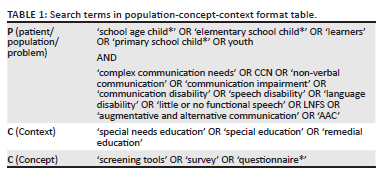
A librarian experienced in systematic review methodology evaluated the search strategy and suggested relevant education, health sciences and humanities databases. A systematic search of nine relevant databases (Academic Search Complete, Health Source: Science/Academic Edition Nursing, Eric EbscoHost, Africa Wide Information, Scopus, PubMed, MEDLINE EbscoHost, CINAHL, APA PsycInfo) was conducted to capture potential articles. This ensured methodological rigour and alignment with the broader landscape of review types, including scoping reviews. Research has shown that involving a librarian in the review process results in more accurate search methods and a higher quality review (Pawliuk et al., 2024). Search terms using keywords were generated through the PCC method, as shown in Table 1. The keywords included Boolean operators AND and OR to link the PCC components in the search, and truncation (*) expanded the search.
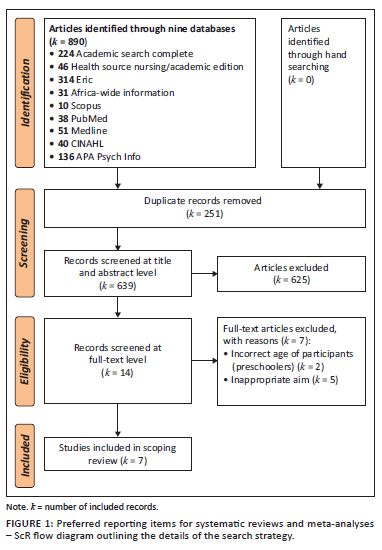
The 890 records identified namely Academic Search Complete (k = 224), Health Source Nursing (k = 46), Eric (k = 314), Africa Wide Web (k = 31), Scopus (k = 10), PubMed (k = 38), MEDLINE (k = 51), CINAHL (k = 40), APA PsycInfo (k = 136). The complete process is shown in Figure 1, using the PRISMA format.
Step 3: Selecting the included studies
The screening process was guided by the following seven eligibility criteria: (1) only studies that reported on children with LNFS between the ages of 5 and 21 years old; (2) conducted in an educational setting; (3) reported on a screening tool or instrument; (4) published between January 1985 and February 2025. The start date was set as 1985, marking the publication of the International Society for AAC's first AAC journal (McNaughton & Light, 2015); (5) reporting on primary data; thus, all scoping or systematic reviews and meta-analyses were excluded; (6) including all study designs to widen the scope as much as possible and (7) because of limitations in time, human and financial resources, only studies published in English were included (Dobrescu et al., 2021).
The 890 records identified included a total of 251 duplicates removed. The remaining 639 records were imported into Rayyan, a digital platform that supports working together on scoping reviews, as Rayyan automates the screening and selection of relevant study processes, thereby saving researchers valuable time (Ouzzani et al., 2016). The use of the Rayyan platform enhanced inter-rater agreement and contributed to a more objective selection of studies (Johnson & Phillips, 2018). The 639 records, uploaded onto Rayyan, were screened on the title and abstract level, of which 625 were excluded for not aligning with the focus of the current scoping review.
The screening at the title and abstract level was performed by two independent reviewers, reaching a 97.9% inter-rater agreement. The 13 records that were in conflict were discussed with a third independent reviewer, with full consensus from all reviewers. The inclusion and exclusion criteria were used to exclude studies at the abstract level.
After screening the 639 records at an abstract level, 14 records remained, of which two reviewers independently read the full texts and evaluated them for eligibility. Seven of the 14 records were excluded after full-text review, mostly as the aim was incorrect (i.e., focusing on comparing learners who use AAC to those who do not). The inter-rater agreement was 100%, which is regarded as a high agreement (Tricco et al., 2016). The results from Step 3, the selection of the included studies, are shown in Figure 1, using the PRISMA-ScR diagram.
Step 4: Charting the data
To ensure consistent and independent data reporting, a data extraction tool was developed. General information was included, such as population, the context and the concept. Similar to the screening, two reviewers independently extracted the data, and any disagreements were resolved through consensus meetings, leading to the data being uploaded to a Microsoft Excel spreadsheet.
Step 5: Collating, summarising and reporting the results
The extracted data were synthesised to address the research question and provide an overview of the breadth of the literature on the topic. The results of the included studies were collated and categorised according to specific topics that emerged during data extraction. As this scoping review included only seven articles, the data are presented qualitatively, using tables to illustrate the key themes and findings, while also alluding to gaps in the existing research, which can guide future studies.
Ethical considerations
An application for full ethical approval was made to the Research Ethics Committee, University of Pretoria, Faculty of Humanities, and ethics consent was received on 17 February 2025. The ethics approval number is 20806762 (HUM019/1024).
Results
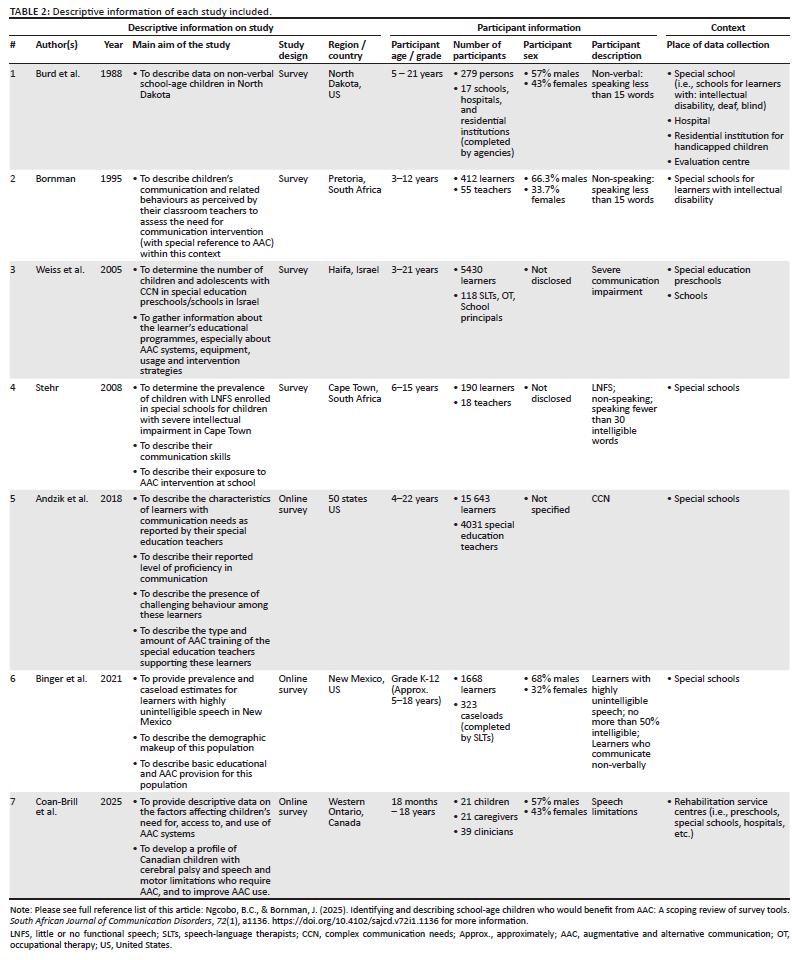
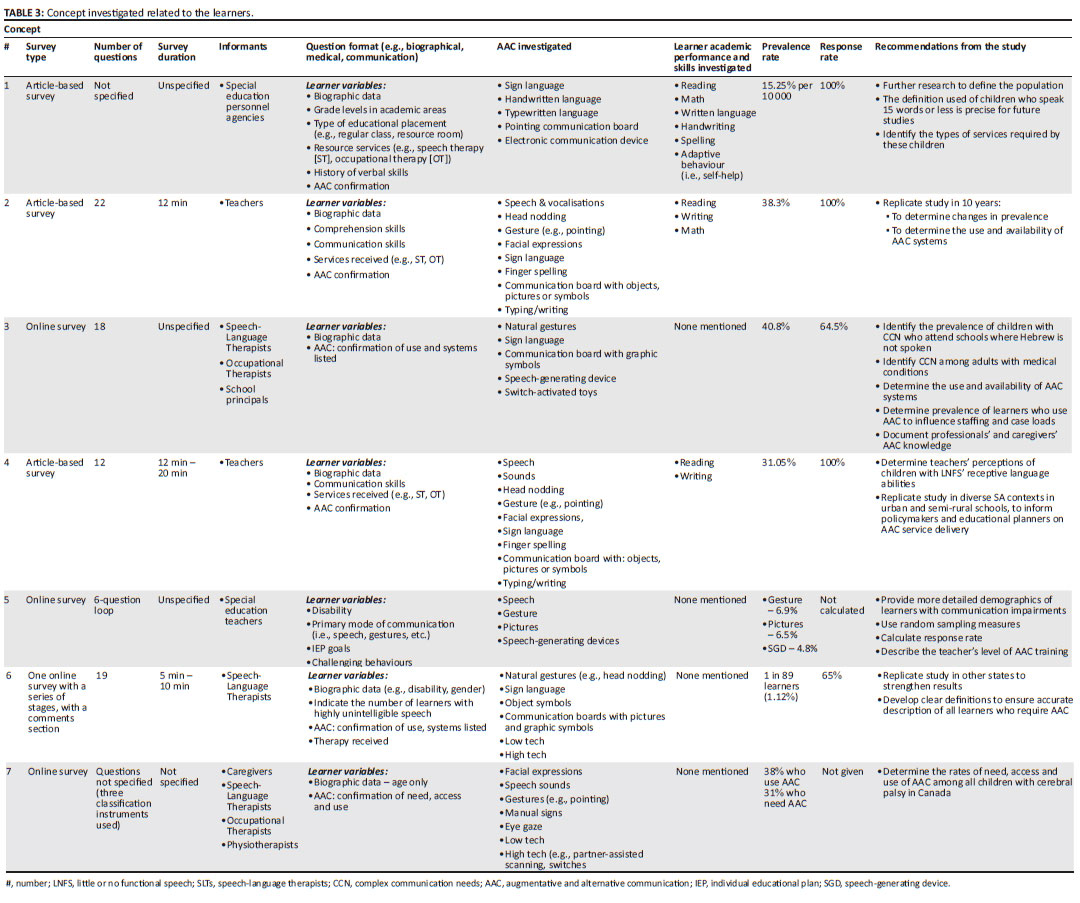
The results of the scoping review are presented as descriptive information related to the seven included studies (e.g., author(s), year of publication, the main aim of the study and the country), the population (e.g., age, number and sex of the participants) and the study context (e.g., participant description and place of data collection) (see Table 2). An analysis of the concept (i.e., the survey instrument) described in the various studies then follows (see Table 3).
Descriptive information on included studies
Despite the importance of descriptive studies and the fact that the number of non-speaking school-age children is unknown, few studies have been undertaken. The descriptive information shown in Table 2 clearly demonstrates that most of the seven included studies were conducted in the United States (US) (#1, #5, #6), with two studies conducted in South Africa (#2, #4), one study each in both Canada (#7) and Israel (#3). One study was conducted in the 1980s (#1), one was conducted in the 1990s (#2), two studies were conducted in the 2000s (#3 and #4), one study was conducted in 2018 (#5) and two studies were conducted between 2021 and 2025 (#6 and #7).
Population
Table 2 shows that in four studies (#1, #2, #6 and #7), more males were reported than females, while the other three studies (#3, #4 and #5) did not report their participants' gender. This study's primary context was LSEN; however, the inclusion criteria allowed for a combination of settings, of which an LSEN school must be part. Having mentioned that, study #7 included children from 18 months old; the children's ages mostly ranged from 3 (#2, #3) to 22 years old (#5). Study #6 described learners according to their grades (K-12), which translates to approximately 5-18 years of age. Table 2 also shows that the sample sizes of the seven included studies ranged considerably, from 21 learners (#7) to 15 643 (#5).
Context
Table 2 shows that learners who could benefit from AAC were described using different terms in the various studies; for example, the term CCN was used in the US study (#5), 'severe communication impairment', was used in the Israeli study (#3) and 'speech limitations' in the Canadian study (#7). Studies #1 and #2 aimed to quantify the number of words that the learners could intelligibly speak, by describing the learners as 'speaking less than 15 intelligible words'. Study #4, from South Africa, used the term LNFS, which was quantified to mean 'less than 30 intelligible spoken words'. Study #5 also attempted to quantify the percentage of words spoken intelligibly as 'less than 50% intelligible words'. All studies collected their data in either special schools (#2, #4, #5, #6) or combined sectors, such as hospitals, preschools, rehabilitation centres and residential homes (#1, #3, #5).
Concept
The review revealed that all studies made use of custom-made surveys. In terms of their distribution and presentation format, three were article-based (#1, #2, #4) and four were online (#3, #5, #6, #7). Table 3 shows that survey completion times ranged from 5 min to 20 min (#6, #2, #4), while studies #1, #3, #5 and #7 did not specify the completion time. One South African study (#2) included the highest number of questions, being 22, closely followed by a US study (#6) with 19 and the Israeli study (#3) with 18. The other South African study (#4) and US study (#5) included 12 and six looped questions, respectively. A combination of informants was noted; three studies used teachers (#2, #4, #5), one study used SLTs only (#6) and two studies used a combination of clinicians (#3, #7). Interestingly, study #3 also used principals, whereas study # 7 also used caregivers as informants. Study #1 used special education personnel agencies only.
A similar pattern was noted regarding the question format of the studies. All studies, excluding studies #5 and #7, presented a similar pattern in terms of investigating the learner variables in terms of the biographic information. Study #5 only wanted the disability label and # 7 only wanted the age. A similar pattern was noted in terms of the response formats. A combination of responses was noted with the survey instruments, such as multiple-choice, rating scales, binary (yes/no) questions and open-ended text fields (#3, #5, #2, #7). The studies also presented a similar pattern in terms of listing the different AAC systems that were considered, including both unaided (e.g., speech sounds and natural gestures) and aided systems (e.g., communication boards with objects and electronic communication devices). The Israeli study (#3) and two US studies (#5, #6) did not include any factors related to school performance or skills of learners, while both South African studies (#2, #4) and one US study (#1) investigated the school performance of learners, skills and functionality.
Five of the seven studies reported a response rate of higher than 60%, while one study (#5) did not calculate the response rate, and another (#7) did not report the response rate. Table 3 also shows the main outcomes in terms of prevalence rates of the different studies. The prevalence rate varied greatly: in the two South African studies (#2, #4) and the Israeli study (#3), a prevalence rate of more than 30% was reported, while the US studies (#1, #6) presented a prevalence rate below 2%. The one US study (#5) and the Canadian study (#7) presented their prevalence in terms of the percentage of AAC used by learners with LNFS.
Future recommendations from studies
All studies presented similar recommendations. Studies #1, #5, #6 and #7 recommended that a robust and unambiguous definition of the AAC user population should be developed, as it is essential to ensure accurate identification and description of individuals who require AAC support. Such clarity would facilitate more precise needs analyses, inform appropriate AAC device provision and support effective allocation of staff and resources, ultimately contributing to more equitable and efficient service delivery. Studies #2, #3 and #4 all recommend that in future studies, AAC service provision, AAC services and AAC use should also be described in greater detail for this population to influence policymakers and educational planners.
Discussion
Speech-language therapists play a vital role in assessing and managing learners with LNFS in special schools (Sharma, 2021). The results from this scoping review highlight the limited availability of instruments that can be used to identify and describe learners with LNFS. Only seven studies were identified, with three originating from the US (#1, #5, #6), two from South Africa (#2, #4) and one each from Israel (#3) and Canada (#7). This scarcity may be because of several factors, including ongoing challenges in clearly defining the population of interest and selecting the most suitable methodologies for data collection. The literature reflects variation in how this population is conceptualised. Some authors focus on providing descriptive accounts (e.g., #3, #5, #7), while others attempt to quantify specific characteristics associated with the group (e.g., #1, #2, #4, #6). For instance, Sutherland et al. (2005) employed the term CCN to characterise the population more broadly. In contrast, South African studies defined participants more specifically by quantifying expressive language abilities, referring to learners as using fewer than 15 intelligible words or fewer than 30 intelligible words (Alant, 1999; Bornman & Alant, 1996). This poses a serious research challenge because of the lack of uniformity in terminology, which could lead to miscommunication, confusion and a misinterpretation of research findings (Smoktunowicz et al., 2020).
In addition to differences in how the population was defined, the studies also varied in the level of biographical detail reported. Some studies did not disclose the gender of participants (Sutherland et al., 2005), while others provided both gender information and male:female ratios (Erickson & Geist, 2016; Lillehaug et al., 2023). Moreover, there was considerable variation in the ages of participants across the included studies. Some studies reported on children as young as 18 months (e.g., #7), while most studies focused on school-aged children, with a few also including individuals up to school-leaving age (e.g., 20 years old). As noted by Heidari and colleagues (2016), researchers who omit detailed biographical information may do so because they do not perceive it as essential to their study objectives. The lack of agreement on biographical characteristics and definitional boundaries across the available studies precludes the possibility of conducting a meaningful comparison across studies. Standardisation in these areas is essential to ensure data compatibility and interpretability across different research contexts.
In addition, the findings also indicate that most of the studies presented a similar pattern in terms of investigating the learner variables when attempting to identify and describe learners who could benefit from AAC. Typically, a list of the different AAC systems, including both unaided and aided systems, was provided (Alant, 1999; Binger & Light, 2006; Erickson & Geist, 2016; Sutherland et al., 2005). No pattern was observed in terms of investigating the school performance of learners, skills and functionality, with some studies including these factors (Alant, 1999), while others did not (Sutherland et al., 2005).
Furthermore, there is no set protocol on who to use as informants for gathering descriptive data. The findings indicate that in high-income countries, the informants included agencies (#7), school principals (#3) and clinicians (SLTs) (#6). In contrast, in the low- and middle-income country (LMIC) included in the study - South Africa - teachers were used as informants (#2, #4). The rationale being that in the absence of SLTs, teachers were deemed well-positioned to identify and describe learners with communication difficulties, as well as describe learners' functional performance.
Linked to the variation in informants is the challenge of determining appropriate data collection settings. In all the studies included in the review, data were collected either in LSEN schools (#2, #3, #4, #5, #6) or across a combination of sectors such as hospitals, preschools, rehabilitation centres and residential homes (#1, #7). These settings may have been selected based on the age range of the children studied. However, collecting data primarily in schools presents a significant limitation, as it may exclude children who are not currently enrolled in educational settings. The reasons for non-enrolment may vary; however, such children could still benefit from AAC interventions (Zhang & Holden, 2025).
Another aspect linked to who provided the information is related to the best method of collecting data. Similar to the findings noted in the review, some of the earlier descriptive studies were article-based (Alant, 1999; Bornman & Alant, 1996; Sutherland et al., 2005), while some of the later studies were online-based (Binger & Light, 2006; Erickson & Geist, 2016). In LMICs, article-based surveys are preferred over online surveys because of various factors such as limited Internet access, digital literacy, population coverage, data collection infrastructure and cultural and social factors.
The findings also indicated a variation in the time needed to complete the surveys. Some studies did not specify the time needed to complete their survey (Sutherland et al., 2005), while others were described as 'short' (e.g., Alant, 1999; Bornman & Alant, 1996). The literature consistently agrees that surveys should be concise; subsequently, lengthy instruments and questions can lead to respondent fatigue and incomplete responses (Ghafourifard, 2024). The findings from this review suggest that there is no set guidance in reporting response rates. Some studies presented a high response rate (#1, #2, #3, #4, #6); in contrast, some did not calculate the response rate (#5), which poses a challenge when wanting to understand the limitations of the given findings (McMillan & Schumacher, 2010).
While some insight into learners with LNFS has been gained, there remains a critical need for more robust and geographically diverse research. A key challenge is the lack of consensus on terminology, which hinders both the identification and description of this population and limits comparability across studies. In addition, decisions regarding which biographical and contextual variables to include, such as age, gender, diagnosis and educational placement, are often inconsistent, limiting the generalisability of findings. Methodological variations further compound these issues, as studies differ in their selection of participants, data collection strategies and the materials used. Establishing greater standardisation in definitions and methodologies would enhance the comparability of research outcomes and ultimately contribute to a more accurate and comprehensive understanding of individuals with LNFS, which could in turn positively impact service delivery.
Limitations
This review yielded valuable information; however, some studies on AAC as a specific intervention for identifying and describing learners with LNFS may have been inadvertently excluded because of the applied framework and eligibility criteria. Furthermore, the search strategy was limited to studies reporting on primary data, a specific time period and the English language.
Recommendations for future studies
There is a need to develop a standardised tool - led or co-developed by SLTs - to accurately identify and describe learners with LNFS, and determine the most appropriate AAC systems that would benefit these learners.
Conclusion
Surveys used to identify and describe learners with LNFS who could benefit from AAC present with little to no uniformity. There is no standard uniformity in terms of the survey structure or even the data to be collected. Surveys are typically custom-designed to align with specific research objectives. However, biographical information and details about AAC systems learners use or require are common elements found across most of these surveys. Given their expertise in communication development and intervention, SLTs play a critical role in both designing and administering these surveys, as well as in interpreting the data to inform individualised AAC recommendations and support strategies.
Acknowledgements
This article is based on research originally conducted as part of Bathobile C. Ngcobo's doctoral thesis titled 'Learners with little or no functional speech requiring augmentative and alternative communication in the KwaZulu-Natal province: A special education school-based prevalence study', submitted to the University of Pretoria. The thesis is currently unpublished and not publicly available. The thesis was supervised by Juan Bornman. The manuscript has been revised and adapted for journal publication. The author confirms that the content has not been previously published or disseminated and complies with ethical standards for original publication. J.B. acknowledges the Division of Speech-Language and Hearing Therapy, Department of Health and Rehabilitation Sciences, Faculty of Medicine and Health Sciences at Stellenbosch University, Cape Town, where she is currently employed.
Competing interests
The authors declare that they have no financial or personal relationships that may have inappropriately influenced them in writing this article.
Authors' contributions
B.C.N. is the primary investigator for this research study. J.B. is the supervisor and co-author of the manuscript submitted. B.C.N. and J.B. contributed to the article, discussed the results and approved the final version for submission and publication.
Funding information
This research received no specific grant from any funding agency in the public, commercial or not-for-profit sectors.
Data availability
The data that support the findings of this study are available from the corresponding author, B.C.N., upon reasonable request.
Disclaimer
The views and opinions expressed in this article are those of the authors and are the product of professional research. They do not necessarily reflect the official policy or position of any affiliated institution, funder, agency or that of the publisher. The authors are responsible for this article's results, findings and content.
References
Alant, E. (1999). Students with little or no functional speech in schools for students with severe mental retardation in South Africa. Augmentative and Alternative Communication, 15(2), 83-94. https://doi.org/10.1080/07434619912331278595 [ Links ]
Alant, E., Bornman, J., & Lloyd, L.L. (2006). Issues in AAC research: How much do we really understand? Disability and Rehabilitation, 28(3), 143-150. https://doi.org/10.1080/09638280500077986 [ Links ]
Almirall, D., DiStefano, C., Chang, Y.-C., Shire, S., Kaiser, A., Lu, X., Nahum-Shani, I., Landa, R., Mathy, P., & Kasari, C. (2016). Longitudinal effects of adaptive interventions with a speech-generating device in minimally verbal children with ASD. Journal of Clinical Child and Adolescent Psychology, 45(4), 442-456. https://doi.org/10.1080/15374416.2016.1138407 [ Links ]
Andersen, G., Mjøen, T.R., & Vik, T. (2010). Prevalence of speech problems and the use of augmentative and alternative communication in children with cerebral palsy: A registry-based study in Norway. Perspectives on Augmentative and Alternative Communication, 19(1), 12-20. https://doi.org/10.1044/aac19.1.12 [ Links ]
Andzik, N.R., Schaefer, J.M., Nichols, R.T., & Chung, Y.C. (2018). National survey describing and quantifying students with communication needs. Developmental Neurorehabilitation, 21(1), 40-47. https://doi.org/10.1080/17518423.2017.1339133 [ Links ]
Archibald, D., Patterson, R., Haraldsdottir, E., Hazelwood, M., Fife, S., & Murray, S.A. (2016). Mapping the progress and impacts of public health approaches to palliative care: A scoping review protocol. BMJ Open, 6(7), e012058. https://doi.org/10.1136/bmjopen-2016-012058 [ Links ]
Arksey, H., & O'Malley, L. (2005). Scoping studies: Towards a methodological framework. International Journal of Social Research Methodology, 8(1), 19-32. https://doi.org/10.1080/1364557032000119616 [ Links ]
Beukelman, D.R., & Light, J.C. (2020). Augmentative and alternative communication: Supporting children and adults with complex communication needs (5th ed.). Paul H. Brookes Publishing Co.
Binger, C., & Light, J. (2006). Demographics of preschoolers who require AAC. Language, Speech, and Hearing Services in Schools, 37(3), 200-208. https://doi.org/10.1044/0161-1461(2006/022) [ Links ]
Binger, C., Renley, N., Babej, E., & Hahs-Vaughn, D. (2021). A survey of school-age children with highly unintelligible speech. Augmentative and Alternative Communication, 37(3), 194-205. https://doi.org/10.1080/07434618.2021.1947370 [ Links ]
Bornman, J. (1995). Non-speaking children in schools for children with mental handicaps in the Pretoria area: A survey of communication and related problems. Unpublished master's thesis. University of Pretoria.
Bornman, J. (2021). Believe that all can achieve: Increasing classroom participation of learners in need of special support (3rd ed.). Van Schaik.
Bornman, J., & Alant, E. (1996). Nonspeaking children in schools for children with severe mental disabilities in the greater Pretoria area: Implications for speech-language therapists. South African Journal of Communication Disorders, 43(1), 53-61. https://doi.org/10.4102/sajcd.v43i1.239 [ Links ]
Burd, L., Hammes, K., Bornhoeft, D.M., & Fisher, W. (1988). A North Dakota prevalence study of nonverbal school-age children. Language, Speech, and Hearing Services in Schools, 19(4), 371-383. https://doi.org/10.1044/0161-1461.1904.371 [ Links ]
Cantwell, D.P., & Baker, L. (1985). Speech and language: Development and disorders. In M. Rutter & L. Hersov (Eds.), Child and adolescent psychiatry: Modern approaches (2nd ed., pp. 526-544). Blackwell Scientific.
Coan-Brill, J., Costigan, F.A., Kay, J., Stadskleiv, K., Batorowicz, B., Chau, T., Geytenbeek, J., Grahovac, D., Hopmans, S., & Cunningham, B.J. (2025). Developing a profile of Canadian children with cerebral palsy who require augmentative and alternative communication. American Journal of Speech-Language Pathology, 34(2), 605-616. https://doi.org/10.1044/2024_AJSLP-24-00284 [ Links ]
CommunicationFirst. (2023). The words we use: Communication First's style guide. Retrieved from https://communicationfirst.org
Constitution of the Republic of South Africa. (1996). Bill of rights. Pretoria: Government Printers. [ Links ]
Department of Basic Education (DBE). (2011). SC006: Dictionary of concepts and terms. Government Printers.
Department of Education (DoE). (2001). Education White Paper 6 on special needs education: Building an inclusive education and training system. Government Printers.
Dobrescu, I., Nussbaumer-Streit, B., Klerings, I., Wagner, G., Persad, E., Sommer, I., Herkner, H., & Gartlehner, G. (2021). Restricting evidence syntheses of interventions to English-language publications is a viable methodological shortcut for most medical topics: A systematic review. Journal of Clinical Epidemiology, 137, 209-217. https://doi.org/10.1016/j.jclinepi.2021.04.012 [ Links ]
Erickson, K.A., & Geist, L.A. (2016). The profiles of students with significant cognitive disabilities and complex communication needs. Augmentative and Alternative Communication, 32(3), 187-197. https://doi.org/10.1080/07434618.2016.1213312 [ Links ]
Franco, J.H., Davis, B.L., & Davis, J.L. (2013). Increasing social interaction using prelinguistic milieu teaching with nonverbal school-age children with autism. American Journal of Speech-Language Pathology, 22(3), 489-502. https://doi.org/10.1044/1058-0360(2012/10-0103) [ Links ]
Ghafourifard, M. (2024). Survey fatigue in questionnaire-based research: The issues and solutions. Journal of Caring Sciences, 13(4), 214-215. https://doi.org/10.34172/jcs.33287 [ Links ]
Glennen, S., & DeCoste, D.C. (1997). The handbook of augmentative and alternative communication. Singular Publishing Group.
Heidari, S., Babor, T.F., De Castro, P., Tort, S., & Curno, M. (2016). Sex and gender equity in research: Rationale for the SAGER guidelines and recommended use. Research Integrity and Peer Review, 1, 1-9. https://doi.org/10.1186/s41073-016-0007-6 [ Links ]
Hingtgen, J.N., & Churchill, D.W. (1969). Identification of perceptual limitations in mute autistic children: Identification by the use of behaviour modification. Archives of General Psychiatry, 21(1), 68-71. https://doi.org/10.1001/archpsyc.1969.01740190070009 [ Links ]
Johnson, N., & Phillips, M. (2018). Rayyan for systematic reviews. Journal of Electronic Resources Librarianship, 30(1), 46-48. https://doi.org/10.1080/1941126X.2018.1444339 [ Links ]
Kazi, M.R., Chowdhury, N., Chowdhury, M., & Turin, T.C. (2021). Conducting comprehensive scoping reviews to systematically capture the landscape of a subject matter. Population Medicine, 3, 1-9. https://doi.org/10.18332/popmed/143831 [ Links ]
Koegel, L.K., Bryan, K.M., Su, P.L., Vaidya, M., & Camarata, S. (2020). Definitions of nonverbal and minimally verbal in research for autism: A systematic review of the literature. Journal of Autism and Developmental Disorders, 50(8), 2957-2972. https://doi.org/10.1007/s10803-020-04402-w [ Links ]
Lillehaug, H.A., Klevberg, G.L., & Stadskleiv, K. (2023). Provision of augmentative and alternative communication interventions to Norwegian preschool children with cerebral palsy: Are the right children receiving interventions? Augmentative and Alternative Communication, 39(4), 219-229. https://doi.org/10.1080/07434618.2023.2212068 [ Links ]
McMillan, J.H., & Schumacher, S. (2010). Research in education: Evidence-based inquiry (7th ed., international ed.). Pearson Education.
McNaughton, D., & Light, J. (2015). What we write about when we write about AAC: The past 30 years of research and future directions. Augmentative and Alternative Communication, 31(4), 261-270. https://doi.org/10.3109/07434618.2015.1099736 [ Links ]
Mophosho, M., & Masuku, K. (2021). The uses of augmentative and alternative communication technology in empowering learners overcome communication barriers to learning. In M. Maguvhe, R.S. Mphahlele, & S. Moonsamy (Eds.), Empowering students and maximising inclusiveness and equality through ICT (pp. 203-222). Brill.
Ngcobo, B.C., & Bornman, J. (2024). Augmentative and alternative communication training: The effect on perceptions of special schoolteachers. South African Journal of Education, 44(3), Art. #2467. https://doi.org/10.15700/saje.v44n3a2467 [ Links ]
Ouzzani, M., Hammady, H., Fedorowicz, Z., & Elmagarmid, A. (2016). Rayyan - A web and mobile app for systematic reviews. Systematic Reviews, 5, 210. https://doi.org/10.1186/s13643-016-0384-4 [ Links ]
Pascoe, M., Maphalala, Z., Ebrahim, A., Hime, D., Mdladla, B., Mohamed, N., & Skinner, M. (2010). Children with speech difficulties: A survey of clinical practice in the Western Cape. South African Journal of Communication Disorders, 57(1), 66. https://doi.org/10.4102/sajcd.v57i1.51 [ Links ]
Pawliuk, C., Cheng, S., Zheng, A., & Siden, H. (2024). Librarian involvement in systematic reviews was associated with higher quality of reported search methods: A cross-sectional survey. Journal of Clinical Epidemiology, 166, 111237. https://doi.org/10.1016/j.jclinepi.2023.111237 [ Links ]
Peters, M.D.J., Marnie, C., Colquhoun, H., Garritty, C.M., Hempel, S., Horsley, T., Langlois, E.V., Lillie, E., O'Brien, K.K., Tunçalp, Ö., Wilson, M.G., Zarin, W., & Tricco, A.C. (2021). Scoping reviews: Reinforcing and advancing the methodology and application. Systematic Reviews, 10(1), 263. https://doi.org/10.1186/s13643-021-01821-3 [ Links ]
Peters, M.D.J., Marnie, C., Tricco, A.C., Pollock, D., Munn, Z., Alexander, L., McInerney, P., Godfrey, C.M., & Khalil, H. (2020). Updated methodological guidance for the conduct of scoping reviews. JBI Evidence Synthesis, 18(10), 2119-2126. https://doi.org/10.11124/JBIES-20-00167 [ Links ]
Sharma, A. (2021). The role of speech-language pathologists in special education. Global International Research Thoughts, 9(1), 15-20. Retrieved from https://girt.shodhsagar.com/index.php/j/article/view/44 [ Links ]
Stehr, D. (2008). A descriptive survey of children with little or no functional speech in special schools in Cape Town. Unpublished master's mini-dissertation. University of Pretoria. [ Links ]
Stephenson, C.F., Serry, T.A., & Snow, P.C. (2024). Teachers' perspectives on the role and scope of practice of speech-language pathologists working to support literacy in the early years of school. International Journal of Speech-Language Pathology, 26(5), 623-636. https://doi.org/10.1080/17549507.2023.2250934 [ Links ]
Sutherland, D.E., Gillon, G.G., & Yoder, D.E. (2005). AAC use and service provision: A survey of New Zealand speech-language therapists. Augmentative and Alternative Communication, 21(4), 295-307. https://doi.org/10.1080/07434610500103483 [ Links ]
Tricco, A.C., Lillie, E., Zarin, W., O'Brien, K., Colquhoun, H., Kastner, M., Levac, D., Ng, C., Sharpe, J.P., & Wilson, K. (2016). A scoping review on the conduct and reporting of scoping reviews. BMC Medical Research Methodology, 16, 15, 1-10. https://doi.org/10.1186/s12874-016-0116-4 [ Links ]
United Nations. (2006). Conventions on the rights of persons with disabilities (CRPD). Retrieved from https://www.un.org/disabilities/documents/convention/convoptprot-e.pdf
Wendelken, M.E., & Williams, D.L. (2023). Is research on augmentative and alternative communication intervention with children with autism spectrum disorder reflected in the clinical practice of speech-language pathologists? Perspectives of the ASHA Special Interest Groups, 8(6), 1432-1455. https://doi.org/10.1044/2023_PERSP-23-00022 [ Links ]
Weiss, P.L., Seligman-Wine, J., Lebel, T., Arzi, N., & Yalon-Chamovitz, S. (2005). A demographic survey of children and adolescents with complex communication needs in Israel. Augmentative and Alternative Communication, 21(1), 56-66. https://doi.org/10.1080/07434610412331272910 [ Links ]
Zhang, H., & Holden, S.T. (2025). Disability types and children's schooling in Africa. International Journal of Disability, Development and Education, 72(4), 763-783. https://doi.org/10.1080/1034912X.2024.2355621 [ Links ]
 Correspondence:
Bathobile Ngcobo
mrsbngcobo@gmail.com
Received: 26 June 2025
Accepted: 08 Sept. 2025
Published: 25 Oct. 2025