



Services on Demand
Journal

Article
 English (pdf)
 Article in xml format
 Article references

 Automatic translation
 Send this article by e-mail
Indicators
Related links
-
 Cited by Google
-
 Similars in Google
Share

 Permalink

South African Journal of Libraries and Information Science
On-line version ISSN 2304-8263Print version ISSN 0256-8861
SAJLIS vol.91 n.1 Pretoria 2025
https://doi.org/10.7553/91-1-2484
RESEARCH ARTICLES
Status of information literacy skills offered by secondary school libraries to students in urban and rural environments in Kenya
John IreriI; Dennis OchollaII
ILecturer at the Chuka University, Kenya and Department of Information Studies, University of Zululand, South Africa Jmwaura@chuka.ac.ke ORCID: 0000-0001-8871-6772
IIResearch Fellow in the Department of Information Studies, University of Zululand, South Africa Ochollad@unizulu.ac.za ORCID: 0000-0003-3860-1736
ABSTRACT
Information literacy skills for lifelong learning are essential to secondary school students. However, many secondary schools' students have little or no basic knowledge about how to access and succeed in obtaining information. This study investigated the status of school libraries' information literacy (IL) skills for secondary school students in Nairobi (urban) and Tharaka Nithi (rural) counties of Kenya. The study population consisted of Nairobi (urban) and Tharaka Nithi (rural) counties' secondary schools of Kenya. Principals, librarians, and students were targeted in the sampled secondary schools. Both quantitative and qualitative sampling techniques were applied. The sample size consisted of 382 students, 30 secondary schools: 20 in Nairobi and 10 in Tharaka Nithi. Findings revealed insignificant IL disparities between urban and rural schools. There was lack of awareness of whether the libraries were on par. Library orientation user education and IL were the most available library programmes. The most common user interface was the human interface/librarians. More computers, internet connectivity, current information resources, unrestricted library access time/hours, more space, professional librarians, improved reading culture, and improved security of library materials are needed. The study has implications for school library IL development in Kenya and elsewhere with similar school library environment.
Keywords: information literacy, school libraries, skills, Kenya, rural schools, urban schools
1 Introduction
Information literacy (IL) has potential as an instructive tool in education, making it essential that teachers and students/learners are sensitised to its value in lifelong learning. McKeever, Bates and Reilly (2017:2) recommend that students should develop IL skills in schools to be responsible users of information as the future skilled workforce. Foo et al. (2014:4) agree that being information literate will equip them to effectively filter through available information to identify appropriate and trustworthy information, which they obtain via the internet, newspapers, television, other sources, and acquaintances for school assignments.
It is pertinent that governments incorporate IL knowledge into academic programmes to ensure that citizens are productive and equipped to function smartly and globally in the 21st century (Rodney-Wellington 2014:5). Information literate students are independent, bold in solving problems, knowledgeable on the significance of information, manage IT information retrieval tools, and effective communicators (Malliari et al. 2014:77).
Studies have shown that, for various reasons, many new secondary schools' students have very little or no basic knowledge about library use, computer literacy and information-searching skills after enrolling at universities or other higher institutions. This can be attributed to students obtaining education in information-poor environments characterised by poor learning facilities like the absence of a library, poorly equipped school library, lack of computers in schools, and failure to recognise the school library (where in existence) as a learning resource. In this information technology age, if properly equipped Kenyan secondary school libraries will assist students to develop IL skills.
The Republic of Kenya lies on the East Coast of Africa (Nuffic, 2015:3) and consists of 47 counties. The education system (Figure 1.1) is run by the Ministry of Education and the Ministry of Higher Education, Science and Technology, which oversee distribution of learning materials and implementation educational policies. Kenya has more than 3 500 secondary schools, with some 700 000 pupils. Secondary education takes four years, after which students take examinations administered by the KNEC to obtain the Kenya Certificate of Secondary Education (Nuffic, 2015:6). The examination is used for admission to universities and training at other higher education institutions in the technical and vocational stream/tracks.
Kenya transitioned from the 8-4-4 system to the Competency-Based Curriculum (CBC), which focuses on developing learners' competencies, skills, and talents (Muchira et al., 2023:2). The CBC emphasises holistic development, critical thinking, creativity, and problem-solving. Efforts have been directed towards curriculum development, teacher training, resource provision, assessment reform, and stakeholder engagement (Amutabi, 2021:15). According to Mohamed and Karuku (2017:2), learning resources and materials are being developed and distributed to support CBC implementation. Assessment methods prioritise formative evaluation and continuous assessment of learners' competencies through diverse means such as portfolios and projects (Sifuna & Obonyo, 2019:2).
The Kenyan secondary school curriculum does not provide for IL teaching; hence, students join universities with limited or no skills to search for and find information (Dadzie, 2007:268; Jiyane & Onyancha, 2010:13; Amunga, 2011:4). According to Mutungi (2012:155), nothing has been done for students' IL skills in Kenya, and not much has been written on school libraries in Kenya. This explains why there is little progress in establishing the role of libraries in Kenyan schools. Kinya (2013:11) laments that only 5% of the existing 3 500 secondary schools have trained library professionals, as those who worked as librarians were teachers. There is no clear government policy, no modern technology (Nyagowa, Ocholla & Mutula, 2013a:12; 2013b:3), and no financial support for school libraries. This study filled this gap (Ireri, Evans & Ocholla, 2022:43; Ireri 2025).
This study filled a noticeable gap in school libraries' IL skills while recognising that such skills are essential to secondary school students in general, and in the under-resourced developing countries such as Kenya, in particular. The study was informed by the Big6 model (Odede, 2020; Ireri 2024b). Ireri (2024a) provides a deeper insight into this subject; therefore, this study did not include an IL literature review.
2 Purpose of the study
The study aimed to establish the status of schools' IL for the secondary students in the two counties. Since IL is best taught to students in appropriately equipped secondary school libraries, the study focused on the libraries and IL, as shown by the following study objectives:
• Establish the available information literacy programmes in school libraries of Nairobi and Tharaka Nithi counties.
• Determine the factors that can influence students' information literacy in the school libraries of Nairobi and Tharaka Nithi counties.
• Establish the information-seeking strategies of students in Nairobi and Tharaka Nithi counties' secondary schools.
• Establish the challenges students face in the use of school libraries of Nairobi and Tharaka Nithi counties.
• Develop an IL model to support IL development in secondary school libraries in Kenya counties.
3 Methodology
The study was informed by the pragmatism paradigm, mixed methods approach, through survey and concurrent research design discussed extensively in related studies (Creswell 2021; Creswell & Plano Clark, 2017; Ngulube, 2021). It focused largely on the quantitative aspects of the methodology in this article. The study population was derived from Nairobi and Tharaka Nithi counties of Kenya, representing both urban and rural secondary schools.
Nairobi County has 200 secondary schools and Tharaka Nithi County has 104 (Advance-Africa.Com, 2019). Therefore, the total number of schools from the two counties was 304 (Kenya Secondary Education, 2019), with an average of 200 students in one secondary school in Kenya, thus an approximate population of 60 800 students in total. To determine the sample size, Raosoft Online Sample Size Calculator was used with a margin of error of 5%, confidence level of 95%, and a population probability of 50, rendering a sample size of 382 for this study.
The sample size for each of the two counties was determined from the ratio of schools in Nairobi and Tharaka Nithi counties (200: 104=2:1). Using this ratio and the total sample size of 382, the sample size for Nairobi and Tharaka Nithi was 255 and 127 students, respectively. Systematic sampling was used in a sampling interval of each fifth to get 20 secondary schools from Nairobi County and 10 from Tharaka Nithi County.
The number of students and their distribution in schools for each county was determined by dividing the number of students to be sampled by the number of schools. Therefore, in Nairobi County: 255/20=12.75, approximately 13 students per school and in Tharaka Nithi: 127/10=12.7 approximately 13 students per school.
To distribute the students in each school, stratified and random sampling was done used. Thus, each school had four strata that comprised the four levels of secondary school classes. These levels are commonly referred to as Forms in Kenya; therefore, Form 1, Form 2, Form 3, and Form 4. In each school a stratum (Form) received 13 divided by four, giving three questionnaires, with one remaining. From the four strata, there were a total of 12 questionnaires distributed in a random manner. Random distribution was done by writing student serial numbers, as they appeared in the class registers on small pieces of paper and randomly picking any three. Twelve students completed questionnaires. The balance of one to make 13 students was distributed purposively to the chairperson/person of students' body, who by virtue of this position, was better informed than the rest of the students. In a situation where a secondary school had a Form with more than one class, random sampling was used to pick the class to use. The interview (qualitative) results are not fully reported in this paper due to space limitations.
Data was collected using questionnaires given to the students and semi-structured interviews with the selected school principals and school librarians. The respondents' data was then fed into the Statistical Package for the Social Sciences (SPSS) version 25.0. Both descriptive statistics such as frequencies, percentages, and inferential statistics such as Pearson correlation were applied.
4 Findings and discussions
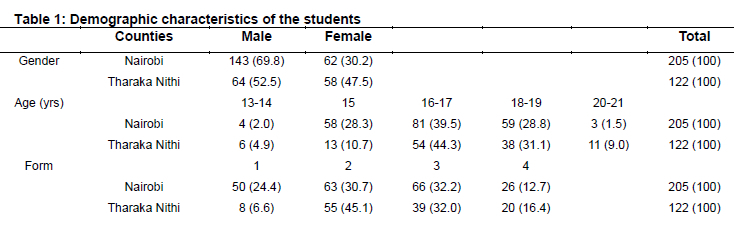
The findings are discussed in sections 4.1 to 4.5. The respondent's demographic profile is summarised in Table 1.
4.1 Information literacy programmes in school libraries in the two counties
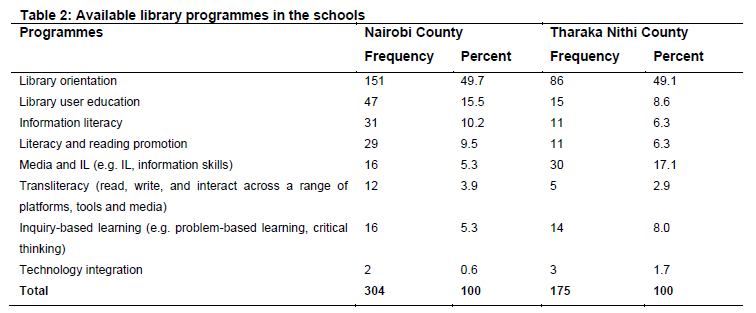
Library programmes refer to the activities and events conducted by the library to promote and support its products and services on regular basis. Among those referred to in this study are library orientation, library user education, IL, literacy and reading promotion, media and information literacy (e.g. IL, information skills), transliteracy (read, write, and interact across a range of platforms, tools, and media), inquiry-based learning (e.g. problem-based learning, critical thinking), and technology integration and IL programmes.
Results of the analysis on the available library programmes in schools as shown in Table 2 revealed that students in both Nairobi County (151; 49.7%) and Tharaka Nithi County (86; 49.1%) agreed that library orientation was the most available programme in the schools. The principals and librarians also confirmed that library orientation took place upon admission of Form One/Grade Nine, and whenever a new student joined the schools. Studies showed that library orientation is a significant programme in the school libraries in both secondary schools and higher institutions of learning. According to Brown (2017:3), library orientation presents an opportunity for new students in the schools to engage with the available materials in the libraries. Regular library orientation is a motivating factor for students' use of library materials and resources (Opara et al., 2018:73) and an opportunity through which libraries advertise their services and resources to the students and probable users of the libraries (Suleiman, 2012:3). Trained and skilled librarians play a critical role in user orientation and reduce the time spent on searching needed information. User orientation programmes can be provided by skilled librarians through library services, which should be in pace with the needs of students (Owusu et al., 2014:134).
Results further indicated that library user education (47; 15.5%) and IL (31; 10.2%) were available library programmes known by more students in Nairobi than Tharaka Nithi. Due to many factors such as resource support, library programmes differed in the two counties. Being rural, Tharaka Nithi has fewer professional librarians than Nairobi. In fact, several schools did not have a trained and professional librarian; the management of the libraries was done by a language teacher. Uwakwe et al. (2016:3) found that the rate at which students use the library is determined by the quality of user education. Furthermore, overpopulation of students in the libraries, inadequate or no infrastructure, insufficient and untrained personnel, limited resources, allocation of restricted time to the programme, limited library space and a library environment that is not conducive to learning are some of the challenges hindering effective user education (Uwakwe et al., 2016:11).
Most students in Nairobi and Tharaka Nithi counties were non-committal/neutral on the indicators of the library programmes in schools. According to IFLA (2015:7), the instructional work of school librarians involves developing programmes like literacy and reading promotion, media and IL instruction, supporting and guiding inquiry-based learning, integration of technology to teaching and learning, besides having an active function in the professional development of teachers.
4.2 Factors influencing students' information literacy in school libraries of the two counties
Most students in Nairobi (122: 59.5%) and Tharaka Nithi (78: 63.9%) admitted that the libraries were well equipped with the required resources for information seeking. This was confirmed through observation during data collection. Studies concur that school libraries should be well equipped since they are usually considered important for educational, social, and national advancement (Ladele et al., 2022:52). According to Olaojo (2013:8), sufficient library materials have an efficient function in Nigerian secondary education. Moreover, a school library is an instrument of people's expertise and proficiencies which are kept in valuable formats to help the learning of the academic society (Ladele et al., 2022:52).
According to Mubasrah et al. (2013:20), many researchers agree that libraries in most learning institutions have no or few trained professional employees and resources to support learning by the students. The authors opine that library resources in terms of human resources, relating to their credentials and proficiencies, physical materials available, library space, chairs, and tables, are significant in doing assignments and carrying out research work by students. The Big6 model advises that for information to be useful, location and access are important. The students must find information resources like textbooks, magazines and reference materials, yet information in each source must be easy to locate and access using library personnel, catalogues, or other resource-specific tools.
According to the results, most (143: 69.8% and 86: 70.5%) students in both Nairobi and Tharaka Nithi admitted the available resources in the libraries were easily accessible. For effective learning to take place, the necessary library information materials and resources should be available and accessible. This means that librarians bear the responsibility of providing the right information to the students when required. The more accessible the sources are, the less effort is needed to access them. According to Ezeala and Yusuff (2011:3), there should be enough storage space for collections and strategies enhancing the accessibility of the materials via classification, cataloguing, and other organisation should be in place, due to the positive relationship between efficient and effective provision of library materials and students' academic achievement.
These counties mostly agreed on what needed to be done to encourage students to use the libraries. For example, adding more books (Nairobi = 86: 27.7% and Tharaka Nithi = 37: 28.5%), having computers in the library (Nairobi = 59; 19.0% and Tharaka Nithi = 12; 9.2%), and increasing library space (Nairobi = 54; 17.4% and Tharaka Nithi = 16; 12.3%) topped the list. Wood et al. (2020:1) state that students with access to well-equipped libraries with enough books well-matched to their interests used the libraries frequently, indicating that well-equipped libraries encourage or conversely discourage the use of libraries. According to Abanobi (2012:5), the absence of novel and up-to-date books and availability of space and other materials affect the students' IL and therefore present a challenge to the school libraries. The current state of development of school libraries is a direct consequence of a government intervention level, and particularly, financial aid that can explain the non-functionality of some libraries and limited library stock resulting in the ineffective use of the libraries by students. (Moruf, 2015:65). This supports this study's results that more government support is required.
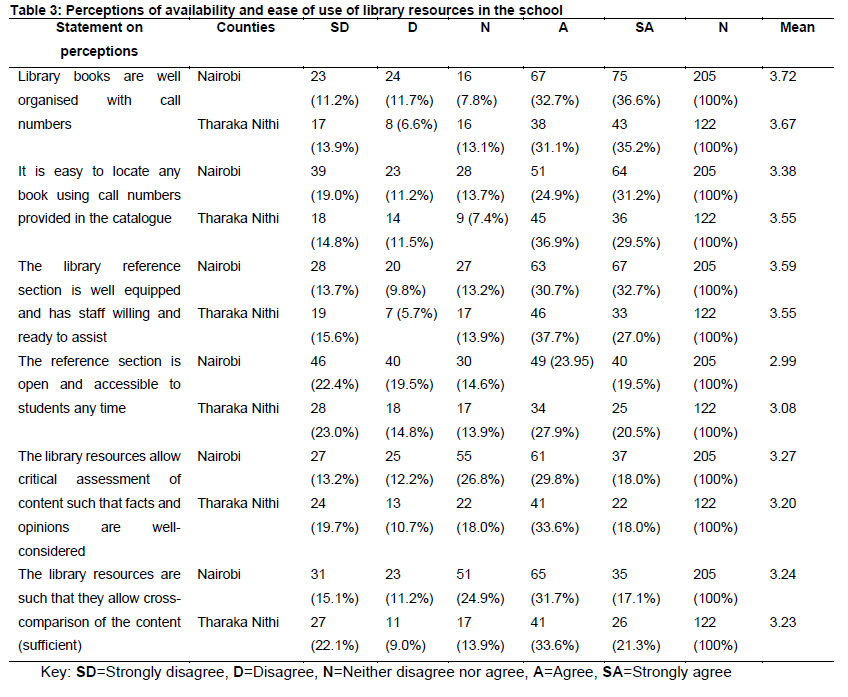
nformation on indicators of the availability and ease of use of library resources in the schools revealed that most students in Nairobi and Tharaka Nithi agreed on the indicators of availability and ease of use of library resources in the schools (Table 3).
Henderson et al. (2017:14) caution that when the students cannot locate important resources and library materials during searches, they are left stranded and confused, contributing to wrong attitudes regarding library databases. Additionally, there is a need for fast internet connectivity in the libraries, as slow internet connectivity discourages students from using important online resources and materials in the libraries (Bagarukayo & Kalema, 2015:7).
4.3 Information-seeking strategies of students in the two counties
Most students used the limited library personnel to get information (45.9% in Nairobi and 46.7% in Tharaka Nithi), as also confirmed by the principals and librarians from both counties. Librarians and information science professionals play a key role in promoting IL in the community. According to IFLA/UNESCO (1999:17), librarians play a critical role in supporting the use of books and other information materials, which range from fictional to documentary, print to electronic, both on-site and remote in the libraries. Benard and Dulle (2014:16) argue that the quality of library services depends on the professional quality of its employees (librarian and library staff), which depends on the quality and applicability of the training that they have. Operating a library with unprofessional librarian and library employees is like teaching with an unprofessional background. Montiel-Overall and Grimes (2013:21) suggest that library personnel actively contribute to awareness, understanding, and abilities of students in information use, management, and critical work. Library personnel can work in partnership with teachers to improve overall engagement of the students with the learning institutions.
A library catalogue was second most used after library personnel, with 31.8% and 35.0% of the students from Nairobi and Tharaka Nithi, respectively. None of the principals or librarians in the secondary schools mentioned the use of catalogues as a strategy for seeking information from the libraries, which physical observation confirmed. A study carried out by Ebiwolate (2010:6) and Maidul (2010:15) on the use of library catalogues by university students in Nigeria and Bangladesh showed that fewer than 10% used a catalogue to access library resources and materials, citing lack of proper user education and lack of the necessary skills. However, searching skills should begin in schools. Montiel-Overall and Grimes (2013:9) argue that training students on the use of catalogues, allowing them to access databases and search the library catalogues at any time or place, encourages students to access library resources.
The Big6 model reveals that students are required to first find all probable sources of available information and then do an evaluation of every source to establish which ones are best for them to use. This means the students must have information-seeking skills to ensure they can retrieve sources for evaluation to be possible (Iriani & Wicaksono, 2021:2). Further, students should find personal resources like books and reference materials and retrieve information these sources using indexes, catalogues, and other resource-specific tools. According to Fordjour et al. (2011:137), students have challenges in finding documents and deciding on the information to read or selecting a database to search and devise a search strategy. Furthermore, students with the ability to retrieve information end up getting more information that may not be useful to what they need; sometimes, they cannot find the information they need. This is due to the intricacy and struggle users experience in presenting their information needs.
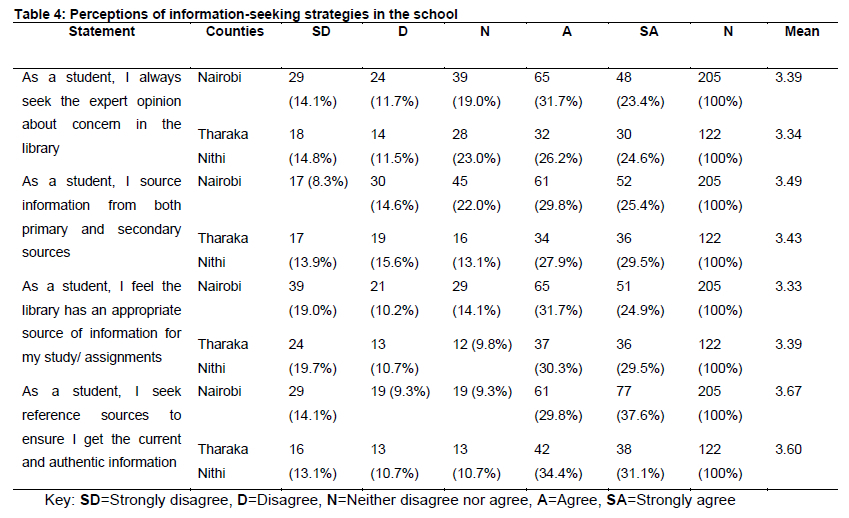
Information on indicators of information-seeking strategies in the schools indicated that most students in Nairobi and Tharaka Nithi were neutral on the indicators of information-seeking strategies in the schools (Table 4).
This was supported by the principals and librarians who acknowledged that the use of library personnel and browsing the shelves were the chief information-seeking strategies in secondary schools.
According to a study carried out by Soria et al. (2013:2), effective and successful services in any library are only possible if there is proper shelving of the available resources and materials. Proper shelving plays a critical role in ensuring efficiency and effectiveness in delivering services. This includes the way library resources and materials are organised and structured such that each resource and material is adequately identified and appropriately located, thereby bringing order to the available resources and materials, making their use easier and getting the best out of the worth that is obtained from the services in the library.
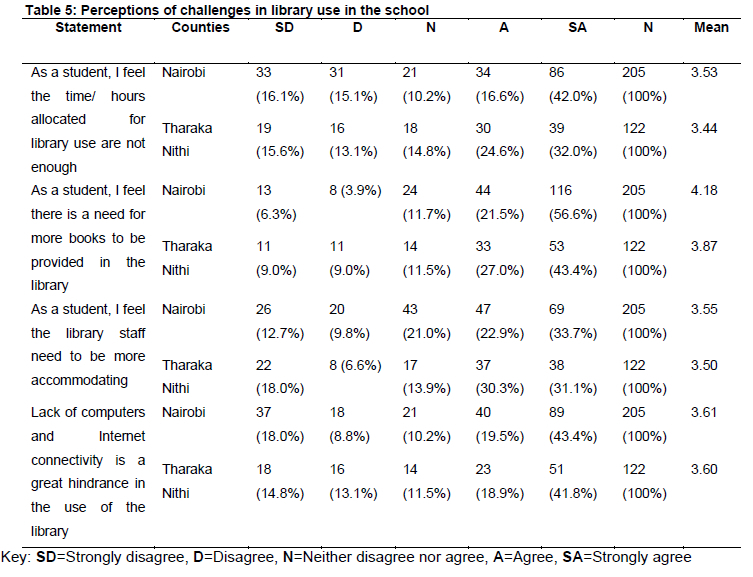
The students had to indicate whether the librarian was willing and ready to assist whenever needed. The results are given in Table 5. According to the results, most (165: 80.5 and 96: 78.7%) students in both Nairobi and Tharaka Nithi conceded the librarian was willing and ready to assist whenever needed. Abanobi (2012:7) states the attitude of the library staff or the librarian posed a challenge to students' use of school libraries. Regular interactions with students, willingness to assist, and friendly disposition to students were identified as issues affecting students' visits to the libraries. They therefore need to be adopted by library employees to improve visits to the libraries by the students (Opara et al., 2018:80).
4.4 Challenges faced by students in using school libraries in the counties
Students mentioned many challenges. For instance, 85.9% of the students in Nairobi and 90.8% of the students in Tharaka Nithi experienced some challenges. The key challenge mentioned in both counties was restricted library hours. In some of the studied schools, there was no standard time when libraries were opened and, in some, especially day schools, the libraries were open for very short periods, which meant that students did not have sufficient time to visit/use the libraries. In some schools, restricted library hours were aggravated by the lack of professional librarians or library employees that would have the responsibility of managing the school libraries.
Other similar challenges students in both counties highlighted were lack of computers and internet connectivity, restricted numbers of books and poor library accommodation by staff. According to Sahabi et al. (2021:152), having limited computers and ICT infrastructure to accommodate as many students as available, and having the will to use the electronic information resources in the library were challenges affecting selected tertiary institutions in Northwest Nigeria.
Common challenges highlighted by principals and librarians in both counties were few books in the library, limited space, unprofessional librarians, poor reading culture of students, lack of internet connectivity, and theft of library materials. Similar problems were highlighted by students. The results of this study are echoed by several scholars. Moin et al.'s (2022:698) and Nagasawa's (2022:17) studies found that the shortage of trained library professionals, absence of commitment among librarians, limited training opportunities for the librarians, and lack of interest from those who use the library, were the challenges and barriers that affected library instruction programmes.
Similarly, Arua (2011:8) observed that meagre library accommodation/space, meagre library orientation, and limited library hours were challenges hindering the use of school libraries. Also, insufficient school library information materials, computer theft caused by insecurity in the libraries, and lack of comprehension by teachers on the function of library in teaching and learning were challenges of using the libraries in South Africa. Okeuhie et al. (2015:18) found unavailability of resources and materials in the libraries a challenge. A study by Laddunuri (2012:17) in Tanzania noted that school libraries lacked sufficient funding from government and stakeholders, physical facilities like chairs and shelves, professional librarians and adequate library services, which resulted in poor performance of secondary schools. Further, secondary schools need to make sure that the services in the library are most favourable for the students. These are achievable by comprehending the attitudes and requirements of students about the library (Okeuhie et al., 2021:496).
In West Africa, for example, Arua (2011:17) found that most libraries did not have professional librarians to give effective service to users. Absence of internet connectivity in libraries was a challenge (Okoye, 2013:12), as well as ow strength or total absence of internet connectivity and inability to retrieve textbooks (Kwabena et al., 2021:28). According to Fordjour et al. (2011:142), teachers and librarians act as facilitators in the identification of information requirements, accessibility and assessing information and challenges in the accessibility of the information to enhance maximum literacy actions in schools via cooperation between the teachers and librarians, teachers, and students. There is thus a need for every element to work together to achieve the target of increasing IL in the schools. The Big6 model reveals synthesis of information obtained, evaluation of results and process of obtaining information as important steps in creating a product and formulation of an answer to the research questions the students had during task definition. This is a big challenge for the students in the school libraries studied.
5 Discussions and conclusions
The study observed that more students from Nairobi used the library than in Tharaka Nithi. Nearly half of the students indicated that the library was up to the required standard. However, how they understand or determine good standard without comparison with better libraries is unsure. The nature of library standards in schools is a factor that either encouraged or discouraged the students to visit the libraries.
Unawareness of librarians' professional skills and misconceptions about their willingness and readiness to help obtain the right information and the required resources could contribute to students not using libraries. Students may also assume that the resources in the libraries are not helpful for their assignments, especially if they are supplied with adequate textbooks in the classes and information-intensive tasks. Library orientation was the most available programme in schools in both counties and is carried out to teach students how to use library services and materials available and effectively facilitate use of the resources on their academic journey. Study findings revealed that most students use library personnel to locate and retrieve library information which increases dependency and inhibits self-learningThose who access and use the available libraries were comfortable with the way they used the library materials and services as they noted the library was well equipped with the required materials and resources, and that the library was a quiet place for effective studying.
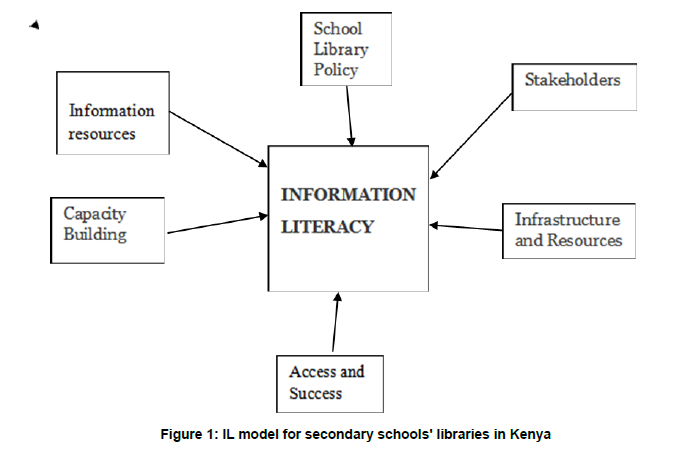
However, these results were accompanied by restricted library hours, lack of computers, and poor or non-existent internet connectivity as the key challenges.The study recommends formulation of school library policy, capacity building, infrastructure and resources, information resources, stakeholders, and access and success. The recommendations are explained in Figure 1.
As seen from the model above, the top-most issue to consider in addressing the findings of this study is the development of school library policy. In Kenya, a forum assisting in the development of school library guidelines in alignment with the new Constitution (2010) was formed in 2016 by the Ministry of Sports, Culture and the Arts, together with the Ministry of Education, Science and Technology. It was tasked with identifying challenges facing school libraries, conducting a detailed situational analysis of school libraries, identifying best practices Kenya can learn from, developing a funding model for public school libraries, and drafting guidelines for school libraries. At the time of this study, this legal framework had not been exposed.
Once the legal framework is in place, a school library policy should be developed by a school librarian, together with school administrators and teaching staff, in line with the curriculum and the requirements and interests of the school society. The policy outlines the goals, priorities, and services of the school curriculum, thereby providing for what (processes), how (resources), and who (people) of school libraries. The school library policy will provide guidelines on the above thematic areas of capacity building, infrastructure and resources, information resources and current information technologies, access, and success as well as the stakeholders. The legal framework will give directions on the funding of school libraries, which has remained a major impediment to school libraries.
Capacity building includes library user education, library orientation, staff training and development, information/multimedia/digital/computer literacy, equipping a library with recommended furniture and equipment. With capacity building, the study established that the libraries did not have qualified and professional librarians, students were not information literate, funding was inadequate, information resources were mainly print, and there was limited use of digital and electronic resources. Internet access was also limited, library space was inadequate, and shelving, tables, and chairs were substandard. Library infrastructure and resources include funding, staffing, equipment, technology, space/building and information, and telecommunication. On the library infrastructure and resources, it was established that they were below the standard established by IFLA. The library buildings did not meet the universal standard as stipulated by IFLA (2015:32). Almost all libraries had no internet installed and, as indicated by Nyagowa et al. (2013:4), schools had inadequate ICT infrastructure, poor maintenance, and unreliable internet.
Information resources in libraries include print, electronic and multimedia, and modern information technologies. The study established that these were unavailable in most schools. Computers, tablets, and other modern digital content access technologies were absent. The study showed a lack of digital/electronic/print information resources, which may jeopardise education quality in schools. To alleviate this, according to Yusuf (2014:2), school libraries should have a rich environment and resources to enable extra free voluntary reading that stimulates students' potential for wide-ranging knowhow, language capability, and grammatical and spelling proficiencies. Multimedia resources such as video, animations, and simulations have the capacity to better explain dynamic concepts and motivate students (Ibrahim & Brown in Nyagowa et al. 2013:185186).
Access and success are the ability to access and use information effectively without physical, space, and cognitive barriers. It focuses on information access points (such as physical or online/remote access), information needs, seeking, retrieval, and use. For the students to access information according to the Big6 model, they be able to recognise their specific information requirements to progress from one stage to another, to effectively and efficiently find solutions to their information challenges (Major & Boitumelo, 2012:17).
According to the National Policy and Guidelines Framework for School Libraries in Kenya (2018:28), realisation of the school library guidelines will require key stakeholders to participate fully in their implementation. These stakeholders include ministries responsible for school library services; relevant departments within these ministries; county governments; professionals (school librarians, teachers, head teachers); students; parents, including the Parents-Teachers Associations; Boards of Management of schools; school communities; publishing companies; book suppliers and donors. These stakeholders will ensure that school library policies are adhered to.
The study makes the following further recommendations:
• Use of the Big6 model (Odede, 2020; Ireri, 2024) in both Nairobi and Tharaka Nithi counties' secondary schools, as it fosters the acquisition of research, problem-solving, and metacognitive skills through cooperation of the school librarians, library staff, classroom teachers, and the students.
• The already existing national framework guidelines for school libraries in Kenya, formulated in 2018, should be ratified by an Act of Parliament by creating a legal framework to hold schools accountable to a government-mandated standard. This will address the issues raised above.
• The government may consider incorporating IL and new emerging literacies in the curriculum so that a slot is created in the timetable.
• Remote access and use of library resources should be made available by installing the internet in the libraries and introducing digital information in the library collection.
The research was limited to secondary school students of Nairobi and Tharaka Nithi counties in Kenya which limited its generalisation beyond the context but would still be of value for understanding and comparing IL environment in rural and urban schools in the developing countries, particularly those in Africa. Also, the results of this study can inform IL policy, strategies that can be used by school management, government, and other stakeholders in Kenya to improve IL in schools.
References
Abanobi, C. 2012. Poverty has stopped people from writing. Daily Sun (Lagos), p. 28.
Advance-Africa.Com 2019. List of private and secondary schools in Kenya. Available at: https://www.advance-africa.com/kenya-secondary-schools.html
Amunga, H.A. 2011. Information literacy in the 21st century universities: The Kenyan experience. 8th International CALIBER - 2011, Goa University.
Amutabi, M. 2021. Competency Based Curriculum (CBC) and the end of an era in Kenya's education sector and implications for development: Some empirical reflections. Journal of Popular Music Education, 3(10): 45-66. [ Links ]
Arua, U. 2011. A framework of cooperation between academic staff and library staff for a meaningful university education for students. Library Philosophy and Practice, 1. [ Links ]
Bagarukayo, E. & Kalema, B. 2011. Evaluation of elearning usage in South African universities: A critical review. International Journal of Education and Development using ICT, 11(2). [ Links ]
Benard, R. & Dulle, F. 2014. Assessment of access and use of school library information resources by secondary schools students in Morogoro Municipality, Tanzania. Library Philosophy and Practice (e-journal), 1107. http://digitalcommons.unl.edu/libphilprac/110. [ Links ]
Brown, E. 2017. Developing standardized library orientation and evaluating student learning. Education Libraries, 40(1). [ Links ]
Creswell, J.W. 2021. A concise introduction to mixed methods research. London: Sage. [ Links ]
Creswell, J.W. & Plano Clark, V.L. 2017. Designing and conducting mixed methods research. London: Sage. [ Links ]
Dadzie, P.S. 2007. Information literacy: assessing the readiness of Ghanaian universities. Information Development, 23(4): 266-277. [ Links ]
Ebiwolate, P.B. 2010. The use of the library catalogue by undergraduate students in Niger Delta University Library. Library Philosophy and Practice (e-journal), 392. [ Links ]
Ezeala, L.O. & Yusuff, E.O. 2011. User satisfaction with library resources and services in Nigerian agriculture research institutes. Library Philosophy and Practice. http://www.webpages.uidaho.edu/~mbolin/ezeala-yusuff.pdf
Foo, S., Majid, S., Mokhtar, I. A., Zhang, X., Chang, Y. K., Luyt, B. & Theng, Y. L. 2014. Information literacy skills of secondary school students in Singapore. Aslib Journal of Information Management.
Fordjour, R., Badu, E.E. & Wiredu, A.N. 2011. The challenges of information retrieval by university students: A case study of post graduate students of the University of Ghana, Legon. International Research Journal of Information, Library and Archival Studies, 1(5): 136-143. [ Links ]
Henderson, M., Selwyn, N. & Aston, R. 2017. What works and why? Student perceptions of 'useful 'digital technology in university teaching and learning. Studies in Higher Education, 42(8): 1567-1579. [ Links ]
IFLA School Libraries Section Standing Committee. 2015. IFLA school library guidelines.
IFLA/UNESCO School Library Manifesto. 1999. https://www.ifla.org/publications/iflaunesco-school-library-manifesto-1999 on 26th July 2017.Kenya Secondary Education 2019. Retrieved from: https://education.stateuniversity.com/pages/774/Kenya-SECONDARY-EDUCATION.html
Ireri, J.M. 2024a. Information literacy skills of students in secondary schools with African perspective. A literature review. In D.N. Ocholla, O.B. Onyancha & A.O. Adesina (Eds), Information, knowledge, and technology for teaching and research in Africa: Information Seeking and Knowledge Economy, 131-159. Springer, Cham.
Ireri, J.M. 2024b. Information literacy skills of secondary school students of Nairobi and Tharaka Nithi counties of Kenya, Doctoral dissertation, University of Zululand. https://uzspace.unizulu.ac.za/items/801ff50b-d06d-446c-bb5b-989448033470 [ Links ]
Ireri, J.M., Evans, N. & Ocholla, D. 2022. Information literacy standards of school libraries of Nairobi and Tharaka-Nithi Counties, Kenya. Journal of Environmental Sustainability Advancement Research Journal of EnvironmentalSustainability Advancement. Research. ISSN: 2409-966X: http://repository.chuka.ac.ke/handle/chuka/7942.
Ireri, J.M. 2025. Information Literacy Skills of Students in Secondary Schools with African Perspective. A Literature Review. Information, Knowledge, and Technology for Teaching and Research in Africa, pp.131 -159.
Iriani, T. & Wicaksono, G. 2021. Application of the Big6 Skills Model and information literacy skills for surveying subject at vocational school. IOP Conference Series: Earth and Environmental Science, 747 012014 [ Links ]
Jiyane, G.V. & Onyancha, O.B. 2010. Information literacy education and instruction in academic libraries and LIS schools in institutions of higher education in South Africa. South African Journal of Libraries and Information Science, 76(1): 11-23. [ Links ]
Kenya Secondary Education 2019. Retrieved from: https://education.stateuniversity.com/pages/774/Kenya-SECONDARY-EDUCATION.htm.
Kinya, H.D. 2013. Development of school libraries in Kenya. International Monthly Refereed Journal of Research in Management and Technology.
Kwabena, O.K., Akwasi, D.F. & Vida, D. 2021. Library orientation and its impact on students academic journey: A case study of Kwame Nkrumah University of Science and Technology (Knust), Law Faculty Library. Library Philosophy and Practice (e-journal), 656. [ Links ]
Laddunuri, M.M. 2012. Status of school education in present Tanzania and emerging issues. International Journal of Educational Research and Technology, 3(1): 15-20. [ Links ]
Ladele, M., Madukoma, E. & Alegbeleye, G. 2022. Information literacy skills and library use by JSS111 students in Sagamu Local Government, Ogun State. Information Impact: Journal of Information and Knowledge Management, 13(1): 51-63. [ Links ]
Maidul, I. 2010. The use of the library catalogue by undergraduates. Library Philosophy and Practice (e-journal).
Major, T.E. & Boitumelo, M. 2012. The constructivist theory in mathematics: The case of Botswana Primary Schools. International Review of Social Sciences and Humanities, 3(2): 139-147. [ Links ]
Malliari, A., Korobili, S. & Zapounidou, S. 2014. Exploring the information seeking behavior of Greek graduate students: A case study set in the University of Macedonia. The International Information and Library Review.
McKeever, C., Bates, J. & Reilly, J. 2017. School library staff perspectives on teacher information literacy and collaboration. Journal of Information Literacy, 11 (2). [ Links ]
Mohamed, M. & Karuku, S. 2017. Implementing a Competency-Based Curriculum in science education. In Otulaja, F.S. & Ogunniyi, M.B. (eds), The world of science education. Cultural and historical perspectives on science education: Handbooks. Rotterdam: Sense Publishers. [ Links ]
Moin, G., Mairaj, M.I. & Sheikh, A. 2022. Information literacy instruction in university libraries of Islamabad, Pakistan: A study of librarians' perceptions, practices, barriers, and strategies. The Electronic Library, 40(6): 698-711. [ Links ]
Montiel-Overall, P. & Grimes, K. 2013. Teachers and librarians collaborating on inquiry-based science instruction: A longitudinal study. Library & Information Science Research, 35(1): 41-53. [ Links ]
Moruf, H.A. 2015. Students' utilization of secondary school libraries in Akinyele Local Government area of Oyo State, Nigeria. IOSR Journal of Research & Method in Education (IOSR-JRME), 5(3): 60-66. [ Links ]
Mubasrah, J., Shah, J. & Tariq, R.H. 2013. Library resources: Utilization by teachers and students. Library resources: Utilization by teachers and students. Bulletin of Education and Research, 35(2): 19-35. [ Links ]
Muchira, J., Morris, R., Wawire, B. & Chorong, O. 2023. Implementing Competency Based Curriculum (CBC) in Kenya: Challenges and lessons from South Korea and USA. Journal of Education and Learning, 12(3): 62. [ Links ]
Mutungi, B.K. 2012. The status of school libraries in Kenya: The case of public secondary schools in Nairobi County. MA Thesis, University of South Africa, Pretoria. [ Links ]
Nagasawa, T. 2022. Collaboration between academics and librarians in information literacy instruction at Aalto Universityfollowing a decentralising restructure. Proceedings of the 11th International Conference on Conceptions of Library and Information Science, Oslo Metropolitan University, May 29 - June 1, 2022.
National Policy and Guidelines Framework for School Libraries in Kenya 2018. Alignment of school libraries with the Constitution of Kenya 2010 and Kenya Vision 2030 towards supporting teaching, learning and Student achievement. Ministry of Sports, Culture & the Arts and Ministry of Education, Science and Technology Republic of Kenya. https://keylibraries.org/wp-content/uploads/2019/12/2018-Draft-Kenya-School-Libraries-Policy-and-Guidelines-.pdf
Ngulube, P. (ed.). 2021. Handbook of research on mixed methods research in information science. IGI Global. Nuffic 2015. Education system Kenya. 2015. 1st ed. Available at: https://www.knqa.go.ke/wp_content/uploads/2018/10/education-system-kenya.pdf.
Nyagowa, H., Ocholla, D. & Mutula, S. 2013a. The influence of infrastructure, training, content, and communication on the success of NEPAD's pilot e-school in Kenya. Information Development, 30(3): 235-246. [ Links ]
Nyagowa, H., Ocholla, D. and Mutula, S. 2013b. The effect of service quality, user satisfaction and net-benefits on e- School success: The case of NEPAD's e-School pilot phase in Kenya. Education for Information, 30: 93-115. [ Links ]
Odede, I. 2020. Models for teaching information literacy: A comparative review of the top six models. Mousaion: South African Journal of Information Studies, 38(2): 19. [ Links ]
Okeuhie, S.N., Agbagha, M.M., Ndu, M.O. & Emmanuela, C.A. 2021. Utilization of library resources by secondary school students: A case of Britarch Secondary School Library. International Journal of Academic Library and Information Science, 9(9): 495-511. [ Links ]
Okoye, M.O. 2013. User education in Federal University libraries: A study of trends and developments in Nigeria.
Olaojo, P.O. 2013. Influence of availability and teachers' utilization of library-media resources on students' cognitive achievement in secondary school social science subjects in Oyo State, Nigeria. PhD thesis, , University of Ibadan. [ Links ]
Opara, G., Eke, F., Njoku, I. & Okoye, I. 2018. The effect of library orientation programme on use of library resources by freshmen and women in the Federal University of Technology, Owerri. Journal of Applied Information Science and Technology, 11(1): 73-80. [ Links ]
Owusu, G. A., Tawiah, M. A., Sena-Kpeglo, C. & Onyame, J. T. 2014. Orientation impact on performance of undergraduate students in University of Cape Coast (Ghana). International Journal of Educational Administration and Policy Studies, 6(7): 131-140. [ Links ]
Rodney-Wellington, K. 2014. An examination of information literacy instruction on the information-seeking skills of primary school children in Jamaica: An experiment using grade six students. Journal of Information Literacy, 8: 10. [ Links ]
Sahabi, M.K., Otobo, E.E. & Bukar, S.S. 2021. Information literacy skills as a factor influencing use of electronic information resources by undergraduate students in selected federal university libraries, North-West, Nigeria. International Journal of Management, Social Sciences, Peace and Conflict Studies (IJMSSPCS), 4(4): 145 -154. [ Links ]
Sifuna, D.N. & Obonyo, M.M. 2019. Competency Based Curriculum in primary schools in Kenya - prospects and challenges of implementation. Journal of Popular Education in Africa, 3(7): 39-50. [ Links ]
Soria, K.M., Fransen, J. & Nackerud, S. 2013. Library use and undergraduate student outcomes: New evidence for students' retention and academic success. Libraries and the Academy, 13(2): 147-164. [ Links ]
Suleiman, S.A. 2012. User education programs in academic libraries: the experience of the International Islamic University Malaysia students. Library and Philosophy Practice.
Uwakwe, B.S., Onyeneke, C.O. & Njoku, I.N. 2016. Effect of user education on law students' use of the library: A case of the faculty of law library, Imo State University, Owerri, Nigeria. Journal of Information and Knowledge Management, 7(1): 70-85. [ Links ]
Wood, C., Clark, C., Teravainen-Goff, A., et al. 2020. Exploring the literacy-related behaviors and feelings of pupils eligible for free school meals in relation to their use of and access to school libraries (School Library Research 23). http://www.ala.org/aasl/sites/ala.org.aasl/files/content/pubs/slr/vol23/SLRExploringLiteracyRelatedBehaviorsV23.pdf (accessed 20 January 2024).
Yusuf, N. 2014. Impact of high school library service and library usage on student performance: the case of Eastren Hararghe. Master's thesis, Haramaya University India. [ Links ]
Received: 22 November 2024
Accepted: 18 February 2025