




Services on Demand
Journal

Article
 English (pdf)
 Article in xml format
 Article references
 Automatic translation
 Send this article by e-mail
Indicators
Related links
-
 Cited by Google
 -
 Similars in Google
Share

 Permalink
Scriptura
On-line version ISSN 2305-445XPrint version ISSN 0254-1807
Scriptura vol.119 n.1 Stellenbosch 2020
https://doi.org/10.7833/118-1-1686
ARTICLES
Religious intersections in African Christianity: the conversion dilemma among indigenous converts
Joel Mokhoathi
Department of Religion Studies University of the Free State
ABSTRACT
The conversion of indigenous converts to Christianity is often perceived as a linear process, which marks individuals' rebirth and assumption of a new identity as they are assimilated into the Christian fold. This simplistic view, however, seems to undermine the intrinsic technicalities that are involved in the process of conversion, particularly for indigenous converts who already embrace a unique worldview, which is different from and sometimes contradictory to the conservative Christian outlook. This paper uses a qualitative research approach in the form of document analysis to critically explore the religious intersectionalities between Christianity and African Traditional Religion (ATR), and discusses some dilemmas that are inherent in the conversion of indigenous converts. It concludes by suggesting a paradigmatic model for re-viewing and reinterpreting the coming together of Christianity and African Traditional Religion in Africa south of the Sahara, particularly in South Africa.
Keywords: African Christianity; African Traditional Religion; Conversion; Indigenous converts; Hybridity
1. Introduction
Conversion, as a transformative process, does not occur in a vacuum (Masondo 2015:93). It is significantly influenced by the "interplay of identity, politics and morality" (Hefner 1993:4). That is why social scientists continue to show interest in the notion of conversion, especially Christian conversion, as a religious experience that solidifies faith and transforms the believer's life (Staples and Mauss 1987:146). This is because conversion implies "the acceptance of a new locus of self-definition, a new, though not necessarily exclusive, reference point for one's identity" (Hefner 1993:17). This paper, therefore, critically explores the religious intersectionalities between Christianity and African Traditional Religion (ATR), and discusses some dilemmas which are inherent in the conversion of indigenous converts. A paradigmatic model according to which the intersection between Christianity and ATR can be understood and interpreted, is also suggested. This paradigmatic model rests upon the premise of hybridity rather than syncretism as a popular concept.
2. The intersection of Christianity and ATR
The developed awareness that Christianity in Africa, particularly in South Africa, has generally been merged with African Traditional Religion, does not seem to excite, and tends to generate some agitation in both conservative Christians and rigorist African religionists. The central consensus between these two religious traditions is that Christianity and ATR are a paradox and cannot therefore be reconciled (Mndende 2009:8). This perception, however, appears to controvert the nominalist view, which advocates that the two religious traditions - Christianity and ATR - are compatible and are, in fact, two related systems of thought and practice (Mlisa 2009:8). These erratic perceptions therefore appear to ground understanding and interpretation of the intersectionalities between Christianity and ATR.
In most cases, these interpretations tend to be absolute and often seem to undermine the insider view - the views of the practitioners. This means that both conservative Christians and rigorist African religionists tend to see a clear divide between Christianity and ATR, but nominal Christians often allude to a grey area, which is not necessarily acknowledged or explored by non-practitioners. In their view, Christianity and ATR are two related systems of thought and practice (Hirst 2005:4).
The opponents of this nominalist view argue that this intersection implies syncretism (Bediako 1994:14). Thus, it is argued that the syncretism of Christianity and ATR distort the originality of both systems, since the elements of one religion are expressed through the other (Hastings 1989:30-35).
What is often undermined in this debate, however, is the evaluation of how Christianity made its way into Africa. According to Ferguson (2003:115), Bosch (1991:227) and Oduro, Pretorius, Nussbaum and Born (2008:37), Christianity arrived in Africa riding on the wings of colonisation and Western civilisation.
Therefore, subversion, potency and military strength were part of this crusade (Reill and Wilson 2004:294). African converts were often obligated to accept Christianity (Chingota 1998:147). Their religious and cultural heritage was ridiculed and commonly classified as heathenism (Carey 1792:93; Brown 1970:3). They were forced to acknowledge Christianity, as early missionaries were set on destroying their cultural and religious heritage (Hoschele 2007:262). The external pressure which Christianity imposed upon the structural functioning of their society was so great that it could not simply be ignored (Mlisa 2009:9). They had to adapt, and juxtaposing Christianity and ATR was an alternative way of doing so.
3. Critiquing the intersectionality - Christianity and ATR
Initially, the intersectionality of Christianity and ATR appears to have grown out of the missionary error of not recognising the value of African traditional customs and religious systems (Willoughby 1970: xviii-xix). However, its endurance so far, even after the missionary pressure has ended, seems to beg an enquiry. It makes one wonder how this phenomenon moved beyond the stages of pretense (if it was ever used to garner social recognition, acceptance and material gains from missionaries), to a level where indigenous converts willfully and purposely prefer to juxtapose Christianity and ATR.
Could this be a new form of expression which African converts were denied during the missionary epoch, which is now manifesting in the form of the intersectionality between Christianity and ATR? Or is it the basic search for a true African Christian identity, which is generated by the search for a way in which one may truly be an African Christian within an African cultural context? If this realism is indeed a search for an Afro-Christian identity, then it is comprehensible. African Christians must try to find ways in which they may rally express their Christian identity within their cultural context.
If this comes about by trial and error, then it is also sensible - as long as they discover themselves in the process. But if this is a new form of expression, then one must enquire how this realism is lived, and how the practitioners of this reality describe it. An inside view is therefore imperative in this form of enquiry. But since this paper deals with the technicalities inherent to the conversion of indigenous converts, this inquiry will be reserved for another time.
Some scholars, however, feel that the intersection of Christianity and ATR is a form of hypocrisy, in which African people use Christianity and its symbols to revive their religious practices (De Gruchy 1990:46). But other scholars, such as Ray (1976:3), see this as an account of ignorance. Indigenous converts had no alternative means by which to resisthe influence of Christianity other than incorporating Christian values systems into their African traditional belief systems (Mbiti 1969:223). They sought to acknowledge the Christian influence without denying their cultural identity. Mugambi (2002:519-520) notes that "[o]n the one hand, they [indigenous converts] accepted the norms introduced by the missionaries who saw nothing valuable in African culture. On the other hand, the converts could not deny their own cultural identity". This implies that indigenous converts were often put in a position where they had to choose between denominational belonging and cultural identity.
Their dilemma is clear, "[t]hey could not substitute their denominational belonging for their cultural and religious heritage. Yet they could not become Europeans or Americans merely by adopting some aspects of the missionaries' outward norms of conduct" (Mugambi 2002:519-520). A reasonable solution to this dilemma was to juxtapose the two religious traditions - Christianity and ATR. This, however, was not an easy process. It required that African converts live double lives: They professed to be Christians in public but were also supporters of ATR in private (Ntombana 2015:110).
They lived this double life because early missionaries forbade them from practicing their African traditional rites and customs (Afeke and Verster 2004:50). Those who were found contravening the regulations of the missionaries were harshly and publicly disciplined (Mills 1995:153ff). Elaborating on this idea, Ntombana (2015:110) notes that in 1881 the Wesleyan Methodist clerics James Lwana and Abraham Mabula were disciplined for accepting Lobola (dowry) for their daughters. Another Methodist cleric, Nehemiah Tile, was found guilty of contributing an ox for the circumcision of the Tembu paramount heir, Dalindyebo. After this incident, Nehemiah Tile is said to have withdrawn from the Methodist Church (Mills 1995:153ff). This indicates that the missionary campaign was hostile towards the African cultural and religious heritage. It sought to replace traditional norms with Western cultural values (Jafta 2011:61). That is probably why scholars such as Prozesky (1991:39) note that:
It is important for Christians to remember that in the experience of black people, the gospel arrived here in tandem with deeply destructive political and commercial forces which have succeeded in making two of South Africa's indigenous faiths, those of the Khoikhoi and the San, extinct within our boarders, have destroyed all the once-independent polities of the pre-European period and massively exploited all their survivors, and have extensively eroded the ancestral faiths of the Bantu-speaking peoples.
Therefore, when critiquing the intersectionality between Christianity and ATR, scholars ought to consider the historical context from which this realism was born: It is the direct consequence of the supremacy of Christianity over indigenous religions in Africa. As Lado (2006:8) contends, Christianity was ethnocentric. It was characterised by the dominance of Western culture over African cultures. This ethnocentric attitude elevated the status of Christianity, but at the expense of indigenous religions - such as ATR.
Indigenous religions, like those of the Khoikhoi and San, were massively undermined and ultimately extinguished (Prozesky 1991:39). The spirituality of indigenous people was seen as barbarism or heathenism (Bediako 1992:225). Their conversion to Christianity was viewed as a form of "liberation from a state of absolute awfulness [...]." (Hastings 1967:60). But, as Ray (1976:3) contends, these early missionary perceptions of African people were "based on inaccurate information and cultural prejudice".
Early missionaries should have attempted to understand the cultural and religious context of indigenous people. William (1950:15) appears to have understood the importance of this compromise:
The evil of institutions "often lies on the surface while the good only becomes apparent as the result of prolonged and painstaking investigation": but "the more a missionary knows his people, the more he finds to admire" and marvel at even in the lowliest forms of religion. It is impossible to regard the religious systems of savage and barbarous peoples as merely the work of the devil.
This implies that early missionaries hastily judged the embodiment of African traditional cultures and religious systems without proper, prolonged or painstaking investigation. As a result, they basically rejected a great number of African ideals and traditional customs. Yet scholars such as Mugambi (2002:517) note that Christianity cannot be fully expressed or adequately communicated without a cultural medium. This implies that Christianity can find expression in any cultural medium, including the African culture. In this manner indigenous converts should be allowed to experience Christianity or Christ within their cultural context.
4. Conversion as a dilemma for indigenous converts
The conversion of indigenous converts to Christianity is often seen as a linear process that marks the rebirth of an individual into the new faith and is characterised by the assumption of a new identity. But this simplistic view tends to undermine the intrinsic details inherent to the conversion of people who already possess a unique worldview, which is based on the rationality of the African traditional religious heritage and its socio-cultural norms. This worldview is different from, and sometimes appears to contradict, the conservative Christian view. The conservative Christian outlook1 places Christ at the centre of everything, whereas the ancestors play a dominant role in the African traditional worldview.
Conversion, as the "transformation of one's self concurrent with a transformation of one's basic meaning system" (McGuire 2002:73), either consolidates or challenges these worldviews. This implies that conversion has the ability to reinforce or challenge the sense of who people are and their sense of belonging within a social setting. This happens to be the case with radical transformation. Radical transformation occurs when people make a radical change through conversion to a different religious tradition and when this change affects both their self-actualisation and social affiliations (McGuire, 2002:74).
A clear example of this is when a Muslim person converts to mainstream Christianity, or vice versa, through marriage. This form of conversion has both the ability to change the sense of who people are and their sense of belonging within the social context. This is because the new identity often demands that people break away from their old or previous identity in order to fully submerge themselves within the current. This break away from the old identity may easily bring about some form of alienation from their previous community, as their new identity no longer aligns with their former way of life and traditional beliefs.
Therefore, the conversion of indigenous converts who are practitioners of ATR to Christianity has the same drastic implications for the converting individuals. They often feel obliged to break with their old self or previous identity in order to fully submerge themselves within the new Christian identity, thereby running the risk of being alienated from their traditional communities. William (1950:4), a former Bishop of Masasi in Tanzania (1926-1944), describes this dilemma as follows:
The new Christian rises from the waters of the font and goes back to his home in the village with his fellow tribesmen, men of his own nation and race: what is to be the practical relation between the new life and the old? As a catechumen he has tried to face it, but now, white from the laver of regeneration, it comes home to him with a new urgency, how shall he walk worthy of the vocation wherewith he is called? In grace he has come into a new society, his life has been raised to a new plane. But though no longer of the world, he is still in the world: he has to live out his faith in everyday life. Again and again situations will arise in which he may easily imperil his soul's new health. Custom will demand his participation with his relatives and kindred in much of which he may feel a real distrust, and yet, if he refuses to be associated with his fellow tribesmen in what are regarded as essential acts of citizenship and duties to the community, he begins to be in danger of cutting himself off completely, and at the end becoming an outcast. If his own tribe into which he was born no longer recognizes him, it is impossible for him to become a real member of any other tribe or people. He can indeed do his best to imitate the ways of another race, and another race may do their best to offer him comradeship and make him their associate to the utmost extent to which this is possible; but more than an associate he cannot become.
This denotes that, for indigenous converts, converting to Christianity often gave rise to the damning concern of breaking away from their former identity and thereby incurring the possibility of social denunciation. Thus, no matter how much indigenous converts sought to live up to Christian principles or may have embraced western precedence, when judged according to social norms and communal expectations, they quickly gained the status of outcasts. They were obligated to choose between their former lives and their new Christian identity.
If they refused to be associated with their fellow tribesmen in what was regarded as essential acts of citizenship and duties to the community, they were in danger of cutting themselves off completely from their tribes (William 1950:4). The "[t]raditionalists understood such an act as betrayal because it meant the rejection of traditional customs and practices" (Masondo 2015:94). In agreement with this, Hastings (1994:61) observes that "[i]n the nineteenth century Christian converts tended by and large to be ex-slaves, outcasts from their society, [and] refugees looking for a safe haven".
These converts were seen as amambuka2(traitors), or amagqobhoka3. In order to deal with such demands of identity loss and social denunciation, William (1950:4-5) notes that indigenous converts often considered two options:
[E]ither he will come to the missionary and ask for guidance, what he may do and what he may not do; or, if his conscience is only barely awakened or his faith has not led to a true conversion of heart, he will acquiesce too easily in the ways of the old life and lapse from religion, behaving at times as barely more than a baptized heathen, losing his sonship in slavery to the old life.
According to this first option, the indigenous convert would go to the missionaries for guidance on "what to do" or "what not to do". This involved the verbal transmission of Christian teachings and ethical guidelines (Ray 1976:5). In order to demonstrate their commitment and sincerity to the new Christian faith, they were expected to make public declarations of faith and had to exchange their indigenous names for Christian ones. According to Ntombana (2015:109), Christian names like "John, Joseph and Timothy" were given to them to reflect their new Christian identity. They were also expected to uphold all the principles and values of western culture - such as education, clothing, behaviour, etc. They were kept under close scrutiny not to disobey the teachings and guidelines of the missionaries (Matobo, Makatsa and Obioha 2009:15). Those who appeared to contravene the teachings and guidelines of the missionaries were suspended from the church (Ray 1976:5). They were "only allowed back to the Church after undergoing the church ritual of repentance and cleansing, which included public confession and assurance that they would not do it again" (Ntombana 2015:109).
This made some indigenous converts choose the second option - "acquiescing too easily in the ways of the old life and lapsing from religion [Christianity], behaving at times as barely more than a baptized heathen, losing his sonship in slavery to the old life" (William, 1950:5). This so-called "lapsing from religion" was characterised by the
Willoughby (1970:xix) rightly states that "[t]o cut a man completely away from the heritage that his ancestors left him, the mental and spiritual environment of his earlier years, would be to sever him from all that he has hitherto held sacred". In order to avoid this form of alienation from the heritage of their ancestors, indigenous converts resorted to the secret practice of the ATR. As Mndende (2009:1) remarks, they resolved to "sit on the fence", becoming Christians in public, but supporters of ATR in private. This gives the impression that indigenous converts were pressured into incorporating Christian values systems into their African religious and socio-cultural value systems.
These effects, however, are usually less drastic with consolidation (McGuire 2002:74). Consolidation is another form of conversion which entails the consolidation of an already existing identity and its meaning system with another similar religious identity. For instance, this happens when a Roman Catholic church member converts to an Anglican church member. These two religious traditions are similar and convey corresponding systems of meaning and belief. In this regard, consolidation does not challenge, but re-enforces identity.
But among indigenous converts to Christianity, the most common form of conversion is radical conversion which radically challenges the way they perceive themselves and their personal belonging within their society. In order to avoid this form of disorder, indigenous converts often tended to intersect Christianity and ATR, thereby blending the two religious systems.
This two-way process of blending and borrowing from one religious tradition to another is generally perceived as "hybridity" (Spielmann 2006:1). The process of hybridisation is by nature unapologetic and intentional (Müller 2008:1), whereas that of "syncretism" tends to suggest "the blending of foreign, non-Christian elements with (putatively 'pure', 'authentic') Christian beliefs and practices" (McGuire 2008:189).
5. Hybridisation as a developing paradigmatic model
The concept of religious "hybridity" is an ingenious metaphor to describe the African religious discourse. This is because the concept of hybridity denotes the socio-cultural exchange of various traditions from one group to the other (Bohata 2004:129). Scholars such as Spielmann (2006:1) note that "[h]ybridity has become a term commonly used in cultural studies to describe conditions in contact zones where different cultures connect, merge, intersect and eventually transform".
Hybridisation therefore denotes "the two-way process of borrowing and blending between cultures, where new, incoherent and heterogeneous forms of cultural practices emerge in translocating places - so-called third spaces" (Spielmann 2006:1). Cieslik and Verkuyten (2006:78) further note that hybridity is "predominantly used to describe cultural phenomena and identities", and this paradigmatic approach is relevant to the study of indigenous cultures.
Unlike Cieslik and Verkuyten (2006:78), who emphasise that hybridity refers "to the different lifestyles, behaviours, practices and orientations that result in multiple identities", I prefer Spielmann's description (2006:1) of hybridity as "a term [that is] commonly used in cultural studies to describe conditions in contact zones where different cultures connect, merge, intersect and eventually transform", because the coming together of various cultural traditions does not automatically imply the assumption of multiple identities, as Cieslik and Verkuyten (2006:78) suggest.
But hybridity can denote the consolidation of identity by incorporating or supplementing certain external components of culture which do not fully find adequate expression within the immediate cultural tradition. Therefore, the notion of hybridity features strongly where two or more cultural or religious traditions intersect and result into an altogether new hybrid. Homi Bhabha (1994: 211) describes this process in the following manner:
[T]he importance of hybridity is not to be able to trace two original moments from which the third emerges, rather hybridity [...] is the "third space" which enables other positions to emerge. This third space displaces the histories that constitute it, and sets up new structures of authority, new political initiatives, which are inadequately understood through received wisdom.
African Christians often fall into this category. They often espouse their African worldviews to supplement their Christian beliefs. For instance, cultural elements like witchcraft, oohili/thokolosi4, or ukuthwetyulwa5, are often undermined by mainstream Christianity, whereas these are taken seriously in African religion. Prayers are sometimes simply not enough to protect people against these, so they use charms or fetishes as additional means of protection. These protective elements do not find an interpretive paradigm within the Christian context, hence it is often difficult for Christians to understand the dynamics of African spirituality and mysticism. They cannot easily tap into African worldviews, which exist outside the scope of the Christian system, in order to understand these dynamics.
Thus, some traditional components of African cosmology are essential and necessary for African Christians to supplement the expression of Christianity within the African context. Fasholé-Luke (1978:366), for instance, notes that African theologians have begun to demonstrate "that the African religious experience and heritage were not illusory, and that they should have formed the vehicle for conveying the Gospel verities to Africa". These theologians argue that it is the rehabilitation of the African cultural and religious heritage that may regain the self-respect of Africans (Fasholé-Luke 1978:366).
Some African scholars strongly argue that in this reconstructive process the coming together of Christianity and ATR should not be categorised as "syncretism" (Mokhoathi 2017:4-5). This is because many Christian theologians still consider the dialogue between Christianity and ATR as a step towards syncretism (Adamo 2011:16). According to this perception the syncretising of Christianity and ATR denotes the corruption of Christianity. On the other hand, the notion of hybridity seems "to evoke an unapologetic sense oí blending, whereby two different traditions contribute in roughly equal measure to a new cultural/religious product" (Müller 2008:1).
I am of the opinion that this is where constructive dialogues should be based with regards to the merging between Christianity and ATR. African Christians must be empowered to find ways in which to authentically express and experience their Christian identity within their cultural context. This should evoke an unapologetic sense of blending, whereby two different traditions - the Christian and the African - contribute in equal measure to facilitate a new socio-cultural and religious end product. This end product, however, should be measured against and founded on solid biblical hermeneutics, which uphold scriptures as the standard critique of culture and its traditional practices.
In this sense, no cultural traditions which contravene the authoritative voice of scriptures, no matter how viable, may be considered or acknowledged. The scriptures must serve as a filter for indigenous customs and practices that may produce a conducive environment for African converts to experience Christianity within their cultural context. The seamless model of hybridity therefore appears to be a constructive paradigm in which to base and interpret the coming together of Christianity and ATR.
6. Conclusion
It is clear that conversion, as a transformative process, does not occur within a vacuum. Rather, it occurs within a socio-cultural and/or religious context as a result of which the converting individual already possesses a particular worldview. This worldview may be consistent with or different from (and sometimes contradictory to) the new worldview being undertaken. The conversion of indigenous converts to Christianity often mirrors the latter rather than the former situation. The former refers to the consolidation of identity through conversion, whereas the latter pertains to the alteration of identity through radical transformation. Radical conversion has the ability to drastically challenge the way converts perceive themselves and how they belong in society, thereby giving rise to issues such as identity crises or internal conflicts. These are inherent complexities of conversion. Against this background, the linear approach, which tends to characterise conversion as rebirth and the assumption of a new identity, seems to be too simplistic. It tends to undermine the dilemmas that are inherent in the conversion of indigenous converts. This is because the old identity often does not dissipate but tends to be incorporated into the new Christian identity. Therefore, this form of intersectionality is complex and needs to be re-evaluated. Hence a new paradigmatic model, which is based on the premise of hybridity, may be useful for the exploration of such an intersectionality.
BIBLIOGRAPHY
Adamo, D.T. 2011. Christianity and the African Traditional Religion(s): The postcolonial round of engagement, Verbum et Ecclesia 32:1 -10. [ Links ]
Afeke, B. and Verster, P. 2004. Christianisation of ancestor veneration within African Traditional Religions: An evaluation, In die Skriflig 38(1):47-61 . [ Links ]
Bediako, K. 1992. Theology and identity: The impact of culture upon Christian thought in the Second Century and modern Africa. Oxford: Regnum Books International. [ Links ]
Bediako, K. 1994. Understanding African theology in the 20th Century, Themelios 20:14-20. [ Links ]
Bhabha H. 1994. The location of culture. London: Routledge Publications. [ Links ]
Bohata, K. 2004. Post-colonialism revised: Writing Wales in English. Cardiff: University of Wales Press. [ Links ]
Bosch, D.J. 1991. Transforming mission: Paradigm shifts in mission theology. Maryknoll: Orbis Books. [ Links ]
Brown, W.H. 1970. On South African frontier: The adventures and observations of an American in Mashonaland and Matabeleland. New York: Negro University Press. [ Links ]
Carey, W. 1792. An enquiry into the obligations of Christians, to use means for the conversion of the heathens. Didcot, Oxfordshire: Baptist Missionary Society. [ Links ]
Chingota, F. 1998. A historical account of the attitude of Blantyre Synod of the Church of Central Africa Presbyterian towards initiation rites. In James L. Cox (ed.), Rites of passage in contemporary Africa: Interaction between Christian and African Traditional Religions. Cardiff, UK: Cardiff Academic Press, pp. 146-55. [ Links ]
Cieslik, A. and Verkuyten, M. 2006. National, ethnic and religious identities: Hybridity and the case of the Polish Tatars, National Identities 8(2):77-93. [ Links ]
De Gruchy, J.W. 1990. The church struggle in South Africa. Grand Rapids, Michigan: William B. Eerdmans Publishing Company. [ Links ]
Fashole-Luke, E.W. 1978. Christianity in independent Africa. London: R. Collings Publications. [ Links ]
Ferguson, N. 2003. Empire: How Britain made the modern world. London: Allen Lane Publications. [ Links ]
Hastings, A. 1976. African Christianity. London: Geoffrey Chapman. [ Links ]
Hastings, A. 1989. African Catholicism - An essay in discovery. London: SCM Press. [ Links ]
Hastings, A. 1994. The church in Africa 1450 - 1950. New York: Oxford University Press. [ Links ]
Hefner, R.W. 1993. Introduction: World building and the rationality of conversion. In Robert. W. Herfer (ed.), Conversion to Christianity: Historical and anthropological perspectives on a great transformation. Oxford: University of California Press, pp. 3-46. [ Links ]
Hirst, M.M. 2005. Dreams and medicines: The perspective of Xhosa diviners and novices in the Eastern Cape, South Africa, Indo-Pacific Journal of Phenomenology 5:1-22. [ Links ]
Höschele, S. 2007. Christian remnant - African folk church: Seventh-day Adventism in Tanzania, 1903-1980. Boston, MA: Brill Publication. [ Links ]
Jafta, L. 2011. The Methodist Church of Southern Africa: The establishment and the expansion of the mission. In Itumeleng Mekoa (ed.), The journey of hope: Essays in honour of Dr. Mmutlanyane Stanley Mogoba. Cape Town: Incwadi Press, pp. 56-65. [ Links ]
Lado, L. 2006. The Roman Catholic Church and African religions: A problematic encounter, The Way 45:7-21. [ Links ]
Masondo, S. 2015. Indigenous conceptions of conversion among African Christians in South Africa, Journal for the study of Religion 28(2):87-112. [ Links ]
Mathema, Z.A. 2007. The African worldview: A serious challenge to Christian discipleship, Ministry, International Journal for Pastors 79:5-7. [ Links ]
Matobo, T.A, Makatsa, M. and Obioha, E.E. 2009. Continuity in the traditional initiation practice of boys and girls in contemporary Southern African society, Studies of Tribes and Tribals 7:105-13. [ Links ]
Mbiti, J.S. 1969. African religions and philosophy. London: Heinemann Educational Books. [ Links ]
Mbiti, J.S. 1992. African religions and philosophy (rev. ed.). London: Heinemann Educational Books. [ Links ]
McGuire, M.B. 2002. Religion: The social context. London: Wadsworth Thomson Learning. [ Links ]
McGuire, M.B. 2008. Lived religion: Faith and practice in everyday life. Oxford: Oxford University Press. [ Links ]
Mills, W.G. 1995. Missionaries, Xhosa clergy and the suppression of traditional customs. In C. Bredenkamp and Robert J. Ross (eds), Missions and Christianity in South African history. Johannesburg, RSA: Witwatersrand University Press, pp. 153 -72. [ Links ]
Mlisa, N.L. 2009. Ukuthwasa, the training of Xhosa women as traditional healers. PhD dissertation, University of the Free State. [ Links ]
Mndende, N. 2009. Tears of distress: Voices of a denied spirituality in a democratic South Africa. Dutywa, RSA: Icamagu Institute. [ Links ]
Mokhoathi, J. 2017b. From contextual theology to African Christianity: The consideration of adiaphora from a South African perspective, Religions 8(266):1-14. [ Links ]
Mugambi, J.N.K. 2002. Christianity and the African cultural heritage. In Jesse N.K. Mugambi (ed.), Christianity and African culture. Nairobi: Acton Publications, pp. 516-42. [ Links ]
Müller, R. 2008. Rain rituals and hybridity in South Africa, Verbum et Ecclesia JRG 29(3):819-31. [ Links ]
Ntombana, L. 2015. The trajectories of Christianity and African ritual practices: The public silence and the dilemma of mainline or mission churches, Acta Theologica 35:104-19. [ Links ]
Oduro, T., Pretorius, H., Nussbaum, S. and Born, B. 2008. Mission in an African way: A practical introduction to African instituted churches and their sense of mission. Wellington: Christian Literature Fund and Bible Media Publication. [ Links ]
Prozesky, M. 1991. The challenge of other religions for Christianity in South Africa, Journal of Theology for Southern Africa 74:35-45. [ Links ]
Ray, B.C. 1976. African religions: Symbol, ritual and community. Englewood Cliffs, New Jersey: Prentice-Hall Inc. [ Links ]
Reill, P.H. and Wilson, E.J. 2004. Encyclopedia of the Enlightenment. New York: Facts On File Incorporated. [ Links ]
Sanneh, L. 1993. Encountering the West: Christianity and the global cultural process - the African dimension. Maryknoll, New York: Orbis Books. [ Links ]
Schineller, P. 1990. A handbook on inculturation. New York: Paulist Press. [ Links ]
Spielmann, H. 2006. Hybridity: Arts, science and cultural effects, Leonardo 39(2):23- 39. [ Links ]
Staples, C.L. and Mauss, A.L. 1987. Conversion or commitment? A reassessment of the Snow and Machalek approach to the study of conversion, Journal for the Scientific Study of Religion 26(2):133-47. [ Links ]
Stromberg, P.G. 2008. Language and self-transformation: A study of the Christian conversion narrative. Cambridge: Cambridge University Press. [ Links ]
William, V. 1950. Christianity and native rites. London: Central Africa House Press. [ Links ]
Willoughby, W.C. 1970. The soul of the Bantu: A sympathetic study of the magico- religious practices and beliefs of the Bantu tribes of Africa. Westport, Connecticut: Negro University Press. [ Links ]
1 The phrase "conservative Christian outlook" is used in this paper to refer to Christians who tend to follow conservative values, in contrast to liberal Christian viewpoints. The label "conservative", however, does not necessarily imply the acceptance of all basic conservative values. Rather, it designates Christian groups who are more traditional than other members of the same faith family.
2 Among amaZulu tribes, Christian converts were referred to as amambuka (traitors) because they were seen to be rejecting the ways of their forefathers, as well as their community. They literally ran away and settled in mission stations (see Sibusiso Masondo 2015:94).
3 Among amaXhosa tribes, a Christian convert was referred to as igqobhoka. This term has no direct translation into English. But Mndende (1998:9) describes igqobhoka as a container with a hole in it, that is letting out what is good and valuable, while letting in what is evil and undesirable. She argues that amagqobhoka are untrustworthy because they serve two masters - Christ and the ancestors.
4 There is no direct translation of this term into English. But oohili/thokolosi may be described as dwarf-like creatures that are used by witches to pursue evil ends, or to cause harm to other people, including their enemies.
5 There is no direct translation of this term into English. But ukuthwetyulwa may imply abduction through witchcraft to alien places, such as forests, rivers, deserts, or mountains, while family members assume that the victim has died.
ARTICLES
The reception and delivery of the oracle in Revelation 13:9-10
David Seal
Cornerstone University Grand Rapids, USA
ABSTRACT
This study will examine how the oracle in Revelation 13:9-10 might have been regarded by the original audience as it was recited by the lector to each of the seven churches. The oral cultural context from which it originated decisively shaped the oracle's form and content. That oral cultural context will be considered in this analysis. The investigation will be conducted in three steps. First, this essay will argue that in the recitation of Revelation, the assemblies in Asia Minor would have perceived the following: the author's presence, his authority as a prophet, and the divine presence. Second, it will demonstrate that in hearing the oracle in Revelation 13:9-10, the congregants would have heard John's voice and accepted the prophet's words as caring and authoritative. Finally, the poetic nature of the oracle will be examined for its ability to foster a sense of the semantic divine presence. Consequently, when the prophecy was read aloud, it may have nurturedfeelings of awe, reverence, and respect for God in the listeners.
Keywords: New Testament prophecy; Orality; Poetry; Revelation, book of
1. Introduction
Most studies on the phenomenon of early Christian prophecy, as described in the New Testament, address either one or a combination of the following (e.g. Ellis 1978; Hill 1979; Gillespie 1985; Callan 1985; Tibbs 2007; Aune 1983; Boring 1991): 1) They attempt to determine what the prophets were doing by assigning a definition to their activity; 2) they endeavour to describe the function of the prophets; or 3) they investigate the nature of the oracles. However, these studies have not closely examined how specific oracles, embedded in the New Testament books, would have been delivered once they arrived at their intended destinations, or how they would have been understood by the communities that heard them recited.1 The oral cultural context from which they originated decisively shaped their form and contents and must, therefore, be considered in any analysis.
I am grateful for the comments and suggestions received from the anonymous reviewers for Scriptura.
This study will address this gap by examining how the oracle recounted in Revelation 13:9-102 might have been regarded by the original audience.3 In part, this study is concerned with determining the ancient understanding of the authoritative force of John's prophetic words. This investigation will be conducted in three steps. First, following a summary of the socio-historical situation of the churches in Asia Minor, this essay will argue that in the recitation of Revelation, the assemblies would have perceived the following: the author's presence, his authority as a prophet, and the divine presence. Second, it will demonstrate that in hearing the oracle in Revelation 13:9-10, the congregants would have heard the prophetic voice of John and accepted his words as caring and authoritative. Finally, the poetic nature of the oracle will be examined for its ability to foster a sense of the semantic divine presence. Consequently, when the prophecy was read aloud, it may have nurtured feelings of awe, reverence, and respect for God in the listeners.
2. The socio-historical situation of Revelation
What follows is a brief summary of the socio-historical situation of the author and the members of the seven churches receiving Revelation. The discussion will provide important background for understanding the significance of the prophetic oracle for John's listeners.
Recent scholarship claims that a crisis setting for Revelation is appropriate given that apocalypses emerge out of a critical situation (Boxall 2006:12; Collins 1984:137; Osborne 2002:11; Mounce 1997:3). Evidence in the book and from external sources suggests that the seven churches in Asia Minor faced major economic, political, and social issues. It is likely that there was pressure in the commercial arena for Christians to submit to pagan worship practices. For example, every craftsman and trader had the opportunity to belong to the relevant guild. These guilds included practices like sacrificing to a pagan god (and likely to the emperor as well) and participation in a common meal dedicated to a pagan deity (Kraybill 1996:196). In order to survive in the international marketplace, it was essential to join trade guilds. It would have been a compromise of a Christian's faith to participate in the activities of these organisations. The Nicolaitans (Rev 2:6, 15) seem to have been a group that corrupted the church by suggesting compromise with the culture of the day. Rather than worshiping God alone, they said it was appropriate to engage in cultural activities of the empire. The Nicolaitan practices were linked with Balaam (Rev 2:14-15) and Jezebel (Rev 2:20-23). One of the sins found in both the Balaam narrative and the Jezebel narrative (1 Kgs 16:31) is idolatry. Therefore, it is probable that the Nicolaitans encouraged the church in Ephesus to accommodate the pagans by participating in their practices (Osborne 2002:120-121). To counter the Nicolaitan's instructions, Revelation discloses the rewards for those who remain faithful despite the pressure to compromise (e.g. 6:9-11; 7:9-17).
Christians in Asia Minor also experienced harassment from their Jewish neighbors. Informing the local authorities of Christian nonparticipation in emperor worship may have been one form of harassment enacted by some Jews. Another could have been pointing out to the Roman establishment that despite the apparent similarities between the two groups, the Christians were not, in fact, Jews, and therefore, were not exempt from emperor worship, as were the Jews.4 In the early years of the church, Rome did not see a distinction between Christianity and Judaism. But later Jews antithetical to Christianity could act as informants for Rome against Christians. This scenario might explain the references to "the synagogue of Satan" in Rev 2:9 and 3:9 (DeSilva 1992:279).
In addition to external pressures to compromise, the letters to the seven churches reveal that the communities faced internal strife. These problems emerged in the form of false prophets whose teaching threatened to weaken community boundaries (Balaam, Rev 2:14, the Nicolaitans, Rev 2:6, 15, and Jezebel, Rev 2:20). As noted, it is likely the Nicolaitans (Rev 2:6) falsely "redefined apostolic teaching" so Christians could feel comfortable participating in the practices of pagan organisations (Beale 1999:30).
John's community was experiencing various forms of stress such as ostracism and social contempt. They likely faced some local persecution, but not widespread state persecution. The Christian community felt threatened and insecure and would have been subject to religious as well as social stress. This stress was produced by the externally enforced worship of the Roman emperor, with social and economic sanctions applied against nonconformists.
3. Reception: Authorial presence
John, who was confined5 to Patmos (Rev 1:9), wrote and sent correspondence to the seven churches in Asia Minor,6 where a lector stood before each community and recited the letter (Rev 1:3; 2:1, 8, 12, 18; 3:1, 7, 14).7 The letter acted as a substitute for face-to-face communication (cf. Cicero, Att. 8.14.1; 12.53; Seneca, Ep. 75.1), which would presumably have taken place if John was physically present at the congregations. Written correspondence, as with other literature in the 1st century, was often read out loud by the recipient or by another literate individual on behalf of the recipient. While low literacy rates contributed to the popularity of oral recitation, even highly literate persons were accustomed to listening to passages read out loud, especially when the availability of texts was limited (e.g. Pliny, Ep. 9.34). Seneca articulated the benefit of listening to something recited, even if a person was fully literate, when he asked and answered, '"But why,' one asks, 'should I have to continue hearing lectures on what I can read?' 'The living voice,' one replies, 'is a great help.'" (Ep. 33.9).8 The 1st century Mediterranean world was a blend of an oral and a scribal culture. It was a world familiar with writing, but still significantly, even predominately, oral.
1st century oral cultures believed that the reading of a letter created a sense of the author's tangible presence (e.g. Seneca, Ep. 40.1). The letter was considered by some ancient rhetorical theorists as one half of a conversation or a replacement for dialogue (e.g. Demetrius, Eloc. 223; Cicero, Fam. 12.30.1). Seneca conveyed this notion when he wrote: "Whenever your letters arrive, I imagine that I am with you, and I have the feeling that I am about to speak my answer, instead of writing it" (Seneca, Ep. 67.2).9 The words were a mirror of their spoken counterpart, letting the absent author come to life (Fögen 2018:61). The author was regarded as concretely present in the reading or hearing of his letter, almost seen and heard through his written words. This notion is expressed in another one of Seneca's letters: "I see you, my dear Lucilius, and at this very moment I hear you; I am with you to such an extent that I hesitate whether I should not begin to write you notes instead of letters. Farewell." (Seneca, Ep. 55.11:371, 373)10
Like these secular letters, there is a significant amount of oral/aural language in New Testament epistles, suggesting an ongoing conversation between the author and the recipients of the letters.11 For example, James exhorts his audience to "listen, my beloved brothers and sisters" (Jas 2:5). The author of Hebrews uses language that stresses the actions of speaking, which are appropriate to persons engaged in a conversation (e.g. Heb 5:11; 6:9; 9:5). Both Jesus and John repeatedly urge the audience to "listen" to or "hear" what the Spirit is saying to the churches (e.g. Rev 2:7, 11, 17, 29; 3:6, 13, 22;
13:9).
John's epistle to the congregations in Asia Minor served as a substitute for his personal presence.12 The individuals reciting the epistle effectively eliminated the distance in time and space between the author and the reader/audience, giving John's words real immediacy. In the oral/aural experience of the hearers, the voice that was heard within the assembly was not only a text but was at the same time the voice of the lector and the voice of John. John was not present in any mystical way but was in attendance by means of his voice.
4. Reception: A prophetic presence
In several New Testament documents it is apparent that the authors believed they had received an authoritative divine message and were communicating these prophetic words in writing to various church assemblies. For example, Paul tells the Thessalonian community "with a word of the Lord" (έν λόγω κυρίου) what will happen to the Christians who had died before the hoped-for return of Jesus (1 Thess 4:15). Also, in Paul's statement in 2 Corinthians 13:2 - 3: "Since you desire proof that Christ is speaking... ", λαλοΰντος (speaking) is a present tense participle, communicating that Christ is speaking through Paul even as he now speaks to them through the reading of the letter. The author of Hebrews also believed his discourse was an extension or form of God's own speech. He indicates that he expects his sermon to function with the power and authority of God's own word: "See to it that you do not refuse the one who is speaking; for if they did not escape when they refused the one who warned them on earth, how much less will we escape if we reject the one who warns from heaven!" (Heb 12:25).13 The audience is hearing God's voice in the moment of the delivery of the sermon. Finally, John was a Spirit-endowed prophet, called to communicate the words of God to the seven churches in Asia Minor (Rev 1:1 -2; 1:7; 22:6). This language conveys that not only were the recipients receiving correspondence from John or Paul, but from God or Christ, who had conveyed the communication to a divine envoy.14
The individuals who received messages from God or Christ and were commissioned to deliver the oracles were to be viewed and treated by the members of the church as divinely authorised agents. Agents or messengers would have possessed some of the comprehensive authority delegated to them by their commissioners (Derrett 2005:55). In the Greek world, heralds were sacred and under the divine protection of Hermes, the divine herald (Hesiod, Theog. 939; Homer, Od. 12.390). The sacred and protected nature of heralds was also respected amongst the Romans, who recognised the essential nature of the protection (7he Digest of Justinian 50.7.18; Watson 2009:436). One of the great maxims of the Jewish law of agency was that a man's agent was like himself (b. Hag. 1:8, IV.1.C; Derrett 2005:52). The person commissioned was always the representative of the man (or God) who authorised the commission.15 Jesus likely had this law of agency in mind when he spoke to his disciples: "Whoever listens to you listens to me, and whoever rejects you rejects me, and whoever rejects me rejects the one who sent me" (Luke 10:16).16 Thus, when the language in Revelation indicates that the author is conveying a divine message, not only is the lector giving voice to John, but he is also invoking the presence of the divinely commissioned prophetic messenger.
5. Reception: Divine presence
While the congregations heard the voice of the prophet John through the lector, they actually heard far more, as the prophet became a surrogate for God or Christ as he delivered a divine oracle (e.g. Rev 1:7-8; 13:9-10).17 So, as the lector personified the prophet, he also represented the presence of God or Jesus in the community.18 Ancient written documents from various levels of leadership carried a sense of the presence of the ruler in epistolary form (Doty 2014:6).
Timothy Ward's (2009) work helps to explain how the divine presence might have been conceived by a 1st century audience upon hearing the prophetic announcement. Ward (2009:60-67) argues that God is semantically present when a person hears (or reads) God's words. He claims that Scripture indicates an "astoundingly close relationship between God as himself and the words (spoken or written) through which he speaks" (2009:26). To support this assertion, Ward (2009:26-32) cites, amongst other examples, Adam and Eve's disobedience to God's spoken command and the ensuing punishment. Their disregard of his spoken order to not eat from the tree of the knowledge of good and evil result in a fractured relationship with God himself, as they are sent out of his presence in the Garden (Gen 2:17; 3:24; Ward 2009:26-27). In another example, the Lord's anger is aroused when Uzzah irreverently touches the ark that houses the words of God inscribed on the tablets (2 Sam 6:7). According to Ward (2009:29-30), Uzzah is struck dead instantly because God is represented in the ten words or commandments inscribed on the tablets in the ark to such an extent that he is, in some sense, present in those words. For Ward (2009:66), God has so identified himself with his words that whatever someone does to God's words (whether it is to obey, to disobey, or to treat with disrespect, etc.) they do directly to God himself. God has chosen to use words as a fundamental means of revealing himself to humanity - though not exhaustively. God reveals himself by being semantically present to readers or listeners, as he promises, warns, rebukes, reassures and so on in Scripture.
When God or Jesus (or any person) promises, warns, rebukes, or reassures (or speaks any other performative verb) they are executing what speech-act theorists call an illocutionary act.19 John Austin's book (1975) on speech-act theory provides ways for linguists to think about words as actions, or performatives. To denote the effect or intention of an illocutionary act, Austin uses the word "perlocutions". The term perlocutions refers to how "saying something can bring about certain consequential effects upon the feelings, thoughts, or actions of the audience, or of the speaker, or of other persons" (Austin 1975:101). An illocutionary act is achieved in saying something, while a perlocutionary act is achieved by saying something. For example, a person performs an illocutionary act by saying "the toaster is hot". He or she is verbalising a warning. The goal, however, of giving this warning, is to persuade anyone in the vicinity of the toaster to act with caution and thus avoid getting burned. The goal of the statement is labelled a perlocutionary act. In this sense, words can be viewed "like servants dispatched to do the bidding of their master" (Caird 2002:21).
People (and God) speak to bring about various outcomes or effects, or to accomplish specific purposes. Speech-act theory reaffirms the interpersonal nature of textual communication. God, rather than a text, is promising, warning, rebuking, and reassuring humanity. Perlocutions may also operate through delegation (Caird 2002:25). When a person encounters the words of an Old or New Testament prophet, he or she is in direct contact with God's words - his semantic presence.20 Thus, the public reader stood in the place of the prophet John and made both him and God present. The prophet was more than God's representative for, in "the moment of delivery of the prophecy he was an active extension of God's personality and as such, was God in person" (Myers and Freed 1966:50). Subsequently, we will examine how a specific prophetic word from John to the churches may have been expressed.
6. Delivery: A compassionate and authoritative word from John (Rev 13:910)
Following the vision of the beast who wages war against the church, and who likely was the representative of the Roman Empire, is a prophetic proclamation formula or a call for attention: "If anyone has an ear, let him hear" (Rev 13:9; Aune 1983:282). Here, without warning, anyone listening to the lector is abruptly addressed in the text. The formula is similar to those that open many Old Testament prophetic speeches (e.g. Isa 7:13, 28:14; Jer 2:4). In the Iliad, Zeus makes use of the call for attention formula: κέκλυτέ μευ, πάντες τε θεοί πασαί τε θέαιναι ("Hear me, all you gods and goddesses"; Homer 1925: 340-341). The call for attention formula suggests that the poetic saying that follows, is of oracular nature (Aune 1983:282).
If anyone has an ear, let him hear.
If anyone [is destined] for captivity, into captivity he goes.
If anyone kills with the sword, by the sword he must be killed.
Here is a call for the endurance and faith of the saints. (Rev 13:9-10)21
The oracle is arranged in two parallel lines. It appears to be formulated in close association with Jeremiah 15:2 LXX and 43:11 LXX (Rev 13:10a). A concluding formula articulates a call for Christians to endure persecution, and is likely the seer's own words rather than part of the divine message (Rev 13:10b; Aune 1983:282).
The difficulties in this text have produced multiple textual variants, providing evidence that scribes found the original passage quite problematic.22 At issue is the identity of who is taken captive and killed, and by whom these deeds are done. Craig Koester (2014:587-588) believes the saying has a double meaning.23 First, the warning pertains to the faithful, who may lose their freedom and lives if they refuse to worship the beast. Second, the statement expresses the principle of retributive justice (jus talonis). As such, persecuted Christians should exercise patience because God will punish the guilty for their crimes. The concept of retributive justice and divine vengeance may have brought present comfort, hope, and encouragement to Christians who were victims of evil. Other scholars do not consider the oracle as a promise of divine punishment of the wicked but, instead, believe the warning affirms the suffering of God's people and exhorts their perseverance through it (Beale 1999:704).
It is not the point of this essay to determine the intent of the oracle. Regardless of its meaning, for the purposes of this essay it is significant that the message to the oppressed churches originated with John, a fellow victim of persecution who cared for the Christians' plight. While it was not possible for John to be with the congregations in person, his presence was felt through the reading of his letter. In the ancient world sending a letter was not a trivial matter, but a clear statement expressing the author's concern and compassion for the recipients (cf. Seneca, Ep. AdLucilius 59.1). According to Pseudo-Demetrius (Eloc. 224), a letter is "written and sent as a kind of gift". In his absence, John thought of sending a gift to those he loved - an oracle (Rev 13:9-10), providing insight into how the church should respond to its oppression.
John was not merely a compassionate brother providing good advice for Christians experiencing persecution, but also a Spirit-endowed prophet, called to communicate the counsel of Jesus and God to the seven churches in Asia Minor (Rev 1:1 - 3; 1:7; 22:6). The recipients were receiving guidance from a divine envoy in the form of a prophetic word concerning the proper view of suffering that Christians should hold,24 bolstering John's exhortation that they remain faithful to their confession regardless of the pressures to do otherwise. Next, we will consider the poetic nature of the prophetic word, which would have resulted in the lector delivering it in a manner distinct from the other voices in the text competing for the listeners' attention.25
7. Delivery: The poetic nature of the divine word (Rev 13:9-10)
In addition to the compassionate and authoritative nature of the words from John, it is also important to note that the poetic form of the oracle cultivates a sense of the divine presence. Oracles in both Testaments are often poetic with formal regularities which set them apart from prose literature.26 Citing the speech of Moses (Deut 32), Josephus noted that the poetic form is characteristic of Hebrew prophecy (Ant. 4.303).27 James Kugel (1990:5) observes certain connections between the act of prophesying in the Old Testament and the accoutrements of music making or poetry (1 Sam 10:5; 2 Kings 3:1416). John's prophetic word in Revelation 13:9-10 has several poetic features, distinguishing it from what is written before and after the instruction.
Εϊ τις εχει ούς άκουσάτω.
εϊ τις εις αίχμαλωσίαν, εις αίχμαλωσίαν υπάγει·
εϊ τις έν μαχαίρη άποκτανθήναι αυτόν έν μαχαίρη άποκτανθήναι.
Ώδέ έστιν ή υπομονή και ή πίστις των αγίων.
An initial poetic characteristic in the oracle is that the text is an example of anaphora (Demetrius, Eloc. 268; Quintilian, Inst. 9.3.30) in that successive phrases begin with the same words (εϊ τις). An additional poetic device is present in the first line of the oracle, which is written in the form of anadiplosis (Quintilian, Inst. 9.3.44-45). Anadiplosis exists when there is a repetition of a word or words which end a clause at the beginning of the next clause (εϊ τις εις αίχμαλωσίαν, εις αίχμαλωσίαν υπάγει). Anaphora and anadiplosis both contribute to the rhythm and rhyme in the oracle. Rhythm transpires with the periodic re-emergence of the same significant element or factor. Pseudo-Longinus, in discussing the sublime or that which produces exalted language and has the effect of being dignified and filled with grandeur, points to the aural effects of rhythm ([Subl.] 39-42). Furthermore, rhythm could have provided auditory stability to the original hearers' already chaotic world, thereby minimising their anxiety (Myers and Freed 1966:43).
The oracle's rhythmic poetic style may have been one of the characteristics that conveyed its authority. In the Hellenistic and Roman periods, the poetic form of oracles was viewed as an indication of their divine origin, because the Greeks widely accepted the divine inspiration of poetry. Socrates stated that poets "don't do what they do from wisdom, but from some natural inspiration, like prophets and oracle mongers" (Plato, Apol. 22b8-c2; 1925:125). Socrates noted about poets that: "For the god, as it seems to me, intended him to be a sign to us that we should not waver or doubt that these fine poems are not human or the work of men, but divine and the work of gods; and that the poets are merely the interpreters of the gods, according as each is possessed by one of the heavenly powers" (Plato, Ion. 534e-535a; 1925:425).28 Some of the Psalms, which are poetic by nature, contain oracles where God is addressing Israel, or the nations, or pagan deities (e.g. Ps 81:6-16, 82:2-7; Kugel 1990:6). As Robert Alter (2011:147) says, poetry is our best human model of complex and rich communication, being "solemn, weighty, and forceful". Consequently, it is appropriate that divine speech should be represented as poetry. Katie Heffelfinger (2013:38) states it another way: by setting prophetic texts in poetry, ancient Israelite prophets were "putting divine speech in special divine speech quotation marks".
Given that the style of language of the oracle is different from that which precedes or follows it, the poetic form tends to indicate a change in speaker - God is now addressing the church. The transformation in language contributes to the sense of the divine presence within the community. Oracles set in poetry help the prophet project the persona of God himself to the audience. While John is speaking as a prophet, the oracle is verbalised as the present utterance of God (or Jesus) in person - he is personally speaking and addressing the listeners (Boring 1992:336). This divine persona also increases the chances that the audience will experience a type of divine encounter as they hear the oracle recited (Heffelfinger 2013:45).29
In political, judicial, or religious settings, ancient recitations were not flat or mumbled (Meyer 2004:87). They were a marked mode of expression to be used on deeply serious occasions. Poetry, with its aesthetic component, was a marked mode of communication that could call attention to itself through expressions of rhythm, rhyme, and other poetic devices (Barr 1988:50-51). As the oracle in Revelation 13:9-10 was brought to life by the lector, the audience would have recognised its unique language, which perhaps would have alerted them to the importance of the communication, its divine origin, and the need for it to be considered dependable and binding.
Reverence and awe were likely stimulated by hearing the word from God. Jonathan Haidt (2012:28) contends that awe is usually triggered when two situations are present: first, vastness (something larger than us overwhelms us and makes us feel small), and second, our experience is not easily assimilated into existing mental structures. When people are mystified, they feel small, powerless, and passive.
Awe associated with the experience of being in the presence of an entity greater than the self, such as God, endows the being with higher status, respect and authority. A potential response of a subordinate who has perceived the characteristics of the person or deity who produced the awe, could involve heightened attention to the powerful person (Keltner and Haidt 2003:306). Endowing status to God, inspiring awe as a result of the divine voice, may have been encouraging for persecuted Christians and/or influential in motivating a faithful Christian commitment from the members of the churches in Asia Minor.
8. Summary and conclusion
This essay has demonstrated that, for the seven churches in Asia Minor, the prophetic word in Revelation 13:9 -10 would have been received simultaneously as the voice of the divinely commissioned prophet John, the divine himself, and the lector. John's letters are "voiced texts" - written with the intent of an oral proclamation. Both the human and divine speakers were made present across great distances by having the written words proclaimed by a public reader. The congregants would have heard John's voice and accepted the prophet's words as caring and authoritative. In addition, the poetic nature of the oracle, when communicated, may have fostered a sense of the semantic divine presence. Prophetic poetry mediates the divine voice as direct speech. God was not absent, but present as his voice was heard in the reading of his commanding word. Consequently, when the prophecy was read aloud, it may have nurtured feelings of awe, reverence, and respect for God in the listeners. Furthermore, the poetic style of the oracle (Rev 13:9-10) gives it a unique style when delivered, bolstering its authoritative nature.
BIBLIOGRAPHY
Alter, R. 2011. The art of Biblical poetry. New York: Basic Books. [ Links ]
Aune, D.E. 1983. Prophecy in early Christianity and the ancient Mediterranean world. Grand Rapids, MI: Eerdmans. [ Links ]
________. 1998. Revelation 6-16. Nashville: T. Nelson. [ Links ]
Austin, J.L. 1975. How to do things with words. 2nd edition. Cambridge: Harvard University. [ Links ]
Barr, D.L. 1986. The apocalypse of John as oral enactment, Union Seminary Review 40(3):243-256. [ Links ]
________. 1988. How were the hearers blessed? Literary reflections on the social impact of John's apocalypse, Proceedings of the Eastern Great Lakes and Midwest Biblical Societies 1988. Georgetown, KY: Eastern Great Lakes and Midwest Biblical Societies, pp. 49-59. [ Links ]
Beale, G.K. 1999. The book of Revelation: a commentary on the Greek text. Grand Rapids, MI: Eerdmans. [ Links ]
Boring, M.E. 1989. Revelation: Interpretation, a Bible commentary for teaching and preaching. Louisville, KY: John Knox Press. [ Links ]
________. 1991. The continuing voice of Jesus: Christian prophecy and the gospel tradition. Louisville, KY: Westminster/John Knox Press. [ Links ]
________. 1992. The voice of Jesus in the apocalypse of John, Novum Testamentum 34(4):334-359. [ Links ]
Boxall, I. 2006. The revelation of Saint John. Peabody, MA: Hendrickson Publishers. [ Links ]
Buchanan, G.W. 2005. The book of Revelation: Its introduction and prophecy. Eugene, OR: Wipf and Stock. [ Links ]
Caird, G.B. 2002. The language and imagery of the Bible. London: Gerald Duckworth and Co. Ltd. [ Links ]
Callan, T. 1985. Prophecy and ecstasy in Greco-Roman religion and in 1 Corinthians, Novum Testamentum 27(2):125-140. [ Links ]
Chaniotis, A. 2013. Staging and feeling the presence of God: Emotional and theatricality in religious celebrations in the Roman East. In L. Bricault and C. Bonnet (eds), Panthée: Religious transformation in the Roman Empire. Boston: Brill, pp. 169-189. [ Links ]
Cicero. Letters to Atticus, Vol. I. 1999. D.R.S. Bailey (tr.) (ed.). Loeb Classical Library 7. Cambridge, MA: Harvard University. [ Links ]
________. Letters to friends, Vol. I: Letters 1-113. 2001. D.R.S. Bailey (tr.) (ed.). Loeb Classical Library 205. Cambridge, MA: Harvard University. [ Links ]
________. Letters to Quintus and Brutus. 2002. D.R.S. Bailey (tr.) (ed.). Loeb Classical Library 462. Cambridge, MA: Harvard University. [ Links ]
Collins, A.Y. 1984. Crisis and catharsis: The power of the Apocalypse. Philadelphia: Westminster. [ Links ]
Demetrius. On style. 1995. S. Halliwell, W.H. Fyfe, D.C. Innes, W.R. Roberts (tr.). Loeb Classical Library 199. Cambridge, MA: Harvard University. [ Links ]
Derrett, J.D.M. 2005. Law in the New Testament. Eugene, OR: Wipf and Stock. [ Links ]
DeSilva, D. 1992. The social setting of the Revelation to John: Conflicts within, fears without, Westminster Theological Journal 54(2):273-302. [ Links ]
Doan, W. and Giles, T. 2005. Prophets, performance, and power: Performance criticism of the Hebrew Bible. New York: T. & T. Clark. [ Links ]
Doty, W.G. 2014. Letters in primitive Christianity. Eugene, OR: Wipf and Stock. [ Links ]
Ellis, E.E. 1978. Prophecy andhermeneutics in early Christianity. Tubingen: Mohr Siebeck. [ Links ]
Ferguson, E. 2011. Angels of the churches in Revelation 1-3: Status quaestionis and another proposal, Bulletin of Biblical Research 213:371-386. [ Links ]
Fögen, T. 2018. Ancient approaches to letter writing and the configuration of communities through epistles. In P. Ceccarelli, et al. (eds), Letters and communities, studies in the socio-political dimensions of ancient epistolography. Oxford: Oxford University, pp. 46-82. [ Links ]
Gillespie, T.W. 1994. The first theologians: A study in early Christian prophecy. Grand Rapids: Eerdmans. [ Links ]
Griffiths, J.I. 2014. Hebrews and divine speech. New York: Bloomsbury T. & T. Clark. [ Links ]
Haidt, J. 2012. The righteous mind: Why good people are divided by politics and religion. New York: Pantheon Books. [ Links ]
Heffelfinger, K.M. 2013. More than mere ornamentation, Proceedings of the Irish Biblical Association 36:36-54. [ Links ]
Hesiod. Theogony. 2018. G.W. Most (tr.) (ed.). Loeb Classical Library 57. Cambridge, MA: Harvard University. [ Links ]
Hill, D. 1979. New Testament prophecy. Atlanta: John Knox. [ Links ]
Homer. Odyssey, Vol. I: Books 1-12. 1919. A.T. Murray (tr.). Loeb Classical Library 104. Cambridge, MA: Harvard University. [ Links ]
Homer. 1925. Iliad, Vol. II: Books 13-24. A.T. Murray (tr.). Loeb Classical Library 171. Cambridge, MA: Harvard University. [ Links ]
Josephus. Jewish antiquities, Vol. II: Books 4-6. 1930. H.St.J. Thackeray and R. Marcus (tr.). Loeb Classical Library 490. Cambridge, MA: Harvard University. [ Links ]
________. Jewish antiquities, Vol. VII: Books 16-17. 1963. R. Marcus and A. Wikgren (tr.). Loeb Classical Library 410. Cambridge, MA: Harvard University. [ Links ]
Keltner, D. and Haidt, J. 2003. Approaching awe, a moral, spiritual, and aesthetic emotion, Cognition and Emotion 17(2):297-314. [ Links ]
Koester, C.R. 2014. Revelation: A new translation with introduction and commentary. AB vol. 38a. New Haven; London: Yale University. [ Links ]
Kraybill, J.N. 1996. Imperial cult and commerce in John's apocalypse. Sheffield: Sheffield Academic. [ Links ]
Kugel, J.L. 1990. Poets and prophets: An overview. In J.L. Kugel (ed.), Poetry and prophecy: The beginnings of a literary tradition. Ithaca, NY: Cornell University, pp. 1 -25. [ Links ]
Longinus. On the sublime. 1995. S. Halliwell, W.H. Fyfe, D.C. Innes, W.R. Roberts (tr.). Loeb Classical Library 199. Cambridge, MA: Harvard University. [ Links ]
Martin, T.W. 2018. The silence of God: A literary study of voice and violence in the Book of Revelation, Journal for the Study of the New Testament 41:246-260. [ Links ]
Meyer, E.A. 2004. Legitimacy and law in the Roman world: Tabulae in Roman belief and practice. New York: Cambridge University. [ Links ]
Mounce, R.H. 1997. The book of Revelation. Grand Rapids, MI: Eerdmans. [ Links ]
Myers J.M. and E.D. Freed. 1966. Is Paul also among the prophets? Interpretation 20:40-53. [ Links ]
Neusner, J. 2011. The Babylonian Talmud: A translation and commentary. Peabody, MA: Hendrickson Publishers. [ Links ]
Osborne, G.R. 2002. Revelation. Grand Rapids, MI: Baker Academic. [ Links ]
Plato. Statesman, Philebus. Ion. 1925. H.N. Fowler and W.R.M. Lamb (tr.). Loeb Classical Library 164. Cambridge, MA: Harvard University. [ Links ]
________. Euthyphro. Apology. Crito. Phaedo. 2017. C. Emlyn-Jones and W. Preddy (tr.). Loeb Classical Library 36. Cambridge, MA: Harvard University. [ Links ]
Pliny the Younger. Letters, Vol. I: Books 1-7. B. Radice (tr.). Loeb Classical Library 55. Cambridge, MA: Harvard University. [ Links ]
Pliny the Younger. Letters, Vol. II: Books 8-10. 1969. B. Radice (tr.). Loeb Classical Library 59. Cambridge, MA: Harvard University. [ Links ]
Quintilian. 2002. The orator's education, Vol. IV: Books 9-10. D.A. Russell (tr.) (ed.). Loeb Classical Library 127. Cambridge, MA: Harvard University. [ Links ]
Seal, D.R. 2017. Prayer as divine experience in 4 Ezra and John's apocalypse: Emotions, empathy, and engagement with God. Hamilton Books: Lanham, MD. [ Links ]
Select Papyri, Volume I: Private Documents. 1932. A.S. Hunt and C.C. Edgar (tr.). Loeb Classical Library 266. Cambridge, MA: Harvard University. [ Links ]
Seneca. Epistles 1-65. 1917. R.M. Gummere (tr.). Loeb Classical Library 75. Cambridge, MA: Harvard University. [ Links ]
________. Epistles 66-92. 1920. R.M. Gummere (tr.). Loeb Classical Library 76. Cambridge, MA: Harvard University. [ Links ]
Tibbs, C. 2007. Religious experience of the pneuma. Tubingen: Mohr Siebeck. [ Links ]
Vanderveken, D. 1990. Meaning and speech acts, vol. 1: Principles of language use. New York: Cambridge University. [ Links ]
Vanni, U. 1991. Liturgical dialogue as a literary form in the Book of Revelation, New Testament Studies 37:348-372. [ Links ]
Ward, T. 2009. Words of life: Scripture as the living and active word of God. Grand Rapids, MI: InterVarsity. [ Links ]
Watson, A. 2009. The digest of Justinian, IV. Philadelphia: University of Pennsylvania. [ Links ]
Winsbury, R. 2009. The Roman book: Books, publishing and performance in classical Rome. London: Gerald Duckworth & Co. [ Links ]
1 David Barr (1986) has done some work on orality in Revelation. This present study will provide more robust support for how the Apocalypse would have been performed by the public reader and received by the original audience.
2 This passage reads as follows: "Let anyone who has an ear listen: If you are to be taken captive, into captivity you go; if you kill with the sword, with the sword you must be killed. Here is a call for the endurance and faith of the saints." All biblical quotations are from the New Revised Standard Version unless otherwise noted.
3 Other oracles in the New Testament could be similarly investigated. However, Revelation lends itself to this type of examination because the book is not only apocalyptic in nature, but it is also prophetic. It is prophetic both by forthtelling (e.g. Rev 1:8) and foretelling (cf. Rev 1:19).
4 In contrast to the pressures facing Christians, Judaism, under Roman rule, enjoyed the privilege of the right to practice religion unhindered (Kraybill 1996:172-173). Josephus cites a long list of privileges extended to Diaspora Jews (Ant. 16.6.2). Ephesus, Pergamum, Sardis, and Laodicea all had Jewish communities. It is possible there was little or no persecution during Domitian's reign, assuming a late date for Revelation's composition (Collins 1984:70).
5 The phrase δώ χόν λόγον χοϋ θεοϋ καί την μαρχυρίαν Ίησοϋ (Rev 1:9) may indicate that John was on Patmos for missionary purposes or it could mean that he was sent there as an exile. It is likely that his presence on the island was not for the purpose of proclaiming the word of God, but rather that he had been exiled there by the state as punishment for preaching. The phrase "because of (δώ) is always used in Revelation for the result of an action and not to designate a purpose for an action (Boring 1989:82).
6 The number seven may be symbolic. If so, the seven historical churches are viewed as representative of all the churches in Asia Minor and probably, by extension, the church universal. See Gregory Beale (1999:186-187) for further discussion.
7 No conclusive consensus has been reached on the identity of the angels of the churches to which each of the seven letters in Rev 2-3 are addressed (2:1, 8, 12, 18; 3:1, 7, 14). See Everett Ferguson (2011) for a list of proposals. Ferguson contends that the designation άγγελος refers to the human congregational reader of each church.
8 As noted by Rex Winsbury (2009:112).
9 See also Seneca, Ep. 40.1; Cicero, Att. 9.10.1; Quint. fratr. 1.1.45; Pliny, Ep. 6.
10 See also Select Papyri (1932:112).
11 "Aural" means of or relating to the ear or to the sense of hearing.
12 This was true of other New Testament epistles as well (cf. 1 Cor 5:1 -5).
13 The identity of the "one who is speaking" is somewhat ambiguous and is disputed. However, Jonathan Griffiths (2014:147) contends that in its immediate context, God must have been the ultimate speaker.
14 Of course, the Spirit is also ministering through all these voices, making the message efficacious to the congregations (Matt 10:20; John 16:13; 1 Thess 1:5; Rev 2:7, 11, 17, 29; 3:6, 13, 22).
15 Contra Thomas Martin (2018:249) who says that "ventriloquism does not carry quite the same authority as God's direct voice".
16 See also Matthew 10:40 and John 13:20.
17 Despite John's claim to possess prophetic status (Rev 1: 1-3), there was no guarantee that his message would be accepted by everyone as coming from God. He could have been rejected as other prophets who claimed divine authorisation (cf. Hos 9:7; Mark 6:1-4; Luke 13:31-35; 2 Cor 13:2-3).
18 William Doan and Terry Giles (2005:29) make a similar claim regarding the Old Testament scribe.
19 Daniel Vanderveken (1990:166-219) lists over 270 English performative verbs.
20 For pagan ways of staging the divine presence see Angelos Chaniotis (2013:169-189). It is important to note that Ward (2009:65) is not claiming that God is present when the Bible is open and being read and he is not present when the book is closed. Neither is he saying that individual words or phrases from the Bible, when read privately or out loud, are somehow filled with divine presence, as if they are religious relics believed to possess magical powers.
21 My translation.
22 See David Aune (1998:750-751) for a discussion of textual variances and interpretive options.
23 George Wesley Buchanan (2005:358) also understands both lines to be promises of divine justice on behalf of the persecuted saints.
24 Of course, the Spirit is also ministering through all these voices, making the message efficacious to the congregations (Rev 2:7, 11, 17, 29; 3:6, 13, 22; 13:9).
25 See M. Eugene Boring (1992:334-359) who analyses the various speaking voices in Revelation.
26 For example, in the New Testament see Revelation 3:5b, 10; 13:10; 16:6; 22:12, 18-19 (Boring 1991:156). See also Luke 1:14-17, 32-33, 35, 46b-55, 68-79; 2:29-32, 34-35; 1 Corinthians 3:17; 14:38; 15:51-52; 16:22; 2 Corinthians 9:6; Romans 2:12; 11:25-26; Galatians 1:9.
27 As noted by Boring (1991:156).
28 See also Homer, Od. 8.488.
29 See David Seal (2017) for a similar argument regarding the hymns and prayers in 4 Ezra and Revelation.
ARTICLES
A journal for biblical, theological and / or contextual hermeneutics?
Ernst M. Conradie
Department of Religion and Theology University of the Western Cape
ABSTRACT
This contribution reflects on the current sub-title of the journal Scriptura, namely "Journal for Biblical, Theological andHermeneutics ". It shows that this has been a core interest of the journal over a period of forty years. It also discusses the methodological tensions between these three forms / aspects of hermeneutics - to the point where one may wonder whether the "and" in the subtitle could be understood as "or ". It does not propose a way forward but commends Scriptura for offering the space to explore such tensions further in the South African context.
Keywords: Biblical hermeneutics; Contextual hermeneutics; Scriptura; Theological hermeneutics
On a personal note
When the first issue of Scriptura was published in 1980 I was a first-year student in the then Department of Biblical Studies of Stellenbosch University (SU). The first editor, Bernard Lategan, newly appointed at SU from the former Faculty of Theology at the University of the Western Cape (UWC), and the later editor Johann Kinghorn taught some of our modules. I was also a student in philosophy classes presented by Hennie Rossouw, one of the contributors to that first volume. His article on strategies of appropriating the meaning of the text (archaeological, analogical-typological and eschatological-critical) remains (in my view) one of the more insightful contributions ever published in this journal (Rossouw 1980a). In one way or another I have been involved in Scriptura ever since - as a student, subscriber, administrator, author, reviewer and co-editor.
In this contribution I will reflect on the history of Scriptura, not so much the history of my engagement with Scriptura but certainly the history from my perspective as an insider-outsider (given my affiliation with UWC since 1993). The current subtitle "Journal for Biblical, Theological and Contextual Hermeneutics" was only formalised in 2018. It nevertheless reflects a core concern with hermeneutics that has been evident throughout its history of forty years. I will suggest that the most interesting word in this sub-title is the word "and". This indicates the intention to hold together three forms of hermeneutics. Whether this can be maintained, is another matter. Given long-standing methodological disputes, one is inclined to wonder whether these are not held in opposition to each other, despite the journal's deliberate intention to the contrary. This is indicated in the "or" and the question mark in the title of this contribution. By reflecting on these methodological tensions I merely commend Scriptura for offering the space to explore such tensions further in the South African context.
An emerging hermeneutical awareness
When I embarked on my studies at SU in 1980 it soon became clear to me that hermeneutics, in one form or another, was a common interest of most of my lecturers, cutting across most disciplines. It took me longer to understand why. The critique of apartheid that developed amongst minorities within the Dutch Reformed Church (DRC) since the 1950s coincided with disillusionment with both the way in which the Bible was read in support of apartheid and the mode of doing theology that could produce apartheid theology despite overtly maintaining an orthodox reformed approach. What went wrong? The owl of Minerva spreads its wings only with the falling of dusk. The interest in hermeneutics arises once one becomes aware of radically distorted interpretations.
One may say that the earlier 19th century debates around John Colenso and "modernity", and the early 20th century debates around Johannes du Plessis already signalled such a hermeneutical awareness (see recently Jonker 2019). One may add with Johann Kinghorn (1986:55-58) that the Du Plessis trial left a hermeneutical vacuum, a lack of competence in and sensitivity for hermeneutics in the DRC in general and in SU in particular. The teachers (some from outside Stellenbosch) who most influenced me each tackled an aspect of the hermeneutical problem. Hennie Rossouw paved the way philosophically with his formidable doctoral dissertation on the clarity of Scripture (1963) and his subsequent reading of the history of philosophical hermeneutics (e.g. 1980b). An array of biblical scholars such as Ferdinand Deist, Bernard Lategan and Bernard Combrink reread the Bible in search of adequate tools to refute Totius' conclusion that the whole Bible supports apartheid. Jaap Durand grappled with a fully historical understanding of God's economy that challenged the more static and formalised categories employed by Herman Dooyeweerd and Hendrik Stoker (see Durand 1980, Smit 2009). Willie Jonker adopted Berkouwer's understanding of correlation to propose a more dynamic constant engagement with the Word of God that cannot be captured in orthodox formulae even if they may be "true" (see Jonker 1973). Dirkie Smit took the Barthian emphasis on the Word much further through his engagement with Habermas and introduced me to David Tracy and his "revised correlation" model (Tracy 1974). David Bosch (1980) regarded missiology as the "storm centre" of theology where hermeneutical debates on relating "Christ" and "culture" are played out. He also made me aware of the possibility / danger of an inverse hermeneutics, i.e. one where the meaning of the context for (an assessment of) the text is explored (Bosch 1991:430).
When the new journal was named Scriptura, this indicated such a hermeneutical interest but also a commitment to reread the text within an ever-changing context. The journal was administratively established in a Faculty of Arts, not in a Faculty of Theology or a Seminary - which also signalled that the Bible is not only read in the church but also in the academy and indeed in society, for better but often also for worse. The Latin name Scriptura conformed to academic parlance, but it certainly also evoked the classic Protestant emphasis on sola scriptura - Scripture alone. Naming the journal thus would have made it far more church orientated. Did leaving the sola out of the name signal a protest against not only the ecclesial authorities of the day but also against the formula itself? This is for Bernard Lategan as the founder and first editor of Scriptura to answer, but I do remember him once saying that sola Scriptura is one of the most radical slogans in the history of ideas. This signalled a willingness to test an entire tradition of more than a millennium and to call for radical reinterpretation. If the pope is not infallible, neither is the synod of the Dutch Reformed Church! In fact, it may well be horribly wrong. David Tracy's distinction between the three publics of theology (academy, church and society) is as old as Scriptura and the tension between these publics remains evident in contributions to the journal (Tracy 1981). Lategan has long argued for the need for "taking the third public seriously" but also indicates how difficult that often is (see Lategan 2015).
Institutional changes over forty years
The history of Scriptura as a journal is not particularly complex but still important. In the 1980s it served as the official journal for an academic society dedicated to teaching biblical studies in schools. It later focused more broadly on religious education. Therefore, for a while one edition of Scriptura annually was dedicated to articles in this field. By the mid-1980s the Centre for Contextual Hermeneutics was established in the Faculty of Arts with Bernard Lategan as its first Director. The emphasis clearly shifted to the so-called "third public" of theology, namely "society", although this is an over-generalised rubric that encompasses government, business and industry, the media, jurisprudence and civil society alike. Lategan hosted an annual seminar on contextual Bible reading and many articles emerging from these seminars were published in the journal. In 1990 Johann Kinghorn became head of the Department of Biblical Studies in the Faculty of Arts (SU) with Bernard Lategan taking up the position of Dean of the Faculty of Arts. In 1994 the Department of Biblical Studies became the Department of Religious Studies. With Kinghorn as editor, the journal maintained its interest in hermeneutics, but the focus was no longer only on reading the text (which was still in place) but also on "reading", understanding, analysing the context - during a time of rapid transition from apartheid.
When the Department of Religious Studies was subsequently closed around 2000, the journal was almost discontinued too. Hendrik Bosman had the wisdom not to let a precious resource slip away and ensured a transition by which Scriptura would be administratively located in the Department Old Testament and New Testament at SU from 2001. Ironically, this signalled a shift away from a journal in a Faculty of Arts to a journal now housed in a Faculty of Theology. For a decade and a half Hendrik Bosman, Elna Mouton and myself served as three co-editors with Bosman being the first among equals in bearing the bulk of the administrative burden. At the time the sub-title of the journal was "International Journal of Bible, Religion and Theology". This name signalled the broad interest of the journal in seeking to hold together interests in biblical studies, theological studies and religious studies. The danger was of course that its focus was too all-inclusive and not really distinctive if compared with other journals in the field. The order of Bible, religion and theology was admittedly odd. An order of religion, sacred texts (as one dimension of religious traditions) and theological reflection on such texts would make sense - but not given the name Scriptura. A classic theological encyclopaedia would have text, tradition, doctrine, ethics and contemporary appropriation (roughly biblical studies, systematic theology and practical theology, here including mission, treating religion as an object of mission).
The name change in 2018 signalled a narrower focus on hermeneutics although this is very broadly understood. If everything is a matter of interpretation, nothing much is excluded from consideration for publication. The journal maintains its interest in the South African context despite the word "international" in the former sub-title. One may say that the earlier emphasis on international and ecumenical engagement hoped to break through the isolation associated with apartheid and the subsequent academic boycotts and to ensure subscriptions from libraries further afield. If anything, there is now a commitment to publish articles from the wider African context.
A quantitative survey
Given the comments above, it would be interesting to see what has been published in Scriptura over a period of forty years, from one decade to the next. The survey below includes only articles and special editions, not editorials, responses or book reviews. It is indeed remarkable to see the variety of genres in the first decade (conference reports, homilies, literature reviews, opinions) before the current subsidy formula inhibited such creativity. If some rather traditional subject areas are employed and if each contribution is forced into one main category (which any form of hermeneutics can hardly sustain), based mainly on the title of each contribution, the following pattern emerges:

This table indicates that the focus on hermeneutics does allow for contributions from all the traditional disciplines and sub-disciplines of the fields of religion and theology. The decrease in contributions about discourse on biblical studies as a school subject / religion / religious education since the 1990s is understandable given that the academic society that focused on this, no longer exists.
It would be quite interesting to explore demographic changes in the contributing authors in terms of nationality, institutional affiliation, gender, race, age and denominational background but this cannot be offered here. It would be even more interesting to offer a survey of themes covered and changes in the underlying theological discourse - a good topic for a postgraduate project. Suffice it to say that while the quality of the typographical layout (but not of the copy editing) in the 1980s compared to contemporary standards left much to be desired , there were some truly excellent articles over the years. These include articles by SU and UWC affiliated scholars, articles derived from seminars on contextual hermeneutics and a few by famous German theologians such as Wolfgang Huber, Eberhard Jüngel and Theo Sundermeier, to name only a few. The increase in quantity over the decades does not necessarily indicate an increase in quality, although some of the early contributions would not have been accepted according to contemporary double blind peer review processes, at least if the titles are considered (e.g. "Fundamentalism - yes or no?").
Mapping the keys to adequate interpretation
Another strategy to detect hermeneutical trends in publications in Scriptura since 1980 may be to employ forms of hermeneutics that focus on the world behind the text, the world of the text and the world in front of the text. This distinction has been widely employed by contributors to Scriptura. A few examples will suffice to illustrate this analysis.
A first attempt to map the terrain of biblical hermeneutics may be found in the textbook by Ferdinand Deist and Jasper Burden, An ABC of Biblical exegesis (1980). In an influential essay Bernard Lategan (1984) shows how two shifts occurred in New Testament hermeneutics, namely from historical critical approaches, to text-based approaches (new criticism, structural analysis), and then to contextual approaches (the role of the reader, reception theory and cultural approaches). In a widely used textbook, Dirkie Smit (1987) identified six aspects of hermeneutics, namely the world behind the text, the text itself, the role of the tradition, contemporary appropriation, ideological suspicion and the social context. Gerald West (1991) used the distinction between the world behind, of and in front of the text in various publications (early 1990s). In the first edition of Fishing for Jonah Roger Arendse, Louis Jonker, Douglas Lawrie and myself adopted and adapted Smit's analysis, identifying the same six aspects. In various contributions during the 1990s Louis Jonker argued for multi-dimensional modes of hermeneutics (see 1996). Finally, in Angling for interpretation (2001, 2008) I added a seventh set of factors namely related to the role of the contemporary rhetorical context in which a classic text such as the Bible is interpreted, and its meaning appropriated.
One may say that these attempts at mapping the terrain of biblical, theological and contextual hermeneutics are typically South African. Given our Dutch and British colonial history and our situatedness in the global South, we are influenced by discourses in continental Europe, the UK and USA, Latin America and elsewhere in Africa. Of course, the terrain of hermeneutics is contested in South Africa where the Bible is regarded as a site of struggle (Mosala 1989) and indeed an object of theft (West 2016). Admittedly, such mapping is never innocent and typically reflects a position of power. Since this is an all-male cast of mostly white scholars mapping the terrain, one needs to add that many others have contributed to the debate, not least Elna Mouton and Charlene van der Walt (see 2012) as former co-editors. The analysis will always be contested but the basic identification of three, four, six or seven sets of factors influencing biblical and theological interpretation has thus far withstood the test of time, with only some details described with different vocabularies.
Let me on this basis again offer a statistical survey of contributions to Scriptura, now asking where the main focus of each contribution lies in terms of the seven sets of factors playing a role in biblical, theological and contextual hermeneutics as identified in Angling for interpretation. One may say that even though most scholars would acknowledge the complexity of interpretation, the key to adequate interpretation is found in different areas. Note that the focus here is not only on biblical hermeneutics, but also on theological hermeneutics (understanding the content and significance of the Christian faith) and contextual hermeneutics (arguably critically reflecting on the perceived implications of text and tradition for contemporary or future Christian praxis, for the role of religion in society or for society itself). The statistics indicated below are admittedly rather imprecise and to some extent arbitrary, but suffice to suggest that the analysis of aspects of interpretation holds:

And / or?
Hermeneutics is studied in multiple disciplines, but especially of course in philosophy, jurisprudence, literature, religion and theology. One may argue that it is hermeneutics that holds together the various sub-disciplines of Christian theology. As Dirkie Smit argues in a lesser known article (1991), the task of (evangelical) theology is to understand the Word of God anew. He observes that this entails three tasks, namely, to understand the biblical texts, to become cognisant of the tradition of interpretation and to study the contemporary context. This is a single integrated task: even though one may focus on one aspect, the others inevitably play a role, whether acknowledged as such or not. For example, biblical scholars are situated in a particular context that shapes the way they read the text. Liberation theologians and pastoral theologians alike may be concerned with particular social or personal needs, but the context is always already shaped by the biblical texts. Systematic theologians may proclaim adherence to the axiom of sola Scriptura, but their reflections are always shaped by the particular tradition in which they stand and by philosophical assumptions derived from contemporary discourse. No wonder the Methodist quadrilateral acknowledges Scripture, tradition, reason and experience as sources of Christian theology.
To recognise such a single integrated task may help to avoid the fragmentation of theological sub-disciplines. However, this cannot hide the deep methodological tensions that have emerged between theological sub-disciplines. How, then, is it possible for Scriptura to maintain the "and" in its subtitle? To have "Biblical, theological or contextual hermeneutics" as subtitle may provoke even more questions but it would at least point to the underlying problem.
One may fill volumes in explaining such tensions, but it may suffice to say that these are found between biblical studies and dogmatics, between biblical studies and ethics (see Mouton 1997 though), between the history of Christianity and systematic theology, between dogmatics and ethics, between practical theology and systematic theology, between religious studies and theological studies and between theology and a wide range of other disciplines, including the humanities, the social sciences and nowadays also the natural sciences. In working on Fishing for Jonah (and much of it in jest) I reached a half-serious ceasefire agreement with my colleagues and friends biblical scholars Douglas Lawrie and Louis Jonker. Accordingly, I may quote the Bible as a systematic theologian as long as I do not pretend to have any real clue how the text is situated in its historical context and the history of the coming into being of the text. Any quotation is also misquotation. They may study the biblical text and may spell out its contemporary significance as long as they admit that they have no real clue how to understand the doctrinal and ethical vocabulary that they employ in doing so. Any appropriation is also misappropriation.
These methodological tensions remain entrenched, as illustrated by a recent article by Izak Spangenberg. Spangenberg (2017:209) comments on the "old-fashioned use of the Bible to support specific convictions" by "most South African theologians". Inversely, he observes that "Christians project their prejudices and values onto the Bible, arguing that they are 'biblical norms and values'" (2017:212). Note the distinction here between appropriations of what the text means (for us today) and reconstructions of what the text has meant. Spangenberg is in my view right to point to the distance between the biblical texts and contemporary beliefs and values, but then seems to assume that it is possible to avoid reading the context into the text and the text into the context. He argues that those who supported apartheid on the basis of the Bible and those who rejected apartheid on the basis of the Bible followed the same strategy. However, even an atheist rejection of the relevance of the Bible for today is still a (negative) form of appropriation. His own emphasis on humanism and human rights categories operates in the same way, namely, to indicate historical distance, to question the authority of the text and to regard the Bible as one possible source of inspiration alongside many others. Elsewhere I argue that such hermeneutical keys to relate text and context cannot be avoided (see Conradie 2010). They identify / construct / enforce a point of similarity between text and context (idem-facio = to make similar). Moreover, these hermeneutical keys are typically of a doctrinal kind. This was well illustrated by an empirical project on how established Bible study groups read the Bible - in which it became clear that their doctrinal presuppositions shape their appropriation of the text (see Bosman, Conradie and Jonker 2001). I also illustrate this claim with reference to the "small dogmatics" employed as principles in the Earth Bible series (Conradie 2004). Without them, neither appropriation, misappropriation nor rejection is possible. In short, the role of doctrine (expressing deeply held convictions) cannot be avoided in exegesis. The most vehement denial of the role of doctrine may be the most doctrinal. The only way forward is to acknowledge and then discuss the relative adequacy of such doctrinal keys. Biblical and theological hermeneutics cannot be separated from each other.
The most dramatic instance where such methodological disputes surfaced in the forty years of Scriptura is in a volume of essays on New Testament ethics published as a supplement in 1992. In a concluding essay to a volume of essays on New Testament ethics, Dirkie Smit (1992:325) observes that the very sophisticated work done by his New Testament colleagues is of very little use to respond to the South African challenges of the time because they do not take into account the immense complexities involved in forming moral judgements. In particular, the distinction between ethos and ethics is not taken into account sufficiently. As a result there is a tendency to be either very vague about the contemporary significance of these texts or to jump almost directly from a particular text to a particular contemporary issue. He argues that as competent as the New Testament scholars are in analysing the texts, so superficial is their analysis of the contemporary social problems. In a scathing last sentence he comments that, with this volume of essays, we are still in the house of the deaf.
To conclude
Suffice it to say that biblical, theological and contextual hermeneutics remain in tension with each other thirty years later, as the reference to Spangenberg above illustrates. My hope is that this subtitle will serve as an acknowledgement of what David Bosch (1991:381-389) describes as a creative tension. By juxtaposing all three these modes of hermeneutics, Scriptura is signaling that the one cannot be done without the other. It also provides an academic space where this can be explored further. It is only through the collaborative efforts of authors, reviewers and readers that any distortions in the relatedness of biblical, theological and contextual hermeneutics can be recognised. May we remain vigilant in this regard in the decades to come!
BIBLIOGRAPHY
Bosch, DJ. 1980. Witness to the world: The Christian mission in theological perspective. Atlanta: John Knox Press. [ Links ]
Bosch, DJ. 1991. Transforming mission: Paradigm shifts in Theology of Mission. Maryknoll: Orbis Books. [ Links ]
Bosman, HL, Conradie, EM and Jonker, LC. 2001. Biblical interpretation in established Bible study groups: A chronicle of a regional research project, Scriptura 78:340346. [ Links ]
Conradie, EM et al. 1995. Fishing for Jonah. Various approaches to Biblical interpretation. Study Guides in Religion and Theology 1. Bellville: UWC Publications. [ Links ]
Conradie, EM. 2004. Towards an ecological biblical hermeneutics: A review essay on the Earth Bible project, Scriptura 85:123-135. [ Links ]
Conradie, EM. 2008. Angling for interpretation: A first guide to Biblical, theological and contextual hermeneutics. Study Guides in Religion and Theology 13. Stellenbosch: SUN Press. [ Links ]
Conradie, EM. 2010. What on earth is an ecological hermeneutics? Some broad parameters. In Horrell, DG et al. (eds), Ecological hermeneutics: Biblical, historical, and theological perspectives. London: T & T Clark, 295-314. [ Links ]
Deist, FE and Burden, JJ. 1980. An ABC of Biblical exegesis. Pretoria: JL van Schaik. [ Links ]
Durand, JJF. 1980. God in history: An unresolved problem. In Kõnig, A and Keane, MH (eds), The meaning of history. Pretoria: Unisa, 171-178. [ Links ]
Jonker, LC. 1996. Exclusivity and variety: Perspectives on multidimensional exegesis. Leuven: Peeters. [ Links ]
Jonker, LC and Lawrie, DG (eds). 2005. Fishing for Jonah (anew): Various approaches to Biblical interpretation. Stellenbosch: Sun Press. [ Links ]
Jonker, LC. 2019. Herinnering en verlange: Gesprekke oor mag, geskiedenis en die Bybel. Stellenbosch: Sun Press. [ Links ]
Jonker, WD. 1973. Dogmatiek en Heilige Skrif. In Bakker, JT et al. (eds), Septuagesimo anno - Theologische opstelle aangeboden aan Prof. Dr. G. C. Berkouwer,. Kampen: JH Kok, 86-111. [ Links ]
Kinghorn, J (ed.). 1986. Die NG Kerk en apartheid. Johannesburg: Macmillan. [ Links ]
Lategan, BC. 1984. Current issues in the hermeneutical debate, Neotestamentica 18:117. [ Links ]
Lategan, BC. 2015. On taking the third public seriously. In DJ Smit (ed.), Hermeneutics and social transformation. Stellenbosch: Sun Press, 149-158. [ Links ]
Mosala, IJ. 1989. Biblical hermeneutics and black theology in South Africa. Grand Rapids: WB Eerdmans. [ Links ]
Mouton, E. 1997. The (trans)formative potential of the Bible as resource for Christian ethos and ethics, Scriptura 62:245-257. [ Links ]
Rossouw, HW. 1963. Klaarheid en interpretasie: Enkele probleemhistoriese gesigspunte in verband met die leer van die duidelikheid van die Heilige Skrif. Amsterdam: Jacob van Campen. [ Links ]
Rossouw, HW. 1980a. Hoe moet 'n mens die Bybel lees? Die hermeneutiese probleem, Scriptura 1:7-28. [ Links ]
Rossouw, HW. 1980b. Wetenskap, interpretasie, wysheid. Port Elizabeth: University of Port Elizabeth. [ Links ]
Smit, DJ. 1987. Hoe verstaan ons wat ons lees? Kaapstad: NG Kerk-Uitgewers. [ Links ]
Smit, DJ. 1991. The challenge of theological studies for evangelical students, Apologia 6(2):48-57. [ Links ]
Smit, DJ. 1992. Oor 'n Nuwe Testamentiese etiek, die Christelike lewe en Suid-Afrika vandag. In Lategan, BC and Breytenbach, C (eds), Geloof en opdrag: Perspektiewe op die etiek van die Nuwe Testament, Scriptura S9: 303-325. [ Links ]
Smit, DJ. 2009. In die geskiedenis ingegaan. In Conradie, EM en Lombard, C (eds), Discerning God's justice in church, society and academy: Festschrift for Jaap Durand. Stellenbosch: SUN Press, 131-166. [ Links ]
Spangenberg, IJJ. 2017. Is God a ventriloquist and is the Bible God's dummy? Critical reflections on the use of the Bible as a warrant for doctrines, policies and moral values, Scriptura 116:208-223. [ Links ]
Van der Walt, C. 2012. Close encounters: Creating a safe space for intercultural Bible reading, Scriptura 109:110-118. [ Links ]
West, GO. 1991. Biblical hermeneutics of liberation. Modes of reading the Bible in the South African context. Pietermaritzburg: Cluster Publications. [ Links ]
West, GO. 2016. The stolen Bible: From tool of Imperialism to African icon. Leiden: Brill. [ Links ]
^rND^sBosman^nHL^rND^sConradie^nEM^rND^sJonker^nLC^rND^sConradie^nEM^rND^sConradie^nEM^rND^sDurand^nJJF^rND^sJonker^nWD^rND^sLategan^nBC^rND^sLategan^nBC^rND^sMouton^nE^rND^sRossouw^nHW^rND^sSmit^nDJ^rND^sSmit^nDJ^rND^sSmit^nDJ^rND^sSpangenberg^nIJJ^rND^sVan der Walt^nC^rND^1A01^nBernard^sLategan^rND^1A01^nBernard^sLategan^rND^1A01^nBernard^sLateganARTICLES
The early years: the quest for a free space in a restricted environment
Bernard Lategan
Department of Information Science Stellenbosch University
ABSTRACT
This article discusses the considerations which led to the establishment of Scriptura in 1980. Against the backdrop of a looming social and political transformation, the intellectual, political and ecclesial climate was restrictive in many ways and on various levels. The strict adherence to disciplinary boundaries in academe, the dominant political ideology of oppression and exclusion, and the inertia caused by hierarchical systems of ecclesial control all contributed to the need to find spaces where alternative approaches could be explored and tested. In the process, fortunate co-incidences or instances of serendipity played an important role. The intention of this article is neither to provide a historical account of these developments nor an overview of the contents of the journal, but rather to explore the forces which influenced the course of events, often behind the scenes and on a meta-level. After the first decade, the journal was established enough to pursue more conventional objectives.
Keywords: Scriptura; Academic journals; Biblical scholarship; Disciplinary isolation; Ecclesial control; Socio-political transformation
Introduction
Journals, like people, are children of their time. Scriptura is no exception. The intention of this article, which focuses on the first decade (1980 - 1990), is neither to provide a historical account nor an overview of its contents, but rather to sketch the denkklimaat (intellectual climate) and tydsgewrig (epoch - terms very much in vogue at the time) in which the journal came into being. In the forefront were several immediate needs and practical reasons for its establishment. The editorial of the first issue (July 1980) offers an extensive rationale for launching yet another publication in an already crowded field. I shall return to some of these arguments in due course.
However, the wider background of these more immediate concerns was the ominous rumblings of a society on the verge of a fundamental and comprehensive social and political transformation that would affect every aspect of life. Although the eighties were the high point of the apartheid state and of the power of the governing National Party, it was equally clear that this dispensation was nearing its end. In the circles of the "struggle", the coming liberation was eagerly and enthusiastically anticipated, while in the camp of the government and its supporters it was awaited with growing fear. Tensions ran high, fed by contrasting emotions of hope and despondency, of longing for a new dawn and of trepidation at the loss of privilege and power - and the violence and chaos that was presumed to follow. International sanctions against the country became more stringent and internal insurgence escalated. A partial state of emergency was declared in 1985, and it became nation-wide in 1988. Forty years down the line, it is difficult to re-imagine this situation of a society at war with itself, in a state of physical and psychological danger, characterised by an all-pervasive sense of uncertainty.1
The turmoil on the political front was the most visible manifestation of a much wider realisation that an era was coming to its end. This Zeitgeist permeated all spheres of life - music, art, literature, lifestyle, and even the distant and dusty halls of academe. Change was in the air. Time-honoured dogmas and the pillars supporting the status quo came under critical scrutiny. A willingness - even urgency - to abandon current paradigms energised an unprecedented quest for alternatives.
This formed the existential context in which Scriptura first saw the light. Although it was - as an academic enterprise - far removed from the actual sites of struggle, it was nonetheless affected by them in direct and indirect ways. This relates to both the forces of change and the forces resisting change. The latter consisted mainly of attempts of physical and mental control, using force or other strategies of containment, thought policing and intimidation, which resulted in a highly restrictive environment in which borders, limits, laws and rules featured prominently. To explain its peculiar setting, more needs to be said about the "social location" of the journal.
Social location
The journal had a hesitant beginning, characterised not only by the usual trepidations of such an undertaking, but also by the awareness that it was entering unchartered territory. Because its long-term sustainability was all but assured, each issue was published as a separate volume (see the volume numbers). The first issues (in ungainly A4-format) were manually clamped into plastic binders - a far cry from the professional appearance of the print and online issues of today.
The initial social location of the journal had a physical as well as an intellectual dimension. Its physical address was the Department of Biblical Studies at Stellenbosch University, but intellectually it was linked to departments which were not directly involved in preparing students for the ministry (UWC, Unisa, UPE). There hangs a tale: at the time, Biblical Studies did not have the same standing as disciplines like New or Old Testament, which formed a substantial part of the curriculum of theological students training for the ministry2. It was primarily a "school subject," popular among education students preparing for a teaching career. It did not require knowledge of Hebrew or Greek (except in certain cases, at a post-graduate level) and was consequently not taken as seriously as other theological subjects. From the perspective of church authorities and university management, the actual placement of the subject and in a department posed a dilemma. In some cases, it was housed in the Faculty of Arts or Humanities (SU, UWC, UPE). In other cases, it became part of the Faculty of Theology (UP, Unisa, PU for CHE).
The establishment of the Department of Biblical Studies at Stellenbosch was a prime example of what Nettelbeck (2019) calls "serendipity" - one of those fortunate, unintended coincidences which opened unforeseen possibilities. Its founding was not based on any pressing academic or intellectual reasons, but was in fact the by-product of a staff reshuffle in the Department of Semitic Languages. The outcome was that it remained in the Faculty of Arts and Social Sciences. In due course, it became a flourishing department with large numbers, mainly students preparing for a teaching career.
As an initial home for Scriptura, this specific social location had both advantages and disadvantages, as will soon become apparent. One disadvantage was that the Department was not that influential, neither in the Faculty of Arts and Social Sciences nor in the Faculty of Theology. On the other hand, being free from ecclesial supervision and a bit under the radar, there was more space for experimentation and the exploring of alternative approaches.
The first editorial (Scriptura (1980 (1):1-6)) sets out the parameters of the proposed journal: The target readers are students preparing for a teaching career and teachers in need of further in-service training; scholarly rigour will be the over-all norm; research will be conducted in dynamic interaction with other (secular) disciplines in the humanities and further afield and will be informed by the socio-political challenges of the day; the journal intends to provide a publication platform for the latest research; expository articles, wherein "illustrative exegetical procedures" will form an important component; an inclusive approach will be followed to enable the co-operation of a wide as possible spectrum of colleagues and universities.3
These "surface goals" were signifiers of a less visible "hidden transcript" and part of a strategy to prepare the ground for a bolder objective: To circumvent the restrictions inherent in the situation described above and to actively pursue alternatives to the status quo. The predominance of students following the subject for general or teaching purposes (in contrast to students preparing for the ministry) meant less ecclesial scrutiny and more space to experiment. The emphasis on scholarly rigour and on the latest research signalled the commitment to intellectual integrity and intended to counter the mistaken impression of pietism which is often associated with Biblical Studies. The inclusive approach was meant to expand the circle of students and scholars participating in the conversation. The reference to "our troubled society" and its "difficult problems" was an acknowledgement that socio-political realities could no longer be ignored. The basic hermeneutical orientation of the journal was underlined by the emphasis on "interpretive procedures" and the fact that the opening article by Rossouw (1980) was a programmatic statement of the "hermeneutical problem" to be followed by a hermeneutical analysis not of a Biblical text, but of Brahms' selection of scripture passages for his Deutsches Requiem (Lategan, 1980). But perhaps most significant was the insistence that students of Biblical Studies give account of themselves in an academic world which they share "with students in the sciences and the humanities. Biblical Studies cannot be studied in isolation, but only in dynamic interaction with other fields of science". The horizon of the discourse in which students of Biblical Studies would immerse themselves would not be constituted by the boundaries of neighbouring theological disciplines, but encompass academe in toto.
Right from the start, the journal thus has had a two-fold agenda. On the first level, it pursued customary academic goals, attempting to carve a distinctive niche for itself in the already crowded world of academic publishing. On a second level, it was intent on exploring - more tentatively or more boldly - alternative approaches to the one which it experienced as a stifling and constrictive environment. At stake were constraints of a diverse nature, operating on different levels. Not all of them were the exclusive product of the Zeitgeist of the eighties. Nonetheless, the tensions and uncertainties of the time increased their intensity and made it that more urgent to break the stranglehold of these constraints.
Academic constraints
South African universities did not escape the general turmoil which engulfed the country at the time, but as institutions of higher learning they faced a unique set of challenges. The disruption of academic programmes, international isolation (including academic boycotts), protest movements and clashes with security forces which turned some campuses into sites of struggle - all of this contributed to a highly unstable environment. However, there were also uniquely intellectual constraints at play which were not the direct result of the current situation, but which had a longer history with implications for the intellectual agenda Scriptura was pursuing.
The most important of these was a growing disciplinary isolation and disengagement from the encyclopaedia of knowledge or "academic universe". Disciplinary specialisation, no doubt, contributed greatly to the rapid growth of knowledge, but during the eighties this trend began to develop negative tendencies.
A prime example is the curriculum for students intending to enter the ministry.4Previously theology students had a thorough preparatory training in the humanities, consisting of a bachelor degree with a minimum of two years of Hebrew and Greek. Many of these students continued with post-graduate study in subjects like philosophy, Semitic and classical languages, psychology, or history, thereby enriching and broadening not only their own development, but that of theology itself.
By the second half of the previous century the tide began to turn. For a variety of reasons, including cutting the high cost of university education, the goal became to shorten and streamline courses by eliminating all components which were considered to be "non-essential". The practical outcome was that broad-based education fell by the wayside. The physical outlay of campuses, which did not encourage inter-disciplinary contact, also played a role. One could complete one's whole degree without any serious interaction with students from a different faculty or discipline. Not only theology, but also medicine, engineering, law and other professions suffered from this isolation.
Added to this general pedagogical attenuation was a certain "internal" contraction of Biblical Studies itself, namely the expectation that the subject should restrict itself to the "background" of the Bible, namely its historical, archaeological, and geographical setting and to the history of the text and its transmission. This expectation - based on what Kinghorn (1982:32) calls a "naïve hermeneutics" - disregards the integrative nature of the full cycle of interpretation, sense-making and application and can only lead to the trivialisation of the subject.
The situation was exacerbated by the policing of disciplinary boundaries which discouraged any cross-border incursions. In one instance, in the Faculty of Arts and Social Sciences at Stellenbosch, the appointment of a supervisor from Biblical Studies for a PhD student in Greek met with strong opposition. General linguistics was separated from Afrikaans linguistics, music from school music, maths from maths for engineers, psychology from educational or industrial psychology and so forth. Whatever advantages these sub-specialisations might have had in their specific context, they certainly did not encourage inter- and cross-disciplinary pollination.
Against this backdrop of intellectual contraction and the patrolling of disciplinary boundaries, the academic location of Biblical Studies - and per implication of Scriptura - suddenly became its most important asset. It is not by accident that the "founding" partners of the journal shared a similar position: Biblical Studies at UWC, UPE and later the Institute for the Study of the Bible at UKZN formed part of the Humanities and Social Sciences at their respective universities. At Unisa, Biblical Studies was housed in the (non-denominational) Faculty of Theology, but Willem Vorster's Institute for Theological Research from the outset had an inter-disciplinary and ecumenical character.
Consequently, the reality on the ground was that colleagues in Biblical Studies worked in constant dialogue with a wide spectrum of "non-theological" disciplines, rubbing shoulders on a daily basis with their counterparts from political science, sociology, philosophy, history, journalism, performing and visual arts, and the like -often sharing the same building or tea-room and being exposed to a wide variety of methodological traditions and scientific paradigms. Even more importantly, they found themselves in a secular environment where their subject had no privileged or sacrosanct status. They had to fend for themselves on an equal footing where the quality of their insights and their arguments was the only currency. The loss of influence in theological circles was thus compensated by a robust and creative interaction with secular subjects. This had a profound effect on the nature of the discourse which ensued and which also influenced the style of the journal which started to promote the widest possible interdisciplinary participation. Kinghorn's article on Biblical Studies as "theology in the market place" (Kinghorn 1982) and Deist's discussion of the task of Biblical Studies in a secularised world (Deist 1990) were some of the earliest ventures into what later became known as "public theology".
There was also another reason why Biblical Studies and Scriptura were more at home in the humanities, namely the deep cultural-historical impact which the Biblical tradition had on so many aspects of human life, such as literature, art, architecture, philosophy, history, education, law, music, ethics, war and peace (Kinghorn 1982:35).
Right from the start Scriptura published articles from a wide range of disciplines. Apart from contributions from other theological fields like systematic theology, practical theology and theological ethics, the first decade saw work from disciplines like philosophy, psychology, musicology, education, value studies, political science, psychology, linguistics and hermeneutics.
At the same time it must be conceded that these "non-theological" or "secular" articles seem to be collected in an unsystematic and almost random way, giving the journal a certain rogue appearance. There is little evidence at this stage of a sustained dialogue between disciplines where methodologies and bodies of knowledge engage with one another. It is almost if the ice had first to be broken before substantial interdisciplinary interaction became possible. This did follow later - not necessarily on the pages of Scriptura, but in the wider university environment. Here, a gradual mind-shift was taking place, loosening the confines of a strict mono-disciplinary approach and based on a growing realisation of the deeply-interrelated nature of knowledge - what Nyamnjoh (2015) would later call the "incompleteness" of knowledge as part of his plea for "convivial scholarship". One example was the emergence of interdisciplinary academic courses in the nineties when universities were required to review and restructure their whole academic offering. Post-graduate master courses became a popular vehicle to achieve this, where modules from different disciplines were added to a bachelor degree, of which the M in value and policy studies, applied ethics, and international relations are examples. In some sense, this was the precursor of the kind of interdisciplinary research promoted by STIAS (the Stellenbosch Institute for Advanced Study).
Ecclesial constraints
The study of theology as part of the process of preparing candidates for the ministry is not purely an academic matter - a situation similar to other professions. As in engineering, medicine, or law, the "licence" to practice in the field is granted by a professional body which also has a say in the curriculum which is taught by universities. Each church or denomination has its own set of requirements for admission to the ministry. Some do not require formal academic qualifications but, where they do, this normally depends on an agreement between the specific church and a university (or number of universities). Regardless of how this relationship is structured in practice, the system of (additional) external control creates the possibility to impose certain restrictions on the content and method of academic teaching.
Although Scriptura was located in a department at the Faculty of Arts and Social Sciences at Stellenbosch, it had to contend with the presence of a Theological Faculty of the Dutch Reformed Church at Stellenbosch. The situation at the other "founding" universities was slightly different. UWC had a School (later Faculty) of Theology serving the then Dutch Reformed Mission Church, but Biblical Studies was part of the Arts Faculty where students were preparing for teaching careers or chose the subject as part of a general bachelor's degree. UPE had no Faculty of Theology and students aiming for the ministry had to complete their studies elsewhere. The Faculty at Unisa was non-denominational, but a number of churches and denominations made use of the courses it offered - a situation similar to the School of Theology at UKZN which followed later.
The constraints in the ecclesial domain functioned on two levels: control exercised by church authorities and the limitations imposed by the discipline itself in the way it approached its scientific task.
Admission to the ministry in the DRC, for example, was granted by the Curatorium (Board of Curators) through a formal process of "legitimation". This "licence" depended on a number of criteria like personal character, ability, academic qualifications, and adherence to the doctrine of the church. The latter was by far the most important and used very effectively as shibboleth to prevent questionable individuals (in the opinion of the church authorities) to participate in the training of students for the ministry. But, in addition to these confessional criteria (cf. Kinghorn 1982:32), there were also criteria like political correctness (that is, adherence to the policy of apartheid) at work. Examples range from the infamous Du Plessis heresy trial of 1930 to the withdrawal of Jaap Durand's permission to preach in the DRC (cf. Lategan 2001; Die Burger 29/11/2019). The careful vetting of appointments to the Theological Faculty (candidates had to be approved by the church) was another form of control which was even extended to the pre-theological phase, as the well-known side-lining of Degenaar illustrates (cf. Van Niekerk 2017). These measures stifled free scientific enquiry, but they ironically also had an unintended effect. Research-minded students found other outlets to satisfy their intellectual curiosity and turned to post-graduate study in other disciplines - largely in philosophy but also in psychology, history, literature, and Semitic and classical languages (cf. Nash 1997b).
Students of Biblical Studies preparing for teaching or "secular" careers were not subjected to these ecclesial controls. The same applied to Scriptura as an academic journal. Under the auspices of the Faculty of Arts, it was not only slightly under the ecclesial radar, but also more free to experiment with alternative approaches which moved beyond the strict doctrinal or confessional boundaries of a given denomination.
Did the journal make full use of these opportunities? As will be explained below, the issues of the first decade present a mixed picture. The fact was that the relevant academic disciplines, and more specifically Old and New Testament studies and Education, were to a large measure (quite apart from external constraints) also caught up in their own isolation, following the guidelines of their respective guilds for what qualifies as scientific research. In the Bibliological subjects, for example, the fixation on the text and its internal relationships reinforced an a-historical approach. Exegetical analyses and articles on the teaching of Biblical Studies at school show little methodological innovation or evidence of a critical consciousness.
It was only with the decisive shift of focus away from "inception" to "reception", that is, from the conditions of text production to the realities and implications of text reception and the deliberate inclusion of the full spiral of communication in both theoretical reflection and in pursuing its practical implications, that new impulses were released. The establishment of the Centre for Contextual Hermeneutics played an important role in this regard. Scriptura became the regular outlet for the research and discussions at the annual meetings of the Centre (see for example Scriptura S9 (1991)).
The acknowledgement of the critical role of contextuality made it possible to integrate different aspects of the hermeneutical process in a holistic way (Lategan 1991).
The historical dimension (that is, the singular original context of communication) could thus be connected via the mediating and preserving structural dimension of the text with the multiple contexts of reception. This theoretical extension enabled the inclusion of a spectrum of readers (implied, unintended, 'ordinary' and the like), as well as a variety of readings (resisting or affirming; or from a black, liberation, gender, minority or power perspective). At the same time, it provided the theoretical basis for the inclusion of readings from other disciplines, that is, readings in different settings and for different purposes. For example, the contributions of Van Huyssteen 1981, De Gruchy 1981, De Villiers 1983, Esterhuyse 1986, Jüngel 1988, Kinghorn 1988, Sebothoma 1989, and Smit 1990, 1999 illustrate the increasing scope of the journal. At the same time it signalled the beginning of a shift away from fixated paradigms and the undermining of the status quo.
Socio-political constraints
In what way was the journal constrained by the socio-political situation? Like any academic journal worth its salt, scholarly rigour; critical, unbiased analysis; and intellectual integrity were important values if Scriptura was to earn the respect of its peers and to be accepted by the world of academic publishing. As we have seen, these values were explicitly articulated in the editorial of the first issue.
The right balance between engaged scholarship and academic distance is an issue with which most disciplines and publications in the social sciences have to grapple. There is the constant possibility that academe becomes directly involved in the "subject matter" it studies, especially in a highly charged political atmosphere. Nyamnjoh has recently argued that certain strands of engaged social anthropology run the risk of becoming an "evangelising public anthropology" if they forsake their rigorous commitment to science, theory building and an acknowledgement of associated epistemologies. He consequently calls for a commitment to "the essential task of producing critical knowledge of critical value, and to re-embrace and fulfil anthropology's core mission and ambition as an evidence-based field science" (Nyamnjoh 2015:48).
In the case of Scripura, the socio-political context did not act as a constraint on the ambitions of the journal to maintain a rigorous academic profile. Its effect was more indirect, but at the same time all the more pervasive. Omni-present was a gnawing awareness that the political dispensation was fundamentally unjust, discriminatory, divisive, suppressive, and undemocratic. What made it especially acute in the case of Biblical Studies was that the moral justification of the system was based on the very subject matter of the discipline, namely Biblical Texts. This placed a heavy onus on this core subject. During the eighties, the condemnation of apartheid and its purported Biblical justification was gaining momentum, locally and internationally, mostly outside, but also inside the church - including isolated voices in the DRC.
Denouncing an unjust system and exposing the roots of its ideology was just the first step. What was more urgently needed, was the articulation of an alternative dispensation which was morally sound (cf. Kinghorn 1986:192). Finding alternatives was (as we saw) one of the "hidden" ambitions of Scriptura. It is in this regard that Biblical Studies was hampered by a serious constraint - ironically, one of its own making.
• In his incisive analysis and sharp criticism of South African exegetical Biblical scholarship during the nineteen-eighties, Smit (1990:42) makes clear how ensconced the discipline still was in its ethos of institutionalised scientific scholarship, "safeguarding its practitioners from the aberrations and conflicts of both the socio-political and dogmatic struggles". Furthermore, most scholars from Afrikaner Reformed circles "could not rid themselves of the controls and the inherent constraints of the institutionalized ecclesial and spheres". When they did address issues of ecclesial conflict with socio-political overtones, they were hesitant and reserved, "almost apologetical of the mere fact that they write with a view to a specific present-day conflict" (1990:46).
Although Smit addresses his critique mainly to the scholarship of the New Testament Society of South Africa, his remarks also apply to many of the contributions published in Scriptura during its first decade. The same hesitancy and socio-political "detachment" are in evidence here, illustrating how the constraints under discussion also came from within the guild itself. At the same time, there were also early signs of a wider, more inclusive and integrative approach, of which the programmatic essay of Kinghorn (1982) is one example.
Here again, the broadening of the scope of the discipline and especially the inclusion of reception on both the theoretical and pragmatic level, started to change things. When not only the original audiences and the first readers of Biblical texts but also their present-day readers and their existential contexts became part of the equation, no part of the communication process could be excluded arbitrarily. For the same reason, a retreat to the historic-critical level and the confines of scientific scholarship is also not an enduring option. Vorster is correct in his contention that many of the critics of apartheid theology use exactly the same hermeneutical approach as its proponents (Smit 1990b:31-35). Vorster consequently calls for strict adherence to the tenets of the historical-critical approach. But when he then proceeds to rely on individualistic, almost casuistic, decisions on an ad hoc basis, further questions arise, as Smit (1990b:36) makes clear: What does it mean to be "in line" with the Bible? How does "hope in Christ" or the "salvation of the Christian" function as an interpretive guideline? Could it be that the wisest course of action is to remove as far as possible the many constraints we have discussed and to allow the theological and rhetorical thrust of the text to run its own course?
As far as Scriptura is concerned, the situation also began to change towards the end of its first decade - slowly and tentatively at first and perhaps not so strongly influenced by Schüssler-Fiorenza or Wuellner as Smit (1990:29, 37, 42) would have wished. It was rather via reception that the door was openend for the influx from other perspectives and disciplines like contextual hermeneutics, liberation theology, gender studies and even ethics. One example of the latter is the special edition "Geloof en Opdrag" (Scriptura S9a) published in 1992 on initiative of Cilliers Breytenbach and in which ethical issues related to the South African situation formed the focal point.
By the end of the second decade, the journal was past its hesitant stage and fully engaged in ethical, socio-political and multi-religious issues in South Africa, across Africa and beyond (see for example the contributions of 1990 in volumes 68-71 of Scriptura).
However, to return to the goal of moving beyond mere criticism of apartheid to propose - as stated above - an alternative dispensation that was morally sound, The Option for Inclusive Democracy (Lategan, Kinghorn, du Plessis and de Villiers: 1987) was a more substantive contribution in this direction. Although not published in Scriptura but by the Centre for Hermeneutics (soon to become the Centre for Contextual Hermeneutics) it came from the same department and by authors who were regular contributors to the journal.
The Option was unusual in several respects. The first part consisted of a discussion of fundamental theological-ethical values of special significance for "the structure of a future South Africa". These included values related to human equality, unity and interdependence, freedom, governance, social responsibility, and human rights. In the second part, these theological values are translated in" secular" terms in order to be accessible to religious and non-religious citizens alike. A list of unacceptable values is followed by a set of positive values which are then applied to the South African situation. Finally, an appendix of basic human rights is added, which is in reality a rudimentary draft of a bill of human rights intended to be included in a future constitution for the country.
The authors come from an Afrikaans Reformed background, but they make clear that the document is the product of a collaborative effort and ongoing consultation with fellow South Africans from various sectors of society. The initial impulse was the report of the HRSC's Investigation into Intergroup Relations (1985). One of its main findings was that there does exist a potential consensus of social values among South Africans which could contribute to the establishment of a more just society - a finding which was validated in their discussions with black compatriots and the latter's support of the same basic values. Thus a re-evaluation of the authors' own theological tradition "makes clear that the case for an inclusive democracy without an ethnic or racial basis can be argued more strongly and more convincingly from this very tradition" (The Option: iii).
Conclusion
Did Scriptura succeed in the goals it initially set for itself? If the question is whether the journal provided space to experiment and a platform to explore alternative approaches -given its social location and the constraints of the time - the answer must be yes.
If the question is whether the journal itself changed things, the answer becomes more complicated. How is such a contribution (or lack thereof) to be measured in any case? Judgement in this matter is best left to others, who were not intimately involved in the establishment of the journal. What can be said of the first decade is that it remained work in progress. Much of the work is still hesitant, carefully formulated and apologetic in tone. Smit is correct that in many cases contributions remain within the confines of conventional Biblical scholarship, showing little or no awareness of wider ethical and social issues. On the other hand, there were also daring ventures into the unknown, exploring substantial questions beyond the limits of linguistic or historical concerns. The emphasis on the reader and contextual hermeneutics contributed largely to initiate this shift. In this sense the journal did pave the way for more momentous and substantial changes which were to follow later.
By 1990, many of the original constraints fell away or assumed different configurations. Inter-disciplinarity and the cross-pollination of ideas are currently prominent features of research in general as well as among theological disciplines5. Contextuality and hermeneutics have become mainstream, and the masthead of the journal now reads: "Journal for Biblical, theological and contextual hermeneutics". The fact that mono-denominational training was largely replaced by multi-denominational teaching in multi-denominational faculties meant that ecclesial control lost much of its former hold, although it remains in more subtle forms. The fact that the Department of Old and New Testament at Stellenbosch University was willing to take over Scriptura, when Biblical Studies morphed into Information Science and the journal was about to close, is evidence of its changed status - but it also injected much needed energy and signalled the beginning of a flourishing new lease on life. And presently, the journal has co-editors from Stellenbosch and UWC with an editorial board from all over the country and the continent. With the advent of an inclusive democracy, the socio-political landscape changed irrevocably but brought with it new ethical challenges, including continuing and even increasing levels of inequality, new forms of discrimination and exclusion, and environmental ethics. So, the task continues!
BIBLIOGRAPHY
Breytenbach, C. and Lategan, B.C. (eds.) 1992. Geloof en opdrag. Perspektiewe op die etiek van die Nuwe Testament, Scriptura S9a. [ Links ]
De Gruchy, J.W. 1981. Bonhoeffer's English Bible, Scriptura 3:9-18. [ Links ]
Deist, F.E. 1990. The hermeneutical of the sacred and the task of Biblical Studies in a secularized world, Scriptura 33:6-15. [ Links ]
Deist, F.E. 1994. Ervaring, rede en metode in Skrifuitleg. 'n Wetenskapshistoriese is ¡ondersoek na Skrifuitleg in die Ned. Geref Kerk 1840-1990. Pretoria: RGN. [ Links ]
De Villiers, E. 1983. Putting the recent debate on conscientious objection into perspective, Scriptura 8:21-33. [ Links ]
Esterhuyse, W.P. 1986. Die rol van waardes in die proses van konstitusionele hervorming, Scriptura 18:22-40. [ Links ]
Jüngel, E. 1988. Hat der christliche Glaube eine besondere Affinitãt zur Demokratie?, Scriptura 27:1 -7. [ Links ]
Kinghorn, J. 1982. Bybelkunde: Teologie op die markplein, Scriptura 6:29-42. [ Links ]
Kinghorn, J. 1988. Twee teologies-etiese perspektiewe op 'n keuse vir inklusiewe demokrasie in Suid-Afrika, Scriptura 27:8-19. [ Links ]
Kinghorn, J. (ed.) 1986. Die NG Kerk en Apartheid. Johannesburg: MacmiIlan. [ Links ]
Lategan, B.C .1980. Ein Deutsches Requiem: Notes on Brahms' selection of Biblical texts, Scriptura 1:29-41. [ Links ]
Lategan, B. C. 1991. The challenge of contextuality, Scriptura S9:1-6. [ Links ]
Lategan, B. C. 2001. Preparing and keeping the mind-set intact. Reasons and forms of a theology of the status quo, Scriptura 76:63-75. [ Links ]
Lategan, B., Kinghorn, J., Du Plessis, L. and De Villiers, E. 1987. The option for inclusive democracy. A theological-ethical study of appropriate social values for South Africa. Stellenbosch: Centre for Hermeneutics. [ Links ]
Nash, A. 1997a. Wine-farming, heresy trials and the 'whole personality': the emergency is of the Stellenbosch philosophical tradition, 1916-40, South African Journal for Philosophy 16:55-69. [ Links ]
Nash, A. 1997b. How Kierkegaard came to Stellenbosch: the transformation of the Stellenbosch philosophical tradition, 1947-50, South African Journal for Philosophy 16:129-139. [ Links ]
Nyamnjoh, F.B. 2015. Beyond an evangelizing public anthropology: science, theory and commitment, Journal of Contemporary African Studies 33(1):48-63. http://dx.doi.org/10.1080/02589001.2015.1021214. [ Links ]
Nyamnjoh, F.B. 2019. ICTs as Juju: African inspiration for understanding the compositeness of being human through digital technologies', Journal of African Media Studies, 11:3, pp. 279-291, doi: 10.1386/jams_00001_1. [ Links ]
Nettelbeck, J. 2019. Verwalten von Wissenschaft, eine Kunst. Berlin: Max Planck Institute for the History of Science. [ Links ]
Rossouw, H.W. 1980. Hoe moet mens die Bybel lees? Die hermeneutiese probleem, Scriptura 1:7-28. [ Links ]
Schüssler-Fiorenza, E. 1998. The ethics of interpretation: de-centering biblical scholarship, Journal of Biblical Literature 107:3-17. [ Links ]
Scriptura S9 (1991). Issues in contextual hermeneutics. [ Links ]
Sebothoma, W. 1989. Contextualization: a paradigm-shift?, Scriptura 30:1-14. [ Links ]
Smit, D.J. 1990a. The ethics of interpretation - new voices from the USA, Scriptura 33:16-28. [ Links ]
Smit, D.J. 1990b. The ethics of interpretation - and South Africa, Scriptura 33:29-43. [ Links ]
Van Huyssteen, J.W.V. 1981. Opmerkings oor geloof en geloofsuitsprake, Scriptura 3:1-8. [ Links ]
Van Niekerk, A.A. 1990. Textuality and the human sciences: an appraisal of Paul Ricoeur, Scriptura S5. [ Links ]
Van Niekerk, A.A. 2017. A department under siege: How philosophy at Stellenbosch was split to survive, Stellenbosch Theological Journal 3 (1):451-473. [ Links ]
West, G.O. 1990. Can a literary reading be a liberative reading? Scriptura 35:10-25. [ Links ]
1 To quote from the 2020 virtual exhibition of SAHA (the South African Historical Archive) to commemorate the End Conscription Campaign (http://www.saha.org.za/ecc25/ecc_under_a_state_of_emergency.htm consulted on 25.1.2020):
"By the mid-1980s, South Africa was in flames, with violent resistance and escalating insurgence from all borders, including the ones inside the country. Rural uprisings in the desiccated countryside of South Africa's Bantustan homelands were met by violent demonstrations within the sprawls of South Africa's peri-urban townships.
The state's response was to declare a state of emergency, something usually declared when the welfare of a nation is so threatened by "war, invasion, general insurection, disorder, natural disaster" that such a declaration is deemed "necessary to restore peace and order." It gave the President of South Africa the ability to rule by decree, to heighten the powers of both SADF and SAP, and to restrict and censor any reportage of political unrest. The constant state of low-level siege experienced throughout this decade was divided by two such 'declarations.'"
2 Kinghorn, (1982:31) refers to the "para-theological" status of Biblical Studies at the time.
3 Compare this to the self-description of the Journal in 2020: "Scriptura is an independent journal which publishes contributions in the fields of Bible, Religion and Theology refereed by peers. It is international in scope but special attention is given to topics and issues emerging from or relevant to Southern Africa. Scriptura publishes contributions in English but also in other languages relevant to the Southern African region (such as Afrikaans, Xhosa, Sesotho, Zulu, French and German)".
4 The relationship between church and higher learning, between seminary and university (including the issue whether theology belongs at the university in the first place) form part of a centuries-old debate which cannot be discussed here in any detail.
5 A glance at Scriptura 115 (2016) reveals contributions from environmental issues, food and eating, African feminist pneumatology, film interpretation, gender studies, black theology, land reform, restoration theory, the biblical critic as a public intellectual, food symbolism and food security, biblical-ethical hermeneutics, African biblical hermeneutics, indigenous belief systems, Orthodox ecclesiology and exegetical methodology, religious liberty and the South African constitution, African philosophical analysis, Pentecostal theology, syncretism, hybridity and ambivalence, the NT as political documents, poverty reduction, land, farming and socio-economic development, leadership studies, feminist critique of educational models, parenting, Jesus' identity, and Ricoeur's concept of metaphor.
ARTICLES
Coming face to face through narratives: evaluating from our evolutionary history the contemporary risk factors and their conceptualisation within a technologised society
Danie Veldsman
Department of Systematic and Historical Theology University of Pretoria
ABSTRACT
Technological developments represent wide-ranging and multifarious economic and cultural forces worldwide - even in South Africa. As forces, they must be faced and addressed contextually and critically since they have shaping impacts on societies, that is, they imply agency. The vantage point and focus of my critical engagement with technological developments as shaping agencies is the conviction that these developments are in no way neutral. In an explorative manner the article will focus on the most recent publication (Feb 2020) by the Institute of Risk Management South Africa (IRMSA), namely The IRMSA Risk Report 2019 (5th edition). In the report, a very sophisticated analysis is given of the contextual challenges as risks that the South African society are facing but at the same time, conceptual skills (as tools!) are proposed for the risk manager as futurist to address these (technological) challenges. I subsequently raise and ask the question against the background of brief remarks on the (technological) challenges from the 4th Industrial Revolution whether it is helpful to judge and critically evaluate the proposed conceptual skills from the narratives on our evolutionary history as Homo sapiens. The evaluation of the proposed skills, transversally undertaken as the narratively-shaped face to face encounter of our evolutionary history and the contemporary-contextual conceptualisation of the management of risks within the South African society represents the original contribution of the argument.
Keywords: IRMSA Risk Report (2019); Risk Management; 4th Industrial Revolution; Evolutionary history; Cardiac Discernment
Introduction
Can an evolutionary starting point on human anthropology perhaps assist us in a constructive way in valuing contemporary decision-making and envisioning the addressing off contextual societal challenges and risks? The challenges I have in mind are specific technological challenges that currently affect the very fibre of our societies in numerous ways. Can we learn something from, on the one hand our evolutionary history (including toolmaking)1 and the various challenges that confronted Homo sapiens, and on the other hand the conceptualisation of the current (technological) challenges and identified risks that confront us?
In an explorative manner, I take as vantage point, the most recent publication (Feb 2020) of the Institute of Risk Management South Africa (IMRSA), namely The IRMSA Risk Report 2019 (5th edition).2 In the report 3a very sophisticated analysis is given of the contextual challenges as risks4 that are facing South African society, captured in a template of risk impact, risk likelihood and risk readiness. At the same time an analysis is given of the risk causal relationship, structured by means of identified drivers, pivots and outcomes. Twenty risks5 are identified and ranked so that guidelines can be formulated in order to address the risks in a constructive manner. Or simply captured by Gillian le Cordeur, Chief Executive Officer of The Institute of Risk Management South Africa, in stating that "risk management is optimally used as a tool to bring about positive change in the country" (Le Cordeur 2020:16), and risk managers therefore can be best seen as "futurists"!6 For my critical engagement with, and evaluation of, the constructive guidelines for addressing these risks, I will firstly briefly discuss the report and its formulated guidelines, embedded within a few general remarks on the multi-dimensional challenges flowing from the 4th Industrial Revolution. Secondly, I will give a brief paraphrased overview of Homo sapiens from evolutionary anthropology, limiting myself in my exposition to focussing only on the manner in which they addressed their challenges (amongst others in toolmaking). Lastly the contemporary-contextual conceptualisation of the risk factors will be critically and transversally7 explored and valued.
IMRSA Report and Technology
IMRSA Report
In his "Foreword" to the report, the Minister of Public Enterprises, Pravin Gordhan (2020:11), states that risk managers "... are in a unique position to connect the proverbial dots - finding the linkages and trends in information, vertically and horizontally, from a number of different planes that enable [them] to navigate the level and pace of complexity of what we are going through in the world and certainly in South Africa". It is therefore of the utmost importance for Gordhan (2020:11) that the dots be connected by the guiding question: "Where to from here and how do we as public officials or private operators in companies influence and chart our own destiny?" From the important conviction that "Silence can be costly", Gordhan (2020:12) urges the risk professionals to find "bold solutions with new mind sets that can enable us both to overcome the difficulties of the past and present, and also to make determined efforts to create a very different kind of future".
One such solution is offered by Graeme Codrington in two contributions, namely "The risk practitioner as a Futurist" (Codrington 2020a) and "Dealing with disruption -don't get caught behind the 8-ball" (Codrington 2020b). In the latter contribution, he states emphatically:
We live in the digital age, and so looking at technology is an obvious place to start. Which technologies to focus your attention on is obviously the most important starting point - even having that conversation with your team will be valuable. The technologies you should analyse are those that bring the greatest opportunities and the biggest threats to your business. Technologies are not just external 'shiny things' coming our way - we must also consider the intangible shifts driven by digital trends like personalisation, cloud, data analytics, social proof, gamification and connected platforms (Codrington 2020b:50).
Indeed. A discussion of technology is not "a" place to start but "the" place to start. Codrington therefore unfolds the five major areas of his exposition - what he calls areas of disruption - in close alignment with current technological developments within our society. The five major (disruptive) areas that he identifies as influential forces are Technology, Institutional Change, Demographics, Environment and Natural Resources, and lastly Shifting Societal Values.8 Since the risk manager for him is a futurist who "intentionally builds the capacity to see and understand the implications and meaning of change" (Codrington 2020a:48), he proposes six key skills (read: conceptual tools) that in his opinion we can learn and apply in our South African context. How does he "see" our context, and what are the six skills? The former is described as follows:
The last two decades have been preparation for what we're about to experience. At some levels, we merely developed the key building blocks for deep change, including cell phones and digital communication networks, the Internet (and now the Internet of Things), robotics, artificial intelligence, automation, quantum computing, augmented reality, the block chain, regenerative medical options, and many other disruptive technologies and mega forces. All of these are also fuelling deep structural changes in politics, economics and society itself. Every aspect of our world is currently in flux (Codrington 2020a:48).
The latter, namely the skills (see Codrington 2020a:49) that he proposes, are:
Switch Your Radar On9
Be More Curious10
Collect Sense-making Frameworks11
Embrace Diversity12
Unlearn and Relearn13
Experiment More14
Before I direct my attention to the evolutionary anthropology and history of Homo sapiens from which I would like to evaluate the skills that Codrington proposes, a brief interlude in which I sketch an overview of the 4th Industrial Revolution (4th IR) is relevant.
Technology15
The societal importance and influence of technology on contemporary societies cannot be underestimated or overemphasised! It represents both an economic and cultural force (cf. Franssen and others 2018:1) affecting every fibre of our respective societies in multifarious and penetrative ways. It was the German engineer-economist Klaus Martin Schwab who coined the term 4th IR to signify the current technological revolution for the world we are living in. If our current world is then described as in the grip of the 4thIR, the core of the previous revolutions can be best described with steam as a power source (1st Revolution), electricity (2nd) and information (3rd). Our current world, in the grip of the 4th IR is characterised by the seamless, intelligent (or smart) integration of multiple disciplines and sectors into a single whole. The markers of the 4th IR are insightfully captured and described by the industrial psychologist Theo Veldsman (2019:14; cf. 2019b:97-101) in the acronym DIVAS, namely:
Digitisation: making everything, anything and anywhere computer readable and processable. Examples are smart phones, voice and facial recognition, augmented reality.
Interconnectivity: everyone/everything talking to everyone/everything. Examples are the Worldwide Web, Social media, Internet of Things, Cloud, and virtual collaboration platforms (such as Skype).
Virtualisation: being present and delivering on an ongoing basis in cyberspace, anything, anywhere, anytime, anyhow, for anyone. Examples are smartphones, voice and facial recognition.
Automation: performing a process or practice, and taking decisions and actions, through technological means with no/minimum human mediation. Examples are robotics and 3D printing.
Smart: generating data from everything/anyone, affecting machine learning through feedback and/or turning data into intelligence through decision-making algorithms in order to take focused real time, in time, validated, predictive action. Examples are Artificial Intelligence and machine learning.
These markers clearly indicate not only the wide-ranging influences of technological developments, but also their (implicit) intensity and effective depths. Schwenger (2016:44) confirms its range and rightly cautions that the "importance of technology in our time can hardly be overestimated. Technology is ubiquitous and all areas of life are influenced by it, such as work processes, mobility, relationships (especially the realm of communication), leisure activities and health". And Jeffrey Shaw (2018:152) adds on a very scary note that the "...whole massive complex of technology, which reaches into every aspect of social life today, implies a huge organization of which no one is really in control, and which dictates its own solutions, irrespective of human needs or even reason". The Israeli historian Yuval Harari (2016:59) sings in the same out-of-control-technology choir by stating that "nobody really has a clue where we are heading in such a rush nor can anyone stop it" since - according to McGinnes (cf 2018) - it is currently disruptively blurring the boundaries between the physical, digital and biological worlds.
Against the background of these brief and sketchy remarks on contemporary technological developments that highlight their wide ranging disruptive and out-of-control and blurring character, I turn to the narrative of Homo sapiens as a framework into which I subsequently would like to transversally embed my exploration and evaluation of the conceptualisation of the management of risks.
Homo sapiens: a brief history16
The story of human evolution goes back more than six million years. It is a fascinating story that tells us that our species name, namely Homo sapiens - that is, "wise man" -gives us an important indication of what characterises "being human" or "what makes us human". Wisdom17 is an answer,18 albeit a debatable answer, but there are very good reasons to present and qualitatively defend it as one of the better answers! In evolutionary anthropology, wisdom is mostly defined as "the pattern (and ability) of successful complex decision-making in navigating social networks and dynamic niches in human communities. It is suggested that much of the core development of human wisdom occurred with the evolutionary advent of symbolic thought and its correlated material evidence"19 (Fuentes & Deane-Drummond 2018a:11). Niches? What does it entail in an evolutionary context? And: To talk about contemporary successful decision-making in this context does not imply that it can be fully grasped alone from either reconstructive understandings of wisdom or from our evolutionary history. Both terms, namely niches and decision-making, must be explicated in a broader evolutionary narrative of becoming human.
To add significantly to the challenges of unfolding the range and depth of "becoming human" and "being human"20 from our evolutionary history (that is, from the archaic form of our genus Homo sapiens into the current form of Homo sapiens sapiens), the very history itself is an ongoing evolving history. The crux for my evaluation of risk management in light of our evolutionary history lies precisely here, namely that the "focus on this transition in our current socio-cognitive niche will add to our insight into how we, as humans, experience the world in the here and now" (Van Huyssteen 2018:38).
"Becoming" and "niche" are the two keywords in contemporary discourses on our evolutionary history, since Darwin's original theory of evolution that was formulated more than 160 years ago has insightfully and dramatically evolved. In the contemporary Extended Evolutionary Synthesis (ESS), Darwin's theory is not only understood through a variety of lenses, but has also been excitingly broadened. Evolution is much more than the inheritance of genes! The variety of lenses and its broadening have unearthed the influential totalising discourses on the insistence of natural selection as a creative force as well as opened up new exciting interpretative anthropological horizons. The former, namely EES has taken on and revised the classical understanding of Darwin's evolutionary theory in that "becoming human" restrictively entails past fitness, potentials and survival mechanisms in which natural selection and sexual selection were taken as the key factors in change and adaptations for evolutionary success over a period of time (cf. Van Huyssteen 2018:26). In their important revision of evolutionary theory, Eva Jablonka and Marion Lamb (2005) argue convincingly in Evolution in Four Dimensions that apart from genes, three other inheritance systems come into evolutionary play.
Alongside the important genetic inheritance system, Jablonka and Lamb (cf. 2005:18) argue for three other inheritance systems that may also have causal roles in evolutionary change, namely epigenetic, behavioural, and symbolic inheritance.21 What important implications flow from this broadening of traditional evolutionary theory? Evolution is now much more than simply the inheritance of genes. Behaviour and behavioural patterns are vehicles of the transmission of information, and its transmission occurs through socially mediated learning. Language not only ensures symbolic inheritance, but also the ability to engage in complex information transfer containing a high density of information (cf. Jablonka and Lamb 2005:193-231). And here emerges a special and distinct human trait, namely the organisation, transferral and acquisition of information. In short: It is our ability to think and communicate through words and other types of symbols that makes "being human" different. And even more enlightening flowing from the broadening (read: extension) of traditional evolutionary theory, is niche construction, that is, the important implication that variation on which natural selection acts is not always random in origin or blind to function. As response to the conditions of life, a new heritable variation can arise. Niche construction entails the insight that organisms are constructed in development, not simply programmed to develop by genes, and consequently do not evolve to fit into pre-existing environments but co-construct and co-evolve with their environments (see Fuentes 2016:13ff). In this, humans construct ecological, technical, and cultural niches that influence the structure of evolutionary landscapes (cf. Fuentes 2016:14).
In the period from about 2.5 million to 12 000 years ago (the so called Pleistocene period), we find a significant evolvement of increasing complexities regarding culture and social traditions, tool and manufacture, trade and the use of fire. But evenmore: enhanced infant survival, predator avoidance, increased habitat exploitation and information transfer via material technologies (cf. Van Huyssteen 2018: 28). Van Huyssteen (2018:28) insightfully summarises in reference to Augustin Fuentes' article "Human Evolution, Niche Complexity, and the Emergence of a Distinctively Human Imagination" the implications:
All of these increasing complexities are tied directly to a rapidly evolving human cognition and social structure that require greater cooperative capabilities and coordination within human communities. Thinking of these developments as specific outcomes of a niche construction actually provides a mechanism, as well as a context, for the evolution of multifaceted response capabilities and coordination within communities.
And:
(T)the emergence of language and a fully developed theory of mind with high levels of intentionality, empathy, moral awareness, symbolic thought, and social unity would be impossible without an extremely cooperative and mutually integrated social system in combination with enhanced cognitive and communicative capacities as our core adaptive niche (Van Huyssteen 2018:29).
A last important remark and quotation must suffice: the key part of our evolutionary niches, and perhaps the best explanation for why our species succeeded and all other hominins went extinct, is a distinctively human imagination as intrinsic evolutionary force!22 There is not only a naturalness to human imagination, but also to religious imagination23 - and it makes our engagement with the world in some ways truly distinct from any other animals! Van Huyssteen (2018:29-30) concludes:
Now existing in a landscape where the material and social elements have semiotic properties, and where communication and action can potentially be influenced by representations of both past and future behaviour, implies the possession of an imagination, and even something like hope, i.e., the expectation of future outcomes beyond the predictable.
The latter remark, namely "the expectation of future outcomes beyond the predictable" represents the connection from our evolutionary history to the subsequent evaluation of contemporary decision-making and envisioning the addressing off contextual societal challenges and risks.
Coming face to face through narratives: Our evolutionary history and risk management
Facing contemporary (technological) challenges within the given context of risk management should in my opinion, be pre-guided by a crucial and helpful distinction that is prompted by our evolutionary history and specifically niche construction, especially between human technological intelligence and human social wisdom. Following Fiona Coward (2018) in her very readable exposition "Technological Intelligence or Social Wisdom? Promiscuous Sociality, Things, and Networks in Human Evolution", she argues that it is not only an important distinction to be made, but a significant one. Whereas in the study of the evolution of human cognition the emphasis tends mostly to fall on intelligence, Coward proposes an emphasis on human social wisdom in contrast to human technological intelligence.24 In her understanding of human social wisdom, she explains that whilst wisdom requires and is predicated on intelligence, it actually represents intelligence tempered by experience (cf Coward 2018:41). And the application of that intelligence is based on a deep and rich understanding of the world in which one lives.25
For the world in which we currently live in South Africa, Codrington (2020a:48) proposed in the IMRSA Report six key skills for addressing the risks we are facing. Do his proposed skills make sense against the background and in the light of the preceding evolutionary history of Homo sapiens, and especially the importance that our evolutionary history intrinsically places on the role of imagination for our semiotic species? Contemporary risk management surely represents a specific type of complex decision-making for the benefit of our South African societal context. In this qualified and restricted sense, the six skills should constructively contribute in navigating our social networks and dynamic niches in our communities. Our adaptive societal niche can indeed do with "looking beyond what we can see, that is, to look beyond the horizon (skill: Switch Your Radar On). The same goes for the emphasis on "curiosity", that is to ask better questions, cognitively prompted (skill: Be More Curious). Closely tied to curiosity, is the acknowledgement of complexities, that is, to go looking and working towards sense-making frameworks in which we can be assisted to connect the dots, to see the ripples of the cause and effect of disruptive change, and then anticipate the implications of these changes across all of the systems that we live and work in (skill: Collect Sense-making Frameworks). To collect sense-making frameworks, implies for me discernment, and discernment presupposes pluralism and diversity. I can therefore also support the celebration of different opinions and many different viewpoints on the same issue (skill: Embrace Diversity). The last skill that I can positively acknowledge is that we intentionally have to build our capacity for change and doing things differently (skill: Experiment more).
But from this evaluative point onwards, our paths critically divert in the light of our evolutionary history. I can agree in a qualified sense that merely building on past experiences is not good enough (skill: Unlearn and Relearn), but I cannot light-heartedly accept the dismissive statement that the past offers little help in finding solutions for our so called new challenges. A skill should rather be added for taking deep history more seriously: there is much more to learn from our history than Codrington suggests. The same goes for the strange omission of the utmost importance of one of our most outstanding characteristics for "making it" as Homo sapiens, namely co-operation. Those groups in the past that addressed their societal challenges (read: risks) together made it! Those that did not hold cooperation in high esteem did not make it! Cooperation is far more powerful than the suggested skill of merely "seeking meaning with others" and "building diversity" into one's system. And perhaps the most crucial omission of skills for risk management is what I will call in light of our evolutionary history, Cardiac Discernment. Cardiac Discernment is a very "risky human dimension" that should be acknowledged for its highly complex and problematic influential composition, but precisely for this reason - it must subsequently be moulded into a skill - and perhaps emphasised (prioritised?) as the "first skill" to be crafted and pursued. With Cardiac Discernment, I take seriously, the words from wisdom literature that were formulated in Ancient Israel that warningly states: "Be careful what is going on in your heart. It determines everything you do" (Proverbs 4:23).26 Our successful evolutionary history is deeply driven by passions (affective dimensions such as empathy, compassion and attachment). Not only are we biologically woven together affectively (feelings, moods, emotions), but our affectations represent core elements of being a societal human being in community, in relationships. At the very same time I would acknowledge the lurking dangers in the suggested skill of Cardiac Discernment, but that is why it carries the qualification of "discernment". Closely tied to Cardiac Discernment lies the evolutionary insight of the naturalness of the role of imagination, and then specifically the naturalness of religious imagination. The qualified point that I would like to make is not to emphasise a religious disposition as such, but the unavoidable role of morality or moral awareness within a context of discernment since that is the "place" from which we or I speak and from which we or I manage our societal risks (the "space") as futurist. Risk management for embodied persons has a very concrete contextual address (Tshwane in the first place and not Tokyo; Durban in the first place and not Dubai), embedded deeply in sociality and therefore (moral) values - both organisational (and institutional) and societal values. It is therefore necessary that the skills for the management of risks should entail a skill as a moral guideline to ensure that it does not itself contribute to the privileging of those in (economic/political) power, or the silent marginalisation of those that are excluded from the mainstream of technological developments.
Conclusion
According to Codrington, we need risk practitioners as futurists in South Africa who will intentionally build the capacity to see and understand the implications and meaning of change, and therefore learn and apply at least six skills that he proposes. His proposed six skills are helpful guidelines, but then only as a starting point for extension and deep revision if viewed and evaluated from our evolutionary history. If these revisionary challenges that come from our evolutionary history are simply ignored, our risk practitioners are themselves at risk in being human beings without social addresses and with a shallow sense of (moral) discernment in our contemporary deeply disrupted South African environment.
BIBLIOGRAPHY
Codrington, Graeme. 2020a. The risk practitioner as a Futurist, in: IMRSA 2020. [ Links ]
Codrington, Graeme. 2020b. Dealing with disruption - don't get caught behind the 8-ball, in: IMRSA 2020. [ Links ]
Coward, Fiona. 2018. Technological intelligence or social wisdom? Promiscuous sociality, things, and networks in human evolution, in: Fuentes and Deane-Drummond (eds). [ Links ]
Franssen, M and Lockhurst, G and Van de Poel (eds). 2018. Philosophy of Technology. The Stanford Encyclopaedia of Philosophy.https://plato.stanford.edu/archives/fall2015/entries/technology. [ Links ]
French, Jennifer. 2018. The Palaeolithic archaeological record and the materiality of imagination: A Response to J. Wentzel van Huyssteen, in: Fuentes and Deane- Drummond (eds). [ Links ]
Fuentes, Agustín. 2016. The extended evolutionary synthesis, ethnography, and the human niche: Toward an integrated anthropology, Current Anthropology 57 (13): 13-26. [ Links ]
Fuentes, Agustin and Deane-Drummond, Celia (eds). 2018a. Evolution of wisdom: Major and minor Keys. Center for Theology, Science, and Human Flourishing, University of Notre Dame. [ Links ]
Fuentes, Agustin and Deane-Drummond, Celia (eds). 2018b. Introduction: Transdisciplinarity, evolution and engaging wisdom, in: Fuentes and Deane- Drummond (2018a). [ Links ]
Gordhan, Pravin. 2020. Foreword, in: IRMSA 2020. [ Links ]
Harari, Yuval N. 2016. Homo Deus. London: Vintage. [ Links ]
IRMSA. 2020. The IRMSA Risk Report 2019 (5th Edition). Institute of Risk Management South Africa. https://www.irmsa.org.za. [ Links ]
Jablonka, Eva, and Marion Lamb. 2005. Evolution in four dimensions: Genetic, epigenetic, behavioral, and symbolic variation in the history of life. Cambridge, MA: MIT Press. [ Links ]
Le Cordeur, Gillian. 2020: Preface, in: IMRSA 2020. [ Links ]
Schwenger, Björn. 2016. 'Heresy' or 'Phase of Nature'? Approaching technology theologically. EJT 25 (1): 44-54. [ Links ]
Shaw, Jeffrey M . 2018. Illusions of freedom: Thomas Merton and Jacques Ellul on technology and the human condition. Religion and Theology 25 (1): 151-154. [ Links ]
Van den Berg, J A (ed). 2020. Engaging the Fourth Industrial Revolution. Perspectives from theology, philosophy and education. Bloemfontein: SUN MeDIA. [ Links ]
Van Huyssteen, J. Wentzel. 2018. Human origins and the emergence of a distinctively human imagination, in: Fuentes and Deane-Drummond (2018a) [ Links ]
Veldsman, Daniël P. 2019a. Embracing the eye of the apple: On anthropology, theology and technology. HTS Theological Studies vol.75 (1). http://dx.doi.org/10.4102/hts.v75i1.5498 [ Links ]
Veldsman, Danie P. 2020. From Harari to Harare: On mapping and theologically relating the Fourth Industrial Revolution with human distinctiveness, in: Van den Berg, J A (ed). [ Links ]
Veldsman, Theo H. 2019. Organisational design in the Fourth Industrial Revolution. The challenge of virtuous, people-Technology optimized integration. Conference Paper at the University of Johannesburg. Johannesburg. [ Links ]
Veldsman, Theo H. 2019b. Designing fit-for-purpose organisations. A comprehensive, integrated route map. Johannesburg: Kr Publishing. [ Links ]
1 The reason for "and toolmaking" in brackets and the formulation of "and" is to emphasise that I will concentrate more strongly on the dynamics of the "social niche" within which the toolmaking takes place rather than the story of toolmaking itself. On social niche, see my section 3. Homo Sapiens: a brief history. An important qualification on the study of technology or toolmaking (stone tools, pottery, metalwork, etc.) is made by Coward (2018:42) in stating that it is one of the most significant specialist areas in archaeology. She insightfully adds: "This is not in itself problematic: stone tools are a major class of evidence for early hominin behaviour ... and technology-and material culture more generally-do play a hugely significant role in human lifeways both past and present. Indeed, it could be argued that other disciplines do not pay enough attention to the kind of information that can be gleaned from studying technology ... The danger comes when the alluringly oversimplified, linear schemes of technological development lurking in broader cultural narratives about human 'progress' are allowed to shape the understandings of human evolution we claim are entirely objective and scientific".
2 The IRMSA Risk Report creates awareness of the risks facing the achievement of the South African country and industry objectives. It stimulates debate on how to best manage the risks highlighted in the report through communicating current challenges clearly to create effective risk treatment plans benefiting the country and all South Africans (cf. IMRSA 2020:36).
3 In the report more than 85 experts provided summarised and consolidated opinions for each of the top risks for both country and industry.
4 In the report, a risk is defined "as the effect of uncertainty on objectives" (IMRSA 2020:35)
5 The following risks for the South African context are identified: 1 Structurally high unemployment; 2 Growing income disparity and inequality; 3 Failure of governance - public; 4 Unmanageable fraud and corruption; 5 Inadequate and/or sub-standard education and skills development; 6 Energy price shock; 7 Labour unrest and strike action; 8 National political uncertainty/instability; 9 Cyber-attacks (ransom, algorithm shutdown of the internet of things); 10 Macro-economic developments; 11 Skills shortage, including the ability to attract and retain top talent; 12 Lack of leadership; 13 Breakdown of critical infrastructure & networks (e.g. transport, information, roads); 14 Government policy, legislative and regulatory changes and uncertainty; 15 Failure of State, a State crisis or a State collapse; 16 Global political uncertainty/disruption; 17 Capital availability/credit risk; 18 Insufficient supply of electricity; 19 Failure of governance -private; 20 Business interruptions (e.g. production, supply (IMRSA 2020:2). Interestingly, there are some global risks - such as climate change, loss of biodiversity etc. - that the compilers do not see as important enough to include in their identified risks.
6 In the report, a "futurist" is described as "someone who intentionally builds the capacity to see and understand the implications and meaning of change" (IMRSA 2020:31).
7 Why the specific emphasis on transversal? The emphasis is to distinguish my approach from interdisciplinary and multi-disciplinary approaches. The former focuses on the spaces between disciplines and strives to create a relational connection. In the latter approaches, we find that actors from distinct disciplines unite for an investigation, sharing insights but seldom incorporating them into their own worldviews. Although both approaches are important sources for data generation, they are thin on the integration of frameworks from different disciplines and therefore on the broadening and deepening of a specific intellectual approach. A transversal approach entails collaboration that incorporates some of the assumptions, worldviews, and potentially the languages of different disciplines. But even more importantly: It has the goal of developing a relationship that creates the possibility for discourse in which the terms of all the participant disciplines are, or can be, expressed, thus facilitating the possibilities for intellectual transformation that is more thorough, intensive, and generative than in inter- or multidisciplinary approaches. Transcending disciplinary boundaries enables the possibility of synthesizing knowledge anew (cf. Fuentes & Deane-Drummond 2018b: 11-12).
8 Codrington (2020b:50) calls his model for addressing the four major areas of disruption appropriately the TIDES model!
9 For Codrington (2020a:48) this entails that we look beyond what we can see with our naked eyes, that is, looking beyond the horizon.
10 For Codrington (2020a:48) this entails that we ask better questions since questions are fundamental to the learning process and the gateway to challenging existing realities and orthodoxies.
11 For Codrington (2020a:48) this entails in a complex world the developing of a shared vocabulary and frameworks. It is the latter that helps us to connect dots, to see the ripples of the cause and effect of disruptive change, and then anticipate the implications of these changes across all of the systems in which we live and work.
12 For Codrington (2020a:49) this entails the celebration of different opinions and many different viewpoints on the same issue.
13 For Codrington (2020a:49) this entails the conviction that the past offers little help in finding solutions since tomorrow's challenges will not be solved by yesterday's solutions. Merely building on past experiences is not good enough.
14 For Codrington (2020a:49) this entails that we intentionally build our capacity for change.
15 See the interesting discussion from our evolutionary history by Coward (2018:42ff) on technology not being a uniquely human trait.
16 I call it a "brief' history since it only focusses on very limited and deliberately chosen dimensions of being human.
17 The importance of wisdom for characterising "being human" was creatively explored at the conference, - Human Distinctiveness: Wisdom's Deep Evolution at the Notre Dame London Global Gateway in July 2017. The conference was the culmination of the transdisciplinary Evolution of Wisdom research project supported by a grant from the John Templeton Foundation and led by Celia Deane-Drummond and Augustin Fuentes at the University of Notre Dame. A collection of articles that originated from the papers presented at the conference was published by the Centre for Theology, Science, and Human Flourishing, University of Notre Dame as e-book Evolution of Wisdom: Major and Minor Keys. I gratefully acknowledge that I make use of many of their insightful explorations of the role of wisdom for the characterisation of "being human".
18 In contemporary discourses on human distinctiveness, we find many answers to the question, conceptually captured in symbolic behaviour (including religious imagination), morality, and language. However, see my later remark that we can no longer propose exclusively one specific trait for human distinctiveness.
19 Since archaeological data represents the basis on which interpretations of and inferences for human symbolic thought relies, it will always be challenged and remain problematic!
20 See the important critical discussion of the formulation of "becoming human" and being human" by Jennifer French (2018:57ff) in which she argues that this transition is often difficult and problematic to pin down. She refers to and discusses the example of the dating of the recently discovered hominin Homo naledi, found in the Rising Star Cave in South Africa. Only c. 300,000-200,000 years old?
21 Epigenetic inheritance is found in all organisms, behavioural in most, and symbolic inheritance occurs only in humans.
22 One of the most important insights that emerges from our evolutionary history of "becoming human", is that there is neither a single trait that explains human evolutionary success, nor is there a particular environment that created it!
23 The argumentative emphasis on religious imagination at this point, is not an insight that we can merely bypass in a friendly noteworthy manner and then continue on our "being human" merry way! It is of crucial importance because, as paleoanthropologist Ian Tattersall has insightfully and convincingly argued, every human society, at one stage or another, possessed religion of some sort, complete with origin myths that purportedly explain the relationship of humans to the world around them. The point is: Religion cannot be discounted from any discussion of typically human behaviours (cf. Van Huyssteen 2018: 31). There is indeed a naturalness to religious imagination that challenges any viewpoint that would want to see religion or religious imagination as an arbitrary or esoteric faculty of the human mind.
24 Coward (2018:41) quotes an example to make the difference clear. She refers to a poster on reddit.com that states, "... intelligence is being able to clone a dinosaur, and wisdom is stopping and asking 'hey, is this really a good idea?'".
25 Coward (2018) discusses the important shift that has taken place regarding the dividing line between humans and non-humans from technology to sociality. She aligns her argument for the decisive emphasis on wisdom with the viewpoint that the distinctive elements of human nature relate primarily to the complexity of our social worlds, rather than to technology per se. This she does convincingly by employing an alternative to the technological model of human wisdom, namely the "Social Brain Hypothesis" in which the emphasis falls on the fundamentally social selective context for brain evolution.
26 My own translation from the Hebrew text. It is also very illuminating to compare with other translations. I shall note a few. The Living Bible reads: "Above all else, guard your affections, for they influence everything else in your life". The KJV translates: "Keep thy heart with all diligence; for out of it are the issues of life". The MSG reads: "Keep vigilant watch over your heart; that's where life starts", and the NASB: "Watch over your heart with all diligence, for from it flow the springs of life".
ARTICLES
Towards an inclusive and collaborative African biblical hermeneutics of reception and production: a distinctively South African contribution
Gerald O. West
School of Religion, Philosophy, and Classics & Ujamaa Centre University of KwaZulu-Natal
ABSTRACT
In a recent article I characterised the biblical hermeneutics of James H. Cone as a hermeneutic of radical reception and the biblical hermeneutics of Itumeleng Mosala as a hermeneutic of radical production. In this article I argue that though a hermeneutic of reception is the distinctive feature of African biblical hermeneutics, a hermeneutic of production is a particular and distinct contribution by South African biblical scholarship to African biblical scholarship. The article then reflects on how these two hermeneutics might intersect through the inclusion ofordinary African readers of the Bible in both the reception process and in a collaborative analysis of the contested sites of the Bible's production.
Keywords: Ideology; Redaction; Reception; Production; African
Introduction
South African biblical scholarship has been at the forefront of an insistence on the recognition of a hermeneutics of production. While much African biblical scholarship tends to work with the biblical text in its final form, there is a trajectory within African biblical scholarship which argues for the importance of an analysis of the Bible's processes of production. This article analyses the formative work done by African biblical scholarship during the 1980s, focussing on the work of South African scholars Gunther Wittenberg and Itumeleng Mosala, but making reference to others, like Justin Ukpong from Nigeria. My article will place considerable emphasis on the significance of a hermeneutic of production, given that this is a particularly significant contribution of South African (African contextually engaged) biblical scholarship to African biblical hermeneutics.1
However, the article will also analyse the importance of a hermeneutic of reception within African biblical scholarship. African reception of the Bible is what is most obviously 'African' about African biblical scholarship. African contextual realities are foregrounded, constituting the starting point of African biblical scholarship. As Ukpong so eloquently put it, African biblical scholarship "seeks to make the African ... context the subject of interpretation", which means that every dimension of the interpretive process is "consciously informed by the world-view of, and the life experience within that culture" (Ukpong 1995:5).
Given the early (1960s) disciplinary formation of African biblical scholars, trained within (Western/Euro-American) historical-critical method (LeMarquand 2000; Holter:2002), the insistence on the African context as the subject of interpretation has a distinctly post-colonial orientation, though African biblical scholarship has preferred until recently to speak of an 'inculturation' or a 'comparative' orientation (Ukpong 1995; Ukpong 2000a). South African biblical scholarship, as a particular variant form of African biblical scholarship, has foregrounded the ideological dimensions of inculturation hermeneutics, insisting that context and text are always brought into dialogue/conversation/contestation via a mediating post-colonial theoretical orientation (West 2016a).
A hermeneutic of production
In the midst of the struggle against apartheid in the 1980s, Itumeleng Mosala engaged in a vigorous critique of the biblical hermeneutics of both South African and African American Black theologians. Allan Boesak and James Cone came in for particular scrutiny (Mosala 1989a:13-42). I have analysed Mosala's critical engagement with both Boesak and Cone in detail.2 However, though both Boesak and Cone have training in biblical studies, their primary orientation is theological, so it could be argued that Mosala is being somewhat demanding in his critique of their biblical hermeneutics. However, Mosala's contention is that how we do our biblical hermeneutics has theological implications. Indeed, I will argue, Mosala might claim that how we do our biblical interpretation in contexts where the Bible is a significant sacred text is in itself theological. Theory and method are theological.
I will return to Mosala's trenchant analysis and its theological implications in due course. My point here is that Mosala's critique is founded on a particularly 'biblical studies' understanding of the Bible. That the Bible is the product of particular sites of production is axiomatic to the discipline of biblical studies. Justin Ukpong, for example, makes it clear that "the biblical text itself is not acultural and universal, rather it is steeped through and through in the culture and life experiences of those communities that produced them" (Ukpong 1995:6). And though as "[a] preliminary condition for doing inculturation hermeneutic is awareness of, and commitment to, the inculturation movement which seeks strong interaction of the Christian faith with all aspects of African ... life and thought" (Ukpong 1995:10), the "first step in the interpretation process" requires "identifying the interpreter's specific context that dynamically corresponds or approximates to the historical context of the text, and clarifying his/her perspective in relation to the text" (Ukpong 1995:10). An African hermeneutic of reception requires a hermeneutic of production.
Biblical studies as a discipline has a well-worn set of methodological resources for identifying a text's site of production, and African biblical scholars like Ukpong deploy them in a systematic manner. Historical-critical tools are used to identify and delimit a particular 'text' within its particular historical site of production (Ukpong 1996:194204). Since the 1970s, sociological methods and models have been used alongside or integrated with historical analysis in order to thicken the social dimensions of historically reconstructed sites of production.3 Indeed, Norman Gottwald's pioneering work, The Tribes of Yahweh: A Sociology of the Religion of Liberated Israel, 1250-1050 B.C., which was formative for both Wittenberg and Mosala, made the bold claim that sociological models are (and should be) constitutive of historical reconstructions (Gottwald 1999:16-17).4
Gottwald's point is that historical data is not ideologically innocent, and is always given a particular historical shape by an interpreter's (whether ancient or contemporary) ideological orientations. The historian Hayden White made a similar point, using a broader notion of ideology, in his analysis of the "tropes" of historical reconstruction (White 1978). But the trajectory within South African biblical scholarship I am analysing here uses a more orthodox Marxism-informed notion of ideology, following Gottwald, where ideology has explicitly economic dimensions.5 As African biblical scholars, both Wittenberg and Mosala acknowledge and embrace the ideological role of the African reader, but they insist that the biblical text too is an ideological product. This is their distinctive contribution to African biblical scholarship.
The particular emphasis of South African (African socially engaged) biblical scholarship has been on the ideological nature of a text's site of production. Biblical texts are indelibly etched with the ideological markers of their sites of production.6 The plural 'sites' here is important, for among the historical-critical methods, South African biblical scholarship has given special attention to the ideological dimensions of redaction criticism. The Bible, as we have it in its final form, is the product of successive socio-historical processes of collection and composition, known as redaction, with each and every socio-historical moment of (re)collection and (re)composition having a particular ideological site of production. More significantly, South African biblical scholarship has argued that the process of redaction is ideologically contested, so that the Bible is itself, intrinsically and inherently, a site of ideological struggle. Redaction is not additive but ideological. Redaction, to use a recent South African expression, 'captures' the ideological identities and voices of the texts it co-opts and redacts.
As Mosala sets out to demonstrate his understanding of the redaction process in his seminal 1980s work with respect to the biblical book of Micah, he invokes this axiomatic understanding of biblical scholarship: "Biblical scholars have always been aware of the tendency in biblical literature for older traditions to be reused to address the needs of new situations. ... This practice has, in fact, been seen as a natural order of things in the internal hermeneutics of the Bible" (Mosala 1989a:101). Among those Mosala cites to support this claim is the work of South African biblical scholar Ferdinand Deist. What is significant about Mosala's choice of Deist's work is that Deist is overt about how older texts are ideologically reused in order "to authorize the new" (Deist 1982:65; Mosala 1989a:101). Deist, like Mosala, insists on South African biblical scholarship being attentive to the ideological dimensions of the Bible, at a time when much of white South African biblical scholarship was avoiding the ideological dimensions of biblical interpretation (Smit 1990; Draper 1991).
Mosala's second citation is equally telling, for he cites the biblical-theological work of Gerhard von Rad, which resonates here rather well with Mosala's own theological worries about the final redactional form of the Bible. Von Rad makes the point that in the reuse of older texts, "the factual historical data [of the older traditions] can no longer be separated from the spiritualizing interpretation, which penetrates everything" (Von Rad 1975:118; Mosala 1989a:101). The ideological diversity of older traditions, what Von Rad refers to as "the old disassociated traditions", are given through later redactions "a reference and interpretation which in most cases was foreign to their original meaning". Von Rad, cited by Mosala, goes on to add that "the [later] reader is not aware of the tremendous process of [theological] unification lying behind the picture given in the [redacted] source documents" (Von) Rad 1975:118; Mosala 1989a:101). In Mosala's terms, redactional ideo-theological "co-optation" is an inherent and intrinsic aspect of any and every biblical text (Mosala 1989a:188).7
Mosala's particular problem with Boesak and other black theologians is that by neglecting to discern the ideological character of a particular biblical text they participate in the Bible's ideo-theological co-optation and perpetuate within contemporary contexts ideo-theological co-optation. A hermeneutic of reception (on its own) "conceals the hermeneutically important fact that the texts of the Bible, despite being overladen by harmonizing perspectives, are problematical - if only because they are products of complex and problematical histories and societies". By this Mosala means "that as products, records, and sites of social, historical, cultural, gender, racial, and ideological struggles, they radically and indelibly bear the mark of their origins and history" (Mosala 1989a:20). The "ideological aura" of the final form of the biblical text, often referred to by African Christian believers as "the Word of God" (Mosala 1989a:20), obscures and obfuscates the historical reality of the contending ideologies 'behind' the Bible's final form. "A black biblical hermeneutics of liberation", Mosala insists, "must battle to recover precisely that history and those origins of struggle in the text and engage them anew in the service of ongoing human struggles" (Mosala 1989a:20). It is only "[w]ith the agenda of the text laid bare", Mosala contends, that "we can make hermeneutical connections with similar agendas in the contemporary setting" (Mosala 1989a:185).
Mosala is confident that biblical scholarship is able to discern that sites of production are indeed sites of ideological contestation. However, he is sceptical that "the struggles and projects of the oppressed peoples in biblical communities" are readily apparent (Mosala 1989a:152), even to biblical scholarship. Successive co-optation by dominant ideologies through successive redactional processes has meant that the presence of oppressed sectors is almost entirely absent. Mosala laments "the absences in the text of material concerning the experiences of the oppressed in ancient society" (Mosala 1989a:152), but recognises that "while the oppressed and exploited peasants, artisans, day laborers, and underclasses of Micah's Judah are entirely absent in the signifying practice that the wider text of Micah represents, something of their project and voice has almost accidentally survived" in the redacted texts that have co-opted their struggles and projects (Mosala 1989a:152).
"The task of a biblical hermeneutics of liberation", therefore, "is to go behind the dominant discourses [represented in the final form of the Bible] to the [co-opted] discourses of oppressed communities in order to link up with kindred struggles" (Mosala 198a9:153). The final form of the Bible is a "contradictory" or contested text (Mosala 1989a:152); "the texts of the Bible are sites of struggle" (Mosala 1989a:185). As James Scott argues, in most contexts of domination "the terrain of dominant discourse is the only plausible arena of struggle" (Scott 1990:102-3). Given this reality, the importance of contemporary struggles for liberation as a biblical exegetical resource is, as Mosala insists, that "there are enough contradictions within ... [biblical texts] to enable eyes that are hermeneutically trained in the struggle for liberation today to observe the kin struggles of the oppressed and exploited of the biblical communities in the very absences of those struggles in the text" (Mosala 1986:196). The contradictions are embodied -textually inscribed - within the final form of the text because, insists Mosala, the Bible is itself "a product and a record of class struggles" (Mosala 1986:196). Black theologians, because of their social location within the struggle against apartheid, were able, Mosala argues, to detect "glimpses of liberation and of a determinate social movement galvanized by a powerful [liberation] religious ideology in the biblical text" (Mosala 1989a:40). But because of the "middle-class origins and character" of South African Black Theology (Mosala 1989a:96), even Black Theology required an interpretive alliance with the epistemological eyes of the most oppressed, whom Mosala refers to in class terms as "the 'commoners'" (Mosala 1989a:97). So the exploited classes have an exegetical contribution to make, working alongside biblical scholars in recovering what has been co-opted through redaction. I will return to this significant recognition later.
Mosala's method for going "behind the dominant discourses" is itself a substantive ideo-theological formulation. Mosala offers an analogy of method as an ideo-theological resource: in the same way that contemporary social sites are sites of struggle, so biblical texts too are sites of struggle, indelibly marked as they are by their ideo-theological contested sites of production. Interpretive method is an ideo-theological resource. This foregrounding of method, recognising the ideo-theological capacities of method, is Mosala's distinctive contribution to African biblical interpretation. Mosala's contribution goes beyond historical-critical and historical-materialist sociological method's subverting of theologically determinative interpretations of the Bible. His contention and contribution is an understanding of the Bible itself - inherently, intrinsically, and indelibly - as a site of struggle, a conceptualisation, he believes, should carry ideo-theological import.
Biblical scholarship as a discipline emerged as a response, in part, to the church's control of the Bible through theology, interrogating theologically determinative interpretations of (ideo-theologically diverse) biblical texts.8 Like Ukpong, Mosala does not shirk the theological in African contexts in which the Bible is a significant sacred resource, but reconceptualises it. While Mosala foregrounds hermeneutical method as an ideo-theological resource (West 1995:74-75), Ukpong foregrounds the ideo-theological dimension itself. "The goal of interpretation", Ukpong argues, "is the actualization of the theological meaning of the text in today's context so as to forge integration between faith and life, and engender commitment to personal and societal transformation" (Ukpong 2000b:24). Wittenberg makes similar methodological moves to both Ukpong and Mosala, but emphasises the economic and political dimensions of theology more than Ukpong, and is more optimistic than Mosala about the textual presence of what he refers to as "resistance theology" (Wittenberg 2007).
For Mosala, ideo-theological redactional co-optation of peasant/working-class struggles is a distinctive feature of the final form of the biblical text, and so, often, "[t]he category of the 'black struggle' as a hermeneutical factor draws its poetry from a future that [,] in this struggle's collision with ... [much of the biblical text as we have it] [,] is experienced as an 'absence'" (Mosala 1989a:188). So, as I have already noted, Mosala finds only the already co-opted voices of "the oppressed and exploited peasants, artisans, day laborers, and underclasses of Micah's Judah ... in the signifying practice ... of [the final form] of Micah" (Mosala 1989b:152). By focussing on the final form of the biblical text, Mosala warns, we find only the absence of marginalised voices. However, "their project and voice" is not entirely lost (Mosala 1989b:152), for this absence is partially present precisely because redactional processes do not entirely eradicate the voices they co-opt. 'Accidental' remnants of marginalised voices remain. The poetry that Mosala refers to is the capacity of future contexts of struggle, such as the black South African struggle of the 1980s, to provide avenues of access to the fragmentary presence of ideologically redacted and co-opted social sectors. If Africans persist in their use of the Bible, there is an ethical imperative to engage in such African Marxist socio-historical ideo-theological poetry (West 2020).
Like Mosala, Wittenberg locates resistance in historical communities of struggle, both ancient and contemporary. The persuasiveness of Wittenberg's argument for a pervasive "resistance theology" within the Old Testament/Hebrew Bible resides partially in his location of resistance theology within a particular sector of ancient 'Israel', the am ha'aretz, "the Judean 'people of the land'" (Wittenberg 2007:18). Though the resistance theology of the am ha'aretz takes form in its engagement with the rise of the monarchy, Wittenberg is careful to demonstrate the political and economic significance of this sector prior to the changes wrought by monarchy. The "men of Judah", in Wittenberg's analysis, are Judah's relatively stable, relatively prosperous, and relatively educated "traditional leadership" (Wittenberg 2007:57), representing the rural agricultural community of the am ha'aretz. Wittenberg sees this sector as the repository of an early Judean agriculture-based wisdom tradition, which drew on the Egyptian wisdom traditions that characterised "Judean towns which had long been under direct Egyptian control" (Wittenberg 2007:57). Importantly, the am ha'aretz retained a substantial independence, rooted in their ownership of rural land, their memory of "a period in their history when they were not ruled by kings" (Wittenberg 2007:98), their "segmentary ... [relatively "democratic"] acephalous society" (Wittenberg 2007:98-99), and the leadership of clan-based "elders" and/or "judges" (Wittenberg 2007:99).
The resistance theology of this sector takes on a distinctive socio-economic shape, however, "within the context of historical struggles and conflicts" (Wittenberg 2007:137); it is a theology of struggle. And the locus of the struggle is the rise of the monarchy. The resistance theology of the am ha'aretz is forged, firstly, in opposition to Egyptian colonial control of the towns of Judea - for though they "shared in the great tradition of the ancient Near East ... they no longer shared the royal-urban imperial values" (Wittenberg 2007:57), and then, secondly, in contestation with the attempts of David and Solomon "to establish an empire according to the Egyptian model" (Wittenberg 2007:57). Wittenberg's analysis is nuanced, and he is careful to point out that, though the am ha'aretz are clearly apprehensive about monarchy, given their memory of the Egyptian model (and their experience of the Canaanite city-states) (Wittenberg 2007:57), they supported David's kingship. Within the "stable world" of an agricultural community, "where wealth came from the land", "everybody had a place, the rich and the poor, even the king, all of whom the am ha'aretz of Judah had come to accept as part of the just order of creation" (Wittenberg 2007:74).
Incrementally, as the monarchic system under David developed ominously oppressive systemic features, so Wittenberg discerns contestation among the am ha'aretz. The stable world, on which so much of the agriculture-based life and wisdom was based, became unstable. As Wittenberg shows, wisdom literature, itself a site of struggle, reflects the emergence of the recognition of a systemic relationship between wealth and poverty. Proverbs 22:2, "The rich and the poor have a common bond, the Lord is the maker of them all" seems to reflect a non-systemic relationship between "the rich" and "the poor" when compared to Proverbs 29:13, "The poor and the oppressor have a common bond, the Lord gives light to the eyes of both".9 "The two sayings are almost identical", Wittenberg notes, "but there is a major shift in meaning in the second one - from the neutral 'rich' to the pejorative 'oppressor'". "This shift in emphasis", he continues, "from wealth as a desirable asset and a blessing of God typical of old wisdom, to wealth as a means of oppression, can best be understood ... as a reaction of the old economy to the dynamics of a growing urban-based monetary economy", to the introduction of "Canaanite [city-temple state] business practices, especially interest on loans", systems that "could be seen as being primarily responsible for the exploitation of the rural population" (Wittenberg 2007:75).
With this systemic socio-economic shift, contestation develops within the am ha'aretz, for a certain sector of the am ha'aretz not only benefited from but were co-opted by this emerging monarchic city-temple state economic system, and so contributed to the exploitation of "the poorer Judahite fellow citizens who were sinking even deeper into debt and serfdom" (Wittenberg 2007:71). A sector of the am ha'aretz, Wittenberg argues, "in the latter part of the monarchy", "became a rich, land-owning class who participated in the oppression of the poorer sections of the people, together with the merchants and other feudatories in the city of Jerusalem" (Wittenberg 2007:71, 133). However, Drawing on the "dangerous insights" (Marcuse 1964) and "dangerous memory" (Metz 1980)) of "their own ancient sacred traditions", especially the Exodus tradition (Wittenberg 2007:14), there remained "a counter-movement" within the am ha'aretz (Wittenberg 2007:71). It is this counter-movement and its resistance theology that is the focus of Wittenberg's scholarship.
For both Mosala and Wittenberg socio-historical method is framed by an eclectic array of liberation theory (West 1991:70-74, 78-79), but with an emphasis on an African Marxist orientated economic analysis.10 Their hermeneutic is similar. African liberation theory - specifically and respectively, South African Black Theology and South African Contextual Theology - shapes their interpretive project, including accountability to contemporary poor and marginalised African sectors and responsibility to the socio-historical realities of similar sectors within the sites of production of biblical texts. Historical-critical methods, and redaction criticism in particular, provide resources for locating a biblical text within its historical period of production. Redaction criticism is key in their analysis (West 2017), for both recognise that the final form of the biblical text is a product of continual ideo-theologically driven reuse (until the canon is closed) (West 2019). What is distinctive about Mosala's and Wittenberg's understanding of redaction criticism is that it is ideo-theological, not simply historical. Sociological theory, and Marxist oriented historical-materialist theory in particular, provide resources for identifying the economic dimensions of the contested site of production that generated a 'text', and for identifying the contending sectoral voices within that text. Marxist oriented notions of 'mode of production', taken up into biblical scholarship by Gottwald and others (West 2020:56), provide them with socio-economic categories for identifying contending and co-opted sectoral voices.
These then are the two ends of an ideological orientation to redactional criticism. At the one end are the voices of the exploited classes; at the other end is the final form of the text. In-between are successive stages of redaction. The purpose of an ideologically determined redaction criticism is precisely to delve for each and every voice, no matter how co-opted and 'redacted'. Identifying poor and marginalised sectoral voices within historical sites of struggle is the focus of Mosala's and Wittenberg's socio-historical work.11 They recognise, however, that this oral voice is always 're-presented' by other sectors. For Mosala, the closest we come to this voice is the representation of the prophet; for Wittenberg, it is the representation of the Judahite landowning sector. Both recognise, however, that even this partial representation is itself coopted and represented by the scribal sector, which subsists on and so tends to serve the city-temple state ruling elite sectors, who are responsible for the final redactional compositions and their ideo-theologies.12
Though a historical orientation is somewhat fashionably unfashionable at this time (Moore and Sherwood 2011), Mosala's and Wittenberg's liberatory project requires the work in order to identify and hear kin voices of struggle within and behind what they understand to be systemically and thoroughly ideo-theologically co-opted biblical texts. Significantly, both Wittenberg and Mosala emphasise the economic dimensions of ancient and contemporary life. That class is constructed and configured racially in South Africa shapes their prioritising in the 1980s of the socio-economic (Terreblanche 2002). Ukpong's "inculturation biblical hermeneutic", though having a broadly 'cultural' orientation, also includes recognition of the "oppressive structures of contemporary economic systems" (Ukpong 1996:208), though his tendency is to foreground emerging globalised economic systems, such as the 'Structural Adjustment Programmes' that have so devastated emerging postcolonial African economies (Ukpong) 1996:207; Ukpong 2002:25-37). In general, African biblical scholarship outside of South Africa has tended to emphasise the religio-cultural aspects of their own African realities,13 and where the socio-economic is analysed it tends to be at the 'international' level. Wittenberg and Mosala are more local in their socio-economic analysis, preparing the way, both in terms of contextual emphasis and interpretive method for the work of successive generations of South African biblical scholars.14
Like most other African biblical scholars, Mosala's and Wittenberg's project is given its impetus by an already read and regularly used Bible within the South African context of struggle in the 1980s. They take up the hermeneutical tools they do in order to serve poor and marginalised Bible-using communities within contemporary sites of struggle. It is a hermeneutic of reception that gives shape to their methodological choices with respect to a hermeneutic of production.
A hermeneutic of reception
An African biblical hermeneutics of reception is predicated on two assumptions. The first and most fundamental is the actual presence of the Bible in African contexts among African communities. African biblical scholars recognise the reality across African contexts of an already 'entangled' Bible. I find Achille Mbembe's notion of 'entanglement' useful here. The "time of African existence", argues Achille Mbembe, can be characterised as the "time of entanglement". He goes on to elaborate, arguing that the time of African existence "is neither a linear time nor a simple sequence in which each moment effaces, annuls, and replaces those that preceded it, to the point where a single age exists within a society. This time is not a series but an interlocking of presents, pasts, and futures, each age bearing, altering, and maintaining the previous ones" (Mbembe 2001:16). In my recent book, The Stolen Bible: From Tool of Imperialism to African Icon", I offer an account of this entanglement (West 2016b). The Bible that comes in European imperial-commercial trading ships in the mid-1600s and which is used to take, among many African things, African cattle, is later, in the 1900s, stolen by African healer-prophet-messiahs, with the clear recognition that those who stole African cattle now have had their own potentially powerful sacred text stolen by those whose cattle were stolen (West 2016b:66-75, 252-60). The Bible that is translated by missionaries who despise African languages and cultures, yet have to turn to those same African languages and cultures in order to translate, is the Bible that Africans pry from missionary control and appropriate for their own purposes precisely because of those languages and the African reader discerned religio-cultural resonances between biblical cultures and their own African cultures (West 2016b:164-231, 32-43). The Bible that is used by Whites to craft the racial-economic system of apartheid is used by Blacks to assert Black dignity and claim political, legal, and economic liberation (West 2016b:369-75, 26-28). The Bible that is used by Whites to take Black land is used by Blacks to expropriate land taken by Whites (West 2016b:447-49, 545-61).
The second assumption that undergirds an African reception of the Bible is that the Bible is, in the words of Takatso Mofokeng writing in the 1980s, an "accessible ideological silo or storeroom" of "ideological and spiritual food" for "the Black masses" (Mofokeng 1988:40). While much of African biblical scholarship concurs with the trajectory of early Latin American biblical hermeneutics, in which the Bible is understood to have a liberatory "axis" (West 1983:26-28), the trajectory of South African biblical scholarship I am engaging here rejects the notion that the problem is with the misinterpretation of an inherently liberatory Bible. Mofokeng is clear in his rejection of this argument. "The most commonly held approach", Mofokeng argues, "has been to accuse oppressor preachers of misusing the Bible for their oppressive purposes and objectives. This misuse is based, it is argued, on misinterpretations of biblical texts to support or promote oppressive intentions" (Mofokeng 1988:37). However, he continues, "It is clear that this critique is based on the assumption that the Bible is essentially a book of liberation. This assumption is held in spite of the obvious presence in the Bible of texts, stories, and books which can only serve an oppressive cause" (Mofokeng 1988:37). "We contend", he counters, "that there are stories and texts which are basically oppressive and [their] interpretation (not misinterpretation) only serves the cause of oppression. On the contrary [,] it is (in fact) their interpretation and use for liberation that would constitute misinterpretation and misuse" (Mofokeng 1988:37).
Formally-trained black biblical scholars and theologians are part of the problem, argues Mofokeng, for they "have been brought into the ideological universe of the dominant and oppressive Christian world and accepted it" (Mofokeng 1988:37), and so attempt to "save" or "co-opt" inherently oppressive biblical texts (Mofokeng 1988:38). Such attempts to use "oppressive texts for the oppressed only serve the interests of the oppressors who desire to have the oppressed under the same cultural, spiritual and ideological (sic) as themselves because they are in control of it" (Mofokeng 1988:38). Mofokeng calls on "formally-trained" black biblical scholars and theologians to align themselves with the "hermeneutical approach of lay Christians" (Mofokeng 1988:38), in which these "untrained black hermeneutists" bring their social context "into a dynamic and fruitful interaction with the Bible", so that "[t]he progressive elements of the black life experience, history and culture interact with the progressive life experience, histories and cultures of some biblical communities" (Mofokeng 1988:39, 41).Black biblical scholars and theologians "who are organically connected to the above Christian hermeneutical communities but who also stand with both feet in the liberation struggle do not frown", insists Mofokeng, "on this hermeneutical approach of lay Christians. On the contrary they lift the above hermeneutical exercise to a higher formal level" (Mofokeng 1988:41), joining with the Black masses "to assert their claim on the Bible as a weapon of ideological and spiritual struggle for liberation". "As they assert this claim", Mofokeng continues, "a new kind of struggle ensues, namely, the struggle for the Bible or, to be more precise, the struggle for control of the Bible" (Mofokeng 1988:39). Profoundly, Mofokeng understands how a hermeneutic of reception requires a hermeneutic of production.
Mofokeng does not develop how he understands the task of 'lifting' lay hermeneutical practice "to a higher level", but as we have seen, his comrade and dialogue partner, Mosala, does. Mosala takes up the hermeneutical task where Mofokeng leaves off, using Marxist theory and method to construct a historical-materialist biblical hermeneutics of liberation (West 2020). What Mofokeng is clear about, however, is that the "analytical tools" forged by Black Theology in collaboration with the masses of lay Black Christians must serve what Marx referred to as "the sigh of the oppressed" (Marx 2010:175) and what Mofokeng refers to below as the "story of pain, fears, and hopes" of "the downtrodden of this world":
Using these analytical tools as members of a silenced, marginalized and sometimes ignored race, they discover the silenced, ignored and marginalized people in the Bible and develop an affinity with them. They also discover the text behind the text of the Bible - a text that has been silenced but one that speaks through this silence about the struggles of the silenced and marginalized people of the Bible. As members of a people whose story of pain, fears and hopes has been suppressed, they are enabled, by their physical and psychological scars, together with the analytical tools they have chosen, to discover the suppressed and forgotten stories of the weak and the poor of the Bible. These seem, according to them, to be the stories wherein God is identifying with the forgotten and the weak and is actively retrieving them from the margins of the social world. It is through these stories that God, the creator of humans, is manifested as the God of the oppressed and accepted as such. This creator God acts incarnately in Jesus to end the rampant enmity in creation and restore real humanity to people. Only the reading of these stories of the downtrodden God among the downtrodden of this world strengthens the tormented faith of the oppressed of our time, as well as enhancing the quality of their commitment to the physical struggle for liberation. This discovery constitutes the liberation of the Bible from the clutches of the dominant in the Christian fold who impose the stories that justify their victories onto the oppressed (Mofokeng 1988:41; see also West 2020).
Mofokeng invokes a theological trajectory given its shape by "silenced" voices and texts, recognising together with Wittenberg (and to some extent Mosala) that a remnant resisting presence is recoverable. What all three of these South African liberation hermeneutics scholars recognise is the required presence of 'lay' (Mofokeng) or 'commoner' (Mosala) or 'poor and oppressed' (Wittenberg) Bible-using 'readers' (Wittenberg 1993:5). Reflecting back on this period and its contribution to African biblical scholarship, Ukpong too recognises the inclusion within African biblical scholarship of "ordinary African readers (that is, non-biblical scholars) as important partners" (Ukpong 2000a:23).
Inclusive reception and collaborative production hermeneutics
How each of these African scholars goes about actually working with African ordinary users of the Bible is different. Mosala laments the lack of methodological capacity among African commoner Christians (Mosala 1996:57), but does not put forward or implement a clear procedure for working hermeneutically with this sector. Ukpong shares similar concerns about popular West African ways of reading the Bible, seeing them as a "serious challenge" (Ukpong 2000b:593), and gives glimpses of how an overt use of inculturation method at work on Matthew 20:1-16, a parable about day-labourers in first-century Palestine, interacts with "the situation of day labourers in Southern Nigeria" when the method is used among them and with them (Ukpong 2001:196). Though Ukpong is not clear and precise about his inclusive reception and collaborative production interpretive processes, he acknowledges that he is following the kinds of interpretive processes forged by Wittenberg and the Institute for the Study of the Bible (ISB). Wittenberg's work is overt about method, but his emphasis is on the potential resistance theology resources that the method recovers from the final form of the biblical text. In this regard, Wittenberg and Ukpong are very similar. Where Wittenberg is distinctive is, first, in offering popular forms of his biblical studies method (Wittenberg 1993), and, second, in his recognition that inclusive and collaborative hermeneutical work requires an organised and institutionalised site in which socially engaged biblical scholars and ordinary readers of the Bible collaborate (ISB 2000:14-16). Mofokeng, as a theologian, offers a theological trajectory constructed from across biblical texts, centred on Christology (Mofokeng 1983), of "the downtrodden God among the downtrodden of this world". While Wittenberg reconstructs a resistance theology trajectory of "an Old Testament theology" (Wittenberg 1993: xii), Mofokeng does something similar with the New Testament (Mofokeng 1987).
My own work since the late 1980s follows in these footsteps, but diverges in terms of method. Briefly,15 while I acknowledged the significant contribution of the socio-historical methods advocated by Wittenberg, Mosala, and Ukpong, I also recognised that an inclusive reception and collaborative production hermeneutic could not begin with the socio-historical. Socio-historical method excludes what I came to call 'ordinary readers'. So within the Institute for the Study of the Bible (which then became the Institute for the Study of the Bible & Worker Ministry Project, which then became the Ujamaa Centre) I began to experiment over the next thirty years with how we might use literary-narrative method to include ordinary readers in discerning contending voices within (and then behind) the biblical text.
My early work grappled with the arguments put forward by Norman Gottwald, Itumeleng Mosala, and Elisabeth Schüssler Fiorenza about why socio-historical method ought to be privileged in liberation hermeneutics and why literary-narrative method risked sustaining forms of "neo-orthodox theology" in which the Bible was understood as offering a singular authoritative voice (Fiorenza 1983:135-54), rather than the reality of contending voices. My argument then (West 1991:146-54), and now (West 2019), is that literary-narrative method offers an egalitarian entry point for an inclusive and collaborative hermeneutic, working from Mosala's "glimpses" within the text of contending voices to a more in-depth analysis of the socio-historical sites of production that generated this contestation and co-optation.
Gottwald's, Mosala's, and Schüssler Fiorenza's (as well as Wittenberg's and Draper's)16 concerns are understandable, given the rudimentary nature of literary-narrative method within biblical scholarship in the late 1970s and early 1980s. But literary-narrative tools have come a long way since. Mosala is justifiably worried by interpretations that follow the ideo-theological grain of what is a co-opted text (Mosala 1989a:123-53, 73-89), what the literary biblical scholar Denis Olson refers to as the "constructive literary approaches" characteristic of the 1970s and 1980s, in which "scholars often assumed a basic unity, structure, and coherence in the text" (Olson 2010:16). However, continues Olson, with the recognition of the presence of real readers and their role "in constructing meaning from texts", "literary scholars began to question the new critic's assumption about the stability of literary texts with a unified meaning. They also resisted structuralism's assumption of a set of universal binary oppositions that transcend cultural and social location" (Olson 2010:19). Alongside this reader-centred generated recognition, text-centred approaches themselves became more focussed "'in' the details of the text itself", recognising both the text's "internal complexity" and the text's "gaps and omissions" (Olson 2010:19). The grain of the text was destabilised from without by the reader and from within by the text's own detail and (post-structural) gaps, each of which are ideologically determined (in both senses of the English word). Such "deconstructive literary approaches" (Olson 2010:19) are better equipped to do the work Mosala envisages at the textual level, and lend themselves to inclusive and collaborative work. Using deconstructive literary-narrative method, inclusive and collaborative interpretive work is able to detect more detailed "glimpses" of the struggles that produced the text, in the text.
Two examples from the 'Contextual Bible Study' (CBS) work of the Ujamaa Centre reflect how we move from literary-narrative to socio-historical contestation. Our work on 2 Samuel 13:1-22, the story of the rape of Tamar, separates this text from the patriarchal and monarchical narrative that has co-opted it. Our claim is not that 2 Samuel 13:1-22 is devoid of redactional co-optation; our claim is more modest, using literary-narrative analysis to facilitate inclusive and collaborative recognition of internal textual gendered contestation and the option to go behind the text to the kinds of socio-historical gendered contestation taking place in the ancient world.17 A second example is even more explicit about the move from literary-narrative method to socio-historical method. Working together with my colleague Sithembiso Zwane on the same parable as Ukpong (Matthew 20:1-16), we have offered local community projects we work with two 'texts' to interpret, with half the group interpreting Matthew's religiously oriented redaction of the parable and other the half a partially recovered pre-redaction economically oriented 'source' parable.18 Here too we begin with a literary-narrative inclusive and collaborative interpretation, through which ordinary readers recognise internal economic contestation, and then move overtly to the socio-historical sectoral economic contestation within the text's site of production in first- century Palestine (West and Zwane 2013).
The Ujamaa Centre has become increasingly overt about the kind of Bible we work with. The values or orientations that shape our work are the following: Community, Criticality, Collaboration, Change, Context, and Contestation (West 2015). The last has been added relatively recently, in response to a growing recognition that we should be more overt about the reality of a Bible that is a site of struggle and contestation, both in terms of its sites of production and its sites of reception.
Conclusion
South African Africa-oriented biblical scholarship in the 1980s emphasised the importance of the recognition, both in the academy and in local communities of ordinary users of the Bible, that the Bible is itself, intrinsically and inherently, a site of struggle. Scholars like Gunther Wittenberg and Itumeleng Mosala advocated socio-historical analysis of a text's site of production and the socio-economic forces at work within this site. This article has argued that this is a distinctive contribution of South African Africa-oriented biblical scholarship to African biblical scholarship. Though other African biblical scholars, like Justin Ukpong, would take up aspects of this work, the pioneers of a biblical hermeneutics of production were South Africans.
Though the emphasis of these African biblical scholars was on a hermeneutics of production, like almost all other African scholars, they embraced a biblical hermeneutics of reception, with African contexts as the subject of interpretation. Each of these biblical scholars offered African communities of reception both their interpretive method and the theological outcomes of their method. Wittenberg emphasised the forms of resistance theology that socio-historical method offered to contemporary sites of resistance. Mosala's emphasis was almost entirely on method, so much so that one could argue that for Mosala method is theology.
Each of these South African biblical scholars recognised a role for ordinary African users of the Bible in the interpretive process. Mosala invokes their presence and their potential for guiding the socially engaged biblical scholar in the search for resonances between contemporary and ancient kin struggles. Wittenberg not only acknowledges their collaborative interpretive potential, but establishes a site, which is now the Ujamaa Centre, within which such collaboration can be nurtured. It is from this inclusive and collaborative site that 'Contextual Bible Study' has emerged as both a hermeneutic of inclusive reception and a hermeneutic of collaborative exploration of the Bible's contested sites of production.
BIBLIOGRAPHY
Brueggemann, Walter. 1993. Trajectories in Old Testament literature and the sociology of ancient Israel. In Gottwald, Norman K. and Horsley, Richard A. (eds), The Bible and liberation: Political and social hermeneutics. Maryknoll, NY: Orbis, 201-26. [ Links ]
Chaney, Marvin L. 2006. Micah - Models Matter: Political Economy and Micah 6:915. In Esler, Philip F. Ancient Israel: The Old Testament in its social context. Minneapolis: Fortress Press, 145-60. [ Links ]
Croatto, J. Severino. 1983. Biblical hermeneutics in theologies of liberation. In Fabella, Virgina and Torres, Sergio (eds), Irruption of the Third World: Challenge to theology. Maryknoll: Orbis, 140-41. [ Links ]
Deist, Ferdinand. 1982."Idealistic theologiegeschichte, ideology critique and the dating of oracles of salvation." Paper presented at the SA Society for the Study of the Old Testament Congress (22nd & 23rd), Pretoria (1979) and Johannesburg (1980), 1982. [ Links ]
Dijkhuizen, Petra. 2013. The State of Our Discipline, Neotestamentica 47(2) 247-62. [ Links ]
Draper, Jonathan A. 1991. "For the Kingdom is inside of you and it is outside of you": Contextual exegesis in South Africa (Lk. 13:6-9)." In Hartin, Patrick J. and Petzer, Jacobus H. (eds.), Text and interpretation: New approaches in the criticism of the New Testament. Leiden: E.J. Brill235-57. [ Links ]
_______. 1995. Wandering redicalism or purposeful activity? Jesus and the sending of messengers in Mark 6:6-56, Neotestamentica 29: 187-207. [ Links ]
Dube, Musa W. 2001a. Divining Ruth for international relations. In Dube, Musa W. (ed.), Other ways of reading: African women and the Bible, e. Atlanta and Geneva: Society of Biblical Literature and WCC Publications, 179-95. [ Links ]
_______. 2001b. Fifty years of bleeding: A storytelling feminist reading of Mark 5:24-43. In Dube, Musa W. (ed), Other ways of reading: African women and the Bible. Atlanta: Society of Biblical Literature50-60. [ Links ]
Fiorenza, Elisabeth Schüssler. 1983. In memory of her: A feminist theological reconstruction of Christian origins. London: SCM. [ Links ]
Fowl, Stephen. 1995. Texts don't have ideologies. Biblical Interpretation 3: 15-34. [ Links ]
Frostin, Per. 1988. Liberation theology in Tanzania and South Africa: A First World interpretation. Lund: Lund University Press. [ Links ]
Gottwald, Norman K. 1979. The tribes of Yahweh: A sociology of the religion of liberated Israel, 1250-1050 B.C. Maryknoll, New York: Orbis. [ Links ]
_______. 1999. The tribes of Yahweh: A sociology of the religion of liberated Israel, 1250-1050 Bce. Sheffield: Sheffield Academic Press; Maryknoll: Orbis. [ Links ]
Herzog, William R. 1994. Parables as subversive speech: Jesus as pedagogue of the oppressed. Louisville: Westminster John Knox. [ Links ]
Holter, Knut. 2002. Old Testament research for Africa: A critical analysis and annotated bibliography of African Old Testament dissertations, 1967-2000. New York: Peter Lang. [ Links ]
ISB. 2000. The tenth anniversary celebration and evaluation. Institute for the Study of the Bible and The House of Studies for Worker Ministry. The Worker Ministry Project. Pietermaritzburg. [ Links ]
Lategan, Bernard C. 1984. Current issues in the hermeneutical debate, Neotestamentica 18: 1-17. [ Links ]
LeMarquand, Grant. 2000. A bibliography of the Bible in Africa. In West, Gerald O. and Dube, Musa W. (eds), The Bible in Africa: Transactions, trajectories, and trends. Leiden: E.J. Brill,633-800. [ Links ]
Marcuse, Herbert. 1964. One-dimensional man: Studies in the ideology of advanced industrial society. Boston: Beacon Press. [ Links ]
Marx, Karl. 2010. Contribution to the critique of Hegel's Philosophy of Law (1843-44). In Marx, Karl and Engels, Friedrich (eds.), Collected Works: Volume 3, Karl Marx March 1843-August 1844. London: Lawrence & Wishart, 175-87. [ Links ]
Masenya, Madipoane, and Hulisani Ramantswana. 2012. Anything new under the sun of South African Old Testament scholarship? African Qoheleths' review of Ote 1994-2010, Old Testament Essays 25: 598-637. [ Links ]
Mbembe, Achille. 2001. On the Postcolony. Berkeley: University of California Press. [ Links ]
Metz, Johann Baptist. 1980. Faith in history and society: Toward a practical fundamental theology. New York: Seabury Press. [ Links ]
Mofokeng, Takatso. 1988. Black Christians, the Bible and liberation. Journal of Black Theology 2: 34-42. [ Links ]
Mofokeng, Takatso A. 1983a. A Black Christology: A new beginning. Journal of Black Theology in South Africa 1(1): 1-17. [ Links ]
_______.1983b. The crucified among the cross-bearers: Towards a Black Christology. Kampen: H. Kok. [ Links ]
Moore, Stephen D., and Sherwood, Yvonne. 2011. The Invention of the Biblical Scholar: A Critical Manifesto. Minneapolis: Fortress Press. [ Links ]
Mosala, Itumeleng J. 1989a. Biblical and black theology in South Africa. Grand Rapids: Eerdmans. [ Links ]
_______. 1989b. Race, class, and gender as hermeneutical factors in the African Independent Churches. Pretoria: Unpublished report to the HSRC. [ Links ]
_______.1996. Race, class, and gender as hermeneutical factors in the African Independent Churches' appropriation of the Bible, Semeia 73: 43-57. [ Links ]
_______.1986. The use of the Bible in black theology. In Mosala, Itumeleng J. and Tlhagale, Buti (eds.), The unquestionable right to Be free: Essays in black theology. Johannesburg: Skotaville, 175-99. [ Links ]
Mtshiselwa, Ndikho. 2014. A re-reading of 1 Kings 21:1-29 and Jehu's revolution in dialogue with Farisani and Nzimande: Negotiating socio-economic redress in South Africa, Old Testament Essays 27(1): 205-30. [ Links ]
Nzimande, Makhosazana K. 2008. Reconfiguring Jezebel: A postcolonial Imbokodo reading of the story of Naboth's Vineyard (1 Kings 21:1-16). In de Wit, Hans and West, Gerald O. (eds.), African and European readers of the Bible in dialogue: In quest of a shared meaning. Leiden: Brill, 223-58. [ Links ]
Olson, Dennis T. 2010. Literary and rhetorical criticism. In Dozeman, Thomas B. (ed.), Methods for Exodus. Cambridge: Cambridge University Press, 13-54. [ Links ]
Ramantswana, Hulisani. 2016. Decolonising Biblical hermeneutics in the (South) African context, Acta Theologica Supplement 24: 178-203. https://doi.org/10.4314/actat.v36i1.11S. [ Links ]
Scott, James C. 1990. Domination and the arts of resistance: Hidden transcripts. New Haven and London: Yale University Press. [ Links ]
Smit, Dirk J. 1990. The ethics of interpretation: And South Africa., Scriptura 33: 29-43. [ Links ]
Terreblanche, Sampie. 2002. A history of inequality in South Africa, 1652-2002. Pietermaritzburg: University of Natal Press. [ Links ]
Tshehla, Maarman S. 2014. Africa, where art thou? Pondering post-Apartheid South African New Testament scholarship. [In English], Neotestamentica 48(2): 259-81. [ Links ]
Ukpong, Justin S. 2001. Bible reading with a community of ordinary readers. In Getui, Mary, Maluleke, Tinyiko S., and Ukpong, Justin S. Interpreting the New Testament in Africa. Nairobi: Acton, 188-212. [ Links ]
_______.2000a. Developments in Biblical interpretation in Africa: Historical and hermeneutical directions, Journal of Theology for Southern Africa 108: 3-18. [ Links ]
_______. 2000b. Developments in Biblical interpretation in Africa: Historical and hermeneutical directions." In West, Gerald O. and Dube, Musa W. (eds.), The Bible in Africa: Transactions, trajectories and trends. Leiden: E.J. Brill, 11-28. [ Links ]
_______. 1996. The parable of the shrewd manager (Lk 16:1-13): An essay in the inculturation of Biblical hermeneutics, Semeia 73: 189-210. [ Links ]
_______. 2000c. Popular readings of the Bible in Africa and implications for academic readings: Report on the field research carried out on oral interpretations of the Bible in Port Harcourt Metropolis, Nigeria under the auspices of the Bible in Africa Project, 1991-94. In West, Gerald O. and Dube, Musa W. (eds.), The Bible in Africa: Transactions, trajectories, and trends. Leiden: E.J. Brill, 582-94. [ Links ]
_______. 2002. Reading the Bible in the global village: Issues and challenges from African readings. In Ukpong, Justin S. (ed.), Reading the Bible in the global village: Cape Town. Atlanta: Society of Biblical Literature, 9-39. [ Links ]
_______. 1995. Rereading the Bible with African eyes, Journal of Theology for Southern Africa 9: 3-14. [ Links ]
Von Rad, Gerhard. 1975. Old Testament theology: The theology of Israel's historical traditions. Vol. 2. London: SCM Press. [ Links ]
West, Gerald O. 2019. Scripture as a site of struggle: Literary and socio-historical resources for prophetic theology in post-colonial, post-Apartheid (neo-colonial?) South Africa. In Havea. Jione (ed.), Scripture and resistance. New York and London: Lexington/Fortress Academic149-63. [ Links ]
West, Gerald O. 2016a. Accountable African Biblical scholarship: Post-colonial and tri-polar. Canon&Culture 20: 35-67. [ Links ]
_______. 2019. The Bible and/as the lynching tree: A South African tribute to James H. Cone, Missionalia 46(2): 236-54. http://missionalia.journals.ac.za/pub/article/view/312. [ Links ]
_______. 1995. Biblical hermeneutics of liberation: Modes of reading the Bible in the South African context. Second Revised ed. Maryknoll and Pietermaritzburg: Orbis Books and Cluster Publications, 1995. Cluster Publications 1991. [ Links ]
_______. 2013. Deploying the literary detail of a Biblical text (2 Samuel 13:1 -22) in search of redemptive masculinities. In Aitken, James A., Clines, Jeremy M.S. and Maier, Christl M. (eds.), Interested readers: Essays on the Hebrew Bible in honor of David J.A. Clines. Atlanta: Society of Biblical Literature, 297-312. [ Links ]
_______. 2009. Interpreting 'the Exile' in African Biblical scholarship: An ideotheological dilemma in postcolonial South Africa. In Becking, Bob and Human, Dirk (eds.), Exile and suffering: A selection of papers read at the 50th Anniversary Meeting of the Old Testament Society of South Africa Otwsa/Otssa, Pretoria August 2007. Leiden: Brill, 247-67. [ Links ]
_______. 2017. Redaction criticism as a resource for the Bible as 'a site of struggle',Old Testament Essays 30(2): 525-45. [ Links ]
_______. 2020. Serving the sighs of the working class in South Africa with Marxist analysis of the Bible as a site of struggle, Rethinking Marxism 32(1): 41-65. https://doi.org/10.1080/08935696.2019.1694287. [ Links ]
_______. 2016b. The stolen Bible: From tool of imperialism to African icon. Leiden and Pietermaritzburg: Brill and Cluster Publications. [ Links ]
_______.2004. Taming texts of terror: Reading (against) the gender grain of 1 Timothy, Scriptura 86: 160-73. [ Links ]
_______. 2015. "Reading the Bible with the marginalised: the value/s of contextual Bible reading." Stellenbosch Theological Journal 1 (2): 235-261. [ Links ]
West, Gerald O., and Zwane, Sithembiso. "Why are you sitting there?" Reading Matthew 20:1-16 in the context of casual workers in Pietermaritzburg, South Africa. In Wilkinson, Nicole Duran and Grimshaw, James (eds.), Matthew: Texts@Contexts. Minneapolis: Fortress Press, 175-88. [ Links ]
White, Hayden. 1978. The tropics of discourse: Essays in cultural criticism. Baltimore: Johns Hopkins University Press. [ Links ]
Wittenberg, Gunther H. 1993. Prophecy and protest: A contextual introduction to Israelite prophecy. Pietermaritzburg: Cluster Publications. [ Links ]
_______. 2007. Resistance theology in the Old Testament: Collected essays. Pietermaritzburg: Cluster Publications. [ Links ]
1 This rather awkward formulation, "South African (African contextually engaged) biblical scholarship", is necessary for 'South African' biblical scholarship is not homogeneous, with fairly distinct racial and cultural orientations; see for example Gerald O. West, Biblical hermeneutics of liberation: modes of reading the Bible in the South African context, Second Revised ed. (Maryknoll and Pietermaritzburg: Orbis Books and Cluster Publications, 1995), 47-59; Madipoane Masenya and Hulisani Ramantswana, "Anything new under the sun of South African Old Testament scholarship? African Qoheleths' review of OTE 1994-2010," Old Testament Essays 25 (2012); Maarman S. Tshehla, "Africa, where art thou? Pondering post-apartheid South African New Testament scholarship," Neotestamentica 48, no. 2 (2014).
2 See, respectively: West.2019. Biblical hermeneutics of liberation; Gerald O. West.2019 The Bible and/as the lynching tree: A South African tribute to James H. Cone, Missionalia 46, (2), http://missionalia.journals.ac.za/pub/article/view/312.
3 See the insightful analysis in: Lategan, Bernard C.Current issues in the hermeneutical debate, Neotestamentica 18; Chaney, Marvin L. Micah - models matter: political economy and Micah 6:9-15, in Esler, Philip F. (ed), Ancient Israel: the Old Testament in its social context, Minneapolis: Fortress Press.
4 Though not as clear in her formulation, Elisabeth Schüssler Fiorenza's 'feminist' sociological method frames her historical reconstructions; see Fiorenza Elisabeth Schüssler. In memory of her: a feminist theological reconstruction of Christian origins. London: SCM.
5 See Per Frostin's careful contrasting of Boesak's and Mosala's notions of ideology: Frostin Per. Liberation theology in Tanzania and South Africa: a First World interpretation. Lund: Lund University Press, 165-66.
6 Mosala would, I think, acknowledge Stephen Fowl's interrogation of the notion that texts 'have' ideologies, but would want to insist that significant features of a text's production are ingrained in the text; see Fowl, Stephen. 1995. Texts don't have ideologies, Biblical Interpretation 3; West, Gerald O. 2004. Taming texts of terror: reading (against) the gender grain of 1 Timothy, Scriptura 86.
7 I use the term 'ideo-theological', admitting as it does to both ideological and theological dimensions to interpretation; see: West, Gerald O. 2009. Interpreting 'the exile' in African biblical scholarship: an ideo-theological dilemma in postcolonial South Africa, in Becking, Bob, and Human, Dirk (eds), Exile and suffering: a selection ofpapers read at the 50th Anniversary Meeting of the Old Testament Society of South Africa OTWSA/OTSSA, Pretoria August 2007, ed. Bob Becking and Dirk Human Leiden: Brill.
8 See for example the following book, and a response by a South African biblical scholar: Moore, Stephen D. and Sherwood Yvonne. 2011. The invention of the biblical scholar: a critical manifesto Minneapolis: Fortress Press; Dijkhuizen, Petra. 2013. The state of our discipline, Neotestamentica 47(2).
9 These are my translations.
10 For a detailed analysis of Mosala's use of Marx see: West, "Serving the sighs of the working class in South Africa with Marxist analysis of the Bible as a site of struggle."
11 For an overview of what such a sectoral analysis might look like across 'the Bible', see: Walter Brueggemann, Walter. 1993. Trajectories in Old Testament literature and the sociology of ancient Israel, in Gottwald, Norman K. and Horsley, Richard A. (eds), The Bible and liberation: political and social hermeneutics, Maryknoll, NY: Orbis.
12 For a fuller analysis see: West, "Serving the sighs of the working class in South Africa with Marxist analysis of the Bible as a site of struggle," 53-56.
13 See also: Dube, Musa W. 2001a. Fifty years of bleeding: a storytelling feminist reading of Mark 5:24-43. in Dube, Musa W. (ed), Other ways of reading: African women and the Bible. Atlanta: Society of Biblical Literature; Dube, Musa W. 2001bDivining Ruth for international relations. in Dube, Musa W. (ed), Other ways of reading: African women and the Bible. Atlanta and Geneva: Society of Biblical Literature and WCC Publications.
14 See for example: Nzimande, Makhosazana K. 2008. Reconfiguring Jezebel: a postcolonial imbokodo reading of the story of Naboth's vineyard (1 Kings 21:1-16). in De Wit, Hans and West, Gerald O. (eds), African and European readers of the Bible in dialogue: in quest of a shared meaning. Leiden: Brill; Mtshiselwa, Ndikho. 2014. A re-reading of 1 Kings 21:1-29 and Jehu's revolution in dialogue with Farisani and Nzimande: negotiating socio-economic redress in South Africa, Old Testament Essays 27(1); Ramantswana, Hulisani .2016. Decolonising biblical hermeneutics in the (South) African context, Acta Theologica Supplement 24, https://doi.org/10.4314/actat.v36i1.11S.
15 For the longer version see West, Biblical hermeneutics of liberation.
16 See for example: Draper, Jonathan A. 1995. Wandering radicalism or purposeful activity? Jesus and the sending of messengers in Mark 6:6-56, Neotestamentica 29.
17 See for example: Gerald O. West, "Deploying the literary detail of a biblical text (2 Samuel 13:1 -22) in search of redemptive masculinities," in Interested readers: essays on the Hebrew Bible in honour of David J.A. Clines, ed. James K. Aitken, Jeremy M.S. Clines, and Christl M. Maier (Atlanta: Society of Biblical Literature, 2013).
18 See for example: William R. Herzog, Parables as subversive speech: Jesus as pedagogue of the oppressed (Louisville: Westminster/John Knox, 1994), 79-97.
ARTICLES
"Sola Scriptura" against the background of the Reformation and the recent "Gay Debate" in the Dutch Reformed Church
Hendrik L Bosman Old
New Testament Stellenbosch University
ABSTRACT
Although "sola Scriptura" was an important doctrine of the Reformation, it was not perceived to be a generic and exclusive principle that Scripture or the Bible had final authority with regards to any conceivable topic. The Reformation, with " sola Scriptura" as rallying cry, played a significant role in the development of critical biblical scholarship, and it was only after the emergence of evangelical fundamentalism in the late nineteenth century that the reinterpretation of " sola Scriptura" created a less accommodating attitude towards critical biblical scholarship. It is against this backdrop that the function of biblical authority in the recent "gay debate" in the Dutch Reformed Church will be discussed. In conclusion it will be asked whether " sola Scriptura" led to the Bible becoming a type of "paper pope" when the Counter-Reformation triggered the Protestant emphasis on the authority of Scripture to counter papal authority.
Keywords: Authority of Scripture; Sola Scriptura; Reformation; Gay debate; Dutch Reformed Church
Introduction
Some form of appeal to the authority of the Bible as Holy Scripture forms an indispensable part of Christian theology, but since the Enlightenment, it cannot be taken as a given. Sceptical academics in general and critical theologians in particular are challenging more traditional ways of presupposing the authority of Scripture (Paddison 2011: 448, 450-451). Adrian Thatcher (2008:142) goes even further and argues that it is "morally complacent" to turn a blind eye to the negative impact that certain claims of the authority of Scripture have had on marginalised and vulnerable groups in society -he makes special mention of the suffering endured by people of colour, Jews, the LGBQTI community and women due to prejudice ostensibly backed by Scriptural authority.
The Bible perceived as Scripture can be defined as "literature that is both holy and authoritative" without indicating what type of power is presupposed or what the extent of the authority amounts to (Sundberg 1964: 1-8). Any reflection on the authority of the Bible is soon confronted by the complexity involved in the conceptualisation and the appropriation of the term. Susan Schreiner (1996:197) ascribed the complexity of the crisis of biblical authority to its "theological, social and political dimensions" because power is involved in all these dimensions.
There is a tendency in Reformed churches across the globe to treat their doctrinal confessions "as ahistorical documents with timeless propositions" that do not require "responsible hermeneutics when reading the documents from our confessional tradition" (Smit 2010:x). In his historical research on the types of authority involved in the process of second century scripturalisation (canonisation), Francis Borchardt (2015: 182-196) comes to the conclusion that there were a variety of reasons for which a text became authoritative: it was presumed to be divinely inspired, historically accurate, politically expedient etc. - but one should take note that all of these reasons constituted different acts of reception resonating with aspects of its historical context. This contribution will focus on how the authority of the Bible was conceptualised in the term "sola Scriptum" by both the Reformation (Luther and Calvin) and the recent so-called "gay debate' in the Dutch Reformed Church in South Africa.
Sola Scriptura during the reformation
In his discussion of sola Scriptura during the Reformation, Gerrit Berkhouwer (1967:333-334) points out the concept's close link with the doctrinal presupposition concerning the sufficiency of Scripture, indicating that this sufficiency was focused on Christian life as a religious confession.3 The view of the Reformation on sola Scriptura did not entail the total rejection of tradition because it viewed Scripture and tradition as mutually dependent on one another (Berkhouwer 1967:340-341).
For Martin Luther (1483-1545), his exegetical engagement with Scripture was totally integrated with his theological reflection, but as a professor in biblical interpretation, the Bible was his primary source (Ebeling 1970a:2; Nürnberger 2005:80). The fundamental position of the Bible in Luther's theology is well illustrated by his comment as quoted and paraphrased by Klaus Nürnberger (2005:80):
"For Christians nothing but the divine Words (= the Scriptures) should be the first Principles, while all the human words (of later theologians) are deductions, which are derived from these and which again have to lead back to them and be confirmed by them (WA VII 96ff; H 84; Knaake 1883)"
Although Scripture as "divine Words" were his "first Principles", Luther never subscribed to biblical inerrancy in a fundamentalist manner (Massing 2018:815).4
There is general agreement that for Luther the authority of the Bible was closely related to Jesus Christ (solus Christus), who formed the centre of his interpretation of the Bible - for both Old and New Testament. The New Testament is not merely a text concerning Jesus Christ, but the presence of the Living Word in Scripture forms the basis for its authority - ie, "that what promotes Christ" ("was Christum treibet") is constitutive for its canonical authority (Childs 1992:44). According to Richard Soulen (2009:115), two poles can be discerned in Luther's conception of Scripture: what God has done in Christ (("was Christum treibet" as "objective side") and that "God's forgiveness in Christ is to be received by faith alone " (the doctrine of justification as "subjective side"). Therefore, for Luther, sola Scriptura implied that "the Scriptures have supreme authority in matters of faith" because they "proclaim the good news of God's saving grace in Jesus Christ" (Soulen 2009:119).
Did Luther make use of sola Scriptura as a foundational motto for his understanding of the authority of Scripture? The short answer is "no". In Luther's response (WA 7,98) to his excommunication in 1520, his critique of the importance of church tradition in the Roman Catholic Church was "sed solam scripturam regnare" ("that Scripture alone reign"). This does not exclude tradition but emphasises the primacy of Scripture as opposed to interpretation based on arbitrary opinions (van den Belt 2016:209).
John Calvin (1509-1564) shared many theological focal points with Luther: the centrality of Christ, justification by faith, emphasis on the Word etc.; and although he felt strongly about these foundational issues, he exercised some scholarly restraint that often eluded Luther (Childs 1993:47). What was the underlying reason for this more cautious approach to the authority of Scripture by Calvin? On the one hand, Calvin did not perceive law and gospel in the same dialectical opposition than Luther did; and on the other hand, Calvin "was willing to draw on all fields of endeavour - language, classical studies, philosophy, even science - to explore the meaning of the biblical text" (Harrisburg & Sundberg 2002:19).5
A good example of Calvin's appreciation for science can be found when he acknowledges that the reference to the moon as a "lesser light" in Genesis 1:16 is incorrect according to astronomy: "Moses described in popular style what all men without training and education perceive with their ordinary senses" (Calvin 1958: 356).
According to Calvin, the authority of Scripture was grounded in the presupposition that it was "self-authenticating ("autopistos") because God himself was speaking through this vehicle (Inst. I.vii.5). This involved an important "shift in perspective from seeing the church as the source of the Bible's authority to that of the Bible itself" -Scripture had to be interpreted in terms of itself (Childs 1993:48-49).
John Calvin made incidental references to the concept of sola Scriptura, in, for example, his Institutes (3.17.8): "the true rule of righteousness is to be sought from Scripture alone (ex sola scriptum)" Clearly, the concept is not absent, but as clearly, it is comparatively rare and to some extent accidental in Calvin's work (van den Belt 2016:224-225).
Despite the unquestionable centrality and in a certain sense priority of Scripture during the Reformation, Anthony Lane (1994:324) pointed out that sola scriptura as doctrinal motto did not originate in the initial Reformation period and Henk van den Belt (2016:206) established that sola scriptura, sola fide and sola gratia as a triad "is absent from the writings of the reformers and of sixteenth and seventeenth Protestant orthodoxy". The emphasis on sola Scriptura is explained as a Protestant reaction to the Council of Trent in 1546. This reaction rejected the combination of Scripture and tradition in the statement that "the Bible alone, without unwritten traditions, is the final judge, rather than the exclusive source, of all saving truth and moral rules, thereby confessing the sufficiency of Scripture, along with its necessity, authority and perspicuity" (van den Belt 2016:205).
It should be clear that sola Scriptura, as an important motto of Protestantism in general, initially did not intend to separate or isolate its adherents "as a theoretical axioma", but this became visible in concrete action (like preaching) when it was guided by the Holy Spirit and its obedience to Christ (Berkhouwer 1967:369). In his study of Biblical Authority, Kevin Vanhoozer (2016:127) concludes that the Reformation did not view sola scriptura "simply as a principle but as a practice: the practice of using Scripture to interpret Scripture" as reflected in the well-known dictum of the Reformers "scriptura sui ipsius interpret".
Sola Scriptura and the influence of fundamentalism
Between the Reformation and the rise of fundamentalism at the end of the nineteenth century, Protestant scholastics were "preoccupied with establishing the supreme authority of Scripture over and against Roman Catholic claims on behalf of the pope", and eventually "biblical inerrancy' was identified as one of the fundamentals of Christian faith" (Soulen 2009: 120-121.) In this brief survey, the focus will be on the approach to Scripture that was espoused by emerging fundamentalism at the end of the nineteenth century. During the Niagara Falls conference in 1895, five fundamental doctrines were formulated and published in booklets titled The Fundamentals between 1909 and 1915, with the first being (Badley 2002:138): "The Bible is God's verbally inspired and inerrant word" (the remaining four fundamentals were on Christ's virgin birth, Christ being God incarnate, Christ's substitutionary atonement and his bodily resurrection from the dead). Although sola Scriptura is not specifically mentioned, verbal and not organic inspiration as well as inerrancy are taken as points of departure for the rest of the "fundamentals" that are focused on Christ.
Similar presuppositions about the authority of Scripture in fundamentalist churches can be detected in more recent times. Harriet Harris (2008:816-818), as an expert on Christian fundamentalism, pointed out different aspects of the foundational nature of Scripture in these circles: (i) the authority of Scripture is based on the doctrine of (full) verbal inspiration and therefore the understanding of the Bible is unmediated; (ii) the Bible is perspicuous and readily accessible for everyone, with a plain sense that requires no or little interpretation; (iii) the Bible is self-authenticating or self-justifying and therefore allows for circular arguments that Scripture verifies its own authority and inspiration; (iv) the Bible as a reliable foundation also necessitates it being inerrant.
One of the few studies on fundamentalism and conservatism in South Africa, conducted by Christopher Stones (1977:155), argues that conservatives and fundamentalists "in an insecure context characterized by uncertainty will be resistant to change, except when the proposed change is perceived to be in the direction of increased security". David Chidester (2008:362) points out in his study of religious fundamentalism in South Africa that fundamentalism is not only engaged in global politics "but also in the most intimate sexual politics, gender politics and family politics", and his study is in agreement with previous studies (eg., Hoodfor 1996) that "religious fundamentalism is obsessed with women's bodies and male power" by making the family "a site of male power and dominance" as a "ritual substitution for political problems they cannot solve."
This world-wide phenomenon of protecting male power in the family appears relevant in South Africa given the emphasis placed on same-sex-sexuality and marriage by conservative evangelicals and religious fundamentalists. The COVID pandemic, economic decline, rampant corruption and increasing racial tension have aggravated already high levels of anxiety and insecurity in South Africa; this is an ideal environment for fundamentalism to thrive in since it offers "moral absolutism, traditional social values and the certainty of faith" - and one could add the absolutism of a certain understanding of sola Scriptura (Boucher 2006:1).
A word of caution is needed, since it seems to be advisable to speak about fundamentalisms (in the plural) to accommodate the wide range of its manifestations in South Africa, ranging from crude anti-modernism and anti-intellectualism to a more sophisticated postmodern version in which camouflaged appropriations of an intolerant understanding of sola Scriptura survive (Bosman 2008: 425).6
Sola Scriptura and its recent protestant reception
On the occasion of the 400th anniversary of John Calvin's birth, the influential Dutch Systematic Theologian Herman Bavinck (1909/2010:66) summarised that for Calvin "the essence of Christian faith" was that "in Scripture God tells us how much he loves us" - the foundational importance of grace and mercy for Reformed Theology. Although Bavinck pays scant attention to the role of Scripture in his discussion of Calvin, he is much more explicit eight years later when he speaks on the commemoration of the Reformation in 1917 about the "triadic principle of the Reformation: Scriptura sola, gratia sola, fides sold" (Bavinck 1917:7). One year earlier, Theodore Engelder (1916:99), as part of the Lutheran celebration in the USA of the Reformation, was the first to identify the three principles of the Reformation as "Sola Scriptura, Sola Gratia, Sola Fides".
Wolfgang Pannenberg concluded that Luther exalted the authority of Scripture to such an extent that it can be detected as a type of "Scripture-positivism." In a similar vein, Harrisburg and Sundberg (2002:17) argue that Luther considered the Bible to be both source Qfons") and judge ("judex") of the life of the church and that he asserted that the Bible alone is to be trusted because it is "through itself most certain, most easily accessible, comprehensible, interpreting itself, proving, judging all the words of all."7
In his comments on Scripture and tradition, Gerhard Ebeling (1970b:282) is of the opinion that "sola scriptura sei obsolete geworden" in ecumenical dialogue. Antonius Gunneweg (1983:184-185) concurs with Ebeling and points out that theologians like Pannenberg and Jürgen Moltmann are critical of a "Biblizismus" that emerged from Biblical Science orientated towards Scripture as canon. It would seem that the major hermeneutical dialectic has shifted from Scripture and church or dogmatic tradition to Scripture and the sciences and technology (Gunneweg 1983:196-197).
In South Africa, the influential systematic theologian Johan Heyns (1973:156-157) made it quite clear that the Bible did not intend "to say everything about everything" and that sola scriptura did not imply that theological-scientific reflection about Scripture "must be brought to a stand-still"; on the contrary, its close connection to the other attributes of Scripture (authority, reliability and perspicuity)t should stimulate the ongoing reformulation (semper reformando) of the interpretation of the Bible - without adding or deducting anything from the main scope or central message of the Bible.
The "Alliance of Black Reformed Christians in Southern Africa" (ABRECSA) defined the authority of Scriptura in their ""Charter and Declaration" of October 1981, in which they articulate their theological point of departure as follows: "The Word of God is the supreme authority and guiding principle revealing all we need to know about God's will for the whole existence of human beings. It is this Word that gives life and offers liberation that is total and complete." Piet Naude (2010:59) responds to this seminal statement by pointing out that it corresponds with "the classic Reformed belief about the claritas and perspecuitas of Scriptures linked to its liberative intentions."
The Bible is central to modern evangelical Protestants8, not only as doctrine but also as a component of their daily Christian practice of Bible reading - private and communal. According to Timothy Larsen (2007:8), sola Scriptura is "foundational to this stance" because evangelicals "believe that human beings are judged by the Bible and called to change in the light of it, rather [than] standing in judgement over the Bible and rejecting those parts that are not in line with their own sensibilities." As the first point of their statement of faith, the "Association of Evangelicals in Africa" clarifies how they conceptualise sola Scriptura: "The Holy Scriptures of the Old and New Testament... are the Word of God. [They are] divinely inspired, infallible, inerrant, entirely trustworthy and serve as a supreme authority in all matters of faith and conduct (Larsen 2007:9). Where fundamentalist Christians presuppose the Bible to be the sole source of Christian belief and practice, evangelical Christians accept that Scripture has "final authority" over "Christian belief and practice" - but that it is more "ministerial" than "magisterial" (Treier 2007:35).
It is clear that sola Scriptura as a theological concept has developed over the five centuries since the Reformation and that fundamentalist trends within Protestant churches have redefined the concept to suit their exclusive claims to power and influence within faith communities.
Sola Scriptura and recent gay debate in the Dutch Reformed Church
Does sola Scriptura still have any significance in the Dutch Reformed Church (DRC) in South Africa today or is it a mere doctrinal fossil that has survived since the Reformation of the 16th century? On the official church seal of the DRC, a seated female (representing the church) holds a cross in her left hand and the Bible in her right hand. In the discussion of the elements of the church seal on the official website of the DRC, the depiction of the Bible is explained as follows: "The Bible is central in all reformed churches who consider the Bible as their highest authority. A church meeting or a pope cannot take any decision that is contrary to the Bible. Therefore, "sola Scriptura" ("Scripture alone"), is one of the cornerstones of the reformed or protestant confessions of faith (Dutch Reformed Church Website: "Nederduitse Gereformeerde Kerk in Suid-Afrika se Kerkseël 4.6").
The appeal to sola Scriptura in the recent "gay debate" in South Africa is focused on the decisions and statements made by the General Synod of the DRC on same-sex relations and the authority and use of the Bible9.
It has been observed that Protestant churches seem to be more prone to motivate their views on economic, political, and social issues by referring to some form of Biblical authority (De Villiers & Smit 1995:39-40). Christianity in South Africa has a chequered history with regards to its acceptance of oppressive social institutions like slavery (up to 1830's) or its legitimation for discriminatory political ideologies like apartheid (up to 1990's). Secularisation and the democratisation of South African society have also eroded the authority of religion to make any pronouncement on societal problems, and at most some form of dialogue with social sciences seems to be the way forward when engaging with societal challenges as a collective (De Villiers & Smit 1995:43).
The role of sola Scriptura within the DRC should be evaluated against the background of its decisions with regard to the authority and interpretation of the Bible as Holy Scripture and the reports on the appeal to Scripture as part of ethical decisions during the past three decades. In the following survey, the official website of the DRC was consulted, and summarised translations of the Afrikaans texts are provided.10
One could start with the research report on the authority and use of Scripture by the General Synod of the DRC in 1986.11 The Bible as Holy Scripture came into being through the inspiration of the Holy Spirit and an "organic inspiration theory" is presupposed. In accordance with article 7 of the Confessio Bélgica, Holy Scripture is the infallible Word of God and the result of inspirational dialogue between the Holy Spirit and human authors. Historical-critical interpretation is considered suspect because it approaches the Bible as any other historical document, and this placed the infallibility of Scripture under threat. On the one hand, the absolute authority of Holy Scripture as Word of God is fully accepted, while on the other hand, it is stated that the Bible cannot be considered as a handbook for science and history. It is important that this tension is addressed by pointing out that the Bible has a specific religious scope or goal that must be taken into account when interpreting Scripture.12 Furthermore, the Reformed principle that Scripture is its own interpreter, as opposed to church tradition interpreting Scripture, is again emphasised. Biblicist interpretation of the Bible is rejected because it does not do justice to the historical context of the text of the Bible.
Against the backdrop of the unresolved tension in the General Synod of 1986 between doctrinal presuppositions about the infallibility and absolute authority of Holy Scripture as Word of God and the acknowledgement that the Bible cannot be used as a handbook for science and history and that ahistorical interpretations of the Bible must be rejected, the following resolution was accepted (Bartlett 2017: 19-21): homosexuality and homosexual relations do not fit in the divinely ordained gender differentiation, does not comply with the essence of marriage and is at odds with the human as being created in the image of God; and this led to the recommendation that "in the light of Scripture" homosexuality must be perceived as a "deviant form of sexuality" and therefore "homosexual practices and homosexual relations" are considered to be in contravention of the will of God "as revealed in Holy Scripture."13
The DRC General Synod of 1986 requested a study on how an appeal to Scripture can be made in dealing with ethical matters. Taking as a point of departure a similar report made to the DRC Synod of the Western Cape, the following recommendations were made to and accepted by the General Synod of 1990: i) That any appeal to Scripture in Ethics should be made according to "the correct interpretation" of Scripture - each word of the Bible must be understood in its historical context and in agreement with the central meaning of Scripture as the bringing of the good news of salvation in Christ etc; ii) that there are general laws and moral principles in the Bible that are normative for all times, but that it is part of responsible interpretation of Scripture to indicate how general principles are appropriated in current life contexts; iii) that problems emerging in the modern era must be addressed in view of the 'total message of the Bible"; iv) that the central message and goal of the Bible must always be kept in mind when ethical decisions are made; v) that the guidance of the Holy Spirit in ethical decisions is non-negotiable.14
In 1993, the Regional Synod of the DRC in the Western Cape requested a report on how gay church members can receive pastoral care based on the Bible. An extensive report was tabled after four years in which the DRC's view of the use of Scripture was combined with research by psychologists and sociologists, as well as empirical research amongst ministers of religion and gay church members (Gaum 2020:147). This report also advocates that the authority of Scripture is based on the message of salvation in the Bible as a whole and not on the literal meaning of a few texts. Serious consideration was given to the ground-breaking decision of the American Psychiatric Association in 1994: "Homosexuality is neither mental illness nor moral depravity. It is simply the way a minority of our population expresses human love and sexuality."
To supplement the 1986 report on the authority and use of Scripture, the General Synod of 2002 required some clarification of the authority of the Bible as the Word of God. It seems that the reference to the human character of the Bible caused problems, since it was perceived to undermine the authority of the Bible as the Word of God. The following recommendations and to some extent emendations were made: i) That the authority of the Bible as the Word of God must set us free; ii) that the human nature of Scripture is not a threat to its divine character since the latter is an expression of the former; iii) that Scripture is not given as an infallible source for scientific and historical information but to make known salvation through faith in Christ Jesus; iv) that it is clear from the Bible that not all parts of the Bible are inspired in the same way and therefore there must be discernment with regard to the heart of the message of the Bible; v) that the authority of Scripture is based not on individual verses but on Scripture as a whole; vi) that the authority of Scripture is based not on decisions of the church but on the guidance of the Holy Spirit as the Translator of the grace of God in Christ; vii) that the following eight points with regards to the text and interpretation of the Bible are accepted for reading and understanding Scripture. The eight guidelines for the interpretation of Scripture are as follows: a) To understand Scripture, the intention of Scripture is crucial; b) as the "book of the church" the Bible must be interpreted within the context of the community of faith; c) the interpretation of the Bible is influenced by assumptions related to its text and background; d) that although the intention of Scripture is not historical accuracy, history remains important; e) that not only the text of Scripture but also its historical context are important, as well as knowledge of the languages in which it was originally written; f) that it must be considered that the text of Scripture on occasion also went against its context and culture; g) that the "salvation-historical development within Scripture" must be taken into account; h) that the different literary genres of Scripture must be considered. The last paragraph (5.11.4) of the report is critical of both the lack of recognition of the incarnation of the Word of God by "fundamentalists" as well as the negation of this incarnation by "liberalists".
The 2002 report of the DRC General Synod mentions the concept sola Scriptura twice. While discussing the Bible as revelation, it is emphasised that sola Scriptura ("Scripture alone") also means tota Scriptura ("whole of Scripture"). This implies that each part of Scripture must be understood in terms of the whole and vice versa. It is also pointed out that sola Scriptura, sola gratia and sola fide are intertwined, and to understand each one of these concepts, all three must be taken into consideration. It is also of importance to note that this 2002 report acknowledged that the criticism that the Reformation possibly exchanged a "Roman Pope" with a "Paper Pope" must be taken seriously because it indicates a real danger when discussing the authority of the Bible as Holy Scripture. In this regard the report argues that the depiction of Scripture as a "Paper Pope" is based on a misunderstanding of the role of the Holy Spirit that guides the interpreter or reader of Scripture into the love of God and neighbour.
The 2002 report on homosexuality wanted to relate the acceptance of the authority of the Bible with a monogamous relationship between two same-sex partners. It cautions the General Synod not to get bogged down in a literal interpretation of the Bible and points out how this type of interpretation tolerated slavery up until the 19th Century (Gaum 2020: 149). The DRC was also reluctant to accept that same-sex relationships can be considered to constitute a marriage.
Another report on the use and authority of Scripture was submitted to the General Synod of the DRC in 2004. In its "Introduction", mention is made that there is a crisis in the Reformed view of Scripture and that it is in a phase of transition. The synod is cautioned that there are pressure groups impacting on church decision making: on the one hand, fundamentalism; and on the other hand, "radical reformers" (ie. "Nuwe Hervormers"). Although theological renewal is required, it is emphasised that the boundaries of renewal must be clearly demarcated. The main points of the eventual decision were the following: i) The DRC, as part of the Reformed tradition, confesses that the Bible is the Word of God and that it therefore has authority over the totality of life; is trustworthy because God as Trinity made Him known through Scripture; is clear because the church can hear the gospel of God's love and grace; sufficient because the Holy Spirit teaches us through the Bible everything we need to know to have faith in God and to be obedient to His will. ii) This confession, in accordance with Reformed tradition, does not imply any of the following: that the ability to think is sacrificed, that the Bible can be seen as a handbook for historical and scientific knowledge, that all of the Bible can be independently and immediately understood by everybody, or that the Bible provides comprehensive knowledge about all aspects of reality that does not require further human reflection or research. iii) That the Holy Spirit guides the church through the ages by means of the truth of Scripture as the living Word of God. iv) That Scripture as Word of God must not be juxtaposed with the responsible interpretation of Scripture. v) That God will lead his church through his Word and Spirit and in close community with the church through the ages and across the world, striving for truth, justice and mercy in all doctrinal and ethical matters.15
After several years of consultation and study, a report on "Homosexuality" was submitted to the 2007 General Synod of the DRC. Consensus was reached by the commission on several important issues: The Bible was taken as point of departure for reflection and decisions concerning homosexuality and there was an honest attempt to interpret biblical values in a meaningful way within its context. Other matters on which consensus was reached include the importance of human dignity for all church members, inclusive church membership that is not determined by sexual orientation, the acknowledgement that the marriage between a male and female was an important institution introduced by God, and the acknowledgement that all forms of promiscuity (both hetero- and homosexual manifestations) are to be rejected. Despite these important points of consensus, the following differences of opinion could not be resolved and resulted in two reports with diverging recommendations: The Bible rejects all homosexual behaviour; and in opposition to that, it was argued that the Bible rejects certain sexual misbehaviour without providing any judgment on homosexuality. On the one hand, the first point of view cannot be depicted simply as fundamentalism since they consciously attempted to remain within the parameters of Reformed hermeneutics and therefore made a distinction between the scope and the periphery of Scripture, as well as consistently taking the historical context of the Bible into account. On the other hand, the second report cannot simply be pigeon-holed as liberal theology, since they also attempted take the Bible seriously within the broad parameters of the Reformed confessions.
The General Synod of the DRC in 2013 reconfirmed the 2007 decision and stated that this reaffirming was the result of thorough exegetical and theological study and requested further study on same sex relations in view of Scripture and Reformed tradition. The General Synod also decided that all students (hetero- and homosexual) preparing for ministry in the DRC must comply with the same Christian-ethical standard in view of legitimation.
The General Synod of 2015 decided to recognise the status of civil unions of persons of the same sex whose relations are characterised by love and fidelity. In view of the stark differences of opinion on same sex relations, the DRC acknowledges the right of church councils to formulate their own decisions in this regard. A further decision was made to develop a Christian-Biblical ethical model on sexuality for all people to council local congregations.16
Soon after the General Synod of 2015, Andre Bartlett (2015) described two trends with regard to the understanding and use of the Bible in the debate leading up to the decision to accommodate gay church members. According to him, the first trend makes use of "proof texts" to motivate that the Bible is against any form of heterosexual practice and therefore the church must be obedient to these prohibitions of Scripture. The second trend does not restrict its focus to only a few texts in the Bible but sets out to follow broad trends in the Bible - with special attention to the ministry of Jesus, in which love is summarised and the appropriation of the law is qualified by the inclusion of marginalised groups into the community of faith.
Due to a flood of objections or gravamina (ca 80 consisting of more than 600 pages!) against the 2015 decision, a special General Synod was organised in 2016 - the first time in the history of the DRC. After vigorous debate, the 2015 decisions of the DRC General Synod regarding same-sex relations were overturned. Some of the decisions related to their view of the Bible are the following (Notule 2016:73): The General Synod reaffirms her commitment to decisions taken in 2011 concerning "View of Scripture, authority of Scripture, Hermeneutics and authority of Scripture", as well as the 2004 General Synod's statement on "Use and authority of Scripture" that entails a summary of the DRC's view of Scripture. In conjunction with the 2011 decision, previous decisions and reports regarding the authority and use of Scripture, the appeal to Scripture when dealing with ethical matters accepted in 1986, 1990 and 2002 must be also be considered.
This raises the question of how the General Synod could come to different decisions about same-sex relations in 2015 and 2016, both based on the same views on the authority and understanding of the Bible as Holy Scripture. To understand the taking of diverging decisions within 13 months, special attention will now be given to the claims concerning the authority and understanding of Scripture made by the authors (individuals and church councils) of the numerous objections raised against the 2015 decisions. The focus will especially be on the use of the doctrine of sola Scriptura to motivate their objections or gravamina.
It is unnecessary to quote all references to sola Scriptura in these gravamina, but a few examples will illustrate the main trains of thought regarding the authority of Scripture and its appropriation when making ethical decisions (discussed in alphabetical order as printed in the official documentation of the DRC):
• Dr A Bartlett (Gravamina 2019: 5-10) As in 2015, he makes a distinction between a "proof text" approach motivating the rejection of same-sex behaviour and a broad trajectory of the Bible approach that accommodates same-sex behaviour within the faith community. In agreement with previous statements of the General Synod, he argues that the debate is about the mere tolerance of homosexuality as a defect or the positive acceptance of a homosexual relationship as a good gift. In short, the crucial question remains: "Is it possible to accept the authority of Scripture and at the same time approve of a durable relationship between two people of the same sex (Gravamina 2019:9).17 To resolve the deadlock between diverging opinions in the DRC, he suggests that the DRC must follow the Reformers and listen to the Spirit of God in the "letters' of the Bible. Only in this manner will the Bible remain the "living Word of God. This debate on homosexuality is a text case of the underlying problem: the functioning of the authority of Scripture, not only within the church but also where ethical issues are addressed in view of Scripture.
• DRC Burgersfort (Gravamina 2019:76-83): In their introductory paragraph, they express their prayer that the Holy Spirit will guide the Synod and that the church in all its deliberations can declare, "sola Scriptura". They insist that the DRC must reaffirm that the Word of God must take priority over all "General Revelations" and that the DRC as a church of the Reformation is steadfast in maintaining the confession "sola Scriptura" .
• DRC Charl Cilliers (Gravamina 2019:84-90): After recognising the Bible as the only true Scripture inspired by the Spirit of God, they reject input from "human sciences" because it is considered to be at the heart of a humanistic approach to the Bible that undermines the authority of Scripture.
• Rev T Danzfuss & Rev HM Janse van Rensburg (Gravamina 2019:94-122): They argue that the 2015 decisions on homosexuality are invalid because they are contrary to the Reformed principle of sola Scriptura, depart from a false view of the authority of Scripture, presuppose a relational understanding of truth and a one-sided view of love ethics. Furthermore, "general revelation" must be understood through the lens of Scripture and not the other way round.
• DRC Eendracht (Gravamina 2019:136-137): Their formulation summarises most of the general objections raised. Homosexuality is a deviant form of sexuality because it is the result of falling into sin and is contrary to God's will and creational order as revealed in Scripture. Holy Scripture has the highest authority because the Bible as the Word of God must be the foundation of all church decisions.
• Dr JH Ernst (Gravamina 2019: 139-235): His extensive objections are based on the Bible, the Confessions and the Church Order, and he argues that the 2015 decisions were not made in accordance with of any of the three. Ernst (2019:199) points out a certain "logic" to the 2007 decisions: (i) The Bible and biblical values guided the DRC deliberations on homosexuality; (ii) the love of Christ is basic to all relations within the faith community, and therefore all people are welcome; (iii) the DRC does not discriminate against people with a homosexual orientation because they can be members of the church, have access to the sacraments and be ordained if they adhere to church discipline and order. According to Ernst (2019:215), it is a soft option to explain the diverging points of view in the DRC regarding same-sex relations as the result of a difference in the use and interpretation of Scripture. It is not merely the juxtaposition of a literal and historical reading of Scripture.18 To address this dichotomy in the DRC, his recommendation is as follows (2019:220): "The infallible Words of God, as articulated through fallible human words, must be cautiously and painstakingly read and interpreted in each other's company and in the presence of God." He continues by suggesting that no decision on same-sex relations can be reached by the DRC without the framework of a "Biblical, hermeneutically responsible, Reformed, Christological theology" - this framework should focus on the Bible as Holy Scripture and Gospel and not on the foundation of natural theology (2019:221). Ernst (2019:222) is convinced that the problem facing the DRC and other Reformed churches is not two diverging paradigms or schools of thought about the use or interpretation of Scripture but more fundamentally the lack of clarity about the authority of the Bible as the Word of God (sola Scriptura). He concludes that the confession of sola Scriptura can unify the DRC and other Reformed churches if the variety of views about sola Scriptura is first explained within the framework of an accountable Biblical-Reformed hermeneutic that establishes church unity in love and fidelity (Gravamina 2019:222).
• Prof Johan Janse van Rensburg (Gravamina 2019:269-306): He argues that the 2015 decisions reflect little of the central position that Scripture ought to have in decisions made by church meetings. Instead, he finds questionable attempts to focus on human dignity, new scientific approaches, love, and context to function as underlying hermeneutical keys when making theological-ethical decisions (2019: 270-277). Janse van Rensburg (Gravamina 2019:278-279) reaffirms the authority of Scripture as his hermeneutical key and claims that the 2015 decisions shifted the authority of Scripture from an ontological to an existential level that amounted to natural theology that does not take Scripture to be the final authority and does not comply with the Reformed doctrine of sola Scriptura.19
• Dr JD Kirkpatrick (Gravamina 2019:307-320): He points out that there seems to be a close relationship between the deliberations of the DRC on the use of Scripture and their 2015 decisions on same-sex relations. While the DRC engages difficult ethical issues, it has consistently chosen to read the Bible historically and with cultural sensitivity (Gravamina 2019:307). He concludes that there is no lack of clarity in the DRC about the authority of the Bible as the Word of God and that there is a clear trend to reject fundamentalism as an a-historical reading of the Bible - "what it meant and what it means" is not necessarily the same and true to a reformed understanding of Scripture. There can be no final decision about the Bible because all decisions are open for ongoing reflection (Gravamina 2019:220).
• Rev J Theron (Gravamina 2019: 458-466): He identifies three focal points in the discussions of the Special General Synod of 2016: sola Scriptura, the juxtaposition of sin against human rights and the use of confessions of faith to affirm the Reformed tradition of the DRC. It seems that the 2016 General Synod emphasised sola Scriptura as protection against what they perceived as an onslaught from liberal theology, in a way similar to how Luther used it to counter the power of tradition and the pope. He reminds the General Synod that the Reformation always related sola Scriptura with sola gratia and it seemed to him as if the 2016 reversal of 2015 decisions did not focus enough on the link with sola gratia. Furthermore, sola Scriptura as the mere citing of a few verses from the Bible does not imply that one is following the will of God. One must keep in mind that sola Scriptura ("Scripture alone") must also be interpreted in close connection with tota Scriptura ("whole of Scripture"). If the 2015 decision can be summarised by "love is love", then the gist of the 2016 reversal is "sin is sin" - only tota Scriptura allows the law to be in service of love (Gravamina 2019:459).
• Dr C van Wyk (Gravamina 2019: 467-532)20: In a well referenced and extensive objection against the 2015 decision, van Wyk states that this decision is contrary to the Bible as the holy and infallible Word of God and that it was not aligned with Reformed tradition in this regard. He claims that same-sex relations and not only same-sex behaviour were well known in antiquity and were rejected by all three monotheistic religions (Gravamina 2019:469). The authority of the Written Word is paramount and with that as point of departure, he formulates his own hermeneutical framework for the exegesis of biblical texts (Gravamina 2019:474 - 480: i) The Bible is never read in isolation from other readers; ii) God exercises his authority through the Bible; iii) therefore, the authority of the Bible is based on God21; iv) the voice of God can be heard in the Bible; v) the Bible as the canonised legacy of the oral truth and gospel is authoritative as the written Word of God; vi) God establishes his Kingdom with the message of the Bible. One of his final recommendations is that the 2015 decisions on same-sex relations are contrary to article 1 of the Church Order of the DRC that affirms the doctrine that the Bible is the holy and infallible Word of God22. This is further qualified by his clarification that the "Written Word of God" is the point of departure for the church in all matters concerned with doctrine and life (Gravamina 2019:527). For the Reformation, "Scripture alone" is the highest and final authority for all decisions made by the church, and the understanding of the biblical text must be based on the interpretation of the text, since the text of the Bible is the inspired Word of God, both in its divine and human character (Gravamina 2019:528).
During the much anticipated 2019 General Synod of the DRC, the decision of the Western Cape Synod concerning same-sex relations was tabled, discussed, and accepted23. The decisions relevant for this discussion were formulated as follows (Gaum 2020:207-210): i) The General Synod acknowledges that the differences of opinion with regards the use and interpretation of Scripture have reached a dead-end-street ("vasgelooptheid") and that ongoing reflection on the responsible interpretation of Scripture is still required; ii) The General Synod confesses that the unity of the church is based on a unity between Christ and its confessional base and that this unity is not weakened by the diverging use and interpretation of Scripture regarding same-sex relations but is enriched and enhanced by it; iii) The General Synod is committed to an ongoing and humble listening to one another, with respect for diverging approaches to the use of Scripture and hermeneutics; iv) it is requested that study must continue regarding what constitutes a marriage and what human sexuality entails for feedback during the next synod.
It is clear from this case study on the gay debate in the DRC that more than three decades of agonising discussions have not yet reached a point where adequate common ground has been found between the diverging points of view. There seems to be a whole range of different opinions and approaches on how a Reformed church should interpret the Bible as Word of God and how it should be appropriated when discussing theological-ethical matters such as same-sex relations and marriage. After three decades of deliberations, it has become obvious that it serves no purpose to make sweeping statements about opposing points of view by simply describing it as a juxtaposition of theological fundamentalism and liberalism within the DRC.
Although some clarity has been reached about the "ears of the hippopotamus" (diverging approaches in the gay-debate), further dialogue and reflection are required to address "the hippopotamus" of doctrinal and hermeneutical presuppositions that lurk beneath the surface of future discussions.
Conclusion
According to Martin Luther, "Nothing is more miserable than uncertainty" (Schreiner 1996:189). It is ironic (even tragic) that in times of tribulation, such as famine, pandemics and war, sources of possible certainty and security inevitably become more attractive. Hard-line ideologies and religious fundamentalisms seem to flourish in uncertain times, such as ours during the COVID pandemic, and therefore attempts to claim unqualified, infallible Scriptural authority for one's point of view should come as no surprise.
Is it foolhardy to hope for a decrease in religious fundamentalism and an acknowledgement by certain traditions amongst Protestant churches that the Bible as supposedly inerrant Holy Scriptura has become a "paper pope" that is rooted in the rise of twentieth century fundamentalism and not in the Reformation of Martin Luther or John Calvin? The appropriation of sola Scriptura must take into account how it, together with sola gratia and sola fide, formed part of a doctrinal triad that articulated the Protestant response to the Counter-Reformation launched by the Council of Trent (van den Belt 2016:207).
Jean Oosthuizen (2018: 247-260) is correct when he points out that the "elephant in the room" for the Dutch Reformed Church, when it discussed contentious issues like same-sex marriages, sexual intimacy, the existence of the devil etc, was the authority of the Bible as divine or Holy Scripture. This point of view is also accepted by Frits Gaum (2020:45) when he acknowledges that the Dutch Reformed Church is aware of the challenge of diverging interpretations of the Bible within its denomination but have yet to succeed in establishing a hermeneutic that allows the co-existence of diverging biblical interpretations.24
Sola Scriptura, in a qualified sense, remains an important point of theological orientation within Protestant theology and probably for theological reflection in general. However, sola Scriptura does not imply the exclusion of church or ecclesial tradition that came into being prior to the Reformation; neither does it imply the rejection of scientific research since the Reformation. If sola Scriptura implied a consistent literal interpretation of Scripture that did not allow any input from church tradition or scientific research, a geocentric worldview and slavery might still be around. It took the "courage of Christians to interpret Scripture from a new hermeneutic perspective" informed by critical biblical studies to abolish untenable cosmological presuppositions and abhorrent social practices (van den Belt 2016:216). Similar courage will be needed to relate the scriptural affirmation of human dignity with growing scientific evidence related to gay sexuality.
The ethics of interpretation should also be kept in mind when reflecting on the authority and use of sola Scriptura. Biblical interpreters (trained exegetes and members of synods alike) must not only be held responsible by requirements of the academic guild and the doctrinal framework of a church but also for the impact that their interpretations have on vulnerable groups in society. Theology has long ago abdicated as queen of the sciences, and the Bible is no longer a "paper pope" because the authority of the Bible (including sola Scriptura) is intrinsically relational. It should not exert power over an interpretive or faith community but guide the dynamic interaction between those who have power and authority and those who have not: the aliens, the orphans, the poor, the widow and the gay community.
All interpreters of the Bible must be aware of the power-play involved when invoking Biblical authority as divine warrant for their point of view - making it almost impossible to argue for an alternative. Constructive future dialogue on establishing a common hermeneutic depends on it.
For forty years, the journal Scriptura focused on theological topics that were examined from a broadly contextual hermeneutical perspective - a methodology that gained in relevance and importance during the past four decades. The appropriation of sola Scriptura in the 21st century can gain a lot by becoming more aware of the initial contextual interpretation of the doctrine during the Reformation and its eventual reinterpretation by fundamentalist Biblicists at the turn of the previous century. It also needs to avoid succumbing to the temptation of superimposing this fundamentalist interpretation on the Reformation and the appeal to Scripture in current theological-ethical discussions.25
BIBLIOGRAPHY
Badley, Ken. 2002. Fundamentalist and Evangelical perspectives in education, Journal of Education and Christian Belief6(2): 135-148. [ Links ]
Bartlett, Andre. 2015. Sinode se gay-besluit: keuse vir die verantwoordelike gebruik van die Bybel, LitNet Akademies (Godsdienswetenskappe) 2015-10-20. [ Links ]
Bartlett, Andre. 2017. Weerlose weerstand. Pretoria: Protea Boekhuis. [ Links ]
Bavinck, Herman. 1909 / 2010. John Calvin: A Lecture on Occasion of his 400th Birthday, July 10, 1509-1909. The Bavinck Review 1:57-85. [ Links ]
Bavinck, Herman. 1917. De Hervorming en ons national eleven, in Bavinck, H. & Kuyper, H. (eds.), Ter herdenking der Hervorming, 1517-1917. Kampen: Kok. [ Links ]
Berkhouwer, Gerrit C. 1967. De Heilige Schrift II. Kampen: JH Kok. [ Links ]
Borchardt, F. 2015. Influence and Power: The Types of Authority in the Process of Scriptualisation, Scandinavian Journal of the Old Testament 29(2): 182-196. [ Links ]
Bosman, Hendrik L. 2008. Larger ears and smaller horns. Towards distinguishing conservative from fundamentalist theology, Scriptura 99: 422-431. [ Links ]
Boucher, J. 2006. Postmodern conservatism and religious fundamentalism, paper delivered at the "Postmodern Conservatism " Conference, February 2006, University of Melbourne.). http://www.ethicalpolitics.org/seminars/fundamentalism.htm. [ Links ]
Calvin. John. 1958. Calvin: Commentaries. Philadelphia: Westminster John Knox. [ Links ]
Chidester, David. 2008. Religious Fundamentalism in South Africa, Scriptura 99: 350-367. [ Links ]
Childs, Brevard S. 1993. Biblical theology of the Old and New Testaments. Minneapolis: Fortress. [ Links ]
De Villiers, D. Ettienne, and Smit, Dirkie J. 1995. Met watter gesag sê U hierdie dinge? Opmerkings oor kerklike dokumente oor die openbare lewe, Skrif en Kerk 16(1): 39-56. [ Links ]
Dutch Reformed Church Website: Research Report on "Algemene Sinodebesluite oor die SKRIF: 1986, 1990, 2002, 2004" (Accessed in August to September 2020). [ Links ]
Dutch Reformed Church Website: Research reports on "Homoseksualiteit [Algemene Sinode 2007] (Accessed in August to September 2020). [ Links ]
Dutch Reformed Church Website: "Nederduitse Gereformeerde Kerk in Suid-Afrika se Kerkseel" (Accessed in August to September 2020). [ Links ]
Dutch Reformed Church Website: "Gravamina gerig aan die Sinode" [Algemene Sinode 2019] (Accessed in August to October 2020). [ Links ]
Ebeling, Gerhard. 1970a. Luther: An introduction to his thought. London: SPCK. [ Links ]
Ebeling, Gerhard. 1970b. 'Sola Scriptura' und das Problem der Tradition. in Käsemann, Ernst (ed.), Das Neue Testament als Kanon. Dokumentation und kritische Analyse zur gegenwärtigen Diskussion. Göttingen: Vandenhoeck & Rupprecht, 282-335. [ Links ]
Engelder, Theodore. 1916. The Three Principles of the Reformation: Sola Scriptura, Sola Gratia, Sola Fides. in Dau, WHT (ed), Four hundred years: Commemorative essays on the reformation of Dr Martin Luther and its blessed results, in the year of the four-hundredth anniversary of the Reformation. St Louis: Concordia, 97109. [ Links ]
Gaum, Frits. 2020. Kerk oor die muur of oor die Rubicon? Kaapstad: Naledi. [ Links ]
Gunneweg, Antonius H.J. 1983. Sola Scriptura. Beiträge zu Exegese und Hermeneutik des Alten Testaments. Göttingen: Vandenhoeck & Rupprecht. [ Links ]
Harris, Harriet A. 2008. Fundamentalism(s). in Rogerson, J.W. and Lieu, J.M. (eds.), The Oxford handbook of biblical studies. Oxford: Oxford University Press, 810840. [ Links ]
Harrisburg, RA and Sundberg, W. 2002. The Bible and the modern culture. Baruch Spinoza to Brevard Childs (2nd ed.). Grand Rapids: Eerdmans. [ Links ]
Heyns, Johan A. 1973. Brug tussen God en Mens. Oor die Bybel. Pretoria: NG Kerkboekhandel. [ Links ]
Hoodfor, Homa. 1996. Bargaining with Fundamentalism: Women and the Politics of Population Control in Iran, Reproductive Health Matters 8:30-40. [ Links ]
Kelsey, David H. 1975. The uses of Scripture in recent theology. Philadelphia: Fortress. [ Links ]
Kinghorn, Johann. 2000. My last word, Scriptura 75: i. [ Links ]
Knaake, J.K.F. et al. 1883. Luthers Werke. Kritische Gesamtausgabe. Weimar. [WA - "Weimarer Ausgabe"] [ Links ]
Lane, Anthony. 1994. Sola Scriptura? Making Sense of a Post-Reformation Slogan. in Wright, D.F. and Satterthwaite, P. (eds), A pathway into the Holy Scripture. Grand Rapids: Eerdmans, 297-327. [ Links ]
Larsen, Timothy. 2007. Defining and locating evangelicalism. in Larsen, T and Treier, D. (eds), The Cambridge companion to evangelical theology. Cambridge: Cambridge University Press, 1-14. [ Links ]
Massing, Michael. 2018. Fatal discord. Erasmus, Luther and the fight for the Western Mind. New York: HarperCollins. [ Links ]
Naude, Piet J. 2010. Neither calendar nor clock. Perspectives on the Belhar Confession. Grand Rapids: Eerdmans. [ Links ]
Nürnberger, Klaus. 2005. Martin Luther's message for us today. A perspective from the South. Pietermaritzburg: Cluster Publications. [ Links ]
Oosthuizen, Jean. 2018. Die opkoms en ondergang van die NG Kerk. Johannesburg: Penguin Random House. [ Links ]
Paddison, A. 2011. The authority of Scripture and the triune God, International Journal of Systematic Theology 13(4): 448-462. [ Links ]
Provan, Iain, 2017. The Reformation and the right reading of Scripture. Waco: Baylor University Press. [ Links ]
Rossouw, Hendrik W. 1963. Klaarheid en interpretasie. Enkele probleemhistoriese gesigspunte in verband met die leer van die duidelikheid van die Heilige Skrif Amsterdam: Jacob van Campen. [ Links ]
Schreiner, Susan S. 1996. The spiritual man judges all things: Calvin and the exegetical debate about certainty in the Reformation, in Muller, R.A. and Thompson, J.L. (eds.), Biblical interpretation in the era of the Reformation. Essays presented to David C Steinmetz in honor of his sixtieth birthday. Grand Rapids: Eerdmans. [ Links ]
Smit, Dirkie. 2010. Foreword: The Ongoing Task, in Naude, Piet (ed), Neither calendar nor clock. Grand Rapids: Eerdmans, pp ix - xv. [ Links ]
Soulen, Richard N. 2009. Sacred Scripture. A short history of interpretation. Louisville: Westminster John Knox. [ Links ]
Stones, Christopher R. 1977. The Jesus People: fundamentalism and changes in factors associated with conservatism, Journal for the Scientific Study of Religion 17:155-158. [ Links ]
Strauss, Piet. 2020. Kerkorde en leer en aktuele sake: NG Kerkorde Artikel 56 in perspektief, Koers 85:1-14. [ Links ]
Sundberg, Albert C. 1964. The Old Testament of the early church. Cambridge: Harvard University Press. [ Links ]
Thatcher, Adrian. 2008. The savage text; The use and abuse of the Bible. Oxford: Wiley-Blackwell. [ Links ]
Treier, Daniel J. 2007. Scripture and hermeneutics, in T Larsen, T. and Treier, J.D. (eds), The Cambridge companion to evangelical theology. Cambridge: Cambridge University Press, 35-49. [ Links ]
Van den Belt, Henk. 2016. Sola Scriptura: An Inadequate Slogan for the Authority of Scripture, Calvin Theological Journal 51:204-226. [ Links ]
Vanhoozer, Kevin J. 2016. Biblical authority after Babel: Retrieving the Solas in the spirit of mere Protestant Christianity. Grand Rapids: Brazos. [ Links ]
1 Although the title entails a wordplay on the name of the journal whose fortieth year of existence we are celebrating, the topic itself has somewhat less scope for amusement and mirth!
2 When celebrating the fortieth anniversary of Scriptura, it is fitting to be reminded where and how it all started in the late 1980's when Bernard Lategan (first editor), Johann Kinghorn (second editor) and Willem Vorster (NT scholar from UNISA) decided to launch an independent, academic journal that intended to provide a credible voice for intellectual discourse in South African Theology (Kinghorn 2000:i). For the first twenty years, Scriptura was managed by the Department of Biblical Studies in the Faculty of Arts, and for the past 20 years, it was housed in the Old and New Testament discipline group of the Faculty of Theology, still maintaining its character as an independent academic journal.
3 One of Berkhouwer's PhD graduates, the well-known Hennie W Rossouw (1963), focused on sola Scriptura in a similar fashion in the second thesis of his doctoral defence: "The reformational sola scriptura is falsified when the Holy Spirit in the exercise of its power is isolated from the activity of the church in service of the proclamation."
4 This article will argue later on that the emphasis on the supposed inerrancy of the Bible is a product of post-Enlightenment fundamentalism, and it is simply anachronistic to relate it to the major figures of the Reformation such as Luther and Calvin.
5 Calvin drew on all these scientific sources amidst his adherence to the priority of Scripture!
6 The limited scope of this article does not allow a more detailed investigation of the different modes of fundamentalism in South Africa. Against the background of persisting fundamentalist interpretations of the Bible as inerrant and infallible Scripture that defies scientific research, it is not surprising that the Bible has become a "paper pope" to counter the onslaught of areligious science and relativistic liberal theology.
7 It might be suggested that in certain respects the Protestant (especially the Lutheran tradition) critique of papal authority (triggered by the Council of Trent) resulted in the Bible becoming a type of "paper pope' whose authority was invoked for all spheres of life to counter the authority of the pope in Rome.
8 Daniel Trier (2007:35) defines "evangelicals" as "confessionally orthodox Protestants oriented to piety that is personal."
9 The following section must be understood as a case study that illustrates the preceding sections and is probably less relevant for someone not involved or acquainted with the gay debate in South Africa.
10 It must be noted that prior to any synodical decision by the DRC, a University of Pretoria doctoral dissertation by Albert Botha was completed in 1975 with the title "Pastorale sorg aan die homoseksuele mens" ("Pastoral care to the homosexual person"). This dissertation was used as point of departure to compile a manual for pastoral carers, titled "Pastorale sorg aan die homoseksueel" ("Pastoral care to the homosexual").
11 The decisions made by General Synods of the DRC between 1986 and 2004 related to the authority and interpretation of Scripture are summarised by a research report "Algemene Sinodebesluite oor SKRIF: 1986, 1990, 2002, 2004" available on the official website of the DRC. A summarised translation is provided in this article and the original Afrikaans text is available on the DRC website.
12 Echoes of Johan Heyns mentioned above.
13 Piet Strauss (2020:10) considers this decision to be in accordance with the first article of the DRC Church Order that the Bible is the "objective" Word of God as opposed to the relational understanding of truth that was espoused by some Reformed Churches in the Netherlands.
14 Strauss (2020:10) argues that since 1986 the DRC gradually shifted its understanding of the authority and reliability of the Bible as determined by its intention or purpose ('die Bybel word "n tendensboek") - amply illustrated by the General Synods from 1990 onwards.
15 Strauss (2020: 1-14) also reflects on the implications and impact of article 56 of the DRC Church Order, according to which the church exerts itself to reach decisions on current, doctrinal and ethical matters based on Scripture; as well as on article 21 that advocates that the church must discuss all matters in light of the Word of God and in a manner that resonates with being a church.
16 These decisions were qualified by the comment that they were made in humility and after seriously seeking the best appropriation of the message of the Bible as it is currently understood.
17 A similar attempt was made in the 2002 report on "Homosexuality".
18 This seems to be a response to the submission of Dr. J. Kirkpatrick that will be discussed in more detail,
19 In a somewhat melodramatic manner, he concludes that the "monster of relativism" is already standing "salivating" at the door of the DRC and threatens the sola Scriptura principle of the Reformation (Gravamina 2019:306).
20 The compilers of the Agenda of the 2019 General Synod of the DRC pointed out that this gravamen reflected the essential arguments in most of the other objections.
21 This might be considered an unfortunate example of circular argumentation - see comments by Harris (2008 above.
22 Compare the similar argument by Strauss (2020) above.
23 The official minutes of the 2019 General Synod was not yet available on the DRC website at the completion of this article in 2020.
24 This resonates with the strong plea by JH Ernst in his gravamen of 2019 that further dialogue about same-sex relations in the DRC must be conducted within the framework of a Biblical - Reformed hermeneutic (see above).
25 A toast to (sola?) Scriptura - may the next forty years be as exciting as the first four decades!
ARTICLES
Ten years (2010 - 2020) of exciting missiology in South Africa: trends and trajectories
Lukwikilu (Credo) MangayiI; Eugene BaronII
IDepartment of Christian Spirituality, Church History and Missiology University of South Africa
IIDepartment of Practical and Missional Theology University of the Free State
ABSTRACT
Missiology as a theological discipline is dynamic and forever evolving. This dynamism can be observed through trends and trajectories in biblical, theological, and contextual hermeneutics. The authors of this article, by means of literature analysis, scrutinise contributions of some retiring and retired South African missiologists to unearth trends and trajectories in biblical, missiological, and contextual hermeneutics prevalent in South Africa. The authors used the data analysis programme Atlas.ti with a focus on the current four pertinent questions in missiology: What is mission? How should we do mission? What are the goals of mission? What are the contextual issues of mission today and in the near future? The findings reveal interesting trends and trajectories, and points of divergence and similarities, and because of the dynamic nature of missiology, current emerging and established missiologists should continue to shape the future trends and trajectories.
Keywords: Mission; Missiology; Contextual hermeneutics; South Africa; Trends; Trajectories
Introduction
Missiology, the cutting edge of the Christian movement, is dynamic and forever evolving. This dynamism can be observed through trends and trajectories in biblical, theological, and contextual hermeneutics that have emerged on the global as well as national stage. The face of missiology, including trends and trajectories, is expected to change if the issues that preoccupy it change in different contexts.
Current missiological focus areas, namely evangelisation in context, intercultural communication, interreligious dynamics, patterns of mission theology, mission practice and history, women and youth empowerment, and sustainable communities and earth healing remain relevant in these changing landscapes. However, appropriate ways to attend to these focus areas vary from context to context and can be observed in trends and trajectories relating to missiological, biblical, and contextual hermeneutics. Missiology in South Africa and the world has been exciting in this decade. In this article, we aim to unearth trends and trajectories in biblical, theological, missiological, and contextual hermeneutics prevalent in South Africa. Therefore, the central question of this article is this: What trends and trajectories have emerged in South African missiology from 2010 to 2020? Answers to this question will undoubtedly contribute towards an understanding of the South African theological landscape from a missiological perspective and reveal gaps that need further reflection and research.
In the process of answering the central question in this article, we will first provide a global overview pertaining to missiological discourse. We are conscious that we live in a globalised context and that missiological discourses in South Africa should be read against the backdrop of globalisation. Therefore, in our quest for global impulses and perspectives, we engaged three prominent missiological documents of this decade written by people from different traditions of the Church (Protestant, Catholic and Evangelical) and listened to reports of the International Association of Mission Studies. Secondly, through desktop research, we unearthed the scholarly contributions and discourses that preoccupied some South African missiologists in this decade. Thirdly, we present glimpses based on the gaps found in the works of scholars whose contributions we scrutinised to envisage future trends and trajectories on which South African missiology should focus going forward.
Trends and trajectories in missiology: A global overview as precursor
A global overview is important as a precursor. For this article, we engaged three seminal mission documents that emerged in this decade, namely Together Towards Life (TTL) (2013), written by the Commission on World Mission and Evangelism (CWME) of the World Council of Churches (WCC); Evangelii Gaudium (2013), the pastoral exhortation of Pope Francis of the Roman Catholic Church; and the Cape Town Commitment (2010) of the Lausanne Movement. The precursor to these documents is the centenary celebration of the Edinburgh 1910 Conference in 2010, which in many ways set the scene for the issues that were raised in the TTL document, but also indirectly in the Evangelii Gaudium and the Cape Town Commitment. The Edinburgh Conference1 celebrated and reflected on a centenary of world missionary work as well as on considering ways of "Witnessing to Christ today" at the turn of a new century (Edinburgh Conference Listening Group Report 2010:1).
In short, the Edinburgh 2010 centenary conference followed up and further developed the paradigm shift in world mission for the worldwide Church in terms of its emphasis on missional ministry. This shift consists of the following elements: from mission as the Church's mission to God's mission (missio Dei), and thus from a Church-oriented mission to a mission-centred Church; from world mission and a global Church dominated by Western culture to a worldwide community with a major growth in the global south, with many colours and a multifaceted face; from competition among Churches and missionary organisations to co-operation and unity; from a split between ecumenism and evangelism, dialogue and mission to a more united ministry with the Gospel; from a focus on verbal communication to a more holistic understanding of the Gospel and Christian ministry; from a power-exercising Church to vulnerable communities and a Church among and for the poor; and from male-dominated ministries to full involvement of women, young adults and children in the life and ministry of the Church (Edinburgh Conference Listening Group Report 2010:2). In our view, the TTL broadens this emphasis on the missional ministry of the Church as articulated in the following paragraph.
Essentially, the TTL reflects on Mission and Evangelism in Changing Landscapes and commences with the World Council of Churches' affirmation on mission and evangelism under the auspices of the ecumenical Commission on World Mission and Evangelism (CWME).
In a way, it encapsulates a new ecumenical discernment to seek vision, concepts and directions for a renewed understanding and practice of mission and evangelism in changing landscapes. It also seeks a broad appeal, even wider than the World Council of Churches' member Churches and affiliated mission bodies, so that all can commit themselves to the fullness of life for all, led by the God of Life (TTL 2013:3)!
Through this document, the ecumenical call affirms, on the one hand, that "life in all its fullness is Jesus Christ's ultimate concern and mission (John 10:10)" (TTL 2013:4), and on the other, belief "in God, the Holy Spirit, the Life-giver, who sustains and empowers life and renews the whole creation (Gen. 2:7; John 3:8)" (TTL 2013:4). Moreover, this document affirms that "a denial of life is a rejection of the God of life. God invites us into the life-giving mission of the Triune God and empowers us to bear witness to the vision of abundant life for all in the new heaven and earth" (TTL 2013:4). Missiological discourses and praxes were and continue to be challenged to figure out how and where they discern God's life-giving work that enables God's agents to participate in his mission today (TTL 2013:4). Recognition of "God's mission in a cosmic sense and [affirmation of] all life, the whole oikoumene, as being interconnected in God's web of life" (TTL 2013:5), as well as recognition of the Holy Spirit as being essential and central to mission in this document, broadens the horizons of the missio Dei2. Due consideration is also given to the shift in world Christianity, where the majority of Christians either are living or have their origins in the global South and East where socio-economic poverty and deprivation are endemic realities; migration as a global phenomenon; the emergence of strong Pentecostal and charismatic movements and the fact that people at the margins are claiming their key role as agents of mission and affirming mission as transformation. These are key issues in landscapes that should inform the development of trends and trajectories in theologies of mission, agendas, and practices.
Francis (2013), the current Roman Catholic Church Pope, in his Apostolic Exhortation Evangelii Gaudium to the Bishops, Clergy, Consecrated Persons and the Lay Faithful, calls the Roman Catholic Church to carry on the proclamation of the gospel in today's world. He asserts that the gospel is at its heart a message of joy as captured in these lines:
The joy of the gospel fills the hearts and lives of all who encounter Jesus. Those who accept his offer of salvation are set free from sin, sorrow, inner emptiness, and loneliness. With Christ, joy is constantly born anew (Francis 2013:1).
In this exhortation, Francis encourages Christians to embark faithfully upon a new chapter of evangelisation marked by this joy. This joy, ever new, should be shared in today's world pervaded by consumerism, complacency, covetousness, the feverish pursuit of frivolous pleasures, and a blunted conscience. This pervasion has resulted in our inner life being caught up in its own interests and concerns. Consequently, there is no longer room for others, no place for the poor (Francis 2013:3). He therefore "invites all Christians, everywhere, to a renewed personal encounter with Jesus Christ or at least an openness to letting him encounter them" (Francis 2013:4), so that the truth and goodness of Christ, which by its nature liberates, will grow within them. The assumption is that "any person who has experienced a profound liberation becomes more sensitive to the needs of others" (Francis 2013:9).
The joy of the gospel and its liberating nature should enthuse Christians to an ongoing proclamation of the gospel, as the following verses show: "The love of Christ urges us on" (2 Cor. 5:14); "Woe to me if I do not proclaim the Gospel" (1 Cor. 9:16). These portions of scripture capture what Francis' preoccupations are in relation to mission and evangelism in our contemporary world. He proceeded thereafter by presenting "some guidelines which can encourage and guide the whole Church in a new phase of evangelisation, one marked by enthusiasm and vitality" (Francis 2013:16). These guidelines aimed at addressing questions pertaining to a) the reform of the Church in her missionary outreach; b) the temptations faced by pastoral workers; c) the Church, understood as the entire People of God, which evangelises; d) the homily and its preparation; e) the inclusion of the poor in society; f peace and dialogue within society; and g) the spiritual motivations for mission (Francis 2013:17). Answers to these issues are in the form of guidelines which map theological trends and trajectories that might be considered by the Roman Catholic Church in its mission and evangelisation.
The Cape Town Commitment of the Lausanne Movement (2010) is a confession of faith and a call to action from mainly the evangelical tradition of the Church. The confession of faith section revolves around "The Lord we love" in relation to mission and evangelisation. It is developed in themes such as "We love because God first loved us" (pp. 6-7); "We love the living God"(pp. 7-8); "We Love God the Father" (pp. 9-10); "We love God the Son" (pp. 10-11); "We love God the Holy Spirit" (pp. 11-12); "We love God's word" (pp. 12-14); "We love God's world" (pp. 14-16); "We love the gospel of God" (pp. 17-18); "We love the people of God" (pp. 19-20); and, "We love the mission of God" (pp. 20-21). With reference to loving the mission of God, the Cape Town Commitment elucidates that, on one hand, 'Ourparticipation in God's mission'has its origin from and is motivated by God, who calls his people to share in his mission, and on the other, 'The integrity of our mission' in that the source of all our mission is what God has done in Christ for the redemption of the whole world as revealed in the Bible.
Further, the Cape Town Commitment's call to action revolves around "The world we serve" in participation to God's mission. It includes bearing witness to the truth of Christ in a pluralistic, globalised world; building the peace of Christ in our divided and broken world; living the love of Christ among people of other faiths; discerning the will of Christ for world evangelisation; calling the Church of Christ back to humility, integrity and simplicity; and partnering in the body of Christ for unity in mission (The Cape Town Commitment 2010:22-47).
Each one of these documents discusses various theological-missiological understandings which capture trends and trajectories and contextual hermeneutics in relation to the Church in general on the global scene. The similarities in contents on issues such as the globalised changing landscapes of the whole creation as the context for mission, God as the source and the initiator of mission, and the call of God to the Church to join him and the role of the Holy Spirit are vividly articulated. There is consensus, we note, that salvation and transformation of the whole of Creation is the aim of God's mission. Of significance in these documents is, on the one hand, the call to the Church to rediscover contextual and authentic expressions as it participates in the missio Dei in the globalised world, where migration and complex diversities have become the norm. On the other hand, the need to re-read the Bible afresh to find contextual hermeneutics for transformative applications in mission is explicitly articulated in these three missionary documents.
In tandem with insights from these documents, the International Association for Mission studies (IAMS) continues to highlight the issues and themes deserving further theological and missiological reflection. However, not all the themes or issues are new. In fact, some have been discussed regularly in missiological discourses in the recent past. Nonetheless, reflection on these themes should continue to be part of the missiological agenda for the future. In 2012, at the IAMS congress in Toronto (Canada), issues and themes such as migration, incarnation, understanding of the notion of "home" in relation to migration and migrants including Pentecostal Christianity received much attention. Other important themes that emerged at this conference included: 1) the strong link between the biblical narrative and the narratives and dramas of present-day migration; 2) migrants are not and should not be simply objects of our mission, hospitality, and pastoral care. They are also agents of mission; and 3) an insistence on missiology not only of theory but one of action-or better, of praxis.3
In 2016 at IAMS in Seoul (South Korea), the conference emphasised the conversion of the Church over the conversion of the 'other..'4 Related to the conversion of the Church was the theme of the multidirectional flow of conversion through ongoing encounters, the notion of spirituality being essential and foundational to missiology, and the way in which we bring together conversion and missiological themes. Further discussions focussed on 1) how conversions and transformations are mutually interdependent and that it is an ongoing process, 2) the nature of conversion itself, 3) questions like: What are we converting from? Moreover, what we are converting to? and 4) the question of the "How?" of conversion and transformation were central matters of discussion.
The upcoming IAMS conference in Sydney (Australia), which would have been addressing the issue of vulnerabilities, power and inequality has been postponed to 2021 because of the global COVID-19 pandemic. Nevertheless, the theme of this conference shows that future mission agendas must include addressing vulnerabilities, power, and inequality. This theme resonates with the tenets of missiological discourses covered in those documents.
It is apparent from the foregoing that discourses covered in the missiological documents, together with IAMS-conference inputs, provide us with some of the 'impulses', at least on the global scene, important trends and trajectories in biblical, theological-missiological and contextual hermeneutics, and preoccupations relative to missiological discourses during this decade (2010-2020). We will later discuss how South African missiology hinges unto the global trends.
Research methodology
The authors approached the study from a critical realist paradigm and were committed to the belief that there are multiple realities that should be critically engaged. The authors used a qualitative approach because they were interested in the deeper meaning of the core questions within South African missiology. Therefore, the authors analysed the various formulations and articulations of six South African missiologists and used it as a springboard to discuss the future of missiology in South Africa. The authors therefore posed the question: How do the perspectives of various senior missiologists in South Africa allow missiologists to reimagine missiological research and mission practice in South Africa?
The authors were specifically interested in understanding the recent discourse and trends in mission and missiology and therefore limited the scope to the discourse of six missiologists in South Africa. These scholars include JNJ (Klippies) Kritzinger, Thias S Kgatla, CJP (Nelus) Niemandt, Nico Adam Botha, H, Jurgens Hendriks,5 and Pieter Verster.6 The authors made use of purposive sampling to analyse trends in missiology. The chosen six missiologists were employed in public higher education institutions. These include Universities where missiology is taught (i.e. Stellenbosch, Pretoria, Free State, South Africa). Five of the six are retired and one will retire soon. Common among these six missiologists is that they have been in academia for a considerable amount of time and have vast exposure and experience relative to the discipline of missiology in South Africa, and they all belong to Reformed Protestant tradition. These individuals have worked with mission organisations and societies - nationally as well as internationally - to be able to provide basic contours for mission discourse.
To engage their voices, the authors were able to select the 'final' words (though they continue working in various capacities) or some of their notable works (that is their much-cited and referenced works) to unearth the trends and trajectories.
The authors limited the quest in terms of their h-indexes, their most referenced works, and in other cases their valedictory lectures, and cases in which they provide an overview of the issues that they regard as critical for missiology to engage. The authors also consulted the festschrifts that were published to honour some of these colleagues to determine issues or concerns which preoccupied the scholarship of these missiologists in relation to South Africa.
The authors then used Atlas.ti software to codify the documents focussing on the four pertinent questions in missiology: What is mission? How should we do mission? What are the goals of Mission? What are the contextual issues of mission today and in the near future? Through these questions, the authors were able to grasp essential understanding(s) that these missiologists have on these issues. The authors then grouped the various codes into code groups that would be able to relate to the four pertinent questions in mission and missiology. Data were then analysed to highlight the trends within missiology from a South African perspective and were then further analysed through comparisons, highlighting contrasts, and recurring themes.
Trends and trajectories in South African Missiology (2010 - 2020)
The study yielded interesting quantitative results. For instance, the question on How to do mission turned out to be a contentious and significant question to address in mission discourse in South Africa. It is probably one of the reasons why the researchers were able to identify the highest number of codes (50) that relate to this question. The second highest number of codes (42) relates to the definition of mission. This is followed by the contemporary issues in mission (33); and lastly, the goal of mission (24). In terms of the space and depth of discussion on the goal of mission, it seems that most missiologists have a bit more clarity in this regard. The following section will present a qualitative reflection on the findings of these results and what they reveal about the trends in missiological discourse in South Africa.
What is mission?
Answers to this question highlight the interconnectedness of mission with God, the kingdom of God and its manifestation, salvation of sinners and holistic communication of the gospel, and other various concepts.
The findings of the study reveal that there is much said about God as the initiator of mission in that "it starts with God" or "God as the author" of mission. However, there is also a focus on Christ ("grounded in Christ"), and reference to the crucified and resurrected Christ. The emerging significance shows an increased number of references to the Spirit and mission. However, the reference to the 'Spirit' is not as prominent as would be expected. The reference to the role of the Spirit in mission does not receive as much attention as the roles of the other persons in the trinity. Though there is much emphasis on the mission of God as "Trinitarian," there is an emphasis on one or the other person in the trinity but not as equal an emphasis as there should be. Therefore, the authors submit that missiologists still have a long way to go before they embrace the articulations made in the three mission documents highlighted earlier regarding the role of the Spirit in mission.
There is also a focus on the Kingdom and clear articulation on the eschatological vision of God, who will redeem the world at the end of time, but that in the present - the here and now - the transformation of the present and pressing realities should occur. Therefore, the emphasis is on social involvement, salvation with social justice, and "radical transformation" (not general empowerment but radical salvation in Jesus). More specifically, there is an emphasis on mission as "political and revolutionary" and the phrase "radical transformation", which appears (though not too frequently) in the data. Mission is also seen and described within the context of empire, and cultural approaches should not blur the realities of imperial approaches. Mission is about 'all' the 'sent ones', and there seems to be a conscious and intentional move from a "Church centric" mode of understanding of mission to a "theocentric" one. The data reflects an ambivalent relationship between Church and mission in terms of mission being simultaneously about a "community of witness", which articulates the embodiment of God's mission within the life and practice of the Church, and the "essential task" of the Church.
The idea that mission is about "sinners" also surfaces most likely because this is quite central within Reformed Theology, which has shaped all the missiologists considered in this study. However, the notion of corruptio totalis (total depravity), which belongs to the reformed tradition, does not receive much prominence nor is extended in the sense of the structural nature of sin in the world even though the word "evil", which has to do with external forces, is accentuated within the discussion on the Kingdom of God on earth.
Mission is articulated within the data as the "holistic good news communication", and this serves to counter the "tug war" between the "evangelism gospel" and the "social gospel." From a rhetorical perspective, this seems to be a contentious issue within the South African context, which is therefore described in such strong-worded terms like "tug-of-war." Though this might be apparent in the perspective of Reformed theologians, it would be interesting to see the fusion of Pentecostal-missiological perspectives with that of current and emerging discussion and trends in this regard.
Finally, the one issue that has received much agreement among missiologists in the data is the emphasis on "people" in mission. This encapsulates that the notion that mission should be "people-centred" rather than institution and "programme-centred", and that it is "people" who participate in the mission of God. While this is important, there seems to be quite an imbalance between the position of people in mission than the rest of the cosmos (which has only been squarely placed by one missiologist as part of the emphasis of mission. It should be noted that people are important as far as they are part of the Oikos - the whole household of God (cf. Baron and Mangayi).7 It would also be interesting to see how the emphasis on people will be engaged with in the emerging context of the Fourth Industrial Revolution (4IR)8, especially the ushering in of 3D imaging, robotics, and Artificial Intelligence (AI), in terms of decreasing dependency on people regarding certain types of work.
How do we do mission?
The data reveals the considerable emphasis on the question of how mission is performed. There seems to be a sensitivity in terms of "how mission" has been done in the past and a great concern for the integrity of mission. One of the missiologists who conducted the study is of the view that mission should not only be about a mission agent that wants to know the other only through literature (concerning beliefs, practices, rituals etc.), but rather through encounters - in which a person opens up, not only to know (cognitive exercise) the other but to experience the other, so much so that the mission agents themselves should be vulnerable and willing to 'change' in their own beliefs. This is therefore, based on the 'experiential' factor, in which mission agents 'experience' the world of others. The notion of 'encounterology' becomes an imperative component for doing mission in the post-apartheid context. It is also stressed that the integrity of mission would be to move from a 'deductive', theory-practice method to an "interactive theological-practical method." This links with themes in research where the data shows the use of words such as "contextual", "cultural analysis", "dialogue" (towards a possible reformulation of ecclesial beliefs, practices, and traditions"), and a move from the "ontological to hermeneutical" that also relates to the "interactional-change" that needs to take place during mission encounters. This implies an intentional move away from the notion that every community is homogeneous to a notion that they are heterogeneous; this involves a deliberate shift from a copy-paste method to an appreciation for the "self-identification" of the people that participate in mission activities in parallel with the evolving of "self-knowledge" on the part of mission agents. This also echoes and propagates the idea of "respect" for others and therefore a move from "essentialism" towards an "analysis of attitudes." What also stems from this is the issue of "creativity in mission", which has been under-estimated as a significant component and imperative for Churches in South Africa.
There is also a trend to speak about mission as a method "in the community", "discernment with others" and reference to "participatory action research." It is interesting to see how much the method of mission has to do with words such as "interactionality", "interdependence" and "discernment in communion", as well as a "shoulder-to-shoulder towards a common purpose." The "side of the poor" also goes along with "interfaith encounter 'in the street'" which brings in immediately the notion of class and a class approach within the centre of discussion of mission practice. The latter issues relate to the notion of "solidarity", which also has found prominence in the work of South African theologians/missiologists like Allan Boesak, Desmond Tutu, and Steve Bantu Biko. This 'solidarity' refers to a 'black' (marginalised) solidarity.
The notion that mission should be done through the lens of the "cross" - a "Christological Vision" - becomes the ideal within a society that has suffered immensely through colonisation and colonialism of a special type (apartheid) (where the colonialist and colonised share geographical space). This Christological vision calls for an empathetic mission, a position from which we do not approach mission and contexts from a position of "victory" but from a position of vulnerability. A final thought is the issue of "people" before principles as a way in which mission agents should approach communities in which they do mission.
The issues in mission
The tension around the argument about whether mission comes before or after ecclesiology is common for all these scholars. Yet, they agree that mission should be understood to be before the Church. The data reveals the issues that have been crucial for missiologists to contend with in the South African context. These include issues and challenges such as globalisation, emphasis on the cross, denominational diversity, mission and empire, poverty, postmodernism, the missionary nature of the Church, as well as the Bible as a missionary document. Therefore, reimagining the Church is crucial, especially to reimagine "old ecclesiologies." There also seems to be a focus on "children as agents of mission", the "influence of social media" and the impact of "4IR" as some of the evolving issues that have not been addressed comprehensively by these missiologists, as well as in missiological engagements in South African public higher education institutions where missiology is taught. Further, the data highlighted issues related to South African realities such as "violence", "internalised racism and oppression", "migration", and "xenophobia" as issues that preoccupied these scholars. They contended also that mission and missiology in South Africa should not neglect these issues.
The goals and motivation for mission
The data reveals that the goals of mission should be to address the pressing realities and not to opt for a "pie in the sky, bye-bye" approach. These goals should aim to overcome "the powers of evil" and to proclaim the reign of God, of Christ, and the centrality of the cross in the mission of God. Mission agents should therefore be "radically Christo-centric" as they allow the "future [kingdom] to invade the present" and to bring forth transformation of the most vulnerable, the marginalised and the poor. Furthermore, mission must bring more "questions to the fore" and continuously foster 'intercultural perspectives.' The data also reveals that the motivation for doing mission should be "God" through salvation, not only of people but the "whole of creation," not only of the "soul" but the shalom in God's Kingdom on earth.
The future of missiology in South Africa
It is apparent from the foregoing that there is enough evidence to believe that these scholars engaged their context. However, these authors perceived that there was hesitation from their contributions and praxes to propagate a 'radical-Christocentric' mission approach, which could have brought forth the most unheard voices into mainstream missiological discourse in South Africa. Unheard voices of marginalised groups, such as children, women, and homeless communities, are not yet taken seriously in South African missiology. For example, the focus on 'children' as agents of mission as an important issue to challenge and transform the hermeneutics of mission in the future is not taken as seriously as it should be. It will assist with bringing all under the "reign of God" and with the conversation of the other. There is a definite need for a model that would allow the "encounterology" to be practised. There is also not so much missiological engagement on how one should address the influence of 4IR in terms of challenging ideas about what it means to be human. This remains, therefore, a question on how missiology as a discipline should position itself in the face of this present challenge. There remains also a deep concern from these scholars in terms of how the previous how of mission can be transformed, especially because it has been entrenched in the pattern of the Church. How do we bridge the gap between 'othering' towards 'oneness' and 'Oikos (Household of God)'? How do we deliver the Church from dichotomies that are not helpful in a diverse post-apartheid context?
It should be also noted that all these questions find a coherent narrative on points relative to praxis such as "mission flows from God," and as a concern for people, proclaiming the reign of God allows for a dialogue that allows for self-knowledge and self-identification at the same time. This can be done if we adhere to Kritzinger (2008) in seeing truth as a person and not a principle and objective. The Church as mission with God is witnessing the truth embodied in the person of Christ by becoming an embodiment of the same truth to communities. It is more about being than doing as affirmed below.
In discussion with the Dutch Reformed Church (DRC) Free State's Partners of Witness Council, it was affirmed that congregations and presbyteries believe that mission is about "being a witness," not any more a focus on "outgoing" mission. Nevertheless, this does not mean abandoning mission activities such as outreaches. It should therefore be equally stressed that being missional means "being a witness" though proclamation. This means that mission agents are not focussed exclusively on "being" at the expense of action. Rather both being and doing are fused within an adequate understanding of the missio Dei.
Of great concern in the data is the grounding of mission discourse to become almost "a pie in the sky" discourse. This can be observed in the reluctance to speak in contextual terms and confront historical and structural issues. There is a failure, on the one hand, to engage explicitly the 'empire' that South Africans have to deal with daily, and on the other, coming short towards unmasking (prophetic posture) structural issues that impede the shalom of God. The authors, therefore, contend that missiological discourse in South Africa has no option, but to opt for prophetic posture. This entails unveiling and exposing systemic and structural frameworks that keep on reproducing evil, pain and suffering in society. Therefore, as much as other issues are important, the looming issue of racism, for example, should be squarely placed as a central issue that missiology must address in the South African context. Failure to embrace the prophetic posture has resulted in a pastoral approach that seems entirely consistent with mission practice in the past. Thus, the reluctance to move towards a radical approach that would address South African structural realities as revealed in the data suggests an ongoing commitment from missiologists in the Southern African context. Nevertheless, there is a sense of relief that some missiologists currently affiliated with institutions of higher learning in South Africa have started to address these gaps in their scholarship. We will highlight some of the issues that they are wrestling with in their research in the following section as we envisage missiology post-2020.
South African missiology post-2020
Going forward, in the context of globalised changing landscapes, and specifically with reference to the global south, where multidimensional socio-economic, historical, political and ecological degradation remain real challenges for the Church and its survival, the authors contend that there is a need to subscribe to a missiology that is biblical, contextual, multidisciplinary, transdisciplinary, and intentionally aimed at holistic transformation. In keeping with our understanding of "mission as the 'cutting edge'" of a Christian community, that is, its attempts to change the world through projects of evangelism, healing, teaching, development or liberation, missiology has to remain the "systematic and critical study of the missionary (world-changing) activities of Christian Churches and organisations."9 It is an applied theological study and should therefore rely on practical frameworks to realise transformation in any specific context.
Research interests and fields of specialisation and publications of South African missiologists in this decade slightly indicate, we hope, trends and trajectories in the future. In depth analysis regarding motivations that these current missiologists may have pertaining to their declared research interests and specialisation is unfortunately beyond the scope of this article. Nevertheless, they are mentioned here to give a glimpse as to how they engage some key issues in South Africa.
A glance at their ongoing research interests, as captured on Google Scholar, reveals that at the North-West University, for instance, colleagues work on missiological perspectives on issues of children and youth including urban missions. At the University of KwaZulu-Natal, colleagues work on public theology of mission, missiological perspectives, economic ethics, theology of work, ethical leadership, the agenda of the Palestine Kairos Document, the Church, development praxis, ecclesial, and sociopolitical history of missionary Churches, theology and democracy in South Africa, and the role of the Church in participatory development.
At the University of Pretoria, colleagues work on ecumenical theology of mission, religion, politics, post-colonial literature, African spirituality, and African culture. Colleagues at the University of South Africa are working on a variety of missiological issues, including transformative urban missions and ministry and African Theology; faith communities and community development; women, gender and missiology; oiko-missiology and ecofeminist theology; mission in African cities and local economic development; sustainable development discourse; African Pentecostal Christianity; intercultural theology; and missional theology. Their transformative urban mission focus, for example, has developed into a community engagement project that works towards finding pathways out of homelessness and poverty in The City of Tshwane.10
Colleagues at Stellenbosch University are working on issues of post-colonial theology, youth movements, and anti-racism, as well as intercultural and inter-religious missiology.11 There is a focus on how the youth would reimagine their identity in a post-colonial society like South Africa. Nel (2013) is specifically interested in youth contributions to the Church, in particular in his own denomination (United Reformed Church of Southern Africa [URCSA]), when he unpacks the projected future of South Africa. His caption on "remixing" and merging of "old" and "new" ecclesiologies and the search for new identities features in many of his academic contributions. However, one also observes in his work the impact and integral missional role of young people in the transformation of Church and society. Simon's contributions underscore the integrity of mission in Africa, in particular models and systems that would contribute to change in society. The concept that rings through his research contributions is that of "interculturality." Interculturality would enable the "unity and diversity of cultures."12
Colleagues at the University of the Free State (UFS) focus on issues of reconciliation and post-colonial mission and mission engagements in the township precinct in Mangaung.13 Baron's work focusses particularly on articulating the processes of reconciliation within the Church and society. He highlights the emphasis on the relationship between the powerful and the marginalised in his research as an important point of consideration within a post-colonial context. The notion 'missional consciousness' at the Church's grassroots level14 rings through emerging missiological research contributions at UFS since 2019. Baron's work on corruption and the influence of the media in post-apartheid South Africa are some of the focus areas of missiology at UFS.
Finally, colleagues at the University of Western Cape focus on theological issues of mission and development, and ecumenical movement and development.
When grouped into six categories that make the focus areas of the discipline of missiology, (see Figure 1 below)15 the following picture emerges:
a) In the focus area of evangelisation in different contexts, there are the works of colleagues Mashau, Mangayi, Kgatle, Knoetze, Le Bryuns, Kumalo, Maluleke, and Nel.
b) In the focus area of intercultural communication, there are the works of colleagues Maluleke, Banda, Nel, and Simon.
c) In the focus area of interreligious dynamics, the works of Banda and Mashau were associated with this area of study.
d) In the focus area of patterns of mission practice, mission theology, and history, the works of Mashau, van Schalkwyk, Mangayi, Le Bryuns, Kgatle, Kumalo, Makofane, Maluleke, Banda, Klaasen, Knoetze, Baron, and Ferreira were associated with this study area.
e) In the focus area of women and youth empowerment, the works of van Schalkwyk, Kgatle, Knoetze, Banda, Nel, and Baron are associated with this study area.
f) In the focus area of building sustainable community and earth-keeping, works of Mangayi and van Schalkwyk are associated with this study area.

It is obvious that most South African missiologists continue to work in the focus area of patterns of mission practice, mission theology, and history. As stated earlier, this is perhaps to make missiology connect theory and practice in different contexts. Colleagues' contributions to scholarship and impact in each one of these study areas in missiology in South Africa is traceable through their publications.16 However, in the lines that follow, we handpicked a few of these publications in Missionalia: Southern African Journal of Missiology in this decade to support our argument.
In relation to evangelisation in context, Mangayi, for example, highlights the need for the ongoing conversions of the missionary. "These conversions pave the way for informed mission encounters enriched with insights on cross-cultural communication, mission praxis, and stimulate reflexive engagement and enhance perspectives on contextual praxis" (Mangayi 2017:78-79). In relation to migrated people, Knoetze (2013:40) contends for a missionary diaconate which focusses on proclamation that is anchored at Koinonia. Kgatle (2016:333) discusses the impact of the Azusa Street Revival in the early evangelistic developments of the Apostolic Faith Mission (AFM) of South Africa and its ability to unite people beyond differences of race, gender, age and colour, and Pentecostal experiences. It is worth noting here that evangelisation is associated with the ongoing conversions of the agents of mission by Mangayi. Knoetze anchors it in Koinonia, and Kgatle, in relation to the AFM, connects evangelisation with revival which ushered in unity.
With reference to intercultural communication, Nel (2013:557) contends from a post-colonial theological perspective, which frames and remixes intercultural discourse for the sake of social transformation. Banda (2015:151) highlights the role of religion in the life story of the African Renaissance, specifically in terms of offering a "contribution from the praxis of Christian mission as an important adjunct to the realisation of African Renaissance." We note with appreciation that both Nel and Banda associated intercultural communication with social transformation and the African Renaissance, respectively.
On interreligious dynamics, Mashau and Ngcobo assert that Christian mission coexists in creative tension with African traditional religions in Africa. "They contend that the notion of life after death would help in making Christianity relevant to Africans by addressing their hopes and fears." (Mashau & Ngcobo 2016:48). Mashau and Ngcobo's insights suggest that missiology has an inescapable responsibility to learn more from African Traditional religions.
Regarding the patterns of mission practice, mission theology and history, Klaasen (2017:29) contributes towards an approach to development based on personhood, which is "viewed from the perspective of the types of relationships the self has with God, with other selves and the rest of creation." Le Bryuns (2015:477) contends for "a public theological engagement that seeks to draw from the African soil and to dream of overcoming all that oppresses and dehumanises." Baron (2014:145), in relation to homelessness in the City of Tshwane, was in the quest for a missiological praxis which would help homeless people to identify 'bad habits,' 'take them off' and 'put on' new ones with the hope that they will manage to live a life that is better - and valued by others. Makofane (2019:145), in relation to the Evangelical Lutheran Church in South Africa, discusses patterns and ways that could assist missionary Churches to be liberated from paternalistic legacies of mission societies. Maluleke engages the life of Archbishop Tutu regarding strategies on remembering, and through these he unearthed Tutu's own Biblical and historical hermeneutics in "terms of which God always takes the side of the weak" (Maluleke 2019:189). It is encouraging to see missiology being associated with a development project that rebuilds the person in community and uproots dehumanisation, fostering moral renewal and behavioural change, liberation from paternalistic legacies, and God's preferential option for the weak in South Africa.
In relation to women and youth empowerment, Knoetze (2015:219) also reflects on the impact of TTL and Evangelii Gaudium in relation to African child and youth theology today. Missiological reflections on the African child and youth are much needed, given the fact that Africa is a 'youthful' continent.
Finally, in reference to sustainable communities and earth keeping, Mangayi weaves together missio Dei and sustainable local economic development in townships into an articulation of a form of "oiko-missiology" that aims to "promote both human and non-human beings' harmony with the environment" (Mangayi 2016:504). Additionally, van Schalkwyk (2019) attempts to formulate an oiko-theological response to the Amadiba Crisis Committee of Xolobeni's struggle for ubuntu, land, and ecology. Discourse on the ecological dimension of missio Dei in relation to sustainable development is not only pertinent but, also urgent given the unfolding ecological crisis.
What is obvious from the foregoing is the omission of missiological discourse on 4IR, as stated earlier. In addition, not much is done on endemic contextual issues, such as gender-based violence and multiple vulnerabilities, as well as the matter of children and their position in God's mission. The issue of globalised cities with associated religious plurality and multidimensional poverty and marginalisation of the poor needs ongoing missiological attention. African expressions of Christianity and their role in building communities should not escape missiological reflection. The issue of mission and health must be revisited as we are in the wake of the COVID-19 pandemic. The ecological dimension of missio Dei in relation to building sustainable communities is another issue missiology should not forget going forward. The Holy Spirit's role in the missio Dei is also a crucial issue that needs more emphasis.
South African missiologists must rise to contend with these and many other challenging issues staring at us at the dawn of another decade to remain relevant in their scholarship. As a final remark, it should be known that the epistemological landscape has been shifting. The authors speculate that this could be attributed to various factors. Nevertheless, it is probable that the appointment of various missiologists in these institutions that subscribe to traditions other than the Reformed tradition, for example, Pentecostal, Anglican, Baptist, etc., are contributing to the shifting epistemological landscape. Secondly, missiologists that have been driven by change in context in the last decade had also to speak to change in spirituality, which in a sense opens the space in these institutions. One of the results is the increased number of theology students, including missiology, who come from various walks of life and mostly subscribe to a Pentecostal spirituality. The undercurrent for this phenomenon could also be the recent and unresolved racial, cultural, and religious tensions globally and locally. As a result of all these, carving an authentic missiological agenda is inevitable and remains a dynamic undertaking.
Conclusion
This contribution has certainly provided the researchers with glimpses of current trends, trajectories, and biblical and contextual hermeneutics relative to missiology in South Africa in this decade. A scrutiny of the works of some colleagues reveals in vivid ways the contributions these retired/retiring colleagues have made in missiological discourse. It is left to current emerging and established missiologists to continue shaping future trends and trajectories for missiology. There is a need to remain conscious that it is not in the nature of missiology to be idle or remain "pie in the" sky. It remains an applied practical theological discipline.
BIBLIOGRAPHY
Ayre, C.W., & Conradie, E.M. 2016. The Church in God's household: Protestant perspectives on ecclesiology and ecology. Pietermaritzburg: Cluster Publications. [ Links ]
Banda, Z.J., & Saayman, W. 2015. Renaissance and rebirth: A perspective on the African Renaissance from Christian mission praxis, Missionalia 43(2): 131-152. [ Links ]
Baron, E. 2019. The call for African missional consciousness through renewed mission Praxis in URCSA, Studia Historiae Ecclesiasticae 45(3). [ Links ]
Botha, N. 2020. Church and Mission: Unavoidable issues on defining the relationship. Malaysia. Unpublished paper. [ Links ]
Francis (Pope). 2013. The Apostolic Exhortation, Evangelii Gaudium, of the Holy Father Francis to the bishops, clergy, consecrated persons and the lay faithful of the proclamation of the gospel in today's world. Rome: Vatican Press. [ Links ]
Hendriks, H. J. 2007. 'Missional theology and social development', HTS Teologiese Studies /Theological Studies, 63(3):999-1016. doi: 10.4102/hts.v63i3.244. [ Links ]
International Association of Mission Studies. 2012. Listeners' Report, Meeting of the International Association for Mission Studies, Toronto, August 19, 2012. [ Links ]
International Association of Mission Studies. 2016. Listening Report, Meeting of the International Association for Mission Studies, Seoul, August 17, 2016. [ Links ]
Kgatla, S. 2016. Church and South African realities today: Towards a relevant missiology of radical discipleship, Stellenbosch Theological Journal 2(2): 57-75. doi: 10.17570/stj.2016.v2n2.a03. [ Links ]
Kgatla, S. T. 2016. Relationships are building blocks to social justice: Cases of biblical justice and African Ubuntu, HTS Teologiese Studies / Theological Studies 72(1):1-6. doi: 10.4102/hts.v72i1.3239. [ Links ]
Kgatle, S. M. 2016. The influence of Asuza Street Revival in the early developments of the Apostolic Faith Mission of South Africa, Missionalia 44(3):321-335. doi: 10.7832/44-2-156. [ Links ]
Knoetze, J. J., 2013. Missionary diaconate: Hope for migrated people, Missionalia, 41(1):40 - 52. doi:10/7832/41-1-20. [ Links ]
Knoetze, J. J. 2015. Together towards Life and Evangelii Gaudium: Implications for African Child Theology today, Missionalia 43(2):218 - 231. doi:10.7832/43-2-96. [ Links ]
Kritzinger, J. N. J. 2008. Faith to faith - Missiology as encounterology, Verbum Et Ecclesia 29(3):764-790. [ Links ]
Kritzinger, J. N. J. 2012. Overcoming theological voicelessness in the new millennium, Missionalia 3(Nov):233-250. [ Links ]
Le Bruyns, C. 2015. The rebirth of Kairos theology and its implications for public theology and citizenship in South Africa, Missionalia 43(3):460 - 477. doi:10.7832/43-3-131. [ Links ]
Makofane, K. 2019. The African Initiated Churches as an embodiment of the moratorium debate: Lessons for the Evangelical Lutheran Church in Southern Africa Central Diocese, Missionalia 47(1):126 - 147. doi:10.7832/47-1-296 [ Links ]
Maluleke, T. S. 2019. Tutu in memory, Tutu on memory: Strategies of remembering, Missionalia 47(2):177 - 192. doi:10.7832/47-2-342 [ Links ]
Mangayi, L. C. 2016. Mission in an African city: Discovering the township church as an asset towards local economic development in Tshwane, Unpublished PhD thesis, Department of Christian Spirituality, Church History and Missiology, University of South Africa, viewed n.d., from http://hdl.handle.net/10500/22674 [ Links ]
Mangayi, L. C. 2017. Conversions in context: Insights from an autobiographical narrative of a Congolese-born missionary at Stinkwater, Missionalia 45(1):77- 91. doi:10.7834/45-1-185. [ Links ]
Mashau, T.D and Ngcobo, T. 2016. Christian mission in creative tension with African worldview(s): A post-colonial engagement regarding life after death and ancestry, Missionalia 44(1):34 - 49. doi: 10.7832/44-1-89. [ Links ]
Niemandt, C. J. P. 2012. Trends in missional ecclesiology, HTS Teologiese Studies / Theological Studies 68(1):1-9. doi: 10.4102/hts.v68i1.1198. [ Links ]
The Lausanne Movement. 2010. Cape Town Commitment. http://www.lausanne.org/content/covenant/lausanne-covenant (Accessed 12 April 2010). [ Links ]
Van Schalkwyk, A. 2019. Living in the land: An Oiko-theological response to the Amadiba Crisis Committee of Xolobeni's struggle for ubuntu, land and ecology, Missionalia 47(1): 31-57. [ Links ]
World Council of Churches. 2010. Edinburgh Conference Listening Report, Meeting of the world missionary conference, 2-6 June 2010. [ Links ]
World Council of Churches. 2013. Together towards life: Mission and evangelism in changing landscapes. Geneva: WCC Publications. [ Links ]
1 Edinburgh Conference Listening Report, Meeting of the World Missionary Conference, 2-6 June 2010.
2 The book entitled ""Ecumenical Missiology: Changing Landscapes and New Conceptions of Mission." Volume 35, edited by Ross, Kenneth R., Jooseop Keum, Kyriaki Avtzi, and Roderick R. Hewitt in 2016 provides elaborate articulations on this discourse. https://digitalshowcase.oru.edu/re2010series/25
3 Listeners' Report, Meeting of the International Association for Mission Studies, August 19, 2012. Prepared by Stephen Bevans, Pavol Bargar, Jacob Kavunkal, Valentin Kozhuharov, Susan Nganga and Atola Lungkumer.
4 Listening Report, Meeting of the International Association for Mission Studies, August 17, 2016. Prepared by: Melody Wachsmuth, Klippies Kritzinger, Alison Fitchett, Eun Ah Cho, Varughese John, Thias Kgatla, Jonny Baker.
5 Jurgens Hendricks was employed at Stellenbosch as a practical theologian, though because of his own work and contributions in missional ecclesiology and theology, the authors decided to include him in the list of contributors in the field of missiology at the University of Stellenbosch.
6 (Kritzinger 2008); (Kritzinger 2012); (Niemandt 2012); (Hendriks 2007); (Kgatla 2016); (Kgatla, 2016); (Botha, 2020).
7 These missiologists wrote a Study Guide in Missiology at the University of South Africa. It focusses on the mission of God as God's involvement in the Oikos, "Household of God." However, these scholars draw from the work of the Oikos Journey project, the contributions of Ernst Conradie, especially his edited work with Clive W Ayre, "The Church in God's household. Protestant Perspectives on Ecclesiology and Ecology," pp.1185 (Conradie & Ayre 2016).
8 Schwab (2016), the founder of World Economic Forum noted "4IR is characterized by a range of new technologies that are fusing the physical, digital and biological worlds, impacting all disciplines, economies and industries, and even challenging ideas about what it means to be human."
9 Definition of missiology by Unisa faculty found on the website. https://www.unisa.ac.za/sites/corporate/default/Colleges/Human-Sciences/Schools,-departments,-centres,-institutes-&-units/School-of-Humanities/Department-of-Christian-Spirituality,-Church-History-and-Missiology/Discipline-of-Missiology
10 This community engagement project, the Meal of Peace, started in 2010 and has published two volumes and more than 10 articles. It is a project of the Department of Christian Spirituality, Church History and Missiology in the College of Human Sciences.
11 The areas of research of Prof RW (Reggie) Nel and Prof Xolile Simon.
12 See his chapter on Transforming Power Relations for the definition of "interculturality" in the book edited by Jochen Motte and Andar Parlindungan, "Mission still impossible? Global perspectives on mission theology and mission practice," 2017, pp. 203-215.
13 Dr Eugene Baron and Prof P Verster.
14 See Baron's article The call for African missional consciousness through renewed mission praxis in URCSA, Studia Historiae Ecclessiastae, 45(3): 1-19.
15 This categorisation does not claim to be exhaustive; there are many colleagues who contribute to missiological discourses and development who are not professors of mission studies. This should be seen only as a glance used to support our point of view.
16 Readers can find the publications of these scholars on Google Scholar, Scopus and ResearchGate to establi sh readership and impact in academia and the broader society. It is beyond the scope of this article to cover all of that here.
ARTICLES
Past the glorious age: Old Testament scholarship in South Africa - are we moving anywhere close to blackening Old Testament scholarship?
Hulisani Ramantswana
Department of Biblical and Ancient Studies UNISA
ABSTRACT
Old Testament scholarship in South Africa has deepened, broadened, and evolved over the years; and various trails can be traced within it. The article interrogates whether Old Testament scholarship has passed the glorious age. The following issues are explored: First, the retirement of scholars in recent years as a signal of the coming to an end of the second-generation of Old Testament scholars in South Africa; second, the developments in black Old Testament scholarship as a trail which developed alongside white Old Testament scholarship; and third, the prospects of Old Testament scholarship from a decolonial perspective. This article argues that the future of Old Testament Scholarship in (South) Africa is in a blackening, that is, a redress process through broadening of the scholarship to reflect the continent in which it has to thrive.
Keywords: Old Testament Scholarship; South Africa; Africa; White; Margins; Blackening
Introduction
At the 2019 meeting of the Old Testament Society of South Africa (OTSSA), I was invited to participate in a panel which focused on "Reading Old Testament texts in contemporary contexts/Reading the Old Testament in contemporary contexts". The panel included Prof Madipoane Masenya, Prof Gerald O. West and retired Prof Eben Scheffler and me. We were required to focus our discussion on our scholarship and the prospects of Old Testament scholarship in South Africa. As a young scholar in the company of scholars who were at the tail end of their scholarship, I also had to start envisioning the future of Old Testament scholarship in South Africa-the next thirty to sixty years. I do not intend to simply rehearse the things that I mentioned at the OTSSA conference. I do build, however, on those initial thoughts. Therefore, this article will reflect on the present (where we are), the past (where we have been), and the future (where we are going) of Old Testament scholarship in South Africa.
However, let me make a disclaimer at this point. Any attempt to describe Old Testament scholarship in South Africa is relative, as it is impossible to follow all the trails. We cannot ride the wagon of pseudo-objectivity that assumes that history can be formulated from a God's-eye view. The dominance of certain trails does not negate the existence of other trails. As Gericke (2018:299-322) also highlights, historical overviews tend to take different research contexts and formats. Gericke identifies about thirteen types of historical overviews of Old Testament scholarship in South Africa, which have been done over the years.1 There are other areas to be explored, such as the following:
• The teaching of the Old Testament outside of the mainstream academic institutions. In this case, the focus would be in private or church-run Bible schools, Bible colleges, and theological seminaries;
• The development of Old Testament scholarship within the historically black universities;
• An overview of books which have been published by Old Testament scholars in South Africa over the past thirty-three years;
• The development of specialist groups in the study of the Old Testament in South Africa;
• The contribution of black South African Old Testament scholars to the field pre-1994 and post-1994.
This article is structured as follows: First, I reflect on second-generation Old Testament scholarship in South Africa with particular interest in the retirement of scholars as marking the end of an era. Second, I focus on the developments in black Old Testament scholarship as a trail which in some sense developed alongside white Old Testament scholarship. Third, I reflect on the prospects of Old Testament scholarship from a decolonial perspective.
Second-generation Old Testament scholars in South Africa coming to an end: Is white dominance also coming to an end?
Second-Generation Old Testament Scholars
Hendrik Bosman, towards the end of an article in which he reflects on Old Testament scholarship since 1994, asks the question: "Who are OT or HB scholars in South Africa"? (Bosman 2015:647) However, because he does not answer this pertinent question, I will attempt to answer it, whether directly or indirectly.
What better place to start than with Jurie le Roux's monumental work, A Story of Two Ways: Thirty Years of Old Testament Scholarship, which covers the period 1957-1987 and in which he reflects on Old Testament scholarship in South Africa? (Le Roux 1993). This range of years was chosen because 1957 was the year that the Old Testament Society of South Africa was established, and 1987 was chosen so that the range would be thirty years (Le Roux 1993:11). During this period, as Le Roux notes, Old Testament scholars produced an immense number of books, theses and articles (Le Roux 1993:11). My interest is in the historically marginalised black people of South Africa, but as I perused A Story of Two Ways, it became apparent that there was not one single reference to a black Old Testament scholar except C. S. Mngadi whose Master's thesis was written under the supervision of Professor Jasper J. Burden at the University of South Africa (UNISA).
In Le Roux's (1993:11-12) view, at the time, the thirty years period was what may come to be referred to as the golden era of Old Testament scholarship in South Africa. However, if the period has to be referred to as the golden era, it was the golden era of white Old Testament scholarship in South Africa as practised in the historically white Afrikaans and English universities. While UNISA as a distance learning institution accommodated black students, the staff of the Old Testament department was white. The same situation prevailed in all the other historically white universities as well. Therefore, as we shall see below, A Story of Two Ways is a one-sided and biased telling of a story that completely ignores black Old Testament scholarship in South Africa.
The so-called "golden era" in Old Testament scholarship was an era of white dominance that thrived under the colonial-apartheid regime. For example, in 1983 at UNISA, the Department of Old Testament had fourteen lecturers, who were all white (Burden 1983: iv-vii).2 The number of lecturers at the Department continued to grow over time. Except for the respective size of each of the departments, the situation at other Afrikaans universities was no different-the Old Testament scholars where all white. However, when Le Roux wrote A Story of Two Ways, the wind of change was blowing over South Africa, and therefore, he contemplated the future in the follow words:
The thirty years may well be described as the flowering of Old Testament in South Africa. Economic developments and social circumstances created job opportunities which allowed many a young scholar to enter the academic life. These events had, of course, far reaching consequences for the study of the Old Testament in South Africa. A younger generation now had the opportunity of devoting their lives to a study of the Old Testament. With enthusiasm they set themselves to their task and accomplished much over many years. In the long run they have contributed to the growth and development of an exegetical and theological tradition. Before that time this was impossible. A limited number of theological faculties, to which only a few Old Testament scholars were attached existed. These lecturers had to teach the whole field of Old Testament study leaving very little time for research and publication. Present-day South African Old Testament scholars must always keep those who carried the burden under difficult circumstances in high esteem. But it was the generation of the sixties, the seventies and the eighties who had the
privilege of contributing to and enjoying the fine fruits of a flourishing South African science of the Old Testament. South Africa is, however, now standing on the verge of radical and far-reaching social and political change. These events will certainly cause dramatic changes to the university system and the nature of its staff. The possible lowering of standards and the adaptation of courses in order to address the grave social and economic needs of Africa may endanger the good work of the past thirty years. Radical changes may lead to the lack of a second and a third generation to continue the progress of the past three decades (le Roux 350-351).
In the words above, I cannot help but sense some fear and pessimism in le Roux at the time he wrote. The changing political dynamics in the country were not viewed positively. Basically, the white fear was that the looming takeover politically by the black people could undo the good work that Old Testament scholars had accomplished in the thirty years. Moreover, it was possible that there would not be a second or third generation of Old Testament scholars.
Thirty-three years later, Old Testament scholarship is still alive and well. The second generation indeed continued the progress of the first generation. What was feared is what the Vhavenda people refer to as u ofha swiswi li sina phele (fearing the dark in which there is no hyena), which means that sometimes we tend to fear what we have no reason to fear. The young scholars in the 1980s and early 1990s were the second generation of scholars to carry the baton forward, and for most of them, the journey in academia is coming to an end with mandatory retirement. This includes such scholars as Jurie le Roux, Herrie van Rooy, Hendrik L. Bosman, Willie A. G. Nel, Sakkie Spangenberg, Coenie Scheepers, Eben Scheffler, Peet van Dyk, Willie Wessels, Phil Botha, Fanie Snyman, Gerald West, and Willem S. Boshoff. I include Jurie le Roux in the list of the second-generation scholars though his career spans from the middle of the first generation era, beginning in 1971 to 2006 when he officially retired. In him, the first generation lives on and the second generation draws its inspiration. It comes as no surprise that several scholars have reflected on his scholarship over the years. Apart from the OTE Festschrift 19/3 (2006), which was dedicated to Jurie le Roux, see particularly Human (2006):801-819; Gericke (2013:1-6); Bosman (2013:1-8); Lombaard (2006b:912-925; 2019); and Scheffler (2019:1-9).
Do we have to look at the recent spate of retirement as a sign of the coming to an end of an age? In my view, the ongoing retirements signal the coming to an end of the second generation of Old Testament scholars in South Africa. Retirements in general have the potential to bring down an academic unit or discipline where there is poor planning for succession. This may also result in the phasing out of this academic discipline as it may become absorbed in other disciplines with no unique identity of its own. In some instances, the mass retirements may result in the institution offering incentives to its retiring staff in order to continue to benefit from their experience. However, delaying retirement or offering contracts to the retired also has the potential of straining departmental budgets, especially in underfunded departments. Keeping retired people in the system may also amount to reducing job opportunities for upcoming scholars and disadvantaging minority groups, which may eventually have negative effects on the academic discipline (Bahrami 2001:297). In other instances, mass retirement may also result in mass hiring, which will eventually lead to another crisis down the line, thirty to forty years later (Ummersen, McLaughlin & Duranleau 2014; cf. Foxall et al. 2009:172175).
In the case of UNISA, the mandatory retirement of seven scholars in the past four years has not resulted in the mass hiring which happened in the 1980s. In addition, it has not decimated the Old Testament unit at UNISA considering the number of scholars in other comparable institutions (Table A).

The profile of Old Testament scholars at the different South African universities shows that3UNISA currently has eight permanent staff members: Elelwani B. Farisani, Ig Gous, Magdel le Roux, Madipoane Masenya, Ndikhokhele Mtshiselwa, Gerrie Snyman, Schalk W. van Heerden and Hulisani Ramantswana. The University of Pretoria has six: Dirk Human, Sias Meyer, Alphonso Groenewald, Ananda Geyser-Fouche, Gerda de Villiers, Gert T.M. Prinsloo and Charlotte Sibanyoni. North-West University has nine stationed at different campuses: Albert Coetsee, Chris van der Walt, Lekgetho Moretsi, At Lamprecht, Gideon Kotze, Godwin Mushayabasa Murhiyashe, Hans van Deventer, Jaco Gericke and Lerato Mokoena. The University of Free State has five: Loedewyk Sutton, Marius Terblanche, Cynthia Miller-Naude, Jacobus A. Naude, and Tshokolo J. Makutoane. Stellenbosch University has five: Juliana Claassens, Louis Jonker, Ntozakhe Cezula, Christo van der Merwe, Alexander Andrason, and Izak Cornelius. University of KwaZulu-Natal has two: Helen Keith van Wyk and Charlene van Der Walt.4 The University of Johannesburg has two: Hennie Viviers and Gudrun Lier. Lastly, the University of the Western Cape has two: Tiana Bosman and Sarojini Nadar.5
The reduction in the number of scholars at UNISA implies that the dominance that UNISA used to enjoy in terms of numbers is waning, and soon it will no longer enjoy it. Therefore, scholars at UNISA are standing on shifting ground, as the University of North-West may become dominant considering its structure, which allows it to offer programmes at the different campuses and therefore expand even its theology training.
Too many retirements may threaten the viability of an academic discipline. However, in the case of Old Testament scholarship in South Africa, retirements at UNISA do not necessarily reflect the trend in other public universities. The declining number at UNISA does not necessarily imply that the Old Testament discipline is dying, but it may be symptomatic of the challenge that lies ahead. Already, the general disconnection of biblical languages from the theological training programme was a blow to Old Testament studies.6 Most of the retiring Old Testament scholars, if not all, were also equipped with biblical languages, and this implies the vanishing of those skills within the discipline. In the current situation, there are people who hold doctorates in both Old Testament and New Testament without grounding in biblical languages. This is not to belittle those who have their doctorates without knowledge of the biblical languages, nor is it to blame the student; it is simply a reflection on the present situation. Perhaps the blame should be on those who leave the system without finding models of transferring rare skills and knowledge which are crucial for the discipline to continue to operate at present levels or at the higher level it needs to compete with its global peers.
In our current South African context, is it necessary, after over twenty-six years of democracy, that we should still bother about the racial profile in our institutions or departments? It may be that in other departments and disciplines, the issue of transformation has become a non-issue; however, considering the history of apartheid and the lingering ugly head of racism, it is necessary to also consider the racial profile of Old Testament scholars. Old Testament scholarship in South Africa's public universities is still pretty much a white-dominated discipline. This white dominance cannot simply be traced back to the hiring in the 1980s and the 1990s; it also reflects the continuing hiring trend in our universities, which favour the minority whites. Old Testament scholarship in South Africa has not done enough to produce a pool of black scholars. Is it not embarrassing that in the current dispensation, representation of black scholars is still lower than that of the whites (eleven blacks versus twenty-nine whites)? Furthermore, for almost thirty years, the black female voices of Madipoane Masenya (Ngwan'a Mphahlele), Sarojini Nadar, and Makhosazana K. Nzimande (who entered the scene for just a short while) were the only black female voices in Old Testament scholarship-compared to white female voices in the same period, among whom are Joan Annandale (or as also known Joan Annandale-Potgieter), Dalene Heyns, Frances Klopper, Helen Efthimiaded-Keith (also known as Helen Keith-van Wyk), Magdel le Roux, Julie Claassens, Gerda de Villiers, and Charlene Van der Walt. The recent appointment of two black females, Charlotte Sibanyoni as a lecturer of Hebrew at UP and Lerato Mokeona at North-West University (Mahikeng Campus), is a positive addition. However, these two and others belong to the emerging third generation of scholars that I will refer to subsequently.
Legacy of the second generation of Old Testament scholars
An emerging trend in the last three decades is the development of multiple specialist areas in Old Testament study in South Africa. This move has to do primarily with the scholars' area of interest, which has led to the emergence of focus groups or specialist groups. In the academia, specialisation is justified by the argument that it is impossible of any one person to be an expert in more than one area-a narrowing that is satirized as, one "knows more and more about less and less" (Shipman & Shipman 2016). It should be noted, however, that areas of specialisation do not remain static. As Jenniskens and Morphew (1999:95-120) note, "scholars' interests evolve, students' needs change, and the external environment shifts as well". Unfortunately, specialist groups/focus areas tend to breed disciplinary silos and this situation encourages scholars to limit their research to the scope of their area of interest or specialisation (Cohen & Lloyd 2014:196). The existence of specialist groups does not imply that scholars simply stick to their group and cannot contribute to other groups. Considering the pool of Old Testament scholars in South Africa, it is only logical to expect that such cross-contributions in the different areas would be there, howbeit from the different perspectives of scholars who are not necessarily specialists in the group.
Specialist groups have also been enriched through collaboration with international scholars from across the continent of Africa, Europe, and the USA. The appointment of extraordinary professors in universities, the invitation of guest lecturers, and the appointment of research fellows/associates who publish with our institutions are indicative of the collaboration and networking which Old Testament scholars engage in to develop the discipline and their respective areas of specialisation. The current climate in South African public universities fosters collaboration and networking by providing room for such appointments to boost their research output. Furthermore, the National Research Foundation with funding instruments such as the Knowledge Interchange Collaboration (KIC) fosters collaboration and knowledge exchange between scholars.
Various areas of specialisation have developed in the last three decades, some of which I will simply mention without going into details. The areas include Pentateuch (Pro-Pent), Psalms (Pro-Psalms), Prophets (Pro-Prophets), Eco-theological, Trauma, Feminist/Womanist, Spirituality, Philosophy of religion, Hermeneutic of vulnerability, Chronicles, Ezra-Nehemiah, Exilic and Post-exilic periods, Second Temple period, Septuagint studies, African biblical hermeneutics and Decolonial readings (Bosman 2015:636-654; Gericke 2018:299-322). The existence of multiple areas of specialization in Old Testament scholarship advances the scholarship, and we ought to remain open to venturing into new areas to be at the cutting edge of Old Testament scholarship. However, as Bosman warns, we should also "reflect on the impact and legacy" which our research will have in the future.
The second generation of Old Testament scholars is still pretty much white dominated and so hands over to the third generation a scholarship that has started to transform but has not yet fully transformed. Therefore, it is incumbent on those of the third generation to ensure that Old Testament scholarship continues to be blackened. This, however, will require targeted intervention, such as identifying potential students and nurturing and developing their interest in Old Testament studies. For example, I, in part, owe my interest in the Old Testament to my undergraduate Hebrew lecturer, Jan Kroeze, and my emeritus professor, Herrie van Rooy, who nurtured in me the love of Semitic languages as well as the Old Testament/Hebrew Bible. What is needed now is to intensify such efforts-by showing the relevance of Old Testament study to our students. The common perception among theology students preparing for ministry is that disciplines such as missiology, spirituality, practical theology, and systematic theology or dogmatics are more relevant to ministry than disciplines such as Old Testament and New Testament.
From the margins: Black Old Testament scholarship
During the colonial-apartheid period, black scholarship had to operate in the margins. In 1959, the apartheid government passed the Extension of University Education Act, which banned blacks from receiving higher education at the same universities as whites. This act, as Badat (1999:50-51) notes, was intended to "arrest and reverse" the developing situation in which blacks received higher education at the same institutions with whites, particularly the white English-language universities.7
This act also laid the foundation for the establishment of black universities and colleges, specifically, University Colleges of the North, University of Zululand, University of the Western Cape, and University of Durban (later, University of Durban-Westville). The apartheid policy at the time required that such institutions be established in the "Native areas", away from the white urban centres (Rose & Tunmer 1975).8 The education minister of the apartheid regime had the responsibility to appoint senior academic and administrative staff. As Balintulo points out, the modus operandi was "to appoint their own men, some of the recent graduates, invariably from the Afrikaansmedium universities, and promote them rapidly" (Balintulo 1981:150). Badat (1999:71) further notes that, "Liberal senior administrators and academics were fired and repressive measures like a ban on staff engaging in political activity resulted in resignations". The academic positions at black universities were dominated by whites, especially at professor and senior lecturer levels.
In line with the Extension of University Education Act, churches also continued to establish separate theological schools or seminaries for the training of blacks. In most of the black seminaries, training was mainly in the hands of the whites. Most of the black theological schools were established by white churches for the training of the black-it was their school for them, and so the Afrikaans saying, "ons skool vir hulle". Ntwasa (1972:179), reflecting on the situation of black students at the seminaries at that time, wrote,
The problems do not end here in the white staff/black student seminary situation. The white staff are frequently highly competent academically judged by the standards and requirement of Western universities. None of them, however, have any existential knowledge of what it is to be a black man in a white racist South Africa. This makes it impossible for them to think theologically from the basis of this human experience common (in varying degrees) to all South African blacks. This is bad enough, but it is still not all. Few, if any, of them have any first-hand experience of either black communities or parishes in their living or work situation. Those who do not come from overseas to the seminaries have experienced South Africa from the situation of the white suburbs.
The black theological students who wanted to continue with their education at postgraduate level had to do so at the white universities (Afrikaans or English) or go abroad. Desmond Tutu went to further his studies in London at King's College, where he obtained his Master of Theology in 1966. Manas Buthelezi did his postgraduate studies in the USA at Drew University, where he obtained his PhD in Systematic Theology in 1968. Allan Boesak obtained his PhD at Kampen Theological Institute in the Netherlands in 1976. Ephraim K. Mosothoane obtained his PhD at the University of Aberdeen. Barney Pityana, while in exile in London, studied theology at King's College London and at Ripon College Cuddesdon. Ntwasa (1972:180) reflecting further on the training of black students, notes that,
At the moment it would be unfair to say that the most positive contribution our seminaries have been able to make is that they have enabled students to be sufficiently competent to study abroad (in white Western academic institutions). These students can study the Bible in the original languages and learn something about church history, the historical debates on doctrine, and doctrine itself. But as creative agents for change in South African church embedded in the South African socio-political situation they have largely failed.
While the scholars listed above did not earn PhDs in Old Testament, it is worthwhile to note that when Desmond Tutu joined the staff at Federal Theological Seminary, he taught Old Testament among other modules.
It was not the PhD degrees which qualified blacks to engage in critical reflection on the Old Testament; rather, they were qualified by their existential situation of damnation. It was in the context of the struggle for human dignity, justice, life, and land that they started theologizing from the Old Testament. As Ntwasa (1972:181) argues,
If the Christian gospel is about liberation from sin, then it is not simply from individual, personal, private sins (like swearing and fornication) but also about liberation from the social sins which dehumanize and debilitate people (especially black people in South Africa). The vast majority of our black people suffer shockingly under the impact of racism but poverty, hunger, ignorance and disease. The problems of most of our people are immediate bread and land issues.
Black scholars began to publish in outlets such as the Journal of Theology for Southern Africa, Pro Veritate, Reality and Missionalia. For black theologians in South Africa in the 1960s to the 1980s, the study of the Scriptures could not be divorced from the lived experience of the black masses. Theirs was not a theology enclosed in the ivory towers of academic institutions; rather, it was a theology of liberation, and the Old Testament played a central role in their theologizing. Of particular concern in reading the Old Testament was the issue of social justice. Therefore, there was emphasis on the creation of all human beings in the image of God, the theme of liberation (exodus motif, YHWH as a liberator, and YHWH being on the side of the oppressed), and the call for a just society (YHWH as God of justice and relating acts of injustice in the biblical text and today's context). For example, West (1995:64-66) points out that Boesak's biblical hermeneutics utilised three interpretive procedures: First, he read the biblical text in the context of the struggle of black people of South Africa. Second, he linked the struggles in the text to the struggles in the here and now, thereby advocating for a shared or common humanity. Third, he focused on the final form of the text-reading the texts as self-contained and yet as part of the broader canonical story, which finds its culmination in the person and works of Jesus Christ (see also Boesak 1977; 1984).
In the ivory tower of white Old Testament scholarship, an outlet such as Old Testament Essays, of which I am the current editor, was in the 1980s a product that served white scholarship, whose publications did not speak to the reality of the black masses. The first publication by a black South African Old Testament scholar in Old Testament Essays was in 1991. The article, "In the School of Wisdom: An Interpretation of Some Old Testament Proverbs in a Northern Sotho Context", was written by Madipoane J. Masenya. I return to Madipoane Masenya (Ngwan'a Mphahlele) shortly.
Flint, in his "Old Testament Scholarship from an African Perspective" (1986), notes that only few black Old Testament scholars were found in South Africa, and he could only identify two, namely, E. K. Mosothoane, a lecturer at a black university, the University of Transkei,9 and C. S. Mngadi, a senior lecturer (Old Testament) at the University of Zululand. Mngadi obtained his master's in theology at the University of South Africa in 1982 with a thesis entitled "The Significance of Blood in the Old Testament Sacrifices and its Relevance for the Church in Africa". Mngadi would later serve in the editorial board of Old Testament Essays. What is significant about these scholars is that they engaged in Old Testament scholarship from the margins.
It is quite unfortunate that, when black universities were established, departments of theology or religion were not entrenched in the systems of those institutions. Today, theology departments and faculties of theology exist in only a few of the historically black universities in South Africa-University of the Western Cape and the University of KwaZulu-Natal, which is the product of the merger between University of Durban-Westville (historically black) and University of Natal (historically white, with a medical school for blacks). This, in turn, implies that biblical studies (Old and New Testament) could not gain a foothold at academic institutions in the margins. In the current context, it is difficult to say whether there is room to revive some of those departments in the historically black universities, considering that the field of theology or religion does not necessarily draw large numbers of students.
While Flint in 1986 could only identify two black Old Testament scholars, the ground was shifting. Two others emerged in the 1980s and early 1990s-Itumeleng Mosala and Madipoane Masenya (Ngwan'a Mphahlele). To these two I turn attention.
Itumeleng Mosala: 1987 and the rise of Black Theology Old Testament scholarship
While 1987 marks the end of the first generation of white Old Testament scholarship, from a black perspective the same year should be viewed as a monumental year in black Old Testament scholarship That year, Itumeleng Mosala completed his PhD at the University of Cape Town with a dissertation entitled, "Biblical Hermeneutics and Black Theology in South Africa", which was published in 1989.10 I can safely say that Mosala's book contributed immensely to shaping the hermeneutics of subsequent black theologians in South Africa. Not only did his book become important to black Old Testament scholars, its influence cuts across theological disciplines, particularly in the following ways.
First, it marks a hermeneutical shift among black theologians in South Africa. Mosala saw the need for black theologians to "break ideologically and theoretically with bourgeois biblical hermeneutical assumptions" and be theologically well grounded. The Bible, for Mosala, does not have to be viewed as an innocent book which contains the "Word of God" and therefore does not have to be critically scrutinised. The Bible in Mosala's hermeneutic should be viewed as a human product tainted by oppressive ideology.
Second, the primary concern for black theology of liberation should be the struggles of the black masses. For Mosala (1986:120b), "Black Theology has roots in the Bible in so far as it is capable of linking struggles of the oppressed people in the communities in the Bible". Therefore, black theology has to be rooted in "black history and culture in order for it to possess apposite weapons of struggle, that can enable black people to get underneath the biblical text to the struggles of the oppressed classes".
Third, the Bible has to be analysed using historical-critical tools. This is important so that the biblical texts can be understood in their own contexts. As West (2016:334) notes, the interpreter needs "to identify and delimit the 'sources' that underlie the final canonical form of the text and then to historically locate those source texts within a particular time and place". Mosala (1989:29) also writes that, "A century of historical-critical scholarship has demonstrated beyond any doubt that the Bible is made up of a multiplicity of varying and often contradictory traditions that are a function of both a long history over which they have been produced and a variety of situations that produced them".
Fourth, the interpreter has to pay attention to the materialist and ideological conditions of the text, and by so doing, investigate the world behind the text, the class struggles in ancient Israel and the ideologies of those who composed the biblical texts. The materialist struggles in ancient Israel are in this case analysed from a Marxist perspective, which pays attention to the different classes in society and the modes of production. The ideological component considers the class struggle behind the text and the class interests in the text as it stands.
Fifth, the interpreter draws an analogy between the class struggles in the present-day context and those struggles that lie behind the biblical text. While Mosala agrees in principle with the analogical method of the other black theologians, his focus was different. Whereas other black theologians such as Tutu and Boesak focus on the struggle as projected by the text (or in the text and in front of the text); for Mosala, the focus is on the struggles behind the text which can be understood through a historical-materialist analysis of the text (West 1995:74-75).
The central contribution of Mosala is in providing the hermeneutical foundation, which helped to shape the second phase of Black Theology (West 2016:329-330). The work of Mosala should not simply be located within black theology; his study fits within the scope of biblical or Scripture studies. Although the book has a canonical focus, it can rightly be claimed as a monumental work in black Old Testament scholarship. Therefore, it is incumbent on black scholars to build on the foundation that Mosala laid as an excellent builder. He can rightly be regarded as the ntate/khotsi/baba (father) of black Old Testament scholarship.
Madipoane Masenya: Female voice centring the struggles of African women and the African knowledge system
The first black female voice in South African Old Testament scholarship is that of Madipoane Masenya (Ngwan'a Mphahlele). Masenya developed a unique approach to reading the Bible, which she calls bosadi (1992:271-287; 1996; 1997a:55-68; 1997b:15-16; 1997c:439-48). Her voice began to rock the boat of white Old Testament scholarship as it emerged within a white-dominated Old Testament department at UNISA. Masenya's work is significant for Old Testament scholarship from the following fronts.
First, it brings to the centre the experiences of African women in the theological enterprise. Masenya's bosadi approach is significant in this regard, as she affirms, "I deliberately make my African-South African sisters' context the main hermeneutical focus" (Masenya 2005a). On the concept of bosadi, Masenya (2005b:183) explains,
Reclaiming the use of the Northern Sotho word bosadi not only makes sense to African-South African women at the grassroots level, women with whom I interact constantly and thus, naturally, it also succeeds in enabling these women to read the Bible in that affirms them, because the bosadi approach acknowledges the uniqueness of the context of African-South African women.
The bosadi approach demands the centring of African women's struggles in the reading of the biblical texts-it is a reading from the perspective of a woman/mosadi. The "African" aspect is important and Masenya (2015:68-79) takes Africa as a hermeneutical focus in her approach.
Second, for Masenya, the Bible is not an innocent book; rather, its ideology projects both degradation and affirmation of women. While the Bible is a book of faith, it does not follow that ideologies in the text that are oppressive to women must be uncritically accepted. In the bosadi approach, thus, the patriarchal nature of biblical texts is not ignored; rather, it is critically engaged.
Third, in Masenya's interpretation, African cultures are also not innocent. The patriarchal tendencies in our cultures have to be confronted and negated. Therefore, the bosadi approach reflects on the conditions of basadi or women in the current context and challenges the life-denying realities that women face.
Fourth, Masenya utilises African knowledge systems to read biblical texts. Although she often uses African proverbs as lenses through which to engage critically with the biblical text, her approach is not limited solely to the use of proverbs. Other knowledge systems and life experiences such as HIV/AIDS, racism and xenophobia are also appropriated and utilised in reading the biblical texts.
Where there is a father, there should also be a mother. Therefore, I contend without fear of contradiction that Madipoane Masenya (Ngwan'a Mphahlele) is the mma/mme/mama ("mother") of black Old Testament scholarship in South Africa. It was by drinking her sweet African milk that some of us grew as Old Testament scholars, as she taught us to value our cultural elements in our engagements with biblical texts. Furthermore, it was under her wings that I learned the trade of scholarly publishing as one who had a mother to guide him. Through her, we learned anew the beauty of our African proverbs.
There are those like Lombaard (2006a:144-155) who contend that there is nothing particularly African in the approaches that have been developed by African biblical scholars. The idea that the approaches developed by our black theologians are merely contextual should be viewed as reflecting a mindset which tends to view the Western approaches as the standard. Pace Lombaard, the community of faith and the people in our country are not better served when what we engage in remains an elitist endeavour in the corridors of academia. Rather, the community of faith and the people are best served when our scholarship speaks to and helps provide solutions to our people's needs.
The decolonised future of Old Testament scholarship in South Africa
Snyman (2016:99), reflecting on the future of Old Testament scholarship in South Africa, declares that, "Old Testament scholarship in South Africa is in a unique position by being the meeting ground for African approaches to the Old Testament as well as the traditional Western approaches. It is not a matter of either/or, but rather a matter of both/and". This option may have its appeal, but as a black Old Testament scholar, I approach the matter from a different perspective. The challenge for African biblical scholars is to delink from the Euro-Western paradigms and start thinking outside them. To transcend Euro-Western paradigms, it is crucial to approach the Old Testament from the perspective of colonial difference. Pertinent for black Old Testament scholars is to recognize the provinciality and limitations of Euro-Western paradigms and to choose to liberate our minds and practice our scholarship outside of the confines of the Western hermeneutical practices.
Therefore, in envisioning the future, I propose the following.
The third generation of Old Testament scholars should be a decolonised generation
A decolonised future requires resistance to the notions of racial superiority and knowledge superiority. The story of two trails should evolve as the two trails merge and we build a decolonised Old Testament scholarship. Black Old Testament scholars no longer have to see themselves as the accommodated other in a white guild. White Old Testament scholars, on the other hand, have to work with black scholars as their equals. The third generation has to be different, and I would like to believe that things will be different. We can make things different as we work together to build Old Testament scholarship in South Africa.
The third generation already incorporates black scholars such as Charlotte Sibanyoni,11 Lerato Mokoena, Ndikhokhele Mtshiselwa, Hulisani Ramantswana, Lekgetho Moretsi, Ntozakhe Cezula, Lehlohonolo J. Bookholane, and Tshokolo J. Makutoane. Included also in the list are the following scholars from other African countries who are establishing their roots in South Africa: Funlola Olojede, Sampson S. Ndoga, Godwin M. Mushayabasa, and Daniel Simango. Therefore, it is in joining hands with white scholars such as Sias Meyer, Ananda Gyser Fouche, Alphonso Groenewald, Charlene van der Walt, Helen Keith-van Wyk, Jaco Gericke, Gideon Kotze, Albert Coetsee, Chris van der Walt, Marius Terblanche, and Lodewyk Sutton, as well as those who will join in this generation, that we can build a better future for our discipline.
In my view, because scholars such as Elelwani Farisani, Juliana Claassens, Louis Jonker, and Hans van Deventer emerged at the midpoint of the second generation, they should anchor, so to speak, the third generation of scholars. Therefore, they have great responsibility on their shoulders. As a way of passing the baton in the practice of their scholarship, scholars must shift gear to strengthen the next generation. Just as Jurie H. le Roux functioned as a link between the first and second generations, these scholars also have a role to play in strengthening the third generation of Old Testament scholars.
However, as the baton is passed, we cannot ignore the reality of our South African context. Black people are the majority, and this need to be reflected in our scholarship. The historically white institutions are blackening, and they will continue to blacken irreversibly and irresistibly. The more they blacken, the more they will also require black scholars.
Production of Old Testament theology from the (South) African perspective
In his recent article, "Mapping Recent Development in Old Testament Theology", Snyman (2019) presents a historical overview with a focus on developments in Old Testament theology in the twentieth and twenty-first centuries. However, his conclusion notes two things among others:
Women made huge and important contribution to the understanding of the Old Testament in recent decades in all fields of the study of the Old Testament, yet an Old Testament theology written by a woman has not been published.
Africa has not yet produced a theology of the Old Testament. This is a challenge to Old Testament scholarship in Africa. Although the study of the Old Testament is a vibrant part of the study of theology in general, Africa has not yet produced an Old Testament theology originating from African soil (Snyman 2019:7).
Snyman's challenge to African theologians to produce an Old Testament theology should be welcome, particularly, by those of us who belong to the third generation of Old Testament scholars. The more important question which we have to answer is whether such an Old Testament theology will be done through the Euro-Western lens or indeed be an African Old Testament theology. Therefore, we wait to see how this challenge will be answered.
Reviving prophetic theology: Overcoming the disconnect with the masses
The strength of our scholarship does not have to be simply in our writing for our peers- those in the scholarly guild. It is high time we wrote with the community in mind. Our scholarship has to target not only academic libraries, but also home libraries; we have to write for laypeople as well. In this way, our scholarship will help shape the ordinary people and those who are in ministry who require resources that speak to their context. In this way, we shall revive the Kairos Document's call for a prophetic theology:
To be truly prophetic, our response would have to be, in the first place, solidly grounded in the Bible. Our KAIROS impels us to return to the Bible and to search the Word of God for a message that is relevant to what we are experiencing in South Africa today. This will be no mere academic exercise. Prophetic theology differs from academic theology because, whereas academic theology deals with all biblical themes in a systematic manner and formulates general Christian principles and doctrines, prophetic theology concentrates on those aspects of the Word of God that have an immediate bearing upon the critical situation in which we find ourselves. The theology of the prophets does not pretend to be comprehensive and complete; it speaks to the particular circumstances of a particular time and place-the KAIROS (Kairos Document 1986; cf. Leonard 2010:63).
As third generation Old Testament scholars, our moment requires us to seek decolonial justice while considering the continuing structures of colonialism and apartheid, which continue to shape our society and subjugate us culturally, socially, politically, and economically. In seeking decolonial justice, our scholarship has to be prophetic as we engage with the masses. Furthermore, our scholarship has to engage the powers that be considering the corruption and the failure to improve the quality of life for the majority of our people on the part of the leaders.
The blackening of Old Testament Society of South Africa and the shift to an Old Testament Society of Africa
The future of Old Testament scholarship is in its blackening. The same also applies to sister societies such as the Society of Ancient Near Eastern Studies (SASNES) and the Association for the Study of the Septuagint in South Africa (LXXSA). If these societies do not become blackened, then, they will have to strengthen their bonds with Europe to survive-which will happen for some time, but they will die anyway. How is it that after six decades of the Old Testament Society of South Africa, blacks are still in the minority in a country that is predominantly black? As a young black Old Testament scholar who loves this discipline, I therefore have the right to ask, why have we failed to nurture the South African black child in our discipline? What has happened to the black child? Senzenina (What have we done)? What have we done that makes our presence invisible? I ask this question so that we can steer the ship in the right direction. The future of this discipline and the society lies in its production of black South African Old Testament scholars. Otherwise, the future is bleak.
The blackening of the Old Testament Society of South Africa should not be understood in exclusionary terms as though the blackening implies the exclusion of the other. The blackening of the society is a process of redress in a situation which was characterised by exclusion and discrimination. The blackening of the society amounts to the broadening of the society in a way that the society would reflect the continent in which it has to thrive. Thus, the decolonial turn will be incomplete as long as we do not move beyond the Old Testament Society of South Africa to an Old Testament Society of Africa, which would involve crossing boundaries and breaking down colonial boundaries. In that way, we further blacken Old Testament scholarship in Africa. What is currently known as the Old Testament Society of South Africa should in the future evolve to be a regional space. Our meeting place with fellow African scholars should not primarily be in Europe or the USA when we attend Society of Biblical Literature (SBL) or the International Organisation for the Study of the Old Testament (IOSOT), but here on the African soil.
As editor of Old Testament Essays, I am humbled by the article contributions that our journal receives from scholars across Africa. The publications of these scholars in Old Testament Essays point to the richness on the African continent and we can glean more from one another not simply through publications, but also through other engagements with one another. The poem by my sister, Muneiwa Ramantswana, rings in my head:
Africa my home
Africa our continent
Africa the place of ubuntu
Where black, white, and coloured are accommodated
Africa the home of many like myself
Many have landed on you, but many have left without a reason
Oh! Africa the continent of the happy and sad - the poor and rich
Africa the continent where heroes and heroines are born every break of dawn
Oh! Africa the continent with creative minds
Wake up! Child of Africa
The father calleth his son who seeketh shelter for the night
Many have for today's world
But many are no longer with us as we speak
Rise up! Daughters of the soil
The land awaits your hard work and prosperity
"Life and death in the soil", they say
Then why wait for the future generation to die of hunger
Why wait for the cattle to die without use
Vukani! Amadoda ne Bafazi
The world is in your hands
The rest look at you to bring out the map to success
Oh! Afrika die wêreld is ons s'n
Takalani noṱhe dzitshaka dza Afurika
How many nations are there,
Nigerians, Zimbabweans, Zambians . . .
They are so many, some we never know where they live and hibernate
A ri tsamaye Ma Afrika!
The journey can come to a halt at any time
Though some say the journey is too long, some say it is too short
There is one thing we stand for
Our vision is to fight poverty
Our prayer is to have a peaceful environment
To have harmony - the sweet perfume of friendship and unity
Oh! Africa my home, Africa, our continent (M. Ramantswana 2003:4-5).
Conclusion
Old Testament scholarship in South Africa is a story of two trails-the white trail and the black trail. I hope that members of the third generation of Old Testament scholars will embrace each other and work together to develop Old Testament scholarship. The immediate challenge that confronts us as South African Old Testament scholars is to train more black scholars. We fail to do this to the peril of our discipline.
BIBLIOGRAPHY
Badat, M. Saleem. 1999. Black Student Politics, Higher Education and Apartheid: From SASO to SANSCO, 1968-1990. Pretoria: Human Sciences Research Council. [ Links ]
Bahrami, Bahman. 2001. "Factors affecting faculty retirement decisions". The Social Science Journal 38: 297- 305. [ Links ]
Balintulo, M.M. 1981. "The Black Universities in South Africa". In Rex, J. (ed.), Apartheid and Social Research. Paris: UNESCO, 141-159. [ Links ]
Boesak, Allan. 1977. Farewell to Innocence: A Socio-ethical Study on Black Theology and Power. Maryknoll: Orbis. [ Links ]
____1984. Black and Reformed: Apartheid, Liberation and Calvinist Tradition. Johannesburg: Skotaville. [ Links ]
Bosman, Hendrik. 2013. "The Historical Understanding of the Old Testament in South Africa: Colenso, Le Roux and Beyond". Verbum et Ecclesia 32 (2): 1 -8. https://doi.org/10.4102/vev34i2.793. [ Links ]
____ 2015. "Ants, Spiders or Bees... and Ticks? A Typology of Old Testament Scholarship in South Africa since 1994 within Its African Context". Old Testament Essays 28 (3): 636-654. [ Links ]
Burden, J.J. 1983. "Foreword". Old Testament Essays 1: iv-vii. [ Links ]
Cohen, Eli B., and Scott J. Lloyd. 2014. "Disciplinary Evolution and the Rise of the Transdiscipline". Informing Science: The International Journal of an Emerging Transdiscipline 17:189-215. [ Links ]
Foxall, Martha, et al. 2009. "Faculty Retirement: Stemming the Tide". Journal of Nursing Education 48 (3): 172-175. [ Links ]
Gericke, Jaco. 2013. "J.H. le Roux's Philosophy of Religion". Verbum et Ecclesia 34 (2): 1-6. https://doi.org/10.4102/ve.v34i2.827. [ Links ]
____ 2018. "The Concept of Philosophy in Post-Apartheid Western Historical Overview of South African Old Testament Scholarship". Old Testament Essays 31 (2): 299 322. [ Links ]
Human, Dirk. 2006. "Jurie Hendrik le Roux: Deernisvolle Mens en Veelsydige Akademikus". Old Testament Essays 19 (3): 801-819. [ Links ]
Jenniskens, Ineke, and Christopher Morphew. 1999. "Assessing Institutional Change at the Level of the Faculty: Examining Faculty Motivations and New Degree Programmes". In Jongbloed, Ben W., Maassen, Peer A. and Neave, Guy (eds.), From the Eye of the Storm: Higher Education's Changing Institution Dordrecht: Kluwer Academic Publishers, 95-120. [ Links ]
Le Roux, Jurie H. 1993. A Story ofTwo Ways: Thirty Years ofOld Testament Scholarship in South Africa. OTE Supp 2; Pretoria: Verba Vitae. [ Links ]
Lombaard, Christo. 2006a. "The Relevance of Old Testament Science in/for Africa: Two False Pieties and Focused Scholarship". Old Testament Essays 19 (1): 144-155. [ Links ]
____ 2006b. Teks en mens. JH le Roux se lees van die Bybel binne die Konteks van Hoofstroom-Ekseges in Suid-Afrika". Old Testament Essays 19 (3): 912-925. [ Links ]
____2019. "Non-Moses le Roux: Premises, Promises and Fulfilment in the Work of J.H. le Roux". Verbum et Ecclesia 40 (1), a1913. https://doi.org/10.4102/ve.v40i1.1913. [ Links ]
Masenya, Madipoane J. 1991. "In the School of Wisdom: An Interpretation of Some Old Testament Proverbs in a Northern Sotho Context". Old Testament Essays 4 (2): 171 -191. [ Links ]
____1992. "A Bosadi (Womanhood) Reading of Genesis 16". Old Testament Essays 11 (2): 271 -287. [ Links ]
____1996. "Proverbs 31:10-31 in a South African Context: A Bosadi (Womanhood) Approach". Dlitt et Phil Thesis. Pretoria: University of South Africa. [ Links ]
____1997a. "Proverbs 31:10-31 in a South African Context: A Reading for the Liberation of African (Northern Sotho) Women". Semeia 78: 55-68. [ Links ]
____1997b. "Reading the Bible the Bosadi (Womanhood) Way". Bulletin for Contextual Theology in Southern Africa and Africa 4 (2): 15-16. [ Links ]
____1997c. "Redefining Ourselves: A Bosadi (Womanhood) Approach". Old Testament Essays 10 (3): 439-448. [ Links ]
____ 2005 a. "Struggling to Find 'Africa' in South Africa: A Bosadi (Womanhood) Approach to Biblical Texts". SBL Forum, Online: http://sbl-site.org/publications/article.aspx?articleId=402. [ Links ]
Masenya, Madipoane J. (Ngwan'a Mphahlele). 2005b. "Their Hermeneutics Was Strange! Ours Is a Necessity! Rereading Vashti as African-South African Women". In Stichele, Caroline V. and Penner, Todd (eds.), Her Master's Tools? Feminist and Postcolonial Engagements of Historical-Critical Discourse. Atlanta: Society of Biblical Literature, 175-194. [ Links ]
____2015. "An African Methodology for South African Biblical Sciences: Revisiting the Bosadi (Womanhood) Approach". In Smith, Mitzi J. (ed.), I Found God in Me: A Womanist Biblical Hermeneutic Reader. Eugene: Cascade Books, 68-79. [ Links ]
Mngadi, C. S. 1982. "The Significance of Blood in the Old Testament Sacrifices and Its Relevance for the Church in Africa". MTh Thesis: UNISA. [ Links ]
Mosala, Itumeleng. 1985. "African Independent Churches: A Study of in Socio-Theological Protest". In Villa-Vicencio, C. and De Gruchy, J. W. (eds.), Resistance and Hope: South African Essays in Honour of Beyers Naudé. Cape Town: David Philips, 103-111. [ Links ]
____ 1986a. "Black Theology versus the Social Morality of Settler Colonialism: Hermeneutical Reflections on Luke 1 and 2". Journal of Black Theology 1: 26-42. [ Links ]
____ 1986b. "Ethics of the Economic Principles: Church and Secular Investment". In Thlagale, B. and Mosala, I. J. (eds.), Hammering Swords into Ploughshares: Essays in Honour of ArchbishopMpilo Desmond Tutu. Johannesburg: Skotaville, 119-129. [ Links ]
____ 1986c. "Social Scientific Approaches to the Bible: One Step Forward, Two Steps Backwards". Journal of Theology for Southern Africa 55: 15-30. [ Links ]
____ 1986d. "The Relevance of African Independent Churches and Their Challenge to Black Theology". In Mosala, I. J. and Thlagale, B. (eds.), The Unquestionable Right to Be Free. Johannesburg: Skotaville, 91 -100. [ Links ]
____1986e. "The Use of the Bible in Black Theology". In Mosala, I. J. and Thlagale, B. (eds.), The Unquestionable Right to Be Free. Johannesburg: Skotaville, 175-179. [ Links ]
____1987. "Biblical Hermeneutics and Black Theology in South Africa". PhD Dissertation. Cape Town: University of Cape Town. [ Links ]
____ 1989. Biblical Hermeneutics and Black Theology in South Africa. Grand Rapids: Eerdmans. [ Links ]
Ntwasa, Sabelo S. 1972. "The Training of Black Ministers Today". International Review of Mission 61 (242): 177-182. [ Links ]
Ramantswana, Muneiwa. 2003. Africa My Home, Africa Our Continent. Malvern: umSinsi. [ Links ]
Rose, B., and R. Tunmer. 1975. Document in South African Education. Johannesburg: AD Jonker. [ Links ]
Scheffler, Eben. 2019. "Jurie le Roux: Master of Many Academic Trades". Verbum et Ecclesia 40 (1): 1-9, a1938. https://doi.org/10.4102/ve.v40i1.1938. [ Links ]
Shipman, Alan, and Marten Shipman. 2016. Knowledge Monopolies: The Academisation of Society. Exeter: Imprint Academic. [ Links ]
Snyman, S.D. (Fanie). 2016. "What Happened to the Prophets in South Africa since 1994"? In Rian Venter (ed.), Theology and the (Post)Apartheid Condition: Genealogies and Future Directions. Bloemfontein: Sun Media, 88-104. [ Links ]
____ 2019. "Mapping Recent Development in Old Testament Theology". HTS Teologies Studies/Theological Studies 75 (3), a50211. https://doi.org/10.4102/hts.v75i3.5021. [ Links ]
Van Ummersen, Claire, Jean McLaughlin, and Lauren Duranleau. 2014. Faculty Retirement: Best Practices for Navigating the Transition. Sterling: Stylus Publishing. [ Links ]
West, Gerald. 1995. Biblical Hermeneutics of Liberation: Modes of Reading the Bible in the South African Context. Second revised version. Pietermaritzburg: Cluster Publications. [ Links ]
____ 2016. The Stolen Bible: From Tool of Imperialism to African Icon. Pietermaritzburg: Cluster Publications. [ Links ]
1 Gericke classifies the historical overviews under the following categories: 1) large-scale studies of a distinctive period in the history the Old Testament Society of South Africa (Jurie H. le Roux), 2) critical appraisals or corrective and justifying responses to Le Roux's analysis (James A. Loader, Jurie H. le Roux); 3) subsequent supplementation to Le Roux's analysis in number 1 (Hendrik L. Bosman); 4) local reflection on exegetical methods (Ferdinand E. Deist, and Alphonso Groenewald); 5) local perspectives on a particular theme/approach (Willie S. van Heerden); 6) a particular scholar's contribution (Hans J. M. van Deventer); 7) critical comparisons of scholarly contributions (Christo Lombaard); 8) Old Testament scholarship vis-á-vis other theological disciplines (Wentzel J. V. van Huyssteen and Izak J. J. Spangenberg); 9) Old Testament scholarship at particular universities (Andries P. Breytenbach, Andries Breytenbach and Jurie H. le Roux, Jurie le Roux, and Dirk Human et al.); 10) Old Testament interpretation in particular church traditions (Ferdinand E. Deist, and Herrie F. van Rooy, and Marius Nel); 11) the Old Testament or Bible in the whole of Africa (Knut Holter); 12) Western perspectives' irrelevance to African concerns (Madipoane M. Masenya and Hulisani Ramantswana); and 13) perceived fallacies in contextual African perspectives (Christo J. S. Lombaard, and Esias E. Meyer).
2 These were Professors: J. J. Burden, F. E. Deist, and J. A. Loader; Associate Professor: Jurie le Roux; and Senior Lecturers: Joan Annandale, H. L. Bosman, and W. J. Wessels; and Lecturers: E. H. Scheffler, W. A. G. Nel and P. J. van Dyk; Junior Lecturers: J. A. Burger, J. P. H. Wessels; C. L. van W. Scheepers and Dalene Heyns.
3 Old Testament scholars are also found in departments such ancient languages (UP, NWU, SU) and Bible Translation (UFS).
4 Charlene van Der Walt is appointed Associate Professor in the Gender and Religion discipline at UKZN.
5 Sarojini Nadar is currently serving as the Director of the Desmond Tutu Centre for Spirituality and Society within the Department of Religion and Theology.
6 We do sit with students who wish to pursue Old Testament or New Testament studies at postgraduate level without knowledge of biblical languages, but we need to begin to require of those who work within the biblical disciplines to demand of their students to take some basic Hebrew and/or Greek. Therefore, it is also incumbent on biblical scholars of the Old and New Testament to find ways to get the students to learn biblical languages, be it as short learning courses or as additional modules during the undergraduate years as part of requirements for specializing in these areas.
7 Prior to the 1959 Education Act, higher education for black students was focused mainly on teacher training, which was carried out at teacher-training institutions, some of which were run by churches. The teacher-training institutions were initially a continuation of secondary education. Prior to 1948, a higher teaching diploma was offered at the South African Native College, which became Fort Hare University. Some of the black students, however, gained access to English universities such as the University of Cape Town, University of the Witwatersrand, University of Natal, and the University of South Africa. The Afrikaans universities, however, did not admit black students. I am indebted here to Badat (1991:47-75).
8 The black universities initially had the status of colleges and therefore awarded degrees from UNISA. It was only in 1969 that these universities started to function as fully-fledged universities.
9 In my view, Prof Mosothoane was more of a historical theologian, and some of his works tended to focus on the New Testament rather than the Old Testament.
10 Prior to 1987, Mosala had published several works including Mosala (1985; 1986a; 1986b; 1986c; 1986d; 1986e).
11 Having listened to her first presentation at the Old Testament Society of Southern Africa, I am hoping that she will not limit herself simply to teaching Hebrew language, but will also venture more into the study of the Hebrew Bible/Old Testament.
ARTICLES
Weerkaatsende woorde: 'n (outo)biografiese refleksie van 'n (praktiese) teoloog
JA van den Berg1
Department Practical and Missional Theology University of the Free State
OPSOMMING
Sommige van diepersoonlike ervaringe en bevindinge van 'n (prakties) teologies-akademiese skrywer word in die artikel onthul. Dié onthulling geskied op 'n intiem-persoonlike wyse aan die hand van 'n outo(biografiese) reis. Meesleurend vanuit 'n aanvanklike en terloopse aanraking van die persoonlike lewensruimte van die praktiese teoloog, word 'n trajek gebied aan die hand waarvan die ontwikkeling van akademiese skryfwerk gekaart kan word. Onverwagse mylpale langs die pad van gedokumenteerde prakties-teologiese navorsing sluit onder meer verbandhoudende aspekte van 'n plaaslike, konkrete en beliggaamde aard in. By elk van dié mylpale, wat 'n steil reliëf en gradiënt op die roete verteenwoordig, word op outobiografiese wyse aangedoen. In 'n persoonlike tuiskoms by dié mylpale word tot die ontdekking gekom dat skrywer en leser inderdaad die mees persoonlike in gemeen het, maar dat dít ook universele betekenis het. In die konstruering van dié reflekterende gedagtes word moontlike coordinate vir die toekomstige neerpen en kartering van persoonlike teologies-akademiese onthullings gebied.
Kernwoorde: Outobiografie; Narratief; Refleksie; Praktiese teologie; Akademiese skryfwerk
ABSTRACT
This article discloses, in an intimate personal manner and based on an (auto)biographical journey, some of the secrets and treasures of a (practical) theological academic author. Drawing on an initial casual contact with a practical theologian's personal living-space, it presents a trajectory for charting the development of academic writing. Unexpected milestones along the path of documented practical theological research include aspects of a local, concrete and embodied description. Each of these milestones describes the steep elevation and gradient along the course. In viewing these milestones, one discovers that both writer and reader share in the most personal matters and that this intimacy has general significance. An analysis of the reflecting words of a (practical) theologian reveals potential coordinates for future writing and charting of other personal theological academic secrets and disclosures.
Keywords: Autobiography; Narrative; Reflection; Academic writing
Waardering
Dit is vir my 'n voorreg om dié bydrae aan te bied as deel van Scriptura se 40-jarige feesviering. Dit is juis ter herdenking van dié besondere mylpaal ten opsigte van akademiese navorsing en publikasie dat ek dit goedgedink het om 'n bydrae aan te bied wat die rol van die outobiografiese in teologiese skryfwerk verken. In dié bydrae probeer ek persoonlike ervarings akkomodeer aan die hand van akademiese argumente en -bronne ter vestiging van 'n diskoers wat moontlik resoneer met dié ander outeurs in dié veld.
Toetrede
Hoe vreesaanjaend is dit nie wanneer die skoon wit bladsy met die flitsende invoegingswyser van die woordverwerkingsprogram voor jou opdoem nie? Dié skoon bladsy met die flitsende én wagtende roep van die wyser vra 'n eerste letter, 'n eerste woord, 'n eerste sin en 'n eerste paragraaf. Mettertyd, as jy gelukkig is, vul die swart karakters op die wit skerm 'n bladsy en nóg later, verdere bladsye. Tog is daar altyd die moontlikheid dat gedeeltes van dié formulerings of selfs alles later uitgevee mag word. Hoe dié skryfproses in my lewe, en in die besonder ook as (praktiese) teoloog afspeel, is die onderliggende tema van die bydrae.

Die "Cloudgate", ook bekend as die "The Bean", is sekerlik een van Chicago se bekendste toeristebesienswaardighede (Chicago 2020:n.p.). Die massiewe 110 ton boonvormige kunswerk van gepoleerde vlekvrye staal is onthul as deel van Millenniumpark se inwyding in 2004 (Cloudgate 2020:n.p.). Sedertdien is dit een van die bekendste besienswaardighede vir toeriste aan Chicago. Die enigmatiese aantrekkingskrag van die vlekvryestaalkunswerk is geleë in die moontlikheid wat dit bied om die ideale foto - juis 'n sogenaamde "selfie" - te neem met die bekende geboue van Chicago weerkaatsend in die agtergrond.
"The Bean" het ook al in verskeie akademiese werke opgeduik as metafoor vir die dinamika geassosieer met teologiese refleksie (Graham 2017:n.p.; Bennet & Rowland 2016:152). Die dinamiese aard van die refleksie wat die vlekvrye staal van die kunswerk bied, word dikwels gesien as uitdrukking van die proses van interpretasie en refleksie -ook aangaande dit wat persoonlik en intiem is. Ek sit dié tradisie in die bydrae voort wanneer ek "The Bean" as metafoor gebruik om (outo)biografies op my (prakties) teologiese skryf-praktyke te reflekteer. Voortspruitend uit onder meer ooreenstemmende perspektiewe vanuit drie onlangse saamgestelde en geredigeerde werke in praktiese teologie deur gesaghebbende outeurs en redakteurs (Miller-McLemore, 2012a; Cahalan & Mikoski; Mecer & Miller-McLemore); beskou ek om die volgende vier redes, dié vertrekpunt, gekarakteriseer as praktiese teologie:
Eerstens, verteenwoordig die reflekterende karakter van die bydrae die sogenaamde "reflexive turn" in praktiese teologie waarvolgens implisiete waardes soos onder meer subjektiwiteit (lees óók outobiografie) en kontekstualiteit erken word (Graham 2017:n.p.).
Tweedens, word die voortgaande, sirkulêre beweging tussen praktyk en teorie in die formulerings van refleksie in dié bydrae weerspieël. Dit sluit goed aan by die ontwikkeling in kontemporêre praktiese teologie wat 'n voortgaande reflekterende spiraalbeweging tussen praktyk en teorie (let wel éérs praktyk en dán teorie) veronderstel (Browning 1991:84; Ganzevoort 2009:n.p.). Ek probeer daarom die refleksie tussen persoonlike fragmente asook die teorie wat deel uitmaak van akademiese skryfwerk, op 'n dinamiese wyse in die bydrae vasvang.
'n Derde is geleë in praktiese teologie se besondere belangstelling in die dieperliggende betekenis van praktyke, waarvan outobiografiese werk 'n belangrike voorbeeld is. Dit is juis in die funksionering van dié praktyke asook die beskrywing daarvan, soos byvoorbeeld in outobiografiese skryfwerk, dat 'n belangrike spirituele dimensie onderskei word (Staude 2005:250).
Vierdens, word die karakter van praktiese teologie ook in hierdie beskrywing verwoord. Ter beskrywing van dié karakter skryf Julian Müller dat praktiese teologie inderdaad handel oor die beskrywing van 'n oriëntasie tot die lewe wat "always concrete, local, and contextual" is (Müller 2009:205). Die Amerikaanse praktiese teoloog, Bonnie Miller-McLemore, skryf in aansluiting hierby dat praktiese teologie fokus op "the tangible, the local, the concrete and the embodied ... it remains grounded in practice and stays close to life" (Miller-McLemore 2012b: 12).
In die neerpen van fragmente van my eie (outo)biografie, gaan ek aansluitend by hierdié twee aanhalings van Julian Müller en Bonnie Miller-McLemore ter verdere strukturering gebruik maak van die drie ooreenstemmende merkers, naamlik plaaslik ("local"), konkreet ("concrete") en beliggaam ("embodied"). In die inkleding van dié drie merkers gaan ek telkens die inhoud vul met (outo)biografiese perspektiewe ter verheldering van die verband met my eie navorsing en skryfwerk. Ek gaan egter ook probeer aantoon dat die drie merkers nie net losstaande van mekaar verstaan moet word nie, maar dat dit ook komplementêr in opbou is.
Plaaslik ("local")
Die semantiese betekenis van die woord "plaaslik", oftewel "local", het volgens my mening 'n sterk geografiese betekeniskomponent wat weer onder meer direk met die begrip kontekstualiteit resoneer. As praktiese teoloog vanuit Afrika eggo klanke, geure en belewenisse vanuit stofstrate, grasdak-hutte, maar ook 'n besige stadskern waarin individue woon, werk en leef na my en spel dit heel persoonlik en uniek: "plaaslik". Dit is juis hiér, plaaslik, waar ek woon en werk, waar my (outo)biografiese (praktiese) teologiese navorsing en skryfwerk gestalte vind:
Ek onthou nog goed die moment in Graad 1 toe ek ontdek het dat my klasonderwyser my naam ken. Die feit dat sy my naam geken het, was vir my tekenend en bevestigend daarvan dat ek betekenis dra. Jare later het dit teenoor my ervaring gestaan waar ek in ander kontekste slegs op my van aangespreek is. Ek het dit meestal as onpersoonlik en selfs degraderend beskou. Tog vreemd dus dat in akademiese skryfwerk daar dikwels na outeurs slegs by wyse van hul vanne verwys word. So asof sy/hy net 'n bron sou wees, sonder 'n naam en bepaalde lokaliteit en konteks met bepaalde betekenis. Juis daarom verkies ek om in dié bydrae, uitgesonder die tradisionele gebruik van verwysings in hakies, na die name en vanne van outeurs te verwys en daardeur te beklemtoon dat dié intieme naam deel van die bydrae vorm van reflekterende woorde wat deur 'n bepaalde persoon aangebied word.
"Cloudgate" is aanvanklik só gedoop op grond van die reflektering van die hemelkoepel vasgevang in die weerkaatsing vanaf die vlekvrye staal oppervlakte (Cloudgate 2020:n.p.). Mettertyd het dié naam van die beeld in die volksmond verander na "The Bean", verwysende na die simplistiese boonvormige karakter van die kunswerk. Dié spontane naamsverandering het inderdaad ook betekenis vir die bydrae, veral gedagtig aan die titel van die artikel, juis veral gedagtig daaraan dat 'n naam óf titel betekenis dra wat identiteit ontsluit.
Die titel van die artikel suggereer reeds 'n sterk (outo)biografiese aksent. In die klem op "weerkaatsende woorde", word op simboliese wyse aangesluit by "The Bean" se kenmerkende reflekterende eienskap. Nou is die klem egter op die insinuasie dat geskrewe woorde 'n spieël word waarin die skrywer se gesig sigbaar word. As ek dan verder doelbewus kies om outobiografies te skryf word woorde intensioneel gebruik om myself aan ander bekend te maak. Hieroor skryf John-Raphael Staude (2005:252) tereg dat:
We all practice the craft of autobiography every day in our inner conversations about the meaning of our experiences and those conversations, no matter what language or metaphor we use, are fundamentally philosophical and theological by their very nature in that they are concerned with meaning and value.
In die subtitel word dié veronderstelde betekenis van refleksie duideliker opgeneem en verbind aan die (outo)biografiese beskrywing met die implisiete nuanse dat 'n openbaring of onthulling gaan plaasvind. Dit is egter opvallend dat "outo"biografiese met hakies om die voorvoegsel (outo) geskryf word. Dit dui op die gespanne verhouding tussen die "eie" en die "biografíese", dus soekend na die verband en sistemiese verweefdheid van 'n eie verhaal met dié van ander (Müller 2011:n.p.).
Die titel dra egter ook 'n aksent van verdere betekeniswaarde naamlik dat dié opgetekende perspektiewe afkomstig is van 'n teoloog, met weereens 'n aanduiding in hakies dat dit 'n "praktiese" teoloog is. Daarin word reeds implisiet verwoord dat die outeur (ekself) van mening is dat alhoewel verskillende akademiese vakgebiede in teologie onderskei word, dat teologie nie primêr as 'n naamwoord gebruik behoort te word nie, maar eerder soos Jurgens Hendriks (2004:24) voorstel, die karakter van 'n werkwoord, wat prakties bedryf word, vergestalt.
Die titel van enige skryfwerk is die "naam " van die navorsing wat dikwels die sleutel word tot die ontsluiting én lees daarvan. Dikwels gaan alleen die formulering van 'n titel, die potensiële navorser in 'n soektog laat besluit om die inhoud wat volg te lees. In die betrokke akademiese skryfwerk hou die aangeduide titel op ten minste drie vlakke verband met die gedokumenteerde navorsing: Dit verteenwoordig sleutelkonsepte wat verken gaan word; dit bied 'n moontlike wyse vir indeksering en gee uitdrukking aan die sentrale vraag wat die navorsing rig. Vir my is 'n titel tot voor finalisering van publikasie hoogstens 'n moontlikheid waaraan voortdurend op die rekenaarskerm getimmer kan word. Aan die formulering word voortdurend geskaaf: bewustelik en aktief voor die rekenaarskerm as die invoegingswyser ongeduldig oor woorde poets, maar ook meer onbewustelik as die ritme van die titel saam met jou deur die ure van die dag en nag gaan en jy gedurigdeur aan dié betekenis proe. So byvoorbeeld, was "weerkaatsende woorde" eers 'n latere toevoeging tot die titel van die artikel en spruit dit uit 'n persoonlike gesprek met 'n predikantvriend. Die kollega het in 'n pastorale gesprek teenoor my gereflekteer oor die betekenis van 2 Korintiërs 3:18 in sy eie lewe en die wyse waarop ons maar net die heerlikheid van die Here weerkaats. Ek het onmiddellik aan die metafoor van weerkaatsing gedink en gewonder op watter wyse die woorde in (outo)biografiese (praktiese) teologiese skryfwerk in wese weerkaatsend van aard is. Dié perspektief het gelei tot die herformulering van die titel van die betrokke bydrae.
Konkreet ("concrete")
Die vlekvrye staal plate van "The Bean" vereis dat dit ten minste twee maal per dag gepoets moet word om die maksimale reflektering te bied (Cloudgate 2020:n.p.). Vir my verteenwoordig akademiese skryfwerk dieselfde opheldering van bepaalde vraagstukke. In aansluiting by die metafoor van "The Bean" wat gepoets moet word, sou ek die vrae wat die skryfwerk rig, wou formuleer aan die hand van die beeld van opheldering. Ek stuur daarom my (outo)biografiese refleksies, en getrou aan aanvaarde akademiese konvensies wat 'n navorsingsvraag vereis, deur eers enkele perspektiewe te bied op die sentrale vraag wat die bydrae rig.
Ek is wel huiwerig om die formulering van 'n navorsingsvraag te benader asof ek besig is met 'n eksakte wetenskap. Ek skram dus weg van die formulering van 'n navorsingsvraag asof navorsing die presiese antwoord daarop gaan bied. Inteendeel, ek is veel gemakliker met beskrywende perspektiewe waarin narratiewe, metafore en assosiatiewe netwerke van betekenis, 'n sentrale rol speel (Müller & Maritz 1998:64).
Met dié oriëntasie in gedagte, maar tog ook sensitief vir die aanvaarde konvensies ten opsigte van akademiese skryfwerk waarin 'n bepaalde probleem geïdentifiseer word, is my soeke in dié bydrae na perspektiewe wat die rol van die mees intieme-persoonlike in akademies-teologiese-, en meer spesifiek prakties-teologiese skryfwerk kan belig. Gedagtig aan die sentrale rol wat die subjektiewe in die "reflexive turn" (Graham 2017:n.p.) speel, is my ondersoek gerig op die rol van die mees persoonlike in die aanbied van akademies-(praktiese)teologiese skryfwerk. In dié soeke na die beskrywing van perspektiewe vir opheldering is die erkenning van die persoonlike register dus belangrik.
Ek vind my inspirasie as (praktiese) teoloog in konkrete kontekste. Dink ek reflekterend terug aan my skryfkamer, is die omtrek daarvan juis groot genoeg om my te sien sit by 'n persoon geaffekteer deur 'n depressiewe gemoed; hoor ek die persone in die gevangenis gereedmaak vir middagete; sien ek hoe 'n chirurg floreer in die spirituele ontdekking van 'n roeping by 'n teatertafel en proe ek hoe iemand besig is om teologie op Twitter te skryf. Dié konkrete, hier lokaal, is my muse; my inspirasie vir die doen van (praktiese) teologie.
In haar bydrae, "Theology in the way we live now: a theopoetics of life writing" (2017), vertrou Heather Walton die leser met die intieme inligting dat sy die laaste paragrawe van haar bydrae by haar kombuistafel skryf. Dit is by dié komsbuistafel waar teologie geleef en gedoen word. Die intimiteit resoneer juis met Kevin Vanhoozer se bydrae dat "Theology is not for Sundays only ... Theology is an everyday affair ... Theology not only articulates beliefs but suggests 'designs for living'" (V anhoozer 2007:7). Dit is juis in dié plaaslike en konkrete ontwerpe waar ek die ruimte vind om ander, maar ook my eie diepe verbintenis tot die lewe te beskryf en daarop te reflekteer. Natuurlik, met die verwagting dat die uitdagende reliëf en kontoere van dié lewe somtyds sorg vir die ruimste horisonne.
My veronderstelling is dat dit juis onder meer daarom is dat Elaine Graham (2017:n.p.) in haar outobiografiese refleksie wys op die beweging en ontwikkeling van praktiese teologie van 'n aanvanklike kerklike toepassingsmodel tot 'n kontekstuele oriëntasie waarin die heilige in die alledaagse nagespoor word (Ganzevoort 2009:n.p.; Ganzevoort & Roeland 2014:n.p.). Ter uitdrukking van dié oriëntasie, en begryplikheidshalwe ook so, is die plaaslike en konkrete konteks, die betekenis van kontekstualiteit, vir my belangrik. Dit is juis in verskillende plaaslike en konkrete kontekste dat die teenwoordigheid van God nagespoor en beskryf kan word. Wanneer die hemel aan die aarde raak, word dus konkreet beliggaam in kontekstuele beskrywings.
"The Bean" is aanvanklik "Cloudgate" gedoop aangesien dit ongeveer 80 persent van die hemelkoepel reflekteer (Cloudgate 2020:n.p.). Alhoewel 'n mens dus op grondvlak is, skep dié kunswerk die illusie dat die hemel aan die aarde raak en dat een werklikheid gekonstrueer word. Na my oordeel is dié waarneming uiters gepas vir my (outo)biografiese verstaan van teologie en, in die besonder ook vir die aard en karakter van (praktiese) teologie.
Beliggaam ("embodied")
"The Bean" sal altyd relevant bly, bloot in terme van dié kunswerk se inherente en dinamiese vermoë om die fluktuering van beelde wat konstant verander te reflekteer. Ek het gewonder in watter mate (outo)biografiese (praktiese) teologiese beskrywings oor dieselfde vermoë beskik deurdat dit die verteller uitdaag om ten diepste betekenisse op so 'n wyse te verwoord en te artikuleer dat dit voortgaande moet kan resoneer met die leefwêreld van die leser.
In dié opsig is die belangstelling in populêre kultuur as ruimte vir prakties- teologiese refleksie inderdaad betekenisvol. Nie net ontwikkel populêre kultuur as gevolg van verskeie faktore, onder meer die invloed van die sogenaamde 4de Industriële Revolusie, teen 'n duiselingwekkende spoed nie, maar skep dit die ruimte vir diepgaande vrae na die bestaan van die mens. Dit is juis in refleksie vanuit hierdie voortgaande kontekstuele verbondenheid en in die soeke na die taal en woorde om juis dít te beskryf, dat (outo)biografiese (praktiese) teologiese skryfwerk relevansie aan lesers bied.
Van die jongste ontwikkelings in praktiese teologie poog juis om hierin 'n bydrae te lewer. Voorbeelde hiervan is hoe die verhale van gewone mense op skrif gestel word om juis daardeur 'n sogaamde teologie van onder te skryf. Hieroor skryf Adriaan van Klinken (2018:216):
Storytelling is not only a method for developing a culturally relevant theology, but it is also political significant as it allows foregrounding the perspectives and experiences of people and communities who otherwise do not become part of the theological discourse, granting them an epistemological privilege.
Met (outo)biografiese (praktiese) teologiese skryfwerk is daar na my mening 'n sterk soeke na die verbinding met die inhoud van betekenisvolle akademiese refleksie vir 'n eie lewe, maar waarin veral betekenis gevind word in die verbintenis met ander lewens.
Ek word dikwels deur nie-professionele teoloë gevra waaroor my navorsing gaan. Vertel ek dan aan die individue waarmee ek besig is, kan ek dikwels sien hoe hulle onseker wonder - dikwels sonder om dit openlik te sê - wat die betekenis of doel van dié werk nou eintlik is. Aanvanklik het ek dit doelbewus begin sien as 'n uitdaging om my navorsing se relevansie te toets aan hoe ander daarop reageer. Die afgelope tyd, het ek egter begin om vir mense - binne, maar ook buite die kerk - te vra waaroor hulle dink ek navorsing behoort te doen. In 'n oomblik se tyd het ek in dié antwoorde van kenners - oënskynlik hoe vreemd ook al - dinamiese refleksie begin ontdek en sien oor die moontlike relevante beliggaming van wat teologie vir mense op voetsoolvlak beteken.
Die argitek van "The Bean", Anish Kapoor, het met dié ontwerp 'n bepaalde kreatiwiteit beliggaam ten opsigte van die funksie van dié beeld (Cloudgate 2020:n.p.). Hierin word die bekende argitektoniese beginsel "form follows function" ondermeer beliggaam. Ek het egter ' n vermoede dat teologiese skryfwerk somtyds nog die gevaar loop om uitdrukking te gee aan die teenoorgestelde en uitgediende beginsel van "function follows form". Hiervolgens sou navorsing aangebied kon word binne bepaalde bestaande denkraamwerke, maar sonder om te verstaan wat die funksie daarvan is en of dit enige verandering gaan fasiliteer. Juis daarom is Heather Walton van oortuiging dat "artistic creativity does not supplement the theological enterprise it also deconstructs and fundamentally undermines its authority" (Walton 2017: 3).
In die passing van dié outobiografiese beskrywings sou ander vorme soos byvoorbeeld outo-etnografie of sogenaamde "life-writing" (Moschella 2012:224; Walton 2017:2) ook 'n rol kon speel, maar ek verkies (outo)biografie omdat dit in die eerste plek die subjektief-persoonlike beklemtoon en tweedens omdat dit die karakter van prosaïese vertelling van 'n betrokke lewensverhaal vergestalt (Anderson 2014). Dié perspektiewe was na alle waarskynlikheid ook sentraal in die motivering van ander outobiografies-teologiese werke (Jonker 1998; Moltmann 2009). In die konstruering van outobiografie gaan dit juis oor die self-dialoog wat die individu (ék met myself) voer oor gebeure in die verlede ter wille van die beter verstaan met betrekking tot die hede en die toekoms. "Autobiography is defined as 'a dialogue of the self with the self in the present about the past for the sake of self-understanding" (Staude 2004:249).
Die intieme beliggaming van die plaaslike met die konkrete kan onder meer in die beliggaming van die lewe en werk van Anton Boisen gesien word wat as gevolg van sy eie psigiatriese siekte gehospitaliseer is en op grond van dié ervaring later instrumenteel was in die ontwikkeling van die sogenaamde Clinical Pastoral Education-beweging wat tot vandag wêreldwyd 'n onskatbare bydrae lewer in pastorale versorging (Boisen 1960:7). Dit is in die besonder betekenisvol dat Anton Boisen in sy werk waarskynlik van die eerste bydraes gebied het in die vestiging van narratief-outobiografiese teologie met onder meer die munting van die metafoor "living human documents" (Boisen 1960; Gerkin 1984).
Juis hierom skryf John-Raphael Staude (2005:265) dat: "Autobiography represents a form of creativity ..." In die navolging van vorige pogings van andere en in my voortgaande projek van die skryf van (outo)biografiese (praktiese) teologie, val dit my op dat in bestaande ontwerpe en skryf-pogings, die leesbaarheid - net soos die ontwerp van "The Bean" - gekenmerk word deur 'n toeganklikheid geleë in eenvoud. Moontlik is die rede daarvoor dat in die eenvoud van die optekening van ' n eie lewensverhaal, dit wat mees persoonlik is, juis ook mees algemeen met ander resoneer. Juis daarom word outobiografiese teologie die beliggaming van "... transforming the way in which theology is written and understood" (Walton 2017:2).
In dié aspek van beliggaming bied "The Bean" in terme van 'n plaaslike, konkrete, maar ook beliggaamde uitdrukking van praktiese teologie, 'n bepaalde perspektief. "The Bean" is van vlekvrye staal gebou. Dit is juis in dié keuse van konstruksiemateriaal dat die eiesoortige effek van refleksie gevind word. In die weerkaatsende oppervlak van die vlekvrye staal word dinamiese beelde vasgevang wat afhangend van die tyd van die dag, lig, donkerte en skemerte verskillende projeksies van reflektering bied. Sentraal tot die karakter van die teologiese wetenskap en taal is die soeke om deur letters, woorde en sinne waarhede oor God te probeer formuleer, reflekteer en weerkaats (Migliore 1991:2). In aansluiting hierby erken ek aan die hand van 'n (outo)biografiese perspektief die sosiaal konstruksionistiese aard van taal asook die gegewe dat ek my eie werklikheid deur my eie tongval skep en beliggaam. Net soos wat my eie fotobeeld in "The Bean" se refleksie van Chicago stad as agtergrond vasgevang en weerkaats word, reflekteer ek in die woorde en aksente wat ek kies - bewustelik en onbewustelik - fragmente vanuit my eie verhaal. Dikwels word my eie verstaan dan selfs in oënskynlike onbewuste momente vasgevang in my eie formulerings. Dié fragmente is implisiet sigbaar en teenwoordig in die formulerings wat opgeneem word in die artikel, maar ook eksplisiet in kort refleksies vanuit my eie lewe wat in kursiewe ingekeepte formaat aangedui word. Dit word egter verder beliggaam, op plaaslike en konkrete wyse deur die die keuse van die gebruik van outobiografie as genre. Dit weer word niks anders as geleefde praktiese teologie nie. Daarom kan Elaine Graham (20017:n.p) dan ook skryf:
It is not about reducing practical theology to autobiography but seeing how our standpoints and concerns have informed our intellectual and academic interests, and vice versa. In the interests of integrity and transparency, the self as researcher as one who brings particular presuppositions, questions and interests, must be prepared to write themselves into the text of their research.
Dit is juis in dié outobiografiese beliggaming dat die soeke na integriteit en deursigtigheid die sogenaamde "pastoral cycle" in momente van refleksie lokaal, konkreet en beliggaam aanbied. Daarom skryf Pete Ward (2017: 115): "Reflection should arise from, and have a location in, what is happening. In other words, the key to developing theological reflection is found not in following a method but in practice itself." Die Suid-Afrikaanse praktiese teoloog, Julian Müller, het na alle waarskynlikheid die meeste vir die beliggaming van dié praktyk van outobiografiese teologie binne 'n eie plaaslike en konkrete konteks gedoen. Behalwe die opteken van momente vanuit sy eie lewensverhaal, reflekteer hy ook vanuit 'n akademiese omgewing op die ontwikkeling van narratiewe teologie tot die vestiging van outobiografiese teologie. Met "story theology" of "theology of life" kom Julian Müller (2011:2) dan tot die volgende gevolgtrekking: "Ek kon veral ook ontdek dat my teologie eenvoudig deel van my lewensstorie is. Dit was 'n ontdekking van die verhouding tussen outobiografie en teologie ..." (Müller 2011: 2).
Terugskouend
"I thought I knew myself until I began writing about myself (Johnson 2003:227).
Alhoewel ek ongelukkig nog nie die voorreg gehad het om in Chicago "The Bean" te kon besigtig nie en dit dus onbekende terrein vir my is, sal ek dié besienswaardigheid graag eendag wil besoek. In my refleksie met die stad se profiel agter my vasgevang, sal ek dan terugdink aan hierdie opgetekende woorde as deel van ' n (praktiese) teoloog se voortgaande (outo)biografie. Dié beskrywing is egter nie bedoel om staties gedokumenteerd te wees nie. Daarom kontrasteer skrywers soos Elaine Graham (2017:n.p) juis die dinamies, lewende en reflekterende beelde van "The Bean" met die statiese gevangeneming van die Narcissus beeld in die bekende skildery van Caravaggio. John-Raphael Staude (2005:252) som dié voortgaande dinamika treffend op wanneer hy skryf: "Autobiographical consciousness is prospective as much as it is retrospective. The self of the autobiographer exists as something unfinished, full of potentiality, always overflowing the actuality". In dié voortgaande en dinamiese (outo)biografiese refleksie op my lewe as (praktiese) teoloog, veral juis ook nou lokaal, konkreet en beliggaam in 'n Covid-19 grendeltyd, vra dat ek "... remains grounded in practice and stays close to life" (Miller-McLemore 2012b:12). Juis dít en die invloed daarvan op elkeen se lewe, is vir my bepalend van hoe teologie en outo(biografie) bedryf, máár veral geleef behoort te word. Moontlik is dít een van die redes, gedagtig aan die woorde van Johnson aan die begin van dié Terugskouende-perspektief, waarom ek myself eers begin leer ken, namate ek ook oor myself begin skryf ...
BIBLIOGRAFIE
Anderson, L. 2014. Autobiography. London: Routledge. [ Links ]
Bennet, Z. & Rowland, C. 2016. In a glass darkly: The Bible, reflection and everyday life. London: SCM. [ Links ]
Boisen, A.T. 1960. Out of the depths. An autobiographical study of mental disorder and religious experience. New York: Harper & Brothers Publishers. [ Links ]
Browning, D.S. 1991. A fundamental practical theology. Descriptive and strategic proposals. Minneapolis: Fortress Press. [ Links ]
Cahalan, K.A. & Mikoski, G.S. 2014. Opening the field of practical theology, an introduction. Lanham: Rowman & Littlefield. [ Links ]
Chicago. 2020. Cloudgate. Online: https://www.chicago.gov/city/en/depts/dca/supp_info/chicago_s_publicartcloudgateinmillenniumpark.html (Accessed: 28 February 2020). [ Links ]
Cloudgate. 2020. Millennium Park Foundation. Online: https://millenniumparkfoundation.org/art-architecture/cloud-gate/ (Accessed 28 February 2020). [ Links ]
Ganzevoort, R.R. 2009. Forks in the road when tracing the sacred, Practical theology as hermeneutics of lived religion. Presidential address to the ninth conference of the International Academy of Practical Theology, Chicago 3 August 2009. Online: http://www.ruardganzevoort.nl/pdf/2009_Presidential.pdf (Accessed 10 April 2010). [ Links ]
Ganzevoort, R.R. & Roeland, J. 2014. Lived religion: The praxis of practical theology, International Journal of Practical Theology 18(1), 91-101. Online: https://doi.org/10.1515/ijpt-2014-0007 (Accessed: 4 September 2015). [ Links ]
Gerkin, C.V. 1984. The Living Human Document: Re-Visioning Pastoral Counselling in a Hermeneutical Mode. Nashville: Abingdon Press. [ Links ]
Graham, E.L. 2017. On becoming a practical theologian: Past, present and future tenses. HTS Teologiese Studies/Theological Studies 73(4), a4634. https://doi.org/10.4102/hts.v73i4.4634 (Accessed: 31 July 2018). [ Links ]
Hendriks, H.J. 2004. Studying congregations in Africa. Wellington:Lux Verbi BM. [ Links ]
Jonker W.D.1998. Selfs die kerk kan verander. Kaapstad: Tafelberg. [ Links ]
Johnson, R.R. 2003. Autobiography and transformative learning. Narrative in search of self. Journal of Transformative Education. 1(3):227-224. [ Links ]
Mecer J.A. & B.J. Miller-McLemore, 2016, Conundrums in practical theology, Brill, Boston. [ Links ]
Migliore, D.L. 1991. Faith seeking understanding: An introduction to Christian Theology. Grand Rapids MI: William B. Eerdmans Publishing Company. [ Links ]
Miller-McLemore, B.J., 2012a, 'The Wiley-Blackwell Companion to Practical Theology', Blackwell Publishing, Oxford. [ Links ]
Miller-McLemore, B.J. 2012b. Introduction: The contributions of practical theology. In Miller-McLemore, B.J. (ed.), The Wiley-Blackwell Companion to Practical Theology. Oxford: Blackwell Publishing, 1-20. [ Links ]
Moltmann, J. 2009. A broad place. An autobiography. Minneapolis: Augsburg Fortress. [ Links ]
Moschella, M.C. 2012. Etnography. In Miller-McLemore, B.J. (ed.), The Wiley-Blackwell Companion to Practical Theology. Oxford: Blackwell Publishing, 224-233. [ Links ]
Müller, J.C. 2009. Transversal rationality as a practical way of doing interdisciplinary work, with HIV and Aids as a case study. Practical Theology in South Africa 24(2), 199-228. [ Links ]
Müller, J.C. 2011. '(Outo)biografie as teologie\is_ HTS Teologiese Studies/ Theological Studies 67(3), Art. #1113, 5 pages. http://dx.doi.org/10.4102/hts.v67i3. [ Links ]
Müller, J. C. & Maritz, B. 1998. Die waarde van metafore binne die hermeneuties- pastorale sisteem. Praktiese Teologie in Suid-Afrika. 13(1):64-71. [ Links ]
Staude, J.R. 2005. Autobiography as a spiritual practice. Journal of Gerontological Social Work 45(3):249-269. [ Links ]
Van Klinken, A. 2018. Autobiographical Storytelling and African Narrative Queer Theology. Exchange 47:211-229. [ Links ]
Vanhoozer, K.J. 2007. What is everyday theology? How and why Christians should read culture. In Vanhoozer, K.J., Anderson, C.A. & Sleasman, M.J. (eds.), Everyday theology: How to read cultural texts and interpret cultural trends. Grand Rapids, MI: Baker Academic, 15-60. [ Links ]
Walton, H. 2017. Theology in the way we live now: a theopoetics of life writing. Concilium 5:1-9. [ Links ]
Ward, P. 2017. Introducing practical theology: Mission, ministry and the life of the church. Grand Rapids MI: Baker Academic. [ Links ]
1 Departement Praktiese en Missionale Teologie, Fakulteit Teologie en Religie, Universiteit van die Vrystaat E-pos: vdbergja@ufs.ac.za
^rND^sGanzevoort^nR.R.^rND^sGanzevoort^nR.R.^rND^sRoeland^nJ.^rND^sGraham^nE.L.^rND^sJohnson^nR.R.^rND^sMiller-McLemore^nB.J.^rND^sMoschella^nM.C.^rND^sMüller^nJ.C.^rND^sMüller^nJ.C.^rND^sMüller^nJ. C^rND^sMaritz^nB.^rND^sStaude^nJ.R.^rND^sVan Klinken^nA^rND^sVanhoozer^nK.J.^rND^sWalton^nH.^rND^1A01^nJ.M.^sVorster^rND^1A01^nJ.M.^sVorster^rND^1A01^nJ. M^sVorsterARTICLES
Still plausible and intelligible? Towards a hermeneutic of congruent biblical theology for today
J.M. Vorster
Faculty of Theology North-West University
ABSTRACT
This article focusses on the question of whether a hermeneutic of congruent biblical theology, founded in the classic reformed tradition, can still be regarded as plausible and intelligible for doing theology and applying Christian ethics today. The central theoretical argument of the discussion is that a hermeneutic of congruent biblical theology in the abovementioned sense can still be plausible and intelligible under specific conditions. First and foremost: Scripture should be seen as the written revelation (Word) of God, inspired by the Spirit of God, and as more than just an ancient text. This inspiration can be termed "organic inspiration" because the Spirit inspired and used humans, within their cultural and socio-historical contexts, their spiritual experiences, languages and expectations to write the texts. Approaching Scripture from this premise, interpreters shouldfor understanding the text, read the text using the modern tools of lexicography and deal thoroughly with the cultural and socio-historical contexts of the ancient authors and the implications thereof. In this process, interpreters must be aware of the fact that they approach Scripture with various forms of pre-understanding and should deal with these by way of the tools of the hermeneutical circle. Passages in Scripture must be analysed and interpreted in light of the wholeness of Scripture and its congruent biblical theology. Furthermore, a "hermeneutic of congruent biblical theology" can add value to biblical studies and new theological knowledge by considering findings in modern literary theories as long as these do not disregard the belief that Scripture is the inspired authoritative written Word of God. Lastly, a hermeneutic of congruent biblical theology must function within the ambit of the Reformed dictum of "semper reformanda" - the quest for continuous revisiting and reevaluation of the findings of biblical interpretation in the course of history.
Keywords: Hermeneutics; Revelation; Congruent theology; Hermeneutical circle; Pre-understanding; Inspiration of Scripture; Organic inspiration; Semper - reformanda.
Introduction
The principles of biblical interpretation as they were developed in the classical Reformed tradition are, since the emergence of the science of theological hermeneutics, under serious review. The late nineteenth-century schools of historical criticism (see Barton 1998:9), literary criticism (see Jasper 1998:21) and form criticism (see Bultmann 1967) were the first to question the positivist approach to the interpretation of the biblical text in the history of Christian theology (see Van der Walt 1962; Berkouwer and Van der Woude 1969). These were followed by challenges posed to biblical hermeneutics by the radical liberal theology of secularism and the death of God proposed by Vahanian (1961), Cox (1965), Altizer (1966), and Hamilton (1966) and the contextualism of liberation theologies (Fierro 1977). Contemporary hermeneutical theories, inspired by theorists such as Gadamer (1975), Ricoeur (1981a; 1981b) and Derrida (1997; 2004), make a case for the ambiguousness of any notion of objectivity in the pursuance of truth either by claiming the existence of an "objective truth" or the neutrality of either the ancient author or the modern reader. Some of the new literary theories propose a deconstruction of the text on the grounds that the text does not mean what it appears to mean and nothing ultimately means what it first seems to say. When reading the biblical text as an ancient text, the reader must be aware of the fact that the biblical text is an interpretation of an interpretation and must therefore approach it with a sense of suspicion (hermeneutics of suspicion)1. These hermeneutical theories inspired biblical scientists to apply various new literary theories to the interpretation of the biblical text and to question traditional doctrines about the notion of "biblical truth" and the divine authority and inspiration of Scripture.
Tracy (1994:302) is correct when he says that "The influence of literary criticism and literary theory on Christian theologies has become a major factor in any reasonable interpretation or assessment of theology today". Furthermore, these developments in hermeneutical theories in modern theology cast a shadow over the principles of biblical interpretation as they were entertained in the classic Reformed tradition with its emphasis on the idea of God's revelation in Scripture. The Reformation's hermeneutic can be termed "hermeneutic of congruent biblical theology", although many theologians in the Reformed tradition have set aside classic Reformed principles and endeavoured to design new theories on how the ancient biblical text should function in the current post-secular and post-modern paradigm. In view of modern hermeneutical theories, the hermeneutic of congruent biblical theology is suspected of entertaining a "naïve realistic"2 approach to Scripture and of being "fundamentalist"3 and "biblicist"4 and is regarded by many as no longer plausible and intelligible for doing responsible theology.
This article focusses on the question of whether a hermeneutic of congruent biblical theology, modelled on the basic trajectories of classic reformed tradition, can still be regarded as plausible and intelligible for doing theology and applying Christian ethics today. The central theoretical argument of the discussion is that a hermeneutic of congruent biblical theology is still plausible and intelligible under specific conditions. My argument rests on the confessional premise that theology is not possible if we discard the notion of God's self-revelation through Scripture. The structure of the article will unfold as follows: The first section, explains the knowledge of God and the role of the written word in the Reformed tradition. The second section, argues that the hermeneutical principles flow from the knowledge of God and affirm a hermeneutic of congruent biblical theology, and the last section, will postulate the findings and offer an answer to the research question above.
The knowledge of God
The classic Reformed creeds commence with a confession that God exists. They resonate the three ecumenical creeds of early Christianity, which bear witness of belief in the existence of the triune God. The existence of God cannot be proved by way of philosophical reasoning, as in the Aristotelian view of the "initial mover" or the modern concept of "intelligent design". The existence of God is a matter of belief, and Christian faith stems from this axiom. Modernism, with its high regard for a positivist approach to scientific research, rejected the validity of any axiomatic foundations for epistemology. This idea is still present at many universities which regard theology as below reason and pseudo-science, with no place in academic scholarship.5 However, the authority of reason and the notion that theology is below reason are gradually becoming less accepted in current academic research. This development is due to the influence of Kuhn's account of paradigms in doing science and the devaluation of the dominance of reason in science and "scientific methods" by post-modernism (see Kuhn 1970; Foucault 1970; Lyotard 1991). This development reinvigorates the plausibility of axiomatic angles of approach in scientific research when they are scientifically agreed upon in a ruling paradigm. The post-modern (post-positivist) view of science thus provides space for doing theology on the foundation of the Reformed creeds' axiom about the existence of God. The academic use of this axiom is thus plausible.
Calvin (Inst. 1:2:1:7) founded his theology on the conviction that God exists and that humans can know God. The perfect knowledge of God was a creational gift, implanted in the human mind, but was distorted and corrupted by sin. However, every human being still "has a seed of religion, divinely sown in all" (Calvin Inst. I:4:1:12). This seed of religion brings about the light of reason and a moral sense in every human being (lex naturalis) that is sufficient to prevent humankind and society from falling into total chaos (Calvin II:2:13:166).6 But the light of reason and the seed of religion are not enough to reconcile humankind with God. Reconciliation can only occur by way of atonement founded in Christ. As an act of free grace, God reveals this knowledge in Scripture. Scripture is God's special revelation. The Reformed creeds7 utilized Calvin's idea of the duplex cognito Dei, that is God's general revelation in the "book of nature" and his particular revelation in "the written word" (Scripture). The Belgic Confession testifies in Article 2:
We know Him by two means: first, by creation, preservation, and government of the universe; (Ps. 19:2; Eph.4:6) which is before our eyes as a most elegant book, wherein all creatures, great and small, are as so many characters leading us to contemplate the invisible things of God, namely, his internal power and divinity, as the apostle Paul sayeth (Rom. 1:20). All things which are sufficient to convince men and to leave them without excuse. Secondly, He makes Himself more clearly and more fully known to us by his holy and divine Word (Ps. 19:8; 1 Cor. 12:6), that is to say, as far as it is necessary for us to know in this life, to his glory and our salvation." (see also Heid. Cat. Q/A 122; Canons of Dort, Head III and IV, arts. 6 and 7; Westminster Confession of Faith, I:1 and the Westminster Larger Catechism Q/A 2 and the references to Scripture in these statements.)
The creeds then proceed with an explanation of the history, character, purpose and inspiration of the "written word" (Scripture).
God's revelation in Scripture
The creeds concur that Scripture was inspired by the Spirit of God and written by humans. God has spoken through the prophets and apostles in ancient times and still speaks to us today through the Holy Scriptures (Belgic Confession: art 3; Second Helvetic Confession God inspired people within ancient cultural and social contexts to write down his revelation in their own styles and languages with the purpose of speaking to the people of God in a certain time and context about the creation and recreation of his reign (kingdom) and its relevance for humankind. Scripture, containing the sixty-six canonical books, is an ancient text in the sense that people wrote the texts in a certain time and place, but it is more than any other ancient text because it was inspired by the Spirit of God (theopneustie).
Word and Spirit are inextricably linked in Reformed Theology. The Word of God can never be detached from the Spirit of God. The Word alone is unable to correspond to the riches and the mysteries of God. It is the Spirit which first enables people to speak from, and to God. Without the Spirit, human beings do not get the power of faith and the language of faith. The word without the Spirit is weak and becomes fossilised, leaving humans with uncertainty. Without the Spirit, the word is an outdated book or, in the words of Barth (1978:525), a "paper pope". Only by and through the Spirit does the Word become powerful enough to overcome the uncertainty, according to Welker's (1996:77) defence of the close connection of Word and Spirit and his proposition of a realistic theology of the Spirit for the contemporary world.
The idea of the divine inspiration of the biblical text has been thoroughly researched in Reformed theology since the late nineteenth century in reaction to the rationalism and Positivism of the Enlightenment and the emergence of classical theological liberalism. The Dutch systematic theologian Bavinck (1928:357) explained, in that era, that the biblical text itself claims divine inspiration, and he constructs his argument on various biblical material in both the Old and the New Testament. He claims that the doctrine of the divine inspiration of Scripture is the oldest and most widely accepted doctrine in the Christian tradition. Welker (1994:276) contends that, without the divine inspiration, Scripture would be only a library of human wisdom and ideas. The acceptance of the divine inspiration of Scripture determines its interpretation. However, ideas about the character of this inspiration moved into various patterns of reasoning (Kärkkäinen 2019:17). Very influential was the dictation theory of Orthodox Reformed theology that defended the idea of "verbal inspiration", which entails that not only the general intent of Scripture, but the words of the biblical authors were thought to be directly inspired and dictated by God's Spirit. This theory was also labelled as a view of "mechanical inspiration", as if the biblical authors were no more than automations, instruments of the Spirit without any contextual influences from their environment (Van der Kooi and Van den Brink 2017:538). The idea of "verbal inspiration" became highly influential in the development of Evangelicalism and Pentecostalism in the twentieth century as well as in neo-Calvinism in the Netherlands and South Africa; this resulted in questionable ecclesiastical customs and moral stances due to the use of mere "proof texts" (loca probantia). The South African biblical scientist, Deist (1994:322) typified this approach as "naïve realism", which was in his view responsible for the biblical justification of the political structure of Apartheid in South Africa. Over and against this theory in Orthodox Reformed theology, Bavinck (1929:402) made a case for the theory of "organic inspiration", which means that God is the auctor primarius, who inspired the authors as the auctors secundarii and used their contexts, reasoning, emotional conditions, styles and personalities to write down God's revelation. Recently, Kärkkäinen (2019:18) defended this theory by speaking of "divine-human synergy", an outlook: "...where the humanity of the biblical writers is not set aside, but confirmed" (Kärkkäinen 2019:18).
The authors were children of their time and their writings bear the stamp of their time (Peels 1996:53). The angle of approach in this research is the view of "organic inspiration" as the theory is argued by Bavinck and held by the above-mentioned expositors.
Closely related to the doctrine of the divine inspiration of Scripture is the confession of the self-convincing authority of Scripture (Autopistia) due to the testimony of the Spirit (Belgic Confession, art. 5; Second Helvetic Confession II; Westminster Confession of Faith I, 4-6; Canons of Dort III and IV, 13-14). This pre-modern idea was criticised in the age of modernism with its positivist view of science, which claims that science cannot depend on unchanging and self-convincing truths. However, the recent research of the Dutch theologian, Van der Belt (2006:324) about the concept autopistia indicates that the contemporary post-modern paradigm is more open to such an idea, because the validity of an idea depends on the scientific agreement in a ruling paradigm and not on the notion of "objective" rational proof as modernism claimed. Postmodernism rejects the idea of authoritative, objective principia of science. Van der Belt (2006:324) therefore argues that:
The idea that we do not believe the Scriptures on account of the church or of logical demonstration by professional theologians, but because we are personally convinced by the text of Scripture itself, fastens upon the feeling that truth is something personal and that the only reason to believe the Scriptures lies in the personal conviction that they are true.
The concept autopistia, as it is confessed in Reformed theology, can thus also be regarded today as a plausible angle of approach in biblical interpretation.
Another very important determinant for a hermeneutic of congruent biblical theology in the classic Reformed creeds is the acceptance of the "consent of the parts" in Scripture. Q/A 4 of the Westminster Larger Catechism reads, inter alia, as follows:
The Scriptures manifest themselves to be the Word of God, by their majesty (Hos. 8:12; 1 Cor. 2:6-7, 13; Ps. 119:18, 129) and purity (Ps. 12:6; 119:140;, by the consent of all the parts (Acts 10:43; 26:22), and the scope of the whole, which is to give all glory to God (Rom. 3:19; 27)...
Scripture is thus not an inconsistent compendium of independent narratives that take place in various periods and situations. Irrespective of historical and chronological differences in the dating of biblical texts and contrasting and even contradictory historical facts, there is still a "consent of the parts" pointing to a theological unity. This theological unity has been described by various Reformed scholars with different concepts, such as "heilsgeschicte" (salvation history), biblical theology, covenant history, and revelation history (see, for example, Cullman 1948:147; Barth 1961:136; Reuman 2005:833; Ciampa 2007:254). Barton (1997:152) contends that the canonical books of Scripture should be read as "chapters in a single work" and that the Old and New Testaments are congruent. Kelsey (2009:154ff) discusses the view of the wholeness of Scripture in depth and agrees with Barton but, with certain pre-conditions. He utilises the concept of "canonical holy Scripture" and concludes that Scripture contains a "canon-unifying narrative" (Kelsey 2009:477). Some scholars in the Reformed theological paradigm argue that the wholeness (theology, harmony, congruence, unity) of Scripture becomes clear in the overarching theme of the reign (kingdom) of God. Scripture reveals in different narratives, prophecies, wisdom expressions and cultic experiences God's reign and his intention to renew creation by way of redemption (Christology) and regeneration (Holy Spirit). The idea of the constant reign of God in communion with people constitutes, according to Vriezen (1966:146), the unity of the theology of the Old Testament. The reign of God is also the basic message of the New Testament (Van der Walt 1962:37). Within this overarching theme, various theological themes such as, among others, reconciliation, life, liberation, communion, love, and holiness can be discerned and outlined. This harmonious wholeness makes the study of biblical systematic theology possible. For this reason, I choose the concept of hermeneutic of congruent theology as an expression of what the hermeneutics of the classic Reformed tradition entails. This approach to scripture means that the part should always be understood within the framework of the whole, and the exegete should be extremely cautious to single out isolated parts of the text and to phrase them into doctrines or moral codes applicable to all times and situations. The congruent theology determines the validity of doctrines and moral norms.
The theological foundation for a hermeneutic of congruent biblical theology can be summarised in the following statements:
• Scripture is the written revelation of God and is a holy text.
• Scripture is inspired by the Spirit of God and is more than just a collection of ancient texts.
• Scripture came into being by a divine-human interaction and is authoritative for faith and life.
• Scripture originated within different linguistic and literary contexts and contains multiple literary genres.
• Scripture is theologically congruent, irrespective of chronological and historical differences and contradictions that may occur in the text.
• Scripture reveals the reality of the renewing reign of God and its implications for the renewal of his creation.
These fundamental beliefs constitute the pre-conditions for a hermeneutic of congruent biblical theology and flow into a certain hermeneutical approach which will be outlined in the next section.
Guiding principles for interpretation in a hermeneutic of congruent biblical theology
Six guiding principles can be formulated from the fundamental beliefs mentioned above. These guiding principles can guide a hermeneutic of congruent biblical theology. These are as follows:
Dealing with the reality of pre-understanding
Research does not take place in a void. Researchers are influenced by their presuppositions which on their part are paradigm driven. This is also the case with biblical interpretation. No reader approaches the Scripture without some form of pre-understanding (Vorverständnis). Spykman (1995:121) explains that the self is always involved in the process of interpretation. Exegetes can never escape themselves or turn themselves off. They all approach Scripture with a sense of anticipation. In studying Scripture, they all wear "glasses" of one kind or another. The "glasses" can be the influence of their cultural contexts, social positions, education, and other forming and influencing factors that determine the paradigm of the reader. The "glasses" can be belief systems, theology, and ideology. Osborne (2006:29) also emphasises the pertinent role of the reader's context because readers often wish to harmonise the text with their belief systems and see its meaning in light of their own respective preconceived theological systems. The theological and ecclesiastical tradition of the reader brings about a certain expectation of what the text may reveal. Osborne (2006:29) then continues to say: "The problem is that our pre-understanding too easily becomes prejudice, a set of a priories that place a grid over Scripture and make it conform to these preconceived conceptions." The claim of a hermeneutic of congruent theology, that Scripture is the written Word of God and that it is organically inspired by the Spirit, is itself a pre-supposition that drives certain forms of pre-understanding in the process of interpretation of Scripture.
The question arises: Suppose that readers of the biblical text do their readings from the premise of their respective pre-suppositions, would it then not be a foregone conclusion that they are all left in a hopeless sea of subjectivity? This will indeed be the case if interpreters do not recognise their pre-understandings and deal with them. Subjectivity can be dealt with as long as the interpreters acknowledge and deal with pre-understanding by using the tools of the hermeneutical circle which entails the confirmation of pre-suppositions and the willingness to challenge them (see Osborne 2006:407; Grondin 2017:299-305). Therefore, readers of Scripture should be aware that their understanding of the text is influenced by a pre-understanding because of their respective paradigms, and they ought to deal with this reality. In this respect, three steps are important in the process of interpretation. Firstly, readers can acknowledge the existence of their pre-understanding, identify their pre-suppositions and affirm them in the process of deeper understanding. Secondly, as Gadamer (1975:258ff) proposes, interpreters can, from the angle of their respective contexts and pre-understandings, ask questions of the text. In this way, the thought world of the text opens itself up, and the dialogue that follows, reshapes the questions of the interpreter. A "fusion of horizons" (the horizon of the reader and the horizon of the text) emerges and flows into a valid interpretation. Thirdly, the findings of other readings driven by the pre-suppositions of other paradigms could be perused and compared with one's own, because biblical interpretation is a collective and ecumenical endeavour, as we are reminded by the apostle Paul in Eph. 3:16-19.8 Furthermore, the universal basis of language brings readers closer to each other. Other interpretations of readers driven by other paradigms, but dealing with the same text, can become a corrective of our own reading and interpretation, and in this way the influence of pre-understanding can be managed. In sum, the tools of the hermeneutical circle should be utilised in dealing with pre-understanding. These are as follows: affirm the pre-understanding, do the reading, compare the interpretation with other paradigm-driven interpretations and then revisit, and if necessary, rectify the determinants of the own pre-understanding.
Dealing with the literary genres in the biblical text
The revelation of God in the written word was written down not only by several authors but also in different several genres. He spoke to people in historical narratives, by way of people's experiences in the psalms and expressions of truth and wisdom, by way of symbols and metaphors, in prophecies, and by way of the teachings of Jesus and the apostles. The text of Scripture consists thus of various literary genres. Each literary genre of the biblical text poses its own challenges to the reader. Narratives, wisdom literature, prophecies, epistles, and symbolic images and expressions require different tools of interpretation (Ricoeur 1981b: chapter 3). They may be studied with literary interest in their genres, the structure of their compositions, the devices and force of their rhetoric, and the way in which they arrive at their respective answers (Kelsey 2009:135). Osborne (2006:181-343) proposes a comprehensive, thorough, and well-argued genre analysis and the implications of the various genres for their respective interpretations. To neglect the challenges posed by a genre can lead to erroneous interpretations and findings. For example, in the narrative genre, a description of a certain situation or cultural custom cannot be elevated to a prescription. Descriptions of the way of life of a patriarchal family and a polygamous marriage cannot be translated into an ethical principle condoning and advocating patriarchy and polygamy. Descriptions of capital punishments for various transgressions in ancient Israel cannot be interpreted as being prescriptions for the biblical sanctioning of capital punishment. The deeper spiritual experience of an author should not be proposed as normative for spirituality today, and customs in families and other relationships in antiquity cannot be prescribed as examples for family life and relationships today. Turning descriptions into prescriptions led to many questionable moral codes that influenced the moral life of Christians in the history of Reformed ethics, such as the inferiority of women, the defence of slavery, and the endorsement of violence as a way to solve problems and serve a good end. The reader ought to use the tools required by every genre to excavate the deeper meaning and message within the scope of the whole. In this respect, the acknowledgement of the congruence of biblical theology is important because it can serve as the tool for distinguishing between prescriptive and descriptive material in Scripture. For example, certain isolated parts of the biblical texts refer to the inferiority of women or the legitimacy of violence but, interpreted within the context of congruent theology, such conclusions will not be valid. To understand what the Bible teaches about the status of women or about human relations, the congruence of biblical theology must shed light on individual passages dealing with these issues in order to understand what is prescriptive and what is merely descriptive.
Dealing with a grammatical analysis of the text within the context
Gadamer (1975:258ff) reminds us that the connecting point of the authors of the biblical text and the readers of the text through the centuries is in the end the universal text. The universal text brings authors, readers, and Christian traditions in the same space, and the art of good and sound exegesis therefore remains the foundation of responsible theology. This article will not discuss the whole process of exegesis; it will discuss only the focal points flowing from a hermeneutic of congruent biblical theology. First, of all, the text under scrutiny can be established by way of the tools of the science of text-criticism and redaction criticism. Secondly, the grammatical structure has to be analysed within the historical context, and the meaning of the unit of thought in the text can be excavated by using the tools of lexicography (Van der Belt 2006:328). (For a thorough explanation of the other rules of exegesis see Peels 1996:52-92; Silva 1996:197-286; Osborne 2006:35180). Thirdly, the passage can be collated into what Kelsey (2009:458-477) epitomises as the "wholeness" of Scripture. The relation "part" and "whole" is fundamental in a hermeneutic of congruent biblical theology and will be briefly explained in the following paragraph.
Dealing with the harmony of the text with the congruent theology of Scripture
One of the principles of the reformed doctrine of Scripture mentioned above is that the revelation in Scripture is theologically congruent, irrespective of chronological and historical differences and contradictions that may occur in the text. This principle implies that grammatical analysis can be complemented by the theological interpretation of Scripture. Van der Kooi and Van den Brink (2012:554) indicate, with reference to various exponents of this idea, that this approach has again become a productive movement in the contemporary hermeneutical discourse. The "part" (passage in the biblical text) can thus be illumined by the "whole" (the congruent biblical theology). This principle has important implications for the process of interpretation. Firstly, the principle entails that Scripture can be regarded as its own interpreter (Scriptura Scripturae interpres) and enables the reader to approach difficult passages from the passages in which meaning is obvious. Secondly, the principle determines the necessity of the interpreter to distinguish between the centre of the revelation and the periphery. In dealing with Scripture, the reader ought to ask the following question: What are the essential teachings of Scripture that are a sine qua non for salvation, faith and life, and what are non-essentials (adiaphora) that are time bound or mere guidelines for a particular situation or a certain way of life. On the one hand, these directives protect the reader against a total secularisation of Scripture and, on the other hand, against "biblicism", which was defined earlier in this article. A hermeneutic of congruent biblical theology still holds these two directives in high esteem although they were sometimes neglected by some reformed traditions in South Africa when they resorted to forms of "biblicism". In this respect, one can refer to the defence of Apartheid theology, the exclusion of women for ordination in ecclesiastical offices and the forming of erroneous biblical-ethical norms for marriage, family, and sexuality. In all these cases, theological points of view, ecclesiastical practices and ethical norms were shaped on the foundation of certain passages taken out of the context of congruent theology and given a prescriptive status of their own.
Dealing with the principle of Semper Reformanda
One of the well-known sola's of the Reformed tradition is sola scriptura. This dictum typifies the centrality of Scripture as the inspired written Word of God and the only rule of faith and life in Reformed thinking. No human ideas (be they philosophy, ideology, papal claims, resolution of ecclesiastical councils or synods or creeds and confessions) can be equated with the authority of Scripture in this tradition. The Reformers, their contemporaries, and their followers through the ages proclaimed that Church, theology, worship, and Christian faith and life must adhere to the teachings of Scripture. To do this and keep on doing this, Scripture needs to be continually investigated with all the valid hermeneutical tools available for the reader. Closely related to this dictum is the saying in this tradition: ecclesia reformata semper reformanda (the reformed church must continue reforming). What does it mean for biblical interpretation today? Among other things, it means that the findings of exegesis are always provisional. Findings of biblical scholars can never be cast in stone. In a hermeneutic of congruent biblical theology, the idea of semper reformanda pictures the spirit in which readers should engage with the biblical text, encounter each other, and present their findings. This principle reminds us that understanding Scripture requires humility and the acknowledgement that all interpretation must always be revisited, reaffirmed and, if necessary, reformed. The same principle applies to all ecclesiastical resolutions which claim to be founded on Scripture. Therefore, Reformed Church Orders make provision for the revisiting of any resolution of major assemblies when such a resolution is deemed to be founded on an erroneous use or interpretation of Scripture.
Conclusion
The research question dealt with in this article reads as follows: can a hermeneutic of congruent biblical theology, founded in the classic reformed tradition, still be regarded as plausible and intelligible for doing theology and applying Christian ethics today? I venture to say, "yes", but on the following conditions:
• Scripture ought to be perceived as the written revelation (word) of God, inspired by the Spirit of God and as more than just a compilation of ancient texts.
• This inspiration can be termed "organic inspiration" because the Spirit inspired and used humans within their cultural and socio-historical contexts, spiritual experiences, language, and expectations to write the texts.
• Interpreters approach Scripture with various forms of pre-understanding, and they ought to deal with these by way of the tools of the hermeneutical circle.
• The deeper meaning of passages in Scripture come to light when they are interpreted in light of the wholeness of Scripture and its congruent biblical theology.
• A hermeneutic of congruent biblical theology can add value to biblical studies and new theological knowledge by taking into account findings in modern literary theories as long as they do not contravene the belief that Scripture is the inspired, authoritative written Word of God.
• A "hermeneutic of congruent biblical theology" must function within the realm of "semper rerformanda" - the continuous revisiting of past and current interpretation of Scripture.
BIBLIOGRAPHY
Altizer, T.J.J. 1966. Theology and the death of God. In Altizer T.J.J. and Hamilton, W. (eds.), Radical theology and the death of God. New York The Bobbs Merrill Company, 1-15. [ Links ]
Barr, J. 2001. Fundamentalism. In Fahlbusch, E. et al. The encyclopaedia of Christianity, (vol. 2). Leiden: Brill, 363-365. [ Links ]
Barth, K. 1961. Church dogmatics (vol IV, pt 2): The doctrine of reconciliation. Edinburgh: T&T Clark. [ Links ]
Barth, K. 1978. Church dogmatics (vol 1 and 2). Translated by G.T. Thomson and H Knight. Edinburgh: T&T Clark. [ Links ]
Barton, J. 1997. Holy writings, sacred text; The canon in early Christianity. Louisville, Kentucky: Westminster John Knox Press. [ Links ]
Barton, J. 1998. Historical-critical approaches. In Barton, J. (ed.), The Cambridge companion in biblical interpretation. Cambridge: Cambridge University Press. [ Links ]
Bavinck, H. 1928. Gereformeerde dogmatiek (vol. 1). Kampen: Kok. [ Links ]
Beeke, J.R. and Ferguson, S.B. 1999. Reformed confessions harmonized with an annotated bibliography of Reformed doctrinal works. Grand Rapids, Michigan: Baker Books. [ Links ]
Berkouwer, C.C. and Van der Woude, A.S. 1969. De Bijbel in het geding: Een bundel beschouwingen over Scriftcritiek en Schriftgezag, Nijkerk: G.F. Callenbach. [ Links ]
Brunner, E. and Barth, K. 1946. Natural theology. London: Geoffrey Bles. [ Links ]
Bultmann, R. 1967. Jezus Christus en de mythe. Translated by L. de Liefde. Amsterdam: Ten Have. [ Links ]
Calvin, J. 2008 [1559]. Institutes of the Christian religion. Translated by H. Beveridge. Peabody, Massachusetts: Hendriksen. [ Links ]
Ciampa, R.E. 2007. The history of redemption. In Havemann, S.J. and House, P.R. Central themes in biblical theology: Mapping unity in diversity. Grand Rapids, Michigan: Baker Academic, 254-308. [ Links ]
Cox, H. 1965. The secular city, secularisation and urbanisation in theological perspective. London: Pelican Books. [ Links ]
Cullmann, O. 1948. Christus und die Zeit, Die uhrchristliche Zeit und Geschichtaufassung. Zürich: Evangeliscer Verlag. [ Links ]
Deist, F. 1994. Ervaring, rede en metode in Skrifuitleg: 'n Wetenskapshistoriese ondersoek na Skrifuitleg in die Ned. Geref. Kerk 1840-1990. Pretoria: Raad vir Geesteswetenskaplike Navorsing (Human Research Council). [ Links ]
Derrida, J. 1997. On grammatology. Translated by G.C. Spivak. Baltimore, MD: John Hopkins University Press. [ Links ]
Derrida, J. 2004. From outwork, prefacing in dissemination. In Drolet (ed.), The postmodern reader. London: Routledge, 147-153. [ Links ]
Douma, J. 1996. The Ten Commandments: Manual for the Christian life. Translated by Nelson. D Kloosterman. Phillipsburg, NJ: P & R Publishing. [ Links ]
Fierro, A. 1977. The militant Gospel: an analysis of contemporary political theologies. London: S.C.M Press. [ Links ]
Foucault, M. 1970. The order of things. New York: Random House. [ Links ]
Gadamer, H. 1975. Truth and method. Translated and edited by G. Brodin and J. Cumming, J. New York: Seabury. [ Links ]
Grondin, J. 2017. What is the hermeneutical circle? In Keane, N. and Lawn, C. (eds.), The Blackwell companion to hermeneutics. Oxford: Blackwell, 299-305. [ Links ]
Grabill, S.E. 2006. Rediscovering the natural law in Reformed theological ethics. Grand Rapids: Eerdmans, 66-80. [ Links ]
Hamilton, W. 1966. The death of God theologies today. In Altizer, T.J.J. and Hamilton, W. (eds.), Radical theology and the death of God. New York: The Bobbs Merrill Company. [ Links ]
Jasper, D. 1998. Literary readings of the Bible. In Barton, J. (ed.), The Cambridge companion in biblical interpretation. Cambridge: Cambridge University Press, 21 -34. [ Links ]
Kärkkäinen, V.M. 2019. Christian theology in a pluralistic world: A global introduction. Grand Rapids, Michigan: Eerdmans. [ Links ]
Kelsey, D.H. 2009. Eccentric existence: A theological anthropology, (vol. 1). Louisville, Kentucky: Westminster John Knox Press. [ Links ]
Kuhn, T.S. 1970. The structure of scientific revolutions. Chicago: University of Chicago Press. [ Links ]
Lyotard. J-F. 1991. The post-modern condition: a report on knowledge. Translated by Geoff Bennington and Brian Massumi. Manchester: Manchester University Press. [ Links ]
Marsden, G.M. 1991. Understanding fundamentalism and evangelicalism. Grand Rapids: Eerdmans. [ Links ]
Osborne, G.R. 2006. The hermeneutical spiral: A comprehensive introduction to Biblical interpretation. Downers grove, IL: IVP Academic. [ Links ]
Peels, H.G.L. 1996. Het Woord is leven - over de Heilige Schrift. In Van den Brink, G., Van Campen, M. and Van den Graaf, J. (eds.), Gegrond geloof, kernpunten uit de geloofsleer in bijbels, historisch en belijdend perspectief. Zoetermeer: Uitgeverij Boekencentrum, 52-92. [ Links ]
Reuman, J. 2005. Salvation history. Fahlbusch, E. et al. The encyclopaedia of Christianity (vol. 4). Leiden: Brill, 832-836. [ Links ]
Ricoeur, P. 1981a. Hermeneutics and the human sciences. Edited and translated by J.B. Thompson. Cambridge: Cambridge University Press. [ Links ]
Ricoeur, P. 1981b. Essays on Biblical interpretation. Edited and translated by L.S. Mudge. London: SPCK. [ Links ]
Ritschl, D. 1999. Biblicism. In Fahlbusch, E. et al. The encyclopaedia of Christianity (vol. 1). Leiden: Brill, 255-256. [ Links ]
Silva, M. 1996. God, language, and Scripture. In Long, V.P., Longman, T., Muller, R.A., Poytress, V.S. and Silva, M. (eds.), Foundations of contemporary interpretation, six volumes in one. Grand Rapids, MI: Zondervan, 197-286. [ Links ]
Spykman, G.J. 1995. Reformational theology: A new paradigm for doing dogmatics. Grand Rapids, MI: Eerdmans. [ Links ]
Tracy, D. 1994. Literary theory and return of the forms for naming and thinking of God in theology. Journal of religion, 74(1994):302. [ Links ]
Thiselton, A.C. 2009. Hermeneutics: An introduction. Grand Rapids, MI: Eerdmans. [ Links ]
Vahanian, G. 1961. The death of God: The culture of our post-Christian era. New York: George Braziller. [ Links ]
Van der Belt, H. 2006. Autopistia, the self-convincing authority of scripture in Reformed theology. Amsterdam: De Gereformeerde Bond in de Protestantse Kerk. [ Links ]
Van der Kooi, C. and Van den Brink, G. 2012. Christian dogmatics: An introduction. Translated by R. Bruinsma and J.D. Bratt. Grand Rapids, MI: Eerdmans. [ Links ]
Van der Walt, T. 1962. Die Koninkryk van God - naby! Kampen: Kok. [ Links ]
Van der Westhuizen, H. 2017a. The Word and the Spirit - Michael Welker's theological hermeneutics, (part 2). Stellenbosch Theological journal. Online: http://dx.doi.org/10.17570/stj.2017.v3n1.a20 (Accessed: 25 Jan 2020). [ Links ]
VanDrunen, D. 2010. Natural law and the two kingdoms: A study in the development of Reformed social thought. Grand Rapids: Eerdmans. [ Links ]
Van Drunen, D. 2014. Divine covenants and moral order: A biblical theology of natural law. Grand Rapids: Eerdmans. [ Links ]
Vriezen, T.C. 1966. Hoofdlijnen der Theologie van het Oude Testament. Wageningen: Veeneman and Zonen. [ Links ]
Welker, M. 1994. Gottes Geist. Theologie des Heiligen Geistes, Neukirchen-Vluyn: Neukirchener. [ Links ]
Welker, M. 1996. Geist und Wort - Wort und Geist. Concilium, 1996(3):159-165. [ Links ]
Witte, J. 2007. The reformation of rights: Law, religion, and human rights in early modern Calvinism. Cambridge: Cambridge University Press. [ Links ]
1 The concept "hermeneutics of suspicion" is attributed to the philosophy of Ricoeur. Thiselton (2009:228-254) explains and argues the hermeneutics of Ricoeur in a constructive way, with references to other exponents and critics of Ricoeur's plea for suspicion of the speech of the ancient biblical author, which is a speech of another behind the author.
2 In his thorough research of the influence of Calvinism and neo-Calvinism on the development of Christian nationalism and "Apartheid theology" in South Africa, Deist (1994:155ff) employs the concept "naïve realism" to refer to an approach to Scripture where the naïve acceptance of Scripture as the Word of God, as an objective truth and above any form of rational scepticism, is seen as essential for the development of Calvinism as a life and worldview. Naïve realism should, in his view, be a distortion of Reformed faith and as the direct reason for "Apartheid-theology".
3 The term fundamentalism emerged in the US in 1920 as a description of conservative Christians who adhered to the "fundamentals" in the face of liberal theology. These fundamentals were, among others, the inspiration and verbal inerrancy of Scripture and a strictly literal interpretation of the ancient text (Marsden 1991:9). In his study of fundamentalism, Marsden (1991:57) indicates that, since 1930 in the US, the term was increasingly used to describe several groups of American Protestants who were willing to wage ecclesiastical war against modernism in theology and the cultural changes that modernists celebrated. See also the description of Barr (2001:363).
4 The term "biblicism" is commonly used to denote a particular way of dealing with the Bible, especially the expectation that it can be transposed directly into modern reasoning and lifestyles (Ritschl 1999:255). Douma (1996:363) employs the term to "that appeal to Scripture which uses the biblical texts in an atomistic (isolated) way by lifting them out of their immediate contexts or out of the whole context of Scripture."
5 Welker (1994:40ff) argues, with valid arguments, that theology today is still influenced by old forms of thought that inhibit the translation of biblical ideas in society today. These outdated forms stem from the modernist paradigm where reason, objectivity, and neutrality guided science and devalued faith and religion. Theology today should in his view be liberated from these old forms of thought in order to become a vibrant and inspiring force in human life today (for an illuminating explanation of his critique on the old forms of thought, see Van der Westhuizen (2017b).
6 Barth, in his debate with Brunner, questioned the viewpoint that Calvin accredited any theological significance to the idea of natural law (Brunner and Barth 1946). Modern research on the theological meaning of natural law in Reformed theology indicates that Barth misinterprets Calvin in this regard, possibly due to his fierce resistance against the natural theology of German Christians of his time. Calvin indeed entertained the idea of natural law, which enables all humans to be reasonable and moral and to have a longing for God (see Grabill 2006:70; Witte 2007:59; VanDrunen 2010; 2014:41)
7 The direct quotations from the Reformed creeds, namely the Belgic Confession (1561), the Heidelberg Catechism (1563), the Second Helvetic Confession (1566), the Canons of Dort (1619), The Westminster Confession of Faith (1647), the Westminster Shorter Catechism (1647) and the Westminster Larger Catechism (1648) are taken from the publication of a synopsis of the original texts of these documents by Beeke and Ferguson (1999).
8 I pray that out of his glorious riches he may strengthen you with power through his Spirit in your inner being, so that Christ may dwell in your hearts through faith. And I pray that you, being rooted and established in love, may have power, together with all the Lord's holy people, to grasp how wide and long and high and deep is the love of Christ, 19 and to know this love that surpasses knowledge-that you may be filled to the measure of all the fullness of God.
ARTICLES
The project / prospects of "redeeming sin?": some core insights and several unresolved problems
Ernst M Conradie
Department of Religion and Theology University of the Western Cape
ABSTRACT
This contribution offers an overview of a five-year project on Redeeming Sin that included a number of postgraduate projects registered at the University of the Western Cape, a series of international colloquiums hosted more or less annually, two monographs by Ernst Conradie (one forthcoming), and a number of articles. The notion of "redeeming sin" is ironic, as Christians typically speak of redemption from sin. Here it refers to attempts to retrieve the category of sin in the public sphere, for example in relation to ecological destruction, economic inequality and various forms of violence based on race, gender, language and culture. The polemic nature of the project is highlighted - to acknowledge but also to challenge a preoccupation with the theodicy problem (focused on the relationship between natural evil and social evil) in North Atlantic Christian theology.
Keywords: Anthropocene; Christian theology; climate change; food contestation; sin; social diagnostics
Introduction
In 2014 I registered a project entitled Redeeming Sin: Hamartiology, Ecology and Social Analysis at the University of the Western Cape (UWC). This was framed as a collaborative project involving staff members and postgraduate students at UWC. It became intertwined with three related projects, namely one on Food Contestation: Humanities and the Food System located at the DST-NRF Centre of Excellence in Food Security at UWC (led by Desiree Lewis and myself),1 ongoing work on Christian theology and climate change leading to the publication of the T&T Clark handbook of Christian theology and climate change (2019), edited by Hilda Koster and myself, and a senior fellowship on the ethics of the Anthropocene entitled Whose Anthropocene -What Diagnosis? that I held at the Institute for Environmental Studies at the Vrije Universiteit (VU) in Amsterdam. International collaboration on this project was facilitated especially through a series of colloquiums on Redeeming Sin? hosted in Stellenbosch in South Africa, and in San Antonio, Denver and San Diego in the United States between 2015 and 2019.
In this contribution I will highlight some of the core insights that I gained through this project and outline some of the many unresolved problems that were discussed and to some extent clarified. Although the insights gained are necessarily personal and reflected in the rather many publications mentioned below, such insights would not have been possible without many conversations with colleagues and students at UWC and the VU in Amsterdam, comments and questions from the audiences at numerous conference presentations and especially the in-depth critical explorations through the series of colloquiums mentioned above. I often had the sense that the discussions were probing the line of the watershed distinctions in Christian sin-talk. This is an attempt to capture some of these. I will give credit mainly to publications from such conversation partners as far as this is relevant, including work in progress.
Sin-talk in the public sphere? The role of social diagnostics
Christian sin-talk has been widely ridiculed in the public sphere. Nowadays it is no longer restricted to sexual indiscretions but also to sin-tax (smoking and drinking), sinfully delicious food, sugar tax, carbon sins or "sin bins" (e.g. in rugby). Can sin-talk be retrieved in the public sphere, for example to address environmental concerns, but also economic injustices related to poverty, unemployment, inequality and the many manifestations of violence - domestic violence, gangsterism, race discrimination,2 rape,3femicide, crime, corruption,4 hate speech, human trafficking, the mass migration of people, tariffs on trade, terrorism, civil war, etc? Clearly, the conciliar agenda of justice, peace and the integrity of creation requires the retrieval of sin-talk in the public sphere. But how should this be approached? A purely prophetic approach, as it were shouting from a safe religious distance, can only have a limited impact.5 If so, the only way forward is a multi-disciplinary approach where Christian theologians contribute to matters of public significance alongside other spheres of society (politics, industry, business, media, law and civil society) and alongside a range of other academic disciplines.6
This poses additional problems: While the role of faith-based organisations in civil society may still be acknowledged, especially in the African context, the legitimacy of Christian theology amongst other academic disciplines is highly contested. The question is: What can Christian theology contribute to public debates that other disciplines cannot? One may argue that the presence of theologians is in itself significant in order to ensure that some issues are addressed. There is sometimes a need to support what others have to say. Also, theologians may seek to speak alongside other activists on behalf of the voiceless (with the dangers that such representation entails). But at some point the distinct contribution of Christian theology needs to be clarified.
The assumption behind the project on Redeeming Sin? is that sin-talk may be regarded, at least from the outside, as a form of social diagnostics.7 Alongside medical and psychological practitioners, political and economic analysts, and a range of other commentators, theologians may help to assess what has gone wrong with the world. With philosophers they may contribute to conceptual clarification in this regard and help to analyse and critique the underlying assumptions of their conversation partners. They would typically focus either on local pastoral experience or at the ultimate level on the deepest roots of the underlying problem.
My sense is that this proposal indeed helps to take the debate forward. The proof of the pudding still lies in its eating, but there is an intuitive recognition of the need for in-depth diagnostics in the public sphere. Admittedly, an adequate diagnosis is only helpful if coupled with a prognosis and an appropriate remedy/therapy/policy. There may well be scepticism over any prescribed religious remedy (redemption from sin), but there should at least be some openness to a possible role of Christian sin-talk as a form of diagnostics.
From inside the Christian tradition sin-talk could be regarded as at least also a form of social diagnostics, although all problems are not only of a social nature. Whatever else sin may be (e.g. a broken relationship with God), it does have an impact in society. However, a re-description of social problems as "sin" should not be taken for granted. For example, what would it mean to describe climate change as a sin?8 A deeper reservation may be that knowledge of sin is ultimately only possible through knowledge of salvation and indeed of the Saviour (see below). An acknowledgement of guilt before God emerges when one is confronted with the magnanimity of God's forgiveness. However, there may be many steps before such a recognition emerges and comes to fruition. It is theologically inappropriate to work only deductively from a position (e.g. the Nicene Creed or another confession) if that position was the result of a lengthy inductive process. Such prior steps need to be traced and retraced and can be debated in the public sphere. Another problem with social diagnostics is more serious. The search for an adequate diagnosis may not only be futile or become highly abstract and generalised. The possibility also exists that the diagnostic gaze itself is the problem since it may well presume a self-righteous appointment to assess what is wrong with the world, as it were from the outside.9 The famous comment by GK Chesterton comes to mind here. When asked by a newspaper to respond to the question as to what is wrong with the world, his alleged short answer was: "Dear Sir, I am. Yours, G. K. Chesterton." But is his answer not somehow arrogant? Can one person be the cause of all the trouble?
Three conceptual toolsets
In recent contributions I offer three particular suggestions for how sin-talk can be retrieved in the public sphere, which can be briefly summarised as follows:
First, theologians can draw on an extended history of pastoral and prophetic experience that provides them with a conceptual toolbox loaded with the vocabulary for sin that may be required to name and analyse the underlying problem. At first, I identified five such concepts, namely sin as pride (anthropocentrism), greed (consumerism),10 sloth (failure, a lack of development), the violation of dignity (domination in the name of differences) and the privation of the good (alienation). As the terminology in parentheses indicates, each of these Christian concepts have become secularised and open for public debate. Each is also relevant to address environmental concerns. If so, sin-talk may be helpful to explore the origins and the relationship between these concepts.11 In later contributions in conversation with Newton Cloete (a PhD candidate at UWC) I added the roles of sin as folly, pollution and corruption (which is related to the privation of the good).12
Second, the history of Christian theology yields a sensitivity for different ways in which the story of the emergence of evil and the subsequent conflict between good and evil can be told. There are not that many options available. In Christian debates these are distinguished as the Augustinian (good is original, corruption is total), the Pelagian (good is original, corruption is not total), the Manichaean (good and evil are co-original and in constant conflict) and the Irenaean (initially good and evil were undifferentiated) versions of the story. There may be many variations on these themes, but I maintain that these are the main options. It is remarkable that secular debates, at least in the West, follow these options as well. In Redeeming Sin? I outline these options in terms of the Manichaean-Darwinian-capitalist, the Augustinian-Marxist, the Pelagian-liberal and the Irenaean-Whiteheadian-Teilhardian trajectories.13 My sense is that some form of Manichaeism is the default option in contemporary debates14 albeit that there are two diverging trajectories, namely those who maintain either a tragic disposition (finitude, mortality, extinction will have the last word) or Promethean aspirations (the forces of good will ultimately trump the forces of evil). This is also applicable to discourse on the Anthropocene.
Third, in an unpublished manuscript on the Anthropocene I employ a different toolset derived from the theological critique of apartheid in South Africa in the 1970s and 1980s. There were different levels of criticism that did not exclude but complemented each other. Accordingly, apartheid could be regarded in terms of injustice (a violation of dignity), oppression (structural violence), ideology, quasi-soteriology,15 idolatry and also a form of heresy. Again, it is striking to see how secular discourse on sin adopts and adapts such categories to come to terms with what has gone wrong with the world - to the extent that humans have become a geological force of nature in the Anthropocene. One may observe that there is more common ground with other disciplines towards the one end of the spectrum (injustice), but theology can make a more distinctive contribution towards the other end of the spectrum (heresy).16
Obstacles to a retrieval of sin in the public sphere
In the introductory session of the first colloquium on Redeeming Sin? held at the Stellenbosch Institute for Advanced Studies in 2015 I identified five obstacles that have to be addressed in order to retrieve the category of sin in the public sphere. At that stage these were merely mentioned intuitively. I discuss these five obstacles in more detail in Redeeming Sin?(2017) and have been grappling with them ever since. I will use these to structure the rest of this contribution, except the first one, namely the cultural ridicule around sin-talk in the public sphere. This certainly remains a reality but will not go away easily, even if all other problems can be resolved.
What kind of category is sin?
In Christian reflection on the nature of sin the same conclusion is reached again and again, namely that sin cannot be defined but can only be opposed.17 Any attempt to define sin may well underestimate the way in which sin morphs into different manifestations. If it can be captured in a single formula, it may also be possible to isolate, contain and surgically remove sin like a cancerous growth. Instead, sin is seen as elusive and hideous, ever re-emerging in new forms.
Nevertheless, in my view it is helpful to understand the category of sin. What kind of thing is sin? Of course, it is not a thing but a category. In several contributions I list the following options which are clearly in tension with each other:18
• Sin describes individual acts of human wrongdoing: what individuals do to others, to themselves and to the surrounding nature by not doing what is right, not abiding by rules (anomie).
• Sin is not just a matter of doing, but also of thinking and saying. It is about dispositions, attitudes and attachments - which provide the breeding ground for wrongdoing. Sin affects the mind, the imagination, the sense of longing, desires, feelings, the will, the conscience and therefore also the senses, every part of the human body.19
• Sin also refers to what is left undone, a failure to accept responsibility, duties not fulfilled.
• Sin describes the character of a person rather than specific deeds that a person may do. Being a sinner is a more pervasive problem than committing acts of sin; it is much harder to stop committing habitual sins.
• Sin describes the quality of a (broken) relationship of trust and loyalty, not the dispositions or deeds of any one individual. Selfishness is a manifestation of a broken relationship. If so, one cannot sin on one's own. Sins in the plural are manifestations of broken relationships.
• Such broken relationships are embedded in wider networks of families, clans, institutions and affiliations. Sin becomes manifest in what one party does to another but is indeed best described as a relationship going awry.
• Sin is best understood as structural violence; it describes systems of oppression such as patriarchy, slavery, colonialism, apartheid, castes, capitalism, ecological destruction - situations in which individuals and organisations alike are caught up.
• This may be true, but then the focus should be on the power of ideological distortions: sin is about classism, sexism, racism, elitism, homophobia, xenophobia, etc.
• Sin cannot be reduced to something moral but is primarily something religious. It is indeed about broken relationships but then a broken relationship with God, broken at least from our side.
• Sin is best understood as idolatry.20 If it is religious in nature, it is not merely about an individual's relationship with God but about unbelief, rebellion, idolatry, apostasy, putting one's trust in principalities and powers that cannot save us.
• Sin is about heresy, about radically distorting the Christian gospel to serve one's own interests.
What kind of thing is sin, then? The answer may well be that sin is not something that one can identify and describe but rather the privation of the good. This Augustinian position assumes the ontological priority of the good so that evil is a distortion of such good. Accordingly, in a sense sin does not exist, at least not on its own. This may well be contested on evolutionary grounds but rests on an affirmation of the goodness of creation and therefore the benevolence of the Creator.
Another way of reflecting on these notions of sin is in terms of the classic distinction between sin as guilt and as power.21 Some would focus on sin as guilt and then attend to things that individuals do. Others would focus on sin as power and then attend to how individuals are influenced by forces beyond their locus of control. We are caught up amidst evil forces that are more powerful than we can cope with and from which we cannot escape. A one-sided emphasis on either is dangerous. To focus on individual actions is to trivialise sin, to look for particular instantiations of sin as if there are other actions, attitudes, dispositions and thoughts that are not contaminated by sin. To focus on sin as power only is to portray individuals and groups as victims of forces beyond their control for which they therefore ultimately do not need to accept responsibility. This would undermine agency, also the agency of victims.
I think it is possible to combine an understanding of sin as power and as guilt in order to avoid such excesses. Perhaps one may start with sin as power (structural and cultural/ideological violence). Accordingly, sin may be understood as pervasive perversity.22 Sin is the mess that we find ourselves in.
One would then first need to add that this is a mess to which we (humans) and our predecessors have all contributed in one way or another, creating or worsening the mess. However, there is no need to argue that we have contributed equally. Consider the role of moral agents in positions of political and economic power but also moral patients (infants, the sick, the senile) on whose behalf others act. The victims of history are never completely innocent either and may well become the perpetrators of tomorrow. If we are all equally guilty, then we can no longer introduce gradations to establish who is truly guilty or not.
Second, this is a mess that causes suffering for all of us, including other animals and plants, albeit - again - not equally so. The suffering of victims may be obvious, but tyrants and torturers also suffer the consequences of oppression. However, it would be obscene to equate the suffering of the rapist and the rape victim. This is obviously relevant in the context of climate change where those who contribute next to nothing to carbon emissions will suffer, indeed are suffering, disproportionally under its impact.
Third, Augustinians (more than Pelagians) would add that this is a mess from which we cannot escape, at least not by ourselves. Our best efforts at moral renewal, reconstruction, transformation and social development remain flawed and often even exacerbate the problem.23 In short, sin describes the mess that we find ourselves in, to which we all contributed (but not equally so), under which we all suffer (again not equally so) and from which we cannot escape.
Unresolved theological problems
In Redeeming Sin? I also discuss a series of six unresolved and probably unresolvable theological problems around sin.24 Again these are simply listed here:
• Where does evil ultimately come from? The default (Augustinian) answer may be to define evil as the long-term impact of sin but that merely begs the question where sin then comes from (see below). This question cannot be resolved but must be addressed, if only to warn against inadequate responses to the question. Clearly, both monism (the view that God is the origin of everything including evil) and dualism (allowing for a power co-original with God) need to be avoided. As Robert Williams observes, "The classic doctrine is impaled on the first horn of the dilemma (original righteousness excludes sin), while modern theological reconstructions are confronted with the other (to acknowledge a flaw seems to equate finitude with sin)."25
• If evil comes from sin (as suggested by an Augustinian critique of both monist and dualist approaches), where does sin come from? The question about the origin of evil should in my view not to be confused with the notion of original sin, that is primarily a comment on the pervasive consequences of sin that cannot be escaped and confront us collectively and individually.26 Again, this question has to be addressed, if only to respond to the many inadequate answers provided. Of particular concern is the suggestion by some theologians that sin is the more or less inevitable - if not strictly necessary - by-product of human freedom. Others, following the Gnostics, equate sin with anxiety over finitude. In both cases God ultimately has to accept responsibility for sin, for offering finite humans an ability to respond, knowing that they would face such anxiety.
• What, then, is the causal relation between sin and evil (the demonic)?27 Is the problem of sin a subset of the problem of evil or vice versa? Does sin lead to evil or is evil the root cause of sin? Note that the question is not whether evil has causal efficacy. That is more or less obvious. What is less obvious is the interplay between sin, sickness and death. Clearly, from a theological point of view, sin is not always the cause of sickness, while, from an evolutionary point of view, death in God's good creation is not the result of sin. Nevertheless, sin does exacerbate natural suffering. Ongoing climate change is one thing, anthropogenic climate change is quite another.
• How serious is sin really? Does sin lead to a corruption but not the destruction of being human? What impact does it have on human nature? And on being the image of God? And on human freedom?
• What is the nature of sin? There is some consensus in theological literature that sin cannot be defined, it constantly appears in new forms and disguises. It is both fatal and fertile, leading to a progression of corruption, like a cancer killing by reproducing. To define sin may be to explain and to control it. This would underestimate the deviousness of sin and evil. However, this refusal to define sin does not resolve the problem since rival definitions are often offered in literature. Again, one needs to guard against inadequate responses. This debate remains far from resolved, as is indicated by framing the underlying question this way: How and where does sin enter into the tension between body and spirit, between flesh (the libido) and word (the tongue)?28 What about salvation? Does salvation enter from the side of the "flesh" (through genes, medicine, detoxification, vitamin supplements, muti, economic upliftment, technology, biotechnology, money, bread and wine), or via the "soul" (through language, culture and ideas)? The problem is that when theology falls prey to any form of dualism it tends to pay only lip-service to the biological rooted-ness of the human condition. This is not only theologically self-destructive but cannot do scientific justice to the co-evolution of the human brain and symbolic language.29
• How is knowledge of sin possible? We may be able to realise that something is wrong in the world through general human experience. However, sin is more than knowledge of life's abnormalities and distortions. To locate the deepest roots of what went wrong in humanity's turning away from the triune God requires knowledge of the triune God. If so, the deepest question is not so much where evil comes from but where good comes from. How, then, is an understanding of the nature of sin correlated with an understanding of the nature of salvation? Is it true that sin can be recognised only from its inverse, i.e. from what it distorts, e.g. trust in God's love, the hope of shalom? How should the dialectic between law and gospel, or between sin and grace, be understood?
One rather surprising further comment suffices here, namely that none of these unresolved theological problems actually inhibit the retrieval of sin-talk in the public sphere. Distorted responses to these problems may do that, but recognising and admitting such problems is in fact a condition for retrieval in the public sphere. Perhaps some honesty in grappling with such issues - which are indeed of wider significance - is appropriate for Christian witness.
The universality of sin
In contemporary debates the universality of sin and therefore of guilt have become highly contested. One may observe that, despite resistance against inherited guilt, the notion of original sin (following Reinhold Niebuhr) retains some empirical credibility given its emphasis on the structural universality of sin as pervasive power. This prompted ongoing debates on how to reconcile the universality of sin with individual responsibility for sin - if universal sinfulness precedes individual sinful acts.30
The universality of sin remains attractive for several reasons. The Lutheran emphasis that all human beings have sinned before God, that we are all "beggars", that sin cannot be graded, is widely appreciated for its recognition of human equality. In most contexts guilt is mutually implicated, so that confession of sin may help to prevent or end a cycle of mutual accusations - where evil is always blamed on someone else or on some system of oppression (apartheid, colonialism) and where no one seems willing to accept responsibility for the destructive legacy of sin. Indeed, open confession is good for the soul and for the sake of community (Bonhoeffer again). The radical universality of sin also implies that evil cannot be attributed to only one group so that stigmatising and scapegoating others must be avoided. Evil is not merely something out there that has to be overcome or defeated or escaped from - since evil cannot be located somewhere outside ourselves. Moreover, moral exhortation and evangelical appeals for conversion remain insufficient to overcome an addiction to sin that is widespread, pervasive and delusional. The universality of sin is indeed a core assumption in much of evangelical theology, even though such a notion of sin often remains rather vague and even though structural dimensions of evil are often not recognised. At best it is a protocol against proposals that offer easy answers or quick fixes to eradicate evil.
By contrast, a sharp distinction between perpetrators and their victims has gained prevalence in several contemporary theological discourses. If sin has social consequences, the category of "being sinned against" is required in order to confront violence against women, slavery, torture, oppression, dictatorship and (environmental) destruction. There is nothing equal about the consequences of sin. If so, the language of sin can be used to disguise the suffering of victims and to obfuscate human evil. There seems to be a self-centredness in traditional discourse on sin in that the focus remains on the sinner rather than on the wounds of the victim, on the consequences of sin. Whereas confession may be the cry of the sinner, lament is the cry of the victim.
This debate clearly remains unresolved. On the basis of the suggestion above that sin may be understood as the "mess' in which we find ourselves, I suggest (following conversations with Miranda Pillay and other colleagues and students) the notion of the proportionality of guilt.31 Climate change, global economic inequalities and widespread violence suggest that we are in this mess together, even though not everyone contributed to it equally or suffer under it equally.32 Anton Rupert, at times the richest person in South Africa, rightly stated that if one's neighbours do not eat, one will not be able to sleep. He was a resident of Stellenbosch, one of the most unequal towns in the world, where this has implications for sanitation: If one's neighbours do not have access to adequate sanitation, this poses a disease risk for the whole population.
The plausibility of the fall of humanity in evolutionary history
In contemporary discussions on theology and evolutionary history there is widespread recognition that the biblical narrative of creation and the subsequent fall of humanity is not plausible. It is hard to read the early history of hominins as one where things went awry at a certain point (or period) in time. The argument has been reiterated so often that it is not worth repeating here. What is far less clear is what the theological implications of such a recognition may be. Should we drop the fall?33 Is it possible to "do away with a fall"?34 Is sin-talk at all possible without a notion of fall? Should one therefore hold onto a symbolic interpretation of the fall (an event happening time and again) rather than a historical interpretation (the fall as an event in human history)?
In my view this debate is partly mistaken or at least imprecise. To put this provocatively: there is no contemporary theologian who does not assume some notion of the fall. If one agrees with Cornelius Plantinga that things are "not the way it's supposed to be",35 then one has to maintain that something went wrong somewhere sometime. If things could be better than they are, then this constitutes at least a minimal notion of a "fall".36 This need not imply a dramatic event but is based on prophetic moral discernment, a critique of the present more than a reconstruction of the past. And when the world is not as it ought to be, we have every reason to ask why.37
Consider the alternatives. There are only two that I can think of. The one alternative would assume satisfaction with present circumstances - which would invite a vehement critique of positions of power given domination in the name of gender, race, class, caste, language, culture, sexual orientation and species - you name it. Consider also Nietzsche's will to power by which he accepts the world as it is without wanting it to be different - which includes the will to live with all of its evils.38 At best, this is born from the fear that any desire for something better constitutes a betrayal of life itself.39 At worst, this serves as a legitimation of power. In the words of Adorno: "Only when that which is can be changed is that which is not everything."40
The other alternative would assume that things may not be perfect, but this is the best that could be expected. This is a modification of Leibniz's best of all possible worlds argument, now framed in evolutionary history as an upward trajectory from brutish savages to civilised common humanity.41 While this view is quite common, it does not exclude a critique of the present in the sense that moral progress could have been further advanced than it is. This leaves room for a critique of various forms of violence, injustice and environmental destruction. If so, I would argue that this still assumes the need to reconstruct what went wrong and why human societies have not reached their full potential yet. This is surely a minimalist view of the "fall", but it illustrates the point that almost no contemporary scholar does not assume that something went wrong somewhere sometime, perhaps everywhere all the time.
My sense is that the real problem does not lie with the plausibility of the fall but with how the affirmation of the goodness of God's beloved creation can be reconciled with the reality of social evil. Since this affirmation is particular to the Jewish, Christian and Muslim traditions, such a problem would not necessarily emerge in other visions of the world, for example in a classic Greek sense of tragedy, Manichaeism, social Darwinism or contemporary discourse on socio-biology or evolutionary psychology. The affirmation of the goodness of God's beloved creation is in fact a deeply counter-intuitive confession of faith given the presence of pain, suffering, injustice, oppression and destruction in the world.42 The goodness of creation is often almost taken for granted but then only on the basis of a rather speculative reconstruction of how the world might have been before the impact of sin. This is also the way in which debates on the naturalistic fallacy are typically framed, namely that the gap between what is and what ought to be can be addressed through a reconstruction of the natural order so that the natural order and the moral order can be in harmony. But what if the natural order is itself deemed to be less than adequate?
I have argued elsewhere that such a reconstruction is not only speculative but completely misses the profound nature of the confession, namely that the world (or individual human beings) is declared to be good despite the obvious presence of evil. It introduces a tension between what is and what ought to be, the world as we find it around us and the demand that it be different. This is at best possible through what I call the emergence of a liturgical vision, seeing the world through God's eyes, in the light of the Light of the world, as beloved by God despite its obvious fallenness.43 This is not an empirical claim but a counter-intuitive confession that requires much further explanation. One needs to tell the rest of the story to make sense of it.
This requires further theological discussion, but on this matter there is no consensus. It is at least clear that the story of good and evil is told in diverging ways, with far-reaching implications for the moral of the story. In order to ensure a proper focus on the primacy of social evil I remain attracted to some form of the Augustinian version of the story, perhaps with some Irenaean revisions.44 I must admit though that this is hard to sustain. The Augustinian narrative assumes the (original) possibility of avoiding sin. The question is whether an affirmation of the notion of an original posse non peccare can be sustained given what we know of aggression, predation and natural disselection.45Eating, one may say almost any kind of eating, provides a test case for the plausibility of an affirmation of posse non peccare.46It is not surprising that this has been heavily criticised while other alternatives have been explored. Such alternatives pose theological problems of their own, as I will indicate below. Likewise, the subsequent non posse non peccare (after the fall) also remains disputed given liberal (Pelagian) assumptions that we humans need to save ourselves from whatever evil we have caused and that we have it within us to do so, perhaps with a little help from God's side.
I presume that the point of divergence between these alternatives can be framed in many ways but the relationship between so-called natural evil and social evil comes close to the heart of the matter.
The relationship between natural evil and social evil
Framing the question with such terminology obscures two important issues. The first is that humans form part of nature and of the evolution of life so that a clear distinction between natural evil and social evil is not tenable. Humans form part of the ecosystems they are embedded in. In Christian categories: humans are God's creatures that do not somehow occupy a middle position between the Creator and other creatures.
The second is that the term natural evil remains awkward, at least if evil intentions (wickedness)47 or some form of intentionality are invoked. Social systems (such as apartheid) may be called evil since these are the collective outcome of institutionalised human decision making over longer periods of time. One may argue that other animals can be evil-minded, at least in terms of their temperament, and that there is some continuity between such "evil" and human evil.48 But the term natural evil is also used with reference to earthquakes (such as the one in Lisbon), natural disselection, viruses, parasites, cellular degeneration, predation, death and extinction - where there is no suggestion of consciousness, freedom, intentions or decision making processes. If the term evil is to be used here, this should either be applied to an evil-minded divine Creator or to an inherent tendency in nature that comes to fruition amongst humans - in which case no distinction between natural evil and social evil is needed. One should remember what is at stake in making this distinction. Susan Neiman puts this starkly: "The distinction between natural and moral evil began as a debate about how much of the world's misery was God's fault, how much of it ours. Once God was overcome as a human projection, the distinction itself must be overturned."49 But abandoning God does not provide any solace: if evil forms part of nature itself, then it is hard to denounce crimes against nature.50
I suggest that it may be better to focus on forms of pain and suffering rather than on evil. One may say that suffering is not only a matter of pain but also the awareness of such pain, including past pain, and anxiety over possible future pain. One may of course find suffering amongst other animals with a degree of consciousness so that human suffering is one instantiation of animal suffering. "Natural suffering" could then be used to refer to forms of suffering in nature where humans are not involved. Given the global impact of human presence and the "end of nature",51 such suffering has become rather scarce, but the category of natural suffering would still apply to prehumen forms of suffering. This is the theodicy problem as posed in contemporary science and theology discourse.52
While such distinctions may be helpful, one should not overlook the question about the underlying causes of such suffering. The word "evil" hints in this direction, namely that behind so much suffering must be some form of evil intent, sometimes referred to as metaphysical evil. In an earlier contribution I speak of "sources" of suffering.53 I identify six such sources, some found only amongst humans, namely self-induced suffering (e.g. lung cancer derived from smoking), vicarious suffering on behalf of others (a special case of self-induced suffering), suffering induced directly by another human (e.g. assault, rape, murder), structural violence (imperialism, colonialism, apartheid, patriarchy, heteronormativity, etc), suffering due to contingency (being in the right place at the wrong time) and finally suffering with purely or at least predominantly natural causes that are outside the locus of control of any moral agent (fragility, sickness, ageing, death, predation). The last category is often associated with a recognition of limits in power, space, time and knowledge. It is pastorally important to distinguish between such sources of suffering (e.g. in the case of poverty) although pastoral sensitivity also requires some hesitation to assign a particular source of suffering (as in the case of HIV infection).
The focus on (human) suffering is helpful to move away from attributing evil intentions but does not resolve the underlying problem, namely how the possible sources of suffering are related to each other. My sense is that the first four of these are theologically easier to deal with, even while existentially hard to swallow. If one's suffering is the result of injustices for which one is partly responsible, then that could be addressed through the processes of reconciliation and restorative justice.54 This remains highly complex, but there are ample theological categories available to address such concerns. Natural suffering and the role of contingency are theologically harder to address because God's own complicity is implied. This is where the problem of relating human and other than human causes of suffering retains its sting
This problem can hardly be solved - existentially, philosophically or theologically. It cannot be avoided either. Indeed, in her superbly crafted book Evil in modern thought, Susan Neiman shows that this problem is core to understanding the whole history of modern philosophy.55 Since the days of Job the best approach is not to seek final answers but to unmask the many inadequate answers for what they are. In Job's case he refused to accept that his suffering was the result of his own sins and could not relate it to the sins of others. He had to reckon with the possibility that his suffering was the result of a heavenly bet between God and Satan but refused to blame God for that either.
Let me mention two especially inadequate responses, retaining the categories of natural evil and social evil:
The first response suggests that social evil is the cause of natural evil. This presumes that what is incorrectly termed natural evil is in fact God's punishment for human sin, individually (in the form of sickness) or collectively (in the case of natural catastrophes). The widely presumed response to the Lisbon earthquake was that the earthquake was God's punishment for Lisbon's sins. If so, God is not the cause of moral evil, but God is the cause of natural evil!56 The inadequacy of this position has engaged modern intellectuals since then, including Leibniz, Kant and Hegel. According to Susan Neiman's analysis, Christianity maintains that human beings should take the blame for (all) suffering upon ourselves in order to give life in all its misery and grandeur meaning. Sin gives suffering an origin; redemption gives it a telos.57If some suffering cannot be traced back to sin, the myth of sin and redemption becomes implausible. If so, it seems that either a tragic vision or a Nietzschean will to power is more sensible.
The second inadequate response suggests that social evil is caused by natural evil. Expressed in theological terminology, sin is the almost necessary or at least inevitable result of human anxiety over finitude and the suffering that such finitude implies.58 But finitude is neither a form of punishment nor is it evidence of sin. It is not even a lack of something. Instead, the problem with finitude seems to be the vulnerability that it entails. As Susan Neiman puts it: "Either the world should have been made less vulnerable: we to moral corruption, or the world to being damaged by it."59 Michel Serres locates the origin of evil more precisely in terms of the violence produced in the vicinity of boundaries by the exclusion of the other - the inverse of a sense of identity and therefore finitude.60
In other words, according to the second response, the blame for sin can be shifted to natural causes - which makes nature all the more threatening and senseless.61 We humans are then the more or less innocent victims of forces beyond our control. Once suffering becomes manifest, sympathy for the victim is required. The underlying causes of such suffering can best be addressed through medicine and therapy at the individual level and through social contracts, policy making and appropriate forms of technology at the collective level. Economic growth and education are the keys to ensuring well-being for all. Where that fails, "development",62 "safety nets" and "corrective services" may be required. This pathological and therapeutic model for addressing social evil is widespread in contemporary culture, not only in the West. It is not surprising that some commentators, including psychologists, respond with the question: "Whatever happened to sin?".63 The problem of guilt and complicity cannot be resolved through more therapy.64 Even where a deep sense of guilt is not invoked, moral (and legal) responsibility is required.
The lines demarcating these two responses become blurred when the category of contingency is introduced,65 typically invoking the problem of metaphysical evil. If this is the best of all possible worlds, at least in theory, this would seem to require an underlying sense of purpose or lawfulness: the laws of nature. If there is room for radical contingency, if God is playing dice, then this suggests some imperfection - and to accept imperfection is to accept a world that is not as it ought to be. To allow for contingency and the many forms of suffering that "accidents" bring, given the fragility of any form of life, is to acknowledge a source of suffering beyond law and purpose, beyond God or our locus of control. The logic of cause and effect is broken, but this yields an unbearable solution: suffering may be either a matter of deterministic fate (written in our genes if not in the stars) or more likely a matter of luck (the roll of the dice). This again suggests a tragic vision where the best one can do is to ride one's luck.66 Neither Hegelian nor Marxian attempts to embed contingency within a dialectic of necessity can resolve the underlying problem.
I conclude that natural evil (better: non-human sources of suffering) and social evil can neither be separated from each other (as the Kantian tradition maintained in response to the Lisbon earthquake), nor can these be fused to identify only one source of all suffering. The distinction between nature and morality, what is and what ought to be, can neither be abolished nor can it be maintained by insisting that evil is a moral category only.67 The problem of relating these terms remains unresolved.68 We (including agnostics and atheists) can neither relinquish the theodicy problem nor can we even begin to address it. Like children, we need to refuse to accept a world that makes no sense, even if, as adults, we know we cannot make sense of evil.69
Social diagnostics and the primacy of social evil
The notion of "social diagnostics" may easily fall into the traps associated with the second response described above given the way medical terminology is employed. However, the project on Redeeming Sin? (with the question mark) is best understood as a response to the one-sidedness of the second response. It assumes the theological need to emphasise the primacy of social evil. As I stated before, at least from an African perspective, "our primary problem is not vulnerability but rape, not service but slavery, not death but murder, not sickness but the spread of preventable diseases, not economic scarcity or even inequality but capitalism, not being ruled but Empire, not the evolution of species but the loss of biodiversity, not an always changing climate but anthropogenic climate change, not hunger due to inadequate food production but due to its skewed distribution and/or the over-supply of fast food with high sugar and high fat contents".70Neither is it human anxiety but the arsenals built to alleviate such anxieties.
The assumption of the primacy of social evil is core to theological movements in the global South such as liberation theology, black theology, Dalit theology, African women's theology, indigenous theologies and non-Western forms of ecotheology. From this perspective, the apparent preoccupation with the problem of natural evil in science and religion discourse in Western contexts remains suspect, to say the least. Put briefly, the suspicion is that guilt for Western imperialism, slavery and genocide is attributed to natural evil! Put differently, a soteriological orientation71 (how God saves us from sin and evil) may be contrasted with an exploration of the theodicy problem (how we may "save" / defend God against various accusations), whether the focus is on social evil or natural evil (how could a loving Creator have given rise to a world governed by natural disselection and predation?). From the perspective of ecotheology it would not make sense to love creation while questioning the Creator for its inadequacies.72 Even if the same doctrinal themes are employed, soteriology and theodicy are two rather different ways of telling the story.73 Admittedly, the North Atlantic preoccupation with natural evil may be a response to the perceived threat of secularisation, namely that the existence of natural evil jeopardises the credibility of the Christian faith.74 If so, the question remains which interlocutors are privileged - the "cultured despisers of religion" or the victims of social evil.
I hasten to add that "primacy" requires further clarification. It is used here in a pastoral and prophetic sense - as priority public concerns on theological agendas. Such (political) primacy does not necessarily apply epistemologically (how does one begin to unravel the sources of suffering), ontologically (is evil co-original with good?) or chronologically (the slow evolution of morality and the emergence of moral visions). The order of being cannot be equated with the order of knowing. This is where the debate clearly remains unresolved. Nevertheless, it would be inappropriate to use this as an excuse for not addressing the problem of social evil with the urgency required. To do so, the project of Redeeming Sin (without the question mark) may in my view be helpful. It has gathered together some resources and core insights that may indeed help to retrieve the category of sin in the public sphere.
BIBLIOGRAPHY
Baard, RS. 2019. Sexism and sin-talk: Feminist conversations on the human condition. Westminster: John Knox Press. [ Links ]
Baron, Eugene. 2018. South African newspaper reports on corruption: A rethorical assessment. Unpublished PhD dissertation, University of the Western Cape. [ Links ]
Bavinck, Herman. 2019. Gereformeerde ethiek (bezorgd door Dirk van Keulen). Utrecht: KokBoekencentrum. [ Links ]
Bonhoeffer, D. 1997. Creation and fall: A theological exposition of Genesis 1-3 (ed. John W de Gruchy). Minneapolis: Fortress Press. [ Links ]
Brooks, K. 2015. "Deliver us from evil": A critical analysis of soteriological discourse in African Pentecostalism. Unpublished MPhil thesis, University of the Western Cape. [ Links ]
Cloete, NM. 2020. What on earth is wrong with the world? Five Christian voices on hamartiology and ecology. PhD project (submitted November 2019), University of the Western Cape. [ Links ]
Cloete, NM. 2014. Hamartiology and ecology: A critical assessment of Dietrich Bonhoeffer's view on the nature of sin. Unpublished MTh thesis, University of the Western Cape. [ Links ]
Coetzee, MH and Conradie, EM. 2010. Apartheid as quasi-soteriology: The remaining lure and threat, Journal of Theology for Southern Africa 138:112-123. [ Links ]
Conradie, EM and Koster, HP (eds). 2019. T&T Clark handbook on Christian theology and climate change. London et al: T&T Clark. [ Links ]
Conradie, EM and Sakuba, XS. 2006. Sin and evil in African Christian theologies: A classification, Ned Geref Teologiese Tydskrif 47(1&2):60-73. [ Links ]
Conradie, EM. 2005a. An ecological Christian anthropology: At home on earth? Aldershot: Ashgate. [ Links ]
Conradie, EM. 2005b. HIV/AIDS and human suffering: Where on earth is God?, Scriptura 89:406-432. [ Links ]
Conradie, EM. 2005c. On human finitude and eternal life, Scriptura 88:30-51. [ Links ]
Conradie, EM. 2005d. Towards an ecological reformulation of the Christian doctrine of sin, Journal of Theology for Southern Africa 122:4-22. [ Links ]
Conradie, EM. 2006a. Healing in soteriological perspective, Religion & Theology: A Journal of Contemporary Religious Discourse 13(1):3-22. [ Links ]
Conradie, EM. 2006b. On responding to human suffering: A critical survey of theological contributions in conversation with the sciences. In Du Toit, CW (ed.), Can nature be evil and evil natural? A science-and-religion view on suffering and evil. Pretoria: Unisa, 165-188. [ Links ]
Conradie, EM. 2007. Human distinctiveness as a journey of discovery of (human) finitude, Journal of Theology for Southern Africa 128:4-17. [ Links ]
Conradie, EM. 2009. Christianity and a critique of consumerism: A survey of six points of entry. Wellington: Bible Media. [ Links ]
Conradie, EM. 2010a. Climate change and the common good: Some reflections from the South African context, International Journal of Public Theology 4:271-293. [ Links ]
Conradie, EM. 2010b. Confessing guilt in the context of climate change: Some South African perspectives, Scriptura 103:134-152. [ Links ]
Conradie, EM. 2010c. Globalisation, consumerism and the call for a status confessionis. In Boesak, AA and Hansen, L (eds), Globalisation Volume II: Global crisis, global challenge, global faith - An ongoing response to the Accra confession. Stellenbosch: SUN Press, 53-76. [ Links ]
Conradie, EM. 2010d. The salvation of the earth from anthropogenic destruction: In search of appropriate soteriological concepts in an age of ecological destruction, Worldviews: Global Religions, Culture, Ecology 14:2-3, 111-140. [ Links ]
Conradie, EM. 2011. Missiology and soteriology: The power and limits of a multidimensional approach, Missionalia 39(1/2):83-98. [ Links ]
Conradie, EM (ed.). 2013a. Reconciliation as a guiding vision for South Africa? Stellenbosch: SUN Press. [ Links ]
Conradie, EM. 2013b. Saving the earth? The legacy of reformed views on "Recreation ". Berlin: LIT Verlag. [ Links ]
Conradie, EM. 2013c. The God of life: A counter-intuitive confession, The Ecumenical Review 65(1):3-16. [ Links ]
Conradie, EM. 2014. What on earth did God create? Overtures to an ecumenical theology of creation, The Ecumenical Review 66(4):433-453. [ Links ]
Conradie, EM. 2015a. Eat and/or be eaten: The evolutionary roots of violence?, Scriptura 114:1-22. [ Links ]
Conradie, EM. 2015b. The earth in God's economy: Creation, salvation andconsummation in ecological perspective. Berlin: LIT Verlag. [ Links ]
Conradie, EM. 2015c. Twelve theses on the place of Christian theology in multi-disciplinary conversations, Stellenbosch Theological Journal 1(1):375-386 (with responses by Wentzel van Huyssteen, Gys Loubser and Daniel Veldsman). [ Links ]
Conradie, EM. 2016a. An emerging horizon: Learning to see the world in a different light through the liturgy. In Buxton, G and Habel, N (eds), The nature of things: Rediscovering the spiritual in God's creation. Eugene: Pickwick, 41-57. [ Links ]
Conradie, EM. 2016b. Climate justice, food security ... and God: Some reflections from the perspective of ecotheology. In Werner, D and Jeglitzka, E (eds), Climate justice and food security: Theological education and Christian leadership development. Geneva: Globethics.net, 109-134. [ Links ]
Conradie, EM. 2016c. John Haught on original sin: A conversation, HTS Teologiese Studies/Theological Studies 72(4):1-10. [ Links ]
Conradie, EM. 2016d. Penultimate perspectives on the root causes of environmental destruction in Africa, Scriptura 115:1-19. [ Links ]
Conradie, EM. 2016e. What do we do when we eat? Part 1: An inconclusive inquiry, Scriptura 115:1-17. [ Links ]
Conradie, EM. 2016f. What do we do when we eat? Part 2: A theological inquiry, Scriptura 115:1-19. [ Links ]
Conradie, EM. 2016g. Why can't the term development just be dropped altogether? Some reflections on the concept of maturation as alternative to development discourse, HTS Teologiese Studies/Theological Studies 72(4): 1-11. [ Links ]
Conradie, EM. 2017a. Do only humans sin? In conversation with Frans de Waal. In Fuller, M and Evers, D (eds), Are we special? Science and theology questioning human uniqueness. Heidelberg: Springer, 117-135. [ Links ]
Conradie, EM. 2017b. Laudato Si and the root causes of ecological destruction. In Warmback, A (ed.), A review article on Laudato Si, Journal of Theology for Southern Africa 157:138-145. [ Links ]
Conradie, EM. 2017c. Redeeming sin? Social diagnostics amid ecological destruction. Lanham: Lexington Books. [ Links ]
Conradie, EM. 2017d. The Gospel: Just for sinners or just for the sinned against? (with responses by Christine Hong, Brian Powers and Mindy McGarrah Sharp, and a rejoinder). @this point: Theological Investigations in Church and Culture 12:2. Available online: http://www.atthispoint.net/. [ Links ]
Conradie, EM. 2018a. Om reg te stel: Oor regverdiging én geregtigheid. Wellington: Bybelmedia. [ Links ]
Conradie, EM. 2018b. On social evil and natural evil: In conversation with Christopher Southgate, Zygon: Journal of Religion and Science 53(3):752-765. [ Links ]
Conradie, EM. 2018c. The Christian faith and evolution: An evolving, unresolved debate, Verbum et Ecclesia 39(1):1-13. [ Links ]
Conradie, EM. 2018d. To cover the many sins of Galamsey Mining, Missionalia 46(1):109-130. [ Links ]
Conradie, EM. 2018e. To eat or be eaten? That's the question. In Baumann, Whitney and Hobgood, Laura (eds), The Bloomsbury handbook of religion and nature: The elements. London: Bloomsbury, 63-80. [ Links ]
Conradie, EM. 2018f. Ways of viewing an evolving world amidst ecological destruction, Scriptura 117:1-13. [ Links ]
Conradie, EM. 2018g. What diagnosis? Which remedy? Critical reflections on the diagnostic overview of South Africa's National Planning Commission, Scriptura 117:1-21. [ Links ]
Conradie, EM. 2019a. Could eating other creatures be a way of discovering their intrinsic value?, Journal of Theology for Southern Africa 164:26-39. [ Links ]
Conradie, EM. 2019b. The emergence of human sin. In Conradie, EM and Koster, HP (eds), T&T Clark handbook on Christian theology and climate change. London et al: T&T Clark, 384-394. [ Links ]
Conradie, EM. 2019c. The UWC reception of Gustaf Aulén's Christus Victor typology, Svensk Teologisk Kvartalskrift 95:79-92. [ Links ]
Conradie, EM. 2020a. What's wrong with the world? Secular discourse on sin in the Anthropocene. Manuscript submitted for publication with Lexington Books. [ Links ]
Conradie, EM. 2020b. Why, exactly, is climate change a wicked problem? Article submitted for publication in Philosophia Reformata. [ Links ]
Dawkins, R. 2006. The selfish gene. Oxford: Oxford University Press. [ Links ]
Deane-Drummond, CE. 2009. Christ and evolution: Wisdom and wonder. Minneapolis: Fortress Press. [ Links ]
Edwards, D. 1999. The God of evolution: A trinitarian theology. New York: Paulist Press. [ Links ]
Fowl, SL. 2019. Idolatry. Waco: Baylor University Press. [ Links ]
Houck, D. 2020 (forthcoming). Aquinas, original sin, and the challenge of evolution. Cambridge: Cambridge University Press. [ Links ]
Kobe, L. 2015. The relationship between remorse and offering forgiveness: Selected case studies from the South African Truth and Reconciliation Commission. MTh mini-thesis, University of the Western Cape. [ Links ]
Koster, HP. 2015a. Ecological evil, evolution, and the wisdom of God. In Daggers J and Kim, GJS (eds), Christian doctrines for global gender justice. New York: Palgrave Macmillan, 55-72. [ Links ]
Koster, HP. 2015b. Ecological evil, sin and redemption in the Anthropocene: An eco- feminist approach. Paper read at a colloquium on Redeeming Sin?, Stellenbosch, August 2015. [ Links ]
Kotze, M. 2016. GM food and collective sin: A Christian theological ethical reflection, Scriptura 115:1-10. [ Links ]
Kotze, M. 2016. Fighting finitude?. Paper read at a colloquium on Redeeming Sin, San Antonio, November 2016. [ Links ]
McDougall JA. 2014. The bondage of the eye/I? A transnational feminist wager for reimagining the doctrine of sin. In Daggers J and Kim, GJS (eds), Reimagining with Christian doctrines: Responding to global gender injustices. New York: Palgrave Pivot, 105-125. [ Links ]
McDougall, JA. 2006. Sin-no more? A feminist re-visioning of a Christian theology of sin, Anglican Theological Review 88(2):215-235. [ Links ]
McDougall, JA. 2011. A trinitarian grammar of sin, Modern Theology 27(1):55-71. [ Links ]
McKibben, B. 1989. The end of nature. New York et al: Penguin. [ Links ]
Menninger, K. 1973. Whatever became of sin? New York: Hawthorn. [ Links ]
Neiman, S. 2002. Evil in modern thought: An alternative history of philosophy. Princeton and Oxford: Princeton University Press. [ Links ]
Niebuhr, R. 1941. The nature and destiny of man: A Christian interpretation Volume 1: Human nature. New York: Charles Scriber's Sons. [ Links ]
Nkosi, MS. 2016. The concept of restitution in South African economic policy documents between 1994 and 2014: An ethical analysis. Unpublished MTh thesis, University of the Western Cape. [ Links ]
Pinker, S. 2011. The better angels of our nature: Why violence has declined. New York: Viking. [ Links ]
Plantinga, C. 1995. Not the way it's supposed to be: A breviary of sin. Grand Rapids: Eerdmans. [ Links ]
Rasmussen, L. 2013. Earth honoring faith: Religious ethics in a new key. Oxford: Oxford University Press. [ Links ]
Sakuba, XS. 2005. The relationship between sin and evil in recent African Christian theologies. MTh mini-thesis, University of the Western Cape. [ Links ]
Serres, M. 2018. The incandescent. London: Bloomsbury. [ Links ]
Smith, JKA. 2017. What stands on the fall? A philosophical exploration. In Smith, JKA and Cavanaugh, WT (eds), Evolution and the fall. Grand Rapids: Eerdmans, 48-64. [ Links ]
Sollereder, B. 2018. God, evolution, and animal suffering: Theodicy without a fall. London: Routledge. [ Links ]
Solomons, DJ. 2018. Reconciliation as a controversial symbol: An analysis of a theological discourse in South Africa between 1968 and 2010. Unpublished PhD dissertation, University of the Western Cape/Vrije Universiteit Amsterdam. [ Links ]
Solomons, DJ. 2019. An unlikely conversation partner: Gustaf Aulén's connection with reconciliation in South Africa, Svensk Teologisk Kvartalskrift 95:93-108. [ Links ]
Southgate, C. 2008. The groaning of creation: God, evolution and the problem of evil. Louisville: Westminster John Knox Press. [ Links ]
Southgate C. 2018a. "Free process" and "only way" arguments. In Rosenberg, S (ed.), Finding ourselves after Darwin. Grand Rapids: Baker Academic, 292-305. [ Links ]
Southgate, C. 201b. Theology in a suffering world: Glory and longing. Cambridge: Cambridge University Press. [ Links ]
Van den Brink, G. 2011. Should we drop the fall? On taking evil seriously. In Van der Borght, EAJG and Van Geest, P (eds), Strangers and pilgrims. Leiden: Brill, 761777. [ Links ]
Van den Brink, G. 2015. Through Adam 's fall. Recontextualizing original sin in evolutionary history. Paper read at a colloquium on Redeeming Sin?, Stellenbosch, August 2015. [ Links ]
Van den Brink, G. 2017. En de aarde bracht voort: Christelijk geloof en evolutie. Utrecht: Boekencentrum. [ Links ]
Van den Brink, G. 2017. What would it mean to characterize human-induced climate change as sin? Paper read at a colloquium on Redeeming Sin?, Denver, November 2015. [ Links ]
Van den Brink, G. 2018. Questions, challenges, and concerns for original sin. In Rosenberg, S (ed.), Finding ourselves after Darwin. Grand Rapids: Baker Academic, 117-129. [ Links ]
Vorster, N. 2015. Created in the image of God: Understanding God's relationship with humanity. Eugene: Pickwick. [ Links ]
Vorster, N. 2016. Reconstructing distorted racial identities in post-Apartheid South-Africa. A theological perspective. Paper read at a colloquium on Redeeming Sin?, San Antonio, November 2016. [ Links ]
Williams, RR. 1985. Sin and evil. In Hodgson, PC and King, RH (eds), Christian theology: An introduction to its traditions and tasks. Philadelphia: Fortress, 194221. [ Links ]
Žižek, S. 2011. Living in the end times. London & New York: Verso. [ Links ]
1 For one contribution that relates food contestation to sin-talk, see Kotze (2016).
2 For one contribution within the context of the project on Redeeming Sin?, see Vorster (2016).
3 For feminist perspectives on sin-talk, see Baard (2019), Koster (2015a; 2015b), McDougall (2006; 2011; 2014).
4 See Baron (2018).
5 On the danger of issuing public statements without public engagement, see Conradie (2010a).
6 In Chapter 2 of Redeeming Sin? (2017c:29-60) I explore the question what such a multi-disciplinary conversation would require. See also Conradie (2015c) where I offer 12 theses on the place of Christian theology in multi-disciplinary conversations.
7 See especially Conradie (2017c; 2020a; also 2018d; 2018g).
8 See the reflections by Van den Brink (2018).
9 The warning of Slavoj Žižek (2011:358) is pertinent here: "Think about a religious fundamentalist who sees signs of sin and corruption everywhere in modern society - is the true evil not his suspicious gaze itself?"
10 See Conradie (2009, 2010c).
11 For a discussion, see Cloete (2014; 2020), Conradie (2016d; 2017c; 2017b).
12 See Conradie (2020a, forthcoming).
13 See Conradie (2017c:61-106).
14 See also Neiman (2002:124-125). She compares Manichaeism with Calvinism: "Wouldn't reason prefer two warring substances to the Calvinist God? A Being who makes the torments of hell eternal, restricts the number of those who escape them to a tiny minority, and determines who gets what without regard to merit makes Manichaeism look positively sunny." She adds that Manichaeism is less an explanation of experience than a reflection of it.
15 See Coetzee and Conradie (2010).
16 See Conradie (2020a, forthcoming).
17 The same applies to attempts to understand the origins of evil. Dietrich Bonhoeffer (1997:120) understood this particularly well: "The question why there is evil is not a theological question, for it presupposes that it is possible to go back behind the existence that is laid upon us as sinners. If we could answer the question why, then we would not be sinners. We would blame something else. So the 'question why' can never be answered except by the statement 'that' which burdens humankind so completely. The theological question is not a question about the origin of evil but one about the actual overcoming of evil on the cross; it seeks the real forgiveness of guilt and the reconciliation of the fallen world."
18 See especially Conradie (2017c:120-130; 2018d; 2019b).
19 See the remarkable discussion by Herman Bavinck in his recently published Gereformeerde ethiek (2019:89-93).
20 See the innovative discussion by Stephen Fowl (2019) on the slow process through which idolatry emerges.
21 The next few paragraphs draw almost verbatim on my contribution on The Emergence of Sin. See Conradie (2019b:384-394).
22 See the excellent discussion by Larry Rasmussen (2013:100).
23 See the remarkable comment by Susan Neiman (2002:322): "The urge to unite is and ought stands behind every creative endeavor. Those who seek to unite them by force usually do more harm that they set out to prevent. Those who never seek to unite them do nothing at all."
24 Conradie (2017c:148-161).
25 Williams (1985:209).
26 The literature available on original sin in the light of evolutionary history has become quite extensive and, in my view, confusing, because the origins of sin and the pervasive impact of sin are conflated. On original sin in the context of the project on Redeeming Sin?, see Conradie (2016c), Houck (2020), Van den Brink (2015; 2017:207-260; 2018), Vorster (2015). Van den Brink identifies seven assumptions that constitute the "network" of original sin and captures these in the formula that original sin is "humans' universal, radical, total, effective, acquired, hereditary and inculpating inclination towards sin" (2018:119). The hereditary (through sexual reproduction) and inculpating connotations are typically highly contested.
27 See Sakuba (2005), Conradie and Sakuba (2006).
28 I was surprised to see how assured Herman Bavinck is in responding to this question, namely in locating the origin of sin in the human consciousness. His answer is worth quoting at length: "We zien dus, dat de zonde zich ingang verschaft door het bewustzijn, werkt op die verbeeldingskracht, doet verlangen, zich uitstrekken naar de ideaal dat voorgespiegeld is en het eindelijk, door de zintuigen onder de invloed dier verbeelding waargenomen, doet grijpen. Voordat de daad dus volbracht is, heeft er in één enkel ogenblik een heel proces in de mens plaats gehad. De ganse mens is erdoor aangetast, in geest, ziel, lichaam, in verstand, gevoel en wil. ... Zo ontstaat nog elke zonde. Ons bewustzijn, door twijfel aangetast, concipieert een idee, onze verbeeldingskracht maakt er een ideal van, onze zintuigen geven dat ideaal in de zinlijke wereld gestalte, onze wil tracht het te grijpen. De éne zondige daad is dus een daad van die ganse mens, waar al zijn krachten, vermogens in meerder of minder mate aan deel hebben (2018:82). Bavinck adds that the reason why it is no longer possible to restore goodness after the first sin, is because the consciousness and therefore the will were infected, resulting in the state of sin.
29 See Conradie (2017c:155-160).
30 This section summarises the argument in Conradie (2017c:143-148, see also 2017d).
31 See the analysis in Conradie (2013a) and the further debates on restitution in Conradie (2018a; 2018b; 2018g), also Nkosi (2016). On the basis of recognition that not everything can be given back in cases of injustice (the so-called "deficit"), I suggest a distinction between restitution (giving back what can be given back), compensation, reparation (creative strategies to address long-term injustices) and restoration (symbolic acts to restore broken relationships).
32 See also the distinction between the equality of sin and the inequality of guilt introduced by Reinhold Niebuhr (1941:222).
33 See Van den Brink (2011).
34 See Sollereder (2018), Southgate (2008:28-35).
35 See Plantinga (1995).
36 For an interesting discussion, see Smith (2017).
37 Neiman (2002:322).
38 See Neiman (2002:263).
39 See Neiman (2002:307).
40 Quoted in Neiman (2002:308, her translation).
41 This is the argument of Steven Pinker (2011).
42 On the counter-intuitive nature of the confession of God as Creator, see Conradie (2013c; 2014; 2015b).
43 See Conradie (2014; 2015b; 2016a).
44 This is the underlying tenor of my argument in Redeeming Sin? (Conradie 2017c).
45 I explore this question in Chapter 5 of Redeeming Sin? (Conradie 2017c:177-228).
46 I explore this question in the context of the UWC project on Food Contestation. See Conradie (2015a; 2016b; 2016e; 2016f; 2018e; 2019a).
47 See the collection of essays on "wicked problems" to be published in Philosophia Reformata, including Conradie (2020b).
48 For a discussion, see Conradie (2017a), in conversation with amongst others Celia Deane-Drummond (2009).
49 See Neiman (2002:107).
50 See Neiman (2002:269).
51 The reference is to Bill McKibben (1989).
52 There is a sizable corpus of literature here, far too many to reference. I have been influenced particularly by many conversations with Christopher Southgate in this regard. In his sizable oeuvre, see especially Southgate (2008; 2018a; 2018b), and for my contributions in conversation with Southgate, Gijsbert van den Brink and others, see Conradie (2018b; 2018c; 2018e).
53 See Conradie (2005; 2006b).
54 At UWC extensive work has been done on reconciliation since the early debates around the Belhar Confession. For more recent contributions, see Conradie (2013a; 2019c), Kobe (2015), Nkosi (2016), Solomons (2018; 2019).
55 See Neiman (2002).
56 Neiman (2002:120). She adds: "After years of watching the Portuguese prefer the goods of this world to God's word, He determined to speak a little louder" (2002:243)!
57 Neiman (2002:216).
58 See Conradie as early as (2005a; 2005c; 2005d; 2007), also Kotze (2016).
59 See Neiman (2002:60).
60 See Serres (2018:144). Serres argues that the course of evolution bifurcates with the emergence of self-consciousness that enables the recognition of the evolutionary war of all against all. The human species emerges when it departs from this war of species. On this basis he poses a profound question: "How, consequently, can we free ourselves from evil without abandoning life itself since it entails death, entropy, filth, and crimes?" (147).
61 Again Susan Neiman (2002:236) grasps what is at stake: "The paradox is just this: the urge to naturalize evil arose from the desire to tame and control it. But the more it is tamed, the more the quality of evil disappears. This leaves us with the fear that evil wasn't captured but trivialized. The banal doesn't shatter the world but composes it."
62 See my critique of the concept of development (Conradie 2015b; 2016f).
63 The implied reference is to Menninger (1973).
64 See my earlier contributions on confessing guilt in the context of climate change (Conradie 2010b).
65 See the comment by Susan Neiman (2002:92): "Contingency blurs the lines between moral and natural evil the eighteenth century tried to draw, for it is both microscopic and all-pervasive. Chance can turn our best efforts into quixotic last stands. The will to be effectively moral is therefore the will to remove it."
66 Susan Neiman (2002:230), in conversation with Freud, observes that the Greek gods were invented to serve three functions: "to exorcise the terrors of nature, to reconcile us to the cruelty of fate and to compensate us for the suffering that civilization itself imposes". The laws of nature may help to address the first, the second remains unresolved, while the third, the need for civilisation, responds to the first two.
67 See Neiman (2002:257, 267). She regards both Hegel and Nietzsche as representative of attempts to overcome the gap between nature and morality by abolishing either the one or the other. Strangely, Richard Dawkins' book The selfish gene may be regarded as an attempt to sustain the distinction: in the end he reaches the conclusion that we need to rebel against our genes (2006:200-201)!
68 There is ample literature on the emergence of sin in theological discussions of evolution. Often this is confused with the category of original sin. See my review of such literature in Redeeming sin? (2017) and the proposal developed in Chapter 5 that the category of "bifurcation" may be helpful to indicate that things can go wrong at various levels but that not all of these need to be categorised as sin. Things going wrong is not necessarily a moral or a religious concept; it may be used in business or sport without moral connotations. I recently reread Denis Edwards' discussion in The God of evolution (1999:60-70). He maintains a clear distinction between social evil and natural evil and does not make the latter the root cause of the former. Nature is damaged by human sin but not itself fallen (1999:67). I find his first thesis congenial to my own approach: "Humans are a fallible symbiosis of genes and culture, who experience drives and impulses from the genetic side of their inheritance as well as from the cultural side, and these drives and impulses can be disordered and mutually opposed. This experience is intrinsic to being an evolutionary human but it is not sin" (1999:65).
69 For Neiman (2002:325), to reject theodicy is to reject comprehension!
70 Conradie (2017c:110-111).
71 Especially three contemporary soteriological metaphors have been explored by UWC students under my supervision, namely liberation, reconciliation and reconstruction. See Conradie (2006a; 2010d; 2011), Brooks (2015), Solomons (2018).
72 See Neiman (2002:299).
73 See the intriguing proposal by Christopher Southgate regarding the need for a compound theodicy that combines various elements within a narrative scheme "that is consonant with the classic Christian confessions of creation, redemption and eschatological consummation" (2018a:305). He assumes the failure of fall-based arguments to account for natural sources of suffering. Redemption is therefore not from sin - since sin is inevitable in an evolutionary world - but from the disvalues (the many forms of suffering) embedded in the evolutionary process. Eschatological consummation is required to ensure a "new creation", "a dimension of existence in which there is no more suffering" (304). I would need to ask whether such salvation entails the redemption of the earth or redemption from the many flaws of God's otherwise quite good creation? Or is redemption aimed at making God's beloved creation fire-proof against sin (see Conradie 2013b; 2015b).
74 I am grateful to Frederick Simmons for helping me to recognise this.
ARTICLES
Deception in the language game. Tracing the natural roots of the vice of lying1
Celia Deane-Drummond
Laudato Si' Research Institute, Campion Hall , University of Oxford
ABSTRACT
In the public political sphere truth telling is becoming more the exception than the rule. Of all the tendencies to sin, lying is arguably one of the most destructive and most distinctive of human societies. Or is it? Is it, for example, right to exaggerate the importance of keystone species in order to enhance public support for biodiversity conservation? Longstanding philosophical debates exist about the moral legitimacy of lying in certain circumstances where not to do so would lead to harmful social outcomes. What might be the evolutionary roots of tendencies to deceive and how might this map onto human capacities for lying? Is an Augustinian approach to lying as always fundamentally wrong too rigid an approach or is it essential to Christian witness in a world where truth telling is habitually compromised? This paper will explore the fuzzy boundaries between natural and social evils and tease out in a preliminary way their relationships with original sin.
Keywords: deception; truth; lying; language; morality; natural evil; original sin
Introduction
For the purposes of this paper I will be focusing on a specific aspect of sin - lying -which is, arguably, one of the most fundamentally important, as its ramifications are felt in the social and political sphere and not just expressed as a private but essentially individualistic sin. It is also particularly interesting insofar as there are analogies with evolutionarily significant natural tendencies for deception and psychological explanations as to why human beings tell lies. It is, therefore, one of the most important aspects of biocultural evolution that theologians need to take seriously and draw into conversation with their own theological and biblical traditions on lying as a sin and vice. The social politically charged nature of the topic of deception and lying is obvious. Having spent the last eight years working for a United States University in the period in which Donald Trump became elected, a kind of politics that is indifferent to truth telling became obvious to me. According to a report published in the USA, in three presidential debates in November 2016 Trump made a total of 104 false claims (Dale and Talaga 2016). His lies are significant, as they aim not just to deceive, but also to re-write history. While in office he continues to use these tactics, including accusations that his opponents are trying to deceive during impeachment proceedings (Smith 2019).
Another good example that is particularly important ecologically is the public debate sometimes known as "Climategate" surrounding leaked emails following Prof Philip Jones' private discussion of the results of his climate research with a colleague, Prof Michael Mann, in 2009, immediately prior to the Intergovernmental Panel on Climate Change (IPCC) meeting in Copenhagen (Deane-Drummond 2011). The problem with the leaked emails is that they seemed to suggest that the scientists involved were portraying the statistics in a deceptive way so as to make a high risk of extreme warming more likely. At the time reports in the media, including the Daily Telegraph, portrayed this as "the worst scientific scandal of our generation" (Booker 2009). Three months later, in February 2010, another equally strident report published in The Guardian claimed that the "Climategate" scandal was "bogus" and based on "climate skeptic lies" (Pearce 2010). Prof Jones claimed in his original email to a colleague that "the 'trick' hides 'the decline'", an ambiguous phrase that triggered the suspicion that some results had been covered up. His use of the word "trick" referred to his use of statistics. But the suggestion that this was meant to "hide the decline in temperature" was impossible, since in 1999 the global climate temperatures were still rising; rather he referred to the fact that analyses of tree rings, traditionally used by scientists as a marker to indicate temperature change, seemed to show a decline in temperatures in the last half century. However, this was a false result, since the correlation between temperature and tree rings has broken down in the last half century due to other interfering factors, such as pollution. The "trick" was a shorthand way of saying two different data sets were combined in order to remove the ambiguity in the presentation of the statistics.
A month later, in March 2010, an international panel of experts published a report which examined the research of the Climate Research Unit in East Anglia. They concluded that greater transparency is needed, and that "climate scientists need to take steps to make available all the data that support their work and full methodological workings, including their computer codes" (Oxburgh et al. 2010). They did, however, express regret that some information may have been deleted. The overall conclusion is that when there are heated political issues at stake, deception and deliberate manipulation of information are common, and are used at the personal cost of those who are caught up in processes. Are there ever cases of deception not just to disguise climate change, but to promote the work of environmentalists and ecologists? A photographer who published a photograph of a lone polar bear starving to death in 2017 and claimed that this was related to climate change, provides a good example. In retrospect many think that this went too far - the actual cause of that polar bear's death was not known. National Geographic later admitted this mistake (Mittermeier 2018).
Lies are socially and politically important, as they can not only ruin individual lives, but also change the social and political landscape through incitation to violence, cruelty and potentially warfare. Even when Trump is recognised as a liar, his popularity among his supporters does not wane, as he is seen to lie in the name of authenticity and legitimacy. Millennials' desire for authenticity means that lies do not appear to be quite as socially abhorrent in Western cultures today compared with attitudes even half a century ago. Lies are socially binding in the sense that they can bring people together under a common lie. Yet when directed against others, lies can break into violence. Hannah Arendt's analysis of the ineffectiveness of outrage about lying in politics (Arendt 1972) is true to the extent that moral outrage against racism and misogyny in the case of Trump seems to make very little difference to his popularity. His supporters tap into a different kind of rage over the loss of white masculinity as power and a rejection of "political correctness" (Dale and Talaga 2018).
Theological ethics cannot afford to be neutral, though it must be cognisant of the fact that simple moral outrage is ineffective against those who are driven by other emotively inspired lights. Lying is to an extent part and parcel of social and cultural fabric as recorded in countless works of literature. Shakespeare's plays, for example, include accidental incidences of deception (= non-linguistic lying), as in the Comedy of errors, or more deliberate manipulative tactics as in Othello or Julius Caesar, or fear of being deceived by faithless lovers as in The winter's tale, Othello, or Much ado about nothing, or even examples of self-deception as in Macbeth or Twelfth night.
The aim of this paper is to try and tease out a little more of those aspects of "natural evil" as reflected in deception and lying in psychological and evolutionary terms, and ask how that might impinge on theological ideas on "moral evil", including discussion of its source understood according to the doctrine of original sin. I will engage with an Augustinian approach to lying compared with the Thomistic position, and explore the way in which the boundary between natural and moral evil is blurred, but at the same time there are distinct features in Thomistic and Augustinian positions which are brought to the surface through their specific use of the language of lies.
Bio-cultural roots of deception
Psychologists and evolutionary biologists generally treat different forms of deception in social communities as natural phenomena to be explained rather than a matter of ethical judgment of right or wrong. The basic ability to deceive others is viewed as a psychological adaptation to learning the demands of living with others in a community (Lewis and Saarni 1993). Deception may be used either for socially approved goals or for reasons that provoke subsequent condemnation or distrust. There are usually strong psychological motivations behind deception, for example: (a) fear of being found out to have committed misdeeds, or (b) feeling threatened by another's dominance, or emotions of envy or greed, or (c) in some cases feeling protective of or desiring to care for vulnerable others (Lewis and Saarni 1993:7).
As well as these mixed motivations, deception may have different degrees of self-awareness, including self-deception. Lying that is self-aware can take various forms. First, is may be implemented to cover up a misdeed in order to avoid punishment, interpreted as part of an adaptive strategy in children as young as two years of age (Lewis and Saarni 1993:9-17). Second, people may lie in an attempt to gain advantages, such as cheating in school, common from elementary level. Third, deception may be a deliberate exaggeration in order to gain attention, also known as emotional dissemblance, found in children as young as three years of age. Children as young as five years can use deception in manipulative ways in order to attract attention or gain other advantages. Self-illusory deception is harder to identify in young children, but there is some evidence that from about seven years children are capable of it, such as believing a dead animal will suffocate if it is buried in the ground (Lewis and Saarni 1993:17).
Deception is a biological phenomenon described at the most basic level through evolutionary means, and can be defined as follows: In deception the deceiver represents something else to one who is being deceived than is actually the case in order for the deceiver to gain advantages that it would not have otherwise. Biologist Robert Mitchell proposes different levels of deception, beginning with basic mimicry through to behavioural deceptions. Snakes will sometimes feign death, and predatory fireflies mimic the reproductive displays of other species in order to capture them (Mitchell 1993:68). According to Mitchell's definition, something like camouflage would not count. Part of the difficulty of understanding deception biologically is that if deception is common, then there would be adjustment of behaviour where deception is assumed, so it is not obvious why deception would work to deceive at all. It therefore has to be part of a more general system in which "honest" signalling is the norm, and which includes means of detecting those who give incorrect information to their own advantage or who "cheat".
A good example of deception that is fairly common is false predator alarm calls between birds when feeding. Those that give the alarm calls are the less dominant, so that the predator alarm has the effect of giving them greater access to food. For the birds that are deceived the cost of not responding to a predator is death, while responding to a false alarm is temporary loss of food. When at a feeding source, false alarming for predators was observed to be higher than honest alarm calls at a ratio of 1.70 for great tits and 1.17 for white-winged shrike-tanager (Searcy and Nowicki 2005:65-66).
Anthropologist Donna Kean and her colleagues have observed important physiological changes among tufted capuchin monkeys, Sapajus nigritis, when making false alarm calls (Kean et al. 2017:37-46). Vocal production in terrestrial mammals is linked with affective states, and specific calls arise spontaneously rather like human laughter. However, Kean and associates report behavioural and neurobiological evidence to suggest that there is actually a degree of voluntary control over whether or not to produce an alarm call in a given emotional state. So, the emotional state may be necessary for the call to be produced, but may not be sufficient on its own to account for such calls. Their results show that for both tufted capuchins observed in the wild and in captivity, anxiety is a necessary precondition for producing false alarm calls, but such states are not sufficient.
The language of lies
One of the interesting aspects to explore is the relationship between biologically driven deception and lies. This forms a topic for an exploration of cultural evolution. Are lies that necessarily use language (at least in most definitions) just exaggerated forms of deception or not? Commenting on the psychological predisposition to lie in the context of a discussion of a contemporary interpretation of Augustine's doctrine of original sin, Jesse Couenhoven claims that such predispositions that seem to be based on deep psychologically driven tendencies amount to support for the idea of original sin arising from the social sciences. So "the traditional idea of sin's originality offers a variation on the theme via the striking claim that human beings, while first and fundamentally created good, are now constituted as sinners via an inherited infection that is shared among our race" (Couenhoven 2013:3). He assumes, incorrectly in my view, that it is possible that originating humans were not inclined to lying and deception - an assumption which is not supported by current science showing widespread deception in the animal world. His main point is that, even if we cannot help involuntary forms of sin, we are still responsible, and "we should not be too ready to excuse ourselves" (Couenhoven 2013:3).
He argues that psychological tendencies towards self-deception, such as attribution bias,2brings empirical plausibility to the doctrine of original sin (Couenhoven 2013:220). At the same time, facing up to such a bias allows an ownership of the narratives, rather than just characterising persons as puppets of moral luck or bodies with diseases (Couvenhoven 2013:222).
Couenhoven's argument is interesting, but only really adequate if the natural tendency for self-deception is in direct continuity with the basic ground for lying. My argument in this paper is that this is only a partial truth, in that language cannot be reduced to psychological or even evolutionary coherent accounts. In addition, Augustinian thinking, by prioritising grace over against natural tendencies to sin, is ambiguous with respect to its compatibility with psychological theories. Couenhoven argues that original sin is realistic in noting the depth of our ability to deceive ourselves in a way which is compatible with psychological theories, but he does not sufficiently acknowledge that the doctrine of original sin still relies on a different normative framework compared to that of science. Further, even if we agree with the theoretical moral importance of truth telling, Augustine's own absolutist analysis of the evils of lying leads to some troubling ethical conclusions.
Charles Taylor's The language animal argues for a constitutive theory of language drawing on the 18th century German philosophers Johann Gottfried von Herder, Johan Georg Hamann and Wilhelm von Humboldt, whereby language makes possible a very different kind of consciousness, one that is reflective, besonnen (Taylor 2016:6). Such reflection becomes a kind of sensitivity to "rightness" that he argues cannot simply be reduced to psychology, because it is about an inner recognition of validity (Taylor 2016:7-8). It is not, therefore, simply "success" in a task, but an "awareness which is independent from, or can sit alongside of, response triggering... a new kind of response, linguistic recognition" (Taylor 2016:9). Taylor suggests that the difference is that while sophisticated social animals such as primates may be able to use symbols, they are incapable of "symbolic invention" (Taylor 2016:10-11).3 For Taylor the significance of language is also about establishing new relationships and recognition of where someone is positioned in the social sphere, a process he terms "footings" (Taylor 2016:28). Language also helps constitute meanings not present before, having a creative existential function in terms of describing and understanding our human condition (Taylor 2016:46). Language is about a web of relationships in face to face encounters.
Rowan Williams similarly resists the view that the natural sciences are sufficient to capture the meaning of language (Williams 2014:1-34). Like Taylor, he is interested in material practices as the context which shapes language (Williams 2014:95-125). He develops the transcendental dimension of language, including the place of silence as part of making meaning (Williams 2014:156-185). It follows, therefore, that both Taylor's and Williams' understanding of language renders a discussion of lying rather different from one of deception, since it highlights the fact that lying is not simply a matter of lack of correspondence to a given fact, but rather subtler; a falsity whereby an active agent bears false witness (Williams 2014:45). Could lying, therefore, also be language free, that is, through a specific and deliberate use of silence? This is theoretically possible in Williams' scheme, though he does not discuss it. Furthermore, the philosophy of language tends to focus on the explicit use of language to deceive as an integral part of what a definition of a lie means.
Lying as a uniquely human activity is particularly interesting as it is about a philosophy of language and ethical dilemmas associated with lying. According to Jennifer Saul, lying in the first place requires a type of saying, something false needs to be said in order to lie (Saul 2012). However, it is not just about saying something false (as in jokes, for example), but also more commonly saying something false with an intention for another to believe that what is said is true (Saul 2012:6-7). It is a type of warranting (Saul 2012:11).
In ethics there are two different philosophical traditions on lying (MacIntyre 1994). One is broadly based on the intention to deceive; here some lying is permissible depending on motivations or consequences. Aristotle follows this view. While he is generally negative about the permissibility of lying, especially lying related to boasting and false humility, he allows for some lies to be morally permissible when they harm no one and when they stem from an excellence rather than a deficiency in character (Zembaty 1993).
The other tradition, such as that followed by Immanuel Kant, is narrower; in this case lying is never permissible. According to this second tradition, the distinction between lying and misleading is significant, and deliberately giving misleading information that is technically not a lie is morally better than acts which tell lies.
A well-known narrative tells of St Athanasius in disguise, who was asked by would be persecutors "Is Athanasius close at hand?" His reply "He is not far from here" technically did not lie, but was deliberately misleading (MacIntyre 1994:336). Of course, if Athanasius adhered to the first broader tradition on lying, then saying a deliberate lie to save his life would be permissible anyway. The point is that this second tradition goes to extreme lengths not to tell a lie.
Augustine and Aquinas are interesting as they follow the two different traditions named earlier, Augustine supporting a more absolute stance against lying, but Aquinas modifying that approach and leaning more towards a broader one that countenances some lies which are permissible, or, rather, are still sins, but count as venial rather than mortal sins.
Augustine believes the lie by definition to be a deliberate act of duplicity:
... that man lies, who has one thing in his mind and utters another in words, or by signs of whatever kind. Whence also the heart of him who lies is said to be double; that is, there is a double thought: the one, of that thing which he either knows or thinks to be true and does not produce; the other, of that thing which he produces instead thereof, knowing or thinking it to be false. (Augustine 1887 §3)
Theologian Paul Griffiths argues that the core of an Augustinian understanding of lying is this duplicity, duplex cor, so that what is said does not correspond to what the speaker believes to be true (Griffiths 2004:30). Griffiths' staunch defence of an Augustinian absolutism on lying based on a priority of grace means that lying is never under any circumstances defensible. Williams describes this view as "austere" and asks "how do we know that this hideously costly truthfulness will not be the occasion for smugness
rather than anguish?" (Williams 2014:49).
Aquinas supports a more flexible approach and extends the broader category of lying as a sin against the truth, not just in words, but also in actions:
... just as it is contrary to truth to signify something with words differently than what one has in mind, it is also contrary to truth to use signs of deeds or things to signify the opposite of what is in oneself, and this is properly called dissimulation. Thus dissimulation is properly a lie told through the signification of outward deeds. (Aquinas 2a2ae Qu. 3.1)
Aquinas, like Augustine, defines the lie, mendacium, as both saying something false and deceiving someone. He defines the lie as the sin against truthfulness, veritas, so it is always associated with falsitas (Aquinas 2a2ae Qu. 110.1). Truthfulness is a form of communication that relies on the use of reason that connects accurately signs with a particular idea, a conceptum.
To what extent is deceiving among animals related to human lying when considered from a biological perspective? It is worth commenting that biologists call accurate signalling by animals, honest signalling in a way that captures something of what is true about biological relationships. Of course, their own use of language is replete with human metaphors when used to describe animal behaviour. It is often difficult to capture meaning without some resort to human metaphors, that is, to anthropomorphic terms. The difference, in the case of human speech, is that humans alone have the ability to abstract ideas from situations in a way that reflects veracity or falsehood. According to Aquinas, the ability of the lie to deceive another is not so much intrinsic to the lie, but rather its perfection, so a lie that deceives is successful, but a lie that does not deceive is still lying. At the lower levels of deception in the biological world it would not make sense to talk about deception that does not work; it simply would not be registered as deception. At the same time, complex social animals do have complex cultural worlds, which in some cases includes intentionality, for example the behaviour of a lower ranking chimpanzee that aims to mislead a dominant but is unsuccessful, could be interpreted as a failed attempt to deceive.
Griffiths claims that Augustine's interest in lying just for the pleasure of doing so is more psychologically acute than Aquinas' two-stage model (Griffiths 2004:175). I am much less convinced of this point. If there is no ability to deceive, then that lack of ability undercuts the culminating purpose of the lie which, it seems to me, is still grounded in a biologically driven desire to deceive others. Further, in Aquinas' definition, if a person believes something is false (whereas in fact it is true), and states it as truth, that is not a lie, so, like Augustine, the issue of duplicity is very important to him.
Aquinas' less severe condemnation of moderate lying depends on his categorisation of lies as mortal and venial sins. When a lie is about what refers to God, or about the human good in a way opposed to love, then it is a mortal sin. It is also a mortal sin when it intends to harm someone else, either directly or indirectly, for example as in inciting scandal. Aquinas defines the difference between mortal and venial sin as follows: Mortal sin arises "when the soul is so disordered by sin as to turn away from its last end, viz., God, to Whom it is united by charity (...); but when it is disordered without turning away from God, there is venial sin" (Aquinas 2012: 1a2ae Qu. 72.5). All other lies are classified as venial sins, that is, they are not classified as opposed to humanity's end in God.
By dividing lies into mortal and venial sins, Aquinas moves away from the absolutist position of Augustine by generating a hierarchy of different types of lie, some of which do not necessarily separate those who commit such acts from God's love. Augustine insists that any lie, regardless of its effects, is always wrong. Aquinas' more moderate position allows for some lies in some circumstances if the intent behind that lie is love rather than harm, such as to protect a child or vulnerable person. In naming lies as sins against God, against the virtue of truth, he also refuses to accept a purely reductionistic explanation for their existence. Stewart Clem argues that Aquinas' focus on lies as primarily a sin against truth and only secondarily a sin against justice is important as it shows that moral wrongdoing goes further than the notion of harm (Clem 2018:261). Is the categorisation into mortal and venial sin fully convincing or does Aquinas not entirely escape Augustine's stricture against all lying? As with many aspects of the moral life, Aquinas intends to be faithful to Augustine while moderating or qualifying his position. In this respect it depends on how far venial sins are considered to be serious or not in the moral life. By naming such lies sins, of a qualified sort, Aquinas is refusing to declare any lie as good. However, distinguishing mortal and venial sins permits a more flexible approach to the moral life that avoids rigidity. Such an approach is also more compatible with moral psychology that tends to find social or cultural reasons why some lies are committed, such as in defence of the most vulnerable, rather than naming them as inevitable "evils". At the same time, given his elevation of the importance of truth, he refuses to reduce ethics to moral psychology. In so far as a lie, in his thinking, is always a sin against truthfulness it can never be classified as a good. Yet, by softening the condemnatory approach to all lying characteristic of Augustine's position, it takes account of the complexity of moral decision making in difficult or challenging circumstances where to tell a lie would lead to significant harm.
Preliminary conclusions
Studying deception and lying provides a fascinating way to probe the relationships between natural and social evils and interpret these in theological and ethical terms. Evolutionary biologists prefer to frame the debate on deception in terms of payoffs for advantages that are significant in evolutionary terms, such as basic survival with alarm calls, or other reproductive advantages like deception in attracting a mate. Too much deception is counter-productive, as it undermines trust in what a biologist would call "honest signalling". In chimpanzee societies deception is relatively rare, and there is evidence of some awareness of what another is thinking ("theory of mind"), and a degree of control about, for example, whether or not to emit false alarm signals, though anxious states presuppose such a tendency. In human communities there are signs of a very early development of a capacity to deceive in different ways, either to avoid punishment or in order to gain benefits (through exaggeration).
What difference might lying make to the tapestry of deception? Language is distinctive in allowing human beings to reflect inwardly on and create particular concepts. Language, in so far as it is able to identify what is right and fitting for a given context, can create social worlds that extend beyond a direct one to one truthful correspondence. Lying, similarly, in so far as it draws on the imagination, can create falsehoods and generate illusions both in the self and others, more often than not for destructive purposes, though on occasion arising from the desire to protect another. Lying can go further than simple deception, as it is also about the need for warranting. As language opens up to the beautiful and even the transcendent, so lying has the capacity to open up to the diabolical and destructive. Under psychological pressure, human beings are far more likely to tell lies. As climate change becomes more severe and ecological anxiety increases, lying is more likely to be the sin that chokes the human condition and prevents effective action. At the same time, it is important to recognise its natural roots and make at least some allowances for lying.
If humans have evolved a language-ready brain, then perhaps they have in some sense evolved a lying-ready brain as well. Discerning whether a lie is justifiable or not needs to recognise natural inclinations and cultural perspectives on the acceptability of lying. Theologians generally resist collapsing explanations of lying into such biocultural processes and perceive the lie as an offence against the truth as transcendental. The virtue of wisdom helps people to make right judgments as to when or under what circumstances particular passions are appropriate. I rejected an Augustinian hard line on the absolute prohibition of lying, favouring instead Thomistic moderation, which, while still consistent in attributing lying as sin, in so far as it is less judgmental, seems to be rather more in keeping with contemporary psychology and biology. At the same time a line needs to be drawn between truth and falsehood. Anthropologists as a rule refuse to draw such ethical lines. The link between individual, community and political forms of deception is all too clear in our contemporary social context. A theological analysis of lying alongside insights from the social and natural sciences may perhaps help to begin to make sense of it all.
BIBLIOGRAPHY
Aquinas, Thomas. 2012. Summa Theologiae, Prima Secundae 71-114 Volume 16, translated by Laurence Shapcote, edited by John Mortensen and Enrique Alarcón. Lander: Aquinas Institute. [ Links ]
Aquinas, Thomas. 2012. Summa Theologiae, Secunda Secundae 1-91 Volume 17, translated by Laurence Shapcote. Green Bay: Aquinas Institute. [ Links ]
Aquinas, Thomas. 2012. Summa Theologiae, Secunda Secundae 92-189 Volume 18, translated by Laurence Shapcote, edited by John Mortensen and Enrique Alarcón. Lander: Aquinas Institute. [ Links ]
Arendt, Hannah. 1972. Lying in politics: Reflections on the Pentagon Papers [1971]. In Hannah Arendt, Crises of the republic. San Diego: Harcourt/Bruce. [ Links ]
Augustine, De Mendacio 1887. §3 (On Lying), translated by H. Browne. In Philip Schaff (ed.), Nicene andpost-Nicene fathers, First Series Volume 3. Buffalo, NY: Christian Literature Publishing Co. Revised and edited for New Advent by Kevin Knight. Available online: http://www.newadvent.org/fathers/1312.htm (Accessed 15 June 2019). [ Links ]
Booker, Christopher. 2009. Climate change: This is the worst scientific scandal of our generation, Daily Telegraph, 28 November 2009. Available online: https://www.telegraph.co.uk/comment/columnists/christopherbooker/6679082/Climate-change-this-is-the-worst-scientific-scandal-of-our-generation.html (Accessed 5 December 2010). [ Links ]
Clem, Stewart. 2018. Truth as virtue: A Thomistic framework for the ethics of lying and truthtelling. PhD dissertation, University of Notre Dame. [ Links ]
Couenhoven, Jesse. 2013. Stricken by sin, cured by Christ: Agency, necessity and culpability in Augustinian theology. Oxford: Oxford University Press. [ Links ]
Dale, Denis and Tanya Talaga. 2016. Donald Trump: The unauthorized database of false things, Toronto Star, 4 November 2016. Available online: https://www.thestar.com/news/world/uselection/2016/11/04/donald-trump-the-unauthorized-database-of-false-things.html (Accessed 29 March 2019). [ Links ]
Deane-Drummond, Celia. 2011. A case for collective conscience: Climategate, COP-15, and climate justice, Studies in Christian Ethics 24(1):1-18. [ Links ]
Deane-Drummond, Celia. 2022. Shadow Sophia: The evolution of wisdom Volume 2. Oxford: Oxford University Press (in press). [ Links ]
Griffiths, Paul. 2004. Lying: An Augustinian theology of duplicity. Grand Rapids: Braznos Press. [ Links ]
Kean, Donna, Barbara Tiddi, Martin Fahy, Michael Heistermann, Gabriele Schino, Brandon C. Wheeler. 2017. Feeling anxious? The mechanisms of vocal deception in tufted capuchin monkeys, Animal Behaviour 130:37-46. Available online: https://doi.org/10.1016/j.anbehav.2017.06.008. [ Links ]
Lewis, Michael and Carolyn Saarni (eds). 1993. Lying and deception in everyday life. New York: The Guildford Press. [ Links ]
MacIntyre, Alasdair. 1994. Truthfulness, lies and moral philosophers: What can we learn from Mill and Kant?, Tanner Lectures on Human Values 1994, delivered at Princeton University, 1994. Available online: https://tannerlectures.utah.edu/_documents/a-to-z/m/macintyre_1994.pdf (Accessed 23 June 2019). [ Links ]
Mitchell, Robert. 1993. Animals as liars: The human face of non-human duplicity. In Michael Lewis and Carolyn Saarni (eds), Lying and deception in everyday life. New York: The Guildford Press, pp. 59-89. [ Links ]
Mittermeier, Cristina G. 2018. Starving polar bear photographer recalls what went wrong, National Geographic Magazine, August 2018. Available online: https://www.nationalgeographic.com/magazine/2018/08/explore-through-the-lens-starving-polar-bear-photo/ (Accessed 14 October 2019). [ Links ]
Oxburgh, Ron, Huw Davies, Kerry Emanuel, Lisa Graumlich, David Hand, Herbert Huppert Michael Kelly. 2010. Report of the International Panel set up by the University of East Anglia to examine the research of the Climatic Research Unit, March 2010. Available online: http://www.uea.ac.uk/documents/3154295/7847337/SAP.pdf/a6f591fc-fc6e-4a70-9648-8b943d84782b (Accessed 5 April 2010). [ Links ]
Pearce, Fred. 2010. How the "Climategate" scandal is bogus and based on climate skeptic lies, The Guardian, 1 February 2010. Available online: http://www.guardian.co.uk/environment/2010/feb/01/climate-emails-sceptics (Accessed 5 March 2010). [ Links ]
Saul, Jennifer Mather. 2012. Lying, misleading and what is said: An exploration in philosophy of language and in ethics. Oxford: Oxford University Press. [ Links ]
Searcy William A. and Stephen Nowicki. 2005. The evolution of animal communication. Princeton: Princeton University Press. [ Links ]
Smith, David. 2019. The lies have it. Republicans abandon truth in Trump impeachment proceedings, The Guardian, 15 December 2019. Available online: https://www.theguardian.com/us-news/2019/dec/15/donald-trump-impeachment-defense-republicans-fox-news (Accessed 16 December 2019). [ Links ]
Sullivan, Maureen. 2003. The fundamental attribution error in detecting deception: The boy-who-cried-wolf effect, Personality and Social Psychology Bulletin 19(10):1316-1327. Available online: https://doi.org/10.1177/0146167203254610. [ Links ]
Taylor, Charles. 2016. The language animal: The full shape of the human linguistic capacity. Cambridge/Mass: Belknap/Harvard University Press. [ Links ]
Williams, Rowan. 2014. The edge of words: God and the habits of language. London: Bloomsbury. [ Links ]
Zembaty, Jane. 1993. Aristotle on lying, Journal of the History of Philosophy 31(1):7-29. [ Links ]
1 A fuller account of many of the arguments in this chapter is presented in Deane-Drummond (2022).
2 There are various attribution biases that could be a factor in self-deception. For example, the tendency to believe that external factors are responsible for failure rather than the self and success the result of internal factors is thought to be characteristic of more individualistic cultures. The issue is complicated by the fact that it is also possible to make assumptions about someone else on the basis of attributing actions to the influence of a particular culture, known as cultural bias. Further, it is even possible to have cognitive bias in the ability to detect deception accurately (e.g. O'Sullivan 2003).
3 Referenced in footnote 10. Taylor unfortunately tends to dismiss the views of those working on chimpanzee language as if they presuppose it is the same as, or at least in continuity with, human language. In my own experience of discussing such topics with primatologists this is far from correct: the awareness of discontinuity is still acute, even if primatologists do not always have the philosophical language to identify what distinguishes human language from animal communication more precisely.
ARTICLES
Land dispossession as "original sin". Can christian original sin talk be used as diagnostic tool within the public domain?
Nico Vorster
Faculty of Theology North-West University
ABSTRACT
This contribution considers the descriptive value of original sin talk within the public domain against the background of the South African land reform debate. The first section analyses the employment of "original sin" language within this debate by South African President Cyril Ramaphosa in the light of the rise of "white privilege" discourse in South Africa. The subsequent section addresses the theological content and logical consistency of Augustine's version of original sin. It pays particular attention to Paul Ricoeur's analysis of the historical development of Augustine's thought on sin in response to Manicheanism and Pelagianism and concludes by identifying possible risks involved in transposing the Augustinian version of original sin talk to the public domain. The third section probes the question: Does Christian sin talk belong in the public domain at all? It examines the disconnections that exist between Christian sin talk and popular public notions of "wrongdoing". The article then considers the possible strengths of a non-literalist, non-biological version of original sin doctrine when applied to the public domain, while the last section illustrates the diagnostic benefits of the proposed version of original sin with reference to the South African land debate.
Keywords: original sin; Augustine; Ricoeur; public discourse; land dispossession; South Africa; colonialism
Introduction
"Original sin" language is used surprisingly often in non-theological literature and public social discourses. In property law original sin theory refers to the origin of property rights. It states that the manner in which governments transfer property rights to individuals has ramifications for the legitimacy of those property rights. Property rights that are transferred by means of major transgressions of law are tainted and "retain their illegitimacy".1 Within economic theory original sin refers to the inability of emergent economies to borrow capital in local currency, either in international or domestic markets, as a result of their debt composition.2 Original sin language also features in political theory studies that trace the historical "pathways" of discriminatory legislation and evaluate their enduring effect on the current status of individual citizens3 as well as genocidal studies concerned with the aftermaths of mass killings4 and post-colonial discourses about the continuing legacy of colonialism and racism.5 While these usages of original sin language are devoid of explicit religious content or references to God, they mimic the underlying components of Christian original sin doctrine: i) the notion of an original, unlawful or irresponsible act that sets in motion a tragic chain of events, ii) the propensity of the original act to have a lasting, enduring and systemic impact on future generations, iii) the understanding that the "original act" taints the legacy of those who benefitted historically from the particular act, and iv) the acknowledgement that such an act incurs a level of moral culpability and requires some kind of remedy.
The South African President, Cyril Ramaphosa, recently employed original sin language within the fierce and emotionally charged land reform debate in South Africa. On several occasions he described 20th century colonial land dispossessions from indigenous people as the "original sin" that plagues South Africa. On 18 February 2018 Ramaphosa stated before the South African Parliament: "The taking of land from the indigenous people of this country was the 'original sin'. It caused divisions, hurt and pain amongst our people." He continued to argue that rectifying the situation is a "collective task" and that a variety of mechanisms are available to resolve the issue of land. This includes, among others, the possibility of land expropriation without compensation under certain conditions.6
This essay forms part of a larger project named "Redeeming sin". The project was hosted by the Department of Religion and Theology at the University of the Western Cape and included a number of annual international colloquiums. The project examined a challenging and daunting question: Is it possible to retrieve Christian sin-talk in the public sphere?7 My essay contributes to the project theme by exploring the topic of original sin.8 I specifically ask whether we can transpose the theological concept of original sin to the public realm in a constructive and useful manner? Various sub-questions follow: Would the public use of a theological term not compromise the integrity of Christian doctrine? What are the social risks involved in applying the concept to the public realm? Are there any moral benefits to using the concept as a diagnostic tool within the public domain? I probe these interrelated questions against the concrete background of the South African land debate, specifically President Ramaphosa's use of original sin language as a moral entry point to the conversation on land reform.
Original sin language in the South African land reform debate
Ramaphosa's use of a theological concept within the extra-religious domain of politics received mixed reactions. Some land activists embraced it, while others openly denounced it. The South African Institute for Race Relations, for instance, publicly repudiated the remarks by stating that "doctrines of collective guilt have no place in a democracy founded on individual rights".9 We therefore need to ask: Why would Ramaphosa use a theological term within the political domain where juridical and constitutional language are perhaps more appropriate?
We can safely assume that political optics and rhetorical impact were important considerations in Ramaphosa's well-choreographed choice of words. South African politicians often employ pseudo-theological notions in political rallies, especially when they address church leaders and adherents of traditional African religions. But Ramaphosa's original sin remarks have a different sound to them. He employed the term in a speech before Parliament, not a religious audience. His use of the concept was also not a once-off event: he consistently and persistently utilised the term in subsequent speeches as a political-philosophical and moral entry point to the topic of land reform.10
Two other key factors also need to be taken into account when evaluating Ramaphosa's comments. Firstly, his original sin narrative emerged against the background of a wider postcolonial political discourse in South Africa about white privilege and intergenerational accountability. Ramaphosa on several occasions publicly endorsed the logic of the white privilege narrative.11 This argues that "whiteness" continues to act within previous colonial societies as a normative category against which other racial groups are valued, making colonialism an enduring mode of existence.12Whites still enjoy structural advantages of power in these societies and are afforded "taken-for-granted benefits and protections" based on their skin colour.13 The "white condition" is made possible by structures and processes that allow benefits to continue flowing to white people. To rectify this state of affairs, societies need to incorporate notions of "backward liability" in their legal discourses, and they should accept that Person A can be held accountable for the sins of Person B when they have benefitted indirectly from the actions of Person B. The South African white privilege narrative claims that since colonialism and Apartheid legislation appropriated land from black people unjustly, the profits from land that current white owners enjoy, can be considered unjust. The State can therefore not be expected to use market mechanisms to determine current values of land, nor can it be expected to compensate owners for land obtained illegally.14 The Vumelana Advisory Fund articulated this viewpoint as follows before the Parliamentary land hearings held in September 2018:
There is a sense of continuing injustice in the idea that those who profited from the land from which the original land occupants were removed without compensation should keep their profits and be compensated for the land they are now required to give up.15
Secondly, Ramaphosa used the term "original sin" within a specific political context. He attempted to silence political opposition to his land reform programme by providing a moral justification for the ANC policy of expropriation without compensation under certain conditions. On the one hand, Ramaphosa had to counter liberal arguments that individuals cannot be held accountable for the sins of past generations. Original sin tells us that racial and social inequality in South Africa can be related to a specific point in time in South Africa's history - a primal sin - namely the implementation of the 1913 Native Land Act and the 1936 Native Trust and Land Act that dispossessed many black South Africans. Ownership patterns had a sense of normality before the legislation was introduced, but the "sinful act" of this legislation produced the current state of unequal land distribution. The "original sinners" are historically liable for what went wrong. Backward liability and redress are warranted, not only when it comes to the original sinners themselves, but also those who benefitted from the original sin. Ramaphosa also employed original sin to refute the fatalist argument of neo-classicist economists and agriculturalists who claim that wrongs of the past cannot be rectified without endangering future prosperity. Original sin signifies landlessness as an "ongoing" disease that cannot be left untreated. It holds that the negative after-effects of land dispossession are trans-generational, systemic and enduring in nature, and that the "disease" of skewed ownership patterns will not be cured without a collective social response.
At face value, the original sin doctrine provided Ramaphosa with a powerful conceptual tool to promote his political agenda of land restitution and restorative justice. However, transposing the theological concept of original sin to the political domain without a substantive theological context can have unintended consequences.
The "risks" of transposing original sin talk to the public domain
In an essay entitled: Original sin. A study in meaning, first published in 1960 and republished in The conflict of interpretations (1989), Paul Ricoeur warns that we cannot speak about original sin as if it is a concept with proper rational consistency.16 He bases his argument on historical analysis of the theological and philosophical cross-pressures that Augustine faced when he formulated his doctrine on original sin.17 Ricoeur suggests that Augustine developed the notion of peccatum originale as a response to Gnosticism on the one hand and Pelagianism on the other. The unfortunate result was that an "anti-Gnostic" concept became a "quasi-Gnostic" doctrine based on a literal interpretation of the creation narratives and an erroneous exposition of Romans 5:12 and 19.18
Ricoeur emphasises that the term "original sin" is not directly derived from Scripture. The Biblical traditions largely use the metaphor of "captivity" when speaking about the effects of sin on human nature. Unfortunately, Augustine and certain strands of Reformed theology transformed this biblical image into a speculative and abstract rational concept that operates with juridical debt and biological inheritance categories.19
Gnosticism locates evil outside the agency of the human being in matter itself, thus awarding evil ontological status. It views sin as the result of the soul having been infected by the evil of matter, the body and the world. According to Ricoeur, the Church Fathers responded to the Gnostics by asserting the non-being of evil. Evil is not substance, nature or matter, but consists of "doing". Appealing to the creation narratives, they claimed that sin entered the world through the acts of the first human being, which means that "sin is not the world, but comes into the world".20
Sharing the Church Fathers' line of thought, Augustine, in his refutations of Manicheanism (a particular form of Gnosticism), reverts to an ethical understanding of evil. Sin is a deficient movement of the human will away from God; it finds its origins in non-being.21 According to Ricoeur, the question Augustine faced, was: How can the ethical understanding of sin be reconciled with passages such as Romans 9:10-29 that speak of the election of Jacob and the rejection of Esau before their births? Moreover, Augustine had to contend with the Pelagian movement, which portrays sin as a voluntary individual act based on imitation rather than necessity. The Pelagians also contested the possibility of one person being punished for the sins of others.22 This position naturally had drastic implications for orthodox Christology and the Pauline doctrine of grace.
To avoid Pelagian voluntarism and explain the human condition of sin, Augustine introduced the notion of inheritance. He contends that Adam was the initiator and propagator of sin when, as the primal ancestor, he transmitted the disease of sin to all of his descendants.23 We are all infected by sin, and thus we are accountable to God. According to Ricoeur, Augustine based this view on his erroneous interpretation of Romans 5, where Paul sets Adam as anti-type against Jesus, who represents the ideal human.24 Instead of interpreting δι ένός άνθρωπου in 5:12 as Adam being a first vehicle of sin in a "supra individual" sense, Augustine understood the term to denote Adam as the first agent of sin.25 The result was the loss of the mythic dimension of the Adamitic figure - which was still present in Paul's reflection - and the emergence of a juridical notion of "individual guilt corrected by a biologism of hereditary transmission".26
Ricoeur concludes his genealogical discussion of the development of Augustine's concept of original sin with a sharp rebuke:
It will never be said enough just what evil has been done to Christianity by the literal interpretation, the "historicist" interpretation of the Adamatic myth. This interpretation has plunged Christianity into the profession of an absurd history and into pseudo-rational speculations on the quasi-biological transmission of a quasi-juridical guilt for the fault of an other man, back into the night of time somewhere between Pithecanthropus and Neanderthal man.27
Ricoeur's otherwise informative examination contains one fundamental weakness: it does not take the central motive in Augustine's thought adequately into account. In Augustine's thought the comprehensive nature of sin serves as a foil to God's radical and encompassing grace. We are all sinful and guilty before God and are thus salvaged by God's grace alone. That said, Ricoeur's critique unveils shaky theological elements in Augustine's doctrine of original sin: it makes the error of interpreting archetypal, symbolical and metaphorical literature as literal history, it provides an erroneous exposition of Romans 5:12 and it abandons a metaphorical approach to sin as found in creation narratives, only to replace these with an exhaustive but self-contradicting, rationalist explanation of the transmission of sin.
Ricoeur's critique of Augustine's literalist notion of inherited sin is echoed by prominent 20th century theologians, most notably Karl Barth and Reinhold Niebuhr. Barth calls for the total abandonment of the concept of inherited sin,28 while Niebuhr, in a similar vein, appeals for the cleansing of the original sin doctrine from "literalistic illusions". Niebuhr claims that the notion of "an inherited second nature" actually contradicts the idea of human responsibility for sin.29
So, can we transpose a concept that lacks consistency to the public domain, despite its weaknesses? With this question, various challenges come into focus. A first major obstacle is the historical plausibility of Augustine's doctrine. He understood the fall as a literal historical event committed by an original pair of human beings that altered the moral and biological dispositions of human nature. However, when we construe the creation narratives simplistically as literal science or history, we lose, as Duffy contends, "their genuine insights".30 The creation narratives contain prose, poetry, metaphors and symbols that introduce us, in the words of Karl Barth, to a world of "prophetic witness", "intuition" and "imagination" where "events are no longer susceptible as such of historical proof'.31 The absurdity of literalist interpretations of the creation narratives become even clearer when we compare them with paleontological and biological information on the natural history of humankind. McFarland summarises this as follows:
It is now beyond dispute that there was no point where human existence was characterized by immunity from death, absence of labor pains, or an ability to acquire food without toil. Nor are the facts of evolutionary biology consistent with the descent of all human beings from a single ancestral pairing and nothing suggests that humanity's advent occasioned any change in the basic conditions of biological existence.32
The literalist error and historical implausibility of Augustine's doctrine on the origin of sin not only pose a complex set of theological problems, but are also problematic from a public point of view, because the public sphere has to operate with diagnostic tools that are plausible and conform to basic standards of rationality. In a debate as sensitive as land reform, we need to apply moral language with a demonstrable factual basis.
Another major obstacle is the outdated anthropology that underlies the doctrine. Jenson describes the classic notion of human nature as highly problematic, because it understands human nature as something "given to each of us by our biological generation which hands on a deprived and infected version of that nature".33 But the notion that the first pair transmitted the alteration of human nature is theologically not a "sufficient explanation". It suggests an "impersonal something" that makes us human, the alteration of which can bring about a change in the "definition of humanity".34
Augustine regarded the soul as the controller of the body. After the soul deserted God through a wilful act of disobedience, it lost its ability to control the lower passions of the body. Sexual concupiscence and lust now exercised hegemony over the rational dictates of the human will. Human beings were conceived in sexual desire and, by means of this illicit desire, sin was propagated to subsequent generations.35 The natural state of the human being and the unity between body and soul were ruined as a result of sin, because God submitted the human body to death and destruction.36
The difficulty in transposing this aspect of Augustine's doctrine of original sin to a modern context should be clear: The idea that sin (a moral notion) can be transmitted to human generations through sexual intercourse (a biological act) is, anthropologically speaking, not intelligible. Herman Bavinck rightly observes that sin can never be conceived as a substance that settles in the human body that can be transmitted through procreation. This would imply that bodily human nature is, somehow, evil.37
Thirdly, Augustine's fusion of biological and juridical categories risks obliterating the important link between human accountability and human agency. Maintaining the link between human accountability and human agency is vitally important within criminal justice discourse, since the alternative would be to enter the realm of arbitrary justice. Once we ascribe guilt and culpability to a person in the legal realm based on their lineage or group association without taking into account the person's own agency and actions, a space is created for arbitrary discrimination. The most notorious crimes committed against humanity in the 20th century generally had one feature in common: a group of people were considered as undesirable simply because of their lineage, religion, group belonging or supposed criminal history and the law was subsequently used to persecute or discriminate against them. These cases clearly illustrate the danger of collectivist and arbitrary notions of guilt or innocence. When it comes to land, events in Zimbabwe serve as a vivid reminder of the disastrous effects that an arbitrary application of justice can have on a country. When we respond to injustice by doing injustice we not only lose our moral compasses, but we also create spirals of wrongdoing.
The compatibility of Christian sin talk and public discourse
If the Augustinian version of original sin is not transposable to the public domain, what about other types of Christian sin talk? McGrath rightly notes that Western culture has been deeply influenced by the Pelagian sin doctrine, even though its name means little to most people.38 Pelagianism upholds the free will of the human being and preserves the close bond between human agency and human accountability. It claims that moral actions and merit stand in a proportional relationship to each other and it dispenses with any notion of inherited guilt. It does not view sin as a permanent condition, but as a contingent moral act that emanates from the abuse of free will. At face value, it seems that public and juridical discourse can utilise this concept of sin quite easily.
But here we also encounter various difficulties.39 Pelagianism tends to understand the human will as an unconditioned neutral mechanism that can freely choose between competing options. When we cannot make decisions, we are in a position of coercion, and not engaged in a process of willing.40 Theoretically speaking, then, Pelagianism holds that it is possible for human beings not to sin, and even if they sin, they are always in a position to return to a neutral position of decision making. Semi-Pelagianism softens the voluntarism of Pelagianism somewhat by recognising that the human will is weakened by sin and that moral perfection is not possible, but it still claims that the human propensity for good combined with divine aid can overcome sin.
The biblical traditions largely use much more radical language when it comes to sin. As Horton rightly observes, sin is not something that can be overcome by simple "moral instruction" or "social engineering".41 We are, in Paul's words, slaves of sin.42 Our wills are not merely weakened by sin, but in bondage to it. The Reformers described the tragedy of human existence with the phrase "total depravity", which means that all parts of human existence are contaminated by sin; "there is no Archimedean point within us that is left unfallen."43 Hence, sin involves more than an act of wrong imitation. It denotes a condition of captivity and enslavement, a malevolent compulsion that preconditions our will and captivates us. Paul states it most eloquently in Romans 3:10-11:
As it is written:
'There is no one righteous, not even one;
11 there is no one who understands;
there is no one who seeks God.
12 All have turned away,
they have together become worthless; there is no one who does good, not even one.'
Pelagianism's "thin notion" of sin inevitably leads to a thin Christology and soteriology that reduces Christ to a moral teacher, and grace to external divine guidance. The biblical traditions, in contrast, tend to magnify the radical nature of sin and the encompassing nature of God's grace, de-emphasising human autonomy and resisting the possibility of the human attainment of salvation through good works.44
From a political point of view, we could also argue that Pelagianism is too naïve a doctrine of sin to transpose to the public domain. Its weakness lies in not taking humanity's solidarity in sin seriously enough. It glosses over the harsh and cruel aftereffects of sin by proclaiming that every human being is in control of their own destiny and that we can conquer sin through human ingenuity. But reality tells us otherwise. The land debate in South Africa serves as an apt reminder that sin entraps generations of victims in vicious cycles of poverty and landlessness. Disparate acts of land dispossession have resulted in a condition, a mode of existence, which is almost impossible to reverse without risking food security, social conflict or severe damage to the economy. South African society is in the precarious position of having to choose between different evils. Niebuhr rightly contends that the Pelagians are so focused on asserting human freedom that they do not realise that "the discovery of this freedom, also involves the discovery of man's guilt".45
If both Pelagianism and Augustinian original sin doctrine do not meet the criteria for an adequate explanation of wrongdoing, should Christian sin language be used as a diagnostic tool within the public domain at all? Theological sin-language and public discourses do not seem at face value to be a natural fit. Three considerations immediately come to mind.
Firstly, Christian sin talk has God as referent. Jenson argues that sin relates to that which God does not want us to do. Without acknowledging God as the norm of righteousness, we are unable to employ the concept properly.46 Public discourses, on the other hand, generally attempt to avoid metaphysical concepts. While the existence of God and the authenticity of religion are not necessarily rejected, in most democratic societies God-talk is relegated to the private and subjective realm of personal decision.47After all, human rights discourse finds its origin in the liberal endeavour to forge a universal moral language based on rational premises that would allow for a minimum consensus between divergent worldviews. Christian sin talk seems to undermine the liberal project.
Secondly, Christian sin talk is generally connected to Christology. For Christians, the pervasive and total nature of sin magnifies the radical depth and wide-ranging implications of God's grace. Within the extra-religious domain of politics, law and economics this connection is lost. Christ does not occupy a central place in the cognitive framework of the average politician, social philosopher, lawyer or economist.
Thirdly, Christianity does not equate divine justice with human justice. Human justice connects deeds to merit and actions to just reward or punishment. Divine justice, as understood within most Christian traditions, is a gift that transcends moralist notions of action-reward, cause and effect. Jesus' parable of the workers in the vineyard serves as a vivid reminder of this.48 The point Jesus makes in this parable is that God is not constrained by human notions of justice. He has the right to show mercy to those who come last and deserve it the least. He is the wholly other, the Sovereign whose acts of justice are not necessarily comprehensible to the human mind or subject to human norms of justice. In fact, the Christ event defies conventional human logic about sin, guilt and justice. Vorster states as follows:
God does not follow conventional justice logic, but embraces us in a manner that circumvents human logic, undercuts human autonomy, surpasses due process and
defies retributive logic to make a new beginning possible. The Christ-event was a once-off non-repeatable event executed by a God who Himself is the norm of justice. Finite human beings cannot execute justice in the same manner.49
Since God is Sovereign when it comes to justice, divine forms of justice cannot be applied to human contexts in an unqualified manner, nor can human justice be simplistically modelled on divine justice.
Lastly, we need to recognise that Christian concepts of freedom and guilt and modern notions of liberty and culpability differ significantly. Biblical language depicts sin and grace as conditions or states that pre-empt human willing, eventually emerging in particular acts.50 Neither the gospels nor Pauline literature refrain from describing the whole of humanity as captives of sin and as culpable before God, even before their births.51 Old Testament literature also exhibits no qualms in assigning guilt in a corporate sense to Israel, Edom, Babylon or Nineve. God's grace is viewed, almost without exception, as a gift rather than a reward.
Augustine attempted to capture this biblical way of thinking about sin and grace with the concept of original sin. For Augustine the unmerited gift character of God's grace -so clearly articulated by Paul - implies that all human beings are sinners incapable of redeeming themselves.52 Human beings stand before God in a state of guilt, because even though the human will is enslaved by sinful desire, it still acts willingly of its own accord and is therefore culpable before God.53 This Christian approach to freedom stands in stark contrast to secular, liberal and legal understandings of freedom as consisting of human agents making decisions free of external compulsion, and culpability as related to recompenses based on intentional individual acts.
Using Christian concepts of sin as diagnostic tools within the public realm might seem pointless at this stage, both from a theological and public point of view. One may argue that Christian sin talk should be limited to the ecclesiastical domain, because the integrity of Christian doctrine can only be compromised when employed in public debates. But McFadyen rightly observes that such an approach risks colluding with the "general retreat of God talk in the public life". 54 The Christian faith makes universal claims, analyses the human condition, considers its message as a truthful perspective on reality and proclaims the reign of Christ over the whole of human history. Another option could be to evacuate Christian sin talk from all references to God and to translate it into neutral political language to make constructive public discourse possible. But is sin talk without God as referent not, as McFayden rightly asks, a form of "pragmatic atheism", a "rhetorical flourish" with descriptive power?55 Does this approach not allow secular discourses to set the standards for public discourse and is it not in essence self-defeating?56
In addition, the secular-liberal outlook on the make-up of the public realm should not be taken for granted. The modernist notion of a neutral, objective public realm where liberal rights discourse determines the procedural and ideological framework of public interaction is not entirely intelligible. Are secular discourses not themselves fighting creeds undergirded by worldviews, structural understandings of reality, anthropologies and vested power interests? How plausible are the dualist patterns that underlie liberalism's worldview? Do liberalism's binary distinctions between the objective and subjective, public and private, and sacred and profane reflect the complexity of lived experience?
We also need to ask: Why should liberal discourse be afforded the right to dictate the rules of discourse in the public sphere, especially in a highly diverse society such as South Africa? Surely social groups ought to be allowed to participate in public life without being expected to relinquish the fundamental tenets of their worldviews. They ought to be allowed an opportunity to persuade others, admittedly without imposing their views coercively on others simply by demanding consent. But how can social groups persuade others if they are not allowed to speak in their authentic language within the public domain?
My point is the following: Christians should not be prevented from participating in public debates in the language of their choice and they should not be scared of using Christian sin language in social discourses. The explanatory and descriptive power of Christian sin talk will reveal - or not reveal - itself in practical situations. When original sin talk exhibits deficiencies it should be revisited like any other doctrine. McFadyen states the need for an openness to doctrinal renewal poignantly:
... doctrinal continuity is not something we receive from the past, but something we find and recognize in the present - not merely in, but for, to meet the demands of, the practical and theoretical exigencies of particular situations.
Revisiting original sin doctrine
Thus far, I have argued that the Augustinian version of original sin shows deficiencies. But at this stage we also need to note that even the harshest critics of Augustine's notion of original sin - Schleiermacher, Ricoeur, Barth and Niebuhr - are not prepared to abandon it entirely. They leave behind the Augustinian version, but still embrace the truth of original sin. Why would this be the case? Is Christian original sin talk not perhaps resurfacing within the public domain because it provides a descriptive tool that few other moral languages can offer, especially when it comes to addressing historical injustices and the systemic impact of wrongdoing? In what follows I will argue that original sin is indeed a useful descriptive tool that can be used in the public realm, but it needs to be cleansed of doctrinal constructs that are unnecessary, implausible or not profoundly biblical.
I have already discussed the impasse that a literalist and biological notion of original sin creates. The question now is whether a non-literalist and non-biological understanding of original sin that maintains God as referent and dispenses with the classic notion of the soul as controller of the body will improve the doctrine's explanatory and descriptive power. A non-biological, non-literalist understanding of original sin presents, in my view, a more plausible descriptive tool than the Augustinian version of original sin. Two qualifying remarks are appropriate in this respect. First, we should not confuse a non-biological understanding of original sin with a rejection of the universal, corporate and habitual nature of sin, nor see it as an attempt to refute the culpability of human beings. It does, however, deny sin an ontological status. Secondly, we should not equate a non-literalist understanding of the creation narratives with a non-historical understanding of original sin. Non-literalism does, however, remove historically implausible narratives from sin talk.
Biological notions of sin are theologically unacceptable because they ground sin in the creaturely nature of the human and hence award sin an ontological status. Biblical thought is clear on this point: sin is not part of God's creation or his intent. Biological concepts of sin could actually serve as a recusal for human sinning, because they locate sinning in the physical make-up of the human rather than human willing. Sin is universal and radical not for the reason that it is transmitted biologically from one generation to another, but because it is an overwhelming and captivating condition that disorients the human will and preconditions human freedom. Sin shapes our lives even before we are capable of making moral judgements.57
By describing sin as a condition, we are not depicting sin as a "thing" or substance, but as defection; the absence of good; as a negating, distortive and parasitical power alien to God. It preys on God's good creation and manifests itself in individual, supra-individual and collective acts of human wrongdoing. We can explain this by referring to freedom. Freedom is a gift of God to humanity; it is a basic precondition for an authentic I-Thou relationship between God and human beings. Relations devoid of freedom can only be coercive in nature. But freedom also provides an opportunity for humans to choose and act against the will of God. In other words, the gift of freedom, which is an essential part of a good creation, is in its very nature also prone to distortion and perversion. This is where the power of sin lies: it preys parasitically on the good gifts of God's creation by distorting, perverting and re-orienting them to bad ends. We sin inevitably, not as a result of our physical make-up nor because sinning is a necessity, but because human willing is cut off from God as the Source of life. Reality cannot be adequately understood or explained without reference to God, nor can we act properly without discerning God's will for our actions.58
Sin also has a corporate historical dimension. Jenson rightly notes that there must have been a "historical first happening of what thereafter always happens", an act of disobedience by the "first community of our biological ancestors".59 Genesis 3 may not narrate literal history, but it tells of an original event that certainly occurred. Following Plantinga, Conradie rightly indicates that as soon as we accept that things are not the way they should be, we are working with at least a minimalist notion of the fall.60However, the use of original sin and fall language should not be misconstrued as an attempt to explain evil's origin.61 Original sin rather refers to the pervasiveness of sin; it teaches that human history is diachronically related, that we do not merely sin alone, but also through and with others, and that our acts are socio-politically and "historically connected".62 Thus human history has seen the formation of continuous chains of sin and cycles of evil and their replication time and again. Freedom in its pure authentic form no longer exists; we are alienated from God who is the Source of good, we are bound by the structural consequences of previous abuses of freedom, we live in a world devoid of innocence. Yet, as Bonhoeffer rightly points out, we should not recuse ourselves by making the chain of events itself responsible for our deeds.63 We are ourselves compulsively drawn to abusing God's gift of freedom and we often participate in the sins of past generations either actively, by consent or through deadly silence. The human propensity to self-recusal is sadly illustrated in the denialism and indifference that many landowners in South Africa exhibit with regard to past land dispossessions.
The human will cannot resist the captivating power of sin and the temptation to use God's gift of freedom for bad ends. Sin finds its basis in human actions, but it is more than simply "doing", it is depravity, since we cannot return to a "neutral" position of innocence. Human wills are no longer free, but in bondage. To illustrate the descriptive power of a non-literalist, non-biological understanding of original sin we return to the South African land debate.
Original sin talk and the South African land debate
South Africa's tragic land history affirms the basic truths contained in the original sin doctrine: the pre-conditioned nature of human willing; the radical and systemic nature of sin; sin as opposition to God; and our corporate solidarity in sinning.
The South African Native Land Act of 1913 and the Native Trust and Land Act of 1936 relocated black South Africans living in rural areas to so-called native reserves or traditional areas. Rural blacks were arbitrarily and forcefully removed from the land they inhabited, received no monetary compensation and were prevented from buying or selling land outside the reserves. Within the newly established reserves they were only allowed conditional usage rights of land under trusteeship of the State. The native reserves were small and overcrowded, infrastructure was poorly developed, and the land allocated was largely unproductive.64
The land grabs did not meet much resistance from either the white community in South Africa or the British colonial authorities who ruled South Africa at the time. The lack of resistance highlights the conditioned nature of "white" thinking at the time. By the first part of the 19th century white mindsets and white values were already framed for at least two centuries by colonialism and a patriarchal ideology that idolised "civilisation", progress, hierarchy, victory, white and Christian exceptionalism, patriotism and heroism. The Cape was colonised by the Dutch in 1652, and then by the British in 1795. Afrikaners (offspring of Dutch settlers) penetrated the South African interior from the 1830's and colonised black land which they regarded as terra nullus, while British rulers introduced black native reserves on Natal's eastern coast as early as the 1840's. The promulgation of the 1913 and 1936 land acts was the culmination of thought patterns and habits that had been established long since, and thus presented no moral affront to most whites.
Patriarchy shaped white identity formation, and acted as the basic premise for choosing and willing various outcomes. It became the force behind the fibre of society, the dynamics behind white decision making, the invisible hand that arranged the very structure of colonial society. To be sure, colonial identity and patriarchy did not force the hand of white South Africans as if they had no alternative but to follow these land policies, but it captured their inner intentionality and moral judgement. Inequality and hierarchy were seen by many as part of the divinely intended order of things, while freedom and equality were considered as humanist values that disturbed God's natural order. Land grabs were accepted as legitimate interventions for the sake of the common good; as the right thing to do in order to nurture civilisation in South Africa and build a strong economy. Patriarchy indeed captured white "willing" to such a degree that the white collective actually became incapable of unambiguously discerning good.
The 1913 and 1936 land grabs as well as a whole range of subsequent laws that governed black ownership created a highly unequal land structure consisting of an underdeveloped black peasant farming community and a technologically advanced white commercial farming sector.65 Many black men were forced to leave the reserves and their families to seek work at mines and urban sectors where they supplied cheap labour. The end result was a chain reaction of "gradual" black impoverishment and the near destruction of rural black family life.66 Land dispossession, segregation laws (1910- 1948) and the system of Apartheid (1948-1990) created trajectories where the racial characteristics of a person and the group to which they belonged determined their opportunities in terms of access to land, property, jobs, education, voting rights and economic advancement. These dynamics simultaneously gave rise to cycles of violence and counter-violence.
These events illustrate the systemic impact of sin on generations of people. In the South African case, sinful racial discourse penetrated white identity formation, permeated collective white consciousness, entered social policymaking processes and eventually culminated in oppressive social structures that reigned over every inch of society. To maintain these social structures and to curb resistance, the State applied violence, while liberation movements responded with violence. Ordinary people were caught in between. Simple options between right and wrong no longer existed; innocence was lost. Sin indeed became a destructive systemic power; it was no longer a loose collection of individual acts, but a condition into which people were born and had to frame their existence.
South Africa's land history offers a clear illustration of collective opposition to God. Systematic land dispossessions almost always coincide with group egotism, greed, violence and injustice. As such they all constitute acts against God. Yet, some transgressions are directly aimed at God and directly refer to God. Blasphemy is one such example and, in the case of South African land dispossessions, idolatry and despair immediately come to mind. Jenson defines idolatry as follows:
Idolatry is our persistent and ingenious and even noble attempt to use deity for our own ends; in this attempt we necessarily posit a middle realm in which to meet and negotiate with deity, and "idols" are whatever then emerges to conduct the negotiation.67
A wide variety of religious ideologies were used to justify land grabs in South Africa. Nineteenth century British colonialism considered land invasions as a "missionary endeavour" that would bring the gospel to "pagan nations", while the Afrikaner Voortrekkers used a literalist understanding of Old Testament promised land and conquest narratives to identify themselves as the elected "Israel", with the duty to drive away heathen nations from God's promised land.68 In bestowing on themselves the status of the "enlightened" or "elect", the British and Voortrekkers engaged in a form of self-deification, a collective pride, that made the interests of the group the norm and ultimate end.
Twentieth century Apartheid ideologies became more sophisticated. South African Calvinists distorted Dutch Neo-Calvinist teachings on sphere sovereignty to claim that every nation was created to be autonomous and sovereign. In practice this would entail that different racial groups should live apart. Theologians from the Dutch Reformed Church in South Africa, moreover, utilised neo-Fichtean philosophical notions to argue that God created every nation with an "own soul" or temperament. This view held that, depending on their exposure to the gospels, nations exhibit differing levels of cultural sophistication. There exists a kind of hierarchy, a higher and lower order of nations. The cultures of higher order nations should not be contaminated with the values of lower order nations.69
If religious language was the facade used to justify land dispossession, anxiety can be considered as the innermost motive, and selfish acts of despair as the outcomes. Anxiety, as Kierkegaard so eloquently indicates, is not the actuality of sin but "the psychological condition that precedes sin".70 Anxiety creates insecurity, which leads to despairing acts of self-preservation at the expense of others. By allowing anxiety to control our decisions, by attempting to take control and establish our own independence, we emancipate ourselves from God and overreach the limits of our creaturely nature. Hence anxiety creates a breeding ground for direct opposition to God.71 Fear of the "black danger" was a central motif in 20th century white politics and indeed a rallying cry during elections. As was the case with the implementation of segregation and Apartheid policies, South African land dispossessions were designed to secure the interests of the white minority in a country where blacks constituted the vast majority of citizens. By controlling the natural resources of the country, and by hindering black economic advancement, the white minority hoped to maintain a grip on power. Their acts not only constituted an attempt to emancipate themselves from God, but also revealed a nihilistic sense of despair.
This brings us to the most unsettling component of original sin discourse, namely our universal guilt and culpability. Can young white South Africans who were born into a situation of sin be exonerated from culpability or guilt on the basis that they themselves did not commit any crimes? Liberal discourse would probably say "yes", based on the principle that moral accountability cannot be severed from moral agency. We can agree to some extent: young white South Africans born in the post-Apartheid era can certainly not be held criminally or legally accountable for the sins of past generations. Criminal justice is, after all, concerned with specific intentional acts of legal transgression. As noted earlier, when we persecute people on the basis of others' transgressions, we enter the realm of arbitrary justice. But we also need to distinguish between legal culpability and moral culpability. Illegality and immorality are not always the same thing. In line with original sin discourse, we could indeed argue that young white people cannot exonerate themselves from moral guilt and culpability, because they have benefitted and are still benefitting from the chain of enrichment and privilege that Apartheid brought to white people at the expense of black people. Once you share in the benefits of wrongdoing, you are contaminated, and cannot extricate yourself from the situation, even though you did not intend to cause anyone any harm. Young white South Africans may not be legally accountable, but they do carry a moral burden that needs to be acknowledged, and they have a duty to confront the evils of the past.
Those who fell victim to Apartheid laws should, however, not lose sight of the bigger picture nor be in a hurry to claim righteousness. Many gruesome acts were committed in the name of the "struggle" and considerable innocent blood was spilled in the name of freedom. The tragedy of human existence is that all of us benefit in some way or another from the sins of past generations, whether it be the violence that my fathers committed in wars to bring me freedom, or anything else. Volf correctly observes that the very act of dividing parties "into pure and corrupt entails corruption".72 Every person carries a moral burden; no-one is righteous, because we are all compromised by events that extend beyond our own moral agency. The make-up of our sins may differ in severity and range, but we are all involved and morally culpable in some way or another. This is the tragedy of human existence that the original sin doctrine articulates so clearly when it speaks about the universality of sin, the intergenerational communication of sin and our guilt before God. Yet, as Volf rightly notes, the universality of sinning should not be confused with equality in sinning.73 We are all victims and perpetrators in some way or another; but not equally so. To deny this reality would be to "disguise the suffering of victims and to obfuscate human evil".74 Those in power, who have the resources to influence events, carry a higher moral responsibility for their actions than those who respond to what life throws at them.
Seen in the light of South Africa's land history, Ramaphosa's choice of words was perhaps not as ill-advised as some may assume. When it comes to substance, the diagnostic tool of "original sin" allowed him to articulate the complexities and aftereffects of land dispossession at a deeper and much more profound level than terminologies restricted to human rights, constitutional or legal language. Postcolonial, Marxist and feminist thought have rightly exposed the limits of liberal rights discourse when it comes to issues of redress. They indicate that human choices are always made within the limits of social and institutional contexts and that past forms of discrimination have a profound impact on the outcomes available to a person. Fundamental rights discourse seems to fall short in this regard. It finds it difficult to accommodate notions of "redress" in its vocabulary, because it is concerned with individual rights and specific evidence-based abuses, whereas "redress" is concerned with the systemic after-effects of crimes committed against particular groups.75
Should Christians hence congratulate Ramaphosa on reintroducing a Christian concept to the political domain? I don't think so. The South African President's intuition about the truth of "original sin" doctrine may have been correct, but his application of the concept is highly problematic. Ramaphosa erred in evacuating a Christian concept from any reference to God; and by applying a religious-ethical term to the legal domain. Removing God from the picture inevitably emanates in the universal nature of sinning being denied and guilt and culpability being narrowed down to interhuman relations. It is no longer we as a collective who sin against God and our neighbours and have a shared moral burden to carry together; but rather a case of they who sin against us and owe us redress. Moreover, by applying original sin doctrine to the realm of property rights, Ramaphosa gave significant impetus to the arbitrary concept of expropriation without compensation being introduced to South African law. As noted earlier, "original sin" is not a juridical concept but a theological-ethical concept that depicts the moral and spiritual condition of humankind. When applied outside the realm of ethics and social diagnostics, it can be used as a tool of oppression.
Conclusion
The doctrine of original sin is indispensable to the Christian faith. It presents a "thick" understanding of sin that encapsulates humanity's universal culpability with reference to God, the bondage of human willing and the universal, corporate and systemic nature of sinning. It is also much better aligned to the Christian doctrine of salvation by grace alone than either Pelagianism or semi-Pelagianism. However, for the Christian concept of original sin to be theologically plausible, it must be cleansed from biological, literalist and juridical-debt interpretations. Biologism risks ascribing sin to God and can only serve as a false recusal for our sins. Literalism tend to use original sin as a heuristic device to explain the origin of evil. Juridical-debt interpretations inevitably lead to retributive talk. I believe that a non-biological, non-literalist understanding of original sin that emphasises the universal, systemic, inevitable and pervasive nature of sin would safeguard the Christian faith against these tendencies.
From a social point of view, original sin discourse provides descriptive tools that few other moral languages offer, especially when it comes to historical injustices and redress. That said, while original sin talk can be employed in public moral discourse and used as a diagnostic tool in policies of redress, we should not attempt to apply it to the legal domain. A strictly legal approach to issues of morality and culpability cannot resolve the social problems created by centuries of injustice. To solve the impasses of human history we need to go beyond legal rights discourse. Even as original sin language reminds us of the collective burden of guilt we carry as a human species, it is not designed to lead us into fatalism. Genesis 1 is fittingly located at the very beginning of the primeval history. It tells us that the goodness of God's creation enjoys logical priority over sin talk. Christian theology does not start with sin-talk, neither does it end with sin talk. Salvation and healing have the last word. Admittedly, we cannot change the past nor can we rectify the past in an unadulterated form, but we can undo many of the remnants of the past through spontaneous acts of self-sacrifice, embrace, reconciliation and restoration. In the end, land reform depends on attitudes, political will and social cooperation. In my view clear social diagnosis and sincere reconciliatory language carries much more promise than retributive expropriation without compensation talk or legalist liberal rights discourse.
BIBLIOGRAPHY
Asal, Victor, Udi Sommer and Paul G. Harwood. Original sin: A cross-national study of the legality of homosexual acts, Comparative Political Studies 46 (2013), no. 3: 320-351. doi/10.1177/0010414012453693. [ Links ]
Augustine. Contra Faustus Manicaeum [Reply to Faustus the Manichaean], in The writings against the Manicheans and the Donatists. A select library of the Nicene and Post-Nicene fathers of the Christian Church, edited by Phillip Schaff, volume 4. Grand Rapids Mich.: Eerdmans, 1956. [ Links ]
Augustine. Dei Civitate Dei [The City of God], in A select library of the Nicene and Post-Nicene fathers of the Christian Church, edited by Phillip Schaff, volume 2. Grand Rapids Mich.: Eerdmans, 1956. [ Links ]
Augustine. De Peccatorum Meritis et Remissione, et de Baptismo Parvulorum [On the merits and remission of sins, and on the baptism of infants], in Writings against the Pelagians. A select library of the Nicene and Post-Nicene fathers of the Christian Church, edited by Phillip Schaff, volume 5. Grand Rapids Mich.: Eerdmans, 1956, 12-80. [ Links ]
Balkan, Elazar. Historical reconciliation: Redress, rights and politics, Journal of International Affairs 60 (2013), no. 1:1-15. [ Links ]
Barth, Karl. The doctrine of reconciliation, KD iv/1, translated by G.W. Bromiley. Edinburgh: T &T Clark, 1956. [ Links ]
Bavinck, Herman. Gereformeerde dogmatiek, volume 3. Kampen: Kok, 1929. [ Links ]
Bonds, Anne and Joshua Innwood. Beyond white privilege: Geographies of white supremacy and settler colonialism, Progress in Human Geography 40 (2015), no. 6:715-733. https://doi.org/10.1177/0309132515613166. [ Links ]
Bonnhoeffer, Dietrich. Creation and fall. A theological exposition of Genesis 1-3. Minneapolis: Fortress Press, 2004. [ Links ]
Cohen, Jeremy. Original sin as the evil inclination. A polemicist's appreciation of human nature, Harvard Theological Review 73, no. 4 (1980):495-520. [ Links ]
Conradie, Ernst. Redeeming sin? Social diagnostics amid ecological destruction. Lanham: Lexington Books, 2017. [ Links ]
Conradie, Ernst. The project/prospects of Redeeming Sin?, paper read at a colloquium on "Redeeming Sin", San Diego, California, November 2019. [ Links ]
Cousins, Ben and Ian Scoones. Contested paradigms of viability in redistributive land reform: Perspectives from Southern Africa, The Journal of Peasant Studies 37 (2010), no. 1:31-66. [ Links ]
Duffy, Stephen J. Our hearts of darkness: Original sin revisited, Theological Studies 49 (1988):597-622. [ Links ]
Frye, Timothy. Original sin, good works and property rights in Russia, World Politics 58 (2006):479-504. [ Links ]
Gibney, Mark, Rhoda E. Howard Hassmann, Jean Marc-Coicaud and Niklaus Steiner. The Age of Apology: Facing up to the past. Pennsylvania: University of Pennsylvania Press, 2008. [ Links ]
Horton, Michael. The Christian faith. A systematic theology for pilgrims on the way. Grand Rapids Mich.: Zondervan, 2011. [ Links ]
Jenson, Robert. Systematic theology, volume 2. Oxford: Oxford University Press, 1999. [ Links ]
McFadyen, Alistair I. Bound to sin. Abuse, holocaust and the Christian doctrine of sin. Cambridge: Cambridge University Press, 2000. [ Links ]
McFarland, Ian A. The fall and sin, in The Oxford handbook of systematic theology, edited by Kathryn Tanner, John Webster and Iain Torrance. Oxford: Oxford University Press, 2007. [ Links ]
McGrath, Alister. Heresy. A history of defending the truth. New York: Harper, 2012. [ Links ]
Mehl, Arnaud, and Julian Reynaud. The determinants of domestic original sin in emerging market economies. Working Paper Series no 560. Frankfurt: European Central Bank, 2005. [ Links ]
Niebuhr, Reinhold. The nature and destiny of man, volume 1. London: Nisbet, 1941. [ Links ]
Ricoeur, Paul. Original sin. A study in meaning, in The conflict of interpretations, edited by Don Ihde. London: Continuum, 265-284, 1989. [ Links ]
South African Institute for Race Relations, Submission to the Joint Constitutional Review Committee regarding its Review of Section 25 and other Sections where necessary to make it possible for the State to Expropriate Land in the Public Interest without Compensation. https://irr.org.za/reports/submissions-on-proposed-legislation/irr-full-submission-to-joint-constitutional-review-committee-14-june-2018.pdf. Accessed 11 September 2018. [ Links ]
Van der Elst, Herman. Die wegbeweeg vanaf gematigdheid na 'n radikale grondverdelingsbenadering as transformasie prioriteit in Suid-Afrika, Tydskrif vir Geesteswetenskappe 57 (2017), no. 4:955-970. [ Links ]
Van der Kooi, Cornelis and Van den Brink, Gijsbert. Christian dogmatics. An introduction. Grand Rapids Mich.: Eerdmans, 2017. [ Links ]
Volf, Miroslav. Exclusion and embrace. A theological exploration of identity, otherness and reconciliation. Nashville: Abingdon Press, 1996. [ Links ]
Vorster, Koos. The ethics of land restitution, Journal of Religious Ethics 34, no. 4:685-707. [ Links ]
Vorster, Nico. Christian theology and racist ideology: A case study of Nazi theology and Apartheid theology, Journal for the Study of Religions and Ideologies 7 (2008), no. 19:144-161. [ Links ]
Vorster, Nico. Land and identity in South Africa: An immanent moral critique of dominant discourses in the debate on expropriation without compensation, HTS 75, no. 4 (2019): 1-9. [ Links ]
Vorster, Nico. Land, group identities and competing justice values in South Africa: Reformed perspectives on embracive justice and permeable identity formation, In Luce Verbi 53 (2019) , no. 1:1-9. [ Links ]
Vumelana Advisory Fund. Submission to the Joint Constitutional Review Committee on the Review of Section 25 of the Constitution to make it possible for the State to expropriate Land in the Public Interest without Compensation. www.vumelana.org.za/wpcontent/uploads/2018/06/00_Vumelana_submission_14_Jun_2018_vFINAL.pdf. Accessed 20 September 2018. [ Links ]
Wallis, Jim. Original sin: Racism, white privilege and the bridge to a new America. Grand Rapids, Mich.: Brazos Press, 2016. [ Links ]
1 See Frye, Original sin, good works and property rights, 482, 485.
2 Mehl and Reynaud, The determinants of domestic original sin, 5, 7.
3 Asal, Sommer and Harwood, Original sin: A cross national study, 320-351.
4 Gibney, Hassmann, Marc-Coicaud and Steiner, The Age of Apology.
5 See Wallis, Original sin: Racism, white privilege and the bridge to a new America.
6 www.youtube.com/watch?v=Sazu3SxjaHc.
7 See Conradie, The project/prospects of Redeeming Sin?, 1.
8 A number of important publications on original sin emanated from the series of colloquia. See Conradie, Redeeming sin? Social diagnostics amid ecological destruction, 61 -107; Van der Kooi and Van den Brink, Christian dogmatics, 318-324; Daniel Houck, Aquinas, original sin, and the challenge of evolution. Cambridge: Cambridge University Press (2020) and Rachel Baard, Sexism and sin-talk: Feminist conversations on the human condition. Westminster: John Knox Press (2019).
9 South African Institute for Race Relations, Submission to the Joint Constitutional Review Committee.
10 For instance, on 14 October 2018 Ramaphosa made similar comments about the "original sin" of land dispossession when he facilitated the handover of 4586 hectares of land to a community in Kwamkhwanasi, Kwazulu Natal. See Jeff Wicks, We will be returning land in a massive way: Ramaphosa, 14 October 2018, https://www.timeslive.co.za/news/south-africa/2018-10-14-we-will-be-returning-land-in-a-massive-way-ramaphosa/.
11 Carin Smith, Ramaphosa: Growing black anger about lackadaisical whites in power. Financial Times 13 December 2018, https://www.fin24.com/Economy/ramaphosa-growing-black-anger-about-lackadaisical-whites-with-power-20181213; Siyabonga Mkwanazi, Cyril defends Mmusi's white privilege remarks, Politics 9 May 2018, https://www.iol.co.za/news/politics/ramaphosaqanda-cyril-defends-mmusis-white-privilege-remarks-14853355; Marianne Merten, Parliament: historic land expropriation agreement reached amid South Africa's changing politics, Daily Maverick 28 February 2018, https://dailymaverick.co.za/section/south-africa.
12 Thuli Madonsela, Waaroor ek en Zille tee drink. Maatskaplike onreg is die grootste uitdaging van ons generasie [Why myself and Zille drank tea together. Social injustice is the greatest challenge of our times], Rapport 2 June 2019, 7; Bonds and Innwood, Beyond white privilege, 716, 721.
13 Bonds and Innwood, Beyond white privilege, 716.
14 Allen Choruma, How to defuse South Africa's ticking land time-bomb, New African 2017 (November), 3233.
15 Vumelana Advisory Fund, 2018, Submission to the Joint Constitutional Review Committee, 8.
16 Ricoeur, Original sin. A study in meaning, 265-284.
17 Conradie distinguishes between four historical Christian approaches to the emergence of sin, namely the notion that good is original and corruption total (Augustine), good is original and corruption not total (Pelagian), good and evil are co-original and in constant conflict (Manichean) and good and evil were first "undifferentiated" (Irenaen). According to Conradie, these models have analogies in the public realm in the form of the Manichaean-Darwinian-capitalist, the Augustinian-Marxist, the Pelagian-liberal and the Irenaen-Whiteheadian-Teilhardian trajectories. See Conradie, Redeeming sin? Social diagnostics amid ecological destruction, 61 -106. The exact typology is open for debate, but the resemblances in Christian and social discourse on evil are striking and illustrate the possibility of a phenomenological approach to evil (see in this regard Van der Kooi and Van den Brink, Christian dogmatics, 295).
18 Ibid, 267, 276.
19 Ibid, 266.
20 Ibid. 269.
21 Ibid, 270. See Augustine, Dei Civitate Dei, 12.7.
22 Ricoeur, Original sin, 274, 275.
23 See Augustine, De Peccatorum Meritis et Remissione, 1.13.
24 Ricoeur, Original sin, 273, 276.
25 Ibid, 273. See Augustine, Contra Faustum, 22.78.
26 Ricoeur, Original sin, 273.
27 Ibid, 280.
28 Barth, KD iv/1, 501.
29 Niebuhr, The nature and destiny of man, 278.
30 Duffy, Original sin revisited, 607.
31 Barth, KD iv/1, 508.
32 McFarland, Fall and sin, 142.
33 Jenson, Systematic theology, 149.
34 Ibid.
35 Augustine, Dei Civitate Dei, 13.13, 14.15.
36 See Cohen, Original sin as the evil inclination, 495-520.
37 Bavinck, Gereformeerde dogmatiek, 97, 101.
38 See McGrath, Heresy, 170.
39 Ibid.
40 See McFadyen, Bound by sin, 169.
41 Horton, The Christian faith, 428.
42 Rom 6:16-17.
43 Horton, The Christian faith, 433.
44 See Eph 2:8-9; Rom 8:3.
45 Niebuhr, The nature and destiny of man, 276.
46 Jenson, Systematic theology, 103.
47 See McFadyen, Bound to sin, 9.
48 Matt 20:1-16.
49 Vorster, Land, group identities and competing justice values, 7.
50 McFarland, Fall and sin, 148-149.
51 See 2 Thess 2:11-12, Rom 1:24-28, Jer 50:6-8; Isa 6, Jonah 1.
52 McFarland, Fall and sin, 148.
53 Ibid, 142.
54 McFadyen, Bound to sin, 4.
55 Ibid, 6, 11.
56 Ibid, 6.
57 Duffy, Original sin revisited, 616.
58 Ibid, 12.
59 Jenson, Systematic theology, 150.
60 Conradie, The project/prospects of Redeeming Sin?, 9.
61 Ibid, 6.
62 Jenson, 15.
63 Bonnhoeffer, Creation and fall, 117.
64 Vorster, Land, group identities and competing justice values, 2.
65 Cousins and Scoones, Contested paradigms of viability, 32.
66 Vorster, Land, group identities and competing justice values, 2; Van der Elst, Die wegbeweeg vanaf gematigdheid na 'n radikale grondverdelingsbenadering, 959.
67 Jenson, Systematic theology, 137.
68 See Vorster, The ethics of land restitution, 686.
69 See Vorster, Christian theology and racist ideology, 144-161.
70 As quoted in Niebuhr, The nature and destiny of man, 195.
71 See Ibid, 190.
72 Volf, Exclusion and embrace, 83.
73 Ibid, 82.
74 Conradie, The project/prospects of Redeeming Sin?", 8.
75 Balkan, Historical reconciliation: Redress, rights and politics, 4.
ARTICLES
African Christianity and the ecological crisis - tracing the contours of a conundrum
A.O. Balcomb
School of Religion, Philosophy and Classics. University of KwaZulu-Natal
ABSTRACT
There has been a hot debate around Christianity's complicity in environmental destruction for some fifty years. The reasons are mainly to do with the so-called dominion mandate in the book of Genesis and the propensity for Christianity to "disenchant" the environment, that is rid it of spiritual agency. This has led to a comparison between Indigenous Religion and Christianity with respect to the environment with the former being the saint and the latter the sinner. Eco-theologies have emerged during this time in order to mitigate the negative influence of Christianity. These have in many cases attempted to emulate some aspects of Indigenous Religions. In the African context there are signs that the Christian mission continues to have negative effects on the environment and this raises the question of what would constitute an appropriate African Christian theology of the environment.
Key words: Environment; Eco-theology; Disenchantment; Indigenous Religion; Christianity
The debate around Christianity's complicity in environmental destruction has been raging for some fifty years. A concurrent and associated debate has been taking place around Indigenous Religions and the environment. The consensus appears to be that Christianity is the villain and Indigenous Religion the saint in the matter. In this essay I would like to summarize the arguments that have been put forward in this debate, discuss their relevance for contemporary explorations in eco-theology, and explore some of the possibilities for an African Christian theology of the environment.
Christianity and the environment
A watershed moment in the realization of Christianity's complicity in environmental destruction came with the publication of an article by the medieval historian Lynn White in 1967 entitled "The Historical Roots of our Ecological Crisis".1 Although White's thesis has been criticized this landmark publication paved the way for much of the present debate amongst scholars about the negative role of Christianity in the environment.2 The domination of nature in Christianity, argued White, finds its roots in the Genesis creation narrative itself. The import of Gen. 1:26-28 is that dominion over creation is a characteristic of God and because humankind is made in the image of God humans too have dominion, with the creator, over the creation. In White's terms
Man shares, in great measure, God's transcendence of nature. Christianity, in absolute contrast to ancient paganism and Asia's religions ... not only established a dualism of man and nature but also insisted that it is God's will that man exploit nature for his proper ends.3
It is important to note first of all that White frames his critique of Christianity by way of a comparison with paganism, setting the tone for the debate that was to ensue. He stated his case in rather radical terms, arguing firstly that the "widespread practice of the
Baconian creed that scientific knowledge means technological power over nature .....
mark[s] the greatest event in human history since the invention of agriculture, and perhaps in nonhuman terrestrial history as well",4 and secondly that "the victory of Christianity over paganism was the greatest psychic revolution in the history of our culture". 5 The first fundamentally shifted the relationship between human beings and nature from mutuality to dominance and the second led to the "exorcism", or, in Weberian terms, "disenchantment", from the environment of all spiritual significance which, in turn, led to the removal of restraints from exploitation of nature. This was in accordance with the Christian doctrine of the natural world being given to humankind to use and exploit for its own purposes.6
Kinsley summarizes the tradition of antipathy between Christianity and nature under three headings - desacralization, domination, and degradation.7 Desacralization, disenchantment, or demystification takes place when nature is emptied of spirituality, domination occurs when humans get the idea (from the Bible) that this is the command of God, and degradation follows through over-exploitation. Kinsley picks up the point strongly made by White that in the popular religion of antiquity "every stream, every tree, every mountain contained a guardian spirit who had to be carefully propitiated before one put a mill in a stream, or cut the tree, or mined the mountain".8 On the other hand
To a Christian a tree can be no more than a physical fact. The whole concept of the sacred grove is alien to Christianity and to the ethos of the West. For nearly two millennia Christian missionaries have been chopping down sacred groves which are idolatrous because they assume spirit in nature.9
Such an attitude finds its roots in the Hebrew Bible with the attitude of Israel to the Baal cult which was the indigenous religion of Canaan. This cult was based on "rapport with, reverence for, and propitiation of the powers latent in the land".10 Spirituality had nothing to do with the presence of the divine in the environment but with the transcendence of God over and above the environment. The environment is only sacred in that it is the creation of God and therefore indirectly bears the mark of God. The move from the indigenous belief that the environment itself is personal and has spiritual agency, to monotheistic religion where spiritual agency lies only with the transcendent deity constitutes, for White, the central radical shift that revolutionized the attitude of humankind to the environment and opened the way for exploitation and abuse.
White's thesis that this kind of exploitation of the environment finds its origins in the Hebrew scriptures under the dominion motif is confirmed by other scholars. John Austin Baker, for example, argues that the notion of the sovereignty of Jahweh in the Old Testament has led to the progressive depersonalization and demythologization of nature which led to the loss of the "numinous dread" of nature, and, under the one all powerful and transcendent God, places humankind in effective control of nature.11
This brings us to the relationship that Indigenous religions cultivate towards the environment.
Indigenous Religion and the environment
Firstly, it needs to be stated that the term "indigenous religion" is something of a misnomer because indigenous peoples do not recognize a religious sphere that is separate from life as a whole. The term indigenous "lifeway" is preferred by some authors as this emphasizes the "seamless cosmology-cum-economy character of indigenous societies".12 In spite of this the term "indigenous religion" continues to be used in the literature13 and I will use it here.
Secondly, contestation around the concept of the indigenous takes place mainly between essentialist as opposed to dynamic understandings of what knowledge is. The former assumes a body of knowledge that is defined in a particular way and has a particular ontological status and the latter emphasizes the process whereby knowledge is socially constructed through encounter and interaction with other forms of knowledge, making it essentially syncretistic. This essay will not go into this debate. Suffice to say that both of these understandings of indigenous knowledge are relevant. There are different forms of knowledge that can be defined in an ontological sense but this does not mean that they are not socially and historically constructed and constantly change through engagement with other forms of knowledge in particular contexts. The argument that knowledge is "essentially a social construction that results from a particular context and is being reshaped by the encounters and discontinuities that emerge at the points of intersection between actors' lifeworlds" 14 is particularly relevant for this discussion. John Grim appropriately locates this idea within the indigenous paradigm. "Contemporary indigenous lifeways and ecological cultures", he says, "are not 'pure' thought systems; rather they are distinct hybrids creatively influenced by the regional, national, and global regimes they have encountered and resisted".15
That Indigenous religion contributes towards environmental protection and not exploitation is supported by "voluminous ethnographic literature filled with carefully detailed examples of conservation practices, land stewardship, and religiously based environmental ethics among traditional peoples all over the world." 16 This does not mean that indigenous communities are faultless when it comes to environmental care. All human communities exploit nature to one extent or another. It is only a question of how much and with what effects. One of the theories that have emerged concerning Indigenous exploitation is what has been called "Pleistocene Overkill" in which Native Americans allegedly brought about widespread mammalian extinction. The theory seems to be highly contested and rubbished by some scholars.17 A counter argument maintains that the norms and regulations that establish responsible harvesting levels, discourage waste, and prevent ecological damage prevail among these communities is common to most of them. The reason for this, in Africa at least, is likely to do with taboos around the enchanted nature of the environment put forward in the White argument. Blasu, for example, argues that what he calls "eco-virtuous" character is a lifelong experience in primal (read "indigenous") African communities.18 This is based on the vulnerability to spiritual entities other than God in the precarious ecosystems, and is, according to him "the main reason why our ancestors establish both elaborate religious procedures (e.g. rituals) to manipulate the spirit forces and ethical rules (e.g. taboos) for prohibiting and inhibiting human conduct in the holistic eco-community". 19
Romantic notions of harmony between humans and nature in indigenous worldviews largely miss this element. Care for the environment that grows out of an aesthetic or spiritual appreciation is one thing, care based on a mixture of fear, respect, and a sense of profound dependence on it is another altogether. The basic arguments that have been put forward for such an attitude revolve around a number of interlinking beliefs and practices, for example that indigenous societies extend beyond the human to include beings that are other than human; that all these beings are profoundly interdependent; that the natural world is suffused with spirituality; that everything in the natural world is in some sense alive; and that responsible, sustainable, and non-exploitative use of the natural world is essential for the survival of both the human and other-than-human.20Such a view of the environment has little or nothing to do with the romantic notions of nature held by some of the more famous lovers of nature such as Thoreau, Muir, and Leopold who argued that nature met the spiritual needs of humankind which modernity had robbed it of. 21 Indigenous people, on the other hand, go much further than this as they "try to understand nature exactly as how it is so they can figure out how to survive and prosper within its changeable actions".22
Catherine Tucker's observation nicely summarizes the reason for the proenvironment position of Indigenous cultures.
Traditional peoples live within animate worlds of mutual obligations with spirits or nonhuman beings, and their beliefs constrain the behavior of members of the communities, ideally limiting their environmentally destructive behavior. Modernization processes, on the other hand, disenchant and despiritualize those worlds to enable life without the constraints and obligations.23
So from the Indigenous viewpoint there is nothing theoretical, philanthropic, or moral about being nice to the environment. It is more about pragmatism. If you do not take care of the environment it will punish you in some way. If you know what is good for you, you will recognize your obligations towards it. There is a kind Millsian utilitarianism at work here. You will be happy if everyone around you is happy. But in this case the "everyone" includes the entire living community, seen and unseen, human and other than human, earth, plants, peoples, and animals.
The major question that arises out of this background to the general understanding of the Christian and Indigenous Religions towards the environment is what has been happening in the encounter between these religions when it comes to environmental issues and what the significance of this is for the making of an African Christian eco-theology. The question is especially pertinent in the light of the fact that the Christian mission, as part of the modernizing project in Africa, is largely displacing, or at least profoundly transforming, Indigenous Religion in Africa south of the Sahara.24 This is not to say that Christianity itself is not being transformed or "enculturated" as it transacts with Indigenous Religion which, of course, has been well documented.
In what follows I will attempt to briefly summarise first of all how progressive theology in the West has responded to the basic challenges that White raised all those years ago with reference to the indigenous ("pagan") paradigm and then discuss the relevance of these for the making of an African Christian theology of the environment.
The challenge - eco-theology in the wake of disenchantment
More than four decades have passed since Lynn White threw down the gauntlet concerning the complicity of the Christian faith in environmental destruction. Over the ensuing period references to his article have continually appeared in the debates around theology and the environment and a wide range of theological responses have emerged. These have, in turn, been spurred on by the growing threat of climate change. The three main theological issues that White believed were at the heart of the problem were the transcendence of God, the dominion mandate of human kind over the earth, and the disenchantment of nature. At the heart of all of these issues is the nature of God, the relationship between God and human beings, and the relationship with the rest of creation. If God is creator and ruler of the universe and humankind is made in the image of God then humans are also rulers of the universe. If God transcends nature then nature is left devoid of God. So the basic tenets of theism have been questioned and the search for an embodied God who is present in the world and in creation has been emphasized through panentheism, which seeks to find the balance between imminence and transcendence.25 The concept of the imago Dei has been overhauled in the search for a deity who is less of a ruler and more of a servant.26 The essential relationality of God in the trinity and the extension of the concept of relationality to the whole of creation has been suggested as has the doctrine of the incarnation. Various forms of this can be seen in the attempts to re-enchant nature - to inject into nature the idea, if not the reality, of enchantment. This means re-inventing the notion that nature has agency or personality, thus the growing reference in the literature to non-human beings as being part of the community of human beings.27 Some have taken exception to the term "non" to be politically incorrect and rather called these citizens of nature "other than human beings". Ecofeminism and the Gaia hypothesis are obviously examples of these attempts to re-enchant nature.
One cannot help noticing that all these attempts to reformulate Christian theology in a way that makes it friendlier to the environment boil down to trying to become more like Indigenous religions. The things within pagan religion that were condemned by the early pioneers of Christianity as idolatry and indeed, apparently by Jahweh himself in the Old Testament regarding Canaanite religion, are now seen to be important antidotes to environmental destruction! Many of the reforms, adjustments, overhauls, and visitations of past traditions in Christian theology amount to attempts to introduce into the Christian faith-world things that already exist in one form or another in the world of Indigenous Religion. Indigenous Religions never entertained the idea of the domination of humankind over the natural world, they never believed in a purely materialistic, "secular" existence without the presence of spirit, and their concept of a distant deity was mitigated by what Bolaji Idowu called "diffused monotheism" whereby the supreme deity influenced the world through a hierarchy of lesser divinities.28 Indeed in Indigenous Religions the attitudes, habits and dispositions necessary for environmental care are of the essence of these religions because they are constituents of the worldview in which they are embedded. Western Christian theology, on the other hand, has to contend with a secular worldview that has become so embedded within the western psyche that whatever changes may be made can only be a simulacra of the real thing. How does one re-enchant a disenchanted universe? How does one re-invite the deity to walk once more with us in the garden when, according to Christian tradition, not only has [s]he expelled us because of our disobedience (and allowed thistles and thorns to take over), but we, at least in the secular West, have now also expelled him/her?
In the search for an African theology of the environment the first thing that will need to be asked is whether the same kinds of things that White said happened wherever the Christian mission was established with respect to its effect on the environment are also happening in the wake of the Christian mission in Africa. The second question to be asked is whether the response of western theology as outlined above is appropriate in the African context. The answer to the first question is yes and to the second no, as I will now argue.
There is clear evidence, both anecdotal and empirical, to demonstrate that Christianity, in displacing indigenous religion in Africa, is contributing to environmental destruction in the way that has been described above. For convenience sake I will call the theory describing this process the disenchantment thesis.
In a recent research project funded by the Templeton Foundation in which I participated as principal researcher in 2017 two hundred and fifty (250) people from a cross section of the population 29in five African countries were interviewed on a wide range of topics, including the issue of the sacredness of the environment. The relevant question was: If you or someone else wanted to cut down a tree (e.g. on your property) that was considered sacred, what would you do? All of the respondents who were adherents of African Traditional Religion said they would not cut it down except one who said that it depended on whether or not the land itself was sacred. Only 16 out of 40 Muslim respondents said they would cut down the tree. One of the Muslims maintained that Islam would not allow the tree to be cut down if it was sacred. Of the total responses, 37.2% said they would not cut the tree down, 57.6% of the respondents said that they would cut the tree down. Of this group of 144 people, 22 said that they would cut it down after prayer. Two people indicated that they would cut the tree down after consulting traditional leaders and seven said they would perform rituals first. They all considered that there would be spiritual consequences and so would take preventative action. Eight respondents said they would have been afraid to cut the tree down before they became Christians, but after conversion, they would cut it down without any fear of the consequences. The following response from one person was typical of many of the Christian respondents.
I will have it cut down. In fact, there were two such trees in the garden of my parents. A diviner (Bale Wuqabi) said that they were not to cut them lest bad things would happen to the family. I had it cut down after I came to Christ as a teenager. My mother and grandmother feared for my life, but nothing happened. These things are from the devil [Female 35-44, Married, University / Tertiary, Christian, Charismatic]30
Although the clear majority of the respondents said they would cut down the tree the fact that twenty two of them said they would but only with prayer indicated that they considered the spiritual consequences of such an act. More significant is the fact that none of the ATR adherents would cut down the tree and eight said that they would cut it down because they were now Christians and did not believe in such things as sacred trees.31 Equally significant, however, is that a minority of Muslims said that they would cut the tree down. This is especially interesting in the light of the fact that one would think that Islam, possibly the most monotheistic of religions emphasizing the extreme sovereignty of the Creator, would be more inclined towards disenchantment.
While the evidence is clear from this particular piece of research that the disenchantment thesis is at play in the contemporary African scene there are also indications that there continues to exist a measure of mitigating restraint in the attitude of many of the respondents. A number of them did not believe they had carte blanche to do whatever they pleased with the environment. For example they would pray about cutting the tree down or they would consult others before they did so. The reason for such restraint and how it can be exploited in the articulation of an African ecological theology would be an important consideration when constructing such a theology.
Further evidence for the disenchantment thesis is to be found in the work of Allison Howell who has lived and worked in Ghana as a missionary, teacher and researcher for many years. In her 2017 Kwame Bediako Memorial Lecture she tells of how, when working among the Kasena in Northern Ghana, a Christian begged her to get him a chainsaw so he could cut down trees close to his home which were regarded as sacred, saying he no longer associated the trees with anything sacred and he did not consider it his responsibility to manage God's creation.32 She also cites the work of Christopher Affum-Nyarko who did his Masters degree in 2015 on Christian and Traditional Responses to Illegal Mining in Ghana. In the Western, Eastern and Ashanti Regions, in communities with a high concentration of galamsey (illegal mining) activity, he interviewed illegal miners, traditional leaders, church members and church leaders/pastors. Seven illegal miners who claimed to be Christians believed that 'God gave the earth and everything in it for our use. He will not prevent us from enjoying what He has created.' In their opinion, the traditional taboos should 'not hinder a human's quest to extract the natural resources of the earth for a living.'33
Finally, another case study not on the African continent but in Papua New Guinea, documents an extreme form of disenchantment by evangelical Christians exercising "spiritual warfare" in Urapmin in the West Sepik province. Prior to the advent of the Christian mission in this region the people had a highly developed and complex cosmology where spiritual beings or "motobil" controlled the environment and the humans were seen as late comers and foreigners who were allowed to work the land but could not own it. A strict system of taboos regulated all activity in the natural environment. When Christian missionaries arrived mass conversions took place and a completely new spiritual regime was established in which the "motobil" were now seen as the usurpers and needed to be exorcized from the environment through prayer and intercession. This was done very specifically to clear the way for mining since rich reserves of copper and gold had been discovered there. The environment almost overnight became available for exploitation but any developmental intervention had to be accompanied by an initial bout of spiritual warfare against the motobil. A starker form of disenchantment of the environment in the interests of its exploitation can hardly be found.34
What to consider in constructing an African Christian theology of the environment
So far, the following important points have emerged in the discussion:
• Christianity was, and continues to be, complicit in environmental destruction and all that accompanies this, including climate change
• Indigenous Religion in many ways acts as exhibit A in how a religion can contribute to a healthy environment
• Christianity has become the dominant religion in sub-Saharan Africa and will continue to be massively influential in every aspect of life
• Conversion to Christianity from Indigenous Religion in Africa raises the spectre of a repeat of the theological failures of the past with respect to environmental issues
I have also made the argument that ecological theology in the West attempts to emulate some of the basic elements of Indigenous Religion. These are the numinous presence of the divine, the enchantment of nature, and the recognition that humans are vulnerable and interdependent beings amongst other beings who not human. Now if all of these are characteristic of Indigenous Religion, which continues to exist in various forms in Africa, then why can they not simply be appropriated into an African theology of the environment? Unfortunately it is not that easy. The Western theological project is largely taking place against the backdrop of secularism and the practical obliteration of the original indigenous religions. Emulating Indigenous Religion where it poses no threat whatsoever to one's essential (secular) beliefs is quite different from a situation where Indigenous beliefs are an ever present reality, where the lines are continually being drawn and where contestations continue to take place between it and Christianity. The world-view shared by these religions in an African context is fundamentally the same. God, the devil, and the supernatural, are existential realities and theology is to do with understanding and negotiating them in a way that concretely affects the way people live their lives. There is no place for the kind of "play" with different, interesting theological ideas that might be useful for particular purposes that characterizes theology in the West.
This became clear in the Templeton funded research mentioned above. When there is the widespread belief, for example, in the notion of spiritual marriage where people may enter, often against their will, into relationships with spiritual beings, the option of recognizing enchantment as a possible way to protect the environment becomes a little more consequential than in a context where such a notion is ludicrous. More specifically, to re-introduce as a theological necessity the notion of a spirituality of nature to someone who has recently been "saved" from a situation of "spiritual bondage" (that is the belief that they were subject to spiritual forces that were part of the panoply of principalities and powers against which they have been struggling) is clearly a risky proposition.35Blasu's work, cited above, is illuminating in this regard.
Due to the holistic but precarious [nature] of African cosmology ... multifarious spirits vivify the cosmos, but malevolent ones may discourage belief in Christ and living the fulfilled Christian life. Hence salvation is understood as redemption from sin and evil forces, transformation into a new person and turning away from creation by waging war against the evil forces.36
If the taboos and rituals that lead to the protection of nature are motivated by fear of punishment from spiritual entities residing in nature and conversion amounts to freedom from such entities then further consort with them through some kind of "re-enchantment" regime in order to recreate a scenario where nature can be protected will surely not be an option.37
This, then, is the essence of the conundrum that is suggested in the title of this essay. While Indigenous Religion offers an example of best practice when it comes to the environment and many western theologians are falling over themselves attempting to emulate it, it does not remain an option for those who live close to it physically, spiritually, culturally, historically, and emotionally.
The question therefore remains - what considerations must be made when constructing an African ecological theology?
It is this question that I will now address very briefly.
Some thoughts about elements of an African Christian theology of the environment
Philip Jenkins is not far off the mark when he asserts that the dominant theological tone of emerging world Christianity is "traditionalist, orthodox, and supernatural".38 This is certainly the case with mainstream theology in Africa, that is, theology that does not include African Independent Churches. With this in mind an African theology of the environment will have three main characteristics - it will be theocentric, it will resonate with the motifs found in established theological traditions in the field, and it will be biblically based.
The centrality of God is a given in African theologies and eco-theology is no exception. The particular irony here is that in the Western ecological paradigm the attempt is to diffuse the deity as in panentheism and incarnation, as explained above. In Indigenous Religion in Africa the deity is already diffused, as in the notion of diffused monotheism. Conversion to Christianity personalizes the deity, incarnating it in Christ, and making it central to everyday existence. This means that an African eco-theology will need to work within a traditional, orthodox theism, albeit with a progressive, environmentally friendly slant.
Blasu explores a number of traditional, biblical themes for what he calls a "theocology" appropriate for the African context. Some of the themes that he unpacks are theocracy, viceregency, Sabbath rest, and kinship with the earth. I have found no better discussion of the topic and will therefore briefly summarize some of Blasu's ideas as well as add some others.
The strongly theocentric world view in Africa is summed up by Blasu in his assertion that "The eco-ethical [position] is that the All-Valuable and Good Creator is the only authoritative source and imputer of value and goodness to his creation, both human and non-human."39 This theocentrism is reinforced by the belief that God not only created but rules the earth, that God's righteousness cannot be separated from ecological relationships in the ecosystem, that seeking God's kingdom is the motivation for right "ecological actions", and that we must put our faith in God as the creator and sustainer of the universe to provide the ultimate solution to our ecological crisis. 40
"A paradigm shift towards theocentrism", says Blasu, "will influence Environmental viceregency, which is our human responsibility to the environment and expression of faith that the whole cosmos is a living revelation of God."41 The Viceregency of human beings finds its origins in the concept of Imago Dei and has traditionally emphasized the dominion motif. This is one of the doctrines that has been used to justify anthropocentric domination of the environment but a slew of theologians have reacted to this over the past three decades in the light of the ecological crisis and have come up with a range of revised interpretations of the doctrine. The following are some examples: Boff (both humans and non-humans have the same moral and sacramental value);42Victus (God is the prototypical ecologist and humans represent God in the ecosphere);43 Schwarz (Imago Dei does not signify a special ontological quality but is rather an assertion about the ecological function of humanity);44 Hefner (human beings become human through their relationships with the world and with God);45 Welker (humans are extremely close to the animal world and are "theologically designated to exemplify this and represent God's presence in the world").46 Blasu uses the first two (among others) and the others, among many contemporary scholars across disciplines, are used by Van Huysteen in his post-foundational, interdisciplinary analysis of the notion of human uniqueness.47
The notion of Sabbath rest is interpreted ecologically - that is it is not so much to do with the rest of God or of humans but the rest of the natural environment which, through energy dissipation, needs to be refreshed. There needs therefore to be a shift away from the anthropocentric notion of human rest to the rest (read "non-exploitation") of environmental resources through taboos and regulations that ensure rejuvenation and regeneration.48 Blasu does not explain, however, where such taboos and regulations would come from in circumstances where people have moved on from an African Indigenous world-view.
Kinship with nature, says Blasu, should be part of a "reconstructed" Christian cosmology that takes into account some elements of African culture and worldview and combines them with a theology of the incarnation. When this is combined with the practice of birthing rites among some communities a powerful eco-theology is the result. As an example of this Blasu cites the birthing rituals of the Sokpoe-Ewe people of Ghana who bury the placenta and umbilical cord and place the new-born baby on the soil in order to "ground the baby as an earthling, which primes it for creation care as it grows into responsible status".49
Conclusion
There is probably no set of issues of greater importance in the contemporary world than those that are to do with the earth on which we live and depend. The more alienated we become from it the more we contribute to our own destruction. In this essay I have picked up on the argument that certain beliefs that have been fundamental to Christianity have contributed to this alienation and destruction and attempted to demonstrate how they continue to play out in the Christian mission. While Indigenous Religions are clearly better placed to protect us from such destruction and their beliefs, ideas and practices should be heeded where they continue to exist, Christianity, as the dominant religion associated with the modern project, needs to be held to account and its theologies of the environment revisited, revised, and reconstructed with all urgency. I have argued that the allure of Indigenous Religion may remain for those historically and ideologically removed from the indigenous worldview and who have long since crossed the historical bridge to modernity but for those still struggling with the existential realities of a premodern world the luxury of indulging in such reflections hardly exists. What does exist, however, are opportunities to engage with the various traditions within Christian theology that deal with the topic of the natural world and to construct new ones in new and developing contexts. It is a most sobering revelation indeed that the fathers of the modern attitude to the exploitation and use of land (I speak of the likes of Locke and Bacon) drew their inspiration from scriptures such as Genesis 1:28. While their voice has been the dominant one in the West we are hopefully finally waking up to the destruction that has been caused and the need for alternative voices to be heard.
BIBLIOGRAPHY
Baker, JN 1990. "Biblical views of Nature", in Liberating Life - Contemporary Approaches to Ecological Theology, Brich C W. Eakin W. and McDaniel J., (eds) (Orbis Books, New York, Maryknoll,) 9-26. [ Links ]
Balcomb, AO et al. "Spirituality and Hope in Africa - a Study in Five Countries", (International Bulletin of Missionary Research, 2017, Vol. 41, 4) 336-347. [ Links ]
Blasu, E. "Christian Higher Education as Holistic Mission and Moral Transformation: an assessment of studying environmental science at the Presbyterian University College, Ghana and the Development of an African Theocology Curriculum", unpublished doctoral thesis completed in 2017. [ Links ]
Boff, L 1996. Sacraments of Life- Life of sacraments, Washington DC, Pastoral Press. [ Links ]
Clayton, P and Peacocke, A (eds) 2004. In Whom we live and Move and have our Being - panentheist reflections on God's presence in a scientific world. Grand Rapids, Michigan, Eerdmans. [ Links ]
Grim, A (ed) 2001. Indigenous Traditions and Ecology - the inter-being of cosmology and community. Cambridge Massachusetts: Harvard University Press. [ Links ]
Harvey, G (ed) 2001. Indigenous Religions - A companion. London: Casell. [ Links ]
Hefner, P 1993. The Human Factor: Evolution, Culture, and Religion. Minneapolis: Fortress Press. [ Links ]
Hitzhusen, G. "Judaeo-Christian theology and the environment: moving beyond skepticism to new sources for environmental education in the United States", Environmental Education Research, vol 13, No 1, (Feb 2007), 55-74. [ Links ]
Howell, A. "African spirituality and Christian ministry: 'Discerning the signs of the times' in our environment and community" unpublished 9th Kwame Bediako Memorial Lecture delivered 7 June 2017 at the Akrofi-Christaller Institute, Akropong, Ghana. [ Links ]
Idowu, I 1962. Olodumare: God in Yoruba belief. London: Longmans. [ Links ]
Jenkins, P 2011. The Next Christendom - the Coming of Global Christianity. New York: Oxford University Press. [ Links ]
Kinsley, D 1995. Ecology and Religion - ecological spirituality in cross-cultural perspective. New Jersey: Prentice-Hall. [ Links ]
Latour, B "Will non-humans be saved? An argument in eco-theology", (Journal of the Royal Anthropological Institute, 15, 2009) 459-475. [ Links ]
Long, N and Villareal, M in Pottier, J (ed) 2003. "Negotiating Local Knowledge - An Introduction " in Negotiating Local Knowledge - Power and Identity in Development. London, Pluto Press, 1-29. [ Links ]
Meyer, B 1999. Translating the devil - Religion and Modernity amongst the Ewe inGhana Edinburgh: Edinburgh University Press. [ Links ]
Pierotti, R 2011. Indigenous Knowledge, Ecology, and Evolutionary Biology. New York: Taylor and Francis. [ Links ]
Schwarz, H 2002. Creation. Cambridge: Eerdmans. [ Links ]
Suzman, J 2017. Affluence without Abundance - the disappearing world of the Bushmen. New York: Bloomsbury. [ Links ]
Tucker, C 2012. Nature, science, and religion: intersections shaping society and the environment. Santa Fe: SAR Press. [ Links ]
Van Huyssteen, W 2006. Alone in the World - Human Uniqueness in Science and Theology. Grand Rapids: Eerdmans. [ Links ]
Victus, S 2014. Eco-Theology and the Scriptures: Revisit of Christian responses. New Delhi: Christian World Imprints. [ Links ]
Welker, M 2006. Creation and Reality. Minneapolis: Fortress Press. [ Links ]
White, L. "The Historical Roots of our Ecological Crisis", in This Sacred Earth -Religion, Nature, Environment, Gottlieb, R (ed.) (Routledge, New York, 1996), 184-193. This paper first appeared in Science, March 1967, 155(3767), 1203-1207. [ Links ]
1 Lynn White, "The Historical Roots of our Ecological Crisis", in This Sacred Earth - Religion, Nature, Environment, Gottlieb, R. (ed.), Routledge, New York, (1996), 184-193. This paper first appeared in Science, March 1967, 155, 1203-1207.
2 For a critique of White see, for example, Hitzhusen G.E. "Judeo-Christian theology and the environment: moving beyond skepticism to new sources for environmental education in the United States", Environmental Education Research, vol 13, No 1, (Feb 2007) 55-74.
3 White in Kinsley D. Ecology and Religion- ecological spirituality in cross-cultural perspective, (Prentice-Hall, New Jersey, 1995) 105.
4 White, "The Historical Roots of our Ecological Crisis", 185.
5 White, "The Historical Roots of our Ecological Crisis", 188.
6 In some ways it could be said that the entire system of private property in the West finds its inspiration in the Genesis narrative. This because John Locke, whose philosophy laid the foundation for the private ownership of land, justified his position from Genesis 1:28, following in the footsteps of Francis Bacon who was the first to articulate the need for an aggressive exploitation of nature.
7 Kinsley D. Ecology and Religion, 1995, 103.
8 White in Kinsley D. Ecology and Religion, 103.
9 White in Kinsley D. Ecology and Religion, 104.
10 Kinsley D. Ecology and Religion, 106.
11 Baker J. "Biblical views of Nature", in Liberating Life - Contemporary Approaches to Ecological Theology, Brich C. Eakin W. and McDaniel J. (eds) (Orbis Books, Maryknoll, New York) 1990, 9-26.
12 John Grim, in the Introduction to Indigenous Traditions and Ecology - the inter-being of cosmology and community (Harvard University Press, Cambridge Massachusetts) 2001, xxxiv, John Grim (ed).
13 See for example Graham Harvey (ed) Indigenous Religions - A companion (Casell, London) 2001.
14 Long N. and Villareal M. in Pottier, J. Negotiating Local Knowledge - Power and Identity in Development (Pluto Press, London 2003) 16.
15 Grim J. 2001:xxxix.
16 Richard Nelson in the prologue to Indigenous Traditions and Ecology - the Interbeing of Cosmology and Community, John Grim (ed), (Harvard University Press) 2001, lxiii. For evidence that Indigenous cultures are being taken more seriously across the academic spectrum see Balcomb A. "Counter-modernism, the Primal Imagination and Development Theory - Shifting the paradigm", Journal of theology for Southern Africa, no. 157, (March 2017) 44-58.
17 For example Richard Nelson in the prologue to Grim's book, and also Raymond Pierotti, Indigenous Knowledge, Ecology, and Evolutionary Biology, (Routledge, New York, 2011).
18 Ebenezer Yaw Blasu, "Christian Higher Education as holistic mission and moral transformation: an assessment of studying environmental science at the Presbyterian University College, Ghana, and the development of an African Theological Curriculum", unpublished PhD thesis at the Akrofi-Christaller Institute of Theology, Mission, and Culture, pg108.
19 Blasu, unpublished PhD thesis, 107.
20 A classic example of sustainable use of resources from the natural environment among indigenous communities is the Bushmen. James Suzman's recent book on this subject strongly reinforces this perception. See Suzman J. Affluence without Abundance - the disappearing world of the Bushmen (Bloomsbury, New York, 2017).
21 See David Kinsley, Ecology and Religion, 1995 for a good summary of the Romanticist position on the environment.
22 Raymond Pierotti, Indigenous Knowledge, Ecology, and Evolutionary Biology (Taylor and Francis, New
York, 2011) 16.
23 Catherine Tucker, Nature, science, and religion: intersections shaping society and the environment, (SAR
Press, Santa Fe, 2012) 14.
23 For a fuller discussion of this see Anthony Balcomb, Journey into the African Sun - Soundings in Search of Another Way of Being in the World, (Unisa, Pretoria, 2014).
24 A comparison between a map of Africa in 1910 when the WCC held its first conference and 2010 one hundred years later showing the demographics of what was then called "animism" compared with Christianity sharply demonstrates the massive transformation that has taken place with respect to the displacement of Indigenous religions by Christianity in the sub region.
25 See for example Philip Clayton and Arthur Peacocke (eds) In Whom we live and Move and have our Being - panentheist reflections on God's presence in a scientific world, (Eerdmans, Grand Rapids, 2004).
26 For a thoroughgoing overview and analysis of contemporary shifts in the theology of the Imago Dei see chapter three of Wentzel van Huyssteen Alone in the World-Human Uniqueness in Science and Theology, (Eerdmans Grand Rapids, 2006).
27 A fascinating example of this is Bruno Latour, Catholic French ethnographer with a penchant for trying his hand at theology, and argues that the concept of salvation needs to be extended to the non-human community. See Bruno Latour, "Will non-humans be saved? An argument in eco-theology", (Journal of the Royal Anthropological Institute, 15, 2009) 459-475.
28 See Bolaji Idowu, Olodumare: God in Yoruba belief, (Longmans, London, 1962).
29 The countries where the research took place were Ghana, Ethiopia, Cameroon, Burkina-Faso, and Zimbabwe. The informants were distributed throughout the religious, denominational, educational, and age spectrums. Topics included marriage, customary tradition, relationships with spiritual beings, dreams, spirit possession, gender, success and failure in business, and corruption. A total of 7750 pieces of data were collected.
30 Anthony Balcomb et al "Spirituality and Hope in Africa - a Study in Five Countries", International Bulletin ofMissionary Research, Vol. 41, Issue 4, (October 2017) 336-347, 341.
31 Balcomb et al "Spirituality and Hope in Africa - a Study in Five Countries", 341.
32 Allison Howell "African spirituality and Christian ministry: 'Discerning the signs of the times' in our environment and community" unpublished 9th Kwame Bediako Memorial Lecture delivered 7 June 2017 at the Akrofi-Christaller Institute, Akropong, Ghana.
33 Howell, "African Spirituality and Christian Mission", unpublished lecture, 8.
34 See J. Robbins "On Enchanting Science and Disenchanting Nature - Spiritual Warfare in North America and Papua New Guinea", in Nature, Science, and Religion, intersections shaping society and the environment, Mary Tucker (ed), School for Advanced Research Press, Santa Fe, (2012) 45-64.
35 Birgit Meyer's work is significant in this regard. She demonstrates how suspicious the Ewe people were of attempts to contextualize the faith in cultural terms as this was perceived to compromise the faith and subject them to the very things from which they wanted to be "delivered". Birgit Meyer, Translating the devil - Religion andModernity amongst the Ewe in Ghana (Edinburgh, Edinburgh University Press, 1999).
36 Blasu, unpublished PhD thesis, 131.
37 Kalu asserts that there other more pragmatic reasons why Indigenous religion is not an option when he says that its ethics and practices are unable to withstand the onslaught of modernity on the environment. See Ogbu Kalu "The Sacred Egg- Worldview, Ecology, and Development in West Africa", in Indigenous Traditions and Ecology - The Interbeing of Cosmology and Community, John Grim, 2001, 225-248.
38 Philip Jenkins, The Next Christendom - the Coming of Global Christianity, (Oxford University Press, New York, 2011) 11.
39 Blasu, unpublished PhD thesis, 105.
40 Blasu, unpublished PhD thesis, 128.
41 Blasu, unpublished PhD thesis, 129.
42 L. Boff Sacraments of Life- Life of sacraments, (Pastoral Press, Washington DC, 1996).
43 S. Victus Eco-Theology and the Scriptures: Revisit of Christian responses, (New Delhi, Christian World Imprints, 2014).
44 H. Schwarz Creation, (Eerdmans, Grand Rapids, 2002).
45 P. Hefner, The Human Factor: Evolution, Culture, and Religion, (Fortress, Minneapolis, 1993).
46 M. Welker, Creation and Reality, (Fortress Press Minneapolis 1999, Quoted from Van Huysteen, 2006) 156.
47 Van Huysteen, Alone in the World, 2006.
48 Blasu, unpublished PhD, 139.
49 Blasu, unpublished PhD thesis, 129.
ARTICLES
The restoration of the "dry bones" in Ezekiel 37:1-14: an exegetical and theological analysis
Joel Kamsen Tihitshak BiwulI; ECWA Theological Seminary (JETS)II
IResearch Fellow, Old and New , Testament Stellenbosch University
IIJos, Nigeria
ABSTRACT
The visionary presentation of "Dry Bones" in Ezekiel 37 presupposes the possibility of the restoration of Yahweh's covenant people to their ancestral land in ancient Palestine. What, therefore, is the underpinning theological significance? Using an exegetical and theological analysis, this article argues that the Babylonian captivity had a divine retributive and punitive purpose for a dissident covenant people, and, ultimately, achieved the recognition of the prophetic formula in Ezekiel. It concludes that only Yahweh, acting in his divine economy, and through his divine method, reserved the prerogative to reverse the unfortunate exilic condition of Israel. Bewildered and pessimistic readers should therefore acknowledge the display of this unitary divine sovereignty.
Keywords: Babylon/Babylonia; Dry Bones; Exile; Ezekiel; Israel; Restoration
Introduction
Ezekiel was from the Zadokite priestly tradition in Judah; exiled to Babylonia with King Jehoiachin and other Judahite nobles; and called to be a prophet to the Babylonian exiles. The existing literary text he left behind, includes him among the oral-literary prophets of Israel. Prophet Ezekiel, contra some Israelite prophets, used mostly prose narrative in his reported speech formula, with little poetry. Yet, his prophetic text encapsulates more sign-acts, oracular rebuke and elegy, symbolism and metaphors, and imageries and parables. Using oral oracles, visions, symbolic actions, and prophetic discourse (Bullock 2007:281) as communicative modes, Ezekiel's stylistic literary tradition of the imagery of "Dry Bones" is employed purposefully (Biwul 2017:1). Whether modern readers recognise this or not, Ezekiel 37's vision of "Dry Bones" attracts a wide readership. Greenberg is not mistaken when he says, "This passage, probably the best known of Ezekiel's prophecies, deserves its fame" (1997:747). It appears to be the most famous of Ezekiel's work (Lapsley 2000:169). I also agree with Block that, "No prophecy in the entire book of Ezekiel has captured the imagination of readers down through the centuries like the account of the revivification of the dry bones in chapter 37" (1992:132).
The Assyrian captives (722 BC) and the Babylonian captives (605 BC, 597 BC and 587 BC) were not only whisked away into a foreign land, but also into a political and religious context quite remote to the Jewish culture and tradition. Exile not only meant expulsion from God's land as retribution for violating his covenant (Rom-Shiloni 2006:3), but also the demise of national Israel, the loss of everything, even her identity as a people. The glimpse of hope of recovery from such an irreparable condition bewildered Ezekiel when he came face to face with the vision of the "Dry Bones". Even Yahweh's messenger himself wondered, can dry bones really live? Yet, in his use of the messenger and reported speech formulas, Ezekiel employed language that evokes ancient prophetic experiences that characterise him as possessing authoritative credentials that can be trusted (Allen 1990:184).
The visionary imagery of the "Dry Bones", described as a dramatic autobiographical narrative, with the prophet's actions playing a more significant role in the vision than in any previous visions (Block 1992:132), was necessitated by the lamentation of the disenfranchised, hopeless, traumatised and shattered Babylonian exiles regarding their condition. Clearly, the vision reveals the pervasiveness of death against the historical backdrop of the crisis of survival (Powery 2012:20). Represented by the imagery of death, exile was Yahweh's punishment for Israel's spiritual infidelity (Block 1992:133). Death means cessation and physical loss; exilic Israel had lost all her institutions. Any hope of reparation and restoration, either in part or in full, was merely a mirage. Yahweh put on such an unbelievably dramatic display purposefully "to combat the despair which had settled upon the [agonising] exiles" (Cooke 1970:397). But what is the theological significance of this portent, the visionary imagery of "Dry Bones", for exilic Israel? I will employ an exegetical and theological measuring grid in response as I proceed with the analysis.
The Uniqueness of the Book of Ezekiel
The book of Ezekiel is situated among the Latter Prophets in the Hebrew canon, one of the five books of the Major Prophets out of seventeen Hebrew Writing Prophets in the Christian canon. Of these, the book of Ezekiel seems to be the most exciting. Apart from its four major visionary experiences (Ezek. 1; 8; 37; 40) and dramatic aspects, it is also unique in other respects.
Firstly, while other Israelite prophets were called to be prophets in Palestine, either in the North or the South, according to internal evidence Ezekiel, as one of the Babylonian exiles, was called in a foreign land, in Babylonia (Ezek. 1:1; 2:2-7; 3:10-11). When Nebuchadnezzar raided Jerusalem in 605 BC, he took materials and people (see Dan 1:1-4, 6-7; 3:12-14). He returned in 597 BC and carried away more people, including Ezekiel. Cooke captures the impact of Ezekiel's visionary experience thus: "A VISION of God in His glory and holiness, enthroned yet in motion, approaching to reveal Himself outside the land of Israel: this conveyed to Ezekiel in Babylonia a call to prophecy. It determined the substance of his message. He could never forget what he had seen and heard" (1970: xvii). This prophetic call outside Yahweh's land of abode, sets aside his supposed immobility, and allows for his mobility as Sovereign Yahweh. Shortly after Ezekiel's call to the prophetic function, Jerusalem was finally destroyed by Babylon in 587 BC as both Jeremiah and Ezekiel had prophesied would inevitably occur (Jer. 1:16; 2:19; 13:19; 24:1; Ezek. 4:16; 17:12).
Secondly, Ezekiel's call to be a prophet came at a crucial point in the history of covenantal Israel. It was a turbulent and threatening time as the city of Jerusalem, the cultural, religious, and economic centre of Jewish life (Powery 2012:20), was at risk of demise at the hands of the Babylonians. The final dissolution and therefore the disappearance of the city, temple, priesthood, and monarchy (Ezek. 33:21, 27-29) was an event God had already purposed on the grounds of Israel's persistent covenantal infidelity. Yet, the prophet could not convince the rebellious, obstinate, unbelieving and resistant Babylonian exiles to admit their sin as the cause of this calamity and turn to Yahweh in repentance for mercy (Ezek. 2:2-5; 3:7, 11). The sequential crises of events that culminated in the total collapse of the Jewish institutions and the disappearance of their national and religious identity not only, as Blenkinsopp (1990:12) points out, ". . . threaten to undermine the religious assumptions on which their lives are based. . . . [But] the very possibility of worship was called into question" as well. This eclipse of national identity and institutions presupposes the demise and disappearance from history of Israel as a nation in a covenant relationship with Yahweh.
Thirdly, the effects of false prophecy in Judah concerning the duration of the Babylonian captivity (Ezek. 13:1-16; 22:28; see Jer. 5:31; 14:13-15), and the disbelief of the exiles in Ezekiel's prophecy about the impending demise of Jerusalem, made his prophetic words ineffectual to the exiles (Ezek. 12:2-3). This disbelief in an indubitable event was anchored in their traditional belief in the inviolability of Jerusalem as Yahweh's residential city vis-â-vis the Davidic covenant (2 Sam. 7:1-29; 1 Chron. 22:116; 28:6; 2 Chron. 7:17-18). The psychology of Ezekiel's primary audience compelled him to become the most dominant and famous choreographic dramatist of the Hebrew prophets. This feature led Ogunkunle to perceive the book as being ". . . full of the personal experiences of the prophet" (2007:160).
Fourthly, the switch in Ezekiel's prophetic function from a judging orator to a consoling rhetorician, is significant. The cause of the Babylonian captivity was indisputably Israel's persistent sin in disrespecting Yahweh's holy name and honour (Ezek. 20:9, 14, 22, 44; 36:20-23; 39:7, 25; 43:7-8). But exilic experience had a retributive and punitive outcome. On hearing the news of the final demise of Jerusalem (33:21), the disbelieving and resistant exiles became socio-psychologically disenfranchised and theologically disoriented and shattered. Blenkinsopp describes their psychology thus, "These communities were trying to pick up the pieces of their lives after passing through a terrible trauma. Their land had been devastated, the temple destroyed, many of their friends and relatives were dead, missing, or left behind, and they had to begin a new life from scratch" (1990:17). Consequently, the context of Ezekiel's ministry warranted that ". . . he had to be a creative theologian, doing far more than reinterpreting the prophetic tradition for his own time" (Gowan 1998:121).
Lastly, the pervasively dominant recognition formula in Ezekiel ("you will know/they will know") sets it apart. Both in judgement and in restoration, Yahweh shows himself as one who unitarily controls cosmic events and human history. He judges and punishes both the wicked and the righteous to instil awe and enthrone himself in divine sovereignty. According to Powery (2012:107), the excavation and resurrection of a deceased Israel from her grave, serving as the ultimate end of God's story for his people, irresistibly moves its recipients to a state of awful and reverential acknowledgement of his sovereignty.
The preceding uniqueness lays the foundation for my analysis of the prophet's visionary imagery of "Dry Bones".
The Restorative Imagery of "Dry Bones" in Ezekiel 37
Lapsley construes the entire book of Ezekiel (and I add, particularly Ezekiel 37) as "an earnest attempt to persuade a despairing audience to envision themselves as part of a future blessed by God, and to that end, to embrace their role in the restoration of national life" (2000:2). The thread that runs through Ezekiel 34 to 48, described by Block (1998:268) as the gospel of hope according to Ezekiel, is its salvific principle. Yahweh would actualise this hope for Abraham's descendants because of his covenantal fidelity and mercy. Ezekiel 37, therefore, falls within the restoration section of this prophetic book. It is divided in two clear sections: the prophet's visionary experience of the valley of "Dry Bones", visualising the dead state of Israel (vv. 1-14); and the graphic eventual realisation of postexilic reunification of the dispersed tribes of Judah and Israel (vv. 1528). Verses 1-14, which is my concern, is also divided into two literary sub-units: the introductory epilogue, presented in a prophetic reported speech formula (vv. 1-4); and the divine speech, couched in the messenger formula (vv. 5-14).
Karin Schöpflin (2005:101) admits to the varied presence of imageries in the Writing Prophets. The language of imagery was used by the Hebrew prophets in particular to paint a vivid mental picture of the essence of the prophetic message being communicated. In this way, it functions as a catchword or like a luring device that traps a fish in the fishing net (Biwul 2017:2). Israelite prophets used imagery to transmit the divine message through the prophetic word more vividly and concretely. Nissinen (2003:1-2) notes that this process of transmission consists of four components: the divine sender of the message; the message itself; the human transmitter of the message; and the recipient of the message.
Israelite prophets also engaged in the stylistic and artistic use of imagery to achieve their emotive agendas. This became unavoidable because prosaic expression was inadequate; hence, ". . . poetry as an emotional, deep expression of faith and worship became a necessity" (Osborne 2006:231). To be sure, the engagement of prophetic imagery is largely situated in the relationship of Yahweh with his covenant people. The core of imaging linguistic expression in Ezekiel captures this interwoven thread, culminating in the striking vision of "Dry Bones".
The Prophetic Description of the Condition of the Bones
The visionary dramatic display recounted by Ezekiel took place in a valley, הַבִּקְעָה בְתוֹךְ , in the middle/midst of it. It was a lifeless environment, likely an ancient battlefield filled with bones of the slain that had been lying there for years. Importantly, the prepositional function of situating Ezekiel in the centre, was so he could have a full view of all the bones and their state of absolute dryness. Yahweh instructing Ezekiel to pass over/walk upon the bones, clearly supports this (37:2). Ezekiel describes the state of the bones that he saw in the valley as very dry (37:2). The descriptive Hebrew particle adverb used here is dm, translated as very (ASV, ESV, GNV, KJV, NAS, NET, NIV, NKJ, NRS, RSV, TNK, YLT), completely (nJB, NLT), and so (CJB). Adverbial words like this usually stand with nouns, describing the status or condition of the object of association. In this case, it is the bones in the valley. The Hebrew  translated as bone, is used elsewhere in the Old Testament, in its poetic form (Gen 2:23; Prov 15:30), and in its literal form (Ezek. 39:15). The plural form niacs; also has a dual function. It functions in both a literal sense (Exod. 13:19; Jos. 24:32; 2 Sam. 21:12-14; 2 Kgs. 23:14; 2 Kgs. 23:18; 2 Kgs. 23:20) and in a poetic sense (Ps. 51:10; Prov. 14:30; Jer. 8:1; Amos 2:1).
However, of all the occurrences of the word in both its singular and plural forms, only Ezekiel's use of  for bone in chapter 37 is specific to the humanly irreparable and irrecoverable condition of Israel in exile. This prepares the ground for the Hebrew adjective
  for dry, which suggests not only the deplorable state of the bones, but also their condition of total deadness. The condition of Yahweh's covenant people captured in the imagery of bones is described as very dry, so dry, and completely dry. The bones had been dried out exceedingly, greatly, lying waste in their lifeless state in the valley, and therefore not good for anything. According to Greenberg, what Ezekiel saw was not skeletons; rather, it was a sea of disjointed bones, each separated from its mates, clearly revealing the extremity of their deterioration (1997:742).
The emotive picture that the reader visualises of the intensity/degree of the dryness of the bones, is to the effect that they would not even attract a dog sniffing them. This descriptive extremity of Israel's exilic experience ". . . sums up well the situation of the exiles . . . [as] the personification of the bones reflects the fact that they represent the exiles" (Joyce 2009:208), whose political and religious conditions were indeed very dry, indicating both a hopeless and an irreparable condition. This metaphor of unburied dry bones is well captured by the exiles' intense expression: "Our bones are dried up and our hope is gone; we are cut off" (37:11). Allen points out that the metaphor of death, as expressed in this lament, describes "an abysmally low level of human existence that, crushed by crisis, lacked any of the quality that life ordinarily had" (1990:186). The word ΊΤ3  for "cut off", is used here to indicate the separation, detachment, alienation, expulsion, and exclusion of the Jews from their land of ancestry. As Tuell confirms, ". . . texts from around the time of the exile use gazar for separation in a more abstract sense" (2009:262). It is this hopeless condition following the demise of Jerusalem that compelled Ezekiel to use this imagery as a means of comfort for the exiles, offering hope of their restoration and transformation (VanGemeren 1990:327).
The Theological Import of the Status Description of the Bones
The Hebrew prophets were sages, poets, and theologians. As Gowan (1998:1) notes, their books are "works of theology" because, in them, the prophets claim to explain Yahweh's role and actions in historical events. This theology plays out in Ezekiel's visionary imagery of "Dry Bones".
At least five theological imports are apparent in Ezekiel 37:1-14. Ezekiel's glaring use of Yahweh's hand and the Spirit indicates his theological representation of the divine presence. Readers of Ezekiel encounter the crucial literary phrasal expressions "The hand of the LORD was upon me" and "by the Spirit of the LORD" several times. The text indicates their dominant occurrences: the first occurs in 1:3; 3:22; 8:1, 3; 37:1; and 40:1, and the second occurs in 2:2; 3:12, 14, 24; 8:3; 11:1, 2, 5, 24; 36:27; 37:1, 14; 39:29; and 43:5. Pneumatology in Ezekiel functions as a transporting agency, suggestively replicating the hovering role of  (Spirit of God) at creation (Gen. 1:2). In this particular visionary experience, ". . . the prophet finds himself carried away and deposited in a valley" (Block 1998:373). The theology of Yahweh's permeating presence in Ezekiel thus displaces the hitherto held view of his immobility as a localised deity.
Secondly, a resurrection theology emerges in two phases (vv. 7-8). Bullock notes, "The valley of dry bones and their resuscitation primarily constitute a message of return from captivity and restoration to the land" (1998:301). The rattling sound of the bones, their coming together, their having tendons and clothing with flesh, their being covered with skin in response to the prophetic declaration, is indicative of resurrection theology. Israel's exilic condition was hopeless and practically irreparable. The people had lost the priesthood and its rituals; the monarchy and its respect; the temple and its glory; Zion, the city of David/Yahweh and its integrity; Yahweh's presence and glory; their ancestral land; and their pride as a people. Israel, regrettably, lost such national repertoires when her ancestral land was disposed and, subsequently, was forcefully deposited in a foreign land. And, worst of all, the people now ". . . lived in an alien culture that denied the truth of their ancestral faith" (Gowan 1998:123). As Gowan rightly states, there was practically no ". . . likelihood that they could achieve and maintain an identity that could preserve the uniqueness of the Yahwistic faith under these conditions" (1998:123). The claim of the exiles: "Our bones are dried up and our hope is gone; we are cut off" (Ezek. 37:11b NIV) clearly expresses this frustratingly hopeless condition. But the imagery of the "Dry Bones" reversed this perception. But although the bones became skeletons, tendons and flesh were put on the exceedingly dry bones, and skin covered them, yet they were still lifeless corpses (vv. 7-8).
In the second phase of the resurrection, the imagery also conveys an embedded resuscitative theological element (vv. 9-10) which flows from the theological stream of resurrection. Ezekiel's obedience to Yahweh's imperative (in the Niphal root) to prophesy  to the dry bones (Ezek. 37:4, 7), is immediately followed with the divine advance explanation of what the effects of the action would be (Ezek. 37:5-6). It would result in the resuscitation of the bodies now lying lifeless and motionless in bodily form. The prophetic declaration of life for the dry bones against natural laws, rational human imagination, and common sense would resurrect and resuscitate the bodily forms into living humans described as a "vast army" (Ezek. 37:10). Blenkinsopp (1990:173) perceives this life-giving event as a re-enactment of the primal act of creation, pari passu in the events of Gen 2:7. Block explains that the corpses were revived by the specific direct act of Yahweh; for it is he who infused them with breath. Consequently, "The two-phase process of resuscitation also serves a theologico-anthropological function, emulating the paradigm of Yahweh's creation of [Adam]" (Block 1998:379). Cooke affirms that this re-animation of dry bones into living humans can only be "a mighty act of Jahveh, who alone can do what to human eyes looks impossible" when he brings to life truly dead corpses (1970:397).
The resurrection and resuscitation of these exceedingly dried bones moves the prophetic narrative from the state of disorientation to reorientation to demonstrate that such power would be proof indeed of Yahweh's being (Allen 1990:185). Readers are therefore never left in doubt to the effect that only Yahweh can do what humans are incapable of. For in Ezekiel's eschatological vision, it is the singular creative activity of God that fashions a new people; this action is the product of a unilateral divine action (Lapsley 2000:39, 159).
Thirdly, a restorative theological focus is clear from the "Dry Bones" imagery (vv. 11-12). The prophetic narrative reveals that the promised actualisation of this divine futuristic action of restoration, captured in the imagery of the grave, would begin with Yahweh's excavation of the graves and the exhumation of the dead bones from them (Ezek. 37:12). The ancient tradition of reopening the varied family rock-cut tombs every time a family member died, so the person could be gathered to the ancestors (Block 1998:381), was reversed in Ezekiel. Yahweh was instead to revive the bones into corpses, give breath and life to them, then bring them out of the tombs. Block grounds the necessity for a restorative theology on Israel's losses when he says, Israel had ". . . lost all hope in their future and all hope in God. The nation obviously needs deliverance not only from their exile in Babylon but also from their own despondency" (1998:372). This physical national resurrection would then culminate in the reunification of the Jewish race, captured by the imagery of the prophet writing on two wooden sticks and joining them together (Ezek. 37:15-22). Block (1998:376) concedes a dual element in this restoration - a physical restoration of the Israelite state and a spiritual revival of a restored relationship of Israel with Yahweh.
Fourthly, a recognition theological import is also glaring in this text (vv. 5-6, 13-14). The recognition/acknowledgement formula, "you will know/they will know" phraseology, acts as a pervasive theme song in Ezekiel. The basic theological motivation for this revival, depicted by the imagery of "Dry Bones", which later culminates in Yahweh's eschatological restoration, was to compel Israel's awareness of the being and power of Yahweh: "Then you will know that I am the LORD" (Ezek. 37:6b, 13, 14b). It is supposed that eschatology presents hope, and in the case of biblical Israel, hope remained the constant aspect in every difficult situation Israel and the Jews faced (Coetzee 2016:1). All the occurrences of recognition formula or motif in Ezekiel have dual targets: either it is directed at the gentile nations when God takes glory over them in judgement of their oppressive relationship to Israel, or specifically directed at Israel when he divinely saves them in view of her covenant relationship with him. The undergirding theology of this motif in the context of Ezekiel is significant,
In Ezekiel's text, the function of recognition formula serves to achieve an awesome recognition and admission of the greatness, power, and supreme authority of Yahweh on the part of the targeted recipients of the prophetic message. Also, it functions to achieve the purpose of clarification in the perception of the unique personhood and acts of the divine as the latter is seen displayed in the cosmic order or historic events. In this regard, recognition formula functions as an enhancer to achieve a deepened understanding of Yahweh in all the embodiment of his glory, dignity, and majesty (Biwul 2013:226).
The grounds for the prophet's engaging this formula specific to Israel, then, is unambiguous. Ezekiel's frequent use of this prophetic ". . . recognition motif points to Yahweh's faithful commitment to his covenant with the people and to reveal as well his ownership of the people. . . . This therefore clearly articulates Ezekiel's use of the shepherd metaphor within a covenantal context with a decidedly fixed eschatological motif (Biwul 2013:225-226). Israel's rejection of Yahweh for other gods would be reversed when they identified his acts in history. The transformed members of the new community would be filled with the knowledge of Yahweh and therefore unable to repeat their past mistakes (Lapsley 2000:170).
Fifthly, the display of divine sovereignty is obvious in this passage. The point is heightened by the prophetic imperative declaration,  "Dry bones, hear the word of the Lord!" (v. 4). According to Odell, "In the poetic literature, the metaphor of bones represents the totality of the human person" (2005:453). This, in turn, is used as a representation of the Jews as a people in a covenant relationship with Yahweh. The coming back to the life of these dry bones, a representation of the eschatological restoration as well as the reunification of Yahweh's covenant people, is a clear demonstration of Yahweh's sovereignty and the display of his absolute divine power of control over cosmic order and history. It reveals the essence of Yahweh as the "I am that I am" (Exod. 3:14) and his divine might when he proclaimed, "Is anything too hard for the LORD?" (Gen 18:14 NIV). It not only brings Yahweh into clear perspective as the one who directs history and historical events in human society, but also testifies to these events possessing theological imports for the careful participant or observer. Only Israel's Yahweh is capable of doing what the gods of other nations and what humans are incapable of doing. Therefore, such acts would serve as an indictment to Israel for disserting the true source of life and power for weak ones.
This theological understanding is critically tied to Yahweh's question to Ezekiel "Son of man, can these bones live?" (Ezek. 37:3). Quite obviously, Yahweh's question to Prophet Ezekiel as to whether the bones that were exceedingly dry in their extreme state of dryness could live, is quite enigmatic. The one to whom this question is posed, is a "son of man", "mortal one", a weak and frail created being who is limited in knowledge and power. This enigma is heightened in that, "The image concretises the hopelessness [of Israel] expressed in v. 11; no life force remains in them at all. . . . the picture is one of death in all its horror, intensity, and finality" (Block 1998:374). Ezekiel knew from his priestly background that corpses do not live, even less dry bones. The bewildered prophet pondered the elusive possibility of a restored life to such bones, and responded appropriately to the Yahwistic enigmatic question; "O Sovereign LORD, you alone know" (37:3b NIV). According to Odell, Ezekiel's reply to Yahweh's question is an acknowledgement of his own failure (2005:454), and according to Greenberg, his evasion was to avoid encroaching on God's freedom (1997:743). It seems appropriate to reason that such a thoughtful response is an expression of the prophet's inadequacy and incapability of imagining that dry bones can become humans. It was a non-committal answer that reflected the exiles' crisis of faith (Welch 2016:79). In this way, the prophet acknowledged his lack of omniscience (Alexander 1986:924) as Yahweh possesses knowledge that the prophet himself does not have (Lapsley 2000:170). But Allen thinks Ezekiel declined any answer to the ridiculous divine question out of politeness (1990:184).
In terms of Ezekiel's priestly background, such a response could well have been grounded on the concept of awe, trust and dependence on Yahweh. Blenkinsopp considers this response as the prophet's expression of confidence and his knowledge ". . . that the power of God extends even into the realm of death" (1998:171). In the prophet's mind, he reasoned, "If Yahweh can bring life back to those dead, dried, scattered bones, then he can bring life back to anyone, including scattered, defeated Israel" (Hays 2010:225).
Lastly, when this vision is interpreted against the difficult context of Ezekiel's audience, the theological theme of obedience also emerges. The Judean exiles in Babylonia were rebellious, obstinate and stubborn, constantly resistant to the prophetic word (Ezek. 2:3-5; 3:7-9). But the commissioned prophet had to obey everything Yahweh would ask or direct him to do (Ezek. 2:6-8). According to Lapsley, Ezekiel's crucial role of relaying to the bones what he is told to prophesy, stands in stunning contrast to the incredulous attitude of his audience. In this, his conduct provided an example for his audience (2000:171). Acting as Yahweh's agent who was to partner with him to bring into effect this envisaged national rebirth and regathering, Ezekiel exhibited the attitude of absolute obedience in this vision (37:4, 7, 9-10). This reversal from disobedience to obedience resonated with Yahweh's purposed reversal of Israel's exilic condition to liberation.
Conclusion
Israel only discovered in exile that apart from Yahweh, she had no essence, purpose, identity and existence. Her consistent obedience and religious fidelity to her deity were what ensured her survival. The reversal and revitalisation of the exilic condition of dissident captive Judeans were solely within divine sovereignty; any human effort was futile. The controlling purpose of the visionary experience of "Dry Bones" in Ezekiel 37:1-14 was not only crucial to Israel's history, but also particularly critical to Ezekiel's eschatological theology. This vision forms the core of Ezekiel's prophecy, serving as the ligament that sustains the parts of the book.
Only Yahweh could save exiled Israel from her despondent state of existence; for she was incapable of self-deliverance. Clearly, then, it was Yahweh who directed both the events of the Assyrian and the Babylonian exiles as his punitive agents towards whoring Israel, to call her back to himself. By the same token, Yahweh himself alone could dig captives out of their grave and return them to their land of ancestry; a land hitherto dispossessed by their enemies.
The basic purpose of recognition theology replete in the book of Ezekiel would be actualised when the vision came to fruition by the hand of Yahweh. God acting to reverse the hopeless condition of the Babylonian captives and restore them was in order to sustain the integrity and the honour due to his name. When he put his plan into effect, both the Assyrian and Babylonian captives and their captors would recognise that there is no deity more powerful than Israel's Yahweh. True to Yahweh's word, the Jews became free to return to Israel, firstly under the Persian king, Ahasuerus/Xerxes, then under Zerubbabel in 538 BC, under Ezra the scribe in 458 BC, and finally, under Nehemiah in 444 BC.
BIBLIOGRAPHY
Alexander, Ralph H 1986. "Ezekiel." In The Expositor's Bible Commentary Volume 6. Edited by Frank E Gaebelein. Grand Rapids, Zondervan, pp 735-996. [ Links ]
Allen, Leslie C 1990. Ezekiel 20-48: Word Biblical Commentary Volume 29. Dallas: Word Books. [ Links ]
Biwul, Joel KT 2013. A theological examination of symbolism in Ezekiel with emphasis on the shepherd metaphor. London: Langham Monographs. [ Links ]
Biwul, Joel KT 2017. "The vision of 'Dry Bones' in Ezekiel 37:1-28: Resonating Ezekiel's message as the African prophet of hope." HTS Teologiese Studies/ Theological Studies 73(3), a4707. https://doi.org/10.4102/hts.v73i3.4707. [ Links ]
Blenkinsopp, Joseph 1990. Ezekiel: INTERPRETATION - A Bible commentary for teaching and preaching. Kentucky: John Knox. [ Links ]
Block, Daniel I 1992. "Beyond the Grave: Ezekiel's Vision of Death and the Afterlife." Bulletin for Biblical Research 2:113-141. [ Links ]
Block, Daniel Isaac 1998. The Book of Ezekiel chapters 25-48. New International Commentary on the Old Testament. Michigan: Eerdmans. [ Links ]
Bullock, Clarence Hassell 2007. An introduction to the Old Testament: Prophetic books. Updated ed. Chicago: Moody. [ Links ]
Coetzee, J 2016. "Ideology as a factor for the eschatological outlook hidden in a text: A study between Ezekiel 37 and 4Q386 fragment HTS Teologiese Studies/ Theological Studies 72(4), a4343. http://dx.doi.org/10.4102/hts.v72i4.4343. [ Links ]
Cooke, GA 1970. A Critical andExegetical Commentary on the Book of Ezekiel. Reprint. Edinburgh: T & T Clark. [ Links ]
Day, John (ed.). 2010. Prophecy and prophets in ancient Israel: Proceedings of the Oxford Old Testament seminar. London: T & T Clark. [ Links ]
Gowan, Donald E 1998. Theology of the Prophetic Books: The death and resurrection of Israel. Kentucky: Westminster John Knox. [ Links ]
Greenberg, Moshe 1997. Ezekiel 21-37: The Anchor Bible Volume 22A. New York: Doubleday. [ Links ]
Joyce, Paul M 2009. Ezekiel: A commentary. Paperback ed. London: T & T Clark. [ Links ]
Lapsley, Jacqueline E 2000. Can These Bones Live? The Problem of the Moral Self in the Book of Ezekiel. Berlin; New York: Walter de Gruyter. [ Links ]
Nissinen, Martti with contributions by C.L. Seow and Robert K. Ritner. 2003. Writings from the ancient world: Prophets and prophecy in ancient Near East Number 12. Peter Machinist (Ed.). Atlanta: Society of Biblical Literature. [ Links ]
Odell, Margaret Sinclair. 2005. Ezekiel. Georgia: Smyth & Helwys. [ Links ]
Ogunkunle, CO 2007. "Prophet Ezekiel on false prophets in the context of Nigeria." Biblical Studies and Corruption in Africa. Series Number 6:154-174. [ Links ]
Osborne, Grant R 2006. The hermeneutical spiral: A comprehensive introduction to Biblical Interpretation. 2nd ed. Illinois: Inter-Varsity. [ Links ]
Powery, Luke A 2012. Dem Dry Bones: Preaching, Death, and Hope. Minneapolis: Augsburg Fortress. Project MUSE, https://muse.jhu.edu/. [ Links ]
Rom-Shiloni, Dalit "Ezekiel as the Voice of the Exiles and Constructor of Exilic Ideology." Hebrew Union College Annual Vol. LXXVI (2006):1-46. [ Links ]
Schöpflin, Karin 2005. "The composition of metaphorical oracles within the Book of Ezekiel." Vestus Testamentum LV, 1:101-120. [ Links ]
Tuell, Steven 2009. Ezekiel. Michigan: Baker. [ Links ]
VanGemeren, Willem A. 1990. Interpreting the prophetic word: An introduction to the prophetic literature of the Old Testament. Michigan: Zondervan. [ Links ]
Welch, Jeffery L. "Between Text and Sermon: Ezekiel 37:1-14." Interpretation: A Journal of Bible and Theology 2016, Vol. 70(1):78-80. [ Links ]
^rND^sAlexander^nRalph H^rND^sBiwul^nJoel KT^rND^sBlock^nDaniel I^rND^sCoetzee^nJ^rND^sOgunkunle^nCO^rND^sRom-Shiloni^nDalit^rND^sSchöpflin^nKarin^rND^sWelch^nJeffery L.^rND^1A01^nWJ^sSchoeman^rND^1A01^nErnest^svan Eck^rND^1A01^nWJ^sSchoeman^rND^1A01^nErnest^svan Eck^rND^1A01^nWJ^sSchoeman^rND^1A01^nErnest^svan EckARTICLES
Die gelykenis van die verlore seun: eerste-eeuse ekonomie en die hoorders van Jesus / The parable of the prodigal son: First-century econmy and the hearers of Jesus
WJ Schoeman; Ernest van Eck
Universiteit van Pretoria
OPSOMMING
Jesus het die koninkryk van God verkondig, met die beginsel van algemene wederkerigheid as 'n kardinale aspek daarvan. Vir Jesus was dié koninkryk 'n alternatiewe sosiale wêreld teenoor en die onderdrukkende en uitbuitende sosiale stelsel van die Grieks-Romeinse wêreld. Hierdie artikel poog om die gelykenis van die Verlore Seun (Lukas 15:11-32), met as fokus Lukas 15:11-13, te analiseer teen die sosio-ekonomiese agtergrond van Palestina in die eerste eeu. Spesiale aandag word gegee aan die jongste seun se besluit om die huis te verlaat en moontlike motief daaragter. Daar word van die standpunt uitgegaan dat tekste die produkte is van die spesifieke sosiale stelsels waarin hulle ontstaan het, en daarom word die sosiaal-wetenskaplike benadering gebruik om dié teks te analiseer. Die konklusie waartoe gekom word, is dat die politieke- en belastingstelsel van die Grieks-Romeinse wêreld uiters uitbuitend was, terwyl die koninkryk van God, as alternatiewe sosiale orde, die beginsel van algemene wederkerigheid en die deel van hulpbronne voorgestaan het.
Sleutelwoorde: Gelykenisse; Gelykenis van die Verlore Seun; Lukas 15; Volhoubaarheid; Algemene wederkerigheid; Antieke ekonomie
ABSTRACT
Jesus preached the kingdom of God, with the principle of general reciprocity as a cardinal aspect. For Jesus, this kingdom was an alternative social world to the oppressive and exploitative social system of the Greco-Roman world. This article seeks to analyse the parable of the Lost Son (Luke 15:11-32), focusing on Luke 15:11-13, against the socio-economic background of first century Palestine. Special attention is given to the youngest son's decision to leave the house and his possible motive for doing so. The view is that texts are the products of the specific social systems in which they originated, and therefore the social scientific approach is used to analyse this text. The conclusion reached is that the political and tax systems of the Greco-Roman world were extremely exploitative, while the kingdom of God, as an alternative social order, advocated the principle of general reciprocity and the sharing of resources.
Key words: Parables; Parable of the Lost Son; Luke 15; Sustainability; General reciprocity; Ancient economy
Inleiding
Tot op hede is daar weinig tot geen studies gedoen wat die gelykenis van die Verlore Seun in Lukas 15:11-32 in terme van die 27-30 nC sosio-ekonomiese agtergrond daarvan bestudeer het nie. Hierdie artikel poog om sekere aspekte van die navorsingsleemte aan te spreek deur die gelykenis van die Verlore Seun te analiseer teen die agtergrond van die eerste-eeu waartydens Jesus2 sy gelykenisse vertel het, Die fokus is dus nie daarop om die gelykenis te lees in terme van die sosiohistoriese konteks van die Lukas-evangelie nie, maar in terme van die sosio-ekonomiese konteks van die eerste-eeuse Palestina waartydens die historiese Jesus (27-30 nC) sy gelykenisse vertel het. Hedrick (2004: xvi; beklemtoning in die oorspronklike) verduidelik hierdie verskil betreffende fokus soos volg:
If one is interested in the evangelist's understanding of the parable, reading begins with the literary context, but if one is interested in the parable in the context of Jesus' public career some forty years or so earlier than the gospels, reading begins with the parable and ignores the literary setting. Those who begin with the literary setting proceed on the assumption that the literary context of the parable in the gospels (usually around and after 70 C.E.) accurately reflects the social context in the public career of Jesus (around 30 C.E.)... Jesus' invention of the parable in the social context of first-century life preceded the writing of the gospels.
Soos hieronder aangetoon sal word, getuig dié gelykenis van verskeie invloede van die sosio-ekonomiese wêreld van die historiese Jesus. Daar bestaan byvoorbeeld 'n opmerklike verband tussen die gelykenis en die sosio-ekonomiese konteks daarvan soos onder andere blyk uit die feit dat die jonger seun voortydig 'n deel van sy erfporsie ontvang het (μέρος της ουσίας); 'n erfporsie wat vanselfsprekend ekonomiese hulpbronne ingesluit het. Die teksgedeelte waarop gefokus word, is Lukas 15:11-13.3
In die wêreld waarin ons tans leef, gebeur dit dikwels, dat die mens vertrou op welvaart, aardse besittings of rykdom om "sinvol" te lewe. Hierdie moderne perspektief toon aan dat die jongste seun se gekose leefwyse in die ver land vanuit die staanspoor nie volhoubaar was nie. Indien hy geweet het wat hy met sy geld kon doen ten einde volhoubaarheid te verseker, en dit gedoen het, sou sy geld nie opgeraak en hy nie in die varkhok beland het nie. Laasgenoemde gedagte sluit aan by wat die kernbeginsel van die "Verlore Seun" genoem kan word, naamlik dat dit meer waarde inhou om op Jesus se genade te vertrou en spesifiek volgens sy alternatiewe sosiale orde te lewe. Vanuit hierdie perspektief, word die beginsel van volhoubaarheid in die gelykenis geïdentifiseer. Verdere vrae wat in die artikel aangespreek word, is die volgende: Kan die temas van sosiale geregtigheid en volhoubare beplanning in die bediening van Jesus gevind word deur na die optrede en doel van die jonger broer in Lukas 15:11-32 te kyk deur die lens van 'n sosiaal-wetenskaplike benadering? Die gelykenis maak geen verwysing na wat die jonger seun in gedagte gehad het nie. Is dit moontlik dat die jonger seun na 'n ver land wou verhuis om daar 'n lewe vir homself te maak, en dit vanweë sosiaal-ekonomiese redes nie kon regkry nie? Lukas 15:14 maak die stelling dat die jonger seun alles spandeer het (δαπαν die st). Is dit moontlik dat die historiese Jesus hier wysheid rakende verkwisting by sy hoorders probeer tuisbring het? In Lukas 15:11-32 kom daar geen verwysing na beplanning voor nie. Is dit moontlik dat Jesus in hierdie gelykenis 'n wysheid probeer kommunikeer het, naamlik dat 'n mens fyn moet beplan alvorens jy jou beskikbare hulpbronne bestee? Indien Jesus 'n sosiale evangelie verkondig het, watter kenmerke van sosiale geregtigheid kan in Lukas 15:11-32 gevind word?
As die jongste seun in die gelykenis nagedink het oor sy nuwe leefwyse en beplan het wat hy met sy nuwe geld wou doen, sou hy besef het dat sy nuwe leefstyl nie volhoubaar sou wees nie. Voordat die Verlore Seun dit sou kon agterkom, moes hy eers beplan het deur gebruik te maak van 'n begroting. Eers dan sou hy kon raaksien wat hy kon en nie kon bekostig nie. Indien hy die nodige begroting as beplanning toegepas het, sou hy besef het dat die verkwisting van geld (soos die gelykenis vermeld) nie n volhoubare leefwyse verseker nie, en dat hy moontlik in 'n varkhok (as werker) sou kon eindig.
Dit is duidelik dat die temas volhoubaarheid en verkwisting heel waarskynlik n rol in die gelykenis speel. In hierdie verband is die volgende vrae dus ook belangrik: Is dit moontlik dat die historiese Jesus in die gelykenis wysheid rakende beplanning kommunikeer? Wat probeer die gelykenis aan sy gehoor kommunikeer in terme van volhoubaarheid? Dit is in die gelykenis duidelik dat die verkwisting in verband gebring word met geld. Watter tipe wysheid kan die hoorder uit die gelykenis leer in terme van finansiële beplanning en volhoubaarheid? Wat kan organisasies (beide winsgewend en nie-winsgewend) uit die gelykenis leer in terme van Bybelse finansiële beplanning? Ten slotte: Genade blyk 'n belangrike tema in die gelykenis te wees. Wat is die verband tussen genade en volhoubare beplanning?
Die sosiale konteks van die gelykenis word in hierdie artikel deeglik verreken. Daarom word die sosiaal-wetenskaplike benadering gebruik om die teks te bestudeer.4Die sosio-kulturele, politieke, godsdienstige en ekonomiese realiteite van die Nuwe-Testamentiese periode in Palestina word volgens Malina (2001) se vier-basis-model bestudeer. Die beskouinge van Van Eck (2015), Zimmermann (2009) en Horsley (2006) sal as hoofbronne vir die interpretasie van die gelykenis gebruik word.
Die artikel poog om die antieke hoorder se interpretasie van die gelykenis na te speur. Dit is daarom nodig dat die sosiale konteks van Palestina in die eerste eeu, as deel van die Romeinse Ryk, verstaan word. In hierdie verband word daar spesifiek aandag gegee aan die eerste-eeuse Mediterreense samelewing as 'n verweefde samelewing, die vloei van geld in die tyd van die Nuwe Testament, die vloei van belasting in die antieke tyd, grondeienaarskap in die tyd van Jesus, Jesus se interpretasie van sy sosiale konteks, en daarteenoor die vloei van geld in die moderne tyd (21ste eeu).
Benadering tot die Gelykenisse
Volgens Zimmermann (2009:158; kyk ook Zimmermann 2007:25) kan 'n gelykenis soos volg gedefinieer word:
A parable is a short narrative ... fictional ... text that is related in the narrated world to known reality ... but, by way of implicit or explicit transfer signals, makes it understood that the meaning of the narration must be differentiated from the literal words of the text.... In its appeal structure ... it challenges the reader to carry out a metaphoric transfer of meaning that is steered by co-text and context information.
Die implikasie van bogenoemde karaktereienskappe is dat 'n gelykenis 'n fiktiewe narratief is wat moontlik na 'n verwante realiteit verwys. Daar moet dus gepoog word om die realistiese elemente in n gelykenis te identifiseer en te verstaan alvorens die gelykenis geïnterpreteer kan word. Die realistiese elemente met betrekking tot die gelykenis van die Verlore Seun word in die sosiohistoriese konteks van Palestina in die eerste eeu gevind.
Die gelykenisse van Jesus is atipiese vertellings waarin die sosiale konteks van daardie tyd (Grieks-Romeinse wêreld) vervang word met dié van 'n ander wereldbeeld. Die ander wêreldbeeld is die koninkryk van God; Jesus se alternatiewe sosiale orde. Die antieke hoorder het n verband getref tussen sy/haar Grieks-Romeinse wêreldbeeld (realisties) en die wêreldbeeld van Jesus (koninkryk van God en Jesus se alternatiewe sosiale orde). Die gelykenis van die Verlore Seun kan dus op een van twee wyses verstaan word (Van Eck 2015): dit onderskryf of bevraagteken die status quo. Hieronder sal aangetoon word dat die gelykenis die status quo van die eerste-eeuse Palestina bevraagteken het. Jesus het in die proses 'n alternatief daargestel.
Daar bestaan beduidend realistiese ooreenkomste tussen die boodskap van die gelykenisse van Jesus en die konteks van die hoorders in Palestina (in die Grieks-Romeinse wêreld in die tyd van die Nuwe Testament) soos die volgende (Horsley 2006:1214, Oakman 2008:4, Snodgrass 2008:369): die gelykenisse sluit, naamlik die werkersklas in; en die werker (landbouer) is besig om vanweë sosio-ekonomiese en politieke redes beheer oor sy grond te verloor. Beide die werkersklas en beheer oor grond is deel van die wêreld van die gelykenis van die Verlore Seun.
Die Sosiaal-Wetenskaplike Metode
Van Eck (2015:5) wys daarop dat interpreteerders eers die sosiale realia of kulturele agtergrond (bv. gewoontes en gebruike) van die antieke konteks moet verken ten einde te probeer vasstel wat die bepaalde geykenis moontlik in daardie konteks wou kommunikeer. Eers dan kan gevra word wat die gelykenis moontlik binne vandag se konteks wil kommunikeer. Die antieke konteks in hierdie studie is die sosio-kulturele omgewing van Jesus.
Hierdie artikel gebruik die sosiaal-wetenskaplike benadering om die Nuwe-Testamentiese teks te analiseer. In hierdie benadering word sosiale modelle gebruik om 'n meer omvattende en geïntegreerde benadering te bewerkstellig, om die sosiale wêreld van Jesus te verstaan en sodoende die gelykenisse se destydse boodskap kultuur-sensitief te interpreteer.
n Duidelike en bruikbare begrip van sosiale sisteme help om bevooroordeelde interpretasies te voorkom (Oakman 2008:246). Duidelikheid word verkry deur toe te laat dat konsepsionele raamwerke gebruik word wanneer die teks krities bestudeer word. Sulke konsepsionele raamwerke verg geskiedkundige data as bewyse van hoe die mense van daardie tyd die lewe verstaan het.
Die Antieke Ekonomie en die Verweefde Samelewing
Die ekonomie van die antieke tyd het nie losstaande van ander sosiale instellings gefunksioneer nie. Die antieke samelewing was 'n verweefde samelewing waarin die ekonomie, politiek, familie en godsdiens hand aan hand gefunksioneer het.
Die woord ekonomie het sy oorsprong in Grieks en is 'n samestelling wat die begrippe "huis" en "bestuurder" saamvoeg. "Huis" of "huishouding" kan verwys na 'n huisgesin, groot landgebied, 'n groot huishouding met baie eiendomme, of selfs 'n imperiale heerskappy (Liddell & Scott 1897). Die "huis" van 'n grondeienaar kon die "bestuur" van die plaaswerkers en hul landboubedrywighede insluit. Die Romeinse Ryk het op so n manier gefunksioneer dat die imperiale heersers (elite) grond as n groot huishouding bestuur het (Oakman 2008).
Volgens (Khumalo 2012:600) kombineer die Oxford woordeboek (Allen 1991) se definisie die basiskonsepte van ekonomie, te wete hulpbronne van n samelewing en hoe dit geproduseer en verbruik word. Mohr en Fourie (2008:5) verwoord die basisbegrippe van ekonomie as skaarsheid en keuse. Die twee hoofbegrippe van ekonomie, skaarsheid en keuse, kom in die besprekings in hierdie studie gereeld na vore.
Palestina is aan die Middellandse See geleë, wat handeldryf met skepe vergemaklik het. Die heersers het die meeste van die landgoed besit, en hulle of hul agente het hierdie handelsroetes oor die Middellandse See beheer en was in beheer van internasionale handel. Die antieke ekonomie in Palestina was dus in wese verweef met die politiek. Dit word 'n "politieke ekonomie" genoem (Oakman 2008). In hierdie artikel word Malina (1986:69) se model van die vier antieke sosiale sisteme gebruik om die antieke ekonomie te verstaan.

Die Grieks-Romeinse wêreld het bestaan uit 'n groot groep nie-elite en 'n klein groep elite. Die nie-elite het die oorgrote meerderheid van die bevolking verteenwoordig. Hulle was die landboere en het hoë belasting betaal. Die elite het as die heersers opgetree, naamlik die koning, tempelpersoneel en die Romeinse regering.
Die nie-elite bevolking was onder groot druk vanweë belasting. Onbetaalde belasting is as skuld geag. Belasting moes betaal word aan die Romeinse Ryk, aan die plaaslike heersers (bv. Herodes Antipas), en aan die plaaslike elite (bv. die Herodiane; kyk Mark 3:6). Verder moes die meeste landboere huur betaal, al het die grond waarop hulle geboer het, aan hulle behoort. Soms het hulle lenings aangegaan ten einde hul belastingverpligtinge te dek, wat dikwels tot die verlies van hul grond gelei het omdat die lenings plus die rente daarop nie betaal kon word nie. Naas hierdie belastings, huur, en moontlike rente, was tempelbelasting 'n verdere verpligting. Daaruit blyk dit dat die heersers die nie-elite ekonomies onderdruk het.
Die tipiese wyse waarop geld in moderne ekonomieë vloei, kan nie as model dien vir die vloei van geld in Palestina in die Nuwe-Testamentiese tyd nie. 'n Ander model word benodig om die vloei van fondse in die destydse verweefde sosiale wêreld van die eerste-eeuse Palestina te analiseer.
Die produkte van die landbousektor, veral die sogenaamde "surplus van die oes," is deur die staat opgeëis om in die behoeftes van die elite in die stede te voorsien. Gevolglik kon die plaasboere, wat bestaansboerderye bedryf het, minder van hul produkte vir eie gebruik oorhou. In baie gevalle is produkte ook deur die elite opgeëis om na Rome gestuur te word.
Die vloei van fondse in die antieke "finansiële belastingstelsel" het soos volg verloop (kyk Vakman 2008:74; aangepas):

Hierdie figuur toon aan hoe die fondse en goedere in die Romeinse Ryk gevloei het. Die stippellyn pyltjies dui aan hoe welvaart, in terme van goedere en belasting, na Rome gevloei het. Die heersers het hulself dus bevoordeel deur van die samelewing te neem. Die weermag wat die samelewing namens die heersers onderdruk het, is deels uit hierdie welvaart betaal.
Die nie-elite (onder die stippellyn wat die skets horisontaal in twee helftes verdeel) was die plaaswerkers of landboere. Dit was grootliks hul belastinggelde wat die elite in die stede onderhou het en wat die elite in die stede gebruik het om hul eie belasting (aan Rome) te betaal. In hierdie model word die elite dus ryker, en die nie-elite net armer.
Die Antieke Ekonomiese Invloed op die Gelykenis van die Verlore Seun
Kloppenborg (2008:4) wys daarop dat "τό επιβάλλον μέρος" 'n kontraktuele frase was waardeur die jonger seun regmatig sy deel van die erfporsie kon aanvra. Dit sou moontlik n derde van die waarde van die totale erfporsie beloop. Die aanvra van die erfporsie was nie destyds negatief van aard nie (Kloppenborg 2008:21, Oesterley 1936:184, Smith 1937:194). Toe die jonger seun daarop aanspraak gemaak het sou van hom verwag word om dit in kontant om te sit (συναγαγών πάντα ό νεώτερος υιός) en elders heen te verhuis (Linnemann 1966:150). Carter (1985:104) argumenteer dat die gebeure van Lukas 15:12 'n nodige stap was, eerder as 'n negatiewe een.
Volgens die gelykenis het die seun sy erfgeld verkwis. Die verkwisting kan verskeie aksies insluit waaronder die betaal van belasting, die vermorsing van geld op plesier, of die koop van grond moontlikhede was. Die vraag is egter of dit vir die Verlorene hoegenaamd moontlik was om 'n wins te toon, en in die proses finansiële sukses in die ver land te behaal?
Die uitgangspunt hier is dat vanweë ekonomiese omstandighede, die Verlore Seun nie in die ver land n finansiële sukses sou kon maak nie, selfs al sou hy n daadwerklike poging daartoe aanwend het. Hy het daarom nie eens probeer om finansieel suksesvol te wees nie, maar het die geld verkwis.
Varvatsoulias (2010:70) interpreteer die gelykenis van die Verlore Seun op gedekontekstualiseerde wyse en argumenteer dat die rede vir die jonger broer se keuse om die huis te verlaat, onbekend is.
Jesus se Alternatiewe Sosiale Orde
Hierdie artikel fokus op die gelykenis van Jesus soos dit opgeteken is in die Lukas-evangelie. Lukas teken Jesus as 'n messiaanse Koning wat die evangelie na die armes bring: "Die Gees van die Here is op My omdat Hy My gesalf het om die evangelie aan armes te verkondig. Hy het My gestuur om vrylating vir gevangenes uit te roep en herstel van gesig vir blindes, om onderdruktes in vryheid uit te stuur" (Luk. 4:18). Dit is moeilik om te bepaal of Jesus Homself as 'n Messiaanse koning gesien het. Wat egter wel aanvaar kan word, is dat die Lukaanse Jesus se fokus op die armes heel waarskynlik deel van die program van die historiese Jesus was. Jesus se fokus was duidelik op die armes, en in sy verkondiging en dade het Hy sy hoorders aangespoor om eerder op God te vertrou as op aardse goed. Die konsep van algemene wederkerigheid, om te gee sonder om terug te verwag, wat so karakteriserend van Jesus se verkondiging was, kom sterk in die Lukas-evangelie na vore.
Jesus se alternatiewe wêreld staan bekend as die koninkryk van God. Dit het lynreg teenoor die Grieks-Romeinse wêreldsisteem gestaan, wat veroorsaak het dat mense hul grond en besittings deur uitbuiting verloor het. Dit het heel waarskynlik ook met die Verlorene se erfgeld gebeur. Die Grieks-Romeinse wêreld word in die onderstaande figuur aangedui deur die linkerkantse soliede blokke; die Grieks-Romeinse wêreld wat die nie-elite deur uitbuitende praktyke benadeel het. Die welvaart van die nie-elite het opwaarts gevloei na die elite. Dit is juis hierdie sisteem wat die historiese Jesus teengestaan het en sou vervang met die koninkryk van God.
Jesus se alternatiewe sosiale orde word aan die regterkant van die onderstaande figuur aangedui. Die produk-sirkulasie verwys na welvaart en vind plaas tussen die familie (biologies, fiktief, plaasgemeenskap of geloofsfamilie), die plaaslike geloof en die plaaslike ekonomie.
Die Verlorene maak op sy familie staat ná die gebeurtenis in Lukas 15:17 en ontvang sodoende genoeg om te oorleef. Dit is opvallend dat die vaderfiguur in die model iets verstaan van algemene wederkerigheid, aangesien hy die familiekonteks so aanwend dat die Verlorene terug verwelkom word.
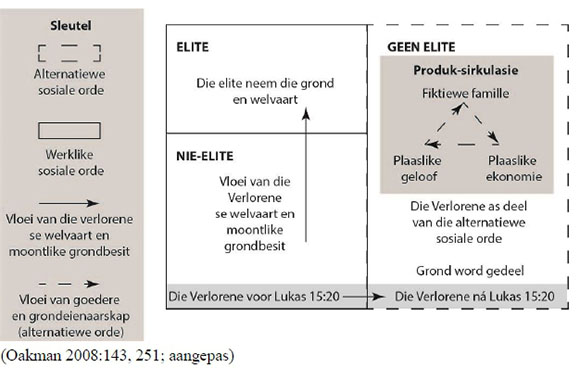
Jesus se Alternatiewe Sosiale Orde toegepas op die Gelykenis van die Verlore Seun
In die onderstande tabel word Malina (1986:69) se vier-basis-model in kombinasie met Oakman (2008:251) se model toegepas om Jesus se alternatiewe sosiale orde te identifiseer in die gelykenis van die Verlore Seun.

Die bostaande tabel dui duidelik die waarde van Jesus se alternatiewe sosiale orde in die konteks van die gelykenis van die Verlore Seun in Lukas 15:11-32 aan. Die artikel toon dus verskeie beginsels aan wat geïdentifiseer en ontwikkel kan word vir die moderne individu en die owerheid in die wêreld van die 21ste eeu.
Beginsels vir Vandag
In hierdie afdeling word die voorafgaande toepassing van die sosiaal-wetenskaplike metode prakties gebruik om beginsels vir vandag te ontgin. Die beginsels skakel direk met die gelykenis van die Verlore Seun in Lukas 15:11-13.
Jesus se Sosiale Motief
Jesus het sosiale en politieke motiewe gehad (soos aangetoon). Dit sluit in dat die historiese Jesus die armes wou help deur n beter wêreld vir hulle te skep. Die rede hiervoor was dat die Grieks-Romeinse wêreld n uitbuitende ekonomie gehad het waaraan die verweefde samelewing uitgelewer was.
Daar is alreeds aangetoon dat Jesus se bediening op aarde in 'n onstuimige tyd in Galilea en Palestina afgespeel het. Die Romeinse weermag het ongeveer 10 jaar voor die geboorte van Jesus 'n bloedige veldtog in Galilea gevoer teen mense wat potensieel van belastingontduiking verdink is. Jesus het in n tyd geleef waarin n militêre veldtog of enige protesaksie teen die Romeinse Ryk sou misluk.
Jesus het gereeld sondaars en tollenaars (mense wat belasting ingevorder het) onthaal. n Moontlike gevolgtrekking is dat Jesus die skuld van die armes probeer verminder het. Hy het vir die skuldeisers en tollenaars probeer aantoon dat dit beter vir die samelewing sou wees indien hulle eerder die armes se skuld sou afskryf.
Die Romeinse Ryk was egter op 'n politieke netwerk gebaseer. Dit kan ook 'n kliëntebasis genoem word (soos reeds aangetoon). Plaasboere was kliënte van die dorpsbewoners, die dorpsbewoners van die stadsbewoners, die stadsbewoners van die provinsiale regering en die provinsiale regering van die keiser in Rome. Dit sou die politieke netwerk versteur indien een persoon in die netwerk minder aan die ander betaal het.
Dit was dus 'n komponent van Jesus se bediening om die Grieks-Romeinse wêreld met 'n alternatiewe sosiale orde te vervang. Jesus se alternatiewe sosiale orde staan ook bekend as die koninkryk van God. In hierdie studie is die sosiaal-wetenskaplike metode gebruik om die begrip van algemene wederkerigheid in die koninkryk aan die hand van die gelykenis van die Verlore Seun aan te toon.
Grieks-Romeinse Wêreld vergelyk met die Wêreld van die 21ste Eeu Die antieke belastingstelsel teenoor die moderne belastingstelsel in Suid-Afrika Die moontlike uitbuitende praktyke van die wêreld van die 21ste eeu lyk aansienlik anders as dié van die Grieks-Romeinse wêreld. In die Grieks-Romeinse wêreld het die armes hoë belasting betaal (Oakman 2008:251). In die moderne tyd probeer die owerheid van Suid-Afrika verseker dat die armes minder belasting betaal as die welvarendes (Mohr & Fourie 2008:79, South African Reserve Bank 2018). Die Grieks-Romeinse wêreld en die wêreld van die 21ste eeu (in Suid-Afrika) kan dus in terme van armes en randfigure nie met mekaar vergelyk word nie. In die Grieks-Romeinse wêreld het die belasting gevloei vanaf die armes (nie-elite) na die rykes (elite). Die Suid-Afrikaanse owerheid probeer die situasie omkeer, naamlik dat die armes deur die belastingstelsel bevoordeel word. Dit is egter nie die doel van hierdie studie om die huidige sisteem in Suid-Afrika te beoordeel nie.
Soos alreeds aangetoon, was dit in die Grieks-Romeinse wêreld die plaasboere en die nie-elite wat die elite in die dorpe en stede onderhou het. Indien daar in die Romeinse Ryk n beweging was wat n stem vir die armes was, is dit, soos Judas van Gamala, stil-gemaak. Dit wil uit die geskiedenis (Whiston 2018) asook uit die Bybel voorkom asof die armes nie 'n stem gehad het in Palestina in die tyd van die Nuwe Testament nie.
Volgens Mohr en Fourie (2008:85) word Suid-Afrika gekenmerk deur 'n skewe verdeling van inkomste tussen huishoudings en individue. Die ekonomiese maatstaf van ongelykheid tussen die individue van n land word deur die Gini-koëffisiënt uitgedruk. Dit word algemeen aanvaar dat Suid-Afrika een van die wêreld se hoogste Gini-koëffisiënte het. Suid-Afrika het dus een van die mees ongelyke verdelings van inkomste ter wêreld (Mohr & Fourie 2008:75).
Mohr en Fourie (2008:86) toon aan dat die Suid-Afrikaanse owerheid funksionele verdeling van inkomste toepas om die groot ongelykheid in terme van dié verdeling in die land te verklein. Die proses van funksionele verdeling van inkomste was sedert 1994 beduidend suksesvol.
Mohr en Fourie (2008:454) toon aan dat owerhede slegs geld kan spandeer indien hulle belasting verhaal. Die staat bestee geld om armes op te hef. Dit sluit die Suid-Afrikaanse owerheid in. Belasting is dus die bron van die staat se sosiale werk. Hoë belasting ontmoedig egter investering, wat op sy beurt ekonomiese ontwikkeling vertraag.
Skuld en arm lande
Mohr en Fourie (2008:547) toon aan dat minder ontwikkelde lande (MOL'e) verskeie probleme ervaar wat ekonomiese groei en ontwikkeling teenwerk. Die gebrek aan kapitaal is sodanige probleem. Indien die oorgrote meerderheid van n land se bevolking hulself in die lae inkomstegroep bevind, is daar min bronne van kapitaal in die land. n Moontlike bron van kapitaal is dan buitelandse investering.
Buitelandse beleggings word nadelig beïnvloed wanneer dié land se belastingkoers hoog is. Die rede hiervoor is dat welvarende internasionale organisasies nie geneë is om kapitaal te belê in lande waar die hoë inkomstegroep hoë belasting betaal nie. Belasting dra n land se skuld. Indien n land baie skuld het, word hoë belasting gehef om die skuld te delg. Hoë belastingheffings ontmoedig investering in die bepaalde land, wat ekonomiese groei en ontwikkeling nadelig beïnvloed. Minder ontwikkelde lande se skuld behoort afgeskryf te word, sodat investering vir internasionale beleggers aanloklik kan wees.
Indien die skuldeisers van minder ontwikkelde lande die konsep van algemene wederkerigheid toepas, kan hulle die lande se behoeftiges help. Jesus se alternatiewe sosiale orde sou dus moontlik op n globale skaal toegepas kon word.
Beplanning
Seal, Garrison en Noreen (2009:434) definieer die konsep, "begroting" as 'n geëtaleerde plan vir die aanwending en gebruik van finansiële en ander hulpbronne oor 'n spesifieke tydperk. Dit verteenwoordig 'n plan vir die toekoms, uitgedruk in formele hoeveelhede. Twee aspekte van die begrotingsproses is naamlik:
• Beplanning - dit sluit die ontwikkeling van doelwitte en voorbereiding van begrotings om spesifieke doelwitte te bereik, in.
• Beheer - dit sluit in die stappe wat rolspelers neem om die kans om die doelwitte te behaal, te vergroot.
Die gelykenis van die Verlore Seun in Lukas 15:11-13 toon geen beplanning nie. Die Verlorene het slegs sy erfporsie in geld omgesit en daarvan gaan leef. Die feit dat hy nie beplan het nie, sou hom uiteindelik tot n val bring. Die feit dat hy sy geld verkwis het, is slegs n bykomende faktor.
Die gelykenis van die Verlore Seun toon aan dat finansiële beplanning met behulp van 'n begroting noodsaaklik is. Seal et al. (2009) wys daarop dat die meeste mense onwetend deelneem aan 'n proses waardeur daar begroot word. 'n Individu of huishouding kan byvoorbeeld min of meer skat wat die inkomste en uitgawes in 'n maand (spesifieke tyd) sal wees. 'n Individu of huishouding maak dan keuses op grond van daardie geskatte beplanning.
In die gelykenis van die Verlore Seun het die Verlorene nie beplan met 'n begroting nie. Die vaderfiguur het wel genoeg gehad om van te leef (Lukas 15:17). Dit is dus moontlik dat die familie en die vaderfiguur n begroting gehad het.
BIBLIOGRAFIE
Allen, R 1991. The concise Oxford dictionary of current English, 8th ed. Oxford: Clarendon Press. [ Links ]
Horsley, RA 2006. "Early Christian movements: Jesus movements and the renewal of Israel", HTS Teologiese Studies/Theological Studies, 62(4), 1201-1225. [ Links ]
Khumalo, B 2012. "'Defining economics in the twenty first century", Modern Economy, 3(1), 597-607. [ Links ]
Kloppenborg, JS 2008. "The Parable of the Prodigal Son and Deeds of Gift", Jesus, Paul, and Early Christianity: Studies in Honour of Henk Jan de Jonge' 169-194. [ Links ]
Law, DR 2012. The Historical-Critical Method: A Guide for the Perplexed. New York:, T&T Clark. [ Links ]
Liddell, HG & Scott, R 1897. A Greek-English lexicon, New York: American Book Company. [ Links ]
Linnemann, E 1966, Parables of Jesus: Introduction and Exposition, S.P.C.K., Indiana University. [ Links ]
Malina, BJ 1986. "'Religion' in the World of Paul", Biblical Theology Bulletin: Journal of Bible and Culture. 16(3), 92. [ Links ]
Malina, BJ 2001. The social gospel of Jesus: The kingdom of God in Mediterranean perspective Minneapolis: Fortress Press, [ Links ]
Mohr, P & Fourie, L 2008. Ekonomie vir Suid-Afrikaanse studente. Pretoria: Van Schaik Uitgewers. [ Links ]
Oakman, D 2008. Jesus and the peasants: (Matrix: the Bible in Mediterranean Context). Eugene: Cascade Books. [ Links ]
Oesterley, WOE 1936. The gospel parables in the light of their Jewish background, Society for promoting Christian knowledge. [ Links ]
Seal, W, Garrison, RH & Noreen, EW 2009. Management Accounting. Glasgow: McGraw-Hill Higher Education [ Links ]
Smith, BTD 1937. The Parables in the Synoptic Gospels. Cambridge: Cambridge Press. [ Links ]
Snodgrass, K 2008. Stories with intent: A comprehensive guide to the parables of Jesus, Grand Rapids MI: Wm. B. Eerdmans Publishing. [ Links ]
South African Reserve Bank, South African Reserve Bank, viewed 2018-06-06, from https://www.resbank.co.za/Pages/default.aspx. [ Links ]
Van Eck, E 2015. "Die gelykenisse van Jesus: Allegorieë of simbole van sosiale transformasie?", HTS: Theological Studies. 71(3), 1-10. [ Links ]
Whiston, W Josephus - The antiquities of the Jews, vertaal deur Whiston, W. voorberei deur Blackmask Online, BoD-Books on Demand. [ Links ]
Zimmermann, R 2007. "Die Gleichnisse Jesu: Eine Leseanleitung zum Kompendium." In R Zimmermann, D Dormeyer, G Kern, A Merz, C Münch & E.E. Popkes (eds.), Kompendium der Gleichnisse Jesu. (3-45). München: Gütersloher Verlagshaus. [ Links ]
Zimmermann, R 2009. "How to understand the parables of Jesus: a paradigm shift in parable exegesis." Acta Theologica. 29(1), 157-182. [ Links ]
1 Hierdie artikel is 'n verwerking van sekere aspekte van W.J. Schoeman se PhD-tesis: "Die gelykenis van die Verlore Seun: Die eerste-eeuse ekonomie en die hoorders van Jesus", in die Departement Nuwe Testament en Verwante Literatuur, Fakulteit Teologie en Religie, aan die Universiteit van Pretoria, onder die studieleiding van Prof. Dr. Ernest van Eck.
2 Die verwysing na Jesus in hierdie verband dui nie na op die Jesus van byvoorbeeld Lukas of Markus nie, maar op die Jesus "voor" Lukas of Matteus. Levine (2014:16) motiveer hierdie onderskeid soos volg: "The evangelists are our first known interpreters of the parables. By adapting the language and providing a setting they have already foreclosed some meanings; by providing explications they foreclose others." Anders gestel: die fokus hier is nie op hóé die evangeliste die gelykenisse van Jesus aangewend het nie, maar op wát Jesus waarskynlik daarmee bedoel het toe Hy 'n bepaalde gelykenis vertel het.
3 Alhoewel daar in hierdie artikel gefokus word op Lukas 15:11-13, is dit soms nodig om na die hele gelykenis van die Verlore Seun in Lukas 15:11-32 te verwys om temas en konsepte te verduidelik. Die gelykenis as geheel sal daarom soms deel van die bespreking hieronder wees.
4 Die histories-kritiese metode of historiese kritiek word nie volledig in hierdie studie gebruik word nie, maar elemente van teks-, bron-, vorm- en redaksiekritiek, soos deur Law (2012) uiteengesit, word gebruik.
ARTICLES
The essence and content of the work of the Diakonos according to the New Testament
Gert Breed
North West University
ABSTRACT
The word διάκονος is used for a large variety ofpersons in the New Testament. The question can be asked why this specific word was also used for some of the leaders (deacons) in congregations. The first step to answer this question, is to determine the essence and content of the work of a διάκονος (not as leader) according to the New Testament. The aim of the article is a close study of the meaning of the διάκον words in five New Testament texts to determine the essence and content of the task of the διάκονος. The conclusion is that the results of this study cannot on their own determine the essence and content of the work of the deacon, but they lay the foundation for further study about the leader διάκονος (deacon). In further study it will be important to also look at the texts where the διάκονος functions in a position of leadership.
Key words: Deacon; Diakonos; Diakon- words; Congregational ministry; New Testament
Introduction
The deacon can play a key role in the ministry plan of a congregation. This article is a study of the διακονία of the διάκονος (not necessarily as leader) to determine what the essence and content of the διακονία of the διάκονος was according to the New Testament. Acts 6 cannot be regarded as the description of the institution of the office of the deacon, and even if you want to take Acts 6 as such, it is uncertain what the essence and content of the seven's task were (Breed 2012; Pao 2011:129). The question arises what the source for determining the task of the deacon could be. The word "deacon" is derived from the word διάκονος; however, this Greek word is used for a large variety of persons in the New Testament. It is widely accepted that its meaning as a technical term for a certain type of leader in the congregation, is most clearly stated in Philippians 1: 1 and 1 Timothy 3 (Collins 2014:152, 153; Strauch 174-177; Aitchison 2003). Nowhere in the New Testament is the content of the work of the διακόνοι explicitly described (Latvus 2008). Why then, was the word διάκονος used to designate these specific leaders? A probable answer to this question is that the very essence of what the leaders were doing (their διακονία), is expressed by the semantic content of the διάκον- word group (Van Klinken 1989:85, 59). Collins points out that a special meaning was attributed to the original Greek word διάκονος; it was therefore retained when the Bible was translated into other languages. He says that all the other words in the διάκον- word group were translated with words from the new language, but that "the word deacon was clearly a special case" (Collins 2002:6).
The working hypothesis of this article is that the deacons were called so because they were leaders in the διακονία. The first step to determine the essence and content of the work of the deacon, could be to determine the essence and content of the work of a διάκονος in general according to the New Testament. Further study can then build on these results to investigate the task of the leader διάκονος.
Parts of the New Testament where the διάκον- word group is used, will be investigated to formulate a theory on the task of the διάκονος. The history of the essence and content of the service of the deacon, as it was formulated in different times and denominations, cannot be discussed in the space of this article.1 The aim here is primarily to determine what the general task of all believers was in their capacity as διάκονος, and not necessarily what the task of the leader διάκονος was. The results of this study could probably be useful in further studies of the use of the διάκον- words in the New Testament to determine the task of leaders in the congregation. From the integration of such study results and the results of this study, it might be possible to give a clearer indication of the task of the deacon according to the New Testament and apply the findings in congregations today.
A valid question is if it is possible to establish the διακονία of the deacon from the study of the διάκον- word group. Avis (2009) and Shack (2011:51) motivate the possibility of accomplishing this goal. Avis (2009:4, 5) says:
The New Testament provides neither precept nor precedent that fills in the content of diaconal ministry, what we do have is examples of the actual usage of διάκον-words in the Gospels, the Acts of the Apostles and the Pauline letters. How can the Church relate to this usage, how can it connect with it? ... To have integrity our own use of διάκονος and διακονία should be consonant with New Testament usage of those terms; it should resonate with it and be empowered by it.
Shack (2011:1-100) also investigates the use of the διάκον- word group in the New Testament to establish the task of the deacon today.
Louw and Nida's (1996: vi-xx) approach to semantic domains will be discussed as an introduction to the research on the use of the διάκον- word group. Thereafter, several scriptural passages will be investigated. In the discussion of each scriptural passage, deductions will be made about what the original readers possibly had in mind when they called a person in the church a διάκονος and what the essence and content of the work of a διάκονος could have been.
The "distinctive" meaning of the διάκον- word group
When the "distinctive" meaning of the διάκον- word group is investigated, it is important to take into account what Burton (1891:135) says:
The study of words is by no means the whole interpretation. No language, unless it be that of a mathematical formula or a logical definition, conveys in the words expressed all the thought which it represents in the mind of the speaker or even all that it is intended to create and actually does create in the mind of the intelligent hearer ... The interpreter who confines himself to mere word-study must often miss the richest and best of his author's thought.
It is important to state the insights of Louw and Nida into the use of words. They divide words into different semantic domains and explain the division as follows (Louw & Nida 1996: vi-xx):
The basis for the various semantic domains and subdomains consists of three major classes of semantic features: shared, distinctive, and supplementary. The shared features are those elements of the meaning of lexical items which are held in common by a set of lexical items. The distinctive features are those which separate meanings one from another and the supplementary features are those which may be relevant in certain contexts or may play primarily a connotative or associative role.
They give a further explanation of the use of words (Louw & Nida 1996: vi-xx):
What is essential is that one does not confuse the meaning of a term with the particular reference which a term has in a specific context. For example, όρνις (4.38) may be defined as "any kind of bird, wild or domestic", but in Mt. 23:37 (the only occurrence of όρνις in the New Testament) it probably refers to a hen, and therefore may be translated as such. But the meaning of όρνις is not "hen" but "a bird of any kind, either wild or domestic", since it is used in Hellenistic and Classical Greek with precisely such a broad range of reference.
In similar fashion, θήχη (6.119) may be translated in John 18:11 as "sheath", since the context refers to putting a sword in its container. This does not mean that θήχη means "sheath", for θήχη designates "any receptacle into which an object is customarily placed for safekeeping".
The research results of John N. Collins and Anni Hentschel, who show that the διάκον- word group does not primarily or always indicate humble service or charity, are widely accepted. Their finding is that the "distinctive" meaning (also called the "denotative" or "designative" meaning by Louw and Nida) of the διάκον- word group is not humble service or charity, but "go-between", "envoy", "representative", or "spokesperson". Certain further possible meanings (shared and supplementary) of this word group in the New Testament should be excluded, according to Collins. His most prominent exclusions are that the word group does not indicate service done out of love for people and that it only refers to service that is performed by an ordained person in the church. In another article, I point out why these exclusions cannot be accepted and that the context should determine the semantic content (Breed 2017). This point of view means that the semantic content of the διάκον- word group is not entirely neutral and has to be determined by the context.
This article is the first step towards determining the task of the deacon from the use of the διάκον- word group in the New Testament.
The point of departure of this investigation into the meaning of the διάκον- word group is now explained. Every word has lexicographical semantic possibilities. A writer or a speaker can have one or more of these semantic possibilities in mind when using a word in a specific context. The reader or hearer can only establish from the context which one of these semantic possibilities the writer or speaker has in the mind. Writers can assign a unique semantic possibility (concept) to a certain word in their work (Breed 2017).
In this study, I will also look at the possibility of using the results of the exegesis of some passages where the διάκον- word group is used to suggest a theory about the possible content and essence of the work of the διάκονος as leader in the congregation. Five New Testament passages will be studied to determine different semantic possibilities in which the διάκον- word group occurs.
Synthesis of the exegetical results
I have done in-depth exegetical work on various New Testament passages where the διάκον- word group is used to establish (in some cases using macro- and microstructural analysis) the meaning of the words used in specific contexts (Breed and Breed 2010; Breed 2012; Breed 2014a; Breed 2014b; Breed 2015a; Breed 2015b; Breed 2016a; Breed 2016b; Breed 2016c; Breed 2017; Breed 2018). These results will be used to arrive at the closest possible answer to the question what the essence and content of the διακονία of the διάκονος could possibly be according to the sections investigated. When the semantic possibilities in which the διάκον- word group occurs, are taken into account, the research question of this part of the article can be formulated as follows: In view of the meaning of the διάκον- word group, what semantic possibility or possibilities that are part of these concepts, are actualised in a specific New Testament section; and what image could the words διακονία or διακονέω possibly have evoked in the author and reader of the specific section; or, what concept of the work of a διάκονος could possibly have lived in the minds of the authors and readers? From the answer to this research question, conclusions will be made about the possible essence and content of the διακονία of the διάκονος in the New Testament.
Ephesians
The διάκον- words are used in Ephesians 3:7, 4:12 and 6:21. In v. 3:7, it describes the calling of Paul to bring the gospel to the gentiles. In v. 4:12, it describes the διακονία of the believers and in v. 6:21, the work of Tychicus.
From my research on the meaning of the διάκον- word group in Ephesians (Breed 2014b), it has become clear that the triune God executes his eternal plan through the work of the Father, the Son and the Holy Spirit, making it possible for people to be freed from the power of the prince of evil and from their own sinful desires and live a new life in Christ (Breed 2014b; Floor 2011:471). The church came into existence through the fundamental work (διακονία) of the apostles. The purpose of the church is to exist for the praise and glory of God's grace and to make the wisdom of God known to all in this world (Eph. 2:7; 3:10). The purpose of the church can also be described as the continuous performance of the good deeds that God has prepared for believers as part of their lives (Eph. 2:10) (Hoehner 2002:348; O'Brien 1999:18). Through good deeds, the Lord can bring people to faith and make them part of the congregation (Eph. 3:7) (Breed 2014c:8; Breed 2015b).
The διακονία of all believers plays a vital role in the execution of God's plan to unite all things under the one head, Christ (Eph. 1:10) (Van Aarde 2014:210; Floor 2011:467480; Barnard 2009:168; Pester 2009). The διακονία of the apostles was used by God to establish the church; the διακονία of the special services (offices) is used by God to equip believers for service (Van Aarde 2014:169). The διακονία of believers is used by God to promote the church's growth to maturity (Eph. 4:12-16). The διακονία of the church is the ministry of the grace that Christ measures out to every believer (Eph. 4:7) (Lincoln 1990:254). Christ gives special gifts (people) to the church to equip the members for their διακονία (Eph. 4:12). When believers are equipped for their διακονία and they perform it, they grow in maturity to become increasingly like Christ and less vulnerable to the temptation of false doctrine (Eph. 4:15, 16) (Petrenko 2011:156, 157). As mature believers, they will talk to each other in truth and in love (Eph. 4:15; admonish and encourage). The edification process is characterised by love. When believers use their gifts, the congregation is bound together in a unity according to the plan of God, and God reveals his wisdom and the glory of his grace to and through them (Van Aarde 2014:144). The imperative that demands a certain life-style from the believers (Eph. 4:17) is based on knowledge of Christ (the indicative of the work of the triune God). The equipment of believers to perform service enables them to break with the old human being, to renew their thinking, and to make the new human being a reality in their words and deeds (Eph. 4:17-24) (Mbennah 2016:116-118).
The essence of the διακονία, according to Ephesians, could be the execution of God's eternal plan to unite all things under the one head, Christ. It comprises that the διάκονος, who has received Christ's grace, must in turn minister it to others through the works of διακονία with a view to the edification and growth to maturity of the church.
The content of the διακονία could be the practical good works that are performed. It could comprise the fulfilment of unique functions in the congregation, for which everyone receives gifts, the equipment provided by the leaders, telling the truth to each other in love, and living in a way that is worthy of their calling.
The Gospel according to John
The διακον- words are used three times in John 12. Chapter 12 can be seen as a transition from the description of Jesus' work in public (Jn. 1-12) to his work focused on the disciples (Jn. 13 -21). In chapter 12, the contrast between those who believe, follow and serve Jesus, and those who do not believe, is accentuated.
Two of my articles deal with the use of the διάκον- word group in John (Breed 2014b; Breed 2015a).
Διακονία understood as making Jesus and the Father visible
In John, a two-tiered narrative can be detected. One level of the narrative deals with what can be seen and experienced by all people through their senses. The other level of John's narrative deals with what is implied by the visible and experiential reality, but is not observable to all people (Breed 2015a:3, 4). Jesus came to make this hidden truth known through the words of the Father, which He-Jesus-spoke, and through the deeds He did (Breed 2015a:3, 4; Bruner, 2012:734). In this way, He revealed the Father, whom no one except Jesus has seen yet. Only those who are reborn through the Spirit, can observe, understand and believe this revelation. The others persevere in their unbelief (Köstenberger & Swain 2008:164). Those who believe, participate in the unity that is found between the Father and the Son (Breed 2015a:4; Peterson 2009:59). They become followers (disciples) of Jesus and start to serve (διακονέω) Him and the Father (Koester 2008:129, 130). Those who serve Jesus, follow Him by doing his work and speaking his words (Jn. 12:26). In and through their service, Jesus and the Father are revealed to people who see and hear them (Breed 2015a:6; Bruner 2012:741; Van der Merwe 1997:343; Du Rand 1991:318).
The essence of the διακονία could be representing God and making visible who God is in word and deed (διακονία).
The content of the διακονία could be a life in which the διάκονος demonstrates by his deeds and words, through the guidance of the Holy Spirit, the obedience of Jesus to the Father and his love.
John 12 Diakonia and following Jesus
In John 12:26, the daikon- words are used three times: "If any man serves (διακονέω) me, let him follow me; and where I am, there shall also my servant (διάκονος) be: if any man serve (διακονέω) me, him will the Father honor."
John 12 places the διάκονος of Jesus Christ in the new era, which arrived with the suffering and death, resurrection and ascension of Jesus (Anderson 1999:42; Van der Watt 2008:91). Anyone who wants to serve Jesus (διακονέω), must follow Him. Following Jesus essentially means to accept the task that Jesus received from the Father, and to continue to do it. It means that the διάκονος has to speak the words of Jesus and to do the deeds of Jesus (MacArthur 2005:11; Thomas 2004:80; Van der Watt 2008:89; Von Wahlde 2010:555). In John 12, following Jesus is linked to the death of Jesus, the purpose of which is to save many (Jn. 12:23, 24, 32). The διάκονος must be prepared to follow Jesus to death (Jn. 12:25). They must be willing to lose their life to regain it. In this way, the διάκονος becomes involved in the salvation of many who will be drawn to Jesus through their words and deeds (Van der Watt 2008:94). Two promises are given to those who serve Jesus and therefore follow Him. They will be where Jesus is, which means, in their relationship with the Father and the Son, they will be in the position where Jesus is in his relationship with the Father (Breed 2014c:4). The second is that the Father will honour them. The suffering and the dishonour they experience because of their διακονία, will stand in contrast to the honour they will receive from the Father. The διάκονος glorifies Jesus and the Father, and is glorified by Jesus and the Father (12:26) (Neyrey 2007:214).
The essence of διακονία could be following Jesus where He is waiting, in anticipation of the honour the Father bestows.
The content of the διακονία could be following Jesus by doing practical deeds with a view to leading people to Jesus, even if it requires them to sacrifice their life.
Mark 8-10 Diakonia and compassion
In an article on the use of the διάκον- word group in Mark 10:42-5, I argue that Mark guides his leaders to understand διακονία as work done with an open and compassionate attitude towards other people, even to those who are not entitled to it (Breed 2017; see also Sabin 2005:87-89). In Mark 8-10, Jesus is preparing his disciples with great patience to act as leaders (Breed 2017). The most important attitude they as leaders have to adopt, is not being rulers, but servants. This teaching stands in contrast to the attitude of the world's rulers, who reign over their subjects (Wilcox 1996:175). Trusting that in God they are first, Jesus' followers can be the servants of all and become the slaves of all (Jn. 10:43, 44). In this way, they follow Jesus, who did not come to be served, but to serve, and gave his life as ransom for many (Jn. 10:45) (De Mingo Kaminouchi 2003:206). Diaconal service stands in the light of the reconciliation that Jesus brought about by the ransom He paid.
The essence of διακονία, according to Mark 8-10, could be the open and compassionate attitude found in a διάκονος, who, as an envoy of God, does not want to rule over others, but wishes to serve them.
The content of the διακονία, according to Mark 8-10, could be the deeds that bear testimony to openness and compassion and do not seek to rule over others.
1 Peter 4 and 5
The διάκον- word group is used in 1 Peter 4:10, where Peter encourages his readers to use their gifts to serve (διακονέω) each other with God's varied grace.
Peter writes a pastoral letter to people who endure intense hardships (Breed 2016a:5). He guides them with his letter to live in the midst of rejection and persecution according to their new identity and calling as renewed people (Fagbemi 2009). To achieve this, they must show mutual friendliness and hospitality (1 Pet. 4:9) (Green 2007:145, 146). They must understand that they are managers of God's multi-colored grace by serving each other according to the gifts each of them has received (1 Pet. 4:10). Those who received gifts of teaching, have to speak the words of God. Those who have received the gift of practical service (διακονέω), must perform it in the strength of God (Hamilton 2010:523). The elders must take care of the congregation like shepherds and supervise them with the attitude that Christ taught his disciples (1 Pet. 5:1-3). The whole congregation must be humble under the powerful hand of God and serve each other in anticipation that God will exalt them at the right time (1 Pet. 5:4-6) (Breed 2016a:6).
According to 1 Peter 4 and 5, the essence of the διακονία could be the attitude of openness found in people who humbly take care of others and do not seek their own interests or rule, but act in anticipation of the exaltation that God bestows.
The content of the διακονία could be that the διάκονος as manager has to serve the multi-coloured grace of God to the congregation to enable them to persevere in the midst of hardships.
1 Corinthians 12
I also investigated 1 Corinthians 12, focusing on ministry to children as representatives of groups in the congregation who could possibly be "outsiders" (Breed 2016c:274-300).
The διακον- words are used in 1 Corinthians 12:4-6, where Paul accentuates the variety of gifts, services (διακονία) and activities that are assigned by the one triune God who works all things in everyone through the διακονία of those who use their gifts.
The work of the Holy Spirit takes a central position in 1 Corinthians 12. He brings people to the confession that Jesus is Lord (1 Cor. 12:3). This confession serves as a measure whether someone is led by the Spirit (1 Cor. 12:2, 3). The one God (Father, Son and Holy Spirit) distributes the gift and instructs them to perform διακονία, resulting in the powerful work that creates everything in everyone when the gifts are used to perform diaconal service (Thiselton 2000:931). The διακονία is performed to edify the body of Christ. The diversity found in the body is bound together in unity by the διακονία that each member enacts and receives. The apostles, prophets and preachers occupy a special place in activating the gifts for service (1 Cor. 12:11) (Kinnaman 2011:13).
The fact that the unity of the body is served because all members sees themselves as necessary yet dependent members of the body, is strongly emphasised in 1 Corinthians 12. The relationship between gifts, service and the powerful work of God, through which everything in everyone is brought into existence, is also singled out. When members use their gifts to perform service (διακονία), God works in a powerful manner to bring about rebirth, faith, diligence and commitment in people and congregations (Breed 2016c:287-291; Goede 2004:183, 184).
The essence of διακονία, according to 1 Corinthians 12, could be that it flows forth from the fact that the Spirit gives gifts and that God works powerfully through these gifts to bring about everything in everyone. The διακονία is built on the confession that Jesus is Lord, as opposed to a life in the power of mute idols. Διακονία includes everyone who is part of the congregation.
The content of the διακονία could be active in intimate mutual involvement between members of the congregation, the utilisation of gifts to edify the congregation and the mutual reception of the ministry.
Conclusion
By investigating the meaning of the διάκον- word group in several New Testament texts, guidelines have been established as to what the essence and content of the διακονία of the διάκονος in the New Testament could have entailed. These results can lay the foundation for further research into the task of the deacon as derived from the διάκον-word group in the New Testament. However, further research will have to be done on the διάκονος as a leader before conclusions can be made about the content and essence of the task of the deacon in the church today. It will be important to compare the different semantic possibilities in which the διάκον- word group occurs in the sections investigated to establish if different authors use the word with concurring semantic possibilities. In such an analysis, the sections in which the same semantic possibility is actualised by the authors, can possibly be combined to identify the different concepts (themes) that have been applied to the διάκον- word group. From the results of the research done on the διακονία of the διάκονος (in this article) and the results of research that can be done on the διάκονος as leader in the church, it may be possible to glean guidelines for the work of the deacon today.
BIBLIOGRAPHY
Aitchison, Ronnie. 2003. The ministry of a deacon. Werrington: Epworth. [ Links ]
Anderson, Paul N. 1999. The having-sent-me Father: Aspects of agency, encounter, and irony in the Johannine Father-Son relationship, Semeia 85. [ Links ]
Avis, Paul. 2009. Wrestling with the diaconate, Ecclesiology 5(1). [ Links ]
Barnard, Jody A. 2009. Unity in Christ: The purpose of Ephesians. The Expository Times 120(4):168. Online: https://doi.org/10.1177/0014524608099799. [ Links ]
Breed, G. and Breed, D.G. 2010. Besinning oor die diakonale dienswerk na aanleiding van Handelinge 6:1-7, In die Skrifig 44(3/4):627-653. [ Links ]
Breed, Gert. 2012. Nuut gedink oor die wese en inhoud van die dienswerk van die diaken/Thinking new on the essence and content of the service of the deacon, HTS Teologiese Studies/Theological Studies 68(1):1-8. Online: http://dx.doi.org/10.4102/hts.v68i1.1059. [ Links ]
Breed, G. 2014a. The diakonia of Practical Theology to the alienated in South Africa in the light of 1 Peter, Verbum et Ecclesia 35(1). Online: Art. #847, 9 pages, http://dx.doi.org/10.4102/ve.v35i1.847. [ Links ]
Breed, G. 2014b. The meaning of the diakon word group in John 12:26 applied to the ministry in congregations, Verbum et Ecclesia 35(1). Online: Art. #844, 8 pages, http://dx.doi.org/10.4102/ve.v35i1.844. [ Links ]
Breed, Gert. 2014c. 'n Kritiese blik op missio Dei in die lig van Efesiërs, In die Skrifig 48(2):1-9. Online: http://dx.doi.org/10.4102/ids.v48i2.1707. [ Links ]
Breed, Gert. 2015a. Finding guidelines on social change in the two-tiered narrative and διακονία in the Gospel of John, HTS Teologiese Studies/Theological Studies 7(2):1-7. Online: http://dx.doi.org/10.4102/hts.v71i2.2666. [ Links ]
Breed, Gert. 2015b. Ministry to the congregation according to the Letter to the Ephesians, Acta Theologica 35(1):37-58. Online: http://dx.doi.org/10.4314/actat.v35i1.3. [ Links ]
Breed, Gert. 2016a. The διακονία of the elder according to 1 Peter, In die Skriflig 50(3):1-7. Online: http://dx.doi.org/10.4102/ids.v50i3.2102016. [ Links ]
Breed, Gert. 2016b. A social movement against corruption in the footsteps of Jesus' διακονία according to Matthew. In F.P. Kruger and B.J. de Klerk (eds), Corruption in South Africa's liberal democratic context: Equipping Christian leaders and communities for their role in countering corruption. Durbanville: Aosis, pp. 160-184. [ Links ]
Breed, Gert. 2016. Welcoming children to the διακονία of the congregation. In Jan Grobbelaar and Gert Breed (eds), Theologies of childhood and the Children of Africa, Durbanville: Aosis, pp. 274-300. Online: http://books.aosis.co.za/index.php/ob/catalog/book/34. [ Links ]
Breed, Gert. 2017. Diakonia: In conversation with John N Collins, Ecclesiology 13(3):349-368. Online: https://www.researchgate.net/publication/320073048_Diakonia_In_Conversation _with_John_N_Collins. [ Links ]
Breed, Gert. 2018. The diakon- word group in the New Testament and congregational ministry. PhD dissertation, Radboud University, Nijmegen. [ Links ]
Bruner, Fredrick Dale. 2012. The Gospel of John: A commentary. Grand Rapids: Eerdmans. [ Links ]
Burton, Ernest Dewitt. 1891. The study of New Testament words, The Old and New Testament Student 12(3). Online: http://www.jstor.org/stable/3157789. [ Links ]
Collins, Joan N. 2002. Deacons and the church: Making connections between old and new. Harrisburg: Gracewing. [ Links ]
Collins, Joan N. 2014. Diakonia studies: Critical issues in ministry. Oxford: Oxford University Press. [ Links ]
Crijns, Hub, et al. (eds). 2011. Diaconie in beweging: Handboek diaconiewetenschap. Kampen: Kok. [ Links ]
De Mingo Kaminouchi, Alberto. 2003. But it is not so among you: Echoes of power in Mark 10:32-45. New York: T& T Clark. [ Links ]
Du Rand, J.A. 1991. Perspectives on Johannine discipleship according to the farewell discourses, Neotestamentica 25(2):311-325. [ Links ]
Fagbemi, Stephen Ayodeji A. 2009. Living for Christ in a hostile world: The Christian identity and its present challenges in 1 Peter, Transformation: An international journal of Holistic Mission Studies 26(1):1-12. [ Links ]
Floor, L. 2011. Een blauwdruk voor de toekomst: Efeziërs 1:9-10, In die Skriflig 45(2&3):467-480. [ Links ]
Goede, H. 2004. Die voorstelling en die verteenwoordiging van die liggaam-metafoor in 1 Korintiërs 12:1-31, Acta Patristica et Byzantina 15:184-211. [ Links ]
Hamilton, James M. Jr. 2010. God's glory in salvation through judgement: A Biblical theology. Wheaton: Crossway. [ Links ]
Green, Joel B. 2007. 1 Peter. Grand Rapids: Eerdmans. [ Links ]
Hoehner, Harold Walter. 2002. Ephesians: An exegetical commentary. Grand Rapids: Baker Academic. [ Links ]
Koester, Craig R. 2008. The Word of life: A theology of John's Gospel. Grand Rapids: Eerdmans. [ Links ]
Köstenberger, Andreas J. and Swain, Scott R. 2008. Father, Son and Spirit: The Trinity and John's Gospel. Downers Grove: InterVarsity Press. [ Links ]
Latvus, Kari. 2008. The paradigm challenged: A new analysis of the origin of diakonia, Studia Theologica 62:152. [ Links ]
Lincoln, Andrew T. 1990. Ephesians. Dallas: Word Incorporated. [ Links ]
Louw, Johannes P. and Nida, Eugene Albert. 1996. Greek-English lexicon of the New Testament: Based on semantic domains, electronic ed. of the 2nd ed. New York: United Bible Societies. [ Links ]
MacArthur, John. 2005. Hard to believe: The high cost and infinite value of following Jesus. Nashville: Thomas Nelson. [ Links ]
Mbennah, Emmanuel D. 2016. The goal of maturity in Ephesians 4:13-16, Acta Theologica 36(1):110-132. Online: http://dx.doi.org/10.4314/actat.v36iL7. [ Links ]
McKee, Elsie Anne. 1989. Diakonia in the classical Reformed tradition and today. Grand Rapids: Eerdmans. [ Links ]
Neyrey, Jerome H. 2007. The Gospel of John. New York: Cambridge University Press. [ Links ]
O'Brien, Peter T. 1999. The Letter to the Ephesians. Grand Rapids: Eerdmans. [ Links ]
Olson, Jeannine E. 2005. Deacons and deaconesses through the centuries. Saint Louis: Concordia. [ Links ]
Pao, David W. 2011. Waiters or Preachers: Acts 6:1-7 and the Lukan table fellowship motif, Journal of Biblical Literature 130(1):127-144. [ Links ]
Pester, John. 2009. The role of revelation in the fulfilment of the economy in God in Ephesians, Affirmation and Critique 14(2):29-42. [ Links ]
Peterson, David G. 2009. The Acts of the Apostles. Grand Rapids: Eerdmans. [ Links ]
Petrenko, Esther. 2011. Created in Christ Jesus for good works: The integration of soteriology and ethics in Ephesian. Milton Keynes: Paternoster. [ Links ]
Sabin, Marie Noonan. 2005. The Gospel according to Mark. Collegeville: Liturgical Press. [ Links ]
Shack, Jennifer. 2011. A comparison between the diaconates of Lutheran Church: Canada and the New Testament. Master's thesis, Concordia University College of Alberta, Edmonton. [ Links ]
Strauch, Alexander. 2003. Biblical leadership: An urgent call to restore Biblical church leadership. Littleton: Lewis and Roth. [ Links ]
Thiselton, Anthony C. 2000. The First Epistle to the Corinthians: A commentary on the Greek text. Grand Rapids: Eerdmans. [ Links ]
Thomas, John Christopher. 2004. In John 13 and the Johannine community. London: T &T Clark. [ Links ]
Van Aarde, Timothy. 2014. The missional purpose of the Letter to the Ephesians. Doctoral dissertation, North-West University, Potchefstroom. [ Links ]
Van der Merwe, Dirk G. 1997. Towards a theological understanding of Johannine Discipleship, Neotestamentica 31(2). [ Links ]
Van der Watt, J. 2008. Johannine style: Some initial remarks on the functional use of repetition in the Gospel according to John, In die Skriflig 42(1). [ Links ]
Van Klinken, Jaap. 1989. Diakonia: Mutual helping with justice and compassion. Kampen: Kok. [ Links ]
Von Wahlde, Urban C. 2010. The Gospel and letters of John, vol. 2: Commentary on the Gospel of John. Grand Rapids: Eerdmans. [ Links ]
Wilcox, M. 1996. On the ransom saying in Mark 10:45c, Matthew 20:28c. In H. Lichtenberger (ed.), Geschichte, Tradition, Reflexion: Festschrift für Martin Hengel zum 70 Geburstag. Tübingen: Mohr Siebeck. [ Links ]
1 For a thorough discussion of the history of the diaconal service, see McKee (1989), Van Klinken (1989:60-78), Ronnie Aitchison (2003:83-105), Crijns et al. (2011:61-108) and Olson (2005).
^rND^sAvis^nPaul.^rND^sBarnard^nJody A.^rND^sBreed^nG.^rND^sBreed^nD.G.^rND^sBreed^nGert^rND^sBreed^nG.^rND^sBreed^nG.^rND^sBreed^nGert^rND^sBreed^nGert^rND^sBreed^nGert^rND^sBreed^nGert^rND^sBreed^nGert^rND^sBreed^nGert^rND^sBreed^nGert^rND^sBurton^nErnest Dewitt^rND^sDu Rand^nJ.A^rND^sFagbemi^nStephen Ayodeji A^rND^sFloor^nL.^rND^sGoede^nH^rND^sLatvus^nKari^rND^sMbennah^nEmmanuel D^rND^sPao^nDavid W^rND^sPester^nJohn^rND^sVan der Merwe^nDirk G^rND^sVan der Watt^nJ.^rND^sWilcox^nM^rND^1A01^nJune F^sDickie^rND^1A01^nJune F^sDickie^rND^1A01^nJune F^sDickieARTICLES
Zulu youth interpret and translate metaphors in Hebrew poetry: An empirical study
June F Dickie
University of KwaZulu-Natal
ABSTRACT
Biblical poems make extensive use of metaphors which related to the culture of the original writers. This study explores how Zulu youth in South Africa interpret some of these metaphors from their context. It also gave them the opportunity to translate some biblical metaphors for their peer-group, using images that are more meaningful to them. Their compositions show some insightful interpretation of the Hebrew texts, particularly with respect to their use of new metaphors (often in an expanded form). These new metaphors tend to be within the same domain as those in the original text.
The ambiguity inherent in metaphor offered space for the Zulu youth to introduce new (and insightful) imagery in translating metaphors from another culture. The process is worth extending to other communities to enrich our understanding of how people from different contexts perceive and think.
Key words: Biblical Poetry; Metaphors; Community; Cultural Interpretation; Zulu
Introduction
Conceptual Metaphor Theory (Lakoff and Johnson 1980) suggests that metaphors are based on embodied experience and are thus universal.1 However, work in minority languages indicates that conceptual metaphors are not universal but are shaped by the sociocultural worldviews of indigenous speakers (Idstrom and Piirainen 2012). It is possible that emotions of fear, joy, etc. are universal, but the metaphors or images triggering these emotions,2 are culture specific. Indeed, the diversity of metaphors across cultures (Kövecses 2005) points to the importance of cross-cultural factors that shape experience. This article seeks to provide further data from a non-European language, supporting a cognitive-cultural theory of metaphor (Kövecses 2017) as a necessary complement of the (cognitive) experiential view.
The scientific value of exploring novel metaphors is two-fold: First, a new metaphor can provide revelatory insight into a particular concept (Perdue 1991:27).3 Thus, a comparison of different metaphors used to describe a similar (emotional) experience can be very enlightening, revealing "new perspectives" (Lundin et. al. 1999:169-171).
Second, a cross-cultural study of the way metaphors are interpreted, indicates what the readers bring to the text from their own contexts.
Reception Theory (e.g. Iser 1974) posits that, because of "gaps"4 in a text (arising from translation ambiguities and the use of metaphors, Fretheim 2007:51-52), readers use their imagination, experience, and societal conventions to make sense of the text. This is in line with Relevance Theory (e.g. Gutt 1992): people try to make sense of messages according to their experience and background (Soukup 1997:107). This study thus seeks to use a study of metaphor to give insight into the Zulu way of thinking and the experience they bring to interpreting text.
A third scientific value of this study is that assessing the power of biblical metaphors, reveals to some extent the novelty of interpretation by Zulu readers.
Two conceptual frameworks are important in this study. First, the notion of literary functional equivalence (as advocated by Wendland 2004) is followed for the translation of poetry. This maintains that the function of the poetic device in the original language must be determined, and then the same function achieved in the receptor language, using an indigenous poetic device (which may be the same as that used in the source text, but not necessarily so). Functions achieved by poetic devices include setting boundaries (e.g. through inclusion or parallelism), holding text together (e.g. by the repetition of key terms or the use of chiasm), aesthetic beauty (e.g. through metaphorical language), and adding rhetorical force (e.g. by repetition, chiasm, and metaphor). It is important that the translation should sound like a poem. As Bisschops (2003:113) notes, "Literary metaphors have a nature of their own and must therefore be interpreted correspondingly." The poetic devices must be "translated" into indigenous poetic devices that achieve the same aesthetic and rhetorical functions.
Second, the "domestication approach" is followed for the translation of poetic images.5 Maalej (2008:63) argues that the translatability of a source language metaphor does not depend on its "boldness" or "originality" but on "the extent to which the cultural experience and lexical matrices on which it draws are shared by speakers of the particular target [or receptor] language". When the cultural experiences of the source and receptor communities are very different, the domestication approach chooses to replace foreign cultural images in the source text with more meaningful images from the receptor culture (Izgarjan and Prodanovic-Stankic 2015:26). This is necessary when an image has either no meaning (or limited meaning) for the audience, or a contrary meaning.6 As Miller-Naudé and Naudé (2010:306) note, "A translation cannot travel to new surroundings without adapting to its new environment." This is in line with the thinking of many African biblical scholars.7 For example, Masoga (2004:143) asserts that the Bible must relate to the community reading it, "using their indigenous contexts to interpret this indigenous text". "Their indigenous contexts" includes all that the readers bring to the text, and the text must be "indigenous" in the sense of using local means of expression, including local metaphors. This enables the biblical text to then be relevant to the lives of the readers, a prime concern for the African theologian, David Adamo (2005:3).
The aim of this study is to explore the interpretation of biblical metaphors by Zulu youth and their translation of such images into their own language, using metaphors that are meaningful to them. As Lakoff and Johnson (2003:247) note, empirical data (based on real-life usage of language) is helpful for understanding the value of metaphor because "Every question about the nature of conceptual metaphor and its role in thought and language is an empirical question." Thus the examples emerging from this empirical study can add to the pool of understanding of the role of metaphor, adding data from the Zulu community.
Research methods and design
Zulu youth interested in poetry were invited to participate in "Psalms workshops" during which they made their own translations of selected psalms, using various features of Zulu oral art. The participants came from three church groups (one in Durban and two in Pietermaritzburg) and a Pietermaritzburg poets' group. The first group consisted of a youth group from a church in one of the townships near Durban, linked relationally to the researcher's home church. The second group came from various Anglican churches in Pietermaritzburg and comprised ten young people (of both genders) and three older women (members of the Cathedral choir). The third group were ten students (of both genders) from the Lutheran Theological Institute, and the fourth group consisted of 1015 members (mainly male youth) from the Tree of Life poetry group. This latter group meets weekly in the Central Library to perform their own poetry. Most of the participants are from the Zulu community, but some speakers of other African languages also participated, all working in their own mother tongues. The participants were volunteers who agreed to take part in a workshop held over three days for about six hours per day. Separate workshops were held for the four different groups.
At each workshop, participants learned the basics of Bible-translation principles, poetics (Hebrew and Zulu praise-poetry), and rhythm (as evidenced in Zulu music and poetry). Three biblical psalms were then studied, one per day. The first psalm was a short psalm of praise, Ps. 134. Participants studied the poetic devices, the functions achieved thereby, and the meaning of key words used in the text. They then translated Ps. 134 into their own languages, using indigenous poetic devices and metaphors. Once the translations had been assessed for basic accuracy, the participants converted them into performances (using rap, spoken poetry or song) which were presented to the whole group. The process was repeated on the second and third day, using Ps. 93 and a portion of Ps. 145. After the third day of the workshop, the group presented a final performance to the local church, or a group of friends and family.
Data consisted of the poems composed by the participants and video recordings of their performances. They also completed questionnaires at the end of the process, and interviews were conducted with a sample (four participants and three audience members) from each group.
The poems composed by the youth were analysed in terms of their poetic features and the functions they achieved, relative to the functions performed by the Hebrew poetic features of the relevant psalm. Particular attention was given to cases where participants understood the biblical metaphors in an unusual way, imposing their own contexts on the text (as per Reception Theory). The use of novel metaphors in their translations of the psalms was also studied with interest.
Ethical approval was obtained from the University of KwaZulu-Natal to conduct this study. The Protocol Reference Number is HSS/1602/015D.
Results
This article focusses on some translations of Ps. 134 and Ps. 93. Ps. 134 only has three verses, but includes a number of poetic features. Ps. 93 has both dramatic imagery and powerful rhetorical structure, using threefold-parallelism. The first example selected (based on Ps. 134) illustrates two of the poets' unusual interpretations of the biblical text. To facilitate understanding, a literal translation (viz. English Standard Version) of Ps. 134 is first given:
Psalm 134 (ESV)
1. Come, bless the LORD, all you servants of the LORD,
who stand by night in the house of the LORD!
2. Lift up your hands to the holy place and bless the LORD!
3. May the LORD bless you from Zion,
He who made heaven and earth.
The Hebrew in the first verse includes the words הָעמְֹדִים ("the ones standing") and בַּלֵּילוֹת ("at night"). Most scholars (e.g. Hossfeld and Zenger 2011:488) interpret "the ones standing" to mean "being in the service of (as in other biblical texts such as 1 Kgs. 1:2 and Deut. 10:8). Similarly, "at night" is usually understood literally, with reference to the priests doing night guard-duty (Kittel 1929:281-282), or an evening ritual (De Claisse et. al. 2014:940), or as the continuation of priestly service into the night (Hossfeld and Zenger 2011:488). "Night" could also be metonymic of "day and night" (meaning all the time), as in 1 Chron. 9:33. However, biblical lexicons (such as Brown, Driver, and Briggs) indicate that both words can also take on metaphorical meanings, "standing" understood as "enduring" and "night" understood as "a time of trial". Although no known printed scriptures choose the metaphorical interpretation of this verse,8 two of the Zulu youth (both going through significant troubles) independently understood the text as referring to "those enduring through trial" or "you who hold on to the LORD in difficulties" (e.g. Dickie 2017, Item 17). The "gap of ambiguity" in the Hebrew text enabled them to interpret the words metaphorically, from the background of their personal contexts, rather than literally, as is generally done.
Another translation of Ps. 134 introduces additional components in v. 3:
Example 1 (Dickie 2017, Item 23)
3 a. May the Lord of lords bless you from Zion
3b. May he bless you,
3c. this one who separates darkness and light
3d. who separates water and sea.
The first notable characteristic is the repetition of the idea in 3a, in 3b (although in a "stepped-down" form, i.e. reduced). This is to give focus and to support the rhythm structure. Then, in 3c, an additional image is presented to that in the biblical text. Clearly the reference is to the creation of the earth in Gen. 1-2, as is the biblical image (creating "heaven and earth"), but the focus is on "separating", and this idea is repeated in 3d with a parallel construction (again for focus and rhythm purposes). The introduction of images of separation in 3c and 3d could highlight a theme throughout the three verses, viz. the people of God are a separated people (emphasised by "servants of the LORD" and being "in the house of the LORD" in v. 1), and serve a God who is separate, or set apart, from all others (the meaning of "holy"9 in v. 2). Thus through the Zulu poet's introduction of a slightly different metaphor in v. 3, he has succeeded in emphasising an important truth in the psalm.
The next psalm studied in the workshops (Ps. 93) includes strong imagery of "overwhelming waves" in the central verses, viz. 3 and 4. A literal English translation of these verses follows, and then some Zulu examples are discussed.
Psalm 93:3-4 (ESV)
3. The floods have lifted up, O LORD,
the floods have lifted up their voice,
the floods lift up their roaring.
4. Mightier than the thunders of many waters,
mightier than the waves of the sea,
the LORD on high is mighty.
The imagery of rising water needs to be understood first in its original context. The background is Ugaritic and Canaanite mythology, where Baal fights and defeats the chaos-enemy, (the god) Sea (Hossfeld and Zenger 2011:449). For ancient Israel, the sea symbolised the unknown, the feared. By metonymy, it may also refer to the hostile nations who opposed Israel and thus God (Bullock 2001). It links back also to the threatening waters in Gen. 1:2, before order was established with the separating of land from the sea. Thus the metaphor refers to that which threatens and provokes fear. However, as the Zulu community lives inland and does not experience overwhelming waves, the imagery is not particularly meaningful to them. Thus they were encouraged to find other symbols of things which provoke fear in them. The most popular metaphor was that of "strong wind". Perhaps this was an attempt to maintain an image from nature that was part of the poets' common experience. An example using this imagery follows:
Example 2 (Dickie 2017, Item 28)
Umoya uyavunguza (ke) The wind is blowing (filler)
Izivungu-vungu ziyavunguza, Mdali Gales are blowing, Creator,
Kuvunguza sansunami. Blowing a tsunami.
Others combined several metaphors (but all from the domain of natural phenomena), as in the example below:
Example 3 (Dickie 2017, Item 7)
Noma umfula ungagcwala uphuphume, Even if the river is full, overflowing
noma umlilo ungavutha ubuhangu-hangu, even if the fire burns with scorching heat
noma ulwandle lungenza unonakalo, even if the sea is causing destruction
Of interest in this translation is the use of the ideophones gcwala ("to be full to capacity": Nyembezi 1990:46) and hangu (implying scorching heat: Dent and Nyembezi 1969). Ideophones provide a very descriptive intensification of a characteristic, often replacing a metaphor in another language (Hermanson 2004:56-58).
Other poets interpreted the "floods" as difficulties or enemy attacks, thus removing the metaphorical image. However, the poet below added a simile to bring in an image (that of a lion), again from the domain of nature:
Example 4 (Dickie 2017, Item 6)
Noma isitha singahlasela, Jehova Even if the enemy attacks, LORD,
sihlasele nhlangothi zombili it attacks both ways,
sihlasela kuhle kwebhubesi it attacks well like a lion,
The composition below interprets the original "waves" metaphor as 'enemy', including a new metaphor (wind), and a simile (like a lion), all within the same poem.
Example 5 (Dickie 2017, Item 12)
Nakuba isitha sibhodla okwebhubesi, Even tho' enemy roars like a lion,
Nakuba izivunga-vunga zisihlasela Even tho' strong winds attack with
ngamandla, strength,
Nakuba umoya uvunguza ngamandla, Even tho' wind blows strongly with power,
Ps. 93:4 continues the refrain begun in v. 3, and in the Hebrew the same metaphor of rising water is used. In order to give the same message, viz. that the LORD is mightier than the threat in v. 3, there should be a link between the imagery of these two verses. Most of the Zulu poets did provide such a link. The poet in the example below maintains the imagery of powerful water in both vv. 3 and 4:
Example 6 (Dickie 2017, Item 18)
Imifula ihlokoma kuSomandla, Rivers roar to the Almighty
Imifula ihlokoma ngezwi elikhulu Rivers roar with a big voice to the
kuSomandla, Almighty,
Imifula ihlokoma ngezwi elikhulu Rivers roar with a big voice to the
kuSomandla, Almighty
Ngaphezu kwemidumo yamagagasi Above the thunder of the waves of
amanzi waters
ungaphezulu kwemidumo yolwandle You are above the thunder of the sea
uphakeme ngamandla, uSomandla. You are exalted with power, Almighty!
The next example introduces two metaphors in v. 3: an enemy roaring like a lion, and strong wind. V. 4 refers back to both of these metaphors, thus communicating the same message as in the source text.
Example 7 (Dickie 2017, Item 12)
3 a. Nakuba isitha sibhodla okwebhubesi, Even tho' enemy roars like a lion,
3b. Nakuba izivunga-vunga zisihlasela, Even tho' strong winds attack with
ngamandla strength,
3c. Nakuba umoya uvunguza ngamandla, Even tho' wind blows strongly with power,
4a. Inamandla Nkosi ngaphezu kwebhubesi Powerful Lord, above the lion
4b.inamandla Nkosi ngaphezu powerful Lord, above the
kwezivungu-vungu blowing (storms)
4c. inamandla Nkosi ngaphezu powerful Lord, above the blowing
kwezivungu-vungu (storms) that blow with
ezivunguza ngamandla power
The poet below similarly linked the metaphor in v. 3 with that in v. 4, but also added a new metaphor in v. 4 (that of mountains, again from the domain of natural phenomena). This new image is an attempt by the poet to intensify the message, wanting to emphasise that the LORD is higher than even the highest thing known to humanity:
Example 8 (Dickie 2017, Item 19)
3a. Imifula ingcwale kakhulu, Nkosi Rivers they are very full, king/lord
3b. Ulwandle nemifula kuzwakala ngomsindo Oceans and rivers they are heard by sound
3c. Ngomsindo omkhulu ulwandle luyezwakala. Big sound from the ocean is heard
4a. Unamandla ukwedlula umsindo ulwandle You are mighty in spite of sound of ocean
4b. Unamandla ukwedlula umdumo You are mighty in spite of riot of
wamagagasi asolwandle waves of ocean
4c. Unamandla unamanela ukwedlula izintaba You mighty enough in spite of
euphakemeyo, Somandla! mountains that are high, Almighty!
An interesting use of imagery and word-choice is shown in the following translation by a Zulu youth of a few cola from Ps. 93. The ESV translation appears in brackets below each colon):
Example 9 (Dickie 2017, Item 6)
1c. Jehova, uyingonyama LORD, you are the royal lion (he has put on strength as his belt)
3 a. Noma isitha singahlasela, Jehova Even if the enemy may attack, LORD (The waves have lifted up, o LORD),
3b. sihlasele nhlangothi zombili, attacking both ways, (The waves have lifted up their voice),
3c. sihlasela kuhle kwebhubesi, attacking fiercely like a lion, (The waves have lifted up their voice on high).
4a. kepha unamandla kunesitha, but you are more powerful than enemy (Mightier than the thunder of the waves)
The imagery in cola 1c and 3c is similar, although a metaphor is used in 1c ("the royal lion") and a simile in 3c ("like a lion"). First, the use of a metaphor followed by a simile suggests that the enemy may try to appear strong, but the real lion (or strong one) is the LORD. This seems to be a powerful insight. Further, the introduction of the "lion" metaphor in 1c is very creative, using the attribute of power (symbolised by the lion) to translate the Hebrew idea of "having put on strength as a belt". Second, although both 1c and 3c use the image of a lion, the words used are significantly different. The first, attributed to the LORD as a metaphor translating his strength (cf. "you are robed in power" in the ESV), is the word for the royal lion, the symbol associated with the royal house of the Zulu people. In contrast, the word used to indicate the way the enemy is attacking, is that of a common lion. Thus the poet has cleverly contrasted the real strength of the LORD and the lesser strength of the enemy.
Another example where the Zulu poet's translation of a metaphor offers insight is shown below:
Example 10 (Dickie 2017, Item 24)
3 a. uSimakade wase Siyoni The LORD from Zion
3b. makahlise izibusiso phezu kwenu may he bring down blessings upon you.
3c. Engathi ningathela izibusiso May you bear blessings
3d. kulowo owadala izulu nomhlaba. from the Creator of heaven and earth.
The single word "bless" in the Hebrew in v. 3 was transformed by the poet into two images, first, that of God bringing down blessings upon the person, and then of the person being able to "bear" the blessings that are "brought down". There are some rich insights in this translation: first, the notion of something tangible (that can be "brought down", supposedly from above) involved in the act of blessing, and then second, that the recipient of blessings has a responsibility to bear this good thing they are given. Thus, although the Hebrew text did not use a metaphor here, the introduction of this picture language is powerful and easily visualised, and there is new insight as to the responsibility of the recipient.
A final example comes from the third psalm translated by the empirical poets, viz. Ps. 145. This example reveals a cultural norm within the Zulu community, that of grandparents "raising the young". V. 4a in English (ESV) reads, "One generation shall commend your works to another", which is a rather dull image compared to the Zulu version below:
Example 11 (Dickie 2017, Item 36)
4a. Abazali badumisa imsebenzi yakho Parents praise your work to their children, eziqaneni,
4b. nasesi zukulwanene sabo. even to their grandchildren.
The Hebrew expression "one generation to another" has been filled out with two parallel images, and as fits the Zulu culture, it includes not just parents communicating with children, but also with grandchildren.
From the interviews, a few responses indicate how the participants and audience experienced the process. Comments include: "... [the Nguni people will enjoy having more songs like these because they are] done in a way that people can relate to and understand better" (Interview 4); "the translation ... is much easier to understand than the original translation we have" (Interview 5); and "[being part of the workshop] I discovered the potential of transforming the scripture ... by understanding the context of the psalms. I have learned to be part of the process of transforming the scripture for my context" (Interview 6).
Importance of local context in the choice and interpretation of metaphors
The Zulu poets brought their own experience to their understanding of the biblical metaphors. With the first psalm there was no prior discussion of the meaning of the text, and the ambiguity allowed readers to bring their own context into the interpretation. When working with the second psalm, discussion of the historical background preceded the poets' compositions. Thus, they understood the imagery of "floods" better, and were able to find appropriate images that conveyed the same meaning. At times they replaced the Hebrew metaphor with an ideophone, or with an extended metaphor (often using two parallel lines, repeating the image or complementing it).
Metaphorical language is full of ambiguity, and this study illustrates the claim of Reception Theory, that gaps in the text leave room for individual interpretation, particularly if closure is not imposed on the meaning of the text. As Lakoff and Johnson (2003:218) note, metaphor emerges from "experienced reality" and the difficult experiences of two of the poets coloured their understanding of the language used in Ps. 134:1. Thus, the empirical examples underscore the impact of the readers' experiences in their interpretation.
When a metaphor is understood in its historical context, the force of the image is probably understood as by the original audience. However, to communicate this emotion and experience effectively for their own community, the Zulu poets generally changed the picture language, often using different metaphors to underline the emotion they were trying to convey. The empirical compositions highlight the potential insights and strength of translations when the poets are free to adapt the metaphors.
Apart from the value of translating metaphors appropriately for one's own culture, others (outside that culture) can also benefit. The introduction of the "separating" metaphor in Example 1 adds a new focus to the concept of holiness in Ps. 134. Similarly the use of the "lion" metaphor in Example 9 brings a rich, new understanding to Ps. 93. Theorists (e.g. Lakoff and Johnson 2003:139, 142) argue that imaginative metaphors can "[give] us a new understanding of our experience or 'provide' a new insight into a particular concept", and this study supports this assertion.
The participants in this study were not selected on the basis of skill in poetry, but were volunteers who called themselves "poetry fans". The training time in the workshops was also very limited. Despite these factors, the results show what can be achieved when "ordinary"10 people are given the opportunity to be creative and think about picture-language to transmit their experiences. More imaginative results could probably have been obtained if circumstances had allowed some of the more gifted poets to participate more fully. (Several of the youth could only attend one or two of the workshops owing to family responsibilities.)
Implications emerging from the results include the need to find meaningful metaphors when translating texts for a cross-cultural, contemporary audience. The local community, in particular youth interested in poetry, has much to contribute, particularly in the translation of biblical poetry. Their interpretations of established metaphors in the Bible, as well as their innovative translations, add to the richness of biblical interpretation. Outside of the field of biblical text, one can also imagine local communities providing stimulating translations of other classical literature.
Conclusion
The responses of both participants and audience members showed that they considered the new translations within the Zulu cultural idiom to be more understandable and relevant than published translations. The audiences also assessed the new compositions as acceptable "translations", transmitting the same message (but in a more engaging way) than the old translations. Also, the young people enjoyed being part of the process of "meaning-making", an important aspect for millennials.11
With regard to the metaphors used, it seems that the Zulu poets restricted their images to natural phenomena (as did the biblical texts), although, when they chose to give a literal interpretation of the Hebrew metaphor, they referred to people ("enemies"). Other work12 has shown that Zulu youth may invent novel metaphors (outside of the domain of natural phenomena), but that was not the case when translating original biblical texts which use metaphors of natural phenomena. It was noted, too, that sound metaphors (or ideophones) may be used in Zulu rather than visual ones, possibly as a result of it being a predominantly oral culture. However, as the Hebrew culture was also predominantly oral, it also used sound metaphors (as is evident in Ps. 93, with a focus on the sound of the rising waters). Thus there is often a good match between Zulu metaphors and those used in the Bible.
The value of such a study is that the Zulu youths' translations open a window into their culture and thinking. As Naudé (2004:57) notes: "One way of 'opening up' a foreign culture is by way of interlingual translation ... in that the act of translating literary texts ... involves transferring aspects of the culture belonging to one group to that of another." Thus it serves to enrich our understanding of Zulu culture and thought processes as well as adding insight to the ancient biblical text.
BIBLIOGRAPHY
Adamo, D.T. 2001. Reading and interpreting the Bible in African indigenous churches. Eugene, Oregon: WIPF and Stock Publishers. [ Links ]
Bisschops, Ralph. 2003. Are religious metaphors rooted in experience? On Ezekiel's wedding metaphors. In Kurt Feyaerts (ed.), The Bible through metaphor and translation. A cognitive semantic perspective. Bern, Switzerland: Peter Lang Pub Inc, 113-151. [ Links ]
Brown, Driver, and Briggs, 2000. The enhanced Brown-Driver-Briggs Hebrew and English lexicon, part of Translator's Workplace within the suite of Logos software. [ Links ]
Bullock, C. Hassel. 2001. Encountering the Book of Psalms. Grand Rapids, MI: Baker Books. [ Links ]
De Claisse-Walford, N., Jacobson, R.A. and Tanner, B. (eds). 2014. Overview of the shape and shaping of the Book of Psalms: the current state of scholarship. Atlanta: SBL Press. [ Links ]
Dent, G.R. and Nyembezi, C.L.S. 1969. Scholar's Zulu dictionary (rev.). PMB: Shuter and Shooter. [ Links ]
Dickie, June F. 2017. Zulu son, oral art, performing the Psalms to stir the heart. Unpublished PhD thesis, University of KwaZulu-Natal, South Africa. [ Links ]
Dickie, June F. 2018. African youth engage with Psalms of Lament to find their own voice of lament, Journal of Theology for Southern Africa, 160:4-20. [ Links ]
Fretheim, T. 2007. The authority of the Bible and the imaging of God. In W.P. Brown (ed.), Engaging Biblical authority. London: Westminster John Knox Press, 45-52. [ Links ]
Gutt, E-A. 1992. Relevance Theory: A guide to successful communication in translation. Dallas/New York: SIL and UBS. [ Links ]
Hermanson, Eric A. 2004. Missionary translations of the Bible into the Zulu language. In G.L.O.R. Yorke & P.M. Renju (eds), Bible translation and African languages. Nairobi: Acton, 41-58. [ Links ]
Hossfeld, F-L. and Zenger, E. 2011. Psalms (vol. 3). Minneapolis: Fortress Press. [ Links ]
Idstrom, Anna and Piirainen, Elisabeth. 2012. Endangered metaphors. Amsterdam: John Benjamins. [ Links ]
Iser, W. 1974. The implied reader: Patterns of communication in prose fiction from Bunyan to Beckett. Baltimore: John Hopkins University Press. [ Links ]
Izgarjan, Aleksandra and Prodanovic-Stankic, Diana. 2015. Approaches to metaphor: Cognitive, translation and literature studies perspective. Monograph on Academia.edu. Novi-Sad, Serbia: University of Novi-Sad. [ Links ]
Kittel, R. 1929. Die Psalmen, Kommentar zum Alten Testament 13 (4th ed.). Leipzig: D.W. Scholl. [ Links ]
Kövecses, Zoltán. 2005. Metaphor in culture. Universality and variation. Cambridge and New York: Cambridge University Press. [ Links ]
Kövecses, Zoltán. The interplay between metaphor and culture. Online: https://www.researchgate.net/publication/321314977_The_interplay_between_metaphor_and_culture (Accessed: 4 October 2018). [ Links ]
Lakoff, George and Johnson, Mark. 2003. Metaphors we live by. London: University of Chicago Press. Online: https://www.cc.gatech.edu/classes/AY2013/cs7601_spring/.../Lakoff_Johnson.pdf (Accessed: 27 November 2018). [ Links ]
Lundin, R., Thiselton, A.C., and Walhout, C. 1999. The Promise of Hermeneutics. Grand Rapids: Eerdmans. [ Links ]
Maalej, Z. 2008. Translating metaphor between unrelated cultures: A cognitive-pragmatic perspective, Sayyab Translation Journal 1:60-82. [ Links ]
Marais, Jacobus. 2008. The language practitioner as agent: The implications of recent trends in research for language practice in Africa, JNGS 6/3:35-47. [ Links ]
Masoga, M. 2004. How indigenous is the Bible? Challenges facing the 21st century South African biblical scholarship, Journal for Semitics 13(2):139-158. [ Links ]
Miller-Naudé, Cynthia L. and Naudé, Jacobus A. 2010. The translator as an agent of change and transformation: The case of translating Biblical proverbs, OTE 23/2:306-321. [ Links ]
Naudé, Jacobus A. 2004. An overview of recent developments in translation studies with special reference to the implications for Bible translation, Acta Theologica. Online: file:///C:/Users/User/Desktop/Naude%20An_overview_of_recent_developments_in_tr.pdf (Accessed: 27 November 2018). [ Links ]
Nord, Christiane. 2001. Bridging the cultural gap: Bible translation as a case in point, Acta Theologica 22:98-116. [ Links ]
Nyembezi, C.L.S. 1990. Learn more Zulu. PMB: Shuter and Shooter. [ Links ]
Olojede, Funlola. 2015. " ..What of the Night?" Theology of night in the Book of Job and the Psalter, OTE, 28/3. Online: http://dx.doi.org/10.17159/2312-3621/2015/v28n3a10 (Accessed: 29 November 2018). [ Links ]
Perdue, Leo G. 1991. Wisdom in revolt. Metaphorical theology in the Book of Job. Sheffield: Academic Press. [ Links ]
Punter, David. 2007. Metaphor. London / New York: Routledge. [ Links ]
Ricoeur, Paul. 1975/9. The rule of metaphor. Toronto: University of Toronto Press. [ Links ]
Shirky, C. 2010. Cognitive surplus. Creativity and generosity in a connected age. New York: Penguin Press. [ Links ]
Soukup, P.A. 1997. Understanding audience understanding. In Paul A. Soukup and R. Hodgson (eds), From one medium to another: communicating the Bible through multimedia. Kansas City: Sheed & Ward, 91-107. [ Links ]
Wendland, Ernst R. 2004. Translating the literature of Scripture. Dallas: SIL. [ Links ]
West, Gerald O. 2002. Indigenous exegesis: exploring the interface between missionary methods and the rhetorical rhythms of Africa; locating local reading resources in the academy, Neotestamentica 36:147-162. [ Links ]
1 Lakoff and Johnson (2003:218) posit that the basis of metaphor is "experienced reality", which seems to leave more room for variation between cultures in terms of experience, and thus the metaphor used.
2 A metaphor not only carries the content of the experience, but also the associated emotion (Punter 2007:13; Ricoeur 1975:190).
3 Also see Lakoff and Johnson 2003:139, 142.
4 "Gaps" implies a lack of definiteness of meaning.
5 Nord (2001:103) argues that a Bible translation should seek to address the cultural gap between the source and receptor cultures by either "presenting] a strange culture in a way that allows readers from a culture distant in time and space to understand and respect its otherness" or by "show[ing] where these texts - in spite of their strangeness and ancientness - have something to say to people living in a modern culture". The former is the "foreignisation" approach, the latter the "domestication" approach.
6 For example, "horn" has a positive connotation in the Bible, but in Zulu the term may have a positive or negative nuance (the latter in the context of witchcraft).
7 Marais (2008:40) agrees, claiming that "in the South African context, translation should involve indigenisation: foreign texts ... should be translated into South African languages using indigenous forms ..."
8 However, see F. Olojede 2015.
9 The Hebrew word usually translated as "holy" has the notion of being set apart for a special purpose.
10 "Ordinary African interpreters" have much to contribute through sharing their local and indigenous interpretive resources with biblical scholarship. See West 2002.
11 The upcoming generation expects to be able to participate and share (Shirky, 2010:212-3).
12 For example, see Dickie 2018:15. A woman laments that "They make me like a car that won't start".
ARTICLES
Resistance or compliance: Reading Daniel 1 as a faux-hidden transcript
Jonathan Redding
Nebraska Wesleyan University
ABSTRACT
This article examines imperial and economic forces of colonisation surrounding post-exilic Israel, specifically the late Persian period (334-330 BCE) transitioning into the Hellenistic era (332-64 BCE), to do a suspicious reading of Daniel 1 as a text of imperial resistance. Using a paradigm constructed from elements of James Scott's theory of hidden transcripts from "Domination and the arts of resistance ", Daniel 1 becomes a Hellenistic text capable ofplacating and appeasing as much as (or perhaps more than) opposing and resisting empire. This work emphasises suspicious tensions to examine socio-economic class structures in and around the composition of the book of Daniel to interpret Daniel 1 through a hermeneutic of suspicion with a focus on postcolonial theory.
Key words: Hebrew Bible; Hellenistic Judaism; Daniel; Hidden Transcript; Materialist; Postcolonial
Using a paradigm constructed from elements of James Scott's theory of hidden transcripts from Domination and the arts of resistance, Daniel 1 becomes a text capable of placating and appeasing as much as (or perhaps more than) opposing and resisting empire. John Goldingay regards reading potential ulterior motives behind Daniel's authorship and composition with suspicion:
A suspicious hermeneutic might view [Daniel's stories] as an upper class text designed to justify the authors' collaboration in exile. But they are a stories of a popular kind and may be designed to speak to Jews as an ethnic and religious minority more generally, the implicit argument being that if people like Daniel and his friends in their positions remained faithful and proved the faithfulness of God, ordinary people can do so too. (Goldingay, 1989:328)
Goldingay's observation articulates suspicious tensions well and promotes examining socio-economic class structures in and around the composition of Daniel to interpret Daniel 1 through a hermeneutic of suspicion. The article is in two sections. The first expands on the use of Scott's hidden transcript theory, then examines Israelite and Hellenistic histories through a Marxist economic lens. It then uses a socio-economic problematic to define the boundaries of economics and empire through which Daniel 1 may be read. The second section analyses and reads Daniel 1 to trace possible threads of compromise and accommodation underlying the tale, which, in turn, offers a renewed reading of Daniel 1 as a faux-hidden transcript. Conclusions present implications for further interpretation.
Section I - The economics of empire and written word
Scholars widely accept characters and settings in Daniel as legendary (cf. Collins, 1993:2) and, thus, historically difficult to date. However, physical and historical evidence from certain eras makes it possible to construct generalised dates for Daniel. Literary features in Daniel like references to King Nebuchadnezzar II and historically murky characters like Darius the Mede and Belshazzar,1 pull Daniel back from a primarily Greek-Hellenistic perspective and orients the narrative some time during the neo-Babylonian empire (626-539 BCE) (Charpin, 2006:808). However, it is clear Daniel uses its late Babylonian backdrop metaphorically and replaces concurrent political leaders with long deceased and likely non-existent kings to convey its message. It is also clear that Daniel, like many Hebrew Bible/Old Testament books, alludes to or contains information that may be used to date a given text as older than its actual age (Lemche, 2001:293). Complexities and inconsistencies stemming from using a biblical text to date itself aside, many scholars agree upon the late Persian period into and during the Hellenistic empire (334-64 BCE) as the most probable timeframe in which the stories in Daniel were written.2
The ongoing reality of the aristocracy
This possible timeframe between the late Persian period and Hellenistic era grounds the book of Daniel in an era of tumult and military upheaval. The transition between Persian and Hellenistic empires trapped struggling Israelites within economic structures and systems. A thorough examination of the ancient economies from 334 BCE to 64 BCE is too great an undertaking for this essay, but an examination of class disparity and struggle in the late Persian and Hellenistic eras outlines influences that might have motivated the creation of faux-hidden transcripts. The advent of aristocratic empires in the ancient Near East shattered otherwise "totally unchanging" economic and social orders (Kautsky, 1997:4). Land ownership and exchange of surplus for monetary gain spurred aristocrats on to use peasants for personal financial gain, (Kautsky, 1997:4) thereby creating higher, wealthier classes and lower, proletariat classes.
Class separation during the decline of the Persian Empire and the rise of Hellenism divided the population into two groups: higher, aristocratic classes; and lower, peasant-worker classes (Briant, 2006: 518-519). Géza Alföldy deems the "concept of class" as inappropriate for defining the Hellenistic-into-Roman imperial socio-economic systems, arguing the stratification was flexible and allowed some upward mobility (Alföldy, 1985:149). However, Alföldy's hesitation does not prevent him from admitting "various groups" met "these economic criteria" to a certain extent (Alföldy, 1985:149). Pierre Briant is comfortable speaking in such polar extremes and cites several instances in which King Darius himself "refers to the powerful and the poor, establishing himself as an arbitrator between the two categories" (Briant, 2006:518). Herodotus also notes Persian socio-economic rank as an extant and unremarkable fact:
When [Persians] meet each other in the street, there is a sign by which one may know if those who encounter are equals, and the sign is this: instead of greeting, they kiss one another on the mouth. If one of the two is a little humbler, they kiss on the cheek. If one of them is inferior in birth, he falls down and does obeisance to the other. Most of all they had hold in honor themselves, then those who dwell next to themselves, and then those next to them, and so on, so that there is progression in honor in relation to the distance. They hold least in honor those whose habitation is furthest from their own (Herodotus, tr. 1987:196).
Briant cites material possession and economic status as the deciding factor in determining rank, and J.K. Davies traces similar class differentiation as a socioeconomic phenomenon during the rise and fall of the Hellenistic influence.3 Davies argues early Hellenistic polis states depended on wealthy persons, or "aristocrats", for political, economic, and military control, meaning the presence and influence of a strong aristocratic class was one defining aspect of the era in which Daniel 1 may have been written.
John Kautsky also lobbies for reading with an awareness of a wealthy class, saying, "The aristocracy must be defined in terms of the economic and political role it plays in aristocratic empires for, unlike racial and ethnic characteristics, that role is in important respects the same in all aristocratic empires" (Kautsky, 1997:79). In short, aristocracy as an actualised concept remains static throughout history; details such as time, place, and political rule change, but the basic idea is treacherously timeless. Since the inception of "civilised" production-based empires and ruling constituencies, persons possessing monetary wealth have moulded and benefitted from economic systems, thereby granting themselves the title of nobility, freeing themselves from their own taxations, and granting themselves special rights based primarily on their ability to control land and the produce of said land.4
A dual-pronged approach to higher class exploitation of lower classes, known as direct and indirect exploitation, reveals a pertinent issue involving aristocracies and possible faux-hidden transcripts. According to G.E.M. de Ste Croix, "direct individual exploitation involved the master-slave relationship and other forms of unfree labour, and in wage-labour" (De Ste Croix, 1981:205). Forms of indirect collective exploitation "were applied by the state for the collective benefit of (mainly) the propertied class" at the expense of traders, merchants, shop keepers, independent artisans, and peasants (De Ste Croix, 1981:205). Indirect and collective exploitation did not occur at an "individual to individual" level; rather, according to de Ste Croix:
[indirect and collective exploitations] were exacted by the authority of the state (as defined above) from a whole community or from individuals; they would normally take one of three main forms: (1) taxation, in money or in kind; (2) military conscription; or (3) compulsory menial services (De Ste Croix, 1981:205). Insight from de Ste Croix establishes a simple but weighty reality: wealthier persons and their connected groups took advantage of and benefitted from individuals and communities with lesser wealth; thus, aristocratic upper classes worked to keep said profitable systems in place.
From a colonising imperial perspective, persistence of economics-based class disparities depended on the practice of allowing conquered lands and peoples to maintain stability. For example, the changeover from Persian military control into Ptolemaic then Seleucid allowed native customs, laws, and forms of administration "to continue just as they had always done" throughout the empire (Grabbe, 1992:274). Persian practices differed from Ptolemaic-Seleucid Hellenistic rule, but, "because the Jews were allowed to continue living as they had done", there was "no indication of immediate change in the general circumstances of life in Judea" (Grabbe, 1992:275). Judean revolts did erupt during the rule of Antiochus IV (175-164 BCE), but only after temple vessels had been stolen, which reflects a period of relative stability despite changes in administrative powers (Grabbe, 1992:281). Previous changes made in and around Judean religious practice were limited to priestly office disputes over power and leadership. Evidence of conflicts among high ranking cultic officials takes centre stage in apocryphal writings chronicling the Maccabean revolt, but for the purposes of this study, the "top-down" political hierarchy merely solidifies evidence of class disparity. Minor revolts and aristocratic disputes aside, common Israelite and Judean citizens were oriented to behave as normal, in turn becoming pawns, subject to individuals and groups wielding financial and military power.
Proliferation of ideas and ideologies
Another socio-economic and cultural reality central to this exercise, is a result of connections between wealth, literacy, and the proliferation of ideas and ideologies. Returning to the earliest eras of the ancient Near East and into the latter days of scriptural composition, literacy and the ability to read and/or write was more than a luxury: it was a direct means to power and control. Thus, scribes and persons capable of writing and instructing other persons to write, had direct links to (and were often members of) the aristocracy, or, at the very least, literate persons working as government functionaries and mechanisms (Redford, 1992: 369-374).
The inception, evolution, and use of literature in the ancient Near East and Hellenistic era revolutionised cultic and political practices. Literacy in ancient Israel is a contentious scholarly issue, but Donald Redford articulates well the tensions surrounding notions of widespread illiteracy and recent archeological findings:
[T]he paltry few hundred ostraca and handful of seals and bullae that have come to light have, under no circumstances, given grounds to believe in a "literate" society in ancient Israel. Far more written material has come to light from Ptolemaic Egypt; but to call Egyptian society of the second century B.C. "literate" would give a misleading impression. The mere fact that some of the Hebrews could5have written down bell-lettristic compositions does not mean that they did in fact do so. (Redford, 1992:304).
Redford is certainly not alone in making sound but conjectured assertions about the importance and scarcity of literature and literacy in the later phases of biblical Israel's lifespan. H. Vanstiphout argues writing was "the single most important cultural contribution" from the ancient Near East, going as far to say this statement "cannot be weakened by repetition" (Vanstiphout. 2006:2181-2196). Vanstiphout's assessment and study of writing, yields another crucial link between aristocracy and literacy: palace, temple, and local government structures had a great need for scribes as they required "specialised services" (Vanstiphout, 2006:2188). Thus, government structures and ruling class groups had direct access to writing and the creation of literature, and likely used these connections to control the proliferation of particular ideologies throughout the empire.
Elite priestly classes in the ancient Near East leading into the final years of the Persian Empire redefined the potential of literacy and propagation of ideas. As religion was written down, "a new situation arises since the priest has privileged access to the sacred texts of which he is the custodian and prime interpreter" (Goody, 1986:16-17). Mediation between priests and written religious texts gave aristocrats a unique link to the divine. Persons able to read and write became "gate-keepers of ideas", and, despite the diffusion of teaching methods and techniques, ideological content remained largely under the control of a specific subset of the population (Goody, 1986:17). Beginning with ancient Egypt and continuing into post-exilic Israel and its surrounding cultures, effective control of literature and other forms of written communication gave state and religious powers exclusive authority over both elite and lower classes.
The Hellenistic period was marked by the multiplication of books and other forms of documentation throughout the empire into Hellenistic Egypt (Havelock, 1982:335). Hellenistic literacy was "high culture" and reflected aristocratic perspectives (Havelock, 1982:10-11). Advances in writing and literary works in this era had far-reaching effects, with the orthography of printed language in post-Hellenistic texts reflecting "phonetic decisions adopted by the Alexandrian scholars of the Hellenistic age" (Havelock, 1982:319). War and military upheaval spurred conquering forces on to create "effective means of control" to perpetuate ideologies loyal to ruling powers (Morgan, 1998:23). Thus, "literacy and literate education" provided an organic means by which a "culture could be identified and distributed and the ruling class could be defined" (Morgan, 1998:23). Acknowledging the reality of literature as a method of controlling information, ideologies, and, in turn, the general populous, makes the existence of faux-hidden transcripts possible.
Section II - The method: Created hidden transcripts and false truths as systems of control
James Scott describes discourse created and espoused by a given ruling majority, which he labels "public transcript", as "the open interaction between subordinates and those who dominate" (Scott, 1990: 2). Despite apparent widespread and uniform acceptance of public transcripts, Scott argues subordinate groups create "discourse that occurs 'offstage', beyond direct observation by power holders", known as "hidden transcripts" (Scott, 1990:4). Hidden transcripts exist outside public discourse and hide in plain sight, and subordinate groups wear "masks" constructed according to stereotypes and mainstream rituals to avoid confrontation that may occur as a result of unveiling hidden transcripts (Scott, 1990:3). Persons wear such masks to survive and endure the rigours of subordination and to create space for creating their own narratives beyond the control and constraints of dominant forces.
Scott bolsters his hidden transcript mask theory by presenting a companion theory of public transcript masks:
If the weak have obvious and compelling reasons to seek refuge behind a mask when in the presence of power, the powerful have their own compelling reasons to adopt a mask in the presence of subordinates. Thus, for the powerful as well, there is typically a disparity between the public transcript expressed safely only offstage. The offstage transcript of elites is, like its counterpart among subordinates, derivative: it consists in those gestures and words that inflect, contradict, or confirm what appears in the public transcript (Scott, 1990:10).
In short, members of different strata wear distinctive masks for similar reasons: to hide their motives and protect their interests. Wealthy upper-class persons don veils to keep subservient lower-class members appeased and functioning, then switch faces when surrounded by fellow aristocrats to appease their peers. Lower-class persons wear masks to pacify their "masters", supervisors, and other relevant aristocrats. Among members of their class, they wear masks akin to their actual selves, constructed according to personal and communal narratives.
Scott writes his hidden transcription and mask theories with an awareness of potential manipulation and exploitation, noting that persons in power want to control all information, including stories and motives created by persons under aristocratic authority (Scott, 1990:73). Scott cites and summarises John Gaventa's theory of false consciousness to argue that those in power supervise hidden narratives by creating faux-hidden transcripts6 to propagate "a culture of defeat and nonparticipation" (Scott, 1990:73). Furthermore, wealthy persons and power brokers control public and private rhetoric at an ideological level by securing "the active consent of subordinate groups to the social arrangement that reproduce their subordination" (Scott, 1990:73). Scott is quick to critique such ideological control that those in power might wield, citing (without significant evidence) that opposition by lower classes against aristocrats under capitalism and feudalism throughout history, discounts unilateral application of Gaventa's theory (Scott, 1990:74).
Scott's counter argument against higher classes manipulating lower classes through faux-hidden transcripts is insufficient. Historical evidence of faux-hidden transcripts is difficult to cite, given the heavily interpretative move necessary to read a text as having a purpose opposed to the one it seemingly purports. Scott's opposition does not mean that stories like Daniel 1 lack the threads necessary to unravel historical readings of resistance and opposition; tugging such threads makes space for expanded interpretations.
Section III - Hidden transcripts and privilege: Reading Daniel 1 alongside empire
John Collins reads Daniel 1:1-2 as "a general introduction" recalling events leading to the exile, positioning characters in key roles, and setting the stage for the first chapter and entire book (Collins, 1993:129). Collins' straightforward reading dovetails with Donna Fewell's reading of Daniel 1:1-2 as the hidden transcript author's method of reconstructing the concurrent public transcript (Fewell, 2003:119). However, under a suspicious lens, the first two verses shift. First, the chapter begins without questioning the current political situation, which is problematic; throughout the Bible, Nebuchadnezzar symbolises the unwavering reality of empire. Collins addresses dating issues around v. 1 and Nebuchadnezzar laying siege to Jerusalem during King Jehoiakim's reign, saying the presented chronology "cannot be reconciled with any plausible reconstruction of the course of events" (Collins, 1993:131). He then takes a more direct route in theorising about the text's historical inconsistency, saying Daniel was clearly written during the time of Antiochus Epiphanes, and that the writer(s) used long-past settings to give Daniel 1 both historical flexibility and contemporary resonance (Collins, 1984:87-90).
The text's unquestioning certainty of empire is also unsettling. Inconsistent chronology and the use of figures much older than the book's composition date make Nebuchadnezzar, the conquering ruling force, and Jehoiakim, the overtaken force, filler characters. Underlying these mismatched monarchs is Daniel's divinely ensured monotonous certainty. According to v. 2, as Adonai7 wills, one king replaces another. Jehoiakim first appears in the biblical text in 2 Kings 23 as a puppet king installed by Pharaoh Neco, put on the throne to ensure tribute payment to the conquering Egyptians (Albertz, tr. 1994:232-236). Jehoiakim's reign was marked by conscripted and wagefree labour (Jer. 22:13), and was held in such low esteem that Jeremiah urges readers not to mourn or lament Jehoiakim's death (Jer. 22:18-19).
These opening verses construct a hierarchy with Adonai at the top, Nebuchadnezzar next (by the deity's hand), and everything else waiting to be arranged. Numerous scriptural citations confirm Jehoiakim's negative notoriety among biblical writers and editors (2 Kings 24; 2 Chron. 36:5, 8; Jer. 26; 36:26; 52:2 among others), so one could argue that Daniel's likely post-exilic audience would have celebrated Jehoiakim's ousting. However, Jehoiakim's replacement, Nebuchadnezzar, had an equally negative reputation. Tension amplified with Adonai as the orchestrator organising the process, sending a clear message: Nebuchadnezzar is king because God wanted it to be so. Simply put, the deity Daniel's readers worshipped and with whom they were aligned, established a gentile king and empire.8 The newly enthroned king took temple articles, items likely taken into exile from Jerusalem as religious remembrances, and made them commonplace, thereby making them a sign of victory over Israel and its god (Goldinay, 1989:329).
The king speaks and his wish or desire receives immediate resolution. Hellenistic kings operated with unquestioned power, issuing decrees and demanding expedient, if not immediate, results from subsidiaries.9 Bearing in mind Daniel's purported pre-Hellenistic narrative setting, Babylonian economic systems were based on similar kingship hierarchies.10 The two economies, one standing within the text and the other behind it, present unchanging stability. On a textual level, the change in leadership is unremarkable despite the particular historical characteristics of the empires. Historically, the progression of time from pre-Assyrian to Hellenistic reflects the normalcy of empire with confident efficiency and inevitability (Joannés, 2000:63-75). Reading Daniel 1 as a faux-hidden transcript, the certainty of being under monarchical rule, limits what will unfold. One could argue the writers built the arena and inserted players to destroy the arena in the course of the book (Albertz, 1988),11 but Daniel 1 introduces the narrative without dissonance or dissent.
Vv. 3 and 4 perpetuate the acceptance of empire by describing the type of young persons the king wants; not just any random group will suffice. If the ideal readers are meant to read Nebuchadnezzar's edict with chagrin, and identify with the four young men, the foursome's aristocratic background becomes noteworthy. Though Nebuchadnezzar and his court had higher political, social, and economic status than Daniel, Hananiah, Mishael, and Azariah, v. 3 makes it clear that Daniel and his three Judahite comrades were members of an elite socio-economic stratum.
Words used to describe Nebuchadnezzar's requirements become a rote list and an exercise ad nauseam. He asks for physically pristine young Judahites, young men without blemish (me'üm). Rainer Stahl argues the most crucial descriptors in Daniel 1 revolve around physical beauty and intellectual capability as the king's wish for the chosen to be aesthetically pleasing, is on par with their ability to perform undisclosed duties (Stahl, 1994:135-139). The word me'üm and a derivative word with a similar meaning, mum}12appear throughout the Hebrew Bible referencing physical and cultic abnormalities. For example, Nebuchadnezzar's wishes echo Leviticus 21 and the requirements for becoming a priest and approaching the altar of YHWH. The text makes it clear that the four men are worthy of Israel's highest cultic service, which moves them away from common readers and closer to the aristocracy.
The group's ability to learn, read, and write, places them above potentially handsome farmers and good-looking artisans. From a socio-economic perspective, one could read v. 4 in a countdown format starting with what the king wants, increasing with each desired value, and peaking at literacy:
Daniel 1:4:
INTRO. yelãdim 'user
4. 'ên-bãhem kol-me'üm wetôbê mar'eh
3. ümaskllim bekol-hokmãh weyod'ê da'at
2. ümebinê maddã wa'äser kõah bãhem laãmõdbehêkalhammelek
1. ülãlammedãm sëper ülesôn kasdim
By beginning the list with physical attributes then moving to intellectual capability, the sentence hides the men's most crucial feature in plain sight: above all else, they must be able to read and produce literature. Smith-Christopher notes literacy's importance here, saying:
Note that the assessment of their competence to serve in the king's palace is made before they have been trained, implying that they have something to offer the king's court, and that, therefore, their knowledge of Jewish language and culture is what the king is particularly interested in (Smith-Christopher, 1996:39).
The foursome's well-rounded skillset makes the group formidable in many settings and creates highly idealised caricatures of captive Judahites.
Daniel 1:5 straddles neutral observation and hatred-inducing realisation. Collins' brief and straightforward reading takes v. 5 as a simple but effective means of progressing the chapter's plot (Collins, 1993:139-140). Goldingay's use of A.L. Oppenheim's dated but relevant overview of ancient Near Eastern palaces in Ancient Mesopotamia: Portrait of a dead civilization adds the weight of economic and social status: Daniel and his comrades' placement in the palace will grant them access to wealth and means beyond anything the common Judahite could ever obtain (Goldingay, 1989:17).
One could argue that Daniel should entirely reject the king's offer since Daniel is the key character in a book about imperial resistance.13 Daniel only requests a slightly different version of the king's plan, which brings Daniel and his friends closer to the king's throne. Read in isolation, v. 6 introduces Daniel with little fanfare; however, v. 3 and 6 illuminate each other. Daniel is either Israelite royalty, or a high-ranking noble, or both. Non-canonical historical documents support Daniel's nobility: Josephus (1958:262) confirms Daniel's upper-class status and describes him as King Sacchias' eldest son, making Daniel a member of the Israelite royalty. Daniel is arguably an Israelite prince, making the four men in Daniel 1 privileged citizens; they are given the opportunity to gain intimate and unfettered access to the king because of their extant status.
Nebuchadnezzar chooses his Israelite courtiers with class similarity and distinction in mind; it is very likely this Hellenistic recreation of the Babylonian king reflects intra-class loyalty. Wealthy ruling classes rarely experienced internal disagreement, but conflict was rife between landowners and financiers on one side and peasants, artisans, and slaves on the other (De Ste Croix, 1981:340). Ruling classes created, implemented, and enforced systems favouring themselves and other persons with above-subsistence means. Evidence also exists to support the claim that upper class leadership fabricated animosity between sections of the lower and poorer classes as swift and advantageous control methods (Friesen, 2008:19).
Class dynamics in Daniel 1:3-6 reveals threads for deconstructing anti-imperial sentiment. Aristocrats surround themselves with aristocrats, not for torture, but for the proliferation of ideas. By pulling Daniel and his friends into the king's inner circle, Nebuchadnezzar appeases potential upper-class readers and hearers, while the emphasis on the group's Judahite ethnicity, appeals to commoners. This arrangement of literary elements keeps the people from one end of the economic spectrum to the other satisfied, thereby promoting stability throughout the empire.
Babylonian courts used names to suit imperial needs, and the privilege of Daniel and his compatriots is demonstrated by receiving names. Temple slaves were often branded with the seal of the temple god or king, and other slaves and lower class members active in cultic and royal courts, were defined by their physical particularities, such as scars and height (Stol, 2006:485). Thus, Daniel bearing a Babylonian name may appear as a slight or degrading, but, in fact, receiving a royal name elevated his status from an obscure and unknown Judahite noble or temple slave to a welcomed member of the king's advisers. Naming, not a vague designation based on arbitrary physical attributes, is crucial to Scott's theories of domination and subordination. He uses the example of enslaved Africans in the American Southern states being forced to forgo their birth names in favour of given slave names. The fear and pain Scott associates with naming humiliation, is absent in Daniel's re-identification; instead, a capricious apprehension for food and drink takes centre stage.
Mark McEntire cites Daniel 1:11 and 1:19 and the reassertion of Hebrew names as the narrator's rejection of Babylonian names, corresponding "to the character's refusal to eat and drink like Babylonians" (McEntire, 2012:574-575). Based on McEntire's reading, the text may reject the names, but Daniel accepts the name, though he rejects the food and drink provisions. This is not to say Daniel accepts his foreign name, but his passivity creates literary tension. Daniel's ardent resolve against the food, amplifies the naming tension: the text does not imply Daniel and his friends kept their Hebrew names behind closed doors, àla hidden transcript, but Daniel 1 does provide a detailed look into Daniel's thoughts as he constructs an elaborate show of his rejection of provisions under the guise of Judahite purity laws.
Daniel 1:8-9 blurs Daniel's quasi-religious motives, presents Daniel and his deity as willing to cooperate with Babylonian governmental structures, and withholds Daniel's motives for opposing the king's food and wine. The word often translated as "defile himself'14 isyitga'al, a hithpael imperfect form of ga'al, understood in other scriptural writing as "cultic impurity" (Mal. 1:7; Isa. 59:3, and Lam. 4:14), or as "stain", with less religious connotation (Isa. 63:3). Hermeneutical lenses of resistance read Daniel's decision as an attempt to keep Torah law, but the text does not reveal what makes the food unacceptable; Torah's dietary laws are not openly violated by what the king offers and wine is not forbidden in the Torah.
The chief palace officer's role in v. 7-9 creates additional tensions. First, Daniel's allegiance with the officer lacks prior justification. Daniel's relationship with the officer is one of subservience: the reader meets Ashpenaz in Daniel 1:3 when he is responsible for finding and bringing people meeting the king's description to fulfill the king's command. He performs an overt act of power by giving Daniel a Babylonian name, which indicates Ashpenaz's higher standing in the royal hierarchy above Daniel. Daniel must do as Ashpenaz's instructs. But Daniel accepts as much as he rejects, which begs the question: What is Daniel's goal? Who is he trying to please?
Unlike Exodus 9:12 and Daniel 1:2, God's intervention in v. 9 fails. Perhaps the chief palace officer's act of compassion is not killing or physically harming Daniel, but the text is unclear as to what God's work in Daniel 1:9 accomplishes. Daniel's behaviour towards the chiefs subordinate raises faux-hidden transcript tensions. Ashpenaz opposes Daniel's plan based on possible consequences for Ashpenaz but Daniel withholds Aspenaz's apprehensions from the agreeing subordinate; perhaps Daniel misleads this unnamed guard into complacency.
Ashpenaz's remarks are convenient for progressing the plot, but reveal another layer of Daniel's aristocratic privilege: the lives of Daniel and his friends are not in jeopardy. Regardless of motive, it is clear Daniel's life is never at risk before, during, or after the proceedings. If replicated, Daniel's "model" behavior could (and likely would) have placed non-aristocratic persons in legal jeopardy, or, at worst, life threatening situations. Perhaps Daniel's misleading ingenuity has a two-fold purpose: for lower-class citizens, it may inspire resistance that accommodates existing systems, placating dissatisfied persons and upholding the status quo; for upper-class members, it assures them that the ruling system operates in aristocratic favour.
Since Daniel accepts vegetables and water from the king's provisions, he consumes provisions from the king's royal and cultic settings, which raises faux-hidden transcript tensions. Daniel does not seek "going without" and engaging in a hunger strike; he simply wants to eat the food that he wants to eat, not what is given to him. The health of Daniel and his friends is again not at risk, because the results of Daniel's plan will display the group's strength and physical capability.
Daniel's success continues in v. 15 as the plan accomplishes his goal and benefits the foursome. In the eras Daniel straddles, ranging from its literary Babylon to its concurrent Hellenistic environment, economic structures were historically known for overexerting working-class citizens to the benefit of wealthy land owners, royalty, noble persons, and their beneficiaries. The text never makes labour-related exploitation an issue: Daniel chooses what he will and will not eat with disregard for how the various foods and drinks are acquired.
Considering the ambiguity surrounding Daniel's rejection of the king's initial food, it is puzzling when God rewards the foursome with wisdom and the ability to write. Granting Daniel and his friends the abilities of reading and writing, bolsters them, confirming their status as elite members of the royal nobility; they can now control the construction and flow of information and ideas. God distinguishes Daniel's gifts from the foursome with the peculiar nuance of understanding other-worldly events and happenings via dream vision discernment. The foursome entered the story with wealth and holding royal lineage, and as the narrative develops, they cement their aristocratic status through divine gifts. One could argue the group now has the tools and means necessary to make a defiant stand against the foreign king and his ruling government. However, as the final verses show, Daniel uses his access and skills for personal benefit and advancement.
Daniel's plan succeeds flawlessly, giving him and his companions direct access to the king. The chapter's conclusion is remarkable in its passivity: little changes from the opening verses - no Babylonian or Israelite characters lose anything or have anything significant taken from them. The king does not know about Daniel's dietary adjustments, nor does it seem the chief palace official is aware of his guard's insubordination. Daniel 1 concludes exactly as the king intended according to vv. 3 and 4: strong, able, and intelligent Israelites take advisory servant positions in the royal court.
Valeta notes the satisfaction of the king's initial request with apprehension:
Ironically, [the king] does not realize that the change in menu and the blessing of their God has enabled these noble Israelites to excel. The king rewards these heroes for being successful and faithful products of royal training, while the reader knows that the captives have creatively manipulated the king through a conspiracy with his servants to establish some autonomy. (Valeta, 2008:74; my italics)
Valeta is not alone in his interpretation of reading the foursome as valiant champions.15While Daniel's actions took gall, labelling the group as "heroes" is excessive for two reasons. First, Daniel acts alone. Daniel 1 offers no insight into the thoughts, actions, and motives of Hananiah, Mishael, and Azariah; the narrator only grants access into Daniel's mind. Thus, describing the silent three with laudatory words or praise overlooks their most obvious contribution to the narrative: passive acceptance. The friends remain quiet and do as Daniel wishes; he acts as a de facto leader without opposition or approval. Compliance implies the friends' acceptance, but one could remove the three from Daniel 1 and the story would change little, if at all. Possible messages of resistance become screenplays for solo abstinence as Daniel isolates himself without warrant and eliminates any possible dissent among his cohorts.
Second, the reader is pressed to discover what Daniel accomplished to warrant praise and admiration. The text withholds judgment regarding Daniel's choices and outcomes, and one can contend that the actualisation of God's gifts, indicates approval for Daniel's actions, but Daniel 1 offers no additional assessment. Suspicion haunts Daniel's "success", because the situation's outcome reflects active acceptance instead of passive resistance. Nebuchadnezzar praises the men for being exemplary students and, as Valeta says, excellent products of the royal education system. Chapter 1 concludes by telling the reader of Daniel's extensive tenure in the royal court, implying success, prosperity, and unconcealed connections to the heart of ancient Babylonian politics.
Conclusion
When questioning Daniel's author and intended audience, it is effortless to find narrative threads necessary to invert reading the chapter as a hidden transcript-style narrative of resistance. Daniel, the titular heroic figure, enters the story as an Israelite nobleman with nothing at stake or in jeopardy; he continues losing nothing and gaining political, social, literary, and supernatural prestige. The rewards and honours Daniel and his friends receive, placate lower class members into submission and appease aristocratic minds with hints of money, fame, and success. Historical importance and (scarcity of) literacy is crucial to reading Daniel 1 as a faux-hidden transcript. Daniel 1 is a product of its time, and, risking over-simplification, one can argue that Daniel's writers and editors were not members of a lower class, meaning they wrote for and among themselves.
Daniel 1 also makes Daniel a stand-in character for wealthy Israelite noblepersons under foreign control, and his friends become silent sycophants in the positions of the text's ideal subservient Israelite commoners: they do as their leader, Daniel, says, without hesitation or protest. The relationship between Daniel and the three becomes an administrative hierarchy that can be an example others may follow by addressing certain questions: How does a person of wealth and means remain in the upper class? Cultivate relationships with appropriate persons in power and amalgamate into their countenance. How does a non-aristocratic Israelite survive and thrive under the weight of foreign occupation? Trust your leaders; God blesses their decisions, and following them ensures a moderate and stable lifestyle. Further, this story can work as a contrived example of keeping lower classes appeased. Daniel includes Hananiah, Mishael, and Azariah enough to give them part of his success, but he is clearly superior. Thus, the story offers an image of giving working class members "just enough" to make them believe leadership has their best intentions in mind, while the overt reality enables those in power to cement their status.
The chapter's use of God also supports the possibility of reading Daniel 1 as a faux-hidden transcript. V. 2 is straightforward in terms of God's role in Nebuchadnezzar's rise, thereby setting a precedence for what follows: God is in control. God follows Daniel's resolution to avoid the king's prescribed rations, but, according to the text, God is not the source of Daniel's resolve; Daniel alone devises the plan. Daniel ignores and sidesteps the response of the chief palace official after God orients him to Daniel's wishes. One could argue Daniel rebuffs God and follows his own procedures: Ashpenaz withdraws support, which may symbolise a warning from God or displeasure with Daniel's actions, but Daniel makes his own way. Despite Daniel's defiance, God blesses him with superior abilities designed to ensure Daniel's success in the king's court. God never speaks and is Daniel's pawn, put in place to facilitate avenues for Daniel's benefit.
Ambiguous characters like Daniel give readers pause while making audiences question motives and purposes behind traditionally historic figures. For example, rereading the "founding" of the United States from the perspective of indigenous persons killed and oppressed by European settlers, causes sharp reconsideration of American "heroes" like Christopher Columbus and Andrew Jackson (Zinn, 2003). Reading against the traditional interpretative grain continues the conversation begun by recent archeological finds and subsequent socio-economic realities of the ancient Near East and biblical Israel. Every hermeneutic has an agenda, and this article follows that trend through postcolonial readings and postmodern biblical study by seeking to expose dominant readings of the Bible that have become central to the cultural archive of Western thought (Horsley, 2013:241-260). In short, Daniel may be a heroic figure, but he may just as easily be something else entirely.
BIBLIOGRAPHY
Albertz, Rainer. 1988. Der Gott des Daniel. Stuttgart, Germany: Verlag Katholisches Bibelwerk. [ Links ]
Albertz, Rainer. 1994. A history of Israelite religion in the Old Testament period, vol. 1: From the beginning to the end of the monarchy [tr. John Bowden]. Louisville: Westminster John Knox. [ Links ]
Albertz, Rainer. 1994. A history of Israelite religion in the Old Testament period, vol. 2: From the exile to the Maccabees [tr. John Bowden]. Louisville: Westminster John Knox. [ Links ]
Alföldy, Géza. 1985. The social history of Rome [tr. Croom Helm]. Totowa, NJ: Barnes and Noble. [ Links ]
Aperghis, G.G. 2011. Jewish subjects and Seleukid kings: A case study of economic interaction. In Archibald, Z.A., Davies, J.K., Gabrielsen, V. (eds.), The economies of Hellenistic societies, Third to First Centuries BC. New York, NY: Oxford University Press, 19-41. [ Links ]
Azzoni, Annalisa. 2012. Betraying the text: Creation narratives in their and our context. In Berquist, J., and Hunt, A. (eds.), Focusing Biblical studies: the crucial nature of the Persian and Hellenistic period: Essays in Honor of Douglas A. Knight. New York: T& T Clark, 83-91. [ Links ]
Briant, Pierre. 2006. Social and legal institutions in Achaemenid Iran. In Sasson, Jack (ed.), CANE. Peabody, MA: Hendrickson Publishers, 518-519. [ Links ]
Charpin, Dominique. 2006. The history of ancient Mesopotamia: An overview. In Sasson, Jack (ed.), CANE. Peabody, MA: Hendrickson Publishers, 807-829. [ Links ]
Collins, John. 1984. The apocalyptic imagination. New York, TN: Crossroad. [ Links ]
Collins, John. 1993. Daniel. Minneapolis, MN: Fortress Press. [ Links ]
Davies, J.K. 1984. Cultural, social, and economic features of the Hellenistic world. In Walbank, F.W., Astin, A.E., Frederiksen, M.W., and Ogilvie, R.M. (eds.), The Cambridge ancient history vol. 7: The Hellenistic world, 2nd ed. Cambridge: Cambridge University Press, 257-320. [ Links ]
De Ste Croix, G.E.M. 1981. The class struggle in the ancient Greek world. Ithaca, NY: Cornell University Press. [ Links ]
Elliger, Karl and Rudoplh, Willhelm. 2001. Biblia Hebraica Stuttgartensia. Germany: German Bible Society. [ Links ]
Fewell, Donna Nolan. 2003. The children of Israel: Reading the Bible for the sake of our children. Nashville, TN: Abingdon Press. [ Links ]
Fewell, Donna Nolan. 1988. Circle of sovereignty: A story of stories in Daniel 1-6. Sheffield: Almond Press. [ Links ]
Friesen, Steven. 2008. Injustice or God's will: Early Christian explanations of poverty. In Holman, Susan (ed.), Wealth and poverty in early church and society. Grand Rapids, MI: Baker Academic, 17-36. [ Links ]
Gaventa, John. 1980. Power andpowerlessness: Quiescence and rebellion in an Appalachian valley. Oxford: Oxford University Press. [ Links ]
Goldingay, John. 1898. Daniel, WBC 30. Dallas, TX: Word Books. [ Links ]
Goody, Jack. 1986. The logic of writing and organization of society. Cambridge, UK: Cambridge University Press. [ Links ]
Gottwald, Norman. 1979. The tribes of Yahweh. Maryknoll, NY: Orbis Books. [ Links ]
Grabbe, Lester. 1988. Another look at the gestalt of Darius the Mede, CBQ 50. [ Links ]
Grabbe, Lester. 1992. Judaism from Cyrus to Hadrian vol. 1. Minneapolis, MN: Fortress Press. [ Links ]
Havelock, Eric. 1982. The literate revolution in Greece and its cultural consequences. Princeton, NJ: Princeton University Press. [ Links ]
Herodotus. 1987. The History, [tr. David Grene]. Chicago, IL: The University of Chicago Press. [ Links ]
Holm, Tawny. 2013. Of courtiers and kings: The Biblical Daniel narratives and ancient story-collections. Winona Lake, In: Eisenbrauns. [ Links ]
Horsley, Richard. 2013. "It is more complicated": Reflections on some suggestive essays. In Boer, Roland (ed.), Postcolonialism and the Hebrew Bible: the next step. Atlanta, GA: Society of Biblical Literature, 241-260. [ Links ]
Joannes, Francis. 2000. Guerre et économie dans l'empire néo-babylonien. In Économie Antique: La guerre dans les économies antiques. France: Haute-Garonne Conseil General. [ Links ]
Josephus. 1958. The Jewish Antiquities, Books IX-XI [tr. Ralph Marcus]. Cambridge, MA: Harvard University Press. [ Links ]
Kautsky, John. 1997. The politics of aristocratic empires. New Brunswick, NJ: Transaction Publishers. [ Links ]
Kirkpatrick, Shane. 2005. Competing for honor: A social-scientific reading of Daniel 1-6. Boston, MA: Brill. [ Links ]
Koch, Klaus. 1980. Das Buch Daniel, EdF 144. Darmstadt: Wissenschaftliche Buchgesellschaft. [ Links ]
Lemche, Niels Peter. 2001. The Old Testament - A Hellenistic Book? In Grabbe, Lester (ed.) Did Moses speak Attic? Sheffield, England: Sheffield Academic Press, 287-318. [ Links ]
McEntire, Mark. 2012. The graying of God in Daniel 1-7, Review and Expositor 109: 569-579. [ Links ]
Morgan, Teresa. 1998. Literature education in the Hellenistic and Roman worlds. Cambridge, UK: Cambridge University Press. [ Links ]
Oliver, G.J. 2011. Mobility, society, and economy. In Archibald, Zosia A., Davies, John K., and Gabrielsen, Vincent (eds.), The economies of Hellenistic societies, Third to First Centuries BC. New York, NY: Oxford University Press, 345-367. [ Links ]
Pitt-Rivers, Julian. 1978. The fate of Shechum, or the politics of sex: Essay in the anthropology of the Mediterranean. Cambridge: Cambridge University Press. [ Links ]
Portier-Young, Anathea. 2011. Apocalypse against empire. Grand Rapids, MI: William B. Eerdmans Publishing Company. [ Links ]
Redford, Donald. 1992. Egypt, Canaan, and Israel in ancient times. Princeton, NJ: Princeton University Press. [ Links ]
Scott, James. 1990. Domination and the arts of resistance: Hidden transcripts. New Haven, CT: Yale University Press. [ Links ]
Seow, C.L. 2003. Daniel. Louisville, TN: John Knox Press. [ Links ]
Smith-Christopher, Daniel. 1996. The Book of Daniel, NIB VII. Nashville, TN: Abingdon Press, 17-152. [ Links ]
Stahl, Rainer. 1994. Von welt-engagement zu welt-überwindung: Theologische positionen im Danielbuch. The Netherlands: Kok Pharos Publishing House. [ Links ]
Stol, Marten. 2006. Private life in ancient Mesopotamia. In Sasson, Jack (ed.), CANE. Peabody, MA: Hendrickson Publishers, 485-501. [ Links ]
Valeta, David M. 2008. Lions and ovens and visions: A satirical reading of Daniel 1-6. Sheffield, England: Sheffield Phoenix Press. [ Links ]
Vanstiphout, H. 2006. Memory and literacy in ancient Western Asia. In Sasson, Jack (ed.), CANE. Peabody, MA: Hendrickson Publishers. [ Links ]
Von Rad, Gerhard. 1972. Genesis. Philadelphia, PA: The Westminster Press. [ Links ]
Waltke, Bruce K. and O'Conner, M. 1990. An introduction to Biblical Hebrew syntax. Winona Lake, IN: Eisenbrauns. [ Links ]
Wenham, Gordon. 1994. Genesis 16-50. Dallas, TX: Word Books. [ Links ]
Willis, Amy. 2010. Dissonance and the drama of divine sovereignty in the Book of Daniel. New York, NY: T& T Clark. [ Links ]
Zinn, Howard. 2003. A people's history of the United States: 1492-Present. New York, NY: Harper Perennial. [ Links ]
1 See Grabbe, Lester. 1988. Another look at the Gestalt of Darius the Mede, CBQ 50; Koch, Klaus. 1980. Das Buch Daniel, EdF 144. Darmstadt: Wissenschaftliche Buchgesellschaft.
2 Cf. Smith-Christopher, Daniel. 1996. The Book of Daniel, NIB VII. Nashville, TN: Abingdon Press, 17-152; Collins, John. 1993. Daniel. Minneapolis, MN: Fortress; Seow, C.L, 2003. Daniel. Louisville, TN: John Knox; Portier-Young, Anathea. 2011. Apocalypse against empire. Grand Rapids, MI: William B. Eerdmans; among others.
3 Davies, J.K. 1984. Cultural, social, and economic features of the Hellenistic world. In Walbank, F.W., Astin, A.E., Frederiksen, M.W., and Ogilvie, R.M (eds.), The Cambridge ancient history vol. 7: The Hellenistic world, 2 ed. Cambridge: Cambridge University Press, 257-320.
4 Kautsky, The politics of aristocratic empires, 79.
5 Emphasis Redford's.
6 Cf. Gaventa, John. 1980. Power and powerlessness: Quiescence and rebellion in an Appalachian valley. Oxford: Oxford University Press, 22: "As A develops power, A prevails over B in decision-making arenas in the allocation of resources and values within the political system. If A prevails consistently, then A may accumulate surplus resources and values which may be allocated towards the construction of barriers around the decision-making arenas, i.e. towards the development of a mobilization of bias, as in the second dimension of power. The consistent prevalence of A in the decision-making arenas plus the thwarting of challenges to that prevalence may allow A further power to invest in the development of dominant images, legitimations, of beliefs about A's power through control, for instance, of the media or other socialization institutions. The power of A to prevail in the first dimension increases the power to affect B's actions in the second dimension, and increases the power to affect B's conceptions in the third."
7 Here 'ádõnoy.
8 Amy Willis notes Daniel 1:2 and the lack of culpability projected onto the community as the reason for the deity's historical activity, saying: '[t]he focus of historical presentation is primarily on God's interaction, not with the community, but with the kings and empires. This history displays God's incomparability by revealing the deity's interactions with these world-historical powers." See Willis, Amy. 2010. Dissonance and the drama of divine sovereignty in the Book of Daniel. New York, NY: T& T Clark, 58.
9 For a concise but complete overview of the role of kings in Hellenistic economic structures, see Aperghis, G.G. 2011. Jewish subjects and Seleukid kings: A case study of economic interaction. In Archibald, Zosia A., Davies, John K., and Gabrielsen, Vincent (eds.), The economies of Hellenistic societies, Third to First centuries BC. New York, NY: Oxford University Press, 19-41.
10 For an overview of Mesopotamia economic practices and structures relating to kingship, return to Charpin, Dominique. 2006. The history of ancient Mesopotamia: An overview. In Sasson, Jack (ed.), CANE. Peabody, MA: Hendrickson, 807-829.
11 Albertz, Rainer. 1988. Der Gott des Daniel. Stuttgart, Germany: Verlag Katholisches Bibelwerk. Though Albertz's work deals primarily with Dan. 4-6, he argues the book uses historically powerful kings and ancient kingdoms to circumvent their human power in place in God's divine intentions. Reading Dan. 1 as an introduction, the book makes Albertz's theory to the opening and throughout the book.
12 Textual notes from BHS indicate a qere in multiple manuscripts that replaces me'üm with müm; similar translations and text critical indecision allows me to read and understand the two words as slight variations of the same concept. See Goldingay, Daniel, 5 n.4b for further support.
13 This is not an uncommon trope throughout the Hebrew Bible: see 2 Sam.11 for Uriah the Hittite's solidarity with his fellow soldiers by rejecting David's repeated offers for Uriah to lie with his wife.
14 See JPS, NRSV, RSV, and KJV.
15 See Smith-Christopher, Daniel; Collins, Daniel; Goldingay, Daniel; Portier-Young, Apocalypse against empire; and many others.
ARTICLES
The role of the church in the land debate
Kelebogile Thomas Resane
Department of Historical and Constructive Theology University of the Free State
ABSTRACT
The issue of land is emotive and controversial. The colonisers allotted themselves land ignoring the African emotional and religious attachment to land. Churches ended up owning tracts of land from which original inhabitants had been mercilessly removed. Landlessness has become a mark of various population settlement patterns. The church is called on to be prophetic by partnering with victims for land re-allocation. The paper suggests four decisive steps that the church should take. These are firstly to advocate strategies to clarify, and secondly to entrench rights for the victims - bilateral agreements - with which the church is conversant with current policies regarding land in order to assist the dispossessed. Thirdly, to reach degrees of consensus which may contribute to amicable settlement of disputes that satisfy both parties and where majority decisions are respected. Finally, the church should promote dialogue, where dissenting parties should synergise towards a unified action to address the situation; or clarify any misunderstanding.
Key words: Land; Church; Landlessness; Victims; Allocation; People
Land debates and disputes have a long and complex history in South Africa. Louis Changuion and Bertus Steenkamp (2012) outline the evolutionary processes of land tenure from 1671 to 2011. In an article by Chris Maxon (2018:3) in the City Press newspaper of 3 June, 2018, he notes that:
The debate needs a radical shift and must be taken further by progressive forces to give it completeness by succinctly detailing a programmatic approach to meaningful land expropriation.
Land has become an emotive issue in postcolonial Africa, and for the Republic of South Africa, the emotiveness is inflated more than anywhere else. Land has become the focus of constant struggle between the forces of dispossession, greed, exploitation and land-grabbing (Wright 2004:81). This is simply because humans, especially in Africa, develop some form of emotional attachment to the land. Oil is added to this fire by the failure of or slow response to land restitution or redistribution processes. This cry is highlighted by Mbatha (2017:1), who says that "More failures than successes in reform projects have been reported since 1994".
In 1997, Takatso Mofokeng published a moving chapter in a book edited by Guma titled: An African Challenge to the Church in the 21st Century. The chapter is titled: "Land is our mother: A Black Theology of Land". The metaphor "mother" in the article is loaded with symbolism of the mother so emotionally attached to the child, to the degree that she would even sacrifice her life to save the child. It is expressed in my language by the proverb: Mmangwana o tshwara thipa ka fa bogaleng (a mother defends the child by staving off the sharp blade or knife by her own hand). According to Vuyani Vellem (2016:1), "Land is an integral part of the whole constellation of life, which cannot be separated into dichotomized compartments or spheres in the African ethical view of life". This is also emphasised by Ilgunas (2018:213):
Ecosystems are made up of complex, interdependent relationships between environments and the organisms that live within those environments. When someone who doesn't understand the land's ecology manages the land, then the ecosystem and all of its inhabitants become threatened.
This is the root source of the problem when the colonisers allotted themselves land as a commodity. They were ignorant of African human-ecosystem interdependence; and as a result seared the very depth of African emotional relations with the land.
Historically, the church has been divided also on the issue of the land. This is due to the reality that the church includes members of the colonisers and the colonised. Mainline Christianity to a certain degree joined the civil government in dispossessing people of their land. Some Christian denominations still own land that was given to them by the government after forced removals of the population, while mission stations acquired title deeds or were compensated for new developments on the land.
The current reality
Until 1994, land ownership was characterised by an embarrassing imbalance whereby only 13% of the land was occupied by the majority black population, and 87% owned either by the white minority or the apartheid government. After 1994, when many restrictive apartheid laws were repealed, the reality came to the surface. Mushrooming informal settlements, uncontrolled movement of people to the margins of cities, and the swelling of rural settlements bear testimony to landlessness. Apartheid laws suppressed this reality by controlling the movements of population. Ramantswana (2017:79) paints a vivid picture of such landlessness:
Landlessness is not an invisible characteristic of our society in the so-called postcolonial, post-apartheid South Africa, unless one chooses to ignore it or turn a blind eye. Landlessness is apparent in the townships where the black masses have to share the limited space by opening up rooms for rental, building back rooms or erecting shacks in the yard as a means of survival and a means of accommodation for the landless. Landlessness is also a visible reality in and around South African cities.
The reality of landlessness has become visible to the naked eye, regardless of settlement patterns. It has become a characteristic of the human landscape in South Africa. Ramantswana (2017:79) continues to drive the reality of landlessness:
The landlessness of the black masses is evidenced by the continuous mushrooming of informal settlements... To be landless in South African cities is to live in canals, under bridges, under trees, in parks, and in open spaces in front of buildings or shops. Even worse, to be a landless female is to be prey to slave-traders and sex-traders and to be first in line for endless rape. Landlessness sets up our people for dehumanization and exploitation.
To these phenomena cited by Ramantswana, one can add the so-called highway hobos. These are the stranded, sometimes mentally disturbed people who have turned the highways into their permanent or semi-permanent abode. Traveling on any highway or national road in South Africa, this is one of the visible marks of landlessness. These are people who have lost human dignity, whose lives have lost meaning. Theirs is the experience of struggling for survival, no prosperity, no meaning of life:
Land is a livelihood of survival and progress in life. Africans find meaning of life in the land. It offers and facilitates some form of dignity, integrity, and ego towards prosperity. To be robbed of the land is to be stripped of selfhood (Resane 2015b:178).
Ironically, the current scenario is one of dispossession of the land in the name of development. The cry of dispossession is still vocal and audible. Peter Delius of Witwatersrand University recently summarised this in the City Press of 24 June 2018:
We are dispossessed of our land by development and by the mines, and we get no compensation or benefits out of the so-called development of our ancestral land (2018:1).
What does land mean to Africans?
Much has been written about land in the recent past. This is exacerbated by the emotional attachment of Africans to the land. For them, to be detached from the land, is to be dehumanised. It is unfortunate that in our postcolonial and post-apartheid South Africa, whiteness remains a symbol of privilege, while blackness is a symbol of wretchedness. Symbolically, whiteness stands for landedness whereas blackness stands for landlessness (Ramantswana 2017:90). In another context, Masenya and Ramantswana (2015:98) synchronise the thought that:
One of the main visible manifestations of white privilege in South Africa is the land possession, a privilege which people of Caucasian descent continue to cling to and defend even to this day.
In some instances, this injustice was exacerbated by colonisers who were either ignorant of or disregarded the Africans' emotive relation to the land. Elsewhere I argue that "Land plays a crucial role for Africans. Land ownership is the pillar of ego, dignity, and hope upon which one's humanness relies" (Resane 2015b:176). Lucas Ledwaba, journalist of Mail and Guardian, interviewed a traditional doctor and former ANC Umkhonto weSizwe member, Mr Ephraim Mabena, and this traditionalist unequivocally declared: "The biggest humiliation you can visit upon an African is to take away his land. You can't separate us from the land. We are one with it" (2018:18).
It is also crucial to note that Africans rarely refers to "my" land or that "the land is mine". In the African worldview land was never deemed as a personal possession but as communal property. This truth is emphasised by Ilgunas (2018:53): "In indigenous communities around the globe, personal ownership of large pieces of land was unheard of." Later, in his monograph, Ilgunas continues to elaborate that nothing convinces him that "land should ever wholly and despotically belong to one person" (2018:215).
The role of the church
I propose four approaches the church should engage in when dealing with the land issue. Inevitably, this issue is a real cry from the depth of the hearts of the majority of South African citizens. These marginalised voices have received the promise of land from the people in power, yet they are still waiting for the fulfilment of such promises (Masenya and Ramantswana 2015:97). The church cannot be detached from this real-life situation. Theology must speak to the national issues such as land, environment, human dignity, prejudices etc.
The first proposal is that of advocacy. The primary aim is to advocate strategies to clarify and entrench rights (Beinart, Delius and Hay 2017:9). This ministry is patterned after the 8th and 9th century BC prophets such as Micah, Isaiah and Hosea, who defended the victims of land grabbing. They exposed corruption and exploitation (Wright 2004:91). The church as a prophetic community needs to engage in a process of supporting and enabling people to express their concerns without any fear or intimidation. The church as the company of those who have been raised with Christ, is the vanguard of the new created order (Vanhoozer and Strachan 2015:109); and that order is a creation of a new community that is peacefully and strategically settled in the land where God's life, light and love is lived out in space and time (2015:151). The dispossessed must turn to the church where they can access information and services. The church community needs to demonstrate public support for or recommend a cause or policy that is not biased or prejudiced. There is a need to engage activities that aim to influence decisions within political, economic, and social systems and institutions. As advocates, the church needs to exert pressure on the government to correct this unfair or harmful situation affecting people in the community. This calls for a sympathetic ear on the ground. The settlement may be reached through persuasion, by forcing the dispossessor to buckle under pressure, by compromise, or through political or legal action. Bear in mind the kind of advocacy I propose can be confrontational, but conflict is usually a bad place to start. Good advocates know they must think hard about whether confrontation is necessary. This is one reason for careful planning of strategy and tactics. Even if the issue seems as clear as a bell, and the choice of actions seems just as obvious, it is a good idea to take another long, hard look.
Advocacy is a shared task - a task that is motivated theologically and needs to be done voluntarily (Verhoef and Rathbone 2013:99). It is an ecclesiastical task that is not enforced by a political or economic ideology or system. The advocacy proposed here is one of solidarity that is driven by love and justice, not by humanistic ideals.
Secondly, the church's role can be that of influencing bilateral agreements. This is an exchange agreement between two parties in order to give each party favourable status pertaining to certain outcomes promoted by the signatories. The agreement leads to a win-win situation. It is not a matter of 50/50, but a matter of restitution whereby all parties are satisfied. This is a bone of contention at the moment in the political landscape where debates continue on land expropriation with or without compensation and a willing seller, willing buyer approach. The church has to be attuned to the current policies regarding land. Both the government and the people should be educated on the pros and cons of land redistribution or expropriation. The church should play an influential role by guiding and enlightening communities about what it means to occupy the land, and how to utilise the land so that food security is not at risk.
Bilateral agreements are often the outcomes of public policy and debates. Churches need to be part of these public debates, because participation in policy making entails prophetic speaking, initiating synergy toward agreements that benefit the parties at war regarding the land issue. Koopman (2010:43) applauds the role of the churches and some religious formations in collaborating on issues of public policy. It is in public spaces where theology becomes a public reality, where it becomes an open and ongoing discourse which allows for the possibility of change (Kusmierz 2016:283).
Thirdly, the church should journey with the parties involved towards consensus. This is contributing towards an amicable settlement of disputes that satisfies both parties, or where majority decisions are respected. Such consensus requires a collective opinion -middle ground in decision making, between total assent and total disagreement. The church as a community of faith should play a paracletic role of prodding people towards a desired achievement. The church is the love of Christ incarnate:
We do not proclaim from the distance, from the security of some haven of self-righteousness, but that we come very close to the people we are inviting, in relating to them in solidarity because we are as much in need of the good news as they are (Kritzinger et al 1994:143).
The church in society is the mouthpiece of Christ, and an agent of peace. This implies missiological incarnation par excellence. The church is in eschatological journey as a missional channel in the hurting world. Through proclamation, it brings liberation to the oppressed and the marginalised societies where Christ does not rule supreme. This is not the conveyance of human intellect or eloquence. We all agree that land reform is a complex web that cannot be limited to a narrow political approach of land expropriation, nor to the economic argument that ignores the country's brutal political history. Jason Musyoka of City Press is correct that the process involves a complex tapestry, woven from competing political, economic and social imperatives (2018:3). Regardless of this delicate imbalance, consensus must be reached in order to defuse the ticking time bomb ready to explode should delay drag on any longer. As part of theological responsibility, church theology must be understood as "public ethical theology because of its involvement and continued evolution in light of pressing world dilemmas" (Chung 2017:153).
Fourthly the church can play the critical role of being part of or the facilitator of dialogue regarding land. A theology of dialogue or dialogical theology requires introspective reflection where self-examination is deliberated to assess standing relationships with another view that may differ from one's own standpoint. Kasper (2004:35) speaks of dialogical philosophy that ends monological thinking, and contributes immensely to understanding this dialogical philosophy as:
I don't be without thou; we don't exist for ourselves; we exist with and for each other; we do not only have encounter, we are encounter, we are dialogue.
I explain the same notion elsewhere:
Dialogues often take the form of theological consultations, which highlight differences and seek ways of coming closer together through new understandings, reinterpretation or correction of misunderstandings, and healing of divisions. The process of discussion itself brings people closer together and helps to break down barriers in social spaces, necessitating the need for social scientists' interventions (Resane 2018:4).
Dialogical tasks are carried out transparently regardless of dialogical partners' differences regarding their personalities, convictions, and/or predispositions. The participants have different personalities and dialoguing may include some dissenting ideas. It is true that:
Dialogue makes participants more sympathetic to one another, even when they disagree, and assists enormously in preparing the ground for negotiation or decision-making on emotion-laden issues (Resane 2017:204).
Consensus and mutual understanding are the goals of dialogue. The dissenting parties around the table synergise towards a unified action in order to address the situation; or clarify any misunderstanding. In theological dialogue, fragmentations, misunderstandings, and misinformation are all addressed because:
Dialogue is a special kind of discourse that enables people with different perspectives and worldviews to work together to dispel mistrust and create a climate of good faith (Resane 2016:62).
Dialogue minimises prejudice, stereotypes, and inhibitions. Theology has and is always at the centre of dialogical tasks to bring harmony, peace, synergy, and stability during civil unrest. This is done both internally (ecclesiastically) and externally with other churches and communities, with other religions, and also with modern culture, arts and science, politics and media (Kasper 2004:176). It is a sensible endeavour to dialogue with those holding different worldviews and perspectives. "A dialogue makes sense simply because we have different experiences and concerns" (Holter 2009:77). Participation in land debates is not about revenge or narrow nationalism. Chris Maxon wrote in the City Press of 3 June 2018:
We need to assert that the commitment to land reform is also to assert the people's identity and because it is a symbol of citizenship (2018:3).
I concur with Verhoef and Rathbone (2015:156) that this land debate needs the development of the encompassing ontological nature of land and possibility of justice. Debates need to be theological without any bias or prejudice. What God says about the land should take precedence over emotive reactions. This ontology should include the diversity of ontological dimensions of land to address injustices. Mabena, whom I referred to above, continues that he fears that:
The burning issue of land could lead to violence and bloodshed if not handled properly and needs to be resolved through dialogue (2018:18).
This is the space and time when church dialogues become grounded in communicative rationality and the reason for anamnesis in remembrance of the reality of innocent victims and mass suffering (Chung 2017:158) of the land-dispossessed masses in our society. Ethics should come to the fore and articulate the value of life in the midst of tensions and conflicts. As a norm, dialogue should be a conversation from within the polyphony of voices that constitute the Christian community (Thiemann 1991:135). The church cannot proclaim from a distance, but should stand in the context in order to empathise with victims. The dialogue should reimagine the land debate on the biblical principle that "the land was intended to be equitably shared out, so that every household had its part in the national inheritance" (Wright 2004:90).
Conclusion
This paper points out that the church has a critical role to play in current land debates in South Africa. Church docility in national matters such as land expropriation is anathema, and cannot be tolerated even a fortiori (with strong reason). Ecclesiastical community is the salt of the earth, and one of the ways of giving taste to the world, is through its clemency. In this national crisis, Bouyer (2013:227) rightly points out that:
So long as there are Christians in the world, they must open their hearts to the sufferings and needs of others, and they must spend themselves personally for others, showing by their deeds that they think of their goods and only their own property, but as that of other people as well.
The preaching of love without self-immersion into addressing ólethros (corruption), is hypocrisy. It is in the spirit of advocacy that the church must assimilate canonical commands. It is, after all, about Te totum applica ad texttum, rem totam applica ad te (Applying yourself wholly to the text, and applying its matter wholly to yourself). It is in the spirit of contributing towards bilateral agreements between the landed and the landless, that the church can proudly testify to mirabilia Dei (the wonderful deeds of God). The church cannot work towards consensus between the perpetrators and the victims of land injustice, unless the church vehemently stands the ground of video, sitio, volo (I see, I thirst, I will). As justice is mercilessly brutalised, the church thirsts for righteousness, and theo-determinedly takes decisive steps to restore justice. The church should be determined to have justice restored, but "not without reminding ourselves unwearyingly that it is God, in whose presence we are" (Bouyer 2013:115), who, through his word, commands us to be the agent of human dignity restoration. This is creating in us both the willing and the doing initiative that is inevitable and mandatory for the church's mission in a hurting world. In dialogue, the partners are directed by the visible word, where love, understanding, and humility characterise the dialogical processes.
Paternalistic positions and approaches to dialogue cannot be welcomed. Dialogue is collaboration of equal partners where perpetrators and victims enter transparent spaces to walk together in the light. When the Word guides, there will be self-control (enkrateia) and understanding (synesis ).
The role of the church in this national crisis is beyond dispute. The church has a theological mandate to demonstrate and incarnate the love of Christ:
The role of ekklesia is therefore to proclaim the gospel of the kingdom. The ekklesia belongs to the present aeon and therefore has to challenge social injustices prevalent in the cosmos. Its presence in this age necessitates the proclamation of the truth; hence ekklesia will always be in conflict with everything opposed to the truth, because the truth is existentially in combat with evil (Resane 2015a:5).
If these suggested roles are followed, despite the fact that Africans were violently dispossessed of the land, the national law will be in place to "create the conditions necessary for coexistence and a shared prosperity among the races" (Ngcukaitobi 2018:73). The dictum remains and the church mandate still echoes: From the land we were born, lived, and shall return. Human dignity is intertwined with the land, therefore the church is a syzygus (yokefellow/partner) for promoting this dignity.
BIBLIOGRAPHY
Beinart, W., Delius, P. and Hay, M. 2017. Rights to land: A guide to tenure upgrading and restitution in South Africa. Auckland Park: Fanele, (Jacana Media). [ Links ]
Bouyer, L. 2013. Introduction to the spiritual life. Notre Dame: Christian Classics. [ Links ]
Changuion, L. and Steenkamp, B. 2012. Disputed land: The historical development of the South African land issue, 1652-2011. Pretoria: Protea. [ Links ]
Chung, P.S. 2017. Postcolonial public theology: Faith, scientific rationality, and prophetic dialogue. Cambridge: James Clarke & Co. [ Links ]
Delius, P. 2018. The chief problem with land rights, The City Press, 24 June 2018. [ Links ]
Holter, K. 2009. Does a dialogue between Africa and Europe make sense? In De Wit, H. and West, G.O, Africa and European readers of the Bible in dialogue. Pietermaritzburg: Cluster Publications, 69-80. [ Links ]
Ilgunas, K. 2018. This land is our land: How we lost the right to roam and how to take it back. New York: Plume (Penguin Random House). [ Links ]
Kasper, W. 2004. That they may be one: The call to unity. London: Burns & Oates. [ Links ]
Koopman, N. 2010. Churches and public policy discourses in South Africa, Journal of Theology for Southern Africa 136 (March 2010): 41-56. [ Links ]
Kritzinger J.J., Meiring, P.G.J and Saayman, W.A. 1994. On Being Witnesses. Halfway House: Orion Publishers. [ Links ]
Kusmierz, K. 2016. Theology in transition: Public theologies in post-apartheid South Africa. Zurich: Lit Verlag. [ Links ]
Ledwaba, L. 2018. Healing resurrects blighted land above Mamelodi, Mail & Guardian, 29 March to 5 April 2018. [ Links ]
Masenya, M. and Ramantswana, H. 2015. Lupfumo lu mavuni (Wealth is the land): In search of the Promised Land (cf. Exod. 3-4) in the post-colonial, post-apartheid South Africa, Journal of Theology for Southern Africa 151 (March 2015): 96-116. [ Links ]
Maxon, C. 2018. Land: Are we there yet? City Press, 3 June 2018. [ Links ]
Mbatha, N.C., 2017, How to understand, evaluate and influence efficient progress in South Africa's land reform process: A typology from historical lessons from selected sub-Saharan African countries, South African Journal of Economic and Management Sciences 20(1). Online: https://doi.org/10.4102/sajems.v20i1.1990 (Accessed: 16 March 2018) [ Links ]
Mofokeng, T. 1997. Land is our mother: A black theology of land. In Guma, M. (ed.), An African challenge to the Church in the 21st century. Cape Town: Salty Print, 45-56. [ Links ]
Musyoka, J. 2018. The complex path to land reform, City Press, 11 March 2018. [ Links ]
Ngcukaitobi, T. 2018. The land is ours: South Africa's first black lawyers and the birth of constitutionalism. Cape Town: Penguin Books. [ Links ]
Ramantswana, H. 2017. Decolonial reflection on the landlessness of the Levites, Journal of Theology for Southern Africa 158 (July 2017): 72-91. [ Links ]
Resane, K.T. 2015a. The mining-induced displacement and resettlement: The church as a leaven and ecclesiology in context's response, HTS Teologiese Studies/Theological Studies 71(3), Art. #2967, 8 pages. Online: http://dx.doi.org/10.4102/hts.v71i3.2967 (Accessed: 28 July 2016) [ Links ]
Resane, K.T. 2015b. Naboth's vineyard: Theological lessons for the South African land issue, Acta Theologica 2015 35(1): 174-188. [ Links ]
____________ 2016. Africanising a theological discipline: Paradigm shifts for the new trends. In Venter, R. (ed.), Theology and the (post) apartheid condition: Genealogies and future directions. Bloemfontein: Sun Press, 50-57. [ Links ]
____________ 2017. Communion Ecclesiology in a racially polarised South Africa. Bloemfontein: Sun Media. [ Links ]
____________ 2018. Transparent theological dialogue - "Moseka Phofu Ya Gaabo Gaa Tshabe Go SwaLentswe" (A Setswana proverb), Religions 2018, 9(2): 54. Online: https://doi.org/10.3390/rel9020054 (Accessed: 16 November, 2017) [ Links ]
Thiemann, R.F. 1991. Constructing a public theology: The church in a pluralistic culture. Louisville: Westminster John Knox Press. [ Links ]
Vanhoozer, K.J. and Strachan, O. 2015. The pastor as public theologian: Reclaiming a lost vision. Grand Rapids: Baker Academic. [ Links ]
Vellem, V. 2016. Epistemological dialogue as prophetic: A black theological perspective on the land issue, Scriptura 115 (2016:1): 1-11. [ Links ]
Verhoef, A.H. and Rathbone, M. 2013. Economic justice and prophetic discourse in the South African context - Towards a dialogical mode of discourse, Journal of Theology for Southern Africa 145 (March 2013): 92-109. [ Links ]
____________ 2015. A theologically informed ontology of land in the context of South African land redistribution, Journal of Theology for Southern Africa 152 (July 2015): 156 -170. [ Links ]
Wright, C.J.H. 2004. Old Testament ethics for the people of God. Downers Grove: IVP Academic. [ Links ]
^rND^sHolter^nK.^rND^sKoopman^nN.^rND^sMasenya^nM.^rND^sRamantswana^nH.^rND^sMbatha^nN.C.^rND^sMofokeng^nT.^rND^sRamantswana^nH.^rND^sResane^nK.T.^rND^sResane^nK.T.^rND^sResane^nK.T.^rND^sResane^nK.T.^rND^sResane^nK.T.^rND^sVellem^nV.^rND^sVerhoef^nA.H.^rND^sRathbone^nM.^rND^sVerhoef^nA.H.^rND^1A01^nMark^sWilson^rND^1A01^nMark^sWilson^rND^1A01^nMark^sWilsonARTICLES
The water of life: Three explorations into water imagery in revelation and the Fourth Gospel
Mark Wilson
Old and New Testament, Stellenbosch University
ABSTRACT
This article is comprised of three separate yet related explorations regarding the image of water in Revelation and the Fourth Gospel. It first explores the attempt to tabulate examples of water terminology in the New Testament and how that tabulation has proven incomplete. A fresh assessment is provided that includes an expanded lexical domain for water and notes its high frequency of usage in Revelation and John when compared to the rest of the New Testament. The next section examines four pericopae in Revelation and in the Fourth Gospel where water imagery is prevalent. Old Testament backgrounds for language are examined along with the intertextual relationship between texts in Revelation and John. A theological understanding of water imagery for Revelation and the gospel is proposed. In the final section, the Asian cultic practice of using water-the hydrophoros in the Artemis cult-is presented. While a Jewish background is commonly posited as the background for understanding water imagery in Revelation and the Fourth Gospel, the Greco-Roman polytheistic cults are posited as the primary religious background for Gentile believers in the Asian congregations.
Key words: Water Imagery; Revelation; Fourth Gospel; Patmos; Artemis; hydrophoros
Introduction1
Water is recognised as a significant trope in Revelation and the Fourth Gospel. The metaphor has been explored in numerous monographs, articles, and commentaries. This article seeks to add three further dimensions to that discussion. The first exploration seeks to elucidate the full extent of the semantic domain of water in the New Testament, especially in Revelation and the Gospel of John. The second examines four significant pericopae both in Revelation and the Fourth Gospel. It initially explores their intertextual relationship with Old Testament texts and then intra-textually, particularly through a lexical comparison. It then draws conclusions about how water imagery is used theologically in each document. The third exploration begins by noting that a background in Jewish texts and ritual is the lens usually offered to explain how water imagery was interpreted by the first audience. However, what is seldom identified and addressed is the interpretive grid according to which the Gentile believers from a pagan background might have understood such water imagery. A Greco-Roman cultic practice-the hydrophoros in the Artemis cult-is suggested as a possible pagan background for water imagery that would have been familiar to Gentile Christians in Ephesus and the rest of the seven churches.
Exploration 1: Water terminology in Revelation and the Fourth Gospel
In a recent monograph on water imagery, Crutcher (2015:1) writes, "Water is a powerful and pervasive image in the Hebrew Scriptures and other ancient Jewish literature.... Many of these water images from the Hebrew Scriptures are reused by the writers of the New Testament, particularly in the Gospels and the book of Revelation." Goppelt (1983:314-7) notes three basic categories into which references to water fall in literature of the ancient Orient and Greco-Roman world: 1) flood stories (e.g. Gilgamesh Epic); 2) life sources (e.g. rivers, lakes, springs, etc.); and 3) purification sources (e.g. fountains, basins, mikvoth, etc.). Crutcher (2015:3) observes that the Fourth Gospel has more references to water (28) than any other New Testament book except Revelation (38). She writes, "The Johannine writings combined (Gospel [of John], 1 John, Revelation) account for 70 instances of these water terms, over half the total in the New Testament" (i.e. 118).2 However, her statistics are confined to only five terms: ύδωρ (water), λίμνη (lake), κολυμβήθρα (pool), πηγή (spring or well),3 and ποταμός (river). A review of the domain "Bodies of Water" (1.J) in Louw and Nida (1998:s.v.) indicates that four other terms are missing: πέλαγος (open sea), βυθός (deep water), χείμαρρος (brook or wadi), and θάλασσα (sea). Of these, θάλασσα is the most significant with 91 occurrences in the New Testament, of which two are in the Gospel of John and 26 in Revelation. The chart below summarises the NT usage of these nine water-related terms. The total number of water terms-210-is 78% more than Crutcher's total of 118. Of these 210, 92 are found in Revelation and the Fourth Gospel. Rather than numbering 59% of New Testament occurrences as per Crutcher, these terms comprise around 44% of the total.

These results present a much more comprehensive treatment of water terms in the New Testament, especially in Revelation and the Fourth Gospel. They also function as a corrective for future researchers who would use Crutcher as a source for data on water vocabulary, particularly for these two books.
Water was particularly important for life in the cities of the Greek East, especially of Roman Asia. Three of the seven churches-Ephesus, Smyrna, and Pergamum (via nearby Elaia)-were ports on the Aegean; the other four were on or near rivers- Thyatira (Lycus), Sardis (Hermus), Philadelphia (Cogamus), and Laodicea (Lycus/Meander). Most had fresh water delivered via aqueducts or siphon systems. Water therefore provided various benefits- economic (commerce), aesthetic (fountains), sanitary (baths and sewer systems), and domestic (potability)-to these cities.
Exploration 2: Water imagery in Revelation and the Fourth Gospel5
In this second exploration, water imagery in Revelation will first be investigated in four pericopae followed by a similar investigation of four pericopae in John's gospel. A chart showing the Greek text of these related pericopae, particularly the intertextual relationship of their vocabulary, is presented.
John's exile on Patmos for an indeterminate period appears to have influenced some of the imagery in his apocalyptic visions.6 Surrounded by water during his exile, the sea (θάλασσα) is a dominant image in Revelation with 26 references. For John, sea is a metaphor for heavenly splendour (4:6; 15:2), the realm of God's creation (5:13; 10:6), a place for judgment (7:1-3; 8:8-9), the abode of the first beast (13:1), a domain of commerce (18:17, 19), the holding place for souls (20:13), and a lacuna in the new heaven and earth (21:1).7 Islands are mentioned at the opening of the sixth seal (6:14), and at the outpouring of the seventh bowl, every island will disappear (16:20). These random, general references to water found throughout Revelation, however, give way to four particular pericopae where water is used metaphorically in a significant way. While these offer similar language and imagery, they are presented in varying contexts.
Pericope 1: Revelation 7:17
Rev. 7:17 portrays the proleptic fulfilment of several covenant promises to the great multitude gathered around the heavenly throne in heaven. These are the victors who have emerged successfully from the great tribulation and are receiving their promised rewards. Hunger, thirst, physical discomfort, and sorrow give way to spiritual provision from the Lamb who will shepherd and guide them. His guidance will lead them to springs of the water of life.8
The use of this word cluster in the Old Testament is limited but striking. Ps. 113:8 LXX alludes to Israel in the wilderness when God turned the stone into a pool of water (λίμνας υδάτων) and the flintstone into a spring of water (πηγάς υδάτων).9 The psalmist refers back to Deut. 8:15 where identical language is used (έκ πέτρας άκροτόμου πηγην ύδατος).10 One of God's complaints with Judah prior to the Babylonian captivity was that she had forsaken the spring of the water of life (πηγην ύδατος ζωής; Jer. 2:13; cf. 17:13: ύδωρ ζων έξ Ιερουσαλήμ).11 In this verse God specifically identifies himself as that source of life. However, the closest intertextual reference for Rev. 7:17 is Isa. 49:10 where Isaiah prophesies that at Israel's restoration the captives will neither hunger nor thirst (ού πεινάσουσιν ουδέ διψήσουσιν) and that God will lead them to springs of water (διά πηγων υδάτων άξει αύτούς). Like Isaiah, John casts the fulfillment of this promise in the future. However, rather than an earthly fulfillment for Israel, for the followers of the Lamb, its fulfillment will be in New Jerusalem. Goppelt (1983:325) observes, "While the dwellers on earth (8:13; 11:10, etc.) are deprived of necessary water, those redeemed from the earth (14:13) are given the water of life to drink in the consummation."12
Pericope 2: Revelation 21:6
The proleptic promise given in 7:17 is reiterated in 21:6: "I will let the thirsty drink freely from the spring of the water of life."13 This is a final victor saying similar to those found at the conclusion of the prophetic messages to the seven churches in chapters 2 and 3.14Swete (1911:281) calls this "an eighth promise that completes and in effect embraces the rest".15 As I (Wilson 2007a:174; cf. 175-9) have written elsewhere, "The seven letters do not contain an explicit promise of living water, which is here given to the victor who thirsts for God. This promise is repeated under the image of inheritance as God's son in verse 7." Thus, according to Beckwith (1919:752), "the thirst for God will be satisfied in the relation of perfect sonship with God". Mealy (1992:263) identifies the thirst here as "not so much a symbol of their desire for God as it is emblematic of their weary condition which is the result of earthly faithfulness" (italics his). Yet it is surely the victors' desire to follow the Lamb that sustains them through persecution by the two beasts and the earth's inhabitants (cf. Matt. 5:6).
Commentators suggest various interpretations for this promise. Smalley (2005:541), while noting that running water may suggest a baptismal setting and citing Didache 7:12, nevertheless opts for a spiritual meaning; that it represents the "salvific presence of God through faith in the redeeming Lamb". For him the metaphor is soteriological. However, Thomas and Macchia (2016:174), referring to 7:17 and drawing co-texts from the Fourth Gospel, suggest: "This potent description calls to mind both the guiding activity of the Spirit of Truth (John 16:13) and the emphasis placed upon wells of living water in John's gospel (4:14; 7:38), again reminding hearers of the intimate relationship that exists between Jesus and the Spirit in Revelation." For them, the metaphor of the water of life is pneumatological.
Pericope 3: Revelation 22:1
The springs of water promised in 21:6 are transformed into a river in 22:1: "Then he showed me a river of the water of life shining like crystal and coming out of the throne of God and of the Lamb."16 Two prophetic pictures of flowing water suggest an Old Testament background for John's description.17 Ezekiel saw water coming from beneath the threshold of the temple and flowing southward (Ezek. 47:1-2). As the river deepened, Ezekiel saw trees growing along its banks. The significance of these fruit trees is then described: "Their leaves will not wither, nor will their fruit fail. Every month they will bear fruit, because the water from the sanctuary flows to them. Their fruit will serve for food and their leaves for healing" (Ezek. 47:12). Later, the prophet Zechariah foresaw a similar day of the Lord in the future when living water (ύδωρ ζών) would flow from Jerusalem (Zech. 14:8). These prophetic pictures, like John's, also recall the river in the Garden of Eden that watered all the trees including the tree of life. As the river flowed from the garden, it split into four branches to water the earth (Gen. 2:9-10).
Regarding this image, Beale (1999:1104-5) notes that "water also symbolized the Spirit in the OT, Jewish writings, and elsewhere in the NT". Smalley (2005:562) further notes: "The concept of 'living water', denoting the eternal, spiritual vitality which flows from God in Christ and through the Spirit, is used in the New Testament solely by the writers of John's Revelation and the Gospel." This picture of the water flowing from the heavenly throne shared jointly by God and the Lamb perhaps inspired the early Church Fathers to form their creedal statement that the Holy Spirit proceeds both from the Father and the Son, the Filioque.18
Pericope 4: Revelation 22:17
The promise of 21:6 is repeated in "compressed form"19 in 22:17: "Whoever thirsts, let them come. And whoever desires, let them receive the water of life freely." The invitation is extended to the nations (21:24, 26; 22:2) like the similar invitation in Isa. 55:1: "Whoever thirsts, come to the water" (οί δνψωντες πορεύεσθε έφ' ύδωρ).20 The Spirit is mentioned in each of the hearing sayings in Rev. 2-3: "Let everyone who has an ear hear what the Spirit is saying to the churches."21 At the beginning of 22:17 the Spirit also speaks in a modified hearing saying: "The Spirit and the Bride say, 'Come!' Whoever hears, let them say, 'Come'." The promise is part of a threefold invitation to "Come" uttered by the Spirit and the Bride (also 22:20). Peterson (1988:194) succinctly connects these images: "The Spirit, the Bride, and the listeners all urge this arrival 'Come.' The thirsty of the world are invited to come to him who comes."22 Remarkably, in Revelation's final chapter believers in the seven churches still equivocating are again appealed to strongly. For the Laodiceans who were spiritually lukewarm and did not realise it (3:16), "this final promise to quench their thirst would have been especially significant" (Wilson 2007b:133).
Koester (2015:857) notes that some commentators understand this invitation to mean that the audience receives the water of life now in this present life. However, this interpretation better fits the "realised"23 or "present" 24 eschatology of the Fourth Gospel. For in Revelation the promise of the water of life is a future one realised in New Jerusalem. Nevertheless, Beale views these concluding imperatives as possible references to both the present age and the future age, finding a precedent for this in 7:17. He writes: "When believers successfully finish their life of faith, they are rewarded at death with 'the water of life.' This blessing is an anticipation of the full reward at the end when the 'full number' in the church finally overcome" (Beale 1999:1150). Since the other promises to the victors are all fulfilled in the future, it seems unlikely that one would be partially fulfilled at the death of the believer.
In 22:17 Lee (2014:90) sees the author depicting the Spirit "as an evangelist or missionary". Curiously, he interprets this invitation of grace for salvation as an address to nonbelievers: "Thus, the narrator, as an evangelist who invites nonbelievers on earth to receive the gospel, describes the Spirit." Yet, like earlier pericopae using this imagery, it is expressly addressed to believers in the churches (22:16) who are part of the Bride (22:17). Rea (1990:347) insightfully captures the relationship of water to this final reference to the Spirit in Revelation: "God's perpetual giving of Himself in His Spirit will be an ever-flowing river."
These four water pericopae in Revelation all include eschatological promises mediated by the Holy Spirit, hence they are pneumatological as well. The victors in the seven churches of Asia are characterised as the thirsty who will be rewarded in the future. Their travails and persecutions in the present life by Jezebel, the two beasts, and the great whore/city, will be assuaged by Jesus through the Spirit at the wedding supper of the Lamb in New Jerusalem. Thus, the metaphor of water is predominantly eschatological in Revelation with the Spirit as the eternal life-source in the new heaven and new earth.

In the second half of Exploration 2, water imagery in the Fourth Gospel will be investigated. Numerous monographs and articles have been written about the subject; therefore this will be a modest attempt to contribute a fresh reading. In the Fourth Gospel the motif of water, according to Smalley (1998:132) becomes an "apparent preoccupation".25 This is first seen in the miracle at Cana (2:6-11) and in the conversation with Nicodemus (3:5), where water assumes a spiritual meaning. If the chronological priority of Revelation is accepted (see note 7), water imagery established in the Apocalypse is recast as historical narrative in John's gospel during several key scenes in Jesus' ministry.26 This imagery utilises vocabulary similar to that in Revelation (see chart 2). The source of the water in both is either a spring (πηγή) or river (ποταμός). Nevertheless, there are a couple of anomalies. The genitival form ζωής in Revelation becomes the present participle of ζάω in John 4:10 and 7:38. δωρεάν is used adverbially in Rev. 21:6 and 22:17 while it becomes an accusative noun in John 4:10. Four texts related to water refer specifically to the Spirit, so observations will be limited to these.
Text 1: John 4:10
Two texts are found in the pericope related to the Samaritan woman. John 4:10 reads: "If you knew the gift of God and who it is that asks you for a drink, you would have asked him and he would have given you living water."27 The word δωρεά occurs only here in the gospels. As Westcott (1889:69) notes, "It carries with it something of the idea of bounty, honour, privilege; and is used of the gift of the Spirit (Acts ii.38, viii.20, x.45, xi.17)." Beasley-Murray (1999:60) emphasises the spiritual meaning of this metaphor: "It is evident that 'living water' has a variety of nuances that must be taken into account; chiefly it appears to denote the life mediated by the Spirit sent from the (crucified and exalted) Revealer-Redeemer" (italics his).28 Bruce (1983:104) writes similarly, "Here the water in Jacob's well, symbolizing the old order inherited by Samaritans and Jews alike, is contrasted with the new order, the gift of the Spirit, life eternal." This accords with one of the symbolic meanings for water in early Judaism found in the rabbinical Targum of Isa. 44:3: "As water is given to dry land and is led over arid land, so will I give my Holy Spirit to your son and my blessings to your children's children." The pneumatological dimension of the metaphor of water seen in Revelation is likewise seen in the Fourth Gospel.
Text 2: John 4:14
Four verses later in 4:14 Jesus tells the Samaritan woman that if she or others drink water from Jacob's well, they will thirst again: "But whoever drinks the water I give them will never thirst. Indeed, the water I give them will become in them a spring of water welling up to eternal life."29 The thirst of which Jesus speaks, is spiritual, not physical, hence, the quenching of this thirst requires the supernatural action of the Holy Spirit. For as Koester (2003:191) writes, "If Jesus is both Messiah and Savior of the world, the living water is both revelation and the Spirit."30 Bruce (1983:105) observes insightfully that the evangelist may provide the same narrative aside here as he gives in 7:39: "For the Spirit of God, imparted by our Lord to his people, dwells within them as a perennial wellspring of refreshment and life." In summary Jones (1997:113) notes: "When viewed from the perspective of the Gospel as a whole, however, it appears that the narrator here begins to prepare the reader to unite all the various images and meanings of water under the general heading of the pre-eminent gift of the Spirit." Thus the interpretation of this image is stable.
Text 3: John 6:35
Jesus directs the next water image to a Jewish crowd that followed him in boats from Tiberias to Capernaum (John 6:22-25). To their request for a sign, he offers to show them a heavenly one like the manna given to Moses: The Father will send the true bread from heaven. The Jews then request that they be given this bread. In reply Jesus utters the first of the seven "I am" sayings: "I am the bread of life. Whoever comes to me will never go hungry, and whoever believes in me will never be thirsty" (6:35). Although water is not explicitly mentioned here, it is certainly implied. For the idea of this verse is very close to John 4:14 as well as Rev. 21:6.31 But, unlike Revelation, the satisfaction of spiritual hunger and thirst is soteriological, not eschatological, for belief in the Son brings eternal life (John 6:40).
Text 4: John 7:37-38
The final text with a water image is 7:37-38. Jesus was in Jerusalem for the Feast of Tabernacles (Sukkot), a festival connected with water and light. The water-pouring ceremony32 at tabernacles was related in later rabbinical sources to the promised outpouring of the Holy Spirit. For example, Sukkãh 55 a, citing Jehoshua ben Levi, says, "Why did they call it (the court of women) the place of drawing water? Because it was from there that they drew the Holy Spirit, according to the word: 'With joy you will draw water from the wells of salvation'."(cf. Isa. 12:3)33
On the last day of the feast, Jesus stood and cried out, "Let anyone who is thirsty come to me and drink. Whoever believes in me, as Scripture has said, rivers of living water will flow from within them" (7:37-38).34 Gates Brown (2003:155) notes that these words, particularly their source, "have occasioned voluminous analysis by biblical scholars". Smalley (2005:562) notes that even if the source of the water of life is ambiguous-believer or Christ-"in either case the water symbolises the Spirit (7.39); and, according to the Fourth Gospel, the Spirit is the gift of both Jesus and the Father". Gates Brown (2003:165) further notes regarding Jesus' audience: "In contrast to those who pledge their allegiance to Moses and await a future reiteration of his water miracles, those who remain loyal to Jesus are promised 'rivers of living water' in the present age, an outpouring of spirit." This living water is the Spirit communicated by Jesus. Gates Brown (2003:179) adds, "Moreover, for the identification of 'living water' as the Spirit we have the specific evidence of John vii 37-39."
The living water thus promised in 7:38 is realised in 20:22 when Jesus breathes upon his disciples to receive the Holy Spirit. This is made clear by the narrator's aside in 7:39: "By this he meant the Spirit, whom those who believed in him were later to receive. Up to that time the Spirit had not been given, since Jesus had not yet been glorified."35Brown (1966: 328) likewise connects these verses: "If the water is a symbol of the revelation that Jesus gives to those who believe in him, it is also a symbol of the Spirit that the resurrected Jesus will give, as v. 39 specifies."36 From John's perspective, only after Jesus' crucifixion and resurrection, could the Spirit be given to believers (cf. 1 John 5:7-8). Thus, as Comfort and Hawley (1994:132) conclude, "once Christ became the life-giving Spirit through resurrection (see 1 Cor. 15:45; 2 Cor. 2:17-18), he could be received as the living water".
Despite such strong characterisations, Ng (2001:161) in her study of water symbolism in John, concludes that water always symbolises something eschatological. She (2001:95) contends that "it is only with eschatology that water symbolism in John continually interacts".37 Yet that eschatology was a realised one for John's audience with the promised living water to be given after Jesus' resurrection. Jones (1997:229-30) concludes his investigation of water in the Fourth Gospel by stating, "Primarily, water symbolizes the Spirit". Taken by itself, the statement is starkly unnuanced, despite the numerous examples offered to support his assertion. However, in the next paragraph he observes that, "water symbolizes Jesus himself", who is the "primary symbol in the Fourth Gospel". Water is thus a recurring symbol "that points to him and renders him present". Jones seems to be speaking in circles. The bottom line is that Jesus as the living water mediates that water to those who believe in him through the Holy Spirit.38 Koester (2003:176) expresses this well in conclusion: "If living water is the revelation Jesus offered people during his ministry, this revelation is extended through the Spirit to readers living after Jesus' departure to the Father."
Summarising this second exploration, the author of the Fourth Gospel seemingly draws on Revelation's water imagery, which itself is drawn from Jewish Scripture and ritual. He recontextualises it by using similar language and phraseology but with a different theological focus. A comparison of water-related texts in Revelation and the Fourth Gospel has revealed that in the former the Spirit is primarily eschatological, while in the latter the Spirit is primarily soteriological. The thirsty in Revelation are believers, while those who thirst in John are unbelievers.39
Exploration 3: Hydrophoroi in Patmos and Asia
John's arrival on Patmos in the late 60s brought him in contact with an active Artemis cult somewhat different from that in nearby Ephesus. Patmos was not the barren island used only as a penal colony as sometimes depicted by commentators (cf. Mounce 1997:75). Instead it had a small but active military garrison, a resident population who had lived there for centuries, and active religious cults including a temple of Artemis.40While on Patmos, John undoubtedly gained local information regarding Artemis Patmia, the patron goddess of the island. An inscription found at her temple site-where the Monastery of St. John in Chora, founded in 1088, is now situated-provides important information about the cult's origin and practice on "the loveliest island of the daughter of Leto".41 First, it alludes to a foundation myth that Artemis was brought from Scythia by Orestes, the son of Agamemnon, to remove his terrible madness resulting from the murder of his mother. The Patmian version of the Orestes myth differs from that of Euripides: Orestes overcame his crime by recovering a sacred statue of Artemis in Tauria believed to have fallen from heaven. Boxall (2013:233) concludes, "The Patmos inscription apparently claims that this sacred statue was brought, not to Athens, but to Artemis' own island of Patmos."42 Second, the inscription names Vera, a maiden priestess appointed by the Virgin Huntress herself. She was born on Patmos but raised on Artis (Argos?) and crossed the stormy Aegean to return home to sacrifice goats on the altar of Artemis Patmia. Afterwards she organised a festive celebration and banquet. Vera also held the honorific title of υδροφόρος (water-bearer).43
Among the honorific titles found in Greek inscriptions during the Hellenistic and Roman periods, particularly in western Asia Minor, hydrophoroi presents itself as one of the most interesting.44 Artemis, as the initiatory goddess of virgins, supplied the majority of adolescent priestesses including the hydrophoroi for service in cult worship.45 Connelly (2007:40) notes that "the office of hydrophoros was also the top job for maidens".This view is sustained when figures depicting a hydrophoros are examined. Various museums contain terracotta figurines of a female with her right arm raised to support the hydria on her head. The earliest of these objects date from the 5th to the 2ndcenturies BCE and come from various cities such as Knidos, Tralles, and Rhodes.46 One figurine, now in the Harvard Museum, is possibly Roman and dates to the 1st century BCE to 1st century CE.47 One well-known epigram, dated to the 2nd century CE, comes from Patmos. It states that Artemis herself made "Kydonia, the daughter of Glaukies, priestess and hydrophoros... to offer minor sacrifices" (Merkelbach and Stauber 1998:169-70G). The office of hydrophoroi in the imperial period is known particularly from nearby Miletus, which was the neokoros for the oracle temple of Apollo at nearby Didyma. Water from a sacred spring was the source of inspiration (Parke 1985:213-4). Its sister temple of Artemis had five wells or springs within its temenos (sacred precinct). This abundance of water suggests a connection with her primary priestess, the hydrophoros. 84 inscriptions at Didyma honour hydrophoroi (Ibid. 307-88).
The Greek Dodecanese islands were once part of Roman Asia, and Patmos was historically attached to Miletus, one of the province's conventus, or juridical assize, cities. Inscriptions from Didyma suggest that the father of the hydrophoros held the office of προφήτης (prophet) simultaneously (Bremmer 1999:190).48 In an extensive study on the term, Heller (2017:18) found that the preponderance of such commemorative inscriptions49 were concentrated at Didyma, with 38 prophetai (100% male) and 15 hydrophoroi (100% female) identified. Regarding the identifiable civic affiliations of these 15, three were Greek citizens while nine were Roman citizens (Heller 2017:3-8, especially tables 1.1; 1.2a, b, 1.3.a). Nevertheless, the title hydrophoros is also found in inscriptions from other Ionian cities like Miletus, Ephesus, and Smyrna. 26 dedications mentioning the name, family background, and benefactions date from the Hellenistic period, while 87 date to the first three centuries CE (Connelly 2007:40).
What was the function of a hydrophoros? While her activities are not known exactly, inferences can be drawn from inscriptional evidence. I.Didyma 331 (1st-2nd century CE) mentions a hydrophoros named Sympherousa, a daughter of Apellas, who religiously performed all the prescribed sacrifices and libations and the rites of the mysteries for the goddess Artemis Pythia (Schuddeboom 2009:218 no. 41). But, as Graf (2003:247) writes, "We lack the means to determine whether this too was a specific initiation of a hydrophoros, or whether she had also to preside over mystery rites that were open to some visitors of the oracle." In addition to hosting feasts and making sacrifices, she would have offered libations before the altars.50 Fontenrose (1998:126, esp. note 5) muses about the special functions related to the hydrophoros in the cult of Artemis Pythia: "We have noticed the several springs, wells, or fountains in Artemis' sanctuary. The hydrophor might have had to carry water in the mysteries of Artemis, or perhaps in all her rites and perhaps those of other Didymean deities." Fontenrose (1998:127-8) further observes, "The prevalence of these titles (e.g., hydrophoros and loutrophoros) in cults of Artemis on the east Aegean coast, as well as the several fountains in Artemis Pythie's temenos at Didyma, points to an association of the Asian Artemis with water."
Among commentators on Revelation or John only one has been found who refers to the Patmos inscription. Page (2014:chap. 18 n.p.) attempts to contextualise the Patmian Artemis for his interpretation of Rev. 12:15-16 and thus links the Patmian hydrophoros Vera and her duty of pouring out water to "the water gushing from the dragon's mouth and disappearing into the earth". However, this interpretation is unconvincing, and Page never connects the hydrophoros inscription to any other texts in Revelation that mention water.
Concluding remarks
The three explorations in this study have focused on the importance of water for the early believers in Asia. Existentially, water was essential, not only for domestic use, but also for commerce, sanitation, and architecture in the cities in which they lived. Yet water also became an important spiritual symbol related to their new life in Christ. One final observation should be made regarding these explorations. Water imagery in Revelation and the Fourth Gospel is usually interpreted from a Jewish background. For example, Crutcher (2015:15) states that her study relates "specifically to one particular recurring image (i.e., water) of Yahweh's creative and sovereign powers in the Jewish mindset of the Second Temple period". Her interest therefore is to examine "links between the New Testament passages and Old Testament precursors". Yet the provenance of the Fourth Gospel is usually not situated in Palestine,51 but in and around Ephesus (cf. Irenaeus Haer. 3.1.2), the same region as the seven churches of Revelation (cf. Smalley 1998:186).52 So the audience would have included many Gentiles without a background in Jewish texts and religious practices.53
Interpreters of Revelation and the Fourth Gospel have probed their author's use of the Jewish Scriptures.54 Koester (2015:123) even asserts about the audience of Revelation: "John assumed that his readers would be acquainted with biblical narratives and prophetic texts." Yet can such an assumption be sustained, particularly among Gentiles new to faith? Stanley (2008:142) observes, "Christians from non-Jewish backgrounds-the great majority by the time the New Testament texts were written- frequently entered the church with no idea of where to look for the biblical verses cited by Paul and other early Christian writers."55 It would have been the Jewish believers or Gentile God-fearers,56 aware of the rich intertextuality in these texts, who could explain these quotations and allusions to such Gentile believers and to the "unlearned" in the meetings (1 Cor. 14:23-24).57
Koester (2015:123) does allow that John's audience would also have been familiar "with stories from their Greco-Roman cultural context. As Revelation was read aloud, people would have heard expressions and themes that they knew from other settings." Fee (1987: 147) makes a significant observation about the pre-Christian Corinthians (άπιστοι; 1 Cor. 14:23): "As practicing pagans most of them would have frequented the many pagan temples and shrines (naoi) in their city." Thus they would likely have been familiar with various religious rites such as those surrounding the hydrophoros. Writing from Ephesus, Paul observed regarding the religious background of the Gentile believers: "You know that when you were pagans, you were enticed and led astray to idols that could not speak" (1 Cor. 12:2 NRSV).58 This was therefore their initial contextual background for water imagery and prophetic activity, subsequently encountered in Revelation and the Fourth Gospel as believers. For them the prophetic spirit that previously issued from water in the hydrophoros ritual, was now re-visioned as the Spirit of prophecy from whom proceeded the water of life.
BIBLIOGRAPHY
Abasciano, B.J. 2007. Diamonds in the rough: A reply to Christopher Stanley concerning the reader competency of Paul's original audiences, Novum Testamentum 49(2):153-183. [ Links ]
Barrett, C.K. 1947. The Old Testament in the fourth gospel, Journal of Theological Studies 4(191/92):155-169. [ Links ]
Barrett, C.K. 1978. The gospel according to John, 2nd ed. Philadelphia: Westminster John Knox. [ Links ]
Beale, G.K. 1998. John's use of the Old Testament in Revelation. Sheffield: Sheffield Academic Press. [ Links ]
Beale, G.K. 1999. The book of Revelation. Grand Rapids: Eerdmans. [ Links ]
Beasley-Murray, G.R. 1978, Revelation. Grand Rapids: Eerdmans. [ Links ]
Beasley-Murray, G.R. 1999, John, 2nd ed. Nashville: Thomas Nelson. [ Links ]
Beckwith, I.T. 1919. The Apocalypse of John. New York: Macmillan. [ Links ]
Boxall, I. 2013. Patmos in the reception history of the Apocalypse. Oxford: Oxford University Press. [ Links ]
Bremmer, J.N. 1999. Transvestite Dionysos. In M.W. Padilla (ed.), Rites of passage in ancient Greece: Literature, religion, society. Lewisburg, PA: Bucknell University Press, pp. 183-200. [ Links ]
Bremmer, J.N. 2008. Priestly personnel of the Ephesian Artemision: Anatolian, Persian, Greek and Roman aspects. In B. Dignas and K. Trampedach (eds), Practitioners of the divine: Greek priests and religious officials from Homer to Heliodorus. Cambridge, MA: Center for Hellenic Studies, pp. 37-53. [ Links ]
Brown, R.E. 1966. The gospel according to John I-XII. Garden City, NY: Doubleday. [ Links ]
Bruce, F.F. 1983. The gospel of John. Grand Rapids: Eerdmans. [ Links ]
Burge, G. 1987. The anointed community: The Holy Spirit in the Johannine tradition. Grand Rapids: Eerdmans. [ Links ]
Carter, W. 2008. John and empire, initial explorations. New York: T& T Clark. [ Links ]
Ciampa, R.E. and Rosner, B.S. 2010. The first letter to the Corinthians. Grand Rapids: Eerdmans. [ Links ]
Comfort, P.W. and Hawley, W.C. 1994. Opening the gospel of John. Wheaton, IL: Tyndale House. [ Links ]
Connelly, J.B. 2007. Portrait of a priestess: Women and ritual in ancient Greece. Princeton: Princeton University Press. [ Links ]
Craigie, P.C., Kelley, P.H. and Drinkard, J.F. 1988. Jeremiah 1-25. Dallas: Word. [ Links ]
Crutcher, R.G. 2015. That he might be revealed: Water imagery and the identity of Jesus in the gospel of John. Eugene, OR: Wipf & Stock. [ Links ]
Eisenstein, J.D. 1906. Water-drawing, Feast of . ln I. Singer (ed.), Jewish Encyclopedia, vol. 12. New York: Funk & Wagnalls, pp. 476-477. [ Links ]
Fee, G.D. 1987. 1 Corinthians. Grand Rapids: Eerdmans. [ Links ]
Fekkes, J. 1994. Isaiah and prophetic traditions in the book of Revelation. Sheffield: JSOT Press. [ Links ]
Fontenrose, J. 1998. Didyma: Apollo's oracle, cult, and companions. Berkeley: University of California Press. [ Links ]
Gates Brown, T.G. 2003. Spirit in the writings of John. London: T &T Clark. [ Links ]
Goppelt, L. 1983. ύδωρ. In G.W. Bromiley (ed.), Theological dictionary of the New Testament, vol. 8. Grand Rapids: Eerdmans, pp. 314-333. [ Links ]
Graf, F. 2003. Lesser mysteries - not less mysterious. In M.B. Cosmopoulos (ed.), Greek mysteries: The archaeology and ritual of ancient Greek secret cults. London/New York: Routledge, pp. 242-262. [ Links ]
Guérin, V. 1856. Description de l'ile de Patmos et de l'ile de Samos. Paris: Durand. [ Links ]
Heller, A. 2017. Priesthoods and civic ideology: Honorific titles for Hiereis and Archiereis in Roman Asia Minor. In E.M. Grijalvo, J.M.C. Copete and F.L. Gomez (eds), Empire and religion: Religious change in Greek cities under Roman rule. Leiden: Brill, pp. 1 -20. [ Links ]
Hengel, M. 1990. The Old Testament in the fourth gospel, Horizons of Biblical Theology 12:19-41. [ Links ]
Jones, L.P. 1997. The symbol of water in the gospel of John. London: Bloomsbury. [ Links ]
Keener, C.S. 2003. The gospel of John, vol. 1. Grand Rapids: Baker. [ Links ]
Koester, C.R. 2003. Symbolism in the fourth gospel, 2nd ed. Minneapolis: Fortress. [ Links ]
Koester, C.R. 2015. Revelation. New Haven: Yale University Press. [ Links ]
Kouremenos, A. (ed.). 2018. Insularity and identity in the Roman Mediterranean. Oxford: Oxbow. [ Links ]
Youl Lee, H.Y. 2014. A dynamic reading of the Holy Spirit in Revelation: A theological reflection on the functional role of the Holy Spirit in the narrative. Eugene, OR: Wipf & Stock. [ Links ]
Mealy, J.W. 1992. After the thousand years: Resurrection and judgment in Revelation. Sheffield: JSOT Press. [ Links ]
Menken, M.J.J. 1996. Old Testament quotations in the fourth gospel. Kampen: Kok Pharos. [ Links ]
Merkelbach, R. and Stauber, J. 1998. Steinepigramme aus dem griechischen Osten Stuttgart/Leipzig: K.G. Saur. [ Links ]
Mounce, R.H. 1977. The book of Revelation. Grand Rapids: Eerdmans. [ Links ]
Moyise, S. 1995. The Old Testament in the book of Revelation. Sheffield: Sheffield Academic Press. [ Links ]
Ng, W-Y. 2001. Water symbolism in John: An eschatological interpretation. New York: Peter Lang. [ Links ]
Nida, E.A. and Louw, J.P. 1988. Greek-English lexicon of the New Testament. New York: American Bible Society. [ Links ]
Orepeza, B.J. 2019. Corinthian audience competency: How much did the Corinthians know about Scripture? Paper presented at the Bildung und Religion Symposium, Göttingen, 30 May to 1 June, pp. 1-10. Online: https://www.academia.edu/39594258/Corinthian_Audience_Competency_How_much_did_the_Corinthians_Know_about_Scripture (viewed 30 September 2019). [ Links ]
Page, N. 2014. Revelation Road. London: Hodder & Stoughton. [ Links ]
Parke, H.W. 1985. The oracles of Apollo in Asia Minor. London: Croom Helm. [ Links ]
Peterson, E. 1988. Reversed thunder. San Francisco: Harper & Row. [ Links ]
Pleket, H.W. and Stroud, R.S. 1989. Patmos. Epigram for Vera, hydrophoros of Artemis Patmos, 3rd/4th cent. A.D., Supplementum Epigraphicum Graecum 39(855). Leiden: Brill, pp. 261-262. [ Links ]
Rea, J. 1990. The Holy Spirit in the Bible. Lake Mary, FL: Creation House. [ Links ]
Schuddeboom, F.L. 2009. Greek religious terminology - Telete & Orgia: A revised and expanded English edition of the studies by Zijderveld and Van der Burg. Leiden: Brill. [ Links ]
Smalley, S.S. 1989. 1, 2, 3 John. Dallas: Word. [ Links ]
Smalley, S.S. 1994. Thunder and love: John's Revelation and John's community. Milton Keynes, UK: Word. [ Links ]
Smalley, S.S. 1998. John evangelist and interpreter, 2nd ed. Downers Grove, IL: InterVarsity. [ Links ]
Smalley, S.S. 2005. The Revelation to John. Downers Grove, IL: InterVarsity. [ Links ]
Smith, G. 2009. Isaiah 40-66. Nashville: Broadman & Holman. [ Links ]
Stanley, C.D. 2008. Paul's 'use' of Scripture: Why the audience matters. In S.E. Porter and C.D. Stanley (eds), As it is written: Studying Paul's use of Scripture. Atlanta: Society of Biblical Literature, pp. 125-156. [ Links ]
Swete, H.B. 1911. The Apocalypse of St. John. London: Macmillan. [ Links ]
Thomas, J.C. and Macchia, F.D. 2016. Revelation. Grand Rapids: Eerdmans. [ Links ]
Tibor, G. 1989. Patmiaka: Two studies on ancient Patmos. Budapest: Eötvös Collegium. [ Links ]
Tõniste, K. 2016. The ending of the canon: A canonical and intertextual reading of Revelation 21-22. London: Bloomsbury T& T Clark. [ Links ]
Weinrich, W.C. (ed.). 2005. Revelation. In T.C. Oden (ed.), Ancient Christian commentary on Scripture, vol. 12. Downers Grove, IL: InterVarsity. [ Links ]
Wemyss, T. 1840. A key to the symbolical language of Scripture. Edinburgh: Thomas Clark. [ Links ]
Westcott, B.F. 1881. The gospel according to St. John. London: John Murray. [ Links ]
Wilson, M. 2005. The early Christians in Ephesus and the date of Revelation, again, Neotestamentica 39(1):163-193. [ Links ]
Wilson, M. 2007a. The victor sayings in the book of Revelation. Eugene, OR: Wipf & Stock. [ Links ]
Wilson, M. 2007b. Revelation: Illustrated Bible backgrounds commentary. Grand Rapids: Zondervan. [ Links ]
Wilson, M. 2008. The rise of Christian oracles in the shadow of the Apollo cults, Ekklesiastikos Pharos 90:162-175. [ Links ]
Wilson, M. 2019. Geography of the Island of Patmos. In B. Beitzel (ed.), Lexham Geographic Commentary: Acts through Revelation. Bellingham, WA: Lexham, pp.619-628. [ Links ]
1 I wish to thank the anonymous reviewers whose comments helped to improve the article, as well as my doctoral student Jeremy Painter for his useful insights. Any errors that remain are my own.
2 Despite the omission of "sea" in her statistical discussion, Crutcher does mention two events in the Fourth Gospel that occurred on the Sea of Galilee/Tiberias (John 6:16-21; 21:1-19). Of course, "sea" is a misnomer since it is really a freshwater lake fed by the Jordan River.
3 Nida and Louw list both κολυμβήθρα and πηγή under "Constructions for Holding Water" in domain 7.57-58.
4 There are four uses in 1 John: 5:6 (3x) and 5:8. After reviewing various interpretative options for these challenging verses, Smalley (1989:278) writes: "John is speaking here of the terminal points in the earthly ministry of Jesus: his baptism at the beginning, and his crucifixion at the end." His view that the reference to water here is historical (cf. John 1:26-34) rather than sacramental, is persuasive.
5 Revelation is presented first in the discussion and in the charts based on the presupposition that the Apocalypse should be dated early to the late 60s while the Fourth Gospel was written after the fall of Jerusalem in 70 CE; see Smalley (1994:40-50) and Wilson (2005).
6 The issues concerning the connectivity and insularity of Mediterranean islands through various periods has been a topic of much recent scholarly discussion; see, for example, the ten articles in Anna Kouremenos (2018).
7 The variant reading πόντος ("open sea") is found in Rev. 18:17.
8 The genitival form ζωής is used in other constructions in Revelation: tree of life (2:7; 22:2, 14, 19), wreath of life (2:10), book of life (3:5; 13:8; 17:8; 20:12, 15; 21:27), and breath/soul of life (11:11; 16:3). Hence this translation is preferred over the adjectival one "living water" given, for example, in the NIV and ESV translations. Interestingly, both translate to "water of life" in 21:6 and 22:1, 17, so the translations are not consistent.
9 The phrase "springs of water" also represents a natural phenomenon in Rev. 8:10; 14:7; and 16:4.
10 Paul interprets this rock as Jesus in 1 Cor. 10:4.
11 One of the new "waters" of idolatry from which Judah was drinking was the Euphrates River (Jer. 2:18). Craigie, Kelley, and Drinkard (1998:33) write: "Israel had exchanged the 'fountain of living water' for 'leaky cisterns'; now, with cisterns empty, it would seek water from Egypt or Assyria, but yet would fail to return to the source of 'living waters'." For John the great river Euphrates was the place from which the demonic enemies of God will gather and advance for the last battle (Rev. 9:14; 16:12).
12 Goppelt, ύδωρ, 325.
13 All English translations are from the NIV except those in Revelation which are my own. The Greek text of this and the other verses discussed are shown in chart 2.
14 This final saying is introduced by the epithet, "I am the Alpha and the Omega, the Beginning and the End." In 1:8 "Alpha and Omega" is also used as an epithet for the Lord God Almighty. Thus Fekkes (1994:262), comments, "The promise follows the same structural pattern as the eschatological rewards of the letters (Rev. 2-3), except that here God is the speaker." Whereas in 1:8 the Alpha and the Omega is the Lord God, it is better here to view the Alpha and the Omega as the Lamb-Jesus; a view validated by the title's use one more time in 22:13 (with the Beginning and the End).
15 Beasley-Murray (1978:313), likewise states: "The promises to the conquerors, declared in the seven letters in chapters 2-3, therefore find their summary expression at this point."
16 Smalley (2005:201) writes similarly: "The 'springs of living water' in verse 17 become in the final vision of Rev. 22.1, 'a river of the water of life', flowing through the heavenly city from the joint throne of God and the Lamb."
17 Wemyss (1840:362) uses these and other Old Testament texts to inform his statement that "rivers and streams are used as symbols of the Holy Spirit".
18 Most Eastern Fathers interpret v. 38 as the believer because they do not believe in a double procession of the Spirit but only from the Father. Jerome, referring to this verse in Homilies on the Psalms 1, writes, "We believe in the Father and the Son and the Holy Spirit, that is true, and that they are a Trinity; nevertheless, the kingship is one"; see Weinrich (2005:387).
19 The language of Goppelt (1983:325), who notes further that the metaphor explained by the appended ζωής "does not occur in the OT verses".
20 Smith (2009:494) observes that "the sustenance and covenant mentioned in 55:1-5 are not offered to just people from Zion; they are available to everyone who comes to partake, including the nations (55:5)". This invitation is similarly given in Odes of Solomon 30:1-2: "Fill for yourselves water from the living spring of the Lord, because it has been opened for you. And come all you thirsty and take a drink, and rest beside the spring of the Lord" (Charlesworth trans.).
21 For more on the hearing sayings, see Wilson (2007a:71 -5).
22 Compare Tõniste (2016:189).
23 See, for example, Brown (1966: CXVI-CXXI).
24 Smalley (1998:265-70).
25 Nevertheless, Koester (2003:176) observes, "The water motif in the Fourth Gospel is less consistent than that of light and darkness."
26 The composition of the Fourth Gospel is an elusive and debated quest in Johannine scholarship. For a survey of the issue see, for example, Keener (2003:81-139).
27 Thus Smalley (1998:201) writes about living water: "The Apocalypse and Gospel of John are closely associated in their common use of this imagery."
28 Barrett (1978:195) likewise notes that living water in the Old Testament sometimes stands for the Holy Spirit and is "a metaphor for divine activity in quickening men to life".
29 Tyconius in his Commentary on the Apocalypse already linked this promise in John 4:14 (cf. 6:35) to "drink from a cup so excellent" with Rev. 7:16-17; see Weinrich (2005:115).
30 Burge (1987:96-9), however, holds that the water signifies only the Spirit.
31 See Smalley (2005:541).
32 Eisenstein (1906:476) states, "At the morning service on each of the seven days of the Feast of Tabernacles (Sukkot) a libation of water was made together with the pouring out of wine (Suk. iv. 1; Yoma 26b), the water being drawn from the Pool of Siloam in a golden ewer of the capacity of three logs."
33 Cf. Jerusalem Talmud, tractate Sukkãh 5.1; Ruth Rabba 4.8 (on Ruth 2.9); Midrash Rabbah 70.8 (on Gen. 29:1).
34 For more on the background of the feast and its pneumatological significance, see Gates Brown (2003:152-4).
35 Regarding John 7:39, Westcott (1881:123) makes the strange comment about the anarthrous nature of pneuma here: "When the term occurs in this form, it marks an operation, or manifestation, or gifts of the Spirit, and not the person Spirit." Although he provides a number of examples, such a fine distinction cannot be made because an article is lacking.
36 Brown (1966:328) observes in his note on v. 39 that water symbolising spirit, while strange to the Western mind, is well attested in Hebrew (p. 324). He then gives a number of examples to support his claim, concluding that water in v. 38 "stands both for the Spirit and for Jesus' teaching".
37 Crutcher (2015:10) responds by stating "this is an inaccurate generalization".
38 Goppelt (1983:326) characterises Jesus' gift of living water that becomes a well of water as "His Word...His Spirit... and He Himself... all in one".
39 This conclusion differs from that of Goppelt (1983:326) who likewise recognises a difference in conceptual background. For him "Rev. uses OT promises as figures for the NT gift of salvation." However, the Gospel does not have a single Old Testament text in view but "the frequently promised eschatological dispensing of water". For the Fourth Gospel he emphasises its dualistic and Gnostic concepts.
40 For more on the island and its history, see Wilson (2019).
41 The inscription (Syll. 11.52), dated to the 2-3 century CE, is now displayed in the monastery's museum. For a recent reconstruction and interpretation of this lacunose text, see Tibor (1989:3-6); cf. Pleket and Stroud (1989). A photograph and translation can be found at: https://artsandculture.google.com/asset/inscription-from-the-temple-of-artemis/GAF0MCAsXjXTGw.
42 Boxall reflects the discussion of Guérin (1856:17-8, 59).
43 The translation posted next to the inscription in the monastery states that Vera was the "10" hydrophoros. This has been interpreted to imply "generations": Vera was the tenth in a line of priestesses who had served the cult. However, the corrected translation mentioned in note 68 no longer gives that reading.
44 The term υδροφόρος is found three times in the Septuagint to describe foreigners in the camp of Israel whose duties were those of water carriers (Deut. 29:10; Josh. 9:21, 27).
45 Bremmer (2008:10) suggests that such adolescent females would have served as hydrophoroi, whether at Didyma, Ephesus, or Patmos.
46 Knidos: 3-2 century BCE (http://www.britishmuseum.org/research/collection_online/collection_object_details.aspx?objectId=400304&partId=1); Tralles: 4 century BCE (https://journals.openedition.org/acost/620); and Rhodes: late 5 BCE (http://www.imj.org.il/en/collections/442482). The Sadberk Hanim Museum in Istanbul has a similar figurine from the same period but does not give its provenance (http://www.sadberkhanimmuzesi.org.tr/en/collection/figurine).
47 This identification is apparently based on the hairstyle of the young woman and the shape of the jar; however, no provenance is given (https://www.harvardartmuseums.org/art/290846).
48 For more about the office of prophet and prophecy at Didyma, see Wilson (2008).
49 Heller (2017:18) notes further that commemorative inscriptions "are private texts, inscribed by the officeholder after completing his year in office, to record his actions on behalf of the community". The most frequent laudatory epithet used for the hydrophoroi is eusebeis (pious), used on 68% of all inscriptions.
50 Such libation offerings using water resembled those practiced by Jews for the Feast of Tabernacles; see note 50.
51 This is evident in the frequent use of explanatory asides in water contexts in John's gospel: water jars (2:6), Jacob's well (4:5-6), Bethesda pool (5:2), Galilee/Tiberias lake (6:1), and Siloam pool (9:7).
52 See also Carter (2008) who also situates his study in and around Ephesus; see particularly chapter 3, "Expressions of Roman power in Ephesus".
53 In Revelation Old Testament historical figures such as Balaam and Jezebel (Rev. 2:14, 20) are unexplained, while in the Fourth Gospel titles such as Rabbi and Messiah (John 1:38, 41) are translated. In the gospel Cephas is also translated (John 1:42) while in Revelation the names Abaddon/Apollyon are given both in Hebrew and Greek (Rev. 9:11). This and the isopsephism 666, commonly calculated as NERON KAISAR in Hebrew, suggest there were still Hebrew speakers in Revelation's audience. However, when the Fourth Gospel was written, their number was probably reduced.
54 For Revelation see Moyise (1995) and Beale (1998); cf. Beale (1999:76-99). For examples in the Gospel of John see Barrett (1947), Hengel (1990), and Menken (1996).
55 Stanley (2008:143) goes on to comment that even literate Gentiles who might have attended the synagogue and studied scriptural texts for themselves "would have been quite rare".
56 Abasciano (2007:167) pushes back on Stanley's negative view of scriptural competency in the early Pauline churches but allows specifically that it was Gentile God-fearers who "may have been very familiar with Scripture through contact with the synagogue". While Gentiles without synagogue experience might have become effective interpreters of scripture, their number in the Asian churches must have been few.
57 This assumes the view that the ίδιώται in early Christian assemblies were actually untutored inquirers "who have shown some interest in the Christian faith but who have not yet taken the step of expressing a clear faith commitment and joining the church through baptism"; see Ciampa and Rosner (2010:704).
58 Orepeza (2019:5) writes: "We can adduce from texts like 1 Cor 8:7 and 12:2 that the Corinthians are Gentiles and former idolaters. They did not grow up with Jewish Scripture."
ARTICLE
Apologetics against the devaluation of the Mosaic Law in early Judaism? An indication of an Anti-Hellenistic stance in LXX-Proverbs and the works of Philo of Alexandria
Bryan Beeckman; KU Leuven
ABSTRACT
In a time when Hellenistic culture became the predominant one, other streams of thinking, such as Judaism, were challenged by the Greek way of thinking. Due to this Hellenistic influence, some Jews tended to devaluate the Law of Moses. Jewish literature of that time often worked as apologetics against Hellenism. This pilot article analyses the role of the Mosaic Law in the LXX translation of Proverbs as well as the attestation of the Law in the works of Philo in order to determine whether or not there was an actual devaluation of the Law by Jews due to Hellenistic influence in the Early Jewish period and whether or not these works contain an anti-Hellenistic stance.
Keywords: Septuagint; LXX-Proverbs; Philo; Hellenism; Law
Introduction
In recent Septuagint (LXX) scholarly debate, some scholars have been trying to detect the provenance of the LXX and the identity of its translators. Johann Cook has written extensively on the provenance of the LXX translation of Proverbs and the identity of its translator. By looking at theological themes that are present in the LXX version but absent in the Masoretic Text (MT), he has given an indicate answer to the question of the identity of LXX-Proverbs.1 According to him, the LXX translator of Proverbs was a Palestinian Jew who was presumably living in Alexandria and who warned his readers against Hellenistic influences.2 Although Hellenism influenced Jewish culture positively, e.g. linguistics, politics and economics, these Hellenistic influences had, according to Cook, a negative impact on Jews because it led to the devaluation of the Law of Moses and brought in foreign wisdom, i.e. Greek philosophical thought.3
Philo of Alexandria was also familiar with the LXX corpus and, with regard to this study, also with LXX-Proverbs. Several studies have given an overview of the attestation of LXX-Proverbs in the works of Philo.4 This study has proven that six clear quotations from LXX-Proverbs are present in Philo's work, i.e. Prov. 3,11-12 (= Philo, Preliminary Studies, 177), Prov. 14,4 (= Philo, On Dreams, 2.144), Prov. 8,22-23 (Philo, On Drunkeness, 3031), Prov. 3,4; 4,3 en 6,20 (= Philo, On Drunkenness, 84).5 Although the Law is briefly mentioned in these passages, it is important to study the attestation of the Law in Philo's work and compare it to the results found by Cook in LXX-Proverbs. Such a comparison has not been made in scholarship so far. Will the works of Philo also reveal an anti-Hellenistic stance and a plea for the protection of Mosaic Law?
In this preliminary study I will analyse the role of the Mosaic Law in the LXX-trans-lation of Proverbs according to Cook and afterwards I will look at the attestation of the Law in the works of Philo in order to determine whether or not there was an actual devaluation of the Law by Jews due to Hellenistic influence in the Early Jewish period and whether or not these works contain an anti-Hellenistic stance.
The Role of the Mosaic Law in LXX-Proverbs
The LXX-version of Proverbs is commonly accepted to be a free translation.6 Ilmari Soisalon-Soininen has argued that the LXX translation of Proverbs can be considered of equal linguistic quality as Koine Greek literature.7 The rather free approach of the LXX translator towards his Hebrew parent text enabled him to insert some ideological and theological nuances in his translation such as the emphasis on God as the sole creator in Prov. 8 and the warning against foreign wisdom in Prov. 2, 5, 6, 7 and 9.8
Johan Cook has written extensively on the LXX-translation of Proverbs. In his work he has also looked at the role of the Law in LXX-Proverbs. Against the opinion of scholars such as Dick, Gerleman and Hengel, Cook observes that the Law of Moses plays a prominent role in LXX-Proverbs.9 According to him the role of the Law of Moses can be detected when looking at (1) the Hebrew and Greek lexemes used to denote the Law, (2) pluses in the Greek text that emphasise the role of the Law and (3) parallels with certain Jewish writings in relation to Prov. 28,4 (οί δέ άγαπωντες τον νόμον περιβάλλουσιν έαυτοΐς τείχος/ but those who love the law build a wall around themselves).10
(1) The Hebrew lexeme תּוֹרָה is attested 12 times in LXX-Proverbs and is translated with different Greek lexemes: νόμος (7x), θεσμός (2x), λόγος (1x), έννομος (1x) and νόμιμα (1x).11 Cook argues that when the singular form of νόμος, θεσμός and λόγος is used, the translator is referring to the Law of Moses.12 When the plural of these nouns is used the translator wants to convey a different meaning, i.e. the teachings of the parents.13
(2) In several passages the prominent role of the Law of Moses is attested. An example hereof is Prov. 9,10 and 13,15:14

The same plus is attested in both passages, namely τό γάρ/δέ γνωναι νόμον διανοίας έστιν αγαθής (and/for to know the law is the sign of a sound mind).15 In Chapter 9, several warnings are being given against i.a. foreign wisdom and the devaluation of the Law.16 This warning against the devaluation of the Law was an important feature of the ideology of the translator.17 This is observed in Prov. 9,10 and 13,15 where he stressed the importance of the law.18 Cook ascribes these pluses to the historical milieu of the provenance of LXX-Proverbs.19 The LXX translation of Proverbs would have been written in a time where the influence of Hellenism was a threat to Jewish thought, which eventually led to a devaluation of the Torah by the Jews.20 An example of an Alexandrian Jew who renounced his religion is Dositheos son of Drimylos.21 Some information about Dositheos can be found in the apocryphal book 3 Maccabees 1,3:
[...] Dositheos, called the son of Drimylus, a Jew by race, [...] who later had abandoned the observance of the law and had become alienated from ancestral teachings.22
3 Maccabees does not depict a positive picture of the Gentiles. The aim of 3 Maccabees is polemical, apologetic, hortatory and etiological.23 N Clayton Croy writes: "The author exhorts readers to faithful adherence to the Torah, devotion to the Jerusalem temple, and resistance to the imposition of Gentile religious practices".24 Taking the provenance of 3 Maccabees, i.e. Alexandria, into account, I want to argue, although cautiously, that it is possible that both LXX-Proverbs and 3 Maccabees reflect a similar context.25
(3) The LXX translator in Prov. 28,4 gives a specific interpretation of a central Jewish religious thought that is also present in Rabbinic literature; i.e. building a wall around the Torah:26

This passage shows some similarities with other Jewish writings i.e. Mishna, Talmud and the Letter of Aristeas.27 Pirkei Avot indicates that a wall is being built around the Torah:
Moses received the Torah from Sinai, and handed it down to Joshua, and Joshua to the elders, and the elders to the prophets, and the prophets delivered it to the men of the Great Synagogue. They said three things, "Be deliberate in judgment; raise up many disciples; and make a fence about the Torah".28
The same expression is found in Midrash Rabba (Num. 8:X):
From this you can infer that the Torah has put a fence about its ordinances. We have learned elsewhere: Be deliberate in judgement, raise up many disciples, and make a fence around the Torah. How shall a man make a fence round his own affairs in the same way as the Torah make a fence round hers?29
In the LXX version of Proverbs, however, another interpretation of this theological tradition is found: the righteous have to build a wall around themselves.30 A similar interpretation can be found in the Letter of Aristeas § 139:

The lawgiver that is mentioned in this passage and who has built the iron walls around the Jewish people is Moses.33 Moses gave the Law, with moral regulations, to the Jewish people. This Law prohibited Jews to interfere with foreign nations. Cook and Wright recognise the shielding of Jews from pagans and other foreign nations.34 According to Cook, this meaning is also conveyed in LXX-Proverbs.35
Drawing on these three arguments, Cook rightly concludes that the Law of Moses has been given a prominent role in LXX-Proverbs.36 The LXX translator had a high regard for the Law and tried to convince his readers of the importance of this Law. According to Cook, the translator's target audience called the importance of the Law into question due to the influence of Hellenism.37
The Role of the Mosaic Law in the Works of Philo of Alexandria
The works of Philocontain abundant references to the Mosaic Law. One of those references is, according to Naomi Cohen, taken from LXX-Proverbs.38 In Philo's On Drunkenness §84 we find the following text:

Cohen argues that the reference to Prov. 6,20 into Philo's On Drunkenness indicates Philo's emphasis to keep the Torah.40 Cohen has a different understanding than Cook on the usage of the word νόμος in LXX-Proverbs. According to her, the noun νόμος denotes the Law of Moses, i.e. Torah.41 She asserts this without taking into consideration the different usage of the number of the noun in LXX-Proverbs and the difference in meaning that comes with it as is observed by Cook.
The prominent role of the Law of Moses in the writings of Philo is also observed by John W Martens in his monograph One God, One Law. Philo of Alexandria on the Mosaic and Greco-Roman Law.42In contrast to Greek culture, Philo claims divine authorship for the Mosaic Law.43 For Philo, the written Law of Moses is in harmony with the non-written Law of Nature (νόμος φύσεως), which was the highest law in Philo's hierarchy of laws.44 God created the Law of Nature and also gave the Law to Moses by divine power.45Although the Mosaic Law is a written law, it would be impossible to claim that the Law of Nature would contradict the Law of Moses.46 There can be no contradictions between Mosaic and Natural Law since both laws are created or given by God. Any other written, material, law is not in line with the Law of Nature since they are not given by divine command.47 In this respect Philo's respect for the Mosaic Law is clearly evident.48 Martens asserts that the Law of Moses was so important for Philo that he rejected other codes of law that did not agree with the Law of Moses.49
The importance of the Law of Moses in the works of Philo can be seen as apologetic. Philo stressed the importance of Mosaic Laws in a time when Hellenistic thought was winning the hearts of many Jews that were confronted with Hellenism.50 Although he was also tempted by foreign wisdom, Philo remained strong and remained loyal to his Jewish tradition.51 He tried to elevate the role of the Mosaic Law by stressing its importance and trying to bring it to hesitating Jews and the Gentile pagan world.52
Conclusion
In this preliminary study I have analysed the role of the Law of Moses in LXX-Proverbs and the works of Philo of Alexandria. Special attention has been given to the question whether or not these texts reveal a context where the Mosaic Law was devaluated by Jews and whether or not these works show an anti-Hellenistic stance.
Cook has indicated that the Law of Moses played a prominent role in the ideology of LXX-Proverbs. The LXX translator of Proverbs tried to convince his readers of the impor-tance of the Mosaic Law by (a) adding τὸ γὰρ/δὲ γνῶναι νόμον διανοίας ἐστὶν ἀγαθῆς (and/for to know the law is the sign of a sound mind) in Prov. 9,10 and Prov. 13,15 and (b) by interpreting a famous Jewish religious thought, i.e. the building of a wall around the Torah to the exhortation for righteous people to build a wall around themselves to shield themselves from foreign wisdom (Prov. 28,4). The target audience of LXX-Proverbs was thus tempted by foreign wisdom and this led to the devaluation of the Law. This was a tendency to which the LXX translator reacted in his translation of Proverbs. An example of a Jew who renounced his religion and embraced Greek ideology and culture can be found in 3 Maccabees. This book informs us about a Jew called Dositheos, son of Drimylos, who abandoned the observance of the law. Looking at the aim and the provenance of the book, I deem it likely that it was written in the same context as LXX-Proverbs. However, further research should be conducted on the relationship between both books.
Also in Philo the prominent role of the Law of Moses can be observed. Philo argues that the Law of Moses is close to the Law of Nature. Both are created by God: the one is a written law given to Moses on Sinai, the other one came into existence during the creation of the world and dwells in nature itself. Contrary to Greek laws, the Law of Moses is thus of divine origin. Therefore, Philo rejects the Greek laws that do not correspond with the Mosaic Law. This means that Greek laws that are in harmony with the Torah are not being devaluated. In this respect we can trace on the one hand a call for Jews to keep the Law of Moses, on the other hand to merge this Law with some Greek laws that correspond with it. This way we can observe an anti-Hellenistic stance in Philo but on the other hand also a positive evaluation of certain aspects of Greek culture that do not harm Jewish religion and/or culture. In contrast to the context wherein the LXX-translation was made, Philo's context was less hostile towards Hellenism.
Having analysed these two ancient Jewish-Hellenistic sources I conclude that these works were indeed written in a context wherein Hellenistic thought challenged Jewish religion. It is known that some Jews, such as Dositheos son of Drimylos, were tempted by Hellenistic thought and no longer kept the laws as prescribed by the Law of Moses. Both Philo and the LXX translator of Proverbs warned their readers against the devaluation of the Torah by Hellenistic thought by putting the Mosaic Law in a prominent position. In a way we can detect an anti-Hellenistic inclination both in LXX-Proverbs and Philo although Philo is more tolerant towards Greek influences that do not damage Jewish culture/religion. This strengthens the hypothesis of Cook that LXX-Proverbs would have been written two centuries earlier than Philo.
In this limited study I only looked at the LXX of Proverbs and the writings of Philo and briefly touched upon 3 Maccabees. Still, there is other Early Jewish literature that needs to be analysed, e.g. Sentences of Pseudo-Phocylides, Josephus' works, Letter of Aristeas, etc. Will further research on other Early Jewish literature exhibit the same anti-Hellenistic stance or will these sources be more welcoming toward Hellenistic culture?
BIBLIOGRAPHY
Aejmelaeus, A 2007. "The Significance of Clause Connectors in the Syntactical and Translation-Technical Study of the Septuagint," in Aejmeleus, A (ed.). On the Trail of the Septuagint Translators. Collected Essays. CBET 50; Leuven - Parijs - Dudley: Peeters, 43-57. [ Links ]
Ausloos, H & Lemmelijn B 2010. "Content-Related Criteria in Characterising the LXX Translation Technique," in Kraus, W, Karrer, M & Meiser, M (eds.). Die~Septuaginta. Texte, Theologien und Einflüsse. WUNT 252; Tübingen: Mohr Siebeck, 356-376. [ Links ]
Ausloos, H & Lemmelijn, B 2014. "Faithful Creativity Torn between Freedom and Literalness in the Septuagint's Translations." JNSL 40/2:53-69. [ Links ]
Barr, J 1979. The Typology of Literalism in Ancient Biblical Translation. MSU 15;Göttingen: Vandenhoeck & Ruprecht. [ Links ]
Beeckman, B 2017. "Trails of Different Vorlagen and A Free Translator in Proverbs. A Text-Critical Analysis of Prov. 16:1-7." in OTE 30/3:571-591. [ Links ]
Cohen, NG 2007. Philo's Scriptures. Citations from the Prophets and Writings. SJSJ 123; Leiden - Boston: Brill. [ Links ]
Cook, J 1993. "The Dating of Septuagint Proverbs." ETL 69/4:383-399. [ Links ]
Cook, J 1994. ""זָרַע אִשָ (Proverbs 1-9 Septuagint). A Metaphor for Foreign Wisdom?" ZAW 106/3:458-476. [ Links ]
Cook, J 1999. "The Law of Moses in Septuagint Proverbs," VT 49/4:448-461. [ Links ]
Cook, J 2005. "Theological/ideological Tendenz in the Septuagint. LXX Proverbs a Case Study," in Garcia Martíinez, F & Vervenne, M (eds.). Interpreting Translation. Studies on the LXX and Ezekiel in Honour of Johan Lust. Leuven: University Press, 65-79. [ Links ]
Cook, J 2006. "Exegesis in the Septuagint of Proverbs," in Neimann, HM & Augustin, M (eds.) Stimulation from Leiden. Collected Communications to the XVIIIth Congress of the International Organisation for the Study of the Old Testament, Leiden 2004. BEATAJ 54; Frankfurt am Main: Peter Lang, 187-198. [ Links ]
Cook, J 2007. "Proverbs," in Pietersma, A & Wright, BG (eds.). A New English Translation of the Septuagint. And the Other Greek Translations Traditionally Included Under That Title. New York, NY; Oxford: Oxford University Press, 621-647. [ Links ]
Cook, J 2016. "The Provenance of the Septuagint - A Case Study of LXX Proverbs, LXX Job and 4 Maccabees," in Kreuzer, S et al. (eds.). Die Septuaginta. Orte und Intentionen. WUNT 361; Tübingen: Mohr Siebeck, 59-77. [ Links ]
Croy, NC 2006. 3 Maccabees. SCS; Leiden: Brill. [ Links ]
Feldman, LH 1993. Jew and Gentile in the Ancient World. Attitudes and Interactions from Alexander to Justinian. Princeton: Princeton University Press. [ Links ]
Feldman, LH 2006. Judaism and Hellenism Reconsidered. SJSJ 107; Leiden - Boston: Brill. [ Links ]
Gorfinkle, JI 2003. "The Sayings of the Jewish Fathers. Pirkei Abot." Accessed 21.04.2017: http://www.gutenberg.org/cache/epub/8547/pg8547-images.html. [ Links ]
Lemmelijn, B 2001. "Two Methological Trails in Recent Studies on the Translation Technique of the Septuagint," in Sollamo, R & Sipilä, S (eds.). Helsinki Perspectives. On the Translation Technique of the Septuagint. PFES 82; Göttingen: Vandenhoeck & Ruprecht, 43-63. [ Links ]
Lemmelijn, B 2014. "The Greek Rendering of Hebrew Hapax Legomena in LXX Proverbs and Job. A Clue to the Question of a Single Translator?" in Law, TM, De Troyer, K & Liljeström, M (eds.) In the Footsteps of Sherlock Holmes. Studies in the Biblical Text in Honour of Anneli Aejmelaeus. CBET 72; Leuven - Parijs -Walpole: Peeters, 133-150. [ Links ]
Martens, JW 2003. One God, One Law. Philo of Alexandria on the Mosaic and Greco-Roman Law. SPhAMA 2; Leiden - Boston: Brill. [ Links ]
Meecham, HG 1935. The Letter of Aristeas. A Linguistic Study with Special Reference to the Greek Bible. Manchester: Manchester University Press. [ Links ]
Modrzejewksi, JM 1995. The Jews of Egypt. From Ramses II to Emperor Hadrian. Princeton: Princeton University Press. [ Links ]
Rajak, T 2001 . "Judaism and Hellenism Revisited," in Rajak, T (ed.) The Jewish Dialogue with Greece and Rome. Studies in Cultural and Social Interaction. AGAJU 48; Leiden - Boston - Köln: Brill, 3-10. [ Links ]
Rajak, T 2009. Translation and Survival. The Greek Bible of the Ancient Jewish Diaspora. Oxford: University Press. [ Links ]
Soisalon-Soininen, I 1965. Die Infinitive in der Septuaginta. AASF Series B 132; Helsinki: Suomalaien Tiedeakatemia. [ Links ]
Soisalon-Soininen, I 1987. "Renderings of Hebrew Comparative Expressions with ןמ in the Greek Pentateuch," in Soisalon-Soininen, I, Aemelaeus, A & Sollamo, R (eds.). Studien zur Septuaginta-Syntax. AASF Series B 237. Helsinki: Suomalaien Tiedeakatemia, 141-153. [ Links ]
Sollamo, R 1979. Renderings of Hebrew Semipropositions in the Septuagint. AASFDHL 19; Helsinki: Suomalainen Tiedeakatemia. [ Links ]
Steyn, GJ 2016. "Introductory Notes on Philo of Alexandria's "Proverbs" and Idiomatic Expressions," in Gauthier, RX, Kotzé GR & Steyn, GJ (eds.). Septuagint, Sages and Scriptures. Studies in Honour of Johann Cook. SVT 172; Leiden - Boston: Brill, 294-322. [ Links ]
Tcherikover, V 1966. Hellenistic Civilization and the Jews. Philadelphia: Jewish Publication Society of America. [ Links ]
Tov, E & Wright, B 1985. "Computer-Assisted Study of the Criteria for Assessing Literalness of Translation Units in the LXX," Textus 12:149-187. [ Links ]
Wright, BG 2015. The Letter of Aristeas. 'Aristeas To Philocrates' or 'On the Translation of the Law of the Jews'. CEJL; Berlin: De Gruyter. [ Links ]
1 See Cook (1999:448-461).
2 See Cook (1999:460).
3 See e.g. Cook (1993:397); Id. (1994:474-475). It is important to note that the terms 'Judaism' and 'Hellenism' can no longer be juxtaposed. Jewish culture constantly went into dialogue with the dominant Greek culture. Moreover, both were strongly intertwined. However, although a strong juxtaposition between the two terms can no longer be accepted, in times of revolt (e.g. revolt of the Maccabees, esp. the decrees of Antiochus IV against the Jews) Hellenisation was often perceived as a threat to Jewish identity. See e.g. Tcherikover (1966:75-265), Rajak (2001:3-10) and Rajak (2009:14-119).
4 See Cohen (2007); Steyn (2016:294-322).
5 See Cohen (2007:157-171); Steyn (2016:297-301). Gert Steyn does not include Prov. 8:22-23 and 6,20 in his analysis.
6 The translation technique of LXX-Proverbs has been studied by multiple scholars using different approaches to characterise the translation technique of the LXX translator. Bénédicte Lemmelijn makes a distinction between two different approaches that have been developed to study the translation technique of the LXX translators: the quantitative and the qualitative approach (see Lemmelijn, 2001:43-63). The former has been introduced by James Barr in his work The Typology of Literalism in Ancient Biblical Translations and takes different aspects of literalness as a starting point (see Barr, 1979). This approach has been further developed by Emanuel Tov who analysed the degree of literalness by means of statistics and computer data using the CATSS database (see Tov & Wright, 1985). The second approach, the qualitative approach, has been developed by the Finnish Helsinki school, i.a. Ilmari Soisalon-Soininen, Raija Sollamo, Seppo Sipilä and Anneli Aejmelaeus. This approach looks at the freedom of the translator and the quality of the Greek language by studying the rendering of Hebrew grammatical features into Greek (see Lemmelijn, 2001:54-55) and by means of example: Sollamo (1979), Soisalon-Soininen (1987), Aejmelaeus (2007)). Beside these two approaches, and in line with the qualitative approach, Bénédicte Lemmelijn and Hans Ausloos have developed a new approach: the so-called 'content- and context-related approach' (see Ausloos & Lemmelijn, 2014). This approach studies the rendering of content- and context-related criteria such as Hebrew hapax legomena, Hebrew wordplay in the context of parallelisms and Hebrew wordplay in the context of aetiologies. These criteria confronted the translator with a difficult situation in which he was forced to make a specific choice of rendering. By looking at these isolated cases, one can characterise the translation technique the LXX translators applied to translate their Hebrew Vorlage (see Ausloos & Lemmelijn, 2010 and Lemmelijn, 2014:137). All three approaches, i.e. quantitative, qualitative and the content- and context-related approach, characterise LXX-Proverbs as a free translation on the basis of their own specific analyses. Moreover, the content- and content-related approach characterises the LXX-translator as a free and creative translator who remained faithful to his Hebrew Vorlage (see Lemmelijn, 2014:148 and Beeckman, 2017:588). On the faithfulness of a translation see e.g. Aejmelaeus (2007:278) and Ausloos & Lemmelijn (2014).
7 See Soisalon-Soininen (1965:208).
8 See Cook (1994), Cook (1999) and Cook (2006).
9 See Cook (1999:448); Id. (2016:63-64).
10 See Cook (1999:448).
11 See Cook (1999:449).
12 See Cook (1999:449, 451). An exception is Prov. 4,2 (νόμος). See Cook (1999:451).
13 See Cook (1999:451).
14 The English translation from the LXX is based upon the NETS-translation of Proverbs made by J Cook. See Cook (2007:621-647). The English translation of the Hebrew text is taken form the King James Version.
15 See Cook (1999:455). Cook correctly observes the difference in meaning between γάρ and δέ: 'the particle γάρ introduces a final clause, whereas δέ has a paratactical function'. See Cook (1999:455).
16 See Cook (1999:456-457).
17 See Cook (1999:457).
18 See Cook (1999:457).
19 See Cook (1999:456).
20 See Cook (1993:397); Id. (1994:473-474); Id. (2005:77); Id. (2016:64).
21 See Modrzejewski (1995:56), Feldman (1993:82) and Feldman (2006:68-69). Modrzejeweski refutes the modern critique of the non-authenticity of 3 Maccebees 1,3. On the basis of an extensive analysis of multiple Greek papyri and a demotic document he comes to the conclusion that Dositheos son of Drimylos did exist. See Modrzejewski (1995:56-61).
22 See Croy (2006:3).
23 See Croy (2006:xix).
24 Croy (2006:xix).
25 See Croy (2006:xiii).
26 See Cook (1999:457); Id. (2005:75-76).
27 See Cook (1999:458-459).
28 Gorfinkle (2003). See also Cook (1999:458).
29 Cook (1999:458).
30 See Cook (1999:459).
31 Meecham (1935:22).
32 Wright (2015:257).
33 See Wright (2015:264).
34 See Cook (1999:459); Wright (2015: 264).
35 See Cook (1999:459).
36 See Cook (1999:459).
37 See Cook (1999:459); Id. (1993:397); Id. (2015:76-77).
38 See Cohen (2007:165-166).
39 Cohen (2007:165).
40 See Cohen (2007:166).
41 See Cohen (2007:166).
42 Martens (2003).
43 See Martens (2003:95).
44 See Martens (2003:96).
45 See Martens (2003:97).
46 See Martens (2003:97).
47 See Martens (2003:98).
48 See Martens (2003:95).
49 See Martens (2003:99-100).
50 See Martens (2003:159).
51 See Cohen (2007:162-163).
52 See Cohen (2007:164).
ARTICLE
Christian ethics in South Africa: Liberal values among the public and elites
Hennie Kotzé1; Reinet Loubser2
Centre for International and Comparative Politics, Stellenbosch University
ABSTRACT
This article uses statistical data from the World Values Survey (WVS) and the South African Opinion Leader Survey to examine liberal values and attitudes among the following samples of South Africans: Afrikaans, English, isiXhosa and isiZulu speaking Protestants, Catholics, African Independent Church (AIC) members and non-religious people (public and parliamentarians). We find that South Africans have softened in their traditionally conservative attitudes toward homosexuality, prostitution, abortion and euthanasia (but not the death penalty). We conclude that the South African public has gradually become more accepting of the liberal values of the constitution (the product of elite-driven transition to liberal democracy). That being said, South Africans have not become liberals as such and many mainline Protestants and members of the AICs (in particular) have remained fairly conservative in their views. Additionally, elites (parliamentarians) continue to outpace the public with regards to the acceptance of liberal values and practices.
Key words: South Africa; Christianity; Liberal Values; Human Rights
Introduction
In a previous article (Christian Ethics in South Africa: Religiosity among the Public and Elites, Kotzé & Loubser, 2017) an overview was provided of the nature and extent of religiosity among various Christian groups and non-religious people in South Africa. The present article offers an investigation into the extent to which the liberal values found in South Africa's constitution have been accepted among the same groups of people. The groups in question are Protestants, Roman Catholics, members of the African Independent Churches (AICs) and non-religious people. For a more detailed analysis, these groups are also subdivided into four language groups: mother tongue speakers of Afrikaans, English, isiXhosa and isiZulu. Wherever possible, the values of the public are compared with that of South African parliamentary leaders.
Post-Apartheid South Africa's constitution grants equal rights to all the country's citizens, regardless of race, ethnicity, gender, religious affiliation or sexual orientation (see Chapter 2 of Constitution of the Republic of South Africa, 1996:6-9). In practice, this has resulted in a series of laws that have been controversial and unpopular with the South African public. South Africa was one of the first countries to legalise same-sex marriage in 2006 despite a hostile reaction from a fairly conservative public (Thoreson, 2008; Roberts and Reddy, 2008:9-11). The acceptance of gay people as equal citizens and the practice of same-sex marriage have continued to be debated heatedly, as illustrated by the controversy and criticism provoked by the Dutch Reformed Church's decision in 2015 to admit gay members and allow them to marry in the church. This decision was under threat from the beginning and when in November 2016 the General Synod of the DRC reversed this decision, this reversal was challenged in the High Court in Pretoria. (Oosthuizen, 2015; Die Burger, 16 June 2017). The idea of gay marriage has also proved unpalatable to other churches in the country, including the Anglican Church (Laganparsad, 2016:5) and the Roman Catholic Church, both of whom criticised the initial more liberal 2015 decision of the Dutch Reformed Church (DeBarros, 2015).
Gay rights are not the only controversial moral issue where the liberal values of the constitution clash with the views of the public. The legalisation of abortion - in the name of women's rights - has also been unpopular with many South Africans (Mncwango & Rule, 2008:6-7). The passing of the Choice of Termination of Pregnancy Act in 1996 provoked resistance even among many members of parliament, including members of the ruling African National Congress (ANC) who initiated the legislation under President Nelson Mandela (Guttmacher et al., 1998:193). There continues to be passionate disagreement about abortion in many sectors of South African society (Hodes, 2013; Rule, 2004:4-5). Meanwhile, advocacy groups such as SWEAT (Sex workers Educate and Advocacy Task Force) and the pro-euthanasia advocacy groups such as Dying with Dignity SA, amongst others are continuously lobbying the SA government to change the legislation regarding sex work and euthanasia.3
South African sentiments about capital punishment have been similarly contrarian. A feature of Apartheid era justice (and injustice), the death penalty was found to be unconstitutional in 1995 since it violates the rights to dignity and life (Plasket, 2006:9). The idea of capital punishment has nevertheless enjoyed a recurring popularity with many South Africans, who have been known to demand its return (Spies, 2015; Mkhondo, 2014; Nduru, 2006).
The three moral issues mentioned above - homosexuality, abortion and capital punishment - are arguably the biggest and most enduring of heated debates on values in South Africa. The country's political elites have, however, decided the matter for the public by drawing up an extremely progressive constitution, which ultimately allows the unpopular rights and restraints discussed above. This article examines what South Africans of various backgrounds (mentioned above) believe about these controversial matters in the time period 2006 to 2013 (the latter being the latest extensive data available).
In addition to South Africans' views on homosexuality, abortion and the death penalty, there is also an examination of the attitudes regarding prostitution and euthanasia. Neither have been legalised in South Africa despite debates and lobbying with regards to both (see, for example, Surujlal, J & Dhurup, M, 2009; Bateman, 2015:432-433; Slabbert & Van der Westhuizen, 2007:383-384). It is therefore important to analyse South Africans' attitudes regarding these moral dilemmas, with an eye to the future.
Data and Samples
As was the case with the first article, the World Values Survey (WVS) data (dating from 2006 and 2013) is used for statistical analysis of public beliefs and attitudes. 2 988 South Africans over the age of 16 were interviewed during the 2006 survey, while the 2013 survey included 3 531 respondents. The datasets in question are weighted to accurately reflect demographics and are also within a statistical margin of error of less than 2% at the 95% confidence level.
The South African Opinion Leader Survey (from 2007 and 2013) is used to analyse the values of South Africa's foremost opinion leaders in parliament. The former includes answers from 100 members of parliament and the latter 142.4 The surveys discussed above are administered under the auspices of the Centre for International and Comparative Politics (CICP) at Stellenbosch University. They are well-established, reputable longitudinal studies that have been conducted at regular intervals since 1981 (WVS) and 1990 (Opinion Leader Survey) respectively. The WVS is nationally representative and the results can be used to generalise about the South African public. The Opinion Leader Survey, however, is only indicative of the attitudes of some members of parliament and results from this data cannot be used to make generalisations about the South African public or elites as such.
This article studies South Africa's Christian communities and compares three categories of Christians with people who claim to have no religious denomination (described as non-religious for the purpose of this article). The different Christian denominations under investigation are Protestants, Roman Catholics and members of the African Independent Churches (AICs).5 These three denominations are the biggest religious communities in South Africa (where Christianity is also the dominant religion) (South African Institute of Race Relations, 2015:69). Other religions and denominations do not form part of this particular study and have therefore been excluded from all analyses.
To provide further insight into various South African beliefs, values and attitudes, four language groups have also been selected for closer analysis. These are the Afrikaans and English speaking communities (both being ethnically heterogeneous) as well as mother tongue speakers of isiXhosa and isiZulu (both being fairly ethnically homogenous). These are the four biggest language groups in the country,6 which is the basis for their inclusion in the study.7
The reader is kindly asked to keep the following in mind when assessing the findings: firstly, the general data on Protestants, Roman Catholics etc. includes all Protestant and Catholic etc. respondents, regardless of which language they speak. It is only the deeper analysis of language group and religion that excludes speakers of other languages; secondly, care is to be taken not to confuse language groups with ethnic groups: mother tongue Afrikaans and English speakers are not necessarily ethnic Afrikaners or people of English descent. The same may hold true for isiXhosa and isiZulu respondents, although language and ethnicity tend to overlap for the latter two groups; lastly, the sample sizes of the elites - with the exception of the Protestant elites - are quite small and this may skew the results (hence the occasional 100% agreement to a statement or question). The small sample sizes are a limitation, but the data at hand nevertheless remains the best and only source with which to learn anything about the groups in question.
Liberal Values
Before turning to the analysis of religion, language and liberal values, it is important briefly to note the nature of the samples in question in terms of the composition of the different religious groups. The subject is discussed in detail in Kotzé & Loubser (2017). Only the main figures are recapped in Tables 1 and 2. Do note the dramatic decrease in the proportional number of Protestants among the public.


To measure attitudes towards the controversial moral questions under investigation, respondents in all the datasets were asked whether homosexuality, prostitution and so forth are ever justifiable.8 Table 3 provides a comprehensive overview of the beliefs and attitudes of the public and elites regarding the values in question. A few main conclusions can be drawn: over the period 2006 to 2013 all the people in the study have grown more liberal with regards to every moral issue under investigation, with the single exception of the death penalty; secondly, despite everyone's becoming more liberal, in almost all cases the public has proven more conservative in their views than their leaders; another interesting finding is that Protestants tend to be more conservative in their views than others. This tends to be the case for both the public and elites. It should however be kept in mind that the majority of the elites are Protestant and the sample sizes of the other groups are consequently very small, which may skew the results.9 A deeper analysis according to language is provided in Table 4. It shows only the proportion of respondents who said that a given practice was never justifiable. Once again one finds that, in general, Protestants tend to be the most conservative group in the sample. In fact, they appear to have grown more conservative in many instances. In many cases AIC Christians also report fairly conservative views (even when these views are less conservative than they used to be). Among AIC members, isiZulu speakers - and sometimes also English speakers - stand out as being fairly liberal. By far the most liberal group of all is the category of English speaking non-religious people.
There appears to have been a remarkable shift in attitude towards homosexuality: it has become much more acceptable amongst almost everyone. It is only Protestants in general and Afrikaans-speaking Christians who have not softened on the subject. This probably explains the ongoing controversy over gay membership and marriage in the Protestant churches. Although the Roman Catholic Church criticised the Dutch Reformed Church's 2015 decision to be more accepting of gay people (DeBarros, 2015), its own members have in most cases become much more amenable to gay rights.
A look at the 2013 data on same-sex marriage10 confirms that most Protestants (68%) and AIC members (55%) are against the idea. However, over half of all Catholics (56%) as well as non-religious people (55%) think that same-sex marriage is sometimes or always justifiable (data not shown).
Figure 1 shows that the conservative Protestant sentiment is valid for all four language groups: over half of each group's respondents think same-sex marriage is never justifiable. AIC Christians are somewhat less conservative and Roman Catholics tend to be the most liberal of the Christians, with isiXhosa Catholics being particularly accepting of gay marriage. The most liberal group overall is non-religious English speakers, approximately 78% of whom find same-sex marriage justifiable (and most non-religious people generally agree). We found a similar pattern among elites: over half of Protestant elites (59%) are against gay marriage compared to 30% of Catholic elites and only 8% of non-religious leaders (data not shown). In addition to the decrease in disapproval of homosexuality, there is a general trend towards a more liberal attitude toward other moral and social questions. Prostitution, abortion and euthanasia have all become more acceptable in general and to specific groups in particular. However, it is important to note that although there appears to be a trend towards more liberal attitudes, the levels of acceptance among various groups differ widely on all matters. In many cases attitudes have definitely softened, but the higher levels of acceptance (of any given issue) are not necessarily high levels of acceptance as such. In many cases attitudes are still fairly conservative despite having become markedly less so since 2006. Thus one sees that most of the demographic groups in Table 4 still disapprove of everything but the death penalty.

The death penalty is the only moral dilemma where there is not a general trend towards a more liberal stance. In fact, the various demographics are divided about evenly in their respective stances on capital punishment. Discounting the demographic groups whose opinions have remained more or less the same since 2006, there are more strands of society growing increasingly in favour of capital punishment than against Table 4. In fact, isiXhosa and isiZulu speaking Protestants (and to a lesser extent isiXhosa and Afrikaans speaking AIC members) are the only people in the study with truly high levels of rejection for the death penalty. Surprisingly, English speaking non-religious people - normally a very liberal group - are the most adamantly in favour of capital punishment (only 16% think it is never justifiable). It is likely that the continued support for the death penalty in South Africa is due to the country's extremely high levels of crime and violence (Moller, 2005:268; Spies, 2015).
Factor Analysis and Moral Index
In order to construct a moral index which would indicate where the South Africans in our study can be located on a moral scale, a factor analysis was conducted (varimax rotation) on 14 items (all asking respondents about the justifiability of moral issues).11 Factor one explained 27.812% of the variance and the five items that scored highest on factor one (using a fairly high cut-off of .66) were used in the construction of the moral index. These variables were: (are the following ever justifiable:) same-sex marriage (.797), suicide (.711), homosexuality (.701), abortion (.688) and prostitution (.669).
The moral index constructed from the five variables above was recoded on a nine point scale with 1 indicating 'never justifiable' and 9 indicating 'always justifiable.' Over half of the responses were clustered around values 1-3 on the scale and approximately 60% of the variance could be found clustered around values 1-4. Most respondents therefore lean towards the disapproving side of the scale ('never justifiable'). These results merely confirm that the South Africans in our study remain quite conservative despite the effect of increased liberalism found in Tables 3 and 4 as well as Figure 1. The variance can be viewed in more detail in Table 5.

Concluding Remarks
This analysis of Christian ethics in South Africa found an important change of heart in progress: most South Africans have softened in their attitudes toward most of the controversial practices under study. This does not mean that South Africa has become a nation of liberals, but the changes that have occurred in a relatively short period of time are nevertheless remarkable and important. Where values are concerned, South Africa has been engaged in a dynamic process of change. Future analysis will reveal whether secularisation and liberalisation are set to continue.
At present it does appear as if - singular exceptions notwithstanding - the South African public is slowly being reconciled to the values of its own constitution. The constitution has largely been an elite project, initiated and implemented by South African leaders, often to an unwilling public. However, the public has not been oblivious to elites promotion of liberal values. Ordinary people have begun to grow more accepting of the sometimes offensive rights of others. Besides the influence of the value patterns among the political elite, we could only speculate why there was this slow but steady movement towards a more liberal stance on the moral issues discussed. Foremost is certainly the role of the South African Constitution and the respect that the public gained over time for the principled stance that the Constitutional Court judges took in their interpretation of important sections related to moral issues and others. The general opening up of society for debates on these issues and the influencing role of social media and advocacy groups might also have played a not insignificant part in this slow change reported in these value patterns.'
The changes occurring among Protestant worshippers were another interesting finding. South Africa's Protestant churches appear to have suffered a dramatic exodus of members (Kotzé & Loubser, 2017) and the remaining Protestant worshippers have remained remarkably conservative in the face of liberal change. If liberal values are the wave of the future, the now smaller number of Protestant worshippers appear to be quite resistant. It remains to be seen whether Protestant churches will embrace change, either for its own sake or in an attempt to win back followers. That being said, a large number of South African Christians are now affiliated with non-mainline churches such as the AICs. Respondents who belong to the AICs also often appear to be fairly conservative in their outlook.
The more detailed analysis of language communities added further perspective to the findings. Despite the recognition that English speakers have a tendency toward liberal attitudes, it is safe to say that there are considerable differences of opinion both between and within the various language groups, depending on their particular religious background as well as the particular moral dilemma with which they are presented.
BIBLIOGRAPHY
Bateman, C 2015. "Judge Nudges Dormant Euthanasia Draft Law" in South African Medical Journal. 105(6):432-433. [ Links ]
Constitution of the Republic of South Africa. 1996. Chapter 2: Bill of Rights. Pretoria: Government Printer. 6-24. [ Links ]
DeBarros, L 2015. "NG Kerk Decision: Gay People could still Face Rejection." Mambaonline. 15 October. http://www.mambaonline.com/2015/10/15/ng-kerk-decision-gay-people-still-face-rejection/ (4 March 2016). [ Links ]
Guttmacher, S, Kapadia, F, Te Water Naude, J & de Pinho, H 2008. "Abortion Reform in South Africa: A Case Study of the 1996 Choice on Termination of Pregnancy Act" in International Family Planning Perspectives. 24(4):191-194. [ Links ]
Hodes, R 2013. "Abortion in South Africa: A Conspiracy of Silence." The Daily Maverick. 30 September. http://www.dailymaverick.co.za/article/2013-09-30-abortion-in-south-africa-a-conspiracy-of-silence/#.VssNTFJKVQ4 (22 February 2016). [ Links ]
Kotzé, H & Loubser, R 2017. "Religiosity in South Africa: Trends among the Public and Elites." Scriptura. 116, (2017:1):1-12. [ Links ]
Laganparsad, M 2016. "Church Welcomes Gay Couples but still Refuses Marriage Rites" in The Sunday Times. 28 February. 5. [ Links ]
Mkhondo, R 2014. "Let's be Democratic about Death Penalty." IOL. 29 October. http://www.iol.co.za/the-star/lets-be-democratic-about-death-penalty-1772385 (2 March 2016). [ Links ]
Mncwango, B & Rule, S 2008. "South Africans against Abortion" in HSRC Review. 6(1):6-7. [ Links ]
Moller, V 2005. "Resilient or Resigned? Criminal Victimization and Quality of Life in South Africa." Social Indicators Research. 72(3):263-317. [ Links ]
Nduru, M 2006. "Death Penalty: Calls for the Return of Capital Punishment in South Africa." Inter Press Service. 7 June. http://www.ipsnews.net/2006/06/death-penalty-calls-for-the-return-of-capital-punishment-in-south-africa/ (2 March 2016). [ Links ]
Oosthuizen, J 2015. "Gay-Besluit Gestuit." Netwerk24. 14 November. http://www.netwerk24.com/Nuus/Algemeen/gay-besluit-gestuit-20151114 (22 February 2016). [ Links ]
Plasket, C 2006. "Human Rights in South Africa: An Assessment." Obiter. 27(1):1-19. [ Links ]
Roberts, B & Reddy, V 2008. "Pride and Prejudice: Public Attitudes toward Homosexuality" in HSRC Review. 6(4):9-11. [ Links ]
Rule, S 2004. "Rights or Wrongs? Public Attitudes towards Moral Issues" in HSRC Review. 2(3):4-5. [ Links ]
Slabbert, M & Van der Westhuizen, C 2007. "Death with Dignity in lieu of Euthanasia" in SA Publieke Reg/Public Law. 22(2):366-384. [ Links ]
South African Institute of Race Relations, 2015. South Africa Survey 2015. Johannesburg: South African Institute of Race Relations. [ Links ]
Spies, D 2015. "Thousands Demand Death Penalty for Killers of Uitenhage Teacher." BizNews. 23 April. http://www.biznews.com/undictated/2015/04/23/thousands-demand-death-penalty-for-killers-of-pe-teacher/ (3 March 2016). [ Links ]
Surujlal, J & Dhurup, M 2009. "Legalising Sex Workers during the 2010 FIFA Soccer World CupTM in South Africa." African Journal for Physical, Health Education, Recreation and Dance. September (Supplement). 79-97. [ Links ]
Thoreson, RR 2008. "Somewhere over the Rainbow Nation: Gay, Lesbian and Bisexual Activism in South Africa." Journal of Southern African Studies. 34(3):679-697. [ Links ]
1 Research fellow at the Centre for International and Comparative Politics Stellenbosch , University, hjk@sun.ac.za
2 Researcher at the Centre for International and Comparative Politics, Stellenbosch University, rloub@sun.ac.za
3 With reference to euthanasia see: http://www.reuters.com/article/us-safrica-health-euthanasia/south-africas-appeals-court-overturns-ruling-allowing-assisted-dying-idUSKBN13V1BH (downloaded 10/3/17); and with reference to SWEAT see: http://www.sweat.org.za/
4 In the 2007 data set, approximately 52% of respondents were members of the ANC, 25% were DA members and 7% belonged to the Inkatha Freedom Party (IFP). The rest of the sample belonged to various other small parties. In 2013 approximately 44% of the members of parliament interviewed belonged to the ANC, 41% to the DA, 10% to the Congress of the People (COPE) and 5% to the IFP. The samples were not weighted and are not representative of each political party's proportion of seats in the national assembly.
5 AIC members are excluded from the analysis of elites as there are too few parliamentarians who belong to this denomination to make statistical analysis feasible.
6 According to the 2011 census, isiZulu has 11 587 374 mother tongue speakers, followed by isiXhosa (8 154 258), Afrikaans (6 855 082) and English (4 892 623) (Statistics South Africa, 2011:23).
7 It is only with the public data from the WVS that it is possible to analyse language groups. The sample sizes of the elite data are too small to make statistical analysis feasible. There is therefore no subdivision of the elites into language groups.
8 Respondents answered the questions on a ten point scale with 1 indicating 'Never' and 10 indicating 'Always.' The ten point scales were recoded to provide three response categories: 'Never' (values 1-4 were recoded as 1), 'Sometimes' (values 5-6 were recoded as 2) and 'Always' (values 7-10 recoded as 3).
9 The small sample sizes can probably also be the reason why much of the elite data is not statistically significant. This means that there is a chance that the pattern of response is merely due to chance and does not necessarily indicate a significant pattern. Data that is not statistically significant (indicated with an *) is therefore not usable.
10 The question over the justifiability of same-sex marriage was only included in the 2013 WVS and there is thus no 2006 data.
11 The factor analysis and moral index were done only with the WVS's 2013 data.
ARTICLE
Horizons in transformational development and transnational migration: Does hope matter?
Barnabé Anzuruni MsabahI, II
IDepartment of Practical Theology and Missiology, Stellenbosch University
IISchool of Theology, Pan Africa Christian University, Nairobi, Kenya
ABSTRACT
There is growing interest in the wellbeing of refugees and particularly the strategies they employ in their quest for improved livelihoods. This article reports on a recent study on the dynamics of the refugee phenomenon. It focuses largely on the long-term livelihood strategies that refugee migrants bring into play so as to earn their living and improve their wellbeing amid sheer vulnerability. The study reveals that the majority of African refugees in Cape Town have shifted from short-term survival mechanisms such as the dependence on relief from churches, faith-based organisations, mosques, etc., to long-term strategies. The article concludes by exploring the concept of development as hope in action. Here, it is established that although a considerable number of refugees leave their home countries with a certain level of uncertainty concerning their survival in the hosting country, they use their hope as a resource to improve their livelihoods.
Key words: Transformational Development; Practical Theology; Hope in Action; Refugee Phenomenon; Survival Mechanism
Introduction
While every refugee's story is different and their anguish personal, they all share a common thread of uncommon courage: the courage not only to survive, but to persevere and rebuild their shattered lives.
- António Guterres (Secretary-General of the United Nations)
I urge you to celebrate the extraordinary courage and contributions of refugees past and present.
- Kofi Annan (Former Secretary-General of the United Nations, 1997-2006)
These words of high-profile United Nations (UN) personalities provide pointers to the courage of refugees and their resolve to survive in the hosting country. They are also indicative of migratory movements bred by serious violations of human rights, internal conflicts and various other forms of violence in most African countries. In view of this, Ferris (1993:68) notes that "historically, people have always sought to move when they were unable to survive" while Harzig, Hoerder and Gabaccia (2009:8) suggest that "the history of humanity is a history of migration".
Baggio (2005:1) indicates that "migration, like any other human phenomenon, represents a worthy subject for a serious theological reflection". This is because the phenomenon is long-established in the history of humanity. Nevertheless, it could be argued that globalisation, particularly improved communication and transportation systems, has made it easier today. Unlike other migrants, refugees are forced to leave their countries; that is, they do not choose to do so. Jacobsen (2002:579) notes that most receiving countries seek to prevent the arrival of refugees and limit the granting of asylum. South Africa is no exception. In South Africa, refugees are considered to be among the main contributors to the rising crime rates in the country, so that they are considered as adding no value to the country's economic growth (cf. Buscher, 2011:18; Belvedere, 2007:58).
As it were, majority of refugees leave their countries uncertain of their survival in South Africa but they continue to put their hope into action to pursue and improve their livelihoods. Nevertheless, the UNHCR's programme for livelihood and self-reliance preaches the message of "helping refugees help themselves" to reduce their dependency on and the cost of humanitarian assistance (UNHCR, 2012:6). In this regard, there is growing interest in the wellbeing of refugees and particularly the strategies they utilise in their quest for improved livelihoods. There is, however, a dearth of literature on the refugee phenomenon from the perspective of social theology worldwide and here South Africa is no exception. Even fewer are the studies on the socio-economic coping mechanisms that refugees themselves employ to improve their own livelihoods. This article addresses that knowledge gap by analysing the strategies that refugees in Cape Town employ in order to keep going despite the circumstances in which they find themselves.
Against this background, the two-fold question this article attempts to answer is - what are the strategies refugees in Cape Town employ to survive, and what role do they play in the country's economic growth? This article will answer the above question , which is, on the one hand, to analyse refugees' paradigm shift from survival mechanisms to livelihood strategies and, on the other, to present qualitative evidence of the role hope plays in refugees' lives and how it contributes in improving their wellbeing. This article is of great significance in that it has a potential to impact positively on the Southern African migration discourse and faith communities by introducing a ministry that could help to enhance the livelihoods of refugees.
Methodological Considerations
Considering the need for rich data and thick description of lived experiences, the study needed an in-depth exploration. A qualitative approach was adopted to allow detailed descriptions of the phenomenon under investigation during data gathering. For this research, data was collected through a triangulation of methods, namely, focus groups discussions (FGDs), key informants interviews (KIIs), a short survey with a very small population, and document analysis.
Besides, this research was designed and conducted within the frames and following the principles of a case study because its nature required exploration of refugees' lived ex -periences. The data of this research was collected from adult refugees and a few 'non-refugee' role players who had relevant information about refugees, such as social workers and healthcare providers. First, data was collected using the method of document analysis. Here, existing textual materials were used not to only review literature but also as sources of information. As instruments for literature review, textual documents helped with the a priori familiarisation of the body of knowledge and with the theories or principles behind the phenomenon under study. As sources of information, textual documents were objects of investigation. In this way, the contents of relevant documents, in an attempt to find and gather appropriate data for the research, were analysed critically.
In addition to the data collected from the existing written materials, data was also collected from participants using three different methods, namely, key informants interviews (KII, i.e. one-on-one interviews with refugees), focus groups discussions (FGDs, i.e. discussions with the members of the refugee community) and a short survey (i.e. distribution of a semi-structured questionnaire to a few role players - these are South African citizens who work for or with refugees. They were eligible on the basis of their active involvement with refugees). In other words, the FGDs and KIIs were conducted qualitatively with refugees while the short survey was done with 'non-refugees' - those who work with or for refugees in various sectors. The questionnaire for this short survey was designed quantitatively.
The sample was chosen by triangulating two non-probabilistic sampling methods: purposive sampling and snowball sampling. The sample size as initially proposed was 30; however, having reached saturation, data was finally collected from 20 participants. All the selected participants were above 18 years old. These were divided into various age categories. In an attempt to achieve the best results in this research, the best features of traditional qualitative content analysis method or 'manual method' and of CAQDAS (Computer Assisted Qualitative Data Analysis Software) were used during the process of data analysis. It was vital to recognise the value of both, and to triangulate them during the analysis and management of data for this research. In this way, my preferred manual method was content analysis and ATLAS.ti was the preferred CAQDAS tool.
Finally, this article studies the narratives of hope as expressed by refugees in order to establish them as active partners in the development equation. It also aims at ensuring that they are not ignored when issues concerning their empowerment are discussed. Thus, an explicit aim of this article is investigating the relationship between hope and empowerment in an attempt to instil a hope in action consciousness and raise theological awareness of the refugee phenomenon, so that refugee migrants can find renewed hope for improved wellbeing amid their seemingly deplorable conditions of life.
In view of the above, the following guiding objectives had to be met:
a. To identify the challenges that refugees face through their lived experiences
b. To situate hope as a resource for development in ministry to refugees
c. To determine the impact of the refugee phenomenon on the wellbeing of refugees
Does Hope Matter in Development Discourse?
Development is a "constant improvement of the wellbeing of the entire population and of all individuals" (UNGA, 1986). A human being is therefore the heart of development. In other words, to achieve sustainable development goals, development activities must focus on improving the wellbeing of people. Tamas (1999:7) describes development as 'a process in which people become more active agents in improving their circumstances'. Thus, a human is both an active participant and a beneficiary of development activities. Development which is not aimed at improving the wellbeing of a human is no development.
A human consists of body, soul and mind, representing the physical (or material), the spiritual and the emotional aspects of a person respectively. When these three aspects of the self are in balance, there is holistic wellbeing. Thus, development needs to improve not only the material, but also the emotional and spiritual wellbeing of a person. This is what constitutes holistic development. The failure to include the emotional and the spiritual aspects of the self in the development equation, therefore, reduces the effectiveness of development research and interventions, and deprives any development activity of its vitality and/or sustainability (see Carbonnier, 2012:1; Beek, 2000:31; Tamas, 1999:7).
The common assumption is that the spiritual aspect of the self is the exclusive focus of faith. The basis of such a perception is the premise that only rationality (thus, the material or the emotional, and not the spiritual) is a human tool for assembling available evidence (empirical or conceptual) and for assessing it deductively or inductively (see Clark, 2004). However, reason often falls short of making sense of the realities of the world, and faith fills the gap. Thus, faith and reason are complementary and not contradictory. Reason properly used and faith properly understood can never beget competing claims (Swindal, 2001). The contention here is that all fields of research are meant to address the issues affecting the whole person to ensure holistic wellbeing.
Most researchers in religion and development (see for example Carbonnier, 2012:1; Marshall, 2001:339; Beek, 2000:36; Tamas, 1999:7) note that faith and/or spirituality re-main(s) under-represented, marginal or ignored in development theory and practice. They also indicate that debates on the role of faith in the development discourse are on-going due to the global resurgence of religion. As it were, the secular-religious dichotomy gives rise to reluctance among academics and development agencies particularly on the integration of religion into mainstream development approaches (Carbonnier, 2012:1). Their reluctance is based somewhat on the meta-theoretical hypothesis of Auguste Comte's positivism, which asserts that the quest for truth and meaning are a sole prerogative of scientific investigation (Copleston, 1972:27). In the positivist school of thought, scientific knowledge is presumed to be the only authentic and valid knowledge because it allows verification of evidence and, therefore, gives cognitive prestige to science.
As a science closely linked to matters of faith, theology is not only concerned with 'spiritual' matters. It deals with all the aspects of human experience, including the physical and the emotional. Theology is therefore not 'a development taboo' (Beek, 2000:31). Rather, it links the secular and the religious in order to bring the material, emotional and spiritual aspects of the self to a deeper reflection of the realities of the world, which include the widespread refugee phenomenon with its subsequent challenges. Beneath such challenges lies the 'purgatory of asylum application' (Sutton, et al., 2011:34), by reason of which refugees' prospects of improved livelihoods are shattered. In this context, it could be argued that faith provides 'a different lens on development debates', to borrow the words of Marshall (2001:339), through which the theory of hope is best understood and its practice valued. With this 'different lens', the practice of transformational development is also viewed differently.
This explains why the church needs to be on the side of refugees. However, to walk with the poor, the marginalised, the oppressed, etc. is not always easy. As Hampson (2010:4) indicates, "to be identified with the victims means taking the side of the poor, and therefore against those who exploit or those who misuse their power". Given the fact that the church has chosen to side with the poor, it suffices to say that it has to side with refugees as well. In other words, "the church has announced its preferential option for the poor" as Jesus did, it also has to give refugees preferential treatment (Hampson, 2010:4). It is in this regard that theology addresses matters pertaining to the refugee phenomenon although when discussing issues of migration, theology is rarely mentioned. This observation is also made by Groody (2009:640) when he affirms that theology is almost never mentioned in major works discussing migration studies. Nevertheless, as he further indicates, "migration issues are so complex and far-reaching that understanding them demands a broad range of interdisciplinary research" (Groody, 2009:641), which is the approach this article has taken. This explains why Hampson (2007:3) says:
We live in a world that has so many contradictions - greater wealth than ever before in human history, yet more poverty and inequality; instant global communications, yet increased fear of outsiders and the stranger; more goods, services and money passing across the world, but greater restrictions on movement of labour, in spite of the modern economy's need for a more mobile supply of workers.
Indeed, the society has fear of strangers and outsiders, including refugees. This is very evident in the South African context and the findings of this research have proven this. It is a contradiction because greater wealth is found in the country but many, refugees included, live in abject poverty. This explains why they strive to make their lives better despite the many challenges they face.
Ordinary People with Extraordinary Challenges
The history of migration is not new. As Groody (2009:638) puts it, "migration has been part of human history since its origins". However, despite its long establishment "due to widespread changes precipitated by globalisation, [today] more people are migrating than ever before" (Groody 2009:638). The refugee phenomenon is a form of migration, although a forced one. In South Africa refugees enjoy the freedom of movement and are entitled to various legal rights but the feeling of vulnerability among them is increasingly high, resulting in compromised wellbeing and dignity (Buscher, 2011:21; Sutton, et al, 2011:31; Belvedere, 2007:59). They are often considered as parasites that deprive the local citizenry from enjoying the fruits of their struggle for freedom; as people who exhaust the country's resources and who 'should not be in South Africa in the first place' (Belvedere, 2007:58). Such sentiments make refugees live in renewed fear of xenophobic attacks resulting from intolerance.
Refugees are ordinary people going through extraordinary challenges - and this increases their vulnerability. Yet, even in the face of such challenges, refugees are known to be courageous, with a strong desire and determination to rise above their day-to-day hurdles. They strive to thrive in spite of the insurmountable odds against them. This is why Hampson (2010:9, 10) finds that "[w]hen people feel forced to move to find alternative livelihoods, the governments of their home countries at best ignore the situation, at worst promote the move in the hope of remittances, whilst the receiving countries routinely criminalise such migrants, or consign them to a twilight world where they are neither seen nor heard". In this vein, it could be argued that the South African Department of Home Affairs (DHA) adds to refugees' vulnerability owing to the many irregularities regarding their documentation. For example, asylum seekers are told to bring 'any proof of identification from [their] country of origin' (DHA, 2013). It is also the case that most asylum applications are rejected by the Refugee Status Determination Officer (RSDO) on the basis that the applicants had not left their home countries owing to persecution; they came to South Africa in search of a better life. In that regard, they do not qualify for refugee status.
According to the 2012/2013 DHA's annual report (covering the period between April 1, 2012 and March 31, 2013), a total of 78 142 applications for asylum were received. Of these, 36 657 applications were rejected on the basis that they were 'manifestly unfounded, abusive or fraudulent' ; a further 24 520 were deemed 'unfounded' and rejected on that basis; only 3 908 claims were approved and applicants granted asylum (DHA, 2013:90).
Statistically, this implies that only 1 out of every 20 applications received was approved in 2012. It provides pointers to the claims of this respondent from Burundi who said that 'living in South Africa is difficult because the local population doesn't like foreigners'. One can therefore postulate that such rejections not only increase cases of undocumented migrants in the country, but also solidify the likelihood for corruption because the fear of being rejected may make refugees bribe the officials in order to get the document and avoid arrest, detention and deportation.
As it can be deduced from the preceding discussion, humanitarian assistance is a short-term strategy that allows refugees to rebuild their lives in the hosting country. Many refugees use the assistance they receive while they are still 'newcomers' both to establish themselves and rebuild their shattered lives and so become self-reliant. According to the UNHCR (2011:15), self-reliance is 'the social and economic ability of an individual, household or community to meet basic needs in a sustainable manner and with dignity'. Therefore, being self-reliant improves and strengthens refugees' livelihoods, on the one hand, and reduces their vulnerability and dependence on humanitarian assistance, on the other. In their quest for improved livelyhoods, refugees accept work for insufficient payment as they often struggle to find jobs that could earn them sufficient money for survival. Quality livelihoods are essential for the emotional and socio-economic wellbeing of refugees. Thus, protecting refugees is concomitant to ensuring their livelihoods.
The Quest for a New Identity: Alternatives to Short-Term Survival Mechanisms
It should be noted that "[r]efugees and asylum seekers often travel to other countries in the company of others who have different, non-protection needs" (Hampson 2010:10). In view of this, Lee (2010) posits that "migration involves changes in one's identity". This is the reason why most refugees in Cape Town do not want to return to their home countries, regardless of their living conditions and bad treatment they endure in the country. On the one hand, it is due to the life-threatening situations in their respective countries of origin and, on the other, it is because the hope of improving their livelihoods is higher in the host country. The church therefore needs to ensure that it accompanies refugees in their life of displacement, as Hampson (2010:11) observes. They thus put their hope into practice in order to achieve the hoped-for. This is why most refugees have more advantage in various aspects of their lives than they had in their home countries.
Brueggemann (2002:102) observes that 'hope is a distinctive mark of faith with dange -rous and revolutionary social potential'. Here, Brueggemann implies that hope and faith are closely related. In this regard, refugees could be seen to practice hope as an alternative coping mechanism within the bounds of faith. Hryniewycz (2007:9) observes that the existential nature of hope is universal since it 'lives in all and is for all'. The community of faith ought to make known and defend the universal relevance of hope due to 'the common human experience of suffering and the dangers [of hopelessness] that it brings forth (Hryniewicz, 2007:68). The universality of hope makes it a quality of life for which no social group can claim its rightful ownership. Similarly, Bielawski (2007:284) finds that hope is experienced from within and reaches the depths of human soul, while Tinder (1999:13) argues that hope is a 'necessity', and therefore as necessary as light and air to human life. In this respect, 'no single tradition is the designated custodian of hope' (Brueggemann, 2002:102). With regard to the refugee phenomenon, one could argue that it is the presence of hope rather than the absence of it that keeps them going despite their increased vulnerability and undignified treatment in the hosting country.
A growing number of people today succumb to despair because the current social system is not working. The community of faith can neither conform to the system nor withdraw from it. It has to rise to the occasion and provide it with a transforming framework that changes the status quo for the better and invite the social fabric to live in a new way - the way of faith, love and hope (see Tasker, 1962:536). In this regard, the community of faith helps the inclinations, the desires and the dreams of those in despair to be rooted anew in faith, love and hope. In this same vein, Moltmann (1971:49) observes that the more faith is in harmony with the groaning of people, the more love is in solidarity with them, and the more comprehensive the horizon of hope becomes. The 'groaning' people in Moltmann's observation includes refugees. One can therefore deduce that without hope the realities of the world could destroy love and shake the foundations of faith. Hope is a concomitant of faith. Thus, rootedness in faith determines the quality of hope and acts as a stimulus for pure love.
Identity is a crucial part of human existence. Yet, refugees often find themselves in a grey area awaiting a new identity. At the DHA, they are made to wait for extended periods of time before they are attended to. In this regard, Sutton et al. (2011:31) note that 'the more power, the less waiting; the less power, the more waiting'. In other words, waiting is associated with the powerless and 'not-waiting' with the powerful. Refugees are often made to wait in long queues (which often take days) expecting something, anything or nothing to happen. Their waiting, however, is not a waste of time or '[b]eing without [t]ime' as Günther Anders (1965:140) says of Samuel Beckett's (2006) play, Waiting for Godot, in which the two characters, Vladimir and Estragon, wait for a certain Godot who never comes. The two have no idea who this Godot is and do not even know what he wants. At the end of the day, when Godot does not show up, they take care of their disappointment by waiting for him the following day.
Like the waiting of Vladimir and Estragon, refugees' waiting involves disappointment, frustration and despair but, at the same time, it is fanned with a great sense of hope. It involves frustration and despair because of the fear that the long waiting might culminate in not reaching the front of the queue at the end of the day; and hope because the waiting is based on the longing for a new identity (see Sutton, et al. 2011:32). Thus, refugees' waiting is not a hopeless situation but rather a resilient waiting. This waiting in hope is a virtue that gives meaning to their existence. For them, waiting is a state of being and, therefore, a quality of life. Refugees live in a constant state of waiting: they are made to wait when in need of services from public offices; they wait for the situation in their respective countries to stabilise so that they might return home; they wait in long queues at the DHA for their documents to be processed; and they wait in hope for a better tomorrow. Thus, refugees' everyday life recounts a waiting story.
Like the resilience of Vladimir and Estragon, refugees keep waiting for their Godot despite the frustration and disappointment, driven by the assurance of faith, the embrace of love and the resilience of hope. Unlike Vladimir and Estragon whose waiting was fuelled by nothingness as they waited for Godot to come, refugees' waiting narrative is that of activity although coupled with a mixture of patience and impatience; belief and disbelief. Indeed as Moltmann (1971:49) observes, when belief and disbelief conflict, 'hope arises from patience and experience, and finally overcomes'. Thus, even in their waiting, refugees' hope for a better tomorrow triumphs over their doubt and impatience.
Waiting is associated with the virtue of patience. The word 'patience' in Greek (Hupomoné, cf. Strong #5281) suggests bearing up a heavy load on the shoulder from the oppressor and abiding under such difficult circumstances when it is not possible to escape.
Waiting is therefore concomitant to long-suffering (Brown & Falkenroth, 1976:766). To quote Sutton, et al.'s (2011:31) words, 'it is hope that makes the powerless persevere and (...) ultimately makes waiting a phenomenon that is socially productive'. In agreement with Sutton, et al. (2011:36), it could be said that hope transforms refugees' waiting into a socially productive and resourceful weapon. It generates enough strength and breeds ability to wait patiently in spite of the fact that prevailing circumstances do not give any reason to do so or even though there are no rational grounds for it. They wait in 'active hope'. Thus, hopeful waiting is a strategy to pursue improved livelihoods for refugees' survival.
In this regard, one would concur with Keshgegian (2006:188) that 'we learn to hope anew when we practice hope' . It is indeed the case that refugees have a strong desire to be productive in order to take care of their families and pay the bills related to their livelihoods. They could be said to put their hope into practice to attain the hoped-for. Here, putting hope into action is what makes the powerless powerful and turns their waiting experience into a socially productive phenomenon. Botman (2001:70) observes that translating hope into action is 'a theological grounding to become meaningful' in this 21stcentury. Thus, active hope is central to human living. It is a part of what it means to be human. The prevalence of hopelessness and despair, that is, the 'groaning of people' to borrow the words of Moltmann (1971:49), should therefore motivate the community of faith to get involved in the society in order to birth hope.
To nurse the frustrations and disappointments of the day, refugees seize every available opportunity to build up new hope for tomorrow. In their quest they rise above the dependence on relief and hand-outs from churches, faith-based organisations, mosques, etc. and, instead, engage in various trades, however insignificant, for their self-reliance. In this respect, hope is not abstract; it is visible through active involvement. It is a positive force with the potential to transform lives.
Findings and Interpretation
A respondent from the Democratic Republic of Congo explained his lived experiences thus: "Myself my asylum application have been rejected in 2006 then I did appeal 2008. Now I am still waiting final result till now". Although the waiting for his new identity takes longer than expected, the respondent keeps on waiting. It shows that for refugees, waiting is hopeful endurance and, therefore, a coping mechanism for survival. Various studies carried out in this domain (see Amit, 2013:32-33; Kiama & Likule, 2013:34-35; Kane & Kane, 2013:36) indicate that arresting and detaining refugees on the basis of documentation legitimises a variety of unlawful practices and gives rise to increased opportunities for bribery. Proper documentation is essential for refugees to settle and pursue improved livelihoods within the requirements of the law. Another respondent had this to say regarding the A4-sized permit given to refugees, which is often refused by most employers who require a green (i.e. South African) ID:
[The question of documentation] affects me negatively. Because with the A4 size temporary permit no job; even with the Status and ID; no professional job. That is why I do not do my professional job.
In the same vein, a respondent from Ethiopia said, on the issue of documentation and its consequential likelihood for corruption: 'It takes very long to get it and there is people they take the short cut to get it. I think that make it bad for the others'. As indicated by this respondent, some refugees decide to use a 'short cut' to acquire their documents in order to make a living and improve their livelihoods through legal means. It is noteworthy that the 'short cut' he is referring to is monetary. These sentiments become more and more sensitive as another respondent who had been living in South Africa for more than 10 years. says: 'I have been trying to get an ID book since 2005 but they never responded without any reason'. Due to increased dissatisfaction on the question of documentation and service delivery by the DHA, a middle-aged Rwandan woman said:
The Home Affairs is the most horror place I never see; to go to Home Affairs and to stay illegal is just the same; we need international community to take care of us; not Home Affairs.
These sentiments echo the voices of many respondents. They explain refugees' feeling of vulnerability and the undignified treatment attributable to the disservices of the DHA. Remarkably, it demands great courage (e.g. travelling by bus from Cape Town to Durban1or back to Musina [port of entry] to extend one's permit) in order to remain legally documented in South Africa. The challenges of documentation also make refugees depend on humanitarian assistance for survival rather than making a living through personal pursuits for livelihoods. It could be argued that such documentation challenges not only deprive refugees their human right to asylum and development but also contribute to the increase of criminal activities, in which some refugees engage for survival. Refugees benefit from humanitarian assistance mostly when they are still new in the country. This is because assistance is often reserved for the most vulnerable ones, the marginalised and the unaccompanied or orphaned children.
Studies carried out by various researchers (see Potts, 2011; Buscher, 2011:26; Jacobsen, 2002:585; Harrell-Bond, 2002) confirm that the contexts in which refugees pursue livelihoods are unsupportive and uncared for although they provide economic inputs in the form of skills and needed labour. This could be due to restrictive policies in most hosting countries. In South Africa until recently, it was illegal for asylum seekers to study, work or own businesses, and it is still illegal for both asylum seekers and refugees to own property or to access financial services such as loans. In this vein, a university student from the Democratic Republic of Congo said:
As a refugee I don't exercise all my rights; there are rights that a refugee cannot claim because he is not a citizen of the country; but a refugee student for instance should be allowed to apply for a loan to finance his studies.
Although refugees are now entitled to study and work, finding employment remains a great challenge because they compete for the jobs with the majority of the local population, who are in most cases prioritised for job openings (see Amit 2013; Belvedere 2007). This makes refugees' resilience fragile and their pursuit for improved livelihoods challenging. A Burundian respondent who believes he has 'unused talent' said the following:
I have been in South Africa for 12 years and in exile for 18 years. Have managed to get BSc, PGCE but have been no teaching positions because of the document I am using. Yes the country needs science teachers but fail to give a teaching post no matter how I managed to work on short contract for some months. I hold unused talent that the countries, the world need to profit from.
The sentiments provide pointers to the government's policy to prioritise civic services to the local population. The 'unused talent' of the respondent, however, could be an asset to the welfare and development of the country. A common misconception is that refugees are a dependent people surviving at the mercy of either the humanitarian organisations or the generosity of the local community. However, the study has revealed that refugees exploit various available avenues to enhance their livelihoods. The factors that facilitate access to improved livelihoods and build resilience in refugees could be divided into three categories: internal factors, external factors and supernal factors. Internal factors involve personal qualities such as courage, strength of mind, determination and skills. External factors involve the support refugees receive from friends, relatives, faith communities and humanitarian organisations. Supernal factors include religious beliefs and spirituality (see Hutchinson & Dorsett 2012:59-63). All these factors interact in helping refugees to improve their living conditions by pursuing productive livelihoods.
This study also revealed that most refugees are economically active and productive in their own way. The majority of refugees were found to be 'working' although most of them are self-employed in the informal sector. Those from the Great Lakes region were generally in the security line of work, car-guarding, repairing of appliances, hairdressing and barbing. Those from the Horn of Africa mostly owned or worked in retail supermarkets or Spaza shops2. It emerges that the security/car-guarding 'industry' and restaurants (i.e. mostly Zimbabweans) are the leading 'employers' of refugees.
The study also found that most refugees in Cape Town have relatively strong societies, which increase their trust, ability to work together and help each other. Such societies are a social capital that multiplies their connections and gives them access to financial capital. They use the social media to get support from relatives or friends. The same applies when they want to send remittances to their home countries. There are many refugee-owned financial services in the city of Cape Town that facilitate money transfers abroad. These services provide an alternative to the South African banking system whose policies vis-à-vis refugees are very restrictive. In some other cases, refugees make contributions to assist those in need, especially during bereavement or any tragedy. Refugees were also found to demonstrate enviable solidarity with the newcomers in their midst whom they accommodate from the time they arrive until they find something to earn them a living. Those who own businesses, such as Somalis, introduce the newcomers to the world of business without delay. One respondent asserted the following:
If South Africa was good country it suppose to assist refugees fully because we are paying tax and create job; imagine if you come to Bellville many shops of foreigner they employ many South African. And imagine apartheid time South African was refugee in all over Africa but they treat them nice until 1994.
The words of this respondent indicate that refugees are economically productive and have skills that could make them a useful asset to the hosting community if allowed to fully explore their potential. The livelihoods of migrants are linked to the acquisition of goods, services and cash. Unlike other migrants, however, refugees find little opportunity to increase their means of support or sources of revenue. They face realities that thwart their holistic wellbeing and prevent them from exploring various developmental avenues for self-empowerment.
Refugees' resolve to succeed is also demonstrated by the strength of their mind. Their hope for improved livelihoods and holistic wellbeing propels them to work harder in order to establish their presence in the hosting community. The hope of seeing their dignity restored is made concrete in the pursuit of and access to livelihood opportunities. They end up being their own bosses because finding a job is a challenge even to the local population. Even when salaried employment is not forthcoming, their financial burdens compel them to engage in some form of self-employment to preserve their dignity and economic independence.
Based on the findings, this research has established that (i) although most refugees in Cape Town struggled to attain an improved level of livelihood, migration has enhanced their socio-economic savoir-faire, which benefits the welfare and development of the country; (ii) the majority of refugees in Cape Town have shifted from short term survival mechanisms such as the dependence on relief from charity organisations to long-term strategies in the pursuit for improved livelihoods; (iii) and the strategies pursued by refugees for livelihoods make them agents of change and proponents of hope in action.
Furthermore, the findings have revealed that refugees are victims of circumstances that have inflicted neediness, hopelessness and misery upon them but they are capable people with various skills and expertise albeit without resources. Even though they are faced with challenges, refugees put their hope into action to increase the chances of improving their livelihoods. In this way, their resolve to succeed against the odds propels them to engage in various kinds of trades to earn a living. Thus they play a positive role in improving the living condition of many. Such resolve to improve their livelihoods is therefore a commitment to work successfully and reach a certain level of self-sufficiency, which would see them integrate into the mainstream South African society and become open to social change.
Conclusion
Although refugees are often portrayed as helpless people whose source of revenue depends on the benevolence of others, this research found that refugees are agents of change and contribute to the economic development of their hosting country. They have been shown in this research as people who have the ability to employ a whole range of coping mechanisms to ensure improved livelihoods. This they do not only for survival purposes but also for the purpose of giving their life meaning through dignified and sustainable means of support. In spite of the challenges they have to surmount on a daily basis, refugees' narratives express hope for a better tomorrow. For them, hope does indeed matter. This explains why refugees put their hope into action as a livelihood strategy by seizing every available opportunity to build up new hope for a better tomorrow. The research has pointed out that refugees in Cape Town rise above the dependence on relief and hand-outs from charitable organisations and, instead, engage in various trades, however insignificant, for sustenance. For them, development is about making use of hope as a resource by putting it into practice.
South Africa is now a constitutional democracy founded on internationally recognised values such as non-discrimination and human dignity. Human dignity, being one of the fundamental values of a human being, needs to be respected, defended and protected. Ferris (1993:66) points out that people leave their countries because they are either 'unable to survive or afraid to live there'. Her sentiments indicate that for some people, home might be the most dangerous place to live, and asylum could be their sole alternative. It is however the case that refugees strive for local integration into the mainstream South African society regardless of the discriminatory treatments they endure or the constant fear of looming xenophobic attacks. Some of them rely on short-term humanitarian aid due to restrictive policies of the hosting country, which limit them from exploring various other avenues for self-reliance.
This article has presented hope as a practical paradigm for transformational development and the actuation of this hope as necessary for improved wellbeing. Put into action, hope could rekindle the ambitions of the less-privileged in the community such as it has been shown here in the case of refugees living in Cape Town. Their coping mechanisms constitute an opportunity for new hope as it has been evidenced that they strive to rise beyond the satisfaction of basic needs for survival to the meeting of specific long-term goals. If managed properly, the refugee phenomenon presents an opportunity that could be capitalised upon to bring about the desired transformational development leading to a more productive economy in any refugee-hosting country. To be human entails being discontented with the ever-present predicaments of life that are increasingly causing despair in the world. It entails helping those in despair to hope anew. In this way, they will be empowered by their renewed hope. Attitudes towards transformational development should therefore be reflected in the efforts to empower the powerless and restore their dignity.
BIBLIOGRAPHY
Amit, R 2013. "Security Rhetoric and Detention in South Africa." M Couldrey, & M Herson, (eds.). Forced Migration Review. 44:32-33. [ Links ]
Amit, R 2009.Vigneswaran D; Monson T & Wachira GM. National Survey of the Refugee Reception and Status Determination System in South Africa. Wits University. Johannesburg: Forced Migration Studies Programme. [ Links ]
Anders, G 1965. "Being without Time: On Beckett's Play Waiting for Godot". In M Esslin (ed.), Samuel Beckett: A Collection of Critical Essays (pp. 140-151). New Jersey: Prentice-Hall Inc. [ Links ]
Baggio, F 2005. Theology of Migration. Cape Town: Scalabrini International Migration Institute. [ Links ]
Beckett, S 1965. Waiting for Godot (2nd ed.). Kent, Great Britain: Whitstable Litho Ltd. [ Links ]
Beek, KA 2000. "Spirituality: A Development Taboo." Development in Practice 10, 1:31-43. [ Links ]
Belvedere, MF 2007. "Insiders but Outsiders: The Struggle for the Inclusion of Asylum Seekers and Refugees in South Africa." Refuge, 24, 1:57-70. [ Links ]
Bielawski, M 2007. "Thinking about Church with Hope: The Example of Waclaw Hryniewicz." In W Hryniewicz, The Challenge of Our Hope (pp. 269-285). Washington: RVP. [ Links ]
Botman, RH 2001. "Hope as the Coming Reign of God." In W Brueggemann (ed.), Hope for the World. London: Westminster John Knox Press. [ Links ]
Bourdeau, M 2013. Auguste Comte. EN Zalta, (ed.). Retrieved October 18, 2013, from The Standford Encyclopedia of Philosophy: <http://plato.stanford.edu/archives/win2013/entries/comte/> [ Links ]
Brown, C & Falkenroth, U 1976. "Patience, Steadfastness, Endurance." In C Brown (ed.), The New International Dictionary of New Testament Theology (pp. 764-765). London: Paternoster Press. [ Links ]
Brueggemann, W 2001. "Communities of Hope Midst Engines for Despair." In W Brueggemann (ed.), Hope for the World. London: Westminster John Knox Press. [ Links ]
Brueggemann, W 2002. "Hope." In W Brueggemann, Reverbations of Faith: A Theological Handbook of Old Testament Themes (pp. 100-102). London: Westminster John Knox Press. [ Links ]
Buscher, D 2011. "New Approaches to Urban Refugee Livelihoods." Refuge 28, 2:17-29. [ Links ]
Carbonnier, G 2012. Religion and Development: Reconsidering Secularism as the Norm. Boston: Leiden. [ Links ]
Clark, J 2004. Religious Epistemology. Retrieved October 17, 2013, from Internet Encyclopedia of Philosophy: A Peer-Reviewed Academic Resource: http://www.iep.utm.edu/relig-ep/ [ Links ]
Copleston, F 1972. Contemporary Philosophy: Studies of Logical Positivism and Existentialism. London: Continuum. [ Links ]
DHA: Department of Home Affairs 2013. Annual Report: 2012 -2013. Pretoria: Home Affairs. [ Links ]
DHA: Department of Home Affairs 2013. Refugee Status & Asylum. Retrieved October 15, from Home Affairs: http://www.home-affairs.gov.za/index.php/refugee-status-asylum [ Links ]
Ferris, EG 1993. Beyond Borders: Refugees, Migrants and Human Rights in the Post-Cold War Era. Geneva: WCC. [ Links ]
Freire, P 1992. Pedagogy of Hope. New York: Continuum Publishing Company. [ Links ]
Fyodorov, N 2003. Philosophy of the Common Cause. In V Zenkovskij, History of Russian Philosophy (1st ed., p. 968). London: Routledge. [ Links ]
Groody, D 2009. "Crossing the Divide: Foundations of a Theology of Migration and Refugees." Theological Studies, 70(2):638-667. [ Links ]
Hampson, SJ 2009. Accompaniment - A New Way of being Present? Geneva: JRS. [ Links ]
Harrell-Bond, BE 2002. "Can Humanitarian Work with Refugees be Humane?" Human Rights Quarterly, Volume 24, Number 1:51-85. [ Links ]
Harzig, C, Hoerder, D & Gabaccia, D 2009. What is Migration History? Cambridge: Polity Press. [ Links ]
Hryniewicz, W 2007. The Challenge of our Hope: Christian Faith in Dialogue. Washington: RVP. [ Links ]
Hutchinson, M & Dorsett P 2012. "What does the Literature say about Resilience in the Refugee People?" Implications for Practice. Journal of Social Inclusion, 3, 2:55-78. [ Links ]
Jacobsen, K 2012. Refugee Livelihoods in Urban Areas: Identifying Program Opportunities. Boston, USA.: Feinstein International Center, Tufts University. [ Links ]
Kane, MC & Kane, SF 2013. "A Last Resort in Cases of Wrongful Detention and Deportation in Africa." Forced Migration Review, 36. [ Links ]
Keshgegian, FA 2006. Time for Hope: Practices for Living in Today's World. London: Continuum Publishing Company. [ Links ]
Kiama, L & Likule D 2013. "Detention in Kenya: Risks for Refugees and Asylum Seekers". Forced Migration Review, 34-35. [ Links ]
Marshall, K 2001. "Development and Religion: A Different Lens on Development Debates." Peabody Journal of Education, 76, 3&4 Global Issues in Education, 339-375. [ Links ]
Moltmann, J 1967. Theology of Hope. London: SCM Press Ltd. [ Links ]
Moltmann, J 1971. Hope and Planning. London: SCM Press Ltd. [ Links ]
Potts, D 2011. "Making a Livelihood in (and beyond) the African City: The Experience of Zimbabwe." AFRICA, 81, 04K588-605. [ Links ]
Rosenkranz, E 2013. Those People: Political Construction of Refugees and Asylum Seekers in South Africa. Lund: Lunds Universitet. [ Links ]
Roux, N 2009. Migration and Urbanization: Towards a 10-year Review of the Population Implementation in South Africa (1998-2008). Pretoria: Department of Social Development, RSA. [ Links ]
Sutton, R, Vigneswaran, D & Wels H 2011. "Waiting in Liminal Space: Migrants' Queuing for Home Affairs in South Africa." Anthropology in South Africa, 34, 1&2:30-37. [ Links ]
Swindal, J 2001. Faith and Reason. Retrieved October 17, 2013, from Internet Encyclopedia of Philosophy: A Peer-Reviewed Academic Resource: http://www.iep.utm.edu/faith-re/ [ Links ]
Tasker, RV 1962. "Hope." In JD Douglas (ed.), The New Bible Dictionary (1st ed., pp. 535536). London: Inter-Varsity Press. [ Links ]
Tinder, G 1999. The Fabric of Hope: An Essay. Atlanta: Emory University. [ Links ]
UNGA: United Nations General Assembly 1986. Declaration on the Right to Development. (A/RES/41/128). New York, USA: United Nations. Retrieved October 9, 2013, from http://www.un.org/documents/ga/res/41/a41r128.htm [ Links ]
UNHCR 2011. Promoting Livelihoods and Self-Reliance: Operational Guidance on Refugee Protection and Solutions in Urban Areas. Geneva, Switzerland: UNHCR. [ Links ]
UNHCR 2012. Livelihood Programming in UNHCR: Operational Guidelines. Geneva, Switzerland: UNHCR. [ Links ]
1 That is approximately 2 000 kilometres.
2 In South Africa, a Spaza shop is a mini shop mostly found in townships
ARTICLE
The 'upper regions' and the route of Paul's third journey from Apamea to Ephesus
Mark Wilson
Stellenbosch University
ABSTRACT
Luke's phrase ἀνωτερικὰ μέρη in Acts 19:1 has been an interpretative conundrum for scholars of Acts for centuries. How Paul came to Ephesus at the start of the third journey is the geographical issue. The article begins with a brief lexical discussion. It then examines each of the proposed routes and their variants. Recent archaeological and hodological research in western Asia Minor as well as new cartographic productions provide fresh insights into these routes. How contemporary Bible atlases portray the route of the journey is then discussed. The methodological tools of Least Cost Path Analysis, Network Analysis, and 3D modelling are next employed to evaluate these routes. Based on these data, the Meander valley route from Apamea to Ephesus is preferred. The article concludes with several insights about Paul's travel and ministry programme in Acts derived from the study.
Key words: Paul's Third Journey; Ephesus; Apamea; Roman Roads; Meander River
Introduction1
Paul stopped briefly in Ephesus on the return portion of his second journey. Ephesus was probably the intended destination for this journey, but at its beginning the Holy Spirit prevented him from preaching in Asia (Acts 16:6).2 Now over two years later the apostle arrived in the capital of Asia to an already functioning church. There he left Priscilla and Aquila and visited the synagogue where he was invited to stay and teach (Acts 18:19-21a). However, Paul was intent on reaching Jerusalem for Pentecost, so he set sail for Judea. Luke's geographical concision in these verses is jarring: in two verses Paul travelled from Ephesus to Caesarea to Jerusalem to Antioch on the Orontes, a distance of approximately 1160 miles/1875 kilometres involving weeks of travel (Acts 18:21b-22). After spending some time in Antioch, he began the third journey. Tannehill suggests that this journey was a new mission in only a limited sense: "In the first two journeys the emphasis was on the founding of new churches. In 18:23 Paul begins a journey to strengthen established churches."3 However, Paul strengthened the Galatian churches at the start of the second journey as well (Acts 16:5), so this is the third time that the disciples in south Galatia are revisited for strengthening (cf. Acts 14:22). Since his destination was Ephesus,4 he took the Via Sebaste westward from Pisidian Antioch. West of Apollonia Paul took the right fork to continue on the Southern or Common Highway from the province of Galatia into the province of Asia.
Crossroad at Apamea
After entering Asia, the apostle arrived at Apamea (modern Dinar), which was situated at a major road junction.5 Apamea, formerly Persian Celenae, was a great emporium and conventus of the province as well as "hub of communication and exchange" between the Aegean region and the upper Anatolian plateau.6 As described by Dio Chrysostum (Cel. Phyrg. 15-17), the assizes held by the governor attracted area residents to Apamea for juridical, commercial, and entertainment reasons.
Despite its strategic location, Breytenbach and Zimmerman doubt whether Paul ever visited Apamea: "It is highly probable that local Jewish resistance to the Pauline mission on the Phrygian escarpment initially made it impossible to extend the Pauline sphere of influence from Lystra and Iconium westwards along the Via Sebaste beyond Antioch to Apollonia or along the main road running north of the Sultan and Karakus. Daglari down to Apamea and eventually to Eumenea."7 This 'obvious explanation' is faulty for several reasons. Paul experienced great opposition from Jewish communities in many cities where he preached but was able to return to them later for the resumption of his ministry. These include Lystra and Pisidian Antioch (Acts 14:21), Thessalonica (Acts 20:2), and Corinth (Acts 20:2). Therefore, Breytenbach and Zimmerman have Paul looping northward through Laodicea Combusta and Philomelium on his second and third journeys to avoid this ' resistance' around Apamea. Although no Jewish community is known from Philomelium (though it likely had one), a Jewish inscription has been identified at Laodicea Combusta, located just northwest of Iconium where Paul had been expelled from the synagogue.8 If local Jewish resistance was influencing Paul's choice of a route, surely travel through these cities much nearer to Iconium would been blocked as well. So Jewish resistance cannot be the reason Paul is prevented from travelling to Apamea.
Breytenbach also doubts that Paul visited Apamea because no evidence of Christianity has been found there or in its surrounding cities until the late second century CE. He attributes this to Paul's inability to extend his sphere of influence westward between Pisidian Antioch and the Lycus valley. Nevertheless, literary and epigraphical evidence, e.g., Montanism and Abercius, dating from 150-200 CE suggests that Christianity was already entrenched in the Phrygian cities around Apamea.9 Pliny the Younger (Ep. 10.96.9) attests to the presence of Christians in the cities, villages, and countryside of Bithynia and Pontus around 112 CE. Yet the earliest Christian inscriptions from the region date to the late third century CE, suggesting that the absence of Christian realia somewhere is not the same as the absence of Christian presence.10 It is therefore viable to postulate that Christianity was established in Apamea by the late first century CE. At Apamea Paul was literally at a crossroad for choosing his route to Ephesus.
Lexical Issues
Paul's passage to Ephesus is succinctly described in Acts 19:1: 
 . The relevant phrase is
  with
with  being a hapax legomenon in the New Testament. As Barrett notes, "The precise meaning of this phrase is uncertain. The adjective is rare, and is not used elsewhere as a geographical term."11 BDAG (s.v.
  ) defines the word as "the upper (i.e. inland) country, the interior."12 Its editors suggest a semantic parallel with the use of
  in the LXX readings of Judith 1:8,
  (Upper Galilee; NRSV, NETS), and of Judith 2:21,
  (upper Cilicia; NRSV, NETS).13 The cognate
  is used in a geographical sense only in 1 Kings 10:22 LXX:
  (Upper Beth Horon).14 LXX usage primarily signifies a higher elevation. The phrase
 is variously translated into English as 'interior' (NIV), 'inland country' (ESV), 'upper regions' (NKJV), and 'interior regions' (NRSV, NLt).15
The textual variant  is not discussed by Metzger.16 However, Barrett comments: "The nature of the hinterland makes
  a suitable verb ... but does not make
  ... unsuitable. The compound verb may have been introduced in order to match
  "17Fifteen of the sixteen usages of
  in the New Testament are found in Luke-Acts.18 In nine cases the verb has the geographical sense of going from a higher to a lower place (e.g., Luke 4:31; 9:37), specifically going down from Jerusalem (e.g., Acts 8:5; 9:32; 11:27; 12:19; 15:1; 30; 21:10). Regarding the text of Acts 19:1, Apamea stood at 2887 feet or 880 meters above sea level (hereafter fasl/masl); Ephesus was situated just above sea level. So whichever route Paul used, he descended in elevation toward the coast. 19
The Inner Route through Lydia
Conybeare and Howson suggested that "it is safer to imagine him following some road further to the north," postulating that since Paul was never personally at Colossae (Col. 2:1), he would not have used the 'well-travelled' Southern Highway.20 They then projected an extreme northerly route that came from Tavium in eastern North Galatia before turning westward into upper Phrygia. It then passed near Thyatira and entered the Hermus valley at Sardis. They interpreted the phrase  as meaning the mountains of Asia and Phrygia that contained the headwaters of the Meander and Hermus Rivers.21 However, the headwaters of the Meander are much farther south near Apamea, while the upper Hermus flows past Cadi (modern Gediz) where Paul travelled along Mysia on his second journey (Acts 16:7). If Thyatira were a destination, he would have travelled northwest along the Simav River rather than cross the mountains west of Cadi before dropping south to Thyatira.22 From there, according to Conybeare and Howson, Paul continued southward past Sardis and followed some track across the Tmolus Mountains (Boz Daglar) before arriving in Ephesus. Their map (Fig. 1) of the journey fails to follow the known Roman road system and instead depicts a straight line from the interior to the Aegean coast. Because of the imprecise nature of this projected route, its length cannot be estimated. These able commentators have ignored Anatolian geography with this ill-conceived hypothesis.

A variant is Huttner's suggestion that "a northern route through Philomelium and Sardis would also have offered an appropriate connection with the capital of the province of Asia."23 However, this route from Iconium did not use the Via Sebaste and bypassed Pisidian Antioch, which Paul visited to strengthen the disciples (see previous discussion). It was also an unnecessary detour northward. Huttner claims that Ramsay suggested this northern route, but Ramsay described the northern route as running through Cappadocia and North Galatia,24 not through the Asian cities of Philomelium and Sardis. In fact, Ramsay repudiates this route and favours a southern route that revisits the churches started on Paul's first journey, including Pisidian Antioch.25
The Upper Route along the Pontic and Propontic Coasts
French has proposed an unusual interpretation of Acts 19:1, suggesting that it may "reflect a correction to an earlier omission during his second journey, namely his avoidance of coastal Bithynia (and the Mysian shore of the Propontis and the Aegean sea) but there can be no certainty." In a footnote French explains that since the phrase 'under Crete' in Acts 27:7 indicates the southern coast of Crete, "'upper parts,' therefore, may mean 'northern,' i.e. the Pontic and Propontid coasts."26 Such an itinerary along the modern Sea of Marmara would have taken Paul hundreds of miles/kilometres out of his way, particularly if by the Pontic coast, the Black Sea is meant. Also, there is no further evidence in Acts for such an itinerary nor is there any evidence in Paul's letters of church planting in these areas. About such a speculative proposal one thing is certain: Acts scholars and Bible atlases unanimously agree that this was not the route that Paul took.
The Upper Route through the Cayster Valley
Ramsay became a prominent advocate that the area of the upper Meander and upper Cayster River valleys is what Luke is describing as the 'higher districts.'27 He based his opinion on a geographic point that Phrygia had two sections: High and Low. Since Laodicea was the southwestern extent of Low Phrygia, this ruled out Paul's passage through there. Without disparaging Ramsay's pioneering scholarship, his successor Haspels has delineated the region called the Highlands of Phrygia as actually further north between the ancient cities of Dorylaeum (modern Eskis.ehir), Cotiaeum (modern Kutahya), Nacolea (modern Seyitgazi), and Prymnessus (near modern Afyonkarahisar). She writes that "it was not, however, this remote rock country that claimed most of his [Ramsay's] attention during his 'twelve years' wanderings,' but the lower plains of Phrygia, with the later, prosperous cities."28 So when reading Ramsay's description today that High Phrygia would be the ' higher districts,' he is actually discussing southwestern Phrygia.
The Barrington Atlas calls this highland area, Phrygia Epikteteis, and shows it considerably north of the area supposedly travelled by Paul.29 Mitchell identifies the upper Meander valley and Phrygia Paroreius as sites of the Seleucid settlements of Apamea, Pelta, Blaundos, Hierapolis, and Laodicea.30 So Ramsay's point is not arguable today; both itineraries were partially in lower Phrygia. Schnabel's statement that Paul could not have taken the southern route because it "did not run through Phrygia" is not correct,31 for Laodicea and Colossae were situated at the southwestern edge of Phrygia.32
Schnabel has presented the most articulate discussion regarding the upper Cayster route and provides a brief introduction to the cities "in which he [Paul] could have preached the gospel to people whom he encountered during overnight stays and rest stops."33 He suggests a route departing northwestward out of Apamea toward Eumenea (modern Isikli) 34 and Sebaste (modern Selcikler). At this road junction Schnabel projects Paul next travelling northeast through Acmonia (modern Ahat) and then westward to Temenouthyrai (modern Usak). Unless Paul specifically wanted to visit the Jewish community in Acmonia,35 this would have been a needless detour of over 62 miles/100 kilometres en route to Blaundos (near modern Sulumenli). 36 Least Cost Path Analysis (see below) suggests that a track existed between Sebaste and Blaundos, pointed to by the red arrows on the digital map of Asia Minor (Fig. 2).
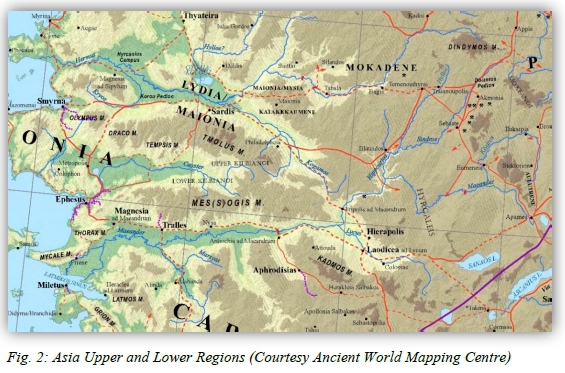
This track, also suggested on the Barrington Atlas but not on Calder and Bean or Pauly,37passed north of the deep canyon of the Sindros River (modern Banaz Qayi).38 It provided access from the east to Pepouza and Tymion and intersected the north-south road (Fig. 3) that connected these cities with Temenouthryai.39
Blaundos was situated on an isolated high plateau. Filges writes that "the city was situated several kilometres away from the nearest major trade route. Thus it can be assumed that it was not a regular station for travelling traders."40 Its inaccessibility made it an improbable destination for a travelling apostle. For this leg ending in Blaundos, described by Schnabel as a 'high road,'41 it is unlikely that Paul would have taken it to Ephesus. Thonemann notes that the cities just mentioned are "on the main route towards Sardis from southern Phrygia."42 So the road's orientation was towards the valley of the Hermus River (modern Gediz) and not the valley of the Cayster River (modern Küçük Menderes). This would suggest an itinerary more in line with Monroy's suggestion discussed in the next section.
Schnabel next projects the road proceeding westward across the watershed of the Meander valley and into the valley of the Cogamus ( ), a branch of the Hermus, south of Philadelphia (modern Ala§ehir).43 Schnabel then suggests that a track crossed into the upper watershed of the Cayster and passed several ancient towns like Tarigya until reaching Koloe (modern Kiraz). The name of the modern Turkish village, Uluderbent ('high mountain pass'), suggests that it was a transit point on a long-used passage, today highway D310. The track continued on the southern side of the Tmolus range until Hypaipa (modern Gunluce), where there was an important road junction.44
The Barrington Atlas and the digital map of ' Asia Minor' show no route from the upper Cogamus valley to Hypaipa.45 Calder and Bean show a direct route from Koloe past Dioshieron (Birgi) to Hypaipa. However, the terrain dictated that this track ascends 820 feet/250 meters from Koloe before descending a tortuous path to Dioshieron. It is no wonder that both the main ancient and modern routes went southwest around a spur of the Tmolus past Neikaia (modern Türkönü) into the valley of the Cayster before turning northwest to Hypaipa (Fig. 4).46 Near modern Odemis. a branch road runs northeast to Birgi, which surely must have been the same situation in antiquity. French has an arrow pointing southwest from Philadelphia (the junction was actually south of the city) and labels this route D20 with a question mark. However, he does not place Hypaipa at the junction of D2 running from Sardis to Ephesus.47

Roads running from Hypaipa linked the cities in the upper Cayster valley with Smyrna as well as Sardis and Ephesus.48 A stadion-stone dating to the Hellenistic period documents a road between the latter two cities. Now in the Ephesus Museum, the marker measures 90 stadia from Ephesus and 410 stadia from Sardis. French suggests that the distance of 500 stadia may calculate the distance between the Artemis temples in each city and that the route constitutes a 'sacred' or 'King's' road between Ephesus and Sardis.49 Yet the fact remains this route still involved a significant climb over Mount Tmolus (Bozdag) reaching an elevation of over 3200 fasl/975 masl. A route looping through Sardis and crossing over the Tmolus was indeed possible, but it would add considerable time and distance to the journey, thus delaying Paul's arrival in Ephesus.
According to Altinoluk, "The road from Hypaipa to Ephesus follows the plain of Cayster, thus being easy to travel."50 The route followed the northern bank to Laris(s)a. After Larisa, Schnabel suggests that Metropolis was the next stop before Ephesus.51However, this track, depicted on the Barrington Atlas, brought the traveller north of Metropolis, so was the route to Smyrna, not to Ephesus. At Larisa the road turned south to Tyrrha/Thyaira (modern Tire) crossing the Cayster just north of that city. It continued on the left bank past the Seleucid tomb at Belevi before arriving in the territory of Ephesus. The route passed the temple of Artemis and entered Ephesus through the Artemis gate near the stadium.
Other reasons for Paul choosing this route have been suggested. Although conceding that the route from Apamea through Laodicea was 'more usual,' Skeel nonetheless suggests that Paul "might prefer the plain of Metropolis through Eumenia and down the Cayster valley."52 A difference in temperature has also been postulated. Keener writes: "Travel through the highlands would have avoided the scorching heat of a land journey around Ephesus in the summer."53 His source is Pliny the Younger (Ep. 10.17.1) who, however, did not make an inland journey. He arrived by sea at Ephesus (cf. Ep. 10.15) and described his travel by carriage along the Aegean coast in the heat of August. The higher elevation along the upper route does produce a variance of four to five degrees centigrade in the summer when Laodicea (Denizli) is compared to Tememouthryae (Us.ak). However, Paul was probably travelling in the spring when temperatures were more moderate. Night temperatures would be more the concern in April-May: those in Denizli range from 48-55° F/9-13°C while those in Us.ak range from 41-48° F/5-9°C.54 Summarizing the overall climatic situation, the upper Cayster route would be somewhat more bearable in the summer while the Meander route would be more comfortable in the spring. But the temperature difference is so minimal that it would hardly warrant a change in itinerary.
Fairchild has suggested that Paul might have taken the longer northern route because he wished "to avoid the same hindrance that prevented him from entering Asia on his second mission."55 However, the nature of that hindrance is not articulated. Acts 16:16 never states that Paul could not enter Asia, but rather that he was forbidden to preach there. As argued elsewhere, the prohibition by the Spirit likely occurred at the road junction east of Apamea after the apostolic party had already entered the province of Asia. Since the road junction for the upper route began at Apamea, Paul would now have been past that earlier place of 'hindrance.'56
A present fact demonstrating that the cities along the upper route through the Cayster valley were secondary is that no archaeological excavations are occurring in them. However, on the Meander route there are ongoing archaeological excavations at every ancient city except Colossae and Antioch ad Meandrum. Uggeri emphasizes the significance of this for the early church: "Le vie di penetrazione del Cristianesimo in Asia sono dunque le stesse del commercio, e di quello in mano ai giudei in particolare... Tali centri risultano dislocarsi, a partire da Efeso, lungo l'ampia e ricca vallata del Meandro, ossia Magnesia, Tralle e le tre citta contigue di Laodicea, Colossae e Hierapolis."57
The Upper Route through Smyrna
Monroy has proposed a variant by suggesting that Paul went to Ephesus either through the Cayster valley or by way of Philadelphia, Sardis, and Smyrna "perhaps for the purpose of visiting these important cities."58 The latter route had its terminus on the Aegean coast at Smyrna and was rebuilt by Manius Aquillius to provide access to Anatolia's interior.59Monroy cites the fourth-century Life of Polycarp as possible evidence for such a visit: it states that Paul stayed with Strataeas during his visit to Smyrna (Vit. Poly. 2). Grant cites this, contrarily, as an example of the ahistorical nature of the document, since Polycarp in his Letter to the Philippians (11.3) states that the church in Smyrna was not founded before the church in Philippi.60 This route is even more circumambulatory than the Cayster option, adding another 100 miles/160 kilometres. The later tradition that Paul established congregations at this time in several of the Seven Churches proves specious. Their establishment must wait until later during his ministry in Ephesus (Acts 19:10).
Even if Smyrna were the goal, taking the road from Apamea via Blaundos was unlikely. When Xerxes marched westward to Sardis in 480 BCE, his route took him from Apamea (Celenae) past Colossae before traversing the Meander river and then crossing into the Cogamus and Hermus valleys (Herodotus Hist. 7.26, 30-32). In 399 BCE Cyrus the Younger marched with his ten thousand in reverse, departing Sardis and then crossing into the Meander valley and visiting Colossae before heading northeast toward Apamea (Xenophon Anab. 1.2.5-6). In the early second century CE Ignatius, the bishop of Antioch, probably travelled this route via Laodicea and Sardis as a prisoner before stopping at Smyrna.61
A variant of this itinerary has been suggested by Uggeri. For Paul's second journey he posits a route coming from Apamea down the Lycus valley. At Laodicea he turned northwest to Hierapolis, Philadelphia, and Sardis before continuing northward to Troas. Regarding this stage route of the third journey, Uggeri writes: "Anche ora le tappe dovettero essere le stesse del secondo viaggio... Pero, giunto in Lidia, non aveva più motivo di deviare verso la Troade e la Macedonia e percio da Sardi prosegui diritto verso ovest per Efeso, seguendo il percorso dell'antica strada persiana."62 The Persian road that Uggeri speaks about was the Royal Road whose terminus was Sardis. If the route continuing west toward Smyrna was taken, that road forked west of Troketta with its left branch turning south to Metropolis through the Karabel Pass on the modern Kemalpaça-Torbali road. After Metropolis Paul would pass Mount Gallesion before arriving in Ephesus.63
At this stage of the third journey Paul's visitation of cities for sightseeing or ministry seems unlikely. So the roundabout itinerary through Sardis and/or Smyrna via Metropolis posited by Monroy and Uggeri is scarcely feasible. Despite the various arguments marshalled for the route along the upper Meander and Cayster valleys, Bérard's trenchant observation written almost a century ago remains valid: "Cet itinéraire, il faut l'avouer, serait pour le moins étonnant. La vallée du Caystre n'est pas une voie d'accès vers l'intérieur elle conduit à un cul-de-sac, et n'a jamais été, en conséquence, empruntée par les grandes routes antiques ou modernes. Pour rejoindre le haut bassin de Caystre depuis la région d'Apamée, il faut traverser un pays montagneux extrêmement accidenté.... Enfin, dans l'antiquité même, nous n'avons aucune reference tant soit peu précise sur un chemin direct traversant cette région."64
The Southern Highway to Ephesus
The shortest and easiest route from Apamea ran westward along the Southern Highway. Even during the Late Bronze Age (1200 BCE), this was the main route between Apamea and Ephesus and the only route depicted in Vaessen's map of the period.65 Strabo (14.2.29) states that "there is a kind of common road (  ) constantly used by all who travel from Ephesus towards the east." Travelled by his source Artemidorus, the route passed through Laodicea and Apamea. Kulzer emphasizes the importance of this highway "which led from Ephesus (Selcuk) through the valley of the Maeander and the inner parts of Phrygia up to the Euphrates, a connection already used in archaic times."66 In his classic volume on Asia Minor, Magie discusses the important cities founded by the Seleucids that were either in or near the basin of the Meander and its tributary, the Lycus. Only Eumenea to the northwest of Apamea was unconnected to this route.67 These cities with a Hellenistic foundation began at Apamea and ran westward to Tralles.
Approximately 40 miles/64 kilometres southwest of Apamea between the Sinaus Lacus (modern Acigol) and Colossae, the route joined the road that Manius Aquillius built in 129 BCE that connected Ephesus and Pergamum to Pamphylia via Laodicea. Presumably in this area Paul would begin to see bilingual milestones naming the governor as well as the distance to Ephesus, the road's caput viae.68 The road entered the Lycus valley above Colossae and then entered Laodicea through the Syrian Gate. It exited through the Ephesus Gate and crossed the Asopus river over a bridge whose piers are still standing.69 West of Laodicea the Lycus valley merged into the larger Meander valley, and the road proceeded past Antioch ad Meandrum, Nysa, and Tralles. At Magnesia ad Meandrum the road climbed over the small pass at Thorax before descending through the triple-arched Pollio Aqueduct and entering the upper city of Ephesus through the northeastern Magnesian Gate.70
After Asia was incorporated into the Roman Empire, its governors regularly travelled to the province's conventus cities to hold court sessions. Laodicea and Apamea were among these cities, so an imperial retinue regularly travelled from Ephesus eastward to conduct such assizes.71 In 51 BCE when Cicero arrived in Asia to serve as governor of Cilicia, he travelled from Ephesus through Laodicea to Apamea (Att. 5.13-5.16).72 This again demonstrates that this was the natural route between the cities. Regarding the Southern Highway as Paul's route to Ephesus, Mitchell writes that "there is no reason to look beyond the natural geographical interpretation of this journey"; from Apamea Paul continued "down the Maeander valley to the west coast."73
The Third Journey and Bible Atlases
The view of Ramsay and later scholars-that the upper Cayster route best accords with Luke's phrase  -has been articulated for over a century. Yet no Bible atlases have adopted it. In a review of ten major Bible atlases, only three might suggest this as the route Paul used to travel to Ephesus.74 The Kregel Atlas shows a broad line vaguely tracing a path coming from the northeast above the Meander valley.75Carta's New Century Atlas shows Paul's route north of the Meander River, thus suggesting an inner road (Fig. 5).76 Since the lines do not follow any known roads, the maps reflect only the imagination of the cartographers.

The Oxford Atlas depicts a puzzling combination: the track stays north of the road from Apamea to Colossae, but west of Laodicea it dips into the Meander valley and proceeds westward to Ephesus. 77 Since the route cuts across mountains and not along known Roman roads, the projected route again looks like a cartographer's construct. Schnabel's map is not helpful either since it depicts a route directly from Apamea to Acmonia without passing through Eumenea. It also fails to mark either Temenouthryae or Blaundos, and shows no route through the upper Cayster valley into Ephesus.78 Although the verdict of the atlases surveyed, such as the Zondervan Atlas (Fig. 6), decisively favours the Meander route, their general lack of cartographic accuracy depicting Paul's routes in Asia Minor remains problematic.79

Least Cost Path Analysis
While texts and maps contribute to answering the question about Paul's route, new methodologies such as network analysis can provide more objective data. Historians of ancient trade and economy have recently been analyzing transportation routes and how they developed for largely economic reasons. However, their research has implications for travel in a broader sense. Herzog identifies several aims for archaeology offered by Optimal Path or Least Cost Path Analysis (LCPA):80 1) reconstructs ancient routes and road networks,81 2) identifies the main factors governing construction of known road or segments,82 and 3) identifies locations that occupy a central position in a territory. LCPA assumes that people optimize the costs of frequently-travelled routes, which leads to the real-world equivalent of a least cost path. Such analysis is most frequently generated using GIS software. Once optimal routes are generated, their reliability must then be compared to archaeological evidence such as ancient road sections, bridges, and milestones. An example of LCPA at work is the projected road between Sebaste and Blaundos, discussed earlier. Similarly, the suggested track in Figure 4 between the junction south of Philadelphia and the upper Cayster valley near Koloe avoids the much longer and equally difficult climb over the Tmolus at Sardis.
Itineraries may change due to weather conditions as well as social and religious factors. Since Paul's travel pattern suggests frequent visitation of Jewish communities, would one route be more conducive for making such religious connections? As discussed above, Acmonia had a Jewish community in the first century CE; however, the city was located off the projected inland route. Unless Paul had a specific reason to detour there, this would not be a factor for choosing the Upper Cayster route. Because the inland route passed through a rural area with smaller cities, the likelihood of encountering synagogues was more remote. In contrast, Jewish communities were well-established in the cities along the southern route such as in Laodicea, Tralles, and Magnesia ad Sipylum.
A second type of network analysis is route analysis, defined by ArcMap as "finding the quickest, shortest, or even the most scenic route, depending on the impedance you choose to solve."83 LCPA favors cost as the impedance. If time or distance is the impedance, then the best route is the quickest and shortest. Related to Paul's journey, these are primary concerns. Route analysis can be done using various route planners available on the web or as phone apps. Strava Route Builder (https://www.strava.com) is designed especially for runners or cyclists. When Dinar (Apamea) and Selcuk (Ephesus) are entered into Strava, only one route is displayed: the southern route down the Meander valley with a distance of 287 kilometres (178 mi.). Google Maps (http://maps.google.com) is another popular program for route building. When a route from Dinar to Selcuk is requested in Google Maps, the Meander valley option is generated as the shortest at 295 kilometres (183 mi.). To display the inland route via the Cayster valley, a route from Dinar to Selcuk had to be constructed manually, using modern village names that lie along the approximate ancient route (Fig. 7). This option measured 386 kilometres (240 mi.), an overestimation generated because of the difficulty of plotting this route. (For this the Barrington Atlas measured 194 miles/312 kilometres using a map wheel.)
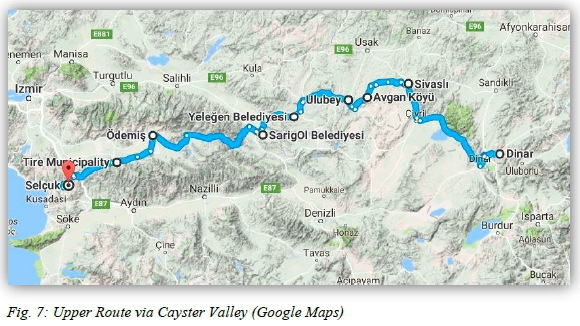


A modern traveller would clearly choose the first option which follows the lower Meander valley. Nevertheless, there are limitations for using these forms of network analysis. Herzog warns that "GIS-based reconstructing prehistoric routes without validating the results on the basis of archaeological evidence or historic sources is mere guesswork."84 However, the autopsy of these routes by the author along with the examination of relevant archaeological realia and texts have hopefully overcome such limitations.85
3D Modelling of the Cayster and Meander Routes
Two-dimensional examples of route building, however, fail to account for elevation differences between the routes. Whereas distance is not changed, speed and ease of travel are clearly affected. Various software is now available to produce 3D route models. The two routes under discussion are now shown using 3D modelling in Geocontext, and the data drawn from these maps are then presented.86
The following chart first provides the data drawn from the 3D route modelling in Geocontext; it then provides the distances calculated in 2D from the Barrington Atlas.

The Cayster route is preferred by some commentators because of its presumed shorter distance. Keener writes that "this would be a more direct route through the hills."88 But as the chart shows, this route at 320.9 kilometres is 18 percent longer than the Meander route at 272.2 kilometres. The route from Sebaste to the Cogamus valley crossed a tableland more rugged than that from Apamea to Colossae. And the Cayster has a narrower valley and meanders more than its namesake. Finally, the climb from the Cogamus valley (610 fasl/185 masl) to cross the pass at Tarigya (2871 fasl/875 masl) is much steeper than that from Magnesia (105 fasl/32 masl) over the Thorax pass (912 fasl/278 masl).
An average daily distance for walking, both today and in antiquity, is approximately thirty kilometres (29.6 km; 18.4 mi). Calculating travel times on the 2D maps of the Barrington Atlas estimates 10.4 days for the Cayster route and 9.3 days via the Meander route. Factoring in ascent from 3D modelling (Cayster 3824 m. vs. Meander 1769 m.) adds time to both itineraries; however, the Cayster route gains more adding 1.4 days. The total time for the Cayster route is now 11.9 days while the Meander route takes 9.7 days. When elevation is factored, the Cayster route takes 2.2 days longer to walk than the Meander route.89 Topographical realities clearly disadvantage any perceived pluses of the Cayster route, and 3D modelling prefers the Meander route.
Concluding Remarks
Delving into an obscure point of biblical geography may appear an arcane exercise, yet it yields some important insights about Paul's travel and ministry programme in Acts. On the second journey the divine impulse to "preach the word" in Asia, particularly its capital Ephesus, remained unresolved. Yet an open door had presented itself in the Ephesian synagogue that Paul must have interpreted as divine guidance to return.90 As in Antioch on the Orontes, Paul was not the founding apostle of the church in Ephesus. Nevertheless, the city's significance as a governmental, commercial, religious, and transportation hub must have beckoned him. As a church strategist he now moves his base of operations westward from Antioch, 91 the third largest city in the empire, to Ephesus, the fourth largest city. Both cities shared numerous demographic advantages, including a large Jewish population. The resumption of Paul's third journey in 19:1, following an episodic window into events at Ephesus during his absence (Acts 18:24-28), indicates that the capital of Asia is his primary focus now. Tannehill emphasizes this point: "Ephesus is not just another stop in a series. It is Paul's last major place of new mission work; indeed, it is the sole centre of mission noted in the last stage of Paul's work as a free man."92 The concise description of Paul's pan-Anatolian journey suggests a compulsion to return as quickly as possible (cf. Acts 20:22).93After his arrival Paul immediately instructs some disciples of John before accepting the invitation, extended months before, to teach in the synagogue (Acts 19:1b-8). To postulate a longer route between Apamea and Ephesus runs counter to the sense of urgency in Luke's narrative at this point.
Spencer importantly points out that the travel texts in Acts "continue to portray the Pauline mission as a team effort."94 Luke seemingly suggests that Paul was travelling alone from Antioch to Ephesus; however, the possibility that he was accompanied by companions should not be discounted. So far in Acts the only journey wherein Paul travelled alone was when the Jerusalem believers sent him back to Tarsus (Acts 9:30). Luke at times fails to list Paul's fellow travellers. For the famine relief journey from Antioch to Jerusalem only Barnabas is named, while Paul includes Titus in his own description of the trip (Acts 11:30; Gal 2:1).95 At the end of Paul's time in Ephesus two of Paul's travelling companions ( ; Acts 19:29), Gaius and Aristarchus, were dragged into the theatre during the riot. Later Gaius is said to be from Derbe while Aristarchus was from Thessalonica (Acts 20:4; cf. 27:2).96 Titus is never mentioned in Acts yet named ten times in 2 Corinthians. He was sent to Corinth from Ephesus as Paul's emissary along with an unnamed brother (2 Cor. 12:18), and after leaving Ephesus the apostle looked for Titus at Troas (2 Cor. 2:1213). After finally meeting him in Macedonia, Titus and his unnamed travelling companion (
 ) were sent ahead to Corinth (2 Cor. 8:19). It is possible that Titus and Gaius travelled with Paul to Ephesus from Syria and Lycaonia respectively. If several travel companions were accompanying Paul, the longer and more difficult Cayster route would be less expedient than travelling directly to his destination.
Paul mentions in Colossians 2:1 that he had never personally met the believers in the Lycus valley: 
 .97 As suggested earlier, there is nothing conclusive in Paul's statement to preclude him from having traversed these cities previously. Dunn construes this verse so, suggesting that Paul "may have passed through Colossae earlier," but that some local believers presently in the church had not met him then.98 Harris argues contrarily that
  introduces the general class of persons to which the Colossians and Laodicean belong: those who have not met Paul personally. He continues, "Paul is emphasizing that his struggle was for Christians personally unknown to him yet spiritually dear to him."99 As Thompson notes about Colossae and Laodicea, "the Christian congregations in both cities owe their existence to the efforts of coworkers in Paul's mission."100 Only during Paul's ministry at Ephesus did Epaphras become a believer and return to the Lycus valley, establishing a congregation at Hierapolis also (Col. 4:13).101Since no believers existed when he passed through initially, no one could know him personally. Because Paul had passed through the Lycus valley on this journey, he had a firsthand knowledge of the physical landscape that his audience inhabited. Although he had not seen their face, he had seen their place: the snow-capped Mount Cadmus that loomed over Colossae like a crown and the white travertine cliffs that gleamed north of Laodicea and provided a ledge upon which Hierapolis rested. These images would come to mind as he later penned his letter to the three house churches there. This existential acquaintance with the Lycus valley seems to underscore the anticipation in his closing request to Philemon: "Prepare a guest room for me, because I hope to be restored to you i n answer to your prayers" (Philm. 1:22).
Can a conclusion be reached regarding Paul's route to Ephesus through the "upper regions?" Walker is noncommittal, stating, "We cannot tell whether he travelled down the Lycus/Meander valley - passing places such as Colossae and Laodicea - or came along the north side of Mount Messogis."102 The majority of Bible atlases, as we have seen, prefer the southern Meander route from Apamea to Ephesus. The longstanding suggestion that Paul detoured off the Southern Highway to travel along a minor route has been demonstrated to be geographically and topographically problematic. The cumulative evidence from ancient texts, archaeological realia, network analysis, and 3D modelling overwhelmingly prefers the direct Meander route for Paul's travel to Ephesus from Apamea. Unless a significant reason existed to deviate, none of which is known, the Southern Highway would be the natural route for Paul's third journey.
1 I wish to thank the anonymous reviewers whose comments helped to improve the article significantly. Any errors that remain are my own.
2 For the probability that Ephesus was his intended destination, see Glen L Thompson and Mark Wilson, "The Route of Paul's Second Journey in Asia Minor: In the Steps of Robert Jewett and Beyond," Tyndale Bulletin 67.2, 2016:225.
3 Robert C Tannehill, The Narrative Unity of Luke-Acts, vol. 2. Minneapolis: Fortress, 1990:231.
4 The most direct route from Antioch on the Orontes to Ephesus was approximately 1000 miles/1600 kilometres. William J Larkin Jr., Acts. Downers Grove, IL: InterVarsity, 1994:269, overestimates this distance by 50 percent, suggesting it was 1500 miles/2414 kilometres.
5 It was probably near Apamea that the Holy Spirit's prohibition forced the apostolic party to turn northward to Bithynia; see Thompson and Wilson, "The Route of Paul's Second Journey in Asia Minor," 227-28.
6 Peter Thonemami, TheMaeander Valley. Cambridge: Cambridge University Press, 2011:133; cf. 99-109. For a local guidebook see Mehmet Özalp, From the Province of Marsyas, Gelenia, Apameia Cibotis, Geykler, Dinar. Dinar: Renksel, 2010.
7 Cilliers Breytenbach and Christiane Zimmerman, Early Christianity in Lycaonia and Adjacent Areas: From Paul to Amphilochius of Iconium. Leiden: Brill, 2018:70.
8 Walter Ameling, Inscriptiones Judaicae Orientis: Kleinasien, Band II. Tübingen, Mohr Siebeck, 2004:488-90 nr. 227.
9 Cilliers Breytenbach, "What Happened to the Galatian Christians? Paul's Legacy in Southern Galatia," Acta Theologica 19, 2014:10-11. For Montanism and Abercius, see William Tabbernee, "Asia Minor and Cyprus," in Early Christianity in Context, ed. William Tabbernee. Grand Rapids: Eerdmans, 2014:268-73; for Pliny and Bithynia-Pontus see idem 302-306. If hypotheses 3-4, 5-4, 5-6, and 5-8 advanced by Rodney Stark, Cities of God. New York: HarperOne, 200:81-82, 132-36, are correct, and they are likely so, Apamea would be a certain candidate for a Christian community in the late first century CE.
10 As Longenecker states similarly about those who deny the existence of robust evidence for a Christian presence in Pompeii before 79 CE, "the absence of evidence is not evidence of absence"; Bruce W. Longenecker, "The Empress, the Goddess, and the Earthquake," in Early Christianity in Pompeian Light: People, Texts, Situations, ed. Bruce. Longenecker. Minneapolis: Fortress, 2016: 62.
11 CK Barrett, Acts 15-28. London: T&T Clark, 1998:892. He further suggests that the statement of Herodotus (Hist. 1.177) about Harpagus pillaging lower Asia (^ev vuv xorw Tfj; Acrfy];) while Cyrus did so to the upper country (Ta 5s avw auTfj;) probably functioned similarly to Luke's statement. Lower Asia for Herodotus was the coastal areas of Ionia, Caria, and Lycia (Hist. 164-176); however, the upper country is ill defined. Previously Cyrus was leaving Lydia for Persia (Hist. 157.1) and is next said to be fighting the Assyrians (Hist. 178.1). The use of nsipo; seemingly refers to continental Asia inland from the sea. Herodotus thus provides little help for understanding Luke's description here.
12 It is worth noting that the Hittites also used the term 'Upper Land' (malum elitum) to designate a region in central Anatolia. As Gurney notes, the term is "based on altitude as seen from their capital, Hattusa"; OR Gurney, "The Upper Land, malum elitum," in In Hittite Studies in Honor of Harry A Hoffner, Jr.: On the Occasion of His 65th Birthday, ed. Gary Beckman, Richard Beal, and Gregory McMahon. Winona Lake: Eisenbrauns, 2003:120.
13 Other parallels in the Deuterocanonicals are sv Tfj avw raAiAaia (Tob. 1:2), avw si; Ta ^spy Aiyunrou (Tob. 8:3), and si; tou; avw T6nou; (2 Macc. 9:23).
14 It is alternatively rendered in the LXX as Bai6wpwv t]]v avw (Josh. 16:5; 1 Chron. 7:24; 2 Chron. 8:5) or t]]v avw Bai6wpwv (Josh. 21:22).
15 For comparison the Afrikaans versions read 'boonste landstreke' (1953 Vertaling), 'die binneland' (1983 Vertaling), and 'deur ander plekke in die provinsie Asie' (Die Bybel vir Almal).
16 Bruce M Metzger, A Textual Commentary on the Greek New Testament, 3rd ed. New York: United Bible Societies, 1975.
17 Barrett, Acts 15-28, 893. In the ellipses Barrett gives the manuscript support for each reading which is fully presented in Nestle-Aland 28. 'Hinterland' in discussions of ancient Greek cities refers not to an amorphous interior region but rather to its relationship to a city, as in n6Ai; and xwpa; see Mogens Herman Hansen, "The Polis as an Urban Centre: The Literary and Epigraphical Evidence," in The Polis as an Urban Centre and as a Political Community, ed. Mogens Herman Hansen. Copenhagen: Royal Academy of Danish Arts and Letters, 1997:17-20.
18 Louw and Nida (s.v. 15.107) place xaTsp^o^ai in the same semantic domain as KaxaPaivco, whose translation in Acts 16:8 involves a similar interpretative issue; see Thompson and Wilson, "Route of Paul's Second Journey," 237-38, 238 n. 104.
19 The reverse movement of ascending or going up is seen in Xenophon's title Anabasis with Sardis as the point of departure and inner Anatolia as the region to be traversed.
20 WJ Conybeare and JS Howson, The Life and Epistles of St. Paul, 2 vols. London: Longmans & Roberts, 1856:2:5.
21 Conybeare and Howson, Life and Epistles, 2:6, also n. 2.
22 Thompson and Wilson, "Route of Paul's Second Journey," 235-37.
23 Ulrich Huttner, Early Christianity in the Lycus Valley. Leiden: Brill, 2013:83.
24 Howard Clark Kee, To Every Nation under Heaven: The Acts of the Apostles. Harrisburg, PA: Trinity Press International, 1997:226, seems to hold this view, suggesting that the upper regions "were on the lofty plateau of central Asia Minor"; cf. Gerd Liidemann, Early Christianity according to the Traditions in Acts: A Commentary (Minneapolis: Fortress, 1989:210, also holds that the interior of Asia Minor is what is meant.
25 Huttner, Early Christianity, 83 n. 17; WM Ramsay, The Church in the Roman Empire. London: Hodder & Stoughton, 1893:91-94. Ramsay (93) makes a significant observation about this initial stage: "Why should the narrator, who in other cases describes St. Paul's route with accuracy, leave it entirely doubtful whether he took the northern or the southern route? The reason is that the northern route never occurred to him as a possibility. The route from Syria by the Cilician Gates to the Aegean coast was a familiar and much frequented one; and unless another route was expressly mentioned, everyone would understand that Paul passed through Lycaonia, and not through North Galatia."
26 David H French, "Acts and the Roman Roads of Asia Minor," in The Book of Acts in its Graeco-Roman Setting, ed. David WJ Gill and Conrad Gempf, vol. 2 of The Book of Acts in Its First Century Setting, ed. Bruce W Winter. Grand Rapids: Eerdmans, 1994:55. James B Pritchard and Nick Page, eds. HarperCollins Atlas of Bible History. New York: HarperCollins, 2008:167, depict this Propontid itinerary for Paul's second journey. However, this route is in Bithynia, which Paul was forbidden to enter by the Spirit of Jesus (Acts 16:7).
27 Ramsay first articulated this in The Church in the Roman Empire, 94, and later more briefly in St. Paul Traveller and Roman Citizen. London: Hodder & Stoughton, 1895:265. This opinion is followed by Colin J Hemer, The Book of Acts in the Setting of Hellenistic History. Winona Lake: Eisenbrauns, 1990:120, 187; FF Bruce, Acts of the Apostles, 3rd ed. Grand Rapids: Eerdmans, 1990:405; Rainer Reisner, Paul's Early Period: Chronology, Mission Strategy, Theology. Grand Rapids: Eerdmans, 1998:286; John McRay, Paul: His Life and Teaching. Grand Rapids: Baker, 2007:177-78, David Peterson, The Acts of the Apostles. Grand Rapids: Eerdmans, 2009:528 n. 5, and Eckhard J Schnabel, Acts. Grand Rapids: Zondervan, 2012:783.
28 CM Emilie Haspels, The Highlands ofPhrygia: Sites and Monuments, 2 vols. Princeton: Princeton University Press, 1971:1:11. She states in the Preface (vvii) that she is completing Ramsay's two-volume Cities and Bishoprics of Phrygia by writing the third volume on the Highlands of Phrygia.
29 Richard Talbert, Barrington Atlas of the Greek and Roman World. Princeton, Princeton University Press, 2000:61-62.
30 Stephen Mitchell, Anatolia, 2 vols. Oxford: Oxford University Press, 1993:1:20; for a map of western Phrygia and Lydia, see 1:190.
31 Eckhard Schnabel, Early Christian Mission: Paul & the Early Church, 2 vols. Downers Grove: IVP Academic, 2004:2:1200.
32 Celal Sims.ek, Laodikeia (Laodikeia adLycum), rev. ed. (Istanbul: Ege, 2013), 35. As head of the excavations at Laodicea, Sim§ek writes, "Antik cografyada Lykos Vadisi, Frigya Bölgesi'nin en bati ucunda bulunur" ("In ancient geography, the Lycus valley is found at the most western margin of the Phrygian region.")
33 Schnabel, Early Christian Mission, 2:1200. The cities along this route are described on pp. 1200-1203. Witherington, following FF Bruce, more equivocally states that "Paul may have taken a higher road farther north, leaving the main road at Apamea"; Ben Witherington III, The Acts of the Apostles. Grand Rapids: Eerdmans, 1998:70.
34 Eumenea later became an important Christian centre; see Tabbernee, "Asia Minor and Cyprus," 270-71.
35 See Paul Trebilco, Jewish Communities in Asia Minor. Cambridge: Cambridge University Press, 1991:58-84, 214-21.
36 The primary road from Sebaste ran northwest to Temenouthyrai before dropping southwest to Blaundos. Following this route was again a detour of approximately 47 miles/75 kilometres. Distances have been calculated on the Barrington Atlas using a Scalex Map Wheel and conform with the measurements given on Orbis for distances in this area (http://orbis.stanford.edu/). They also approximate the distances given by Schnabel in his chart (2:1198).
37 Talbert, Barrington Atlas, 62; WH Calder and GE Bean, "Classical Map of Asia Minor". Ankara: BIAA, 1958; A-M Wittke, E Olshausen, and R Szydlak, eds., New Pauly Historical Atlas of the Ancient World. Leiden: Brill, 2010:177
38 "Asia Minor in the Second Century CE," Ancient World Mapping Centre (http://awmc.unc.edu/wordpress/blog/2017/02/22/wall-map-now-available-asia-minor-in-the-second-century-c-e/; accessed 7/20/2017).
39 William Tabbernee and Peter Lampe, Pepouza and Tymion. Berlin: de Gruyter, 2008:105-6; 165-67. Two maps show this road and the Roman bridge across the Sindros: 104 fig. 5.11 and 105 fig. 5.12. For a map of the larger region see 2-3 fig. 1.1.
40 Axel Filges, "Buildings and Citizens: Observations from Late Antique and Byzantine Blaundos in Phrygia," in Archaeology and the Cities of Asia Minor in Late Antiquity, ed. O Dally and C Ratte. Ann Arbor: Kelsey Museum of Archaeology, 2011:136. Filges also writes: "There must have been a junction at this major road with a one-way street leading to and from Blaundos" (personal correspondence 1/9/2016); see also Falko von Saldern, "Das Territorium von Blaundos," in Blaundos. Berichte zur Erforschung einer Kleinstadt im Lydisch-Phrygischen, ed. Axel Filges. Tübingen: Wasmuth, 2006:14-16.
41 Schnabel, Early Christian Mission, 2:1200. Elevations are definitely higher along this road. Eumenea sits at 2822 fasl/860 masl while Blaundos is at 2231 fasl/680 masl; conversely, Colossae sits at 1188 fasl/362 masl while Laodicea is at 951 fasl/290 masl.
42 Thonemann, Maeander Valley, 173.
43 Schnabel's geography gets fuzzy here: "At this point, near mod. Gullu, one needs to assume a road running toward the southwest across the eastern Tmolus Mountinas (mod. Bozdaglari), perhaps along the line from Gullu to A§agice§me, Bozalan, Sarigol, Uluderbent and Akpinar. The BAGRW maps neither document nor suggest such a route, which, however, does not prove that such a route did not exist" (Early Christian Mission, 2:1200). First, the Tmolus Mountains do not extend east of the Cogamus valley (see Fig. 2). Of the places mentioned, only Uluderbent and Akpinar are situated in the Tmolus. Second, the Barrington Atlas does show a route on map 62 from Blaundos connecting just south of Philadelphia. However, it is farther north than that projected by Schnabel.
44 The connection between Hypaipa and Sardis is epitomized by the fragmentary inscription found in the Sardis synagogue mentioning a Jew named Samuel, also called Julianos, who was a citizen and councilor of Hypaipa who erected the panel in fulfillment of a vow; see Jack Kroll, "The Greek Inscriptions of the Sardis Synagogue," Harvard Theological Review 94.1, 2001:33 no. 34; 89 fig. 36.
45 Talbert, Barrington Atlas, 56.
46 Veli Sevin, Necla Arslan Sevin, and Sevda Cetin, Neikaia Unutulmus birAntikKent. Odemis,: Odemis. Museum, 2013:30 fig. 10.
47 David H French, Roads and Milestones of Asia Minor, vol. 3 Milestones, Fasc. 3.5 Asia. Ankara: BIAA, 2014:25, Conspectus map 5.1.1 Asia West.
48 For recent investigations of these roads, see Hatice Kalkan, "New Observations on the Road of Ephesus-Hypaepa-Sardeis and Persian Royal Road," International Journal of Human Sciences, 11.1, 2014:456.
49 David H French, "Pre- and Early- Roman Roads of Asia Minor: A Hellenistic Stadion-stone of Ephesus," Arkeoloji Dergisi 5. 1997: 91-95, map 190. One stadion is calculated at 609.006 feet/185.625 meters.
50 S Altinoluk, Hypaipa, A Lydian City during the Roman Imperial Period. Istanbul: Ege, 2013:20. A map on page 251 depicts the city territories of the Cayster valley.
51 Schnabel, Early Christian Mission, 2:1203.
52 Caroline AJ Skeel, Travel in the First Century after Christ with Special Reference to Asia Minor. Cambridge: Cambridge University Press, 1901:137.
53 Craig S Keener, Acts, 4 vols. Grand Rapids: Baker, 2013:3:2815 n. 5153. Regarding the heat, Keener adds that "Paul was probably by now inured to it, in any case."
54 The temperature information for Denizli and U§ak was derived from the weather section of the Wikipedia articles on these cities.
55 Mark Fairchild, "Laodicea's 'Lukewarm' Legacy: Conflicts of Prosperity in an Ancient Christian City," Biblical Archaeology Review 43.2, 2017:33.
56 Thompson and Wilson, "Route of Paul's Second Journey," 227-28.
57 "The ways of penetration of Christianity in Asia are therefore the same as those of commerce, and of those in the hands of Jews in particular... These centres are positioned, starting from Ephesus, along the wide and rich valley of the Meander, namely Magnesia, Tralles, and the three adjoining cities of Laodicea, Colossae, and Hierapolis": Uggeri, "Sulle strade di San Paolo in Anatolia," 159. Uggeri seemingly ignored his own words when he formulated the route of the third journey; see below.
58 Mauricio Saavedra Monroy, The Church of Smyrna: History and Theology of a Primitive Christian Community. Frankfurt am Main: Peter Lang, 2015:162; cf. 243. Again this interpretation is driven by the reading of Colossians 2:1 that "the men of the valley of Laodicea and Colossae did not see Paul personally."
59 David Magie, Roman Rule in Asia Minor, 2 vols. Princeton: Princeton University Press, 1950:1:157.
60 Robert M Grant, "Polycarp of Smyrna." Anglican Theological Review 28, 1946:137. [ Links ]
61 William R Schoedel, Ignatius of Antioch. Philadelphia: Fortress, 1985:11; Michael W Holmes, ed. The Apostolic Fathers, 3rd ed. Grand Rapids: Baker, 1999:128, map 611.
62 "Even now the stages had to be the same as the second voyage... However, when he arrived in Lydia, he no longer had a reason to deviate to Troas and Macedonia, and therefore from Sardis he went straight west to Ephesus, following the path of the ancient Persian road": Giovanni Uggeri, "Sulle strade di San Paolo in Anatolia: Il secondo e il terzo viaggio," in Seminario di studi Paolo di Tarso: il messaggio, Vimmagine, i viaggi: studi in memoria di Luigi Padovese, ed. Stella Uggeri Patitucci and Luigi Padovese.(Palermo: Officina di studi medievali, 2011:134; cf. 137.
63 Paradoxically the map of the third journey in Uggeri, "Sulle strade di San Paolo," 163 fig. 34, fails to show this route but instead shows it descending through the Meander valley to Ephesus.
64 "This itinerary, it must be admitted, would be surprising to say the least. The Cayster valley is not an inland gateway but leads to a cul-de-sac, and has never been, as a result, travelled by ancient or modern highways. To reach the high basin of Cayster from the region of Apamea, you have to cross an extremely rugged mountainous country... Finally, even in antiquity, we have no precise reference to a direct path through this region": Jean Bérard, "Recherches sur les Itinéraires du Saint Paul en Asie Mineure." Revue Archéologique 6.5, 1935:85.
65 Rik Vaessen, "Cosmopolitanism, Communality and the Appropriation of Mycenaean Pottery," Anatolian Studies 66, 2016:49 fig. 3.
66 Andreas Kiilzer, "The Network of Communication Routes in Anatolia in Late Antiquity and Medieval Times," 7 (paper presented June 15, 2015 at Atalim University, Ankara, Turkey; https://www.academia.edu/27832584/The_Network_of_Communication_Routes _in_Anatolia_in_Late_Antiq uity_and_Medieval_Times; accessed 7/27/2017).
67 Magie, Roman Rule in Asia Minor, 1:125-29. Magie carefully delineates the stages of this route, called by Ramsay the "Eastern Highway," in a detailed discussion in 2.789-91 n. 18.
68 This route is shown as E1 on French, Roads and Milestones, Asia, 26 map 5.1.2. Two milestones marking this route have been discovered; see David H French, Roads and Milestones of Asia Minor, vol. 3 Milestones, Fasc. 3.1 Republican. Ankara: BIAA, 2012:36-38.
69 Simsek, Laodikeia, 83-85, 89-91, 95-97.
70 Thonemann, The Maeander Valley, 103-104 n. 11, 279.
71 Christian Marek, In the Land of a Thousand Gods: A History ofAsia Minor in the Ancient World. Princeton University Press, Princeton, 2016:261. However, Marek includes Sardis among the cities along this main road.
72 Cohen uses Cicero to make this same point: "Under the Republic and Early Empire, the Common Road and its western terminus, Ephesos, remained a vital link for communication with Rome"; Getzel M Cohen, The Hellenistic Settlements in Europe, the Islands, and Asia Minor. Berkeley: University of California Press, 1995:58.
73 Mitchell, Anatolia, 2:4.
74 The other seven are: Yohanan Aharoni and Michael Avi-Yonah, The Macmillan Bible Atlas, 3rd ed. New York: Macmillan, 1993, 184 map 252; Paul Lawrence, The IVP Atlas of Bible History. Downers Grove: IVP Academic, 2006:161; Pritchard and Page, HarperCollins Atlas ofBible History, 167; Barry J Beitzel, The New Moody Atlas of the Bible. Chicago: Moody, 2009:261 map 112; John D Currid and David P Barrett, Crossway ESV Bible Atlas. Wheaton: Crossway, 2010:247; Carl Rasmussen, Zondervan Atlas of the Bible. Grand Rapids: Zondervan, 2010:231; John A Beck, Discovery House Bible Atlas. Grand Rapids: Discovery House, 2015:303 map 11.7.
75 Tim Dowley, The Kregel Bible Atlas. Grand Rapids: Kregel, 2002:85.
76 Anson F Rainey and R Steven Notley, Carta's New Century Handbook and Atlas of the Bible. Jerusalem: Carta, 2007:246.
77 Adrian Curtis, Oxford Bible Atlas, 4th ed. Oxford: Oxford University Press, 2009:169.
78 Schnabel, Early Christian Mission, 2:1604, fig. 18. Also confusing is that his two maps of Asia Minor are mislabelled: fig. 18, Asia Minor I is really "Cities and Roads," while fig. 31, Asia Minor II is actually "Provinces and Territories" (2:1617).
79 This lack of cartographic veracity is discussed in Thompson and Wilson, "Route of Paul's Second Journey in Asia Minor," 219, 221.
80 Irmela Herzog, "The Potential and Limits of Optimal Path Analysis," in: Computational Approaches to Archaeological Spaces, ed. Andrew Bevan and Mark Lake. London: Left Coast Press, 2012:1.
81 An example is Philip Verhagen and Karen Jeneson, "A Roman Puzzle: Trying to Find the Via Belgica Using GIS," in Thinking Beyond the Tool: Archaeological Computing and the Interpretive Process, ed. Angeliki Chrysanthi, Patricia Murrieta Flores, and Constantinos Papadopoulos. Oxford: BAR, 2012:123-30.
82 Barbora Weissova and Peter Pavúk, "On Persistency of the Main Communication Routes from Prehistory until Today," Turkish Academy of Sciences Journal of Archaeology 19, 2016:1-21.
83 http://desktop.arcgis.com/en/arcmap/latest/extensions/network-analyst/route.htm (accessed March 3, 2018).
84 Herzog, "Potential and Limits of Optimal Path Analysis," 20.
85 LCPA was used to calculate two optional routes on Paul's second journey also; see Thompson and Wilson, "Route of Paul's Second Journey," 234 n. 84. I wish to thank Levent Oral and Cenk Eronat of Tutku Tours, Izmir, Turkey, for the opportunity to visit Dinar and other sites along the upper route in August 2016.
86 Such 3D modelling was presented by Tonnes Bekker-Nielsen in the presentation "Ancient Roads in the Third Dimension" at a conference called Roads and Routes in Anatolia: Pathways of Communication from Prehistory to Seljuk Times sponsored by the British Institute in Ankara in March 2014. I thank Prof Bekker-Nielsen for his patience in teaching me about this methodology.
87 The formula used in the chart is: (d + [L| * 7.92] = T); "Naismith's Rule," Wikipedia, https://en.wikipedia.org/wiki/Naismith%27s_rule (accessed 2 July 2017
88 Keener, Acts, 3:2815, apparently echoing the opinion of Ramsay (Church in the Roman Empire, 94), states that Paul "preferred the shorter hill road practicable for foot passengers but not for wheeled traffic."
89 For a more detailed discussion of the methodology behind these calculations, see this author's "Paul's Journeys in 3D: The Apostle as Professional Traveller," Journal of Early Christian History 8.1, 2018 na.
90 Mark Wilson, The Spirit Said Go: Lessons in Guidance from Paul's Journeys. Eugene: Wipf & Stock, 2017:70-72.
91 Tannehill, Narrative Unity of Luke-Acts, 230, makes this significant observation: "Paul is not a loner, founding a separate, Pauline church, but a major figure in the one mission that began in Jerusalem and was effectively continued from Antioch."
92 Tannehill, Narrative Unity of Luke-Acts, 231.
93 Wilson, The Spirit Said Go, 91-93.
94 F Scott Spencer, Journeying through Acts: A Literary-Cultural Reading. Peabody, MA: Hendrickson, 2004:192.
95 This of course assumes that the two journeys are identical, which I do. For more discussion on this issue see Ben Witherington III, Grace in Galatia: A Commentary on Paul's Letter to the Galatians. Grand Rapids: Eerdmans, 1998:13-20.
96 The plural MaKeôóvaç suggests that both men were Macedonians; however, the Alexandrian text here is singular (MaKeôóva) suggesting that only Aristarchus was Macedonian. For more on the possibility of dittography here, see FF Bruce, The Acts of the Apostles: Greek Text with Introduction and Commentary, 3rd ed. Grand Rapids: Eerdmans, 1990:418.
97 "For I want you to know how much I am contending for you and those in Laodicea: everyone who has not seen me in person" (author's translation).
98 James Dunn, The Epistles to the Colossians and to Philemon. Grand Rapids: Eerdmans, 1996:129.
99 Murray Harris, Colossians & Philemon. Grand Rapids: Eerdmans, 1991:79
100 Marianne Meye Thompson, Colossians & Philemon. Grand Rapids: Eerdmans, 2005:47.
101 John Polhill, Acts (Nashville: B&H, 1992), 398, suggests that the "most natural route" passed through the Lycus valley and then concludes from Col. 1:7 that the churches there were established by Epaphras, probably during Paul's Ephesian ministry.
102 Peter Walker, In the Steps of Paul. Grand Rapids: Zondervan, 2008:135-136. Messogis is the mountain range separating the Meander and Cayster valleys. The map on page 84 shows a major road north of Messogis coming from the east; however, it deviates significantly from the routes presented in this article.
ARTICLES
Glocalisation in the service of resistant discourses: towards 'reading' with Volker Küster
Godwin Akper
Systematic Theology and Ecclesiology Stellenbosch University
ABSTRACT
'Talking back' in a non-confrontational way, this essay engages the German theologian Volker Küster's 'reading' of what it views as resistant discourses from the global South. In the first instance, the essay attempts to 'read', with Küster, global political and social transformations since 1990, specifically looking at possible ways they have shaped theological discourses in the global South. Moving on, is Küster's 'reading' of a selected number of the latter discourses. The essay also attempts to highlight analytically, how Küster came to the conclusion that a shift occurred from contextualisation to the so-called glocalisation. Finally, based upon an own 'reading' of the discourses and drawing on the discussants' voices themselves, an argument is made for glocalisation in the service of contextualisation.
Keywords: Contextualisation; Globalisation; Glocalisation; African Theology; Black Theology; Resistant discourses; Postcolonial discourse; Feminist criticism
Introduction
German scholar Volker Küster recently published1 a very insightful article in Exchange2 arguing that recent economic, political and social changes that took place around the world have already left their marks on theology.3 They have done so, he argues, specifically on so-called resistant theologies4 from the, to use Küster's term, Third World. According to Küster, when considering the fact that some of the interlocutors of a number of these theologies have become obsolete, such theologies have either deteriorated or transformed from local, cultural, or particularistic to globalised theologies.5 Küster lists such theologies as, among others, inculturation,6 contextual, liberation, feminist, postcolonial theologies and hermeneutics. Globalisation is understood by Küster to refer to a discourse involving "many-folded connections, mutual dependencies or permanent exchanges" between what was previously proposed to be local, contextual and community-like but is now globalised. From his arguments, it appears that Küster is under the impression that the various theologies he reviewed had a shared main agenda, namely to particularise and localise global intellectual discourses. Therefore, he argues and concludes that such particularistic and localisation projects could not be sustained by either earlier or later generations of theologians, as the (particular and local) issues the theologies were designed to address became global issues which called for synergy. Küster thus thinks that inculturation, reconstruction, gender, race, feminist, liberation or contextual theologies and hermeneuti no longer exist cs, but what appeared in their place were globalised discourses. 'Pitching tent' with postcolonial criticism as "a meaningful continuation of contextual theologies in the era of globalisation",7 Küster is of the view, for example, that "inculturation theology points at a way from contextualisation8 to globalisation".9 I will argue that the resistant theologies/hermeneutics here referred to, were approached by Küster as discourses. Küster 'read' discourses of a select number of discussants of proponents of the theologies. This approach led him to the conclusion that there has been continued transformation of these theologies into others, terminating in globalised theology. While not denying the fact these theologies had undergone transformation, a broader 'reading' of their tasks expressed in the discourses will, however, reveal that they are still hovering around contextualisation and have not necessarily been totally taken up into globalisation in the way Küster portrays them in his article.
On Global Political and Social Transformation
Like South African theologian Tinyiko Sam Maluleke,10 Küster identifies the perceived end of the Cold War symbolised in 1989/90 by the fall of the Berlin wall, as the dawning of a new world order. The latter, Küster argues quite eloquently, signalled a form of hybridity of political and economic life of the former communist East and the capitalist West as they both scrambled for control of the South, for which the latter was later to bear the brunt of negative consequences. Within the South itself, the gap between the rich and the poor became wider despite the fact that the world became a global village through superior communication media technology.11 Conscious of the fact that the West and East are not as yet free from conflicts and power contestations, Küster further explains that "[T]he possible allegation that this is [simply] a Eurocentric perspective is refuted by the strong connection of the conflicts between East and West, and North and South".12 He reiterates that the power consolidation following the fall of the Berlin Wall was the work of already well-established power blocs. While European Union (EU) was formed with a cooperate interest towards the East, taking with it most of what had until then belonged to communist powers. Russia, on the other hand, emerged as a 'new' super power, leaving behind a number of the "former Warsaw Pact states" for the EU.13 The USA, according to Küster, was preoccupied with its "War on Terror" in the Middle East, protecting its (the USA's) interests in the massive oil resources in the Gulf region. For Küster, these changes, in one way or another, had implications for thought patterns and ideologies in Third World countries. This coincided with a widespread renewed sense of national and cultural identity, as refugee crises arising from the power contestations among the 'world's giants' scattered citizens of developing countries into the global North.
Küster's arguments, put in context, portray the impact of global political and economic transformation have, on what is considered by some theologians in the global South, as contextual (or resistant as Maluleke & Nadar call them) theologies. He succinctly summarised his conviction, also taking note of the views of many in the global South, in the following words: '...theologies which consider themselves as contextual undergo deep transformations from localisation to deterritorialisation, from being mono-cultural to hybridity and from being community centered to multiple belongings' .14 He traced this major shift from "contextualisation to glocalisation" to the works of leading theologians from the global South like Musimbi Kanyoro (Kenya), Musa Dube15 (Botswana), Kwok Pui-Lan (resident in USA but Asian by race) and RS Sugirtharajah (United Kingdom).
The 'global' citizenship of some of the above-named theologians underscores the point stressed in Küster's article, that there is a consistent shift away from local to global, from community-based (centred) to "deterritorial", as it is in the case of Kwok Pui-Lan and RS Sugirtharajah. There are also a number of events, such as migration, political and socioeconomic transformations in countries like South Africa (like the demise of a separate development ideology called apartheid and recently the fall of Jacob Zuma),16 in Zimbabwe (especially the unexpected peaceful fall of Mugabe); the four times historic peaceful civil to civil transition in Nigeria, and many others call for a new theological thinking in Africa and the rest of the global South as argued by Küster in his article. Perhaps, the lists of events that ushered in the so-called new order is endless. One could add to the events mentioned by Küster, to argue further that major transformations are ongoing in the global South, that also call into question the continued relevance of earlier theologies that seek to problematise post-coloniality (Dube), liberation (Mosala, Boesak, Mafokeng, among others); inculturation (Musimbi), as the events that reflect some of the transformations that occurred at the beginning of the so-called new order appeared to have dampened earlier enthusiasm for those theological 'projects'.
But did such a new world order really persist? If the fall of the Berlin wall was significant in bringing to an end an old era, is Donald Trump's threat during his first week in office as the USA's 45th president to raise a wall in North America between the USA and Mexico, a mark of the rebirth of the 'old world order'? Perhaps this could be dismissed for the fact that many within USA criticise Trump, while other media commentators regard him as a ' deranged politician' . Yet, the Columbia SC (USA) racial protests, the reaction of the President of Mexico, by cancelling his initial visit to Whitehouse in protest; the declaration of Jerusalem as the capital city of the State of Israel by Trump's administration and the reactions that trail that declaration from the Arab League of Nations; the release of the The End is not Yet published by a leading South African theologian, John De Gruchy,17depicting Trump's views as indeed representing the views of elites in the USA further underscore the point that another world order or a reversal of the an existing one may have erupted. Similarly, on January 26, 2017, in her first and most powerful speech to date, United Kingdom's (UK) Theresa May, addressed Republican Law makers and this seemed by all indications to favour the re-establishment of another but redefined imperial world order. In the latter, ' Global Britain' , as she calls it, would take the lead with the USA as its soul partner. Again, it could be argued that May represents the right wing conservative view from the global North. However, true as that may be, the Brexit processes and the ongoing re-alignment that follows it, the decision of the South African Parliament to vote for reversal of traditional land ownership in some communities in South Africa, stressing local community-centredness, are events pointing towards another world order based on local interests, not only in the global North, but also in the global South.
In their separate foreign policy statements, both the British Prime Minister and the USA President are apparently clear on the kind of world order with which their countries seek to establish or engage. May explicitly says it is the relationship between the UK and USA that "defined the modern world".18 In turn, Trump insists that it is either America first, or no deal at all. I find Trump's position almost identical to that of May of Global Britain. The world is again, as it has in fact always been during and after the Cold War, defined in accordance with the USA and UK's global interests and ideology. If this is the case, then it may be safe to argue that in reality, following the fall of the Berlin Wall, no new world order was established, but merely a realignment of interests and partners in the global North. In this sense, globalisation by USA and the UK in the years to come appears to be boiled down to "thinking globally, but acting very locally" for the benefit of one's own people. And this is the version of globalisation, I find in the resistant and contextual discourses succinctly analysed by Küster in his "From Contextualization to Glocalization".19In the next section of this essay, I turn in more detail to Küster's 'reading' of how the events described above impacted on, and transformed Third World theologies.
On Changing Third World and Theological Discourses
"I think that what Africa will need is the ability to drink from our own wells as it were."20
- Tinyiko S Maluleke
Küster provides a very insightful, comprehensive and what could be described as an acute narrative on the changing situation of the Third World.21 Following the end of the Cold War, he asserts, the world has opened up, with only North Korea hanging on to its self-imposed isolation.22 The agitation for regime changes, to replace military dictatorship in Africa appears to decrease. There are track records of peaceful political transitions in most of the countries of the Third World. One finds an increase in developing economies making news - such as China joining the G20 and South Africa and Brazil showing significant economic growth with greater potential envisaged for other countries beyond ' the southern tip' of Africa. Theologically-speaking, as may be expected, one also finds a transformational shift and in the theological focus and discourse of theologies of the Third World. An example is the views of Laurenti Magesa (from Africa), who "claims that African traditional religion is a world religion to demonstrate that the worldview and the values of his continent contribute genuinely to the global knowledge economy".23 With regard to the categories of 'globalisation' and 'empire', Küster argues that helpful as these concepts may be, the idea of ' empire' as a hermeneutical key to understanding changes in the global world, presents the "risk of falling into a trap of a monocausal interpretation pattern of a situation that needs to be analysed from multiple perspectives".24 Globalisation, he argues, is weak because of its "unilateral focus on socio-economic and political factors accompanied by a disregard of cultural and religious factors"25 as resistant or 'counter-movements'. Küster furthermore argues that "local cultures strengthen themselves in hybrid forms as counter movements, which make all cultural analysis needing a complex hermeneutics of difference to delineate the new mixtures adequately". His conclusion on this matter is that:
[I]f one wishes to analyse and understand the situation of the Third World, it is better to pay attention to ethnicity, fundamentalism and the reconstruction of hybrid identities, the formation of local elites and the deterioration of the position of the urban proletariat, which works in the sweat-shops and call-centres of the megacities.26
Nothing is to be gained from denying the fact that the developing world has undergone the changes/transformations discussed by Küster. However, his initial assumption that resistant and contextual theologies themselves transformed from being contextual theologies to becoming globalised theologies affects, in my opinion, his fair assessment of the situation in the Third World as regards doing theology in that context. Therefore, his description of the transformation of the Third World in the era of globalisation logically leads him to the conclusion expressed in the quotation above.
Küster also dismisses the idea of 'empire' on the ground that it focuses only on the USA's global domination. However, one has to ask whether this is really the interpretation of ' empire' by theologians of the Third World. When Black theologians in South Africa speak about Afrikaner nationalism and how the ideology led to disinheritance and genocide of the indigenous people - an act legitimised by a hyper-Calvinistic theology - were they referring to the USA? Related questions to ask are: with regard to the recent speech of Theresa May in Philadelphia referred to above and the ongoing Brexit processes and the ideology behind the intention to withdraw from EU, will it still be helpful to argue to the contrary, that the idea of empire is fresh in the minds of global superpowers as it was before the end of the so-called Cold War? As was seen, both May and Trump made it clear to the world that their countries come first. It is Britain first and America first. When May speaks of global Britain, what does she mean? What would a global Britain in the twenty-first century mean to the global South? Küster refers to the massive cross-border migration of different groups as a contributor to the intermingling of local culturing identities. While this may be the case, there is also another side to it. Migrants to the global North, despite the apparent appearance of being clothed in imperial-capitalist identities of the powerful global North are nonetheless aliens in those cultures. At most, they end up in what the theologian Miguel de la Torres refers to as ou topos (utopia) - meaning no place - in a supposedly superior place! Hear what he has to say with regard to Cuban-American migrants:
...the Cuban-American creates a hyphenated identity, attempting to reconcile two distinct and separate cultures into one being. This locution erects within our very being a schizophrenic (Latin for 'split mind') existence. This phenomenon was manifested during my first trip to Cuba, my homeland, some forty years after I left. ... I was approached by one of the city jineteros (street hustlers) who asked me where I was from... With pride I stated I was from here from this very city; to which he replied, "you may be from Cuba, but obviously not Cuban." ...I realise that I will always be too Cuban ever to be fully accepted within the United States and too Americanised ever to be accepted by my native compatriots. In effect, I occupy utopia (Greek for 'no place' -ou topos), for literally there is no place on earth to which I and other US scholars of color (sic) can belong.27
Reading the 'confessions' of De la Torre and others,28 one could easily discern the primordial stigma that is placed on the faces of nearly all the people of the South that may last for the unforeseeable future, no matter where they migrate to. In terms of the hybridity that Küster proposes, the example he refers to are that of Hispanic Americans; also of Asian Americans and the various segmented structures within communities in the global South itself. Küster's argument is that the effects of pluralism - with all its ambiguities - are felt more by the people of the global South, than those of the global North.
Regarding phenomenon of globalisation, theologians of the Third World never accepted it as a helpful way forward for theological, economic and social transformation of their own people. To them, what the Third World (the global South) has seen in the so-called globalised economy is that the powerful become more powerful and the rich richer to the detriment of the people these theologies wish to serve.29 According to Allan A Boesak, one of the leading voices of Black Liberation Theology in Africa:
[O]ne of the startling realities of the 'new south Africa' is not only that the rich are getting richer and the poor poorer, but that the gap between the rich, including the new black elites, and the poor is wider than ever. The legacy of apartheid continues to cast a long dark shadow over the lives of those who are most miserable and vulnerable.30
The main focus of resistant theologies is the emancipation of their own people. Globalisation appears to have worsened the living conditions of people in the global South. Küster is therefore right in arguing that the concept of globalisation used as a hermeneutical lens to interpret global issues is weak and lopsided towards socio-economic and political factors while at the same time it neglects cultural and religious factors. This is precisely the point of resistant theologies which argue that there is still a gap existing that needs to be attended to. It is pertinent to note that socio-economic and political factors trigger the neglect of religious and cultural factors. Accordingly, to the contextual theologians (discussed here), all these factors appear to go together. For the people of the South, globalisation did not offer a sufficient way out of any of these factors. When Magesa speaks of African traditional religion being global religions, he was not arguing for globalisation per se, but rather for the inherent value of such religions themselves, especially their contributions to theological developments before the arrival of Christian missionaries to the continent. Such religions, Magesa argues, have credentials that should be recognised as such in their own right. Yet, this point of view is criticised by some leading contemporary African Christian theologians.31
Küster also supports his argument that the global changes have transformed the theological landscape of Third World theologies by saying that "local cultures [in the Third World] strengthen themselves in hybrid forms as counter movements, which make all cultural analysis needing a complex hermeneutics of difference to delineate it". This is one of the shortcomings resistant and contextual theologies point out in the idea of ' speaking for...'. African cultures are known for their plurality and therefore their ambiguity. This may be different from other countries like South Korea, India, Latin America, where people speak one language, and share a similar culture and so on. Although not challenged by multiplicity of languages and cultures as in Africa, Asians too, it could be argued, have multiple views on social transformation in their various contexts as Küster also admits. Whether or not there is a deliberate effort by the people of the South, who vehemently rejected globalisation, towards hegemony of views or cultures, would need further clarification beyond the ordinary description of the cultures in terms of hybridity. Furthermore, more exploration is needed to unearth how 'hybrid identities' could emerge, amongst others, from ethnic fundamentalism, as Küster suggests.32 Nevertheless, the point Küster is perhaps trying to make, is that the socio-economic and political transformation in the Third World have changed the thinking of theologians in the South from that of contextualisation to globalisation. His 'reading' of selected discourses is aimed at proving just that. In what follows, Küster's 'reading' of these discourses is analysed over against what I consider to be the actual arguments and basic thrust of resistant and contextual theologies of the South.
On Resistant Theologies in Changing Contexts
"...the category of the struggle provides the lens for reading the text in a liberating fashion, as well as the codes for unlocking the possibilities and limitations of the biblical texts."33
- IJ Mosala
"...as we African intellectuals continue to meet to discuss ... African Christians are in the process daily of shaping a Christianity that will be at home in Africa and in which Africa will be at home."34
- Mercy Amba Oduyoye
The quotations given as epigraphs above express the mood of theologians from the Third World. A 'reading' of the discourses that takes into cognisance, the mood with which the discourse were engaged into in the first place, would provide sharper hermeneutical lenses with which to 'read' and interpret them. Three things should be made clear: 1) theologians who engage in Third World theologies are not interested in promoting or realigning themselves to what has already been put on the table by Western theology. On the contrary, they are out to oppose and resist its perceived dominating patterns. 2) Theologians who are constructing these theologies do so in rebellion against established Westernised theologies. 3) These Third World theologies are the result of the zeal to address the spiritual and material needs of Christians from the margins, who are trying to ' find' God, so that God could ' find' them, in their situation of despair, but full of hope for a better future. Most of the discussants of these theologies think established Western theologies do not have the requisite potentials to provide answers to the real life questions of people presumed to be underprivileged. In what follows, I will attempt to 'read' Küster's view on Third World theologies in the changing world context with the aforementioned three points in mind.
First of all, Küster correctly points out that "contextual theologies got entrance in the local churches and curricula of their theological seminaries only very slowly".35Theological Seminaries, especially the ones in Africa, are still following the curricula of their churches' home missionary boards that, to a large extent, still fund them. The situation is even more complex in West Africa. Cases in point are: Trinity Theological Seminary has been affiliated to University of Ghana, the Theological College of Northern Nigeria, to University of Jos; and the Reformed Theological Seminary, to University of Calabar (Nigeria). These are indeed state-owned universities with a broad curriculum in religious studies and naturally, degrees awarded to students from these affiliated institutions would bear the marks of the curriculum of the universities awarding the degrees as directed by accreditation and regulatory agencies of their countries. Therefore, while they may be free from structural and theological cumbersomeness of traditional churches, they are not really free from those of state agencies. Thus, not only are the curricula of theological seminaries still determined by nineteenth century missionary theologies, they are also coined by liberal and secular theories of related disciplines in the humanities.
However, Third World theologians are not practicing seminary and traditional theology. Most discussants of theological discourses of the Third World have also transcended denominational boundaries. As such, the future of contextual theologies in the developing world is not determined by what is going on in theological seminaries. Perhaps contextual theologies themselves are tired of seminary theology. What they are out to do is a theology of 'power' and of 'praxis'. That is to say, "[they] call ... not for mastering the theological canon of the West but to explore divinity through the eyes of the marginalised who have resided for centuries on the underside of the colonisers. The journey of solidarity becomes [to them] a liberative pedagogy, which can be implemented (not just by scholars of color (sic), within a global context".36 That the "relationship between global and contextual theologies is shaped by denominational histories, theological traditions and institutional structures" is not news to discussants of Third World theological discourses. In fact, it is this very 'theological pitfall'37 that contextual theologies seek to eliminate. Also, even a cursory ' reading' of the discourses still unearths the fact that contextual theologies are aware that such 'theological pitfalls' do not exist by accident. They (pitfalls) exist as part of a colonial residual being preserved via neo-colonial religious globalisation from above. Perhaps this amounts in part, to what Küster calls a 'complex' mixture requiring a "complex herme-neutics of difference to delineate the new mixtures adequately". Therefore, this may be the reason why Küster himself nearly fell into the pit of "overgeneralisation and simplifica-tion",38 of what are otherwise particular but nonetheless multiple and complex theological issues, that call for contextualisation in order to attend to the specifics of each of the particular issues.
While applauding the global impact of contextual theologies as rightly proposed by Robert Schreiter,39 Küster argues that Third World theologies have multiple, but different sets of problems. These problems include but are not limited to: 1) Inculturation theologies were given less attention in the West but dialogue theologies after 9/11. 2) While contextual theologies feature well in global societies like the Society for Biblical Literature (SBL) and American Academy of Religion (AAR), Third World Theologies are hardly translated into European languages. Even the works written in English are published only in English and mostly by American publishers. 3) Publications of Third World theologians are more easily available in Western libraries than in the libraries of the countries of origin of their authors. There is therefore a problem of dissemination of Third World theologians' thoughts to where they are most needed. 4) That the "situation of Black Theology is again different. Its representatives, such as Desmond Tutu, Allan Boesak or Tinyiku (sic) Maluleke, are deeply involved in the great transformation processes South Africa is undergoing since the end of apartheid. They speak about reconciliation, reconstruction and reparation".40 Küster concludes this part of his argument by stating that theologians like Jesse N.K. Mugambi, Diego Irarrazaval, and Laurenti Magesa, among others, have a "wish to transform both the local cultures and the churches in response to globalisation" in common.41 But, is that really the intention of the theologians? Do they all agree on transforming local cultures and churches as a veritable response to globalisation?
Theologians of the Third World analysed by Küster and others not mentioned in his essay were and are aware of changes that have taken place around the globe. They have in one way or the other and by way of differing methods and constructions creatively initiated and engaged in discourses theologically to address the changing times and needs of their own people. Küster is able to 'read' this aspect in the discourses he reviewed. However, there are other perspectives he overlooked. It is true that Black Theology of Liberation has suffered a setback after 1994 when majority rule and a new constitution were put in place in South Africa. Boesak decries this situation, when he asks:
When the moment called, we went to prison for them (political activists) and shed our own blood for their cause, which was also ours, risked our lives for what we, and they, believed in. We made our sacrifices and inspired others to do likewise. Is the identification too close? Is it that when they falter, we fall, and when they fall, we fail? Is critique of the government too much self-critique? Is this the price we pay for having been so right in the struggle? These are deep, painful questions and the answers may disturb us more that we would want. But it is better to ask them now than to regret never having asked at all {my emphasis}.42
Boesak is reacting to the apparent loss of a prophetic voice and praxis that was loud and active during the struggle days and now appears to be muted since blacks themselves became subtle oppressors. But in the same essay, Boesak reiterates the continued relevance and significance of Black Theology, saying that "liberation theology, as an expression of African Christian theology, is as necessary now as it ever had been".43 Like his African American colleague and compatriot, Gayraud Wilmore,44 Boesak affirms that "black pride, black power, African nationalism and the struggle for black freedom, dignity and the African soul had no past without the religious faith of the African people and the prophetic church, and without them it may well have no enduring and meaningful future".45
In taking up the prophetic voice of the church that Black Theology once had in South Africa, two young black theologians in South Africa, Rothney Tshaka and MK Makofane, argue that a distinction should be made between Black Theology of Liberation that examines spiritual and material conditions of the people on the margins of society and Black Theology as a symbolic intellectual discourse referring to humanity in its entirety.46 Whatever this distinction entails, the idea is that Black Theology, as a resistant voice of the people on the underside of history, is relevant and alive, and should remain an active discourse as long as the situation of vulnerability of people of colour persists. Desmond Tutu not only retired from Episcopal service, but he also retired to a large extent from public life, soon after his compatriot, the late Nelson Mandela did. However, it could still be argued that Tutu was guided by his anthropology that all are created in the image of God, and that God's dream for his created beings is the same for every race. Therefore, it is a sin for any race to discriminate against another. Where this has happened, as it was the case in South Africa before 1994 (on racial grounds) and in Rwanda during the 1994 ethnic genocide, reconciliation is the only hope for the future co-existence of all races and ethnic groups.47 If this is Tutu's point of view, then it may not be fair to conclude that his participation in nation building by serving as Chair of Truth and Reconciliation Commission (and other similar public engagements) under President Nelson Mandela lessened his contribution to Black Theological discourse. Never throughout his theological career and in public discourse, did Tutu change his position on Black Theology.
A similar argument could be advanced regarding African Theology. It is true, as Küster argues, that the initial zeal of the first generation of African theologians may not be seen in the contemporary discussants in African theological discourses. But to "lay down a hole does not mean one has stop to working".48 These were words of acclaimed father of African Theology, John Mbiti in response to the question on the future of African Theology in the twenty-first century. The same year African Christian Theologies in Transformation was published,49 Maluleke and Nadar jointly called for essays on agency of the oppressed discourse, consciousness, liberation and survival in theological perspective which were published in Journal of Theology for Southern Africa (120). All six contributors to that special issue of the journal are black African males and females (Nadar being Indian South African female). The arguments of the discussants are that, in whichever way one looks at the situation of the oppressed, there is proven evidence that the oppressed, no matter the level of their destitution, have devised means of survival and resistance to be able to serve as agents of change in their lives and that of others. They are therefore agents themselves and should not be seen as being too weak or too poor to act for themselves or that they stand in need of others to speak for them. After all, the 'subaltern' does 'speak'.50 Perhaps this was a follow up on an earlier call by Maluleke, that it is time for Africans to "drink from their own wells".51 This is clear from Maluleke and Nadar's description of the notion of agency. By agency, they argue: "the basic suggestion is that human beings, even the most oppressed, marginalised and seemingly destitute among them, have the potential, possibility and even ability to act as (moral) agents of transformation and change in their own lives and in the lives of others".52 In this way, the discussants opt to continue the consciousness movements of the 1970s53 into the twenty-first century theological discourse, arguing that, if any discourse on blacks, women, Africans, or any people at the underside of history, is to be truly liberative, its agents must be from the communities that the discourse intends to liberate.
In the twentieth century, in the attempt to drink from their ' own wells', some African theologians constructed a number of theologies and hermeneutics that aim at addressing African problems by using African tools in an African way by Africans themselves. When Oduyoye speaks of an "irruption within an irruption"54 she was not referring to the fact that what was going on in the Ecumenical Association of Third World Theologians was not on course. Rather, it referred to the fact that it was incomplete without women having a space to deal with their own specific issues, which could be argued, are numerous, and that men are not in a position to address them on behalf of women. Women, too, should "drink from their own wells". As such, Kanyoro,55 Upong56, Dube,57 Masenya,58 Phiri,59 and others from the Third world constructed their vernacular, also intercultural hermeneutics, not necessarily as a move away from contextualisation to globalisation, but rather, as a way of 'drinking' from their own 'wells'.60
This is the point Maluleke makes, namely that the "twenty-first century challenges us to push the boundaries of Black and African theologies by isolating the crucial issues, mapping out the challenges and identifying past and current traps". 61 According to Maluleke, "enough has been done already to lay a firm foundation upon which African theologies can build well into the twenty-first century".62 This would mean that the apparent absence of new theological constructions in Africa is not so much as a result of change in perspective on contextualisation in favour of globalisation, but rather that specific contextual challenges would determine what kind of theological discourse would meet African needs. This explains why Sano (citing late US Senator Hubert H. Humphrey) argues that "where you sit determines where you stand". 63 Thus, where theologians from marginalised communities are sitting (their context) determines both their theology and hermeneutics.
However, it is not to say that all that theologians from the South have done should be taken and accepted without any criticisms. There appears to be as much criticism among theologians from the South in the twentieth century as ever before. In Africa, Maluleke laments that theologians on the continent (black, coloured or Indian) hardly agree on anything and he asks "why should they?"64 But in all they try to do, whether it is the likes of late Ghanaian theologian, Kwame Bediako,65 the Gambian-born, Lamin Sanneh,66 the Kenyan Jesse Mugambi67 or the South African Tinyiko Maluleke,68 the idea is to explore how the encounter between Christianity and the indigenous people of Africa shape each other and thereby solve or complicate already existing problems of the people who Christianity met on the continent. Whether they are successful or not should be a question that could be examined on the terms of the discussants of those discourses. It should also, be appreciated that the main goal of African theologians is to unearth (rediscover) African 'wells' while encouraging Africans to 'drink' from them themselves, in their theological discourses and hermeneutics. In all of these, context remains crucial.
Conclusion
A more careful ‘reading’ of theological discourses of resistant theologies that Küster rightly describes as Third World Theologies reveals a recurrent emphasis on context. Therefore, in as much as theologies from the South are mindful of global changes that are shaping global theological discourses, they still insist that the immediate context of the theologian provides the best hermeneutical lens to interpret and theologise for the context. The relevance of such theologies is determined by the extent to which they are in touch with real life situations as it is lived by the people within their context. If globalisation is taken seriously in the South, it is in the area of thinking globally but acting locally. Contextualisation remains a key in the methodological starting point of theologies from the underside of history.
1 'Reading' here refers to an attempt to understand and interpret what is written by another person. The concept of 'talk back' is taken from Maluleke and Nadar to delineate the importance of resistance in the discourses under review. Cf. Maluleke & Nadar, "Alien Fraudsters in the White Academy. Agency in Gendered Colour", Journal of Theology for Southern Africa 120 (November 2004:5-17).
2 Volker Küster, "From Contextualization to Glocalization: Intercultural Theology and Postcolonial Critique", Exchange 45 (2016:203-226).
3 Küster, "From Contextualization to Glocalization", 203.
4 This is how most of those engaging these theologies regard them. In postcolonial discourses, it is not necessarily completely wrong, but neither is it completely acceptable to many that one may name and speak for the "other". Therefore, the concept of ' Third World' being a description of developing countries/economies of the so-called global South is increasingly being challenged. Maluleke & Nadar (South African Black male and South African Indian female theologians respectively) would summarise the imports of these theologies as resistant and libel theologies, dominated, but fighting for survival on an unfair White epistemological terrain. See Maluleke & Nadar, "The Agency of the Oppressed Discourse: Consciousness, Liberation and Survival in Theological Perspective", Journal of Theology for Southern Africa 120 (November 2004:2-3); "Alien Fraudsters in the White Academy: Agency in Gendered Colour", Journal of Theology in Southern Africa, 120 (November 2004:5-17). In this essay, I refrain from using sources from White scholarship and from the global North simply because it is argued by black and African theologians that Africans should be able and motivated to 'drink' from their 'own wells'.
5 Of course, Kwok Pui-Lan (originally from the global South, but currently residing in the USA) also makes a case for a Global theology, but not as globalisation theology. For the difference between these two concepts see her "Teaching Global Theology in a Global Perspective", in: Kwok Pui-Lan, Cecilia Gonzalez-Andrieu & Dwight N Hopkins (eds.) Teaching Global Theologies. Waco, TX: Baylor University Press (2015:12-13).
6 Küster, "From Contextualization to Glocalization", 226.
6 Küster, "From Contextualization to Glocalization", 226.
6 'Inculturation' is understood here in the way 'Third World' theologians, especially in Africa, use it. The South African theologian, Buti Tlhagale describes Inculturation as "the use of African Culture as a medium of communicating the gospel message. Inculturation thereby also seeks to give a purified meaning, in conformity wit Christian truths, to African cultural practices". See Tlhagale, "Inculturation: Bringing the African Culure into the Church", in: African Theologies in Transformation edited by Ernst Conradie, Stellenbosch : EFSA (2004:43-67).
7 Küster, "From Contextualization to Glocalization", 226.
8 This refers to the use of context to delineate a complex or otherwise theological construct, especially as it is argued in the works of those theologians in the global South under discussion.
9 Küster, "From Contextualization to Glocalization", 226.
10 Tinyiko S Maluleke, "Black and African Theologies in the New World Order: A Time to Drink from our Own Wells", Journal of Theology for Southern Africa (JTSA), 96 (November 1996:3-19).
11 Küster, "From Contextualization to Glocalization", 204.
12 Küster, "From Contextualization to Glocalization", 204.
13 Küster, "From Contextualization to Glocalization", 204.
14 Küster, "From Contextualization to Glocalization", 203.
15 See her, "Looking Back and forward: Postcolonialism, Globalization, God and Gender", Scriptura: International Journal of Bible, Religion and Theology in Southern Africa (2006/2:178-193).
16 Which signifies a shift from embrace of nepotism, dictatorial rule to accountable democratic leadership that Küster refers to in the article under discussion.
17 John De Gruchy, The End Is Not Yet. Standing Firm in Apocalyptic Times. Minneapolis: Fortress Press, (repr. in Cape Town by The Methodist Publishing House} 2017.
18 Theresa May, "Full Text of Theresa May's Speech to 'Congress of Tomorrow' Conference", Philadelphia, USA, January 26, 2017. Available on: http://uk.businessinsider.com/full-text-theresa-mays-speech-to-the-republican-congress-of-tomorrow-conference-2017-1?IR=T (accessed 20/4/17).
19 Küster, "From Contextualization to Glocalization", 204-226.
20 Tinyiko S Maluleke, "Black and African Theologies in the New World Order. A Time to Drink from our own Wells', Journal of Theology for Southern Africa 96 (November 1996:17).
21 To Küster, the so-called Third World refers to developing economies of countries in Africa, Asia, the Middle East and Latin America (see, 'From Contextualization to Glocalization", 205-207). However, according to Amin Samir, from the end of the Cold War and its attendant consequences, Africa appears to be in the Fourth World (whatever this means)! See, Amin Sanir, "A World in Chaos" Voices from the Third World XVIII:2 (December, 1995:160-182).
22 Küster, "From Contextualization to Glocalization", 205.
23 Küster, "From Contextualization to Glocalization", 206. Also, Magesa, African Religion. The Moral Traditions of Abundant Life. Maryknoll, NY: Obis 1997.
24 Küster, "From Contextualization to Glocalization", 206.
25 Küster, "from Contextualization to Glocalization", 206.
26 Küster, "From Contextualization to Glocalization", 207.
27 Miguel A de La Torre, "Identity Cross-Dressing while Teaching in a Global Context", in: Teaching Global Theologies, 80-81.
28 Other examples include Roy I Sano, an Asian-American, who also tells of the experiences of Asian-Americans, who in the 1950s felt privileged by the imperial identity of becoming Americans, and the capitalist identity of being educated in an advanced and superior Euro-centric culture and worldview, had a sense of belonging to an upper superior class, but later felt rejected by that same class, because of their race, their culture, and because of their very nature of being aliens from Asia. They finally realise, according to him, that they are constituted by their own real culture: that of being Asians, and no identity is true of them, than the one they were born into. He therefore insists unapologetically that "particularity of method and focus [context] are both inevitable and necessary" {my emphasis} See Sano, "Shifts in Reading the Bible: Hermeneutical Moves Among Asian Americans", Semeia 90/91 (2002:105-118).
29 Pui-Lan reports the fact that a number of theologians of the developing global south accept the fact that deterritorialisation exists, but territorial geography still remains and they insist, especially feminist/womanist intellectuals, that their discourses continue to address particular and distinctive issues of their particular contexts. Cf. Kwok Pui Lan, "Teaching Theology a Global Perspective", 20-25
30 AA Boesak, "Truth Crushed to Earth will Rise Again: Christian Theology in South Africa- Looking Back", in: Ernst M Conradie (ed.), African Christian Theologies in Transformation. Stellenbosch, Ecumenical Foundation of Southern Africa (2004:24-25).
31 See for example, Maluleke, "Black and African Theologies in a New World Order", 15; Maluleke & Saroj ini Nadar, "Alien Fraudsters in the While Academy: Agency in Gendered Colour", Journal of Theology in Southern Africa 120 (2003:13-14). The argument of these African theologians is that by merely being in the majority (not clear here: does neither their own numerical majority or that of their religions, nor the fact that their religions are word religions, matter to the people of the South?) Statistically (numerically?), or that African religions are world religions have not mattered much to people of the so-called global South. What matters to these theologians/the people of the South (?) is their daily real life socio-economic wellbeing.
32 See Küster , "From Contextualization to Glocalization", 207.
33 IJ Mosala, "Biblical Hermeneutics and Black Theology in South Africa. Grand Rapids, MI: Eerdmans (1989:123).
34 Mercy Amba Oduyoye, "Christianity and African Culture", International Review of Missions LXXXIV (January /April 1995:77).
35 Custer, "From Contextualization to Glocalization", 207.
36 De la Torre, "Identity Cross-Dressing while Teaching a Global Context", 89.
37 Byang Kato, Theological Pitfalls in Africa. Kasimu, Kenya: Kenya Evangelical Publishing house 1975.
38 Küster, "From Contextualization to Glocalization", 207.
39 Robert Schreiter, Constructing Local Theologies. Maryknoll, NY: Orbis, 1985.
40 Küster, "From Contextualization to Glocalization", 208.
41 Küster, "From Contextualization to Glocalization", 209.
42 Boesak, "Truth Crushed to Earth", 26.
43 Boesak, "Truth Crushed to Earth", 26.
44 Gayraud Wilmore, Black Religion and Black Radicalism, an Examination of the Black Experience in Religion. New York, NY: Anchor Books (1973:231).
45 Boesak, "Truth Crushed to Earth", 27.
46 RS Tshaka & MK Makofane, "The Continued Relevance of Black Liberation Theology for Democratic South Africa Today", Scriptura 105 (2010:532-546).
47 Tutu, Desmond, No Future without Forgiveness. A Personal Overview of South Africa's Truth and Reconciliation Commission. London: Rider 1999.
48 John Mbiti, "To lay down a hole does not mean one has to stop working", unpublished paper read during African Christian Theologies in Transformation Conference at University of the Western Cape, South Africa 4 to 6 June 2003.
49 Ernst Conradie (ed.) African Christian Theologies in Transformation. Stellenbosch: EFSA 2004.
50 Gayatri C Spivak, "Can the Subaltern Speak?" in: Marxism and the Interpretation of Culture, Gay Nelson & L Grossberg (eds.). London: Macmillan (1988:271-313).
51 TS Maluleke, "Black African Theologies in the New World Order", 3-19.
52 Maluleke & Nadar, "Alien Fraudsters in the White Academy", 7-8.
53 Cf. Steve Biko, I Write what I like. Selection of his Works. Johannesburg: Ravan 1996.
54 Mercy Amba Oduyoye, "Christianity and African Culture", International Review of Missions LXXXIV:332/333 (January/April 1995:77-90).
55 Musimbi Kanyoro, Introducing Feminist Cultural Hermeneutics: African Perspective. London: Pilgrims Press 2002.
56 JS Ukpong, " Rereading the Bible with African Eyes. Inculturation and Hermeneutics", Journal of Theology for Southern Africa 91 (June 1995:3-14).
57 Musa Dube, Other Way of Reading: African Women and the Bible. Atlanta: Society of Biblical Literature 2001.
58 MadipoaneMasenya, "Struggling with Poverty/Emptiness: Rereading the Naomi-Ruth Story in African - South Africa", JTSA 120 (November 2004:466-59).
59 Isabel Apawo Phiri, "A Theological Analysis of the Voices of Teenage Girls on 'Men's Role in the Fight Against HIV/AIDS' in KwaZulu-Natal, South Africa", JTSA 120 (November 2004:34-45).
60 Maluleke, "Black and African Theologies in the New World Order", 3-19.
61 Maluleke, "Black African Theologies in the New World Order", 3.
62 Maluleke, "Black and African Theologies in the New World Order", 3.
63 Sano, "Shifts in Reading the Bible", Semeia 90/91 (2002:105).
64 Maluleke, "Black and African Theologies in the New World Order", 3-19.
65 Kwame Bediako, Jesus in African Culture. A Ghanaian Perspective. Accra: Asempa Publishers 1990.
66 Lamin Sanneh, Encountering the West. Christianity and the Global Cultural Context. Maryknoll, NY: Orbis 1993; Translating the Message: The Missionary Impact on Culture. Maryknoll, NY: Orbis 1989.
67 JNK Mugambi, From Liberation to Reconstruction: Africa Theology after the Cold War. Nairobi: East African Educational Publishers 1995.
68 TS Maluleke, "'A Morula Tree between Two Fields': The Commentary of Selected Tsonga Writers on Missionary Christianity." Unpublished DTh Thesis. Pretoria. University of South Africa 1995.
ARTICLE
Ecumenical ecclesiology in the African context: towards a view of the church as Ubuntu
Teddy C Sakupapa
University of the Western Cape
ABSTRACT
This purpose of this essay is to provide an overview of approaches to ecclesiology in the African context with specific reference to various institutional expressions of the ecumenical movement. While wider ecumenical ecclesiological debates have pondered on the distinctive nature of the church, African contributions have focused on the embeddedness of the church in the African context with its evolving cultures and social context. Decrying the split between what the church is (read: ecclesiology) and what it does (read: ethics) as a false dichotomy within the African context, I will argue for a critical appropriation of the sub-Saharan African nondualistic notion of ubuntu as apposite for articulating an ecumenical ecclesiology within the African context. This is buttressed by the connotations of communality, communion and interrelatedness that ubuntu carries in addition to its resonance with other concepts in African thought, such as vital participation and vital force.
Key words: African Theology; African Ecclesiology; Church as Family; Communion Ecclesiology; Diakonia; Ecumenical Ecclesiology; Koinonia; Trinity; Ubuntu
Introduction
African theologians operating within the paradigm of inculturation have employed a variety of metaphors to describe the church within the African context, such as clan (Waliggo, 1998), family (Oduyoye, 1991; Onwubiko, 2001; Chukwu, 2011), and community (Omenyo, 2000). Within African liberation and reconstruction theologies, ecclesiology has often been framed in sociological terms. More generally, African contributions to eccle-siology have typically responded to several aspects of the African social context. This is understandable given the consideration that churches as historical communities are indeed culturally and historically grounded and conditioned. As an attempt at an African contextual ecumenical reflection on the church, this contribution will offer an appraisal of selected proposals for an African ecclesiology in African ecumenical discourse in general and in the African theologies of inculturation, liberation and reconstruction specifically. On this basis, I will argue for an approach to African ecumenical ecclesiology that does justice to the integral relationship between ecclesiology and ethics. I share the conviction that the relationship between these two crucial ecumenical concerns can hardly be overlooked in any meaningful reflection on ecumenical ecclesiology within the African context. This contribution will therefore proceed from an African ecumenical vantage point.
Antecedents of Ecumenical Ecclesiology
Dominant historical understandings of what the church is in sub-Saharan Africa reflect a heritage of missionary Christianity and its concomitant western interpretations. Most churches that were established as a result of the 19th century missionary movement were trapped in denominational and theological stripes of its 'parent' European churches. Ironically, it was among missionaries serving in the so-called mission fields that the scandal of denominationalism was deeply felt. Little wonder that the Edinburgh Missionary Conference (1910), which is regarded as the birthplace of the modern ecumenical movement, was a conference of missionary societies and not of churches. The ecumenical movement was therefore, in large part, an outgrowth of the missionary movement. In many respects, the formation of the World Council of Churches (WCC) in 1948 and the subsequent merger of the International Missionary Council into the WCC as its Commission for World Mission and Evangelism at New Delhi in 1961 signalled an ecclesiological renaissance. This issued in a sustained search for a common understanding of church and mission among WCC member churches, as well as increased attention to needs and concerns of churches in Africa, Asia and Latin America.
In protestant circles in Africa, the creation of the All Africa Conference of Churches (AACC) in 1963 in Kampala signalled a new impetus for the search for unity among churches in Africa. Since its inception, the AACC has always been in the vanguard for the development of creative African theology. It is indeed a case study of the 'church enabling task' of African theology in the sense that church and theology in Africa have been closely connected (Maluleke, 1997:9). Established as a fellowship of churches for consultation and cooperation within the wider fellowship of the universal church, the AACC was soon positioned to become a stimulus for the quest for authenticity in African Christianity. Already at the Kampala Assembly (1963), it was recognised that the church in Africa had hitherto not attained true selfhood (AACC, 1963:32). Churches in Africa were thus invited to a thoughtful study of particular forms of the church. The AACC's (1970:117) second Assembly at Abidjan (1969) revitalized the search for African cultural and liturgical forms through which African churches could express the faith in all aspects of church life (AACC, 1970:117). This was crucial given the ambiguous legacy of mission in Africa including an understanding of the church in its western categories.
Several African theologians bemoaned this status quo during the 1960-70s.1 Idowu (1968:426) observed that the church in Africa "came into being with prefabricated theology, liturgies and traditions" while Mbiti (1972:51) lamented that the church in Africa was without a theology, theologians and theological concern. Pobee (1983:5) characterised this predicament as the "North Atlantic Captivity of the Church" in which Christianity in Africa began with an assumed definition of the Christian faith, which is "definitely North Atlantic - intellectually, physically, spiritually, economically and culturally." For Idowu, what was needed was an indigenous African church devoid of acquired theological foreignness. This implied among other things the need to develop African forms of the liturgy and incorporate the use of African musical instruments in the church. The AACC Kampala Assembly (1963) framed this task in terms of the "selfhood of the church" as an attempt to situate the Christian Church within the spiritual, cultural and political realities of Africa.
Selfhood of the Church in Africa: Ecclesiology within the All Africa Conference of Churches
The Kampala Assembly underscored the three-fold task of the church as prophetic, reconciling and witnessing (AACC, 1963:61). The AACC next Assembly at Abidjan urged African churches to seek unity - not for its own sake but for mission (AACC, 1970:120). The third Assembly at Lusaka (1974) went further than describing the prophetic role of the church to defining the prophetic ministry of the churches in Africa as follows:
The mission of the church is prophetic, and in serving it can accomplish its prophetic mission by being engaged, involved and sensitive to the well-being of the society. The Church must be alive in the present in order to live better in the future (AACC, 1975:38).
The AACC's concern with the selfhood of the church in Africa led to the adoption of the policy of moratorium at Lusaka in the quest for the self-reliance, self-expression and self-identity of the churches in Africa. The moratorium debate accentuated a missiological debate that signalled a shift from paternalistic to partnership models of mission. While churches, mission boards and ecumenical organisations in the West critiqued the moratorium debate, the Lusaka Assembly appealed to the credo belief in the "one, holy, catholic and apostolic Church" but that this is manifested in the "church in every locality". The moratorium was therefore an implicit critique of a distorted missionary version of catholicity that limited catholicity to the churches in the West.
At its Harare Assembly (1992), ecclesiological reflection focused on the role of the church in social transformation with respect to the concerns of human rights, democracy, peace and reconciliation. Harare clearly marked a shift from the quest for authenticity - which had hitherto characterised AACC ecclesiological reflections - towards advocacy. Discourse on civil society burgeoned within the AACC during this time, encapsulated in the publication of Civil Society, the State & African Development in the 1990s (1993). These developments further necessitated the need to clarify the place of the church in wider civil society. The African theology of reconstruction, mooted by Jesse Mugambi at the request of the AACC leadership soon became characteristic of theological initiatives within the AACC.
Despite a robust focus on reconstruction theology at the Addis Ababa Assembly (1997), ecclesiological reflection was extremely weak while at the Yaoundé Assembly (2003) it was tangential. Nonetheless, a functional view of church unity emerged from Yaoundé and this was encapsulated in the proposed vision of the AACC, namely "Churches in Africa: together for Life, Truth, Justice and Peace".
When the AACC gathered for its 9th General Assembly at Maputo in 2008 having "regained its place as the pre-eminent ecumenical organisation on the continent" following successful restructuring, there was a renewed call for the revitalisation of the theological basis of its work. In the post-Maputo period, the AACC department of "Theology, Ecumenical and Interfaith Relations" became a major focus of ecumenical activities. The focus of ecclesiological reflections at Maputo was largely on the role of the church in addressing the various issues facing the African continent, particularly in relation to economic, environmental, health, and peace and reconciliation concerns. The AACC's most recent Assembly at Kampala in 2013 stressed a view of church unity as a functional requirement for the effective common witness of the church in the world. The Assembly deliberated on the relationship between the "imperative of Christian unity and the promotion of peace, justice and dignity" (see AACC, 2015:102).
From the above, it may be argued that notions of church that have emerged at various points in the AACC history stress varied aspects of the social responsibility of the church rather than ecclesiological questions on the nature of the church (Sakupapa, 2017:256). The unity of the church has thus been underscored as a matter of credibility for the churches' witness in society. Here one may infer a tension between ecclesiology and ethics. The South African story in which churches found unity in their common struggle against apartheid is instructive. De Gruchy (1995:14) observes that such unity "was based on a common social praxis" without paying much attention to divisive theological and confessional issues.
Although the technical expression, 'ecclesiology and ethics', is indeed artificial within the African context given the African communal ontology, it is significant to note this tension since African ecclesiologies typically tend to focus on what the church does rather than on its theological nature. In a case study of the AACC, this author has argued that ecclesiology and ethics are integrally linked and need not be separated (see Sakupapa, 2017:249). Before venturing into a discussion of possible ways to develop an ecumenical ecclesiology that does not split ecclesiology and ethics, I will briefly discuss the profile of ecclesiological models proffered by some African theologians.
Ecclesiology in an African Context
Various models of the church have been advocated by African theologians. Most of these recognise the church as a complex reality that defies any simple description. Jesuit ecclesiologist Avery Dulles, who pioneered the use of models in ecclesiology, considers the theological reality of the church as a mystery and therefore identified five dominant models of the church. His models are best understood as hermeneutical tools; windows onto the complex reality church. Dulles draws together a variety of biblical and traditional images of the church in developing his models. He further points out the strengths and limitations of each model. The institutional model tends to degenerate into institutionalism (2002:34) while that of mystical communion may deteriorate into spiritualism (2002:52). The model of the church as sacrament, Dulles argues, may grow into symbolism. The model of the church as a herald can so easily give rise to biblical fundamentalism and often focuses too exclusively on witness to the neglect of action (79), while the model of the church as servant tends to view the church no more than a non-government organisation active in dealing with social concerns (2002:91).
As influential as these models are, one has to recognise their relativity. Ecclesiologist John Fuellenbach (2006:62) rightly notes that there "is no model to end all models" (c.f. Dulles, 2002:25). Dulles' models presuppose theological understandings rather than sociological ones. One may thus venture to suggest that no single model embraces all that may be said about the visible life of the church in the world.2 Here, a tension emerges between the sociological and theological dimensions of the church. This observation begs an epistemological question, namely whether at all it is thinkable for us to obtain knowledge of ultimate reality.
Among African scholars, various approaches are employed in the classification of churches. Some embark of typological3 assessment (Waruta, 1998) distinguishing between dominant denominational churches (so-called mainline churches), popular types (e,g, Pentecostal churches) and indigenous churches (independent church ecclesiologies)4 while most adopt the approach of models (Nyamiti, 1998; Onwubiko, 2001; Waliggo, 1996). Accordingly, various ecclesiological models have been proposed within African theologies of inculturation, reconstruction, and in various African liberation theologies, including South African black liberation theology and African women's theology.
Models of the Church in Africa
Nigerian theologian Agbonkhianmeghe Orobator (1996:268) rhetorically asks whether there is a systematically elaborated theological conception of the origin, nature, mission and meaning of the African church "in terms which are peculiar to and expressive of the African way of being church." This begs reflection on whether there is such a thing as an 'African ecclesiology'.5 What qualifies such ecclesiology as African? It seems fair to argue that there have been attempts to reflect on the church taking into consideration the African social-cultural-religious context. African inculturation theologians have particularly re-interpreted western theological traditions of the church through a retrieval of some traditional African concepts and values.
Among African Roman Catholic theologians, the official endorsement of the notion of the "Church as family of God" as an ecclesiological concept by the Roman Catholic African Synod in 1994 and its subsequent promulgation by Pope John Paul II stimulated ecclesiological reflections on the concept of family.6 In their propositions, the African bishops argued that "the mystery of the Truine God is the origin, model and purpose of the Church..., a mystery which finds suitable expression for Africa in the image of the Church-as-Family" (African Synod 1996:89). Proponents of ecclesiological models patterned after the African family find the notion attractive for fostering ecumenism given the stress on solidarity, fraternity, openness and inclusivity which these values elicit (Waliggo, 1998:118).
However, the models of family and clan also carry potentially damaging associations. It is often the case that an African family is hierarchical while clan identity may provide ' an incentive to nepotism, corruption and the advancement of one social group to the detriment of others' (Sankey, 1994:448; c.f Walingo, 1998:124). The notions of clan typically reinforce a preoccupation with internal relations amongst members to the detriment of the ' world' outside. Further, the view of the church as family may well entail a narrow conception of the universality of the Church. Given the hierarchical and unequal nature of family relations in both contemporary and traditional Africa, Waliggo sees the need for "a vision of an African family where equality is guaranteed, sharing of responsibility is accepted, the clear option for the disadvantaged members is made, and deadly tensions are eliminated" (see African Synod, 1996208). Without this, he contends, the theology of the Church as family is a double-edged sword that may be used profitably but may also lead to benign paternalism.
Other theologians have elaborated on African ancestral ecclesiologies. For instance, Charles Nyamiti (1998:137) articulates an ancestral-koinonia ecclesiology on the basis of an ancestral Christology rooted in the mystery of the Trinity. On this basis, Nyamiti (1998:132) describes communion in the church as koinonia and perceives the church as the extension of Christ's ancestorship in human communities. The ancestral relationship that Christ shares with all church members transcends the distinctions of tribe, race and gender. For Nyamiti (1998:144), ancestral ecclesiology not only lends itself to an understanding of the church as communion of saints but also avoids the danger of secular ecclesiologies which perceive the church as just another institution in society. Similarly, Bujo (1992:85) develops an ancestral ecclesiology grounded in the concept of life with a nuanced focus on the central role of Christ, the Proto-Ancestor and the Eucharist.
The use of ancestor models in relation to the doctrine of God in African theology has been criticised for not taking full cognizance of the divinity of God and Christ. Since both Nyamiti and Bujo take ancestral Christology as the starting point for ecclesiology, the same criticism may be levelled in addition to the fact that such ecclesiologies have little influence on the actual life of African churches.
In liberation theologies, including South African black theology, the social context has been decisive for ecclesiology (see Goba, 1981:56). Describing black theology in South Africa as having enjoyed only the status of ' a guerrilla enterprise' 7 since its beginnings, Tshaka (2015:10) argues that "a church that is conversant with her own context is one which must realise that black people are not yet liberated." This concern with liberation is shared by African liberation theologians north of the Limpopo who describe the church as "a liberating agent in Africa" (Magesa, 1992). Among African women theologians, eccle-siological reflections have a starting point in the lived experiences of marginalisation and oppression to which African women are subjected in both church and society. Women theologians have therefore critiqued ecclesiologies which undercut the dignity of women and disgruntle women's contribution to the life and work of the Church as well as uncritical servant models of the church. According to Lenka-Bula (2008:300), the goal of such critique is to build "communities of wholeness and inclusivity where all God's children and God's creation are affirmed". In similar vein, Isabel Phiri (2012:265) notes the need for just relations between men and women against the background of the marginalisation of women in the church. Although African women theologians draw on African culture in their reflections, they reframe the inculturation debate using gender as a tool of analysis. In this way, they embark on a reconstruction of ecclesiology captured in feminist ecclesial portraiture and call for new visions of partnership among men and women in the sense of koinonia. Several essays in the edited volume, On Being Church: African Women's Voices and Visions capture this concern by reflecting in diverse ways on the issues of inclusivity and communion.
Ecclesiology in African Theology of Reconstruction
Within the paradigm of African reconstruction theology, Jesse Mugambi (1995:163) captures the contradiction between the much celebrated numerical growth of Christianity in Africa towards the end of the twentieth century and the socio-economic challenges confronting Africans. In his words; "How can the most religious continent in the world be abandoned by God to perish in poverty, in debt and under the yoke of the great powers of the world?" Mugambi wonders whether the kind of religiosity that African Christians have embraced can help them cope with the challenges they face. These considerations underlie his call for the "need to shift our theological gear from liberation to reconstruction" (1995:165). Given his conviction that the church in Africa is one of the most influential and sustainable social institutions especially in rural areas, Mugambi speaks of the church as "the facilitator of social transformation". Mugambi's ecclesiology indirectly reflects the belief that the world sets the agenda.
Mugambi's approach is however problematic given the nature of his recommendations for future of African theology. As Katongole (2011:84) argues, Mugambi "shifts his reflection away from the church and her practices and instead suggests a ' theology of reconstruction' whose main protagonist and beneficiary is the African nation-state." To counter such an approach, Katongole draws on Jean-Marc Ela and Stanley Hauerwas and suggests that the decisive role of Christianity is to be located in a new 'Christian social hermeneutics' that may aid Christians to imagine an 'alternative social history'. He insists on the church formulating a new social imaginary in Africa as an alternative to the state social imaginary. In this way, he embraces narrative theology and gives priority to social imagination.8 Katongole's view of the church as a "uniquely suited community for the task of the social re-imagination of Africa" is indeed attractive. However, his treatment of the notion of nation-state does not seem to fully capture its dubious nature within the African context.
Like Mugambi, Katongole is appalled with how an overwhelmingly Christian continent is a site of horrific events such as the Rwandan genocide, the burden of disease, wars and poverty. In a recent publication, he offers interesting perspectives on a theological grammar of hope.9 He writes, "the church's unique calling and mission at the intersection of social brokenness and repair is to be a sacrament of God's ongoing work of social repair" (2017:264). At the heart of this claim is an attempt to articulate a view of the church as a sacrament of hope. The theological grammar of hope is, in Katongole's view, the unique contribution that the church offers at the above-named intersection. Interestingly, Katongole (2017:120) calls attention to the need for lament as a social ethic; driving the church to the margins, to the crucified ones in history. While this analysis is useful, one also needs to ponder about ecclesiology from the perspective of the margins rather than the church reaching out to the margins.
On the basis of the foregoing brief overview, I affirm with Conradie (2007:18) that "there is an apparent resistance to drawing any clear distinction between the agenda of the church and that of state or civil society" in African contributions to ecclesiology. Katongole's approach is undoubtedly an exception, albeit limited given its inadequate treatment of the dubious nature of the African nation-state. Conradie's argument highlights a critical question, namely how to understand the nature and distinctive mission of the church within the whole household of God. In my view, what is at stake here is the need for appropriate language to express the link between what the church is and what it does. In the African context, this might be enriched through an appropriation of the African notion of ubuntu as a metaphor for an ecumenical ecclesiology that does justice to both ecclesiology and ethics.
Towards a Notion of the Church as the Ubuntu Community
The notion of ubuntu has been employed in African theological reflections on peace and reconciliation, African spirituality, ecological theology and on economic justice (see Sakupapa, 2017:257). Within wider ecumenical circles, the significance of this notion has been intimated in inter alia reflections on the "theological basis for wider ecumenism in which the whole family of the oikoumene, particularly people of other faiths, and creation are related and connected on the basis of a spirit of Ubuntu and Sangsaeng" (Bringing Together 2008:131).
Etymologically, the term ubuntu is derived from the Bantu languages of sub-Saharan Africa. It finds expression in a variety of terms across Southern Africa such as umunthu (Chewa, Zambia), botho (Sesotho), obuntu (Ganda, Uganda), obunu (Jita, Tanzania), umundu (Kikuyu, Kenya), and unhu (Shona, Zimbabwe) among others. It consists of the prefix ubu and the root ntu. Ubu stresses the quality of ntu (being). Rwandese scholar Alexis Kagamé (1956) proposed four categories of a Bantu philosophy of being under which all being, in whatever form, may be subsumed. These are namely muntu (human being), kintu (thing), hantu (place), and kuntu (modal time).
Ubuntu: A very Brief Conceptual Analysis
Conceptually, there are at least three ways in which the notion of ubuntu has been employed in recent discourse on the subject. These are namely, as a signifier of a quality of being human, an ethical theory (Thaddeus Metz) and as a notion of relational cosmology (Desmond Tutu). According to Tutu (2004:27), "ubuntu has to do with what it means to be truly human ... that you are bound up with others in the bundle of life, for a person is only a person through other persons." Ubuntu may well be described as an African communitarian philosophy. This is best encapsulated in Mbiti's (1969:108-109) famous phrase, "I am because we are; and since we are, therefore I am." By implication, it is only in terms of other people that the individual becomes conscious of his being. This begs further clarification regarding African conceptualisation of personhood.
Menkiti (1984:172) argues that personhood in the African context is "something which has to be achieved, and is not given simply because one is born of human seed". Such a view is indeed value-laden. Kwasi Wiredu (1992:104) recounts the following words of Zambia's first Republican President, Kenneth Kaunda, which he addressed to Margaret Thatcher in praise of her constructive role at some point during negotiations to rid Zimbabwe of white minority rule: "Personhood is not an automatic quality of the human individual; it is something to be achieved, and the higher the achievement, the higher the credit." Such an understanding of personhood assumes human existence but situates the acquisition of personhood within a wide web of relationships. As Bujo (2003:114) argues, this view describes the person "as a process of coming into existence in the reciprocal relatedness of individual and community, where the latter includes not only the deceased but also God".
We may surmise from the foregoing that ubuntu carries connotations of communality, communion and interrelatedness. It thus resonates with other concepts in African thought such as vital participation and vital force (see Sakupapa, 2012). It shares in the strong connection with life associated with these notions. Such life-centeredness is apparent in African ethics. As Bujo (1992:22) argues, the "morality of an act is determined by its life-giving potential". Good acts are those which contribute to the community's vital force. Magesa (2013:97) has recently argued that "ubuntu is also a quality of groups and communities, in whom certain reputations of kindness, hospitality, and sharing are perceived." The emphasis in the notion of ubuntu on life, community and hospitality renders it significant for articulating a nuanced form of communion ecclesiology.10
The above notwithstanding, recent debates on ubuntu illustrate the contested nature of the notion (see Praeg, 2014; Gade, 2011:306). Given what may be termed as an overuse of this notion, some scholars argue that ubuntu is passé (Matolini & Kwindingwi, 2013:201-2003)11 while others postulate that it is no more than an ideological construct, or better still, a product of globalisation; a creation of the African elite (cf. Van Binsbergen, 2001:61-62). Contra these arguments, I consider ubuntu a living tradition that is constantly reinvented owing to cultural dynamism, and further affirm its (sub-Saharan) African roots. Leonhard Praeg (2014:37) formulates a compelling argument that ubuntu is a glocal phenomenon which in its current articulation - at least in the Southern African context - is infused with Christian and human rights discourses. Therefore, ubuntu is neither 'restorative nostalgia' nor a 'narrative of return'. It is an ontological and hermeneutical African reality.
Ubuntu as Metaphor for Ecumenical Ecclesiology
The issue of whether or not ubuntu may be an appropriate metaphor for an ecumenical ecclesiology begs further questions regarding its usefulness in dealing with diversity. Would the notion of ubuntu sufficiently capture the tension between unity and diversity, since unity does not entail uniformity?12 Some argue that the notion of ubuntu does not sufficiently capture deep perspectives of the other as unique (see Conradie 2007:11). This challenge may have to do with the particularistic nature of the notion. This danger becomes pronounced in the face of essentialist notions of identity which stress fortification of such identity. In this way, ubuntu becomes a notion of exclusion rather than inclusion and may lead to negative forms of identity such as xenophobia, nepotism and even ethnicism. Consider for instance the view of xenophobia as negative ubuntu. Furthermore, one may argue that ubuntu is tainted with patriarchal values widespread in many African cultures. By pointing to the emancipatory potential of ubuntu to aid the reinvention of violent masculinity, some scholars argue that it is compatible with feminism (Magadla & Chitando, 2014:185-190). On may further argue that the use of concepts such as motherhood (Oduyoye, 2001:45) and womanhood (Masenya) by some African women theologians imply an ethic of care akin to ubuntu.
The foregoing notwithstanding, the notion of ubuntu has potential for developing an ecumenical ethic that underpins both the ecumenical search for unity and the social responsibility of the church. This is derived from the integrative capacity of ubuntu as a relational concept and as a moral vision. I will discuss at least two perspectives in this regard.
Ubuntu as Koinonia
From the African religious ethos that underpins ubuntu, community transcends the human community of the living to include the living dead and the whole of creation (see Bujo, 2009:281; Mbiti, 1969:175). The human is seen as part of a network of relationships; 'a cosmic community' (Bujo, 2009:296). The gamut of relationships that come under the grasp of ubuntu holds potential for an ecumenical theological reinterpretation of relationality. Ubuntu resonates with various aspects of the notion of koinonia as expressed in the New Testament and in recent ecumenical theological discourse. Nalwamba & Sakupapa (2016:76) argue that "koinonia is expressive of the relationship and unity within and among churches locally and globally". A recent WCC (2013:10) convergence document has employed the notion of koinonia as a key to understanding the nature, unity and mission of the church as well as the character of God and creation. Given the western orientation and terminology in wider ecumenical discourses, ubuntu may contribute towards contextual ecumenical theological reflection on ecclesiology and ethics in the African context. Ubuntu shares the features of hospitality, fellowship and participation.
Following Magesa (2013), it may be argued that we can rightfully speak of a community as having ubuntu. Accordingly, I suggest a view of the church as an ubuntu community. This implies an ecclesiology of inclusion. However, if an ubuntu ecclesiology is to be rendered an appropriate metaphor that resonates with both African tradition and Christianity, several questions emerge. The first is Christological. Who is Jesus within the ubuntu community? The community called ubuntu (ecclesiology) derives its existence from Jesus, the ideal expression of ubuntu whose ubuntu is continually expressed in the church through the Holy Spirit. The ubuntu community is therefore a koinonia of the Spirit. This necessarily links with a second question, namely how the proposal set out here relates to the Christian tradition of the doctrine of the Trinity.
There is wide ecumenical consensus that the church is the creation of the Truine God as contained in the creeds and confessions (WCC, 2013:10). This is evident in the appeal to the doctrine of the Trinity in articulating the ecumenical basis of the churches' search for unity. In this regard, ecclesiology is understood as necessarily derivative to the doctrine of God.13 However, one must not overdo the correlation between Trinity and church.
Within the African context, the notion of ubuntu as a metaphor for an ecumenical ecclesiology must be reconciled with an appropriate African view of the doctrine of the Trinity. There are currently few extensive works on the Trinity within the African context (see Kombo, 2007; c.f. Vähäkangas, 2000:69-78). Charles Nyamiti is perhaps the only African theologian who has written widely on the Trinity albeit from the perspective of an ancestral Christology.14 Admittedly, the theological doctrine of the Trinity as a heritage of early Church Fathers poses several challenges within the African context. The intellectual infrastructure of Greek philosophy that is employed particularly with regard to the language of persons is foreign within the African set up. Nevertheless, the ecclesial implications of the doctrine of the Trinity and its significance for understanding reconciliation and redemption have been intimated by some African theologians such as Oduyoye (1986:141-142).15
Given indispensability of the doctrine of God to an adequate theological account of the nature of the church as argued above, ubuntu may be appropriated in ecclesiology since it resonates with the broad outlines of the doctrine of God as the divine community. The church as an ubuntu community participates in God's ntu which is constitutive of ubuntu as koinonia. Theologically, community must be understood as a gift of God made possible through the power (vital force) of God. Therefore, the church as a fellowship of those called together by the Holy Spirit, may be understood as effected not only through the response of community members to the ethic of ubuntu but more so as a gift of God through the Holy Spirit (see Sakupapa, 2012:426). The Holy Spirit constitutes the ubuntu community.
The above understanding of ubuntu as koinonia further implies that the unity and interaction within the community called ubuntu entails participation and solidarity (cf. Chukwu, 2011:35). This observation necessarily leads me to underscore the second perspective on the significance of ubuntu as a metaphor for describing an ecumenical ecclesiology, namely ubuntu as diakonia.
Ubuntu as Diakonia
Participation in the community called ubuntu entails solidarity not only within the community but also towards others. This may be best understood in several vital convictions associated with ubuntu, namely that (i) identity is constituted by relatedness to others, (ii) respect for the human dignity of all, and (iii) solidarity in need. The first aspect has been explained above in terms of relational ontology. The second aspect has found radical expression in the writings and work of Desmond Tutu who argues for the essence of human dignity in terms of our common humanity. Drawing on the Judaeo-Christian tradition of the creation of human beings, the Christian teaching of unconditional justification of the sinner and the notion of ubuntu, Tutu argues for the human rights and dignity of all, especially of those despised by the majority - the victims of history, beggars, prostitutes, etc. Tutu's focus in this regard is further illuminated by his view of God: "God is clearly not a Christian. His concern is for all his children" (Tutu, 2011:12). Tutu also underscores the inalienable dignity of perpetrators of some unthinkable violations of human dignity in human history, such as apartheid; both the oppressor and the oppressed are created in the image of God. In the words of Tutu (1999:35):
"a person with ubuntu is open and available to others, affirming others, does not feel threatened that others are able or good, for he or she has a proper self-assurance that comes from knowing that he or she belongs in a greater whole and is diminished when others are humiliated and diminished, when others are tortured and oppressed."
For Tutu we are made for interdependence. Elsewhere, he adds to his views on ubuntu an ecological slant when he intimates that "we are beginning to discover that it is true that -that that tree does hurt, and if you hurt the tree, in an extraordinary way you hurt yourself."
From the foregoing, one may infer a view of ubuntu as a radical ethical vision. More specifically, such views of ubuntu echo various aspects of solidarity and hospitality. Such solidarity (read: African hospitality) is extended not only to friends and neighbours but also to enemies. It is in this regard that Oduyoye (2001:100) has described "the limitation of hospitality to one's own ethnic group" as a "perversion of hospitality in Africa".
I suggest that ubuntu resonates with the idea of diakonia (read: solidarity, struggle for justice) as a missiological description of the social responsibility of the church. Ubuntu as solidarity attains ecumenical significance in this regard. The Church as the ubuntu community is expected to be a community of sharing, interdependence and solidarity. This however requires a reinterpretation and theological enrichment (through Scripture) of negative forms of solidarity such as those based on essentialist notions of identity whether that is in the form of race, ethnicity or even religion. In that way, ubuntu becomes an ecumenical socio-ethical vision of inclusion. In his reflections on xenophobia, David Field (2017:6) suggests a theological reimagining of the "church as God's Makwerekwere" as one way of asserting that "God is in a particular way the God of the rejected and excluded in all their diversity".
Proper solidarity as informed by the ethic of ubuntu also entails respect for the other. A community that is informed by the ethic of ubuntu can rightly be spoken of in terms of a moral community in so far as ubuntu entails a moral ethic. Kobia (2006:100) came closer to an expression of this idea in his address to the AACC General Assembly at Yaoundé (2003) where he observed as follows: "The ecumenical movement in Africa is called to reinvent a network of moral communities inspired by communitarian spirit". South African theologian Barney Pityana (1995:98) makes a similar point when he argues with respect to the South African context that "the possibility of the church as a mutually supportive and moral community is compelling".
Metaphor for an African Ecumenical/Ecclesiological Vision
The church as an ubuntu community and in that regard, a moral community, participates in the struggles for peace and justice in the world. The church as ubuntu community stands in solidarity with the world. The ubuntu as a metaphor for an African ecumenical/ ecclesiological vision needs to do justice to the distinctive nature of the church in the whole household of God. It seems to obscure the distinction between church and world. As Conradie (2007:23) argues, African ecclesiological discourses "describe the nature of the church in terms of a free community of equals, but seem to place less emphasis on the distinctiveness of the church community within the larger human community." Conradie's proposal of the metaphor of "whole household of God" does not equally resolve the challenge he notes.
The above notwithstanding, there is a danger in either sharply contrasting between the church and the world or joining the two. Indeed, a crucial aspect that requires further reflection in my proposal of ubuntu as a horizon for ecclesiology and ethics concerns how to do justice to the church as a distinct body within the oikoumene (cf. Raiser, 1991:104105). The second limitation has to do with whether or not ubuntu does justice to a non-hierarchical model of community.16 Thirdly, there is a question whether or not ubuntu ecclesiology implies divinisation of the church since the ubuntu community includes God. The other concern pertains to how an African understanding of the church as ubuntu may do justice to wider concerns regarding religious pluralism in Africa.
The above limitations notwithstanding, the notion of ubuntu may well be appropriated to express the integral relationship between ecclesiology and ethics since it denies the separation of 'being' and 'doing'.
Unconcluding Thoughts
This contribution has argued for a critical appropriation of the notion of ubuntu in articulating an African ecumenical ecclesiology. Such a notion integrates both ecclesiology and ethics. The discussion of ubuntu as koinonia and diakonia as argued in this contribution has implications for a missional understanding of the church in Africa. Indeed, the ecumenical affirmation of the missionary nature of the church necessarily posits the inseparability of the church and mission. Mission, understood in its broad sense as the mission-Dei, is at the heart of the church's calling. An ecumenical ecclesiology predicated on the notion of ubuntu is in essence a missional ecclesiology in that it is missio-centric. The church in Africa cannot be truly church if it does not engage with the existential needs of God's people on the continent and in creation as a whole.
BIBLIOGRAPHY
AACC 2015. God of Life, lead Africa to Peace, Justice and Dignity: 10th General Assembly and Golden Jubilee Celebrations Report. Nairobi: AACC. [ Links ]
AACC 1963. Drumbeats from Kampala: Report of the first Assembly of the All Africa Conference of Churches, Kampala 20-30 April 1963. London: Lutterworth. [ Links ]
AACC 1970. Engagement: The second AACC Assembly, Abidjan 1969. Nairobi: AACC. [ Links ]
AACC 1975. The Struggle Continues: Official Report, Third Assembly of the All Africa Conference of Churches, Lusaka, Zambia 12-24 May 1974. Nairobi: AACC. [ Links ]
African Synod 1996. African Synod: Documents, Reflections, Perspectives. Maryknoll: Orbis Books. [ Links ]
Bujo, B 2009. "Ecology and ethical Responsibility from an African Perspective." In Murove, M (ed.) African Ethics: An Anthology of Comparative and Applied Ethics, 281-297. Pietermaritzburg: University of KwaZulu-Natal Press. [ Links ]
Bujo, B 2003. Foundation of an African Ethic: Beyond the Universal Claims of Western Morality. Nairobi: Paulines. [ Links ]
Bujo, B 1992. African Theology in its Social Context. Nairobi: Paulines. [ Links ]
Bosch, D 1991. Transforming Mission: Paradigm shifts in the Theology of Mission. Maryknoll: Orbis. [ Links ]
Bringing together "Ubuntu and Sangsaeng: A Journey towards Life-giving Civilization, transforming Theology and the Ecumenism of the 21st Century". International Review of Mission 97 (384-387), 129-134. [ Links ]
Chukwu, D 2011. The Church as the extended Family of God: Toward a New Direction for African Ecclesiology. Bloomington: Xlibris Corporation. [ Links ]
Conradie, EM 2007. "The whole Household of God (oikos): Some ecclesiological Perspectives (Part 2)." Scriptura 94, 10-28. [ Links ]
Conradie, EM & Sakupapa, TC "Decolonising the Doctrine of the Trinity" or "The Decolonising Doctrine of the Trinity"? (forthcoming). [ Links ]
De Gruchy, J 1995. Becoming the ecumenical Church. In Pityana, BN and Villa-Vicencio, C (eds.) Being the Church in South Africa Today, 12-24. Johannesburg: South Africa Conference of Churches. [ Links ]
Dulles, A 2001. Models of the Church. Expanded. New York: Doubleday Image. [ Links ]
Field, DN 2017. God's Makwerekwere: Re-imagining the Church in the Context of Migration and Xenophobia. Verbum et Ecclesia 38 (1), 1-8. [ Links ]
Fuellenbach, J 2006. The Kingdom of God: The Message of Jesus Today. Eugene, OR: Wipf & Stock. [ Links ]
Gade, C 2011. "The historical Development of the written Discourses on Ubuntu ". South African Journal of Philosophy 30 (3), 303-329. [ Links ]
Goba, B 1981. Towards a Black Ecclesiology. Missionalia 9 (2), 47-59. [ Links ]
Idowu, B 1968. "The Predicament of the Church in Africa." In Baeta, CG (ed.) Christianity in Tropical Africa, 415-440. Oxford: Oxford University Press. [ Links ]
Katongole, E 2017. Born from Lament: The Theology and Politics of Hope in Africa. Michigan: WB Eerdmans. [ Links ]
Katongole, E 2011. The Sacrifice of Africa: A Political Theology for Africa. Grand Rapids: WB Eerdmans. [ Links ]
Kombo, J 2007. The Doctrine of God in African Christian Thought: The Holy Trinity, Theological Hermeneutics, and the African Intellectual Culture. Leiden: Brill. [ Links ]
LenkaBula, P 2008. "The Shift of Gravity of the Church to sub-Saharan Africa: Theological and Ecclesiological Implications for Women." International Journal for the Study of the Christian Church 8 (4), 290-304. [ Links ]
Magadla, S & Chitando, E 2014. "The self Become God: Ubuntu and the 'Scandal of Manhood'". In Praeg, L and Magadla, S (eds.) Ubuntu: Curating the Archive, 176192. Pietermaritzburg: University of KwaZulu-Natal Press. [ Links ]
Magesa, L 2013. What is not Sacred?: African Spirituality. Maryknoll: Orbis. [ Links ]
Magesa, L 1992. "Am I not a Human Being and a Brother/Sister?" African Ecclesial Review 34 (2), 95-114. [ Links ]
Maluleke, T 1997. Half a Century of African Christian Theologies: Elements of the Emerging Agenda for the Twenty-first Century. Journal of Theology for Southern Africa 25, 4-23. [ Links ]
Matolino, B & Kwindingwi, W 2013. The End of Ubuntu. South African Journal of Philosophy 32 (2), 197-205. [ Links ]
Mbiti, J 1969. African Religions and Philosophy. London: Heinemann. [ Links ]
Menkiti, I 1984. "Person and Community in African Traditional Thought". In Wright, R (ed.) African Philosophy: An Introduction, 171-182. Lanham: University Press of America. [ Links ]
Msafiri, AG 2002. "The Church as a Family Model: Its Strength and Weaknesses". In Katongole, E (ed.) African Theology Today, 85-98. Scanton: University of Scranton Press. [ Links ]
Mugambi, JNK 1995. From Liberation to Reconstruction: African Christian Theology after the Cold War. Nairobi: East African Educational Publishers. [ Links ]
Oduyoye, M 2001. Introducing African Women's Theology. Sheffield: Sheffield Academic. [ Links ]
Oduyoye, M 1991. "The African Family as a Symbol of Ecumenism". Ecumenical Review 43 (4), 465-478. [ Links ]
Oduyoye, M 1986. Hearing and Knowing: Theological Reflections on Christianity in Africa. Maryknoll: Orbis. [ Links ]
Onwubiko, O 2001. The Church in Mission in the Light of Ecclesia in Africa: A Trilogy. Nairobi: Paulines. [ Links ]
Orobator, A 1996. "Perspectives and Trends in Contemporary African Ecclesiology". Studia Missionalia 45, 267-281. [ Links ]
Phiri, I 2012. "The Church and Women in Africa". In Bongmba, E. The Wiley-Blackwell Companion to African Religions. Blackwell Publishing. [ Links ]
Pityana, B 1995. "Culture and Church: The Quest for a new Ecclesiology". In Pityana, B & Villa-Vicencio, C (eds.) Being the Church in South Africa Today, 87-99. Johannesburg: South African Council of Churches. [ Links ]
Praeg, L 2014. A Report on Ubuntu. Pietermaritzburg: University of KwaZulu-Natal Press. [ Links ]
Raiser, K 1991. Ecumenism in Transition: A Paradigm Shift in the Ecumenical Movement? Geneva: WCC. [ Links ]
Sakupapa, TC 2012. "Spirit and Ecology in the Context of African Theology". Scriptura 111 (3), 422-430. [ Links ]
Sakupapa, TC 2013. "Local Ecumenism in the Zambian Context". In Conradie, EM (ed.) South African Perspectives on Notions and Forms of Ecumenicity, 156-166. Stellenbosch: Sun Press. [ Links ]
Sakupapa, TC 2017. Ecclesiology and Ethics: An Analysis of the History of the All Africa Conference of Churches (1963-2013) (Doctoral dissertation, University of the Western Cape). [ Links ]
Sakupapa, TC & Nalwamba, K 2016. "Ecology and Fellowship (Koinonia): A Community of Life". In Ayre, C & Conradie, E (eds.) The Church in God's Household: Protestant Perspectives on Ecclesiology and Ecology, 75-93. Pietermaritzburg: Cluster Publications. [ Links ]
Sankey, P 1994. "The Church as Clan: Critical Reflections on African Ecclesiology". International Review of Mission 83 (330), 437-449. [ Links ]
Tshaka, RS 2015. "The Black Church as the Womb of Black Liberation Theology?: Why the Uniting Reformed Church in Southern Africa (URCSA) is not a genuine black Church?" HTS Theological Studies 71 (3), 1-10. [ Links ]
Tutu, D 2011. God is not a Christian and other Provocations (Allen J, ed.). London: Harper Collins. [ Links ]
Van Binsbergen, W 2001. Ubuntu and the Globalisation of Southern African Thought and Society. Quest 15 (1/2), 53-89. [ Links ]
Waliggo, J 1998. "The African Clan as the true Model of the African Church". In Mugambi, JNK & Magesa, L (eds.): The Church in African Christianity: Innovative Essays in Ecclesiology, 111-127. Nairobi: Acton. [ Links ]
WCC 2013. The Church: Towards a common Vision, (Faith and Order Paper No. 214). Geneva: WCC. [ Links ]
Wiredu, K 1992. "The African Concept of Personhood". In Flack, H & Pellegrino, D (eds.) African-American Perspectives on Biomedical Ethics, 104-117. Washington: Georgetown University. [ Links ]
1 See for instance the publication Biblical Revelation and African Beliefs (1969).
2 The crucial question here pertains to the relationship between an idealist and concrete ecclesiology. The earlier is addressed via models while reflections on concrete activities and distinctive functions of the church relate to the latter.
3 In the South African context, scholars talk about settler churches which are further distinguished between Afrikaner and so-called English speaking churches (De Gruchy, 2004).
4 See Omenyo's "Essential Aspects of African Ecclesiology: The Case of the African Independent Churches".
5 See Nyamiti's (2007) Contemporary Models of African Ecclesiology in which he offers a useful survey of African ecclesiologies from a Roman Catholic perspective.
6 See The Church We Want: African Catholics Look to Vatican III (2016) edited by Agbonkhianmeghe Orobator for a collection is instructive essays on ecclesiology by a number of African Roman Catholic Theologians.
7 This notion resonates with Gustavo Gutierez's idea of the church in liberation theology as being "uncen terd" in solidarity with the marginalised.
8 The theologian Kä Mana (2004:103) similarly locates the church as the site where God's people are "mobilised for new activities and new strategies for social change and for building a new society." He accordingly considers the role of theology as "the creation of a visionary, creative and resourceful society for the struggle against all the negative forces that Africa is suffering from" including socio-political and economic powers that are embodied in sterile local and international institutions and social structures.
9 Compare Kobia's (2002) Courage to Hope: The Rootsfor a New Vision and Calling of the Church in Africa. One limitation of Kobia's reflections on hope is its inadequate theological account for such hope.
10 Communion ecclesiology has emerged as a central concept in recent WCC discussions. See also Doyle's (2004) Communion Ecclesiology for an overview of selected thinkers.
11 For these two scholars, ubuntu is an outdated mode of being. In that regard, they consider contemporary discourses on ubuntu as narratives of return that are not "well suited for complex, multicultural societies that do not prize communality and associations drawn along those lines."
12 For some, the emphasis on community in ubuntu may seem to suggest a constriction of individuality by demanding an oppressive conformity and loyalty to the "group" or "community" (see Menkiti, 1984:171). Others, however, contend that the individual is not absorbed into the community (Bujo, 2003:118). It is argued that individuality in Africa is emphasised by the fact that each one has his [sic] own name, which is different from that of his parents (2003:25).
13 Scholars such as Leonardo Boff, Miroslav Volf, and John Zizioulas have brought a Trinitarian view to bear on their understanding of the church.
14 For a helpful overview of some major voices in discourse on the Trinity in African theology see Conradie, EM & Sakupapa, TC "Decolonising the Doctrine of the Trinity" or "The Decolonising Doctrine of the Trinity"? (forthcoming).
15 Conradie and Sakupapa problematise the African theological appropriation of the social analogy in the Eastern tradition in their forthcoming publication "Decolonising the Doctrine of the Trinity" or "The Decolonising Doctrine of the Trinity"?
16 Jürgen Moltmann offers a useful analysis of a non-hierarchical model of the church based on his social
doctrine of the Trinity. This understanding is further developed by Miraslov Volf (1998:217-219) in After Our Likeness: The Church as the Image of the Trinity by means of an egalitarian understanding of the Trinity. Volf (1998:231) portrays the church as "a community of men and women whom the spirit of God has endowed in a certain way for service to each other and to the world in anticipation of God's new creation."
ARTICLES
The spelling eye and the listening ear: oral poetics and New Testament writings
Pieter JJ Botha
Biblical & Ancient Studies University of South Africa
ABSTRACT
Concepts such as orality, media criticism, manuscript culture, oral reading and performance have been introduced to New Testament scholarship since the 1980s, but their impact on and contribution to mainstream research are still in question. A resurgent interest in these socio-cultural notions is raising fundamental questions about approaches to and conclusions about early Christian texts. Some of the implications and possibilities of these developments are reviewed and briefly illustrated. Rather than emphasising another method or 'criticism' that could be 'added' to the repertoire of biblical scholarship, it is proposed that a multifaceted conceptualising of ' speaking-hearing-remembering' , an ' oral poetics' , inform NT scholarship.
Key words: Reading Practices; Ancient Literacy; Hermeneutics; Orality; Performance Criticism; Verbal Art; Poetics; Oral Traditional Literature
Introduction
For the past three decades some New Testament scholars have been arguing for a reorientation in our discipline, calling for a more comprehensive approach to the NT texts; an approach informed by orality studies as practised by human and social sciences (e.g., Boomershine 1987a; 1987b; Kelber, 1994; 2014; Maxey, 2009a) which is in dialogue with cognition studies and memory research (e.g. Czachesz, 2007; DeConick, 2008). In this endeavour, some researchers point to the results of folklore studies and to the investigations in historical sociology and the anthropology of social and religious movements in pre-industrial cultures (such as Yaghjian, 1996; Hearon, 2004; Draper, 1999; 2003). Others emphasise the insights gained by scholars working in disciplines with similar historical interests who have adopted theories and methods from performance studies, the ethnography of communication and oral historians (Rhoads, 2010; Botha, 2012; Daniels, 2013; Byrskog, 2000 - among others). As in all research trajectories, these developments were anticipated, specifically in various challenges to form criticism: Willi Marxsen1 in the late 1950s, Erhardt Güttgemanns in 19702 and Werner Kelber in 1983 all objected to the trivialisation of the uniqueness of oral and scribal communication.
A call to be critical and more informed about the oral aspects of early Christian traditions clearly ties these assessments together, but it is the forceful claims about the why and the how of oral tradition which provides particular relevance to this selection of work. It is not the case that New Testament scholars deny the presence of oral tradition in early Christianity; rather that there is a detectable resistance not only to participate in the extensive body of knowledge with regard to orality and informal communication when they do source and tradition criticism, but also an avoidance of engaging with the implications of the actualities of oral tradition and orality. Orality/oral tradition is not merely an optional feature of early Christian history (like paint on a wall), and does not refer to terms to be invoked merely to cover up difficulties with purely documentary solutions to exegetical questions. Oral tradition, oral aspects and orality are basic interpretive categories, requiring formal examination.
On the one hand, the extent of interest in orality and New Testament has reached a point at which studies reviewing a remarkable progress have become available. Particularly deserving mention in this regard is Rafael Rodriguez's Oral tradition and the New Testament: a guide for the perplexed (2014). In this 'state of question' Rodriguez succinctly summarises and critically analyses the what, the who, the how and the why of oral tradition scholarship with reference to New Testament studies. The work of Eric Eve, who reviews the origins of the gospel traditions as a research trajectory covering oral tradition, composition and memory (Eve, 2014; 2016), also deserves to be mentioned.
On the other hand, Kelber's analysis of contemporary biblical scholarship and why objections to cross-cultural and/or trans-historical analytical models persist, is still very relevant:
As an academic discipline, biblical scholarship is laden with centuries of received manners and mannerisms. Not infrequently it has operated in a state of culturally conditioned and/or institutionally enforced isolation. More to the point, many of its historical methods and assumptions about the functioning of biblical texts originated in perennial working relations with print versions - typographic constructs of modernity. Plainly, New Testament (and biblical) studies stand in need of a rethinking of the communications environment in which the early Jesus tradition participated (Kelber, 2009:181).
Kelber's examination remains apt because far too many scholarly studies still either ignore these critical issues or dismiss them rather briefly. Partly motivating such avoidance could be an evasion of some of the implications of orality/performance research (such as loss of a fixed 'original' text, for instance). It could also relate to the challenges of construing context and memorising texts. Whatever the case may be, investigations into orality/the performance aspects of biblical texts - and consequently the body of multi- and interdisciplinary research surrounding them - are bypassed at our peril. If history and historical understanding are important, if indeed we want to ' participate' in meaningful communication with our forebears and their historical writings, dealing with the issues pertaining to orality and oral tradition in the first-century world and early Christianity is unavoidable.
A Change in Perspective
The bottom line of the challenges proposed by this development is that the viability of a number of assumptions in conventional NT scholarship and its treatment of texts, pertaining to the transmission of tradition and the oral aspects of ancient communication, have become problematic. Since the 1920s the work of Milman Parry, and then from the mid-twentieth century Albert Lord, Eric Havelock, Walter Ong, Dell Hymes, Ruth Finnegan and Jack Goody, and more recently Richard Bauman, John M Foley, David Olson and Jan and Aleida Assmann have fundamentally changed how to think (or more correctly, how not to think) about the compositional and performative aspects of oral traditions and the texts dependent on, or interacting with, them.3 It is time to deal with research on orality and related fields in a much more comprehensive way and to do that we need a profound shift in perspective; what Dunn calls a reset in default setting (cf. Dunn, 2003).
In order to illustrate more precisely what these challenges entail and to gain a better understanding of the reasons for the shift in perspective a discussion of the exploratory work of Loubser (2007) is useful.
'Studies on the Media Texture of the New Testament'
In a way, Bobby Loubser's Oral and manuscript culture in the Bible: Studies on the media texture of the New Testament (2007), is a signpost to a crossroad in New Testament scholarship. It provides a useful summary of some of the research that has been done with regard to oral traditions in various disciplines, and it suggests a number of interesting and useful alternative research problems. Loubser himself notes that in the light of the developments at the time of his writing, the stage is set for a 'third generation' of New Testament orality studies (Loubser, 2007:87).
He uses the term 'media criticism' to characterise the paradigm change he pleads for: "an understanding of the media culture of a society provides an indispensable window into the social and psychological dynamics in that society" (Loubser, 2007:3). An understanding of media is not only important for the interpretation of ancient texts, but also vital for understanding a culture in general as well as for cross-cultural communication. Loubser's first two chapters summarise studies dealing with media and biblical traditions, and he connects these with some discussions of communication theory. He puts heavy emphasis on 'medium'; medium is a critical aspect of a message, for it is the configuration of physical elements (including orality and aurality), determined by the technology of communication, that mediates the coherent exchange of information. The medium is the configuration of vectors, inclusive of such things as script, voice, memory, social contexts, and format (e.g., scrolls, codices), that are operative in the storage, retrieval, and utilisation of information.
The second chapter constitutes the heart of Loubser's book, as it situates discussion of media approaches within scholarship, as well as evaluates methodology in biblical research. In order to navigate one's way among the proliferation of methods in biblical scholarship, but also in order to be able to reflect on one's preferences, some 'general theory' is necessary (Loubser, 2007:23-25). To this end, Loubser delves into systems theory (or, as he prefers to call it, a 'systems approach'; 2007:24). A system is a set of elements related to one another in such a way that it maintains or supports regulated processes (Loubser, 2007:26), therefore communication (or rather, communication events) should be analysed as a systems process involving senders and receivers. The purpose of the system is transmission of information, with various feedback loops that permit the adjustment of the message to the audience. "Communication systems are part of social systems in which live people participate" (Loubser, 2007:31). One implication of a systems approach is that several methods for biblical interpretation, including social-scientific study, textual criticism, reception studies, rhetorical analysis and even, according to Loubser, dogmatic hermeneutics (Loubser, 2007:51-53), are to be incorporated.
The written text that biblical scholarship tends to take as its exclusive focus is "just one aspect" of more encompassing communication systems. Texts (the material objects) ought not to be identified with the total event of communication; rather, they are active components within a system of communication, which in turn is part of a larger social system, forming the physical and visible substratum of the actual message. In addition to its purely conceptual elements, which have tended to be central to scholarly analysis, a message makes implicit and explicit reference to numerous linguistic and cultural codes (or social conventions) such as genre and canon (Loubser, 2007:33-34). Medium is another critical aspect of the message, for it is the configuration of physical elements (including orality and aurality), determined by the technology of communication, that mediates the coherent exchange of information. The 'oral-aural medium' is basic to human communication, but invariably 'augmented' by other media (Loubser, 2007:35). Media carry various properties that regulate the production, format, distribution and reception of messages. Just think of how media regulate dis-tanciation (e.g., writing in contrast to conversation - Loubser, 2007:41). "Knowledge of the general media culture ... provide us with important clues as to the stylistic forms, conceptual textures and themes communicated, it can inform us about the senders and receivers, why they used certain strategies, and the world they lived in" (Loubser, 2007:47).
In the rest of his book Loubser suggests some ways for studying the 'media texture' of NT texts (mainly Pauline material and the Gospel of John). His first instance is a convincing exercise in an acoustic mapping of Luke 9:51-56 (Loubser, 2007:75-83). He shows that here Luke retains an oral substratum (effaced in translations that approach the text in wholly literary terms) that requires oral activation from its base in the written Gospel medium.
Likewise, the cognitive centrality of verbal (oral/aural) memory determines the doctrine of the Spirit's presence in the Johannine literature as the expression of the oral focus upon the immediate presence of the word (Loubser, 2007:121-132). Loubser also attempts to find contemporary analogies for oral theologies in the innovative Christologies of presence prominent in some African indigenous churches (2007:145-151).
While the cultural contexts for biblical texts have long moved away from the almost exclusive orality of traditional societies, writing in antiquity retained purposes of oral enactment as well as being an external prop for memory. Conventional scholarship, Loubser points out again and again, is notoriously deficient in media awareness, and tends to project modern understandings of media dynamics - especially notions of individual, solitary authors and readers - upon the ancient messages embodied in the biblical texts. 4 In Greco-Roman times, the boundaries of the written text were indistinct, opening out to the wider oral-traditional register. Loubser (2007:72) questions whether we can rightly assume the existence of a "self-conscious literate identity" behind each of the texts of the New Testament. New Testament writings do not reflect homogeneous compositions, but the vocabularies and styles of a number of individuals.
In other words, suggests Loubser, ancient texts should be seen as team products. This 'team' creating the text also includes the delivery and presentation of the text. Hence, modern depictions of ' reading' the New Testament texts must be inadequate; a more appropriate visualisation of what ancient reading entails would be 'performance' (Loubser, 2007:138). In many ways this is a refinement of a longstanding interpretation of an aspect of Paul's letters (Botha, 1993; Dahl, 1977:79; Doty, 1973:75-76; Hester, 1986:387-389; Funk, 1966; Lategan, 1988:416; Malherbe, 1986:68; Roller, 1933:16-23; White, 1986:19; see the excellent review by Oestreich, 2016:7-40).
Following from this, Loubser notes that the 'author' of a New Testament text is present with the audience when the text is 'read'. In Paul's letters reference to 'seeing' Jesus Christ (Gal. 3.1) should be understood more literally than is usual: the gestures of the reader make visible parts of the meaning/message. It is not a Pauline gospel, but a Pauline Christology being contextualised (Loubser, 2007:99). Loubser goes on to argue that Paul's internalising, his "in Christ/Christ in us" theology, is the expression of an oral mentality, more precisely, of the cognitive centrality of oral memory that was a key component of ancient communication.
A number of main points raised by Loubser's work can be summarised as follows:
■ In antiquity, oral contextualisation was key to the emergence and transmission of a written composition.
■ The search for an 'original text' of any New Testament writing becomes improbable (Loubser, 2007:71).
■ The search for the historical Jesus requires a methodological rethink - in Loubser's (2007:7) words, the search has acquired 'surrealistic proportions' - as the 'oral origins' of the gospel traditions give different answers to the questions driving the search.
■ The identification of ' layers' in the letters of Paul is futile. Rather than (somewhat inept) editing, the inconsistencies, gaps and verbal conflicts characterising these writings are due to the 'oral origins' of such writings (Loubser, 2007:97). The irregularities and breaks in Pauline and Gospel texts can "to a considerable extent at least" be ascribed to the medium of communication (Loubser, 2007:111).
Loubser's book is an important study and a useful contribution to initiate reconceptualising (and redescribing) in our discipline: media criticism (or knowledge of media textures) "provides a viable strategy for a fuller understanding of texts as they function within communication systems" (Loubser, 2007:165).
Problematic Aspects
There are two interrelated shortcomings that limit Loubser's work. Firstly, it falls short when it comes to detailed (socio-cultural) historical investigations of ancient orality and literacy -an ethnography of ancient communication, in a manner of speaking. Despite the overall persuasiveness of Loubser's studies, his presentation of ancient media dynamics lacks historical detail and contextual grounding.
Secondly, and precisely in order to clarify Greco-Roman literacy, a more sophisticated understanding of the complexity of communication is necessary. For his theorising and methodological claims Loubser relies very much on the synthesis developed by Ong (1982) -which was intended as an introduction, a summary of Ong's view on how writing "shaped and powered the intellectual activity of modern man" and never as a methodological guide-line.5 It is this specific reliance that undermines Loubser's very aim of developing a 'systems approach'. Loubser does not make use of the anthropological critiques of Ong's synthesis (or incorporate the many extensions/refinements available in such studies: Briggs 2013; Clark, 1999; Kirshenblatt-Gimblett, 1998:309-321; Porcello, et al. 2010; Swearingen, 1986), nor does he take cognisance of the response by communication theorists (Kennedy, 1991; Payne, 1991; Olson, 1994; Bloch, 1998; Langlois, 2006; Durant, 1997). Consequently Loubser remains stuck with positing an oral mentality in the strong, epistemologically determinative sense, from which he then derives various theological and conceptual features of early Christianity. The idea of a determinative form of an oral mentality has been shown to be problematic (e.g., Finnegan, 1988; Worthington, 1996; Cole & Cole, 2006). Starting off with an overstated adversarial preconception of orality and literacy, Loubser operates with an unhistorical dualism, contrary to his own intentions.
The implicit divide and opposition between orality and literacy is simply not realistic in view of the extensive ethnographic reports from around the world (Finnegan, 2001; Theall, 1992), and research about literacy practices (Finnegan, 1988; Snyder, 1990; Reder & Davila, 2005), which stresses the interaction of orality and literacy. This interactive scenario holds true for both ancient and medieval traditions.
Speech and writing are present and influential in 'traditional' cultures, as significant oral modes of communication that persist powerfully in communities acquiring and practising literacy. After all, "literacy was formed, shaped, and conditioned by the oral world that it penetrated" (Graff, 1987:5; Killingsworth, 1993:27). Deborah Tannen's cross-cultural research places in doubt at least one of the supposed analytical mainstays of the orality/ literacy opposition, namely the 'de-contextualisation hypothesis,' the idea that writing is less context-dependent than speech - lending weight to the point about not generalising Ong's categories. De-contextualisation does not apply to speech and writing per se, but rather to informal conversational speech as opposed to formal academic writing (Tannen, 1982a; 1982b; Chafe & Tannen, 1987; Hunter, 1996).
Orality is an almost magical wand in Loubser's studies, revealing true consciousness and generating something unlike anything we (literates) are familiar with. This is belied by Loubser's own description of Greco-Roman antiquity as a mixed-media culture with the manuscript medium itself integrally comprising the co-existent operations of writing, orality and memory. Clearly, investigating and then integrating more of ancient communication is required, but also a better theoretical framework. Orality versus literacy was a useful first step, a ' strong thesis' to provoke reflection, but now we need more articulate models that square with historical realities and generate appropriate appreciation of verbal art.
'Poetics' rather than 'Criticism'
Because it is a useful contribution - Loubser's book is not about just another ' approach' to the New Testament, but about fundamental problems with the media assumptions that supply the cognitive frameworks within which biblical scholarship operates - it is important to respond to the challenges raised by him. In order to contribute to curing our 'media blindness' (Loubser, 2007:v, 3, 52, 133), I recommend that we learn oral poetics.
As important as ' media criticism' (Loubser's preferred ' model' for interpretation) is as a tool to interpret ancient documents, 'oral poetics', as an open-ended interpretive and performative hermeneutical process allows us to avoid the simplification of 'adding' one more criticism to the exegetical toolbox. The discussion thus far makes one aware that more than just another method or procedure is called for - rather, we are required to think of a poetics, an oral poetics. Traditionally poetics deals with the system of conscious and unconscious aesthetic and technical principles that govern the production and interpretation of verbal art. Yet it is an inherently pragmatic and pluriform activity, which, with the identifier 'oral' emphasises voice, participation, performance, translation, contextualisation and impact (cf. Tedlock, 1977; Amodio, 1995:58-59).
Towards an Oral Poetics (for early Christian Traditions)
The Spelling eye and the Listening Ear
' Listening ear' and ' spelling eye' are concepts that I discovered in the context of reviewing the practices of teachers of literature, who are dealing with a bias toward (or overemphasis on) the printed word.6 The contrast expressed by the two designations is, on the one hand, studying a text with ' an eye toward' precision of textual and word features, as different, on the other hand, from paying intent attention to the communicative event, 'listening' thoughtfully to what is being conveyed. The underlying idea is that it would be a very poor comprehension that prefers to examine a text (and correct the spelling, so to speak) rather than attend to the possible realisation of the text. The spelling eye 'fixes' the text, whilst the listening ear is aware of the multifaceted processes when a body speaks to others.
One of the insights that media criticism brings to the interpretation of ancient texts is the need to recover the possible aural aspects of these texts. Any attempt to bring voice to a text means assuming and construing an audience. The spelling eye strives to bring to the text one audience (which, in practice, basically are the dictionary and the grammar rulebook). The listening ear knows that there are always various voices with many audiences; it does not look for the context of a text because it gives precedence to contextualisation. It imaginatively perks up the ears to hear the voice, and to sense the body projecting that voice, striving for sense and understanding.
The listening ear is a way of dissolving the opposition 'seen' by the spelling eye between the denotative and connotative meaning of a text. Listening is to be aware of the continuum of meanings, to shift beyond the denotative versus the connotative towards a balance of denotation and connotation. ' Denotative' refers to the strictly textual, a sort of ' dictionary' level of meaning of words in a given context, whereas 'connotative' meaning refers to the traditional associations that memory attaches to words in a given context (Foley, 1991:xiv-xv, 8-9; 1995:50). 'Connotation' includes certain commonly held values, attitudes, and feelings, what Foley describes as 'traditional referentiality'.7 An easy example could be the unexpected and strange call by a centurion that, as Jesus breathes his last, "this man was a son of God" (Mk. 15.39). Here υιός θεοϋ ήν opens an untextual (yet very contextualised) range of connotative meanings eclipsing its denotative value: a dying man symbolising divinity, politics, social relations and critiques of power. One might also think of the possibilities presented by σωτήρ in the Pauline literature, given the strong presence of divine healing in urban settings where Asklepieai were not only in clear view, but where Asklepios was successfully displayed and invoked as the saviour.8 The deep interest of early Christianity in healing shaped their Christology.
The listening ear model that I am proposing is founded upon a conception of social life as discursively constituted, produced and reproduced in situated acts of speaking and other signifying practices that are simultaneously anchored in their situational contexts of use and transcendent of them, linked by inter-discursive ties to other situations, other acts, other utterances. The socio-historical continuity and coherence manifested in these inter-discursive relationships rests upon cultural repertoires of concepts and practices that serve as sets of 'frames' for the production, reception, and circulation of discourse (cf. Bauman, 2004; 2013 and Nagler, 1976).
This is a contextual approach, which seeks to understand not so much the forms of the New Testament's oral-derived texts (though such investigations are part of it), but how these forms generate meaning(s) in their various contexts of use.
To explicate this contextual approach a bit more, the social poetics of oral literature as developed by John Niles (1993; 1999; 2013) is useful.Particularly with regard to verbal art (so-called oral literature) Niles develops a poetics that brings the social praxis (the social functions) of traditional storytelling to the fore. In addition to asking what, or how, traditional stories mean (in the sense of textual features), Niles insists that we also ask practical questions: "What work does a narrative of this kind do?" "What are the cultural questions to which a narrative of this kind represents an answer?" (Niles, 1999:120).
Building on the research done by Niles, six linked social functions of traditional storytelling can be identified: (1) the ludic: the effectiveness of all other functions of a presentation basically resides in the capacity of stories to compel attention, to entertain; it is the fact that such art is a form of collective play that enables a tradition "to bear effortlessly a heavy cargo of meaning" (Niles, 1999:70); (2) the sapiential: a traditional narrative has pedagogical significance; it trains auditors to know the parts and understand the principles of the world they inhabit; (3) the normative: stories establish priorities of moral value and enculturate the auditor to an ethical system by inspiring emulation or avoidance; (4) the constitutive: stories create a ' heterocosm,' an imaginative world that transcends ordinary reality but also refashions that reality into a system of symbolic categories: "inside and outside, now and then, here and there, us and them, male and female, young and old, free and unfree, safe and risky, the rulers and the ruled, the public and the private, the holy and the unholy, the clean and the unclean, the just and the unjust, and so on" (Niles, 1999:78); (5) the socially cohesive: traditional narratives manipulate an audience's understanding of itself as a group, often through the construction of ethnic identities and various other solidarities and affiliations; and (6) the adaptive: traditional stories are an arena of cultural conflict and change, part of a dynamic continuum of telling and retelling whereby received ideas and values are constantly challenged, reaffirmed, or changed.
These are not genres, but functions of performed genres; in a way they are all present in verbal art - though of course one or more of these functions may dominate. Emphasising the functions to which the 'listening ear' is attuned, is also to affirm the importance of Rodriguez's argument that a multiplicity of factors should be carefully investigated when it comes to oral tradition, so that more than just the underlying conceptual source-field for a given text be uncovered. It is about describing "the multisensory, multilayered, totalising social context that enabled the early Christians to interpret and respond to their written texts" (Rodríguez, 2014:79).
Oral-aural Dynamics
When we look at Greek and Roman παιδεία for aspects of literacy teaching, and link this to discussions of interpretation by Greek and Roman authors, it is fairly evident that Greco-Roman authors produced their works with an auditory impact in mind. Presentation was a distinct element of reading and publication. They analysed works after the fact to evaluate (and improve) the sounded quality of their compositions.9 Their understanding of interpreting a text dealt with γραμματική, λέξις and σύνθεσις, the fundamental categories for literary analysis. 'Grammar' (γραμματική) was about εύφωνία, pleasing sound; λέξις (speech) dealt with αρετή λέξεως, good diction. Composition (σύνθεσις) was about presenting harmony (ή αρμονία). A well-spoken composition contained harmonised sounds that were sweet to the ear (μελιχρόν έν ταΐς άκοαΐς, Dionysius Halicarnassus De compositione verborum 1).
Various early church authors are often invoked to affirm the origins of the Gospels, but actual attention to the testimonies of Justin Martyr, Papias, and Clement Alexandria and their use of gospel traditions is illuminating:
It is as if each written text represents a particular performance of 'the gospel', the good news about Jesus, and, however much it is valued and respected, it retains its 'provisional' character as a performance, as one possible instantiation of the gospel. Contrary to what we might expect, it is the underlying story that has solidity, while the particular performance in which it is embodied ... has a more ephemeral quality (Alexander, 2006:23).
Of course, the difficulties of making such 'instantiations' visible (acknowledging that ' audible' is at best a to-be-hoped-for ambition) are considerable. Yet, significant success is possible. Martin Jaffee's essay, "Honi the Circler in manuscript and memory: an experiment in 're-oralising' the Talmudic text" (2009), building on the work of Foley (1995), attempts to balance the recovery of an orally mediated tradition with a detailed analysis of the handwritten texts. It is precisely this kind of balance that the listening ear is about. It is also precisely this balance which eludes much of biblical media-critical scholarship; we seem to either forget the scriptural, ' hand' -based nature of all our data or to underestimate the significance of the oral setting contextualising the ancient written texts.
Jaffee offers two presentations of the Honi tradition10 from the Munich manuscript of the Babylonian Talmud. The first illustrate the visual appearance of that tradition in the Munich Manuscript, "attempting to represent in English what a reader of the manuscript finds in the published facsimile edition: line after undifferentiated line of text without any of the normal cues of punctuation that would signal to a reader how to vocalise the text" (Jaffee, 2009:91).
The second presentation employs different typefaces (italics, plain text, boldfaced type, capital letters, etc.) in an attempt
to represent visually the various oral-performative sources of textual tradition that are manifest in the editorial shaping of the material but concealed by the scribal format of the manuscript. My goal is to permit the reader to grasp the fundamental ways in which the linear, scribal version of the Talmud neutralises the oral-performative traces of the transmitted text even as it becomes the very condition of the recovery of the text's oral life (Jaffee, 2009:91).
Jaffee does not - indeed cannot - provide any methodologically rigorous criteria to prove that the ' oral-performative' interpretation of the Honi pericope actually happened. He acknowledges this problem (Jaffee, 2009:96-97), but does not abandon the attempt to recover oral-performative dynamics that we know contextualised the written textual artifacts. Simply because we cannot know whether, or how well, we have recovered those dynamics does not preclude exploration.11 "An 'oralist' reading of rabbinic texts ... reminds the reader that the written manuscript is not the text itself, but the storage space for that part of the text that can be represented in fixed, visual form" (Jaffee, 2009:110).
We cannot know with any certainty the extent to which Jaffee's 're-oralisation' of the Honi pericope restages how that pericope would have been heard by its audiences in any given historical setting, but we can appreciate how the presentation of the text in discrete breath-units with highlighting of the multiple voices comprising the Talmudic text adds depth and texture to the words on a page.
There are many implications that follow from attention to sound patterns, rhythm, mnemonic constructions and auditory aspects: not only how texts are structured but also how they are experienced and received (Hearon, 2006). What an oral poetics invokes is clearly far more complex and involved than merely the reading out loud of a text.12 It is to acknowledge that more than just the voice of the composer/poet (in the past pictured as the central figure) is involved, that there are various other participants who help to form the work and mediate its meaning and the dynamics through which this occurs (Finnegan, 1992:51).
The point is not so much about the correct presentation, but about better presentations: more and better and deeper contextualised readings, based on persuasive, detailed historical work evoking plausibility. It is to move beyond the conventional disembodied, solitary, silent and intellectual interpretation to an embodied, involved, exposed, vulnerable and actualising processual understanding.
Christians and Bible readers are fond of referring to the living word - but as Wendland13so eloquently shows, exegetical and translation studies of the Bible fail woefully when it comes to providing "an 'ear' for their audiences to actually hear more of the Bible's beauty and power, including its captivating vocal qualities" (Wendland, 2008:146).
Oral Poetics: Performance Criticism
The basic aspects of performance studies - as an academic discipline - are not new, namely to consider traditions and texts as scripts only fully realised in performance, and performance as a mode of speaking. Performance studies relates to anthropology, culture studies, theatre studies, literary criticism and the study of oral traditions (Foley, 1992; Joubert, 2004:3-181; Schechner, 2013; Turner, 1986). Significant performance critical investigations of New Testament texts have already been done (e.g., Botha, 1992; Davis, 1999; Harvey, 1998; Oestreich, 2016; Shiell, 2011; Wendland, 2012).
Among biblical scholars different accents are placed by different researchers. So Maxey prefers to emphasise performance criticism as a contribution, analysing "a biblical text through the translation, preparation, and performance of a text for group discussion of the performance event" (Maxey, 2009b:42). The purpose is to foster appreciation of performance for the appropriation of the Bible in the modern world.
Others note the encompassing presence of performance in ancient communication, being as it was embedded in an oral-aural, high-context, face-to-face, socially-oriented, participatory and relational culture. Speaking, listening, gesturing, observing and memorising were the typical, even primary means of everyday communication, properly characterised by an oral ' register' of discourse consisting of associated traditions, memories, experiences, images, and the like (Hearon, 2006:6-15; 2014; Kelber, 2007; Rhoads, 2006a; 2006b).
As an interdisciplinary hermeneutical strategy, performance criticism interacts with ethno-poetics, social-scientific criticism, rhetoric studies, rhetorical criticism, reader-response criticism and cultural hermeneutics and its constitutive role in oral poetics is evident.
In a technical sense, performance criticism of ancient (written) texts searches out traces of orality; interrogating attributes of written literature for residing or embedded oral, vocal, performative features. Such indirect signs - 'voice prints' or 'sound maps' - of oral thought and articulation identifiable within the text would include features like the following: the occurrence of dynamic, distinctly interactive discourse; indicators of personal involvement (such as emotions, facial expressions and gestures); aural signals, such as formulas opening or closing a discourse segment; patterns of lexical repetition; recurring themes and motifs; phonological reiteration (e.g., alliteration); apparent ungrammaticalities (such as paratactic, event-laden sentences, ambiguous references, and inconsistent deixis, cf. Oesterreicher, 1997:200); verbal recursion of various types (such repetitive and definitional patterns not only structure the text, but make it more ' presentable' and aurally memorable), and then image-based techniques to evoke visualisation of the textual content.
The Gospel of Mark's preference for sequences of vivid actions, and its plot-governed, descriptive narrative, have drawn a number of performance critical investigations (Boomershine, 2015; Maxey, 2010; Shiner, 2004). Hortatory prophetic and epistolary literature also lend themselves to performance, such as the Letter of James, with its graphic, symbolical, and controversial images (see Wendland, 2008:57-142).
The performance is not merely a subdued event for a subservient audience, but an opportunity for co-creation of meaning with the reader/teller/performer by means of meto-nymic references. The performance, in other words, is not only an aesthetic event, but a rhetorical event, as the performer, in a manner of speaking, persuades the listening audience to participate in and agree with his/her way of directing the communal experience (Quick, 2011:598).
One of the neglected issues in scholarly reflection on the functions and contexts of the New Testament documents is investigation of what actually happened when the text arrived at its (supposed) destination.
In conventional perspective, an implicit assumption is clearly that the text was presented under perfect conditions to a perfectly docile and understanding audience. Other typical assumptions deal with what happened immediately after the text had been delivered. Yes, what did happen then? Surely the text was not xeroxed and exact copies distributed throughout the congregation? Surely it was not reprinted and filed in the libraries of various private households? Surely it was not made into a poster stuck up on the congregation's public notice board with all issues addressed and finalised?
An oral poetics interrogates precisely the various possible performance possibilities of the text. It was ' reproduced' in conversations, meetings and private discussions, provoking a range of presentations and responses (and in that way it became 'tradition'). It was probably copied by some scribes with varying accuracy for various reasons - at a fee for a passer-by, or for a patron, and then those copies were presented at a variety of situations each with smaller or greater deviations from other presentations.
To actualise such questions in NT scholarship demands that we adapt our understanding of the meaning and rhetoric of early Christian writings by means of performance criticism. We need to approach manuscripts as performance events, considering the intertwining (συμπλοκή) of author, performer, audience, material settings/aspects, social circumstances (keeping in mind the tentative, exploratory and open-endedness of such results).
Early Christian manuscripts should be approached as verbal art, fused into verbal behaviour. Methodologically one starts from the text, but on an interpretative level the approach is through performance, and that means that the living world itself becomes the point of reference. Within an oral poetics questions about the historical at the core of the stories change; they become attempts to understand the relationship of the characters and themes with the repertoire of stories and motifs that shaped, influenced and generated the story under review, rigorously analysing the textual features as elements of performance events.
Concluding Remarks
By way of conclusion the idea of an oral poetics as the 'listening ear' can be summarised as follows.
■ The oral-traditional context of New Testament and early Christian writings can no longer be ignored. Media criticism (to borrow from Loubser) is here to stay, and is to become an unavoidable part of exegesis. Much greater attention should be given to the performance dimension of the ancient world and to the experience/role of performances by ancient Christian authors, narrators, teachers and audiences.
■ In antiquity, publication meant oral performance, reading meant memorising for storage and recall. Consequently, we need to deal with how spoken literature builds structure that is received and comprehended in time, not space, outlining the functions of repetition, sound's primary structuring device.
■ The results of philological and exegetical work, and especially translations should be judged not on the basis of their acceptability as silent written literature, but on the basis of how it 'performs' when read aloud, how it strikes ears that have been re-educated to the subtlety and richness of the spoken word (Tedlock, 1977:516).
■ The interrelationship between spoken words and written words in the rhetorical world of antiquity can be actualised by means of a multi-modal, social historical and social semiotic study, emphasising the oral-aural features of the texts. Such an oral poetics elucidates, in terms of form-function-meaning interrelationships, how genre and performance may be keyed and rekeyed, contextualised and re-contextualised, and turned to the fulfilment of social ends (Bauman, 2004:12).
■ We cannot settle for the comfortable sinecure of the strictly literary criticism of the 'spelling eye' any longer. With 'listening ears' we need to strike out with bold new hypotheses based on the data of recent discoveries about oral and traditional verbal art, explicated by sound, detailed historical work. Such hypotheses are bound to be closer approximations of what ancient texts can convey than those based on post-oral, non-traditional literature (cf. Foley, 1981:122).
BIBLIOGRAPHY
Alexander, L 2006. What is a Gospel? In The Cambridge Companion to the Gospels, ed. SC Barton, 13-33. Cambridge: Cambridge University Press. [ Links ]
Allen, WS 1993. Vox Graeca: A Guide to the Pronunciation of Classical Greek. 3rd ed. Cambridge: Cambridge University Press. [ Links ]
Amodio, MC 1995. Affective Criticism, Oral Poetics, and Beowulf's Fight with the Dragon. Oral Tradition 10(1):54-90. [ Links ]
Bauman, R 2004. A World of Others' Words: Cross-cultural Perspectives on Intertextuality. Oxford: Blackwell. [ Links ]
- 2013. Discovery and Dialogue in Ethno-poetics. Journal of Folklore Research 50(1):175-90. [ Links ]
Bloch, MEF 1998. How we Think they Think: Anthropological Approaches to Cognition, Memory and Literacy. Boulder: Westview Press. [ Links ]
Bomer, R 2006. Reading with the Mind's Ear: Listening to Text as a Mental Action. Journal of Adolescent and Adult Literacy 49(6):524-35. [ Links ]
Boomershine, TE 1987a. Biblical Megatrends: Towards a Paradigm for the Interpretation of the Bible in Electronic Media. Society of Biblical Literature Seminar Papers:144-57. [ Links ]
- 1987b. Peter's Denial as Polemic or Confession: The Implications of Media Criticism for Biblical Hermeneutics. Semeia 39:47-68. [ Links ]
- 2015. The Messiah of Peace: A Performance-criticism Commentary on Mark's Passion-resurrection Narrative. Eugene, OR: Cascade Books. [ Links ]
Botha, PJJ 1992. Letter writing and Oral Communication in Antiquity: Suggested Implications for Paul's Letter to the Galatians. Scriptura 42:17-34. [ Links ]
- 1993. The Verbal Art of the Pauline Letters: Rhetoric, Performance and Presence. In Rhetoric and the New Testament: Essays from the 1992 Heidelberg Conference, eds. SE Porter and TH Olbricht, 409-28. Sheffield: Sheffield Academic Press. [ Links ]
--- 2009. The Greco-Roman Book: Contextualising early Christian Documents. Acta Patristica et Byzantina 20:2-27. [ Links ]
- 2012. Orality and Literacy in Early Christianity. Eugene, OR: Cascade Books. [ Links ]
Briggs, CL 2013. Contested Mobilities: On the Politics and Ethno-poetics of Circulation. Journal of Folklore Research 50:285-99. [ Links ]
Byrskog, S 2000. Story as History - History as Story: The Gospel Tradition in the Context of Ancient Oral History. Tübingen: Mohr Siebeck. [ Links ]
Caragounis, CC 1995. The Error of Erasmus and Un-Greek Pronunciations of Greek. Filología Neotestamentaria 8:151-85. [ Links ]
Chafe, W & D Tannen 1987. The Relation between Written and Spoken Language. Annual Review of Anthropology 16:383-407. [ Links ]
Clark, T 1999. Technology Inside: Enlightenment and Romantic Assumptions of the Orality/Literacy School. Oxford Literary Review 21:57-72. [ Links ]
Coffman, RJ 1993. Historical Jesus the Healer: Cultural Interpretations of the Healing Cults of the Greco-Roman World as the Basis for Jesus Movements. SBL 1993 Seminar Papers:412-43. [ Links ]
Cole, M & J Cole 2006. Rethinking the Goody Myth. In Technology, Literacy, and the Evolution of Society: Implications of the Work of Jack Goody, ed. DR Olson & M Cole, 305-24. Mahwah, NJ: Lawrence Erlbaum Associates. [ Links ]
Czachesz, I 2007. The Transmission of Early Christian Thought: Toward a Cognitive Psychological Model. Studies in Religion 36:65-83. [ Links ]
Dahl, NA 1977. Studies in Paul. Minneapolis: Augsburg. [ Links ]
Daniels, JW 2013. Gossiping Jesus: The Oral Processing of Jesus in John's Gospel. Eugene, OR: Pickwick Publications. [ Links ]
Davies, AM 1996. Pronunciation, Greek. In Oxford Classical Dictionary. 3rd ed., ed. S Hornblower & A Spawforth. Oxford: Oxford University Press. [ Links ]
Davis, CW 1999. Oral Biblical Criticism: The Influence of the Principles of Orality on the Literary Structure of Paul's Epistle to the Philippians. JSNTSS 172. Sheffield: Sheffield Academic Press. [ Links ]
De Jonge, CC 2008. Between Grammar and Rhetoric: Dionysius of Halicarnassus on Language, Linguistics and Literature. Leiden: Brill. [ Links ]
DeConick, AD 2008. Human Memory and the Sayings of Jesus: Contemporary Experimental Exercises in the Transmission of Jesus Traditions. In Jesus, the Voice, and the Text: Beyond the Oral and the Written Gospel, ed. T Thatcher, 135-80. Waco: Baylor University Press. [ Links ]
Dibelius, M & H Conzelmann. 1972. The Pastoral Epistles. Hermeneia. Philadelphia: Fortress. [ Links ]
Doty, WG 1973. Letters in Primitive Christianity. Philadelphia: Fortress Press. [ Links ]
Draper, JA 1999. Recovering Oral Performance from Written Text in Q. In Whoever hears You hears Me: Prophets, Performance and Tradition in Q, RA Horsley, 175-94. Harrisburg: Trinity Press International. [ Links ]
- 2003. The closed Text and the Heavenly Telephone: The Role of the Bricoleur in Oral Mediation of Sacred Text in the case of George Khambule and the Gospel of John. In Orality, Literacy and Colonialism in Southern Africa, ed. J Draper. Semeia Studies, Vol. 46, 57-90. Pietermaritzburg: Cluster Publications. [ Links ]
Dunn, JDG 2003. Altering the Default Setting: Re-envisaging the Early Transmission of the Jesus Tradition. New Testament Studies 49:139-75. [ Links ]
Durant, A 1997. Orality. In Dictionary of Cultural and Critical Theory, ed. M Payne, 390-92. Oxford: Blackwell Publishers. [ Links ]
Evans, MA & J Saint-Aubin. 2010. An Eye for Print: Child and Adult Attention to Print during shared Book Reading. In Literacy Development and Enhancement Across Orthographies and Cultures, ed. D Aram & O Korat, 43-54. New York: Springer. [ Links ]
Eve, E 2014. Behind the Gospels: Understanding the Oral Traditions. Grand Rapids: Eerdmans. [ Links ]
--- 2016. Writing the Gospels: Composition and Memory. London: SPCK. [ Links ]
Finnegan, R 1988. Literacy and Orality: Studies in the Technology of Communication. Oxford: Blackwell. [ Links ]
--- 1992. Oral Traditions and the Verbal Arts: A Guide to Research Practices. London: Routledge. [ Links ]
--- 2001. Oral and Literate Culture. In International Encyclopedia of the Social & Behavioral Sciences, Vol. 16, 10887-91. Amsterdam: Elsevier. [ Links ]
Foley, JM 1981. Oral Texts, Traditional Texts: Poetics and Critical Methods. Canadian-American Slavic Studies 15:122-48. [ Links ]
--- 1991. Immanent Art: From Structure to Meaning in Traditional Oral Epic. Bloomington: Indiana University Press. [ Links ]
- 1992. Word-power, Performance and Tradition. Journal of American Folklore 105(417):275-301. [ Links ]
--- 1995. The Singer of Tales in Performance. Bloomington: Indiana University Press. [ Links ]
Funk, RW 1966. Saying and Seeing: Phenomenology of Language and the New Testament. Journal of Bible and Religion 34:197-213. [ Links ]
Graff, HJ 1987. The Labyrinths of Literacy: Reflections on Literacy Past and Present. London: Falmer. [ Links ]
Grafton, A 1998. Correctores Corruptores? Notes on the Social History of Editing. In Editing texts - Texte edieren, ed. GW Most, 22-53. Göttingen: Vandenhoeck. [ Links ]
Güttgemanns, E 1979. Candid Questions Concerning Gospel Form Criticism: A Methodological Sketch of the Fundamental Problematics of Form and Redaction Criticism. Pittsburgh: Pickwick. [ Links ]
Harvey, JD 1998. Listening to the Text: Oral Patterning of Paul's Letters. Grand Rapids: Eerdmans. [ Links ]
Hearon, HE 2004. The Implications of "Orality" for Studies of the Biblical Text. Oral Tradition 19(1):96-107. [ Links ]
- 2006. The Implications of Orality for Studies of the Biblical Text. In Performing the Gospel: Orality, Memory, and Mark, ed. RA Horsley, JA Draper & JM Foley, 3-20. Minneapolis: Fortress Press. [ Links ]
--- 2014. A Social Semiotic Multi-modal Approach to Communication Practices in early Christianity: Orality and Literacy in early Christianity. Journal of Early Christian History 4(1):44-67. [ Links ]
Hester, JD 1986. The Use and Influence of Rhetoric in Galatians 2:1-14. ThZ 42:386-408. [ Links ]
Hunter, L 1996. Transformation in African Verbal Art: Voice, Speech, Language. Journal of American Folklore 109(432):178-92. [ Links ]
Jaffee, MS 2009. Honi the Circler in Manuscript and Memory: An Experiment in "re-oralizing" the Talmudic Text. In Jesus in Memory: Traditions in Oral and Scribal Perspectives, ed. WH Kelber & Byrskog, 87-111. Waco: Baylor University Press. [ Links ]
Joubert, A 2004. The Power of Performance: Linking Past and Present in Hananwa and Lobedu Oral Literature. Trends in Linguistics 160. Berlin: Mouton de Gruyter. [ Links ]
Kelber, WH 1983. The Oral and the Written Gospel: The Hermeneutics of Speaking and Writing in the Synoptic Tradition, Mark, Paul & Q Philadelphia: Fortress. [ Links ]
- 1994. Modalities of Communication, Cognition, and Physiology of Perception: Orality, Rhetoric, Scribality. Semeia 65:193-216. [ Links ]
- 2007. Orality and Biblical Studies: A Review Essay. Review of Biblical Literature 12. http://www.bookreviews.org/pdf/2107_6748.pdf <retrieved on 3/12/2007> [ Links ].
- 2009. The Work of Birger Gerhardsson in Perspective. In Jesus in memory: Traditions in Oral and Scribal Perspectives, ed. WH Kelber & S Byrskog, 173-206. Waco: Baylor University Press. [ Links ]
- 2014. Orality and Literacy in Early Christianity. Biblical Theology Bulletin 44(3):1-12. [ Links ]
Kennedy, WJ 1991. Voice as Frame: Longinus, Kant, Ong, and Deconstruction in Literary studies. In Media, Consciousness, and Culture: Explorations of Walter Ong's Thought, ed. BE Gronbeck, TJ Farrell & PA Soukup, 77-89. Newbury Park: Sage Publications. [ Links ]
Killingsworth, MJ 1993. Product and Process, Literacy and Orality: An Essay on Composition and Culture. College Composition and Communication 44:26-39. [ Links ]
Kirshenblatt-Gimblett, B 1998. Folklore's Crisis. Journal of American Folklore 111(441):281-327. [ Links ]
Langlois, R 2006. An Introduction to Jack Goody's Historical Anthropology. In Technology, Literacy, and the Evolution of Society: Implications of the Work of Jack Goody, ed. DR Olson & M Cole, 3-28. Mahwah, NJ: Lawrence Erlbaum Associates. [ Links ]
Lategan, BC 1988. Is Paul defending his Apostleship in Galatians? The Function of Galatians 1. 11-12 and 2. 19-20 in the Development of Paul's Argument. NTS 34(3):411-30. [ Links ],
Lee, ME & BB Scott. 2009. Sound Mapping the New Testament. Salem: Polebridge Press. [ Links ]
Loubser, JA 2007. Oral and Manuscript Culture in the Bible: Studies on the Media Texture of the New Testament. Stellenbosch: Sun Press. [ Links ]
Margaret, H 1951. The Eye, the Ear, and the Misspelled Word. College English 13:29-32. [ Links ]
Malherbe, AJ 1986. Moral Exhortation: A Greco-Roman Sourcebook. Philadelphia: Fortress Press. [ Links ]
Marxsen, W 1969. Mark the Evangelist: Studies on the Redaction History of the Gospel. Nashville: Abingdon. [ Links ]
Maxey, JA 2009a. From Orality to Orality: A New Paradigm for Contextual Translation of the Bible. Biblical Performance Criticism Series 2. Eugene, OR: Cascade Books. [ Links ]
--- 2009b. Performance Criticism and its Implications for Bible Translation. Part I: Oral Performance and New Testament Studies. Bible Translator 60(1):37-49. [ Links ]
--- 2010. The Power of Words in Mark: Their Potential and their Limits. Currents in Theology and Mission 37(4):296-303. [ Links ]
McCarthy, WB 2007. Recent Scholarship in Oral Theory and Ethnopoetics. Journal of American Folklore 120(3):360-64. [ Links ]
McNelis, C 2002. Greek Grammarians and Roman Society during the Early Emperor: Statius' Father and his Contemporaries. Classical Antiquity 21(1):67-94. [ Links ]
--- 2007. Grammarians and Rhetoricians. In A Companion to Roman Rhetoric, Vol. 21, ed. W Dominik & J Hall, 285-96. Malden: Blackwell Publishing. [ Links ]
Nagler, M 1976. How does an Oral Poem Mean? Arion 3(3):365-77. [ Links ]
Niles, JD 1993. Understanding Beowulf: Oral Poetry Acts. Journal of American Folklore 106(420):131-55. [ Links ]
--- 1999. Homo Narrans: The Poetics and Anthropology of Oral Literature. Philadelphia: University of Pennsylvania Press. [ Links ]
--- 2013. Orality. In The Cambridge Companion to Textual Scholarship, ed. N Fraistat and J Flanders, 205-23. Cambridge: Cambridge University Press. [ Links ]
Nock, AD 1972. Soter and Euergetes. In Essays on Religion and the Ancient World, Vol 2, comp & ed Z Stewart, 720-35. Oxford: Clarendon. [ Links ],
Nünlist, R 2009. The Ancient Critic at Work: Terms and Concepts of Literary Criticism in Greek Scholia. Cambridge: Cambridge University Press. [ Links ]
Oesterreicher, W 1997. Types of Orality in Text. In Written Voices, Spoken Signs: Tradition, Performance and the Epic Text, ed. E Bakker & A Kahane, 190-214. Cambridge, MA: Harvard University Press. [ Links ]
Oestreich, B 2016. Performance Criticism of the Pauline Letters. Trans. L Elias & B Blum. Eugene: Cascade Books. [ Links ]
Olson, DR 1994. The World on Paper: The Conceptual and Cognitive Implications of Writing and Reading. Cambridge: Cambridge University Press. [ Links ]
--- 2009. Why Literacy Matters, Then and Now. In Ancient Literacies: The Culture of Reading in Greece and Rome, ed. WA Johnson & HN Parker, 385-404. Oxford: Oxford University Press. [ Links ]
Olson, DR & M Cole, eds. 2006. Technology, Literacy, and the Evolution of Society: Implications of the Work of Jack Goody. Mahwah, NJ: Lawrence Erlbaum. [ Links ]
Ong, WJ 1982. Orality and Literacy: The Technologizing of the Word. London: Methuen. [ Links ]
Ong, WJ & J Hartley 2012. Orality and Literacy: The Technologizing of the Word. 30thanniversary ed. London: Routledge. [ Links ]
Otto, W 1910. Augustus Soter. Hermes 45(3):448-60. [ Links ]
Payne, D 1991. Characterology, Media and Rhetoric. In Media, Consciousness, and Culture: Explorations of Walter Ong's Thought, ed. BE Gronbeck, TJ Farrell & PA Soukup, 223-36. Newbury Park: Sage Publications. [ Links ]
Porcello, TL Meintjes, AM Ochoa & DW Samuels 2010. The Reorganization of the Sensory World. Annual Review of Anthropology 39:51-66. [ Links ]
Quick, C 2011. The Metonym: Rhetoric and oral Tradition at the Crossroads. Oral Tradition 26(2):597-600. [ Links ]
Reder, S & E Davila 2005. Context and Literacy Practices. Annual Review of Applied Linguistics 25:170-87. [ Links ]
Rhoads, D 2006a. Performance Criticism: An emerging Methodology in Second Testament Studies - Part I. Biblical Theology Bulletin 36:118-33. [ Links ]
- 2006b. Performance Criticism: An emerging Methodology in Second Testament Studies - Part II. Biblical Theology Bulletin 36(4):164-84. [ Links ]
--- 2010. Biblical Performance Criticism: Performance as Research. Oral Tradition 25(1):157-98. [ Links ]
Rodríguez, R 2014. Oral Tradition and the New Testament: A Guide for the Perplexed. London: Bloomsbury. [ Links ]
Roller, O 1933. Das Formular der paulinischen Briefe: ein Beitrag zur Lehre vom antiken Briefe. BWANT 58. Stuttgart: Kohlhammer Verlag. [ Links ]
Schechner, R 2013. Performance Studies: An Introduction. 3rd ed. London: Routledge. [ Links ]
Shiell, WD 2011. Delivering from Memory: The Effect of Performance on the early Christian Audience. Eugene, OR: Pickwick Publications. [ Links ]
Shiner, W 2004. Applause and Applause Lines in the Gospel of Mark. In Rhetorics and Hermeneutics: Wilhelm Wuellner and his Influence, ed. JD Hester & JD Hester, 129-44. New York: T&T Clark International. [ Links ]
Snyder, HR 1990. A Case Study in defining Literacy: David Olson's Journey from the Great Divide to the Great Beyond. Interchange 21(3):1-12. [ Links ]
Swearingen, CJ 1986. Oral Hermeneutics during the Transition to Literacy: The Contemporary Debate. Cultural Anthropology 1(2):138-56. [ Links ]
Tannen, D 1982a. The Myth of Orality and Literacy. In Linguistics and Literacy, ed. W Frawley, 37-50. New York: Plenum Press. [ Links ]
--- 1982b. The Oral/Literate Continuum in Discourse. In Spoken and Written Language: Exploring Orality and Literacy, ed. D Tannen, 1-16. Norwood: Ablex. [ Links ]
Tedlock, D 1977. Toward an Oral Poetics. New Literary History 8:507-19. [ Links ]
Theall, DF 1992. Beyond the Orality/Literacy Dichotomy. Postmodern Culture 2(3):1-34. [ Links ]
Turner, V 1986. The Anthropology of Performance. New York: PAJ Publications. [ Links ]
Vorster, WS 1981. Wat is 'n evangelie? - die plek van die tekssoort evangelie in die literatuurgeskiedenis. Pretoria: NG Kerkboekhandel. [ Links ]
- 1982. Redaction, Contextualization and the Sayings of Jesus. In Logia. Lesparoles de Jesus - The Sayings of Jesus, ed. J Delobel, 491-500. Leuven: University Press. [ Links ]
- 1983. Kerygma/History and the Gospel Genre. New Testament Studies 29:87-95. [ Links ]
Wendland, ER 2008. Finding and Translating the Oral-aural Elements in Written Language: The Case of the New Testament Epistles. Lewiston, NY: Edwin Mellen Press. [ Links ]
--- 2012. Comparative Rhetorical Poetics, Orality, and Bible Translation: The Case of Jude. In Translating Scripture for Sound and Performance: New Directions in Biblical studies, ed. JA Maxey & ER Wendland. Biblical Performance Criticism Series 6, 139-78. Eugene, OR: Cascade Books. [ Links ]
--- 2013. Orality and the Scriptures: Composition, Translation, and Transmission. Dallas: SIL International. [ Links ]
White, JL 1986. Light from Ancient Letters. Philadelphia: Fortress. [ Links ]
Worthington, I 1996. Greek Oratory and the Oral/Literate Division. In Voice into Text: Orality and Literacy in Ancient Greece, ed. I Worthington, 165-77. Leiden: Brill. [ Links ]
Yaghjian, LB 1996. Ancient Reading. In The Social Sciences and New Testament Interpretation, ed. RL Rohrbaugh, 206-30. Peabody: Hendrickson. [ Links ]
Yunis, H 2003. Writing for Reading: Thucydides, Plato, and the Emergence of the Critical Reader. In Written Texts and the Rise of Literate Culture in Ancient Greece, ed. H Yunis, 189-212. Cambridge: Cambridge University Press. [ Links ]
1 Marxsen very perceptively argued for a reconsideration of the conventional linear model of the synoptic tradition; "the traditional material scatters into every direction" (Marxsen, 1959:17). Although his focus was on the theological integrity of the Markan text, Marxsen noted that the synoptic tradition was more diffuse than evolutionary, and that the text could not simply have arisen from oral customs.
2 Willem Vorster developed insights of Güttgemanns in his Wat is 'n evangelie? (1981; cf. Vorster, 1982; 1983). Neither scholar was explicitly concerned with oral tradition, but focused on the problematic assumptions at play in form and tradition history.
3 Of course, issues can be raised about the individual contributions of each of these scholars. The point is the accumulated contribution in historical linguistics, anthropology, social history, communication studies, classics, cultural studies and literary criticism: Bauman, 2013; McCarthy, 2007; Niles, 2013; Olson, 2009; Olson & Cole, 2006
4 The challenge of anachronistic and ethnocentric depictions of ancient communication can hardly be overemphasised: Botha, 2009; 2012:62-132; Loubser, 2007:168-178.
5 See Ong 1982:82 (his italics). In the recent updated edition (Ong & Hartley, 2012) it is emphasised that study of the contrast between orality and literacy "is largely unfinished business" and that it is best to see these perspectives and insights as 'theorems': "more or less hypothetical statements" describing and explaining orality and the orality-literacy shift (Ong & Hartley 2012:153).
6 Such as Bomer, 2006; Evans & Saint-Aubin, 2010. The particular terms seem to have been introduced by Helene Magaret. Magaret wrote that that "at best the written word is only a symbol of that which is spoken and that the study of literature can never be divorced from the study of speech" (Magaret, 1951:32). It should be noted that her concern was primarily the improvement of spelling (literacy among American youth).
7 'Traditional referentiality' is Foley's concept to indicate that the structure of an oral work of art summons certain meanings by virtue of its traditionality. The concept includes various extra-textual dimensions, which comprise the personal, but more significantly the extra-personal, collective knowledge that the members of a community share - a complex of unpronounced norms, beliefs, expectations, conventions, and the like which are vitalised by oral works (Foley, 1991:59ff.).
8 The title 'saviour' was used in various ways in the ancient world, often for gods (Otto, 1910; Nock, 1951; Dibelius & Conzelmann, 1972:100-103). Generally speaking σωτήρ indicates the helper in time of need, bringer of deliverance and 'salvation', often with a sense of 'conservator' or 'preserver' as the 'saving' relating to the title was considered in a material way (hence the frequent combination of 'saviour and benefactor'). However, it was mostly the god Asklepios who was seen as 'saviour of all' (e.g. Aelius Aristides Orationes 6.37.2). See further Coffman, 1993.
9 Lee & Scott, 2009:91-134. There is a wealth of information to be mined from studies on ancient literary criticism, even though few explicitly analyse aural-auditory aspects of ancient literary theory; see De Jonge, 2008; Grafton 1998; McNelis, 2002; 2007; Nünlist, 2009; Yunis, 2003.
10 Honi the Circler, "the most famous of a number of Second Temple holy men whose feats are recounted in the rabbinic literature" (Jaffee, 2009:91).
11 And, to remind ourselves, the impossibility of actual recovery does not mean conventional tradition criticism/source criticism must therefore be correct.
12 Of course, we do not know how ancient Greek sounded (but cf. Caragounis, 1995), and accentuation is uncertain (Davies, 1996), but however the sounds were pronounced, they were pronounced consistently (Allen, 1993:8). The difficulties should not distract from the main issue: "In the study of a 'dead' language there is inevitably a main emphasis on the written word. But it is well to remember that writing is secondary to speech, and, however much it may deviate from it, has speech as its ultimate basis" (Allen, 1993:8).
13 Ernst Wendland has made a massive contribution to the study of orality and performance with regard to Scripture (cf. Wendland, 2008; 2012; 2013 from among his many studies). It must be pointed out that Wendland prefers to limit oral hermeneutics to the stylistic elements of Scripture.
ARTICLES
Ways of viewing an evolving world amidst ecological destruction
Ernst M Conradie
Department of Religion and Theology University of the Western Cape
ABSTRACT
In an earlier contribution on the use of the term 'worldview' in various theological discourses I commented on the confusing connotations attached to the term in neo-Calvinism, the sociology of knowledge, African theology, 'science and theology' and 'religion and ecology'.1 This contribution builds on that earlier one by raising the question whether the category of ' worldviews' can perhaps help to hold together the categories of evolution and religion - while doing justice also to an ecological awareness.2 The conclusion is a negative one, namely that this is unlikely, given the conceptual confusion over what a 'worldview' entails. Nevertheless, it at least indicates the terrain where contestation takes place.
Key words: Ecology; Evolution; Evolutionary Biology; Abraham Kuyper; Religion; Worldviews
On the Attractions of seeing Things in a New Way
In his recent 2018 Nelson Mandela Annual Lecture former US-President Barack Obama recognised the role of seeing things in a new way. He recalled the grace and generosity with which Mandela embraced former enemies and commented that it was not just the subjugated, the oppressed who were being freed from the shackles of the past: "The subjugator was being offered a gift, being given a chance to see in a new way, being given a chance to participate in the work of building a better world."3 It seems that the fittest who survived 27 years in prison do so by embracing their former enemies!
Such wisdom is perhaps epitomised by emeritus Archbishop Desmond Mpilo Tutu (a Nobel Peace laureate with Obama and Mandela). In articulating his vision of a common humanity (ubuntu) he is never shy of repeating that it matters how we see one another, namely as part of God's family. It alters one's behaviour to see the beggar as a brother, the prostitute as a sister, the rapist as an uncle and the torturer as a fellow citizen. Tutu portrays such a vision as nothing less than God's dream.4
The need to see the invisible is widely recognised in the biblical roots of Christianity, in Greek philosophy, and in indigenous African culture alike.5 It also forms part of common human experience. After all, one cannot see someone's personality, friendship, love, a university, a country or indeed the world as such. Moreover, the power of a moral vision to confront the might of Empires is unmistakable.6 Ways of seeing things can change the world (contra Marx?). This underlies the belief expressed by the Global Social Forum that "a different world is possible". Or in the poetic words of Arundhati Roy: "Another world is not only possible, she is on her way. On a quiet day, I can hear her breathing."7 Indeed, what is possible exceeds what is actual exponentially.8
This is also what inspires the Christian liturgy,9 namely to slowly learn to see the world through God's eyes - with a sense of compassion and therefore justice. Through the liturgy Christians learn to see the world in the light of the Light of the world - noting that we cannot actually see light, but this light illuminates the world around us. For the downtrodden throughout history it is hard to unlearn the message that it is money, not love, that makes the world go round.10 Their daily experiences reinforce the opposite, namely that might rules over right. It therefore requires lengthy church services to learn to see the world through God's eyes. For the ruling classes it may be even harder to see the world in that way - but they scarcely have time for such lengthy liturgies.
What will attract media attention is money, political power, intelligence and education, physical power, skill and perhaps beauty, especially if put to use for doing evil. Such an ethos was of course notoriously expressed by the exponents of social Darwinism with their rallying call to recognise the significance of a struggle for "the survival of the fittest", warmly endorsed by capitalist philanthropists such as Andrew Carnegie and John Rockefeller.
In his book Salvation Means Creation Healed: The Ecology of Sin and Grace, Howard Snyder identifies various 'warped' views of nature that has an ecologically destructive impact.11 These include social Darwinism and the capitalist view of nature in terms of 'natural resources' that are available for excavation and exploitation for the sake of economic 'development'. It also includes romanticised views of nature as 'oh so beautiful' where the shadow side of pain, suffering, degeneration, death and extinction; the view of nature as something that is essentially inferior to which value must be added (culture); and the view of nature as something so sublime that it ought to be treated with reverence, if not worshipped. What difference does it then make to see the world as God's creation, the universe as God's child?12
In short, seeing things (even the world as such) in a particular light matters (it has a material impact), perhaps for the better, but possibly also for worse.
On the Many Flaws of Adopting a View of the World
Despite the attractiveness of the category of a moral vision and, inversely, the much-needed ability to recognise flawed views of the world, the very notion of adopting a worldview (seeing the world) remains highly contested.13 Let me mention the following contestations:
■ Firstly, the obvious has to be stated, namely that viewing the world is impossible. One may watch a game of soccer but one cannot see 'soccer'. One may adopt a worldview but one cannot the view the world as it were at a distance if one necessarily participates within it. Any notion of the world as such is socially constructed,14 selectively based on a complex set of factors, including knowledge, philosophies (e.g. notions of time and space), beliefs, culture and values. Any worldview remains incomplete, broken, distorted, misshaped. It imposes some order and is therefore an exercise in the use and abuse of power. However, this cannot be avoided.15 There is only one thing that is worse than adopting a particular worldview - and that is to pretend not to have adopted one at all, to be blind for the assumptions that we make about the world in which we are embedded.16
■ Secondly, for some the problem is precisely associated with social constructivism. It may be true that different cultures adopt distinct views of the world but there seems to be a degree of implied relativism. The proverbial Flat Earth Society may have a view of the world supported by plausibility structures, associated with guilds, initiation rituals, gurus, institutional structures and the like, but such a view is clearly flawed. The same applies to the failure to recognise the evolutionary history of the human species. How, then, does the social construction of reality relate to scientific insights? The underlying problem is intertwined with the long-standing inability to relate cosmological notions of time on the basis of the movements of the sun and the stars (already analysed by Aristotle) and the psycho-social experience of the fleeting nature of time (as articulated by Augustine). Paul Ricoeur states this bluntly: "we must ... admit that a psychological theory and a cosmological theory [of time] mutually occlude each other to the extent they imply each other."17
■ Thirdly, there is an odd ambiguity in the term worldview: is the focus on viewing the world or on viewing the viewing? There is no point in adopting a worldview if that becomes a blindfold disabling one to view the world. This is a typical flaw in neo-Calvinist discussions of the concept worldview.18 The desire to make Christian beliefs relevant to other spheres of society yields little more than the articulation of a set of reformed doctrines (e. g. on God's sovereignty, the presumed goodness of the created order, the impact of sin and the reign of God19). Clearly, Christian perspectives on the world underdetermine the available data so that such a worldview cannot be derived from biblical principles alone.20 It seems that the religious zeal to transform the world in "every square inch" of society may conceal world-blinkers or even world-blindness instead of a worldview? To regard Christianity and the theory of evolution as "two mutually exclusive systems"21 has undoubtedly aggravated a disregard for evidence of biological evolution.
■ Fourthly, others would insist that the problem is already implied in the visual metaphors employed. The visual seems to assume a degree of distance, radicalised through scientific empiricism in the wake of the European Enlightenment.22 What about the other senses? Why privilege the eye? Is feeling (the sense of touch) not even more significant in order to be in touch with reality? And is the ear not more spiritual than the eye,23 to be open to the word of forgiveness and promise?
■ Fifthly, it seems easier to describe a worldview (in the sense of the tacit assumptions of how things hold together) other than one's own - in a different culture or a different historical period. A worldview is scarcely something that can be conceptually developed with full coherence, doing justice to science, the economy, social relations, ethics, aesthetics and religion. To articulate one's own worldview (which cannot be individual in any case) has to reckon with the sub-conscious world of material interests. We do not see the world as it is; we see the world as we are.24 Who is the subject that holds a worldview? A sub-culture, culture, society or an entire civilisation? Moreover, who typically employs the category of worldview? A hermeneutics of suspicion is required here. In South Africa in the 20th century the term worldview was used most often by the neo-Calvinist proponents of apartheid theology.
Finally, in philosophy of science there remains contestation over the role of "myths, models and paradigms".25 To be sure, all data are theory laden, but many still adhere to some form of critical realism. The deeper question remains over the role of metaphysical assumptions in constructing scientific theories.26 This is evident from a) cosmological debates over T=0 (e.g. Hoyle's proposal for a "steady state cosmology" that fits his atheist assump tions), b) ongoing critiques of scientific reductionism (e.g. in discourse on science and religion, often in response to sociobiology), c) debates over the respective roles of bloody competition and social cooperation in natural selection and d) the question whether natural selection is the only or even the main driver of the evolution of species (e.g. vis-â-vis niche construction). It would be inappropriate to deny such a role of metaphysical assumptions but this does not resolve the question how scientific cosmologies, (religious) worldviews and metaphysics are related to each other. Arguably, there is no physics without metaphysics, but metaphysics is not possible without physics either.
There is an obvious need for conceptual clarification here but given the widely diverging ways in which the term ' worldview' is used, such clarity remains beyond the horizon.
Evolution, Worldviews, Ecology: The Curious Case of Abraham Kuyper
Is the category of ' worldview' perhaps the key to explore the linkages between evolution and religion in such a way that it carries fruitful ecological connotations? Put differently, is the tension between conflict and cooperation, between the brutal struggle for the survival of the fittest and ecological symbiosis, a matter of 'seeing' and 'seeing as'? Do we see the world through the eyes of Thomas Hobbes and Niccolo Macchiaveli or through the eyes of Jean-Jacques Rousseau and William Wordsworth? Given the critique of the use of the term worldview above, but also its inevitability, one should not expect too much in this regard. The best way forward is perhaps to consider some contrasting proposals for holding together these three concepts. In this section I will describe Abraham Kuyper's position and contrast that in the next section with some others.
In his famous Stone lectures (1898) Kuyper described Calvinism as a 'life-system' -which he contrasted with paganism, Islamism and Romanism in terms of relationships with God, ' man' and the world. He argues that the development of science presupposed a cosmos that does not fall prey to the freaks of chance but develops from a firm order, for Kuyper according to the divine decree that underpins faith in the unity, stability and order of things. Calvinism therefore cannot but foster a love for science.27
In an important rectoral address on evolution a year later (20 October 1899) Kuyper vehemently contrasted the "pseudo-dogma of Evolution" that regards the triumph of the strong as the only way to higher development and the Triune God's mercy for the weak, i.e. the 'kleine luyden'.28 His target here is social Darwinism that "not only excuses the violent eradication of the weak but makes it a matter of principle, a duty of the strong".29 He distinguishes between the fact of the evolution of species (which he accepts) and the (reductionist or ' mechanistic' 30) worldview within which this is interpreted (seeking to explain all organic life in terms of what is inorganic and drawing ethical implications from that31). This distinction between the 'fact' of evolution, Darwinian and other theories of natural selection, and 'evolutionism' as an encompassing worldview based on such theories, still holds and is often used, for example in a critique of sociobiology. However, Kuyper's emphasis on the lasting gaps in scientific knowledge is widely abandoned in contemporary discourse on theology and science. His constructive proposal on the assumptions of the Christian faith that are in opposition with evolutionary theory would at least be contested.32
Kuyper questions attempts to explain all organic life from the inorganic,33 because the insistence upon 'spontaneous generation' is based on a denial of the possibility of divine action, of 'supernatural' influence. Likewise, Kuyper questions the abandonment of teleology (Zwecklosigkeit) or any sense of purpose, goals or intentionality, and hence some divine master-plan, in the evolution of species. He critiques the attempt to explain the beautiful from the useful in terms of natural selection via sexual preference as reductionist. Evolutionary ethics seeks to explain human morality in terms of physiological, psychological and sociological factors based on desires and interests and does not allow for the recognition of the soul, for human freedom or for a recognition of sin and guilt. Altruism is explained in terms of egoism. The idea of a moral world order, a moral law that governs us and the correlate ideas of righteousness, sin, repentance and atonement are abandoned.34 As soon as such ideas penetrate to the broad masses, Kuyper believes, "humanity will sink back into a horrible sensuality and unbridled barbarism".35 Instead, it must be insisted that ' man' is created in the image of God, that animal nature does not determine our humanity and that "the entire lower cosmos is paradigmatically determined by the central position of man".36 Finally, Kuyper maintains that 'monistic' evolutionary theory must, in principle, oppose features of religion such as the existence of angels, the soul, life after death, and of God and God's revelation. 37 The duality between Creator and creature is abandoned while the immanence of a transcendent Spirit, guiding, inspiring creatures towards an ultimate goal is forbidden ground for evolutionary theory.
Few would agree with Kuyper's conclusion, namely that "If the theory of evolution is true, then all that humanity has thus far imagined, thought, pondered and believed is a lie. Then the tree of knowledge on whose fruits we have lived thus far must be eradicated root and branch".38 Or that evolutionary theory is "diametrically opposed to the Christian faith and can erect its temple only upon the ruins of our Christian confession."39 Kuyper does leave room for an Architect to create species by allowing one species to emerge from another since he would not want to prescribe a particular method, but this still presupposes a divine purpose according to a previously prepared plan.40 Nevertheless, the contrast between Christian faith and evolutionary theory remains ' unimpaired' and ' irreconcilable' so that aesthetics, ethics, religion and theology can do nothing other than "irrevocably condemn the system of Evolution by virtue of the law governing its own life".41
One may say that Kuyper's notion of worldview, in a typically Calvinist way, is primarily concerned with defending God's sovereignty, that he seeks to acknowledge a his -torical consciousness in a typically 19th century way, thus allowing for evolutionary change, but that he resists many of the insights on evolution now taken for granted in scientific debates, e.g. on the emergence of the organic from the inorganic and human descent. His vision is certainly ecological in the sense that the breadth of his theology extends to every square inch of society and has a cosmic scope. His concern is for the restoration of the whole created order in order to restrain and overcome the impact of human sin.42 However, the very category of restoration is not readily reconciled with the history of the evolution of life on earth.43
Evolution, Worldviews, Ecology: Some recent Proposals
In this section I will contrast Kuyper's position with more recent schools of thought and some well-known representative figures. I will only mention these, very briefly, to indicate how cosmological visions that seek to hold together evolution, religion and ecology can still go in diverging directions.
a) The school of socio-biology developed in the 1960s on the basis of the intuition that altruism amongst social species should remain compatible with natural selection as the main driver of the evolution of species. This prompted an exploration, often on the basis of game theory, of the interplay between conflict and cooperation, between selfish genes44 and the survival of the most cooperative.45 In the case of Edward Wilson such cooperation is extended towards an exploration of human nature,46 a recognition of the "social conquest of the earth" (by insects and by humans),47 and the need for synthesis (consilience48) and wholeness. If there is room for religion in this school of thought (denied e.g. by Dawkins and Pinker49), it has to be explained in terms of evolutionary principles (strengthening social cohesion) or could be considered on purely functional grounds as one role player50 that could promote environmental conservation.51
b) A quite different view of the world is found in the writings of James Lovelock, Lynn Margulis and other proponents of the Gaia-hypothesis. The point of departure is not social species (ants and bees) but planetary systems based especially on comparisons of the atmospheres of Earth, Venus and Mars.52 Signs of the emergence of life are correlated with atmospheric changes. Life is regarded as an integrated, self-regulating planetary system with the recognition that such a self-regulatory system can become dysfunctional and disintegrate. The emphasis on competition amongst 'selfish genes' for the sake of survival of the 'fittest' makes way for an emphasis on symbiosis, on the intertwining of species that depend on each other for their survival. The ecological concern is unmistakable although the focus is not on particular ecosystems or even bioregions but on the "vanishing face of Gaia".53 The vision is by itself hardly religious in orientation but is warmly, even wildly embraced in pantheist, neo-pagan and also some panentheist circles.54
c) In the wake of Pierre Teilhard de Chardin's evolutionary cosmology, Thomas Berry and their followers, including Brian Swimme, Mary Evelyn Tucker and many others (mostly Roman Catholics?), have seen considerable ecological significance in telling the story of the universe.55 Their reconstruction of this story is based on the latest available scientific information from astrophysics and biological evolution. Despite the anti-teleological stance of much of evolutionary biology, they seek to demonstrate the evolutionary tendency towards increasing diversity, complexity and beauty. Their ecological awareness is born from telling this story, namely to illustrate the fragility but also the generosity and resilience of the evolutionary process. Environmental destruct-tion through climate change and the rapid loss of biodiversity leads to "much beauty, irrevocably lost". For Berry and others this story has replaced the former function of the Genesis creation narratives to offer a cosmological orientation within which humans can understand their identity and vocation.56 Nevertheless, there is an odd retrieval of pre-modern religious wisdom, coupled with an appreciation of, let us say, postmodern quantum cosmology. If so, the problem seems to be the Christian legitimation of the worldview of modernity - which needs to be contrasted with other worldviews.57 Either way, how this ' marriage' between pre-modern religion and contemporary science is constituted is not always clear, at least not to me.58
d) Such a retrieval of the story of the universe is also found amongst several scholars in the tradition of process philosophy and process theology. They offer an evolutionary vision of the world that seeks to do justice to science, the emergence of religion and an ecological ethos (also emphasising increasing diversity, complexity and beauty), but employ process metaphysics to a lesser or greater extent in order to develop their vision. Each constructs the narrative in a slightly different way to highlight distinct features. Let me mention, with extreme brevity, four examples, mostly influenced by North American debates.
In On the Moral Nature of the Universe physicist George Ellis and philosopher Nancey Murphy acknowledge the role of worldviews, recognise ethics and religion as part of reality and therefore open to scientific inquiry, and emphasise (in exemplary Anabaptist fashion) a self-sacrificial kenotic principle at work throughout the history of the cosmos, coming to fruition in religious awareness.59
Likewise, environmental philosopher Holmes Rolston tells the story of the universe in terms of three big bangs (the emergence of the cosmos, of life on earth and of human consciousness).60 He counters socio-biological tendencies to underplay religion by demonstrating the role of novelty in terms of the categories of genesis, genes and God.61 He makes this relevant for thinking about wilderness by not focusing on nature conservation or preservation but by focusing on the projective thrust of ecosystems, that is, not just their ability to maintain equilibrium but to adapt to geological and atmospheric changes.62
Catholic theologian John Haught also employs process categories to develop an eschatological vision of cosmic evolution. Unlike reductionist forms of evolutionary biology and what he calls 'cosmic pessimism' in modern science, he insists that nature is 'seeded with promise' and is not shy of a theistic emphasis on teleology. We live in an unfinished universe in which we are continuously surprised by its beauty and novelty. The directionality in the cosmic movement from simplicity to complexity signifies the promise in all things. God's presence allows for directing evolution towards increasing diversity, complexity and beauty, despite what we know about the laws of entropy.63 The destruction of life is a cause of grave concern but the promise of nature is also a source of inspiration to resist such destruction. This is Haught's version of an eschatological approach to Christian ecotheology.64
A rather difference vision is offered by Catherine Keller, for example in her book Face of the Deep: A Theology of Becoming (2003). She offers an alternative to the orthodox but gendered power of creation out of sheer nothing by proposing a creatio ex profundis that suggests a bottomless process of becoming from the watery tehom. Weaving together process categories and deconstructive tools, she portrays "a fluid matrix of bottomless potentiality, a heterogeneous womb of self-organising complexity, a resistance to every fixed order.65
These proposals based on the category of process (or becoming) are obviously better able to do justice to evolutionary history than the more static notions of order, stability and restoration found in, for example, Kuyper's neo-Calvinism. Whether or not the prescribed adoption of process categories can do justice to the religious insistence on a distinction between Creator and creature remains open for debate.
An Inconclusive Postscript
In an earlier contribution on the diverging notion of worldviews I suggested that there are at least some common characteristics of notions of a 'worldview': they tend to place the social construction of reality, that is, an understanding of a) the structure of human societies and b) its moral landscape, within a larger frame of reference that incorporates c) scientific insights and that can d) indicate the place of humanity within the cosmos and e) whatever may transcend the cosmos.66 At the same time, a worldview places scientific insights within a comprehensive system of meaning that can account for the origin and destiny of the world, the forces that govern it, our human place within it and human questions about meaning, suffering and evil. Inversely, such a worldview will shape scientific investigation in multiple ways, including funding, the conceptualisation of projects, research paradigms and metaphysical assumptions that shape scientific theories.
This suggests a twofold interplay already implied in the term, namely between viewing the world in the light of something else and viewing the world as such (which is, again, impossible). The one is implied in the other: Ways of viewing will enable, influence and distort scientific insights while such ways of viewing will remain implausible without knowledge of the world and what makes the world go round.
Let me now return to the question: Is the category of 'worldview' the key to explore the linkages between evolution and religion in such a way that it carries fruitful ecological connotations? Perhaps, but this is a rather tall order, undermined by conceptual confusion over what a ' worldview' entails. I may be mistaken here, but one reason why evolution, ecology and religion are not so easily held together is related to the distinction between what is (perception, science, metaphysics), what has been (reconstructions of evolutionary history), what is potential / possible (the art of politics?), what should be (a moral vision), how that could come about (the interplay between the material and the ideal) and what will be (which remains open-ended and unknown, not least in the case of climate change). These have to be held together (perhaps through worldviews), but no one discipline would suffice in this regard. There are, quite understandably, imperialist temptations for each field of inquiry to stretch beyond its own focus. This may add to the existing confusion.
BIBLIOGRAPHY
Balcomb, Anthony 2014. Journey into the African Sun: Soundings in Search of Another Way of Being in the World. Pretoria: Unisa. [ Links ]
Barbour, Ian G 1974. Myths, Models and Paradigms. San Francisco: HarperOne. [ Links ]
Bavinck, Herman 1909. The Philosophy of Revelation. London: Longmans, Green & Co. [ Links ]
Berger, Peter L & Luckmann, Thomas 1967. The Social Construction of Reality: A Treatise in the Sociology of Knowledge. New York: Penguin Press. [ Links ]
Berry, Thomas & Swimme, Brian 1992. The Universe Story: From the Primordial Flashing Forth to the Ecozoic Era. New York: Penguin Books. [ Links ]
Berry, Thomas 1988. The Dream of the Earth. San Francisco: Sierra Club Books. [ Links ]
Berry, Thomas 2009. The Christian Future and the Fate of the Earth. Maryknoll: Orbis Books. [ Links ]
Bonzo, J Matt and Stevens, Michael (eds.) 2009. After Worldview: Christian Higher Education in Postmodern Worlds. Sioux Center: Dordt College Press. [ Links ]
Conradie, Ernst M (ed.) 2011. Creation and Salvation: Dialogue on Abraham Kuyper's Legacy for Contemporary Ecotheology. Leiden: Brill Publishers. [ Links ]
Conradie, Ernst M 2005. An Ecological Christian Anthropology: At Home on Earth? Aldershot: Ashgate. [ Links ]
Conradie, Ernst M 2012. "What makes the World go Round? Some Refor med Perspectives on Pneumatology and Ecology". Journal of Reformed Theology 6:294-305. [ Links ]
Conradie, Ernst M 2014a. "Views on Worldviews: An Overview of the Use of the Term Worldview in Selected Theological Discourses". Scriptura 113:1-12. [ Links ]
Conradie, Ernst M 2014b. "What on Earth did God Create? Overtures to an Ecumenical Theology of Creation". The Ecumenical Review 66:4, 433-453. [ Links ]
Conradie, Ernst M 2015. The Earth in God's Economy: Creation, Salvation and Consummation in Ecological Perspective. Berlin: LIT Verlag. [ Links ]
Conradie, Ernst M 2016. "Is the Ear More Spiritual Than the Eye? Theological Reflection on the Human Senses'. In Evers, Dirk, Fuller, Michael, Runehov, Anne & Saether, Knut-Willie (eds.): Issues in Science and Theology: Do Emotions Shape the World?, 177-188. Heidelberg: Springer. [ Links ]
Conradie, Ernst M 2016. "John Haught on Original Sin: A Conversation". HTS Teologiese Studies/Theological Studies, 72:4, http://dx.doi.org/10.4102/hts.v72i4.3437, 1-10. [ Links ]
Conradie, Ernst M 2017. Redeeming Sin? Social Diagnostics amid Ecological Destruction. Lanham: Lexington Books. [ Links ]
Conradie, Ernst M 2018. "The Christian Faith and Evolution: An Evolving, Unresolved Debate". Verbum et Ecclesia 39:1, 1-13. [ Links ]
Dawkins, Richard 2006. The Selfish Gene. Oxford: Oxford University Press. [ Links ]
Ellis, George FR & Murphy, Nancey 1996. On the Moral Nature of the Universe. Minneapolis: Fortress Press. [ Links ]
Fensham, Charles 2012. "The Sacrament of the First Child of God: A Renewed Christian Eco-Imaginary". Scriptura, 111:323-332. [ Links ]
Galtung, Johan 1996. Peace by peaceful Means: Peace and Conflict, Development and Civilization. Oslo: PRIO. [ Links ]
Grinspoon, David 2016. Earth in Human Hands: Shaping Our Planet's Future. New York: Grand Central. [ Links ]
Haught, John F 1993. The Promise of Nature: Ecology and Cosmic Purpose. Mahwah: Paulist Press. [ Links ]
Haught, John F 2000. God after Darwin: A Theology of Evolution. Boulder: Westview Press. [ Links ]
Haught, John F 2003 Deeper than Darwin: The Prospect for Religion in the Age of Evolution. Boulder: Westview Press. [ Links ]
Haught, John F 2010. Making Sense of Evolution: Darwin, God and the Drama of Life. Louisville: John Knox Press. [ Links ]
Haught, John F 2015. Resting on the Future: Catholic Theology for an Unfinished Universe. New York & London: Bloomsbury. [ Links ]
Haught, John F. 2006. Is Nature Enough? Meaning and Truth in the Age of Science. Cambridge: Cambridge University Press. [ Links ]
Ingold, Tim 2011. Being Alive: Essays on Movement, Knowledge and Description. London & New York: Routledge. [ Links ]
Kaoma, Kapya J 2013. God's Family, God's Earth: Christian Ecological Ethics of Ubuntu. Zomba: Kachere Series. [ Links ]
Keller, Catherine 2003. Face of the Deep: A Theology of Becoming. London: Routledge. [ Links ]
Kuyper, Abraham 1931/2007. Lectures on Calvinism. New York: Cosimo Classics. [ Links ]
Kuyper, Abraham 1998. Abraham Kuyper: A Centennial Reader (edited by James D Bratt). Grand Rapids: Eerdmans. [ Links ]
Lathrop, Gordon W 2003. Holy Ground: A Liturgical Cosmology. Minneapolis: Fortress Press. [ Links ]
Latour, Bruno 2017. Facing Gaia: Eight Lectures on the New Climate Regime. Cambridge: Polity Press. [ Links ]
Loen, Arnold E 1946. De Vaste Grond. Amsterdam: HJ Paris. [ Links ]
Lovelock, James 2009. The Vanishing Face of Gaia: A Final Warning. New York: Basic Books. [ Links ]
Morton, Timothy 2013. Hyperobjects: Philosophy and Ecology after the End of the World. Minneapolis: University of Minnesota Press. [ Links ]
Nowak, Martin (with Roger Highfield) 2011. Super-Cooperators: Altruism, Evolution and Why We Need Each Other to Succeed. New York et al: Free Press. [ Links ]
Obama, Barack 2018. "Nelson Mandela Lecture". https://www.dailymaverick.co.za/article/2018-07-18-obamas-speech-at-the-2018-nelson-mandela-annual-lecture/ (accessed 20 July 2018). [ Links ]
Olthius, James H 2009. "Where there is Love, there is Vision": Witnessing in/under/through Worldviews. In: Bonzo, J Matt & Stevens, Michael (eds.), After Worldview: Christian Higher Education in Postmodern Worlds, 81-94. Sioux Center: Dordt College Press. [ Links ]
Pinker, Steven 2009. How the Mind Works. New York: WW Norton. [ Links ]
Pinker, Steven 2011. The Better Angels of Our Nature: The Decline of Violence in History and its Causes. New York: Penguin Books. [ Links ]
Primavesi, Anne 2000. Sacred Gaia: Holistic Theology and Earth System Science. London/New York: Routledge. [ Links ]
Primavesi, Anne 2009. Gaia and Climate Change: A Theology of Gift Events. London/New York: Routledge. [ Links ]
Rasmussen, Larry L 2013. Earth Honoring Faith: Religious Ethics in a New Key. Oxford: Oxford University Press. [ Links ]
Ricoeur, Paul 1988. Time and Narrative Volume 3. Chicago: University of Chicago Press. [ Links ]
Rolston, Holmes (III) 1988. Environmental Ethics: Duties to and Values in the Natural World. Philadelphia: Temple University Press. [ Links ]
Rolston, Holmes (III) 1999. Genes, Genesis and God. London: Cambridge University Press. [ Links ]
Rolston, Holmes (III) 2010. Three Big Bangs: Matter-Energy, Life, Mind. New York: Columbia University Press. [ Links ]
Rolston, Holmes (III) 2012). A New Environmental Ethics: The Next Millennium for Life on Earth. New York & London: Routledge. [ Links ]
Roy, Arundhati no date. "Confronting Empire", https://ratical.org/ratville/CAH/AR012703.html (accessed 17 October 2017). [ Links ]
Russell, Robert John 2002. "Bodily Resurrection, Eschatology, and Scientific Cosmology". In Peters, Ted, Russell, Robert John & Welker, Michael (eds): Resurrection: Theological and Scientific Assessments, 3-30. Grand Rapids: WB Eerdmans. [ Links ]
Sideris, Lisa 2017. Consecrating Science: Wonder, Knowledge, and the Natural World. Oakland: University of California Press. [ Links ]
Snyder, Howard A 2011. Salvation Means Creation Healed: The Ecology of Sin and Grace. Eugene: Cascade Books. [ Links ]
Swimme, Brian & Tucker, Mary Evelyn 2011. Journey of the Universe. New Haven: Yale University Press. [ Links ]
Taylor, John V 2001. Christian Presence amid African Religion. Nairobi: Acton Publishers. [ Links ]
Tucker, Mary Evelyn & Grim, John M (eds.) 1994. Worldviews and Ecology: Religion, Philosophy and the Environment. Maryknoll: Orbis Books. [ Links ]
Tutu, Desmond M 2005. God has a Dream: A Vision of Hope for our Time. New York: Double Day. [ Links ]
Ulanowicz, Robert E 2009. A Third Window: Natural Life Beyond Newton and Darwin. West Conshohocken: Templeton Foundation Press. [ Links ]
Van den Brink, Gijsbert 2017. En de Aarde Bracht Voort: Christelijk Geloof en Evolutie. Utrecht: Boekencentrum, [ Links ].
Wilson, Edward O 1978. On Human Nature. Cambridge: Harvard University Press. [ Links ]
Wilson, Edward O 1998. Consilience: The Unity of Knowledge. New York: Vintage Boo [ Links ]
Wilson, Edward O 2012. The Social Conquest of Earth. New York: WW Norton. [ Links ]
Wilson, Edward O 2014. The Meaning of Human Existence. New York: WW Norton. [ Links ]
Wilson, Edward O 2016. Half-Earth: Our Planet's Fight for Life. New York: WW Norton.1313 [ Links ]
Wolters, Albert M 2005. Creation Regained: Biblical Basics for a Reformational Worldview2Grand Rapids: WB Eerdmans. [ Links ]
1 See Conradie (2014a).
2 This contribution follows from an invited paper for a workshop on "Distinguishing Science and Metaphysics in Evolution and Religion", held at the Lorentz conference centre in Leiden, 27-31 August 2018. It was attended by scholars from the fields of evolutionary biology, philosophy, religious studies and Christian theology, including Christians of various persuasions, Muslims, Jews, militant atheists, agnostics, and secular critics alike.
3 For a transcript of this speech (17 July 2018), see https://www.dailymaverick.co.za/article/2018-07-18-obamas-speech-at-the-2018-nelson-mandela-annual-lecture/.
4 These are recurring themes in Tutu's writings. See especially Tutu (2005), also Kaoma (2013).
5 See especially Taylor (2000) on the notion of a 'primal vision', also Balcomb (2014).
6 See especially Rasmussen (2013).
7 See Arundhati Roy, "Confronting Empire", https://ratical.org/ratville/CAH/AR012703.html (accessed 17 October 2017).
8 Robert Ulanowicz (2009:120-121) illustrates this with some calculations: Given that there are some 1081 atoms in the universe and 1025 nanoseconds in the history of the universe, the number of atomic events that have taken place in history is in the order of 10106. Yet, there are 10870 possible configurations of only four hundred distinct elements. It follows that the overwhelming majority of potential configurations can never occur. The possible is vastly larger than the actual. The fraction of configurations that are repeated in a continuum is vanishingly small.
9 On liturgical cosmology, see especially the work of Gordon Lathrop (2003), also Conradie (2015:51-59).
10 For the notion of "what makes the world go round", see my essay on pneumatology and ecology (Conradie 2012). Movement is unmistakable, including evolutionary change, but the direction of such movement requires discernment - of the signs of the time but also of the vestigia Dei.
11 See Snyder (2011:42-45).
12 On the counter-intuitive nature of the confession that this world is the creation of this Triune God, see Conradie (2014b, 2015), also Fensham (2012).
13 This section draws from Conradie (2014a).
14 See already Berger & Luckmann (1967). See also the sophisticated analysis of six cosmologies embedded in diverse civilisations by Galtung (1996). He defines the cosmology (or Weltanschauung) of a civilisation as "collectively held subconscious ideas about what constitutes normal and natural reality" (1996:211).
15 Timothy Morton even argues that "the concept world is no longer operational". He regards the socially constructed term 'world' as rather anthropogenic) and is content to accept "the end of the world". He argues that this end already happened and even offers precise dates for that, i.e. 1784 (the patenting of the steam engine) and 1945 (the tests and use of nuclear bombs). Instead, he suggests that the Anthropocene announced the encroachment of what he calls hyper-objects (things that are massively distributed in space and time because they outscale humans), given his commitment to object-oriented ontology. Indeed, "The 'world' as the significant totality of what is the case is strictly unimaginable, and for a good reason: it does not exist." See Morton (2013:1, 6, 108). In this contribution I heed Morton's warning but maintain that the social construction of reality still matters.
16 See Conradie (2014a).
17 Ricoeur (1988:14).
18 See Wolters (2005).
19 The philosopher Arnold Loen (1946:1) famously maintained that he did not know whether his work, De Vaste Grond, is best understood as philosophy or theology.
20 This was already recognised by Herman Bavinck in his Stone lecturers (1908/1909) where he developed the notion of a "philosophy of revelation" i.e. an attempt by Christians to reflect on the significance of God's whole revelation, including the natural world. In his contribution to a volume After Worldview (Bonzo & Stevens, 2009), James Olthuis recognises what is at stake. In criticising his own earlier work, he says: "For even though I relativized a worldview by situating it as a medium always informed and shaped in a two-directional movement between faith commitment and all of the other dimensions of human life, a worldview still has too much the feel of a more or less polished instrument, a kind of concrete steel bridge, a pair of glasses that, if kept tightly ground, will allow its wearers to make sense of life, giving definite shape and form to the often murky and confused world of experiences that is reality" (Olthuis 2009:86-87).
21 Kuyper (1998:412).
22 Tim Ingold's formulation is eloquent: "Rather than thinking of ourselves only as observers, picking our way around the objects lying about on the ground of a ready-formed world, we must imagine ourselves in the first place as participants, each immersed within the whole of our being in the currents of a world-in-formation: in the sunlight we see in, the rain we hear in and the wind we feel in. Participation is not opposed to observation but is a condition for it, just as light is a condition for seeing things, sound for hearing them and feeling for touching them" (Ingold, 2011:129). It may therefore be appropriate to emphasise various ways of being in the world (or world formation) as the context within which any notion of viewing the world (or worldviews) may emerge (see Balcomb, 2013:viii).
23 For a critical discussion, see Conradie (2016a).
24 See Rasmussen (2013:76).
25 Borrowing from the title of Barbour (1974).
26 See e.g. the thorough discussion in Russell (2002).
27 Kuyper (2007:114-115).
28 See Kuyper (1998:410).
29 Kuyper (1998:414).
30 Kuyper (1998:419).
31 Kuyper (1998:416).
32 In a recent overview (Conradie 2018) of the "evolving but unresolved" debates on Christian theology and evolution, I identified six such debates, namely 1) on an evolving universe, 2) on the role of chance in natural selection, 3) on human descent, on natural suffering, 4) on the evolutionary roots of evil, 5) on divine election and the survival of the fittest, and 6) on natural selection as explanation for morality and religion. Both Kuyper (1998) and Van den Brink (2017) recognise the fifth of these namely the tension between the emphasis on the reproduction of those fit to survive in natural selection and the triune God's concern for the weak as one of the main unresolved issues.
33 Kuyper (1998:416, 419).
34 Kuyper (1998:434).
35 Kuyper (1998:435).
36 Kuyper (1998:438).
37 Kuyper (1998:435).
38 Kuyper (1998:413).
39 Kuyper (1998:439).
40 Kuyper (1998:437).
41 Kuyper (1998:439).
42 See the edited volume on the ecological significance of Kuyper's theology (Conradie, 2011).
43 On the contrast between reformed notions of 'restoration' and other equally problematic soteriological concepts such as an Orthodox notion of divinisation, a Catholic notion of 'elevation', an Anabaptist notion of 'replacement' and a secular notion of 'recycling, see Conradie (2015).
44 See Dawkins (2006).
45 See Nowak & Highfield (2011).
46 See Wilson (1978, 2014).
47 See Wilson (2012).
48 See Wilson (1998:294).
49 See Dawkins (2006), Pinker (2009, 2011).
50 On religion, see Wilson (1978:169-209; 1998:260-290).
51 Such conservation is a life-time occupation for Wilson. See, most recently, Wilson (2016).
52 See the discussion in Grinspoon (2016:57-81).
53 See Lovelock (2009).
54 See the enthusiastic but widely-diverging appraisals by Latour (2017) and Primavesi (e.g. 2000, 2009).
55 See especially Berry & Swimme (1992), Swimme and Tucker (2011).
56 See especially the more nuanced essays in Berry (2009).
57 The term worldview is popular in this context. Mary Evelyn Tucker and John Grimm have edited a volume entitled Worldviews and Ecology (1994), produces a series of major edited volumes on world religions and ecology and helped establish the journal Worldviews: Global Religions, Culture, Ecology.
58 For a critique of this 'new cosmology', see especially Sideris (2017:116-145).
59 See Ellis & Murphy (1996).
60 Rolston (2010).
61 Rolston (1999).
62 Rolston (1988:225, also 2010:158-193).
63 See Haught (2000, 2003, 2006, 2010, 2015). For critical engagement with Haught's position, see Conradie 2005, 2016b.
64 Haught (1993, 2000:145-155).
65 See Keller (2003), with reference to text on the dust cover of the book.
66 See Conradie (2014a).
ARTICLES
What diagnosis? Which remedy? Critical reflections on the Diagnostic Overview of South Africa's National Planning Commission1
Ernst M Conradie
University of the Western Cape
ABSTRACT
This contribution offers some critical reflections on the Diagnostic Overview produced by the South African National Planning Commission. The argument is structured in the form of catena and commentary with main sections devoted to the assumption of the need for economic growth, factors inhibiting economic growth, the category of unemployability, and the impact of inequalities. It is suggested that Christian discourse on sin, understood as a form of social diagnostics, can contribute to an in-depth diagnosis by uncovering the root causes of the problem from an ultimate perspective.
Key words: Diagnostic Report; Inequality; National Development Plan; National Planning Commission; Sin; Social Diagnostics; Unemployability
Introduction
Former South African President Jacob Zuma appointed a National Planning Commission (NPC) in April 2010 with Minister Trevor Manuel as its chairperson. The NPC produced a five volume Diagnostic Report (on Human Conditions, Material Conditions, Nation-Building, the Economy and Institutions, and Governance), together with a helpful 'Diagnostic Overview' in 2011 followed by the release of the 'National Development Plan' (NDP) itself in 2012. The NDP was endorsed at the Mangaung assembly of the African National Congress in December 2012 and was also adopted as an election manifesto for the April 2014 national elections, despite resistance against it from the Congress of South African Trade Unions (Cosatu), an alliance partner of the ANC, and the National Union of Mineworkers in particular. Although the NDP is obviously a significant planning document, there is considerable public debate as to whether the government itself is fully committed to its implementation. It is typically affirmed by business and industry but contested by trade unions.
The findings of the Diagnostic Overview are captured under a number of brief statements:
1) Too few South Africans are employed;
2) The quality of education for poor black South Africans is substandard;
3) Poorly located and inadequate infrastructure limits social inclusion and faster economic growth;
4) South Africa's growth path is highly resource-intensive and hence unsustainable;
5) Spatial challenges continue to marginalise the poor;
6) The ailing public health system confronts a massive disease burden;
7) The performance of the public service is uneven;
8) Corruption undermines state legitimacy and service delivery;
9) South Africa remains a divided society. In my view this is an excellent but nevertheless deeply flawed document - which is most helpful simply because it provides a basis for public debate. Although this diagnosis will become outdated (e.g. with more recent debates on state capture), there is no doubt that these issues as identified cut deeply to the core of the underlying problem.
In this contribution I will engage with this diagnosis of the South African society while keeping in mind (but without foregrounding) the much maligned Christian discourse on sin. My assumption is that the very notion of sin is best understood as reflections on and abstractions from previous diagnostic exercises to capture the deepest malaise of society, for example in the Hebrew prophetic tradition. At its best such social analysis leads to a discernment of the "signs of the time". In South Africa there is a rich tradition of such social analysis, diagnosis and prophetic critique - marked especially by the Study Project on Christianity in Apartheid Society (Spro-cas, 1969-1977), launched by the Christian Institute and the Kairos Document (1985) produced by the Institute for Contextual Theology.
I need to admit that this exercise is fraught with many dangers. Those who wish to discern the finger of God in history all too often read their own interests into such history. Christians engaged in social analysis have a double temptation, namely either merely to repeat what secular analysts (with considerable more expertise) have been saying, or to seek to make a distinct contribution in the moralising form of calling for family values, patriarchal authority, moral rearmament, moral regeneration or suggesting religious conversion as a remedy for all the ills of society. A secularised version of this argument would be to emphasise the role of faith communities in fostering social cohesion.2 A middle path is to find sweet similarities between, for example, consumerist spending and the vice of greed, or racism and the vice of pride.
My sense is that the specific contribution that Christians can make to a common task of understanding what is wrong in society can come from two sides. Pastoral experience in local Christian communities and the work of faith-based organisations can enable leaders to keep their ears to the ground to gather particular insights in the dynamics of society. Inversely, the prophetic imagination can enable one to challenge the depth of analysis in order to capture the very root of a problem. Prophets are not always interested in details but can play a role to articulate a vision of the good society and to call what is wrong by name.
In the rest of this contribution I will engage with the Diagnostic Overview of the National Planning Commission on this basis. I will structure this in the form of catena and commentary, i.e. quotations from the Diagnostic Overview and comments on the validity of such assessments. My aim is not to be comprehensive but to highlight selected areas of concern that are perhaps underdeveloped in the Diagnostic Overview.
On the un/contested Need for Economic Growth (with a View to the Future)
"Economic performance has been mixed. The South African economy has grown by about 3.3 percent a year between 1995 and 2010, following almost two decades of stagnation... While racial inequality remains a stubborn reality for the vast majority, the proportion of black people in the top 20 percent of income earners has risen from about half to well over two-thirds between 1995 and 2009" (p. 7).
"Slow growth in per capita incomes is one explanation for poverty levels. . The acceleration of economic growth is not yet sufficiently high or sustained to make a meaningful impact after many years of population growth and economic stagnation" (p. 8).
There is little doubt that the Diagnostic Overview is premised on the neo-liberal assumption that sustained economic growth is desirable in the South African context in order to address all the other concerns. This is already expressed in the foreword: "We acknowledge that our growth so far has been insufficiently inclusive. Too many people remain poor and marginalised" (p. 1). The solution is then to make growth more inclusive. Even though the emphasis on economic growth is qualified with a discussion on resource restraints, social concerns and a recognition of the significance of sustainability, the mantra of faster economic growth (measured in terms of Gross Domestic Product) is regarded as the bottom-line for prosperity in South Africa. It is economic growth that has to resolve the crisis in unemployment.3 Such job creation and taxes derived from a growing economy will help to address the obvious need for social development amongst large sectors of the population. Sustained development may be measured by higher levels of education and better quality education for all. The fourfold key to the vision to "improve the quality of life" (p. 4) for all is therefore education, development, employment and above all else economic growth. The perceived remedy seems to influence the diagnosis.
There is no need here to unmask the fallacy that infinite economic growth is possible on a finite planet. Dematerialised growth4 that is not reliant on fossil fuels for energy or vast mineral resources is indeed sustainable but where can such a model be found globally? The Diagnostic Overview does recognise that "South Africa's growth path is highly resource -intensive and hence unsustainable" and that it continues to reflect and reproduce this dependence on natural resource exploitation (p. 17). South Africa, of course, may be regarded as a 'developing' economy where there is indeed a need to allow for such growth.5 There is also no doubt that prosperity for all can be enhanced through improved technology, more efficiency, better management and less corruption - without using more non-renewable resources or consuming more fossil fuels. However, there is no recognition in the Diagnostic Overview that the global environmental (and carbon) footprint of current economic growth is not sustainable. Energy debates in South Africa focus on the efficient and effective supply of sources of energy for an increasing demand. There was widespread resentment over the mechanism of load shedding that had to be introduced to address the inability of the national electricity grid to supply sufficient energy to meet national demands. Such resentment is understandable given concerns over gross mismanagement and inefficiency in parastatal companies. Although there are debates on alternative sources of energy, the legitimacy of such an increasing demand seems to be taken for granted. Admittedly, the Diagnostic Overview recognises the challenges posed by an energy-intensive economy (without questioning the need for development). It states:
A critical future challenge for the NPC will thus be to balance the potential benefits from further development of our natural resource and mineral endowments with a less energy-intensive development path that is more environmentally sustainable and which offers more opportunities for currently marginalised sections of the population (p. 19).6
Again, a growth in the production (the generation of electricity) and consumption of energy is possible by means of sustainable alternatives to the use of fossil fuels. It is also possible to uncouple economic growth from increases in energy consumption.7 However, global tendencies are in the opposite direction so that there is, instead, a sustained increase in the use of fossil fuels, despite global concerns over climate change.8 Given the already very high per capita greenhouse emissions in South Africa (which is roughly on par with that of the European Union), the neo-liberal emphasis on economic growth (and implied increases in energy consumption) is not innocent. Yet, the need for sustained economic growth to address poverty and unemployment and to allow for social development is hardly questioned. The possibility of a "good life beyond growth" is apparently not contemplated while the validity of the concept 'development' is taken for granted.9
On what inhibits Economic Growth (with a Focus on present Inequalities)
"Growth in South Africa over the past decade was largely fuelled by consumer spending. Consumption-led growth benefits short-term job creation, especially through services such as retail. However, a small economy cannot sustain consumption-led growth for long. ... A key recommendation of the New Growth Path focuses on the shift from consumption-led to investment-led growth" (p. 12).
What, according to the Diagnostic Overview, is the underlying problem that inhibits economic growth - and therefore curtails social development, employment and education? While any one answer to this question will be simplistic,10 there is also little doubt that the need for foreign direct investment is seen as the key ingredient necessary to kickstart economic growth. What prevents the South African economy from attracting such foreign investment (or worse, for the creditworthiness of the South African economy to be downgraded to 'junk status')? Here a range of factors would need to be given. Clearly the problem does not lie with natural resources, even though the gold mining industry can no longer provide the backbone to the economy. The availability of cheap sources of energy is no longer the drawcard that it used to be in the Mandela-government. Relatively high wages for relatively low productivity and protracted wage negotiations and strikes are prohibitive factors. The same applies to levels of crime and corruption (the misuse of an official position for personal gain - see p. 25). Political stability within a constitutional framework should provide a platform for business confidence but this is being eroded by the multiple scandals plaguing the former Zuma government. One may argue that the National Development Plan itself is aimed at providing a framework to restore such confidence.
In addition to the role of foreign investment and revenue from the export of resources,11one may say that the Diagnostic Overview identifies four other crucial internal factors that have to be addressed to ensure economic growth, namely levels of (in)efficiency in grasping business opportunities,12 inadequate infrastructure (including transport logistics, information technology, energy efficiency, water management and sanitation), the development of skills amongst the poorest half of citizens through adequate education and training, and the need for social cohesion amongst citizens to ensure economic cooperation at all levels. Indeed, "Social division impedes the formation of consensus to develop, change or even implement policy" (p. 26). This assessment may be accurate but given economic inequalities and unevenness in the quality of education, it requires a more detailed class analysis to understand at what level the problem lies.
There is no doubt that ordinary South Africans recognise the crucial role played by education in order to get somewhere in life. The concerns about the uneven quality of primary and secondary education are therefore pertinent. One may say that roughly 25% of schools in South Africa provide good to excellent education, 50% are mediocre at best while around 25% are (completely) dysfunctional. 13 The Diagnostic Overview identifies various factors such as low literacy levels among parents, poor nutrition, violence and social fragmentation contributing to poor performance of South African children in literacy and numeracy tests (compared to other African countries) but blames it on teacher performance and the quality of school leadership (p. 15). Access to better schools is determined by one's proximity to such a school. Since the physical location of a school coincides with class distinctions (especially in urban areas) and by the lasting impact of group areas on the basis of race classification,14 it is not easy for a child from a poor family to gain access to better schools. One can only attend a better school further away from home on the basis of parental income or through scholarships available to a select few. As a result, access to quality education is largely influenced by economic class. Nevertheless, the quality of education is clearly not only a function of finance but of the slow process of building viable institutions.
One may argue that the structural violence embedded in the South African economy has shifted from the division between land owners and landless serfs (with others crammed into ' reserves' ) through the colonial conquest of land through military power since the 17thcentury, to the division between industrial capitalists (owning the means of production for agriculture, mining and industry) and workers since the mid-19th century, to the racialised oppression of political resistance by the apartheid regime, to the current inequalities of a service-based economy that retain features of each of the former dispensations and will be radicalised by the advent of the fourth industrial revolution. The deepest current divide is arguably between the more or less educated, employed elite (and those who buy into their power basis) and the uneducated, mostly unemployed or semi-employed underclasses. This divide is best understood by tertiary students who have the potential to move from the underclasses to the employed, educated elite. However, since not all registered students will eventually obtain tertiary qualifications, some will fail to make such a transition. They become highly frustrated, venting their anger against any obstacle that may hinder their progress. The student protests of 2015 and 2016 clearly need to be understood against this background.
There is indeed a rough correlation between class (standard of living ranging from poor to wealthy, but also social status) and levels of education (with primary, Grade 9, Grade 12, tertiary or postgraduate qualifications) but a more detailed analysis would obviously be required. I suggest that the following 12 categories be recognised (not necessarily in terms of levels of income):
1) the royal elite (traditional leaders) with control over land and property and some privileges;
2) the landed aristocracy (with 'old money' from mining, retail or agribusiness, now invested in land, shares, property or art);
3) the nouveau riche who are making fortunes in various ways in business and industry;
4) business entrepreneurs (with different levels of education and different standards of living from lower middle class upwards);
5) professionals of various kinds (usually with tertiary qualifications, ranging from wealthy CEOs of companies to middle class teachers and nurses);
6) skilled artisans (usually with matric and/or technical qualifications, including computer programmers, mechanics and technicians of various kinds);
country" (p. 19). Spaull comments: "Black students usually live far from good schools (situated in expensive neighborhoods), which make such schools geographically inaccessible, and those same schools usually charge higher school fees, which makes them financially inaccessible." See Spaull, "Poverty & Privilege", p. 438.
7) semi-skilled workers (usually with matric and with some language competence, often unionised) employed in various sectors, sometimes as overseers but with limited job security);
8) lowly-skilled workers (usually without matric but fully employed and often unionised, e.g. as mine workers, farm workers, care givers, domestic workers, petrol attendants, cleaners, etc.);
9) semi-employed, lowly skilled workers (usually without matric, often working as day labourers or on odd jobs, without job security or union support);
10) the unemployed with or without matric, looking for some form of employment for shorter or longer periods of time;
11) the unemployable who have not been doing any work for an extended period of time and will struggle to find and maintain employment (including gangsters, criminals, alcoholics, beggars, vagrants);
12) those between the ages of 18 and 65 who are dependent on care and who cannot do fulltime work due to various disabilities.
This analysis suggests the need for an appreciation of technical skills, alongside the cultural prestige associated with academic qualifications as a crucial factor in addressing class differences. Sadly, there has been a deterioration of the guilds that govern standards in various fields of technical expertise. However, the level of skills is not the only indicator of employability.
On Employability
"Skills acquisition is out of line with the needs of a modernising economy. Higher education institutions are not producing the number of skilled personnel that the economy requires - which raises the cost of people who do have skills. The economy generates large numbers of low- and semi-skilled jobs, but these do require a basic set of capabilities such as reading comprehension" (p. 13).
The notion of employability may help to understand one of the deepest divisions in the South African society since it combines aspects of social cohesion, education and levels of skills. Note that some may be currently employed but are actually unemployable at that level, while others may be currently unemployed but quite employable in terms of levels of skill and market mechanisms. I will focus here on the category of unemployability although the focus is usually either on the failure of the market, or on structural changes in the economy (from agriculture to mining, industry and services) or on population growth.
This emphasis on employability can easily be misunderstood. Unemployability may suggest a sense of failure, even moral failure for which those who are indeed unemployed are to be blamed. It can easily be reduced to an elitist (and in some cases racist) denigration of the worth of the poor for the South African economy ("the unemployed are stupid, lazy, slow or all three"). Accordingly, this emphasis can yield to capitalist values around acquiring skills without taking into account the impact of the use of technology to reduce labour costs deliberately. In this way the structural causes of unemployment in the context of globalisation would be underplayed. This is clearly recognised in the Diagnostic Overview:
The roots of South Africa's high rates of unemployment, poverty and inequality can be traced to more than a century of colonial exploitation and apartheid - denying African people access to land, and the right to run businesses, to own certain assets, to quality education and to live in well-located areas. Decades of racial discrimination in the workplace led to social stratification based on skin colour, with social and economic institutions largely reinforcing these inequities (p. 9).
In addition, the impact of the injustices of the apartheid period on unemployability would need to be recognised. At an experiential level this is one of the harder indicators of current divisions in the South African society. Those who cannot find or keep employment are marginalised in the national economy and they know that they are likely to remain dependent upon social grants for the rest of their lives. They thus become despondent.
I suggest that one may identify four structural indicators of unemployability. In each case these are related to the legacy of imperialism, colonialism and apartheid. In each case these structural causes have an impact on various ages of personal development, so that these causes of unemployment are very difficult to address later in life.
a) A first indicator of employability is related to access to adequate basic education.15 It is widely recognised that basic education entails the acquiring on reading, writing and numeracy skills. In addition, basic education allows a child to develop a frame of reference which enables the integration of further knowledge. The Diagnostic Overview admits under one of its main headings that: "The quality of education for poor black South Africans is substandard". This means that despite the education provided learners do not acquire the necessary literacy and numeracy skills.16 It adds the following:
The economy has failed to create jobs at the pace necessary to reduce extremely high unemployment, and the education system has failed to ensure that equalised public spending on schooling translates into improved education for poor black children. Raising educational outcomes and increasing employment levels would mean more opportunities for young people, higher productivity growth, rising incomes, increased tax revenue, less dependence on grants, reduced scope for the politics of patronage, greater social cohesion, higher levels of investment and more space for creativity (p. 5).
What is seldom admitted by planners is how difficult it is to overcome inferior language and numeracy skills after the age of let us say 11 or 12.17 This is not to say that it is impossible, only that brain development makes it increasingly difficult to acquire such skills on the basis of a weak foundation later in life.18
Here the language of instruction used in South African schools poses a crucial problem. Children in good schools who receive instruction in their mother tongue learn to master their own language by the age of 11 or so when they start using passive constructions required for formulation. If they have not mastered the language of instruction by that time, or even writing skills in their own mother tongue, this is often condoned by teachers as 'perfectly understandable' given the circumstances. By contrast, those who have mastered one language find it quite possible to transfer such skills to another language later in life. In my experience such forms of condoning inadequacies continue in secondary and tertiary education even up to Honours level. At Masters level that can no longer be condoned since the results are accessible in the public domain. Students are then required to improve earlier drafts of a thesis, often for the first time in their academic careers. Where this is still condoned, standards are inevitably lowered.
Of course language proficiency is a matter of degree, but some form of proficiency is required for almost any form of employment. Without basic language and numeracy skills the ceiling for employability becomes much lower.
b) A second indicator of employability is fairly widely recognised, namely the acquiring of generic practical skills - that would later be required to work with machines, wood, raw materials, computers etc. These skills include the visual recognition of forms, spatial orientation, fine motor skills, an ability to concentrate, to organise one's work space and so forth. The development of such generic skills probably has to be in place at least by the age of 15 in order to lay the foundation for more specific skills that will be required in specific job environments - used by artisans, technicians and their assistants alike. The absence of such skills would undoubtedly be associated with unemployability in almost all sectors of the formal economy except for some menial forms of manual labour.
This indicator of employability is plagued by the legacy of the past in a very particular way, namely the value that is placed on high level technical skills amongst artisans. My impression (which is alas rather vague) is that this is undermined by a flawed comparison with the status attributed to academic qualifications. Perhaps the very name of the former Department of Education and Training contributed to this lack of appreciation that filtered through to the rest of the economic system. One measurable indicator in this regard may be the value attributed to training in agriculture amongst teenaged African learners. How many are taking this as a subject in school? Undoubtedly, the connotations and status attached to manual agricultural work on feudal commercial farms and gendered role responsibilities shape such attitudes.
c) A third indicator of employability is related to the development of basic personal and inter-personal skills, attitudes and virtues. These include a range of listening skills, hygiene, understanding the need for safety, showing respect for the rights, needs and emotions of others, managing conflict, exercising self-control in terms of temper, eating, drinking, sexual desires, possessions, etc. This is followed by skills needed for cooperation, self-restraint, courage, a sense of justice and a bit of wisdom (the so-called four cardinal virtues).
The foundations for such skills, attitudes and virtues have to be laid very early in life, probably well before the age of seven. This is best done in a stable family environment, supplemented by the extended family, role models in the local community and religious leaders. Here the legacy of the past should again be obvious. All too many families have become highly dysfunctional as a result of the strain of divorce, Aids orphans, forced removals, migrant labour, urbanisation and the many traps associated with a culture of poverty (alcohol and drug abuse, gangsterism, gambling, prostitution). Parents in stable families find it hard enough to transfer such skills to their children; in dysfunctional families it may seem almost miraculous if young adults emerge with adequate skills. Here the NPC's Diagnostic Report recognises the underlying problem:
At a micro level, the family is the principal agent for socialisation, value inculcation and creating a sense of belonging. The family represents the centre of children's lives. According to the Macro Social report produced by the Presidency in 2006, the two-parent household is on the decline, with an increase in the proportion of both single and extended households in urban and rural areas; marriage rates are falling (p. 27).
The role of such basic personal and inter-personal skills, attitudes and virtues with respect to employability cannot be overestimated. One may be currently employed, but one would be likely to lose one's job if problems surface around drinking, fighting, stealing or sexual harassment. Of course, one may argue that there is some good in every human being and such skills and virtues are never completely absent or completely perfected. However, it should be equally clear that the ceiling for employability would be lowered to the extent that such problems increase, even if the basic education and generic practical skills of a person are deemed satisfactory.
d) A fourth indicator is related to task-oriented attitudes, values and virtues. This has to do with learning to do something well and not only whether one can do it. In general it has to do with a willingness to accept responsibility coupled with an appreciation of excellence, with not being satisfied with less than that. One needs to learn how to do some things well, whether it is cleaning the dishes, tidying one's bed, doing homework, doing an errand, playing sport or tackling an assignment. Here a whole range of descriptors may be used for excellence, some exploited to the extreme in the world of business and industry. Consider the following: artistry, coherence concentration, creativity, curiosity, dedication, dexterity, diligence, discipline, efficacy, efficiency, entrepreneurship, innovation, punctuality, teachability and tidiness. More descriptors can surely be added. Of course, this is a matter of degree and function. One may be quite happy with an untidy room, but may still exercise discipline with one's homework at school. Nevertheless, without the urge for excellence and a willingness to accept responsibility at least in some areas, it is unlikely that one would find stable employment.
These attitudes are gradually acquired from around the age of five when one is first given little tasks from one's parents. They are developed over a long period of time, but surely a foundation needs to be laid well before the end of primary school in order to allow for further development that may continue up to the age of retirement. One would hope to get better at what one is doing with experience, but this will only come with an appropriate attitude.
The development of such attitudes is not only related to the functionality of nuclear families. It is crucial to see several role models in action in order see how things are done and to learn to mimic that over an extended period of time. This typically takes places in the process of acquiring a range of skills. Role models in the extended family, the neighbourhood, schools and community organisations are crucial in this regard. Religious affiliation may well offer support and motivation for such attitudes. Many pastors seek in their ministry to undergird and legitimise the upward social mobility of the lower-middle class.
The destructive legacy of the apartheid past has to be recognised here as well. Forced removals uprooted people and destroyed bonds of community so that it required a whole generation to rebuild community structures. Perhaps the most significant problem is the paucity of strong community organisations. To keep such an organisation going over an extended period of time requires considerable skills, dedication and the right attitudes. It requires leadership, participatory decision making, good secretaries to keep records and to ensure implementation, disciplined treasurers and some form of effectiveness in terms of reaching the aims and objectives of the organisation. All too often organisations, schools, businesses or sports clubs are plagued by the lack of persons who have mastered the appropriate task-oriented attitudes, values and virtues.
In considering these four indicators of employability together, it is striking to what extent the foundations have to be laid at an early age. One may say that the earlier the age when the foundations have to be laid, the more crucial that indicator may be for employability. Thus there is an order from the development of personal and interpersonal skills and virtues (at least from the age of 2), the development of task-related attitudes (at least from the age of 6), the knowledge and skills associated with basic education (between the age of 6 and 11) and the development of generic practical skills (from the age of 5 to 15).
This analysis also indicates that simple solutions will not do. To address the four indicators of employability is necessarily slow work. It will require at least one or two generations to overcome the impact of colonialism and apartheid - if further injustices and social conflict do not aggravate the current situation.
On Inequalities and the Legacy of the Past
"For those South Africans who are excluded from the formal economy, live in informal settlements, depend on social services which are either absent or of very poor quality; the political transition is yet to translate into a better life. . The continued social and economic exclusion of millions of South Africans, reflected in high level s of poverty and inequality, is our biggest challenge. In our view, these high levels of poverty and inequality have a historical basis in apartheid and are driven principally by the fact that too few people work and that the quality of education for many black people remains poor" (p. 7)
"South Africa is a highly unequal country. This was true for much of the past century and remains so today. According to the Income and Expenditure Survey, the Gini coefficient was 0.67 in 2005, which is very high by international standards. The incomes of both the richest and the poorest 20 percent of the population both rose by about 45 percent between 1995 and 2005. The distribution of income to the richest and poorest sections of society did not change significantly between 1995 and 2005. The poorest 20 percent of the population earns about 2.3 percent of national income, while the richest 20 percent earns about 70 percent of the income" (p. 9).
"The dividing lines in our society are complex and evolving. While race is still the key dividing line, issues such as gender and locality are also important factors that explain differences in opportunity. Inequality compounds this division. While we have made significant progress in deracialising the upper end of the income spectrum, poor quality education and high youth unemployment inhibits a broadening of opportunity necessary to reduce inequality and heal the divisions of the past" (p. 26).
The Diagnostic Overview clearly recognises the triple problem of poverty, unemployment and inequality (PUI) as lying at the core of current problems. These problems have to be dealt with together as they reinforce each other.19 To alleviate poverty through social grants without addressing unemployment and employability will not do since that would still undermine a sense of self-worth and human dignity. Likewise, although poverty may be alleviated through social grants,20 this does not necessarily overcome growing inequality if the rich are getting richer while the poor are falling further behind and the unemployed become unemployable in a service-based economy. Each of these problems is intransigent: the poor will always be with us, full employment in industrialised societies will remain elusive, while a degree of inequality is unavoidable and indeed necessary to incentivise initiative. The problem is not inequality itself (or differences in income) but the degree of inequality (or the income differential).
Inequality is indeed the most difficult of the three concepts to understand and address. However, there can be no doubt that the current gross inequalities are shaped by the legacy of imperialism, colonialism and by apartheid as one particularly crude phase within that history. This is a history characterised by land conquest, the quest for cheap labour, political oppression, white supremacy, discrimination and domination, often legitimised in the name of Christianity. It is also a history characterised by a spiral of violence, i.e. a dialectic between structural violence, revolutionary resistance and repressive violence. This is aggravated by gross violations of human rights and retaliation, disproportionate retribution, resentment and revenge.
As the Diagnostic Overview puts it, "historical disadvantages continue to have an adverse effect on tens of millions of citizens. This is particularly true in education and employment, which the commission has identified as the most pressing challenges facing the country" (p. 5). It is widely recognised that it will not be easy to undo the legacy of the past. It may take generations. If I am not mistaken the Diagnostic Overview recognises basically five ways to address such inequalities, namely
1) restitution (giving back what can be given back);
2) compensation for what cannot be given back;
3) creating opportunities to reverse the legacy of the past through land redistribution, affirmative action to ensure that the public service becomes more representative of South Africa's population (see p. 22), employment equity and black economic empowerment;
4) economic growth to facilitate development in order to help those who have fallen behind to catch up; and
5) the introduction of safety nets where the other four strategies still fail - which is clearly the case with the rather elaborate social grant system.
It is quite obvious that the fifth aspect of this approach can only provide temporary alleviation of poverty; without higher levels of employment and adequate education such safety nets cannot provide a lasting solution even though it may be true that "Since 1994, government programmes have improved quality of life and living standards for the poorest South Africans" (p. 9), especially through expanded access to housing, water, sanitation, schooling, primary health care and electricity. The social grant system (but without a basic income grant) and 'social wages' (a package of measures ranging from free schooling to free water and electricity - see p. 9), together with the massive housing schemes, are all necessary due to high levels of poverty and unemployment, but seem to indicate that the other four aspects have failed to overcome inequality. As a result this has created a culture of dependency if not entitlement and the expectation that government must provide for the needs of the poor since they remain helpless to find jobs.
Moreover, the fourth path of fostering economic growth would not necessarily overcome inequality. Instead of the expected trickle-down effect, it may, in fact, lead to a trickle-up effect.21 Those who do find employment may be better off than they were in terms of standard of living but may still fall further behind in terms of income, skills and education.
The third aspect of (creating opportunities to address past inequalities) is widely recognised as necessary but may have side-effects in terms of maintaining appropriate standards for service delivery. Part of the problem seems to be that the system and categories of race classification need to be maintained in order to circumscribe "previously disadvantaged groups". This may be unavoidable but would work best if coupled to a particular time -frame.22 The Diagnostic Overview does not use the term 'redistribution' (at all!) although the need for land redistribution is recognised elsewhere in government policies. There is also no reference to the redistribution of wealth through the nationalisation of mines or other assets. It seems that such redistribution has to take place through the systems of progressive taxation and social grants. What, then, are the possibilities for restitution (giving back what can be given back) and compensation?
In policy debates at UWC I have suggested that a person should be asked three questions in order to capture the impact of the legacy of the past: a) How were you classified in South Africa before 1994? b) How was your father (or legal guardian) classified before 1994? c) How was your mother (or legal guardian) classified before 1994? The apartheid categories may then be used with the addition of "not applicable" - for people who were not classified before 1994 because they were not born yet or because they were not South African citizens before 1994. Such a system would mean that race classification will be phased out in two steps, namely for those born after 1994 and for those whose parents were born after 1994. This will take until around 2100: if a person retires in 2100 at the age of 65 (born in 2035), such a person may still have one or two parents born before 1994. This suggests a lengthy but not indefinite need for affirmative action - which is appropriate given the legacy of colonialism and apartheid.
The underlying problem that has to be addressed here is that restitution to address past injustices is not always possible. There will always be a deficit between what can be given back and what cannot be given back, while inequalities prevail. It is crucial to understand why this is the case. Consider the following examples which remain relatively simple because they focus on individual relationships:
■ If I have stolen your bicycle I can return it, repair it (if I damaged it) or replace it with a similar one, but that would not undo your resentment over the theft and would not by itself heal the breach in our relationship (as friends, neighbours or citizens).
■ If I have insulted you (e.g. through a racist or sexist comment), I can offer an apology to make amends and to limit the damage to our relationship, but nothing can undo the fact that the comment was made. There is nothing to be given back or even to compensate for but the breach in the relationship still has to be addressed.
■ If I 'borrowed' your text book I can return that unscathed after the test but I cannot undo your inability to study for the test. Even if another opportunity for you to write the test can be arranged, nothing can undo the time that you lost as a result of failing the first test.
■ If I have injured your child through negligent or drunken driving, I can pay for the hospital costs and pay compensation for pain endured, but I cannot undo the time that the child had to spend in hospital.
■ If your child is not only injured but paralysed for the rest of her life, the deficit between what can be given back or compensated for and what can never be given back increases significantly.
■ In the cases of rape and murder there is relatively little that can indeed be given back, while the deficit increases exponentially given the intentional nature of such violations of human rights. The only way to address such inequality seems to be to induce commensurate suffering and shame on the perpetrator.
In any such breach of a relationship it may be helpful to distinguish between four aspects, namely what can indeed be given back to the other party in more or less the same form (e.g. stolen goods), what cannot be given back in the same form but for which compensation can be offered (for example through financial compensation, offering alternatives and creating new opportunities to compensate for a loss), what can be addressed through a redress of wrongs (e.g. in the form of a private or public apology following insults, racist remarks, forms of sexual harassment) and what can never be given back (e.g. violations of dignity or life through rape, maiming or murder). The deficit between what can be given back or compensated for, and what cannot be given back is constituted differently, depending on which examples are used. I will return to this fourfold distinction below.
The examples above remain relative simple since they all have to do with interpersonal relations where there is little duration between the occurrence of an injustice and attempts to address that. This may be contrasted with a range of further examples going further and further back in history:
■ If a husband has been guilty of physical and emotional domestic violence over a period of ten years, the physical wounds may heal if he would stop doing that, but the psychological damage to his wife and children is a quite different matter.
■ If a company has exercised a virtual monopoly over a decade or more, keeping prices artificially high (e.g. for computer software), many would be disadvantaged but it would be difficult to compensate for that at a later stage.
■ If someone lost a house due to the implementation of the Group Areas Act in the 1960s, the house may be returned (perhaps in the same form), but nothing can undo the forty years in between, the disruption of family life and the psychological impact of that, and the realisation that the best years of the lives of the original owners have come and gone. If the house was destroyed for the sake of urban or industrial development, then financial compensation may be offered or alternative housing may be made available, but sentiment over the specific location of the former house and its neighbourhood cannot be ameliorated in such ways.
■ If one's deceased parents were paid unfair wages as serfs on a commercial farm throughout their adult lives, then the cumulative impact of being disadvantaged in this way (e.g. loss of income, prospects for better education or the psychological impact of being subservient) can scarcely be calculated, and cannot be overcome merely through financial compensation.23
■ If one's grandparents did not enjoy opportunities for education available to others merely on the basis of race classification (irrespective of intellectual ability), this will have considerable long-term economic consequences for all their descendants. However, one's position will be influenced not only by one set of grandparents but also by the other set of grandparents, by one's own parents or legal guardians and by one's own life experiences and choices.
■ Those who benefited from previous policies in terms of subsidies, education, employment or business opportunities and their descendants hold a considerable advantage over others who were not favoured by such policies, even if no subsequent injustices took place (which is seldom the case).
■ If one's ancestors were sold by nearby tribes as slaves to merchants, the economic impact of that (both ways) may still be felt many generations later. The benefits of owning slaves and the psychological and financial damage done by having been enslaved may stretch over several generations.
■ If one's ancestral land was taken away due to colonial conquest two hundred years ago, this may have a lasting impact on one's present economic situation, although any direct link would be impossible to establish - not only because of diverse patterns of land ownership but also given that there may by now be thousands of descendants of the original owners.
Given such examples one may identify three reasons why restitution may not be possible, although in a technical sense nothing can ever be given back, in the same way that one cannot walk through the same river twice. Firstly the nature of the injustice may be irreversible (e.g. rape). Secondly, the mere fact that it happened and that it caused resentment cannot be undone. Thirdly, the delay between the time that the injustice occurred and the attempts at restoration complicates matters in several ways.24
This may be illustrated with the example of the expropriation of farm land a generation or two ago. To receive land back after fifty years may be symbolically important but does not compensate for the loss of income in the interim. Restoration of ownership may be impossible if infrastructure has been destroyed or replaced by new developments (e.g. farmland used for urban housing developments). Moreover, it may be extremely difficult to catch up with economic developments, technological changes and the expertise required that occurred in the interim. This is aggravated by structural changes from an economy based on agriculture to one on mining, industry, services and finances. With each shift there has also been a transfer in the location of valuable assets, e.g. from farm land to urban land, to infrastructure, technology, financial assets and shareholding.
All of these changes may occur within the lifetime of one individual. It becomes far more difficult to deal with inequalities if these are extended over three or more generations. This is not merely a case of demographic and cultural changes experienced by children and grandchildren. The impact of particular past injustices become dispersed over time since these are either aggravated and amplified through the continued impact of unjust policies, practices and structures (structural violence), or partially alleviated by subsequent developments, or caught up in the spiral of structural violence, violent resistance and repression, or an interplay of violence and retaliation, or at the very least become entangled in a more complex web of factors leading to current inequalities. Inversely, current relationships characterised by inequality can over time no longer be traced back to discrete events (or the implementation of a policy) since a myriad of other factors may contribute to such inequality.25 The colonial conquest of land is undoubtedly still a factor in current economic inequalities but even if one can trace one's ancestry to a particular piece of land, then one's claim to that land would need to be shared with thousands of other descendants of the owners at that time. Likewise, the impact of Cape slavery two or three hundred years ago is undoubtedly still felt today, but it would be impossible for the descendants of a particular slave to claim compensation for unfair wages and a violation of dignity now, if only because it would not be clear from whom this should be claimed. In all cases developments subsequent to 1994 (with new forms of injustice added to those of the past) only increase the complexity and lead to a further dissipation of the consequences. One may conclude that the longer the period over which inequalities are sustained, the more difficult it becomes to address such inequalities through reparation or compensation. However, this takes nothing away from the reality of current inequalities and the cumulative legacy of the past. In fact, the sense of injustice is aggravated by time delays: the longer the delay in reparation, the worse the injustice.
As a result it becomes increasingly difficult to establish what can be given back and what can be compensated for. Within two or three generations it may still be possible to give back what was taken (e.g. land, houses, but not cars or computers) or to compensate the victims or their heirs for losses incurred (e.g. for a loss of income), but beyond that restitution or compensation is no longer feasible - even though the lasting impact of past injustices and the accumulation of wealth built on such injustices remain obvious. As a result particular incidents of injustice tend to dissipate except for storytelling in extended families so that a sense of injustice is generalised, expressed in different locations compared to where injustices occurred and lingers in the form of amorphous resentment, frustration and anger.
Given such complexities it is not surprising that South African policy discourse on restitution (giving back what can be given back) is restricted to land restitution within a particular period of time, namely the proclamation of the Native Land Act of 1913. In the majority of cases land claims have been settled through financial compensation. Land restitution is complemented by tenure reform and the land redistribution programme, coupled with a support programme for emerging farmers. This focus on land restitution is widely regarded as symbolically significant (e.g. in the form of restitution) but remains in principle rather limited in its scope in order to address current economic inequalities. Given population growth and shifts in the structure of the economy (and the implied transfer of assets), relatively few people would ever benefit from such policies. Moreover, the success and impact of land restitution and redistribution programmes is disputed for many reasons that need not be discussed here. 26 What, then, about the other ways in which the injustices of the past have a lasting impact?
Another area where there has been national discussion on compensation is the report of the Truth and Reconciliation Commission, recommending that (rather meagre) financial compensation be offered to the victims of gross violations of human rights. However, this leaves at least four aspects of the injustices of the past outside of the debate on reparation or compensation, namely 1) grievances as a result of relatively minor but more extensive violations of human rights (e.g. beatings or racist insults); 2) the abuse of cheap labour over a long period of time and the resultant loss of income and capabilities, 3) a loss of economic and educational opportunities as a result of discriminatory policies and practices, and 4) unfair advantages given to others through job reservation, nepotism,27 educational opportunities, subsidies, financial incentives, and so forth. The last of these aspects refers to the so-called beneficiaries of apartheid28 - an issue which was raised by Mahmood Mam-dani,29 amongst others, and also through Desmond Tutu's proposal for a wealth tax, but which is sidelined in public debates, presumably in order not to invoke white guilt.
In dealing with current inequalities that are shaped by the legacy of the distant past, it seems necessary to distinguish between at least four aspects of restorative justice:30
■ First, the term ' restitution' (making amends, putting things right) may be used for giving back fixed assets that can indeed still be given back in more or less the same form. The term land restitution is typically used in this way.
■ Second, the term 'compensation' may be used to refer to an act of seeking to address damages in a breached relationship as a result of past injustices through financial compensation, offering alternatives (e.g. housing somewhere else) or creating new opportunities. Note that there will always be a deficit between the loss incurred and the compensation received.
■ Third, I suggest that the term ' reparation' may be used to refer to creative acts, strategies or policies that are introduced (e.g. affirmative action, weighted opportunities, differentiated forms of taxation) in cases where a dissipation and amplification of injustices have taken place due to the extension of unequal relationships over time so that it is no longer feasible to trace back current relationships of inequality to any specific event, structure or policy. Such forms of reparation cannot merely be of a symbolic nature given the aim of justice but also cannot go beyond a 'rough' sense of justice.31 It is best tied to a particular timeframe.
■ Fourth, the term ' restoration' refers to acts aimed at reconciliation through reciprocal giving and receiving in order to demonstrate a desire for the healing (restoring) of a relationship. This is based on the recognition that the deficit between what can and what cannot be given back is constituted by the very occurrence of a breach and its extension over time. The aim here is not so much justice but reconciliation, i.e. the healing of the distorted relationship itself. The gifts should be proportionate to the nature of the breach. It is should not be too small (that would underestimate the damage that was caused) and should not be too large either (that would constitute a bribe). 32 It should be clear that such gifts aimed at the restoration of relationships cannot be equated with restitution, compensation and reparation but assumes these. In fact, reconciliation is impossible without restitution (giving back what can be given back), compensation (to the extent that this is possible) and forgiveness. Forgiveness requires a declaration by the victims of the past that the deficit will no longer be held against the perpetrator - for the sake of a restored relationship.
Given the current racialised inequalities in terms of standard of living and levels of education, an inability to address the legacy of the past will have far-reaching future consequences. Put succinctly, for many the only viable option seems to be one based on sustained economic growth (coupled with affirmative action) that will allow those who were previously disadvantaged to catch up with others. The emergence of a new black elite through black economic empowerment seems to validate this route. However, the hope for 'catching up' through the 'trickle down' effect of economic growth is a pipe dream.33 All indications are that the affluent elite (at least those in the top income decile) are extending their advantage, while the poorest 40% will remain reliant on social grants for the foreseeable future. The National Development Plan presents a more nuanced strategy to address such lasting inequalities. A discussion of the plan falls outside the scope of this contribution but it needs to be noted again that the NDP is premised on the need for economic growth. The hope for economic growth cannot be the only way to address economic inequalities.
In the interim the prevailing economic inequalities feed simmering social unrest in varied ways. The affluent sense the need to secure their positions, while inequality prompts the upward social mobility of the (lower) middle class and a sense of despondency amongst those left behind. Coupled with a culture of entitlement such tensions regularly erupt through student protests, service delivery protests and debilitating industrial strikes for higher wages, if not through the political symbolism adopted by the Economic Freedom Fighters led by Julius Malema. Put bluntly, given global limits to economic growth (amidst long-term concerns over climate change), current inequalities in South Africa cannot be addressed merely by expanding the economy and without coming to terms with the legacy of the past. Inversely, environmental issues such as climate change cannot be addressed without coming to terms with inequality. 34
On the Need for a deeper Diagnostic
"We need leaders and citizens to commit to a bold programme to build a better future, based on ethical values and mutual sacrifice. The leadership required will think and act long term, rising above short-term personal or political gain. They will think and act in the interests of the nation as a whole, and avoid promoting the interests of one group of South Africans at the cost of others" (p. 28).
There is little doubt that poverty, unemployment and inequality are manifestations at the surface level of deeper underlying structural problems in the South African society. The problem is not merely poverty, unemployment and inequality as such but the structural causes of such poverty, unemployment and inequality. This requires moral and spiritual discernment.
One may mention the structural injustices of the past associated with the legacy of imperialism, colonialism and apartheid - so that there are some beneficiaries who have become undeservedly affluent while others are undeservedly poor. One would also need to account for the alienation from the land, from the means of economic production and from communities due to imperial conquest, colonial occupation and the legacy of urbanisation. One would need to question the assumption that limitless economic growth is possible on a finite planet. One must consider the many forms of violence and the violation of human dignity. One would need to take into account the ideologies of nationalism, racism, classism, sexism and elitism. One would need to analyse the economic model of neo-liberal capitalism that is currently dominant, also in South Africa. One would need to address the issues of incompetence, mismanagement, corruption and state capture related to the Zuma government, while acknowledging the limitations within which any South African government necessarily has to operate. Each of these categories addresses forms of structural violence. They describe a situation in which people are trapped collectively, from which it is hard to escape, under which they all suffer but not equally so and to which they all contribute but again not equally so. The tendency here is to regard people as the innocent or not so innocent victims of circumstances beyond their control. For example, crime cannot be condoned although it is quite evident that "Crime finds fertile ground in countries with huge inequality and where citizens feel they need not practise good citizenship" (p. 26). In the language of the Christian tradition this is to speak of the hold of sin as power. Sin has become inescapable so that people are born into a society characterised by violence and injustice to which they later also contribute.
However, a deeper diagnostic would need to acknowledge the ways in which people contribute individually and collectively to such structural violence. One would need to address issues related to the abuse of (political) power and corruption. One would need to acknowledge that the massive disease burden in South Africa is partly also our own doing (e.g. the spread of HIV, deaths due to injury and accidents, foetal alcohol syndrome and lifestyle diseases, even though the problem is exacerbated by the inefficiency of the public health care system.35 One would need to acknowledge the failure of public servants to take responsibility and the erosion of accountability and line of authority in governance structures, together with the inability of public servants "to forge a collective professional identity and loyalty to the values of the Constitution rather than any political party" (or faction within a party) (p. 23). One would need to acknowledge a lack of diligence (sloth), i.e. to be "energetic in exercising our responsibilities" (see p. 28). One would have to confront the extravagant desire for affluence amongst the elite, the consumerist aspirations of the middle class and the yearning of many poor people to somehow imitate such exam-ples.36 One would need to unmask triumphalist theologies that legitimise the status quo, that seem to romanticise poverty and that suggest quick access to prosperity. In short, one would need to speak of the impact of sin, oppression, ideology, idolatry, and heresy.
Traditionally, the much maligned (if not ridiculed) Christian notion of sin has been understood in various ways that can be captured in secular terminology such as anthropo-centrism (pride), consumerism and corruption (greed), domination in the name of difference (violence), a failure to reach one's goals (sloth) and alienation (privation of the good).37 In my view such categories may be of use to sharpen and deepen the diagnosis of what is wrong in the world.38
Such a diagnosis does not yet offer a prognosis or a remedy to redress the wrongs of the past and to build a better society. The National Planning Commission rightly followed up the Diagnostic Report with the National Development Plan (NDP). In this contribution I have offered concerns over the adequacy of the diagnosis that will be relevant for the adequacy of the 'remedy', albeit that the NDP is hardly being implemented in any case. The Christian gospel of course also offers a 'remedy', namely a message of liberation from the destructive power of sin, of the forgiveness of sin as guilt in order to address the injustices of the past, and of the healing of relationships. Whether this message is plausible is another matter, but it radicalises a vision for the future in the same way that it fathoms the ultimate roots of the underlying problem.
BIBLIOGRAPHY
Arnst, Michael, Draga, Lisa & Andrews, Lisa 2013. "Basic Education and the National Development Plan", Social Dynamics, 39:1, 130-137. [ Links ]
Cloete, Newton 2014. "Hamartology and Ecology: A Critical Assessment of Dietrich Bonhoeffer's View on the Nature of Sin.", MTh thesis, University of the Western Cape. [ Links ]
Conradie, Ernst M (ed.) 2013. Reconciliation as a Guiding Vision for South Africa? Stellenbosch: SUN Press. [ Links ]
Conradie, Ernst M 2017. "Is it not God's Mercy that Nourishes and Sustains Us ... Forever? Some Theological Perspectives on Entangled Sustainabilities", Scriptura 116:38-54. [ Links ]
Conradie, Ernst M 2016. "Penultimate Perspectives on the Root Causes of Environmental Destruction in Africa", Scriptura 115:1-19. doi:http://dx.doi.org/10.7833/115-0-1279. [ Links ]
Conradie, Ernst M 2016. "Why Can't the Term Development Just be Dropped Altogether? Some Reflections on the Concept of Maturation as Alternative to Development Discourse", HTS Teologiese Studies/Theological Studies 72:4, 1-11. [ Links ]
Conradie, Ernst M 2009. Christianity and a Critique of Consumerism: A Survey of Six Points of Entry. Wellington: Bible Media. [ Links ]
Conradie, Ernst M 2018. Om Reg te Stel: Oor Regverdiging én Geregtigheid. Wellington: Bybelmedia. [ Links ]
Conradie, Ernst M 2017. Redeeming Sin? Social Diagnostics amid Ecological Destruction. Lanham: Lexington Books. [ Links ]
Conradie, Ernst M 2008. The Church and Climate Change. Pietermaritzburg: Cluster Publications. [ Links ]
Hendricks, Fred, Ntsebeza Lungisile & Helliker, Kirk (eds.) 2013. The Promise of Land: Undoing a Century of Dispossession in South Africa. Johannesburg: Jacana. [ Links ]
Mamdani, Mahmood 1996. "Reconciliation Without Justice", Southern African Review of Books No. 46. [ Links ]
May, Julian (ed.) 2000. Poverty and Inequality in South Africa: Meeting the Challenge. Cape Town: David Philip. [ Links ]
National Planning Commission, Diagnostic Overview 2011. https://www.nationalplanningcommission.org.za/Downloads/diagnostic-overview.pdf. (accessed 20 September 2018). [ Links ]
Rieger, Joerg 2009. No Rising Tide: Theology, Economics, and the Future. Minneapolis: Fortress Press. [ Links ]
South African Council of Churches 2009. Climate Change - A Challenge to the Churches in South Africa produced by the Marshalltown: SACC. [ Links ]
Spaull, Nicholas 2013. "Poverty & Privilege: Primary School Inequality in South Africa", International Journal of Educational Development, 33:5 (September 2013), 436-447. [ Links ]
Spaull, Nicholas 2015. South Africa's Education Crisis: The Quality of Education in South Africa 1994-2011, http://www.section27.org.za/wp-content/uploads/2013/10/Spaull-2013-CDE-report-South-Africas-Education-Crisis.pdf (accessed 27 April 2015). [ Links ]
Swilling, Mark 2011. "Growth, Resource Use and Decoupling: Towards a 'Green New Deal' for South Africa", Harold Wolpe Lecture, March 2011. [ Links ]
1 This contribution is based on a paper prepared for the annual meeting of the Theological Society of South Africa, 17-19 June 2015.
2 The only time that the Diagnostic Overview mentions the role of religion is with reference to social cohesion. The functionalist understanding of religion is notable: 'Tor many South Africans, faith is an important element of social capital, and religious institutions are also useful for the social cohesion project because they are a repository of social values." If Sunday at 10:00 is indeed the 'most divided hour" in South Africa, this may not be the most significant contribution that religion can make. Indeed, as the Diagnostic Overview adds, "Similarly, other social activities such as sport, recreation, education, work and community organisations are essential building blocks in uniting people by creating a common identity and understanding of their fellow citizens. They are important partners for driving nation-building and social cohesion" (p. 27).
3 Julian May suggests that economic growth is a necessary condition to alleviate poverty but not a sufficient condition. What is also needed is human development in order to enhance the "human capabilities" (Amartya Sen) of people (alongside natural resources, social and institutional assets and human-made assets) to address their own needs. See Julian May (ed.), Poverty and Inequality in South Africa: Meeting the Challenge. Cape Town: David Philip, 2000:8.
4 See Mark Swilling, ""Growth, Resource Use and Decoupling: Towards a 'Green new Deal' for South Africa", Harold Wolpe Lecture, March 2011.
5 The Diagnostic Overview recognises that "South Africa is considered an upper middle income country by virtue of the average national income per person or GDP per capita. This status, however, masks extreme inequality in income and access to opportunity. Deep poverty is widespread, and constrains human development and economic progress" (p. 8). The question, then, is how to resolve poverty and inequality together. The answer seems to be premised on the need for economic growth.
6 The concept of sustainability is not explored at any length in the Diagnostic Overview. The word "sustain" (in various forms) appears 10 times in the document, twice to refer to the sustainable use of resources, six times to affirm the need to sustain an economic growth-path (!) and twice in a more general sense. It is indeed a slippery concept in need of clarification since very different questions are being addressed. See my recent contribution in this regard in Ernst M Conradie, "Is it not God's Mercy That Nourishes and Sustains Us ... Forever? Some Theological Perspectives on Entangled Sustainabilities", Scriptura 116, 2017:38-54.
7 The Wikipedia entry on world energy consumption may suffice here: Global annual energy supply from fossil fuels increased from 83.374 terawatt hours in 1990 to 117.076 terawatt hours in 2008, an overall increase of 23.9%.
8 This is expressed acutely in the "Earth Statement" issued by 17 leading scientists on 22 April 2015 with a view to the Conference of Parties meeting in Paris in December 2015. Three of the eight statements are worth quoting here in full (see http://earthstatement.org/statement/, accessed 22 April 2014): 2. The remaining global carbon budget - the limit of what we can still emit in the future - must be well below 1 000 Gt CO2 to have a reasonable chance to hold the 2 °C line. Humankind has already emitted around 2 000 Gt CO2 since the beginning of industrialisation. Respecting the global carbon budget means leaving at least three quarters of all known fossil fuel reserves in the ground. With current emissions trends, the remaining 1 000 Gt CO2 would be used up within the next 25 years. 3. We need to fundamentally transform the economy and adopt a global goal to phase out greenhouse gases completely by mid-century. Deep decarbonisation, starting immediately and leading to a zero-carbon society by 2050 or shortly thereafter, is key to future prosperity. This long-term goal, paired with strong national commitments, including a price on carbon, and a possibility to ramp up ambition via regular reviews, are essential elements of the Paris agreement. Fossil fuel subsidies should be removed urgently, and investment should be redirected to spark a global renewable energy revolution, warranting energy access for all and particularly for those most in need. 4. Equity is critical for a successful global agreement in Paris. Every country must formulate an emissions pathway consistent with deep decarbonisation. For the sake of fairness, rich countries and progressive industries can and should take the lead and decarbonise well before mid-century. Developing countries should formulate plans far beyond what they can be expected to pursue on their own, reaping benefits from leapfrogging into a sustainable economy, well supported by international climate finance and technology access. Safeguarding the right to development of the Least Developed Countries (LDCs) is fundamental.
9 Elsewhere I have challenged the validity of this assumption. See Ernst M Conradie, "Why can't the Term Development just be dropped altogether? Some Reflections on the Concept of Maturation as Alternative to Development Discourse", HTS Teologiese Studies/Theological Studies 72:4, 2016:1-11.
10 In a document titled Climate Change - A Challenge to the Churches in South Africa produced by the South African Council of Churches (Marshalltown: SACC, 2009) the following ten factors that contribute to the production of wealth are identified:
■ Access to energy sources (consider the availability and use of fossil fuels);
■ natural resources, including various non-renewable resources and renewable resources such as water, soil, trees and plants and fish stocks (access to cheap sources was a driving force behind colonialism, remains crucial for many industries, leads to a current scramble for raw materials available in various African countries and are often monopolised by powerful economic institutions);
■ land/property (consider the conquest of land through war and imperialism, ensuring political control over such resources);
■ labour and employment (consider the role of slavery, the exploitation of cheap labour, the tendency towards outsourcing labour costs, the impact of trade unions and the cutting of labour costs by replacing it with technology);
■ knowledge and skills (consider the role of research, ingenuity, education and training and unequal access to quality education);
■ the means of production (including various forms of technology that are sometimes beneficial, sometimes destructive);
■ the formation of strong institutions such as business corporations with efficient management systems which allow for the sharing of risks and give some groups a competitive advantage over others (consider the ways in which the globalised economy is dominated by powerful multi-national companies and the interests of their shareholders);
■ cultural values and virtues (consider the emphasis on entrepreneurship, creativity, innovation, dedication, diligence, productivity, efficiency, innovative leadership) as well as economic drives (consider the quest for progress, success, fame, affluence);
■ the availability of capital to finance large new projects based on previous profits (consider the role of credit, judgements on creditworthiness and interests paid on such credit) as well as the role played by investments, shareholding and the quest for profit, interests on investments and the lucrative transfer of money or financial products where no trade in goods is involved (i.e. making money from money alone, without adding anything to economic well-being);
■ access to viable markets to sell products (influenced by legislation and trade agreements) and the stimulation of consumer demands through advertising (p. 26-27). The document emphasises that the production of wealth always depends on an interplay between all these factors. Each of these factors is deeply influenced by historic injustices and the legacy of imperialism, colonialism, classism, racism, sexism and cultural elitism. In a telling comment the document adds that "Some may wish to emphasise the role of cultural values, virtues and the proper management of corporate institutions. Thereby they tacitly imply that those who are poor are relatively lazy, stupid, slow, corrupt or unlucky. By contrast, those of us who emphasise injustices typically focus on all the other factors, including access to the means of production, labour costs and unfair trade relations" (p. 27-28). Debates on the interplay between these factors remain unresolved.
11 The Diagnostic Overview states that such gains "will only be durable and sustainable if South Africa can use these revenues to improve education, invest in infrastructure and support labour-absorbing industries" (p. 12).
12 The Diagnostic Overview states that "While increasing per capita income is important, there is substantial room to improve South Africa's level of human development within present income levels" (p. 9). One reason for that is the limited expansion of small and medium-scale enterprises (see p. 12).
13 This is admittedly a rough generalisation. It is based on impressions derived from a Church Consultative Workshop on Education in collaboration with the Carnegie 3 process in search of effective strategies to overcome poverty and inequality in South Africa that I attended in November 2013. Ther e is a wealth of information available on the education crisis in South Africa that cannot be reviewed here. See also Spaull's observation that primary education in South Africa is a bifurcated system with significant difference in converting educational inputs into outputs such as numeracy and literacy skills. See Nicholas Spaull, "P overty & privilege: Primary school inequality in South Africa", International Journal of Educational Development, 33:5, September 2013:436-447.
14 As the Diagnostic Overview observes, "The spatial legacy of apartheid continues to weigh on the entire
15 For a discussion on basic education, see Michael Arnst, Lisa Draga and Lisa Andrews, "Basic Education and the National Development Plan". Social Dynamics, 39:1, 2013:130-137.
16 The Diagnostic Overview comments: "Literacy and numeracy test scores are low by African and global standards, despite the fact that government spends about 6 percent of GDP on education and South Africa's teachers are among the highest paid in the world (in purchasing power parity terms)" (p. 14). Moreover, "While there have been some improvements as measured by the pass rate of those who sat the 2010 matriculation exam which was 67.8 percent, this hides the fact that only 15 percent achieved an average mark of 40 percent or more. This means that roughly 7 percent of the cohort of children born between 1990 and 1994 achieved this standard" (p. 14).
17 The impact of pre-school formation is recognised in the Diagnostic Overview. It notes that "Educationists often argue that most of a child's deductive ability is formed before they enter school. ... The factors that influence school scores at age seven are not entirely understood, but associated factors include the presence of both parents in the household, whether parents can read and write, the prevalence of books in the house, adequate nutrition and micronutrient intake, and generally stimulating environments for children" (p. 14).
18 Nicholas Spaull comments: "All of the available evidence suggests that many South African children are acquiring debilitating learning deficits early on in their schooling careers and that this is the root cause of underperformance in later years. Because they do not master the elementary numeracy and literacy skills in the foundation and intermediate phases, they are precluded from further learning and engaging fully with the grade-appropriate curriculum." See his report, South Africa's Education Crisis: The Quality of Education in South Africa 1994-2011, commissioned by the Centre for Development and Enterprise (October 2013), p. 39. See http://www.section27.org.za/wp-content/uploads/2013/10/Spaull-2013-CDE-report-South-Africas-Education-Crisis.pdf (accessed 27 April 2015).
19 This is obvious but well recognised in the Diagnostic Overview: 'High rates of unemployment anchor widespread poverty. Poor households tend to have high dependency ratios, with few earners supporting multiple dependents. Only 41 percent of the working age population is working, well below the average of similar countries" (p. 11).
20 The problem is clearly recognised in the Diagnostic Overview: 'Per capita income growth is only one indicator of a country's wellbeing. It tells us how much income there is to share, but does not communicate the distribution of that income ... the proportion of people living below the poverty line was about 53 percent in 1995 and fell to 48 percent in 2008. This is a very high level of poverty for a middle-income economy. The diffusion of social grants was the most important contributor to falling income poverty from 2000" (p. 9). In other words, even though levels of poverty were reduced slightly, such income is not based on wages but shifted dramatically to dependence upon social grants.
21 For a critique, see Joerg Rieger, No Rising Tide: Theology, Economics, and the Future. Minneapolis: Fortress Press, 2009.
22 The continuation of the system of race classification is both necessary, given the need for transformation and employment equity, and indefensible, given that this was indeed the cornerstone of apartheid policies. The continuation of the system and the categories used rely on the willingness of people to classify themselves or the cooption of administrators who are asked to classify people accordingly. There is no need here to explain the crudeness of the categories and the problems that this poses. One observation may suffice: One category is based on a colour (white), another on a country (India), another of an adjective (coloured) and the final one on a continent (Africa).
23 This problem is recognised in the Diagnostic Overview: "Decades of racial discrimination, especially in the workplace, confined the majority of black people to menial labour. Low wages and low productivity, combined with poor-quality schooling that limited social mobility, led to low levels of income. Stringent policies limiting ownership of land and influx control measures that limited access to the cities prevented an entrepreneurial class from developing" (p. 10).
24 I have discussed the amplification and diffusion of injustice as a result of time delays in more detail in Ernst M Conradie, Om Reg te Stel: Oor Regverdiging én Geregtigheid. Wellington: Bybelmedia, 2018.
25 Some degree of inequality is basically inevitable given degrees of talent, positions and responsibility. No one would propose that the rector of a university and a cleaner should earn the same salary. The debate about inequality is about what an appropriate maximum income differential should be. Even then, income inequality is also influenced by career choices, diligence and ambition, by family responsibilities (opting not to work full-time), by external circumstances (e.g. sickness), by lifestyle choices in terms of expenses (spending money instead of saving it) and by the accumulation of capital and assets though frugality and wise investments.
26 For a recent discussion amidst a wealth of earlier literature, see Fred Hendricks, Lungisile Ntsebeza and Kirk Helliker (eds.), The Promise of Land: Undoing a Century of Dispossession in South Africa. Johannesburg: Jacana, 2013.
27 The case of nepotism is distinct because a person who is appointed through nepotism obviously benefits from that while those not appointed are not necessarily disadvantaged directly. If there were 50 applicants for a post one may not have secured the job in any case. However, it is another matter if two persons are shortlisted on the basis of merit and one is then appointed on the basis of nepotism.
28 A differentiated analysis requires finer distinctions between the perpetrators and victims of apartheid. One needs to allow for distinctions between the architects, implementers, enforcers and supporters of apartheid, the beneficiaries of apartheid, the bystanders and many onlookers and those few who were indeed deeply involved in the struggle against apartheid.
29 See Mahmood Mamdani, "Reconciliation without justice", Southern African Review of Books No. 46 (1996).
30 Note that what these terms mean in relation to each other may be tested with reference to each of the examples indicated above.
31 There are many institutions dealing with such issues. Three such institutions based in the Western Cape (only) may be mentioned, namely the Institution for Justice and Reconciliation, the Institute for the Healing of Memories, the Restitution Foundation and the Five Plus Project. The goal of the Five Plus Project is to get as many comparatively well-off South Africans as possible to give at least 5% of their income to organisations and initiatives helping to reduce poverty in South Africa or alleviate its effects. The Project has over 250 members See http://www.fiveplus.uct.ac.za/.
32 For a more detailed discussion, see Ernst M Conradie (ed.), Reconciliation as a Guiding Vision for South Africa? (Stellenbosch: SUN Press, 2013).
33 May observes that the available evidence suggests that the argument for poverty reduction through the trickle down effect from broad-based growth does not hold in sub-Saharan Africa. Even where there is a reduction in absolute poverty, such growth may not lead to a reduction in inequality. Inversely, there is evidence that suggests that inequality hampers growth because inequalities in human assets are likely to constrain people from participating in economic activities. See May, Poverty and Inequality in South Africa, 13-14.
34 I discussed this connection between addressing climate change and economic inequalities in Ernst M Conradie, The Church and Climate Change. Pietermaritzburg: Cluster Publications, 2008.
35 The section in the Diagnostic Overview that addresses the ailing public health system which confronts a massive disease burden (p. 20-22) makes for sobering reading.
36 I have discussed this in more detail in Ernst M Conradie, Christianity and a Critique of Consumerism: A Survey ofSix Points of Entry. Wellington: Bible Media, 2009.
37 See Newton Cloete, "Hamartology and Ecology: A Critical Assessment of Dietrich Bonhoeffer's View on the Nature of Sin.", M Th thesis, University of the Western Cape (2014); also Ernst M Conradie "Penultimate Perspectives on the Root Causes of Environmental Destruction in Africa". Scriptura 115, 2016:1-19. doi:http://dx.doi.org/10.7833/115-0-1279.
38 For a more detailed argument that Christian discourse on sin may be regarded (at least from the outside) as a form of social diagnostics, despite some major obstacles that thwart a retrieval of sin discourse in the public sphere, see Ernst M Conradie, Redeeming Sin? Social Diagnostics amid Ecological Destruction. Lanham: Lexington Books, 2017.
ARTICLES
Examples of contemporary laments (based on biblical laments), illustrating theological insights
June F Dickie
University of KwaZulu-Natal
ABSTRACT
Many of us do not see God in our suffering as a result of our notions of who God is and how God interacts with us. But a study of the psalms of lament can help us bring all our emotions - those emanating from pain, frustration, faith, and a need for revenge - to God. In this article, examples are given of lament poems composed by young Zulu 'pain-bearers', after they had come to understand the language of biblical lament, as seen in three psalms. A careful review of these lament psalms gave insight to the participants as to who God is and how we can approach God. They also noted that in the Bible suffering was part of the normal human condition. By composing their own personal laments, the young people were able to process their pain better, and gain a sense of agency, being able to tell their stories and be heard with respect and compassion.
Key words: Lament; Nature of God; Nature of Christian Life; Suffering; Community Involvement
Introduction
Many of us have naive notions about who God is and of how God interacts with us, and consequently we do not see God in our suffering. In this study, 'pain-bearers' were encouraged to explore God in their suffering, through participating in a workshop where they were given a brief review of some psalms of lament, and then encouraged to write their own laments, following ideas they gained from the biblical pattern. The participants were Zulu youth from the Pietermaritzburg area, and included young women who are part of an AIDS support group, and young men and women from the local LGBT support group. During the workshop (conducted over two days, for three hours per day, for each group separately), they studied Psalms 3 and 13 (personal biblical laments), as well as Psalm 55 (a communal lament). They noted that the biblical poems included complaints (sometimes in the form of rhetorical questions), requests for justice to be done to the perpetrator, expressions of trust, and petitions, and these different forms were often intermingled, revealing the heart of the speaker. The young people then used these ideas to compose their own personal laments, speaking into their particular situations. A few examples follow, with complaints highlighted in grey, expressions of trust in bold, and requests (for justice or other) in italics. Thereafter, a review is made of lament studies in recent years, to place these empirical examples within the frame of the theory of biblical lament.
E.g. 1) The author of this lament is a young (unemployed) woman who is HIV+ as a result of being abused.
Why me?
What have I done to deserve this?
What have I done to be rejected by you, Lord?
Why have you turned your back on me?
Why let my enemies celebrate my fall?
Why can't you show them your power?
Lord Almighty, I know you're a living God. You make things happen.
Prove it to them.
I will forever raise your name.
E.g. 2) The composer of this next poem is also HIV+, unemployed, with a child but abandoned by the father.
I have problems that I am facing.
You will protect me from them.
I have a lot of suffering in my heart.
Mine, yours - you just abandon me.
But you are the answer.
You lead me in a good path.
Lord, answer me in my cry,
Sweep my soul.
This last request is particularly poetic, introducing a new metaphor which reveals her desire for a new beginning. Of interest is that she sees that new beginning as being dependant on God doing something in her innermost being.
E.g. 3) The author of this next poem gave herself the pseudonym 'Fatty' which says something of how she sees herself. She is also HIV+ and unemployed.
Lord, you are my rock.
Lord, don't let them laugh at me.
Show them how big you are,
Because you are my cover.
Lord, I cried several times to you, but you didn't answer.
You don't feel anything for me.
Father, they make me a laughing stock, saying this and that.
But I know, Lord, you will fight for me.
I know, Lord, you will stand for me.
Lift me up and make them lose.1
Make them lose, because you are my cover, my shield.
You will never leave me alone or disappoint me.
E.g. 4) The following poem was composed as a group lament by five women of the LGBT community.
My God, listen to our prayer.
Don't hide when we need you. I'm confused and tired. We only need you, Lord.
My God listen to our prayer.
When bad people talk bad about us, they spit on our backs.
If we had wings, we would fly to a better place.
My God, listen to our prayer.
God, make them talk nonsense. Make them go mad. Because they have done bad to our community.
God, listen to our prayer.
This poem includes a wish, "If we had wings ..." which could be seen as a veiled request. It imitates the line in Psalm 55:6 (ESV): 'Oh, that I had wings like a dove! I would fly away and be at rest." This was obviously a metaphor that resonated strongly with the women of this group.
In the next section, a review of the study of biblical lament is given, and then in the concluding section, the theory is used to help interpret the empirical laments given above.
A Brief Study of the Theory of Lament
Walter Brueggemann has thought and written much about biblical lament over the past decades. In considering biblical lament, he notes:2 "The issue of pain is crucial in Israel's portrayal of God." Indeed, by ignoring the realities of pain, one's theological system may be 'coherent and comfortable", but when one's desire for an end to pain is sufficiently strong, one will engage in lament,3 and thereby grow in one's understanding of the character of God.
The fact that God allows lament against Godself to be included in the biblical text helps us gain a new vision of God's nature. In particular, lament reveals the following notions about God:
■ God is not complacent about suffering
■ God is not restricted to a dualistic system of retributive justice
■ God engages with the complainant, but does not rebuke or crush him / her
■ God does not view complaint as a lack of faith or hope
■ God allows Godself to be criticised
God is not Complacent about Suffering
Suffering is a spiritual phenomenon,4 and has a sacred dimension.5 YHWH perceives suffering in this way, and thus 'the cry" (borne out of pain and truth)6 prompts a response from YHWH, and indeed in Exodus 2:24-25, it is clear that YHWH is attentive to 'the cry'. As Kugel claims: "Hearing the victim's cry is a god's duty and God's duty".7 The reality of hurt is experienced and voiced, and this links earth to heaven. The hurt is heard, and heaven acts.8 Indeed, God is perceived as "either the perpetrator of the pain or the negligent permitter of such",9 for pain is either the result of human agency or the consequence of the action of God (either merited or 'without cause').10 This might suggest that God is complacent about human suffering. However, the inclusion of many laments in the Scriptures indicates that the "injection of the reality of pain into the sinews of social relationship" with YHWH is an essential part of revealing more of YHWH's character.
As Brueggemann notes, lament is always 'a dangerous posture' as it may be rejected by God, but Israel discovered that protest speech "is taken seriously in a way that permits a newness".11 Throughout history, as people refuse to acquiesce to suffering but bring their complaints and questions to God, something happens. Job, in his suffering, could not be at peace with God and so wrestled with God, thereby securing a response.12 The person who laments in Psalm 22 knows that "God does not regard suffering as an ideal",13 but asserts that "(the LORD) has not despised the affliction of the afflicted, and has not hidden his14face from him".15
It seems indeed that God expects the complainant to complain. Trust in a "good and powerful God" requires that one be confused by suffering. As Gutierrez16 observes, "Those who suffer unjustly have a right to complain and protest. Their cry expresses both their bewilderment and their faith." In the case of Job, it was his complaint, bewilderment, and confrontation that resulted in "his full encounter with his God".17 Similarly, Brueggemann notes that for the Jewish people, "an adequate relationship with God permits and requires a human voice that will speak out against every wrong perpetrated either on earth or by heaven".18 And God allows this voice to speak, without interruption. This is seen clearly in the book of Lamentations. By omitting the voice of God throughout the five chapters of the book, "undistracted reverence [is given] to human voices of pain and resistance".19
Those who are suffering are living in a situation that is contrary to God's will, and God's love provokes a longing for change. Gutierrez20 claims that "The basis for God's attitude is in God, in his (sic) gratuitous and universal love." We see the same hope in Job (Job 16:19 ESV) when he claims: "He who testifies for me is on high". Job had already appealed to God against God21 in 14:13 (ESV): "Oh that you would conceal me until your wrath be past". Job saw that, although God seemed to be at the root of his problem, God was also the one who could relieve him. As Bullock22 notes, "the (lamenter's) trust is in the true character of YHWH", who is not complacent about suffering.
However, the unacceptability of suffering to a loving God then raises the question of God's power over evil. As Stone23 notes, "the unacceptability of suffering ... calls into question any theological discourse that is willing to construct a comforting God while refusing to confront the difficult question of evil." This 'difficult question' is beyond the scope of this article, but the fact that God is moved by laments, and often moved to action albeit not necessarily that requested, does indicate that God is not complacent about suffering.
One needs to remember, too, that God laments, and God's lament precedes and super-cedes human lament.24 Even as God seems to afflict in judgment, so too God laments in incomprehensible grief. The God of wrath is also the God who mourns and is compassionate.25 In the words of Berkhof, "His [sic] judgment is nothing other than his [sic] wounded love."26
The book of Isaiah (1:2) begins with God's lament over the rebellion of his people. The same lament recurs in Jeremiah 8:5. The redactors putting these laments at the beginning of the prophetic books, wanted to say that the compassion of God does not depart when God intervenes as judge.27 In Hosea 6:4, we see God 'wrestling with himself'.28 God mourns the destruction of God's people (for example, see Jeremiah 12:7) but it is God who has given them over into the hands of their enemies. Westermann29 asserts that "The juxtaposition of God's wrath and God's grief vis-a-vis the people in these texts is almost incomprehensible." This tells us about God's relationship with God's people which finds its fulfilment in God's suffering for God's people.
Lament reveals that God does not hold to a Dualistic System of Retributive Justice
' Contractual theology' proposes that God punishes disobedience and rewards obedience. However, the Scriptures indicate that life does not fit into such a dualistic system. The classic example is that of Job, a man considered by God to be 'blameless' (Job 1:8 ESV) and yet who suffered a string of excessive losses. Many other biblical texts also show that the experience of suffering is not simply related to reward and retribution.30 Retributive justice is not the only operative motivator in the way God acts. There is another, which Brueggemann31 calls 'the embrace of pain', a trajectory which permits 'life outside the contract'. The two trajectories are not necessarily in opposition, but they exist in tension.32
As Gutierrez33 notes, "God's love operates in a world not of cause and effect but of freedom and gratuitousness". Through the many dialogues with God, Job is pointed "towards a different way of thinking", to understand that issues other than 'rudimentary justice' are at stake.34 He realises that God cannot be limited to act in a binary way, rewarding ' the good' and punishing 'the evil'. God is far more complex than such dualistic thinking allows.35
It is true that "the justice of God is a fundamental datum of the Bible", and thus God does not rebuke Job for having demanded justice.36 However, God seeks to help Job move beyond "imprisoning God in a narrow conception of justice",37 helping him to understand that justice is only one element in the way God interacts with God's people. The 'voice of pain' is another important element, "a proper partner in the relationship with God.38Brueggemann39 claims that the 'voice of pain', although not a 'central proposal', serves "an important probing function", helping us understand that "God's good news consists in more than structure legitimation." Through lament and the embrace of pain, transformation can arise, enriching the relationship with God beyond that of a contract. Thus, as Gutierrez40concludes, "Job's freedom finds expression in his complaints and rebellion; God's freedom finds expression in the gratuitousness of the divine love that refuses to be confined within a system of predictable rewards and punishments".
The recognition that there are counter-voices contained alongside one another in the biblical text is significant for it enables one to understand the character of God more fully. As West41 notes, "It facilitates building the religio-spiritual capacities required to live positively in a religious landscape dominated by theologies of retribution."42 This gives theological resilience, a ' significant resource' which enables marginalised sectors to interpret the Bible from, and for, their own experience.43
God does not view Complaint as a Lack of Faith or Hope
Complaint to God is presented in the Scriptures as "an act of hope that fully expects a response from a hearing God who is capable and who may be willing to intervene in effective ways". 44 It is not viewed by God as evidence of a lack of faith.45 Rather, as Bullock46 asserts, "There is a place in biblical faith for this kind of boldness before God. The psalms of lament carve out a spiritual niche for us where we can use the colloquial language of life's hurts and still stay within the vocabulary of faith." Gutierrez47 goes even further when he claims that "In the Bible, complaint does not exclude hope; in fact, they go together". Walter Kasper48 gives the example of Jesus' words on the cross ('My God, my God, why have you forsaken me?' Matthew 27:46 ESV) as representing "not a cry of despair but a prayer confident of an answer, and one which hopes for the coming of God's kingdom". Even in the midst of Job's excruciating pain, he reveals moments of hope (as in Job 13:15) as well as belief in God's 'wisdom and might' (Job 12:13 ESV). And it is to God that he brings his lament, "filled with deep pain but also with lively hope".49 Indeed, the recognition of pain is "the beginning of . felt hope. Those who are capable of noticing their hurt recognise that it is not normal and is unacceptable, and the situation must be changed."50 As those in pain insist on raising their protest through complaint and petition, the way is opened for hope to emerge. However, hope does not deny the significant obstacles along the way,51 and thus is almost always infused with fear, to some degree.52But hope is allied with humility and imagination as it actively seeks to make new meaning.53
Laments help us to reflect on the relationship between hurt and hope. As Brueggemann54 observes, "The Old Testament . mediates ethical reflection through disclosures of hurt and articulations of hope". If the complaint of hurt includes petition (as do many laments), this can be seen as "an act of hope, fully anticipating that God can and will hear the petition and act to transform the circumstance"55. The speaker waits for God's response, "is not intimidated, accepts no responsibility for the problems, and proposes no way out. ... If there is to be a next move, it will have to be on the part of God".56 This reveals the faith of the lamenter, believing that God can, and will, bring relief. Moreover, lament is based on the belief that "there is some benevolent disposition toward oneself somewhere in the universe, conveyed by a caring person".57 In the biblical text, the lamenter has faith that YHWH will respond with care, either directly or through a third party. As Gerstenberger58 notes, "[Laments] are acts of a relentless hope that believes no situation falls outside Yahweh's capacity for transformation [or] ... outside Yahweh's responsibility."
Brueggemann59 sees the hope as not only for some future time, but "also a dismantling of the present". For some scholars,60 the lamenter's hope lies in the possibility that YHWH "might turn his [sic] anger and be gracious". "Where the cry is not voiced, heaven is not moved and history is not initiated. The end is hopelessness. Where the cry is seriously voiced, heaven may answer ."61 For other scholars, the hope arises not necessarily from changed circumstances, but from "public resistance to YHWH and refusal to accept further punishment without challenge". 62 The very act of resistance to suffering provokes strength to well up, to replace hopelessness. Thus the refusal to settle for the way things are emerges either from a tenacious hope that believes things can change, or it stimulates hope as it protests an unrighteous situation.
Thus, lament is the language of hope, for lament and hope are "flipsides of the same coin".63 One could also say that lament and faith are inseparable. For without faith that God cares and will do something, one would not bother to 'pour oneself out' to God.64 In our modern world, complaint and lack of faith have been equated,65 but the converse is true. Lament can enrich a naïve view of faith. It does not represent a failure of faith, but an act of faith.66 The lamenter recognises his utter dependence on God, and consequently "gives full rein to his lament as the expression of his belief that no human aid can avail him anything", but that "God in his [sic] great love and compassion will not resist his plea."67 Complaint to a fellow human being would be simply complaint, but as it is addressed to God, "this makes all the difference",68 it becomes an act of faith.
Gelin69 agrees that cries of indignation are not blaspheming but the out-workings of faith. For example, the pain the psalmist expresses in Psalm 88 is "within the limits of faith". They are "cries that need to be uttered", and the fact that they were uttered (and recorded as holy text) affirms that such an "opening-out of oneself to God" is recognised to be an act of faith.70 And "faith is the foundation of hope ... for faith unites us to the God of promises."71 Thus lament, in the eyes of God, is a sign of both hope and faith.
God is Confrontational but does not crush or rebuke the Complainant
The fact that complaint is recorded in the Scriptures as 'serious speech' shows that the petitioner is heard and valued.72 With regard to Job, he had wanted to see God and to speak to God, but he feared how God might respond to his complaint.73 Nevertheless, "those who genuinely hurt dare to speak a command, even to the throne of God."74 Clearly God is confrontational, as is evident in Job 38-41. However, God does not crush nor rebuke Job75but rather ultimately commends him (Job 42:7-8). The confrontation implicit in lament seems to make a change in both parties.76
A modern example of a confrontational interaction with God is seen in the work of the South African poet, Mzwakhe Mbuli. His writing shows a "relentless respectful-disrespectful questioning of God" but demonstrates too that it is legitimate to talk back to God.77 For example, in his poem "Why Tricks not Solutions", he includes the lines:78
"Therefore my God owes a special apology,
To the ancient people of Babylon, Egypt, Sodom, and Gomorra."
His work suggests that the complainant is not rebuked. In other writings, he is respectful to God as the following line79 indicates:
"Oh mighty Kumkani/God, help me as I rise myself ..."
Such is the nature of lament: engaging with God, sometimes positively, sometimes negatively, but engaging!
God allows Criticism of Godself to be included in the Scriptures
In the Psalms, expression ranges from celebration to complaint. The mood of a particular psalm depends not only on the situation in which the psalmist finds himself, but also on his conception of YHWH based on the current relationship between them. In praise psalms, God is seen as benevolent whereas in psalms of complaint, God is seen as indifferent or hostile.80 Thus these psalms of lament threaten the integrity of YHWH's character.81 However, their inclusion in the Scriptures means that protest against God or criticism of God's actions was not denied to the people of God, to the extent that such protests were even recorded for future generations.82
The musical composer, Shulamit Ran,83 has noted: "It is one of the extraordinary things about the Jewish religion that confronting God, even to the point of challenging God's actions and judgment, is acceptable." God is not threatened, and does not react vindictively when people complain against God. For example, when the people complained in the book of Exodus, God did not punish them, but rather gave sustenance to those in need.84 Also when traumatised people accuse God, God seems to recognise and accept that their pain and anger make them likely to rage against not only the perpetrators but also against God (as a powerful one who did not prevent their suffering).85
Many people find the notion of criticising God offensive. For example, Bullock86 concedes that we are invited to speak freely with God, but he adds: "We must be careful to use this freedom ... not to become defiant or mutinous before God, or filled with insolence or hatred of our enemies." This seems to go against the very nature of lament, when there are no constraints on what is acceptable before God. As Brueggemann87 observes, "In these prayers, the last residue of transcendentalism is overcome and even God is expected to change". From a study of Lamentations, Kathleen O'Connor observes that lament is necessary to "burn away pseudo-spiritualities and God-diminishing pieties" which dodge the truth and allow God to escape unchallenged.88 Thereby, it "smashes images of a god harnessed to our bidding", or a god who does not give room for the expression of pain.89
Thus a study of biblical laments changes and enriches our notions about God. Laments also serve three other purposes, which will now be mentioned briefly. First, one's understanding of the Christian life becomes more realistic when one realises that suffering is part of most people's lot, and thus one cannot have a relationship with God in which there is only praise and never lamentation.90 Moreover, there is not always closure to a situation of pain. Some lament psalms (e.g. Psalm 88) and the book of Lamentations make it clear that truth is more important than comfort.91 This is a necessary reminder as there is a strong movement in many churches today for 'triumphalist faith', with a focus on 'victory' and ' abundance' and freedom from difficulty. And yet this leaves the Christian with a distorted view of the true spiritual life, and consequently vulnerable to lose his/her faith in the face of adversity.92 Laments thus help bring a more accurate understanding of spiritual reality.
Second, pain-bearers are helped in various ways. Studying biblical lament helps them identify and name their pain, and this affirms their human dignity. The biblical laments also make it clear that it is a fallacy that suffering should always be borne patiently.93 Indeed, the biblical laments can provide a template to help contemporary sufferers bring their own personal pain into the open. For as Dorothee Soelle94 points out, suffering is not to be denied or ignored, but in fact is one of the ways to God, if it is worked through. And the way to work through it is by speaking out one's own personal lament. This restores agency to the former victim, restoring to him/her a voice, the first step toward healing. Moreover, being able to share one's pain with empathic others also enables the sufferer not to feel isolated and alone any longer. Indeed, the opportunity to hear the pain of sufferers can change one's thinking and acting, and consequently the practice of communal lament can also lead to a healthier, more socially aware community. This is the third additional value of lament, simply mentioned here but expanded elsewhere.95
The most extreme example of a biblical lament is that seen in the book of Lamentations. This adds a new dimension to the function of some laments, and thus this is reviewed below briefly before returning to the empirical laments.
Insight from the Book of Lamentations: A Hidden Transcript in some Biblical Laments
The book of Lamentations is intense in the level of suffering experienced by the community, and their pouring out of pain to God. As in many psalms of lament, YHWH is named as the agent of destruction,96 "[driven by] abusive rage" in chapter 2. 97 However, in the central and prominent98 verse of the book (3:33) there is a comment that "He does not willingly afflict" (ESV).99 The book then ends in Chapter 5 with a communal lament in which YHWH is accused of having failed to help Israel, but also suggesting that Israel's suffering is a result of her having broken the covenant through her disobedience.100
This communal lament is what Williamson101 calls the 'public transcript'. However, there is also a ' hidden transcript' nurtured by the anger and frustration of the people for the public humiliation that YHWH has inflicted on them.102 The hidden transcript is seen in the way that Lamentations 5 deviates from the usual form of a communal lament103 or a typical city lament,104 particularly with the introductory particle in 5:22.105 As Williamson106observes, the last verse of Lamentations 5 is "completely outside of the communal lament structure". Although it is essential in order to complete the acrostic structure of the entire poem,107 it achieves something more significant, "something which the community lament was not able to do".
To understand how the hidden transcript is achieved, one must re-examine verses 1-21 (the public transcript) for 'covert elements'.108 Many such elements are identified.109 For example, there are intertextual allusions, reminding YHWH of promises made but not upheld, thus implying ' a hint of reproach'.110 There are apparently contradictory statements, allowing "the communal voice to protest its own innocence (5:7) while appearing to adhere to the 'officially sanctioned' interpretation that its suffering is a legitimate punishment for wrongdoing (5:16)." There is a juxtaposition of contradictory statements (e.g. 5:19 and 5:20) which "may allow the communal voice to maintain the expected element of the turn toward God while simultaneously undermining and even critiquing it". 111 And lastly, there is a use of double entendre in 5:19,112 "suggesting that YHWH is a god who sits, perpetually doing nothing" and not willing to help Zion.113 Thus, hidden within the form of a communal lament is another agenda, viz. to provide ' public revenge' in the face of ' public humiliation', thereby enabling Israel to reclaim its dignity and make possible "a viable future with YHWH".114
Discussion of the Empirical Poems in the Light of Lament Theory
The four empirical poems in this paper show an intense honesty in communicating their pain and disappointment to God. The composers were not reticent to express criticism of God, and they did not accept their suffering as 'retributive justice' (which they deserved). Rather in a number of the cases, the composer expresses innocence,115 and asks God to execute revenge on the perpetrator on his/her behalf. The compositions are also remarkable in that the authors do not apologise or feel they have to defend their attitude. For them, complaint did not imply a lack of faith or hope. Rather, their compositions show positive trust, indicating that they consider that God is not complacent about suffering.
It seems that a study of lament has helped these young people to have a bigger understanding of the character of God, which allows, and even encourages them to lament. With regard to changing their view of the Christian life, their compositions show an acceptance that difficulty and suffering are normal. The second example has "I have problems . but you are the answer" and the third example includes the lines "Father, they make me a laughing stock... But I know, Lord, you will fight for me." The first example is a little different: the poem begins with the complaint "Why me?" which suggests that she considers her suffering as outside of what should be expected. However, she does continue to say, "You make things happen" which implies that although she cannot understand why she is suffering, she does believe that God is not indifferent, can help her, and will help her. Then she is defiant: "Prove it to them!", but ends her poem with a declaration of praise: "I will forever raise your name."
The empirical poems all show a mixture of various emotions, swinging between complaint, trust, and petition.116 This was noted to be typical of the biblical laments too. The lamenter is experiencing a cacophony of emotions, all at the same time, and they spill out, as a representation of the turbulent state of the mind. Whether the swing from accusation to faith (as in Example 2: ". you just abandon me. But you are the answer") indicates a ' hidden agenda' is questionable. It could simply be the result of such turbulence arising from the pain, or it could be a means of softening the complaint (the 'hidden agenda') by immediately counteracting it with an affirmation of faith (the 'external agenda').
It has been said that if we are to change the way we see God in our suffering, we must first change the way we see God.117 This empirical study has shown that an understanding of biblical lament has helped contemporary pain-bearers see God in a new way which has enabled them to speak boldly to God about their personal situations. More generally then, the study and practice of lament can help 'ordinary people' learn to express their pain to God, which can leave them with a sense of hope that things could, and may, be different in the future. Also, realising that many people in the Psalms have suffered many difficulties, some of which reflect their own difficult experiences, also helps them recognise that suffering is not absent in the lives of those who follow YHWH.
The lives of many people today are filled with pain which has no therapeutic outlet for expression. But in the biblical text, we have a window giving a fresh view of the nature of God, a window which can blow away the discouragement of difficulty and infuse new hope. That window is found in the psalms of lament ...
BIBLIOGRAPHY
Allen, Jon G 2005. Coping with Trauma. Hope through Understanding. Washington: American Psychiatric Publishing. [ Links ]
Attridge, HW & Fassler, ME 2003. Psalms in Community. Jewish and Christian Textual, Liturgical, and Artistic Traditions. Atlanta: SBL. [ Links ]
Berkhof, H 1973. Christelijk Geloof. Een inleiding tot de geloofsleer. Nijkerk: Callenbach. [ Links ]
Broyles, Craig C 1989. The Conflict of Faith and Experience in the Psalms. A Form- Critical and Theological Study. Sheffield: JSOT Press. [ Links ]
Brueggemann, Walter (ed. PD Miller) 1992. Old Testament Theology. Essays on Structure, Theme and Text. Minneapolis: Fortress Press. [ Links ]
Brueggemann, Walter 1997. Theology of the Old Testament: Testimony, Dispute, Advocacy. Minneapolis: Fortress Press. [ Links ]
Brueggemann, Walter 2008. "Lament as Wake-up Call (Class Analysis and Historical Possibility)." Pages 221-236 in Nancy C Lee and Carleen Mandolfo. Lamentations in Ancient and Contemporary Cultural Contexts. Atlanta: SBL. [ Links ]
Bullock, C Hassel 2001. Encountering the Book of Psalms. Grand Rapids, MI: Baker Books. [ Links ]
Cilliers, Johan 2007. "Breaking the Syndrome of Silence: Finding Speech for Preaching in a Context of HIV and AIDS". Scriptura, 96, 2007:391-406. [ Links ]
Ferris, Paul Wayne Jr. 1992. The Genre of Communal Lament in the Bible and the ANE. Atlanta: Scholars' Press. [ Links ]
Fontaine, Carol 2008. Wisdom and Psalms. A Feminist Companion to the Bible. Sheffield: Academic Press. [ Links ]
Gelin, Albert PS 1961. The Psalms are our Prayers. Translated by Michael J Bell. Collegeville, Minnesota: The Liturgical Press. [ Links ]
Gerstenberger, ES 1963. "Jeremiah's Complaints", JBL 82:393-408, esp. n.50. [ Links ]
Gerstenberger, ES 1971. "Der Klagende Mensch": Probleme biblischer Theologie (FS G von Rad), pp 64-72. Edited by HW Wolff. Munich: Chr. Kaiser. (ch.3, n.4 cited by Brueggemann, 1992:85. [ Links ])
Gottwald, Norman K 1954. Studies in the Book of Lamentations. Chicago: Allenson. [ Links ]
Gutierrez, Gustavo 1991. On Job. God-talk and the Suffering of the Innocent. New York: Maryknoll. [ Links ]
Herman, JL 1992. Trauma and Recovery. The Aftermath of Violence - From Domestic Abuse to Political Terror. New York: Basic Books. [ Links ]
Kasper, Walter 1976. Jesus the Christ. New York: Paulist. [ Links ]
Kugel, James L 2003. The God of Old: Inside the Lost World of the Bible. New York: Free Press. [ Links ]
Mbuli, Mzwakhe 1989. Before Dawn. South Africa: Congress of South African Writers. [ Links ]
Nadar, Sarojini 2003. "Re-reading Job in the midst of Suffering in the HIV/AIDS era: How not to talk of God". OTE 16/2, 2003:354. [ Links ]
O'Connor, Kathleen M 2002. Lamentations and the Tears of the World. Maryknoll, NY: Orbis Books. [ Links ]
Provan, Iain 1991. The New Century Bible Commentary. Lamentations. Grand Rapids: Eerdmans. [ Links ]
Pruyser PW 1987. "Maintaining Hope in Adversity." Bulletin of the Menninger Clinic 51: 463-474. [ Links ]
Scott, James, C 1990. Domination and the Arts of Resistance. Hidden Transcripts. New Haven, CT, US: Yale University Press. [ Links ]
Soelle, Dorothee 1975. Suffering. Translated by Everett R Kalin. Philadelphia: Fortress Press. [ Links ]
Stone, Ken 1999. "Safer Texts: Reading Biblical Laments in the Age of AIDS", Theology and Sexuality, 10:16-27. [ Links ]
West, Gerald O 2016. "Between Text and Trauma: Reading Job with People living with HIV". Atlanta: SBL. [ Links ]
Westermann, Claus 1981. Praise and Lament in the Psalms. USA: John Knox Press. [ Links ]
Westermann, Claus 1994. Lamentations. Issues and Interpretation. Edinburgh: T&T Clark. [ Links ]
Williamson, Robert Jnr. 2008. "Lament and the Arts of Resistance: Public and Hidden Transcripts in Lamentations 5." Pages 67-80 in Nancy C Lee and Carleen Mandolfo. Lamentations in Ancient and Contemporary Cultural Contexts. Atlanta: SBL. [ Links ]
Wolff, HW 1957. Hosea: Dodekapropheton. Biblischer Kommentar. Neukirchen: Neukirchener Verlag. [ Links ]
Worden, T 1961. The Psalms are Christian Prayer. New York: Sheed & Ward. [ Links ]
1 The explanation given by the poet was this: Let them lose the wrong idea that I am a loser.
2 Walter Brueggemann, Old Testament Theology. Essays on Structure, Theme and Text. (Ed.) PD Miller. Minneapolis: Fortress Press, 1992:18.
3 Ken Stone, "Safer Texts: Reading Biblical laments in the age of AIDS". Theology and Sexuality, 10 1999:16-27, 25.
4 Kathleen M O'Connor, Lamentations and the Tears of the World. Maryknoll, NY: Orbis Books, 2002:104.
5 Jon Sobrino, Spanish theologian, in a lecture in the 1980s, cited by O'Connor. Lamentations and the Tears of the World, 2002:106.
6 "Truth does not exist if pain cannot speak, nor is worship truthful if pain must be excluded". O'Connor, Lamentations and the Tears of the World, 125.
7 James L. Kugel, The God of Old: Inside the Lost World of the Bible. New York: Free Press, 2003:124, 135-36.
8 Brueggemann, Essays on Structure, Theme and Text, 46-48. For example, see Exodus 2:23-25.
9 Walter Brueggemann, "Lament as wake-up call (class analysis and historical possibility)". Pages 221-236 in Nancy C Lee and Carleen Mandolfo. Lamentations in Ancient and Contemporary Cultural Contexts. Atlanta: SBL, 2008:231.
10 Brueggemann, "Lament as wake-up call", 230.
11 Brueggemann, Essays on Structure, Theme and Text, 34.
12 Sarojini Nadar, "Re-reading Job in the midst of suffering in the HIV/AIDS era: How not to talk of God". OTE 16/2, 2003:353.
13 Gustavo Gutierrez, On Job. God-talk and the Suffering of the Innocent. New York: Maryknoll, 1991:98.
14 Throughout this article, God is spoken of without gender, except when reference is made to biblical translations which do otherwise.
15 Psalm 22:24 (ESV).
16 Gutierrez, On Job, 101.
17 Gutierrez, On Job, 55.
18 Brueggemann, Theology of the Old Testament: Testimony, Dispute, Advocacy. Minneapolis: Fortress Press, 1997:22. Italics added.
19 O'Connor, Lamentations and the Tears of the World, 1-3.
20 Gutierrez, On Job, 94.
21 Gutierrez, On Job, 62, 65.
22 C Hassel Bullock, Encountering the Book of Psalms. Grand Rapids, MI: Baker Books, 2001:143.
23 Stone, "Safer Texts", 25.
24 Johan Cilliers, "Breaking the Syndrome of Silence: Finding Speech for Preaching in a Context of HIV and AIDS." Scriptura, 96, 2007:391-406, 399.
25 Cilliers, "Breaking the Syndrome", 400.
26 H Berkhof, Christelijk Geloof. Een inleiding tot de geloofsleer. Nijkerk: Callenbach, 1973: 132.
27 Claus Westermann, Praise and Lament in the Psalms. USA: John Knox Press, 1981:279.
28 HW Wolff, Hosea: Dodekapropheton. Biblischer Kommentar. Neukirchen: Neukirchener Verlag, 1957:151.
29 Westermann, Praise and Lament in the Psalms. USA: John Knox Press, 1981:280.
30 Nadar, "Rereading Job", 343, 345.
31 Brueggemann, Essays on Structure, Theme and Text, 25.
32 Brueggemann, (Essays on Structure, Theme and Text, 19) believes that God experiences a tension between his desire to show grace and the need (at times) for judgment. Paul Wayne Ferris Jr. (The Genre of Communal Lament in the Bible and the ANE. Atlanta: Scholars' Press, 1992:150), agrees.
33 Gutierrez, On Job, 87.
34 Nadar, "Rereading Job", 354, 356.
35 Feminist criticism seeks to deconstruct, among other things, "the false dualisms of retribution theology ... believing there are only two ways to live in the world" (Carol Fontaine, in Preface to Wisdom and Psalms. A Feminist Companion to the Bible. Sheffield: Academic Press, 2008:21).
36 Gutierrez, On Job, 90.
37 Gutierrez, On Job, 91.
38 Brueggemann, Essays on Structure, Theme and Text, 33-34.
39 Brueggemann, Essays on Structure, Theme and Text, 42-43.
40 Gutierrez, On Job, 80.
41 Gerald O West, "Between Text and Trauma: Reading Job with People living with HIV". SBL, 2016:227.
42 West, "Between Text and Trauma", 227.
43 West, "Between Text and Trauma", 226.
44 Brueggemann, "Lament as wake-up call", 232.
45 The recurring use of the possessive in the form of a vocative is evidence of the trust relationship. Ferris, The Genre of Communal Lament in the Bible and the ANE, 122.
46 Bullock, Encountering the Book of Psalms, 138.
47 Gutierrez, On Job, 98.
48 Walter Kasper, Jesus the Christ. New York: Paulist, 1976:118.
49 Gutierrez, On Job, 59.
50 Brueggemann, Essays on Structure, Theme and Text, 51-52. The common view is often that taking human pain seriously will lead to a sense of despair. In fact the reverse occurs, as the complainant recognises the abnormality and intolerableness of such pain.
51 Jon G Allen, Coping with Trauma. Hope through Understanding. Washington: American Psychiatric Publishing, 2005:282.
52 Allen, Coping with Trauma, 283.
53 Allen, Coping with Trauma, 283.
54 Brueggemann, Essays on Structure, Theme and Text, 45
55 ES Gerstenberger, "Der klagende Mensch": Probleme biblischer Theologie. FS G von Rad, pp 64-72, ed. HW Wolff, Munich: Chr. Kaiser, 1971 :ch.3, n.4. Cited by Brueggemann, Essays on Structure, Theme and Text, 85.
56 Brueggemann, Essays on Structure, Theme and Text, 31.
57 PW Pruyser, "Maintaining Hope in Adversity". Bulletin of the Menninger Clinic 51, 1987:463-474, 467.
58 ES Gerstenberger, "Jeremiah's Complaints". JBL 82, 1963:393-408, n.50.
59 Brueggemann, Essays on Structure, Theme and Text, 86.
60 For example, Norman K Gottwald, Studies in the Book of Lamentations. Chicago: Allenson, 1954:99.
61 Brueggemann, Essays on Structure, Theme and Text, 111.
62 Robert Williamson Jnr., "Lament and the Arts of Resistance: Public and hidden Transcripts in Lamentations 5", pages 67-80 in Nancy C Lee & Carleen Mandolfo. Lamentations in Ancient and Contemporary Cultural Contexts. Atlanta: SBL, 2008:80.
63 Cilliers, "Breaking the Syndrome", 395.
64 Psalm 62:8 ESV.
65 Cilliers, "Breaking the Syndrome", 396.
66 Cilliers, "Breaking the Syndrome", 395.
67 T Worden, The Psalms are Christian Prayer. New York: Sheed and Ward, 1961:47.
68 Worden, The Psalms are Christian Prayer, 47.
69 Albert PS Gelin. The Psalms are our Prayers, translated by Michael J Bell. Collegeville, Minnesota: The Liturgical Press, 1961:48.
70 Gelin, The Psalms are our Prayers, 39.
71 Gelin, The Psalms are our Prayers, 39. However, the God of promises remains the God of mystery, an essential characteristic of God's transcendence.
72 Brueggemann, Essays on Structure, Theme and Text, 101.
73 Gutierrez, On Job, 67-68.
74 Brueggemann, Essays on Structure, Theme and Text, 51.
75 Gutierrez, On Job, 69.
76 Brueggemann, Essays on Structure, Theme and Text, 32.
77 West, "Poetry of Job", 211.
78 Mzwakhe Mbuli, Before Dawn. South Africa: Congress of South African Writers, 1989:86.
79 Mbuli, Before Dawn, 73.
80 Craig C Broyles, The Conflict of Faith and Experience in the Psalms. A Form-Critical and Theological Study. Sheffield: JSOT Press, 1989:53.
81 Broyles, The Conflict of Faith and Experience in the Psalms, 53.
82 See also Broyles, The Conflict of Faith and Experience in the Psalms, 53.
83 Shulamit Ran, from the notes to a performance of her "Supplications (for Chorus and Orchestra)" 3 November 2002. Cited by HW Attridge and ME Fassler. Psalms in Community. Jewish and Christian Textual, Liturgical, and Artistic Traditions. Atlanta: SBL, 2003:1.
84 Westermann, Praise and Lament in the Psalms, 271.
85 See Judith L. Herman, Trauma and Recovery. The Aftermath of Violence - From Domestic Abuse to Political Terror. New York: Basic Books, 1992:94-95.
86 Bullock, Encountering the Psalms, 138.
87 Brueggemann, Essays on Structure, Theme and Text, 85.
88 O'Connor, Lamentations and the Tears of the World, 110, 127.
89 O'Connor, Lamentations and the Tears of the World, 110, 126.
90 Westermann, Praise and Lament in the Psalms, 267.
91 O'Connor, Lamentations and the Tears of the World, 78-79.
92 "The issue of pain appears to me to be the crucial social issue for the contemporary community of faith." Brueggemann, Essays on Structure, Theme and Text, 21, footnote 33.
93 Claus Westermann, Lamentations. Issues and Interpretation. Edinburgh: T&T Clark, 1994:274-5. As Westermann points out, many in the church view the ministry of Christ as dealing with sin but not suffering. And yet never in the Gospels is healing denied in preference to the forgiveness of sins.
94 Dorothee Soelle, Suffering, translated by Everett R Kalin. Philadelphia: Fortress Press, 1975: 129-130.
95 Dickie, June, "Lament as a means of healing the community". Under review.
96 This is clear in Lamentations 1-4. Williamson, "Lament and the Arts of Resistance", 71.
97 O'Connor, Lamentations and the Tears of the World, 112.
98 Attention is also drawn to this verse by the change to Adonai as the form of address.
99 O'Connor, Lamentations and the Tears of the World, 114.
100 Williamson, "Lament and the Arts of Resistance", 72.
101 Williamson bases his work on that of James Scott, Domination and the Arts of Resistance. Hidden Transcripts. New Haven, CT: Yale Univ. Press, 1990. Both maintain that, before dominant authorities, the speech of subordinates typically includes ritual performance (the 'public transcript') but there is also a 'hidden transcript' (which may include evasion and resistance).
102 Williamson, "Lament and the Arts of Resistance", 72-73. See also Scott, Domination and the Arts of Resistance, 111, 113. Scott also notes that "The experience of humiliation is nearly always far more injurious when it is inflicted before an audience".
103 For example, the complaint section is much longer than normal; the turn toward God (v.19) is very brief and then there is a return to complaint; and the poem ends with a severe accusation of rejection (v.22).
104 It lacks the return of the gods and the restoration of the city, as in a Mesopotamian city lament.
105 Williamson, "Lament and the Arts of Resistance", 74, 79-80.
106 Williamson, "Lament and the Arts of Resistance", 79-80.
107 The first four chapters of Lamentations reflect an acrostic structure (with 22 verses or a multiple thereof) hence Chapter 5 is also required to have 22 verses to complete the structure.
108 Williamson, "Lament and the Arts of Resistance", 75.
109 See Scott, Domination and the Arts of Resistance, 6. 19:183-201.
110 Iain Provan, The New Century Bible Commentary. Lamentations. Grand Rapids: Eerdmans, 1991:127.
111 Williamson, "Lament and the Arts of Resistance", 77.
112 Strawn (personal communication, cited by Williamson, "Lament and the Arts of Resistance", 77) suggests that ntST) might be understood as an adverbial accusative describing the manner of YHWH's sitting, giving the sense of: 'You, o YHWH, sit forever."
113 Williamson, "Lament and the Arts of Resistance", 77. This is strengthened by the intertextual connection with Psalm 102:12 which uses the same verb. However, the next verse of Psalm 102 has YHWH arising to restore Jerusalem, implying that in Lam 5:19 there is a hidden accusation that YHWH is not willing to help Zion (Williamson, "Lament and the Arts of Resistance", 78).
114 Scott, Domination and the Arts of Resistance, 214-215. One should remember that other biblical books 'complete' the picture painted of God in Lamentations. For example, in Second Isaiah many of the complaints from Lamentations are addressed, and God responds positively as the Comforting God. See O'Connor, Lamentations and the Tears of the World, 147.
115 E.g. Example 1: "What have I done to deserve this?"
116 E.g. Example 4 (in the first cola) moves from petition to complaint to trust to petition to complaint.
117 Nadar, "Rereading Job", 354.
ARTICLES
The practice and impact of divine healing in Saint John Apostolic Faith Mission: a missiological perspective
Mookgo S Kgatle
University of South Africa
ABSTRACT
Previous works on Saint John Apostolic Faith Mission have focused on the establishment of the church by its female founder, Christina Nku. Other works have studied the reasons that caused the church to undergo several schisms over the years. Some scholars have discussed Saint John Apostolic Faith Mission as a Pentecostal church instead of an African Independent Church. This article looks at the practice of divine healing in Saint John Apostolic Faith Mission and its impact on the growth of the church, by using a missiological lens. This shall be established by looking at the practice of divine healing in the African Independent Churches in general. The practice of divine healing in Saint John Apostolic Faith Mission shall be explored by looking at the role of the Holy Spirit, healing symbols and healing songs. The article also looks at the relationship between divine healing and western medicine. The purpose here is to demonstrate the impact of divine healing on the growth of Saint John Apostolic Faith Mission.
Key words: Divine Healing; African Independent Churches; St John Apostolic Faith Mission; Healing Symbols; Western Medicine
Saint John Apostolic Faith Mission as an African Independent Church
African Independent Churches (AIC)1 refers to churches that present Christianity in an African context and relevant to African people. Munthali, Mannan, MacLachlan, and Swartz state that during the 19th century AICs emerged, which syncretised traditional African religion with European Christianity.2 Togarasei, Mmolai and Nkomazana find reasons for this syncretisation to include the denominational divisions and failure of the mother churches to meet local needs; the desire for physical healing; the desire for community, that is, identity, belonging and harmony; a response of protest against white domination and a desire for liberation; a response to western cultural systems.3 Van den Bosch-Heij asserts that AICs were "founded and are run by Africans, who succeed in making the message of the Gospel relevant to the African indigenous worldview. The AIC movement is often perceived as an authentic African expression of Christianity, because the AICs created space for certain spiritual or pneumatic elements that are of great importance within the African context but that were not allowed to exist within the missionary-founded churches".4
As stated by Pirirani the AICs "believe in spirituality, prophecy, spiritual healing, relying on the Holy Spirit rather than human intellect. Although the prophecies came from a human being, they still believe it is through the Spirit's guidance. There are certain beliefs and practises which make AICs distinctive. Prominent among them are revelation through the prophets, second is faith healing and AICs are more ritualistic than any other churches".5 Stuart opines that "within the context of community, the AICs spoke to the practical needs of the people".6
Adongo illustrates that AICs "have been a widespread and fascinating phenomenon. AICs have attracted numerous observers and analysts over the years. They represent one of the most profound developments in the transmission and transformation of both African Christianity and Christianity in Africa".7 In addition AICs in South Africa they may well represent the majority of the population today, especially those on the margins of society. In the words of Öhlmann and Gräb "they have an important role in shaping the attitudes, values and ethics of their membership. Numerous studies have shown that AICs in South Africa bear a high degree of transformative potential, which is 'the capacity to legitimise, in religious or ideological terms, the development of new motivations, activities, and insti-tutions".8 Ositelu says that "In spite of the interpretation that the Western world give to the AICs, most of them are stable, growing churches with a Christian doctrine based on the Bible as sole authority, a special dispensation of the Holy Spirit, faith in the God of the Bible and confidence in its promises. One can say with conviction that AICs are part of the universal church and have much to contribute to her life".9
The Saint John Apostolic Faith Mission, as reported by Molobi, is regarded specifically as an African indigenous church and a family of the AICs. Some theological opinions and observations are that Pentecostal-type AICs overemphasised pneumatology as the Africa spiritual world, particularly the ancestor cult, which formed new expressions.10 This church also has its roots in the Apostolic Faith Mission (AFM) of South Africa.11 One of the major distinguishing features of this church is that it was founded by a woman, Christina Nku in 1939 at Evaton outside Johannesburg. Kruss states that "a group of people who had been healed by prayer started gathering at her two-roomed house in Prospect Township, Johannesburg. Thus the Church was started that was later recognised and registered in South Africa as St. John's Apostolic Faith Mission. It was named after my first son, John".12 She had visions since her youth. She was also part of Le Roux13's church. She was also coming from the Zion Apostolic Church background and the affiliation of AFM. In the words of Modiko "Her continued prophetic disorder in the church caused her expulsion as Le Roux could not tolerate her prophetic raptures. She also prayed for water that was said to heal all sorts of ailments".14
The church has had a protracted history of conflict and schisms. Masondo says that "at the core of the conflict and schisms were contestations over leadership and control of the church and its resources".15 One good example of bringing the church into disarray, Molobi asserts, "was the Saint Paul Apostolic Faith Mission Church of Archbishop Masango in the East Rand. This church seceded from the Saint John Apostolic Faith Mission of Manku in the 1980s. The same churches are still splitting into further splinter groups today as a result of misunderstandings and conflicts that erupt frequently in them. It is the power struggle by some of the leaders who may want to gun for positions in the church".16
Healing Symbolic Objects in St John Apostolic Faith Mission
St John members, like most members of AICs, believe in healing by the use of symbolic objects. The mediation of divine healing power and the support of the social environment are demonstrated in healing rituals. These rituals belong to the community. Essentially they are only meaningful within a particular network of relationships because they are performed in reference to a particular community. Furthermore, healing rituals are manifestations of the restoration of the individual's deficient relationship(s), and of the transformation of the community itself. In that sense, healing as well as its display can be seen as a service of the community.17
Some researchers like Schlemmer contend that "the healing rituals are a means whereby their social realities are reinvented".18 However, Thomas maintains that essentially, in the South African context and elsewhere, ritual healing is the enactment of people's beliefs. As a religious act, healing ritual is the drama human beings perform to build a relationship between themselves and their beliefs. Ritual expression at St. John's was usually associated with moral problems, social conflict and the healing of illness. Ritual was a means by which St. John's members came to terms with that which was out of order. Thus, it was a means to bind the community, resolve conflict, and ultimately improve health and the quality of life.19
Water as a symbolic object has always played an important role in all nations especially in African life. Modiko opines that Africans understand that water comes from 'heaven' and has an important spiritual content. When a spell is pronounced over the water the life-giving force of water is activated. In healing practices, including exorcism, water plays a dominant role. The major emphasis is on purification; the water cleanses, it is an expellant. "Purification belongs to the consciousness of the religious person who is disturbed or whose position in relation to the community has become disturbed and who wishes to have this restored".20 In St John, Landman says "Nku blessed the bottles of water, this water acquired healing powers. Nku expanded her healing ministry with love towards other people and the advocacy of a healthy moral lifestyle".21 Consequently, Masondo opines that "Her church was a place for those who are ill and no one goes there willingly but through a special calling. Healing, through the use of holy water, was central to the theology and practice of the church".22
At the close of the service at St John, people brought plastic containers with water to be prayed for by the minister. The water came from the municipal supply, but after it had been prayed for it was believed to have curative properties. The minister covered the water with a linen cloth and then drew a circle around it with his gold staff, after which the cloth was removed and the water given back to the people to sprinkle and drink for the healing of their sicknesses. Then the minister called forward those who were joining the church, and those who were candidates for baptism. They were liberally sprinkled with water on their faces and on their backs, after which the ministers laid hands on them. The congregation knelt in prayer to close what had been a four-hour service.23
Kunnie maintains that Nku adopted the use of water, among other natural resources, to facilitate the completion of respective procedures and processes such as baptism and cleansing. One of the reasons for the use of water in the church is that it was and continues to be regarded as sacred in the apostolic tradition. Nku also used water to facilitate the completion of divine healing.24 Lebeloane and Madise opine that:
"The purpose of going into and using these sources was mainly to wash themselves in water in the belief that their wounds would be healed, pains eased and so forth. During those times, diseases were thought to be a sign of divine wrath. Washing and bathing in sacred waters was seen as serving a dual function, namely that of serving a rite of placating the gods and as a means of healing and curing the body".25
Furthermore the holy water is used as a protective medicine either by drinking or bathing. To protect a house against witches, the holy water is sprinkled into all four corners in a room26. The characteristic uniform of the St John's was blue and white. Mother Nku, who is the initiator and first leader of this church, had chosen these colours because they were shown to her in a vision. Due to this they were believed to have sacred healing powers27.
Women have to cover their hair during worship, in keeping with the inspired counsel of God through St. Paul the Apostle (1 Cor. 11:1-10). The Church believes in the adult baptism by immersion because only an adult can make a confession or profession of faith in the Lord Jesus Christ28.
Healing and Holy Spirit in St John Apostolic Faith Mission
There are two central constructs in St. John's world view, namely, the role of the Holy Spirit (umoya) and the service of healing. These constructs give a view of the way in which members responded to supernatural entities and how association with the spirit world ultimately augmented members' participation in socio-political acts. The Holy Spirit was the means through which the work of healing took place at St. John's. It provided a spiritual and communal bond among St. John's members. Indeed, the church and all aspects of its life were empowered through umoya. Umoya as a spiritual power usually took possession of persons during worship services.29
In addition the evil spirit had to be exorcised. While this was done by the diviner under the guidance of an ancestor spirit(s) in African Traditional religion, the prophet calls for assistance from 'the Spirit'/Holy Spirit and/or messenger(s) in AICs. The Spirit (uMoya) is a 'personalised force' from two sources, two realities: the African understanding of life and the Biblical revelation30. In my opinion, the Holy Spirit is the centre of power for healing in St John and other AICs, the same way it was recorded earlier in the book of Acts.
Healing through the power of the Holy Spirit (and by means of prayers, spiritual blessings, laying on of hands on patients, demon exorcism or speaking in tongues) is not a unique practice in St John but common among the AICs. The belief that the Holy Spirit dwells in a believer, thereby removing the presence of undesirable spirits in an individual, is the core of spiritual healing. It is believed that only a body rid of bad spirits can receive the Holy Spirit, and thus be healed. For this reason a spirit possession in the form of trance is provoked both on the side of patients and prophets during the healing sessions in these churches. One of the greatest attractions of the AICs is that they accept the ontological reality of witchcraft and evil spirits and offer protection from it.31 Thus the Holy Spirit is viewed as an antidote to the manifestations of the evil spirits. Believers need to be filled with the Holy Spirit in order to fight and conquer evil spirits.
Moreover, within the African church-based healing discourse, the meaning of the power of the Spirit is understood in such a way that the Spirit is not only needed for dismantling the effects of evil, but also for revealing the cause of illness and misfortune. The Holy Spirit moves beyond the treatment of symptoms, and reaches deeper, uprooting the source of the ailment. The power of the Spirit is a crucial theme within the church-based healing discourse, because the power of the Spirit is key to a new perspective on experienced reality. The outlook on life in abundance will remain blurred if the power of the Spirit is out of the picture, since the Spirit is needed in order to discern, identify and address evil32. When the evil spirit causing the sickness is identified, the Holy Spirit will further direct the prophet on how to lead a sick person into complete divine healing.
The Holy Spirit acting through the prophet could identify the afflicting spirit; determine the source of the problem, often using local spirit terms; and then begin to drive the spirit out, a process that can take days to achieve. In obvious contrast to traditional healing, church pastors and prophets insist that an offending/evil spirit can only be driven out by the Holy Spirit if the help-seeker becomes a member of the church and conforms to Christian life accordingly.33 The renewal of the Holy Spirit in the words of Ositelu "is continuous with and greater than the spirits around us. Their dependence on the Holy Spirit for protection from evil forces has liberated us to share with others our freedom from fear, a very enticing proposition in the African context, as well as in the rest of the world".34
The experience of the Holy Spirit at work through his gifts of healing, exorcising and prophesying gives these churches a self-authenticating key in a hermeneutical process, leading them from their role as healing and coping communities to their becoming effective anti-segregation and liberating forces - in short, churches that are interested not only in daily misfortunes, illness, witchcraft, poverty, and bad luck but also in concrete social problems35 Churches which emphasise ecstatic possession by the spirit [and always the Holy Spirit], which foster prophecy and spiritual healing and exorcism have been seen as continuations of African belief and practice. Yet these very features, which are taken as being most African, are in reality the most Christian aspect of these churches. They spring directly from increasingly strong tendencies in world Christianity in the late nineteenth and twentieth centuries. They spring in fact either from anti-establishment Christian Pentecostalism, as it developed in Europe and North America, or from evangelical tendencies within the major mission churches themselves. Few independent church leaders have claimed to be continuing African traditions36.
Healing Songs in St John Apostolic Faith Mission
Although the AICs may not all be articulate in written theology, Ositelu argues that "they express faith in their liturgy, worship and structures. Their services are alive with warm expressions of joy as they clap and dance in rhythm with the new spiritual and indigenous songs. Needless to say, the people come because they feel at home".37
The words of hymns like "seteng sediba sa madi aletereng ya tefello" which literally means that there is a "well of blood on Golgotha" is rich in symbolic meaning. An exegesis of the hymn text suggests that the well of blood was an altar of atonement which signified Jesus' sacrificial death. The well of blood was medicine that gave power to life. Thus, the blood of Jesus was metaphorically a healing medicine that was symbolised by the blessed water members drank. While this hymn was sung, the sanctuary was transformed to represent a well that metaphorically represented the pool of healing where Jesus cured a man who had been an invalid for many years. The pool, which was called Bethesda in the New Testament book John 3, signified that persons who wanted to be healed would have the opportunity to drink blessed water and be prayed for during the service.38
According to Modiko it is during singing that people receive their healing even before they are touched or prayed for. The general view is that the singers and dancers give the healer more power and support the healer in casting out evil spirits. Dancing and music-making have power to drive away demons. "The spirits in a plagued person are lured into putting in an appearance by means of song and dancing" and in accompaniment to "the rhythm of the hypnotic background singing" the 'demon' is exorcised through the laying-on of hands and by prayer.39 Wouters adds that "performing sacred church songs is, in effect, praying and it calls down the Holy Spirit". Participation is therefore believed to generate healing. When an individual is allowed to dance in the middle of the circle, the Holy Spirit's power is focused on her/him allowing her/him to obtain even more healing power or life-force. Dancing in the middle of this sacred circle is therefore understandably a privileged healing experience.40
The ultimate expression of this new life and renewed identity is the personal song of the sufferer: during the therapy the suffering individual moves from a passive state (receiving songs from others) to an active and powerful one, during which he or she composes and sings a song that instructs others in the community. The ritual of performing this personalised song marks the transformation of the individual back into the community in a restored condition41. At the end the sick person receives healing even before the ministers pray for him or her. When the minister finally gets an opportunity to pray, it is in the form of confirmation and affirmation that indeed the sick person has already been healed and delivered.
Healing and Medicine in St John Apostolic Faith Mission
Western medicine and antibiotics have been used at a cheaper price to alleviate the sickness and suffering of the black poor masses in Africa. The qualified medical doctors, sisters, nurses and medical assistants have traditionally been whites who ministered among the black Africans. Although these Western-trained professionals have been helpful to the sick, for Africans, there has not been enough healing because Africans have always believed in African spiritual healing.42 There are also sicknesses and ailments for which the western medicine can provide wisdom in order for healing to take place. Healing is mostly limited to the kinds of sicknesses that are identified through scientific investigations. The reliance on scientific causes of ill-health, Ahiabu professes, "...narrows scientific systems of healing to measures that aim at restoring only scientifically proven causes of ill-health situations". These measures include scientific diagnoses of the cause of sickness, dispensation of biomedicine proven to be efficacious in curing a specific ailment and other forms of treatments such taking rest; doing exercise and regulating one's diet.43
Religion and medicine have had a long relationship especially among the AICs. In modern times, the two are often at odds, with some believing more in faith than in science and others taking the opposite view. In traditional societies and also in AICs, religion and medicine are often fused, with the religious leader or the Bishop or Priest also being the medicine man who knows the secrets of healing. While Christians, especially in Evangelical and Charismatic / Pentecostal churches, have faith in the healing power of prayer and depict Jesus as a healer as well, certain groups place a greater emphasis on faith than medicine44. St Johns according to Ositelu "does not condemn the scientific medical treatments or the use of curative medicines".45
The Impact of Divine Healing on Saint John Apostolic Faith Mission
As stated in the first section, indeed the greatest attraction to the AICS lies in their ability to integrate African religious belief and the Christian faith. AICs are appreciative of the fact that salvation is not complete if it fails to address their concrete, daily problems such as healing, driving away troublesome spirits and protecting individuals against evil forces through charms, the AICs openly invite members and others to bring their fears and anxieties about witchcraft, bad luck, illness, unemployment and other misfortunes to the Christian community so that they may be given help.46
One of the reasons for the growth of AICs in Africa is to respond to the challenge of the absence of spiritual healing in the mission churches. Many members from the mission churches are drawn to these churches and ministries to seek healing. At the same time some mission churches are accommodating the challenges and have included healing ministry in their services. Charismatic/Pentecostal spirituality is also found in some mission-initiated churches in Africa because it resonates with African spirituality.47 A major reason for the proliferation of AICs, specifically the Spirit-type AICs, is their ability to address traditional African needs, of which the emphasis is on the deliverance from illness, poverty, unemployment, loneliness, evil spirits and sorcery. Unlike mission churches traditional African religions are primarily concerned with rituals of healing and protection. The preoccupation of traditional African religions is with health and the assistance most eagerly sought from early missionaries in Africa was treatment of the sick.48
Therefore divine healing has made AICs to be the fastest-growing Christian body in Africa today. The reasons given for the growth are that these churches' goal was to bring Africans to Christ via media that are understandable to Africans and more relevant messages that meet the needs of the Africans. Unlike the older churches the independent churches are not growing biologically. Hence they have extensive outreach through healing ministries.49 St John claims a membership of great number of people across Africa and its prestige is on the increase because of its healing activities. However, the church also experienced certain schisms at later stages and changed its name several times. In spite of these changes it has been a religious force really to be reckoned with.
Healing is very important in the everyday lives of African people. South African people in Soweto consider the 'healing abilities' of the church leaders an important factor when they join a church in South Africa. A very similar situation exists in other countries. Most of the churches in Africa have healing sessions, not only during the service, but also on many other occasions.50 The Spirit-type AICs' prominent promise of healing seemed to have been a definitive attraction to numerous members from various religious backgrounds. Hence, healing practices are typically perceived to be the main reason for the tremendous membership growth rate of Spirit-type AICs.
That Christianity is growing more quickly in Africa than anywhere else is due particularly to the AICs and their relatives, the indigenous Pentecostal churches in many parts of the world. The most serious phenomenon of Christianity in modem Africa is the growth of independent churches which are broken off from mission Churches and from one another. However, there are some churches which have been established by Africans without any trace of breakaway from a mission Church but through the inspiration and call of God.51
The 2001 Census (to date the last census to include data in religion) places the membership of Zionist/Apostolic/Ethiopian Churches at 31.8% of the population compared to 26.6% in 1996 (Statistics South Africa 2004). Assuming the same growth rate of nearly 20% for the period from 2001 to 2016 their share would be at over 54% by now. Pentecostal-Charismatic Churches stood at 5.9% in 2001, but have since grown very dyna-mically.52 It can hence be safely assumed that the joint share of the population Zionist/Apostolic/Ethiopian Churches and Charismatic Churches is at well over 50%. Particularly the Zionist/Apostolic/ Ethiopian Churches are often described as churches of 'the poorest of the poor' 53. It has generally been argued that the incorporation and popularisation of healing in AICs has contributed to this rapid growth.54 In addition, the growth of AICs is attributed to several factors, with the factor of healing, and vibrant singing and dancing, which are uniquely African, as the foremost leading factors.55
Conclusion
This article looked at the practice of divine healing in Saint John Apostolic Faith Mission and its impact on the growth of the church, through a missiological lens. The article has discussed the practice of divine healing in the African Independent Churches in general as a point of departure. The practice of divine healing in Saint John Apostolic Faith Mission has been explored by looking at the role of the Holy Spirit, healing symbols and healing songs. The article also looked at the relationship between divine healing and western medicine. The conclusion here is that divine healing has had a huge impact on the growth of Saint John Apostolic Faith Mission.
BIBLIOGRAPHY
Adongo, Wilson Okonjo 2015. "The History, Beliefs and Practices of the Voice of Salvation and Healing Church, 1954-2012." PhD diss., Kenyatta University. [ Links ]
Ahiabu, Yohanes Kwasi 2013. "Healing and Deliverance in Church Growth: The Case of the Global Evangelical Church, Ghana from 1991-2011." PhD diss., University of Ghana. [ Links ]
Anderson, Allan & Samuel Otwang 1993. TUMELO: The Faith of African Pentecostals in South Africa. Pretoria: University of South Africa. [ Links ]
Anderson, Allan 2000. Zion and Pentecost: The Spirituality and Experience of Pentecostal and Zionist/Apostolic Churches in South Africa. Vol. 6. Unisa Press. [ Links ]
Anderson, Allan 2003. "African Initiated Churches of the Spirit and Pneumatology." Word and World 23, no. 2:178-186. [ Links ]
Kgatla, Selaelo T & Jinho Park 2015. "Healing in Herero Culture and Namibian African Independent Churches." HTS Theological Studies 71, no. 3:01-09. [ Links ]
Kgatle, Mookgo Solomon 2016. "Sociological and Theological Factors that caused Schisms in the Apostolic Faith Mission of South Africa." Studia Historiae Ecclesiasticae 42, no. 1:1-15. [ Links ]
Kruss, Glenda 1985. "Religion, Class and Culture: Indigenous Churches in South Africa, with special reference to Zionist-Apostolics." PhD diss., University of Cape Town. [ Links ]
Kunnie, Julian 1992. Indigenous African Churches and Religio-Cultural Liberation: The Practice of Traditional Healing. Paper presented at the Thirty-Fifth Annual Meeting of the African Studies Association, Seattle, Washington, 20-23 November 1992:15. [ Links ]
Lamola, JM 1988. "Towards a Black Church: A historical Investigation of the African Independent Churches as a Model." Journal of Black Theology in South Africa (JTSA) 2, no. 1:5-14. [ Links ]
Landman, Christina 2006. "Christina Nku and St John's: A Hundred Years Later." Studia Historicae Ecclesiasticae 32, no. 1:1-32. [ Links ]
Lebeloane, Lazarus, & Madise Mokhele 2006. "The Use of different Types of Water in the Zion Christian Church." Studia Historiae Ecclesiasticae 32(2):143-152. [ Links ]
Mashabela, James Kenokeno 2017. "Healing in a Cultural Context: The Role of Healing as a Defining Character in the Growth and Popular Faith of the Zion Christian Church." Studia Historiae Ecclesiasticae 43, no. 2:1-14. [ Links ]
Masondo, Sibusiso 2013. "The Crisis Model for Managing Change in African Christianity: The Story of St John's Apostolic Church." Exchange 42, no. 2:157-174. [ Links ]
Masondo, Sibusiso 2013. "Prophets never die? The Story of Bishop PJ Masango of the St. John's Apostolic Faith Mission. "Alternation Special Edition, 14:231-246. [ Links ]
Mildnerová, Katefina 2014. "African independent Churches in Zambia (Lusaka)." Ethnologia Actualis 14, no. 2:8-25. [ Links ]
Modiko, Buti Vincent 2011. "The Concept of Healing Power in the African Initiated Churches (AICs) with Special Reference to the Vaal Triangle." PhD diss., North-West University. [ Links ]
Molobi, Masilo 2011. "Power Struggles, Poverty and Breakaways in the African Independent Churches in South Africa." Studia Historiae Ecclesiasticae, 37(2):51-65 [ Links ]
Molobi, Masilo 2013. "The Historical Voices of the African Independent Churches: Towards New Development." Studia Historiae Ecclesiasticae. 39:155-167. [ Links ]
Munthali, AC, Mannan, H, MacLachlan, M & Swartz, L 2016. Seeking Biomedical and Traditional Treatment is a Spiritual Lapse among Zionists: A Case Study of the Zion Church in Malawi. Ufahamu: A Journal of African Studies, 39(2) : 127-146 [ Links ]
Mwakabana, Hance AO (ed.) 2002. Crises of Life in African Religion and Christianity. City of Publisher:Geneva: Lutheran World Federation. [ Links ]
Ngada, Ndumiso Harry & Kenosi Mofokeng 2001. African Christian Witness: The Movement of the Spirit in African Indigenous Churches. City of Publisher: Pietermaritzburg: Cluster Publications. [ Links ]
Öhlmann, Philipp, Marie-Luise Frost & Wilhelm Grab 2016. "African Initiated Churches' Potential as Development Actors." HTS Theological Studies 72, no. 4:1-12. [ Links ]
Olowola, Cornelius A 1984. "An Introduction to Independent African Churches." East African Journal of Evangelical Theology 3, no. 2:21-49. [ Links ]
Ositelu, Rufus Okikiolaolu Olubiyi 2002. African Instituted Churches: Diversities, Growth, Gifts, Spirituality and Ecumenical Understanding of African Initiated Churches. Vol. 18. Münster: LIT Verlag. Paper 1, viewed from http://scholarexchange.furman.edu/ant-presentations/1 [ Links ]
Pfeiffer, James 2005. "Commodity Fetichismo the Holy Spirit, and the Turn to Pentecostal and African Independent Churches in Central Mozambique." Culture, Medicine and Psychiatry 29, no. 3:255-283. [ Links ]
Pirirani, Richard 2015. "Mt Darwin AICs: Continuity or Discontinuity with Biblical Pre- Canonical Prophets." Research Project submitted in partial Fulfilment of the BA Honours Degree in Theology and Religious Studies, Midlands State University. [ Links ]
Schlemmer, Lawrence 2008. Under the Radar: Pentecostalism in South Africa and its Potential Social and Economic Role. City of Institution:Johannesburg: Centre for Development and Enterprise. [ Links ]
Siegel, Brian 2013. "Neo-Pentecostalism in Black Africa." Anthropology Presentations, Paper 1, viewed from http://scholarexchange.furman.edu/ant-presentations/1. [ Links ]
Stuart, Donald 2008. "I came that They may have Life, and have it Abundantly." PhD diss., Middlebury College. [ Links ]
Thomas, Linda E 1994. "African Indigenous Churches as a Source of Socio-political Transformation in South Africa." Africa Today 41, no. 1:39-56. [ Links ]
Togarasei, Lovemore, S Mmolai, & Fidelis Nkomazana 2011. "The Faith Sector and HIV/Aids in Botswana: Responses and Challenges." Newcastle: Cambridge Scholars Publishing. [ Links ]
Van den Bosch-Heij, Deborah 2013. Spirit and Healing in Africa: A Reformed Pneumatological Perspective. City of Publisher: Stellenbosch AFRICAN SUN MeDIA. [ Links ]
Wouters, Jacqueline Martha Francisca 2014. "An Anthropological Study of Healing Practices in African Initiated Churches with specific Reference to a Zionist Christian Church in Marabastad." Submitted in Partial Fulfilment of Masters of Arts. University of South Africa, Pretoria. [ Links ]
1 Depending on one's perspective, the acronym AIC can also stand for African Indigenous Churches, African Independent Churches or African Initiated Churches. In this article the acronym AIC refers to African Independent Churches.
2 Munthali, Alister C, Hasheem Mannan, Malcolm MacLachlan & Leslie Swartz. "Seeking Biomedical and Traditional Treatment is a Spiritual Lapse among Zionists: A Case Study of the Zion Church in Malawi." Ufahamu: A Journal of African Studies 39, 2026, no. 2:140.
3 Togarasei, Lovemore, S Mmolai, and Fidelis Nkomazana. "The Faith Sector and HIV/AIDS in Botswana: Responses and Challenges." Newcastle: Cambridge Scholars Publishing, 2011:14.
4 Deborah van den Bosch-Heij. Spirit and Healing in Africa: A Reformed Pneumatological Perspective. African Sun Media, 2013:122. City of publisher?
5 Richard, Pirirani. Mt Darwin AICs: Continuity or Discontinuity with Biblical Pre-Canonical Prophets, 2015:11.
6 Donald Stuart. I came that They may have Life, and have it Abundantly. Middlebury College, 2008:15.
7 Wilson, O Adongo. The History, Beliefs and Practices of the Voice of Salvation and Healing Church, 1954-2012. Kenyatta University, 2015:1.
8 Philipp, Marie-Luise Frost, Öhlmann and Wilhelm Gräb. "African Initiated Churches' potential as Development Actors." HTS Theological Studies 72, no. 4, 2016:1-12.
9 Rufus, Okikiolaolu, Olubiyi, Ositelu. African Instituted Churches: Diversities, Growth, Gifts, Spirituality and Ecumenical Understanding of African Initiated Churches. Vol. 18. LIT Verlag Münster, 2002:61.
10 Masilo, Molobi. "The Historical Voices of the African Independent Churches: Towards New Development". Studia Historiae Ecclesiasticae, 2013, 39:155-167.
11 AFM is a Pentecostal Church started by an American missionary, John G Lake.
12 Glenda, Kruss. Religion, Class and Culture: Indigenous Churches in South Africa, with special Reference to Zionist-Apostolics. University of Cape Town, 1985:166.
13 Le Roux is the Second President of the AFM of South Africa
14 Buti, Vincent, Modiko. The Concept of Healing Power in the African Initiated Churches (AICs) with special Reference to the Vaal Triangle. North-West University, 2011:232.
15 Sibusiso, Masondo. Prophets never die? The Story of Bishop PJ Masango of the St. John's Apostolic Faith Mission. 2015:232.
16 Masilo, Molobi. Power Struggles, Poverty and Breakaways in the African Independent Churches in South Africa. 2011:11.
17 Bosch-Heij, Spirit and healing in Africa, 64.
18 Lawrence Schlemmer. Under the Radar: Pentecostalism in South Africa and its Potential Social and Economic Role. Centre for Development and Enterprise, 2008:25.
19 Linda E Thomas, "African Indigenous Churches as a Source of Socio-political Transformation in South Africa." Africa Today 41, 1994 no. 1:39-56.
20 Modiko, The Concept of Healing Power, 14.
21 Christina Landman, "Christina Nku and St John's: A Hundred Years later." Studia Historicae Ecclesiasticae 32, 2006 no. 1:1-32.
22 Sibusiso, Masondo, "The Crisis Model for Managing Change in African Christianity: The Story of St John's Apostolic Church." Exchange 42, 2013 no. 2:157-174.
23 Allan, Anderson and Samuel Otwang. TUMELO: The Faith of African Pentecostals in South Africa. Pretoria: University of South Africa, 1993:48.
24 Julian Kunnie, Indigenous African Churches and Religio-Cultural Liberation: The Practice of Traditional Healing, 1992:23.
25 Lazarus Lebeloane, and Madise Mokhele. "The Use of Different Types of Water in the Zion Christian Church." (2006). Studia Historiae Ecclesiasticae 32(2):143-152.
26 Katefina. Mildnerová, "African Independent Churches in Zambia (Lusaka)". Ethnologia Actualis 14, 2014, no. 2:8-25.
27 Jacqueline Martha Francisca Wouters, "An Anthropological Study of Healing Practices in African Initiated Churches with Specific Reference to a Zionist Christian Church in Marabastad". 2014:10
28 Ositelu, African Instituted Churches, 192.
29 Thomas, African Indigenous Churches, 45
30 Modiko, The Concept of Healing Power, 26.
31 Mildnerová, African Independent Churches in Zambia, 10.
32 Van den Bosch-Heij, Deborah. Spirit and Healing in Africa, 140.
33 Pfeiffer, Commodity Fetichismo the Holy Spirit, 260.
34 Ositelu, African instituted churches, 232.
35 Anderson, Allan. Zion and Pentecost: the spirituality and experience ofPentecostal and Zionist/Apostolic churches in South Africa. Vol. 6. Unisa Press, 2000.
36 Siegel, Brian. "Neo-Pentecostalism in Black Africa." 2013:23.
37 Ositelu, African Instituted Churches, 62.
38 Paris, Peter J. Religion and Poverty: Pan-African Perspectives. Duke University Press, 2009:48.
39 Modiko, The Concept of Healing Power, 46.
40 Wouters, An Anthropological Study of Healing Practices, 149.
41 Van den Bosch-Heij, Deborah. Spirit and Healing in Africa, 2013.
42 Mashabela, James Kenokeno. "Healing in a Cultural Context: The Role of Healing as a Defining Character in the Growth and Popular Faith of the Zion Christian Church." Studia Historiae Ecclesiasticae 43, 2017 no. 2:1-14.
43 Ahiabu, Yohanes Kwasi. "Healing and Deliverance in Church Growth: The Case of the Global Evangelical Church, Ghana from 1991-2011." PhD diss., University of Ghana, 2013:27.
44 Modiko, The Concept of Healing Power, 6.
45 Ositelu, African Instituted Churches, 192.
46 Mwakabana, Hance AO, ed. Crises of Life in African Religion and Christianity. Lutheran World Federation, 2002.
47 Modiko, The Concept of Healing Power, 11.
48 Wouters, An Anthropological Study of Healing Practices, 233
49 Cornelius A Olowola, "An Introduction to Independent African Churches." East African Journal of Evangelical Theology 3, 1984, no. 2:21-49.
50 Kgatla, Healing in Herero Culture, 2.
51 Ositelu, African Instituted Churches, 32.
52 Schlemmer, Under the Radar, 48
53 Öhlmann, African Initiated Churches, 10.
54 Munthali et al., Seeking Biomedical and Traditional Treatment, 140.
55 Togarasei et al., The Faith Sector And HIV/Aids in Botswana, 14.
ARTICLES
Intersection of personhood and culture: a narrative approach of pastoral care to gender-based violence1
John Klaasen
University of Western Cape
ABSTRACT
What contribution does a narrative approach make to effective care for those affected by gender-based violence? Notwithstanding the contributions of feminist theologians who take experience and identity seriously (Ackermann and Ruether), open-ended narrative includes lived experience, embodied communication, and the identity of the victim as formative community as an effective approach of care. Experience as lived experience or actual reality is not what is interpreted by the dominance of those in the centre, but it is primarily the experience of the vulnerable at the margins. The post-structuralist critique of the structuralist approach to communication and difference and the other within a fluid community will be considered within the narrative approach of care. This article will also address the intersection between gender and culture. I will use Ackermann and Ruether's feminist lens as theological framework.
Key words: Intersection; Personhood; Culture; Narrative; Pastoral Care; Gender Based Violence
Gender and Violence
Violence is defined by The World Health Organisation as: "The intentional use of physical force or power, threatened or actual, against oneself, another person, or against a group or community, that either results in or has a high likelihood of resulting in injury, death, psychological harm, maldevelopment or deprivation" (Krug et al., 2002:5). This is a comprehensive definition and includes the main phenomena such as the intentional misuse of power, the persons or groups affected, and the results of violence. Within this broad definition there are three kinds of violence, which are: self-directed violence, collective violence and interpersonal violence (Krug et al., 2002:6). This article will be restricted to interpersonal violence between a man and a woman, in the context of Gender-Based Violence (GBV).
Gender-based violence is an assertion of physical dominance between a man and woman and is characterised by physical, oppressive power that causes physical, psychological, or sexual harm. While men are also victims of gender-based violence, women are by far the most vulnerable to gender-based violence in the South African context. According to Peltzer, Mashego, and Mabeda (2003:150, 152), one in every eight South African women experience gender-based violence (Davies & Dreyer, 2014:2).
While there are many causes of gender-based violence such as economic deprivation, social exclusion, psychological manipulation and religious structures, culture and person-hood are two of the most common causes of gender-based violence within societies in transition, such as South Africa. Who we are is formed by both selfhood and formation by practices within consistent environments over a long period. Within patriarchal and hierarchical societies men's self-understanding is intersected with dominant cultures.
Notions of who we are and cultural practices can contribute to gender-based violence. Religious and social understandings of what it means to be a person can be misconstrued as formations of individuals that develop within oppressive patriarchal and hierarchical systems.
Metaphors, symbols, language and instruments are used as tools of cultivation and interpretation for human behaviour within particular contexts (Louw, 2012:15). Weiss (2009:243) draws from Geertz and views culture as 'thick description' "of meanings towards understanding human social behaviour. According to this notion, cultures create symbols of values, which express meaning of human behaviour. Human behaviour can only be understood in the context of the respective social and cultural interpretation patter ns...". Culture is the context of human behaviour and the means of meaning making and interpretation of behaviour. Culture is integrally connected to identity in a way that personhood is connected to the Imago Dei. Lartey (2003:31) adds to the connection between behaviour and identity by asserting that culture is embodied in structures. He concludes that culture "has to do with the way in which patterns of life in a group are structured with an emphasis on how these structures are experienced, understood and interpreted. These structures and their meanings influence the on-going collective experience of groups" (Lartey, 2003:31). Patriarchal and hierarchical structures result in separation and domination, which has been responsible for the construction of gender stereotypes and for many theologians who work within a liberation paradigm, maledominated gender construction is the principle cause of gender-based violence.
Care for victims of Gender-Based Volence is most effective when personhood and culture intersect within the context of the narratives of the victims. Drawing from the approaches of Ackermann and Ruether, I seek to explore how narratives of victims of gender-based violence can provide effective care for both victims and perpetrators.
What is Effective Care for those affected by Gender-Based Violence
Pastoral care is widely accepted as a combination of the meaning of the term pastoral, "tending to the needs of the vulnerable", and care as "the attentive concern for the other" (McClure 2012:269). 'Vulnerable' does not refer to the weak or subordinate, but the condition that certain persons find themselves in over above other persons. Vulnerability is not an absolute condition, but rather the result of social, political, religious, scientific and cultural practices. Although women are vulnerable because of conditions beyond their control, such as wars and sickness and the inevitability of death, gender-based violence is not justifiable and is not positive vulnerability. However, centuries of hierarchy and patriarchy in all facets of the identity of women and men, has made negative vulnearbility normative for women. O'Donnell Gandolfo rightly claims that women are vulnerable throughout their lifespan. From the uncontrollable health risks during pregnancy and childbirth such as haemorrhage, infections, and obstructed labour to obstetric fistula post-child-birth.
The reason that our bodies are so vulnerable is that part of the nature of embodiment is receptivity. Nobody is an island. All bodies - and here I include molecular, chemical, cellular, biological, animal and human bodies - are naturally and necessarily receptive to other bodies in some way, shape or form. This means that all bodies are affected by their interactions with other bodies (either positively or negatively) and this makes all bodies vulnerable to harm or even destruction by other bodies (O'Donnell Gandolfo, 2015:39-45).
Does this mean that if the conditions are changed, negative vulnerability will disappear? Du Plessis (2015:2) asserts: "Although certain groups are vulnerable because of their social status (e.g. women and children), an individual's vulnerability is determined by the situation". Vulnerability is closely associated and even determined by external factors beyond the control of victims of gender-based violence.
Koopman's notion of vulnerability is rooted in Trinitarian anthropology. He asserts that "vulnerability also enhances a human rights culture" (2003:203). Like Du Plessis, he also refers to the disempowering of the vulnerable. Using the Protestant confession of justification by grace, Koopman asserts that to receive is more important than to give (2003:204). Koopman does not address the power relations and thus, places his assertion within the power imbalance between the centre and the margins. Within the context of gender-based violence, the victim (woman) remains powerless and at the mercy of the powerful, whether that is a professional pastoral carer or the perpetrator of violence. The question about the position of the victim in relation to the perpetrator in not fully addressed. How is the power relations between victim and perpetrator addressed?
A narrative approach to gender-based violence explores women as the other, but not as the less significant one or the absolutely dependent one. The other is not the different one who is excluded by constructed boundaries of unequal power relations. The other is not seen through the lenses of elimination, assimilation (Miroslav Volf), dominance and abandonment (Ackermann 2000:110). The other has meaning for self and is meaning making. Women are not powerless or insignificant within the process of pastoral care. They are not only victims but they have certain experience and skills that contribute to healing. Women should occupy the space that causes transformation and they should not be eliminated or marginalised in the process. They have worth and give worth.
Within this meaning of pastoral care, there is a particular, but not exclusive, concern for the victim of gender-based violence, who is usually the woman. The care is not an all-knowing approach by the pastoral carer or one of the professional versus the client, but the other becomes the one who deconstructs and constructs. This article explores women as indispensable partners in pastoral care. The one who causes the violence is disempowered and the pastoral carer(s) depends on the women for effective pastoral care.
Ackermann and the Struggle for Common Humanity
Ackermann, one of South Africa's foremost feminist theologians, applies "healing as a theological praxis" within the South African context, where "violence is an endemic reality in our society" (2000:102-103). Ackermann approaches violence from the perspective of the politics of violence and clearly connects identity with violence by highlighting that violence is identified with the victim, with who commits the violence and who has the power. Ackermann differs from Louw, Weiss, and Lartey, and warns against the assumption that violence is behaviourist. She gives greater attention to "agency" or "decision" than circumstances. "The question of agency, of choice, is extremely important in the search for an appropriate theological and pastoral response to violence" (2000:105-106).
Ackermann's assertion for greater attention to the transformation of the self than a change in circumstances is a plausible assumption: while change in circumstances influences behaviour, it does not necessarily empower the other within the context of gender-based violence. It is for this reason that her approach to healing praxis is directed towards the healing of creation and search for common humanity. A search for a healed creation by healing praxis takes seriously both "those who are suffering, marginalized and oppressed as well as those who have privilege and power, provided they too understand its genesis in the hope for a restored creation, and are willing to hear the pain of the suffering of 'the other' and to act in response" (Ackermann, 2000:107).
Boundaries and difference are important aspects of the identity. Boundaries can be both positive and negative. Within a changing social context such as South Africa, boundaries help to embed identity in historical critical contexts. Ackermann affirms boundaries as helpful for the development and forming of the "unique self of every person" (2000:111). Boundaries protect the self and provide meaning-making of the self. This is in line with Ackermann's assertion of the importance of choice in acts of violence. However, Ackermann does warn against the potential of exclusion by drawing boundaries. Boundaries must be inviting, dialogical, and conversational, otherwise they become tools of psychological mal-development and physical violence.
Difference can also lead to exclusion. Within the Christian tradition, the biological difference between the two persons in the creation story, Adam and Eve, has been used to substantiate gender oppression under the label of "complementarity" or "distinctiveness". Different sexes imply complimentary fixed roles. Within the institutional churches, patriarchy has entrenched these kinds of notions of identity. Modernism with its grand narratives and universalism can also cause the self to disintegrate in the quest for commonality. Ackermann claims that "differences are always in relation" (2000:111).
Ackermann's feminist theology of healing praxis approach has seven markers. "The act of lament is one of self-expression which re-establishes communication". Narratives evoke memory and draw the perpetrators of violence into the process of care. Embodied practical theology implies that reality is conveyed through bodies. "Theology is also about imagination that is characterised by willingness and beyond ... We are agents of God's creation and lastly we must practice vulnerability" (2000:112-117).
Ackermann raises important tensions that are typical in postmodernism. How does the self relate to other(s) in a meaningful, mutually enriching relationship, difference and identity and bodies and reason? Within these broad tensions there is also the ambiguity of imagination, boundaries and communication. Amidst the uncertainty is the constant of our common humanity. Violence has the potential to disguise the divine creation, which is the Imago Dei. A feminist theology of healing praxis seeks to restore the sacredness of the other for the discovering of the unique person. It is the calling of both women and men to transcend the violent culture prevalent in South Africa and embedded in patriarchy and hierarchy.
Ruether's and the Dialectical Methodology
Like Ackermann and most other feminist theologians, Ruether's methodology and approach is based on experience as key in the hermeneutical process. For Ruether (1983), women's experience within patriarchy and hierarchy and not experience in general, forms the concrete starting point of the dialectical approach. The violence as a result of patriarchy and exclusion of women from the centre is the reality that forms the context for women's emancipation. However, Ruether's use of women's experience is not limited and is placed within the human experience. "Human experience is the starting point and the ending point of the hermeneutical circle" (Ruether, 1983:12).
Ruether's feminist theology is also about the full humanity of women. Ackermann (2008:37-46) rightly asserts that Ruether's vision is inclusive and that this "does not divert her from what she considers the critical principle of feminist theology - the promotion of the full humanity of women". In Sexism and God-Talk, Ruether unveils the primary principle of her approach of feminist theology as "the promotion of the full humanity of women. Whatever denies, diminishes, or distorts the full humanity of women is, therefore, appraised as not redemptive. Theologically speaking, whatever diminishes or denies the full humanity of women must be presumed not to reflect the divine or an authentic relation to the divine" (Ruether, 1983:18-19). The primary principle is symptomatic of the dialectical methodology that Ruether applies throughout her feminist theology. Instead of a dualism of women's experience of marginalisation and degradation and the transcendence of such evil, a dialectical approach places the concrete experience in a much broader and often repressed experience. The end goal is the promotion of women's humanity (Jamieson, 2013:5).
Snyder (1988:15) asserts that Ruether "has constructed a methodology that is dialectical, one that she believes does justice to her search for truths that will set us all free". Dualisms, like man/woman, provides either-or that is disconnected. Dialectics, on the other hand, transcend polarities to form synthesis for transformation or conversion. Gender-Based Violence is a result of dualistic categorisation that causes hierarchy of power and false identities. Through historical analysis and deconstruction, Ruether uncovers the root of injustice (Jamieson, 2013:6). "Dialectical thinking for Ruether provides a way to discover deeper truths about persons, communities, and ideas that may appear on the surface to be oppositional or negative, but ... after their polarities are explored in a mutually critical way, reveal new insights and syntheses heretofore unrealized" (Snyder, 1996:399-410).
Historical analysis and deconstruction as assumptions of dialectics provide an openness and critical engagement that invites opposites with the intentionality of newness. Like Ackermann, Ruether seeks to transcend the concrete experience of violence towards healing and justice. Unlike Ackermann, Ruether uses the distorted humanity as a means toward unravelling the layers of disguise. These disguises can come in the form of Neo-Platonic influence on Augustine's view that the soul has two functions, of which both are different for women and men, the Greek and Latin Church fathers' view that feminine symbols reflects the "lower passions and bodily nature, and the masculine . symbolize the higher rational and spiritual nature",2 and Thomas Aquinas, who claims that women are not only inferior by virtue of the divine law, but also by their physical and biological defectiveness and the hierarchical nature of man and woman as part of Luther's ecclesiology (Klaasen, 2016).3
Ruether starts with the experience of women in contexts of oppression and moves "backwards" to uncover what has been covered over. The dialectical approach uses mechanisms such as historical analysis of God/dess and the authentic self as the broader context of gender violence. "Authenticity refers to a willingness and a capacity to be grounded in our existence. God/dess is the ground of all being, the matrix of existence. God/dess can be compared to a womb from which all life was shaped and came into existence. In being authentic, the human person aligns himself or herself to that ground and matrix of all being" (Jamieson, 2013:25).
Ackermann and Ruether and the Quest for a Narrative of Care
Both Ackermann and Ruether, like feminist liberation theologians such as Carol Gilligan, Rebecca Chopp and Miranda Pillay, use experience and liberation as their primary principle of their methodologies. Ruether uses the specific women's experience and women's humanity, while Ackermann uses the human experience and common humanity (Klaasen, 2016:8-12). Both theologians seek to transcend the present reality and seek the authenticity of humanity beyond the distorted notion of the image of God. While Ruether attempts to dialogue with the past/history in order to synthesise the perceived dualisms that divide for separation and domination, Ackermann seeks solution in the present analysis of identity, differences and commonalities. Ackermann suggests "markers", which can be related in a process or system but do not necessarily follow a systematic set of stages. Both Ruether and Ackermann acknowledge the role of culture and what it means to be human, in care and emancipation of victims of violence. Ackermann opts for choice as a determining factor of violence over circumstances which gives culture a lesser role in care than Ruether's historical analysis and critique of social constructionism. This is evident in Ruether's move from the natural paradigm of feminist theology to the social constructionist paradigm (Klaasen, 2016:2-4).
The following can be identified as limitations of Ruether's approach: while Ruether understands the limited options of women in the present patriarchal society and subsequent violence, she does not develop why this is the case. Secondly, she does not identify any emancipatory tools for women in patriarchal societies (Jamieson, 2013:32-33). Ackermann, on the other hand, does not seek to change the circumstances (culture), but change the agency (personhood) from alienation and domination to a common humanity. She does not go far enough to relate the culture (circumstances) with who we are. Violence against women is more a matter of choice than structure.
Narrative approaches have become important in practical theology in the last two decades. The use of narrative in pastoral care can be associated with Charles Gerkin, Chris Schlauch, Andrew Lester, and Julian Muller (Ganzevoort, 2012:218-219). Within the South African context, Ackermann has drawn on the narrative approach, although she has not identified herself as a narrative practical theologian. In her model of feminist theology, a feminist theology of praxis, Ackermann does not use narrative as an approach of feminist theology, but as identity, including agency. She moves from agency as choice (2000) to agency as activity (2006). Ackermann draws on the use of praxis by Rebecca Chopp (1996) (former student of Ruether) as social activity (2003:225-232).
Müller is the foremost narrative practical theologian in South Africa. Müller (2015:33) "strongly argues for the not knowing position of the narrative approach as the only acceptable approach in an intercultural therapeutic situation" 4. This approach is characterised by "mutual conversational co-creation of new stories", "historically situated interchanges between people", understanding on the basis of "vicissitudes of social processes", and "negotiated understanding" (2015:34). Influenced by Wentzel van Huyssteen's post-foundational theology, Müller develops a post-foundationalism approach5 of practical theology.
Like most narrative practical theologians, Müller's approach neglects the marginalised groups and those at the periphery, who use narrative as "an audience to tell their stories". This is also commonly neglected within practical theology (Ganzevoort, 2012:214). Marginalised groups find the centre space in the feminist and womanist theology (Carol Christ), liberation theology (Gustaff Gutierrez), and black theology (James Cone).
My own use of narrative is an attempt to provide an intersection between personhood and culture for effective care. Care cannot be effective within the division of culture and who we are. Personhood is social and not independent, unconnected, and separate, but culture and personhood intersect within the space of narrative. There is an overlap between culture (the structural long-term practices that influence behaviour) and personhood (who we are in form and forming).
I do not refer to narrative as a closed system disconnected through differences and ambiguities, but as transcendence of violence caused by separation, domination, alienation, abandonment and assimilation. Narrative reinterprets boundaries as points of contention and pointers to newness. Narrative is referred to as open-ended. It is inductive and consists of communication (telling the story), experience (living the story) and community (being the story). These three, telling the story, living the story and being the story, are three interactionist episodes of the narrative.
Embedded Communication
Communication cannot be restricted to written words or disembodied meaning-making. Language has meaning in context and the invisible surroundings are as important as the visible written communication. Communication is meaningful through the presence of other(s). Jeeves (2011:306) asserts that "Schleiermacher realizes, as did Wittgenstein, that were Adam alone in the garden he would not only be unable to reproduce, he would be unable to speak. Speech is a pre-eminently social possession. And without speech there would be no praise, no prayer, no 'world'.
Communication in the context of narrative is not an isolated reality like abstract reason by an autonomous individual. Although pastoral care has moved beyond the single discipline approach (influenced by Boisen's writings), the critical reflection on experience approach of Hiltner and James's empirical theology and experience and function (Patton, 2000:51), embodied communication gives a greater focus on the redemptive nature of the telling of the story beyond the text by the victim. Communicating narrative is reciprocal and invites the hearer to listen with the acknowledgement that response and actions are invitations.
Gestures, symbols and body language should be taken seriously, both as a means and an end. It is not only the medium of the narrative but part of the essence of the narrative. What lies between the written text or at the margins forms part of the meaning of the text: "This means a text is never stable or fixed, but always open to endless interpretation and reinterpretation that stretches to a receding horizon within which meaning is endlessly deferred. This combination of what is not said, but which echoes around the text, and deferral of meaning, is termed differance by Derrida" (Goodlief, 1998:44). "Difference" means pushing the boundaries of the text to suspended meaning. Post-structualists are quick to make the point that "difference" does not refer to differences in substance or function, but an extension of meaning. There is greater openness to interpretation than the limitation of meaning of the disembodied text.
Communication evokes memory and interprets the present through the past. Like Ackermann's reference to the stories of the Truth and Reconciliation, which is both the foundation for truth and what is real, the boundaries for moving beyond and Ruether's search for the repressed reality in history, embodied communication provides the space for broader interaction and effective healing. Interpersonal violence is unmasked as physical scars, but the lifetime consequences of emotional and psychological trauma of subjugation, inferiority, and alienation are also communicated as being in need of healing.
Lived Experience
Both Ackermann (2008) (human experience) and Ruether (1983) (experience of women) affirm that experience is part of the fundamental principles of their approaches of feminist theology. Within practical theology and in pastoral care, experience has drawn new attention within postmodernism and the critique against meta-narratives, universalism, autonomous individuality and abstract reason. While postmodern social and theological notions can be criticised for replacing the absoluteness of universalism and abstract reason with particularity and non-rationality, there has been an upsurge of critical engagement of the relationship between theory and practice.
In her article The Theory-practice Distinction and the Complexity of Practical Theology (2016:1-8), Miller-McLemore provides a provocative analysis of the relationship between theory and practice. She surveys Tracy's (1998; 2011) inevitable distinction between theory and practice and the dialectical relational approaches of Forrester (1999), Mikoski (2014), Heitink (1999), Browning (1999), Mercer (2014) and Burrows (1995) (2016:1). Miller-McLemore recognises the complexity of separating theory and practice and the oversimplification of the relationship by many pastoral care practitioners and theologians. Her own idea lies in the question: What kind of knowledge? She appreciates both theoretical knowledge and practical knowledge as terrains for practical theologians. She opts for practical knowledge, which values theory as knowledge that develops within praxis such as violence, through observation of such circumstances. Theory also needs interpretation to appeal to a wide range of audiences and changed perceptions and understandings. Theory has limitations. "Practice escapes or surpasses theory in everyday life in two important ways: it eludes theory and trumps theory" (2016:5-6). Miller-McLemore ends her article by emphasising the importance of practice in practical theology and pastoral theology with some measure of ambiguity, but what seems to be a major step towards the advancement of the debate of theory versus practice. She concludes: "There is, in short, a need for more analysis of how theory and practice function dynamically in practice and for fresh appreciation for the complications of their pragmatic relationship" (2016:7).
Without underestimating the complexity of practice and theory, a narrative approach of pastoral care for victims of gender-based violence opts for the experience of the victim to be prioritised for the immediacy of the need. The experience is the reality of the victim and those who identify with the victim are drawn in as fellow-participants in the story. The victim does not relate to general human experience, but lived experiences, which are first personal and then communal. Lived experience is the actual experience that is narrated as reliving the extent of the transgressions and their effects.
The pastoral carer (the professional pastor or group carer) plays a role in healing only as far as they can put their skills within and alongside the actual experience of the victim. The pastoral carer loses the all-powerful and all-knowing status to the more comprehensive telling of the story from the margins. The experiences of the victim draw the pastoral carer into the authenticity of the need for the healing of creation. Knowledge becomes a matter of what kind of knowledge instead of abstract reason. Knowledge is produced by experience, not in the way that Ackermann seeks to keep doing (ethical) and knowing (theology) in a tension that forms a dualism with knowledge as primary within her feminist theology of praxis (2003:227). Within an open-ended narrative approach, lived experience (living the narrative) and not technical knowledge of modernity interacts with embedded communication and humanity in community for effective pastoral care.
Lived experience produces knowledge. When knowledge is embedded in the story, the lived experience is what is needed to make sense of gender-based violence. Knowledge is not restricted to the abstract knowledge of the professional or the practical knowledge (Browning 1999; Miller-Mclemore 2016) of the practitioner, but the meaning of actual experience as relived by the victim.
Effective pastoral care stems from listening with flexibility and creativity. The former refers to an openness to the process and the latter to transcending the limitations of the experience. The barriers of experience are pushed to the edge where limitations are challenged as moments of care.
Humanity in Community
Whose story? The skilled professional pastoral carer (cleric) or skilled pastoral care groups (lay councillors and psychologists) usually take centre stage in pastoral care. Skills determines the nature and direction of the care. Within a narrative approach, the person is the nature and direction of care. The person is the narrative and is both the care receiver and care giver. The person (care receiver and caregiver) is not an isolated, absolutely independent individual, but as Ackermann asserts, she shares a common humanity. The person is in an (inter-) dependent vulnerable relationship with the other(s) within the context of pastoral care.
The community that narrative depicts is not made up of isolated individuals who form a collective for the purpose of commonality. This kind of community does not exist out of the authenticity of community, but rather out of necessity for the purpose. When the purpose has been achieved, the community disintegrates. A narrative approach to pastoral care assumes that community is the essence of personhood. Louw asserts: "The basic presupposition is that the manner in which we view human beings will determine how we treat human beings. One can argue that anthropology provides the paradigms ... that determine the attitudes of people (habitus) and their position within the realm of human relationships" (2012:4).
Lartey makes the claim that human beings are fully understood within the complex interaction between culture, individuality, and human characteristics. He uses the noun 'other' to draw the continuum amongst the three, despite some definite particularities. With regard to culture, he means that "we are like others" in the sense of valuing the world through worldviews, values, prejudices, frames of references, language, and customs. The individual, like no other, refers to personal characteristics like fingerprints and dental parts that are unique to each person. Human characteristics refer to such phenomena as physiological, psychological and cognitive abilities, which are part of all human beings (2003:171-172).
Pastoral care always takes place within the context of community. The starting point is the story, the person who is both the receiver and giver of care. The story of the abused person provides the "stage" and the narrator. The story is not closed, but open-ended and invites the audience to participate in the different episodes. Cochrane (2009:16-17) describes this kind of interaction as the imago Dei within the Christian narrative. It is logically analysed as the figured but not yet exhausted (logos) and the prefigured but not captured (myth), and is part of the Christian understanding of what it means to be created in God's image. The cared for and the caregiver (including others who care) are not separate isolated individuals, but interdependent vulnerable persons in community. Cochrane refers to the "slippage in the self between consciousness and the unconscious and . the equally pertinent slippage in the relationship of the self to the other" (2009:16-17). The Christian narrative provides the space for the care giver and care receiver to confront their own identities in view of the identity of the constructive other, and ultimately in relation to the Trinity. The Christian narrative embodies the narrative of Jesus Christ, the Holy Spirit, and the Father, and draws persons into community forming and personal growth and healing.
Conclusion
Feminist theologians such as Ackermann and Ruether have used experience as herme-neutical key for the analysis of women's gender construction by hierarchical and patriarchal systems and processes. These constructions cause notions of personhood and cultural practices that form the foundation of Gender-Based Violence. Changing situations or constructions based on dialectics do not necessarily result in healing. An open-ended narrative approach with the three interactionist movements of lived experience, embodied communication, and humanity in community takes the story of the victim as meaning-making and space for pastoral care. The lived experience of the victim is the power of the margins and not the dominance of the centre. The experience of the vulnerable is not placed within a hierarchy of socially constructed gender isolated humanity; within the Christian story, experience is aligned with the redeeming suffering of Jesus Christ. Communication is not disembodied words or language whose meaning has been constructed by maledominated traditions. The post-structuralist use of language as both the written and oral, visible and invisible, gestures, symbols and metaphors, all form part of the meaning of what is communicated. The victim (the woman) does not receive, but gives meaning to the authenticity of pastoral care. The victim also invites the other participants to become part of the healing process. This happens within a fluid community where barriers and boundaries become points of potential transcendence and healing, rather than spaces of exclusion, domination, elimination and abandonment.
BIBLIOGRAPHY
Ackermann, D 2000. From Violence to Healing, in IT Douglas and K Pui-lan (eds.). Beyond Colonial Anglicanism; The Anglican Communion in the Twenty-first Century. New York: Church Publishing Incorporated. [ Links ]
Ackermann, D 2006. 'From mere Existence to tenacious Endurance', in IA Phiri & S Nadar (eds.). African Women, Religion, and Health: Essays in Honour of Mercy Amba Ewudzima Oduyoye. Pietermaritzburg: Cluster Publications. [ Links ]
Ackermann, D 2008. "Rosemary Radford Ruether: Themes from a Feminist Liberation Story". Scriptura 37:46. [ Links ]
Cochrane, JC 2009. On Identity and Faith in the Global Political Economy'. Journal of Theology for Southern Africa 134:14-31. [ Links ]
Davies, PJ & Dreyer Y 2014. 'A Pastoral Psychological Approach to Domestic Violence in South Africa'. HTS Teologiese Studies/Theological Studies 70(3), Art. #2802, 8 pages. [ Links ]
Du Plessis, AL 2015. 'Principles for the Pastoral Guidance Process to Women on Matters related to Human Vulnerability and Personal Integrity'. HTS Teologiese Studies/Theological Studies 71(2), Art.#2068, 6 pages. [ Links ]
Goodlief, P 1998. Care in a Confused Climate: Pastoral Care and Postmodern Culture. London: Darton, Longman and Todd Ltd. [ Links ]
Jamieson, C 2013. Christian Ethics and the Crisis of Gender Violence: Exploring Kristeva's Reading of Religion, Culture and the Human Psyche. New Delhi: Christian World Imprints. [ Links ]
Jeeves, M (ed.) 2011. Rethinking Human Nature: A Multidisciplinary Approach. Grand Rapids, Michigan: William B Eerdmans Publishing Company. [ Links ]
Koopman, N 2003. Trinitarian Anthropology, Ubuntu and Human Rights, in K Sporre and R Botman (eds.). Building a Human Rights Culture: South African and Swedish Perspectives. Falun: Stralins. [ Links ]
Krug G, Dahlberg LL, Mercy JA, Zwi AB & Lozano R (eds.) 2002. World Report on Violence and Health. Geneva: World Health Organization. [ Links ]
Lartey, EY 2003. In living Color: An Intercultural Approach to Pastoral Care and Counselling. Jessica Kingsley Publishers, London. [ Links ]
McClure, B 2012. Pastoral Care, in Miller-McLemore, BJ (ed.). The Wiley-Blackwell Companion to Practical Theology, pp 169-278. West Sussex: Wiley-Blackwell Publishing Ltd. [ Links ]
Miller-McLemore, B 2016. 'The Theory-practice Distinction and the Complexity of Practical Knowledge'. HTS Teologiese Studies/Theological Studies 72(4), a3381.http://dx.doi.org/10.4102/hts.v72i4.3381. [ Links ]
Muller, J 2004. 'HIV/AIDS, Narrative Practical Theology, and Postfoundationalism: The Emergence of a New Story', HTS Teologiese Studies/Theological Studies 60(1&2). [ Links ]
Muller, JC 2011. 'Postfoundational Practical Theology for the Time of Transition'. HTS Theological Studies 67 (1), 1-5. [ Links ]
Muller, J 2015. 'Intercultural Exchange: A Discovery of Being Different', in K Federschmidt & D Louw (eds.). Intercultural and Interreligious Pastoral Care-Giving, pp. 27-36. Norderstedt: Books on Demand. [ Links ]
O' Donnell Gandolfo, E 2015. The Power and Vulnerability of Love: A Theological Anthropology. Minneapolis: Fortress Press. [ Links ]
Park, SK 2010. 'A Postfoundationalist Research Paradigm of Practical Theology'. HTS Teologiese Studies/Theological Studies 66(2), Art.#849, 6 pages. [ Links ]
Patton, J 2000 'Introduction to Modern Pastoral Theology in the United States', in J Woodward and S. Pattison (eds.). The Blackwell Reader in Pastoral and Practical Theology, pp. 49-58. Oxford: Blackwell Publishers. [ Links ]
Radford Ruether, R 1983. Sexism and God-Talk: Toward a Feminist Theology. Londn: SCM Press. [ Links ]
Radford Ruether, R 2014. "Sexism and Misogyny in the Christian Tradition: Liberating Alternatives". Buddhist-Christian Studies 34:83-94. [ Links ]
Snyder, MH 1996. "Rosemary Radford Ruether" in DW Musser & JL Price (eds.). A Handbook of Christian Theologians. Nashville: Abingdon Press. [ Links ]
Snyder, MH 1988. The Christology of Rosemary Radford Ruether: A Critical Introduction. Connecticut: Twenty-third Publications. [ Links ]
Weiss, H 2009. 'Interreligious and Intercultural Pastoral Care and Counselling: Notes from a German Perspective', in DN Schipani & LD Bueckert (eds.). Interfaith Spiritual Care: Understandings and Practices, pp. 235-258. Ontario: Pandora Press. [ Links ]
1 This article was delivered as a paper at The Society for Practical Theology in South Africa's annual conference 17-19 January 2018 in Pretoria.
2 Rosemary Radford Ruether, "Sexism and Misogyny in the Christian tradition: Liberating alternatives", Buddhist-Christian Studies 34, 2014:83-94.
3 For a more detailed discussion see Klaasen, 2016.
4 This article was first presented as a paper at the 10th International Seminar on Intercultural Pastoral Care and Counselling, 1996, in Ustron, Poland and published in Intercultural Pastoral Care and Counselling, 2 1997, 408.
5 Sung Kyu Park, a former student of Julian Muller, provides an interesting discussion of social-constructionism and post-foundationalism in Park, S-K., 2010, 'A postfoundationalist research paradigm of practical theology' HTS Teologiese Studies/Theological Studies 66(2), Art.#849, 6 pages.
ARTICLES
Imperialism, Christian identity and masculinity: post-colonial interpretation of Jesus' arrest and trial in the Gospel of Matthew
Paul Leshota
National University of Lesotho
ABSTRACT
The influence of the great Roman Empire on almost every facet of life in the first century Mediterranean world can hardly be ignored. It comes as no surprise therefore that the gospels, which took shape within this context, reflect the machinations of the empire which guarded, jealously, any attempt to oppose or subvert the military, economic, political and ideological imperium it enjoyed over its colonies. The presence of the governor, military and the Sanhedrin, in the gospel of Matthew, all connive to expose the pervasiveness of the empire under the dual aspects of materiality and ideology. Applying the optics ofpost-colonial, imperialist hermeneutics on the Matthean unit of Jesus' arrest and trial, this article seeks to show how 1) the imperial machinations of the first Mediterranean world shaped the collective memory of the Matthean Christians; 2) how this collective memory interfaces with the manner in which the same imperium - no matter how hybridised it may be - is kept alive in our day; 3) how the potent mix of the pervasiveness of the Roman Empire and masculinity within which it is entrenched, are prolonged in the modern day Christian society.
Key words: Post-colonial; Imperium; Masculinity; Mimetics; Roman Empire
Introduction
The influence of the Roman Imperial system on the New Testament books has not gone unnoticed. A sizeable number of New Testament scholars agree that the Roman Imperial system pervades every facet of life of the first century Mediterranean world within which the New Testament writings were born (Carter, 2006; Garland, 1993; Horsley, 2003; Dube, 2000; Winter, 1994; Crossan, 2007; Punt, 2012).They hold that the entire New Testament body of writings reflects the various machinations of the empire in its structural, ideological and religious aspects. As seen by Carter (2006:1), the New Testament's claims regarding "language, structures, personnel and scenes" can only be understood properly within the "ever-present political, economic, societal and religious framework" of the Roman Empire.
At the helm of this imperial structure, which was both hierarchical and masculine, was the emperor. Central to its functioning was the so-called retainer carder, consisting of the military, which used 'coercive diplomacy' (Carter, 2006:5) to exact submission from all and sundry throughout the empire. The ability of the emperor to manipulate with stealth and extreme tact the different components of the structure and to deal with utter ruthless-ness - when the situation warranted - any semblance of threat and subversion to his divine powers, were added advantages.
This thesis though is not without its critics. In his article, "Empire and New Testament texts: Theorising the imperial, in subversion and attraction" Jeremy Punt (2012) discusses reservations that some of these critics have regarding the influence and impact of "Empire on New Testament Texts". His conclusion, which is quite compelling, is that the perimeters for the discussion on the empire and how it relates to the New Testament texts should be broadened. These arguments and counter-arguments not-withstanding, there is, indeed, a relationship between the empire and the New Testament, which remains unaffected.
The Gospel of Matthew, like the rest of gospel corpus, has been caught up in the web of the Imperium. Indeed the Gospel of Matthew, in its various parts, reveals, in covert and overt ways, the realities of the empire. With the scholarly scales tilting in the direction of Antioch as its possible place of provenance, the dominance and presence of Roman influence on all those who fell within its purview can hardly be doubted. In the words of Esler (2005:12), the empire was omnipresent in this city at the time that the Gospel was composed. For purposes of this article, it remains convenient to assume the modern scholarly position which attributes authorship of the gospel of Matthew to an anonymous Jewish Christian who worked on and adapted several sources available to him in telling his story. The traditional position which attributes authorship of the gospel to Matthew is implausible given both internal and external evidence1 (Holladay, 2005:186-187; Elwell & Yarbrough, 2005:78; Nickle, 1981:121).
This article seeks to follow part of the Matthean story that runs the gamut from the arrest of Jesus to his trial. It employs post-colonial imperialist lenses to interpret this section of the story. Though the term post-colony as applied here does not imply the chronology during the period under consideration, the sense of finding space for alternative identities - especially that of Jesus and his group of followers - in spite of the Roman Empire's effort to exert control over them, politically, economically and ideologically, will be sought (Esler, 2005:11). As it does that it will identify the symbols, the language, the structures and the manipulations of the empire to acquire power, honour and alliances, while underlining its masculine face. Jesus, the central figure, who too is masculine, will be roped in to either corroborate or subvert the dominant masculinity in the world of Matthew.
Encounters, Swords, Kisses and Flights (Matthew 26:47-56)
The setting of this section of the Gospel is the garden of Gethsemane, to where Jesus and his disciples had briefly retreated. It also becomes the setting for Jesus' various encounters with Judas and a great crowd and of his eventual arrest. Jesus had on three occasions, begged his disciples to watch with him as he went out to pray (Mt. 26:38-45). On all these occasions his disciples could not resist the temptation and gave in to sleep. The Gethsemane prayer episode concludes with an imperative that summons the disciples to rise and go. Gundry (1994:535) is correct that this command to rise and go serves as a transition that connects the approaching hour of the betrayal of the Son of man into the hands of sinners and the coming of Judas which interrupts Jesus' address to his disciples ( Mt. 26:47).
The mention of Judas and the fact that he is one of the twelve, sent by the chief priests and the leaders, reminds us of an earlier encounter with the chief priests in Matthew 26:14-16. The use of the term παραδίδομαι (Mt. 26:15, 16, 45, 48), in its different forms, in these cases suggests that Judas is going to play a critical role in the hour of Jesus. Various reasons have been advanced to account for the meaning of Judas' act of betrayal. Machingura (2012:213-216) discusses at length the plethora of questions and opinion around Judas' action. While the debates that ensue excite very interesting insights, it is beyond the scope of this article to pursue them. Suffice to say that history has succeeded to paint Judas as, predominantly, the "most odious of traitors" (Guardini, 1954:348) after whom no child can be named. For purposes of this article, the interest is on the place and meaning of Judas' act of betrayal from a post-colonial context, particularly the traces of mimicry, ambivalence and hybridity as post-colonial features and their consequences in the ensuing relationship between Jesus' circle of disciples and the reigning Roman Empire.
Judas' introduction as one of the twelve puts him within an inner circle of Jesus' movement which grew out of an urban - rural relationship that was necessitated and shaped by the imperial and economic dynamics of the time (Crossley, 2006:73). His mention alongside a great crowd with swords and clubs, sent from the chief priests and the elders of the people is suggestive of his association with this group, clearly aligned to Rome. This association further renders conspicuous an earlier reference to an unidentified betrayer, who is clearly Judas, in Matthew 26:46. Matthew's mention of Judas as both betrayer and one of the twelve, places him in an ambiguous position. He becomes a tertium quid or in post-colonial language, a hybrid, thus becoming an embodiment of both attraction and repulsion.
Judas' original identification with Jesus' inner circle of disciples places him closer to, if not inside the economic and political trappings of the Roman Empire. If, as it would seem, he belonged to a non-elite class of mendicant disciples who made a living from their occasional fishing expeditions, he was a peasant and therefore a member of the majority in terms of numbers and the minority in terms of benefits that accrue from the work done on the land (Carter, 2006:3). Judas was, like the rest of peasantry, destined to the seamy underside of an oppressive and exploitative system and therefore vulnerable to the machinations of patronage and beneficence. He, and others of his group, did not return imperial support in kind but through loyalty and change of allegiances. It does not come as a surprise that he fell prey to the common pecuniary snares of the imperium. It will be recalled that Judas had earlier in Matthew 26:14-15 offered to hand over Jesus for thirty pieces of silver. The chief priests had paid Judas the thirty pieces of silver and it is now time for Judas to fulfill his part of deal.
Sent from the chief priests and the elders, Judas arrives, accompanied by a great crowd with swords and clubs (Mt. 26:47-48). Saldarini (1988:160-161) suggests that in the Gospel of Matthew, the chief priests and elders are often identified with Jewish leadership working in cahoots with the retainer class who carried out dirty tasks on their behalf. Neyrey (2003:55) concurs that the retainer class served the governing elite who had both power and wealth. In fact the mention of the term μαχαιρών (swords), as Brown (1994:247) observes, leads the reader to think of a military or paramilitary presence. Clearly, and in keeping with the gender stereotypes of the time, one would expect the chief priests, the elders and the crowd holding swords and clubs, to be men as women would hardly be expected to show boldness and aggressiveness in defending societal interests. It did not belong to them to do so. In fact, weapons and harvesting tools belonged to the male world (Malina, 1981:32). The above observations betray the masculine orientation of the show of force, aggression and violence characteristic of the imperial machinations.
The arrival of the cohort led by Judas for Jesus' arrest is punctuated by the seemingly important gesture of a kiss which, as the text suggests, was a prearranged sign for the identification of the culprit. What do we make of this sign? A lot has been proposed regarding the meaning of Judas' sign of a kiss and his manner of greeting Jesus. For some, it shows the falsity of Judas' commitment to Jesus and his deliberate choice to side with Jesus' enemies (Gundry, 1994:537). For others the link between words χαίρε, ραββί and gesture (kiss) points to a pejorative meaning (Stock, 1994:407). These important observations notwithstanding, one cannot fail to underline the possibility of a conspiracy of misrepresentation which is commonplace in interactions between those who dominate and their subordinates (Scott, 1990:2). Judas' familiar greeting which conjures up some normalcy and friendship, but in a hostile environment, points to a cluttered meaning which serves to underscore his (Judas) continual fluctuation between being a disciple and an enemy. It is a relationship that is both mimetic and ambivalent which forces people to have both a double vision and a forked tongue (Bhabha, 1994:88). In the words of the book of Revelation (3: 15-16) he is neither cold nor hot and therefore unacceptable within the circle of true disciples. The latter position fits well into the Matthean dualistic schema which, according to Sim (2005:93) "involves a strict division in the cosmic order between the forces of good and evil." In keeping with this schema, Judas' attempt to maintain neutrality renders his schemes untenable and unconvincing for the one who claims to belong to the kingdom of God. You are either on God's side or on Satan's side. Judas' identification as a betrayer (Mt. 26:48) is a clear indication that he has chosen to side with the enemy, namely the empire. He has not only disregarded Jesus' call to watchfulness and vigilance (Mt. 2425), he has allowed himself to be led astray and thus deserving of eternal punishment that awaits those who have broken from the ranks of the righteous (Mt. 25:46). In what Girard (1979:145) terms a 'mimetic desire' Judas is caught up in the web of desiring the object after the model of the rival. The desirability of what the empire offers - as compared to what God's Kingdom offers in Judas' mind- has become so irresistible that Judas can only go after something he lacks which his rival seems to possess (Girard, 1979:146).
The combination of two expressions, έπέβαλον τάς χείρας (laid hands upon him) and έκράτησαν αυτόν (seized him) (Mt. 26:50) suggests that this could not have been a friendly encounter implied by Judas' address to Jesus as ραββί and the corresponding address to Judas as friend. Jesus' rhetorical question, "why are you here?" lays bare the intentions of Judas and further exposes his pretence of friendship to Jesus and the kingdom he represents. The laying of hands upon and seizing Jesus are a further indication of the show of force that is common of the soldiers and those allied with them "who carry out their brutal work with extreme arrogance and cruelty" (Sim, 1993:404). The reaction of one of those with Jesus - who drew his sword and struck the slave of the high priest and cut off his ear - is a further indication of the hostile confrontation that ensued in Jesus' arrest.
Arrest is an expression of coercion that leads to prison. It plays a part in achieving docility through some form of violence and to discourage participation in acts of resistance. Prison has been defined by Foucault (1977:232) as a form of punishment that seeks to produce docile and capable bodies by coercion. Both prison and its verbal expression, to arrest, connive to achieve the aims of the coloniser. By arresting Jesus through the use of one of his own, the Imperium seeks to produce docile bodies that would occupy their proper place in the arena of power relations. However, Jesus' reaction to a show of force by one of those who were with him, points not only to Jesus' attitude and principle of non-retaliation (Mt. 5:38-42), but it also achieves what one would describe as transforming a body into a site of power from which to confront the power of authority.
Jesus' imperative to the man with a sword, to put his sword back into its place, is consonant with Jesus' attitude of non-violence captured well in his words, "do not resist one who is evil." (Mt. 5:39). The interpretation proposed by Wink (2003:10-11) seems to fit well within the context of Matthew's series of teachings on a number of issues (Mt. 5:17 -6:18) where Jesus proposes a new and different way of doing things. Wink suggests that the proper translation of Jesus' words in Matthew 5:39 should be "do not strike back at one who has done you evil" (Wink, 2003:11). The term άναστήνοα (resist not) here has the sense of not retaliating. Through the adoption of this non-violent attitude Jesus subverts the common tendency of the time; that of meeting fire with fire. He throws evil back to the opponent and thus forces the oppressor to see him in a new light (Wink, 2003:32). In this way Matthew passes judgment on the empire and all those who collaborate with it. Jesus represents God's kingdom which operates with a different set of standards. He successfully resists the empire's attempt to colonise him personally and ideologically. But for the empire and its local allies Jesus must have been a thorn in the flesh as he led a group whose identity and ideological leanings were clearly not consonant with those of the empire.
Unfortunately, the disciples have fallen prey to the temptation of the values by which the empire operates. Not only have they slept (Mt. 26:40-45), they have also followed Jesus from afar (Mt. 26:58), displayed utter temerity (Mt. 26:69), lied (Mt. 26:70), and cursed (Mt. 26:74). All of these have to be read against the commitment that Peter made earlier in Matthew 26:33-35. Peter's word of commitment made publicly in the preceding verses should be equated with oath making. His failure, therefore, to be faithful to the oath made publicly is a dishonour on the part of Peter. In the game of challenge and riposte Peter, and by extension the disciples, have been called upon to respond to the commitment they made freely. Within the context of the contest of challenge and riposte, public opinion would judge them as dishonourable for failing to submit to an oath made (Malina, 1981:37).
The flight of all the disciples in Matthew 26:56, which seems to be a culmination of their failure to stand by Jesus, closes the curtain on them and declares them as defectors, who have chosen to submit to the values of the empire as opposed to the standards of God. In this representation God cannot be a copy of the emperor. On the contrary, it is the empire that should be converted to God's ways. The Matthean church is therefore warned and urged to remain steadfast to the determinations of God's kingdom. Jesus' intention from the word go has been to gather a group of disciples around him in order to entrench his new way of being and behaving which would facilitate an emergence of a new identity in a different empire. It would be a group expected to depart materially and ideologically from the Roman Empire's expectations. Instead they submitted to the demands of the empire. As it is often the case where colonisers meet the colonised, ambiguity and ambivalence are usually to be expected as a result of the reciprocal influence that usually occurs. It is therefore not surprising that, under such circumstances, signs of hybridity emerge.
Power, Mimetics, Alliances and Rome: Empire's Instruments or God's?
The empire has succeeded to pit the disciples against the master. The leaders of the people had long conspired to have Jesus destroyed (Mt. 12:14). Jesus' disciples on the other hand have been called upon to remain steadfast and committed to his cause (Mt. 26:36-46). Unfortunately, their performance has not been commendable. Their flight becomes the climax of the series of failures on their part. From the point of view of honour and shame, they have not managed to live up to the public demands of honour required of males to aggressively defend and protect their reputation and that of their group of disciples (Malina, 1981:42-43). In the process they have become ambivalent subjects who are split between their earlier appearance as original and authoritative representatives of God's kingdom and their articulation as repetition of the empire embodied in those who came to arrest Jesus (Samuel, 2002:50). This situation begs a question: Are they God's instruments or the empire's?
Jesus' arrest, which has landed him into the high priest' s chambers, is a step in the direction of Jesus' sentencing. According to Neyrey (1996:119-120), the arrest constitutes the first element in the formal forensic process. While this may not have been a Roman trial in the strict sense of the word, alliances between members of the Sanhedrin and Rome underlines the pervasiveness of the imperial power even in juridical matters. Peter's following of Jesus at a distance is put side by side with the session of the Sanhedrin as if to remind us of an earlier declaration in Matthew 26:32-35. The Peter that we now see is a shadow of the Peter we have met earlier in the chapter. He chose to sit among the guards, who were the officials of the empire as if to say, "I am better off and at home among the imperial officials than with the master." Peter was an impulsive character (Mt. 16:16), always the first in self-committing but he is the first to break down among Jesus' most trusted disciples. He is seemingly given more responsibility (Mt. 16:19). They were a group with clear boundaries regarding rituals and traditions. Peter had made commitments to the cause of what this group stood for in word and deed (Mt. 26:35). His failure, however, to stay within the boundaries of discipleship seems to suggest that the mimetic desire for the empire - in Peter's reckoning - prevails over what God's Kingdom promises at this stage. This is what Anderson (1991:91) calls 'mental miscegenation' resulting from the intercourse between God's Kingdom and the imperial world view.
Matthew 26:57 not only introduces new characters namely, Caiaphas, the high priest as well as the scribes and the elders, it also connects this episode (Mt. 26:57-68) to the preceding one. Note the use of the adversative δέ. This newly introduced group is identified later on (v. 59) as the Sanhedrin. Jeremias (1969:74) describes the Sanhedrin as the highest authority and the highest Jewish court of Law in the whole of Judaea. Intuitively, a contemporary reader would want to interrogate an association between the alleged criminal and the high priest. With the Judaean occupation by the Romans, the Sanhedrin became the latter's political agent with their interests well secured in it. The mention of Caiaphas as the high priest to whom Jesus was led underlines the balance of power tilting in the direction of Rome. It will be recalled that Caiaphas was the son-in-law of Annas who was appointed high priest by the Roman governor (Fitzmyer, 1970:458). He was therefore an ally of the governor. The distant emperor extended his authority and power through alliances made with the Roman elite. With Caiaphas, as Annas' son-in-law, being one among those who succeeded Annas, associations and alliances with the empire cannot be missed. The implied author, through these associations, would like us to keep the empire within our purview as we read the text. Brown (1994:434) says about the Sanhedrin:
In a Sanhedrin where the high priests (present and past) were Roman appointees, and these were combined with aristocrats and scribes, there was surely an admixture of insincerity, self-protective cunning, honest religious devotion, conscientious soul-searching, and fanaticism.
With Jesus hauled before the Sanhedrin one can therefore expect a drama of connivance of people and ideologies. The trial becomes an occasion for a public challenge to honour as well as a snare for Jesus to overstep the boundaries of his gender, status and ideological representation. The charges that are brought against Jesus are not so much about what he said and its meaning alone but also about who he is and represents. This becomes a tug of war between the faces of the empire and its pervasiveness on one side and Jesus, his followers and what they represent, on the other. It is also a contest of two males squaring up against each other in a challenge - riposte contest.
That Jesus was seized and led to Caiaphas points to the clear intention to humiliate and degrade him. This particularly Jewish leadership dimension of the empire, the Sanhedrin, is characterised by deceptiveness and spuriousness. The high priest, working in cahoots with the Sanhedrin, is bringing false testimony against Jesus. (Mt. 26:59, 60). Jesus, on the other side, is presented as having no further energy to expend on the belaboured issues, particularly the false and malicious charges. The stakes are very high on both sides of the challenge and riposte contest. Jesus' performance, in the face of the trial that was meant to humiliate and degrade him, seems to surpass that of his accusers who, from the flow of the text, can only be remembered for their concocted testimonies. His silence in the face of questions that were directed against him functions to tilt the scales in his favour in the contest between him and the Sanhedrin. In a contest of challenge and riposte which seems to undergird the exchange between Jesus and the high priest, the latter is hurling questions that were meant to destroy Jesus' reputation and eventually to dishono ur him. Jesus' ability to be silent and to respond at will, even under oath, suggests that he is in control of the situation and therefore more powerful than his accuser. This becomes a clear reflection of his possession of honour deserving therefore of the title the Christ, the Son of God. According to the gender stereotypes of the time, this type of honour which was taking place in a public-civic sphere was tied to masculinity so valued as to be won and kept (Gilmore, 1990:224). The humiliating acts (spitting in his face, striking and slapping him) meted out against Jesus by his opponents were meant to bully him into submission and eventually take away honour from him. The endurance of all this functions to position Jesus at the most honourable of places, and that is at the right hand of power. His silence and endurance belong to the virtue of men who had to display courage in enduring what must be endured. Neyrey (1996:2) has this to say on the above:
For among the warrior elite, at least, the endurance of pain and suffering were marks of andreia or manly courage (e.g. Hercules' labours; Paul's hardship catalogues: e.g. 2 Cor. 6:3-10; 11:23-33). Silence by the victim during torture was a mark of honour (see Isa 53:7; Cicero, In Verrem, 2.5.162; Josephus, War 6.304). Mockery, loss of respect, and humiliation were the bitter parts; the loss of honour, the worst fate. Although the gospels record in varying degrees the physical torture of Jesus, they focus on the various attempts to dishonour him by spitting on him (Mark 14:65//Mt. 26:67; see Mark 10:33-34), striking him in the face and head (Mark 14:65//Mt. 26:67), ridiculing him (empaizô: Mark 15:20, 31; Mt. 27:29, 31, 41), heaping insults upon him (oneidizô: Mark 15:32, 34; Mt. 27:44), and treating him as though he were nothing (exouthenein, Luke 23:11; see Acts 4:11).
By his attitude and actions or non-actions Jesus manages to subvert the popular imperial attitude of the time. He stubbornly refuses to be colonised by and into the ideologies of the empire. He remains fixed within the boundaries of the kingdom of God. Indeed, the kingdom that he represents does not subscribe to the aggression, brutality and show of force that was typical of the Roman Empire. Jesus has conducted himself well in this first part in the series of forensic proceedings. Regarding his identity, he is unambiguous in his answer to the Jewish leaders. It remains to be seen whether or not Peter, who vowed not to deny Jesus, will conduct himself equally well.
Peter, Maids, Denials and Cock
Peter's trial is sandwiched between the two scenes of Jesus' trial before the leaders as if to say that whatever he does should be measured against what takes place in the two bracketing scenes. What should be recalled about Peter, from the preceding episode, is that he had been following Jesus from a distance until inside the courtyard of the high priest where he camped with the guards. One would do well also to recall that Peter is the one who confessed Jesus as the Messiah (Mt. 16:16), who also promised not to deny Jesus (Mt. 26:35), who followed Jesus from a distance (Mt. 26:58) and who simply disappears into thin air inside the courtyard as Jesus conducts himself with the magnanimity of a true masculine man before the Roman allies (Mt. 26:59-68). Will Peter, this time around, conduct himself any better? Will he be man enough? Will he resist the temptation of the mimetic desire or will he succumb to it?
The scene begins with the adversative δέ as if to contrast the performance of Jesus inside the aule of the high priest and that of Peter who is depicted as sitting outside. Peter's first encounter is with a maid, who confronts him with a statement about his belonging to a group of those who were with Jesus. The obvious meaning of the maid's words is that Peter was in the company of Jesus. The hidden meaning, which becomes apparent in the light of Peter' s second denial which is accompanied by an oath, paints Peter as one who infringes upon God's majesty. Peter's refusal of the statement made by the second witness labels him as someone who cannot be trusted (Stock, 1994:413). The fact that this was the second witness whose statement Peter denies casts doubt on his reliability as a disciple of Jesus. The maid' s statements, to the effect that Peter was with Jesus, demands to ascertain whether or not Peter knows Jesus (Mt. 15:19-20; 7:21), does the will of his Father or learns from Jesus (Mt. 13:51; 15:10; 15:16). Peter's responses and denials of association with Jesus or the kingdom cast doubt on his reliability and are a pointer to his betrayal of the cause of discipleship. He has failed to give account of himself as a disciple of Jesus to represent the kingdom to which he belongs. First it was Judas who sold out, then all the disciples who forsook him and fled (Mt. 26:56) and now Peter - who despite promises of never falling away (Mt. 26:33) - is terrorised by the maids into denying Jesus.
Usage of the verb, προσηλθεν (Mt. 26:69) is quite common in Matthew to underline people's movement toward Jesus (Brown, 1994:598). The first maid's movement to Peter, as if to Jesus, heightens the reader's expectation of a figure that is supposed to be honest, after the example of Jesus, but who unfortunately performs below par. The gender implications of these confrontations and of Peter's conduct and how they connive to underline the intensity of Peter's failure, should not be missed. Peter's third and last denial of Jesus, which is accompanied by the invocation of a curse upon himself and swearing (Mt. 26:74a) makes more sense if it is read against Matthew 26:33 where Peter made a declaration of never falling away. The immediate cockcrow in Matthew 26:74b following upon Peter's last denial, harks back to Matthew 26:34 where Jesus prophesied about the cockcrow and denial. It serves to remind Peter of the prophecy of Jesus which was put side by side with his commitment to the cause of Jesus and of God's kingdom (Mt. 26:33-35). Jesus' prediction and not that of Peter has proved to be true (Brown, 1994:608). This explains Peter's reaction of going out and weeping bitterly. He could not face up to the prophecy of Jesus about what they (disciples) undertook to do (Mt. 26:35) and of his (Peter) stern and oathlike promises made to Jesus (Mt. 26:33-34).
The tantalising presence of the empire seems to overshadow the promises of the kingdom. Its intimidating nature has, as Dube (2000:50) puts it, instigated internal strife within and among the colonised who are gradually falling away as Jesus remains on his own to confront the empire. Peter, too, has overstepped the boundaries of true discipleship and has in the process become a tertium quid, a hybrid. Being the most vocal and the most daring of the group (Mt. 26:33-35), Peter has failed to live up to the honour that goes with the demands of the status that he appropriated to himself, when it was critical for him to do so. While Jesus remained true to his reputation and the Kingdom which he represents, Peter on the other hand seems to be caught up within the web of the imperial stealth and power. He has chosen to become ambiguous when it mattered most. Peter conceals his identity (Samuel 2002:238). He has sided with the empire against Jesus.
Within the Matthean dualistic framework there is always a strict separation between two opposing forces engaged in a fierce battle for supremacy (Sim, 2005:93). In this schema humans have no choice but to identify with either good or evil; righteous or unrighteous; faithful or unfaithful; God's or the devil's. If Peter has clearly and publicly denounced Jesus, he has no doubt, identified with Satan. He stood trial and according to Matthew's perspective, did not acquit himself well. Instead he has allowed himself to be colonised by the enemy. He has denounced Jesus personally and ideologically. While Jesus has been vindicated, Peter has been condemned by the cock (Samuel, 2002:239). In fact the mockery of Jesus in the Jewish court revolves around his messianic and prophetic identity (Mt. 26:68). The cockcrow, concerning Peter, serves to remove any doubts regarding Jesus' identity as the Messiah and his ability to prophesy while exposing the inability of Peter to stand the test regarding his identity as well as standing by his word. Though Peter's bitter crying has been interpreted, in certain circles (Brown, 1994:608; Stock, 1994:414), as a sign of despair resulting from total failure on his part, Matthew 12:32 has forewarned us that not all is lost as the possibility of forgiveness exists even for speaking against the Son of Man (Brown, 1994:608). From this episode Peter has emerged scathed. He is neither a disciple of Jesus nor is he fully part of the empire. He fits neither of the structures. He is a Black skin and a white mask. As Fanon (1967:xiii) would have put it, the disciple has come into contact with the empire and thus defined his discipleship in relation to the empire. He/she has internalised his/her inferiority. Their ego has collapsed and their self-esteem has evaporated.
Jesus, the Empire and God's Kingdom
It is not over yet with Jesus. Following upon the mocking episode and the decision to put Jesus to death, the Jewish aristocracy did three things: bound him, led him away and delivered him to Pilate. The binding of Jesus is obviously meant to create an impression that Jesus is not only a criminal but a dangerous one (Brown, 1994:634). Only Matthew adds the qualifier, ήγεμόνι (governor) to Pilate, a term that is used a number of other times in the gospel (Mt. 27:11, 15, 27; 28:14). Judas has delivered Jesus (Mt. 26:48) to the chief priests who in turn deliver Jesus to Pilate (27:2) for obvious reasons that Pilate, as the governor, has the authority to sentence somebody to death. All of this had been prophesied by Jesus (Mt. 10:17-18) in the ongoing tug of war between God's kingdom and the empire before whom they will be dragged. With this prophecy in mind the stage is set for a tussle between the two rulers of the two contrasting empires (Carter, 2001:159).
Pilate is the Roman governor responsible for the province of Palestine. Governors were appointees of Rome, as per its strategy, to ensure that its interests are secured and loyalty by its subjects is assured. As mentioned earlier, the appointment of chief priests by Rome, as was the case with Caiaphas, was part of its strategy for social control and consolidation of their grip on power (Carter, 2001:148-149). The bringing together of these two cadres, chief priests and elders, (Mt. 27:1-2) is meant to evoke the presence and the power of the empire and of the consolidation of its social, economic and juridical power base in the province of Palestine. The Roman Empire considered it as part of its divine mission to conquer and to impose its will and laws on the conquered territories. Pilate and Caiaphas as its appointees, respectively, were bound to each other to ensure that their interests and those of the empire were secured (Carter, 2006:38). Part of the Jewish religious body, the Pharisees, has been all out to eliminate Jesus (Mt. 12:14; 22:15). Their enlisting of the services of the Herodians (Mt. 22:16-17) in entangling him, is a strategic alliance. The Pharisees are creating a common enemy which they will have no choice except to gang up against in achieving what they want. These, as Dube (2000:50) observes, are "elites and leaders whose positions of power make them vulnerable to collaboration". The net effect of this collaboration is the internal strife which they have managed to sow within Jesus' circle of discipleship in order to tear it apart. Now through one of their own, Judas, they have entered, or penetrated the group with the aim of doing away with their leader and taking control of the entire group.
In the ensuing trial, the alliance between the Jewish leaders, who are now handing over Jesus, and Pilate is assumed. One can already sense that what Carter (2001:145) calls "Roman Justice all washed up" is in the offing. The Religious leaders have concocted accusations against Jesus in order to put him to death. Only Pilate - within the provincial structure of Palestine - has the legal prerogative to sentence somebody to death (Carter, 2006:38). Because this is what the Religious leaders demanded, and only Pilate had the powers to give what they demanded, the nature of their relationship with Pilate was critical. The nature of the alliance between the Jewish leaders and Pilate which ensures that Jesus is guilty before proven guilty is played out well by interpolating Judas' death scene ( Mt. 27:3-10) between Jesus being handed over to Pilate (Mt. 27:1-2) and the beginning of the trial before Pilate (Mt. 27:11). Judas, who is presented as 'the hander-over', seems to have made up his mind that Jesus is already condemned even before he could appear before the governor. The alliance between the two parties, serving the interests of the empire, is thicker than justice. One can already conclude, on the basis of the narrative flow, that Jesus' death is as good as sealed not because he is guilty but because 'their interests' are served by his death.
Judas, by accepting the pieces of silver in exchange for Jesus, which he now brings back, has fallen prey to the colonising tendencies of the empire. The money that was used had on it the symbol of Caesar and to use the monetary symbol meant acknowledgement of the empire's sovereignty. Judas, as it were, has bowed down to the pressures of the empire and has begun to mimic the empire in its operations. Now in both Peter and Judas the boundaries are blurred. They are both materially and ideologically ambiguous. Their attraction to the imperial exploits has given rise to a Peter and Judas who are neither fully in the Jesus' circle nor in the imperial fold. In fact the rejection of the pieces of silver brought back by Judas and the words, σύ οψπ "See to it yourself, is a clear reflection of Judas' ambiguity. As it is common with all imperial operations, Judas has been made to serve the purpose for which he was wanted. Now, both Judas and the money which was paid to him, have played their role and they cannot, anymore, be part of the empire. They are associated with strangeness and foreignness, and foreignness has features of ambiguity and ambivalence. The pieces of silver do not anymore enjoy participation in the treasury because they are now the 'other' and the different. Judas, too, has become the 'other' in which the empire can look at itself as in a mirror and say "this is what my victims look like when they have fallen prey to my power and might."
While Pilate and his allies appear to be having the upper hand in the case and in the eventual conviction of Jesus, the reader knows that this is a trial between two empires. Against voices that depoliticise Pilate's first question to Jesus (Mt. 27:11), my contention is that this is a politically charged question. The reader knows that Jesus, given the words of the Wise men from the East, has already been suspected of a claim to Herod's throne (Mt. 2:2-6). Given the jealousy with which Rome guarded against any imperial or royal pretensions there was no way Pilate could not have felt threatened by Jesus' manner of response to his question. If he felt no threat to his power base, at least he had to be careful how Rome would interpret it. As Carter (2006:39) puts it, "to claim to be 'king of the Jews' without Rome's assent is to pose a political threat and to be guilty of treason." Josephus (Ant. 17.273-276) bears testimony to the ruthlessness with which Rome dealt with whoever they perceived to be a threat to their superiority.
Unlike his disciples who displayed all manner of ambivalence regarding their identity, Jesus is unfazed and quite resolute in his answers despite the violence that they provoke. This show of character on the side of Jesus portrays him as honourable, honest and conscientious. Pilate on the other side appears to be a cunning and seasoned schemer who uses Barabbas as bait to test the strength of Jesus' support. The governor has lamented the dearth of facts and underlined the envy-driven intentions for Jesus' death. With the crowds demanding the release of Barabbas and the execution of Jesus, Pilate seems to have skilfully placed the entire blame on the crowds. The narrator wittingly brings in Pilate's wife who asserts Jesus' righteousness and firm commitment to God's kingdom while further expo -sing Pilate's shrewdness. When at the end Pilate releases Barabbas and hands Jesus over to be executed, the reader knows well enough that his judgment is cooked up and that the Roman justice he represents "is administered by the elite for the elite's benefit" (Carter, 2001:167). As one of the military's tactics used to counter the adversary's operations (Letwoski, 2012:5) stealth permeated the entire empire structures which depended on the army for its survival. It expresses itself in different ways in the above episode. Roman Empire's prerogative to appoint governors and later on Chief priests was a strategy to rule by proxy in order to exert control and influence over subjects. Enlisting the Herodians to support the cause of the Sanhedrin was a common strategy and snare employed among competitors. Using bribe, as it was the case with Judas, to infiltrate the enemy for purposes of dividing and conquering, was common with the Roman Empire (Posner et al., 2009:1).
Jesus further represents a kingdom that is diametrically opposed to Pilate's. It is a kingdom characterised by non-violence (Mt. 5:38-41), advocating the sharing of resources (Mt. 5:42). It proffers service to all indiscriminately (Mt. 20:28) and wins the hearts of others through deferential and modest ways (Mt. 11:28-30; 21:5). The Roman Empire, on the other hand, is characterised by unjust and inequitable distribution of resources almost always extorted from the oppressed peasants (Mt. 17:25). It is notorious for lording it over others (Mt. 20:25-26) and dominating through military subjugation.
There is obviously a collision of perspectives regarding the nature of the empires, their operations as well as the identity of their representatives. I concur with Carter (2001:160) that Jesus presents "claims that not only differ profoundly from those of Rome, the dominant power, but claims that contest and challenge Rome's declarations." The im perial reading of the scene of Jesus' arrest and trial has not only exposed the pervasiveness and the workings of the empire, it has also displayed the gender bias towards males common in the Gospel of Matthew. Anderson and Moore (2003:71) state in no uncertain terms - with which I concur - that Matthew's gospel is clearly andro-centric. Throughout the scene of Jesus' arrest and trial there are more men acting out their masculinity against each other. While, within Jesus' circle, Judas and Peter fail to imitate Jesus and therefore lose the honour they acquired through associating with Jesus, Jesus stays on course and becomes a male par excellence who subverts the gender stereotype of the time by setting the new standard of non-violence, meekness and humility to characterise masculinity. Unlike the Jewish leaders, and their ally Pilate, who have sought to live up to the demands of their empire through stealth and deceit, Jesus has sought honour by making claims of a higher order and defending them. By standing the entire trial in its rigors and agonies, Jesus willingly submitted himself to public scrutiny and conducted his defence with impeccable honour and dignity.
Potent Mix of Imperialism, Christian Identity and Masculinity in Modern Day Society
Though the text of Matthew was written some two thousand years ago it carries the same -perhaps with much nuanced rancour - imperialist and masculine trait which has implications for the contemporary Christian Church of our day. Jesus' coming onto the stage during the time of the Roman Empire was an occasion for disquiet to an entity that tolerated no competition whatsoever. His organisation of a mendicant group around him was a source of great discomfort for both the Jewish leaders, who sought to consolidate people's belief in the One God, as well as the Roman Empire which jealously guarded against any opposition to the empire's superiority and hegemony. The latter's right to have power over the entire world was viewed as divinely ordained (Carter, 2006:2). It therefore fell within the purview of its divine responsibility to brutally protect and defend the empire and all its subjects against any semblance of opposition to its claims. Jesus on the other hand claimed entitlement to a Kingdom whose author was God.
Issues gleaned from our post-colonial imperialist reading of Jesus' arrest and trial above, are identified and related to the Christian churches' journeys of engagement with itself and the modern empires. Firstly the issue of the two empires and their varied operations and ideological orientations, raised in our discussion above, has pertinence to the most vexing and perennial problem of Church - State relations that continues to irk the minds of ministers of religion, politicians and academics (Namwera et al., 1990; Katongole & Wilson-Hartgrove, 2009). Secondly, identity politics remain central to discussions on social, religious and gender politics today. It would be remiss of us if we were to miss such a glaring issue in both Peter's and Jesus trials. Thirdly, Jesus' subversion of masculinities that were tied to the operations of the empire and its allies has a bearing on issues around gender in general and hegemonic masculinities in particular which continue to dominate debates in churches, politics and the academia.
Two Empires and Church - State Dynamic
The interaction between the two empires has engendered a historical dynamic which, shaped by circumstances of time and place, has led to two main trajectories on church -state relationship in our modern world. The first sees both the church and state as separate entities, always in tension against each other. Churches associated with this trajectory tend to dissociate themselves from state politics or anything that is associated with governance. The extreme form of this trajectory has seen the church detached from the trappings of everyday life and adopting the literal interpretation of the beatitudes where people resign themselves to the world to do with them as it pleases with the hope of being rewarded in the next world (Kasomo & Naila, 2013). The second trajectory sees both church and state as two expressions of God in action in the world, with each playing its role while collaborating in development and reconstruction initiatives. This model of church-state relations has been popularised as a prophetic model or critical engagement. Kretzchmar (2012:139) describes it as churches' "active interaction with state without losing their independence of mind or action." The thrust of this trajectory lies in the Biblical prophetic tradition with its concern against injustice, oppression and dehumanisation of the most vulnerable in society (Leshota, 2017:214).
While the debates regarding the political or apolitical nature of Jesus' ministry will continue to divide the Christian churches, what cannot be contested is that Jewish leaders' accusations against Jesus - trumped-up or not - are of a political nature. He was condemned to death not because he represented a Kingdom that had absolutely nothing to do with the empire but because he represented a Kingdom that was seen to be posing a threat of a political nature to the empire. Pilate's question to Jesus, "Are you the King of the Jews?" encapsulates challenge, threat and conflict (Carter, 2001:161). Its answer in the positive, explicitly and implicitly, borders on sedition which is a political crime.
However, having followed Jesus' interactions with people and leaders throughout the Gospel of Matthew, it is clear that Jesus was not interested in contesting or laying claim to the imperial throne. He claimed no political power for himself (Magesa, 1990:78). He represented an empire that confronted and censured the Roman Empire for stealth on exploitation and oppression of the people. Jesus did not shy away from mixing with people from all walks of life and engaging them on issues of a varied nature. In this way Jesus was setting himself both materially, ideologically and in terms of his identity, as a paradigm for his followers to embrace the way of "inclusiveness not elite privilege, mercy not force, service not domination, wholeness not deprivation" (Carter, 2001:161).
I tend to agree with Kasomo and Naila (2013:11) that church and politics are inseparable. It "is not anymore whether the churches should be involved in politics but how and to what extent the church can contribute to democratic politics without losing sight of its mission, vision and credibility." The person to whom the Good news of the Kingdom was/is preached was/is a body/soul entity. Jesus did not feed or attend to people's needs only spiritually but also bodily, emotionally and socially. Similarly, the church is called to minister to the same person who is immersed in social, economic and political contexts (Shongwe, 2018). The church in Africa has to be applauded for making countries better and peaceful places to live in through working with governments in peace-building efforts and pursuing good governance, developmental and democratic programmes. Through their leaders churches have spearheaded a number of commendable projects which eventually turned around the fortunes of their countries. The following examples would suffice to show how the church's involvement mollified volatile political situations: In Togo, Archbishop Kpodzo agreed to serve as a speaker of a transitional parliament, on a temporary basis in 1992; Bishop Diggs of the Lutheran Church of Liberia was named to serve as Vice President on an interim basis in 1990; Archbishop Tutu was named Chairperson of the Truth and Reconciliation commission in South Africa; Professor Waliggo was chosen to head the Uganda Human Rights Commission. When, in Matthew's purview, the Kingdom of God has permeated the entire fabric of the society then peace, justice and love reign supreme.
However, in some instances the church has failed to engage states critically in word and deed on issues that fall within its purview either through abdicating its responsibility under the pretext of what is called spiritual realm or fear of defilement or by acting beyond its mandate. The work that the church is called upon to do in the world is not only sensitive, it is also exacting. It is the work that requires discernment as well as reading and re-reading of the signs of times.
Maluleke (2010) cites examples of the South African church being quite involved in its prophetic calling against the evils and injustices of Apartheid. After the 1994 democratic elections the same church officials, who like the prophets of old, were not afraid to speak with boldness, had now been absorbed into government and were now beginning to prophesy in muddled voices (Maluleke, 2010:154). At the same time the inaction and silence of the church as a result of the benefits accruing from its amorous relationship with government and/or politics, more often than not, rendered the church indifferent to the plight of those who suffered at the hands of state hegemony.
Examples of religious leaders or church leaders acting in this manner abound in Africa. (Chitando & Togarasei, 2010; Kasomo & Naila, 2013; Abbink, 2014; Shongwe, 2017; Leshota, 2017; Makubakube, 2018; Hincks, 2009:587). Their indifference to the plight of the people who suffer because of the dearth of a prophetic voice or their being captured by government machinery conjures up memories of Judas and Peter who found themselves caught up in the operations of the Roman Empire.
Sustainable Christian Identity
The identity miscegenation embodied in Peter's failure to stand up to the maid's identity questions should be a constant reminder to the church and its officials that their identity should be measured up to that of Jesus who remains the paradigm par excellence of a true Christian identity, in word and deed. The Rwandan genocide will forever remain a sad reminder of how not to be a Christian. That stigma will always be associated with a political entity named Rwanda but the fact of the matter is that it is simply a concrete and visible example of what is happening in varied but subtle ways in many countries in Africa and indeed across the entire globe. It is a mirror and an indictment of Christianity in general and how it has been transmitted and embraced particularly in Africa. It was a revelation of ambiguous and fork-tongued discipleship in the rest of Africa. The assertion by one Christian leader in Rwanda that "the blood of tribalism is deeper than the waters of baptism" (Katongole & Wilson-Hartgrove, 2009:22) may sound disturbing particularly when it comes from a religious leader. But the denominational wars in the 16th and 17thcentury Europe; the War of Independence in Ireland; the bloodshed which engulfed the former Yugoslavia all of which were justified in Christian terms, made it almost impossible for those who identified with these memories and others, to speak the language of forgiveness. But a deeper reflection on all of these experiences will reveal that numerous examples of hardcore tribalism, racism, denominationalism, party politicism, classism, able-ism, hegemonic male chauvinism are slowly undermining what Jesus has left us as a lasting commandment of love that surpasses all the '-isms' that characterise our relationships today.
Despite Jesus' commandment of love for one another, Christians have hated to the extent of killing their fellow Christians on account of their different tribe, race, class and party political affiliation. Denominational slandering, in some instances, has been inherited from the missionaries who brought Christianity to Africa and they have been embraced and perfected by the African Christians (Hincks, 2009:240). The best and most faithful churchgoers were also the best executors of religious zealotry. According to Volf (2005), in his conversation with Krista Tippett, these are the nominal Christians who practice 'thin religion' lacking in depth, reducible to a formula or a single gesture and highly manipulable.
Just as Peter disowned Jesus and preferred to identify with the guards, the Christian church through its leaders - in some instances - has located itself within and identified with the dominant stories of the political and economic institutions of our day. In the process it has deprived itself of the latitude to question the dictatorial, corrupt, and oppressive tendencies perpetrated against the marginalised of the African countries. Peter followed Jesus from a distance and was intimidated by the agents of the empire. His identity became ambiguous. Similarly, the Christian churches and their leaders are often colonised by the operations of the empire. In the process they become hybridised.
The mimetic desire embodied in Judas' subtle temptation to identify with the enticements of the empire are a warning to the increasingly poor African church which has fallen prey to the temptations of the empire masquerading as God's kingdom. The African Church compared to its glorious missionary past is becoming increasingly destitute and dependent on donations from the well-wishers in the West and at home. As a result, its ministers are becoming vulnerable to the enticements dangled by governments and politics to buy their loyalty and to suppress the dictates of the empire that Jesus represents.
Our present governments loathe power and competition and do not take kindly to any criticism coming from inside or outside. Fanon (1967:xi) concurs that civilised society does not like uncomfortable truths and naked honesty. When Archbishop Tutu was a stern critic of the white minority government in South Africa on the basis of gospel principles, the ANC did not mind. When he turned to the ANC government on the basis of the same principles, this drew stinging rebuke from President Mbeki (David Blair, 2004). The same thing happened with Jacob Zuma (Biznews.com, 2011). It happened between Dr Leabua Jonathan and Lesotho church leaders around the 1970s (Hincks, 2009:659). It happened between President Robert Mugabe and Archbishop Pius Ncube (Miller, TIME, 2007). It also happened between President Joseph Kabila and the Catholic clergy in the DRC (News24, 2018).
Like the Sanhedrin and the chief priest had each their specific role to play, honestly and without fear or favour, church leaders have openly supported political parties to the extent of undermining noble efforts made by Christian churches in advancing a worthy cause for society and its people. Chitando and Togarasei (2010:151) cite examples of 'party-affiliated' pastors in Zimbabwe who have chosen party politics over gospel dictates. The human rights violations and economic inequalities have become a norm and a way of life in both church and society because the Christian leaders too have embraced what Maluleke (1998:325) calls dispossession ideologies which are not only manufactured but are also sustained within Christianity and within Christian churches. Not only are these violations happening under their watch but they are encouraged and perpetuated by the Christians themselves. Perhaps an honest response to Mugambi's question, "Why is Africa the most religious continent in the world ... whose people remain the most abused of all history?" (1995:33) would point to the colonisation of God's Kingdom and its disciples. Matthew's response is simply to identify with Jesus who's Kingdom subverts the dictates and operations of the Roman Empire.
The Church and Hegemonic Masculinities
Jesus' tenacious subversion of dominant forms of masculinity manifest in both his arrest and trial leaves us with nothing but an excuse for not challenging hegemonic masculinities that pose as tradition and gospel injunction in our Christian churches. The brutality, aggressiveness, stealth and deception through which the Roman Empire, which was predominantly masculine, operated is counteracted in Jesus' proposition of a Kingdom whose trademarks are meekness, humility, non-violence, inclusiveness and kindness. All the above qualities were non-starters in so far as honour in the ancient Mediterranean world was concerned.
The death-dealing masculinities, masquerading as biblical and ancestor-sanctioned, which continue to hurt, infect and harm women and children physically, emotionally and spiritually, particularly in this era of HIV and Aids (Chitando, 2007:45-56) have not only been challenged by Jesus but they have also been rendered obsolete. Two thousand years down the line since Jesus' overt denunciation of these unbridled manifestations of institutionalised masculinities, we continue to debate as if we doubt the sincerity of God's Kingdom in Jesus. Significant strides have been made in the African church with respect to the promotion of gender justice. Churches which traditionally ordained only men to clerical leadership have begun to appreciate women's gifts as leaders too in the church. Not only this, but a sizeable number of women in Africa have enrolled in institutions of higher learning to do what used to be men's disciplines i.e. Theology and Biblical Studies. A significant number of them are as qualified as their male counterparts and are beginning to teach at universities, seminaries and are making their presence felt in areas of research. Their contributions in the area of theology, Scripture and religion have opened avenues for women's perspectives and voices to be heard (Phiri & Kaunda, 2017:387). Oduyoye, Phiri, Masenya, Dube, Kanyoro, Njoroge, Okure, Nadar and Mombo are but a few of African women scholars who have made an impact in academia. There are also African male scholars who are committed to the gender agenda and have joined their African sisters in working on a more sustained response in the quest for transformative masculinities in Africa. Maluleke, Chitando, Amanze, Mugambi, Gunda and Togarasei, to cite just a few, have written extensively on issues in African theology and religion. They have weathered the storm by confronting issues of gender at times when it was still taboo in church circles. Following in the footsteps of Jesus, the radical preacher and teacher, who challenged and subverted the commonly held and entrenched views on gender at the time, the above male theologians chose the necessary but the hard route to salvation. These positive signs notwithstanding, "much still remains to be done to overcome deeply ingrained sexist attitudes within African societies and churches" (Phiri & Kaunda, 2017:396).
Conclusion
The post-colonial reading of the Matthean story of the arrest and trial of Jesus has made it possible for us to explore the operations of the two contrasting empires on three key issues. Firstly, there is the issue of the relationship between church and state which is a direct derivation from Matthew's two empires. At the level of the interpretation of Matthew the two are not necessarily mutually exclusive but anyone who goes against the operations of God's kingdom as represented by Jesus becomes the agent of the evil one. Secondly, there is the issue of identity which seem to be central to both Jesus' and Peter's cases (26:63, 68, 69, 71, 73). The high priest demands to know whether it is true that Jesus is the Christ, the Son of God. While Jesus' answer seems to point to the affirmative, which is given out in ways that underline his acumen, Peter's performance is quite disappointing as compared to his oaths and promises made earlier on in the story. He is undecided and his behaviour borders on hybridity. Judas did not only deny Jesus and therefore fail to represent Jesus, he was actually caught up in the Roman Empire's snares and operations. He played the game the empire's way and sold Jesus out. Thirdly there is the element of masculinity which was key to the understanding of the behaviour of the high priest, scribes, elders and soldiers in their challenge to Jesus. From the latter was expected the same masculine response. Instead Jesus responded in ways that totally disarmed his opponents and retained his honour, while at the same time subverting the dominant strand of masculinity which was quite entrenched in both Roman and Jewish cultures.
At the level of the appropriation of the story, the issue of church and state derives directly from the duality of the two empires. It is an issue which the church cannot avoid.
Jesus did not necessarily come down to work against people. He wanted to establish God's kingdom on earth. His intention was not to abrogate to himself the powers that belonged to the emperor. He came so that people could take their position for or against him. In real life that position is lived between what Hastings (1979:262) calls 'Politics and Prayer.' It is a calling filled with tension, but which remains, in Matthew's perspective, the only way aligned to God's kingdom. Just as Jesus remained firm in his commitment to God's calling and thus challenged the ideologies and practices of the empire, the modern church has to cast itself as an institution that exists in politics but above politics at the same time. In that way it would retain a more independent and critical voice in its relationship with state. Jesus' identity as the Son of God was not softened by the intimidation of the empire and its agents. He transformed his body into a site of power from which to confront the power which worked through violence, stealth, deception, patronage, male hegemony and alliances. He proposed, instead, a kingdom which worked through meekness, justice, peace and love.
The example of Jesus who subjected himself to public scrutiny by others, particularly his enemies, during his trial as well as during the many challenge and riposte contests with the Jewish leaders leaves us a telling example of the church that is well posed to stand the test of time in this era of ambiguities, mimicry, hegemonic masculinities, hybridity and identity miscegenation which continue to pound hard on the church. De Gruchy (1997:1180) puts it well:
When and where have faith communities ever willingly submitted themselves to the scrutiny of the state, the nation, the media, and each other? When and where have they sought to give public account of their role in relation to political struggles for justice and liberation?
Over and above, the Christian church needs to subject itself to constant public scrutiny by the gospel dictates and the Kingdom of God it proposes in the life and person of Jesus, whose commitment to God and the people to whom God had sent him, remained consistent throughout changing times and circumstances.
BIBLIOGRAPHY
Abbink, J 2014. Religion and Politics in Africa: The Future of the Secular. Africa Spectrum 49 (3):83-106. [ Links ]
Anderson B1991. Imagined Communities: Reflections on the Origin and Spread of Nationalism. Verso: London. [ Links ]
Ashcroft et al. 2000. Post-colonial Studies: The Key Concepts. New York: Routledge. [ Links ]
Bhabha, H 1994. The Location of Culture. London: Routledge. [ Links ]
Blair, D 2004. Mbeki lashes out as Tutu attacks ANC 'Favouritism' - Telegraph. https://www.telegraph.co.uk. [ Links ]
Brown, R 1994. The Death of the Messiah: From Gethsemane to the Grave Vol. One. New York: Doubleday. [ Links ]
Carter, W 2001. Matthew and Empire: Initial Explorations. Harrisburg: Trinity Press International. [ Links ]
Carter, W 2006. The Roman Empire and the New Testament: An Essential Guide. Nashville: Abingdon Press. [ Links ]
Chitando, E 2007. Acting in Hope: African Churches and HIV/Aids 2. Geneva: WCC Publications. [ Links ]
Chitando, E & Chirongoma, S 2008. "Challenging Masculinities: Religious Studies, Men and HIV in Africa". Journal of Constructive Theology 14(1):55-69. [ Links ]
Chitando, E & Togarasei, L 2010. 'June 2008, verse 27': The Church and the 2008 Zimbabwean Political Crisis. African Identities 8 (2):151-162. [ Links ]
Clarke, H 2003. The Gospel of Matthew and its Readers: A Historical Introduction to the First Gospel. Indianapolis: Indiana University Press. [ Links ]
Crossan, JD 2007. God & Empire: Jesus against Rome, Then and Now. San Francisco: Harper. [ Links ]
Crossley, J 2006. Why Christianity Happened: A Sociohistorical Account of Christian Origins (26-50). Louisville, KY. Westminster John Knox. [ Links ]
Crossley, J 2010. Reading the New Testament: Contemporary Approaches. London: Routledge. [ Links ]
De Gruchy, J 1997. Giving Account. Christian Century, Dec. 17:1180. [ Links ]
Dube, M 2000. Postcolonial Feminist Interpretation of the Bible. St Louis: Chalice Press. [ Links ]
Esler, PF 2005. Rome in Apocalyptic and Rabbinic Literature. In Riches, J, & Sim, DC, (eds.). The Gospel of Matthew in Its Imperial Context, pp. 9-33. London: T&T Clark International. [ Links ]
Fanon, F 1967. Black Skin, White Masks. London: Pluto Press. [ Links ]
Fitzmyer, J 1970. The Gospel According to Luke I-IX. New York: Doubleday. [ Links ]
Foucault, M 1977. Discipline and Punish. London: Routledge. [ Links ]
Garland, DE 1993. Reading Matthew: A Literary and Theological Commentary on the First Gospel. New York: Cross Roads. [ Links ]
Gilmore, DD 1990. Manhood in the Making: Cultural Conceptions of Masculinity. New Haven: Yale University Press. [ Links ]
Girard, R 1979. Violence and the Sacred. London: The Johns Hopkins University Press. [ Links ]
Guardini, R 1954. The Lord. Chicago: Regnery. [ Links ]
Gundry, RH 1994. Matthew: A Commentary on His Handbook for a Mixed Church under Persecution. Michigan: William B Eerdmans Publishing Company. [ Links ]
Holladay, CR 2005. A Critical Introduction to the New Testament: Interpreting the Message and Meaning of Jesus Christ. Nashville: Abingdon Press. [ Links ]
Horsley, RA 2003. Jesus and Empire: The Kingdom of God and the New World Disorder. Minneapolis: Fortress Press. [ Links ]
Jeremias, J 1969. Jerusalem in the Time of Jesus: An Investigation into Economic and Social Conditions during the New Testament Period. Philadelphia: Fortress Press. [ Links ]
Kasomo, D & Naila, GN 2013. The Relationship between Church and State. International Journal of Applied Sociology 3 (2):9-18. [ Links ]
Katongole, EM & Wilson-Hartgrove, J 2009. Mirror to the Church: Resurrecting Faith after Genocide in Rwanda. Michigan: Zondervan. [ Links ]
Machingura, F 2012. The Judas Iscariot Episode in the Zimbabwean Religio-Political Debate of "Selling Out". In Gunda, MR, & Kugler, J, (eds.), Bible and Politics in Africa. Bamberg: University of Bamberg Press. [ Links ]
Magesa, L 1990. Has the Church a Role in Politics? In Namwera, L et al., Towards African Liberation, pp.71-85. Nairobi: St. Paul Publication - Africa. [ Links ]
Malina, BJ 1981. The New Testament World: Insights from Cultural Anthropology. Atlanta: SCM Press. [ Links ]
Maluleke, TS 1998. Christianity in a distressed Africa. A Time to own and own up. Missionalia 26 (3):324-340. [ Links ]
Maluleke, TS 2010. A Post-colonial South African Church: Problems and Promises. In Stinton, D (ed.) African Theology on the Way: Current Conversations, pp.150-160. London: SPCK. [ Links ]
Moore, SD & Anderson, JC (eds.) 2003. New Testament Studies. Semeia Studies 45. Atlanta:SBL. [ Links ]
Miller, P 2007. Zimbabwe's Outspoken Archbishop. TIME. Content.time.com [ Links ]
Mugambi, J 1995. From Liberation to Reconstruction: African Christian Theology after the Cold War. Nairobi: East African Educational Publishers. [ Links ]
News24 2018. Catholic Church pounds out anger at Kabila at Mass for dead Protesters. https://rn.news24.com. [ Links ]
Neyrey, JH 1996. Despising the Shame of the Cross: Honour and Shame in the Johannine Passion Narrative. Semeia 69:113-37. [ Links ]
Neyrey, JH 2003. Jesus, Gender and the Gospel of Matthew. In Moore, SD & Anderson, JC (eds.). New Testament Masculinities. Semeia Studies 45:43-66. Atlanta: SBL. [ Links ]
Posner, EA et al. 2009. Divide and Conquer. Discussion Paper No. 639. Cambridge: Harvard Law School. [ Links ]
Punt, J 2012. "Empire and New Testament Texts: Theorizing the Imperial in Subversion and Attraction", in HTS Theological Studies vol. 68 (1). [ Links ]
Saldarini, AJ 1988. Pharisees, Scribes andSadducees in Palestinian Society. Edinburgh: T&T Clark. [ Links ]
Samuel, S 2002. A Postcolonial Reading of Mark's Story of Jesus. PhD Thesis: Department of Biblical Studies: University of Sheffield. [ Links ]
Scott, JC 1990. Domination and the Arts of Resistance: Hidden and Public Transcripts. New Haven: Yale University. [ Links ]
Scott, JC et al. 2014. Violence, Desire and the Sacred Vol. 2. New York: Bloomsbury. [ Links ]
Shongwe, V 2018. The Church's Role is to be Political. Mail & Guardian. October 24, 2018. [ Links ]
Sim, DC 2005. Rome in Matthew's Eschatology. In Riches, J & Sim, DC. The Gospel of Matthew in its Roman Imperial Context, pp.91-106. London: T&T Clark International. [ Links ]
Stock, A 1994. The Method and Message of Matthew. Minnesota: The Liturgical Press. [ Links ]
Volf, M 2005. Religion and Violence. https: onbeing.org/programs/miroslavWink, W 2003. Jesus and Nonviolence: A Third Way. Minneapolis: Fortress Press. [ Links ]
Winter, BW 1994. Acts and Roman Religion: 'The Imperial Cult'. In Gill, DW & Gempf, C (eds.). The Book of Acts in its Graeco-Roman Setting, pp.93-103. Michigan: William B Eerdman Publishing. [ Links ]
1 Some of the reasons advanced in support of the implausibility of Matthew as author are the followsing:
1) Matthew nowhere claims to be the author.
2) The gospel reflects a later period in church history.
3) The gospel uses [mentions?] Mark who was a non-apostle.
4) The gospel lacks the feel of an eyewitness. All of the above, taken together seem to discount Matthew as the author of the gospel.
ARTICLES
The ending of the pre-Markan passion narrative
Kirk Robert MacGregor
Mc Pherson College, USA
ABSTRACT
This article argues that the pre-Markan passion narrative ended with a starkly unadorned account of the empty tomb, an account which raises as many questions about Jesus's fate as it does answers. Employing tradition and redaction criticism, I reveal that the pre-Markan empty tomb account contained no mention of an angel, Jesus's resurrection, or Galilean appearances. Rather, it straightforwardly described the women's coming to the tomb, finding the tomb empty, and fleeing from the tomb in terror and silence. The logic of the pre-Markan ending discloses that the women fled because they naturally assumed grave robbery and feared being implicated in this capital crime. Throughout this article, I interact with the views of Sakkie Spangenberg, Hansie Wolmarans, Andries van Aarde and Julian Müller, four prominent South African scholars who have commented on the empty tomb narrative.
Key words: Pre-Markan Passion Narrative; Empty Tomb; Tradition Criticism; Redaction Criticism
Theories regarding a pre-Markan passion narrative have fallen on hard times due to the practical impossibility of reconstructing it in toto and to scholarly trends favouring the Gospels' interpretation in their final forms over more or less probable reconstructions of prior traditions.1 Nevertheless, most exegetes of Mark recognise the existence of a pre-Markan passion narrative, either in oral or written form.2 As Marion L Soards remarks at the end of his comparative study of thirty-five prominent commentators, "We may safely conclude that Mark uses a source in writing his PN."3 At minimum, the source recounted basic information about Jesus's betrayal by Judas, arrest, condemnation, execution, and burial.
Although so many pre-Markan traditional elements have been sufficiently reworked by Mark that the pre-Markan Urtext is unrecoverable, it remains the case that certain particular verses are widely regarded as belonging to that Urtext with a high degree of probability. Two sets of these verses are relevant to this study. First is Mark 14:53 a, 60, 63, which refer to Caiaphas as simply "the high priest" withou t mentioning his name.4 As Rudolf Pesch points out, this phenomenon is most naturally explained by the hypothesis that Caiaphas (r. 18-37 CE) held the office of high priest at the time the pre-Markan passion narrative was formulated. For if the tradition were formulated after Caiaphas' reign, then there would have been a need to specify which high priest it was who found Jesus a messianic pretender. Accordingly, the terminus ante quem of the pre-Markan passion narrative is 37 CE.5 Second is Mark 15:40, 42-47, which recount Jesus' burial by Joseph of Arimathea and its observation by Mary Magdalene and Mary the mother of Joses.6 Here the judgment of Vincent Taylor still stands: regarding Rudolf Bultmann's positive yet somewh at tentative assignment of 15:40, 42-47 to the pre-Markan passion account, Taylor famously deemed Bultmann's estimate "a notable understatement... The narrative belongs to the best tradition."7
In this article I will argue that the pre-Markan passion narrative ended with a starkly unadorned account of the empty tomb, an account which raises as many questions about Jesus's fate as it does answers. To make my case, I will integrate tradition criticism and redaction criticism, the findings of which mutually reinforce one another. Via tradition criticism I will identify which elements of Mark 16:1-8 can be positively assigned to the Urtext of the pre-Markan passion narrative. Via redaction criticism I will identify which elements of Mark 16:1-8 can be ruled out of origination in the Urtext as the editorial hand of the evangelist. In the process, I will interact with the views of Sakkie Spangenberg, Hansie Wolmarans, Andries van Aarde, and Julian Müller, four prominent South African scholars who have commented on the empty tomb narrative. Spangenberg (University of South Africa) and Wolmarans (University of Johannesburg) are members of the New Reformation. Van Aarde (University of Pretoria) is a member of the Jesus Seminar. Müller (University of Pretoria) is sympathetic to the projects of the New Reformation and Jesus Seminar, pleading for an innovative understanding of God in light of a new Weltanschauung.
Tradition Criticism of Mark 16:1-8
I turn first to those parts of Mark 16:1-8 that are bound together verbally and syntactically with the pre-Markan burial account. Verbally, the time indicators διαγενομένου του σαββάτου ("the Sabbath having passed"; 16:1) and λίαν πρωΐ τγ\ μια των σαββάτων ("very early on the first [day] of the week"; 16:2) are tied to the pre-Markan time indicators όψίας ('evening') and προσάββατον ("the day before the Sabbath"; 15:42). The mention of the place Jesus was laid in the tomb, ό τόπος δπου έ'θηκαν αυτόν ("the place where they laid him"; 16:6), is linked to the pre-Markan έ'θηκεν αυτόν έν μνημείω ("placed him in a tomb"; 15:46) and που τέθειται ("where he has been laid"; 15:47). The term μνημεΐον rather than μνήμα is consistently used for the 'tomb' in 16:2, 3, 5, 8 and the pre-Markan 15:46. The rolling away (άποκυλίω) of the stone from the entrance of the tomb (τον λίθον έκ της θύρας τοΰ μνημείου) in 16:3-4 is the mirror image of the pre-Markan rolling up (προσκυλίω) of the stone against the entrance of the tomb (λίθον έπι την θύραν τοΰ μνημείου) in 15:46. The women's seeing is attested in 16:4 (θεωροΰσιν, "they see") and the pre-Markan 15:40 (θεωροΰσαι, "looking on") and 15:47 (έθεώρουν, "were observing"). Given the pre-Markan list of "Mary Magdalene, Mary the mother of James the younger and of Joses, and Salome" (15:40), the next pre-Markan list which denotes the second Mary using the stylistic variant ή Ίωσητος ("the [mother] of Joses") and omits Salome (15:47) fits extremely well with an interlocking list which refers to the second Mary using the other possible stylistic variant ή [τοΰ] Ιακώβου ("the [mother] of James") and includes Salome (16:1).8 Hence 15:47 and 16:1 assume each other's existence; if one is traditional, so is the other.9
Syntactically, the time indicators διαγενομένου τοΰ σαββάτου (16:1) and the pre-Markan όψίας γενομένης ("having become evening"; 15:42) are in genitivus absolutus. The four participia coniuncta in ch. 16 - έλθοΰσαι ("having come"; v. 1), άναβλέψασαι ("having looked up"; v. 4), είσελθοΰσαι ("having entered"; v. 5), and έξελθοΰσαι ("having gone out"; v. 8) - parallel the four participia coniuncta in the pre-Markan burial account - τολμήσας ("having boldness"; 15:43), προσκαλεσάμενος ("having summoned"; 15:44), γνους ("having found out"; 15:45), and άγοράσας ("having bought"; 15:46).
With the verbal and syntactical links established, I proceed to the informational links, or the data in the pre-Markan burial account presupposed by portions of Ch. 16. The description "the Sabbath having passed" (16:1) presupposes the pre-Markan burial on "the Preparation, which is the day before the Sabbath" (15:42). The use of the personal pronoun αυτόν ('him') for Jesus (16:1) has its antecedent in the naming of Jesus in the pre-Markan burial account (15:43). The visit to the tomb (16:2) presupposes the knowledge of the tomb's location (15:47). The discussion between the women concerning who would roll away the stone (16:3) presupposes the knowledge of the shutting of the tomb with the roll-stone (15:46). The women's entrance into the tomb (16:5) presupposes the nature of the tomb (15:46).
Distinctively non-Markan grammatical features and content in Ch. 16 can also be utilised to isolate pre-Markan tradition. The chapter contains several hapax legomena: διαγίνομαι ('pass'; v. 1); άρωμα ("aromatic spice"; v. 1); άποκυλίω ("roll away"; vv. 3-4); σφόδρα ('very'; v. 4); τρόμος ('trembling' or 'terror'; v. 8).10 In 16:2 the cardinal numeral μία ('one') is employed where the ordinal πρώτη ('first') would be expected in Greek: τη μια των σαββάτων (lit. "on one of the Sabbath"). Moreover, it is surprising that σάββατον rather than the typical Greek έβδομάς (in, e.g., Exod. 34:22 LXX) should be used to denote 'week. ' But in Late Aramaic the days of the week are designated by the cardinal numeral followed by the word 'Sabbath' with the preposition ι ('of or 'in'), rendering an Aramaic original behind τη μια των σαββάτων perfectly smooth and comprehensible as  , "on the first day of the week" (a reading attested in, e.g., Tg. Esth. II 2:9; 3:7; Gen. Rab. 11:8).11 Hence Elliott C Maloney concludes that τγ\ μια των σαββάτων "was probably a fixed formula deriving from a Jewish or Semitic system of dating" and constitutes a definite instance of a Semitism.12 The discovery of the empty tomb "on the first day of the week" instead of "on the third day" bespeaks extremely primitive tradition, as the third day motif is prominent in the kerygma as far back as the pre-Pauline creed (1 Cor. 15:4) dating, per scholarly consensus, no later than 35 CE.13 This implies that the dating of the tomb's discovery antedates the third day motif itself.14 Certainly if the discovery date were Markan in origin, then it could have hardly avoided being cast in the ancient and accepted third day motif.15 The non-Markan character of the empty tomb story's setting "when the Sabbath was over" (16:1) and "very early on the first day of the week, when the sun had risen" (16:2) is evident by its contradiction to Mark's refrain that the resurrection should occur "after (μετά) three days" (8:31; 9:31; 10:34).16
Summing up, tradition criticism establishes that the entirety of 16:1, the entirety of 16:2, the entirety of 16:3, the entirety of 16:4, the first clause of 16:5 (και έισελθοΰσαι εις το μνημεΐον, "and having entered into the tomb"), the last clause of 16:6 (ό τόπος δπου ε'θηκαν αυτόν), and most of the first two clauses of 16:8 (και έξελθοΰσαι ε'φυγον άπα τοΰ μνημείου, εΐχεν γαρ αύτάς τρόμος, "and having gone out they fled from the tomb, for trembling seized them") belong to the pre-Markan passion narrative.17 Some of these components may have been slightly modified or rearranged, but they all find their origin in pre-Markan tradition.18These results undermine the position of Spangenberg, Wolmarans, Van Aarde, and Müller that the empty tomb is a later legendary development which cannot be traced back to the original Jesus movement in Jerusalem.19 Yet to be determined, however, is whether or not the angelophany, the resurrection proclamation, the foreshadowing of Galilean appearances, and the women's silence are pre-Markan. We shall tackle these questions using redaction criticism.
Redaction Criticism of Mark 16:1-8
Previous redaction-critical analyses of Mark 16:1-8 stand largely in agreement that the women's visit to the tomb is pre-Markan, differing only on how they parse vv. 1-4.20 Hence these studies confirm our tradition-critical find to the same effect. But previous studies are divided as to whether or not the pre-Markan Urtext contained an angelophany.21 Scholars who see the primary element in any resurrection account in its relationship to the apocalyptic take the angelophany as the key to the entire pre-Markan empty tomb tradition. However, this is precisely to beg the question that the pre-Markan empty tomb tradition is, in fact, a resurrection account. Here we note that no part of the pre-Markan Urtext discoverable by tradition criticism suggests that we have a resurrection account on our hands.
We turn to the angelophany. Some scholars have argued that the νεανίσκος ("young man," 16:5) is simply a human figure, even the author of Mark himself.22 But the νεανίσκος is almost certainly intended by Mark to be an angel, as evident from the term's clear reference to angels in 2 Macc. 3:26, 33-34; Luke 24:4; Gos. Pet. 9; Josephus, Ant. 5.277 and the traditional angelic white robe (Dan. 7:9; Rev. 9:13; 10:1). Further, Matthew interprets Mark as describing an angel since Matthew puts the Markan message in the mouth of an angel clothed in white (Matt. 28:2-3, 5-7). It is widely recognised that angels often function as a literary device to signal a divine message or communicate theological truth.23 Mark 16:5 is not the only appearance of the νεανίσκος in the Gospel but the second, with the first occurring in the arrest scene at Mark 14:51-52. Here too the angelic identity of the νεανίσκος is implied by the fact that all Jesus' human disciples deserted him and fled (ε'φυγον πάντες, "all fled"; 14:50) while still the νεανίσκος was following him (14:51).
Forming a virtual bookend to the story of Jesus' passion, each manifestation of the νεανίσκος exists in binary opposition to and thus presupposes the other manifestation, so that neither is fully explicable without the other. In Mark 14:51-52 the νεανίσκος has only a linen garment covering his naked body and, when seized by the soldiers, left the linen garment behind and fled naked. That only the loose-fitting linen garment covered his naked body was shameful enough in Jewish culture, but to actually be forced to avoid capture by fleeing naked brings an ultimate sense of shame.24 How important this was to the author is apparent from the repetition of σινδών ("linen garment") in the space of two verses. In Mark 16:5 the honour of the νεανίσκος is restored, as he has been clothed in a white robe (περιβεβλημένον στολήν λευκήν).25 Rather than being shamefully accosted, moreover, the νεανίσκος is treated respectfully by the women. Since the νεανίσκος in Mark 14:51-52 is almost universally regarded as a Markan composition, the νεανίσκος in Mark's empty tomb account should be regarded as a Markan redaction of the pre-Markan passion narrative. Thus Bode concludes "that the angel appearance does not belong to the historical nucleus of the tomb tradition," which nucleus he takes to be the pre-Markan passion narrative.26
The focus on the clothes is an indication of the theological significance Mark ascribes to the related events, namely, Jesus' arrest and empty tomb. The shame of the barely clothed, and then naked, angel discloses the shame of Jesus as he is betrayed by Judas, apprehended by the soldiers, and deserted by his disciples. In addition, the angel's departure from Jesus makes the theological point that God has stopped protecting, and even abandoned, Jesus (cp. Mark 15:34). But the angel's restoration to honour at the empty tomb denotes that, on Mark's assessment, Jesus has been restored to honor - the shame of his passion has been undone by his bodily resurrection. The God who had once forsaken Jesus has now fully vindicated him in the most realistic of senses, physically reversing the effects of the passion. Accordingly, the shame-honour motif forms a characteristically Markan inclusio framing the story of the cross; the last one who has been with and then abandons Jesus is also the first one to announce his resurrection.27
That the νεανίσκος is a Markan creation is also evident by the verb έξεθαμβήθησαν ("they were utterly amazed"; 16:5), which reflects the typical reaction to the miraculous as an epiphany of the divine in Mark (6:49; 9:6, 15; 14:33).28 Further, ascribed to the νεανίσκος is the designation of Jesus as ό Ναζαρηνός ("the Nazarene"; 16:6), which constitutes a peculiarly Markan attribution (1:24; 10:47; 14:67). Similarly, the angel's description of Jesus as τον έσταυρωμένον ("the one having been crucified") and claim that ήγέρθη ("he was raised"; 16:6) are kerygmatic, coloured by the vocabulary of preaching. Combining the results of tradition and redaction criticism, we find that while the opening clause of 16:5 and the final clause of 16:6 are pre-Markan, the νεανίσκος and his proclamation of the resurrection are Markan. This corroborates the verdict of Spangenberg, Wolmarans, Van Aarde, and Müller that the νεανίσκος is a mythological construct that formed no part of the earliest preaching of the kerygma.29
Preserving the connecting elements between these clauses and deleting everything else, we may propose the following as, mutatis mutandis, the probable reading of the pre-Markan Urtext underlying 16:5-6: και είσελθοΰσαι εις το μνημεΐον είδον Ίησουν ουκ είναι έκεΐ, τόν τόπον δπου έ'θηκαν αυτόν ("and having entered the tomb, they saw that Jesus was not there - the place where they laid him"). This reconstruction is confirmed by the fact that it requires nothing more drastic than positing the Markan changes from έκεΐ ('there') to ώδε ('here'), from an infinitive (είναι) to an indicative (έστιν) verb, and from an accusative (τόν τόπον) to a nominative case (ό τόπος). These changes are trivial, especially the latter two. The first may not even be a change at all, for it is possible to regard ώδε as the pre-Markan term, which would heighten the vividness and the immediacy of the scene. Our reconstruction also conforms to the view of most Markan exegetes that the pre-Markan passion narrative related the emptiness of the tomb. As Dale Allison rightly notes, "The reduction of the empty tomb to Markan creativity, whatever the redactional motive postulated, is not a compelling point of view."30 To get the emptiness of the tomb while avoiding the νεανίσκος, one needs to posit something extremely similar to our reconstruction.
Concurring with the majority of Markan exegetes (including Spangenberg, Wolmarans, Van Aarde and Müller), we identify Mark 16:7 as a Markan interpolation into the pre-Markan passion narrative.31 For Mark 16:7 refers back to Mark 14:28, which is almost always considered Markan in origin and outside the bounds of the pre-Markan passion narrative, beginning with Jesus' betrayal. The unmotivated άλλά ('but'; 16:7) also shows that material has been added which did not belong to the primitive tradition.32 Interestingly, Mark 16:7 contradicts the reaction of the women in the fourth clause of Mark 16:8 - και ουδενι ουδέν είπαν ("and they told no one anything"). Since the women would not have disobeyed the command of an angel to υπάγετε είπατε τοΐς μαθηταΐς αυτου και τω Πέτρω δτι Προάγει υμάς εις την Γαλιλαίαν ("go tell his disciples and Peter that he goes before you into Galilee"; 16:7), it is impossible for Mark 16:7 and the fourth clause of Mark 16:8 to come from the same hand. Hence the Markan character of 16:7 proves the pre-Markan character of the fourth clause of 16:8.
Thus far we have seen in 16:8 that και έξελθουσαι έφυγον άπο του μνημείου, είχεν γαρ αυτάς τρόμος and και ουδενι ουδέν είπαν formed part of the pre-Markan passion narrative. There is convincing reason to believe that the remaining components are Markan. For while τρόμος is hapax legomenon, φοβέομαι ("be afraid"; cp. Mark 4:41; 5:15, 33, 36; 6:50; 9:32; 10:32; 11:18) is the standard Markan term for fear and bewilderment when confronted by the supernatural. Similarly, έκστασις is found in Mark 5:42 and denotes 'amazement' in the divine presence. In fact, never in the NT does έκστασις carry a non-supernatural connotation (Luke 5:26; Acts 3:10; 10:10; 11:5; 22:17). So for Mark, έκστασις and φοβέομαι presuppose the evangelist's divine νεανίσκος, while τρόμος carries no such implication. It simply denotes trembling or terror; elsewhere in the NT τρόμος refers exclusively to a naturally, humanly induced fear (1 Cor. 2:3; 2 Cor. 7:15; Eph. 6:5; Phil. 2:12).
Conclusions
We have found that the ending of the pre-Markan passion narrative ran as follows: 16:1-4; και είσελθοΰσαι εις το μνημεΐον είδον Ίησουν ούκ είναι έκεΐ, τόν τόπον δπου ε'θηκαν αυτόν (parts of 16:5-6); και έξελθουσαι ε'φυγον άπα του μνημείου, είχεν γαρ αυτάς τρόμος, και ουδενι ουδέν εΐπαν (parts of 16:8). The pre-Markan passion narrative contained no mention of either an angel or Jesus' resurrection; indeed, the ending of the pre-Markan passion narrative is not a resurrection story. Rather, it is a simple and straightforward account of the women's coming to the tomb on Sunday morning to anoint Jesus' body, surprisingly finding the stone already rolled away and the tomb empty, and fleeing from the tomb in terror and silence. The logic of the pre-Markan ending discloses that the women fled because they naturally assumed grave robbery and feared being implicated in this capital crime.33 Thus the pre-Markan passion narrative originated quite independently of the pre-Pauline resurrection tradition of 1 Cor. 15:3b-6a, 7. Contrary to its Markan redaction which presupposes the resurrection kerygma, the pre-Markan passion narrative was a tragedy from beginning to middle to end, i.e., from Jesus' betrayal to Jesus' crucifixion to unknown and presumably hostile actors refusing Jesus the dignity of an undisturbed burial. In the final irony, even when it appeared that Jesus would get a proper burial due to Joseph of Arimathea, any modicum of respect that could have been paid to the corpse was ultimately rescinded.
By interpolating the νεανίσκος, the resurrection proclamation, and the foretold Galilean appearances, Mark thoroughly reversed the force of his pre-Markan source, transforming a story of defeat and abject humiliation into a story of triumph and final vindication. But the pre-Markan empty tomb report lacks any signs of theological or legendary development. The starkness of the pre-Markan empty tomb account, coupled with its early date and the embarrassing presence of its women witnesses, furnish good reason to regard it as his-torical.34 This judgment corroborates the view of most contemporary scholars that the tomb was found empty by a group of Jesus' women followers.35 Our findings on the ending of the pre-Markan passion narrative breathe fresh life into the verdict of Geza Vermes:
But in the end, when every argument has been considered and weighed, the only conclusion acceptable to the historian must be that the opinions of the orthodox, the liberal sympathizer and the critical agnostic alike - and even perhaps of the disciples themselves - are simply interpretations of the one disconcerting fact: namely that the women who set out to pay their last respects to Jesus found to their consternation, not a body, but an empty tomb.36
While the empty tomb does not prove Jesus' resurrection, it does rule out the attempt of Van Aarde and Müller to reinterpret Jesus' resurrection in such a way that his tomb remained occupied.37 Despite his concession that "a resurrected corpse cannot but leave an empty tomb behind," Müller protests that "this is definitely not how we should think about the resurrection of Jesus."38 Müller argues that Jesus' resurrection concerns the existential transformation of Jesus' followers into persons who can become one with ultimate reality and so live authentically. For Müller, we should refuse to answer 'yes' to the question whether Jesus' tomb is empty because the fact that Jesus lives and rises in the believer has nothing to do with a factual statement about an empty tomb. But this is a non sequitur. Even if we grant that Jesus' living and rising in the believer does not presuppose an empty tomb, the question of whether Jesus' tomb was empty can only be answered on historical grounds. Hence Müller is incorrect to state that "the question about the empty tomb is loaded with fundamentalistic theological points of departure and misunderstandings, and to answer yes to this question would also mean to say yes to a certain theological paradigm."39For one can believe in the historicity of the empty tomb without subscribing to a supernatural theological worldview. One can maintain, for example, that the disciples stole Jesus' body (cf. Matt. 28:11-15) or that Jesus' body was moved by the Jewish leaders, the Roman authorities, or members of Jesus' family. Such explanations involve nothing supernatural. Hence our analysis of the pre-Markan passion narrative serves as a reminder that theological presuppositions, whether traditional or progressive, cannot validly be used to settle historical questions.
BIBLIOGRAPHY
Allison, Dale C 2005. Resurrecting Jesus: The Earliest Christian Tradition and its Interpreters. New York: T&T Clark. [ Links ]
Alsup, John E 1975. The Post-Resurrection Appearance Stories of the Gospel Tradition: A History-of-Tradition Analysis. Stuttgart: Calwer Verlag. [ Links ]
Anderson, Hugh 1976. The Gospel of Mark. NCB. London: Oliphants. [ Links ]
Bauckham, Richard 2006. Jesus and the Eyewitnesses: The Gospels as Eyewitness Testimony. Grand Rapids: Eerdmans. [ Links ]
Black, C 2011. Clifton. Mark. ANTC. Nashville: Abingdon. [ Links ]
Blinzler, Josef 1974. "Die Grablegung Jesu in historischer Sicht." In Resurrexit, ed. Edouard Dhanis. Rome: Libreria Editice Vaticana, 56-107. [ Links ]
Bode, Edward Lynn 1970. The First Easter Morning: The Gospel Accounts of the Women's Visit to the Tomb of Jesus. AnBib 45. Rome: Biblical Institute Press. [ Links ]
Boomershine, Thomas E 1981. "Mark 16:8 and the Apostolic Commission." JBL 100.2 (225-39). [ Links ]
Brown, Raymond E 1970. The Gospel according to John. AB 29A. Garden City, NY: Doubleday. [ Links ]
Brown, Raymond E 1973. The Virginal Conception and Bodily Resurrection of Jesus. London: Geoffrey Chapman. [ Links ]
Catchpole, David 2002. Resurrection People: Studies in the Resurrection Narratives of the Gospels. Macon, GA: Smyth & Helwys. [ Links ]
Crossan, John Dominic 1976. "Empty Tomb and Absent Lord (Mark 16:1-8)." In The Passion in Mark, ed. Werner H Kelber. Minneapolis: Fortress, (136-45). [ Links ]
Czerski, Janusz 1976. "Die Passion Christi in den synoptischen Evangelien im Lichte der historisch-literarischen Kritik." CollTheol 46, Sonderheft:81-96. [ Links ]
Dibelius, Martin. Die Formgeschichte des Evangeliums. 3rd ed. Tübingen: Mohr, 1959. [ Links ]
Ernst, Josef 1980. "Die Passionserzählung des Markus und die Aporien der Forschung." TGl 70 (160-80). [ Links ]
Evans, CF 1970. Resurrection and the New Testament. SBT 12. London: SCM. [ Links ]
Fischer, Karl M 1980. Das Ostergeschehen. Göttingen: Vandenhoeck & Ruprecht. [ Links ]
Fuller, Reginald Η 1972. The Formation of the Resurrection Narratives. London: SPCK. [ Links ]
Funk, Robert W and the Jesus Seminar 1998. The Acts of Jesus. San Francisco: Polebridge. [ Links ]
Goguel, Maurice 1933. La foi à la résurrection de Jésus dans le christianisme primitif. Paris: Leroux. [ Links ]
Grass, Hans 1970. Ostergeschehen und Osterberichte. 4th rev. ed. Göttingen: Vandenhoeck & Ruprecht. [ Links ]
Green, Joel B 1988. The Death of Jesus: Tradition and Interpretation in the Passion Narrative. Tübingen: Mohr Siebeck. [ Links ]
Grundmann, Walter 1959. Das Evangelium nach Markus. 2nd ed. Berlin: Evangelische Verlagsanstalt. [ Links ]
Gutwenger, Engelbert 1966. "Zur Geschichtlichkeit der Auferstehung Jesu." ZKT 88 (257-282). [ Links ]
Habermas, Gary 2005. "Resurrection Research from 1975 to the Present: What are Critical Scholars Saying?" Journal of the Study of the Historical Jesus 3.2 (135-53). [ Links ]
Hamilton, Neill Q 1965. "Resurrection Tradition and the Composition of Mark." JBL 84.4 (415-21). [ Links ]
Hirsch, Emanuel 1940. Die Auferstehungsgeschichten und der christliche Glaube. Tübingen: Mohr. [ Links ]
Jackson, Howard M 1997. "Why the Youth Shed His Cloak and Fled Naked: The Meaning and Purpose of Mark 14:51-52." JBL 116.2 (273-89). [ Links ]
Jeremias, Joachim 1967. Die Abendmahlsworte Jesu. 4th ed. Göttingen: Vandenhoeck & Ruprecht. [ Links ]
Koch, Gerhard 1959. Die Auferstehung Jesu Christi. BHT 27. Tübingen: Mohr. [ Links ]
Kremer, Jacob 1970. Das älteste Zeugnis von der Auferstehung Christi. 3rd ed. Stuttgart: Katholisches Bibelwerk. [ Links ]
Kremer, Jacob 1974. "Zur Diskussion über 'das leere Grab.'" In Resurrexit, ed. Edouard Dhanis. Rome: Libreria Editice Vaticana, (137-68). [ Links ]
Lagrange, Marie-Joseph 1966. Évangile selon saint Marc. Paris: Librairie Lecoffre. [ Links ]
Lane, William L 1974. The Gospel according to Mark. NICNT. Grand Rapids: Eerdmans. [ Links ]
Lindemann, Andreas 1979/80. "Die Osterbotschaft des Markus. Zur Theologischen Interpretation von Mk 16.1-8." NTS 26 (298-317). [ Links ]
Lüdemann, Gerd 1994. The Resurrection of Jesus. London: SCM. [ Links ]
Lührmann, Dieter 1987. Das Markusevangelium. HNT 3. Tübingen: Mohr Siebeck. [ Links ]
Maloney, Elliott C 1981. Semitic Interference in Marcan Syntax. SBL Dissertation Series 51. Chico, CA: Scholars. [ Links ]
Marcus, Joel 2009. Mark 8-16. AYBRL 27A. New Haven: Yale University Press. [ Links ]
Müller, Julian 2011. Om te mag twyfel: 'n Gelowige se reis. Cape Town: Tafelberg. [ Links ]
Neirynck, Frans 1980. "Marc 16, 1-8 tradition et redaction." ETL 56 (56-88). [ Links ]
Oberlinner, Lorenz 1982. "Die Verkündigung der Auferweckung Jesu in geöffneten und leeren Grab." ZNW 73 (159-82). [ Links ]
Pannenberg, Wolfhart 1977. Jesus - God and Man. 2nd ed. Trans. Lewis L Wilkins & Duane A Priebe. Louisville: Westminster John Knox. [ Links ]
Perkins, Pheme 1984. Resurrection: New Testament Witness and Contemporary Reflection. Garden City, NY: Doubleday. [ Links ]
Pesch, Rudolf 1977. Das Markusevangelium. 2 vols. HThKNT 2. Freiburg: Herder. [ Links ]
Pesch, Rudolf 1996. The Trial of Jesus Continues. Trans. Doris Glen Wagner. Eugene, OR: Pickwick. [ Links ]
Reinbold, Wolfgang. Der älteste Bericht über den Tod Jesu. BZAW 69. Berlin: De Gruyter, 1994. [ Links ]
Schenke, Ludger 1968. Auferstehungsverkündigung und leeres Grab. Stuttgart: Katholisches Bibelwerk. [ Links ]
Schenke, Ludger 1974. Der gekreuzigte Christus: Versuch einer literarkritischen und traditionsgeschichtlichen Bestimmung der vormarkinischen Passionsgeschichte. SBS 69. Stuttgart: KBW. [ Links ]
Scroggs, Robin & Groff, Kent J 1973. "Baptism in Mark: Dying and Rising with Christ." JBL 92.4 (531-48). [ Links ]
Soards, Marion L 1994. "Appendix IX: The Question of a PreMarcan Passion Narrative." In Raymond E Brown, The Death of the Messiah, 2 vols. ABRL. New York: Doubleday, (2:1492-1524). [ Links ]
Spangenberg, Sakkie 2009. Jesus van Nasaret. Cape Town: Griffel. [ Links ]
Taylor, Vincent 1966. The Gospel according to St. Mark. 2nd ed. London: Macmillan. [ Links ]
Van Aarde, Andries 2001. Fatherless in Galilee: Jesus as Child of God. Harrisburg, PA: Trinity Press International. [ Links ]
Vermes, Geza 1981. Jesus the Jew: A Historian's Reading of the Gospels. Minneapolis: Fortress. [ Links ]
Waetjen, Herman C 1965. "The Ending of Mark and the Gospel's Shift in Eschatology." ASTI 4 (114-31). [ Links ]
Wolmarans, JLP 1991. Biblical Anthropology. Johannesburg: Woordmeesters. [ Links ]
1 C Clifton Black, Mark, ANTC (Nashville: Abingdon, 2011:32).
2 Joel Marcus, Mark 8-16, AYBRL 27A (New Haven: Yale University Press, 2009:925).
3 Marion L Soards, "Appendix IX: The Question of a PreMarcan Passion Narrative," in Raymond E Brown, The Death of the Messiah, 2 vols.; ABRL (New York: Doubleday, 1994, 2:1523).
4 Ibid., 2:1506-7; Marcus, Mark 8-16, 1010; William L Lane, The Gospel according to Mark, NICNT (Grand Rapids: Eerdmans, 1974:485); Hugh Anderson, The Gospel of Mark, NCB (London: Oliphants, 1976:325-32); Janusz Czerski, "Die Passion Christi in den synoptischen Evangelien im Lichte der historisch-literarischen Kritik," CollTheol 46, 1976 Sonderheft:81-96; Dieter Lührmann, Das Markusevangelium, HNT 3 (Tübingen: Mohr Siebeck, 1987:241-9); Joel B Green, The Death of.Jesus: Tradition and Interpretation in the Passion Narrative (Tübingen: Mohr Siebeck, 1988:272-82).
5 Rudolf Pesch, Das Markusevangelium, 2 vols., HThKNT 2 (Freiburg: Herder, 1977, 2:21, 364-77, 425); idem, The Trial ofJesus Continues, trans. Doris Glen Wagner (Eugene, OR: Pickwick, 1996:17). Even if one regards, as I do, the pre-Markan passion narrative as significantly shorter than Pesch imagines, his dating of the narrative holds so long as Mark 14:53a, 60, 63 (or even one of these three verses) constitutes part of the Urtext.
6 Soards, "PreMarcan," 1516-7; Brown, Death, 2:1238-41; Marcus, Mark 8-16, 1060, 1073; Ludger Schenke, Der gekreuzigte Christus: Versuch einer literarkritischen und traditionsgeschichtlichen Bestimmung der vormarkinischenPassionsgeschichte, SBS 69 (Stuttgart: KBW, 1974:77-83); Josef Ernst, "Die Passionserzählung des Markus und die Aporien der Forschung," TGl 70 (1980:160-80); Lührmann, Markusevangelium, 261-2; Wolfgang Reinbold, Der älteste Bericht über den Tod Jesu, BZAW 69 (Berlin: De Gruyter, 1994:175-6).
7 Vincent Taylor, The Gospel according to St. Mark, 2 ed. (London: Macmillan, 1966:599).
8 On this score, Josef Blinzler argues that all three lists belong to the pre-Markan passion narrative ("Die Grablegung Jesu in historischer Sicht," in Resurrexit, ed. Edouard Dhanis (Rome: Libreria Editice Vaticana, 1974:65-8).
9 Marie-Joseph Lagrange, Évangile selon saint Marc (Paris: Librairie Lecoffre, 1966:444).
10 Dale C Allison, Resurrecting Jesus: The Earliest Christian Tradition and Its Interpreters (New York: T&T Clark, 2005:302).
11 Elliott C Maloney, Semitic Interference in Marcan Syntax, SBL Dissertation Series 51 (Chico, CA: Scholars, 1981:144-9).
12 Ibid., 150, 250.
13 Joachim Jeremias, Die Abendmahlsworte Jesu, 4 ed. (Göttingen: Vandenhoeck & Ruprecht, 1967:95-8); Jacob Kremer, Das älteste Zeugnis von der Auferstehung Christi, 3 ed. (Stuttgart: Katholisches Bibelwerk, 1970); Reginald Η Fuller, The Formation of the Resurrection Narratives (London: SPCK, 1972:10-1). Even the Jesus Seminar dated the 1 Cor. 15 Creed no later than 33 CE (Robert W Funk and the Jesus Seminar, The Acts of Jesus, San Francisco: Polebridge, 1998:454). Gerd Lüdemann, one of the seminar's most prominent members, flatly declares regarding 1 Cor. 15:3b-6a, 7 that "all the elements in the tradition are to be dated to the first two years after the crucifixion of Jesus" (The Resurrection ofJesus, London: SCM, 1994:38).
14 As Raymond E Brown comments, "The basic time indication of the finding of the tomb was fixed in Christian memory before the possible symbolism in the three-day reckoning had yet been perceived" (The Gospel according to John, AB 29A, Garden City, NY: Doubleday, 1970:980).
15 Edward Lynn Bode, The First Easter Morning: The Gospel Accounts of the Women's Visit to the Tomb of Jesus, AnBib 45 (Rome: Biblical Institute Press, 1970:161).
16 Allison, Resurrecting, 302.
17 Contra Green, Death, 311-2; Andreas Lindemann, "Die Osterbotschaft des Markus. Zur Theologischen Interpretation von Mk 16.1-8," NTS 26 (1979/80:301-2); John Dominic Crossan, "Empty Tomb and Absent Lord (Mark 16:1-8)," in The Passion in Mark, ed. Werner H Kelber (Minneapolis: Fortress, 1976:136-45); Thomas E Boomershine, "Mark 16:8 and the Apostolic Commission," (JBZ, 100.2, 1981:226 n. 40).
18 Such possible modification and rearrangement is discussed by Pheme Perkins, Resurrection: New Testament Witness and Contemporary Reflection (Garden City, NY: Doubleday, 1984:115-24).
19 Sakkie Spangenberg, Jesus van Nasaret (Cape Town: Griffel, 2009:147-52; JLP Wolmarans, Biblical Anthropology, (Johannesburg: Woordmeesters, 1991:61-4); Andries van Aarde, Fatherless in Galilee: Jesus as Child of God (Harrisburg, PA: Trinity Press International, 2001:28, 112); Julian Müller, Om te mag twyfel: 'n Gelowige se reis (Cape Town: Tafelberg, 2011:75, 100).
20 Perkins, Resurrection, 115-8; David Catchpole, Resurrection People: Studies in the Resurrection Narratives of the Gospels (Macon, GA: Smyth & Helwys, 2002:3-4); Jacob Kremer, "Zur Diskussion über 'das leere Grab,'" in Dhanis, ed., Resurrexit, 152-4; Ludger Schenke, Auferstehungsverkündigung und leeres Grab (Stuttgart: Katholisches Bibelwerk, 1968:54); Maurice Goguel, La foi à la résurrection de Jésus dans le christianisme primitif '(Paris: Leroux, 1933:182); Walter Grundmann, Das Evangelium nach Markus, 2 ed. (Berlin: Evangelische Verlagsanstalt, 1959:321); Engelbert Gutwenger, "Zur Geschichlichkeit der Auferstehung Jesu," ZKT 88 (1966:274); Emanuel Hirsch, Die Auferstehungsgeschichten und der christliche Glaube (Tübingen: Mohr, 1940:30-1).
21 For a survey of these studies see Frans Neirynck, "Marc 16, 1-8 tradition et rédaction," ETL 56 (1980:56-62).
22 Lüdemann, Resurrection, 85-6; Herman C Waetjen, "The Ending of Mark and the Gospel's Shift in Eschatology," ASTI 4 (1965:117); Neill Q. Hamilton, "Resurrection Tradition and the Composition of Mark," JBL 84.4 (1965:417).
23 Bode, Easter, 166-7; Kremer, "Grab," 148-50; Raymond E Brown, The Virginal Conception and Bodily Resurrection of Jesus (London: Geoffrey Chapman, 1973:122-3).
24 Howard M Jackson describes how, even in the best of circumstances, the σινδών - a sleeveless rectangle of cloth wrapped or draped around the body without any belt or fasteners to hold it on - was likely to slip off even with normal bodily movements ("Why the Youth Shed His Cloak and Fled Naked: The Meaning and Purpose of Mark 14:51-52," JBL 116.2, 1997:280).
25 Contra Lüdemann's interpretation of the white garment as symbolizing baptism (Resurrection, 86) and the presumption that the νεανίσκος is the type of the baptized initiate (Robin Scroggs and Kent J Groff, "Baptism in Mark: Dying and Rising with Christ," JBL 92.4, 1973:540-3). There is no evidence for disrobing as baptismal ritual until the second century CE.
26 Bode, Easter, 166; concurring with Bode are Hans Grass, Ostergeschehen und Osterberichte, 4 rev. ed. (Göttingen: Vandenhoeck & Ruprecht, 1970:20); Gerhard Koch, Die Auferstehung Jesu Christi, BHT 27 (Tübingen: Mohr, 1959:164); Martin Dibelius, Die Formgeschichte des Evangeliums, 3 ed. (Tübingen: Mohr, 1959:191); Schenke, Grab, 71; CF Evans, Resurrection and the New Testament, SBT 12 (London: SCM, 1970:76-7); John E Alsup, The Post-Resurrection Appearance Stories of the Gospel Tradition: A History-of-Tradition Analysis (Stuttgart: Calwer Verlag, 1975:106); Karl M Fischer, Das Ostergeschehen (Göttingen: Vandenhoeck & Ruprecht, 1980:59); Lorenz Oberlinner, "Die Verkündigung der Auferweckung Jesu in geöffneten und leeren Grab," ZNW 73 (1982:178).
27 For the importance of inclusio to Mark see Richard Bauckham, Jesus and the Eyewitnesses: The Gospels as Eyewitness Testimony (Grand Rapids: Eerdmans, 2006:124-7).
28 Perkins, Resurrection, 119.
29 Spangenberg, Jesus, 149; Wolmarans, Anthropology, 63; Van Aarde, Fatherless, 112; Müller, Om te mag twyfel, 100.
30 Allison, Resurrecting, 301.
31 Grass, Ostergeschehen, 21, 120; Schenke, Grab, 43-7; Evans, Resurrection, 78; Bode, Easter, 35-7; Kremer, "Grab," 151; Fuller, Formation, 53, 60-1; Brown, Resurrection, 123; Spangenberg, Jesus, 150; Wolmarans, Anthropology, 68; Van Aarde, Fatherless, 160; Müller, Om te mag twyfel, 103.
32 Wolfhart Pannenberg, Jesus - God and Man, 2 ed., trans. Lewis L Wilkins and Duane A Priebe (Louisville: Westminster John Knox, 1977:102).
33 We know from Cicero (Leg. 3) that violatio sepulchri was a crime under Roman law, and the Nazareth Inscription (first century CE) prescribes the death penalty for the offense. The initial reaction of the women is preserved in John 20:2, "They have taken the Lord out of the tomb, and we don't know where they have put him".
34 Josephus relates that the witness of women was considered so unreliable that they were not even permitted to testify in Jewish courts of law (Ant. 4.219).
35 In a comprehensive survey of the literature from 1975 to 2005, Gary Habermas found that approximately 75% of exegetes regard the empty tomb as historical ("Resurrection Research from 1975 to the Present: What are Critical Scholars Saying?" Journal of the Study of the Historical Jesus 3.2, 2005:141).
36 Geza Vermes, Jesus the Jew: A Historian's Reading of the Gospels (Minneapolis: Fortress, 1981:41).
37 Van Aarde, Fatherless, 112-3; Müller, Om te mag twyfel, 72-8.
38 Müller, Om te mag twyfel, 75.
39 Ibid.
ARTICLES
African religious spirituality and inculturation
Takesure Mahohoma
Unisa
ABSTRACT
This article seeks to demonstrate the impact of community life in promoting unity from an African perspective. We use the proto-community in Acts 2:42. The aim is to encourage all Africans and other people to cultivate a sense of belonging and valuing community life in the light of Acts 2:42. Hence we shall trace this theme from a Christian history. The other section touches on the essence of community life and obstacles that hinder it. We shall offer spiritual suggestions and an integrative reflection. The nature of the article is theology in general but spiritual in particular. As a spiritual article it is guided by a foundational approach. The expected result is that freedom from all the miseries experienced is brought by living a community life. This is a life that gives greater assurance of enough food, education, health, peace, employment and increased responsibility that values human dignity. The basic presumption is that there can be no development in any society without community life.
Key words: Community; Fellowship; Honour; Neighbour; Relationship
Introduction
The word, community, is very powerful. It can evoke memories and emotions; provoke judgments, theological explorations and sociological theories. It also conjures up fantasies. The fact it can produce such diverse responses suggests that behind this word there is a complex reality. Community is not a simple entity. It expresses a wide range of life experiences. However, there are also negative things that harm individuals in a community. But our concern is an ideal community according to Jesus Christ. The ideal community is found in Acts 2:42. This community is both livable and important for peace and unity in any society. According to Keener (2012:991), it has been noted that life without integration into the life of the community is difficult to sustain. If we are to value human existence and the experience of all human beings we have to speak of a community. Individuals and families form different communities. In communities people have experiences which can be positive, negative, satisfying or unsatisfying.
Methodology
This article uses a literary critical approach. Literary criticism has many guises. In this article, the discussion traces the flow of the text and shows how it is essential to promote in a divided society. As presently practiced, literary criticism focuses on the text as a narrative. It involves a study of the context of the text and techniques by which it is told like events, characters and settings.
Problem of Statement and Historical Analysis
As President Mugabe celebrated his 93rd birthday with a 93 kilogram cake on 21st February, 2017 Zimbabwe was in a state of economic quandary. The involvement of security forces in every sector had divided people. The poor had become helpless because they could not do anything to stop this phenomenon. During the 2002 elections, an army commander unapologetically said the army would support the ruling party and he warned the voters that supporting the opposition would be suicidal (Maunganidze, 2015:48). In 2008, the army, intelligence officers and police set up command centres led by colonels that forced people to support ZANU-PF. According to Makovere, "2008 was when hell broke loose in Zimbabwe because my wife was raped by six men the whole night in my presence. I also suffered head injuries and psychological distress" (Interview: 20/07/2016). Currently the security controls prices of basic commodities, and this has placed the business community and consumers at loggerheads. During the election campaign period police and military forces asked business people to reduce prices so that people would support the ruling party. At roadblocks the security forces controlled collection of money. This is confirmed by Ndlela (2008:43): "In Zimbabwe the police and military pervade the economy (in state institutions, parastatals and also the private sector) playing a dominant role in the development of national policy through their prominent role in the Joint Operations Command (JOC) and also in enforcing policies such as price controls. The looting of diamonds worth $15 billion in Chiadzwa showed the involvement of security chiefs in economy who have become the elite of the Zimbabwe. The divisions in the country have been worsened by the haphazard land invasions and emergence of the strong opposition party (MDC). The issue of which party to support, has caused father to turn against son, mother against daughter and so forth. Amongst the churches, some Apostolic sects and ZCC incline themselves with Robert Mugabe, while others sympathise with the opposition party. The same mentality proliferates into people of same church. There is no trust among people because there is a lot [of] suspicion. For instance, in the Catholic diocese of Harare there are eight priests who are believed to be linked with the government.1 At Berejena Mission (Chivi District) there are five teachers feared to be security agents working in the disguise of nurses or teachers. The community fears these people. During my research in Karoi, I discovered an Anglican priest terrorising the parish because some the members supported the opposition party. He wants all parishioners to support Robert Mugabe. Since July 2007 when former archbishop Pius Ncube resigned due to alleged adultery allegations the Christian community in Bulawayo and the entire country has never been united. While some rejoiced because he criticised Mugabe fearlessly others did not like it".
Due to polarisation this has forced distress among people and migration. According to Makochekanwa and Kwaramba (2009:4), "More than four million Zimbabweans or a third of the population, mostly trained teachers or lecturers, nurses, doctors and mining engineers were believed to be living outside the country by end of December 2008." An estimated 1.5 million have moved to South Africa. However, the number can be higher than this due to undocumented people on farms and industries. Most of the migrations are due to economic and political reasons. Most fear being targeted by the security forces.
Theological Background of Community
There is no single definition for the word community. The word has a myriad of definitions. Some are inclusive of each other while others exclude one another. The Latin etymology for the term community is communitas. This can also be traced to communis where the word 'com' (cum) means with and implies severalness, while unity (unus) means one (Principe, 1994:183). From this is derived the meaning of community as common possession. Community can refer to a group of people living in a particular local area. It implies all people from the same neighbourhood. This is geographical oneness. These can be people in one place based on ethnicity like Kikuyu of Kenya, Shona of Zimbabwe or Toro of Uganda. There are communities based on religious affiliation like the Catholic, Lutheran or Anglican community. As such a parish is a local church community. In the same way a convent is a community of people in a religious order living together. But there can be a language community which involves people sharing a given language or dialect. There is also a community of nomadic people, politics, economics, or academics.
Elements that characterise a community could include common ownership. This is where people share a community of possessions. In this case ownership means that there is a relation of an owner to the thing possessed.
In the political arena, we have communities of nations who have common interests, such as NATO, UN, EU, AU, COMESA, SADC and EAC. These are global or international organisations which involve many different countries having certain interests in common. At times a community is marked by where people live (http://www.thefreedictionary.com/community,27/01/2014,21\20PM[). This is a residential community. Hence we can have a community of high density, low density or rural people. We can further have a community bases on sharing, participation and fellowship. This is why we can talk of a community of plants and animals living and interacting with one another in a specific region under relatively similar environmental conditions. This will include gay or scientific communities.
In short, the term community has varied meanings denoting collectivities which are bound by culture, environment, religion, politics or economics. The focus of our reflection is based on Acts 2:42 which states, "They devoted themselves to the teaching of the apostles and to the communal life, to the breaking of the bread and to the prayers." This ideal community is the one we intend to emulate and live daily. Although there are other theological models of the church which include the church as an institution, sacrament, herald and servant, we shall limit ourselves to the model of community because it represents the heart of the church.
The crux of the matter under discussion is community life. At face value the title seems familiar as it speaks of community life into which we were born and live. But what is important is to know what community life is in the context of Acts: 2:42. When we consider the pragmatic aspect of community living in daily experiences it may sound like tiptoeing through landmine of conflicts. Thus we are faced with the paradox that most communities affirm community life but the real community life has remained a phantasm-magoria. The reality of community has remained a slogan for some people because it has not become a way of life. Just as the devil can cite Scriptures so too are vocal proponents of community who are practically destroying its foundation. If we look back into the past centuries, it is evident that this problem is not just a contemporary one. As Mauro Guiseppe Lepori (2011:369) writes, "We can find examples of this difficulty among people of the twentieth century, the nineteenth, the eighteenth, and so on." Our task is to explore the community life we already share and live in faith. There are phrases closely linked to community like unity, communion and spirituality. These phrases put us right at the heart of the bone discussed. They make us question the name of a community life.
Community Life in the Old Testament
This section looks at community in a Jewish context. In the Davidic times there seems to have been an awareness that community was more worthy than family attainment. This is captured in the remembrance, "back in the days when the whole world was united by a single language" (Gen. 11:1). The splendour of unity extended to the rule of Solomon. The Jewish religion and customs have always been lived out in the community. However, the word was used in many different ways. In one sense, Rachael Montagu (2000:63) writes: "It is used to describe the whole people of Israel as a collective entity." Thus community referred to the Jews of one country who acted collectively. The chosen people lived in the visible institutional unity of all its twelve tribes (Lohfink, 1973:144). In another sense it meant a synagogue. "A synagogue is a group of Jews who pray together but who also function as a social grouping, meeting to support those in need, to organise and enjoy educational activities and spend time with each other" (Montagu, 200:63).
But among the Jews are also different communities along tribal, religious and geographical communities, each paying attention to its own needs. They have different belief systems; for example, the Pharisees believe in the resurrection while the Sadducees do not. There is also a Jewish community in the Diaspora.
The most binding fact among the Jews was the covenant with Yahweh. People were to remain loyal to God, their Supreme Ruler. In this context people had to honour and not violate one another (Principe, 1995:184). This was part of a covenant relationship between God and people. Every King was to honour this relationship. Hence, "This relational treaty between a nation and a king is the metaphor for the relationship between Yahweh and the Hebrew people" (Principe, 1995:184). The Shema of Deuteronomy epitomises this saying, "Hear, O Israel! The Lord is our God, the Lord alone! Therefore, you shall love ... the Lord, your God, with all your heart, and with all your soul, and with all your strength ... you shall not follow other gods . for the Lord, your God, who is in your midst, is a jealous God" (Dt. 6:4-5, 14-15). This text was important enough to the understanding of the covenant that a written copy was affixed to the hand, to the forehead and to the doorpost at the entrance to the home (Principe, 1995:184). In other words, the covenant with Yahweh was the basis of community in the Old Testament. It bound people in a single movement to God and to one another (Principe, 1995:184).
From the above argument it is clear that God made a covenant with a people and not an individual. Thus, "individuals were covenanted because they belonged to a covenanted community" (Principe, 1995:184). Yahweh did not enter into private covenants with people for personal purposes. The concept of covenant developed with cultural changes. These include: Yahweh's covenant with Adam and Eve, the agreement with Noah, an intensified promise to Abraham, another development with Moses, a revision with David and the new covenant announced by Jeremiah.
The spirituality extrapolated from the community's covenant with Yahweh is that people have to become holy in the same way that Yahweh is holy. This holiness was expressed through seged (justice) and hesed (mercy). "Seged is a loving concern that all people have what is needed for a decent, fulfilling human life" (Principe, 1995:184). This justice has a distributive quality based on God's care. The Hesedis galvanised by compassion.
In short, community in Old Testament is a oneness rooted in the total presence of people to Yahweh. The spirituality of the community is expressed through justice and mercy. For holiness and development every Christian community and the world need to be just and compassionate.
New Testament Teaching on Community Life
In this section we travel back through the history of community life in the first Christian community in Jerusalem. The Greek etymology of the community is koinonia (Starkloff, 2000:426). In the Greek philosophy koinonia is understood as life-giving participation in the eternal realities. This notion reflects the Greek meaning in New Testament where Paul uses the phrase "sharers in the divine nature" (2 Peter 1:4). This confirms the understanding idea of Paul's use of koinonia which arises from the idea of shared holiness (2 Cor. 6:14) to participation in Christ's sufferings, to the unity of equity and justice demanded by participation in the Lord's Supper (2 Cor. 10-11)" (Starkloff, 2000:426). Paul augments this idea when he talks of the social duty to share in the needs of the saints (Rom. 12-13). This culminates in the practical injunction to the Corinthians that they contribute money for the impoverished community in Jerusalem (c.f. 2 Cor. 9:13). What comes out very clearly is that community never implies absorption but rather a sharing by distinct persons.
The greatest commandment given by Jesus comes from Deuteronomy 6 which states, "Love God with all you have and are". In the same way, how we treat one another is vital to our relationship with God. Matthew 25 gives us sedeq and hesed as qualities by which we will be judged. In Mt. 5:45 the author uses the word perfect, which probably tells us about the same notion of being compassionate in Luke.
In the New Testament Jesus insists on the Kingdom of God as a metaphor for a community. God is in charge of the community. Hence the use of Our Father is collective. The Christian community brings out the image of Father/parent and child. All people are children of the same parent who loves them equally. God is the universal parent of all people. Consequently, "What the parenthood of God does is make sisters and brothers of all men and women" (Principe, 1995:185). As stated in Mt. 23:8-12 we have only one Father, and that one is in Heaven. Strictly speaking, "We are always and only siblings" (Starkloff, 2000:426). This means God is our only parent in our relational structures on earth. As such, "A discipleship of equals is the character of the oneness of the many who are the community of Jesus Christ" (Starkloff, 2000:426).
The parenthood of God relates us to one another whether we like it or not. Siblings cannot choose whether to be related as siblings; their only choice is whether to live the relationship constructively or destructively. As President Obama remarked, "We can only choose friends, not relatives". We are free individuals when we relate with others.
Jesus gives images of how a community can live its spirituality, i.e. as steward. shepherd or servant. From these qualities it is clear that a community does not belong to the leader. "The community is God's people, and the Leader has temporary responsibility on God's behalf (Principe, 1995:186). The image of a shepherd emphasises that the leader does not own community. A good shepherd portrays inclusivity and care for the stray. Jesus demonstrated this by his association with sinners and good people. Sinners could eat at table with Jesus. This shepherd leaves the ninety-nine sheep and goes to look for one that has gone astray. A Christian community concerns itself with those who have drooping spirits, the down-trodden and the weak.
Textual Analysis of Acts 2:42 and its Community Relevance
Acts of the Apostles is widely recognised as the continuation of Luke. It is the fifth book in the New Testament and offers a historical account of the beginning of the Christian church. Generally the aim of Acts of the Apostles is education into the being of the Holy Spirit. This is attested to by the fact that "Miracles and other wonders worked by Christ's disciples are so many signs of power" (Farmer, 1998:1506). The Holy Spirit takes initiative and directs the mission of the church. The disciples have to witness the Trinitarian life in their daily living. Above all the Holy Spirit draws many different people together, thus forming united communities. Throughout the entire Acts the basic element of community life testifies to the life of the risen Christ.
The climactic sentence in Peter's description of Jesus (Acts 2:36) lays the ground work for understanding the nature of the community which had gathered in Jerusalem. Luke has Peter prepare the way for a definition of a messianic Jewish community. Those who believe in Jesus form communities that are messianic, a concept which is later translated to mean Christians. The instructions by Peter lead to the expansion of the community within Jerusalem. The community had various characteristics (Acts 2:42-47) which recur in the six subsequent descriptions of the community (Acts 4:4, 4:32-35, 5:12-16, 5:41-42, 6:7 and 8:1-3). At the conclusion of Chapter 2 there is a continuation of the programme seen in the Pentecost event and in Peter's speech. The community gathered for four interrelated aspects of common life which are in Acts 2:42, namely the teaching of the apostles, fellowship, the breaking of bread and prayers. These four are associated and they provide an ideal community for Africa which suffers division, terrorism and xenophobia.
The section selected falls under the church's liturgy, and is usually used during Easter, Ascension and Pentecost celebrations. The text is also used for dedication of churches, spread of the gospel, persecuted Christians and for those suffering from hunger and natural calamities. Ideally the text is intended for a liturgical community. The growth of the community is a constant theme in the early church. It portrays a community in the Jerusalem church that is ideal. In de facto in its growth the Christian community resembles the community of Israel (Farmer, 1998:1513).
The Four Elements that Promote Community Life
In this section we shall critically analyse the four elements that summarise spiritual features in a Christian community. These include teaching of the apostles, fellowship, breaking of bread and prayers (Keddie, 1993:42). Gaventa (2003:81) calls them daily life in the community. These elements are linked to one another. There is a sense of belonging in a community. As Nicholas Segeja (2011:115) argues, the early Christian communities were characterized by the way in which members related to one another. Any commitment should mirror Jesus Christ. Like in the early Church, living in a community means relating to God and to each other in Communion i.e. Koinonia. Acts 2:42 sets as primordial image of koinonia in a community.
Teaching of the Apostles
The teaching of apostles was the principle of authority. The teaching however, was not merely that of catechumens, to prepare them for admission to the church, but that which was essential to the Christian life (Bruce, 1990:131). Membership meant fellowship with the apostles. This means the church becomes apostolic because it abides by the apostles. The apostles had been the disciples of Jesus Christ, had witnessed His resurrection and hence they qualified to be the new teachers.
The prominence of teaching among the Jews was due to their possession of written Scriptures which contained their law and rule of social and religious life. It is in the same context that the early Christian community emerged. When Christ ascended into heaven the apostles took his place as teachers. They taught publicly and had a place of teaching in the synagogues. Similarly, a Christian community teaches and preaches because the two go side by side.
The teaching of the Apostles was not limited to their public proclamation of good news but also their private instruction to other disciples, as they explained the Scriptures in the light of Christ and recalled the teaching of Jesus. The teaching had an impact on the lives of people; it rang out authoritatively far beyond boundaries of colour, creed and tribe. In contrast with gospel of prosperity where preachers speak more about themselves, the early Christians based their teaching on the risen Christ. We can argue that the explication of Scripture is part of community's apostolate. This element continues when Christians confess Jesus Christ by word and life. As such small Christian communities have a special role in preparing new members.
The believers underwent a regular course of instruction which became known as catechesis. This became a necessary qualification for baptism. The apostles taught about things concerning the Lord Jesus Christ of which they were witnesses. This is a challenge of teaching with authority and relevant information. The call to this apostolate is for every baptised person. It concerns the kingdom God which demands moral uprightness. It should be a custom which is conveyed by word of mouth and continual repetition. When this is handed down as a good deposit from one generation to another it becomes a tradition.
Fellowship (Communion)
The second aspect of community life is fellowship. The precise term, koinonia, occurs only here in Acts. The word fellowship comes from the Greek term, koinonia. It also means communion. Keener (2012:1002) opines, "The term koinonia or partnership, can refer to the sort of harmony created by shared purpose and working together." It was also used by Paul to mean the sharing of resources (Rom. 12:12-13). In addition it referred specifically the collection of money for the poor of Jerusalem (Rom. 15:26). Thus the financial contribution to the poor is a proof of fellowship. The notion of sharing or togetherness which was inherent in the early Christian community was evident in other ways. Members of the community gathered with one mind in way that characterised a community. Paul emulated the pattern of daily meetings in Berea (Acts 17:11), Athens (Acts 17:17), and Ephesus (Acts 19:9). In Acts of the Apostles, we see a community or fellowship. The Jerusalem community is philosophically described as having all things in common (Acts 2:44). The emphasis is on participative common life. Inferring from 2:42 Robert Bellarmine wrote, "The one and true Church, is the community of men brought together by the profession of the same Christian faith and conjoined in the communion of the same sacraments, under the government of the legitimate pastors and specially the one Vicar of Christ on earth, the Roman Pontiff (Dulles, 19974:14). In this definition three elements of community life are clear, namely profession of faith, communion and submission to the legitimate pastors. However, this view is exclusive because there is no room for people who do not belong to the church. True community life is manifested through life. How people live what they profess is more important than mere lip service. As Dulles (1974:15) argues community life is the union of people with one another. To this Dietrich Bonhoeffer adds interpersonal relationship which constitutes the complete self-forgetfulness of love.
Acts 4:32 stipulates that the whole group of those who believed were of one heart and soul, and no one claimed private ownership of any possessions, but everything they owned was held in common. For Stella Nneji (2004:48) community is meaningful when its members are treated with dignity and rights. This idea of koinonia spreads through Judea and Samaria to Antioch, through Asia Minor and Greece, through Cyprus and Crete to Rome (Nneji, 2004:55). The Pauline letters to Corinthians show a concern for unity and maintaining koinonia. The Corinthians would experience Koinonia because of their participation in Jesus Christ and in the Holy Spirit. In 1 Cor. 1:9 Paul writes, "You can rely on God, who has called you to be partners with his son Jesus Christ our Lord." This refers to the following engendered by the Gospel of Jesus Christ and reception by people. It is also a place where communion is first experienced and lived. This is why the Church as a community is a place where people have fellowship and union. This is supported by Segeja (2011:11) who argues that communities should promote justice and peace. This clearly sets the vision of communion among small Christian communities. In other words, the one community is a community of other communities; unity in each community is a mark of apostolicity. He goes further to say that communities should be true expressions of profound communion. Hence the celebration of the Eucharist expresses communion (Segeja, 2011:10).
Members of the community were found both in the temple and in their homes (Acts 2:46). Even though Luke wrote after the destruction of the temple in Jerusalem he knew the prominent role of the temple. He accurately locates the messianic community as continuing to be faithful to the temple cult. Thus their public presence in the temple continued unabated. The practice was continued by Paul in Jerusalem and other public places.
The idea of communion in a community fills the understanding of unity as a vital element. An authentic communion brings worship, ways of organising church life and recognises them as authentic gifts of the Holy Spirit which are necessary for the integrity of the community. This leads to an understanding that community is a place where the Gospel of Jesus Christ is proclaimed and received by people.
From the above exposition we have come to know that fellowship is comprehensive in its application. It corresponds to words like community, communion, and communication. "Its rarest sense, at least in the New Testament, is the vague one of society or social intercourse" (Addison, 90). It might be applied to the community of goods. In the ensuing verses it refers to mutual participation of the same food, whether social or sacramental. Above all fellowship signifies charity or any other species of beneficence. All these are appropriate and essential to the community character. It is desirable that people give alms to the needy. From the cited verse the early Christian community constantly engaged in mutual communion, both by joint repasts and sacramental feasts and charitable distribution.
The Breaking of Bread
The expression seems to refer to the Eucharist (1 Cor. 10:16), i.e. the celebration that Jesus introduced on the night he was betrayed (1 Cor. 11:23). In other words, breaking of bread was a custom of Jesus (Luke 9:16, 22:19, 24:35). While Acts 2:46 makes it clear that this was a daily practice of the Jerusalem community, there is no further reference to the breaking of bread. However, the sharing of meals is inferred at various points in the ensuing narrative (Acts 10:23, 11:12, 16:14-15, 34, 18:7). Later references demonstrate that the breaking of bread remained a practice of Paul in Troas (20:7) and on board ship (27:35). Breaking of bread closely connected with fellowship (Keener, 2012:1003). It seems that during breaking of bread disciples shared common possessions and common meals. According to Keener (2012:1003), "It was a daily practice that involved shared use of property in, presumably, especially the more ample homes."
The Old Testament does not refer explicitly to this idea of finding communion with God in a common meal. Eating however is closely connected with sacrifice (c.f. Gen. 31:54, Exod. 18:21, 1 Sam. 9:12-13). Peace offerings ended with a feast upon the victim, and the priests ate the remains of the guilt and trespass offerings. The sacrifices are called the bread of God and besides this animal victims, meal-offerings, showbread and first fruits were to God and eaten by the priests. On the other side the ordinary meals of the Jews bore a religious character, as was shown by the practice of blessing God or giving thanks over the food i.e. saying grace. Apparently the head of the family would break and distribute it. And so the term breaking of bread came to denote this commencement of a meal with a blessing.
In the life of Jesus Christ and his disciples the meal was no less part of their religious life. Eating together formed the bond of union between them and the Lord. This reinforced the notion of equality (Phillips, 2005:99). They began their daily meals by breaking bread and giving thanks in the manner described in the feeding of 5 000 people (c.f. Mt. 14:19). At the sea of Tiberius Jesus first took bread and gave thanks (Luke 24:30, 35). The Twelve naturally continued their common meal after the Lord was taken away from them. After Pentecost the whole society engaged in daily breaking of bread together and the meal must have held a central place in their life. 2 It was the bond of fellowship which gave an opportunity for common worship and mutual instruction and sustenance of poor members in the society.
From the beginning Christians observed the Lord's Day by gathering for the "breaking of the bread" (Acts 20:7). It was fraternal meal or love feast. This fellowship amounted to communion. In the Didache (A.D. 100) it is argued, "Thou shalt not turn away from him that hath need, but share all things with thy brother, and shalt not say that ought is thine own; for, if ye are partners in the eternal, how much more are ye partners in perishable?" (IV,8). The celebration was perceived as the expression of love by Christ (1 Cor. 11:26). Luke describes three times the life of the early Christian Community in Jerusalem (Acts 2:42-47, 4:32-37, 5:12-16).
Thus the author writes, "They devoted themselves to the apostle's instructions and the communal life, the breaking of the bread and the prayers" (Acts 2:42). As Phan (1998:199) writes, "It is the body and blood of Christ, the gift of God the Father, brought forth b y the power of the Holy Spirit." On this idea Pope Leo XIII (1902:513) wrote:
"...this sacrifice of the Lord in itself affirms the universal union of Christians among themselves by firm and indissoluble charity. For when the Lord calls his body the bread made up of many grains, He indicates the union of Our people; and when He calls his blood the wine made out of thousands of grapes and forming one single liquid, He also designates Our flock formed out of a multitude of different men gathered together."
In a similar way St. Augustine called the Eucharist a Sacrament of unity (Catechism of the Catholic Church, 1993:351).
Sacrosanctum Concilium, No. 47 teaches that the Eucharist is "a sacrament of love, sign of unity, a bond of charity, a paschal banquet ... a pledge of future glory" (Abbot, 1966:137). This is why it is atrocious for Christians to be deprived of the Eucharist. The deprivation of Eucharist means losing unity and communion. Communion with Christ brings peace and joy and fosters courage to forgive our enemies. The Holy Eucharist creates our unity with God and among ourselves. As it is written, "At the heart of the mystery of the church lies the deeper mystery of communion: communion with God and among human beings in God" (Spearhead, 1979:9). The unity brought about by Eucharist is not deadening and alienating uniformity. This is called liberating unity wrought by God. Pope John XXIII (1959:513) in his encyclical Ad Petri Cathedram said "Let there be unity in what is necessary, freedom in what is doubtful and charity in everything". Thus, as a Eucharistic community people should want unity only in things that are necessary or essential to our faith and spirituality.
In the Eucharistic action, the bread and wine are the instruments of communion. A community shows koinonia by actually sharing bread and wine. St. Paul refers to a sacrificial community when he writes, "Look at Israel according to the flesh; are not those who eat the sacrifices participants in the altar? So what am I saying? That meat sacrificed to idols is anything? Or, that an idol is anything? No, I mean that what they sacrifice, (they sacrifice) to demons, not to God, and I do not want you to become participants with demons. You cannot drink the cup of the Lord and also the cup of demons. You cannot partake of the table of the Lord and of the table of demons" (1 Cor. 10:18-21).
To belong to a community requires no double standards. One belongs either to the table of the Lord or the table of demons. One sign that shows that an individual belongs to Christ is participation in the Eucharist celebration. And participation in the sacrifice shows that one belongs to the body of Christ and has accepted the invitation (cf. 1 Cor 11:23-26).
According to Paul participation in the Eucharist holds the community together because people see others as members of Christ's body. Hence the spiritual gifts given to them edify the body (cf. 1 Cor. 12:a4-6). Where koinonia is strained what helps the community to continue understanding one another and working together is Christian love (cf. 1 Cor. 13:47). In essence liturgical celebration should bring the community together. According to Jungmann, (1956:101) "Celebration is the expression of thought or joy or enthusiasm communally shared . A man needs his fellow human beings if all that is human in him is to blossom forth." In other words community life is the fruit of the Eucharist. Breaking of bread has remained a central means and test of fellowship in the church. Eating together is a sign of fellowship. Hence the Bantu people agree that a person who eats alone is witch. Hence eating together creates a bond and friendship.
Prayer and Devotion
The devotion to the apostles' instruction was of value for the early Christian community. The apostles preached publicly in the Temples and homes Christians (cf. Acts 5:42); for example Peter preached to the centurion and his relations in his own house. Similarly, Paul preached publicly in synagogue or in lecture-halls (cf. 19:10) and also evangelised in the houses of Christians. Christians were loyal to the common creed of the apostles.
Prayers meant the singing of psalms, the great prayers of the Bible that Christianity inherited from Judaism. Prayer is a necessary tool for community life. People have to pray for each other. Thomas argues that prayer was a mark of the early Christian community. The prayers were not a part of formal worship services only. The whole life of the early church was a dialogue with God. Prayer preceded every decision, undergirded all action and followed every triumph. In addition, "The Christians assisted at prayer in the Temple (Acts 3:1), but they also prayed in their homes". Apart from communal prayers Christians continued to develop individual prayers. The Daily Mass and prayers require that people have to participate. People reaching out to each other are brought together. The life of Christ is realised in prayer. Jerome argues that prayer is at the centre if one wishes to live a godliness and dignified life. Prayer makes people discover their foundation and stability. The Christians shared all things (Acts 2:44, 4:34), and people were generous, as in the instance of Barnabas (Acts 4:36, 37). Secondly, Mary the mother of John Mark, chose to open her house to the Christian community (Acts 12:12-19). But deceivers of the community like Ananias and Sapphira would not be entertained. Luke gives us an ideal community for human living. To have everything in common reminds us of Aristotle who argued that friends have their goods in common. In other words, people may own their own goods, but they are ready to surrender their claim for a friend in need. This is how the early Christian community lived.
In the light of Vatican II Constitution on the Church community life can be seen as charity and truth. Thus what befits a community is visible unity. This is what Dulles (1974:49) calls, "...the immediate relationship of all believers...". Thus community life completes and makes explicit a human relationship with God. This makes Christians a unique people of God. When the world looks at our communities people should say, "Look at them; they are one heart and one soul". This is a community motto. It should prevail in homes, small Christian communities, parishes, dioceses and the universal church.
Community life should become a spiritual notion that is hereditary or contagious. People have to be conscious of the community. This is what brings heroism in any community. Community is a means for perfection. Both priests and the laity are abound with people and things to show their virtues. Hence one sacrifices for the sake of the community.
The goodness of a community depends solely on the goodness of individuals and families who constitute it. Where the people are role models so also is the community. This is why we argue that a community that violates the rights and dignity of an individual is not worth living in. A community is a bigger home for people. It is absurd when the community eats its own children. A good community guarantees security and comfort. It has influence on the families and people pride in it. Families need community to realise their potential. The need for community is a natural need where people exchange love and services, seek common good and support each other. An organised community exercises mutual charity daily. The concern for the common good of all becomes a higher and more sacred concern than for any private good. This is why any intelligent person must learn to regard the common good as a sacred thing close to Christ. There is no way charity can harm its beneficiaries. The problem starts when people feel neglected by the community.
Inhis discourse at the last supper (John 17:20-23) Jesus called upon the community life to be the truest sign to future generations that He had been sent by His Father into the world. A community of his followers is the proof of Jesus' presence in the world. God is community (cf. Gen. 1:26). There are three persons but One God. The more communal people become the more visible signs of God are realised in the world. As such community should reflect God's fidelity, peace and love. It draws life from the love and grace of God.
The four elements which include devotion to the apostles' teaching, the breaking of bread, communal life and prayers (c.f. Acts 2:42) we have discussed indicate that community life has both horizontal and vertical dimensions. The horizontal dimension refers to the social aspect of relationship with other people, while the vertical is about the relationship with God (Dulles, 1974:45). Community life is the glory of Christ. In other words, "The outward and visible bonds of a brotherly society are an element in the reality of the Church, but they rest upon a deeper spiritual communion of grace or charity" (Dulles, 1974:45). The cooperation of Christians with the Holy Spirit is shown in a network of mutual interpersonal relationships. The true Christian spirituality is depicted by a relationship of people as Body of Christ. This exemplifies the community as an organism vivified by the Holy Spirit. Thus a community is seen as a human body with various organs. The main function of a community is to follow Christian teaching, mutual union, observe the Eucharist and prayers. These are metaphorically oxygen to any sincere community. The four bring people closer to each other and to union with God, and the Holy Spirit who is the principle of unity dwells in such a community.
Obstacles to Community Life
■ Lack of affirmation: Nowadays there is a culture of respect and recognition. Affirmation works for both an individual and community. It is a kind of feedback and appreciation that someone has done something that is valuable and recognisable. Paul in his Epistles repeatedly expressed thanksgiving and appreciation to God and the community or individual to whom he wrote. The feeling of being appreciated makes one desire to improve and do better, just as lack of affirmation breeds despondence. A genuine affirmation prevents abuse by leaders because it stems from a heart filled with the love of Christ.
■ When Christ ceases to be the centre of our life. When one is far from others one is further from Christ. This means that life without Jesus Christ is absurd. The absence of Christ means that life is lived without ultimate significance, value, or purpose. The moral values are just human expressions without taste. From a qualitative point of view life without Jesus Christ is not different from that of brute animals.
■ Dysfunctional passivity. This is unwillingness to engage (cf. Gal. 6:1-5), i.e. a situation where there is no empathy. The person is emotionally unavailable, and therefore a passive abuser. One is hurt by the lack of interest and lack of communication. In this case the attitude manifested defines one as unlovable and unworthy.
■ Lack of dialogue (cf. Sirach 19:5-12). According to Pope Francis (2013:15), "Peace cannot be built without dialogue founded on meekness." Thus all the wars, strife and unresolved problems are due to lack of dialogue. Whenever we are confronted with problems dialogue must bring solution and peace. The nature of dialogue is that it does not allow conflict and quarrel.
■ Barbed-wire disease. Barbed wire is a type of steel fencing wire constructed with sharp edges or points arranged at intervals along the strand(s). It is used to construct inexpensive fences and is used atop walls surrounding secured property. In community life some have the attitude of fencing relationship. Such people would not allow anyone close to them to relate or talk to anyone. They jealously guard against any person that may interfere with their friendship. Some even end up killing the person whom they suspect or perceive as a threat to them.
■ Prayerlessness. But is prayerlessness sin? Though it is not listed specifically as such in Scripture, James, the brother of Jesus, said, "Anyone, then, who knows the good he ought to do and doesn't do it, sins" (James 4:17). An argument may be made then that prayerlessness, as a lack of action, could indeed be considered a sin of omission. Without a doubt we are commanded to pray. Jesus told His disciples to pray and not give up (Luke 18:1-8). Paul commanded us to "pray continually" (1 Thessalonians 5:17). Peter wrote that we are to be self-controlled so that we can pray (1 Peter 4:7). James commanded us to pray for each other (James 5:16). If failing to do something we are commanded to do is sin, then prayerlessness is surely a major sin for believers. Perhaps the most foundational issue here is that prayerlessness is a declaration that we do not need God. Prayerlessness occurs when you depend on yourself. Failing to pray is also an indicator of a lack of love for the Lord. Prayer, at its heart, is communicating with God. What does it say to Him when we fail to find time to talk with Him? Do we say by our lack of prayer that we are not at all interested in spending time with the Lord or hearing anything from Him? When we do not pray, we move away from any possibility of intimacy with Christ. When prayerlessness is prevalent in our lives, we are also guilty of failure to love one another. There is scarcely any greater way to demonstrate love than to pray for someone.
Spiritual Suggestions
■ Strengthen the Christian Teaching: People are drawn to the beliefs they share. Very often most of us do not know what we believe. People are carried away by cheap and popular notions that make them deny reality. It is essential to find Scripture references in Holy to what we are living today, to what concerns us and preoccupies us in the present, so that we can discern and understand our way of life. This is no biblical fundamentalism but making the word of God take the place of reality. The word of God clarifies reality in all its dimensions and truth. It arouses freedom and motivates people towards the good. Thus communities need to receive and proclaim the Word of God (i.e. kerygmatic).
■ Uphold Fellowship: A community is the centre of spiritual life in which the lonely find friends, the sinful find understanding and forgiveness, believers find support from fellow-believers and the down-trodden find solace. This is affirmed by Stella Nneji (2004:53) who says, "The Church is a communion." Fellowship makes people share the existence of Christ. Similarly put, Constance Bansikiza (2012:9) argues that a community is a place of protection and security. This is what John Lukwata (2003:185) calls unity of those who worship together. Such a community is free of discord or quarrelling. The members have courage to reconcile.
■ Develop Spiritual Interest in the Holy Communion: Celebration of Mass is not a matter of soulless routine. In de facto it is a spiritual act by which people are drawn together as a community.
■ Love of Prayer: People who remember one another in prayers can survive divisions and privations which can destroy their oneness. Praying together brings unity among people even though they work for different concerns, in diverse parts of the world.
■ Economic Responsibility: The impact of economic doldrums can be visible in the lifestyle of a community. While some live in luxury others are languishing in economic disaster. There are many people who have no access to houses, clothes, food, clean water and health facilities. As a community we have to support our fellow brethren in need. The money raised to support them must reach the intended destinations and be used responsibly. These people belong to the community of human beings and they should feel part of us. Leaders must be transparent and accountable. According to Stella Nneji (2001:53) communion must be manifested in co-responsibility and collaboration.
■ To Know and Live Trinitarian Communion: This is the ultimate meaning of each person and community. The individual finds the real meaning of community when he/she enters into Christ who is the origin and end of everything and goal of every human heart. And this is possible through grace of the Holy Spirit. It is not enough to remember historical events but Christians need to join a group of people who are living the Christian teaching (Hargreaves, 1990:29).
Integrative Reflection
The four practices are inseparable. The organisation and condition of the early Christian community was that of a family. Thus all acts were more or less of religious character. It was at meals and prayers that teaching and fellowship were dispensed. Moreover, the Breaking of Bread was also administered at the social meals. Thus the social and the Eucharist were combined to make up the full sense of apostolic communion. The early Christians adhered to the teaching of apostles and breaking of bread. As the beginning of mature life the initiatory acts should teach the young adults the idea of communion. The devotional character of prayer has to be focused. Although cultural practices can be social but they can enhance religious attitudes.
The gist of our article has been to reflect on our community life today. The mission of all the baptised is to continue what Christ came to accomplish in this world. thus to make Him present and living among us. The real challenge of any community is to give humanity access to Salvation, to the Saviour. We discover the presence of Christ in our midst as he promised, "When two or three are gathered in my name, there I am in the midst of them" (Mt. 18:20). The mission of every community is to place all individuals in communion of love with the Trinity.
To conclude, it should be borne in mind that community life is the concern of every individual, nation and continent. The obligation comes from the fact that people have been created to live a community. No person is an island. From Acts 2:42 we have learnt that community life is at once human and supernatural. No individual person or nation should live, develop and make progress at the expense of others. Community life is the basis of civilisation of the world. It is a war against war (the threat of nuclear war). It is a manifestation of genuine religion, independence and human life. In other words, people engage in a spiritual pilgrimage for perfection.
BIBLIOGRAPHY
Abbot WM 1966. The Documents of Vatican II, Atlanta: Guild Press. [ Links ]
Bansikiza, C 2012. "A Christian Family: An Educational Peace Building Institution in Africa" in African Christian Studies, Vol. 28, No. 2, 9.: Page numbers? [ Links ]
Bonhoeffer, D 1963. The Communion of Saints, New York: Harper & Row. [ Links ]
Bruce FF 1990. The Acts of the Apostles, Leicester: Apollos. [ Links ]
Catechism of the Catholic Church, 1994. Vatican: Libreria Editrice Vaticana.Downey, M (ed.), 1993. The New Dictionary of Catholic Spirituality, Collegeville: The Liturgical Press. [ Links ]
Dulles, A 1974. Models of the Church, New York: Doubleday & Company, Inc. Farmer, 1998. [ Links ]
Gaventa, RB 2003. Acts, Nashville: Abingdon Press. [ Links ]
Hargreaves, J 1990. A Guide to Acts, London: SPCK. [ Links ]
Jungmann, JA 1956. The Eucharistic Prayer and the Meaning of Sunday, Notre Dame: Fides Publishers, Inc. [ Links ]
Keddi, RJ 1993. You are my Witnesses, Durham: Evangelical Press. [ Links ]
Keener, CS 2012. Acts An Exegetical Commentary, Vol. 1, Michigan: Baker Academic. [ Links ]
Lepori, MG 2011. The Individual and Community, Roma: Cistercens. [ Links ]
Lohfink, N 1973. "The 'Unity' of Israel and Judah" in Theology Digest, Vol. 21, No. 2: [ Links ]
Lukwata, J 2003. Integrated African Liturgy, Eldoret: AMECEA Gaba Publications. [ Links ]
Makochekanwa, A & Kwaramba, M 2009. State Fragility: Zimbabwe's Horrific Journey in the New Millenium. A Research Paper presented at the European Report on Development's (ERD). Accra: Ghana, 21-23 May 2009. [ Links ]
Maunganidze, L 2015. Institutionalized Corruption and State Fragility in State Fragility and State Building in Africa: Cases from Eastern and Southern Africa, edited by Olowu, D & Chanie, P. New York: Springer. [ Links ]
Montagu, R 2000. "Diverse Communities" in The Way, Supplement, No. 97-99. [ Links ]
Ndlela, DB 2008. Developing a Transformative agenda: Key Issues for Zimbabwe's Reconstruction, Harare: Zimconsult, Idasa. [ Links ]
Nneji, S 2017. "The Active Participation of the Faithful in the Eucharist: A Reflection on Implementations of the Teaching of Vatican Council" in African Christian Studies, Vol. 25, Number 1, Nairobi: CUEA Press. [ Links ]
O'Gorman, S 1998. "Whose Community is it anyhow?", The Way Supplement, No. 97-99, 90. [ Links ]
Phan, PC 1998. "How Much Uniformity can We Stand? How much Unity do We Want? Church and Worship in the Next Millenium" in Worship, Vol. 72, No. 3. [ Links ]
Phillips, TE 2005. Acts and Ethics, Sheffield: Phoenix Press. [ Links ]
Sagovsky, N 1979. "Belonging in Communion: The First Centuries" in The Way, Vol. 38, No. 1, London: The Way Publications. [ Links ]
Segeja, N 2011. "Small Christian Communities: A Vital Icon for New Evangelization" in African Christian Studies, Vol. 27, No. 4, Nairobi: CUEA Press. Spearhead Vol. 5, No. 60, AMECEA Pastoral Institute, Eldoret: Gaba Publications, 1979. [ Links ]
Starkloff, CF 2000. "The Church as Covenant, Culture, and Communion" in Theological Studies, Vol. 61, No. 3:409-431. [ Links ]
Van Kaam, A 1987. Formative Spirituality. Scientific Formation, Vol. IV, New York: Crossroad. [ Links ]
Wamburu, FG 1995. "Towards an Ongoing Formation Programme for Diocesan Priests with Special Reference to the Archdiocese of Nairobi", PhD Dissertation, CUEA. [ Links ]
Articles and Internet Sources
Acta Apostolicae Sedis, 1959, 513. [ Links ]
http://www.thefreedictionary.com/community, 27/04/2016, 21:20 PM.
Makovere, T 20/07/ 2008, Interview by researcher.
Pope Francis, L'OsservatoreRomano, 22 August 2013.
Pope Leo XIII, Mirae Caritatis, May 28, 1902.
1 They are given allowances, cars, fuel or houses. They spy on other priests and parishioners.
2 Luke pays attention to the thought of bodily nourishment (Acts 2:46, Luke 2:42, 46, 6:2, 9:19, 10:9-16).
ARTICLES
Jesus as brugbouer: Jesus en die buitestanders in Johannes 4:1-42 / Jesus as a bridge builder: Jesus and the outsiders in John 4:1-42
Bennie MaraisI; Ernest van EckII; Jacobus KokIII
IUniversitelt van Pretoria
IIUniversiteit van Pretoria
IIIETF Leuven, België en Universiteit van Pretoria
ABSTRACT
This article deals with Jesus and the outsiders in John 4, with particular focus on John 4:1-42. Methodologically, the study focuses on social identity theory, and asks the question of how Jesus gets the Samaritan woman, who is a member of the outside group, into the insider group. The focus of the study is thus what the behaviour and attitude of the historical and non-conventional Jesus was toward outsiders in the strongly hierarchical social structure of his day.
Inleiding
Hierdie artikel het as fokus die verhouding tussen Jesus en die buitestanders (die Samaritaanse vrou) in Johannes 4:1-42. Die betrokke vertelling word gelees deur die heuristiese bril van sosiale-identiteitsteorie, en daar word aangetoon dat die lens van hierdie teorie 'n nuwe of minstens meer genuanseerde verstaan van die vertelling na vore bring. Die vraag wat die artikel poog om te beantwoord, is die volgende: Hoe het Jesus die Samaritaanse vrou, wat deel van die buitegroep was, in die binnegroep gekry? In wese fokus die artikel dus eintlik op die historiese- en nie-konvensionele Jesus se houding en optrede teenoor buitestanders binne die streng hiërargiese sosiale- en reinheidstruktuur van sy dag.
Sosiale-identiteitsteorie in Nuwe Testamentiese studies
Sosiale-identiteitsteorie is ontwikkel deur Tajfel (1978; 1981; 1982), Tajfel en Turner (1986) en Turner (1987; 1996).1 In die Nuwe Testamentiese Wetenskap is dit deur Philip Esler vir die eerste keer rondom 1996 met veel vrug gebruik (kyk Esler 2003). Onlangs (2014) het die T&T Clark Handbook to Social Identity in the New Testament verskyn onder die redakteurskap van Brian Tucker en Coleman Baker. Hierdie teoretiese benadering tot die tekste het ten doel om eksplisiet te maak wat alreeds op sosiaal-dinamiese vlak implisiet in die teks lê. Die teorie funksioneer as heuristiese lens en word abduktief aangewend (Joubert & Van Aarde 2009:419-455).
Sosiale-identiteitsteorie definieer sosiale identiteit as 'the aspects of an individual's self-image that derive from the social categories to which he perceives himself as belonging' (Turner 1996:16), en bestudeer die verhouding tussen 'n individu se selfverstaan en die-selfde individu se deel-wees van 'n groep. Sosiale-identiteitsteorie gaan van die oortuiging uit dat die meeste persone (veral persone wat deel is van n kollektiewe kultuur soos die eerste-eeuse Mediterreense wêreld), se selfVerstaan grootliks gevorm word deur die feit dat hulle aan n bepaalde groep behoort. So verstaan, bestaan sosiale identiteit uit n kognitiewe, emosionele en evaluerende komponent.2 Sosiale-identiteitsteorie is verder van oordeel dat lidmaatskap tot n bepaalde groep nie staties is nie. Die deel-wees van n bepaalde groep kan iemand tot ander insigte bring oor bepaalde groepe, en sterk leierskap kan persone bring om aan meer as een groep te behoort (Esler 2003). Deur die herdefiniëring van groepsgrense, byvoorbeeld as gevolg van leierskap, kan persone wat aanvanklik beskou was as deel van n buitegroep opgeneem word in die binnegroep (Capozza & Brown 2000:xiv).
Tajfel (1981:1) het verder aangetoon dat verskillende groepe (bv. nasionale, etniese en taalgroepe) se fokus die behoud van n 'eiesoortigheid' is, ten spyte van toenemende vlakke van kommunikasie en interafhanklikheid met ander groepe (Tajfel 1978:2). Saam met Turner het Tajfel ook spesifiek aandag gegee aan intergroep-konflik (Tajfel & Turner 2001:33-47). Wat hier van belang is, is dat daar dikwels n verskil is tussen die wyse waarop individue teenoor mekaar optree as individue, en hoe dieselfde persone teenoor mekaar optree as lede van dieselfde groep (Tajfel 1978:7). Tajfel (1978:43) het verder ook aangetoon dat lede van dieselfde groep se houding teenoor lede van n buitegroep meer eenvormigheid vertoon, en dat lede van n binnegroep geneig is om individuele verskille met buitegroeplede te ignoreer en ongedifferensieerd te beskou as deel van n homogene sosiale kategorie (Tajfel 1978:44-45). Kortom kom sosiale-identiteitsteorie dus daarop neer dat wanneer sosiale kategorisering met sosiale identiteit gekoppel word, die gevolg 'sosiale vergelyking' is. Die individu se begrip van wie hy of sy is, word bepaal deur die groep waaraan so n persoon behoort, en hoe hierdie groep verskil van ander groepe in terme van aspekte soos status, rykdom, armoede of etniese identiteit.
Buitestanders, Jesus en die status quo
In die kontekstuele en referensiële buite-tekstuele wêrelde (die wêreld[e] agter die teks) word Samaritane meestal vanuit die perspektief van behoudende strominge binne die vroeë Judaïsme as buitestanders getipeer (kyk bv. Joh. 4; 8:1-11, 48; vgl. Snodgrass3 2018: ad loc.), en sosiale gemeenskap (vgl. συγχρώνται in Joh. 4:9) met Samaritane as taboe beskou. Dit word die duidelikste gesien in primêre antieke tekste soos in die Babiloniese Talmoed en spesifiek in Nidah 4:1; 31b en 56b waarvolgens die dogters van die Samaritane beskou word as onrein van hulle geboorte af, en dit waaraan hulle raak of waarop hulle skadu val ipso facto onrein is. Snodgrass (2018) toon verskeie primêre antieke bronne, ook nader aan die tyd van Johannes aan, wat hierdie spanning tussen Jode en Samaritane illustreer (bv. Sirach 50:25-26; Josephus, Ant 12:10; 13:275-281; 18:29-30; 20:118-136; m. Seqalim 1:5; m. Sebi it 8:10).4
Johannes self bied in sy narratief (die wêreld ín die teks) eksplisiet hierdie spanning aan as synde 'n realiteit, en lig die implisiete leser wat dalk nie van hierdie spanning bewus is nie, daarvan in. Hy doen dit deur die woorde wat in die mond van die Samaritaanse vrou by die put gelê word. Die vrou self vra aan Jesus: Hoe is dit dat u, 'n Jood, vir my, 'n Samaritaanse vrou iets vra om te drink ... want (let wel, die negatiewe redegewende voeg-woord/partikel in die konstruksie ού γαρ) Jode gaan immers nie met Samaritane om nie (πώς συ Ιουδαίος ών παρ' έμου πείν αιτείς γυναικός Σαμαρίτιδος οϋσης; ού γαρ συγχρώνται Ιουδαίοι Σαμαρίταις; Joh. 4:9). Die vrou trek of beskerm dus juis die algemeen aanvaarbare sosiale grense, in 'n konteks waar Jesus die grense transendeer en Jesus nie die status quo handhaaf nie, en toenemende sosiale interaksie inisieer.
Die spanning tussen die Jode en die Samaritane strek sover terug as 722 vC, toe die Assiriërs die Noordelike koninkryk van Israel ingeval het. Van die Jode wat nie in balling-skap weggevoer is nie, het ondertrou met van die Assiriërs, en so het die Samaritane ontstaan (Barclay 2000:149). Die verbastering was vir die Israeliete van die Suidelike Ryk n skande - die verlies van hulle eksklusief-Israelities etniese suiwerheid. Die Jode het die Samaritane as vreemdelinge beskou ('n volk met gemengde bloed van Jood en Assiriër), ongelowiges en afgodedienaars (kyk 2 Kon. 17:6-41). Die Samaritane het egter nog steeds die Tora aanvaar, en die plek van aanbidding as Geresim (digby die moderne Nablus) gesien. Die tempel by Geresim is gebou terwyl daar nie 'n tempel in Jerusalem was nie. Johannes Hyrcanus (die Makkabese leier vanaf 134-104 vC) het hierdie tempel verwoes (128 vC), wat natuurlik die vyandigheid tussen die Jode en Samaritane verder verhoog het. As teenreaksie op die verwoesting van hulle tempel, het sommige Samaritane die tempelplein in Jerusalem met beendere van dooie mense en diere bestrooi - beendere wat as onrein beskou is omdat dit vanaf dooie wesens kom. Vir die Jode was die tempelplein dus met die 'dood' besaai, en ontheilig deur die Samaritane. As reaksie hierop is alle Sama-ritane die toegang tot alle sinagoges verbied, en tydens die gebede in die sinagoges is gevra dat hulle ook van die ewige lewe uitgesluit sal word. Die Johannesevangelie weerspieël iets van hierdie spanning tussen Jood en Samaritaan. In Johannes 8:48, byvoorbeeld, sien ons dat die Jode die Samaritane beskou het as synde binne die kategorie van die kinders van die Satan, en in hulle gesprek met Jesus, omdat hulle van Hom verskil oor sy identiteit, hom tipeer as 'n Samaritaan wat van die duiwel besete is.
Johannes 4:1-42 kan beskou word as een van die mees treffende voorbeelde van die positiewe uitbeelding van 'n getransformeerde 'buitestander' of 'die ander' in die Evan-gelie. Nie alleen was sy iemand met 'n twyfelagtige huwelikstatus nie, maar boonop n onrein Samaritaan en dus iemand wat as gemarginaliseerde vanuit n behoudende vroeg-Joodse perspektief gekets word.5 Die vrou in Johannes 4 is daarom miskien een van die beste voorbeelde in die Evangelie om Jesus se houding teenoor die buitestanders (en Johannes se algemene positiewe aanbieding van vroue) te ondersoek - iemand met ver-keerde geslag, van verkeerde etnisiteit wat op die verkeerde plek of ruimte Jesus ontmoet.
perspektiewe op die Samaritaanse vrou as synde 'n owerspelige vrou of nie. Daar is verskeie argumente in die kerkgeskiedenis en historiese kerklike kommentare en ook deur moderne navorsers. Sommige geleerdes beskou haar as 'n oneervolle vrou en andere as 'n produk van 'n patriargale sisteem, dus dat haar posisie nie die gevolg was van immorele gedrag nie. Die meeste geleerdes is dit egter eens dat Johannes hier, soos elders as hy sy σημεία aanbied, met iemand in 'n gemarginaliseerde posisie verkeer. Sien in hierdie verband ook die soortgelyke gevolgtrekking waartoe Kok (2016) kom.
Johannes 4:1-42 deur die lens van sosiale-identiteitsteorie
Vanuit die perspektief van sosiale-identiteitsteorie identifiseer Johannes 4:1 die leiersrol van Jesus; Hy doop meer mense en maak meer dissipels as Johannes. Die feit dat die Fariseërs hierdie berig hoor, dui verder onmiddellik op groepvorming. In die binnegroep gaan dit goed, maar nie in die buitegroep nie (Malina & Rohrbaugh 1998:98). Duidelik is Johannes 4:1 ondubbelsinnig ten gunste van die lede van die eie groep teenoor lede van die buitegroep. Jesus is die leier, en sy groep is beter daaraan toe as die buitegroep.
Wanneer die leier van die binnegroep in Sigar6 aankom, verskyn die tweede buitegroep in die vertelling op die toneel. Jesus, n Jood, ontmoet n Samaritaanse vrou. Belangrik is waar Jesus haar ontmoet, te wete by die fontein of put van Jakob. Vir die Samaritane was hierdie put belangrik, aangesien dit hulle oorsprong aan die begin van die koninkryk van Israel koppel: hulle voorvader is Jakob (Joh. 4:12). In die vrou se eerste opmerking is die konflik tussen die twee groepe (Jode en Samaritane) duidelik: Jode en Samaritane gaan nie met mekaar om nie. Immers, die Samaritane aanbid by Geresim, en die Jode in Jerusalem (Joh. 4:20). Duidelik is hier dus twee buitegroepe ter sprake, met veral die een buitegroep (die Samaritane) wat die klem op hulle eiesoortigheid laat val.
Wat meer is, is dat hierdie buitegroep heel waarskynlik deur n 'laerklas' vrou ver-teenwoordig word. n Put was n plek waar veral laerklas vroue gereeld bymekaargekom het. Dit was hulle daaglikse taak om hier vars water vir die huishouding te gaan haal. Normaalweg het die vroue vroeg in die oggend of in die aand - wanneer dit koel was - gaan water skep (kyk bv. Gen. 24:11). Die vroue het gewoonlik nie op hulle eie nie, maar saam met ander vroue gaan water skep (1 Sam. 9:11), en terwyl hulle daar was, was die put effektief die vroue se 'private' ruimte (Malina & Rohrbaugh 1998:98). Die feit dat die vrou alleen by die put was, en dat van die dorp se ander vroue nie daar was nie, laat die suggestie dat die ander vroue haar vermy het. Sy is heel waarskynlik gesien as sosiaal afwykend (Joh. 4:16-18).
Dat Jesus alleen met n vrou praat, is in wese verrassend. Daar is van mans verwag om nie met vreemde vroue te praat in die publiek nie. Die verteller beklemtoon dat hulle alleen was (Joh. 4:8), en dat die vrou verbaas was dat Jesus met haar praat. Haar antwoord aan Jesus beklemtoon dat sy vroulik en n Samaritaan is, terwyl Jesus manlik en n buitestander (Jood) is. Hierdie soort bewustheid van geslag en herkoms was tipies van sosiale interaksie in die antieke tyd (Malina & Rohrbaugh 1998:98). Sosiale-identiteitsteorie help ons om hierdie interaksie beter te verstaan, veral dat daar in die gesprek n verwisseling tussen private en openbare ruimte plaasvind.
Die verteller se woordkeuse in Johannes 4:9 beklemtoon die kontras tussen die twee groepe wat hier deur Jesus en die Samaritaanse vrou verteenwoordig word. Die Griekse term συγχρώνται word soms gebruik in n konteks waarin skottelgoed of eetgerei gedeel word. Dit gaan dus hier oor n bekommernis oor rituele reinheid, aangesien die Jode van oordeel was dat Samaritaanse vroue permanent onrein was: "die susters van die Samaritane menstrueer vanaf die wieg" (kyk m. Nid. 4.1). Volgens Levitikus 15:19-27 was nie net n vrou wat menstrueer onrein nie, maar ook enigeen wat bloot aan items wat sy hanteer het, sou raak. Verder, as n vrou gebly het by n man wat nie haar man was nie, is sy ook as oneervol en onrein beskou. Uit n Judeër se waardes is hierdie hele toneel as sosiaal af-wykend beskou, en dit beklemtoon die stereotipering van die binnegroep teenoor die buite-groep (Malina & Rohrbaugh 1998:98).
Dit is verder interessant dat die vrou, 'n Samaritaan, Jesus n Judeër (συ Ιουδαίος in Joh. 4:9) noem. In Johannes 8:48 noem die Judeërs Jesus n Samaritaan. Om iemand op n afwysende en vilifiserende wyse name te noem was n manier om iemand uit te wys as n buitestander. Jesus - n Galileër - is letterlik vir beide groepe n buitestander. Vir enige groep sou dit doodnormaal wees om die etikette te gebruik om mekaar voor te stel en die sosiale afstand tussen hulself en Jesus uit te druk (Malina & Rohrbaugh 1998:99).
Jesus transendeer egter al hierdie aspekte van taboe en afwysing wanneer hy met die (onrein) Samaritaanse vrou praat en bereid is om saam met haar uit dieselfde beker te drink. Wanneer hy dit doen, behandel hy die vrou as n gelyke en dus in wese as n familielid of binnestaander (Neyrey 2009:94). So word openbare ruimte (die put), private ruimte. Deur die proses van interpersoonlikheid word die vrou deel van die dissipelgroep van Jesus (Malina & Rohrbaugh 1998:99).
Volgens sosiale-identiteitsteorie val alle sosiale situasies iewers tussen hierdie twee uiterstes (Jesus en die Samaritaanse vrou), en gedrag teenoor mense word geklassifiseer as deel van die binnegroep of die buitegroep. Hierdie gedrag word beïnvloed deur individue se persepsies van die situasie. In die besonder was dit Jesus van die binnegroep wat 'nader aan die situasie was' omdat hy meer eenvormigheid getoon het in sy gedrag teenoor lede van buitegroep (Samaritane), en bereid was om individuele verskille met n buitegroeplid te ignoreer en haar nie te behandel as n ongedifferensieerde persoon wat deel is van n amorfe sosiale kategorie nie.
Die interaksie tussen Jesus en die Samaritaanse vrou bring 'n vorm van (spirituele) status, 'sosiale verandering' en 'sosiale mobiliteit' teweeg. Sosiale verandering is n ver-andering in die aard van die verhoudings tussen grootskaalse sosiale groepe, soos sosio-ekonomiese, nasionale (Jood teenoor Samaritane), godsdienstige en rasse- of etniese kategorieë. Sosiale mobiliteit is individuele mobiliteit. Dit beteken dat mense beweeg van een sosiale posisie na n ander. Dit gebeur wanneer die vrou Jesus herken as die Messias in Johannes 4:25 en 42. Die Samaritaanse vrou het in die proses van verandering van een sosiale posisie (buitegroep) na n ander beweeg (binnegroep); en so word sy modus ponens deel van die Jesus-groep. Die modus ponens-argument kan soos volg uitgedruk word: In die teologie van Johannes kom dit duidelik na vore binne die metaforiese raamwerk van die familie-metafoor soos wat Van der Watt (2000) en later ook Kok (2016) aangetoon het. In die dualistiese denke van Johannes is n mens deel van een van twee families - die van God as Vader (vgl. Joh. 1:12) of die duiwel as vader (Joh. 8:44). Diegene wat tot geloof kom in Johannes se wêreldbeeld, ontvang die reg om kinders van God genoem te word (εδωκεν αύτοίς έξουσίαν τέκνα θεού γενέσθαι; Joh. 1:12), en beweeg van n bestaanstoestand van dood oor na n bestaanstoestand van lewe (μεταβέβηκεν έκ του θανάτου εις τήν ζωήν; Joh. 5:24). Vanuit die perspektief van die modus ponens-argument kan geargumenteer word dat haar spirituele blindheid genees word (kyk Joh. 9:40-41; 12:40-41), en sy geestelike 'sig' en 'lewe' ontvang (Joh. 3:16). Verder word die Samaritaanse vrou in Johannes effektief n missionale getuie voordat die dissipels in Johannes missionaal optree (Kok 2016). Vanuit n performatiewe (en protreptiese) perspektief kan geargumenteer word dat sy dus dien as n prototipe van die 'korrekte' gedrag vir die implisiete leser.
Hierdie perspektief of argument kan verder versterk word deur te let op die woorde wat Johannes in die opgestane Jesus se mond plaas in Johannes 20:21: "Net soos die Vader my gestuur het, stuur ek julle ook" (καθώς άπέσταλκέν με ό πατήρ, κάγώ πέμπω υμάς). Die sending van Jesus (Joh. 3:16) moet volgens Johannes uitloop op die sending na die wêreld van sy volgers (καθώς έμέ άπέστειλας εις τόν κόσμον, κάγώ απέστειλα αυτούς εις τόν κόσμον; Joh. 17:18). Reeds in Johannes 4 word die Samaritaanse vrou die ideale voorbeeld van n missionêre getuie van Jesus. Die teks maak dit immers duidelik in Johannes 4:39 dat die vrou die goeie boodskap na die Samaritaanse stad geneem het en dat baie mense tot geloof gekom het op grond van (δια) die woorde en getuienis van die vrou (Εκ δέ της πόλεως εκείνης πολλοί έπίστευσαν εις αυτόν τών Σαμαριτών δια τόν λόγον της γυναικός μαρτυρούσης). Daarom is Bultmann (1941:148) korrek as hy opmerk: "Dieser Gedanke ist stark betont: wohl war das zeugnis der Frau für die Leute die notwendige vorausetzung ihres Glaubens" (Hierdie gedagte word sterk beklemtoon: waarskynlik was die getuienis van die vrou vir die mense die noodsaaklike vereiste van hul geloof). Op hierdie wyse sluit die betrokke hoofstuk aan by die sogenaamde 'plenipotentiary 'Leitmotif' ' van die evangelie volgens Johannes (aldus Kok 2015:1-9).
Samevattende opmerkings
In terme van sosiale-identiteitsvorming in Johannes 4 is die sosiale groep van Jesus en sy dissipels die binnegroep. Hierdie groep beskou hulself as behorende tot dieselfde sosiale kategorie (Joh. 1:12; 3:16), en vorm deur vereenselwiging met mekaar 'n binnegroep wat deur 'n proses van sosiale vergelyking, die Samaritane as n buitegroep beskou. In die geval van individuele identiteit is die basis van identiteitsvorming die rol waarmee individue hulself vereenselwig (as dissipels van Jesus), asook die betekenis en verwagtinge wat aan hierdie rol gekoppel is (Tajfel 1978:149-178).
Verskillende strategies word gewoonlik gebruik in n poging om iemand uit n buite -groep tot n binnegroep oor te bring (sosiale verandering). Wat sosiale identiteit betref word n beoogde samehorigheid bereik deur 'n proses van gelykskakeling (Jesus ontmoet die vrou by die publieke plek). Die gelykskakeling gebeur wanneer Jesus in gesprek tree met die Samaritaanse vrou, en verskille tussen sosiale identiteite sover as moontlik onderdruk of uitskakel (Jode teenoor die Samaritane en man teenoor vrou) en die klem laat val op die eenvormigheid van die groep (kyk bv. Joh. 4:21; almal sal in die toekoms die Vader aanbid, maar nie by Geresim of in Jerusalem nie). Verskille kom slegs ten opsigte van eksterne ver-houdinge in die visier - om die afstand van die buitegroep (of -groepe) af te baken. In sy gesprek met die vrou, transendeer Jesus hierdie grense deur private ruimte tot publieke ruimte by die put om te skakel.
Wat individuele identiteitsvorming betref, word gewoonlik 'n strategie van differensiasie gevolg deurdat die Samaritaanse vrou se profiel geteken word op grond van die spesifieke rol waarmee sy haar vereenselwig - in teenstelling met ander moontlikhede. Dit beteken ook dat die groep as ' anders' beskou word (soos aanbidding). In sosiale-iden-titeitsteorie word die groep as 'n versameling van soortgelyke individue beskou. Hulle vereenselwig hulle met mekaar en huldig dieselfde oortuigings, in teenstelling met lede van 'buitegroepe' (Joh. 4:20). In individuele-identiteitsteorie word die groep as 'n versameling van onderling verbonde individue beskou, waarbinne die individu egter unieke funksies vervul, soos toe die Samaritaanse vrou getuig het (Tajfel 1971:149-178).
Dit beteken dat die individuele-identiteitsteorie 'n uiteenlopende (divergerende) en die sosiale-identiteitsteorie 'n saambindende (konvergerende) effek veronderstel. Dit word veral duidelik wanneer die verskillende vorme van identiteit aan die gang gesit word, dit wil sê, wanneer daar ooreenkomstig die gekose of toegeëiende identiteit in konkrete situ-asies opgetree word (Joh. 4:42). In albei vorme van identiteit word aanvaar as 'n dinamiese proses waarop sowel die aanvaarde identiteit as die spesifieke omstandighede 'n invloed uitoefen. In die geval van sosiale identiteit is die moontlike alternatiewe minder, omdat individuele verskille ter wille van die gemeenskaplike identiteit onderbeklemtoon en uiteindelik vergeestelik word (kyk bv. Joh. 4:25 - Ek weet dat die Messias kom (Λέγει αύτω ή γυνήοΐδα ότι Μεσσίας έρχεται ό λεγόμενος χριστός). Die groep funksioneer as 'n prototipe waarby die individu aanpas, en nie andersom nie. Hierdie proses vorm die grondstruktuur van alle stereotipes, wat altyd 'n mate van veralgemening en uiteindelik vergrowwing en vertekening meebring (kyk bv. Joh. 4:42 - "Ons glo nie op grond van wat jy vertel het nie, en ons weet dat Hy waarlik die Verlosser van die wêreld is"). Dit is logies dat as die groep groter word (Joh. 4:39 -baie van die Samaritane in daardie dorp het tot geloof in Jesus gekom op grond van die woorde van die vrou wat getuig het) - die beperking en vertekening nog groter word. Daar vind dus 'n mate van ontpersoonliking plaas, waar-volgens die Samaritane van Sigar hulle eerder met die sosiale kategorie as met die individu as sodanig vereenselwig.
In Johannes 4:1-42 word nie net die gebroke verhouding tussen die Samaritaanse vrou en God herstel nie, maar daar is ook potensiële restourasie van die gebroke verhouding tussen die Samaritane en die Jode wat in die nuwe familie van God gebore word (Joh. 1:12). Jesus se kommunikasie met die Samaritaanse vrou is dus meer as 'n blote kommu-nikatiewe interaksie; dit kan gesien word as 'n transformatiewe interaksie, 'n prototipe van 'n restourasie van verteenwoordiging (Kok 2008:323). Een van die anonieme eweknie beoordelaars van hierdie artikel het tereg opgemerk dat "[T]he further reaching effect of the Gospel (mutual indwelling/'in-grouping' between people and God, and the agency of believers to become those who 'in-group' outsiders [2 Cor. 5:18])". Dit is hierdie belangrike dimensie van versoening wat ons dus hier in Johannes ook vroeër terugvind in Paulus (vgl. 2 Kor. 5:18) en wat tot n kardinale dimensie van die Jesus-beweging hoort (sien ook 1 Kor. 12:13; Gal. 3:28 en Kol. 3:11).
Peter Anibati-Abia (2013:5-6) is dus korrek as hy opmerk dat Jesus in Johannes uit-gebeeld word as n ware brugbouer: "[B]y reaching out to such a notorious woman, Jesus is truly depicted as the one who shows mercy to the tax collectors, prostitutes and all the outcasts of the Jewish people (Mark 7:24-30; Luke 7:36-50, 10:25-37)".
Johannes 4:1-42 funksioneer dus as sub-narratief om die kerndoel van die Evangelie (Joh. 20:30-31) te bereik, naamlik om te dien as teken dat Jesus waarlik die Seun en die bron van Lewe is, die nuwe (ware) tempel (Joh. 2:17-22), en diegene wat dit glo, die ewige lewe sal ontvang (Joh. 3:16; 20:30-31).
LITERATUURVERWYSINGS
Abia-Anibati, P 2013. "A Missional Perspective of John 4:1-42: Hearing Jesus and the Samaritan Woman and its Implications for the Mission of the Contemporary Church", Unpublished MA-thesis, University of Pretoria. [ Links ]
Albright, WF 1956. 'Recent Discoveries in Palestine and the Gospel of St John', in WD Davies & D Daube (eds.), The Background of the New Testament and its Eschatology: In Honour of CHDodd, pp. 153-171, Cambridge University Press, Cambridge. [ Links ]
Billing, M, & Tajfel H 1973. 'Social Categorization and Similarity in Intergroup Behaviour', European Journal of Social Psychology 3:27-52. [ Links ]
Bultmann, R 1941, Das Evangelium des Johannes, Vandenhoeck & Ruprecht, Göttingen. [ Links ]
Capozza, D & Brown, R 2000. Social Identity Processes: Trends in Theory and Research, Sage, Thousand Oaks. [ Links ]
Esler, PE 2003. Conflict and Identity in Romans, Fortress Press, Minneapolis. [ Links ]
Joubert, S & Van Aarde A 2009. "Social-scientific Criticism", in Du Toit, AB (red.), Focusing on the Message, pp. 417-455, Protea, Pretoria. [ Links ]
Kippenberg, HG 1971. "Garzim und Synagoge, Traditionsgeschichtliche Untersuchungen zur samaritanischen Religion der aramäischen Periode", Religionsgeschichtliche Versuche und Vorarbeiten 30:87-93. [ Links ]
Kok, J 2008. "Siekte en gebrokenheid teenoor genesing en restourasie in Johannes", Ongepubliseerde PhD-tesis, Departement Nuwe Testamentiese Wetenskap, Universiteit van Pretoria. [ Links ]
Kok, J 2015. "The plenipotentiary idea as Leitmotiv in John's Gospel," In die Skriflig 49(2):1-9. doi: 10.4102/ids.v49i2.1923. [ Links ]
Kok, J 2016. New Perspectives on Healing, Restoration and Reconciliation in John, BINS 146, Brill, Leiden. [ Links ]
Malina, BJ & Rohrbaugh RL 1998, Social Science Commentary on the Gospel of John, Fortress Press, Minneapolis. [ Links ]
Neyrey, JH 2009. The Gospel of John in Cultural and Rhetorical Perspective, William B Eerdmans Publishing Company, Grand Rapids. [ Links ]
Snodgrass K 2018. Stories with Intent: A Comprehensive Guide to the Parables of Jesus, Eerdmans, Michigan. [ Links ]
Tajfel, H & Turner, JC 1986. 'An Integrative Theory of Intergroup Conflict', in WG Austin & S Worchel (eds.), The Social Psychology of Intergroup Relations, pp. 33-47, Brooks/Cole Publishing, Monterey. [ Links ]
Tajfel, H 1978. Differentiation between Social Groups: Studies in the Social Psychology of Intergroup Relations, Academic Press, London. [ Links ]
Tajfel, H 1981. Human Groups in Social Categories: Studies in Social Psychology, Cambridge University Press, Cambridge. [ Links ]
Tajfel, H 1982. Social Identity and Intergroup Relations, Cambridge University Press, Cambridge. [ Links ]
Tucker, BJ & Baker CA (eds.) 2014. T&T Clark Handbook to Social Identity in the New Testament, Bloomsbury T&T Clark, New York. [ Links ]
Turner, JC 1987. Rediscovering the Social Group: Self-categorization Theory, Blackwell, New York. [ Links ]
Turner, JC 1996. 'Henri Tajfel: An Introduction', in WP Robinson (ed.), Social Groups and Identities: Developing the Legacy of Henri Tajfel, pp. 1-24, ButterworthHeinemann, Oxford. [ Links ]
1 Tajfel baseer sy teorie oor identiteit op sy sogenaamde 'minimale groepseksperiment'. In 'n situasie waarin deelnemers georganiseer is in groepe wat anoniem en na willekeur saamgestel is sonder enige voorafkontak, het dit geblyk dat groepsbelange swaarder weeg as persoonlike selfbelange (Tajfel 1978:149-178). Tajfel het verder deur hierdie eksperiment aangetoon hoe die prosesse van groepkategorisering verloop, en hoe hierdie prosesse intergroep-gedrag beïnvloed. Groepvorming, aldus Tajfel, is dus in wese sosiale kategorisering (Billing & Tajfel 1973:27-52).
2 Die kognitiewe komponent bestaan uit die wete dat ek tot n bepaalde groep behoort, die emosionele komponent is die emosionele binding aan die waardes van die groep, en die evaluerende komponent is die houding van hulle wat aan die binnegroep behoort teenoor hulle wat aan buitegroepe behoort (Tajfel 1978:28-29).
3 Snodgrass (2018:347) verwys in sy boek Stories with intent: A comprehensive guide to the parables of.Jesus, na Josephus en die negatiewe gevoelens tussen Jode en Samaritane gedurende die middel van die eerste eeu (circa 50 n.C.).
4 Daar was natuurlik ook uitsonderings op die reël en sommige rabbi's (soos Akiba) het verskil van ander rabbi's. Akiba, byvoorbeeld, verwerp die radikale uitspraak van Rabbi Eliezer in m. Sebi 'it 8:10 (vgl. Snodgrass 2018:347).
5 Anibati-Abia (2013:3-6) gee 'n goeie oorsig oor die geskiedenis van navorsing en die verskillende
6 Die klein dorpie Sigar (die moderne Askar) is ongeveer twee myl oos van Nablus geleë, net oos van die berg Geresim en die berg Ebal (Kippenberg 1971:94). Die identifisering van Sigar as die Bybelse Sigem (ongeveer 'n myl van Askar) is onwaarskynlik, omdat Sigem waarskynlik in 128 vC (of ten minste voor 107 vC) deur die Hasmoniese hoëpriester John Hyrcanus I vernietig is. Na die verowering van Jerusalem deur die Romeinse generaal Pompeii (63 vC), is Sigar vervang deur Sigem as die belangrikste Samaritaanse stad (Albright 1956:160).
ARTICLES
A reflection on ritual murders in the biblical text from an African perspective
Mogomme Alpheus MasogaI; Temba RugwijiII
IFaculty of Humanities University of Limpopo
IIDepartment of Biblical and Ancient Studies University of South Africa
ABSTRACT
Ritual murders have recently been widespread among African societies in general. Reports of such murders have become cause for concern. African countries that are implicated in ritual killing include, but are not limited to: Botswana, Nigeria, South Africa, Swaziland, Tanzania, Uganda and Zimbabwe. Cases have been reported of human body parts allegedly removed from the corpses. The mortiferous character of ritual killing is not unique to African communities. During ancient biblical times, it was common that a son would be offered on the altar as a sacrifice to the gods. This article is multifaceted in its form. The study problematises phenomena of ritual murders by utilising narrative research in which human sacrifice, as depicted in the Old Testament, is the focus of attention. In addition, a comparative approach is employed to demonstrate that ritual murder is not unique to Africa. The article concludes by offering some recommendations towards obliterating ritual killing.
Keywords: Ritual Murders; Human Sacrifice; African Perspective
Introduction
The historical development of sacrifices and offerings in the Old Testament (OT) is extensive (Bvunabandi, 2008:280), since they played a significant role in the Jewish religion. Although the OT does not explicitly mention that Abraham intended to sacrifice his son Isaac in a ritual which could be described in terms of human sacrifice, societies (especially African) who are familiar with ritual sacrifices would recognise some striking parallels between the two contexts which are separated by both time and geopolitical space. African belief systems are complex and mysterious. Numerous factors are subsumed to precipitate the killing of humans for ritual purposes among African societies. For example, one of the beliefs making the rounds among some African societies is that robbers ritualise waste/water which has been used to wash the human dead body for stealing purposes. It is believed that when such water mixed with muti (African magic) is sprayed into the bedroom, people would sleep like corpses. The potency of the muti would allow robbers to access the room and steal almost everything while the occupants are sleeping like 'the dead'.
It is this legendary belief of connecting the dead/the supernatural with the living which motivates human societies all over the world to engage in ritual murder in order to gratify the gods who in return would 'bless' and enrich the offerer. Fontaine defines ritual as:
A religious performance and embodies authority; its aim is public, the personnel that perform it and, ideally, their actions, are specified and cannot be varied without weakening its efficacy. A ritual concerns the sacred and it is a truism of anthropology that it also invokes the highest cultural legitimacy, activating spiritual powers, whether they be of gods, spirits, or ancestors, in order to achieve a beneficent result (2011:2). Among African societies, ritual murder involves removing the required body parts from the victim while the person is still alive (Labuschagne, 2004:191-206).
The main aim of this article is to explore contestations surrounding human sacrifice in the biblical text in view of similar practices in our modern post-biblical world. Particular attention will be paid to ritual practices (or ritual killings to be precise) among African societies1 .In order to do justice in our investigation, we will endeavour to avoid making an obvious comparison. This essay will discuss what other scholars have written on ritual killings but missed to expedite on the length and breadth of these practices in Botswana, Nigeria, South Africa, Swaziland, Tanzania, Uganda and Zimbabwe. The article focuses on ritual murders in Africa because the study was carried out in Africa during fieldwork in Vhembe District of Limpopo Province, South Africa. These findings do not represent other destinations where muti murder is practised. However, the Vhembe District experience has motivated research on the phenomenon in other parts of Africa as well. In the final section, recommendations are made towards obliterating ritual murders in Africa.
Statement of the Problem
This article attempts to respond to the following two main problems:
1. The practical application of the Decalogue and the moral teachings of the OT (especially the Torah) are bought into dialogue in order to respond to the question of human sacrifice as depicted in the text that teaches against killing of humans.
2. Previous discussions (e.g. Hattingh & Meyer, 2016; Etieyibo & Omiegbe, 2016) on human sacrifice practised in the ancient biblical world have not succeeded in exploring the parallels between such ritual practices and African societies which the present investigation does.
Research Methodology
This article utilises largely desk research in which various contributions on sacrifice and offerings in the ancient biblical world and ritual killings among African societies are consulted. These contributions include: The Hebrew Bible, Hattingh & Meyer (2016), Etieyibo & Omiegbe (2016), Rannditsheni, Masoga & Mavhandu-Mudzusi (2016) and Mokotso (2015) among others. In addition, the researcher's personal experiences and orientation with family members of the victims of ritual murders will also be part of the data pool.
The Decalogue and Human Sacrifice in the OT
The Torah depicts Yahweh giving Moses the Ten Commandments, the Decalogue (Punt, 2011:101-114). One of the laws in the Decalogue says: "You shall not kill" (Exod. 20:13), and yet those who profess to be bound by these words do a lot of killing (Cavanaugh, 2004:510). The most fundamental contemporary threat to world peace is the conviction that God not only does not forbid them to kill, but positively commands them to do so (Cavanaugh, 2004:510). This could be one of the reasons why scholars and also some biblical commentators do not take biblical narratives seriously; hence the unprecedented growth in the number of scholars who would like to scrap the term 'religion' altogether because it produces more confusion than clarity (e.g. Masoga, 2005; Fitzgerald, 2000).
Narratives of ritual killings are found in the biblical text (e.g. 2 Kings 6:26-29 and Lamentations 4:10. In Exodus 22:29-30 we also read that all firstborn sons of humans, including of cattle and sheep, were given to God on the eighth day after birth. The reader may also notice that reference to eight days' period is made with regards to both circumcision and sacrifice. In Genesis 17:12, God directed Abraham to circumcise new-born males on the eighth day. The question which may arise is, what is special about the eight days' period after birth in both cases? Modern post-biblical science provides some clue. A study by Holt and McIntosh (1953), among others, is quite illuminating for the present investigation. Holt and McIntosh have espoused that Vitamin K, coupled with prothrombin, causes blood coagulation which is important in any surgical procedure (1953:125-126). It is further noted that only on the fifth through the seventh days of the new-born males' life that Vitamin K (produced by bacteria in the intestinal tract) is present in adequate quantities. A new-born infant, observed Holt and McIntosh, has peculiar susceptibility to bleeding between the second and fifth days of life. Haemorrhages at this time are sometimes extensive, and may produce serious damage to internal organs, especially the brain, and may cause death (1953:125-126). Additionally, Holt and McIntosh explain that on the eighth day, Vitamin K and prothrombin levels are at their peak. Holt and McIntosh discovery has led McMillen (1984:93) to conclude that, "We should commend the many years of workers who laboured at great expense over a number of years to discover that the safest day to perform circumcision is the eighth..." However, while the sons had to be redeemed, the animals with exceptions had to be sacrificed (Exod. 13:1-2; 11-15; 34:19-20; Num. 3:12-13; 40-51; 8:15-19).
In Genesis 22:2, God commands Abraham to take Isaac, his only son, and sacrifice him as an offering at Mount Moriah. Human beings were also killed in Mesopotamia in disparate circumstances to avert divine wrath (Scurlock, 2006:254). The biblical text presents Abraham as having migrated from Ur of the Chaldeans in ancient Mesopotamia where he lived with his father, Terah (Gen. 11:26-32). Contemplating on the religion of his ancestors in Mesopotamia might have motivated Abraham to sacrifice Isaac to a new God, Yahweh, in Canaan. This argument is made in view of similar opinions advanced by scholars such as M Green, (1998), O'Connor (1993), Day (1989), and ARW Green (1975), whose research firmly confirm the position that human sacrifice was practised in ancient Mesopotamia, Israel and Nubia. Numerous other texts attest to the fact that human sacrifice occurred in ancient Israel. For example, the book of Deuteronomy confirms the practices of the Canaanites in which parents burnt their sons and daughters in the fire as sacrifices to their gods (Deut. 12:31; 18:9-12), which justified the extirpation from the land. Some kings in ancient Israel were also implicated in local rituals of sacrificing their sons and daughters which in the eyes of God was detestable (2 Kgs. 16:3; Jer. 19:4-5). The psalmist was also not unaware of what was practiced because he writes that "they shed blood of sons and daughters to Canaanite idols, and because of that, their land was detestable" (Ps. 106:38). The story of two mothers who conspired to kill one of their sons and eat the flesh (2 Kgs. 6:29) is also striking. The narrative says the women agreed that the next day they would eat the flesh of the remaining son. The next day came and the other mother refused to hand over her son to be killed for food.
The prophet Zephaniah (1:7) also pictures Judah as the sacrifice that is offered to God by the priest Babylonia (Mayhue, 1985:240). In other words, God could use even pagan kingdoms to make a sacrifice to him, Israel being the 'sacrificial lamb'. While on the one hand Judah was mourning over their suffering as a result of the exile, on the other hand Yahweh would be gratified by the sacrifice.
Leviticus 27:282 commands that once something has been given to God it cannot be revoked. Human beings (sons and daughters) dedicated will remain God's and cannot be redeemed, although according to Hattingh and Meyer (2016:642) Jephthah had the opportunity to redeem his daughter in view of Leviticus 27:1-8. Various biblical texts illustrate that children dedicated to God became either priests or prophets whose tasks were wholly serving God. For example, Hannah was unable to bear a child. She prayed for a child and promised to dedicate him to the Lord if He would give her a son (1 Sam. 1:11). When Hannah conceived and Samuel was born, she brought him to the house of the Lord in Shilo (1 Sam. 1:24-28).3 In the New Testament, Joseph and Mary took Jesus to the temple in order to dedicate him to God (Luke 2:22).
In view of Leviticus 27:28, Jephthah vowed that if the Lord had given him victory in battle, he would in return dedicate to God whatever would come out of his house to welcome him (see also Hattingh & Meyer, 2016:642). When it happened that Jephthah was victorious over his enemies, his daughter came out first to receive him. Jephthah vowed to keep his promise by giving his daughter to God in spite of her pleading to be saved (Judg. 11:30-39). Killing in the name of God is the only type of killing that would be legitimate and justified (Cavanaugh, 2004:511). According to Cavanaugh (2004:511) the frequency of the verb ratsach (in English: 'murder', 'slay', 'kill') appears 46 times as opposed to 165 for harag (English: 'to kill' 'to slay'). Over the course of Israelite history, we see a progressive mitigation of capital punishment, beginning with the requirement that there be two witnesses for capital sentence (Num. 35:30).
God as the architect of ritual murder is further problematised by reading the Gospels both of which present Jesus as the Son of God (Matt. 11:27; 16:15-17; Mk. 14:61-62; Luke 3:21-22; John 17:1) whom He allowed to die on the cross as an atonement or substitution for the sinful world (Gal. 3:13). Jesus as the sacrificial lamb (Matt. 27:46; Sandy 1991:447-460)4 had been abandoned by His Father, God. Hence, Jesus cried out: Eli, Eli, lemasabachthani? ("My God, my God, why have you forsaken me"?). Jesus being the firstborn "Son of God" (Brown, 2000:41-52; Dreyer, 2001:506-530; Hoffmeier, 1997:4449), had to be offered to God. Apparently, Isaac, who is abused (Freitheim, 1995:49-57) as a prototype of Jesus, escaped in retrospect the role of the sacrificial lamb which Jesus had to fulfil (Puica, 2011:77-99).
However, a new dispensation arose in the teachings of Jesus on human dignity and sacredness of human life. When Jesus commands his followers to "turn the other cheek" (Matt. 5:39), and "love your enemies" (Matt. 5:44), he is moving with, not against, the grain of the revelation of God to Israel, not abolishing it, but fulfilling the Law (Matt. 5:17; Cavanaugh, 2004:522). Karl Barth (1961:397-400) also remarks that with the coming of the Messiah in the incarnation of God in Jesus Christ, God signals that human life has been definitely accepted into the divine life, and that human life, therefore, is to be respected and protected as belonging to God.
Though it can be deduced in Genesis 9:5-6 that humans may shed the blood of humans, they may do so only and precisely in obedience to God (Harrelson, 1976-77:236; Cavanaugh, 2004:515). The shedding of human blood by another person is strictly prohibited, unless it is in punishment for killing another, a punishment mandated by God (Cavanaugh, 2004:515). God claims ownership over the lifeblood of humans. Because humans are made in the image of God, that lifeblood belongs to God, and may not be taken by a mere human acting on his/her own initiative (Cavanaugh, 2004:516). Because the killer was understood as taking possession of the victim's blood, the killer had to be executed to compensate the true owner, God (Phillips, 1983:32-35). Forgiveness of all has been achieved through the non-resistance of Jesus Christ to the homicidal intent of human beings (Cavanaugh, 2004:523). Cavanaugh (2004:514) further suggests that we are called to see that life is not ours to take, but belongs to God alone. In that regard, in Christ's death at the hands of others, death is abolished5. Hence, the human figure of Jesus plays a central role in the atonement and salvation of humanity (Machingura & Museka, 2016:46).
Human Sacrifice in Africa
Having discussed human sacrifices in the biblical text, we now focus our attention on witchcraft and human sacrifice (or better still, ritual/muti murder) in Africa. Discussing muti murder in view of human sacrifice as depicted in the biblical text does not in any way imply an attempt to compare the variations in ritual practices of the ancient biblical world with our modern contemporary context, both of which are separated by time, space and distance. In our effort to explore ritual murders practised by some African societies, we also demonstrate our familiarisation with ritual practices as common features among ancient biblical societies, because human sacrifice, which Hooks (2004:57-58) describes as "rituals of blood", was not unique to ancient Israel. Narratives of witchcraft and human sacrifice are not confined to a specific geopolitical location; they are found all over the world. However, due to limitation of space we have chosen to discuss selected cases including ancient Israelite societies as depicted in the biblical text and some societies in Africa, as representative examples. We will discuss ritual killing in view of witchcraft because the two cannot be separated as witchcraft tends to influence ritual murder (Fontaine, 2011:14).
Witchcraft in Africa
Witchcraft is "the use of magic powers, especially evil ones" (Ashby, 2000:1371). For Manala (2004:1492) the concept of witchcraft refers to the use by some people of evil magic powers to harm or cause misfortune to others. African and European belief in witchcraft is extensively documented (see Leistner, 2014:53-77, among others). The proliferation of the belief in witchcraft is not only widespread across sub-Saharan African countries (Cimpric, 2010), but also very disturbing. It was previously believed that these beliefs and socio-cultural practices would disappear over time, but the current situation indicates the contrary. In Tanzania for example, thousands of elderly people, especially women, have been accused of witchcraft and then beaten and/or killed (Cimpric, 2010:13).
Africans believe that a moloi's (witch's) identity is never obvious and that molôi ga a bônwe ka mahlo (Northern Sotho for "a witch cannot be seen with the eyes") (Van Wyk, 2004:1213). Following Van Wyk's account, Munthali (2005:43) reaffirms that the main aim of typical night errands is to do evil and bring death. He remarks further (2005:43) that several vhaloi may meet for a feast, eat human flesh and dance, and that they may wage war on one another, one group trying to steal the corn of another group. Among many African societies, disease/sickness cannot just happen; it has a cause, and usually witchcraft and food poisoning are cited. People with evil powers could cause other people they see as their enemies or who are disrespectful toward them to become sick as a way of punishment (White, 2015:2; Olupona, 2004:113). In some Ghanaian communities, especially in the Akan community, one could become sick through invocation of curses in the name of the river deity, Antoa, upon an unknown offender (White, 2015:2). The Akan community is just one illustration among numerous others across Africa in which narratives of witchcraft and cultural practices are common.
However, from an indigenous knowledge systems (IKS) perspective, witchcraft practised in Africa could also be regarded as a unique knowledge system which is peculiar to non-Africans. For example, one of the tenets in African witchcraft is that one can fly in a winnowing basket (rusero in Shona) from say Pretoria to Lilongwe/Maputo/Lusaka and back within a few hours of the night. In fact it takes several hours for a modern aircraft to travel to any of the above destinations. Another striking uniqueness is that this 'African flight' defies international aviation laws in which the rusero aircraft cannot be detected by a radar/satellite or digital television.
Ritual Murders in Africa
It was shown in this study that the divine (and Yahweh) influenced the emergence of human sacrifice as depicted in the biblical text (Bvunabandi, 2008:375, 377). Cultural individuals honoured the gods by giving them something to eat in exchange for potency (Bvunabandi, 2008:5). The ritual by Africans of venerating and or appeasing the ancestors by brewing traditional beer probably arose as a result of such an ideology (Anderson, 1993:26-39). In view of the philosophy explained above, it is plausible that as the quest for power to outshine one another heightened, a more complex method of acquiring potency arose. Hence, ritual killing was ignited. Ritual murder (also known as muti murder) refers to killing with the purpose of harvesting the body parts for use as traditional medicine or 'muti' (Vincent, 2008:43-53). Ritual murder is a pandemic because of its perennial effects on the welfare of most communities (Rannditsheni, Masoga & Mavhandu-Mudzusi, 2016:239). It is a common practice among Africans and an acknowledged problem in the contemporary dispensation (Maganga & Tembo, 2015:17). Ritual or muti murders are a form of human sacrifice practised by some African tribes (Munthali, 2005:29). There are strong indications that some tribes still use human ingredients in the traditional rain-medicine which is used in the ancestral rites for rain (Monning, 1967:61). The challenge posed by the traumatic ritual murder and its phenomenon is a global problem, and in South Africa a national issue (Munthali, 2005:1).
We will discuss muti killing practised in the following African countries: Botswana, Nigeria, South Africa, Swaziland, Tanzania, Uganda and Zimbabwe.
Botswana
Witchcraft among the youths in Botswana needs attention. Burke explains witchcraft in terms of two words: boloi and dipheko (Burke, 2000:206-214). The term boloi in which an individual manipulates materials for personal gain or to harm someone, and dipheko as ritual murder. For Burke (2000:206), in boloi the youths supposedly know and do nothing, whereas the adult actions yield result. Dipheko, however, reveals youth vulnerability yet also provides opportunity to address it (Burke, 2000:206).
Meanwhile, Pamela Shumba's6 (2013) findings on ritual murder confirms that the phenomenon is rampant in Botswana. Shumba writes that machete-wielding thugs killed a Bulawayo man and then ripped out his heart in a suspected ritual killing. Shumba further pens that the dismembered remains of the victim, identified as Edmore Rundogo, were found in Maun, about 500km from Botswana's second city of Francistown.7
Nigeria
In Nigeria, people with mental illnesses are killed as part of ritual practices that flow from various beliefs which people hold about disability. Many people who hold negative beliefs about persons with mental illness claim that their hands are unclean (Etieyibo & Omiegbe, 2016:3). People living with albinism have equally become victims of ritual killings in which their body parts are sold to witchdoctors (Mswela, 2016:2; Etieyibo & Omiegbe, 2016:3). The killing of people with albinism is fuelled by the belief that their body parts could be used for potions that will make one wealthy and prolong one's life (see Etieyibo & Omiegbe, 2016:3).
South Africa
There are numerous reports of ritual murders in South Africa (Munthali, 2005:29). Unfortunately, children are not excluded because it appears they are preferred as to make a better sacrifice on grounds of their innocence (Munthali, 2005:29). According to a report by the South African HSRC, (2010:8) muti (muthi) is a term for traditional medicine in southern Africa. In a muti murder, body parts are removed from a living victim to use medicinally, either mixed with other ingredients or used alone (HSRC, 2010; Labuschagne, 2004:191-206). While muti murders have occurred throughout history in South African culture, little is known about them and little research exists on the phenomenon (HSRC, 2010:9). Rannditsheni, Masoga & Mavhandu-Mudzusi, 2016:239) carried out a study on ritual murders in Vhembe District in South Africa. They established that since the dawn of the South African democracy about 117 cases of ritual murders have been reported as having taken place in the Vhembe District . In our view because most of the victims "end up dead" (see Rannditsheni, Masoga & Mavhandu-Mudzusi, 2016:241), that on its own is an impact. Besides enduring trauma, family members have to finance the burial too. Another disturbing phenomenon is that in most cases the murderers, although known, are not arrested, or are released shortly after arrest due to lack of evidence (Rannditsheni, Masoga & Mavhandu-Mudzusi, 2016:242). This state of affairs explains the complexity of the mammoth task to apprehend ritual murder in South Africa.
Others blame muti murders on Satanism. For example, Elizabeth Hamilton (2016)8reports that human sacrifice, animal slaughter and child pornography are some of the terrifying claims made against Satanism (cf. Fontaine, 2011:12). Satanism is in fact a legal religion in South Africa and protected by the Constitution, like all other religions. Hamilton further states that some cults within Satanism have confirmed that they do practise ritual killing.
Swaziland
Cases of crime in Swaziland have recently included killing for ritual purposes. Three accused persons were recently charged with the ritual murder of a four-year-old girl (Langwenya, 2013:61). It is further stated that the court found that the prosecution had failed to prove its case beyond reasonable doubt, since the evidence of the accomplice witness on which the prosecution had relied had been discredited by the defence. The request was made following the killing of an 11-year-old albino girl who was shot dead in front of her friends and then beheaded in what police believe was a ritual murder9. According to Aislinn Laing, the murder is the latest in a series of albino killings in Sub-Saharan Africa, where sufferers of the rare skin pigmentation condition are concentrated.10
Tanzania
A spate of killings of people with albinism in Northwest Tanzania placed the country in the international limelight in 2007 (Schühle, 2013:27). It is believed that the bones of people with albinism were a necessary ingredient in wealth-generating magic potions and thus provoked the killings which had no precedents in Tanzania or the local Sukuma culture (Schühle, 2013:28). Hence, it is narrated that Tanzania announced a ban on witchdoctors who are believed to have been targeting the country's albino population in mistake n beliefs that their body parts can bring wealth, luck and power (Masanja, 2015:231; see also Tanner, 2010:229-236). Whether Tanzania is winning the war against ritual killing of people with albinism is yet to be known. However, it has been revealed that the Tanzanian government ordered the arrest of more than 200 witchdoctors in its effort to put an end to murder of people with albinism (Masanja, 2015:231).
Uganda
In the East and Southern Africa regions, the numbers of child mutilations and or child sacrifice seem to be on the increase (Bukuluki, 2014:2). The most recent study of child sacrifice in Uganda showed that a child is mutilated every week (Byansi, Kafuko, Wandega & Bukuluki, 2014:78). The phenomenon of child sacrifice came to the limelight in the late 1990s when the first reports of the practice appeared in the media (Byansi et al., 2014:78). Child mutilation and sacrifice is not a myth but rather an emerging unfortunate reality in some communities in Uganda and other parts of Africa (Bukuluki, 2014:1). In Uganda, stories of child sacrifice have become common themes with almost all major newspapers (Bukuluki, 2014:1). Available reports suggest that in Uganda, albino body parts appear to be particularly highly prized, because they can be used to make potions and magic charms -luck charms - that enhance wealth (Cimpric, 2005:30). However, this barbaric ritual happens against the backdrop of the report that people with albinism in Uganda have also recently demanded a seat in parliament for a representative (Schühle, 2013:27).
Zimbabwe
The Zimbabwean society is not spared either from the phenomenon of ritual killing which is devastating societies in other parts of Africa. For example, Farai Kavirimirwa11 reports that villagers and pupils of Mhondoro-Mubaira are living in fear following a spate of suspected ritual killings that have taken place over the past few months. Kavirimirwa further explains that the attacks on pupils took place in Morowa village under Chief Nyamweda in December 2013.12 Recently, 16-year-old Moreblessing Murove was fatally axed and her body parts were mutilated in another suspected case of ritual murder. Tendai Rupapa13 also writes about a 42-year-old Harare woman who is being interrogated on charges of ritual murder of a Grade 1 pupil in Norton. Rupapa reaffirms that Chaitwa and Garande reportedly kidnapped and killed Perfect Hunyani, whose body parts were missing when the body was recovered. Cases of ritual killing have also been heard as being practised among the Ngombe people of Zambia, who believe that a novice diviner must first kill a near relative before the basket will divine properly (Zuesse, 1975:168). Similar cases are also conveyed from other destinations such as Kenya, Namibia, Lesotho, Liberia and Mozambique (see Bukuluki, 2014:1; Mokotso, 2015:210),14 among others.
Conclusions
The essay has demonstrated the plausibility that human sacrifice was practised on a larger scale in the ancient biblical world. Parents would make a vow and offer their children to Yahweh. For example, Abraham had offered Isaac to God; Jephthah kept his vow by offering his daughter; the king of Moab offered his firstborn son as a sacrifice on the wall; others would burn their children as sacrifices to Baal; and God offered His own son as atonement for the sins of the human race. However, societies which practised human sacrifice did not consider it as a human rights violation because Yahweh (or other deities such as Baal) who created humankind commanded that such a sacrifice should be offered to Him. It was explored that many scholars attest to the assertion that offering 'sons' and 'daughters' to the gods was common during ancient biblical times.
The study explored that muti murder is practised by communities in African countries such as: Botswana, Liberia, Lesotho, Malawi, Mozambique, Namibia, Nigeria, South Africa, Swaziland, Tanzania, Uganda, Zambia and Zimbabwe. It was chronicled that some body parts are harvested while the victim is still alive. These body parts include: the heart, breasts and sexual organs. It was asserted that usually the muti murder involves the witchdoctor, and in some cases the local traditional leaders. In some cases ritual killers targeted people living with albinism. It is believed that when human body parts are pounded together with other concoctions, the user becomes wealthier, while chiefs who rub human fats on their faces are feared and respected by people.
Recommendations
In an attempt to apprehend ritual murder among African societies, this project makes the following recommendations:
■ The political leadership is positioned better to address the nation about muti murder, and perhaps consider the option of declaring the phenomenon a crisis in which every citizen is expected to participate. Stiffer jail sentences and or heavy fines like what the Tanzanian government employed as mechanisms, are positive developments.
■ Whistle-blowers are invisible law-abiding citizens whose main function is to disseminate information which provides details towards the arrest of suspected ritual murderers. They should not be known and the law-enforcement institution should not mention them as their link persons.
■ The traditional healing profession (including witchdoctors) should be regularised by an arm of government such as conventional medical practitioners so that in case of any mishaps, the police will interrogate them to identify one of their own as the perpetrator.
■ Human rights activism against muti murder should be intensified. This should incur-porate some members of society to participate in a solidarity campaign against the practice. The corporate citizenry may be requested to come on board by funding the campaign. The campaign can be carried out twice a year or more often, depending on the need.
■ The law as enshrined in a nation's Constitution will forever remain on paper if members of society are not prepared to take action. Article 8 of the African Charter on Human and People's Rights guarantees freedom of conscience, profession and free practice of religion. That is why the Church of Satan in South Africa is recognised by law. The Article further states that: "No one may, subject to law and order, be submitted to measures restricting the exercise of these freedoms". However, these freedoms should not be abused. Hence, the Charter supports the prohibition on ritual killing. Actually, Article 5 of the Charter stipulates that every individual is entitled to respect for his/her life; i.e., the integrity of his/her person.
BIBLIOGRAPHY
Anderson, A 1993. African Pentecostalism and the Ancestors: Confrontation or Compromise? Missionalia 21 (1):26-39. [ Links ]
Ashby, A 2015. Witchcraft, Justice and Human Rights in Africa; Cases from Malawi. African Studies Review 58 (1):5-38. [ Links ]
Asuquo, OO 2011. A Rationalisation of an African Concept of Life, Death and Hereafter. American Journal of Social and Management Sciences 2 (1):171-175. [ Links ]
Barth, K 1961. Church Dogmatics III. Edinburgh: T&T Clark. [ Links ]
Brown, R 2000. The "Son of God": Understanding Messianic Titles of Jesus. International Journal of Frontier Missions 17 (1):41-52. [ Links ]
Bukuluki, P 2014. Child Sacrifice: Myth or Reality? International Letters of Social and Humanistic Sciences 41:1-11. [ Links ]
Burke, C 2000. They cut Segments into Parts: Ritual Murder, Youth, and Politics of Knowledge in Botswana. Anthropology Quarterly 73 (4):204-214. [ Links ]
Buthelezi, JS 2011. A Critical Analysis of the Doctrine of Salvation in Free Evangelical Assemblies in Swaziland: A Contextualized Theology. MTh dissertation. South African Theological Seminary. [ Links ]
Bvunabandi, S 2008. The Communicative Power of Blood Sacrifices: A Predominantly South African Perspective with Special Reference to Epistle of Hebrews. PhD thesis. University of Pretoria. [ Links ]
Byansi, PK, Kafuko, A, Wandega, A, & Bukuluki, P 2014. Responses to Child Sacrifice in Uganda. International Letters of Social and Humanistic Sciences 41:78-91. [ Links ]
Cavanaugh, WT 2004. Killing in the Name of God. The Dominican Council 510-526. [ Links ]
Cimpric, A 2010. Children accused of Witchcraft: An Anthropological Study of Contemporary Practices in Africa. Dakar: Unicef WCARO. [ Links ]
Day, J 1989. Molech. A God of Human Sacrifice in the Old Testament. Cambridge University Press. [ Links ]
Dreyer, Y 2001. Son of God Traditions in the Synoptic Gospels: Ferdinand Hahn's Diachronic Perspective. HTS 57 (1&2):506-530. [ Links ]
Etieyibo, E & Omiegbe, O 2016. Religion, Culture and Discrimination against People with Disabilities in Nigeria. African Journal of Disability 5 (1):1-6. [ Links ]
Fitzgerald, T 2000. The Ideology of the Religious Studies. Oxford: Oxford University Press. [ Links ]
Fontaine, JL 2011. Ritual Murder? London: Open Anthropology Cooperative Press. [ Links ]
Freitheim, TE 1995. God, Abraham, and the Abuse of Isaac. Word & WorldXV (I):49-57. [ Links ]
Green, M 1998. Humans as Ritual Victims in the later Prehistory of Western Europe. Oxford Journal Archaeology 17 (2):169-189. [ Links ]
Green, ARW 1975. The Role of Human Sacrifice in the Ancient Near East. Montana: Scholars Publishers. [ Links ]
Hamilton, E 2016. "On the Hunt for Human Sacrifice: Satanism in South Africa." The South African 18 October. No pages. Online at: https://www.thesouthafrican.com. Accessed 27 August 2017. [ Links ]
Harrelson, W 1976-77. Karl Barth on the Decalogue. Studies in Religion 6 (3):229-240. [ Links ]
Hattingh, AJK & Meyer, EE 2016. 'Devoted to Destruction'. A Case of Human Sacrifice in Leviticus 27. Journal for Semitics 25 (2):630-657. [ Links ]
Hoffmeier, JK 1997. Son of God: From Pharaoh to Israel's Kings to Jesus. Bible Review 13 (3):44-49. [ Links ]
Holt, LE & McIntosh, R 1953. Holt Paediatrics. Twelfth edition. New York: Appleton-Century-Crofts. [ Links ]
Hooks, P 2004. Black Men and Masculinity. New York: Routledge. [ Links ]
Human Sciences Research Council, 2010. Tsireledzani: Understanding the Dimensions of Human Trafficking in Southern Africa. Research Report. March 2010. HSRC, Republic of South Africa. [ Links ]
Kavirimirwa, F 2014. "Ritual Murders Shock Mhondoro."The Herald 03 March. [ Links ]
Khangala, PB 1990. The Role played by Witchcraft and Ritual Murder Beliefs in Venda with special Reference to the Western, Eastern and Northern Areas, from 1979-1990. Unpublished PhD thesis. University of Venda. [ Links ]
Labuschagne, G 2004. Features and Investigative Implications of Muti in South Africa. Journal of Investigative Psychology and Offender Profiling. 1 (3):191-206. [ Links ]
Laing, A 2010. "Albino Girl, 11, killed and beheaded in Swaziland for Witchcraft". The Telegraph 20 August. [ Links ]
Langwenya, M 2013. A Review by AfriMAP and the Open Society Initiative for Southern Africa. Johannesburg: Open Society Foundation. [ Links ]
Leistner, E 2014. Witchcraft and African Development. Journal of African Security Review 23 (1):53-77. [ Links ]
Machigura, F & Museka, G 2016. "Blood as the Seat of Life": The Blood Paradox among Afro-Christians. Perichoresis 14 (1):41-62. [ Links ]
Maganga, AT & Tembo, C 2015. Expounding selected Shona Novelists' Perspectives on Ritual Murder. The Dyke 9 (1):17-28. [ Links ]
Manala, MJ 2004. Witchcraft and its Impact on Black African Christians: A Lacuna in the Ministry of the Hervormde Kerk in Suidelike Afrika. HTS 60 (4):1491-1511. [ Links ]
Masanja, MM 2015. Albinos' Plight: Will Legal Methods be Powerful enough to eradicate Albinos' Scourge? International Journal of Education & Research 3 (5):231-244. [ Links ]
Masoga MA 2005, South African Research in Indigenous Knowledge Systems and Challenges for Change. Indilinga, 4(1), 15-29. [ Links ]
Mayhue, RL 1985. The Prophet's Watchword: Day of the Lord. Grace Theological Journal 6 (2):231-246. [ Links ]
McMillen, SI 1984. None of these Diseases. Old Tappan, NJ: Revell. [ Links ]
Meyer, EE 2015. South African Old Testament Crisis: Squeezed between an ancient Text and Contemporary Contexts. HTS 71 (3):1-7. [ Links ]
Miladi, L 2013. Round and Angular Kyphosis in Paediatric Patients. Orthopaedics & Traumatology: Surgery & Research 99 (1):S140-S149. [ Links ]
Mokotso, IR 2015. A sustainable Educational Response to the Recent Increased Witch Killing and Ritual Murder 'liretlo' in Lesotho: Introducing Basotho Traditional Religion in Lesotho Schools. African Educational Research Journal 3 (4):209-220. [ Links ]
Monnig, HO 1967. The Pedi. Pretoria: JL van Schaik Publishers. [ Links ]
Mswela, MM 2016. A Selection of Legal Issues Relating to Persons Living with Albinism. Doctoral Thesis. University of South Africa. [ Links ]
Munthali, RC 2005. Trauma Ritual Murders in Venda: A Challenge to Pastoral Care. Masters Dissertation. University of Pretoria. [ Links ]
O'Connor, D 1993. Ancient Nubia. Egypt's Rival in Africa. Philadelphia: University Museum of Archaeology. [ Links ]
Olupona, JK 2004. 'Owner of the Day and Regulator of the Universe: Ifa Divination and healing among the Youroba of South-Western Nigeria', in M Winkelman & PM Peeks (eds.), Divination and Healing: Potent Vision, 103-117. Tucson, AZ: University of Arizona Press. [ Links ]
Parrinder, EO 1956. African Ideas of Witchcraft. Journal of Folklore 67 (3):142-150. [ Links ]
Phillips, ACT 1983. Respect for Life in the Old Testament. King's Theological Review 6:32-35. [ Links ]
Puica, IM 2011. The Lamb Sacrifice Expressed in Religious Art. European Journal of Science and Technology 7 (2):77-99. [ Links ]
Punt, J. (2011). The Decalogue in the New Testament: Tradition, Ethos, and Identity. Scriptura 106:101-114. [ Links ]
Rannditsheni, AE, Masoga, MA & Mavhandu-Mudzusi, AH 2016. Some Perspectives on the Impacts of Ritual Murders in the Vhembe District of South Africa: An Interpretative Phenomenological Approach. Journal of Social Science 48 (3):239-245. [ Links ]
Rupapa, T 2017. "Court Denies Ritual in Murder Suspect Bail." The Herald 28 April. [ Links ]
Sandy, DB 1991. John the Baptist's "Lamb of God" Affirmation in its Canonical and Apocalyptic Milieu. JETS 34 (4):447-460. [ Links ]
Schühle, J 2013. Medicine Murder Of Peoples with Albinism in Tanzania - How Casino Capitalism Creates Rumorscape and Occult Economies. CAS Working Paper Series No.2/2013. Berlin: Center for Area Studies. [ Links ]
Scurlock, J 2006. The Techniques of the Sacrifice of Animals in Ancient Israel and Ancient Mesopotamia: New Insights through Comparison, part 2. Andrews University Seminary Studies 44 (4):241-264. [ Links ]
Shumba, P 2013. "Heartless ... Zim Man's Heart ripped out in Botswana Ritual Murder." The Chronicles 05 Nov. No pages. Online at: http://www.chronicle.co.zw/heartless-zim-mans-heart-ripped-out-in-botswana-ritual-murder/Accessed 23 August 2017. [ Links ]
Tanner, R 2010. Ideology and the Killing of Albinos in Tanzania: A Study in Cultural Relativities. Anthropologist 12 (4):229-236. [ Links ]
Van Wyk, IWC 2004. African Witchcraft in Theological Perspective. HTS Teologiese Studies/Theological Studies 60 (4):1201-1228. [ Links ]
Vincent, L 2008. New Magic for New Times: Muti Murder in Democratic South Africa. Tribes and Tribals 2: 43-53. [ Links ]
White, P 2015. The Concept of Diseases and Health Care in African Traditional Religion in Ghana. HTS Teologiese Studies/Theological Studies 71 (3):1-7. [ Links ]
Zuesse, EM 1985. Divination and Deity in Africa Religions. History of Religion 15 (2):158-182. [ Links ]
1 However we are not unaware of the danger of "squeezing the ancient text" as Esias Meyer argues (see Meyer, 2015:1-7).
2 Hattingh& Meyer (2016) have discussed Leviticus 27:28-29 in detail.
3 For further discussion, see Hattingh & Meyer (2016:641).
4 See "Behold, the Lamb of God that takes away the sin of the world!" (John 1:29).
5 5 The abolishment of death does not refer to the physical, but the spiritual. It is fundamentalist ideology of life sustenance through belief in Jesus Christ (see Eph. 1:7). A similar belief system of after-life is also common among most African traditional societies. For African cultural beliefs, the spirit of a person does not die forever; hence, the veneration of the dead. See Asuquo (2011:171-175).
6 PamelaShumba, "Heartless...Zim man's heart ripped out in Botswana ritual murder."The Chronicles (5 Nov 2013). No pages. Online at: http://www.chronicle.co.zw/heartless-zim-mans-heart-ripped-out-in-botswana-ritual-murder/Accessed 23 August 2017.
7 Shumba, "Heartless ... Zim man's heart ripped out in Botswana ritual murder".
8 See Elizabeth Hamilton, "On the Hunt for Human Sacrifice: Satanism in South Africa."The South African (18 October 2016). No pages. Online at: https://www.thesouthafrican.com. Accessed 27 August 2017.
9 Aislinn Laing, "Albino Girl, 11, killed and beheaded in Swaziland for Witchcraft." The Telegraph (20 August 2010).
10 Laing, "Albino girl, 11, killed and beheaded in Swaziland for witchcraft".
11 Farai Kavirimirwa, "Ritual Murders shock Mhondoro". The Herald (03 March 2014).
12 Kavirimirwa, "Ritual Murders shock Mhondoro".
13 Tendai Rupapa, "Court denies Ritual in Murder Suspect Bail."The Herald (28 April 2017).
14 Please note that we have deliberately avoided repeating continuously the same discussions on ritual killing which we have explored previously in this study with respect to other countries that practice these phenomena.
ARTICLES
History of the Jewish interpretation of Genesis 1:26, 3:5, 3:22 in the Middle Ages
Matthew Oseka
Concordia Theological Seminary, Hong Kong
ABSTRACT
The present article analyses the plural forms occurring in Genesis 1:26, 3:5 and 3:22 which might appertain to God and which acted as focal points for theological and exegetical discussion within the framework of the Jewish tradition. Furthermore, the article studies the mediaeval Jewish exegesis of these forms as recorded in the representative Jewish commentaries and situates it against the early Jewish reception of these forms.
Key words: Genesis 1:26; 3:5; 3:22; Hebrew Studies; Jewish Studies; Hebrew Scriptures; Mediaeval Jewish Exegesis
Introduction
The plural forms attested in Genesis 1:26 ( and
and  ), 3:5 (
 ) and 3:22 (
 ), which might relate to God, were discussed within the framework of the Jewish tradition. The canonical form of Genesis 1-3 was the final result of a long process in which strata of various traditions were interacting with each other until they solidified into the document which was received and transmitted as canonical. Notwithstanding a complex history of redaction which can be reconstructed only partially, the ultimate text of the narratives found in Genesis 1-3 seems to be coherent in literary terms and thus, the aforementioned plural forms that occur in Genesis 1:26, 3:5, 3:22 might be studied together. Naturally, there were also other passages in the Tanakh such as Genesis 11:7 (
 ), 20:13 (
 ) or 35:7 (
 ) which contained the plural forms potentially referring to God but these passages could not be reviewed in the present article.
Since the mediaeval Jewish exegesis of these forms drew upon the early Jewish interpretation, which was recorded in the ancient Aramaic and Greek translations of the Scripture and reflected in the Midrashic and Talmudic literature, the present article also examines this hermeneutical root of the Jewish exposition of these phenomena. Although the dating of the Targumim and Midrashim is debatable, the author of the present article does not presume that this ancient Jewish literature was created primarily to combat emerging forms of early Christian theology.1 Rather, this corpus aimed to preserve and to elucidate the Jewish tradition in the face of the profound challenges to which Judaism needed to respond in that period.
Comments on the plural forms made by Philo of Alexandria2 were intentionally excluded from the present enquiry though they demonstrated that such forms challenged ancient Jewish literati. In addition, the relationship between the Philonic legacy and the Rabbinic tradition is complex3 and cannot be scrutinised in the present essay.
Historical-critical commentaries on the Book of Genesis4 and particular studies5 analysed the forms in question but none of them intended to be a history of their Jewish elucidation in the Middle Ages. Generally speaking, the findings of modern interpreters coincided with the propositions which emerged in the Jewish reading of the Tanakh. It should be noted that the literature on the generic name of God6 is immense, while the plural forms in Genesis 1:26 cannot be interpreted apart from the question of what was meant by the image and likeness in which humankind was made according to the biblical narrative.7
Textual Study and Ancient Translations
The Hebrew text of Genesis 1:26, 3:5 and 3:22 was uniform in the Masoretic and Samaritan8 versions as far as the plural forms are concerned. From a literary perspective, in Genesis 1:26-27 singular and plural forms both of verbs ( ) and of pronominal suffixes (
 ) were used interchangeably. In view of the parallelism,
  from Genesis 1:26 should be explicated in the light of
  from Genesis 1:27. Thus, "our image", in which human beings were created, was that of
  . In the narrative there is also a natural transition from the singular to the plural concerning
  that could denote either the individual person distinct from Eve and called Adam or both male (
 ) and female (
 ) as indicated by Genesis 1:27. Therefore, in Genesis 1:26a God said "let us make
  [...]" but in Genesis 1:26b God said with reference to
  "let them rule (
 ) [...]".
The Targum Onkelos9 upheld the plural form of the verb in Genesis 1:26a, rendering Hebrew  by means of Aramaic
  . Actually, in Hebrew verbs
  and
and  could be synonyms. Furthermore, in the Targum Onkelos to Genesis 1:26 the plural pronominal suffixes on
  were retained, while the Aramaic equivalents of both nouns were used with the same prepositions (
 , respectively). The Targum Pseudo-Jonathan10followed the interpretation found in the Targum Onkelos, yet it elucidated Genesis 1:26 in theological terms by adding that God said "let us make [...]" to the angels that were created by him and that were ministering in front of him. Moreover, the Targum Pseudo-Jonathan used the Aramaic noun (
 ) of Greek origin (δύο + είκών)11 in place of
  which could function both in Hebrew and in Aramaic and which was employed by the Targum Onkelos. Besides, the Targum to Psalm 39:7a translated
  .12 Furthermore, in the Targum Pseudo-Jonathan the preposition n, which occurs with mai both in the Hebrew original and in the Targum Onkelos, is replaced with the Aramaic preposition n. Thus, it seems that the Targum Pseudo-Jonathan viewed Hebrew mai as synonymous with
  because
  was appositive to
  .
.
Although no Jerusalem Targum to Genesis 1:26 is extant, the Jerusalem Targum to Genesis 1:27 casts light upon the preceding verse.13 Accordingly, the act of creating human beings was attributed to the Word of the LORD ( ), while human beings were created in the likeness (
 ) of the Word of the LORD, namely, in the "likeness from before the LORD". Such an interpretation articulated that the LORD used his Word as the instrument mediating between the intangible and the tangible, while creating the world and while acting in the created realm. This approach coincided with the Philonic concept of λόγος and it could be traced back to the biblical literature (e.g. Jeremiah 10:12; Psalm 33:6; Proverbs 3:19, chapter 8 or Job 28) which recorded the idea of God's Wisdom
( , σοφία) or God's Word prominent in Hellenistic Judaism. The Jerusalem Targum14 to Genesis 1:1 and the tractate Sanhedrin15 maintained that God created the universe through (3) the Wisdom (
 ), whereas the grand Midrash on the Book of Genesis16 (
 ) announced that while looking at the Torah (
 ), God created the universe because
  , by means of which (3) God was said to create the world, was identified with the Torah. Similarly, the Pirke attributed to Rabbi Eliezer17 asserted that God said "let us make [...]", conversing with the Torah about his anticipated act of creating human beings. Consequently, the divine Wisdom (identical with the Torah) was construed as the LORD's instrument (
 ), as the agency which emanated from God and which represented God, yet without being independent of God in ontological terms. The Yalkut Shimoni18 suggested that God might say "let us make [...]" either to the Torah or to the angels serving in front of him.
The ancient Greek versions of Genesis 1:26 preserved all plural features of the Hebrew original.19 The Septuagint translated both prepositions (i.e. 3 and 3) as κατά but the LXX revisions offered a more nuanced rendition. Aquila and Theodotion interpreted 3 with as έν ("in our image"), while Symmachus rendered it as ώς ("as our image"). The Septuagint, Aquila and Symmachus translated 3 with  as κατά, whereas Theodotion resorted to ώς.
It is notable that a parallelism found in the Book of Sirach, which was a part of the Septuagint, illustrated how the image in which human beings were created, was understood in that Hellenistic Jewish text. In the light of the Book of Sirach (17:3)20 the statement, that God created (έποίησεν) human beings according to his image (κατ' εικόνα αύτοΰ), meant that God clothed (ένέδυσεν), namely, endowed human beings with power (ίσχύν) according to himself (καθ' εαυτόν). Thus, the creation in accordance with God's image was the creation on the pattern of God himself, while this pattern conveyed a sense of divine power.
In the narrative Genesis 3:5 and Genesis 3:22 were interrelated because in the former passage the serpent enticed Eve to eat the fruit by saying that in consequence she and Adam would be like  knowing (
 ) good and evil, whereas in the latter passage God (
 ) concluded that a human being became "like
  ". In both verses there were plural forms (
 ) or phrases (
 ) potentially pertinent to God.
The Targum Onkelos21 and the Targum Pseudo-Jonathan22 reworked Genesis 3:5 in order to streamline the narrative from the theological point of view. The explicit statement, that "God knows [...]" ( ), which in the original was attributed to the serpent, was rephrased to ensure the serpent's distance from God. Thus, the Targumim read that the serpent said to Eve: "it was evident in front of the LORD that [...]". Moreover, according to the Targum Onkelos, the serpent encouraged Eve to eat the fruit so that she and Adam would be like (
 ) "the mighty" (
 ) who knew the difference between (
 ) good and evil. The Targum Pseudo-Jonathan coincided with the Targum Onkelos, yet specified that "the mighty" (
 ) were the mighty angels (
 ) because the appellation
  was so generic that it might refer to any kind of human or angelic beings vested with authority and power. Additionally, both Targumim stated that "the mighty/angels" knew the difference between (
 ) good and evil instead of saying that they simply knew good and evil because the direct knowledge of good and evil was reserved for God.
The Septuagint23 translated Genesis 3:5 literally, asserting that by eating the fruit, Adam and Eve were supposed to be "like gods" (ώς θεοί) who knew (γινώσκοντες) good and evil. Consequently, it appears that the plural form of the participle (' ') in the Hebrew original of Genesis 3:5b impelled the LXX translators to parse
  in that verse as plural.
The Masoretic text of Genesis 3:22 and the Septuagint24 dovetailed together. The LXX imitated literally both the plural phrasing (ώς εις έξ ήμων) [ ] and the purpose clause (του γινώσκειν) [
 ]. To the contrary, the LXX revision by Symmachus,25 the Targum Onkelos,26 the Targum Pseudo-Jonathan27 and the Jerusalem Targum28 proposed complex interpretations which could be visualised as follows:
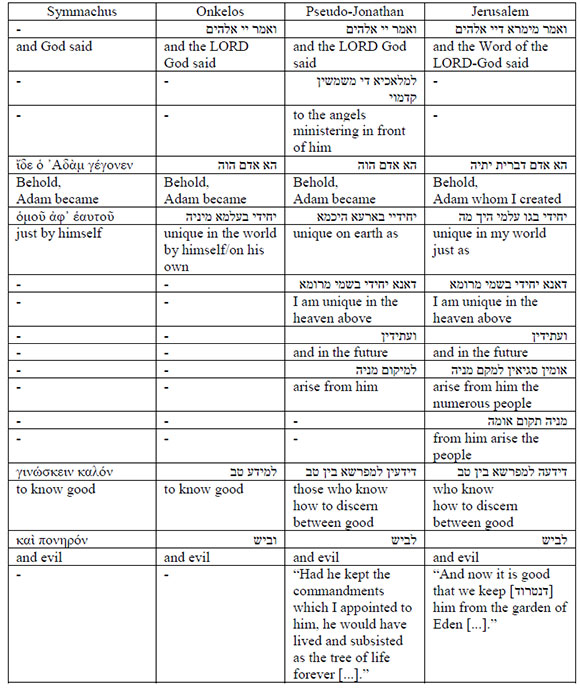
In principle, the interpretations cited above were seamless from a theological perspective because God did not say that Adam became  but rather depicted Adam as unique (
 ) in the world due to his ability to discern between good and evil. From Genesis 3:5 it appears that Adam acquired this ability by eating the fruit. Consequently, the Targum Pseudo-Jonathan and the Jerusalem Targum compared this unique position of Adam in the world to God' s unique position in the heaven.
It seems that all the Targumim relied on the same grammatical presuppositions concerning the original text of Genesis 3:22 which might be reconstructed as follows. Firstly,  was construed as the absolute state and it was said to denote 'unique'. Secondly,
  was linked to the infinitive (
 ). Thus, Adam either individually (as Adam) or collectively (as Adam' s posterity)29 became like the one who was to know good and evil. Thirdly, the preposition with the pronominal suffix (
 ) was parsed as singular ("from him", "on his own", "by himself')30 and it modified either the infinitive (
 ) or the verb (
 ). Consequently, Adam became like the one who was to know good and evil, and either in this condition (n'n) or in this knowledge (
 ) Adam was self-reliant (
 ) in the world. In other words, either Adam became by himself like the one who was to know good and evil, or Adam became like the one who was to know by himself good and evil. It should be noted that in Symmachus' revision (άφ' έαυτοΰ)
  was interpreted in the same way as in the Targumim, while Greek όμοΰ might imply that Symmachus' revision took
  for the adverbial phrase. Indeed,
  vocalised
  not
not  (the received Masoretic vocalisation in Genesis 3:22), acted as the adverbial phrase denoting "together, totally or at once" in the Tanakh (2 Chronicles 5:13; Ezra 2:64, 3:9, 6:20; Nehemiah 7:66; Ecclesiastes 11:6; Isaiah 65:25).
Furthermore, the Targum Pseudo-Jonathan and the Jerusalem Targum mentioned that Adam as a prototype of humankind would originate countless future generations of human beings who could discern between good and evil. To emphasise that the direct knowledge of good and evil was reserved for God, both Targumim preferred to speak of "knowing how to discern between good and evil," which indicated that human beings could discern between these two but not necessarily penetrate them. Although the Jerusalem Targum facilitated the exposition of Genesis 3:22, it also attributed a new plural form ( ) to God who referred to his own action in the plural ("we keep/let us keep"). Given that this new plural form did not occur in the Hebrew original, it might be an imitation of
  from Genesis 1:26. Thus, in the act of creation God said "let us make a human [...]", while in response to Adam' s action, God said "let us keep a human away from the garden [...]".
References in the Midrashic and Talmudic Literature
Expounding Genesis 1:1, the grand Midrash on the Book of Genesis31 safeguarded the unity of God and pointed out that  , which could be parsed either as singular or as plural and which might denote either true/false God(s) or human/angelic agent(s) of power, depending on the context, referred to the one and only God in Genesis 1:1 because
  acted as the subject of the singular verb (
 ), not the plural one (
 ). Likewise, the grand Midrash32recalled that Genesis 1:27 read that God created (
 ), not that gods created (
 ), humankind. Thus, there was only one divine authority/power (
 ), not many (
 ), creating the universe. This hermeneutical presupposition determined the Midrashic interpretation of the plural forms which in Genesis 1-3 might refer to God.
Commenting upon Genesis 1:26, the grand Midrash33 contended that the plural form "let us make [...]" signalled that God consulted ( ) someone or something, while creating the human race. Several answers to the question, whom God consulted, were recorded in the grand Midrash. According to the first interpretation, God consulted (
 ) the works of heaven and earth, namely, the intangible34 and tangible35 creatures which were created prior to the creation of humankind. The grand Midrash mentioned that God could either consult all pre-human creatures at once or could consult creatures made on every single day prior to the creation of human beings. This process of consultation was compared to a political situation in which a king would not act without seeking advice from his counsellors.
According to the second interpretation, God consulted his own heart, namely, consulted himself while creating humankind because when human conduct disappointed God, in Genesis 6:6 God did not blame any proxy or contractor engaged in the work of creation but rather the LORD himself regretted creating human beings and the LORD himself held his own heart ( ) accountable for the act of creation. According to the third interpretation, which was tinged with Platonising colour, God consulted preexisting souls of the righteous.
According to the fourth interpretation, God consulted the angels ministering in front of him, while creating human beings. Furthermore, the grand Midrash36 considered how to explicate God's consultation with angels in the light of the LORD's sovereignty, because God was said to seek advice from beings (angels, to be precise) that were created by him and that were inferior and subordinate to him, albeit it would not be customary for superiors to seek advice from their inferiors. Therefore, the grand Midrash viewed God's consultation with angels as a token of the LORD's benevolence and humility, and clarified that while consulting angels, God did not ask for their permission to create humankind but rather requested their opinion without compromising his own authority and power to do whatever would please him.
As regards the creation of human beings in God' s image, the grand Midrash37 registered that the human race was created as a bridge between "upper" beings and "lower" beings, namely, between spiritual beings (i.e. God along with his angels)38 and animals. Consequently, humankind would embrace both intellectual and physical attributes, and would be torn between immortality characteristic of the spiritual sphere, and mortality intrinsic to the physical sphere. Thus, human beings were created, on the one hand, in the image and likeness coming from the upper realm ( ), and on the other hand, in the image and likeness arising from the lower realm (
 ). In short, they were created as both intangible and tangible beings. The upper sphere, which might be called spiritual, intellect-tual or celestial, knew neither reproduction nor death, while the lower sphere, which could be denominated as physical, animal or earthly, harboured both of these phenomena.39
Therefore, it could be argued that according to the grand Midrash, the image, which God imprinted on human beings, consisted in both intangible and tangible features by virtue of which humankind could act as a bridge between heaven and earth. Thus, the image referred to in Genesis 1:26-27 was God's in the sense that God was the One who imprinted the image. In other words, the image, in which human beings were created, was that of God because God intentionally designed human identity to bridge both dimensions. This idea was adopted by the subsequent Jewish literature.40
Moreover, the grand Midrash made other references to God's image/likeness. Explaining Genesis 2:18, the Midrash41 stated that without female the likeness ( ) would be reduced which implies that the likeness referred to in Genesis 1:26-27 posited that humankind was created as male and female. Consequently, the full likeness could be predicated only of humankind defined as both male and female.42 Besides, it transpires that in the Midrash the terms 'image' (
 ) and 'likeness' (
 ) were employed as synonyms.
Commenting upon Genesis 9:6, the grand Midrash43 presented the idea which was also reflected in the Babylonian Talmud.44 The image (identical with the likeness) was understood as God' s collective representation in the world assigned to humankind. Thus, God created the human race to serve as his image in the world, namely, to represent him in the world. Therefore, by taking human life or by refusing to procreate, the image would decrease. Consequently, actions which expand or facilitate life, enhance the image, whereas actions, which terminate or suppress life, diminish the image. Clearly, the early Rabbinic tradition affirmed the human body as a part of God' s design and recognised it as belonging to the image of God.45 In the early Rabbinic tradition this image denoted, on the one hand, the tangible and intangible features which God imprinted on human beings, and on the other hand, the status and function of humankind that in its material (body) and immaterial (soul/spirit) aspects represented God in the world, namely, acted as the image of God in the world.
Such an approach to the image as to the intangible and tangible imprint left by God on humankind in its entirety corresponded to the Talmudic assertion46 that the value of individual life ought to be the same as that of the community or even the same as that of whole humankind. Discussing this issue, the Babylonian Talmud47 noticed that although the same image, which was imprinted by God on Adam, was also imprinted upon all subsequent generations of human beings, every single human being was unique and should be treated this way. Thus, both the unity and the diversity of the human race were duly acknowledged as a part of God's perfect design.
The ancient Jewish tradition treated Genesis 1:26 with caution and ventured to bring together two propositions which otherwise might be set against one another. On the one hand, God created the world through his Wisdom identical with his Word/Torah, and God could consult his heavenly court, more specifically, his angels, while creating humankind, and he might engage them as his proxies and agents, while creating human beings. On the other hand, God was the sole Creator of the universe so that the act of creation was his work, not that of angels. Therefore, any independent non-divine activity in or contribution to the act of creation was denied. God was to be affirmed as the only Maker of the world with no partner ( ) in the work of creation.48 Actually, the idea of more than one divine power or authority (
 ) involved in the act of creation was condemned in the ancient Jewish literature49 and it was characteristic of the Gnostic tendencies penetrating both Judaism and Christianity in that period.50
Balancing these two propositions was not an easy task. For instance, the grand Midrash51 reported that in Genesis 1:26 God might consult pre-existing souls of the righteous and the possibility of such a consultation was illustrated with 1 Chronicles 4:23 which refers to workers ( ) staying with a king and working for him. These workers acted as the king's agents and assistants. Moreover, the Midrash juxtaposed Hebrew
  , which was derived from the root with the statement, that God made [the same root
  ] human beings, from Genesis 2:7. Since such an illustration, in which God was compared to an earthly king, while God's counsellors were compared to the king's workers, might imply that souls of the righteous were not only God' s counsellors but also 'makers' (
 ) of humankind, the Midrash clarified that God (
 ) only consulted them (
 ) and that he himself created the world (
 ). Thus, theological limitations were placed on the comparison employed in the Midrash in order to uphold both propositions simultaneously.
The grand Midrash52 interpreted the plural form ( ) in Genesis 3:5 in the light of the singular form (
 ), of which
  was the subject in the same verse, in order to rule out any interpretation undermining God' s absolute unity. The Pirke53 attributed to Rabbi Eliezer54 offered an interesting exposition of the phrase
  in Genesis 3:5. Accordingly,
  in that phrase denoted true God, while the knowledge of good and evil was construed as the ability to do good and evil. Thus, the Pirke argued that the serpent tried to convince Eve that by eating the fruit, she could "be like God", namely, could acquire God's power to create and to destroy, to bring to life and to terminate life.
As regards Genesis 3:22 ( ), the grand Midrash55 listed three possible interpretations of that phrase. Firstly,
  could refer to God cum his holy retinue. Secondly, in defiance of the received (Masoretic) vocalisation
  was parsed as the absolute state, while
  was parsed as singular (literally: "from him", figuratively: "by himself, on his own"). Consequently,
  was harnessed to the infinitive (
 ) which was said to be modified by
  . All of this was supposed to produce the following meaning: "Adam became like the one who would know, namely, choose between good and evil by himself". Although the final rendition made sense in the context of the narrative, this reasoning was untenable in grammatical terms because
  must be viewed as the partitive phrase ("one of us") and the syntax of Genesis 3:22 would not allow the preposition with the pronominal suffix (
 ) to modify the infinitive (
 ) instead of
  . Thirdly, the grand Midrash epitomised the interpretation recorded in the Targum Onkelos and in the Targum Pseudo-Jonathan. According to this reading, owing to his knowledge of good and evil, Adam became unique in the world in the same way as God was unique in heaven. In other words, by acquiring the knowledge of good and evil, Adam became Godlike because he ultimately possessed the knowledge which was previously reserved for God. In addition, the Yalkut Shimoni56 maintained that according to Genesis 3:22, Adam became like one of the angels ministering in front of God and endowed with the knowledge of good and evil.
The plural forms occurring in Genesis 1:26; 3:5 and 3:22 were examined in the Babylonian Talmud. In the case of Genesis 1:26, the tractate Sanhedrin57 suggested that God said "let us make [...]" to his heavenly court, and it highlighted God's unity based on the fact that in Genesis 1:27  was the subject of the singular form of the verb (
 ). Thus, in Genesis 1:26 God contemplated and announced his intention of creating human-kind in the presence of his angels, whereas Genesis 1:27 reported that God's action had been accomplished. Since God said "let us make [...]" to the angels, "our image", in which humankind was created according to Genesis 1:26, was interpreted as the image both of God and of his angels. Consequently, the image denoted the features which were shared both by God and by the angels.
The tractate Megillah58 and the minor tractate of the Babylonian Talmud called Sofrim59implied that in Genesis 1:26  (let us make) should be interpreted as if God was the sole Maker (
 ) [I will make]. In the case of Genesis 3:5, Sofrim60 stated that the first (
 ) occurrence of
  was divine, namely, denoted true God, whereas the second one (
 ) was non-divine, yet no further specification was provided.
Mediaeval Jewish Exegesis
The early Jewish reception of the plural forms in Genesis 1:26, 3:5 and 3:22 defined the parameters of the subsequent Jewish interpretation of these phenomena. Explanations found in the Targumim and in the Midrashic and Talmudic literature were denounced as Jewish by the early church fathers. Justin61 recapitulated and disapproved of several interpretations of the plural forms in Genesis 1:26, 3:22. These interpretations did not support the Christian trinitarian reading of such plural forms and were therefore rejected by Justin. Since Justin's account presented the mainstream Jewish positions circulating in the 2nd century accurately, it is relevant to the present research.62
Consequently, Justin could not accept that God would say "let us make [...]" to himself, while deliberating and getting down to work. The proposition, that God said "let us make [...]" to the angels, engaging them in the work of creation as his agents, was also rebutted by Justin who asserted that even the human body could not be produced by the angels. Actually, the idea that the angels, who were defined as God's proxies and who could also be conceptualised as λόγος, created the material world including human corporeality, would be acceptable to Philo and could be argued from his writings.63 Furthermore, Justin fended off the interpretation according to which God addressed classical elements (στοιχεία), such as earth, out of which the human body was created, when he said "let us make [...]". This interpretation implied that God referred to the basic material elements, which had already been created by him, and that God used them to fashion the corporeal dimension of human beings. Thus, Justin epitomised the fundamental Jewish interpretations which must have been circulating and widespread in his lifetime. In fact, his own distinctively Christian exposition rested on the Jewish tradition, though clearly contravening the tenets of Judaism. Justin exploited the concept of divine σοφία (as typified by the LXX version of Proverbs 3:19) with which God conversed in the act of creation and through which God created the universe, according to the Jewish tradition. Contrary to the Rabbinic consensus, Justin invested this divine σοφία with the independent ontological status and claimed that σοφία manifested itself in and through Jesus to such an extent that God's wisdom could be embodied in Jesus and identified with Jesus.
Saadia Gaon ( ) expounded on Genesis 1:26-2764 as well as Genesis 3:5 and 3:22.65 In his opinion, the plural forms in Genesis 1:26 implied no plurality on the Creator's side but rather emphasised the majesty in a way which was typical of the Hebrew language. Thus, the plural in such expressions as "let us make" (
 ) or "let us work" (
 ) did not have to render the subject plural. To illustrate his point, Saadia referred to Numbers 22:6,66Judges 13:1567 and Daniel 2:3668 where in the direct speech the singular subject applied plural forms to itself very naturally.
Furthermore, Saadia avowed that humankind was created not by angels but rather by the LORD in his image which, for Saadia, did not indicate any corporeal resemblance between God and human beings. Rather, God created humankind in his image in the sense that he recognised and authenticated the dignity and significance of human beings as his creatures and declared them to be his most treasured possession. Consequently, by creating humankind in his image, God owned up to his perfect and beloved design. Saadia equated the image (referred to in Genesis 1:26-27) with the form or shape ( ) and pointed out that although there were many different shapes in the world, God encompassed all of them. Therefore, when God acclaimed one of the shapes as his own, he acknowledged the unique and unprecedented status of this shape in his eyes. According to Saadia, humankind was the shape favoured by God as his image. In Genesis 3:5 Saadia interpreted
  in the phrase
  as angels69 and translated it as angels in his Arabic rendition of the Pentateuch.70 Besides, Saadia explicated God's statement in Genesis 3:22 as follows: "Behold, Adam has already been made like one of us [endowed] with the knowledge of good and evil".71
Rashi's ( ) treatment of the plural forms in the aforementioned passages did not offer any coherent strategy of interpretation but rather relied on the Targumic and Midrashic solutions.72 Thus, on the one hand Rashi followed a mental shortcut according to which humankind was created in the image of angels, on the other hand, he affirmed that the image, in which human beings were made, was that of their Creator because God himself created humankind as alluded to in Psalm 139:5. In Rashi's opinion, God was so humble that he would regularly consult the heavenly court (more specifically, the angels) surrounding him as exemplified by 1 Kings 22:19 and Daniel 4:14/17. Rashi argued that God indeed consulted his heavenly court and therefore he said to his angels "let us make [...]", yet no one assisted God in the work of creation because the LORD alone created humankind. Furthermore, Rashi admitted that God's exemplary humility might be misperceived as if the superior (i.e. God) needed to win inferiors' (i.e. angels') approval or permission to take any action. Consequently, God addressed the angels by saying to them "let us make [...]" but God did not invite them to join him in the work of creation which in the light of Genesis 1:27a (
 ) was performed by God alone, not by multiple agents (
 ).
).
Rashi's interpretation of Genesis 3:5 was equivocal because in his view, to become "like  knowing good and evil" meant to become "like makers of the world". This might suggest the emphatic reading of
  in that verse which could be traced back to the Pirke attributed to Rabbi Eliezer.73 As regards Genesis 3:22, Rashi paraphrased the Targum Pseudo-Jonathan74 and wrote that human beings were unique among earthly (visible) beings just as God was unique among heavenly (invisible) beings. Moreover, Rashi clarified that the unique status of humankind among other earthly creatures consisted in the knowledge of good and evil which was acquired by human beings but which was alien to animals. However, it unclear whether God's unique status consisted in the same knowledge of good and evil as obtained by human beings (because of their consummation of the fruit) or was due to the fact that God was the sole Creator of all visible and invisible beings.
Commenting upon Genesis 1:26-27, Samuel ben Meir ( )75 maintained that God said "let us make [...]" to his angels in the same way as he consulted his heavenly court in 1 Kings 22:19-22 and in Job 1:6. Rashbam pointed out that in Isaiah 6:8 the LORD spoke of himself both in the singular (
 ) and in the plural (
 ) to highlight his majesty. In Rashbam's opinion, human beings were created in the image of angels and the likeness, which was imparted to humankind in the act of creation, equipped human beings with the wisdom (
 ) which differentiated them from animals. It seems that since the proposition that human beings were created in the image of angels, did not conform to Genesis 1:27a (
 ), Rashbam resorted to the Platonising interpretation according to which a human being was created "in his/her own [i.e. human] image", namely, in line with the incorporeal, abstract idea of humankind which mirrored the angelic world.
In his commentary on the Book of Genesis Abraham ibn Ezra ( )76 dealt with theological, exegetical and grammatical questions. In theological terms, Abraham ibn Ezra opined that God said "let us make [...]" to the angels and that human beings were created by God in the image of angels. In his view, the plural forms occurring in Genesis 1:26 and in Genesis 11:7 (
 ) indicated that the LORD addressed his angels. Therefore, according to Abraham ibn Ezra,
  (Genesis 3:5) and
  (Genesis 3:22) denoted God along with his angels. Besides, Abraham ibn Ezra surmised that the LORD's statement in Genesis 3:22 might be God's account of what Adam aspired to be, as a result of his consummation of the fruit, given that Adam took the serpent's promise (Genesis 3:5) at face value.
Abraham ibn Ezra contended that humankind was created by God, not by angels, and that humankind mirrored the glory of its Creator in the sense that the vitality of the highest (whence immaterial and immortal) dimension of human soul ( ) reflected the existence of God. Consequently, this highest incorporeal and immortal dimension of human soul, which originated from God and which was rooted in God, filled the human body in the same way as God, who had no flesh, filled the universe. From Abraham's perspective, the assertion, that only the highest dimension of the human soul participated in the spiritual (angelic) world, granted that this dimension was created in the image of that intangible sphere, did not discredit human corporeality because the human soul dwelt in the human body which was affirmed and valued as the microcosm (
 ). According to Abraham ibn Ezra, God began his work of creation with the intangible (including angels and the highest dimension of the human soul created in the image of the angelic sphere), which could be denominated as the macrocosm (
 ), while he completed his work of creation by engendering the material world inclusive of the human body which was the very microcosm. Thus, by virtue of this divine parentage of human beings, the Scriptures spoke of God's glory revealed as "human resemblance" (Ezekiel 1:26). Nonetheless, based on Isaiah 40:25, Abraham ibn Ezra was convinced that the likeness or image (
 ) of God could never be understood as a sort of copy external to the original, and therefore, he argued that humankind could not be created in the image of God alone.
Simultaneously, Abraham ibn Ezra rejected the Platonising interpretation according to which the pronominal suffix  in Genesis 1:27a
  referred to a human being ("God made a human being in the image of a human being") because such a reading posited that there was the image of a human being, the idea of humankind, philosophically speaking, before human beings had been created by God. The proposition that human beings were created by God in line with the eternal abstract idea of humankind, was unpalatable to Abraham ibn Ezra who claimed that in the context of Genesis 1:27 the pronominal suffix (
 ) could not stand for
  and that such an interpretation could not explain the plural suffixes in Genesis 1:26 (
 , to be precise) in the same way.
Furthermore, the interpretation of the pronominal suffix (i) on in Genesis 1:27a as self-referential was related to the alternative parsing of  in Genesis 1:27b, 9:6b and of
  in Genesis 5:1 because if the suffix (
 ) on
) on  in Genesis 1:27a did not refer to God, it was also necessary to disconnect לם /דמות from אלהים in Genesis 1:27b, 5:1, 9:6b. Abraham ibn Ezra did not espouse this reasoning either. According to the alternative parsing, בצלם אלהים in Genesis 1:27b, 9:6b and בדמות אלהים in Genesis 5:1 should not be construed as the construct chain but rather צלם /דמ ought to be viewed as the absolute state ("in/as the image/likeness God created a human being [...]") provided that in the case of segolate nouns (such as צֶלֶם) and in the case of דמות, the absolute state and the construct state were identical. Nonetheless, such a reading would not comply with the Masoretic accentuation of Genesis 1:27b in which the accents מירכא and טפחא bracketed בצלם אלהים together. The same is true of the Masoretic accentuation of בדמות אלהים in Genesis 5:1. Undoubtedly, this fact lent credence to the interpretation of בצלם אלהים and בדמות אלהיםas the construct chain.
Consequently, Abraham ibn Ezra disregarded the interpretation of צלם in Genesis 1:27b, 9:6b and of דמות in Genesis 5:1 as the absolute state, for three reasons: Firstly, such a reading would break the parallelism between Genesis 1:27a and Genesis 1:27b by virtue of which בצלמו (27a) should correspond to בצלם אלהים (27b) because the unspecified בצלם could not be parallel to the specified בצלמו. Secondly, the statement that "God created a human being in/as the image/likeness", did not disclose which or whose image/likeness was referred to and would thus be unintelligible.
Thirdly, such an interpretation would undo the moral argumentation in Genesis 9:6a which was based on ('3) Genesis 9:6b; because if צלםin Genesis 9:6b was in the absolute state, this passage only communicated that God created a human being as/in a certain shape or form. For Abraham ibn Ezra, it was obvious that every creature had its own image (shape, form) which, however, incurred no moral obligations. In other words, the moral admonition articulated in Genesis 9:6a could not be caused by the fact that humankind had some shape (form) in the same way as every object would have some shape (form), but must arise rather from the unique and privileged status of human beings in God' s eyes.
Abraham ibn Ezra also reported and dismissed the claim that the prepositional phrase "in our image and in our likeness" (Genesis 1:26) was uttered by Moses who described the act of creation from his own, human perspective ("in our image, scilicet, in the image of us, human beings, like me, Moses"). Such reasoning would run counter to all the passages which mentioned "the image of God".
In exegetical terms, Abraham ibn Ezra recapitulated Saadia Gaon's interpretation of Genesis 1:26-27 which could be found in ספר האמונות והדעות.77 According to Abraham's recollection, Saadia construed the image as the wisdom (חכמה) and the ability to govern the world (ממשלה), which the Creator bestowed upon humankind, and he assumed that this image was rooted in God for the sake of the splendour of human beings as God's creatures. Consequently, through the concept of human beings as created in God' s image, the LORD could seal his possession of humankind. Similarly, although the whole earth belonged to the LORD (Psalm 24:1), the land of Israel was designated as his own (Ezekiel 36:20) in order to stress God's unique ties with the land which he promised to his people.
Furthermore, Abraham ibn Ezra recalled that according to Saadia, the plural forms in Genesis 1:26 might be the plural of majesty which was customary for earthly rulers and which could be used in the Tanakh to narrate God' s actions. Abraham ibn Ezra did not object to applying the plural of majesty to narratives about God because he asserted that the Scriptures were written by human authors in the human language so that human beings could understand the message conveyed by these sacred texts. Thus, it was natural for Abraham ibn Ezra that human beings would describe and speak of any reality, inclusive of God, using human expressions because only such expressions were known and accessible to human beings. Therefore, as Abraham ibn Ezra noted,78 the Hebrew Bible resorted to anthropomorphism not only with reference to God but also with reference to inanimate objects as exemplified by Numbers 13:29,79 16:3080 and by Proverbs 8:26.81 Given his concept of revelation, Abraham ibn Ezra asserted that the interpretation of the plural forms in Genesis 1:26 as the plural of majesty was permissible, yet debatable because the passages (Genesis 29:27;82 Numbers 22:6 and Daniel 2:36),83 which, according to his recollection, Saadia Gaon had adduced as proof of the plural of majesty occurring in the Tanakh, were problematised by Abraham ibn Ezra who parsed and explained them differently.
In grammatical terms, Abraham ibn Ezra recalled that some expositors84 recognised נעשה in Genesis 1:26 as the niphal participle akin to נעשה from Nehemiah 5:18.85 Although the same vocalised form (נַעֲשֶ) could be parsed either as the qal imperfect ("let us make [human]") or as the niphal participle ("let [human] be made"), Abraham ibn Ezra preferred the former interpretation (i.e. qal imperfect) in the light of the context. Furthermore, Abraham ibn Ezra scrutinised כְּאַחַד and מִמֶנּוּ in Genesis 3:22 because he was critical of the Targumim which explicated these phrases in a peculiar way.
Abraham ibn Ezra ascertained that in the Hebrew Scriptures כאחד played two different syntactical roles which effected two different vocalisations. On the one hand, כְּאַחַד, in which inN was in the construct state (as demonstrated by the vocalisation), functioned as the partitive phrase ("as/like one of [...]") which was bound to another noun or pronoun either directly or indirectly, that is, by means of a preposition (e.g.מן).86 Therefore, the construct chain was a must. On the other hand,כְּאֶחָד, in which אחד was in the absolute state (as evidenced by the vocalisation), acted as the adverbial phrase denoting "together, totally or at once" and it was not a part of any construct chain.87 Actually, the Septuagint88 and the Targum89 always translated כְּאֶחָד adverbially. Therefore, Abraham ibn Ezra did not accept the Targumic approach to Genesis 3:22 and doubted whether in the context of that verse the prepositional phrase inNn could denote ' unique' . Rather, he advocated the following rendition: "Adam became like one of us to know good and evil".
As regards מִמֶנּוּ, Abraham ibn Ezra observed that this form could be parsed either as singular or as plural, depending on the context. In Genesis 3:22 the partitive phrase כְּאַחַד required a group, to which אחד could belong, and therefore, it entailed the plural parsing of מִמֶנּוּ . Actually, in the Book of Genesis the singular90 or plural91 parsing of מִמֶנּוּ was evident from the context and identified unanimously by the Septuagint92 and by the Targum
Onkelos.93 Moreover, Abraham ibn Ezra disagreed with the suggestion that the prepositional phrase מִמֶנּוּ (interpreted as singular ["on his own, by himself']) could modify the infinitive לדעת instead of כאחד (taken for the absolute state). Thus, he rejected the second interpretation of Genesis 3:22 recorded in the grand Midrash.94
Maimonides (רמב״ם)95 did not peruse the plural forms in Genesis 1:26 but rather quoted the explanations found in the tractate Sanhedrin and in the grand Midrash on the Book of Genesis. It seems that following in Philo's footsteps, Maimonides presumed that the human body was produced by angels. In Maimonides' opinion, God created human beings in his image in the sense that the divine intelligence, namely, the intelligence originating from God and common to God and his angels, was imparted to humankind, yet to the exclusion of human corporeality because God had neither flesh nor image (תמונה).96 Expounding Genesis 3:5, Maimonides97 cited the Targum Onkelos and mentioned that since אלוהים could signify not only true or false God(s) but also angelic or human agent(s) of power, "the mighty" (רברבין) as the non-divine general meaning of אלוהים would be preferable in the context of Genesis 3:5.
In his commentary on the Book of Genesis David Kimhi (רד״ק)98 treated of the plural forms in Genesis 1:26, 3:5 and 3:22, drawing on the exposition which was handed down to him by his father, Joseph Kimhi (יוסף קמחי). Additionally, David Kimhi summarised the interpretations offered by the grand Midrash on the Book of Genesis.
According to Joseph and David Kimhi, God said "Let us make [...]" towards the basic material elements which were previously created by him and which were endowed by him with natural powers. Thus, the LORD used these elements and powers of his own making to create humankind. Figuratively speaking, God intended to communicate "Let us, namely, me [i.e. God] and you [i.e. the elements cum their powers], carry it out" when he said "Let us make [...]". Consequently, the human body was made by God out of these elements and it was equipped with natural powers. On the other hand, through their immaterial dimension (רוח) human beings resembled angels and reflected the 'upper' (celestial) sphere. In Joseph and David Kimhi' s view,99 this truth was articulated in Genesis 2:7 where the creation of human beings was depicted as the act of God who united the tangible (therefore, אדם was derived from אדמה)100 and the intangible (נשמה) to enact his design. Although the human body arose from the natural elements and powers, while the immaterial dimension of human beings was engendered by the LORD (Zechariah 12:1) and derived from heaven, it was clear that God was the sole Maker of all humanity because the natural elements and powers, which God employed to create human corporeality, were made by him earlier with the intention of creating the human race as the very climax of all his creative activity.
Ultimately, God was the One who designed humankind to act as a bridge between heaven and earth, and to unite the intangible and the tangible.
From Joseph and David Kimhi's perspective, at the same time, God said "Let us make [...]" to the angels because human beings were predestined to take part in the intangible sphere which was common to spiritual (i.e. incorporeal) beings, namely, common to God and his angels. Explaining the concept of the image and likeness encountered in Genesis 1:26-27, Joseph and David Kimhi acknowledged that in the Hebrew Scriptures צלם and דמו might signify material (physical)101 or immaterial (spiritual)102 correspondence (resemblance), yet they placed theological limitations upon the plural pronominal suffixes occurring with צלם ("[our] image") and דמות ("[our] likeness") in this passage.
In their opinion, the plural form of the suffixes was caused by the plural form of the verb ("Let us make [...]") and it did not indicate that human beings were created in the image (likeness) both of the intangible sphere (common to God and his angels) and of the tangible sphere (videlicet, the basic elements created by God). In fact, the early Jewish tradition acclaimed both human body and human soul as God' s image and likeness,103while the grand Midrash on the Book of Genesis implied that the image (likeness), which was God imprinted on humankind, reflected both dimensions and that the image (likeness) was God's in the sense that God was the sole Designer thereof.104
To the contrary, Joseph and David Kimhi argued that if God said "Let us make [...]" towards his angels, "our image and our likeness" must denote only the spiritual features shared by God and his angels on the stipulation that although both God and angels were spiritual (incorporeal) beings, God was the Creator, while angels were merely his creatures. Thus, the phrase "in our image and in our likeness" meant that some of these spiritual features were bestowed by God upon human beings in the act of creation. It seems that Joseph and David Kimhi upheld both propositions at the same time, teaching that God said "Let us make [...]", on the one hand, to the basic elements, on the other hand, to his angels, yet only the latter (scilicet the angelic reference) was used to explain the plural suffix on צלם in order to exclude non-spiritual features from the image.
In Joseph and David Kimhi' s view, the image and likeness did not consist in any physical correspondence but rather in the intelligence (שכל ) with the aid of which ( בית העזר) God created humankind and with which (בית כלי) God equipped human beings. For Joseph and David Kimhi, the preposition 3 (called simply בית) with צלם ("[our] image") in Genesis 1:26 performed both functions at the same time, namely, implied that God used the divine intelligence (שכל) as his tool (בית העזר) to create humankind and that God furnished human beings with this divine intelligence (בית כלי). In other words, God created the human race through the image defined as certain spiritual features (shared by God and his angels) and God imparted this image (i.e. features in question) to human beings. Consequently, the creation of humankind as both physical and spiritual beings could be perfected and brought to completion. Analysing כדמותנו in Genesis 1:26, Joseph and David Kimhi clarified that the preposition 3 conveyed a sense of correspondence which in this instance must be only partial, not full, because human beings participated only in some spiritual features common to God and his angels.
In Genesis 3:5 David Kimhi interpreted אלהים as the angels and in Genesis 3:22 he asserted that God said "like one of us" because the LORD referred to himself and to his angels. Likewise, the plural forms in Genesis 1:26 ("Let us make [...]", "in our image and in our likeness") and in Genesis 3:22 might be caused by the fact that God intended to speak for himself and for the angels surrounding him. Furthermore, Radak cited the grand Midrash on Genesis 3:22 and briefed on the vocalisation of אחד .
The exposition of Genesis 1:26-27 found in David Kimhi's commentary was recapitulated and adopted by Nahmanides (רמב״ן),105 who however did not exclude human corporeality from "our image and our likeness". Rather, for Ramban, this phrase communicated that human beings resembled (ידמה) both dimensions given that the human body belonged to the material sphere, while the human spirit (ר) belonged to the immaterial one. Similarly, Jacob ben Asher (יעקב בן ראש),106 who was also called the Master of the Rows (בעל הטורים), explicated "our image and our likeness" as the intentional reference (דומה) to both spheres. Finally, in his long commentary on Genesis 1:26 Hezekiah ben Manoah (חזקיה בן מנוח)107 explained that the plural form of the verb might be the plural of majesty as exemplified by Isaiah 6:8 and Daniel 2:36 where the singular subject referred to itself in the plural. Moreover, Hezekiah remarked that the choice of the verb, which in Genesis 1:26 was used in the plural, was not an accident. In his view, the verb ברא was not employed in that verse because it denoted the absolute creative activity which only God could perform. Therefore, Hezekiah averred that in the light of Genesis 1:27 and of Genesis 6:7 only God could be recognised as the Maker of human beings. Consequently, in Genesis 1:26 God employed the plural form of the verb עשה , not בר, in order to invite his agents, presumably, either angels or natural elements/powers, to assist him in carrying out this project. Thus, God used the plural because he spoke on his behalf and on behalf of his associates.
Conclusion
The mediaeval Jewish tradition, on the one hand, relied on the earlier exposition of the plural forms in Genesis 1:26, 3:5 and 3:22, which occurred in the Targumim and in the Midrashic and Talmudic literature; on the other hand, it enriched and advanced the trajectory of the interpretations accepted within the limits of Judaism. Clearly, Jewish translators and expositors tried to eschew any interpretation which might undermine the absolute unity of the Godhead or diminish the status of God as the sole Creator of the universe, including humankind.
Although Philo did not hesitate to outsource the act of creating the material world, inclusive of human body, to God' s agents, in the face of Gnosticism and Christianity, post-Hellenistic Judaism was cautious about the status and function of instruments or mediators in the act of creation, and it was compelled to vindicate the dignity and value of the tangible sphere, particularly, of human corporeality. From an exegetical perspective, the Jewish reading of these plural forms was rooted in the context of the Hebrew language and in the context of the Hebrew Scriptures. Thus, the use of the plural in Hebrew was studied and relevant passages referring to the creation of humankind or containing the appellation אלוהים in its non-divine denotations were examined.
Finally, the Jewish exegetical tradition in the Middle Ages did not conceal its presuppositions or intentions but rather took pride in its mission, which was to facilitate the understanding of the plural forms in the Tanakh which were potentially pertinent to God. In anthropological terms, Judaism offered an intriguing perspective on human beings as creatures designed to embrace both the tangible and the intangible, to bridge the gulf between heaven and earth, while this perspective emboldens human beings to discover תיקון עולם as their calling.
BIBLIOGRAPHY
Abraham ibn Ezra 1970-1971. "ספר בראשית ." In מקראות גדולות ספר בראשית . New York: פ [ Links ]ריעדמאן .
Armstrong, Gregory T 1962. Die Genesis in der alten Kirche: Die drei Kirchenväter. Tübingen: Mohr. [ Links ]
Berliner, Abraham (ed.) 1905. Raschi: Der Kommentar des Salomo b. Isak über den Pentateuch. Frankfurt am Main: Kauffmann. [ Links ]
Berliner, Abraham (ed.) 1884. Targum Onkelos, vol. 1. Berlin: Kaufmann. [ Links ]
Bray, Gerald 1991. "The Significance of God's Image in Man." Tyndale Bulletin 42/2. ""בראשית " 1913. In ספר מדרש תנחומא . Petrikau: צ [ Links ]עדערבוי
Brüll, Adolf (ed.), 1875. Das samaritanische Targum zum Pentateuch. Frankfurt am Main: Erras. [ Links ]
Bucur, Bogdan G 2014. "Justin Martyr's Exegesis of Biblical Theophanies and the Parting of the Ways between Christianity and Judaism." Theological Studies 75/1. [ Links ]
Burnett, Joel S 2001. A Reassessment of Biblical Elohim. Atlanta: Society of Biblical Literature. [ Links ]
Clarke, Ernest George (ed.) 1984. Targum Pseudo-Jonathan of the Pentateuch: Text and Concordance. Hoboken: KTAV. [ Links ]
Clines, David JA 1968. "The Image of God in Man." Tyndale Bulletin 19. [ Links ]
Cook, Johann 1983. "Anti-heretical Traditions in Targum Pseudo-Jonathan." Journal of Northwest Semitic Languages 11. [ Links ]
Crouch, Carly Lorraine 2010. "Genesis 1:26-7 as a Statement of Humanity's Divine Parentage. " Journal of Theological Studies 61/1. [ Links ]
Dahl, NA & Alan F Segal 1978. "Philo and the Rabbis on the Names of God." Journal for the Study of Judaism 9, no. 1. [ Links ]
De Lagarde, Paul, (ed.), 1872. Prophetae chaldaice. Leipzig: Teubner. [ Links ]
Dillmann, August 1897. Genesis Critically and Exegetically Expounded, vol. 1, trans. William Black Stevenson. Edinburgh: Clark. [ Links ]
Draffkorn, Anne E 1957. "Ilani/Elohim." Journal of Biblical Literature 76, no. 3. [ Links ]
Driver, Samuel Rolles 1904. The Book of Genesis with Introduction and Notes. London: Methuen. [ Links ]
Dulkin, Ryan S 2013. "The Triumph of Mercy: An Ethical-Critical Reading of Rabbinic Expansions on the Narrative of Humanity's Creation in Genesis Rabbah 8." Journal of the Society of Christian Ethics 33, no. 1. [ Links ]
Edwards, Robert GT 2014. "Clement of Alexandria's Anti-Valentinian Interpretation of Gen. 1:26-27." Zeitschrift für antikes Christentum 18, no. 3. [ Links ]
Field, Frederick (ed.),1875. Origenis Hexaplorum quae supersunt: Sive veterum interpretum Graecorum in totum Vetus Testamentum fragmenta, vol. 1. Oxford: Clarendon. [ Links ]
Fossum, Jarl 1985. "Gen. 1:26 and 2:7 in Judaism, Samaritanism and Gnosticism." Journal for the Study of Judaism 16, no. 2. [ Links ]
Friedländer, Moriz 1878. "Justins Dialog mit dem Juden Tryphon." In Patristische und Talmudische Studien. Vienna: Hölder. [ Links ]
Friedländer, Moriz 1898. Der vorchristliche jüdische Gnostizismus. Göttingen: Vandenhoeck and Ruprecht. [ Links ]
Goodenough, Erwin R 1923. The Theology of Justin Martyr. Jena: Biedermann. [ Links ]
Gordon, Cyrus Herzl 1935. "אלהים in its Reputed Meaning of >Rulers<, >Judges<." Journal of Biblical Literature 54, no. 3. [ Links ]
Gottstein, Alon Goshen 1994. "The Body as Image of God in Rabbinic Literature." Harvard Theological Review 87, no. 2. [ Links ]
Graetz, Heinrich 1846. Gnostizismus und Judentum. Krotoschin: Monasch. "חגי." 1860. In תלמוד בבלי, vol. 6. Warsaw: Orgelbrand. [ Links ]
Harris, Murray J 1984. "The Translation of Elohim in Psalm 45:7-8." TyndaleBulletin 35. [ Links ]
Hasel, Gerhard F 1975. "The Meaning of >Let us< in Gn 1:26." Andrews University Seminary Studies 13, no. 1. [ Links ]
Heiser, Michael S 2001. "Deuteronomy 32:8 and the Sons of God." Bibliotheca Sacra 158, no. 629. [ Links ]
Herford, Robert Travers 1903. Christianity in Talmud and Midrash. London: Williams and Norgate. [ Links ]
Hezekiah ben Manoah 1859. " ספר בראשית ." In ספר חזקוני על חמשה חומשי תורה. Lemberg [Lviv]: Schrenzel. [ Links ]
Holmes, Robert & James Parsons, (ed.), 1827. Vetus Testamentum Graecum cum variis lectionibus, vol. 5. Oxford: Clarendon. [ Links ]
Hurtado, Larry W 1998. "First-Century Jewish Monotheism." Journal for the Study of the New Testament 71. [ Links ]
Jacob ben Asher 1880. "בראשית ." In פירוש הטור על התורה. Warsaw: . " ילקוט בראשית " 1863. In "ספר ילקוט שמעוני" -so. Vilnius: Romm. "יבמות" 1860. In תלמוד בבלי, vol. 7. Warsaw: Orgelbrand. [ Links ]
Jehiel, Nathan 1819. Rabbinisch-aramäisch-deutsches Wörterbuch zur Kenntnis des Talmuds, der Targumim und Midraschim, vol. 2, (ed.) Moses Israel Landau. Prague: Scholl. [ Links ]
Joosten, Jan 2007. "A Note on the Text of Deuteronomy 32:8." Vetus Testamentum 57, no. 4. [ Links ]
Justinus 1857. "Dialogus cum Tryphone Judaeo." In Patrologiae cursus completus: Series Graeca, vol. 6, (ed.) J-P Migne. Paris: Migne. [ Links ]
Keil, Carl Friedrich & Franz Delitzsch (s.a.). Biblical Commentary on the Old Testament, vol. 1, trans. James Martin. Grand Rapids: Eerdmans. [ Links ]
Kimhi, David 1842. Kommentar zur Genesis, (ed.) Abraham Ginzburg. Pressburg [Bratislava]: Schmid. [ Links ]
Kimhi, David 1909. "" פירוש רד״ק ." In מקראות גדולות חומש בית דוד, vol. 1. Lemberg: Balaban. [ Links ]
Levy, Jacob 1867. Chaldäisches Wörterbuch über die Targumim und einen grossen Teil des rabbinischen Schrifttums, vol. 1. Leipzig: Baumgärtner. [ Links ]
Maimonides 1828. More Nebuchim, vol. 1, trans. Judah ibn Tibbon. Vienna: Schmid. [ Links ]
Maimonides 1828. More Nebuchim, vol. 2, trans. Judah ibn Tibbon. Vienna: Schmid. [ Links ]
McKenzie, John L 1948. "The Appellative Use of El and Elohim." The Catholic Biblical Quarterly 10, no. 2. [ Links ]
"מגילה " 1864. In תלמוד בבלי, vol. 5. Warsaw: Orgelbrand. [ Links ]
" מדרש רבה ויקרא " 1864. In ספר מדרש רבות על התורה. Leipzig: Wienbrack. [ Links ]
" מדרש רבה ספר שמות " 1864. In ספר מדרש רבות על התורה. Leipzig: Wienbrack. [ Links ] Nahmanides 1970-1971. " ספר בראשית ." In מקראות גדולות ספר בראשית. New York: פ [ Links ]ריעדמאן .]
Niehoff, Maren R 2008. "Questions and Answers in Philo and Genesis Rabbah." Journal for the Study of Judaism 39. [ Links ]
Niskanen, Paul 2009. "The Poetics of Adam: The Creation of אלהיםin the Image of אדם" Journal of Biblical Literature 128, no. 3. [ Links ]
Philo Alexandrinus 1897. "De confusione linguarum." In Opera quae supersunt, vol. 2, (ed.) Leopold Cohn and Paul Wendland. Berlin: Reimer. [ Links ]
Philo Alexandrinus 1898. "De fuga et inventione." In Opera quae supersunt, vol. 3, (ed.) Leopold Cohn and Paul Wendland. Berlin: Reimer. [ Links ]
Philo Alexandrinus 1898. "De mutatione nominum." In Opera quae supersunt, vol. 3, (ed.) Leopold Cohn and Paul Wendland. Berlin: Reimer. [ Links ]
Philo Alexandrinus 1896. "De opificio mundi." In Opera quae supersunt, vol. 1, (ed.) Leopold Cohn and Paul Wendland. Berlin: Reimer. [ Links ]
Philo Alexandrinus 1898. "De sominiis liber I." In Opera quae supersunt, vol. 3, (ed.) Leopold Cohn and Paul Wendland. Berlin: Reimer. [ Links ]
Philo Alexandrinus 1826. "In Genesi: Sermo I." In Paralipomena Armena, (ed.) Joannes Baptista Aucher. Venice: Lazari. [ Links ]
Philo Alexandrinus 1896. "Legum allegoriarum liber III." In Opera quae supersunt, vol. 1, (ed.) Leopold Cohn and Paul Wendland. Berlin: Reimer. [ Links ]
Philo Alexandrinus 1898. "Quis rerum divinarum heres sit." In Opera quae supersunt, vol. 3, (ed.) Leopold Cohn and Paul Wendland. Berlin: Reimer. [ Links ]
Ringgren, Helmer 1974. "אלהים ." In Theological Dictionary of the Old Testament, vol. 1, (ed.) Gerhard Johannes Botterweck and Helmer Ringgren, trans. John T Willis. Grand Rapids: Eerdmans. [ Links ]
Saadia Gaon 1959-1960. "בראשית ." In פירוש על התורה ועל נ״ך London: Gad. [ Links ]
Saadia Gaon 1885. ספר האמונות והדעות, trans. Judah ibn Tibbon. Jozefow: ז [ Links ]עצר
Saadia Gaon 1893. "Version Arabe du Pentateuque." In Œuvres complètes, vol. 1, (ed) and trans. Joseph Derenbourg. Paris: Leroux. [ Links ]
Samuel ben Meir 1881-1882. "בראשית ." In פירוש התור (ed.) David Rosin. Breslau: "ש [ Links ]אטטלענדער"
"סנהדרין " 1862. In תלמוד בבלי, vol. 13. Warsaw: Orgelbrand. [ Links ]
Schremer, Adiel 2008. "Midrash, Theology, and History: Two Powers in Heaven Revisited," Journal for the Study of Judaism 39. [ Links ]
" ספר בראשית" 1890. In מדרש רבה על התורה Warsaw: Orgelbrand. ספר פרקי רבי אליעזר1838. Vilnius: Romm. [ Links ]
Segal, Alan F 1977. Two Powers in Heaven: Early Rabbinic Reports about Christianity and Gnosticism. Leiden: Brill. [ Links ]
"סופרים " 1862. In תלמוד בבלי ,, vol. 13. Warsaw: Orgelbrand. [ Links ]
Stroumsa, Gedaliahu G 1983. "Form(s) of God: Some Notes on Metatron and Christ." Harvard Theological Review 76, no. 3. [ Links ]
Swete, Henry Barclay (ed.) 1887. The Old Testament in Greek according to the Septuagint, vol. 1. Cambridge: Cambridge University Press. [ Links ]
Swete, Henry Barclay (ed.) 1907. The Old Testament in Greek according to the Septuagint, vol. 2. Cambridge: Cambridge University Press. [ Links ]
Swete, Henry Barclay (ed.) 1894. The Old Testament in Greek according to the Septuagint, vol. 3. Cambridge: Cambridge University Press. [ Links ]
"תרגום " s.a. In מקראות גדולות ספר דברי הימים . Lublin: ש [ Links ]ניידמעסער.
"Targum" 1656. In Biblia sacra polyglotta, vol. 3, (ed.) Brian Walton. London: Roycroft. [ Links ]
"Targum Hierosolymitanum" 1657. In Biblia sacra polyglotta, vol. 4, (ed.) Brian Walton. London: Roycroft. [ Links ]
"Targum [Pseudo-Jonathan" 1657. In Biblia sacra polyglotta, vol. 4, (ed.) Brian Walton. London: Roycroft. [ Links ]
"Targum of Palestine" 1862. In The Targums of Onkelos and Jonathan ben Uzziel on the Pentateuch with the Fragments of the Jerusalem Targum: Genesis and Exodus, trans. John Wesley Etheridge. London: Longman. [ Links ]
Von Gall, August (ed.) 1914. Der Hebräische Pentateuch der Samaritaner, vol. 1. Giessen: Töpelmann. [ Links ]
Von Rad, Gerhard 1961. Genesis: A Commentary, trans. John H Marks. Philadelphia: The Westminster Press. [ Links ]
Wardlaw, Terrance Randall 2008. Conceptualising Words for >God< within the Pentateuch: A Cognitive-Semantic Investigation in Literary Context. New York: T&T Clark. [ Links ]
Wedderburn, AJM 1973. "Philo's >Heavenly Man<." Novum Testamentum 15, no. 4. [ Links ]
Welz, Claudia 2011. "Imago Dei: References to the Invisible." Studia Theologica 65. [ Links ]
Wenham, Gordon J 1998. Genesis: 1-15, vol. 1. Dallas: Word. [ Links ]
Westermann, Claus 1984. Genesis 1-11: A Commentary, trans. John J Scullion. Minneapolis: Augsburg Publishing House. [ Links ]
Wilson, Robert McLachlan 1957. "The Early History of the Exegesis of Gen. 1:26." Studia Patristica 1. [ Links ]
1 Cf. Johann Cook, "Anti-heretical Traditions in Targum Pseudo-Jonathan," Journal of Northwest Semitic Languages 11, 1983:47-57.
2 Philo Alexandrinus, "De opificio mundi," in Opera quae supersunt, vol. 1, (ed.) Leopold Cohn and Paul Wendland (Berlin: Reimer, 1896), 24-25 [24, 72-76]. Ibidem, 46-47 [46, 134-135]. Idem, "Legum allegoriarum liber III," in Opera, vol. 1, 134 [31, 96]. Idem, "De confusione linguarum," in Opera quae supersunt, vol. 2, (ed.) Cohn and Wendland (Berlin: Reimer, 1897), 261 [33, 169]. Ibidem, 263-264 [34-36, 175-182]. Idem, "Quis rerum divinarum heres sit," in Opera quae supersunt, vol. 3, (ed.) Cohn and Wendland (Berlin: Reimer, 1898), 38 [34, 165-167]. Idem, "De fuga et inventione," in Opera, vol. 3, 124-125 [13-14, 66-76]. Idem, "De mutatione nominum," in Opera, vol. 3, 161-163 [4, 27-38]. Idem, "De sominiis liber I," in Opera, vol. 3, 239-240 [26, 160-165]. Idem, "In Genesi: Sermo I," in ParalipomenaArmena, (ed.) Joannes Baptista Aucher (Venice: Lazari, 1826), 25-26 [XXXVI]. Ibidem, 36-37 [LIV].
3 Maren R Niehoff, "Questions and Answers in Philo and Genesis Rabbah," Journal for the Study ofJudaism 39, 2008:337-366. AJM Wedderburn, "Philo's >Heavenly Man<," Novum Testamentum 15, no. 4, 1973:301-326.
4 August Dillmann, Genesis Critically andExegetically Expounded, vol. 1, trans. William Black Stevenson (Edinburgh: Clark, 1897), 77-85 [Genesis 1:26-27]. Ibidem, 151-152 [Genesis 3:5]. Ibidem, 167-169 [Genesis 3:22]. Samuel Rolles Driver, The Book ofGenesis with Introduction andNotes (London: Methuen, 1904), 14-15 [Genesis 1:26-27]. Ibidem, 45 [Genesis 3:5]. Ibidem, 50 [Genesis 3:22]. Carl Friedrich Keil and Franz Delitzsch, Biblical Commentary on the Old Testament, vol. 1, trans. James Martin (Grand Rapids: Eerdmans, [s. a.]), 61-67 [Genesis 1:24-31]. Ibidem, 94-96 [Genesis 3:1-8]. Ibidem, 106-108 [Genesis 3:22]. Gerhard von Rad, Genesis: A Commentary, trans. John H. Marks (Philadelphia: The Westminster Press, 1961), 55-59 [Genesis 1:26-28]. Ibidem, 86-87 [Genesis 3:4-5]. Ibidem, 94 [Genesis 3:22]. Gordon J Wenham, Genesis: 1-15, vol. 1 (Dallas: Word, 1998), 27-34 [Genesis 1:26-28]. Ibidem, 73-75 [Genesis 3:5]. Ibidem, 85 [Genesis 3:22]. Claus Westermann, Genesis 1-11: A Commentary, trans. John J Scullion (Minneapolis: Augsburg Publishing House, 1984), 142-161 [Genesis 1:26-28]. Ibidem, 240-248 [Genesis 3:5]. Ibidem, 272-273 [Genesis 3:22].
5 Ryan S Dulkin, "The Triumph of Mercy: An Ethical-Critical Reading of Rabbinic Expansions on the Narrative of Humanity's Creation in Genesis Rabbah 8," Journal of the Society of Christian Ethics 33, no. 1, 2013:139-151. Jarl Fossum, "Gen. 1:26 and 2:7 in Judaism, Samaritanism and Gnosticism," Journal for the Study of Judaism 16, no. 2, 1985:202-239. Gerhard F Hasel, "The Meaning of >Let us< in Gen. 1:26," Andrews University Seminary Studies 13, no. 1, 1975:58-66.
6 Joel S Burnett, A Reassessment of Biblical Elohim (Atlanta: Society of Biblical Literature, 2001). NA Dahl and Alan F Segal, "Philo and the Rabbis on the Names of God," Journal for the Study of Judaism 9, no. 1, 1978:1-28. Anne E Draffkorn, "Ilani/Elohim," Journal of Biblical Literature 76, no. 3, 1957:216-224. Cyrus Herzl Gordon, "אלהים in its Reputed Meaning of >Rulers<, >Judges<," Journal of Biblical Literature 54, no. 3, 1935:139-144. Murray J Harris, "The Translation of Elohim in Psalm 45:7-8," Tyndale Bulletin 35, 1984:65-89. Michael S Heiser, "Deuteronomy 32:8 and the Sons of God," Bibliotheca Sacra 158, no. 629, 2001:52-74. Jan Joosten, "A Note on the Text of Deuteronomy 32:8," Vetus Testamentum 57, no. 4 2007:548555. John L McKenzie, "The Appellative Use of El and Elohim," The Catholic Biblical Quarterly 10, no. 2, 1948:170-181. Helmer Ringgren, 'אלהים ,' in Theological Dictionary of the Old Testament, vol. 1, (ed.) Gerhard Johannes Botterweck and Helmer Ringgren, trans. John T Willis (Grand Rapids: Eerdmans, 1974), 267-284. Terrance Randall Wardlaw, Conceptualising Words for >God< within the Pentateuch: A Cognitive-Semantic Investigation in Literary Context (New York: Clark, 2008).
7 Gerald Bray, "The Significance of God's Image in Man," Tyndale Bulletin 42/2, 1991:195-225. David JA Clines, "The Image of God in Man," Tyndale Bulletin 19, 1968:53-103. Carly Lorraine Crouch, "Genesis 1:26-7 as a Statement of Humanity's Divine Parentage," Journal of Theological Studies 61/1, 2010:1-15. Paul Niskanen, "The Poetics of Adam: The Creation of אדם in the Image of אלהים" Journal of Biblical Literature 128, no. 3, 2009:417-436. Claudia Welz, "Imago Dei: References to the Invisible," Studia Theologica 65, 2011:74-91.
8 August von Gall, (ed.), Der Hebräische Pentateuch der Samaritaner, vol. 1 (Giessen: Töpelmann, 1914), 1 [Genesis 1:26]. Ibidem, 4 [Genesis 3:5]. Ibidem, 5 [Genesis 3:22].
9 Abraham Berliner, (ed.), Targum Onkelos, vol. 1 (Berlin: Kaufmann, 1884), 2 [Genesis 1:26].
10 "Targum [Pseudo-]Jonathan," in Biblia sacrapolyglotta, vol. 4, (ed.) Brian Walton (London: Roycroft, 1657), 3 [Genesis 1:26]. Collated with: Ernest George Clarke, (ed.), Targum Pseudo-Jonathan of the Pentateuch: Text and Concordance (Hoboken: KTAV, 1984), 2 [Genesis 1:26].
11 Nathan Jehiel, Rabbinisch-aramäisch-deutsches Wörterbuch zur Kenntnis des Talmuds, der Targumim und Midraschim, vol. 2, (ed.) Moses Israel Landau (Prague: Scholl, 1819), 461-462 [s. v. דיוקן]. Jacob Levy, Chaldäisches Wörterbuch über die Targumim und einen grossen Teil des rabbinischen Schrifttums, vol. 1 (Leipzig: Baumgärtner, 1867), 170 [s.v. דיוקנא].
12 "Targum," in Biblia sacra polyglotta, vol. 3, (ed.) Walton (London: Roycroft, 1656), 144 [Psalm 39:7].
13 "Targum Hierosolymitanum," in Biblia sacra polyglotta, vol. 4, 3 [Genesis 1:27].
14 Ibidem, 2 [Genesis 1:1]. See the reference to Proverbs 3:19:"בראשית ," in ספר מדרש תנחומא (Petrikau: צעדערבוים , 1913), 1 [Genesis 1:1].
15 "סנהדרין ," in תלמוד בבלי, vol. 13 (Warsaw: Orgelbrand, 1862), 38r [no. 38a].
16 "ספר בראשית ," in מדרש רבה על התורה (Warsaw: Orgelbrand, 1890), 1r [I, 2 (Genesis 1:1)].
17 ספר פרקי רבי אליעזר (Vilnius: Romm, 1838), 15 [XI, 6].
18 "ילקוט בראשית ," in ספר ילקוט שמעוני (Vilnius: Romm, 1863), 6r-6v [no. 12-14 (Genesis 1:26)].
19 Henry Barclay Swete, (ed.), The Old Testament in Greek according to the Septuagint, vol. 1 (Cambridge: Cambridge University Press, 1887), 2 [Genesis 1:26]. Frederick Field, (ed.), Origenis Hexaplorum quae supersunt: Sive veterum interpretum Graecorum in totum Vetus Testamentum fragmenta, vol. 1 (Oxford: Clarendon, 1875), 10 [Genesis 1:26 (Aquila, Symmachus and Theodotion)].
20 Robert Holmes and James Parsons, (ed.), Vetus Testamentum Graecum cum variis lectionibus, vol. 5 (Oxford: Clarendon, 1827), [s.p.] [Sirach 17:3]. "καθ' εαυτόν" is the only reasonable reading.
21 Berliner, (ed.), Targum, vol. 1, 3 [Genesis 3:5].
22 "Targum [Pseudo-]Jonathan," 5 [Genesis 3:5]. Clarke, (ed.), Targum Pseudo-Jonathan of the Pentateuch, 3 [Genesis 3:5].
23 Swete, (ed.), The Old Testament, vol. 1, 4 [Genesis 3:5].
24 Ibidem, 5 [Genesis 3:22].
25 Field, (ed.), OrigenisHexaplorum, vol. 1, 17 [Genesis 3:22 (Symmachus)].
26 Berliner, (ed.), Targum, vol. 1, 4 [Genesis 3:22].
27 "Targum [Pseudo-]Jonathan," 7 [Genesis 3:22]. Clarke, (ed.), Targum Pseudo-Jonathan of the Pentateuch, 4 [Genesis 3:22]. "Targum of Palestine," in The Targums of Onkelos and Jonathan ben Uzziel on the Pentateuch with the Fragments of the Jerusalem Targum: Genesis and Exodus, trans. John Wesley Etheridge (London: Longman, 1862), 168 [Genesis 3:22].
28 "Targum Hierosolymitanum," 7 [Genesis 3:22]. "Jerusalem," in The Targums, 169 [Genesis 3:22].
29 This position additionally explicated ממנו in terms of the source ("from/out of Adam").
30 Grammatically speaking, ממנו could be parsed either as singular ("from him") or as plural ("from us"), depending on the context.
31 "ספר בראשית ," in מדרש רבה על התורה [I, 10 (Genesis 1:1)].
32 Ibidem, 16r [VIII, 8 (Genesis 1:26)].
33 Ibidem, 15r-16r [VIII, 3-7 (Genesis 1:26)]. Ibidem, 29v [XIV, 3 (Genesis 2:7)].
34 Thus, angels were included.
35 Animate and inanimate.
36 "ספר בראשית ," in מדרש רבה על התורה ,, 15v-16r [VIII, 7 (Genesis 1:26)].
37 Ibidem, 16r-16v [VIII, 11 (Genesis 1:27)]. Ibidem, 30r [XIV, 3 (Genesis 2:7)].
38 Therefore, the ancient Jewish tradition occasionally spoke of humankind as created in the image of angels but this was a mental shortcut. "מדרש רבה ספר שמות ," in ספר מדרש רבות על התורה(Leipzig: Wienbrack, 1864), 251 [XXX (Exodus 22:1)]. Adolf Brüll, (ed.), Das samaritanische Targum zum Pentateuch (Frankfurt am Main: Erras, 1875), 10 [Genesis 9:6].
39 Philo of Alexandria also noted that human body, which belonged to the material, visible world, was mortal, while the incorporeal dimension of human beings (called rational soul or mind), which reflected the ideal, invisible world, was immortal. Philo Alexandrinus, "De opificio mundi," 46-47 [46, 134-135].
40 "ילקוט בראשית "II" 6r-6v [no. 12-14 (Genesis 1:26)].
41 "ספר בראשית ," in מדרש רבה על התורה 35r [XVII, 2 (Genesis 2:18)].
42 Ibidem, 16r [VIII, 8 (Genesis 1:26)]. Ibidem, 46r [XXII, 4 (Genesis 4:1)].
43 Ibidem, 70r-70v [XXXIV, 20 (Genesis 9:6)].
44 "יבמות ," in תלמוד בבלי, vol. 7 (Warsaw: Orgelbrand, 1860), 63v [no. 63b].
45 "מדרש רבה ויקרא ," in ספר מדרש רבות על התורה, 354 [XXXIV (Leviticus 25:39)]. Alon Goshen Gottstein, "The Body as Image of God in Rabbinic Literature," Harvard Theological Review 87, no. 2, 1994:171-195.
46 "סנהדרין ," 37r [no. 37a].
47 Ibidem, 37r [no. 37a]. Ibidem, 38r [no. 38a].
48 Ibidem, 38r [no. 38a]. "ספר בראשית ," in מדרש רבה על התורה, 1v [I, 4 (Genesis 1:1)]. Ibidem, 7r [III, 11 (Genesis 1:5)].
49 ""חגיגה ," in תלמוד בבלי vol. 6 (Warsaw: Orgelbrand, 1860), 15r [no. 15a].
50 Robert GT Edwards, "Clement of Alexandria's Anti-Valentinian Interpretation of Gen. 1:26-27," Zeitschrift für antikes Christentum 18, no. 3, 2014:365-389. Moriz Friedländer, Der vorchristliche jüdische Gnostizismus (Göttingen: Vandenhoeck and Ruprecht, 1898). Heinrich Graetz, Gnostizismus und Judentum (Krotoschin: Monasch, 1846). Robert Travers Herford, Christianity in Talmud and Midrash (London: Williams and Norgate, 1903), 261-266 [I, B, ii]. Ibidem, 291-303 [I, B, iii]. Larry W Hurtado, "First-Century Jewish Monotheism," Journal for the Study of the New Testament 71, 1998:3-26. Adiel Schremer, "Midrash, Theology, and History: Two Powers in Heaven Revisited," Journal for the Study of Judaism 39, 2008:230-254. Alan F Segal, Two Powers in Heaven: Early Rabbinic Reports about Christianity and Gnosticism (Leiden: Brill, 1977). Gedaliahu G Stroumsa, "Form(s) of God: Some Notes on Metatron and Christ," Harvard Theological Review 76, no. 3, 1983:269-288.
51 "ספר בראשית ," in מדרש רבה על התורה, 15v [VIII, 6 (Genesis 1:26)].
52 Ibidem, 39r [XIX, 5 (Genesis 3:5)].
53 Pirke Eliezer (פרקי אליעזר) should not be confused with Pirke Avot (פרקי אבות).
54 ספר פרקי רבי אליעזר, 19 [XIII, 12].
55 "ספר בראשית ," in מדרש רבה על התורה, 44r-44v [XXI, 1-5 (Genesis 3:22)].
56 "ילקוט בראשית" 15r [no. 34 (Genesis 3:22)].
57 "הדרין ," 38v [no. 38b].
58 "מגילה ," in תלמוד בבלי, vol. 5 (Warsaw: Orgelbrand, 1860), 9r [no. 9a].
59 "סופרים ," in תלמוד בבלי, vol. 13, 48v [I, VIII, 5].
60 Ibidem, 50v [IV, 3].
61 Justinus, "Dialogus cum Tryphone Judaeo," in Patrologiae cursus completus: Series Graeca, vol. 6, (ed.) J-P Migne (Paris: Migne, 1857), 617-620 [§ 62].
62 Gregory T Armstrong, Die Genesis in der alten Kirche: Die drei Kirchenväter (Tübingen: Mohr, 1962). Bogdan G Bucur, "Justin Martyr's Exegesis of Biblical Theophanies and the Parting of the Ways between Christianity and Judaism," Theological Studies 75/1, 2014:34-51. Friedländer, "Justins Dialog mit dem Juden Tryphon," in Patristische und Talmudische Studien (Vienna: Holder, 1878), 80-148 [III]. Erwin R Goodenough, The Theology of Justin Martyr (Jena: Biedermann, 1923). Robert McLachlan Wilson, "The Early History of the Exegesis of Gen. 1:26," Studia Patristica 1, 1957:420-437.
63 See the footnote no. 2 in the present article.
64 Saadia Gaon, ספר האמונות והדעות trans. Judah ibn Tibbon [יהודה אבן תיבון] (Jozefow: עצר, 1885), 93-94 [II, 6]. Ibidem, 96 [II, 9]. Ibidem, 147 [V, 8].
65 Saadia Gaon, ""בראשית ," in פירוש על התורה ועל נ״ך (London: Gad, 1959-1960), 10 [Genesis 3:5, 3:22].
66 "Come now therefore, I pray thee, curse me this people; for they are too mighty for me; peradventure I shall prevail, that we may smite them [נכה], and that I may drive them out of the land [...]" (JPS).
67 "And Manoah said unto the angel of the LORD: >I pray thee, let us detain [נעצרה] thee, that we may make ready [ונעשה] a kid [goat] for thee<" (JPS).
68 "[Daniel answered before the king, and said (Daniel 2:27):] This is the dream; and we will tell [אמר] the interpretation thereof before the king" (JPS).
69 Saadia Gaon, "בראשית ," 10 [Genesis 3:5].
70 Saadia Gaon, "Version Arabe du Pentateuque," in Œuvres complètes, vol. 1, (ed.) and trans. Joseph Derenbourg (Paris: Leroux, 1893), 8 [Genesis 3:5].
71 Saadia Gaon, ""בראשי" 10 [Genesis 3:22].
72 Berliner, (ed.), Raschi: Der Kommentar des Salomo b. Isak über den Pentateuch (Frankfurt am Main: Kauffmann, 1905), 4 [Genesis 1:26-27]. Ibidem, 7 [Genesis 3:5]. Ibidem, 9 [Genesis 3:22].
73 ספר פרקי רבי אליעזר19 [XIII, 12].
74 "Targum [Pseudo-]Jonathan," 7 [Genesis 3:22]. Clarke, (ed.), Targum Pseudo-Jonathan of the Pentateuch, 4 [Genesis 3:22].
75 Samuel ben Meir, "בראשית ," in פירוש התורה, (ed.) David Rosin (Breslau: שאטטלענדער , 1881-1882), 8 [Genesis 1:26-27].
76 Abraham ibn Ezra, "ספר בראשית ," in מקראות גדולות ספר בראשית (New York: פריעדמאן, 1970-1971), 26-30 [Genesis 1:26-27]. Ibidem, 50 [Genesis 3:5]. Ibidem, 61 [Genesis 3:22].
77 Saadia Gaon, ספר האמונות והדעות, 93-94 [II, 6].
78 In Saadia's masterpiece there is a long section on biblical anthropomorphisms concerning both God and creatures. Among many passages listed by Saadia we can also find the examples which were later cited by Abraham ibn Ezra. Saadia Gaon, ספר האמונות והדעות, 96-98 [II, 10].
79 "[...] and along by the side [literally: hand (ד)] of the Jordan" (JPS).
80 "But if the LORD make a new thing, and the ground open her mouth [פיה], and swallow them up [...]" (JPS).
81 "While as yet He had not made the earth, nor the fields, nor the beginning [literally: head (ראש )] of the dust of the world" (JPS).
82 "[And Laban said (Genesis 29:26):] [...] Fulfil the week of this one, and we will give [ונתנה] thee the other also for the service which thou shalt serve with me [עמדי] yet seven other years" (JPS).
83 This passage was classified as the plural of majesty by Moses ibn Gikatilla (משה אבן גקטילה), according to Abraham ibn Ezra.
84 It is debatable whether such a view was recorded in the grand Midrash on the Book of Genesis. "ספר בראשית ," in מדרש רבה על התורה , 15v [VIII, 5 (Genesis 1:26)]: "כבר נעשה אדם".
85 In Nehemiah 5:18 the context of the narrative and the Septuagint (ήν γινόμενον) lent credence to the interpretation of נעשה as niphal. Swete, (ed.), The Old Testament in Greek according to the Septuagint, vol. 2 (Cambridge: Cambridge University Press, 1907), 191 [Nehemiah 5:18].
86 See Genesis 3:22, 49:16; Judges 16:7, 16:11, 17:11; 1 Samuel 17:36; 2 Samuel 2:18, 9:11, 13:13; 2 Chronicles 18:12; Ezekiel 48:8; Obadiah 1:11.
87 See 2 Chronicles 5:13; Ezra 2:64, 3:9, 6:20; Nehemiah 7:66; Ecclesiastes 11:6; Isaiah 65:25.
88 Swete, (ed.), The Old Testament, vol. 2, 67 [2 Chronicles 5:13]. Ibidem, 165 [Ezra 2:64]. Ibidem, 166 [Ezra 3:9]. Ibidem, 172 [Ezra 6:20]. Ibidem, 196 [Nehemiah 7:66]. Ibidem, 503 [Ecclesiastes 11:6]. Swete, (ed.), The Old Testament in Greek according to the Septuagint, vol. 3 (Cambridge: Cambridge University Press, 1894), 220 [Isaiah 65:25].
89 "תרגום ," in מקראות גדולות ספר דברי הימים (Lublin: שניידמעסער [s. a.]), 213 [2 Chronicles 5:13]. "Targum," in Biblia sacra polyglotta, vol. 3, 424 [Ecclesiastes 11:6]. Paul de Lagarde, (ed.), Prophetae chaldaice (Leipzig: Teubner, 1872), 290 [Isaiah 65:25].
90 See Genesis 2:17, 3:3, 3:5, 3:11, 3:17, 48:19.
91 See Genesis 23:6, 26:16.
92 Swete, (ed.), The Old Testament, vol. 1, 4 [Genesis 2:17]. Ibidem, 4 [Genesis 3:3]. Ibidem, 4 [Genesis 3:5]. Ibidem, 5 [Genesis 3:11]. Ibidem, 5 [Genesis 3:17]. Ibidem, 36 [Genesis 23:6]. Ibidem, 45 [Genesis 26:16]. Ibidem, 98 [Genesis 48:19].
93 Berliner, (ed.), Targum, vol. 1, 2 [Genesis 2:17]. Ibidem, 3 [Genesis 3:3]. Ibidem, 3 [Genesis 3:5]. Ibidem, 3 [Genesis 3:11]. Ibidem, 3 [Genesis 3:17]. Ibidem, 22 [Genesis 23:6]. Ibidem, 27 [Genesis 26:16]. Ibidem, 56 [Genesis 48:19].
94 "ספר בראשית ," in מדרש רבה על התור, 44r-44v [XXI, 1-5 (Genesis 3:22)].
95 Maimonides,MoreNebuchim, vol. 2, trans. Judah ibn Tibbon (Vienna: Schmid, 1828), 12v-14r [II, 6].
96 Maimonides, More Nebuchim, vol. 1, trans. Judah ibn Tibbon (Vienna: Schmid, 1828), 10r [I, 1].
97 Ibidem, 10r [I, 2].
98 In Rashi script: David Kimhi, Kommentar zur Genesis, (ed.) Abraham Ginzburg (Pressburg [Bratislava]: Schmid, 1842), 16r-18v [Genesis 1:26-27]. Ibidem, 31v-32v [Genesis 3:5]. Ibidem, 38v-39r [Genesis 3:22]. In square script: David Kimhi, "פירוש רד״ק ," in מקראות גדולות חומש בית דוד, vol. 1 (Lemberg: Balaban, 1909), 4v-6r [Genesis 1:26-27]. Ibidem, 15r [Genesis 3:5]. Ibidem, 17r [Genesis 3:22].
99 Supra. David Kimhi, Kommentar, 11r [Genesis 2:7]. Idem, ""פירוש רד״ק" 23r [Genesis 2:7].
100 This is a good example of theological etymology.
101 See צלם in Numbers 33:52; 1 Samuel 6:5 and the verb n07 in Ezekiel 32:2; Psalm 102:7; Songs of Songs 7:8.
102 See דמות in Ezekiel 1:13.
103 "מדרש רבה ויקרא ," in ספר מדרש רבות על התורה, 354 [XXXIV (Leviticus 25:39)]. Gottstein, "The Body as Image of God in Rabbinic Literature," 71-195.
104 "ספר בראשית ," in מדרש רבה על התור, 29v [XIV, 3 (Genesis 2:7)].
105 Nahmanides, "ספר בראשית ," in מקראות גדולות ספר בראשית, 25-28 [Genesis 1:26-27]. Ibidem, 38-39 [Genesis 2:7].
106 Jacob ben Asher, "בראשית ," in פירוש הטור על התורה (Warsaw: יסבערג ,1880), 4r [Genesis 1:26].
107 Hezekiah ben Manoah, "ספר בראשית ," in ספר חזקוני על חמשה חומשי תורה (Lemberg [Lviv]: Schrenzel, 1859), 4v [Genesis 1:26].
ARTICLES
Beyond the rhetoric of the 'next Christendom'? An examination of the integrity of the Christian faith in Nigeria
Jake Otonko
Department of Religious Studies Nasarawa State University, Keffi-Nigeria
ABSTRACT
The growing population of Christians in Africa, Asia and Latin America is one of the success stories of the Christian faith of the modern era. The central importance of this paradigmatic shift in the gravitational centre of Christianity to Africa has been clearly represented in the writings of Jenkins, Walls and Bediako. However, this rapid growth in numbers of Christians in Africa does not often correspond with the authentic translation of the Christian faith in the daily affairs of the peoples. This incapacity of the Christian faith is seen in the inability of the growing numbers of Christians to transform the public space. The paradox of growing Christian presence and growing poverty, corruption, bad government, disease, failed service delivery and several dysfunctional states challenge the effective impact of this Christian presence. It seems the rhetoric of numbers has not translated directly into Christian practice. Unfortunately, the excitement of numbers and the euphoria of the Southward movement of the Christian faith to the region of Africa and Nigeria in particular have not resolved the problematic character of the Christian faith and practices within this region. In Nigeria, the revival of cultures and the attendant theological enterprise in inculturation have often legitimised the importance of African cultural expressions on Christian beliefs, but also with tendencies of distorting the purity and integrity of Christian faith as a result of misunderstanding. Using analytical methodology, the present article engages the religious dynamism in Nigerian culturalised ecclesiastical space, and the necessity of preserving the Christian faith against cultural expressions which challenge the integrity of the Christian faith directly. Thus, this article argues for the repositioning of the Christian faith in Nigeria in order to fulfil its destined significance as one of the most important treasure houses of the "Next Christendom".
Key words: Next Christendom; Paradigmatic shift; Africa; Inculturation; Christian Faith; Christian Population; Nigeria
Introduction
Philip Jenkins has described Africa, Asia and Latin America as the "Next Christendom" and the "New Face" of global Christianity since there are now more Christians in this region of the world than in Europe and North America put together.1 For Jenkins, Christianity of this region of the global South is strategically positioned by its unique history and cultural disposition to assert a formidable religious influence on the Christian beliefs and practices of global Christianity.2
This enthusiasm of the geometric rise in the numbers of Christians in Africa has characterised the writings of Andrew F Walls, who has heralded the dawn of global Christianity with African Christianity becoming the important representative of this Christianity by the sheer force of its numeric strength.3 In the same way, this euphoria and fascination with the numbers and growth of Christianity in Africa has its forerunner in the writing of David Barret who had earlier predicated its numeric growth.4 The thrill of this transmigration of Christianity from Europe and North America to Africa has also found expression in the writings of Kwame Bediako who described the necessity for global Christianity to have the unique stamp of African culture because of the significant population of Christians on the African continent.5
The unprecedented upsurge of Christian presence in Africa has impacted contemporary theological discourse directly, especially regarding the significant role African theological discourse needs to occupy in global Christianity by the sheer weight of its numeric strength. The significant role of Nigeria as an important stakeholder in this paradigmatic shift of Christianity has been emphasised. Timothy Tennent has described the importance of the Nigerian Christianity as the 'new' representation of global Christianity.6 In the recent study by the Pew-Templeton Global Religious Futures Project of the ten countries with the largest number of Christians, Nigeria was ranked the 6th.7 This global rating naturally poses the importance of Christianity in Nigeria as a representative Christianity in Sub-Saharan Africa.
Unfortunately, this euphoria in statistics and numbers of Christians in Africa has not translated into the discourse on the ethics, morality and the quality of Christian faith on the African continent. Rather, it seems the integrity of the Christian faith is jettisoned away in the midst of the thrills of numeric strength. The integrity of the Christian faith in its history is primarily not driven by numbers, but it is clearly founded on integrity and commitment to the Scriptures. One can understand the irking dimension of this development from the assessment of Onaiyekan when he asserts that "Nigeria was recently accorded the record of being the most religious nation in the world. This was about the same time when we were rated among the most corrupt nations of the world. How we combined such superlatives must remain for us a matter for deep reflection."8 The problem is compounded by the relapse of many Christians to traditional religion, a development that has made them syncretistic in the practice of the Christian faith. This article aims to analyse the problem of dual belonging among Nigerian Christians and to consider what measures could be taken to root the Christian faith deeply in Nigerian Christians. Evidently, the challenge of dual belonging has impeded the Christian faith from producing the desired fruits. The present article engages the rhetoric of growth in numbers of Christians in Nigeria and the problematic character of the faith and practices of Christian faiths' communities.
Historical Stages in the Growth of Christian Presence in Nigeria
The density of Christian presence in Africa rests on Nigeria, the leading black Christian nation in the world. Dogara Gwamna's assertion in line with many other scholars that Africa is a key player to the global shift of Christianity to the South9 lends credence to this. Interestingly, Nigeria has witnessed a proliferation of churches in a manner that has surprised the world. In urban centres as well as rural ones, there are different churches professing the Christian faith. Besides that, there is exponential growth in the number of converts to the Christian faith, most of whom have abandoned their inclination to traditional religion or who did not belong originally to any religious group but have decided to cling to one.
Historically, Christianity has continued to record giant strides in conversion and growth since its arrival to Nigeria in the 15th Century. Adamolekun has captured this growth in five phases, namely: the period of introducing Latin Christianity in the 15th and 16th centuries; the period of denominationalism and missionary activities in the 19th century from 1842 onward; the period of evolution of independent churches; the period of indigenous African Churches; and the period of the birth of Charismatic and Pentecostal Churches.10 The first period dates from the 'first contact of Europeans with the natives of the Delta region in 1472 till the close of the 18th century, a period of about three hundred years. During this period, "Christianity failed to gain any permanent foothold in Benin, Warri, Bonny, and Calabar."11 The second period started in 1840 when missionary bodies set up in Europe and America in the 18th century succeeded in converting Nigerians to Christianity and opened permanent mission stations among the people. This was just after the abolition of the slave trade, which stimulated a fresh religious enthusiasm among the Europeans and Americans. With the support of the missionary bodies, the freed slaves in places like Sierra Leone and Abeokuta encouraged missionary enterprises.12
The third period was the evolution of African Independent churches from the late 19th century as "protest movements against the marginalisation of the indigenes within the foreign mission."13 This began apparently in consequence of the nationalistic spirit that was awakened by the partition of Africa in 1885, which set in motion a new phase of European colonial activities. The yearning for democracy and self government14 and the discriminatory practices of the white church leaders provoked very sharp reactions from the Lagos elite and also from Edward W. Blyden and James Johnson who were renowned for their Pan-Africanism. The culmination of this unheard protest was the establishment of the United African Church (UAC) in Lagos in September 1891. This was really the first indigenous church in Nigeria.15 Other independent churches also emerged.
The fourth period gave birth to Nigerian indigenous churches, a phenomenon of the Aladura Movement in the 1920s to 1940s. This was a period of the Christian faith as practiced in Nigeria by Nigerians and was suited to the diversified and aggregated cultural and geographical outlook of Nigerians. This movement was essentially a 20th century phenomenon and it represented, as observed by Omoyajowo: "A reaction against the European complexion of the Western-oriented churches with their completely prefabricated theology and Christianity from their own perspective and to worship as Christian". 16Other churches, namely, Cherubim and Seraphim emerged thereafter.
The final period saw the emergence of Charismatic Evangelical and Pentecostal churches. The revival of the 1930s had effects on African churches. The increase in the population of Christians in the country up till 1935 modified church order: some Christians slipped from the traditional network of pastoral oversight, care and discipline and regrouped themselves into religious societies as evangelical Christian groups or churches. Ojo describes this period as new trends in Nigerian Christianity, by saying that "the regrouping of minority Christians in the name of Africanisation or indigenisation or acculturation in a movement of revolt against or revulsion of idolatrous traditional cultural values vis-a-vis Christianity, was the beginning of sectarianism in Nigeria."17 This resulted in the emergence of churches from 1970s till the present date. Evidently, more churches continue to spring up by the day as the project of enlarging the Christian fold continues. But what has been the response of the Christian church to culture in Nigeria?
Cultural Dynamics and the Christian Faith in Nigeria
This section will attempt to explore the relationship between the Christian faith and culture in Nigeria. Issues bordering on inculturation will be given prominence here. Citing Walligo, Kanu writes:
Inculturation means the honest and serious attempt to make Christ and his Gospel of salvation ever more understood by peoples of every culture, locality and time. It is the reformulation of Christian life and doctrine into the very thought patterns of each people.... It is the continuous endeavour to make Christianity 'truly feel at home' in the cultures of each people.18
An assessment of the success of this project of inculturation has been in raising a truly Christian faith shall be undertaken. From this assessment, it is easy to take a position as to whether the romance of Christians with culture has done either good or bad to the Christian faith. The Christian theology of inculturation is one of the bold steps taken to make the Christian faith at home in the diverse cultures of the world. Efforts have been made to dissociate the Christian faith from the Western culture with which people confuse it. This development has won plaudits all over the globe and has as well given people the opportunity to express the Christian faith in their respective cultural forms. Africa is among the continents that have really explored the benefit of this Christian landmark, part of the reason being that it has had a history of cultural exploitation. Looked at from another angle, inculturation has offered Africa the opportunity to rediscover itself and value its culture.
The benefits of inculturation to the growth of Christianity in Africa cannot be overemphasised. Through inculturation, Africans have seen many ways that the African Traditional Religion (ATR) is in congruence with the Christian faith. The belief in a Supreme Being, a rich moral heritage and other humane cultural values are among the many things that portray continuity with the Christian faith. However, the challenge of this endeavour has remained the constant tendency to place the Christian faith on the same level with African Traditional Religion. The resultant effect of this tendency is syncretism. Aben establishes a thesis which calls for serious attention. The striking thing about his thesis is that it blames the syncretistic practice of the Christian faith on the works of African Christian theologians. African theologians quite commonly use syncretism in their attempt to develop African Christian Theology and they justify its usage by claiming the African Traditional Religion is a legitimate and genuine conception of God which evidences that Africans have an advanced mentality.19 Aben takes his argument further by identifying four forms of syncretism evident in the works of African theologians:
(1) Reformulation: this thinking puts African traditional religious beliefs and practices above those of Christianity. It advocates the reformulation of Christian beliefs and practices to fit African ones;
(2) Transformation: this way of thinking puts Christianity above African traditional religion in its conditioning of African souls and minds towards a better understanding of God. Thus, advocates of transformation see that the introduction of Christianity in Africa aims at transforming Africans from merely thinking of God in concrete categories to also conceiving and talking about God in abstract categories;
(3) Dialogue: this view asserts religious equality between African traditional religion and Christianity. Its advocates see the possibility of inter-religious dialogue between African Traditional Religion and Christianity and
(4) Adaptation: promotes religious equality between Christianity and African Traditional Religion, but its advocates add that Christianity is the religious storehouse for unalterable divine truth to us which must be preserved at all costs even in carrying out syncretism.
As convincing as Aben's arguments may be especially regarding the types of syncretism among African theologians, it is difficult to accept all he has proposed here because it stigmatises the quest for contextualisation and trivialises the enterprise. Thus, it is better to lean on scholars such as Tersur Aben, who prefer to use the concept 'synthetic faith' rather than syncretism to describe the quest for inculturation. Synthetic faith here refers to the type of faith that allows the person to be truly Christian and truly African. This is exactly the goal of inculturation, namely, the ability to express the Christian faith in a way that is peculiar to our culture in order to maintain our true identity as Africans and as Christians.
It is worthwhile to state that Christ is not against any culture. What he does is to eliminate elements of culture that are opposed to the will of God, thereby raising the culture to God's standard. Within such a framework, it is easy to posit that Christ may be of culture, but He is also above, against and a transformer of culture.20 As a transformer of culture, Christ or the Christian faith permeates cultures to heal people of practices that hinder them in fulfilling the will of God. The neglect of this important dimension (Christ as the Transformer of Culture) of Christ's relationship with all human cultures has made Africans carry the Christian faith and African Traditional Religion on the same voyage. This is, indeed, the crisis of the Christian faith. But to what extent has this crisis been felt?
The Problematic Character of Christian Beliefs and Practices in the Nigerian Church
There is no doubt that the number of Christians in Africa and Nigeria in particular has grown remarkably. The Pentecostal wave has taken a better side of it. This growth has been characterised by the proliferation of Christian churches. But what is the fate of the Christian faith amidst this growth in numbers? Nigeria, which is among the most religious nations in the world, also bears the record as being one of the most corrupt nations in the world. It is no exaggeration to hold that the level of evil in Nigeria is directly proportional to the growth in the number of Christians. The sweeping statement of Hegeman as cited by Udoh that "only one out of ten self-named Christians in West Africa practices true Christianity"21is not difficult to understand. This is evident in the daily happenings in the nation as there is poor governance; corruption; justice is a rare commodity; there is no transparency and accountability in the management of the people's affairs; human rights are abused without remorse; and human life has no protection or dignity. All of these depravities are carried out by most of the people that call themselves Christians. This is nothing but the counter-productivity of the Christian faith.
It is pertinent to reflect on the ethical implications of the Gospel really to point at the direction of this discourse. The main drive in Christian spirituality is that the professed faith should be a lived faith. In other words, Christians should practise what they believe. By implication, in an atmosphere where the Christian presence is overwhelming, there should be a corresponding drive towards an exceptional way of life that is guided by refined ethical principles. This thesis does not augur well within the Nigerian context because as daily experiences show, the dominance of the Christian faith has only given birth to dominance in evil practices and immoral acts. Here lies the problem with the celebrated geometrical rise in the number of Christians and Christian churches in Nigeria.
The increase in the number of Christians will remain questionable in the face of the immoral acts in the Nigerian polity unless the Gospel values permeate every aspect of Nigerian life. Within this expectation lies the need for authentic belief in God and obedience to His commandments; a system that promotes justice, respects the dignity of life and the human person; a political system that is transparent and accountable; and a society that promotes morality in all its guises, among others. These are the fruits of an authentic Christian life that is lived in theory and praxis. It is worthwhile to reiterate here that it is not just how far the faith has gone, but also how deeply rooted it is in the life of Nigerians. Otherwise, the growth in number will count for nothing, but another form of idolatry that is wearing the Christian garb to seduce patronage.
International Journal of Humanities and Social Science Invention 2, no, 7 (2013:35).
The worst contradiction to the practice of the Christian faith is the relapse to traditional rites that are not congruent with the Christian faith. In the name of inculturation, many Christians have endorsed cultural practices that are unchristian. The concern of Kanu could be understood when he notes: "Many clergy men and women and laity fear that what we call inculturation may turn out to be another form of what fetish priests, witchdoctors and fortune tellers do in African Traditional Religion."22 Christians are very comfortable visiting witchdoctors. Most times they even carry charms and engage in rituals that are unchristian. The explanation they give is that the two practices (Christian and traditional) are complementary to each other and where one fails, the other replaces it. This is dual allegiance which the first commandment23 of God abhors. Onuzulike confirms this when he cites Knitter thus: "According to the Holy Bible, the first commandment is not to have any other god besides God. 'Therefore, using other channels other than Christ is idolatry.' All idols and sacrifices should be abolished because the big brother and our dearest ancestor, Christ, has paid the price on the cross."24 God Himself made it clear that He does not share His glory with anyone.25
This is a perturbing problem to the authentic practice of the Christian faith in Africa today and Nigeria in particular. Ntrie-Akpabi gives a pictorial description of an African Christian which is also true of a Nigerian Christian. According to him, it is that of "a man divided into two halves: the right hand held a Bible pointing to the Church, and the left hand held a fowl pointing to the traditional shrine."26 Udoh expresses this point clearer by observing that "[the] majority of African Christians live ambivalent spiritual lives with an exterior allegiance to the God of Jesus Christ, but with an interior and perhaps a more profound allegiance to the God of their forbearers who refused to give way to the new God. There is a wide gap, a split, or is it a dislocation of many Africans recently converted to Christianity."27 Writing with particular reference to Catholic Christians, Udoh roars that thousands come to our churches. Our cathedrals and chapels are filled to capacity every Sunday and during important celebrations like harvest and bazaar. A lot of people also make huge donations for the maintenance of the Church. Still many also avail themselves of the sacraments. But often, there are reports that practising Christians are equally idol worshippers. They wear idols, erect hidden shrines in their homes. They hide fetishes in their shades in the market stalls and in their workshops.28 It is, indeed, true as Ntrie-Akpabi has observed that "even though it is impossible to measure the faith of an individual, practical faith experience or how most African Christians live their faith points to the fact that they live double lives: partial fidelity to the Christian God and partial allegiance to traditional religion; Church service in the morning, a visit to the ancestral shrine in the afternoon."29
There seem to be different views as per the explanation for this attitude of Nigerian Christians. The major view rests on the fact that Nigerians like other Africans cannot dissociate themselves completely from their religion and cultural beliefs. In this light Ntrie-Akpabi notes: "...since Africans would not dissociate themselves completely from their religions and cultural beliefs, they tend to blend the Christian faith with traditional religious belief even if they contradict the Christian faith. This created instability, dualistic attitude and identity crisis among African Christians."30 The point made here seems to stem from the anthropological crisis of African identity noted by Mpasi when he observes: "It is not a secret to say that African personality has been distorted by historical events such as slavery, exploitation and colonisation. An African identity is suffering from anthropological crisis."31
Ferdinando ties the problem of syncretism among Christians to the concept of worldview which he considers as tenacious, and so making it difficult for people to change or abandon their beliefs and moral values that have been passed on from generation to generation. For Ferdinando, the tenacity of worldview - its resistance to change - is evident when people respond to the gospel of Jesus Christ while continuing to hold worldview beliefs that conflict with it.32 Going by this explanation, there may have been a huge number of African Christian converts, but African traditional worldview continues to shape their beliefs, so that many professing Christians may hold beliefs and behave in ways which are incompatible with the Christian truth that they have embraced outwardly. In consequence, their Christian faith may seem at times to be little more than a veneer that has been glued over the surface of their lives while underneath nothing much has altered; the gospel of Jesus Christ has not penetrated the depths of the original worldview and so lives are relatively unchanged.33
Dual allegiance is counterproductive because among other things, it breeds confusion about good and evil. A person of dual allegiance is a divided person who struggles always to satisfy two different demands that are opposed to each other. As the centre cannot hold due to conflict, the person in question is shattered. This is the consequence of the kind of spirituality among many Christians today. But how can Christianity in Nigeria live up to the need for its global significance?
The Prospects of Christian Beliefs and Practices
That the Christian faith is growing exponentially in Nigeria is a blessing to be celebrated. But a growth in the number of Christians without a corresponding growth in the depth of the faith is nothing to write home about. It is good news that African Christians can comfortably express their Christian faith in a fashion that does not dent their identity as Africans. However, this faith must be expressed in forms that distance it from syncretism. In the first place, African Christians must understand and accept the fact that African Traditional Religion (ATR) is not synonymous with Christianity. Even though the two religions share a lot in common, there are other areas in which they are at conflict. These areas of conflict establish the line between true practice of the Christian faith and its syncretistic practice. Syncretism sets in when African Christians ignore these conflict areas and consider them as complementary options to the Christian faith.
Moreover, African Christians should not capitalize on the current interest in African Traditional Religion as a way of its absolute endorsement. Most of the scholars with interest in this area are not adherents of the religion as such. Their current effort is part and parcel of the bold step taken to correct a historical mistake of the past which considered anything African as subhuman, substandard and evil. It is, indeed, part of the candid efforts being made to reconstruct the African battered past. This goes well with Kanu's position when he writes that there is need to study African Traditional Religion in order "to help the African reconstruct his past, understand the present and effectively plan for the future."34Keen attention to their works reveals how they try to conscientise the world on the rich religious values inherent in the religion and calling on the world not just to pass unfair verdict on it as being evil. All of this is part of the efforts aimed at appreciating the rich African culture of which this religion is part.
There is need for African Christians to dissociate from the thinking that Christianity is synonymous with Western culture. This is the misconception that makes people turn the whole issue to the battle of cultures with the attempt of one trying to conquer the other. The Christian faith is independent of any culture, but dialogues with all cultures. Some of the cultural trends that do not conform to the Christian faith are not particular to only African culture. Rather, these trends also exist in other cultures. For instance, polygamy that has been one of the contended issues between the Christian faith and African culture is not only an African thing. The Christian faith has always spoken to cultures that marriage is a union between a man and a woman. Christ Himself established this monogamous principle35during His ministry here on earth. This is the message Christ speaks to all cultures without any exclusion. African Christians should look at the Christian faith as above all cultures, and so should serve as a principle of life for all religious practices. It is only within this framework that African Christians can understand why certain cultural practices should not be absorbed into the practice of their Christian faith.
African Christians must give the Christian faith a new face. This new face requires that the growth in number should correspond with the growth in the depth of the faith. The sweeping assertion of scholars like Gwamna regarding the Christian faith that "it is not how far, but how deep"36 expresses this challenge clearer because as Ojonemi et al. have observed: "Nigerians profess God in principles (words) and not in practices (actions)."37There is need to establish a balance between the growth in number and depth of the faith. The overwhelming number of Christians professing the Christian faith should also be found practicing the faith everywhere since no dual allegiance is a guarantee for any success. There will always arise moments of conflict, and it is this conflict that stifles the potential of the Christian faith towards bringing positive changes in the Nigerian society. Nigerian Christians must practice inculturation within its boundaries and avoid bringing in foreign elements. When this is done, Christ would have significantly transformed the African culture and healed it of elements that are needing healing. At this point, the culture would have been raised to the standard.
In the array of the evident growth in number of Christians, the Nigerian Church needs to go beyond its aforementioned inadequacies in order to prepare itself better for its special role in the next Christendom. It implies, therefore, that there is need for proper theological education. Theological education is necessary to ensure that both Christians and their leaders are properly guided in their Christian struggles. Gwamna emphasises the importance of such training when he writes: "Theological education provides men and women a sound biblically-based theology that will contribute to God's kingdom here on earth and enable them to significantly impact their respective societies."38 Many Christian leaders. especially of the Pentecostal brand of Christianity. are criticised for the 'weak' theology and empty spirituality they dish out to their members. This development has given the Christian faith a bad name and made it appear hypocritical. Gwamna prefers to characterise this as part of the hermeneutical challenges confronting Pentecostalism in terms of the need for sound theology, biblical contextual hermeneutics, the call for commitment to the hermeneutical task, the need to codify Pentecostal theology and monitoring Pentecostal theology in Nigeria.39 Thus, going beyond these excesses will restore hope in the Christian faith and spell out its potential in a setting that holds it suspect. By and large, for Nigerian Church to play its role properly in the next Christendom, it must ensure that it confronts the many challenges facing the practice of the Christian faith in Nigeria as already noted above.
Conclusion
The growth of the Christian faith in Nigeria remains a blessing that should be cherished. However, the "Next Christendom" should not be merely increasing numbers of Christians but it should entail the integrity of the Christian faith because the growth and expansion of the Christian faith will only have meaning when it is balanced by depth of the faith. In its history, Christianity has been concerned with numbers, but with few who practice the basic tenets of the Christian faith. There is the need for authentic emphasis on Christian beliefs and practices. Christianity in Nigeria must pursue a depth in the context of its shallow profession of the Christian faith. By the depth, it must seek to place value on Christian professions of the faith and Christian practices. It means too that Christians will not be divided in their allegiance to the basic tenets of the faith. This is the point where it could be said that conversion has assumed its complete form. While inculturation theology must be practised by the Nigerian Church, it should be done within limits following guidelines. All of this is necessary to avoid chances of syncretism which puts the Christian faith in crisis. It is no exaggeration to underscore that the negative results emerging from the lives of Christians today in Nigeria are as a result of syncretism. A syncretistic faith is a faith in crisis struggling to satisfy two opposing masters that are condemned to constant conflict. Practising the authentic Christian faith, that is, faith devoid of syncretism is the only guarantee for positive results for African Christians. This could be done by harkening to the voice of God in Jesus Christ through the power of the Holy Spirit that there is no other God except the one who created the heavens and the earth in whom all things move and have their being. When Nigerian Christians move away from dual allegiance, the glory of the Christian faith will shine and bring changes in society in new authentic ways.
BIBLIOGRAPHY
Aben, TA 2008. African Christian Theology; Illusion and Reality. Bukuru, Plateau State: African Christian Textbooks (ACTS). [ Links ]
Adamolekun, T 1999. "Proliferation of churches and its Impact on National Development in Nigeria." Ibadan: Ben Quality Printers. [ Links ]
Adamolekun, T 2012."Main Trends in the Church Growth in Nigeria." European Scientific Journal, Vol. 8, no. 23. [ Links ]
Ajayi, A 1998. "The Influence of the Church on the Nigerian Polity: An Appraisal." Being a Seminar Paper Series of the School of Arts and Social Sciences, Adeyemi College of Education, Ondo. [ Links ]
Akinbi, JO 1999? Towards A better Nigeria. Ibadan: Ben Quality Printers. [ Links ]
Barrett, David B 1968. Schism and Renewal in Africa. Oxford: Oxford University Press. [ Links ]
Bediako, Kwame 1995. Christianity in Africa: The Renewal of a Non-Western Religion. Edinburgh: Edinburgh University Press. [ Links ]
Bediako, Kwame 1994. "Understanding African Theology in the 20th Century", Themelios 20, no. 1:14-20. [ Links ]
Crowther, M 1978. The Story of Nigeria. London: Faber and Faber. [ Links ]
Di Mpasi LB 1993. "The Theology of African Churches." Trends in Mission: Towards the Third Millennium. Ed. W Jenkinson & H Sullivan. New York: Orbis Books. [ Links ]
Ferdinando, K 2012. The Battle is God's: Reflecting on Spiritual Warfare for African Believers. Plateau State: African Christian Textbooks (ACTS). [ Links ]
Gwamna, DJ 2014. Perspectives in African Theology, Vol. 2. Keffi, Nasarawa State: Al-mumtaz Printers and Publishers. [ Links ]
Hackett, Conrad 2011. "Global Christianity: A Report on the Size and Distribution of the World's Christian Population," The Pew Forum on Religion & Public Life. Washington, DC: Pew Research Centre. [ Links ]
Jenkins, Philip 2002. The Next Christendom: The Coming of Global Christianity. Oxford: Oxford University Press, 2002. [ Links ]
Jenkins, Philip 2006. The New Faces of Christianity: Believing the Bible in the Global South. Oxford: Oxford University Press. [ Links ]
Jenkins, Philip 2007. God's Continent: Christianity, Islam, and Europe's Religious Crisis. Oxford: Oxford University Press. [ Links ]
Kalu, O 1978. Christianity in West Africa: The Nigerian Story. Ibadan: Day Star Press. [ Links ]
Kanu, AI 2012. "Inculturation and the Christian Faith in Africa. International Journal of Humanities and Social Science, Vol. 2. [ Links ]
Kanu, AI 2014."African Traditional Religion in a Globalising World.!" International Journal of Humanities Social Sciences and Education (IJHSSE), vol. 1, Is. 1. [ Links ]
Mpasi, LBD 1991. "The Theology of African Churches.Churches." Trends in Mission: Towards the Third Millennium. Ed. W Jenkinsin and H Sullivan. New York: Orbis Books. [ Links ]
Ntrie-Akpabi, V 2016. Inculturation as Self-Identification: An African in Search of Authentic Christian Identity. A Theological Enquiry among the Ewe of Ghana. Porto: Universidade Catolica Portuguesa. [ Links ]
Ojo, MA 1984. "New Trends in Nigerian Christianity". Being a Seminar Series Paper presented in the Department of Religious Studies, University of Ife, Ile-Ife on 16th January 1984. [ Links ]
Ojonemi, Paul S et al. 2014. "Deficit in Religious Practice in Nigeria: Implications for National Development" in Developing Country Studies, Vol. 4, No. 4. [ Links ]
Omoyajowo, JA 1973. "An African Expression of Christianity". Moore, B Black Theology: The South African Voice. London: C Hurst. [ Links ]
Onaiyekan, J. O. Seeking Common Grounds: Inter-Religious Dialogue in Africa, Vol. 1. Nairobi, Kenya: Paulines Publications, 2013. [ Links ]
Onuzulike, U 2008. "African Crossroads: Conflicts between African Tradition Religion and Christianity." International Journal of the Humanities, Volume 6/2: 163-170 [ Links ]
Tennent TC 2007. Theology in the Context of World Christianity. Grand Rapids, Michigan: Zondervan. [ Links ]
Udoh, D 2013. "Superstition and Syncretism: Setbacks to Authentic Christian Practice in Africa." International Journal of Humanities and Social Science Invention, Vol. 2, Is. 7. [ Links ]
Walls, Andrew F 2002. The Cross-Cultural Process in Christian History. Maryknoll, NY: Orbis Books. [ Links ]
1 See Jenkins, The Next Christendom: The Coming of Global Christianity (Oxford: Oxford University Press, 2002); Idem, The New Faces of Christianity: Believing the Bible in the Global South (Oxford: Oxford University Press, 2006); Idem, God's Continent: Christianity, Islam, and Europe's Religious Crisis (Oxford: Oxford University Press, 2007).
2 Jenkins, The Next Christendom, 1.
3 See Andrew F Walls, The Cross-Cultural Process in Christian History (Maryknoll, NY: Orbis Books, 2002).
4 See David B Barrett, Schism and Renewal in Africa (Oxford: Oxford University Press, 1968).
5 See Kwame Bediako, Christianity in Africa: The Renewal of a Non-Western Religion (Edinburgh: Edinburgh University Press, 1995); Idem, "Understanding African Theology in the 20 Century," Themelios 20, no. 1 (1994:14-20).
6 See Timothy Tennent, Theology in the Context of World Christianity (Grand Rapids, Michigan: Zondervan, 2007:105).
7 Conrad Hackett, "Global Christianity: A Report on the Size and Distribution of the World's Christian Population," The Pew Forum on Religion & Public Life (Washington, DC: Pew Research Centre, 2011:11).
8 John O Onaiyekan, Seeking Common Grounds: Inter-Religious Dialogue in Africa, Vol. 1. (Nairobi, Kenya: Paulines Publications, 2013:61).
9 Dogara Je'adeyibe Gwamna. Perspectives in African Theology, Vol. 2. (Keffi, Nasarawa State: Al-mumtaz Printers and Publishers, 2014:151).
10 Taiye Adamolekun. "Main Trends in the Church Growth in Nigeria." European Scientific Journal, Vol. 8, No.23, 1.
11 Taiye Adamolekun. "Proliferation of Churches and its Impact on National Development in Nigeria." Akinbi, JO. Towards A better Nigeria. (Ibadan: Ben Quality printers, 1999:45).
12 M Crowther. The Story of Nigeria. (London: Faber and Faber, 1978:113-114).
13 A Ajayi. "The Influence of the Church on the Nigerian Polity: An Appraisal." Being a Seminar Paper Series of the School of Arts and Social Sciences, Adeyemi College of Education, Ondo, 1998:4.
14 O Kalu. Christianity in West Africa: The Nigerian Story. (Ibadan: Day Star Press, 1978:337).
15 Taiye Adamolekun. "Main Trends in the Church Growth in Nigeria," 5.
16 JA Omoyajowo "An African Expression of Christianity." Moore, B. Black Theology: The South African Voice. (London: C. Hurst, 1973:86).
17 MA Ojo. "New Trends in Nigerian Christianity." Being a Seminar Series Paper Presented in the Department of Religious Studies, University of Ife, Ile-Ife (16th January 1984:6).
18 Anthony Ikechukwu Kanu. "Inculturation and the Christian Faith in Africa." International Journal of Humanities and Social Science, Vol. 2, No. 17, 2012:237.
19 Tersur A Aben. African Christian Theology; Illusion and Reality. (Bukuru, Plateau State: African Christian Textbooks (ACTS), 2008:99).
20 In his book: "Christ and Culture" Richard Niebuhr identified the different ways in which Christ-Culture relations could be viewed. Christ of Culture and Christ, the Transformer of Culture are some of those ways.
21 Dominic Udoh. "Superstition and Syncretism: Setbacks to Authentic Christian Practice in Africa."
22 Anthony Ikechukwu Kanu. "Inkulturation and the Christian Faith in Africa. International Journal of Humanities and Social Science 2 (2012:243).
23 I am the Lord your God, you shall not have any other God before me.
24 Uchenna Onuzulike. "African Crossroads: Conflicts between African Tradition Religion and Christianity." International Journal of the Humanities (2008:165). [PF Knitter. Pluralism and Oppression. (Maryland: University Press, 1998:33)]
25 Isaiah 42:8.
26 Vincent Ntrie-Akpabi. Inculturation as Self-Identification: An African in Search of Authentic Christian Identity. A Theological Enquiry among the Ewe of Ghana. (Porto: Universidade Catolica Portuguesa, 2016:2).
27 Udoh. "Superstition and Syncretism", 35.
28 Dominic Udoh. "Superstition and Syncretism", 35.
29 Vincent Ntrie-Akpabi. Inculturation as Self-Identification, 78.
30 Vincent Ntrie-Akpabi. Inculturation as Self-Identification, iii.
31 L Boka Di Mpasi. "The Theology of African Churches." Trends in Mission: Towards the Third Millennium. Ed. W Jenkinson & H Sullivan. (New York: Orbis Books, 1991:53).
32 Keith Ferdinando. The Battle is God's: Reflecting on Spiritual Warfare for African Believers. (Plateau State: African Christian Textbooks (ACTS), 2012:4).
33 Ferdinando. The Battle is God's, 5.
34 Anthony Ikechukwu Kanu. "African Traditional Religion in a Globalising World.'''International Journal of Humanities Social Sciences and Education (IJHSSE), vol. 1, Is. 1, 2014.
35 In Mark 10: 6-9, Jesus says: "But from the beginning of creation He made them male and female. This is why a man leaves his father and mother, and the two become one flesh. They are no longer two, therefore, but one flesh. So then, what God has united, human beings must not divide.
36 This expression was used by Gwamna to describe the counter-productivity of the Christian faith in Nigeria where the number is growing but the real practice of the faith is in crisis.
37 Ojonemi, Paul S. et al. "Deficit in Religious Practice in Nigeria: Implications for National Development," Developing Country Studies 4, no.4 (2014:191).
38 Dogara Je'adayibe Gwamna. Perspectives in African Theology, Vol. 2. (Keffi: Al-mumtaz Printers & Publishers, 2014:191).
39 Dogara Je'adayibe Gwamna. Perspectives in African Theology, Vol. 2:146-147.
ARTICLES
Paul the Jew, power of evil and Rome1
Jeremy Punt
Stellenbosch University
ABSTRACT
Continuing to read the Pauline letters as 'Christian ' theological treatises side-lines their author's Jewishness and life in the Roman Empire. Paul's Jewishness within Empire is important for understanding the letters' take on power and also the powers. His Jewish identity and life in Empire informed which powers Paul addressed, how he understood their nature, and how he related to them. This contribution questions the hiatus most often presupposed but at times also argued in the Pauline letters, between notions of evil and empire from the perspective of Paul's Jewishness.
Key words: Paul's Jewishness; Empire; Powers; Imperial Discourse; Theological Convention; Religion and Politics
Introduction
In mainstream academic work, neither Paul's Jewishness nor his life under the Roman Empire are still in serious dispute. Increasingly, Paul is re-politicised (political and economic dimensions of his letters) and decentred (towards a people's history), acknowledging the skewing effect of monolithic, retrospective Christian interpretation over centuries (Johnson-DeBaufre, 2012:13-23). However, Pauline letters are often still read as 'Christian' theological treatises, and Paul's Jewishness and life under Empire treated as two unrelated, at best, concerns. How Paul addressed the powers, how he understood their nature and how he related to them are impacted upon by such tendencies. However, his Jewishness within Empire formatted Paul's relationship to power, as much as issues of religion and justice. In short, with Paul's Jewishness in mind, this contribution questions the hiatus presupposed and at times argued in his letters between powers of evil and empire as discrete entities.
Beyond Complacent Conventionalism
Conventional biblical interpretation, an admittedly broad category, is predisposed to offer theologically-focused readings in the narrow sense of the word, restricting textual inter-pretation.2 Intellectual trends can seldom, if ever, be attributed to a single cause, and while it would be foolish and frankly impossible to deny theological dimensions of biblical texts given their subject matter, the totalising effect of theological interpretations has meant the exclusion of the texts' wealth of meaning. The ingrained theological focus on texts has been ensconced in the academy in established, long-held beliefs in historical objectivity, and the ability to describe a past as it actually happened.3 Indeed, the realisation that the past does not exist outside its literary presentation is a recent and not uncontested position in biblical studies.4 Moreover, literary constructions of the past imply recognition for the ideological nature and cultural embedding of historical (re)presentations too.5 Intersections of texts, language, culture and politics reach beyond the twentieth century's linguistic turn which initiated such intersectionalities within their various power constellations, to the extent that a 'cultural' or even a 'political turn' has become evident if not yet prominent in NT studies.6
Developments constituting the political turn, however, often meet with conventionalist backlash, given long-ranging ideological and epistemological investment and support.7 The backlash operates with lingering claims regarding the plain sense or sheer apparentness of shared, conventional concerns regarding the NT texts. Two aspects serve not only to put the conventionalist reaction into perspective but also to formulate the gist of their challenge to the political turn. The first is the claim that NT authors - and our focus here is on Paul -had bigger worries than the Roman Empire in the form of the so-called principalities and powers; notwithstanding some acknowledgement that the gods and powers were not necessarily unrelated to the Roman Empire and imperial strategies. Conventionalists also query the subtlety with which the NT engages Empire, questioning the format and nature of understated resistance; notwithstanding some recognition that texts (like inscriptions) subtly pushed back against Empire through existing but re-tuned images.8
A recent and forceful expression that the Pauline letters neither consciously nor subtly engaged the Roman Empire is found in the concluding chapter of a volume by Barclay (2011:365-387), provocatively titled, "Why the Roman Empire was insignificant to Paul".9
The crux of his argument is that "Paul uses different categories and maps the world in different terms" and that Paul saw "only a categorical distinction between the κόσμος and the καινή κτίσις which was created by the cross (Gal. 6:14-15): in shattering other classifications of culture and power, the world is divided anew around the event of Christ" (Barclay, 2011:384). Smaller matters of disagreement aside, Barclay's (like other coventio-nalists') penchant to mind-read Paul and in addition, to associate himself indiscriminately with Paul's ostensible intentions, is problematic. My argument, however, proceeds rather from the rhetoric as discerned in the letters10 - without doubt still and also an interpretation, but one reliant neither on authorial intention nor on an uncritically affirmative stance towards the Pauline texts or their author.
The two conventionalist concerns, Paul's supposed cosmic struggle11 and the lack of explicit oppositional claims, are not unrelated. A long tradition of interpretation that pitched Paul against Jews and Judaism rather than accounting for his Judaism, predetermined the objects of his concerns and opposition. Having so identified Paul's focus, eliminated Roman imperialism as something with which Paul engaged, directly or indirectly, aided by an apparent lack of voicing an anti-imperial stance. The subtle and ambivalent rhetoric which is characteristic of the powerless in hegemonic contexts, where explicit confrontation is impossible, also determines the style and content of the NT texts.12 Furthermore, the investigation of the juxtaposition is not made any easier given the different perspectives found in NT documents and the different communities living in the Roman Empire to which they are directed, not to mention different interpretations of such perspectives.13 One serious neglect in all this has been proper regard for Paul's Jewish identity in first-century Roman Empire and its implications.
Paul: A Jew living in the Roman Empire
Paul's life in and engagement with the Empire did not suspend his Jewishness,14 as much as his Jewish identity did not put his life in the empire on hold. Unfortunately, at times scholars tend to introduce a choice between dealing with the Jewish orientation and the so-called Greco-Roman context of the NT, implying that recognition of the one excludes the other (cf. Porter, and Pitts, 2013:2).15 However, accounting for life in a Hellenistically-imbued Roman Empire and the inescapable Jewishness of Paul are both crucial for understanding each of these elements and their influence on his work (Donfried, 2011:48; cf. Kwok, 2006:53-54).16
The cultural or political turn in Pauline studies requires a movement away from an essentialist approach to Romanness as some sort of bounded identity.17 Rethinking Empire in Paul, then, starts with rethinking Empire as such (Punt, 2012a:1-11). Empire arguably is best theorised as a structural, differentiated, influential, negotiated concept. First, the structural and material reality of Empire comprised a binary principal of centre and margins, with centre symbolised by a city and margins subordinated to the centre - at a political, economic or cultural level.18 But second, structurally already Empire was neither singular nor uniform in temporal or spatial senses but differentiated in constitution and deployment regardless of many resemblances.19 Third, the reach and power of Empire influenced and impacted in direct and indirect, in overt and subtle ways, on all aspects of life, on the powerful as well as on the subalterns. The unrelenting material presence and ideological influence, traversing other dimensions of first-century life across a geographically spread of communities, suggest two further notions about Empire. Empire, fourthly, was primarily a conceptual entity, fluid and shifting and changing, to which its material form(s) attest - admitting that mutuality between structure and idea does not reverse the conceptual primacy! Fifthly, and contrary to restrictive, essentialist understandings,20Empire can be theorised as dynamic and primarily a process, in conceptualising and constant fabrication: a negotiated concept, co-constructed by all, and not only the powerful (see Punt, 2012a). Harrill contends that "to be Roman was a discourse" expressed in ideology: "language that colludes with, supports, and makes sense of the current structures of authority and domination that a particular society uses to construct its social 'reality' and in which writers can participate even if the collusion is not altogether conscious" (Harrill, 2011:291).21 Empire was negotiated in dynamic ways, not as static positions 'for' or 'against' - interaction was more complex and hybrid than simple support or resistance.22
Paul the Jew
As much as Paul negotiated (with) Roman Empire as ideological discourse, he was informed by his Jewish context and frame of mind.23 For some scholars Paul's Jewishness counted against anti-Empire notions in his letters. Seyoon Kim argues for a general dissatisfaction with a world not acknowledging God, "a general criticism of the pagan world under their rule as idolatrous, immoral, unrighteous, perverse, and hopeless". But Kim (2008:64) finds in Paul no critique of the Empire, emperor worship, political repression, military violence, imperial conquest of other peoples, or economic exploitation.24 For others it is not so much the Jewish Paul's concern with paganism which mitigates against an anti-Empire stance, but that he followed the biblical tradition's alleged pragmatism in aligning human power structures and divine purpose. Biblical tradition is taken as concerned not with forms or origins of human power structures, but with their purposes and that the powerful live up to these purposes.25 Generalising and locked into a one-sided theological position, Bryan (2005:125) claims that the Bible sees human authorities in service of God, "promoting God's peace and God's justice for all", but also that authorities' very existence is by the will of God.26
However, Paul's Jewish frame of reference and his ambivalent position to politics can be construed differently. Paul's political theology was essentially Jewish, not unlike that of the prophets. Paul's Jewishness can be seen to determine his anti-Empire stance: "The more Jewish we make Paul's 'gospel', the more it confronts directly the pretensions of the Imperial cult, and indeed all other paganisms whether 'religious' or 'secular'" (Wright, 1994:228).27 Wright identifies wide-ranging political claims made in the Scriptures of Israel, which he sees influencing Paul.28 For Wright (1994:229), Paul's εύαγγέλιον is not only grounded in Judaism, but also and as a result, a "royal announcement which challenges the pagan principalities and powers".29 As a Jew Paul did not retreat from the powers, resigning them as evil manifestations of paganism to the wrath of God, but challenged them as integrally connected to the everyday political context enveloped by the Empire's long shadow. The intersection between Paul's Jewishness and his experience of Empire raises the question whether Rome was considered part of the power of evil, and whether a Jewish frame of reference erased the Roman Empire and its various authorities from the constellation of powers?30
Paul and the Powers
Pauline scholars of all persuasions readily admit to Paul's deep-set concern with evil powers, but differ widely on what these were, with opinions ranging from spiritual entities to civic authorities.31 The letters mention άρχαί (Rom. 8:38; 1 Cor. 15:24; Phil. 4:15),32έξουσίαι (Rom. 13:1-3; 1 Cor. 15:24) and δυνάμεις (Rom. 8:38; 1 Cor. 15:24).33 In addition to these broader and ambivalent terms, some related terms are used, generally but not necessarily denoting earthly rulers or civic authorities.34 Άρχοντες (rulers) refers to earthly rulers, who among others collect taxes (Rom. 13:3); but scholars differ on whether 1 Cor. 2:6, 8 refers to earthly or to spiritual rulers.35 Paul also refers to "many gods and many lords" (κύριοι, 1 Cor. 8:5) which he may have associated with 'demons' (δαιμόνια, 1 Cor. 10:20), and from which the deutero-Pauline concept of lordship or dominion (κυριότης, Col. 1:16; Eph. 1:21) may have developed.36 The all-inclusive phrases Paul deploys in Rom. 8:39 and Phil. 2:10 (cf. Col. 1:16 and Eph. 1:21) include a wide-ranging array of powers and spatialities. In Phil 2:10 an intertextual echo of Isaiah 45:23 evokes the Scriptures of Israel's apocalyptic notion of enforced submission to earthly powers (cf. Is. 45:24 and 24:21; cf. Reid, 1993:749).
Powers were prominent in the Greek and Hellenistic world where the distinction between a cosmic principle and divine figure was not always clear. References to a god's power was unnecessary in a context where the god as such is power. Individual gods were δυνάμεις of the cosmic, universal dynamism and represented impersonal and disinterested divine figures' abilities.37 In fact, in Hellenism the world itself was constituted by and through forces, which people needed to know and in which they needed to participate, in order to live (Grundmann, 1985:187). Paul's Scriptures knew the power of a personal God, which replaced neutral forces of nature that were equated with deity.38 In Second Temple Judaism the Scriptures' emphasis on God's power as demonstrated in the exodus was heightened by the Maccabean deliverance. In NT times, emphasis shifted to eschatological deliverance (see already Isa. 2:19; Ezek. 20:33), with daily life as a battlefield of good and hostile forces inhabiting the space between God and people. God's supremacy remains intact, however, and God's essence is found in God's power.39
Conventionalist interpretations of a particular ilk see the principalities and powers as ethereal powers, that is "a spiritual dimension of the created order (objective and personal powers, some would add) who, being inimical to Christ and his church, were in some way opposed and either neutralised or conquered by Christ" (Reid, 1993:746).40 Granted, the assertion that Paul refers to spiritual powers does not mean to imply that they are unreal or assume the form of cloud-floating angels (e.g. Carr, 1981) or demonic forces from hell (e.g. Arnold, 1992)41 - at least, generally not only heavenly or ethereal entities.42 A prominent voice on the powers in Paul, sees the powers as "heavenly and earthly, divine and human, spiritual and political, invisible and structural" (Wink, 1984:100; also Wink, 1992).43 The powers are psycho-spiritual webs constituted through collective human belief and energy, since the spiritual powers are "the inner aspect of material or tangible manifestations of power" (Wink, 1984:104).
In yet another version of conventionalist response, Barclay holds that Paul purposely refrained from defining the powers, either as physical or spiritual entities, according to Roman characteristics. Even the more ambivalent notions ό κόσμος (the world) or ό αιών (this age, 1 Cor. 1-2; Gal1. 4) with which he referred to political rulers (1 Cor. 2:6-8) and their operational cultural systems (σοφία and δύναμις, 1 Cor. 1:18-31), are unrelated to the Roman Empire, according to Barclay. Principalities and powers "are entities which defy our normal taxonomies": more than 'anthropological', principalities and powers extend across all of life, "from death to social disintegration to the corruption that infests the whole cosmos (1 Cor. 15:26; Rom. 8:18-39)". The furthest that Barclay is willing to allow the powers to be reflective also of civic authorities is his admission that "Paul's language of the 'powers' thus denotes comprehensive features of reality which penetrate (what we call) the 'political' sphere, but only as it is enmeshed in larger and more comprehensive force-fields" (Barclay, 2011:384).44
Literary, cultural and political turns in NT studies are hampered, however, by a conventionalist modern worldview to textual reference. Historical objectivity and the ability to describe the past as it actually happened, are making way for the realisation that the past does not exist outside its literary presentation. Searching for literary references to Empire and emperor are akin to the search for earlier or contemporary texts in order to explain other NT texts. The assumption is that other texts, or in our case, Roman realia are present only in as far as these are directly referenced. But imposing concerns of Western novelists onto ancient texts smacks of anachronism. The problem is complicated further, though, in that such "domestication of the language" fails to recognise how in the high-context ancient Mediterranean society, texts often took "for granted large amounts of information" (Hobbs, 1995:252).45
Pauline Negotiations: Powers and Empire
History shows how the exertion of dominating power was met in the past by resistance. In the first century, too, resistance sprung up from anger and resentment and took various forms, only occasionally open revolt.46 In its negotiation of Empire, the Pauline letters, too show resistance against contemporary, Roman-aligned symbols of domination. The letters' stance is ambivalent, not unlike such negotiations in other hegemonic contexts. A choice between pro-Empire or anti-Empire readings is insufficient to make sense of the letters and inappropriate to both the literature and socio-historical context. Crude oppositional models which entertain only support or subversion are inadequate.47 The alternative to avoiding this impossible choice is, however, not "a perspective which reads political history according to a different script" (Barclay, 2011:386) - a more plausible alternative approach is not to divorce politics from religion but rather to explore their intersections in the first century.
Folly of separating Politics and Religion
The Pauline letters' negotiations with Empire are framed by the intersection between religion and politics. Imposing the modern, conventional distinction between religion and politics onto this context, conceals the basic similarity between politics and religion: "both are ways of systematically constructing power" (Price, 1984:237).48 Furthermore, unlike today's religion in the sense of a system of beliefs or impersonal pattern of ritual ac tions, cult was the better term in the first century Mediterranean world: "those rituals and offerings whereby ancients enacted their respect for and devotion to the deity, and thereby solicited heaven's good will". Individual households, and at times individuals themselves, practiced their versions of piety, but worship was generally public, communal and political (at civic and imperial levels).49 While modern religion focuses on the inner disposition of the believer in the sense of ' psychological states' or even ' sincerity of belief', ancient ' religion' in contrast focused on acts: "how one lived, what one did, according to both inherited and local custom. Ancient religion was thus intrinsically communal and public: performance-indexed piety" (Fredriksen, 2006:590).50
The role of the priestly elite in and around the Jerusalem Temple illustrates the intersection of religion, politics and economics in the first century. Rome did not expect of its conquered subjects to drop their religious affiliations, but to broaden them to accommodate also the Roman gods and sense of religiosity or at least to tune local cults so as that they show support for the Roman cause (see Carter, 2006:66). And so it is little surprise that the priestly elite generally sided with the Romans when unrest broke out, since their loyalty ensured that they retained their power and privileges. In ways similar to the Roman and Herodian elites, the priestly elites obtained their wealth through tithes and sacrifices made by people to the Temple. The priestly elite acted at the same time as patrons on behalf of God and as subjects to the Roman Empire.51
In this context, the Pauline letters52 were "by no means 'apolitical' - neither privatised, confined to the level of individual piety, nor spiritualised, detached from the social and political realities of everyday life" (Barclay, 2011:385). However, to claim that Paul's theology did not relate to the Roman Empire "because his systemic analysis of the world differs from ours" (Barclay, 2011:385), is misleading. This last phrase is instructive since it is both Barclay's conventionalist theological framework as well as a truncated understanding of Empire as primarily a matter of structures and systems rather than ideological, negotiated concept that sees his analysis go astray.53 As Milnor (2005:4) puts it, "It is no longer necessary to think of the early Empire as a time of totalitarian oppression, when Rome suffered under the imposition of a unitary and uncompromising ideology; rather, we now may understand it as a concept, whose power lay in its ability to set the terms which framed any discussion of politics, society, and culture".54 With overpowering Roman ideological control, relegating Paul's powers and principalities to the spiritual realm, emptying them from human elements (authorities), does not make sense. Political and religious intersections short-circuit claims that Paul's principalities and powers would have excluded Roman (aligned) authorities or that Roman (aligned) authorities shrink into insignificance given other principalities and powers. If nothing else, Rome was an evil power, at least, another evil power. God's unrecognised sovereignty led to misplaced loyalties (Rom. 1:18-32) including to idols or images - likely also of the emperors - which were dwelling places of demons (1 Cor. 10:20-21).55
Rome as Evil Power
Paul's perspective identified a world not ordered to God's purposes, a world under Rome's power. The flipside of disavowing God's role in the world, was allegiance to ruling powers hostile to God: sin and death (Rom. 6:9, 14); flesh (Rom. 8:7); and Satan (Rom. 16:20). But the present evil age that stood in contrast to the coming age of God's reign, was under Rome's rule (Gal. 1:4), and 'ungodliness and wickedness' defined the present age (Rom. 1:18) and its ostensible wisdom was actually foolishness (1 Cor. 2:6). The rhetoric makes for "a scathing condemnation of Rome's hierarchical, exploitative, and legionary empire" (Carter, 2006:87).56
Still, conventionalist denial separates Paul's denunciation of the principalities and powers from anti-Empire critique. "The true enemies were no longer the Romans, but the spiritual powers that lurked behind the human faces of the authorities and empires of this world" (Reid, 1993:750). Jewish indignation at the Romans' occupation and violation of the sanctity of Temple, Torah and sacred territory, is seen exclusively as theodicy and not a social or political problem.57 In short, "[t]he powers also populate the backdrop of this drama of redemption: appearing among the potential barriers to the love of Christ, they are, nonetheless, ultimately powerless to thwart the final triumph of Christ (Rom. 8:38)" (Reid, 1993:751).58 Pauline texts, exemplified already by the basic claim that the "the rulers of this age" were responsible for Jesus' death (1 Cor. 2:8), counter such claims. Debating whether rulers refer to heavenly powers or human rulers, it is probably another instance where both the overt role of the imperial authorities and the concealed work of supernatural powers are joined (Carter, 2006:88).59
Conventionalist argument cannot prevail against the overwhelming sense that powers could not have excluded Roman authorities altogether, given Paul's Jewish setting. Philo refers with δυνάμεις to angelic powers (e.g. Philo, Migr. Abr. 181), and Jub. 1:29 similarly to "powers of the heaven" (cf. links between heavens and armies in 1 En. 61:10 and 2 En. 20:1). The Septuagint's use of κύριος των δυνάμεων (Lord of Powers), rather than κύριος των στρατιών (Lord of armies) for Yahweh Sabaoth (Lord of Hosts) may be indicative of Jewish texts' use of δυνάμεις for military power (e.g. Ps. 102:21; Wink, 1984:159-61). "This militaristic association suggests that the same connotation might be present in the use of dynameis in Romans 8:38 ... where the powers are opposed to God" (Reid, 1993:748). While "Rome is not the chief or sole enemy to be overcome in Paul's theological rhetoric" (Zerbe, 2012:24), it is not excluded from the constellation of powers that his letters confronted.
Some scholars insist that Paul did not consider the Roman Empire as part of the spectrum of evil power in the world; that it was not on Paul's radar.60 Largely repeating the notion developed by Oakes (2005:301-322; see Barclay 2011:387) that Paul remapped the universe through Christ, Barclay concludes: "Paul's gospel is subversive of Roman imperial claims precisely by not opposing them within their own terms, but by reducing Rome's agency and historical significance to just one more entity in a much greater drama" (Barclay, 2011:386).61 This position is one that Schüssler Fiorenza (cf. Polaski re choosing in which moment to read)62 identifies as male-stream, siding with Paul as much as with conventional scholarship that finds in him a 'true radical'.63 The comfort of a long interpretive history apparently dissolves the need for the acknowledgement of grey areas and (marginal) contradictions.64 However, the recognition that powers in the Pauline documents included also Roman agents, is not the final word since the Roman imperial context rubbed off on the letters as Paul negotiated Empire, as is evident in Paul's rhetorical negotiations with Empire.
Paul's Rhetorical Negotiations of Empire
Pauline negotiations of the Empire cannot be adjudicated by individual references or explicit counter-claims against it, but rather in analysis of his rhetoric.65 It moves discussions beyond stale pro-, anti-, or non-Empire arguments and simplistic notions regarding Rome's possible (covert or otherwise) inclusion in the powers and principalities. Better analytical or reading frameworks than the current logo-centric approach typical of historical critical studies are required. Postcolonial analyses are particularly helpful for analysing rhetoric used in hegemonic contexts characterised by uneven power relations,66 and "focus on the impact of the empire, both ancient and modern, and on its representations in the text " (Kwok, 2006:59). Merely focusing on ostensible anti-Empire claims in the Pauline corpus is not impossible but one-sided, since Paul's imperialist counter-claims show the extent to which he lived in and negotiated an imperialist setting characterised by political hegemony and unequal power relations.67 In a context where "[t]o be Roman was a discourse, particularly about the nature of authority and power" (Harrill, 2011:291), Paul's rhetoric cannot be divorced from the prevailing political structures or context.68 While imperial rule had shaped and changed Jewish cultures and customs, Paul's Jewishness impacted also on his perception of the Romans.69
Some scholars argue that Paul's letters contain a polemic, in the sense of "a communicative act that challenges and/or gives offence in the form of a challenge to another", or "a challenge of one party to another through a claim to a role held by the other" (Fantin, 2011:9).70 Others (e.g. Harrill, 2001) present a portrait of Paul that is not held captive by centuries' long tradition of interpretation but with a willingness to explore Paul within his own context. Harrill paints Paul not as subversive but, to the contrary, as a person who bought into and availed himself of the Roman discourse of the day. Paul's allegiance to imperial discourse should not create the impression of allegiance to Empire as such, as the opposite is true. This tension can be explained as the push and pull of Empire,71 in a context characterised by hegemony, that is, domination by consent (Gramsci) entailing the active involvement of subjugated groups in their suppression.72 Pauline rhetoric infused by a Jewish perspective and availing himself also of Roman discourse at hand, is replete with power terminology.73 His claims to power were not weakened by appeals to weakness, and their rhetorical nature should be appreciated. For example, και εί'ρηκέν μοι· αρκεί σοι ή χάρις μου, ή γαρ δύναμις έν άσθενεία τελείται. 'Ήδιστα ούν μάλλον καυχήσομαι έν ταίς άσθενείαις μου, ϊνα έπισκηνώση έπ' έμέ ή δύναμις του Χριστού (2 Cor. 12:9) was neither a capitulation nor a defaulting to God, but a strong rhetorical claim based on reversals of power - very much a claim upon power itself (see Punt, 2013).74
Paul wrote back against Empire, but did not shy away from imperial terms as is evident from the prevalent use of δύναμις in his letters, especially in Romans and 1 Corinthians. He claimed power (δύναμις) with reference to God, and to some extent Christ too. It is instruct-tive that he wrote in 1 Cor. 4:20 ού γαρ έν λόγω ή βασιλεία του θεου άλλ' έν δυνάμει. For Paul, the kingdom of God also is defined in power, with no room for other kingdoms; certainly not for another kingdom making similar ultimate world-conquering claims such as the Roman Empire did.
Conclusion
Paul's Jewishness and indebtedness to contemporary culture, which included his unavoidable contact with the ubiquity of the Roman Empire in its many guises, left their mark on his letters. The insistence that Paul was neither affected politically by the Roman Empire, nor interested in challenging or countering imperial claims consciously or otherwise, rests less on the rhetoric of his letters and more on a long tradition of interpretation which includes a particular approach to literary sources. Interpretive history has invented both a largely benevolent Roman regime through a tradition of Romanisation as well as a theologically truncated early Jesus community, wherein earthly politics were largely deemed absent. In many instances, conventionalist neglect of Pauline negativity towards Rome went hand in hand with the unwillingness to acknowledge Paul's Jewishness.
On the one hand, a theological reading of Paul does not have to be restrictive, naïve and pious, and other-worldly. On the other hand, however, conventionalist readings tend to foreclose on the socio-political dimension of the Pauline letters, generally if grudgingly granting the letters' socio-political relevance in a secondary or derived sense at best. Conventionalist scholars go off-course in a two-fold way: failing to see Pauline rhetoric's embeddedness in imperial discourse and ignoring the co-optation of Paul for a theological agenda established over a prolonged period of time. Paul's hostility toward the powers simultaneously had Jewish roots and was related to his opposition of Roman imperial power. The remaining challenge is how to perceive and understand the Pauline letters' understanding of the power of evil as it manifests in evil powers, making the distinction while at the same time keeping the connection between them alive.
BIBLIOGRAPHY
Ando, C 2000. Imperial Ideology and Provincial Loyalty in the Roman Empire. Classics and Contemporary Thought, vol. 6. Berkeley: University of California Press. [ Links ]
Arnold, CE 1992. S.v. Principalities and Powers. In The Anchor Yale Bible Dictionary, vol 5, ed. DN Freedman, 467. New York: Doubleday. [ Links ]
Barclay, JMG 2011 Pauline Churches and Diaspora Jews. WUNT. Tübingen: Mohr Siebeck. [ Links ]
Bauckham, R 1989. The Bible in Politics. How to Read the Bible Politically. Third Way Books, ed. T Dean. London: SPCK. [ Links ]
Bryan, C 2005. Render to Caesar. Jesus, the Early Church and the Roman Superpower. Oxford: Oxford University Press, 2005. [ Links ]
Carr, W 1981. Angels and Principalities. The Background, Meaning and Development of the Pauline Phrase hai archai kai hai exousiai. SNTSMS, vol. 42. Cambridge: Cambridge University Press. [ Links ]
Carter, W 2006. The Roman Empire and the New Testament: An Essential Guide. Abingdon Essential Guides. Nashville: Abingdon. [ Links ]
Carter, W 2011. Roman Imperial Power: A New Testament Perspective. In Rome and Religion: A Cross-Disciplinary Dialogue on the Imperial Cult, eds. J Brodd and JL Reed, 137-51. Writings from the Greco-Roman World Supplement series. Atlanta: SBL. [ Links ]
Cobb, LS 2008. Dying to be Men - Gender and Language in Early Christian Martyr Texts. Gender, Theory, and Religion. New York: Columbia University Press. [ Links ]
Crossan, JD 2007. God & Empire. Jesus against Rome, Then and Now. San Francisco: HarperSanFrancisco. [ Links ]
Donfried, KP 2011. "Paul's Jewish Matrix. The Scope and Nature of the Contributions." In Paul's Jewish Matrix, eds. TG Casey and J Taylor, 11-49. Studies in Judaism and Christianity. Rome: Gregorium and Biblical Press. [ Links ]
Fantin, Joseph D 2007. The Lord of the Entire World: Lord Jesus, a Challenge to Lord Caesar? New Testament Monographs, 31. Sheffield: Sheffield Phoenix Press, 2011. [ Links ]
Fredriksen P 2006. "Christians in the Roman Empire in the First Three Centuries CE." In A Companion to the Roman Empire, ed. DS Potter, 587-606. Blackwell Companions to the Ancient World. Malden: Blackwells. [ Links ]
Freyne, S 1988. "Bandits in Galilee: A Contribution to the Study of Social Conditions in First-Century Palestine." In The Social World of Formative Christianity and Judaism. Essays in Tribute to Howard Clark Kee, eds. J Neusner, P Borgen, ES Frerichs and R Horsley, 50-68. Philadelphia: Fortress. [ Links ]
Galinsky, K 1996. Augustan Culture. An Interpretive Introduction. Princeton: Princeton University Press. [ Links ]
Garnsey, P & R Saller 1987. The Roman Empire. Economy, Society and Culture. London: Duckworth. [ Links ]
Gradel, I 2002. Emperor Worship and Roman Religion. Oxford Classical Monographs. Oxford: Clarendon. [ Links ]
Grundmann, W 1985. S.v. dýnamai to be able, dynatós able, dynatéô to be able, adýnatos unable, adynatéô to be unable, dýnamis ability, power, dynástës ruler, dynamóo to give power, endynamóo to give power. In Theological Dictionary of the New Testament, eds. G Kittel, G Friedrich and GW Bromiley, 186191. Grand Rapids: Eerdmans.
Harrill, JA 2011. "Paul and Empire: Studying Roman Identity after the Cultural Turn." Early Christianity 2(3):281-311. [ Links ]
Horsley, RA & JS Hanson. 1985. Bandits, Prophets, and Messiahs: Popular Movements at the Time of Jesus. Minneapolis: Winston. [ Links ]
Horsley, RA 1997. "The Gospel of Imperial Salvation: Introduction." In Paul and Empire. Religion and Power in Roman Imperial Society, ed. RA Horsley, 10-24. Harrisville: Trinity Press International. [ Links ]
Johnson-DeBaufre, M 2012. "Historical Perspectives. Which Past? Whose Past?" In Studying Paul's Letters. Contemporary Perspectives and Methods, ed. JA Marchal, 13-32. Minneapolis: Fortress. [ Links ]
Kim, S 2008. Christ and Caesar. The Gospel and the Roman Empire in the Writings of Paul and Luke. Grand Rapids: Eerdmans. [ Links ]
Kwok, P 2006. "Making the Connections: Postcolonial Studies and Feminist Biblical Interpretation." In The Postcolonial Biblical Reader, ed. RS Sugirtharajah, 45-63. London: Blackwell. [ Links ]
Lopez, D 2011. "Visualizing Significant Otherness. Reimagining Paul(ine Studies) Through Hybrid Lenses." In The Colonized Apostle. Paul through Postcolonial Eyes, ed. CD Stanley, 74-94. Paul in Critical Contexts. Minneapolis: Fortress. [ Links ]
Martin, DB 2005. Introduction. In The Cultural Turn in Late Ancient Studies. Gender, Asceticism, and Historiography, eds. DB Martin, and PC Miller, 1-21. Durham & London: Duke University Press. [ Links ]
Mattingly, DJ 2010. Imperialism, Power, and Identity: Experiencing the Roman Empire. Princeton: Princeton University Press. [ Links ]
Milnor, K 2005. Gender, Domesticity, and the Age of Augustus. Inventing Private Life. Oxford Studies in Classical Literature and Gender Theory. Oxford: Oxford University Press. [ Links ]
Moore, SD 2006a. Empire and Apocalypse. Postcolonialism and the New Testament. The Bible in the Modern World, vol. 12. Sheffield: Sheffield Phoenix. [ Links ]
Moore, SD 2006b. Mark and Empire: "Zealot" and "Postcolonial" Readings. In The Postcolonial Biblical Reader, ed. RS Sugirtharajah, 193-205. London: Blackwell. [ Links ]
Oakes, P 2005. "Re-Mapping the Universe: Paul and the Emperor in 1 Thessalonians and Philippians." Journal for the Study of the New Testament 27:301-22. [ Links ]
Polaski, SH 1999. Paul and the Discourse of Power. Gender, Culture, Theory, vol. 8; Biblical Seminar, vol. 62. Sheffield: Sheffield Academic Press. [ Links ]
Polaski, SH 2005. A Feminist Introduction to Paul. St Louis: Chalice. [ Links ]
Porter, SE & AW Pitts 2013. "Greco-Roman Culture in the History of New Testament Interpretation: An Introductory Essay. " In Christian Origins and Greco-Roman Culture. Social and Literary Contexts for the New Testament, eds. SE Porter & AW Pitts, 1-12. Texts and Editions for New Testament Study, vol 9; Early Christianity in Its Hellenistic Context, vol 1. Leiden: Brill. [ Links ]
Price, SRF 1984. Rituals and Power. The Roman Imperial Cult in Asia Minor. Cambridge: Cambridge University Press. [ Links ]
Punt, J 2012a. "Empire and New Testament Texts: Theorising the Imperial, in Subversion and Attraction." HTS Teologiese Studies/Theological Studies 68(1), Art. #1182, 11 pages. http://dx.doi.org/10.4102/hts.v68i1.1182 [ Links ]
Punt, J 2012b. "Violence in the New Testament, and the Roman Empire. Ambivalence, Othering, Agency." In Coping with Violence in the New Testament, eds. PGR de Villiers and JW van Henten, 23-39. STAR vol 16. Leiden: Brill. [ Links ]
Punt, J 2013. "The Interpretation of the New Testament as the Study of Texts and Contexts: Hermeneutics, Identities, Communities." Acta Theologica 33(2):113-132. [ Links ]
Punt, J 2015. "Paul's Jewish Identity in the Roman World: Beyond the Conflict Model." In Paul the Jew: A Conversation between Pauline and Second Temple Scholars. Edited by CA Segovia & G Boccaccini (forthcoming). [ Links ]
Reed, AY & NB Dohrmann 2013. "Introduction: Rethinking Romanness, Provincialising Christendom." In Jews, Christians, and the Roman Empire. The Poetics of Power in Late Antiquity, eds. NB Dohrmann & AY Reed, 1-22. Philadelphia: University of Pennsylvania Press. [ Links ]
Reid, DG 1993. "S.v. Principalities and Powers." In Dictionary of Paul and his Letters, eds. GF Hawthorne, RP Martin and DG Reid, 746-752. Downers Grove: InterVarsity. [ Links ]
Rosen-Zvi, I & A Ophir 2015. "Paul and the Invention of the Gentiles." The Jewish Quarterly Review 105(1):1-41. [ Links ]
Schüssler Fiorenza, E 2000. "Paul and the Politics of Interpretation. In Paul and Politics. Ekklesia, Israel, Imperium, Interpretation. Essays in honor of Krister Stendahl, ed. RA Horsley, 40-57.Harrisburg: TPI. [ Links ]
Seesengood, RP 2005. "Hybridity and the Rhetoric of Endurance: Reading Paul's Athletic Metaphors in a Context of Postcolonial Self-Construction." The Bible and Critical Theory 1(3):1-16. DOI: 10:2104/bc050016. [ Links ]
Sharp, CJ 2013. "Mapping Jeremiah as/in a Feminist Landscape: Negotiating Ancient and Contemporary Terrains. " In Prophecy and Power: Jeremiah in Feminist and Postcolonial Perspective, eds. CM Maier and CJ Sharp, 38-56. Library of Hebrew Bible/Old Testament Studies, vol. 577. London: Bloomsbury. [ Links ]
Stanley, CD 2011. "Paul the Ethnic Hybrid? Postcolonial Perspectives on Paul's Ethnic Categorizations." In The Colonized Apostle. Paul through Postcolonial Eyes, ed. CD Stanley, 110-26. Paul in Critical Contexts. Minneapolis: Fortress. [ Links ]
Versnel, HS 2011. Coping with the Gods. Wayward Readings in Greek Theology. Religions in the Graeco-Roman World, vol. 173. Leiden: Brill. [ Links ]
White, J 2009. "Anti-Imperial Subtexts in Paul: An Attempt at Building a Firmer Foundation." Biblica 90(3):305-33. [ Links ]
Wink, W 1984. Naming the Powers. The Language of Power in the New Testament. Philadelphia: Fortress. [ Links ]
Wink, W 1992. Engaging the Powers. Discernment and Resistance in a World of Domination. Minneapolis: Fortress. [ Links ]
Wright, NT 1994. "Gospel and Theology in Galatians." In Gospel in Paul: Studies on Corinthians, Galatians and Romans for Richard N. Longenecker, eds. LA Jervis & P Richardson, 222-239. JSNT, Supplement Series 108. Sheffield: Sheffield Academic Press. [ Links ]
Wright, NT 2000. "Paul's Gospel and Caesar's Empire." In Paul and Politics. Ekklesia, Israel, Imperium, Interpretation. Essays in Honor of Krister Stendahl, ed. RA Horsley, 160-83. Harrisville: TPI. [ Links ]
Zerbe, G 2012. Citizenship. Paul on Peace and Politics. Winnipeg: CMU. [ Links ]
1 Edited version of a paper read at the SBL Annual Meeting (Paul within Judaism-program unit), Atlanta USA, 21-24 November 2015.
2 By theological readings is meant the use of modern theological constructs and frameworks as hermeneutical grids with which to read biblical texts, which tend to slight the texts' historical settings and ignore the history of the texts' interpretation. More appropriate approaches ironically acknowledge the reciprocity between texts and theological interests, then and now, requiring due attention for the impact of the history of interpretation of texts and incorporating their socio-historical contexts.
3 By and large, academic study of the Bible shares this theological focus even if scholars do not always strive to achieve a theological reading per se, or associate themselves with the results of the interpretation. See the persuasive arguments by e.g. Horsley (2000:72-101) and Schüssler Fiorenza (2000:40-57) in this regard.
4 "History itself, insofar as it is discernible by any human being, is just like a text in that it is constructed by a particular person in a particular time and place. And it must be interpreted like a text. There is, in the end, no escape from language and textuality" (Martin, 2005:18).
5 The ideological aspect of interpretation cuts across the board, e.g. "Of course we must recognise that revolutionary interpretations of Scripture can be [sic] as ideological as interpretations by those in power, just as feminist interpretations can be [sic] as ideological as patriarchal interpretations" (Bauckham, 1989:18). And literary texts are cultural products and therefore part of a larger "inseparable, relational web of residues and artifacts that hang together in ways that are not always easily comprehensible" (Lopez, 2011:80). After all, "history is interpreted according to the mental apparatus and framework we have constructed" (Kwok, 2006:46).
6 See the comments of Martin (2005:1-21) and Stanley (2011:111) in this regard. The political and cultural turns at times go in opposite directions, cf. e.g. Harrill (2011).
7 Conventionalist (rather than traditionalist, although this is no tight distinction) is used to signal the broader biblical scholarly interpretive approach and patterns well-supported by methodology and rhetoric, which tend to establish and maintain a strong theological and at times confessional hermeneutical framework with its obvious limitations and general exclusivist unwillingness to entertain non-conventional hermeneutics or interpretations.
8 Reacting to NT Wright's approach in particular, Barclay raises four concerns regarding Paul's ostensible challenge to the Roman Empire: the peculiarity of Paul's perception of reality, the interpretation of shared terminology, type of reading strategy (or better, assuming coded language in the Pauline letters), and Paul's theopolitical construal of conflicting powers. Barclay is particularly perturbed by the anti-empire approach, to the extent that he violates what he advocates as good exegetical practice, by speculating and, assuming although "proper exegetical method requires us to read precisely what is on the lines" (Barclay, 2011:383).
9 See for example also the earlier arguments by Bryan (2005) that Jesus and the early Christians were critical of the Roman superpower only in as far as the entire biblical and prophetic traditions critique human authority, and Kim (2008) that Paul expressed no anti-imperial criticism.
10 This is in line with a cultural studies approach: "The 'cultural turn' emphasises the inadequacy of reading texts to reconstruct the voices of ancient people, in favour of theorising the discursive strategies in the 'texts' themselves".
11 Barclay (2011:384) is at pains to point out that 'cosmic' should suppose that the powers "hover in some extra-human sphere, and not (also) in human lives on the earthly stage". However, and notwithstanding his accusation that Wright fails to clarify the relationship between the Empire and the powers, for Barclay the powers are largely metaphysical constructs which may affect Paul's consciousness in redrawing the map of the universe but apparently little else. See also below.
12 See also the use of 'figured speech' in the HB/OT and Quintilian on 'safe speech'.
13 See Moore (2006b:199): "And yet even if Mark lacks the explicitly hostile attitude toward Roman rule evident in Revelations[?], he also lacks the explicitly 'quietist' attitude toward Roman rule evident in at least two other first-century Christian texts, namely, the letter to the Romans (cf. 13:1-7) ... and 1 Peter (cf. 2:13-17)."
14 Some scholars bemoan the continuing influence of 'standard' Western dictionaries and commentaries in Two-Thirds World theological school with their often anti-Jewish remarks and warped notions about Christian origins (Levine in Kwok, 2006:59) - a problem exacerbated by outdated but free online materials.
15 For criticism of 'Greco-Roman', particularly in masking the ubiquity of the Roman Empire, cf. Reed and Dohrmann (2013:4-9).
16 "Once Paul's Jewish moorings became more manifest, his counter-Roman posture could become more obvious. Paul had first to be re-constituted in terms of his Jewish 'apocalyptic' theological framework, and its special Judeo-Messianic religio-politics" (Zerbe, 2012:15; also White, 2009:316-333, focusing on Daniel). For possible connections between imperial rule and patriarchy, see e.g. Kwok (2006:59), "the Jesus movement must be recognised as a movement within the context of Judaism, and postcolonial feminists are interested to know if this movement provided opportunities for Jewish women to challenge not only patriarchy but also imperial rule".
17 Theodor Mommsen's late nineteenth century's 5 volume work on Roman history is often cited as a most influential text for the notion of being 'Roman' as a "clearly bounded identity in cultural opposition to 'native', and 'Romanisation' to be an active (top-down) force to which natives 'reacted'" (Harrill, 2011: 290-291).
18 Other binaries follow: civilised/uncivilised; advanced/primitive; cultured/barbarian; progressive/backward; developed/undeveloped or underdeveloped. In the discussion of Rome and its role and impact on the communities of the early followers of Jesus, the city of Rome constitutes such a metropolitan or rather imperial centre; western and in particular eastern parts of the ancient world, including subcontinents such as Asia, were deemed peripheral areas (Friesen, 2001:17).
19 Empires are imperial in distinctive ways, differing e.g. in terms of power base, duration, spread and influence (Walker, 2002:40).
20 Choosing against essentialising empire does not imply a disavowal of real life, flesh and blood entities (so e.g. Roth, 2003), but points to the illusionary nature of sure categories (essentialism) and certain grounds (objectivity) (cf. Brown, 2001:44), i.e. to view social phenomena in terms of trans-historical essences, independent of conscious beings, disallowing the notion that society or people determine the categorical structure of reality.
21 See also Oakes (2005:302-303): "By 'Rome' I mean, primarily, Roman ideology, that is, Roman discourse which sustains certain power relations. The power relations in question are those of Roman society. They have both external and internal dimensions. Externally, they constitute Rome's dominant position over against any competing powers. Internally, they constitute a hierarchy that runs from the emperor down to the most marginal inhabitants of the Empire. Alongside ideology, I am including practices that maintain the power relations in question".
22 Modern empire theory provides further useful categories for theorising the Roman Empire of the first century, but space does not allow much further discussion here; suffice to mention the importance of the conceptual nature of empire, of borderlessness, psychological impact and claims upon world peace (Hardt & Negri, 2000:xv). At the heart of imperial peace is violence, ably supported by the military and various other structures, systems and manifestations of violence (cf. Punt, 2012b), and the position of Roman emperors and elite depended on their perceived ability to inflict violence (Mattern, 1999).
23 Barclay seems to suggest that scholars pursuing the link between Paul and Empire make them guilty of disrespecting the fact that Paul's "angle of perception on the Roman world was different from ours" (2011:375) - not accounting for a similar counter-accusation that can be directed at his conventionalist approach, not to mention the loaded 'ours' which betrays his assumptions and presuppositions.
24 Texts such as Rom. 1:18-31; 12:2; 1 Cor. 1:18-25; 6:1; Phil. 2:15; 1 Th. 4:13 are cited; adding "[a]t most Paul points to the total inadequacy of the much-celebrated pax Romana (1 Th. 5:3) and of the Roman commonwealth and its soteria (Phil. 3:20-21)" (Kim, 2008:64).
25 "Thus, the biblical tradition subverts human order not by attempting to dismantle it or replace it with other structures but by consistently confronting its representatives with the truth about its origin and its purpose" (Bryan, 2005:125).
26 The harshest criticism Bryan sees in the Bible is that "[p]owers and superpowers are allowed to exist, and may even be approved, but they are always on notice" (Bryan, 2005:125).
27 With reference to Rom. 1:16-17, and δικαιοσύνη θεοϋ in particular, Wright (2000:70) stresses the Jewish context of Paul's work which clarifies the meaning of the phrase as God's own righteousness.
28 "According to this covenant faithfulness, as we can see in the analogous theological wrestlings of 4 Ezra, the God of Israel must somehow not only be true to the covenant promises but also remain impartial, with no favorites. This God must also not only deal properly with evil but rescue the helpless. This God must ... act as the righteous judge in the cosmic law court" (Wright, 1994:229).
29 The correspondence in use of terms such as σώτηρ, πίστις, ειρήνη and words with the εύαγγελ-stem not only in contemporary Empire but also in the LXX, is often taken to indicate significant Jewish influence and even aims, in Paul's communication (e.g. Fantin, 2011:44). Fantin (2011:11) also argues that "the title [κύριος] was common for God in the Septuagint, which undeniably influenced Paul".
30 For (Barclay, 2011:371 n32) "the relationship between the Roman empire and the 'principalities and powers' is not fully clarified in Wright's work". The danger lurks that recognition of the letters' subversive stance towards Empire may lead to scholars' (inadvertently, perhaps) severing Paul's relationship with Judaism (e.g. White [2009] who has Paul radically alter the Jewish apocalyptic framework).
31 Such terms of course do not always denote the omnipresent and actual cosmic, supernatural powers but also human ability (e.g. 1 Cor. 12:29 πάντες δυνάμεις). The relatively restricted presence of 'the powers' in the Pauline letters augurs against making these Paul's focus of attention. "Within the Pauline corpus only four letters use these terms in contexts implying that they are nonhuman powers (excluding for the moment the more problematic stoicheia tou kosmou, 'elements of the world,' which appear twice in both Galatians and Colossians): Romans, 1 Corinthians, Colossians and Ephesians" (Reid, 1993:747).
32 Daniel 7:27 refers to rulers of earthly kingdoms that serve the Most High; the LXX uses έξουσίαι, with Theodotion's version using άρχαί.
33 The prevalence of these terms in the deutero-Paulines (Eph., Col., Pastorals) is probably an indication of how the Roman imperial rule was gradually 'spiritualised', not in the sense of metaphysical powers but in moving away from the alignment of real-life oppositional forces with metaphysical forces, so that the latter came to rule the day. Powers-terms are used with various meanings in the Gospels and Acts.
34 It is only when Paul's principalities and powers are perceived as spiritual that άγγελοι (Rom. 8:38) is also listed. Cf. Reid (1993:749).
35 Reid (1993:747) argues strongly for Paul being influenced by Daniel (especially Dan. 10:13, 21; 12:1 LXX), "the Danielic cosmology of spiritual powers lying behind the nations", where άρχοντες translates the Hebrew sarîm (chiefs, princes, captains or rulers) as malevolent contemporary spiritual powers (the positive sense of sar as angelic 'Ruler/Prince of Light' coming to Israel's defence against the Satan or the Angel of Darkness, is found in 1QM 13:10; 1QS 3:20). However, are the apocalyptic frameworks of Daniel and of Paul similar enough to compare the referents denoted by similar terms in their work?
36 Paul also used τα στοιχεία τοϋ κόσμου in Gal. 4:3 and 9 (see also Col. 2:8, 20; Heb. 5:12; 2 Pet. 3:10, 12) opinions are divided on whether it refers to "basic principles of religious teaching such as the Law", or to "essential, rudimentary substances of the universe such as earth, water, air and fire" or to another category of powers, namely "personal spiritual beings of the cosmos such as demons, angels or star deities" (Reid, 1993:229). Reid (1993:232) prefers seeing this phrase "as a broad, inclusive term that embraced the whole host of spiritual beings known individually as principalities, powers, dominions and rulers, the equivalent to the angels or gods of the nations."
37 As Fredriksen (2006:598) explains about ancient religions and their gods, "While lower gods with visible bodies might seem more involved with time, the highest god, their ultimate source, lay beyond both time and matter".
38 As Grundmann (1985:187) explains, in the Scriptures the focus is not on power itself, as independent entity, but rather "the will which it must execute and serve." As all demonstrations of divine power, the exodus event rules supreme (e.g. Ex. 15:6, 13; 32:11; Dt. 9:26, etc), with Dt. 3:24 as typical of its significance and with many indications (e.g. Neh. 1: 10; Is. 10:33) that similar future events are not precluded.
39 The importance of the Law cannot be overrated in this regard: "As regards the saving power of God, it is found in the law. The strength that God gives his people is none other than the law. By the law he creates the world, directs his people, and gives sanctification and power to those who obey it. The law is thus saving power as the revelation of God's will" (Grundmann, 1985:188).
40 Such a conventionalist reading is often informed by a "Christianising theory of religion which assumes that religion is essentially designed to provide guidance through the personal crises of life and to grant salvation into life everlasting imposes on the imperial cult a distinction between religion and politics" (Price, 1984:237).
41 For Arnold (1992:467), principalities and powers "designate angelic beings, both good and evil, but most commonly in reference to the realm of Satan. Several other terms are used in conjunction with these to denote supernatural beings: exousiai ('authorities'), archontes ('rulers'), thronoi ('thrones'), kyriotëtes ('lordships'), kosmokratores ('world rulers'), and stoicheia ('elemental spirits')".
42 "[A] particularly influential line of interpretation has been that Paul demythologised the powers and employed the language to refer to the structures of earthly existence such as tradition, morality, justice and order (Berkhof). This approach has been adapted by others who have argued that Paul was referring to both the socio-political structures of society and spiritual forces behind and within those structures (Yoder, Mouw)" (cf. Reid, 1993:747).
43 Particularly focused on interpretation for the contemporary context Wink points to governments and corporate conglomerates as powers (Wink, 1992): it is not the material nature of these entities that constitute them as powers, but rather their existence as spiritual entities. People are enslaved to the powers through their allegiances to them, blind to their violence and evil aims and participation in the contagious cycle of violence. Since the powers are not recognised as such, and with people's buy-in, the powers develop lives of their own and dominate the very people who made them into powers in the first place.
44 Zerbe also argues that "Paul refuses to dignify Rome by naming it specifically" and that Paul "is hesitant to give Rome too much credit", and that "Paul's move, rather, is to place even Rome under the ultimate sovereignty of God" (Zerbe, 2012:25).
45 Drawing on the work of Jacobs-Malina (1993), Hobbs asserts that "the military metaphor presents a decisive shift in the self-understanding of at least a substantial part of the primitive Christian community" (Hobbs, 1995:255), a development or a corrective depending on one's chronology of the NT documents.
46 Against uneven odds, protest took public forms "such as pilfering elite property, evading taxes, working slowly, refusing to work at all, or attacking a symbol of domination" (Carter, 2006:11). See also e.g. Crossan (2007), Freyne (1988:50-68), Horsley & Hanson (1985).
47 Cf. e.g. the section on "Christianity and the Roman world" in Cobb (2008:11-17) which hinges on a choice between appropriation and subversion. Portrayals of the relationship shows the endurance of a conflict model (see Punt, 2015).
48 As Galinsky (1996:288) convincingly argued, "Fundamentally, religion is a response and alternative to chaos; it is an attempt to provide structure, order and meaning, the very efforts that lay at the heart of the Augustan reconstitution of the res publica". See e.g. also in Sib Or 3.545-555 for religion as mechanism to acculturate and control subject peoples.
49 Recent interpretation of literary and archaeological remains indicate that Roman emperor worship was a public enterprise but that the current emperor was likely worshipped fairly widely in domestic cults within household contexts. Cf. Gradel (2002:198-212). The value of emperor worship is hard to overestimate, as Price (1984:248) argued, "The imperial cult stabilised the religious order of the world".
50 The presentation of incipient Christianity stressing faith and dogma misrepresents religion in Roman times. Religious forms were about actions, performing state and local rituals to appease the gods, even if (see Versnel, 2011) ancient religions were not totally devoid of beliefs. If Christianity's emphasis was on faith as action and content, it may have seemed pointless to many, or might have been seen as endangering traditional human relationships with gods.
51 The Jewish elite's attitude towards the Empire may have been the result of a longer period during which non-cultic honours were bestowed upon the Romans in synagogues (e.g. Philo, Flacc 49, Legat 132) and sacrifices made for the emperors in the temple (Josephus, Apion 2.76-77, 409-410, 412-417; already the case for Hellenistic rulers, e.g. 1 Macc. 7:33; Arist 45) - within certain limits.
52 Barclay actually writes 'Paul's theology' - but this concept calls up further questions which cannot be addressed here.
53 One cannot help but wonder, is Barclay's acknowledgement that it is impossible to separate Paul's theological and political ideas truly reflected in how he interprets Paul? He argues in a way that elevates matters theological to overshadow everyday concerns.
54 However, in similar vein to 'the Age of Augustus', imperial culture was a developing concept rather than 'chronological moment'; it requires attention for its "creation as a process, and its historical role as a gradually imagined 'fact' which transformed how Roman politics and society would be understood" (Milnor, 2005:5).
55 According to Paul's analysis, not acknowledging God leads also to caustic destructive social relationships (Rom. 1:29-31). As for imperial images, Ando (2000:237) argues, "The ability of portraits to demand veneration, as it were, made them active forces within local affairs. They were instruments of power, and, in representing a unique mortal with superhuman power, they became powerful and animate in their own right".
56 The notion that the Empire is in the power of the devil, and that Empire embodies the devil's power is found explicitly in Mt. 4:8-9; Lk. 4:5-7; and Rev. 12:9 also (cf. Carter, 2011:143).
57 The War Scroll of Qumran (11QM, 4QM491-496) apocalyptically expands on the eschatological battle of Dan 11:40-12:3, depicting a war in which righteous of Israel ('Sons of Light', assisted by Michael and the angelic forces) defeat the 'Sons of Darkness' (assisted by Belial and his powers of darkness). Defeating first the traditional opponents of Israel (Edom, Moab, Ammon, Philistia, 1QM 1:1-2), the final battle is fought against the 'Kittim of Asshur' (1QM 1:1-14; 11:11; cf. Num. 24:24). The Kittim is generally understood to refer to the Roman occupation of the first century (Reid, 1993:749).
58 "The immediate context of 1 Corinthians 15:24 leaves no doubt about whether Paul ever spoke of the powers as being evil, for there they are listed among the eschatological 'enemies' (echthroi, 1 Cor. 15:25-26; cf. Eph. 6:12), including death" (Reid, 1993:751).
59 "Paul's proclamation of 'Christ crucified' (1 Cor. 1:23; 2:2) reveals the profound antipathy between God's purposes, expressed in Jesus, and the imperial world. Its rulers employ violence to protect their order and power against Jesus' threat. Jesus undergoes the fate of many enslaved by the emperor who dare to envisage a different order (Phil. 2:7)" (Carter 2006:88). Cf. Arnold (1992:467): "Deeply aware of the influence of 'the god of this age' (2 [JP] Cor. 4:4), Paul sees demonic rulers (archontes) as ultimately responsible for the death of Christ (1 Cor. 2:8; see Eph. 2:2 for a similar use of archon as an evil spirit being). These powers did not understand the wisdom of God, who would use Christ's death for the actual defeat of the realm of evil and thereby procure salvation for his people".
60 Barclay seems more intent on refuting NT Wright's claims that in a carefully camouflaged way (hidden transcripts) Paul challenged the Roman Empire on their claims pertaining to imperial beneficence. Possible problems in Wright's position can be identified, but Barclay hovers on making a caricature of it, with references to "simple anti-Roman propaganda in Paul" (Barclay, 2011:18) and similar quips!
61 This is a rather ironic conclusion in view of Barclay's vehement opposition to Wright's use of Scott's notion of hidden transcripts, or the subtle ways in which subalterns ideologically resisted imperial overlords, of which 'the silent treatment' was one version.
62 Contemporary interpreting communities need to choose the moment in which to interpret texts, choosing whether to align themselves with an authoritarian role claimed by Paul, or that of dependency required of the communities addressed, but also whether the particular attitude accompanying the role is appropriate today (Polaski, 2005:80-81).
63 Romanisation can have as skewing an effect as an andro-centric or patriarchal reading of Pauline texts. Questioning the scholarly tradition of Romanisation with the perceived benefits of Roman rule emphasised and its brutality and domination of other people slighted is becoming more pointed (e.g. Mattingly, 2011).
64 In Barclay's (2011) essay, notwithstanding his resolute refusal of any anti-Empire trends in Paul, he claims that Paul is also radical and in opposition to the governing authorities; marginal contradictions in his essay include his focus on a ' theological Paul' yet insisting that in the first century religion and politics were inseparable.
65 Is what Paul says about glossolalia in 1 Cor. 14:10-11 perhaps equally applicable to the rest of his rhetoric?
66 Sharp (2013:45) claims: "Postcolonial criticism refuses the claims, overt predations, and oppressive gestures of empire: namely, cultural discourses and pragmatic actions (military, social, political) that seek to establish the 'naturalness' and beneficence of imperial rule over against supposed primitive, immoral, benighted, or ineffective characters of indigenous colonised persons and native cultures".
67 Not only Paul negotiated empire: "A postcolonial interpretation will highlight the roles these religious leaders played in maintaining the traditional ways of Jewish life, while also serving as mediators between the Jewish people and the Roman order" (Kwok, 2006:59).
68 Harrill (2011:297, following Galinsky) proposes that for the influence exerted by Empire on Paul and in which Paul shared, the term auctoritas, which denoted a person's actual power as granted by subordinates and colleagues, is actually a more appropriate depiction than propaganda. "The ancient value of auctoritas was deeply moral, belonging to the Roman conflict milieu of masculinity, and routed power through the patterns of personalised influence rather than through abstract institutions" (Harrill, 2011:297). Augustus (and his successors) expressed imperium (power) through auctoritas (Harrill, 2011:298). See Horsley (1997:15) for Augustus' auctoritas.
69 "Accepting Taubes's emphasis on Paul's radical political challenge to the Hellenic political world, as well as to the imperial organisational matrix with Rome at its center, we argue that this challenge was performed first and foremost through the 'conversion' of Romans, Corinthians, and Galatians into gentiles" (Rozen-Zvi & Ophir, 2015:40).
70 Fantin (2011:9) is keen to demonstrate Paul's polemic with Roman emperor worship in particular, focusing on the use of κύριος.
71 See Punt (2012a). Part of the difficulty to speak truth to power in an imperialist setting results from the distance between the powerful and the people. The upper class had little if any interaction with people, having devolved disciplinary power to the indigenous elites and their accomplices. "The possession of Roman culture was another symbol of the status of a community and its leading members, many of whom continued to use the vernacular as the language of common discourse. Roman rule accentuated rather than broke down the divisions between city and country, rich and poor, local elites and the urban and local masses" (Garnsey & Saller, 1987:203).
72 "In such cases ... the indigene's desire for self-determination will have been replaced by a discursively inculcated notion of the greater good, couched in such terms as social stability ... and economic and cultural advancement" (cf. Moore, 2006a:101), even if the numerical advantage of the oppressed over those in power may neutralise the oppressor or army of occupation.
73 In the words of Seesengood (2005:3): "Colonial encroachment and hegemony are ambivalent; it brings both oppression and opportunity".
74 "But he said to me, 'My grace is sufficient for you, for my power is made perfect in weakness.' I will all the more gladly boast of my weaknesses, that the power of Christ may rest upon me" (2 Cor. 12:9). Often in the midst of his claims of disinvestment of self, patronal power patterns emerge by which Paul claims control (cf. Polaski, 1999:104-123). E.g. his weakness discourse cannot be read simply as a theological argument, since it forms a vital part of Paul's challenge to the social and imperialist setting of his day (see Punt, 2013).
ARTICLES
Euthanasia: A Muslim's perspective
Mahmud Adesina Ayuba
Department of Religion & African Culture Adekunle Ajasin University Nigeria
ABSTRACT
Availability of advanced medical technology has generated various new moral issues such as abortion, cloning and euthanasia. The use of medical technology, therefore, raises questions about the moral appropriateness of sustaining life versus taking life or allowing someone to die. Moreover, the world-wide discussion on euthanasia has assumed different dimensions of acceptance and rejection. The modern advanced medical technology has brought this issue under extensive focus of philosophers and religious authorities. The objective of this article is to consider the Islamic ethical position on euthanasia with a view to appreciating its com-prehensiveness and investigating how an Islamic approach to medical treatment addresses the issue. The study observes that Allah gives life and has the absolute authority of taking it. In other words, the Qur'an prohibits consenting to one's own destruction which could be related to terminally ill patients who give consent to mercy killing. The study equally revealed that death is not the final destination of human beings but the hereafter; therefore, a believer should not lose hope when facing difficulties, suffering and hardship but should instead keep hope alive. The study calls on Muslims to ensure that Islamic teachings on medical ethics are entrenched in all fabrics of human endeavour.
Key Words: Islam; Euthanasia; Ethics; Medicine; Qur'an; Sunnah
Introduction
Euthanasia is a contemporary issue in the jurisprudence of right. Many people such as Fletcher and Brockopp1 are in support of it, while some people like Banner and al-Qaradawi2 have argued against it.1 The argument of the supporters of euthanasia, as we are going to see as we progress, is that to leave somebody in the state of pain could be tantamount to allowing him/her to suffer the more. They argue that the best thing to do is to help him/her terminate his/her life. Religiously and more importantly, Islamic law and some moralists are vehemently opposed to this position. To them, God is the Creator of lives and reserves the right to take them at the right time. They argued that, no matter the precarious condition of a creature of God, there is still hope for survival.
An investigation into euthanasia reveals that the practice involves three parties, namely the dying patient, the family of the dying patient and the doctor who is to perform the action. The dying patient may use his/her initiative to request a doctor to terminate her/his life voluntarily out of distress. This type of euthanasia is known as 'voluntary euthanasia'.3It is involuntary when it is performed without the consent of the patient but with the knowledge of the relatives of the patient who are worried by his pain and distress.4 The doctor, on the other hand, has the option of either terminating the life of a dying patient by recommending an overdose of painkillers, or withdrawal of certain treatment, or by switching off the life support machine with the aim of terminating the patient's life. Technically, the former is called 'active euthanasia' while the latter is known as 'passive euthanasia'.5
Moreover, the debate on end-of-life issues became pertinent in the late 20th. Although there is unavoidable overlap between suicide and euthanasia, the debate on them became separated along with their subject matter and arguments. As a result, the nature of euthanasia is more pertinent to the medical profession and the debate over rights of patients and duties of clinicians. Thus broadly, euthanasia becomes interdisciplinary as the issue is being discussed by philosophers, physicians, religious bodies, academics and human rights activists, among others.
For instance, it was legalised under certain circumstances in the Netherlands in 2002, while it is considered illegal in the United Kingdom. The Northern Territory of Australia's law which permitted euthanasia came into effect in June of 1996, only to be overturned in March of 1997.6 Switzerland and the American State of Oregon allow only physician-assisted suicide.7 Many countries are also trying to strike a balance between ethical and practical laws governing it.8 This is an indication that divergence of opinions characterize the legality, or otherwise, of the practice of euthanasia.
In addressing the issue of euthanasia from a Muslim point of view, responses have come from various sections such as organisations of Muslim doctors, independent writers, and above all from the Islamic jurisprudential bodies and Islamic medical code.9 The aim of this article, therefore, is to examine the position of Islam regarding euthanasia with a view to appreciating its rules on the sacredness of life, among other things.
In the course of doing justice to the topic, the article aims to examine the meaning of euthanasia and its types - active and passive - before moving to the relationship between homicide, suicide and euthanasia. A Muslim approach to life, death and dying will also be analysed under active euthanasia. The article then examines medical treatment from an Islamic perspective before finally looking at some issues under passive euthanasia. Let us now examine the meaning of euthanasia.
Euthanasia: What is it?
Etymologically, euthanasia comes from two Greek words, eu, meaning 'well', and thanatos, meaning 'death', so it means a good or easy death. In the course of time, the meaning of the term gained the connotation of 'mercy killing'.10 The common synonym for euthanasia, therefore, in the lay and professional vocabularies has been mercy killing. In Arabic works on euthanasia, the term has been rendered as qatalur-rahmah, meaning (literally) 'mercy killing'. Merriam-Webster's dictionary defines euthanasia as 'an easy and painless death, or, an act or method of causing death painlessly so as to end suffering: advocated by some as a way to deal with victims of incurable disease'.11
The Oxford Advanced Learner's Dictionary also defines euthanasia as 'the practice of killing without pain of a person who is suffering from an incurable and painful disease'.12The Euthanasia Society of America that was founded in 1938 defines euthanasia as the 'termination of human life by painless means for the purpose of ending severe physical suffering'.13 And the American Medical Association's Council on Ethical and Judicial Affairs defines it as 'the act of bringing about the death of a hopelessly ill and suffering person in a relatively quick and painless way for reasons of mercy'.14 Motlani, however, argues that the term 'euthanasia' has no generally accepted and philosophically warranted core of meaning.15
Moreover, there are two different uses of the term 'euthanasia'. The first is sometimes called the narrow construal of euthanasia, by which euthanasia is equivalent to mercy killing. Hence, when a physician injects a patient with a drug with the intent to kill him, it would be an act of euthanasia; but if a physician withholds some extraordinary and excessively burdensome treatment from a patient and allows him to die in a natural way, it does not come under euthanasia. The second one is called the broad construal of euthanasia. This comes under the definition of euthanasia as mercy killing and cessation of extraordinary medical treatment; that is, active and passive euthanasia.16
Active euthanasia or euthanasia by action, which is also called positive euthanasia, means 'intentionally causing a person's death by performing an action such as giving a lethal injection' . Passive euthanasia or euthanasia by omission, which is also called negative euthanasia is ' withholding or withdrawing the necessary and extraordinary medical treatment'.17 The Arabic term for active euthanasia is qatalur-rahmah al-ijābī, while passive one is called qatalur-rahmah al-salibī.
The clash of views at the conceptual level of defining the terms from the Western bioethical perspective has made much of the debate, as a result frustrating clarity on the use of the term 'euthanasia' in a diverse sense. However, Muslim scholars in the field have responded to these modern bioethical issues in a systematic way through fatwa literature (jurisprudential decrees) like that of Shaykh Muzammil, medical codes and jurisprudential conferences.18 In a nutshell, Islamic writings carried out an in-depth research into euthanasia by using the same categories as set by the Western bioethics when bioethics started long ago as a discipline in the Western countries, especially in the United States.19
The Relationship between Homicide, Suicide and Euthanasia
The historical account of the debate regarding end-of-life issues has remained focused on the subject of suicide; and euthanasia has been considered part of it. Indeed, seeking a clear separation between them which was necessitated by legal and ethical implications is a recent development. The ethical and legal implications of euthanasia are more far-reaching than those surrounding suicide.20 The difference between suicide and euthanasia are present in Islamic jurisprudential works of Imams Abu Hanīfah, Shāfi'ī and Hanbali, where essential distinctions are drawn between suicide (intihār), assisted suicide and homicide (qatl).21
The delineations between them are made mainly to recommend different penalties for different cases. From the Islamic perspective, the difference between euthanasia and suicide could be seen from legal and ethical grounds. The reason is that it is prohibited for a person to commit self-killing (suicide), whereas in euthanasia, it would be prohibited for both the one who seeks self-killing as well as the one who assists such a person in committing suicide.22 On the other hand, there are factors which made suicide and euthanasia similar, such as wishing for death and ending a life. Euthanasia, according to Motlani may be distinguished from suicide as a person wishing to commit suicide may not need any support or knowledge of another to terminate his life.23 The sanctity of life remains central in the arguments and debates on suicide and euthanasia.
Moreover, Jurists like Imam Abu Hanīfah, Shāfi'ī and Hanbali classify homicide into intentional, quasi-intentional and inadvertent homicide.24 Intentional homicide occurs when a person intentionally uses an object that could kill against another person whose blood is sacred and which consequently leads to the death of that person.25 Quasi-intentional homicide occurs when a person injures another man without having the intention of taking his life but due to the injury sustained, the victim eventually dies.26 A homicide becomes inadvertent when an offender intends a target other than a human being but he mistakenly hits a human being, causing his death.27
The classification above reveals that intentional homicide has a close connection with euthanasia, as it is intentionally carried out by the doctor on a person whose life is protected by law for a reason known to him. Quasi-intentional and inadvertent homicide could be classified under professional negligence on the part of the medical doctor.
Some leading Muslim Jurists have likened euthanasia to murder and therefore concluded that the practice is haram (forbidden). For instance, Al-Qaradawi28 issued a fatwa (jurisprudential decree or legal opinion) equating euthanasia to murder. The Late Grand Mufti of Saudi Arabia, Abdul-Aziz bin Abdullah bin Baz equally declared it un-Islamic for anybody to decide the death of a person before he is actually dead.29 Equating euthanasia to suicide, the Islamic Code of Medical Ethics issued by the First International Conference on Islamic Medicine states.30
Mercy killing like suicide finds no support except in the atheistic way of thinking that believes that our life on this earth is followed by void. The claim of killing for painful hopeless illness is also refuted, for there is no human pain that cannot be largely conquered by medication or by suitable neurosurgery...
The next segment discusses two types of euthanasia; the active and passive types for the purpose of clarity.
Active Euthanasia
Active euthanasia is a 'narrow construal' of euthanasia.31 This is real euthanasia because it refers to intentional death of a terminally ill patient by action. Technically, active euthanasia excludes suicide, assisted suicide and physician assisted suicide. Suicide is self-killing while assisted suicide occurs when someone provides an individual with information, guidance and means to take his or her own life with the intention that it will be used for this purpose. Likewise, when it is a doctor who helps another person to kill the patient it is called physician-assisted suicide. Therefore, the definition of active euthanasia is: A physician's act that causes a terminally ill person's death intentionally for the reason of mercy.
To be precise, active euthanasia is voluntary as per its use in the current debate on the issue. However, there are three types of active euthanasia and the difference between them is mainly based on the nature of the patient's consent. According to al-Qaradawi, the three types of euthanasia are voluntary, involuntary and non-voluntary euthanasia:
Voluntary euthanasia occurs whenever a competent, informed patient autonomously requests it. Non-voluntary euthanasia occurs whenever a person is incapable of forming a judgment or expressing a wish in the matter (e.g. a defective newborn or a comatose adult). Involuntary euthanasia occurs when the person expresses a wish to live but is nevertheless killed or allowed to die.32
In Islamic literature and works on bioethics, definitions which clearly try to make definitional content clearer are those given in the International Islamic Code for Medical and Health Ethics. The code defines mercy killing and what it includes in article 61 as follows:
A physician should not take part in terminating the life of a patient... This particularly applies to the following cases of what is known as mercy killing:
(a) the deliberate killing of a person who voluntarily asks for his life to be ended,
(b) physician-assisted suicide, and
(c) the deliberate killing of newly born infants with deformities that may or may not threaten their lives.33
From the study of the above code, it appears that a physician would be said to have committed an immoral and illegal act if he involves himself in killing a patient whether directly or indirectly. The aforementioned definition in the code - also a physician-oriented definition - gives an ethical guideline to a physician. However, it does not locate the position of the patient and his ethical position on the issue. This presents a broader definition of mercy killing, which includes voluntary euthanasia, non-voluntary euthanasia, involuntary euthanasia and physician-assisted suicide. The definition is based on the prohibition of killing and the cases are not just a matter of ethical discussion, but they also have legal implications. According to Motlani, some scholars such as Warnock and Macdonald34 observe that voluntary active euthanasia also known as 'aid-in-dying' must, in most cases, involve the patient's consent to euthanasia: this may appear in a verbal expressed statement or writing. However, they argue that the word 'voluntary' should be substituted with 'begging to die', 'asked for', 'requested' or 'chosen'.35
Summarily, mercy killing is ethically wrong and it comes under the broader guidelines of the Qurán and Sunnah which are against killing innocent beings and against participating or collaborating in committing sin (ithm). The Qurán, chapter 5 verse 2 states: "...And do not help each other in sin (ithm) and aggression...".36 Therefore, the debate on what constitutes active euthanasia remains irrelevant to seeking Islamic ethical guideline on how a physician should perform his responsibilities while dealing with terminally ill patients. That includes every act on the part of the physician which involves any assistance or guidance in killing terminally ill patients and is ethically prohibited in Islam.
According to Muslim scholarship, the following forms of euthanasia are prohibited: voluntary euthanasia, involuntary euthanasia, non-voluntary euthanasia and physician-assisted suicide. That being the case, it must be stated that the position of Islam as regards the conception of life and its sanctity makes killing or mercy killing prohibited.
In the next section, we will talk briefly on the Islamic approach to life and its sanctity.
Islam's Approach to Life, Dying and Death
A Muslim scholar, Ebrahim,37 posits that like other religions, Islam upholds the sanctity of life and quotes the Qur'an, chapter 5:28 to support his position as follows:
If you do stretch your hand to slay me, it is not for me to stretch my hand to slay you for I do fear God the Cherisher of the worlds.
Islam, however, teaches that human beings are God's vicegerent (Al-khalīfah) in this world (Qur'an 2:30-31) and God (Allah - hereafter this term will be used throughout the text instead of the term 'God')38 has given human beings respect by giving them control and power over many things (Qur'an 22:65). Muslims are expected to have faith (imān) and with their faith, they are advised to have virtues of patience and endurance (sabr) to be able to face the challenges of life. Qur'an 2:155-157 confirms thus:
But give glad tidings to those who patiently persevere. Those who say when affected with calamity, 'To Allah we belong and to Him is our return'. They are those on whom descend blessings from their Lord and mercy. They are the ones who receive guidance.
In addition, Islam according to Malik,39 provides a cohesive social system and set of rules which keeps a community of believers in warm relationship with each other. In other words, it provides an atmosphere in which individuals are morally, emotionally and physically supported. In taking care of ill people, Islam provides a support system in the form of family in which duties of maintenance, compassion and kindness are to be maintained. If these notions were properly understood, a Muslim would never contemplate committing suicide.40 Even, for, According to the Qur'an, a Muslim's life constitutes a trial and a test for the human, by means of which his final destiny is determined (by God). For him, death is the return of the soul to its Creator, God. In another words, death marks the transition from one state of existence to the next. The Qur'an says:
Be sure that We shall test you with something of fear and hunger, some loss in goods or lives or the fruits of your toil, but give glad tidings to those who patiently persevere (Al-Qur'an 2:155).
You shall certainly be tried and tested in your wealth and properties and in your personal selves... (Al-Qur'an 3:186).
Islam teaches that Allah gives life and has the absolute authority of taking it. Allah has apportioned a terminal period to each soul to which upon its expiration, a second cannot be added by anybody. In short, Allah alone has control over death (Qur'an 16:61). The maintenance of the sanctity of life is further enhanced when Allah instructs: "Do not take life which Allah made sacred, other than in the cause of justice" (Qur'an 17:33). "The enormity of the sin on a person who deliberately terminates a life other than in the course of justice such as murder or spreading mischief in the land, is as if the whole people have been killed by him" (Qur'an 5:32).41 This means that Islamic law prescribes the death penalty for those who commit grave crimes in order to ensure peace, security and tranquility in the society. Based on the following Qur'anic chapter: "O you who believe! Al-Qisas (just retribution) is ordained for you in respect of the murdered (Qur'an 2:178)"; Ebrahim observes that God uses the word al-qisas (just retribution) to ensure that only the guilty of the crime will lose his life when the death sentence is to be carried out.42
With the above Qur'anic verses, it is clear that someone who terminates the life of another person is only unfortunate, as the person killed has been predestined43 to die at that particular time because no person can die except by Allah's leave at an appointed time. The Qur'an says: "And no human being can die save by Allah's leave, at a term preordained (Qur'an 3:145)". The verses explicitly prohibit suicide, euthanasia (killing by clinicians) and other types of homicide. Moreover, the Qur'an also prohibits someone causing own destruction which is an indication that active euthanasia is, indeed, wrong and prohibited. In other words, it gives a clear position regarding the main facts related to euthanasia: all of, which includes prohibition of killing, prohibition of helping on prohibited acts, consenting to self-destruction and suicide. The Qur'anic chapter 2:195 attests to this: "And spend in the cause of Allah and do not throw yourselves into destruction and do good. Truly, Allah loves the good-doers".
The tradition of Prophet Muhammad also prohibits killing of innocent soul. He was reported to have said: "The biggest of the great sins (al-kabā'ir) are to join others as partners in worship with Allah, to murder a human being, to be undutiful to one's parents and to make a false statement or give a false witness".44 A companion of the Prophet, Abdrahman Bin Sahr (popularly known as Abu Hurayrah) also narrated that the Prophet said: He who commits suicide by throttling shall keep on throttling himself in the Hell Fire (forever) and he who commits suicide by stabbing himself shall keep on stabbing himself in the Hell Fire.45
In a similar way, Muslim scholars have unanimously prohibited active euthanasia and physician-assisted suicide because both are prohibited by the injunctions of the Qur'an and Sunnah. According to Yusuf Al-Qaradawi, "this is an act of killing and killing is a major sin and thus forbidden in Islam, the religion of pure mercy".46 We now discuss passive euthanasia.
Passive Euthanasia
Passive euthanasia is also known as euthanasia by omission or as negative euthanasia; this happens when one withholds or withdraws the necessary and extraordinary medical treatment from a terminally ill patient, thus allowing the patient to die.47 There are some scholars who do not treat passive euthanasia as euthanasia. Outright rejection or permission of passive euthanasia would not be appropriate without making it clear what it is and how different cases under it could be categorised.
Some forms of passive euthanasia are:48
■ Withdrawing medical treatment from terminally ill patients.
■ Withholding medical treatment from terminally ill patients.
■ Pain medication that may hasten death of a terminally ill patient as a side effect.
■ Discontinuing life support systems such as ventilators.
■ Refusing medical treatment to terminally ill patients.
■ Do Not Resuscitate (DNR).
Passive euthanasia, as explained above, does not mean one single method but a variety of options a physician and patient face. Since it is unanimously held that passive euthanasia is not about failing to implement medical treatment for patients to recover, but for those patients who die due to underlying diseases, the question arises: when and in what circumstances is it permissible to withhold, withdraw, refuse and induce pain medication that will suppress the pain and hasten the death?
Moreover, is it permissible to let a patient starve to death by discontinuing the feeding tube and hydration? When is it permissible for a patient to refuse medical treatment? Is DNR permissible? Solutions to these issues are possible only when a well-conceived understanding of the Islamic approach to medication is understood. The next segment concentrates on the Islamic stance on medical treatment.
Medical Treatment: A Muslim's Viewpoint
Islamic guidance on medical treatment is based on the basic sources of Islam; that is the Qur'an and Sunnah. Moreover, maxims of Islamic jurisprudence (al-qawā'id al-fiqhiyyah) which are drawn on these sources have wider applicability on the issues which come under passive euthanasia.
The Qur'an clearly provides injunctions and commandments which prohibit killing; whereas Sunnah - as a collection of traditions of Prophet Muhammad - is fairly comprehensive in providing an Islamic approach to medication. The Sunnah includes various traditions which are helpful in formulating an Islamic approach to medication in general and to discourage medicinal treatment in a particular way. Among these traditions are those which encourage medical treatment such as Imam Ahmad who, in his book of Hahith, Musnad, narrated that Usāmah bin Shurayk (a companion of the Prophet) said:
I was with Prophet Muhammad when the Bedouins came to him and said, 'O' Messenger of Allah, should we seek medicine? He said, 'Yes O' servants of Allah seek medicine, for Allah has not created a disease except that He has created its cure, except for one illness'. They said, 'And what is that?' He said, 'Old age.'49
It is also narrated that a companion,50 Abu Khuzamah said: I said, 'O Messenger of Allah, the Ruqyah (divine remedies - Islamic supplication formula) that we use, the medicine we take and the prevention we seek, does all this change Allah's appointed destiny? He said, "They are in fact a part of Allah's appointed destiny".51 Abu Hurayrah also narrates: The Prophet said: "There is no disease that Allah has created, except that He has also created its treatment".52 Ebrahim, however, notes that Muslims generally view affliction with a disease as a test of their faith and that such tribulation contributes to expiation of their sins.53 He then quotes a prophetic tradition which stated that: When a Muslim is tried with a disease in his body, it is said to the angel: "Write for him the good actions which he used to do. If He (Allah) cures him, He (Allah) absolves him (of all sins); and if He (Allah) takes his life (as a result of this disease), He (Allah) forgives him and shows mercy upon him".54
On the other hand, there are traditions which allow refusal of medication; this according to narration of Prophet Muhammad's wife, 'Aishah55 (an indication that Islam encourages medication). She relates an incident that took place before Prophet Muhammad's demise. She states: "We put medicine in one side of his mouth, but he started waving to us not to insert the medicine into his mouth. We said: He dislikes the medicine as a patient usually does. But when he came to his senses, he said: Did I not forbid you to put medicine (by force) in the side of my mouth..."
Moreover, some scholars argue over which is better for the patient: treatment or showing endurance (sabr). Those who maintain that showing endurance is far better, base their judgment on the narration of Ibn 'Abbās, Ata' ibn Abī Rabīh (a companion of the Prophet), said Ibn 'Abbās to me:
May I show you a woman of Paradise? I said: Yes. He said: Here is this dark-complexioned woman. She came to Allah's Apostle and said: I am suffering from falling sickness and I become naked; supplicate Allah for me. Whereupon he (the Prophet) said: Show endurance (sabr) as you can do and there would be Paradise for you and if you desire, I supplicate Allah that He may cure you. She said: I am prepared to show endurance (but the unbearable trouble is) that I become naked, so supplicate Allah that He should not let me become naked, so he supplicated for her.56
On the basis of above traditions, the discourse on Islamic position on medication has been the subject of debate among Muslim jurists since very early times. The majority of scholars (such as Hanafi and Māliki) stated that medical treatment is mubāh (permitted).57 The Muslim jurists, namely Shāfi'ī jurists such as al-Qadi, and Ibn 'Aqil and Ibn al-Jawzi among the Hanbalis, said that it is mustahāb (recommended).58 For the Shafi's, treatment is mustahāb when there is no certainty that it will be beneficial.59 But when treatment is certain to be beneficial (such as putting a dressing on a wound) then it is wājib (obligatory).60
In summary, seeking a treatment or cure is not obligatory unless it will definitely be of benefit. After studying the opinions of fuqahā' (jurists) on the status and scope of medication in Islam, Ali Baar61 concludes that there is no doubt that a patient has a choice in having medication or not in some situations. Even withholding medication is better for the patient and his guardians when usefulness of medicine is doubtful, and its harm becomes clear. For instance, when cancer has taken hold of all the body, in such a case medication by surgery or drugs will not be helpful. It will, instead, increase pain and expenses will become burdensome.
In addition, there are also some maxims of Islamic jurisprudence which are applicable to the cases which come under passive euthanasia. Among these principles is al-Umur bimaqāsidiha, which means "Actions shall be judged according to intentions behind them".62In a nutshell, intention has a major role in judging action in terms of sin in Islam. For instance, if pain medication is applied to a terminally ill patient to control the pain and coincidentally hastens his death. The judgment, therefore, will be based on the intention of the doctor.
Some Important Issues under Passive Euthanasia
Taking a comprehensive view of the traditions of Prophet Muhammad and the opinions of jurists based on such traditions, it seems that Islam encourages medication. However, when medication is seemingly useless, refusing, withholding, withdrawing and discontinuing such medication is allowed. Moreover, according to Motlani,63 some scholars argue that withdrawing or withholding treatment need not constitute a form of euthanasia. While some scholars consider withdrawing extraordinary treatment as 'passive euthanasia', others consider it a standard or conventionally accepted practice from a medical, spiritual and economic viewpoint. However, scholars such as Warnock, Macdonald and Rachels64believe that there is no moral difference between 'active' and 'passive' euthanasia since the intention and outcome may be the same in both cases, while scholars like Craig and Putilo65believe that lack of clear intention may also make it difficult to morally distinguish 'active' euthanasia from 'passive' euthanasia.
On the other hand, Muslim scholars such as Tantawi, Uthaymin and Al-Qaradawi share the view that there is a difference between the two ('active' and 'passive' euthanasia).66 For instance, Yusuf al-Qaradawi, while analyzing opinions of Islamic scholars on medication formulates the following position regarding the issue of euthanasia: "This act (active euthanasia) is Islamically forbidden for it encompasses a positive role on the part of the physician to end the life of the patient and hasten his death through lethal injection, electric shock, a sharp weapon or any other way. This is an act of killing and killing is a major sin and thus forbidden in Islam".67 He, however, differentiates it from mercy killing as follows: "...But it is different from the controversial 'Mercy Killing' as it does not imply a positive action on the part of the physician..."68
On permissibility of suspension of treatment, al-Qaradawi says: "As for the suspension of medical treatment via preventing the patient from his due medication which is, from a medical perspective, thought to be useless, this is permissible and sometimes it is even recommended. Thus, the physician can do this for the sake of the patient's comfort and the relief of his family. Nothing is wrong in this".69
While commenting on the importance of medication and its suspension in Islam, Muhammad Salih Al-Munajjid says:70
If there is no certainty that treatment will be of benefit and indeed, it is likely to cause suffering to the patient, there is nothing at all wrong with not giving the treatment. The patient should not forget to put his trust in Allah and seek refuge in Him, for the gates of heaven are open to those who call on Allah. He may also seek ruqya treatment by reciting Qur'an such as reading al-Fātihah, al-Falaq and an-Nās over himself. This will benefit him psychologically and physically as well as bringing him reward. Allah is the Healer and there is no healer but He.
Regarding withholding medical treatment from terminally ill patients, Abdul-Aziz bin Abdullah bin Baz and Abdur-Razzaq 'Afif allowed DNR in the following cases:71
■ If the sick person has been taken to hospital and is dead.
■ If the patient's condition is not fit for resuscitation according to the opinion of three trustworthy specialist doctors.
■ If the patient's sickness is chronic and untreatable and death is inevitable according to three trustworthy specialist doctors.
■ If the patient is incapacitated or is in a persistent vegetative state and chronically ill or in the case of cancer in its advanced stages, or chronic heart and lung disease with repeated stoppages of the heart and lungs and three trustworthy doctors have determined that.
■ If there is any indication that the patient has brain injury that cannot be treated, according to reports of three trustworthy specialist doctors.
■ If reviving the heart and lungs is of no benefit according to opinions of three trustworthy specialist doctors.
In a consistent manner with the above submission, Ali Goma72 allows the removal of life support machines if the patient's recovery is not possible. He, however, does not allow the removal of such support system in ordinary use to enhance respiration. The position of the Council of Islamic Jurisprudence and Organization of the Islamic Conference73 - also on the issue of discontinuing life support system from those patients - is: "In the case of a patient whose body has been hooked up to life support, it is permissible to remove it if all his brain function has ceased completely, and a committee of three specialist, experienced doctors have determined that this cessation of function is irreversible, even if the heart and breathing are still working mechanically with the help of a machine".74
Moreover, our discussion which is basically founded on the Qur'an and traditions of the Prophet and the Muslim jurists has helped in giving a fair insight on major issues under euthanasia. Although advocates of euthanasia, according to Ebrahim75 based their arguments on economic factors, consideration of hospital materials and equipment such as space, bed and therapeutic devices that could be used for other patients; and death with dignity. Ebrahim,76 however, is of the opinion that economic factors are of no consideration in Islam about euthanasia as it is the responsibility of the head of the Muslim community to make funds available from the Public Treasury (Baytul-Māl) in meeting the medical expenses of the needy.77
Ebrahim78 continues by saying that as a Muslim no one can say that a patient who is not suffering from a fatal disease will outlive one who is terminally ill. Therefore, the logic of preference being given to one individual over another on the basis of the quality of life has no place in Islam. More funds should be allocated to increase the hospital equipment and human resources. On death with dignity, Ebrahim79 with reference to the prophetic tradition posits that the suffering that one undergoes as a result of any disease actually benefits one spiritually and has nothing to do with one's dignity. At the same time, a Muslim should not wish for death because of any calamity befalling him but be advised to use pain control and put his trust (tawakkul) in Allah. The Hadith goes thus: 'Abdullah ibn Mas'ūd reported: I visited the Prophet while he was having high fever. I said, 'You have a high fever. Is it because you will have a double reward?' He said, 'Yes. No Muslim is afflicted with any harm but that Allah will remove his sins for him as the leaves of a tree fall down.' 80
Conclusion
We have tried to explain euthanasia from a Muslim perspective. Its two types; active and passive were analysed. The prohibition of active euthanasia and physician-assisted suicide is based on the prohibition of killing an innocent person on which the two primary sources are explicitly clear. Regarding the second type - passive euthanasia, because of its complexity and lack of preciseness, the issues which could be grouped under it are withholding, withdrawing and refusing medical treatment, DNR and discontinuing life support machines, among others. The Muslim position was once again based on the Muslim primary sources and the resolutions of Muslim jurists.
REFERENCES
1 . RR Motlani, "Islam, Euthanasia and Western Christianity: Drawing on Western Christian thinking to develop an expanded Western Sunni Muslim Perspective on Euthanasia". Unpublished thesis, University of Exeter, 2011:6. [ Links ]
2 . Motlani, Islam, Euthanasia and Western Christianity," 6.
3 . MM Malik, "Euthanasia: Islamic Perspective" in AH Soliu (ed.) "The Islamic Worldview, Ethics and Civilization: Issues in Contemporary Interdisciplinary Discourse". Malaysia: International Islamic University Press, 2012:229. [ Links ]
4 . Malik, Euthanasia: Islamic Perspective, 240.
5 . RI Adebayo, Euthanasia in the Light of Islamic Law and Ethics. NATAIS: Journal of the Nigeria Association of Teachers of Arabic and Islamic Studies. Vol. 11, 2008.1. [ Links ]
6 . AQ Audah, Criminal Law of Islam. Delhi: International Islamic Publishers. Vol. 4:6. [ Links ]
7 . Motlani, Islam, Euthanasia and Western Christianity," 7.
8 . Malik, Euthanasia: Islamic Perspective, 229.
9 . Malik, Euthanasia: Islamic Perspective, 231.
10 . Malik, Euthanasia: Islamic Perspective, 231.
11 . BO Ogunsola, "Euthanasia - Church Reaction to its Practice". Journal of Human Studies; School of Arts and Social Sciences, Osun State College of Education, Ila-Orangun, vol. 3, No. 1, 2000:16. [ Links ]
12 . Ogunsola, "Euthanasia - Church Reaction to its Practice, 17.
13 . Malik, Euthanasia: Islamic Perspective, 240.
14 . M Robert and E Stuart, Euthanasia: The Moral Issues. Contemporary Issues in Philosophy. New York: Prometheus Books, 1999:91. [ Links ]
15 . Motlani, Islam, Euthanasia and Western Christianity, 5.
16 . American Medical Association Council on Ethical and Judicial Affairs, "Decisions on the End of Life" Journal of the American Medical Association 267 (16), 1992:2230. [ Links ]
17 . O Margaret, Voluntary Euthanasia and the Common Law. Oxford: Clarendon Press, 1997:16&17. [ Links ]
18 . Margaret, Voluntary Euthanasia, 39.
19 . Malik, Euthanasia: Islamic Perspective, 232.
20 . Robert and Stuart, Euthanasia, 98.
21 . Ogunsola, Euthanasia - Church Reaction to its Practice, 25.
22 . Audah, Criminal Law of Islam, 34.
23 . Motlani, Islam, Euthanasia and Western Christianity, 5.
24 . Malik, Euthanasia: Islamic Perspective, 232.
25 . Adebayo, Euthanasia in the Light, 6.
26 . Y Al-Qaradawi, "Islam's Stance on Euthanasia" n.d.http://www.islamonline.net/servlet/Satellite?
27 . Adebayo, Euthanasia in the Light, 2.
28 . Robert and Stuart, Euthanasia, 98.
29 . Ogunsola, Euthanasia, 25.
30 . Malik, Euthanasia: Islamic Perspective, 230.
31 . Adebayo, Euthanasia in the Light, 6.
32 . Al-Qaradawi, Islam's Stance.
33 . Muhammad bin Ali Al-Bar, Ahkam Al-Tadawi. Jeddah: Dar Al-Manar, 1416H:44.
34 . Motlani, Islam, Euthanasia and Western Christianity, 6.
35 . Motlani, Islam, Euthanasia and Western Christianity, 6.
36 . As translated by MY Zayid, The Meaning of the Qur'an. Beirut: Dar al-Choura, 1980.
37 . A M Ebrahim, "Islamic Perspective Euthanasia (Qatl al-rahma)". JIMA, volume 39, 2007:173. [ Links ]
38 . The word 'Allah' literarily means 'God'.
39 . Malik, Euthanasia: Islamic Perspective, 230.
40 . This implies that suicide attack in any form is not allowed in Islam and no excuse could be given under any circumstances to permit it as human life is the property of Allah and it is therefore forbidden for a human to destroy it.
41 . See Yusuf Ali's commentary on the Qur'an 5 verse 32. The Holy Qur'an: Text, Translation and Commentary. New Delhi: Goodword Books Ltd. 2007:251.
42 . Ebrahim, Euthanasia (Qatl al-rahma), 173.
43 . Malik, Euthanasia: Islamic Perspective, 230.
44 . Malik, Euthanasia: Islamic Perspective, 230.
45 . Malik, Euthanasia: Islamic Perspective, 230.
46 . Malik, Euthanasia: Islamic Perspective, 230.
47 . Malik, Euthanasia: Islamic Perspective, 230.
48 . Malik, Euthanasia: Islamic Perspective, 230.
49 . Majama' Fiqhul Islami, "Life Supportive System" Majallat Majma Al-Fiqh 2 3:807.
50 . The word 'companion' (Sahabah in Arabic) refers to the disciple, scribe and family of Prophet Muhammad. A companion, therefore, is someone who met the Prophet, believed in him and died as a Muslim.
51 . IMANA Ethics Committee, "Islamic Medical Ethics: The Imana Perspective", Journal of Islamic Medical Association, 37 (July 2005), 33-43. [ Links ]
52 . Al-Bukhari, Sahihul Bukhari, 1, 1.
53 . Ebrahim, Euthanasia (Qatl al-rahma), 173.
54 . Ebrahim, Euthanasia (Qatl al-rahma, 173.
55 . Malik, Euthanasia: Islamic Perspective, 235.
56 . Al-Qaradawi, Islam's Stance.
57 . Robert and Stuart, Euthanasia, 100.
58 . Al-Qaradawi, Islam's Stance.
59 . Al-Qaradawi, Islam's Stance.
60 . Adebayo, Euthanasia in the Light, 7.
61 . Adebayo, Euthanasia in the Light, 10.
62 . Malik, Euthanasia: Islamic Perspective, 245.
63 . Motlani, Islam, Euthanasia and Western Christianity, 6.
64 . Motlani, Islam, Euthanasia and Western Christianity, 6.
65 . Motlani, Islam, Euthanasia and Western Christianity, 6.
66 . Motlani, Islam, Euthanasia and Western Christianity, 6.
67 . Malik, Euthanasia: Islamic Perspective, 245.
68 . Malik, Euthanasia: Islamic Perspective, 245.
69 . Muhammad bin Ali Al-Bar, Ahkam.
70 . Majama' Fiqhul Islami, Life Supportive.
71 . www.islamicity.com - A Sign on the Road to Makkah (visited on 5th September, 2013.
72 . Majama' Fiqhul Islami, Life Supportive.
73 . www.islamicity.com- A Sign on the Road.
74 . Malik, Euthanasia: Islamic Perspective, 246.
75 . Malik, Euthanasia: Islamic Perspective, 230.
76 . Ebrahim, Euthanasia (Qatl al-rahma), 176.
77 . Ebrahim, Euthanasia (Qatl al-rahma), 176.
78 . Ebrahim, Euthanasia (Qatl al-rahma), 176.
79 . Ebrahim, Euthanasia (Qatl al-rahma), 176.
80 . Ebrahim, Euthanasia (Qatl al-rahma), 176.
^rND^nMM^sMalik^rND^nRI^sAdebayo^rND^nBO^sOgunsola^rND^nA M^sEbrahim^rND^1A01 A02^nDustin W^sEllington^rND^1A01 A02^nDustin W^sEllington^rND^1A01 A02^nDustin W^sEllingtonARTICLES
The impulse toward the disadvantaged in the gospel preached by Paul: An analysis of 1 Corinthians 1:10-4:21 and 8:1-11:1
Dustin W EllingtonI, II
INew Testament and Greek Justo Mwale University
IIDepartment of New Testament University of the Free State
ABSTRACT
This article examines two major sections of 1 Corinthians, 1:10-4:21 and 8:1-11:1, arguing that we find within Paul's gospel of Christ crucified an impulse to elevate the position of the disadvantaged members of the Corinthian congregation. In both sections the gospel serves as Paul's resource for working toward just and unified relations. The study of 1 Cor. 1:10-4:21 traces the apostle's own identification with the cross and with disadvantaged members of the church. Paul's call to imitate himself becomes a means of imparting to the whole congregation a new identity as a people of power, as they embrace the way of the cross and the apostles. The reading of 1 Cor. 8:1-11:1 exhibits Paul's use of Christ's death for the 'weak' as a model for his own personal adjustments on behalf of the gospel and in deference to the vulnerable. By imitating Paul, the Corinthians can work with - not against - the gospel' s impulse to honour the disadvantaged.
Key words: Cross; Disadvantaged; Gospel; Imitate; Power; Status
Introduction1
Christians have long recognised a strong concern for the vulnerable in certain parts of the New Testament, such as the teachings of Jesus (e.g., Luke 4:16-30) and the letter of James (e.g., James 2:1-6). Yet, what about the writings of the apostle Paul? This apostle's letters have been vital in originating what Christians believe. Since the Reformation almost five hundred years ago, Protestants have relied particularly on Paul for the gospel of salvation through faith in Jesus Christ, by means of his death on the cross. Yet Paul's letters, with their emphasis on the gospel of Christ's death and resurrection, are sometimes thought to overlook social concerns, and even to disregard the poor.2 In this essay, I will argue that Paul had an impulse toward the disadvantaged and that he experienced this impulse arising from the same gospel he preached for people's salvation. Paul's convictions about the gospel of Jesus' death on the cross shaped his concern for justice and for the disadvantaged.
I will concentrate on 1 Corinthians, a letter which, along with 2 Corinthians, provides the most in-depth portrayal of Paul' s interaction with a particular congregation. 1 Corinthians also affords the opportunity to see how the apostle handles congregational issues which have a clear socio-economic component. After a brief bird's-eye view of the situation in Corinth and its fledgling congregation of believers, we will examine two major sections, 1 Cor. 1:10-4:21 and 8:1-11:1.3 As two of the largest segments of 1 Corinthians, they offer substantial material for a clarifying analysis.4 However critically important Christ crucified is for the gospel Paul preached for believers' salvation, we will discover that in these broad sections of 1 Corinthians, Paul focuses on the gospel of Christ crucified in order to re-align relationships among believers. The gospel becomes Paul's resource for working toward relations which are just and unified, especially for the sake of the church's less advantaged members.5 Our analysis will trace the gospel's role in Paul's tendency towards elevating the disadvantaged.
The Situation of the Corinthian Church and Paul's Strategic Response6
In the time of Paul the apostle, ancient Corinth was a prosperous city, defined by competition for status and success (Thiselton 2006:325, 326). In contrast with other cities of Paul's day, it was distinctly a place of opportunity and upward mobility - where a migrant craftsman might become a comfortable business owner - and this fed the ambitions of many who journeyed to Corinth with hopes of taking part in the city' s fortune. Corinth was a centre of opportunity partly because of its relatively recent history. Rome had completely destroyed Corinth just over two centuries before Paul's arrival, but in 44 BC Julius Caesar re-founded it in honour of himself, as a colony of Rome and capital of the province of Achaia. The absence of a previously-landed class made Corinth attractive to colonists. Romans living in the East, Greek freed slaves, and hordes of day labourers made their way to Corinth.7 The city gained a reputation as a magnet for entrepreneurs, and great numbers of the poor flocked there, hoping to find a better life.
By the time Paul writes 1 Corinthians, the local culture's obsession with upward movement in status is getting the best of the young church (Hansen 2010:110). Members are boasting that one Christian leader is more eloquent and knowledgeable than another, and people have begun taking sides (1 Cor. 1:12). Envy and strife fill the congregation (1 Cor. 1:11; 3:3). Believers have begun to take one another to court (1 Cor. 6:1-8). The Lord's Supper is apparently divided by social class, with some of the poorest even going without (1 Cor. 11:20-22). Believers rival one another by showing off their charismatic gifts (chapters 12 and 14).
Recognising that fixation upon status and power has taken over the congregation and is the root problem, Paul chooses to disrupt the Corinthian Christians' instincts about where to place their pride. He takes a strategy of turning upside down their sense of what is high and what is low in their pursuit of status and power. Paul especially finds the gospel of Christ crucified on behalf of others, with its patterns of power-in-weakness and sacrifice on behalf of others, to be the resource he needs for responding to the Corinthians (see also Malcolm 2013:161-163; Pickett 1997:37; Boff 1987:81, 83). Paul had preached the message of Christ crucified, and he affirms that the Corinthians received this gospel for their salvation (1 Cor.15:1-2). They believed the gospel, but they had not yet learned how the gospel also orients the Christian way of life, including the redefinition of status and power in light of the cross.8 So in 1 Corinthians Paul aims to take the congregation to a deeper, better understanding of the gospel he first preached to them - in a way that speaks directly to the congregation' s strife.
Validation and Empowerment for the Disadvantaged: 1 Corinthians 1:10-4:21
Once Paul names the congregation's divisions and quarrelling (1 Cor. 1:10-11), he turns their attention in the rest of 1 Corinthians 1-4 to the message and implications of the cross. The Corinthians are attracted to wisdom and power; Paul responds by redefining these through the gospel of Christ crucified (1:18). Paul utilises the cross as a metaphor for calling into question and reversing the social conventions of the Corinthian congregation. "We preach Christ crucified: to Jews a stumbling block, and to Gentiles foolishness, but to those who are called, both Jews and Gentiles, Christ the power of God and wisdom of God" (1:23-24). The apostle attempts to pull up the roots of Corinthian disunity by showing that God's power works in people and arenas that resemble the cross (1:18-31).
Paul recalls that hardly any of the Corinthian church members are, by their society' s standards, wise, powerful or well-born (1 Cor. 1:26).9 Their backgrounds resemble for Paul how most people in their world esteem the cross - foolish, weak, and of low regard (1:17-18, 23-24).10 Moreover, as Paul affirms the arenas where God has chosen to exert power, his Greek language shifts from references that are specific to the Corinthians in 1:26 to neuter references which are more general and inclusive (foolish, weak, base and despised things) in 1:27-28 (Barrett 1968:58). The apostle thereby generalises that this is the way God tends to work, and not that it has merely happened this way in Corinth. God chose things that are low and despised "so that no one may boast" (1:30). Paul re-interprets the humble background of most of the Corinthians as something that sets them up as favoured. For the apostle, they are the sort of people who fit the pattern of how God reveals his power - in the midst of human weakness.
Paul also reminds the Corinthians of his own personal example. The apostle states that when he lived and preached among them, he came not with sophisticated rhetorical persuasion but in weakness, fear and trembling, so that their faith might not be in human wisdom but in God's power (1 Cor. 2:3-5; cf. 2 Cor. 11:6).11 Even though the Corinthians saw nothing in Paul worth boasting about, they apparently sensed strong evidence of God's power working through him as they came to faith.
This is the first occurrence in 1-2 Corinthians where the apostle speaks explicitly of his ministry in terms of power in weakness. It could hardly be more significant that we find these statements immediately following his description of the message of the cross, the gospel, in like terms (1 Cor. 1:18ff.). The fundamental pattern of God's power dwelling and being expressed in human weakness is one to which Paul will return again and again in his correspondence with the Corinthians (e.g., 1 Cor. 15:10; 2 Cor. 4:7; 12:9-10; 13:4). The pattern of power-in-weakness arises from the event and message of Christ crucified; Paul interprets his own life and ministry in the light of this gospel message.12 As he writes letters to the Corinthians, he wants their congregation to learn to do the same.
So Paul describes himself continuously as a weak vessel through whom God works powerfully. Gerd Theissen (1982:58) has observed of Paul's self-description in 1 Corinthians, "He places himself on the low end of the social hierarchy." Why does Paul do this, and what is the significance of his doing it in a portion of 1 Corinthians which culminates in the words, "Become imitators of me" (4:16)?
Paul' s self-description as weak aligns him with the very thing through which God has chosen to reveal his power: the cross. Christ "was crucified in weakness", yet this same event unleashed the power of God for salvation (1 Cor. 1:17-18; 2 Cor. 13:4). God chose not the strong, but the weak things of the world, to display his power (1 Cor. 1:27). Paul's alignment of himself with the weakness of the cross authenticates his apostolic ministry as a suitable arena for God's power. When Paul embodies the gospel in his person, he comes across as weak by conventional Corinthian standards. Simultaneously, however, he strengthens his status and authority by the measure of the cross (Schutz 2007). If the Corinthians accept Paul' s words that identify God' s power in the cross, this will also strengthen Paul's authority and reputation vis-a-vis the Corinthian congregation. Paul's self-lowering mirrors the weakness of the cross, even as his proclamation of salvation reflects its power (1 Cor. 2:4-5).
The apostle' s power in weakness also stands to solidify his connection with the Corinthian congregation, even as it validates the background of most of them. Paul will later say, "I became weak to the weak, that I might win the weak" (1 Cor. 9:22). This saying has special relevance for his ministry to the Corinthians. Paul' s identification with the cross led him to participate in their low estate. Paul was with them in weakness (2:3). He was in this way similar to most of the Corinthians. This served to unite him with them and also to illustrate just how deeply suitable the gospel is to them. The apostle's personal example validates the church' s members, given their background, as the sort of people who are - like him - marked for God's involvement. "For look at (the situation of) your calling, brothers: Not many wise according to the flesh, not many powerful, not many well-born" (1:26).
Paul aims to win the Corinthians to the idea that his weak demeanour serves as a paradigm for believers who desire God's power in their midst. Betz (1967:159) rightly affirms that the Corinthian church is led into the power of the cross of Christ through mimesis of Paul. As in the apostle's own life, God's power will be apparent in a congregation that owns up to its weakness. Paul attempts to teach this pattern to the Corinthians. Power-in-weakness is not only true for the gospel of Christ crucified and for Paul as an apostle. The pattern applies to the Corinthian congregation as well, and as it changes the congregation' s convictions about where true power and status lie, it can uproot the foundations of Corinthian boasting and disunity.
In 1 Cor. 4:9-13, Paul's identification with the cross enables him to meet (and go beyond) most of the Corinthians and their lower rungs on the social ladder, even as he also steers them toward a way of life that reflects the cross.13 His self-description reminds us of his earlier words about the wisdom of the cross (1:25-31). Although Paul does not say 'cross' or 'crucified' in 4:9-13, the contours of "the message of the cross" (1:18) shape his description of the apostles (Schrage 1991:330; Hays 1999:72; Nguyen 2008:44). Paul characterises their way of life: "I think God has exhibited us apostles last, as sentenced to die" (4:9). "We are fools because of Christ" (4:10). These statements reflect the shame and foolishness of the cross (cf. 1:20-27). Paul is sarcastic as he calls the Corinthians rich, wise and royal (4:8, 4:10), but he is dead serious about the apostles. The cross is not the only foolish, weak and despised spectacle. The apostles are, too. They are dishonoured. They hunger and thirst, go without proper clothing, and are ill-treated. They lack shelter and labour with their own hands. The event of Christ crucified has become the story of their lives. "Paul offers a catalogue of hardships demonstrating that he embodies all that is held in disrepute according to cultural standards and expectations" (Longenecker 2010:254; see also Shi 2008: 226-228). This is not the life esteemed by status-conscious Corinth.
Paul's description of the apostolic life takes a curious twist in 1 Cor. 4:12-13. His manner, as shaped by the cross, does not only mean that he places himself with the lowly. It also means, "When reviled, we bless; when persecuted, we endure; when defamed, we encourage" (12b-13a).14 The apostles demonstrate powerful capacities in the midst of these experiences of weakness. Paul accents not only the weak side but also the powerful side of the apostolic life, as he portrays the cross itself in 1 Corinthians 1-2. The apostles certainly fail to meet some Corinthian standards of power and status, but they exhibit a powerful ability to bless, endure, and encourage. The apostles prove strong in the attributes needed for restoring unity in a congregation.
Paul' s personal example in 1 Corinthians 1-4 fills out what he means by the command which concludes this large section of the letter: "Be imitators of me" (4:16). It is much more than a call to relatively high-status church members to identify with the disadvantaged. Paul' s words exhort the entire community, including the many believers at the bottom of the social ladder. Even they can lay hold of God' s power to bless, endure and encourage. Just as Paul follows the pattern of Christ crucified, the whole congregation must exercise power in weakness. The believers' vocation reflects both the weakness and the power of the cross. Although Martin (1995:103) claims that Paul aims his call to imitation only at the high-status members of the community, Paul's choice to execute his ministry from a situation of low social status suggests that he has the whole congregation in mind as he encourages them to participate in God's power to bless.15
Paul simultaneously identifies with the cross and with the disadvantaged in order to call the Corinthian community to participate in the power of God - not by denying weakness and boasting in human strength, but by owning their weakness and boasting in the Lord. Paul' s identification with the cross enables him to identify with the Corinthians. Then when Paul invites the Corinthians to take the path of power-in-weakness which he has taken, he imparts to this congregation of mainly disadvantaged people an identity as a people of power. This strength comes not on account of their association with what their society calls status and power, but on account of their participation in Jesus Christ and the cross. Paul imparts a vocation to walk in the way of the cross and the apostles, to become a people empowered to bless, encourage and serve. All the members can stand tall and walk in confidence - in the Lord alone. Therefore the congregation need not grasp for sources of pride. Because they need not compete for sources of status and power, their relations with one another can be re-aligned; they can walk in unity.
Renouncing Privileges to Give Preference to the 'Weak': 1 Corinthians 8:1-11:1
In 1 Cor. 8:1-11:1 Paul deals with an issue which readers today may find obscure at first: Should believers eat meat that has previously been offered up to idols?16 Division seems to have erupted between the more sophisticated members who recognise that an idol is really nothing, and the bulk of the members who are less knowledgeable or less accustomed to high-level reasoning (8:7).17 Brookins observes that scholars tend to agree that "the 'wise' Corinthians are also the wealthier Corinthians" (2011:55). G Theissen (1982:128ff.) clarifies that the economic status of those whom Paul calls 'weak' would not have allowed them to eat meat on any occasion other than when it had been sacrificed to an idol, so they associated eating meat with returning to pagan worship. The apostle theoretically agrees with the higher-status members' position, yet he counsels the congregation: "Knowledge puffs up, but love builds up" (8:1b). Paul also warns lest their freedom become a stumbling block or hindrance for those in their congregation who are weak - those with less knowledge and a tender conscience based on limited knowledge (8:9-10). Paul expresses the gravity of destroying the brother who is weak; he is one "for whom Christ died" (8:11). Thus Paul again turns the Corinthians to the central event of the gospel, Christ's death for others, to guide them in their treatment of those who are somehow disadvantaged.
When interpreting Paul's call to the Corinthians in 1 Cor. 11:1 to "Imitate me, as I imitate Christ", we must remember Christ as the one who died for the weak brother (8:11). Scholars tend to miss this one reference to an action of Christ in 1 Cor. 8:1-11:1.18 It is the type of deed done by Christ that both Paul and the Corinthians should imitate. Paul reasons that if Christ sacrificed himself by dying for the weak, then those who are strong in knowledge can at least adjust their eating habits. The example of Christ crucified directs the church to give priority to the underprivileged.
In 1 Corinthians 9, Paul describes his own privileges which he gave up for the sake of the weak and for the progress of the gospel. Paul refers to himself more in 1 Corinthians 9 than any other section of the letter, but we also find forms of the stem εὐαγγελ-(gospel') as frequently in this chapter as anywhere else in the Pauline corpus.19 This is no accident. Paul binds his personal example to the message of the gospel, which in 1 Corinthians is, in essence, Christ crucified.20 Throughout chapter 9 we see the pattern of Christ's death for others reflected in Paul's renunciation of his apostolic privileges.21 As Paul substantiates his privileges (9:1, 4, 5, 12), this serves his larger goal of instructing the Corinthians in surrendering liberties for the sake of the weak in their midst and for the advance of the gospel. The gospel does not merely shape Paul's words; it molds his way of life and the example he sets, even as he pursues the gospel's advance.22 Thus Paul cannot explain his manner of life apart from the gospel. We must bear this in mind when Paul concludes this large section of 1 Corinthians by calling on the congregation to imitate him.
In 1 Cor. 9:19-23, Paul speaks of his actions alongside preaching the gospel and of the purpose behind these actions. In 9:19, he affirms that although he is free to exercise his rights as an apostle, he has instead made himself a slave (ἐδούλωσα) for all people, in order that he might win (κερδήσω) more. Paul uses κερδήσω four times in verses 19-22; this would likely bring to the Corinthians' minds the pursuit of financial profit, since the term is often used in the realm of business (Matt 16:26; 25:16-22; James 4:13; but cf. Matt 18:15; Phil 3:8).However, Paul utilises the word in an unexpected way. With each use of κερδή σω, Paul maintains that the gospel of Christ crucified redefines what Christians attempt to gain: other people. Paul claims that he aims to win as many as he can and therefore makes himself a slave to all.
Paul's mention of self-enslavement (ἐδούλωσα) might have surprised the Corinthians. This was perhaps not easy on the ears of the relatively high-status members of the Corinthian church. For the congregation's disadvantaged members, however, the apostle's reference to himself as a slave may have been validating. Certainly the term would have been understandable to all: To be a slave is to live for another' s benefit or profit (Martin 1990:51). Paul means that he relinquishes his freedom to live as he pleases, in order to do, and become, what is best for the gospel's progress among the people he seeks to win.
In addition to saying "I enslaved myself, Paul uses the term "I became" (ἐγενόμην) four times, and implies it two more times, in 9:20-23. By emphasising what he becomes, Paul models personal adjustments for the sake of his purpose. Paul mentions that he has become various things for the sake of the gospel, but what he names just before saying he has become all things to all people is particularly essential for the Corinthians: "I became weak to the weak, that I might win the weak. " This is highly significant for how those in Corinth who are strong in knowledge, and also stronger in their economic status (Brookins 2011:55), must interpret the call to imitate the apostle. Paul calls the more elite members to adapt their way of relating to fit the rest of the congregation.23 Paul models behaviour so that the believers learn to act in a way that serves the salvation and wellbeing of the disadvantaged members. Paul prioritises what is best for the weak.
The climax of 1 Corinthians 9 is verse 23, where Paul says he does all things for the sake of the gospel, in order to become its συγκοινωνός ('participant', 'partner'). The apostle uses this term to indicate that he shares and participates in the gospel' s pattern and power - of Christ's death for others.24 Paul also means that he aims to work together with the gospel as its 'partner' - another important meaning of συγκοινωνός. We have observed that Paul makes himself a slave; that is, he lets go of his prerogatives and renounces his rights for the sake of others. This is Paul's way of imitating the pattern of Christ's death for others. Thiselton reads συγκοινωνός similarly when he says that Paul aims to share in the gospel's nature, "to instantiate what the gospel is and how it operates" (2000:707). When Paul calls the congregants to imitate him as he imitates Christ in 11:1, he means that the Corinthians should become the gospel's συγκοινωνοί: people who share in the pattern, power and progress of the gospel.
In addition to offering himself as a positive example in 1 Corinthians 9, Paul submits the 'fathers' in 10:1-13 as a negative example of those who stumble and fall. The apostle tells the congregation that it was not enough that the ancestors in the faith were baptized into Moses and drank from the rock that was Christ. Despite their preliminary form of participation in Christ, their bodies lay strewn across the wilderness. As "types for us" (10:6; cf. 10:11), the incidents prefigure the life of the church (Hays 1997:162), and Paul tells the community (in particular, the strong) to take heed lest they fall (10:12). Even as the community is one because of their common participation in Christ (10:17), this union with Christ must also lead to embodied expression.25 For Paul, true participation in Christ carries within it an impulse to be like the one who died for others, and thus to act and live for the advantage of others. The apostle summarizes: "Let no one seek his own good but that of the other" (10:24). To be true to Christ and the gospel, the church must love and build up the weaker members.
When Paul concludes this section of 1 Corinthians by saying, "Be imitators of me, as I (am an imitator) of Christ," he calls the Corinthians to be sharers in the gospel's pattern, power, and progress, even as he himself is. Like Paul, the members of the Corinthian church must work with, not against, the impulse of the gospel. The gospel itself directs the Christian life.26 As Paul calls his audience to participate in the gospel's pattern and power, the gospel' s goal becomes their aim: the salvation of others, of whom most are the weak.27In the Corinthian context, this means learning to be a church that carries out its life in a way that is sensitive and preferential toward the disadvantaged. Paul asks the Corinthians to adjust their eating habits and thus make sacrifices in the quality of their lives. By renouncing such prerogatives for the sake of the economically and socially vulnerable, believers join Paul in working with, and being propelled by, the impulse of the gospel.
Conclusion
This article has examined two major sections of 1 Corinthians, 1:10-4:21 and 8:1-11:1, in which we recognize an impulse toward the disadvantaged in the gospel as preached by Paul. The apostle affirms, and in no way denies, that the gospel of Christ crucified is the power of God for salvation to those who believe (1 Cor. 1:17-18, 21; 15:1-4). However, as important as Christ and his death are for the message Paul proclaims, in 1 Corinthians the apostle focuses on the cross in order to establish just and unified relationships among believers, especially to benefit the disadvantaged. This study, though not exhaustive,28 has demonstrated how the apostle perceives the gospel of Christ's death for others as a driving power and motivating model that moves the church toward care for the vulnerable. The investigation of 1 Cor. 1:10-4:21 and 8:1-11:1 stands as a witness to the holistic nature of Paul's good news.
In 1 Corinthians, Paul aims to draw discordant groups together as a distinct Christian community and culture, complete with new conventions for approaching status and power in the light of the cross. By identifying the power of God in the cross, Paul argues that Christ's death turns upside down the Corinthians' prior assumptions. As Paul forms the community through reflection on Christ's death, he inculcates new concepts of power and status that can replace the Corinthians' former standards.
Paul's own example embodies the new way of operating in the manner of the cross. He calls the Corinthians to imitate him, and thereby to embody the gospel themselves. Whereas weakness was previously shameful, in the cross God validated human weakness as the chosen arena for expressing divine power. In the cross we also see Jesus' example of sacrificing himself for the weak. Paul takes up Christ's example by renouncing privileges for the sake of the socioeconomically vulnerable. Paul teaches the Corinthians to imitate him by limiting their privileges by for the sake of the 'weak' in their midst, such as by eating in ways that do not become a stumbling block for them (1 Cor. 8:1-11:1).
Paul also imparts to the Corinthians a deep identification with Jesus Christ and the gospel. Through the gospel of Christ crucified, this congregation of mainly disadvantaged people receives the presence and power of God. The whole congregation, the weak included, thereby receive an identity as a people of power - able to bless, endure, and encourage others (4:12-13). They also receive the dignity of partnership with the gospel, as they reproduce its pattern, move with its power, and live for its progress (9:19-23). At the same time, Paul' s redefinition of status eliminates boasting in human strength, success or recognition. Paul teaches the believers to take pride in and identify themselves with Jesus Christ and the gospel (1 Cor. 1:31; 3:21, 23; 9:23; 11:1). With new sources of strength and pride which eliminate the need to compete in their relationships, they operate differently with one another, as a unified congregation.
Now that we have observed the impulse toward the vulnerable within Paul' s gospel, some may naturally ask: why do the apostle' s words not pursue an agenda of social justice even further? For instance, why did Paul not allow the impulse to take him further in regard to slavery, or the role of women? These are questions that deserve more attention than this conclusion allows, but it is essential to keep three matters in mind. First, Paul is writing an occasional letter, responding to situations and questions as he writes to the Corinthians (1 Cor. 1:11; 5:1; 7:1), not giving the last word on topics such as slavery and the role of women. Second, Paul answers questions and counsels believers based on his eschatological understanding that "the time is short" (7:29); he teaches the Corinthians in the light of what he believes will be Christ's impending return (1:7-8).29 Third, it is highly possible that the impulse of Paul's gospel to elevate the disadvantaged, even though it acts as a driving force in 1 Corinthians, is something that still remains embryonic in Paul' s thought. As Boff (1987:78) observes, meanings and implications of Christ's death came gradually, not all at once, to earliest Christianity.
Finally, what does the drive to elevate the disadvantaged, which we find in Paul' s gospel, mean for Christians in Africa today? For those of us who claim Paul' s understanding of the gospel as our own, we must recognize that, since the impulse toward the disadvantaged comes from the gospel itself, socio-economic issues cannot be left at the periphery of how believers live and reflect on the Christian faith. Although justice for the weak is not the gospel itself, it is integral to the gospel (see also Longenecker 2010:316).
In light of this study's observations about the gospel's impulse toward the disadvantaged, we must reflect on the question: Who should the church honour with status and privilege? The African church needs to wrestle with its proclivity to give the greatest esteem to believers who are successful, wealthy, and powerful by standards which are not derived from Christian teaching. As one who trains pastors in Zambia, I frequently hear of social shame that accompanies Christians who lack financial means. For instance, if a minister goes about on foot or by bicycle instead of by car or motorcycle, fellow believers tend to sneer, saying the God he/she preaches must be small. This attitude suggests a deep misunderstanding of the Christian God and the Christian gospel.30 Rooted in the incarnation and crucifixion, the concept of power-in-weakness arises from the foundation of the Christian faith. Barton rightly affirms that "in its literary deposit and common life, early Christianity represents a re-narration of what really counts and how to attain it" (2009:56). The church needs to allow Scripture and the gospel to do the same today. What we proclaim and do as Christians must reflect and continue this re-narration in our own contexts.
Instead of buying into modes of thought about status that have little relation to Christian faith, we must opt for Paul's approach in 1 Corinthians, where he keeps addressing the problem that believers place their confidence in the wrong places, namely in various forms of human strength. Paul' s convictions about Jesus' death on the cross, and power in weakness, led him to practice and teach a spirituality that privileged the disadvantaged and gave status to them. Africa' s Christians unabashedly believe the gospel of Christ crucified for human sin. Since this is so, the church also needs to recognize the impulse toward the disadvantaged, which comes from the same gospel of Christ crucified, in order to fulfill the calling of God' s people to social relationships marked by justice. To be faithful to the gospel, believers must never despise or shame a fellow believer who is poor. We who are Christians belong to a community that preaches the gospel and exemplifies a life shaped by the gospel - often in ways quite reversed from outside definitions of status and power.
BIBLIOGRAPHY
Barclay, J 2004. "Poverty in Pauline Studies: A Response to Steven Friesen." Journal for the Study of the New Testament 26.3:363-366. [ Links ]
Barrett, CK 1968. First Epistle to the Corinthians. New York: Harper & Row. [ Links ]
Barton, S 2009. "Money Matters: Economic Relations and the Transformation of Value in Early Christianity. " Pages 37-59 in Engaging Economics: New Testament Scenarios and Early Christian Reception. Edited by B Longenecker and K Liebengood. Grand Rapids: Eerdmans. [ Links ]
Betz, HD 1967. Nachfolge und Nachahmung Jesu Christi im Neuen Testament. Tübingen: JCB Mohr. [ Links ]
Boff, L 1987. Passion of Christ, Passion of the World: The Facts, their Interpretation, and their Meaning Yesterday and Today. Maryknoll, NY: Orbis. [ Links ]
Brookins, T 2011. "The Wise Corinthians: Their Stoic Education and Outlook." Journal of Theological Studies 62.1:51-76. [ Links ]
Castelli, E 1991. Imitating Paul: A Discourse of Power. Louisville: Westminster John Knox. [ Links ]
Ciampa, R and B Rosner 2010. The First Letter to the Corinthians. Grand Rapids: Eerdmans. [ Links ]
Downs, D 2009. "Was God Paul's Patron? The Economy of Patronage in Pauline Theology." Pages 129-156 in Engaging Economics: New Testament Scenarios and Early Christian Reception. Edited by B Longenecker and K Liebengood. Grand Rapids: Eerdmans. [ Links ]
Eastman, S 2010. "Philippians 2:6-11: Incarnation as Mimetic Participation." Journal for the Study of Paul and his Letters 1.1:1-22. [ Links ]
Ehrensberger, K 2003. "'Be Imitators of Me as I am of Christ': A Hidden Discourse of Power and Domination in Paul?" Lexington Theological Quarterly 38:241-61. [ Links ]
Ellington, DW 2011. "Imitating Paul's Relationship to the Gospel: 1 Corinthians 8.1-11.1." Journal for the Study of the New Testament 33.3:303-315. [ Links ]
Fee, G 1987. The First Epistle to the Corinthians. New International Commentary on the New Testament. Grand Rapids: Eerdmans. [ Links ]
Fitzmyer, J 2007. First Corinthians. Anchor Yale Vol. 32. New Haven: Yale University Press. [ Links ]
Friesen, SJ 2004. "Poverty in Pauline Studies: Beyond the New Consensus." Journal for the Study of the New Testament 26.3:323-361. [ Links ]
Friesen, SJ, DN Schowalter, JC Walters, (eds.) 2010. Corinth in Context: Comparative Studies on Religion and Society. Supplements to Novum Testamentum 134. Leiden: Brill. [ Links ]
Gorman, MJ 2001. Cruciformity: Paul's Narrative Spirituality of the Cross. Grand Rapids: Eerdmans. [ Links ]
Gorman, MJ 2010. "Justification and Justice in Paul, with Special Reference to the Corinthians." Journal for the Study of Paul and His Letters 1. 1:23-40. [ Links ]
Hanson, AT 1987. The Paradox of the Cross in the Thought of St Paul. Sheffield, England: Sheffield Academic Press. [ Links ]
Hansen, B 2010. 'All of You Are One': The Social Vision of Gal. 3.28, 1 Cor. 12.13, and Col 3.11. London: T&T Clark. [ Links ]
Hays, RB 1997. First Corinthians. Louisville: John Knox Press. [ Links ]
Hurtado, L 2004. "Jesus' Death as Paradigmatic in the New Testament." Scottish Journal of Theology 57.4:413-33. [ Links ]
Longenecker, B 2010. Remember the Poor: Paul, Poverty, and the Greco-Roman World. Grand Rapids: Eerdmans. [ Links ]
Malcolm, MR 2013. Paul and the Rhetoric of Reversal in 1 Corinthians: The Impact of Paul's Gospel on His Macro-Rhetoric. SNTSMS 155. Cambridge: Cambridge University Press. [ Links ]
Martin, D 1990. Slavery as Salvation: The Metaphor of Slavery in Pauline Christianity. New Haven: Yale University Press. [ Links ]
Martin, D 1995. The Corinthian Body. New Haven: Yale University Press. [ Links ]
Meggitt, J 1997. "Laughing and Dreaming at the Foot of the Cross: Context and Reception of a Religious Symbol." Pages 63-70 in Modern Spiritualities: An Inquiry (ed.) Laurence Brown et al. Oxford: Prometheus Books. [ Links ]
Millis, BW 2010. "The Social and Ethnic Origins of the Colonists in Early Roman Corinth. " Pages 13-36 in Corinth in Context: Comparative studies on religion and society. Edited by SJ Friesen, DN Schowalter, JC Walters. Supplements to Novum Testamentum, 134. Leiden: Brill. [ Links ]
Nguyen, VHT 2008. "God's Execution of His Condemned Apostles: Paul's Imagery of the Roman Arena in 1 Cor.4, 9." Zeitschrift für die neutestamentliche Wissenschaft 99:33-48. [ Links ]
Pickett, R 1997. The Cross in Corinth: The Social Significance of the Death of Jesus. JSNTS 143. Sheffield: Sheffield Academic Press. [ Links ]
Schowalter, DN and SJ Friesen, (eds.) 2005. Urban Religion in Roman Corinth: Interdisciplinary Approaches. Cambridge: Harvard University Press. [ Links ]
Schrage, W 1991. Der Erste Brief an die Korinther, I. Düsseldorf: Benziger Verlag. [ Links ]
Schutz, JH 2007 [1975]. Paul and the Anatomy of Apostolic Authority. Louisville: Westminster John Knox.
Shi, W 2008. Paul's Message of the Cross as Body Language. WUNT 2, 254.Tübingen: Mohr Siebeck. [ Links ]
Stafford, T (ed.). 2016 (forthcoming). God's Justice: The Holy Bible. Colorado Springs: Biblica. [ Links ]
Theissen, G 1982. The Social Setting of Pauline Christianity. Philadelphia: Fortress Press. [ Links ]
Thiselton, AC 2000. The First Epistle to the Corinthians. Grand Rapids, Michigan: Eerdmans. [ Links ]
Thiselton, AC 2006. "The Significance of Recent Research on 1 Corinthians for Hermeneutical Appropriation of this Epistle Today." Neotestamentica 40.2:320-352. [ Links ]
1 This article is based on a significantly shorter essay presented to the Council of Churches in Zambia (5 September25 2014). With the title, "The Impulse toward the Disadvantaged in the Gospel Preached by Paul: Reflecting on 1 Corinthians for Zambia's Jubilee," the earlier version also appeared in Word and Context (2014), a publication of Justo Mwale University in Lusaka, Zambia, to honour the fiftieth anniversary of Zambia's independence on 24 October 2014.
2 See "Paul's Alleged Disregard of the Poor" in Longenecker (2010:1-16).
3 This study, however, does not exhaust the relevant material in 1 Corinthians - 1 Cor. 6:1-11 would also be suitable; Paul uses a play on the words 'unjust' (ἄδικος), 'do injustice' (ἀδικέω) and 'justify' (δικαιόω) that tends to be hidden in translation. The apostle repeats the same stem from all of these words to describe acts of injustice, only to make a statement at the end about the power of justification to create doers of justice (Gorman 2011:32-34). Paul's words regarding the Lord's Supper (1 Cor. 11:17-34) present another possibility for exploration. The apostle draws together the proclamation of Christ's death and regard for the poor; see the brief but perceptive comments of Downs (2009:151).
4 The letter conveniently divides in the following way: 1:1-9; 1:10-4:21; 5:1-6:20; 7:1-40; 8:1-11:1; 11:2-34; 12:1-14:40; 15:1-58; and 16:1-24. This outline roughly agrees with Hays (1997: xi-xiv), except that he considers 11:2-14:40 to be a unit.
5 Boff (1987:79) argues that the altercations among the Corinthian Christians lead Paul to develop his theology of Christ crucified. While this would be difficult to prove, Boff is correct to recognise that the death of Jesus becomes Paul's resource for dealing with and thinking theologically about the community's conflicts.
6 The information on Corinth is based on material in my introduction to 1 Corinthians forthcoming in God's Justice: The Holy Bible in 2016. For recent, in-depth exploration of the socio-religious context of ancient Corinth, see Friesen, Schowalter and Walters (2010) and Schowalter and Friesen (2005).
7 Millis (2010) demonstrates that the greatest number of colonists was a combination of Romans who had already been living in the East and Greek freedmen.
8 See Gorman 2001:298-301, 303; Malcolm 2013:34, 38, 148, 153; Boff 1987:78-82; Hurtado 2004; and Ellington 2011. See also Eastman (2010) on how Paul's gospel involves a union between kerygma and ethics.
9 Longenecker (2010:143) also sees the term 'weak' (1:27) as having an economic dimension in the context of 1 Cor. 1:26-29.
10 Meggitt (1997: 66) calls crucifixion "the ultimate symbol of degradation for a slave". Nguyen (2008:36) states that spectacles of death, such as crucifixion, were normally for "condemned criminals of low status". Nguyen (2008:38-39) goes on to describe how the Roman arena, as a place for death spectacles, was a setting for establishing and upsetting social hierarchy.
11 See also Shi (2008:159). Moreover, Fitzmyer (2007:173) states: "Paul is rejecting explicitly the art of persuasion cultivated by the orators trained in Greco-Roman rhetorical tradition." Paul's style of writing, in which he engages in thoughtful persuasion, may have been different to his speaking. Malcolm (2013:137) may be on the mark when, following Winter (2002), he interprets Paul as saying he rejects the kind of oratory represented by the Sophists, in which truth is not the chief matter but rather human oratorical skill. Similarly, Ciampa and Rosner (2010:117) assert that "the sophist's goal was persuasion by the manipulation of arguments and skillful rhetoric. Paul's goal was the manifestation of God's power in people's lives."
12 Eastman's study of Philippians, which speaks of "the power of mimetic performance to evoke a corresponding mimesis by the audience" (2010:20), is also highly relevant for studying the function of Paul's example in 1 Corinthians.
13 This observation with regard to 1 Corinthians 4 grants corroborative evidence for Eastman's approach (2010) with respect to the example of Christ and Paul in Philippians.
14 AT Hanson observes the similarity between 4:12b-13a and Rom 12:14 and reasons that Paul's use of the material from 1 Cor. 4:12b-13a in the paraenesis of Romans reflects the reality that "Paul does not mean this sort of life to be restricted to the apostles" (1987:27).
15 We can also note that to Paul, all the Corinthians are his children (4:15) - so he commands them all. The 'some' (τίνες) of 4:18 does not suffice to lead us to read Paul's example as intended only for the elite of the community.
16 This issue was neither small nor isolated, and it forced new believers to ask difficult questions about how they related to their pagan background (cf. Rev. 2:20).
17 Paul himself does not say it is the bulk of the members. Here he is polite, but other indications in the letter suggest that most of them would be in this category (cf. 1:26; 9:22).
18 Castelli (1991), Fee (1987), Thiselton (2000), and Fitzmyer (2007) fail to mention 8:11 when interpreting 11:1; referring to 8:11 would have strengthened the case of Fee and Thiselton that Paul thinks of Christ's death as a model when he calls the believers to imitate him in 11:1.
19 The stem appears seven times in 9:12-18, plus once more in 9:23. Galatians 1-2 is the other passage with the highest concentration.
20 On account of Paul's repeated emphasis on Christ's resurrection in 1 Corinthians15:1-4 ff., the resurrection is also implicit in the message of Christ's death within the letter's preceding chapters.
21 See Boff, who summarizes his discussion of Paul's theology of the cross in 1 Corinthians as "Not Freedom from Others, but Freedom for Others" (1987:80-81).
22 For the unity of Paul's way of life with his gospel, see Schutz (2007:203 ff., and 190), who demonstrates that Paul's apostolic manner is "an embodiment of the gospel ('the word of the cross')" (2007: 203). See also Shi (2008:1), who states: "The message of the cross refers not only to the content of Paul's gospel, but also to the manner of his proclamation and delivery as well as his apostolic life." See also Ellington (2011:308) and Hurtado (2004).
23 K Ehrensberger (2003:256) elucidates Paul's actions in 9:19-22: "To accommodate to him/her in his/her difference as Paul does (9:19ff.) is proper imitation of Christ... Accommodation serves the purpose of supporting the other on his way to salvation."
24 Ellington 2011:309-312. Some of the present article's exegetical points from 1 Cor. 8:1-11:1 appear there, despite that article's different argument and focus.
25 Although outside the scope of this essay, the relationship between Paul's concern for the disadvantaged and his Christology, and specifically his understanding of believers' union with Christ, deserves attention. The reality that believers have been called into the κοινωνία of God's Son (1:9) means that relationships within the church are re-aligned to reflect this κοινωνία. Paul's concept of the body of Christ brings this out and leads the apostle to the corollary that no member is unimportant. Those in the church whom we are tempted to overlook as weak and less honourable, Paul labels 'indispensable' (12:22). God has chosen greater honour for those we tend to treat as less respectable (12:24). The suffering of one is the suffering of all (12:26). Corinth was marked by social competition, yet Paul's letter came to the Christians in this city in order, at least partly, to persuade them that care and honour are available for all; union with Christ was a key basis for this argument. See the fuller discussion in Gorman (2010:36-37).
26 Boff, with 1 Corinthians in mind, affirms that "the cross of Christ has become the criterion of Christian wisdom"; the cross "is also the measure of the Christian's concrete behavior" (1987:81).
27 J Barclay observes that it is highly difficult to reconstruct exactly the economic makeup of the Pauline churches, but that "most of Paul's converts ... lived at or near subsistence level" (2004:365). See also
SJ Friesen (2004:348).
28 More could be explored regarding the precise relationship between 'weakness' and 'power' in Paul's terminology. Moreover, the link between Paul's concern for the disadvantaged and his Christology in 1 Corinthians - specifically his understanding of believers' union with Christ - deserves attention (see footnote 25).
29 Longenecker (2010:138), however, deftly explores how the reality of Christ's imminent return means that Paul goes about forming congregations that are as much as possible like the new age which is dawning. Longenecker takes Paul' s work at unifying Jew and Gentile as evidence.
30 Boff (1987:81) states: "Those who ... sneer at the weak ... may as well sneer at the crucified Jesus himself, as well, and curse him. And indeed they do. But they forget that it was in weakness that God has revealed power and salvation. "
Hotel Rwanda: Individual heroism or interconnectedness in the portrayal of Paul Rusesabagina?
Marthie Momberg
Systematic Theology Stellenbosch University
ABSTRACT
Why does the protagonist in the film 'Hotel Rwanda' (2004) shelter almost 1300 refugees and in the process risk his own life? Most critics say it is because Paul Rusesabagina is a hero. Yet heroism as an individual act of courage may not be the only answer. I argue that an inclusive enactment of interconnected, communal belonging opens up the possibility to understand facets of Rusesabagina's bravery as a spiritual choice. To fail to consider clues from the Rwandese society and its heritage may, even with the best of intentions to do the opposite, result in projections of the self that compound the tragedy of othering in the Rwandan genocide of 1994 when the world turned a blind eye to the massacre.
Key words: Hotel Rwanda, Heroism; Interconnectedness; Existential Symbols; Film Interpretation
Introduction
Films can play an active role in people's meaning-making processes, because they provide viewers with safe zones in which to explore, reaffirm, or review personal life views. But what is the ethical task of an interpreter in entering the world of another? How perceptive are we in the context of an historic event that shattered humanity's expectations of life? This contextual reflection on the film's main character focuses on the distinctions between mainstream Western interpretations of individual heroism, and courage as part of an inclusive, communal interconnectedness.
The Historical Context of the Film in Brief
From April 1994, over a 100-day period, about 800 000 Rwandese citizens were brutally slaughtered, mostly hacked to death with machetes. For scale and speed, the killings were the most efficient in recorded history. The massacre was perpetrated without any significant intervention from the rest of the world. The film Ghosts of Rwanda suggests that Western politicians such as Bill Clinton, then the President of the United States, and Madeleine Albright, then United States Permanent Representative to the United Nations, among others, knew what was happening, that it was happening on a large scale, and very quickly (Leiner 2014:11). A number of countries called for the withdrawal of their contingents, eventually leaving the United Nations Assistance Mission for Rwanda (UNAMIR) with 270 soldiers, supported by fewer than 200 local authorities. The request from the Commander of the United Nations' peacekeeping force for the immediate insertion of 5000 troops was denied. In effect, the world stood by at the brutal slaughter of a people.
The history of the Rwandese population in central Africa can be traced back to the ninth and tenth centuries BCE, when the first of three population groups migrated to the area now known as Rwanda. The Twa, hunters and gatherers of the forest, were the first to arrive. They were followed some centuries later by the Hutus, who were farmers and agriculturists. Then, gradually, the pastoralist Tutsis settled in the region between the tenth and fifteenth centuries. These groups coexisted for centuries without large-scale clashes. They spoke the same language, Kinyarwanda, and adhered to the same religion, a belief in one God named Imana (Nzabatsinda 2005:234). They shared many philosophical and literary elements in an oral tradition, the same rituals and a fluid system of social organization: "(A) Tutsi who fell on hard times could become Hutu, and vice versa. There were Tutsi chiefs and Hutu potentates. They also intermarried extensively, so that over time it became increasingly difficult to tell for sure who was what" (Olojede 2004:15).1 Both Olojede and Nzabatsinda argue that the distinction between these groups was social, and was informed by financial status rather than by ethnic distinctions in the conventional sense.
According to Dele Olojede (2004),2 a focus on ethnic distinctions between Hutus and Tutsis was deliberately cultivated by German and Belgian colonisers from the mid-1880s. At this time, an anthropology of so-called race science was fashionable in Europe. 3Germany was initially allotted Rwanda at the 1885 Berlin Conference, which parcelled out Africa among European powers, but Rwanda became a Belgian protectorate after World War I. The Belgians used the ruling elite, the Tutsis, to continue to run the country. When they instituted a system of identity cards that specified each person's ethnicity, it froze every Rwandan's identity, and social mobility was effectively halted. This system remained in place until after World War II, when the Tutsi elite began to demand the end of Belgian colonial rule. The Belgians then shifted their patronage to the Hutu, but in 1959, the Hutu began a purge of the Tutsi from all facets of Rwandan life, a purge that lasted for decades (Olojede 2004:15).4
The documentary As we Forgive (2010) voices the perspectives of both perpetrators and victims in the aftermath of the horrors of the Rwandese Genocide of 1994. It reminds us that ordinary people, good people, even (and sometimes especially) those who may be devoted believers, can perpetrate violent and deadly acts. Yet under the harshest of conditions, such as holocausts, there are always some who do not join the masses, but side with the oppressed. In the Rwandan genocide, several accounts tell of people who did not participate in the persecution of Tutsis and moderate Hutus, or even risked their own safety to protect victims. Examples include a small Rwandese Muslim community who saved fellow citizens (Al Jazeera, 15 May 2014), a pastor who hid eight women in his bathroom (Ilibagiza 2006) and Paul Rusesabagina on whom the protagonist in Hotel Rwanda (2004) is based. As a Hutu, married to a Tutsi, according to their identity documents, he saved 1 268 refugees by sheltering them in the four-star Hotel Des Milles Collines, in Kigali, the Rwandan capital. The hotel was then owned by the Belgian airline, Sabena. Rusesabagina, who was the house manager at the hotel, became acting manager when the hotel manager handed him the keys and fled from the upheaval.
Views on Paul as a Hero
Why does the protagonist in the film Hotel Rwanda (2004) risk his life for others when so many turned their backs on friends, neighbours, family members and an entire people? Kent Williams (2005) is one of several film critics5 who compare Rusesabagina's film character with Oscar Schindler in Schindler's List (1993), due to what Williams calls the 'saintly' way in which he protects fellow citizens: "Paul Rusesabagina and his hotel are the very symbol of hope, a beacon of light in a country overcome with darkness" (2005:n.p.). Schindler profited from the German occupation of Poland in World War II, but he also courageously saved more than a thousand Polish-Jewish refugees during the Holocaust/Shoah by employing them in his factories in Krakow. In the same vein, film critic Roger Ebert (2014:n.p.) says that in this tale of heroism and survival, "Rusesabagina rises to the challenge". Leiner defines a hero loosely as "someone - perhaps an ordinary person, or even someone with a dubious agenda - who evolves and displays impressive and ethically good, or even outstanding, behaviour" and he too refers to the example of Schindler.6 In terms of his definition he regards Paul as a hero (Leiner 2014:15-17) and the film "a typical hero-story" (Leiner 2014:18,19).
Sakota-Kokot sees Rusesabagina as a black hero, who is "not part of the winning formula of the Hollywood blockbuster" (Sakota-Kokot 2013:225). She points to various notions of othering in the film such as an over-simplified view of the genocide as a barbaric ethnic clash in contrast to (Western) civilisation, a reduction of the Orient or the exotic in an identity of difference, hatred of the excessiveness of the other, and mythical othering whereby the hero needs "exceptional status within the narrative" to be adequately contrasted with the villain (Sakota-Kokot 2013:211-212). Although the film critiques the apathy and the superiority of the West, the sequence of events nevertheless reflects a Western superiority over a stagnant, barbaric, and conservative Africa. She concludes that "Paul is the hero", albeit in a reading of the genocide that "ultimately occurs through Western eyes" (Sakota-Kokot 2013:230) in the way the film deals with ethnicity and historical facts.
Kohen (2010:65) draws on comments by the real Rusesabagina to construct an argument around moral heroism where Paul's circle of care "is expansive enough to include those who are the radically Other". He concludes that Paul's courage stems from being aware of his own mortality, the altruistic example modelled by his father, his disassociation with the Hutu violence and a strong identification with the Tutsi refugees under his protection.
All these critics deem Paul's sheltering of so many people, despite immense pressure from the militia, to be an individual act of heroism in a life-threatening situation. With the exception of Kohen none of them mention the possible roles of communal belonging and interconnectedness. In this regard Kohen (2010:73) notes that according to Paul his morality has not developed in separation from others, but it was passed on to him by his own father who received it from his father and grandfather and before that from "a mixture of Hutus and Tutsis stretching back hundreds of years". Paul's father was a well-respected person in the Rwandese culture who shared his wisdom in the traditional judicial system of gacaca. To Paul (who does not regard himself to be religious) protecting and housing refugees is part of the Rwandan concept of hospitality and not an unnatural, isolated act of kindness reserved only for friends and relatives. Sheltering and defending strangers is not a nice thing to do, but a spiritual imperative rooted in the Rwandan culture. (Kohen 2010:7274).
Theoretical Differences between a Modern Western View and Interconnectedness
My focus is on film as a way to deepen an understanding of others and in trying to do so, to choose an appropriate lens to limit othering. The historic context of the Rwandese and the pointers provided by Kohen raise the need to re-view film interpretations that do not take the role of communal belonging into account.
It is very difficult to inhibit projecting one's own existential framework and symbols onto the behaviour of other people, precisely because our experience of these elements are so deep-seated and so ingrained that each of us tends to feel (and think) that her/his own perspective of life is the way things work, or ought to work, for everyone. The elevation of one's own perspective to the decisive or only possible criterion when interpreting another's existential belonging implies an imperialistic approach. For most of us, this is a shocking realisation. Many of us expressly say that we want to do the exact opposite, and claim to have no desire whatsoever to colonise the inner world of others. And still we do it. Time and again I feel embarrassed when I realise in hindsight that I unwittingly projected my own reality view onto those whom I want to understand. Others also step into this trap (Momberg 2010:41-43) or remain perplexed about differences between people.
The social fabric of Rwanda, as in most African countries, was severely distorted by centuries of inappropriate, but active, purpose-driven engagement by European colonialists with the continent and its people in order to shape it according to the material needs, the power bases and the belief systems of Western modernity.7 Thus, in considering a film in the context of the Rwandan genocide, the context of centuries of interaction between people from a modern Western-Christian existential paradigm and those from a traditional African existential paradigm needs to be taken into account.8
Existential symbols, or our impressions, assumptions, conventions, associations and values, express our interpretation and imagination of various ways to make sense of totality, including the ultimately-real. For example: Is time perceived as linear or cyclical? Is reality dualistic or monistic? Is the immediate world out there real and ultimate, or not? (Cumpsty 1991:218).
Tarnas (1983:321) argues that the concept of "linear historical progress toward ultimate fulfilment" is "perhaps the most pervasive and specifically Judaeo-Christian component tacitly retained in the modern world view" of Western society. Such a perception of time, with a clear beginning and end (of the world), implies an impetus to work towards a better tomorrow - in other words to shape the environment, one's own life, etcetera, and not to maintain things as they are nor to affirm daily life as of the real and as part of the ultimately-real. Valuing linear time is linked to the expected fulfilment of future events and the individual tends to relate to society in a solidary manner and contributes towards an end point or goal. Sacrifice of the present texture of life and the overcoming of obstacles at great personal cost are regarded worthwhile. Thus an individual may support her/his society in a courageous attempt in solidarity with others, but the motivation for doing so is not necessarily or primarily informed by a sense of communal interconnectedness.
In what may be called an Immediate Experience Affirming a paradigm characterised by interconnectedness plays a significant role. Theoretically and when totally coherent it is characterised by a monistic web of life that connects human beings, nature and the ultimately-real with the past, the present and the future. Each individual is actualised through connection with the community, both those living and those departed. Social relations begin with the individual in the centre and from there move out to a network of relations between the person, the ultimately-real and everything else, but with a decreasing emphasis on the individual. This essentially communal perspective of social relations differs starkly from a modern Western existential paradigm, as the test of the quality of the immediate experience lies in the texture of life and not in goals. Thus the existential value of time is not explained by a series of historical events, but rather by cyclical rhythms as manifested through nature and human life. Change, which is a feature of all life, is not seen as 'going somewhere'. The mode of engagement with the world out there involves fitting into a totality where there is no clear beginning or end, and all are part of a pulsating, coherent whole. Belonging to the ultimately-real is assumed to be axiomatic, and this relation must be maintained or repaired, and not overcome, as it would be in a dualistic, purpose-driven, linear perspective of life (Cumpsty 1991:172-217; Louw 1998; Ukpong 1999; Tarnas 1993).
This paradigm is often associated with the African concept of Ubuntu, "(t)he entire universe participates in the one life of God and there exists a network of relations between God, human beings and the cosmos, with the human being at the center" (Ukpong 1999:112). In this spirituality, every action affects the whole. Every individual belongs to the ultimately-real, or finds existential meaning by belonging to her/his community, as the relationship between God, humanity and nature is interdependent, without a rigid distinction between the personal and the impersonal. The source of ethics is to seek harmony (which requires wisdom). It provides individual purpose, but the individual cannot find meaning or express his or her worth without expressing it through belonging to the community. However Ubuntu and similar terms in sub-Saharan African indigenous cultures can have many different connotations and these have not yet been mapped out (Gade 2012:485-486).
I want to stress that these theoretical outlines of different symbolic expressions (marked by italic print) do not to point to rigid or fixed existential paradigms, but rather to distinctions in the interpretations of existential factors and their impact on one another. Although I described some aspects of these two paradigms as if both are coherent, this is often not the case, due to people's personal choices, or to external influences which may result in an uneasy fit between symbols from different paradigms. If we acknowledge that life views are not universal truths, but are expressed rather through a creative imagining of the human condition in the context of the imperceptible (Armstrong 1994:233-234), it should sensitise us not to assume that what identifies or gives meaning to one person automatically applies to everyone else.
In what follows I reflect on the possible roles of both these two paradigms in the film's portrayal of Paul.
Paul's Humanity in a Distorted Society
When the film starts, the viewer is aware that it is April 1994. Paul Rusesabagina, a Hutu, is portrayed as an aspirational figure in the eyes of his young colleague, the porter Dube: Dube:
Aah, that is a fine cigar, sir!
Paul: This is a Cohiba cigar. Each one is worth 10,000 francs.
Dube: 10,000 francs?
Paul: Yes, yes. But it is worth more to me than 10,000 francs. Dube: What do you mean, sir?
Paul: If I give a businessman 10,000 francs, what does that matter to him? He is rich. But, if I give him a Cohiba cigar straight from Havana, Cuba, hey, that is style, Dube.
Dube: [smiles] Style!
To the admiration of Dube, Paul advises the hotel chef to concoct a dish with local ingredients when the quality of the freshly delivered crayfish is not what is expected. Clad in Western business attire, he is able to befriend and impress Westerners in senior positions, including the Commander of the United Nations peacekeeping force, and he seems to fit seamlessly into the world of European and American officials and tourists. His social standing reflects that of the ruling class in Rwanda, the Hutus, but he is married to a Tutsi woman, Tatiana. Paul navigates between his own political opinion (which opposes the oppression of the Tutsis) and his duty to collect stock for the hotel when he accepts a militia shirt from a Hutu supplier of beer. He talks himself out of the offer to join the militant movement and keeps quiet when a container tips over to reveal machetes instead of crates with beer. On their way back to the hotel, he uses the shirt to pacify Hutu extremists when he and Dube are caught up in a demonstration.
As the political tensions rise, Paul tries to alleviate the anxiety of family members by telling them that there is no reason to leave the country. Shortly after they learn that the Rwandese president's plane has been shot down,9 their neighbours are attacked. Paul does not want to call for help when his wife urges him to do so: "All day long I work to please this officer, that diplomat, some tourist to store up favours so if there is a time when we need help I have powerful people I can call upon. [...] He is not family. Family is all that matters." The impression created up to this point is that Paul is successful in the eyes of those who prefer a so-called international (Western) image, and that he distinguishes between himself and his family in relation to others in Rwandese society. Based on the contents of the film thus far, one would suspect that Paul's goal-orientation and his ability to engage actively with and shape his environment to suit his needs can be explained by existential symbols that are generally associated with a modern Western paradigm. It is necessary to allow the story to unfold further before drawing any conclusions.
The next night Paul comes home to find his frightened family hiding with several moderate Hutus in a pitch dark house. He wants to protect only his own family, but his wife Tatiana once more pleads passionately with him to offer shelter to the others too. Paul agrees under pressure and eventually leads the whole group into the Hotel des Mille Collines after bargaining with a senior member of the Hutu militia, who threatens to kill the whole group, starting with Paul. In the following days and weeks, when the United Nations' refugee camp becomes either too crowded or too dangerous to be safe, more people flee to the hotel. Even in these dire circumstances, whilst coping with an overly full hotel and diverting Hutu soldiers, Paul is always dressed in a neat dark suit with a tie and a spotless white shirt - clothes that differ from the more colourful, African clothes of the rest of the staff. He continues to perform the role of a dedicated manager in effective control of a fully booked hotel, crossing all the t's and dotting all the i's, although his guests are now refugees crowded into rooms. He is depicted as quite as fearful as the others, but, unlike them, he has the means, the skills and the connections to bargain with, and to bribe people with influence, which buys them all time. In short, he is able to shape his environment.
Paul trusts that help will arrive from the Western world, but Jack, a journalist who took video clips of the killings, remarks cynically: "I think if people see this footage they'll say, 'Oh my God that's horrible,' and then go on eating their dinners." When several vehicles with soldiers do arrive at the hotel, it is only to inform them that all Western countries and the United Nations Assistance Mission for Rwanda (UNAMIR) are withdrawing from Rwanda and that all the tourists and officials from Western countries must evacuate immediately. The Commander of the United Nations peace keeping forces shares the journalist's disillusionment of the Western world:
Colonel Oliver: You should spit in my face.
Paul: Excuse me, Colonel?
Colonel Oliver: You're dirt. We think you're dirt, Paul.
Paul: Who is we?
Colonel Oliver: The West. All the Superpowers. Everything you believe in, Paul.
They think you're dirt. They think you're dumb. You're worthless. Paul: I am afraid I don't understand what you are saying.
Colonel Oliver: Oh, come on, Paul, you're the smartest man here. You got 'em all eating out of your hands. You could own this frigging hotel, except for one thing. You're black. You're not even a nigger. You're an African. They're not going to stay, Paul. They're not going to stop this slaughter.
For the first time Paul realises that those he regards as his allies, the very people who inspire him and on whom he relies for help, are not real friends. In a striking symbolic scene in the film, rain pours down as the Western hotel guests, including the press, are accompanied to the rescue vehicles by the staff with umbrellas. Paul, who oversees the departure, is drenched. As the buses leave, the hotel staff huddle under the overhang of the entrance and Dube steps forward to offer Paul the shelter of an umbrella. But it is too late. His clothes and his body are soaked from head to toe.
The scene suggests a significant shift or turn in Paul's experience of reality. Liquids or fluids, such as the pouring rain, have multiple symbolic meanings, such as the beginning and end of all things on earth, intuitive wisdom, the mother-imago, the universal congress of potentialities; the female principle and unconsciousness (Cirlot 201:364-367). In this dark moment, Paul experiences an acute personal crisis. He no longer knows where he fits in or what to believe. It is evident that his identification with Western power, style, goal-orientation and the ability to shape life are crumbling - he confesses to his wife in a private moment: "They told me I was one of them, and I... the wine, chocolates, cigars, style... I swallowed it. I swallowed it, I swallowed all of it. And they handed me their shit. I have no... no history. I have no memory. I'm a fool, Tati." With the Western peacekeeping forces and hotel guests all gone, Paul encourages the displaced to save themselves by phoning influential people abroad and asking for help with repatriation.
It is only when, in a nauseating scene, he physically experiences the unacceptability of his changed life-world as a result of the brutal murders that he can no longer sustain his suit-and-tie image and is stripped to his core. Late one afternoon, an unwilling Dube accompanies Paul to one of the hotel's suppliers in order to secure food for the refugees. When they return with their load, it is already dark. They take the same road that they had travelled that afternoon. At some point, the vehicle appears to be off the road, bumping over what seem to be rocks. Paul, tense, shouts at Dube to get the vehicle back on the road immediately. What they subsequently discover strips Paul of all visible signs of control. The road, which was deserted and clear a few hours ago, is now littered with lifeless, massacred bodies, impeding the vehicle's progress.
Back at the hotel and in the privacy of his bathroom, the viewer sees an utterly distraught man. Once more the film uses water as a symbolic medium to connect deep-seated feelings with Paul's present reality. After a shower to rinse off the blood and grit on him as a result of clearing the road of dead bodies, Paul dresses himself afresh in a stark white shirt and begins to put on a tie. But this time he cannot go through with it. He can no longer cover up. "Immersion in water signifies a return to the pre-formal state, with a sense of death and annihilation on the one hand, but of rebirth and regeneration on the other, since immersion intensifies the life-force" (Cirlot 2001:365). Thus far, Paul has acted purposefully and tried to shape the hotel full of refugees to resemble a well-managed business. Now it seems as if the very foundation of his beliefs has been shattered, and he can no longer maintain his carefully collected image. The acute horror of the massacre amongst his people has been brought home to him in a brutal and literal way. The overwhelming anguish strips his identity of its outer layers and levels him. With his back pressed against the bathroom wall, the utterly distressed man slides down to the floor, tearing the clean, white shirt and tie from his body to reveal the dark skin of his torso. The viewer sees a man crawling on the floor, gasping in anguish. Someone knocks on the door, but he cannot open it. In this moment, he is no saviour, he has no hope and he feels helpless. He grapples with himself and with what makes life worthwhile. Those whom he trusted have deserted him and his country, and his own people are murdering their fellow citizens. How can he make sense of all this? He experiences more than horror - it is a spiritual crisis.
The shower and the blood, or the second immersion in fluids, seems to stir his consciousness to a point where he rediscovers the life-force of his communal Rwandese roots. The viewer meets Paul as someone interested only in his own family's safety in the opening scenes of the film. When his wife pleads with him to shelter the victims, he eventually tries to please her. However, Tatiana's heart-rending requests, together with Paul's own disillusion and trauma prompt a re-awakening of a deep-seated, felt sense of reality based on a centred communal belonging in him. After the dramatic scene in the bathroom, the portrayal of Paul's social values no longer represents any traces of an individual perspective, but he actively extends his personal position or individual centre to encompass the displaced. He no longer wears a suit and a tie. Some of the calls by refugees for help pay off, and they, including the Rusesabagina family, are granted permission to be evacuated to other countries. Yet many are not that lucky. As Paul is about to get into the rescue vehicle, he turns around to look back at those whom he has just greeted, and realises that he cannot leave them. In what may seem like a heroic deed to the Western mind, he forsakes his personal chance to freedom by sending his wife and children and the others to safety, while he stays behind to take care of those who are not yet on the evacuation list. Yet, if in the deepest sense, the integrity of his own existence is meaningful when he realizes himself through communion with others, it means that his choice to remain behind is not a heroic deed in the classic Western sense, but a profound, inclusive expression of humanity within a spirituality of interconnectedness.
The words of emeritus Archbishop Desmond Tutu (2000:31), "I am human because I belong, I participate, I share" and "(s)ocial harmony is for us the summum bonum - the greatest good" come to mind. As such the source of ethics - that which governs relationships with people and the world - is not a higher realm or a future goal, but an integrated part of a "network of interdependence and togetherness" (Tutu 2000:166) or "the bundle of life" (Tutu 2000:196). Or as explained in the words of Ma'Makhubu - the mother of the boy who carried the dead body of Hector Petersen during a 1976 student protest against South African apartheid: "Mbuyisa is or was my son. But he is not a hero. In my culture, picking up Hector is not an act of heroism. It was his job as a brother. If he left him on the ground and somebody saw him jump over Hector, he would never be able to live here."10 In this sense the social ethos is not symbolised by a solidary act of rescuing others, but by affirming the relations between the living and the dead. Tutu's remarks on South African Ubuntu express an inclusive morality that values all persons as interconnected and human, and Ma'Makhuba's words point to a moral duty of "I can do no other" that is not special, but natural even when people flee for their lives. In the same vein, Paul's act may express, affirm and perhaps restore some sense of human dignity in the desperate situation as a result of his inclusive, expansive understanding of the Rwandese notion of hospitality and brotherhood.
In the scenes that follow, the situation intensifies. The United Nations vehicles with his family and refugees are attacked and they have to return to the hotel. Paul has nothing left to buy time with, not even one day. The present is a dark pit of utter devastation, and there is no future. They have nowhere to go, and no-one to protect them. The possibility of life implodes. It seems as if individual survival becomes the very factor which is required for meaning. All that "remains as a possible ground of meaning is individual contributions to a struggle for short-term sectional improvements in texture" (Cumpsty 1991:205). Cumpsty argues that in such a situation, the 'grand design' which is expressed either by major supportable goals or in the worthwhile texture of daily experiences as in an Immediate Experience Affirming paradigm, is missing. In this case, neither modern Western existential symbols of solidarity, an active shaping of the world out there, sacrifice and goal-orientation, nor symbols such as communal social values, wisdom, the restoration of harmony and an emphasis on the quality of the experience, can bring relief.
Whether Cumpsty's comments apply or not in this case is not clear from the last scenes. The film concludes as the Rusesabagina family and everyone else in the hotel reach safety in a United Nations refugee camp. In a post-script, the viewer is informed that the Rusesabagina family relocated to Belgium after the genocide. How they and all the Rwandese - both those who survived the massacre and those who participated in the killings - cope with life and find existential meaning and belonging after the genocide may be a story that is still unfolding.
Conclusion
Paul Rusesabagina's character portrays both the positive and traumatic effects of a severely damaged tapestry of society, where two existential paradigms, each with different sets of aspirations and symbolic expressions, co-exist in incoherent ways as a result of centuries of Western intervention.
In the film Paul develops from a person who pursues his own interests to someone who risks his life for the sake of others. To interpret his behaviour as heroic, or as resembling those of Oscar Schindler, may reflect a modern Western view, if it is assumed that he overcomes a current reality too devastating to be confirmed as the ultimate in his striving for a better tomorrow. Such an interpretation of courage and sacrifice, hailed for being special in society, is devoid of a relevant, and additional, perspective of an interconnected societal bond that needs to be affirmed and restored for the sake of the spiritual wellbeing and worthwhileness of the individual as an integral member of the community.
Hotel Rwanda (2004) portrays a haunting, true tragedy and the human potential to live with spiritual integrity in the absence of hope for physical survival. If it is the ethical responsibility of a film critic to focus, first and foremost, on the portrayal of the film character and not on the self, it is perhaps not too much to ask to consider symbols from different existential paradigms in the historic context of the film. To reduce someone else to the way I understand life without even trying to engage with the other's world, may perpetuate neglect, exclusion and othering. In this case, it would compound the human tragedy that Hotel Rwanda (2004) urges us to not forget or repeat.
BIBLIOGRAPHY
Al Jazeera English. Hutu Muslim saved Tutsis during Rwandan Genocide. YouTube video clip. [ Links ] [Online]. Available: http://www.dailymotion.com/video/xqlmqy_hutu-muslims-saved-tutsis-during-rwandan-genocide-8-apr-09_news. [2014, 15 May].
Ansen, David 2004. A hero will rise. Newsweek, 144(25):60. Film review. [ Links ] [Online]. Available: http://web.b.ebscohost.com.ez.sun.ac.za/ehost/detail/detail?vid=7&sid=d799e1f4-e11f-4051-881f-d2e8a1a4a499%40sessionmgr113&hid=125&bdata=JnNpdGU9ZWhvc3QtbGl2ZS ZzY29wZT1zaXRl#db=aph&AN=15343414. [2015, 24 August].
Armstrong, K 1994. A History of God. The 4 000-year quest of Judaism, Christianity and Islam. New York, NY: Ballantine. [ Links ]
As we forgive 2010. Documentary. Directed by: Laura Waters Hinson. Narrated by: Mia Farrow. Music by: Chris Biondo, Lenny Williams. United States of America. 53 mins. Produced by: Laura Waters Hinson. [ Links ]
Cirlot, Jacques E 2001. A Dictionary of Symbols. Trans. J Sage. London: Routledge. [ Links ]
Cumpsty, JS 1991. Religion as Belonging: A General Theory of Religion. Lanham, MD: University Press of America. [ Links ]
Ebert, R 2004. Hotel Rwanda. Film review on rogerebert.com. [ Links ] [Online]. Available: http://www.rogerebert.com/reviews/hotel-rwanda-2004 [2014, 21 July].
Gade, C 2012. "What is Ubuntu? Different Interpretations among South Africans of African Descent." South African Journal of Philosophy, 31(3):484-503. [ Links ]
Horsfield P, Hess, ME & Medrano, AM (eds.). 2004. Belief in Media. Cultural Perspectives on Media and Christianity. Aldershot, UK: Ashgate. [ Links ]
Hotel Rwanda 2004. Directed by: Terry George. Written by: Keir Pearson, Terry George. Performed by: Don Cheadle, Sophie Okonedo. United Kingdom, United States, Italy, South Africa. 121min. English, French. Produced by: Lions Gate Entertainment, United Artists. [ Links ]
Ilibagiza, I 2006. Left to Tell: Discovering God amidst the Rwandan Holocaust. Carlsbad, CA: Hay House. [ Links ]
Johnson, Brian D 2005. Reviews the motion picture "Hotel Rwanda" starring Don Cheadle. Maclean's, 118(2):52. 1/3p. 1 Color Photograph. [ Links ] [Online]. Available: http://web.b.ebscohost.com.ez.sun.ac.za/ehost/detail/detail?vid=5&sid=6439961a-2523-4585-baac-e8edc80a08b4%40sessionmgr115&hid=125&bdata=JnNpdGU9ZWhvc3QtbGl2ZSZzY29w ZT1zaXRl#db=buh&AN=15577882. [2015, 24 August].
Kobia, S 2003. The Courage to Hope: The Roots for a New Vision and the Calling of the Church in Africa. Geneva: WCC. [ Links ]
Kohen, A 2010. "A Case of Moral Heroism: Sympathy, Personal Identification, and Mortality in Rwanda." Human Rights Review, 11(1):65-82. [ Links ] [Online]. Available: http://web.a.ebscohost.com.ez.sun.ac.za/ehost/pdfviewer/pdfviewer?vid=32&sid=addbf1ee-f964-4ea3-84c3-e9692d16f368%40sessionmgr4005&hid=4201.
Leiner, M 2014. Films about the Genocide in Rwanda 1994 - An Example of the Moral Landscape Method (MLM) in Media Analysis. Paper presented at Department of Systematic Theology, Stellenbosch University, Stellenbosch, February 14. [ Links ]
Louw, D 1998. Ubuntu: An African Assessment of the religious Others. Paper presented at the Twentieth World Congress of Philosophy, Boston, MA, 10-15 August. [ Links ] [Online]. Available: http://www.bu.edu/wcp/Papers/Afri/AfriLouw.htm. [2012, 25 January].
Momberg, MJ 2010. Different Ways of Belonging to Totality: Traditional African and Modern Western Cosmologies in Three Films. An Exploratory Study. MPhil thesis. Stellenbosch: Stellenbosch University. Available: http://scholar.sun.ac.za/handle/10019.1/17. [2011, 31 January]. [ Links ]
Mukasonga, S 2014. Fear. Trans. M Mauthner. In Imagine Africa. Cape Town: Pirogue, Island Position. [ Links ]
Nzabatsinda, A 2005. Hotel Rwanda. Research in African Literatures, 36(4), Winter:233-236. [ Links ] [Online]. Available: http://content.ebscohost.com.ez.sun.ac.za/pdf25_26/pdf/2005/RAL/01Dec05/19013564. pdf?T=P&P=AN &K=19013564&S=& D=aph&EbscoContent=dGJyMNLe80Sep7M4y9f3OLCmr 0yeprJSsau4S7OWxWXS&ContentCustomer=dGJyMPGqsEq0rrVPuePfgeyx44Dt6fIA. [2014, 15 May].
Olojede, D 2004. History of a Deadly Divide. Newsday. May 2, 2004. Part of a series of articles awarded the Pulitzer Prize, E-mail to M Momberg. (14953609@sun.ac.za). [ Links ]
Publishers Weekly 2005. Hotel Rwanda: Bringing the True Story of an African Hero to Film, Publishers Weekly, 252(6):57. 1/4p. Book review. [ Links ] [Online]. Available: http://web.b.ebscohost.com.ez.sun.ac.za/ehost/pdfviewer/pdfviewer?vid=6&sid=d79e1f4-e11f-4051-881f-d2e8a1a4a499%40sessionmgr113&hid=125. [2015, 24August].
Schindler's List 1993. Directed by: Steven Spielberg. Written by Steven Zaillian. Performed by Liam Neeson, Ben Kingsley, Ralph Fiennes, Caroline Goodall, Embeth Davidtz. United States. 195min. English, Hebrew, German, Polish, French. Produced by: Steven Spielberg. Universal Pictures. [ Links ]
Sakota-Kokot, Tanja. 2013. When the past talks to the present: Fiction narrative and the 'other' in Hotel Rwanda. Critical Arts: A South-North Journal of Cultural & Medic Studies, 27(2):211-234. [ Links ] [Online]. Available: http://web.b.ebscohost.com.ez.sun.ac.za/ehost/pdfviewer/pdfviewer?vid=4&sid=d799e1f4-e11f-4051-881f-d2e8a1a4a499%40sessionmgr113&hid=125. [2015, 24 August].
Stiglitz, JE 2002. Globalization and its Discontents. London: Penguin. [ Links ]
Tarnas, R 1993. The Passion of the Western Mind. New York, NY: Ballantine. [ Links ]
Tutu, D 2000. No Future without Forgiveness. London: Rider. [ Links ]
Ukpong, JS 1999. Towards a Holistic Approach to Inculturation Theology. Mission-Studies, 16(2):100-124. [ Links ]
Williams, K 2005. Hotel Rwanda. Review on Isthmus. The Daily Page. [ Links ] [Online]. Available: http://www.thedailypage.com/isthmus/article.php?article=3710. [2008,26 June].
1 This is borne out by the personal account of Immaculée Ilibagiza (2006:20), a Tutsi woman who survived the 2004 genocide.
2 Winner of a Pulitzer Prize for a series of articles ten years after the Rwandese genocide.
3 The sentiment also fuelled anti-Semitism, as is so poignantly portrayed in the Berlin Jewish Museum.
4 The essay "Fear" by Scholastique Mukasonga (2014), for example, recalls her chilling childhood memories of the 1960s and the 1970s, which continue to haunt her today in France. She left Rwanda two years before the mass massacre swept through the country.
5 Similar comparisons are made, for example, in Publishers Weekly (2005:57) and by Ansen (2004:60) and Johnson (2005:52).
6 A hero can also be tragic. It has been a commonplace for more than 2000 years, since Aristotle (ca. 330 BCE), that when a prominent and prosperous person receives undeserved misfortune, for example, it evokes an emotion of pity as a result of a change of fortune from good to bad.
7 Examples of inappropriate engagement in Africa include the slave trade, colonialism and the superficial implementation of nation-state models (Kobia 2003, Clark in Horsfield, Hess & Medrano, 2004), the effect of the Cold War, the search for natural resources, as well as globalism (Stiglitz 2002).
8 For the purposes of the article, an existential paradigm or a reality view is defined as a quest for, realisation or maintenance of a sense of belonging to a totality, including the ultimately-real (Cumpsty 1991:161). A person's existential paradigm explains how s/he relates to existential features such as the temporary, the spatial and the eternal dimensions of life, the nature of reality, including what is real and what is not, the mode of engagement with the world-out-there, the relationship between an individual and society, chance versus determinism, the attainment of spiritual knowledge, the source of ethics, the ground of meaning, and so forth. Each of these features can be understood or symbolised in different ways by religious traditions and people. I refer to these features as existential symbols.
9 On 6 April 1994, a plane carrying the Rwandan president, a Hutu, was shot down. In the wake of the incident, extremist Hutus from the Interahamwe, a Hutu paramilitary organization, began the killings and implemented a plan to destroy the entire Tutsi civilian population.
10 Ma'Makhubu's words are inscribed at the Hector Petersen Memorial in Soweto, South Africa.
The relationship between the Markan άφίημι-chreia and the historical Jesus
Marius Johannes Nel
Old and New Testament Studies Stellenbosch University
ABSTRACT
The theme of Jesus and the forgiveness of sin has always been a contentious one within historical Jesus research. This article gives a brief overview of the debate on the authenticity of various forgiveness logia in the Jesus tradition, as well as the different criteria that have been used in the past in an attempt to validate them. It focuses on two specific forgiveness logia in the Markan tradition (2:1-12, 3:20-35) in order to assess whether the manner in which they have been crafted as chreia can provide insight into how the άφίημι logia of Jesus have been preserved in the pre-Markan tradition.
Key words: Mark; Memory Studies; Forgiveness; Historical Jesus; Chreia
Introduction
The focus of this article is on selected άφίημι chreia in the Gospel of Mark and their relationship to the historical Jesus.1 Its focus is not on the concept of forgiveness as it is communicated by the words, deeds and even attitude of Jesus in Mark. Nor is it on the manner in which Jesus effected forgiveness by specific actions (i.e. healings and his death).2 Neither does the article investigate the link between the selected Markan άφίημι chreia and the historical Jesus in order to reconstruct the theology of the historical Jesus. Its specific intention is rather to evaluate the possibility of determining the transmission history of the Markan άφίημι chreia by focusing on its literary form.
The bedrock of historical Jesus research is, according to Meier (2011:307-308), the attempt to distinguish between authentic and inauthentic elements in the extant sources; in other words, to differentiate what comes from the ministry of Jesus (28-30 CE) from what was created by the oral tradition (30-70 CE) or produced by the redactional work of the evangelist (70-100 CE). This differentiation process can be conducted methodologically from two points of departure (Hágerland 2012:17-18). The first, taken by scholars such as NT Wright (1996)3 and Dale Allison4 (2010), is to postulate a plausible general picture of the historical Jesus and then to examine what sense individual traditions or sayings make therein. The second, taken by scholars such as John Meier (1991) and Dominic Crossan (1991), is to begin with the authentication of the individual components of the tradition and then to attempt to construct the historical Jesus only from elements verified as being authentic.5
This article will begin by giving a brief overview of studies that have attempted to identify authentic άφίημι logia in the Jesus tradition after which a literary form-based approach to studying άφίημι logia in the synoptic gospels and their implications for understanding how they were transmitted by the early church will be discussed. This approach will then be evaluated in terms of studies of the chreia in Mark 2:1-12 (Hägerland 2012) and 3:20-35 (Damm 2013; Mack & Robbins 1989) and the redaction and use of άφίημι logia in Matthew and Luke.
The Authentication of άφίημι logia in the Jesus Tradition
It is evident from the table below (adapted from Sung (1993:285))6 that while Matthew, Mark, Luke, John, Gospel of Thomas, and possibly James, all contain άφίημι logia linked to Jesus they do not contain a considerable amount thereof. The limited occurrence of άφίημι logia validates the comment of Vincent Taylor (1941:11) that the extant material in the gospels on Jesus forgiving sin is less than might be expected, as well as the remark of James Dunn (2003, 788) that the sparseness of material within the Jesus tradition forbids any attempt to make much of the theme of Jesus and forgiveness.

Scholarship is divided on whether this scant material can be attributed to the historical Jesus. Some of the primary criteria that have been used by scholars to authenticate individual components of the Jesus tradition have been that of coherence, multiple attestation,7 embarrassment and discontinuity (Meier 2011:310-322; Perrin 1967:39-49; Porter 2011:695-714). The application of these criteria has resulted in mixed results when applied to the άφίημι logia in the Jesus tradition. The results are:
(a) While there has been some support for the claim that according to the criterion of embarrassment (i.e. actions or sayings of Jesus that would have embarrassed the early church (Meier 2011:310)) that the baptism of Jesus by John the Baptist (Mark 1:4-11) can be considered to be authentic since it would have been problematic for the church to explain why Jesus had undergone a baptism of repentance for the forgiveness of sins (Backhaus 2011:1761; Meier 1991:168-171), there has been no consensus on the authenticity of the other άφίημι logia based on this criterion. This is a general problem with the criterion of embarrassment since there are few clear-cut examples thereof and it would thus be very difficult to get a full picture of the historical Jesus based on it alone (Meier 2011:313). It should also be kept in mind that Mark 1:4 is strictly speaking a John the Baptist logia and not one attributed to the historical Jesus.
(b) In evaluating the material according to the criterion of discontinuity (i.e. words and deeds that cannot be derived either from Judaism at the time of Jesus, nor from the early church after him (Meier 2011:314-315)) the problem arises that it presupposes what we do not possess - a full knowledge of Judaism8 at the time of Jesus and of primitive Christianity right after him.9 Therefore, it comes as no surprise that the application of this criterion has not resulted in any consensus on material that can be attributed to the historical Jesus as the survey by Hágerland (2012:3-8) of various scholars' judgement on the authenticity of Mark 2:1-12 illustrates.10 It is apparent from his survey that especially our limited understanding of second temple Judaism and primitive Christianity has resulted in contrasting views on the authenticity of the άφίημι logia in the Jesus tradition.
(c) If the criterion of multiple attestation - sayings or deeds of Jesus that are attested in more than one independent literary source (e.g. Mark, Q, L, M) and/or in more than one literary form or genre (e.g. parable, controversy story, miracle story etc.) that expresses a common motif11 - is applied to the extant άφίημι logia of Jesus the following becomes apparent:
(i) There is a single occurrence in the triple tradition (Mark 2:5, 7, 9, 10 // Matt. 9:2, 5-6 // Luke 5:20-21, 23-24) of which Mark is the source.
(ii) Two other references in Mark to άφίημι are taken over by Matthew, but not Luke (Mark 3:28-30 // Matthew 12:31; Mark 11:25-26 // Matt. 6:14-15).
(iii) There are logia from Q that both Matthew and Luke use in different literary contexts (cf. Matt. 6:12 //Luke 11:4 and Matt. 12:32 // Luke 12:10).
(iv) Both Matthew (Matt. 18:27, 32, 35) and Luke (Lk 7:47-49; 17:3; 23:34) have unique άφίημι logia.
While it is important to keep Perrin's focus on multiple attested motifs rather than individual sayings in mind (Kloppenborg 2011:272) the logic underlying the four source hypothesis12 results in almost no material meeting the criterion of multiple attestation due to the lack of other corroborating independent sources for them. It is for this reason that logion 44 ("Jesus said: Whoever blasphemes the Father, he will be forgiven, and whoever blasphemes the Son, he will be forgiven; but whoever blasphemes the Holy Spirit, he will not be forgiven either on earth or in heaven") (Gathercole 2014:388), the only reference to forgiveness in Gospel of Thomas, is significant since it could constitute an independent source for Mark 3:28-29. This, however, seems unlikely since in contrast to the synoptic parallels (Mark 3:28-29; Matt. 12:31-32; Luke 12:10) Gospel of Thomas formulates the logia about blasphemy in a 'Trinitarian', or rather triadic manner, by referring to blasphemy against the Father, Son and Holy Spirit (Gathercole 2014:388-390). According to Hägerland (2012:65-66), this Trinitarian structure, and other redactional changes in this Logion13 and others,14 indicate that it is a later theological development of the 'Son of Man' sayings in Q that was taken over by Matthew. Logion 44, therefore, does not represent an independent tradition (Hágerland 2012:66).
Another possible candidate for independent άφίημι logia is James 5:1515 for Mark 2:510. Luke Johnson (2005:55) has suggested that James 5:13-18 is the only possible exception to the rule that James does not allude to any narrative gospel material. The reason is that James 5:15 and Mark 2:1-12 combine the theme of forgiveness with Jesus' ability to 'raise up' those who are ill. James 5:15 could thus be an echo of the gospel healing accounts such as the one in Mark 2:1-12. After considering the relationship between the two texts Hágerland (2012:50-51)concludes that it is just remotely possible that James does allude to this more primitive form of the episode in Mark. If this is indeed the case, an argument could be made that it represents an independent source for the logion. The evidence for this is, however, extremely tenuous since Jas 5:15 does not explicitly refer to the ministry of the historical Jesus, but rather to the work of the exulted Lord within the faith community.
It can thus be concluded that there are no multiple attested άφίημι logia in the extant Jesus tradition, a single example of one meeting the criteria of embarrassment (Mark 1:411) and no consensus on material meeting the criteria of discontinuity. In support of this conclusion it is noteworthy that the Jesus Seminar has, for instance, not marked a single άφίημι logia as red (likely authentic), but has rather marked the logia in Matthew 6:12, 18:23-34 and Luke 6:37c as pink (something Jesus probably said) and Mark 11:25, Matthew 6:14-15 and Luke 11:4 as grey (somewhat unlikely to have been said by Jesus) (Funk & Hoover 1993:549-553). If the criterion of multiple attestation is, however, applied to the occurrence of the motif of forgiveness in different genres and strands of the Synoptic tradition, the evidence is more promising since it occurs in prayers (Mark 11:25; Matt. 6:12, 14-15; Luke 11:2-4), controversy stories (Mark 2:1-12; Matt. 9:1-8; Luke 5:17-26), parables (Matt. 18:23-35) and a community rule (Matt. 18:15-20, 21-22), as well as in all four strands (Mark, Q, M, and L) of the Synoptic tradition (McArthur 1971:319). It is thus plausible that some of the άφίημι logia could go back to the historical Jesus in terms of Dale Allison's (2010:20) modification of the criterion of multiple attestation as the criterion of recurrent attestation. Recurrent attestation means a topic or motif occurs repeatedly throughout the tradition. It is clear that the άφίημι logia meet this criterion as is apparent from the following summaries of the different source material in the Jesus tradition in which it occurs (Sung 1993:193-197).
■ The Markan material - Mark 2:5, 7, 9, 10 (Matt. 9:2, 5-6 // Luke 5:20-21, 23-24); 3:28-30 (Matt. 12:31); 4:12; 11:25-26 (Matt. 6:14-15)
■ The Q-material - Lk. 11:4 (Matt. 6:12); 12:10 (Matt. 12:32); 17:4 (Matt. 18:21)
■ The L-material - Lk. 7:47-49; 17:3; 23:34
■ The M-material - Matt. 18:27, 32, 35
Multiple attested (or recurring) motifs16 imply that not all sayings in which they occur are the creation of the different evangelists and that they were commonly enough associated with Jesus to become part of several streams of tradition. 17 We thus have to take the construals of these sayings and stories, and their consensus seriously, when such consensus exists (Kloppenborg 2011:273, 275). While it is impossible to determine whether a specific saying goes back to the historical Jesus since a recurring motif does not prove every occurrence thereof is authentic, it appears that the motif of forgiveness did form part of the teaching of the historical Jesus. The criteria commonly used to authenticate individual άφίημι logia in the Jesus tradition have, however, not resulted in consensus on any of the particular sayings attributed to the historical Jesus. One reason for this state of affairs is that the άφίημι logia in the Jesus tradition have been appropriated selectively (there is a single triple tradition example) and have been redacted in different ways by the various synoptic gospels. The question thus arises whether there is not another way with which to approach the άφίημι logia in the Jesus tradition in order to clarify their relationship with each other and the historical Jesus.
Literary Form, Memory and the Historical Jesus
In recent years there has been a growing interest in the utilisation of memory studies in the study of the historical Jesus in order to assess the trustworthiness of the transmitted tradition (Crook 2014:1). A number of scholars (Byrskog 2007; Hágerland 2012; McIver 2011) have specifically investigated the relationship between the literary form in which the Jesus logia have been transmitted and memory. Samuel Byrskog (2007:212), for example, has called on scholars to "focus on the formation of narrative entities in recurrent mnemonic situations of transmission and performance and [to] look for stylised patterns in the Gospels that are specifically mnemonic and narrative in character" and have suggested chreia (together with apomnemoneuma) as a starting-point18 since they were considered to be easy to remember due to their briefness and being attributed to a specific character.
Robert McIver (2011:131) has argued, however, that when the different literary types containing material attributed to the historical Jesus are taken into consideration a case can rather be made that material such as aphorisms19 and parables have the greatest chance of belonging to material that originated with Jesus teaching his disciples. The reason is that according to memory studies, aphorisms20 are, usually remembered with near verbatim accuracy or not at all. In support of his claim McIver (2011:177) has shown that in contrast to parables, that usually show only a loose relationship, there is frequently a verbatim relationship between the versions of aphorisms in two or more Gospels. Aphorisms thus lend themselves to the accurate transmission of material in an oral context.21 This does not mean, however, that they do not need to be rehearsed constantly if they are to be remembered in long-term memory (McIver 2011:167, 180). The fact that parables need to be transmitted relatively coherently to remain intelligible and are generally told with great economy also gives them relative stability in an oral setting. It could thus be argued that the core of the parables (their gist) would have been transmitted reliably (McIver 2011:174175).
Stories about Jesus in the form of chreia22stem from the memory of those around Jesus; it is unlikely that a Galilean Jew would have instructed his followers by using chreiai since it is a literary form common in ancient Greek and Latin, and not Jewish, literature.23Chreiai are, however, the most natural type of material to have developed in the collective memory of Jesus' earliest followers who had been influenced by the conventions of the Greco-Roman world (McIver 2011:131).24 The reason for this is that chreia intentionally combined features of narrativity, oral performance and memory (Byrskog 2007:211). They were thus, as their name suggests, useful for remembering the words and deeds of specific persons. If the Jesus tradition was transmitted as chreia it is possible that not only his words would have been preserved, but also their setting and effect on the first hearers thereof, since a chreia, unlike a maxim, often included a reference to the setting in which it was uttered as well as to the response of its hearers.
According to Neyrey (1998:671) Mark contains a number of responsive chreiai (e.g. Mark 2:1-12, 15-17, 18-22, 23-28; 3:1-6, 22-30, 31-35; 4:35-41; 6:1-6; 7:1-13; 8:11-13; 9:9-13; 10:2-9, 13-16, 17-22, 35-41; 11:27-33; 12:13-17, 18-27, 28-34, 35-37); in her study of Mark 8:27-10:45 Marion Moeser (2002) identified nine Markan anecdotes that can be considered to be types of chreia leading her to claim that the majority of Markan anecdotes are modelled upon the Greek chreia. Some scholars (Butts 1986; Mack & Robbins 1989) have also noted that chreiai are not only common in the Synoptic Gospels in general and Mark specifically, but are also used specifically to convey the theme of forgiveness. With regard to the motive of forgiveness Buchanan (1982:504) writes that: "When all these chreias are put together and then organized according to subject matter, they fall into four natural categories: 1) those picturing Jesus recruiting and training apostles, 2) those showing Jesus in conflict with the Pharisees in defence of the tax collectors and sinners, 3) those picturing Jesus as he led an underground movement under the noses of the Romans, and 4) those teaching forgiveness and reconciliation."
There is thus support from a number of scholars for studying some of the Markan άφίημι logia from the perspective that they were composed as chreiai. While it cannot be proved that the gospel tradition was consciously expanded in accordance with the patterns described in the rhetorics handbooks, Byrskog's hypothesis appears to be plausible since, according to Eusebius, it was claimed by Papias that the Jesus tradition was transmitted in the form of chreia (McIver 2011:134). Papias, in his statement that the Gospel according to Mark derives from Peter's interpreter states that: "Peter... used to give his teachings in the form of chreiai (πρόςτάςχρείαςέποίετοτάςδιδασκαλίας) but had no intention of providing an ordered arrangement of the logia of the Lord (Hist. Eccl. 3.39.15)." According to Bauckham (2006:203, 214-217), the reference to chreiai should here be understood in the technical sense it was used by ancient rhetoricians. If he is correct, the classification of the Jesus tradition as chreiai is very old and Papias could be stating that Peter taught the Jesus tradition through them and that Mark was their interpreter (Byrskog 2011:1492; Riesner 2011:429).25 According to Byrskog (2007:213-215) Mark's role as ερμηνευτής should probably be understood in the light of the chreia exercises described in the Progymnasmata26The first of these was the memorisation of chreia (ἀπαγγελία) and the recital thereof in the same or different words from memory. The requirement of this exercise was clarity, not verbatim repetition. The students performing it in a rhetorical culture27 were thus not 'copying' their 'source', but rather composing the tradition anew (Robbins 1993:120).
The new emphasis on the role of chreiai in the Jesus tradition and the composition of the Synoptic gospels raises the question whether the exercises described in various ancient handbooks can be used to reconstruct the form in which the Jesus' άφίημι logia were transmitted. While it would not be possible to reconstruct the verba of Jesus, or to establish whether he did indeed utter these logia, it could be possible to reconstruct the earliest transmitted memories, or rather performances, of the early church of the teaching of Jesus on forgiveness, and how they were appropriated by the writers of the Synoptic Gospels.
Forgiveness in Selected Markan άφίημι chreia
In order to ascertain whether an analysis of the Markan άφίημι chreia provides a clearer understanding of the transmitted Jesus tradition the approach will be evaluated with regard to two specific pericopae (Mark 2:1-12 and 3:20-25) and the studies thereof by Hágerland (2012), Damm (2013), Mack and Robbins (1989). Their pre-history, Markan elaboration and Matthean redaction will be considered, but not that of Luke since the scope of this article does not allow for it.
Mark 2:1-12
According to Hágerland (2012:231-232), if it is assumed that the oral tradition underlying Mark 2:1-12 conformed to general progymnastic patterns, there are three possibilities for the formation of the pericope. The earliest tradition may, firstly, have circulated in the form of a chreia proper, only to be expanded into an apomnemoneuma at a secondary oral or literary stage. Secondly, a relatively brief apomnemoneuma may have been elaborated further into a longer one by inserting secondary material. Thirdly, it is conceivable that the entire episode (or at least 2:3-12) reproduces the earliest attainable tradition.
After analysing the composition of Mark 2:1-12, Hägerland (2012:234) concludes that Mark 2:3-5 and 11-12 were in their most primitive shape an apomnemoneuma introduced by an exordium in Mark 2:3-4, which narrated the background events. An exordium should, according to Theon (216.10-12), be specific to a particular chreia (Hágerland 2012:234) as is the case of the description of the four men carrying the paralysed man and lowering him through the roof to get him to Jesus. It also aligns with the common use of an exordium to create tension that compelled the speaker to deliver the chreia proper to resolve it.
Hágerland (2012:232) takes Mark 2:5 and 11 ("Jesus, seeing their faith, said to the paralytic, 'Child, your sins [being] forgiven, I tell you, rise, take your pallet, and go home!'") as the chreia that was originally transmitted. For him it meets the criteria established in the Progymnasmata since it is a concise pronouncement attributed to a historical person and that of Patillion that it be contained within a single syntactic system. Finally, Mark 2:12 forms the brief conclusion of the apomnemoneuma. Its structure thus roughly corresponds to that of an expanded chreia as it is explained in the chreia chapter of Theon's Progymnasmata. Mark has expanded thereon by adding a narratio about Jesus' response to the reaction of the scribes (2:6-10) and a conclusio providing both the reaction of the paralytic and the crowd (2:12).
When Matthew's version of the apomnemoneuma is compared to Mark's it becomes apparent that, while largely keeping Mark' s structure (he has only moved the reference to the authority of the Son of Man from the narratio (Mark 2:10a) to his conclusio (Matt. 9:8b)), Matthew has abbreviated his story in regard to its setting. Matthew has also shortened Mark's narratio of the miracle to focus more on the controversy about the forgiveness of sins which he extends explicitly to the praxis of the community (cf. Mark 2:6-10 and Matt. 9:3-6a).28
The application of the known ways in which chreiai were constructed and elaborated in an analysis of Mark 2:1-12 supports the claim that it can help in reconstructing the pre-Markan forms of some άφίημι chreia in Mark. Moreover, when compared to Matthew's version, it is also apparent that the core of the chreia in Mark is essentially preserved by Matthew even though he has reworked Mark' s version. It is, however, a question if this approach applies to all the ἀφίημι chreia in Mark and if the tradition underlying them can also be clearly identified by assuming that Mark had elaborated the chreia that he had received. In order to answer these questions Mark 3:20-35, a longer and more complex άφίημι chreia, will be analysed briefly.
Mark 3:20-35
According to Mack and Robbins (1989:162-163) the Beelzebul controversy in the three synoptic gospels exhibits less verbatim agreement than other stories therein. From the perspective of Theon's Progymnasmata they understand the common tradition as consisting of a double chreia (i.e. a chreia containing the statements of two characters of which either one creates a chreia) that is amplified by the three synoptic gospels in different ways (Mack & Robbins 1989:166-167).
Chreia 1 ἔλεγονὅτιΒεελζεβοὺλἔχεικαὶὅτιἐντῷἄρχοντιτῶνδαιμονίωνἐκβάλλειτὰδαιμόνια.
Chreia 2 Καὶπροσκαλεσάμενοςαὐτοὺςκαὶἐὰνβασιλείαἐἑαυτὴνμερισθῇ, οὐδύναταισταθῆναιἡβασιλείαἐκείνη·καὶἐὰνοἰκίαἐἑαυτὴνμερισθῇ, οὐδυνήσεταιἡοἰκίαἐκείνησταθῆναι. καὶεἰὁσατανᾶςἀνέστηἐἑαυτὸνκαὶἐμερίσθη, οὐδύναταιστῆναιἀλλὰτέλοςἔχει. ἀλλοὐδύναταιοὐδεὶςεἰςτὴνοἰκίαντοῦἰσχυροῦεἰσελθὼντὰσκεύηαὐτοῦδιαρπάσαι, ἐὰνμὴπρῶτοντὸνἰσχυρὸνδήσῃ, καὶτότετὴνοἰκίαναὐτοῦδιαρπάσει.
The analysis of Mark 3:20-35 reveals that Mark has extensively expanded and elaborated the two chreia that focus on Jesus' proposition, "How can Satan cast out Satan?" (3:23). According to Damm (2013:223-224) Mark 3:20-25 contains three topoi arranged in a chiasmus. These topoi (that according to Mack and Robbins were already part of the chreia in its pre-Markan form) express three charges against Jesus followed by three replies in reverse sequence, by using an argument for their implausibility (3:24-26). The first half of the chiasm (3:20-22) can be understood as a chreia expansion that presents the three charges against Jesus. The charges are: he is crazy (3:20-21), possessed by Beelzebul (3:22a) and casts out demons by the power of demons (3:22b). In the second half of the chiasmus Mark's Jesus replies to these charges in reverse order. His proposition (a responsive chreia - "how is Satan able to cast out Satan?") is supported by four logical arguments (three from analogy and one from contradiction). After the response to the first charge Jesus offers a tripartite reply to the second charge (3:28-30) with a countercharge that warns the scribes that their remark will earn them eternal status as sinners (3:29). Finally, Jesus replies (3:31-25) to the first charge with a chreia (3:33).
If Matthew's version of the controversy is compared to Mark's it becomes apparent that he has reshaped the controversy story into a specific attack on the Pharisees (Repschinski 2000:141) by using rhetorical questions (Matt. 12:23, 34b) and directly addressing them (Matt. 12:34a) while omitting references to Jesus' family (cf. Mark 3:31-35). He has also added an argument from a common quality (Matt. 12:27), a counter definition (Matt. 12:28) and rationale (Matt. 12:34b) for Jesus' power, as well as an analogy from nature (Matt. 12:33) to Jesus' answer. He has, however, only retained the third charge against Jesus (Matt. 12:24) in order to focus the controversy on the charge that he is able to expel demons through the power of Beelzebul. Matthew also emphasizes the Christological aspect of the controversy by reorientating the controversy as one over the crowds' suggestion of Jesus being the Son of David (Matt. 12:23).
The analysis of Mark 3:20-35 and Matthew 12:22-37 reveals that it is not an easy task to analyse the Jesus tradition underlying the different synoptic gospels. Not only is the task of identifying a common tradition difficult, but is it also apparent that since chreia could be elaborated or abridged, it is not always possible to determine the form of the earliest transmitted version of a chreia. One should thus be wary of using the Progymnasmata as rulebooks with which to reconstruct their original form. There is also a further aspect to consider in studying the relationship between the ἀφίημι logia in the Jesus tradition and the historical Jesus: the transmission of these chreia was not undertaken as an exercise by the evangelist. Their transmission and elaboration were part of an intentional theological interpretive and appropriation process that cannot be explained as a mere rhetorical exercise. It is therefore necessary to examine briefly the manner in which Matthew and Luke appropriated the Markan ἀφίημι logia.
The Redaction of άφίημι logia in the Jesus Tradition
In comparing the different sources of the synoptic gospels with each other it becomes evident that both Matthew and Luke have redacted both Mark and Q extensively. For example, Matthew has moved Mark's phrase είςἄφεσινἁμαρτιῶν from being an explanation of the baptism of John (Mark 1:4) to the Last Supper, as a statement on the meaning of Jesus' death (Matt. 26:28) (Backhaus 2011:1761). While the Markan phrase thus occurs in Matthew it does not do so in the same narrative context. It is, moreover, not only the reformulation and modification of individual pericopae that reveal Matthew and Luke' s redactional processes. It is also apparent in the manner in which they interweave the motif of forgiveness with other theological themes in their respective Gospels.
The ἀφίημι logia in Matthew
The verb ἀφίημι occurs in four pericopae in the Matthew.

It is apparent from the table above that the verb άφίημι occurs in pericopae in Matthew in which the Sitz im Leben of the Matthean community, especially with regard to its authority and sharing of Jesus' power, plays an important role. Some of this is due to Matthew's redaction, while the rest occurs already in Mark (e.g. Mark 2:10) and possibly in Q (cf. Luke 11:4) and is taken over by Matthew. Matthew thus follows Mark in linking the forgiveness of sins to the motif of power and authority by also utilising his Q and M sources in this regard. The redaction of the άφίημι logia also reflects Matthew's understanding of the interconnectedness of the authority and conduct of the church with the eschatological judgement of God.
The ἀφίημι logia in Luke
Luke uses ἀφίημι 15 times in 6 pericopae in regard to Jesus (Sung 1993:194).

Luke' s redaction of άφίημι logia relates to at least two aspects of the ministry and teaching of the Lukan Jesus: the opposition to Jesus by his enemies (especially the Pharisees) and his references to debt.
In Luke the Pharisees are often depicted as being in conflict with Jesus (Schottroff 2006:146). Although Luke's portrait of the Pharisees is a nuanced one, they are always depicted as enemies of Jesus when they appear in tandem with the experts of the law (5:17, 21, 30; 6:7; 7:30; 11:53; 14:3; 15:2) (Green 1995:70). They disagree fundamentally with Jesus' keeping the company of sinners and tax collectors (Luke 5:1-11; 5:27-32; 6:11; 7:3650; 15:2; 19:1-11) and it is therefore not surprising that Luke links their conflict with Jesus with the theme of forgiveness of sin (5:17-26; 7:36-50 and 12:10).
Two other pericopae in which the Lukan Jesus refers to forgiveness contain references to debt. In the first, while eating at the house of a Pharisee named Simon (Luke 7:36-50), Jesus tells a parable about two debtors in order to explain why he forgave the sinful woman present at the meal (Luke 7:40-43). According to Jesus, the woman who had been forgiven many sins, had responded with an outlandish display of affection due to her recognition of the size of her debt that had been forgiven. It is the view of Chilton (2011:2833-2834) that this use of debt in a metaphorical manner can be traced to the historical Jesus29 who had adapted the idiom of 'debt' in order to develop a systematic aspect of his message (cf. Matt. 6:19-21; 19:21; Mark 10:21; Luke 12:33, 34; 18:22). In the second pericope (Luke 11:1-4) Jesus instructs his disciples to petition God for the forgiveness of their debt (ὀφείλοντι is here used metaphorically).
It is clear from the afore-mentioned that Matthew and Luke were redacting their άφίημι logia to address the specific concerns of their respective communities. The question thus arises whether their source material (Q and Mark) did not do the same with their sources? Why would their authors treat the Jesus logia differently than Matthew and Luke did? And if they did redact their material, is it at all possible to reconstruct its prehistory if this process was not just rhetorically, but also theologically motivated?
Conclusion
The analysis of the extant Jesus tradition has shown it is more than plausible that the historical Jesus instructed his followers about the necessity of the forgiveness of sins. The criterion of multiple, or rather recurring, attestation testifies to the motif (but not the individual logia) being present in all the synoptic source material in a variety of literary types. The depiction of Jesus forgiving sin also agrees with the depiction of him eating with sinners and being in conflict with Jewish agents of forgiveness (the Priests), and thus meets the criterion of coherence. It is unclear, however, which of the individual ἀφίημι logia go back to the historical Jesus and if they do, what their earliest form was since Matthew, Luke and Thomas have all redacted the forgiveness logia with material that reflected their theological concerns. It can thus be expected that Mark and Q did the same.
Studies on chreia elaboration show some promise in understanding how the Jesus ἀφίημι logia were transmitted (without claiming that Jesus actually formulated these chreia). The contention of Butts (1986:138) that the chreia form was characteristic of the pre-Gospel stage of the tradition in which collections of sayings and stories about Jesus were being transmitted orally from person to person and from community to community therefore need to be taken seriously. The concise nature of chreia also make them an ideal unit to retain in memory. 30 While it is reasonable to assume that the elaboration of the chreia was not a free, uncontrolled, process and that the rules taught in texts such as the Progymnasmata would have played some role in determining how material could be modified, it should, however, be kept in mind that this was not a mechanical process. McIver (2011:135, 141), in his analysis of chreia, has argued in this regard that while they closely preserve the sayings of Jesus, at the same time they allow flexibility in the language used to retell them.
Moreover, the choice of chreiai as literary form is an important one for understanding the stability of the Jesus tradition and the intention of those transmitting it. Mason (2011:1680) states that an axiom of rhetorical training was that a story should never be told twice in the same way in order to avoid boring audiences. The standard preparatory exercise in rhetoric was therefore to rework chreiai. In the words of Robbins (1993:120121) "culture-transmitting traditions invite, in fact require, continual reformulation, just like speaking does". In the rhetorical culture of the first century Mediterranean world speech was influenced by writing and writing by speech. In a scribal culture scribes were expected to move their eyes back and forth from manuscript to manuscript that they were copying word for word, intentionally modifying wording only for editorial purposes; or to write down what they hear as another person read from a manuscript or performed a speech (Robbins 1993:116). In a rhetorical culture chreiai were, however, not copied, but creatively performed. Their aim was not primarily to preserve a saying unchanged, but intentionally to use it creatively in a new context and performance. From the analysis from Mark 2:1-12 and 3:20-35 it is evident that the process of transmission and adaptation of the Jesus tradition led to the addition of new material to the logia of Jesus. It is, however, no easy task to determine how the material might have been reworked (e.g. chreiai could be elaborated or abbreviated). When considering the use of the Markan άφίημι logia by Matthew and Luke it is apparent that they were also used theologically in a creative way and not only rhetorically edited.
In considering the relationship between Jesus and the forgiveness of sins the question is thus not only whether Jesus was remembered correctly (i.e. the authenticity of the Jesus ἀφίημι logia) but also how the tradition was utilised rhetorically and theologically in a creative manner. What is apparent in the textual phase of the tradition can also be expected from the less stable oral phase.31 The possible transmission of the Jesus άφίημι logia as chreia indicates that they were never transmitted as 'cold memory' or as a 'frozen tradition'.32 Stated differently, they were not formulated as a fixed legal code. Preserved as chreia their memorisation and transmission process was an invitation to reimagine innovatively the logia of Jesus. Chreia were to be performed anew and not only to be repeated verbatim. The άφίημι chreia were thus not frozen artefacts transmitted in a carefully regulated cold chain, to use a modern metaphor. They were rather incendiaries that ignited the theological imagination of the early church in a context in which the reflection on the practice and nature of forgiveness was deemed critically important - and useful - in all the extant Jesus-traditions.
BIBLIOGRAPHY
Allison, Dale C 2010. Constructing Jesus: Memory, Imagination, and History. Grand Rapids: Baker Academic. [ Links ]
Allison, Dale C 2009. The Historical Christ and the Theological Jesus. Grand Rapids: Eerdmans. [ Links ]
Allison, Dale C 2004. The Quest for the Plausible Jesus: The Question of Criteria. Interpretation 58, 1:88-88. [ Links ]
Backhaus, Knut 2011. Echoes from the Wilderness: The Historical John the Baptist. In [HMD: Sê [ Links ] hy "In:" wanneer dit 'n boek is, anders as 'n tydskrif?] Handbook for the Study of the Historical Jesus. Vol. 2. Leiden: Brill, 1747-1786.
Bauckham, Richard 2006. Jesus and the Eyewitnesses: the Gospels as Eyewitness Testimony. Grand Rapids: Eerdmans. [ Links ]
Buchanan, GW 1982. Chreias in the New Testament. In Logia: les paroles de Jésus: Mémorial Joseph Coppens. Leuven: Peeters, 501-505. [ Links ]
Butts, James R 1986. The chreia in the synoptic gospels. Biblical Theology Bulletin 16, 4:132-138. [ Links ]
Byrskog, S 2007. The Early Church as a Narrative Fellowship: An Exploratory Study of the Performance of the Chreia. Tidsskrift for Teologi og Kirke 78, 3:207-226. [ Links ]
Byrskog, Samuel 2011. The Transmission of the Jesus Tradition. In Handbook for the Study of the Historical Jesus. Vol. 2. Leiden: Brill, 1465-1494. [ Links ]
Chilton, Bruce 2011. Jesus and Sinners and Outcasts. In Handbook for the Study of the Historical Jesus. Vol. 3. Leiden: Brill, 2801-2834. [ Links ]
Crook, Zeba 2014. Matthew, Memory Theory and the New No Quest. HTS Teologiese Studies / Theological Studies 70:1. [ Links ]
Crossan, John Dominic 1983. In Fragments: The Aphorisms of Jesus. San Francisco: Harper & Row. [ Links ]
Crossan, John Dominic 1991. The Historical Jesus: The Life of a Mediterranean Jewish Peasant. San Francisco: HarperSanFrancisco. [ Links ]
Damm, Alex 2013. Ancient Rhetoric and the Synoptic Problem: Clarifying Markan Priority. Leiden: Brill. [ Links ]
Dundes, Alan 1999. Holy Writ as Oral Lit: The Bible as Folklore. Lanham: Rowman & Littlefield. [ Links ]
Funk, Robert W & Hoover, Roy W 1993. The Five Gospels: The Search for the Authentic Words of Jesus: New Translation and Commentary. New York: Macmillan. [ Links ]
Gathercole, Simon J 2014. The Gospel of Thomas: Introduction and Commentary. Leiden: Brill. [ Links ]
Green, Joel B 1995. The Theology of the Gospel of Luke. Cambridge; New York: Cambridge University Press. [ Links ]
Hägerland, Tobias 2012. Jesus and the Forgiveness of Sins: An Aspect of his Prophetic Mission. Cambridge: Cambridge University Press. [ Links ]
Hock, Ronald F & O' Neil, Edward N 1986. The Chreia in Ancient Rhetoric: The Progymnasmata. Atlanta: Scholars Press. [ Links ]
Johnson, Luke Timothy 2005. TheLetter of James: A New Translation with Introduction and Commentary. New Haven: Yale University Press. [ Links ]
Kelber, Werner 2005. The Works of Memory: Christian Origins as MnemoHistory - A Response. In Memory, Tradition, and Text Uses of the Past in early Christianity. Atlanta: Society of Biblical Literature, 221-248. [ Links ]
Kloppenborg, John S 2011. Sources, Methods and Discursive Locations in the Quest of the Historical Jesus. In Handbook for the Study of the Historical Jesus. Vol. 1. Leiden: Brill, 241-290. [ Links ]
Mack, Burton L & Robbins, Vernon K 1989. Patterns of Persuasion in the Gospels. Sonoma: Polebridge Press. [ Links ]
Mason, Steve 2011. The Writings of Josephus: Their Significance for New Testament Study. In Handbook for the Study of the Historical Jesus. Vol. 2. Leiden: Brill, 1639-1686. [ Links ]
McArthur, Harvey K 1971. Burden of Proof in Historical Jesus Research. Expository Times 82, 4:116-119. [ Links ]
McIver, Robert K 2011. Memory, Jesus, and the Synoptic Gospels. Atlanta: Society of Biblical Literature. [ Links ]
Meier, John P 1991. A Marginal Jew: Rethinking the Historical Jesus. Vol. 1. New York: Doubleday. [ Links ]
Meier, John P 2011. Basic Methodology in the Quest for the Historical Jesus. In Handbook for the Study of the Historical Jesus. Vol. 1. Leiden: Brill, 291-331. [ Links ]
Moeser, Marion C 2002. The Anecdote in Mark, the Classical World and the Rabbis. London: Sheffield Academic Press. [ Links ]
Neyrey, Jerome H 1998. Questions, Chreiai, and Challenges to Honor: The Interface of Rhetoric and Culture in Mark's Gospel. Catholic Biblical Quarterly 60, 4, 657-681. [ Links ]
Perrin, Norman 1967. Rediscovering the Teaching of Jesus. New York: Harper & Row. [ Links ]
Porter, Stanley E 2011. The Criteria of Authenticity. Bd. Vol. 1. Leiden; Boston: Brill. [ Links ]
Repschinski, Boris 2000. The Controversy Stories in the Gospel of Matthew: Their Redaction, Form and Relevance for the Relationship between the Matthean Community and Formative Judaism. Göttingen: Vandenhoeck & Ruprecht. [ Links ]
Riesner, Rainer 2011. From the Messianic Teacher to the Gospels of Jesus Christ. In Handbook for the Study of the Historical Jesus. Vol. 1. Leiden: Brill, 405-446. [ Links ]
Riesner, Rainer 1988. Jesus als Lehrer: eine Untersuchung zum Ursprung der Evangelien- Überlieferung. Tubingen: Mohr. [ Links ]
Robbins, Vernon K 2006. Interfaces of Orality and Literature in the Gospel of Mark. In Performing the Gospel: Orality, Memory, and Mark: Essays Dedicated to Werner Kelber. Minneapolis: Fortress, 125-146. [ Links ]
Robbins, Vernon K 1993. Progymnastic Rhetorical Composition and Pre-Gospel Traditions: A New Approach. In The Synoptic Gospels: Source Criticism and the New Literary Criticism. Leuven: Leuven University Press, 111-148. [ Links ]
Schottroff, Luise 2006. The Parables of Jesus. Minneapolis: Fortress Press. [ Links ]
Sung, Chong-Hyon 1993. Vergebung der Sünden: Jesu Praxis der Sündenvergebung nach den Synoptikern und ihre Voraussetzungen im Alten Testament undfrühen Judentum. Tubingen: JCB Mohr. [ Links ]
Taylor, Vincent 1941. Forgiveness and Reconciliation; A Study in New Testament Theology. London: Macmillan. [ Links ]
Theissen, Gerd & Winter, Dagmar 2002. The Quest for the Plausible Jesus: The Question of Criteria. Louisville: Westminster John Knox Press. [ Links ]
Wright, NT 1996. Jesus and the Victory of God. Minneapolis: Fortress Press. [ Links ]
1 For Meier (2011:291, 296) the historical Jesus is a modern abstraction and construct that can be 'recovered' and examined by using the scientific tools of modern research. It is, therefore, important to distinguish the historical Jesus from the 'real Jesus' - the totality of everything Jesus ever said or did, which is impossible to do.
2 Sung (1993:192-193) refers to the whole life of Jesus as a 'Lebenssprache' and especially his fellowship with sinners and tax collectors, meals with everyone and healing of the sick as 'Gleichnishandlungen' that imply forgiveness.
3 Wright (1996:280-281) interprets references to the forgiveness of sins within his framework of Israel being in a third exile in their own land while under Roman occupation. The forgiveness of sins longed for by Israel is therefore not primarily a gift to the individual Israelite, but rather another way of saying the 'return from exile' for the whole nation. This 'return' from the third exile would signal that Israel's sins had been forgiven and that the covenant has been renewed. For Wright there is no real tension between the personal and the corporate forgiveness of sins. When Jesus announces to the paralysed man that his sins have been forgiven it means that the coming kingdom of YHWH (the eschatological work of the Spirit of YHWH) has embraced him and that the paralysed man was thus experiencing his own personal 'return from exile'.
4 Allison (2009:62-63) includes the unlimited forgiveness of others (Matt. 18:21-22; Luke 17:3-4) amongst the sayings of Jesus that depict him as making uncommonly difficult demands to some of his followers.
5 The two approaches characterise the so-called Third and Renewed Quest respectively.
6 Parallels from the Letter of James and the Gospels of Thomas and John have been added.
7 Multiple attestation is normally used in conjunction with the criteria of early attestation since it can indicate an earlier, common source. It also has to be used with other criteria since it can only indicate that the possible common source is an earlier one, and not that it is necessarily the earliest or authentic source (Porter 2011:712-713).
8 It is debateable, for example, whether priests (including the high priest) of the second temple ever pronounced sins to be forgiven (Hágerland 2012:133-142).
9 Theissen and Winter have revised the criteria for authenticity to formulate the criterion of historical plausibility which consists of two sub-criteria: contextual plausibility and plausibility of effects. Contextual plausibility consists of Contextual Appropriateness (does it have an element corresponding to Jesus' first-century Jewish context) and Contextual Distinctiveness (does it have features that are distinctive of Jesus within the historical context). The problem is, however, that these criteria are too malleable to be of much use. The synoptic gospels contain very little material about Jesus that cannot be made to correspond to the little we know about first-century Galilean Judaism (Allison 2004:88). While some degree of difference between Jesus and primitive Christianity is needed by historical Jesus research since it would otherwise be impossible to distinguish between the Jesus that was proclaimed and the historical Jesus (Hágerland 2012:19) there is a danger inherent in the criteria of dissimilarity in that it can be used to set Jesus over and against Judaism (Theissen & Winter 2002:167-171, 180).
10 The negative evaluation of Bultmann of Mark 2:1-12 was based on his assertion that Mark 2:5b-10 was inserted to legitimize the authority of the later followers of Jesus, while Baur and Wrede similarly argued that it was created for a theological reason (primitive Christianity believed Jesus had the authority to forgive sins). In contrast, Fiedler has stated that the claim to be able to forgive sins would have been incomprehensible in early Judaism (since only God was believed to be able to forgive sins), but that this does not affirm its authenticity since it would not have been considered plausible by the latter. It also contradicts Jesus' denial of a link between illness and sin in John 9:2 and Luke 13:1-15, and therefore does not meet the criterion of coherence. Hampel, however, considers it to be authentic for precisely the same reason. Since primitive Christianity, according to him, did not connect forgiveness and healing it would not have been created by them. It is also not clear for Hempel in which Sitz im Leben the Church would need to have their authority legitimised to forgive sins since they believed that they had all already been forgiven through the death and resurrection of Jesus.
11 The occurrence of a given motif in more than one literary source expressed by different literary forms adds considerable weight to the possibility of its being authentic (Meier 2011:318-319). It should, however, be kept in mind that the fact that a saying occurs only once in a single source is no proof that it was not spoken by Jesus (Meier 2011:320).
12 Q is defined as the material common to Matthew and Luke and not in Mark, L or M M and L must thus differ from each other (otherwise it becomes Q) and Mark (it is impossible to determine whether parts of Mark were also part of M, Q and L respectively).
13 In keeping with its non-eschatological tendency, Thomas has substituted 'earth' and 'heaven' for Matthew's 'in this age' and 'in the [age] to come' (Hágerland 2012:65). Thomas has thus changed the eschatological element by changing the bifurcation of the ages into an earth/heaven duality (Gathercole 2014:391).
14 It must be noted that most of the instances Meier (1991:135) cites as examples of Thomas' knowledge of Matthean redactional features involve Matthean special material, and it is therefore impossible to know whether Matthew indeed made these redactions himself (Kloppenborg 2011:254).
15 "And the prayer offered in faith will make the sick person well; the Lord will raise them up. If they have sinned, they will be forgiven" - Jas, 5:15.
16 The difference between the criteria of coherence and multiple attested motifs is that the latter refers to the same motif occurring in different sayings in various documents or forms, attesting to its broad association with the Jesus tradition, while coherence refers to motifs which cohere with material assessed to be authentic through the use of other criteria. There can thus be an overlap between the two criteria.
17 The problem remains that they could also be typical of material that was commonly associated with any religious leader in second temple Judaism and that it thus cannot be assumed to have been a distinctive teaching of the historical Jesus, since various other Jewish religious leaders (e.g. John the Baptist and Paul) also proclaimed the forgiveness of sins.
18 This call has been heeded by his PhD student Tobias Hágerland in his 2009 dissertation published as Jesus and the Forgiveness of Sins. The focus of Hágerland (2012:1-2) is specifically on the άφίημι logia that depict Jesus as someone who explicitly claimed to have the authority to forgive sins.
19 According to Riesner (1988:392-393) 42% of the 247 independent units that contain a saying of Jesus in the Synoptics are one verse long while a further 23% are two verses long and can thus be described as being in an aphoristic-like form.
20 A short, pithy saying that conveys personal insight (in contrast to a proverb that conveys collective wisdom) with a very basic internal structure that often utilises vivid imagery.
21 In support of the stability of orally transmitted aphorisms and proverbs McIver (2011:177-178) refers to the work of Alan Dundes (1999:9-10) on the preservation of the proverb, "Do not be too sweet lest you be swallowed; do not be too bitter lest you be spat out" over more than a millennium without the help of written sources.
22 In his Progymnasmata, Aelius Theon (201.17-19) defines a chreia as "a concise statement or action which is attributed with aptness to some specified character or to something analogous to a character' (Hock & O'Neil 1986:82-83). The last aspect is central to what a chreia is (Byrskog 2007:212-213). If a chreia is expanded according to the pattern described by the Progymnasmata it turns into an apomnemoneuma. Chreiai and apomnemoneuma are similar, but not identical, for while the latter was also seen as being useful for living it was longer than chreia and was not attributed to anyone specific. While a narrative could explain something by a generalised narrative presentation the saying or action of a chreia had to be attributed to a specified character (Byrskog 2007:212-213).
23 An argument can rather be made that the historical Jesus preferred to tell parables.
24 A full study of the Gospels will, according to Byrskog, reveal the extent to which they are made up with chreia-like building-blocks and how these blocks relate to the rest of their narratives (Byrskog 2007:223).
25 While the trustworthiness of the Papias tradition, referred to by Eusebius, can be questioned due to its apologetic nature, the important point is that Papias (or at least Eusebius) envisions the use of chreia in the transmission of the Jesus tradition. The use of chreia was thus a plausible way of transmitting the teachings of Jesus for some ancient writers who attempted to give an account of how it had occurred.
26 The Progymnasmata of Aelius Theon of Alexandria and the New Testament Gospels were most likely written during the same period (Robbins 2006:125).
27 Robbins (1993:118) distinguishes between (a) oral culture that has no written literature in view; (b) rhetorical culture that is aware of written documents, uses written and oral language interactively, and composes both orally and scribally in a rhetorical manner and (c) scribal culture that focuses on 'copying' and 'editing' either oral statements or written texts.
28 While Matthew distinguishes between the scribes (who react negatively) and the crowds (who react positively) in the audience the accusation of the scribes (Matt. 9:3) is similar to the accusation made by the Sanhedrin in Matt. 26:65 in order to express the irreconcilable differences between Jesus and his opponents (Repschinski 2000:75).
29 The gospels attribute a coherent language of debt to Jesus that they apply to the theme of forgiveness. Both Matthew 6:12 and Luke 11:4 link sin to debt, while several parables utilise the metaphorical and literal senses of 'debt' in line with the Targum of Isa 50:1 where debt refers to both money owned to others and sins before God (Chilton 2011:2821). The parable of the dishonest steward (Luke 16:1-9), however, describes a dishonest steward releasing the debtors of his master from their debt in order to gain their favour. In this case a metaphorical meaning for debt is not apparent.
30 Unlike aphorisms (Crossan 1983) the context of the saying could also have been transmitted accurately.
31 John Kloppenborg (2012, 132) has shown that despite the stability of the wording of the measure-for-measure aphorism the fact that it functions in five quite distinct performative contexts (Q 6.37; Luke 6:37-38; Mark 4:24-25; Matt. 7:1-2; 1 Clem. 13:2) it is misleading to insist that it remains intact. Aphorisms are thus also not used or transmitted in an unchanged manner. We also have no way of knowing if an aphorism was falsely attributed to Jesus.
32 Kelber (2005:232) describes the memory process by which the disciples, according to Birger Gerhardsson, committed the teachings of Jesus to memory and then transmitted these teachings by continuous repetition as 'cold memory'. In contrast Kelber (2005:236-237) argues that memory is not a mechanism for the preservation of the verbatim teachings of Jesus, but rather one that is almost certain to introduce significant change into what is recorded (McIver 2011:8).
Danger! Ingozi! Gevaar! Why reading alone can be bad for you1
Charlene van der Walt
Department of Old and New Testament Stellenbosch University
ABSTRACT
A discussion of the 1974 film, 'The Conversation', by Francis Ford Coppola serves as an introductory illustration of the dangers of interpretation in isolation. The film, starring Gene Hackman, highlights the contextual nature of communication, where the viewer becomes increasingly aware of the development of a skewed interpretation of an overheard conversation. Utterances and events are interpreted in isolation and perceived as ultimate truths. The social commentary offered by Coppola serves as an analogy for the dangers of exclusivist approaches to biblical interpretation. This article critiques these approaches and offers contextual intercultural Bible reading as a life giving, alternative approach that draws from the combined hermeneutical framework of Feminism and African hermeneutics. In this article I will explore the creative possibilities of the intercultural Bible reading process as a space with communal meaning-making possibilities.
Key words: The Conversation Film; Interpretation of the Bible; Contextual Bible Reading; Intercultural Bible Reading
"I don't care what they're talking about. All I want is a nice, fat recording." It is with these words that Harry Caul (Gene Hackman), the main character in Francis Ford Coppola's 1974 film, The Conversation, states his mission concerning his job as a surveillance expert and, maybe even beyond that, it serves as a sort of credo for his life. The film, written, produced and directed by Coppola, is a timely, low-budget cinematic masterpiece of the 1970s. After his phenomenal success with The Godfather (1972), Coppola's technically brilliant, absorbing film was a critically acclaimed work,2 but it failed at the box office.3 At the 1974 Oscars Awards Ceremony,4The Conversation competed for Best Picture with Coppola's own sequel The Godfather, Part II (1974).
"At its most general level, The Conversation is Coppola's existential meditation on technology.5 Because technology is value-free, advancements are in themselves neutral. It is how man uses these advancements that define them as tools or weapons" (Gray 1999:125). In The Conversation, electronic surveillance is presented as a science and Harry is one of the best in the business.6 Harry Caul and his instruments function as mere tools in the war against privacy. This pawn-like position that Harry willingly finds himself in is mainly the result of his refusal to take any moral or ethical responsibility for his recordings. According to his own reasoning he merely records, with great skill and technical resources, people's conversations. These recordings mostly take place in very complex settings because of the very fact that it predominantly involves people who do not want to be overheard. After obtaining the recordings they get handed over to the interested party who pays for the information. It is a technical job and Harry works his magic for money. When confronted, amongst others by his technical assistant, Stan, about the nature of the subject matter of particular conversations, he reacts dismissively. Stan believes that it is natural to have some curiosity about the subjects in their work, but Harry asserts otherwise - he has sacrificed everything to be cold, 7 calculated and methodical.8
The audience is introduced to Harry in the iconic first scene of the film. Tharp (2009) remarks the following: "The opening scene sets up the themes and underlines the dramatic tension of the film. The very first shot in the film is an astonishing three-minute long take; the camera starts wide on Union Square, San Francisco, establishing it as a major set-piece for the story - the setting where the illusory conversation takes place. The first two minutes of this shot are spent easing down into the square by a slow zoom, where the camera lens focuses in on a mime.9 The significance of the mime is to highlight the auditory disconnect from the visual in the film. When the camera is wide at the top of the shot, the sounds of the square sound distant; but as the camera pushes in, sounds like the dog barking become loud and crisp." The extraordinary sound track10 helps to draw the viewer into the scene and shows Harry being imitated by the mime, something that visibly annoys Harry since drawing attention to himself is that last thing he wants. From here on the audience is continuously linked to Harry. Peary (2000) importantly comments on this connection by stating: "Hackman's character and the audience are practically joined at the hip in this film. There is not a scene in which Harry is not the focus of action. This alliance is essential for the film if it is to succeed as a character study because Harry is a closed-off person. He does not expose himself emotionally, mentally or even physically (he sits hiding in a van or in his apartment most of the time)".
Everything about Harry is nondescript11 and practical - his generic glasses, his inexpensive suit and shoes, bargain watch and opaque plastic raincoat.12 Anonymity13 and ruthlessness are necessary to his world. Harry functions on the margin, peripheral to political, commercial or social systems. His cheap clothes are matched by his determinedly impersonal dwelling. The décor is self-consciously bland and unrevealing, though it's clear that no-one ever comes there. Throughout the film Harry demonstrates an extraordinary refusal to provide information about himself.14 "In response to his snoopy landlady's request for emergency keys to his apartment, he says: 'I would be perfectly happy if all my belongings burned up in a fire because I have nothing personal, nothing of value, except my keys'" (Turner 1985:6). Denzin (1992:136) remarks in a seminal character analysis: "He takes morbid pleasure in spying on others, in wire-tapping their phones and using the latest technologies to capture their private conversation which occurs in public places. He works for anyone. He espouses no moral conscience: "I once placed a bug in a parakeet. I don't care what they're talking about; all I want is a nice, fat recording. You get a better track if you pay attention to the recording, not what they're talking about. Just do the job. Never ask questions. Do it right. Keep your eyes and your mouth closed." Harry is a man of contradictions and is unable to communicate with anyone. "His universe is defined by sounds and their recordings." Silverman (1998:88) continues: "His fear of being overheard is as intense as his compulsion to eavesdrop on others. His favourite position is 'outside the door.'"
Harry is hired by the Director of an anonymous corporation to tail a couple and to obtain a recording of whatever they are saying; a difficult assignment that involves recording their conversation in an outdoor setting. Harry proceeds to sets up his crew with three different long-distance microphones to record a seemingly banal conversation about Christmas presents between two clandestine lovers, who weave in an out of the lunchtime crowd on Union Square in San Francisco. The audience hears snippets of the conversation between the so-called 'targets' which is interwoven with sounds of other conversations, mingled with a saxophone solo and an off-screen band that plays: When the red, red robin comes bob, bob bobbin' along. With the use of his signature technology Harry later recreates 'the conversation' in his studio by combining the three recordings and minimalizing the other background noises. In the process of refining the recording Harry realises that he is overhearing a possible murder plot. According to the reconstructed recording something sinister is going to happen on Sunday at 3pm in room 773 of the Jack Tarr Hotel. Although sound bites of the conversation are played repeatedly throughout the film, it is especially the following section on which Harry fixates:
Ann: I love you.
Mark: We're spending too much time together here.
Ann: No, let's stay just a little longer.
Mark: He'd kill us if he got the chance.
Haunted by an earlier case that led to several deaths,15 Harry worries about the consequences of his assignment. In an effort to contain the situation Harry refuses to hand over the recording to the Director's assistant (Harrison Ford). While listening repeatedly to the words: "He'd kill us if he got the chance", Harry starts to fear for the young people's lives. For Harry it is obvious that the powerful Director, who commissioned the recordings, has ill intentions towards his wife and her young lover. After a late-night party the tapes disappears from Harry's studio and come into the possession of the Director. Harry is deeply afflicted. He has clearly ventured outside the safe parameters of his normal detached objective position. Harry begins to care. From never listening to what he has taped, he starts to show concern for those he is wiretapping.
The taped conversation plays in the Directors office when Harry collects his payment. On the desk is a picture of the Director with his wife Ann, dining at a restaurant. After collecting his $ 15 000, blood money, Harry asks the Director about the fate of his adulterous wife: "What will they do to her? On the tape, Mark's voice announces her verdict for unfaithfulness - a death sentence: "He'd kill us if he got the chance."
In a final attempt to circumvent the impending, inevitable tragedy, Harry rents the room next to Room 773 in the Jack Tarr hotel at the assigned time as deduced from the recording. He uses a listening device to tap into an ongoing argument in the room next door, where he can distinguish the voices of amongst others Ann and Mark. Afflicted and overwhelmed by emotion Harry moves out onto the balcony where a bloodied hand on the partition between the rooms is the only visible sign of the fierce struggle. Harry loses control over his emotions and blacks out. He wakes up a considerable time later and the lapse in time is clear from the fact that it is now visibly dark outside. He goes to the room next door to find it empty and impeccably clean. No tangible sign of the struggle that he listened to through the wall remains. It is only when Harry flushes the running toilet that the water turns red and begins to rise - spewing forth bloodied water onto the tile floor, that his worst suspicions are confirmed. It is clear that wads of tissue paper that were used to soak up the blood have clogged the pipes.
In the final scene movement of the film, Harry and the audience, become aware of their misinterpretation. Harry reads the newspaper headlines at a newsstand: "Auto Crash Kills Executive". Looking on, Harry sees press reporters and photographers surrounding Ann as she leaves the lobby area - heir to her husband's stock, property and fortune. Harry realises with shock that he was part of the young lovers' murderous plot. Harry reflects on all the moments of interpretation realising his lack of perspective and true understanding. The words: "He'd kill us if he got the chance" now takes on its real meaning, not as an impending threat against the lovers but as a justification for their sordid plan of ill intention and ultimately murder.
I literally stumbled upon Harry Caul and his painfully tragic fate haunted me long after the end credits disappeared from screen. In the hermeneutical process of interpretation Harry was set up for failure. From within his own position of isolation, Harry approached information at face value without reflecting on the contextual nature of the utterances in the conversation. Plagued by his own guilt Harry interprets the conversation from his own biased position without testing his interpretation with his assistant Stan or any other peers. Harry fails to consider the influence of his own history of interpretation and the effect that it has on any new process of interpretation. This uncritical, self-centred and self-sufficient space from which Harry interprets the conversation leaves no room for alternative points of view or other possible meanings to develop. Harry can see no interpretive reality beyond his own and even more troubling is the fact that Harry is utterly unaware of his own unique experience-fuelled position of interpretation. Harry thinks he knows the truth; he is painfully unaware of the partial and contextual nature of his so called truth.
It is not only his own context that Harry does not consider in the process of interpretation; he also seems blind to the contextual situatedness of the so called 'targets'. Turner (1985:12) illustrates this when arguing: "It is clear that the inflection upon a given pronoun - such as 'us' in 'he'll kill us if he gets the chance,' can radically alter the semantic content of the sentence in which it is enunciated. In this sense the error committed by Harry Caul was to fail to understand the position of the speaker, or enunciator, of his tell-tale tape. Locked into his own subjectivity - his own narrative of selfhood - he reads things as if they had been articulated as pure denotation, devoid of the shading and nuance of discourse."
Apart from not considering his own contextual position or that of his 'subjects', Harry also ignores the multiplicity of meanings located within a specific 'text'. Although the text is but one line, in this case: "He'd kill us if he got the chance", it clearly illustrates the plurality of distinct structured 'meaning producing dimensions' within the text. Daniel Patte16 (1995:28) argues in this regard: "Each of these meaning-producing dimensions offers readers/interpreters the possibility of perceiving a coherent meaning for the text. Different readers, because of their specific interests, concerns or backgrounds, perceive different yet coherent meanings in the text (or better, produce these meanings with the text) by selecting one of these dimensions of the text." As a result of his isolation and lack of self-critique, Harry cannot allow himself to affirm the legitimacy of a plurality of interpretations. He cannot bring himself to acknowledge the fact that where you stand determines what you see.
Finally, as mentioned above, Harry's blind devotion to his method of interpretation leaves him ethically vulnerable. Harry fails to see that his interpretation of the 'nice fat recording' has very real consequences for the people involved, not only those that he is listening to, but ultimately also those he are listening for.17
Harry's unfortunate position of interpretation and the dismal consequences thereof, served as an important reflective surface to consider the often similar challenges faced by various interpreters of the Bible. Like Harry many Bible readers, knowingly or unknowingly, function in interpretative isolation, either oblivious to or denying the possibility of interpretations other than their own and by doing this claiming legitimacy only for their own reading and understanding of text. This position of interpretative isolation is evident in the normative and universal claims of Androcentric en Eurocentric Biblical Scholarship18as well as the exclusivist interpretative statements of fundamentalist faith communities.19 When considering the values of traditional Biblical Scholarship and looking back at its history,20 it is clear that a privileged position of power was long held by the practitioners of Western academic scholarship. The language, themes of discussion and focus of investtigation were determined mainly by the few who had access to the academic environment. Sure of their methods and seemingly unaware of the influence of their contextual situatedness on their interpretation they continue to interpret text oblivious of how their interpretations impact on those they interpret for or on behalf of.21 In doing so interpreters ignore the multidimensional nature of text, as Daniel Patte (1995:9) argues: "I argue for the plausibility of acknowledging that any reading, including any critical reading, is the production of meaning by the reader with one or another of the meaning-producing dimensions of the text, consciously or subconsciously chosen because it matches the interest or concerns of the reader... I argue for the plausibility of recognising that the diverse readings based upon different meaning-producing dimensions of a text are equally legitimate because none of these dimensions can be said to be a more legitimate representation of the meaning of the text than the others."
The result of Harry's skewed interpretation is the death of a man due to two lovers' murderous plot. A plot communicated to Harry in so many words, but one that he failed to grasp fully. When considering this painful reality one inevitably asks, What could have prevented this? What parameters could have been put into place to help Harry read the text more responsibly and with greater accountability? And if one uses Harry as an example for practitioners of exclusive enterprises of biblical interpretation, the question also extends to the practise of biblical interpretation, namely what do we need to do or put into place to counter exclusive practices of biblical interpretation? How do we create a life-affirming alternative?
When reflecting on Harry's situation it is clear that he could have done well with a diverse community surrounding him and journeying with him in the interpretative process; a community with a diversity of skills and who represent diverse interpretative positions or location. A healthy dose of self-critique and critical reflection could have also helped Harry; by being more critical of himself Harry would have discovered the contextual nature of his own interpretation, the contextual situatedness of his subjects and the multiplicity of meanings located within contextually embedded utterances. Finally Harry would have ended up in a much better place if he considered the ethical implications of his interpretative practise. Daniel Patte's (1995:29) challenges for biblical scholars resonate with the above-mentioned: "What is needed is a practice of biblical study that accounts for the multiplicity of readings, related to the variety of contexts from which readers read."
Linking up to Daniel Patte in this regard and using Harry's fate as an example of the results of exclusive approaches to Biblical scholarship, I would like to propose the intercultural Bible reading space as a life-affirming alternative to exclusivist approaches to biblical interpretation.
The intercultural Bible reading space theoretically develops out of the combined hermeneutical framework of Feminism and African hermeneutics. Whereas Feminism argues for the importance of the contextually embedded voice of the individual22, African hermeneutics23 theoretically offers a communal space where the voice of the individual can be heard. The space that African hermeneutics describes, allows for the transformation from a situation of multiculturality to interculturality, where the differences between various cultural agents are not merely tolerated but rather celebrated and where they are brought into real interaction. African hermeneutics thus asks for an ethic of hospitality.24
The praxis of the intercultural Bible reading process therefore implies the coming together of diverse individuals from different cultural backgrounds within a safe space that allows for the interaction between these individuals and the culturally diverse Biblical text.25
In conclusion I would like to highlight a number of assets that the intercultural Bible reading space possesses which could serve as counter-measures in order to minimalise the possibility for exclusivist practises of Biblical interpretation and in the process resist the life-denying consequences thereof.
A Diversity of Voices
The intercultural Bible reading space poses challenges for the traditional bipolar model26that is used to explain the hermeneutical process. Kessler (2004:452-459) problematises all three traditional elements involved in the hermeneutical process, but he primarily indicates how the role of the reader is challenged by the intercultural Bible reading process: "In the traditional model, the reader is understood to be singular - one reader... In contrast, within the process of Intercultural Bible reading, the position of the reader becomes plural. By definition, the reader is no longer an individual or a single group, but multiple readers who are linked together. The receiver of the text is not a single pole in this hermeneutic model -it is a plurality of poles."
Kessler (2004:457) goes on to describe the unique position of the reader in the intercultural Bible reading process as follows: "These readers do not simply have the text as object of interpretation; they have other readers with whom they communicate. Reading the text thus becomes a double communication. It is communication with the text, as in the traditional bipolar model. And by means of the text, it is communication with the author. However, reading also includes communication with other readers. This communication forms a constitutive part of the process of understanding. Understanding the text is no longer possible without the communication with other readers. Through intercultural Bible reading, these other readers are no longer readers who come from the same context. These readers are different from one another and they are global."
Interpreters with a diversity of skills thus come together to hold each other accountable for their contextually embedded readings of text and to serve one another with their interpretative skills.27 Within this space there is a place for both scholarly and lay readers, it regards the differences in these reading populations as an assent that holds the potential for life-affirming praxis. West (2007:2) remarks in this regard: "Part of the substantive claim I am making in differentiating between the scholar and nonscholar/ordinary reader is that there is a difference in the way each of these sectors read biblical texts. This difference is significant, and recognition of this difference can lead to creative and socially transformative collaboration between different sets of interpretive resources these different sectors bring to a collaborative reading project. So, in the general sense I am focusing on the kind of interpretive training different sectors have received. The ordinary reader has been 'trained' by his or her primary (for example, the family) and secondary (for example, the church and school) communities, whereas the scholarly reader has been trained by a tertiary community, the academy."
The rich diverse intercultural space thus serves as a counter for the dangers of reading in isolation by exposing interpreters to each other and in so doing highlights the multiplicity of interpretation possibilities.
Serious about Context
One of Harry's most serious flaws in the process of interpretation is his lack of contextual awareness. Contextuality implies more than the mere context of interpretation or the context of the interpreter. Jonker (2005a:640-641) unpacks this term and alludes to the following contexts that need to be taken into account in the process of interpretation.
■ Productive Contextuality: one first has in mind all those different contexts, spanning over ten or more centuries, within which all the diversity of biblical literature was produced.
■ Rhetorical Contextuality: refers to those realities that are constructed in biblical texts.
■ Literary Contextuality: is manifested in the various literary contexts that are embodied in the corpus of biblical writings.
■ Canonical Contextuality: in the final formation of the Bible ... there were various theological considerations that interacted with socio-political conditions in order to bring about what is called the biblical canon.
■ Meta-theoretical Contextuality: since the conclusion of the canonisation processes various traditions of interpretation of the Bible have emerged.
In order to allow for this diversity of contexts to come into play in the interpretation process, an intercontextual model should be pursued: "What we should be looking for is not in the first place contextual authenticity, but rather contextual integrity, that is, an approach to biblical interpretation that brings into interaction all those dimensions of contextuality that inform our life interests as well as our interpretative interests" (642).
Both Jonker (2005a:645) and Patte (1995:28) argue for a multidimensional, critical, communal approach to biblical interpretation. According to Jonker, "A communal approach would rather appeal to the diversity of (South) African scholars to come to the liminal space of community in order to share, to contradict, to influence, to change one another's interests in terms of the whole spectrum of contextualities involved in biblical interpretation."
The communal space that is inherent to the intercultural Bible reading process holds the possibility of being a space that takes a diversity and the interply of different contextualities seriously. The rich diverse intercultural space thus serves as a counter for the dangers of reading without considering contextuality.
Not merely doing no Harm, but rather making Change possible
By allowing for the interaction among culturally diverse individuals, the intercultural Bible reading process theoretically becomes a safe space that promotes human dignity and facilitates social transformation.
The primary potential contribution that the intercultural Bible reading space could make is the creation of a safe space where both women and men can engage with complex cultural realities and the ramifications thereof, from within the confines of a caring and supportive environment. White (1997:141) suggests that when people stand together in solidarity, however briefly and partially, it "... provides us with the opportunity to look back on our taken-for-granted ways of thinking and being in the world." He further believes that this makes it possible for people to "think outside the limits of what we would otherwise think, to challenge aspects of our own participation in the reproduction of dominance, and to identify options for action in addressing disadvantage and inequality that would not otherwise be available to us" (White, 1997:141). By becoming a space that holds a diversity of interpretative opinions it presents the potential for a unique experience of community.
By reading Biblical text together the intercultural Bible reading space thus serves as a counter for harmful exclusivist interpretative practices.
Conclusion
In contrast to the community described above that develops through the process of intercultural Bible reading, at the end of the film we find Harry emotionally bankrupt and completely isolated, the tragic anti-hero; alone and paranoid. Copula's meditation on the interpretation process leaves the viewer with difficult questions and at least one important warning: Danger! Ingozi! Gevaar! Reading alone can be bad for you...
BIBLIOGRAPHY
Ackermann, DM 1993. "Meaning and Power: Some Key Terms in Feminist Liberation Theology." Scriptura: International Journal of Bible, Religion and Theology in Southern Africa, 44:19-33. [ Links ]
Bal, M 1987. Lethal Love: Feminist Literary Readings of Biblical Love Stories. Bloomington: Indiana University Press. [ Links ]
Cowie, P 1990. Coppola. New York: Scribner's. [ Links ]
Denzin, NK 1992. The Conversation. Symbolic Interaction, 15(2):135-150. [ Links ]
Dougherty, P 2011. "A nice fat Recording" The Conversation Movie Review. Online. [ Links ]
Faber, S 1981. "A Nightmare World with no Secrets." Review. New York Times 12 May II:13.1. [ Links ]
Dube, MW 2000. Postcolonial Feminist Interpretation of the Bible. St Louis: Chalice Press. [ Links ]
Gray, WR 1999. Tuning in to The Conversation: Twenty-five Years Later. The Journal of Popular Culture, 33(2):123-130. [ Links ]
Jonker, LC 2005a. "'Contextuality' in (South) African Exegesis: Reflections on the Communality of Our Exegetical Methodologies." Old Testament Essays 18:637-50. [ Links ]
--Jonker, LC 2005b. "Approaches Focusing on the Production of Texts." In Fishing for Jonah (Anew): Various Approaches to Biblical Interpretation, edited by Louis C Jonker and Douglas Lawrie, pp. 27-66. Stellenbosch: SunPress. [ Links ]
-Jonker, LC 2010. "The Global Context and Its Consequences for Old Testament Interpretation." In Global Hermeneutics? Reflections and Consequences, edited by Louis C Jonker and K Holter. IVBS Proceedings 1:47-56. Atlanta: SBL (electronic publication: http://ivbs.sbl-site.org/uploads/JONKER~1.PDF). [ Links ]
Kessler, Rainer 2004. "From Bipolar to Multipolar Understanding: Hermeneutical Consequences of Intercultural Bible Reading." In Through the Eyes of Another: Intercultural Reading of the Bible, edited by Hans de Wit, Louis C Jonker, Marleen Kool, and Daniel Schipani, pp. 452-59. Elkhart, IN: Institute of Mennonite Studies. [ Links ]
Lawrie, G 2005a. "Approaches Focusing on the Texts Themselves." In Fishing for Jonah (Anew): Various Approaches to Biblical Interpretation, edited by Louis C Jonker and Douglas Lawrie, pp. 67-108. Stellenbosch: SunMedia. [ Links ]
Lawrie, G 2005b. "Approaches Focusing on the Reception of Texts." In Fishing for Jonah (Anew): Various Approaches to Biblical Interpretation, edited by Louis C Jonker and Douglas Lawrie, pp. 109-66. Stellenbosch: SunMedia. [ Links ]
Lawrie, G 2005c. "The Hermeneutics of Suspicion: The Hidden Worlds of Ideology and the Unconscious." In Fishing for Jonah (Anew): Various Approaches to Biblical Interpretation, edited by Louis C Jonker and Douglas Lawrie, pp. 167-228. Stellenbosch: SunMedia. [ Links ]
Patte, D 1995. Ethics of Biblical Interpretation: A Re-evaluation. Louisville: Westminster. [ Links ]
Peterson, R 1994. "Theological and Religious Pluralism." In Doing Theology in Context: South African Perspectives, edited by John W De Gruchy and Charles Villa-Vicencio, pp. 219-228. Maryknoll: Orbis Books. [ Links ]
Phillips, GA, & Fewell, DN 1997. Ethics, Bible, reading as if. Semeia, 77:1 [ Links ]
Silverman, K 1988. The Acoustic Mirror: The Female Voice in Psychoanalysis and Cinema. Indiana University Press. [ Links ]
Snyman, G 2007. Om die Bybel anders te lees.'n Etiek van Bybellees. Pretoria: Griffel. [ Links ]
Nadar, S 2004. On being the Pentecostal Church. The Ecumenical Review, 56(3):354-367. [ Links ]
Nadar, S 2009. "The Bible Says!" Feminism, Hermeneutics and Neo-Pentecostal Challenges. Journal of Theology for Southern Africa, 134:131-146. [ Links ]
Peary, G 2000. The Conversation. Review. Online: www.geraldpeary.com/essay/the/the_conversation.htmle Conversation [ Links ]
Tharp, C 2009. The Conversation [Francis Ford Coppola] Scene Analysis. [ Links ] Online: http://cinemaarts.blogspot.com/2009/11/conversation-francis-ford-coppola-scene.html
Turner, D 1985. The Subject of The Conversation. Cinema Journal, pp. 4-22. [ Links ]
Vosloo, R 2003. "Public Morality and the Need for an Ethos of Hospitality. Scriptura: International Journal of Bible, Religion and Theology in Southern Africa 82:63-71. [ Links ]
West, GO 2007. Reading Other-Wise: Socially Engaged Biblical Scholars Reading with Their Local Communities. Atlanta: Society of Biblical Literature. [ Links ]
White, M 1997. Narratives of Therapists' Lives. Adelaide: Dulwich Centre Publications. [ Links ]
1 Edited version of a paper delivered in the Feminist Interpretation section of the International meeting of the Society of Biblical Literature, held at the University of Amsterdam, Amsterdam, Netherlands from 22-26 July 2012.
2 The film won the 1974 Palme d'Or at the Cannes Film Festival and currently holds a 98% on Rotten Tomatoes with an average of 8.6/10 based on 43 reviews of which 42 were positive and 1 negative. Variety magazine lauded Coppola's labour of love, calling it "Coppolas's most complete, most assured, and most rewarding film up to date, and the years it took him to bring it to the screen should be considered well worth the persistence" (Cowie 1990:85). One critic called it "one of the darkest and most disturbing films ever made in this country" (Faber 1974:13).
3 This statement needs qualification. The film did very well financially, making $4420000 in its domestic gross on a $1600000 budget, meaning it made its budget back over 2.75 times. Although it was profitable it can simply not be compared with the blockbusters that Coppola produced at the time
4 It had a total of three award nominations (without any wins): Best Picture, Best Original Screenplay and Best Sound. Positioned between The Godfather Part I and Part II, the film illustrates something of Martin Scorsese's credo of how to manoeuvre in Hollywood at the time, when he stated: "Make one for them (a genre film with mass appeal), then one for yourself (something small and personal)" (Peary:2000).
5 "The germ of The Conversation was a 1966 conversation with fellow director, Irvin Kershner. Coppola recalled, "We were talking about eavesdropping and bugging, and they told me about some long-distance microphones that could overhear what people were saying." Kershner sent Coppola an article about a sound-surveillance expert named Hal Lipset. Coppola was smitten. "I was fascinated to learn that bugging was a profession, not just some private cop going out and eavesdropping with primitive equipment" (Peary:2000).
6 Bernie, one of Harry's rivals drinks a toast to him declaring him as "The best bugger on the West Coast." Harry is highly regarded amongst peers and rivals alike.
7 Harry's position of isolation is further enhanced by contrasting Harry with his partner Stan. "Stan demonstrates noticeable human qualities: sex drive (takes pictures of the two women), curiosity (interest in the 'targets'' conversation), and humour (the 'Internal Revenue' pun)" (Doughery:2011).
8 Dialogue to this extent from the film illustrates Harry's ideological position.
Stan: Harry, if you filled me in a little bit, once in a while; did you ever think of that?
Harry: It has nothing to do with me and even less to do with you.
Stan: It's curiosity. Did you ever hear of that? It's just god-damned human nature.
Harry: Listen, if there's one sure-fire rule that I have learned in this business it's that I don't know anything about human nature. I don't know anything about curiosity. That's not part of what I do. This is my business... (www.filmsite.org/conv3.html).
9 The use of the mime in the opening scene of the film also creates an intertextual link with the provocative 1966 film by Michelangelo Antonioni, Blow Up. "It could be argued that the mimes in Blow Up function as ironic commentators on the photographer's protagonist's naïve faith in the visible. In this sense the appearance of their dumb fellow at the opening of The Conversation bridges the beginning and that ending at the same time that it offers a similar ironic comment on the naïve faith that Harry puts in the audible." Turner (1985:10).
10 It is only fitting that the Sound Track of a film obsessed by 'what is heard' should be of the highest quality. "The marvellous sound work on the film was deserving of an Oscar for Best Sound for its effective sound mixing of interdependent elements: taped conversation, muffled voices, background and other mechanically generated noises, musical/piano accompaniment and other ambient sounds" (www.filmsite.org/conv3.html).
11 Gene Hackman "complained about the acute problems in becoming Harry Caul. 'It's a depressing and difficult part to play because it's low-key. The minute you start having fun with it, you know you're out of character" (Peary: 2000).
12 Gray (1999:127) remarks: "When not at home or at work, Harry wears a transparent raincoat, rain or shine, which Vincent Canby interprets as 'prophylactic protection against society.'"
13 Gray (1999:127) describes the state of isolation in which Harry finds himself: "Coppola's script depicts Harry residing, playing, and working in a state of isolation or near isolation. His sparsely furnished apartment has an array of locks and alarms to keep outsiders, even the building superintendent, at bay. These measures characterize a man whose trade magazine, Security World, is an understated metaphor. For recreation, Harry visits a mistress who knows no more about him than his name. He lies to her about his age; other innocent questions make him uncomfortable and he abruptly leaves. His recreation at home consists of solitarily playing his saxophone to electronic accompaniment - a recording of a jazz concert complete with applause."
14 As an unlicensed private investigator whose focus is privacy investigation, Harry reminds one of a "shady private detective whose skills are for sale, no questions asked. He is the unheroic opposite number of the principled private eye of detective fiction". Grey (1999:128).
15 The audience learns the reason for Harry's paranoia when: "The narration continues to follow Harry exclusively, and we discover the reason for his paranoia in the workshop scene with Bernie Moran. Bernie exposes Harry by telling everyone about a job Harry was on in New York that resulted in the death of a family, causing the guilt-ridden Harry to move across the country to San Francisco" (Dougherty: 2011). Denzin (1992:136) argues one of the contradictions in Harry's character when he states: "He is riddled with guilt, yet feels disconnected from the three murders that resulted from one of his jobs, 'I just turned the tapes.'"
16 Daniel Patte draws heavily on the work of Mieke Bal in this regard. Bal, on the basis of semiotic theories, shows how a diversity of meanings is possible as it depends on the choise of different 'codes' as foci of critical investigation. "Each of these codes reflects concerns and interests of certain groups in specific contexts and is studied through the use of a specific critical method" (Patte 1995:27). Bal (1987:132) remarks in terms of her own scholarship: "My readings present an alternative to other readings, not a 'correct' one, let alone the 'only possible' interpretation of what the text 'really says.' Texts trigger readings; that is what they are; the occasion of a reaction. The feeling that there is a text in support of one's view makes texts such efficient ideological weapons. Every reading is different from, and in contact with, the text... (T)he point is that there is none, at least not one single one; the point of literary analysis is that there is no truth, and that this contention can be reasonably argued."
17 For further critical reflection in this regard, especially focusing on the South African context, please see the work of the South Africa scholar Gerrie Snyman. Snyman, G 2007. Om die Bybel anders te lees. 'n Etiek van Bybellees. Pretoria: Griffel. Snyman explores the impact of interpretation on reading communities as well as those who are interpreted for by drawing on amongst others Emmanuel Levinas's concept of the Other and J Hillis Miller's concept of the law of the text. Snyman's work offers invaluable reflection on themes related to rhetoric and ethics especially by engaging issues such as race, class and gender.
18 Patte (1995:29) argues as follows in this regard: "These terms (Androcentrism and Eurocentrism) express the fact that the male and European perspectives, approaches, methods, and interpretations are taken to be normative and universal and therefore posited as the only legitimate ones".
19 In the process of reflecting on her own experience within the Neo-Pentecostal tradition, Sarojini Nadar (2009:137) summarises the guiding principles to the appropriation of Scripture as follows: " However, from the Pentecostal approach to Scripture has emerged a sustained and developed neo-Pentecostal understanding of Scripture - what I have termed 'the four i's' approach. This approach suggests that the Bible is inerrant, infallible, inspired and immediate." Elsewhere Nadar (2004:359) continues: "This idea of the Bible as the indisputable word of God, which has no need of critical or contextual interpretation, is directly linked to the idea that the Spirit enables interpretation, and that the interpreter is simply an innocent unmediated voice of the Spirit. 'I try to give them the Bible, not just what I think," is a typical statement made by Pentecostal preachers." Interpreters in this tradition thus share something of Harry's ignorance concerning their own inevitable situatedness within the process of interpretation.
20 Throughout the course of history, different strategies have been used to interpret biblical text. Broadly speaking, four main phases of biblical scholarship can be distinguished. Each phase focuses on a different aspect of the interpretation process:
■ Historical-critical approach: the world behind the text. In this approach to biblical interpretation, the focus is on the description of the text in terms of its process of development and the world in which the author/s functioned. Louis Jonker (2005b:27) describes this movement as follows: "The historical-critical approaches hold in common the presupposition that (biblical) texts can and should be understood only in the light of the historical context within which they originated."
■ Literary approach: the world of the text. The text itself becomes the main focus of biblical scholarship. "A text is a unique linguistic unit, constituted by the relationship of the parts to one another and to the whole. Whereas historical criticism regarded meaning as a function of origin, those who turned to the text itself regarded meaning as a function of the relationships among the parts of a text" (Lawrie 2005a:68).
■ The role of the reader in the interpretation process: the world in front of the text. In this approach, the role of the reader is taken seriously. "The reader does not merely discover meaning, but plays an active part in the creation of meaning" (Lawrie 2005b:110). Moreover, readers read text not in isolation but as a function of the constant interaction between the text and the reader's personal context. The context of the reader becomes the key to the understanding of text. "The specific context of the reader provides the horizon of understanding that enables the reader to make sense of the text" (111).
■ Hermeneutics of suspicion: the world under the text. "A number of influential approaches to the interpretation of texts are based on the suspicion that there are hidden factors at work in the production, circulation and reception of texts." Douglas Lawrie expounds on this: "The hermeneutics of suspicion suspects that what usually remains hidden is indeed a guilty secret. Neither authors, nor texts, nor readers are 'innocent' or neutral. They often work together to keep up the (false) appearance of normality and rationality" (2005c: 167).
21 For further reflection on the notion that the interpretations by some could bear marks of the 'others' please see: Phillips, GA & Fewell, DN 1997. "Ethics, Bible, reading as if." Semeia, 77:1.
22 In Ackermann's (1993:24) definition of Feminism, the inclusivity of the term is made clear. Feminism is described as follows: "The commitment to the praxis of liberation for women from all that oppresses us. Feminism does not benefit any specific group, race or class of women; neither does it promote privilege for women over men. It is about a different consciousness, a radically transformed perspective which questions our social, cultural, political and religious traditions and calls for structural change in all these spheres." The importance given to the contextuality of individual voices grows out of one of the fundamental principles of Feminism namely the central role of women's experience. Ackermann describes the importance of this principle for a feminist hermeneutic as follows: "A feminist hermeneutic, like all hermeneutics, is grounded in experience, and more particularly in women's experience of oppression... It is essential to acknowledge that experience itself is interpreted and filtered through our cultural matrix, which in turn is formed by the race, class, time and histories of our lives. There is no universal experience for all people or even for all women. Yet, while accepting the particularity of experience as a hermeneutical category, we must acknowledge the universal fact of discrimination against and oppression of women" (Ackermann 1993:21).
23 The term African hermeneutics does not imply a singular all-encompassing movement or approach to theological issues. Africa is fragmented and approaches to theological issues are numerous. Pluralism is of course not unique to Africa, but rather typical of a post-modern reality, a reality that challenges the universalisation of human experience. "Resistance to this universalising and imperialist tendency, therefore, means an assertion of the radically, irreducibly plural nature of human existence. It implies a fundamental respect for the Other, one that does not and will not attempt to reduce the Other to the Same. Life is basically dialogical, like a good conversation. It is a relation that retains its distance; it is a face-to-face engagement that respects the 'otherness of the other'; it is committed to hearing the voice of the other. Pluralism, thus, is a given fact of political, cultural, theological and religious life" (Peterson 1994:223). African hermeneutics takes diversity seriously and does not strive towards the creation of a new approach to biblical interpretation, but as Jonker rightly states: "An African hermeneutic is rather a hermeneutical stance or disposition according to which, and in service of which, a whole variety of exegetical methods or tools are used" (Jonker 2005a:637-650).
24 As Vosloo (2003:66) proposes: "The challenge posed by the moral crisis does not merely ask for tolerance and peaceful co-existence or some abstract plea for community, but for an ethos of hospitality. The opposite of cruelty and hostility is not simply freedom from the cruel and hostile relationship, but hospitality. Without an ethos of hospitality it is difficult to envisage a way to challenge economic injustice, racism and xenophobia, lack of communication, the recognition of the rights of another, etc. Hospitality is a prerequisite for a more public life. "
25 The intercultural moment thus lies on two levels: on the one hand lies the difference between various cultural frameworks that Jonker (2010:53) describes as follows: "Intercultural hermeneutics therefore takes its point of departure in the interaction, the communication between different cultures", and on the other hand the interaction between diverse modern Bible readers and the culturally removed Biblical text.
26 Kessler (2004:452) describes the traditional bipolar model as follows: "The traditional hermeneutical model may be called bipolar. The centre of this model is always the text, which may be written or spoken, although biblical texts are, of course, written texts. One pole of the bipolar model represents the text's author... The second pole of the bipolar model represents the receiver of the text."
27 Musa Dube (2000:116) describes this quest for new creative spaces for interpretation when defining Post-colonial Feminism as an endeavour that "must always insist on new spaces for cultivating new contextual and international reading-writings, which are both decolonising and depatriarchalising. As used here, new spaces, therefore, define new frameworks of imagining reality and building social, economic and political structures that do not espouse patriarchal and imperial forms of relationships, or any form of oppression. Such new spaces demand the courage to constantly plant new seeds of critical assessment of social structures and build relationships of liberating interdependence. The vibrancy of such spaces will require embarking on a deliberate agenda of monitoring and resisting all forms of oppression."
ARTICLES
Penultimate perspectives on the root causes of environmental destruction in Africa1
Ernst M Conradie
Department of Religion and Theology University of the Western Cape
ABSTRACT
In Christian ecotheology in the African context the root causes of environmental destruction in Africa are rightly associated with imperialism and colonialism. In this contribution such root causes are investigated in more detail with reference to Christian discourse on sin. The argument proceeds in three steps. Firstly, some background is offered on root cause analysis as a tool for social analysis. Secondly, the root causes of global environmental destruction are traced backwards to the role of worldviews ('modernity') and religious constructions of ultimate reality with reference to the critique against Christianity by Lynn White and others. Thirdly, this analysis is then related to the form of social diagnostics found in Christian discourse on sin. How is the underlying problem perceived? This question is addressed with reference to five classic notions of sin each with a modern correlate found in environmental discourse, namely moral shortcomings (prompting alleged needs for education, economic growth and development), pride (anthropocentrism), greed (consumerism), violence (domination in the name of differences of species), and the privation of the good (alienation from the earth). The last of these resonate well with traditional African notions of land. It also suggests the possibility of ultimate perspective on such root causes of environmental destruction within a Christian context, namely in terms of a broken relationship with the triune God.
Key words: Africa; Environment; Hamartology; Penultimate; Root Cause Analysis; Sin; Ultimacy
What are the Causes of Environmental Destruction in Africa?
There is no need here to sketch the impact and scope of environmental destruction in Africa. Others may do so with much more expertise. One may merely list the obvious concerns, namely over the long-term impact of global climate change on food security, the impact also on food security of wide-ranging desertification and deforestation (resulting from the pressures posed by population growth, urban sprawl and commercial agriculture), the associated loss in biodiversity, the impact of mining together with oil and gas extraction on precious fresh water supplies, for example through acid mine drainage (e.g. in South Africa and Ghana), and the unhygienic living conditions of Africa's urban poor, partly as a result of waste dumping and inadequate waste management.
Most of the problems experienced by Africa's urban poor on a daily basis (with the exception of unemployment which is related to environmental destruction only indirectly) are in fact environmental problems, even if not always recognised as such. The list includes diseases resulting directly from air and water pollution, inadequate housing in already contaminated areas of low economic value, ubiquitous problems around sanitation, the daily search for firewood, the emotional impact of living amidst filth and squalor and local political conflict over scarce resources (see already Lawson 1991).
These problems are of such a nature that the only appropriate response may be lament over so much destruction, so much beauty irrevocably lost. In this contribution I will adopt a different genre by investigating the root causes of such environmental destruction in Africa. The rationale for such an inquiry should be obvious. The question is this: If we are on the road towards self-destruction and know that all too well, why don't we just stop (see Rasmussen 2013:89 and the discussion below)? This suggests that the problem is not merely a scientific, political, economic or technological one. It is a moral problem and, given our collective inability to do what we know we need to do, indeed a spiritual problem.
It is not difficult to offer provisional answers to this question. Let me, by way of introduction, offer a few possibilities:
Most, I presume, would blame this directly upon Western imperialism and colonialism. Some may respond that such imperialism and colonialism is based on the scramble for Africa's natural resources and would argue that although colonialism is officially something of the past, such a confiscation of resources continues unabated, for example to satisfy the need for such resources in the vast Chinese economy. Others may point out that capitalism becomes manifested not only in the monopolisation of resources but also the exploitation of labour and the control of markets. Globalised neo-liberal capitalism has created stark economic inequalities also within Africa. This is the driver of rising social expectations amongst the emerging middle class, while Africa's poor have to fend for themselves from whatever resources might be available. Accordingly, the root causes of environmental destruction may be found in such economic inequalities albeit that the environmental impact of the lifestyles of the affluent and the poor is different in kind and severity (see Nürnberger 1999).
Yet others would agree but would want to add that the production of wealth takes place for the sake of consumption. This would suggest that social and indeed cultural factors also play a role. Accordingly, the deepest causes of environmental destruction are related to cultural expectations regarding people's standard of living, coupled with contested notions of what 'civilisation' entails. This may help to explain the motives behind colonialism but also to indicate that such drivers of ecological destruction are also found within the African context, in the appropriation of such standards of living amongst the emerging African elite and in the aspirations and upward social mobility of many others. The blame for ecological destruction would then be related to the internalisation of outside forces. The problem remains an imbalance of power; but such imbalances are found also within Africa, as indicated in the distinction between centre and periphery that has global, continental, national and local dimensions (see Nürnberger 1999). If so, Africans are indeed the victims of environmental injustices but cannot merely put the blame on outside forces beyond their control.
One may also argue that such shifting social expectations are fuelled by various mechanisms that are designed to promote such upward social mobility. These of course include aggressive marketing - for the sake of enhancing the market share of those who already dominate such markets - that leaves some despondent while stirring the imagination and desires of others. Moreover, one may point to the role of education (still largely based on notions of civilisation amongst the Western elite) and especially to the disastrous role of development. There can be little doubt that ecological destruction in Africa since the 1970s is deeply intertwined with the failure of development agendas - and more specifically with the associated international debt, internal corruption over the control of international loans and structural adjustment programmes imposed by the World Bank and the International Monetary Fund for the sake of 'development' in Africa (see e.g. Mugambi & Vähäkangas 2001, also Moyo & Ott 2002).
Two comments on this provisional analysis may suffice: Firstly, particular ideologies such as imperialism, colonialism, capitalism and cultural elitism typically inform economic practices that have a destructive environmental impact. The ideological roots of the underlying problem therefore have to be addressed. Secondly, the contestation over the roots of the problem is related to the extent to which external forces have become internalised. Should environmental destruction be blamed mainly on the West and now also the East, or are Africans deeply complicit in this regard? On a personal note I need to confess that these ideologies are indeed internalised and reinforced through the board games that my children like playing (preferably with me!), namely Risk (militarism), Settlers of Catan (imperialism), Monopoly (capitalism) and Scrabble (cultural elitism - which is far from innocent).
In the discussion below I will test and develop these provisional comments on the root causes of environmental destruction in Africa by following a series of further steps.
Some Observations on Root Cause Analysis
Drawing from various popular and readily available internet sources, one may say that root cause analysis is a method of problem solving that tries to identify and address the root causes of problems as opposed to simply addressing their symptoms. Root causes are distinguished from other causal factors (in a fault sequence) that also affect outcomes but are not the root cause. It may help to address such causal factors but this would not prevent the problem from recurring. Focusing on the root causes instead, may prevent problem recurrence. The root cause is often taken to be the main cause, but it is better to understand it as a cause lying beneath the surface (like the roots of a weed) that is not immediately obvious but is nevertheless the origin of the symptoms that are identified.
In its simplest form the method used in root cause analysis entails first the identification and accurate description of a problem that occurred, specifying its nature, magnitude and location on the basis of collected data. This is followed by the identification of a list of possible causal factors. These may include physical causes, human causes and organisational causes (a system or policy that people use in making decisions). The simplest way to identify such causal factors is to ask the question why something occurred and to repeat that several times in order to identify the root cause. It is said that five such steps would usually suffice. The trick is to ask appropriate questions. It is then necessary to establish a sequence of events to understand the relationships between such causal factors and the identified problem. On this basis one may identify, recommend and implement solutions. It is therefore best understood as a reactive method of identifying the causes of problems but may also be used on that basis as a pre-emptive method to predict and then avoid probable problems before they occur.
One interesting example relates to the Washington monument in Washington DC. It was discovered that the monument is eroding and that the rate of erosion is increasing. Why? Apparently, this was due to harsh chemicals used to clean the pigeon poop off the monument. Should other chemicals be used? This may be the solution but then the problem with the pigeon poop would not be addressed satisfactorily. Root cause analysis suggests the need to ask why the pigeons are there in the first place. It turns out that pigeons like spiders and that spiders were nesting on the monument. Why were the spiders there? Spiders like gnats and gnats were flocking to the monument in increasing numbers. Why? They are attracted by the lights that bathe the monument after dark. These lights were switched on the same time each day, not accounting for seasonal changes. So the solution was relatively easy, namely to address the root cause of the problem, by switching on the lights later and well after dusk according to the seasons. No lights means fewer gnats, fewer spiders, fewer pigeons, less pigeon poop, less need for harsh chemicals and less erosion.
This solution may seem obvious after the analysis but this is not immediately evident for the cleaners tasked to combat the problem of pigeon poop. It is only once all the factors are identified and when the cleaning staff is brought into contact with the person responsible for the automated lighting that a solution can be found. One may use this kind of analysis to investigate a range of recurring problems at home or at work - if the tearoom is in a mess, if pass rates for a particular module are low or if large numbers of students are registering late each year. In each case this may help to address the causes instead of the symptoms of a problem.
Apparently, root cause analysis was first introduced by NASA in the complex field of rocket design. It does make sense as a way of avoiding aircraft accidents from recurring. In the literature on root cause analysis the role of Japanese motor vehicle manufacturing companies is often mentioned. The so-called fish-bone diagram was developed in this context in order to map cause and effect with reference to the role of people, the environment, raw materials, processes and so forth. Root cause analysis is not a single, sharply defined methodology though. There are different tools, processes and philosophies for performing a root cause analysis in the fields of production, health care, safety and security, maintenance (systems failure), risk management and so forth. It is best understood as a tool for management practice and is less helpful in addressing complex social problems such as poverty, HIV/AIDS or violence against women. It is therefore not necessarily appropriate to use this form of analysis to address something as complex and systemic as the destruction of ecosystems in Africa, unless only localised problems such as oil spills are addressed. I will nevertheless use the terminology if not the necessarily the methods because identifying the root causes of something is indeed important for any form of social diagnostics.
The Root Causes of Global Environmental Destruction
There can be little doubt that humanity has had an adverse impact on the bio-physical environment already from the time that hunters and gatherers spread from Africa all over the globe (see Ponting 1991). However, such impact remained limited due to relatively low population figures, much lower levels of per capita consumption and technological sophistication. Wherever humans developed better tools, they used them for productive but also for destructive purposes. There is more or less consensus in the literature that current forms of environmental destruction follow from three revolutions that changed the shape of human societies, namely the expansion of human foragers after the 'cognitive revolution' from around 70 000 BCE, leading to the extinction of numerous larger species in every geographical context including Australia, the Arctic, the Americas and various islands (see Harari 2014:3-83),2 the agricultural revolution since around 10 000 BCE (at first in Egypt and Mesopotamia) and the industrial revolution since 1750 (at first in England and Germany). We are in the midst of another, namely the information revolution (at first in Silicon Valley), but in each case the next revolution assumes previous achievements and exacerbates their environmental impact (see Rasmussen 1996:53-74). The information revolution may in future help us to cut down on the use of paper, but it is abundantly clear that even though agriculture, mining and industry form a much smaller section of the economy than in the past, the total bio-physical throughput of the global economy is still expanding (albeit not proportional to GDP growth).
Following the logic of root cause analysis one may say that if the industrial revolution is the root cause of current environmental destruction and if the benefits of the industrial revolution (arguably for at least half of the human population) are obvious in terms of health, food and standard of living, then there is no easy solution available. This is illustrated by the widely discussed formula E = P x A x T, i.e. environmental impact is a function of population, consumption (affluence) and technological sophistication. Since all three these factors have climbed exponentially, it is difficult to see where a solution may be found. Few economists would welcome a drastic decrease in the human population (what would that do to the economy!); even fewer would willingly lower their standard of living before retirement and more advanced technology would always be welcome.
But what are the causes of the industrial revolution? One may give many answers but a simple one would do, namely the widespread introduction of technology such as the steam engine that changed the means of production in industrialised economies decisively. The steam engine was indeed the prototype for all further technologies in industrialised societies and is still the underlying technology that provides the main source of energy for the global economy by burning fossil fuels. This is of course directly related to global climate change. If such technology is indeed the root cause of environmental destruction, the solution would lie in developing alternative technologies based on other sources of energy (the 'T' in the formula above). The challenge posed by climate change is to alter the energy base of the global economy by reducing its carbon footprint by at least 50% within the space of let us say 6 decades as from 1990 - of which the first 2 decades were the most important. One may add qualifications to this bottom line. Some would say that the problem can be alleviated through raising efficiency standards - which will certainly make a difference but would be cancelled out by soaring global demands for energy, especially in so-called developing economies (the Jevons paradox). Another qualification is based on the principle of a common but differentiated responsibility: Countries with high historic carbon emissions should reduce their carbon footprint by around 80% in order to allow industrialising economies some breathing space to make increasing use of fossil fuels before a transfer of technology can be achieved. This is certainly appropriate for the sake of justice but not if this diverts the attention away from the primary task of reducing CO2 levels in the earth's atmosphere. It would not help us as Africans much to demand our fair share of time and space on the upper-deck if the ship is the Titanic and if the catastrophe will hit us the hardest.
This suggests that the root of the problem is not technology as if technological innovation by itself can resolve environmental destruction in Africa. So we need to probe deeper by asking: What are the root causes of such technological innovation? Again there is a simple answer, namely the rise of modern science that stimulated a climate of invention. In very broad strokes the industrial revolution has to be understood against the background of the intellectual climate that emerged in Western Europe on the basis of the Renaissance (in Italy), the 16th century Protestant reformations, the voyages of exploration and exploitation (spearheaded by Portugal and Spain), the emergence of mercantile systems based on that (through Dutch, French and British imperialism), drawing in resources from around the world and slave labour especially from Africa, the (German) Enlightenment that followed in the wake of the religious wars of the 16th and 17th centuries, the call for freedom, equality and brotherhood associated with the French revolution and the emergence of mercantile and later industrial capitalism with its forms of entrepreneurship and corporate management of risk.
Upon further reflection, this shift in intellectual and cultural climate may be captured in a single word, namely the rise of modernity. For many there is little doubt that (the worldview of) modernity is indeed the root cause of current environmental destruction. More specifically, this may be described as the logic of domination and control. This is especially evident from the split between subject and object associated with Descartes, widely regarded as the father of modernity. This stimulated empirical investigation (already the difference between Copernicus and Galileo) and the subsequent quest for knowledge, truth, certainty and control. Immanuel Kant represents the spirit of this age with his call to think for oneself, even if he already undermined this quest with his analysis of the limits of pure reason and practical reasoning. Feminist critics have suggested that the same underlying logic of domination is also evident in patriarchal relationships. The environmental crisis is the outcome of the extrapolation of this logic of domination and exploitation by seeing nature mainly in terms of natural resources (see e.g. Ruether 1992). As others have added, this is a logic of domination in the name of the differences of gender, race, culture, caste, class, sexual orientation, education, species and kind. If that is the case, what is required is the fostering of relationships based on mutual respect and reciprocity.
Some would argue that we are witnessing a transformation of the cultural and intellectual climate away from modernity towards postmodernity. This is certainly associated with less certainty, but others would counter that such thoughts can only be entertained by the leisured classes - whose lifestyles are inseparable from the systemic violence associated with late-modern, industrialised and now neo-liberal capitalism. Yet others therefore offer a critique of empire and engage in postcolonial discourse in order to address the underlying logic of domination. This is in my view indeed appropriate but only if it is recognised that such discourse is still determined by what is criticised (as the term post-colonial suggests) and not by articulating viable alternatives. If a different world is possible, one that has never existed before, as the Global Social Forum dreamed, how is this to be imagined?
Can one go deeper than modernity in analysing the root causes of global environmental destruction? One may raise the question why modernity emerged where it did and when it did. Why did modern science not emerge in Egypt or in China with its ancient civilisations - or in the cradle of humankind in Eastern or Southern Africa? This is of course a sensitive question given a sense of externalised superiority (white supremacy) and of internalised inferiority so readily associated with that. This is the question that Jared Diamond addresses in his book Guns, Germs and Steel (1998) - by pointing first of all to plant and animal species that were available to be domesticated in certain parts of the world and that facilitated the establishment of towns, kingdoms and civilisations. There is no need to explore the validity of his argument here. I do think it is necessary for us as Africans, if only for the sake of honesty, to address this kind of question given the way in which we have so willingly and readily adopted the technologies (guns, motor vehicles, television and cell phones) and some cultural patterns (notably soccer) emerging from the Western world.
There is one famous answer to this question, namely that the deepest roots of global environmental destruction are related to the emergence of Judaism, Christianity and Islam. This is the thesis posed by the American historian Lynn White in his article entitled "The historical roots of our ecological crisis" first published already in 1967. He argues that Abrahamic religion is deeply anthropocentric and that Christianity, in particular, bears a "huge burden of guilt" for such destruction. The details of his argument on the distinction between Creator and creature, on the subsequent disenchantment of nature, the exegesis of Gen 1:28 and the notion of stewardship need not be explored here. Four brief comments would suffice:
Firstly, Christianity is widely interpreted as having provided religious legitimation for the upward mobility of the nations of Europe and later North America. There can alas be little doubt that this is what still attracts many in Africa and Asia to Christianity. When confronted with the technological power and relative wealth of Europe, people may well assume that Christianity is the inner secret of such progress. Secondly, the argument of White and others has nevertheless been highly contested on historical grounds despite the obvious role that Islam and then Christianity played in the emergence of modern science. Thirdly, there can be little doubt that Christianity does share a "huge burden of guilt". This is already illustrated by the correlation between countries with high historic carbon emissions and countries where Christianity was well-established at the time of the industrial revolution. If Christians did not cause the problem they at least tacitly legitimised such cultural patterns or failed to unmask the underlying tendencies. The complicity is also suggested by the alignment between neo-liberal capitalism and right-wing evangelicalism - which is, from the perspective of religious studies, undoubtedly the dominant form of religion/ideology currently operative in the world. Fourthly, given such guilt, apologetic approaches to defend Judaism, Christianity and Islam against such accusations are inappropriate. What is needed is a radical ecological transformation of each religious tradition, albeit that this has to take place in each case on their own terms (see Nash 1996, Conradie 2013, Conradie, Tsalampouni & Werner 2016).
Has this exercise in root cause analysis enabled us to identify the very roots of the environmental crisis as being deeply religious? My sense is that this is what numerous African authors are indeed suggesting. They intuitively or explicitly sense the impact of the world-view of modernity, recognise the differences if compared with the assumptions embedded in an African worldview and seek to retrieve indigenous ecological wisdom from traditional African culture and religion on that basis. The underlying problem may still be located in different areas but these tend to be related: a recognition of the impact of visible but also invisible (spiritual) (life) forces (including the role of ancestors), the need for a cosmic balances of forces, an appreciation for a sense of enchantment, of the sacred and the sublime, a sense of circular or narrative instead of linear time, the need to identify and exorcise demonic forces (typically undermining social stability from the outside) and an almost overwhelming plea for social harmony based on notions of relatedness. In South Africa this is expressed by the term ubuntu that includes at least three connotations, namely that one's identity is partially constituted by the (radical) other, a sense of inclusive community and fellowship (that stretches beyond friends and insiders) and the need for hospitality toward those who need help, including strangers. Each of these connotations may be extended towards a community of life that is embedded and sustained in healthy ecosystems.
Given the military, political and economic conflicts that rage in so many regions throughout the African continent, such pleas may easily be dismissed as romanticised. What would it help to long back for a bygone era? A sense of the sacred has seldom in history been sufficient to resist the abuse of new technologies. What about the real advances in terms of food and health care introduced to Africa on the basis of the industrial revolution? One may also wonder whether traditional communities in Africa were all that harmonious, given the role of patriarchy and the treatment of people with sexual orientations that deviated from the established norms. Either way, the forces that undermine such a sense of community are clearly stronger than those that replenish them (see Rasmussen 1993). Even if the root causes of environmental destruction can be identified on this basis as being deeply religious, it is by no means clear that this also suggests an avenue to find lasting solutions. Either way, I suggest that the substantive contribution that scholars in the fields of religion and theology can make to address environmental issues lies in probing this issue.
Sin and Social Diagnostics
One may take the exercise in root cause analysis one step further. If the roots of the problem are indeed religious so that it is impossible to address the problem without tapping into religious symbols, archetypes, myths and rituals, it may also help to investigate how the underlying problem is analysed in particular religious traditions. A warning has to be heeded though: If religion is part of the problem, then its diagnosis of what is wrong with the world may well be misleading, if not illusory. However, it may also help to remind others that the underlying problem should not be pathologised as if the problem (and therefore the solution) is merely medical or psychological. Here the term diagnosis may well be misleading.
In the discussion below I will draw mainly on the Christian and more particularly the reformed tradition within which I find myself. I trust that this will serve as an invitation to others to offer a similar analysis of diagnostic tools from within their own traditions. I will suggest that this diagnosis is indeed ambiguous but that it may still provide some vocabulary for the common purpose? of assessing what has gone wrong.
Christians would tend to capture the root causes of environmental destruction in one very brief word, namely sin. Given widespread cultural resistance against language about sin and guilt it may be futile to introduce such concepts. Moreover, the danger is that a preconceived diagnosis is presented even before the patient is examined. The remedy would therefore be dangerous and may well be tantamount to a form of witchcraft. Instead, I suggest that the Christian vocabulary of sin may be likened to terminology available to a doctor to describe a diagnosis based on knowledge accumulated from other medical case studies. This implies that the hard work of socio-economic diagnostics cannot be avoided or circumvented through religious short-cuts. The category of sin therefore cannot be introduced prematurely. It may be the last word on where the underlying problem may be found, not the first word. Or perhaps, as reflected in the title of this contribution, it may be an appropriate penultimate word. If God may be regarded as the ultimate "mystery of the world" (Jüngel 1983) and if God-talk is practised in an arcane and doxological way to express a last word beyond which all other words dry up, then the category of sin may function in a similar way as a penultimate assessment, following in-depth diagnosis, of the nature of the predicament, the malaise of society, the deepest roots of environmental destruction.
Christian reflection on sin has been plagued with numerous impenetrable questions throughout the centuries. Where does sin come from? From the temptation of evil (symbolised by Eve and the 'apple')? But where does evil come from? From the devil? But then where does the devil come from? From God? Why is there suffering and injustices in God's supposedly good creation? Is sin indeed inescapable (i.e. 'original') so that I was born (in 1962) within structures of violence that were not my own doing but within which I am necessarily complicit? How serious is sin? Are we totally depraved as some of Calvin's followers would have it? Or is there also something good in every human being and indeed every creature - as the humanist and liberal followers of Pelagius still maintain? Is the function of religion then one of moral encouragement? If so, do we need to save ourselves from evil by mustering the available forces of goodness with a bit of divine grace? Do we have to "save the planet" ourselves from anthropogenic climate change? Another question: How does one recognise sin in the first place - if it tends to hide itself through deception and illusion? Is Barth correct that sin is only fully recognised when we are shamed by the forgiveness of sin, when we have already grasped the solution?
The crucial question is on the very nature of sin. The best scholars have always come to the same conclusion, namely that sin cannot be defined since that would imply that it can be identified, contained and be overcome. Instead, one may say that sin is like a hydra, a monster that appears in new forms every time its head is severed from its body (see Migliore 2004:153). The strategy employed in medieval times to warn against at least seven deadly sins - usually wrath, avarice, sloth, pride, lust, envy and gluttony - may therefore be quite appropriate (see Peters 1994).
This conclusion has not impeded theologians from trying to capture some of the characteristic features of sin. In this contribution I will explore five such classic approaches and will show how these have been employed in Christian ecotheology and in a secular context to identify the root causes of environmental destruction. It is in my view remarkable how fruitful the traditional Christian vocabulary has proved to be on the nature of sin (for a survey of the literature see Cloete 2013). Sin is at once manifested in a lack of education and development (sloth), anthropocentrism (pride), consumerism (greed), domination in the name of difference (violence) and human alienation from the rest of nature (the privation of the good). In conclusion I will show how this may be relevant within the African context.
Sin as moral shortcomings (backwardness)
One of the classic descriptions of sin in the biblical roots of Christianity is that of harmartia (see 1 Cor. 6:18), derived from the Greek verb hamartano, indicating an arrow falling short of its target (see Hall 1993:221). This notion of sin may be understood in terms of a sense of holiness. Anything less than full devotion to the Holy One would lead to exclusion. It is therefore not merely a matter of shortcomings that can be graded so that anything less than let us say 50% would be regarded as a moral failure. Alternatively, this may be understood in terms of covenant obligations. Falling short of what the covenant stipulates would lead to exclusion from the divine blessings that the covenant secured. This notion of sin as shortcomings invites further reflection on specific acts of wrongdoing - including murder, rape and theft, but also adultery, defamation, regulations around not keeping the Sabbath -and a whole long list of vices. In a secularised context this may be reduced and trivialised to smoking and drinking on which ' sin tax' has to be paid.
One may argue that this diagnosis of the human condition in terms of moral shortcomings has become extremely influential in modern industrialised societies. In a secularised form this yields a notion of a society where people are graded according to their moral standing. This may be understood in terms of personal virtues and vices. In the context of industrialised capitalism, however, such virtues are understood in terms of creativity, entrepreneurship, diligence, punctuality, efficiency and so forth. The vices then include laziness, stupidity, inefficiency, backwardness and barbarism. In short, sin is easily understood here in terms of the deadly sin of sloth. It does not refer to what one has done but what one has failed to do or left undone.
If sin is understood in such terms, it is easy to see how 'salvation' may then be interpreted in terms of development, progress, economic growth, industrialisation, civilisation and (for many) simply Westernisation. The means through which this has to be achieved is through education and training. This assumes that our main problem is ignorance, so that acquiring appropriate knowledge will make the difference between making it in life or not. This assumption is apparently widely endorsed in the South African context - leading to equally widespread concerns over the quality of education. However, at least in moral terms, it is a liberal fallacy to assume that knowledge of the good is sufficient for the realisation of the good. To know that I need to love my neighbour as myself will not necessarily lead me to act accordingly. Likewise, knowledge of how the HI virus is transmitted will not by itself lead to appropriate sexual behaviour.
This diagnosis of the underlying problem and the prescribed remedy has prompted vehement responses in the context of ecotheology also and especially from within the African context. The assumption is that salvation for all Africans is to be achieved through higher economic growth so that everyone will receive (or simply take!) a larger slice of the proverbial cake. As John F. Kennedy famously stated, a rising tide should lift all boats (for a critique see Rieger 2009). However, insofar as such economic growth assumes a more intensive use of resources and a higher biophysical throughput, it must be said that infinite economic growth is not possible on a finite planet. A rising tide in one half of the world implies a subsiding tide in another part of the world. Moreover, given the control of markets by powerful companies in a supposedly liberalised economy, the increased production of wealth does not necessarily lead to economic equality. There may have been some trickle-down effect but the trickle-up effect is even more evident. This applies globally but also within the African continent and within particular national economies. For those who fall behind the targets for economic growth the remedy that is prescribed to ' catch up' (and is accepted by many) is development. As noted above such a notion of development has had disastrous economic and ecological consequences in Africa in recent decades. The problem for ordinary people is that there is only one thing that is worse than development is that is falling so far behind that one is rendered unemployable in a service-based economy. There is only one thing that is worse than having a loan from the World Bank (with all the strings attached) and that is not having such a loan.
Sin as pride (anthropocentrism)
In the biblical roots of the Christian tradition sin is often described in terms of hubris, arrogance or pride. This is readily associated with sin as rebellion against God, unbelief or idolatry. Accordingly, sin is not just a form of arrogance but a way of putting one's trust in things that are ultimately not trustworthy. This notion of sin has remained influential throughout the ages, albeit that it is undermined by the modern and also postmodern emphasis on the need for self-respect, self-affirmation, self-confidence, self-realisation and indeed on 'loving oneself'. It is not difficult to see how this is related to the heretical turn to the subject prompted by Descartes' cogito ergo sum and Kant's cry on behalf of the Enlightenment: "Dare to think for yourself!" However, this may also help us to see how the emphasis on the self is dialectically related to the denigration of oneself - which prompts the very need for self-affirmation.
In secular reflection on the root causes of environmental destruction (but echoed in many contributions to ecotheology) this notion of sin is re-described as anthropocentrism. This is the assumption that non-human nature has only instrumental value for us as humans and not also intrinsic value. If so, one would need to conclude that the whole history of the universe is there only for our sake. This is cosmologically naïve, highly arrogant and downright silly. Nevertheless, such anthropocentrism is difficult to avoid. For one, we seem to need a way of distinguishing between household pets and household pests. We need some justification to slaughter chickens for food but not children. Most standard ethical theories are based on such a form of anthropocentrism (see Desjardin 2012). Even where the intrinsic value of non-human animals is affirmed, an equal intrinsic value is seldom acknowledged so that such value has to be graded, typically using norms that remain deeply anthropocentric. Others have argued that it is impossible for humans to perceive nature in any other way than as human beings so that some form of anthropocentrism seems inevitable. In response, a distinction may be suggested between what is anthropogenic and what is anthropocentric. We may be the only measurers of things (although that is debatable too) but this does not imply that we are the measure by which everything else has to be judged (see Rolston 1988:32).
Amongst the many examples of such a notion of sin, one may mention Sallie McFague's view that sin is "the refusal to accept our place" (1993:112). This is born from a new appreciation for the situatedness of human beings within the larger earth community, for the need for a sense of place (McFague 1993:100-103). The question is no longer how the relationship between human beings and nature is to be understood because we form part of nature. McFague offers the following three reasons for a theological retrieval of space and place: a) Space is a levelling, democratic notion which places us on a par with all other life forms. b) Space highlights the relationship between ecological and justice issues, for example wherever conflict over arable land emerges. c) An emphasis on space helps us to realise that the earth is our home, that we belong here, and that this is not only our space but also our place.
On this basis McFague (1993:34) comments on the malaise of the human condition: "We have lost the sense of belonging in our world and to the God who creates, nurtures, and redeems this world and all its creatures, and we have lost the sense that we are part of a living, changing, dynamic cosmos that has its being in and through God." Accordingly, sin may be understood as the refusal to accept our place, to know and to accept our limitations. My sense is that such a notion of sin is attractive for many in Africa who see the roots of environmental destruction mainly in terms of Western arrogance in refusing to accept their place by invading the places of others. Traditionalists would warn against the temptation to internalise this sense of superiority either through an inferiority complex or by imitating Western (American) culture.
Sin as greed (consumerism)
In the biblical roots of the Christian tradition sin is also described in terms of greed or avarice. This is readily associated with sin as selfishness, jealousy and egocentrism. It is exemplified by sexual lust, hoarding riches, over-indulging in food and a lack of temperance. This notion of sin, too, has remained influential throughout the ages. It is obviously a driving force behind the accumulation of capital and expressed in vices such as hedonism, consumerism and so forth. In contemporary culture advertisements often offer a justification for lust, desire, greed and hoarding (in the name of ensuring a viable retirement package). The verdict of Alberto Múnera (2000:68) on globalised capitalism may suffice here: "It is the rule of the greedy, for the greedy, and by the greedy."
In contemporary reflection on the root causes of environmental destruction this notion of sin is re-described as consumerism. Consumption is of course a necessary human activity. People have the need to consume resources in order to survive. The poorest sections of the world's human population need to consume more resources if they are to lead dignified lives. The meaning of the term ' consumption' is slippery since it is not immediately evident what is being consumed. Strictly speaking, since neither matter nor energy can be created or destroyed, no product can be literally consumed - production and consumption are really nothing more than a rearrangement of matter but then in such a way that something that is consumed is no longer available for others. Some would say that what is consumed is the value added to nature, but that would underestimate the preexisting value of the building blocks (e.g. coal) to which value is added through economic production (e.g. of electricity) and which are indeed receptive to such value being added. Following economist Herman Daly and many others, it may therefore be more appropriate to describe consumption in terms of throughput: "the flow beginning with raw material inputs, followed by their conversion into commodities, and finally into waste outputs" (see Crocker & Linden 1998:7). Others would argue that what is being consumed is meaning. Consumers purchase products because of the cultural connotations (or branding) attached to such products. Such connotations are highlighted through packaging and exploited by the advertising industry. On the basis of such connotations an act of consumption may also become a vehicle for communicating with other consumers. Consumer items thus function as symbols through which consumers interact with others, for example, in conveying social status.
If consumption is necessary, a critique of consumerism therefore has to focus on the need for moderation. Too little consumption leads to starvation and too much consumption to constipation. The question, as posed by Alan Durning (1992) in his often quoted work with the same title, is therefore "How much is enough?" The term 'consumerism' refers to a cultural orientation that is quite evident amongst but not restricted to the consumer class. It has spread rapidly from the consumer class in North America, to Europe, the Far East and is now a dominant cultural force in almost every single country. The lifestyles of the consumer class, together with the power of the media and a bombardment of advertisements, have ensured that consumerism now describes the hopes and aspirations of the poor and the lower-middle class almost everywhere in the world.
In a survey of Christian literature on consumerism I identified the following six points of entry for a critique of consumerism (Conradie 2009):
• An ecological critique: The consumer society is not sustainable;
• An economic critique: Consumerism exacerbates economic injustices;
• A social and psychological critique: The affluent have become the victims of their own desires;
• A virtue ethics critique: Consumerism undermines virtue and breeds vices;
• A hermeneutical critique: The consumer society encourages commercialised cultural and religious practices; and
• A theological critique: Consumerism amounts to idolatry.
For my purposes here it may help to comment on the fourth of these critiques, namely on consumerist vices such as envy, haughtiness, wastefulness and especially greed. Greed is the rapacious craving for more goods or wealth than one needs or deserves (Kavanaugh 2006:12). It enslaves people and destroys community and is therefore rightly regarded as one of the mortal sins. Greed is based on delusion: the delusion that happiness is to be found through either accumulation or consumption. Three manifestations of greed may be identified: the excessive desire for acquiring possessions, the desire for hoarding money and the closely related vice of covetousness which includes the desire for the possessions of others. This critique of consumerism thus focuses on the apparent insatiability of consumers. As Richard Foster (1978:71) notes, the lust for affluence in contemporary society has become psychotic: "It is psychotic because it has completely lost touch with reality. We crave things we neither need nor enjoy. We buy things we do not want to impress people we do not like... Covetousness we call ambition. Hoarding we call prudence. Greed we call industry." Such a critique of the vices embedded in the consumer society is perhaps the dominant point of entry for a critique of consumerism in Christian discourse. As Steven Bouma-Prediger (2001:167) observes, Christians can scarcely condone such materialism and consumerism: "Given the God we serve, can we justify a way of life predicated on the inordinate desire for that which moth and rust consume?"
Tragically, the whole ' global village' has come under the spell of the ' American dream' of the pursuit of happiness here and now. The American way of life is exported almost everywhere. Consumerism has become the dominant cultural trend in the whole world, certainly also in Africa. And, as Richard Foster once commented about money: "Those who have it the least, love it the most." The hope and yearning of the world's poor is to achieve an equally affluent standard of living. The hope of the poor is typically based on what money can buy too. They dream of instant prosperity. Kenyan theologian Mary Getui (1999:65) comments: "In Africa today, while some employ fair and just ways in acquiring material possessions, there are others whose strategies and methods are to their own detriment and that of the whole society. It is a mad rush in a bid to acquire as much as possible - houses, land, cars and any other material possessions - within the shortest possible time."
Sin as power/domination
In the biblical roots of the Christian tradition sin is also described in terms of domination, violence and oppression. This is readily associated with rape, murder, slavery and various forms of verbal aggression. Although one may focus on individual acts of violence, it is necessary to understand sin here not only as an act incurring guilt but also as a power that becomes embedded in the structures of society. It is a power within which both victims and perpetrators become trapped and into which children are born and raised. In contemporary terms this is best understood as structural violence, a sociological concept derived from the peace research of Johann Galtung. Structural violence refers to the physical, psychological and spiritual harm that some experience as a result of an unequal distribution of power but also to the complicity and acquiescence of those who benefit from that (Moe-Lobeda 2013:72). The prime examples of such structural violence include the ideologies of racism, classism and sexism but it also becomes evident in economic inequalities, the build-up of weapons and anthropogenic climate change. Structural violence typically leads to a spiral of violence that includes revolutionary violence and repressive violence, typically endorsed by the ideology of state security. Apartheid in the 1980s offers an obvious example.
Amongst the many examples of this notion of sin one may draw on Larry Rasmussen's recent book Earth Honoring Faith (2013). He offers an excellent diagnosis of the problem underlying ecological destruction. He acknowledges that language about original sin obscures more than what it reveals, but there can be no doubt about the persistence of what Rasmussen (2013:100) calls 'pervasive perversity'. Following observations from Daniel Quinn's text Ishmael Rasmussen (2013:89) raises the question of why we don't just stop when we know that we are destroying the world around us. Why do the injuries of nature delight us? He considers various answers: a lack of compassion, a reductionist utilitarian logic, a managerial anthropocentrism, ignorance of the consequences, human arrogance as a self-segregated species, turned in upon itself (cor curvatum in se), setting itself apart from the community of life, the abuse of power and privilege together with the inequalities and injustices that flow from power imbalances as a result of greed (the will to power), and pervasive ideologies.
Rasmussen then offers a constructive contribution on the basis of a rereading of the ethic of masters and slaves. He describes the Earth/human relationship as one of subject-over-object and mind-over-nature that yields a "paradigm of domination that renders nature essentially a slave to humanity, its steward and master" (2013:100). He criticises a stewardship ethic on this basis, reminding us that white Christian slave-owners considered themselves to the good stewards of slaves. The rest of nature has become enslaved to serve human purposes. Rasmussen adds: "Slaves are certainly not dispensable. But they are replaceable; one can substitute for another. This is the master/slave ethic in pure form" (2013:100). He adds that it is unnerving to realise how 'natural' this relationship has remained for self-appointed stewards of nature given how stewardship mimics the relationship between master and slave even though slavery is no longer permitted.
Rasmussen is very much aware of how such a master/slave dialectic becomes embedded in the structures of society. He labels this 'structural sin'. He observes that the prophetic imagination has a keen sensitivity for institutionalised practices, the habits by which we live. He says: "The practices of systems and structures are the true judges of how we're doing. Ideological claims, creeds, beliefs, rituals, and the noise of solemn assemblies pale alongside routine practice as the measure of our lives" (2013:306). He adds provocatively: "Tell us your income and your zip code and we will tell you how you live and the world it creates. We'll describe your education, diet, energy use and transportation. We'll describe the housing you have, the company you keep, the way you spend your leisure time, and how you treat your neighbours and the world" (2013:306). This, he also observes, applies irrespective of religious persuasions. Such structures of domination call for prophetic critique - and leads Rasmussen to a discussion of Dietrich Bonhoeffer, Martin Luther King Jr. and Mohandas Ghandi.
Sin as privation of the good
In Christian reflection on the nature of sin the same conclusion is reached again and again, namely that sin cannot be defined. If it could be captured in a single formula it might have been possible to isolate and remove the problem. Instead, sin is seen as elusive and hideous, re-emerging in new forms. The best theologians, mainly following Augustine, have concluded on this basis that sin is not so much some or other thing; it is the negation of something, the privation of the good, the distortion of relationships. Accordingly sin cannot be identified with any particular individual or collective deed, word, attitude or predisposition. It is not so much something that one does, but describes a situation in which one finds oneself, an embeddedness from which one cannot escape, within which one is a victim but is also complicit to - albeit not equally so.
If sin is understood in relational terms as a broken relationship it has no ontological status. In a way, it does not even exist, at least not on its own. Accordingly, salvation does not add anything new to the world either. Instead, the salvation brought by the Christian gospel may be understood as a form of pruning (or surgery) where the invasive parasites that hinder growth are removed (and turned into compost) so that the indigenous plant (which is God's creature) can flourish freely, unencumbered by the destructive impact of sin.
In ecological terms, this notion of sin is widely adopted and adapted to describe a sense of alienation. Such alienation may be understood in Marxian terms as alienation from the means of production and from the products of one's own labour, leading to alienation between management and workers. The classic critiques of alienation by Hegel, Marx, Toennies and the Frankfurt School may obviously be retrieved in this regard. In legal terms, alienation implies the disposal of property, whether fairly or unjustly. Likewise, in indigenous African terms it may be described as alienation from ancestral land. In religious terms, this is best understood as alienation from the earth itself following the conviction that the earth is not our home; that our true home and final destination is with God, in heaven, wherever that may be deemed to be located.
According to this diagnosis, people in industrialised societies have become alienated from the material dimensions of creation, including their own bodily existence. This form of alienation may indeed be viewed as the inner aspect of the external alienation evident in the late-modern industrial society. We have indeed for too long thought of ourselves as somehow separate from nature. This has led to alienation between human beings and nature. Larry Rasmussen (1996:75-89) refers to the 'apartheid habit' of distinguishing between humanity and non-human nature, leaving the impression that we are an ecologically segregated species, that we are somehow separate, hence 'apart' from the ecosystems in which we live. Rasmussen adds that the same 'apartheid habit' is also manifested in the ' great divorce' of nature from (human) history. Human beings and the history of humanity should be regarded as a mere episode in the larger history of the cosmos itself and of life in (not on) this planet.
A similar assessment of the alienation of human beings from nature is evident in the striking metaphor of 'autism' which Thomas Berry (1988:215) uses:
In relation to the earth, we have been autistic for centuries. Only now have we begun to listen with some attention and with a willingness to respond to the earth's demands that we cease our industrial assault, that we abandon our inner rage against the conditions of our earthly existence, that we renew our human participation in the grand liturgy of the universe.
Sallie McFague (1993:34) comes to the same conclusion:
We have lost the sense of belonging in our world and to the God who creates, nurtures, and redeems this world and all its creatures, and we have lost the sense that we are part of a living, changing, dynamic cosmos that has its being in and through God.
Christianity, in particular, has been guilty of instigating, reinforcing and legitimising this alienation of human beings from the rest of the earth community. Christianity has all too often been preoccupied with an otherworldliness which did not encourage a sense of belonging here on earth. Instead, it fostered a 'sojourner sensibility' (McFague 1993:102). As I have argued elsewhere, this otherworldliness, this alienation from the rest of the earth community, is manifested especially in the following themes: 1) a theological emphasis on the absolute transcendence of God, 2) an anthropological emphasis on humans as sojourners here on earth, 3) a soteriology which focuses on human salvation from the earth instead of the salvation of the whole earth and 4) an escapist eschatological fascination with a heavenly hereafter where disembodied souls will live in the presence of God (see Conradie 2013).
In response, there is a whole chorus of voices affirming that we are "at home on earth" and indeed at home in the universe. In a wide variety of ecological theologies especially but not only within the African context there is an almost overwhelming emphasis on inter-relatedness, on connectedness, on wholeness, on a sense of community, on intimacy instead of alienation. To mention one example amongst many others (see e.g. Asante 1985, Setiloane 1995), Harvey Sindima (1989:537) speaks of the bondedness, sacredness and fecundity of the "community of life":
The African idea of community refers to bondedness; the act of sharing and living in the one common symbol - life - which enables people to live in communion and communication with each other and nature. Living in communication allows stories or life experiences of others to become one's own.
Such an African notion of wholeness may easily become romanticised; it may well be an idealised vision for the future, retrojected into the distant past. It certainly also serves a prophetic critique of structures of domination in the neo-colonial present, a reminder that we are in fact not at home on our own ancestral land, at least not yet. Indeed, if the earth is our only house, it not our home yet. Our counter-intuitive sense of belonging is not an empirical description of the present dispensation but a function of an eschatological longing (see Conradie 2005). This is the kind of realism that Christian discourse on sin would tend to elicit.
Conclusion
I need to add a reminder that these remain penultimate perspectives on the root causes of environmental destruction globally and in Africa. Such penultimate perspectives are important because they open up possibilities for conversation between different religious traditions and with other spheres of society as to what has gone wrong. Given the widespread cultural resistance against the notion of sin, it may be helpful to allow for the full spectrum of secularised synonyms. As I suggested, such terminology remains contested but at least this allows for conversation towards a common diagnosis of what is by definition a common problem.
This is clearly also important in the African context given the contestation regarding where the real problem lies. Does it lie with population growth, with levels of consumption (affluence and consumerism) or with the impact of industrial technologies (or the lack of technological transfer)? Does it lie with development or the lack of development? Do the root causes of environmental destruction in Africa lie outside the continent, or do we have to accept that the same underlying problem is also found on the inside? My task cannot be to resolve such questions but to help elicit in-depth discussion in this regard. The role of religion cannot be restricted to provide motivational impetus to earthkeeping engagements but also includes an in-depth diagnosis of the underlying problem.
If these are penultimate perspectives, there is also a need to allow for the social construction of ultimate reality. What is of ultimate concern will necessarily offer an even wider interpretative framework within which penultimate concerns are placed in the perspective of what supposedly transcends reality as such. Here there may be less room to find consensus. No religious tradition that I know of is entirely satisfied with being classified as one religion alongside others precisely because each deals with what is nothing less than ultimate.
It is not possible to speak on behalf of any wider of narrower tradition, but I would suggest that ecumenical Christianity would do best to see sin not as something that we do (wrongdoing) but as a situation in which we find ourselves from which we cannot escape and within which none of us can claim innocence - although there is certainly a need to speak of the "proportionality of guilt" (see Conradie 2013:47-53). Indeed, sin is not something (that we do) but the privation of the good, best understood as a broken relationship. For Christians that means a broken relationship with the triune God. The doxological language of the Trinitarian confession is the very last word on the mystery of history (see Conradie 2015:25-174), albeit that it is best practiced in an arcane form and then as a word beyond which further words dry up, which is surpassed only by music and then by an encompassing silence. The Trinitarian confession is not a way of resolving that mystery but of naming, of whispering that mystery. If so, sin-talk is best understood as a re-description of what is ultimately wrong with the world.
BIBLIOGRAPHY
Asante, Emanuel 1985. Ecology: Untapped Resource of Pan-Vitalism in Africa. AFER: African EcclesialReview 27:289-293. [ Links ]
Berry, Thomas 1988. The Dream of the Earth. San Francisco: Sierra Club Books. [ Links ]
Bouma-Prediger, Steven 2001. For the Beauty of the Earth. Grand Rapids: Baker Academic. [ Links ]
Cloete, Newton M 2014. Hamartology and Ecology: A Critical Assessment of Dietrich Bonhoeffer's View on the Nature of Sin. MTh mini-thesis. University of the Western Cape. [ Links ]
Conradie, Ernst M 2005. An Ecological Christian Anthropology: At Home on Earth? Aldershot: Ashgate. [ Links ]
Conradie, Ernst M 2005. Towards an Ecological Reformulation of the Christian Doctrine of Sin. Journal of Theology for Southern Africa 122:4-22. [ Links ]
Conradie, Ernst M 2009. Christianity and a Critique of Consumerism: A Survey of Six Points of Entry. Wellington: Bible Media. [ Links ]
Conradie, Ernst M 2013. Contemporary Challenges to Christian Ecotheology: Some Reflections on the State of the Debate after Five Decades. Journal of Theology for Southern Africa 147:106-123. [ Links ]
Conradie, Ernst M 2015. The Earth in God's Economy. Berlin: LIT Verlag. [ Links ]
Conradie, Ernst M (ed.) 2013. Reconciliation as a Guiding Vision for South Africa? Stellenbosch: SUN Press. [ Links ]
Conradie, Ernst M, Tsalampouni, Ekaterini & Werner, Dietrich (eds.) 2016. "Manifesto on an ecological reformation of all Christian traditions: The Volos Call". In Werner, Dietrich & Jeglitzka, Elisabeth (eds.), Climate Justice and Food Security: Theological Education and Christian Leadership Development, 99-108. Geneva: Globethics.net. [ Links ]
Crocker, DA & Linden, T (eds.) 1998. Ethics of Consumption: The Good Life, Justice and Global Stewardship. Lanham: Rowman & Littlefield. [ Links ]
Desjardins, Joseph R 2012. Environmental Ethics: An Introduction to Environmental Philosophy (fifth edition). Toronto et al.: Thompson Wadsworth. [ Links ]
Diamond, Jared 1998. Guns, Germs and Steel: A Short History of Everybody for the Last 13,000 Years. London: Vintage. [ Links ]
Durning, Alan 1992. How Much is Enough? The Consumer Society and the Future of the Earth. New York: WW Norton. [ Links ]
Foster, Richard 1978. Celebration of Discipline. London: Hodder & Stoughton. [ Links ]
Getui, Mary N 1999. Material Things in Contemporary African Society. In: Mugambi, JNK & Nasimiy-Wasike, A (eds.): Moral and Ethical Issues in African Christianity: A Challenge for African Christians. Nairobi: Acton. [ Links ]
Hall, Douglas John 1993. Professing the Faith. Minneapolis: Fortress Press. [ Links ]
Harari, Yuval Noah 2014. Sapiens: A Brief History of Humankind. London: Vintage Books. [ Links ]
Jüngel, Eberhard 1983. God as the Mystery of the World. Grand Rapids: Eerdmans. [ Links ]
Kavanaugh, John 2006. Following Christ in a Consumer Society: The Spirituality of Cultural Resistance. Maryknoll: Orbis Books. [ Links ]
Lawson, L 1991. The Ghetto and the Greenbelt. In: Cock, J & Koch, E (eds.) 1991. Going Green. People, Politics and the Environment in South Africa, 46-63. Cape Town: Oxford University Press. [ Links ]
McFague, Sallie 1993. The Body of God: An Ecological Theology. London: SCM Press. [ Links ]
Migliore, Daniel L 2004. Faith Seeking Understanding: An Introduction to Christian Theology. Grand Rapids: Eerdmans. [ Links ]
Moe-Lobeda, Cynthia D 2013. Resisting Structural Evil: Love as Ecological-economic Vocation. Minneapolis: Fortress Press. [ Links ]
Moyo, Fulata and Ott, Martin (eds.) 2002. Christianity and the Environment. Kachere Test No. 13. Blantyre: Christian Literature Association in Malawi [ Links ]
Mugambi, Jesse N. & Vähäkangas, Mika (eds.) 2001. Christian Theology and Environmental Responsibility. Nairobi: Acton. [ Links ]
Múnera, Alberto 2000. New Theology on Population, Ecology and Overconsumption from the Catholic Perspective. In: Coward, H & Maguire, DC (eds.): Visions of a New Earth: Religious Perspectives on Population, Consumption and Ecology, 65-78. New York: State University of New York Press. [ Links ]
Nash, James A 1996. "Towards the Ecological Reformation of Christianity", Interpretation, Vol. 50, 1:5-15. [ Links ]
Nürnberger, Klaus 1999. Prosperity, Poverty & Pollution: Managing the Approaching Crisis. Pietermaritzburg: Cluster Publications. [ Links ]
Peters, Ted F 1994. Sin: Radical Evil in Soul and Society. Grand Rapids: WB Eerdmans. [ Links ]
Ponting, Clive 1991. A Green History of the World: The Environment and the Collapse of Great Civilizations. New York: Penguin. [ Links ]
Rasmussen, Larry L 1993. Moral Fragments and Moral Community. Philadelphia: Fortress Press. [ Links ]
Rasmussen, Larry L 1996. Earth Community, Earth Ethics. Maryknoll: Orbis Books. [ Links ]
Rasmussen, Larry L 2013. Earth Honouring Faith: Religious Ethics in a New Key. Oxford: Oxford University Press. [ Links ]
Rieger, Jorg 2009. No Rising Tide: Theology, Economics and the Future. Minneapolis: Fortress Press. [ Links ]
Rolston, Holmes 1988. Environmental Ethics: Duties to and Values in the Natural World. Philadelphia: Temple University Press. [ Links ]
Ruether, Rosemary Radford 1992. Gaia & God: An Ecofeminist Theology of Earth Healing. Harper & Collins Publishers. [ Links ]
Setiloane, Gabriel 1995. Towards a Biocentric Theology and Ethic - via Africa. Journal of Black Theology 9:1, 52-66. [ Links ]
Sindima, Harvey 1989. Community of Life. Ecumenical Review 41, 4:537-551. [ Links ]
White, Lynn 1967. The Historical Roots of our Ecological Crisis. Science 155:1203-1207. [ Links ]
1 This article is based on a keynote paper presented at 6 Conference of the African Association for the Study of Religions on "Religion, Ecology and the Environment in Africa and the African Diaspora", held in Cape Town, 30 July to 2 August 2014.
2 Harari (2014:74) comments that "the historical record makes Homo sapiens look like an ecological serial killer."
ARTICLES
Jesus 'the word' as creator in John 1:1-3: help for evolutionists from Philo the Hellenistic Jew
Annette Evans
University of the Free State
ABSTRACT
Philo's Hellenistic Jewish background (c. 50 BCE - 30 CE) helps to clarify John's identification of Jesus as the 'Logos'. This article explores the course of the Hellenistic philosophical context in which the use of the word 'Logos' was developed from the idea that truth could only be grasped through reason. In Ionia, Heraclitus (c. 500 BCE) was the first to use the term Logos as the principle of balance, stability, and order. Philo's exegesis of Gen 1:26- 27 and Gen 2:7 develops Jewish Wisdom traditions in terms of ' Logos' as present in humanity as a mediator. Thus Philo affirms the transcendence of the creator and at the same time his accessibility to the world he has made. The fertility of John's use of the word Logos harmonises with such mysterious New Testament phrases as 'Christ in you.'
Key words: John 1:1-3; Logos; Philo; Creation; Hellenism; Evolutionists
Introduction and Methodology
The prologue in John's gospel makes an astounding claim about Jesus Christ, the man of flesh who 'lived among us':
'In the beginning was the Word, and the Word was with God, and the Word was God. He was in the beginning with God. All things came into being through him, and without him not one thing came into being ... and the Word became flesh and lived among us' (John 1:1-3, 14a).
How, in today's scientific and technological cultural context, are we to make sense of the above text? In the first place, 'Word' is a poor translation of the original Greek word 'Logos'. Unfortunately there is no directly translatable word in any language other than Greek, because the word Logos arose from a complex development of Hellenistic philosophy which was still current in the era when John's gospel was written. To get to the bottom of what John meant by the word ' Logos' the cultural context of his use of this word must be unravelled. John's description of Jesus Christ as the Logos and Creator of 'All things' encompasses not only a specific aspect of the concept of Wisdom in the Hebrew Bible, but also aspects of Hellenistic philosophy.
Philo of Alexandria (c. 30 BCE-50CE) provides the explanatory link because in the writings of Philo, 'the two great traditions of biblical and Greek thought first meet and interact with each other in a profound way' (Runia 2001:577). In order to explicate the connection from Philo 's combination of the biblical concept of creation of the world with his understanding of Hellenistic philosophy to John's use of the word Logos, the following modus operandi was followed. Firstly, the development of the original Greek word Logos was traced back to its origin in the Greek philosopher Heraclitis (c. 550-480 BCE). Secondly, the connection between the concept in the Hebrew Bible of Wisdom as implicated in God's creation of the world was explored in terms of Proverbs 8. Thirdly, the relevant writings of Philo, the devout Hellenistic Jew, were read closely to gain an understanding of how John could use the word Logos in the sense of Creator of 'All things.'
Hence this article takes a linguistic and theological approach briefly to present relevant aspects of ancient Greek philosophy and of the biblical concept of Wisdom as portrayed in Proverbs 8, both in the Hebrew Bible and the LXX. Pertinent excerpts from Philo's exegesis of Gen 1:26, 27 and 2:7 in terms of Hellenistic philosophy are presented in order to demonstrate coherent connections to John's concept of Jesus Christ as the pre-existent Logos and Creator.
Ancient Greek Philosophy
Alexander (2003:4) suggests that the debate about the creation of the world spread westwards to become a generalised search in the ancient Near East for an overarching concept of the underlying order which was believed to be common to all things in the physical world. For instance, more than five hundred years before the birth of Christ, Pythagoras (c.532 BCE) had so carefully observed natural phenomena that, by applying abstract reasoning to his observations he arrived at the realisation that the world was a sphere. It was his combination of close observation of nature with a preoccupation with geometry that enabled him to discover the simple numerical relations of musical intervals. At about the same time in Ephesus, the philosopher Heraclitus (c.550-480 BCE) propounded the idea that the opposites so clearly perceptible in the world, are actually in balance and stability in an orderly way. He came to the conclusion that the world is a balanced adjustment of opposing tendencies so that even though all things are in flux, behind the strife between opposites is a hidden harmony. Heraclitus named this principle of balance, stability, and order, the Logos.
By the time that Socrates (470-399 BCE) was born in 470 BCE the fundamental principle of Greek thought, that the universe is orderly, was well established. In harmony with that principle, Socrates believed that mankind's ability to reason was the only solid foundation for knowledge. His pupil Plato (428-347 BCE), like Heraclitus, recognised the flowing quality of everything tangible in nature, but he was concerned with what is eternal and immutable, not only in nature but also in society and in morals. True to the already established Greek tradition, Plato asserted that 'reason', as opposed to 'feeling', is the only way of gaining true knowledge because reason expresses what is eternal and universal (Gaarder 1995:54-55, 65-69).1 Plato's pupil Aristotle (384-322 BCE) considered mankind to be at the top of a 'scale' of living beings because mankind has the ability to think rationally, and therefore has a spark of divine reason. This idea provides the crucial link to Philo's exegesis of Gen 1:26-27.
Diachronically, the next major development in Greek philosophy that is of relevance is early and Middle Stoicism, which arose in c. 335 BCE. By then Alexander the Great had conquered virtually the entire ancient Near East and the influence of Hellenism was everywhere. Stoicism upheld Plato's claim that what is eternal and immutable is that which is attained by reason, rather than the senses. Consequently Heraclitus's concept of the Logos as the spark of divine reason which every human being possesses came to prominence. Stoic philosophy propounded the belief that in order to achieve perfection, mankind should live in accord with rational nature. Because it is the rationality of the Logos that maintains order, balance and stability, the correct and fitting act was to be controlled by the Logos. Consequently the Logos came to be viewed as a god (Ferguson 1993:336). It must be noted that in Stoicism the Logos was an impersonal god - for Stoicism the goal of humanity was self-liberation (Ferguson 1993:336-337).
The Stoics claimed that because mankind has the ability to reason, the Logos is an inherent quality possessed by every human being; in other words, each person has part of the Logos within him/herself. Over the next two hundred years in Stoic circles the term Logos was understood as a link which connected the Absolute with the world and humanity. The chief Stoic, Posidonius, lived during the century before the birth of Christ (c.135 BCE-c.50 BCE). He was interested in causation and observed the natural world very closely. For instance, it was Posidonius who discovered the effect of the moon on the tides by correlating the heights of the tide with the phases of the moon. Consequently, he came to the conclusion that there is a sympathetic relationship between all parts of the world. 2Under Posidonius's influence the term Logos became widespread because of the desire to conceive of God as transcendent and yet immanent at the same time (Goodenough 1969:139).
Wisdom and Creation in the Hebrew Bible
The 'wisdom writings,' Job, Proverbs, Ecclesiastes, Ben Sirach and Wisdom of Solomon generally reflect the dominant concerns of how to deal with daily experience and how to
cope with it (Metzger & Murphy 1994:623-624). The Jewish sages responsible for the Wisdom books were keen observers of the world around them, and they extended these observations to play an integral role in moral formation; the two aspects went hand in hand (Brown 2014:9, 16, 17). The Mosaic approach to Wisdom was that mankind should not question the ways of God, but by the 5th century BCE Jewish Wisdom writings 'reflect a lively debate about the physical world' (Alexander 2003:4). In Proverbs 8 Wisdom  is personified, and in verse 22 Wisdom claims to have been created by
  at the beginning of creation. The NRSV notes an alternative reading: not 'at', but 'as' the beginning of creation. The latter version is confirmed in the LXX.3 Whatever the original reading, the implication that Wisdom was intimately connected to
  at the time of creation of 'the heavens and the earth' (Gen 1:1) is consistent with Proverbs 8:27 'When he established the heavens, I [Wisdom] was there.' Thus one can recognise the source of the statement in John 1:1b 'and the Word (Logos as Wisdom) was with God.' It is Philo's exegesis of Gen 2:26, 27 and 2:7, presented below, that provides the explanation of how John made the equation between the Old Testament's use of the words
  Wisdom with the Greek word
  .
.
Philo c.30 BCE-50 CE
Philo's life overlaps with the time when Jesus lived on earth. Philo, the devout Jew and Hellenistic intellectual who understood the Mosaic religion in terms of Greek philosophy, lived and worked in Alexandria. Alexandria had been the intellectual hub of the Hellenistic world for centuries before the birth of Christ (see Evans 2004:294). In order to present a more complete picture of the ideas and cultural factors which contributed to the use of the word Logos, the ancient Egyptian background must be taken into consideration. Metzger & Murphy (1994:802) for instance note that most scholars agree that the second collection of proverbial sayings, 'The Words of the Wise' in Proverbs 22:17-23:11 is 'in some way dependent upon the Instruction of the Egyptian sage, Anmen-em-ope.' In the mythology of the culture from which Moses led the Hebrew people, it was through the 'heart and tongue' of Ptah that the world was created, that is, his words, or utterance. Ptah, the most ancient and pre-eminent of gods, was the god of Memphis, the ancient political capital of Egypt (Hart 1990:18). In Memphite mythology, Ptah coalesces with the deity which emerged from the primeval waters. Just as in Genesis 1:2 'the earth was a formless void and darkness covered the face of the deep, while a wind from God swept over the face of the waters' , 4 so in Memphite theology a limitless ocean of water was imagined as having existed in darkness before the development of a structured cosmos.5
Amongst Philo's prolific writings there are explanations of the account of the creation of mankind in Genesis in terms of the Greek philosophical idea of the Logos. For Philo, the Logos is the instrument of God in the creation of the world because it is 'the divine reason-principle, the active element of God's creative thought (Isaacs 1992:197).' In De Opificio Mundi 69 (trans. Colson & Whitaker 1929:55) Philo explains that God has bestowed his own intellect upon mankind in the form of the  (the human mind):

'... it is in respect of the Mind, the sovereign element of the soul that the word 'image' is used; ... for the human mind  evidently occupies a position in men precisely answering to that which the great Ruler
  occupies in all the world.'6
Thus, here Philo interprets the term  (image) to mean the soul's director or intellect; it is this specific aspect in which humankind stands in an image relation to God (Runia 2001:235). This concept becomes clearer in Philo's exegesis of Gen 1:26-27 and 2:7 in De Opificio Mundi 134 (trans. Runia 2001:82):
'After this he [Moses] says that God moulded the human being, taking clay from the earth, and he inbreathed onto his face the breath of life [Gen 2:7]. By means of this text too he shows us in the clearest fashion that there is a vast difference between the human being who has been moulded now [Gen 2:7] and the one who previously came into being after the image of God [Gen 1:27]. For the human being who has been moulded as sense-perceptible object [Gen 2:7] already participates in quality, consists of body and soul, is either man or woman, and is by nature mortal. The human being after the image [Gen 1:27] is a kind of idea or genus or seal
, is perceived by the intellect, incorporeal, neither male nor female and is immortal by nature.'
In De Opificio Mundi 139 Philo emphasises the differences between the human being formed in Gen 1:27 as 'idea' with that formed in Gen 2:7 as 'physical creation':
'for the Creator, we know, employed for its [the soul's] making no pattern taken from any created thing, but solely, as I have said, His own Word
.' Trans. Colson & Whitaker (1929:111).

In De Opificio Mundi 135 and De Gigantibus 52 Philo describes the Logos as the 'High Priest'/'archangelos'  , and then unfortunately (because it is easily misconstrued), in Questiones et Solutiones in Genesis II.62 (trans. Colson & Whitaker 1929) Philo goes further and actually calls the Logos 'the second God':
'Why does (Scripture) say, as if (speaking) of another God, "in the image of God He made man" and not "in His own image?" Most excellently and veraciously this oracle was given by God. For nothing mortal can be made in the likeness of the most high One and Father of the universe but (only) in that of the second God, who is His Logos
. For it was right that the rational (part) of the human soul should be formed as an impression by the divine Logos, since the pre-Logos God
is superior to every rational nature. But he who is above the Logos (and) exists in the best and in a special form - what thing that comes into being can rightfully bear His likeness?'7
However, in Heres. 205 the idea is qualified to make it clear that the Logos is a mediating element between God and mankind:  ...
... 
 'To His Word, His chief messenger ... to stand on the border and separate the creature from the Creator. This same Word (both pleads with the immortal as suppliant for afflicted mortality and acts as ambassador of the ruler to the subject).' Thus, by virtue of its presence in humanity, the δευτερος θεός as the Philonic Logos should be understood in its mediating characteristic. The exegesis of Gen 1:26-27 and 2:7 provides the background to what Runia (2001:327) noted was Philo's frequent use of the term μεθόριος to denote the intermediate position of human beings in general. For instance, in De Opificio Mundi 135 Philo unifies the two accounts of the creation of mankind with the concept of the Philonic Logos as the μεθόριος (mediator):
' the sense-perceptible and individual human being has a structure which is composed of earthly substance and divine spirit, for the body came into being when the Craftsman took clay and moulded a human shape out of it,8 whereas the soul [Gen 1:27] obtained its origin from nothing which has come into existence at all, but from the Father and Director of all things. Not included: 'What he breathed in [Gen 2:7] was nothing else than the divine spirit which has emigrated here from that blessed and flourishing nature for the assistance of our kind, in order that, even if it is mortal with regard to its visible part, at least with regard to its invisible part it would be immortalized.' For this reason it would be correct to say that the human being stands on the borderline between mortal and immortal nature (
). Sharing in both to the extent necessary, he has come into existence as a creature which is mortal and at the same time immortal, mortal in respect of the body, immortal in respect of the mind' (trans. Runia 2001:82).

The ability of the Logos to be a perfect mediator is clarified by Philo's apt use of allegory in Quis Rer. 230, 231 (Colson & Whitaker 1932:278) where he uses the word 'Logos' in association with birds in their qualities of having wings and 'soaring', equating these qualities with the two forms of reason - 'the archetypal reason above us' and the copy of it (μίμημα) which human beings possess. This is done in the context of the indivisibility of the bird in Gen 15:10b:  'but he did not cut the birds in two' (NRSV); as the bird, so the Logos is indivisible.
Discussion: John's use of Hellenistic Concepts
Radice (2009:139) noted that in the Judeo-Hellenistic setting in the prologue of the Gospel of John there is an 'extraordinary philosophical affinity' between the Stoic concept of the creative Logos as the chief rational principle responsible for the creation of the cosmos and the creative word in the Bible. Platonism is employed as a bridge to make the vital link in Philo's rationale for mediation between God and mankind. For Philo, the Logos is and thus the instrument of God in the creation of the world (Isaacs 1992:197). Radice (2009:136) finds the source of Philo's concept of the Logos in De Opificio 24:
'If one were to use more direct terms, one might say that the intelligible world is nothing other than the divine Logos already engaged in the act of creation. ... and this is the doctrine of Moses, not mine.'
Because to Philo the Logos as 'the divine reason-principle' is the active element of God's creative thought - the power through which God frames the world - he calls it the δεύτερος θεός. Thus the Logos is called the δεύτερος θεός in the sense of making mediation possible between mankind and the deity (Isaacs 1992:196, 197).9 Isaacs stresses that the δεύτερος θεος is the incorporeal Word or Thought of God, definitely not a distinct and separate being subordinate to God. Bousset (1913:389) explains this development of the Logos as medium of creation by means of the concept of a hypostasis: he perceives this to occur where the 'monotheistic idea struggles free from the older polytheism'. The monotheistic tendency 'volatises' originally concrete figures of deities into abstract figures which are half person and half qualities of God, to satisfy the quest for a transcendent, purely spiritual interpretation of God. This reverts back to the Stoic belief that the correct or 'fitting' act is to be controlled by the Logos (Ferguson 1993:335, 337).
The concept expressed by Plato in De Opificio Mundi 135 of the human being standing on the borderline between mortal and immortal nature, as contained in the term μεθοριος, was crucial because it indicated that humankind has the potential to be part of heaven as well as of earth. Philo refers to Deut 5:5a where Moses says 'and I stood between the Lord and you' to explain the status of the Logos; that it is 'neither uncreated as God, nor created as you, but midway between the two extremes, a surety to both sides ... '
The term Logos does not appear at all in the Greek text of the creation account in Genesis, but John conceives of the coming into being of the world in terms of Philo's Hellenistic concept of the presence of the Logos as mediator in humanity as part or spark of God, to convey the mediation between the divine and human world in a new way.
Conclusion
Philo's exegetical development of Jewish Wisdom traditions in terms of Logos allows him to affirm the transcendence of the Creator and at the same time his accessibility to the world he has made, because the Logos is present in humanity itself according to Philo's exegesis of Gen 2:7.10 In Judaism in the Greek-speaking world, especially in Egypt, God was no longer only the God presented in the Old Testament: 'He was the Absolute, connected with phenomena by His Light-Stream, the Logos or Sophia' (Goodenough 1969:7-8).11 The Platonic idea of a demiurge below the highest God was already dominant by the first century BCE, and the Logos was regarded as the medium of creation and government of the world (Fossum 1982:356). Therefore it can be seen that the concept of Jesus Christ as the Logos and Creator as expressed in the Nicene Creed, was not entirely unprecedented. Witherington III (1994:235, 249) assumes that Wisdom became identified with Jesus of Nazareth in the Q tradition, but the apostle Paul was a very important facilitating link in the reception of John's understanding of Christ as the Logos and creator of the world. Long before Neoplatonism arose, Paul the highly educated rabbi and Philo were 'fishing in the same pool' (as Henry Chadwick put it) - they had the Hellenistic Jewish background in common (Ferguson 1993:451, 454).12
That Jesus walked the earth is undeniable, but without Greek philosophy his identification as God and Creator of the world as stated in John 1:1c-2 would not have been possible. Ultimately, when understood in terms of pre-existent Wisdom, John's use of the Greek word Logos brings us a little nearer to understanding the mystery of Jesus Christ as God the Creator, as expressed in the Nicene Creed: being of one substance with the Father, by whom all things were made.'
BIBLIOGRAPHY
Alexander, PS 2003. 'Enoch in Millennial Perspective. On the Counter-cultural Biography of an Apocalyptic Hero', in McNamara 2003:1-19. [ Links ]
Brown, WP 2014. Wisdom's Wonder. Character, Creation, and Crisis in the Bible's Wisdom Literature. Grand Rapids, Michigan/Cambridge, UK: William B Eerdmans Publishing Company. [ Links ]
Bousset, W 1913. Kyrios Christ. Trans. J Steely. Göttingen: Vandenhoeck and Ruprecht. [ Links ]
Colson FH & Whitaker GH (Translators) 1929. Philo. Vol I-V. Loeb Classical Library. Cambridge, Massachusetts/London: Harvard University Press. [ Links ]
Evans, AHM 2004. 'Hellenistic and Pharaonic Influences on the Formation of Coptic Identity.' Scriptura 2:292-301. [ Links ]
Ferguson, E 1993. Backgrounds of Early Christianity. Grand Rapids, Michigan: William B Eerdmans Publishing Company. [ Links ]
Fossum, JE 1982. The Name of God and the Angel of the Lord. The Origin of the Idea of Intermediaries in Gnosticism. Utrecht: Drukkerij Elinkwijk BV. [ Links ]
Gaarder, J 1995. Sophie's World. A Novel about the History of Philosophy. (trsl.) Paulette Moller. London: Phoenix House. [ Links ]
Goodenough, ER 1969. Light by Light. The Mystic Gospel of Hellenistic Judaism. New Haven: Repr. Amsterdam. [ Links ]
Hart, G 1990. Egyptian Myths. London: British Museum Press. [ Links ]
Isaacs, ME 1992. Sacred Space. An Approach to the Theology of the Epistle to the Hebrews. Sheffield: Sheffield Academic Press. [ Links ]
Kamesar, A (ed.) 2009. The Cambridge Companion to Philo. New York: Cambridge University Press. [ Links ]
McNamarah, M (ed.) 2003. Apocalyptic and eschatological heritage. The Middle East and Celtic Realm. Dublin: Four Courts Press. [ Links ]
Metzger BM & Murphy, RE (eds.) 1994. The New Oxford Annotated Bible. New Revised Standard Version. New York: Oxford University Press. [ Links ]
Mullen, ET Jr. 1980. The Assembly of the Gods. Harvard Semitic Monographs 24. Atlanta, Georgia: Scholars Press. [ Links ]
Pearson, BA, 1984. 'Philo and Gnosticism,' in Haase, 295-342. [ Links ]
Radice, R 2009. 'Philo's Theology and Theory of Creation' in Kamesar, 124-145. [ Links ]
Runia, DT 1986. Philo of Alexandria. On the Creation and Timaeus of Plato. Leiden:Brill. [ Links ]
Runia, DT 2001. Philo of Alexandria. On the Creation of the Cosmos according to Moses. Introduction, Translation and Commentary. Leiden: Brill. [ Links ]
Russel, B 1960. The Wisdom of the West. A Historical Survey of Western Philosophy in its Social and Political Setting. London: Macdonald. [ Links ]
Wilkinson, RH 1994. Reading Egyptian Art. A Hieroglyphic Guide to Ancient Egyptian Painting and Sculpture. London: Thames & Hudson. [ Links ]
Witherington III, B 1994. Jesus the Sage: the Pilgrimage of Wisdom. Edinburgh: T&T Clark. [ Links ]
1 Bertrand Russell (1960:23) surmised that Pythagoras's application of abstract reasoning to numerical relations is probably what led to the notion that all things are number, which led to Plato's 'theory of ideas' or 'universals' - that it is only the 'intelligible' that is real, perfect, and eternal, and not that perceived by the senses.
2 Posidonius spoke of the sun as a 'life-giving force', a major element of Egyptian mythology. See notes 4, 5. Posidonius saw the cosmos as an ordered world with graduated levels of being, and wrote a work about beings intermediate between human and divine. None of his writings are extant, but they are often referred to in later works. He represented a return to Plato and Aristotle to the extent that Strabo said he was 'always Aristotelizing'. Although Posidonius was not a mystic, he facilitated the development of mysticism (Ferguson 1993:341).
3 Κύριος έκτισε με αρχήν óδών αυτου εις εργα αυτου, (The Lord made me the beginning of his ways for his works).
4 NRSV notes the alternative readings 'while the spirit of God' or 'while a mighty wind.'
5 Heliopolitan mythology is slightly different from the Memphite mythology: Atum, the sun god, arose out of goddess of the heavens, Nut, at the beginning of time to create the elements of the universe. He self-developed into a being and stood on the raised mound, the Benben. As supreme deity Atum was both 'artisan of the human race and commander of order in the universe' (Hart 1990:11, 18, 19).
6 Trans. Colson & Whitaker (1929:55). Runia (2001:227) notes that the phrase  is used of Zeus in Plato's Phaedrus myth, 246e4. The only other place Philo uses it, is for the sun at Op. 116: 'The sun, too, the great lord of the day' (
 ).
).
7 Pearson (1984b:329) suggests that the variety of interpretations found in Philo is probably due to his use of various traditions of exegesis. The idea that the soul is connected with heaven and the body with earth is found in both the Greek Platonic tradition but also in the later Jewish apocalyptic and rabbinic sources.
8 Plato alludes to the creator god as  in Tim. 28A6, but Runia (1986:107) notes that Plato was not the first Greek philosopher to describe γενεσις in terms of a craftsman-creator. This allusion to the Craftsman is made in the syncretistic Alexandrian context where the mythology of Kothar-wa-Khasis of Ugarit (as related to that of Thoth as craftsman in Egypt) was still likely to have been part of general apperceptive mass of the Alexandrian context. Ugarit was destroyed in 1200 BCE, but its mythology has been demonstrated to live on a thousand years later in the book of Daniel (Mullen 1980:160).
10 By the time of Neoplatonism (205-270 CE) Hellenism had been influenced by a fusion of religions, and that was why a concise and exclusive summary of Christian doctrine had to be devised. The central tenet of the Nicene Creed for instance, is that Jesus is both God who had become man (not a 'demigod'), and truly a man who had shared the misfortunes of mankind and actually suffered crucifixion.
11 Thus for instance Philo can explain Abraham's sacrifice of Isaac in Cher 26-32 (Gen 22:6) in terms of the Pythagorean-Platonism of Alexandria in terms of ascent of the soul in order to be reunited with God, which necessitates severance from the 'sensible' or irrational life (Goodenough 1969:7-8).
12 For instance Eph 3:9: 'And to make all (men) see what (is) the fellowship of the mystery, which from the beginning of the world hath been hid in God, who created all things by Jesus Christ' (KJV).' Interestingly, the NRSV edition does not include 'by Jesus Christ.' It is not certain that Paul wrote the letter to the Ephesians, but it was very likely written at about the same time as the gospel of John, near the end of the first century (Metzger & Murphy 1994: 124, 272). The Nicene Creed per se dates to even later than the Council of Nicene (325 CE), but expresses accurately the belief expounded there that Jesus Christ was 'begotten of the Father before all worlds ... being of one substance with the Father, by whom all things were made.'
ARTICLES
Het universalisme Van de Bergrede in het verhaal Van Mattheüs / The universalism of the Sermon on the Mount in the story of Matthew
Boris Paschke
Evangelische Theologische Faculteit, Leuven
Sleutelwoorden : berg preek; besending; storie van Matteus; universalisme
ABSTRACT
Mt 5:13-16 is studied with regard to universalism and interpreted in the context of the Matthean narrative. In this passage, Jesus entrusts his disciples with a centrifugal ministry that addresses Jews and Gentiles alike and that is to be carried out immediately after the Sermon on the Mount (Mt 5-7). Mt 5:13-16 thus stands in tension to the established scholarly view that the disciples carry out a universal mission only after Jesus's resurrection (cf. Mt 28:19). The universalism of Mt 5:1316 rather suggests to divide the Matthean narrative into a universalistic beginning, a particularistic interim time (cf. Mt 10:5-6), and a universalistic open end.
Key Words : Matthean story; mission; Sermon on the Mount; universalism
Op basis van de uitspraken van de Mattheaanse Jezus over zijn eigen zending en die van zijn discipelen deelt de meerderheid van exegeten het verhaal van Mattheüs in twee fasen in:2 Een fase voor en een fase na de kruisiging/opstanding van de Mattheaanse Jezus. Volgens de meeste uitleggers is de eerste fase particularistisch: De bediening van Jezus en zijn discipelen is alleen maar voor het volk Israël bedoeld (Mat. 10:5-6; 15:24). De tweede fase wordt als universalistisch beschouwd: Alle volken zijn de geadresseerden van de bediening van Jezus' discipelen (Mat. 28:19). Wim Weren vat deze tweedeling als volgt samen:
Op het einde van het boek worden de elf uitgestuurd naar alle volkeren, terwijl de zendingsrede hun missie beperkt tot de verloren schapen van het huis van Israël (10,6). Deze gegevens met elkaar combinerend zou men kunnen denken dat er sprake is van twee op elkaar volgende stadia. De zendingsrede zou betrekking hebben op een eerste fase, waarin de leerlingen nog alleen in Israël actief zijn, terwijl 28,16-20 een nieuwe fase inluidt, waarin ze hun werkterrein verbreden tot alle volkeren (Weren 1994:99).
In plaats van particularisme en universalisme zien enkele uitlegers in de eerste en tweede fase van het verhaal van Mattheüs respectievelijk een centripetaal en centrifugaal universalisme (vgl. Paschke 2011). Centrifugaal universalisme betekent dat de Mattheaanse Jezus zijn discipelen uitzendt om naar alle volken te gaan (Mat. 28:19: πορεύομαι). Centripetaal universalisme wil zeggen dat Jezus en zijn discipelen wel gezonden zijn om - centrifugaal - naar het volk Israël te gaan (Mat. 15:24: àποστέλλω; Mat. 10:6: πορεύομαι), maar dat van heidenen verwacht wordt dat zij - centripetaal - naar Jezus en zijn discipelen komen (vgl. bijv. Mat. 2:1-12; Mat. 8:5-13; Mat. 15:21-28). In zijn commentaar op Mat. 28:19 vat Guido Tisera deze tweedeling als volgt samen: 'The charge "go" constitutes a distinctive pattern if compared to the universalism prior to this. Before this, the pattern is centripetal, but now centrifugal' (Tisera 1993:314).
Helaas moet men constateren dat in het onderzoek naar het evangelie van Mattheüs de tweedeling van het Mattheaanse verhaal in of (1) particularisme en universalisme of (2) centripetaal universalisme en centrifugaal universalisme slechts gebaseerd is op een beperkt aantal Mattheaanse teksten. Tisera merkt op: 'The dominant concern is still with certain passages that show an apparent tension between particularism (Matt 10,5b-6; 15,24) and universalism (Matt 28,16-20) while other passages are not given a proper examination' (Tisera 1993:11-12).
Zo maakt de Bergrede (Mat. 5-7) onderdeel uit van de passages die tot voor kort nauwelijks onderzocht zijn wat betreft de Mattheaanse spanning tussen particularisme en universalisme enerzijds en centripetaal en centrifugaal universalisme anderzijds. Ondanks zijn belofte alle relevante passages te bestuderen (Tisera 1993:1) ziet Tisera de Bergrede zelf over het hoofd. Ook andere monografieën over Mattheaans particularisme en universalisme (bijv. Levine 1988; Konradt 2007) geven onvoldoende aandacht aan de Bergrede, terwijl deze toespraak diverse passages bevat die relevant zijn voor deze thematiek. Te denken valt bijvoorbeeld aan: (1) Mat. 5:13-16; (2) de geringschattende uitspraken van Jezus over de heidenen (Mat. 5:47; 6:7-8, 31-32); (3) Mat. 7:6 en (4) Mat. 7:24-27. Terecht zegt Johannes Nissen over de eerst genoemde passage: 'The mission discourse in ch. 10 and the final commission in ch. 28 are usually considered to be the two most important mission texts in the first Gospel. Matt 5:13-16 is a third text the significance of which for Matthew's theology of mission has largely been overlooked' (Nissen 1999:27).
Alle boven genoemde teksten werden in mijn recente monografie Particularism and Universalism in the Sermon on the Mount (Paschke 2012) in detail onderzocht, met als resultaat de vaststelling dat in de Bergrede een centrifugaal universalisme tot uitdrukking wordt gebracht en dat Jezus zijn discipelen opdraagt zich in hun bediending tot zowel joden als heidenen te richten. Daarmee staat de Bergrede op gespannen voet met een tweedeling van het verhaal van Mattheüs in een fase voor en een fase na de kruisiging/opstanding van Jezus. Naar mijn idee zou men op basis van de Bergrede het verhaal van Mattheüs beter in de volgende drie fasen kunnen indelen: Een universalistisch begin (Mat. 4:18-10:4), een particularistische tussentijd (Mat. 10:5-28:17) en een universalistisch open eind (Mat. 28:18-20).
In dit artikel zal de inhoud van mijn monografie aan de hand van Mat. 5:13-16 worden voorgesteld, aangevuld en voor een Nederlands-/Afrikaanstalig publiek toegankelijk gemaakt. De opbouw van het artikel is als volgt: ten eerste zal worden aangetoond dat de Mattheaanse Jezus zijn discipelen in Mat. 5:13-16 een universalistische bediening opdraagt. Ten tweede zal worden beargumenteerd dat deze universalistische bediening centrifugaal is. Tot slot zal worden aangetoond dat de discipelen met hun universalistische en centripetale bediening meteen na afloop van de Bergrede, d.w.z. al heel vroeg in het Mattheaanse verhaal, moeten beginnen en dat Jezus hun universele zending pas in Mat. 10:5-6 tot een particularistische zending beperkt. Teksten uit het Griekse Nieuwe Testament zijn afkomstig uit de 28e editie van de Novum Testamentum Graece. Indien niet anders vermeldt zijn Nederlandse Bijbelteksten afkomstig uit de Nieuwe Bijbelvertaling.
De reikwijdte van de apostolische bediening
In Mat. 5:13-16 geeft Jezus zijn discipelen aanwijzingen wat betreft hun bediening. Volgens Mat. 5:16 bestaat deze in de eerste instantie uit 'goede daden' ( ). In dit verband zijn er vier aanwijzingen die de reikwijdte van de apostolische bediening aangeven. Bij alle vier is er sprake van universalisme.

In Mat. 5:13 zegt Jezus tot zijn discipelen: 'Jullie zijn het zout van de aarde' (
 ). De belangrijkste exegetische vraag voor het onderwerp van dit artikel is of
  'land' of 'aarde' betekend. Sommige exegeten gaan ervan uit dat Jezus in Mat. 5:13 met
  het land Israël bedoelt (vgl. Dumbrell 1981:13; Beutler 1994; Soltés 2004:111) en zijn discipelen daarmee dus een particularistische zendingsopdracht geeft (Soltés 2004:109). Het gebruik van
  in de rest van het evangelie van Mattheüs spreekt deze interpretatie echter tegen: Het woord is een uitdrukking voor (1) de aarde (Mat. 17:25; 24:30), vaak in tegenstelling tot de hemel (Mat. 5:18, 35; 6:10, 19; 11:25; 16:19; 18:18; 23:9; 24:35; 28:18); (2) land, in contrast met de zee (Mat. 14:24, 34); (3) een akker/stuk land (Mat. 13:5, 8, 23); (4) de grond (Mat. 10:29; 15:35; 25:18, 25); en (5) een specifieke regio of land. In het laatste geval wordt de bedoelde regio altijd expliciet aangegeven, zoals dit bijvoorbeeld in Mat. 2:20-21 gebeurt waar twee keer het 'land Israël' (
 ) genoemd wordt (vgl. verder Mat. 2:6; 4:15; 10:15; 11:24). Donald A. Carson schrijft: 'In Matthew ... gë is used to refer to a specific region or nation (Israel, Judah, Zebulon, Naphtali et al.) only if that region's name is given' (Carson 1984:136). Op basis van het onderzoek naar het woord γή in het evangelie van Mattheüs is het dus niet aannemelijk dat
  in Mat. 5:13 naar het land Israël verwijst. Veeleer bedoelt Jezus hiermee de aarde, iets wat trouwens ook het geval is in Mat. 5:5 waar de landbelofte uit Ps 36:11 (Septuagint) in overeenstemming met joodse (Jub 32:18-19) en andere vroegchristelijke (Rom. 4:13) teksten universalistisch bedoeld is (vgl. Luz 2007:194-195). Het is dus waarschijnlijk dat Jezus in Mat. 5:13 met γή de aarde3bedoelt en over de universalistische bediening van zijn discipelen spreekt (vgl. Luz 2007:205). Ernest Henau schrijft met oog op
  in Mat. 5:13: 'Hierin wordt een betrekking tussen leerlingenkring en mensenwereld tot uitdrukking gebracht' (Henau 1985:47; vgl. Grosheide 1954:72).

In Mat. 5:14 zegt Jezus tot zijn discipelen: 'Jullie zijn het licht in de wereld' (
 ). Naast Mat. 5:14 komt het woord
  nog acht keer voor in het evangelie van Mattheüs.4 De betekenissen van
  in het evangelie van Mattheüs kunnen in twee categorieën onderverdeeld worden: Ten eerste kan
  op de hele schepping/het heelal duiden (Mat. 24:21; 25:34; vgl. ook Mat. 13:35). In de tweede plaats kan
  betrekking hebben op de bewoonde wereld, d.w.z. op planeet aarde als woonplaats van mensen (Mat. 4:8; 13:38; 26:13), op aardse vreugden (Mat. 16:26) of op de mensheid op zich (Mat. 18:7). In Mat. 5:13 valt de betekenis van
  in de tweede categorie. In de onmiddellijke context worden zowel 'mensen' (Mat. 5:16) als bepaalde dingen/voorwerpen van de menselijke civilisatie genoemd (Mat. 5:14: 'stad'; Mat. 5:15: 'lamp'; 'huis'). Daarom hebben de discipelen als
  betrekking op de 'mensenwereld' (Grosheide 1954:73; vgl. Keulers 1950:70) en hun bediening is dus universalistisch (Gnilka 1993:135). In zijn commentaar op Mat. 5:14 spreekt Herman Ridderbos van 'de betekenis en ... taak der discipelen in de wereld' (Ridderbos 1952:99).

In Mat. 5:15 illustreert Jezus de rol van zijn discipelen aan de hand van het beeld van een lamp die 'licht geeft voor ieder die in huis is' ( ). Volgens sommige uitleggers benadrukt het woordje
  ('allen') het universalistische perspectief van het beeld van de lamp (bijv. Luz 2007:207). Anderen komen ondanks
  tot de conclusie dat de frase
  particularistisch is omdat zij de term 'huis' (οίκία) als een referentie naar het 'huis Israël' opvatten (Šoltés 2004:206-207; Manson 1979:93). Het Griekse woord
  kan zowel in de Septuagint als in het evangelie van Mattheüs naar het 'huis Israels' verwijzen. Het is echter belangrijk om te benadrukken dat in al deze gevallen sprake is van
  (vgl. Lev 10:6; Num 20:29; Ruth 4:11, Amos 5:25; Mat. 10:6; 15:24). Dus enkel het woord οίκία in Mat. 5:15 kan niet zo maar in de zin van 'huis Israels' worden geïnterpreteerd. Bovendien wordt in Mat. 5:15 niet
  maar οίκία gebruikt. De mogelijke betekenis 'huis Israels' van de eerste term mag niet zo maar naar de tweede getransfereerd worden. Dit wordt door zowel de Septuagint als het evangelie van Mattheüs bevestigd. In de Septuagint wordt het woord οίκία nergens als referentie naar het 'huis Israels' gebruikt. De term οίκία' Ισραηλ is in de Septuagint niet te vinden. In het evangelie van Mattheüs komt οίκία naast Mat. 5:15 vijfentwintig keer voor.5 In negentien gevallen verwijst οίκία letterlijk naar een 'huis', d.w.z. naar een gebouw.6 In de resterende vijf gevallen doelt οίκία op een gezin/familie.7Nergens in het evangelie van Mattheüs heeft οίκία de betekenis 'huis Israels'. Op basis van dit onderzoek naar het woord οίκία in de Septuagint en het evangelie van Mattheüs ligt het minder voor de hand οίκία in Mat. 5:15 als referentie naar het 'huis Israels' op te vatten. Donald A. Hagner zegt dat de frase
  'should not be understood in a restrictive sense' (Hagner 1993:100). Veeleer is het met het oog op het door
  (Mat. 5:13) en κóσμος (Mat. 5:14) geuite universalisme raadzaam ook de frase
  (Mat. 5:15) universalistisch te interpreteren. Alexander Sand schrijft: 'Allen im Hause, und dies sind nach Mt die Bewohner des (ganzen) Kosmos, muß das Licht leuchten (Sand 1986:105).'

In Mat. 5:16 zegt Jezus tot zijn discipelen: 'Zo moet jullie licht schijnen voor de mensen [ ], opdat ze jullie goede daden zien en eer bewijzen aan jullie Vader in de hemel.' In de grote meerderheid van het Mattheaanse gebruik van
  betekent dit woord over het algemeen 'mens'. In sommige gevallen staat er bij
  een lidwoord, d.w.z.
  (Mat. 4:4; 12:35; 15:11,18), en duidt dus op de mens op zichzelf of de mens collectief. In andere gevallen staat
  in contrast met dieren (Mat. 4:19: vis; Mat. 12:12: schaap) of God, d.w.z. een goddelijke wezen (Mat. 16:23; 19:6, 26; 22:16; cf. 21:25). Ook in deze gevallen doelt
  op de mens op zich. In de gevallen waar
  in enge zin gebruikt wordt, blijkt dit uit de context: in Mat. 19 betekent
  enkele keren 'echtgenoot/man' (Mat. 19:3, 5, 10). In andere gevallen verwijst
  specifiek naar joodse personages van het Mattheaanse verhaal (Mat. 9:9; 11:19; 26:24; 26:72). Dat
  echter net zo goed kan duiden op een heidens personage blijkt uit de uitspraak van de hoofdman te Kafarnaüm: 'Want ook ik ben een mens [
 ] onder het gezag.'8 Omdat niets in de context van Mat. 5:15 op een enge betekenis van
  wijst is het voor de hand liggend dit woord hier als een term voor mensen in het algemeen op te vatten. Henry Pattarumadathil schrijft in zijn commentaar op Mt 5:16: 'Jesus does not identify any special group of people whom the disciples should inspire and influence to glorify the Father; rather he uses a generic term "men" (
 ) to refer to them' (Pattarumadathil 2008:96). De woorden
  in Mat. 5:16 benadrukken dus - in overeenstemming met
  (Mat. 5:13), κόσμος (Mat. 5:15)
  (Mat. 5:16) - de universalistische reikwijdte van de bediening van Jezus' discipelen. Henau schrijft met betrekking tot Mat. 5:16: "'Voor de ogen van de mensen' betekent: voor zoveel mogelijk mensen, voor alle mensen die ge bereiken kunt" (Henau 1985:48). Overeenkomstig schrijft Jakob van Bruggen over de in Mat. 5:16 geschetste bediening dat deze 'voor het oog van alle volken' (van Bruggen 2004:91) moet plaatsvinden.
De bewegingsrichting van de apostolische bediening
In de vorige sectie is vastgesteld dat Jezus zijn discipelen in Mat. 5:13-16 een universalistische bediening opdraagt. Nu zal de bewegingsrichting van deze bediening worden bestudeerd. De vraag is of deze bediening centripetaal of centrifugaal (of allebei) is. Met andere woorden: verwacht Jezus dat de 'mensen' centripetaal naar de discipelen komen of dat de discipelen (ook) als zendelingen centrifugaal naar de 'mensen' gaan om hun licht te brengen?
Uitleggers die voor de eerste interpretatie pleiten doen dit op basis van Mat. 5:14 waar Jezus tot zijn discipelen zegt: 'Jullie zijn het licht in de wereld. Een stad die boven op een berg ligt, kan niet verborgen blijven.' De combinatie van de woorden 'licht' ( ), 'stad' (
 ) en 'berg' (
 ) doet de desbetreffende uitleggers aan enkele passages uit het Oude Testament en andere joodse teksten denken die over een toekomstige pelgrimstocht van de volkeren naar de berg Sion (de zog. Völkerwallfahrt) spreken (vgl. bijvoorbeeld: Jes. 2:2-5; 60:1-3; Tob. 13:13). In Tob. 13:11 bijvoorbeeld wordt de stad Jeruzalem (vgl. Tob. 13:9) met de volgende woorden toegesproken: 'Een stralend licht zal van je uitgaan, het schijnt tot aan de grenzen der aarde. Van verre zullen vele volken naar je toe komen, van de uiteinden der aarde trekken ze op naar je heilige naam, beladen met geschenken voor de koning van de hemel.' Door de 'stad' in Mat. 5:14 als verwijzing naar Jeruzalem te ver -staan, zien veel uitleggers in dit vers dus het oudtestamentische/joodse motief van de Völkerwallfahrt aanwezig, wat zij dan met betrekking tot de discipelen anders uitleggen, d.w.z. de discipelen worden als de bestemming van de komst van de heidenen gezien (vgl. bijv. von Rad 1948/1949:447; Soltés 2004:186; Betz 1995:161). Keulers schrijft in zijn commentaar op Mat. 5:14: 'Hij [Jesus (sic)] [wil] de leerlingen ... voorstellen als een uiterlijke maatschappij, die voor alle mensen zichtbaar is, als een nieuwe Sionstad, waarheen alle mensen toestromen (Is. 2,1-5)' (Keulers 1950:70). J.T. Nielsen stelt: 'Wanneer Jes. 2:2-5 de achtergrond vormt dan vormen de "gij" van dit vers het nieuwe Jeruzalem, de stad op de berg, het licht der wereld' (Nielsen 1971:102). Het probleem met deze interpretatie is dat in Mat. 5:14 noch
  noch
noch  met een lidwoord worden gebruikt. Daarom is het niet waarschijnlijk dat in Mat. 5:14 aan Jeruzalem als de stad op de berg Sion gedacht is (vgl. Nolland 2005:214). Veeleer lijkt het zo te zijn dat Jezus in Mat. 5:14 gewoon het beeld van een stad op een berg gebruikt om daarmee het effect van licht te benadrukken. Omdat
  in Mat. 5:14 niet op Jeruzalem doelt kan dit vers niet als verwijzing naar de Völkerwallfahrt en dus ook niet als een centripetaal universalisme worden opgevat (vgl. Paschke 2011:647).
Er zijn echter verschillende overwegingen die ervoor pleiten Mat. 5:14 als uitdrukking van een centrifugaal universalisme te zien: de achtergrond van de Mattheaanse term 'het licht der wereld' ( ) wordt waarschijnlijk gevormd door de metafoor 'licht der volken/natiën' (
 ) uit Jes. 42:6 en 49:6. Dat de auteur van het evangelie van Mattheüs de Jesajaanse metafoor
  waarschijnlijk als uitdrukking van een centrifugaal universalisme ziet wordt duidelijk in Mat. 12:18-21, waar Jes. 42:1-4 geciteerd wordt. In Mat. 12:18 wordt het werkwoord
  gebruikt. Twee dingen zijn in dit verband cruciaal: ten eerste beschrijft
  in de rest van het evangelie uitsluitend een centrifugale beweging van boodschappers (Mat. 2:8; 8:33; 11:4; 14:12; 28:8, 10, 11). Het lijkt er dus op dat de auteur van het evangelie van Mattheüs door het gebruik van
  een centrifugaal universalisme aan de bediening van de Godsknecht toewijst. Ten tweede heeft de Mattheaanse bewoording
  geen equivalent in de Hebreeuwse Bijbel noch de Septuagint, waar in Jes. 42:1 respectievelijk de wat bewegingsrichting betreft ambigue werkwoorden
  en
en  gebruikt worden. Mattheüs heeft
  en de daarmee gepaard gaande centrifugale beweging dus niet uit een bestaande versie van Jes. 42:1 overgenomen maar blijkt veeleer bewust daarvoor te hebben gekozen. Mattheüs associeert de in Jes. 42:1-4 geschetste bediening van de Godsknecht -en daarmee waarschijnlijk ook de metafoor
  van twee verzen verder (Jes. 42:6) - dus met een centrifugaal universalisme. Dat een dergelijke interpretatie van de Jesajaanse metafoor
  in vroegchristelijke kringen niet ongewoon was maakt Hand. 13:47 duidelijk waarin Paulus en Barnabas hun centrifugale wending tot de heidenen (vgl. Hand. 13:46) rechtvaardigen met een citaat van Jes. 49:6. Omdat dus de metafoor
  door Mattheüs (en andere vroegchristelijke schrijvers) als uitdrukking van een centrifugaal universalisme wordt beschouwd, ligt het voor de hand dat ook de metafoor το
  in Mat. 5:14 en dus de bediening van de discipelen als centrifugaal-universalistisch wordt voorgesteld. Michael F. Bird schrijft over Mat. 5:14: 'Manson, Evans, and Jeremias all see in this saying an echo of the Isaiah "light" passages and interpret the utterance in the context of God's light reaching the nations. If so, then Jesus was intimating that his disciples were to have a centrifugal and redemptive role, like the Servant in Isaiah, and were to be emissaries and heralds of the kingdom of God to the nations' (Bird 2006:126).
Omdat de universalistische bediening van de discipelen volgens Mat. 5:13-16 een centrifugale richting heeft kunnen deze als 'missionarissen' worden gezien. Het Latijnse woord missio betekent 'zending' en houdt dus per definitie een centrifugale beweging in.
Het tijdstip van de apostolische bediening
Tot nu toe is aannemelijk gemaakt dat de Mattheaanse Jezus zijn discipelen in Mat. 5:13-16 een universalistische bediening opdraagt die een centrifugale bewegingsrichting heeft. Nu zal worden ingegaan op de vraag wanneer deze bediening plaats vindt in het Mattheaanse verhaal, d.w.z. wanneer het begint en eindigt.
Het begin van de apostolische bediening
Grammaticale overwegingen
Jezus zegt tegen zijn discipelen:  (Mat. 5:13a) en
 (Mat. 5:14a). Het tweevoudig gebruikte werkwoord
  is een indicatief presens van
  ('zijn'). De indicatief presens verwijst normaal gesproken naar de tegenwoordige tijd maar kan ook betrekking op de toekomst hebben (von Siebenthal 2011:320-321 [§§ 197a en c]). In dit laatste geval staat de indicatief presens vaak in verband met een op de toekomst wijzende tijdsbestemming (Blass/Debrunner 2001:267 [§ 323 voetnoot 1]), welke in Mat 5:13a en 14a echter ontbreekt. Daarom is het waarschijnlijk dat de betreffende uitspraken van Jezus over zijn discipelen betrekking op de tegenwoordige tijd hebben, d.w.z. de discipelen horen van Jezus dat zij tegenwoordig zout en licht zijn.
Daarmee komt overeen dat de imperatief  in Mat. 5:16 hier kan worden opgevat als een ingressieve aoristus (Deines 2004:188, voetnoot 254). P.M. Hensels schrijft in zijn grammatica: 'Bij sommige (duratieve) werkwoorden kan de aoristus het begin van de handeling aangeven; we spreken dan van een aoristus ingressivus' (Hensels 2008:239 [§ 13.8c]). De imperatief van de ingressieve aoristus is een bevel met de (langer aanhoudende) handeling te beginnen (Hoffmann/von Siebenthal 2007:362-363 [§ 212d]). In de grammatica van Friedrich Blass en Albert Debrunner wordt over de imperatief van de aoristus gezegd: 'Ingressiv drückt er das Zustandekommen des Verhaltens im Gegensatz zum bisherigen aus.' Als voorbeeld wordt dan naar de imperatief
  in Jak. 4:7 verwezen wat als 'onderwerp u (vanaf nu) aan God' opgevat wordt (Blass/Debrunner 2001:276 [§ 337.1]). Op dezelfde manier kan de imperatief
  in Mat. 5:16 opgevat worden als een bevel met onmiddellijke kracht: De Mattheaanse Jezus verwacht van zijn discipelen dat zij direct na afloop van de Bergrede hun universalistische bediening aanvatten.
Op basis van deze grammaticale overwegingen kan Mat. 5:13-16 als volgt geparafraseerd worden: 'Jullie zijn nu al het zout van de aarde ... Jullie zijn nu al het licht van de wereld ... Zo moet jullie licht vanaf nu schijnen voor de mensen!'9
Overwegingen wat betreft de onderzoeksgeschiedenis
De tot nu toe in deze bijdrage ontwikkelde positie dat de universalistische bediening van de discipelen volgens Mat. 5:13-16 centrifugaal is en meteen na afloop van de Bergrede begint is een novum in de nieuwtestamentische wetenschap.
Sommige exegeten zijn het eens met het tweede punt, maar ontkennen het eerste door respectievelijk te stellen dat de universalistische bediening van de discipelen in het verhaal weliswaar de tegenwoordigheid betreft maar wel een centripetale richting heeft (Wiefel 1998:96; Nissen 1999:28). Eerder werd al beargumenteerd dat het niet aannemelijk is dat de in Mat. 5:13-16 geschetste universalistische bediening van de discipelen als centripetaal wordt beschouwd.
Andere onderzoekers zijn het daarentegen eens met het eerste punt, maar ontkennen het tweede door respectievelijk te stellen dat Jezus zijn discipelen in Mat. 5:13-16 weliswaar een universalistische bediening met een centrifugale richting opdraagt, maar dat deze opdracht van de discipelen niet meteen na de Bergrede maar pas na Jezus' opstanding verwezenlijkt wordt. Deze uitleggers vatten Mat. 5:13-16 dan op als een anticipatie op de zendingsopdracht van Mat. 28:18-20. John C. Fenton schrijft bijvoorbeeld met betrekking tot het 'licht' in Mat. 5:16: 'This light will be displayed to all when Jesus sends the disciples to all nations (28)19' (Fenton 1963:84; vgl. Konradt 2007:302). Het blijkt dan dat de aan het begin van dit artikel geschetste tweedeling van het Mattheaanse verhaal uitleggers dwingt om Mat. 5:13-16 als niet meer dan een anticipatie op Mat. 28:19 te beschouwen (vgl. Walker 1967:99). De exegetische positie van Mat. 5:13-16 als anticipatie op het zendingsbevel van Mat. 28:19 zal nu narratief-kritisch getoetst worden.
Narratief-kritische overwegingen
Narratief-critici zijn het erover eens dat het Mattheaanse verhaal van begin tot eind moet worden gelezen. Zo schrijft Joop Smit bijvoorbeeld over de literaire benadering van het evangelie van Mattheüs dat 'de aandacht zich vooral op de manier [richt] waarop het verhaal zich van het begin tot het eind ontwikkelt' (Smit 2007:8; vgl. Weren 1994:8). Maar narratief-critici zijn het er niet over eens of het Mattheaanse verhaal voor een eerste lezing (first-time reading) (vgl. Edwards 1985:9) of een herhaaldelijke lezing (rereading)10 is geschreven. Beide lezingen worden hier besproken waarbij zal worden aangetoond dat Mat. 5:13-16 noch bij een eerste noch bij een herhaaldelijke lezing slechts geïnterpreteerd kan worden als anticipatie op Mat. 28:18-20.
Eerste lezing
Een lezer die het verhaal van Mattheüs voor de eerste keer doorleest is zich bij het lezen van Mat. 5:13-16 (nog) niet bewust van de na Pasen, d.w.z. pas aan het eind van het verhaal door Jezus aan zijn discipelen gegeven, zendingsopdracht (Mat. 28:18-20) en kan de eerste tekst daarom überhaupt niet zien als anticipatie op een eventuele tweede tekst. Veeleer zal Mat. 5:13-16 door de lezer als een op zichzelf staande universalistische zendingsopdracht van Jezus aan zijn discipelen worden opgevat die meteen na de Bergrede te verwezenlijken is. In dit verband valt echter nog meer te zeggen. Exegeten die Mat. 5:13-16 als anticipatie op Mat. 28:19 zien, lezen de eerste tekst niet alleen maar in het licht van de universalistische zendingsopdracht van Mat. 28:19 maar ook in het licht van de particularistische zendingsopdrachten van Mat. 10:5-6 en 15:24. Dit wordt bijvoorbeeld zichtbaar in het commentaar van Francis Wright Beare op Mat. 5:13-16:
Matthew is well aware that Jesus himself restricted his own mission to Israel, and responded to appeals from Gentiles only under a kind of compulsion (8:5-13; 15:21-28), but he perceives that the effects of his work are not destined to be limited to Israel. By placing these words at the beginning of Jesus' ministry, Matthew foreshadows the charge that will be given by the risen Christ: 'Go into all the world and make disciples of all nations' (28:19) (Beare 1981:137).
Een lezer die het Mattheaanse verhaal echter voor het eerst doorneemt, kent Mat. 10:5-6 en 15:24 nog niet wanneer hij of zij de Bergrede leest. Het particularisme, dat pas in Mat. 10:5-6 geïntroduceerd (en later in Mat. 15:24 herhaald) wordt is in de Bergrede voor de lezer nog onbekend. Daarom is er geen aanleiding om de onmiddellijke verwezenlijking van het centrifugaal universalisme van Mat. 5:13-16 als onvertrouwd in het Mattheaanse verhaal en dus als anticipatie op Mat. 28:19 te beschouwen.
Herhaaldelijke lezing
Een lezer die het verhaal van Mattheüs herhaaldelijk doorneemt is bij het lezen van Mat. 5:13-16 reeds vertrouwd met de zendingsopdracht uit Mat. 28:19 en zal de eerste tekst daarom in het licht van de tweede verstaan. Het is echter onwaarschijnlijk dat de lezer Mat. 5:13-16 als anticipatie op Mat. 28:19 ziet, omdat hij of zij niet alleen maar de niet van de hand te wijzen overeenkomsten (bijv. universalisme en centrifugale bewegingsrichting) maar tenminste ook één behoorlijk verschil tussen deze twee teksten ziet: Volgens Mat. 5:13-16 zijn in eerste instantie de - eventueel van een mondelinge boodschap voorziene11 -'goede daden' (καλα εργα) van de discipelen het middel van hun zending. Wolfgang Wiefel spreekt daarom terecht van een 'Mission der guten Taten' (Wiefel 1998:97). In Mat. 28:18-20 ziet de zaak er echter heel anders eruit. In deze verzen geven de twee modale participia βαπτίζοντες (Mat. 28:19) en διδáσκοντες (Mat. 28:20) aan dat respectievelijk doop en leer de middelen van zending zijn. In dit verband blijven goede daden onvermeld. Omwille van dit behoorlijke verschil tussen Mat. 5:13-16 en Mat. 28:18-20 wat betreft de middelen van zending zou de lezer de eerste tekst onmogelijk als anticipatie op de tweede kunnen zien. Net zoals met een eerste lezing duidt ook een herhaaldelijke lezing er veeleer op dat Mat. 5:13-16 moet worden verstaan als een zelfstanding bevel.
Samenvattend kan dus gezegd worden dat het vanuit narratief-kritisch perspectief niet mogelijk is om Mat. 5:13-16 enkel als anticipatie op Mat. 28:18-20 te lezen. Op basis van zowel grammaticale als narratief-kritische overwegingen kan het universalistische zendingsbevel in Mat. 5:13-16 niet anders worden geïnterpreteerd dan dat het onmiddellijk na afloop van de Bergrede door de discipelen te verwezenlijken is.
Het einde van de apostolische bediening
Het einde van de in Mat. 5:13-16 opgedragen apostolische bediening kan op basis van Mat. 10:5b-6 duidelijk worden aangegeven: In deze verzen zegt de Mattheaanse Jezus in de context van de uitzending van zijn discipelen: 'Sla niet de weg naar de heidenen in en bezoek geen Samaritaanse stad. Ga liever op zoek naar de verloren schapen van het volk van Israël.' Hier wordt dus de tot nu toe universele zending van de discipelen tot 'de verloren schapen van het huis van Israël' ( ), d.w.z. tot het volk Israël,12 beperkt en op deze manier in een particularistische bediening gewijzigd.13
De eerder gestelde vraag naar het tijdstip van de in Mat. 5:13-16 geschetste apostolische bediening kan nu afsluitend als volgt worden beantwoord: de Mattheaanse Jezus verwacht dat zijn discipelen onmiddellijk na afloop van de Bergrede (Mat. 5-7) met hun bediening beginnen. De verwezenlijking van deze bediening wordt echter in Mat. 10:5b-6 door Jezus onderbroken, omdat hij zijn discipelen dan opdraagt zich tijdens hun bediening enkel tot het volk Israël te richten.
Samenvatting en conclusies
In dit artikel is de in Mat. 5:13-16 geschetste apostolische bediening met betrekking tot het spanningsveld particularisme en universalisme narratief-kritisch bestudeerd, met de volgende resultaten: de reikwijdte van de bediening is universeel. De bediening richt zich dus tot joden en heidenen. De bewegingsrichting van de bediening is centrifugaal en kan daarom 'zending' (missio) worden genoemd. De discipelen dienen als zendelingen alle mensen14 tegemoet te treden. Wat het tijdstip van deze bediening betreft kan het volgende gezegd worden: het in Mat. 5:13-16 opgedragen universele zendingswerk begint meteen na afloop van de Bergrede (Mat. 5-7) en eindigt met Mat. 10:5-6, waar Jezus de bediening van zijn discipelen tot het volk Israël beperkt voordat hij hen in Mat. 28:19 weer tot alle volken uitzendt.
Wanneer de Mattheaanse Jezus zijn discipelen in Mat. 5:13-16 en dus al aan het begin van het verhaal een universele zending opdraagt staat deze tekst in spanning met de in de nieuwtestamentische wetenschap gevestigde tweedeling van het Mattheüs evangelie in een particularistische of centripetale universalistische fase voor en een centripetale universalistische fase na Pasen. Uitgaand van Mat. 5:13-16 zou men het verhaal van Mattheüs beter in drie fasen kunnen indelen: Een universalistisch begin (Mat. 4:18-10:4), een particularistische tussentijd (Mat. 10:5-28:17) en een universalistisch open einde (Mat. 28: 18-20). Dit resultaat wordt door de andere teksten van de Bergrede die betrekking hebben op de spanning tussen particularisme en universalisme (d.w.z. Mat. 5:47; 6:7-8, 31-32; 7:6, 24-27) niet ontkracht maar bevestigd.
LITERATUURLIJST
Beare, FW 1981. The Gospel According to Matthew: A Commentary, Oxford: Basil Blackwell. [ Links ]
Betz, HD 1995. The Sermon on the Mount: A Commentary on the Sermon on the Mount, Including the Sermon on the Plain (Matthew 5:3-7:27 and Luke 6:20-49 Minneapolis: Fortress. Hermeneia. [ Links ]
Beutler, J 1994. Ihr seid das Salz des Landes (Mt 5,13). In: C. Mayer, K. Müller, G. Schmalenberg (red.), Nach den Anfängen fragen (Gießen: Selbstverlag des Fachbereichs 07; Gießener Schriften zur Theologie und Religionspädagogik des Fachbereichs Evangelische Theologie und Katholische Theologie und deren Didaktik der Justus-Liebig-Universität 8), blz. 85-94. [ Links ]
Bird, MF 2006. 'A Light to the Nations' (Isaiah 42:6 and 49:6): Inter-Textuality and Mission Theology in the Early Church. The Reformed Theological Review 65:122-131. [ Links ]
Blass, F & Debrunner, A 2001. Grammatik des neutestamentlichen Griechisch, bearbeitet von F. Rehkopf. Göttingen: Vandenhoeck & Ruprecht. [ Links ]
Carson, DA 1984. Matthew. In: FE Gsbelein (red.), The Expositor's Bible Commentary. Deel 8. Matthew, Mark, Luke (Grand Rapids: Zondervan), blz. 1-599. [ Links ]
Deines, R 2004. Die Gerechtigkeit der Tora im Reich des Messias: Mt 5,13-20 als Schlüsseltext der matthäischen Theologie. Tübingen: Mohr Siebeck. Wissenschaftliche Untersuchungen zum Neuen Testament 177. [ Links ]
Dumbrell, WJ 1981. The Logic of the Role of the Law in Matthew V 1-20. Novum Testamentum 23:1-21. [ Links ]
Edwards, R 1985. Matthew's Story of Jesus. Philadelphia: Fortress. [ Links ]
Fenton, JC 1963. The Gospel of St Matthew. Harmondsworth: Penguin. The Pelican Gospel Commentaries. [ Links ]
Gnilka, J 1993. Das Matthäusevangelium. Deel 1. Kommentar zu Kap. 1,1-13,58. Freiburg: Herder. Herders Theologischer Kommentar zum Neuen Testament. [ Links ]
Grosheide, FW 1954. Het heilig evangelie volgens Mattheus. Kampen: Kok. Commentaar op het Nieuwe Testament. [ Links ]
Hagner, DA 1993. Matthew 1-13. Dallas: Word. Word Biblical Commentary. [ Links ]
Henau, E 1985. Mt. 5,13-16: De leerlingen als zout en licht. In: Werkgroep Sacerdos (red.), Dichtbij is Uw woord: Exegetisch commentaar bij de evangelieperikopen van jaarcyclus A. Matteüs-evangelie (Mechelen/Leuven: Werkgroep Sacerdos), blz. 47-49. [ Links ]
Hensels, PM 2008. Nieuwtestamentisch Grieks: Een beknopte grammatica. Bussum: Coutinho. [ Links ]
Hoffmann, EG & Von Siebenthal, H 2007. Griechische Grammatik zum Neuen Testament, Riehen: Immanuel. [ Links ]
Keulers, J 1950. Het evangelie volgens Mattheüs. Roermond: Romen & Zonen. De boeken van het Nieuwe Testament 1. [ Links ]
Kingsbury, JD 1988. Matthew as Story. Philadelphia: Fortress. [ Links ]
Konradt, M 2007. Israel, Kirche und die Völker im Matthäusevangelium. Tübingen: Mohr Siebeck. Wissenschaftliche Untersuchungen zum Neuen Testament 215. [ Links ]
Levine, A-J 1988. The Social and Ethnic Dimensions of Matthean Salvation History: 'Go nowhere among the Gentiles' (Matt. 10:5b). Lewiston: Edwin Mellen. Studies in the Bible and Early Christianity 14. [ Links ]
Luz, U 2007. Matthew 1-7: A Commentary. Minneaplis: Fortress. Hermeneia. [ Links ]
Luz, U 2008. Die Jesusgeschichte des Matthäus. Neukirchen-Vluyn: Neukirchener. [ Links ]
Manson, TW 1979. The Sayings of Jesus: As Recorded in the Gospels According to St. Matthew and St. Luke Arranged with Introduction and Commentary. Grand Rapids: Eerdmans. [ Links ]
Metzger, BM 2001. A Textual Commentary on the Greek New Testament. Stuttgart: Deutsche Bibelgesellschaft. [ Links ]
Nielsen, JT 1971. Het evangelie naar Mattheüs. Deel 1. Nijkerk: Callenbach. De prediking van het Nieuwe Testament. [ Links ]
Nissen, J 1999. New Testament and Mission: Historical and Hermeneutical Perspectives. Frankfurt a.M.: Peter Lang. [ Links ]
Nolland, J 2005. The Gospel of Matthew: A Commentary on the Greek Text. Grand Rapids: Eerdmans. The New International Greek Testament Commentary. [ Links ]
Paschke, B 2011. Ein Kommen und Gehen: Wie konsequent wird im Matthäusevangelium zwischen zentripetalem und zentrifugalem niversalismus unterschieden In D. Senior (red.), The Gospel of Matthew at the Crossroads of Early Christianity (Leuven: Peeters, Bibliotheca Ephemeridum Theologicarum Lovaniensum 243), blz. 637-652. [ Links ]
Paschke, B 2012. Particularism and Universalism in the Sermon on the Mount: A Narrative-Critical Analysis of Matthew 5-7 in the Light of Matthew's View on Mission. Münster: Aschendorff. Neutestamentliche Abhandlungen, Neue Folge 56. [ Links ]
Pattarumadathil, H 2008. Your Father in Heaven: Discipleship in Matthew as a Process of Becoming Children of God. Rome: Editrice Pontificio Instituto Biblico. Analecta Biblica: Investigationes Scientificae in Res Biblicas 172. [ Links ]
Ridderbos, H 1952. Het evangelie naar Mattheüs: Opnieuw uit den grondtekst vertaald en verklaard. Deel 1, Hoofdstuk 1:1-16:12. Kampen: Kok. Korte verklaring der Heilige Schrift. [ Links ]
Sand, A 1986. Das Evangelium nach Matthäus. Regensburg: Pustet. Regensburger Neues Testament. [ Links ]
Smit, J 2007. Het verhaal van Matteüs: Sleutelpassages uit zijn evangelie. Zoetermeer/Averbode: Boekencentrum. [ Links ]
Soltés, P 2004. 'Ihr seid das Salz des Landes, das Licht der Welt: Eine exegetische Untersuchung zu Mt 5,13-16 im Kontext. Frankfurt a.M.: Peter Lang. Europäische Hochschulschriften, Reihe XXIII [Theologie] 782. [ Links ]
Tisera, G 1993. Universalism According to the Gospel of Matthew. Frankfurt a.M.: Peter Lang. European University Studies, Series XXIII [Theology] 482. [ Links ]
Van Bruggen, J 2004. Matteüs: Het evangelie voor Israël. Kampen: Kok. Commentaar op het Nieuwe Testament, Derde serie. [ Links ]
Von Rad, G 1948/1949. Die Stadt auf dem Berge. Evangelische Theologie 8: 439-447. [ Links ]
Von Siebenthal, H 2011. Griechische Grammatik zum Neuen Testament, Neubearbeitung und Erweiterung der Grammatik Hoffmann / von Siebenthal. Gießen: Brunnen. [ Links ]
Walker, R 1967. Die Heilsgeschichte im ersten Evangelium. Göttingen: Vandenhoeck & Ruprecht. Forschungen zur Religion und Literatur des Alten und Neuen Testaments 91. [ Links ]
Weren, W 1994. Belichting van het bijbelboek Matteüs. 's-Hertogenbosch/Brugge: Katholieke Bijbelstichting. [ Links ]
Wiefel, W 1998. Das Evangelium nach Matthäus. Leipzig: Evangelische Verlagsanstalt. Theologischer Handkommentar zum Neuen Testament 1. [ Links ]
1 Ik dank mijn collega drs. Jermo van Nes dat hij het Nederlands van dit artikel verbeterd heeft.
2 Zoals het woord 'verhaal' impliceert wordt het evangelie van Mattheüs in dit artikel narratief-kritisch benaderd (vgl. Kingsbury 1988; Luz 2008; Smit 2007). Als gevolg doelen verwijzingen naar 'fasen' altijd op fasen van het Mattheaanse verhaal. De vraag in hoeverre deze verhaalfasen met historische fasen van het leven van Jezus en zijn discipelen overeenstemmen komt in dit artikel niet aan bod.
3 De gangbare Nederlandse Bijbelvertalingen (zoals NBG; NBV; Statenvertaling; Herziene Statenvertaling; Willibrord-vertaling) vertalen γή met 'aarde'; te ver gaan de Groot Nieuwsbijbel en Het boek wanneer zij  in Mat. 5:13 met 'wereld' vertalen.
4 Waarbij het gebruik in Mat. 13:35 tekstkritisch gezien twijfelachtig is.
5 Waarbij het voorkomen in Mat. 23:14 waarschijnlijk geen deel van de oorspronkelijke tekst uitmaakt (vgl. Metzger 1994:50).
6 Mat. 2:11; 7:24-27 (vier voorkomen); 8:6, 14; 9:10, 23, 28; 12:29 (twee voorkomen); 13:1, 36; 17:25; 19:29; 24:17, 43; 26:6; vgl. Mat. 23:14.
7 Mat. 10:12-14 (drie voorkomen); 12:25; 13:57.
8 Nederlandse tekst afkomstig uit de Herziene Statenvertaling.
9 Vgl. Hagner 1993:100: 'Since the disciples are the light of the world (v 15), they are now exhorted to let their light shine.'
10 Vgl. Weren 1994:8: 'Pas na herhaalde lezing krijg ik enig zicht op het geheel en kan ik allerlei relaties leggen die mij in de eerste instantie nog ontgingen.'
12 De frase  moet hier dus niet als genitivus partitivus, maar als genitivus epexegeticus opgevat worden.
13 De redenen voor deze beperking zijn zowel theologisch (Mat. 9:36) als pragmatisch (Mat. 9:37) van aard. Vgl. daarvor Paschke 2012:227-229.
14 Hier wordt dus helemaal geen verschil tussen mensen gemaakt. Alle mensen, onafhankelijk van hun afkomst, hebben dezelfde waarde - een waarheid die voordurend herhaald moet worden om elke vorm van apartheid te voorkomen en te bestrijden.
ARTICLES
A gendered critique of the Catholic Church's teaching on marriage and the family: 1965-2016
Susan Rakoczy
School of Religion, Philosophy and Classics; University of KwaZulu-Natal
ABSTRACT
The teachings of the Roman Catholic Church on marriage and the family have been developed with very little consultation with women for whom these teachings have great importance. This article focuses on these teachings from the close of the Second Vatican II in 1965 to 2015 and the Synod session on marriage and the family. It briefly discusses the Church's understanding of marriage from the Patristic era to the Council of Trent and then analyses the development of the theology of marriage in Vatican II, Humanae Vitae, the 1968 encyclical on contraception, Pope John Paul II's theology of marriage and the Synod sessions called by Pope Francis in 2014 and 2015, including his Apostolic Exhortation Amoris Laetitia issued in 2016. Where are the voices of women, especially African women, in shaping Catholic theology of marriage?
Key words: Family; Gender; Humanae Vitae; Marriage; Pope Francis; Pope John Paul II; Vatican II; Women
Introduction
The teachings of the Catholic Church on marriage and the family were highlighted in the world's media during the Synod sessions in Rome in 2014 and 2015. Pope Francis asked the bishops to speak openly about the many issues pertaining to these core human experiences and they did. This article analyses the teachings of the Catholic Church on marriage and the family since the Second Vatican Council (1962-1965) with a special focus on gender. How does the multi-faceted teaching, written by bishops and popes with very little explicit input from women, speak to 21st century Catholics? What does Pope Francis's Apostolic Exhortation Amoris Laetitia contribute to Catholic teaching on marriage?
Roman Catholic Perspectives on Marriage before Vatican II
From the beginning of Christian life, Christians married according to the culture of their times, Jewish and Greco-Roman.1 There were no specific church ceremonies. Bernard Cooke comments that the first generation of Christians "would have regarded marriage as an arrangement between two people who wished to share life and establish their own household... (and) would not have regarded their marriage as anything distinctively related to their Christian faith".2 They would nave understood that the marital union was to mirror the union of Christ and the Church (Eph. 5:28-33).
Patristic teaching on marriage was heavily influenced by a negative interpretation of sexuality. The views of Augustine of Hippo (354-430) were very influential. He taught that "sexual expression is never without grave sin outside marriage; even within marriage it is always touched by venial sin unless the couple desire only the generation of a child and do not directly seek the pleasure attached to intercourse."3 The procreation and education of children was thus "the first and dominant 'good' that Christians should seek in their marriage."4 This became the basic principle of Catholic teaching on marriage until the 20thcentury.
In 1184 the Council of Verona made the first declaration that marriage is a sacrament; this was included in the condemnation of the Cathars, a heterodox group.5 Dualism was the foundation of the Cathar world view: spirit was good, matter was evil. Thus sexuality and marriage were evil and Cathars were to be celibate. Although the Church was suspicious of sexuality, the naming of marriage as a sacrament in opposition to the Cathars was a very important development in the theology of marriage.
The Protestant Reformation in the 16th century included a married clergy in the Western church, a practice which had been kept in the East but had not been seen in the West for many centuries. In reference to clerical celibacy, Margaret Farley comments that "Marriage and family replaced it among the reformers as the centre of sexual gravity in the Christian life".6 The Council of Trent (1545-1563) "was the first ecumenical council to address the role of love in marriage, but it also reaffirmed the primacy of procreation and re-emphasised the superiority of celibacy."7 However, monastic and religious vows continued to be seen as of greater value than marriage vows.
Down the centuries the "generation of children has assumed almost unchallenged primacy as the goal of marriage"8 with the relationship between the spouses of secondary importance until Vatican II. This perspective heavily influenced the issue of contraception which became important in the 20th century.
The Anglican Lambeth Conference in 1930 gave approval for artificial contraception in marriage. Somewhat in reply, Pope Pius XI issued the encyclical Casti Connubi also in 1930 which reaffirmed the procreative focus on marriage. It was issued in a context of "higher divorce rates, the movement for women's suffrage and an increasingly seculari sed view of society."9 He both affirmed the tradition - the ranking of the ends of marriage as first for procreation and secondly for mutual help and as a remedy for concupiscence (the latter was Augustine's view)10 and went further by describing marriage as "a complete and intimate life-partnership and association" (CC 24).11 He also stated that "it was morally licit for a married couple to engage in sexual intercourse known beforehand to be infertile, a position already held by many, but not certainly not all, moral theologians at the time."12
In his address to the Italian Society of Catholic Midwives in 1951, Pope Pius XII gave approval to the 'rhythm method' which is based on avoiding sexual intercourse during the fertile periods of a woman's menstrual cycle and said that "this method could be used even on a permanent basis when serious medical, economic, or social reasons obtained."13
On the eve of Vatican II in 1962, Catholic teaching on marriage was based on the primacy of the procreation of children, a long-standing suspicion of sexual pleasure, and the relationship between the spouses as of secondary importance.
Vatican II: Marriage and the Family in Gaudium et Spes
The Pastoral Constitution on the Church in the Modern World (Gaudium et Spes 1965) was a creative and far-ranging document in which the bishops of Vatican II addressed crucial problems of their time, including marriage.
Setting aside centuries of fear, distrust and judgement of 'the world', the Council declares its solidarity with humanity:
The joy and hope, the grief and anguish of the men of our time, especially those who are poor or afflicted in any way, are the joy and hope, the grief and anguish of the followers or Christ as well. Nothing that is genuinely human fails to find an echo in their hearts (GS 1).14
The Church "travels the same journey as all mankind and shares the same earthly lot with the world: it is to be a leaven and, as it were, the soul of humanity its renewal by Christ" (GS 40).
The first draft of a document on marriage which had been prepared by the chair of the Council's theological commission, Cardinal Alfredo Ottaviani, was extremely negative and condemned abuses of marriage that it judged "to be the most widespread and grievous, with divorce and contraceptive intercourse principal among them."15 It emphasised marriage as a contract between two persons and had a very juridical approach to the sacrament. The bishops totally rejected this draft and wrote a creative interpretation of marriage "even to the extent of putting in abeyance Catholic doctrine that had been taught for centuries."16This was the traditional teaching that the primary end of marriage was the procreation of children.
Theodore Mackin, a Jesuit theologian of the theology of marriage, calls attention to the context of the bishops' concerns which included: "...the fragility of family life and of marital love under the duress of economic and political forces that attack stable society at every point."17 In the 1960s these "economic and political forces" included the Cold War, with the threat of nuclear war evident, especially in the Cuban Missile Crisis in October, 1962, soon after the Council opened. African countries were gaining their independence from colonial powers. In South Africa apartheid tightened its stranglehold after the Sharpeville Massacre in 1960. The bishops wished to address their reflections on marriage "not only to Christians but to all persons concerned about the well-being of marriage."18This was a new perspective in Catholic teaching, demonstrating the bishops' concern for those outside the Catholic Church.
Drafts of the Chapter on Marriage
The debates on the section on marriage in the 1964 session "concentrated on the Church's teaching on marriage in general and on two issues in particular: the ends or purposes of marriage and birth control."19 The bishops who spoke were both conservatives - the draft did not restate traditional teaching strongly enough - and liberals, those who wanted a more contemporary teaching for the modern world. For instance, Cardinal Ottaviani said that the draft "placed too much emphasis on the choice of spouses deciding the number of their children."20 Another bishop said that the text did not sufficiently emphasise "supernatural faith, confidence in divine providence, love and acceptance of the cross."21 Such a statement spiritualises marriage in ways that are not helpful to married people.
Cardinal Leon-Joseph Suenens of Belgium, a leading liberal Council father, asked whether "the communion of the spouses should not be given equal status with procreation as an end of marriage."22 An Indonesian bishop called for the inclusion of laity in the commission drafting this document since they "represent married people better than bishops and priests can."23
African and Asian voices were also present. Bishop Joseph Ngogi Nkongolo from the Congo stressed the necessity of free consent in marriage and the evils of polygamy which "gravely damages the personal dignity of women".24 A bishop from Indonesia, speaking on behalf of twenty-nine bishops from Asia, criticised this draft as too Western. He quoted a Pakistani woman: "You contract marriage because you love, we love because we are joined in matrimony."25 He argued against giving primacy to love since "outside the West marriage is often settled by the couple's parents and mutual love grows gradually as the fruit of marriage."26
There was much discussion about the 'ends' of marriage: how were procreation and mutual love to be articulated in this emerging theology of marriage? Bishop Remi DeRoo had consulted many married couples and so emphasised the riches of conjugal love. Other bishops wanted the document to anticipate everything and condemn everything: divorce, adultery, abortion and sterilisation.
Although Pope Paul VI had already removed contraception from the Council's agenda and appointed a commission to study the issue, it was often mentioned. One of the ecumenical observers criticised the debate in which "two thousand celibates have debated the morality of birth control."27
One bishop feared that the teaching would "justify propaganda in favour of birth control in Africa, Asia and Latin America."28 The Patriarch Elias Zoghby of the Melkite Church in Egypt expressed pastoral concern for "the innocent spouse who in the prime of life and without any fault is left alone by the sin of the other."29 He suggested that the Church look to the practice of the Oriental Churches separated from Rome, which while maintaining the indissolubility of marriage, allow an innocent partner to remarry. His remarks received much publicity and the next day Cardinal Charles Journet strongly re-emphasised the in-dissolubility of sacramental marriage.
There was a strong tension in the Council debates between discussing "marriage and family as if these were mental constructs, while others looked upon them as historical realities."30 The central question was how was the Church to be "in the modern world"? Were the signs of the times, such as industrialisation and urbanisation, seen as threats to the family? Bishop Herbert Bednorz, representing the Polish bishops, had asked "was work undertaken by women simply a danger that might lead to their emancipation?"31
What then, did the bishops decide to say in Gaudium et Spes?
Gaudium et Spes on Marriage
In Section 47 the context of twentieth century married life is described: "polygamy, the plague of divorce, so-called free love ... and married love is too often dishonoured by selfishness, hedonism, and unlawful contraceptive practices" (GS 47). Economic, social and psychological factors also impact marriage and family life.
The 1917 Code of Canon Law, operative during Vatican II, described marriage as a 'contract'. Canon 1012 stated: "Christ our Lord elevated the very contract of marriage between two baptised persons to the dignity of a sacrament."32 True, but as seen above, the Church did not use the language of sacrament in reference to marriage until the 12thcentury. The first significant shift in the Council's teaching on marriage was to use the language of personalism: marriage is a 'partnership of love' (GS 47) and marital love is "an eminently human love because it is an affection between two persons rooted in the will and it embraces the good of the whole person" (GS 49). Marriage is a covenant, not a contract, between the partners. It is a sacrament and thus "its source is God's love for the spouses".33It is a sacrament which the spouses confer to one another through their vows.
The traditional theology of marriage had posited the procreation and education of children as the end of marriage. Mutual love and support were second. Gaudium et Spes makes these equal and states that "the intimate union of marriage, as the mutual giving of two persons, and the good of the children demand total fidelity from the spouses and require an unbreakable unity between them" (GS 48).
Mackin comments that the bishops deliver "a formal rebuff to eighteen centuries of Christian fear and suspicion of sexuality"34 with their positive statements about marital sexuality: "Hence the acts in marriage by which the intimate and chaste union of the spouses are noble and honourable" (GS 49). Influenced by Augustine, the church had taught that marriage was a remedy for controlling sexuality.35 But the bishops say something different: marital love is primarily fertile and creative, both in the love of the partners for each other and for their children (GS 49).
"Married couples should regard it as their proper mission to transmit human life and to educate their children" (GS 50), which is a cooperation with the love of God. The bishops recognised that married people "sometimes find themselves in a position where the number of children cannot be increased, at least for the time being" (GS 51). The couple is to consider "their own good and the good of their children already born or yet to come ... and of their own situation on the material and spiritual level" (GS 50) in terms of how many children to have. But large families are also commended (GS 50). At the same time, marriages without children are a "communion of life" (GS 50).
The dynamics of the marital union are personal and indissoluble and "the good of the children demand that the mutual love of the partners be properly shown, that it should grow and mature" (GS 50). The bishops affirmed the important role the father has in the upbringing of the children and while affirming the importance of the mother's presence with the children, also did not wish to underrate "women's legitimate social advancement" (GS 52).
Life must be protected from the moment of conception and thus abortion and infanticide are 'abominable crimes' (GS 51). In terms of "birth regulation, the sons (sic) of the Church...are forbidden to use methods disapproved of by the teaching authority of the Church in its interpretation of the divine law" (GS 51). This contentious issue had been taken from the Council's agenda and given to a special commission.
Lay Influence on Gaudium Spes and Marriage
There is much to commend in this personalist theology of marriage. But although it was written by celibate men, the views of laity influenced them. There were official male36 and 23 female auditors, plus ecumenical observers. Some of the bishops who spoke during the debate indicated that they had consulted married couples. The president of the commission which was working on the section on marriage invited the one married couple at the Council who were auditors, Luz-Marie and José Icaza of Mexico, to share their experience as members of the Christian Family Movement and give their views on the marriage section in the draft document. "The Icazas told them that what was written about the Christian family was poorly done. After that the sub-commission began to listen to them."37
They were invited to a plenary session of the Mixed Commission which was discussing the marriage section. After hearing the very conservative views of some cardinals, Luz-Marie thought her husband should speak up but he insisted she do so. She asked the bishops why they were putting so much emphasis on concupiscence and sin in marriage and then told them:
Since I am the only married woman here, I feel I have the responsibility of saying that when we have had intercourse, giving life to our children, it wasn't an act of concupiscence38, but an act of love, and I believe that this is true of most Christian mothers who conceive a child. With all respect, I tell you that when your mothers conceived you, it also was in love.39
Another auditor, Pilar Bellosillo of Spain, was also able to assist the bishops in drafting the section on marriage. A single woman, she had been president of an important women's organisation, WUWCO (World Union of Catholic Women's Organisations), and knew the challenges that women faced in their marriages and raising their families. She made the link between women's dignity and marital sexuality: "Once human dignity is seen as referring equally to woman and man, the traditional doctrines have to change because it is against woman's dignity to be considered only as a functionary of man, especially from the sexual point of view."40 It was obvious that the bishops needed help in drafting the marriage section and so the auditors formed a sub-commission, led by the Icazas, who communicated with the relevant commissions.
So we can say that the views of the laity, including women, did help to shape the theology of marriage which Gaudium et Spes developed. McEnroy comments on the role that the Icazas played: "...their names deserve to be spoken and preserved wherever and whenever the document is read or invoked."41
Contraception and Humanae Vitae
The commission that drafted the marriage section of Gaudium et Spes was very aware that "there should be no formulations that would give the impression that the question of birth limitation was already decided."42 Pope Paul VI had taken this issue off the Council's agenda and reserved action to himself. On 23 June 1964, between the second and third sessions of the Council, he expanded the Pontifical Study Commission on Population Control which John XXIII had established. Among the seventy-five members of the commission were Patrick and Patricia Crowley, an American couple and also leaders in the Christian Family Movement (CFM). They had consulted their members and had received thousands of letters describing their experiences with the rhythm method, which had often failed them. When the Commission began its work there were "three numerically equal groups, representing different positions: natural family planning, the pill and acceptance of the pill under certain conditions."43 The Commission issued its report in 1966 and recommended "a change toward mitigation of the proscription of artificial birth control."44Selling notes that "when the commission submitted its report to Paul VI in 1966, it advised that the teaching on contraception should be allowed to evolve and that simply condemning individual acts as 'intrinsically evil' did not properly respond to the vision of marriage and sexuality promulgated by the council. For it was not the individual act that should be considered to be fruitful but the entirety of married life."45
At first Paul VI "had come around to accepting the majority position"46 but then Cardinal Ottaviani told him that if the teaching on contraception was changed, the Church would lose its moral authority. Bernard Häring CSsR, a prominent moral theologian, tried to see the Pope but "neither he nor anyone else from the majority position ever gained access to Paul VI."47 Mackin stated that before Paul VI wrote Humanae Vitae he "had already made up his mind to not contract the proscriptive judgment his predecessors had passed on artificial conception."48
What did Humanae Vitae say? Section #2 describes the context of addressing the problem: rapid population increase and the fears surrounding it "with the consequence that many families and developing countries are being faced with greater hardships" (HV 2).49 It also draws attention to the position of women: "It is also apparent that, with the new understanding of the dignity of woman, and her place in society, there has been an appreciation of the value of love in marriage and of the meaning of intimate married life in the light of that love" (HV 2).
The Pope describes marital love as fully human, total, faithful and exclusive, and creative of life (HV 9). He has decided to examine the question of birth control:
...because, if for no other reason, there was lacking complete agreement within the Commission itself as to what moral norms to put forward. This was all the more necessary because certain approaches and criteria for a solution which were at variance with the moral doctrine on marriage constantly taught by the Magisterium of the Church (HV 6).
Paul VI was very wary of any change in Church teaching on contraception.
Marital love includes awareness by husband and wife of the obligations of responsible parenthood which includes biological, physical, economic, psychological and economic factors. It is also related to "the objective moral order instituted by God" (HV 10). This means that they "are not free to do as they like in the service of transmitting life, as if it were wholly up to them to decide what is the right course to follow" (HV 10).
The core teaching of Humanae Vitae is framed within natural law: "The Church, nevertheless, in urging men to the observance of the precepts of natural law, which it interprets by its constant doctrine, teaches as absolutely required that in any use whatever of marriage (sic) there must be no impairment of its natural capacity to procreate human life" (HV 11). Abortion and direct sterilisation are forbidden. In addition, "Similarly excluded is any action, which either before, at the moment of, or after sexual intercourse, isspecifically intended to prevent procreation - whether as an end or as a means" (HV 14). This is premised on the inseparability of the unitive and procreative meanings of marriage.50
The Pope does affirm that if "there are reasonable grounds for spacing births ... married people may take advantage of the natural cycles immanent in the reproductive system and use their marriage at precisely those times that are infertile" (HV 16). Married couples are thus responsible for discerning the number of children they would like to have since many factors impinge on raising children, including economic factors. Today these methods based on a woman's menstrual cycle are described as Natural Family Planning. He says that the Church "condemns as always unlawful the use of means which directly exclude conception, even when the reasons given for the latter are neither trivial nor immoral" (HV 16).
One of the reasons for the condemnation of these forms of birth control was the Pope's fear of "marital infidelity and a general lowering of moral standards" (HV 17). He was also alarmed that the use of these methods would lead men to "forget the reverence due a woman, and, reduce her to being a mere instrument for the satisfaction of his own desires" (HV17).
The Pope anticipated the opposition that was to come from this teaching but asserted that the Church is "only the guardian and interpreter of these laws" (HV 18).
Critique of the Teaching
Selling points out that the statement that "This particular doctrine, often expounded by the Magisterium of the Church, is based on the inseparable connection, established by God, which man on his own initiative may not break, between the unitive significance and the procreative significance which are both inherent to the marriage act" (HV 13) has no 'precedent' and "it is nowhere to be found in the moral tradition of the church".51 He argues that "Paul VI had introduced a new teaching in order to substantiate a position that he was resolute to uphold, namely that nothing outside of sexual intercourse may be used to regulate fertility."52
He also states that "It has become increasingly evident that the real mind behind the encyclical was, in fact, Karol Wojtyla, later to become Pope John Paul II. The principle ideas upon which HV is built can now be traced to this source."53
Michael J Barberi and Joseph A Selling argue that Wojtyla's influence on Humanae Vitae is clear.54 After the Papal Birth Control Commission issued its report in 1966, he established the Krakow Commission to study the majority and minority reports of the Commission. Humanae Vitae's 'inseparability principle' of the unitive and procreative dimensions of sexual intercourse is found both in the work of the Krakow Commission and Wojtyla's Love and Responsibility.55
Selling also points out that the use of the term 'intrinsically evil' (HV 14) is also problematic.56 People term murder an 'evil' act but preventing conception is termed intrinsically evil. This language is used "to pass judgement upon a material act without taking into account either the persons who might perform such an act or the circumstances within which they find themselves."57Humane Vitae also creates the impression that the Church has had a long, single, unchanging teaching on contraception throughout its history. That is not true, as the evolution in the twentieth century makes clear.58 The Natural Family Planning methods of today "would have been unanimously rejected by Catholic moral theologians"59 a hundred years ago.
Reception of the Teaching of Humane Vitae
Many Catholics around the world were expecting a change in the Church's teaching on contraception. Thus Humane Vitae was a huge disappointment and theologians, some bishops and laity, especially in the West, responded first with shock and then with opposition. The German theologian Hans Küng declared: "Those who reach the conclusion, after mature deliberation with themselves, that to preserve their marital happiness they cannot be guided by the principles enunciated in this encyclical must follow their own consciences."60 An earlier section in Gaudium et Spes discussed conscience and stated: "For man has in his heart a law inscribed by God. His dignity lies in observing this law, and by it he will be judged" (GS 16).
A group of theologians in the United States "openly dissented from the teaching of Humanae Vitae" and "identified the grounds of their dissent in terms of the encyclical's ecclesiology and methodology."61 To Charles Curran and others "the encyclical appears to favour a biological over a more integral understanding of the person, and conjugal acts over the totality of marriage."62 Bishops suspended priests for publicly disagreeing with the teaching; lay Catholics, especially women, were confused and often angry.
In South Africa, Archbishop Denis Hurley was extremely dismayed by the teaching of Humanae Vitae and the way Pope Paul VI had decided on it. He wrote, "But I would not be honest if I said that I agreed with the method of consultation - and with the result."63 The response of the Southern African Catholic Bishops' Conference "allowed some latitude for the exercise of conscience in relation to the use of contraception."64 Two other prominent bishops supported the Pope. Cardinal Owen McCann of Cape Town said "that the Holy Father had spoken and he was the supreme teaching authority" and Archbishop John Garner of Pretoria agreed, saying "The surprising thing is that so many are surprised that the Holy Father should have reaffirmed the constant teaching of the Church on the subject."65
Today, almost fifty years later, Christine Gudof, a moral theologian, asserts that the prohibition of any method of contraception other than Natural Family Planning is "taken seriously only by a small minority of Catholics, even among the clergy."66 However, clergy ordained during the pontificates of John Paul II and Benedict XVI often strenuously defend Humanae Vitae. Because the Church has focused for so long on condemning contraception (one of the litmus tests for becoming a bishop, along with opposition to abortion and women's ordination) it will be very difficult to change this position.
John Paul II and Familiaris Consortio
In October 1980 - fifteen years after the close of Vatican II and twelve years since Humane Vitae - a Synod of Bishops was held which focused on "The Duties of the Christian Family in Today's World". Pope John Paul II then wrote the Apostolic Exhortation Familiaris Consortio (1981) on the Synod's decisions, shaped by his own theology.
Much of the language reflects Vatican II. The sacramental character of marriage is stressed and thus "spouses are bound to one another in the most profoundly indissoluble manner" (FC 13)67 which is understood as related to the covenant which God has with humanity. Sexuality is "by no means something purely biological, but concerns the innermost being of the human person as such" (FC 12). The total physical self-giving of marriage is "the sign and fruit of a total personal self-giving, in which the whole person is present" (FC 12).
Children are a "living reflection of their love, a permanent sign of conjugal unity and a living and inseparable synthesis of their being a father and mother" (FC 14). The family is a communion of persons "through which each human person is introduced into the 'human family' and into the 'family of God', which is the Church" (FC 15). The Synod stressed four important tasks of the family: "forming a community of persons, serving life, participating in the development of society, and sharing in the life of the Church" (FC 17).
Several sections address the role of women. The Pope states that the "equal dignity and responsibility of women with men" (FC 22) is a God-given dignity. This dignity is linked with that of Mary, who as the Mother of God, is "the model of redeemed women" (FC 22). Reflecting on the role of women in society, the Pope is of two minds. On the one hand he states that "There is no doubt that the equal dignity and responsibility of men and women fully justifies women's access to public functions" (FC 23). But on the other hand he asserts that the maternal and family role of women must be primary "in comparison with all other public roles and all other professions" (FC 23).
Here the Pope's "Polish context informs his argument that women should not be compelled by government or economic necessity to work outside the home."68 The Communist government dictated that all women had to work outside the home. When Communism ended they continued to work for economic reasons and like women around the world, juggled two jobs - taking care of their home and family and their work outside the home.
But John Paul projects the Polish experience on to women throughout the world and states that:
While it must be recognised that women have the same right as men to perform various public functions, society must be structured in such a way that wives and mothers are not in practice compelled (sic) to work outside the home, and that their families can live and prosper in a dignified way even when they themselves devote their full time to their own family (FC 23).
What will allow women to stay home and raise the children? The answer is to restructure society so that there is no economic necessity for women to work. The Pope states that "society should create and develop conditions favouring work in the home" through the introduction of a ' family wage' which is "a single salary given to the head of the family for that person's work or other measures such as family allowances or grants to mothers devoting themselves exclusively to their families" (FC 23). The Pope affirms the traditional role in the home: the head of the family is the father and the bread winner; the wife and mother stays home. There is no recognition that while some women work for low wages out of sheer necessity, other women work as doctors, lawyers, teachers, etc. not only to help the family bank account and contribute to society but also for their psychological and spiritual well-being.
The Synod speeches contained a number of interventions that "emphasised that the time had come to take women seriously in Church and society."69 But John Paul II does not concur. His view is that a woman can work outside the home until the children are born and then she must stay home to raise them. This is a romantic and idealistic perspective which has little in common with the reality of life for women in 1980, or today.
However, Familiaris Consortio does condemn various forms of the degradation of women such as slavery, pornography, prostitution, and "forms of discrimination that exist in the fields of education, employment, wages, etc." (FC 24). These all exist because women are considered objects, not persons. Discrimination against women who are childless, widows, separated or divorced and unmarried mothers is deplored (FC 24).
In 1980 Catholics had had twelve years to ponder Humanae Vitae. At the Synod, Archbishop John Quinn of San Francisco spoke to the widespread rejection of the ban on contraception and stressed this opposition was "found even among those whose lives are otherwise outstanding in their Christian dedication and among theologians and pastors whose learning, faith, discretion and dedication to the Church are beyond doubt."70 He cited a study in the United States which found that "76.5 percent of American Catholic women [...] were using some form of birth regulation and that 94 percent were using methods condemned by the encyclical."71 He and Cardinal Basil Hume of Britain called for serious dialogue on this issue since the non-reception of the teaching was "a profound theological and pastoral problem".72
But this was a minority position and the bishops were "particularly scathing in their rejection of surveys and sociological data."73 Cardinal Pericle Felici, President of the General Secretariat of the Synod, said that "the encyclical is closed."74Familiaris Consortio describes Humanae Vitae as "a truly prophetic proclamation ... regarding marriage and regarding the transmission of human life" (FC 30). Contraception is condemned because the partners do not give themselves to each other "in personal totality" (FC 31).
However, the Pope recognises that the "sense of the faithful", their living faith and reception of Church teaching, is significant and thus "Christian spouses and parents can and should offer their unique and irreplaceable contribution to the elaboration of an authentic evangelical discernment in the various situations and cultures in which men and women live their marriage and their family life" (FC 5). But if the hierarchy listens to married people, it may hear things it does not wish to hear.
Recognising that the lay faithful are not accepting Humanae Vitae, the bishops and the pope called for "a new and stronger confirmation of the importance of the authentic teaching on birth control" (FC 31) of Vatican II and the encyclical. They call on theologians to work with the Magisterium to make clear "the biblical foundations, the ethical grounds and the personalistic reasons behind this doctrine" (FC 58). Advocates of the Pope John Paul II's "Theology of the Body" do this, but it is unclear how much influence they have on the people in the pews who do follow their conscience in reference to family planning.
Pope Francis and the Synods on Marriage and the Family: 2014 and 2015
Soon after his election as pope in March 2014, Pope Francis addressed the problems of marriage and the family in his Apostolic Exhortation Evangelii Gaudium ("The Joy of the Gospel", 2013). He calls attention to the crisis that marriage and the family are experiencing today. He views this as very serious because "the family is the fundamental cell of society, where we learn to live with one another and to belong to one another" (EG 66).75A symptom of this crisis is that "Marriage now tends to be viewed as a form of mere emotional satisfaction that can be constructed in any way or modified at will" (EG 66). He states that "The family is experiencing a profound cultural crisis, as are all communities and social bonds. In the case of the family, the weakening of these bonds is particularly serious because the family is the fundamental cell of society" (EA 66).
These concerns led him to call two sessions of the Synod of Bishops to discuss issues relating to marriage and the family. The first was the Extraordinary Synod on "The Pastoral Challenges of the Family in the Context of Evangelisation" held in Rome in October 2014. It was preceded by a consultation of Catholics around the world, coordinated by the national bishops' conferences, to learn what Catholics understood about the Church's teaching on marriage and the family.76 The German conferences released its findings which revealed that there was widespread disagreement on issues such as contraception and the reception of the Eucharist by persons who had divorced and remarried without an annulment. The Southern African Catholic Bishops' Conference did not release the views of Catholics in this country.
At the Synod, Pope Francis told the bishops to speak frankly and many did. There were some calling for changes in church discipline, such as Cardinal Reinhard Marx and others such as Cardinal Wilfrid Napier of Durban standing firm against any change.
The theme of the second Synod session which was held in October 2015 was "The Vocation and Mission of the Family in the Church and in the Contemporary World". The preparatory document was the Relatio Synodi, which summarised the 2014 Synod. It has three sections: Listening: the context and challenges of the family; Looking at Christ: the Gospel of the family; and Confronting the situation: pastoral perspectives.
The first section discusses the socio-cultural context including "a greater freedom of expression and a better recognition of the rights of women and children, at least in some parts of the world" (#4).77 Some of the problems which are highlighted are individualism, loneliness, "the difficulty of raising children, in a hesitancy to welcome new life and in considering the presence of older persons as a burden" (#4). Other problems affecting marriage are polygamy as African bishops observed, "marriage in stages", arranged marriages and cohabitation, children born outside of wedlock, the increasing rate of divorce, absent fathers, domestic violence and the sexual exploitation of children (#7). In the midst of all of these problems the Church "is conscious of the need to offer a word of truth and hope" (#10), based on Christ.
Section two is a sustained reflection on Christ's teachings and interpretation of family life (#13). Marriage and the family "have been redeemed by Christ" (#15) and through the Church the family receives "the grace necessary to witness to the love of God and to live the life of communion" (#15). A brief survey of the Church's teachings on marriage beginning with Gaudium et Spes follows.
The third section addresses marriage preparation, assistance to couples in the early years of marriage, those married civilly or living together, the separated and the divorced and remarried. It is evident that there was frank discussion at the Synod. For example, in the situation of annulments, some bishops wanted to simplify the process while others opposed this (#47). A very contentious issue is the possibility of allowing divorced and remarried persons to receive the Eucharist. Some bishops insisted on maintaining the present discipline which forbids this while others "proposed a more individualised approach, permitting access in certain situations and with certain well-defined conditions, primarily in irreversible situations and those involving moral obligations towards children who would have to endure unjust suffering" (#51).
The teaching of Humanae Vitae is affirmed, but very briefly. The same sections (#5657) commend families who raise disabled children and affirm adoption and foster parenting.
As October 2015 neared bishops and priests in England and Poland insisted that there be no change in Church discipline in these issues. But Pope Francis also emphasised mercy and said in Evangelium Gaudium that "The Eucharist, although it is the fullness of sacramental life, is not a prize for the perfect but a powerful medicine and nourishment for the weak" (EG 47). He announced a Jubilee Year of Mercy from 8 December 2015 to 20 November 2016.
Amoris Laetitia - The Joy of Love
Pope Francis wrote Amoris Laetitia - 'The Joy of Love' after the second Synod. It reflects both his own theology of marriage and the family and some of the concerns of the Synods. The first chapter addresses the family unit. Note that the Pope speaks of "you and your wife" (AL 9)78 rather than husband and wife. Other chapters discuss challenges of family life, the vocation of the family in reference to Jesus, love in marriage based on 1 Corinthians 13, love made fruitful with children, pastoral perspectives, the better education of children, pastoral discernment challenges and the spirituality of marriage and the family.
The document has a distinct pastoral tone. In discussing the challenges to family life the Pope realises that a new approach is needed:
We have long thought that simply by stressing doctrinal bioethical and moral issues without encouraging openness to grace, we were providing sufficient support to families, strengthening the marriage bond and giving meaning to married life... We also find it hard to make room for the consciences of the faithful... We have been called to form consciences, not to replace them (AL 37).
The 2014 Synod stressed that the theology of the sacrament of matrimony is rooted in the sacrament of baptism and AL includes this in its discussion of the sacrament (AL 73).
For Christians, "the sacrament of marriage is not a social convention ... the sacrament is a gift given for the sanctification and salvation of the spouses" (AL 72). Marriage is a vocation and thus "the decision to marry and to have a family ought to be fruit of a process of vocational discernment" (AL 72).
The pastoral perspective is evident throughout the document. For example, it states (based on Synod 2015) that:
Therefore, while clearly stating the Church's teaching, pastors are to avoid judgements that do not take into account the complexity of various situations, and they are to be attentive, by necessity, to how people experience and endure distress because of their condition (AL 79).
This is especially clear in chapter 8 "Accompanying, Discerning and Integrating Weakness". Pope Francis emphasises the gradual nature of accompanying people who are not yet ready for the sacrament of marriage such as couples who are living together. He recognises that people live in civil marriage or cohabitation because of "cultural or contingent situations" and that "respect can also be shown for those signs of love which in some way reflect God's own love" (AL 294).
He discusses various kinds of marital situations involving a second marriage where the partners cannot separate, especially for the good of the children. Others include the abandonment of the spouse or a recent divorce. Synod 2015 recognised that "the baptised who are divorced and civilly remarried need to be more fully integrated into Christian communities in the variety of ways possible" (AL 299). The emphasis is on "a process of accompaniment and discernment" which "guides the faithful to an awareness of their situation before God" (AL 300). This discernment in the internal forum must be guided by "humility, discretion and love for the Church and her teaching, in a sincere search for God's will and a desire to make a more perfect response to it" (AL 300).79
Amoris Laetitia is a rich document on Christian marriage in the 21st century. As will be discussed in the next section, since no woman was able to vote either in Synod 2014 or Synod 2015, there is no way to measure the influence of women in the small working groups on the two Synod documents.
Women at the Two Synod Sessions
Women participated in both Synod sessions in small numbers but since the Catholic Church continues to refuse to ordain women, all decisions were made by bishops and a few heads of male religious orders. In 2014 there were 192 men who voted; fourteen married couples were observers. In total there were 25 women including one religious sister, Margaret Muldoon of Ireland. Pope Francis appointed four male theologians to advise the bishops.80
There are many women theologians who have written about marriage and the family, such as Margaret Farley81 and Lisa Sowle Cahill82 and yet no woman was chosen.
In 2015 there were 17 married couples and in total 32 women attended, including three religious sisters and twelve other laywomen. Ten heads of male religious congregations were appointed and they were willing to give five of their number to women heads. Three women were appointed, but of course they could not vote. One of the men, Brother Herve Janson, superior general of the Little Brothers of Jesus, is not ordained, but as a man, was a voting member. This showed that being a man in Church decision making is more important than ordination. He considered giving up his vote in solidarity with women religious.83There was much comment in the Catholic press about the fact that a synod discussing marriage and family included no women as decision makers.
Lucetta Scaraffia, an Italian historian, commented: "The absence of women's perspec -tives at times of reflection on these issues is not only an act of disdain towards women who make up more than half of religious and believers, it is also an impoverishment of Catholic life."84 Catherine Cavanaugh asks: "How does it affect the family to be told that only men can be the imago Christi... And what is it like to have all the decisions at the upper echelons of the church made by men?"85
Abbot Jeremias Schröder, who attended the Synod, had hoped that more women religious would have been invited. He said that "There is a small recognition that women religious must be present. I had hoped that those nuns, who are involved in so many apostolates of the family, would be a much greater presence than it is currently."86 Some women who attended the 2015 session, said that they "were encouraged that their views were not only respected but included in the discussions taking place."87
The Final Report of the Synod refers to women in two sections. Section 7 mentions polygamy and 'arranged marriages' which impact women as "cultural and religious contexts (which) pose particular challenges."88 Section 8 recognises that "The dignity of women still needs to be defended and promoted. In fact, in many places today, simply being a woman is a source of discrimination and the gift of motherhood is often penalised rather than esteemed."89 This section also mentions violence against women.
We can only imagine what more might have been said if many more women attended the Synod as full voting members.
Africa
And what of Africa? Before and during the Synod sessions various African bishops such as Cardinal Robert Sarah of Guinea insisted that the issues of the West, such as the admission of divorced and remarried persons to the Eucharist, were not African concerns. Since Vatican II African bishops have been calling attention to the problems caused by polygamy. Traditionally it was used "to protect women and to assure stability in marriages where childlessness might have led to adultery"90 but today it is often a sign of male status and power. African feminist theologians challenge it on many grounds. Anne Nasimuyu-Wasike of Kenya argues that "even in traditional rationales for polygyny show it to be an arrangement for the sake of men and harmful to women."91 She asserts that women in polygynous marriages project their dislike not on their husbands or the institution as such but on the co-wives: "The tongue of co-wives is bitter."92
In South Africa the issue of lobola - the exchange of cows or 'cash cows' to the bride's family - was originally designed to bring the two families together. But in a rapidly urbanising country, young men (and their families) often do not have the money for lobola. Thus the young couple cannot marry and so live together, giving neither the wife nor the children legal protection. Christians cannot marry in church unless the traditional ceremonies have been held, including payment of lobola.
The HIV and AIDS pandemic has also profoundly affected family life. The death of the parents, especially before ARVS became widely available, left the children to the care of grandparents, usually the grandmother. In other situations, children as young as 10 took over the work of raising their siblings, usually with the assistance of friends and neighbours. The freedom that African culture often gives to men to have sexual partners outside of marriage has also placed African women at risk. Traditionally, "once married, women's bodies belong to their husbands" but "husbands' bodies can be shared with other women."93
The work of many members of the Circle of Concerned African Women Theologians such as Beverly Haddad, Musimbli RA Kanyoro, Fulata Moyo, Mercy Oduyoye, Isabel Apawo Phiri and others brings women's voices to the conversations about African family life and marriage. Farley notes that while they "affirm the African communitarian character of sex, marriage and family, they believe it can be sustained only in ways that do not threaten the inherent dignity of women or ignore women's need for some degree of economic and social control over their own lives."94
Feminist Voices: A Critique
While various church documents since Vatican II mention the situation of women in marriage and the family, the reality is that these documents are written by celibate men, whose experience of family life is that of their family of origin many decades ago and observation of the family life of their married siblings. The voices of women are only background voices even though since Vatican II Catholic women on all continents are theologians and have written widely on all theological topics, including marriage and the family. Thus women's experience, a foundation in doing feminist theology,95 is lacking. In 2014 Pope Francis named five women to the International Theological Commission which has 30 members, the largest number to date. They are from Australia, Canada, Germany, Slovenia-Russia and Germany - note the absence of Africa and Asia.
Some women have energetically supported John Paul II's Theology of the Body even though it is based on the physical essentialism of Urs von Balthasar.96 Janet E Smith of the United States is an especially prominent defender of the pope's views.97
Two feminist ethicists provide important insights on marriage and the family. Margaret Farley describes the criteria which make the framework of marriage just: "free choice, mutuality, equality, commitment, fruitfulness and a responsibility for the wider world."98She critiques the 'total gift' language of the Church documents, querying if "it is even possible for one person to give him or herself totally to another."99 This language is especially dangerous for women who are socialised to serve others.
Farley relates her framework for justice in marriage to the scourge of domestic violence which is an issue of power. She notes how "violence can rise from a sense of powerlessness effected by religiously inspired but unrealistic expectations placed upon persons in family roles."100 Some seem to tolerate domestic violence since it is 'contained' within the family.
Lisa Sowle Cahill, a married theologian with adult children, also critiques the Church's teaching on marital experience and the language of ' total gift' in marriage. She asks, "On what basis is it affirmed that marital experience requires procreation as the completion of conjugal love (especially if tied to each sex act)?"101 When persons do give themselves totally it is seldom in one act, but in many such as a life of faithful and committed love. She asks: "Would we subject the self-offering of the priest in the Eucharist to such a standard (under pain of mortal sin), even though the priest is supposedly standing in for Christ himself?"102
Discussing male and female experiences of marriage, she describes marriage as a "safe haven" for men, "the counterbalancing sublimation of sexual gratification into socially constructive human relationships," but for women "marriage and family are dangerous, at least as traditionally practiced."103 They seek "a mutually responsible and intimate human relationship in sex."104
In Familiaris Consortio (1981) Pope John Paul II relates discernment to the sense of faith, of "the experience and expertise of lay people in discerning its response to the pastoral challenges facing families."105 The surveys before the Synod sessions showed a wide disconnect between Church teaching and its reception by the lay faithful, so much so that Clague says that they "appear to inhabit different Catholic worlds".106 The institutional Church continues to condemn abortion, contraception, and sexual activity outside of marriage. Where is the listening Church, a Church that takes the experience of married couples, especially of women, seriously?
Conclusion
The Synod discussions and Amoris Laetitia are crucial but they are not the last step. New structures need to be constructed so that the voices of the lay faithful on every continent help to shape the Church's teachings on marriage and the family, and on every important issue of ecclesial life.
Marriage is a lay vocation and the development of theologies of marriage is a special responsibility of married couples .This call is rooted in baptism and as the US bishops wrote: "It is characteristic that lay men and women hear the call to holiness in the very web of their existence ... the complex decisions and conflicting values they must struggle with, the richness and dignity of sexual relationships..."107. Since Vatican II many lay women and men have become theologians, including specialising in moral theology and the theology of marriage. Synods and other church bodies which discuss marriage without a substantial lay voice cannot reflect lay experience. And thus the Church's theology of marriage remains impoverished.
Thus it is the responsibility of the People of God, all of whom are guided by the Spirit, to discern together the direction the Spirit of God is leading the Church, so that "life to the full" (John 10:10) flourishes in families and communities.
1 See Margaret A Farley, Just Love: A Framework for Christian Sexual Ethics, New York and London: Continuum, 2006:247-259; Francis Schüssler Fiorenza, Marriage, in Francis Schüssler Fiorenza and John P Galvin (eds.), Systematic Theology: Roman Catholic Perspectives, Volume II, Minneapolis: Fortress Press, 1991:317-324; Theodore Mackin, What is Marriage?, New York: Paulist Press, 1982:69-127, 145-175.
2 Bernard Cooke, "Historical Reflections on the Meaning of Marriage," in Charles E Curran and Julie Hanlon Rubio (eds.), Marriage. New York: Paulist Press, 2009:11.
3 Cooke, 19.
4 Cooke, 19.
5 Schüssler Fiorenza, "Marriage" 320.
6 Farley, Just Love, 45.
7 Farley, 47.
8 Cooke, 14.
9 Susan A Ross, "The Bride of Christ and the Body Politic: Body and Gender in Pre-Vatican II Moral Theology," in Charles E Curran and Julie Hanlon Rubio (eds.), Marriage. New York: Paulist Press, 2009:37.
10 De Bono Conjugali, 16, 18, PL 40, 385; cf. Contra Faustum 22, 30, PL 42, 438, cf. fn. 4, Joseph A Selling, "Regulating Fertility and Clarifying Moral Language". The Heythrop Journal 55, 2014:1042.
11 Pope Pius XI, Casti Connubi. London: Catholic Truth Society, 1957.
12 Selling, Regulating Fertility, 1034.
13 Farley, Just Love, fn. 67, 48.
14 All quotations from the documents of Vatican II are from Vatican Council II: The Conciliar and Post Conciliar Documents, edited by Austin Flannery OP. Northport, New York: Costello Publishing Company, 1987.
15 Theodore Mackin, "The Second Vatican Council and Humanae Vitae" in Charles E Curran and Julie Hanlon Rubio (eds.), Marriage. New York: Paulist Press, 2009:57.
16 Mackin, "The Second Vatican Council," 57-58.
17 Mackin, 58.
18 Mackin, 59.
19 Giuseppe Alberigo (ed.) and Joseph Komonchak (English version editor), History of Vatican II, Volume 4, translated by Matthew J O'Connell. Leuven: Peeters/Orbis, 2006:307.
20 Alberigio, History, Volume 4, 308.
21 Alberigo 4:309.
22 Alberigo 4:310.
23 Alberigo 4:311.
24 Alberigo 4:312.
25 Alberigo 4:381.
26 Alberigo 4:381
27 Alberigo 4:312.
28 Alberigo Giuseppe Alberigo (ed.) and Joseph Komonchak (English version editor), History of Vatican II, Volume 5, translated by Matthew J O'Connell. Leuven: Peeters/Orbis, 2006:157.
29 Alberigo History of Vatican II, Volume 5:158.
30 Alberigo 5:161.
31 Alberigo 5:162.
32 Bouscaren, T Lincoln and Ellis, Adam C, Canon Law: A Text and Commentary. Milwaukee: The Bruce Publishing Company, 1946:397.
33 Mackin, "The Second Vatican Council," 60.
34 Mackin, 62-63.
35 See footnote 10 above on Augustine.
36 I have not been able to determine how many lay male auditors attended the Council. The first, Jean Guitton, came to the first session at the express invitation of Pope John XXIII. The other men came in the second session in 1963. The women finally appeared in 1964 and so participated in two of the sessions of the Council.
37 Carmel McEnroy, Guests in the Their Own House: The Women of Vatican II. New York: The Crossroad Publishing Company, 1996:142.
38 Augustine's position had been that marriage was a remedy for concupiscence, specifically sexual desire. See footnote 10 above.
39 McEnroy, Guests, 143.
40 McEnroy, 140.
41 McEnroy, 91.
42 McEnroy, 141.
43 McEnroy, 148.
44 Mackin, "The Second Vatican Council," 64.
45 Selling, 1036.
46 McEnroy, 148.
47 McEnroy, 148.
48 Mackin, 275.
49 Pope PauPl VI, Humanae Vitae ("On Human Life"). London: Catholic Truth Society, 1970.
50 See Mackin, 276-277.
51 Selling, 1037.
52 Selling, 1037.
53 Selling, fn. 10, 1042. Cardinal Woytyla was a member of the Papal Birth Control Commission but was unable to attend meetings because the Polish government would not grant him a visa.
54 See Michael J Barberi and Joseph A Selling, "The Origin of Humanae Vitae and the Impasse in Fundamental Theological Ethics," Louvain Studies 37, 201:364-389.
55 Barberi and Selling present the parallels in concepts and language between Humanae Vitae, the Krakow Commission and Love and Responsibility, 374-378.
56 See also the interpretation of "intrinsically evil acts" by Pope John Paul II in his 1993 encyclical Veritatis Splendor ("The Splendor of Truth") in which he lists a number of such acts such as homicide, genocide, abortion, euthanasia - and contraception (#80). In Evangelium Vitae (1995) he speaks of the "culture of death" which includes abortion and contraception (#12).
57 Selling, 1041.
58 See John T Noonan Jr's Contraception: A History of its Treatment by the Catholic Theologians and Canonists. Cambridge, Massachusetts: Harvard University Press, 1966.
59 Selling, 1042.
60 Quoted in Paddy Kearney, Guardian of the Light: Denis Hurley Renewing the Church, Opposing Apartheid. Pietermaritzburg: University of KwaZulu-Natal Press, 2009:135.
61 Darlene Fozard Weaver, "Vatican II and Moral Theology," in Heft, James L (ed.) with O'Malley, John, After Vatican II: Trajectories and Hermeneutics. Grand Rapids, Michigan: William B Eerdmans Publishing Company, 2012:37-38.
62 Weaver, "Vatican II," 38.
63 Archbishop Denis Hurley, "I Don't Think I Have Ever Felt So Torn in Half." The Southern Cross, 7 August 1968, 1.
64 Kearney, Guardian of the Light, 158.
65 Kearney, 135.
66 Christine Gudorf, "After Cairo: New Complexities in Fertility and Development." The Heythrop Journal, 55 2014:1094.
67 Pope John Paul II, Familiaris Consortio. Vatican: Vatican Polygot Press, 1981.
68 Susan Rakoczy, "Mixed Messages: John Paul II's Writings on Women," in Gerard Mannion, (ed.), The Vision of John Paul II. Collegeville, Minnesota: The Liturgical Press, 200:172.
69 Peter Hebblethwaite, Introducing John Paul II. London: Collins, 1982:123.
70 Julie Clague, "Catholics, Families and the Synod of Bishops: Views from the Pews," The Heythrop Journal 55, 2014:986 - see fn. 7 for the original references.
71 Clague, "Catholics, Families," 986, see fn. 8 for the original reference.
72 Clague, 986, see fn. 11 for the original reference.
73 Clague, 986.
74 Clague, 986, see fn. 14 for the original reference.
75 Pope Francis, Evangelii Gaudium. Nairobi: Paulines Publications Africa, 2013.
76 See Clague, "Catholic Families", which describes the results of these surveys in 12 countries, including Uganda, 993-1003.
77 Lineamenta - "The Vocation and Mission of the Family in the Church and Contemporary World." http://www.vatican.va/roman_curia/synod/documents/rc_synod_doc_20141209_lineamenta-xiv-assembly_en.html Accessed 10 November 2016.
78 Pope Francis 2016. The Joy of Love. Nairobi: Paulines Publications Africa.
79 Here the Pope is quoting from the Relatio Finalis 2015, #85.
80 Gerald O'Connell, "Fourteen Married Couples Among 253 Participants at Synod on the Family." America online, September 9, 2014. http://americamagazine.org/content/all-things/fourteen-married-couples-among-253-participants-synod-family. Accessed 2 December 2015.
81 One of her most important writings is Just Love: A Framework for Christian Social Ethics. New York and London: 2006.
82 Among her many writings see Sex, Gender and Christian Ethics. Cambridge: Cambridge University Press, 1996. James Martin, America online: http://americamagazine.org/content/all-things/where-were-voting-women-synod-0.
Accessed 2 December 2015.
84 Quoted in Joshua J McElwee, "Catholic women sharply call for synod to be open to women's participation, voices". National Catholic Reporter, September 17, 2015. http://ncronline.org/news/people/catholic-women-sharply-call-synod-open-womens-participation-voices. Accessed 30 November 2015.
85 Quoted in Joshua J McElwee, "Catholic women sharply call for synod to be open to women's participation, voices". National Catholic Reporter, September 17, 2015. http://ncronline.org/news/people/catholic-women-sharply-call-synod-open-womens-participation-voices. Accessed 30 November 2015.
86 Junno Arocho Esteves, "Women at the Synod 'felt included'." The Southern Cross, 21-27 October 2015, 4.
87 Esteves, "Women at the Synod", 4.
88 Final Report of the Extraordinary Synod on the Family. http://www.dioceseofshrewsbury.org/news/latest-news/vatican-publishes-final-report-extraordinary-synod-family-text-full. Accessed 30 November 2015.
89 Final Report.
90 Farley, Just Love, 83.
91 Cited in Farley, 87.
92 Quoted in Farley, 87.
93 Farley, 85.
94 Farley, 84.
95 See among many resources Serene Jones,"'Women's Experience' Between a Rock and a Hard Place: Feminist, Womanist and Mujerista Theologies in North America." Religious Studies Review 21:3, 1995:171-179. Rosemary Radford Ruether places experience at the centre of feminist theology: "Human experience is the starting point and the ending point of the hermeneutical circle. Codified tradition both reaches back to roots in experience and is constantly renewed or discarded through the test of experience. 'Experience' includes experience of the divine, experience of oneself, and experience of the community and the world, in an interacting dialectic." Sexism and God-Talk. Boston: Beacon Press, 1983, 1993:12).
96 See Rakoczy, "Mixed Messages", 162-164.
97 She edited Why Humanae Vitae was Right: A Reader. San Francisco: Ignatius Press, 1993.
98 Farley, Just Love, 265.
99 Farley, 266.
100 Farley, 267.
101 Lisa Sowle Cahill, Sex, Gender and Christian Ethics. Cambridge: Cambridge University Press, 1996:203.
102 Cahill, Sex, Gender and Christian Ethics, 203.
103 Cahill, 198.
104 Cahill, 199.
105 Clague, 1003.
106 Clague, 1004.
107 United States Catholic Conference, "Called and Gifted", Washington, DC, 198#4, quoted in Paul Lakeland, The Liberation of the Laity. New York: Continuum, 2003:132.
ARTICLES
Epistemological dialogue as prophetic: a black theological perspective on the land issue
Vuyani Vellem
University of Pretoria
ABSTRACT
Land is life and land is our mother. The absence of the content of liberation for the dispossessed in theologies that seek to address the question of land is the 'original' sin of the debate about land in South Africa. The history of the church and land dispossession is a bifurcated, dichotomised discourse of annihilation and quarantine of the disposed. With the rudiments of a Contextual Theology of Land and a Black Theology of Land, the prophetic imagination of the church post-1994 must subject any epistemological views that exclude the internal logic of black Africans to a rigorous hermeneutic of suspicion. Black Africans need land to live first and not to be agents of the commodification of land, a spirit that dominates the debate today.
Key words: Bifurcated; 'Common Physical Space;' Commodification; Hermeneutic of Suspicion
Introduction
We begin our conversation by attempting to present our understanding of the rationale of Black Theology of liberation especially with regard to land. This is followed by a survey of the role the church has played with regard to the land question. This survey delves into what the 'original' purpose was of each of the models and manifestations of the concept ' church' as this inevitably has a bearing on the prophetic mission of the church in South Africa. The relationship between Black Theology of liberation and a particular form of ecclesiology is important, and in conclusion, the debate on the question of land constantly requires to be subjected to a hermeneutic of suspicion.
The Rationale of a Black Theology of Land
Land is life! The title of Takatso Mofokeng's article, (1997) "Land is our mother: A Black Theology of Land," is equally telling. Indeed land has sacred, spiritual, cultural and religious features in black Africa to say the least. This is how black Africans view their land. Accordingly, land is an integral part of the whole constellation of life, which cannot be separated into dichotomised compartments or spheres in the African ethical view of life. Sadly, since the encounter between white and black in South Africa, the epistemological view of land by Africans was violently dismantled and perhaps even so in the current democratic dispensation. Black African people bury their umbilical cords, foreskins and their dead in the land. They practise their religion on land. Land is the rendezvous of their liturgical rhythms of dance and song in their celebration of life. Land is life.1 Land has a body. Land has a womb! Land can be scarred!
Our reflection refers to two important conferences on land since the demise of apartheid: The Rustenburg Conference,2 and another on Church, Land and Poverty, in 1997, hosted jointly by the South African Council of Churches (SACC) and the National Land Committee (NLC). To set the scene for our conversation Willem Saayman's article is selected from a collection of papers presented at this Conference by the SACC and the NLC, published by David Gillan in 1998. One of the positions assumed in this paper is that the prophetic voice of the church in post-1994 South Africa is either absent or outsmarted by the dominant, hegemonic consciousness of market fundamentalism that has accompanied the first twenty years of democracy.3 That Takatso Mofokeng already lamented the absence of a theology of land in the Rustenburg Declaration and rightly posited that "land repossession is a physical, ideological and spiritual struggle," (1997:48) shapes the rationale of this paper. The South African church could possibly be prophetic when she hears the voice of the powerless echoing: 'Come out of the mission station and be prophetic.' By interpreting Prophetic Theology from a black perspective, this paper punctuates a particular understanding of faith that became historicised in our struggle for liberation namely, faith as socio-political praxis. This means that an interpretation of the gospel that is devoid of the content of liberation remains shallow in the historical context of black oppression and dispossession. A commitment to a particular historical project for the liberation of the marginalised and the poor, distinguishes one form of theology from another. The lessons of the past twenty years of democracy in South Africa should alert us to epis-temological dialogue as a prophetic moment of our time.
By the turn of the twentieth century, Black Theology of liberation had established the seamless triad of Liberation, Inculturation and Reconciliation for doing theology; ipso facto, conversations and solutions to the land question require a deepened understanding of the festering wounds inflicted by modernity against blacks, the grammar and language that is quintessentially black African for any reconciliation to be achieved - not cheap reconciliation. There is no possible solution for the land question without the symbolic significance of black African values in the construction of land imaginaries post-1994. The comprehensive liberation of black Africans is a sine qua non for any imagined solutions for land in South Africa.
The Church and Land in South Africa
Dirkie Smit (2007)4 has articulated a number of ways in which the concept 'church' could be understood.
Accordingly, the church could be viewed as an individual person, an ecumenical body and its witness, a denomination, or even a congregation in worship to mention but a few possibilities. This articulation of the church in its varied forms and structural manifestations, as Koopman (2005) also used it, has been helpful in explaining what the role of the church could be in public life, particularly in democratic South Africa. Koopman says:
In this article I speak of theology as ecclesial theology; whereby theology, as an academic discipline is [practised] in, with and for the church. In using the term 'church' I follow the helpful distinction of the South African theologian, Dirkie Smit, namely that the church has six manifestations or forms: A worship service, a local congregation, a denomination, ecumenical bodies, individual Christians engaged in their normal daily activities, individual Christians as volunteers in various organs of civil society (2005:1).
This understanding is helpful. Following this interpretation or definition of the manifestation of the church, one might ask whether there is a role an individual Christian has played or could even play in future for the solutions we require for land justice in our land. In the same way the question about all its manifestations - church - could be posed. While we should not essentially have a problem with this definition of the church and indeed its analytical helpfulness in the complex questions related to the role of the church in public life, it may be also necessary to commence our definition of the church elsewhere.
The undeniable bifurcated state5 of the church in South Africa is probably the most potent of the starting points of any definition of the church in South Africa. Indeed in a number of works that Mamdani has published, his insistence on the nature of colonial power as a bifurcated state, in other words, a form of power that is 'racialised' and 'tribalised' with social spaces that are dichotomised as either civil or savage - even legal discourses that are civil and customary - it is vital that we look at the church in South Africa within these bifurcated horizons of power in physical, concrete and imaginary terms. Anyone who denies the existence of two churches in South Africa, one essentially white, rich or privileged and another one black, poor and marginalised could be a threat to any genuine ecclesiological dialogue in our land.
At best in our South African history of the church, there are three models: The Settler, Missionary and African Initiated. The Settler Model of the church entails the formation of congregations by settler communities in South Africa that ultimately became independent denominations in our history. What distinguishes this model from the others and vice versa is the 'original' purpose for its existence. Settler communities in South Africa cannot be viewed without the establishment of the refreshment station in Cape Town by Jan Van Riebeeck for purposes of trade. The formation of settler churches is thus a consequence -an aftermath - of the trade interest that was the fundamental reason for the establishment of a refreshment station in Cape Town. Missions followed this 'original' purpose. One great example of the relationship between the missionary enterprise and the 'original' purpose of trade is the ' Gospel of Work' which used theology to justify cheap labour and thus the denigration of black dignity. African Initiated Churches are by and large a response to these two models: Settler and Missionary, notwithstanding their ambiguity, deficiencies and contradictions. John de Gruchy (2014) acknowledges these models even though he adds others, probably due to the topic he discusses, namely, the quest for identity among the so-called main line churches in South Africa.
What has become the manifestation of the church in South Africa today a la Smit, will have its roots and origins in these three models of the church. For this reason, the distinct 'original' purposes of and their theological enclaves have a bearing on how one looks at the prophetic dimension of the church in South Africa today. The ecclesiological approach of this paper, from which the argument for a prophetic contribution of the church is based, could be captured by the words of Takatso Mofokeng when he says:
It is shocking to notice that the white colonial church failed to address this violent process of dispossession as a theological issue. It was never called a sin against God and against African people. This church also failed to develop a theology that could have stopped this process, in spite of the fact that violence was perpetrated right in front of their eyes. The missionaries saw our people turned into beggars and wanderers and instead of confronting those who sinned against them, they identified the victims as objects of mission who were taught not to steal and not to be violent. They were taught that their inheritance was safe in heaven from thieves (1997:44).
The colonial church alluded to in these sentiments above is viewed as a representation of the Settler Model, while the missionary role described above is self-explanatory, indeed as a representative of the 'original' purpose of the Missionary Model of the church in South Africa. Willem Saayman (1998:153) says:
One only needs to remind oneself about the often told story: "When the missionaries came, we African people had the land and they had the Bible. They said, 'Let us pray', and when we opened our eyes after the prayer, they had the land and we had the Bible."
Saayman explains this statement by saying it is a 'perception.' It is doubtful that any Black Theology of liberation would treat that statement as a perception.6 Nonetheless, Saayman argues, even though he does not investigate any truth in this statement that it is important to assert the centrality of the land question in this history of the church and missions in South Africa. Saayman examines among other things, the different ways in which land ownership became part of the problem in South African history. He seems to suggest that this clash on the concept of landownership has to be understood as the cause for "breakdown in communication" between blacks and whites. Saayman explains that Christians in South Africa need to understand that land cannot be understood or perceived merely as a commodity. He further suggests that the problem of land requires an intercultural interpretation in the light of the brokenness of our history and concludes his argument by making missiological propositions for a "contextual theology of land." So far, by proposing a contextual theology of land, Saayman affirms what Mofokeng decries above: The absence of a theology of land 'originally' from the Settler and Missionary Models of theology, ipso facto, their ecclesiology.
Some of the aspects that Saayman deems important for a theology of land are worth mentioning in passing. He says that we could do better if we understood land as God's property against the legal and economic interpretations that were used in this history of the church and mission in South Africa that seemed to have seen this matter otherwise - perhaps perceiving ownership of land as by the gods of gold and the market, if one remembers the economics of extraction that went along with the conquest of the black African people. Mofokeng equally discusses aspects of refusal of dispossession by black Africans, the agency of the dispossessed, types of land in contest and repossession as potent themes for a Black Theology of Land. Boesak (2009:21-47) also uses the notion of "a Theology of refusal" to capture the entire spirit of a Black Theology of liberation that developed mostly within the African Initiated model of the church in South Africa.7 Indeed our ecclesiology should begin with this statement: "They said, 'Let us pray', and when we opened our eyes after the prayer, they had the land and we had the Bible."
This is a statement of refusal, a call for an intercultural approach to the land question and an assertion of black African agency in the quest for land redistribution in South Africa. The ecclesiological challenge of land dispossession, particularly the absence of the prophetic moment in the Settler and Missionary Models of the church, could be deeply probed when we hear from yet another voice, Lamin Sanneh. Sanneh begins by tracing the history of race and ethnicity to argue for the transformation of Christianity (2001). One of the points he makes which is vital for our conversation when considering the American example is that America, having been involved in three hundred years of ethnic conflict with native Americans found itself faced with two options: "Extinction of the Native races or permanent quarantine in native reserves" (2001:4). This background, namely the choice between the extinction of the native and permanent quarantine of the native in native reserves, is important to help us grasp the meaning of the categories such as 'race', 'tribe' and so forth in understanding the history of the West. Lanneh says, "Race or tribe is not a self-applied designation: It is imposed in all its dense meaning. It entails the cultural meaning of a people with no historical record, specimens of nature unrefined by discipline, struggle, and self-control" (2001:5). Racism thus signifies a people without history or even knowledge of history. This is what the missionary enterprise in its racial theory and thus its attendant ecclesiological structures and models implanted in Africa. Sadly this mind-set still exists even to this day. Sanneh continues to argue by citing a few American intellectuals that became outstanding in their imaginary of race theory such as Trevor-Roper who contended that "the history of the world, for the last five centuries, in so far as it has significance, has been European history".
So in Western history, blacks were given an objective status in anthropology by classifications such as 'race' and 'tribe.' One might ask, what is the real point of repeating this repugnant past in a South Africa that is now 'liberated' from this bigotry? Let me cite Lanneh to respond to this question:
Africans are not like children, fixed for life from the first white impressions. Thus you do not have to deny the presence of Europeans in Africa to believe that history abides by its own internal logic, that African agency is authentic, that African themes are original, and that an African outlook on life shapes people's historical and moral consciousness (2001:11).
It stands to reason then that the encounter between Europe and Africa cannot be simplified to such an extent that black Africans are portrayed as being unable to turn to their own account the things that the West introduced to them. The internal logic of black African knowledge, black African agency, black African originality and black African historical and moral consciousness are central to the land question in South Africa. Moreover, as Sanneh reminds us, we need to understand that race and ethnicity are constructs used, particularly in South Africa, to answer the question of the "common physical space" that whites and black Africans happen to share in South Africa. To emphasise this point, we need to remember that apartheid is the supreme example of racism within the provenance of Europe and the West. This does not make South Africa any different from other parts of the continent. The point is this: "As long as Europe was physically separate from Africa there would have been no need to introduce" racial policies of inequality (Sanneh 2011:13-14). The South African case should be understood as 'Europe now having to physically inhabit and dwell on African land' - indeed to share the same space with black Africans on this continent and in our land. For this reason racial theory was designed "to capture and distribute dislocated Africans, to entrap unsuspecting hinterland populations, and to punish the recalcitrant among mission-educated natives for being inclined to step outside their place in the scheme of things" (Sanneh 2011:14).
This is where the poignancy of Mamdani's analysis lies. This is where the thrust of Black Consciousness and a Black Theology of liberation lies - in their refusal against the capturing, distribution, entrapment and punishment of black Africans in their total existence as human beings. Our appeal to Sanneh makes an important contribution to the argument put across in this conversation. Western Missions aligned themselves to this historical fault line. When we talk about the church in South Africa, it is implausible to define the church and its mission without in one way or another giving credence to this history or denouncing it. The problem of the land in South Africa is the problem of dichotomies: Mission-Station, Colonial land-Native Reserve, Amaqaba-Amaghobhoka, and extinction-quarantine - a quintessential state of bifurcation. "The race policy of the colonial empire was the most wholehearted preferential quota program ever undertaken in history, and it was blacks who paid the price for it" (2001:13).
So, when black Africans opened their eyes, the land was gone and they were left only with the Bible in their hands. Black Theology of liberation has taught that there are differences we must make in understanding oppression. Mofokeng (1997) writes that oppressors need the oppressed. This means that domination and hegemony, albeit different from genocide, at least in the 19th century, are maintained through forms of perpetual quarantines of black Africans in their physical, spiritual and psychological spaces for the sole benefit of superior whites and the wealthy. In the 21st century it is no longer quarantined spaces for inferior people, but a combination of genocide and quarantined spaces.8 Black Theology of liberation has long ago proposed a theology of land. It is not accidental that there has not been a clearly developed theology of land in the Christian tradition whose 'original' purpose is trade and violated black Africans lives. Even if these models were to develop any theology of land, their credibility would remain in question in as much as any talk about land in South Africa today would be futile without a hermeneutic of suspicion.
Black Theology of Liberation and Prophetic Imagination
The 'zinc forest' that has become a common spectacle in all our major South Africa cities -mekhukhu - in cities where employment looks promising for the masses of the poor people of this country is of itself and is itself a prophetic expression against something qualitatively wrong with our South African democratic era.9 The signification that this spectacle of mekhukhu eloquently aggregates is that the South African morass of poverty, unemployment and inequality (PUI) as Terreblanche (2012) coins them, falls right squarely into land dispossession.10 The relationship between Prophetic Theology and Black Theology of liberation in South Africa is first about the absence of a prophetic instance a la Boesak in the missionary theological imagination, due to its collusion with colonialism and the conquest of the black people of this land. This is what Mofokeng has also argued.
One of the best expressions of a living death in the squatter camps - to expand somewhat on this notion by Fanon - is how dead bodies become alive for profit. At Thabo Mbeki Village, land eviction is tantamount to parting ways with the family graves, the places where others have their umbilical cords buried and thus parting with their identity, which is impossible to imagine without land. There is an interesting contrast here between the pre-1994 era and the post-1994 era in South Africa without exaggeration, given the constant threat of HIV and Aids to life in these places. If the migratory labour system extracted living blood from an average black African person, for the post-1994 neoliberal democracy and economics, literally, dead bodies provide currency for profit; they are living blood for a death-dealing civilisation that has found its zenith in the convergence of politics, the current dominant model of economics and military violence. According to Anton Harber, a legal process of declaring such places as Diepsloot and its neighbouring Thabo Mbeki Village into recognised residences in the city takes about fifteen years, at least in the case of Diepsloot. At Thabo Mbeki Village, this evicted community participated in the elections in 2004, 2009 and the respective Provincial elections that have been held in-between. Now they have also participated in the 2014 elections. They are still not declared, in other words, recognised legally by Johannesburg City. What an irony!
A landless community can be used as voting fodder, but they will wait for fifteen years or more before they are recognised legally, obviously with all the implications of the so-called 'service delivery.' There are children who are born at Thabo Mbeki Village. A child who was born there in 2004 is already ten years old. Thabo Mbeki Village has not yet been declared. That child does not know tap water, electricity, a decent house that another one, a stone's throw away, is enjoying as a birth right. If Peter Berger's thesis of knowledge as a social construction is anything to go by, then there is a difference in the knowledge that a child who grows in such circumstances and another in a suburb is forming. Some years ago, Cone described Black Theology of liberation as a "theology of the ghetto." The relationship between Prophetic Theology and Black Theology of liberation is thus a relationship of confessional faith in the praxis of historical circumstances of ghetto life, living death, not merely pointing to an alluring alternative vision as most of the versions of Prophetic Theology seem to be geared for in post-1994 South Africa.
The creation of the landless urban labourer - the cheap migrant labourer dislodged from home - places security, land and labour as inseparable components of the narrative of landhunger unfolding in the historical promulgation of Acts such as the opprobrious 1913 Land Act and Pass Laws which tied cheap labour to particular employers throughout the colonial and apartheid administrations in South Africa and the struggle for liberation. The discovery of gold and diamonds directly created a mass of landless urban labourers followed by a heightened brutality of forced removals since 1948 up to the 1990s before the demise of apartheid. By the time of the transition to democracy, South Africa had become a land bifurcated between the beneficiaries of 'blood land' and the wounded, humiliated victims of land dispossession.
The dominant paradigm in democratic South Africa as shown by the White Paper, first in the period of transition, the Rustenburg Declaration and the current constitutional dispensation is arguably that of the commodification of land. Stories of eviction, property devaluation and the mushrooming of informal settlements have continued into the new democratic South Africa. Theological reflection on land in South Africa should begin inter alia from the black African understanding of land as a sacred gift from God, as Mofokeng and others have argued.
Black Africans understand land to be a God-given resource for life, not only as a source or tool of life, but verily as an intrinsic part of life itself. Black Africans believe that land has moral and spiritual significance central to their view of life that values the integrity and harmony of creation. Land for black Africans is nahalah, it is inheritance that renders its reification and commodification by the market a perpetual hoax. Given the history of the Western Christian tradition and its use of the Bible in the dispossession and oppression of black Africans, land in South Africa post-1994 is a hermeneutically contested question. The beneficiaries of land dispossession and victims alike are Christians inspired by the same Bible. Hermeneutical starting points therefore, can legitimise powerful traditions of the landed against the landless weaker traditions that are silenced both in the Bible and our current local and global political discourses. Land is life. Land is justice. Let us conclude our conversation on the note of a hermeneutic of suspicion.
A Hermeneutic of Suspicion
There is obviously a different perspective from the one that we have outlined so far. Understandably, there are epistemological differences in our theological views and certainly our approach to the question of land. Karen Lebacqz offers some of the views which are opposed to the liberation paradigm. Often, she explains, this paradigm of theology fails to provide empirical facts to substantiate its interpretation of the situation. The view of the liberation paradigm on sin is narrow; as the argument goes, it equates sin with oppressive structures. Moreover, liberation is utopian while it also uses Scripture selectively. The notion of praxis is also critiqued as some feel that it squeezes out faith and collapses God's activity in the quest for historical justice.
Most recently, though not a theologian, RW Johnson has expressed similar views. Against what Johnson designates as the African Nationalist version of history, he proposes that there is a need to get the history 'right' in building South Africa post-1994. He argues that African Nationalism must come to grips with the fact that we are dealing here with white rule that lasted less than fifty years. Moreover, without denying the atrocities and injustices caused by colonialism and apartheid, he nonetheless argues that South Africans must accept that colonial and apartheid rule had great achievements. There is a need to understand that there were emancipatory possibilities in mission schools, colleges and universities built by the colonial administrations.
During apartheid, there were many schools and hospitals that were built for blacks. The point here is that Johnson attacks the foundations of what he dubs African Nationalist history by arguing that it is imaginary history. By implication, Black Theology of liberation or Prophetic Theology is based on imaginary history. About land Johnson says:
Similarly, one often hears that whites still own 80 per cent of land, though it is easy to see that once you add up the old bantustans and the vast tracts of government land, let alone the urban areas and the game reserves, this cannot possibly be true. Nor indeed could it have been true for quite some time (2010:574).
By challenging what he argues are the empirical distortions in the African Nationalist history of the struggle, he concludes that "One cannot build a sense of shared national community by trying to inculcate a burning sense of grievance and entitlement in a majority and a corresponding sense of fear and guilt among the rest" (2010:582). The primary reason for the inclusion of these views is to illustrate epistemological differences between Black Prophetic views and other views held mostly by whites and not necessarily by most whites. Second, one needs to subject these views to a hermeneutic of suspicion as they continue to be expressed not as overtly and explicitly as stated by Johnson, who was a member of the ANC.
Our brief response is that we should not for once be fazed by the use of the language espoused to attack the liberation paradigm but the foundations of the argument. We do not even have to think about the emancipatory possibilities inherent in the history of colonialism and apartheid for us to build a new South Africa. With regard to land, no one can refute the fact that the skills acquired by those who benefited from colonialism and apartheid are indispensable for land redistribution in South Africa. Black Theology of liberation is not wholly oblivious to these realities and in this article; we have demonstrated this point through Sanneh's arguments above. Essentially, Black Theology of liberation does not perceive its goal as a total rejection of what could be helpful even though resulting from the history of oppression. As Sanneh points out, the issue for us lies here: The more black Africans want to be included in the white and Western epistemological frames, the more they are excluded. Tiyo Soga's story is one of the best examples of this experience. The more they seek to embrace and appreciate the skills and the good that comes out of the repugnant history of colonialism and apartheid, the more they are reminded that they are black and cannot attain these skills. Black Theology erupts out of this history of the struggle for inclusion.
Cornel West makes a pivotal point in his discussion of the difference between exclusion and liberation. Arising out of the perpetual exclusion of blacks even when they attempt and struggle to be included, West says Black Theology of liberation must see the unmasking of falsehoods and overcome the present mystification of oppression as one of its tasks. Black Theology and thus Prophetic Theology, are not about inclusion, but transformation.
Conclusion
The rationale of Black Theology is to refuse to trivialise the fact of dispossession and the cultural death of black African people. Black Africans cannot continue to be quarantined as people who have no skills, without knowledge and even a history of relationships with their motherland. Epistemological dialogue is a prophetic moment of our time.
BIBLIOGRAPHY
Anton, Harber 2011. Diepsloot. Cape Town, Johannesburg: Jonathan Ball Publishers. [ Links ]
Conradie, EM & Klaasen, J (eds.) 2014. The Quest for Identity in so-called Mainline Churches in South Africa. Stellenbosch: Sun Press. [ Links ]
De Gruchy, J 2005. The Struggle of the Church in South Africa. Minneapolis: Fortress. [ Links ]
Gillan, DS 1998 (ed.). Church, Land and Poverty: Community Struggles,Land Reform and the Policy Framework on Church Land. Johannesburg: SACC. [ Links ]
Johnson, RW 2010 South Africa's Brave New World-The Beloved Country since the End of Apartheid. London: Penguin Books. [ Links ]
Koopman, N 2005. "Churches, Democracy and the Public Sphere" http://www.accc-ct.org.za/koopman.html, viewed on 15-08-2014. [ Links ]
Lephakga, T 2013. "The History of Theologised Politics of South Africa, the 1913 Land Act and its Impact on the Flight from the Black Self, in Studia Historiae Ecclesiasticae XXXIX 2:379-400. [ Links ]
Mamdani, M 1996. Citizen and Subject: Contemporary Africa and the Legacy of Late Colonialism. Princeton Studies in Culture/Power/History. Kamapala: Fountain. [ Links ]
Modise, L & Mtshiselwa, N 2013. "The Natives Land Act of 1913 engineered the Poverty of Black South Africans," in Studia Historiae Ecclesiasticae XXXIX 2:359-378 [ Links ]
Mofokeng, T 1997. "Land is our Mother: A Black Theology of Land" in Guma, M (ed.), An African Challenge to the Church in the 21st Century. Cape Town: Salty Print. 42-56. [ Links ]
Mofokeng, T 1992 "The Crucified and Permanent Cross-bearing." in Journal of Black Theology, Vol.7. No.1:20-30. [ Links ]
Mosala, I 1997. "Ownership or Non-Ownership of Land" in Guma, M (ed.), An African Challenge to the Church in the 21st Century. Cape Town: Salty Print. 57-54. [ Links ]
Sanneh, L 2001 "The African Transformation of Christianity: Comparative Reflections on Ethnicity and Religious Mobilization in Africa" in Hopkins, D, Lorentzen, LA, Mendieta, E & Batstone, D (electronic book). Religions/Globalizations: Theories and Cases. London: London Press. 1-79. [ Links ]
Smit, D 2007. "On the impact of the Church in South Africa after the Collapse of the Apartheid Regime" in Conradie, E (ed.) Essays in Public Theology: Stellenbosch: Sun Media. 57-74. [ Links ]
Smit, D 1996 "Oor die unieke openbare rol van die kerk" in Tydskrif vir Geesteswetensakappe, September:190-204 [ Links ]
Terreblanche, S 2012. Lost in Transformation: South Africa's Search for a New Future. Sandton: KMM. [ Links ]
Vellern, V 2014. "Life-giving Assets at a Johannesburg Informal Settlement: Black Faith and the False Gods of Multiculturalism in the 21st Century," in Smith, D, Ackah, W & Reddie, AG (eds.). Churches, Blackness, and Contested Multiculturalism. New York: Palgrave MacMillan. 207-216. [ Links ]
Vellern, V 2010. "Prophetic Witness in Black Theology - with special Reference to the Kairos Document," in HTS Teologiese Studies / Theological Studies Journal 66(1), Art. #800, 6 pages. DOI:10.4102/hts.v66i1.800. [ Links ]
Vellern, VS 2012. "The opiate of neoliberal Globalization and the dawn of Democracy in South Africa" in Theologia Viatorum, Volume 36.1:76-93. [ Links ]
1 See the draft statement of the Theological Consultation on Economy of Life scheduled for 26-30 October 2014 in India entitled: "The Economy of Life, Justice and Peace for All: A Call to Action." This statement is a product of the AGAPE process within the World Council of Churches and the section on "Theological and Spiritual Affirmations" alludes among others to the point we are making: "We are inspired by Indigenous peoples' image of 'Land is Life' (Macliing Dulag) which recognises that the lives of people and the land are woven together in mutual interdependence," p.1.
2 The Rustenburg Conference produced a declaration which alluded to issues of land. For example on p.2 of the Declaration, under section 2 which deals with Confession, 2.3 states: "We remember with sorrow the victims of apartheid who have suffered and continue to suffer humiliation, dispossession and death." Section 5 of the Declaration deals with a subheading entitled "Restitution and a commitment to action" and under this very section, 5.2. states that the church should examine its land ownership.
3 I have argued elsewhere that the opiate of neoliberal democracy has to be unmasked. See VS Vellem, 2012. "The opiate of neoliberal Globalization and the dawn of Democracy in South Africa" in Theologia Viatorum, Volume 36.1.,76-93.
4 The Afrikaans version of this article was published in 1996 as "Oor die unieke openbare rol van die kerk" in Tydskrif vir die Geesteswetensakappe, September:190-204.
5 My use of the term 'bifurcated state' derives from Mahmood Mamdani's 1996 work, Citizen and Subject: Contemporary Africa and the Legacy of Late Colonialism, Princeton Studies in Culture/Power/History. Kampala: Fountain, in which he analyses the nature of colonial power and its resultant power structure.
6 See the interpretation of this statement by Takatso Mofokeng, 1992, "The Crucified and Permanent Cross-bearing," in Journal of Black Theology, Vol.7. No. 1:20-30.
7 See also the articles by Modise, L & Mtshiselwa, N 2013. "The Natives Land Act of 1913 engineered the poverty of Black South Africans," in Studia Historiae Ecclesiasticae XXXIX 2: 359-378 and Lephakga, T 2013. "The history of theologised politics of South Africa, the 1913 Land Act and its impact on the flight from the black self," in Studia Historiae Ecclesiasticae XXXIX 2:379-400.
8 See works on the Accra Confession and the Confession itself.
9 See Vellem, VS 2010. "Prophetic witness in Black Theology - with special reference to the Kairos Document" in HTS Teologiese Studies /Theological Studies Journal 66(1), Art. #800, 6 pages. DOI:10.4102/hts.v66i1.800 and Vellem, V 2014. "Life-giving Assets at a Johannesburg Informal Settlement: Black Faith and the False Gods of Multiculturalism in the Twenty-First Century, in Smith, D, Ackah, W & Reddie, A G (eds.) Churches, Blackness, and Contested Multiculturalism. New York: Palgrave MacMillan.
10 See the most recent black reflections on the 1913 Land Act by black theologians: Modise & Mthiselwa (2013) and Lephakga (2013). Modise & Mthiselwa see the Land Act and thus land dispossession as the root cause of poverty as their discussion is around poverty alleviation in South Africa. Lephakga sees the Land Act of 1913, and thus land dispossession, as the cause of psychological, economic and structural ills. Most importantly, he argues that landlessness creates serious identity problems and in my own words, of the landless becoming mental, physical, political and economic hostages of a parasitic discourse of oppression.
ARTICLES
Natural retreats and human well-being: reading the Song of Songs through the lens of Attention Restoration Theory
Hendrik Viviers
Department of Religion Studies University of Johannesburg
ABSTRACT
Working within the field of environmental psychology, Rachel and Stephen Kaplan developed their Attention Restoration Theory (ART) to address the problem of directed attention fatigue. 'Involuntary' attention can put the voluntary or directed attention mechanism at rest, to enable it to function effectively again. This happens markedly (but not solely) within natural settings that are both wild (e.g. reserves) and domesticated (e.g. gardens). Notions such as 'being away,' ''soft' fascination,' ' extent' and ' compatibility' aptly describe the human nature relationship, and function as descriptive properties that natural settings require to enhance the restorative experience. ART has lately become extended to many fields to explain more than just focus, but overall human well-being and the facilitating role nature plays in this ' healing' process. Shining the light of these insights onto the Song of Songs, it was determined that this ancient book had an (intuitive) appreciation for nature's healing/restorative powers. The focus was especially on the natural retreats of which the two young lovers often avail themselves (e.g. 1:15-17; 2:8 ff.; 6:11-12; 7:11-13; 8:5; 8:13-14) to escape their inhibiting society, and on how these retreats (unknowingly) comply with the mentioned restorative requirements.
Key words: Attention Restoration Theory; Directed Attention Fatigue; Involuntary Attention; Fascination; Compatibility; Being Away; Extent; Nature; Natural Retreats; Song of Songs
Introduction
There is a global trend towards greater urbanisation but people do not seem to have outgrown their rural/nature roots. Most people would admit to be touched by the beauty of nature when exposed to it in whatever way, which is understandable since we are part and parcel of nature, fully integrated into the web of life as we know it. This intimate connection to nature is aptly explained by the Biophilia Hypothesis, which its founder EO Wilson describes as "...the innately emotional affiliation of human beings to other living organisms" (1993:31). People universally have an inborn, spontaneous attraction to their life-infused natural surrounds. The urge of people to escape their daily toil and retreat regularly to some inspiring natural environment (even a walk in the suburban park) to become replenished, is conspicuous. What in nature specifically and in ourselves spawns this beneficial effect, confirming the spontaneous resonance between us and the natural environment? A convincing (scientific) answer explaining the change from fatigue to replenishment with nature as 'partner,'1 comes from Attention Restoration Theory (hereafter ART). This theory offers a psychological perspective explaining some of the mind's mechanisms to become restored and ensure our overall well-being (see discussion below). ART builds on the Biophilia Hypothesis (Frumkin 2001:236) and becomes a concretisation thereof.2 Where Biophilia represents a broad and general point of departure to emphasise the human bond with nature, ART3 endeavours to explain the specifics of our mental abilities, what happens in the human mind when exposed to nature, enhancing our well-being. At the outset it must be emphasised that ART, as its name indicates, is more than just regaining our focus, which prompted its initial conceptualisation. The examples further on will show that its application nowadays in diverse fields includes our overall well-being (therefore also the specific formulation of this article's title), always with the spontaneous embracing of nature. With the help of nature our minds 'heal' us physically and emotionally to become well-adapted, happy and coping persons. Nature, however, cannot be just any piece of nature anywhere but needs to meet the properties of ' being away' (to be exposed to new cognitive content), compatibility (fit the purpose of being there), fascination (wonderment) and extent (rich in scope and content).
The realisation to become restored through nature is not something discovered only recently. Even the ancients experienced the replenishing effect of nature exposure, long before science supplied its theoretical and empirical foundations. Utilising the insights of ART, Thielen and Diller (s.a.) delved into history to show how gardens of old were crucial for learning and contemplation, and unknowingly met the requirements of ART. What did great thinkers such as the Greek and Roman philosophers Plato, Epicurus, Cicero and Pliny the Younger, 10-12th century Confucian thinkers at the Yuela Academy and more modern names from the English world like Desiderius Erasmus, Sir Isaac Newton and Arnold Toynbee have in common? Thielen and Diller show that their academies, schools, monasteries, libraries and laboratories were all adjacent to inspiring gardens: "...one of the preferred ways to learn, study, and find intellectual inspiration was through wandering in a villa or academy garden" (s.a.:8).
Might the ancient book of Song of Songs also reflect a similar appreciation for the replenishing value of nature, unknowingly confirming the insights of ART? The Song's principal metaphor has been aptly described by Landy (1983:31) as a 'rural retreat,' but from what did the two young lovers get away to become replenished? It is so that the Song is overwhelmingly, sometimes even naively concerned with the phenomenon of love, as if this is the only thing in life that matters. This can obviously be expected as we meet the two main characters 'besotted' with love (Exum 2005:6). All in the Song is, however, not idyllic. Even though the references in the Song to wine, milk, honey, oil and pomegranates might evoke paradise-like associations, these foods represent the standard agricultural products of Israel (Num 13:23), implying daily and cumbersome toil (Fontaine 2001:131).
The cultural patriarchal code is also unmistakably present in the Song, inhibiting the two lovers' movements and actions, especially those controlling the young woman. It is her brothers that confine her to the vineyards as a keeper (Song 1:5-6), almost matching their efforts to also keep her 'indoors', away from young male suitors (Song 8:8-10). A respectable woman needs to be indoors at night as she discovers when seeking her lover but gets beaten by the city guards (Song 5:2-8). She wishes for her lover to be a 'brother', to be able to kiss him in public and not be scorned (Song 8:1). Fontaine emphasises their need for privacy from the glaring, censoring eyes of their community. She speaks insightfully of their longing "to get away from it all" (2001:130) and herewith uses almost the exact same words of the first property of ART, namely 'being away', indicative of the ancient Song's intuitive grasp of some of the insights of this theory. These few comments indicate a fruitful breeding ground for boredom, tension, anxiety and stress and make the escape to nature to become replenished meaningful.4 Even though the Song reflects a typical pre-industrial (agricultural) society it does not differ in essence from a modern city where these same anxieties occur in work and living situations, urging urbanites to escape to nature (even a local park) to become refreshed to cope again, that what ART focuses on among other things. It therefore becomes an appropriate tool to analyse the Song and to take cognisance especially of a similar embracement of nature (and notable appreciation of the four properties mentioned) and its uplifting effects. As the Song does not elaborate on the causes of tension, because of its predominant interest in the phenomenon of love, it neither elaborates on the focused activities of the lovers after their natural retreats. These are assumed (implied)5 as the Song constantly meanders to and fro between mundane work/living space and sublime nature. What is clear already and will be elaborated on later is that nature in the Song becomes a safe haven to escape to, to enjoy love and life and to a limited extent, even contemplate on the gift of love.
In what follows the focus will first be on a rather lengthy explanation of ART to introduce this theory, followed by a reading of the Song through the lens of ART.
Attention Restoration Theory
What is Attention Restoration Theory?
ART addresses the problem of directed attention fatigue. ' Involuntary' attention can put the voluntary or directed (psychological) attention mechanism at rest. This happens markedly (but not solely) within natural settings that are both wild (e.g. reserves) and domesticated (e.g. gardens). Cognitive depletion becomes substituted with cognitive restoration and leads to a replenished state of mind so as to function effectively. Notions such as 'being away,' "'soft' fascination," 'extent' and 'compatibility' aptly describe the human: nature relationship, and function as descriptive properties that natural settings require to enhance the restorative experience. This, in a nutshell, is what ART comprises. But where does it come from, has it been empirically verified and where does this research nowadays incline to?
Stephen and Rachel Kaplan, who pioneered the development of ART, reach far back into our evolutionary history to describe humans' natural, intuitive preference for certain natural areas (1989:1-116).6 Human beings store and process information par excellence and notably that what they see (1989:4), to enhance their survival. They instantaneously and unconsciously (1989:38) "take in" their immediate environment and make judgements about its fitness (or not) for their purposes. It has been empirically verified that we (almost universally - 1989:115) prefer environs that are "parklike or woodlawn or savanna" which are safe and provide free movement (1989:48; see also Frumkin 2001:236),7 aptly reflecting our early hominid history.8 Our preferences have also been shaped (nowadays) to choose for a balance between human influence and nature (1989:29, 31), for instance an attractive park instead of an industrial area. To explain our preferences theoretically the Kaplans developed a so-called preference matrix. Those spaces that we choose need to be ordered, understandable, be interestingly complex and even contain some element of mystery.9 The preference matrix has become informative for understanding the (ART) properties of being away, 'soft' fascination, extent and compatibility but cannot be transposed blindly onto these.10 Even so, it provides good insight into our spontaneous resonance with nature, the latter being the healing 'therapist' for our psycho-physiological well-being, and to restore attention burnout.
In developing ART specifically, the Kaplans (1989:179) became inspired by one of the founders of modern psychology, William James (1892). James distinguished between voluntary attention and involuntary attention. The first requires effort and deliberate focus whilst the second does not, for instance when one becomes excited and fascinated by strange, moving, bright and pretty things, wild animals, blood and so on. The Kaplans preferred to call James' voluntary attention 'directed attention,' and it is this mental mechanism that can easily become fatigued and in need of restoration (1989:180). The fact that it is prone to fatigue indicates that it is a limited resource (Kaplan & Berman 2010:43) and most probably had adaptive value for early humans: "Just as wild ungulates cheerfully consuming a patch of delicious foliage look up intermittently (reducing the likelihood that anyone could sneak up on them), being too preoccupied to scan for potential hazards would also have been dangerous for our ancestors" (2010:45).11 This mechanism that helps us to focus on that which is important (e.g. our daily toil) and not necessarily interesting (e.g. bombardment with multimedia adverts, attention grabbers, etc.), allows us to conduct our executive functions (e.g. fixing attention) and self - regulation (e.g. controlling our emotions), in short to be effective (2010:44). If it becomes depleted people make 'human errors', become impulsive, impatient, distractible, irritable, aggressive and anti-social (Kaplan & Kaplan 1989:181; De Young 2010:16). Directed attention fatigue is not the same as stress. Stress implies in a certain sense a 'looking forward,' developing anxiety because of inadequate resources to meet certain demands, of which the onset is swift and prompts the sufferer to look for help from other people. Attentional fatigue 'looks back' at a prolonged period of time of cognitive depletion and the sufferer prefers to avoid other people. Depleted attention can, however, contribute to stress as (another) limited resource leading to psycho-physiological malfunctioning (Kaplan 1995:172, 176-178). In order for the directed attention mechanism to replenish itself it needs the help of the involuntary attention mechanism or also referred to by Stephen Kaplan as 'fascination' (1995:172). ' Fascination' inhibits the bombardment of stimuli aimed at the directed attention mechanism. It does so by redirecting the focus of the mind to become effortlessly and automatically absorbed in interesting stimuli such as beautiful sunsets, water features, cloud formations, blooming plants, singing of birds and so on. It allows the mind to wander effortlessly and it enhances reflection. Whilst doing this the directed attention can come to rest. It is interesting that the two attentional mechanisms also have different neural signatures allowing different sets of neurons to function and rest in alternate fashion12. 'Fascination,' however, needs to be 'soft' and this is achieved markedly (but not solely) by exposure to natural environments. ' Hard fascination,' even though it might seem relaxing as by watching a sporting match on television for instance, is too attention-demanding and again taps into directed attention (Kaplan & Berman 2010:49). But do all natural environments enhance 'soft fascination' and is the latter the only needed property to forge the required human: nature relationship for restored attentional abilities?
Natural environments need not only refer to pristine natural reserves far away but can be your own suburban garden. The Kaplans aptly refer to the latter as 'nearby nature' (1989:150 - 174) and it obviously includes small parks, courtyards or other green areas situated in the heart of major cities. A large reserve and a small Japanese garden can have the same positive effect on people, depending whether they meet the properties of being away, soft fascination, extent and compatibility. These properties overlap in some facets and create in synergy a restorative experience. Being away or 'getting away from it all' (the familiar term more than often used) implies not only to distance yourself physically from your daily, over-familiar working and home environment but to also conceptually experience yourself in 'another world.' It implies to be exposed to "cognitive content different from the usual" (1989:189). 'Soft' fascination has been touched upon already and refers to the 'undramatic' (Kaplan 1995:174) capturing of our attention by beautiful natural scenes but nevertheless allowing the mind to wander. Fascination easily transforms into the spiritual/religious experiences of awe and wonderment, aligning and adjusting our thoughts to an unseen blissful world (Kaplan & Kaplan 1989:195, 197 referring to W James). Extent is characterised by coherence or interrelatedness of different natural objects forming part of a meaningful whole (order) and helps to easily form a cognitive map thereof (S Kaplan 2001:3-5; De Young 2001:18). Extent also includes a rich content or scope indicating that there is more to explore and discover than what meets the eye. It implies an openness and connectedness also to something (conceptually) larger, a greater reality or 'other world,' or in the Kaplans's own words: "Certainly, many gardeners feel a relationship to a force or system that is larger than they are and that is not under human control" (1989:191). The feeling of connectedness to some larger scheme of things evoked by extent, seemingly resonates with the previous two properties. Compatibility refers to the matching of the environment with one's purposes and inclinations (1989:185). If one wants to go for a relaxing stroll in nature and try to do it in dense thickets, it becomes rather meaningless. Usually, however, people 'fit' and adjust easily in nature with "...a special resonance between the natural environment and human inclinations" (1989:193). This makes sense, because this is where we come from and where we belong. People avail themselves of different roles when they resonate with nature: predators (hunting and fishing), locomotors (hiking, canoeing), domesticators (gardeners), observers (bird watchers) and survivors (building fires and shelters). Although some researchers emphasise ' control' over nature to describe these diverse roles, enjoyment of nature is the verified better answer (1989:194). It is especially these properties that provide fruitful grasps ('handles') of the 'natural retreat' sections of the Song of Songs. Their conspicuous presence in the Song shows that its author(s) had a fine and intuitive grasp of the natural resonance between humans and nature, exemplified by the two lovers' ' need' for nature to enhance their overall well-being and happiness. The Song's preoccupation with love understandably allows it to pay little attention to some socially stressful situations leading to emotional and cognitive fatigue and similarly their return to this 'real' (harsh) world after their retreats. Nature's uplifting powers can, however, be assumed to have benefited them similarly to how it is doing today with people globally, as the few empirical examples to follow will demonstrate.
Exposure to nature is not the only remedy to address directed attention fatigue. Sleep can produce similar restoration effects, the intake of glucose has also been shown to have positive effects on improved performance and likewise the practice of meditation (Berman et al. 2008:1211; Kaplan & Berman 2010:52-53; S Kaplan 2001). Meditative and (nature) restorative experiences strive for the same goal, namely attention replenishment, but via different routes. Meditation is a disciplined, trained and mentally effortful exercise to achieve a passive state of mind, whilst a restorative experience in nature needs no training and is mentally effortless and relaxing throughout (S Kaplan 2001:2, 12)13. Moreover, nature is all around us and available to everyone, even in the midst of our massive 'concrete jungles', the big cities that are home to most people nowadays. And nature's healing benefits come free.
The Empirical Foundations of ART and the Way Forward
Frumkin reiterates the Biophilia Hypothesis that humans are naturally attracted to animals, plants, landscapes and wilderness, explaining our intuitive preferences for certain habitats (open, tree-studded, with water) that promise safety, survival and our well-being (2001:236). Nature functions not only as a setting, but also as a 'dynamic partner' in well-being (Berger & McLeod 2006:81). Berger and McLeod (2006:83, 85) indicate how this insight was thoroughly grasped by our traditional forebears. They used nature as a sacred space along with rituals that resonate with natural forces, during their regular healing ceremonies. This age old insight of nature being 'good' for us has also been embraced by ART. Empirical studies testing and confirming ART and the health benefits that nature provides, abound. A few illustrative examples of healthy people maintaining their health, as well as those that suffer from more severe psycho-physiological disorders,14 will be highlighted. Interestingly, exposure to nature alternates between 'real' nature (e.g. walks in parks) and 'virtual' nature (e.g. looking through windows, photos/videos/murals of nature).
De Young (2010) writes appreciatively on ART and proven empirical studies to restore ' mental vitality' through the simple act of regular walking in a natural setting. ' Mental vitality' (2010:13) is his circumscription of the capacity to function effectively, both in problem solving, planning, restraining behaviour as well as managing emotions (i.e. executive and self-regulation; see Kaplan & Berman 2010:44), that become fatigued in modern city life. To enhance mental vitality he recommends "simply to walk, to walk outside, to walk regularly, and to walk surrounded by and mindful of everyday nature" (De Young 2010:21).15 He also emphasises that more research on the intensity, quality and amount of time of nature exposure ('dose'), needs to be done (2010:20). Rachel Kaplan (2001) did a study on views from a window (one of many done by others as well) that indicated restorative effects when natural elements are in sight. She regards the view from the window as a 'micro- restorative experience' - "The glimpse of the world beyond afforded by the window view can quickly transport one elsewhere ... to distant places and thoughts" (2001:511). Her survey comprised the analysis of both verbal feedback and of visual material (photos of apartment views) of a sample of six low-storey apartment communities. Her findings were that satisfaction and a feeling of well-being resulted for those who had natural views from their windows, but satisfaction was limited for those who had views only of buildings. Interest in sky views and of the weather was not that significant. The benefit from such views is that they can be brief, happen daily (as compared to a vacation in the wilds), effortless and safe (2001:508, 509, 511). Another study focusing on healthy people was conducted by Felsten (2009) on college students, who had to imagine themselves being cognitively fatigued and had to perceive where to take a restorative (indoors) break. A perceived experience is a good indicator of an actual one (2009:166)16. They were exposed to four views: no views of nature, a window view of nature (but mundane nature), a large17 mural of a natural scene and another large mural of a natural scene with a waterfall.18 As expected these simulated scenes were rated highest to lowest in reverse order concerning their restorative potential. Even the window view of real (but mundane, depicting late fall) nature compared to the murals, was rated low. Felsten emphasises (2009:166), however, that murals should supplement and not replace real nature when it comes to campus design and lay-out for restorative purposes.
Moving on to a study of the positive effects that tree-view windows had on hospitalised patients, after they had undergone a cholecystectomy (gall bladder surgery), Ulrich in his short, but often quoted article of 1984, confirms the healing benefits of nature. The patients surveyed were split into two groups, those with window views of nature (trees) and those with views of a brick wall. Ulrich concludes as follows: "...patients with the tree view had shorter postoperative stays, had fewer negative evaluative comments from nurses, took fewer moderate and strong analgesic doses, and had slightly lower scores for minor postsurgical complications" (1984:421). Although Ulrich focuses on stress and notably its physiological effects and reactions apart from affective reactions (Stress Recovery Theory, SRT) many researchers are convinced that SRT can be combined with ART in a general framework (e.g. Hartig s.a.). An example of such a combined view was done by Chang et al. (2007) on a group of Taiwanese students where their psychophysiological responses were measured, after viewing visual images of natural scenes representative of the four properties of being away, fascination, extent and compatibility. Psychological restoration was measured according to the Perceived Restorativeness Scale (PRS) and the physiological restoration measured by electromyography (EMG - measuring facial muscle tension)19, electrocephalography (EEG - decrease in alpha brain wave activity indicative of restoration) and blood volume pulse (BVP - lower blood pressure indicative of restoration). Psychological and physiological restoration matched after exposure to visual natural environments, confirming their 'restorative-leisure benefits' (2007:483).
Apart from benefitting the healthy or those hospitalised for physical reasons, exposure to nature has great healing potential also for those with psychological disorders. This was confirmed in a study on children diagnosed with Attention Deficit Disorder (ADD) by Taylor and Kuo (2009).20 ADD is regarded not so much as an attention deficit but rather a (directed) attention inconsistency or a severe susceptibility to attentional fatigue (2009:402, 403, 407)21, but still leaving involuntary attention intact. Typical symptoms apart from attentional inconsistency leading to poor academic performance, are low self-esteem, anxiety, depression, aggressive and anti-social behaviour. In their study Taylor and Kuo exposed ADD children to three different environments after being fatigued (by building puzzles). They had to go for a walk in the park, a walk downtown and a walk in the neighbourhood, and were afterwards tested (inter alia with the favourite Digit Span Backwards measure, to determine the level of focused attention). The park walk ranked highest and its effect is roughly equal to two doses of ADD medication. A mere twenty minutes seemed to be quite enough exposure time for nature to be effective. Taylor and Kuo conclude as follows (2009:402): "'Doses of nature' might serve as a safe, inexpensive, widely accessible new tool in the tool kit for managing ADHD symptoms." How lasting the effect of these 'nature doses' is, still remains an open question (2009:407). A nature walk also benefits those who suffer from Major Depressive Disorder (MDD). Short-term memory and mood were measured (with the Positive and Negative Affect Schedule [PANAS] and Backwards Digit Span [BDS]) of twenty adults with MDD (Berman et al. 2012). Memory and mood were measured first. Then participants were asked to recall a very negative autobiographical event that usually prompts rumination on this event, exacerbating negative mood and impairment of short term memory (2012:301). Hereafter they were asked to take a 50 minutes walk in a nature setting and were measured again. A week later the procedure was repeated except that this time the walk took place in an urban setting. The result was as follows: "Working memory capacity and positive affect improved to a greater extent after the nature walk relative to the urban walk. Interesting, these effects were not correlated, suggesting separable mechanisms" (2012:303). Even when ruminating on the negative personal event they seemed to think about it more 'adaptively' (2012:304) during the nature walk. Berman et al. (2012:304) also end their discussion with the same uncertainty mentioned previously, namely the lasting effects of nature exposure that needs to be researched.
A few interesting further applications are the following. In a 2012 study by landscape architect22 Judith Burch, she utilised ART (and also favours a combination with SRT, 2012:3), principled insights from architecture in general and that of dementia garden design specifically (along with input from Dementia [Alzheimer] specialists), to design a dementia garden in the courtyard of Schowalter Villa Retirement Centre. She hopes that her developed framework will assist in the design of therapeutic gardens in general, besides only dementia gardens (2012:70). Examples of exposure to real nature and virtual nature have been noted above but the debate on the benefits of both continues. Mayer et al. (2009) support real nature, but De Kort et al. (2006), admitting the absence of all the senses in a virtual environment (2006:310), offer the substitution of virtual nature for those who cannot experience real nature (e.g. the hospitalised). However, they emphasise the requirements of 'immersion' (a captivating, inclusive, surrounding and vivid imitation of reality; 2006:311) and 'presence' (the feeling of 'being there'; 2006:311) when utilising modern media technology for restorative purposes. 'Presence' (through 'physical space', 'naturalness' and 'engagement') links nicely with the Kaplans' four properties noted above. The manipulation of screen size (larger) when a natural film was shown enhanced 'immersion,' and although not that overwhelming, ' presence' was achieved to limited extent. Virtual nature can therefore come very close to real nature with the ".intelligent and educated use of media technology" (2006:318). But the quality and intensity of exposure to nature applies just as much to real nature, so much so that people can and should ". cultivate their sense of fascination and wonder when they are in natural environments" (Sato & Connor 2013:203).
It has hopefully become clear that ART is a sound theory with firm empirical support. The appreciation and utilisation of nature as 'partner' in our overall well-being is timely, acknowledging our deep-seated bond with nature. We are part and parcel of nature and cannot live apart from it. The fruitful application of ART has dovetailed into several fields of interest, namely medicine, psychology, architecture, town planning, environmental studies, education, etc. Is it only in the last decades that humans have discovered the healing effects of nature - or did our ancient forebears (intuitively) know that nature is good for us? It is time to take a closer look at an ancient book of love, the Song of Songs, and how it embraces nature.
Reading the Song of Songs through the Lens of ART
Date (around the Hellenistic times) and authorship (probably male-authored)23 do not necessarily contribute to our better understanding of the Song of Songs, but rather to grasp it as timeless, universal love poetry. Exum (2005:1) describes the Song as follows: "...a long lyric poem about erotic love and sexual desire - a poem in which the body is both object of desire and source of delight, and lovers engage in a continual game of seeking and finding in anticipation, enjoyment and assurance of sensual gratification." This 'plain sense' reading of the book makes it the most unbiblical book in the Bible (Meyers 1988:177). Its open celebration of sex between two young people who do not seem to be married, along with the absence of the naming of the Hebrew national god, indeed makes it a strange book in the biblical canon (Fontaine 2001:126). Its metaphoric character understandably evokes many other readings than that of erotic loveplay, for instance the well-known allegorical reading,24 with its disdain for the flesh (LaCoque 1998:11, 67). But the Song is not an allegory with some esoteric meaning (Exum 2005:76). It is neither a cultic-mythological enactment or ritual25 as Pope (1977) for instance would contend, of some dying and rising Ancient Near Eastern fertility god, although it does 'echo' some 'fertility survivals' (Fontaine 2001:127). Neither does the Song have a plot (a movement from A to Z) but is rather meandering, its larger and smaller units26 in constant circularity (Exum 2005:45). This also discredits the so-called dramatic theory with its many variants (2005:8). That the Song is subversive is clear from its uninhibited celebration of the body. It also subverts patriarchy with the young woman following her own mind,27 collapses the divide between classes and appreciates nature/earth in its own right by acknowledging it as 'kin' (Viviers 2001:144, 148-152; see also Fontaine 2001:127-141). On the role of nature Exum (2005:13) says: "Nature in all its glory reflects and participates in their mutual delight" and so emphasises nature's 'agency' (see Introduction) that is of interest in this contribution. In what follows examples of ' real' 28 natural retreats from the Song and how nature contributes to the two lovers' well-being, will be highlighted.
The duet of chapter 1:15 - 17 may be concise, yet replete with repetitions. The man almost stammers "How beautiful you are, my darling, Oh, how beautiful..." (v. 15) and she reciprocates almost verbatim "How handsome are you, my lover, Oh, how charming..." The reiteration further of 'our' bed, 'our' house and 'our' roof aptly expresses their oneness (Barbiero 2011:80). Her 'eyes are doves' signals messages of love (Barbiero 2011:79 following Keel) and acknowledges the dove as an ancient and modern symbol of love (Exum 2005:112). And this is exactly the aim of this natural retreat, a safe, private and intimate natural spot for the consummation of their love, characterised by a green carpet of ground coverage and shaded by a roof of the green foliage of cedars and cypresses.29 Trees convey security and stability in the Song, says Munro (1995:86) and the two lovers' choice of this 'secure bower' (Munro 1995:86; see also Longman 2001:108) confirms the age-old universal human choice of natural retreats to be safe, and in this instance secluded from the controlling and censoring society (e.g. 1:6; 8:8-9). It is to this section that Fontaine's (2001:130) words, "get away from it all" (see again R Kaplan above), mentioned in the Introduction, and encapsulating the property of 'being away', refer. Being away also of the daily toil and demands of society is what brings these two lovers together here in this idyllic "other world of love. " Compatibility has been touched on already, they want to celebrate their love in this ideal, natural 'love nest' or 'house' on their verdant bed. Fascination is expressed not only for each other's natural beauty and attractiveness, but also for the lusciousness of green, fertile nature. Green is not only seen on the ground but also in the impressive canopy of cedars and cypresses, accompanied by refreshing smells (Longman 2001:108). Springtime permeates the whole of the Song with its irresistible overwhelming of all the senses, keeping the attention (softly) captured. And although these few lines of poetry are terse, they are expressive also of extent. Fontaine (2001:134) captures the richness of nature and the transportation of the lovers also into ' other worlds' as follows: "The 'green couch' is an index of all that may be conveyed by the color30 of growth and a textual link to the life-force31 of Earth intensely at work in the real world." But both the couch ('eres instead of miškāb evoking luxury; see Pr 7:16, Am 6:4-6; Barbiero 2011:81; Fox 1985:106) and the references to cedar beams (qōrâ - 2 Chron 3:7) and cypress rafters (rāhtt) - the building materials of palaces and temples (Barbiero 2011:81; Gerleman 1981:113, 114; Rudolph 1962:128) - evoke a heavenly world of bliss, in which all lovers usually find themselves.32
Whereas the previous retreat seems to take place in 'far away' (wild) nature in the woods, the retreat in the spring song, Song 2:10-13, is envisaged in 'nearby' nature, the vineyards and orchards of fig trees. However, wild nature is also dispersed throughout the cultivated fields, with wild flowers starting to bloom and where the voice of the migratory turtle dove can be heard (v.12; Pope 1977:396, Longman 2001:121), now that spring has arrived. Rudolph (1962:134) might be exaggerating somewhat by calling this spring song "das schönste Naturlied im AT" but it is indeed a beautifully composed poem appealing to its audience then and now. Song 2:10-13 forms part of a larger unit 2:8-17 that is neatly structured chiastically: it commences with the invitation of the ' gazelle' lover (vv. 8-9), followed by two invitations (vv. 10-13; v. 14) and closes once again with the gazelle metaphor (Viviers 2001:146). It is framed by an inclusio with the affectionate invitation "Arise, my love, my fair one, and come away" (vv. 10, 13). These words in themselves form a chiasm (Murphy 1990:140). The invitation to "get away from it all"33 is expressed emphatically by the words lekî lāk, to be translated 'leave,' 'come out' and not merely as ' come' (Barbiero 2011:111). The property of compatibility of this natural breakaway is not merely the enjoyment of the arrival of beautiful, life-pulsating spring but also an invitation to intimate lovemaking. Everything else in nature 'blooms' and likewise our "vineyards [that] are in bloom" (v. 15; see also the refrain of mutual belonging in v. 16). If the lovebird sings, humans should echo (v. 12). Springtime here heralds the exuberant season of love in encompassing ways (Munro 1995:91; Exum 2005:127). Being away in nature and imitating its celebration of new life and love already extend to 'other worlds.' Fascination with the spring setting is up front, or in the words of Barbiero, the two lovers are to experience and enjoy "...an epiphany of colours, sounds and scents" (2011:112; see also Longman 2001:122). Fascination and wonderment lure towards another, greater reality, which brings us to the full extent. That this spring scene is rich in content and scope, interesting and captivating is clear. It enhances ' connection' to something larger and also reflection, albeit in this instance mostly on the phenomenon of love. Connectedness comes to the fore on two levels, firstly as an intuitive human connectedness to nature34 which the Song spontaneously portrays in its collapsing of the (mostly Western) divide between human and nature. Humans become nature through metaphor (e.g. the lover as gazelle [vv. 8-9, 17]; the 'beloved' as dove [v. 14]; human 'bodies' become blooming vineyards [v.15]; Barbiero 2011:110) and nature humanlike through personification (turtle dove 'singing' v. 12).35When 'incorporating' the beauty of nature humans become 'one body' with nature (Viviers 2001:150), and so become linked to the life-force permeating the earth. A further level of connection implies a deep-seated (conceptual) awareness also of the ultimate life-force, a ' transportation' to a greater whole and the human place in the bigger scheme of things.36Towards the climactic end of the Song (8:6-7) we do find a contemplation on the essence of the love force itself.
Whereas with the previous ' going down' to the gardens (6:2) there was doubt whether it was 'real' or imaginary, the 'going down' (same verb yārad) or retreat ('being away') to the nut grove in 6:11 points to "...a real visit to a real garden..." (Murphy 1990:179). Gerleman (1981:189), however, reminds us that the border between reality and metaphor in the Song remains thin and permeable. As before, life-pulsating nature becomes the place and metaphor for the lovers' anticipated intimate union (Longman 2001:185; Barbiero 2011:352), the latter which is the purpose (compatibility) also of this 'breakaway.' Song 6:11-12 thus reminds us of the earlier spring retreat, 2:10-13, as well as 6:2-3 where nature elements serve to depict the woman or man, depending who speaks. In regard to the latter it is not clear whether the man or woman speaks - is nature here the vehicle for the man's attractiveness capturing the woman's fascination whilst exploring his body (e.g. Longman 2001:185), or does nature 'image' suggest the desirable woman (e.g. Barbiero 2011:350 351) ?37 For the purpose of this article it would not really matter which one of the two speaks to encapsulate the positive effects of human exposure to nature. I follow Barbiero (2011:351; see, however, Exum 222-224 for strong arguments for both sides), who regards the man as the speaker. The imagery of especially the budding vines and pomegranates describing the woman elsewhere in the Song (e.g. 4:13; 7:9) makes good sense also here in the man's mouth. His fascination with the sights (verb rä'äh repeated twice in v. 11) and smells of nature in bloom, including also the greenery of the valley, ravine or stream-bed (beibey hanāhal; Pope 1977:579, 582) signalling new life (see colour 'green' above), simultaneously also calls to life his 'blossoming/budding' beloved, to further capture his mind. Barbiero (2011:352) sees in her, 'heaven' (the preceding 6:10) coming down and becoming incarnated in the earthly garden - ".in this simple young woman, heaven is present because love is present." Fascination and extent (linking to the celestial world) go hand in hand. Of all the examples focused on thus far, 6:12 is the clearest example of extent, of nature acting as the catalyser to let the mind wander into a different (conceptual) world. Unfortunately verse 12 is also the most enigmatic verse in the Song, due to the corrupt Masoretic text, and therefore leading to as many emendations as there are scholars who try and make sense of "I do/did not know my soul (it) set me chariots of my princely people" (e.g. Pope's literal translation [1977:584]). Exum emends economically (2005:211, 224-225)38 to arrive at the following translation: "I did not know myself, carried off amid chariots with a prince" (and opting for the woman as speaker). Munro, who opts for the male speaker, translates: "Before I knew it, she set me among the chariots of my people, as prince," also retaining something of the royal fiction of the Song, the opulent and privileged world of kings, queens and nobles that the lovers often imagine themselves (e.g. 1:9-11; 1:12-14; 3:6-11; 6:4-9). As before, Barbiero (2011:361) brings the heavenly realm into focus. He argues that 'chariots' echo the chariots of Israel which transported Elijah into heaven (2 Ki 2:12).39 The same numinous power in action here is personified in the woman and explains the effortless ("Before I knew it...," v. 12) and overwhelming transportation into ' another world.' Whatever meanings diverse emendations might evoke, it is clear that nature has the power to transcend the mind to fascinating other worlds of meaning and signification. 33 These words are put into the mouth of the man by the woman, and can also reflect her eagerness to escape, in ART jargon, the boring or even depressing, over-familiar cognitive content of being confined 'indoors', especially when compared to the man who is free to go about as he wishes.
Song 7:12-14, aptly enclosed as a unit through inclusio (dôdi in 12a and 14d; Barbiero 2011:411), almost echoes 2:10-13 and seems like a deliberate repetition of 6:11 (Murphy 1990:187; see also Rudolph 1962:176). Here the woman entices her lover to come along to the fields, the henna bushes, the blooming vines and pomegranates. Abandoning the city in favour of nature is adequately demonstrated here. This love rendezvous happens in cultivated nature and not in the small villages/towns, as kepārim is sometimes translated, instead of henna flowers (Pope 1977:645; Longman 2001:200; Exum 2005:240; Barbiero 2011:413). It therefore also calls forth the earlier getting away in Song 1:15-17. The city is a love-unfriendly place and jeopardises the lovers' privacy (e.g. 5:2-7; 8:1; Longman 2001:200; Barbiero 2011:413). The purpose (compatibility) of this retreat is not a simple garden tour but an erotic pleasure trip (Pope 1977:646), it leads to an erotic crescendo (Exum 2005:240; see also Longman 2001:200), where the young woman gives herself in love to her man: v. 12 "...there40 I will give you my love", v. 13 "...at our door is every delicacy, both new and old,41 that I have stored up for you, my lover." As before, fascination with the cycle of blooming nature mirrors, stimulates and enhances the blossoming and fulfilment of the love of the two lovers (Exum 2005:241; Munro 1995:119), eloquently articulated by Fox (1985:165): "The vine has blossomed, the bud opened, the pomegranates bloomed. The fruits of love are ripe for eating." Adding a new plant not mentioned before is the mandrake (love apple) filling the air with its characteristic fragrance, believed in the Mediterranean (and elsewhere) to have aphrodisiac potency (Gn 30:14-16; see especially Pope 1977:648-9). A conspicuous wordplay or paronomasia is created between dödi ('my lover,' vv. 12a and 14d), dôdim ('caresses,' v. 13e) and dûdā'lm ('mandrake', v.14 a) (see Barbiero 2011:411), contributing to the atmosphere of love and subtly linking nature and humans. The mandrake invites to love and the woman responds appropriately by giving her lover the ' choice fruits' (herself) she has saved for him (Fox 1985:164). The savouring of the delights of nature and of each other (Exum 2005:241) shows a progression in sensuality: "We pass from 'seeing' (v. 13b), to smelling ('fragrance,' v.14a), to eating ('fruits,' vv. 14b-d)..." (Barbiero 2011:411). Extent, leading to the entering of the wondrous world of love through nature has become clear, and is taken a step further according to Barbiero (2011:421) with his focus on the verb säpan, the 'saved/stored' 'choice fruits' 42 of the beloved for her lover (v.14). Following Krinetzki he argues that säpan also means 'hide' and therefore signals 'mystery.' Couples should always retain some 'mystery' for each other to be discovered in the exploration of their world/universe of love.
Moving to the closing unit of the Song (8:5-14), 8:5 as part of the smaller 8:5-7 is another example of the enjoyment of nature leading to some deep reflection on love itself. The two lovers coming from the wilderness on their way to Jerusalem, reminds of Song 3:6. Wilderness and apple tree imply both wild and cultivated countryside. Wilderness as place spells both danger and death but also the place where the forces of life and love43 can be sensed and therefore provides a fitting inspiration for the reflection on the force of love itself (vv. 6-7). Under the apple tree,44 (sām 'there' strongly emphasised; Barbiero 2011:449) has both erotic (see also 2:3, 2:5, 7:8; and 1:16-17 'love in the green' [Barbiero 2011:451]) and mythological overtones (Gerleman 1981:215; Pope 1977:663; Murphy 1995:191), and together with mitrappeqet ('leaning'; hapax), 'ôrartlkā ('I rouse you' is erotic here - Munro 1995:84, 123; see also refrain of adjuration 2:7, 3:5, 8:4) and repeated verb hābal ('conceive'), clearly signal the purpose of this retreat - lovemaking! Fascinated by the awe-inspiring environment and each other whilst 'dallying' (Exum 2005:249) in nature as we have seen before, confirms the effect of the extent of this particular natural setting. It evokes the transference into other worlds and allows for reflection. When the woman thinks back of the lovemaking, conception and giving birth of the mother (of her lover) at the same place under the apple tree where they now find themselves, he is being born to her for a second time, this time for love! (LaCoque 1998:166 following Lys; Munro 1995:72; Exum 2005:249; Barbiero 2011:452). This retreat does not only transport them into their intimate private world of love but also the universal world of love of all lovers, where the power of love is astounding45 (v. 6-7). Song 8:6-7 is the climax of the Song and its only didactic/reflective part, which Exum (2005:245) succinctly recapitulates as "...love is experienced as astonishing, overwhelming, confident, undeterred, deep, and strong as death."
The last two verses of the Song, vv.13-14, let it end appropriately in the garden, as a reaffirmation not only of the value of the two lovers' love but also of nature itself. Nature becomes the final inspiring place and ' agent' to uplift these two lovers to higher worlds. Murphy (1990:194) correctly acknowledges the garden to be taken literally ('being away') but wrongfully denies its metaphoric overtones - garden is (as before) both place and women as expressed by her 'Kosename' (pet name), 'garden dweller' (Gerleman 1981:223; Fox 1985:176). And the purpose (compatibility) of this last retreat is an 'erotic imperative' (Exum 2005:261), expressed by both the man and woman in dialogue. He, along with his companions, wants to hear her sweet voice (v. 13; see again 2:14) and she wants him to return to her - the 'spice-laden mountains' like a virile young gazelle or deer. It is unsure whether the companions are the daughters of Jerusalem (so Munro 1995:110). It seems, however, more probable that they are the friends of the man in their dual role of competitors or supporters (see 1:7; 2:15; 3:7 ff.; Longman 2001:221) representing society (including the daughters of Jerusalem) (Barbiero 2011:496; Exum 2005:262). Fascination during this retreat comes to the fore through sound (voice of the woman), sight (the lively gazelle) and markedly through smell (taste and touch implied) of the women's delectable body, she being the mountains of spices (Murphy 1990:200). The latter recalls inter alia her breasts (4:6 - her mountain of myrrh and hill of incense; see also 1:13), she as 'garden' (5:12-5:1) and her fragrant garments (4:11). The rich extent or scope of these natural elements takes the mind to far and exotic places from where these delicacies originate (Munro 1995:137). And it evokes the truth of the cycle of love that never ends. This comes aptly to the fore with the summons of the beloved to her lover with the word bārah. It usually means 'going away' but here in verse 14 it assumes the meaning of "take flight ...to me" (Exum 2005:262; see also Fox 1985:177). And so the Song ends open-ended, always playing love's game of hide and seek (Munro 1995:89; LaCoque 1998:190); and similarly, also our experience of nature, constantly stirred by it to wander into (conceptual) other worlds and always returning to it to be inspired anew.
Conclusion
The Song of Songs is not only a love-friendly book but markedly also a nature-friendly book. As it idyllically describes the phenomenon of love it simultaneously resonates with nature as a 'partner' in discovering and enjoying this gift of life. The two lovers' happiness is conspicuous as they break away to nature to escape stressful societal pressure or are merely young and in love. It is in and with nature that they pursue and enjoy their love, become fascinated and reflect on the force of love and life. The Song intuitively adheres to all four ART properties that nature requires to contribute to humans' overall welfare: 'being away' (new cognitive content of nature exposure), compatibility (nature as ideal setting for love), fascination (especially with blooming/budding spring time) and extent (nature's rich content to facilitate mind-wandering and contemplation). Their small intimate universe connects them to the greater world in which all lovers find themselves. In similar vein our ancient forebears (e.g. great thinkers) realised the shaping and replenishing value of villas, gardens and nature and enhancing contemplation and overall well-being.
Attention Restoration Theory is a sound theory with a firm empirical basis. It provides an attractive explanation of how the human mind replenishes itself to ensure overall human well-being. Where it initially endeavoured to explain directed attention fatigue, it became applied and extended to diverse fields (medicine, architecture, town planning, environmental studies, education), and notably emphasises the overall 'healing' effects of nature. Nature is acknowledged and embraced as a 'partner' in this healing process and confirms our deep-seated bond with the natural world, which is all around us (even in the big cities) and of which we are an integral part.
BIBLIOGRAPHY
Arbel, DV 2000. "My Vineyard, my Very Own, is for Myself," pp. 90-101 in Brenner, A & Fontaine, C (eds.), The Song of Songs. The Feminist Companion to the Bible (Second Series). Sheffield: Sheffield Academic Press. [ Links ]
Barbiero, G 2011. Song of Songs: A Close Reading. Tr. M Tait. Supplements to Vetus Testamentum, 144. Leiden: Brill. [ Links ]
Berger, R & McLeod, J 2006. Incorporating Nature into Therapy: A Framework for Practice. Journal of Systematic Therapies 25(2):80-94. [ Links ]
Berman, MG, Jonides, J & Kaplan, S 2008. The Cognitive Benefits of Interacting with Nature. Psychological Science 19(12):1207-1212. [ Links ]
Berman, MG, Kross, E, Krpan, KM, Askren, MK, Burson, A, Deldin, PJ, Kaplan, S, Sherdell, L, Gotlib, IH & Jonides, J 2012. Interacting with Nature Improves Cognition and Affect for Individuals with Depression. Journal of Affective Disorders 140:300-305. [ Links ]
Berto, R 2005. Exposure to Restorative Environments Helps Restore Attentional Capacity. Journal of Environmental Psychology 25:249-259. [ Links ]
Burch, JG 2012. Dementia Garden Design: A Framework to Facilitate Kaplans' Attention Restoration Theory (A.R.T.) in Environments of Care. Master of Landscape Architecture, Kansas State University, Manhattan. [ Links ]
Chang, C-Y, Chen, P-K, Hammitt, WE & Machnik, L 2007. Psychophysiological Responses and Restorative Values of Wilderness Environments. USDA Forest Service Proceedings RMRS-P-49:479-484. [ Links ]
Clines, DJA 1994. Why is there a Song of Songs and What Does it Do to You When You Read it? Jian Dao 1:3-27. [ Links ]
De Kort, YAW, Meijnders, AL, Sponselee, AAG & Ijsselsteijn, WA 2006. What's Wrong with Virtual Trees? Restoring from Stress in a Mediated Evironment. Journal of Environmental Psychology 26:309-320. [ Links ]
De Young, R 2010. Restoring Mental Vitality in an Endangered World: Reflections on the Benefits of Walking. Ecopsychology 2(1):13-22. [ Links ]
Exum, JC 2005. Song of Songs: A Commentary. Old Testament Library. Louisville: Westminster John Knox Press. [ Links ]
Felsten, G 2009. Where to Take a Break on the College Campus: An Attention Restoration Theory Perspective. Journal of Environmental Psychology 29:160-167. [ Links ]
Fontaine, CR 2001. "Go forth into the fields": An Earth-centred Reading of the Song of Songs, pp. 126-142 in Habel, NC & Wurst, S (eds.), The Earth Story in Wisdom Traditions. The Earth Bible, 3. Sheffield: Sheffield Academic Press. [ Links ]
Fox, M V 1985. The Song of Songs and Ancient Egyptian Love Songs. Madison: University of Wisconsin Press. [ Links ]
Frumkin, H 2001. Beyond Toxicity: Human Health and the Environment. American Journal of Preventative Medicine 20(3):234-240. [ Links ]
Gerleman, G 1981. Ruth. Das Hohelied. 2. Aufl. Biblische Kommentar zum Alten Testament, XVIII. Neukirchen-Vluyn: Neukirchener Verlag. [ Links ]
Habel, N 2011. The Birth, the Curse and the Greening of Earth: An Ecological Reading of Genesis 1-11. The Earth Bible Commentary. Sheffield: Sheffield Phoenix Press. [ Links ]
Hägerhall, C 2014. Biophilia and the Fractal Geometry of Nature. Accessed on 20 March 2015 from www.cemusstudent.se/wp-content/.../C-Hägerhäll-Uppsala-21 -mars2014.pdf [ Links ]
Hartig, T (s.a.) Toward Understanding the Restorative Environment as a Health Resource. Accessed on 23 March 2015 from www.openspace.eca.ed.ac.uk/conference/proceedings/PDF/Hartig.pdf [ Links ]
Herzog, TR, Maguire, CP & Nebel, MB 2003. Assessing the Restorative Components of Environments. Journal of Environmental Psychology 23:159-170. [ Links ]
Herzog, TR, Ouellette, P, Rolens, JR & Koenigs, AM 2010. Houses of Worship as Restorative Environments. Environment and Behavior 42(4):395-419. [ Links ]
Kaplan, R 2001. The Nature of the View from Home: Psychological Benefits. Environment and Behavior 33(4):507-542. [ Links ]
Kaplan, R & Kaplan, S 1989. The Experience of Nature: A Psychological Perspective. Cambridge: Cambridge University Press. [ Links ]
Kaplan, S 1995. The Restorative Benefits of Nature: Toward an Integrative Framework. Journal of Environmental Psychology 15:169-182. [ Links ]
Kaplan, S 2001. Meditation, Restoration and the Management of Mental Fatigue. Environment and Behavior 33:1-16. [ Links ]
Kaplan, S & Berman, MG 2010. Directed Attention as a Common Resource for Executive Functioning and Self-regulation. Perspectives on Psychological Science 5(1):43-57. [ Links ]
Kellert, SR 1993. The Biological Basis for Human Values of Nature, pp. 42-69 in Kellert, SR & Wilson, EO (eds.), The Biophilia Hypothesis. Washington: Island Press. [ Links ]
Keltner, D & Haidt, J 2003. Approaching Awe, a Moral, Spiritual, and Aesthetic Emotion. Cognition and Emotion 17 (2):297-314. [ Links ]
LaCoque, A 1998. Romance she Wrote: A Hermeneutical Essay on the Song of Songs. Harrisburg: Trinity Press International. [ Links ]
Landy, F 1983. Paradoxes of Paradise: Identity and Difference in the Song of Songs. Bible Literature 7. Sheffield: Almond Press. [ Links ]
Longman III, T 2001. Song of Songs. New International Commentary on the Old Testament. Grand Rapids: Michigan. [ Links ]
Mayer, FS, Frantz, CMP, Bruehlman-Senecal, E & Dolliver, K 2009. Why is Nature Beneficial? Environment and Behavior 4(5):607-643. [ Links ]
Melson, GF 2013. Children and Wild Animals, pp. 93-118 in Kahn Jr, PH, Hasbach, P & Ruckert, J (eds.), The Rediscovery of the Wild. Cambridge, MA: MIT Press. [ Links ]
Meyers C 1988. Discovering Eve: Ancient Israelite Women in Context. New York: Oxford University Press. [ Links ]
Michaelis, J 2011. The Restorative Effects of Color and Environment Type on Cognitive Functioning. Master of Science, University of Central Florida, Orlando. [ Links ]
Munro, JM 1995. Spikenard and Saffron: A Study in the Poetic Language of the Song of Songs. Journal for the Study of the Old Testament Supplement Series 203. Sheffield:Sheffield Academic Press. [ Links ]
Murphy, RE 1990. The Song of Songs: A Commentary on the Book of Canticles or the Song of Songs. Hermeneia. Minneapolis: Augsburg Fortress. [ Links ]
Myers Jr, OE, Saunders, CD, & Birjulin, AA 2004. Emotional Dimensions of Watching Zoo Animals: An Experience Sampling Study Building on Insights from Psychology. Curator 47(3):299-321. [ Links ]
Pearson, DG & Craig, T 2014. The Great Outdoors? Exploring the Mental Health Benefits of Natural Environments. Frontiers in Psychology 5. [ Links ]
Internet Front. Psychol. 5:1178.doi.10.3389/fpsyg.2014.01178 [ Links ]
Polaski, DC 1997. "What will ye See in the Shulammite? Women, Power and Panopticism in the Song of Songs'. Biblical Interpretation 5:64-81. [ Links ]
Pope, MH 1977. Song of Songs: A new translation with introduction and Commentary. Anchor Bible 7C. New York: Doubleday. [ Links ]
Rudolph, W 1962. Das Buch Ruth. Das Hohe Lied. Die Klagelieder. Kommentar zum Alten Testament, XVII 1-3. Gütersloh: Gütersloher Verlaghaus Gerd Mohn. [ Links ]
Sato, I & Conner, TS 2013. The Quality of Time in Nature: How Fascination Explains and Enhances the Relationship between Nature Experiences and Daily Affect. Ecopsychology 5(3):197-204. [ Links ]
Thielen, A & Diller (s.a.) Through the Lens of Attention Restoration Theory: The Pursuit of Learning in Gardens throughout History. Undergraduate Research Journal High School Series (2002-2014) 11:1-10. [ Links ]
Taylor, AF, Kuo, FE & Sullivan, WC 2001. Coping with ADD: The Surprising Connection to Green Play Settings. Environment and Behavior 33(1):54-77. [ Links ]
Taylor, AF & Kuo, FE 2009. Children with Attention Deficits Concentrate Better after Walk in Park. Journal for Attention Disorders 12(5):402-409. [ Links ]
Ulrich, RS 1984. View through a Window may Influence Recovery from Surgery. Science 224, 420-422. [ Links ]
Viviers, H 2001. Eco-delight in the Song of Songs, pp. 143-154 in Habel, NC & Wurst, S (eds.), The Earth Story in Wisdom Traditions. The Earth Bible, 3. Sheffield: Sheffield Academic Press. [ Links ]
Wilson, EO 1993. Biophilia and the Conservation Ethic, pp. 31-41 in Kellert, SR & Wilson, EO (eds.), The Biophilia Hypothesis. Washington: Island Press. [ Links ]
1 The timely emphasis on nature as a non-human 'partner', as a 'subject' with 'agency' in her own right is aptly demonstrated by Norman Habel in his recent Earth Bible commentary on Genesis 1-11. He describes Adamah or Earth as ".. .a pivotal subject in the plot of the myth ... God's partner in the creation of all life on Earth" (2011:48, 51). This is also the view of nature adopted in this article, even though I don't always explicitly indicate her as such.
2 The psychologist Stephen R Kellert (1993:42) represents another example of elaborating on the Biophilia Hypothesis's emphasis on nature for its cognitive, emotional, aesthetic and spiritual value. He emphasises several qualities of nature (e.g. utilitarian, naturalistic, ecologistic-scientific, aesthetic, symbolic, humanistic, moralistic, dominionistic, negativistic) that are shared globally.
3 Other informative psychological perspectives, e.g. developmental (Melson 2013) and emotional (Myers et al. 2004; Keltner & Haidt 2003) emphasise the human: nature bond in their own unique ways.
4 This does not mean that only stressful situations drive the two lovers to nature; the sheer enjoyment of being young and in love is understandably also a positive motive to enjoy the beauty of nature, wherever and whenever.
5 One could argue that the reflection on love itself (Song 8:5-7), the only didactic/philosophical part in the Song and regarded by many as its climax, is an example of 'focused' activity.
6 Although they intend to be inclusive with their study on human exposure to nature, they focus predominantly on flora and not fauna (Kaplan & Kaplan 1989:2). This is probably to prevent their focus from becoming too encompassing.
7 What immediately comes to mind and needs further research is the (cultural) preference for deserts (including snow/ice 'deserts' in the poles) and jungles (admitted by Kaplan & Kaplan 1989:95).
8 Water availability contributes to survival choices apart from its aesthetic attraction (Kaplan & Kaplan 1989:9).
9 The preference matrix can be schematically presented as follows:

The first domain of 'immediate' experience of a preferred environment should have both an 'understanding' and 'exploration' component to address these two basic human needs. To 'understand' requires coherence or 'order' and to be able to 'explore' implies (interesting) complexity. The 'inferred' domain indicates more needed information (Kaplan & Kaplan 1989:52) and for 'understanding' legibility or clarity ("easy to understand and remember" - 1989:55) is required and for 'exploration' mystery signifies to be almost drawn into another world.
10 In a personal conversation with Judith Burch (2012:45) Rachel Kaplan expresses the differences as follows: "Preference seems to be a set of evolutionary inclinations that support safe exploration... Restoration seems to be based on environments where there are things that hold one's attention without effort... From our perspective the two concepts focus on different circumstances". For instance, in evolutionary times involuntary attention ('fascination') was necessary to survive, now it helps restore directed attention, the modern 'surviving mechanism.' See also next footnote.
11 Involuntary and directed attention switched roles in modern times (Kaplan & Berman 2010:48).
12 "There are also neural data showing ... directed attention and involuntary attention may have some different neural foci ... directed attention may have more similarities to top-down attention, whereas involuntary attention would be more related to bottom-up processing," suggesting different brain regions for these different attention types (Kaplan & Berman 2010:47-48).
13 See also the study of Herzog et al. (2010:395, 416) confirming the restorative value of spiritual settings (houses of worship), enhancing internal peace, meditation and reflection.
14 Frumkin (2001:237) interestingly notes how psychiatric in-patients would rather destroy mural art of abstract or symbolic representations than nature scenes such as landscapes.
15 On a lighter note, ".. .next time colleagues show up at your door ... rude and irritable ... tell them to take a hike. Then go take one ourselves" (De Young 2010:21).
16 Pearson and Craig (2014:2), however, question the rather 'undervalued' argument of perceived restoration as equalling an actual natural restoration.
17 Larger mural scenes of nature have been found to provide an improved sense of 'immersion' or to be captivated by a vivid sense of imitated reality (Felsten 2009:162, referring to De Kort et al.). Berto (2005:255258) interestingly found that images of geometrical (non-environmental) patterns, although effortless to view, are not innately interesting and restorative, because they do not contain the properties of ART.
18 Researchers often accept almost ipso facto that the presence of water and certain colours (e.g. green and especially blue) enhance restoration but this may be a premature conclusion and needs more research (Michaelis 2011: 6-8, 32). See also footnote 8.
19 Chang et al. (2007:483) point out that there are different views on EMG findings; some studies regard reduced EMG readings as indicative of reduced stress, whilst others hold exactly the opposite view.
20 This study intended to be more objective than an earlier study (Taylor et al. 2001) relying mostly on parent feedback.
21 The right frontal lobe, which plays a key role in directed attention, is also smaller in ADD children (Taylor et al. 2001:56).
22 Another very interesting study from the field of architecture is that of Hägerhall (2014:15) on fractal geometry. 'Fractals' refer to (neurologically) universally preferred forms that bias us to choose certain landscapes/visual outlines above others - "A fractal has the characteristic of being self-similar, i.e. the same pattern will appear again and again when a fractal object is viewed at increasingly fine magnifications."
23 The Song's unity and cohesiveness is indicative of a single authorship with little editing (Exum 2005:35).
24 "The problem with allegorical interpretation, as well as its typological and parabolic variants, is apparent. It is not verifiable, and it is arbitrary. No agreement exists among allegorical interpreters." (Exum 2005:76; see also p. 250 and LaCoque 1998:166).
25 Exum (2005:64) for instance, is adamant that the Song is a literary and not a ritual text.
26 Exum (2005:39) provides different scholars' structural divisions of its larger and smaller units, making up the meaningful whole of the Song.
27 Despite the excitement amongst feminists, Exum (2005:27) warns that the Song of Songs may not be that liberative for women, as she abides by convention -"she gives and he takes." So also Clines (1995) and Polaski (1997), who both question her independent agency as a woman, as she seems to be nothing more than a male fantasy who has internalised the male gaze, and is therefore still like clay in the hands of men (at least her lover).
28 It is not always clear whether nature functions as a 'real' setting or whether it is only metaphoric and therefore imaginary for one of the lovers (e.g. 6:2-3), confirming Gerleman's (1981:189) remark that there is a thin dividing line between reality and metaphor in the Song.
29 LaCoque (1998:80) articulates as follows: "sans toit ni loi" (without roof or rule), unmarried!
30 See again footnote 18 for the emotive meanings of colours (green and blue) in nature for which humans might have an intuitive attraction.
31 Both Fontaine (2001:134) and Arbel (2000:94) see in the 'greenery' some subdued allusion to procreation, otherwise almost absent in the Song.
32 Murphy (1990:135) is therefore not correct that kingly fiction (1:12-14) has yielded to rustic shepherd fiction. The skillful poet retains both genres.
34 Barbiero (2011:109) points out how chiasms and enjambment (vv. 10-14 to v.15) subtly undergird "the integration of the lovers into nature." Fox (1985:113) refers to "in our land" (v. 12) as no national bond but "the bond of the individual to the earth ... of the individual spirit to nature."
35 Agency applies to nature as a living ' subj ect' in its own right (Viviers 2001: 147) and not a human characteristic only.
36 "The moving aesthetic experience of wonder and awe at Nature's new spring face that the lover anticipates" (Song 2:10-13) unmistakably also points to an overwhelming mystical experience (Landy 1983:178)" (Viviers 2001:152-3).
37 Longman (2001:184 following Pope) points out that the nut imagery can represent both the male and female genitalia.
38 After correctly arguing against proper names such as Amminadab (e.g. LXX, the Vulgate and many commentators) and fully motivating her other choices, Exum (2005:213 notes h and i; 225) states: "But it is also possible, and seems more likely, that the woman is referring to a specific noble or princely man, her lover; compare Fox ('you've placed me in a chariot with a nobleman'); Longman ('my desire had placed me in a chariot with a nobleman'). This is the interpretation I have adopted here, reading mrkbt without the mater lectionis, as the singular, 'chariot', and 'm ('with') for 'my ('my people')."
39 Longman (2001:187) refers to MJ Mulder who defends the idea of merkabah (chariot) mysticism, a late OT development reflected here, as the speaker goes into a trance-like state. Even though not that convincing, it remains interesting (very much so for the purpose of this article) that this verse constantly evokes 'otherworldly' meanings.
40 säm (emphatic) carries both the meanings of place and time (Barbiero 2011:416).
41 A clear example of merism, even though the 'old' along with 'new' sounds somewhat strange.
42 Barbiero's (2011:420) interpretation of the woman as a personification of the Promised Land through her association with 'choice fruits' (megādlm; see Deut 33:13-16), seems to be reading too much into this term!
43 Astarte, the goddess of love, one amongst many other divinities representing life's forces, is often associated with the desert (Barbiero 2011:146-147, 447).
44 Some commentators refer to this tree as an apricot (e.g. Fox 1985:167) but apples were well-known in Palestine (Exum 2005:114).
45 This acknowledgement of the power of love reflects the emotion of awe. Awe at its core has to do with hierarchy, of subordinates looking up to a powerful superior person, animal or phenomenon, in this case love (Keltner & Haidt 2003).
ARTICLES
Jesus' authority and influence in the Gospel of John: towards a Johannine model of leadership
Cornelis Bennema
Theology and the Development of the South African Society Faculty of Theology, North-West University, South Africa and Union School of Theology, UK
ABSTRACT
This article examines Jesus' authority and influence in the Gospel of John and shows that Jesus' style of leadership is exemplary or prototypical rather than autocratic. Jesus' programme is 'to testify to the truth', that is, to proclaim the divine reality to the world. He uses influence (education and personal example) rather than authority (commands) to urge his disciples to continue his programme, so that people may believe and partake in a life-giving relationship with the Father and Son. This leadership style would be useful for contemporary models of leadership.
Key Words: Authority; Gospel of John; Influence; Leadership; Personal Example
Introduction
While (semi-)popular studies on Christian leadership abound, it is a neglected topic in biblical studies. Andrew Clarke is an exception and has focused on Pauline patterns of church leadership.1 In an overview article, he notes that biblical models of leadership often differ from secular models and that principles of biblical leadership are timeless. 2 He contends that godly leaders in the Bible are those who continually seek God's will and have the ability to teach it, and who are appropriate examples for others to emulate.3 I will show that the Johannine Jesus meets these criteria and functions as an ongoing model for Christian leadership. The specific topic of this study is Jesus' authority and influence in the Gospel of John. According to standard English dictionaries, 'authority' is 'the power or right to give orders, make decisions and enforce obedience',4 and 'influence' is 'the capacity to have an effect on the character, development or behaviour of someone or something, or the effect itself'. This study examines John's presentation of Jesus in relation to the following questions.5 While Jesus was able to influence various people, his greatest sphere of influence was his disciples. So, how did Jesus influence them and to what end? What is the source of Jesus' authority and how does he use it? What relation has authority and influence in Jesus' programme? What can we learn from Jesus' model of leadership in the Gospel of John for contemporary (Christian) leadership? In answer to these questions, I will argue a threefold thesis. First, the common goal Jesus seeks to promote among his disciples is 'to testify to the truth'. Second, Jesus uses influence rather than authority to urge his disciples towards the common goal. Third, the means by which Jesus seeks to influence his disciples is education and personal example. The following three sections correspond to and explain this threefold thesis.
Jesus' Programme
In this section, I will argue that Jesus' programme was to reveal God to people so that they may share in the divine life (ζωή). According to John's dualistic outlook, people naturally belong to the darkness, do not know God and are incapable of doing so because they have no access to the divine world (1:5; 3:19; 7:28; 8:47, 55; 12:46; 17:25). The one who knows God perfectly and is intimate with him is the pre-existent Logos who is sent from the world above to the world below to make God known (1:18; 3:31-36; 12:46-50). While many people reject him, those who acknowledge him, that is, believe in him, are brought into a life-giving relationship with God (1:10-13; 20:31). In 18:37, Jesus summarises his entire programme as 'testifying to the truth' (εἰς τοῦτο ἐλήλυθα εἰς τὸν κόσμον, ἵνα μαρτυρήσω τῇ ἀληθείᾳ). In John, 'truth' is shorthand for the reality of God and the world above (cf. 1:9, 17; 3:33; 8:26, 40; 17:17). In his ministry, Jesus proclaims the divine reality about God and himself in terms of their identity, relationship and mission, and in so doing provides divine life to those who accept his testimony (cf. 3:31-36). Jesus is both the embodiment and dispenser of truth (1:14, 17; 14:6). He communicates God's words, which contain truth that liberates, cleanses and saves (3:34; 6:63; 8:31-32; 15:3; 17:17). All who belong to the truth belong to Jesus because they have heard his voice and accepted his life-giving words (18:37; cf. 5:25; 10:3-4, 16).
Jesus intends to continue this programme through the disciples, that is, they are also to testify to the divine reality.6 Although the phrase 'to testify to the truth' does not occur in relation to the disciples, the concept does. Jesus mentions in 15:26 that 'the Spirit of truth' will testify regarding him - a testimony in which the disciples will partake (15:27). In fact, the Spirit prepares and empowers the disciples' testimony by communicating to them the truth that is in Jesus' teaching (14:26; 16:13). In the wider context, Jesus exhorts his disciples to counter the false accusations of the world with their Spirit-empowered testimony to the truth.7 The purpose of such testimony is to elicit life-giving belief in Jesus (17:20-21; cf. 1:7). Besides this oral testimony, John's gospel itself claims to be a written testimony to the truth (19:35; 21:24; cf. 1 John 1:1-5). The disciples' testimony to the truth, then, is modelled on Jesus' testimony to the divine reality. Having gained a basic understanding of Jesus' programme, I will now turn to the issues of authority and influence in relation to Jesus' programme.
Jesus' Authority and Influence
Authority
There are several indications in John's gospel that the source of Jesus' authority is God the Father. First, Jesus is God's authorised agent on earth, sent into the world to make him known (1:18; 3:17, 32-34; 4:34; 5:24; 17:3-6). Second, the Father has given Jesus the Spirit to speak on his behalf (3:34).8 In fact, the Father has given Jesus the complete revelation of the divine reality since πάντα ('all things') in 3:35 probably corresponds to τὰ ῥήματα τοῦ θεου ('the words of God') in 3:34. Third, the Father instructs Jesus. On various occasions, Jesus asserts that he cannot do anything by himself but only speaks and does what he hears and sees from the Father (5:19-20; 8:26, 28, 38; 12:49-50; 14:24; 15:15; 17:7-8).9 Fourth, the Father has authorised Jesus to give life and to judge (5:21-27) - the unique divine functions.10 Fifth, the Father gives or draws people to Jesus (6:37, 44, 65; 10:29; 17:2, 6, 24). Sixth, Jesus' intimate unity with the Father is an authoritative position from which he operates and to which he often appeals (1:18; 10:15, 30; 17:21-26). In sum, Jesus is sent by the Father to do the Father's work under the Father's directive (by means of the Spirit). Jesus' authority is thus rooted in the Father and his personal experience of him.11
We find several expressions of Jesus' authority in John's gospel. Jesus asserts, for example, that he has ἐξουσία ('authority') to lay down his life and pick it up at will (10:18), and, rooted in 5:26, the ἐξουσία to give (divine) life to people (17:2). Although the term εξουσία in relation to Jesus only occurs in 5:27; 10:18; 17:2, the idea of authority is also conveyed, for example, by the term διδόναι ('to give, grant, bestow') in 3:35; 5:22, 26. In addition, Jesus' 'I am' sayings are his self-disclosures to people and probably an allusion to Exodus 3:14, which describes God's self-revelation to Moses. In fact, the Johannine 'I am' sayings do not merely show Jesus' understanding of himself in relation to God - Jesus is on a par with God himself - but, through the accompanying predicates, reveal how the divine operates among humanity. Jesus' authority also becomes apparent in his being the locus of God's presence and activity, that is, God is at work in the world through Jesus. He is God's special agent of revelation and claims to act on God's behalf (cf. 1:18; 3:34-35; 5:17). On another occasion, Jesus asserts that his words are 'Spirit and life' (6:63). Jesus' command to the dead Lazarus (11:43) demonstrates his authority to give life to whomever he wishes (5:21). In the footwashing scene, Jesus uses his authoritative status in the group - he is ὁ κύριος καὶ ὁ διδάσκαλος ('the Lord and Teacher') - to explain to his disciples why they should imitate him (13:13-14, 16; see further the section 'Personal Example'). Jesus' authority was questioned by the Jewish authorities because they found many of his claims and teachings outrageous (5:18; 6:41-42, 52; 8:13, 31-59; 10:33; 19:7). Not surprisingly, the Jewish authorities questioned Jesus again about his teaching during his trial (18:19).
Influence
The term 'influence' in the sense of the capacity to have an effect on someone or something does not correspond to a particular Greek term in John's gospel (nor the rest of the NT). Even as a concept it is difficult to find a Greek equivalent. Besides, I shall not seek to determine how influential Jesus was or which groups of people he was able to influence. Rather, my focus is on Jesus' influence on his (twelve) disciples. Drawing on a Johannine idea (3:8), such as wind, influence is 'invisible' and just as one perceives the direction of the wind through its effects, so one can observe Jesus' effect on his followers through their reactions. The following list of examples (which is not exhaustive) shows Jesus' ability to influence his disciples:
■ Jesus was able to influence his earliest disciples. Two disciples of John the Baptist decided to leave their master and remain with their new master Jesus, perhaps because they learnt that he was the Messiah (1:35-41). Philip accepts the invitation to follow Jesus and learns that Jesus might be the expected prophet-like-Moses (arguably because Jesus taught him) (1:43-45). Jesus' revelatory knowledge of Nathanael's whereabouts causes Nathanael to profess Jesus as the messianic king (1:48-49).
■ On the first public occasion of his ministry, at the wedding in Cana, Jesus' performing a miracle has an effect on his disciples in that they believe in him (2:11), which is the intended Johannine response to Jesus (20:31).
■ In 6:60-69, a dramatic sifting among Jesus' disciples is caused by the effect of Jesus' teaching. When a large group of disciples find Jesus' teaching too difficult to take in, they defect. However, Peter affirms, on behalf of the Twelve, that they will remain with Jesus because they have experienced his life-giving teaching.
■ During their time with Jesus, some disciples express their willingness to die for their master - Thomas in 11:16 and Peter in 13:37. Although their proposal is premature, their intentions appear sincere and allude to the highest expression of love (15:13). Such a noble gesture is naturally the result of the effect Jesus has had on them.
■ The concept of remembrance also shows Jesus' influence on his disciples. While the disciples often fail to understand Jesus during his ministry, they remember (and understand) Jesus' teaching after Easter (2:22; 12:16).12 This remembered Jesus then becomes the impetus and basis for the disciples' testimony (15:26).
■ During the farewell discourses Jesus speaks to his disciples often in enigmatic language, causing confusion and misunderstanding, but when he speaks clearly the effect on his disciples is that it generates knowledge and belief (16:25-30).
■ Jesus' influence on John caused him to write down his eyewitness testimony, so that others might also come to know Jesus (19:35; 20:31; 21:24).13
Authority and Influence in the Ancient Family
Jesus' authority and influence must be set within the context of the divine family and ancient families because 'family' is a pertinent theological category in John.14 John's gospel presents a divine family, characterised by the relationship between God and Jesus as Father and Son (1:18). This nuclear family is extended to include other 'children', namely those who pledge allegiance to Jesus (1:12-13). But John's concept of the divine family also resembles human families in antiquity. In the ancient Graeco-Roman household (οἶκος/οἰκία) or familia, the paterfamilias was the most prominent figure who exercised authority and influence.15 Trevor Burke explains that fathers in both Jewish and Graeco-Roman families had various duties towards their children, such as procreation, nurture, affection, education and example.16 Although the Father is the paterfamilias in John's gospel, he does not have a visible presence and Jesus, as the locus of the Father's presence and his representative, acts in his place (1:18; 3:31-32; 12:45; cf. 5:17). Not surprisingly, then, Jesus brokers or mediates the various family values mentioned above: (i) procreation: belief in Jesus enables people to become 'children of God' (1:12); (ii) nurture: Jesus provides true food and drink (4:14; 6:35, 55); (iii) affection: Jesus asserts his love for his disciples (13:34; 15:9); (iv) education: Jesus teaches his disciples about the divine programme (see further the section 'Education'); (v) example: Jesus sets personal examples regarding appropriate 'family behaviour' (see further the section 'Personal Example').
Friends also occupied influential positions within the ancient Graeco-Roman household or family. In a recent study, Martin Culy elucidates that, in contrast to political and patronclient friendships, private friendships in Graeco-Roman antiquity are characterised by unity, mutuality and equality.17 It is not difficult to see that the Johannine Jesus functions as such a friend to his disciples: (i) Jesus often stresses the unity between him and his disciples, and brokers an intimate relationship for them with the Father (1:12; 15:4-5; 17:21-23); (ii) Jesus shares his life with his disciples and, as a friend, teaches them everything about the Father (15:15), so that they might belong to the divine family (cf. 8:35); (iii) towards the end of his life, Jesus creates social equality with his disciples (13:4-5; 15:15; cf. his address of the disciples as ἀδελφοί ['brothers'] in 20:17).18
Both Jan van der Watt and Martin Culy acknowledge that there is significant overlap between familial and friendship language in John's gospel, but where Van der Watt views friendship as a subset of family (friends as part of the extended family),19 Culy contends that friendship language narrows rather than broadens the circle of intimacy.20 As family and friendship language intersect in John's gospel, I agree with Van der Watt that the dominant language is that of family, but with Culy, certain aspects of the divine family are best explained by friendship language.
In sum, Jesus has both authority and influence, but it appears that while he occupies an authoritative status in the family as the μονογενής ('unique') Son of the Father, he operates more often as an influential family friend to his disciples. I will test this idea in the following section by examining the way Jesus influences his disciples.
Jesus' Method of Influence
In this section, I will look at the question of how Jesus influences his disciples to move along with him towards the common goal of testifying about the divine reality. I will develop the answer along two dimensions: (i) education: through Jesus' revelatory teaching, his disciples are 'in the know' and become associates in God's programme; (ii) personal example: Jesus exemplifies what he expects his disciples to do (imitation).
Education
Jesus communicates his programme about the divine reality (see the section 'Jesus' Programme') primarily through his teaching. Not surprisingly, Jesus is frequently identified as a (God-sent) teacher in John's gospel (1:38; 3:2; 8:4; 11:28; 13:13; 20:16; cf. 6:59; 7:14, 28, 35; 8:2, 20; 18:20). Jesus' educational programme about the divine reality is rooted in God's very own instruction (7:16; 8:28; cf. 12:49; 14:24) and it soon becomes contentious (5:18; 6:41-42, 52; 8:13, 31-59; 10:33; 18:19-20; 19:7). Although Jesus' teaching is linked to authority - Nicodemus recognises that Jesus' teaching is authorised by God (3:2) and Jesus appeals to his authoritative status in the group as a teacher (13:13-14) - his teaching is also influential.21
In the section 'Influence', we observed that Jesus' teaching influences his disciples. While Jesus' teaching is certainly directed at the world (6:59; 7:14; 8:2; 18:20), he also views it as a family activity as, for example, the lengthy farewell discourses illustrate.22Jesus' education of his disciples is to be ongoing in that, after his departure from this world, the Spirit will take over Jesus' educational function and provide ongoing explanation of Jesus' historical teaching (14:26; 16:12-15).23 Jesus considers his teaching of such importance that he urges his disciples to keep it and to let his words dwell in them because that will guarantee the indwelling of him and the Father (14:23; 15:7). Jesus knows that the ongoing effects of his teaching are knowledge of the divine reality and life-giving belief (17:8).
The idea of Jesus' influence through education also comes to the fore in 15:15b, where Jesus is depicted as Teacher-Friend: 'I have called you friends because (ὅτι) I have made known to you everything that I have heard from my Father.' It is significant that Jesus presents himself as a friend (φίλος) who educates the disciples through influence rather than authority. Unlike slaves who have no knowledge of the master's business and hence no place within the family (cf. 8:35), the effect of Jesus' revelatory teaching is that the disciples are treated as friends, are informed about God's programme and become his associates.
Personal Example
Jesus often sets the example for appropriate family behaviour that he expects his disciples to follow. The episode that illustrates this concept of imitation best is the footwashing in John 13 where Jesus gives his disciples an explicit mimetic imperative to wash one another's feet, that is, serve one another in loving humility: 'For I gave you an example (ὑπόδειγμα), that just as (καθώς) I have done to you, you also (καί) should do' (13:15).24The term ὑπόδειγμα ('example, model, pattern') occurs only here in John's gospel and refers back to the footwashing as the visible example or model that Jesus presents for his disciples to imitate. The comparative conjunction καθώς in the protasis with the correlative καί in the apodosis that we find in 13:15 is, in fact, one of the commonest Johannine expressions that indicate mimesis (see further below).25
In 13:13-14, 16, Jesus provides the rationale for the mimetic imperative in 13:15. These verses contain a threefold argumentum a maiore ad minus for why the disciples cannot be exempt from imitating Jesus: what the person of higher status (Lord, Teacher, Sender) has done, must also be done by the one of lower status (disciples, slaves, messengers). The scandal of the footwashing lies in the total reversal of status and role: ό κύριος και ό διδάσκαλος ('the Lord and Teacher') acts as, and identifies with, δοῦλος ('a slave').26Instead of substituting one status for another, Jesus becomes δοῦλος as ό κύριος. Allegiance to this δοῦλος-κύριος then demands that οἱ μαθηταί must be δοῦλοί to one another too. The implication is that the disciples' mimesis involves participation in Jesus' slave-identity.27 Jesus' mimetic imperative implies both authority (he can demand this because he has an authoritative status in the group) and influence (he sets the example to follow). In fact, Jesus uses authority in service of influence. Instead of simply commanding his disciples to serve one another, Jesus shows by example the kind of behaviour he expects from his disciples and then seals this with a mimetic imperative. Jesus uses his authoritative status in the group not for the mimetic imperative per se but to provide a rationale or motivational basis for it. As Teacher-Slave, Jesus thus teaches by example.
The καθώς ... καί ('just as ... also') construction found in 13:15 also points at mimesis elsewhere in John's gospel. Besides service, Jesus provides other examples that he expects his disciples to follow: 'Just as I have loved you, you also should love one another' (13:34; cf. 15:12); 'Just as you, Father, are in me and I am in you, may they also be in us' (17:21; cf. 17:11, 22); 'Just as the Father has sent me, I also send you' (20:21; cf. 17:18). Occasionally, καθώς alone can also indicate mimesis. In 15:10, Jesus clarifies that the disciples' keeping of his commandments is a mimetic act: just as (καθώς) Jesus has kept his Father's commandments and (hence) abides in his love, so the disciples should imitate Jesus. In 17:14, 16, Jesus asserts that just as (καθώς) he does not belong to the world, so the disciples do not belong to the world. Time and again, it is by example that Jesus appeals to the disciples to imitate him. The pattern that emerges is that Jesus shows the example first and his disciples can then (and therefore) imitate him. In this, Jesus uses influence rather than authority, or, more precisely, authority in service of influence, to urge his disciples towards appropriate behaviour within the divine family.
Jesus' method of using his authoritative influence to move his disciples towards the common goal did not arise in a vacuum. I suggest that Jesus learnt this from his Father. The paradigm for the disciples-Jesus mimesis is the Son-Father mimesis in 5:19-20, where Jesus claims he cannot do anything by himself but the Father shows him everything that he is doing so that Jesus can imitate him. John's gospel provides specific instances of the Son-Father mimesis: (i) 'For just as (ώσπερ) the Father ... gives life [to the dead], so also (οὕτως καί) the Son gives life [to whomever he wishes]' (5:21); (ii) Jesus only speaks what the Father has told him (8:26, 28, 38; 12:49-50; 15:15; cf. 7:16; 14:24; 17:8); (iii) Jesus only acts as the Father instructed him (14:31; καθώς ... ούτως construction); (iv) just as the Father loves the Son, the Son has also loved the disciples (15:9; καθώς ... καί construction); (v) just as the Father honoured the Son, Jesus also honours the disciples (17:22); (vi) just as the Father sent the Son, Jesus also sends the disciples into the world (20:21; καθώς ... καί construction). Thus, while 5:19-20 speaks of the Son-Father mimesis in a broad, general sense (Jesus imitates the Father in everything), specific mimetic activities include giving life, speaking, doing, loving, honouring and sending.28
It thus seems that Jesus sets a personal example for the disciples to follow because he himself follows the personal example set by the Father. In other words, just as the Father influenced the Son, the Son also influences his disciples. This also implies that Jesus' instruments of influence - education and personal example - are linked. First, as Jesus was educated by his Father, so he educates the disciples. Second, through his personal example, Jesus teaches his disciples about service, love, indwelling and that they are his agents in this world. Hence, Jesus teaches by personal example29
Conclusion
Our examination of Jesus' authority and influence in the Gospel of John in relation to his disciples has shown the following. First, the common goal to which Jesus urges his disciples is 'to testify to the truth', that is, to proclaim the divine reality to the world, in order that people might believe and partake in a life-giving relationship with the Father and Son. Second, Jesus primarily uses influence (education and personal example) rather than authority (commands) to urge his disciples towards the common goal. Hence, his leadership is exemplary or prototypical rather than autocratic. Although Jesus does require certain behaviour of his disciples (to serve, love, go, obey, and so on), these commands are based on personal example. Jesus never requires anything of his disciples that he himself has not demonstrated first. Jesus' mimetic imperatives, where he commands his disciples to imitate him, reflect the concept of authority in service of influence. Thus, Jesus' commands to his disciples must be understood in the broader context of his effort to influence his followers. In addition, the Spirit is Jesus' executive power given to the disciples (i) to understand and carry through his educational programme, and (ii) to imitate his personal example.
From our findings I derive two principles: (i) Jesus uses authority in service of influence; (ii) Jesus uses personal example in service of education. This becomes apparent in Jesus' teaching positions as a Teacher-Slave and Teacher-Friend. First, Jesus teaches his disciples as δοῦλος (rather than κύριος) (13:13-14). Second, Jesus teaches his disciples as φίλος (rather than κύριος) (15:15). This concept of authority in service of influence is expressed best by Jesus' mimetic imperatives where his personal example is the basis for commanding his disciples to imitate him. While Jesus has an authoritative status in the group - he is after all ὁ κύριος καὶ ὁ διδάσκαλος - he transforms this status by demonstrating servanthood and friendship. Thus, he injects influence into the concept of authority in order to create an influence-imbued authority or an authoritative influence. Jesus 'learnt' this concept of authority in service of influence from the Father, who shows the Son everything so that the Son can imitate him.
John's presentation of Jesus' leadership style has various implications of which I will mention two. First, Jesus' aim is not simply to incorporate his disciples into his programme but also to transform their character. Mimesis or personal example is influential in that it is the primary means of character formation, that is, the goal of mimesis is for the imitator to become like the one who sets the example.30 Second, contemporary management studies acknowledge that the most successful leaders today are also those who use influence rather than authority. In addition, modern management theories support the idea of authoritative influence rooted in personal example, and the disciple-Jesus mimesis readily corresponds to contemporary apprenticeship models. Leading or teaching by example in a context of service and friendship would seem the ideal way to groom or mentor upcoming (Christian) leaders.
BIBLIOGRAPHY
Bauckham, Richard 2006. Jesus and the Eyewitnesses: The Gospels as Eyewitness Testimony. Grand Rapids: Eerdmans. [ Links ]
Bauckham, Richard 2008. Jesus and the God of Israel: God Crucified and Other Studies on the New Testament's Christology of Divine Identity. Grand Rapids: Eerdmans. [ Links ]
Bennema, Cornelis 2002. The Power of Saving Wisdom: An Investigation of Spirit and Wisdom in Relation to the Soteriology of the Fourth Gospel. WUNT II/148. Tübingen: Mohr Siebeck. [ Links ]
Bennema, Cornelis 2014. "Mimesis in John 13: Cloning or Creative Articulation?" Novum Testamentum 56:261-74. [ Links ]
Bennema, Cornelis 2016. "Mimetic Ethics in the Gospel of John." Pages 205-17 in Metapher-Narratio-Mimesis-Doxologie: Begründungsformen frühchristlicher und antiker Ethik. Edited by Ulrich Volp, Friedrich W. Horn and Ruben Zimmermann. WUNT 356. Tübingen: Mohr Siebeck. [ Links ]
Burke, Trevor J 2003. Family Matters: A Socio-Historical Study of Kinship Metaphors in 1 Thessalonians. JSNTS 247. London: T&T Clark. [ Links ]
Burridge, Richard A 2007. Imitating Jesus: An Inclusive Approach to New Testament Ethics. Grand Rapids: Eerdmans. [ Links ]
Byrskog, Samuel 1994. Jesus the Only Teacher: Didactic Authority and Transmission in Ancient Israel, Ancient Judaism and the Matthean Community. CBNTS 24. Stockholm: Almqvist & Wiksell. [ Links ]
Capes, David B 2003. "Imitatio Christi and the Gospel Genre." Bulletin for Biblical Research 13:1-19. [ Links ]
Clarke, Andrew D 1993. Secular and Christian Leadership in Corinth: A Socio-Historical and Exegetical Study of 1 Corinthians 1-6. Leiden: Brill. [ Links ]
Clarke, Andrew D 2000a. "Leadership." Pages 36-40 in New Dictionary of Biblical Theology. Edited by T Desmond Alexander and Brian S Rosner. Downers Grove: InterVarsity Press. [ Links ]
Clarke, Andrew D 2000b. Serve the Community of the Church: Christians as Leaders and Ministers. Grand Rapids: Eerdmans. [ Links ]
Clarke, Andrew D 2008. A Pauline Theology of Church Leadership. LNTS 362. London: T&T Clark. [ Links ]
Coloe, Mary L 2007. Dwelling in the Household of God: Johannine Ecclesiology and Spirituality. Collegeville: Liturgical Press. [ Links ]
Culy, Martin M 2010. Echoes of Friendship in the Gospel of John. NTM 30. Sheffield: Sheffield Phoenix Press. [ Links ]
Foerster, Werner 1964. "ἔξεστιν, ἐξουσία, κτλ." Pages 566-69 in Volume 2 of Theological Dictionary of the New Testament. Edited by G Kittel and G Friedrich. Translated by GW Bromiley. 10 vols. Grand Rapids: Eerdmans. [ Links ]
Pennington, Jonathan T 2012. Reading the Gospels Wisely: A Narrative and Theological Introduction. Grand Rapids: Baker Academic. [ Links ]
Riesner, Rainer 1981. Jesus als Lehrer: Eine Untersuhung zum Ursprung der EvangelienÜberlieferung. WUNT II/7. Tübingen: Mohr (Siebeck). [ Links ]
Thomas, John Christopher 1991. Footwashing in John 13 and the Johannine Community. JSNTS 61. Sheffield: JSOT Press. [ Links ]
Van der Watt, Jan Gabriel 2000. The Family of the King: Dynamics of Metaphor in the Gospel according to John. BIS 47. Leiden: Brill. [ Links ]
Witmer, Stephen E 2008. Divine Instruction in Early Christianity. WUNT II/246. Tübingen: Mohr Siebeck. [ Links ]
Zimmermann, Ruben 2004. Christologie der Bilder im Johannesevangelium: Die Christopoetik des vierten Evangeliums unter besonderer Berücksichtigung von Joh 10. WUNT 171. Tübingen: Mohr Siebeck. [ Links ]
1 Clarke 1993, 2000b, 2008.
2 Clarke 2000a:637.
3 Clarke 2000a:638.
4 See also Foerster 1964:566-69.
5 I use 'John' for the author of this gospel without making any claim to his historical identity.
6 John (the Baptist) also testified to the truth (5:33; cf. 1:15, 19-29).
7 For a detailed treatment of the disciples' Spirit-empowered testimony, see Bennema 2002:225-47.
8 Most scholars agree that God (rather than Jesus) is the subject of διδόναι ('to give') in 3:34b.
9 Cf. Witmer 2008:95-105.
10 Bauckham (2008:1-59) makes a compelling case for Jesus' inclusion in the divine identity based on his sharing these divine functions.
11 Similarly, the disciples' source of authority is Jesus: (i) Jesus sends his disciples into the world (just as he was sent by the Father) (17:18; 20:21); (ii) Jesus empowers them with the Spirit (just as he was empowered by the Spirit) (14:26; 15:26; 20:22); (iii) Jesus has an intimate unity with the disciples (just as he is one with the Father) (14:23; 15:4; 17:20-23).
12 In light of 14:26, it is most likely that the Spirit reminds them of Jesus' teaching and helps them to understand it (see also the section 'Jesus' Programme').
13 For the case that John's gospel is the eyewitness testimony of the Beloved Disciple, see Bauckham 2006:358-83.
14 For the concept of family in John's gospel, see Van der Watt 2000; Zimmermann 2004:172-183; Coloe 2007.
15 See further Clarke 2000b:79-101.
16 Burke 2003:42-52, 62-89.
17 Culy 2010:43-61.
18 Cf. Culy 2010:130-77.
19 Van der Watt 2000:360.
20 Culy 2010:90.
21 For the concept of didactic authority, see Byrskog 1994:ch. 1. The classic study on Jesus as teacher is Riesner 1981.
22 See esp. Van der Watt 2000:266-84.
23 Note also the effect of Jesus' teaching (and the Spirit's ongoing elucidation [1 John 2:27]) on the Johannine believers, resulting in a tremendous claim to knowledge of the divine reality, expressed, for example, by the phrase '(by this) we/you know that' (1 John 2:5, 18, 21; 3:5, 14-16, 19, 24; 4:2, 6, 13; 5:2, 15, 18-20).
24 In 13:14b, the adverbial use of καί, the imperatival force of όφείλειν ('must, ought to') and the repetition of the verb νίπτειν ('to wash') also create a mimetic imperative: '[if I have washed your feet], you must also wash one another's feet.'
25 For a detailed explanation of the nature of mimesis in the footwashing, see Bennema 2014:261-74.
26 I contend that δοῦλος in 13:16 should be translated 'slave' rather than 'servant' (contra NRSV, ESV, NIV, NIB, etc.) (cf. 8:35; 15:15; in 12:26, διάκονος ['servant'] is used).
27 Cf. Thomas 1991:115-16.
28 For the concept of mimesis in John's gospel, see Bennema 2016:205-17.
29 While in the Synoptics Jesus often uses object lessons (parables) to make his point, in John Jesus continually makes himself the object lesson.
30 Others make the same point based on the genre of John's gospel being an ancient Graeco-Roman βίος (Capes 2003:1-19; Burridge 2007:8-31; Pennington 2012:33-35).
ARTICLES
What do we do when we eat? Part I - an inconclusive inquiry
Ernst M Conradie
Department of Religion and Theology University of the Western Cape
ABSTRACT
What do we do when we eat? In the first part of this contribution it is observed that this question is surprisingly seldom addressed in philosophical, ethical and theological literature in such a way that the evolutionary rootedness of human eating, the role of predation and the necessity of death in any form of eating are addressed. A crude typology of interpretations of the act of eating is offered on the basis of concepts such as survival, human (male) supremacy, asceticism, hedonistic consumption and conspicuous consumption. It is argued that all of these positions remain unsatisfactory in the sense that they cannot do justice simultaneously to scientific, ecological, cultural, ethical and theological considerations. The underlying problem is that the need for predation is either employed as a point of departure or minimised, if not avoided or denied.
Key Words: Asceticism; Christianity; Conspicuous Consumption; Eating, Evolution; Food; Hedonism; Human Supremacy; Joy; Kenosis; Predation; Survival
An often avoided Question?
In an earlier contribution entitled "Eat or/and be Eaten: The evolutionary roots of violence?" I tested the distinction between natural suffering and socially-induced forms of suffering by exploring the roots of violence between species with reference to the emergence of the act of eating in evolutionary history. I concluded that the violence embedded in evolutionary history in the form of killing for food cannot be avoided. There seems to be a theological inability to come to terms with the role of predation. I added that "I truly hope that such conclusions are wrong both on logical and on theological grounds". In this contribution I will continue to explore the meaning of the act of eating.1
The question is in a way simple: What are we doing when we eat? One may, of course, offer physiological and biochemical explanations given the role of biting, salivating, tasting, chewing, swallowing and absorbing - and the tools (mouth, teeth and a tongue) that our human evolutionary heritage bestowed on us for such tasks.2 However, the focus here is on how the significance of the very act of eating, all too often simply taken for granted, is to be understood. My interest is not so much on food (as a commodity or a symbol), on appropriate diets, menus or recipes, but on eating. The issue at stake is not so much whether we eat (starvation), how regularly we eat (hunger), how much we eat (stunting, obesity, eating disorders and the need to make food choices on a daily basis),3 what we eat (the so-called omnivore's dilemma amidst cultural preferences, religious taboos, health prescriptions and vegetarian debates), how nutritious the food is that we eat (GMO foods, the use of pesticides), how we eat (culture), with whom we eat (commensality, companionship and exclusion), where and in what setting we eat (the role of homes amidst contestations over family life), when we eat (the impact of working days), how long it takes us to eat (debates on slow food), or why we eat (which is indeed a related question). Each of these questions is intriguing in its own right and has an own body of literature.
How, then, is this act of eating to be understood philosophically, ethically and theo-logically?4 More specifically, how is the role of predation, implied in the act of eating, to be understood? Some forms of life absorb minerals from soil, air and water but any act of eating almost by definition implies the prior death of what is eaten. Eating fruit, nuts, seeds and organic leftovers does not imply killing (what is eaten is no longer a living organism), but eating vegetables and meat typically does require killing other living organisms before they die naturally. As I will argue below, a satisfactory answer to this question remains elusive, perhaps even as elusive as the question "What are we doing when we pray?" (with apologies to Vincent Brümmer). In fact, I would suggest that eating (and therefore preying) is, also from a theological point of view, as important (if not more so), and as intriguing, as praying.
It is certainly important to inquire about the 'we' employed in this question given differences of class, culture and gender and the likelihood of domination in the name of such differences. The question is best addressed within the context of food insecurity and food contestation5 so that the 'we' may refer primarily to the hungry. The hungry do eat from time to time or else they will starve. They are not merely the passive recipients of food but are subjects whose agency matters. As Gustavo Gutierrez once noted, the poor are not merely poor; they are also people with normal human needs for beauty, meaningful relationships, productive labour and an expression of their talents. What, then, are 'we' doing when we eat?
Then there are also differences of species. I will focus here on human acts of eating without losing sight of how this is situated in evolutionary history in order to avoid a crude anthropocentrism or a disconnection between nature and culture. The story of evolution is often described in terms of the survival of the fittest and competition over food, habitat and procreation. This is a story based on predatory habits, from the early appearance of parasitic bacteria to the emergence of herbivores, carnivores and omnivores. All living organisms have to 'eat' by taking in matter and energy to reproduce themselves. It is also a story of procreation and therefore cooperation, especially amongst social species, but such cooperation (also for hunting and gathering) cannot and does not qualify the need for food. The logic seems to be one of "eat or be eaten", or (better) "eat and be eaten". One has to continuously remind oneself that the exchange by which one form of life becomes food for another is rarely if ever a voluntary one!6
Human evolution has to be understood in the context of (if not in terms of) this history of predation. We are equipped with teeth which points to the role of predation in our evolutionary history - even though our teeth are less pronounced if compared to other apes. How, then, are such predatory habits (not only of humans) to be understood? Moreover, how is this to be understood theologically? May predation and parasitism be declared to form part of God's good creation? Is predation, in fact, that which is so good about creation? Or is it an aspect that should best be underplayed or even overcome? Does predation point to a fault in nature's design? Or is predation an unambiguous evil brought about by a human or even a cosmic fall?7
The biblical food regulations in Genesis 1 allow for eating organic leftovers in the form of fruit, nuts and seeds - each of which minimises violence and only limits the potential of the seeds that are eaten to become plants. Every species can potentially produce far more offspring than can possibly survive on a finite planet so that each specimen must necessarily compete with others to survive and flourish. Limiting potential therefore does not seem too harsh. In the case of eating fruit, the act of eating often helps with the distribution of the seeds. Likewise, the food consumed in the Holy Communion (bread and wine) require human cultural inputs but not the killing of other living organisms - although fermentation implies billions of bacterial deaths. The meaning of the Last Supper is also tied up with the slaughtering of lambs during the Passover feast. Drinking milk and eating cheese, honey or eggs do not entail killing those that produce such food products, but may well amount to theft by those in positions of power over other living beings. Again, the exchange is hardly voluntary. One also needs to factor in what the cows and chickens are eating. By contrast, eating vegetables, roots and especially various forms of meat implies that one living metabolism is absorbed by another. While this cannot necessarily be described as a form of 'violence' (pending definitions of violence), it begs numerous questions. Some (vegetarians) would suggest a distinction between uprooting vegetables and killing other sentient beings for food (meat). Such a distinction is not arbitrary but surely plants have interests of their own too. What about carnivorous plants? What about the evolutionary continuity between non-sentient and sentient forms of life. What about the bond between what is organic and what is inorganic? Where would one need to draw a line to legitimise eating other forms of life? Only where eating other humans (cannibalism) is concerned?
Should eating (red) meat be outlawed as well so that 'meat is murder'? And fish? Is sentience an appropriate point of demarcation? Or does the problem go far back in evolutionary history - to the emergence of parasitic bacteria? Would drawing any such a line apply only to humans or should carnivorous animals (and plants) be expected to change their ways as a "prerequisite for a more peaceful nature"?8 How, in other words, can human eating be situated in the evolutionary history of predation?
Even if food is produced in a relatively ' humane' manner, it seems non-sensible to think that the need for predation can be avoided from an evolutionary perspective. In fact, as many have argued, predation is in the interest of the prey; perhaps not in the interest of the individual animal that is killed but certainly in the interest of the species and in the well-being of the ecosystems in which they are situated.9 It is of course also in the interest of the one who eats and the evolution of the predatory species. In early hominid evolution eating meat evidently contributed much towards the proteins necessary for growth in brain size. Vegetarian or vegan habits are now possible, but humans would not have evolved without scavenging and later hunting for meat. Would humans therefore need to ' humanise' nature, by resisting and overcoming their predatory evolutionary heritage? If nature is (not so) good, is culture at least potentially a bit better? Does humanising nature not amount to another, slightly more subtle form of anthropocentrism in which the story of evolution culminates in the human species?
There are similar theological questions: Do we have to ameliorate the violence-ridden work of the triune Creator? Is the very act of eating (and the implied need for predation) not an almost inevitable manifestation of human sin? How, then, should the act of eating be understood theologically - with Manichean or Gnostic disdain over the crude biological nature of eating, with an Augustinian innocence or with a cultured Pelagian sophistication? How should the story of eating be told? As a story starting with Paradise where there was no killing for food (eating only seeds and fruits) to one of condoning the eating of meat to a return to a vegan ideal? Could this version of the story help to make sense of (human) evolution? Or should the story be told along a development path from violent forms of predation to a humanised civilisation? Does this version not remain anthropocentric? Or is this simply a story of the survival of the fittest? What would the moral of such a story be? For theologians the emergence of eating in evolutionary history would have to be told as a story of creation, sin, salvation and consummation, but the plot of this story is understood in diverging ways.
Gaps in the Available Literature?
It is surprising to see to what extent the role of predation in the very ordinary (in most cases) daily human act of eating seems to be avoided in philosophical and theological literature on food.10 There is of course ample secular literature available on the production, distribution, preparation and consumption of food. The same applies to literature on world hunger, stunting, malnutrition, obesity, eating disorders and so forth. There is ample literature on the dimensions of nourishment that include self-renewal, self-fuelling, self-maintenance, self-healing, self-development and self-maturation.11 There is also considerable attention to ethical debates on a vegetarian or vegan diet.12
In philosophy there is the famous saying from Feuerbach that "Der Mensch ist was er isst": Man is what he eats. This is literally true (also of women!): the food that is ingested changes the composition of the body that received it. This shapes the biological evolution of a species. Culturally what and how you eat reveals who you are. This is also true intellectually: learning takes place through assimilation.13 Food shapes culture. As is the case with architecture, we produce and consume food and are in turn shaped (even 'consumed') by what we had produced. Indeed, one cannot separate the way people eat from the way they work (prey) and pray.14 One may even say with William Ralph Inge that "The whole of nature is a conjugation of the verb to eat, in the active and passive."15 In eating the eater destroys the distinctive otherness of the form of what is eaten by transforming and reforming that into the eater. Eating is a strategy of assimilation and, quite literally, incorporation.16 In his Phenomenology of Life Hans Jonas offers a helpful reflection on metabolisms and the distinct ways in which plants, herbivores and carnivores have to absorb food.17 All living organisms require continuous self-renewal through the metabolic process. Plants dissolve and absorb nutrients through their roots by a process of osmosis. By contrast, animals require a mechanical stage of conveying and shredding before the direct chemical stage of metabolic appropriation. Through their roots plants are relieved of the necessity of movement, while such mobility enhances the freedom of animals but this implies a more precarious metabolism, an inability to become fully integrated in its environment and a temporal discontinuity between need and satisfaction. This gap between animal organism and environment is spanned by the role of perception, emotional embeddedness and mobility. All animal life is therefore parasitic on plant life. Jonas (1996:105) comments: "Thus animal metabolism makes mediate action possible; but it also makes it necessary. The animal, feeding on existing life, continually destroys its mortal supply and has to see elsewhere for more. In the case of flesh-eaters, whose food is itself motile, the need is increased in proportion and forces the mutual development of that agility in which so many other faculties of the animal must participate."
In The Hungry Soul Leon Kass also recognises the role of predation in any form of eating. He calls this the paradox of life that is embodied in the necessity of eating. He explains:
Living form, to preserve life and form, threatens life and form. Eating is at once form preserving and form deforming. What was distinct and whole gets broken down and homogenized, in order to preserve the distinctness and wholeness of the feeder. In the case of predatory meat eaters, what was alive is killed in order to preserve life... Nature manifests both variety and vitality; in living things vitality presupposes, conserves, but also threatens variety.18
There is also a rapidly expanding corpus of biblical,19 theological and ethical literature20where reflections on the Eucharist, the soteriological motif of feeding the starving and a call for distributive justice given the inequalities of the global food economy are offered.21However, eating is seldom placed within an evolutionary context. The elusive question thus remains: what are we doing when we eat?
In the discussion below I will first offer a rather crude typology of views on the act of eating. In a subsequent contribution this typology will be extended by an analysis of the available theological options and by a necessarily provisional, modest proposal.
Each of the options in the typology may be assessed in terms of differences of species (who eats what), in terms of human gender (who produces the food, who prepares that and who may eat first) and especially in terms of class (who eats well). Each of the options may also be assessed in terms of whether they manage to do justice to evolutionary history on the one hand and (where appropriate) to core (Christian) theological convictions on the other.
There is a need to avoid both reductionism (reducing culture to nothing but nature) and disconnection (separating culture from nature). Much-maligned forms of dualism, seeking to maintain the tension between, let us say, ' body' and ' soul' (or munching and dining) in order to justice to both, may, in fact, be better able to do justice to human forms of eating than reductionism and disconnection since both poles are at least held together. However, there may well be a fluctuating tendency to skew the one or the other of the polar opposites, all too often leading to disconnection or reductionism in any case. Some may wish to avoid binary oppositions, e.g. by adding 'spirit' to body and soul or a range of other concepts such as embodiment, self-consciousness, transcendence, personhood, relationality, being as communion and so forth. Yet others may opt for multi-dimensional models where the underlying complexity is acknowledged but where the relatedness of the various dimensions is hard to explain.
Again, my sense is that all the available options fail in one way or another in terms of evolutionary (scientific), ecological, ethical and theological criteria. In offering such a typology I hope to be reminded of other not yet recognised options for understanding the meaning of eating.
A Crude Typology of Eating
One may plot various positions on the human act of eating on an axis of condoning the use of force, ranging from (social) Darwinian positions to equally extreme forms of asceticism. In the discussion below I will caricature such positions to some extent in order to demonstrate the underlying problem, namely an apparent collective inability to come to terms with the act of eating and the role of predation that is implied in that.
Food as Fuel
A crudely Darwinian position would situate eating in the context of an ongoing struggle for survival. Accordingly, food is nothing but fuel. Any organism needs to eat in order to live. The most basic rule here is that one needs to spend less energy in obtaining food than it yields in consuming it.22 Eating often implies killing and absorbing other metabolisms and this cannot be avoided. Such killing may be accompanied by more or less brutality, but this is only a matter of degree compared to 'humane' slaughtering - or for that matter compared to ruthlessly pulling a carrot from the soil, mowing the lawn or biting off the leaves of living plants (as herbivores do). This is epitomised by the predatory habits of carnivores (including carnivorous plants) and omnivores, but herbivores also feed off living plants. To grow fruit and vegetables requires some pest control regarding insects, snails and rodents so that some form of (indirect) predation seems inevitable. Indeed, nature is 'red' in terms of claws but also teeth. That humans are equipped with a set of teeth is a reminder of our evolutionary heritage in this regard. At best eating implies scavenging for organic leftovers, including fruit, seeds and nuts, but also decomposing plants and carcasses. It is rather telling that plants and animals have developed defence mechanisms to avoid being eaten. As Steven Pinker observes:
Except for fruits (which trick hungry animals into dispersing seeds), virtually every food is the body part of some other organism, which would just as soon keep that part for itself. Organisms evolve defences against being eaten, and would-be diners evolve weapons to overcome these defences, prodding the would-be meals to evolve better defences, and so on, in an evolutionary arms race. These weapons and defences are genetically based and relatively fixed within the lifetime of the individual; therefore they change slowly. The balance between eater and eaten develops only over evolutionary time.23
Eating therefore assumes the death of such organisms. Even a refreshing pot of tea cannot revive the dead tea leaves. Death is implied in eating in three ways: eating is a daily reminder for multi-cellular organisms that they require food to postpone their own inevitable deaths; it requires the deaths of the other organisms that will be eaten and there is the (for many) unpleasant reminder that one will eventually be eaten by other organisms.24To assume that eating does not imply death may well hide a Gnostic if not a Manichean tendency, amongst Christians a refusal to accept creation on God's terms.25 In fact, many other organisms feed off a living body (bacteria, mosquitoes, the recycling of poo). One may seek to prevent being eaten, ultimately through cremation, but then one may have to be reminded that the ashes from the crematoria at Auschwitz and Birkenau were released into ponds and rivers as food for fish (as I was told by a tour guide).
The (violent) conflict embedded in this position is of course open for interpretation. There are different models that can be employed here. One may offer a capitalist eulogy for the advantage of competition in a ' free' market, based on the same intuition that one (first) needs to attend to one's own self-interests, including the need for food. Or, even better: food may be bought and sold as a commodity for self-enrichment far beyond one's own need for fuel. Or one may employ a Marxist model of class conflict that will eventually yield a classless utopia. Alternatively, one may opt for a Freudian analysis of the conflict between the pleasure principle (eros) and the death instinct (thanatos) or perhaps a Nietzschean defence of human supremacy (see below), or, if you like, a defence of an unashamedly colonialist quest for land and resources, or a white supremacist condoning of slavery. In each case the inevitability of food contestation lies at the very heart of the defence. Such embedded conflict may of course also attract a Macchiavelian or a Hobbesian interpretation. Some form of contract theory may well be required to curtail the use of force entailed in the very act of 'grabbing a bite'. This allows for cooperation, but the purpose of such cooperation is often tied to the production, distribution and preparation of food in order to provide 'fuel' for those in positions of economic power.
Eating as a Demonstration of Human (or Male or White) Supremacy One may argue, along similar lines, that human eating epitomises and symbolises human power and indeed supremacy. This is not merely because humans (as omnivores26) tend to be at the top of the food chain (although our evolutionary ancestors were often cat food) or because of the sophisticated culture associated with eating. There is a long lineage of authors that include James Boswell, Claude Lévi-Strauss and more recently Richard Wrangham and Michael Pollan who have described homo sapiens as a ' cooking animal'. In human evolution cooking significantly increased the availability of food for humans, also rendering it more digestible. Some argue that cooking was the main factor that allowed for the increase in the size of the human brain from approximately 1.9 million years ago. Since then, the teeth, jaws and intestines of our human ancestors began to get smaller because it became increasingly less necessary to digest raw food.27 Cooking enabled humans to spend less energy on chewing and digesting food and this allowed for smaller guts and bigger brains. Our biological make-up now depends upon a diet of cooked food. Moreover, as omnivores our metabolisms are biologically dependent upon a variety of plants and animal for specific nutrients. Variety is for us humans a biologically necessity, not only the spice of life.28 What we eat quite literally shapes who we are. As Pollan puts it, we have a come a long way as a species; "we have indeed lifted ourselves out of nature red in tooth and claw, achieved a kind of transcendence. Cooking sets us apart, helps us to mark and patrol the borders between ourselves and nature's other creatures - none of which can cook... Cooking transforms nature and, by doing so, elevates us above that state, making us human."29 Indeed, "Cooking symbolically marks a transition from nature to culture, and also from nature to society, given that while raw is natural in origin, cooked implies a step that is both cultural and social."30 Of course, eating what has been cooked then serves as a physical and symbolic reinforcement of such supremacy.
Pollan admits that such an affirmation of human supremacy by domesticating, killing, cooking and eating other animals "has never been anything less than a momentous, spiritually freighted, and deeply ambivalent occasion".31 He suggests that this recognition may lie at the root of ritual (animal) sacrifices. It helped people to think about what they are doing, especially when eating meat. He then adds:
This points to something else ritual sacrifice did for people: It drew sharp lines of distinction between humans and other animals on the one side, and between humans and the gods on the other. Other animals don't clothe their killing or eating in ritual; nor do they cook their food over fires they control. When people participate in ritual sacrifice, they are situating themselves in the cosmos at a precise point halfway between the gods, whose power over them they acknowledge by making the sacred offering, and the animals, over whom the ceremonial killing demonstrates their own godlike powers. The recipe for the ritual tells us exactly where we stand.32
If eating symbolises human supremacy, it may also become indicative of male supremacy. Feminist scholars have described the interlocking dualisms associated with the pairs female and male, nature and culture, body and soul, brain and mind, passion and reason, private and public, earth and heaven. In terms of a hierarchy of senses eating is associated with the senses of touch, smell and taste - which are less differentiated and therefore allegedly rank lower than sight and hearing that are associated with knowledge. There is a tendency in philosophy, religion and literature alike to associate food with the body, with what is female, with cooking in the domestic sphere (men tend to cook in public) and with appetite. If so, ' civilised' men (with hints of white supremacy) may wish to overcome such bodily passions through knowledge and reason. However, instead of avoiding such passions, the bitter irony is that hunting, braaing and eating thus becomes a way of demonstrating and reinforcing such male dominance - even in the act of succumbing to bodily needs.33
That eating may become indicative of white supremacy is illustrated by a brief comment from Willie Jennings on the fragile ecology of slave ships where some slaves tried to commit suicide by refusing to eat. He observes that the simple yet profound act of eating became an occasion for torture: "Eating on a slave ship did not carry the symbolic weight of affirming community and of offering thanks to God. Africans who refused to eat, choosing instead a slow death at sea rather than a slow death on the plantation, were force-fed, often by use of a horrific piece of technology called the speculum oris, a contraption that forced the mouth open."34
One can take the argument on human supremacy further for the sake of a critique of the plight of domesticated animals on large commercial farms that have been turned into meat factories, enforcing a life of pain on such animals and with considerable health hazards for humans consuming such meat. There is ample secular literature available in this regard that need not be repeated here. Does this imply that any domestication of animals necessarily lead to a form of slavery and exploitation? This seems to be overstating the case as domestication clearly has been in the interest of the domesticated animals if the numbers of cattle, sheep, pigs, dogs and chickens are anything to go by. Such animals are more likely to survive in alliance with humans than on their own since they have lost the ability to fend for themselves. Admittedly, this comes at the cost of providing humans with their milk, eggs and indeed their very flesh.35
Such supremacist views are seldom condoned in the available literature, but this seems to be a widespread cultural assumption. Why else would a society condemn cannibalism but condone the slaughtering of non-human animals for food? Why else would vegans reject eating meat but condone eating vegetables if there was no tacitly assumed hierarchy based on complexity, consciousness or sentience? We swallow something else not only because of our need for fuel but also because we regarded ourselves entitled to do so given such a hierarchy of complexity. Of course, we also do so often simply because we like doing so (see the discussion on hedonistic consumption below).
It has to be said that such a notion of human supremacy may be understood as an extreme form of a notion of civility that is widely endorsed despite cultural differences. As Leon Kass notes, civility comprises behaviour thought to be appropriate amongst 'civilised' people, regulating dignified bodily posture, eating, drinking, excretion, sleeping, ordinary courtesy, propriety, politeness and tactful speech. It is expressed most clearly in terms of eating practices - not so much what we eat but where, when, with whom and how we eat. It is often contrasted with being barbaric, bestial, rustic, disorderly and primitive. Such civility is certainly also contested, not only because of notions of civilisation that it entails, but also because it seems to inhibit spontaneity, because it is a matter of etiquette more than ethics, or because it is not conspicuous enough as an example of high culture.36 Yet, such a notion of civility forms a crucial part of educating children in all cultures. The role of having a meal together and proper table manners should not be underestimated in understanding what we (humans) are doing when we eat (and not just feed) - even where no table is involved, when one is eating on one's own in front of a TV. This is distinctly different from the ways in which other animals eat, partly because it requires some preparation, hospitality, leisure, proportional justice (in allocating portions) and civil conversation. Human eating literally takes place at an elevated level and not off the ground. We lift our food up to our mouths rather than take our mouths down to the food.37 However, such cultured elevation cannot and does not abrogate the implied deaths of other living organisms (often the need for killing them) in order to eat. This is well recognised by Margaret Visser in a discussion of taboos around cannibalism in her The Rituals of Dinner:
Somewhere at the back of our minds, carefully walled off from ordinary consideration and discourse, lies the idea of cannibalism - that human beings might become food, and eaters of each other. Violence, after all, is necessary if any organism is to ingest another. Animals are murdered in order to produce meat; vegetables are torn up, peeled and chopped; most of what we eat is treated with fire; and chewing is designed remorselessly to finish what killing and cooking began. People naturally prefer that none of this should happen to them. Behind every rule of table etiquette lurks the determination of each person present to be a diner, not a dish. It is the chief role of etiquette to keep the lid on the violence which the meal being eaten presupposes.38
Visser's argument is that being human means to regulate the intake of food through a system of codes designed to control appetite and maintain a social awareness of the needs of others. This system is culturally induced by precept, example and social conditioning in order to promote civility and to inhibit the violence embedded in killing other forms of life for food.
The Ascetic Vision
At the other end of the spectrum one may find attempts (only amongst humans?) to minimise or at least lessen the use of force entailed in eating. This is epitomised in contemporary calls for a vegan or vegetarian diet, but this approach has roots in religious forms of asceticism and in the Sanskrit notion of ahimsa (to have compassion, not to injure). There are diverse ethical, environmental,39 health and religious considerations that may be offered in support of such a diet. On each of these concerns there is a vast literature. My concern is not a specific diet but assumptions about what eating anything entails. The core intuition here is to avoid violence as far as this may be possible, especially violence to sentient animals. Admittedly, the terminology is loaded. One may describe the very act of eating as an act of ' violence' but this depends on how violence is defined. To talk about animal ' brutality' (with many famous examples) is likewise a matter of perspective. The message seems to be: if we eat beasts, we become beasts. In eating meat we are not ennobling the flesh but we are dragging ourselves down to the bestial.40 To say that 'meat is murder' seems to assume a notion of personhood, unless one also wishes to admit to murdering carrots and cabbages in order to eat them.
Nevertheless, in all forms of eating some use of force is required in order for one metabolism to absorb another. The underlying task remains the same whether the meal is animal or vegetable or mineral: devouring the stored energy of life in order to sustain life. Even plants deplete the bacterial life in the soil.41 Growing vegetables not only entails killing the plant in the end but also protecting the plant from other plants (weeds) and from eaters such as insects and rodents. Would one need to distinguish between the violence done to vegetables in cooking or baking them or in eating them raw?42 If such a use of force cannot be avoided, it can at least be minimised in order to establish a more 'humane' society.
It should be clear that this approach is attractive in order to reduce the levels of brutality in society (assuming some notion of what being a ' brute' entails). The prototypical South African braai (with its excessive consumption of meat and reinforcing of patriarchal structures) comes to mind here. It serves as a much-needed corrective to the excesses of consumerism. This argument may be used to promote a (more) vegetarian diet, i.e. then not so much as a principled position but as a critique of consumerism and of the treatment of animals on commercial farms.43
Yet, such an ascetic approach cannot and does not come to terms with the underlying problem of predation. It also raises odd questions about the relationship between nature and culture. In the name of compassion to non-human animals it seems necessary to reinforce a sharp distinction between humans and such animals. If all humans are to become vegetarians, does this apply to other predators as well? If not, how is human eating to be situated within an evolutionary context? Does a failure to address this question not point to an underlying discomfort with our own animality - and also with the animality of other ani-als?44 At best, the message seems to be that there is a need to steer biological evolution in a different direction with the emergence of human beings and of human civilisations, namely towards cultural evolution. To fail to do so is to allow our 'animal instincts' to reign supreme. The ascetic ideal may thus be accused both of erasing and of reinforcing a distinction between humans and other animals. Alternatively, all animals, humans included, may be called to live in peace and harmony with each other. Evolution by natural selection is by definition in need of redemption!45
Such an ascetic approach is therefore not one that can be maintained consistently (a period of fasting cannot last forever either) - short of an act of literal self-sacrificing in order to offer one's own body as food for others. The longer one lives, the more one needs to consume other living organisms - so that such self-sacrifice is best done sooner rather than later (if this argument holds, which is hopefully not the case!). This again poses the problem of interpreting the very act of eating. As far as I can see the options here are not very attractive either:
■ One may opt for a revised form of Gnosticism where that which is material, bodily and earthly is treated with some disdain.46 Accordingly, eating is a necessary evil. This is best done with a sense of shame over bodily functions (saliva, gluttonous desires, blood, guts, defecation) in order to discipline oneself to focus on the 'higher' virtues pertaining to the life of the mind. It is not food, but food for thought that matters.47 The Jesus of the Gnostics ate and drank in such a way that food was not corrupted in him and so that there was no need for defecation.48
This approach is almost inevitably elitist and probably dishonest given the lavish feasts often associated with the parties of the cultured elite - where slaves and servants are tasked to do the slaughtering but may not share in the feast, only in some leftovers. Some Gnostics were strictly ascetic by attenuating contact with matter through fasting and celibacy. Others were notorious for their orgies. Given the crudeness and brutality embedded in eating, one cannot but recognise the continued lure of the Gnostic temptation. This is expressed as the longing for a different world, "absolutely free of necessity and harshness - a world of ease, pleasure, and comfort - in which the lion will lie down with the lamb, and all will eat seeds, delicately boiled in their shells, and graze away indefinitely."49
■ Alternatively, one may opt for a Manichean dualism where the conflict between bodily desires and the life of the mind is acknowledged but not resolved. Accordingly, eating is indeed 'from the devil' but this is a 'necessary evil' in order to explore the 'good', the 'true' and the 'beautiful'. Christians need to partake of the Eucharist in order to taste a slice of what is heavenly.50 Such dualism may well be a more honest attempt to harmonise what cannot be easily reconciled, namely killing other living organisms for food and being ' civilised' .
Given these two opposite ends of the spectrum, can one find some middle ground? Or can one plot the act of eating on a different, more congenial axis? This may be possible but tends to eschew the underlying problem. I think one can find at least two such middle positions, namely hedonistic consumption and conspicuous consumption.
Hedonistic Consumption
Hedonistic consumption is arguably a variant of a (social) Darwinian view on eating except that it focuses on pleasure rather than on inducing or avoiding pain. Eating is indeed pleasurable and this applies not only to humans but evidently also to other animals. Admittedly, the pleasure of the one who is eating comes at the cost of the 'pain' of the one who is eaten (again, there is no voluntary exchange). In such an emphasis on pleasure any notion of sacrifice is rejected as macabre, albeit that the mass slaughtering of animals is simultaneously condoned as normal on condition that this is done at a remote location, far removed from the place where meat is to be consumed.51
Such an emphasis on pleasure can be extended in different directions, including the sheer enjoyment of stimulated taste buds, gluttony and the refined taste experiences associated with the culinary arts and wine tasting. The food and restaurant industry caters for a wide variety of tastes and invites clients to explore new products, exotic foods and ever expanding levels of pleasure. Not surprisingly, this view of eating requires considerable attention to food preparation with the associated industry of sharing recipes derived from around the world.
The association with the culinary arts is closely related to conspicuous consumption (see below) although the emphasis in the latter case is not so much on the act of eating but on what is associated with eating. Either way, the pleasure of eating is enhanced by doing so with a fuller consciousness about choices made in terms of the production, distribution, selection and preparation of food.52 The experience of pleasure in hedonistic consumption may therefore be extended beyond the taste buds to a general sense of well-being. This is expressed in the choice of food types but also, for example, in the accessories of fine dining: table dressing, crockery, glasses, cutlery, ambiance and the like. In short, the world as food is the world humanised.53 This of course also allows for social cohesion and conviviality. The salvific potential of this view of food is emphasised in a study document entitled "The Cultural Dimension of Food" released by the Barilla Centre for Food and Nutrition:
But the greatest challenge of our era is probably that of reacquiring a more profound, richer and more motivating relationship with the process of eating, in which the relationship with food is returned to an aesthetic one based on taste and pleasure. As has been mentioned on several occasions, time is decisive in this regard. Time which extends to allow new space for the eating experience. Just as important is regaining the aspect of conviviality which, in many ways, creates the possibility for a gratifying experience.54
Moreover, such a retrieval of the pleasure of eating has some quasi-religious connotations:
Our postmodern society is one of disenchantment, the loss of the magic of symbolic exchange and distortion of space and time in our lifestyles. Globalization creates an incumbent presence of what is 'diverse', denying people of the human aspects of tangibility, resemblance, durability, connection and profundity. The risk is that a desperate need to interact with others and the progressive fear and inability to do so, will tend to make communities fragile and ephemeral, and emotions fleeting and fragmented.55
In addition to the pleasure associated with culinary arts and a sense of homeliness there are the related pleasures of instant gratification associated with fast foods, meals on the go, pre-prepared meals and TV-dinners. These may meet our needs for fuel and may yield some pleasure but it has to be said that they also diminish opportunities for conversation, communion, hospitality and aesthetic discernment. This produces a culture where kitsch becomes exalted and where the superficial is glorified.
Conspicuous Consumption
The notion of conspicuous consumption is derived from Theodore Veblen's famous analysis suggesting that in the act of consuming (food) people often try to convey their social status in comparison with the consumption patterns of their neighbours. "Conspicuous consumption" is a form of cultural communication in which signals concerning wealth and social status are telegraphed to others with the aim of improving one's social status by emulating the 'leisured class'. This prompts the leisured class to invent other status symbols in order to demarcate their social identity. This leads to a spiral of social climbing where consumers are motivated by a mix of envy (keeping up with the Joneses) and anxiety to maintain their relative positions. Actually, ' we' do not need to keep up with the Joneses but have to stay ahead of them. Conspicuous consumption is therefore consumption not merely for hedonistic excess; it also serves as a marker of class identity, of social stratification and of adherence to norms of style and taste. It is not only a matter of what is being consumed but also how it is being consumed. The elite create distinction for themselves through their ' superior' taste, distancing themselves from those with ' inferior' taste (Pierre Bourdieu). Conspicuous consumption, flaunting the luxuries of success, receives little censure in a consumer society where people are socialised to accept the need for competition and acquisition.56 In more traditional societies food and drink could not be hoarded so that hosting a feast (for all in a village) to share the surplus also functioned as a leveller - even though this enhanced the host's prestige and influence. 57
That consumption is a marker of social identity is not by itself problematic given people's need to express themselves and to be socially acceptable (e.g. in terms of clothing and sanitation).58 Furthermore, the demonstration of more sophisticated products (e.g. a better washing soap) would naturally lead others to experiment with the same product.59The same may apply to food products and food types. However, when this generates a spiral of social desires, it can undermine the formation of virtue. It undermines the so-called four cardinal virtues of wisdom (e.g. being lured into buying on credit), justice (living only for oneself), courage (to break with consumer habits) and especially temperance. Such virtues would normally be required to govern human judgements and to moderate desires, to find a mean between the extremes of deficiency and excess.60
It should be clear that hedonistic consumption can easily revert into conspicuous consumption and vice versa. The same study document of the Barilla Centre for Food and Nutrition raises the question: "What will the role of food be in this newly-emerging world?" (i.e. a multifarious and uncertain society). Its answer is telling:
Image will increasingly tend to form the basis of consumption. It will not be products themselves that determine a choice, but their codified meaning. To convince people to consume, and continue to do so over time, products must be integrated into functional and emotional aspects through symbolic elements that meet the need for roots, localization, duration and respite from anxiety, with a reassuring physical and mental boundary.61
In a final conclusion the elitist connotations of this view of eating becomes apparent. There seems to be little awareness of what eating may mean in contexts plagued by food insecurity:
Lastly, spreading the culture of enjoyment of the eating experience and the taste for good living through authentic food, because restoring the magic and wonder of food and its rituals and the delight of its carefree enjoyment - as existential and cultural fuel - are ways of rediscovering the central importance of people and their emotions. In the future, luxury and good health will both reside in great measure in the art of living and conceiving of food in a cultural key.62
A Preliminary Assessment
Again one needs to ask whether these are the only available options. None of these positions are very attractive if scientific (evolutionary), ecological (non-anthropocentric), ethical and theological considerations are to be held together. Let us review these in inverse order: The elitism of conspicuous consumption hides the use of force in obtaining food products and eschews ethical concerns over food sufficiency and the just distribution of food. The poor can hardly afford whole foods. Hedonistic consumption may indeed be pleasurable but one may raise the same ethical concerns if my pleasure comes at the cost of your pain. Within human communities food (and the pleasures associated with that) is of course habitually shared but not equally distributed so that food contestation is inevitable. Gnostic views on 'spiritual' eating, eating without consuming anything, remain strangely popular.63 The ascetic ideal may be ethically attractive in its commitment to reduce violence but can scarcely do justice to the evolutionary origins of human eating - unless the story is told as one of increasing complexity allowing for moral development (which remains rather anthropocentric). The assumed hierarchy is also the underlying problem with understanding eating in terms of human (or male or white) supremacy. A Darwinian reminder is also necessary here, namely that the consumption of food almost always (short of grazing, bacterial processes and photosynthesis) requires the death of other living organisms.
One may be forced to conclude, then, that a (social) Darwinian emphasis on food as fuel is at least brutally (!) honest and descriptive of social conditions in the context of food contestation, if rather unattractive from an ethical or theological perspective. It seems to me that the question "What do we do when we eat?" therefore remains unresolved.
■ Bibliography: See the bibliography provided in Part II.
1 This article is based on a paper first delivered at the annual meeting of the Theological Society of South Africa on "From Farm to Fork: Theological and Ethical Reflection on the Production, Distribution and Consumption of Food", held as part of the "Third Joint Conference", University of Pretoria, 11-15 July 2016.
2 For a philosophical discussion, see Kass (1994:57-93).
3 For one study of the multiple influences on making daily food choices, with a focus on the dangers of eating more than one should, see Wansink (2006).
4 One may argue that food is by itself an amoral issue that should not be subjecting to unnecessary moralising. Christianity has tended to secularise eating by taking religious rituals out of animal sacrifices (Webb 2012:3) and by minimising food regulations around ingredients, cooking and commensality (see Freidenreich 2011). The counter-argument would be that if eating implies killing it is necessarily a moral issue open to theological inquiry. The danger of such an emphasis on food as at best amoral is illustrated by Webb's own argument, as pointed out in the response by Cavanaugh (2011).
5 The term, "food contestation is derived from a Mellon-funded project, entitled Food Contestation: Humanities and the Food System. This project is situated within the context of the Centre of Excellence in Food Security" located at the University of the Western Cape. The project has two components, namely on "The gendered politics of food systems" and on "The symbolic construction of food consumption in the context of food insecurity". In the first semester of 2016 I offered a postgraduate course on "Religion and food contestation", working alongside a number of postgraduate students with research projects in this area. This contribution emerged from teaching this course. I am grateful to JR Bergman, George Byarugaba, Beauty Dasheka, Ridtwaan Gallant, Mohammed Luqmaan Kagee, Cassiem Khan, Manitza Kotzé, Elias LaCour, and Gloria Roman for collaboratively helping to digest the material.
6 See Wilkinson (1975:22).
7 Andrew Linzey (1998:28) has no hesitation in declaring that "parasitism and predation are unlovely, cruel, evil aspects of the world ultimately incapable of being reconciled with a God of love." A loving Creator must have created a world that is morally good. In other words, predator/prey relations do not constitute God's original will for creation. For Linzey, lions disemboweling gazelles, cuckoos pushing non-cuckoos out of the nest, tarantulas eating their prey are indeed moral matters. If predation is regarded as the "law of the universe", if "predation is 'beautiful', there can be no moral imperative to live without injury" (1998:31). Linzey suggests that condoning (or imitating) predator/prey relations results from a denial of the impact of the fall. He argues that human beings can now approximate the peaceable kingdom by living without killing sentient animals for food. He remains agnostic on the question whether this has always been the case.
8 See Webb (2001:29).
9 Michael Pollan (2006:322) captures the gist of the argument: "But however it may appear to those of us living at such a remove from the natural world, predation is not a matter of morality or politics; it, too, is a matter of symbiosis. Brutal as the wolf may be to the individual deer, the deer depends on him for its well-being. Without predators to cull the herd deer overrun their habitat and starve - all suffer and not only the deer but the plants they browse and every other species that depends on those plants."
10 In an unpublished paper Rian Venter (2011) speaks of the "weird anomaly in Christian theology: despite the prominence of a symbolic meal in the centre of the liturgical service, food and eating do not assume a central place in Christian thought." Perhaps this is influenced by Romans 14:17: "The kingdom of God is not food and drink, but righteousness and peace and joy in the Holy Spirit."?
11 See Kass (1994:31).
12 The best available theological contribution remains the volume edited by Grumett & Muers (2010).
13 See Wilkinson (1975:20), drawing on Bertholt Brecht.
14 See Versfeld (1983:138), almost verbatim. For a discussion on Feuerbach's saying, see Versfeld (1983:70f).
15 Quoted in Kass (1994:17), without specific reference.
16 See Kass (1994:26).
17 See especially Jonas (1966:102-104).
18 See Kass (1994:54).
19 See the contributions by MacDonald and Horrell in the volume edited by Grumett and Muers (2010), also for further literature references. The difficulty here is that even if eating meat is regarded only as a temporary permission for humans, there is still a need to come to terms with the role of predation in evolutionary history. Even in die radical vision of Isaiah 11, the cow grazes on grass and the lion eats straw like an ox - both assume that some living organisms have to die to provide food for others.
20 See the entries in the bibliography, including monographs by Ayres (2013), Capon (1967, 1978), Jung (2004), Méndez-Montoya (2012) and Wirzba (2011) - all from within the North American context.
21 There is no need here to offer references to available literature. One quotation from Michael Northcott (2010:240), drawing many strands together, may suffice: "Eucharistic eating enacted a new society and a new creation in which class division was absent, and the violence and killing involved in meat-eating were no longer necessary. The meal became a microcosm for the divine plan to redeem the whole creation from the effects of sin: physical food became spiritual food as bead and wine became the body and blood of Christ and through this transformation the Church was said to be constituted, and the world redeemed from sin and violence."
22 See Webb (2012:2).
23 See Pinker (2009:188).
24 See Wirzba (2011:110) who recognises the need to eat in order to survive and the need to kill in order to eat, but seems to shy away from the notion of being eaten. He does say that "Creation is an altar on which creatures are offered to each other as the expression of the Creator's self-giving care and provision for life" (2011:112), but this prompts gratitude and seems to eschew the reality that human bodies are food (an offering of love?) for others.
25 See Wirzba (2011:135).
26 Kass (1994:56) recognises the hierarchies of supremacy at stake here: "finding and taking nourishment are more genuine accomplishments for the mobile than the sessile, for the carnivore than the grazer, for the intelligent than the dumb. Yet, though growing omnivorousness (direct or indirect) seems to correlate with -and perhaps to require - growing awareness of the limitless variety of the formed world, omnivorousness means, in principle, the willingness to homogenise and destroy the world as formed and ordered, to put it all to use for oneself, or rather, to swallow and to turn it into oneself.
27 See Barilla Centre for Food and Nutrition (2009:24), almost verbatim.
28 See Pollan (2006:189).
29 See Pollan (2013:53).
30 Barilla Centre for Food and Nutrition (2009:4).
31 See Pollan (2013:51).
32 See Pollan (2013:52), also Visser (1991:41).
33 See Pollan (2013:17), drawing on the work of Janet Flammang in her work The Taste of Civilization: Food, Politics and Civil Society (Urbana: University of Illinois Press, 2009).
34 See Jennings (2010:179).
35 See Pollan (2006:320).
36 See Kass (1994:131).
37 See Kass (1994:135).
38 Visser (1991:8-9). Visser (1991:45-46) follows up her discussion of cannibalism with a remarkable passage on the significance of the Eucharist as a conclusive sacrifice. She explains that sacrifices are not abolished but included in something larger than that, namely communion with God where the congregation gathers at the table to eat God (given that Jesus is 'truly divine'): "All the boundaries are crossed: between individual and group; death and life; spirit and body; meaning and fact; beginning, lasting, and ending; old and new; here and elsewhere; eternal and temporal; linear and cyclical time; host and guest; God and humankind" (p. 45). No animal and no new death is required; one past death is ritually repeated in such a way that this leaves no room for further violence or scapegoating. Injustice, betrayal, torture, murder, and sacrilege - all of this is transformed into grace, forgiveness and salvation, leading to initiation into a new way of life. She then adds: "As a meal, the Mass spans all of the meanings of eating at once - from cannibalism to vegetarianism, from complete fusion of the group to utterly individual satisfaction, from the breaking of the most fearful of taboos to the gentlest and most comforting restoration" (p. 45).
39 There is a vast literature on the environmental consequences of contemporary food production. One comment on water consumption may suffice here: "On average, an individual utilizes 2 to 4 liters of water per day for drinking, while virtual daily water consumption to feed oneself varies from approx. 1,500-2,600 liters for a vegetarian diet, to approx. 4,000-5,400 liters in a meat-rich diet" (see Barilla Centre for Food and Nutrition
2009:26).
40 See Versfeld (1983:75), almost verbatim and paraphrasing the vegetarian rationale.
41 See Wilkinson (1975:5-6), almost verbatim. He adds: "Vegetarianism does not loose us from the bloody tree
of life."
42 See Capon (1978:111).
43 Stephen Webb (2001:217) employs such a more pragmatic argument in promoting Christian vegetarianism: "Some Christians affirm a meat-oriented diet today as a way of proclaiming their faith in the goodness of creation as a gift from God, but they thereby risk affirming the hedonistic values of our consumeristic and gluttonous society, where meat-eating is a symbol not of the Christian doctrine of creation but of the right of humans to satisfy all of their desires at the cheapest possible price."
44 See Pollan (2006:321).
45 See the defence of Christian vegetarianism by Webb (2001). He says: "[T]he world, including the violence of the animal kingdom, is not what it is was meant to be; fortunately, God is working toward and will one day restore the world to its original state of peace and harmony" (2001:37). Elsewhere he adds that, "We live in a fallen world, where the animals have turned against us and each other as much as we have turned against them, so we cannot based our moral decisions on what is presently the case. We must look to the past to see God's original intentions for the world and to the future to see where God is directing the world" (2001:78). Moreover, we should not take our moral principles from the wild since Bible tends to favour the role of domesticated animals (2001:79, 81). Untamed nature is fallen so that human dominion entails naming and hence domestication other animals - presumably encouraging them to become more vegetarian since God gave only green plants as food for mammals, birds and reptiles (Gen 1:30). There is simply no cognisance of evolutionary history here!
46 This is of course not how the best exponents of the ascetic tradition understand its core intuition. As Wirzba (2011:207) (rightly) observes: "Asceticism is not contempt for bodily, material life. Rather, it is the inner detachment that uses and enjoys creation's gifts without needing to possess them."
47 Martin Versfeld (1983:52) is nevertheless right I saying: "Eating is not only a physical process; it is also a spiritual process. Your food could not enter your mouth did it not first enter your mind. You are what you eat, but you also eat what you are. You pour a spiritual sauce on what enters your mouth, like an act of sex which is clothed with imagination."
48 See Fredrikson (2012:69).
49 See Kass (1994:117).
50 See Wirzba (2011:149): "the Eucharist is the place where Christ's offering of himself invites a transformation of eaters so that their lives can become an offering for others too. It is the site where people, having consumed Jesus as their food and drink, are re-created by Christ and so taste a slice of heaven." Wirzba here employs the notion of kenotic sacrifice (see also below).
51 See Grumett & Muers (2010:107).
52 See Pollan (2006:11).
53 See Versfeld (1983:24).
54 Barilla Centre for Food and Nutrition (2009:30).
55 Barilla Centre for Food and Nutrition (2009:30). The 'profundity' that is emphasised here is far from the profanity of hedonistic consumption but scarcely addresses the problem of predation.
56 See Childs (2000:109).
57 See Visser (1991:36).
58 See the essay by Judith Lichtenberg (1998) on "Consuming because others consume." She argues that levels of consumption are necessarily relative and that people do not only consume because others consume, or for the sake of what Veblen called 'conspicuous consumption'. In order to function within a modern urban context people have a varied range of basic needs in addition to absolute human needs for air and food. Many items once thought of as high-tech luxuries are now becoming increasingly necessary for citizens in a technologically sophisticated society. These would include television sets, telephones, computers and so forth. Moreover, some forms of consumption such as public transport is necessarily linked to the consumption patterns of others. Lichtenberg (1998:171) concludes that there is a need to distinguish between four categories of "consuming because others consume": 1) consumption dependent on infrastructure and networks; 2) consumption dependent on the demonstration effect; 3) the status-related desire for equality; and 4) the status-related desire for superiority. In each case a different moral judgement would be required.
59 Lichtenberg (1998:160) notes that the impact of this 'demonstration effect' should not be underestimated: people in less affluent communities have constant access through the mass media to the life styles of the affluent.
60 That consumerism undermines virtue and breeds vices is one point of entry for a critique of consumerism. For a discussion see Conradie (2009).
61 Barilla Centre for Food and Nutrition (2009:30).
62 Barilla Centre for Food and Nutrition (2009:31).
63 See Wirzba's emphasis on "abiding in Christ in the context of a discussion of 'eating Jesus'". He observes that in eating bread we physiologically deform what is eaten. What is distinct and whole gets broken down and homogenised by the one who eats. In Eucharistic eating, Wirzba (2011:157) believes, the other is not completely destroyed but abides in the one who eats: 'The other, that is, Jesus, continues to live on in me not as a de-formed matter but as food that in-forms and re-forms life from the inside. This is eating founded on mutual abiding" (his emphasis). If such imagery is to be interpreted literally it would amount to a macabre form of cannibalism: giving your own body to be eaten by others. Since this is clearly not the intended meaning, the bodily significance of such formulations has to be bracketed in order to stress a communal identity.
ARTICLES
What do we do when we eat? Part II - a theological inquiry
Ernst M Conradie
Department of Religion and Theology University of the Western Cape
ABSTRACT
What do we do when we eat? In the second part of this contribution the fivefold typology offered in the first part is supplemented by three (more or less) theological approaches on the basis of the concepts of recycling, kenosis and superfluous joy. In an inconclusive proposal it is suggested that eating is best understood as a form of intimacy, not enmity. Indeed, one becomes what one eats. One litmus test for any adequate theological interpretation of eating is an eschatological one: would "eternal life" involve both eating and predation, eating but not predation, or no eating and therefore no predation? What kind of life would that be? Or is our last best hope merely for life on earth to continue as long as possible, if not forever?
Key Words: Christianity; Eating; Food; Intimacy; Joy; Kenosis; Predation; Recycling
Biblical and Theological Explorations Regarding Predation
The positions plotted in the typology above are not overtly theological in orientation although religious categories can scarcely be avoided. One may therefore read the spectrum between a Darwinian struggle for survival and an ascetic attempt to minimise violence also in terms of the tension between a Manichean pessimism and a Pelagian optimism.
As almost every scholar contributing to theological discourse on food has observed, food is deeply intertwined with the core tenets of Christian identity in numerous ways. One may merely mention biblical themes such as the fruit in the Garden of Eden, the Passover meal, the provision of manna in the desert, the food regulations in the Torah, the notorious meals that Jesus enjoyed with outcasts, the declaration of Jesus that he is the "Bread of Life" (John 6:48), the celebration of the Holy Communion and the coming wedding feast of the "Lamb that was slain" (Rev. 19:9).
Nevertheless, it seems that the inevitability of predation to allow for human forms of eating is typically avoided in theological reflections. The tacit assumption is probably that human beings are entitled to eat other forms of life since they are the "crown of creation". Christianity has at times shied away from the implications of the food chain (with its intricate balance of one thing eating another) as something created by God and declared to be good. This is probably related to the fear of blaming God for evil1 or to valid fears that references to the role of predation may be used to legitimise class and gender domination. Nevertheless, while Theophilus of Antioch believed that predation resulted from the fall, Augustine argued that it was simply an aspect of the created order that one animal is the nourishment of another. To wish that it were otherwise would not be reasonable. Likewise, Thomas Aquinas criticised those who thought there had been no predation among animals before the fall.
In the biblical roots of Christianity there seems to be no such scruples though. In Psalm 104 the food chain is regarded as an expression of God's wisdom and abundant care for living creatures:
You cause the grass to grow for the cattle,
and plants for people to use,
to bring forth food from the earth,
and wine to gladden the human heart,
oil to make the face shine,
and bread to strengthen the human heart (Ps. 104:14-15, NRSV).
You make darkness, and it is night,
when all the animals of the forest come creeping out.
The young lions roar for their prey,
seeking their food from God.
When the sun rises, they withdraw and lie down in their dens (Ps. 104:20-22, NRSV).
O Lord, how manifold are your works!
In wisdom you have made them all;
the earth is full of your creatures.
These all look to you
to give them their food in due season;
when you give to them, they gather it up;
when you open your hand, they are filled with good things (Ps. 104:24, 27-28, NRSV).
On the basis of such passages John Bimson observes that, "Unlike many in the modern West, estranged from nature and inclined to sentimentalise it, the Hebrew poets had no problem with the natural world's being the way it is. They were fully aware of nature's redness in tooth and claw, and its apparent wastefulness, but did not find this incompatible with belief in a wise and loving Creator; they thus saw no need to invoke a 'cosmic fall' to excuse those aspects that we find offensive."2 Similar sentiments are expressed in Ecclesiastes, albeit that this text reveals the anxieties of the (not so leisured) privileged class and a solidarity amongst God's mortal creatures:
There is nothing better for mortals than to eat and drink, and find enjoyment in their toil. This also, I saw, is from the hand of God; for apart from him who can eat or who can have enjoyment? For to the one who pleases him God gives wisdom and knowledge and joy; but to the sinner he gives the work of gathering and heaping, only to give to one who pleases God. This also is vanity and a chasing after wind" (Eccl. 2:24-26, NRSV).
I know that there is nothing better for them than to be happy and enjoy themselves as long as they live; moreover, it is God's gift that all should eat and drink and take pleasure in all their toil.....I said in my heart with regard to human beings that God is testing them to show that they are but animals. For the fate of humans and the fate of animals is the same; as one dies, so dies the other. They all have the same breath, and humans have no advantage over the animals; for all is vanity (Eccl. 3:12-13, 18-19, NRSV).
So I commend enjoyment, for there is nothing better for people under the sun than to eat, and drink, and enjoy themselves, for this will go with them in their toil through the days of life that God gives them under the sun (Eccl. 8:15, NRSV).
This may well be sound counsel, as long as it is recognised that, in an evolutionary context, eating also implies being eaten!
The role of predation in human eating is of course often discussed with reference to the contrasting food regulations in Genesis 1 and 9. In the Genesis narrative there is a quick progression from eating fruit (Gen 2), to baking bread in toil (Gen 3), to offering grains and meat as a sacrifice (Gen 4), to drinking wine (Gen 9). This narrative is widely addressed in popular and academic debates on vegetarian and vegan diets. In the Torah there is a surprising paucity of further food regulations on what one may eat or with whom one may eat.3 One may also point to eschatological imagery in Isaiah. On the one hand, the vision of the peaceable kingdom in Isaiah 11 suggests that predation will be terminated eschato-logically. The hope is expressed that "The cow and the bear shall graze, their young shall lie down together; and the lion shall eat straw like the ox" (Is 11:7, NRSV). However, living organisms still have to die to provide food for others. By contrast, the eschatological imagery of Isaiah 25 suggests a less than vegetarian meal. Verse 8 indicates that the Lord will wipe away the tears from all faces and will "swallow up death forever". However, this is preceded by the promise in verse 6: "On this mountain the Lord of hosts will make for all peoples a feast of rich food, a feast of well-aged wines, of rich food filled with marrow, of well-aged wines strained clear" (Is. 25:6, NRSV). Then there is the matter of the fattened calf slaughtered to celebrate the return of the 'prodigal' son in Jesus' famous parable in Luke 15.
How, then, is such biblical evidence to be understood theologically and ethically? As far as I can see one may identify at least three approaches to a theology of eating in the available literature that addresses the underlying inevitability of predation within the functioning of the food chain. These approaches are necessarily related to the typology offered above and none of these are derived purely from theological considerations.
In the discussion below I will describe these approaches in terms of the concepts of recycling, kenosis and superfluous joy. In the literature these approaches are often brewed together (to use a food-related metaphor) so that the typology below indicates logical options rather than actual positions adopted. Nevertheless, and only upon further reflection, one may find a roughly Trinitarian differentiation here given the theocentric focus of such recycling, the Christological concentration associated with kenosis and the Pneumatological orientation of the joy of living. Whether there is any unity in such a trinity is open to contestation.4
God's Work of Recycling
A first option is to regard acts of eating as precisely that which a benevolent God declared to be 'good' (if perhaps not perfect) about finite creatures. The whole world is offered by its maker as a divine banquet, a cosmic feast. All that is alive lives by eating. To eat is to participate in God's gift of life,5 even to participate in God's 'eternal' (perhaps ongoing?) life. The blessings from God imply that the materiality of the world is a doxological expression of God's gift; creation is a Eucharistie sign of thanksgiving.6 Predation, killing other organisms for food, absorbing other metabolisms is therefore not merely condoned or eschewed but praised as an integral part of a world that includes living creatures. In ecosystems nothing that lives is ever wasted but becomes recycled though the role of bacteria, fungi and worms. Holmes Rolston rightly insists that "Even grazers are predators of a kind, though what they eat does not suffer. Again, an Earth with only herbivores and no omnivores or carnivores would be impoverished - the animal skills demanded would be only a fraction of those that have resulted in actual zoology - no horns, no fleet-footed predators or prey, no fine-tuned eyesight and hearing, no quick neural capacity, no advanced brains. We humans stand in this tradition, as our ancestors were hunters. We really cannot envision a world, on any Earth more or less like our own, which can give birth to the myriad forms of life that have been generated here, without some things eating other things."7
In the same way the extinction of species (including hominid species) is regarded as not by itself problematic (except for a radical loss of biodiversity) since this allows a niche to be filled by the emergence of other species. One has to stir the stew from time to time or else it will burn! From the perspective of the flourishing of an ecosystem, the death of individual organisms, including human beings, is necessary for the functioning of the food chain. Organic material is continuously being recycled. Fertility emerges from death - as many fertility cults have assumed.8 Such recycling suggests the principles of co-inherence and exchange.9
This position requires a radically non-anthropocentric approach. Human beings form an integral part of God's creation and as such part of the food chain. We humans have to eat in order to live; we have to absorb the world into our own bodies and transform the ingredients into ourselves, into flesh, blood and bones.10 When we die we become food for others and so we are "received back into the great sea of life and love which is God."11 We as human beings should accept our own finitude, our own human scale and death as the final relinquishment of individuated ego into the cosmic matrix of matter and energy. The earth is the womb out of which we arise at birth and into which we should be content to return at death.12 Accordingly, all the component parts of matter and energy that coalesced to make up our individuated self are not lost, but are taken up in the "great matrix of being" and thus become food for new beings to emerge.13
One may therefore eat with gratitude but only if being eaten is accepted and, in the inevitable end, indeed welcomed and celebrated.14 Being eaten then entails the acknowledgement that we are nothing more than creatures, not the Creator; that our mortality is embedded in being creatures and that it requires an appropriate humility to know that we are derived from humus.
Despite the description of humans as 'creatures', it is not obvious how this position may be regarded as theological in orientation. Berthold Brecht's wry comment may help somewhat: "The slogan of hell: Eat or be eaten. The slogan of heaven: Eat and be eaten."15One may certainly extend such an ecocentric approach towards a theocentric position but the danger here is that a position that is adopted on other (perhaps plausible) grounds is merely legitimised theologically. Moreover, the holism assumed in both ecocentric and theocentric approaches begs epistemological questions. How can one detect what is good for an ecosystem if one is always embedded within a particular ecosystem? Or more existentially: How is the one being eaten to see how this may be good for the ecosystem? How can one see the whole except by constructing a notional whole from a particular perspective and position of power? Is it not arrogant to claim to know more than one can know? How can one see things from God's perspective? Is this not a way of 'playing God' and therefore of denying being a creature? Is the danger not that any claim for divine revelation may be used to legitimise self-interests? Does such a position not amount to a defence of the powerful? Does such an ecocentric approach not run the risk of environmental fascism, i.e. sacrificing individuals for the sake of the presumed well-being of the group? What about caring for the weak and vulnerable? From the perspective of Christian theology, one would need to clarify the Christology and Pneumatology that such a position assumes. This can be done, for example by suggesting that Christ rendered his body to be eaten, that the seed has to die in order to yield new life, that the Spirit sustains but also brings forth new life. However, the true test would come at the end: is eating and predation also affirmed eschatologically? Is the God of life therefore also one who is the author of pain and death?16 Would death therefore have the last word after all?
The alternative to a radically secularised and reductionist theology of recycling food would be one where all of recycled life is deified (i.e. the Orthodox notion of theosis) in such a way that creation participates/partakes in God's very being. If God shares God's own being through a gesture of hospitality and generosity (Christ becoming food for us), human nature, incorporated in the body of Christ, is deified. This is the approach that Angel Méndez-Montoya proposes:
In the Eucharist, divinity takes the risk of becoming food because of a desire to indwell (or abide) in the beloved, just as food becomes a part of the eater. But in this kenotic giving there is not only a self-immersion of the supernatural in the natural. This convinentia of the Incarnation as well as the Eucharistic feeding allows the elevation of the human condition of the supernatural: a tendency or forward direction toward a deeper reality of intimacy with God as in the beatific vision and the final destination at the eschaton.17
On the one hand this glorifies the food that is eaten, but (depending on how deification is understood) also undermines the materiality of eating. If the materiality of food is preserved, this begs questions around who eats what so that the problem of predation returns with a vengeance - unless only human nature is deified in this way.18 This would abandon the non-anthropocentric stance adopted above and would deify/justify the sacrifice of some living beings as food for others (especially humans) at the top of the food chain.
Providing Food for Others through Kenotic Love
Another option is to challenge a legitimation of the use of force embedded in predation through a retrieval of kenosis. Accordingly, to focus on the survival of the fittest through killing and eating entails a one-sided reading of evolutionary history. There is, after all, not only competition for food but also cooperation, found especially amongst social species but also between species. Such cooperation by definition entails reciprocal (mutual exchange of benefits, burdens and services), if not always equal relationships. This suggests that, perhaps, relatedness has an ontological priority over individuals requiring food. To establish and sustain relationships requires giving and receiving. This may be interpreted in terms of the Christological category of kenosis, i.e. self-emptying for the sake of the other, or (more appropriately) for the sake of loving relationships, based on mutual respect, mutual care and mutual trust. Whenever such relationships are distorted, this requires a spirit of forgiveness but also a willingness to make oneself vulnerable by waiting upon a reciprocal response from the other. Such self-emptying is not necessarily for the sake of the other (although that is sometimes required) but at best for the sake of a flourishing relationship - of which the one making the sacrifice forms part. Food is thus God's gift of love for the sake of love.19
There is an almost over-whelming emphasis on kenosis in the work of a wide range of contemporary theologians.20 Some suggest that kenosis is not merely a contingent act in history to correct what is wrong, to restore broken relationships, best illustrated by the cross of Jesus Christ, but indeed an underlying cosmic principle. Accordingly, one may detect such a self-sacrificial pattern in the ' birth' and ' death' of stars, the formation of planets made from the 'ashes' of 'dead' stars, the emergence and evolution of life and in human history alike. One may even suggest that kenosis offers a description of "the moral nature of the universe".21 Eating is indeed only possible through the death of other living organisms. Sacrificial death is necessary for new life. If eating continues there is no sacrifice to end all sacrifices, even if the slaughtering of animals is discontinued.22 One may even argue that every act of eating is Eucharistic: Whenever we eat anything, we eat the body of Christ.23 Whatever we kill to eat, belongs to God and is taken from God. Amongst humans who are able to discern this kenotic pattern, the death of others should be accepted with gratitude by the one who is eating and not in a triumphalist spirit of victory over the weak and vulnerable.24 The Eucharist is a concentration of a life of gratitude for a gift that nourishes.25 One may therefore need to say: "Worthy are all lambs, all victims of the world's carniverosity, for out of their death comes life."26 This spirit of eating therefore need not avoid the problem of predation and the recognition that the death of other forms of life is required in order to live. This is poignantly expressed by Wendell Berry:
To live, we must daily break the body and shed the blood of Creation. When we do this knowingly, lovingly, skilfully, reverently, it is a sacrament. When we so it ignorantly, greedily, clumsily, destructively, it is a desecration. In such a desecration we condemn ourselves to spiritual and moral loneliness, and others to want.27
From a Trinitarian perspective this approach is surely more attractive than an abstract theo-centric approach that celebrates the recycling of food in ecosystems. The Christian faith embraces a God who dies so that new life may be possible.28 However, in my view kenosis is best understood as a contingent response to human sin in history rather than as an eternal cosmic principle. It is thus an initiative aimed at restoring relationships, correcting what has gone wrong. There is an added danger that the Son is called upon to patch up the Father's botched job - one in which pain, dying and death form an integral part of life and where the emergence of human sin is more or less inevitable, if not strictly speaking necessary. Indeed, human sin may then be understood as an extrapolation of the brutality embedded in nature, albeit that such brutality (killing for food) is balanced by self-sacrifice (being eaten). The role of the Spirit in such a Trinitarian exposition of kenosis is not immediately clear unless the work of the Spirit is, so to say, spiritualised, namely to encourage a recognition of the kenotic principle at work in the history of the cosmos. If kenosis is inscribed in God's work of creation, one may expect it to be maintained eschatologically. This is no sacrifice to end all sacrifices but something like an eternal recurrence of a sacrificial spirit. Nietzsche would surely have something to say about that, while the feminist critique of the need "to bear one's cross" is well-known and certainly relevant here. Is sacrifice not what is typically expected if not demanded from the victims of history? It may be dramatic to announce that it is the Messiah, the Christ, the Logos who is sacrificed for the sake of others, but there are grave (!) dangers in any construction where the one is sacrificed 'for' the other.
The emphasis on kenosis may, however, also be coupled with a process of moral development to which it is more or less inversely proportioned. Accordingly, self-sacrifice is not an aim in itself but directed towards and precisely enables the emergence of reciprocal relationships based on mutual respect and mutual trust. Such relationships may not have characterised earlier phases of evolutionary history but with the emergence of humans and human civilisation there is the possibility of a humane society that is epitomised by the humane treatment of non-human animals. A vegetarian and vegan diet thus represents a higher phase of cultural evolution. Such a kenotic approach may well be found amongst the followers of Teilhard de Chardin and Alfred North Whitehead. The attractiveness of the process of moral development is undermined by an inability to come to terms with predation amongst non-human animals and the re-imposition of a sharp divide between biological and cultural evolution.29 Would African and Islamic cultures, with their affirmation of meat as something festive (for example as compared to Jainism - that often relies on Dalit labour), then have to be regarded as a lower form of civilisation? Does this not amount to a premature inauguration through human effort of an eschatological dispensation that will abolish not only eating meat but eating anything?30
Eating as Superfluous Joy
A final option is to focus on the sheer joy of eating - at least for the one who is eating. This approach is similar to the one that describes the recycling of organic material in the food chain but offers a different interpretation, namely in terms of over-abundance of life, of food, of joy. Such joy cannot be reduced to hedonistic experiences of pleasure or consumerist over-indulgence since the abundance is precisely not taken for granted. Desire is not situated in lacking but as "an immersion in plenitude and sharing".31 Here there is no Gnostic disdain for blood, guts, saliva, orgasm or excretion. There is a recognition of the need to make sacrifices but this is for the sake of the feast.32 The superfluous goodness of life is not primarily associated with the life of the mind but with being embodied. The incarnation of Christ suggests that being embodied belongs to God's very being. Flesh is the thing that God loves.33 The pulse invigorating Robert Farrar Capon's writings on eating is that food is simply delicious and should not be reduced to what is useful or nutritious. He regards the preference for meaning over matter to be idolatrous.34
The goodness of life is celebrated not as a sombre self-sacrificial gift that has to be received with an all too serious sense of gratitude but as something exuberant, pulsating, joyful, marvellous, even ecstatic. Versfeld speaks of the "incredible largesse emptied upon the earth, which is itself superfluous".35 Augustine was wrong in making a distinction between using things and reserving joy only for God.36 It is through enjoying food that we glorify the Creator. To taste food is to taste God.37 Yes, life is short but it ought to be lived to the fullest, with room for the festive occasion.38 The festive is the godly.39 Life is nasty and brutish too, but (at least for humans) that has more to do with the distortion wrought by sin than with the gift of life itself. Eating is therefore embedded in the joy of life. Through eating we taste the goodness of God.40 Food is God's love made delectable.41 One may ad that this sense of superfluous joy is best expressed in the union of the holy communion. Th bread and wine suggest a "succulent semiotics of excess"42 As Méndez-Montoya suggests:
If touching is also being touched ... then in the Eucharist the partaker is also in some way being touched by God. Thus, above all, in the Eucharist it is the sense of taste (in lips, mouth and tongue) that moves toward the most intimate ecstatic union with God. What could be more intimate than 'ingesting' God?43
This emphasis on the sheer, pulsating joy of eating and drinking, of life in all its vu nerability, is exemplified in the writings of Robert Farrar Capon. Amongst many quotabl passage the following toast may suffice:
We are free: nothing is needful, everything is for joy. Let the bookkeepers struggle with their balance sheets; it is the tippler who sees the untipped Hand. God is eccentric; He has loves, not reasons. Salute!44
Indeed, humans are not only preying animals but also praying animals and indeed playin animals.45 How is the relatedness of these three dimensions of human existence to b understood? Is playing a function of preying? Or is playing a function or praying? Or is lif better understood as play than as a grim struggle for survival? It should at least be clear tha eating is situated within this interplay. A definitive answer to this question would remai elusive and will probably undermine the play. In an eloquent passage, worth quoting quit extensively, Marthinus Versfeld celebrates the superfluous nature of life and the joys o eating. He says:
The fallacy in popular Darwinism is that it is too broadly based on the notion of utility. This or that variation is useful. The splendour of the orchid, the quinine of the bark, are useful for survival. Hence the notion of nature red in tooth and claw. Each bit of life is one ego trying to get in ahead of the others. Capitalist nature! The result is a nature short of all superfluity and largesse which turns into egoism the glory of humility with which the thing, the substance, celebrates its own being. What is fundamental in reality is not self-preservation but generosity. ...
Our devastation of nature is a consequence of our not seeing this. We see it as a welter of struggles for domination, by imputing to nature our own lust for dominion. We create a chaos of egos, and see in nature the mirror of our own society, a cannibalism of egos. The basis of nature conservation is a vision of nature as superfluous, and therefore generous because created in eternal generosity. ... The secret of nature and of the evo-lutionary process is humility, therefore we should see nature as play, as a great game rather than a grim struggle. If nature is, as St. Augustine said, an order of love, we can expect anything to happen because love is creatively spontaneous. It is this spontaneity that is bodied forth in the evolutionary process. The raison d'etre of our convivium is not work but play. Natural selection presupposes the rich efflorescence of superfluity, so perhaps we should call it natural appreciation. Nature looks more like a dance than like a board meeting.46
Versfeld then spells out the implications for eating:
Evolution is what we eat, and if you go wrong about evolution you go wrong about cooking and you miss the glorious coincidences, cooperation and marriages marking the course of nature Bacon and eggs - what a marriage! Pumpkins, potatoes, beans, carrots, parsnips, finochio, celeriac, chicory, tomatoes and eggplant - what a dance! They are differentiated, each is itself, because they have danced out of God, each in his own clothes, to make their contribution to the convivium, where marvellous meetings take place ...47
Therefore a recipe, which is a way in which you deal with the Ten Thousand Things, is also a lifestyle. If you can get your ingredients to be and know and love themselves, they will ascend as a sweet savour from the altar which is your dining table. A recipe is a lifestyle and you can cook yourself into heaven or hell. A good cook creates pied beauty. Don't eat his dish because it is necessary, or full of vitamins, or not fattening, but because it is gorgeous. Then your eating can be in praise of God and of the togetherness of a company in the convivium. If your cooking is play and not work, it will smell of Paradise. The resurrection starts in the cooking pot, because man is what he eats and because what he is, his substantial existence, is in its uniqueness touched by eternity. He is so utterly superfluous and dispensable that he is lovable and will never be dispensed with. The water and wine and bread of life go into the privy, yet go with us beyond history. Nothing hits heaven which does not hit earth.48
Versfeld's eloquent formulations remain anthropocentric. The ingredients bubbling in the pot are humanised through human cooking. His formulations are not always gender sensitive but his position does not assume class privilege since he insists that feasting is not the prerogative of the affluent only. In fact, beggars may be better able to express such joy over a humble meal. One may well extend Versfeld's analysis to include non-human forms of feasting on abundant food.
From a theological perspective one may argue that joy is even deeper and greater than faith, hope and love.49 Our existence has no substance other than creative joy.50 The joy of the Creator is best understood as the exuberant joy of children at play, not the adult desperation of needing to win a game of soccer or the hedonistic joys of (over-)consumption. Accordingly, Jesus is the Bread of Life who came to convert those who kill the joy of others, to allow life to flourish in all its fullness (John 10:10). The animating Spirit is the one who breathes energy into living bodies, who renews life, who makes food available to nourish life, who brings forth new life even from death and amidst death. To participate in the Spirit is to participate in the flow of life, eating, drinking, defecating, ejaculating. Yes, this flow of life also implies being eaten but that seems to be the price that has to be paid for the joy of life, the love that is required to sustain the joy.51.
To put this proverbially: The game has to come to an end but this does take anything away of the pleasure of playing the game. The goal of playing the game does not lie in the end; it is not restricted to winning it but to enhance the game and to be ennobled by it. Likewise, the goal of a journey does not lie merely in the destination (coming home) but may be found in the daily travelling, resting and eating during the journey itself. Eating cannot be reduced to refuelling. Robert Farrar Capon seeks to balance an enjoyment of the goodness of creation with an eschatological longing:
Why do we marry, why take friends and lovers, why give ourselves to music, painting, chemistry, or cooking? Out of the simple delight in the resident goodness of creation, of course; but out of more than that, too. Half of the earth's gorgeousness lies hidden in the glimpsed city it longs to become. For all its rooted loveliness, the world has no continuing city here; it is an outlandish place, a foreign home ... We were given appetites, not to consume the world and forget it, but to taste its goodness and hunger to make it great.52
Capon adds:
It will be precisely because we loved Jerusalem enough to bear it in our bones that its textures will ascend when we rise; it will be because our eyes have relished the earth that the color of its countries will compel our hearts forever. The bread and the pastry, the cheeses, the wine, and the songs go into the Supper of the Lamb because we do: It is our love that brings the City home.53
This does beg eschatological questions anew. What about the resurrection of the flesh? Would there be eating in heaven?54 Would such eating not inscribe death and dying eternally? Or will death be done away with - and therefore eating as well? Alternatively, if death is not something evil in this world, why would it need to be overcome?55 What on earth could then be meant by 'eternal life'? Will predation need to be overcome eschato-logically?56 If so, how could that be imagined? If not, does this imply that death will have the last word?
Such an understanding of eating in the context of superfluous relationality is all too often interpreted in an anthropocentric way, namely that other living organisms are available as food for humans, being at the ' top' of the food pyramid. It is possible to ameliorate a defence of the right to eat other beings by an ethical emphasis on gratitude (e.g. with reference to 1 Tim. 4:3-4),57 inclusive community, reconciliation, fellowship, companionship, hospitality and an ethics of sharing and caring.58 There is lots of room for wonder and love around a table. As Loren Wilkinson observes, "It has not been given humanity the choice to eat without killing, nor has that choice been given to any living thing. But man can eat with wonder and love, recognising his place in the household of life."59 Nevertheless, this still amounts to an anthropocentric legitimation of hierarchy. If not, then the one who eats with joy cannot wish to avoid being eaten. The underlying problem of predation still has to be addressed.60
Such anthropocentrism is in my view the underlying flaw in the otherwise exemplary position adopted by Méndez-Montoya. He recognises that being is best understood as relational and that relationships are nourished by God's superabundance expressed as the gift to be: "Being is not self-grounded, but is the generous sharing of God's perpetual 'to be'. Being, like God, is relational."61 And: "Being is an 'unfinished' project or process; it is a continuous process of 'coming to be', since it is perpetually open to the infinite mystery and superabundance that is God's self-sharing. The 'isness' of being is always in excess of its own existentiality, for it is perpetually open to God's infinity."62 Indeed, "Creation is God's ecstatic self-exceeding: it is an expression of God's superabundance and sharing."63All that is participates in God's superabundant nurturing Love.64 Food is the material form of God's self-sharing.65 In his proposal for an alimentary theology he attempts to overcome a notion of eating governed by the fall of humanity, i.e. one where food point toward an underlying lack (the recurrent state of being hungry), death (the finite nature of both the eater and the eaten) and destruction (the necessity to destroy other forms of life in order to survive.66 Instead, he argues:
An alternative Catholic reading of eating affirms that, through eating in the Eucharist, unity with God is restored, and a promise of resurrected life is opened up. From this eucharistic perspective eating is not a condition of lack, but a foretaste of divine plenitude: a physical and spiritual tasting that kindles a desire for more, for that beautiful excess wherein there is yet more to savour. In the eucharistic feast, death is therefore not the end of the eater, but a promise of reintegration into the resurrected life of Christ - the Father's offering of resurrection to the Son's death, which is then shared in and through the Holy Spirit with the partakers of the eucharistic Paschal banquet.67
This position seems to do justice to the materiality of eating but such eating still comes at the cost of what is eaten. God nourishes, yes, but through the deaths of other lives. The thought of being eaten is not entertained, except in terms of Christ's Eucharistic self-sacrifice. Eucharistic eating is not an erasure of sin or a return to Eden, but "a recognition or awareness that God loves and generously shares divinity in spite of and in the midst of sin (the refusal of God's gift). Yet such a divine generous sharing is ... transformative: from sin to redemption and deification, from scarcity to superabundance, from individualism to communion."68 Despite the emphasis on Eucharistic thanksgiving it is difficult to avoid the impression that being nourished is situated here in the context of a hierarchy of species, if not of class. It is the only (elect) humans who are divinised so that what is eaten has to sustain and nourish others.
Eating and the Ecstasy of Intimacy: A Provisional, Modest Proposal
The positions sketched above all remain unsatisfactory in one way or another in terms of considerations that include the scientific (traction with evolutionary history), the ecological (the rootedness of human eating in ecosystems, disallowing sharp divides between humans and other primates, between sentient animals and other forms of life, or between what is organic and what is inorganic), the cultural (avoiding reductionist accounts of human eating merely in terms of a struggle for survival), the ethical (attending to anthropocentrism, speciesism, elitism, classism, sexism, racism amidst food insecurity) and the theological (doing justice to the soteriological focus and Trinitarian width of the Christian faith).
One may nevertheless be able to detect elements of wisdom in each of the types sketched above. Only one approach would not suffice. Typically, we are inclined to give a diverging range of answers to the question why we are eating. This is indeed the attractiveness of a Trinitarian rather than an abstract theocentric approach. However, it is not clear whether there is unity within such a trinity. The types sketched above are clearly in conflict with each other so that an eclectic approach will not do either - even though we may have to rely on such eclecticism to cope in everyday decisions. The danger of eclectic approaches is that the particularity of a context may provide an easy way out to legitimise eating practices.
Of course the most serious problems related to the production, distribution, preparation and consumption of food result from structural violence, what Christians would refer to in terms of sin as power (or 'original sin'). This prompts soteriological and ethical discourse on food, especially in the context of starvation, hunger, stunting, obesity, food insecurity and an unsustainable food economy. In the (South) African context this focus is entirely appropriate and arguably far more urgent than the philosophical questions around the act of eating raised here. However, as I have suggested above, such ethical debates cannot avoid assumptions about eating and especially on the necessity of predation. These assumptions (a tendency towards any one of the options discussed above) will influence (if not determine) and distort the ethical positions derived at.
Where, then, can one find a reliable clue that can guide eating practices, also and especially in the context of food insecurity? It should be clear that food insecurity tends to aggravate the debate since each of the types gain a distinct set of connotations when situated either in a context of relative abundance or of deprivation. For example: if food is a matter of fuel for survival, then the hungry may be deemed to be evolutionary failures. If food is a matter of hedonistic pleasure, then the hungry are constantly reminded that they are denied what the elite may treasure. In the case of conspicuous consumption the hungry are conspicuously absent. By contrast, if an ascetic ideal is pushed, the poor may well wonder how this applies to them. Similar comments may be made about all the other types discussed above.
How, then, may one proceed if a mere eclecticism would not suffice? Allow me here to repeat and expand upon the equally provisional conclusion in my earlier essay entitled "Eat and/or be Eaten: The Evolutionary Roots of Violence?"
Eating is not a form of enmity but of intimacy. When we eat, Méndez-Montoya observes, "we are literally 'intimate' with food by physically bringing it near to the body, lips and mouth... Our bodies are literally food transformed into flesh, tendon, blood, and bone".69 Our mouths have multiple and competing functions - chewing, tasting, speaking, kissing - but they remain integrally related to each other.70 By eating we consume the world around us and are nourished by it but also express a sense of communion with the world that eliminate rigid boundaries between interiority and exteriority. 71 Eating may also become a form or erotic intimacy, namely as the desire to satisfy the appetite for the other.72 This suggests the need to undermine binary oppositions regarding eating - as if the absorption of food can be classified in terms of enmity and intimacy, what is inside and what is outside. When animals eat, they transfer energy derived from bacteria into another organism but in the process also feed numerous organisms living inside them. They themselves form part of larger ecosystems that are more fluid and interdependent than is often assumed. Our human bodies have porous boundaries as eating and the excretion of body fluids indicate. This is illustrated precisely by intimacy - as is the case of mothers nursing babies, between lovers and in sport. It is therefore facetious to make clear distinctions between subjects and their bodies, between materials and meaning. The food that we eat not only shapes our bodies, our moods and our self-image but also our physiology and in the long run the evolution of our species. We do become what we eat. From the perspective of ecosystems (or in terms of the Gaia hypothesis), it is not possible to identify discrete, individual organisms since the life of any one organism is intertwined with that of others. In the language of deep ecology, the Self is not restricted to an individual self but to the emergence of Life itself. In the human species the evolving universe has come to self-consciousness.
Eating does entail killing (absorbing other living organisms so that they no longer exist as discrete metabolisms), but that takes place in the interest of allowing life to flourish. Eater and eaten, the lion and the lamb form an intricate unity.73 The presence of the predator is in the interest of the prey. Distinct metabolisms do exist but only within the context of larger ecosystems where absorbing another or becoming integrated in another is not a sign of death but of the flourishing of life within ecosystems.
Sallie McFague refers to the example of a nurse logs, i.e. lying down trees that have lived standing up for hundreds of years and now provide a nutrient-rich environment for young saplings to grow. The nurse log can live another several hundred years as the giver of new life. She concludes: "It all works by symbiosis - living off one another. Nothing in an old-growth forest can go it alone; nothing could survive by itself; everything in the forest is interrelated and interdependent: all flora and fauna eat from, live from the others."74 From this perspective, eating does not so much imply the killing of individual organisms but a transfer of energy through absorption and excretion to support the flourishing of the whole ecosystem. McFague thus suggests:
What we love is not individual eternal life for ourselves so much as the continuation of the entire awesome, beautiful abundance of creatures, great and small, that causes us to gasp in wonder and thanksgiving that we have, at least for a short time, been a part of this glorious creation. We wish it to continue, not only in our nearest and dearest (our children, our tribe, our country and our species) but also in all the forms, from slugs to stars, that lie outside our daily appreciation but are necessary to the health of the whole.75
Human eating can then be endorsed as something exuberant as long as one does not shy away from being eaten, if not soon yet, then certainly later.76 If one wishes to eat with joy, one has to accept that one cannot only be a predator but will also become prey.77 Being eaten happens throughout one's life but this applies of course especially to being eaten in the end (even if cremated). The worms that consume our bodies are having a feast too. This convivium (Versfeld) is, in its own uniqueness, touched by eternity too. This is the meaning of compost, the humus from which humans emerge. This is where the resurrection of life starts, not only in the cooking pot but also in the grave. As Walt Whitman puts it: "Behold this compost. Behold it well! ... The resurrection of the wheat appears with pale visage out of its graves."78 Robert Farrar Capon regards resurrection as the very clue to eating. He insists that death is not an accident that overcomes life; it is the driving force of life: "It is by the deaths of chickens, chicory, and chickpeas that you have lived until today."79 This is exemplified by bread, especially the Bread of Life:
That's where bread comes in as the great sacrament of life. Unless the seed has died there would have been no wheat; unless the what has been ground, no flour; without the destruction of carbohydrates by the yeast, no rising; without the murder of the yeast by fire, no finished bread; and without the finishing off the bread by you and me, no accomplished us at all. But the crucial point is that without this whole tissue of deaths at every moment, there simply would be nothing. Note well 'at every moment'. Death is not an eventuality that with luck, waits for another day. It is today's cup from which God insists now you drink.80
This emphasis on resurrection will not resolve all problems. However, it does at least suggest that any theological interpretation of the act of eating (human or otherwise) - and predation as the correlate of eating - will need to be situated within an encompassing narrative of God's work of creation, salvation and consummation.81 Nothing short of a fully Trinitarian theology would suffice, one that brings into play the full spectrum of Christological symbols (incarnation, cross, resurrection, ascension, session and parousia) and one that does justice to the structural differences between Christology and Pneumatology.82 However, calling for such a Trinitarian theology is far easier than offering one.83 It remains rather elusive given the tendency to play the one off against the other. Does the Son need to correct the botched job of the Father who is responsible for predation? Does the Spirit share in the joy of eating (at the Father's table) or is this joy, well, purely spiritual? Does the Spirit need to bring such joy through or independent of the kenosis of the Son? Eucharistic short cuts will not do here, even though this meal may serve as an appropriate lens to comprehend the complexity embedded in the most ordinary, daily act of eating.
The litmus test for any adequate theological interpretation of eating (and predation) is probably an eschatological one. How is eternal life (to use one highly contested eschatological concept) to be imagined? Will it involve both eating and predation (so that death has the last word)? Will there be eating but no predation (does this make any sense)? Or will there be no eating and therefore no predation (the Gnostic temptation)? What kind of life would such eternal life be? Or is our last best hope for life on earth to be recycled in order to continue as long as possible, if not forever (given the eventual heat death of the universe)? If so, what about the victims of history - will they never find justice? Although these questions on eternal life are of course highly speculative, they do help us to rethink the assumptions of living this life, here and now. Talking about eternal life is at best a radicalised way of re-describing and therefore interpreting this life. As Robert Farrar Capon insists, "The world is no disposable ladder to heaven. Earth is not convenient, it is good. It is, by God's design, our lawful love."84
From a theological perspective one needs to ask: What role is there for God as the triune Creator, Redeemer and Consummator of all things in this? Or is an emphasis on God's Mind (God's loving remembrance of all forms of life) the other side of an emphasis on God's body (as process theology may wish to suggest)? Does this overcome the Gnostic eschewing of what is earthly, bodily and material? Is eating after all more a matter of mind than of body?
Of course these are speculative questions that cannot be answered. However, they at least indicate why the problem remains unresolved, why there remains, in my view, a collective theological failure to come to terms with eating because of a failure to come to terms with predation - understood here not only in terms of killing other animals for food but also as one metabolism absorbing any other.
BIBLIOGRAPHY
Ayres, Jennifer R 2013. Good Food: Grounded Practical Theology. Waco: Baylor University Press. [ Links ]
Barilla Centre for Food and Nutrition 2009. "The Cultural Dimension of Food". Parma: Barilla Centre for Food and Nutrition. See http://www.unscn.org/layout/modules/resources/files/the_cultural_dimension_of_food.pdf (accessed 15 June 2016). [ Links ]
Berry, Wendell 2010. "The Pleasures of Eating." The Other Journal 19:136-143. [ Links ]
Bimson, John J 2006. "Reconsidering a 'Cosmic Fall'." Science & Christian Belief 18:1:63-81. [ Links ]
Brümmer, Vincent 1984. What are We Doing when We Pray? London: SCM Press. [ Links ]
Capon, Robert Farrar 2002 [1967]. The Supper of the Lamb: A Culinary Reflection. New York: Modern Library. [ Links ]
Capon, Robert Farrar 1978. Food for Thought: Resurrecting the Art of Eating. New York & London: Harcourt Brace Jovanovich. [ Links ]
Cavanaugh, William T 2011. "Out to Lunch: A Response to Stephen Webb's 'Against the Gourmands'". The Other Journal 1:14-19. [ Links ]
Childs, James M 2000. Greed: Economics and ethics in conflict. Minneapolis: Fortress Press. [ Links ]
Conradie, Ernst M 2009. Christianity and a Critique of Consumerism: A Survey of Six Points of Entry. Wellington: Bible Media. [ Links ]
Conradie, Ernst M 2013. "Only a Fully Trinitarian Theology will do, but where can that be Found?" Ned Geref Teologiese Tydskrif 54:1&2:1-9. [ Links ]
Conradie, Ernst M 2015. "Eat and/or be Eaten: The Evolutionary Roots of Violence?" Scriptura 114:1-22. [ Links ]
Conradie, Ernst M 2015. The Earth in God's Economy: Creation, Salvation and Consummation in Ecological Perspective. Studies in Religion and the Environment Vol. 10. Berlin: LIT Verlag. [ Links ]
Ellis, George FR & Murphy, Nancey 1996. On The Moral Nature of the Universe: Cosmology, Theology, and Ethics. Minneapolis: Fortress Press. [ Links ]
Fredrikson, Paula 2012. Sin: The Early History of an Idea. Princeton: Princeton University Press. [ Links ]
Freidenreich, David M 2011. Foreigners and their Food: Constructing Otherness in Jewish, Christian, and Islamic Law. Berkeley: University of California Press. [ Links ]
Gregersen, Niels Henrik (ed.) 2015. Incarnation: On the Scope and Depth of Christology. Minneapolis: Fortress Press. [ Links ]
Grumett, David & Muers, Rachel 2010. Theology on the Menu: Ascetism, Meat and the Christian Diet. London: Routledge. [ Links ]
Grumett, David & Muers, Rachel (eds.) 2012. Eating and Believing: Interdisciplinary Perspectives on Vegetarianism and Theology. New York: T&T Clark. [ Links ]
Horrell, David G 2010. "Biblical Vegetarianism? A Critical and Constructive Assessment". In Grumett & Muers (eds.), 44-59. [ Links ]
Jennings, Willie J 2010. The Christian Imagination: Theology and the Origins of Race. New Haven: Yale University Press. [ Links ]
Jonas, Hans 1966. The Phenomenology of Life: Towards a Philosophical Biology. Evanston: Northwestern University Press. [ Links ]
Jung, l Shannon 2004. Food for Life: The Spirituality and Ethics of Eating. Minneapolis: Augsburg Fortress. [ Links ]
Kass, Leon R 1994. The Hungry Soul: Eating and the Perfecting of Our Nature. Chicago: University of Chicago Press. [ Links ]
Keller, Chris (ed.) 2011. "The Food and Flourishing issue". The Other Journal 19, 1-257. [ Links ]
Lichtenberg, Judith 1998. "Consuming because Others Consume". In: Crocker, David A & Linden, Toby (eds): Ethics on Consumption: The Good Life, Justice and Global Stewardship, 155-175. Lanham: Rowman & Littlefield. [ Links ]
Linzey, Andrew. Animal Gospel. Westminster: John Knox Press. [ Links ]
MacDonald, Nathan 2010. "Food and Diet in the Priestly Material in the Pentateuch". In Grumett & Muers (eds.), 17-30. [ Links ]
McFague, Sallie 2013. Blessed are the Consumers: Climate Change and the Practice of Restraint. Minneapolis: Fortress Press. [ Links ]
Méndez-Montoya, Angel F 2012. Theology and Food: Eating and the Eucharist. Oxford: Wiley-Blackwell. [ Links ]
Muers, Rachel 2010. "Seeing, Choosing and Eating: Theology and the Feminist-Vegetarian Debate." In Grumett & Muers (eds.), 184-197. [ Links ]
Northcott, Michael 2010. "Eucharistic Eating, and why many Early Christians Preferred Fish". In Grumett & Muers (eds.), 232-246. [ Links ]
Pinker, Steven 2009. How the Mind Works. New York: WW Norton. [ Links ]
Plumwood, Val 2011. "Being Prey". Kurungabaa: A Journal of Literature, History and Ideas from the Sea 4, 1-9 (see https://kurungabaa.net/2011/01/18/being-prey-by-val-plumwood/). [ Links ]
Polkinghorne, John (ed.) 2001. The Work of Love: Creation as Kenosis. Grand Rapids: WB Eerdmans. [ Links ]
Pollan, Michael 2006. The Omnivore's Dilemma: A Natural History of Four Meals. New York: Penguin. [ Links ]
Pollan, Michael 2013. Cooked: A Natural History of Transformation. New York: Penguin. [ Links ]
Rolston, Holmes III 1994. "Does Nature Need to be Redeemed?" Zygon 29:2, 205-229. [ Links ]
Ruether, Rosemary Radford 1975. New Woman/New Earth: Sexist Ideologies and Human Liberation. New York: Seabury Press. [ Links ]
Ruether, Rosemary Radford 1983. Sexism and God-Talk: Toward a Feminist Theology. London: SCM Press. [ Links ]
Stone, Rachel Marie 2013. Eat with Joy: Redeeming God's Gift of Food. Downers Grove: Intervarsity Press. [ Links ]
Van Keulen, Dirk J 2009. "'We zijn een Grap van God': Van Ruler over de Vreugde", in: Van Keulen, Dirk J van, Harinck, George & Van den Brink, Gijsbert (eds.) Men moet Telkens Opnieuw de Reuzenzwaai aan de Rekstok Maken: Verder met Van Ruler, Zoetermeer: Boekencentrum, 64-79. [ Links ]
Van Ruler, Arnold A 1989. Calvinist Trinitarianism and Theocentric Politics: Essays towards a Public Theology (edited by John Bolt). Lampeter: Edwin Mellen Press. [ Links ]
Van Ruler, Arnold A 2009. Verzameld Werk, Deel III: God, Schepping, Mens, Zonde (edited by Dirk van Keulen). Zoetermeer: Boekencentrum. [ Links ]
Venter, Rian 2011. "Towards an Ethics of Food and Eating: The Shape of the Challenge". Unpublished paper presented at the annual meeting of the Theological Society of South Africa, Johannesburg, June 2011. [ Links ]
Versfeld, Marthinus 1983. Food for Thought: A Philosopher's Cookbook. Cape Town: Tafelberg. [ Links ]
Visser, Margaret 1992. The Rituals of Dinner: The Origin, Evolution, Eccentricities and Meaning of Table Manners. Toronto: HarperCollins. [ Links ]
Wansink, Brian 2006. Mindless Eating: Why We eat More than We Think. New York: Bantam Books. [ Links ]
Webb, Stephen H 2001. Good Eating: The Christian Practice of Everyday Life. Grand Rapids: Brazos Press. [ Links ]
Webb, Stephen H 2011. "Against the Gourmands: In Praise of Fast Food as a Form of Fasting". The Other Journal 19:2-13. [ Links ]
Wilkinson, Loren 1975. "A Christian Ecology of Death: Biblical Imagery and the 'Ecological Crisis'". 1975 Faculty lecture, Seattle Pacific College. [ Links ]
Wirzba, Norman 2011. Food & Faith: A Theology of Eating. Cambridge: Cambridge University Press. [ Links ]
Wirzba, Norman 2015. From Nature to Creation: A Christian Vision for Understanding and Loving Our World. Grand Rapids; Baker Academic. [ Links ]
1 See Wilkinson (1975:21).
2 Bimson, (2006:73).
3 See the comparative study by Freidenreich (2011).
4 Méndez-Montoya (2012:3) comes close by envisioning God both as superabundance and as ultra-Trinitarian self-sharing and nurturing Love. Accordingly, "creation is a cosmic banquet - and interdependent network of edible signs - that participates in God's nurturing sharing". On this basis he proposes an alimentary theology that does not only talk about food but becomes food (for thought) (p. 29).
55 See Méndez-Montoya (2012:86), drawing on insights from Alexander Schmemann. See Méndez-Montoya (2012:86), almost verbatim.
7 See Rolston (1994: 213-214).
8 See Wilkinson (1975:16).
9 See Wilkinson (1975:20).
10 This is a paraphrase of a quotation from Alexander Schmemann in Wilkinson (1975:6).
11 See again McFague (2013:186).
12 See Ruether (1975:211).
13 See Ruether (1983:258), almost verbatim.
14 Wirzba (2011:159) suggests that the Eucharist is not so much about consumption but about being consumed. He adds that "being eaten" by Jesus (including being chewed, swallowed and digested) is not about bodily or bacterial decomposition: "Eating Jesus and being eaten by him effects the transformation in us so that we can become the food that nurtures and celebrates the world" (2011:160). Wirzba (2011:178) also says the following: "Eating at the Eucharist table we are asking to be transformed ... so that whenever we eat, those we eat and those we eat with will have been welcomed and cherished as manifestations of God's love ... Jesus shows us that the best and most appropriate response to the gifts of God, the way we become worthy of the nurture of another, is for us to turn ourselves into a source of nurture for the world." The problem with this formulation is that the gratitude expressed is for the deaths of actuals living organisms while the nurture provided seems to be primarily of a spiritual nature. If not, I should not mind a mosquito sucking my blood as this is God's gift to nurture mosquitoes.
15 Quoted in Wilkinson (1975:1). The reference is to Brecht's Whole Earth Epilog. Baltimore: Penguin Press, 1974:375.
16 As Loren Wilkinson (1975:3) observes, "Christians have been reluctant to list death amongst the goods of God's creation." Accordingly, to be delivered from sin is to be delivered from death. However, if there is no death, there can be no life either! What, then, is meant by eternal life?
17 Méndez-Montoya (2012:144).
18 See Méndez-Montoya (2012:103), drawing on Sergei Bulgakov. In my view this interplay between kenosis (see below) and theosis in the end fails to do justice to the interplay between God's work of creation and redemption. The strategy here is a typically Catholic one: grace elevates nature. This leads to a Eucharistic theology where the material is conflated with the spiritual, the physicality of bread and wine is thus spiritualised. This may be contrasted with the reformed notion of grace restoring nature. Bread and wine retains its both its material and symbolic connotations. What is material is not divinised; the integrity of creation is affirmed in all its finitude. If so, the eschatological problem is not avoided but radicalised. Admittedly, Méndez-Montoya (2012:148) seeks to reaffirm the materiality of bread and wine so that the created order is not surpassed or cancelled in receiving and sharing the divine gift. He affirms an "in-betweenness of what is immanent and transcendent, human and divine, material and spiritual, nature and grace, the visible in the invisible (2012:149). I am not convinced that his intention is fulfilled, that this is not a matter of proverbially having your cake (bread) and eating it.
19 Wirzba (2011:11) adds that, "To receive food as a gift and as a declaration of God's love and joy is to receive food in a theological manner." It seems possible to sustain such a position only on the basis of anthropocentric assumptions: food is God's gift to humans! Unless one also accepts being given as food for worms?!
20 The volume edited by Polkinghorne (2001) set the tone for others to follow. One may also mention contributions by Denis Edwards, George Ellis, John Haught, Sallie McFague, Christopher Southgate and many others.
21 See Ellis & Murphy (1996).
22 See Grumett & Muers (2010:121). The suggestion is that Christ died the place of other animals - so that they need not be killed in human rituals of reconciliation or as food for humans. This may end human consumption of meat but of course does not abolish eating so that the underlying problem remains.
23 See Berry (2010:142), drawing on the poetry of William Carlos Williams. See also the discussion in Wilkinson (1975:16f), drawing on C.S. Lewis' exposition of the similarities and differences between the mythic "corn king" and Christ, the dying God who offers bread to his followers, saying "This is my body." Although the God of the Bible is the God of nature, this is no nature God, but the creator of nature. This begs a crucial question: Is the pattern of death and re-birth found in nature because it is first found in God? This is Lewis' position, appreciated by Wilkinson, and followed by many others calling for "deep incarnation" (see Gregersen 2015). As suggested above the answer to this question depends on whether the incarnation is regarded as something ontological (an underlying cosmic principle) or as a contingent response in history to human sin. This classic debate between the Thomists and Scotists remains unresolved.
24 This is how Wirzba (2011: 192) puts it: "To be genuinely thankful presupposes that we have made some effort to appreciate and know what we are thankful for ... At root, when we offer thanks for fellow creatures we acknowledge that without them we could not be, let alone thrive. We confess that our health and happiness are entirely dependent upon their well-being and integrity, and that we have not always served them well. . Grateful people understand that they cannot be thankful for others if they are at the same time knowingly engaged in their destruction. The thankful, hospitable word that carries the world within it - 'Thank you God for these tortillas and this salsa, these friends and this guest!' - also cares for what it carries." By saying grace we carry God's sustaining love for the world within human speech (2011:202). One is alas left to wonder whether gratitude implies killing caringly in order to eat instead of being eaten. Wirzba (2011: 197) suggests that one needs to become worthy of the life and death that one's eating requires, as one must eat. Elsewhere Wirzba (2011:120-121) puts it this way: "No matter how resourceful we are, we are not the sources of our own or any other life. How should we receive and become worthy of the countless lives that are given as a means for our sustenance and good? When we ponder this question we discover an overwhelming disproportion between the extent and cost of gifts received and the human ability to adequately express gratitude for them. We sense a fundamental inability to comprehend our own experience as maintained and continually intersected by the living and dying of countless others." This calls for gratitude in eating since we are "beneficiaries of an incomprehensible and costly generosity and hospitality (2011:121), but no mention is made of being eaten so that this suggests that other forms of life are there as food for human beings while the inverse is not considered.
25 See Méndez-Montoya (2012:110).
26 This is the conclusion that Loren Wilkinson (1975:15) arrives at with reference to Rev. 4:12.
27 Quoted in Southgate (2010:258). The reference is to Wendell Berry's The Gift of Good Land: Further Essays Cultural and Agricultural. San Francisco: North Point, 1981:281.
28 See McFague (2013:159).
29 This position is not readily found in the available literature. For a hint in this direction, see Muers (2010:187). Drawing one Brian Luke's work, she suggests that animal liberation can be seen as a process of human development and an extension of our capacities as moral agents.
30 See Grumett & Muers (2010:137).
31 See Méndez-Montoya (2012:154).
32 This is symbolized by the sacrifice made by the main character in Babette 's Feast when she used the 10 000 francs won in a lottery to cook one sumptuous banquet for a sect who opts to eat but refuses (in vain!) to have pleasure in eating. They had to learn that Gold's grace is lavishly spread over all of creation (see Cavanaugh 2011).
33 Wirzba (2011:218), verbatim.
34 Capon (1967:117).
35 Versfeld (1983:150).
36 Arnold van Ruler (2009:121-122) express this criticism of Augustine poignantly: "Has the Christian tradition not erred on this point throughout the centuries? Grosso modo it always maintained: one may enjoy (frui) only God and things eternal and that has to be done internally; the external world may only be used (uti). In my view there is something blasphemous here: in this way one insults the Creator by regarding creation to be something inferior. Moreover, one distorts the pure relationship between humanity and God in all its fullness: how can one 'have' (and thus enjoy) God without God's world? One may almost add that this touches upon God's essence because (at least for us) God is never without God's world" (my translation). Accordingly, one best praises God by enjoying God's world.
37 Versfeld (1983:33) puts this unashamedly: "The good life, then, is ... where the water or wine we drink ... has not lost its corporeality because it is the eternal drink which will take away all thirst. Hence we talk of tasting life, of tasting God, the gustation of God, when our flesh and blood call for the Living God - our flesh and blood, not a meagre spiritual ego born of desire and abstraction and attempting to nourish itself on the thin soup of success."
38 Versfeld (1983:35) warns, though, that it is gluttonous to want a feast every day; "we can never be festive if we wish every day to be a feast." And: "A festivity does not necessitate all sorts of gorgeous food. ... It is far more essential for the heart to overflow than the dishes" (1983:39).
39 Versfeld observes that the festive expresses some largesse; it calls for a certain superfluity, for a cup running over. There is more than what is needed. He adds that "One might say that creation is a sheer boiling or bubbling over of the high spirits of God, as gratuitous as love always is" (Versfeld 1983:35).
40 See Jung (2004:43), also Ayres (2013:54).
41 As Wirzba (2015:124) maintains.
42 See Méndez-Montoya (2012:74).
43 See Méndez-Montoya (2012:69).
44 Capon (1970:83-84).
45 See Versfeld (1983:153).
46 Versfeld (1983:11).
47 Versfeld (1983:154).
48 Versfeld (1983:154-155).
49 This position is derived from Arnold van Ruler's oeuvre. He would repeatedly say that joy is even higher than love. See, for example, his essay "Joy as Fundamental Christian Attitude to Life" (in Van Ruler 2009:439443), also Van Keulen (2009).
50 Versfeld (1983:38), verbatim.
51 Capon (1970:180) puts this Christologically: "Love is the widest, choicest door into the Passion. God saved the world not by sitting up in heaven and issuing antiseptic directives, by becoming man, and vulnerable in Jesus. He died, not because He despised the earth, but because He loved it as a man loves it - out of all proportion and sense."
52 Capon (1970:179).
53 Capon (1970:181).
54 See the brave attempt to tackle such questions by Wirzba (2011:211-241). He discusses the positions of Irenaeus (affirming heavenly eating) and Tertullian (who believed that heavenly bodies will have no need to eat because God has become all the nourishment they need or could ever want through the Word of God). He speculates that such eating will not necessarily imply consuming, deforming and destroying other forms of life - in the same way that the presence of God in the burning bush did not "consume" the bush (Ex. 3:2). He argues that eating is not so much about nourishment but about hospitality and intimacy (2011:232). So Wirzba concludes: "Eating is about accepting the reality of another - its life and death, its history of struggle and success, its dignity and grace - into our lives, into our mouths, into our bodies, and into our stories and hopes" (2011: 233). To enjoy a proleptic foretaste of heaven is to participate in a Eucharistic community where people live lives based on sacrificial self-offering, grateful reception and reconciled relationships (2011:234). Despite Wirzba's own intentions he is danger here of undermining the materiality of eating.
55 See Wilkinson (1975:19).
56 Southgate (2010:258) argues for the protological validation of predation as part of the evolutionary process but suggests that predation will be eschatologically healed in the transition from the old to a new creation. New creation is therefore not a restoration of the old but something radically new.
57 Norman Wirzba's (2011:158) position is again exemplary: "As a food stuff the other is physically absorbed into my body. But received as a gift of God, as a member of creation benefited by God's attention, care and blessing, the other also continues to live in me as a remembered presence. As re-membered I must henceforth attempt to eat in ways that better honor and protect the sanctity of its life ... when people eat as those trained at the Eucharistic table, no life is simply fuel to be absorbed. All life becomes a sign and sacrament of God's love, a witness to the costliness and mystery of life and death, and so becomes the inspiration to greater attention and care. " He adds: "The opening through which another is welcomed into my mouth and life is also the opening through which my life is moved to respect and respond to what is other than me - starting with the humble word of thanks, but then extending to the implementation of food economies that care for life" (2011:158). This should lead to the virtues of gratitude and hospitality, but since the meaning of food as nourishment returns here, one has to ask whether such eating does not still involve killing the other, even if this is qualified by grateful remembrance.
58 Ayres (2013) identifies four moral commitments derived from a Eucharistic theology: 1) the priority of the hungry; 2) justice for those that work the land; 3) tending the earth; and 4) inclusion amidst alienation. See also the eloquent comment of Méndez-Montoya (2012:74): "the Eucharist is not a merely aesthetic realization and performance. At its core, it is a radical ethical expression of the for-you of a God who is not indifferent to the other, a God whose caring gesture of self-giving nourishes. God becomes the cook, the host and food itself in this eucharistic banquet. Just as God feed humanity, the partakers are called to feed their neighbor, and are challenged to transform a world of hunger, exclusion, and violence." This vision remains rather anthropocentric though, does not situate human eating in an evolutionary context and does not factor in the costs of predation. The world as nourishment is God's gift to humanity - who is alone able to recognize it as gift and to offer priestly thanksgiving to God (see p. 87). Sin is then the failure to recognise this gift and to regard food as possessing its own significance, outside of this gift from God (p. 88).
59 Wilkinson (1975:23).
60 Versfeld recognises what is at stake here by offering an extensive discussion of the contrast between cannibalism and vegetarianism. He acknowledges the attractiveness of a vegetarian position, namely its compassion for suffering that extends to all living beings, forbidding us to kill (sentient animals). If this is not affirmed consistently, one may end up on a slippery slope towards cannibalism, even considering a "modest proposal for eating children". Accordingly, if we eat beasts we become beasts and bestial (1983:77). Versfeld counters this position by insisting on a distinction between humans and other animals: "once we treat animals as human, we shall in due course treat humans as animals" (1983:78). He adds that "The nemesis of treating animals as human is that we shall connect the eating of animal flesh with the taboo on cannibalism and become neurotic vegetarians" (1983:78). The underlying question is this: If no clear distinction is made between humans and other sentient animals, why is a distinction maintained between sentient beings and vegetables? What is the difference between "murdering a cabbage and crushing an ant? What about carnivorous plants? The vegetarian too "sits down to a platter of corpses" (1983:80). Versfeld comments: "If the lion is to lie down with the lamb, let the vegetarian lie down with the cabbage" (1983:80). If vegetarianism becomes a religion, then one may need to reprimand a God who has not arrived at vegetarianism yet, who could command Peter to "rise, kill and eat" (Versfeld 1983:77).
61 Méndez-Montoya (2012:110).
62 See Méndez-Montoya (2012:110).
63 See Méndez-Montoya (2012:111).
64 See Méndez-Montoya (2012:113).
65 See Méndez-Montoya (2012:112).
66 See Méndez-Montoya (2012:108).
67 See Méndez-Montoya (2012:109).
68 See Méndez-Montoya (2012:114).
69 Méndez-Montoya (2012:1). In a discussion of Laura Esquivel's novel Like Water for Chocolate Méndez-Montoya explains that food may become a system of edible signs and a language of intimacy (between the characters Titia and Pedro) so that eating becomes "an act whereby the self loses its center and moves towards the other, only to return to the self, now transfigured, by this ecstatic encounter. Here eating becomes a means for the 'indwelling' of the self within the other. Nevertheless, in this ecstatic act, the 'I' preserves some sort of self-testimony, for the 'I' delights in this sensuous exchange. The paradox here is that self-delight requires one to move beyond the self, to experience a sense of self-loss. It is an exodus from the self that leads toward knowledge of the other, as well as to a new, transfigured self-knowledge" (2012:51).
70 See Kass (1994:3).
71 See Méndez-Montoya (2012:94), drawing on insights from Sergei Bulgakov. He quotes Bulgakov's notion of nourishment extensively: a metabolic exchange between a living organism and its environment that includes food but also inhaling oxygen and absorbing sunlight. We are nourished through our mouths and digestive organs but also with our lungs and skin and indeed with all our senses: seeing, smelling, tasting, feeing and muscular sensation. For Bulgakov, "Life is in this sense the capacity to consume the world, whereas death is an exodus out of this world; the loss of the capacity to communicate with it; finally resurrection is a return into the world with a restoration of this capacity, though to an infinitely expanded degree" (p. 94). This insightful blurring of the boundaries between interiority and exteriority still underplays the reality of being consumed by other creatures - so that resurrection suggests a final victory of some metabolisms over others (akin to election and reprobation?).
72 See Méndez-Montoya (2012:65).
73 So Wilkinson (1975:15).
74 McFague (2013:21).
75 McFague (2013:165-166).
76 See the remarkable essay by Val Plumwood (2011) following an incident in 1985 in which she almost became food for a crocodile. Her reflections are worth quoting at considerable length (if only because of the relative obscurity of the journal where this was published) since she does not shy away from the problem of predation, resists an androcentric master/monster narrative, questions superficial Christian answers and places the human act of eating squarely within the food chain in which we are situated:
"In Western thinking, in contrast, the human is set apart from nature as radically other. Religions like Christianity must then seek narrative continuity for the individual in the idea of an authentic self that belongs to an imperishable realm above the lower sphere of nature and animal life. The eternal soul is the real, enduring, and identifying part of the human self, while the body is animal and corrupting. But transcending death this way exacts a great price; it treats the earth as a lower, fallen realm, true human identity as outside nature, and it provides narrative continuity for the individual only in isolation from the cultural and ecological community and in opposition to a person's perishable body.
It seems to me that in the human supremacist culture of the West there is a strong effort to deny that we humans are also animals positioned in the food chain. This denial that we ourselves are food for others is reflected in many aspects of our death and burial practices the strong coffin, conventionally buried well below the level of soil fauna activity, and the slab over the grave to prevent any other thing from digging us up, keeps the Western human body from becoming food for other species. Horror movies and stories also reflect this deep-seated dread of becoming food for other forms of life: Horror is the wormy corpse, vampires sucking blood, and alien monsters eating humans. Horror and outrage usually greet stories of other species eating humans. Even being nibbled by leeches, sandflies, and mosquitoes can stir various levels of hysteria. This concept of human identity positions humans outside and above the food chain, not as part of the feast in a chain of reciprocity but as external manipulators and masters of it: Animals can be our food, but we can never be their food. The outrage we experience at the idea of a human being eaten is certainly not what we experience at the idea of animals as food. The idea of human prey threatens the dualistic vision of human mastery in which we humans manipulate nature from outside, as predators but never prey. We may daily consume other animals by the billions, but we ourselves cannot be food for worms and certainly not meat for crocodiles. This is one reason why we now treat so inhumanely the animals we make our food, for we cannot imagine ourselves similarly positioned as food. We act as if we live in a separate realm of culture in which we are never food, while other animals inhabit a different world of nature in which they are no more than food, and their lives can be utterly distorted in the service of this end" (Plumwood 2011:7-8).77 See the further comment by Plumwood (2011:8): "Before the encounter, it was as if I saw the whole universe as framed by my own narrative, as though the two were joined perfectly and seamlessly together. As my own narrative and the larger story were ripped apart, I glimpsed a shockingly indifferent world in which I had no more significance than any other edible being. The thought, 'This can't be happening to me, I'm a human being. I am more than just food!' was one component of my terminal incredulity. It was a shocking reduction, from a complex human being to a mere piece of meat. Reflection has persuaded me that not just humans but any creature can make the same claim to be more than just food. We are edible, but we are also much more than edible. Respectful, ecological eating must recognize both of these things. I was a vegetarian at the time of my encounter with the crocodile, and remain one today. This is not because I think predation itself is demonic and impure, but because I object to the reduction of animal lives in factory farming systems that treat them as living meat."
78 The poem may, for example, be found at http://www.bartleby.com/142/159.html (accessed 2 June 2016).
79 See Capon (1978:154).
80 See Capon (1978:156). In a delightful comment Capon (1978:225) adds that resurrection is not something that we need to achieve: "Just be a good corpse; the rest was never up to you anyway."
81 For a discussion, see Conradie (2015).
82 See Arnold van Ruler's remarkable essay entitled "Structural Differences between the Christological and Pneumatological Perspectives" in 1989:27-46.
83 See Arnold van Ruler's equally remarkable essay entitled "The Necessity of a Trinitarian Theology" (in 1989:1-26) and, building upon that, Conradie (2013).
84 Capon (1970:84).
ARTICLES
African Instituted Churches pneumatology and gender justice in the work of GC Oosthuizen: an African feminist pneumatological perspective
Chammah J KaundaI; Isabel A PhiriII
IChristian Spirituality University of South Africa
IIWorld Council of Churches University of KwaZulu-Natal
ABSTRACT
This article investigates how George C Oosthuizen dealt with the doctrine of the Holy Spirit in the African Instituted Churches (AICs). It argues that although Oosthuizen analysed the prominent role of the Holy Spirit in the AICs, his perspective was influenced by the missiological currents of the his time in which issues of gender justice were not recognised as missiological concerns and not perceived as problems requiring theological or missiological response. It demonstrates the significance of raising African feminist pneumatological questions in AICs studies. This perspective shows a correlation between AICs that give prominence to the doctrine of the Holy Spirit and gender justice in the ministry of women and men in most of the AICs studied by Oosthuizen. In conclusion, it is argued that the theoretical framework that a scholar is using when studying the AICs could sideline or be sensitive to power dynamics between men and women in the AICs, which is a very important element in study of African Christianity.
Key Words: African Instituted Churches; Pneumatology; Gender Justice; GC Oosthuizen; African Feminist Pneumatological Perspective
Introduction
African Instituted Churches (hereafter, AICs) have captivated the imagination of the academic world in their ability to creatively express Christian faith by means of an African1traditional outlook. In contemporary Africa, it is not possible to talk about Christianity without referring to the AICs.2 One of the most passionate scholars in the field of AICs was the South African missiologist, Professor George Cornelius (Pippin) Oosthuizen. He is described by Johannes Smit and Pratap Kumar as "one of the foremost scholars who contributed to the development and study of this phenomenon."3 In his numerous studies on AICs, Oosthuizen worked with a conviction that the AICs were laying decisive contours for new approaches to the study of African Christianity.4 He saw them as a pioneering movement for authentic expressions of African Christian spirituality.
A number of scholars who have studied AICs agree with this lucid observation. Andrew Walls for instance, confirms that the indigenous expressions of Christianity within the AICs have exposed that Christianity is "culturally infinitely translatable".5 Thomas Oduro as well observed that AICs have given African Christianity a new outlook. It is not rare to read and hear scholars describing them as the "'signature tune of African Christianity' (Sanneh, 1989:109)" or a movement "'indicating the trend and direction of African Christianity' (Bediako 1995:113)."6 This becomes true, especially when one looks at the status of women in these churches. While acknowledging that women are marginalised in some AICs, the majority of these churches recognise the spiritual virility or vitality operating in women who are endowed with the power of the Holy Spirit.7 Oosthuizen himself noted that "many [women] act as prayer persons and prophets."8
In late modernity, a number of scholars and theologians, such as Oosthuizen, have persistently put their figures on the centrality of the Holy Spirit within the AICs. One of the most distinctive features and strengths of the AICs, it is argued, is the belief in the power and indwelling presence of the Holy Spirit in all believers.9 Humphrey Akogyeram concluded his article by arguing that:
The foregrounding of the Holy Spirit that we are witnessing within the global Pentecostal and Charismatic movement, as well as the orthodox churches as a means of effectively confronting African reality and appropriating the gospel of Christ, must, therefore, be recognised as something for which AICs were the trailblazers.10
Oosthuizen himself spent much of his academic energy trying to understand how the AICs conceptualised the role of the Holy Spirit in the life of the believer and the daily operation of the churches.11 Therefore this essay analyses Oosthuizen's works on the role of the Holy Spirit in the AICs. It is divided into three sections. In the first section, we argue that although Oosthuizen analysed the prominent role of the Holy Spirit in the AICs, his perspective on gender and pneumatology in ministry within the AICs was influenced by his period of writing. In the second section we argue for the significance of raising gender questions when studying the AICs from an African feminist pneumatological perspective, which is a strand within African theology. Using this perspective, in the third section we show a correlation between AICs that give prominence to the doctrine of the Holy Spirit and gender justice in the ministry of women and men in most of the Spirit-oriented AICs studied by Oosthuizen. Finally, we argue that when studying the AICs, a scholar's theoretical framework can sideline or be sensitive to power dynamics between men and women, which is a very important element in the study of African Christianity.
GC Oosthuizen's AICs' Pneumatology
To begin with, Oosthuizen's understanding of the Holy Spirit and the AICs was influenced by his academic context in which the academy was still resistant to the inclusion of gender studies as an academic discipline.12 The academic study of gender emerged as late as the 1960s with the third of wave of feminism. In fact, prior to the 1970s, social sciences and humanities in general, theology and missiology in particular, largely ignored gender issues. Within African theology, the study of gender issues becomes more pronounced in the late 1980s with the formation of the Circle of Concerned African Women Theologians in 1989. Understanding this context is a crucial source of wisdom to aid a fair analysis of Oosthuizen's view of Holy Spirit and the AICs in relation to gender justice.
His perspectives could be divided into two phases. The first phase is marked by his 1958 book, Theological Discussions and Confessional Developments in the Church of Asia and Africa in which he was of the opinion that the AICs are unable to differentiate their understanding on the nature and the work of the Holy Spirit from that of the ancestors.13For example, he saw the continuation of the African traditional world-view within the AICs experience of the Holy Spirit as distorting people's understanding of the work and nature of the Holy Spirit.14 Therefore, he argued that this "misunderstanding of the Holy Spirit"15 is one of the main difficulties the AICs are facing. His analysis of the Holy Spirit and the AICs has been shared by various scholars. For instance, BA Pauw argued that there is a connection between the concepts of possession by the Holy Spirit and traditional possession by ancestors, which many AICs perceive as one and the same experience.16 However, Allan Anderson rightly thinks that at the time when Oosthuizen was writing (at least his early work in the late 1950s through the 1980s), he did not understand the African spirituality on the account that it did not fit in Western theological categories with which he was accustomed.17 Furthermore, James Amanze's research in Botswana has demonstrated very clearly that the AICs make a clear distinction between the nature and the role of the Spirit and the ancestral spirits.18
The second phase of Oosthuizen's understanding of the Holy Spirit and the AICs is marked by his 2003 article entitled: "Relevance of the African Indigenous Churches for New Approaches to the Study of Christianity". In this article, one notices a shift in Oosthuizen's conception of the Holy Spirit and the AICs. For example, Oosthuizen acknowledged that the categories derived from Western philosophical and theological context do not count in the Spirit-oriented AICs' understanding of the role of the Holy Spirit.19 Cogently, for the AICs the all-pervasive and all-immanent Spirit is involved in every aspect of a person and the faith community, and particularly evident in the person of the prophetic leader, who is pre-eminently a person of the Spirit.20 Oosthuizen's shift echoed the work of Marthinus L Daneel who argued that much of the inspiration in the lives of the leaders in the AICs is derived from the Holy Spirit.21 Oosthuizen went further to acknowledge the presence of the Holy Spirit also in the spirituality of the ordinary members. Thus, the Holy Spirit among the AICs is conceptualized as the driving force, the invisible power that empowers and preserves the Church.22 Oosthuizen observed that this same Holy Spirit is "interpreted in terms of possession, as a state of mind" which is experienced by every member of the community of faith with no exception.23 Yet, being possessed by the Holy Spirit is not just "a state of mind" but also an experience that brings about a special sense of God's reality in an individual's life. It is after this experience that leaders and some laity are empowered to perform healing, prophesy, exorcise and do other miraculous signs. Thus, Oosthuizen is right in stressing that for the AICs being possessed by the Holy Spirit means the Holy Spirit is working among them.24 On this basis, Oosthuizen concludes that in the AICs the concept of Spirit possession has found a new expression in the general feature of the African indigenous world-view.25
In relation to the Holy Spirit and women, in The Healer-Prophet in Afro-Christian Churches, a work published in 1992 when the study of gender issues had started finding room in academy, Oosthuizen argues that seniority within the AICs is based on "the gifts bestowed on a person by the Holy Spirit."26 He noted:
Prayer women and prophetesses have a respected status and influence recognised by many in the 'historic' churches and by traditionalists. Because of the status acquired through their talents and personality, women acquire leadership roles in AIC more frequently than in the 'historic' churches. The position as healer which women had in traditional society has not been lessened in AIC. In traditional society, healing in a holistic sense takes precedence with regard to the activities of diviner, who are mostly women. Healing remains in close association with the supernatural forces and herein women play a significant role as they are the 'bridges'. The 'historic' churches neglected such healing activities and stultified an important function of women in the religious context. As prayer healers and prophetesses, women have the same status as men who are prayer healers and prophets.27
We have quoted this passage at length because it illustrates beautifully how Oosthuizen's AICs' pneumatology had shifted over time to embrace the role of the Holy Spirit in creating opportunity for gender empowerment within AICs. In actual fact, this perspective resonates with Isabel Phiri's research on churches founded by women, in which they are accorded the same status and respect as male founders of churches.28 This may explain why there are also a good number of the Spirit-type churches which are founded and led by women even among Zulus, despite being patriarchally oriented societies. As a practical consequence AICs pneumatology symbolically critiques gender injustice as the Holy Spirit does not segregate according to gender. This bears an affinity with traditional African spirituality that forms the foundation of the human imperative to search for balance or equilibrium of all forces. African spirituality of maintaining harmony or balance of forces is the substratum for sustaining all social relationships between God and human beings; female and male; and humanity and the rest of creation. Thus spirituality has always been the ground for promoting social, ecological and gender justice within the community of life. This "is the most important spiritual-ethical responsibility for humanity and it forms an individual moral character."29 Oosthuizen's observation that the Holy Spirit does not just play a decisive role in the calling of the prophetesses and prophets but is the very power that controls and directs the activities of the AICs has everything to do with the African quest to maintain balance within spiritual dimensions of reality.30 In these churches the Holy Spirit guides them in the establishment of the new spiritual communities, where there is healing, sharing things in common, and freedom to pray, fast, shout, dance, clap and sing. In African thought systems, all these aspects have to do with maintaining harmony or equilibrium. Thus, within AICs, Oosthuizen argues, the Holy Spirit is so significant that the people believe that they cannot do without the Holy Spirit.31 Oosthuizen observed that within the Spirit-oriented AICs, "healing and power are associated and the Holy Spirit is the symbol of power,"32 meaning that a person who receives the Holy Spirit is endowed with supernatural power and authority - balancing effect. Oosthuizen made a stunning conclusion when he argued that it is the Holy Spirit who gives the AICs a sense of spirituality without which this kind of Christianity is inconceivable.33
The third significant contribution of Oosthuizen in the theology of the AICs is that there is a danger of emphasising the Holy Spirit at the expense of Jesus Christ. He gave an example of the iBandla lamaNazaretha (The Church of the Nazarites) who seem to be largely a unitarianist of the Spirit.34 He argued that in the AICs of this type, very little attention is given to Jesus because everything floats around the Holy Spirit.35 In fact, he observed that their theology of the Holy Spirit come out of lived experiences. Thus, he concluded that it is difficult to understand the AICs without taking pneumatology seriously.36 This means that the Holy Spirit is an interpretive framework for understanding the AICs and it is significant to understand how they articulate the concept of the Holy Spirit before one can make generalised conclusions.
From the foregoing discussion, one could see the two major areas of Oosthuizen's focus. First, there is no clear distinction between the Holy Spirt and the spirit of ancestors. Second, he shifted from this perspective to a view that one cannot understand AICs without focusing on the nature and the role of the Holy Spirit. Third, Oosthuizen also cautioned that there is a danger of overemphasising the pneumatology at the expense of Christology. These struggles also raise fundamental challenges of utilising Western-informed theological methods to analyse African religious phenomena. Yet, Oosthuizen must be applauded in that though not explicit, by arguing for the centrality of the Holy Spirit in the AICs of the Spirit-type, he unconsciously linked the AICs' pneumatology with liberative anthropology that undergirds gender justice in leadership and exercising of the gifts of the Holy Spirit. It is a focus on this that interests African women when focusing AICs.
AICs in the Light of an African Feminist Pneumatological Perspective
In the work of Oosthuizen, women are depicted as playing crucial roles in leadership but sometimes as complementary to men. African women scholars of the AICs and some male scholars on the AICs have shown concern about the lack of focus on the Holy Spirit as a resource for gender justice. African women theologians who use gender as a tool of analysis raise significant gender questions such as: How do women in the AICs experience the Holy Spirit? What is the link between women's experience of the Holy Spirit with the role of women in the AICs? In what ways do openness to the leading of the Holy Spirit promote gender justice in the AICs of the Spirit type? Does the experience of the Holy Spirit empower AIC women to seek gender justice in the church and society?
African feminist pneumatology is able to raise such questions because it falls between the intersection of feminist and African theology. In this sense, African feminist pneuma-tology shares the same sources for doing theology with African theology and feminist theology.37 There are many different voices writing and thinking about the Holy Spirit among African women even if this is not done in a sustained and systematic way. At the core of African feminist pneumatology is emphasis on intersectionality of African cultures, women's experiences, spiritual empowerment and the Holy Spirit. Perhaps this is the biggest contribution of African feminist pneumatology to the study of African theology. Phiri highlights that "African women theologians use the global feminist theories that identify patriarchy as a cause of women's oppression and apply it to analyse all the sources of African theology."38 In fact, all the sources of African theology are treated with suspicion because of their potential to perpetuate a patriarchal ideology, which is the root cause of women's oppression. It can be argued that African feminist pneumatology stresses women's experiences of the Holy Spirit, thereby increasing their agency and subjectivity and empowers them for resistance against unjust relations of power in the church, by empowering them equally with spiritual gifts to function in equality with their male counterparts. Phiri argues that "it emphasises the need for liberation of African women from multiple oppressions of sexism, classism, racism, colonialism, and imperialism."39She affirms that although generally all African people share all other forms of oppression, only women experience sexism.40 We therefore argue that the experience of the Holy Spirit in the AICs must be underpinned on its liberating power in bringing about gender justice for women and men.
With the above questions in mind, we chose to do interviews in order to understand the significance and ascertain the role of the Holy Spirit in creating opportunity for gender justice within the AICs. In order to validate the hypothesis that the Holy Spirit empowers women for gender justice, the interviews were conducted with twenty women from various AICs in rural Inanda in Durban and in Kokstad. The interviews were done with elderly laypeople and ministers who have substantial experience in the AICs. The interviews were conducted in isiZulu in Inanda and in Xhosa in Kokstad. All interviews were tape-recorded and later transcribed into English.
The Holy Spirit and Gender Justice in AICs
Using the African feminist pneumatological perspective to analyse the interviews that were done on the Holy Spirit and gender justice in the AICs, we discovered that the majority of the people interviewed were in agreement that the Holy Spirit is a gender justice Spirit within the AICs.
First, it is clear from the interviews that the sovereign work of the Holy Spirit within the AICs helps to deal with the question of authority. God is the one with authority. Through the Holy Spirit God decides on who would be empowered for leadership and manifestation of the Holy Spirit. This is confirmed by what one woman said. She explains that women and men "experience the Holy Spirit in the same way because it is God who sends the Holy Spirit". This inclusive operation of the Holy Spirit creates an atmosphere of "all are one in Christ".41 Another woman explains that "we know that the Holy Spirit does not choose according to gender and so men support women even though our culture stipulates that men and women are not the same". Here we see that even cultural constraints that have been imposed on women do not mean anything when a woman receives the Holy Spirit. The Holy Spirit seems to immunize women from the cultural obligations of a woman in African society. Writing in a Kenyan context, Philomena Mwaura has also observed that a critical look at the activity of the Holy Spirit in empowering women and men for a variety of ministries in the AICs reveals that there is a connection between the role of the Holy Spirit and gender justice.42 Another woman from the study emphasised that this connection can be seen in the fact that women receive "the same power available to men". We therefore argue that the empowering presence of the Holy Spirit is not neutral; it has social and political implications in the emancipation of women for leadership roles within the AICs. It is significant to see that the women interviewed placed much emphasis on freedom. For instance, one woman said, "the Holy Spirit has set people free to regard men and women as equal". Therefore, the Holy Spirit is the Spirit of female emancipation within Spirit-oriented-AICs.
Second, the experience of the Holy Spirit by the community of faith within the Spirit-oriented AICs brings about disintegration of every system of domination and subjugation. One woman said, "the Holy Spirit discourages discrimination ... it shows people that all, whether it's men or women, are equal before God". She further clarified that "the Holy Spirit inspires all to respect one another". The Holy Spirit leads women "in the church to work in a powerful way . to set them free that they can feel that God loves them just like men". The domination, which prevails in relationships between the sexes, is nullified through the inclusive bestowment of spiritual gifts on all members of the faith community regardless of gender. Thus, women having experienced the power of the Holy Spirit emerge with no fear of intimidation because they realise that they are speaking on behalf of God and therefore their words now command attention. The women from the study believe that in the AICs "there is no discrimination . the Holy Spirit is available to all in the same way". Consequently, the full acceptance of women as equals in the Spirit by men becomes inevitable. This may explain why Teresa Okure, who was writing from the context of Nigeria, observed that currently the number of women founders and co-founders of churches is ever-increasing within the AICs.43 Lilian Dube-Chirairo, writing from the context of AICs in Zimbabwe also stated that although most women do not hold leadership positions in the political decision-making structures, nevertheless, they have tremendous influence over their churches as prophetesses or prayer-healers.44 Therefore, the experience of the Holy Spirit is a framework for maintaining gender balance.
Third, the priority of the gifts of the Holy Spirit provides a foundation for gender justice within the AICs. In the Spirit-oriented AICs, greater emphasis is placed on the operation and working of the Holy Spirit and spiritual gifts (gifts of grace) as a criterion for ministry and religious leadership in the church. The demography of the women in our study revealed that not only are women playing vital leadership roles in Church administration at the same level with men, sometimes even higher, but also the Spirit-oriented AICs have in fact produced women founders, preachers, evangelists, prophetesses, pastors, etc. One woman said that "the Holy Spirit sets people free ... so that women do not see themselves as inferior to men ... so in our church there are women prophets and ministers just like men". Similar to Oosthuizen's contention that the prophetesses are respected and enjoy the same status as the prophet,45 Daneel, who has studied the Spirit-oriented AICs extensively in Zimbabwe, argues that in the eyes of their followers these prophetesses may obtain a similar position of leadership to their male counterpart.46 This is also in line with the majority of women interviewed in this study. For instance, one woman emphasised that women and men "can be the same ... if women are able to do things it means they are equal like men ". Thus, women through the experience of the empowering and working of gifts of the Spirit, acquire a new status that gives them power and authority to transcend gender barriers within the AICs. Another woman said, "what unifies is love ... the Holy Spirit equips both men and women for the work of God". Mwaura argues passionately that "women, just like men ... experience the Holy Spirit and are endowed with the ability to dream, see visions, prophesy, preach, teach, exorcism and even healing."47 For instance, from our study sample, Pastor Dora Nokusa Mhlongo, in Matikwe, Inanda village outside Durban, is a founder and overseer of the Galilee Apostolic Church in Zion. Studies on AICs in South Africa have singled out the work of Mama Nku of the St. Johns Apostolic Faith Mission who left a thriving church when she died in 1982.48 The function of women in AICs through the "principle of co-dependency", where a woman holds the position of leadership authority because of their husbands' positions as bishops, confirms the findings of Mwaura in the case of the Kenyan context. In this kind of leadership, based on her spiritual gifts, the woman functions as the permanent head and a man may exist as nominal head.49
In fact, even in the AICs that are predominantly male in their leadership structures, scholars have found a paradox. Jules-Rosette, cited by Norman Thomas, in her study of the women's leadership among the Apostles of John Maranke made a shocking discovery. On one hand, she observed a clear exclusion of women from administrative structures of leadership. On the other hand, she noted that prophetesses exerted enormous authority and influence, so that they were able to challenge the decision made by the councils of male elders and be obeyed.50 Norman Thomas asserts that "the key to understanding this kind of a paradox of male hierarchical dominance yet pervasive expressive female leadership" is found in the authority and power of the Holy Spirit that is bestowed upon both women and men.51
As already highlighted, it is the Holy Spirit that balances and helps to overcome the female-male dichotomy - because both females and males experience the Holy Spirit the same way. These women believe that when people experience the Holy Spirit there is a change of attitude and affirmation of gender equality. One woman stressed "the Holy Spirit changes attitudes and actions of people so that they don't treat other people as inferior ... the Holy Spirit guides and leads people into all truth " about gender. This means that the change of attitudes about gender in AICs led to action or praxis that affirms gender justice. This bestowment itself is a space for gender justice and equality. Therefore, although there are some restrictions even within the Spirit-oriented AICs as to the leadership roles of women, because of the pervasive and all-embracing role of the Spirit, Spirit-oriented AICs provide unrestricted opportunity for women to exercise full function and responsibility even in directing political decision making of the church. As already observed, Oosthuizen also recognised the fact that the Holy Spirit works amongst women by empowering them with gifts that give them access to specific leadership positions that they could never have achieved otherwise. However, Oosthuizen would also be in agreement with the view that there are some restrictions as to the leadership roles of women in these churches which are located predominantly in patriarchal societies such as the Zulu, where his study focused. While perhaps not articulating the issue of gender justice as clearly as some would wish, we acknowledge that Oosthuizen paid attention to issues of gender that most of his contemporary white missiologists perhaps did not. It could be argued that within Oosthuizen's AICs pneumatology, the issue of gender justice was at least implicitly present.
Conclusion
In this article, we have attempted to demonstrate the relationship between the AICs whose central belief floats around the doctrine of the Holy Spirit and the prominence gender justice in ministry of women and men in most of the churches that Oosthuizen studied in South Africa. We have argued that the inclusive bestowment of spiritual gifts on all believers within the faith community of AICs allows free participation of women in church leadership. Based on that, we can argue that as scholar's theological framework can marginalise or be sensitive to the power dynamics between women and men, an element significant to the study and understanding of Christianity in Africa. We further argue that since the Holy Spirit inclusively bestows gifts on both women and men, the Spirit also draws them equally to participate in God's mission in the world. Finally, we have demonstrated that the Spirit of God has functioned as a resource of empowerment for women in their resistance against patriarchy. Since Oosthuizen had already began making some comparisons between mainline Protestant church and AICs on the role of women, a future project could focus on comparative studies between the role of the Holy Spirit in empowering women in AICs and mainline Protestant churches in relation to gender justice.52
BIBLIOGRAPHY
Akogyeram, Humphrey 2006. "African Indigenous Churches and the Ministry of the Holy Spirit." Journal of African Instituted Church Theology, Vol. II, no. 1:1-12. [ Links ]
Amanze, James 1998. African Christianity in Botswana: The Case of African Independent Churches. Gweru: Mambo Press. [ Links ]
Anderson, Allan 1991. Moya: The Holy Spirit in an African Context. Pretoria: University of South Africa. [ Links ]
Brandel-Syrier, Mia 1962. Black Woman in Search of God. London: Lutterworth Press. [ Links ]
Daneel, Marthinus L 2000. "AIC Women as Bearers of the Gospel Good News." Missionalia, Vol. 28, no. 2/3, August/November: 312-327. [ Links ]
Daneel, Marthuns L 1988. Old and New in Southern Shona Independent Churches. Vol. 3. Gweru: Mambo Press. [ Links ]
Daneel, Marthuns L 1974. Old and New in Southern Shona Independent Churches. Vol. 2. The Hague: Mouton. [ Links ]
Dube-Chirairo, Lillian 2000. "Mission and Deliverance in the Zvikomborero Apostolic Faith Church." In Missionalia, Vol. 28, no. 2/3:294-311. [ Links ]
Kramarae, Cheris and Dale Spender 2000. Routledge International Encyclopedia of Women: Global Women's Issues and Knowledge. New York, NY and London: Routledge. [ Links ]
Magesa, Laurent 1997. African Religion: The Moral Traditions of Abundant Life. Maryknoll: Orbis. [ Links ]
Maluleke, Tinyiko S 1997. "Half a Century of African Christian Theologies: elements of the emerging agenda for the twenty-first century". Journal of Theology in Southern Africa, 99:4-23. [ Links ]
Mbiti, John Samuel 1998. "African Theology." In Maimela S in Initiating into Theology the Rich Variety of Theology and Hermeneutics. Maimela, Simon S and König Adrio (eds.). Pretoria: JL van Schaik: 141-157. [ Links ]
Mwaura, Philomena N 2005. "Gender and Power in African Christianity: African Instituted Churches and Pentecostal Churches." In Kalu, Ogbu (ed.). African Christianity: An African Story. Pretoria: University of Pretoria: 410-445. [ Links ]
Oduro, Thomas 1997. "Contributions and Challenges of African Instituted Churches in developing African Theology." in Diane B Stinton (ed.). African Theology on the Way: Current Conversations. London: SPCK: 46-55. [ Links ]
Okure, Teresa 2003. "Invitation to African women's Hermeneutical Concerns." African Journal of Biblical Studies, Vol. 19, no. 2:71-95. [ Links ]
Oosthuizen, GC 1992. "Divine-Prophet Parallels in African Independent and Traditional Churches and Traditional Religion." In Oosthuizen, GC and Hexham Irving (eds.). Empirical Studies of the African Independent/Indigenous Churches. Lewiston: The Edwin Mellen Press: 163-194. [ Links ]
Oosthuizen, GC 1967. The Theology of a South African Messiah: An Analysis of the Hymnal of the Church of the Nazarites. Leiden: Brill. [ Links ]
Oosthuizen, GC 1988. "Interpretation of Demonic Powers in Southern African Independent Churches". Missiology: An International Review, Vol. X VI. no. I:3-22. [ Links ]
Oosthuizen, GC 1968. "Isaiah Shembe and the Zulu World." History of Religions, Vol. 8, no. 1:1-30. [ Links ]
Oosthuizen, GC 2003. "Relevance of the African Indigenous Churches for New Approaches to the Study of Christianity". In Gerloff, Roswith (ed.). Mission is Crossing Frontiers: Essays in Honour of Bongani A Mazibuko. Pietermaritzburg: Cluster Publication. [ Links ]
Oosthuizen, GC 1990. "Research Unit for the Study of New Religious Movements and Independent Churches." Journal of Religion in Africa, Vol. 20, Fasc. 3 October: 276-278. [ Links ]
Oosthuizen, GC 1968. Post-Christianity in Africa: A Theological and Anthropological Study. London: C Hurst. [ Links ]
Oosthuizen, GC 1981. Succession Conflict within the Church of the Nazarites. Durban: Institute for Social and Economic Research, University of Westville. [ Links ]
Oosthuizen, GC 1992. The Healer-Prophet in Afro-Christian Churches. Leiden: EJ Brill. [ Links ]
Oosthuizen, GC 1958. Theological Discussions and Confessional Developments in the Church of Asia and Africa. Franeker: T Wever. [ Links ]
Pauw, BA 1960. Religion in Tswana Chiefdom. New York: Oxford University Press. [ Links ]
Phiri, Isabel A 2008/09). "African Theological Pedagogy in the Light of a Case Study on Gendered Violence". Journal of Constructive Theology, Vol. 14, no. 2 & 15, no. 1:109-124, 114. [ Links ]
Phiri, Isabel A 2000. "African Women in Mission: Two Case Studies from Malawi." Missionalia, Vol. 28, no. 2/3:267-327. [ Links ]
Phiri, Isabel A 1997 . "Doing Theology as an African Woman." In Parratt, John (ed.), A Reader in African Theology. London: SPCK: 45-56. [ Links ]
Phiri, Isabel A 2004. "The Church as a Healing Community: Women's Voices and Visions from Chilobwe Healing Centre." Journal of Constructive Theology, Vol. 10, no. 1, July:13-28. [ Links ]
Phiri, Isabel A & Nadar Sarojini 2006. "What's in a Name? - Forging a Theoretical Framework for African Women's Theologies". Journal of Constructive Theology, Vol. 12, no. 2, December:5-24. [ Links ]
Smit, Johannes A & P Pratap Kumar 2005. "GC Oosthuizen and the Study of Religion in KwaZulu-Natal". Alternation Special Edition 2:10-19. [ Links ]
Sundkler, Bengt 1948. Bantu Prophets in South Africa. London: Lutterwoth. [ Links ]
Thomas, Norman E 1995. "Images of Churches and Mission in African Independent Churches." Missiology: International Review, Vol. XXIII, no. 1, January: 17-29. [ Links ]
Vilakazi, Absolom with others 1986. Shembe: The Revitalization of African Society. Johannesburg: Skotaville. [ Links ]
Walls, Andrew 1982. "The Gospel as Prisoner and Liberator of Culture". Missionalia, Vol. 10, no. 3:93-105. [ Links ]
1 Africa in this article refers to the Sub-Saharan people, who have been partakers of the same historical experiences of slave trade, colonisation, independence, neo-colonialism, etc.
2 George C Oosthuizen. "Research Unit for the Study of New Religious Movements and Independent Churches." Journal of Religion in Africa, Vol. 20, Fasc. 3, 1990:276-278.
3 Johannes A Smit and P Pratap Kumar, "GC Oosthuizen and the Study of Religion in KwaZulu-Natal". In Alternation Special Edition 2, 2005:10-l9, 12.
4 GC Oosthuizen. "Relevance of the African Indigenous Churches for New Approaches to the Study of Christianity". In Gerloff, Roswith (ed.). Mission is Crossing Frontiers: Essays in Honour of Bongani A. Mazibuko. Pietermaritzburg: Cluster Publication, 2003:314.
5 Andrew Walls, "The Gospel as Prisoner and liberator of Culture."Missionalia, Vol. 10, No. 3, 1982:93-105.
6 Thomas Oduro, "Contributions and Challenges of African Instituted Churches in developing African Theology." in Diane B Stinton (ed.). African Theology on the Way: Current Conversations. London: SPCK, 46-55:47.
7 Lillian Dube-Chirairo. "Mission and Deliverance in the Zvikomborero Apostolic Faith Church." Missionalia, Vol. 28, No. 2/3, 2000, 294-311:297.
8 George C Oosthuizen," Interpretation of Demonic Powers in Southern African Independent Churches". Missiology: An International Review, Vol. X VI. No. I, 1988:3-22, 8.
9 GC Oosthuizen, The Healer-Prophet in Afro-Christian Churches. Leiden: EJ Brill, 1992:29.
10 Humphrey Akogyeram, "African Indigenous Churches and the Ministry of the Holy Spirit." Journal of African Instituted Church Theology, Vol. II, No. 1, 200:1-12, 11.
11 Most of the AICs Oosthuizen studied fall in the category of what scholars have called "Spirit-type" or what we are calling Spirit-oriented AICs The Spirit-oriented AICs largely emphasise experience, ministry and gifts of the Holy Spirit, especially healing and prophecy. The other group of AICs is called Ethiopian Churches.
12 For detailed discussion of history of women and gender studies, see Cheris Kramarae and Dale Spender.
Routledge International Encyclopedia ofWomen: Global Women's Issues and Knowledge. New York, NY and London: Routledge, 2000.
13 GC Oosthuizen. Theological discussions and Confessional Developments in the Church of Asia and Africa. Franeker: T Wever, 1958.
14 GC Oosthuizen. Post-Christianity in Africa: A Theological and Anthropological Study. London:
C Hurst, 1968.
15 Oosthuizen. Post-Christian... 120; Oosthuizen. Succession Conflict... 66; Anderson. Moya... 4.
16 BA Pauw. Religion in a Tswana Chiefdom. New York: Oxford University Press, 1960:209.
17 Anderson. Moya... 4.
18 James Amanze. African Christianity in Botswana: The Case of African Independent Churches. Gweru: Mambo Press, 1998:116.
19 Oosthuizen. "Relevance..." 314.
20 Oosthuizen. Post-Christian... 129; GC Oosthuizen. "Isaiah Shembe and the Zulu World." History of Religions, Vol. 8, No. 1, 1968:1-30, 6, 23; Anderson.Moya... 4.
21 Marthinus L Daneel, Old and New in Southern Shona Independent Churches. Vol. 3. Gweru: Mambo Press, 1988:390.
22 Oosthuizen. Succession Conflict. 66.
23 Oosthuizen. Succession Conflict. 66.
24 Oosthuizen. Divine-Prophet... 175.
25 Oosthuizen, Post-Christian. 134.
26 Oosthuizen, The Healer-Prophet...32.
27 Oosthuizen, The Healer-Prophet... 32.
28 See Isabel A Phiri. 'The Church as a Healing Community: Women's Voices and Visions from Chilobwe Healing Centre' in Journal of Constructive Theology Vol. 10, No. 1, 2004:13-28 and "African Women in Mission: Two case Studies from Malawi." In Missionalia Vol. 28, No. 2/3, 2000:267-293. This article appears also in a book edited by ML Daneel, African Christian Outreach Vol. 1 Pretoria: 2001:267-293.
29 Laurent Magesa. African Religion: The Moral Traditions of Abundant Life. Maryknoll: Orbis, 1997:73.
30 Oosthuizen, The Healer-Prophet. 29.
31 GC Oosthuizen. "Divine-Prophet Parallels in African Independent and Traditional Churches and Traditional Religion" in GC Oosthuizen and Irving Hexham (eds.). Empirical Studies of the African Independent/Indigenous Churches. Lewiston: The Edwin Mellen Press, 1992:163-194, 172.
32 Oosthuizen. Divine-Prophet... 176.
33 Oosthuizen. Relevance... 314.
34 Oosthuizen had also accused Shembe of usurping the place of Jesus and essentially taking the position of God; see his two earlier works respectively. GC Oosthuizen, The Theology of a South African Messiah: An Analysis of the Hymnal of The Church of the Nazarites. Leiden: Brill, 1967; "Isaiah Shembe and the Zulu world view."History of Religions 8.1, 1968:1-30. This is the same view as was taken by Bengt Sundkler in his earlier work though in a more moderate way. See his Bantu Prophets in South Africa. London: Lutterwoth, 1948. For a critique of this position see Absolom Vilakazi with others who use symbolic hermeneutics to critique Oosthuizen. See, Shembe: The Revitalization of African Society. Johannesburg: Skotaville, 1986.
35 GC Oosthuizen. Succession Conflict within the Church of the Nazarites. Durban: Institute for Social and Economic Research, University of Westville, 1981:66.
36 Oosthuizen, Relevance... 314; Allan Anderson, Moya: The Holy Spirit in an African Context. Pretoria: University of South Africa, 1991: 1.
37 The sources include the following: the African primal religion and culture (traditional prayers, fables, proverbs, metaphors, riddles, myths, songs and folktales); the Bible; Christian tradition; African social, economic and political history and experience; the history of missionary enterprise in Africa; the African Instituted churches and African pluralism. See Isabel A Phiri, "African Theological Pedagogy in the Light of a Case Study on Gendered Violence". Journal of Constructive Theology, Vol.14, No. 2 & 15, No. 1, 2008/2009:109-124, 114.
38 Phiri, African Theological... 115
39 Phiri, African Theological... 115
40 Phiri, African Theological... 115
41 The Apostle Paul (Galatians 3:28,NIV) warned that "there is neither Jew nor Greek, slave nor free, male nor female, for you are all one in Christ Jesus."
42 Mwaura. Gender and Power... 422-434; Daneel. AIC Women... 316-317.
43 Teresa Okure. "Invitation to African Women's Hermeneutical Concerns." African Journal of Biblical Studies, Vol. 19, No. 2, 2003:71-95, 73.
44 Dube-Chirairo. Mission and Deliverance... 297.
45 Oosthuizen. The Healer-Prophet. 35.
46 Daneel. AIC Women as Bearers... 318.
47 Mwaura. Gender and Power... 422.
48 Norman E Thomas. "Images of Churches and Mission in African Independent Churches." Missiology: International Review, Vol. XXIII, No. 1, January 1995:17-29, footnote 6.
49 Mwaura. Gender and Power... 441.
50 Thomas. Images of Churches... 19-20.
51 Thomas. Images of Churches... 20.
52 Mia Brandel-Syrier's book, Black Woman in Search of God (London: Lutterworth Press, 1962) provides the foundation for drawing a comparison between mainline Protestant and AICs in the role of the Holy Spirit in understanding gender justice.
ARTICLES
GM food and collective sin: a Christian theological ethical reflection1,2
Manitza Kotzé
University of the Western Cape
ABSTRACT
While there are various ethical concerns that are raised in terms of genetically modified (GM) food, there seems to be excellent arguments both for and against most of them. In this article I will argue that ethical concern over the possible destructive socio-economic effects is, however, the area where Christian theological ethics may make the most meaningful contribution. This may also be expressed as the notion of collective sin. An understanding of sin as collective, a mutual situation that we all share and that not only refers to individuals transgressions, but also the very structures and systems that make up our world is particularly helpful in discussing GM food through the lenses of a doctrine of sin. This notion also underlines the socio-economic dangers, where large corporations hold a virtual monopoly over the production and selling of GM food, understanding power as "power over" and domination. The article intends to reflect on this understanding and how it may add value to the larger discussions on the ethical concerns surrounding GM food.
Key Words: Bioethics; Doctrine of Sin; Eucharist; Genetic Engineering; GMOs; Power
Introduction
Food, including what, how, and with whom we eat, occupies a central place in human life and identity. David Freidenreich indicates that food is located at an essential position in human life and accordingly, because of its 'practically infinite diversity' it becomes a powerful mode of expressing and transmitting culture and 'communal identity' (2011:4). Nathan MacDonald further illustrates this connection between food and identity by taking note of national stereotypes. He mentions examples of regional cheeses in France, sausages in Germany and many others (2013:11) to illustrate how food and identity are closely connected.
Denise Ackermann reminds us: "Our bodies are more than skin, bone and flesh. Our bodies encompass the totality of our human experience... Our social reality is an embodied reality" (2006:238). Eating not only sustains our bodies, but also plays a role in comprising our embodied reality and our communities; for that reason, eating necessitates not only ethical, but also theological reflection.
Eating is also something that is not simply an individual practice, but usually done communally, as David Brown reminds us: "Eating [has] to be done communally", as it denotes "a world of interdependence, and of individuals as interrelated social beings" (2008).
Brown further argues that before the invention of forks in Western Europe in the fourteenth century, the use of fingers and shared implements meant that table manners affected all those sharing a meal. Communal bonds were therefore "as much lateral as vertical" (2008). Someone such as Erasmus, writing on table etiquette, can accordingly be seen as "continuing a longstanding Christian concern to secure care for the neighbour" (Brown 2008).
With recent publications such as Norman Wirzba's Food and Faith (2011), and Rachel Muers and David Grumett's Eating and Believing (2008), perhaps coupled with a rise in body theology, it has become abundantly clear that food and eating matter; food is more than an article of trade, and eating more than simply the intake of nutrients for sustenance. The acts of producing and consuming food are also spiritual activities that denote our intimate relationship to the rest of creation, non-human and human alike. The consumption of other organisms, even when these organisms are only plants, is by definition a violent system. In addition, as Rian Venter argues in his unpublished Towards an Ethics of Food and Eating, the production of food has also become a violent practice, threatening our bodies and our environment (2011).
One way in which food is produced is through the development and implementation of genetically modified seed. The defence of genetically modified organisms (GMOs) has often been expressed as a form of responsibility to ensure sufficient, nutritious food and keep up with the global demand for more food, while the critique against genetically modified food has portrayed it as an irresponsible overstepping of human boundaries. This contribution will offer an ethical assessment of this argument by investigating the issue of GMOs from the perspective of Christian theology.
The expression 'playing God' is often used by critics to contest the legitimacy of the use of GMO technology, while advocates argue that it would be irresponsible not to use the available technology. In ethical discussion of GMO food, this phrase is also often used, also in secular debates, namely that biotechnology is a means of 'playing God'. Audrey Chapman, writing in Unprecedented Choices: Religious Ethics at the Frontiers of Genetic Science, views the term ' playing God' as a symbolic expression of concern and/or warning over the extensive power of contemporary biotechnology (1999:52). In Cura Vitae: Illness and the healing of life, Daniël Louw, however, indicates that this phrase does not necessarily designate an "objection to manipulating material of life or to resisting contemporary developments in molecular biology and gene technology" (2008:312). For Louw, the statement 'playing God' can also be seen as an expression of wonder and unease, articulating the realisation that humankind is on the brink of understanding the essential machinery of life and how it works (2008:312). In similar vein, the National Council of Churches (USA) document, Genetic Science for Human Benefit states that creation, by divine power, is not static, "but dynamic and ongoing. As creatures uniquely made in God's image and purpose, humans participate in the creative process through the continuing quest for knowledge, which now includes unravelling and learning to control the intricate powers compressed in genes of DNA molecules" (Chapman 1999:44).
These arguments may well be understood as secularised equivalents of the classic Christian categories of sin as pride and sloth. Advocates of the development and utilisation of biotechnology and GMOs may well appeal to the sin of sloth, arguing that not to use available technology to feed to world would be irresponsible (or even sinful), while those opposed could make the case that the motives behind such action would be hubris, proud sin.
On this basis, this contribution will examine the use of such categories within the context of Christian discourse of sin with reference to the collective and structural dimensions of the abuse of power, including economic, agricultural and technological power.
Genetically Modified Organisms (GMOs) and Christian Ethics: Arguments for and Against
Molecular genetics was made possible by the discovery of the existence of genes on chromosomes. The mechanisms of inheritance were further refined, recognising that many inherited traits or characteristics are not the result of single genes, but a specific combination of genes (Shannon 2000:4). In Tomorrow's Table: Organic Farming, Genetics, and the Future of Food, Pamela Ronald and Raoul Adamchak indicate that genetic engineering (GE) is not a farming method, as plant breeding allows only for the transfer of genes between species that are closely related and mixes great sets of genes of unknown function. With genetic engineering, genes can be introduced from any other species, even animals, and usually only one or a few well-characterised genes are brought in at a time (2008:x).
One type of genetic engineering widely used in agriculture and considered by most countries to be an extension of conventional plant breeding is marker-assisted breeding. In marker-assisted breeding, researchers identify the genetic 'fingerprint' of genes that they would like to transfer from one variety to another. They then cross-pollinate the two varieties and create many offspring and identify which of the offspring possess the desired genetic fingerprint. The process is then repeated only with the offspring that has the required fingerprint (Ronald & Adamchak 2008:10).
In Genetically Modified Foods and Social Concerns Behrokh Maghari and Ali Ardekani pronounce that there are more than 148 million hectares of farmland at present that are utilised for the cultivation of GMO crops worldwide (2011:109). The GMO food that is grown most commonly is crops that have been manipulated to endure spraying by herbicides and crops that yield substances which are lethal to insects. So far, the most important aim of genetically altering food has been to benefit the 'farmers' bottom line' by augmenting harvests, making plants more resistant to pests and ailments, and diminishing the utilisation of herbicides (McLean 2005).
Increasing yields is an especially important aspect, given that there are thousands of people who do not have enough food.3 The United Nations Food and Agriculture Organisation document The State of Food Insecurity in the World 2014 states that 14.5% of people in developing regions are undernourished. In Africa, this figure is 20.5% and in Sub-Saharan Africa, it rises to 23.8%, the highest percentage in the world (World Hunger Organisation 2015). Contrary to popular belief, there is not a food shortage worldwide and the world does in fact produce enough food for everyone (World Hunger Organisation 2015). Food contestation does therefore not mean that the contest is for a limited resource, but rather concerns the distribution of this resource.
It would appear that the argument that GMOs are needed in order to produce enough food to feed the growing world population is, at least at present, not necessarily merited. What then are the ethical issues that this form of biotechnology brings to the table?
In discussing the ethical challenges that GMO foods raise in four categories, McLean indicates that possible risks are seen to the environment and wildlife, to human health, to the socio-economic sphere, and to public trust (2005). In this contribution, I am especially interested in the third aspect, the ethical challenges raised by GMOs within the present day economic powers. It may, however, be helpful to mention very briefly the other possible ethical implications as well.
Ronald and Adamchak discuss the risks associated with eating GMOs, but argue that we are worried about consuming the wrong hazards, pointing out that unlike fluoride for example, genetically engineered traits are composed of the same building blocks as other foodstuff and within one hour, "98% of the DNA in food is digested completely ... most proteins are digested even faster" (2008:87). Nearly everything we eat has in some way been genetically altered, and nearly every type of food poses some kind of risk (Ronald & Adamchak 2008:87). Some conventional methods, such as mutation breeding, actually pose even greater risks than GMOs. Mutation breeding is where the seeds are placed in a highly carcinogenic solution to encourage DNA changes, and "surviving seedlings that have new and useful traits" are then adopted by breeders (2008:88). Food that has gone through such a process of mutation, however, can still be certified organic (2008:91). Ronald and Adamchak also further emphasise that no genetically engineered food on the market has to date caused new known allergic reactions in human beings (2008:93).
Potential risks to the environment and wildlife include the fear that the altered genetic material may find their way into other organisms or other members of the species, that modified crops would start competing or breeding with unaltered plants, which would pose a threat to biodiversity, that crops which are monogenetic may not respond suitably to stresses from the environment, and the possible risks posed to non-target species that consume or come into contact with plants that have been genetically altered, such as birds or insects (McLean 2005). A further ethical issue is whether we would be able to leave behind a cleaner environment and abundant and nutritious crops for subsequent generations. Ronald and Adamchak refer to one well-known example of rice (so-called 'Golden Rice') that was genetically altered to contain high levels of Vitamin A by the World Health Organisation, especially for young children and pregnant women in Africa and Southeast Asia that suffer from a Vitamin A deficit, often leading to blindness or even death (2008:94-95). Because of the suspicion with which GMOs are viewed, however, the ' Golden Rice' met with distrust by the media and the public alike.
In theological ethical terms, and borrowing from Ernst Conradie and Newton Cloete's contemporary manifestations of ecological sin in Penultimate perspective on the root causes of environmental destruction in Africa, the concern expressed is related to sin as anthropocentrism and sin as alienation from the earth (2014), or, making use of the classical categories referred to earlier, the sin of human pride.
The greatest extinction threat to birds worldwide is farming, and its unfavourable effects on biodiversity seem set to increase, especially in developing countries (Ronald & Adamchak 2008:107).
Considering the costs and limits of industrial agriculture indicates the naiveté of the hope many people have that there will always be affordable or even cheap food available. "It is not a solution", Wirzba argues, "to expect farmers, many of them already poor, to become dependent on patented seeds and expensive fossil fuel-derived inputs. It is not a solution to increase yields at the cost of an overall decrease in soil fertility, fresh water availability, and species diversity" (2011:73). Wirzba also mentions that there is considerable pressure on developing countries, such as in Africa, to accept GMO seed for crops such as wheat, but that the usage of this seed will, through the contamination of fields and compromising of traditional varieties, serve to "make African farmers dependent of multinational corporations that hold the patents to the seed and control the fertilizer and herbicide inputs that make the seed grow" (2011:22). International trade agreements, as well as foreign aid, largely determine what food will be grown and consumed in most of the world (Wirzba 2011:22).
The utilisation of GM seed worldwide means that the world's food supply is increasingly being consolidated "in the hands of a small number of very large companies" (Wirzba 2011:73) and international trade agreements tap assets and resources from the global South to countries in the North, "leaving the world's poor impoverished and unable to feed themselves" (Wirzba 2011:74).
I wish to argue that the reflection on the socio-economical impact of GMO food is the most valuable contribution that the field of theological ethics can make to the ongoing debate surrounding the development, production, trade and consumption of genetically altered food.
This notion will be examined further in the following section, specifically in relation to the Christian doctrine of sin, particularly sin as collective.
Genetically Modified Organisms (GMOs) and a Christian Doctrine of Sin
In Bound to Sin: Abuse, Holocaust and the Christian Doctrine of Sin, Alistair McFadyen discusses some of the reasons why sin has fallen out of use in everyday language, such as secularisation, and the suspicion that the Christian notion of sin is counter-moral or counter-scientific, sin also uses the language of blame and condemnation (2000:3). Stanley Hauerwas also indicates that the very word ' sin' sounds judgemental in Sinsick (2000:7). One possible response would be to limit talk of sin to the religious and private sphere (McFadyen 2000:5).
Wirzba refers to the statement made by Herbert McCabe; "[t]he root of all sin is fear: the very deep fear that we are nothing; the compulsion, therefore, to make something of ourselves; to construct a self-flattering image of ourselves we can worship, to believe in ourselves" (2011:78). For many people, Wirzba continues, this creaturely finite world "is too hard to bear" (2011:79). It is this turning away from God and the creation that God has made, twisting God's life-giving power to serve our own fear, purposes and vanity, we deny ourselves and the rest of creation the ability to be and to flourish, turning our world and even our own bodies in exile (Wirzba 2011:78). Sin, Wirzba argues, "isolates individuals and destroys the fellowship of life together" (2011:114). From this perspective, sin is therefore more than simply an individual's acts of transgression or wrongdoing, or the violation of a moral code. In speaking of sin, also in conversation with biotechnology and GMOs, one could also speak of collective sin.
Collective sin is a notion that is also particularly emphasised in liberation theology. "In the liberation approach," Gustavo Gutierréz indicates, "sin is not considered as an individual, private, or merely internal reality. Sin is regarded as a social, historical fact considered in this way, the collective dimensions of sin are rediscovered" (1973:175, in Smith 1991:35). This understanding of sin enables liberation theologians to speak of 'social sinfulness', 'institutionalised violence', and 'structural sin' (1983:147, in Smith 1991:35).
South African liberation theologians also made use of the notion of collective sin in opposing the Apartheid regime. The Kairos document,4 for example, refers to the sin of oppression as tyranny, the autocratic misuse of power, while the Belhar Confession5 speaks of the need for the church to witness against the powerful and the privileged that control and harm others through the seeking of their own interest.
Sin as Collective: Agricultural and other Structures of Power
In The Nature and the Destiny of Man Reinhold Niebuhr asserts that sin is the result of human beings' anxiety over our own finitude and dependence (1996:168) and states that it is for this reason that unbelief has frequently been emphasised in Christian orthodoxy as the root of sin, or the sin which precedes pride. It is not anxiety itself that is the sin, but what this anxiety gives way to (1996:183). Anxiety is then described to be both the source of human creativity and the temptation to sin. Human attempts to fight their own finitude will always be destructive and bring about pride and sensuality (Niebuhr 1996:185-186).
However, Niebuhr also stresses in Moral Man and Immoral Society that any form of social co-operation requires some form of coercion, which is frequently covert; different philosophies and attitudes will always exist regarding social and political matters, and goodwill and intelligence will only resolve it so far (1947:3-4). The "democratic method of resolving social conflict which some romanticists hail as a triumph of the ethical over the coercive factor, is really much more coercive than at first seems apparent" (Niebuhr 1947:4). The majority, Niebuhr indicates, has its way because of its power, not because it is right (1947:4). The notion of power is also closely linked to sin; power, he continues, is that poison that "blinds the eyes of moral insight and lames the will of moral purpose" (Niebuhr 1947:6).
The possible destructive socio-economic effects are another aspect that challenges GMO foods from an ethical perspective. This may also be expressed as the notion of collective sin mentioned above and is, in my opinion, the aspect where theological ethics may make the most valuable contribution to the ethical discussion on GMOs.
There are fears that the market could be dominated by a few powerful seed companies, which would have a damaging impact on small-scale farmers and traditional practices such as collecting, storing and replanting seed. As a result of biotechnology's proprietary nature, others are also concerned that basic research may be slowed down and patent protection might delay or even obstruct GMO foods and biotechnology in developing countries (McLean 2005). In Conradie's manifestations of ecological sin, what is at stake in this ethical challenge is sin as consumerist greed, which can be resolved through the virtues of moderation and satisfaction (2014).
In Theology and Biotechnology: Implications for a New Science, Celia Deane-Drummond refers to the power wielded by biotechnology in agricultural practice as "becoming a means of oppressing Third World economies and [it] seems to drive a wedge between rich and poor nations". As a result, the long term social consequences have to be taken into consideration (1997:82). "At the heart of concupiscence," says Ted Peters in Sin: Radical Evil in Soul and Society, "is the denial of our own limits expressed through the consumption of someone else's life-giving power. Those of us who profit from today's First World economies are like vampires, thriving on the blood of unseen victims" (1994:134).
For this reason, Wirzba argues that the genetic modification and patenting of food and seed need to happen in an environment that is shaped by an understanding of the world as a gift. The world as a gift glorifies God and promotes life. This does not indicate the end of genetic research, but rather, appropriate research "will respect the integrity of creatureliness and honour the divine logos (the principles of life and intelligibility) in things. Research that serves the narrow purposes of profitability and power (the glorification of a corporation) rather than the nurture and health of the world, is a desecration" (Wirzba 2011:204).
Economic power, Niebuhr states, argues that a laissez faire approach best serves the general welfare, while at other times it relies on the suppression of freedom, claiming that "peace is more precious" than liberty (1947:33). Where there is unequal power, also in the economic sphere, those who hold power will strive to maintain that by any means necessary (Niebuhr 1947:34). Inequalities of privilege are also inequalities of power (Niebuhr 1947:114).
In Democratising Biblical Studies, Elizabeth Schüssler Fiorenza indicates that a "critical emancipator pedagogy and ethos" criticises the dehumanising power of oppression, but also includes the possibility of the transformation of humanity of both the oppressed and the oppressor, who are both damaged and deformed by domination (2009:10). In a radical democratic system, the manner in which power is exercised is not 'power over' or violence and subordination, "but through the human capacities for respect, responsibility, self-determination, and self-esteem" (Schüssler Fiorenza 2009:16). This relates to equal justice, freedom, and dignity for all.
Through the logic of 'natural differences', historical socio-political kyriarchal practices have argued that these differences result in a logical distinction between different groups, such as men and women, slaves and free citizens, etc. (Schüssler Fiorenza 2009:16). Power, Schüssler Fiorenza continues to point out, can be understood either as in a kyriocentric manner as having control and power over others, or in "radical democratic terms as energy that moves us and invigorates life" (2009:150). Other feminist scholars have also highlighted the issue of the misuse of power. Rosemary Radford Ruether, for example, in Sexism and God-Talk, indicates that to the prophetic-liberating tradition of Scripture, there are important themes such as God's defence and exculpating of the oppressed, criticism against systems of power that dominate and the power holders in such structures, as well as the vision of a new age in which the present injustice and oppression will be installed in history through God's intended reign. Especially, she continues, a "denunciation of oppressive economic and political power is found in many places in the Prophets" (1983:20). This critique of power relations can also be seen to be central to Jesus' ministry and interpretation of the prophetic-messianic tradition (Radford Ruether 1986:26).
Although Isabel Phiri and Sarojini Nadar argue that African women theologians should not be grouped with feminist theologians, given that feminism seems to be "largely Western, white, and middle-class" to African women (2006:4), the notion of sin as communal and beyond only personal sinfulness also finds expression in the work of African theologian Mercy Oduyoye who, however, refers to the collective evil taking form in "racism and other kinds of exploitation" (1986:244). Although she does not articulate it in this way, it also closely mirrors Schüssler Fiorenza's understanding of 'power over'.
Oduyoye does not interpret the liberation of the exodus events only as a personal redemption from sin, but states that this understanding ignores the "cry of the oppressed" (2002:4). Structures and systems can also be called sinful and evil, such as colonialism and any system that oppresses (2002:4-5). Regardless of Phiri and Nadar's assertion earlier, Oduyoye also indicates that women's theology in Africa is, amongst other features, theology concerned with sexism and patriarchal mistreatment, and exploitation that women suffer (2002:69-73) and seeks to be liberating. It deals therefore deeply with the notion of sin as power exercised 'over' others, an aspect which could also be highly beneficial for the discussion of sin as the misuse of power in relation to GMOs.
Conclusion: Collective Sin as Power and the Eucharist
In traditional thought, the origin of sin can be traced back to the first human beings eating forbidden fruit, while the cosmic telos in Scripture is described as a feast on the new earth; there is a strong relationship between thinking about sin and about food in the theological tradition6. Just as food and eating can be thought of communally, as indicated previously, sin can also be spoken of as more than simply individual wrongdoings and overstepping of moral boundaries, but also as collective and communal sin.
An understanding of sin as collective, a mutual situation that we all share and that not only refers to individuals transgressions, but also the very structures and systems that make up our world is particularly helpful in discussing GMO food through the lenses of a doctrine of sin. This notion also underlines the socio-economic dangers, where large corporations hold a virtual monopoly over the production and selling of GMO food, understanding power as 'power over' and domination. Such an understanding of power can also be dangerous to the environment, as Conradie's manifestations of ecological sin also emphasise, with anthropocentrism and alienation from the earth underlining humanity's 'power over' and supremacy over the earth and consumerist greed being exalted.
To conclude this contribution, I wish to argue that the converse of collective sin can be said to be the Eucharistic community. Like collective sin, this is a community made up of individuals, but one which is also greater than the individuals that form part of it.
Power as 'power over' is also reversed in the Eucharistic community. It is exactly with the downtrodden, those who had been thrust out of society, Jürgen Moltmann states, that Jesus celebrated 'the messianic feast' (1992:258). Joy McDougall indicates that it is this 'open friendship', the "reciprocal dynamic of affection and respect, self-giving and self-distinction", that is, for Moltmann, the self-giving love of Jesus Christ made visible (2005:142-143). Within this paradigm of open friendship, both God's fellowship with humanity and the fellowship of human beings with one another takes form (McDougall 2005:143). Nowhere is this community and fellowship better exemplified than in the messianic feast of the Eucharist.
Michael Northcott argues that Jesus Christ's "association of the Kingdom of God with the messianic banquet", recalled the "egalitarian moral economy of the ancient Israelites" and that through their participation in table fellowship, those who are "outside the orbit of grace are invited in" (2008). The Eucharistic meal can therefore be said to stand against the conception of power as domination and 'power over'.
An understanding of eating shaped by the Eucharist, Wirzba further indicates, is one that "will also potentially lead eaters into an understanding of food as ultimately rooted in the grace of God" (2011:29). Such an understanding also makes anthropocentrism impossible; just as food is rooted in the grace of God, the Eucharistic meal also reminds believers that our very being and existence is dependent on God's grace. This is also profoundly evident in Rowan Williams' striking observation: "We do not work our salvation in offering the Eucharistic oblation; we witness to the share we have been given in the glorified life of Christ, manifest in the rest of our lives as charity, humility, and pity. And the purity of our offering depends upon our commitment to the Christ through whom it is offered" (1982:11).
It is highly unlikely that Christian theological critique of GM food would be able to bring to an end the utilisation of this form of biotechnology. From a theological ethical perspective, what we can do is to offer certain guidelines to guard against in its implement-tation. Sin as the abuse and misuse of power, also collective speaking in the structures which make up the agricultural systems of food production and distribution clearly influences the manner in which we will view and discuss GMOs and biotechnology. In this contribution, I have argued that the communal Eucharistic community can act as a countermeasure to the understanding of power as domination and 'power over', to anthropocentrism, alienation from the earth, and greed. The Eucharistic community stresses commensality and fellowship, also with the poor, the marginalised and the oppressed, self-giving and the open friendship and love of God for all humankind.
REFERENCES
Brown, D 2008. "Symbol, Community and Vegetarianism", in R Muers & D Grumett (eds.) Eating and Believing: Interdisciplinary Perspectives on Vegetarianism and Theology. London: T&T Clark (e-book). [ Links ]
Chapman, AR 1999. Unprecedented Choices: Religious Ethics at the Frontiers of Genetic Science. Minneapolis: Fortress Press. [ Links ]
Conradie, EM 2014, Penultimate Perspective on the Root Causes of Environmental Destruction in Africa. Keynote paper presented at 6th Conference of the African Association for the Study of Religions on "Religion, Ecology and the Environment in Africa and the African Diaspora", held in Cape Town, 30 July-2 August 2014. [ Links ]
Dean-Drummond, C 1997. Theology and Biotechnology: Implications for a New Science. London: Geoffrey Chapman. [ Links ]
Hauerwas, S 2000. "Sinsick," in CE Braaten & RW Jenson (eds.) Sin, Death and the Devil. Grand Rapids: Eerdmans. pp. 7-21 [ Links ]
Louw, DJ 2008. Cura Vitae: Illness and the Healing of Life. Wellington: Lux Verbi. [ Links ]
Maghari, BM & Ardekani, AM 2011. Genetically Modified Foods and Social Concerns. Avicenna Journal of Medical Biotechnology, Jul 3(3):109-117. [ Links ]
McDougall, JA 2005. Pilgrimage of Love: Moltmann on the Trinity and Christian Life. New York: Oxford University Press. [ Links ]
McFadyen, A 2000. Bound to Sin: Abuse, Holocaust and the Christian Doctrine of Sin. Cambridge Studies in Christian Doctrine. Cambridge: Cambridge University Press. [ Links ]
McLean, MR 2005. The Future of Food: An Introduction to the Ethical Issues in Genetically Modified Foods. Paper delivered at a conference on The Future of Food: Legal and Ethical Challenges, held at Santa Clara University on 15 April 2005. [ Links ]
Moltmann, J 1992. The Spirit of Life: A Universal Affirmation. Minneapolis: Fortress Press. [ Links ]
Niebuhr, R 1996. The Nature and the Destiny of Man: A Christian Interpretation: Human Nature (first published 1941). Louisville: Westminster John Knox Press. [ Links ]
Niebuhr, R 1947. Moral Man and Immoral Society. Eugene: Wipf & Stock. [ Links ]
Northcott, MS 2008. "Eucharistic Eating, and Why Many Early Christians Preferred Fish", in R Muers & D Grumett (eds.) Eating and Believing: Interdisciplinary Perspectives on Vegetarianism and Theology. London: T&T Clark (e-book). [ Links ]
Oduyoye, MA 2002. Beads and Strands: Reflections of an African Woman on Christianity in Africa. Akropong-Akuapem: Regnum Africa. [ Links ]
Oduyoye, MA 1986. "The Value of African Religious Beliefs and Practices for Christian Theology," in DW Ferm (ed.) Third World Liberation Theologies. Maryknoll: Orbis Books. [ Links ]
Peters, T 1994, Sin: Radical Evil in Soul and Society. Grand Rapids: Eerdmans. [ Links ]
Phiri, IA & Nadar, S (eds.) 2006. African Women, Religion and Health: Essays in Honor of Mercy Amba Ewudziwa Oduyoye. Maryknoll: Orbis Books. [ Links ]
Radford Ruether, R 1983. Sexism and God-Talk. London: SCM Press. [ Links ]
Schüssler Fiorenza, E 2009. Democratizing Biblical Studies: Towards an Emancipatory Educational Space. Louisville: Westminster John Knox. [ Links ]
Shannon, TA 2000. Made in Whose Image? Genetic Engineering and Christian Ethics. New York: Humanity Books. [ Links ]
Smith, C 1991. The Emergence of Liberation Theology: Radical Religion and Social Movement Theory. Chicago: University of Chicago Press. [ Links ]
The Economist, February 2011, The 9 billion-people question: A Special Report on Feeding the World. [ Links ]
Ronald, PC & Adamchak, RW 2008. Tomorrow's Table: Organic Farming, Genetics, and the Future of Food. Oxford: Oxford University Press. [ Links ]
Venter, R 2011. Towards an Ethics of Food and Eating: The Shape of the Challenge. Unpublished paper presented at the Theological Society of South Africa, Johannesburg, June 2011. [ Links ]
Williams, R 1982. Eucharistic Sacrifice: The Roots of a Metaphor. Bramcote: Grove Books. [ Links ]
Wirzba, N 2011. Food and Faith: A Theology of Eating. Cambridge: Cambridge University Press. [ Links ]
2015 World Hunger and Poverty Facts and Statistics, World Health Education Service. Available online: http://www.worldhunger.org/articles/Learn/world%20hunger%20facts%202002.htm [ Links ]
The Belhar Confession.
The Kairos Document.
1 This article was originally a paper presented at the Third Joint Conference of South African Theological Societies on Faith and South African Realities in Pretoria, South Africa, 11-15 July 2016. It was presented at the annual meeting of the Theological Society of Southern Africa (TSSA) on the theme "From Farm to Fork: Theological and Ethical Reflection on the Production, Distribution and Consumption of Food".
2 This research was made possible by the AW Mellon Foundation through the DST/NRF Centre of Excellence in Food Security.
3 Norman Wirzba indicates, however, that despite arguments that the genetic development of seed to increase yields are the best hope to produce more food, the "vast majority of genetically modified seed grown today is not to increase yield but to withstand herbicide use" (2011:73).
4 "The KAIROS document is a Christian, biblical and theological comment on the political crisis in South Africa today [1985 - MK]. It is an attempt by concerned Christians in South Africa to reflect on the situation of death in our country. It is a critique of the current theological models that determine the type of activities the Church engages in to try to resolve the problems of the country. It is an attempt to develop, out of this perplexing situation, an alternative biblical and theological model that will in turn lead to forms of activity that will make a real difference to the future of our country" (Preface: The Kairos Document).
5 "The Belhar Confession has its roots in the struggle against apartheid in Southern Africa. This 'outcry of faith' and "call for faithfulness and repentance" was first drafted in 1982 by the Dutch Reformed Mission Church (DRMC) under the leadership of Allan Boesak. The DRMC took the lead in declaring that apartheid constituted a status confessionis in which the truth of the gospel was at stake. The Dutch Reformed Mission Church formally adopted the Belhar Confession in 1986. It is now one of the 'standards of unity' of the new Uniting Reformed Church of Southern Africa (URCSA). Belhar's theological confrontation of the sin of racism has made possible reconciliation among Reformed churches in Southern Africa and has aided the process of reconciliation within the nation of South Africa" (Prologue: The Belhar Confession).
6 In the Old Testament a variety of meanings are attached to the themes of food and eating. It can refer to sustenance of the life force, with YHWH being consistently portrayed as "the One providing food for life" (Venter 2011). This theme is also used symbolically and metaphorically to refer to "security and health: taboos ... linked to identity; meals are occasions for establishing communion and extending hospitality; religious feasts, just as the Passover, became important events of celebration, memory and hope" (Venter 2011). In the New Testament food and eating are also stressed. Other than rich imagery or metaphors used for food and the act of eating, other themes that also bear mentioning are Jesus' table-fellowship, the Eucharist, as well as the polemical struggles over food regulations in the emerging inclusive Pauline communities.
ARTICLES
'Theological complexity' and the blindness of theory-barbarism in a pastoral hermeneutics: towards the 'infiniscience of God' in processes of hoping and faithful knowing (epistemology)
Daniël Louw
Practical Theology and Missiology Stellenbosch University
ABSTRACT
Theory formation in theology is often directed by the rationalistic principle of simplification. In pastoral caregiving, it leads to the tendency to offer instant answers to the very complex notion of 'meaning in suffering'. In this regard, the question surfaces whether the philosophical construct of 'theodicy', and its attempt to link God in some way or another to human suffering, should be introduced as an appropriate, paradigmatic framework for dealing with processes of caregiving and comforting. It is argued that a causative approach of rationalistic explanation and positivistic clarity (the attempt to give a logical answer and establish a direct connection between the will of God and the phenomenon of undeserved suffering) is insufficient to really comfort people in order to hope and to address the human quest for meaning. The notion of complexity and the philosophical construct of 'chaosmos' are critically assessed in order to revisit the interplay between the Godfactor and the complexity of human suffering in a pastoral hermeneutics. Instead of hope as the projection of easy solutions for the future (wishful thinking and speculative dreaming), the theological paradox of hoping despite the evidence that the future is bleak (hope against hope) is explored by means of the theopaschitic paradigm of a 'suffering God'. Instead of the omni-categories of an 'all-powerful God' (pantokrator), the pathos-category of an 'infiniscient God' is proposed in order to deal with chaosmos and complexity in theory formation for a theology of caregiving in suffering.1
Key words: Practical and Pastoral Theology; Pastoral Hermeneutics; Hope Care; Theopaschitic Theology; Paradox, Chaosmos and Complexity in Theory Formation; The Infiniscience of God
In events of severe human suffering, very specifically when people are exposed to different forms of loss due to unexpected, and in many cases undeserved suffering, the question 'why me?' surfaces. In the pastoral ministry, for example in hospital chaplaincy, caregivers are often challenged by the theodicy question, namely the attempt to link the will and love of God to the notions of evil and the factuality of destruction, loss and suffering. How can a God of love allow the suffering of human beings (providence and the permissive will of God)?
The Confession of Faith (Belgic Confession, Article 1959) starts with the notion of power as the creation, preservation and government of the universe. God as Father "watches over us with paternal care, keeping all creatures so under his power that not a hair of our head (for they are all numbered), nor a sparrow can fall to the ground without the will of our Father..." Although 'will' is not mentioned in the Greek text (Matthew 10:29; literally: without our Father), the interpreters read 'will of the father' into the text. In the background of the religious mind, God determines everything as a causative factor2 so that the will of God should at least equal divine power. Divine power is then interpreted in terms of cause and powerful governance (strength) and not in terms of compassion and weakness (vulnerability).
Such an explanatory approach and causative reasoning often becomes a stumbling block for the ministry of hope and comfort in pastoral caregiving, thus, the question whether Christian hope and compassion should be viewed as a solution for the problem of theodicy3or rather as a source of comfort in order to deal with paradoxical issues in life.
Without any doubt, theodicy is an existential reality and an essential ingredient of human vulnerability and our exposure to loss and tragedy in life. The whole book of Job can be viewed as an account on our struggle how to come to terms with unexpected loss and undeserved suffering. In Psalm 44:23-26 the sufferer appeals to God: "Wake up, O Lord! Why do you sleep? Get up! Do not reject us forever. Why do you look the other way? Why do you ignore our suffering and oppression? We collapse in the dust, lying face down in the dirt. Rise up! Help us! Ransom us because of your unfailing love."
The challenge now in a pastoral hermeneutics is how to link the faithfulness of God and promises in the Biblical text to severe forms of human suffering. The question is the following: if a hermeneutical approach intends to link God and compassion to the existential factuality of theodicy, what is the impact on God-images and our conceptualisation of compassion in pastoral caregiving?
To my mind, the first step is the urgent need for a paradigm switch in theory formation for pastoral caregiving, namely a switch from static categories in the conceptualisation of God (categories that portray God in terms of a mechanistic causative principle), to pathos categories (categories that portray God in terms of compassion).
From 'Iron Philosophy' to 'Theopaschitic Thinking'
My basic assumption and presupposition is that the concept of compassion is unique to the work and life of Christ. It reveals the will of his Father and demonstrates the fact that hope is not an attempt to delude the sickness on to death. Compassion determines God as the suffering God who has revealed his sacrificial love and incarnational presence in the suffering of God the Son (theopaschitic theology of the cross). Theopaschitic hope is a practical demonstration of the fact that hope implies kenotic love. The divine fellow suffering is displayed in events of dereliction, forsakenness and divine despair; it penetrates the core of all forms of dehumanising deaths, loss, anxiety and rejection/isolation. Christian hope penetrates suffering and should not result in apatheiea.
The pathos-approach (theopaschitism) clearly links God with suffering. The cross completes this link, and thus, reveals God as a 'pathetic' being: He is the 'suffering God'. In Het theopaschitisme, Feitsma (1956) calls this form of theopaschitism (redefining God's Being in terms of suffering) the most ultimate expression in theology of what is meant by God's compassion.
Christian hope is human-sensitive and connected to passion. It is not connected to a stoic apatheia that renders emotions as an obstacle to true knowledge.
God is not an apathetic and stoic God. In this regard, Calvin distanced himself from 'being a stone'', i.e. to respond like the Stoics as if one is not affected by anything (Calvin 1949 Book 111, chap. V111:21). His thinking was driven by deep empathy and compassion. "But we have nothing to do with that iron philosophy which our Lord and Master condemned - not only in word, but also in example. For he both grieved and shed tears for his own and other's woes" (Calvin 1949 Book 111, chap. V111:21-22).
Even on his reflection on the omnipotence of God, Calvin is very cautious to portray God's interventions in a causative manner: a mechanistic cause-and-effect approach. Omnipotence is not like "ordering a stream to keep within the channel once prescribed to it, but one which is intent on individual and special movements" (Calvin 1949 Book 1, chap XV1:174). God is not in a philosophic fashion like a primary agent, the cause of all movement (Calvin 1949 Book 1, chap. XV1:174).
These remarks of Calvin points in the direction of what one can call in theopaschitic terminology: the passio Dei, instead of the impassibilitas Dei (deistic terminology). In fact, although Calvin wanted to maintain the sovereignty of God,4 he argues not in static and apathetic categories like the Stoics. He does not want to promote the impassibilitas Dei or an iron immutability, but the image of a compassionate Father: "...but what I wish to impress upon my readers in this way is, that the first step in piety is to acknowledge that God is a Father, to defend, govern, and cherish his us, until he brings us to the eternal inheritance of his kingdom..." (Calvin, Book 11, chap. V1:297). With reference to Psalm 115:3, for Calvin it is actually "...insipid to interpret the Psalmist's words in philosophic fashion, to mean that God is the primary agent... This rather is the solace of the faithful, in their adversity, that everything which they endure is by the ordination and command of God, that they are under his hand" (Calvin, Book 1, chap. XV1:174) The Sizoo translation (Dutch) uses 'in' rather than 'ander': "...omdat ze in zijn hand zijn" (Calvijn 1931, Boek 1, hoofdstuk XV1, 2,3:192).
Suffering (paschō) in the Old Testament is inevitably connected to providence and the theodicy question: Where is God in suffering and how is God related to evil? The OT therefore leaves practically no room for suffering that is fortuitous and happens by accident. However, fate is not behind suffering but the faithfulness of a covenantal promise: I will be your God. The connection suffering, guilt and providence have nothing in common with a pessimistic belief as found in Greek tragedy. A mechanical, deterministic and direct causative explanatory model of theodicy does not suffice and fit into the schema of a theo-paschitic passio Dei.
The question in a pastoral theology is whether one should reason from a cause - effect paradigm or rather from a paradoxical framework of reasoning in order to instil hope as a source of comfort, trust and patience. In this regard, it will be argued that in theory formation for pastoral caregiving, one should shift from the notion of complication and the attempt to come up with explanatory answers, to complexity within the painful awareness that even the Son of God suffered under the unanswered paradoxical question: "My God, my God, why hast you forsaken me?"
If hope is fundamentally shaped by paradox and complexity, what then is the impact of the philosophical construct of chaosmos in our understanding and conceptualisation of God in theology, as well as on the praxis of comfort in hope care and the pastoral ministry?
The Paradox:5 'Hope against Hope'
In order to introduce the notion of paradox, the following distinctions should be made:
■ Paradox: the self-contradictory proposition that appears to be obviously absurd or nonsensical. The contradiction is about apparent, seeming opposite which are maintained at the same time. Like Paul asserts in 2 Cor. 6:9-10: "as unknown, and yet are well known; as dying, and see - we are alive; as punished, and yet not killed; as sorrowful, yet always rejoicing; as poor, yet making many rich; as having nothing, and yet possessing everything".
■ Antinomy: two contrasting perspectives regarding the same issue/object, each with a legitimate view. Each side is legitimate and equally tenable despite their seeming lack of reconciliation (the legitimacy of two equally tenable opposites). In an antinomy, both sides are substantiated by factual evidence. For this reason, one is compelled to accept both positions as legitimate (Hernandez 2012:3). On the one hand it seems in Scripture as if God is present in suffering. On the other hand, in the forsakenness of Christ, God the Son protests against all forms of human suffering. How can both be true at the same time? But somehow God is against suffering as well as engaged in suffering. Two apparently contradictory ideas represent and convey two spiritual truths.
■ Polarity: it describes the dynamics and tension in reciprocity created between contrasting opposites. When two contrasting principles are placed side-by-side or invoked simultaneously, tension predictably arises. Two opposites within a dual tension are then maintained and accommodated at the same time as part of the reality at stake. For example, human beings are exposed to sin. However, if they transgress, they will be pardoned due to the mercy and grace of God. Aware of grace, believers still continue to sin, knowing that they are guilty, but at the same will be forgiven when they confess.
Due to the fact that paradox can closely be connected to antinomy and polarity, one should take into consideration that paradox is a many-layered concept.
According to WH Capps (1976), Christian hope is essentially about a paradox: "Hope against Hope", thus, the plea for a kind of 'sola spes' in theological theory formation (Louw 2016:28-29). Hence the perspective that hope, in Christian spirituality and theological propositions, is in essence a paradoxical category.
With paradox is meant the illusion of the opposite/contradiction. "The mind's first step is to distinguish what is true from what is false. However, as soon as thought reflects on itself, what it first discovers is contradiction" (Camus 1965:20). It seems as if the opposites exclude one another. In fact, they complement one another in order to describe complexity and the realm of faith. "To give a basic definition, a paradox is characterized by a self-contradictory proposition that can appear absurd or nonsensical. The absurdity is embedded in the rhetoric" (Hernandez 2012:2).
Søren Kierkegaard (1962:317) connected life and death paradoxically in order to understand the aesthetics or value of life better. "Thus death is the briefest summary of life or life reduced to its briefest form". Within the ambiguity of life and death, ' sunshine' and 'shadow', the beauty of life and hope emerges.
The challenges in life imply more than merely stress and distress. It is the contention of Henri Nouwen that in this life, spiritual tension is irresolvable, irrevocable and inevitable. "Many of the spiritual tensions we encounter are primarily situated within the realms of paradox, antinomy or polarity" (Hernandez about H Nouwen 2012:2).
The essence of our existential struggle namely how to come to terms with life, even the challenge to hope when there is no logical reason to carry on with life and to hope for something new or meaningful change, is about the question how to cope with ambivalence and paradox.
Paradox describes a kind of shocking interruption, a kind of truth that supersedes rational thinking. According to Aristotle (in Cambell and Cilliers 2012:31), the orator should build his/her argument on the endoxa, the common beliefs and opinions of the people that served as the premises of the argument. According to Campbell and Cilliers (2012:31), Paul relies on paradox - para-doxa - that which is situated beside or outside (para) opinion (doxa). He introduced the gospel of hope through shocking paradoxes. Paul "subverts the endoxa, drawing on conventional language and assumptions only to interrupt them and call them into question" (Campbell and Cilliers 2012:31). In this regard, Paul functioned as a kind of spiritual trickster.
In his book Trickster Makes this World (1998) Lewis Hyde pointed out that truth is a kind of boundary question, hence linking the quest for truth to the figure of a trickster; "the fool becomes the one who is closest to God" (Campbell and Cilliers 2012:29). Lewis Hyde (1998:12) contends that when Pablo Picasso says, "art is a lie that tells the truth," we are closer to the old trickster spirit. The paradox of the relationship between the ' lie' and the 'truth' in the art of Picasso reveals a trickster spirit of parody.
The trickster is a kind of boundary crosser between the realms of right and wrong, sacred and profane, clean and dirty, male and female, young and old, living and dead (Lewis Hyde 1998:7). In every case, the trickster will cross the line and confuse the distinction. However, this confusion is necessary in order to detect the truth. "Trickster is the creative idiot, therefore, the wise fool, the grey-haired baby, the cross-dresser, the speaker of sacred profanities. Where someone's sense of honourable behaviour has left him unable to act, trickster will appear to suggest an amoral action, something right/wrong that will get life going again. Trickster is the mythic embodiment of ambiguity and ambivalence, doubleness and duplicity, contradiction and paradox" (Hyde 1998:7).
In their book on Preaching Fools, Campbell and Cilliers (2012) combines folly and paradox as the heart of a practical theological approach to the communication of the gospel. Theologising takes place at the brink of liminality. "Liminality lies at the heart of theology" (2012:39). They refer to the term limen (threshold, outlines, and margins) to describe human rituals that mark the passage from one life phase to another (2012:40). Liminality describes the paradoxical spiritual tension of the fullness and emptiness of presence and absence.
One can say liminality describes the religious image of 'pilgrimage'. Human beings are travellers (homo viator)6and life is en route; it describes a journey of hope that is essentially anti-structure and anti-status quo, but ultimately ends up in terms of Christian spirituality with the communio sanctorum as a place and space of hope.
Life is never complete. Everyday life is demarcated by the awareness of limitation, vulnerability and paradox. Paradox is actually part of the challenge how to find meaning in life. If hope is really engaged with the existential reality of our struggle and plight for meaning, pastoral theology and a design for a spiritual understanding of hope should reckon with paradox as a structure and ingredient of a hope theory: fides quaerens spem (faith seeking different modes and expressions hoping. (Louw 2014:52; 2008:53; 2016:11).
Paradox, contradiction and parody are interconnected categories in the methodology of hermeneutics. One can even toy with the notion, that with reference to the principle of paradox in theology, theology in the Christian tradition plays the role of a trickster. Truth operates within the awareness of contradiction and complexity. Perhaps one can say that paradox is the most apt formulation for the quest for truth in spiritual reflection; complexity is the hardest 'theological nut' to crack when one has to deal with the interplay between human misery and the intervening grace of God.
The advantage of introducing the notion of paradox in a pastoral hermeneutics is the discovery that care is not about trying and solving paradoxes, but the challenge to assist people to persevere despite the paradox; it is about the art how to live the paradox in hope and transfer it into meaningful change. Paradox and complexity should be viewed as spiritual energizers and not as indicators for doubt regarding the presence of God in suffering.
Taleb (2010:13) argues as follows: "I did not grasp much, except that history had some logic and that things develop through contradiction (or opposites) in a way that elevated mankind into higher forms of society."
If complexity and the awareness of paradox are essential ingredients of our existential reality and the dynamics of relationships, what are the implications of the notion of complexity on hope, compassion and the intervention of the God-factor in processes of care and compassion?
From Complication (the Attempt to find Instant Answers) to Complexity (the Pain of Hoping Against all Forms of Hope)
Research in complexity and philosophy points out the importance to differentiate between 'complicated' and 'complex' (Nilson 2007:237-238). Complicated can be defined as something that is difficult to understand, to deal with, or to comprehend despite the fact that a certain level of information is available. The word complex refers to the challenge how to deal with contradictory and paradoxical issues simultaneously while being aware of the fact that issues are not easy to understand or to analyse on a rational level because the system of knowing involves many different but related parts (Louw 2016:161-168). Nilson proposes the following differentiation:
(a) In a complicated situation: either the situation considered contains an enormous number of interacting elements making calculation extremely hard work, although all the interactions are known. "A complicated process or phenomenon can be decomposed and reduced to solvable parts and it therefore follows that with such an ontological standpoint the positivistic paradigm prevails" (Nilson 2007:238) In the complicated worldview instant answers and quick solutions become the ultimate goal. Knowledge is absolute; true knowledge can be found since valid and reliable facts of cause and effect determine all forms of theory formation (verification). The challenge is then to find optimal solutions.
(b) In a complex situation the interactions between the components are nonlinear. The implication is that bifurcation and choice exist within the situation, leading to the possibility of multiple futures and creative surprises. When dealing with complexity, there are no aspirations to find optimal configurations, only transformative changes into emerging situations and contexts. With this filter, many unknowable phenomena are considered as being related to choices made in daily situations (Nilson 2007:242). Theory in science has then to deal with flux and an infinitive mode of knowing. In the wording of Taleb (2010:9), complication and the idea that we can fix the world is in fact a kind of 'pathology'. "The first leg of the triplet is the pathology of thinking that the world in which we live is more understandable, more explainable, and therefore more predictable than it actually is" (Taleb 2010:9).
In complexity, paradoxes are rendered as intrinsic components of reality. According to Stacey (in Nilson 2007:239), paradox implies an apparent contradiction, a state in which two apparently conflicting elements appear to be operating at the same time. One is then aware of the fact that conflicting ideas cannot necessarily be eliminated or resolved. Complexity thinking thus differs from systems thinking in the sense that components are not organised in a homogenous way, but are embedded in the interplay between order and disorder. "Ontologically, the underlying belief is that of unorder and subjectivity; epistemo-logically, of heuristics or antipositivism; and teleologically, of a transformative nature" (Nilson 2007:239).
Within the framework of hermeneutical thinking, complexity implies processes of com-plexification (Rescher 1998:56). Rather than the offering of 'cheap solutions', complexi-fication describes the richness of experiences as embedded in paradox; it does not want to simplify, but to probe into the density of systemic networking (thick descriptions). Com-plexification is an attempt to understand the system in terms of its complementary parts despite obvious levels of contradiction (Collen 2003:61).
Edgar Morin (2008:21), in his book On Complexity, points out that in order to deal with human problems, one has to reckon with the notion of hyper-complexity. "But complexity is not only quantities of units and interactions that defy our possible calculation; it also is made up of uncertainty, indetermination, and random phenomena. Complexity is, in a sense, always about chance" (Morin 2008:20).
The articulation of complexity points to a radical new way of thinking in theory formation. Rather than being analytic and reductionist within the split between subject and object, it calculates with the unexpected factor within the happenstances of life. It is more interested in the collective, cooperative and organisational aspects of life. It focuses on integration in order to detect wholeness. It tends to be synthetic and holistic within the dynamics of networking. According to Davies (in Montuori 2008:xxix): "For three centuries, science has been dominated by the Newtonian and thermodynamic paradigms, which present the universe as either a sterile machine, or in a state of degeneration and decay.
Now there is the paradigm of the creative universe, which recognises the progressive, innovative character of physical processes. The new paradigm emphasises the collective, and organisational aspects of nature; its perspective is synthetic and holistic rather than analytic and reductionist." This new paradigm is not dominated by the capacity for prediction and control, but by creativity and change.
A new paradigm in Theory Formation: The Unpredictable Dynamic (Randomness) of 'Chaosmos'7 in a 'Pluri-Verse'
One can call this new paradigm ' the indeterminate or unpredictable dynamics of hope' , because the focus is away from viewing the cosmos as a gigantic clockwork mechanism, with each component slavishly and unfailing executing its programmed instructions to mathematical precision. The cosmos is not constructed by necessity and reductionist determinism, but rather it is partly a chaosmos, constructed by order as well as disorder. It is not prediction or control that determines knowledge. It is not merely the Newtonian notion that the whole universe is reversible and thus not irreversible that dominates. Together with the notion of entropy in thermodynamics, it emphasises the fact of disorder or randomness in a system (Montuori 2008:xxxii). The universe is exposed to processes of decay and thus, the struggle against the forces of corrosion and decay. However, at the same time, there are complex processes of explosive creativity in the cosmos. "From the Clockwork World, where Order was King, to a Decaying World, to a Creative World. The crucial difference in the development of these different understandings of the world lies in the relationship between Order and Disorder" (Montuori 2008:xxxiii). Rather than an either/or method, or even and/and, complexity becomes the method of generativity, explosive change and creativity at once. Complexity describes a happenstance wherein order - disorder are about a complex system of interacting relationships and the infinitive tense of being.
The dynamic interplay between physis, cosmos and chaos, is called: chaosmos - as new paradigm for understanding how disorder can become a creative ingredient within the dynamic activity of order. (Morin 1992:53). In Greek myth, chaos had chronologically been dissociated from the cosmos. An organised universe where law and order reign was projected onto life. However, chaos is according to Morin (1992:54) an "idea antedating distinction, separation and opposition, an idea, therefore, of indistinction, of confusion between destructive power, between order and disorder, between disintegration and organisation, between Hubris and Dike." Disharmony becomes the harmony in harmony, because physis, cosmos chaos can no longer be dissociated. They are always co-presenting to each other. "Conflict is but one semblance among others; no unity of opposites, no dialectic will be able to exhaust the mystery of chaos, that is to say, also, the mystery of the genesic/ generic relation of Chaos to Logos (the discursive development of order and organisation), of Hubris (madness) to Dike (moderation), of Elohim (genesis) to JHVH (law)" (Morin 1992:57). Chaos speaks the language of delirium. The universe is at the same time a pluri-verse (Morin 1992:64) determined by complexity.
What now is the implication of the paradigm of chaosmos on epistemology and theory formation in general?
Rationalistic Simplification: The Blindness of Theory-Barbarism
Chaosmos underlines the dynamics of indeterminism (unpredictability, randomness) and the limitations of a positivistic rationalism, i.e. the attempt to come up with fixed define-tions presuming to capture the essence of being and creation. It promotes an approach of infinitive speech and paradoxical thinking. On an epistemological level, complexity and chaosmos-thinking is sensitive to a position of 'not knowing' rather than come up with easy answers and fixed explanatory models.
Within an 'open system', the focus is not on fixed categories like 'omniscience' and 'omnipotence', rather on ' infiniscience': the unexpected but on-going events of life, as well as the explosion of new integrative complex systems of creative change and hoping.
Behind the notion of complexity is the presupposition that in theory formation even the interdisciplinary approach in epistemology is outdated. At stake is a trans-disciplinary approach that reckons with multidimensionality and the indeterminant or unpredictable factor in life and processes of knowing (epistemology). It goes beyond inter-disciplinarily, which involves using the methods of one discipline to inform another, to draw on multiple disciplines while actually challenging the disciplinary organisation of knowledge, and the reductive/disjunctive way of thinking that makes up what Morin was to call the "paradigm of simplicity"' (Montuori 2008:xxi).
With trans-disciplinarily in theory formation is meant exactly a kind of philosophical enquiry disputing the paradigmatic background of presuppositions, assumptions and the idea-matic background of life. By idea-matic is meant: the organisation of knowledge and the construction of concepts in order to contain ways of thinking as related to the realm of creative ideas and the imagination of alternatives or new possibilities that can direct meaningful human behaviour.
Trans-disciplinarily is summed up by Montuori (2008:xxvii) as follows: "A stress on the construction of knowledge through the appreciation of the meta-paradigmatic dimension - in other words, the underlying assumptions that form the paradigm through which disciplines and perspectives construct knowledge. Disciplinary knowledge generally does not question its paradigmatic assumptions."
According to Montuori (2008:xxii), the contribution of Morin's thinking is the following: "to point out that there are human problems, such as the human/nature or two-culture split, that must be approached with a radically different way of thinking, a way of thinking that, as Morin states, is not disjunctive (either/or), but connects, without the Hegelian assumption that the dialectic will lead to a new synthesis."
The Epistemology of Complexity
The complexity of systems does not anymore align with systems of theorists that maintain the position that human beings are part of a homogenous, stable, theoretically knowable, and therefore, predictable system. In an epistemology of complexity, knowledge is not about a controllable system, but about a chaosmos - the interplay between order and disorder (Montuori 2008:xxix). In this indeterminable field of tension, epistemology is an on-going process (infinitive tense) and, with reference to methodology, a kind of trans-disciplinary venture, dealing with the factor of emergence, unpredictability, uncertainty and always referring in theory formation to the importance of the prefix ' re' as in re-organisation, re-thinking, re-framing and re-purposing., and so on, suggesting on-going process of creativity and change. Morin's thought is actually a trans-disciplinary mode of hope in time and space; it is "transformative, self-eco-re-organising, by including all of who we are and indeed stretching our understanding of who we are and pointing us toward new possibilities" (Montuori 2008:xxiv).
The categories faith and hope in this sense literally become a method in itself, namely a 'way' or 'path laid down in walking'. Believing and hoping in epistemology become heuristic principles, open to surprise and the unforeseen. "Unforeseen events can shape our lives in ways we never expected" (Montuori 2008:xxxvi). Contingencies within the happenstances of life then make an appeal on our capacity for wisdom, namely how to respond to the out of ordinary, and ambiguity and paradox as sources of change within a creative process.
Classical science assumed all systems were fundamentally stable and in equilibrium. On the contrary, complexity thinking deals with the fact that equilibrium systems are the exception. The further consequence, for example for sapientia thinking (wisdom of the heart), is to deal with the fact that the world is full of ambiguity and uncertainty. The implication is that both faith and hope as dynamic modes of Christian spirituality, are about the art how to live the ambiguity and paradox without definite answers.
Complexity is a warning against rationalistic simplification, because simple thought is incapable of conceiving the conjunction of the one and the many (unitas multiplex). It wants to 'save' the human mind from the pathology of simplification, idealism and rationalisation. "The modern pathology of mind is in the hyper-simplification that makes us blind to the complexity of the reality. The pathology of ideas takes the form of idealism, where the idea obscures the reality it is supposed to translate, and takes itself alone as real. The pathology of theory is in doctrinarism and dogmatism, which turn the theory in on itself and petrify it. The pathology of reason is rationalization, which encloses reality in a system of ideas that are coherent but partial and unilateral, and do not know that a part of reality is unrationalizable and that rationality's mission is to dialogue with the unrationalizable" (Morin 2008:6).
To be blind to the problem of complexity; i.e. theoretical blindness, is part of theory-barbarism. Due to the notion of clara et distincta (clear distinction created by the rationality of the human mind) (Descartes), rationalistic simplification became the paradigm of Western civilisation by disjoining the thinking subject (ego cogitans) and the thing being thought of (res extensa). Moreover, becoming blind to the problem of complexity. "This blindness is part of our barbarism" (Morin 2008:6). 'System' in systems thinking therefore does not refer to what Morin (2008:9) calls 'flat systemism\ namely to reduce the parts to a state of equilibrium. He therefore rather posited an open system that deals with complexity and being aware of the connection (relationship) in the disconnection, and disequilibrium in the energetic flux that constitutes equilibrium within its environment.
Niels Bohr's introduction of the quantum in microphysics opened up the notion that when new ideas reveal the limits of ideas whose universal value has never been contested, this idea-matic shock should be embraced, because our vision broadens, and we become able to link phenomena that before could seem contradictory. The point is that epis-temology is not a strategic point that is occupied to control all knowledge with sovereign power, to reject all adversarial theories, and to give one a monopoly on verifycation, and, therefore on truth. "Epistemology is not pontifical not judiciary. It is the place of both uncertainty and dialogics" (Morin 2008:28). Epistemology always point to processes of transcending and probing into the beyond of life.
Complexity is pointing to a 'going beyond' (Morin 2008:11). Moreover, this is the basic function of hope in a philosophical approach to methodology in theory formation - the surpassing of the closed system into a meta-system of 'openness' and 'wholeness'. Hope probes into the spiritual realm of wholeness, i.e. the integration of all frameworks of meaning and purposeful orientation towards future planning, goal setting and anticipatory decision-making.
The Whole is not All: Beyond Holism
Wholeness is often confused with 'holism' (Louw 2016:166-167). Different parts in a system compile the whole. In holism, this 'whole' is analysed according to its constituent elements. This act entails a loss of information about the organism because the whole in complexity entails more than the analysis of its parts. The whole in wholism is not holistic in the sense of a sum total that includes the parts and compiles a closed and homogenous circle of interaction. A holistic explanation thus seeks to simplify the problem of the complex unity.
The following remark by Morin (2008:101) aptly sums up the problem of holism as an all-inclusive, unifying concept: "Systems theory reacted to reductionism with its idea of the whole, but believing it has surpassed reductionism, its 'holism' merely brought about a reduction to the whole, from which arose not only its blindness to the parts as parts but to its myopia with the respect to organization as organization, and its ignorance of the complexity at the heart of any global unity." The point is: the dynamism of the whole does not necessarily explain the parts or lead to an annihilation of the parts; nor does the parts explain the whole in an intelligible way. Part and whole is not reducible to the other, but in their interrelatedness and interaction, new dimensions of meaning are created without losing the identity of the parts or the meaning of particularity.
' Whole' is a qualitative concept that always surpasses rational quantification and calculation, because in its complexity the unexpected and the paradox suddenly surface and destroy a fixed schematised version of meaning. The whole is not all, thus the necessity to deal in wholeness with the fact that the complex face of the whole always moves beyond the purely globalising and enveloping idea of the whole. "Thus all systems comprise an immersed, hidden, and obscure zone, teeming with stifled potentialities. The duality between the immersed and the emergent, the potential and the actual, the repressed and the expressed, is the source, in the great living and social poly-systems, of scissions and dissociations between the spheres of the parts and that of the whole" (Morin 2008:102).
In this regard, we can conclude that ' hope-against-hope' is such a hidden emerging factor that always introduces the surprise of new potential forms of meaning on an idea-matic level. It is at this point that the Christian faith reveals the bottomless pit hitherto concealed in the notions of identity and hope. In this profound scission between the parts and the whole, between the world of the internal and that of the external, the notion of a complex whole, opens up the vista of transcendence and unexpected happenstances.
The totality of hope and the anticipation of something new and different, deal with the fact that there are black holes in every illuminating whole. The brightness of the whole is not the euphoria of a perfect system, the hermeneutics of complexity always operates within blind spots, zones of shadow, and ruptures. "The true totality is always fissured and incomplete" (Morin 2008:103); the whole is uncertain and ambiguous, a poly-totality. The moment one pretends to capture the whole in one paradigm, wholeness becomes a phantom-concept; "the concept of system is no magic formula or some vehicle that might transport us to the state of knowledge. It offers us no security. It must be straddled, corrected, and guided. It is a pilot-concept, but only on condition that it is piloted" (Morin 2008:107).
Such is hope; hope as a beacon in the chaosmos of a complex whole. Hope reminds us of the fact that the whole is not all; it thus becomes a pilot-concept for homo viator in its journey to find meaning and significance. As an existential concept, hope is in itself not exclusive; hope opens up the human mind for a poly-totality of different levels of praxis thinking - even for the spiritual praxis of divine intervention.
In the light of the previous outline on complexity as a relatively new paradigm in theory formation, where does it leave us with the notion of God? What is the implication of the chaosmos theory on theological reflection about the character of God's presence in such a universe determined by paradox?
The God-question: From Omniscience to Infiniscience8?
Theology is often introduced as the ability 'to solve the puzzle'; within Christian spirituality, the pieces are in place. Orthodox faith cannot function in a complex filter where there is no order, no control, and no apparent solutions present at all. God is often portrayed as a 'God of order'.
Within the cosmos, God is professed as the causative and logic principle of a created well-organised, divine constellation reflecting the logic of the providence of God. There was no space for chaosmos within the notion of the God of cosmos. To maintain his divine control concepts like omnipotence and omniscience are introduced in doctrine to project an all-powerful deity (pantokrator).
A text like 1 Corinthians 14:33 is mostly interpreted in simplistic and homogenous categories: "For He is not a God of confusion and disorder but of peace and order." (Amplified Bible). Referring to functional issues like prophesising and speaking in a strange language within the context of the liturgical practice of the early church, akatastasia (disorder) as the opposite of eirënë (peace) lead to an ontological interpretation of a cosmic and divine principle of logic cause. The text rather refers to sälöm as a category of spiritual healing (new state of mind and being) emanating from the fact that Christ is the mediator of peace. The 'order' of peace reflects the mind of Christ, not an ontology of fixed and harmonious (homogenous) cosmic forces. Liturgy and preaching should therefore establish this messianic peace rather than to be used to indicate ecclesial and official categories of power and control. "In other words, the biblical concept of peace (from sälöm) is primarily that of wholeness" (Beck and Brown 1976:780).
How then should the paradigm of complexity be translated into a theological paradigm that incorporates chaosmos, disorder, contradiction and paradox?
If traditional conceptions regarding the 'power of God' are deconstructed by Paul in terms of the complexity of weakness, what then is the implication of the complexity theory for what one can call the 'praxis of God'?
In slightly a different way these questions have been posed by Boulten and Allen (2007:262) as they refer to the fact that Richard Dawkins' book, The God Delusion (2006), challenges theological theory formation to explore whether the complexity theory sheds any light on ideas regarding images of God. "So if it were the case that there are no fundamental laws fixed either by God or mathematics, or by God through mathematics, where does that leave God?" (Boulten and Allen 2007:268).
How is God related to what one can call the chaosmos of suffering and the ' non-sense' within meaning? Is perhaps 'God' more complex than the logic of doctrine and confession should admit, because 'weakness; is difficult to merge with omnipotence and disorder with providence?
Within the culture of the near east different metaphors for God surface in the Old Testament. Within a violent cultural context of war, the image of God as 'militant warrior' or 'defending soldier' is quite evident. Within that setting, it makes sense while in a more agricultural and stable context of land, the pastoral image of 'shepherd' seemed to be more appropriate. Metaphors therefore change and are not fixed prescriptive entities. The complexity-theory challenges therefore pastoral theology to revisit existing metaphors for God and to think more in terms of dynamic to-be- categories than fixed substantial categories.
Applied to the realm of theory formation in theology, the implication of the com-plexification theory will be to move from a fixed dogmatic approach to a more flexible dynamics of hermeneutics within different cultural contexts; i.e. the dynamics of 'precensing'; a position of 'not knowing' 9 and being open for the mystery and surprise of God's intervention from the 'eschaton' into the vulnerability of the existential here and now of daily events.
The point is that the concept 'God' in the Old Testament refers to the infinitive of a verb. In the case of the noun Jahvē, derived from the verb hjh (Hebrew) indicates a vivid promise that Jahvê will always be there where humans are. God is an Exodus-God not a Cathedral-God. The presence of God in this regard attains the mode of an infinitive, namely an on-going divine endeavour; an indication of a sustainable faithfulness under all conditions.
Old Testament Studies assert that the Jewish and Christian God is more verb- than noun-like. "Several biblical scholars translate God's answer to Moses' request for God's name in Exodus 3; 14, YHWH, as 'I am who I am becoming' rather than the etymology of YHWH, I am who I am." (Miller-McLemore 2012:8). The point is, in either case, YHWH is a 'verbal form' 10 and indicates the sustainable presence of an on-going intervention and promise of God's faithful and covenantal being-with, rather than a metaphysical entity interpreted in terms of immutable categories.
The name Jahvê does not describe a fixed theological principle or definition of a substance or static noun, it rather points to what one can call infinisciences of divine engagements (on-going modes of divine interventions through and by the indwelling Spirit of God within the functions of the church as expressions of God's presence in this world). Infiniscience is in essence a pneumatological concept.
Infiniscience also expresses the promissio-character of the hesed of God to Moses in the Exodus 3:1-22 narrative. Compassion is linked to the Hebrew meaning of the name of God as expressed in the continuous tense of the verb to be: haja. The name of God has thus future, hopeful implications for the quality of life emanating from the vivid presence of the Lord (YHWH): 'I am that I am', or 'I will be who I will be'. In this name, his El Shaddai, his all-empowering presence, will be displayed as a co-suffering source of encouragement and hope. The suggestion of the future tense in the promise to Moses yields processes of hoping, namely that the significance of the name of God will always be revealed in his faithfulness to his promises and gradually (infinitive tense), through his unfolding actions of comfort and care (the praxis of God), faithful people will discover that even in the complexity of unpredicted events, God does not necessarily explains what is happening, but that he displays his mercy (ḥesed) despite the paradoxes that often leads to the outcry of human beings in anguish and despair.
But, does the notion of a compassionate God saves us from hopelessness and the tendency to give up hope if the future seems to be bleak and life becomes futile?
Dare to Hope Within the Complexity of Processes of Transformation?
Within the framework of the social and political realities of daily life, specifically in the post-apartheid context of South Africa, the burning question about hope as an option in processes of political transformation is posed by Pumia Gobodo-Madikizela in her new publication Dare we Hope? -Facing Our Past to Find a New Future (2014). It seems as if the moral fibre of our society is fading away. Corruption and violence point to non-hope and social despair.
In an interview with La Vita (2014:13), Gobodo-Madikizela shared her uncertainties about the sustainability of a politics of hope. Since 2007, with the beginning of the so-called Polokwane-era (a period of political self-justification, the silencing of fraud, and even ignorance on many levels of government) it seems as if hope, and the human projection of a more humane society, is becoming more and more exposed to 'disillusionment and distrust'. It seems as if the verdict of Ernst Bloch11 is indeed true, namely that human hope can never move beyond the utopian not-yet character of the dreaming human spirit - the utopia of wishful thinking and need-fulfilment.
However, the factuality of disillusionment should not rob human beings of the opportunity to dare hoping. Despite the alarming political realities in South Africa, a proper spirituality of hope is for Gobodo-Madikizela like the flashing of lightning; it is kindled by moments of human encounters and gestures of remorse, forgiveness and reconciliation. In this regard, the confession of Eugene de Kock (a former South African police colonel and assassin, active under the apartheid government, nicknamed 'Prime Evil' by the press) before The Truth and Reconciliation Commission is for Gobodo-Madikizela (2014) a gesture of hope. The existential realism of hope resides often in the "power of the moment" (Gobodo-Madikizela in La Vita 2014:13).
In his philosophy of hope, Ernst Bloch refers to this power, imminent within in every moment, as the humane principle of anagnorisis (acknowledgement and embracement)12. The anagnorisis of humane encounters are for him an indication of beacons of existential hoping - the twilight of the lived moment (Dunkel des gelebten Augenblicks). In the twinkle of the human eye, when perpetrator and victim face one another, and a human being starts to confess: "Sorry, forgive me, I did the wrong", hope is created anew (Gobodo-Madikizela 2014).
Dare to hope? When any logical reason for hope has been cancelled out, and the facts of life press one into a state of non-hope, it is exactly at this 'dead-line' that the Christian notion of hope sets in. "Against all hope, Abraham in hope believed" (Romans 4:18). The gynecological factuality in terms of a medical assessment reads as follow: "...he (Abraham) faced the fact that his body was as good as dead - since he was about a hundred years old - and that Sarah's womb was also dead" (Romans 4:19). Yet Abraham did not waver in non-hope, but interpenetrated the complexity of human doubt and anguish with the promise of God, namely that he will be the father of many - this is the paradoxical logic of the promises of an infiniscient God.
The Feature of a Christian Spirituality of Hope
A Christian spirituality of hope is not based on speculation or calculation, but on trust and confidence; on seeing the unseen (Louw:498-504).
In a nutshell: Christian hope, as the beautification of life, functions as an anchor for the soul, it stabilises life and should establish steadfastness and trust. Hebrew 6:19 summons depleted people to hold onto hope, even if they are in fact victims of poverty and severe tribulation: "We have this hope as an anchor for the soul, firm and secure".
■ From a psychological point of view, hope is a dream for a better life and a wish for positive need fulfilment - a pursuit of happiness. In terms of positive psychology, it represents the principle of inner strength and the personal capacity for growth.
■ From a sociological point of view, hope is about the transformation of structures in order to establish safety, a humane life and just society - the establishment of human dignity.
■ From an existential point of view, hope is a choice, a challenge to meaning-giving in the light of constructive values - moral decision-making.
■ From a philosophical point of view, hope is about the epistemology and paradigm of wisdom (sophia) - the search for truth within the bipolar tension between good and evil in order to discern what really counts in life. In an ontology of the not-yet, the principle of hope refers to the utopia and dream for a 'humane' and 'good' life (freedom from all forms of oppression and stigmatisation/discrimination).
■ From an economical and environmental point of view, hope is about a sustainable livelihood, care for the land, and the preservation and conservation of the planet (eco-perspective), free from exploitation and selfish human greed; it encompasses planning, design, projection and forecast - prognostics.
■ From a spiritual point of view, hope is the envisioning and imaging of purposefulness, a sense of meaning within an acute awareness of paradox and immense suffering. Within the framework of theodicy, it poses the meaning question: where to?
■ From a Christian point of view, hope is a new state of mind and being (soulfulness) in the light of the future as adventus - being as affirmed by the faithfulness of God and resurrection of Christ; an embodiment of kenotic love despite the nothingness and annihilation of death; a display of the fruit/charisma of the Spirit and a vivid expectation of the coming of Christ (paroesia).
Conclusion
In order to conclude one can say that the name of God refers more to a verb in the continuous tense than a fixed substance in the past tense, thus, the following theological paradigm shift: from the omniscience of God to the infiniscience of God. The infiniscience of God indicates that his power is less about a causative threat-power and more about a compassionate comfort-empowerment; infiniscience displays sustainable and on-going faithfulness and grace. God is the living God within the covenantal inifiniscience: the God of Abraham, Isaac, Jacob. The fact is that the hesed and oiktirmos of God have implications for both the naming of God in the praxis of caregiving, as well as for a Christian anthropology. Hesed and oiktirmos define God as a Compassionate Companion and Intimate Partner for spiritual wholeness in life; they define human beings as agents and beacons of hope and wounded healers of life despite the sig sag patterns of suffering.
The whole framework of the messianic expectation and hope in the New Testament is determined by passion. In the account on Christ's narrative of suffering, paschö demarcates the identity of Christ's mediatorial work and the connection with death: pathema tou thanatou (Heb. 2:9). Paschö is closely connected to soteriology. It is substitutionary in character because Christ is the atoning sacrifice for our sins (Heb. 13:12). The suffering of Christ as displayed in a theology of the cross, describes the all-suffiency and completeness of his atoning sacrifice. His vicarious suffering took place ephapax, once for all (Heb. 7:27; 9:12; Rom. 6:10). Christ's vicarious suffering means for believers not deliverance from earthly suffering, but deliverance for earthly suffering and the creation of mode of courageous resilience.
The hope emanating from a theology of the cross (the divine paradox of the forsakenness of the dying Son of God) resides in the fact that due to his vicarious suffering, Christ is able to comfort through his compassion; suffering defines Christ as a high priest who sympathises (sympathêsai) with our weakness (Heb.4:15). Suffering furthermore, constitutes the church as a koinönia, a fellowship partaking in the sufferings of Christ (sympaschomen). Believers are summoned to show not merely sympathy with one another but active and practical compassion (sympaschö). Despite paradoxes, suffering becomes a kind of ministry (diakoneö) (2 Cor. 11:23 ff.) and serves to identify the true servants of the church. Paschö then is intrinsically an eschatological category and is a means to doxa and glorification. Repeatedly in the New Testament suffering and glory (Rom. 8:17; 1 Pet. 5:1, 10), as well as suffering and patience (2 Thess. 1:4; Heb.10:32) demarcate the journey of hope throughout the trajectories of life.
In general, the word splanchnizomai is reserved for the care and pity of Christ as a display of the compassion of God the Father. Furthermore, pastoral care derives its unique theory and identity from ta splanchna, the compassion of God. Due to ta splanchna, God should be introduced to suffering human beings as a Compassionate Companion. The implication is that we ourselves, within the unique meaning of the human soul (nefesh), should be compassionate, "and it is to understand that undergoing the dispossession of self, entailed by compassion, is to align our own 'being' with God's 'being', and thus, p erfor-matively, to participate in the ecstatic ground of the Holy Trinity itself (Davies 2001:252).
Instead of the impassibility of God and our human tendency of apatheia, compassion summons us to a lifestyle of compassionate and hospitable being-with and suffering-with. The further advantage of the emphasis on ta splanchna is that compassion is part of the vocabulary of the church in its koinönia. Compassion, koinönia and the gifts or fruits of the Spirit create a pneumatic praxis of hope and diaconic outreach. In splanchna natural human affection and empathy is refigured and transformed by kenotic love and divine self-giving; it becomes the foundation of the new life and hope that is the spirit of the church. Compassion in this sense represents the transformation of humanity by the supremely compassionate act of God in the incarnation (Christology) and inhabitation (pneumatology). "God is polusplanchnos, and by becoming compassion in the flesh, God has summoned his people likewise to become compassion within the community of the church, whose mutuality re-enacts, through participation, the original mutuality of Father, Son and Spirit" (Davies 2001:249).
Hall (1993:133) asserts that one of the most repressing God-images of Christian theism and cultural Christian imperialism was 'The Father Almighty' - an image which was misused in the North American continent to insulate people from the reality of their situation. Such a theology, he argues, constitutes part of the repressive mechanisms of a class that can still camouflage the truth because it is well padded economically and physically; and that this theology, accordingly, is partly responsible for the oppression of others who suffer from First World luxury, aggressiveness, and self-deceit (Hall 1993:133). Hall (1993:134) calls such a theology that maintains the image of deity, based on a power principle that can only comfort the comfortable, 'a flagrantly disobedient theology'. Indeed, God comforts the afflicted, but also afflicts the comfortable.
On the other hand, many Christians are accustomed to a traditional understanding of God that widens the gap, rather than narrowing the schism between faith and technology. Many are caught up by a "fear of God" that alienates them from God instead of drawing God and life together. Much of Christian spirituality is about punishment and condemnation, rather than transformation, celebration and the embrace of life. Fear of God's power is more predominant than closeness and adoration.
"God's love for me was limited by my fear of God's power, and it seemed wise to keep a careful distance even though the desire for closeness was immense. I know that I share this experience with countless others. I have seen how the fear of becoming subject to God's revenge and punishment has paralyzed the mental and emotional lives of many people independently of their age, religion, or life-style. This paralyzing fear of God is one of the great human tragedies" (Nouwen 1979:121).
Within an 'open system' and the painful awareness of complexity and paradox, the focus is not on 'omniscience' and 'omnipotence' (the Ceasar notion of an all-powerful imperium - omni-category) and the eventual spin off of fear. The focus is rather on sustainable processes of hoping and the link with a To-Be-God, an Infiniscient God. Infiniscience points to the on-going intervention of Jahvê and the steadfast faithful presence of a covenantal God in all spheres of life. The concept 'God' (Yahweh) as an active verb (to be) is a kind of unexpected, merciful happenstance within the on-going events of life. Within the explosion of new integrative complex systems of creative change and hoping, the presence of God surfaces as the amazing discovery and promise in the Old Testament: 'I will be your God'; 'I am who I am, and I shall be there wherever you are'.
BIBLIOGRAPHY
Belgic Confession 1959. Psalter Hymnal. Doctrinal Standards and Liturgy of the Christian Reformed Church. Grand Rapids: Publication Committee of the Christian Reformed Church, Inc Publishers. [ Links ]
Boulton, JP Allen. 2007. The Complex Face of God. In: KA Richardson & P Cilliers (eds.), Explorations in Complexity Thinking: Pre-Proceedings of the 3rd International Workshop on Complexity and Philosophy. Mansfield: ISCE Publishing, pp. 262-278. [ Links ]
Beck, H, Brown C 1976. Peace (eirênê). In C Brown (ed.) The New International Dictionary of New Testament Theology. Exeter: Paternoster Press, pp. 776-783. [ Links ]
Bloch, E 1959. 'Das Prinzip Hoffnung'. Frankfurt am Main: Suhrkamp Verlag. [ Links ]
Bloch, E 1961. 'Zur Ontologie des Noch-Nicht-Seins. Philosophische Grundfagen I. Ein Vortrag und zwei Abhandlungen' . Frankfurt am Main: Suhrkamp Verlag. [ Links ]
Bloch, E 1962. 'Subject-Object. Erläuterungen zu Hegel. Band 8.' Frankfurt am Main: Suhrkamp Verlag. [ Links ]
Bloch, E 1968. 'Atheismus im Christentum. Zur Religion des Exodus und des Reiches.' Band 14. Frankfurt am Main: Suhrkamp Verlag. [ Links ]
Calvin, J 1949. Institutes of the Christian Religion. Translated by Beveridge. Book 1 and Book 11. London: James Clarke & Co, Limited. [ Links ]
Calvijn, J 1931. Institutie of onderwijzing in de Christelijke godsdienst, Sizoo translation, First Part. Delft: WD Meinema BV. [ Links ]
Campbell, CL, Cilliers JH 2012. Preaching Fools. The Gospel as Rhetoric of Folly. Waco: Baylor University Press. [ Links ]
Camus, A 1965. The Myth of Sisyphus. London: Hamish Hamilton. [ Links ]
Capps, WH 1976. Hope against Hope. Moltmann to Merton in One Theological Decade. Philadelphia: Fortress Press. [ Links ]
Collen, A 2003. Systemic Change through Praxis and Inquiry. New Brunswick: Transaction Publishers. [ Links ]
Couvée, P 2005. Aspects of Sublime and Istinnost in Contemporary Russian Poetry: The Mystic Sublime in the Poetry of Leonid Aronzon and Olga Sedakovs. In: W Van den Bercken, J Sutton, Aesthetics as a Religious Factor in Eastern and Western Christianity. Leuven: Peeters, 81-100. [ Links ]
Davies, O 2001. A Theology of Compassion. Metaphysics of Difference and the Renewal of Tradition. Grand Rapids/Cambridge: William B Eerdmans Publishing Company. [ Links ]
Dawkins, R 2006. The God Delusion. Boston/NY: Houghton Mifflin Co. [ Links ]
Feitsma, M 1956. Het theopaschitisme: Een dogma-historische studie over de ontwikkeling van het theopaschitisch denken. Kampen: Kok. [ Links ]
Gobodo-Madikizela, P 2014. Dare We Hope? - Facing Our Past to Find a New Future. Cape Town: Tafelberg. [ Links ]
Hall, D 1993. Professing the Faith. Minneapolis: Fortress Press. [ Links ]
Hernandez, W 2012. Henri Nouwen and Spiritual Polarities. A Life of Tension. New York: Paulist Press. [ Links ]
Hyde, L 1998. Trickster Makes this World. Mischief, Myth, and Art. New York: North Point Press. [ Links ]
Kempen, M 2015. Coaching als abduktiver Prozess vor dem bleibenden Geheimnis. Die Theorie U aus pastoralpsychologischer Perspektive. Als Inauguraldissertation zur Erlangung der Doktorwurde an der philosophisch-theologischen Hochschule Sankt Georgen eingereicht. Dezember 2015, Institut fur Pastoralpsychologie und Spiritualitat. Moderator: Prof Dr Klaus Kiesling (Unpublished doctoral degree). Frankfurt am Main. [ Links ]
Kierkegaard, S 1962. Works of Love. New York: Harper & Row. [ Links ]
La Vita, M 2014. Ons asem dieselfde lug in. In: Die Burger, 25 Julie 2014:13. [ Links ]
Miller-McLemore, BJ 2012. Introduction. The Contributions of Practical Theology. In: BJ Miller- McLemore (ed.), The Wiley-Blackwell Companion to Practical Theology. Malden/Oxford/Chichester, pp. 1-20. [ Links ]
Louw, DJ 2008. Cura Vitae, Illness and the Healing of Life. A Guide for Caregivers. Wellington: Lux Verbi. [ Links ]
Louw, DJ 2014. Icons. Imaging the Unseen. On Beauty and Healing of Life, Body and Soul. Stellenbosch: Sun Media. [ Links ]
Louw, DJ 2016. ' Wholeness in Hope Care. On Nurturing the Beauty of the Human Soul in Spiritual Healing'. Wien/Zürich: Lit Verlag. [ Links ]
Morin, E 1992. Method. Towards a Study of Mankind. Volume1: The Nature of Nature. New York: Peter Lang. [ Links ]
Morin, E 2008. On Complexity. Cresskill: Hampton Press, Inc. [ Links ]
Montuori, A 2008. Foreword. Edgar Morin's Path of Complexity. In: E Morin, On Complexity. Cresskill: Hampton Press, Inc., pp. vii-xliv. [ Links ]
Nilson, F 2007. Towards a Dialectic Complexity Framework: Philosophical Reflections. In: KA Richardson & P Cilliers (eds.), Explorations in Complexity Thinking: Pre-Proceedings of the 3rd International Workshop on Complexity and Philosophy. Mansfield: ISCE Publishing, pp. 236-249. [ Links ]
Nouwen, JM 1979. The Wounded Healer: Ministry in Contemporary Society. New York: Image. [ Links ]
Rescher, N 1998. Complexity: A Philosophical Overview. Brunswick: Transaction Publishers. [ Links ]
Taleb, NN 2010. The Black Swan. The Impact of the Highly Probable. London: Penguin Books. [ Links ]
Van Binsbergen, W 2003. 'Intercultural Encounters. African and Anthropological Lessons towards a Philosophy of Interculturality'. Münster: Lit Verlag. [ Links ]
Vick, K 2015. The Great Migration. In: Time. Special Report. Exodus. The Epic Migration to Europe & What Lies Ahead. October 19, 2015:26-34. [ Links ]
Vos, C 2014. Homo Viator. In: Verbum et Ecclesia; Vol 35, No 2 (2014), 7 pages. doi: 10.4102/ve.v35i2.860. [ Links ]
1 The article is based on a research project about the interplay between a spirituality of wholeness and the notion of hope in pastoral caregiving. See Louw 2016.
2 Belgic Confession, Article VIII, 1959: "The Father is the cause, origin, and beginning of all things visible and invisible;"
3 Theodicy (theos dike) means a justification of God in the light of evil and suffering. In essence, it is a human attempt to justify God's goodness and his handling of affairs; it is largely a philosophical and rational attempt to justify the power and love of God in the light of the reality of evil in this world. It often faces the following dilemma: How to keep God's hands 'clean'; i.e. to proof that God cannot be the origin of evil but is still involved in some or other way in the trajectories of life. Theology is then faced with the dilemma how, on the one hand, to safeguard God's sovereignty (God must be in control; an abled God should manage the remote control in order to shift the different canals of life) and on the one hand to proof that God indeed cares. See Louw 2016: 303-313.
4 "God is deemed omnipotent, not because he can act though he may cease or be idle, or because by a general instinct, he continues the order of nature previously appointed; but because, governing heaven and earth by his providence, he so overrules all things that nothing happens without his counsel" (Calvin 1949 Book 1, chap. XV1:174).
5 For an in-depth discussion on the notion of paradox and its role in theory formation for pastoral caregiving, see Louw (2016:129-131).
6 On the notion of Homo Viator as metaphor within a practical theological discourse, see C Vos. In: Verbum et Ecclesia; Vol 35, No 2 (2014), 7 pages. doi: 10.4102/ve.v35i2.860.
7 See Louw 2016:162-163.
8 See Louw 2016:163-169.
9 "Die genannten Argumente zeugen von einer innerweltlichen Zukunft, die sich jedem Planen und Vorausblick des Menschen entzieht in die Offenheit und in die Dunkelheit des Nichtwissens hinein" (Kempen 2015:220 -221). See also p. 222.
10 In English, "gerunds are words that end with -ing and look like verbs but function as nouns. That is, they are nouns (words that name persons, places, ideas, etc.) that contain action; they are verbs used as nouns" (Miller-McLemore 2012:8).
11 The not-yet differs from annihilation philosophy in the sense that the 'not' of not-having is constructive: it is focused on anticipation, on 'healing', on human 'wholeness' not annihilation as in the case of nothingness (Nichts = the labyrinth of 'sin', the evil of human oppression and capitalism) (Bloch 1961:48-41). In the case of Bloch's docta spes ("Was-Sinn") - the outstanding 'what' of life, points to the utopia of human dignity -the intentional meaning of life.
12 Anagnorisis differs from psychoanalysis and the notion of self-maintenance. In this respect, Bloch criticizes Freud and Jung (1962:351). Freud with the notion of libido encapsulates the self in terms of the prison of the past. Dreams and expectations stems from suppressions of the past. Instead of progression and hope, a human being becomes a captive of processes of resignation and regression. The libido can produce nothing new. Freud and Jung promote regression rather than progression. Instead of libido, Bloch poses the notion of an utopian hunger (Bloch 1959:71), or urge, or longing for future identity (Heimat). Instead of psychoanalysis, anagnorisis (the encounter between Joseph and his brothers as the utopian spirit of a we-identity of human embracement) anticipates a sum bonum or ultimate reality (Ultimum) (Bloch 1968:271). The ultimate of life is captured by the notion of nurture and compassionate care -die Sorge (Bloch 1968:249).
ARTICLES
Pondering possibilities of the biblical critic as public intellectual, part one: problematising the public intellectual and the identity of the biblical scholar
Johannes N Vorster
Department of Biblical and Ancient Studies University of South Africa
ABSTRACT
Is there a possibility to critically interrogate the hegemony of the type of historical approaches to the academic study of the Bible currently governing and regulating Biblical Studies? Against the background of inquiring how Biblical Studies can be effectively transformed, the biblical critic as public intellectual is submitted. The notion of public intellectual, however, is by no means an uncontested category and could replicate what its deployment would endeavour to subvert. The objective of this article is therefore primarily to problematise the notion of the public intellectual within a logic of representationalism with identity as organising principle. It is instead argued that the public intellectual be seen as a subjectivity engendered by an ethos of discursive practices emerging from difference. Utilising projects that theorise the critical rhetor and the public intellectual, I probe the possibility that the biblical critic likewise be seen as public intellectual, engendered by a peculiar ethos produced by its dispersion through discursive practices. This article constitutes a first part specifically problematising and theorising the notion of public intellectual and problematising the current identity of the biblical scholar.
Key Words: Biblical Studies; Biblical Discourse; Bible and Public; Public Intellectual; Disappearance of Public Intellectual; Biblical Critic; Representationalism in Biblical Studies; Ethos of Biblical Critic
Introduction
To consider the possibilities of the biblical critic as public intellectual is to think the possibilities of transforming Biblical Studies. To introduce the notion of public intellectual as a possible discursive site from where change can be thought is to inquire into the possibility of displacing Biblical Studies from its institutional moorings and locating it within multiple spheres of publics. It is an attempt to dismantle the hegemonies that have located it as object of inquiry in a very distant past and in a rather minute demarcated geographical space - hegemonies that have also constructed the regulatory mechanisms, keeping them stable, and marginalising, if not ousting, contending practices. Melanie Johnson-Debaufre writes that real transformation resides not only in the diversification of methods in incorporating cosmopolitan and multilingual biblical studies scholars, but in ensuring "that we are critically aware that all discourses including our own are situated in wide-ranging social-political debates, and that we are able to adjudicate the role of biblical interpretation in these contexts."1 She describes the field of biblical studies for which this transformation is necessary as "a rich and multilocational set of discourses ranging around a group of texts," as a "complex and competitive debate."2
Biblical Studies within the context of "socio-political debates," even as a "complex and competitive debate," shifts us into the sphere of publics. Summons to understand the religious critic, or biblical critic as public intellectual or intellectual in an effort to signify the wider context of studies concerned with religion, or to locate Biblical Studies or Religious Studies within the larger framework of the Humanities and problematise claims made on its uniqueness in order to maintain disciplinary boundaries and fortifications, have been made for quite a while. Preceding McCutcheon's3 robust insistence and O'Connor's4 expanded proposal for the notion of public intellectual as site for the practices of Religious Studies, Dean has already considered the notion of the public intellectual as model for religious studies scholars, albeit then in service of what can be called a nationalistic 'spirituality.' 5It would not be too far off the mark to grant place of honour for the advocacy of the biblical critic as "a public, transformative, connected, or integrated intellectual"6 to Schüssler Fiorenza who has not only already pioneered the conditions for its making in her inaugural lecture as president of the Society of Biblical Literature in 1987 speaking as a 'connected critic' from the margins,7 but has also argued for its capacity for transformation within the context of the ethos of Biblical Studies as discursive practice.8 Joining Krister Stendahl, she visualises a "public health self-understanding of biblical studies graduate students."9Commenting on the contemporary situation, Clines strongly observes that "the Bible is a book belonging to the public, to the society at large," and continues that "[i]t is a very public text."10 Yet despite its 'publicness,' biblical scholarship has done very little to inquire what can be called the performativity of biblical discourse within public spheres. When he summons his students to embark on a project to garner some inkling of what constitutes public knowledge,11 he can conclude that the Bible still has "a unique status in our popular culture,"12 because it can still be seen as a venerable social item, a "common possession of the culture," "a sign of civilization," and even as a "foundation of moral values" on condition that it corresponds with modern values.13
However, although the notion of 'public intellectual' has therefore quite often been used in relation to the religious or biblical critic and has been consistently regarded as a site for transformation, it has seldom been theorised and problematised within the realm of Biblical Studies. Being 'strategically anachronistic'14 it would be possible to relate the critical rhetor, in the person of the vir bonus of antiquity with the public intellectual of contemporary society, since both operate in the public sphere, both appear to address problems of public concern, advocating justice, insisting on democratic practice and civic duty, expose unfairness, dispute what is often taken as normal, represent the downtrodden and emancipate the oppressed. This is then the general view taken on the public intellectual within the field of Biblical Studies and the academic study of religion. However, this is also exactly the view that should be d since it borders on Modernism's Great Subject, the autonomous intellectual representing and inculcating those universal values cherished by spheres of the public and functioning in a teleology set on the emancipatory, that is, representing and liberating those that cannot do so themselves. In addition, it functions within a logic of representationalism where identity is the organising principle, thereby allowing for expansion and diversification, which in itself should not be denigrated, but not the type of transformation that interrogates the conditions that have normalised the very categories that have excluded and discriminated. Utilising projects that theorise the critical rhetor and the intellectual, I probe the possibility that the biblical critic as public intellectual be seen as a subjectivity, engendered by a peculiar ethos produced by its dispersion through discursive practices. Instead of a public intellectual featuring within a logic of representation, a public intellectual engendered by discourse is proposed.
The project "Pondering Possibilities of the Biblical Critic as Public Intellectual" is divided into two articles of which this one is the first. In this part, the focus will be mainly on a problematisation of the public intellectual with a proposal to approach and appropriate this category not from a logic of representationalism driven by the principle of identity, but rather as a discursive rhetorical construct. This part concludes with a brief problematisation of the identity of the biblical scholar, thereby setting the scene for the second article which will present current inquiries into the biblical critic as public intellectual, as well as implementing theoretical strategies for its invention in Biblical Studies.
Who is the Public Intellectual?
Various proposals have been made in attempts to define who the public intellectual is. Mailloux first distinguishes between academic and public intellectual and he insists, with a cue taken trom Stanley Fish, that non-academic public communication must be a denning criterion for the public intellectual.15 Despite the long term public effect of classroom pedagogy, the restriction of work to the academic situation disqualifies that academic from being a public intellectual. In some way or the other there must be public interaction, preferably both in address and in recognition, because discourse will be determined, in true rhetorical mode, by the public as addressees.16 However, there is room for a hybrid between the academic and the public intellectual. This is the academic who, in different rhetorical modes, interacts with and shares her/his expertise with the public. It is this class of the hybrid public intellectual that can assume four different rhetorical modes, namely those of the translator, the commentator, the inventor and the metacritic. The translator functions to make disciplinary knowledge accessible, both in its application to technological and societal problems, as well as the more general, practical philosophical tendencies of thought prevailing in the field of the disciplinary. The commentator assumes the role of the social critic, both explaining and criticising models of society and culture. Taking the cue from traditional thought, the inventor moves beyond the immediate public concerns to create alternatives, and the metacritic functions to critique the work of translators, commentators and inventors.17
The versions of the public intellectual Mailloux provides characterise the public intellectual as subject in the dissemination of knowledge, differing in degrees of agency, but all versions centre around a rather fixed corpus of knowledge. There is an autonomy bestowed upon the public intellectual as subject in the production of knowledge, restricted only by the boundaries defined by representation against which there should be some resistance.
Fuller describes the public intellectual as "ultimately an agent of distributive justice."18Distributive justice, however, should be widely understood, namely as not only pertaining to persons, but also as pertaining to ideas in particular as concerning their unfair dispersion and privileging. The public intellectual functions as a kind of catalyst allowing the resurrection of ideas appropriate to a particular context. As such, the public intellectual is an equalising agent in allowing for a more fair distribution in value between dominant and marginalised ideas.19 Since the public intellectual functions in the process of redressing the imbalance among ideas and allows for the emergence of excluded ideas, s/he can be described as a 'professional crisis-monger.'20 The problem to find criteria for the categorisation of the public intellectual that could lead to the articulation of a definition can be seen in his earlier publication.21 The scope is admittedly wider, namely 'the intellectual' as such. Yet the very ambiguous, dichotomy-inspired, conflating categories contribute more to an obfuscation of the notion of the public intellectual than to providing an explanatory definition.22 Fuller's construction of the intellectual is perhaps a good representation of its elusiveness, a characteristic he himself acknowledges.23 Besides the public intellectual as an autonomous agent24 with the capacity to identify crises, an identity is established between the public intellectual and ideals that are considered worthy, yet also proposing a mode of speech (entertaining) that yields a public intellectual as performer. Despite presenting a wide array of possible public intellectuals, the bias for a real authentic public intellectual is legitimated by a logic of the competitive.
After Nathan Crick25 has problematised both the notions of public intellectual and public sphere,26 he indicates that two types of public intellectual are usually proposed, namely the Enlightenment and a Gramscian organic intellectual. The former sets as objective to translate èpistémè into techne, while the latter, which derives from Gramsci, is completely absorbed in praxis.27Crick wants to steer towards a middle position, taking his point of departure in techne, not forsaking either the rationality èpistémè provides nor the action deriving from praxis. The public intellectual is consequently seen as an agent who reacts to the concrete socio-historical exigencies of the particular situation and the agency by means of which this action is to take place is via the creation "of enduring works that broadly influence cultural habits and institutional practices during their lifetimes."28Although Crick rejects the metaphysical assumptions of a monolithic, uniform public and philosophy as a reservoir of universal truths as spheres from which the public intellectual is to be defined, he replaces the rhetorical situation as sphere of engagement with the philosophical situation,29 thereby privileging the ivory tower, confirmed also by the notion of ' enduring works' that are to function as response to contemporary socio-historical problems. Privileging Bitzer's notion of the rhetorical situation as basis invests the definition of the public intellectual with an essentialistic ontology,30 and its extension to what he calls the 'philosophical situation' appears to be an attempt to retain 'abstract ideas' as the reservoir for action.31
What can be seen so far: Despite recognising the public intellectual as part and parcel of the public sphere, in some constituted by the public sphere, there is a tendency to an ontology that manufactures a subjectivity infusing the notion of the public intellectual with a high degree of autonomy. It is as if a nostalgia to the Great Subject of the Enlightenment still determines the intellectual. The public intellectual has firmly been entrenched within an ontology of the subject as active, rational agent endowed with the capacity to determine how things really are and respond accordingly. This is coupled with a focus on the regime of ideas and their deployment in socio-political and cultural contexts. At the same time there appears to be a separation of intellectual work in the insistence on praxis. This is perhaps why one of the main issues foregrounded is the differentiation between the academic and the public intellectual. One cannot but help also to notice tension in the exigencies of the public sphere and the production of the public intellectual, the latter to transcend the contingencies of the context, if not in linking with Enlightenment universalia, then at least in universalia beyond the immediate.
Although the notion of the public intellectual can be linked to the Enlightenment and can be cast as a Western category by means of which issues such as democracy, citizenship, justice, moral and ethical relationships are foregrounded can be addressed, it has also emerged within the context of the colonised, albeit with slight differentiation. In both a 'descriptive and hortatory'32 manner, Eduardo Mendieta33 introduces the postcolonial, trans- and postnational, diasporic, transmigratory public intellectual.34 He offers a typology of the public intellectual by differentiating according to institutional space, consisting of the following types. State intellectuals are those who are in the service of the state and represent the current ideology of the regime.35 Then there are the independent intellectuals who appear to be an extinct species, since they are neither bound to the institutions of the university nor the state and are inclined to focus on specific socio-political issues, and are guided by what can be called civic professionalism.36 Academic intellectuals, again, are guided by disciplinary professionalism, function within the institution of the university and either integrate their public intellectual enterprise in their academic conduct as part of their civic obligations or work pro bono37 Finally, there is the category consisting of the "cosmopolitan and/or postcolonial intellectual" who must be seen against the background not only of globalisation, transcending in a spatial sense national boundaries, but also in the temporal sense of postcolonialism. The differentiating feature of this category is non-nationalistic, non-particularly-institutional, who will not only focus on "global and transnational issues," but can also function critically in the interaction between colonised and coloniser.38 Mendieta accuses contemporary renderings of the public intellectual of being "but a cloak for chauvinism and old-fashioned nationalism."39
Yet his own rendering appears to be only a broadening of this nationalism to a type of monolithic, panethnic Latino public sphere, inclining to infuse the notion of the public intellectual with an ethnic universality and the United States of America as the prime target of criticism.40 Although Mendieta defines the public intellectual from the perspective of the public sphere, his neglect to historicise the latter both in terms of space and time restores the notion of a universal intellectual whose subjectivation according to particular social and political practices have not been taken into account.41 Juffer has shown that it is for that reason that Cornel West can function as a model of the charismatic intellectual for both African Americans and Latino intellectuals.42 However, it is precisely the introduction of Cornel West as example of the public intellectual that is problematised by Moya on the grounds of representational legitimacy interrogated by the way in which different sociopolitical and cultural imaginaries have constructed publics that cannot equally easily jettison nationalist identities and cultural tropes.43 Despite the valid critique launched at Western notions of the public intellectual, the same logic of representationalism, identity politics, an autonomous and authentic subject with the capacity to determine the realities of a situation, appear to inform the notion of public intellectual within this sphere.
It is worth noting that the tension between academic and public intellectual appears to be less within this context, that aesthetics, such as art and music, should also be recognised as possible constituents of public intellectuals, that the postcolonial context pervaded by the "shards left by the monstrous march of modernity"44 require a change in the role of public intellectuals, as also do globalisation and transnationalism. Instead of a public intellectual as exposer or subverter of normativities, there appears to be a search for a public intellectual with whom can be identified, who can consolidate and unite. And yet, owing to the deep-seated social, political and cultural agonies colonialism has left as legacies, the historical and cultural fissures demand that representativeness has been prominently placed, high on the agenda, thereby simulating the Western public intellectual on a structural level.
The Disappearance(s) of the Intellectual
A topos that regularly occurs in literature concerned with the public intellectual is that of 'disappearance.' As a matter of fact, when the intellectual or public intellectual is discussed, disappearance, decline, demise, decay, death and displacement constantly hover in the background. Within the USA, for example, the publication by Russell Jacoby, The Last Intellectuals: American Culture in the Age of Academe, has not only identified an increasingly expanding vacancy in the academic culture sustained by a then younger generation of scholars, but frequently features when intellectualism in America is discussed, especially to confirm its absence. It stands to reason that his critique would not have gone without punishment and a host of publications have countered with demonstrations that intellectual life was alive and well in the USA, missing the point that he wanted to address the problem of a younger generation institutionalised within the academe where specialisation and professionalisation diverted public engagement. Despite this counterattack, he still features in accounts of the public intellectual specifically as authority on its disappearance. However, the invention of 'intellectual' or 'intellect' disappearances should not be restricted to Jacoby but is a recurring topos appearing whenever social anxieties, fears and moral discontentment emerge and their exigencies cast doubt on the available social coping mechanisms. Calavita refers to C Wright Mills who had already in the 1950's raised his concern that the "shrinking public audience," absorbed by "mass society," driven by consumerism at the cost of citizenship and democracy confused with market choice, may eventually also lead to the extinction of the intellectual.45 Also referring to Jacoby, she consents that a "dramatic 'cultural restructuring'" is what will be required, thereby problematising current culture with its anti-intellectualism,46 its loss of legitimised visions of justice,47 and its manipulation of knowledge production within the world of publication.48 In South Africa, the same lament can be heard when Jansen links the disappearance of the post-apartheid and university-based intellectual to a loss of authority as effect of a totalitarian managerialism that has besieged universities, government interference and control, and a change of campus ethos, alienating the intellectual. He limits those he would regard as university-based intellectuals who would speak out on public concerns and challenge the status quo, to less than a dozen.49
Completely caught up in the totalitarian jargon of market terminology, and driven by a market methodology, Posner also discovers a decline in public intellectuals.50 He distinguishes between two types, of which the first is on the brink of disappearance and of which the second exhibits inferior quality. The first is what he calls 'independent' intellectuals, whereas the second type is seen to be 'affiliated' and the affiliation is usually that of a university.51 His public intellectual is described as that of the "critical commentator addressing a non-specialist audience on matters of public concern." This critical commentator can be modified to be a "safe specialist," usually an academic, affiliated with a university, and who has acquired a noteworthy standing within the own field of expertise.52 As the engagement with the public increases, the measure of expertise decreases. The main reason for the decline in public intellectuals is a lack of quality control.53In delineating who may pass as public intellectuals, Posner boasts a measurability criterion, namely frequency of citations both within the spheres of the media and the academy.54
Public intellectuals find themselves in the business of primarily producing what can be called "credence goods."55 However, constraints usually applicable for those in markets producing credence goods are dysfunctional in the case of the currently emerging public intellectuals. A public intellectual requires no warranty or licence for the product produced; there are no effective consumer intermediaries that may function in controlling the quality of their products; they are not subjected to reputational damage and adverse advertisement owing to poor quality and, for academics turned into public intellectuals, there is eventually little to sacrifice.56 Behind this sorry state of affairs, as far as public intellectuals are concerned, lie the forces of specialisation and professionalisation.
Di Leo commences with what can be called the 'discouraged' intellectual.57 He alerts to the fact that, although we live in times where our knowledge of the world has increased and market demand for public intellectuals has grown, "public intellectualism in itself seems to be increasingly marginalised through shrinking levels of respect and relevancy."58 Although criticising Posner's Public Intellectuals: A Study in Decline,59 Di Leo60 assigns the decline of the public intellectual also to the schism between the interests of academe and the interests of public-private sectors,61 from which is born first the "corporate intellectual,"62 more recently to be changed to what can be called the "brand intellectual."63
Ryan takes us to Great Britain during the Victorian age and how Bernard Shaw expressed his dismay "over the disappearance of the intellectual" as a feature of his time.64However she indicates that the disappearance of the intellectual was already lamented by RH Horne in 1833 and compares this with contemporary lamentations on its absence or growing absence. She writes that it was especially since 1870 that "many voices have claimed that intellectuals are dying out" and that an anti-intellectual tendency could be identified, intellectualism often been tarnished with being foreign, or French.65 It should be kept in mind, though, that the noun 'intellectual' was rarely used before the last quarter of the nineteenth century in Britain, the usual designation being "men of letters," with Shaw preferring "man of genius," thereby turning his back on the professionalism that both the phrases "man of letters" and 'intellectual' implied, while at the same time criticising the intellectually impoverished contemporary public culture.66
In doing an autopsy on the cadaver of the public intellectual in Great Britain, Jennings also finds a rather negative anti-intellectualism, owing to intellectuality being associated with the French, as well as with a ruling elite that was actually drawn from a very "small number of interconnected families."67 In addition, owing to multiple meanings that can be assigned to the term 'intellectual', a clearly demarcated social class of intellectuals was difficult to identify. After World War II a version, closer to that of France began to see the light of day, but contrary to the French whose commitment was to the preservation of truth, justice and human rights, "a distrust of abstract ideas combined with a delight in particularity focused patriotic nostalgia upon the peoples, places, and architecture of a much-revered English landscape."68 However, the autopsy appears to reveal yet another phase that was part of the British public intellectual. In a postcolonial era also subjected to globalisation the intellectual has become little more than "public doom-monger." This situation has been enhanced with the election of 1979 which brought about an oppositional relationship between government and academics, the latter being subjected to typical neoliberal mechanisms, contributing to a loss of social status.69
Although France has generally been accepted as the birthplace of the public intellectual, dating the period of its birth to the Dreyfus Affair and the resistance against government, church and the military offered by intellectuals such as Emilé Zola and the social media,70this is also the country that has been most outspoken on the death of the public intellectual. Michel Foucault embarks on a problematisation of the designation ' intellectual' in a response to a question on whether 'intellectuals' talk too much.71 Despite a lot of talk about intellectuals, Foucault denies that he has ever met one; in fact, he denies that they exist. Instead of assuming the authority of the intellectual, he would prefer anonymity, thereby masquerading as the "masked philosopher." The performativity of this utterance should be considered, because in another published interview, Foucault not only acknowledged the existence of the intellectual, but even distinguished between 'universal' and 'specific' intellectuals.72 And, in another instance, he is quite explicit concerning the work of the intellectual when he says: "I would say also, about the work of an intellectual, that it is fruitful in a certain way to describe that-which-is by making it appear as something that might not be, or that might not be as it is."73 It is therefore clear that the conditions which determine his utterance on the non-existence of the intellectual point into a different direction than simply being informative. Behind the outright denial of the intellectual's existence lies a discourse concerned with power, sociality, and the formation of the subject. The force of the utterance is to exchange authority from that of the philosopher and intellectual, from the autonomous individual to that of the public or the social sphere.
According to Carroll, Foucault "hoped to achieve what could be called the maximum level of discursive effect and a minimum or even zero degree of intellectual presence or authority."74 This type of "disappearance" is probably also what inspires some of JM Coetzee's characterisations, the autobiographical reference having been completely absorbed by fictionalisation and third person narration.75 With Foucault's 'non-existent' intellectual, and Nethersole's portrayal of Coetzee as "reluctant intellectual" a different scenario has appeared that requires it to be contextualised, namely a discursive formation that performs the appearance of the "disappearance of man."76
Already in 1966, with the publication of The Order of Things, Foucault announced the "disappearance of man."77 Foucault's views on the intellectual, his preference for ano-nymity,78 his thoughts on what an author is, should all be related to this account of the human being's disappearance. In addition to his earlier boundary shifting works within the sphere of knowledge production, his later work on power and the technologies of the self cannot be by-passed in what can be used for a construction of a Foucaultian public intellectual.
The disappearance of the "human person"79 presupposes a period of 'its' appearance. According to Foucault this happened from the end of the eighteenth century and into the beginning of the nineteenth century, when a shift in èpistémè took place, that is when the threshold from the Classical period to Modernity was crossed. Using the painting Les Meninas by Diego Velázquez as point of departure, Foucault illustrates how representa-tionalism functioned as unifying principle for the èpistémè produced during the Classical period. He demonstrates how all the "interior lines of the painting ... pointed towards the very thing that is represented, but absent." All these interior lines point towards the spectator as person, who features external to the painting, but who is not foregrounded as unifying principle. For the èpistémè of the Classical period, that is up to the end of the eighteenth century, "man did not exist,"80 or to put it differently, "there was no epistemological consciousness of man."81 At stake was the correspondence between being and language and, as far as the human being was concerned, the question concerned the extent to which human nature could be represented by the proper definition. This scenario changed when Modernity entered at the beginning of the nineteenth century. Referring again to the painting Les Meninas, with the entrance of Modernity, the real spectator slips into the "place of the king."82 Dreyfus and Rabinow aptly articulate this shift: "Man, who was once himself a being among others, now is a subject among objects. But Man is not only a subject among objects, he soon realises that what he is seeking to understand is not only the objects of the world, but himself. Man becomes the subject and the object of his own understanding."83 What marks the change between the representationalism of the Classical period and Modernity, is not a disappearance of representation, but the foregrounding of the conditions that make representation possible. That which was absent has become present with such a force that it not only became both object and subject of knowledge, but 'man' emerged also as "organizer of the spectacle in which he appears."84In proposing an analytic of finitude, Foucault writes: "It is no longer their identity that beings manifest in representation, but the external relation they establish with the human being."85 From the perspective of the human being, the abandonment of the representational order requires the ordering according to the laws of the things themselves, according to the laws of life, production and language. However, they are not suspended in a vacuum but exist only in relation to the human being. Again in the words of Foucault: "In the middle of them all [life, production and language], compressed within the circle they form, man is designated - more, required - by them, since it is he who speaks, since he is seen to reside among the animals (and in a position that is not merely privileged, but a source of order for the totality they form: even though he is not conceived as the end-product of evolution, he is recognised to be one extremity of a long series), and since lastly, the relation between his needs and the means he possesses to satisfy them is such that he is necessarily the principle and means of all production."86 Human consciousness has become the "originating subject of all knowledge and practice."87 Occupying the centre, this originating subject of all knowledge and practice, produced knowledge in terms of itself and viewed itself as the only source of knowledge production.
However, although the human being has become the point of orientation of all knowledge production, there is an ambiguity, a paradoxicality which is fundamental, because as governor, s/he is governed, the king is enslaved, because knowledge also preceded him/her. The human being inherits a legacy of language, there is a history preceding his/her birth and s/he becomes an instrument of production. In the positivity of the knowledge which is disclosed and which is produced, "[m]an's finitude is heralded."88
The manner in which language has 'returned', turning around a long history of lurking behind a logic of representationalism, confirms on the one hand the disappearance of 'man,' and the effacing of all his 'representations,' the philosopher, the intellectual, the author, ' his-stories,' even as it at the same time, on the other hand discloses its creative, materialising, constructing capacities. Both the challenge and the dilemma now reside in the question: "What is language, how can we find a way round it in order to make it appear in itself, in all its plenitude"?89 The dilemma is to make it appear in a form unmediated by language, the impossibility of escaping symbolisation as producing the knowledge we have, in short to make it appear without recourse to language itself. The challenge is to make it appear in the plenitude of its creative capacities, to make it appear in the endless array of possibilities it offers. Oksala indicates that Foucault's "return of language" coincides with philosophy's "linguistic turn" whereby human experiences are to be seen, not as represented by language, but constructed or created by language. The finitude of ' man' is confirmed by the productive possibilities of language: "[W]e can only experience something that language makes possible for us."
It is against the background of the disappearance of 'man' that the author also disappears and becomes replaced by the "author function."90 An author does not feature as the originator of discourse, the subject that brings a writing into its existence. Writing for Foucault, creates "a space into which the writing subject constantly disappears,"91 the reason being that writing identifies with "its own unfolded exteriority."92 Preceding writing, a discursivity exists of which writing partakes, just as it is again taken up into discourse that was not of its own creation. As such the author also "cancels out the signs of his particular individuality", and "[a]s a result the mark of the writer is reduced to nothing more than the singularity of his absence; he must assume the role of the dead man in the game of writing. "93 The "author function" refers to the "characteristic of the mode of existence, circulation, and functioning of certain discourses within a society."94 The category of "author function" signifies the departure from the author as autonomous subject creating a medium that could function in the liberation of humanity,95 but it becomes a principle for the organisation, classification, dispersion and discrimination of a peculiar form of discursive existence.
In response to a government-initiated invitation addressed to 'intellectuals' in France to participate in debating the country's socio-economic problems, Lyotard96 argues that what the government desires cannot be delivered, because the real intellectual has been buried. However, if one locates the notion of the intellectual within the wider ambit of Lyotard's work, it would be possible to identify three types of intellectuals, despite a severely critical attitude towards 'intellectuals,' and despite the fact that he would probably not have preferred the designation ' intellectual.' It will become clear that it is again the logic of representationalism with its foregrounding of the autonomous active subject that is what problematises the notion of the public intellectual.
Considering the above-mentioned government-initiated invitation from the perspective of the type of social responsibilities intellectuals might shoulder, Lyotard associates the intellectual with universality. He writes: "[I]t seems to me that 'intellectuals' are more like thinkers who situate themselves in the position of man (sic), humanity the nation, the people the proletariat, the creature, or some such entity. That is to say, they are thinkers who identify themselves with a subject endowed with a universal value so as to describe and analyse a situation or a condition from this point of view and to prescribe what ought to be done in order for this subject to realise itself, or at least in order for its realisation to progress."97 This type of intellectual, according to him, belongs to the past, to "another age"98 when the idea of a universal subject was still appropriate and history was constructed as a grand narrative concerned with the liberation of the subject as self-realisation.99 The grand narratives that determined the construction of history could be divided into the Enlightenment, the emergence of capitalism and the reaction of Marxism, but all three were centred around the idea of redemption, the redemption of the universal subject. For the Enlightenment it meant liberation from ignorance, for capitalism it meant the capacity to provide for material needs in a free market, and for Marxism freedom for the proletariat via labour.100 By universalising thought, intellectuals functioned in these totalitarian discourses as agents for the self-realisation, the redemption of humankind. However, new technologies have emerged which no longer provide the signs that could legitimate a thinker who can identify with a universal subject. There is no longer a universalising thought that can unite the variety of responsibilities evoked by these new technologies within a coherent system according to a common purpose. According to Lyotard: "It is precisely this totalizing unity, this universality, that thought has lacked since at least the middle of the twentieth century."101 Owing to this loss of a totalising unity, owing to the collapse of the grand narrative ethos, there can no longer be an ' intellectual' who can identify with a universal subject of whatever kind. Neither should there be, not only because such an intellectual belongs to a past age, but also because this decline in universalising thought liberated from a totalising obsession which can only be restored with injury to those parties excluded by the universalising idiom.102
Before proceeding to the other types of intellectuals that can interpretatively be identified in Lyotard's work we need to see that Lyotard problematises the intellectual on the basis of what he calls discursive legitimacy. By virtue of what authority can a thinker speak on behalf of others? What legitimates an intellectual to claim competency to venture thought on behalf others? This, according to Readings "is the root of Lyotard's attack on intellectuals, experts, and big brothers."103 And Sim104 demonstrates that Lyotard gave clear indication of finding "something basically dishonest about the nature of intellectual activity," specifically as it quite often relates and associates with authority. Even the traditional philosopher can be seen as "too often being 'a secret accomplice of the phallocrat," and philosophy of being "the West's madness" which "never ceases to underwrite its quests for knowledge and politics in the name of Truth and the Good."105
Discursive legitimation, happens by virtue of a politics of representation. A politics of representation operates on the possibility of two premises, namely the representability of reality and the possibility of achieving consensus. Both these premises are driven by the assumption of homogeneity. Furthermore, the politics of representation requiring discursive legitimation, operate in close relationship with the politics of redemption. A politics of redemption claims the potential to achieve a redeemed society, whether that redemption be from ignorance, poverty, or slavery. However, redemption requires a ' redeemer,' who can speak "on behalf of the other." This redeemer or intellectual would be legitimated by a tradition of discourse extending from the Enlightenment which consistently strived towards emancipation, whether that emancipation was from ignorance, that is, lack of knowledge leading to self-maturity, from lack of material needs, or from the exploitation of labour sold or exchanged for a wage supposedly of equal value. The discourse of emancipation during the period of Western Modernity, has been a discourse intent on the removal of lack in whichever modus it has appeared, because lack suggests a certain incompetence, or immaturity to take things in your own hands. Lack in this context refers to the absence of a hand because it is being held by a person in authority. It therefore implies reliance. With a play of words, Lyotard argues that it was the grip of the manceps from whom the emancipation had to be actualised, thereby shaking off the condition of mancipium.106Anyone in the condition of a manceps is in a state of lack, that is, "missing a hand."107Modernity has claimed to take things in its own hand in an attempt to liberate humanity. And yet, despite its claim, childhood has continued. Besides the fact that it has become clear that the grip can never be evaded, a politics of redemption again presupposes the possibility of the universal. Concerning the 'intellectuals' of the Enlightenment and their attempt at an educational system that could have strengthened the freedom of the citizen, he says: "The 'intellectuals' who made up the Aufklärer and their nineteenth-century heirs thought that propagating education would strengthen the freedom of the citizen, would get rid of political sectarianism, would hinder wars. Today no one expects teaching, which is discredited everywhere, to train more enlightened citizens..."108 Since there is no universal victim, there ought not to be any 'intellectuals' ... and yet the West has, according to him, been blind for this fact since the 18th century.109
Although the demise of the intellectual, as narrator of the grand-narrative, is claimed by Lyotard, thinkers, artists, writers, philosophers and intelligences are not denied. A second type of 'intellectual,'110 emerged as the product of new technologies,111 but these "cadres are not intellectuals as such" but can at best be seen as analysts within specific domains who have the object to cultivate "the best possible performance in that domain," and the best possible performance has to be defined by the "best input/output (cost/benefit) ratio relative to an operation."112 These 'cadres' neither question the boundaries nor the nature of their domains, but work within the "received compartmentalisation of realities and the received criterion for the evaluation of actions."113 They therefore acquire their discursive legitimation by virtue of their expertise within the particularity of their domain and by virtue of their capability to achieve the highest productivity. However, if we relate these 'cadres' to Lyotard's views on the unipolar state, it would be possible to see them as its agents at work within the discursive spaces that have emerged as effects of the new technologies.
The unipolar state consists of the complicitious relationship between the technologies of the state and the economy, harnessing science and technology to serve its ends.114 Within the unipolar state, which can be seen as terminus, the end product of modernity, all activities are governed by the mechanistic model, of which the principle is the achievement of the highest equilibrium of cost and benefit. Owing to this all-pervading principle, all realities, all activities, all parties, in short everything, becomes representable in terms of a homogeneous mode. As such differences cannot exist but are absorbed by achieving consensus in terms of an idiom constituted by the principle of achieving an equilibrium of cost and benefit. It can be shown how the mechanisms of the unipolar state have also pervaded the academic life at the University. Since the University has become a product of the mechanistic model, as can be seen by the force the cost/benefit principle has acquired in the up- and downscaling of disciplines, the design of curricula, the introduction of constant ratings on all levels and the operation of so-called consensus concretised in performance 'agreements,' the academic has lost her power except "insofar as it is mediated by a representational system" which consists of various levels of managers. Lyotard writes: "Working becomes the carrying out of operations, subjected to imperatives of time and even of norms foreign to its content, ultimately dictated by the axiom (which manages the 'managers' in the first place) that 'economic' society is a machine and ought to obey the rule of the best possible cost/benefit ratio..."115 All activities have consequently been divorced from their meaning and the questions and answers that would have provided meaning to activities have all been absorbed by the criterion of cost versus benefit. Pushing each activity to its optimum within the ratio of cost/benefit is an associated, attached apparatus, "made up of specialists qualified to guarantee its optimal functioning."116 These specialists derive their authority from competencies acquired to ensure optimal performance; they respond to the responsibilities required from them within a particular field, but they have no discursive legitimation external to a particular field. Since the idiom of the mechanistic model, with its techno-economic rationality, has repelled the discourse of humanitas at the Universities, and the humanities have not yet succeeded in providing a formulation dealing with the meaning of existence and questions of citizenship (and most probably cannot), academics have become ' academicians,' who function only as transmitters, but whose speaking does not reach outside the specifics of their disciplines.and according to Lyotard, neither should it.117 They may contribute to the invention of new mechanisms to maximise performance, but they do not have the authority to perform outside their domain of expertise.
Lyotard's problematisation of the intellectual authority is, however, not a totalitarian swipe with the back of the hand to clear the table of all public intellectual engagement. On the one hand it would be quite possible for the 'specialists' or 'experts' to publicly transmit the information appropriate to their domain. However, since these specialists have been subjectivated to the principle of the mechanistic model, namely to achieve an optimal relation between expenditure and production, it is unlikely that this information will be anything but the work of accomplices, and therefore operating in the mode of the instructive or propagandistic. On the other hand would it be possible to identify a third type of ' intellectual' where the possibility emerges to witness to a dissensus among parties where the language of the one cannot fit into the idiom of the dominant, cannot be heard or said in the language of the dominant party. This brings us to yet another component in Lyotard's configuration of intellectual activity, namely the notion of the differend. The differend must be distinguished from oppositionality and to an extent also from difference itself. Differends occur in societies where various phrase regimes or idioms conflict with each other. Lyotard writes: "I would say that there is differend between two parties when the 'settlement' of the conflict that opposes them appears in the idiom of one of them while the tort from which the other suffers cannot signify itself in this idiom."118 Consensus, documented in agreements and contracts, does not prevent the injury suffered by those whose idiom has been denied the right to speak; representation, institutionalised in the relationship between boss and worker, does not guarantee that the unspeakable be said and the silence be heard. Political debate, negotiation and public communication - the staging of public debate - does not offer a space for the articulation of the phrase which does not fit into the idiom in which the conflict is to be settled.
The space occupied by the intellectual who can be constructed from Lyotard's notion of the differend, is that of liminality, the space between two parties in conflict, but where the existence of the idiom of the one is neither allowed, nor recognised. The dissensus cannot be expressed in its own terminologies, in its own language, manufactured from its own values and conditions, but has to avail itself of regulating phraseology of the dominant idiom. It is to this differend that the third type of intellectual must bear witness. Lyotard's intellectual engages in minoritarian politics which operates to make the unspeakable said, to give witness to heard silences. It is not simply oppositional, it is not simply difference of opinion, or an alternative position within the same idiom, but his intellectual operates in the sphere of radical dissent, not clamouring for political representation, but arguing against a politics of representation, not seeking consensus, but exposing the implied homogeneity presuming compliant cooperation, not joining in the search for a redemptive resolution and a judgment on right or wrong, but disclosing the implicit grand-narrative and its totalitarian discourse of certainties.
From 'Who is' to 'How are Public Intellectuals formed'?
We have seen that there is no clear definition of the public intellectual, as a matter of fact the lingering remains and traces of a metaphysical ontology informed by a subtle Essentialism inhabit the resurrected discourse on its nature and functions. We have also seen how this metaphysical ontology has been questioned by Foucault and Lyotard and how alternatives have been suggested that buried representative constructions, laid to rest the autonomous intellectual and cast a doubtful glance over specific, labour intensive and productive specialists or experts. To assign a fixed identity with particular features, or whose constitution is the product of concrete tasks, duties or obligations, to personalise and individualise what could maybe be called civic capacities have been problematised. It has instead become clear that the public intellectual's mode of existence appears to be discursive, that it emerges from discursive difference and disruption rather than from continuity and identity.
Just as the disappearance of the public intellectual requires interpretation from a rhetorical perspective, and can be interpreted as a "usefully mobilising fiction," the public intellectual can be seen as a rhetorical construct. Referring to Foucault's response that he, as the "masked philosopher" has never encountered an intellectual, Carroll concludes that the meeting indeed could not have taken place, because the "intellectual is a mythical figure rather than a real person, a rhetorical abstraction and personification of a national or universal subject."119 He indicates that Foucault's anonymous participation was an attempt to allow "discourse to function on its own, its authority coming exclusively from itself and not from him." It is therefore not an autonomous real individual with reputation and capacity producing addressed discourse but discursive practice that has produced and has lent authority to a personage. If there remains any possibility to still deploy the notion of public intellectual its shift to its discursive mode of existence and performance is of paramount importance in order to avoid the replication of an Enlightenment subject representing and incorporating what societies present as universal, natural, normal and civil.
And yet, while the rhetoricity of the public intellectual has been recognised, the discursive effects of a realist paradigm for its construction still pervade this proposal. While the illusionary pretension of representation has gradually been exposed, there has also been a concomitant concern regarding the ethics that were maintained by the conditions that constructed the intellectual as mythical personage. Carroll for example writes: "The demise and lack of authority of intellectuals cannot thus be seen as an entirely positive phenomenon, for an ethical void remains if not to be filled then at least confronted, since the responsibilities and obligations of citizens have in no way diminished..."120 Carroll's concern, writing within the context of the USA, is political and military, is that of terrorism and torture and the way the latter is justified as necessary for the future of democracy. However, the question is whether the politicising of the economy, visibly present in the increasing authority of corporatism and fuelled by neoliberalism, does not require that the discursive formation of the public intellectual be considered? It should also be asked whether the recognition of an "ethical void," the concerns with the uncontrollability of the military, and the frightening fraternity of economists and politicians, are not in themselves rhetorical constructs, concerned articulations struggling to claim a particular authoritative representation? How can we possibly imagine the active voice of a person to remedy, protest or interrogate discursive formations that have invaded, formed and controlled publics with the forceful efficiency of tanks roaring in display at military parades on the very sites created for public interaction?
Carroll proposes that, in the agonistic agony of contesting parties, representative authority can no longer be claimed for a "universal subject," but that discursive legitimacy can be claimed for a "minimalist principle that is derived from no particular philosophical, political, moral, or religious heritage, that is associated with no one nation, group, religion, culture, or ethnicity more than with another, that belongs to no one and thus to everyone...[a] principle that is not rooted in a universal idea of 'man,' but rather in...the respect of individual human beings and living human bodies." This minimalist principle is then found in an essay by Albert Camus published in Combat during 1946, entitled "Save bodies." As a public intellectual, Camus is then constructed in terms of degrees, "more of a specific intellectual than a universal intellectual," but retaining "some aspects of the universal intellectual," enacting an interpellating principle, demanding intervention on behalf of the human body.
Although Carroll's presentation and selection of Camus indeed problematise the notion of the intellectual and clearly exhibit an awareness of the problematics, the constructedness of his proposal should not be ignored. Having enacted a discourse of pain and suffering within which an ethical void in American politics can be situated, a historical narrative from France's colonialist past functions as analogical situation for the creation of an exemplary protagonist in the person of Camus. We need to keep in mind the vast differences in discursive formations that have taken place not only since the lifetime of Camus, but also with respect to different continents inhabited by publics differently formed. It should not go undetected that the reader has been transported to France and to France's history, the site of events closely associated with the origins and traditions of "the intellectual." Worthy of admiration, and appropriate as example, as Camus may be, his construction serves to legitimate the selection and appropriation of what can be seen as a fundamental, universal, in-the-interest-of-all-humans principle. Without in any way devaluing this interpellation within its context, should the articulation of a minimalist principle function as criterion for what constitutes a public intellectual? Should we not also recognise that the articulation of minimalist principles, such as cogito, ergo sum, or even its expanded version dubito, ergo cogito, ergo sum in effect does not inhibit universal claims or problematise the right to universal representation? It has become "academically incorrect" to adhere to a universal public intellectual, representing the values of humankind, but it is a question whether Camus can, on the grounds of a minimalist principle that is actually universally applicable, be seen as a "specific intellectual." Despite Carroll's recognition via Foucault that the intellectual is a "rhetorical abstraction," and Lyotard's rejection of a "totalizing unity," implicating the existence of an intellectual, representing the obligation of civic and democratic duty, the problematics of a 'realist' framework for thought on the intellectual still haunt this proposal and indicate to what extent the dis-cursivity of realities has not yet been accepted.
From a Latino perspective, distinguishing between a cultural and intellectual scene, Mendietta lambasts narratives concerning the disappearance of the public intellectual posing as enlightened cosmopolitanism, yet which can be seen as nothing but "cloak for chauvinism and old-fashioned nationalism." What he misses in studies concerned with the public intellectual is the notion of the "postcolonial intellectual" which he particularises as the "prophetic intellectual" to be found in the person of Cornel West. Although critical of versions of the public intellectual and quite aware of its Enlightenment roots and identity established with the totalising unity of universal 'man,' he opts to retain the category, though not in the sense of rejuvenation. 121 The conditions constituting the rhetoric of the public intellectual, however, disclose striking similarities with the construction of the public intellectual within a realist frame of reference. The topos of absence of intellectuals within the Latino sphere is first claimed and then modified as a lack of the assertion of their presence.122 The public intellectual is a rational agent, although defined by space, institutions and topics to be addressed.123 Firmly embedded within a politics of identity, the public intellectual within this context will be a hybrid who must have the capacity to transcend while at the same time forging identities across borders in an effort to represent a "postuniversalistic cosmopolitanism," yet also performing in consolidating a panethnic Latino sphere. The public intellectual here constructed also functions as emancipator, not only from oppressing American discourses, from racism, from institutional scorn, but also in working towards the achievement of an incompleted Enlightenment.
A significant, but largely ignored study within this field lends further credibility to the notion of the public intellectual as a rhetorical construct, a discursive product always in the process of becoming, largely produced by interacting spheres of the public in contestation with each other. From the perspective of Sociology, Townsley124 takes her point of departure in the public intellectual as a trope in the USA, specifically analysing how this trope has been deployed within the elite public sphere. Although discursivity as such does not feature prominently in this article, adopting a tropological approach already removes the notion of public intellectual from the possibility of individual autonomy and from performing in the active voice while it firmly situates within the social relations of public spheres and at the same time opens the possibility to enquire as to its performativity. Instead of autonomy and individuality, instead of universal or national representation, rhetorically constructing the public intellectual shifts enquiry to the nexus of social and cultural capital and the structures by which they are maintained.125
Several mechanisms useful for a perspective on the public intellectual as rhetorical construct emerge. Taking into consideration the category public intellectual in terms of spatiality and temporality, two public spheres are demarcated, namely that of academia and that of the media, specifically the field of journalism, with 1987 as the date of its adoption within the elite public sphere of the USA. How this trope performed in both the New York Times since a review of Jacoby's Last Intellectuals and in the Chronicle of Higher Education forms the field of enquiry. In analysing the manner in which Jacoby's public-cation was reviewed in the New York Times, she indicates how a selective genealogy, elevating some as models, functioned as primary mechanism for the granting of public intellectual status. This genealogy refers to the past, specifically to the 1960s, as a distinctive period in the formation of intellectuals, whose exemplariness can then also be compared with the present where the political sensitivity appears to have been spatially numbed by the constraints of a particular sphere, the university. Related to making of a genealogy, the "public intellectual" always performs in a relationship of the attribution of status, or 'nomination.' This concerns two parties, namely the attributor and the reci-pient.126 As a recipient of attributed status and by its insertion in social relationships it demolishes not only the measureability criterion but also prevents an essentialistic claim on individual capacity and confirms the public intellectual as product of regulatory practices relative to particular public spheres. It can be seen as technique that both includes some into the circle of the distinguished, while at the same time it excludes others. It stands to reason that the attribution of status will be relative to a hierarchy of values, inter alia those values that have also constituted social hierarchies. Related to the mechanism of nomination or attribution of status is also what can be called competitive comparison. Townsley indicates how the trope of the public intellectual has emerged within a field of similar tropes during the same period and has proven itself to be more successful in signifying a positive connotation, specifically in pointing to moral concerns.127 In the discrediting and the othering of the university and the academy, whether by academics themselves or by journalists, public intellectual rhetoric appears to be deployed as a mechanism. In comparison with the elevated public intellectual, academics are depicted as over-specialised, technical, abstract, and aloof to social problems.128
The study of Townsley assists in providing with an example of how the already-shaped role of public intellectual can function in society against the background of competing discourses. She has also confirmed that the public intellectual as such does not exist, at the same time as demonstrating its mode of discursive existence - a person becomes a public intellectual in a relationship of attribution and by virtue of its circulation among different discourses. To an extent this is also argued by Stefan Collini who insists on the ordinariness of intellectuals. He writes that intellectuals are ordinary "in the sense that they are indeed part of the cultural landscape of all complex societies; ordinary in the sense that it is neither unthinkable nor shocking to some of one's friends or one's colleagues or even, in some circumstances oneself." He simultaneously cautions not to catapult the public intellectual into a status of "exceptionally important," creating a kind of heroic figure in whichever manifestation.129
According to Townsley's analysis among the public elite in the USA, "public intellect-tuals" are a "good thing," and this applies not only to journalists who find in this role an aspirational possibility and an option that does not require academic legitimation,130 but also to academics even where a decline is lamented.131 Obviously public intellectuals will be a "good thing" for bureaucratic University management also because they could be a source of revenue.132 Among the academics it is especially the "cultural innovators" and the unorthodox who are associated with the trope public intellectual.133 Although Townsley's analysis pertains to a very specific group in the USA it would be possible to submit that, as a trope, it signifies social and civic ideals and regulates what is to be taken as normative and this can be asserted even where a distancing from the notion of intellectual is postured.134 The manner in which particular persons are singled out as public intellectuals and presented as social models or examples responding to their civic duties testifies to how this trope operates to normalise social behaviour. Furthermore it appears to be an ideal aspired to by both the political right and left, despite voices proclaiming anti-intellectualism at certain stages.135 The trope also functions as foil against the specialised, ivory towered mentality of academics. Albeit differently and not cast within the trope of the public intellectual self, Moraru articulates this normativity strongly when he critically presents an alternative to Gramsci: "Intellectual discourse is not superstructural to that group or base, but, against Gramsci's assumptions, structural to it, constitutive, not as much rooted in it as effectively productive of it."136
What legitimises the trope of public intellectual are the numerous discursive practices that have marked it as socio-politically and culturally ameliorative. The Dreyfus Affair has, for example, been integrated in a variety of discourses concerning radical democracy, the power of dissent, the exposure of anti-Semitism to such an extent that Collini can rather in a risky manner, tongue-in-cheek, refer to the "yearning for a more exciting state" by many British writers as, 'Dreyfus-envy'!137 And almost as if in chorus, the name of Émile Zola would appear as example of what a public intellectual signifies. Less known, yet not less valuable, is the contribution to this debate by Émile Durkheim.138 Its discursive legitimation as normative ideal should not only be seen in the historical models presented, but also in the debates, discussions, articles, in contemporary times the social media, and even in obituaries, the latter quite a testimony to the status acquired by the notion of public intellectual.139
Although offered as normative ideal, the rhetoricity of its manufacturing is seldom recognised even where cognisance has been taken of the making of its disappearance, as we have seen. To put it differently: the very discursive practices that have enabled its production and acted as its legitimation act also in the making of its decline and demise, and even as attempts at its resurrection. Where representationalism no longer functions as the primary organiser of our knowledge production and systems, where the 'essence' of the ' essential' identity upon which representation operates has proven to be a discursive construction and no longer a reflection of 'truth' or 'reality' or "how things really are," the public intellectual as representative of cultural values and ideals also disintegrates. Submitting the public intellectual as "normative ideal" can obviously again be a concealed attempt at its restoration, especially with the total onslaught of identity politics and the making of types of identity politics that can be designated as identitarian. Recognising the public intellectual as a rhetorical construct or a critical rhetor, laudable as it may be, does not guarantee that the problem of representationalism has been recognised. It should be kept in mind that Quintilian's orator was to be a vir bonus and a vir bonus was to be the embodiment of Roman values and virtues, obviously those that 'reflected' the adult, elite Roman male, because an identity had to be recognised between the speech presented and the orator presenting, thereby lending credibility to a 'truth' with no discrepancy, no contradiction, no ambiguity, no discontinuity, but secure in the unity of its presentation. The identity between interior and exterior body, and between body and speech, had to secure a unity as legitimating for reliable persuasion. Although some of the sophists already problematised the identity between reality and modes of representation, the discourse that prevailed kept the identity of reality and representation safely ensconced in unity, even as the sophist tradition survived with ups-and-downs, with disruptions in what can be called a "supplementary tradition." The point is that the public intellectual can undoubtedly be cast into the mold of the critical rhetor, but that does not necessarily safeguard against a subject presenting speech that represents truth, virtue, reality, legitimated by an oratorical body that also represents these values. The problem is that the public intellectual, also as critical rhetor, has been constructed in a mode that can be identified as a metaphysical ontology140thereby continuing the very representationalism that has led to the discreditation of the category.
What needs to be recognised and elaborated is how the subjectivity of the public intellectual as rhetorical construct is the product of discursive practices. If then we maintain the public intellectual as a "normative ideal" it needs to be understood that the subject, who is the public intellectual, is formed by an already existing normative framework. To a certain extent it would be possible to define the formation of the public intellectual as a "normative ideal" in a similar manner as Butler's definition of 'sex,' albeit again running the risk of forcing the making of norms into a uniform endeavour. Borrowing from Butler's definition of ' sex' it would not be too far off the mark to find in the trope of the public intellectual "a regulatory ideal whose materialisation . takes place through highly regulated practices."141 Butler is here obviously referring to the hegemony of, or the hegemonic status of heteronormative sex that has been presented as the normal, the normative and the practices that have succeeded not only in its constitution but also in its maintenance and dispersion and her objective is to argue that 'sex' is not a given, is not prediscursive, that no such thing as "natural sex" exists, but that 'sex' is discursively engendered from a matrix of discursive practices that exist prior to its becoming, and acting as relations of power produce what is taken as 'sex.' Desirable as the category of the public intellectual for the maintenance of civic values, for critical public engagement, for exposing the ahistorical claims of the historical may be, its subjectivation has taken place by an interaction of discursive practices competing to produce an ' ideal' that then personifies cherished civic, cultural and political values. The public intellectual as normative ideal still presupposes a pre-existing normative framework normalising the public intellectual as desirable for society. Recognising the public intellectual as normative ideal does not sufficiently problematise representation explaining why the public intellectual is still identified with Western values, but unfortunately also misunderstanding that replacement accommodates similar problematics and, except for iuxtapositioning does not address the problem of representation's exit from functioning as primary principle for the production of knowledge.
We need to explore the possibilities Butler offers once more and introduce a quail-fication that shatters the possibility of an alternative subject functioning as trope for the public intellectual while at the same time disqualifies any representation. In addition, it needs to be explained how subjectivity is engendered by discursive practices in their interaction. In a critique on constructivism that consolidates its effect into an act - a once-off act - and replaces discourse or culture as the subject once the 'human' has been removed, she argues that materialisation is a "process that stabilizes over time to produce the effect of boundary, fixity, and surface we call matter."142 Reiteration, (repetition) is introduced as constituent element of the materialisation of subjectivity. Subjectivation takes place through process of reiteration, in which discursive practices act, not in a progressive linear, sequential mode, but in their unevenness, with interventions and disruptions, discontinuities gradually producing what we eventually would 'subjectivise.' Reiteration is a crucial constituent in the formation of subjectivity, not only because of its sedimented effect, but also because it is "by virtue of this reiteration that gaps and fissures are opened up as the constitutive instabilities in such constructions."143 These instabilities that appear in reiteration are what allow for an escape from the norm, or an exceeding of that norm, that is, what also allows for difference and alterity and what also invests the subjectivated subject with agency.
It would be possible to more specifically tease out the process enacted in the becoming of the public intellectual, and setting the scene for the biblical critic as public intellectual, with the assistance of Bradford Vivian's Being Made Strange: Rhetoric beyond Representation, since his concern is indeed the constitution of the rhetor once its autonomy and representational capacity have been deconstructed.144 Vivian takes to task the manner in which the traditional rhetorical tradition has functioned as a metaphysical ontology to assist in the making of a rhetorical subject who not only signified a unity in the identity established between a bodily interiority and exterior speech, but also between speech and what were taken as universal values, thereby enacting representation as the primary principle for the production of true knowledge. Dominated by what can be described as the logic of the "what is." question, it infuses a subject with the ability to observe the identity between an ' objective' (ideal and original) form and its subjective representations and, as such, to present being with "an essential meaning and an ideal and original form." He writes: "In metaphysical ontology, being is the transcendental signified par excellence."145As such "rhetoric . was institutionalised as the civic activity through which narrow metaphysical beliefs about truth and morality, and human nature became widely accepted moral, political and cultural standards."146 The demands to pronounce on civic duty and morality, to expose injustice and fight for justice, to function on behalf of democratic rights and represent radical democracy, to invent, maintain and disseminate knowledge that may enable coping mechanisms for the human condition, are all conditions frequently required for the making of the public intellectual (and quite remarkably also for the biblical critic), which allows for locating Vivian's rhetor within the realm of the public intellectual. It would therefore also make sense to take note of the proposal he makes for the construction of the rhetor.
Instead of an autonomous rhetor embedded within a metaphysical ontology, with rational agency and who acts to effect change or to establish a particular civility or morality, instead of a subject who is in some way or the other caught up in a representa-tionalist logic, representing universal values embodied in 'man,' or nationalistic aspirations reflected in "the citizen," Vivian, in the wake of Michel Foucault, opts for a subject who becomes the product of discursive formations. I have indicated above that Butler (who follows, but also elaborates on Foucault) submits a subjectivity constituted by a normative ideal whose materialisation has taken place through a reiteration of discursive practices to produce the bodies they also regulate and govern. Since Vivian's concern is to loosen traditional rhetoric from its representationalistic moorings, and to depart from an autonomous subject constructed within a rhetorical situation that can be described as essentialistic, his notion of ethos which has functioned as either an element of 'character' or ' culture' can allow for how a specific subjectivity is materialised, such as the public intellectual. This can also be seen in the way he postulates the ethos of discourse as "the discursive formation of symbolic relations (social, political, and ethical) without which senses of self and other, just and unjust, or good and evil would not exist."147
Instead of traditional rhetoric's restriction to ethos as emblem of the autonomous rhetor's character and reputation, reflecting the identity between what can be seen as ' essence' of the rhetor and the speech rendered, and constituting a particular mode of appeal, that has to serve a particular mode of appeal, Vivian resignifies ethos as the productive capacity, the mutational condition of a discursive formation. He writes: "In order to emphasise the productive capacities of form in this sense, one can profitably describe the characteristic configuration of a discursive formation as its ethos."148Since a discursive formation is engendered by difference, by its dispersion through a variety of discursive practices, it acquires a peculiar characteristic which can be seen as its ethos. To put it a bit differently: the accrual of a particular reputation happens via the repetitive dispersion of a discursive formation as it impacts and is implemented within social, political and ethical relations. However, ethos as the characteristic configuration of discursive formation should not only be seen in a general sense of the formative process by means of which discourse acquires its peculiarity through dispersion, but "[U]ltimately, its ethos is exhibited in the array of subject positions it establishes as articulations of those practices, meanings and values," that circulate as discourse. Although Vivian does not refer to the work of Pierre Bourdieu, it would be possible to closely relate his proposal of ethos with the notion of the "habituated body" when he formulates: "[T]he rules of formation peculiar to discursive practices, become consubstantial with or embodied in the individual ethos of specific subject positions."149
Irrespective of the origins of the public intellectual, discursive difference, transformation - even revolution - function consistently in its making. Resistance discourse gradually assumed a form when Albert Dreyfus was accused as traitor, engendering truths, norma-tivities and ideals concerning democracy, rights, justice in its conflict with the military, the state and the church. The ethos of this discursive formation can be seen in the manner in which it has gained rhetorical value as maintaining the symbolic authority of democratic ideals, but also in the engendering of subject positions with direct effect on social and political relations. Although Émile Zola is usually exceptionalised as public intellectual in association with this trial, it can actually be demonstrated how a variety of subjectivities have been produced by this discursive formation.150 Without disregarding the role played by Zola within a logic of identity and representation, approaching the Dreyfus Affair from a rhetoric of subjectivities engendered by an ethos of discursive formation, shifts the notion of public intellectual away from exceptionality grounded in an autonomous person and expands it to enquire as to the array of subjectivities who have participated in the formation of this discourse. Such an array of subjectivities would also take into consideration those who were opposed to him, and conspired to destroy his life, not in a dichotomy of 'good' versus 'evil', but as discursive products of yet another discursive formation, namely anti-Semitism, riding on the back of nationalistic discourse.
Seen from the perspective of the public intellectual as a subjectivity engendered by the ethos of discursive formation, a decisive shift has been made away from an autonomous individual representing universalities, groups or ideas. The public intellectual does not represent, but is the product of discursive formation. As a matter of fact, the public intellectual can be seen as only one of an array of subjectivities produced by an ethos of discursive formation in turn produced by spheres of the public. To an extent it renders the constant distinction made between a public and academic intellectual superfluous, because the ethos of a discursive formation could engender a multiplicity of subjectivities as it is dispersed via social, political and ethical relations. It refuses also to be inhibited by identity politics, because the identity of the public intellectual is not constituted be particular essential features, but by an ethos of discursive practices constructing and changing subjectivities criss-crossing across boundaries and, as it is dispersed and circulated, it is also productive. This lends credibility also to the argument that the public intellectual as such does not exist, but is a rhetorical construction that is materialised through its dispersion among discourses. As an example one can again evoke the sociological findings of Townsley who, before 1987, does not encounter the notion of the public intellectual in the New York Times. Over a period of time discourse forms inter alia via reviews and interviews within which the ethos of this discursive formation engendered a subjectivity that can be seen as the public intellectual, even though lamented as having disappeared. Seen from the perspective of the ethos of its discursive formation, it also makes sense that Townsley recognised the construction of public intellectuals on the political left and right, as well as changes to its political alliances as transformations took place in American society. Since discursive formation is engendered from differences between discourses and transformations, the subjectivity emerging from its ethos does not feature within a logic of identity and unity but is subjectivated by dispersion and repeated articulations, thereby constantly acting within the realm of difference and change.
Conclusion: The Public Intellectual and the Biblical Critic
Since the origins of modern publics that can be traced to the Enlightenment, biblical scholarship's interaction with publics has always been ambivalent. Despite the fact that processes of secularisation functioned as counter strategies, biblical discourse has persistently remained part of public discourse. On the one hand it shielded itself from publics, fencing itself within the disciplinary boundaries, a move that allowed for an abundance of self-indulgent esotericism; on the other hand biblical discourse has been dispersed within a multitude of public spheres. One of the interesting paradoxes of the Enlightenment was the manner in which the Bible came to be seen as integrating and an integral part of the cultural heritage that binds together Western culture, precisely at the historical moment the authority of religion, church and monarchy was disputed.151 For our purposes the period before the dawn of the Enlightenment had already effected a paradigm shift with the inauguration of Gutenberg's printing press, as well as the Reformation, the Renaissance and the Scientific Revolution.152 Sheehan argues that two related mechanisms really drove the Reformation forward, namely translation on the one hand and biblical scholarship on the other.153 During the 16th century an explosion of translations took place to serve the vernacular, specifically in Germany and Great Britain. The "Vernacular Bible" that thus came into existence was meant to serve the general public and translation into their own language ensured the journey to salvation. Experiencing the Reformation as a liberation from the Roman Catholic Church, biblical discourse dispersed as new translations appeared, engendering in turn further discursive formations, such as creeds and doctrines. However, in some way or the other the authenticity and integrity of the Bible had to be retained for if this control could not be established it could result in a multitude of heresies, thereby detracting from the pure "Word of God." Biblical scholarship assumed the role of its custodian with the objective to ensure the authenticity, the integrity, the authority and the purity of biblical translations. Sheehan indicates that, in order to ensure the safe detachment from the Roman Catholic superstructure, three mechanisms were deployed, namely biblical scholarship, princely power and inspiration.154
The period of extensive translations stopped abruptly at the beginning of the 17thcentury with what can be called the stabilisation of the vernacular Bible - the principle sola scriptura would not have made sense with too many scripturae circling around. Whereas scholars laboured in the 16th century to construct a vernacular Bible through translations, consolidation stepped in during the 17th century with biblical scholars working on the "original text," producing commentary, dictionaries and concordances and published their work in Latin. The two mechanisms that drove the Reformation, namely biblical scholarship and translation, separated as biblical scholarship busied itself with commentary, explanation and justification and translation consolidated into an acceptable vernacular Bible. Biblical translations carried the Bible into all spheres of public life, even into the realm of the family and the home, while students of the Bible could carry on with the intricacies of exegesis and understanding. It would therefore be possible to trace the outlines of an ethos of biblical scholarship, self-centred as experts and with the aspiration to regulate and maintain, to comment and explain and to distance from a wider public already to the 16th and 17th centuries.
However, during the 18th century this situation was to change because the rather stable "vernacular Bible" came under attack as its insufficiencies and deficiencies gradually came to light, and the divorce that had taken place between biblical scholarship and the vernacular was suspended as biblical scholarship now had to "rescue the Bible." It was in this rescue attempt that the Enlightenment Bible was born,155 as the Bible was brought into the human world. Against criticism from philosophers and deists, but also from quasi-historical studies made on apocryphal literature during this time, the practice of a biblical scholarship that can be called a micro-ecological exercise, via specialised philology in an attempt to restore the ' real' original text from the multitude of variants that have become available via historical-critical research, came into being. Although the schism that originated between biblical scholarship and public benefit was not intentional, the 'microscopic rigour' with which biblical scholarship conducted itself did not allow for public con-sumption.156 An ethos developed that was infused with the desire to establish the 'original' text in a quest for historical authenticity, integrity and purity. One cannot but help recognise Foucault's diagnosis of a shift from the Classical period to Modernity, a shift that does not depart from representationalism but nevertheless installs the human being as organiser of the spectacle, as being subject but implicitly also its object, thereby integrating the constituting conditions of representationalism. The human being (Foucault's 'man') became the organising principle of knowledge production also in biblical scholarship.
In inventing the biblical scholar, Moore and Sherwood157 argue that it is from the èpistémè of the Enlightenment that biblical scholarship still draws its inspiration.158 It is then also the Enlightenment Bible which has remained the Bible of contemporary biblical scholarship and which can be seen as constitutive of its ethos. In order to rescue the Bible, owing to a loss of its theological authority, the ethos of biblical scholarship was formed by discursive practices that yielded the human and cultural face of the Bible. Not only historical criticism but also literary criticism, as a matter of fact, also what they term "first wave Theory" performed to translate biblical discourse into "human and cultural categories." Taking the philosophical discourse that functioned as critique during the 18thcentury they indicate to what extent the ethos of a biblical scholarship has been produced by a differentiating drive that distinguished the human and the cultural from the theological and the moral. This allowed biblical scholarship during the 18th century to concede the pervasiveness of "biblical immoralities," such as a God who requires Abraham to sacrifice his son, or a David who conspired to have a commanding officer killed in order to seduce his wife and get away with it.159 The 'impossibility' of linking this to the divine, of allowing this type of behaviour to surface within the realm of universal morality implied its contingency to the historical and cultural environment and circumstances whence biblical discourses originated, rendering the historical the object of inquiry. Identifications with "natural religion," and a purified God, even "intrinsic morality of the true Bible" prevailed, albeit requiring rationalisations.160
To such an extent have the Enlightenment-induced discursive practices dominated the formation of biblical scholarship' s ethos that the problem of biblical immorality has been eclipsed after the 18th century. It was far more important (and easier) to settle historical problems, than to deal with a God who did not measure up to Enlightenment ideals of being human. Moore and Sherwood write: "After the eighteenth century, the investigation of biblical morality was quietly dropped from the job description of the biblical scholar. This was because the moral questions put to the Bible by the early rationalists were deemed to be irresolvable and socially corrosive, whereas historical questions were (or so it was imagined) resolvable and less incendiary."161 Although moral, ethical and theological questions would not disappear, the historical became a mechanism by means of which the former could be marginalised and rationalised. Taking Moore and Sherwood's thesis into account, it would be possible to see the contemporary biblical scholar as a subjectivity that has been engendered by an ethos of biblical scholarship of which discursive practices requiring a focus on the historical reigned supreme. The foreignness of the ' other,' its immoralities and its subhuman tendencies could be kept at a distance, while the immediacy of Enlightenment culture could be retained by the identification of a minimal core, or a more pure original, an intrinsic morality that found its substantiation in a transcendentalist metaphysics, and last but not the least an autonomous biblical scholar posturing as the expert, the historian fitted within this transcendalist narrative in its quest for origins. During this formative period of biblical scholarship it became possible to enquire historical problems ad infinitum, also in interdisciplinary sense, the requirement being the accuracy of the representation and the incorporation of terminologies and strategies that could enhance the precise correspondence. The ethos of biblical scholarship engendered by discursive practice created subjectivities that could be called what Blanton has named as "measurers of the past."162
Although it would be possible to point to advances that have been made away from the hegemony of historical and more recently literary biblical scholarship owing to increasing input from feminism and post-colonialism, poststructuralism and the variety of theoretical paradigms that have been appropriated by Biblical Studies, the question is to what extent the Enlightenment Bible is not still setting the agenda, quite often in a very concealed manner.
Taking biblical scholarship to task for neglecting to recognise the cultural perfor-mativity of biblical discourse by functioning as curators or advertisers for biblical cultural artefacts, Clines self-critically reflects that "we have convinced ourselves that our business is simply to understand, to interpret. Here we have some difficult texts from the ancient world, we say, rightly enough. Do you want to know what they mean? Then come to us, we are the experts, we understand them, we shall tell you how to interpret them."163Comparing literary critics and biblical scholars, Moore concurs, writing: "Biblical scholars ... tend to refer to themselves as 'biblical critics' just as infrequently as literary critics refer to themselves as 'literary scholars.' Biblical scholars continue to labour under the imperative to mark themselves as scholars."164 It is in the innocent sounding, apparently neutral designation ' scholar' that we need to see something of how power performs as discourse. That the designation ' scholar' claims discursive legitimacy for the critic, and the process of a body materialised by discursive practice, and circulated within an environment where a variety of technologies cooperate in its maintenance, cannot be denied. It is precisely when these technologies and practices are recognised that we are able to see how autonomy and representation are at work in the performativity of the term 'scholar.' Politicised institutional regulatory mechanisms actively intervene in controlling the production of knowledge, just as disciplinary practice constrains privileging and stimulating particular fields while implementing exclusionary techniques for others. To be a "biblical scholar" presupposes expert knowledge concerning biblical material, a trained mind that has been subjected to years of study, sacrifice, but also institutional surveillance backed by national and international accreditation. To be a scholar indeed implies to belong to that privileged social field where the vulgar phrase "credence goods" indeed applies. Not only does this individual really know how things biblical "really were," what the 'fundamental' or ' essential' facts of antiquity were, but as representative of a particular interpretative community, there is also an accountability at stake that requires social respect. The rhetoric of a presumably innocent designation such as "biblical scholar" at the cost of "biblical critic," not only maintains a particular social hierarchy, the status of an exclusionary expert, simultaneously upholding the ' truth' of certain statements concerning the object of inquiry, while resisting others, but it also keeps the critic into the position of commentator, explaining, interpreting for, solving biblical problems of a historical nature and providing solutions.
It stands to reason that the notion of ' scholar' also performs citing the condition of objectivity. For that reason, Clines sarcastically exclaims in response to a demand for evaluation or critique as characteristic of the biblical critic's job description: "Oh no, we are objective scholars, and we prefer to keep hidden our personal preferences and our ethical and religious views about the subject matter of our study."165 This echoes Schüssler Fiorenza's problematisation of biblical studies pointing right to its ethos as the heart of the problem, an ethos, constituted by what is seen as scientific value-free inquiry.166 The configuration that has cooperated in constructing the ethos of the "biblical scholar" consists of the detached, socially disinterested expert, autonomous, serving a particular community with explanation, laying bare "what the text means," according to and with the sanitising methodological vocabularies available which are likewise justified as 'objectively' appropriate for inquiring the object.
In a similar manner can the often used 'voices,' as referring to particular identities, allow for a replication of an enlightenment logic of representation. It has become almost standard to refer to "marginalised voices," or "voices from the margins," or if then not necessarily from the margin, voices from somewhere, that is from a specific place or demarcated space, as long as this is not Western, European or North American. Needless to point out that identity politics is the driving force in these attempts to thwart exclusion and struggle for inclusion, and the inroads that have been made, the colonialist walls that have been scaled and the old boys clubs that have been penetrated cannot but be lauded and appreciated. However, the metaphoric ' voice' firmly entrenches a logic of representatio-nalism, just as the use of spatial rhetoric imposes a confusing homogeneity, veiling a discursive heterogeneity and not subverting essentialistic identity constructions. Rhetorically the metaphor ' voice' evokes a corporeality, a particular body who must be heard; there is an immediacy of communication not conveyed by the act of writing, a face-to-face encounter, an interpellation that eclipses the insistence from a page of writing. The concern is speech and the condition that allows it legitimacy is the assumption of an identity with truth - this voice speaks the truth, and this voice speaks the truth of others and on behalf of others. Besides the fact that these 'voices' may be nothing but a ventriloquesting of the master's voice, the rhetoric of representation should not be underestimated.
Thinking the biblical critic as public intellectual evokes its rhetorical constitution. We have seen that the public intellectual can be seen as a rhetorical construct, a subjectivity whose ethos has discursively been formed by a variety of discursive practices. As such, the biblical critic cannot be seen as an autonomous voice, a subject in the active voice functioning as authoritative representative of a fixed, demarcated corpus of knowledge, assumed to have been accumulated and granted status of truth on the basis of consensus. Recognising the biblical critic as public intellectual seeks to construct an identity whose accountability is not restricted to disciplinary boundaries but whose formation is subject to constantly changing and shifting discursive practices and who is also repeatedly dispersed among these discourses, whose discursive mode of existence is subjected to a logic of difference and not to a logic of identity within which difference only functions as measure of identity.
The question is whether it would not more effectively serve the transformation of Biblical Studies and expedite a recognition of its publicness if a revised version of the public intellectual's discursive formations can perform as constitutive in the formation of the biblical critic's ethos? What could happen if the discursive practices performing the making of the ethos of the biblical critic are identified and inquired? If the public intellectual as a subjectivity engendered by the ethos of discursive practices can function as constitutive to the ethos of the biblical critic, what would be the possibilities for a recognition of how discursive differences instead of representation can organise our production of knowledge in emerging democracies? What could be the effects if the biblical critic is recognised as a subjectivated capacity, a subjectivity performing difference, not as a conduit of information but as a discursive catalyst for change?
BIBLIOGRAPHY
Bitzer, Lloyd 1968. "The Rhetorical Situation." Philosophy and Rhetoric 1(1):1-14. [ Links ]
Blanton, Ward 2007. Displacing Christian Origins: Philosophy, Secularity, and the New Testament. Chicago and London: The University of Chicago Press. [ Links ]
Butler, Judith 1993. Bodies That Matter: On the Discursive Limits of "Sex. " New York and Routledge: Routledge. [ Links ]
Brantlinger, Patrick 2003. "Professors and Public Intellectuals in the Information Age." Shofar: An Interdisciplinary Journal of Jewish Studies 21(3):122-136. [ Links ]
Calavita, Kitty 2002. "'Goose Bumps,' and the Role of the Public Intellectual," Law & Society Review 36(1):5-20. [ Links ]
Carroll, David 2008. "The End(s) of the Intellectual: Ethics, Politics, Terror." South Central Review 25(3):106-125. [ Links ]
Clines, David JA 2005. The Bible in the Modern World. Sheffield: Phoenix Press. [ Links ]
Collini, Stefan 2002. "'Every Fruit-Juice Drinker, Nudist, Sandal-Wearer...': Intellectuals as Other People." Pages 203-223 in The Public Intellectual. Edited by H Small. Oxford and Malden: Blackwell Publishing. [ Links ]
Crick, Nathan 2006. "Rhetoric, Philosophy, and the Public Intellectual." Philosophy and Rhetoric 39(2):127-139. [ Links ]
Dean, William D 1994. The Religious Critic in American Culture. Albany: State University of New York Press. [ Links ]
De La Campa, Roman 2003. "On New American Subjects and Intellectual Models." Nepantla: Views from South 4(2):253-243. [ Links ]
Di Leo, Jeffrey R 2006. "Public Intellectuals, Inc." Symplokê 14(1-2):183-196. [ Links ]
Di Leo, Jeffrey R 2016. The New Public Intellectual: Politics, Theory, and the Public Sphere. Hampshire and New York, N.Y.: Palgrave MacMillan. [ Links ]
Dreyfus, Hubert L and Rabinow, Paul 1983. Michel Foucault: Beyond Structuralism and Hermeneutics. 2nd ed.; Chicago: The University of Chicago Press. [ Links ]
Foucault, Michel 1994. The Order of Things: An Archaeology of the Human Sciences. New York: Vintage Books. [ Links ]
Foucault, Michel 1998. "What is An Author?" Pages 205-222 in Michel Foucault: Aesthetics. Vol. 2 of Essential Works of Foucault 1954-1984. Edited by James D Faubion. Translated by R Hurley. Harmondsworth: The Penguin Press. [ Links ]
Foucault, Michel 1998. "On the Archaeology of the Sciences: Response to the Epistemology Circle." Pages 297-333, in Michel Foucault: Aesthetics. Vol. 2 of Essential Works of Foucault 1954-1984. Edited by James D Faubion. Translated by R Hurley. Harmondsworth: The Penguin Press. [ Links ]
Foucault, Michel 2001. "Truth and Power." Pages 111-133 in Michel Foucault: Power. Vol. 3 of Essential Works of Foucault 1954-1984. Edited by James D Faubion. Translated by R Hurley and others. Allen Lane: The Penguin Press. [ Links ]
Foucault, Michel 2003. "The Masked Philosopher." Pages 174-179 in Michel Foucault: Ethics. Vol. 1 of Essential Works of Foucault 1954-1984. Edited by P Rabinow and N Rose. Translated by A Sheridan. New York and London: The New Press. [ Links ]
Fuller, Steve. The Intellectual. Cambridge: Icon Books, 2005. [ Links ]
Fuller, Steve 2006. "The Public Intellectual as Agent of Justice: In Search of a Regime." Philosophy and Rhetoric 39(2):147-156. [ Links ]
Fuller, Steve 2013. "Entertainment as Key to Public Intellectual Agency: Response to Welsh." Philosophy and Rhetoric 46(1):105-113. [ Links ]
Giroux, Henry A 2016. "Writing the Public Good Back Into Education: Reclaiming the Role of the Public Intellectual." Pages 3-28 in The New Public Intellectual: Politics, Theory and the Public Sphere. Edited by J Di Le and P Hitchcock. Hampshire and New York: Palgrave Macmillan. [ Links ]
Glaude, Eddie S 2003. "On Mendieta's Latino Public Intellectual." Nepantla: Views from South 4(2):257-261. [ Links ]
Jacoby, Russell 1987 [2000]. The Last Intellectuals: American Culture in the Age of Academe. New York: Basic Books. [ Links ]
Jansen, Johnathan 2009. "South Africa: Intellectuals, the State and the Universities," Poverty of Ideas - South African Democracy and the Retreat of Intellectuals. Edited by Gumede, William M and Dikeni, Leslie. Johannesburg: Jacana Media. Obtained from University World News at http://www.politicsresearch.com/article.php (December 13, 2009). [ Links ]
Jennings, Jeremy 2002. "Deaths of the Intellectual: A Comparative Autopsy." Pages 110-130 in The Public Intellectual. Edited by Helen Small. Oxford and Malden: Blackwell Publishing. [ Links ]
Johnson-DeBaufre, Melanie 2010. "Mapping the Field, Shaping the Discipline: Doctoral Education as Rhetorical Formation." Pages 319-353 in Transforming Graduate Biblical Education: Ethos and Discipline. Edited by Elisabeth. Schüssler Fiorenza and Kent H Richards. SBL Global Perspectives on Biblical Scholarship 10. Atlanta: Society of Biblical Literature. [ Links ]
Juffer, Jane 2003. "In Search of the Latino Public Sphere: Everywhere and Nowhere." Nepantla: Views from South 4(2):263-268. [ Links ]
Lyotard, Jean-Frangois 1993. "Dead Letter (1962)." Pages 33-40 in Political Writings: Jean-Frangois Lyotard. Edited by B Readings. Translated by B Reading with KP Geiman. London: University College London [ Links ]
Lyotard, Jean-Frangois 1993. "New Technologies (1982)." Pages 14-18 in Political Writings: Jean-Frangois Lyotard. [ Links ]
Lyotard, Jean-Frangois 1993. "The Differend (1982)." Pages 8-10 in Political Writings: Jean-Frangois Lyotard. Edited by B Readings. Translated by B Reading with KP Geiman. London: University College London [ Links ]
Lyotard, Jean-Frangois 1993. "Tomb of the Intellectual (1983)." Pages 3-7 in Political Writings: Jean-Frangois Lyotard. [ Links ]
Lyotard, Jean-Frangois 1993. "The Grip (1990)." Pages 148-158 in Political Writings: Jean-Frangois Lyotard. [ Links ]
Mailloux, Steven 2003. "Contingent Universals: Religious Fundamentalism, Academic Postmodernism, and Public Intellectuals in the Aftermath of September 11." Cordoza Law Review 24(4):1583-1604. [ Links ]
Mailloux, Steven 2006. "Thinking in Public with Rhetoric." Philosophy and Rhetoric 39(2):140-146. [ Links ]
Martinez, Jacqueline M 2003. "On the Possibility of the Latino Postcolonial Intellectual." Nepantla: Views from South 4(2):253-256. [ Links ]
McCutcheon, Russell T 1997. "A Default of Critical Intelligence? The Scholar of Religion as Public Intellectual." Journal of the American Academy of Religion 65(2):443-468. [ Links ]
Mendieta, Eduardo 2003. "What can Latinas/os Learn from Cornel West? The Latino Postcolonial Intellectual in the Age of the Exhaustion of Public Spheres. Nepantla: Views from South 4(2):213-233. [ Links ]
Miller, Paul A 2016. "Teaching Literature, Teaching Commitment." Pages 44-59 in The New Public Intellectual: Politics, Theory and the Public Sphere. Edited by J Di Leo and P Hitchcock. Hampshire and New York: Palgrave Macmillan. [ Links ]
Moore, Stephen D and Sherwood, Yvonne 2010. "Biblical Studies 'After' Theory: Onwards Towards the Past, Part Two: The Secret Vices of the Biblical God." Biblical Interpretation 18:1-27. [ Links ]
Moore, Stephen D 2010. "Illuminating the Gospels Without the Benefit of Color: A Plea for Concrete Criticism." Pages 27-52 in After "After Theory, "and Other Apocalyptic Conceits in Literary and Biblical Studies. Edited by SD Moore. SBL Resources for Biblical Study 57. Atlanta: Society of Biblical Literature. [ Links ]
Moore, Stephen D and Sherwood, Yvonne 2010. The Invention of the Biblical Scholar: A Critical Manifesto. Minneapolis: Fortress Press. [ Links ]
Moraru, Christian 2016. "The Inorganic Intellectual and the Reinvention of the Communal: A Provocation." Pages 63-77 in The New Public Intellectual: Politics, Theory, and the Public Sphere. Edited by J Di Leo and P Hitchcock. [ Links ]
Moya, Paula M L 2003. "With Us, or Without Us: The Development of a Latino Public Sphere." Nepantla: Views from South 4(2):245-252. [ Links ]
Nethersole, Reingard 2011. "JM Coetzee: Reluctant Public Intellectual." African Yearbook of Rhetoric 2(1):41-51. [ Links ]
O'Connor, June 1998. "Response: The Scholar of Religion as Public Intellectual: Expanding Critical Intelligence." Journal of the American Academy of Religion 65(4):897-909. [ Links ]
Oksala, Johanna 2007. How to Read Foucault. London: Granta Books. [ Links ]
Posner, Richard A 2001. Public Intellectuals: A Study of Decline. Cambridge and London: Harvard University Press. [ Links ]
Readings, Bill 1993. "Foreword: The End of the Political." Pages xiii-xxvi in Political Writings: Jean-Frangois Lyotard. Edited by B Readings. Translated by B Readings and KP Geiman. London: University College London. [ Links ]
Ryan, Vanessa L 2007. "'Considering the Alternatives...:' Shaw and the Death of the Intellectual." SHAW The Annual of Bernard Shaw Studies 27:175-189. [ Links ]
Sheehan, Jonathan 2005. The Enlightenment Bible: Translation, Scholarship, Culture. Princeton and Oxford: Princeton University Press. [ Links ]
Schüssler Fiorenza, Elisabeth 1999. "The Ethics of Biblical Interpretation: Decentering Biblical Scholarship." Pages 17-30 in Rhetoric and Ethic: The Politics of Biblical Studies. Edited by E Schüssler Fiorenza. Minneapolis: Fortress Press. [ Links ]
Schüssler Fiorenza, Elisabeth 1999. "Introduction: For a Biblical (Wo/man) Scholar to Speak in the Ekklesia..." Pages 1-14 in Rhetoric and Ethic: The Politics of Biblical Studies. [ Links ]
Schüssler Fiorenza, Elisabeth 1999. "The Ethics of Biblical Interpretation: Decentering Biblical Scholarship." Pages 17-30 in Rhetoric and Ethic: The Politics of Biblical Studies. [ Links ]
Schüssler Fiorenza, Elisabeth 1999. "Changing the Paradigms: The Ethos of Biblical Studies." Pages 31-55 in Rhetoric and Ethic: The Politics of Biblical Studies. [ Links ]
Schüssler Fiorenza, Elisabeth 2010. "Rethinking the Educational Practices of Biblical Doctoral Studies." Pages 373-393 in Transforming Graduate Biblical Education: Ethos and Discipline. SBL Global Perspectives on Biblical Scholarship 10. Edited by E Schüssler Fiorenza and KH Richards. Atlanta: Society of Biblical Literature. [ Links ]
Sim, Stuart 1996. Jean-Frangois Lyotard. London: Prentice Hall Harvester Wheatsheaf. [ Links ]
Smith, Kenneth 2014. Émile Durkheim and the Collective Consciousness of Society: A Study in Criminology. London and New York: Anthem Press. [ Links ]
Townsley, Eleanor 2006. "The Public Intellectual Trope in the United States." The American Sociologist 37(3):39-66. [ Links ]
Vatz, Richard E 1973. "The Myth of the Rhetorical Situation." Philosophy and Rhetoric 6, no. 3 (1973):154-171. [ Links ]
Vivian, Bradford 2004. Being Made Strange: Rhetoric Beyond Representation. Albany: State University of New York. [ Links ]
Vorster, Johannes N 1994. "The Context of the Letter to the Romans: A Critique on the Present State of Research." Neotestamentica 28(1):127-145. [ Links ]
1 Melanie Johnson-DeBaufre, "Mapping the Field, Shaping the Discipline: Doctoral Education as Rhetorical Formation," in Transforming Graduate Biblical Education: Ethos and Discipline, (eds. Elisabeth Schüssler Fiorenza and Kent H Richards; SBL Global Perspectives on Biblical Scholarship no. 10; Atlanta: Society of Biblical Literature, 2010), 330.
2 Johnson-DeBaufre, "Mapping the Field," 319.
3 Russell T McCutcheon, "A Default of Critical Intelligence? The Scholar of Religion as Public Intellectual," Journal of the American Academy of Religion 65, no. 2. (1997).
4 June O'Connor, "Response: The Scholar of Religion as Public Intellectual: Expanding Critical Intelligence," Journal of the American Academy of Religion 66, no. 4 (1998).
5 William D Dean, The Religious Critic in American Culture, (Albany: State University of New York Press, 1994).
6 Elisabeth Schüssler Fiorenza, "Rethinking the Educational Practices of Biblical Doctoral Studies," in Transforming Graduate Biblical Education: Ethos and Discipline, (eds. Elisabeth Schüssler Fiorenza and Kent H Richards; SBL Global Perspectives on Biblical Scholarship no. 10; Atlanta: Society of Biblical Literature, 2010), 393; see also Elisabeth Schüssler Fiorenza, "Introduction: For a Biblical (Wo/man) Scholar to Speak in the Ekklesia..." in Rhetoric and Ethic: The Politics of Biblical Studies, (Minneapolis: Fortress Press, 1999), 10; see also "Changing the Paradigms: The Ethos of Biblical Studies," in Rhetoric and Ethic, 44.
7 Elisabeth Schüssler Fiorenza, "The Ethics of Biblical Interpretation: Decentering Biblical Scholarship," in Rhetoric and Ethic: The Politics of Biblical Studies, (Minneapolis: Fortress Press, 1999), 19.
8 Schüssler Fiorenza, "Ethics of Biblical Interpretation," 26-28
9 Schüssler Fiorenza, "Rethinking Educational Practices," 382; also in "Changing the Paradigms: The Ethos of Biblical Studies," in Rhetoric and Ethic, 31.
10 Clines, Bible in Modern World, 55.
11 They followed basically a two-pronged approach, namely via street survey based on responses to a questionnaire, and via references to the Bible in press specifically The Guardian for a period of six months during 1992.
12 Clines, Bible in Modern World, 79; care should be taken not to confuse "a unique status" with "being unique," the former condition being the product of discursive practices.
13 Clines, Bible in Modern World, 78.
14 I borrow this phrase from Stephen D Moore, "Illuminating the Gospels Without the Benefit of Color: A Plea for Concrete Criticism," in After "After Theory, " and Other Apocalyptic Conceits in Literary and Biblical Studies (ed. SD Moore; SBL Resources for Biblical Study 57; Atlanta: Society of Biblical Literature, 2010), 28.
15 Steven Mailloux "Thinking in Public with Rhetoric," Philosophy and Rhetoric 39, no.2 (2006):140-146, finds the public intellectual definition of Fish too narrow; see also Steven Mailloux, "Contingent Universals: Religious Fundamentalism, Academic Postmodernism, and Public Intellectuals in the Aftermath of September 11," CardozaLaw Review 24, no.4 (2003):1583-1604 where Stanley Fish, Edward Said, Richard Rorty and Alan Badiou are discussed against the background of Fundamentalism, Postmodernism and universalia such as human rights. From the perspective of rhetorical pragmatism and a foregrounding of Badiou's evental philosophy, Mailloux argues for the possibility of the academic to be also public intellectuals "offering new understandings and new vocabularies for discussing problems in the public sphere," 1600.
16 Mailloux, "Thinking in Public," 143.
17 Mailloux, "Thinking in Public," 144.
18 Steve Fuller, "The Public Intellectual as Agent for Justice," Philosophy and Rhetoric 39, no.2 (2006):147.
19 Fuller, "Public Intellectual as Agent of Justice," 147.
20 Fuller, "Public Intellectual as Agent of Justice," 149.
21 See Steve Fuller, The Intellectual (Cambridge: Icon Books, 2005).
22 For example, in characterising the notion of the "intellectual," the following are inter alia seen to be its features: dissenting from the position of the weaker, dichotomously personified in the persons of Protagoras and Socrates, "half prospector" and "half inquisitor," 17, "entrepreneurial optimist" and "paranoid pessimist" 18, having an "oppositional consciousness, " 26, concretising in "negative responsibility," 29, having the capacity to gauge kairos, 48, the imagination to integrate the deployment of the "whole truth," 54-55, as opposed to "only the truth" of experts and censors, 54. In treating "frequently asked questions about intellectual" the two-pronged approach again emerges. Responding to the question of a typology of intellectuals, a classification that is more claim-based than theoretically argued is provided evoking the categories of "the career," the "source of appeal," "the exposure to current events," "the place in history," and those in defence of worthy "ideals," 122-132. Intellectuals are typified as career-oriented since for some their intellectual work serve to "make their name" while others do it "after they've made their name," 122; the source of appeal lies for some intellectuals in their constituency while others are client-driven, 123; in their exposure to current events some can be depicted as "weathervanes," while others are "echo chambers," 124125; in terms of their place in history, intellectuals function as ideological mouthpieces, but some are winners while others are losers, 127-128, and concerning the defence of worthy ideals, some intellectuals defend an absent ideal while others defend the "status quo," 129. The problems with this type of typology can easily be seen. Besides the oversimplified two-pronged approach, there is no reason why the ideological winner mouthpiece cannot also be the intellectual who wanted to make his career and later has made his career, and the same type of conflation can also be implemented as far as the other categories are concerned. Are these really public intellectuals or should these categories not rather apply to public figures? And is this suspicion not confirmed by his view on "entertainment" as the "key to public intellectual agency," the public intellectual being the person, to a large extent autonomous, whose ideas have outbidded others and have the lasting effect analogous to television shows with audiences contaminated by the virus from the "guest organism," an argument explored in Steve Fuller, "Entertainment as Key to Public Intellectual: Response to Welsh," Philosophy and Rhetoric 46, no.1 (2013):105-113, see specifically 108-110.
23 Fuller, Intellectual, 2.
24 See Fuller, "Entertainment," 105 where the public intellectual is required to be the "compleat rhetor," thereby assuming the existence of an ideal, universal rhetor, establishing an identity between a subjectivity and universality or totality. The existence of something such as "intellectual autonomy" features prominently in this construction of the public intellectual, see 106, and then 107 with references to the "autonomy of the public intellectual voice," a "Voltaire or Sartre" as autonomous subjects whose style marked them as "thinking through things for themselves," and the "normal science" of an academic as actually to "declare her reliance on other's work too loudly like a proud ventriloquist's dummy."
25 Nathan Crick, "Rhetoric, Philosophy and the Public Intellectual," Philosophy and Rhetoric 39, no.2 (2006):127-139.
26 Crick, "Rhetoric, Philosophy," 128.
27 Crick, "Rhetoric, Philosophy,"130.
28 Crick, "Rhetoric, Philosophy," 132.
29 Crick, "Rhetoric, Philosophy," 132.
30 Crick's approach reminds strongly of Perelman and Olbrechts-Tyteca's distinction between the particular and universal audiences with the concomitant degree of engagement defined as persuasion versus convincing. It should at this stage also be noted that the rhetorical situation that functions as the ground for a definition of the public intellectual is related to Bitzer's version of the rhetorical situation, a "situation" constructed without any recognition of its construction. See in this regard Richard Vatz, "The Myth of the Rhetorical Situation," Philosophy and Rhetoric 6, no.3 (1973):154-161. For the pioneering work by Bitzer, see Lloyd Bitzer, "The Rhetorical Situation," Philosophy and Rhetoric 1, no.1 (1968):1-14). For a discussion on both Bitzer and Vatz, see Johannes Vorster, "The Context of the Letter to the Romans," Neotestamentica 28, no.1 (1994):127-145, in particular 138-144.
31 Crick, "Rhetoric, Philosophy," 138.
32 See Eddie, S Glaude Jr, "On Mendieta's Latino Public Intellectual," Nepantla: Views from South 4, no.2 (2003):257.
33 Eduardo Mendieta, "What Can Latinas/os Learn from Cornel West? The Latino Postcolonial Intellectual in the Age of the Exhaustion of Public Spheres," Nepantla: Views from South 4 no.2 (2003):213-233.
34 Mendieta, "Latino Postcolonial Intellectual," 220.
35 Mendieta, "Latino Postcolonial Intellectual," 218.
36 Mendieta, "Latino Postcolonial Intellectual," 218.
37 Mendieta, "Latino Postcolonial Intellectual," 219.
38 Mendieta, "Latino Postcolonial Intellectual," 214-215, 219-220.
39 Mendieta, "Latino Postcolonial Intellectual," 215.
40 See Mendieta, "Latino Postcolonial Intellectual," 215, 216, 225. See also Glaude's criticism in Glaude, "Medieta's Latino Public Intellectual," 260. On the other hand again Medieta explicitly assigns the task to move away from "ethnocentrisms" to the role of the public intellectual, 228, yet does not really show how.
41 See Jane Juffer, "In Search of the Latino Public Sphere: Everywhere and Nowhere," Nepantla: Views from South 4 no. 2 (2003):263-268. This is also the problem of another participant in this debate namely Jacqueline M Martinez, "On the Possibility of the Latino Postcolonial Intellectual," Nepantla: Views from South 4 no.2 (2003):253-256 who explicitly extracts the postcolonial public intellectual from the community and defines as a "conduit to the larger public sphere and the more established spaces where voices are heard and translated into the mechanisms of government and policy," 255.
42 Juffer, "Search of the Latino Sphere," 266, 267.
43 Paula ML Moya, "With Us or Without Us: The Development of a Latino Public Sphere," Nepantla: Views from South 4 no. 2 (2003):245-252. Her essay is a good example of how relations of power (with the United States of America, but also within a particular ethnic grouping) constructed different Latino public spheres, and from the perspective of "identity politics" she indicates to what extent the construction of Latino should be seen as a "marketing category," 250.
44 Glaude, "Mendieta's Latino Public Intellectual," 257.
45 Kitty Calavita, "'Goose Bumps,' and the Role of the Public Intellectual," Law & Society Review 36, no. 1 (2002):11.
46 Calavita, "'Goose Bumps'," 13.
47 Calavita, "'Goose Bumps'," 13.
48 Calavita, "'Goose Bumps'," 11. She also makes reference to several other types of "disappearances" of the intellectual, such as a decline in quality, discreditation as product either of the elite 12, or as product of the Enlightenment 13, or as representative within emerging democracies 13, 14, or its "death in Paris at the end of the twentieth century,"15.
49 Johnathan Jansen, "South Africa: Intellectuals, the State and the Universities," in Poverty of Ideas - South African Democracy and the Retreat of Intellectuals," (eds. Gumede, William M and Dikeni, Leslie; Johannesburg: Jacana Media, 2009), obtained from University World News at http://www.politicsresearch.com/article.php. - December 13, 2009.
50 Richard A Posner. Public Intellectuals: A Study of Decline. Cambridge and London: Harvard University
Press, 2001.
51 Posner, Public Intellectuals, 27.
52 Posner, Public Intellectuals, 5.
53 Posner, Public Intellectuals, 50-52.
54 Posner, Public Intellectuals, 167-220.
55 See especially Posner, Public Intellectuals, 7, 47-82.
56 Posner, Public Intellectuals, 77.
57 This is not his designation but he commences by the dilemma of the public intellectual to be taken seriously, see Jeffrey R Di Leo, "Public Intellectuals, Inc., symplokê 14 no.1-2 (2006):183.
58 Di Leo, "Public Intellectuals, Inc.," 184.
59 Di Leo, "Public Intellectuals, Inc.," 188-189.
60 Di Leo, "Public Intellectuals, Inc.," 183-196.
61 Di Leo, "Public Intellectuals,"188-190; also Jeffrey R Di Leo and Peter Hitchcock, "Introduction: Before the Beginning, After the End: Toward the New Public Intellectual," in The New Public Intellectual: Politics, Theory, and the Public Sphere (eds. Jeffrey R Di Leo and Peter Hitchcock; Hampshire and New York, N.Y.: Palgrave MacMillan, 2016), xiv.
62 Di Leo, "Public Intellectuals," 192-195.
63 Di Leo and Hitchcock, "New Public Intellectual," xix-xx.
64 Vanessa, L Ryan, "'Considering the Alternatives...'- Shaw and the Death of the Intellectual," SHAW The Annual of Bernard Shaw Studies 27 (2007):176.
65 Ryan, "Shaw and Death of the Intellectual," 177-178.
66 Ryan, "Shaw and Death of the Intellectual," 178.
67 Jeremy Jennings, "Deaths of the Intellectual: A Comparative Autopsy," in The Public Intellectual (eds. Helen Small; Oxford and Malden: Blackwell Publishing, 2002:119.
68 Jennings, "Comparative Autopsy," 121.
69 Jennings, "Comparative Autopsy," 122.
70 See in this regard also David Carroll, "The End(s) of the Intellectual: Ethics, Politics, Terror," South Central Review 25 no.3 (2008):110-111 where Voltaire, as heroic intellectual conqueror, is also suggested as a possibility for the origins of the intellectual, thereby allowing for a possible origin of the public intellectual that could coincide with the beginnings of secularisation.
71 Michel Foucault, "The Masked Philosopher," in The Essential Foucault: Selections from Essential Works of Foucault, 1954-1984 (eds. P Rabinow and N Rose; New York & London: The New Press, 2003), 174.
72 Michel Foucault, "Truth and Power," in Michel Foucault: Power (vol. 3 of Essential Works of Foucault, 1954-1984; ed. JD Faubion; trans. R Hurley; London: Allen Lane The Penguin Press, 2001).
73 See in Johanna Oksala, How to read Foucault (London: Granta Books, 2007), 7.
74 Carroll, "End(s) of the Intellectual," 110.
75 See in this regard Reingard Nethersole, "JM Coetzee: Reluctant Public Intellectual," African Yearbook of Rhetoric 2 no.1 (2011):44, 47, 50.
76 I have to retain the masculine in this sense, not only because of referencing to the work of Foucault, but also because the demolishing of the Great Subject and the grand narratives in which "he" acted also implied how the processes of knowledge production were regulated by gender. I will therefore avoid using (sic) in every instance.
77 To an extent the complete The Order of Things represents a discourse disputing the épistèmè granting central position to the human being in the process of knowledge production. For specific reference to its disappearance, dissolution, death or end, see Michel Foucault, The Order of Things: An Archaeology of the Human Sciences, (New York: Vintage Books, 1994), 383-387.
78 In a similar manner also Coetzee, who prefers to shy away from public prominence.
79 Foucault consistently used "man" as reference to human beings. In attempting to represent his work and explore the possibilities he has opened for the conceptualisation of the public intellectual, I will replace "man" with "human being" or "person" as far as possible.
80 Foucault, Order of Things, 3-16, also 307-308.
81 Foucault, Order of Things, 309.
82 Using the painting Les Meninas as framework of discussion, Foucault indicates how the spectator occupies the same position as the king and his wife reflected in the mirror. See Foucault, Order of Things, 307-312.
83 Hubert L Dreyfus & Paul Rabinow, Michel Foucault: Beyond Structuralism and Hermeneutics - with an Afterword by Michel Foucault (New York: Harvester Wheatsheaf, 1982), 28.
84 Dreyfus & Rabinow, Michel Foucault, 29.
85 Foucault, Order of Things, 313.
86 Foucault, Order of Things, 313; the masculine has been retained because it is crucial to the argument, although Foucault may not have intended gender sensitivity.
87 Michel Foucault, "On the Archaeology of the Sciences: Response to the Epistemology Circle," in Michel Foucault: Aesthetics (vol. 2 of Essential Works of Foucault, 1954-1984; ed. JD Faubion; trans. R Hurley; London: Allen Lane The Penguin Press, 1998), 333.
88 Foucault, Order of Things, 313.
89 Foucault, Order of Things, 306.
90 Michel Foucault, "What is An Author?" in Michel Foucault - Aesthetics: Essential Works of Foucault 19541984, vol. 2 (ed. James Faubion; transl. Robert Hurley and others; Harmondsworth: Penguin Books, 1998), 206-209, 211-216.
91 Foucault, "An Author?," 206.
92 Foucault, "An Author?," 206.
93 Foucault, "An Author?," 207.
94 Foucault, "An Author?," 211.
95 For the way in which Foucault's "What is An Author?" can be seen as a product of discursive difference disrupting Sartre's What is Literature?, see Oksala, Foucault, 38-39.
96 Jean-Francois Lyotard, "Tomb of the Intellectual (1983)" in Political Writings (trnsl. B Readings with KP Geiman; London: University College London, 1993), 3-7.
97 Lyotard, "Tomb," 3.
98 Lyotard, "Tomb," 7.
99 Bill Readings, "Foreword: The End of the Political," in Political Writings (trnsl. B Readings with KP Geiman; London: University College London, 1993), xxii.
100 See Lyotard, "Tomb," 6; also Readings, "Foreword," xxii.
101 Lyotard, "Tomb," 6.
102 Lyotard, "Tomb," 7.
103 Readings, "Foreword," xxi.
104 Stuart Sim, Jean-Frangois Lyotard (London and New York: Prentice Hall Harvester Wheatsheaf, 1996), 116.
105 Sim, Lyotard, 117.
106 The word manceps refers to the person who takes hold, who takes possession of and who appropriates the other, while mancipium refers to both the gesture of taking hold and to the object that has been taken hold of. See Jean-Francois Lyotard, "The Grip" (1990)" in Political Writings (trnsl. B Readings with KP Geiman; London: University College London, 1993), 148.
107 Lyotard, "Grip," 152.
108 Lyotard, "Tomb," 6.
109 Readings, "Foreword," xxii, summarises as follows: "The intellectual, as a modernist creature, rationalizes history by means of abstraction, constructing a grand narrative of the liberation of a subject as self-realization."
110 Lyotard's default contempt for the notion of intellectual perhaps invalidates the use of this designation for the second group I wish to demarcate. However, these professional thinkers function according to him as substitutes for the "intellectual" which may warrant this designation.
111 These new technologies are, technology, economy, the state and science and a hierarchical combination of science and technology in subservient relationship to the combination of state and economy (see Jean-Francois Lyotard, "New Technologies (1982)" in Political Writings (trnsl. B Readings with KP Geiman; London: University College London, 1993), 14-18.
112 Lyotard, "Tomb," 4.
113 Lyotard, "Tomb," 4.
114 See Lyotard, "New Technologies," 14-15; also Readings, "Foreword," xix.
115 Lyotard, "New Technologies," 14-18.
116 Jean-Fran9ois Lyotard, "Dead Letter (1962)," in Political Writings (trnsl. B Readings with KP Geiman; London: University College London, 1993), 33-40, 35.
117 Lyotard, "Dead Letter," 37, but also "Tomb," 5.
118 Jean-Fran9ois Lyotard, "The Differend (1982)" in Political Writings (trnsl. B Readings with KP Geiman; London: University College London, 1993), 9.
119 Carroll, "End(s)," 110.
120 Carroll, "End(s)," 117.
121 Mendieta, "Latino Postcolonial Intellectual," 215.
122 Mendieta, "Latino Postcolonial Intellectual," 215.
123 Mendieta, "Latino Postcolonial Intellectual," 218.
124 Eleanor Townsley, "The Public Intellectual Trope in the United States," The American Sociologist 37 no.3 (2006).
125 It is of relevance to take cognisance of the manner in which Townsley theorises the tropological. She distinguishes between an anthropological and sociological use, opting for the latter owing to the use of a tropological analysis that consider the "authoritative origins and political effects" of trope, since this allows also to see the way in which tropes "construct their object at exactly the same time that they hide the process of constructing it" 42. The manner in which tropes serve to create realities and what can be taken as self-evident should not be underestimated. Townsley writes: "[p]olitical tropes exercise moral power and have moral effects: readers or listeners come to expect meaning that has been normatively institutionalized in the trope over time believing that it truthfully describes reality" 42.
126 Townsley, "Public Intellectual Trope," 47.
127 Townsley, "Public Intellectual Trope," 47.
128 Townsley, "Public Intellectual Trope," 40 finds that "although there is a wide range of possible readings of the formal opposition between what is 'public' and what is 'intellectual,' in its use by contemporary political and cultural actors the 'public intellectual' is always part of a criticism of the U.S. Academy."
129 Stefan Collini, "'Every Fruit-Juice Drinker, Nudist, Sandal-Wearer...': Intellectuals as Other People," in The Public Intellectual (ed. H Small; Oxford and Malden: Blackwell Publishing, 2002), 222.
130 Townsley, "Public Intellectual Trope," see especially 52.
131 Townsley, "Public Intellectual Trope," 54, 55.
132 Townsley, "Public Intellectual Trope," 57.
133 Townsley, "Public Intellectual Trope," 57.
134 See in this regard Stefan Collini, "'Every Fruit-Juice Drinker, Nudist, Sandal-wearer...": Intellectuals as Other People," in The Public Intellectual (ed. Helen Small; Oxford and Malden, 2002): who singles out the British, in particular George Orwell. Yet, he remarks that this critique is part of a larger pattern where those who criticise actually also should be classified as intellectuals. Neither should the disappearances or deaths claimed on behalf of the public intellectuals be seen as disclaimers, since their "absence" is on the one hand experienced as a loss and on the other hand a reaction against their representationalist capacity and the accompanying universalist claim.
135 Though anti-intellectualism, even stupidity and ignorance are sometimes claimed as default, current situation of the American society, the public intellectual still features as normative ideal to be aspired to, even on condition of being modified. On anti-intellectualism in American society see, Henry A Giroux, "Writing the Public Good Back into Education: Reclaiming the Role of the Public Intellectual," in The New Public Intellectual: Politics, Theory, and the Public Sphere (eds. Jeffrey R Di Leo and Peter Hitchcock; Hampshire and New York, N.Y.: Palgrave MacMillan, 2016):10-11; Paul A Miller, "Teaching Literature, Teaching Commitment," in the New Public Intellectual: Politics, Theory, and the Public Sphere (2016):45-46; Christian Moraru, "The Inorganic Intellectual and the Reinvention of the Communal: A Provocation," in The New Public Intellectual: Politics, Theory, and the Public Sphere (2016):63-64.
136 Moraru, "Inorganic Intellectual," 67.
137 Collini, "Intellectuals as Other People," 216.
138 See for example Kenneth Smith, Émile Durkheim and the Collective Consciousness of Society: A Study in Criminology (London and New York, N.Y.: Anthem Press, 2014), 188-196.
139 Townsley, "Public Intellectual Trope," 46, 49-50.
140 Bradford Vivian, Being Made Strange: Rhetoric Beyond Representation, (Albany: State University of New York Press, 2004), see especially 20-49.
141 Judith Butler, Bodies that Matter: On the Discursive Limits of "Sex, " (New York and London: Routledge, 1993), 1.
142 Butler, Bodies That Matter, 9.
143 Butler, Bodies That Matter, 10.
144 Bradford Vivian, Being Made Strange: Rhetoric beyond Representation (Albany: State University of New York Press, 2004).
145 Vivian, Being Made Strange, 91.
146 Vivian, Being Made Strange, 92.
147 Vivian, Being Made Strange, 103.
148 Vivian, Being Made Strange, 100.
149 Vivian, Being Made Strange, 101
150 If we restrict the subjectivities engendered by this discursive formation only to notables, thereby excluding widespread public opinion and the press, it would be possible to inter alia point also to Émile Durkheim, Henri Poincaré, Georges Clemenceau, Sarah Bernhardt.
151 Jonathan Sheehan, The Enlightenment Bible: Translation, Scholarship, Culture, (Princeton and Oxford: Princeton University Press, 2005), xi.
152 Sheehan, Enlightenment Bible, xii.
153 Sheehan, Enlightenment Bible, xii.
154 Sheehan, Enlightenment Bible, 14.
155 Sheehan, Enlightenment Bible, 27.
156 Sheehan, Enlightenment Bible, 48-49. He writes that "Bentley and the early eighteenth-century philologians at least locked the sacred books away from public consumption, surrounding the text of the Bible with a web of specialized techniques and languages," 50.
157 Although the publication, The Invention of the Biblical Scholar: A Critical Manifesto (Minneapolis: Fortress Press, 2010) has been jointly published by Stephen D Moore and Yvonne Sherwood, it appears from Stephen D Moore and Yvonne Sherwood, "Biblical Studies 'After' Theory: Onwards Towards the Past, Part Two: The Secret Vices of the Biblical God" Biblical Interpretation 18 (2010):87 that Sherwood was the primary author of what has here been reproduced. Since both publications have been published under both names I will retain both names in referencing.
158 Stephen D Moore and Yvonne Sherwood, "Biblical Studies 'After' Theory: Onwards Towards the Past, Part Two: The Secret Vices of the Biblical God," Biblical Interpretation 18 (2010):88-80. Stephen D Moore and Yvonne Sherwood, The Invention of the Biblical Scholar: A Critical Manifesto, (Minneapolis: Fortress Press, 2011), 46-48.
159 Moore and Sherwood, "Secret Vices," 94-99; Moore and Sherwood, "Invention of Biblical Scholar,"54-58.
160 Moore and Sherwood, "Secret Vices," 97-100; Moore and Sherwood, "Invention of Biblical Scholar," 49-58.
161 Moore and Sherwood, "Secret Vices,"101; Moore and Sherwood, "Invention of Biblical Scholar," 59.
162 Ward Blanton, Displacing Christian Origins: Philosophy, Secularity, and the New Testament, (Chicago and London: The University of Chicago Press, 2007), 12.
163 David JA Clines, Bible in Modern World, (Sheffield: Phoenix Press, 2005), 23.
164 Stephen D Moore and Yvonne Sherwood, The Invention of the Biblical Scholar: A Critical Manifesto, (Minneapolis: Fortress Press, 2011), 77.
165 Clines, Bible in Modern World, 23.
166 Elisabeth Schüssler Fiorenza, "The Ethics of Biblical Interpretation: Decentering Biblical Scholarship," in Rhetoric and Ethic: The Politics of Biblical Studies (ed. Elisabeth Schüssler Fiorenza; Minneapolis: Fortress Press, 1999), 22.
ARTICLES
Theological education in South Africa and the epistemological divide: In search of the African habitus
AO Balcomb
School of Religion and Theology University of Kwazulu Natal
ABSTRACT
The ethos of the academy in South Africa, as is the case in the West in general, has been shaped profoundly by the Enlightenment. Theological and religious studies in the secular academy have had to conform to this ethos. This has led to the anomalous situation of African students of theology being alienated from their faith at university level despite the fact that the sub-continent appears to be overwhelmingly Christian in its ethos. Theology departments need to take more seriously the epistemological divide between students of theology coming from an African background that has had little or no exposure to the critical approach that emerged within the history of the academy in the West. This does not mean that the critical approach must be abandoned but rather that it should be applied more rigorously to the secular world view of the university itself and recognition given of alternative world views that shape the African habitus. Such forms of contextualisation mean, amongst other things, that a more sympathetic articulation of the faith in African terms needs to be emphasised, the social sciences should not take the place of theology; an alternative, non-secular account of human rights needs to be found, and development discourse needs to take seriously Indigenous Knowledge Systems.
Key words: World View; Emic vs Etic; Secularisation; Faith Seeking Understanding; Contextualisation
Scholars of African Christianity appear to unanimously agree that [as Lamin Sanneh puts it] "Africa has become, or is becoming, a Christian continent in cultural as well as numerical terms, while on the small scale the West has become, or is rapidly becoming, a post-Christian society".1
Sanneh's assertion of the 'unanimous' agreement amongst scholars of African Christianity that the continent of Africa can now be described as Christian in the cultural as well as numerical sense, although possibly overstated,2 suggests that Christianity south of the Sahara and African identity are now indissolubly linked. This was once again recently highlighted in the South African situation with the appointment of Justice Mogoeng Mogoeng as Chief Justice of the supreme court. Mogoeng is a member of a conservative Pentecostal church and made no secret of his belief that God was calling him to the job. But it was a throw-away phrase of a fellow-judge that highlighted the extent to which the Christian religion has penetrated South African society. "He is a Christian," said Judge Leeuw, "like all of us".3 In this essay I will give a brief overview of the extent to which Christianity has apparently taken hold of the African imagination and then discuss the challenges that this presents for theological education in South Africa.
Christianity and the African Habitus
That sub-Saharan Africa is now overwhelmingly Christian is common knowledge. The latest evidence of this comes out of the recent conference, held in Edinburgh, which was used as an opportunity to survey the church's mission over the past one hundred years. The success of this mission, especially in Africa, has been nothing short of spectacular. It has, in the words of Kenneth Ross, one of the editors of the Atlas of Global Christianity that came out of the conference, 'surpassed even the most sanguine expectations of 1910' and could not have been 'foreseen by any of the Edinburgh delegates' of that year.4 The Atlas gives extraordinary visual impact to the reality of the shift of the centre of gravity of the Christian faith from the North to the South. In almost all sub-Saharan African countries, the growth of Christianity has outpaced population growth. In 1910 Africa was less than 10% Christian, in 2010 it was almost 50% Christian with sub-Saharan Africa at least 70% Christian.5Another statistic puts the population of Christians in Africa in 1900 at 8.7 million, projected to be 633 million in 2025 at the present rate of growth.6 Philip Jenkins argues against the idea that Africa was ever ' off the map' when it came to the Christian religion and maintains that, contrary to other religions in other parts of the world, African Christianity is a grassroots movement that is taking place from 'the bottom up', significantly among the youth because of its high mobility across society (2002:43).
The reasons for such growth are many and varied. Clearly a major factor is the association between the Christian mission and Western notions of education and development. To survive in the modern world these notions have to be appropriated; they were originally brought to Africa by the Christian mission; mutatis mutandis, therefore, Christianity was embraced because a Christian education was necessary. Such a process, however, does not explain the extent to which Christianity as a religion has been embraced. And whereas the link between modern education and the Christian religion has long since been severed in the West this is not the case in Africa. Thus the epistemological dimension has become an important explanation. Christianity was, simply, the "best means of explaining the world around them" (Jenkins 2002:44). Arguably, however, there is something even deeper than this - something, as Chinua Achebe puts it, that was, "felt in the marrow" of Africans. This is depicted brilliantly in one of the characters created by Achebe in Things Fall Apart. "It was not the mad logic of the Trinity that captivated him", writes Achebe:
it was the poetry of the new religion, something felt in the marrow .... He felt relief within as the hymn poured into his parched soul. The words of the hymn were like the drops of frozen rain melting on the dry palate of the panting earth. Nwoye's callow mind was greatly puzzled (Achebe 1959:137).
"For the fictional Nwoye", says Jenkins, "and for millions of his real life counterparts, Christianity was accepted because it spoke to them, because they found it to be true".7
Such a description of the effect of the Christian religion on Africans suggests that for many Africans, inhabitants of South Africa included, Christianity has been adopted into the habitus. This notion, first used by Aristotle and subsequently appropriated by Bourdieu and others, describes the process whereby a particular set of beliefs has become insinuated into the cultural identity of a people and part of the unconscious set of dispositions and attitudes that incline them to believe, interpret, construct meaning, act and react in a certain way, thus constituting part of their cultural capital. It is this notion of theology incubated within the African habitus that I am arguing should inform an agenda for theological education in Southern Africa because it reaches to the heart of how Christianity has been received, translated, negotiated, transacted and transformed amongst ordinary South Africans ever since the advent of the Christian mission. It is not only what the gospel has done to Africans that needs to be understood but what Africans have done to the gospel.
What challenges does this pose for theological education in institutions of higher learning in South Africa? I will take as my point of reference my own institution, that is the School of Religion, Philosophy, and Classics, at the University of KwaZulu-Natal (UKZN), but am of the opinion that while the details may differ in other institutions the basic issues are the same. I will not base my critique on formal empirical research but on my experience of teaching theology for some ten years at UKZN during which time I also served as Southern African co-ordinator for the African Theological Fellowship (ATF).8
Theological Education in South Africa and the Epistemological Divide
John Mbiti tells the story of a theological graduate returning home to Africa with a PhD from a Western institution. He arrived amidst high expectations of what his great accomplishment and newfound wisdom would do for his community. During the homecoming festivities there is a shriek from his older sister who falls to the ground in a fit. The chief diagnoses immediately that she is being troubled by the spirit of her great aunt and the people expect their returning hero to be able to deal with the problem. Instead he calls for her to be taken to hospital but it is quickly pointed out to him that this is a case that hospitals cannot cure. He turns to his books of Western theology and discovers that Bultmann has demythologised the issue of spirit possession. To the acute despair and embarrassment of everyone, most of all himself, he is utterly helpless in the situation. Mbiti ends his story with the following words: "Fantasy? No, for these are the realities of our time".9
The story is hypothetical but the message is clear - that is that a Western theological education, far from equipping African graduates for ministry back home, alienates them from their faith, their context, and their people. Is Mbiti' s claim that "these are the realities of our time" true for the South African context in the 21st century? My contention is that in principle it is, though there are assumptions implicit in the story that cannot be made today. These are the following:
■ Firstly there is the assumption that the context was rural - the reference to the chief and the fact that the nearest hospital was many miles away is evidence of this. Clearly this assumption cannot be made today. While there might be some cases where the home situation is rural, it is more than likely that today it will be urban. And with the extraordinary growth of Pentecostalism in the urban centres and their hunger for a theological education there is a strong possibility that the returning graduate will be a Pentecostal. There is also an increasing possibility that the graduate will be a member of an African Independent Church, whose knock on the door of the academy is becoming increasingly louder.
■ Secondly there is the assumption that the returning graduate will be male. This assumption can no longer be made as an increasing number of female theological candidates are entering the field.
■ Thirdly the assumption is that the student studied abroad, that is at an overseas institution. This assumption cannot be made today for South African students of theology, though, as I will argue later, the intellectual influences on the secular academies that dominate the landscape of higher learning are the same in this country as they are for those in Europe and North America.
■ Fourthly the assumption is that the theology learned in the academy was dominated by the great liberal European and North American theologians of the nineteenth century. This assumption cannot be made in South Africa today as it is more likely that the influences will be various forms of Contextual and Liberation theologies, though in some cases Reformed or Lutheran.
What, then, is left in Mbiti' s story that is relevant today?
■ Firstly the strong emphasis on the desirability of a higher education.
■ Secondly the assumption that such an education, whether it be in theology or not, will be 'Christian' in the sense that it resonates with the notion of habitus described above.
■ Thirdly that such an education should be able to meet the needs of ordinary people living with a non-secular world view that continues to take seriously the possibility of unseen forces that impact on their lives.
■ Fourthly that the reality on the ground will be a theological education that will not be able to meet these needs.
Underlying all these assumptions is the epistemological divide that exists between the academy and society. I would like to unpack these assumptions a little further.
Education in Africa, South Africa included, by definition implies a Western, Christian, education. There are those African intellectuals who resist this thesis because of its association with colonialism.10 But it is impossible even for them to escape the historical fact that Western education came initially with the Christian mission. Indeed, in most cases the education of their parents, if not their own, took place in mission schools, as did the education of all the first crop of African Nationalist leaders throughout the sub-continent, including all the early leaders of the African National Congress. This point needs to be emphasised firstly because it has played a crucial role in the inculcation of Christianity into the South African national habitus and secondly because it is at serious odds with the Western scenario. While higher education in the West has long since cut any umbilical cord with Christianity that it might originally have had, in the African imaginary the relationship between Christianity, education, and development is embedded in the national psyche because of its history.11 This is in stark contrast to the situation in the West where the church has lost its role as leader in society and where religion is no longer associated with personal advancement. Indeed quite to the contrary - a PhD in theology in the secular West would get one practically nowhere. The irony of seeking a theological education and thus advancing oneself in life in places where such advances have taken place in the wake of the demise of religion would not be that significant if it were not for the fact that the Western academy is itself a bastion of the secular values of the society around it. We have, therefore, a situation where the relationship between the Christian faith and intellectual advancement are indissolubly linked, but there is a profound hiatus in such a relationship in the institutions that are ostensibly responsible for such advancement. Such a contradiction puts extraordinary strain on African students of theology and its psychological and pastoral implications for them are profound. In my own institution this led to a variety of coping mechanisms amongst students who had a profound psychological need to separate their Christian faith from their academic studies in order, simply, to preserve the former.
I have specifically retained the assumption about the world view of the home community because there is no indication that in the South African situation - as is also the case in the rest of the continent - modernity has led to a demise of the widespread belief in a spirit world that is co-terminus with the material world. On the contrary there is ample evidence to show that in the South African situation such a world view continues unabated (see, for example, Ashforth 2005, Ellis & Ter Haar 2007).
The question needs to be asked what exactly constitutes the ethos of the academy that leads to the epistemological crisis that is the lot of many African students of theology.12
Understanding the Epistemological Crisis - the Academy and the Enlightenment
To understand the epistemological divide between African students of theology and their home communities one has to understand the epistemological ethos of the university which is profoundly shaped by the Enlightenment. The Enlightenment did three things: First, it established the centrality of the 'organised habit of criticism' and the 'political demand for the right to question everything'.13 Credulity, the penchant to believe easily, was the pet aversion of the scholars of the eighteenth-century Enlightenment and it has become a tradition in the modern academy to lay siege to it. Second, it carried forward what had already begun in the previous century concerning the disenchantment of the universe. It had to be rid of what Charles Darwin called 'caprice', in other words of any magic, or supernatural agency of and in itself in the world. In other words, the world had to be inanimate, objectified, if it was to be understood correctly. Third, the Enlightenment elicited a passionate concern for human rights. All three of these things have constituted the core of the intellectual legacy of the West ever since the eighteenth century and all three have become potentially lethal for the study of religion and theology within the secular university.14 To question them is to question the meaning of the existence of the modern academy. Historically theology was the first victim of the secular purge that needed to take place in the university in order to rid it of the influence of the church, which had lost its intellectual credibility through a series of blunders where it set itself up against scientific discoveries. Early examples of this were the fights with Copernicus and Galileo and, later, with the evolutionary hypothesis and the Scopes trial. These battles have long since been forgotten, but their secularising influence has become embedded in the ethos of the Western academy. For theology to regain any credibility in the university it had to show itself to be equally rigorous in respect of all three of the essential characteristics I have mentioned above. In other words, it had to question the faith, reject all non-material causal influences in the world, and be committed to human rights. It is considered immoral and foolish to ignore them and preposterous to reject them. It is therefore apparently the moral and intellectual duty of a university to bring its students to conform to them. Questioning the faith amidst such an ethos takes place within the paradigm of God's absence rather than presence;15 rejection of non-material influences leads to the pre-eminence of the social sciences as a methodological tool in order to explain why it is that people believe in a spiritual universe in the first place, and the issue of human rights is premised on the idea that faith in God, far from being friendly to the idea, is more often than not antipathetic towards it.16
I have deliberately characterised the Enlightenment tradition in these terms in order to place it in stark contrast to a paradigm that has had no such influence simply because it has not had the same history. In such a paradigm the concern is to strengthen and apply faith rather than interrogate it, assume that non-material causation in the universe is the norm -namely God and the Holy Spirit as well as other spiritual agencies - and put the notion of the Word of God before the notion of human rights.17 For the Enlightenment paradigm to begin to make any sense in such a context, the entire plausibility structure of the African world-view would need to be dismantled.18 It is my contention that one of the biggest challenges facing theological education in South Africa is precisely the epistemological hiatus that exists between African students of theology and the Western liberal academy stemming from the scenario that I have outlined above.
African Theology in the European Academy - Unpacking some of the Challenges19
African theologians from the beginning have been preoccupied with two overriding concerns - reception and enculturation. The first is to do with the overwhelming acceptance of the Christian gospel as described above, the second is to do with the rejection of the Western forms within which it has come. I have characterised these two dynamics as what the gospel has done to Africans and what Africans have done to the gospel. From Bolaji Idowu's recommendation of a separate indigenous church at one end of the spectrum (Idowu 1973) to Byang Kato's attempt to preserve a purified gospel at the other (Kato:1975), African theologians have attempted to contextualise the Christian gospel in African terms.
There is probably no more succinct and comprehensive an overview of African Theologies than Maluleke's "Half a Century of Christian Theologies" (Maluleke 1997). Maluleke' s main contention is that we should rather talk of African Christianities in the plural rather than in the singular because of the proliferation of diverse forms of the faith. He identifies five kinds of 'emerging' theologies in the sub-continent: those of the African Independent Churches, Evangelical/Pentecostal theology, African Womanist/Feminist theology (Mercy Odoyuye being a key figure), Translation theology (associated with the works of Sanneh and Bediako), and the theology of Reconstruction (associated with the Kenyan theologian Jesse Mugambi). Conspicuous by its absence in this typology is Liberation Theology. Although elsewhere in his paper he argues against the distinction between theologies of liberation and enculturation,20 the exclusion of a genre of theology that was allegedly the guiding motif of the Kairos document and raison d'être of the School of Theology - as it was known until recently - during the 1980s and early nineties at the University of KwaZulu-Natal, is highly significant. It must be remembered that this paper was first published almost seventeen years ago when the idea of Liberation Theology in the South African context was still strong, though obviously not as strong as it was prior to 1994 when Nelson Mandela was released. Of course one did not have to be particularly prophetic to predict the eclipse of what the Kairos document called ' prophetic theology' since this theology was hardly distinguishable from the agenda of the UDF (United Democratic Front) which was articulating the policies of the then banned ANC. With the unbanning of the ANC and its move to mainstream politics after the first democratic elections it soon lost its status as a revolutionary movement (even though it still attempts to present itself as one). With such a move the theology of the Kairos document became redundant and the protagonists of such a theology largely co-opted into the politics of the new status quo.
The other emerging theologies mentioned by Maluleke, with the possible exception of Reconstruction theology, have all increased in need and significance, especially those of the African Independent Churches and Pentecostalism. Numerically these two sectors of the church continue to outstrip all other sectors - yet, ironically, they are the two that are the most neglected and side-lined in the modern academy. Their accommodation in the academy represents a major challenge not only because they are increasingly demanding theological education at the highest level but because the oral nature of the theologies that are emerging from the grassroots of their movements still need to be documented and put into dialogue with other theologies. When it comes to Pentecostalism there seems to be significant prejudice against them on the one hand and on the other a rather uncritical belief in them. The former sentiment I think may come out of the belief that Pentecostal theology is dominated by the prosperity motif - though one cannot dismiss the fact that they are also seen as a threat to the mainline churches - and the latter sentiment I have found amongst some contemporary scholars of Pentecostalism who see them as being a significant modernising force in society, especially with respect to the empowerment of women and creation of an entrepreneurial spirit21 (Martin D 2002, Maxwell D 2007). A great deal of research has been done on both the AICs as well as the Pentecostals, especially in the social sciences, but more needs to be done theologically and find its way into mainstream theology in the University. Of particular significance for this essay is that a number of scholars argue that the AICs constitute the most 'authentic' form of African Christianity (see for example Maluleke 1997, Anderson 1991, Oosthuizen 1994) and the success of Pentecostalism in Africa has to do with the affinity between Pentecostalism and an African world view (see Kalu 2008, Anderson 2004, Nkurunziza 2013).
Maluleke' s identification of an emergent stream of African theology being broadly evangelical/Pentecostal in nature means that such a stream, far more pronounced now than it was even in 1997, becomes an interesting departure point for the discussion around the clash of worldviews in the modern academy that is the main topic of this essay. This is further supported by the fact that the Pentecostal nature of African theology goes beyond those who are members of Pentecostal churches. African theology, by definition, is a theology of the Spirit, whether it be done by Anglicans, Catholics, Lutherans, or Pentecostals. By this I do not only mean that credence is given to the Holy Spirit as the third person in the Trinity, but that the Spirit becomes an epistemological category within the thinking of African Christians. This implies the belief in a spirit world at the centre of which is Christ and the Holy Spirit (as opposed to ancestors and other spirit beings) which essentially means the agency of the Spirit in all aspects of life, including intentionality and reason. All aspects of life therefore become matters of faith, in the existential, rather than the doctrinally orthodox sense of the word. Cartesian dualism, which continues to be the dominant epistemology of the Western academy, simply cannot make sense. The implication of this for the way theology is done in the academy is profound, and demands much more time and space than this essay has. The best I can do here is to flag some issues for further discussion and debate.
investigating the potential for development of social capital through the Pentecostal Churches. Involving high profile sociologists such as Peter Berger and David Martin the study was premised on the belief that Pentecostalism "promotes attitudes, habits, and dispositions that promote independence, entrepreneurship and development" (CDE website www.cde.org.za "Under the Radar" accessed 22/02/14), and involved a multi-disciplinary approach to the subject mainly in the Johannesburg area.
• Firstly, there will have to be a critical reappraisal of some of the basic assumptions upon which the epistemology of the modern academy is established, especially with reference to its approach to religious belief.
I am referring here to the above discussion especially concerning the secularist approach to religious questions in the modern academy. The secularisation thesis that religion would become increasingly less significant in society, even in the West, has in any case proven to be false. Those who held to it in the past (e.g. Peter Berger) no longer believe it to be valid (Berger 1999, Deneulin 2009). I have argued elsewhere that we ignore what I have called the "comeback of God(s)" at our peril and the sooner we take cognisance not only of the religious but enchanted nature of the African world view and allow this to inform our theology the better (Balcomb 2010).
• Secondly the culture of enquiry needs to increase its capacity for a more emic approach in theological research and reflection around issues of the African habitus instead of the etic and deconstructive role that it usually takes.
I am arguing here for a more sympathetic engagement with all the phenomena that surround an African world view and African theology. Theology could take a few leaves out of the books of anthropologists who have engaged positively with the phenomena of witchcraft, spirit possession, ritual and ethnicity for many years. Research proposals, for example, on the issue of spirit possession, witchcraft, the gifts of the Spirit, prayer, or exorcism, from a theological perspective should be acceptable in the academy without the necessity of deconstructing or demythologising such phenomena psychologically, sociologically or culturally. Theology needs to have its own integrity in spite of the influences of the academy to attempt to make it conform to its secular criteria.
• Thirdly the social sciences should not take the place of theology but should assist around questions raised " within, between and about the Christian faith, other religious communities, and the pluralist civil society" (Kombo 2013:107).22
I have argued above that theology as a discipline should be allowed its own discourse and exercise its own genius rather than be deconstructed in terms of other social science discourses. This, however, does not mean to say that the social sciences do not have a role to play. In many ways the potency and relevance of religion can best be foregrounded by demonstrating its significance in terms of the social sciences. For example, it has been argued convincingly that religious institutions, for example the church, play a very significant role in African societies which do not have other structures of civil society (see, for example, Gifford 1998). Conversely it may happen that such religious institutions or beliefs have a negative effect on society. The etic approach of the social sciences in such cases would be crucial in explicating this.
• Fourthly the concept of contextualisation needs to be re-defined to take into consideration issues around Christianity and the African habitus.
Contextualisation in South Africa, at least in my own institution, has been restricted to the socio-political. However, the rapid change of events that moved South Africa from the apartheid to a post-apartheid society has left the School floundering in terms of its relevancy. It might have done better had it realised that there was some truth in the assertion that "Liberation theology opted for the poor at the same time that the poor opted for Pentecostalism" (Miller and Yamamori 2007:215). While there is still need for a theology of liberation from economic and gender inequality I have argued in this essay that a neglected area of research has to do with the African habitus. If, as I have argued, the Christian gospel has been, and still is being, transacted, interpreted, and inculcated on a multiplicity of levels amongst ordinary people in South African society, then it should be one of the major research tasks of Schools of Theology to investigate how this is being done and what the consequences are for the message itself. Much emphasis has been placed on the work of theological scholars but not enough on the work of ordinary people.
• Fifthly the issue of Human Rights should be covered in such a way that is inclusive of a non-secular paradigm, for example some discussion around the notion of Ubuntu as well as the historical role that religion has played in the development of a culture of human rights in the West.
In my work in the ATF it has become apparent that amongst many Evangelical scholars in Africa the notion of Human Rights as it is understood in the West becomes the door through which a secular agenda is introduced. There is thus a profound, and worrying, suspicion of this notion, but it must be understood in the context in which it takes place -that is that it is associated with secularism. While it is true to say that historically in the West the idea that religious faith can be antipathetic towards human rights because religion is associated with intolerance, there is another narrative that locates faith at the centre of the struggle for human rights (see, for example, Sugden 2014). And while the notion of Ubuntu has become somewhat hackneyed and cheapened over the past twenty years or so it still may have purchase in the construction of an African perspective on Human Rights.
• Finally much more work needs to be done in the theological dimension of issues around development; the notion of development itself needs to be further interrogated, and Indigenous Knowledge Systems (IKS) need to inform the process.23
I have argued elsewhere (see Balcomb 2012) that the Theology and Development programme in the School of Religion at the UKZN, as important as it is, does not have enough theology and needs more emphasis on critiquing the accepted Western development narrative. This programme also offers an ideal forum for discussion around environmental issues and the African habitus. I have also argued elsewhere that the epistemology of Indigenous Knowledge Systems presents an alternative way of being and knowing that locates the human being in the world in an intersubjective and vulnerable way that is the polar opposite to the Western understanding (Balcomb 2014). Such subjugated epistemologies may constitute a rich resource in the search for an African habitus.
Conclusion
I have argued in this essay that theological education in the secular academy can alienate its graduates from their faith, their context, and their people. I have not argued that it always does. But, that it can, should cause us to be concerned about why this is the case. The main reasons for such alienation, I have argued, are to do with influences of the Enlightenment on the secular academy due to the particular intellectual history of the West. African theology, I have argued, has a different history that continues to unfold a different set of interests, values, priorities, and ways of being and thinking. While Western history cannot be wished away it should not be allowed to dictate this African unfolding. At the least an African perspective needs to be a major dialogue partner in the theological enterprise in the South African academy. At most it should be allowed to write an agenda upon which the conversation takes place. Otherwise we will continue to have the untenable situation where the two histories, while profoundly impacting on each other in society, will not be allowed to dialogue with each other in the academy.
BIBLIOGRAPHY
Achebe, C 1959. Things Fall Apart. Fawcett, New York. [ Links ]
Anderson, A 1991. Moya - the Holy Spirit in an African context. University of South Africa, Pretoria. [ Links ]
Ashforth, A 2005. Witchcraft, Violence, and Democracy in South Africa. University of Chicago Press, Chicago. [ Links ]
Balcomb, A 1998. "From Liberation to Democracy - Theologies of Bread and Being in the New South Africa". Missionalia, Vol 26, No. 1, April, pp. 54-73. [ Links ]
Balcomb, A 2012. "What Theology? Whose Development? Interrogating Theology and Development in the Secular Academy." Journal of Theology for Southern Africa, No 142, March, pp. 6-20. [ Links ]
Balcomb, A 2001. "Is God in South Africa or are we still clearing our throats?" Journal of Theology for Southern Africa, vol 111, Nov, pp. 57-65. [ Links ]
Balcomb, A 2014. "Indigenous Worldviews and Environmental Footprints: The case of Prometheus vs Hermes", in Knowing Differently - the Challenge of the Indigenous. GN Devy, G Davis, & KK Chakravarty (eds.). Routledge, New Delhi, pp. 158-167. [ Links ]
Balcomb, A 2014. Journey into the African sun - soundings in search of another way of being in the world. Unisa, Pretoria. [ Links ]
Bediako, G 2013. "The African Theological Fellowship - an Innovative Model for Evangelical Theological Education" in I Phiri and D Werner (eds.). Handbook of Theological Education in Africa. Pietermaritzburg, Cluster Publications, pp. 934-939. [ Links ]
Bediako, K 1992. Theology and Identity - the impact of culture upon Christian thought in the second century and in modern Africa. Regnum, Oxford. [ Links ]
Berger, P 1999. "The Desecularization of the World - a Global Overview" in The Desecularization of the World: Resurgent Religion in World Politics. P Berger, (ed.) William Eerdmans, Grand Rapids, pp. 1-18. [ Links ]
Deneulin, S 2009. Religion in Development: Rewriting the Secular Script. Zed Books, London and New York. [ Links ]
Ellis, S and Ter Haar G 2007. "Religion and politics: taking African epistemologies seriously" in Journal of Modern African Studies, 45 (3):385-401. [ Links ]
Elphick, R 2012. The Equality of Believers - Protestant Missionaries and the Racial Politics of South Africa. University of KwaZulu-Natal Press, Pietermaritzburg. [ Links ]
Idowu, EB 1973. African traditional religion: a definition. SCM, London. [ Links ]
Kato, B 1975. Theological Pitfalls in Africa. Evangelical Publishing House, Kisumu. [ Links ]
Kombo, J 2013. "The Past and Presence of Christian Theology in African Universities" in I Phiri & D Werner (eds.), Handbook of Theological Education in Africa. Cluster Publications, Pietermaritzburg, pp. 100-107. [ Links ]
Maluleke, TS 1997. "Half a Century of African Christian Theologies: Elements of the emerging agenda for the twenty-first century", Journal of Theology for Southern Africa, Nov, pp. 4-23. [ Links ]
Martin, D 2002. Pentecostalism - the World their Parish. Blackwells, Oxford. [ Links ]
Maxwell, D 2007. African gifts of the Spirit: Pentecostalism and the rise of a Zimbabwean transnational religious movement. James Currey, Oxford. [ Links ]
Miller, D & Yamamori, T 2007. Global Pentecostalism: The new face of Christian Social Engagement. University of California Press, Berkley. [ Links ]
Nkurunziza, C 2013. "Pentecostal Spirituality - a Disregarded Cornerstone for the Contextualization of African Theologies?" Journal of Theology for Southern Africa, March, no 145, pp. 59-75. [ Links ]
Oosthuizen, G 1994. Afro-Christianity at the Grassroots: Its dynamics and strategies. EJ Brill, Leiden. [ Links ]
Sugden, C 2014. "Biblical Resources for understanding Human Rights", in Seeing New Facets of the Diamond - Christianity as a Universal Faith, Essays in Honour of Kwame Bediakio. Regnum Africa, Akropong-Akuapem, pp. 174-187. [ Links ]
Taylor, C 2007. A Secular Age. Harvard University Press, Cambridge Massachusetts. [ Links ]
1 James Kombo, "The Past and Presence of Christian Theology in African Universities" in Handbook of Theological Education in Africa, I Phiri & D Werner (eds.). Pietermaritzburg: Cluster Publications, 2013:100-107;104.
2 Such an assertion, for example, can surely only apply to Sub-Saharan Africa because North Africa is dominated by Islam.
3 Sibusiso Ngalwa "Judging the Judge" in Sunday Times Review, August 21, 2011. Judge Leeuw was trying to allay the fears of many critics of the Mogoeng appointment that he would allow his conservative faith to influence his deliberations as Chief Justice.
4 David Kerr & Kenneth Ross, "Edinburgh 2010 - Mission then and now", in Atlas of Global Christianity, Todd Johnson (ed.). Edinburgh: Edinburgh University Press, 2010:314.
5 Phiri and Werner 2013:xxvii.
6 Kombo 2013:105.
7 Philip Jenkins, The Next Christendom - the coming of Global Christianity. New York: Oxford University
Press, 2002:44.
8 The ATF is a network of African scholars, broadly evangelical in persuasion, across the African continent whose purpose is to promote theological education and research on the sub-continent at an advanced level.
9 Kwame Bediako, Christianity in Africa: The Renewal of a Non-Western Religion. Edinburgh: Edinburgh University Press, 1995:156.
10 For example Okot p'Bitek. Wole Soyinka, Ngugi wa Thionga, Chinweizu, amongst others.
11 For a detailed history of the role of the Christian mission in the shaping of African Nationalism in South Africa see Elphick 2012.
12 I am using the generic term "African" here even though I have in mind the South African situation. Many, if not most, of the students of theology in my institution are black non-South Africans.
13 Peter Gay, The Enlightenment, An Interpretation - the Rise of Modern Paganism. London: Weidenfeld & Nicolson, 1969:141.
14 I use the word "potentially" here advisedly. It is not that the Enlightenment destroyed the possibility of the study of Religion and Theology in the secular university, but that it made emic study of these disciplines very difficult. If the Anselmian definition of theology as "faith seeking understanding" is correct (as it was so deemed up until the Enlightenment) then after the Enlightenment faith itself became problematic. For a full analysis of this particular problematic in the wake of secularism see Taylor 2007.
15 I have argued elsewhere ("The Great Comeback of God(s) - theological challenges and opportunities in a post-secular age" (Missionalia, 2010, vol 38, no. 3, November, pp. 414-430.) that modern European theologians did theology without having God, but they did have the void that was left by God and they thought and spoke about this void with extraordinary eloquence.
16 The University of KwaZulu-Natal is a classic case of the impact of the Enlightenment tradition on religious and theological discourse in the modern academy. The original Department of Theology became the School of Ethics. The subsequent School of Theology, which was funded by the Lutheran World Federation, has now become the School of Religion, Philosophy, and Classics and lost all pretence of being confessionally based.
17 I deal briefly with this worrying suspicion of Human Rights later in this essay.
18 The extent of the epistemological divide between African and European theology is significantly manifest in Bolaji Idowu's comment on the theology of Tillich and Bonhoeffer. Idowu talks about the 'confusion' about God in the minds of these 'enlightened Westerners' who have 'lost their sense of God' (Bediako 1992:271). But if, as I have been arguing, Western theology is apprehended through the lens of the Enlightenment, then such understandings should not be characterised as 'confused' but rather as normative.
19 In terms of the foregoing discussion I define "European" as those institutions that have been strongly influenced by the European Enlightenment, and not those located in Europe. In the South African context they are defined by their liberal heritage as typified in such institutions as the University of Cape Town, Wits University, and the University of KwaZulu-Natal. The other major theological institutions such as Stellenbosch, the University of the Free State, and UNISA I would suggest have a more confessional influence, in these cases historically being that of the Reformed tradition.
20 For an alternative viewpoint see Balcomb 1998.
21 I took part in a major research project of the Centre for Development and Enterprise (CDE) in 2008
22 For a critique of the over-use of the social sciences in the secular academy see Balcomb 2001.
23 Indigenous Knowledge has become a major area of interest, especially amongst scholars working in the field of Development Studies. In this context I am especially emphasizing the need to take seriously the world view that informs Indigenous Knowledge, namely the primal world view. For more on this see Balcomb, 2014.
ARTICLES
Justice-making and the beloved community: Mapping emancipatory landscapes and the public role of theologians and religious scholars
Joy R Bostic
Case Western Reserve University Cleveland, Ohio, United States
ABSTRACT
This article focuses on the religious world view and organizing strategies of United States activist, Joan Southgate who, at the age of 72, mapped out and completed a three-stage, 519 mile walk to North American Underground Railroad sites. Following this 2002 walk, Southgate founded Restore Cleveland Hope (RCH) in Cleveland, Ohio, to combat racism and other social ills. In their organizing efforts, Southgate and other community members envision and work to establish a "Beloved Community" of radical inclusivity that fuses Martin Luther King Jr. 's vision of the Beloved Community with notions of community found in Toni Morrison's 1987 novel Beloved. In this article, I draw upon Southgate's mapping strategies to establish a framework in which to discuss the public role religious scholars can play in giving voice to local religious activists and practitioners by mapping, analysing, and interpreting their emancipatory efforts.
Key words: African American Religions; Underground Railroad; Cultural Debasement; Social Justice; Activism; Mapping
Introduction
"It was truly a gathering of the Beloved Community. The Beloved Community marching down inner city East 105th Street. All of us Freedom Seekers headed straight to our beloved 'safe house.'"1
For Sethe it was as though the Clearing had come to her with all its heat and simmering leaves, where the voices of the women searched for the right combination, the key, the code, the sound that broke the back of words. Building voice upon voice until they found it, and when they did it was a wave of sound wide enough to sound deep water and knock the pods off chestnut trees. It broke over Sethe and she trembled like the baptized in its wash.2
At the age of 72, Joan Southgate of Cleveland, Ohio, United States embarked upon what would become a 519-mile walk, in three stages, to select, documented North American Underground Railroad (UGR) sites in Ohio, Pennsylvania and Ontario. Following the 2002 walk, Southgate, along with other community members, organised and founded Restore Cleveland Hope (RCH), an organisation whose mission it is to bring attention to and educate communities regarding the area's abolitionist past and the implications of this past for ongoing social justice work. I first encountered Southgate in 2009 when, at the age of 80, she walked 250 miles from St Catharine's, Ontario, back to Cleveland, Ohio, to 'complete the circle' of her UGR pilgrimages. On May 30 she crossed Lake Eerie from Port Stanley, Ontario, travelling into Cleveland on a route that ended in University Circle.3 The culminating ceremony of the walk took place on the lawn of the Cozad-Bates house. The Cozad-Bates house was built in 1853 by abolitionist Andrew Bates. Located at Mayfield and E. 115th Street, it is the last pre-Civil War structure remaining in University Circle. Although the Cozad-Bates house is not an officially documented UGR site, for Southgate and the other organizers of RCH the house's association with area abolitionists represents the emancipatory efforts of "Americans [come] together across class, creed and color to do freedom's work."4 In this article, I analyse Southgate and RCH's mapping strategies in order to establish a framework in which to discuss the public role theologians and religious scholars can play within the African continent and across the African diaspora to give voice to local religious activists and practitioners by mapping, analysing and interpreting their emancipatory efforts. By intentionally drawing upon these strategies, religious scholars can further contribute to local, regional, and global efforts to bring about local and global change.
Southgate's Beloved Community
At the gathering of May 30, Southgate addressed the crowd, calling upon those assembled to embrace a common ancestry consisting of 19th century freedom seekers and UGR conductors. At the end of her address, she gestured to the crowd and said, "Look at yourselves - I mean look at yourselves." All around her stood, sat, kneeled black, white, beige and brown bodies. They were LGBT and straight, young and old, and differently-abled. Some wore their hair closely cropped, some had long flowing locks and others wore hijab. Southgate announced to all of us: "You are the Beloved Community."5 She understood this moment to be a realisation of her vision of community informed by Martin Luther King Jr.'s core social justice concepts. For King, the Beloved Community was not some naive notion of an eschatological vision of the 'Peaceable Kingdom' that could only be realised somewhere in the 'hereafter.' Rather, King understood the Beloved Community as a goal that is achievable by a "critical mass of people committed" to nonviolence, social justice and change.6 The Beloved Community has zero tolerance for systemic and interpersonal violence. While King's fight against systemic and interpersonal violence focused largely on the 'three evils' of militarism, poverty, and racism,7 his denouncement of discrimination generally and his demand for operating systems of social justice that support the personal and bodily integrity of all members of the global community opens the door for Southgate and other contemporary activists to envision and work to establish an advanced understanding of the Beloved Community. Southgate's notion of the Beloved Community involves a radical inclusivity that refuses to tolerate social, psychic, physical or political violence against the personal and bodily integrity of any member of the local or global community. This includes violence related to gender, (physical/mental and social) ability and sexuality.
Sacred Geographies and Mapping the Underground Railroad
Since the 1990s the Underground Railroad (UGR) in North America has received renewed attention as community groups, agencies, historians, and descendants of conductors and freedom seekers have attempted to identify routes, safe houses, and border crossings that are a part of its vast network. Originally these sites - out of necessity - were closely guarded secrets among abolitionists and freedom seekers alike. Historically UGR lines, connections and conductors were part of a clandestine network.8 Specific sites and routes were kept secret, for the survival of those involved depended upon concealment of their activities.9 Contemporary pilgrims, however, trying to retrace these ancestral steps seek to render public and visible the significant sites and relationships involved in these networks. Out of these networks these pilgrims map religious and cultural landscapes, meaning and identity. Such mappings (material and imaginative, past and present, individual and collective) serve as 'sacred-making' activities. For some these activities also provide new meanings for social justice work. Above all, I argue that these sacred-making endeavours are spatial practices of mapping memory for many individuals and communities seeking to recover a painful past, redefine an ambivalent present and create a hope-filled future. By identifying, interpreting and analysing such mappings and practices across the African continent and its diaspora, we as religious scholars and theologians further render these practices public and help to connect them within a larger, more collective discourse.
These spatial practices are especially significant for blacks in the United States whose ancestry has been touched by the legacy of slavery. For US blacks, cultural memory and ethnic identifications are in some ways truncated by the systematic suppression and demonisation of African ethnic and regional cultural practices and beliefs by colonisers, slave traders, slave owners and their surrogates. Being captured, enslaved and violently uprooted geographically and culturally often meant that Africans in America and their descendants had to struggle continually for a sense of space and place that would provide an authentic ground for individual and communal expression as well as validation. In this way, these African American pilgrims act as ' freedom seekers' and their pilgrimages serve as emancipatory practices in which they confront this painful legacy of physical and symbolic violence in order to reconnect with their ancestors and other members of the African diaspora.
As a creative response to what historian of religion Charles Long describes as the 'involuntary presence'10 of Africans in North America, enslaved African Americans construct religious structures and practices that adhere to certain aspects of an African American world view rooted in African-derived cosmologies. Within these cosmologies the living and the dead commune together according to particular views of sacred time. According to these notions of time, the past and present co-exist in dynamic relationship one to another in order to impact upon the future. Thus, the dead are still speaking. It is these ancestors and spirit guides that call the living to work out the unfinished business of the past - unfinished business that can potentially lead to the formation or re-formation of African American identity.
The Dead are Still Speaking: Ancestral Call as Impetus for Action
On 2 April 2002 it was my late mother's voice that put my feet in the path.11
Years ago, Joan Southgate began walking through her Glenville neighbourhood as a matter of health. On one particular day in 2002, she started out as usual with her cat Nelson Mandela tagging along. He would always follow her at the beginning of her walk, then suddenly, drop out of sight. At the end of her walks, as Southgate turned the last corner and headed for home, Nelson would reappear and accompany her on the short stretch back to the house. On this particular walk something different occurred. This time as she turned the corner she reports hearing these words: What was it like and how can I praise them? This two-fold question then became a refrain:
What was it like and how can I praise them?
What was it like? How can I praise them?
What was it like and how can I praise them?12
Then the response, as Southgate recalls, "The answer fell into place just as I rounded the corner for home: I will take their journey and set myselffree ."13
Southgate identifies the response with her own mother's voice. She states, "It was my dead mother's voice that put my feet in the path." This account is consistent with an African American sacred-social world that is inhabited by the living and the dead. Although Southgate is a member of Euclid Avenue Congregational Church and identifies herself as a Christian, she also incorporates non-Christian, African-derived concepts into her personal cosmology. Within the context of this sacred-social world, the dead remain present and are yet speaking. Family members and ancestral spirit guides serve as transcendent forces that continue to impact on the lives of the living. This sacred-social world view operates according to specific notions of time in which past, present and future co-exist in dynamic relationship one to another. In narratives such as Southgate's, it is these ancestors and spirit guides that call the living to work out the unfinished business of the past - unfinished business that continues to impact on the present. She uses the concept of 'Sankofa,' an Akan term that literally means to "go back and fetch it" to indicate work that involves a retrieval of the past. In embarking upon a pilgrimage to select UGR sites, Southgate wanted to experience in her own body what it might have felt like for 19th century freedom seekers in order to set herself free from the shame and violence of her own personal past.14
In her books In Their Path (co-written with Fran Stewart) and 'Bout Time, Southgate remembers the shame she felt as a child. She was born in Syracuse, New York, six months before the market crash of 1929 that launched the Great Depression. She explains that she "grew up in the debris." Her father, Falstaff Lionel Harris, was an artist and her mother, Evelyn Claracy Harris, filled her and her siblings' days with song, story, and sound. Southgate attended Croton Elementary school. At Croton Southgate was 'happily popular.' She was smart, eager to volunteer (she describes herself as frequently being the teacher's pet) and a class leader.15 Generally, she was happy and felt included. She recalls that in some ways she even felt superior to the other children - except when the subject of slavery was covered in class. 16 Southgate remarks how African American slaves were most often presented as dependent, helpless victims. She writes, "...I always felt so sad. ...I was suddenly alone and ashamed of the people I came from. It was pathetically shameful that those people, my people, could be uneducated and scared and abused. What had they done?"17
Southgate's memories of shame and pain associated with black enslaved bodies also stirred up memories of the intimate violence and threats to bodily integrity in her own life. Her mother was verbally and physically abused by her father who was also an alcoholic. Her father also beat her and her siblings. When she turned sixty suppressed memories of incest surfaced. Walking this pilgrim's journey was Southgate's own way of engaging in self-emancipatory action to confront and heal the memories of her own past. For Southgate, these walks would serve as mystical acts of prayer in which she would deeply connect with not only her personal past but a larger, collective past. This collective past and the shame and pain often associated with it are due to what religious scholar Renee Harrison refers to as the 'cultural debasement'18 of black peoples, their histories, and their religious, philosophical and artistic productions. This cultural debasement and anti-Africanist views 19 helped to establish and justify the colonization of the African continent, the African slave trade, and post-colonial and post-emancipation institutions of segregation and economic exploitation (such as apartheid and Jim Crow). Out of these conflicted histories Africans and people of African descent have maintained and constructed religious practices that have enabled them to navigate and reconfigure their respective socio-historical landscapes. Scholars of black religion are crucial co-travellers with these communities as we identify and analyze these reconfigured landscapes.
Once Southgate announced her intention to travel to UGR sites, her own co-travellers -family members, neighbours, and members of religious and community groups - came together to form an organising committee. Committee members assisted Southgate as she mapped out the UGR sites she would visit. They also helped to arrange lodging, transportation and educational talks along the selected routes. Southgate's dining room remains decorated with some of the maps, signs and other artifacts that mark the space in which she, neighbours, family members and friends organised her first series of trips. In planning her itinerary, Southgate selected cities and locales to which she had personal and familial connections. For example, the Ohio River Valley where her first walk began was not only significant because of key UGR sites along its borders, but also because her husband Robert was from Cincinnati. Yellow Springs was an important stop because her daughter attended Antioch College there. St. Catharine's was the home of her maternal grandmother. These sites were also significant because of their associations with freedom seekers and conductors such as John Parker, John Rankin and Harriett Tubman. Southgate was intentional about visiting the sites associated with these 'ancestors' in order to honour them and seek their affirmation.
As she travelled to different locales, Southgate met and accepted hospitality from strangers interested in her pilgrimage. As a result, she added other sites and networks to her map. Nineteenth century conductors and freedom seekers as well as 21st century fellow UGR enthusiasts are all co-travellers on Southgate's journey. In her mapping of these sites and her spatial practices, Southgate acknowledges that her own embodied social history is linked to the diverse social histories of the living and the dead. In our own mapping of the emancipatory practices of black people across the globe, religious scholars based in diverse locales also serve as co-travellers. We map complex itineraries that mark the significant spaces and practices that often intersect with our own social histories and intellectual commitments. The question is how we understand these diverse itineraries, social histories and scholarly commitments more thoroughly and more effectively in relation to one another. Joan Southgate's mapping practices and Thomas Tweed's approach to the theory of religion may provide some clues. Southgate's mapping of contemporary UGR pilgrimages and her spatial practices involve the three themes of Thomas Tweed's approach -mobility, relationality, and positionality.20 For Southgate, these acts of mapping are dynamic spatial practices that reveal the important relationships of pilgrims and freedom seekers. In the course of these spatial practices, she establishes, re-confirms or reconfigures these relationships from the vantage point of her own position within her sacred-social world.
Mappings, Borders and Crossings
The markers of Southgate's pilgrimage involve the navigation of significant borders, crossings and bridges. The three major points of entry and culmination in the three-stage journey were the Ohio River Valley, the Canadian border near St Catharine's, Ontario and Port Stanley on Lake Eerie. The Ohio River was a point of contestation during the antebellum period. While freedom seekers struggled to cross the river to the free state of Ohio, the Fugitive Slave Act of 1850 made it possible for slave catchers to travel across the river and return black freedom seekers to slave owners by force. Lake Eerie and the Niagara River were also contested borders. While boats and bridges helped to transport freedom seekers further north, slave catchers remained a constant threat. In traversing these borders, crossings and bridges, Southgate believes that she has been called to take this journey to not only praise the ancestors but to achieve an emancipation of the self from the pain and shame of intimate violence. Literary theorist Katherine Clay Bassard states that physical movement in space serves as a necessary symbolic movement for identity transformation. By engaging in these spatial practices for the initial purpose of giving 'praise' to freedom seeking and conductor-ancestors, Southgate is also transformed. By way of these spatial practices, she identifies with the pain, disorientation and fear; and, ultimately, with the hope of her ancestors. As she participates in her sacred social world by way of these spatial practices, Southgate also accesses the sacred power mediated by intergenerational relationships which contribute to the re-making of her own identity. Her walk across the Peace Bridge into Ontario is indicative of her communal and family ties as well as the role the ancestors play on this journey.
"Walking across the Peace Bridge into Canada was glorious because it was three generations of women - my daughter Teci, my 7-year-old granddaughter Helena and me. Actually, there must have been four. I'm sure my mother was there."21
Thus, her journey begins as a personal endeavour involving selected sites and locales related to particular and individual associations. As a freedom seeker, however, she also seeks to bring others along this sacred-social continuum. As a peace pilgrim, walking for Southgate is prayer. It is a spatial practice imbued with implications for communal commitment and social justice. She and others are creating and re-creating sacred-social spaces where ancestors walked. Following her pilgrimage, the echoing charge of the initial refrain she hears when her dead mother's voice sets her feet on the path, changes from the singular ' I' to the plural ' we.'
What was it like?
How can we praise them? Proudly tell their stories.
The walking is done. But the journey continues.22
As scholars of black religion, we often engage in individual research projects focused on particular locales. Even though we may share our work with other scholars within our geographical regions or even internationally, we don't often collaborate in ways that document, explore and make coherent the complex commonalities and differences that exist in black religious practices across the globe. Southgate's social practices and Tweed's theories provide a framework for how we might map borders, crossings, bridges and points of relationality and contestation related to sites of religious practice, social reconstructions and political resistance across historical, ethnic and cultural divides.
Sacred Geographies as Assemblages and Mediators of Diverse Social Histories
As a part of her collaborations and educational efforts regarding the importance of the history of the Underground Railroad in Northeast Ohio, Southgate founded Restore Cleveland Hope. The organising work itself arose of out organic, fluid and dynamic processes. Committee members who worked with Southgate for many hours in her dining room, along with an increasing number of other local activists, have assisted her in the development of RCH. The organising efforts of the group have focused primarily upon reclaiming the Cozad-Bates house, with its own history as contested space and setting the space aside for intergenerational, educational and social justice organising. Through the organizing work of RCH and other community stakeholders, the Cozad-Bates house was designated a landmark site and the house is being renovated for public use. Southgate's 2009 walk, which represented a completion of the Sankofa 'circle,' was for the purpose of raising funds for the restoration. Her walk from St. Catherine's, Ontario, to Cleveland was her way of returning to the circle - University Circle, that is. Her goal this time was focused more specifically on promoting her new local mission - the preservation of the Cozad-Bates house and raising awareness on UGR networks in Cleveland and Northeast Ohio. The organization has also held a series of "Beloved Community Dialogues" in which participants engage with the stories of UGR conductors and freedom seekers from the perspective of their own social histories.
The geographical space of the Cozad-Bates house, other places associated with the UGR and the layers of memories represented by the social histories of UGR conductors, freedom seekers and contemporary pilgrims take on significant meaning. These geographies might be represented by the image of a collage or assemblages consisting of the interplay between the personal and the collective in which pilgrims select and invest landmarks of the past - products of highly energized interaction of history and memory -with new meaning and associations. These sites become places worked over by imagination, constantly taking on new configurations; and serve as anchors and frames in the search for identity and assertion of birthright and belonging. This identity construction and reclamation takes place for Southgate within the context of an African diasporic cosmological world view or a sacred-social world. This cosmology or world view continues to influence African American religious perspectives and practices. Southgate's account is consistent with an African-derived, sacred-social world that is inhabited by the living and the dead. Consistent with this world view, pilgrims such as Southgate imbue physical and geographical sites identified with 'the ancestors' with layers of imaginative re-constructions that include the memories and the re-membering of the dead who, as active members of the sacred-social community, continue to communicate with and empower freedom seekers. In order to render these reconstructions public as coherent landmarks, scholars of black religion might explore how these sacred spaces act, as what Jualynne Dodson refers to, as "constructed assemblages of shared awareness that articulate a three-dimensional symbolic expression of the body of knowledge that undergirds [black peoples'] comprehensions about life and being in the world"23 within specific locales and, comparatively, across geographical and cultural borders.
Southgate's journey begins as a personal endeavour with selected sites and locales based on personal associations. As a freedom seeker, however, she also seeks to bring others along on this emancipatory journey. In founding RCH, she chose the name ' Hope' to emphasize Cleveland's role in the UGR network as a point of exit for freedom seekers who travelled by ferry across Lake Eerie into Canada. The port in Cleveland was referred to as Hope and Port Stanley on the other side of the Canadian border was known as God be Praised. Likewise, by way of this abolitionist past and the symbolic representation of the Cozad-Bates house, Southgate and RCH declared University Circle to be 'sacred ground.' Southgate's notion of sacred ground signals to us that her conception of community involves a greater depth of complexity than Martin Luther King, Jr.'s articulation. Here, I want to explore Toni Morrison's representation of community in her 1987 novel Beloved as a way of understanding the deeper contours of Southgate's vision.
The Beloved Community and Subverting an Anti-Africanist Paradigm
In Beloved, Toni Morrison presents a narrative centered around Sethe - a freedom seeker who left the Sweet Home plantation in Kentucky to travel north with her three children while pregnant with her fourth child. She travelled to the Cincinnati area to reside with Baby Suggs, her husband Halle's mother. Baby Suggs was an 'unchurched preacher' and a former slave who had also fled north across the Ohio River. She took up residence in a house at 124 Bluestone Road in the Cincinnati, Ohio, area. Located on the outlying borders of the city, 124 served a vital role within the local African American community as well as for freedom seekers passing through on their way to points farther north. The house became a site for clandestine communications as well as for social and cultural exchange. Baby Suggs functioned as a prophet and mediator of African American culture for many in the surrounding community.
In Morrison's novel, the title character 'Beloved' is believed to be the ghost of the child Sethe killed. She had been 'haunting' the house at 124 Bluestone Road over the course of years. Now she appears as a young woman. Beloved's 'haunting' of the family has caused Sethe and her daughter Denver to become largely ostracised and the house at 124, which had once served as a vital thoroughfare of communal exchange and support, became strange and alien, a place to be avoided, feared, a target of ridicule and the subject of great suspicion. When Sethe's former slave master and his posse descended upon her two years after she had arrived, no one in the community alerted her or intervened. The tragic result was that Sethe believed she had no other option than to kill her child rather than have her returned to slavery. This time, however, when the conflict over Beloved's return had reached its breaking point, thirty women in the community took note and gathered together to confront the ghost not only of Sethe's past but of their collective past. The women were led by Ella who was the first to determine that Sethe needed 'rescuing' from this ghost that was ' whipping' her. Morrison describes the scene as the women came together.
Some brought what they could and what they believed would work, stuffed in apron pockets, strung around their necks, lying in the space between their breasts. Others brought Christian faith - as shield and sword. Most brought a little of both. They had no idea what they would do once they got there. They just started out, walked down Bluestone Road and came together at the agreed-upon time. A woman dropped to her knees. Half of the others did likewise....24
It is with the collective gathering of diverse women employing hybrid forms of black religious symbols and practices that the house at124 Bluestone Road once again serves as a site that mediates cross-diasporic religious and emancipatory discourses and practices. Within this Beloved Community, participants are co-travellers whose diverse social histories are understood to be linked and intertwined in ways that subvert the anti-Africanist paradigm. For scholars of black religion, subverting these prevailing anti-Africanist assumptions involves grappling with many questions. These questions include: How do we as African and African diasporic scholars continue to uncover and reclaim emancipatory and healing traditions within diverse cultural contexts that, because of the history of anti-Africanism and cultural debasement, have become marginalized and deemed suspect? How do we respond to the crisis that results from the myriad forms of symbolic and actual violence experienced by dark-skinned people of African descent? How might our collaborative efforts enable us to think about what strategies are needed to address these issues both globally and locally? Joan Southgate and the community of women that gather to resolve Sethe's crisis at the end of Toni Morrison's novel might provide some strategies that we can employ.
First of all, efforts to combat the effects of colonialism, the slave trade, and the cultural debasement of African and African diasporic religion and culture requires recognition and identification of the unfinished business of our past and the ongoing ways in which the dead are still speaking. Our collective work is to recover, analyse and re-articulate the practices and social histories of black people across generational divides. In so doing, we engage in a religio-cultural mapping of sites and moorings - spaces in which black identity has been formed and re-formed within contexts of racial oppression and exploitation. As scholars, we engage in public discourses whereby emancipatory black and African cultural productions are rendered visible and validated. In our documentation and analyses we reveal how these sites serve as assemblages of African and African diasporic expression and practice saturated with historical and symbolic meaning by the communities with which we engage. In order to address the challenges facing people of African descent across the globe, however, it may not be enough for us to continue to focus only on specific locales as individual scholars. I would like to challenge us as scholars working to bring about social change, to consider the ways in which we might further engage one another in collective efforts to reveal the complex landscapes of African and African-derived emancipatory religious practices and the ways in which African and African diasporic social histories are connected. For it is within the context of diverse stories and sounds that we as religious scholars and activists contribute to a collective embodiment of the Beloved Community, that is, we find the right, key, note, chord, combinations of sound, story and song that can break the back of systemic oppression and violence so that the personal and bodily integrity of black people and all people can be supported and affirmed on a global scale and across complex differences.
BIBLIOGRAPHY
Dodson, Jualynne E, and José Millet Batista 2008. Sacred Spaces and Religious Traditions in Oriente Cuba. Albuquerque: University of New Mexico Press. [ Links ]
Harrison, Renee K 2009. Enslaved Women and the Art of Resistance in Antebellum America. New York: Palgrave Macmillan. [ Links ]
King, Martin Luther, Coretta Scott King, and Vincent Harding 2010. Where Do We Go from Here: Chaos or Community? Boston: Beacon Press. [ Links ]
Long, Charles H 1999. Significations: Signs, Symbols, and Images in the Interpretation of Religion. Aurora, CO: The Davies Group. [ Links ]
McKittrick, Katherine 2006. Demonic Grounds: Black Women and the Cartographies of Struggle. Minneapolis: University of Minnesota Press. [ Links ]
Morrison, Toni 2004. Beloved: A Novel. New York: Vintage International. [ Links ]
Southgate, Joan E 2007. 'Bout Time. Solon, Ohio: Eagle Creek Press. [ Links ]
Southgate, Joan E, and Fran Stewart 2004. In Their Path: A Grandmother's 519-Mile Underground Railroad Walk: With Community Histories and Profiles. Solon, OH: Eagle Creek Press. [ Links ]
Stewart, Dianne M 2005. Three Eyes for the Journey: African Dimensions of the Jamaican Religious Experience. New York: Oxford University Press. [ Links ]
Tweed, Thomas A 2006. Crossing and Dwelling a Theory of Religion. Cambridge, Mass.: Harvard University Press. [ Links ]
1 Southgate, Joan. In Their Path 2009 Blog. http://joansouthgate.blogspot.com/2009/06/may-30.html.
2 Toni Morrison. Beloved: A Novel. New York: Penguin Books, 1988:261.
3 University Circle is an area in Cleveland, Ohio that includes Case Western Reserve University, the Church of the Covenant, University Hospital, the Cleveland Museum of Art and a host of other educational, cultural and religious institutions. It is immediately surrounded by predominantly African American neighbourhoods and municipalities such as Glenville and East Cleveland.
4 Joan E Southgate and Fran Stewart. In Their Path: A Grandmother's 519-Mile Underground Railroad Walk: With Community Histories and Profiles (Solon, OH: Eagle Creek Press, 2004). See also The Restore Cleveland Hope web site (http://www.restoreclevelandhope.org/about.html).
5 Southgate, Joan. In Their Path 2009 March, programme at the Cozad-Bates House, May 30. 2009.
6 The Martin Luther King, Jr. Center for Nonviolence Social Change. www.thekingcenter.org.
7 See, for example, Martin Luther King, Jr. Where Do We Go from Here: Chaos or Community? Boston: Beacon Press, 2010.
8 Katherine McKittrick. Demonic Grounds: Black Women and the Cartographies of Struggle. Minneapolis: University of Minnesota Press, 2006:18.
9 Ibid.
10 Charles H Long. Significations: Signs, Symbols, and Images in the Interpretation of Religion. Aurora, CO: The Davies Group, 1999:188.
11 Southgate and Stewart. In Their Path, p. 18.
12 Ibid, p. 14.
13 Ibid. See also In Their Path. www.intheirpath.org.
14 Southgate, Joan. Interview by Joy R Bostic, 4 November 2009.
15 Joan E Southgate. 'Bout Time. Solon, Ohio: Eagle Creek Press, 2007:28-29.
16 Southgate and Stewart. In Their Path, p. 13.
17 Ibid, 12-14.
18 Renee K Harrison. Enslaved Women and the Art of Resistance in Antebellum America. Palgrave Macmillan, 2009.
19 Dianne M Stewart. Three Eyes for the Journey: African Dimensions of the Jamaican Religious Experience. New York: Oxford University Press, 2005.
20 See Thomas A Tweed. Crossing and Dwelling. A Theory of Religion. Cambridge, Mass.: Harvard University Press, 2006.
21 Southgate and Stewart. In Their Path, p. 254.
22 Ibid, p. 261.
23 Jualynne E Dodson and José Millet Batista, Sacred Spaces and Religious Traditions in Oriente Cuba. Albuquerque: University of New Mexico Press, 2008:62.
24 Morrison, Beloved, p. 257.
ARTICLES
God in granite? Aesthetic-theological perspectives on the monumentalisation of religion
Johan Cilliers
Practical Theology and Missiology Stellenbosch University
ABSTRACT
In this article an introductory look is taken at the phenomenon of the monumentalisation of religion, particularly in view of its imperial expressions. The history and religious meaning of the Voortrekker Monument, situated outside Pretoria in South Africa, is outlined briefly as a case in point, followed by a number of aesthetic-theological perspectives on the notion of the monumentalisation of religion, using the keywords as lenses. The article concludes with a reflection on an art work by Argentinian born artist/architect Tomás Saraceno, entitled: 'On Space Time Foam'.
Key words: Remembrance; Time; Space; Movement
The Monumentalisation of Religion
The erecting of sites of remembrance and/or spaces for ritual and religious reflection has been part and parcel of humanity since the dawn of time. Phenomena such as for example the rock paintings of dancing Khoi-San in Southern Africa, or the depiction of people, animals and symbols in the caves at Lascaux, France, clearly indicate that people felt the need to express their religious experiences concretely, and also to leave traces of these experiences for generations to come. The arrangement of the hundreds of portrayals at Lascaux in the unmistakable form of a place of worship at the very least indicates that religion and aesthetic expressions thereof initially overlapped intimately.2
With Otto Bollnow, it could be postulated that "The religious primeval experience ... consists in the experience that a special area develops within the great limitless space, a sacred space which is distinguished by the effectiveness of the numinous."3 We find similar examples in the Bible of sites of remembrance and religious encounters, for instance when Jacob uses the stone that served as his pillow during the night to build a miniature 'rock monument' after his encounter with God in a dream.4
It is, however, not that easy to offer a definition of what a 'monument' is in fact, or intends to be. Estelle Maré, a South African author, states in broad strokes that "A monument is a physical object, displayed in public to remind viewers of specific individuals or events . a memory aid for a specific community or group . usually erected to celebrate military victories, the grandeur of a living or deceased leader, or as political statements rooted in some current ideology."5 Whatever definition we use to describe monuments, it is clear that there has been a standing relationship between monuments and religion from the very beginning.
Monuments more than often have a spiritual character and iconic value, in the sense that they offer a space for the formation or discovery of meaning. Someone such as Peter Berger has argued extensively that religion represents, among other things, the longing for meaning, and that one of the ways in which this longing is fulfilled is through the creation of structures that act as signs of, and for, transcendence.6 These signs, or signals of transcendence should, however, never be seen as evidence of the transcendence - an interpretation of this nature always remains a discernment through faith.7
It is obvious that architecture, understood in this sense as the aesthetic structuring of spaces that act as conduits for meaning and signals of transcendence, becomes of fundamental importance. In his classic work Einleitung in die monumentale Theologie, already published in 1867, the German scholar Ferdinand Piper coined the term 'monumental theology' to describe the link between Gothic architecture and theology and to claim more broadly that artistic expressions, inclusive of architecture, are just as important sources for the study of theology as the Biblical and other confessional texts.8
According to Piper monuments are therefore witnesses in a material sense, whose existence and particular form act as signs of and for an ideal world - a world from which we come and to which we return. As such, monuments are realities through which the histories of religious self-understandings and world-views become apparent. Piper's methodology hinges on the perspective that monuments can act as a type of bridge to the ideal world; as a conduit to spiritual realms, offering us a handle on that which in fact cannot be handled, by way of analogies or allegories. He proposed that the spiritual realm can only be comprehended in and through a material form, albeit that this form always represents a mere metaphor for transcendence.9
Of importance to note here is Piper's contention that many of Christianity's monumental expressions of faith became intertwined with the power of the state after Christianity became the official religion under Constantine. Many churches, for instance, could be interpreted not only as religious shrines, witnessing to encounters with God, but also, and perhaps even predominantly, as quasi-religious depictions of the state's power.10
Perhaps it could be stated here that one of the best expressions of imperial religions can be found in monuments. Monuments offer handles on transcendence, signals for transcendence; but can also act as expressions of power. Patricia Davison speaks about museums (inclusive of certain monuments) as 'mirrors of power'.11 According to her, they anchor certain perspectives of memory, even acting as ' crystallised memory' .12 Certain aspects of history are selected according to certain concerns, and "These concerns can seldom be separated from relations of power and cultural dominance. Museums have often been described as places of collective memory, but selective memory may be a more accurate description... The conceptual frameworks that order collections and underpin exhibitions also mirror dominant forms of knowledge. "13
In short: it would seem that monuments, also those connected to religious motifs, seldom escape the lure of power.14 The monumentalisation of religion in fact often represents an act of power in itself.15 Monuments cannot be understood in isolation from their cultural settings; monumental thinking always correlates with culture and the endeavour to create bases for power in which political aspirations and religious symbols often overlap and even become identical.16
The Voortrekker Monument: A South African Case Study
An interesting case in point would be the Voortrekker Monument, situated outside Pretoria in South Africa. It is the largest monument in Africa, and I obviously cannot do justice to the richness of symbolism of this monument in an article of this nature. Alta Steenkamp, an expert on the monument declares: "As a child I was awestruck by its grandeur and atmosphere of dignity, majesty, and reverence. At that point in my life, the monument represented, for me, sacredness as an experience completely separate from its history and ideology. I thought it was a great building... Even now I believe it is a magical building, laden with mysteries still to be revealed."17 According to Gerard Moerdijk, the architect, the Monument "had to remind people for a thousand years or more of the great deeds that had been done."18
The Voortrekker Monument was inaugurated in 1948 (the same year in which the National Party came to power) and basically symbolises and commemorates two events: The Great Trek (1835-1852) that represented the break of the Dutch settlers with British Rule, and the Day of the Covenant (16 December 1938). The Monument stands 40 meters high, with a base of 40 meters by 40 meters, and is reminiscent of certain European monuments such as the Dome des Invalides in France and especially the Völker-schlachtdenkmal outside Leipzig, Germany.19
The Cenotaph, situated in the centre of the Cenotaph Hall, is the focal point of the monument.20 It can be viewed from the so-called Hall of Heroes, but also from the dome at the top of the building, from where much of the interior of the whole monument can be seen. Through an opening in this dome a ray of sunlight shines annually, exactly at noon on 16 December, falling onto the centre of the Cenotaph, illuminating the words "Ons vir jou, Suid-Afrika" ("We for Thee, South Africa").
The religious overtones are clear: the ray of light symbolises God's blessing on the lives and endeavours of the Voortrekkers, and commemorates 16 December 1838 as the date of the Battle of Blood River.21 But there is an even deeper religious meaning given to this illumination by light from above: not only does it represent a vow made by (white) people, as an expression of patriotism; it also expresses the vow of the God of the Voortrekkers, in fact saying "We (as the Trinitarian God) for thee, South Africa."22 God's Revelation, i.e. God self, is ingrained in granite.
Obviously the role and perception of the Monument has changed after 1994, with the first democratic elections taking place in South Africa. It now functions basically as a ' heritage site' , and attracts scores of tourists every year, especially because of its close proximity to Freedom Park, which in turn depicts the struggle against, and victory over, Apartheid. Albert Grundlingh, a South African historian, describes this change of perspective as follows:
The trend away from ritualised ethnic behaviour generally associated with the monument, already discernable in the 1980s, became distinctly pronounced in the 1990s. The monument could no longer function as the holy shrine of Afrikaner nationalism, as Afrikaner nationalism itself has ceased to exist in its earlier form. Now, for the first time, the monument even appears as an object of slight derision. Half-mockingly it is described as a "pop-up toaster", "a 1940 art deco radio", or an "Andy Warhol drawing, a somewhat absurd, even kitsch symbol."23
It would indeed seem as if the bulk of Afrikanerdom is currently in a process of fleeing from aspects of its past, from what was previously seen as a semi-religious shrine of nationalism. Some even call the monument a forgotten and lonely giant -almost a derelict relic of apartheid.24 Perhaps this illustrates the irony that the phenomenon of monumen-talisation in fact often tends to lead to forgetfulness, because it divests us of the obligation to remember. Monuments can become a sealed-off past, as opposed to a so-called living past. The grandiose pretensions to permanence actually could sabotage the intentions of monumentalisation, dooming it to an archaic, pre-modern status.25
For many black South Africans the monument represents an inversion of symbolism -"the monument is seen as a signifier of what blacks had to overcome and also as a tribute to the black labour that assisted in building the monument."26 The current government in fact seems to have adopted a fairly low-key approach to certain former symbols of Apartheid, with new agreements recently being made between the custodians of the Voortrekker Monument and those of Freedom Park, in an effort to foster reconciliation in South Africa.
This is actually a remarkable turn of events, seeing that the Voortrekker Monument depicts in no uncertain terms the victory of the white Voortrekkers over the Zulus at the Battle of Blood River. During this battle - according to this interpretation - a group of about 470 Voortrekkers and their servants defeated a force of about ten thousand Zulus. Only three Voortrekkers were wounded, and some 3 000 Zulu warriors died in the battle. The 64 granite wagons circling the Voortrekker Monument symbolise the exact number of wagons that the Voortrekkers set up in order to ward off the attacks by the Zulu impis (warriors). It offers a remarkable, monumentalised version of the syndrome of 'circling the wagons'.27
On 16 December 1838 the besieged Voortrekkers took a public vow together before the battle, which stated that they would build a church, and that they, together with their descendants, would commemorate this day as a holy Sabbath, in return for God's help in obtaining victory.
Sarel Cilliers was the undisputed religious leader of the Voortrekkers, as well as the driving force behind the Covenant that was made between the Voortrekkers and God in view of a victorious battle against the Zulus.28 I am a direct descendant of Sarel Cilliers, being the tenth generation of the Cilliers' in South Africa.29 On the marble frieze - said to be the largest of its kind in the world - situated in the Hall of Heroes, Sarel Cilliers - my great, great grandfather - can be seen leading the Voortrekkers in their Vow.
It would seem that my DNA is somehow mixed into the marble of the Voortrekker Monument...
Remembrance, Time, Space, and Movement
How should we then evaluate the role and meaning of the Voortrekker Monument? Such an evaluation could obviously be done from a variety of perspectives. In this article, I limit myself to a number of aesthetical and theological comments, using the keywords remembrance, time, space and movement as lenses.
Remembrance as such is part and parcel of being human. Monuments that call upon us to remember are, and will be, with us as long as there is history to remember. Remembrance forms a characteristic part of all religions; religion has always had a memorial aspect.30 Christianity could also be called a religion of remembrance.31
A rediscovery of a so-called culture of memory has currently become evident, and even popular.32 But it is also clear that a responsible, hermeneutical dialogue with the past is of pivotal importance, as we often tend to apply a reduced form of remembrance, a selective memory, if not total amnesia. On the one hand, we should acknowledge the vulnerability and weakness of our acts of memory; on the other hand we should also embrace the potential of memory to interpret the past in a hermeneutically responsible manner.33 Memory is an important link to the past. But memory can also be abused in various ways, for instance, on a pathological and therapeutic level, on a practical level (especially in terms of finding and defending our identity), and on an ethical-political level.34 Memory can operate not only as a grasp towards the past, but also towards the future, as an effort to secure the future - in view of certain, fixed ideals.35
A slogan that is often seen on monuments says: 'Lest we forget'. But we also know that the function of memory can be complex - albeit personal or communal - and in both cases it can be highly selective and misleading regarding the truth of the events recalled.36Writing about the Great War in European cultural history and the modernist approach to memory, Jay Winter states: "To array the past in such a way is to invite distortion by losing a sense of its messiness, its non-linearity, its vigorous and stubbornly visible incom-patibilities."37
Monuments, that intend to capture time, can ironically fall prey to a loss of time, to an a-historical, mythological approach to memory. Monuments that simplify history for the sake of nationalistic or other ideals, that endeavour to blunt the rough edges of time, in an effort to eternalise time, in effect contradict (the ongoing of) time. Monuments then become servants of 'timeless' myths.38Myths change history into nature39A few viewpoints are abstracted from the unique interrelations of historical events and changed into a repeatable pattern. This pattern or principle is applied with a specific objective, for example, the justification of social, political or ideological structures.40 Indeed, in this privation of history all history evaporates, is changed into nature - which obviously serves the irresponsibility of human beings. In effect this results in the belief that what happens is not the result of historical, human actions, also entailing guilt, but rather 'eternal destiny'. These sentiments can, in my view, be seen clearly in the depictions of the actions of the Voortrekkers, juxtaposed against those of the indigenous people on the frieze in the 'Hall of Heroes'. No 'heroes' emerge from the 'other side'.
***Myth endeavours to eternalise time, but it also usurps space. It fundamentally affects the relationship between time and space. Paul Tillich calls time and space the basic structures within which we exist, the 'Hauptstrukturen der Existenz'.41Everything that exists, also movement, takes place within time and space. Time and space are related to one another, but are also in constant tension with one another - one could indeed call this the fundamental tension of our existence ('fundamentale Spannung der Existenz').42When this tension is broken, dangerous and inhumane myths may be formed. Tillich refers to the classic symbols of a circle (representing enclosed space) and a line (representing linear time).43 If, for instance, space is understood as an exclusive entity (circle), it acquires eternal characteristics. Therefore this exclusive circle must constantly be shattered by the line of time, reminding space of its inherent transience.
According to Tillich, certain forms of nationalism have always operated from an ex-clusivist understanding of space, and many of these nationalistic myths have also corrupted the true understanding and function of time: instead of time interrupting exclusivity, it is now transformed into an (eternal!) cycle of time.44 The latter somehow also signifies the victory of space over time, because time then becomes another eternal, repetitive reality. Where this happens - that is, where the gods of space conquer and corrupt time - life becomes truly heathenised.45
Would it be too harsh a judgment to say that the Voortrekker Monument symbolises the myth of encircled space (literally within the 64 circled wagons) and cyclical - eternalised -time (with the ray of sun repeatedly illuminating the cenotaph on 16 December)? That the thousand years or more that Gerard Moerdijk envisaged his monument to endure, in order to remind people of the great things that happened, indicates a yearning for the eternal monumentalisation of a specific religious experience? Are these not the characteristics of an imperial religion, par excellence: cyclical time and encircled space?
Such a monumental religion fosters, and stems from, a granite theology.46 A granite theology finds powerlessness and vulnerability intolerable. It resists the movement from perfection (40 meters by 40 meters by 40 meters!) to pliability, because it is set in stone; it fails to fathom the reality of fragmentation, because it professes totality and finality; it circles the wagons, because others might endanger this theology's grasp on 'truth.' In such a theology, nothing is fluid; all is solid.
Could we say that, in such a granite theology, history is indeed changed into nature?47Time is arrested and fixed in space. The clock is stopped for the sake of solidification. Flow becomes finality. But, states Tillich, we worship the God of history, the God of Abraham and Sarah, Isaac and Rebecca, and Jacob and Hagar, that is, the God of the past (who calls people out of their encircled spaces), but therefore also the God of the present and future (i.e. a God who grants us the surprising possibilities of 'new time', of kairos).48
God in Granite?
Indeed, God is a God that moves. God is not a monument, but movement. God, (not) needing time and space, moves through time and space. God moves within the realms of culture, cosmos and the dynamics of human relationships. God is the God of the tabernacle, the tent of transit, not the gravity of granite.49
In the Old Testament accounts of God' s presence, we find an interesting tension between what has been called locative and non-locative models of Divine presence. Some scholars even opt for a description of the Divine presence as locomotive: there is a sacred centre, but it moves constantly between centre and periphery.50
It would seem that, also in the Biblical accounts, the notion of fluid space constantly acts as a type of contra-testimony to fixed space.51 Even if the tabernacle was initially understood as a fore-shadow of the temple of Solomon to come,52 it still maintains its metaphorical function of constantly liquefying space, representing a stance against a more "settled idea of presence crystallised in Israel."53 Indeed, within this tension between locative and non-locative, the locomotive God can be in only one place at a time, but also in many places over the course of time.54
In short: God' s power is not set in stone; not cast in concrete; not immortalised in marble; rather epitomised in movement; ultimately in the vulnerable figure of the Son of Man who wandered on this planet, without finding a place to rest his head, not even a stone to use as pillow.55 Perhaps we could even state with Michel Serres, the somewhat enigmatic French philosopher, that the empty tomb of Christ is the greatest statue of history! The movement of Christ from death to life transforms all statues into stones that are rolled away from their fixed places. The resurrected Christ now moves through life.56 Theology that follows in these footsteps, so to speak, practices a kind of leitourgia or street liturgy, following God-in-transit through the seemingly mundane realities of life.57
The Voortrekker Monument challenges me to rethink my (theological) understanding of this God-in-transit. In a monumental manner, it confronts my perception and experience of space and time. On the one hand, God does enter space and time. One could even speak of a theology of place or space.58 For Karl Barth, the encounter between God and human beings does not take place in an empty space but in a special space (bestimmten Raum). It denotes a particular place, fashioned by God for redemption; a place where, and when, grace meets space.59
These spaces and times may however, on the other hand, never become the breeding ground for ideological and identity motifs and agendas.60 It may not be transformed into a handle on eternity, in order to serve that which is transient. While certain monuments represent a particular understanding of time (as eternalising) and space (as condensing; coagulating), a theological understanding would prefer to speak about fluid space and infinituding of time. Space flows, and time is filled with the infinitude; it becomes infinitude.61 Not only does movement take place within time and space, as Paul Tillich argued,62 time and space themselves move.
This understanding of time and space, as being a not coagulation nor condensation, is of course nothing new. Heraclites already said that everything that exists moves (panta rei). All of reality (time, space, cosmos) is in flux.63 The opposite of a granite theology would be a theology-as-time-and-space-in-movement (theologia tempus et spatium motu). This does not equal relativism, but rather relationality - it is God that moves with us through time and space. We are not left alone in the cold of a space-time vacuum; nor are we ingrained in immovable marble - we are taken along in the movement of the God of history. In this sense, theology is not so much a noun-theology, as a verb-theology: God' s Name is A Name-on-the-Move.64
But perhaps all of this is said best - as is often the case - in aesthetical terms. The Argentinian born artist/architect, Tomás Saraceno, has created a remarkable artwork entitled: On space time foam. It was displayed in Milan in a hangar (HangarBicocca), and consists basically of a transparent surface that is accessible to visitors, hanging at a height of 20 meters above the ground and covering 400 square meters. It is constructed in three layers, which offers a total of 1 200 square meters that draw the public into extraordinary spatial and emotional experiences. The large soft and floating film creates a feeling of moving in mid-air between the floor and the ceiling, earth and sky, and it compels those that enter to lose their spatial co-ordinates.65

In effect, Saraceno engages with the notion of boundary, challenging it through the participation of those that enter this space-time foam. Those that dare to enter, often state that not only is their space-orientation changed, but time also seems to lose its normal characteristics. No more handles to hold on to; no more compasses to follow; no more time to tick by! Space and time now move in different ways (tempus et spatium motu!). It becomes a type of play of flight and lightness - an experience of the "unbearable lightness of being" 66 - moving beyond the limitations of physics. No eternal recurrences here, no repetition ad infinitum; only the event of playful and continuous re-co-ordinating, and retiming. Truly, a moving experience - in all the senses of the word.
This play within space-time lightness constantly changes the architecture into a living organism, one that breathes on account of the movements of those who cross it. It visualises the infinite relationships that tie people to space. In the words of the artist himself: "...the films constituting the living core of HangarBicocca are constantly altered by climate and the simple movement of people. Each step, each breath, modifies the entire space: it is a metaphor for how our interrelations affect the Earth and other universes."67
In this ' tent in transit' time and space are not eternalised or postulated as cyclical and fixed, but as a space-time event, constituted by the interplay of relationships. Here we find no frieze, frozen in time and space, but foam, floating in, and with, time and space; no perfection, but play; no marble, but movement.
Truly, a moving metaphor for a moving theology?
Conclusion
The two architectural designs depicted above (Voortrekker Monument; HangarBicocca), could indeed be seen as metaphors for two distinct forms of theology, and in particular also liturgy. On the one hand, the Voortrekker Monument reminds us that we often tend to create God images that we can handle, see, and touch - images that can become fixed and static. The HangarBicocca, as metaphor, reminds us that God is in fact beyond our metaphors - those that we construct from granite, and those that we construct in our minds. It reminds us that every God image is fluid, or should be fluid, given the fact that we construct them, within the times and spaces of our different contexts. It reminds us that even our acts of remembrance, also in liturgical settings; even our architectural construction of ' liturgical spaces' , cannot contain the God-in-transit of whom the Bible speaks. In a sense, these two constructions invite us into the space of tension that underlines every (theological) effort to speak about God, inclusive of every (liturgical) effort to worship this God.
• Indeed: God, our Rock, is not a God-in-Granite; God, the Locomotive, is located-with-us.
1 This article was a paper delivered at the annual conference of the Society for Practical Theology in South Africa, from 21-23 January 2015 in Bloemfontein, on the theme: The Power of Religion and Religions of Power. An abbreviated version of the paper was delivered at the Summer School held at Humboldt University in Berlin, from 11 to 14 June 2014, on the theme Imperial Religions, Theologies, and Indigenous Knowledge Systems. In collaboration between Humboldt University (Berlin, Germany), Stellenbosch University (South Africa), University of the Western Cape (South Africa), and the University of Kwazulu Natal (South Africa).
2 Cf. AR García-Rivera, A Wounded Innocence. Sketches for a Theology of Art. Collegeville, Minnesota: The Liturgical Press, (2003:1-6); cf. also Johan Cilliers, Dancing with Deity. Re-imagining the Beauty of Worship. Wellington: Bible Media, 2012:15ff. The well-known circle of rocks at Stonehenge would also be a case in point.
3 Otto F Bollnow, Human Space. Translated by Christine Shuttleworth, edited by Joseph Kohlmaier. London: Hyphen Press, 2011:135.
4 Gen. 28:18; Cf. also the tabernacle and temple eras, as depiction of Israel's longing to have a space where God is believed to have dwelled.
5 Estelle A Maré, The Aesthetics of Ideology: The Vicissitudes of Monuments. S.A. Tydskrif vir Kultuurgeskiedenis 16 (2) November 2002:16.
6 Peter L Berger, Sehnsucht nach Sinn. Glauben in einer Zeit der Leichtgláubigkeit. Campus-Verlag: Frankfurt am main/New York, 1994:144ff. Berger also refers to the role of notions such as play and humour in the religious search for meaning.
7 Berger, Sehnsucht nach Sinn, 145.
8 Ferdinand Piper, Einleitung in die monumentale Theologie. Eine Geschichte der christlichen Kunstarchálogie undEpigraphik. Mittenwald: Máander Kunstverlag, 1978:1-8. In Piper's own words: "Es werden unter Monumenten nicht bloss Kunstdenkmáler, sondern die körperlichen Reste des Altertums, an die sich ein Gedáchtnis knüpft, samt den Inschriften verstanden... Überhaupt enthált das Monumentale im Gegensatz gegen die schriftliche und mündliche Überlieferung die Beziehung auf den Stoff und dessen Gestaltung."
9 According to Piper, art, also as expressed in monuments, "... ist im Stande nicht bloss im Gebiet des ráumlichen Geschehens dem wahrnehmbaren Dauer zu verleihen, das Vergangene zu vergegenwártigen; sie reicht auch an das Uebersinnliche und hat die Macht der Ideen." He even speaks of ".. .der Ausübung der Kunst al seiner Nachahmung Gottes..." Piper, Einleitung, 27, 28. It is interesting to note that Ernst Bloch claimed in his classic work on hope that, while the Egyptians' intended to anchor the transcended from the top to the basis through the structures of their buildings (e.g. the Pyramids), the Gothic approach endeavours to move from earth to heaven, opening up portals to the transcendent. He states: "Egyptian architecture is the aspiration to become like stone, with the crystal of death as intended perfection; Gothic architecture is the aspiration to become like the vine of Christ, with the tree of life as intended perfection." Ernst Bloch, 'The Principle of Hope', Volume 1, Studies in Contemporary German Social Thought, translated by Neville Plaice, Stephen Plaice and Paul Knight. Cambridge, Massachusetts: the MIT Press, 1995:14.
10 An example in this regard - of which there are many - would be the Marble Church (Frederik's Church) in Copenhagen. The dome shape accentuates the notion of majesty and heavenly exaltation, but it also implements a form of monumental theology or state theology to serve the political powers that were, in this case under the reign of King Frederick. The architecture "incorporates 'monumental theology' in the sense that it embodies ideas about the church, its affiliation with power, governance and kingship. Near to the royal residence Amalienburg, it was the intention to make the church the centre of Fredericktown in honour of the royal family's 300 years' reign... The whole building was a depiction of 'State Theology', heavily criticised by the Danish philosopher Seren Kierkegaard." DJ Louw, Icons: Imaging the Unseen. On Beauty and Healing of Life, Body, and Soul. Stellenbosch: Sun Media, 2014:81.
11 Patricia Davison, Museums and the reshaping of memory. In Negotiating the Past. The making of memory in South Africa. Editor Sarah Nuttall and Carli Coetzee. Cape Town: Oxford University Press, 1998:146.
12 Davison, Museums and the reshaping of memory, 146.
13 Davison, Museums and the reshaping of memory, 146-147.
14 Cf. Gerardus van der Leeuw: "Sacred space may also be defined as that locality that becomes a position by the effects of power repeating themselves there, or being repeated by man." Gerardus van der Leeuw, Religion in essence and manifestation, translated by JE Turner. London: George Allen & Unwin, 1938:446.
15 Mircea Eliade distinguishes between a "sacred, that is, power-laden, significant space", and a profane space. Mircea Eliade, The sacred and the profane. The Nature of Religion. New York: Harcourt, Brace, 1959:13.
16 An interesting question would be concerning the role of relatively new 'monuments' in South Africa, such as for instance the striking statue of Nelson Mandela, standing with outstretched arms in front of the Union Buildings in Pretoria - as an expression of the need for a speedy, monumental legitimisation of the current political dispensation, if not as an expression of the need for conformity to political correctness and fashion.
17 Alta Steenkamp, A shared spatial symbolism: the Voortrekker Monument, the Völkerslachtdenkmal and Freemasonry. SAJAH, ISSN 0258-3542, volume 24, number 1, 2009:150.
18 Irma Vermeulen, Man en Monument: Die Lewe en werk van Gerard Moerdijk. Pretoria: JL van Schaik, 1999:129. [ Links ]
19 According to some, it also reflects the architect's fascination with Egyptian structures such as the pyramids. Cf. Vermeulen, Man en Monument, 137-138.
20 It is noteworthy that war monuments often function as political, aesthetic statements, which portray explicit religious overtones, especially in terms of the notion of offering - as expressed here in the notion of a cenotaph. The Kriegerdenkmal in Potsdam, Germany, for instance reminds strongly of the Pietá. Cf. Wolfgang Braungart, Asthetik der Politik, Asthetik des Politischen. Ein Versuch in Thesen. Das Politische als Kommunikation 1. Göttingen: Wallstein Verlag, 2012:78-79.
21 This day was commemorated in South Africa before 1994 as the Day of the Vow; currently as Day of Reconciliation.
22 The monument has been criticised inter alia as a mythical expression of a distinct form of religiosity, wherein direct analogies are postulated between biblical events and persons and some of the features of the monument. Cf. Irma Vermeulen, Man en Monument: Die Lewe en werk van Gerard Moerdijk. Pretoria: JL van Schaik, 1999:138.
23 Albert Grundlingh, A Cultural Conundrum? Old Monuments and New Regimes: The Voortrekker Monument as Symbol of Afrikaner Power in a Post-apartheid South Africa. Radical History Review, Issue 81, fall 2001:101.
24 Grundlingh, A Cultural Conundrum?, 102,106.
25 Grundlingh, A Cultural Conundrum?, 102.
26 Grundlingh, A Cultural Conundrum?, 104.
27 Cf. Charles Campbell and Johan Cilliers, Preaching Fools. The Gospel as a Rhetoric of Folly. Waco, Texas; Baylor University Press, 2012:60f.
28 Cilliers has been described as a man with strong religious convictions, a pious character - and somewhat fearsome. He regularly preached fire and brimstone to those who dared to partake in dance parties and he passionately detested any new form of fashion! Cf. Karel Schoeman, Die wêreld van Susanna Smit 1799-1863. Kaapstad: Human & Rousseau, 1995:120.
29 I am the tenth generation after the first Cilliers couple (Josué and Elizabeth) arrived on the ship Reijgersdaal at the Cape in 1700. Sarel Cilliers (the fifth generation after Josué and Elizabeth) played a major role in the so-called Battle of Blood River, and was seen as an important spiritual leader of the Voortrekkers who journeyed inland toward the northern borders of what is now South Africa.
30 JS Landres, and OB Stier, Introduction. In Religion, Violence, Memory, and Place. Editor JS Landres and OB Stier. Bloomington and Indianapolis: Indiana University Press, 2006:1-12.
31 According to Markschies and Wolf, "Erinnerung ist nicht irgendeine periphere theologische Kategorie des Christentums. Im Gegenteil: Gedáchtnis ist ein theologischer Zentralbegriff, den als Offenbarungsreligion ist das Christentum eine Erinnerungsreligion." Christoph Markschies, Hubert Wolf, "Tut dies zu meinem Gedáchtnis" Das Christentum als Erinnerungsreligion. In Erinnerungsorte des Christentums. Hg. Christoph Markschies, Hubert Wolf. München: CH Beck, 2010:15.
32 Markschies, Hubert Wolf, "Tut dies zu meinem Gedáchtnis", 10.
33 Paul Ricoeur, Memory, history, forgetting. Chicago: University of Chicago Press, 2004:21.
34 Robert Vosloo, Reconfiguring ecclesial identity: In conversation with Paul Ricoeur. Studia Historiae Ecclesiasticae. Journal of the Church History Society of Southern Africa, 2007:32 (1);273-293.
35 One could in fact argue that the Egyptian Pyramids represent a monumental encapsulation of the future; indeed an attempt to control death.
36 Indeed, "... the designers of monuments inevitably cast a specific memory in stone. The structure as such cannot be modified constantly, but its meaning can be reinterpreted, even completely negated by future viewers who do not share the identity of the designers." Estelle A Maré, Monumental complexity: searching for the meaning of a selection of South African monuments. SAJAH, Volume 22, number 2, 2007:36.
37 Jay Winter, Sites of Memory, Sites of Mourning. The Great War in European cultural history. New York: Cambridge University Press, 1995:5.
38 The phenomenon of myth is complex by nature and, for example, can be described in philosophical, philosophic-semiotic, sociological, and religio-scientific terms. In formal terms, the myth is a narrative. Yet it is to be distinguished from fables, fairy tales, and legends that play roles in their own worlds and conclude according to their own rules (until "all live happily ever after") and especially function with their own concept of time ("Once upon a time ..."). Indeed, myths do have their 'own' times that transcend the boundaries of history, for example, in the so-called anthropogenic myths, in which the world's 'ancient history' is told, or the cosmogonist myths, in which the 'prehistory' of the world is at issue, and certain personal myths, in which either unhistorical or historical figures act and who start to display unhistorical, timeless traits in the narrative. Yet the myth often enters into a relationship with 'real' time. For example, in the cult, the myth is retold and celebrated in order to continue it. In the cultic repetition, the myth attains 'eternal' value, and, in this sense, it is an allegory (image) that verbalises the 'eternal' in human words. Thus, the myth moves from the 'eternal' into time, to again become 'eternal.' Myths use time (cult) to keep themselves alive. Cf. Cilliers, God for Us?, 31-32.
39 Roland Barthes, Mythen des Alltags. Frankfurt: Peter Lang, 1964:129.
40 According to Roland Barthes, the essence of a myth exists in its love of, and continuous search for, timelessness. Real history is negated, annulled and changed into a myth. To be timeless, the myth thus uses history and never becomes altogether detached from it. Neither does it want to do so, because it lives on it, finds its roots in it, and especially conceals itself in it. This secretive game of hide and seek - masking -defines the myth. Barthes, Mythen des Alltags, 118.
41 Paul Tillich, Auf der Grenze. Aus dem Lebenswerk Paul Tillichs. Stuttgart: Evangelisches Verlagswerk, 1962:187.
42 Tillich, Auf der Grenze, 187. In literature research, Bakhtin speaks about chronotope (literally, 'time space') when referring to the intrinsic connectedness of temporal and spatial relationships that are expressed artistically in literature. To Bakhtin, chronotope expresses the inseparability of space and time, time being the fourth dimension of space. Mikael Bakhtin, The dialogic Imagination: Four Essays by MM Bakhtin, editor Michael Holquist. Austin and London: University of Texas Press, 1981:84.
43 Tillich, Auf der Grenze, 187.
44 Tillich, Auf der Grenze, 190-191.
45 According to Tillich the role of the prophets has always been to reclaim space that has become institutionalised as eternal. Prophets point towards something new. They indicate a direction, presupposing a beginning and an end, which contradicts the tendency to strap God down in space, as though God was just another clan deity. In this way the tragic and repetitive circle of eternalised space is broken, interrupted, and the God of history acknowledged and worshipped. Indeed, the God of time is the God of history. That means above all that God is working in and through history towards a culmination, a telos. A mature theology operates with a linear understanding of time that presupposes a beginning and an end. In the process it affirms human beings as not being subjected to a fatalistic and tragic repetition of time, but that they can in fact be broken out of the circle of repetition and turned in the direction of something truly new and surprising. Both the Old the New Testaments express God's history-making action predominantly with the help of linear time categories. The linear passing of time (history) is thus not conceived as an abstract continuity of time, but rather the God-given content of certain moments in history. God's objectives for the world move to a consummation; things do not just go ahead or return to the point where they began. Although it could be said that the fall of humanity made history meaningless and monotonous, it is indeed God's intervention that (always) imparts purpose and new meaning. Linear time is not a sequence of inevitable events, but moments, ' days,' in which God brings his objective for the world closer to its conclusion. These are unrepeatable moments, kairos moments, in which God allows a specific objective to be fulfilled at a specific time. The fullness of time, with Christ's coming, the ephapax of his crucifixion, is the most striking example of this. In some instances, for example, in the Wisdom tradition, we do find the concept of cyclical time. In our view the biblical understanding of cyclical time does not oppose the notion of linear time. Within linear time there are certain occurrences that repeat (for example, seasons), but these repetitions are never understood as the inevitable, unpredictable fruits of fate. Cyclical events can be seen as part of the linear movement towards the Day of the Lord, even if this Day sees many fulfillments. Tillich, Auf der Grenze, 188-195; cf. also WG. Kümmel, Theology of the New Testament. London: SCM, 1974:141-146; also Johan H Cilliers, God for us? An analysis and evaluation of Dutch Reformed preaching during the Apartheid years. Stellenbosch: Sun Press, 2006:21.
46 Elsewhere I spoke about an iron theology, which is a synonym for granite theology. Cf. Charles Campbell and Johan Cilliers, Preaching Fools, 63.
47 Barthes, Mythen des Alltags. 113.
48 Tillich, Auf der Grenze, 192f. Cf. also NJ Duff, Recovering Lamentation as a Practice in the Church. Lament. Reclaiming Practices in Pulpit, Pew, and Public Square. Ed SA Brown and PD Miller, 3-14. Louisville, Kentucky: Westminster John Knox, 2005:11; cf. also Johan H Cilliers, Preaching as language of hope in a context of HIV and AIDS. Preaching as a Language of Hope. Studia Homiletica 6, (ed.) Cas Vos, Lucy L Hogan and Johan H Cilliers, 155-176. Pretoria: Protea Book House, 2007:155-176.
49 Obviously, God is also the God of the temple, at least in Old Testament terms. An important distinction here is that between centralised and decentralised spaces. In Genesis we find mostly the decentralised model of spatiality, as opposed to the centralised model (embodied in the temple). In liturgical terms, as far as these models are concerned, at least three modes of spatiality must be distinguished, i.e. the temple as domus dei (the centralised space), the meeting of Christian believers, the domus ecclesiae - which is to some extent based on the synagogue, but also bears the character of fluid, holy space (moving from centralised to decentralised space), as well as the dispersion of holy space into the realities of everyday, as leitourgia of the street (decentralised space). It is my contention that the notion of decentralisation, or dispersion of holy space is of paramount importance to guard against a fixation of holy space, albeit in the domus dei or domus ecclesiae. Kunin describes the decentralised model as follows: "The significant element . is the absence of implied singularity or uniqueness. In each case there is no suggestion that the holy place is in any way distinct from other holy places... The decentralised model allows for a multiplicity of sacred places and therefore a multiplicity of centres." SD Kunin, God's Place in the World. Sacred Space and sacred Place in Judaism. Cassell. London and New York, 1998:28.
50 According to Sommer "When set against texts that glorify the Jerusalem temple, the priestly tabernacle appears to express a different notion of divine presence. The tabernacle, after all, is not limited to one place, for it wanders with the Israelites. Thus Ρ texts, in comparison to the Zion/Sabaoth theology, seem not locative but what I would describe as locomotive: there is a sacred centre, but it moves... The axis linking heaven and earth (or at least heaven and the nation Israel) is an ambulatory one. The locomotive model, then, combines aspects of locative and Utopian ideologies: the center moves towards the periphery, while points in the periphery can become, temporarily, a centre." B Sommer, "Conflicting constructions of divine presence in priestly tabernacle." Biblical Interpretation 2001, 9:48,49.
51 In the light of this tension, it could be said that we continuously need (new) monuments, but always with the knowledge that these monuments are fleeting, and not eternal; that they offer a restricted view on history, and not solidified 'truth'.
52 According to Fleming, 486: "In all traditions, the tent shrine makes its appearance with the birth of Israel as a people, and it is permanently displaced by the Jerusalem temple." D Fleming, "Mari's large public tent and the priestly tent sanctuary," Vetus Testamentum 2000, 50/4:484-498.
53 Sommer, "Conflicting constructions of divine presence", 50: "Thus God's presence was not linked to any one site in the land of Israel but to an event outside the land in which community, not place, was of paramount importance; and God was conceived as being present only temporarily. After the establishment of a strong centralised monarchy with its seat in the formerly Jebusite city of Jerusalem, a more settled idea of presence crystallised in Israel."
54 "The place [which Yahweh would choose] would be identified by the tabernacle and the ark within it. Thus, though there was only one tabernacle, it would be moved from place to place; there would be many places over the course of time, but only one place at a time." J Niehaus, J 1992. "The Central Sanctuary: Where and When?", TyndaleBulletin 1992, 43.1: 4.
55 Cf. Matthew 5:20
56 Michel Serres, Statues. Paris: Francois Bourin, 1987:226.
57 Cf. Romans 12:1
58 Speaking from a South African perspective Ernst Conradie states: "At a deeper level a theology of place should be understood in terms of God's presence in creation. A theology of place will become shallow when it focuses only on geographic location and ethical concerns and when it fails to do justice to an understanding of God's immanence and transcendence... A theology of place is not about the generic concept of space but about a specific place. The task of a theology of place is to discern the significance of God's presence in this particular location and time." Ernst M Conradie, Towards a Theology of Place in the South African Context: Some Reflections from the Perspective of Ecotheology. Religion & Theology, Volume 16/1-2, 2009:4,5. Conradie points out that a re-emergence of a theology of place is currently taking place in the context of ecotheology, after, for instance, a preoccupation with the category of time in western theology (5ff.).
59 Cf. Willis Jenkins, Ecologies of Grace: Environmental Ethics and Christian Theology. Oxford: Oxford University Press, 2008:137-8.
60 Cf. Joris Geldhof, De Ruimten waar Christenen vieren. Over de intrinsieke verband tussen liturgie en kerkbouw, in: Ruimten voor Heiliging. Over liturgie, kerkgebouwen en hun interieur, redactie Joris Geldhof. Halewijn: Antwerpen, 2011:15.
61 Cf. Johan Cilliers, Time out. Perspectives on liturgical temporality. NGTT. 2009:50 (1 en 2):26-35.
62 Tillich, Auf der Grenze, 187.
63 Of course Heraclitus did not know about astrophysics, or the relativity theory of Albert Einstein, or the notions of warped space and time, or multiple universes, as put forward by people such as Stephen Hawkins!
64 Cf. Niehaus, "The Central Sanctuary: Where and When?", TyndaleBulletin 1992, 43.1:3-30. This understanding of God's Name as movement implies that the movement is not haphazard - although it may seem like this from time to time. The movement of God has a direction; the moving God is headed, with us, towards a telos.
65 http://www.archdaily.com/292447/on-space-time-foam-exhibition-studio-tomas-saraceno/
66 One is reminded of the classic postmodern novel by Milan Kundera, The Unbearable Lightness of Being (New York: Harper Perennial, 1999), originally published in 1984. An American film starring Daniel Day-Lewis, Lena Olin, and Juliette Binoche was produced in 1988. Kundera challenges Nietzsche's notion of eternal recurrence, i.e. the idea the universe and its events have already occurred and will recur ad infinitum, and postulates that each person has only one life to live and that which occurs in life occurs only once and never again - therefore the 'lightness' of being. Whilst the notion of eternal recurrence imposes a 'heaviness' on our lives and on the decisions we make, giving them 'weight', the 'lightness' of being sees life (and love!) as fleeting, haphazard and perhaps based on endless strings of coincidences, despite holding such significance for humans - and thus also being 'unbearable'.
67 As quoted by Tina Chen, On Space Time Foam, in Raine Magazine, Volume 18, 2014:1.
ARTICLES
Aspects of child evangelism and youth ministry in South Africa in the postmodern context of globalism, pluralism and current scientific knowledge
Annette Evans
Postgraduate School University of the Free State
ABSTRACT
After the demise of the Apartheid regime the Religious Instruction syllabus of the Christian National Education system was changed to 'Religious Education'. The new syllabus requires that all religions should be taught in schools. Compounding the difficulties of pluralism, the global postmodernist cultural context has promoted cognitive dissonance in young Christians in that Christianity is now only one option among other religions claiming the same character of truth and demanding the same adherence. Can traditional approaches to child evangelism and youth ministry still be relevant in the context of scientific education and pluralism in South Africa? To explore this question three recent apparently widely-diverging publications are consulted:
1) Jansen (2009), 'Knowledge in the blood. Confronting race and the Apartheid past'; 2) Claassen & Gaum (2012), 'God? Gesprekke oor die Oorsprong en Uiteinde van Alles '; 3) Gericke (2013), 'A philosophical clarification of the axiological assumptions behind the concept of goodness in Genesis 1'.
Key words: Child Evangelism; South Africa; Postmodernism; Pluralism; Scientific Education
Introduction
'It is not so important that many should be as good as you, as that there be some absolute goodness somewhere; for that will leaven the whole lump' (Thoreau 1848, 1972:240). Sixteen years ago Friedrich Schweitzer (1999:69) recognised that if Christian education is to face up to the challenges of our present and our future it is necessary to clarify the ways in which global issues are important for Christian education and youth ministry. In South Africa the Apartheid baggage complicates the issue. Up until 1994 the Apartheid leaders in South Africa were wielding a racially discriminatory political power justified by an ideologically warped version of Christianity. In 1994 the representatives of this minority group with first-world European ancestry were forced, in the name of democracy, to share, and ultimately to yield power, to a so-called third-world majority. Today the remaining loyal products of Apartheid's Christian National Education system are trying to reverse the trend which has resulted in a dwindling membership of the erstwhile politically mighty Dutch Reformed Church. Only now, in the interface between these vastly different cultural backgrounds, are the new challenges for youth ministry being recognised.1
Compounding the challenges of pluralism in South Africa are two underlying global problems: varying degrees of fundamentalism on the one hand, and the fact that religion is no longer as culturally central as it was until the onset of modernity. Erickson (1999:16-18) distinguishes between 'hard' and 'soft' modernism: in 'hard' modernism knowledge is restricted to what can be known through reason and experience, excluding any sort of intuition, and the scientific method is considered the only way to discover truth - it is reason that defines the relations in society, and ambivalence and secularization is the order of the day. Soft modernism still shares with premodernism the belief that integrative metaphysical schemes or world views can be constructed, but because modernity regards intuition as illogical, intuitive knowledge is not considered real, thus supernaturalism of any kind is excluded. The problem for Bible-based religion is obvious, because supernaturalism permeates the Bible. The question must be asked: can traditional approaches to child evangelism still be relevant?2 In an attempt to find answers this paper considers three apparently widely diverging recent publications: 1) Jansen (2009), Knowledge in the blood. Confronting race and the Apartheid past; 2) Claassen & Gaum (2012) God? Gesprekke oor die Oorsprong en Uiteinde van Alles; 3) Gericke (2013), A philosophical clarification of the axiological assumptions behind the concept of goodness in Genesis 1.
The After Effects of the Former 'Christian National Education' System South Africa's new Pluralistic Society
Jansen (2013:265) wonders why nobody writes about the power of indirect knowledge, the 'knowledge in the blood' that he perceives to be hampering the second generation of Apartheid's rulers:
... it leaves them stunted in their social, moral and emotional development in the same way Apartheid distorted their parents' sense of themselves within the human community - a distortion transmitted to their children (Jansen 2013:265).
The above observation made during Jansen's term as Dean of the Education Faculty at the University of Pretoria (started in June 2000), is given current credence and deepened by interviews with prominent Afrikaners, familiar to the general public, reported in Claassen & Gaum (2012). The twenty-four interviewees come from varied Afrikaner backgrounds, but they are all seriously committed to South African society. Twelve are professing Christians; the other twelve are either agnostic or outright atheists. Of the latter twelve, three quarters describe their childhood experience of Christianity during the Apartheid years as negative or counterproductive. 3 Several interviewees in this group describe the authoritarian, dogmatic type of Protestantism in which questioning was unacceptable. Jansen's perception that the parents had a distorted sense of themselves within the human community has recently been verbalised by Pieter Joubert who suggests: 'die vraag wat Suid-Afrikaners hulself vandag moet afvra, is of hul standpunte met die moraliteit en etiek van 'n vinnig veranderende wêreld strook.'4 He stresses the need to be sensitive to our own psychological orientation and stereotypes.
After the fall of the Apartheid regime the official ideology that led to the establishment of Christian National Education, positing that Christianity is the only correct way of life, could no longer be part of schooling (Mkhatshwa 1998:xv-xvi). In the new pluralistic state, religion in education could no longer be thought of in terms of faith-nurturing or religious instruction, or biblical studies, because in the exclusivist approach of Christianity any other religions could be seen only in terms of threat and conflict. Thus the Religious Instruction syllabus was changed to 'Religious Education'. The new syllabus requires that all religions should be taught in schools - there should be active and constructive interaction between all religious traditions and organizations. 5 Christianity is only one option among others claiming the same character of truth and demanding the same adherence (Yu 2013). Chilton & Neusner's (1995:xii) definition of religion explains why, in a pluralistic society, religion has the potential to be a divisive factor, and has indeed proved to be so - terribly - in countries where fundamentalism is rife: 'a religion sets forth a theory of the social order, for which divine or supernatural warrant is claimed, that defines what people are to do and explains how and why they are to do it: a way of life, a world view, and a definition of the social entity ... that embodies the way of life and appeals in explanation to the world view.'
Adding to the difficulty of pluralism, the postmodernist cultural context, with its definition of truth as relative to cultural context, has promoted cognitive dissonance in the youth with regard to Christian education. Over the past twenty years it has become apparent that Religious Education is not contributing to the real nation building required in South Africa. Although there is a spiritual hunger, and receptivity of evangelism in young children is effective to some extent, the retention and continued practice of Christianity as children grow older, is largely lost. A survey presented by Barna Research Group reports the fruitfulness of working with young children from ages 5 through 13, reporting that this age group has a 32% probability of accepting Christ as their Saviour, but young people from the ages of 14 through to 18 have just a 4% likelihood of doing so.6 The reason seems to be mainly one of cognitive dissonance as children grow older, partly because of exposure to pluralism, but it also has to do with the lack of integration of scientific advances into their world view. I would suggest that to facilitate a workable Christian faith plus a real nation building ethos a two-pronged approach is required: firstly, a more creative attitude towards the potential benefits of postmodernism and pluralism; and secondly, a more enlightened and coherent conception of the biblical account of creation in order to take into account the modern science of evolution and its precepts.
The First Prong: Potential Benefits of Postmodernism, Pluralism and Globalism
As early as World War One cultural critics observed that there was growing 'disillusionment with modernity's championship of rationality, individual autonomy, and technology' (Phan 2007:2). Consequently the multivalent term postmodernism arose. Postmodernism has observed that the text of life is constantly in a process of change and thus needs ongoing interpretation because there are no fixed truths and values in life - it is no longer possible to find one underlying truth or value system for society. Postmodern epistemology necessitates respect for, and celebration of particularity and 'otherness' in all dimensions of human life, from race and ethnicity to gender, religion and culture (Phan 2007:3). Because all knowing and speaking are done from a particular perspective, and each perspective is equally true or valuable, postmodernism maintains an 'incredulity towards meta-narratives.'7 The postmoderm philosophers Lyotard, Heidegger and Derrida understand language as a metaphor for life as an ongoing and never-ending hermeneutic process. Janse van Rensburg (2000:26;34) points out that none of these philosophers are Christians, and none of their discourses 'make it possible to accommodate the truth of the Bible as a universal truth in any way.' However, philosophy does indicate to us what is happening to culture. The threat to the cause of Christianity that many see in postmodernism is that it rejects any notion of unity in discourse, or any effort to proclaim absolute truth (Yu 2013; Erickson 1998:20; Janse van Rensburg 2000:34). Schweitzer (1999:7073) points out that we need to see that globalization affects and redefines the local, and we need to change our perspective in dealing with such international influences as the media as carriers of international youth culture. For instance, he refers to feedback from a young woman who states that 'God, as she perceives him to be presented by the church, remains alien to her experience'. Schweitzer refers to another sixteen-year-old who can only go so far as to say she believes 'in faith', thus making faith 'a purely subjective act without any content.' Christian educators need to take note and take up the creative challenge of finding a way to translate biblical culture into the values of contemporary culture (Gold 2004:97;115). This may mean changing the style of presentation of the gospel (Erickson 1998:152).
These challenging aspects of globalism and postmodernism should not be allowed to overshadow the positive benefits. After all, the idea of ecumene, 'the whole world', has important roots in the New Testament, and it clearly includes issues of justice, peace and ecology (Schweitzer 1999:69). It is increasingly being realised that the content of proclaiming God's salvation must extend beyond Christianity toward other faiths and religions. Steyn (1998:83) pinpointed the basic problem fifteen years ago: 'The question of confusing our children in multi-religious education revolves around truth claims. ' She foresaw that multi-religious education could perhaps do more harm than good in that the children could become confused about their own faith orientation, but on the other hand she recognised that 'multi-religious education uncovers the common humanity that underlies the plurality of the people of this country' (Steyn 1998:ix;x). Morality cannot be equated with religion (Mkhatshwa 1998:xvi), but McGurk (1998:130) claims that in the overall socialization process in the schools, education as a community responsibility has a 'very real practical theological dimension in the communication of the essentially moral and religious character of human community.'
As with modernism, Erickson (1999:19;20) makes a nuanced distinction between 'hard' and 'soft' postmodernism. One of the helpful aspects of soft postmodernism is that it rejects the extremes of modernism and recognises the value of intuition in acquiring knowledge: 'the presence of soft postmodernism is encouraging to Christians. It opens the door for believers to contend for the truth of the Christian faith, in contrast to a secular world that formerly excluded any faith of this type' (Lakeland 1997:112). Lakeland sees 'a lesson for Christianity in postmodernism ... there are many alternative versions of reality, many different ways of being in the world'. He stresses that although it is necessary to choose one way, it is important to stop there, and 'not proceed to extravagant claims about the exclusive superiority of the Christian tradition.' Brueggeman (1997:112) has also observed that we need to recognise that 'Absolutist claims for the Christian gospel are not only practically destructive, but theologically inimical to the gospel itself.' Prakash (2005:3) recognises that Christian mission in its narrow form can be containing and rigid, and thus contrary to the precepts of postmodernism, but in its truly universal sense the very nature of Christian Mission is global; Christianity should be all embracing and flexible, so that it can permeate all sections of society. Nouwen (1980:82) claims that 'there are just as many ways to be a Christian as there are Christians.' He blames the exclusivity and dogmatism with which Christianity has maintained its unique identity for the result ' that many find religious education boring, superfluous, and unnecessary, and they complain that it creates fear instead of joy, mental imprisonment instead of spiritual freedom.' His view concurs with Schweitzer's experience that many students do not care for religious instruction mainly because their own life experience is hardly touched.
The challenge lies in ' maintaining a Christian vision that would not exclude or repress others but would also make a positive contribution to the diversity-in-unity of our modern scientific, technological and global culture' (Lakeland 1997:113). Lakeland (1997:37;38) points out that ' contemporary theology has paid too little attention to the shift in perspective in the scientific community.' He is referring to relativity theory, the uncertainty principle, quantum mechanics, and chaos theory, and suggests that what postmodern science uncovers is a world in which mystery is real. The benefit of postmodernity is the acceptance of uncertainty and mystery. I would suggest that in our rapidly changing world and social order education towards a general spiritual development could be the truly unifying element in our differing ways of being human. Spiritual development is defined by Roelkepartain et al. (2006:5) as 'a developmental wellspring out of which emerges the pursuit of meaning, connectedness to others and the sacred, purpose, and contributions, each and all of which can be addressed by religion or other systems of ideas and belief.' Benson (2003:204) elaborates: 'Spiritual development is the process of growing the intrinsic human capacity for self-transcendence, in which the self is embedded in something greater than itself, including the sacred. It is the developmental ' engine' that propels the search for connectedness, meaning, purpose and contribution.' In such a direction for education, the importance of coherence between biblical concepts and modern science must be recognised and integrated into a Christian world view. It is overdue for Christian education to achieve coherence between the description of God's creation in Genesis 1 and 2 as 'good/very good' and the scientific reality of evolution as the means of creation, with all its natural disasters, waste and suffering.
The Second Prong: Coherence between Scientific Knowledge and Biblical Values as World View
Children's Bibles almost always start with Adam and Eve in the garden of Eden, accompanied by the traditional explanation of 'the fall' and 'original sin', which more often than not eventually results either in a crippling sense of guilt, or in cognitive dissonance. The theologian John Haught (2008:127;148) helps to make the necessary paradigm shift with his observation that 'original sin' can still express meaningfully the sense of humanity's estrangement from the deity, but 'the 'ideal' world is the enlivening new creation yet to come, not a once perfect world to which we now seek nostalgically to return.' Gericke's (2013:213;218) philosophical clarification of the relevant presuppositions in Genesis 1 concerning the nature of goodness is helpful in this regard. He approaches the task by asking, in the Ricoeurian sense, 'what did the word 'good' signify within the world in the text ... what was presupposed regarding the meaning of the concept of goodness in this context?' ('Paul Ricoeur speaks of the theologian as a hermeneut, whose task is to interpret the multivalent, rich metaphors arising from the symbolic bases of tradition so that the symbols may 'speak' once again to our existential situation' (Overzee 1992:4)). Along the route of philosophical reasoning Gericke (2013:210-225) is able to describe 'elements and aspects of the folk theory of value presupposed by the character of Elohim' to arrive at the insight that Genesis 1 'of necessity ... will contain folk-axiological assumptions that are nascent and a folk-theory of value which remains unstated.' He points out (2013:220-222) that 'Goodness' is always relative to an agent, and in this case the agent Elohim's valuation is described biblically as done from a subjective perspective - it is experienced as good, and therefore assumed to be good.8 Thus Elohim's positive theory is based on the assumption that there could be one intrinsic value, i.e. 'goodness', but most of the values related to the good of creation are assumed to be conditional, since Elohim assumes a 'satisficing' conception rather than a 'maximising' one - the creation of the world is 'good enough' rather than 'best'. In this way Gericke arrives at a perspective that can to some extent be brought into coherence with what we know today of evolution as the scientific explanation of how creation has evolved: even the Priestly version of the flood comes into some degree of coherence with evolution in that things are not assumed to be perfect and might need to be destroyed later on.9
Discussion
In examining Christian Mission in India, Prakesh (2005:5) saw the first principle of an appropriate response to the impact of globalisation to be attuned to the changing times, and to respond in a way which is appropriate. With respect to religion in schools Du Toit & Kruger (1998:x) state the ideal: when the specific problem of 'comparative ethics' is addressed, teachers need to do justice to the faith of others without denying their own - not loss of religious integrity, but gain in the quality of religious integrity. Phan (2007:7) claims that human knowledge is obtained in a 'serious and thoughtful give-and-take of mutual learning and teaching, in a respectful and humble conversation with the tradition and the community of fellow seekers, in a word, in a genuine dialogue with the other ...' McGurk (1998:131;133) sees the 'higher-order' values that will facilitate dialogue and movement within the school and society as a whole to be a vision incorporating the possibilities of the higher spiritual values. Such a 'correlative life-informing community' would effect the continuous emergence of the higher value in the other.' McGurk indicates the educational way with his concept of 'Interculturation': 'the experience of moving imaginatively into other cultures and faiths, then returning to one's own culture and faith with renewed insight and creativity, in order to share common higher-order universal values as a basis for mutual enrichment ... It is the process in which the students themselves become multicultural.'
Conclusion
In the context of pluralism, traditional approaches to child evangelism need to be adjusted if later cognitive dissonance of the youth is to be avoided, and coherence between Christianity and the realities of global postmodern culture, including current scientific knowledge, is to be achieved. In one of South Africa's greatest defining moments Nelson Mandela said 'My wish is that South Africans never give up belief in goodness.' Goodness is not the sole prerogative of Christianity. Interestingly, that there is hope for the new generation was recently reflected in Cape Town's morning daily, Die Burger, to the effect that we of the older generation sometimes do not understand the youth of today because they have developed a sensitivity for what is good and right, that we never had.10
BIBLIOGRAPHY
Ammerman, Nancy T, Marty, Martin E, Daloz Parks, Sharon, Schweitzer, Friedrich, Willimon, William 1999. Growing up Postmodern. Imitating Christ in the Age of 'Whatever'. Princeton: Institute for Youth Ministry, Princeton Theological Seminary. [ Links ]
Benson, PL, Roehlkepartein, EC, & Rude, SP 2003, 'Spiritual Development in Childhood and Adolescence: Toward a field of enquiry.' Applied Developmental Science 7 (2003:204-212). [ Links ]
Brueggeman, Walter 1997. Theology of the Old Testament. Testimony, Dispute, Advocacy. Minneapolis: Fortress Press. [ Links ]
Cilliers, Susan 2014. 'Baie swart mense het nog onverwerkte trauma.' Die Burger, 8 March. [ Links ]
Chilton, Bruce & Neusner, Jacob 1995. Judaism in the New Testament. Practices and Beliefs. London/New York: Routledge. [ Links ]
Claassen, George & Gaum, Fritz 2012. God? Gesprekke oor die Oorsprong en Uiteinde van Alles. Cape Town: Tafelberg. [ Links ]
DJS 2014. 'Geestelike Waardes'. Die Burger, 8 March, 2014. [ Links ]
Du Toit, CW & Krüger, JS (eds.) 1998. Multireligious education in South Africa. Problems and prospects in a pluralistic society. Pretoria: University of South Africa. [ Links ]
Du Toit, CW & Kruger, JS 1998. 'Preface' in Du Toit & Kruger, vii-xi. Erickson, Millard J 1999. (1998) Postmodernizing the Faith. Evangelical Responses to the Challenge of Postmodernism. Grand Rapids, Michigan: Baker Books. [ Links ]
Evans AHM 2012. "Evangelism of Young Children: Is an evolutionary understanding of 'Original Sin' possible?" OTE 25/1 (2012:84-99). [ Links ]
Evans AHM 2013. 'Interpreting the Bible for Children in coherence with evolution'. OTE 26/2 (2013:315-333). [ Links ]
Evans AHM 2014a. 'The Bible for children in a postmodern context: How do children form explanatory concepts?', Verbum et Ecclesia 35(1), Art. #820, 7 pages. http://dx.doi.org/10.4102/ve.v35i1:820. [ Links ]
Evans AHM 2014b. 'Relevance Theory as an approach to interpreting the Bible for Children: The Lucan version of the Lord's Prayer as a test case', Verbum et Ecclesia 35(1), Art. #1325, 6 pages. http//dx.doi.org/10.4102/ve.v35i1.1325. [ Links ]
Gericke, Jaco 2013. 'A philosophical clarification of the axiological assumptions behind the concept of goodness in Genesis 1.' Journal for Semitics 22/1:210-225. [ Links ]
Haught, John F 2008. God after Darwin. A Theology of Evolution. Boulder: Westview Press. [ Links ]
Jansen, Jonathan D 2013. Knowledge in the Blood. Confronting Race and the Apartheid Past. Cape Town: UCT Press. Reprint of 2009. Standford: Stanford University Press. [ Links ]
Janse van Rensburg, Johan 2000. The Paradigm Shift. An Introduction to Postmodern Thought and its Implications for Theology. Pretoria: Van Schaik Publishers. [ Links ]
Lakeland, Paul 1997. Postmodernity. Christian identity in a fragmented Age. Guides to theological enquiry. Minneapolis: Fortress Press. [ Links ]
Lyotard, Jean-Francois 1984. The Postmodern Condition: A Report on Knowledge. Minneapolis: University of Minnesota Press. [ Links ]
McGurk, NJ 1998. 'The Christian school in an integrated, pluralistic society: A South African experience.' In Du Toit & Kruger, 23-133. [ Links ]
Mkhatshwa, S 1998. Opening Address. In Du Toit & Kruger, xii-xix. [ Links ]
Nouwen, Henri JM 1980. Reaching Out. The Three Movements of the Spiritual Life (reprint 1976). London: Harper Collins Publishers. [ Links ]
Overzee, Anne Hunt 1992. The body divine: the symbol of the body in the works of Teilhard de Chardin and Ramanuja. Issue 2 of Cambridge studies in religious traditions. Cambridge: Cambridge University Press. [ Links ]
Phan, Peter 2007. 'Evangelization in a Culture of Pluralism: Challenges and Opportunities'. Australian ejournal of theology 9 (March 2007). http://aejt.com.au/_data/assets/pdf_fue/0006/378591/AEJT_9.1_Phan_Evangelization.pdf 2014. Accessed 1/2/2014. [ Links ]
Prakash, SJ Cedric 2005. The Impact of globalisation on Christian Mission in India. http://bocs.hu/india/cp-globalisation.htm accessed 29/01/2014. [ Links ]
Roelkepartain, Eugene C, Ebstyne King, Pamela, Wagener, Linda, M. Benson, Peter L. (Eds.) 2006. The Handbook of Spiritual Development in Childhood and Adolescence. London: Sage Publications. [ Links ]
Roelkepartain, Eugene C, Benson, Peter L, Ebstyne King, Pamela, Wagener, Linda M (eds.) 2006. 'Spiritual Development in Childhood and Adolescence: Moving to the Scientific Mainstream', in Roelkepartain et al. 1-16. [ Links ]
Schweitzer, Friedrich 1999. "Global Issues Facing Youth in the Postmodern Church", in Ammerman, Nancy T; Marty, Martin E; Daloz Parks, Sharon; PAGE NUMBERS? [ Links ]
Schweitzer, Friedrich; Willimon, William 1999 Growing up Postmodern: Imitating Christ in the Age of'Whatever', 67-78. Princeton: Princeton Theological Seminary. [ Links ]
Steyn, HC 1998. 'Multireligious education: Confusion or appreciation?' in Du Toit & Kruger, 78-100. [ Links ]
Thoreau, Henry David 1972. Walden and On the Duty of civil Disobedience. New York: The Macmillan Company. First printed 1854 and 1848. [ Links ]
Yu, Carver 2013. http://www.christianexaminer.com/Articles/Articles%20Oct10/Art_Oct10_20.html Accessed 31/01/2014. [ Links ]
1 Evans 2012:84; 2013:315; 2014a; 2014b.
2 For what is meant by 'traditional approaches to child evangelism' the worldwide organization Child Evangelism Fellowship (CEF) based in the USA, is a good example. In their approach to young children CEF start with God as perfectly good and as creator of a perfect world. By way of 'The Fall' they explain that Adam's disobedience introduced original sin and death into the world, sin thereby being imputed to all of humankind, and only forgivable through faith in the atonement wrought by Christ's suffering and death on the cross. For contestation of this approach, see Evans (2012:87;90-93). For subsequent development of the argument see Evans 2013, 2014a, 2014b.
3 For instance see Willemien Brümmer's (2012:202-204) description of her torment when exposed to well-meant child evangelism. The others are: Jurie van den Heever; Dave Pepler; Antjie Krog; Lizette Rabe; Abel Pienaar; Hans Pietersen; Christi van der Westhuizen.
4 Statement made at the North West University Potchefstroom Campus on 6 March 2014, reported by Susan Celliers.
5 As opposed to 'the suffering under a 'tyranny of religion'' (Du Toit & Kruger: 1998:vii;viii). In our South African 'rainbow nation', pluralism is supposed to be treasured and requires respect between the different elements of society. Mkhatshwa (1998:xiii;xv;xvi) points out that to be fair, although in South Africa religion has been misused to divide and oppress, it has also served as inspiration towards creating and sustaining a society in which all religious persuasions would be able to function freely.
6 Information obtained from a current brochure of Child Evangelism Fellowship Inc. (CEF), a world-wide organization founded in the USA in 1937.
7 The phrase was coined by Lyotard in 1984. The term meta- or grand-narrative refers in postmodernism to a comprehensive explanation, a narrative about narratives of historical meaning which offers a society legitimization of an overarching master idea.
8 The goodness is identified with some natural property or properties, therefore naturalistic.
9 For an explanation of the relation of this observation to that of the process of evolution, see Evans 2013.
10 DJS Die Burger 8 March 2014.
ARTICLES
Pentecostal hermeneutics and the marginalisation of women
Rosinah Mmannana Gabaitse
Theology and Religious Studies University of Botswana
ABSTRACT
The Pentecostal movement remains one of ambivalence, tensions and paradoxes. On the surface, worship and practice appear democratic, yet research shows that women and men do not occupy the same status because the movement endorses male dominance and submission of women to men. While there is a sense that men and women are equal because both can receive the Spirit, women still remain in the margins. Sometimes women are affirmed and accepted because of the emancipatory role of the Spirit, but at other times they are marginalised through oppressive interpretative practices of the Bible. Although women are given voice, especially because of the belief within Pentecostal churches that the Holy Spirit speaks through men and women, the same voice is taken away when women are subordinated to male power. As such the Pentecostal space is ambivalent, although women are not completely silenced, they occupy a subordinate position. In this article I seek to demonstrate that the marginalisation of Pentecostal women is due to a considerable extent to the ways in which the Bible is read and interpreted within the Pentecostal tradition. I seek to demonstrate that there is a link between the marginalisation of women and Pentecostal hermeneutical strategies such as literal readings and proof-texting of the Bible. I will also highlight how the interpretation of the Trinity is also implicated in the marginalisation of women. In the final section of the article I will demonstrate how Pentecostals' openness to the work of the Holy Spirit should be a destabilising principle for all Pentecostals' oppressive activities, especially Pentecostal hermeneutics which tends to favour men over and above women.
Key words: Pentecostalism; Bible; Interpretation; Marginalisation and Women
Introduction
Pentecostal communities foreground the Holy Spirit. The Holy Spirit is central to how they live and conduct their activities. The Holy Spirit is a power who speaks, defines, directs and frees individuals and Pentecostal communities. Further, the Holy Spirit is perceived as a participant and power that directs Pentecostal living. It is from this point of view that Pentecostals believe that it is through the Holy Spirit that women can minister during church services, they can prophesy, lay hands on the sick and they can be founders of churches, the same way men can. On the surface, it seems that Pentecostal women are free to be what the Holy Spirit says they can be and do. Moreover, Pentecostal women have freedom because they are not bound by laws that dictate, for example, that women should not minister when they have menstrual periods. Above this, Pentecostal women do not have dress restrictions, i.e. they can wear what they want and they do not have to cover their heads during worship if they do not want to. In short, they are not restricted by laws and taboos. Although they enjoy some of the above freedoms, they are marginalised because they must still submit to the authority of men both at home and in church. Although Pentecostal women can be filled with the Holy Spirit and have experiences parallel to those of men, Pentecostal women in Africa and elsewhere are subordinated to male power. Power and authority are understood and interpreted as the right of males and as such the status of women is pushed to the margins while men occupy the centre. This makes the Pentecostal space ambivalent because women are embraced and excluded at the same time. The marginal status of women is advanced and maintained through the use of the Bible and through interpretation of the same. Therefore, I seek to argue that there is a link between the marginalisation of women within Pentecostal churches and Pentecostal frames of reading the Bible.
Pentecostalism and Ambivalence towards Women
For decades now Pentecostalism has been celebrated as empowering women. Scholars of Pentecostalism such as Estrelda Alexander, Kwabena Asamoah-Gyadu and Ogbu Kalu positively celebrate the liberational potential of Pentecostal movement as it promises greater freedom than other branches of Christianity. Estrelda Alexander argues that women are attracted to Pentecostalism today because of its inherent promise of freedom to be fully involved in ministry.1 Similarly, Kalu argues that Pentecostal churches are gender friendly and open up more spaces for women than other church denominations. He argues that African Initiated Churches (AICs) still limit women's roles "by sourcing their gender ideology from traditional society."2 Supporting this line of thought, Kwabena Asamoah- Gyadu argues that:
The charismatic ministries do not impose any Levitical or traditional taboos on women. They regard these as being inconsistent with New Testament teachings particularly with the missionary experiences that followed the outpouring of the Holy Spirit in Acts.3
Recent studies indicate that while the Pentecostal movement is potentially a liberating space, ambivalent attitudes towards women still exist. The Pentecostal church remains a space which subjugates women "even as it offers them a unique permission to speak." For a long time scholars of Pentecostalism focused on the emancipatory role of the Holy Spirit, focusing on the fact that Pentecostal women can preach and teach under the infilling of the Holy Spirit. However, they paid little attention to the oppressive interpretative practices with regard to the Bible and the Pentecostals' patriarchal tendencies in general which support and uphold male power. Recent studies indicate that boundaries of exclusion exist along gender lines within the Pentecostal movement in Africa,4 Asia,5 and in the West.6 It is evident that women and men do not occupy the same status and Pentecostal churches remain patriarchal. Literature referred to above indicates that many Pentecostal churches are not only patriarchal, but they are resistant to gender transformation as well. Their theology propagates gender injustice and inequality by reinforcing male supremacy. The leadership model employed by Pentecostal churches has also been described as authoritarian and hierarchical, promoting male authority and hierarchical relationships with women and children at the bottom. The hierarchical relationships are promoted not only within the church context, but are promoted and encouraged within the family as well. All these are done through the use and interpretation of a few Biblical texts that seem to promote male power and submission of women to men.
Moreover, Pentecostalism does not promote the full dignity and rights of women in any radical way. Rekopantswe Mate captures this very well. She argues that Pentecostal churches are not doing much to destabilise or threaten patriarchy; rather patriarchy is reinforced through advancing teachings that call for female submission and the headship of the male.7 Female domesticity and subordination, the classic characteristics of patriarchy, are reinforced and maintained as Biblical and godly through the use of texts such as Ephesians 5:22-6:4, which if read uncritically may seem to support and advance patriarchal ideologies. By advancing female submission through the use of texts such as Ephesians 5:22-6:4, the Pentecostal church is not threatening patriarchal prerogatives, but rather patriarchal prerogatives are being enacted, kept alive and maintained. Failure to destabilise and threaten patriarchal prerogatives causes hermeneutical tensions within Pentecostal her-meneutics. When it comes to female subordination and male dominance, ambiguities arise within the Pentecostal movement in two major ways. First, although there is language and talk about equality between men and women because of the work of the Holy Spirit, that language is not put into actual practice as women remain at the periphery and at the bottom of the gender hierarchy. The Pentecostal church has failed to deconstruct texts that advance male power, so that men and women are truly equal. Second, while it is true that Pentecostal women and men can be filled with the Holy Spirit and have experiences that parallel the experience detailed in Acts 2, it is also true that Pentecostal frames of reading and interpreting the Bible insist that women must submit to men. Therefore, Pentecostal women are still located in spheres under male domination even when there is a claim that they too can receive the Holy Spirit.8 Therefore, the marginalisation of women is mostly due to oppressive Pentecostal hermeneutics, especially the one practiced in churches.
The Two Forms of Pentecostal Hermeneutics
Pentecostal hermeneutics can be classified into two kinds, the "articulated Pentecostal hermeneutic and the unarticulated Pentecostal hermeneutics". Articulated Pentecostal hermeneutics refers to an academic exercise of reading and interpreting the Bible. Scholars of Pentecostalism are conscious of engaging in, developing and shaping this kind of hermeneutic. The desire to construct a Pentecostal hermeneutic arose because scholars of Pentecostalism such as Christopher Thomas were less content with "adopting a system of interpretation that is heavily slanted towards rationalism and has little room for the role of the Holy Spirit."9 This hermeneutic reflects on the tradition and ethos present within the Pentecostal tradition in order to appreciate the role of the Holy Spirit and religious experience in the interpretation of the Bible, yet it takes the principles of critical scholarship and biblical interpretation seriously. It has clear principles of interpretation, especially after Christopher Thomas and Kenneth Archer proposed a tridactic model of interpretation consisting of Scripture, Spirit and Community.10 The hermeneutic conforms to the principles of contemporary critical scholarship because it has to be compatible with academic rigour. As such, although the hermeneutic is Pentecostal, the Bible is read and interpreted critically, taking into consideration the context in which it was produced and the culture of the time, among other things.
Unarticulated Pentecostal hermeneutics on the other hand happens within a Pentecostal church community, in churches and in the pews. It is practiced, acted and performed in the churches as Pentecostal members are engaged in shaping and developing this hermeneutic. Unarticulated Pentecostal hermeneutics consists of the often unconscious hermeneutical strategies used by the community. Some, if not most, Pentecostal church members are not conscious that they are engaged in shaping and developing a hermeneutic as they participate in Pentecostal activities such as preaching, prayers, Bible studies, hymns and testimonies. Moreover, this is the kind of hermeneutic that is patently pre-critical in nature and it is characterised by taking and understanding the Bible at face value because it is not concerned with the contexts in which the Bible was produced. Most practitioners of this kind of hermeneutic do not always consider the history of the biblical text, the cultures which writers of the Bible inhabited and the agendas of the biblical writers. These details are not always important to them; "what is important is that the Bible is the Word of God,"11 and should be read and obeyed. Archer points out that this kind of hermeneutic as it is practiced in most churches places no significance on "the historical context of the text, the Bible is the Word of God and it is to be understood at face value."12 This hermeneutic, which tends to be uncritical towards texts in general, and especially texts that seem to support the marginalisation of women, is at the centre and focus of this article. Because of the uncritical reading of the Bible, texts calling women into submission are read and interpreted without taking the context in which they were produced into consideration. It does not matter that these texts were written by Paul within Greco-Roman imperial and patriarchal environments, these texts are applied as if they were written as laws that dictate and prescribe gender relations and the status of women in the 21st century.
The two essential aspects of Pentecostal hermeneutics that have bearing on the marginalisation of women are literal interpretations of the Bible and proof texting of the Bible. In addition to these, I will describe how the theological category or Pentecostal doctrine of the Trinity (which is derived from the Bible) further contributes towards the marginalisation of women. This article draws from existing literature and from the information I gathered when I conducted fieldwork in 2011.13 The information in this article is filtered through a feminist theoretical framework of analysis.
Literal Readings of the Bible and the Marginalisation of Women
One of the most dominant models of biblical interpretation in Pentecostal churches is the literal one. A literal reading of the Bible is the kind that takes the Bible at face value and uncritically, and claims that the "Bible says it and I believe it." A literal reading of the Bible does not take the historical context of texts seriously. The Bible is read in the present to mean what it means. The effects of literalism can be dangerous, especially in relation to the treatment of women and rules relating to their status. The commitment by Pentecostals in churches to take and interpret the Bible literally means that "scriptural directives that insist on women being silent in church are also taken literally";14 they are obeyed and enforced. Also, texts such as 1 Corinthians 11:3 and 1 Timothy 2:9 "are interpreted literally and with universal legislative force, and in so doing exclude females from the centre. "15
Pentecostal literal readers do not take into consideration that texts which seem to support the marginalisation of women have a history; they emerge from particular and specific Jewish, Greco-Roman and other patriarchal cultures. Therefore, there is need for readers to read beneath the surface of biblical texts as well as to interrogate the contexts in which texts were produced, what the texts meant then and how they can meaningfully address the 21st century flesh and blood readers of the Bible. Pentecostal literal readers do not care about these contexts, especially when it comes to texts that support patriarchy. Paul's injunctions concerning women are read and applied in the immediate context without any interrogation of his agendas because they confirm and support the existing African dominant ideological frameworks that place women at the margins.
There is inconsistency though in that Pentecostals do not always take the Bible literally in every sense, but when it comes to reading texts that marginalise women, they do so. An interesting conversation took place while I was collecting data in 2011 in Botswana. One Pentecostal male pastor argued that he believed every sentence in Genesis 2:22-24; the second account of the creation story. According to the pastor, It was a fact that Eve was created from Adam's rib and literally a rib was taken from Adam to create Eve. He said that it was a fact that Adam was created first. This fact, according to the pastor, was God's way of demonstrating that men are superior to women. But when I pointed out that Genesis 1:27, another creation story, suggests that both men and women were created at the same time, the same respondent then argued that Genesis 1:27 must not be taken literally in every sense because it serves as "an introduction of Genesis 2, which actually tells a complete story." This line of reading and interpreting the Bible among some Pentecostals demonstrates that when Pentecostals claim to be literal, they are actually engaging in selective hermeneutics. What emerges here is a clear lack of consistency within Pentecostal frames of interpreting the Bible. Certain texts, especially those commanding women towards submission or a marginal status, are given more 'interpretive power' than others.16 In the above instance, Genesis 2:22-24, which seems to be promoting male supremacy, is taken literally in every sense while Genesis 1:27, which seems to be suggesting a possibility of an equal status between men and women is not interpreted in a literal sense. Rather, such texts as Genesis 1:27 are downplayed because they are not telling the 'complete story,' the story of subordination of women to male power. My interaction with Pentecostals in Botswana demonstrates that especially some male heads of Pentecostal churches, are willing to fall back on literal and selective reading of texts that grant men power over women in order to secure their patriarchal grip on power, while they abandon the literal readings of texts that seem to promote gender equality and justice. Therefore, Pentecostals enforce literal and uncritical interpretations of certain texts of the Bible so that the subordination and marginalisation of women can be justified and legitimised. The rigidity of Pentecostal hermeneutics in relation to texts that seem to support male dominance and the marginal status of women poses hermeneutical problems and tensions within the hermeneutic itself. For example, Pentecostals hold that the Bible becomes the word of God through the illumination of the Holy Spirit who gives new interpretations of texts, depending on the context. One text can have multiple interpretations "as and when the Spirit wills." However, texts such as Ephesians 5:22 and Genesis 2:22-24 that have traditionally been used to support male power and dominance are interpreted in the same way all the time and in different contexts, be it during Sunday church service or during weddings. The question is, are these texts closed to the illumination of the Holy Spirit? Why are there no new interpretations coming out of these texts? I am yet to hear an interpretation of Ephesians 5:22 coming from places of power instructing women and men to occupy the same status at home, church and society.
Proof Texting and the Marginalisation of Women
The second aspect of Pentecostal biblical interpretation that is implicated in the margina-lisation of women is proof texting. Proof texting refers to the art of using and harmonising a few biblical texts to support any one argument narrowly without considering how those texts relate to the Bible as a whole. Doctrines are supported, proven and disproven through using stand-alone biblical verses. The problem with proof texting is that it ignores the principle of context which demands that the cultural contexts of the Bible be taken into consideration.. According to the principle of context, the Bible should be read, understood and interpreted bearing in mind that it was produced within a particular cultural context very different from contemporary contexts. Moreover, proof texting ignores the fact that Bible stories are connected and can never be understood as stand-alone pieces. That being said, the marginalisation of women within Pentecostal spaces is justified and supported by both men and women through this hermeneutical strategy. Biblical texts such as 1 Corinthians 11:3 and Ephesians 5:22 are used to advance female submission and the headship of men without taking other biblical verses into consideration to balance the argument on the status and position of women in society, church and home. Janet Powers argues that proof texting has led Pentecostals to claim that the subordination of women towards men is "a creation principle that must be acknowledged by anyone who acknowledges the authority of the Bible."17
The use of proof texting is prevalent among Pentecostals worldwide as demonstrated below. During a debate on the abolition of the Marital Power amendment bill that was introduced in the Botswana Parliament in 2004/2005, one Pentecostal pastor argued against implementing the bill by suggesting that abolishing marital power was against God's principles as stated in the Bible. He argued that God demands women to submit to the authority of a men and he justified his argument by quoting 1 Corinthians 11:3 and Ephesians 5:22-24.18 Joshua Adjabeng, a Pentecostal male writing within an African Ghanaian context, instructs women through the apparent biblical support of Ephesians 5:22-24 and I Peter 3:1 that "the lordship of a man, of your husband in the home is a command by God that cannot be compromised."19 Going further up, Wayne Grudem, a Pentecostal male scholar and pastor from the USA, uses 1 Peter 3:1 and Ephesians 5:22-24 to argue that wives should willingly "submit to your husband' s authority or leadership in marriage," including submission to 'good or harsh husbands.'20 The three pastors coming from different contexts utilise the same selective hermeneutical strategy, namely, proof texting. Not only do the three male pastors use the same hermeneutical strategy, they also use the same texts: 1 Cor. 11:3; Eph. 5:22-24 and 1 Peter 3:1 to support the submission of women to men and the headship of men. These three Pentecostal pastors use very few scriptural directives to argue that the subjugation of women is divinely commissioned by God. They insist that women should remain at the margins while men occupy the centre on the basis of these few texts. Moreover, proof texting poses a danger to the well-being of women as they are encouraged to submit to both ' good and harsh husbands.' Submitting to harsh husbands has a wide range of meanings and implications. One of the implications may be that women must submit to husbands who are violent, abusive and a danger to their lives. This kind of language and interpretation coming from people with power in the church is dangerous because it legitimises violence. Women are encouraged to accept abuse and still submit to their husbands because the Bible says so. Although the texts do not overtly encourage submission to 'harsh husbands', the interpretations that are derived and given to these texts include submission to harsh husbands. Therefore, proof texting is a problematic and dangerous double-edged hermeneutical strategy; not only is it used to push the status of women to the margins; it also encourages violence against women. Often times married women in abusive and life-denying relationships have been told by their pastors to stay in those relationships through the use of single verses such as Malachi 2:16 which states that "God hates divorce." Had it not been for the Pentecostals' tendency to proof text, Malachi would be read to seek justice for women in abusive relationships, whose only option might be to leave those relationships. Pentecostal women's willingness to stay in life-denying relationships is a direct result of how the Bible is interpreted and the kind of exegetical methods used within Pentecostals churches.21 Interpretations and teachings that advance female submission even to harsh husbands within the Pentecostal church translate into actual tangible practices within homes. Both men and women conduct their lives in the church, society and home according to how the Bible is interpreted and what they have been taught by their church authorities.
Therefore, proof texting which characterises the dominant Pentecostal hermeneutics is one of the reasons for the marginalisation of women within Pentecostal spaces. Gender inequality, violence against women, undermining women and the marginal status of women are legitimised through this selective hermeneutical approach.
Trinity and the Marginalisation of Women
The third argument that is used to advance the marginalisation of women within Pentecostal churches is a theologically based doctrine of the Trinity. Cheryl Johns, writing within a North American context, states that most Pentecostals believe that God has established a chain of command which is visible even within the Trinity. They argue that within the Trinity there is an established chain of subordination, where God the Son is seen to be subordinate to God the Father.22 The relationship of God the Father, God the Son and Holy Spirit is ordered hierarchically. The Trinitarian God is at the top of the hierarchy and is the 'head,' followed by Jesus and the Holy Spirit. Therefore, since Jesus submits to God, the hierarchy between men and women is divinely sanctioned and legitimate. Johns rightly problematises this so-called God-Jesus-Holy Spirit hierarchy. She submits that the argument is used to legitimise the male-female hierarchy as well as to validate teachings that hold that men occupy a higher position in the gender hierarchy and therefore, they must have authority over women.23
Pentecostals who believe in the hierarchy within the Trinity advocate hierarchy between people, and specifically hierarchy between men and women. In this hierarchy, men occupy a high status followed by women and children. Moreover, the physiological biological differences between men and women are used to strengthen this belief as well as to advocate gender hierarchies and complementarity. Proponents of this theology argue that God made men and women physiologically different so that they should occupy different statuses and positions. Physiological differences are used to assign and construct roles for men and women Men and women have their positions and roles as heads of households and leaders in the church while women offer supporting and lesser roles. According to this perception and conviction, men have the divine prerogative to rule and command and women must obey.24 The performance of gender roles which creates hierarchies between men and women is meant to demonstrate a divinely sanctioned hierarchy and order. I concur with Johns who holds that the appeal to the doctrine of the Trinity is an effort and plot "to keep viable a patriarchal worldview"25 The appeal is meant to keep male hegemony afloat, as well as to validate the marginalisation of women because there are no ontological differences between men and women, so that there is no reason for advocating gender hierarchy. Similarly, Mary McClintock-Fulkerson has observed that while Pentecostals will not prohibit women from speaking through the Holy Spirit, "submission is couched in the language of gender complementarity. "26 Unmasking this so-called gender complementarity reveals gender binaries within Pentecostal spaces that are too strict, rigid and not invertible. Appealing to the Trinitarian hierarchy indicates that women will always occupy a marginal status and men will always occupy the centre as long as the hierarchy in the Trinity is not deconstructed.
In my view and that of scholars such as Elizabeth Johnson, the Trinity should be seen as a model of interdependence. For example, Johnson understands the Trinity as a relationship that affirms mutuality, interdependence, equality and community in diversity.27 She submits that "the persons of the Trinity are constituted by their relationships to each other; each is unintelligible except as connected with the other."28 She further submits that "the very essence of God is in relation to ... and relatedness, rather than solitary ego is the heart of all reality." Elevating God above the other two persons of the Trinity is used to justify "social structures of dominance/subordination and an androcentric worldview inimical to the genuine and equal dignity of women. "29 Therefore, there is no hierarchical ordering in the Trinity as some Pentecostals believe, but rather, the Trinity represents a relationship of coexistence and mutuality. If the Trinity were to be understood in this way, Pentecostal men and women would enjoy relationships of equality as they emulate this relationship of mutuality between the three persons of the Trinity. Pentecostal women would not be marginalised through literal interpretations of texts and through proof texting because men and women would be seen as equals in all spheres of life.
While the Pentecostal church marginalises women through biblical interpretation, there is a power, a character, a force and principle at play within and among Pentecostals, namely, the Holy Spirit, who critiques cultures and interpretations of the Bible that marginalise and oppress people. Pentecostals foreground the experiential aspect of the Holy Spirit so that the Holy Spirit is central to Pentecostal living and existence. The Holy Spirit is perceived as a living power who is experienced by women and men, the power that directs individuals and the Pentecostal community. The Holy Spirit is the power that can convict sinners, critique sin and corrects Pentecostals. Also, the Holy Spirit is the power that calls individuals and communities into existence so that without the Holy Spirit's par -ticipation, there can be no authentic Pentecostal community. xPentecostals believe that the Holy Spirit is at the centre of biblical interpretation. According to Pentecostal theology, the Bible "is not of itself the Word of God, it only becomes the Word of God through the continued inspiration of the Holy Spirit,"30 This means that biblical texts and the Holy Spirit are essential authoritative aspects of and are equally placed at the centre of Pentecostal hermeneutics. Since Pentecostalism is not only text-centred, but also in a deep way Holy Spirit-centred, there should not be any room for rigid and literal interpretations of the Bible that marginalise people, especially women. Biblical texts that call women into submission towards men could be interpreted in new ways because the Holy Spirit gives new, life-giving and transformative interpretations of the Bible depending on context. Acts 15 demonstrates how the Holy Spirit was able to transform oppressive cultural practices and offer new interpretations of Scripture that were life-giving to the Gentiles.
In Acts 15, some Jewish believers demand that the Gentiles must be circumcised in obedience to the Law of Moses (verse 5). After much deliberation the Jerusalem Council decided not to impose circumcision on the non-Jews because, first, circumcision was a ' yoke' too difficult to bear (verse 10). Second, and most important, "it has seemed good to the Holy Spirit and to us to impose on you no further burden than these essentials" (verse 28. See also Acts 10:45, 11:15-17). By listening to the Holy Spirit, a community of believers was able to dismiss a culture of teaching non-Jews that they could not be saved unless they were circumcised according to the Law of Moses. The Gentiles were given a marginal status unless they circumcised, although this was a Jewish custom, not theirs. This is until the Jerusalem Council listened to the intervention and transformation that the Holy Spirit imposed on them to allow the Gentiles into the congregation without demanding circumcision from them. The community listened and they were able to transcend an established structure of power and authority; the Law of Moses. The Holy Spirit was able to subvert, deny and deconstruct the Law of Moses in relation to circumcision so that Gentiles were not burdened and restricted because of their ethnicity. The imposed marginal status of the Gentiles was denied because of the transformation brought about by the Holy Spirit. If the Holy Spirit was able to legitimise the acceptance of Gentiles as part of the Christian community, the same Holy Spirit should be able to create spaces within the contemporary Pentecostal church where life-denying and oppressive patriarchal cultures are eliminated and denied. Also, once the Holy Spirit is placed at the centre of hermeneutics of the contemporary Pentecostal church and of individuals, the Pentecostal space must necessarily be liberatory because the Holy Spirit is inherently liberatory, empowering and transformative. The Holy Spirit is able to cut across discrimination and restrictions imposed by cultures, laws and practices. If the Pentecostal church can allow the Holy Spirit to truly transform the way the Bible is interpreted in relation to the status of men and women, women will gain a new status, that of truly inhabiting the centre, not the margins. At the moment even if the Holy Spirit offers a "radical levelling of the hierarchies of the world ... Submission to the man ... appears to be a doctrinally held conviction, one not susceptible to direct refutation."31
Therefore, there is need for the Pentecostal church to allow the Holy Spirit first to critique and convict it of the sin of patriarchy. It is only after the Holy Spirit convicts the church of its sin that the Pentecostal church will allow the Holy Spirit to transform the dominant Pentecostal hermeneutics.
While the liberatory role of the Holy Spirit is not necessarily emphasised and recognised and while Pentecostal women remain at the margins, the Holy Spirit who does not respect any persons, cultures, processes nor boundaries meets women and engages with them even in those margins. It is here that the Spirit gives them a voice. This is why Pentecostal women can be founders of churches, prophetesses and preachers even within cultures that subordinate them to male power. They may be made invisible in those roles because Pentecostal hermeneutics insists that women must be under the authority of a man. However, the Holy Spirit empowers them to perform and shine in those roles, such that Pentecostal women are not cloaked in silence and complete invisibility. The fact that male dominance is promoted and women are relegated to the margins, does not necessarily mean that women are completely without power. The manifestation of the Spirit among Pentecostals in general and women in particular gives women power and recognition and in concrete ways upward mobility is visible and demonstrable Although Pentecostal hermeneutics and practices conspire to marginalise women, women can never be without voice because there is another power at work; the Holy Spirit who continuously speaks to and through women.
Finally, the marginalisation and exclusion of women is inimical to the true spirit of Pentecostalism for the simple reason that the Holy Spirit, if listened to, is able to destabilise and threaten patriarchal ideology and prerogatives. This can happen only if the Pentecostal church were to be open to the change and transformation that the Holy Spirit can usher and effect. However, even if the Pentecostal church is not open to embrace women into the centre, the Holy Spirit will continue to critique, unsettle and act against the Pentecostal church for preaching equality between men and women, while in reality they marginalise women and elevate the status of men through an uncritical use and interpretation of the Bible.
Conclusion
In this paper I have highlighted that the Pentecostal church is a place of exclusion and embrace. There is a sense in which men and women can occupy the centre, yet women are at the periphery and this is largely due to Pentecostal frames of reading and interpreting the Bible. I have also demonstrated that two hermeneutical strategies within Pentecostal hermeneutics, namely, literalist readings of the Bible and proof-texting, together with the theological doctrine and interpretation of Trinity, contribute to the low and marginal status of women within the Pentecostal church. The two hermeneutical strategies, together with the interpretation of the doctrine of Trinity, keep women at the margins as they also perpetuate men's grip on power. However, I have also highlighted the empowering, transformative and liberating work of the Holy Spirit who transcends cultures and practices. Once filled with the Holy Spirit, Pentecostal women are able to transcend gender limitations imposed on them by Pentecostals' biblical interpretations and practices. Even if their statuses remain marginal, the Holy Spirit will continue to unsettle and critique the church until a transformative and liberating way of interpreting the Bible is practiced. It may take time, but we live in hope that one day the transformation of the status of women will occur.
BIBLIOGRAPHY
Adjabeng, J 1995. How to Enjoy Your Marriage, Accra: Olive Publications. [ Links ]
Alexander, E 2009. "Introduction." In Philip's Daughters: Women in Pentecostal-Charismatic Leadership, (eds.) Estrelda Alexander and Amos Yong, Eugene, Oregon: Pickwick Publications. [ Links ]
Archer, KJ 2001. "Early Pentecostal Biblical Interpretation," JPT 18. [ Links ]
Asamoah-Gyadu, K 1998. "'Fireballs in our Midst': West Africa Burgeoning Charismatic Churches and the Pastoral Role of Women," Mission Studies no 296:15-16. [ Links ]
Ellington, S 1996. "Pentecostalism and the Authority of Scripture." JPT 9:16-38). [ Links ]
Grudem, W 1988. 1 Peter. Grand Rapids: Eerdmans. [ Links ]
Johns, C 2009. "Spirited Vestments or Why the Anointing Is Not Enough." In Phillip's Daughters: Women in Pentecostal-Charismatic Leadership, edited by E Alexander and A Yong, (170-184). Eugene, Oregon: Pickwick Publications. [ Links ]
Johnson, E 1994. She Who Is: The Mystery of God in Feminist Theological Discourse. New York: Crossroads. [ Links ]
Kalu, O 2008. African Pentecostalism: An Introduction. Oxford: Oxford University Press. [ Links ]
Masenya, M 2004. How Worthy is the Woman of Worth? Rereading Proverbs 31:10-31 in African- South Africa. New York; Peter Lang. [ Links ]
Mate, R 2002. "Wombs as God's Laboratories: Pentecostal Discourses on Femininity in Zimbabwe," Africa, Journal of the International African Institute 72, no. 4. [ Links ]
McClintock-Fulkerson, M 1994. Changing the Subject: Women's Discourse and Feminist Theology Minneapolis: Fortress Press. [ Links ]
Nadar, S 2009. "The Bible Says!" Feminism, Hermeneutics and Neo-Pentecostal Challenges' in Journal of Theology for Southern Africa Vol 134. [ Links ]
Powers, JA 1999. "'Your Daughters Shall Prophesy': Pentecostal Hermeneutics and the Empowerment of Women." In The Globalisation of Pentecostalism: A Religion Made To Travel, edited by M Dempster, B Klaus and D Petersen, (313-337). Irvine: Regnum. [ Links ]
Powers, JA 2001. 'Recovering A woman's Head with Prophetic Authority: A Pentecostal Reading of 1 Corinthians 11:3-16' JPT 10.1. [ Links ]
Powers, J 2009. "Pentecostalism 101: Your Daughters Shall Prophesy." In Philip's Daughters: Women in Pentecostal-Charismatic Leadership, edited by E Alexander and A Yong, (133-151). Eugene, Oregon: Pickwick Publications. [ Links ]
Tan-Chow, ML 2007. Pentecostal Theology for the Twenty First Century: Engaging with Multi-Faith Singapore. Burlington: Ashgate Publishing Company. [ Links ]
Thomas, C 1994. "Women Pentecostals and the Bible: An Experiment in Pentecostal Hermeneutics." JPT 5:41-56. [ Links ]
Yong, A 2005. The Spirit Poured Out on All Flesh: Pentecostalism and the Possibility of Global of Theology. Michigan: Baker Academic. [ Links ]
1 Alexander, E, "Introduction." In Philip's Daughters: Women in Pentecostal-Charismatic Leadership, (eds.) Estrelda Alexander and Amos Yong, Eugene, Oregon: Pickwick Publications, 2009:2-3.
2 Kalu, O African Pentecostalism: An Introduction. Oxford: Oxford University Press, 2008:149.
3 Asamoah-Gyadu, K, "'Fireballs in our Midst': West Africa Burgeoning Charismatic Churches and the Pastoral Role ofWomen," Mission Studies 15-16, no 296, 1998:21.
4 Masenya, M, How Worthy is the Woman of Worth: Rereading Proverbs 31:10-31 in African South Africa. Peter Lang: New York 2004:1-5; Nadar, S, "The Bible Says!" Feminism, Hermeneutics and Neo-Pentecostal Challenges' in Journal of Theology for Southern Africa Vol 134, (2009).
5 Tan-Chow, ML, Pentecostal Theology for the Twenty First Century: Engaging with Multi-Faith Singapore. Burlington: Ashgate Publishing Company, 2007:136-138.
6 Powers, JA, 'Recovering a Woman's Head with Prophetic Authority: A Pentecostal Reading of 1 Corinthians 11:3-16' JPT 10.1 2001:27.
7 Mate, R, "Wombs as God's Laboratories: Pentecostal Discourses on Femininity in Zimbabwe," Africa, Journal of the International African Institute 72, no. 4, 2002:566.
8 Yong, A, The Spirit Poured Out on All Flesh: Pentecostalism and the Possibility of Global Theology. Michigan: Baker Academic, 2005:40
9 Thomas, C' "Women Pentecostals and the Bible: An Experiment in Pentecostal Hermeneutics." JPT 5, 1994:41-56.
10 Thomas, "Women, Pentecostals and the Bible"; also see K Archer, "Early Pentecostal Biblical Interpretation," JPT 18, 2001:67.
11 Archer, "Early Pentecostals Biblical Interpretation," 67
12 Archer, 'Early Pentecostals Biblical Interpretation', JPT 18, 2001:67.
13 My research assistant, Maria Mpuse and I conducted research on how Pentecostals inhabiting patriarchal spaces in both society and church read biblical texts such as Luke-Acts. We carried out the research from March 2011 to February 2012 among 54 Pentecostals; 51 women and three men. The research was conducted among Pentecostals in three settings in Botswana: an urban, semi urban and a small village. For a detailed discussion of the choice of methods, how the research was conducted, confidentiality, issues of reflexivity and analysis of the data, see Rosinah Mmannana Gabaitse 'Towards an African Pentecostal Feminist Biblical Hermeneutic of Liberation: A Case Study of Interpreting Luke-Acts with Batswana Women.' PhD thesis, University of KwaZulu-Natal, Pietermaritzburg, 2013.
14 Powers, J, "'Your Daughters Shall Prophesy': Pentecostal Hermeneutics and the Empowerment of Women." In The Globalisation of Pentecostalism: A Religion Made to Travel, edited by M Dempster, B Klaus and D. Petersen, 313-337. Irvine: Regnum, 1999:323.
15 Tan-Chow, Pentecostal Theology for the Twenty First Century, 137.
16 McClintock-Fulkerson, M Changing the Subject: Women's Discourse and Feminist Theology Minneapolis: Fortress Press, 1994:255.
17 Powers, J, "Pentecostalism 101: Your Daughters Shall Prophesy." In Phillip's Daughters: Women in Pentecostal-Charismatic Leadership, edited by E Alexander and A Yong, 133-151. Eugene, Oregon:
Pickwick Publications, 2009:147.
18 Pastor Criticises Abolition of Marital Power' inMmegiMonitor Monday March 7, 2005:5.9.
19 Adjabeng, J, How To Enjoy Your Marriage, Accra: Olive Publications, 1995:45.
20 Grudem, W 1 Peter, Grand Rapids: Eerdmans, 1988:135.
21 McClintock-Fulkerson Changing the Subject,
22 Johns, C "Spirited Vestments or Why the Anointing Is Not Enough." In Philip's Daughters: Women in Pentecostal-Charismatic Leadership, edited by E Alexander and A Yong, 170-184. Eugene, Oregon: Pickwick Publications, 2009:174.
23 Johns, "Spirit Vestments, "",176.
24 Johns, "Spirit Vestments,", 176.
25 Johns, "Spirited Vestments," 174-175.
26 McClintock Fulkerson, Changing the Subject, 255.
27 Johnson, E She Who Is: The Mystery of God in Feminist Theological Discourse. New York: Crossroads, 1994:191-223.
28 Johnson, She Who Is, 216.
29 Johnson, She Who Is, 40.
30 Ellington, S "Pentecostalism and the Authority of Scripture." JPT 9, 1996:16-38.
31 Fulkerson, Changing the Subject, 259.
ARTICLES
Attempting to define a Pentecostal hermeneutics
Marius Nel
Research Unit of the Faculty of Theology North-West University
ABSTRACT
What is distinctive about Pentecostals' reading of the Bible? In what way do Pentecostal people read the Bible so that they reach different conclusions than believers of other denominations? Is it possible to speak of a Pentecostal herme-neutics? In what way does it differ from the hermeneutics found in other theological traditions, such as the Catholic, Eastern and Reformed traditions? And how does their hermeneutics inform Pentecostals' practice? These questions are discussed and some preliminary conclusions reached. Pentecostals' religious consciousness expects an experience or encounter between God and human beings through his Spirit. This is supposed to happen in the worship service and also in the practice of Bible reading, whether individually or collectively. The presupposition is that the Word is revealed in the Bible only when people experience God, and the existential precondition leads to a Pentecostal emphasis of narratives describing such encounters in the Bible.
Key words: Hermeneutics; Pentecostals; Encounter with God; Pentecostal Bible Reading; Narratives
Introduction
Underlying the distinctive existence of the different theological traditions is a specific way of reading and interpreting the Bible, serving as the justification for traditions existing separately from the rest of the Christian church. And these different traditions have also been produced by their specific ways of reading and interpreting the Bible. The interpretation of biblical texts leads to "sense-making with existential consequences" (Lategan, 2009:13), resulting in different theologies informing the different denominations. To demonstrate the differences in theologies, the Roman Catholic and Protestant hermeneutics can be compared.
Maas (1910:4), Pelikan (1971:108-120) and Olson (1999:131-135) describe the typical Catholic viewpoint of hermeneutics in terms of two main perspectives. In the first place, the church emphasises the inerrancy of Scripture, indicating that its hermeneutic truth is also objectively true, and that its genuine sense is adequately presented by its literal expression found in the original text and interpreted in the light of the special purpose of the Holy Ghost and of its intended circle of readers. This does not imply that the Bible always presents the whole truth under all its aspects, nor does it demand that all the sayings quoted by the Bible as historical facts are necessarily objectively true. Words quoted in Scripture as spoken by infallibly truthful speakers, e.g. by God Himself or the prophets and apostles, are not merely historically, but also objectively true; but words quoted in Scripture as proceeding from speakers open to error are not necessarily objectively true, though they are historically true. There can thus be no contradictions in the Bible nor real opposition between Biblical statements and the truths of philosophy, science or history because God is the author of Scripture, according to official Catholic theology (Olson, 1999:133). A second perspective (Maas, 1910:7) is found in the Council of Trent's (Sess. IV, De edit. et usu ss. II.) prohibition that, in "matters of faith and morals belonging to the building-up of Christian doctrine", the Bible be explained against the sense held by the Church, or against the unanimous consent of the Fathers. The interpretation of Scripture is unthinkable without the supervision and control of ecclesial authority and the dogmatic tradition of the church (Lategan, 2009:27).
Bahnsen (1993:1), a Reformed theologian, defines as the most important aspect of Reformed hermeneutics that the only unchallengeable authority for doctrine or life, either for the individual believer or the corporate church, is the Holy Spirit speaking in Scripture (cp. Kaiser & Silva, 1994:25), implying that human speculation, imagination, tradition (even that of the church), or reasoning (even that labelled 'science') cannot have the aptitude or right to repudiate, replace, correct or supplement what God has revealed about himself, his works, or his will (Horton, 2011:116). Luther emphasised that it is Christ who reaches out to readers through the word, calling them to respond in faith, or to reject the call (Luther, 2004:21). Bahnsen (1993:3) adds that the process of transmitting God's word through the ages has not diminished the infallibility and authority of the original message. God continually reveals Himself as Creator, Sustainer, Governor and Judge to all mankind through the external world' s order and splendour, as well as through man' s internal consciousness as a rational and moral being (Erickson, 1983:197). His general or universal revelation, however, does not communicate his saving grace or plan and for this reason God has also specially revealed himself, his works, and his will in a variety of ways: By addressing individuals, by typological events and ritual institutions, by inspired proclamation through prophets and apostles, and supremely by the personal manifestation of his own Son, Jesus Christ (Erickson, 1983:179-180; Kaiser & Silva, 1994:168). Some of these divine revelations were verbally recorded for all subsequent ages in the canonical Scripture of the Old and New Testaments, which is also itself the very revelation of God to man as a word of both information and power (Horton, 2011:117-118). The Scripture is authoritative as God's word (Grudem, 1994:73). Scripture communicates not only all of the theological and moral truths of general revelation, but goes beyond what is available to man in general revelation by especially revealing God' s gracious plan of salvation and its accomplishment in history, focusing upon the work of Jesus as the Christ (Grudem, 1994:47; Kaiser & Silva, 1994:308-309). All of God's post-fall covenantal administrations complemented (not contradicted) each other, being progressively revealed facets of the same underlying single promise of God which came to fulfilment in the person and saving work of Jesus Christ (Grudem, 1994:515; Kaiser & Silva, 1994:309). Although unbelievers can understand the literary sense of the Scriptural text, the saving discernment, acceptance, and application of God's word requires the Holy Spirit's work of enlightenment, regeneration, bestowal of faith, nurture and sanctification (Kaiser & Silva, 1994:88).
In the same way it is possible to speak of a Pentecostal hermeneutics or way of interpreting Scriptures. Hermeneutics is the unavoidable activity of interpretation, an intellectual quest to discover meaning, driven by a governing question: "What does the process of interpretation involve and can it even uncover indubitable meaning?" (Kennedy, 2006:164). The Greek hermeneuein was deployed by the Greeks to refer to three basic meanings: to express aloud in words or to vocalise, to explain, and to translate. Palmer (1969:14) argues that in all three cases, something foreign, strange and separated in time, space or experience is made familiar and comprehensible. It is interpreted and explained in order that the unfamiliar becomes familiar (Kaiser & Silva, 1994:37).
Hermeneutical Problem
A wide variety of theoretical approaches characterise the modern hermeneutical debate (cp. Kaiser & Silva, 1994:275-293), summarised by Thiselton (1992) as a hermeneutics of understanding; the hermeneutics of self-involvement; the hermeneutics of metacriticism and the foundations of knowledge; the hermeneutics of suspicion and retrieval; the hermeneutics of socio-critical theory; the hermeneutics of liberation theologies and feminist theologies; the hermeneutics of reading in the context of literary theory and the hermeneutics of reading in reader-response theories of literary meaning (cp. Kaiser & Silva, 1994:34). In discussing a Pentecostal hermeneutics it should probably be classified in terms of Thiselton's categories in terms of a hermeneutics of metacriticism, where the foundations of knowledge, the basis of understanding the biblical text, and modern readers' possible relation to the text's message are addressed (Grábe, 1997:14).1
A Pentecostal hermeneutics emphasises three elements: the interrelationship between the Holy Spirit as the One animating Scriptures and empowering the believing community (cp. Archer, 2009) with the purpose that members be equipped for ministry and witness in culturally appropriate ways (Rance, 2009:8). In the rest of the article these three elements -Spirit, Scriptures and believing community - will be discussed in order to analyse the way Pentecostals interpret the Bible.
Before it can be discussed, the hermeneutical challenge should be described. While the Aufklärung demanded understanding to be objective and that truth could be found by rigorous methodical exercises,2 modern consensus is that all understanding is necessarily based on preconceptions or presuppositions determined by prior understanding engendered by being engaged with the matter involved (Gadamer, 1965:278). Readers' prior experiences and presuppositions are all part of the horizon within which they will interpret what is read with the last influencing the present horizon (Lategan 2009:81 calls it the reader's 'personal backpack' containing past experiences, preconceived ideas, understanding of how the world works, personal prejudices, fears and expectations). It is necessary to know of the role played by pre-understanding although it is not necessary (or possible) to rid oneself of one's past or prejudices before one can partake in the act of understanding. What is necessary is rather to take them into account and place them in balance, leading to the conscious act of the fusing of horizons (Gadamer, 1965:289). To understand is according to Gadamer to confront the text with the conscious awareness of one' s necessary pre-understandings or one' s own 'horizon of expectation' (Thiselton, 1992:61) in order to validate or correct one's pre-understandings through the text (cp. Grábe, 1997:17). "The ongoing cyclic process of pre-understanding - challenge - rejection or acceptance - adjustment - new self-understanding - new pre-understanding is what is understood as the 'hermeneutical circle'" (Lategan, 2009:81). A precondition to understanding is the consciousness of one' s participation in the effective histories of the text where the different variations of historical criticism (text criticism, source criticism, form criticism, tradition criticism and later variations such as redaction criticism) can help to explain the origins of phenomena and plotting their development (Jeanrond, 1982:4; Lategan, 2009:83).3 Bultmann already emphasised that understanding implies a living relationship between the interpreter and the text (Gadamer, 1979:295; Lategan, 2009:35), based on ' fore-understanding' because it is already presupposed and not attained through the process of understanding. When reading the Bible the Christian believer utilises necessarily a Christian existential fore-understanding (Gadamer, 1979:296) because the New Testament originated within and was specifically intended for the Christian community (Kasper, 1989:523). The Bible cannot be understood adequately only in terms of an individual' s self-understanding based on his/her participation in the world but also from faith's self-understanding, determined by the fact that faith is a gracious act of God that happens to the one who has faith (Gadamer, 1976:54). Faith is a pneumatological reality (Schütz, 1985:3-4), and from Pentecostal perspective the Bible is interpreted as the product of an experience with the Spirit which the Bible describes in phenomenological language (Ervin, 1985:33), and leading to the expectation by modern-day believers that the Spirit would apply biblical truth and promises to their every-day experiences and circumstances (cp. discussion, 3.2).4 "The experience of the presence and involvement of the Spirit in the believer' s life enables one to come to terms with the apostolic witness in a truly existential manner" (Grábe, 1997:19), leading to a continuity with the original faith community for whom the epistle or gospel was intended, as well as the modern-day community. The results of a Pentecostal encounter with the Bible are a deepening respect for the witness of the Scriptures and especially the apostolic witnesses concerning Jesus contained in it (Gee, 1932:8); a denial that all passages should be read and interpreted literally as though the truths contained in the passage is transferred in a mechanistic or automatic way;5 and Scriptures is read and interpreted within the pneumatic continuity of the faith community through all ages (Gräbe, 1997:19). The community is defined in terms of being Spirit-driven, Spirit-led and Spirit-empowered to accomplish God's purposes for and through the community, a community that is to be Spirit-governed, Spirit-supported and Spirit-propagated (Rance, 2009:9, responding with a Pentecostal perspective to Anderson, Venn, Nevius, Allen, and Luce who describe the characteristics of the New Testament church in terms of the Three-Self formula as contextually self-propagating, self-governing, and selfsupporting; cp. Reese, 2007:25-27).
If understanding is defined as the fusion of horizons conditioned by effective historical criticism, the important question remains: how does one validate one's experience with the text? Ricoeur was concerned about text comprehension and showed that the relationship between interpreter and text should be approached methodically in a critically accountable way (Jeanrond, 1986:27). The interpretive process is dialectical, progressing from an initial naive understanding to an explanation of the text, and a deeper understanding of the text and a methodological validation of the results of the first or naive understanding (Jeanrond, 1982:5; 1986:42).
True understanding always includes the act of application (Gadamer, 1979:270). The text that is understood historically is always forced to abandon its claim that it is uttering something true, argues Gadamer, and the acknowledgment of the otherness of the other involves the fundamental suspension of its claim to truth, leading to the dilemma of theology when Scripture is applied in an edifying way in Christian preaching (Kaiser & Silva, 1994:329). Understanding always involves the application of the text to be understood to the present situation of the interpreter (Gadamer, 1979:274; Kaiser & Silva, 1994:328).
The relation between interpreter and text consists in ' understanding;' the methodological activity taking place between interpreter and text leads to 'explanation;' a last element consists in 'assessment', consisting of the reader's personal responsibility towards the meaning of the text that opens up before them (Jeanrond, 1986:70, 125). Assessment of biblical texts consists of discovering the claim(s) made by the text and making a personal response to it.
By way of concluding, faith does not render scientific methodologically controlled interpretation of biblical texts impossible but forms the framework that makes the enterprise meaningful (Stuhlmacher, 1979:204). However, the ceaseless movement of biblical interpretation begins and ends in the risk of a response, which is not exhausted by commentary (Ricoeur, 1975:31). Faith forms the necessary and unique from which basis believers orientate them in all their choices. Hermeneutics reminds that biblical faith cannot be separated from the movement of interpretation, which elevates it into language (Kaiser & Silva, 1994:56; Grábe, 1997:23).
Faith is interpreted from a Pentecostal perspective as a transforming and empowering encounter with the divine, as described in Acts, leading to a Christian community eager to bear witness to the power and love of God that they experienced (Schnackenburg, 1974:8182) and a consciousness of the real presence and power of the Spirit.6
Paul bases faith pneumatologically when he relates the proclamation of the gospel to the power of the Spirit, giving rise to faith resting on the powerful working of the Spirit (Rom. 15:18-19; Gal. 5:22; 1 Thess. 1:5-6) (Grábe, 1990:355). The Pentecostal movement believes that the Spirit has manifested himself again with glossolalia, prophecy, miracles of healing and other signs happening in contemporary times.7 They now read the Bible in order to understand themselves (Ricoeur, 1975:30), a mode of subjectivity which responds and corresponds to the power of the New Testament to display its own world radiated by the living Lord and present among his people, the community of faith, through the Holy Spirit. And they also expect these same signs and wonders to occur in their ministry; they prioritise spectacular displays of celestial power, such as healing and deliverance from sinful habits and Satanic bondage, to authenticate the preaching of the Word and leading to faith in the Word (Anderson, 2003:5).8
The Centrality of the Holy Spirit
At the heart of classical Pentecostalism stands the Bible as the inspired Word of God, affirming that the (whole) Bible is a reliable revelation of God, and that it states the exact truths the Holy Spirit intends to convey (Arrington, 1994:11). The starting point and foundation for Pentecostal faith and praxis is the biblical text, making the real issue in Pentecostalism hermeneutics, which is defined in Pentecostalism in terms of the role of the Spirit in realising the distinctive nature and function of Scripture in the faith community (Arrington, 1994:107).9 The three main elements of a Pentecostal hermeneutics can thus be described as: The interrelationship between the Holy Spirit as the One animating Scriptures and empowering the believing community with the purpose that members be equipped for ministry and witness in culturally appropriate ways. These three elements are now discussed in order to demonstrate how Pentecostals interpret what they read in the Bible.
Holy Spirit as the One who Realises the Christ-event in the Present
The accusation has been levelled at Pentecostals that they emphasise the work of the Spirit at the cost of the Christocentric gospel (Möller, 1997:140).10 However, Pentecostals teach that the experience of an encounter with Christ is the result of the Spirit's (the Spirit of Christ) revelation that never leaves a person neutral (Ma, 2005:8).11 The center of the Christian message is Jesus Christ, Pentecostals will confess, but what is critical for them is the personal awareness and experiencing of the indwelling of the Spirit who sets Jesus present in the daily life of the believer (Williams, 2015:1). The Spirit determines the process. "It is the Holy Spirit that calls, it is the Holy Spirit that inspires, it is the Holy Spirit that reveals and the Holy Spirit that administers" (Wilson, 1998:127).12 And this is followed in the Pentecostal perspective by the "Baptism of the Holy Spirit for Service," as Moody expressed it in his Doctrinal Discourses of 1877 (Dayton, 1987:102).13 The doctrine is upheld that the Holy Spirit dwells in some sense, and to some extent, in every believer, but there is another gift that Pentecostals expect and wait for - Moody describes it as the gift of the Spirit for service - and which is entirely distinct and separate from conversion and acceptance of the forgiveness of sins. Christians need this gift in order to be empowered for service (Daniels, 1877:396-403, quoting Moody; Harper, 2008:105; McQueen, 2009:3 emphasises that this takes place in the context of Pentecostal emphasis that it is every believer's responsibility to be a witness of truth, grounded in a distinct belief in the priesthood and prophethood of all believers). Möller (1975:43-44) describes this experience as a gift of grace based on the promise of Acts 1:5, 8, that God would reveal Himself in a personal, immediate, intimate and lasting way to believers by bringing humans under the control and fullness of his Spirit, leading to their sensitised consciousness of the risen and glorified Christ in their lives and resulting in being more effective witnesses for Christ and worshipping Him in a fuller dimension.14 "The Holy Spirit is personally and powerfully present to orchestrate the continuing redemptive ministry of Jesus Christ to the uttermost parts of the world" (Klaus, 2006:4). While Protestants emphasise orthodoxy (correctness in doctrine and confession as derived from Scripture), Pentecostals stress orthopraxy. They do not deny the importance of doctrine being founded on the Bible15 but they seek validation of doctrinal truth in dynamic activity in the Spirit. In their preaching they do not primarily aim at communicating doctrinal truths but to minister to the spiritual, physical, psychological and social needs of the people assembled to meet the Word, Jesus Christ (Clark & Lederle, 1989:64-65).16
The emphasis on experience of an encounter with Christ can be linked to postmodern thought.17 Pentecostalism stands over against Modernism's philosophical presupposition, shared by Fundamentalists, that only what can be proven to be historically and objectively true is meaningful (Cargal, 1993:168).18 Pentecostal hermeneutics share with postmodern thought other presuppositions as well, such as multiplicity of meaning and the dialogical role of experience (Cargal, 1993:187),19 even though McQueen (2009:4) is correct in warning that the Pentecostals' worldview differs in other important respects from the postmodern worldview. Central to the Pentecostal worldview is the confession that God speaks and acts today as he did as recorded in the Bible, leading to a high valuation of experience and non-rational forms of knowing and a resultant unfortunate skepticism toward learning and higher education, as something almost opposed to the (S)spirit (Turnage, 2003:9). Stronstad's (1992:25) analysis of a Pentecostal hermeneutic consists of three elements, that it is experiential, at both levels of presupposition and verification; rational, by incorporating historical-grammatical principles of exegesis; and pneumatic, as it recognises the Spirit as illuminator and inspirer of Scripture. However, the analysis is positivistic and limited to a segment of a diverse Pentecostal movement, where a majority conservative part devalues the second element consisting of rational forms of knowing.20
Kraus (1979:58-59) distinguishes between Pentecostalism and fundamentalism by ascribing to Pentecostalism a charismatic element over against fundamentalism's didactic emphasis; Pentecostalism' s Wesleyan/Arminian theological orientation against fundamentalism's Calvinistic; with gifts of the Spirit providing assurance for Pentecostals against fundamentalists gaining assurance from an inerrant Scripture, Pentecostalism's experience-centred against fundamentalism' s theology-centered orientation, and with Pentecostalism recognising non-rational elements against fundamentalism emphasising rational elements. Pentecostals emphasise re-experiencing the biblical text through preaching an immediate meaning for Scripture, sometimes with little or no significance placed on the original context, and accompanied by the giving of testimonies that God is still working miracles in the present as found in biblical narratives (Fogarty, 2015:5).
The experience of the baptism with the Spirit is designated in the Bible with other terms as well, such as being filled with the Spirit, endued with power from on high, the Spirit falling on people, the gift of the Spirit, and receiving the Spirit. Pentecostals emphasise that it is clear from the New Testament that it refers to a definite and distinctive experience of which one may know whether one has received it or not, and that it is a work separate and distinct from the Spirit's regenerating work (De Beer, 2014:360). The baptism with the Spirit is always connected with testimony and service (Torrey, 1895:9-14). "It is the personal and direct awareness and experiencing of the indwelling of the Holy Spirit by which the risen and glorified Christ is revealed and the believer is empowered to witness and worship with the abundance of life as described in Acts and the Epistles" (Menzies, 1970:2). Klaus (2006:8) speaks of believers' participating in Christ's continuing redemptive ministry, empowered by the Spirit before Christ's return.
The consequences of the Spirit baptism are a quickening of the believer's 'natural powers;' a vast accumulation of moral and spiritual power; soul-transforming apprehensions of Truth; absolute assurance of hope; more intimate fellowship with the Father through his Son, Jesus; a deep and permanent spiritual blessedness; and a unity of Spirit among believers (in the words of Mahan, 1870:52).
The risen Christ is a reality that believers experience on a continual basis through the working of the Spirit. "Der Heilige Geist ist im neutestamentlichen Denken die Kategorie der Gegenwart..." (Wendland, 1952:458). The Spirit empowers the believing community by introducing them to Christ and by enriching them with his gifts and fruit. The Spirit bridges the gap between encounters that early disciples had with Jesus and present encounters with Him (Veenhof, 1987:115), leading them in all truth (John 16:13). The Spirit is the power through which the exalted Lord is present in the history of the cosmos as principle of a new history and a new world (Grábe, 1997:14). "The baptism into the Holy Spirit is not an encounter with the Spirit but with Christ, the baptiser. This means total surrender and absolute commitment to Jesus. Without this He cannot baptise you in the Spirit" (Du Plessis, 1963:71).
Pentecostals interpret Ezekiel 37 as the work of the Spirit in the age of the new covenant to revive the dry bones, and Isaiah 44 as bringing seemingly dead people to new life and vitality (Schafroth, 2009:62-63). As the rain brings the promise of new life and vitality the outpouring of the Spirit promised in Joel 2 and 3 is interpreted as leading to a new dispensation, related to the Spirit (Lochman, 1982:149). Lochman (1982:150) describes the ' new' element in terms of ' Vergegenwártigung' (making present of) and ' Teilhabe' (gaining part of); the Spirit is the power through which God is made present in the Christ event, allowing God to be involved and partake directly in the life of the present-day church. Christians live in the 'relevant presence of God' (Grábe, 1997:16), changing their perspective on reality dramatically.
Not only does the Spirit in the daily lives of believers introduce God but the Spirit also allows believers to partake in the Divine. People are not only the object of God's interest but they are also addressed in their subjectiveness, as subjects who have to answer. The Crucified and Resurrected Lord is present in the midst of his people; to understand in what way, it is necessary to know what the New Testament teaches about the Spirit, explaining Pentecostal interest in the subject (De Beer, 2014:380). For Pentecostal people the apostolic witness is crucial, as can be seen in their preference for the term to be incorporated in the early Pentecostal movement.21 The apostles were the direct witnesses of Jesus' life and ministry and their message is seen as of primary importance. The New Testament as the result of their preaching sees an essential identity and continuity between Jesus of Galilee and the Lord who promises to be with them always - to the end of time (Matt. 28:20).
Holy Spirit as the One who quickens and animates Scriptures
Archer (2009:160) comments about Pentecostals' life with the Bible:
Pentecostals love their Bible. Biblical themes, stories and significant biblical numbers (3, 7, 12, 40) permeated Pentecostal literature. More importantly, these things saturate Pentecostal oral testimonies. In their narrated testimonies, one can clearly hear echoes of biblical stories, themes and phrases. Pentecostals assimilated scriptural stories, verses and concepts into their interpretation of reality.
The Bible speaks about God and claims to be his Word, a claim that results in Pentecostals' acknowledgement of the homiletical value of the Bible and the necessity of the Spirit's guidance in interpreting it.22 However, it is not doctrine or tradition that makes Pente-costalism what it is; it is the presence of God in and among his people "in a manner which is readily evident to participator and bystander alike" (Clark & Lederle, 1989:65). Pentecostal experience of the Spirit is in Pentecostal hermeneutics the legitimate presupposition of biblical interpretation (Stronstad, 1992:18). For this reason, the goal of studying Scripture is "knowledge of (not simply about) God" (Autry, 1993:42). Understanding Scriptures serves the larger aim of knowing God. Pentecostals emphasise that the authority of the Spirit comes before the authority of Scripture. "The Spirit was over the church. The Spirit was prior to Scripture. So, the order of authority was Spirit, Scripture, church. Without the Spirit there would have been no Word, incarnate or written; without the Word, no church" (Ellington, 1996:24).
The same God who spoke and acted in salvation-history events and in the inspiration of Scriptures speaks and acts today, and Pentecostals read the Bible in order to find the hermeneutical implications of God's present activity in the faith community (McQueen, 2009:3-4). The Bible does not per se present itself as the Word of God but what we read in the Bible is mentioning of or references to the Word of God (Möller, 1991:91). Although God inspires the Bible everything in the Bible is not from divine origins or a report of God's words and acts. Biblical writers utilised information available to their contemporaries and at times reported what they heard. The words of sinful and uninspired people are also written down. That the Bible is inspired implies that what is written down in the Bible is what God wanted to present to people and what is necessary for sinful man to know about God and how to live in the correct relationship with Him (Nelson & Wawire, 2004:14). The Bible is called the Word of God when it contains something that Jesus revealed about God (John 14:24; 17:14, 17), as a reference to the message of the gospel (Rev. 1:2, 9), or what God revealed to the prophets and other individuals (Isa. 2:3; Dan. 9:2; Hos. 1:1; 1 Thess. 4:15) (Möller, 1991:91).
The Word is God but the Bible is not God.23 The Bible is the written witness about the Word of God, a road sign indicating the way to God and containing everything needed by humans about God and his will (Möller, 1991:93). As a result, Scriptures are viewed as the primal point of reference for encounter with God because "(t)o encounter the Scriptures is to encounter God" (Johns, 1993:14). Reading Scriptures should lead to affective transformation to be effective, although it does not exclude intellectual understanding as necessary in Pentecostal understanding of truth based on Scriptures.
McQueen (2009:5) argues that a distinctive Pentecostal experiential pre-understanding determines how Pentecostals read the Bible, and experience plays a dialogical role in opening up the biblical text. Although he (2009:6) adds that the communal nature of a Pentecostal hermeneutic demands that conclusions reached be viewed as one member's voice among the other members of the Christian community, he uses his Pentecostal experience to interpret Joel in an invalid way (McQueen, 2009:106-107). He bases his reading of the Bible on Moore's (1995:23) suggestion that an implosion of "utter confession and utter criticism" occurs at the core of the Pentecostal experience. In those moments of intense encounter and communion of the believer with the Spirit, known in and expected by the Pentecostal community, confession is evoked by the claim of the Spirit. The believer is so claimed by the Spirit as "to be disclaimed, to be seized, taken captive and dispossessed of everything previously claimed," that these moments become critical. And even though it occurs outside the dialectic of text and reader, yet it opens up a different reading of reality and a different reading of the text (Moore, 1995:23). To be a Pentecostal interpreter of Scriptures, one's confession about the text must agree with the previously evoked confession about the Spirit. The claim of the Spirit will be in agreement with the claim of the text, and one comes to know the claim of the text in the light of the claim of the Spirit (McQueen, 2009:106). This is where the danger of subjectivism looms, as McQueen (2009:107) illustrates when he describes his experience of "a glorious encounter with the Spirit who filled me with rejoicing... Groans were replaced with glossolalia, and I was filled with a new sense of emotional and intellectual integration." In this way his conclusions in reading Joel was illuminated by Pentecostal experience. His experience allows him to look "with new eyes intuitively focused" on the biblical book and three ' confessions' arose out of the encounter: That the book of Joel enjoys literary and theological unity; that the theme of judgment in the book should not be subsumed under the theme of salvation, as happens in many commentaries, but should form a separate and third theme; and that the transitions between the three movements of the book of Joel are found in the interaction of human cry and divine response (McQueen, 2009:107-108). However, these conclusions are based on a rational reading of the book and to claim a pneumatological precedent for attaching authority to one's understanding of the biblical book is rather subjectivist and far-fetched.24
Pentecostals emphasise that Biblical truths should be seen not to be actualised in the lives of individuals by humans repeating the truths and promises contained in Scriptures or even understanding it on a rational level but by the working of the Spirit in the human heart. The Bible does not contain anything that humans may use to get a grip on God and to realise his promises (De Beer, 2014:365) but true confession and faith is the result of the revelation of God' s Word in and through the human being, by the working of the Spirit. Wessels (1992:382-383) describes how one of the South African Pentecostal churches developed from a spontaneous interaction between the Word of God and experience of the Spirit where the biblical 'truths' were read and believed smoothly and experienced, to that of a church with complicated organisation and structures, with its related social involvement and intellectual development, and with members becoming more critical. Spontaneous experience of faith was eventually complicated by a more critical attitude. The relation to the Bible became more formal as the church found it necessary to consult it with regard to urgent critical issues, resulting in tension between the Bible and its authority, and the experience that flowed from it. Both components subsisted but the spontaneous interaction between the two was lost (Wessels, 1992:384).
Möller (1991:97) distinguishes between fides humana and fides divina at the hand of 1 Corinthians 2:4-5's reference to Paul's proclamation that was not "meant to convince by philosophical argument, but to demonstrate the convincing power of the Spirit, so that your faith should depend not on human wisdom but on the power of God."25 Pentecostal heme-neusis allows that a passage in Scripture may address an individual in certain circumstances while at a later stage in different circumstances the passage does not address the same person (Van der Walt & Jordaan, 2004:508); the Spirit convinces the reader that the specific encounter with the Bible passage contains a unique revelation of God for them (Althouse, 2009:8). This, however, does not imply that the study of the Bible should not try to find out what the biblical writer intended as a message for the original listeners or readers (hermeneutics).
Pentecostals believe that the Bible contains not only the Word of God for human beings but also a specific word for them as a way of guidance. A result of reading the Bible prayerfully in the belief that the Spirit will reveal Christ (or the Word) to them is that they apply promises from the Bible as though it is given to them when they experience that the Spirit highlights a specific passage for them. In this way they read the Bible from a promise-fulfilment scheme, applying certain passages to their daily situation (Rance, 2009:17. This may lead to the situation where the Bible is read a-historically as though the text has no history or an underlying theology or ideology, allowing them to find an uncomplicated message directed to their present-day circumstances, a kind of lectio divina borrowed from mystical theology. Their purpose is to hear the Word for their situation through the Spirit, in order to experience the Word in their daily lives. The working of the Spirit (subjectively evaluated) is then supposed to guarantee that the Word becomes the truth of God for them in today's world.26 The danger is evident, that the reader hears in the Bible what they wish to hear.27
How can dangerous subjectivising tendencies in a Pentecostal hermeneutic be avoided? Thomas (1994:43) suggests a holistic Pentecostal hermeneutic which incorporates both Spirit and experience and he deduces his paradigm from Acts 15, where Spirit and community play an important role in the interpretive approach regarding the issue of Gentile Christians. He observes that the interpretive process moves from the believing community' s context to the biblical text. This reverses the order of exegetical processes that normally start from the text and then moves to the context. The Spirit enables the community that depends upon the Spirit to enlighten them in the interpretive process. This dependence goes far beyond evangelical claims to "illumination by the Spirit." The Spirit actually guides the community into a new understanding of God's will. The three primary components in the hermeneutic are the community, the activity of the Spirit and Scripture. These components are not static but in dialogue with each other. The community testifies to the experiences attributed to the Spirit and then engages Scripture to validate or repudiate the experience or issue. A dynamic balance is needed between individual, Spirit, Scripture, and the faith community (Ellington, 1996:28). In this way Scripture is authoritative and central to the rule and conduct of the church. Pinnock (1993:4) explains that the community needs the controlled liberty of the Spirit, where the Spirit takes what the inspired authors intended to say and discloses its significance, its meaning for the contemporary community. The original meaning is determinate and does not change, but God' s Spirit in his working out of salvation history uses this witness in new ways in ever new settings, creating significance for readers and hearers. "The Spirit is active in the life of the whole church to interpret the biblical message in the languages of today. He actualises the word of God by helping us to restate the message in contemporary terminology and apply it to fresh situations. The result is that salvation history continues to take effect in us" (Pinnock, 1993:4).
In his quantitative research, Huckle (2009:84) found that prophecy influences the contemporary American Pentecostal church to a large extent, that prophecy is understood in terms of personal and communal enlightenment and encouragement and that nearly 95% of fellowships surveyed used Scriptures to judge prophecies, as doctrinal statements of these denominations require. However, most respondents did not bring prophecy into relation with explication of Scriptures, as is the case in Protestant praxis. Prophecy did help some to apply the Bible to a specific situation, or emphasise the blessings of God as expounded in Scriptures, but they realised that it should not be viewed as additions to the written Bible. Where they have been equated with Scripture, the dangers of heretical doctrine being propagated became very real.28
Holy Spirit as Present among his People, the Community of Faith
What distinguishes Pentecostal Bible reading from other traditions is not a different interpretive method but a distinct narrative which leads to a coherent and cohesive interpretive manner in which the Spirit plays the most important role and the community of faith and its story forms the influential hermeneutical filter as pre-understanding forming the condition for understanding.29
The use of any method is not objectively free from the social and cultural location of the person utilising it; both method and person-in-community have been historically conditioned (Archer, 2009:129). Comprehension is both discovery and creation of meaningful understanding (Lategan, 1992:153-154). McQueen (2009:109) also emphasises that methodology can never be value-free. There must be a correspondence between method and content, between formal and substantive matters. He concludes that a hermeneutic that embraces the critical claim of the Spirit simply cannot be fitted into a methodology that allows reason to be the final arbiter of truth, no matter how critical or creative the results.
Although the Pentecostal community is part of the larger Christian community, yet it exists in distinction from the rest of the Christian world due to its distinct narrative tradition. The Pentecostal community is bound together by a shared Pentecostal experience of the baptism with the Spirit, leading to a shared story based on the meta-narrative of the general Christian story about the meaning of creation and God's role in creation, as derived from the general narrative found in the Bible (cp. Fackre, 1996:8-9; Nelson & Wawire, 2004:14). However, Pentecostals concentrate specifically on the narratives found in the New Testament relating to encounters of early Christians with the Holy Spirit leading to an emphasis on the books of the synoptic Gospels (with a predilection for Luke - Mittelstadt, 2010:2-3) and especially Acts of the Apostles (Hollenweger, 1988:336; Mittelstadt, 2004:2). Because the Pentecostal community understands itself to be a restorationist movement; it argues in many instances also that it is the best representation of Christianity in the world today because it is an authentic continuation of New Testament Christianity as well as a faithful representative of New Testament Christianity (Archer, 2009:133). However, its conservative nature also allows for operating legalistically when it succumbs to over-literal interpretations of Scriptures, leading it to become socially unhelpful, for instance, in the age of the earth debates, the role of women in the church and society, and the uncritical acceptance of the authority of governments (Clark, 2013:3). Rather, Clark argues, the Bible should be used to provide direction and boundaries to proclamation and experience, with 'text' and 'Spirit' proving balanced emphases.
Pentecostals regard their narrative tradition as synonymous with the New Testament narratives of experiences with baptism in the Spirit, and this narrative tradition provides the context for their search for meaning when they read the Bible.30 In this way an experiential narrative forms the hermeneutical framework for interpreting Scripture, as well as experiencing reality.31 Their narrative tradition allows for God's involvement in restoring the Spirit and its gifts to the Christian community, and God's dramatic involvement in their reality and Biblical events are interpreted to allow for the same miracles and interventions from the Other Side to happen in their world. They desire to live as the eschatological people of God as part of the final drama of God' s redemptive action, during the last of the last days before the second coming of Christ.
All reading is a transaction between the biblical text and the community, which results in the finding of meaning approximated by the reader (Hart, 1995:107). Between the biblical text and the community there is a dialectical encounter made possible by a working plot within the biblical story that is recreated in the community. Hawk (1991:19) explains that a plot functions on the surface level of a tale as the framework of the story and as the arrangement of incidents and patterns as they relate to each other in a story but the abstract notion of plot also operates within the mind of the reader who organises and makes connections between events, and relates present-day experiences to the plot in the tale (Hart, 1991:27).
The Pentecostal community reads Scripture in order to develop a praxis where biblical tales are placed into the cohesive Pentecostal narrative tradition that interprets Pentecostal existence in terms of the outpouring of the Spirit. Biblical tales challenge and reshape Pentecostal tradition and provide the language to describe their praxis. In this way the encounter between biblical text and community is dialogical as well as dialectical, and the search for and approximation of meaning takes place primarily within the community (Fish, 1980:34). Pentecostal interpretation of the Bible includes an act of obedient response to the Scripture's meaning (Archer, 2009:136), as perceived by the Pentecostal community.
Stronstad (1984:49) challenges two standard evangelical principles of hermeneutics, using textual evidence: In the first place, evangelicals' hermeneutical principle to use Paul to colour all discussions of the Holy Spirit; he argues that Luke's and Paul's pneumato-logical lenses were different, with Paul using primarily salvation-initiation language while Luke uses subsequent-empowerment language. He suggests that Luke should be left to speak for himself and that it would demonstrate the uniqueness of Luke. The second principle he challenges is that the didactic genre of Scripture should be the domain of doctrine while the narrative genre should be used for history's sake. Stronstad demonstrates the legitimacy of the narrative genre to carry theological intent, recognising the legitimacy of the Pentecostal nexus that shapes Pentecostal mission and mission strategy (cp. Menzies, 1991; Penney, 1997:84).32
Two important differences between Pentecostals and many Evangelicals flow from Pentecostals' emphasis on the Spirit's involvement in explicating Scripture: They emphasise an immediate and experiential meaning for Scripture that does not necessarily exactly equate with a historical-critical or grammatical-historical analysis of the text; and they believe that the Spirit can say more than Scripture, although never in contradiction to Scripture (Fogarty, 2015:5-6). A hermeneutic that focuses only on what the original author meant (if it is possible to determine it) do not satisfy Pentecostal sentiments, which assert that the spiritual and extraordinary supernatural experiences of biblical characters are to be duplicated for contemporary believers. A Pentecostal hermeneutic will always take into account the role of the Spirit and the impact of personal experience.
By Way of Conclusion
The question was asked: Why do Pentecostal people reach different conclusions when they read the Bible compared to believers in other Christian traditions, such as the Catholic and Reformed traditions? And how does their hermeneutics inform Pentecostals' practice? It has been argued that a Pentecostal hermeneutics emphasises three elements: the interrelationship between the Holy Spirit as the One animating Scriptures and empowering the believing community. For them, the experience of an encounter with God through his Spirit is imperative, and interpretation of the information contained in the Bible is determined by their praxis.
BIBLIOGRAPHY
Althouse, P 2009. "Towards a Pentecostal ecclesiology: Participation in the missional life of the triune God." Paper read at the 38th Annual Meeting of the Society for Pentecostal Studies, 1-19. [ Links ]
Anderson, A 2003. "Towards a Pentecostal Missiology for the Majority World." Paper read at the International Symposium on Pentecostal Missiology, Asia-Pacific Theological Seminary, 1-19. [ Links ]
Archer, KJ 1996. "Pentecostal hermeneutics: Retrospect and prospect." Journal of Pentecostal Theology 4(8):63-81. [ Links ]
Archer, KJ 2009. A Pentecostal Hermeneutic: Spirit, Scripture and Community. Cleveland: CPT. [ Links ]
Arrington, FL 1996."The Use of the Bible by Pentecostals. PNEUMA: The Journal of the Society for Pentecostal Studies 16(1-2):101-107. [ Links ]
Autry, AC 1993. "Dimensions of hermeneutics in Pentecostal focus." Journal of Pentecostal Theology 1(3):29-50. [ Links ]
Bahnsen, G 1993. "A Reformed confession regarding hermeneutics." PT173. Covenant Media Foundation. http://www.cmfnow.com/articles/pt173.htm. Accessed 2013-12-30. [ Links ]
Burger, I & Nel, M 2008. The Fire Falls in Africa: A History of the Apostolic Faith Mission of South Africa. Vereeniging: Christian Art. [ Links ]
Cargal, TB 1993. "Beyond the Fundamentalist-Modernist controversy: Pentecostals and hermeneutics in a postmodern age." PNEUMA: The Journal of the Society for Pentecostal Studies 15:163-187. [ Links ]
Clark, M 2011. "Pentecostal ecclesiology: A view from the Global South." EPCRA Conference, Riga, Latvia. http://trn.sagepub.com/content/30/1/46.full.pdf. Accessed 2015-01-31. [ Links ]
Clark, M 2013. "Pentecostalism and philosophy of religion." Paper read at the Philosophy and Religious Practices Workshop, University of Wales. https://philosophyreligion.wordpress.com/2013/05/19/matthew-clark-pentecostalis-and-philosophy-of-religion/. Accessed 2015-01-31. [ Links ]
Clark, MS & Lederle, HI 1989. What is Distinctive about Pentecostal Theology? Miscellanea Specialia 1, Unisa. Pretoria: University of South Africa. [ Links ]
Clark, MS 1997. An investigation into the nature of a viable Pentecostal hermeneutic. DTh thesis, University of South Africa. [ Links ]
Cullmann, O 1956. The early church. London: SCM. [ Links ]
Daniels, WH (ed.) 1877. Moody: His words, works, and workers. New York: Nelson and Phillips. [ Links ]
Davies, A 2007. "A new teaching without authority: Preaching the Bible in postmodernity. " The Journal of the European Pentecostal Theological Association 27(2):161-172. [ Links ]
Dayton, DW 1987. Theological Roots of Pentecostalism. Peabody, MA: Hendrickson. [ Links ]
De Beer, FJ 2014. The valence of Spirit manifestation, and its influence on the transformation of the mind and redemption of the body and flesh according to Romans 8 and 12 and its application in a secular society. DLitt et Phil thesis, University of Johannesburg. [ Links ]
Du Plessis, DJ 1963. The Spirit bade me go. Revised and enlarged. California: self-published. [ Links ]
Ellington, SA 1996. "Pentecostalism and the authority of Scripture." Journal of Pentecostal Theology 9:16-38. [ Links ]
Erickson, MJ 1983. Christian Theology. Second edition. Grand Rapids: Baker Academic. [ Links ]
Ervin, HM 1985. "Hermeneutics: A Pentecostal option," in Elbert, P (ed.) Essays on Apostolic Themes: Studies in Honour of HowardM. Ervin. Peabody: Hendrickson. [ Links ]
Fackre, G 1996. The Christian story: A narrative of basic Christian doctrine. Third edition. Grand Rapids: Eerdmans. [ Links ]
Fish, S 1980. Is there a text in this class? The authority of interpretive communities. Cambridge: Harvard University Press. [ Links ]
Fogarty, S 2015. "Toward a Pentecostal hermeneutic." Webjournals.ac.edu.au. http://webjournals.ac.edu.au/journals/PCBC/vol5-no2/toward-a-pentecostal-hermeneutic/. Accessed 2015-04-03. [ Links ]
Friesen, A 2009. "The called out of the called out: Charles Parham's doctrine of Spirit Baptism." The Journal of the European Pentecostal Theological Association 29(1):43-56. [ Links ]
Gadamer, HG 1965. Wahrheit und Methode: Grundzüge einer philosophischen Hermeneutik. 2. Auflage. Tubingen: Mohr. [ Links ]
Gadamer, HG 1976. Philosophical hermeneutics. Tr. and ed. by DE Linge. Berkeley: University of California Press. [ Links ]
Gadamer, HG 1979. Truth and method. Tr. by William Glen-Doepel. London: Sheed and Ward. [ Links ]
Gee, D 1932. Pentecost. Springfield: Gospel Publishing House. [ Links ]
Grábe, PJ 1990. Δυναμισ in the sense of power in the main Pauline Letters. Unpublished DD dissertation, University of Pretoria. [ Links ]
Grábe, PJ 1997. "Hermeneutical reflections on the interpretation of the New Testament with special reference to the Holy Spirit and faith," in Grábe, PJ & Hattingh, WJ (eds.) The Reality of the Holy Spirit in the Church: In Honour of F.P. Möller, 14-26. Pretoria: JL van Schaik. [ Links ]
Grudem, W 1994. Systematic theology: An introduction to Biblical doctrine. Nottingham: IVP. [ Links ]
Harper, M 2008. "The waves keep coming in." The Journal of the European Pentecostal Theological Association 28(2):102-117. [ Links ]
Harrington, HK & Patten, R 1994. "Pentecostal Hermeneutics and Postmodern Literary Theory." PNEUMA: The Journal of the Society for Pentecostal Studies 16(1-2):109-114. [ Links ]
Hart, T 1995. Faith thinking: The dynamics of Christian theology. London: SPCK. [ Links ]
Hawk, LD 1991. Every promise fulfilled: Contesting plots in Joshua. Louisville: Westminster/John Knox. [ Links ]
Hollenweger, WJ 1988. The Pentecostals. London: SCM. [ Links ]
Horn, JN 1989. From rags to riches: An analysis of the Faith movement and its relation to the classical Pentecostal movement. Pretoria: University of South Africa. [ Links ]
Horton, M 2011. The Christian faith: A Systematic Theology for pilgrims on the way. Grand Rapids: Zondervan. [ Links ]
Huckle, JS 2009. "The contemporary use of the gift of prophecy in gatherings of Christians in comparison with their use in the 20th century." The Journal of the European Pentecostal Theological Association 29(1):73-86 [ Links ]
Jeanrond, WG 1982. "Biblical interpretation as appropriation of texts: The need for a closer cooperation between biblical exegetes and systematic theologians." Proceedings of the Irish Biblical Association 6:1-18. [ Links ]
Jeanrond, WG 1986. Text Und Interpretation als Kategorien Theologischen Denkens. Hermeneutische Untersuchungen zur Theologie 23. Tubingen: JCB Mohr. [ Links ]
Johns, CB 1993. Pentecostal formation: A pedagogy among the suppressed. JPTSup, 2. Sheffield: Sheffield Academic Press. [ Links ]
Jooste, LJ s.a. Lewenskets van Dr FP Möller. Gepubliseerde MTh-verhandeling, Universiteit van Suid-Afrika. Westdene: AGS Drukkers. [ Links ]
Kaiser, WC & Silva, M 1994. Introduction to Biblical hermeneutics: The search for meaning. Revised, expanded edition. Grand Rapids: Zondervan. [ Links ]
Kasper, W 1989. "Prolegomena zur Erneuerung der Geistlichen Schriftauslegung," in Frankemöller, H & Kertelge, K (Hg.) Vom Urchristentum zu Jesus: Für Joachim Gnilka, 508-552. Freiburg: Herder. [ Links ]
Kennedy, P 2006. A modern introduction to theology: New questions for old beliefs. London, New York: IB Tauris. [ Links ]
Klaus, BD 2006. "Pentecostalism and mission." Paper read at the American Society of Missiology, 1-18. [ Links ]
Lake, JG 1994. John G Lake: His life, his sermons, his boldness of faith. Fort Worth: Kenneth Copeland Publications. [ Links ]
Lategan, B 2009. "New Testament hermeneutics (Part I): Defining moments in the development of Biblical hermeneutics," in Du Toit, A (ed.) Focusing on the message: New Testament hermeneutics, exegesis and methods, 13-63. Pretoria: Protea. [ Links ]
Lategan, B 2009. "New Testament hermeneutics (Part II): Mapping the Biblical hermeneutics," in Du Toit, A (ed.) Focusing on the message: New Testament hermeneutics, exegesis and methods, 65-105. Pretoria: Protea. [ Links ]
Lategan, BC 1992. "Hermeneutics," in Freedman, DN (ed.) Anchor Bible Dictionary 3:153-154. New York: Doubleday. [ Links ]
Letson, H 2007. "Pentecostalism as a paradigm shift: A response to Hans Kung's paradigmatic model. " The Journal of the European Pentecostal Theological Association 27(2):104-117. [ Links ]
Liardon, R 1996. God's generals: Why they succeeded and why some failed. New Kensington: Whitaker. [ Links ]
Lochmann, JM 1982. Das Glaubensbekenntnis: Grundriss der Dogmatik im Anschluss an das Credo. Gütersloh: Gütersloher Verlagshaus Gerd Mohn. [ Links ]
Luther, M 2004 (1566). Table Talk. Tr. by W Hazlitt. Philadelphia: Lutheran Publication Society. [ Links ]
Ma, W 2005. "Full circle mission: A possibility of Pentecostal Missiology." Asian Journal of Pentecostal Studies 8(1):5-27. [ Links ]
Maas, A 1910. "Hermeneutics," in The Catholic Encyclopedia. New York: Robert Appleton Company. New Advent: http://www.newadvent.org/cathen/07271a.htm. Accessed 2013-12-30. [ Links ]
Macchia, F 2006. Baptized in the Spirit: A global Pentecostal theology. Grand Rapids: Zondervan. [ Links ]
Mahan, A 1870. The baptism of the Holy Spirit. New York: Palmer and Hughes. [ Links ]
McClung, LG (ed.) 1986. Azusa Street and beyond: Pentecostal missions and church growth in the twentieth century. South Plainfield: Bridge. [ Links ]
McLean, MD 1994. "Toward a Pentecostal hermeneutic." Journal of Pentecostal Studies 5:35-49. [ Links ]
McQueen, LR 2009. Joel and the Spirit: The cry of a prophetic hermeneutic. Cleveland: CPT. [ Links ]
Menzies, R 1991. The development of early Christian pneumatology with special reference to Luke-Acts. JSNTSup 54. Sheffield: JSOT. [ Links ]
Menzies, RP 1970. Essence of Pentecostalism. Unpublished document serving as part of the Dialogue between the Roman Catholic Church and the Pentecostal movement, 3 September 1970. http://enrichmentjournal.ag.org/top/holyspirit_articledisplay.cfm?targetBay=1b574d ef-b227-4617-bfc7-a02cdb926902&ModID=2&Process=DisplayArticle&RSS_RSSContentID=15156&RSS_OriginatingChannelID=1170&RSS_Originating RSSFeedID=4486&RSS_Source=. Accessed 2014-05-07. [ Links ]
Menzies, RP 1994. "Jumping Off the Postmodern Bandwagon." PNEUMA: The Journal of the Society for Pentecostal Studies 16(1-2):115-120. [ Links ]
Mittelstadt, MW 2004. The Spirit and suffering in Luke-Acts: Implications for a Pentecostal theology. London, New York: T&T Clark. [ Links ]
Mittelstadt, MW 2010. Reading Luke-Acts in the Pentecostal tradition. Cleveland: CPT. [ Links ]
Möller, FP 1975. Die diskussie van die charismata soos wat dit in die Pinksterbeweging geleer en beoefen word. Braamfontein: Evangelie Uitgewers. [ Links ]
Möller, FP 1991. Woord van lig en lewe: Deel 1: 'n Pinkster Dogmatiese Studie. Westdene: AGS Drukkers. [ Links ]
Möller, FP 1997. "Christ and Pentecostalism," in Grábe, PJ & Hattingh, WJ (eds.) The reality of the Holy Spirit in the church: In honour of FP Möller, 140-144. Pretoria: Van Schaik. [ Links ]
Moore, RD 1995. "Deuteronomy and the Fire of God: A critical charismatic interpretation." Journal of Pentecostal Theology 3(7):11-33. [ Links ]
Nelson, PC & Wawire, P 2004. Bible doctrines. Africa's Hope Discovery Series. Springfield: Gospel Publishing House. [ Links ]
Olson, RE 1999. The story of Christian theology: Twenty centuries of tradition & reform. Leicester: Apollos. [ Links ]
Onyinah, O 2012. "Pneumatological foundations for mission: From a Pentecostal perspective." International Review of Missions Nov 2012:1-3. [ Links ]
Palmer, R 1969. Hermeneutics: Interpretation theory in Scheleiermacher, Dilthey, Heidegger, and Gadamer. Evanston: Northwestern University Press. [ Links ]
Pelikan, J 1971. The Emergence of the Catholic tradition (100-600): The Christian tradition. A history of the development of doctrine. Chicago & London: University of Chicago Press. [ Links ]
Penney, JM 1997. The missionary emphasis of Lukan pneumatology. Sheffield: Sheffield Academic. [ Links ]
Pinnock, CH 1993. "The work of the Holy Spirit in Hermeneutics." Journal of Pentecostal Theology 1(2):3-23. [ Links ]
Poloma, MM 1989. The Assemblies of God at the crossroads: Charisma and institutional dilemmas. Knoxville: University of Tennessee Press. [ Links ]
Rance, D 2009. "Fulfilling the apostolic mandate in apostolic power: Seeking a Spirit-driven missiology and praxis." Paper presented at the 38th Annual Meeting of the Society for Pentecostal Studies, 1-25. [ Links ]
Reese, R 2007. "The surprising relevance of the Three-Self formula." Mission Frontiers July-August 2007:25-27. [ Links ]
Ricoeur, P 1975. "Philosophical hermeneutics and theological hermeneutics." Studies in Religion/Sciences Religieuses 5:14-33. [ Links ]
Schafroth, V 2009. "An exegetical exploration of 'Spirit' references in Ezekiel 36 and 37." Journal of the European Theological Association 29(2):61-77. [ Links ]
Schnackenburg, R 1974. Belief in the New Testament. Tr. by J Moiser. New York: Paulist. [ Links ]
Schütz, C 1985. Einführung in die Pneumatologie. Darmstadt: Wissenschaftliche Buchgesellschaft. [ Links ]
Sheppard, GT 1994. "Biblical interpretation after Gadamer." PNEUMA: The Journal of the Society for Pentecostal Studies 16(1-2):121-141. [ Links ]
Stronstad, R 1984. The charismatic theology of St. Luke. Peabody: Hendrickson. [ Links ]
Stronstad, R 1992. "Pentecostal experience and hermeneutics." Paraclete 26(1):18,25 [ Links ]
Stuhlmacher, P 1979. Vom Verstehen des Neuen Testaments: Eine Hermeneutik. Grundrisse zum Neuen Testament, NTD Ergánzungsreihe 6. Göttingen: Vandenhoeck & Ruprecht. [ Links ]
Thiselton, AC 1992. New horizons in hermeneutics. Grand Rapids: Zondervan. [ Links ]
Thomas, JC 1994. "Women, Pentecostals and the Bible: An experiment in Pentecostal hermeneutics." Journal of Pentecostal Studies 5:41-56. [ Links ]
Torrey, RA 1895. The baptism with the Holy Spirit. New York: Fleming H Revell. [ Links ]
Turnage, M 2003. "The early church and the axis of history and Pentecostalism: Facing the 21st century: Some reflections." Journal of the European Pentecostal Theological Association 23:4-29. [ Links ]
Van der Walt, SJ & Jordaan, GJC 2004. "Die kontekstualisering van die Nuwe Testament binne 'n postmodernistiese paradigma: Die skep van betekenis of die toepas van betekenis." In die Skriflig 38(4) 2004:495-517 [ Links ]
Veenhof, J 1987. "The Holy Spirit and hermeneutics." Scottish Bulletin of Evangelical Theology 5:105-122. [ Links ]
Wendland, HD 1952. "Das Wirken des Heiligen Geistes in den Gláubigen nach Paulus." Theologische Literaturzeitung 77:457-470. [ Links ]
Wessels, WJ 1992. "Skrifgebruik en samelewing: Die Apostoliese Geloof Sending van Suid-Afrika." In die Skriflig 26(3):369-384. [ Links ]
Williams, JR 2015. "The Pentecostal reality. "http://www.cbn.com/spirituallife/biblestudyandtheology/drwilliams/bk-pentacostal-ch03.aspx. Accessed 2015-01-31. [ Links ]
Wilson, E 1998. Strategy of the Spirit: J Philip Hogan and the growth of the Assemblies of God worldwide 1959-1990. Oxford: Regnum. [ Links ]
1 McLean's (1994:35) argument that there is no Pentecostal hermeneutic because a Pentecostal hermeneutic is simply a "Full Gospel" biblical theology that restores the experience of Pentecost to its rightful place in Christian theology is idealistic and does not reckon with historical realities.
2 This premise allowed Evangelicals to describe Scripture as a source of objective truth and doctrinal formulation (Fogarty, 2015:2).
3 Pentecostal scholars maintain a commitment to the reliability of biblical narrative while at the same time tending to align themselves with Evangelicals in their move toward adopting the methods of higher criticism, leading Pentecostal scholars in Cargal's (1993:169) opinion on the one hand to emphasize the historical context of the biblical texts and to reduce their meaning to the intent of the authors while on the other hand they emphasize the immediacy of the text in a canonical sense and multiple meanings. In this way they attempt to navigate the waters of complicated modern reading practices.
4 E.g., Lake (1994:41) writes that a successful Christian life rests on three essentials: a knowledge of the teaching of Christ whose words in the New Testament are the final authority, a willingness to do all the will of God as declared by Jesus, and a recognition of the Spirit as revealer, guide, interpreter, teacher and empowerer to understand Scriptures.
5 Early Pentecostals read many passages in a typological way, "feeling led by the Spirit" that the events in the Bible were prefigurations of what would happen in their day, which constituted the "last days" (Olson, 1999:566-567). A person who has experienced healing or who speaks in tongues reads passages relevant to these experiences radically different from a person who has not experienced either. Ervin (1985:33) explains that when one encounters the Spirit in the same apostolic experience, with the same charismatic phenomenology accompanying it, one can come to terms with the apostolic witness in a truly existential manner. You stand in continuity with the faith community that birthed the Scriptures.
6 "To be Pentecostal is to have experienced the power of God in Jesus" (Clark & Lederle, 1989:43). Pentecostals emphasise that the working of the Spirit would be accompanied by power, including signs, wonders and the miraculous. They see it as the "standard operating procedure of a New Testament/indigenous church" (Rance, 2009:15). In this way the apostolic mandate is fulfilled in apostolic power when the events that the New Testament relate also happens in the present-day church. It is the Spirit who enables believers according to Pentecostals to perform effectively the tasks assigned to each believer in the Christian ministry. Performance of these tasks is urgent since they believe that the second coming of Christ is imminent. The Holy Spirit gives supernatural ability to Christians to witness, including power to preach the Bible, power to cast out demons, heal the sick, and offer protection from evil forces (Onyinah, 2012:1). Lake (1994:29) calls this the secret of the ministry of Jesus Christ and of Christianity, that the Spirit of God imparts his power to Christians and allows them to live in union with the living God through his Spirit indwelling them.
7 For centuries these phenomena were seen as accompanying the missionary origins of the early Church and primitive phenomena suitable for "beginners in the faith" (Schnackenburg, 1974:82-82).
8 Anderson (2003:6) emphasizes that healing is no longer a prominent feature of Western Pentecostalism but in the Majority World the problems of disease and evil affect the whole community and are not relegated to a private domain for individual pastoral care, leading to a constant need for ministering healing to people.
9 "The essence of Pentecostalism is its persistent emphasis upon the supernatural within the community" (Archer, 1996:64).
10 FP Möller was the leader (or president) of the Apostolic Faith Mission of South Africa from 1966 to 1988 and wrote extensively about Pentecostal theology (Jooste, s.a.:58-75, 101-123). His books on Pentecostal Systematic Theology play an important role in South African Pentecostalism.
11 Clark (2011:11) emphasises that Pentecostalism in the South resembles the classical Pentecostalism of the first and second generations after Azusa Street in its forms, dynamic and articulation, with the message of Jesus seemingly coming to the fore more readily than does the message of the Spirit. He remarks provocatively that Spirit-centred thinking is more likely to lead to syncretism because of the spirit-centred nature of the religious context in much of the South.
12 Pinnock (1993:3) distinguishes between an original inspiration and contemporary illumination by the Spirit, acknowledging the Spirit's involvement in the process of forming Scripture as well as guiding the
17 Cf. Letson's (2007:113-116) proposal that Pentecostalism represents a new paradigm shift with its new way of seeing Christian experience, in terms of Hans Kung's identification of paradigm shifts within Christianity and in correlation with Thomas S Kuhn's discussion of the structure of scientific revolution.
18 Poloma (1989:xix) remarks that one sociological factor for the phenomenal growth of the Assemblies of God in the USA has been its ability to offer "an anthropological protest against modernity" by "providing a medium for encountering the supernatural ... (and) fiis(ing) the natural and supernatural, the emotional and rational, the charismatic and institutional in a decidedly postmodern way."
19 Some Pentecostal scholars use postmodern literary theory in their endeavour to construct a hermeneutic more closely aligned with Pentecostal practice (cp. discussion in Arrington, 1994:100-109; Harrington & Patton, 1994:109-114; Menzies, 1994:114-120; Sheppard, 1994:121-141). Other Pentecostal scholars, such as Gordon Fee, William and Robert Menzies, have bought into the conservative evangelic hermeneutic, limiting the meaning of Scripture to the intent of the author, and thereby hindering the freedom of the Spirit to speak through the Word (Cargal, 1993:164). Pentecostals have been concerned all the time that seminary trained preachers are so exegetically "correct" (using along others historical-critical methods) that they do not reach their audience and undermine the dynamic of the early Pentecostal movement (Fogarty, 2015:5).
20 PL le Roux (1936:5), an important South African Pentecostal leader during the second generation of the movement, verbalised the viewpoint of many Pentecostals: "Ons dank die Here vir die beweging wat vierkantig op Gods Woord staan, en alles aanneem wat die Here gesê het. Ja, die Pinkstergelowiges, gevul met die Heilige Gees, glo alles wat geskryf staan... En omdat hulle die woord aanneem en daarop vertrou, word die waarheid daarvan in hulle ondervinding bevestig. Hulle kan sê: 'Ek weet dit is waar; nie net omdat dit in die Bybel geskrywe is nie maar my eie ondervinding bevestig dit'" ("We thank God for the movement built squarely on God's Word, and accept everything that the Lord has said. Yes, Pentecostal believers, filled with the Holy Spirit, believe everything that is written ... And because they are adopting it and relying on it, its truth is confirmed in their experience. They may say, 'I know it's true; not only because it is written in the Bible, but it is confirmed by my own experience'").
21 E.g., the Azusa Street Mission where the Pentecostal movement originated was called "Apostolic Faith Mission" (Burger & Nel, 2008:18) and the earliest magazine published by the Mission was called "The Apostolic Faith" (McClung, 1986:22).
22 In one of the earliest editions of The Apostolic Faith (June to Sept. 1907, 1(9):1), William J Seymour who led the Azusa Street Mission writes: "We're measuring everything by the Word, every experience must measure up with the Bible. Some say this is going too far, but if we have lived too close to the Word, we will settle that with the Lord when we meet Him in the air."
23 Reformed theology makes a distinction between special (revelatio specialis) and general revelation (revelatio generalis), with the Bible as special and nature as general revelation, a distinction not upheld by most Pentecostals because it implies that there is more than one kind or nature of revelation. It is true that there are several things that witness to God's self-revelation and provide information about this event, as found in the Bible, creation, human beings, the fellowship of believers, etc. This does not imply that there is more than one self-revelation but that there are several media that serve as witnesses and means of revelation (Möller, 1991:100).
24 "Pentecostals do not found their understanding of the authority of Scripture on a bedrock of doctrine, but that, in fact, their doctrine is itself resting on something more fundamental, dynamic and resilient; their experience of encountering a living God, directly and personally" (Ellington, 1996:17).
25 Biblical quotation is from The New Jerusalem Bible (1985; London: Darton, Longman & Todd).
26 Pentecostals agree with Karl Barth who described Scriptures as becoming the Word of God to the reader or hearer through the action and participation of the Spirit (Clark, 1997:57; Fogarty, 2015:7).
27 The same may happen when Pentecostals allow for a directly inspired word from God functioning outside the narrow borders of the Bible, called prophecy, where one person feels inspired by the Spirit to speak a personal and individualised word to another or the assembly as they perceive it to be a word from God.
28 Liardon (1996:333-341) demonstrates the danger when he describes the end of the powerful ministry of William Branham, characterised by his attributing personal prophecies with the same authority ascribed to the Bible.
29 As compared to Catholicism, institution and office are largely played down by Pentecostals; their preference lies with the community and the ministry (or "charism") of each member of the community. Office arises amongst the Pentecostals as recognition of ministry. Institution, ordination or certification do not automatically confer ministry (Clark & Lederle, 1989:64).
30 Australian Pentecostal John Penney (in Anderson, 2003:3) says that the experience of the day of Pentecost in Acts 2 becomes a "normative paradigm for every Christian to preach the gospel," and that Luke's "primary and pervasive interest is the working of the Holy Spirit in initiating, empowering and directing the church in its eschatological worldwide mission." The main causes for the growth of Pentecostal churches identified by church growth specialists can be explained by reference to the experience of Spirit baptism (Anderson, 2003:3). Friesen (2009:54-55) shows how Charles Parham, founder of the Apostolic Faith Movement in Topeka, Kansas, already argued in 1902 that speaking in tongues is a tool of evangelism. "The purpose of Spirit baptism was the spreading the gospel to the ends of the earth quickly without having to waste time learning foreign languages." This formed the basis for the movement's emphasis on foreign missions. The question whether contemporary experiences of the Spirit and the experiences of the early church of the first century CE are compatible is nowhere answered by Pentecostals.
31 Davies' (2007:170) remark is noteworthy that Pentecostal preaching must remain inductive rather than deductive, by letting the text tell its story instead of forcing it into a convenient mould.
32 The accusation has been made that Pentecostals never seem to get beyond Luke-Acts (Klaus, 2006:12), an accusation that Pentecostals should consider seriously. Macchia (2006:153) responds by combining Pauline and Lukan pneumatology and writes that "Spirit Baptism as an eschatological partnership in the kingdom of God by faith involves Christian initiation and a release of the Spirit in life for power in witness. The broad theological framework of Spirit Baptism as a divine act in inaugurating the kingdom of God involves theologically for Luke and the Pentecostals an experience of the Spirit in power for witness."
ARTICLES
Transforming congregational culture: Suburban leadership perspectives within a circuit of the DRC
Ian Nell
Practical Theology Stellenbosch University
ABSTRACT
On 27 April 2014 we celebrated twenty years of democracy in South Africa. Celebrating this important day in our history also afforded us the opportunity to reflect on what has transpired in our country during the past two decades. From theories in theology and social sciences we learned that what is happening in the broader context in society directly influences the way we congregate in faith communities. And the way we congregate and structure faith communities once again influence the way leadership is exercised. In this contribution different theoretical constructs are used as interpretive frameworks to view the transformations that occurred in a Circuit of sub-urban congregations of the Dutch Reformed Church during the past twenty years, specifically concentrating on the leadership processes. The results of the data are also interpreted through the lenses of Mary Douglas's 'enclavement theory' and do not only open up a window on the past but also provide some clues for looking at the factors involved in the processes of transformation that is so prevalent in these congregations. The article will conclude with some theological reflection on leadership practices related to these processes of transformation.
"The secret of change is to focus your energy, not on fighting the old but on building the new" - Socrates.
Key words: Transformation; Congregational Culture; Congregational Studies; Leadership; Enclavement Theory
Introduction
The year 2014 introduced the opportunity not only to look back over twenty years of democracy in South Africa, but also to reflect on the impact that the cultural and societal changes had on faith communities. In South Africa we experienced over the past two decades what scholars call a 'collapse into modernity' (Smit, 2008) and the impact of this collapse can be seen in many different ways and forms in the life of faith communities and their leaders. A scholar such as the late Steve de Gruchy (De Gruchy et al., 2008) even speaks about 'another country' to emphasise the impact of the changes that took place when he reflects on the challenges for leadership in this 'new context' after the end of the apartheid era.
Botman's reflection (2014:10) on what is happening within the context of universities in South Africa could apply just as well to what is happening in faith communities. He writes: "With rapidly shifting societal needs worldwide, most universities have gone into ' transformation mode' in order to deal with the pressures of serving people with less space and money and to remain relevant in the knowledge economy." It is, in a certain sense, the impact of this 'transformation mode'2 on faith communities and their leaders that I wish to explore in various ways in this article through theoretical perspectives and an empirical input from a specific group of leaders in a sub-urban setting.
In the light of the theme of the conference and especially with the focus on the ' urban' as the next social construct or sphere to be investigated in the course of the project, the basic research question that the article will address can be formulated as follows: What can we learn from a number of ministers in a suburban circuit of the DRC concerning their experience of the societal changes (transformation) over the past twenty years and the impact it has had on the way in which they exercise their leadership responsibilities? Before we turn to the descriptive-empirical part and the presentation of the data a number of theoretical points of departure will first be discussed. The theoretical perspectives informed the questions put to respondents in semi-structured interviews. After the theoretical discussion and the testing of some of the constructs in the empirical part, the data will be interpreted by making use of a number of theoretical inputs in an effort to draw some conclusions on what was discovered on the topic of the transformation of congregational culture among this specific group of leaders.
Theoretical Perspectives on Transformation3
The literature on transformation theories concerning communities of faith is vast and impressive and therefore it is necessary to make some choices upfront. My choice for the theoretical points of departure falls on the theories of Heitink (2001, 2004), Robinson (2003) and Osmer (2008). I chose Heitink because of the way in which he gives a ' historical perspective' on the development of the office of the minister over more than five hundred years, helping one to understand the way in which changes in society influence the way in which faith communities operate. The choice for Robinson comes from the fact that I am involved in a Master' s programme at the Faculty of Theology in Stellenbosch, South Africa, focusing on missional leadership where we use Robinson's theory concerning the transformation of congregational culture to help students interpret their own congregation's contexts. Osmer' s theory on the different tasks of leadership is very helpful in reaching a deeper understanding of the roles and expectations of leaders in congregations.
The Dutch practical theologian Gerben Heitink studied the development of ministry over the past five hundred years in the Netherlands and named his book: Biografie van de dominee (2001). He worked with the hypothesis that one can only understand the developments in the ministerial profession in the light of developments in the church and that such developments in the church can be understood only by understanding developments in society. He describes how the role of the minister changed during the various periods, from the initial years in Geneva, to the public role in the time of close church-state relations to the pedagogue of the 'volk', inner church administrator, pastoral leader, therapist to strategic leader. In an article he wrote in 2004 he again pays attention to the challenges that the shift from modernity to post-modernity posed to church life and the pastoral profession. Although the roles of the leader will differ from context to context his basic hypothesis of the 'direction of influence' forms a central point of departure in my own thinking about transforming congregational culture.
In the work of Robinson (2003) he concentrates on the changes in congregations and writes: "Observation and experience has led me to the conclusion that no single factor is more important to congregational vitality than leadership." In a chapter dealing specifically with leadership he draws on the work of Ron Heifetz in identifying six strategies for leadership in situations of what he calls 'adaptive challenge'. These six are (2003:125-135): (1) getting to the balcony (2) identify the adaptive challenge (3) regulating distress (4) maintain disciplined attention (5) give responsibility back, and (6) protect leadership from below. Space does not allow discussing each of these strategies, but in the empirical work of the next section it was especially the first two strategies that helped in formulating the first two questions that were put to the respondents.
As part of the so-called identification of the adaptive challenges that Robinson refers to in his six strategies, I find the distinction between different forms of leadership that Osmer (2008) refers to as a valuable way of trying to figure out on which of them the respondents spent most of their time and also try to probe into the underlying reasons for this. The three forms Osmer (2008:178) discusses are the following: Task competence: Performing the leadership tasks of a role in an organisation well. Transactional leadership: Influencing others through a process of trade-offs. Transforming leadership: Leading an organisation through a process of 'deep change' in its identity, mission, culture and operating procedures. Moreover, Osmer (2008:179) is of the opinion that these three forms of leadership are all necessary in faith communities, but that today, especially in the mainstream Protestant churches, the greatest need is for transformation leadership. In the second question put to the respondents they had to answer on which of these forms they spend most of their time and also offer some reasons for the choice.
Research Methodology
The research design for the empirical research that I used, works with an interpretive perspective in qualitative research with its roots in hermeneutics as the study of the theory and practice of interpretation (Henning et al, 2004:19-21). The aim of this kind of empirical research is to provide contextually valid descriptions and interpretations of human actions, which are based on an insider' s perspective of people and their world. The research was done by means of a semi-structured interview schedule (six questions) with a sample of leaders in a specific suburban circuit of faith communities where they exercise different leadership functions.
The theories discussed in the previous section formed the basic framework for the development of the semi-structured questionnaire. As part of the questions I asked the interviewees to describe and to tell stories in what Henning et al. (2004:53) calls "someone's narrative version of her lived experience (as in the phenomenological interview)". Semi-structured interviews, allowing openness for narrative and lived experience, still need interpretation to make sense of the data. Once again the basic research question I am addressing is: What can we learn from these ministers in their suburban context concerning their experience of the societal changes (transformation) over the past twenty years and the impact it had on the way in which they exercise their leadership responsibilities?
I chose the Durbanville Circuit of the Dutch Reformed Church as sample4 because the Circuit functions within the Northern suburbs of the Cape Town Metropole and in that sense represents one form of an ' urban lifestyle' . Another reason for choosing this specific Circuit relates to the fact that I served as minister in a congregation in this area for ten years. In some ways I therefore do have something of an 'insider's perspective' on the activities of the ministers in this area. The Circuit is made up of 10 congregations with more or less 28 000 members, making it the biggest Circuit of the Dutch Reformed Church in South Africa. At the moment 28 full-time ministers are serving the ten congregations with another five youth workers employed by some of the congregations. The population5of ministers is 28. After receiving ethical clearance from the University's Ethical Committee I sent a questionnaire via email to each of the ministers. The questionnaire explained the reason for the research and asked six questions.6 After a fortnight I received 16 responses with a 'thick description'7 of their experiences making it a very comprehensive data set. For the sake of anonymity I numbered the answers in the chronological order that I received the responses and for the analysis I will also use this number to refer to them. One of the results of doing this kind of analysis is what scholars call the eventual ' saturation' 8 of the data.
Empirical Results and Organizing of the Data
The richness of the data and the amount of information that I received makes it impossible to give proper attention in one article to the answers to all six questions. In this article I will therefore concentrate only on the first two questions and answers to determine what we can learn about the 'transformation mode' operative in the different faith communities that I referred to in the introduction. I do this in quest of finding some initial answers as response to the basic research question of the study.
■ Question 1: If you get out in a figurative sense onto the 'balcony,' looking back over the past twenty years, what were the contextual challenges that your ministry faced and that you also feel made an impact on your ministry?
After initially reading through the respondent' s answers to question one, I realized that the social action theory of Talcott Parsons9 (1977) could be helpful in terms of categorising10 the data into the four different factors he uses in his action theory. He makes use of the acronym AGIL to describe the different actions or elements at work in social systems. The letters of the acronym stand for: (A) adaptation (G) goal attainment (I) integration and (L) latent function or pattern maintenance. Each of these functions within specific spheres namely the economic sphere (money), the political sphere (power), the sphere of influence (socialisation and integration) and the sphere of commitment (values and culture). These four different factors will now be used as headings to organise the data and to try to see if there are indeed patterns developing from doing it in this way.
Economic Factors
The following codes capture some of the economic thinking of certain of the respondents as seen in extracts from the responses:
i. The 'Sandton of the Cape'
■ Many businesses have been established within the boundaries of the congregation. Durban Road, considered as the Golden Mile passing Tyger Valley shopping centre, has developed and expanded dramatically, so much so that the area is known as the Sandton of the Cape (respondent 12).
■ I have now been a minister in congregation X for 11 years - a suburban congregation with a unique demography in comparison to the rest of the country in the sense that it falls under one of three areas in SA with the highest income per household (respondent 13).
It is interesting that three of the congregations (out of a total of 10) do not fall in this ' middle and upper class' with regard income. From this cluster of congregations I received only two responses, but one can immediately sense that these congregations do not fit into this so-called 'Sandton of the Cape.' See the following response:
■ Congregation X is to a great degree a 'flow through' congregation. With that I mean that most of the people are first home owners and therefore only temporarily in the area. As soon as they make progress in their work environment or their income rises, they move on to better suburbs. This results in the following: financial income of the congregation is very low because the members are starters in the labour market and are still trying to make it financially (respondent 15).
■ From these responses one can sense a class differentiation between these congregations and those located in suburbs on 'the other side of the ridge' and closer to the ' Golden Mile of Tyger Valley' .
ii. The Economisation of Middle Class Lifestyle
■ Because of the ' economization' of the middle class lifestyle people are not involved in voluntary work (e.g. care, catechism classes, fundraising etc.). The overwhelming frame of reference is one of delivering services in exchange for payment and members carry this understanding into their church involvement. Voluntary service is thus evaporating because of this attitude as well as the busy daily schedules. At the same time members are eager to give money, but not necessarily for the institution (the church) but for specific activities (respondent 3).
■ Many Afrikaans speaking people seek their salvation in the strengthening of their economic position to compensate for the loss of political power. This economic empowerment results in our members looking for the best schools for their kids, good medical care, etc. In my previous congregation I became aware of the challenge of the consumer culture to our members (respondent 6).
The economisation of the middle class lifestyle as a way of creating a new sense of power is very obvious from these responses.
iii. The Influence of a Consumer Culture
■ Members are attending activities, talks and worship services of different churches across denominational borders, especially when there is a well-known speaker. On the one hand it is a good thing that members are not intimidated by congregational boundaries and go to places where they find spiritual nurturing. On the other side it is an unhealthy habit if members run after the next big happening, the next well-known speaker, the next exciting church service. It can become very individualistic, focused on satisfying the spiritual and emotional needs of the individual. This conduct does not contribute towards building the faith community and enhancing the Kingdom (respondent 5).
■ Many members left the DRC for other churches (in some cases for no other church). In the consumer culture the DRC was not a good 'brand name' and members that stayed in the church started to take up a position of defence and maintenance that inhibited creative reflection on the role of the church in the community (respondent 6).
From the data one can see how the consumer culture permeated the communities where the members of these congregations stay.
iv. Poverty and Dwindling Membership
■ Some of the largest challenges revolve around poverty. A related problem is mobilizing the community for service and an altered perception not to be inward looking, but attending to what is going on in the outside world (respondent 8).
■ A further challenge is the impoverishment of retired people, especially in our community. Old people are living longer and their savings are not enough. We have a large component of older members who of course wish to be served in a specific way - for example through personal attention via home visitations. This challenge has a large effect on the church finances (respondent 9).
■ The economic reality of the RSA (and the world) had a profound influence on the congregation's financial situation. The 'affordability' of full-time ministers became an issue. Our congregation became smaller (respondent 10).
■ Finances are very tough, members have lessened, the number of children declined. With three ministers there may be too much working capacity for too few people (respondent 11).
It is interesting to see the paradoxes in the responses concerning poverty. On the one hand some refer to poverty in general; in other cases the worldwide economic recession of 2008 had a definite impact on the financial situation of congregations.
If one uses Parsons' concept of 'adaptation' when he discusses the economic factors in his theory, it is interesting to see in what ways the members (according to the ministers) adapted to a new style of living directly linked to their economic position and even more importantly, the influence it has on their participation in voluntary work in the faith communities. This may be one of the accompanying factors that has to be borne in mind with regard to processes of suburbanisation.
Political Factors
One could sense from a number of responses that political factors were one of the key causes responsible for and driving changes in society. Here are some examples from the data:
i. The Impact of the 1994 Elections - Dawn of Democracy
■ The most important contextual challenges, with regards to the changes during the past twenty years, were brought about by the first democratic elections in 1994. The Groups Area Act of 1950 was repealed on 30 June 1991 and caused the immediate context of traditional churches DRC to change dramatically. People of all races were allowed access to cities and neighbourhoods. The church was now compelled to face these realities and to confront them or to crawl back into its shell (respondent 1).
■ The initial great excitement of a new political order was replaced by pessimism about politics (respondent 10).
ii. A Change in the Playing Field
■ The political playing field in which churches operated very quickly changed since the 90s. On the missional and inclusivity levels the democratic and equality politics implemented since 1994 helped congregations to understand the Bible and life in a different way and to embrace integration on many levels (respondent 2).
iii. Fear and Experience of Loss
■ The main challenge twenty years ago was the transition in South Africa - the fears that many people had about the transition to democracy. I think the biggest challenge at that time was to help people to cope with many losses (loss of community, loss of power or control over the local government and traditional certainties), to start new processes without being overwhelmed by them; and to start to think broader about the church (talks about the Belhar Confession has especially played a role, although most people were dismissive towards the Confession) (respondent 6).
■ The aftermath of the previous political dispensation and the uncertainty about what the future holds, probably made us more sensitive for our own survival (respondent 7).
It is quite easy to see how the political changes that came about because of the democratisation of South African society since 1994 had an enormous impact on all levels of society. It is especially the fear and experience of loss which this uncertain situation created for the members of the DRC faith communities that created ambiguous feelings about the future.
Factors Relating to Processes of Integration and Socialisation
The factors pertaining to processes of integration and socialisation are not always easy to distinguish from those related to culture and identity. The basic distinction that I try to use is between what Parsons calls the 'sphere of influence' in the case of integration and socialisation and the ' sphere of commitment' in the case of culture and identity. See the following as examples from the data.
i. The ' Bubble Existence' of the Wealthy Middle Class
■ The biggest challenge for me is to reflect with believers on the calling of our country within the privileged suburban 'cocoon' of Durbanville (respondent 6).
■ I am in a congregation with a unique demographic in comparison with the rest of the country in the sense that the congregation is situated in one of three areas with the highest income per capita in South Africa. The biggest contextual challenge in this regard is that most of the people do not realise the 'bubble' that we are living in and react unrealistically, superficially and without deeper reflection on the challenges facing our country (respondent 12).
■ The largest contextual challenge here is that most people do not always realise what ' bubble' we are living in, and sometimes react unrealistically, superficially and thoughtlessly regarding the challenges of our country. Also, rich people struggle with the same problems as others - they just hide it in a better way! It causes people to easily cut themselves off from their environment and project a particular false impression to the outside world; neighbours do not know each other by name, and people are unaware of the need (at all levels) here within our own borders (respondent 13).
ii. The ' Birds-of-Feather' Culture
■ The ' birds-of-feather' culture involves that I go where there are people similar to myself. People of our race, our social class, our language, our thoughts, our preferences, our spirituality. This is understandable. And different churches have different approaches to this phenomenon. But how do we break through the boundaries? Especially around race and social class? (respondent 5).
iii. A Change in Demography
■ Rapidly growing number of members due to huge demographic changes. Many new members - not because of evangelism, but rather because of demographic and socioeconomic shifts. The ministry is therefore facing constant new and unique challenges (respondent 3).
■ Where every second house belonged to a DRC member 25 years ago, it is now much more English-speaking people, Chinese people and people of colour that moved into our area (respondent 12).
■ Demographic changes also reveal the fact that where white people moved away they were replaced by coloured people. These people are usually not Afrikaans speaking or even from the Uniting Reformed Church in Southern Africa (URCSA) (respondent 15).
The last response was once again from one of the Kraaifontein Congregations showing a different kind of demographic shift at work.
iv. The Phenomenon of ' Macro-Congregations'
■ With my arrival in congregation X during 2007, I was exposed for the first time to the culture of a macro-congregation. In a sense it made the issue of members who were leaving the DRC a bit easier because it is not felt immediately; the moving away of members kind of disappears in the larger system (respondent 6).
■ In our macro-congregation people can easily fall through the cracks, and feel isolated (partly because of their own doing). Small groups operate on the basis of free association (which in itself is not necessarily a bad thing); the problem is that people who were in the past cared for through the ward system now feel completely neglected. I am certainly not a proponent of the ward system and do not want to see it returning (wards also created the illusion that people were cared for); I just think that our congregation should enhance the experience of intimate communion and caring (respondent 13).
v. The Development of new Religious Markets
■ Over the past few years the move to the charismatic churches became stronger, while a larger number of members openly aired their doubts, especially with regard to books such as those of Richard Dawkins (respondent 6).
■ Several other religious groups established themselves within the town's boundaries, for example: Skaapland Conference Centre, Barnyard Theatre, Local Primary School hall and nearby Voortrekker Hall. Believers in our region thus have a wide choice of different styles of ministry. The challenge is to develop you own unique style of ministry in the midst of all these different styles (respondent 12).
vi. The Digitalisation of Communication
■ The rate at which electronic communication, social media, web communications and visual media struck the ministry is astronomical. Younger generations and their value preferences flourish in contexts of e-communication. If diversity is to be embraced the hard copy preferences should also be accommodated. I suspect the time of bookshelves full of commentaries and theological heavyweights is being replaced by computers, search engines and huge hard drives in ministers' offices.
Some imaginative images emerged in the data such as 'the bubble existence' and 'birds-of-a-feather culture'. Together with the changes in demography, the phenomenon of macro-congregations, the development of new religious markets and the digitalisation of communication one can glimpse the complex processes influencing socialisation and integration taking place in these faith communities.
Factors Relating to Culture and Identity
The factors regarding identity and culture normally function at the deepest level of communities relating to people's genuine commitments and patterns of action. See the following codes that developed from the data.
i. A Change in the Psyche and Loss of Credibility in the DRC
■ The same political changes also had a huge impact on the minds of members in the DRC. The DRC lost her status as a national church - "the National Party at prayer." With this, the questioning of the DRC' s integrity in the eyes of the larger society, but also amongst its own members, increasingly became verbal and public (respondent 1).
■ The second issue is that the DRC increasingly lost its implicit position in people's lives. Many people have left the DRC to other churches (or, in some cases, to no church) (respondent 6).
■ Durbanville is traditionally a rich, white community. I would say that the first challenge was and is to shake of the ' baggage' of the previous era and with it the ' old' DRC. In other words - how do we change our members' minds about their calling to make a difference in our context? But the other side of the coin is also true - how do we get the surrounding people to trust our congregation again? Especially because our context did not change much during the past 20 years - we are still quite rich and the church is still pretty white, because that's what you see around you in our town (respondent 8).
■ The credibility of the DRC, due to factors such as apartheid, causes a lot of damage - specifically among the younger generations (respondent 10).
One can sense the impact that the changes had on the psyche and specifically the loss of credibility that many DRC members experienced. It looks as though the baggage of the past will still have to be borne and taken into consideration for another generation or two.
ii. A Loss of Tradition and Ritual
■ The culture to go away on holidays and long weekends, breaking the rhythm of the church year, means that the most important weekend of the year, Easter, is not well attended. On the one hand it is a good thing: families make an effort to spend quality time together. On the other hand it is not contributing to the family of faith (respondent 5).
iii. A Change in the Model of Ministry
■ To change the culture of specific expectations in people's minds, for example -many members live with a certain expectation of the church and minister to continue to operate in the same way as 20 years ago, although living in modern times. They live with internet, using state-of-the-art technology in their careers, but they would like the church' s ancient traditions to be preserved. It was always in my ministry one of the biggest challenges to change the culture of church and congregational life in people's minds. It takes time, but if you succeed, it becomes easier. I suspect the deepest motivation for members to be served by a model that is 20 years old, is their deep need for personal attention in an age of speed (respondent 4).
iv. Processes of Strategic Planning
■ We went through intense strategic planning processes, formulated a mission and vision, articulated as: "We are disciples of Jesus together in the service of God's kingdom" (respondent 7).
■ The church repeatedly had to adapt its course by making use of strategic processes to continue to stay relevant amid a postmodern environment (respondent 8).
v. Meritocracy
■ We find ourselves in a society driven by competition, living under the impression that we can buy everything we need or work hard enough to earn it (respondent 13)
vi. Globalization
■ A last big contextual challenge is the impact of globalisation on the psyche of South Africans. The isolated and protected life during the days the National Party was in power and the DRC a 'volkskerk' ended and in many ways people reacted morally, intellectually and financially to these bigger trends in a globalising world by going with the flow (respondent 1).
vii. Secularisation and Loss of Spirituality amongst Clergy
■ A growing tendency of secularisation that is in actual fact a following of international Western tendencies and economic and social challenges of our country (respondent 14).
■ Another reason is that only a few ministers do have an 'own' spiritual life. I am in the fortunate position to work with more than 120 ministers across the entire country. One can apply the findings of the Alban Institute concerning the spiritual life of the minister also in our situation (respondent 10).
From the data one can once again see a multitude of factors contributing to some significant changes in culture and identity among the members of these faith communities. One can sense a certain loss of identity and a feeling of shame because of the 'apartheid history' leading to a questioning of the integrity of the DRC and its members.
In table 1 I try to summarize the findings of question 1 under the different headings of Parsons' theory. Looking at the table one can see a tapestry of challenges developing in this process of transformation with each one of the factors influencing the other in a systemic manner.

■ Question 2: In the literature the distinction is made between task leadership (pastoral care, preaching, teaching etc.) transactional leadership (management, administration, etc.) and transformational leadership (the changing of the culture of the congregation). Which of these do you think took most of your attention during the past years and what would you say are the reasons for that?
The following examples from the data show the spread of responses among the three options:
Task leadership
■ Over the years 'task leadership' took up the most and constant attention - this is the best description of any minister' s everyday activities! Because of the demands the changing culture placed on our congregation - over the years we often had to adapt the culture of our ministry. This transformative leadership is not something we have ever completed or will complete, it moves in tandem with task leadership - perhaps deeper and slower (respondent 3).
■ Transformation leadership undoubtedly played the most important role. It was not what took up most of my time. Members' needs function on the level of task and transactional leadership. I spent a lot of time on the first two. If you wanted a successful ministry you could not neglect the first two, but transformation leadership was indispensable if you wanted to grow and make cultural changes (respondent 4).
■ I would say the most task, transactional second and third transformation. Transformation was often on the minds of our leadership team and we tried to focus on that. But the problem is that you are not sure how to bring about transformation. In other words, it' s okay to think about transformation and to speak about it, but what are the tasks and activities you need to do to achieve this transformation? And then, if you managed those tasks and things, how do you really measure whether the culture adapted sufficiently? (respondent 5).
■ I think the first two, no doubt, and for several reasons. The first is that it requires so much attention that we often have little time and energy left for transformational leadership. The second is that we are struggling to get clarity on the direction and nature of the kind of change required, and we often work with a kind of ' tweaking' model of transformation (hoping that small changes will eventually lead to a transformation) rather than purposeful work on culture changes (respondent 6).
■ It is quite a difficult question. If I have to be honest, task of leadership took up most of my time - specifically pastoral care and preaching. But I also spent a lot of time on transformational leadership -my colleagues (most of them!) and I took great pains to welcome diversity in our congregation (in terms of example spirituality preferences and dislikes) and we concentrated on the principle that the church' s culture must not be determined by tradition, but by inclusion (respondent 13).
Transactional Leadership
■ Transactional leadership undoubtedly took up most of my attention, while transformational leader increasing took up more time. Initially most ministers got involved with transactional leadership. The reason behind this is the rapid way in which the society changed around us. The culture shifted more quickly and more dramatically than we had expected. Twenty years ago the construct ' culture' was not used to refer to the changes or to help to understand them (respondent 1).
■ In the last year I was tasked with transactional leadership because I took over the role of 'head pastor' (more a kind of operational leader) with the responsibilities of management and administration (respondent 9).
Transformational Leadership
■ Transformational leadership. The reason is my own personal journey and most definitely my time in 'the desert' during 2000-2003 where I 'lost' my faith and God started with me anew (respondent 10).
■ Currently there is an emphasis on the change of the culture of the congregation. The average age of our members is less than 40, but on Sunday we don't see it. To create more openness between the different generations requires patience. We are moving too slowly to adapt to the demands of the community (respondent 11).
■ Without doubt I shifted during the last 10 years from task leadership to transformational leadership. I spend a lot of time trying to empower people for projects and ministries in the community, but the lack of good leadership caused me to fall back on transactional leadership of these ministries (respondent 15).
From the data it is quite obvious that the emphasis falls on 'task leadership' with a deep conviction that 'transformational leadership' is very necessary. From the responses it is however clear that most of the leaders are not quite sure how to go about performing transformational leadership and what it entails. One can sense that most of them are caught in the daily responsibilities of 'task leadership' and seldom have time to reflect on the challenges and responsibilities concerning transformational leadership. In one of the instances where the respondent referred to his preference for transformational leadership, he applied it to the transformation in his personal life and not with regard to the congregation' s context.
Interpretation of the Data through the Lenses of Enclavement Theory
Introduction
A basic question11 that could be asked at this stage, linking again with the theory of Heitink (2003), is: How do the social transformations affect the transformations in congregations specifically within the Circuit of the DRC and their leadership? By making use of Mary Douglas's concept of 'the enclave' I wish to propose that the result of these transformations was the development of a ' new enclave' in the Dutch Reformed Church in this suburban area. In the rest of this article I want to investigate, in the light of the data in the previous section, the characteristics of this new enclave within the circuit of the DRC and the ministers that I interviewed.
Of interest for this article would be the question whether the stereotypical theological structure12 that characterised the DRC during apartheid has in some way survived and perhaps re-emerged in different forms. For the sake of comparison13 I would like to discuss certain trends emerging from the data using the following keywords, namely stabilizing (or de-stabilizing), emigration (that is, inner emigration) and separation. The common denominator in all of these keywords, however, is the search for a (new) identity that permeates the young South African democracy and which, in my opinion, also has an impact on contemporary DRC congregations. In order to interpret this triangle, I first take a brief look at the so-called enclave theory.
The Enclave
The anthropologist Mary Douglas distinguishes between three social contexts, namely the Market, the Hierarchy and the Enclave.14 According to her, an enclave is usually formed by a dissenting minority developing a social unit maintaining strong boundaries.15 The religious nature and claims of the enclave are of specific importance for this article. Douglas describes the interaction between cultural and religious claims in the enclave as follows: "An enclave community can be recognized and described. It is not mysterious or unique. It starts in characteristic situations and faces characteristic problems. These invite specific solutions, the institutions in which the solutions are tried call forth a specific type of spirituality."16
An enclave - similar to which for instance formed around ' Afrikaner Identity' before and during apartheid - differentiates itself from other groups in order to create internal cohesion.17 An enclave is directed against the 'other', which could, again in the instance of historical Afrikaner identity, be seen as 'other' empires (such as the British - during the Anglo-Boer wars), 'other' races (as expressed during apartheid), 'other' languages (as exemplified during the so-called 'language movement': or 'Taalbeweging'), etc. Enclaves often operate with syndromes of anxiety (the 'black danger', or the 'red, i.e. Roman Catholic danger', etc.) and (often extreme) efforts to maintain the 'purity' of the enclave.
So, the haunting question remains: is a new 'enclave' in the process of being formed in the DRC? Julie Aaboe (2007) is quite convinced of this:
In the opinion of many the DRC stands today rather as safe haven, a frame within which different Afrikaner identities are developing and or re-constructing as clearly identified in the strong pietistic influence within the DRC today, mirrored in the influence of Charismatic and Pentecostal faith traditions, foreign to reformed theology. This represents a problem. If one looks at the different strategies of reconstructing Afrikaner identity in contemporary SA, this development follows not only in the footprints of its own history, but follows also a general global development where ethnic and religious communities, enclave themselves in a modern day laager.18
In what follows, I try to trace some characteristics of this new enclave by making use of the three concepts of stabilisation, emigration and separation.
Stabilisation
After the demise of apartheid, it was clear that many of the members of the DRC were desperately looking for (a new) security as an expression of their search for identity. They have been fundamentally disillusioned by the church. In the data we saw some of this disillusionment in code i under heading 4.1.4. Many people no longer trust the church, or at least have lost their blind and naïve loyalty to the church. The anchors that kept them tied to their moorings have been severed. Stability has become instability; a defined identity has been replaced with the search for a new identity.
The first and foremost problem facing the church is simply that many of these people are no longer present; the audiences who attend church services are rapidly decreasing (see code iv under 4.1.1). The past decade has seen a dramatic decline in the membership of the so-called mainline churches in South Africa (specifically also the DRC), mostly in favour of the charismatic movements and new developing religious markets (see code v under heading 4.1.3).
From these trends it is clear that many of the institutional (mainline) churches are now fighting for survival. Not only are the institutions19 of these churches viewed with scepticism, but also the theology is no longer accepted as obvious. The argument is understandable and goes like this: if the church misled us once in such a fundamental way, how are we to know that it will not do the same again? Others simply no longer engage in dialogue with the church.
This syndrome of apathy could also be ascribed to the accelerated dawn of modernity in South Africa (or collapse into modernity) since 1994. Whereas the country was isolated up to this point in time, its borders are now open to all the influences of globalisation. Processes of secularisation and privatisation (see once again codes vi and vii under 4.1.4) have been condensed into twenty years of democracy, with the expectation that South Africans should digest this in a much shorter time span than was the case in many other countries.
In many cases congregations are structured according to market-driven and consumerist considerations, coupled with the copious use of modern technology (see codes ii and iii under heading 4.1.3). Ministry has become geared towards the attraction and entertainment of people. One often has the feeling that now, since the controlling power of the church no longer exists, leaders and members of the church are frantically searching for new forms of security and identity.
Emigration
Whilst many (mostly white) South Africans have emigrated to other countries, those remaining in South Africa seem to be emigrating inwardly.20 They seek the safety of the enclave, rather than facing the 'other'. The hermeneutical movement of the apartheid era into the potential of the people' s pietistic reserves now takes on different forms: no longer to rectify the state of society according to certain nationalistic ideals, but simply to escape from all responsibilities regarding the new South African society.
This inward emigration of DRC ministry takes on many forms. In some cases the inward movement also represents a movement over, and thus avoidance of the harsh realities of the South African context (see code iii under 4.1.3).
Separation
It is clear that as a young democracy, South Africa is struggling to find its identity. In the euphoria of the political transition in 1994, much was made of the uniqueness of South Africa as a 'unity in diversity', epitomized in Archbishop Desmond Tutu's colourful phrase: rainbow nation. The dark days of ethnocracy seemed to be over. Since then, however, there have been some indications that people are again retreating into ethnic categories when trying to define their identity, sometimes even in fundamentalist ways (see code i under 4.1.4).
That the churches have been affected by this seems to be evident. A sad expression of this is the fact that the church (at least the Reformed Family of Churches) is still to a large extent separated structurally. The process of unification between the Dutch Reformed Church and the Uniting Reformed Church of Southern Africa (URCSA) seems to be derailing - with a large contingency of (white) members and ministers of the DRC indicating in a recent survey that they will not accept the Belhar Confession - which forms the heart of URCSA theology and church life. Therefore the unified, prophetic voice of (Reformed) churches in South Africa is absent: it is as if the church has lost its energy to protest against societal evils such as poverty, corruption, crime, stigmatization, etc.
It is as if the myth of separation between 'us' and 'them' - so integral to the ideology of apartheid - has come back to haunt us. The legalized borders of the enclave may have been abolished, but that does not necessarily mean that the spirit of the enclave is not still alive and well in South Africa, at least within DRC realities.
The Impact on Leadership
In the light of the previous section I wish to conclude by making some observations on the impact the social transformations has had on the leadership, by referring once again to the distinctions of the three forms of leadership that Osmer (2008) developed. Looking at the data that emerged from question two through the lenses of enclavement theory, one can sense why most of the ministers spend most of their time on task-leadership activities. The search for a new identity among the members and the leaders in these faith communities, because of the experiences of disillusionment in the past, calls for a pastoral presence in ' stabilizing the boat' amidst the storms of change. There is not much energy left to work towards the transformation of these faith communities at deeper levels. The legacy of forced removals during the sixties and seventies caused these suburbs to be dominated by white people with little exposure to the living conditions of people in poorer areas. There is little exposure at the level of integration and socialization in terms of Parsons' theory.
Conclusion
It is difficult, if not impossible, to predict how the future scenario in South Africa will turn out with regard to the development of new enclaves. What is clear, however, is that the leaders and their congregations will have to cross borders in order to be enriched and guided by the other. "We even need to move beyond denominationalism, if we hope to have any impact on society. We will have to revisit the hermeneutical space of the ecumenical church in order to address societal ills in our country. For it is exactly within this hermeneutical space that we may discover not a self-destructive ' stability,' but rather our true identity; not a misleading introversion, but rather vocation (to help transform society); not stigmatisation of, and separation from, the other, but rather the experience of facing the other and, in doing so, facing ourselves - and in the end, hopefully, the Other" (Cilliers & Nell 2011:7)
BIBLIOGRAPHY
Aaboe, J 2007. The Other and the Construction of Cultural and Christian identity: The Case of the Dutch Reformed Church in Transition. Unpublished PhD Dissertation: University of Cape Town. [ Links ]
Adams, RE 1992. "Is happiness a home in the suburbs? The influence of urban versus suburban neighbourhoods on psychological health." Journal of Community Psychology. 20:353-372. [ Links ]
Cilliers, J, Nell, IA 2011. 'Within the enclave' - Profiling South African social and religious developments since 1994. Verbum et Ecclesia, 32(1), Art. #552, 7 pages. [ Links ]
Denzin, NK, Lincoln, YS 2011. The SAGE Handbook of Qualitative Research. Thousand Oaks, CA: Sage. [ Links ]
Douglas, M 2001. In the Wilderness: The Doctrine of Defilements in the Book of Numbers. Sheffield: Sheffield Academic Press. [ Links ]
Durand, J 2002. Ontluisterde wêreld: Die Afrikaner en sy kerk in 'n veranderende Suid-Afrika. Wellington: Lux Verbi BM. [ Links ]
De Gruchy, S, Koopman, N, Strijbos, S 2008. From Our Side: Emerging Perspectives on Development and Ethics. Amsterdam: Rozenberg Publishers. [ Links ]
Heitink, G 2001. Biografie van de dominee. Baarn: Ten Have. [ Links ]
Heitink, G 2004. "Veranderingen in samenleving en kerk en de gevolgen voor het beroep van pastor." Verbum et Ecclesia. 25:502-518. [ Links ]
Henning, E, Van Rensburg, W, Smit, B 2004. Finding your Way in Qualitative Research. Pretoria: Van Schaik Publishers. [ Links ]
Osmer, RR 2008. Practical Theology: An Introduction. Grand Rapids, Michigan: Eerdmans. [ Links ]
Parsons, T 1977. Social Systems and the Evolution of Action Theory. New York: Free Press. [ Links ]
Robinson, AB 2003. Transforming Congregational Culture. Grand Rapids: Wm. B Eerdmans Publishing. [ Links ]
Smit, DJ 2008. "Mainline Protestantism in South Africa - and modernity? Tentative reflections for discussion." Nederduitse Gereformeerde Teologiese Tydskrif 49:92-105. [ Links ]
1 The article was originally a paper delivered at the second conference of the international research project with the working title: "Transforming religious identities and communities at the intersections of the rural, the urban and the virtual" that took place from July 2-4 2014 at the Vrije Universiteit in Amsterdam in the Netherlands.
2 'Transformation' is of course a charged concept. Du Toit (2010:ii) writes: "Transformation remains fundamental to the building of a just and equitable post-apartheid state. Few words in South Africa's political lexicon are vested with so much currency and moral weight. Without risking exaggeration, it is safe to say that the concept has become the central reference point that provides the momentum for the rebuilding of the South African state from its apartheid ruins."
3 An interesting theory that may also help to shed some light on what is happening in these types of communities is called 'suburbanization theory' in which psychological aspects play an important role. In a very interesting study where Adams (1992:353) questions whether happiness is a home in the suburbs, he looks at the influence of urban versus suburban neighbourhoods on psychological health. Although his data goes back to the seventies he arrives at the following conclusion: "Classic urban theory suggests that living in highly urbanized areas of the city results in social isolation, social disorganization and psychological problems." Living in the suburbs, however, is thought to be much more conducive to happiness, because suburban areas have a lower population density, lower crime and a more stable population when compared to urban areas. Using data collected in 1974 from the Detroit Metropolitan Area, this study evaluates this 'happy suburbanite' hypothesis. Results show that people living in the suburbs are no more likely to express greater satisfaction with their neighbourhood, greater satisfaction with the quality of their lives, or stronger feelings of self-efficacy than people living in the city. The analyses reveal that social integration and perceptions of the neighbourhood are associated with neighbourhood satisfaction, whereas employment status, age, housing satisfaction, and neighbourhood satisfaction are associated with good psychological health. The results also show that length of residence has the strongest effect on neighbourhood social ties and participation in local activities (my italics).
4 "Sampling is the process of choosing actual data sources from a larger set of possibilities. This overall process actually consists of two related elements: (1) defining the full set of possible data sources - which is generally termed the population, and (2) selecting a specific sample of data sources from that population. Note that this definition is stated in general terms that apply to both qualitative and quantitative research, because it is nearly always necessary to work with a sample of data sources rather than attempting to collect data from the entire population" (Denzin and Lincoln, 2011:799).
5 "A group of persons (or institutions, events, or other subjects of study) that one wants to describe or about which one wants to generalize. In order to generalize about a population, one often studies a *sample that is meant to be representative of the population. Also called *target population and 'universe'" (Denzin and Lincoln, 2011:240).
6 The six questions were the following: 1. If, in a figurative sense, you get out onto the 'balcony' and looking back over the past twenty years, what were the contextual challenges that your ministry faced and made an impact on your ministry? 2. Scholars distinguish between task leadership (pastoral care, preaching, teaching etc.). transactional leadership (management and administration) and transformational leadership (changing the culture of a congregation). Which of these three took up the most of your time over the past years and what are the reasons? 3. Do you think there was a shift during the past twenty years in the way people perceive the 'offices' (deacon, elder and minister). If so, why do you think did it shift and what would be the reasons for that? 4. Leadership frequently focuses on 'technical changes' (with the focus on tasks, roles and structures) and 'adaptive changes' (with the focus on the system and culture of a congregation). What were the technical and adaptive changes that your congregation experienced during the past twenty years? 5. The DRC accepted at the last General Synod a document on 'the missional nature and calling of the church'. How do you understand this missional nature within your ministerial context and how do you think does it influence your ministerial praxis? 6. What do you see from the 'balcony' as the challenges for your ministry during the next twenty years?
7 "Most efforts to define it emphasize that thick description is not simply a matter of amassing relevant detail. Rather, to thickly describe social action is actually to begin to interpret it by recording the circumstances, meanings, intentions, strategies, motivations and so on that characterize a particular episode. It is this interpretive characteristic of description rather than detail per se that makes it thick" (Denzin and Lincoln, 2011:297).
8 "Saturation is the point in data collection when no new or relevant information emerges with respect to the newly constructed theory. Hence, a researcher looks at this as the point at which no more data need to be collected... Some researchers consider a sample size of 15 to 20 as appropriate for saturation of themes during analysis; however, the sample size will vary depending on the context and content under study. Researchers also note that saturation cannot be achieved through frequency counts but instead must be achieved through an examination of the variations within the data and how these variations might be explained in the context of the emerging theory. Therefore, it is essential at the early stages of analysis to consider each piece of data equally because this allows researchers to locate, understand, and explain variations within the sample" (Denzin and Lincoln, 2011:192).
9 Parsons produced a general theoretical system for the analysis of society, which he called 'theory of action' based on the methodological and epistemological principle of 'analytical realism' and on the ontological assumption of 'voluntaristic action' (Parsons, 1977:27).
10 "Categorization is a major component of qualitative data analysis by which investigators attempt to group patterns observed in the data into meaningful units or categories. Through this process, categories are often created by chunking together groups of previously coded data. This integration or aggregation is based on the similarities of meaning between the individually coded bits as observed by the researcher. Categories in turn may be abstracted or conceptualized further to discern semantic, logical, or theoretical links and connections between and across the categories. The results of this process may lead to the creation of themes, constructs, or domains from the categories" (Denzin and Lincoln, 2011:73).
11 In an article co-authored by myself and Cilliers (Cilliers and Nell, 2011) we also asked this question but in a broader sense, looking at the influence of societal changes on the DRC in general.
12 Cilliers & Nell (2011) described this 'stereotypical theological structure' as: "One of the basic theological frameworks within which the DRC sought to guard over its identity during the apartheid era (and) could be described in terms of a triangular movement, namely the search for security (with the help of an 'eternal' myth), the appeal on national 'potential' to overcome adversity, and the projection of guilt onto the enemy as the ' other'".
13 This of course implies delimitation: many other trends could be identified, according to the perspective from which one views the contemporary South African scene.
14 Mary Douglas (2001) In the Wilderness - The doctrine of Defilement in the book of Numbers. Sheffield: Sheffield Academic Press, 2001:48f.
15 Douglas, In the Wilderness, 45-49.
16 Douglas, In the Wilderness, 49.
17 Julie Aaboe, The Other and the Construction of Cultural and Christian Identity: The case of the Dutch Reformed Church in Transition. Unpublished PhD, University of Cape Town, 2007:65.
18 Julie Aaboe, What does it mean to be a Christian? Paper delivered at Stellenbosch Conference, 31/08/2008.
19 It is interesting to note how many DRC congregations no longer use the name Dutch Reformed on their billboards and in their marketing. For some, the link to their historical roots has become an embarrassment.
20 Cf. Jaap Durand, (2002) Ontluisterde Wêreld. Die Afrikaner en sy kerk in h veranderende Suid-Afrika. Wellington: Lux Verbi.BM, 2002:60.
ARTICLES
A white mist in the black Unisa
Tumi Senokoane
Discipline of Theological Ethics Unisa
ABSTRACT
The academic institutions in South Africa are systematically and structurally white. In short, shades of white ethics blight academic institutions such as Unisa. This article, therefore, aims to expose the argument that Unisa is still excluding black academics on the basis of race. Black academics are directly and indirectly subjected to institutional racism, which dramatically undermines their chances of academic success. Institutional racism, otherwise known as white ethics, positions itself as a standard or norm in the institution and at the same time places itself as the only good, and other experiences and knowledge as bad and does not meet the standard. The article will argue in contrast that blackness and black experience and knowledge should be placed as the good and whiteness as bad, thereby calling for black ethics.
Key words: Ethics; Exclusion; Institutional Racism; Worldview; Revolution
Introduction
This article is a result of the Round Table Ethics discussions that are organised by the Vice-Chancellor and Principal of the University of South Africa (Unisa), Prof Mandla Makhanya, and which I was invited to present. On 6 June 2014 an invitation was sent via Unisa's Intcom, and my title read, "A white mist in the black Unisa". On the same day Dr Jeanette Botha (Director in the Office of Principal and Vice-Chancellor at Unisa) phoned me asking if I had the right topic, to which I responded that I did. The Intcom was removed and replaced with the topic, "Whose ethics should define our conduct at Unisa?" This was the topic that was included in my invitation. I had asked Prof Divya Singh (Vice-Principal of Advisory and Assurance Services at Unisa) what exactly I should talk about, and eventually I asked her to give me a 'blank cheque', which she agreed to do. Moreover, the invitation had a question that I had to engage with and try to answer: "Whose ethics should define our conduct at Unisa?" The title I chose was a direct answer to this question; my answer is that "black ethics should determine our conduct at Unisa". I must reiterate that the question was never mine, but that of Unisa. Oliver Goldsmith said: "Ask me no question, and I'll tell you no truth". But if you ask me a question, I'll tell you the truth, because "I want to be an honest man and a good writer" (Baldwin, 2014). I have since asked myself if this invitation was a mistake, a failure to investigate who had been invited. But I said to myself: if indeed it was a mistake, I have learnt from Napoleon that you should "never interrupt your enemy when he [or she] is making a mistake".
Let me introduce myself to the readers. I am a black theologian and a black ethicist. Black theology is a theological perspective found in some black churches that contextu-alises Christianity in an attempt to help blacks overcome oppression. It seeks to liberate black people from multiple forms of political, social, economic and religious subjugation. "Black Theological Ethics is preoccupied with liberation. It is concerned about meaning, survival, and protest for a people despised and degraded" (Roberts Sr., 1975:71). I am a thermostat, as distinguished by Cornell West (2011) saying: "You've got to be a thermostat rather than a thermometer. A thermostat shapes the climate of opinion; a thermometer just reflects it."
Whose Definition and Territory?
The querying, removal and change of my title exposed the very issue of "whose ethics define our conduct at Unisa". White ethics tells us what is good or bad, right or wrong. It tells us what to think and what not to think, or what to write and what not to write. Toni Morrison (2014) said: "In this country American means white. Everybody else has to hyphenate." But I consciously and subconsciously refuse this worldview with its impositions. And I do this with a full understanding that "the power of the white world is threatened whenever a black man refuses to accept the white world's definitions" (Baldwin in Lock, 1999:119). My article, therefore, positions itself as a dynamite message to the white world. In the words of Steve Biko in his letter to the SRC, "the blacks are tired of standing at the touchlines to witness a game that they should be playing" (Biko, 1978:15). By playing the game blacks must avoid the trap of normalising white ethics, as Boesak (1984:17) argues:
White values shall no longer be thought of as 'the highest good'. Blacks shall no longer hate themselves in terms of others. They shall, rather, move toward their own authentic blackness out of their Negroid and nonwhite character. In this way they shall force whites to see themselves in their whiteness and to perceive the consequences of this whiteness for others.
We must remember that coloniality survives colonialism and whiteness survives apartheid. Normalising is enshrined in neutrality. The system (which I prefer to call isandla se-mfene - literal translation meaning 'monkey's hand' but interpreted as 'underhandedness') is portrayed as neutral, universal and as a standard. White knowledge positions itself as universal and thereby makes us keep the very same structure that has oppressed us. Blacks are, therefore, challenged to decolonise universities to avoid being alienated from themselves. Blacks must dare to construct alternatives, substituting the oppressor's order with a full understanding that the order was not a coincidence. As Gutierrez (1979:117) argues: "... we all know that this does not happen 'unfortunately', but that it is the fault of the system itself, due not to 'neglect' but to the very logic of the system."
The construction of knowledge, or knowledge production, is expected to be done at university. However, it is an open secret that university is actually a place where the great minds of Africa are enslaved. Stanley Fish (2007) reviewed Evan Coyne Maloney's film, Indoctrinate U, and he has good critique on both the film and the broader effort to which it belongs: "As an on-camera presence, Maloney is polite, unflappable and relentless." Fish elaborates:
He borrows some techniques from Michael Moore, but rather than resembling a giant donut, Maloney has the lean boyish looks that could earn him a role in ' Oceans 14' , alongside Brad Pitt and Matt Damon. So when he ambles into a university office in search of an administrator who will explain why there is no Men's Resource Center at a university where the Women's Resource Center flourishes, a viewer is likely to ask, Why won't they even talk to that nice young man? (Of course it's a set-up; Maloney knows in advance that no one who works for a large institution is going to start talking to a film crew that just wanders in, and he' s counting on it.)
The thesis of ' Indoctrinate U' is contained in its title. You may think that universities are places where ideas are explored and evaluated in a spirit of objective inquiry. But in fact, Maloney tells us, they are places of indoctrination where a left-leaning faculty teaches every subject, including chemistry and horticulture, through the prism of race, class and gender; where minorities and women are taught that they are victims of oppression; where admissions policies are racially gerrymandered; where identity-based programmes reproduce the patterns of segregation that the left supposedly abhors; where students and faculty who speak against the prevailing orthodoxy are ostracised, disciplined and subjected to sensitivity training; where conservative speakers like Ward Connerly are shouted down; where radical speakers like Ward Churchill are welcomed; where speech codes mandate speech that offends no one; where the faculty preaches diversity but is itself starkly homogeneous with respect to political affiliation; where professors regularly use the classroom as a platform for their political views; where students parrot back the views they know their instructors to hold; where course reading lists are heavy on radical texts and light on texts celebrating the Western tradition; where the American flag is held in suspicion; where military recruiting personnel are either treated rudely or barred from campus; where the default assumption is that anything the United States and Israel do is evil.
A simple example in our context attests to this. Some of us buy food daily at a cafeteria and even get food during Unisa events. The employee at the cafeteria is black, but the food cannot be said to be African. This observation and analysis expose that the ethics of whether food is good or bad, right or wrong, cannot be said to be black. But we have normalised that; it is standard. One, therefore, has to admit that institutional memory is white. Asante (2011:1) shares the same view, arguing that:
Actually these colonial schools were first established to educate Europeans who were distant from their mother countries and felt a need to continue to pass down information that had preserved their societies in their original European habitat. The problem is that often when they left, they left us with their institutions and we were often too afraid to change what we had been given. Indeed, we thought that the system, with its monuments, statues, and rituals of curricula and examinations, was far superior to anything that we could have conceived, and we forgot everything that we had ever conceived. Failure to realise that the modern European university is a creation of Wilhelm von Humboldt, one of Europe' s most authentic racists who believed in the superiority of the Aryan and Nordic people over others meant that we could not anticipate the destruction that the curricula of Europe would have on our minds. What type of university do you think would have excited Von Humboldt who taught at Göttingen? It was Von Humboldt who came up with the idea that culture meant cultivation, that is, to have culture one must cultivate it, hence the need for the university. This conception was not that of the Europeans such as Schelling, Herder, Schiller, Fichte or Hegel, who actually believed in the notion of culture as the spirit of the people, the essence of the nation, the soul of the folk. No person could be without it and remain within the group. Culture was what made a people a people in their view. They also formulated hierarchies of culture and got the world to believe in them. However, the notion of cultivation of culture, one aspect of this discourse, led to the creation of institutions that could cultivate the mind and the feeling, making European students more European and Asian and African students imitations of the Europeans.
Hence, the European university was born as a modern European institution, and I shall add, long after the schools of learning that had existed in ancient Africa and Asia.
Therefore, we need to look beyond our subconscious state to discover the black state of ethics. Black ethics includes a critical tradition of mythological refinement, as white ethics is taught as a position and not debatable, therefore denying blackness any space and augmentation. There is no representation, or less representation, of the black worldview in the institution. In fact, white ethics positions itself as a canon, "the list of works considered to be permanently established as being of the highest quality" (Oxford). Institutional standards are determined under the barometer of this canon, leaving the black worldview marginalised at every corner, and will be eternally and scientifically enslaved to the West. In actual fact, higher education in South Africa is still a legacy of colonial and apartheid education. The fact that I now present in English attests to the fact that Africans are imprisoned in language. This cannot be treated as a coincidence but it must be clear that this is the designed end product and its telos is:
Racism by consequence, operates at the macro-level of society, and represents an historical evolution. It constitutes a gradual shift away from a conscious, almost personalized conviction of the inferiority of an 'othered' 'race'. Such conviction expresses itself in attitudes of prejudice and is acted out in discriminatory behavior. In its place follows social practices that are essentially depersonalized through institutionalization. As a result, racial prejudices may decline overtime, yet more subtle patterns of discrimination persist, supported by the inertia of custom, bureaucratic procedure, impersonal routine, and even law. The result of racism by intent has over time informed institutional cultures and practices that rest on assumptions of white superiority over non-white ethnic group (Guess, 2006:651-652).
It must then be said that institutional racism (or structural racism or systemic racism) refers to a form of racism which occurs specifically in institutions such as public bodies, corporations, and universities. It includes the policies and practices embedded in conventional institutions, which has as consequence the segregation or preferment of designated groups. It manifests itself generally in three ways: firstly; it derives from individuals carrying out the dictates of others who are prejudiced or of a prejudiced society. Secondly; it presents itself in fundamental inequalities embedded in the system-wide maneuver of a society that excludes substantial numbers of members of particular groups from substantial partaking in key public institutions. Thirdly, certain methods of institutional racism may be more unambiguous or informal (for some) to detect than others. Institutional racism still rages and Unisa is not an exception and this is deduced from its 26 March 2008 declaration entitled "The Unisa Statement on racism, racial discrimination and all forms of intolerance" that states:
In the new Unisa, however, we are very conscious that that has not translated into spaces of freedom and belonging by all in our university. We realise that the roots of racism are deeply embedded in the social fabric of our society, rooted in the learned social values and behaviour patterns, and in the persistent power relations that continue to define relations of inequality even in our institution. Racism is pervasive. It mutates in subtle and subliminal forms. Whatever the form, racism hurts. We recognise that the social organisation that we have become all too comfortable with creates barriers to the recognition of the ' other' and to a full appreciation of the humanity of the ' other' .For an academic institution, however, the challenge and the pain are even morepalpable because they are inimical to the values of academic freedom, the pursuit of knowledge, and the search for the truth on which any academic institution is founded (sic) .
The Truth through Metaphors
White ethics, or to use the metaphor of my title, 'a white mist', is, therefore, in the eyes we use to measure our standards. This metaphor of a 'white mist' is very crucial and critical. Mist is a slow drizzle that blurs, and distorts our vision and perception; it prevents us from seeing clearly. Mist is that discomforting confusion that we must wade through just prior to experiencing clarity. The usage of the metaphor for South Africa serves as a direct attack on white racism that says (?): "Lord, make me know my end and what is the extent of my days; Let me know how transient I am" (Psalm 39:4). We must understand the preceding sentence from the perspective of Crawford (2013) that states that: "Biblical metaphors describe life as a mist, a fast runner, a breath and a wisp of smoke". This makes it clear that metaphors are not new in theological circles. Konsmo (2010:198) concludes: "The Pauline Spirit-metaphors fall well within the boundaries of acceptable, appropriate usage of metaphor during the life of the Apostle. The ubiquity of Paul's metaphors, even Spirit-metaphors makes clear the necessity of formal sense; Paul clearly belonged in the Asianist camp of rhetoric that placed less restriction upon the usage of metaphor than the Atticists."
It must be noted that metaphors are conceptual by nature. They are not mere words used in a non-literal sense, "rather, metaphors are conceptual devices used for important cognitive jobs. One of these is that metaphors can actually 'create', or constitute social, cultural and psychological realities for us" (Kovecses 2007:17). It is possible to disagree on the usage of metaphors, including the phrasing of my title; this is nothing new. Dunn (1978:134) argues that:
[T]ime and again in the history of Christianity the cross and currents of theological controversy have thrown a particular word or phrase to the surface where it is tossed back and forth by the waves and becomes the focus of disagreement and dispute. It need not to have been a very significant phrase to earlier generations, but then one side in a debate perceives its usefulness as an expression of their viewpoint and raises it aloft as their banner, while the other side attempts to seize it for themselves or to knock it down. We may recall, for example, the opposing war cries, 'homoousios' and 'homoiousios', the Reformation affirmations 'justification by faith', 'sola scriptura', the Catholic clinging to ' apostolic succession' and 'historic episcopacy', or the fundamentalists' insistence on ' inerrancy of the Bible' and 'substitutionary atonement'.
And since that we will not agree on why the phrase of the title is as it is and on the metaphor of ' white mist' , there may be a follow-up question. In the context of South Africa ' race is everything' (Robert Knox in Babb, 1998) and since it is everything it can, therefore, be a mist; whiteness can be described as a mist. It is thus important to take cognisance of the argument of Babb (1998:8-9) that:
It seems ironic how visible and yet invisible whiteness is in the culture of the United States. Terms such as non-white and people of color, which lump many racial and ethnic identities together while implicitly contrasting them to a racial norm, indicate the cardinal nature of whiteness; yet, often discussions of race do not examine the assumptions, practices, and attitude that form its content.
Therefore, it must be clarified that metaphors are more than physical appearances and so whiteness "... is more than a classification of physical appearance; it is largely an invented construct blending history, culture, assumptions and attitude" (Babb, 1998:10). It is for this reason that Frankenberg (1993:1) characterises whiteness in the following manner: "[W]hiteness is a location of structural advantage, of race privilege ... [I]t is a 'standpoint', a place from which white people look at ourselves, at others, and at society". Therefore, whiteness transcends appearance, thus positioning itself as a system of privileges accorded to those with white skins. Whiteness then translates itself into an ethics of some type, especially for black society.
As Williams (2012) states:
[T]he problem is essentially the same in our African homeland. There, too, white is still the standard of excellence, of what is right, wise and best. I personally know a number of African presidents and ministers who will not dare to make important decisions without the guidance of white advisors, men who often know far less about the questions at hand than the presidents and their ministers. But they all feel the need for a white seal of approval.
The white seal of approval thereby imposes on blacks a subjective test and conclusion, as they are arrested within a particular tradition that denies their objectivity and places them in a mode of silence. By embracing ' white ethics' , blackness loses its ethics to the outside world; that world then becomes a measure and, therefore, normalises a state of confusion for blacks. It is very important to heed the observation made by Williams (2012) when he argued:
Other leaders, equally ignorant of their heritage, simply do not know which way to lead. They, too, feel compelled to adopt and follow Caucasian ideologies because they do not feel free, equal and competent enough to develop an ideology of their own, an African-oriented ideology. Hence, many, including some black youth leaders from whom so much was expected, are jumping out of white capitalist democracy' s frying pan straight into white communism' s fire. Neither system was designed for the black world, yet each is only too anxious to use the Blacks as they have always been used: A numeric power for white rule.
I must pause and reiterate that my critique of capitalism also applies to communism, including socialism:
... it would be wrong to categorise and reduce the argument as asking for socialism or promoting socialism as if Africans have no concept of life. The proposal of socialism or communism as a remedy to our situation and problems can never fully solve our African challenges. After all, both systems were designed for a particular course, context and community. It will also be false claim that our answers are to be found in purely foreign ideologies that are rooted in a certain worldview and that carry the risk of assimilation and re-colonisation (Senokoane, 2012:83).
Williams' warning (2012) should in fact be taken seriously, as:
In each case we have not a theory or speculation, but a plain operating fact that even fools can see: Both capitalism and communism have ruling classes that suppress and exploit the people. The masses of people, like so many masses of puppets, are fed and filled with the ideals and principles of both systems. For these they fight and die, screaming these ideals as though they were drugged. Voting creates an illusion of power that does not exist in fact. It works wonderfully well for the rulers, the real decision-makers, because the people in capitalist democracies actually believe they are deciding and running things. One surprising difference between capitalistic and communistic countries is that the people in the latter countries know they are powerless.
So, running to a white doctor for an African-diagnosed problem will not lead to cure. Our prescription is found in our worldview. Black ethics are also embedded in the black worldview, ideas and beliefs of what is right or wrong, what is good or bad character. It is also embedded in the conceptions of equal social relations and attitude held by members of society. Moreover, it is embedded in the forms or patterns of behaviour that are considered by the members of black society to bring about social revolution, justice and fairness.
The idea of black ethics has not been given elaborate investigation and clarification; it thus stands in real need of profound and extensive analysis and interpretation. But we can only do this if we push, propose, develop and promote black ethics with the understanding that "[B]lack liberation from white oppression is the fundamental issue" (Roberts Sr, 1975:83). Racism in South Africa has denied a black ethics because it (black ethics) promises blacks their dignity and their identity after a period of disregard. "In different periods, a variety of symbols, laws and institutions have been mobilised to sustain the concept of whiteness, and over time, repeated representations have cemented its identity" (Babb, 1998:16).
The cementing of white symbols has also been hidden in the concepts of equality for all and humanity. Many whites want blacks to believe that there is now racial, political, social, economic, etc. equality in South Africa, but what they will not say is that white supremacy is the basis on which this system has been built. The message must be sent that blacks intend to smash and defeat whiteness. Blacks intend to raise themselves from inferior positions that have been imposed on them, so that when that day comes that race is no longer a measure and we are all called one human race as God has desired - and only then -when we meet as human beings we meet as equals: but it is very clearly not yet Uhuru. But since most whites claim that we are one race called human, I must ask the question of Leo Muhammad: "When did I become a human being [to you]?" The motivation of West (1982:48) why blacks are suddenly human beings is very important to grasp: he argues that "the true notion that black people are human beings is a relatively new discovery in the modern West. The idea of black equality in beauty, culture and intellectual capacity remains problematic and controversial within prestigious halls of learning and sophisticated intellectual circles."
But we must be clear and understand that ' humanity' refers to the buzzword ' integration' . Suddenly whites are crying to integrate with blacks, but history and the present inform blacks that the only instances when whites welcome integration are "... when the outcome would put them in a more dominating position, or one of personal security, money and a prestige they could never otherwise achieve" (Williams, 2012). Even the stupid black can realise this. I say ' stupid' because that is what whites think of us. No matter how intelligent, qualified or experienced blacks are, they are still viewed as stupid by whites.
We must refuse to be 'human'. Blacks must refuse neutral and silent conceptions of race because "the resistance to naming white privilege and the scholarly silence that has precluded the analysis of this racial category are the results of whiteness being presumed the norm" (Babb, 1998:15). It is for this reason that some of the cream of the crop, some black leaders, "... unlike the Jews, do not know what their heritage is. They are almost wholly ignorant of their own cultural source from which independent, original thinking springs and progress is inspired" (Williams, 2012). We must conscientise our cream of the crop: "We have a rich ethical and religious tradition, which is rooted in our African ancestry and which is the foundation for all the survivals of this heritage in the black religious tradition" (Roberts Sr, 1975:73).
Black Theological Ethics
One would ask about the interest of a black theologian in ethics and race. It is, therefore, important to present as an example that "[R]acism, however, is not only a moral problem; it is theological as well" (Roberts Sr, 1975:69). In fact, as Roberts Sr. (1975:71) concludes: "All theology is ethical and ethics is theological."
My submission for a black ethics is inspired by the exclusion of blackness in white ethics. White ethics tells us that it is good to have a white leader but bad to have a black leader. It tells us that it is a sign of success to have a rich white, and therefore good, but it is a sign of corruption to have a rich black. It tells us that it is good to have racism, yet bad to have affirmative action. Thus 'white ethics' is not in a position to question itself. According to James Cone (1970:203):
Because White theology and ethics have not asked this question, we concluded that they need to be liberated; that is, freed from the bondage of Whiteness as defined by the variant manifestation of racism. Theology and ethics need to undergo a revolutionary transformation so that the meaning of Christ and his church can be defined in the light of the weak and helpless rather than according to the economic and political interests of oppressors.
It is then clear that religion and black ethics cannot be divorced, as "God is held by the African people not only to be the overlord of the human society but also to have a superbly moral character and because the ancestors [ancestral spirits] are also supposed to be interested in the welfare of the society [they left behind]" (Gyekye, 2013:223). The interest of ancestors in those they have left behind is motivated by a black ethics (as a component of African ethics), as it has similar characteristics to an ethics of duty. A principle of duty is one that requires each entity to exhibit alarm for the interest of others. Campbell (1992:45) attests to this when he states that: "A native will give his best house and his evening meal to a guest, without the slightest thought that he is doing anything extraordinary." And if black ethics can be developed as a mode of conduct for Unisa, we will not have a cry by whites that it is reverse racism because they will be bound to have an interest in black matters. And, once more, our true humanity consists precisely in our creation as black. We shall never be able to gain better human relations until whites have learned to accept blacks as black persons, and to give themselves in service to them (Boesak, 1984:15).
Whites must admit that colonialism and apartheid disadvantaged and excluded blacks, therefore, it is good to have blacks appointed, especially in key positions, and this must be accellerated. Whites must stop thinking only of their own welfare and what is good for them. They must start to think of what is good for blacks. Actually, whites must be warned against their continuous claims, as whenever there is an intention to do good for blacks they claim reverse racism because "when they cry, Racism in reverse! Or reverse discrimination and reverse segregation, they are saying, in effect, that only we whites may discriminate or segregate but not you Blacks!" (Williams, 2012).
It must also be clarified that whites are actually irritated by colourtalk. The black feminist pronouncement on colourtalk is that while it "... may offend some white people as not meeting standards of 'niceness', it is far more important that the white people 'hear' the black anger" (O'Connor, 2012:1). Senokoane (2013:13) exposes the anger of blacks: "It has to be clarified that white power was designed as an answer and advancement of white racism, at the same time, the dehumanising and breaking of a black man". In academia, blacks are discouraged from identifying as members of an academic group. Actually, the problem we find is that blacks in academia are 'stigmatised' as less qualified, less experienced, less educated, performing less well, etc. And Stubblefield (200:112) is correct to state that "... stigmatisation of black people by people in positions of social power over them and that a society in which anti-black oppression occurs is white supremacist".
Conclusion
The article has engaged the roots of black exclusion in intellectual circles, specifically in academia. The academic oppression, exclusion and stigmatisation of blacks compel black academics to be militant and to develop revolutionary consciousness. Black revolutionary consciousness must aim at arming black academics with revolutionary ideology and organisation. Our ideology must be a product of blacks in the struggle for progress and development and against all forms of academic colonialism, academic imperialism and academic apartheid. It must reflect the aspects of black value, humanism, collectivism and egalitarianism and incorporate the positive aspects of their historic experiences with this core ethics. I concur with Sekou Toure (2011) that:
Without revolutionary consciousness there is no Revolution. All those who have conducted revolution agree on this. But where does this revolutionary consciousness come from, since it is certain that it is not basic datum, nor does come into being and develop spontaneously? History teaches us it is created and developed through ideological education and revolutionary practice.
From slavery to apartheid, both designed to exclude and exploit blacks, no ethics but white ethics ever existed. And it is for this reason we need the black academic revolution, because revolution is a complete shift in the ethics and values prescribed by the white world, which will never happen voluntarily. The black academics must push for an academic revolution, and for this to happen they must be informed by a revolutionary theory and revolutionary action. Academic revolution cannot be romantic but has to be violent, and "we cannot say violence is all right when the oppressor uses it to maintain or preserve 'order', but wrong when the oppressor uses it to overthrow this same 'order'" (Gutierrez 1979:28). The black academic must lose his or her fear and attack the white world. It has to be clear that in fact the white world has brought us all the problems black academics are facing today. And it is for this reason I am calling for black ethics, so that black academics can view the world from their own experiences. The point of departure for a black ethics is freedom and not slavery. The struggle for developing black intellectuality must be encouraged by educating blacks, and should be sustained. We must realise that our ideas create our destiny and everything we wish to do begins in our minds. The creation of our own ideology starts by questioning the white worldview, with all its values and beliefs that have been held as a norm and sacred. My last message to those who do not think that there will ever be revolution:
Those who had begun to convince themselves that the fires of popular protest against social repression had been extinguished are beginning to grow uneasy. What looked like defeat will be shown to have been but one episode in a long struggle. In this struggle there will be other setbacks; but there will be new, more decisive advances, as well. For this process of popular self-liberation is deeply, securely irreversible (Gutierrez 1979:82).
The time for the black academic to rise is clearly now, in our lifetime. But this can only happen if we are violent against the white structures and systems that declare to blacks that the world can only be named, defined and explained by world barometers. The black world must name, define and explain itself.
BIBLIOGRAPHY
Asante, A 2011. The Philosophical Bases for an African University: A Curricular for Self- determination. Penang, Malaysia. June 27-29. [ Links ]
Babb, VM 1998. Whiteness Visible: The Meaning of Whiteness in American Literature and Culture. New York and London: New York University Press. [ Links ]
Baldwin, J 2014. Collected Essays at http://www.nytimes.com/books/first/b/baldwin-essays.html accessed 30 January 2014. [ Links ]
Biko, S 1978. I write what I like. Oxford: Heinemann. [ Links ]
Boesak, AA 1984. Black and Reformed: Apartheid, Liberation, and the Calvinist Tradition. Maryknoll: Orbis Books. [ Links ]
Cone, J 1970. Black Power, Black Theology and the Study of Theology and Ethics. Theological Education 6 (Spring):203. [ Links ]
Ahmed Sekou Toure 2011. Strategy and Tactics of the Revolution: Forward. pp. 13-15. Accessed at http://media.biola.edu/jseconf/downloads/3013-conference/dj-crawford.pdf [ Links ]
Campbell, D 1922. In the Heart of Bantuland: A Record of twenty-nine Years in Central Africa among the Bantu Peoples. London: Seely Service and Co. [ Links ]
Dunn, JGD 1978. 'The Birth of a Metaphor - Baptized in Spirit'. Expository Times 89, 1977-78:134-38,173-75. [ Links ]
Frankenberg, R 1993. White Women, Race Matters: The Social Construction of Whiteness. Minneapolis: University of Minnesota Press. [ Links ]
Fish, S 2007. "Yet Once More: Political Correctness on Campus", (October 14). The New York Times at http://opinionator.blogs.nytimes.com/2007/10/14/yet-once-more-political-correctness-on-campus/?_php=true&_type=blogs&_r=0 [ Links ]
Guess, TT 2006. The Social Construction of Whiteness: Racism by Intent, Racism by Consequence. Critical Sociology 32 (4). Leiden: Koninklijke Brill NV. [ Links ]
Gutierrez, G 1979. The Power of the Poor in History. Lima, Peru: Centro de Estudios y Publicaciones. [ Links ]
Gyekye, K 2013. Philosophy, Culture and Vision: African Perspectives. Accra: Sub-Saharan Publishers. [ Links ]
Konsmo, E 2010. The Pauline Metaphors of the Holy Spirit: The Intangible Spirit's Tangible Presence in the Life of the Christian. New York: Peter Lang Publishing, Inc. [ Links ]
Kovecses, Z 2000. Metaphor and Emotions: Language, Culture and Body in Human Feeling. Cambridge: Cambridge University Press. [ Links ]
Lock, G 1999. Blutopia: Visions of the Future and Revisions of the Past in the Work of Sun. Durham: Duke University Press. [ Links ]
Morrison, T 2014. At http://thesunmagazine.org/issues/403/sunbeams accessed on 18 March 2014. [ Links ]
O'Connor, T 2012. "Minority Ethics", MegaLinks in Criminal Justice. Retrieved from http://www.drtomoconnor.com/3300/3300lect07a.htm [ Links ]
Oxford Dictionary Language Matters: http://www.oxforddictionaries.com/definition/english/canon accessed on the 20 January 2014. [ Links ]
Roberts Sr. JD 1975. "Black Theological Ethics: A Bibliographical Essay". Journal of Religious Ethics, 3(1):691-09. [ Links ]
Sekou Toure at: http://www.aaprp-intl.org/revolutionary-consciousness. [ Links ]
Senokoane, BB (Tumi) 2012. My Body, My Business: Das Kapital. Journal of Gender and Religion in Africa Vol. 18 No. 1, July 2012:81-100. [ Links ]
Senokoane, BB (Tumi) 2013. Frank Talk: Black Theology at the Cross-roads. LAP Lambert Academic Publishing. [ Links ]
Stubblefield, A 2005. Ethics along the Color Line. Ithaca, NY: Cornell University Press. [ Links ]
The Unisa Statement on Racism, Racial Discrimination and all Forms of Intolerance. At: http://www.unisa.ac.za/contents/about/principle/docs/Unisa%20Statement%20on%20Racism%20GS.pdf. Pretoria, 26 March 2008. [ Links ]
West, C Talk, Cornell West Flanks the President by Andrew Goldman. July 22, 2011. The New York Times at: http://www.nytimes.com/2011/07/24/magazine/talk-cornel-west.html?_r=0 [ Links ]
Williams, C 1974. The Black World at the Crossroads, in The Destruction of Black Civilization at http://africanbloodsiblings.wordpress.com/2012/01/02/excerpt-from-the-black-world-at-the-crossroad-in-the-destruction-of-black-civilization-1974-by-dr-chancellor-williams/ accessed on 18 March 2014. [ Links ]
^rND^sCone^nJ^rND^sDunn^nJGD^rND^sGuess^nTT^rND^sRoberts Sr.^nJD^rND^sSenokoane^nBB^rND^1A01^nVuyani^sVellem^rND^1A01^nVuyani^sVellem^rND^1A01^nVuyani^sVellemARTICLES
Black theology of liberation and radical democracy: A dialogue
Vuyani Vellem
Director of the Centre for Public Theology University of Pretoria
ABSTRACT
Radical Democracy proposes that capitalism should be theorised deeply and furthermore, that the liberal tradition must not be denounced and rejected by the Left. It is possible that what seems to be a 'confusion,' or 'confoundedness,' 'diffusion' and 'vicious' co-optation of liberation symbols since the demise of Apartheid, the fall of the Berlin Wall and the collapse of the Soviet Union could be unravelled with this theory of Radical Democracy. More importantly, Black Theology of Liberation and its symbiosis with Black Consciousness - having assumed that socialism rather than capitalism was an appropriate historical project of obedience to the Gospel of Jesus Christ - must urgently engage Radical Democracy in order to deal with the rhetoric of liberation that is becoming increasingly sterile. This article argues that Black Theology of Liberation must move beyond reasserting, or rearticulating its core values by recommitting itself to social analysis - mokgwa wa yona (its very nature) - and relate to social theories of the reality of our current context. Radical Democracy is thus chosen as a conversant to examine our social reality post-1994 and to identify lessons that could be drawn from this theory.
Key words: Black Theology; Liberal Discourse; Pragmatism; Radical Democracy; Social Theory
Introduction
The main purpose of this article is to engage the school of Radical Democracy in dialogue with Black Theology of Liberation. The qualification or descriptor 'radical' in relation to democracy could easily suggest a broad field that might be difficult to demarcate; therefore this article focuses on Radical Democracy1 as defined by Ernesto Laclau and Chantal Mouffe. The conversation with Radical Democracy is important because Black Theology of Liberation itself has often been understood and described as a 'radical' school of theology.2
At core is Radical Democracy's proposition that the liberal democratic ideology should not be denounced by the Left. Clearly, the articulation of the struggle within the liberal tradition poses a number of questions - for Black Theology of Liberation in particular. At foundation level Black Theology of liberation has been critical of the liberal tradition surely because of the former's intrinsic link with Black Consciousness.3 In this article, some of the implications of Radical Democracy are discussed tentatively in order to examine whether there could be cleavages between the 'radicality' of democracy as perceived by Laclau and Mouffe, and Black Theology of Liberation which "may be called a theology of revolution" (Cone 1969:32). One of our aims, emanating from the comparison between Radical Democracy and Black Theology of Liberation, is to argue, if not demonstrate that social theory is an important tool without which Black Theology of Liberation cannot succeed in post-1994 South Africa.
Indeed, in the context of what seems to be a 'confusing' state about the so-called Left and Right in our South African politics, since the collapse of the Soviet Union, the demise of the socialist project in the main and Apartheid as well, social analysis remains indispensable to unlock the theme of deepening the liberal discourse rather than denouncing it, as proposed by the Radical Democracy school. It is important also to help us answer some of the shifts we have seen so far, where those who have been identified as ideologically critical and opposed to liberalism, seem to have found a way to operate in spaces that are vividly liberal in orientation and ideology. Our use of the word 'confusing,' to describe the post-1994 context whose economic policy framework has been undeniably neo-liberal, seemingly supported by Leftist exponents, emanates from this context in which ideological demarcations are no longer easy to make.
Social Theory and Social Analysis in Black Theology of Liberation
Since the development of the liberation paradigm in theology, associated with the Latin American Liberation Theology, Black Theology of Liberation in North America and South Africa, African Theology, Minjung Theology in Korea, Dalit Theology in India, Feminist and Womanist Theologies - captured in the past as Third World Theologies - there emerged a methodological difference between Western Traditional and Liberation theologies.
This methodological difference designated by some (Tefsai 1996) as the debate between Liberation and Orthodoxy, distinguishes the vision, starting points, contours and goals of doing theology between the two schools. For example, while Orthodox theology sees the non-believer as its interlocutor, the Liberation paradigm has continued to argue that the non-person is its interlocutor. Gustavo Gutierrez says, "...we referred to the poor as nonpersons" (2007:4) and earlier on Boesak (1977:26) employed the same category of non-person to elucidate the concept of 'blackness,'i.e., the interlocutor of the liberation paradigm of doing theology. There is a huge distinction between the goal of a theology that sees its interlocutor as the non-believer and another whose interlocutor is the non-person. In the liberation paradigm, the situation of the non-person and thus situation analysis is one of the key tenets of doing this model of theology.
James Cone, after more than forty years since the publication of one of the foundational texts in the school: Black Theology of Liberation (1969), has continued to argue even more aggressively in his most recent work: The Cross and the Lynching Tree (2012), that the incompatibility between Orthodox and Liberation theologies arises from differences in priority questions and silences by the former on issues that are existentially significant to the latter. For this reason, Cone (1969:117-118), having asserted the need for the analysis of the situation of a black person as an important task for practising theology, continues to hold that the questions Black Theology of liberation prioritises are different from those prioritised by White theology, and by implication, Orthodox theology. The conversation in this article is based on this understanding of practising theology, aptly described by Cornel West when he says, "The possibility of liberation is found only within the depths of the actuality of oppression. Without an adequate social theory, this possibility is precluded" (1979:557). Black Theology of liberation therefore is a model of theology that is embedded in the depths and actualities of oppression. For this reason, it is a model of theology that requires adequate social theory in its analysis of the depths and actualities of oppression.
In South Africa, the importance of social analysis later found expression in the various phases of development in the school of Black Theology of Liberation. One of the most telling and pertinent of its phases was the debate between the Racial and Marxist strands in Black Theology of Liberation.4
Julian Kunnie (1994) argued for a radical social analysis too by proposing folk tales as a prism for this purpose - the analysis of the experience of oppression. It is also stated clearly in the Kairos Document that social analysis is a requirement for Prophetic Theology. We conclude therefore, that without social theory, which is indispensable for social analysis, we cannot effectively theorise and reflect on the power changes and shifts that have occurred since the fall of the Berlin Wall, the demise of the USSR and Apartheid and the end of the Cold War - the 21st century, in short. The motivation to engage the theory of Radical Democracy stems inter alia from this background. Radical Democracy does not reject capitalism, and Black Theology of Liberation has not accepted capitalism; nor has it theorised its relationship with capitalism adequately. The critique of Black Theology of Liberation by Ivan Petrella, to which I now turn, sheds more light on this aspect of the discourse.
Beyond the Reassertion, or Rearticulation of Black Theology of Liberation
One point of criticism levelled against Liberation Theology by Ivan Petrella in his book: The Future of Liberation Theology is that reasserting and rearticulating the core themes of this paradigm, albeit important, is no longer adequate in the 21st century. In his specific discussion of ' Liberation and Capitalism' he explicitly alludes to the problem of under-theorising or better, the failure to ground arguments against capitalism on social theory (2004:69). Petrella continues to argue that the conceptualisation of capitalism by liberation theology continues to be a hindrance to the liberation paradigm itself to develop new historical projects (2004:69). Most pertinently for this article is the appeal Petrella makes to Fernando Cardoso, that "Capitalism must be, and can be through the right combination of policy and struggle, reworked into socialism," (2004:73). This is exactly what Laclau and Mouffe argue, and Petrella seems to suggest that we should theorise capitalism in another way, more so if our task is grounded on social theory.
We take our cue from the sentiments above to argue that one of the reasons we have stifled the feasibility of Black Theology of Liberation perhaps in the post-1994 South Africa is the constant reaction we offer to the external challenges against this school, some of which are caused deliberately. After decades of the existence of the paradigm of liberation in South Africa and the world - and in order for us to avoid being recycled as the contest against this school is unlikely to abate - there is a need to move beyond rearticulating its core values. For this reason I concur with Petrella. We should further take our cue from James Cone, in his discussion of the relationship between faith and praxis, when he says:
While there are different emphases among liberation theologians regarding the major historical contradiction in society, they all agree with the need to relate theology to a social theory of reality, because they share the conviction that truth is found in the active transformation of unjust social structures (1986:46).
To relate our theology to the challenges of the 21st century requires searching for social theories to which our theological endeavours must be related. The last sentence in the quotation above is even more telling. It is about the importance of history - active participation in the transformation of unjust social structures. It is more important, we note, than differences of emphasis regarding historical contradictions in society. Nonetheless, this is clearly unattainable without any kind of social analysis and a particular view of history. We make this point to justify our purpose, namely, the need to dialogue with Radical Democracy and more broadly, the need for Black Theology of Liberation to heed social theory and thus social analysis in the development of the school. Let us remember that Cone, as much as he turned Karl Barth's theology 'inside-out', also reinterpreted the appropriation of the notion of praxis by equally reversing Dietrich Bonhoeffer's interpretation of faith and obedience.
Accordingly, he sees obedience as a practical starting point, because: "One meets God in the process of historical liberation" (Cone 1986:47). It is when faith is gifted from the struggle for liberation that it might be connected to the "prevenient grace of God," he argues (Cone 1986:49). First, there is an agreement at least among all liberation theologians to relate their theology to social theories of reality. Second, truth erupts in the active transformation of unjust social structures.5 With these tenets of Black Theology of Liberation in mind, the need to go beyond re-articulation or reassertion to identifying social theories that might assist us interpret our current reality could not be overstated. The task to identify relevant and critical theories has therefore become too serious to overlook. The perpetual co-optation of the tenets of Black Theology of Liberation even by its worst adversaries makes this task much more imperative.
Ivan Petrella makes this very point when he challenges Latin Liberation Theology to move beyond asserting and revising its core values to participating in the construction of a historical project. Obedience, a la Cone, is in praxis, and God and God's grace, according to Black Theology of Liberation is met in the struggles of historical liberation.
Indeed, the crucial relationship between theology and social science must be a well-known fact. Cone asserted many years ago that Black Theology of Liberation is "a conscious investigation of the socio-religious experience of the black people" (1977:16). "Social context is important" (1977:43) he explained, and we add, fundamental to liberation theology, meaning that what people think and say about God, Jesus and the church is difficult to separate from their social and political locations.
That "consciousness is a social construction" (1977:46) is core to the paradigm of Black Theology of Liberation and other models of liberation theology. For this reason, the need to participate in the construction of historical projects is not foreign to the heritage of liberation even though it appears to have disappeared in the post-1994 political context of South Africa. That these core tenets of the liberation paradigm continue to be co-opted -even by the champions of neo-liberal institutions in vain, as most of them are not even committed to the ideals of radical transformation and equality - should be enough reason for us to worry. This point, we should remember, was made eloquently by Tinyiko Maluleke and Sarojini Nadar (2004) when they argued poignantly that there is a 'fraudulent' discourse of the co-optation of liberation tenets in South Africa. While the versatility of liberation knowledge could be viewed as a strength, it is not only by rearticulating, or reasserting liberation knowledge that the tradition of Black Theology of Liberation can thrive, when this game of ' fraudulence' in the 21st century has shifted to a pseudo-religious crusade, shamelessly poised to conquer the whole of social life and to suspend history through its convergence of power, money and military violence.6
To defend the heritage of Black Theology of Liberation from any fraudulent co-optation of its symbols and grammar - we insist - requires a tenacious commitment to social analysis and thus, social theory.
To illustrate the points argued thus far, the contradictions on liberation knowledge are clarified by current analyses of the socio-political context post-1994. Kwandiwe Kondlo (2011) offers a sharp criticism against the South African Communist Party (SACP) in post-1994 politics. Apart from what he designates a "tired rhetoric of the Left," the eclecticism of the Party and the sterility of the vanguardist notion of liberation in his critical analysis of the SACP, he pleads for serious attention to these weaknesses. He makes this overall contention:
I would have no problems if the SACP restates its agenda to say it does not seek to renounce liberal democracy but instead seeks to deepen and expand it 'in the direction of radical and plural democracy' (Laclau & Mouffe 2001).
This offering to the SACP to follow the direction of 'radical plural democracy' is our fascination in this article. The sentiments above ostensibly arise from what seems to be painfully true in our South African public life, namely that the difference between a capitalist and a communist is so diffuse today. For example, those who have opposed Julius Malema's project of 'economic liberation in our life-time' have often pointed to the contradictions of his lifestyle. They argue that it is necessary for those committed to the poor to identify with them and their cause by choosing a particular lifestyle. Strangely, the same critics are not necessarily outside of the 'Gucci' and obscene lifestyles of wealth display for which they criticise Malema. Yet the issues that are raised by Malema appeal to the masses of the poor and the millions of the youth that are unemployed. After having been expelled by the African National Congress (ANC), Malema has now established a party, the Economic Freedom Fighters, (EFF) and contested elections in 2014 with the same arguments he advanced while he was President of the Youth League of the same organisation.
This example is made to point to the contradictions in the ANC, which has - perhaps for wrong reasons - been identified as a Leftist organisation in opposition to liberal politics. Does the ANC renounce liberal democracy? This is the question and our argument is that we could probably respond to this question, or even debate this question meticulously through social analysis and thus the theoretical assumptions that undergird the choices the ANC has made in post-1994 democratic South Africa.
Another example is that of the General Secretary of the SACP, Dr Blade Nzimande, who is the current Minister of Higher Education in South Africa. Ever since his appointment as a cabinet Minister, he has had to find reason to justify the dual role he plays in public life as a leader of the Left and a Minister with a Ministerial Handbook that ' defines' his lifestyle.
Arguments for him to choose between the two positions have not ceased and time and again he has had to find ways to explain this matter in his public speeches. It is not the merits of the positions we have highlighted above that is the bone of our contention for now, but the contradiction inherent in these examples in so far as the traditional ideological demarcations that sought to distinguish those who are committed to the poor from the rest have been understood hitherto. The looming wreckage in the Congress of South African Trade Unions (Cosatu) and the internal debates on the National Development Plan (NDP) and the Youth Wage subsidy among others, serve as good examples of what we have designated as a 'confusing' state in our public life, arising from signals that seem to contradict the positions traditionally held by some individuals or even organisations in the struggle for liberation.
Kondlo's point becomes more pertinent when he points to the structural shifts that took place since 1989 in the world. He argues that these shifts have contributed to the 'heteronomous' and 'autochthonous' discourses of politics. By these two terms, 'heteronomous' and 'autochthonous' he means respectively, that since the fall of the Berlin Wall, politics has become too pragmatic with the sovereignty of the state simultaneously diminishing - becoming autochthonous. Because of the saturation of pragmatic discourse of politics in a heteronomous state, theoretical and intellectual discourses are eclipsed if not muzzled, he argues. The power of the state is also diminishing increasingly, i.e. many states are gradually losing their sovereign power since the fall of the Berlin Wall.
In this context of saturated pragmatic politics, a context in which ideological contests and demarcations are so diffuse, confounding and unclear, democracy becomes a tool of the elitist, too detached from the aspirations of the poor masses.
This is implied by Xolela Mangcu in his critical view of the 'elite fear of democracy' and the trade unions in South Africa that can no longer speak for the underdog (2009:29-31).
The politics of pragmatism muzzles the intellectual discourses once committed to the plight of the poor, while the elitist groups continue to dominate the political discourse of the country.
There may be similar charges against Black Theology of Liberation. Since the demise of Apartheid in South Africa, many negative things have been said or implied about this intellectual tradition. One should not be worried about the onslaught against Black Theology of Liberation, whether subtle, or overt! We should rather be worried about a Black Theology of Liberation that might be 'saturated with pragmatism' and contradiction, destined to compromise its 'sovereignty,' thus becoming a tired rhetoric of liberation in public life. We should be far more worried about the possibility of a charge against this school that it 'speaks left when it walks right.' It is not a secret that at foundational level, Black Theology of Liberation, due to its affinity with Black Consciousness, could arguably be located within the Leftist project of socialism by some of its exponents. For example, Nkosinathi Biko writes:
The political space of which Steve Biko was a part has seen a number of 'isms' turned on their heads. In the past, the predominant discourse was that of socialism versus capitalism. In what would have been the year of his retirement (Steve Biko), central banks around the world are arguing that they need to apply a little socialism in order to rescue capitalism (2012:1).
Indeed, in the past Black Theology of Liberation, generally speaking, identified with the Left, socialism perhaps being preferred to capitalism, the point we have already made. Biko argues that today banks apply a little socialism in order to rescue capitalism. Indeed, the language of liberation is employed even at that level. Now, can a little capitalism rescue socialism? This is the question to reiterate for our conversation.
We should be careful with this generalisation in the light of what Itumeleng Mosala postulated some years ago: "that a plurality of black theologies of liberation is a reality of the contemporary South African situation as influenced and shaped by black history and culture in addition to bourgeois society" (1989:190-191). It is therefore important for us to grasp at this very point that there have been many brands of Black Theology of Liberation. Tinyiko Maluleke made a similar point:
The decision to encourage diversity in ideological frameworks in the doing of Black Theology was taken more than a decade ago (1983, 1984 Black Theology conferences). This diversity is evident in some of the writings of Black theologians in the past decade. What theologians such as Mosala (1985:109) have, however, insisted upon is that "the question of ideological framework is of vital importance in any attempt to participate in a theology of liberation". This must not be confused to mean that one ideological framework is better than all others (Maluleke 1995:22).
In this regard one should be soberly conscious of the diverse ideological positions that might be associated with the school. At the same time, the vital importance of ideology, clearly linked to a particular social theory, is indispensable to those who do Black Theology of Liberation. Our focus for this dialogue, nonetheless, is on that brand which, as seen by Mosala, "consciously adopts a black working-class perspective" (1989:191). Perceived as the most liberative and comprehensive of the brands of Black Theology of Liberation, this one which adopts the working-class perspective obviously places the proletariat as the agent of change, a significant point of dialogue with Radical Democracy. At least, secondary to the thrust of this article, must be a clear need for social analysis in order to engage whatever diverse ideological frameworks there are in the school itself or in the liberation movement.
Following this point above, Nkosinathi Biko suggests that the powerful of this world can, when it suits them, co-opt socialism, i.e., the tools of the working class perspective of Black Theology of Liberation. The collapse of the Berlin Wall and the historical fiasco of the socialist project and the evident co-optation of the socialist tools by the central banks must remain a challenge to Black Theology of Liberation to the core!
For this reason, it may ultimately be inexcusable for Black Theology to refrain from dialoguing with new insights that reflect on the tension between capitalism and socialism, or better, liberty and equality discourses in the 21st century. The theoretical and intellectual discourse of the school may become sterile in a context of structural pragmatism and contradictions in public life. The co-optation of the tools of socialism by the liberal project adds its own dimension to the sterility of the liberation project. How does Black Theology of Liberation move beyond rearticulating or renouncing its positions for meaningful engagement with liberal democracy and the contradictions that are prevalent since the demise of Apartheid? Let us turn to Radical Democracy with this question in mind.
Radical Democracy: Alternative for a New Left
This subtitle above is the exact title of an article written by two leading scholars in the field of Radical Democracy, Ernesto Laclau and Chantal Mouffe in 1985. We should state upfront that their writings, which I am constantly quoting, are rather intellectually challenging - a situation which finds its parallel in a remark once made by Maluleke, namely that the Marxist tools are "...excellent theories ... [but] the protestations of its adherents are often difficult, if not impossible, to translate for mass benefit and consumption" (1996:34).
This does not mean that he denies the liberative potential of these theories; long ago Takatso Mofokeng expressed similar sentiments about Marxism vis-à-vis the importance and centrality of the Bible among the poor, which in our South African context may arguably be the only weapon in their hands for their liberation struggle.7 Notwithstanding these cautionary views, our attempt is to delve into the foundational level and propose that such intellectual tools espousing a socialist, Leftist option (to which Black Theology of Liberation has been known to be committed, no matter how difficult) deserve attention. Radical Democracy is one such a social theory with which we need to dialogue more because its proponents have also been known to be Marxists.
Laclau and Mouffe argue that as an alternative for the Left, they locate themselves fully in the field of democratic revolution. They explicitly state that:
The task of the Left therefore cannot be to renounce liberal democratic ideology, but on the contrary to deepen and expand it in the direction of a radical and plural democracy (Laclau and Mouffe 2010:492).
This is what is at the core of Radical Democracy, the deepening and expansion of liberal democracy rather than its denunciation. Known to be Marxists themselves, they criticise the deterministic nature of Marxism and point to the failure of the Left to contend with the shifts, or displacements of what they call nodal points that structure social formation which are important to locate for liberation struggles. Due to a dogmatic view of class analysis, these shifts or nodal points elude the Left. They argue that classism, "the idea that the working class represents the privileged agent in which the fundamental impulse of social change resides" is an obstacle. Against this dogmatism, which in their view leads to what they designate as 'essential fixity,' they posit that a deeper understanding of the notion of revolution might be helpful to disentangle the Left from its weaknesses.
For example, they argue, revolution is foundational, it instantiates a new concentration of power around which society could be newly reorganised. Revolution is a process which has both internal and external moments. In the process of revolution therefore, the multiplication of political spaces that prevent the concentration of power in one point then become conditions for democratic transformation. Let me allow them to speak:
The classic conception of socialism supposed that the disappearance of private ownership of the means of production would set up a chain of effects which, over a whole historical epoch, would lead to the extinction of all forms of subordination. Today we know that this is not so (in Lemert 2010:493).
These sentiments are too important to ignore. Private ownership has not disappeared even though there have been successful struggles against subordination. If rather than the disappearance of private ownership, socialism itself disappears, what then will replace it for the eradication of private ownership? Can we deny that there have been chains of effect that combined, leading to the extinction of sexism and gender oppression while capitalism remained intact? they ask. In other words, have no struggles been waged and won over subordination while at the same time leaving capitalism untainted? These are the questions directed mainly against the classical view of socialism, the deterministic, essentialist view of socialism and classism.
Radical Democracy, does not reject socialism; rather, their exponents perceive socialism as one of the components of Radical Democracy, not the other way around. The anti-democratic features of socialism are repudiated, while liberal democracy is not rejected, but targeted wherever the possibilities of Radical Democracy exist. According to Anna Marie Smith, the rights discourse dubbed "generative principles of democracy" should be embraced , as progressive instances of the liberal democratic moments" (1998:5). Smith argues that human rights can incite the emancipatory struggle even though that discourse is originally bourgeoise. She says:
Marxist discourse privileges class as the primary form of social agency and capitalist exploitation as the primary form of domination. It is, in this sense, an essentialist discourse that cannot grasp the irreducible multiplicity of oppressive power relations; only an anti-essentialist discourse can perform this task (1998:41).
Radical Democracy simply rejects anti-democratic elements in socialism, while it retains the Marxist critique of liberal politics without rejecting the emancipatory and generative principles of democratic revolution in liberal politics. What can one make of this argument in explicit terms? The argument probably suggests that Black Theology of liberation should not denounce liberal democratic ideology because according to the school of Radical Democracy, liberal discourse on individual rights is not fixed. It might be an error to fix individual rights to the liberal discourse in the same way as it was for the Marxist tradition to fix its praxis on class. So, liberal democracy should be denounced on the pivot of individual rights as many critiques sought to treat it.
There is a sense also in which one might understand Radical Democracy as placing liberal discourse and socialism as its components; in other words, Radical Democracy is not a component of socialism, but above it and in this sense, above liberalism. Democracy cannot be abandoned in favour of socialism. This presents our attempt to interpret the meaning of Radical Democracy. So in the end, could Radical Democracy offer a possibility of liberation within the depths of the oppression of millions of South Africans since the dawn of democracy in this country? Let us see whether there are lessons that can be drawn from what we have understood so far as Radical Democracy.
Tentative Lessons of the Dialogue
There are mutual lessons both schools can learn from each other - Black Theology of Liberation and Radical Democracy.
That there are strong affinities between the two schools enriches the language and symbols of liberation in the post-1994 political dispensation and the global stage of power contestations in the 21st century. The fact that there are anti-democratic fault lines in both the socialist and the liberal discourses is not only refreshing, but pivotal for the critical role that Black Theology of Liberation can play in post-Apartheid South Africa. Importantly, Radical Democracy takes language seriously in the formulation of anti-totalitarian discourses. It argues that the liberal discourse creates new definitions and changes terms to erode the gains of the liberation struggle. This point captures what Black Theology of Liberation has decried as the co-optation of the liberation symbols.
At another point Laclau and Mouffe distance themselves from Habermas, whom they perceive to conjure a rationality of 'pre-established universality' (Buttler et al. 2000:3). This must reinforce the position Black Theology of Liberation has taken against universalism. Itumeleng Mosala (1989) offers a good example in his analysis of the tensions between universality and particularity for black hermeneutics. Terry Eagleton's views on universality are also relevant: he argues that for some universality has meant that the West is the sole bearer of universal values and places capitalism in our globalising world as one value that has ousted every space and everyone today. According to him the values of equality find expression in the myths of equality promised by the market in the globalised world (2009:72-73). These twisted values of universality demonstrate the dilemmas that the pre-established universality of Western discourse often imposed on Black Theology of Liberation.
So in the critique of universality there is convergence between Black Theology of Liberation and Radical Democracy and indeed there is a mutual and reciprocal borrowing of concepts and language in this regard. Importantly, there is a caution here for Black Theology of Liberation itself to be sensitive to conjuring up disguised universalities obviously implied in the fixed dogmas and essentialism that might have hampered its development.
On the question of interlocution, Ernesto Laclau's review of the notion of populism in his book On Populist Reason traces the disintegration of the psychological currents of theories of crowd psychology (2007:39). Laclau delves into the Freudian categories of social theory to demonstrate how the notion of crowd and its psychology has been developed and viewed to be distinct from 'public,' with the notion of public being construed as a body "whose cohesion is mental" (2007:44). 'Populism' he argues, has been connected to a 'dangerous excess,' in the past (2007:X). The language provided by Laclau in this regard, particular the statement about populism as being "a way of constituting the political" (2007: X), reinforces the long-held view in Black Theology of Liberation of the experience of the non-person as the necessary starting point for theology. This is a rich point of dialogue particularly because of the resources he employs to argue his point. Laclau himself affirms the Fanonian 'wretched of the earth' which resounds tout court with Steve Biko's tradition of Black Consciousness, integral to Black Theology of Liberation.
As a digression of the three Greek words that are used to refer to people in the New Testament, ochlos seems to be the category with which Jesus identified rather than laos and ethnos. The ochlos are these crowds in the Bible, the riff-raff of society, the underdogs, the lumpenproletariat as Marx defined them, who are the 'excesses' of society destined to be 'far away from civilisation.' This is the category that defines the 'disdainful' notion of ' blackness,' the non-person to whom Black Theology of liberation seeks to deliver the liberating message of the Gospel of Christ. To recapitulate the main point we are making in this section, we are still considering Laclau's development of his theory of populism and its resonance with Black Theology of Liberation. In other words, Radical Democracy is an agonistic theory of democracy in conflict with some tenets of the liberal discourse, while reformulating it together with the socialist project. Dare we say that Radical Democracy seeks to ' colonise' the liberal tradition into the Left? Well, further dialogue with Radical Democracy is necessary, but for our purpose, we have attempted to identify gaps between the schools in the light of our major argument in this article, namely, the need to pursue the gains of the liberation paradigm through social analysis and social theory. Radical Democracy sheds some light on what we have designated a 'confusing' state in our context of democracy in South Africa, but there are divergences.
Some Differences between Radical Democracy and Black Theology of Liberation
There should obviously be some careful distinction between the two schools. Deepening the liberal discourse rather than denouncing or renouncing it must still contend with the fact that the French Revolution to which the liberal discourse is ultimately traced, may not stand as an alternative vision of liberation than the Haitian Revolution for Black Theology of Liberation. The Haitian Revolution may not necessarily be chosen for the sake of making choices, but simply because it is not mainstreamed; yet the two erupted almost at the same time. Moreover that the translation of the gains of the liberal discourse from the West to Africa did the opposite, remains one of the striking quagmires one has to contend with continuously. The black African experience, up to this day, continues to be a festering wound inflicted by those who benefited from the virtues of the liberal discourse upon arriving on the continent in our land South Africa. It is difficult to place the liberation vision on the traditions and values that were enjoyed by those who used them as bitterest sources of oppression and subordination in the non-Western worlds.
Mahmood Mamdani (1996) has already made a point we cannot overlook about the language of human rights. He cautions that this language often takes the discourse of justice two steps backward. Indeed if the liberty discourse is seen as a replacement of equality and justice, and thus the abandonment of socialism, then deepening the liberal tradition can be dangerous. Often, this ensues when an attempt is made at deepening both of these traditions simply because one has become powerful and cunning by co-opting the symbols of the other in a parasitic manner. Mahmood Mamdani's insights remain invaluable for the deepening of liberal politics to include equality, while the socialist paradigm is equally denuded of its anti-democratic weaknesses.
There is an important point that probably defeats the undeniable pivotal point of Radical Democracy, viz. that nodal points often change as a result of variable political spaces that emerge due to revolutions. For this reason, the argument goes, agents of change should not be determined a priori, as the Left sought to argue. Stated otherwise, one could say that Radical Democracy suggests that true democratic transformation occurs when there are multiple political spaces that inevitably prevent the concentration of power in one point. However, Black Theology of Liberation follows what Jesus Christ himself taught, and the choices he made to side with the poor. This is the nodal point for any struggle even when there are multiple spaces of radicalism: the mystery of the preferential option for the poor.
Ultimately, for Black Theology of Liberation the question is whether there could be any compatibility between capitalism and the gospel of Jesus Christ.
Conclusion
The relationship between Black Theology of Liberation and social science, ka mokgwa wa yona (its manner of doing theology), is no longer a luxury, but an essential to traverse the vicious and tempestuous terrains of socio-political and economic theories in the 21st century challenges. The co-optation of liberation tools and the saturation of pragmatic politics not only diffuse and confuse the boundaries of ideological contestations in South African public life and the globe, but also challenge Black Theology of Liberation to move beyond rearticulating its core values as a strategy. If there is a social theory that justifies embracing the liberal tradition in the same manner as the Radical Democracy school then Black Theology of Liberation cannot lament, but engage this theory and probably even have a better grasp of the seismic power shifts that have occurred in the 21st first century.
There are many lessons that can be harnessed from the Radical School of Democracy, one of which is the deepening of the liberal discourse through the generative principles that are located in both liberty and equality projects. Clearly, the socialist project of equality cannot be abandoned; rather the anti-democratic antics of both the liberal and social discourses must be repudiated. Indeed, after 20 years of democracy, are there no signs of anti-democratic practices within the former liberation movements and organisations that were regarded as exponents of the liberation struggle? This task of unveiling antidemocratic practices, particularly in relation to our Leftist discourse, is urgent today. If the 'crowds,' the lumpenproletariat, the millions of the poor who are unemployed, including those on state grants and the masses who are on service delivery strikes are sheer 'excesses' of the political settlement after Apartheid, then it is not their exclusion, but their participation in democracy that will provide radical tools with new nodal points of revolution to reclaim democracy itself to the people.
There are, however, important convergences and divergences between the schools. The French and the Haitian Revolutions point to the 'yes' and 'no' relationship that Black Theology of Liberation will continue to have with Western traditions. Whether Rightist or Leftist, Black Liberation Theology remains a discourse shaped by the festering wounds of those living in the trenches and dungeons of impoverishment by the West. This is not a fixed position of Black Theology of Liberation, but a revelation from the Cross of Jesus in whose obedience the preferential option for the poor remains the locus of the manifestation of God's grace.
BIBLIOGRAPHY
Biko, N 2012. "Quest for a True Humanity - Achieving the Vision." Frank Talk, Issue 2, www.sbffranktalk.com, p 1. [ Links ]
Butler, J, Laclau, E & Zizek, E 2000. Contingency, Hegemony, Universality. London, New York: Verso. [ Links ]
Cone, JH 1975. God of the Oppressed. New York: Seabury. [ Links ]
Cone, JH 2013. The Cross and Lynching Tree. New York: Maryknoll, Orbis. [ Links ]
Eagleton, T 2009. Reason, Faith and Revolution: Reflections of the God Debate. New Haven, London: Yale University Press. [ Links ]
Gutiérrez, G 2007. "Liberation Theology for the Twenty-First Century," in Closkey, PH & Hogan, JP. Romero's Legacy: The Call to Peace and Justice. Maryland: Rowman and Littlefield, 1-40. [ Links ]
Heltzel, PG 2009. "Radical Evangelical Democracy: The Dreams and Nightmares of Martin Luther King, Jr. and Antonio Negri." Political Theology 10 (2):287-303. [ Links ]
Laclau, E 2005. On Populist Reason. London: Verso. [ Links ]
Lemert, C 2010. Social Theory: The Multicultural and Classic Readings (4th Edition). Philadelphia. Westview Press. [ Links ]
Khabela, G 1992. A Seamless Garment: Tutu's Understanding of the Role of the Church in South Africa. Doctoral dissertation. New York: Union Theological Seminary. [ Links ]
Kondlo, K 2011. "At the Point of a Needle: The South African Communist Party and the Dilemma of the National Democratic Revolution in South Africa, 1994 to date." Inaugural Lecture, Centre for African Studies, University of the Free State. [ Links ]
Kunie, J 1994. Models of Black Theology. Issues in Class, Culture and Gender. Pensylvannia: Trinity Press International. [ Links ]
Lummis, CD 1996. Radical Democracy. New York. Cornell University Press. [ Links ]
Maluleke, TS 1995. "Black Theology lives! - on a permanent crisis." Journal of Black Theology in South Africa, 9/1:1-30. [ Links ]
Maluleke, T & Nadar, S 2004. "Alien Fraudsters in the White Academy: Agency in Gendered Colour." Journal of Theology for Southern Africa, Vol.120:5-17. [ Links ]
Mangcu, X 2009. The Democratic Moment: South Africa'sprospects under Jacob Zuma. Auckland Park: Jacana Media (Pty) Ltd. [ Links ]
Ntintili, V 1996. "Notions of Liberation in Black Theology: Which is more Liberative?" Journal of Black Theology, Vol.10, No. 1:1-18. [ Links ]
Petrella, I 2004. The Future of Liberation Theology - An Argument and Manifesto. Hampshire: Ashgate Publishing Limited. [ Links ]
Smith, AM 1998. Laclau and Mouffe: The Radical Democratic Imaginary. New York. Routledge. [ Links ]
Tefsai, Y 1996. Liberation and Orthodoxy. The Promise and Failures of Inter-confessional Dialogue. New York: Maryknoll, Orbis. [ Links ]
1 To distinguish the school, I use capital letters so as to distinguish my use of both terms each time they are not rendered in capital letters.
2 For example see this article with this clear descriptor by Heltzel, PG 2009: "Radical Evangelical Democracy: The Dreams and Nightmares of Martin Luther King, Jr. and Antonio Negri," in Political Theology 10 (2): 287-303. In this article, Martin Luther King's theology is presented as radical theology. Exponents of Black Theology will know how James Cone also uses Martin Luther King Jr, Malcom X and the Blues to develop his model of Black Theology. The point is simply that Black Theology of Liberation could be qualified with this same descriptor: 'radical.'
3 Those who are familiar with the school of Black Theology of Liberation in South Africa will remember that one of the doyens of the school, Itumeleng Mosala, was also the President of the Azanian People's Organization (Azapo) which was and continues to be a socialist oriented political movement.
4 Gideon Khabela offers an enlightening account of this debate in his PhD thesis, 1992. A Seamless Garment: Tutu's Understanding of the Role of the Church in South Africa. Doctoral dissertation. New York: Union Theological Seminary, pp. 282-287.
5 The participation of the church in the struggle was motivated mostly by this understanding for a faithful participation in the structures of injustice in South Africa. This is what distinguished Black Theology paradigmatically from Political Theology and the use of Marxist tools by numerous exponents of Black Theology of Liberation and is adequate testimony in support of this point. We can only recall the debates between the Race and Materialist strands of Black Theology of Liberation to illuminate the point. We have alluded to Khabela, but cf. also, Ntintili, V. 1996. "Notions of Liberation in Black Theology: Which is more Liberative?" in Journal of Black Theology, Vol.10, No.1:1-18.
6 There is already much literature on Empire and the Accra Confession is one of those symbolic Reformed contributions against Empire across the globe. Cf. VS Vellem "Convergence and Eschatology: A Black Theological View of Globalisation and the Rise of 'Revival Churches,' a paper delivered in the Democratic Republic of Congo in 2011 and upcoming, particularly the notion of the convergence of public spheres and its impact on public life."
7 Gerald West has used this argument in his paper entitled: 'Mbeki's Bible'. He suggests that Mbeki's use of the Bible derives from the conscious knowledge that the masses of the people of this country rely more on the Bible than on Marxist tools in their quest for liberation.
ARTICLES
Religion and social transformation in Africa: A critical and appreciative perspective1
Obaji M Agbiji; Ignatius Swart
Research Institute for Theology and Religion University of South Africa
ABSTRACT
Religion constitutes an inextricable part of African society. As such, political and socio-economic activities are often flavoured with religious expressions and rituals. Whilst Africans are steeped in religiosity - this is expressed in many ways - poverty and corruption are rife on the continent. The question thus arises as to whether African religiosity gives impetus to poverty and corruption on the continent or whether religion has a crucial role to play in the liberation of African societies from poverty and corruption. By using the concept of religion in relation to African Traditional Religion, Christianity and Islam, this article investigates the role of religion in the crisis of poverty and corruption in African society and argues that whilst religion has been instrumentalised in some instances to perpetuate poverty and corruption on the continent, it remains a crucial component of 'Africanness' and could contribute to moral, socio-political and economic transformation.
Key words: Religion; African Traditional Religion; Christianity; Islam; Social Transformation; Poverty; Corruption; Development; Social Capital; Values; Africa
Introduction
Religion constitutes an inextricable part of African society. But although religion is flourishing in Africa, many sub-Saharan African countries are amongst the world's poorest nations. Regrettably, according to a recent report of the New Partnership for Africa's Development (NEPAD), nine countries in sub-Saharan Africa rank among the seventeen most corrupt countries in the world (NEPAD Planning and Coordinating Agency et al. 2012:14).
In response to the challenges of poverty, corruption and underdevelopment faced on the African continent, Lual Deng (1998:141-146) has called on African intellectuals to look at African history for a possible guide to an appropriate developmental framework that would integrate African social values and institutions in combination with the economic fundamentals included in contemporary development theories. In the same vein, Dele Omosegbon (2010:55) has suggested that the study of African culture and history could provide guidance for future African development. African religions therefore constitute an enormous terrain that overlaps with the socio-political and economic spheres in sub-Saharan Africa and its diaspora.
Harold Koenig (2009:284) argues that the definition of religion is generally agreed upon by scholars of religion: it comprises beliefs, practices and rituals that are related to the sacred, to God, to the mystical or to the supernatural. Religion, accordingly, is not just a typical function or variable amongst other variables: it constitutes the root from which the different branches of life sprout, grow and flourish. From this point of view, religion is of integral importance: it concerns the deepest root of human existence and integrates human life into a coherent whole (Schuurman 2011:273 -274).
John Mbiti, for his part, has argued that it is difficult to define religion. He argues that it is even more difficult to define religion in the context of African traditional life. Despite this difficulty, he asserts that for Africans, religion is an ontological phenomenon: it pertains to the question of existence or being (Mbiti 1999:15). Religion has rules about conduct that guide life within a social group and it is often organised and practised in a community, instead of being an individual or personal affair. All African societies view life as one big whole and religion permeates all aspects of life. In terms of this thinking, it is the whole that brings about the unification of the parts. There is no such thing as com-partmentalisation or dichotomisation when it comes to human existence: there is no division between matter and spirit, soul and body, and religious practice and daily life.
Speculative reflection without practice has never been characteristic of Africans; the two always go together (Kunhiyop 2008:226). As such, in the African worldview religion permeates the political and socio-economic life of Africans, just as politics, economic activities and other vital components of life permeate religion. In many African countries people who do not subscribe to any form of religion make up less than 0.1% of the population (Koenig 2009:283; cf. Mbiti 1999:15).
In line with the perspectives (or claims) of several other scholars (Deng 1998:143-241; Koenig 2009:284; Kunhiyop 2008:226; Nkom 2000:75; Omosegbon 2010:55; Schuurman 2011:273-274), in this article we uphold the thesis that religion constitutes the main fabric of African societies, and is intertwined with their general existence, including their sociopolitical and economic development. Furthermore, like these scholars we similarly depart from an understanding of 'Africa' as constituting 'a specific cultural context' that allows for at least some degree of common identification amidst diversification. "In spite of myriads of subcultures, there are common denominators and cultural signifiers that underscore shared identity, and denote the deep-level assumptions and allegiances that format the varied cultural ingredients and provide larger meaning" (Kalu 2010b:4; cf. Kalu 2010a: 11-15).
Within a framework that allows for common identification and understanding, this article wishes to reconsider the role of religion in eradicating poverty and corruption - and in doing so contribute to the socio-political and economic transformation of sub-Saharan African societies. By using the concept of religion in relation to African Traditional Religion, Christianity and Islam, the article seeks answers to the following questions: What is the essential nature of African religiosity? How do poverty and corruption pose major challenges to African societies? If African societies are very religious but at the same time very poor and corrupt, to what extent does religion contribute to poverty and corruption on the continent? If religion is crucial to Africans, how could its resources and actors be mobilised to liberate African societies from poverty and corruption? In striving to answer these questions, we will first seek to develop a better grasp of religion as a major constituent of the worldview of African people. This will be followed by a more pertinent examination of how the realities of endemic poverty and corruption pose ongoing challenges to African societies, despite the phenomenon of overt religiosity in those same societies. Departing from this discussion we will proceed to reflect more critically on the factor of religious complacency and on how religion is instrumentalised - especially through Africa's leaders - to sustain and enhance the structural existence of poverty and corruption in African societies. Finally, we will end our discussion by giving new consideration to the ways in which the resources of religion could be utilised by Africans as a force for positive social transformation and development in African society.
Religion as a Way of Life
Secular modernism has succeeded in distancing religion from the socio-economic and political spheres in the developed world (Clarke & Jennings 2008:1). However, despite the influence of secular modernism in Africa, such separation has not left a lasting imprint on African societies, where religion continues to play an important role in socio-economic and political life.
Mbiti asserts that Africans are notoriously religious. According to him, religion permeates all departments of life to such an extent that it is not easy or possible to isolate it (Mbiti 1999:1). Although the African religious consciousness was initially derived from the practice of traditional religion, Christianity and Islam have given further impetus to this consciousness. Conversely, however, as the unfolding of a natural cultural process, both Christianity and Islam have in turn been influenced by traditional religion (Muzorewa 1985:31).
In African traditional life, the individual is immersed in religious participation that starts before birth and continues after death. For the African, "to live is to be caught up in a religious drama" (Mbiti 1999:1). Religion is indeed fundamental for Africans, since human beings live in a religious universe. Both the universe, and practically all human activities in it, are seen and experienced from a religious perspective. This means that the whole of existence is a religious phenomenon, which leads Mbiti to argue that in the African worldview, to exist is to be religious in a religious universe. In this sense it is unthinkable for an African to live without religion. This religious worldview informs the philosophical understanding of African myths, customs, traditions, beliefs, morals, actions and social relationships (Mbiti 1999:15). This same worldview also accounts for the religiosity of the African in political and socio-economic life (Kalu 2010a:11-15). That Africans resort to religion unconsciously shows how deeply a religious consciousness is ingrained in an African person, whether he or she is at home or in the diaspora (Chitando et al. 2013:5-7). It is, therefore, common for Africans to display their religious beliefs and rituals in moments of joy and despair. Africans come alive when they manifest their religiosity. African expressions, names, activities, symbols, celebrations, work, ideology and philosophies are loaded with religiosity.
Whilst the African traditional religious heritage remains a potent force that - on a subconscious level - still influences the values, identity and outlook of Africans, Christianity and Islam have become major sources of influence in African society. Christianity has been in existence in Africa for more than two thousand years and its enormous influence is undeniable. Evidence of such influence can be seen in, for example, the number of Christian churches, names and institutional establishments in many African societies (Metuh 2002:vii-xvi). In turn, Islam has also been around for such a long period of time that it has led Mbiti (1999:223-248) to comment that these two religions can both claim to have become indigenous, albeit as later additions to African societies (when compared with African Traditional Religion). Mbiti argues that it is obvious that - in their encounter with indigenous religious traditions - Christianity and Islam have succeeded in converting many Africans. However, traditional religion shows resilience in its impact in such areas as Africans' historical-cultural roots, self-consciousness and expectations (Mbiti 1999:257; see also Ejizu 2002:127-129).
The influence of Christianity on African Traditional Religion and African Christian religiosity was achieved through the evangelisation of Africans by returnee African Christian slaves and Christian missionaries from the West. At the same time, it was the African Independent Churches (AICs) that introduced African traditional religious practices in African Christian religious communities (Kalu 2010b:5; Onunma 2002:68-69). These churches (AICs) are identified with the Pentecostal type of churches generally known as Aladura among the Yoruba (in West Africa) (Metuh 2002:xiii), Zion (in southern and central Africa), and Roho (in eastern Africa) (Kalu 2010b:5).
The emphasis of the Aladura, Zion and Roho churches is on prayer, dreams, prophesy, faith-healing and providing solutions to existential problems. The Aladura of West Africa, for example, strongly believe that the spoken word can be endowed with 'Agbara emi' (spiritual power). This idea is derived from Yoruba traditional beliefs but finds biblical backing in 1 Thessalonians 5 and 1 Corinthians 4:20. The Aladura, like other AICs, believe in witchcraft, demon-possession, and in the link between sickness, misfortune and the activities of evil spirits - which are also familiar themes in the New Testament and correlate with traditional beliefs (Kalu 2010b:5; Metuh 2002:xiii; Ejizu 2002:127-129).
The influence of the beliefs and practices of the AICs on mainline and Pentecostal churches in Africa and the African diaspora is substantial (Adogame 2013:60-78). Although the emphasis on prayer, healing, the power of the spoken word and music and dance is rooted biblically, these liturgical activities derive from traditional religious practices. The impact of these practices in sustaining a vibrant Christian faith and promoting the growth of the church in Africa and in the diaspora is indeed undeniable (Kalu 2010c:84; Adogame 2013:60-78). Whilst the influence of Christianity on traditional religion (and vice-versa) is significant, especially as this concerns attaining a meaningful indigenous African Christianity, the mutual influence of religion and the socio-political and economic life of Africans should not be underestimated.
Admittedly, just as religion influences the socio-political and economic spheres, so is religion also influenced by these spheres (Kalu 2010a:11-15). African political and economic elite have often resorted to religion in their intense competition for the diminishing resources of wealth, political power and prestige. In African societies such as Nigeria, the state provides a source of power and wealth, more so than any other institution in society. The power and wealth provided by the state is usually competed for with enormous ferocity. Religion is used in this contest as both a contested field and as an instrument of competition. The religious dimension in socio-economic and political contestation in Africa could be said to be both pervasive and complex (Kalu 2010d:36). Kalu argues that the intrusion of spirituality in contemporary political dynamics is, firstly, given impetus by the claim of African politicians that African political ethics are rooted in an African traditional worldview. Secondly, religion is employed in the political and economic spheres by those who legitimate their power by appealing to ritual sources to be found in traditional religion and culture. These two factors "enable traditional secret societies such as Ogboni, Nyamkpe, Owegbe, and Ekine to serve as instruments for mobilising economic and political power" in contemporary African society (Kalu 2010d:37). Whilst Christianity and Islam, like traditional religions, serve as instruments for the mobilisation of political and economic power, they are also wrongly used by the elite as "instruments of political conflict" (Kalu 2010d:37). At the same time, however, if religion is so entrenched in the socio-political and economic lives of Africans, it is unimaginable that it does not also have a vital role to play in the transformation of the continent.
Endemic Poverty and Corruption in the Wake of Overt Religiosity
The recent economic performance of African countries has clearly not done enough to promote economic diversification, job growth and social development in order to lift millions of Africans out of poverty (UNECA 2013:4). And whilst poverty persists on the continent, corruption is also rife (Kolade 2001:79-84).
Definitions of poverty are varied and there is no consensus on the definition of the concept (Laderchi et al. 2003:243). According to Peter Townsend, in a more recent discussion on the concept of poverty initiated by the United Nations Development Programme (UNDP), "people can be said to be in poverty when they are deprived of in -come and other resources needed to obtain the conditions of life - the diets, material goods, amenities, standards and services - that enable them to play the roles, meet the obligations and participate in the relationships and customs of their society" (Townsend 2006:5; cf. White & Tiongco 1997:22-26). For his part, Stan Burkey (1993:3-4) defines poverty in terms of basic needs and he distinguishes between absolute and relative poverty. Absolute poverty refers to the inability of an individual, a community or a nation to meet basic needs such as the need for food, shelter, potable water, healthcare and education. Relative poverty refers to conditions where basic needs are met, but where an inability persists to meet perceived needs and desires. Most African countries fall within the absolute poverty category.
African communities also have definitions, anecdotes and proverbs that depict both the meaning and implications of poverty. For instance, among the Olulumo (Okuni) people of Cross River State in Nigeria, poverty (okpak), besides referring to a lack of possessions, financial incapacity and the inability to meet the basic needs of individuals and the community, also denotes a state or condition devoid of people, happiness and good health. This understanding is reflected in proverbs such as okpak oni okor ("the poor has nobody"), kelam ka okpak a dima koide ("the speech of the poor is heard in the evening or when it is late"), and okpak oradoma kenyam ("the poor has a stench"). These proverbs clearly imply a real awareness of how poverty as an undesirable state or condition of human well-being not only leads to exclusion from communal life but also to an undermining of the 'good life' that gives meaning and purpose to human existence.2
According to Ndem Ndiyo (2008:175), corruption "is the offering, giving, receiving or soliciting, directly or indirectly, of anything of value to influence improperly the actions of another party". He goes on to argue that corrupt practices vary enormously in kind from place to place, but usually include fraudulent, collusive, coercive and obstructive practices. Given the levels of poverty on the African continent, Omosegbon (2010:55) supports the acceleration of Africa's development through diversification but maintains that challenging issues such as corruption, civil strife and bad governance - recurring factors in many African nations, such as Nigeria, Kenya, Zimbabwe, Congo, Egypt, Malawi, Zambia, South Africa and many others - should be taken into consideration.
The perceived notoriety of Nigerians, Ghanaians, Congolese, Cameroonians and other Africans (Okafor 2009:117; Svensson 2005:25) in terms of corruption, both at home and abroad, is irreconcilable with the significant presence of religious centres and activities in those societies. Referring to the example of Nigerian Christians, Ben Kwashi (2008:42) for instance has remarked: "This nation of Nigeria is blessed with every conceivable missionary church and para-church, and the number of prayer ministries is uncountable... And what have we achieved?" In similar vein John Onaiyekan (2010:2) has also commented on the palpable religiosity of Nigerians as evinced by the number of churches and mosques and by the religious noise experienced in Nigerian towns. For him this feature of intense religiosity should be contrasted with the enormity of corruption in Nigerian society.
The enormity of corruption in African society in the midst of intense religiosity inevitably raises serious questions about the kind of Christian, Islamic and traditional religious morality that exists in this predominantly religious continent. Moreover, one may ask: What are the consequences of this form of religiosity? How does the moral experience and performance of Africans conform to the requirements of biblical, Quranic and African traditional religious morality? If Christianity, Islam and traditional religion are the norm, how, then, should the remarkable rise in instances of corruption, the looting of public treasuries, electoral malpractices, cultism, bribery, armed robbery, kidnappings and other forms of criminal activity in so many African societies be explained? What constitutes the actual moral authority of Christians, Muslims and traditional religionists? Is it expressed through the media, the internet, through secular values, reason, tradition or the scriptures? Why have Africans, both in moments of crisis and when in political or elevated positions, failed to live up to their religious vocation, especially in terms of enacting sound moral values? In as much as these are extremely difficult and disturbing questions, they clearly call for deep reflection on the part of religious scholars and practitioners.
Religious Complacency in the Wake of Endemic Poverty and Corruption
Whilst the endemic problems of African poverty and corruption should first of all be blamed on the African political elite, the blame rests in the second place on religious leaders who are part of the elite and have done little to stem poverty and corruption (Gifford 2009:250). Indeed, it could well be said that religious groups - Christian, Islamic and African Traditional - and their leaders have by and large been compliant as far as these problems are concerned. With reference to the case of Nigeria, for instance, Agbiji and Swart (2013) have pointed out that religious and political leaders have through the centuries derived their leadership ideology from similar ideological sources. In doing so, the religious, socio-economic and political spheres have continued to influence each other both positively and negatively. As a result, religion has been used in particular instances by politicians, political institutions, religious leaders and religious communities to foster and sustain the structural entrenchment of poverty and corruption in the continent in a number of ways.
Firstly, the complacent attitudes of religious leaders towards African governments in power (Agi 2008:133) have often resulted in religious leaders' abdicating their prophetic role. A few examples will suffice in this regard. During Ibrahim Babangida's regime as a military despot in Nigeria from 1985-1993, religious and traditional leaders were used to support his schemes. They were lodged in hotels in Abuja and were given briefcases stuffed with money - after endorsing his projects. When Sani Abacha was Nigerian head of state from 1993-1998 and was finding a way to keep himself in office, foreign and local clerics of various religious persuasions likewise travelled to Abuja at Abacha's invitation and expense. In the end, with the exception of the Roman Catholic Pontiff (Pope John Paul II), who insisted that Abacha should release all political prisoners, all other clerics went back to their destinations singing the praises of Abacha (Agi 2008:133). Likewise, in 2010, during the health crisis of late president Umaru Yar'Adua of Nigeria, Christian and Muslim religious leaders were invited to Aso Rock (the Presidential residence) to pray for the ailing president. Whilst the entire nation was kept in the dark with regard to the state of health of the president, none of the religious leaders came out to declare the true state of his health (Agbiji 2012:71, 74-75).
Whilst it could have been argued at the time that these leaders were not medical practitioners and that there was no pastoral obligation on them to declare confidential information, the least those religious leaders could have done was to declare that the president's health was still in a critical state, instead of keeping silent - especially since they knew the unjust way in which Nigerians had been treated with regard to the issue. In all three cases, religious leaders were used to cover up for the political elite.
The cases of religious and political patronage by politicians and religious leaders in Nigeria (cf. Adigwe & Grau 2007:98-101; Afolayan 1994:12) are similar to those found in a number of other African countries - a noticeable case being Zimbabwe. Terence Ranger (2002) has reported on the way in which religion was used by politicians in the build-up to the 2002 elections in Zimbabwe. Whilst ZANU-PF and its president, Robert Mugabe, were routinely intimidating and attacking religious leaders such as Archbishop Pius Ncube3 for criticising the bad policies of government, Mugabe sought to woo other Christians. At a prayer day in Harare in February 2002, Mugabe addressed an audience that included a large contingent from the sect known as African Apostolic Faith;4 they held placards inscribed with ZANU-PF political messages, whilst singing and dancing. For his part the leader of this sect, Madzibaba Nzira,5 announced a prophecy that Mugabe was the divinely anointed king of Zimbabwe and that no person could dare to challenge him. Whilst patronising the Christian churches, ZANU-PF members also requested spirit mediums to call upon the ancestors in support of Mugabe. ZANU-PF leaders thus used religion (both Christian and African Traditional) to promote their political interests, even when these contradicted religious values such as freedom, justice, the sanctity of life and peace.
For its part a delegation of the Movement for Democratic Change (MDC), headed by Morgan Tsvangarai, visited the Njelele shrine in the Matopos during the build-up to the 2002 elections. This visit by representatives of the MDC similarly demonstrated how political leaders resorted to religion to promote their political ambitions. Whilst some religious leaders have consistently maintained a critical stance against unjust political leaders, there are others that continue to "sway wherever the political wind blows". For instance, in the 2002 elections in Zimbabwe, whilst Archbishop Ncube declared Robert Mugabe's new election as president illegal and refused to attend the inauguration, two other Catholic bishops attended. It is also common knowledge that politicians in many African countries patronise pastors, imams and traditional medicine men in seeking spiritual power to win elections, keep themselves in positions of authority and even to undo their opponents (Ranger 2002; Rodrick 2002).
Secondly, historically (during the industrial revolution, colonial expansion and thereafter) religious bodies in Europe, North America, Asia and Africa have often relied on welfare and material aid in the form of poverty-relief programmes (Swart 2006a:17; Agbiji 2012:116-117; Nieman 2010:39; Clarke & Jennings 2008:9). Poverty is often accompanied by psychological and physical indignities. Although relief programmes are helpful in at least keeping the body and soul of the poor together as an interim measure, this does not amount to actual empowerment. Ultimately, this approach to poverty has a long-term negative impact on the poor, and especially on women, as it creates dependence and detracts from the ability of the poor to develop latent skills (White & Tiongco 1997:133). In this sense, religion has in some ways contributed to the social disempowerment of the poor in African societies.
Thirdly, through their work as distributors of relief and charity, religious institutions -such as the churches - are effectively providing psychological relief for unjust conditions and political and socio-economic institutions (Swart 2006a:24-25), whilst these continue to impoverish African societies (cf. Dickinson 1975:70). The use of religious institutions as distributors of relief and charity by political and economic institutions and by powerful individuals both locally and internationally further exacerbates the challenges of poverty and corruption in Africa.
Fourthly, religious practitioners have often encouraged 'God-talk' that weakens the resolve of masses to rise up against unjust political and economic systems in Africa. Much of this nonchalance with regard to public issues is initiated by the political elite and given impetus by religious leaders and by the faithful. In the face of socio-political and economic challenges on the continent, instead of Africans rising to the challenge, they resort to prayer. Whilst praying over issues of socio-political and economic importance is necessary, prayer should not replace responsible actions that are geared towards fighting unjust systems. The remarkable indifference of religious institutions in Africa in the face of enormous socio-political and economic injustice runs counter to their ethical claims. Such indifference on the part of religious institutions and practitioners in Africa also distances them from their known roles in overturning social injustice in various contexts such as Europe in the past. In this regard, for example, Paul Tracey (2012:90) reminds us of the role of religion in enabling "the people" to fight oppression between the 18th and 20th centuries in Europe and the United States of America. He asserts that between the 18th and 20th century, religious movements provided the basis for nearly all of the major uprisings by peasant or urban workers in Europe. The importance of the role of religious institutions in overturning unjust social institutions elsewhere lies in the example this presents to African religious institutions and practitioners.
Fifthly, the politicisation and radicalisation of religion in a number of African countries - such as in post-independence Nigeria, Rwanda and recently in Egypt, Kenya, Sudan and other African countries - have led to violence, deaths, injustice, poverty and hardship, which will be very difficult to eradicate from the continent (Kalu 2010e:270-271). Religious riots and Islamic terrorism in Nigeria, Kenya, Libya, Egypt and other parts of Africa all demonstrate the negative impact of religion. These negative trends have not only claimed hundreds of thousands of human lives, but are also responsible for the enormous destruction of resources (Kalu 2010e:278) that could have been used for the development of African nations. Kalu (2010e:272) has rightly observed that the radicalisation of religion in Africa is accompanied by the scourge of poverty. Instead of being a source of complacency, conflict and poverty, religion could provide a lens through which the public space can be re-imagined (Kalu 2010e:287) and developed.
The Role of Religion in African Political and Social Development
In the nations of the global North or the so-called developed world, the forces of enlightenment and modernisation have distanced religion from socio-political and economic life, relegating it to the private sphere. To provide a philosophical and ideological basis for the modernisation agenda, "reason and faith were constructed as oppositional, mutually incompatible spheres" (Clarke & Jennings 2009:1). During the same era, religion was seen as counter-developmental. It was assumed that religious reasoning was inflexible and unyielding in the face of social and political change (Clarke & Jennings 2008:1). However, over a period of time, and particularly from the latter part of the 20th century, a movement from estrangement to engagement between faith and development occurred. For example, faith-based organisations (FBOs) led mainly by certain Christian churches have actively sought dialogue on development-related issues with donor agencies, whilst donors have also reciprocated (Clarke & Jennings 2008:2).
Unlike societies of the global North, where faith and development were estranged at some point in history, in African societies religion remained central in all aspects of society (Kobia 1978:160; Laguda 2013:27; Adesina 2013:36, 37). Religion, moral values, wealth and social progress were, historically speaking, all communal matters and have remained so in many instances. Poverty was not a pronounced feature of African societies. For example, among the already-mentioned Olulumo (Okuni) people of Cross River State, Nigeria, traditional norms still exist until today that are religiously informed and that ensure there is care for all members of the community. Such norms and practices include that a member of the community or a stranger can harvest food crops from another's farm for the purpose of addressing his/her need for food. A stranger, on passing by a yam barn when hungry, can stop over to roast yam and eat to his or her satisfaction. When passing by tapped palm trees, a thirsty person that desires to drink palm wine but cannot afford it can drink some wine. A cut tree branch or leaves placed on the spot where the needy person helped himself or herself was sufficient to inform the owner that the wine was not taken by a thief but by a person in need.6
The notion of material accumulation for personal gain is foreign to African traditional societies. To be wealthy or rich, means to be surrounded by many people - community. It also means to be healthy and ethically sound, and to be in tune with one's creator, ancestors and community (Narayan 2001:40). Among the Olulumo people, for example, a rich person is called efang-ane, which literarily means "being wealthy of people or having many people". The concept of honour and shame was also helpful in African societies as it prevented people from stealing in order to gain prestige or win accolades from the community. Stealing was taboo and stigmatised the thief, his family and community, all of whom would suffer shame and stigmatisation on account of such behaviour (Agbiji 2012:150; Magesa 2010:71).
There are critics who argue that the African patterns of social behaviour are basically responsible for the material backwardness of African societies. However, within the corpus of alternative developmental approaches, humankind is being urged to return to communal and sustainable lifestyles, as they are now believed to be the solution to the global economic and environmental challenges (Theron 2008:7-9). Despite the erosion of many religiously informed traditional practices by the forces of modernity and globalisation, religion, whether African Traditional, Christian or Islam, still has a vital contribution to make to the progress of African societies. Religion can provide a frame of reference by which the existing value systems of a society may be examined critically. Religious values have informed local and international law; such values are greatly cherished and have been of immense benefit in the conceptualisation and development of modern democracy and democratisation. These values include the sanctity of human life, human equality and human dignity (Tsele 2001:213). Within the Christian understanding, this is the prophetic function of religion. Besides providing a yardstick by which the value system of society can be measured, religion is indispensable for conveying moral values in a society.
Religion plays an indispensable role in fostering values such as honesty, integrity, openness, forthrightness and tolerance (Kalu 2010d:36; Tsele 2001:210-211). Such values are crucial for the development of good economic and democratic political systems. African economic and democratic political systems are still grossly underdeveloped. Signs of underdevelopment are evident in weak economic institutions and in the almost total absence of robust opposition parties in countries such as Nigeria, Zimbabwe, Ghana, Togo and Malawi, but also many others. The low level of forthrightness and transparency within political and economic institutions and by leaders is hindering social progress as this fosters corruption and stifles the development of civil societies. The indirect influence of religious culture on economic and political culture through the transference of religious values to these spheres (Agi 2008:129-130) could therefore benefit economic and political institutions in Africa. In African Traditional Religion, the fostering of values in society is achieved through the immersion of the individual in the activities of society through participation in the community.
This act of immersion in society through participation in community is the very core of indigenous spirituality and morality. In this light, spirituality and morality are inseparable (Magesa 2010:71). The immersion of the individual into the community begins with the family setting and extends to the house/compound (the extended family), and to the village and clan (the community). All of these levels of immersion into community occur simultaneously and reflect the moral formation of the individual who is also accountable to the community. Both the immersion and moral formation of the individual are carried out by parents and members of the community through religious rituals and teachings. The link between spirituality and morality, and the processes of immersion and moral formation in African Traditional Religion resonate with African Christianity (Kalu 2010c:84). Christianity pays attention to moral formation through Bible study, catechism and through other means of disseminating scripture within the family unit and the church community. Religious teachings that are aimed at moral formation also contribute substantially to developing optimism amidst the deplorable socio-political and economic conditions in African societies.
Religion creates hope and optimism in spite of failed governments and economic institutions in Africa. African Christianity, through African Pentecostalism, offers a typical example of the enormous hope that extends from religion to the society. Hope and optimism are mediated through emphasis on the power of the Word of God in spiritual formation and in resisting evil forces (Kalu 2010f:77). Illustrating how Pentecostals kindle hope and optimism in worship, Kalu describes how members of the congregation arrive for Bible studies and Sunday worship with notebooks to take down the message or 'revelation' with the intention of applying it during the week. In the process everyone is urged to become a victor and 'demon destroyer'. Kalu describes this way of kindling optimism as a hermeneutics for conscientisation. The aim here is to relate the promises in the Bible to the existential problems being experienced by the people so that no worshipper leaves the service bearing ' the burdens of yesterday' (Kalu 2010f:77). Alongside the building of optimism in the lives of worshippers through the hermeneutics for conscientisation, religion also contributes towards conscientising the religious practitioner to be responsive to the challenges of society. As a result, the religious person becomes a source of social capital.
Religion in Africa is a key source of social capital. Social, cultural and religious or spiritual capital are not mutually exclusive but are interconnected (Adogame 2013:106; cf. Davies & Guest 2007). The concept of spiritual and religious capital is similar to the more general concept of social capital because this is a resource based on relationships that individuals and religious groups can access for their personal well-being. The same resources can also be donated as a gift to the larger society (Adogame 2013:106). Using the case of Africans in the diaspora and the role of religion as source of social capital, Kalu (2010g:207) argues that religious communities assist new immigrants to secure roots; they provide a network of social and economic transactions, spiritual solace, and link to the religion of the homeland (traditional and Christian).
Among African societies, religion is useful in mobilising resources that would not otherwise have been mobilised to address community problems. It assists in raising consciousness about community problems among people who would not otherwise be aware of those problems. It creates linkages between social groups that would not normally exist. Religious communities such as churches assist in empowering social groups that usually have little influence. According to Adogame (2013:108), these benefits of religious communities as providers of social capital are playing out within African Christian communities in the triangular context of Africa, Europe and North America. In considering the operation of religious and spiritual capital within the broader understanding of social capital, its importance in relation to the development of civil society and democratic life in Europe and North America should be recognised. A nexus between social capital drawn from religious communities, and civil society and democratic life is emerging among African societies (Agbiji 2012:135-136, 333).
A few examples will illustrate the role of religion in terms of social capital drawn from religious communities, civil society and democratic life in Africa. In Nigeria, Kalu argues that all churches have been forced by the economic collapse and the political legitimacy crisis to assume greater visibility in the public space. In the past mainline churches have borne the brunt of building civil society and responding to both the state and the enormous social service burdens (Kalu 2010h:302). In recent times, however, Pentecostal churches such as the Later Rain Assembly, under the auspices of Save Nigeria Group (SNG), are also engaging with civil society (Agbiji 2012:135-136,333). And within the South African context, Ignatius Swart (2006b:2) has shown through socio-empirical research how churches are strategically very important in terms of the formation of social capital to promote social development. This is especially so in light of the high levels of trust still shown in this sector by ordinary people and the way in which churches inspire the activities of voluntary outreach, caring and social services, all of which can be mobilised for social capital interventions (cf. Eigelaar-Meets et al. 2010:53). Churches also provided platforms that enabled civil society to survive even under oppressive regimes such as apartheid and military rule in Africa. As such, religious communities still remain viable platforms for the sustaining of civil society in Africa and for fostering political and economic activities.
Religious communities are creating an effective interface between religion and socioeconomic and political development. Christ Embassy and Redeemed Christian Church of God in Nigeria are prominent examples. Olutayo Adesina (2013:40) argues that, like many other churches, these churches have become platforms for business interests which include the banking, publishing, broadcasting, entertainment and hospitality industries. Adesina (2013:40) reports that in 2008 one of the business outfits of Christ Embassy had a monthly turnover of about 10 million naira. With regard to the political involvement of religion, the involvement of Pentecostal/charismatic Christianity in Africa has been felt in various sectors, including politics. It is on record that in the midst of the turmoil accompanying transitions to democracy in Africa through the 1990s, the Pentecostals rallied in prayer for their nations, and interceded in order to save their countries from bloodshed (Asamoah-Gyadu 2010:66). These religious interventions portray religion as a unifying factor in society.
In Africa, religious communities are serving as a unifying factor and as a vehicle for social, economic and political development on the African continent (Tsele 2001:215), which has suffered acute fragmentation as a result of colonialisation, economic globalisation and deepening pauperization. Even though religious fundamentalism represents an important contributing factor to such fragmentation in present-day African society, religious communities provide viable and crucial networks that are able to serve as glue for leverage collaboration and to harness resources for the social transformation of the continent. The role of churches in promoting social cohesion is indispensable. Lamle (2013) (cited in Mang 2014:102) argues that:
[t]hrough the [Pentecostal] church, people that had come together from different sociopolitical and socio-economic status are brought together into one family. They come together in one brotherhood that helps them to withstand the socio-political and economic chaos in Nigeria. This bond becomes the crutch upon which the people are able to come together into one single-family unit and domesticate their problems together.
Lamle's argument on the important role of churches in society captures the importance of religion in the socio-political and economic spheres of African societies. It shows the scope of religion as a uniting factor, as a source of empowerment in relation to socio-political and economic challenges and as a force for the recovery of collective consciousness from social crises. The role of religious communities such as churches in Africa (but also of other religious communities, including African traditional religious communities) shows how indispensable religion is to the development of Africa. Our view, however, is that religious communities could still play a more prominent role in the transformation of African societies, given the number of religious practitioners on the continent and religion's deep roots in the socio-political, cultural and economic lives of Africans. It is also our view that religion and religious practitioners could play a more transformative role in society - if they were liberated from certain limitations and practices that portray them in a bad light in society.
Regaining the Values and Engaging the Resources of Religion for Social Change
All religious traditions cherish moral values such as virtue, justice, the sanctity of human life, equality and human dignity. There is also the belief in the Supreme Being to whom all beings are accountable. For example, in African traditional societies restraints on leaders were religious. The symbols of justice were respected and belief in restoring justice was very strong (Agi 2008:131). This promoted the well-being of African societies. Religion still has the potential to influence socio-political and economic processes in Africa. Such positive influence could ameliorate poverty and corruption, thereby assisting with the socio-political and economic transformation of the continent. For religion to play its much-needed role in transforming a continent whose sole and major export is religion, Africans must deliberately return to the values of their much cherished religiosity. This is crucial, as religious values are an important resource for religious communities in their quest for the socio-political and economic development of Africa.
With regard to Christian religious values, Kunhiyop (2008:222) has observed that the challenge of African Christianity may be looked at in terms of moral life and practice. A discussion on morality would automatically touch on Christian but also on Islamic and African Traditional religious theology and vice versa, as theology and ethics are intimately connected in both the African continent and elsewhere. Kunhiyop (2008:222) has, therefore, decried the fact that the Christian message that was passed on during the missionary era was wrapped in a culture that was alien to Africans; this meant that both the message and the culture were treated by the messenger as one and the same thing. It is for this reason that the worldview of the messenger was deliberately transmitted to the African Christian with the effect of supplanting the African worldview with a Western mind-set. Such a Western worldview, which is unfamiliar to Africans, includes the compartmentalisation of life and asserts individual moral freedom in total disregard of the community.
Kunhiyop (2008:222) maintains that it is this state of affairs that has impacted negatively on African Christians, leaving them with a moral attitude which is rooted neither in African traditional religious morality nor in Christian morality. His thesis is, therefore, as follows: in order to recover African moral sanity, there is the urgent need to retrieve and restore some positive moral foundations and beliefs which were the moral basis of African societies. These moral foundations and beliefs, transformed through serious interaction with the word of God and inculturated into African Christianity, will save and strengthen the moral stance of the Christian community and indeed of Africa (Kunhiyop 2008:222). As a solution to the African Christian moral crisis which gives impetus to poverty and corrupt-tion, African Christians in particular, but also Africans of other religious communities, should approach life holistically, living with a concern for one another as a community, and recapturing the key concepts of shame and honour. In addition, African churches should devise theological and hermeneutical models that are contextually relevant, and that assist religious education to be contextually relevant (Kunhiyop 2008:222). This approach of African Christians forging relevant theologies and ministerial formation could also apply to other religions such as Islam in Africa.
Matthew Hassan Kukah (1996:20), on his part, has also argued that for religious communities and their leaders to be able to regain their values and moral authority, they must liberate themselves from the laagers of regionalism, inter- and intra-denominational or doctrinal clashes, historical antagonisms, suspicions, ethnicity and racial biases. In the same vein, religious communities and leaders in Africa are becoming increasingly embroiled in the competition for political power, social status and the other rewards that society can offer (Agi 2008:132). Such attitudes on the part of religious leaders are unbecoming. Religious leaders and the faithful will therefore do well to desist from these shameful acts, to be able to perform their prophetic role as the bastion of morality in society. As legitimate citizens of their respective nations, religious practitioners are entitled to political power and prestige. Such political power and prestige should, however, be pursued and acquired legitimately.
The importance of religion includes the fact that religion is the root from which the different branches of life sprout and grow and by which they are continually nurtured. Religion concerns the deepest root of human existence and integrates human life into a coherent whole (Schuurman 2011:273 -274). Religion is therefore about sustaining life in its fullness through community. Religion is about virtue and moral values. These values include love and peace, the sanctity of human life, human equality, human dignity, freedom, justice and social harmony. It is when religious communities live in the consciousness of these core values that religion can employ all its resources for the transformation of African societies. Religious leaders and the faithful have a sacred responsibility to engage with the values and resources of religion through the concept of community, which is common to all religious traditions and is part of the created order.
Religious communities should therefore initiate a culture of self-criticism and maintain a critical stance towards African socio-political and economic institutions. Tinyiko Maluleke (2010:157) has used the example of certain aspects of the formation of the South African Christian community, in which ecumenical church leaders have engaged with political institutions, on the basis of the concept of "critical solidarity with the state", to argue that the church has tainted her image in society by embarking on such a mission. Maluleke argues that this posture of the church towards the state explains the complicity of the church during the apartheid era and in the post-apartheid context in which the church could not speak for, identify with nor act decisively in favour of the poor and oppressed. He therefore urges the church to be in solidarity with the poor who alone deserve this support. In our view, Maluleke makes a crucial point that should be taken seriously by religious leaders in other parts of Africa, as religious leaders and institutions are often tempted to become subject to political manipulation in African societies.
The stance of self-criticism and embracing a critical disposition (to which we subscribe) should also relate to the economic sector which includes businesses owned by churches, corporate institutions and individuals. The religious sector must be critical of the lifestyles of some religious leaders and corporate entrepreneurs. A situation that has religious leaders living in opulence whilst many Africans (including their followers) are living in penury is opposed to the expected stance of the religious community, which should be one of solidarity with the poor and marginalised in society. The situation is made even worse when religious leaders are seen as exploiters of the faithful. When religious leaders are self-critical of their own negative conduct they can renounce the opulence and greed of corporate entrepreneurs and politicians who play such crucial roles in the pauperization of Africans and African nations.
Conclusion
From the outset of this article our concern was to consider the role of religion in combating poverty and corruption, thereby contributing to the socio-political and economic transformation of African societies. However, in order to give a proper account we started by exploring in what sense religion can be said to be a way of life for Africans. We then proceeded to investigate why there was endemic poverty and corruption in the face of such overt religiosity and why there was religious complacency in the face of endemic poverty and corruption in Africa. Thereafter, we sought to understand the role religion could play in the social transformation of African societies and how the resources of religion could be regained and engaged in the transformation of African society.
We have argued that religion - whether African Traditional, Christian or Islamic -remains a major constituent of the worldview of African people. Unfortunately, the realities of endemic poverty and corruption are enduring challenges in African societies despite the phenomenon of overt religiosity manifested in these same societies. The existence of endemic poverty and corruption in Africa is sustained in part by religious complacency on the part of religious practitioners and by the instrumentalisation of religion by African leaders. This sustains and enhances the structural entrenchment of poverty and corruption in African societies.
Despite its negative exploitation by some of its practitioners and by some African leaders, religion is a positive force that is necessary for the moral, socio-political and economic transformation of African societies. Religion fulfils a crucial moral role through its provision of a frame of reference for the critical examination of existing social value systems. All religious traditions uphold moral values such as virtue, justice, the sanctity of human life, equality and human dignity. These moral values are reflected in the scriptures of the various literary religions - Christianity and Islam - and in the oral tradition of African Traditional Religion. Religious practitioners should therefore be self-critical and maintain a critical stance towards socio-political and economic institutions. In order to sustain a sound moral culture in society, religious institutions and practitioners should be steadfast in teaching and practicing the values they propagate. The practitioners of religion should also initiate a culture of moral accountability. This principle would enable religious practitioners to hold themselves accountable to one another in all matters that involve moral choices and obligations in public and private life. The common belief in the existence of a Supreme Being, to whom all created beings are accountable, should serve as a continuous reminder to religious practitioners of the necessity for accountability in all matters. Such a sense of accountability under the watchful eyes of a Supreme Being should not be used to scare but should rather be a reminder of the fact that we will have to account for both our actions and inactions in all spheres of life. Apart from being a crucial source of moral formation and of the principle of accountability in society, religion is the root from which the different branches of life emanate and are sustained. In this regard religion concerns the core of human existence and integrates human life into a coherent whole. Such integration ensures the outflow and sustenance of life; this occurs within the context of community which embraces relationships with the source of life, which is the Divine and all of the created order. The role of religion in fostering moral values includes values such as openness, forthrightness and tolerance. Such values are important for the development of sound economic and democratic political systems.
Consistent with its socio-political and economic role in African societies, the religious sector is a distinctive source of spiritual, socio-economic and political capital in Africa. This is a very privileged role that religious communities play. It could even be said that no other institution can compete with religious communities in carrying out this role. As community-based institutions with vibrant networks, religious communities will continue to serve as unifying factors and vehicles for socio-political and economic development within the African continent. Whilst the resilience of religion in African societies is evident, religious communities and practitioners should build on the privileged place that they occupy over and above other institutions, and respond more effectively to the moral, sociopolitical, economic and technological challenges of Africa.
In addition to the development of moral values, accountability and social capital, religious institutions such as churches should contribute more deliberately to the development of technology, and to enhancing democratic and economic institutions. With the deliberate development of advanced technology and of democratic, economic and civil society, institutions can begin with the development of a relevant curriculum in educational institutions from the primary to the tertiary levels of education. The establishment of educational institutions has been one of the outstanding contributions of churches in Africa. Churches should build on this area of strength by designing curricula that are aimed at addressing the specific needs of African societies, such as the development of political, economic, and civil society institutions, and of technology. Given the crucial role that religion plays in moral formation and as a source of social capital, we recommend the deliberate engagement of these resources for socio-political, economic and technological transformation initiated through education policies that are relevant to the problems of society; this could make a more meaningful contribution to social development. Our point is that religion can no longer be content to see the propagation of moral values alone as its major contribution to African societies: it is the only factor that permeates the whole of the African society, including its political, socio-economic and technological aspects. How religion could foster a more relevant transformation agenda in Africa is a possible area for future empirical research.
BIBLIOGRAPHY
Adesina, OC 2013. "Faith, Spiritualism, and Materialism: Understanding the Interfaces of Religion and the Economy in Nigeria," in Adogame, A, Chitando, E & Bateye, B (eds.), African Traditions in the Study of Religion, Diaspora and Gendered Societies, 35-46, Farnham: Ashgate. [ Links ]
Adogame, A 2013. The African Christian Diaspora: New Currents and Emerging Trends in World Christianity. London: Bloomsbury. [ Links ]
Adigwe, HA & Grau, I 2007. "When God Says Yes - Who Can Say No? Religion as a Factor in Political Discourse in Nigeria since the 1960s." Stichproben - Vienna Journal of African Studies 7(13):79-110. [ Links ]
Afolayan, F 1994. "Civil Society, Popular Culture and the Crisis of Democratic Transitions in Nigeria, 1960-1993," Wits History Workshop Papers (http://hdl.handle.net/10539/7493). [ Links ]
Agbiji, OM 2012. Development-oriented Church Leadership in Post-military Nigeria: A Sustainable Transformational Approach. PhD dissertation. Stellenbosch: Stellenbosch University (http://hdl.handle.net/10019.1/71734). [ Links ]
Agbiji, OM & Swart, I 2013. "Historical Sources of Christian Religious Leadership Ideology: Implications and Challenges for Social Transformation in Post-military Nigeria." Studia Historiae Ecclesiasticae XXXIX(1):221-246. [ Links ]
Agi, SPI 2008. "Religion and the Consolidation of Democracy in Nigeria," in Uya, OE (ed.), Civil Society and the Consolidation of Democracy in Nigeria, 123-138, Ibadan: Daybis. [ Links ]
Asamoah-Gyadu, JK 2010. "Pentecostalism in Africa," in Stinton, DB (ed.), African Theology on the Way: Current Conversations, 56-67, London: SPCK. [ Links ]
Burkey, S 1993. People First: A Guide to Self-reliant, Participatory Rural Development. London & New York: Zed Books. [ Links ]
Chitando, E, Adogame, A & Bateye, B 2013. "Introduction: African Traditions in the Study of Religion in Africa: Contending with Gender, the Vitality of Indigenous Religions, and Diaspora," in Adogame, A, Chitando, E & Bateye, B (eds.), African Traditions in the Study of Religion, Diaspora and Gendered Societies, 1-12, Farnham: Ashgate. [ Links ]
Clarke, G & Jennings, M 2008. "Introduction," in Clarke, G, Jennings, M & Shaw, T (eds.), Development, Civil Society and Faith-based Organizations: Bridging the Sacred and the Secular, 1-16, Basingstoke: Palgrave MacMillan. [ Links ]
Davies, DJ & Guest, M 2007. Bishops, Wives and Children: Spiritual Capital across the Generations. Aldershot: Ashgate. [ Links ]
Deng, LA 1998. Rethinking African Development: Towards a Framework for Social Integration and Ecological Harmony. Asmara: Africa World Press. [ Links ]
Dickinson, RDN 1975. To Set at Liberty the Oppressed: Towards an Understanding of Christian Responsibilities of Development/Liberation. Geneva: WCC. [ Links ]
Eigelaar-Meets, I, Gomulia, C & Geldenhuys, A 2010. "An Emerging Strategy of Social Capital Formation: Opportunity and Challenge for the Religious Sector," in Swart, I, Rocher, H, Green, S & Erasmus, J (eds.), Religion and Social Development in Post-apartheid South Africa: Perspectives for Critical Engagement, 45-60, Stellenbosch: SUN Press. [ Links ]
Ejizu, C 2002. "Continuity and Discontinuity in Igbo Traditional Religion," in Metuh, EI (ed.), The Gods in Retreat: Continuity and Change in African Religion, 111-153, Enugu: Fourth Dimension Publishers. [ Links ]
Gifford, P 2009. Christianity, Politics, and Public Life in Kenya. New York: Columbia University Press. [ Links ]
Kalu, OU 2010a. "Faith and Politics in Africa: Emergent Political Theology of Engagement in Nigeria," in Kalu, W, Wariboko, N & Falola, T (eds.), Religions in Africa: Conflicts, Politics and Social Ethics, The Collected Essays of Ogbu Uke Kalu, Vol. 3, 11-30, Trenton, NJ: Africa World Press. [ Links ]
Kalu, OU 2010b. "African Protestant Theology," in Kalu, W, Wariboko, N & Falola, T (eds.), Religions in Africa: Conflicts, Politics and Social Ethics, The Collected Essays of Ogbu Uke Kalu, Vol. 3, 3-10, Trenton, NJ: Africa World Press. [ Links ]
Kalu, OU 2010c. "Holy Praiseco: Negotiating Sacred and Popular Music and Dance in African Pentecostalism," in Kalu, W, Wariboko, N & Falola, T (eds.), African Pentecostalism: Global Discourses, Migrations, Exchanges and Connections, The Collected Essays of Ogbu Uke Kalu, Vol. 1:84-107, Trenton, NJ: Africa World Press. [ Links ]
Kalu, OU 2010d. "Harsh Flutes: The Religious Dimension of the Legitimacy Crisis in Nigeria, 1993-1998," in Kalu, W, Wariboko, N & Falola, T (eds.), Religions in Africa: Conflicts, Politics and Social Ethics, The Collected Essays of Ogbu Uke Kalu, Vol. 3:31-64, Trenton, NJ: Africa World Press. [ Links ]
Kalu, OU 2010e. "Global Theology and Violent Face of Religion," in Kalu, W, Wariboko, N, & Falola, T (eds.), Religions in Africa: Conflicts, Politics and Social Ethics, The Collected Essays of Ogbu Uke Kalu, Vol. 3:269-290, Trenton, NJ: Africa World Press. [ Links ]
Kalu, OU 2010f. "Globalization and Religion: The Pentecostal Model in Contemporary Africa," in Kalu, W, Wariboko, N & Falola, T (eds.), African Pentecostalism: Global Discourses, Migrations, Exchanges and Connections, The Collected Essays of Ogbu Uke Kalu, Vol. 1:57-183, Trenton, NJ: Africa World Press. [ Links ]
Kalu, OU 2010g. "Patterns of African Migration and Immigrant Condition," in Kalu, W, Wariboko, N, & Falola, T (eds.), African Pentecostalism: Global Discourses, Migrations, Exchanges and Connections, The Collected Essays of Ogbu Uke Kalu, Vol. 1:185-210, Trenton, NJ: Africa World Press. [ Links ]
Kalu, OU 2010h. "Who is Afraid of the Holy Ghost? Presbyterians and Early Charismatic Movement in Nigeria, 1966-1975," in Kalu, W, Wariboko, N & Falola, T (eds.), African Pentecostalism: Global Discourses, Migrations, Exchanges and Connections, The Collected Essays of Ogbu Uke Kalu, Vol. 1:283-306, Trenton, NJ: Africa World Press. [ Links ]
Kobia, SM 1978. "The Christian Mission and the African Peoples in the 19th Century," in De Santa Ana, J (ed.), Separation without Hope? Essays on the Relation between the Church and the Poor during the Industrial Revolution and the Western Colonial Expansion, 155-170, Geneva: WCC. [ Links ]
Koenig, HG 2009. "Research on Religion, Spirituality, and Mental Health: A Review." Canadian Journal of Psychiatry 54(5):283-291. [ Links ]
Kolade, C 2001. "Corruption in Africa: Causes, Effects, and Counter-Measures," in Belshaw, D, Calderisi, R & Sugden, C (eds.), Faith in Development: Partnership between the World Bank and the Churches of Africa, 79-87, Oxford: Regnum. [ Links ]
Kukah, MH 1996. Religion and the Politics of Justice in Nigeria. Lagos: Constitutional Rights Project. [ Links ]
Kunhiyop, SW 2008. "The Challenge of African Christian Morality," in Chinne, Z (ed.), Service with Integrity: The Christian in the Nigerian Project, 211-244, Kaduna: The ECWA Goodnews Church. [ Links ]
Kwashi, B 2008. "The Christian and Corruption," in Chinne, Z (ed.), Service with Integrity: The Christian in the Nigerian Project, 29-53, Kaduna: The ECWA Goodnews Church. [ Links ]
Laderchi, CR, Saith, R & Stewart, F 2003. "Does it Matter that We Do not Agree on the Definition of Poverty? A Comparison of Four Approaches." Oxford Development Studies 31(3):243-274. [ Links ]
Laguda, DO 2013. "Religious Pluralism and Secularization in the Nigerian Religious Sphere," in Adogame, A, Chitando, E & Bateye, B (eds.), African Traditions in the Study of Religion, Diaspora and Gendered Societies, 25-34, Farnham: Ashgate. [ Links ]
Magesa, L 2010. "African Christian Spirituality," in Stinton, DB (ed.), African Theology on the Way: Current Conversations, 46-78, London: SPCK. [ Links ]
Maluleke, TS 2010. "A Postcolonial South African Church: Problems and Promises," in Stinton, DB (ed.), African Theology on the Way: Current Conversations, 150-160, London: SPCK. [ Links ]
Mang, HG 2014. "Christian Perceptions of Islam and Society in Relation to Boko Haram and Recent Events in Jos and Northern Nigeria," in De Montclos, MP (ed.), Boko Haram: Islamism, Politics, Security and the State in Nigeria, 85-109, Leiden: African Studies Centre. Available: http://ifra-nigeria.org/IMG/pdf/boko-haram-islamism-politics-security-nigeria.pdf [accessed 22 August 2014]. [ Links ]
Mbiti, JS 1999. African Religions and Philosophy. 2nd ed. Oxford: Heinemann. [ Links ]
Metuh, EI 2002. "Introduction," in Metuh, EI (ed.), The Gods in Retreat: Continuity and Change in African Religion, v-xvi, Enugu: Fourth Dimension Publishers. [ Links ]
Muzorewa, GH 1985. The Origins and Development of African Theology. Maryknoll, NY: Orbis. [ Links ]
Narayan, D 2001. "Voices of the Poor," in Belshaw, D, Calderisi, R & Sugden, C (eds.), Faith in Development, Partnership between the World Bank and the Churches of Africa, 39-48, Oxford: Regnum. [ Links ]
Ndiyo, NA 2008. Poverty to Sustainable Development: A Community-based Approach. Calabar: University of Calabar Press. [ Links ]
NEPAD Planning and Coordinating Agency, Economic Commission for Africa & Office of the Special Advisor on Africa 2012. Africa's Decade of Change: Reflections on 10 Years of NEPAD. Available: http://www.nepad.org/system/files/Africa%20Decade%20of%20Change%20-%20Final.pdf [accessed 12 March 2014]. [ Links ]
Nieman, A 2010. "Churches and Social Development in South Africa: An Exploration," in Swart, I, Rocher, H, Green, S & Erasmus, J (eds.), Religion and Social Development in Post-apartheid South Africa: Perspectives for Critical Engagement, 37-43, Stellenbosch: SUN Press. [ Links ]
Nkom, SA 2000. "Culture, Empowerment and Local Government with Reference to North Western Nigeria," in Adedeji, A & Ayo, B (eds.), People-centred Democracy in Nigeria? The Search for Alternative Systems of Governance at the Grassroots, 73-85, Ibadan: Heinemann. [ Links ]
Okafor, EE 2009. "Combating High-Profile Corruption in Transitional Societies: Overview of Experiences from Some African Countries." Anthropologist 11(2):117-127. [ Links ]
Omosegbon, O 2010. "The Role of Institutional Factors in the Modeling of Economic Growth and in Policy Formulation in Africa," in Seck, D & Boko, S (eds.), Back on Track: Sector-led Growth in Africa and Implications for Development, 37-58, Trenton, NJ: Africa World Press. [ Links ]
Onaiyekan, J 2010. "Dividends of Religion in Nigeria," Unpublished public lecture presented at the University of Ilorin, Ilorin, Nigeria, 12 May (copy obtained from author). [ Links ]
Onunma, UR 2002. "Christian Missionary Methods and their Influence on Eastern Nigeria," in Metuh, EI (ed.), The Gods in Retreat: Continuity and Change in African Religion, 67-89, Enugu: Fourth Dimension Publishers. [ Links ]
Ranger, T 2002. "The Zimbabwe Elections: A Personal Experience." Available: http://cas1.elis.ugent.be/avrug/pdf02/ranger01.pdf [accessed 17 June 2014]. [ Links ]
Rodrick, M 2002. "Mugabe Seeks Divine Intervention as Defeat Stalks Him." Available: http://www.newsfromafrica.org/newsfromafrica/articles/art_7895.html [accessed 17 June 2014]. [ Links ]
Schuurman, E 2011. "Technology and Religion: Islam, Christianity and Materialism." Koers: Bulletin for Christian Scholarship 76(2):373-386. (doi: 10.4102/koers.v76i2.21). [ Links ]
Svensson, J 2005. "Eight Questions about Corruption." Journal of Economic Perspectives 19(3):19-42. [ Links ]
Swart, I 2006a. The Churches and the Development Debate: Perspectives on a Fourth Generation Approach. Stellenbosch: SUN Press. [ Links ]
Swart, I 2006b. "Churches as a Stock of Social Capital for Promoting Social Development in Western Cape Communities." Journal of Religion in Africa 36(3/4):346-378. [ Links ]
Theron, F 2008. "The Development Change Agent: A Micro-level Approach to Development," in Theron, F (ed.), The Development Change Agent: A Micro-Level Approach to Development, 1-20, Pretoria: Van Schaik. [ Links ]
Townsend, P 2006. "What is Poverty? An Historical Perspective," in International Poverty Centre, United Nations Development Programme (UNDP), "What is Poverty? Concepts and Measures," Poverty in Focus, December 2006:5-6. Available: http://www.ipc-undp.org/pub/IPCPovertyInFocus9.pdf [accessed 11 June 2014]. [ Links ]
Tracey, P 2012. "Religion and Organization: A Critical Review of Current Trends and Future Directions." The Academy of Management Annals 6(1):87-134. [ Links ]
Tsele, M 2001. "The Role of the Christian Faith in Development," in Belshaw, D, Calderisi, R & Sugden, C (eds.), Faith in Development: Partnership between the World Bank and the Churches of Africa, 203-218, Oxford: Regnum. [ Links ]
United Nations Economic Commission for Africa (UNECA) 2013. Making the Most of Africa's Commodities: Industrializing for Growth, Jobs and Economic Transformation. Economic Report on Africa 2013. Addis Ababa: UNECA. Available: http://www.uneca.org/publications/economic-report-africa-2013 [accessed 2 July 2013]. [ Links ]
White, S & Tiongco, R 1997. Doing Theology and Development: Meeting the Challenge of Poverty. Edinburgh: Saint Andrew Press. [ Links ]
1 (a) This material is based on work supported by the National Research Foundation of South Africa (NRF) under grant number 85113. Any opinions, findings and conclusions or recommendations expressed in this material are those of the authors and the NRF does not accept any liability in regard thereto. (b) An original draft of this article was presented by the first author at an International, Interdisciplinary Conference on "Politics, Probity, Poverty and Prayer: African Spiritualities, Economic and Socio-political Transformation," University of Ghana, Legon, October 21-23 2013.
2 The first author is from Olulumo (Okuni). His understanding of poverty among the Olulumo (Okuni) people is based on personal insights, experience and exposure to his community.
3 Archbishop Pius Ncube is a Roman Catholic Church leader from Zimbabwe.
4 The African Apostolic Faith sect is a Zimbabwean-based church that derives its membership mainly from among the poor. It practises polygamy. Women in the sect always dress in white and the men have long beards and shaven heads.
5 Madzibaba Nzira (now late) was the leader of the African Apostolic Faith Sect.
6 These observations are once again based on the first author's personal insights, experience and exposure to the Olulumo community (cf. footnote 2).
ARTICLES
Prophetic criticism of temple rituals: A reflection on Malachi's idea about Yahweh and ethics for faith communities
Blessing Onoriode Boloje1
Alphonso Groenewald Department of Old Testament Studies University of Pretoria
ABSTRACT
This article presents some perspectives about Yahweh and ethics from Malachi's criticism of the rituals of the temple. Malachi's theological and ethical uniqueness is observed somehow most clearly in the preponderance of negative emphasis the prophetic book places on temple rituals and the way the language of the cult dominates its analysis of malpractices. Prophetic criticism of temple rituals, as this article demonstrates, lies at the heart of the controversy between the prophets and the priest; namely the role of cult and ethics in the religion of Ancient Israel. While scholars have yet to explain fully the phenomenon of criticism of the cult in prophetic writings, this article brings the prophets and the priests closer by proposing that the one way to explain the discrepancy is to advocate that these prophets could not see the importance of rituals for the improvement of ethical life. If the cult is understood to be the vertical dimension of the Law and ethics its horizontal dimension, one would notice that these dimensions go together, both are expressions of God' s will. When the vertical dimension (worship, offering, sacrifice) is experiencing some degree of dysfunction, the horizontal dimension (social justice, etc.) will be affected. Malachi' s emphasis on the temple obviously helps one to see that there was nothing wrong with the cult unless it was not used appropriately and effectively to enhance the ethical life of the people as an essential component of the larger framework of the covenant relationship that Yahweh had with them as his people. The article thus emphasizes some underlying theological reflection on the uniqueness of Malachi's oracles about Yahweh and ethics for faith communities.
Key words: Temple Rituals; Prophetic Criticism; Cult; Ethics; Malachi; Faith Community
Introduction
Malachi2 is considered to be one of the windows through which an adequate survey can be attained of the religious and social needs of Yahweh's3 people in Judah and Jerusalem during the early fifth century BCE (Dempsey 2000:139). The book appears as the closing section of the Hebrew Bible Book of the Twelve and the last Old Testament book in the English Bible (Rendtorff 1993:57-65; Blenkinsopp 1996:209; O'Brien 2004:315; Coggins & Hans 2011:199-200; Watts 2000:209; LeCureux 2012:207,226). This has made a number of scholars consider the book to be substantially a literary unit (Schart 2000:45; Fuller 2012:372; Snyman 2012:2; LeCureux 2012:222). It conveys Yahweh's word first to Yehudites living in the Second Temple Period and beyond them to all believers in all times. It deals with issues of declining faith, disrespect or even contempt for Yahweh, empty religious rituals, self-seeking betrayal of marital vows and of the rights and needs of others, greed, injustice and materialism. Both priests and people had fallen away and need the message of Malachi to call them back to repentance.
Having returned to the land of their fathers after the tragedy that befell them and the difficulties they experienced in the land of bondage, with hearts yearning for the fulfilment of earlier prophetic visions of the establishment of Yahweh' s new kingdom, the reconstruction of the temple wherein Yahweh will once again make himself manifest to them, and in addition, the assurance that they have been delivered from the shameful and reprehensible servitude of the adversaries of Yahweh - and thereafter, not to witness any of these anticipations - was no doubt devastating. The resultant implication was a watershed for the faith of the Yehudites. The situation opened up a crisis of faith for them and also endangered the reputation of Yahweh. It cast misgivings and uncertainty on the reliability and authenticity of Yahweh' s words and promises as well as His capacity to sustain them (Block 2006:36; Bramer 2011:158-59). In an earlier article (Boloje & Groenewald 2013:376-408), the misdemeanour of the priests and people in Malachi's era were highlighted. Malachi criticised the priests who had violated their covenant relationship with Yahweh by despising his name and defying his altar. The book dealt extensively on the function and purpose of the priests and Levites:
Priests were saddled with the responsibility of guarding the entire cultic life of the people. Thus, the principal way they despised and defiled Yahweh day after day was through deficient and unacceptable offerings (1:6-2:3). On the other hand, the teaching aspect is considered to have been an integral part of the priestly office. Malachi accuses the priests of causing many to falter by their pedagogical functions and or obligations to Yahweh (2:8) and by implication, the people of Yahweh were led astray for lack of the knowledge of God. Their failure was indeed the ground for the humiliating judgement pronounced on them by Yahweh in the inspired words of Malachi 1:6-2:9 (Boloje & Groenewald 2013:376).
The purpose of this article therefore is to present a highlight on the intricacies of the prophets' criticism of the rituals of the temple as observed from both pre-exilic and post-exilic prophetic writings. This article demonstrates that prophetic criticisms of temple rituals, namely the role of cult and ethics in the religion of Ancient Israel,4 lay at the heart of the controversy between the prophets and the priests. It shall then conclude with some underlying perspectives about Yahweh and ethics from Malachi's criticism of the rituals of the temple for faith communities.
Prophetic Criticism of the Rituals of the Temple
The following discussion focuses very briefly on the criticism of the rituals of the temple from a literary and textual perspective. The aim is simply to demonstrate an understanding of the idea of the temple as expressed by the prophets/prophetic books. Such understanding is necessary in the light of the prophetic criticism of the rituals of the temple in the book of Malachi. With respect to such criticism it is observed that from both pre-exilic and post-exilic prophetic writings on this subject, the evidence leans toward two opposite directions (Barton 2007:111). Heaton (1977:64) notes that this debate is unlikely to reach an end because of the lack of substantial evidence. With the exclusion of Micah who speaks clearly against offerings for sin and not to general religious ritual observances concerned with sacrifices following feasts and celebrations (Barton 2007:119), the prophetic writings attributed to the pre-exilic prophets particularly of the eight and seventh centuries are presented as being very critical and hostile of the cultic religious practices of the temple, especially the sacrificial services in it. On the other hand, some post-exilic prophetic writings record prophetic approval of the sacrificial cult, yet sometimes with condemnation of its existing forms (Barton 2007:111-112). In the following paragraphs, the article shall present a few observations from the biblical text and then reflect the views of scholars on the prophetic criticism of rituals of the temple. The attempt here is to consider briefly what comprises the prophetic criticism. The texts that are cited frequently are those in which the prophets oppose the cultic and ritual practices of their contemporaries. They are treated mostly as an indictment of established principles, an analysis of why these kinds of ritual act and specific cultic circumstances are dishonest. In their appeal to principles that are usually described as one's 'personal' relationship with God or the 'moral' or 'ethical' dimensions of religion, the prophets can be seen as casting doubts on the whole cultic enterprise.
Amos5 for example, ridicules the sacrificial cult at Bethel and Gilgal by ironically asking the people to pile up their sacrifices: "Enter Bethel and transgress; in Gilgal multiply transgression! Bring your sacrifices every morning, your tithes every three days. Offer a thank offering also from that which is leavened, and proclaim freewill offerings, make them known..." (4:4-5). Later on in another paradigmatic text, one sees him denouncing the festivals: "I hate, I reject your festivals, nor do I delight in your solemn assemblies. Even though you offer up to me burnt offerings and your grain offerings, I will not accept them; and I will not even look at the peace offerings of your fatlings. Take away from me the noise of your songs; I will not even listen to the sound of your harps" (5:21-23).6 An upshot of this cultic expression is found in Hosea, who criticises mainly what he considers to be a highly Baalized cult (Barton 2007:111), "For I delight in loyalty rather than sacrifice, and in the knowledge of God rather than burnt offerings" (6:6). In Micah, the prophet opposed to sacrifice, presents a proposal for accommodation between Yahweh and Israel, the groups that were having discrepancies at the opening of the chapter. When tried, judgment is issued against Israel; they are condemned of injustice and ungratefulness towards Yahweh. The guilt of their crime is too clear to be denied, too great to be discharged, and thus, they express their plea to be at peace with Yahweh: "With what shall I come to the LORD and bow myself before the God on high? Shall I come to Him with burnt offerings, with yearling calves? . . . Shall I present my first-born for my rebellious acts, the fruit of my body for the sin of my soul? He has told you, O man, what is good; and what does the LORD require of you but to do justice, to love kindness, And to walk humbly with your God?" (6:6-8).
Isaiah announces the same message of dislike of their festivals and sacrifices in his first chapter (1:11-14), and in Jeremiah, the prophet's message assumes a disapproving viewpoint with respect to the temple. He is recorded as being drastically opposed to some aspects of the sacrificial cult, maintaining that it did not form any part of Yahweh's worship (Barton 2007:112). As noted by the author of the text, God asks derisively through the prophet, "For what purpose does frankincense come to me from Sheba, and the sweet cane from a distant land? Your burnt offerings are not acceptable, and your sacrifices are not pleasing to me" (Jer. 6:20). He criticises all who hold wrong and distorted perspectives about the temple: "Do not trust in deceptive words, saying, 'This is the temple of the LORD, the temple of the LORD, the temple of the LORD'" (Jer. 7:4), and calls their attention to the fortune of Shiloh's sanctuary (Jer. 7:12). However, the prophet's attack is not directed at the temple as an institution but at those with misleading perspectives and a deceitful cultic attitude (Ahn 2011:78).
In his theological assessment of the cult as the place and activity of public worship, Brueggemann (1997:650) notes that the cult plays an essential role in the faith and life of the ancient Israelite community. Old Testament scholarship must therefore reckon with the fact that the community which creates testimonies about Yahweh is, in principle and in practice, a worshipping community. He contends that in worship Israel deals with the person, character, will, purpose and presence of Yahweh in a much regularised, stylised way rather than by history as much modern Old Testament scholarship contends. The textual traditions about Israel' s worship are rich and varied. These texts seek to articulate and make accessible real presence. More importantly, the concrete practice of 'rituals and sacraments' fashioned Israel as a community intensely and definitely related to Yahweh. He rejects the general Christian conception of Old Testament theology derived from classical Protestantism with its profound aversion to cult, regarding cultic actions as archaic, magical and manipulative and thus finding value only in the Old Testament' s prophetic-ethical traditions (Brueggemann 1997:651).
In the ritual criticism of the prophets, Brueggemann points out that the cult does become a place of self-indulgence and satiation. He maintains that the prophets were concerned with the gross abuses in the cult and would not have entertained the notion of abolishing the cult. The cult in these prophetic polemics should be a witness to and embodiment of the practice of communion with Yahweh - in his true character as sovereign and merciful. So he concludes that beyond its instrumental use as a necessary support for ethical intentions, the cult provides a place in which Israel might be in the presence of Yahweh, the Holy One, and thus no evidence that the prophets opposed public worship itself, as long as that worship focused on the peculiarity of Yahweh, the true God of Israel (Brueggemann 1997:678). What is very special to Brueggemann's assessment is his identification of Israel' s cult as a direct witness, or testimony about one who is behaving in an ethical manner.
In his explanation on the pre-exilic prophets who are opposed to sacrifice, Barton (2007:119) notes that only Micah, speaks against the sin-offering in Mic. 6:6, "With what shall I come to the LORD and bow myself before the God on high? Shall I come to Him with burnt offerings, with yearling calves?". The other pre-exilic prophets seem more interested in sacrifices following feasts and other celebrations:
...overwhelmingly concerned with the kind of sacrifice which accompanies feasting, probably the s'lamïm type, offered with rejoicing and thanksgiving in mind ... that could mean that at least some of the anti-sacrifice polemic in, say Amos and Isaiah, is linked to their disapproval of feasting and self-indulgence, rather than to questions of what for us would be strictly questions of religious ritual observance (Barton 2007:119).
As Barton proceeds, he addresses the argument of scholars who deny the sustainability of the rituals in ancient Israel and who promote the idea of religion which has at its heart rather right social interaction than mere observance of ritual stipulation (Barton 2007:116121). Barton, however, does not explain the post-exilic prophetic statements in favour of the cult, which are far more than the statements against the cult from pre-exilic prophets. While he also fails to address further the question of how far the prophets opposed the cultic rituals considered it improper for those who were engrossed in such activities which to them were sinful, such as oppression of the poor and perversion of justice, he notes that the majority of prophetic criticism of the cult does appear to concern the offering of sacrifices or the habit of fasting by those who have compromised themselves morally (as in the case of Isa. 58). To him, "The way to please Yahweh, the prophets urge, or the way to be forgiven for one' s sins, is to engage in moral reform. Until that is done, practicing cultic observances compounds the insult being offered to God" (Barton 2007:120).
Ben Zvi (2006:19-30) notes that as one turns to books explicitly set in the Persian period, one finds again a case of prophetic diatribe against priests who failed to perform their duties (Mal. 2:1-3), but even this book is certainly not anti-priestly. On the contrary it reaffirms the importance of proper priests and the centrality of the temple. This reveals that the existence of a central temple requires the presence of faithful priests (Ben Zvi 2006:23). Klawans (2006:75-100) presents an excellent analysis of discussions on the modern study of prophetic criticism of the cult and concludes that the opposition of the prophets to sacrifice reflects the social and economic messages of the prophets themselves. In the prophetic criticism of cultic activities, Klawans advances that the prophets articulated their hostility to sacrifices and offerings, even though they did not intend to repudiate the legitimacy of cultic worship. He notes that the gifts presented for sacrifice by the people were unacceptable on the grounds that the offerings themselves (the material gifts), had been stolen. "Sacrificing a stolen animal is, at one and the same time, both ethically and ritually wrong" (Klawans 2006:98). He bases his argument on some prophetic statements concerning sacrifices that are in line with expressions of concern over the economic manipulation of the poor and needy, as seen in passages such as Amos 5:10-11 (cf. Amos 5:23, or Isa. 1:11-15). That the priests could accept stolen material gifts (even if they did not know it) for ritual purposes implies that they presumed rightful ownership on the part of those bringing the offerings (Klawans 2006:87-88). However, while Klawans does not offer reasons as to why the prophets of the eighth century would swiftly criticise temple ritual practices as well as explain the impact that individual prophetic criticism of sacrifice had on their respective audience, his perspective of the problem of rejection of sacrifices is a matter of urgent priority.
In his work, Zevit (2006:189-217) notes that the classical prophets of ancient Israel were individuals concerned primarily with Israel' s ethical behaviour. Consequently, for them, adherence to the ethical stipulation of the covenant was deemed more important than the punctilious fulfilment of cultic minutiae. If this is true, as the consensus maintains, it is clear that they must have given some thought to priests, promoters of that which they felt impeded Israelites from fulfilling their ethical covenant obligations (Zevit 2006:189). In this vein, it is reasonable to infer that some prophets must have felt animus toward priests, and their hostility should be imprinted in the preserved literature (Zevit 2006:190). In her prophetic critique of the priority of the cult, Lafferty (2010:4) begins with a survey and critique of the cult in ancient Israel and establishes the place and significance of the cult particularly in pre-exilic Israel and Judah. Lafferty (2010:13) attempts to answer the question as to what role ethical language plays in light of the prophets' rejection of ritual and then establishes that their background knowledge of wisdom ethics and of the cult enabled Amos and Isaiah to voice what Yahweh desires most of all as a matter of the people's attitude. These prophets' criticism of the cult does not judge the cultic actions, nor the goodness of the sacrifices offered, or the piety with which the prayers are offered. As an alternative, the prophets charge the people to perform suitable, viable, merciful and ethical attitudes toward one another. It is such ethical behaviour that helps to establish whether Yahweh accepts the cult or declares it outrageous.
Reflection on Malachi's Oracles about Yahweh and Ethics for Faith Communities
As a book dominated by the religious questions of appropriate temple worship and priestly malpractices, Malachi no doubt carefully conducted his criticism of the rituals of the temple by directing attention to certain highly unacceptable and inexcusable misdemeanours, namely disrespect for Yahweh, worthless cultic rituals, unfaithfulness to marital vows that resulted in the malpractices of mixed marriages and divorce, and violation of the rights and needs of others, greed, injustice, and materialism. In the light of the fact that the main focus of the priests is on cult and ritual activities (cf. Barton 2007:111; Hrobon 2010:6), the prophetic criticism of the rituals of the temple is considered to be a rhetorical characteristic that compels attention to significance of their ethical conduct rather than mere refutation. It is in this regard that theological and ethical dimensions of Malachi's criticism of the rituals of the temple shall be considered. In this reflection, the biblical text is assumed to be the authoritative word for the church,7 and thus the fitting context within which one can do an ethical reading for the ecclesial community. 8 To this end, ethics cannot be simply an academic activity that has to be isolated from the practical life of the church (Boloje & Groenewald 2014a:1). Since ethics and theology are indivisible in the Hebrew Bible or Old Testament (Wright 2006:17):
...the best way for one to appreciate OT ethics, as well as to make an adequate application of same is for one to attempt to identify with Israel's standpoint. Additionally, one needs to appreciate how they comprehended and lived out their affiliation with Yahweh, and how that perspective shaped their ethical standards as a community of faith and practice (Boloje & Groenewald 2014b:2).
As observed by Davies (1995:165) the Old Testament9 is not much of a resource for ethics in that it usually resorts to invoking obedience to commands (where ethical living amounts to obedience to the prescriptions), whether they are from a deity, a prophet or a parent. This is so because its literature reflects a system of communal rather than individual ethics. Davies focuses attention on the Garden of Eden narrative in Genesis 3, in which the woman' s choice is between two propositions: whether or not to obey the divine command not to eat the fruit of the tree of knowledge, to illuminate his point (Davies 1995:165-170). Although he calls into question whether the Bible can be normative for ethics in the light of such obedience to the prescriptions, he admits that it does provide a basis for ethical reflection (Davies 1995:165).
In her attempt to grapple with the role of the Hebrew Bible in contemporary Christian ethics, Arndt (2011:5) observes, "To remark that the Hebrew Bible is important for Christian ethics is both to state the obvious and to make a claim fraught with countless complications." While biblical scholarship and ethicists continue to grapple with how to articulate and overcome the complexities of accounting for the Hebrew Bible in Christian moral theology,10 this experience of reading and the concerns it creates must be accorded more importance in moral theology, if the Hebrew Bible is to be claimed as significant, and at the same time authoritative for the ethical lives of those who hold it to be a sacred text and thus authoritative for present day Christian ethical scholarship (Arndt 2011:7). While stressing the significance of the Hebrew Bible as a crucial (re) source of Christian moral theology, Arndt (2011:7) notes:
While biblical reading certainly involves personal and communal engagement and interpretative moments, exegetical work that takes advantage of the contributions of biblical scholars, modern and postmodern, can and should make an important contribution to the ethical appropriation of these texts. But beyond this, Christians as Christians have a basic imperative to be attentive readers, re-readers, and re-tellers of the biblical story. The Christian ethicist must consider what it means to our moral lives to be this kind of reader.
In dealing with certain tendencies in contemporary ethical treatment the biblical texts, Arndt chooses the biblical account of the aborted sacrifice of Isaac by his father, Abraham (Gen. 22), and provides a particularly apt locus for contending with the challenges of Christian ethical interpretation of the Hebrew Bible, and for addressing methodological consideration (Arndt 2011:20). She demonstrates in her ethical reading of Genesis 22, how the power of even the most alarming and sometimes unpleasant and embarrassing Old Testament narratives communicate and impart basic ethical lessons for a contemporary Christian life. Her illustrative reading of this text helps to realise the significant and authentic role biblical texts play in one's ethical scholarship and in his or her moral life as the individual places himself or herself in relationship to such difficult, thought-provoking and imaginably, such indeterminable biblical texts.
Similarly, in his attempt to make Christians read the Old Testament and find in it ethical values, Sloane (2008:29) remarks that the best framework for understanding the Old Testament in Christian ethics is what Christopher Wright outlines in three key ' angles', as he refers to them: God, Israel and the Land, or the theological, social and economic angles. Old Testament ethics is considered to be always theological and God-centred in nature. In this regard, ethics is viewed as a response to God' s grace, which stimulates, patterns and empowers the action of God's people. In addition the ethics of the Old Testament is addressed to Israel as a faith community and thus seeks to shape them as God's people. Israel is called to be a model of God's purpose to a watching world; they are "a 'paradigm' of God's purpose for human community as a whole" (Sloane 2008:30).
Israel is assumed and portrayed throughout the Hebrew Bible as an ethical commu-nity.11 As such Israel's focus is understood in her relation to God. Since the existence of the canon implies that the story of Israel as an ethical community in relation to God is intended to play a crucial role in the modelling of successive generations of ethical communities in continuity with biblical communities themselves (Birch 1995:119), recent scholarship on biblical ethics has become more conscious of the biblical text as both proof for the establishment of an ethical community in Israel or the early church, but also as intended to model the ethical development of future generations of the communities of faith in relation to God (Birch 1995:124). Thus an understanding of Israel's ethics emanating from Israel's relationship to God, and encompassing character and conduct, leads to a broader set of categories for understanding the source of Israel' s moral norms, namely moral norms arising from knowing God, moral norms arising from imitating God and moral norms arising from obeying God. Attention to these dimensions of moral relationship between God and Israel is basic to a full understanding of the ways in which the Hebrew Bible plays its role as an ethical resource (Birch 1995:134-135).
One' s reading of the text should be able to ask questions about its function theologically, socially, economically and relationally. This properly personal perspective ought to govern the individual and communal reading of the whole Bible, as a Christian canon. As one reads the Bible, he or she should be able to ask what its theological and relational message is. How does a particular text describe God' s person, character, and actions, and what does that mean? How does it describe human beings, God' s purposes and plans, human community and life, the consequences of human actions and so on, and what does that mean? One is expected to look for the theological and ethical function of the text. How would it have modelled its original recipients, their beliefs and behaviour and how then does one understand those purposes in the light of the larger picture of the story of God and the world (Sloane 2008:30-31)? Ethical ideals would no doubt begin with who Yahweh is and then proceed in relation to the individual. What does Malachi teach about God and human relation to him? The following section will synthesise Malachi's theological and ethical relevance of his ritual criticism for faith communities.
Malachi's Narrative in Relation to Yahweh
Since the ethical teachings of the Old Testament are at each given point associated with Yahweh, as his character, his will, his action and purpose (Boloje & Groenewald 2014a:1), the following observations are important in any contemporary theological reflection on Malachi' s oracles about Yahweh.
Yahweh's Faithfulness to his Covenant
Yahweh' s fidelity to the covenant is fundamental to the book. The continued existence of the relationship of Israel with Yahweh "depended totally on his faithfulness and loyalty to his own character and promises, not on their own success in keeping the law" (Wright 1983a:23). Within the entire covenant framework of the book, the fundamental issue is that of Israel's election - God has chosen Jacob (Schuller 1996:855-56). In demonstrating this principle, Malachi, at the outset, firmly follows the outlines of the ideal community in which he reduces the whole symbolic enterprise to matters of covenant and community relationships (Hill 1998:41). The affirmation of divine affection and fidelity to the Torah-abiding community is the first phrase: 'ãhabhtî 'ethkhem ("I have loved you," Mal. 1:2). In this regard, "Malachi points to a historical event of the past, to God' s choosing Jacob over Esau and to his consequent faithful treatment of Israel/Judah in spite of their wickedness contrasted with his just treatment of Edom for their wickedness" (Clendenen 2004:233).
The imagined audience of Malachi has endured more disappointment than encouragement, more dissension than unity. Thus, to respond to Israel's doubts about divine favour, Malachi points to Edom's destruction and by implication, Judah's survival (Stulman & Kim 2010:241). In the light of the fact that Israel' s misfortunes had not been inadvertent nor ordinarily caused by men, this same fate can also be said about the destruction of Edom. Yahweh has placed a curse on Edom; an indefinite one for that matter, as an illustration of
his fair and objective government of the whole world (Mal. 1:4, 5). While they would be known and addressed as gebhul rish ah("a territory of wickedness") as a result of Yahweh's fairness (Mal. 1:4), Israel on the other hand, would be known and addressed all over the world as 'erets hëphets ("a land of delight") (Mal. 3:12). This is not based on any merit on their part, not because they had pleased Yahweh but simply because Yahweh has been faithful - "Because I, Yahweh, have not changed, you descendants of Jacob have not been destroyed" (Mal. 3:6) (Clendenen 2004:233). Malachi shows that Yahweh, in his goodness, justice, faithfulness and commitment to his people, has not changed; this is the reason why his people have not been destroyed (lõ 'khelîthem).
Yahweh's Sovereignty over History
In the light of deteriorating circumstances, Malachi clearly constructs a coherent apology for divine sovereignty (Yahweh's uniqueness) and justice, which manifests itself in harsh allegations against both priests and people (Stulman & Kim 2010:243). The book of Malachi, familiar with earlier prophetic traditions, proclaims the theology of Yahweh alone as the sovereign of all creation, universalism, judgment, justice and punishment, covenant renewal and restoration of fortunes (cf. Exod. 3:14; 14:14; Zeph. 1:2-3,7, 14-18; 3:8) (Udoekpo 2010:275). The temple theology in Jerusalem was firmly connected to the theme of ethical norms and values, and had its origin in Yahweh as the divine king (Groenewald 2009:424). Yahweh, the liberating God of justice, is portrayed as the sovereign king. Faithful Israelites knew: "Your own eyes will see it and you will say, 'Yahweh is great beyond the land of Israel'" (Mal. 1:5), "for my name will be great among the nations" (Mal. 1:11), and "for I am a great King, says the LORD of hosts, and my name is feared among the nations" (Mal. 1:14 NASB). Their God was universal in his sovereignty, and had proven it by eliminating for their good their most stubborn and persistent national enemy (Stuart 1998:1293).
However, in their bitter attitude toward Yahweh the community had lingering questions about divine favour and justice. In their opening question they asked: "How have you loved us?" (Mal. 1:2).12 In their failure to recognize their own disobedience and corruption, they saw their current situation of socio-economic predicaments as indications of the unfaithfulness and unfairness of Yahweh to them. They earnestly anticipated the abundance of Yahweh' s blessings but on the contrary, they were reaping divine afflictions and scarcity. In Malachi, the various questions of the sceptic and disillusioned are not met with silence but rather elicit divine response. Absolutely at home in the prophetic tradition, Malachi speaks from the centre of that tradition "against those who oppress the hired workers in their wages, the widow and the orphan" (Mal. 3:5).13 Yet the world of the priests and the temple and meticulous observance of cultic norms are treated with equal attention (Schuller 1996:861).
Malachi, in order to demonstrate Yahweh' s sovereignty over history, places the blame on their shoulders - priests and people. Yahweh was Israel's abh (Father) in that he brought them into existence, and as such has become their Master (Mal. 1:6; cf. Mal. 2:10). This was the ground upon which he required kãbhôdh fhonour) and mora' (fear) from them (1:6). The kõhãnim were accused of their failure to respond in this manner to the provisions and blessings of Yahweh at his mizbehî (my altar) and shûlhan yhwh (the table of Yahweh) (Mal. 1:7). Their failure to provide moral leadership and instructions to others truthfully and faithfully (Mal. 2:6-7) and to supervise and protect the integrity of Israel's worship, impugned the integrity of Yahweh and set the whole community in severe danger. They had no right whatsoever, to request for or expect Yahweh's favours because of their wrong treatment of Yahweh's blessings to them (Mal. 1:9). In reality, Yahweh declared that his delight in them was over; he threatened to do away with their sacrifices, for their continued rituals were altogether unserviceable (hinnãm) (Clendenen 2004:234). Malachi specifies the terms of the judgment on the priests (khõhãnîm); their persons, blessings and perhaps their offspring will be cursed (2:3). The reason for this punishment lies in the priests' attitude toward Yahweh and his service; their slackness and failure to give God the very best.
Malachi stresses Yahweh's control of history by stating that the Day of Yahweh will be a day of the Lord's covenant by which he establishes his sovereign Lordship over human beings, either by instituting the covenant or by enforcing the provisions of the covenant (Udoekpo 2010:276). He will "purify the sons of Levi and refine them like gold and silver" in order that that they can offer "offerings to Yahweh in righteousness," and Judah's offerings would "please Yahweh as in days of old and years gone by" (Mal. 3:3-4). The promise of a future restoration which includes a covenantal messenger, a renewed temple and a community of reverence who will enjoy righteousness and healing, is another fundamental ethical aspect of Yahweh's sovereignty over history in Malachi. The Lord Almighty would come as the sovereign Lord of the nation to enforce His covenant (3:1). Yahweh is to come unexpectedly, and His day is to bring judgment upon the godless; but for those who fear God, ' the sun of salvation' will shine forth.
The Day of Yahweh as envisioned by Malachi will alter the realities of life for Judah. The Israelites expected a day that would bring divine deliverance from their enemies. They held, of course, that their enemies were Yahweh's enemies but they were themselves Yahweh' s enemies, by reason of their covenant violations. So, while they eagerly await the messenger of the covenant to come (Mal. 3:1), in fact his coming would not be delightful for them. In the decisive events of the day, the prophet discerns with particular simplicity the awesome presence of Yahweh in the world in his ongoing activity of judging those who have violated the covenant, and who invariably are no longer under its protection for a future day of renewal and restoration of the fortunes of those who fear the Lord. It is this eschatological dimension of the Day of Yahweh that intensifies the ethical uniqueness of the book of Malachi. As Clendenen (2004:238) notes, "God's faithful love in the past as elaborated in 1:2-5 and the coming day of Yahweh announced in 3:16-4:6 together were to be the motivating factors for all the exhortations in the book. "
Yahweh's Unqualified Moral Character
The structure of the ethics of the Old Testament was ascertained mainly by the character of Yahweh: what Yahweh is like is to be seen in what he does or has done. This was a practical axiom of Israel's belief about Yahweh's self-manifestation. The clearest expression of this principle is seen in Leviticus: "Be holy, because I, the Lord your God, am holy" (Lev. 19:2) (Wright 1983b:26). Malachi reveals that Yahweh is not only dependable
and trustworthy but conscientious and unrelenting in his dealings (Mal. 2:4; 3:6, 17). "As his love is equitable and impartial toward all his people, he expects his people to be impartial in their treatment of others (2:9; 3:5)" (Clendenen 2004:234). As a holy God, he expects his people to be holy as well (cf. also Lev. 11:44-45; 21:8; Deut. 10:12-19). And more precisely, Leviticus 19 shows that "God's own holiness is thoroughly practical." This of course is the most significant idea of the Old Testament faith. Yahweh as the Holy one stands out in contrasts to all false gods (Exod. 15:11), and in opposition to all that is created. God is holy (Isa. 40:25). He makes Himself available in relationship with this world. He created the world and all creatures live by His power and grace. He is therefore the giver of life. He is loving and merciful. He communes with man (Exod. 34:6; Isa. 49:15; Gen. 24:27). He also commands man to love (Lev. 19:18). This holiness includes generosity to the poor at harvest time, justice for all and integrity in judicial processes, considerate behaviour, impartiality and honesty, and other necessary earthly social matters (Wright 1983b:227). Truly, Yahweh was ridiculed by Israel's many and current malpractices which were obviously on account of their failure to recognise and appreciate what Yahweh had done for them. The repeated indictments in the book all bear witness to the justification of why the blessings of Yahweh were not within reach of his people. They could not obey his law and thus had lost both motive and model for obedience to Yahweh. In this regard, Malachi continues with an emphasis on how Yahweh was being perceived, treated and depicted by Judah's teaching leadership (Clendenen 2004:234).
Expectations from Yahweh's People in Faith Communities
An individual' s personal experience of who Yahweh is must be translated into motivation for consistent ethical behaviour. What shape, then, should Israel's obedience as well as Yahweh' s people in faith communities today take? What should be the standard and property of their ethical action as they seek to respond to Yahweh' s self-disclosure? The following observations are important in any contemporary ethical reflection on Malachi's oracles for Yahweh' s people living as a community of faith.
Reverential Obedience to Yahweh's Commandments
Malachi reiterates that covenant is neither an entitlement nor a blank check: "Yahweh' s covenant demands reverential obedience to the divine commandments and reverential dealings with one another" (Stulman & Kim 2010:243). While one may live in an age when faith is not self-evident and the simple affirmation of the fundamental statements such as "God loves you" may not guarantee assent, as a faithful covenant partner, Yahweh' s chosen people in all ages can count on his faithfulness in all their disillusionments, intense suffering and brokenness, calculations and imaginations and reckon possibilities with it (Schuller 1996:856-57). For Malachi, the ideal community is a Torah-observant community, one that acknowledges Yahweh's justice and sovereignty and in response lives as a reverential covenant community (Stulman & Kim 2010:240).
Malachi reveals that the secret to living as God's covenant people is by preserving and practicing the laws of Yahweh. The divine exhortation to God's people: "From the days of your fathers you have turned aside from my statutes, and have not kept them. Return to me, and I will return to you, says the LORD of hosts" (Mal. 3:7; cf. Hos. 2:7; Joe. 2:12; Am. 4:6-11; Hag. 2:17; Zech. 1:2-3) echoes the significance of returning to Yahweh and Yahweh's statutes. No matter how impressive the map of the future might be, such a future is absolutely deficient without definite and sincere commitment to Yahweh, his teachings, and his people. Thus, Torah obedience is absolutely crucial for both the Jewish as well as the Christian faith communities (Stulman & Kim 2010:243).
Exhortation to Moral Integrity of Religious Leaders
The realities of the Christian church today provide the best atmosphere for the application of the truth of these indictments. While the understanding of the priesthood of all believers may be familiar in some Christian communities, few lay people, on hearing the accusations "O priests, who despise my name" will immediately think of themselves. What may naturally come to mind is the latest scandal about some pastors, priests or televangelists. While it is relatively easy to apply this passage to the priests and other religious leaders of the Christian community, the sins of the priests are parallelled by, indeed may even be implicitly supported by the larger lay community. Thus this passage invites reflection on the interdependence of priests and laity in our communities. The exposure of the abuses, corruption and sins of the leaders calls the entire community to conscious and careful self-evaluation and mutual accountability (Schuller 1996:862).
Consequently, Malachi's remarks offer Yahweh's people and contemporary religious leaders at every level of Christian ministry a glimpse into the nature of the priesthood. Priests had to be men of irreproachable moral character both because they are messengers of God who make known divine commands to the faithful, and because they have the privilege to offer sacrifices. Integrity of character is an eternal prerequisite for transformation. While integrity may not be perfection in all attitudes, Yahweh recognises as his people only those who are pure in their character. The minister's honesty concerning his/her character guarantees effective and productive movement towards ethical maturity in ministry (Swears 2000:38). The grade of membership in the Church depends on moral character. The distinguishing feature of the Church is not wealth, ability or social distinction, but high moral character which qualifies for exalted services. Since the position of the priestly leader in a community is a very noble one with high expectations, the Christian minister is expected to be a person of integrity in life and in ministry. He/she must be able to demonstrate a clear and evident coherence between word and deed. Such a person must avoid all irregular and sensual desires, pride, ambition, and, above all, the lust for power, which can twist and destroy the ministry. The minister's comportment, walk, language, outward conduct, should at all times validate the dignity of his/her calling. He/she should be one who possesses a functional knowledge of Yahweh; confident of his power, committed to his word, commissioned by his will, compelled by his knowledge and consumed with his glory (MacArthur 1995:22-28; Wright 1983b:204).
Just as the actions of a ruler should serve as an example for his people, so also the religious leaders should work to live well so that the people under their care become imitators of their own upright actions. Malachi's oracle implies an exhortation to Christian clergy to live in a way worthy of their status. It is necessary that those chosen for holy work or those called to the priesthood live in a holy way and conduct themselves morally in the church (O'Keefe 1996:149). Priests in the OT and throughout the Ancient Near East were not innovators and revealers of new knowledge, but acted as faithful custodians who transmitted the accumulated lore and rules of behaviour. In this regard, the priesthood functioned as a conservative force in Israel's life (Nelson 1993:88-93). Malachi's emphasis on the role of the priest as teacher (2:5-7), as both the repository and the hander-on of the traditions of the community, invite Yahweh's people in faith communities to look anew at the institutions in the church and their society that can serve as carriers of true ethical instruction (Schuller 1996:862-63).
Exhortation to Moral Perfection of Worshippers and Inner Character of Worship
Malachi' s prophetic narrative includes a scolding of the entire people as well as the inner quality of their worship, not just the priests alone. Although he does not state it explicitly, one can infer a contrast between the lack of virtue in Israel at the time of Malachi and the great virtue of the Christian people and their way of life, especially as manifest in ascetic practice. Acceptable worship is inseparably linked with acceptable living. It is in worship that the demands of the covenant with the entire nation confront the individual afresh, even in the secret places of the heart and with respect to sins hidden from public view or observation. It is in worship that the moral perspectives are sharpened and readjusted to see clearly issues from Yahweh's point of view rather than through the confusion, hopelessness and discouragements of outward appearances (Wright 1983b:204-208).
The liturgy of Israel is saturated with moral contrasts.14 In Malachi, the link between morality and worship is of major concern. It was a link that was broken by the people. The most stinging vehemence is directed at those who presume to perform the rituals of worship while living in blatant wickedness. The rampant social injustice made a blasphemous mockery of it. Malachi' s words, thus, become an exhortation to all Christian people to a life of virtue and piety. This mandate constitutes the true meaning of Malachi' s warnings about a swiftly approaching judgment (Mal. 3:5).15 Thus, it is absolutely necessary to reject wicked actions with all our might, to be eager for what is better, and to strive to perform fully the actions through which one might become full of virtue and every praiseworthy quality; for such an individual will be free of the charges coming from God's wrath issued against those accustomed to sin (O'Keefe 1996:151). Malachi's warnings to the people of ancient Israel must be transformed into both an everlasting indictment of their transgression and a legitimate application of the Christian values of the twenty-first century church. In the prophetic words of Malachi, not only divine commands ordering the people to lead lives of virtue are heard, but also a prediction of actual virtues associated with the Christian way of life (O'Keefe 1996:152).
On the other hand, Malachi's prophetic narrative includes a scolding of the inner quality of the people' s worship. In Malachi, the issue of flawlessness in the sacrificial animals is emphasized. Garner (2003:6) notes:
Although the fundamental meaning of sacrificial worship as contained in the Old Testament is to improve man's relationship with his God, the various rites performed have not always been an act of celebration or worship. Not only have they assumed a multitude of forms and intentions, but the attitude is equally variable depending on, for example, the context of the situation, the requirement of God, the willingness of the participant, and or the particular occasion.
In this regard, "Sacrifices offered to the Lord must be sincere, offered in humility, and in acknowledgement that nothing less than the very best for the Lord will do. Any animals with any defects are therefore not acceptable" (Garner 2003:13). There is something very important and down-to-earth about the discussion of the physical condition of the animals brought for sacrifice. Malachi' s insistence that sacrifices must be without blemish (Mal. 1:8,13,14), exhorts Yahweh's people in faith communities to inspect their own souls for blemishes and to live in virtue. The prophetic narrative insists that the requisite inward religious reality and concrete physical regalia of worship cannot be totally separated. Christian communities today in Africa and all over the world may not be concerned about blemished animals. However, what would Malachi's prophetic narrative say about the quality of music, books, bread and wine, physical surroundings, art, and second-rated items (vehicles, cell phones, shoes, etc.) brought forward as seed-faith offerings and for use in worship today (cf. Schuller 1996:862)?16 Religious leaders in faith communities must assume responsibility of guarding and protecting the purity and authenticity of the entire cultic life of the Church in their various contexts of ministry. As McMickle (2005:7) puts it, "One of the essential needs in every congregation of believers is an occasional sermon rooted in the words and witness of the Old Testament prophets."
Conclusion
While it is now clear that the book of Malachi contains a fundamental critique of the sacrificial practices of the time, no doubt, the criticism of the temple cultic activities was conducted primarily on the basis of covenantal principles. The primary aim of the cult was basically that of illustrating the worshipper's personal and intimate relationship with Yahweh. Such a relationship was based on and sustained by the grace of Yahweh who had mercifully chosen his people to be his own. Malachi's emphases on the temple obviously helps one to see that there was nothing wrong with the cult unless it was not used appropriately and effectively to enhance the ethical life of the people as an essential component of the larger framework of the covenant relationship that Yahweh had with them as his people.
The prophet did not treat the priests as innovators, but as people who are expected to follow policy, maintain standards determined by others, and to perform their duties in a conventional manner. Malachi consistently roots his prophetic dialogue on Yahweh's fidelity to the covenant, constructs a coherent apology for divine sovereignty (Yahweh's uniqueness) and justice, which manifests itself in harsh allegations against both priests and people, and familiar with earlier prophetic traditions, proclaims the theology of Yahweh alone as the sovereign of all creation. Malachi reiterates that covenant is neither an entitlement nor a blank check: Yahweh' s covenant demands reverential obedience to the divine commandments and reverential dealings with one another. His insistence that sacrifices must be without blemish (Mal. 1:8,13,14), exhorts Yahweh's people in faith communities to inspect their own souls for blemishes and to live in virtue. The prophetic narrative insists that the requisite inward spiritual reality and concrete physical regalia of worship cannot be totally separated. His criticism implies an exhortation to Christian clergy to live in a way worthy of their status. They are challenged to assume responsibility of guarding and protecting the purity and authenticity of the entire worship life of the Church in their various contexts of ministry - their performance of the cult should satisfy the most rigorous cultic demands.
BIBLIOGRAPHY
Ahn, Keun Jo 2011. "The Temple in Post-Exilic Prophetic Tradition: Ideology and Reality in Building Contextual Theology. " International Journal of Contextual Theology in East Asia 15:75-96. [ Links ]
Arndt, E 2011. Demanding our Attention: The Hebrew Bible as a Source for Christian Ethics. Grand Rapids, Michigan: William B Eerdmans Publishing Company. [ Links ]
Barton, J 2007. "The Prophets and the Cult," in Temple and Worship in Biblical Israel. Proceedings of the Oxford Old Testament Seminar. Edited by J Day. New York: T&T Clark, 111-122. [ Links ]
Barton, J 2012. The Theology of the Book of Amos. Cambridge: Cambridge University Press. [ Links ]
Barton, J 2014. Ethics in Ancient Israel. Oxford: Oxford University Press. [ Links ]
Ben Zvi, E 2006. "Observations on Prophetic Characters, Prophetic Texts, Priests of Old, Persian Period Priests and Literati," The Priest in the Prophets: The Portrayal of the Priests, Prophets and the Religious Specialists in the Latter Prophets, eds., Lester L. Grabbe and Alice Ogden Bellis. JSOTSup 408. New York: T & T International, 19-29. [ Links ]
Birch, BC 1995. "Divine Character and the Formation of Moral Community in the Book of Exodus." In The Bible in Ethics: The Second Sheffield Colloquium, eds., John W Rogerson, Margaret Davies & M Daniel Carroll R. JSOTSup 207; Sheffield: Sheffield Academic Press, 119-135. [ Links ]
Blenkinsopp, J 1996. A History of Prophecy in Israel. Louisville: WJKP. [ Links ]
Block, DI 2006. "Preaching Old Testament Apocalyptic to a New Testament Church." Calvin Theological Journal 3(2):17-52. [ Links ]
Boloje, BO & Groenewald, A 2013. "Perspectives on Priests' Cultic and Pedagogical Malpractices in Malachi 1:6-2-9 and their Consequent Acts of Negligence," Journal for Semitics 22/2:376-408. [ Links ]
Boloje, BO & Groenewald, A 2014a. "Marriage and divorce in Malachi 2:10-16: An ethical reading of the abomination to Yahweh for faith communities," Verbum et Ecclesia 35(1), Art. #886, 10 pages. http://dx.doi.org/10.4102/ve.v35i1.886 [ Links ]
Boloje, BO & Groenewald, A 2014b. "Malachi's concern for social justice: Malachi 2:17 and 3:5 and its ethical imperatives for faith communities," HTS Teologiese Studies/Theological Studies 70(1), Art. #2072, 9 pages. http://dx.doi.org/10.4102/hts.v70i1.2072 [ Links ]
Boloje, BO, 2014, Malachi' s view on temple rituals and its ethical implications. PhD thesis. University of Pretoria, Pretoria. [ Links ]
Bramer, SJ 2011. "Suffering in the Writing Prophets (Isaiah to Malachi)," in Larry JW and Roy B Zuck (eds.), Why O God? Suffering and disability in the Bible and Church. Wheaton; Illinois: Crossway, 147-159. [ Links ]
Brueggemann, W 1997. Theology of the Old Testament: Testimony, Dispute, and Advocacy. Minneapolis: Fortress Press. [ Links ]
Clendenen, ER 2004. "Malachi," in Clendenen, ER and Taylor, Richard A (eds.), Haggai, Malachi. NAC 21A; Nashville, Tennessee: Broadman and Holman Publishers, 203-464. [ Links ]
Coggins, R and Han, JH 2011. Six Minor Prophets through the Century: Nahum, Habakkuk, Zephaniah, Haggai, Zechariah and Malachi. Wiley-Blackwell: Wiley and Sons. [ Links ]
Davies, PR 1995. "Ethics and the Old Testament," in The Bible in Ethics: The Second Sheffield Colloquium, eds., John W Rogerson, Margaret Davies & M Daniel Carroll R JSOTSup 207; Sheffield: Sheffield Academic Press, 164-173. [ Links ]
Dempsey, CJ 2000. The Prophets: A Liberation-critical Reading. Minneapolis: Fortress Press. [ Links ]
Fuller, R 2012. "The Sequence of Malachi 3:22-24 in the Greek and Hebrew Textual Traditions: Implications for the Redactional History of the Minor Prophets," in R Albertz, JD Nogalski and J Wohrle, (eds.), Perspectives of the formation of the Book of the Twelve. Berlin/Boston: Walter de Gruyter, 371-379. [ Links ]
Garner, G 2003. "Attitudes to Sacrifice in the Old Testament: Accounting for the Differences." Viewed 12 March 2013, from http://eprints.qut.edu.au [ Links ]
Groenewald, A 2009. "Ethics of the Psalms: Psalm 16 within the Context of Psalms 15-24." Journal for Semitics 18, 2:421-433. [ Links ]
Heaton, EW 1977. The Old Testament Prophets. Atlanta: John Knox. [ Links ]
Hill, AE 1998. Malachi: A New Translation with Introduction and Commentary, Anchor Bible, New York: Doubleday. [ Links ]
Hrobon, B 2010. Ethical Dimension of the Cult in the Book of Isaiah. BZAW 418; Berlin/New York: De Gruyter. [ Links ]
Jeremias, J 2013. "Das Rãtsel der Schriftprophetie". Zeitschrift für die alttestamentliche Wissenschaft 125/1, 93-117. [ Links ]
Klawans, J 2006. Purity, Sacrifice, and the Temple: Symbolism and Supercessionism in the Study of Ancient Judaism. New York: Oxford University Press. [ Links ]
Lafferty, TV 2010. The Prophetic Critique of the Priority of the Cult: A Study of Amos 5:21-24 and Isaiah 1:10-17. Parkway: UMI Dissertation Publishing. [ Links ]
LeCureux, JT 2012. The Thematic Unity of the Book of the Twelve. Sheffield: Sheffield Phoenix Press (Hebrew Bible Monographs). [ Links ]
MacArthur, J 1995. Rediscovering Pastoral Ministry. Waco, Texas: Word Publishing. [ Links ]
McMickle, MA 2005. "Where Have All The Prophets Gone?" Viewed 15 March 2013, from http://www.biblicalstudies.org.uk/pdf/ashland_theological/3 7, 7-18. [ Links ]
Nelson, RD 1993. Raising Up a Faithful Priest: Community and Priesthood in Biblical Theology. Louisville: Westminster/John Knox. [ Links ]
O' Brien, JM 2004. Nahum, Habakkuk, Zephaniah, Haggai, Zechariah, Malachi. Nashville: Abingdon Press (Abingdon Old Testament Commentaries). [ Links ]
O' Keefe, JJ 1996. "Christianizing Malachi: Fifth-Century Insights from Cyril of Alexandria." Vigiliae Christianae 50, 2:136-158. [ Links ]
Rendtorff, R 1993. "The Place of Prophecy in a Theology of the Old Testament," in M Kohl (ed. & trans.), Canon and Theology: Overtures to an Old Testament Theology. Minneapolis: Fortress Press, 57-65. [ Links ]
Schart, A 2000. "Reconstructing the Redaction History of the Twelve Prophets: Problems and Models," in JD Nogalski and MA Sweeney (eds.), Reading and Hearing the Book of the Twelve (Society of Biblical Literature Symposium Series 15). Atlanta: Society of Biblical Literature, 34-48. [ Links ]
Schuller, EM 1996. "The Book of Malachi." In The New Interpreter's Bible. Keck, LE, and Peterson (eds.), D Nashville: Abingdon Press, 843-877. [ Links ]
Sloane, A 2008. At Home in a Strange Land: Using the Old Testament in Christian Ethics. Peabody; Massachusetts: Hendrickson Publishers, Inc. [ Links ]
Snyman, SD 2012. "Malachi 4:4-6 (Heb 3:22-24) as a Point of Convergence in the Old Testament or Hebrew Bible: A Consideration of the Intra and Intertextual Relationships," HTS Teologiese Studies/Theological Studies 68(1), Art. #1195, 6 pages. http://dx.doi.org/10.4102/hts.v68i1.1195 [ Links ]
Stuart, D 1998. "Malachi" in TE McComiskey (ed.). The Minor Prophets: An Exegetical and Expository Commentary, vol. 3, Grand Rapids, MI: Baker Books, 1245-1396. [ Links ]
Stulman, L & Kim, HCP 2010. You are My People: An Introduction to the Prophetic Literature. Nashville: Abingdon Press. [ Links ]
Swears, TR 2000. Preaching to Head and Heart. Nashville: Abingdon Press. [ Links ]
Udoekpo, MU 2010. Re-Thinking the Day of YHWH and the Restoration of Fortunes in the Prophet Zephaniah: An Exegetical and Theological Study of 1:14-18; 3:14-20. Bern: Peter Lang AG. [ Links ]
Watts, JDW 2000. "A Frame for the Book of the Twelve: Hosea 1-3 and Malachi," in JD Nogalski and MA Sweeney (eds.), Reading and Hearing the Book of the Twelve (Society of Biblical Literature Symposium Series 15). Atlanta: Society of Biblical Literature, 209-218. [ Links ]
Wright, CJH 1983a. An Eye for an Eye: The Place of Old Testament Ethics Today. Downers Grove, IL: Inter-Varsity Press. [ Links ]
Wright, CJH 1983b. Living as the People of God: The Relevance of Old Testament Ethics. Leicester: Inter-Varsity Press. [ Links ]
Wright, CJH 2006. Old Testament Ethics for the People of God. Reprinted Edition. Leicester: Inter-Varsity Press. [ Links ]
Zevit, Z 2006. "The Prophet versus Priest Antagonism Hypothesis: Its History and Origin. "The Priest in the Prophets: The Portrayal of the Priests, Prophets and the Religious Specialists in the Latter Prophets, eds., Lester L Grabbe and Alice Ogden Bellis. Journal for the Study of OT Supplement Series 408. New York: T&T International, 189-217. [ Links ]
1 Lecturer at the Baptist Theological Seminary, Eku, Nigeria and Postdoctoral Fellow, Department of Old Testament Studies, Faculty of Theology, University of Pretoria with Prof Alphonso Groenewald as research leader. The article is based on research conducted by him for his doctoral thesis in the Department of Old Testament Studies ("Malachi's view on temple rituals and its ethical implications"). His current research project at the University of Pretoria is an extension of the primary aims and objectives of his doctoral thesis.
2 In this article, reference to Malachi always implies the book. In some cases, reference is made to the 'authors' of the book as well as its redactors, in the light of the final stage or form of the book of Malachi as part of the Christian canon. See Boloje's (2014:120f) thesis Chapter Three for details of authorship and date of composition of the book of Malachi. Cf. also Jeremias (2013:93-117) who discusses the problem of 'written prophecy'. He addresses inter alia questions regarding the intention behind the production of prophetic books in the HB, the origin of written texts, the origin of prophetic books, the appearance of genuine written prophecy without any oral basis. These are all regarded as stages in the continuous growth in the authority of prophetic books and messages.
3 We will also make use of the name Yahweh in a similar manner as Barton (2014:vii) states: "After some thought, I have freely used the name 'Yahweh' for the God/god worshipped in ancient Israel ... I think it better to write the name straightforwardly in the form it is generally thought to have taken in the time before its pronunciation became taboo..."
4 With regard to the choice of the term 'Ancient Israel' Barton (2014:4) remarks as follows: "I am concerned with the Hebrew Bible or Old Testament not as the Scriptures of Judaism or Christianity, but as evidence for the thinking of ancient Israelites and Jews... Ancient Israel's 'moral philosophy' will turn out to be highly theological, though far less simply so than in the popular imagination". He continues: "In calling this book Ethics in Ancient Israel, I am deliberately avoiding the more customary title for such works, The Ethics of the Old Testament... In practice, however, the main source by far for ethical thinking in ancient Israel remains the text of the Hebrew Bible/Old Testament, including the deuterocanonical/apocryphal books" (Barton 2014:14).
5 According to Barton (2012:52) Amos was Israel's first theologian: "As far as we know, no one before him had subjected the religious beliefs and practices of people in Israel to critical scrutiny. His message was delivered in short, pithy sayings, but they were soon collected into larger complexes".
6 Cf. also in this regard Barton (2012:66-67): "Amos apparently disapproved of the sacrificial cult, but it is evident that the people he was speaking to took it for granted that sacrifice was pleasing to YHWH. The impression his prophecy leaves us with is that they did not think YHWH was interested in anything else... Certainly, at the national level, the prosperity of the nation depended on continuing to enjoy the favour of the gods, and for that, the national institutions, primarily the temples and shrines, need to keep up a steady supply of sacrifices... Here, Amos's message was extremely radical".
7 In this article, the expressions 'church', 'faith community' 'ecclesia community', and 'Christian community' are used alternatively to refer to the community of baptised believers in Christ through all ages, a company which is distinct from the world by virtue of its calling from and separation unto God (Eph. 1:22; 3:10,21; 5:25-32) (see Boloje & Groenewald 2014a:1).
8 It is important though to bear the following statement by Barton (2014:94) in mind: "I shall not argue that ethics in ancient Israel was never seen as deriving from divine commands... But I shall try ... to present the evidence for an ethic based on a perception of moral order in the world, which, if it does derive from God, does so by way of God's character as creator rather than as a result of this (potentially arbitrary) command".
9 Davies (1995:164) uses this term 'Old Testament' because the reception history which influences this reading is a Christian one. The Hebrew text underlying his discussion is, however, the Masoretic Text, i.e. the (Jewish) Tanakh.
10 Arndt (2011:6-7) identifies a vast array of challenges and pitfalls facing contemporary Christian ethicists to include: the interdisciplinary hurdles of working with the Hebrew Bible itself, the challenges of relating to this sacred text in a pluralistic context and the problem of relating to an ancient and strange text as a twenty-first century person. She notes that the complexity of the problems requires that Christian ethicists collaborate more closely with biblical scholars and other critical disciplines (Arndt 2011:21).
11 The term 'Israel' connects diverse socio-political or organised forms, some historical, some framed by the canonical traditions (wilderness wanderers, tribal federation, nation, socio-cultural group, religious community). However, in all of the different traditions, these forms reflect that Israel is the community which serves as the galvanising force of ethical identity, the guardian of ethical tradition, the power point of ethical discussion and the provocateur of ethical deed (Birch 1995:119).
12 In Malachi, these insensitive and disorderly people asked other similar questions: "How have you loved us?" (1:2), "How have we shown contempt for your name?" (1:6), "How have we defiled you?" (1:7), "How have we wearied you?" (2:17), "How are we to return?" (3:7), "How do we rob you?" (3:8) (Clendenen 2004:413).
13 With regard to Mal. 3:5 Barton (2014:233) remarks as follows: "Malachi 3:5, seldom mentioned in discussions of digests, seems close to this tradition, with much about the treatment of employees, though it also mentions the classic sins, false worship and adultery."
14 The Psalms (15 and 25) are clear illustrations of entrance requirement liturgy. "Lord, who may dwell in your sanctuary? Who may live on your holy hill? He whose walk is blameless and who does what is righteous" (Ps. 15: 1f). Even more clearly is Psalm 24, which presents outward act and inward motive in the phrase, "He who has clean hands and a pure heart" (Ps. 24:4) (Wright 1983b:207).
15 Cf. also Barton 2014:233.
16 The above observation is an apt description of the Nigerian Church, which seems to be a fitting context for the interpretation and application of Malachi's prophetic narrative. Today it is not uncommon to witness across denominational lines various items that are brought forward as seed-faith offerings during preaching. I am aware (first author - BO Boloje) of the diversity of the Christian community in Nigeria. Obviously, no one can be so presumptuous as to claim to describe Christianity in Nigeria in the singular. My perception of the Church bears the stamp of the part of the Church I have experienced and into which I minister as a pastor and teacher. The rest of Nigeria and Africa may not be too far from this description.
ARTICLES
'n narratief-pastorale betrokkenheid by adolessente meisies wat seksueel misbruik is1
A parrative pastoral involvement with adolescent girls who have experienced sexual abuse
Hester FourieI; Jan Albert van den BergII
IDepartement Praktiese Teologie Universiteit van die Vrystaat
IIDepartement Praktiese Teologie Universiteit van die Vrystaat
ABSTRACT
The phenomenon of sexual abuse is a complicated matter that includes therapeutic as well as legal aspects and which is the result of the complex interaction between individual, social and environmental influences. The purpose of this research is to map the importance of hope therapy from an eschatological perspective in the healing process of adolescent girls who have experienced sexual abuse. This article focuses, in the first instance, on the understanding of the identity of a teenage girl from a theological anthropological perspective. Secondly, the focus shifts to what the phenomenon of sexual abuse entails, the impact of this form of abuse on how an individual understands her identity in Christ, as well as a narrative pastoral involvement with female adolescents who have experienced sexual abuse. Thirdly, the importance of a perspective of Christian hope, born from faith in God, as space and place for the praxis of God's committed involvement in the life-story and suffering of adolescent girls who have experienced sexual abuse, is highlighted. This research is portrayed by the metaphor of cartography and the mapping of the research journey occurs according to the five directives of the ABDCE approach to narrative research as developed and used by Julian Müller and others.
Inleiding en aktualiteit
Ek was die afgelope agt jaar as pastorale terapeut by verskillende skole in Kroonstad en omgewing betrokke. 'n Beduidende aantal van die adolessente meisies by wie ek gedurende hierdie tyd in pastorale gesprek betrokke was, is op die een of ander ouderdom seksueel misbruik. My waarneming op grond van hierdie gesprekke sluit aan by dié van Wickham en West (2002:4), naamlik dat, "Child victims of sexuality, beyond their emotional and physical developmental levels, are violated in every sense of the word: physically, psychologically, emotionally and spiritually."
Ek het daarom navorsing begin doen oor die fenomeen van misbruik en het gevind dat die navorsingsterrein van seksuele molestering en die impak daarvan op slagoffers al telkemale onder die loep geneem is (Moore 1985; Richardson & Bacon 2001; Spies et al. 2006; Coetzer 2009). Ek het egter gevind dat die negatiewe impak van molestering op die spirituele vorming van die adolessent selde as die fokus van navorsing dien. As bykomende bydrae tot dié navorsing word die negatiewe impak van molestering op die spirituele vorming van die adolessent as fokus geneem. Die invloed van molestering op die spirituele ervaring van die slagoffer is 'n werklikheid en word soos volg deur die persoon wat misbruik ervaar het, maar dit sinvol kon verwerk, beskryf: "You feel rejected, unloved, worthless, disconnected from and abandoned by your Creator" (Crisp 2007:301).
Vanuit my eie betrokkenheid as terapeut binne die aangeduide konteks, is die impak van molestering op die spirituele ervaring2 van slagoffers onder meer soos volg deur gespreksgenote3 wat aan die navorsing deelgeneem het, verwoord:
- Jeanine: Ek is te kwaad vir Hom om te wil lewe. Hy het my verraai want Hy het dit nie gekeer nie. Ek kon hom nie keer nie, want ek was te klein.
- Zoe: Ek weet die Here is daar, ek weet net nie of Hy vir mý daar is nie. Al my gebede dat dit moet ophou het nie gehelp nie. Hy het my nie gehoor nie. Ek kan nie meer bid nie, want my gebed slaan teen die dak vas.
- Karla: God sou dit gekeer het as Hy vir my omgegee het. Ek is in elk geval tweedehands en hoort op die ashoop. Hy gee seker net vir die heiliges om.
Bovermelde fragmente uit die verhale van gespreksgenote wat misbruik ervaar het, dui aan dat daar by hierdie individue, as gevolg van wat met hulle gebeur het, ' n negatiewe spiritualiteit ten opsigte van wat hulle van God verstaan, ontstaan het. Dit kan moontlik 'n negatiewe toekomstige oriëntasie van wanhoop in stede van hoop daarstel.
In die titel word aangedui dat die navorsing ' n narratief-pastorale betrokkenheid by adolessente meisies wat gemolesteer is, veronderstel. Volgens Ganzevoort (2007:100) word daar in die narratiewe benadering4 gepoog om te verduidelik en te beskryf wat in die pastorale ontmoeting plaasvind. Die gespreksgenote wat by hierdie navorsing betrokke was, is in hierdie ontmoeting as medenavorsers betrek, wat weer dui op ' n bepaalde betrokkenheid by individue wat deelneem aan die navorsingsproses (De Beer & Van den Berg 2011:143). Slegs fragmente uit die drie meisies - wat as medenavorsers by die studie betrokke was - se verhale word in die kartering van 'n navorsingsreis gebruik weens sensitiwiteit vir empiriese ontledings van en/of verkeerdelik veralgemenende afleidings. Dié fragmente tesame met verhelderende perspektiewe uit die gangbare literatuur en die Bybel, word vervolgens op prakties-teologiese wyse in 'n sirkulêre- en spirale beweging5tussen praktyk en teorie aangebied.
Kartografie as toegangsmedium tot die onbekende: 'n fokus en metodologiese uitgangspunt
In die dokumentering van ' n narratief-pastorale betrokkenheid by adolessente meisies wat misbruik ervaar het, word kartografie as metafoor gebruik om die verloop van die navorsing te beskryf. Wanneer kartografie ter sprake kom, tree die aspekte van ruimte en plek terselfdertyd na vore. In metaforiese sin kan ruimte verwys na die intellektuele en spirituele vermoë om te verstaan.
Teen hierdie agtergrond het ek die volgende navorsingsvrae as merkers gebruik ten einde die ondersoek te fasiliteer: Hoe kan ' n adolessente meisie verstaan word in die lig van ' n teologiese antropologie? Watter impak het misbruik op ' n vroulike adolessente slagoffer se identiteit in Christus? Wat behels ' n narratiewe pastorale betrokkenheid by my gespreks-genote in die lig van Christelike hoop soos gesetel in geloof in God?
Die roete waarlangs die navorsing gekarteer word, word aangedui deur sekere koör-dinate. Die verskillende koördinate word gekarteer na aanleiding van die ABDCE-navorsingsbenadering6 soos ontwikkel deur Müller, Van Deventer en Human in hulle artikel, 'Fiction writing as metaphor for research: A narrative approach' (2001). Die akroniem ABDCE staan vir Action, Background, Development, Climax en Ending en dien as perspektiewe ter interpretering van ' n narratiewe werklikheid.
'Action' as Koördinaat 1
Aksie word geneem ten opsigte van wat ' nou' besig is om te gebeur (Müller, Van Deventer & Human 2001:2). Die 'nou' in die navorsingsproses maak gebruik van die metafoor van spoorsny om op die navorsingsweg te bly. In dié navorsingsreis dien die verhale van die medenavorsers as landskap van aksie vir hierdie studie. Getrou aan die navorsingsoriëntasie word van die insigte gebruik gemaak van drie medenavorsers, wat na hulle goedkeuring van die dokumentering en bekendstelling van fragmente uit hulle verhale, vervolgens aan die leser bekend gestel word:
- Jeanine is deur haar ma se broer gemolesteer toe sy agt jaar oud was. Haar ma wou haar nie glo toe sy dit openbaar gemaak het nie. Sy is nou 17 jaar oud, en haar ma weier steeds om daaroor te praat. Jeanine sien haarself as iemand wat, weens die feit dat God nie die misbruik gekeer het nie, buite die genadekring van God val.
- Zoe is in pleegsorg by haar grootouers geplaas nadat haar ma op 15-jarige ouderdom met haar swanger geraak het. Zoe is deur haar oupa misbruik vandat sy agt jaar oud was. Haar ouma het aangedring om te weet waaroor Zoe se onbedaarlike huilbuie gaan toe sy 12 jaar oud was, en sy moes haar vertel. Haar grootouers is daarna geskei, en Zoe moes by haar ma en stiefpa gaan woon. Sy het telkemale gebid dat God haar oupa moet stop. Weens die feit dat hy slegs ' n opgeskorte vonnis gekry het en dat Hy nie die molestering gekeer het nie, het sy die afleiding gemaak dat God haar oupa bevoordeel bo haar.
- Karla weet nie wie haar pa is nie, aangesien hy haar ma verlaat het toe sy swanger was. Karla is etlike kere op verskillende ouderdomme deur haar ma se manlike kuiergaste gemolesteer, waarop sy in 'n kinderhuis geplaas is. In die lig van haar persepsie dat God haar nie wou help nie, voel Karla dat God haar nie as waardevol genoeg geag het om haar te beskerm nie.
In die narratiewe benadering word die landskap van aksie saamgestel uit menslike gebeure wat aaneengeskakel is in spesifieke orde deur bepaalde tydsdimensies en wat volgens ' n spesifieke storielyn ontwikkel (White 1992:125). In die verhale van die medenavorsers het molestering gedreig om die destruktiewe hoofkarakter in medenavorsers se verhale te word. Uit gemelde verhale van misbruik en kondisionering is dit onder meer duidelik dat gespreksgenote God verkwalik dat Hy as liefdevolle en Almagtige nie die molestering gekeer het nie (Wickham & West 2002:166).
Ten einde die aard van molestering te begryp, moet egter gelet word op wat die aksie van molestering behels:
Any sexual contact between an adult (socially and physically defined) and a sexually immature child for the purposes of the adult's sexual gratification; or deceit to secure the child's participation; or sexual contact to which the child is incapable of consenting by virtue of age or power differentials and the nature of the relationship with the adult (Guma & Henda 2004:99).
Die spektrum van misbruik dek ' n wye reeks seksuele dade teenoor kinders, wat strek van marteling, slae, verbale en psigologiese mishandeling, ekshibisionisme, pornografie, bloed-skande en kondisionering vir misbruik deur middel van die internet (McGregor 2008:17). Volgens Spies (2006:45-51) volg seksuele misbruik dikwels 'n tipiese fase-orde, soos vervolgens aangedui sal word.
'n Moontlike slagoffer word gekondisioneer vir molestering deurdat sy voorgetrek word en fisiese kontak vind op 'n oënskynlike gepaste wyse plaas, sodat sy geleidelik gewoond kan raak aan die aanraking van die oortreder. Dit word dan later gevolg deur fisiese kontak wat net ietwat verder as die aanvaarbare grense gaan. Die fisiese molestering kan wissel van betasting tot penetrasie. Wanneer ' n slagoffer toenadering weier, reageer die oortreder dikwels met ' n onskuldige nie-eisende liefde jeens haar. Dit word gesien as ' n wyse van beloning of omkoop ter voorbereiding van die volgende ontmoeting. Wanneer die intensiteit van die dade toeneem, word die stilswye van die slagoffer verseker deur fisiese dreigemente wat verband hou met liggaamlike leed wat gemik is op die slagoffer self, of iemand na aan haar. Psigologiese dreigemente is ewe kragtig. Ter wille van die voortsetting van molestering, sal die oortreder sy mag gebruik om die slagoffer te domineer, om te koop, te dreig of af te pers. Dit het duidelik uit die volgende spesifieke opmerkings in medenavorsers se verhale geblyk:
- Jeanine: My oom het my altyd spesiaal aandag aan my gegee, daarom was ek baie lief vir hom. Na die gebeurtenis het my oom gesê hy sal dit net ontken as ek vir my ma sê.
- Zoe: Ek was baie lief vir lekkerruikseep en sjokolade en my oupa het dit altyd vir my gekoop. Hy het gesê dit is omdat ek so soet is en ek mag nie vir my niggies wys nie, want hulle is stout. Ek was te bang om vir my ouma te sê toe hy my gemolesteer het, want hy het gesê hy sal tronk toe gaan en dan is daar niemand om vir ons te sorg nie.
- Karla: Die ooms wat by my ma gekuier het, of wat van tyd tot tyd saam met haar gebly het, was altyd spesiaal vriendelik met my en het speelgoed aangedra. As ek gedreig het om vir die juffrou te gaan sê, het hulle gesê niemand sal my glo nie, en my ma sal nie sonder die geld wat hulle haar gee, kan oorleef nie.
'Background' as Koördinaat 2
Die sogenaamde Background-moment verwys na die verlede sowel as die hede van die landskap wat die agtergrond tot die interpretering en betekenis van hierdie navorsing vorm (Müller, Van Deventer en Human 2001:2). Ter verdere uitdrukking van die pastorale karakter van die navorsing, dien ' n teologies antropologiese verkenning van die adolessente meisie wat misbruik ervaar het, vervolgens as tweede koördinaat tot oriëntering.
'n Teologiese antropologie
Hoewel die term 'identiteit' nooit per se in die Bybel voorkom nie, gee die Skrif aan die mens sy/haar identiteit deur aan te dui hoe hy/sy in die verhaal van God inpas en hoe daardie identiteit uitgeleef behoort te word (Snodgrass 2011:4). In die gemoed van my gespreksgenote - soos in die aangehaalde fragmente van hulle verhale aangetref - ontstaan die volgende vrae: "Wat beteken dit alles vir my?" en "Wat beteken God in dit alles?" Die ' hoekom' -vraag wat deur hulle gevra word, vra na God as Skepper en onderhouer van alles wat bestaan, en wat ook in die mens binne die Skepping teenwoordig is.
Sentraal tot die Bybelse verstaan van die mens in Skrifgedeeltes soos Gen. 1:26; 9:6; 2:23-24; Ps. 8 en Ps. 139, is die oortuiging dat man en vrou geskape is na die beeld van God (Imago Dei). Hierdie beeld fokus op die uniekheid van die mens wat van God afhanklik is en dat die uiteindelike bestemming van die mens uit daardie verhouding tot God geïnterpreteer word (Ps. 139; Louw 1999:182). Die beeld van God word voorts in die mens as unieke beliggaamde menslike wese gevind waarbinne liggaam, siel, verstand en wil vervleg is (Louw 1999:196). Tydens die pastorale ontmoetings moet in gedagte gehou word dat die unieke bydrae van die teologiese antropologie juis daarin lê dat dit nie negatief oor my gespreksgenoot wil reflekteer nie, maar eerder op wat die persoon se wesenlike gerigtheid, oorsprong en eindbestemming is (Louw 1999:181).
Dit beteken dat sy beskik oor 'n verlede, hede en toekoms. Die narratief-pastorale teologie stel dus in my gespreksgenote belang as wesens met ' n verhaal wat oor tyd gekoppel is aan hulle Godgerigtheid, sondigheid, verlossing en geloof (Schmutzer 2008:792). Hierdie verhaal sluit ook hulle geleefde ervaring van verskillende gebeure op verskillende tye van hulle lewe in. Vir my gespreksgenote is dit baie moeilik om hulle onderskeie verhale van adolessente ontwikkeling, asook hulle ervaring van misbruik, in verband te bring met God se verhaal en Sy ware aard. Die rede is dat hulle selfwaardering as geskapenes na die beeld van God aangetas is deur die geleefde ervaring van molestering. Nadat Ps. 8 en Ps. 139 onder meer saam met my gespreksgenote as deel van die narratiewe pastoraal terapeutiese proses en as deel van ' n wederkerige gesprek behandel is, was hulle onderskeie reaksies soos volg:
- Zoe: Ek hoor wat die Bybel sê, maar ek kan nie daardie prentjie en die prentjie van my lewe bymekaar bring nie.
- Jeanine: As dit van my en my lewe waar was, waarkom kry ek met soveel geweld te doen?
- Karla: Dit voel of die Bybel van iemand anders praat. Hoe pas dit in by al die dinge wat al aan my gedoen is?
Die betekenis van die konteks van misbruik dui dus daarop dat die woorde van God gehoor moet word in die kompleksiteit van die lewe self. Dié uitdaging om die betekenis en relevansie van God se woorde vir gespreksgenote oor te vertaal, word selfs groter deur die kompleksiteit wat seksuele misbruik toevoeg tot die ontwikkelende identiteit van die adolessent.
Die samehang tussen 'n teologiese antropologie en misbruik
Trauma7 kan beskryf word as 'n verwonding op 'n verskeidenheid van vlakke wat ontstaan weens ' n ernstige gebeurtenis en wat die slagoffer se integriteit versplinter met gevoelens van magteloosheid en vervreemding (Ganzevoort 2001:20). Trauma is egter nie die gebeure as sodanig nie, maar die impak wat dit op die identiteit van die slagoffer het. Die trauma van misbruik hou daarom verband met die inhoud, erns, duur en konteks van die gebeure. Die impak van molestering hou ook verband met my gespreksgenote se unieke persoonlikhede en hanteringsvaardighede, hulle ervaring van sin en betekenis, en op die wyse waarop adolessente ontwikkelingstake hanteer word, asook die aard van ondersteuningsbronne (Crisp 2007:302).
Misbruik het verwoesting tot gevolg omdat dit die werklikhede van wat dit beteken om mens te wees vernietig, gedelegeerde gesag word destruktief, seksuele uitdrukking word verdraai, inter-persoonlike vertroue word vernietig en die diepgaande metafore vir God word vermink (Schmutzer 2008:786). Wanneer die outentisiteit van die ander persoon as beeld van God na wie omgesien moet word nie gerespekteer word nie, word die liefde van God weerspreek (Ef. 5:21-33).
Misbruik sny dus die band tussen die 'wie' van menswees en die 'wat' van beliggaamde lewe omdat die gebeure deur die vervlegte eenheid van liggaam, siel en verstand onthou word. Die gawe wat God aan die mens gee, naamlik sy Gees en verskeie kenmerke van die menslike ervaring wat die stempel van God se beeld van die mens dra, naamlik persoonlikheid, spiritualiteit, rasionaliteit, moraliteit, gesag en kreatiwiteit word hierdeur aangetas. Molestering is daarom 'n vergryp teen God wat in die geval van my gespreks-genote gelei het tot versteurde geloofsoriëntasies hoofsaaklik weens skeefgetrekte Gods-konsepte. Uit die volgende opmerkings van my gespreksgenote is dit duidelik dat hulle aan God ' n naam gee, in plaas daarvan dat God aan hulle ' n naam gee, wat lei tot skeefgetrekte perspektiewe oor God.
- Zoe: Ek het al detensie gesit omdat ek pouse gerook het. Wat die onderwysers nie kan verstaan nie, is dat dit al is wat my help om te kalmeer wanneer dit voel of ek my selfbeheer gaan verloor. Ek het vir God gevra hy moet my rooklus wegvat, maar dit gebeur nie.
Sy sien dus haar geloof as versekering teen lyding en God as versekeringspolis. Omdat God nie intree soos wat sy verlang nie, ervaar sy onbetrokkendheid. Dit lei tot 'n verknegtings-perspektief aangesien daar voortdurend gewag word dat God op elke behoefte moet reageer (Perrin 2005:454).
- Jeanine: Ek weet nie waaroor die bohaai gaan nie. Ek het net 'n paar pynpille gedrink om te kan cope en toe lag en huil ek deurmekaar. Ek moet dit partykeer doen, want niemand anders is daar vir my nie. As ek dit net kan regkry om my ma en my oom te vergewe, maar ek was 'n onskuldige dogtertjie, hoekom het God dit nie gekeer nie?
Jeanine beskou God as onregverdig omdat die gebeure nie gekeer is nie. Wanneer vergifnis dan ter sprake kom, ervaar sy dit opnuut as misbruik. Die resultaat hiervan is wanhoop, magteloosheid, eensaamheid, woede, weerstand, skuld en vertwyfeling.
- Karla: Daardie spul heiliges in my klas kap my omdat ek rook en omdat ek saam met ouens slaap. Hulle verstaan nie dat ek nie worry nie, want God het dit nie gekeer nie, en ek het stilgebly oor die gelollery met my. Partykeer dink ek Hy straf my, want niks in my lewe loop reg nie.
Karla beskou die molestering wat sy beleef het as straf omdat sy 'n onderskeid tref tussen haar en ander wat nie misbruik is nie (heiliges). Skuld ontstaan uit haar aanname dat sy iets verkeerd gedoen het. Daar word algemeen aanvaar dat God dié wat lewe en dié wat reeds dood is, oordeel. Lyding word dan met oordeel gelyk gestel.
Geloof in God dui nie slegs op bepaalde opvattinge oor God nie, maar dit beteken ook dat die mens in ' n dinamiese verhouding tot God lewe. God mag egter nie gereduseer word tot alleenlik ' n lewensantwoord vir menslike lyding nie, aangesien Hy dan nie meer God is nie (Müller 2000:64). Hieruit is dit duidelik dat herstrukturering van ontoepaslike Gods-konsepte belangrik is vir spirituele heling en dat Skrifgebruik verantwoordelik toegepas moet word op weg na ' n verantwoordelike beskouing van God. Christelike spiritualiteit word in hierdie verband gesien as 'n "...openness to the guidance of the Holy Spirit as she forms and transforms them toward the image of Christ in his body and in the service of the church's mission" (Osmer 2008:27). Hoop word geïnterpreteer as dimensie van tyd deurdat dit aktief geskied in die verlede, hede en toekoms. Hoop word versterk uit die toekoms, maar motiveer die mens ook om te lewe sodat God "...se wil op aarde kan geskied, soos in die hemel" (Matt 6:10). Die transendente faktor dui hier op die teenwoordigheid van God en die ervaring om menswaardig in die teenwoordigheid van God te leef.
'Development' as Koördinaat 3
Die derde beweging van die voorgestelde narratiewe navorsingsproses van die karteringsproses kan vergelyk word met die ontwikkeling van ' n foto van die navorsingslandskap (Müller, Van Deventer en Human 2001:3). Twee vrae wat hier deur die praktiese teoloog gevra word, is: Wat is besig om te gebeur? Hoe verstaan ek hierdie konkrete situasie waarin in diens van God opgetree moet word? Dié vrae vind weer aansluiting by 'n prakties-teologiese hermeneutiek wat te make het met die interpretasie van menslike handelinge binne sosiale kontekste (Louw 1997:56).
In Bybelse terme word die verhaal van die mensdom gedra deur die verbond as intieme interverwantskap tussen God en sy mense (Williams 2010:22). Wat in die Bybel as "God se Woord" gevind word, kan dus "...op geen manier losgemaak word van die behoeftes, omstandighede en eise van die wêreld waarin ons lesers hier en nou leef nie" (Van Niekerk 2005:35). Praktiese teologie vind hierby aansluiting met - as oriëntasie -'n soeke om 'n verband te vind met "...the critical, theological explorations of situations" (Swinton & Mowat 2006:vii).
Volgens Anderson (2001:37) is praktiese teologie in wese 'n hermeneutiese teologie. Hermeneutiek bied as deel van ' n praktiese teologie-oriëntasie 'n fokus op die konkre-tisering en toepassing van die heilsboodskap (Louw 1999:253). Hierdie toepassing kan volgens Osmer (2008:15) nie anders wees nie as relasioneel en kontekstueel. Metodologies beteken dit dat die sosiale konstruksionistiese perspektief, veral met die klem op 'n narratiewe oriëntasie, in staat moet wees om die prosesse betrokke by misbruik te interpreteer. 'n Prakties-teologiese interpretasie behels volgens Osmer (2008:10) vier sleuteltake wat as voorbeeld aan die hand van fragmente uit Zoe se verhaal, soos volg omskryf kan word:
- Die beskrywend-empiriese taak handel oor die vraag oor hoe die konkrete situasie waarin in diens van God opgetree moet word, verstaan moet word? Zoe is in die pleegsorg van haar grootouers geplaas omdat haar ma nog in die skool was toe sy swanger geraak het. Aanvanklik is albei haar grootouers vir haar 'n bron van sekuriteit en liefde, totdat haar oupa haar begin molesteer. Volgens haar Godskonsep moes Hy haar beskerm het omdat sy nog so klein was. Sy is daarom vir God kwaad.
- Die interpreterende taak ondersoek die verstaan en interpretering van die betrokke gebeure. Die betrokke gebeure in Zoe se lewe wat verstaan en geïnterpreteer moet word, bestaan uit die volgende aspekte: Zoe se plek in ' n familie wat ekonomies nie goed daaraan toe is nie; haar ma wat op skool swanger raak en hoe dit Zoe se selfbeeld raak wanneer sy in pleegsorg geplaas word omdat haar ma nie na haar kan omsien nie; die feit dat haar grootouers geskei is na die openbaarmaking van die gebeure en Zoe wel by haar ma moet gaan bly; die impak van die gebeure op haar insig van God, asook haar identiteit in Christus.
- Die normatiewe taak ondersoek die vraag wat in die betrokke konteks behoort te gebeur. In die lig van die paradigma van hierdie studie behoort ' n narratief-pastorale benadering tot die terapeutiese versorging van Zoe oorweeg te word. Dié oriëntasie tot die praktyk van Zoe se lewe word in en deur die navorsing aangetoon.
- Die pragmatiese taak handel oor die vraag na watter aksies strategies geneem en geïmplementeer kan word. Die aksies wat geneem kan word, is om saam met Zoe haar duistere verlede te dekonstrueer met voortspruitende herkonstruksie daarvan tot 'n toekomsverhaal van hoop. Saam met Zoe is dié ontwikkeling gefasiliteer aan die hand van die metafoor van ' n leeu wat haar bedreig. Insig is ontwikkel tot die begrip dat die leeu in die verlede ingehok word deur verskeie beskermingsmeganismes. Hierdie begrip het mettertyd gegroei totdat Zoe begin ervaar het dat die leeu nie weggeneem kan word nie, maar dat dit haar nie meer bedreig nie. Sodoende word saam met Zoe as sogenaamde medenavorser gewerk om ' n nuwe voorkeurverhaal te konstrueer. Hierdie onderskeie vier take is ineen verweef. Probleme wat in die pragmatiese taak na vore tree, moet verder empiries nagevors word, terwyl teorieë wat aangewend word om sekere gebeure te interpreteer 'n normatiewe perspektief daarop reflekteer. Die interaksie en gemeenskaplike invloede van die vier take onderskei praktiese teologie van ander studie-velde, omdat die sosiale wetenskappe byvoorbeeld nie normatiewe teologiese perspektiewe vir interpretasie ontwikkel nie. Hierdie vier take word daarom gesien as funksionerend in 'n hermeneutiese sirkel "...which portrays interpretation as composed of distinct interrelated moments" (Osmer 2008:10).
Wanneer ervaring ter sprake kom, gaan dit oor die ontdekkende religieuse en spirituele omgang met die werklikheid wat oor verskillende domeine van die daaglikse geleefde ervaring strek (Williams 2010:257). Die werklikheid van geleefde religie kan egter nie wetenskaplik benader word asof die mens kan bewys dat God bestaan as objek teenoor subjek nie. Daarom word 'n narratiewe prakties teologiese benadering gevolg en word geprobeer om hierdie geleefde ervaring ".wat verband hou met die verhale van die Christelike geloofsgemeenskap, teologies te verhelder en te vernuwe" (Müller 1996:5). Die objek van Christelike teorievorming is nie God nie, maar die mens se reaksie op God. Wat God doen, doen Hy vir, met en deur alle mense, ook adolessente (Nel 2000:13), wat my gespreksgenote insluit, en daarom word die praxis weer eens ook in die volgende faset van die narratiewe navorsingsproses benadruk.
'Climax' as Koördinaat 4
Müller, Van Deventer en Human (2001:3) beskryf die dinamika van dié betrokke navorsingsfase soos volg: "You move them along until everything comes together in the climax, after which things are different for the main characters." Pastorale sorg groei juis uit 'n gegewe menslike situasie ".with the greatest breadth and richness of perception possible and the accompanying ability to relate these perceptions to a coherent and comprehensive theological framework" (Gerkin 1986:12). Ten einde die inhoud en betekenis van dié navorsingsfase te beskryf, word van die volgende oriëntasie gebruik gemaak.
Die narratiewe benadering tot terapie
Die sentrale beginsel van narratiewe teorie is dat dit self gekonstrueer en vertel word deur interaksie met ander en dat taal binne hierdie konteks betekenis gee, sodat dit nie slegs 'n weergawe van gebeure bied nie (Gower et al. 2005:155). Narratiewe terapie is veral geskik om mense te voorsien van 'n ervaring waar hulle 'n stem kan gee aan hulle trauma, hulle interpretasies kan evalueer, hulle gevolgtrekkings oor hulle identiteit kan heroorweeg en hulle lewensverhale kan herskryf vanaf slagofferskap tot oorwinning en hoop (Duval & Béres 2007:233). In 'n narratief-pastorale benadering word kennis van die lewe saamgestel uit die geleefde ervaring van mense waar die verhaal van God en die verhaal van mense mekaar ontmoet (Ganzevoort 2007:100). Pastorale sorg groei dus uit 'n gegewe menslike situasie waar nie slegs die ervaring van misbruik ter sprake is nie, maar ook die ervaring van die transendente, naamlik God. Hoop groei uit die terapeutiese situasie en word saam met die gespreksgenote geskep in die vertel van hulle verhale.
Vir my gespreksgenote is die 'waarheid' oor hulleself die aangeduide impak van misbruik op hulle selfwaardering en identiteit. ' n Dekonstruksie van hierdie dele van die geïnternaliseerde verhaal wat geglo word die ' waarheid' is, dien om dit te ontgin. Die gespreksgenoot word in die proses aangemoedig om haar verhaal te vertel en te hervertel volgens alternatiewe en gewenste verhale van selfidentiteit, en volgens voorkeur lewens-wyses. Daar word van geen vraelyste of meetskale gebruik gemaak nie. Wanneer verhale vertel word, word met die geheue gewerk en nie met die onderbewuste of onbewuste nie (Müller 1996:71). Verder word van die veronderstelling uitgegaan dat die komplekse verhouding tussen trauma en geloof fundamenteel ' n persoonlike en hermeneutiese saak is wat slegs uit die eie narratief verstaan kan word.
Vervolgens en as deel van die klimaksgebeure van die narratiewe navorsingsproses word in 'n sirkulêre beweging tussen praktyk en teorie. 'n reis deur tyd na hoop volgens die narratief-pastorale benadering gekarteer. Die gespreksgenote vertel hulle verhale in vyf sirkulêre bewegings tussen die verlede, hede en toekoms.
Die begin: 'n Doolhof van verhale
Die gespreksgenoot het nie meer 'n sinvolle verhaal nie (Ganzevoort & Visser 2007:188). Dit is die eerste taak van die pastor om hierby aansluiting te vind en toe te sien dat die noodverhaal so goed as moontlik verwoord word deur met respek en ontsag na die verskillende ontknopingspogings van die vasgedraaide verhaal uit te vra en te luister. Binne die bestek van hierdie artikel is dit onmoontlik om die totale pastorale reis weer te gee, daarom word gefokus op gespreksgenote se vrae oor God se rol in die voorkoms van hulle lyding.
Voorbeeld van vrae wat gebruik is ter dekonstruksie van medenavorsers se onderskeie verhale word vervolgens aangedui:
- Hoor ek reg - jy voel jy het skuld aan die gebeure en dat jy daarom voel God sal jou nie vergewe nie?
- Ek hoor dat jou geloof wipplank ry. Wanneer voel jy magteloos, bang en alleen?
- Kan jy onthou van ' n tyd in jou lewe toe jy nie so gevoel het nie?
- Wanneer jy praat oor God se rol in die gebeure loop die trane. Wil jy vir my die storie van die trane vertel?
- Vertel my meer van die leeus wat jou vaskeer?
- Wat dink jy het hy bedoel toe hy gesê het jy is maklik?
Dit is belangrik om te onthou dat lydendes en die medenavorsers nie teoloë is nie, maar dat dít nie hulle vrae ongeldig maak nie. Müller dui tereg aan dat alle Godsbeelde uiteindelik maar taalkonstrukte is wat die mens óf help óf belemmer in hulle pogings om God te verstaan. Dit is eerder belangrik dat "...ons nie aan slegs één begrip uitverkoop nie, maar oop . wees vir die onuitspreeklike veelkantige misterie van God" (Müller 2010:elektroniese bron).
Die begin van die begin: Die eerste deur na die toekoms
Dit is nodig om die verhaal te hervertel sodat die deur na die toekoms op ' n skrefie oop-gemaak word. Grafiese voorstellings is ' n nuttige strategie wanneer gebeure ontken word, of wanneer die persoon nie kans sien om - weens die pynlikheid van die verlede - daaroor te praat nie. Die sketse dien as hermeneutiese teorie wat die sosiale, simboliese en religieuse dimensies van die individu se lewe interpreteer. Ek maak spesifiek van die volgende fragmente gebruik omdat dit elke gespreksgenoot se verhaal vertel nog voordat die molestering plaasgevind het. Die doel daarvan is om haar te laat besef dat sy deel is van 'n familiestelsel en -geskiedenis wat reeds kon bydra tot moontlike misbruik.
- Zoe: Ek sien dat mishandeling deel is van ons familie, want my ma en my ouma het mans wat hulle mishandel. Nie een van ons weet juis veel van die Bybel of van God af nie. Waar begin ek?
- Jeanine: Dit kan wees dat my oupa se opvoeding gemaak het dat die gesin nie mag praat oor gebeure en gevoelens nie. My oupa praat oor God, maar net dat ons reg moet leef om in Sy goeie boeke te wees.
- Karla: Ek sien dat daar in my ma se gesin baie geweld was. Sy en haar suster is vroeg uit die skool uit en het maar baie rondgeval omdat hulle nooit lank in een werk gebly het nie. Nie een van ons verstaan wat dit beteken om lojaal en getrou te wees aan iemand nie. Hoe sal ons verstaan dat God so is?
Grafiese voorstellings dien dus as dekonstruksie van die gespreksgenote se dominante verhale en bied die geleentheid om die historiese alternatiewe verhale te begin vertel. Dit is belangrik om in gedagte te hou dat elke mens uit sy/haar konteks die Bybel en God anders lees en verstaan.
Met hierdie agtergrond kan verstaan word dat die toekomsverhaal nie eksplisiet funk-sioneer nie, maar implisiet deurdat dit soos ' n embrio in die baarmoeder van die verlede lê (Müller 1996:87). Die embrio kan eers ontwikkel wanneer die rou materiaal van die toekomsverhaal uit die rommel van die verlede uitgesnuffel word. In die hermeneutiese sirkel word dieselfde elemente oor en oor hanteer, maar op verskillende vlakke. Vervolgens word die elemente van skuld, skaamte en die belang van die Evangelie in al drie die gespreksgenote se verhale getoon.
- Zoe: Tannie, ek sukkel nog om myself te vergewe omdat ek nie hard geskree of weggehardloop het nie. Al wat my hoop gee is dat Jesus reeds vir my sonde aan die kruis gesterf het.
- Karla: Hy weet hoe ek voel, want Jesus het as 'n mens aan die kruis gehang.
- Jeanine: Die enigste plek waar ek goed voel oor myself is wanneer ek by klein kindertjies is. Hulle kyk nie snaaks na my nie en aanvaar my sonder om vrae te vra. Ek het al begin dink dit is my gawe wat ek in diens van die Evangelie kan gebruik, en dit maak dat ek begin dink ek het dalk ' n toekoms.
Dit is belangrik dat die pastorale identiteit in die narratiewe beelde en metafore van die Christelike storie gewortel is. Hoop word omskryf as "...die toestand van bestaan waarin, deur die geloof, peil getrek word op God se vervulde beloftes en trou" (Louw 1999:426). Wat die verhaal van die verlede betref, ". [moet] daar. genoeg van die verlede-verhaal wees wat voortgesit kan word, maar daar moet ook genoeg wees wat nuut is sodat dit ' n krag tot nuwe homeostase kan wees" (Müller 1996:116).
Terug by die begin
Laag-op-laag gesprekke bied aan die gespreksgenoot die geleentheid om van die bekende wanhoop inherent tot die dominante storie te beweeg tot die ontdekking van hoop in die ontluikende alternatiewe verhaal (Duval & Béres 2007:235). Voorbeelde van hoe medenavorsers dié momente van hoop in hulle eie verhale ontdek het word weerspieël in die volgende fragmente vanuit hulle vertellings:
- Zoe: Partykeer laat die herinneringe my baie af voel, dan dink ek daaraan dat Hy nie net gesterf het aan die kruis nie, maar dat Hy weer opgestaan het.
- Karla: My gemoed ry soms wipplank. Partykeer dink ek steeds ek is te sleg dat God my kan vergewe. Ander kere onthou ek weer dat Sy genade vir my genoeg is.
- Jeanine: Vandat ek geleer het dat God se liefde alles hoop, glo en verdra, het ek begin dink dat ek eerder so oor my ma en my oom moet begin voel.
Soos wat die gespreksgenoot die verlede bevry van die greep van die dominante stories, is sy in staat om 'n minder problematiese toekoms te verbeel, te voorsien en te beplan. Die ontdekkingsreis na die toekoms word dus telkens gekarteer vanuit die verlede. Die gelowige word geleer om ".met die perikoop van geloof om die hoek van die dood te kyk" (Louw 1999:536). Die realisme van hoop bring egter nie vir alle probleme 'n oplossing nie, maar die sentrale storielyn kan ruimte gee, verbreed, verskuif en verander word.
Dit is hier dat ' n verband met die verhaal van God getrek moet word. Die pastor is as ' n verteenwoordiger van die Christelike tradisie ' n simboliese draer van die storie van God.
Die Bybel is die wyse wat God gebruik om Homself op 'n narratiewe manier aan die mens te openbaar.
Om 'n toekoms positief te onthou
Snodgrass (2011:13) beskryf identiteit as die innerlike self-interpreterende geheue "...that includes some sense of the future . for from our identity we project a future". Die geskiedenis van die mens word verby sy/haar geskiedenis opgeroep om in Christus te lewe. ' n Eerlike worsteling met God is deel van die geloofspad. Stemme uit die Bybel antwoord nie noodwendig die vrae van die gespreksgenoot nie, maar bied wel 'n perspektief daarop. Die ontdekking van vaardighede en dit waaraan sy waarde heg as die generering van hoopvolle uithouvermoë behels "...to perceive the possible in the actual, seeing possibilities immediately connected with the person" (Waaijman 2002:513). Hierdie hoopvolle oriëntasies het te doen met moontlikhede in die persoon se werklike lewen-situasie. Die spesiale klem uit die volgende fragmente van medenavorsers illustreer 'n hoopvolle oriëntasie vir die toekoms:
- Zoe: Ek besef dat ' n mens nie teen die dak vas bid nie. God is altyd hier by my teenwoordig en ek kan Hom aanroep in my swaarkry. Dit is wat my tot dusver gehelp het om te oorleef. Ek kan na myself in die spieël kyk en sê dat daar vir my 'n positiewe toekoms is.
- Karla: Ek besef dat dit die Heilige Gees is wat my bewus gemaak het van God se genade. Jesus stuur wonderlike mense op my pad, ek het dit net nie vantevore raakgesien nie. Ek besef dat God in my deurmekaar lewe teenwoordig is en dat ek Hom daar kan aanbid.
- Jeanine: Jesus is steeds lief vir my, al is ek gemolesteer. Die 'slegte ek' oorheers nie meer my lewe nie. Ek is nog bang om Hom te vertrou, maar dit gaan al baie beter. Die molestering het gemaak dat ek meer vrae oor God begin vra het, wat my al nader aan Hom gebring het.
Binne die konteks van teologiese refleksie dui hoop op die mens se poging om die teenwoordigheid en wil van God op so 'n wyse uit te druk dat betekenis in die lewe ontdek word. Hierdie poging van die mens behels beide 'n hermeneutiese en kommunikatiewe onderneming waar die kommunikatiewe praxis van geloof vertaal word in die eksistensiële en lewenskategorieë van plek en ruimte (Louw 1999:107).
Die 'ending', maar ook steeds pastoraat en route....
Hierdie fase van die karteringsreis behels die volgende: "And then there is the ending: what is our sense of who these people are now, what are they left with, what happened, and what did it mean?" (Müller, Van Deventer & Human 2001:8). Die karteringsreis van hierdie navorsing het geskied teen die agtergrond van 'n narratief-pastorale betrokkenheid by adolessente dogters wat seksueel misbruik is. Die narratief-pastorale benadering van hierdie navorsing word verantwoord in die sirkulêre funksionering van die empiriese, interpreterende, normatiewe en pragmatiese take van die praktiese teologie. Dit vind neerslag in 'n eie narratief-pastorale benadering ten opsigte van die betrokkenheid by adolessente meisies wat gemolesteer is.
Die vrae: "Wie is ek?" en "Wie is God?" wat deur die medenavorsers gevra is, het die fokus van die navorsing geplaas in die belang van geloofsorg binne die konteks van lewenssorg. In dié navorsing is bevestig dat 'n pastorale bediening bystandshulp aan mense is (Louw 1999:17). Die begrip 'terapie' het juis te doen met die funksies van heling, herstel en sensitiewe sorg wat konstruktiewe en positiewe implikasies vir die menslike bestaan en sinvolle funksionering kan hê (Louw 1999:510-511). Juis dié klem was belangrik in die fasilitering van die pastoraat aan my gespreksgenote, veral wat betref die verdiskontering van die impak van misbruik op verhoudings in die wydste moontlik sin (Killian & Brakarsh 2004:371-372, Spies 2006:241).
Uit die ingeslote fragmente en komende van die verhale van my gespreksgenote is duidelik aangetoon op watter wyse hulle selfwaardering in die lig van hoe hulle God verstaan het, aanvanklike skeefgetrek was en tot die vernietiging van hoop gelei het. Daar is egter ook aangetoon dat - soos wat ' n hoopvolle toekoms saam met hulle uit die verlede gekarteer word - 'n nuwe werklikheid aangebreek het met as inhoud die Christelike hoop8"... qualified by the cross and the resurrection of Christ" (Louw 2008:238).
BIBLIOGRAFIE
Anderson, RS 2001. The shape of practical theology. Empowering ministry with theological praxis. InterVarsity Press: Downers Grove. [ Links ]
Clinebell, HJ 1966. Basic types ofpastoral care and counseling: Resources for the ministry of healing and growth. Abingdon Press: Nashville. [ Links ]
Crisp, BR 2007. Spirituality and Sexual Abuse: Issues and dilemmas for survivors. In Theology and Sexuality. 13(3):301-314. Retrieved from the World Wide Web on 31January 2010 at http://www.soul-expressions-abuse-recovery.com [ Links ]
De Beer, A & Van den Berg, JA 2011. A discourse on eschatology and promissiotherapy with women after the loss of a husband. In die Skriflig. 45(1):141-159. [ Links ]
Delport, CSL & Fouché, CB 1998. The Place of theory and the literature review in the qualitative approach to research. In Research at grassroots level. A primer for the caring professionals. Third edition. Edited by AS de Vos; HY Strydom; CB Fouché & CSL Delport. Van Schaik: Pretoria. 261-266. [ Links ]
Dobson, J 1999. Spesiaal vir tieners. Hoe om fisieke en emosionele veranderings in jou tienerjare te oorleef. Christelike Uitgewers Maatskappy: Vereeniging. Vertaal in Afrikaans in 2007. [ Links ]
Duval, J & Béres, L 2007. Movement of identities. A map for therapeutic conversations about trauma. In Narrative therapy. Making meaning, making lives. Edited by C Brown & T Augusta-Scott. Sage Publications: California. 229-250. [ Links ]
Ganzevoort, RR 2001. Religion in rewriting the story: Case study of a sexually abused man. The International Journal of Psychology of Religion. 11(1):45-62. [ Links ]
Ganzevoort, RR 2007. Waarheen met de praktiesche theologie? Theologische Debat. 4(1):20-24. [ Links ]
Ganzevoort, R & Visser, J 2007. Zorg voor het verhaal. Actergrond, methode en inhoud van pastorale begeleiding. Uitgeverij Meinema: Zoetermeer. [ Links ]
Ganzevoort, R 2008. Scars and stigmata: Trauma, identity and theology. Practical Theology. 1(1):19-31. [ Links ]
Gerkin, CV 1986. Widening the horizons. Pastoral responses to a fragmented society. The Westminster Press: Philadelphia. [ Links ]
Gower, G; Dowling, E & Gersch, I 2005. Parenting adult children. A project combining narrative, clinical and empirical methodologies. In Narrative therapies with children and their families. A practitioner's guide to concepts and approaches. Edited by A Vetere & E Dowling. Routledge: London and New York. 85-100. [ Links ]
Guma, M & Henda, N 2004. The social-cultural context of child abuse: A betrayal of trust. In Sexual abuse of young children in South Africa. Edited by L Richter; A Dawes & C Higson-Smith. HSRC Press: Cape Town. 95-109. [ Links ]
Heaven, PCL 2001. The social psychology of adolescence. Palgrave Publishers: Hampshire. [ Links ]
Heitink, G 1979. Pastoraat als hulpverlening. Inleiding in de pastorale theologie en psychologie. Tweede druk. Uitgeversmaatschappij JH Kok: Kampen. [ Links ]
Louw, DJ 1999. Pastoraat as vertolking en ontmoeting. Teologiese ontwerp vir 'n basisteorie, antropologie en terapie. US Drukkery: Stellenbosch. [ Links ]
Louw, DJ 2007. Hoe teologies is die praktiese teologie en hoe prakties is die teologie? Ontwerp vir ' n prakties-teologiese hermeneutiek. Praktiese Teologie in Suid-Afrika. 12(2):43-63. [ Links ]
Louw, DJ 2008. Cura Vita. Illness and the healing of life. Wellington: Lux Verbi. BM. [ Links ]
McGregor, K 2008. Surviving and moving on. Self-help for survivors of childhood sexual abuse. Random House: New Zealand. [ Links ]
Moore, JG 1985. The ABC of Child abuse work. Gower Publishing Company Limited: Aldershot. [ Links ]
Müller, J 1996. Om tot verhaal te kom. Pastorale Gesinsterapie. RGN-studies in die Praktiese Teologie. Die RGN Uitgewery: Pretoria. [ Links ]
Müller, JJ 2010. 'n Refleksie op menswees aan die begin van die 21ste eeu. Retrieved from the World Wide Web on 2 September 2010 at http://www.gotquestions.org/practical-theology.html [ Links ]
Müller, J, Van Deventer, W & Human, L 2001. Fiction writing as metaphor for research: A narrative approach. Praktiese Teologie in Suid-Afrika. 1692:1-13. [ Links ]
Nel, M 2000. Youth ministry. An inclusive congregational approach. Vertaal deur E de Waal. Design Books: Clubview. [ Links ]
Olson, G 2006. Teenage Girls. Exploring issues adolescent girls face and strategies to help them. Zondervan: Grand Rapids, Michigan. [ Links ]
Osmer, RR 2008. Practical theology. An introduction. William B Eerdmans Publishing Company: Cambridge, UK. [ Links ]
Perrin, DB 2005. Mysticism. In The Blackwell companion to Christian spirituality. Edited by A Holder. Blackwell Publishing: Malden, Oxford, Victoria. 442-458. [ Links ]
Richardson, S & Bacon, H 2001. Creative responces to child sexual abuse. Challenges and dilemmas. Revised edition (2003). Jessica Kingsley Publishers: London. [ Links ]
Shotter, J 1993. Conversational realities. Constructing life through language. Sage Publications: New Delhi. [ Links ]
Schmutzer, AJ 2008. A theology of sexual abuse: A reflection on creation and devastation. JETS. 51(4):785-182. [ Links ]
Snodgrass. KR 2011. Introduction to a hermeneutics of identity. Bibliotheca Sacra. January - March 2011:3-19. [ Links ]
Spies, GM 2006. Sexual abuse. Dynamics, assessment & healing. Van Schaik Publishers: Pretoria. [ Links ]
Swinton, J & Mowat, H 2006. Practical theology and qualitative research. SCM Press: London. [ Links ]
Van Aarde, A 2004. Skrifbeskouing in die lig van postmoderniteit. Hervormde Teologiese Studies. 60(1&2):1105-1119. [ Links ]
Van den Berg, JA 2006. 'n Verandering in tongval ...? 'n Verwoord(beeld)-ing van pastoraal teologiese perspektiewe. Praktiese Teologie in Suid-Afrika. 2:164-181. [ Links ]
Van Huyssteen, JW 1998. Duet or duel? Theology and science in a postmodern world. Trinity Press International: Pennsyvania. [ Links ]
Van Niekerk, AA 2005. Geloof sonder sekerhede. Besinning vir eietydse gelowiges. Lux Verbi BM: Wellington. [ Links ]
White, M 1992. Deconstruction & therapy. In Experiences, contradiction, narrative & imagination: Selected papers of David Epston & Michael White. Dulwich Centre Publications: South Australia. [ Links ]
Waaijman, K 2002. Spirituality. Forms, foundations, methods. Peeters: Leuven. [ Links ]
Wickham, RE & West, J 2002. Therapeutic work with sexually abused children. SAGE Publications Ltd: London. [ Links ]
Williams, RR 2010. Space for God: Lived religion at work, home and play. Sociology of Religion. 71(3):257-279. [ Links ]
1 Hierdie artikel is gebaseer op dr Hester Fourie se doktorale proefskrif met die titel: "'n Narratief-pastorale betrokkenheid by adolessente dogters wat seksueel misbruik is".
2 "In one way or another, spirituality is related to faith and the experiences of faith, while God-images also come into play" (Louw 2008:49).
3 Skuilname is in alle gevalle gebruik. Waar medenavorsers aangehaal word, word hulle skuilname onderstreep en word die teks in ingekeepte formaat aangebied.
4 Die keuse vir die narratiewe benadering vind aansluiting by die pastoraat "als zorg voor het verhaal van mensen in relatie tot het verhaal van God. In het pastoraat staat dus het levensverhaal van mensen én het verhaal van God centraal" (Ganzevoort & Visser 2007:100).
5 "Practical theological interpretation often circles back like a spiral as insights emerge" (Osmer 2008:11).
6 Die ABDCE-navorsingsmodel model is ontwikkel om uitdrukking te gee aan die moontlikheid van 'n narratiewe navorsingsmodel. Elk van die aangeduide bewegings in die betrokke navorsingsmodel verteenwoordig 'n narratiewe karakter.
7 Ganzevoort wys daarop dat trauma onder meer 'n verlies aan 'n begrip van die wêreld, verhoudings met ander en die self impliseer: "These three fundamental assumptions are challenged in traumatization. We lose our place in the world. We lose our connection to others. We lose our sense of self ... this connection of trauma and identity is closely related to central theological issues. The basic assumptions are not only psychological mechanisms that sustain our identity and our being in the world. They are also the foundations for a religious identity and being in the world spiritually" (Ganzevoort 2008:26).
8 "Christian hope deals with the unseen dimension of true life and must be interpreted as an eschatological event" (Louw 2008:238).
ARTICLES
Land reform embedded in the constitution: Legal contextualisation
Juanita M Pienaar
Private Law Stellenbosch University
ABSTRACT
Land reform is a temporal process that was embarked on in two distinctive phases in South Africa: first by way of an exploratory programme before the new constitutional dispensation commenced, followed by, secondly, an all-encompassing programme after April 1994. While a constitutional dimension distinguished these broad phases from each other, the second phase was furthermore characterised by having an interim Constitution for a period of time, followed by the final Constitution, which is currently still in place. With regard to land reform, the initial exploratory programme was conducted in the absence of a Constitution with a Bill of Rights. Following 1994 and the commencement of a Constitution, the interim property clause, section 28, did not provide for land reform specifically, although provision was made for the expropriation of property for public purposes. However, provision was made, specifically for the restitution of land and rights in land, but not within the property clause as such. In contrast, the final property clause, section 25 which commenced in 1997, provides for land reform in particular. This contribution explores the meaning of having land reform embedded in the Constitution generally and in the property clause specifically. To that end it becomes clear that being embedded in the property clause calls for a specific approach to and interpreting of all land reform-based and -related statutory measures and case law. It is also imperative that the structure of the property clause and the prominence of the reform-oriented clauses be taken into account when considering the property clause on the one hand and the aims and purposes of land reform, on the other. While this contribution focuses entirely on the constitutional dimension of land reform, it is also true that effective policy measures and legislation, implemented, interpreted and applied correctly, are furthermore non-negotiable to make land reform effective, although they are not analysed here.
Key words: Land Reform; Constitution; Restitution; Redistribution; Tenure Reform; Property Clause; Legal Implications
Introduction
South Africa is a democracy within a constitutional dispensation.1 This has implications for everything we do in our country: how we approach and structure our endeavours, how we formulate our aims and goals and how we develop the mechanisms and tools employed to achieve the stated aims and goals. Forming the centre of our dispensation is the Constitution,2 consisting of a Bill of Rights3 and constitutional principles and values.4 When land reform was first embarked on in the pre-constitutional phase on an exploratory basis, no Bill of Rights or property clause guided or undergirded reform. Following the new constitutional dispensation, property law reform was guided by an interim property clause that did not provide for land reform specifically. In contrast, the present Constitution now provides for land reform in particular, coupled with the imperative to reform other natural resources as well. Why is this important? Could land reform not be embarked on and conducted in the absence of a Constitution or a property clause? Does it make any difference that the present South African land reform programme is embedded in the Constitution? While it is true that land reform is complex and multi-dimensional, including the reasons leading up to formulating the property clause on the one hand and the overall land reform programme on the other, and while it is true that various political, economic, developmental and philosophical debates, undercurrents and considerations emerge, not all of these issues and considerations can be canvassed here. Instead, this contribution explores the meaning of having land reform embedded in the Constitution generally and in the property clause specifically, in view of its legal ramifications only. It is within this context that the relevant background and more importantly, the current legal parameters and implications, are explored here.
Being integral to the topic at hand, the concept 'land reform' will be explored first. In this regard much emphasis will be placed on South African considerations and what the concept means in our context. That will be followed by an overview of what the Constitution provides for with respect to land reform. The particular implications of having land reform embedded in the Constitution, thereby transforming the South African land reform programme to a rather unique operation compared to other programmes globally, are dealt with thereafter.
'Land Reform'
The term is often used and referred to in popular media and academic publications. While some form of universality may be incorporated into the term, it is crucial to bear in mind that there is no fixed definition of land reform or no single definition that would suffice in all circumstances.5 Instead, 'land reform' is a flexible and adaptable term that is largely influenced by the particular background of a specific jurisdiction or country that employs it. To a large extent, the meaning of the term ' land reform' reverts back to the reasons that gave rise to it. Accordingly, aims and goals, usually linked to the reasons for employing land reform in the first place, would inevitably impact on the definition, scope and mechanisms of the particular land reform programme. To that end, different jurisdictions at different points in time, with diverse backgrounds, would consider and ultimately employ land reform differently.6 Apart from the specific historical background,7 other factors that also guide the content and definition of land reform are underlying ownership, economic and agrarian patterns and paradigms.8
Because 'land reform' also embodies the word 'reform', it implies that the action or method requires some adjustment to the existing paradigm or status quo, usually on the grounds of fairness and efficiency.9 Land reform is thus usually embarked on because it is aimed at a more fair or equitable dispensation or a better, more efficient, outcome.10
Internationally land reform is usually reduced to "the redistribution of property or rights in land for the benefit of the landless, tenants and farm labourers."11 This means that traditionally, land reform is essentially linked to agriculture and agricultural reform. In fact, land reform and agricultural reform have often been used inter-changeably.12 Regarding the content, land reform has also been described as reforms that aim to increase the ability of persons to gain access to land13 and to vest secure rights in relation to land.14 Apart from the redistribution dimension, some jurisdictions, including South Africa, also enjoin restorative elements.15 Given the South African history of dispossession, the restoration dimension is especially prominent.16
Apart from the specific historical reasons that gave rise to land reform in particular jurisdictions,17 land reform has generally been employed on a global scale to achieve two main goals, namely to (a) reduce poverty18 and to (b) address gross inequality.19 These overarching goals are usually supplemented and supported by other goals, including20
(a) promoting output, efficiency and growth in the agricultural sector;21
(b) enhancement of the environment and environmental sustainability; and
(c) enabling peace and stability, in general.
In light of the above, it becomes clear that achieving particular land reform goals is often also linked to overarching international goals, including the Millennium Development Goals,22or particular overarching national objectives, including those contained in the South African National Development Plan.23
Often the goals the government sets out to achieve overlap with the benefits beneficiaries intend to gain, but sometimes they are grossly contradictory.24 For example, while land reform may have been employed to prevent instability and upheavals and, instead, to guarantee peace and progress,25 beneficiaries may be interested only in their own personal gains and not at all concerned about regional or national considerations. For the government productivity and development may be important objectives26, but for a particular individual obtaining closure and returning to her roots may be the only considerations.27 With regard to the specific individual, productivity, sustainability and development may not even enter the picture.28
It is also important to note that land reform is not the automatic solution to all economic, developmental, social and political challenges. Instead, one has to be realistic and accept that land reform has limits.29 While it is true that land reform may not achieve the broad spectrum of goals listed above, it is also true that not all of the benefits of land reform may be quantifiable, measured and weighed. Indeed, some benefits are tangible, for example determining how much land had been redistributed and to whom. Other benefits may be of more symbolic relevance, contributing to identity and a sense of well-being, belonging and community.30
With regard to land and property in particular, the historical background encapsulating the three pillars of apartheid in the form of influx control,31 group areas32 and the strict regulation of unlawful occupation of land,33 indicate clearly the preferred international definition of land reform, which essentially entails the redistribution of agricultural land only, is too narrow for South African conditions. Instead, within the South African context land reform can be described as the:34
initiatives, embodied in legislative, policy and other measures, constituting actions and mechanisms aimed at broadening access to land, improving security of tenure and restoring land or rights in land. Overall, embodied in this concept is the operational as well as the supportive and supplementary frameworks, including relevant strategies, papers, plans and implementing frameworks.
This means that while the South African land reform programme may share some similarities with other land reform programmes that have been conducted globally,35 with regard to its definition, content and scope, it is rather unique. In this regard three separate, but inter-connected sub-programmes may be identified, namely (a) redistribution - or broadening access to land;36 (b) tenure reform - or upgrading or making insecure and weak rights stronger and more secure;37 and (c) restitution - or restoring what was lost and dispossessed under a racially-based land control system.38
The brief background above has indicated that particular needs and demands, some shared at a global level with other jurisdictions, but others quite unique to South Africa, necessitated an all-encompassing land reform programme. Not only is the South African land reform programme more expansive than other programmes embarked on globally, but it also has a very particular constitutional dimension, dealt with in more detail below.
The Constitutional Dimension
In the context of land reform a clear distinction may be made between a racially-based land control system functioning on a discriminatory basis on the one hand39 and embarking on a land reform programme on the other. However, land reform in its present guise did not commence overnight.40 Instead, South Africa approached land reform in two distinct phases: firstly, an initial or exploratory land reform programme not guided by a Bill of Rights which was followed by, secondly, an in-depth, all-encompassing land reform programme, undergirded by the Constitution, which is still being conducted.
While it is critical to understand that the re-assessment of the land control system did not take place in isolation, but was impacted on and influenced by political and economic considerations as well, these issues are not explored here.41 Suffice it to say that, for example, where political pressure increased, greater pressure to change, adapt and transform land rights, resulted. In this regard the removal of the racial dimension led to free settlement areas, thereby negating the former group areas policies and approaches.42
The initial or exploratory phase started under the former De Klerk government with the publication of the White Paper on Land Reform in 1991 and the promulgation of a set of reformative statutes.43 While these steps were urgently needed in 1991,44 the land reform initiatives were rather superficial and restricted in scope and impact. Following the repeal of all racially-discriminatory land measures under the Abolition of Racially-Based Land Measures Act 108 of 1991, a limited upgrading process45 was initiated and a restricted land restitution process was announced.46
The immediate effect of the 1991 initiatives was disappointing. It resulted in an even more complex,47 diverse land control system,48 embodying a continued fragmented approach to land use, planning, survey, deeds and registries.49 Physically, South Africa was still a country divided: it consisted of four national states: Transkei, Ciskei, Bophuthat-swana and Venda; six self-governing territories,50 and four provinces: the former Transvaal, Natal, Orange Free State and Cape provinces. Accordingly, deracialising the land control system - though critical - was not sufficient. With regard to land and property much more had to be done. What was needed was an all-encompassing land reform programme that also provided for:
- broadening access to land or the opening up of all natural resources to everyone;
- making insecure or weak rights stronger; and
- restoring what was lost or dispossessed - on a much larger scale.
Within the context of land control, an urgent need to rationalise and re-align diverse land administration systems that prevailed in the different areas alluded to above, also emerged. To that end not only the land control system, but also its supporting networks and underlying systems, including the survey of land and the recording of rights in land, had to be re-assessed on a national scale.51
While the above-mentioned shortcomings hindered the effectiveness of the exploratory land reform initiatives, the fact that these efforts were not constitutionally-grounded, was especially disconcerting. Therefore, apart from the scope and degree on which land reform was undertaken, the further distinguishing factor of the second, more encompassing phase was that land reform was embedded in the Constitution. Because South Africa promulgated two Constitutions - first an interim and thereafter a final Constitution as alluded to above, two further dimensions to land reform emerged. In this regard a less-focused and less-reform centred approach was embodied in section 28 of the interim Constitution (the then property clause), whereas a clearly more reform oriented and more expansive reform approach is embodied in section 25 of the final Constitution (the current property clause). While the main emphasis of this contribution remains on the present Constitution and its implications specifically for land reform, a brief reference to the interim Constitution is necessary in order to appreciate the main differences between the two property clauses and their relevance for land reform. To that end considerations relating to political and economic debates and undercurrents - though important - are not further explored here.52
Section 28 in the Interim Constitution
Incorporating a property clause in the Constitution was a contentious issue. In the debate both spectrums were represented:53 proponents in support of incorporating a property clause in the Bill of Rights as well as persons in favour of discarding such a clause. Support for incorporating a property clause centred on, inter alia, the need to anchor property rights in the Constitution so as to prevent anything slightly resembling apartheid from ever happening again and the necessity for adequately protecting existing rights. A property clause could furthermore also facilitate a legislative programme to effect restoration and rural reconstruction.54 Criticism against a property clause was levelled at the fact that it would prevent reform and would ' freeze' existing rights to the detriment of reform and transformation. It was argued here that a lasting resolution of the South African problem would be threatened if property rights were protected in the Constitution. 55After intensive debate, section 28 was finally included into the interim Constitution. According to Ntsebeza "[i]t is widely accepted that Section 28 represented a compromise between the ANC and NP positions."56 It was a short, concise section. Though it did not specifically provide for land reform,57 it did provide for the expropriation of property or rights in property for public purposes, with the payment of just and equitable compensation.58
Not forming part of the Bill of Rights as such, in sections 121, 122 and 123 respectively, provision was made for legislation to be drafted to regulate the restitution process, for a Commission on the Restitution of Land Rights and a court of law to adjudicate these matters.59 The restitution programme and the Land Claims Court were subsequently provided for under the Restitution of Land Rights Act 22 of 1994.
On 4 February 1997 the interim Constitution was superceded by the final Constitution and section 28 was replaced by a new property clause, section 25.
Section 25
Background
In the context of this contribution, focussing on land reform within a constitutional dispensation, section 25 is pivotal. Before the implications of embedding land reform within the Constitution are elaborated on in more detail below, the general approach to interpreting the provisions and the structure of the property clause are set out first. For these purposes section 25 is reproduced in full:
(1) No one may be deprived of property except in terms of law of general application, and no law may permit arbitrary deprivation of property.
(2) Property may be expropriated only in terms of law of general application:
(a) for a public purpose or in the public interest; and
(b) subject to compensation, the amount of which and the time and manner of payment of which have either been agreed to by those affected or decided or approved by a court.
(3) The amount of the compensation and the time and manner of payment must be just and equitable, reflecting an equitable balance between the public interest and the interests of those affected, having regard to all relevant circumstances, including:
(a) the current use of the property;
(b) the history of the acquisition and use of the property;
(c) the market value of the property;
(d) the extent of direct state investment and subsidy in the acquisition and beneficial capital improvement of the property; and
(e) the purpose of the expropriation.
(4) For the purposes of this section:
(a) the public interest includes the nation's commitment to land reform, and to reforms to bring about equitable access to all South Africa's natural resources; and
(b) property is not limited to land.
(5) The state must take reasonable legislative and other measures, within its available resources, to foster conditions which enable citizens to gain access to land on an equitable basis.
(6) A person or community whose tenure of land is legally insecure as a result of past racially discriminatory laws or practices is entitled, to the extent provided by an Act of Parliament, either to tenure which is legally secure or to comparable redress.
(7) A person or community dispossessed of property after 19 June 1913 as a result of past racially discriminatory laws or practices is entitled, to the extent provided by an Act of Parliament, either to restitution of that property or to equitable redress.
(8) No provision of this section may impede the state from taking legislative and other measures to achieve land, water and related reform, in order to redress the results of past racial discrimination, provided that any departure from the provisions of this section is in accordance with the provisions of section 36 (1).
(9) Parliament must enact the legislation referred to in subsection (6).
Considering that section 28 in the interim Constitution only provided for the expropriation of property for public purposes, it was sometimes considered too limited for purposes of land reform.60 To that end section 25 specifically included the expropriation of property for public purposes as well as for in the public interest. In this light Chief Justice Mogoeng Mogoeng recently stated as follows in Agri South Africa v. Minister for Minerals and Energy and Others:61
The approach to be adopted in interpreting section 25, with particular reference to expropriation, is to have regard to the special role that this section has to play in facilitating the fulfilment of our country's nation-building and reconciliation responsibilities, by recognising the need to open up economic opportunities to all South Africans. This section thus sits at the heart of an inevitable tension between the interests of the wealthy and the previously disadvantaged. And that tension is likely to occupy South Africa for many years to come, in the process of undertaking the difficult task of seeking to achieve the equitable distribution of land and wealth to all.
Structure and Clusters
Having regard to the general approach to section 25, the actual structure thereof is important. Essentially two broad, seemingly contrasting, parts emerge:62
(a) a traditional cluster of provisions that protect existing property rights and interests, consisting of subsections (1), (2) and (3); and
(b) a second part that provides authority for state action to promote land reform and other related reforms, consisting of subsections (4)-(9).
While it is understandable that both categories (or parts) are essential, the end result is a rather complex property clause. This means that, when the property clause is considered, it automatically necessitates an understanding of the underlying tensions and potential conflicts that are embodied in section 25.63 On closer scrutiny the property clause consists of 4 clusters, comprising the following:64 cluster 1: deprivation - section 25(1); cluster 2: expropriation - section 25(2) and (3); cluster 3: interpretation - section 25(4); and cluster 4: reforms - section 25(5)-(9). However, having regard to the clause as a whole, it is clear that the majority of the sections are aimed at reforming and transforming (subsections (4)-(9)). Even subsections (1) and (2), aimed at setting out the parameters for limiting and expropriating property, also contribute to transformation as these subsections indicate clearly that property rights may be limited and indeed expropriated - as long as it remains constitutional.65 A transformative thrust is thus clearly embodied in the property clause, elaborated on below with regard to each cluster.
The first cluster contains section 25(1). The function of this section is twofold: firstly, it confirms that the property clause does not render property absolute and untouchable;66 and secondly, it ensures that necessary and legitimate regulatory limitations are imposed, albeit not arbitrarily or unfairly.67 Essentially, this means that there has to be a good reason before rights may be limited. Accordingly, where good reasons exist, ownership and property rights may be restricted and limited.68
The second cluster deals with section 25(2) and (3) laying down the general provisions for the validity of expropriation. Expropriation is an original form of acquisition of ownership whereby the state acquires ownership without the consent of the previous owner.69 This section confirms that expropriation is legitimate if certain requirements have been met. These include that expropriation must be imposed by law of general application;70 it must serve a public purpose71 or be in the public interest;72 and it must be accompanied by just and equitable compensation.73 As alluded to above, expropriation is now also possible "in the public interest" and not for public purposes only, thereby expanding the former section 28-scope. Section 25(3) specifies that compensation has to be paid in cases of expropriation and that the amount, time and manner of payment have to be just and equitable.74 In this regard the general principles underlying expropriation are also listed, including that it should reflect an equitable balance between the interests of those affected and the public interest, having regard to all the relevant factors. These factors include: (a) the current use of the property; (b) the history of the acquisition and use of the property; (c) the market value of the property; (d) the extent of direct state investment and subsidy in the acquisition and beneficial capital improvement of the property; and (e) the purpose of the expropriation.75
Cluster three contains section 25(4) that provides guidelines as to how section 25 is to be interpreted. In this regard Chief Justice Mogoeng Mogoeng also stated that:76
Section 25(4)(a) enjoins the courts to bear in mind, as they interpret section 25, that the public interest referred to in section 25(2) includes the nation's commitment to land reform and reforms to bring about equitable access to all our natural resources. We must therefore interpret section 25 with due regard to the gross inequality in relation to wealth and land distribution in the country... "77
Cluster four contains the reform measures consisting of subsections (5)-(9). This cluster deals with land reform and other reform measures generally. This last part of the property clause is especially distinctive from section 28 of the interim Constitution. The incorporation of a set of reform-minded subsections is a clear indication that the property clause is not intrinsically linked to ' freezing' the status quo, but instead aimed at striking an equitable balance between the protection of existing (private) property (and rights) and the promotion of public interest, which includes the reform of the property regime.78
When the final Constitution commenced in February 1997, an all-encompassing land reform programme was still in the process of being unrolled, as explained, although various legislative measures pertaining to land had already been promulgated at that stage.79 With respect to the three main areas of land reform constituting redistribution, tenure reform and restitution, various unrelated legislative measures were operative, with only limited progress overall. Restitution was possibly the most advanced leg of the land reform programme as it had already been established, although in a limited capacity initially, in 1991.80 The limited scope of the process and capacity of the Commission on Land Allocation were thereafter expanded, first in the interim Constitution and later in the Restitution of Land Rights Act 22 of 1994. When the final Constitution commenced, the Commission on Restitution of Land Rights had already been established and the Land Claims Court was already operative, especially in relation to restitution matters. However, during the interim Constitution's application, the tenure reform programme had consisted mainly of the Upgrading of Land Tenure Rights Act 112 of 1991 that was promulgated under De Klerk in 1991. Correspondingly, redistribution of land had mainly been dealt with under the Provision of Land and Assistance Act 126 of 1993, also a pre-constitutional measure. Therefore, with regard to tenure reform and redistribution specifically, not much had been done at that stage. Although the pre-1994 measures remained relevant, and other measures linked to land matters had commenced, an all-encompassing land reform programme, embedded in a constitutional basis, was still lacking. The land-related provisions that were indeed contained in the interim Constitution were furthermore scattered in various parts81 and were lacking in focus and co-ordination. With the drafting of the fourth cluster in section 25 these short-comings were all attended to. Finally, a focused set of reform measures were all located in the same clause. In this regard sections 25(5)-(9) require further scrutiny.
Reformative Thrust
Section 25(5) places a general duty on the state to take reasonable legislative and other steps, within its available resources, to foster conditions which promote equitable access to land for citizens. In reality this subsection embodies the redistribution programme.82 Of special interest are the following considerations:
- legislation has to be drafted and other steps have to be taken specifically to effect access;
- access relates not only to agricultural or rural land. In fact, section 25(5) states that there has to be equitable access to land - generally, that would therefore include urban contexts; and
- it is the only programme that qualifies the beneficiary group, namely citizens.
Section 25(6) places a duty on the state to draft legislation to ensure that security of tenure for persons or communities whose tenure of land is legally insecure as a result of past discriminatory laws or practices, improves by providing for such security or comparable redress. This subsection embodies the tenure reform programme. Tenure reform entails changing or adjusting the basis on which control is held over land so that it is stronger and better protected against interference.83 Adjusting or amending the basis on which control is exercised over land was necessary in view of the fact that, routinely, more insecure rights were allocated to non-whites whereas more secure rights, in particular ownership, were exercised by whites.84 The tenure reform programme is also elaborated on in section 25(9) which provides that Parliament had to enact the legislation required. Of special interest are the following:85
- individuals and communities both qualify for tenure reform opportunities;
- specific legislation has to be promulgated; and
- comparable redress is possible when reform cannot take place.
Section 25(7) entitles a person or community dispossessed of property after 19 June 1913 as a result of past racially discriminatory laws or practices to restitution or equitable redress, as provided in legislation. This subsection embodies the restitution programme. Of special interest are the following:
- the cut-off date - 19 June 1913 - is constitutionally-based;
- the process is mainly legislation-based; and
- equitable redress is possible86.
The three sub-programmes of the overall land reform programme have thus been cemented constitutionally. Under these sections numerous legislative measures87 have been promulgated to achieve the respective goals of redistribution, tenure reform and restitution and various other developments are presently also underway.88 Section 25(8) also ensures that no provision of section 25 may impede the state from taking legislative and other measures to achieve land, water and related reforms in order to redress the results of past racially discriminatory laws and practices, on condition that such measures are in accordance with section 36. Section 36, the limitation clause, provides that the rights in the Bill of Rights may be limited, provided that certain conditions have been met.89 This means that the right to property, like other rights in the Constitution, is not absolute.90 Therefore, section 25, read with section 36, indicates clearly that reform and transformation are integral components of the present South African property paradigm.
Implications of having Land Reform embedded in the Constitution
While the exploratory land reform programme was not constitutionally-based, the all-encompassing (or current) land reform programme is embedded in the Constitution. Why is this important? Are there any real differences between a loose-standing programme and one embedded in the Constitution? Is there a difference between a land reform programme embedded in any part of the Constitution and one embedded within the property clause specifically? Herewith the crux of the contribution: it is not by chance that the land reform programme currently conducted in South Africa is embedded in the Constitution and located within the property clause in particular. It was a considered decision.91 This decision has important implications. These implications distinguish the South African land reform programmes from other land reform programmes conducted globally.
Having the land reform programme embedded in the Constitution immediately places various responsibilities on the government regarding the necessary steps it has to take to effect land reform.92 This means that the government cannot merely abandon land reform, it is constitutionally enjoined to attend to it meticulously. Not only is the basic responsibility grounded in the Constitution, but the broad parameters of the various programmes are set out as well. This means that adjustments and changes to land reform cannot take place outside the broad parameters of the Constitution. To some extent, the property clause therefore provides the 'framework blueprint' for the reform of property, including land reform.
On the basis that parliamentary sovereignty has been replaced by constitutional supremacy, all actions endorsing land reform stand to be tested against the Constitution. Essentially, the Constitution now acts as a big 'checks and balances' tool.93 This factor has to be considered continuously, but especially during the process of drafting new measures. It is within this context that the constitutionality of land reform and other reformative measures have to be approached.94 In this regard greater care, caution and slower processes are often better served than ex post facto unconstitutionality findings.95
Having a constitutional basis for land reform brings to the fore the technical issue as to which source of law is to be employed when a right flowing from land reform has to be enforced. For example, where restoration of land is in issue, should one use the land reform legislation - the Restitution of Land Rights Act 22 of 1994, or the common law96 or can one rely directly on the Constitution itself? In this regard particular subsidiarity rules have been developed.97 While complex, these rules essentially entail that where legislation was specifically drafted to provide content and context to particular fundamental rights, reliance should be on the legislative measure itself and not on the common law or the Constitution. Within the context of dispossession of land as a result of racially discriminatory laws or practises, the procedures and requirements set out in the Restitution Act need to be complied with meticulously. Underlying the subsidiarity rules is the idea of 'one country one law' so as to prevent confusion and a proliferation of remedies.98
Moreover, a constitutionally embedded land reform programme has clear implications for how legislative measures have to be approached, interpreted and ultimately applied. In this regard the underlying values of the Constitution also come into play, namely freedom, equality and dignity.99 Particular constitutional values underpinning land reform specifically further include the commitment to orderly land reform and ubuntu - in the sense that it is linked with humanness and dignity.100 For example, with regard to the interpretation of section 2 of the Restitution of Land Rights Act 22 of 1994, courts have placed much emphasis on its umbilical link with section 25.101 To that end a particular purposive approach to interpretation has resulted.102
Having land reform embedded in the Constitution also underscores the links between the property clause, section 25, and other related rights in the Bill of Rights. In this regard section 9 - the equality clause; section 10 - the right to dignity; section 26 - the right to access to housing and sections 30 and 31, respectively the right to culture and the right to belong to a cultural community, also resonate with the effective functioning of the land reform programme.103 In this regard optimal synergy between these fundamental rights and the land reform programme has unfortunately remained a challenge. It is especially with regard to equality and dignity that disconnects and dichotomies emerge. 104 Achieving equality, specifically with respect to the gender dimension of land reform, which impacts on especially the redistribution and tenure reform programmes, still poses a major challenge. 105Despite initial policy guidelines indicating that women in particular had to benefit from land reform, indications are that women, for various reasons, may in fact be the least likely to benefit.106 Infusing dignity, especially within the domain of access to land and housing and correspondingly unlawful occupation and eviction, seems likewise elusive.107
While land reform is complex and multi-dimensional in that various factors and considerations guide and impact on its workings, it is clear that its constitutional dimension is paramount for its optimal functioning.
Conclusion
Embedding land reform in the Constitution was no coincidence. On the contrary, it was a considered decision - a decision that has non-negotiable implications for all role players involved. In the South African land reform context the Constitution is central: it anchors and stabilises, yet also guides and is direction-giving. This is quite unique. While providing a framework blueprint it also enables change, transformation and growth. In this regard the property clause provides the necessary parameters to protect existing land and property rights, but also enables the transformation of the South African landscape generally and property rights, in particular.
While the Constitution is integral in the South African land reform programme and centres it effectively, more is required for land reform to be effective overall: policymakers have to draft sound and clear policies, which have to be reduced to effective legislation by competent lawmakers. These laws have to be interpreted and implemented effectively and where conflicts arise, courts need to adjudicate and to balance and weigh the conflicting rights and aspirations concisely. For land reform to be successful, the Constitution and all the other elements and components of land reform have to work together, optimally and effectively. This is no easy task. Even within a constitutional dispensation, constant vigilance and commitment are crucial.
BIBLIOGRAPHY
Ackerman L 2013. Human Dignity: Lodestar for equality in South Africa. Cape Town: Juta. [ Links ]
Badenhorst PJ, Pienaar JM and Mostert H 2006. Silberberg and Schoeman's Law of Property. Durban: LexisNexis. [ Links ]
Beinart W 2001. Twentieth Century South Africa New York: Oxford University Press. [ Links ]
Bennett T 1996. "African land - a history of dispossession" in Zimmermann R and Visser D (eds.). Southern Cross. Cape Town: Juta 65-94. [ Links ]
Boggenpoel ZT 2014. "Does method really matter? Reconsidering the role of common law remedies in the eviction paradigm". Stellenbosch Law Review 72-83. [ Links ]
Bohlin A 2004. "A price on the past: Cash as compensation in South African land restitution". Canadian Association of African Studies 672-687. [ Links ]
Carey-Miller DL and Pope A 2000. A Land Title in South Africa. Kenwyn: Juta. [ Links ]
Chaskalson M 1995. "Stumbling towards section 28: Negotiations over the protection of property rights in the interim Constitution". SAJHR 222-240. [ Links ]
Chaskelson M 1994. "The property clause: section 28 of the Constitution". SAJHR 131-141. [ Links ]
Cheadle MH, Davis DM and Haysom NRL 2005. South African Constitutional Law: The Bill of Rights, Durban: LexisNexis. [ Links ]
Chenwi L 2009. "A new approach to remedies in socioeconomic rights adjudication: Occupiers of 51 Olivia Road and Others v. City of Johannesburg and Others". Constitutional Court Review 371-382. [ Links ]
Claassens A and Mnisi S 2011. "Rural women redefining land rights in the context of Living Customary Law" in Goldblatt B and McLean K (eds.) Women's Social and Economic Rights: Developments in South Africa. Cape Town: Juta 80-104. [ Links ]
Claassens A and Ngubane S 2008. "Women, land and power: the impact of the Communal Land Rights Act" in Claassens A and Cousins B (eds.) Land, Power and Custom Controversies generated by South Africa's Communal Land Rights Act. Cape Town: UCT Press 154-183. [ Links ]
Cobbett M 1988. "The land question in a post-apartheid South Africa: A preliminary assessment" in Cross C and Haines R (eds.) Towards Freehold ? Options for Land and Development in South Africa' s Black Rural Areas. Cape Town: Juta 60-72. [ Links ]
Currie I and De Waal J 2005. The Bill of Rights Handbook 5 (ed.). Landsdowne: Juta. [ Links ]
Department of Rural Development and Land Reform 2013. Policy Framework for the Recapitalisation and Development Programme 23 July. [ Links ]
Department of Rural Development and Land Reform 2013. State Land Lease and Disposal Policy Framework 23 July. [ Links ]
Department of Rural Development and Land Reform 2013. Agricultural Landholding Policy Framework 23 July. [ Links ]
Devenish GE 1998. A Commentary on the South African Constitution. Durban: Butterworths. [ Links ]
Dorner P 1992. Latin American Land Reforms in Theory and Practice. Madison: University of Wisconsin Press. [ Links ]
Du Plessis JE 2012. The South African Law of Unjustified Enrichment. Cape Town: Juta. [ Links ]
Du Plessis WJ 2009. Compensation for expropriation under the Constitution LLD dissertation. University of Stellenbosch. [ Links ]
Du Plessis WJ 2014. "Silence is golden: the lack of direction on compensation for expropriation in the 2011 Green Paper on Land Reform" 2014 PER 24. [ Links ]
Du Toit A 2011."Comment on the newly released Green Paper on Land Reform" 26 September 2011, PLAAS. [ Links ]
Fay D and James D 2010. "Giving land back or righting wrongs" in Walker C, Bohlin A, Hall R and Kepe T (eds.). Land, Memory, Reconstruction and Justice: Perspectives on land claims in South Africa. Ohio: Ohio University Press and Pietermaritzburg: University of KwaZulu-Natal Press 41-61. [ Links ]
Feinstein CH 2005. Economic History of South Africa. Cambridge: Cambridge University Press. [ Links ]
Gibson JL 2010. "Land redistribution/restitution in South Africa: a model of multiple values as the past meets the present". British Journal of Political Science 135-169. [ Links ]
Gibson JL 2008. Overcoming historical injustices: land reconciliation in South Africa. New York and Cambridge: Cambridge University Press. [ Links ]
Giliomee H 2003. The Afrikaners: Biography of a People. Cape Town: Tafelberg. [ Links ]
Hall R 2007. "Transforming rural South Africa? Taking stock of land reform" in Ntsebeza L and Hall R (eds.) The Land Question in South Africa - The challenge of transformation and redistribution. Cape Town: HSRC Press 87-106. [ Links ]
Hall R 2010. "Reconciling the past, present and future" in Walker C, Bohlin A, Hall R and Kepe T (eds.) Land, Memory, Reconstruction and Justice: Perspectives on Land Claims in South Africa. Ohio: Ohio University Press and Pietermaritzburg: University of KwaZulu-Natal Press 17-40. [ Links ]
Huchzermeyer M 2004. "From 'contravention of laws' to 'lack of rights': redefining the problem of informal settlements in South Africa". Habitat International 333-347. [ Links ]
Klopper H and Pienaar GJ 2014. "The historical context of land reform in South Africa and early policies" 2014 PER 20 1-21. [ Links ]
Langford M and Moyo K 2010. "Right, remedy or rhetoric? Land restitution in international law". Nordic Journal of Human Rights 143-176. [ Links ]
Lipton M 2011. Land reform in developing countries: Property rights and property wrongs. New York: Routledge. [ Links ]
Marais H 2011. South Africa Pushed to the limit: the political economy of change. London: Zed Books. [ Links ]
Metz T 2011. "Ubuntu as a moral theory and human rights in South Africa". African Human Rights Law Journal 532-543. [ Links ]
Mostert H 2010. "Change through jurisprudence: the role of the courts in broadening the scope of restitution" in Walker C, Bohlin A, Hall R and Kepe T (eds.) Land, memory, reconstruction and justice. Ohio: Ohio University Press and Pietermaritzburg: University of KwaZulu-Natal Press 61-79, 61. [ Links ]
Mosert H 2014. "Land as a "national asset" under the Constitution: the system change envisaged by the 2011 Green Paper on Land Reform and what it means for property law under the Constitution" 2014 PER 23. [ Links ]
Mostert H, Pienaar JM and Van Wyk J 2010. "Land" in Joubert WA (ed) LAWSA 14. Durban: LexisNexis. [ Links ]
Muller G 2013. "The legal-historical context of urban forced evictions in South Africa". Fundamina 367-396. [ Links ]
Murisa T and Helliger K 2011. "Contemporary rural realities in Southern Africa" in Helliger K and Murisa T (eds.) Land struggles in Civil Society in Southern Africa. Trenton, NJ: Africa World Press 1-43. [ Links ]
Ntsebeza L 2007. "Land redistribution in South Africa: the property clause revisited" in Ntsebeza L and Hall R (eds.) The Land Question in South Africa - The challenge of transformation and redistribution. Cape Town: HSRC Press 107-131. [ Links ]
Olivier NJJ, Du Plessis W and Pienaar JM 1990. "Legislation affecting land: an overview". SA Public Law 266-276. [ Links ]
Pienaar JM and Brickhill J 2007. "Land" in Woolman S and Bishop M (eds.) Constitutional Law of South Africa. Cape Town: Juta Chapter 48. [ Links ]
Pienaar JM and Mostert H 2005. "The balance between burial rights and landownership in South Africa: Issues of content, nature and constitutionality". SALJ 633-660. [ Links ]
Pienaar JM 2014. "Reflections on the South African land reform programme: characteristics, dichotomies and tensions (Part 2)". TSAR 689-705. [ Links ]
Pienaar JM 2014. Land Reform. Cape Town: Juta. [ Links ]
Reilly A 2001. "Land rights for disenfranchised and dispossessed peoples in Australia and South Africa: a legislative comparison". Queensland Law Journal 41-56. [ Links ]
Slade B 2012. The justification of expropriation for economic development LLD Dissertation. University of Stellenbosch. [ Links ]
Sparks A 1990. The Mind of South Africa: The story if the rise and fall of Apartheid (1990 - reprinted 2007). Cape Town and Johannesburg: Jonathan Ball Publishers. [ Links ]
Van der Merwe D 1989. "Land tenure in South Africa: a brief history and some reform proposals". TSAR 663-692. [ Links ]
Van der Merwe CG and Pienaar JM 1997. "Land reform in South Africa" in Jackson P and Wilde DC (eds.) Reform of Property Law. Dartmouth: Dartmouth Publishing Company 334-380. [ Links ]
Van der Walt AJ 1990. "Towards the development of post-apartheid land law: an exploratory survey". 23 De Jure 1-45. [ Links ]
Van der Walt AJ 1999. "The constitutional property clause: striking a balance between guarantee and limitation" in McLean J (ed.) Property and the Constitution. Oxford: Hart Publishing. [ Links ]
Van der Walt AJ 2006. Constitutional Property Law 2 ed. Cape Town: Juta. [ Links ]
Van der Walt AJ 2011. Constitutional Property Law 3 ed. Cape Town: Juta. [ Links ]
Van der Westhuizen C 2005. "Land reform: lessons from a south-eastern Free State experience". SA Tydskrif vir landbouvoorligting 1-10. [ Links ]
Van Wyk J 2012. Planning Law. Cape Town: Juta. [ Links ]
Walker C 2011. "Elusive equality: women, property rights and land reform in South Africa" in Goldblatt B and McLean K Women' s Social and Economic Rights: Developments in South Africa. Cape Town: Juta 105-127. [ Links ]
Walker C 2007. "Redistributive land reform: for what and for whom?" in Ntsebeza L and Hall R (eds.) The Land Question in South Africa - The challenge of transformation and redistribution. Town: HSRC Press 132-151. [ Links ]
Woolman S and Swanepoel J 2009. "Constitutional History" in Woolman S, Roux T and Bishop M (eds.) Constitutional Law of South Africa volume 1, second edition Cape Town: Juta Chapter 2. [ Links ]
Woolman S 2009. "Application" in Woolman S, Roux T and Bishop M (eds.) Constitutional Law of South Africa. Volume 1, second edition Cape Town: Juta Chapter 31. [ Links ]
Woolman S 2013. The Selfless Constitution. Cape Town: Juta. [ Links ]
LEGISLATION
Abolition of Racially-Based Land Measures Act 108 of 1991. Group Areas Act 41 of 1950.
Mineral Petroleum Resources Development Act 28 of 2002.
Natives (Urban Areas) Act 21 of 1923.
Natives (Urban Areas) Consolidation Act 25 of 1945.
Prevention of Illegal Eviction from and Unlawful Occupation of Land Act 19 of 1998.
Prevention of Illegal Squatting Act 52 of 1951.
Restitution of Land Rights Act 22 of 1994.
Upgrading of Land Tenure Rights Act 112 of 1991.
CASE LAW
Agri South Africa v. Minister for Minerals and Energy and Others 2013 (4) SA 1 (CC).
Alexkor Ltd and Another v. Richtersveld Community and Others 2003 (12) BCLR 1301 (CC).
Ex Parte Chairperson of the Constitutional Assembly: In re Certification of the Constitution of the Republic of South Africa 1996 (4) SA 744 (CC).
Port Elizabeth Municipality v. Various Occupiers 2004 (12) BCLR 1268 (CC); Port Elizabeth Municipality v. Various Occupiers 2005 (1) 217 (CC).
Tongoane and Others v. Minister of Agriculture and Land Affairs and Others 2010 (6) SA 214 (CC).
1 Ex Parte Chairperson of the Constitutional Assembly: In re Certification of the Constitution of the Republic of South Africa 1996 (4) SA 744 (CC). While this contribution does not deal with political undercurrents and considerations underlying the Constitution and the land reform programme embedded therein per se, it suffices to say that in the present democracy parliamentary sovereignty has been replaced by constitutional sovereignty and that the Constitution is paramount. Supporting and protecting the South African constitutional democracy are various Chapter 9 institutions, e.g., the Office of the Public Protector and the Human Rights Commission.
2 The interim Constitution (Act 200 of 1993) commenced on 27 April 1994 and the final, current Constitution, commenced on 4 February 1997. See for a historical background Woolman and Swanepoel, "Constitutional History" in Woolman, Roux and Bishop (eds.) Constitutional Law of South Africa (2009), second edition, whole of Chapter 2. See also Devenish, Commentary on the South African Constitution (1998) for the content of the interim Constitution.
3 See for more detail Cheadle, Davis and Haysom, South African Constitutional Law (2005).
4 For operational provisions in the Constitution see Woolman "Application" in Woolman, Roux and Bishop (eds.) Constitutional Law of South Africa (2009), second edition, Chapter 31.
5 See Pienaar Land Reform 2014:12-15.
6 See e.g. Dorner, Latin American land reform 1992:3-4 with regard to land reform in Latin America.
7 In South Africa the racially discriminatory land control system before 1991 was instrumental in embarking on an in-depth land reform programme. See for more detail Woolman and Swanepoel, "Constitutional History" in Woolman, Roux and Bishop (eds.) Constitutional Law of South Africa (2009), second edition, 2-5-2-23; Van der Merwe, "Land tenure in South Africa: a brief history and some reform proposals" 1989 TSAR 663 - 692; Bennett, "African land - a history of dispossession" in Zimmermann and Visser (eds.), Southern Cross 1996:81-80 and Klopper and Pienaar, "The historical context of land reform in South Africa and early policies" 2014 PER 20 1-21.
8 Pienaar, Land Reform 2014:17-19.
9 Lipton, Land reform in developing countries 2011:323-324.
10 Murisa and Helliger, "Contemporary rural realities in Southern Africa" in Helliger and Murisa (eds.), Land struggles in Civil Society in Southern Africa 2011:1 -43.
11 Lipton, Land reform in developing countries 2011:323.
12 Van der Westhuizen, "Land reform: lessons from a south-eastern Free State experience" 2005 SA Tydskrif vir landbouvoorligting 1-10, 2.
13 This is often referred to as redistribution in general terms.
14 This is linked to adjusting the form of tenure or control a particular person or community has with regard to land and immovable property, constituting tenure reform.
15 Langford and Moyo, "Right, remedy or rhetoric? Land restitution in international law" 2010 Nordic Journal of Human Rights 143-176.
16 Hall, "Reconciling the past, present and future" in Walker, Bohlin, Hall and Kepe (eds.), Land, Memory, Reconstruction and Justice: Perspectives on Land Claims in South Africa 2010:17-40. In South Africa the restitution programme, provided for in section 25(7) of the Constitution, is one of the three sub-programmes. The other sub-programmes embody redistribution and tenure reform.
17 In South Africa the racially-based land control system and its aftermath are directly linked to the land reform programme. See for a detailed historical exposition Pienaar, Land Reform 2014:chapter 3.
18 Hall, "Transforming rural South Africa? Taking stock of land reform" in Ntsebeza and Hall (eds.), The land question 2007:87-106; Bernstein, "Agrarian questions of capital and labour: some theory about land reform (and a periodization)" in Ntsebeza and Hall (eds.), The land question 2007:29-30. Vulnerability and poverty are also often linked with fluctuations across life cycles, e.g., after death of the breadwinner - see also Statistics South Africa Men, women and children: findings of the living conditions survey (2013) which indicates that more than two-thirds (67,9%) of all households are located in urban areas, p. 9. Generally, more than one out of every five (21,2%) are living below the food poverty line, a third (32,3%) are living below the lower-bound poverty line and slightly less than half (45,1%) of adults are living below the upper-bound poverty line - p. 15. Across all provinces, women are more likely to be poorer than men - p. 18.
19 Ntsebeza, "Land redistribution in South Africa: the property clause revisited" in Ntsebeza and Hall (eds.), The land question 2007:107-131, 125; Lipton, Land reform in developing countries 2011:16.
20 See generally Pienaar, Land Reform 2014:23-25.
21 Interestingly, in the initial policy drafting processes, food security was not highlighted in particular - see Hall, "Two cycles of land policy in South Africa: Tracing the contours" in Anseeuw and Alden (eds.), The Struggle over land in Africa: Conflicts, Politics and Change 2010:175-192. More recently, since 2000, with greater emphasis on the eradication of poverty and improving food security, a new developmental paradigm for land reform emerged - see Riddle, "Contemporary thinking on land reform" (2000) http://www.fao.org/sd/ltdirect/ltan0037.htm#topofpage [date of use 27 February 2014]. Food security has also enjoyed more attention in South Africa in recent policy documents, including the 2011 Green Paper on Land Reform - see Pienaar, "Mechanics of intervention and the Green Paper on Land Reform" 2014 PER 21. This new developmental paradigm is focused not only on the landless, but is also aimed at strengthening the economic and productive potential of all producers, including existing producers - see also the following governmental policy documents: Policy Framework for the Recapitalisation and Development Programme; State Land Lease and Disposal Policy Framework and Agricultural Landholding Policy Framework - all published on 23 July 2013.
22 Goal 7 of the Millennium Development Goals, adopted by the United Nations during the United Nations Millennium Summit in New York in 2000, deals with environmental sustainability and includes Target 11, which is aimed at eradicating poverty and improving livelihoods. In this regard the international dimension of land reform emerges - see for a detailed discussion of this dimension Pienaar, Land reform 2014:673-674 and with regard to the Millennium Goals 39.
23 The South African National Development Plan was published in August 2012 by the Planning Commission. Some of the main objectives of the Plan include the elimination of poverty and the reduction of inequality by 2030. Although the National Development Plan, as such, is not aimed at land reform specifically, it certainly has links therewith - see for a discussion of these links Pienaar, Land reform 2014:237-241.
24 Gibson, Overcoming historical injustices: land reconciliation in South Africa 2008:34.
25 Walker, "Redistributive land reform: for what and for whom?" in Ntsebeza and Hall (eds.), The land question 2007:132-151;134.
26 In South Africa these objectives are increasingly becoming more prominent, see e.g. Du Toit, "Comment on the newly released Green Paper on Land Reform" 26 September 2011, PLAAS and Department of Rural Development and Land Reform Policy Framework for the Recapitalisation and Development Programme 23 July 2013.
27 Lipton, Land reform in developing countries 2011:58.
28 Bohlin, "A price on the past: Cash as compensation in South African land restitution" 2004 3 Canadian Association of African Studies 672-687.
29 Pienaar, Land Reform 2014:37-38.
30 Gibson, "Land redistribution/restitution in South Africa: a model of multiple values as the past meets the present" 2010 British Journal of Political Science 135-169.
31 Embodied in inter alia the Black (Urban Areas) Act 21 of 1923 and the Black (Urban Areas) Consolidation Act 25 of 1945. Both legislative measures were initially published as "Native" and were later amended.
32 Embodied in the Group Areas Act 41 of 1950 and its successors.
33 Embodied in the Prevention of Illegal Squatting Act 52 of 1951. See for more detail Pienaar, Land Reform 2014:104-112; Van Wyk, Planning Law 2012:40; Muller, "The legal-historical context of urban forced evictions in South Africa" 2013 Fundamina 367-396 and Huchzermeyer, "From 'contravention of laws' to 'lack of rights': redefining the problem of informal settlements in South Africa" 2004 Habitat International 333-347.
34 Pienaar, Land Reform 2014:15.
35 E.g., partial and fully fledged land reform programmes in Australia - see Reilly, "Land rights for disenfranchised and dispossessed peoples in Australia and South Africa: a legislative comparison" 2001 Queensland Law Journal 41.
36 Section 25(5) of the Constitution. See Pienaar, Land Reform 2014:chapter 7.
37 Section 25(6) of the Constitution, read with section 25(8). See Pienaar, Land Reform 2014:chapter 8.
38 Section 25(7) of the Constitution. See Pienaar, Land Reform 2014:chapter 9.
39 See for an exposition of the immediate impact of such a discriminatory approach to land Judge Sachs' background to the Prevention of Illegal Eviction from and Unlawful Occupation of Land Act 19 of 1998 in Port Elizabeth Municipality v. Various Occupiers 2004 (12) BCLR 1268 (CC); 2005 (1) 217 (CC). See also Kloppers and Pienaar, "The historical context of land reform in South Africa and early policies" 2014 PER 20 and Huchzermeyer, "From 'contravention of laws' to 'lack of rights': redefining the problem of informal settlements in South Africa" 2004 Habitat International 333-347.
40 Hall, "Two cycles of land policy in South Africa: Tracing the contours" in Anseeuw and Alden (eds.), The Struggle over land in Africa: Conflicts, Politics and Change 2010:175-192.
41 See generally Feinstein, Economic History of South Africa (2005); Sparks, The mind of South Africa (2007); Giliomee, The Afrikaners: biography of a people (2003); Beinart, Twentieth century South Africa (2001).
42 Beinart, Twentieth century South Africa 2001:357; Marais, South Africa pushed to the limit 2011:27-38.
43 See for background Pienaar, Land Reform 2014:153-162; Van der Walt, "Towards the development of post-apartheid land law: an exploratory survey" 1990 De Jure 38-40; Van der Merwe and Pienaar, "Land reform in South Africa" in Jackson and Wilde (eds.), Reform of property law 1997:350.
44 Apart from the fact that the racially discriminatory dimension of land control had to be removed, the land control system overall was rather fragmented, diverse, complex and insufficient - see Olivier, Du Plessis and Pienaar, "Legislation affecting land: an overview" 1990 SA Public Law 266-276; Van Wyk, Planning law 2012:46; Cobbett "The land question in a post-apartheid South Africa: a preliminary assessment" in Cross and Haines (eds.), Towards freehold 1988:60-73.
45 Embodied in the Upgrading of Land Tenure Rights Act 112 of 1991.
46 An Advisory Commission on Land Allocation was established under sections 89-96 of the Abolition of Racially Based Land Measures Act 108 of 1991 to advise the then State President on, inter alia, the restoration of land to persons and communities that had been removed in terms of the (repealed) racially discriminatory land system.
47 Different kinds of rights prevailed in different areas in the country at different points in time - see the exposition in Pienaar, Land Reform 2014:142-153.
48 Not only were rights linked to race and cultural backgrounds, but also to location and region. A multitude of different kinds of rights with diverse implications resulted. Accordingly, de-racialising land rights did not automatically address the diversity-factor of the land control system.
49 See for detail Pienaar, Land Reform 2014:158-160. Not only were the actual rights diverse, but how the land was surveyed and how the titles were ultimately registered and recorded, differed from area to area, depending on whether it was a national state, a self-governing territory or a province.
50 KwaZulu, KaNgwane, QwaQwa, KwaNdebele, Gazankulu and Lebowa.
51 Olivier, Du Plessis and Pienaar, "Legislation affecting land: an overview" 1990 SA Public Law 266-276.
52 See especially Ntsebeza, "Land redistribution in South Africa: the property clause revisited" in Ntsebeza and Hall (eds.), The land question in South Africa 2007:108-131.
53 Van der Walt, Constitutional property law 2006:2-3; Chaskalson, "Stumbling towards section 28: negotiations over the protection of property rights in the interim Constitution" 1995 SAJHR 222-240; Ntsebeza, "Land redistribution in South Africa: the property clause revisited" in Ntsebeza and Hall (eds.), The land question in South Africa 2007:108-131; Van der Walt, "The constitutional property clause: striking a balance between guarantee and limitation" in Maclean (ed.), Property and the Constitution 1990:109-146; Murphy, "Interpreting the property clause in the Constitution of 1993" 1995 SA Public Law 107-130.
54 Chaskalson, "Stumbling towards section 28: negotiations over the protection of property rights in the interim Constitution" 1995 SAJHR 222-240.
55 Ntsebeza, "Land redistribution in South Africa: the property clause revisited" in Ntsebeza and Hall (eds.) The land question in South Africa 2007:110-111.
56 Ntsebeza, "Land redistribution in South Africa: the property clause revisited" in Ntsebeza and Hall (eds.) The land question in South Africa 2007:115.
57 See for more detail Devenish, Commentary on the South African Constitution 1998:68-71.
58 Section 28(3). See also Badenhorst, Pienaar and Mostert, Law of Propertyy 2006:590-591; Carey-Miller and Pope, Land Title 2000:282-286 and Chaskelson "The property clause: section 28 of the Constitution" 1994 SAJHR 131-141.
59 Van der Merwe and Pienaar, "Land reform in South Africa" in Jackson and Wilde (eds.), Reform of property law 1997:347.
60 See especially Ntsebeza, "Land redistribution in South Africa: the property clause revisited" in Ntsebeza and Hall (eds.), The land question in South Africa 2007:108-13;115.
61 2013 (4) SA 1 (CC) at para [60].
62 Van der Walt, Constitutional Property Law 2011:12; Cheadle, Davis and Haysom, South African Constitutional Law 2005:20-1-18; Carey-Miller and Pope, Land Title 2000:290-291.
63 Van der Walt, Constitutional Property Law 2011:16.
64 See in detail Van der Walt, Constitutional Property Law 2011:16.
65 See e.g. First National Bank of SA Ltd t/a Wesbank Commissioner, South African Revenue Service, First National Bank of SA Ltd t/a Wesbank v. Minister of Finance [2002] ZACC5; 2002 (4) SA 768 (CC).
66 It is absolute if it always prevails, in all conditions and at all times.
67 This usually entails due process and reasonableness. Conversely: arbitrary conduct would normally amount to an absence of due process and unreasonableness.
68 E.g., Nhlabathi and Others v. Fick [2003] 2 All SA 323 (LCC) found that section 6(5) of the Extension of Security of Tenure Act 62 of 1997, providing for burial rights, was constitutional as it did not contravene section 25(1) or (2) of the Constitution. To that end the land owner's rights may be limited as the limitation was reasonable and justifiable in the public interest and was not arbitrary - see Pienaar and Mostert, "The balance between burial rights and landownership in South Africa: Issues of content, nature and constitutionality" 2005 SALJ 633-660.
69 This is a very common power that governments have internationally, namely to expropriate or take away property rights for very particular purposes - see Van der Walt, Constitutional Property Law 2011:334-340. See also Currie and De Waal, Bill of Rights Handbook 2005:534.
70 This means that the law should impact on everyone, on a national scale and should not affect only certain persons or communities.
71 This usually includes acquiring land in order to build schools, hospitals and roads.
72 This is more difficult to define, but is essentially broader than public purposes only. See also section 25(4). See Slade, The justification of expropriation for economic development LLD Dissertation US (2012).
73 See in general Du Plessis, Compensation for expropriation under the Constitution LLD dissertation SU (2009); Du Plessis, "Silence is golden: the lack of direction on compensation for expropriation in the 2011 Green Paper on Land Reform" 2014 PER 24.
74 See generally Du Plessis, Compensation for expropriation under the Constitution LLD dissertation SU (2009).
75 Pienaar, Land Reform 2014:177-179; Currie and De Waal, Bill of Rights handbook 2005:551-554; Van der Walt, Constitutional Property Law 2011:18-20.
76 Agri South Africa v. Minister of Minerals and Energy and Others 2013 (4) SA 1 (CC) at para [61].
77 See Mostert, "Land as a "national asset" under the Constitution: the system change envisaged by the 2011 Green Paper on Land Reform and what it means for property law under the Constitution" 2014 PER 23 for a comparison of the land reform approach to that followed with regard to the reform of minerals. See also the Mineral Petroleum Resources Development Act 28 of 2002 which is often hailed as an example of reshaping the mineral landscape in the interest of wealth redistribution.
78 Van der Walt, Constitutional Property Law 2011:41; Pienaar, Land Reform 2014:182-185. In contrast to Ntesebeza, who calls for the amendment of the property clause ("Land redistribution in South Africa: the property clause revisited" in Ntsebeza and Hall (eds.), The land question in South Africa 2007:108-131), Hall opines that the problem seems to be "more political than legal" and that, when interpreted and applied correctly, the property clause should not impact negatively on the overall land reform programme - see Hall, "Transforming rural South Africa? Taking stock of land reform" in Ntsebeza and Hall (eds.), The Land Question in South Africa 2007:87-106.
79 Including for example, the Restitution of Land Rights Act 22 of 1994.
80 Forming part of the exploratory programme under the De Klerk-Government.
81 E.g., section 28 provided for expropriation in some instances while sections 121-123 provided for restitution of land and rights in land.
82 See Pienaar, "Reflections on the South African land reform programme: characteristics, dichotomies and tensions (Part 2)" 2014 TSAR 690-692 for an analysis of the redistribution programme's greatest shortcomings.
83 Interference also includes being evicted arbitrarily, without a legal basis.
84 See Pienaar, Land Reform 2014:151.
85 See Pienaar, "Reflections on the South African land reform programme: characteristics, dichotomies and tensions (Part 2)" 2014 TSAR 692-693 for an analysis of the shortcomings of the tenure reform programme.
86 This means that when specific restoration of property cannot take place, other equitable redress can occur, including a financial award - see also Fay and James "Giving land back or righting wrongs" in Walker, Bohlin, Hall and Kepe (eds.), Land, Memory, Reconstruction and Justice: Perspectives on land claims in South Africa 2010:41-61.
87 See Mostert, Pienaar and Van Wyk, "Land" in Joubert (ed.) LAWSA 14 2010:paras 111-174.
88 E.g., the Communal Property Associations Amendment Bill of 2014 and the Communal Land Tenure Bill of 2014.
89 Van der Walt, Constitutional Property Law 2011:21; Cheadle, Davis and Haysom, South African Constitutional Law 2005:30-1-4.
90 Currie and De Waal, Bill of Rights handbook 2005:163-168; Carey-Miller and Pope, Land title 2000:303.
91 Woolman, The Selfless Constitution 2013:318.
92 Hall, "Transforming rural South Africa? Taking stock of land reform" in Ntsebeza and Hall (eds.), The Land Question in South Africa 2007:87-106.
93 Cheadle, Davis and Haysom, South African Constitutional Law 20-24-25.
94 E.g., the Communal Land Rights Act 11 of 2004 was eventually found to be unconstitutional on the basis that the incorrect tagging procedure was followed - see Tongoane and Others v. Minister of Agriculture and Land Affairs and Others 2010 (6) SA 214 (CC). See Claassens and Cousins (eds.), Land, Power and Custom Controversies generated by South Africa's Communal Land Rights Act (2008) for a detailed analysis of all the relevant issues. With regard to gender inequality within this context see Claassens and Ngubane, "Women, land and power: the impact of the Communal Land Rights Act" in Claassens and Cousins (eds.), Land, Power and Custom Controversies generated by South Africa's Communal Land Rights Act 2008:154-183.
95 Mosert, "Land as a "national asset" under the Constitution: the system change envisaged by the 2011 Green Paper on Land Policy and what it means for property law under the Constitution" 2014 PER 23.
96 E.g. by way of enrichment claims - see Du Plessis, The South African Law of Unjustified Enrichment 2012:21-22.
97 See for a detailed discussion hereof and for the rules themselves Van der Walt, Constitutional Property Law 2011:66-68; Pienaar, Land Reform 2014:187-188.
98 See e.g. Boggenpoel, "Does method really matter? Reconsidering the role of common law remedies in the eviction paradigm" 2014 Stellenbosch Law Review 72.
99 See also Ackermann, Human Dignity 2013:chapter 5.
100 Pienaar and Brickhill, "Land" in Woolman, Chaskelson and Bishop (eds.), Constitutional Law of South Africa 2007:48-34; Metz, "Ubuntu as a moral theory and human rights in South Africa" 2011 African Human Rights Law Journal 532-543.
101 Alexkor Ltd and Another v. Richtersveld Community and Others 2003 (12) BCLR 1301 (CC).
102 Mostert, "Change through jurisprudence: the role of the courts in broadening the scope of restitution" in Walker, Bohlin, Hall and Kepe (eds.), Land, memory, reconstruction andjustice 2010:61-79;61.
103 Cheadle, Davis and Haysom, South African Constitutional Law 25-11; 25-18.
104 See Pienaar, "Reflections on the South African land reform programme: characteristics, dichotomies and tensions (Part 2)" 2014 TSAR 689-705.
105 Walker, "Elusive equality: women, property rights and land reform in South Africa" in Goldblatt and McLean (eds.), Women' s Social and Economic Rights 2011:105-127.
106 Walker, "Redistributive land reform: for what and for whom?" in Ntsebeza and Hall (eds.), The land question 2007:132-151; Claassens and Mnisi, "Rural women redefining land rights in the context of Living Customary Law" in Goldblatt and McLean (eds.), Women' s Social and Economic Rights: Developments in South Africa 2011:80-104.
107 Liebenberg, Socio-economic rights 2010:311; Chenwi, "A new approach to remedies in socioeconomic rights adjudication: Occupiers of 51 Olivia Road and Others v. City of Johannesburg and Others" 2009 Constitutional Court Review 371.
ARTICLES
Good news for all? A feminist perspective on the Gospel of Matthew1
Miranda Pillay
Department of Religion and Theology University of the Western Cape
ABSTRACT
In the Gospel of Matthew the Kingdom of Heaven which Jesus preaches about is in conflict with the dominant culture which creates tension between what is and ought. Those whom society despises are pronounced 'blessed' (5:1-12); the inclusiveness of the kingdom is made manifest when outsiders (the despised) such as lepers, Gentiles, ' unclean' women, and the demon possessed are pronounced ' clean' (Chaps 8-9). Jesus' vision of the basileia as symbolically presented in parables entails hearing, understanding and embodying inclusivity. Based on this premise, this article explores the question of Good news for all in Matthew. While Matthew cannot be reduced to a feminist treasure chamber for gender justice it is possible to spot certain gynocentric interruptions of the dominant androcentricity of Scripture. Based on the observation that the Gospel of Matthew exhibits a tension that both excludes and includes others, this article argues for the possibility that Matthew may be a resource to proclaim 'good news for all' - including women.
Key words: Matthew; Inclusivity; Feminist Perspective
Introductory Remarks: On 'Good News' for All
The question mark in the title of this paper may trigger another question: Is the Gospel of Jesus Christ not supposed to be Good News for all - irrespective of race, ethnicity, class and gender? While many Christians may wish to respond unreservedly in the affirmative, both questions may also evoke memories with many South Africans for whom the oppressive interpretation of Scripture had not been good news.2 The result of oppressive interpretations (perhaps manipulation) of 'the good news' of salvation is evident in the following argument:
Through a lack of credibility on the side of preachers and theological institutions, mainly because of repressive ways in which the Bible has been used in the past, many people seem to have lost their trust and confidence in the liberating power of the Word of God. For such people to be surprised (again) by Scripture's transformative and liberative power, and to be persuaded by virtues such as truthfulness, authenticity and integrity (while lacking appropriate role-models), have indeed become an enormous theological challenge to Christian theology (Elna Mouton 2003:5-6).
What I think Mouton is calling for is serious, prayerful reflection on what text we read (genre), how (interpretive/ exegetical tools) we read a particular text, and why we read a particular text (appropriation) because, as South Africans we have witnessed how the Bible could be used to subjugate - and also to liberate. Mouton (2011) points out that the multidimensional nature of text and context (of text-world and interpreter) impacts on what is understood as the 'authority' of Scripture. She suggests that all facets of the hermeneutical circle are to be considered to account for the authority of Scripture or for the authority a particular interpretation wishes to impose. Von Thaden notes that "the important issue is to identify what people do with the texts, rather than assume passive communities upon whom the texts act and ... the question, 'who has (re)used this text, how, and for what purpose' identifies more clearly the particular interpreters and agendas behind these reinterpretations" (2015:108). Thus, besides choosing a particular text, an interpreter also chooses (or ignores) certain interpretive tools in order to address questions which emerge from within the community of the interpreter or the social context of the interpreter in response to contemporary societal needs. Thus, the 'ideological texture' of both text and interpreter has a pivotal impact on the reading (and interpretive) process (see Robbins 1996; cf. Pillay 2008).
Many feminist biblical scholars have, for some time now, come to see the need to challenge the historic patriarchy of our faith which is rooted in Scripture and have experienced the Bible as a major contributor to the oppression and subjugation of women throughout the ages (see for example Schüssler Fiorenza 1983; Pippin 1992; Exum 1993; Musimbbi Kanyoro 2002; Julie Claassens 2009; Jennifer Bird 2011; Annika Thiem 2014; Pillay 2015). McKay (1996:59) argues that women in Biblical texts are suppressed by various literary devices in a context of patriarchy.3 However, despite the very real problems that the Bible presents to many women in general and feminist biblical scholars in particular, some continue to find the Bible to be a source of life and liberation (Lancaster, 2002:11). Others suggest that it is our (Christian) responsibility to search for ways of reading the Bible that are transformative and liberative (see for example Mouton 2011:275-279 and 2007:44-47; Ackermann 2007:200-219; Pillay 2005:448-452; Nadar 2004:63-67; Pui-lan 1995:96-98; Claassens 2009:200-201). The point of departure for reformist Christian feminists lies at this intersection - between the life-affirming and life-degrading power the Bible has for women (Lancaster 2002:1). It is at this juncture - the space of dynamic tension and paradox - where I, personally, continue to find hope as a Christian South African woman of colour. Scripture continues to function in (South African) Christian discourse as a source of insight and hope, and thus it has the potential to influence the ethos of Christian communities in South Africa.
Salvation as 'Good News'
Considering the introductory remarks, it is clear that the good news of 'salvation' is open to interpretation. Insights based on Feminist Biblical Hermeneutics would make one suspicious of salvation that is understood only in terms of its eschatological worth. Salvation derives from the Latin salus, a word that refers to health/well-being. The original meaning of the Greek equivalent, soteria, from which we derive the doctrine of salvation could then also mean physical or ' worldly' well-being. This view could surprise some Christians - especially those who think of salvation as "out of this world, beyond this realm" says Cochrane. who concludes that "salvation has to do with 'precisely' an overcoming of the conditions that enslave, dehumanize, marginalize, and alienate us from neighbours, our self and God ... Our responsibility... begins at least in an understanding of who suffers, why they suffer, and what those who suffer experience. It does so by confronting the agents and forces of suffering in the name of the comprehensive well-being of all" (Cochrane 2009:187).4
But, one might ask, "What is wrong with suffering? Are we not called to 'suffer' for the sake of the kingdom of Heaven"? Besides, "Has Jesus not pronounced a 'blessing' on those who suffer for the sake of righteousness according to Matthew" (5:10)?
Ricoeur explains that "Suffering is not defined solely by physical pain, nor even by mental pain, but by the reduction, even the destruction, of the capacity for acting, of being-able-to-act, experienced as a violation of self-integrity" (1992:318-320). In the words of Ricoeur (1992:320) suffering means "the very forms of disesteem of self, and hatred of others, in which suffering exceeds physical pain". This, I believe, is the suffering (the Matthean) Jesus challenges and condemns - particularly in the Sermon on the Mount.
Matthew: A Brief Overview
The Gospel according to Matthew occupied a special position in the early church. This is evident by the fact that Matthew appears first in all canonical lists. Its position probably reflects the early church's belief in the gospel's theological priority - which some ascribe to its chronological priority.5 Others believe Matthew to function as a literary bridge between the first and second Testaments. In this regard the Matthean focus on the law and its characteristic reference to the Old Testament are seen to have been welcomed by Christians who sought clarity and assurance of how Jesus had fulfilled God's promises as revealed in the Old Testament. Considering these observations, I wish to highlight two facets of this debate:
Mathew Displays a Clear, Systematic Structure, Considering the Five Discourses, viz.:
- The Sermon on the Mount. Mt. 5:1 to 7:28
- The Missionary Discourse. Mt. 10:1-42
- The 'Kingdom of Heaven' Parables. Mt 13:1-53
- The Community Discourse. Mt 17:22 to 18:35
- The Sermon in the Temple. Mt 21:1 to 25:46
The sayings and teachings of Jesus were valuable to the young church as it provided material from which the church could teach and preach. It is obvious that these 'teaching discourses' in Matthew, which include the Lord's Prayer and the Sermon on the Mount, particularly influenced and shaped Christian theology. Themes such as 'righteousness' (3;15; 5:6; 6:33; 5:10; 5:20; 5:21;-48; 6:1) and 'the Kingdom of Heaven' often emerge as part of the 'theological thrust' of Matthew's gospel.
Framed by Matthew's Christology, this Gospel also exhibits many Old Testament quotations and makes frequent reference to ideas/ beliefs practices inspired by the Old Testament which Matthew then reconfigures to proclaim Jesus as Messiah, viz. Jesus had truly and unexpectedly fulfilled the aspirations of the Law and the Prophets and, Jesus was indeed the culmination of Israel's hope - through God's grace which extends beyond Israel.
For or Against Jews?
While it is generally agreed that the author of Matthew was a Jewish Christian and that this Gospel is a highly Jewish document, many scholars also point to its universalistic features. However, for many (in the church throughout the ages) 'universal' ironically meant 'anti-Jewish'. Therefore, when exploring the 'inclusivity' in the Gospel according to Matthew as well as hope for all through God' s salvific love, grace and mercy in Jesus - one has to consider the possibility of interpreting the Gospel of Matthew as both Jewish and anti-Jewish and also that the new Christian movement includes Gentiles.
- Matthew is for the Jews
- Matthew's Jesus is portrayed as thoroughly Jewish
- Matthew uses typically Jewish terminology, e.g. Kingdom of heaven
- The Matthean Jesus reflects Jewish attitudes (e.g. 18:17)
- Jesus' ministry is first to "lost sheep of the house of Israel" (10:5; 15:24)
- Matthew is anti-Jewish
- Jesus criticises scribes and Pharisees: They are hypocrites
- Jewish leaders are seen to be responsible for Jesus' death
- Jesus pronounces judgment on the Jewish nation (21:43)
- Implied split between Jews and Christians (9:35; 10:17; 28:15)
- Matthew includes Gentiles
- Disciples are open to 'all nations' (28:19)
- Gentiles represented in Jesus' birth narrative (1:3 ;4&6)
- Reference to 'Galilee of the Gentiles' (4:12-16)
- Jesus heals Gentile centurion's servant (7:5-13)
- Jesus engages a Canaanite woman in public (15:21-28)
Inclusivity in Matthew's Gospel?
Based on the above observation, it may be argued that while the Gospel of Matthew is a highly Jewish document, Matthean texts also exhibit content that is 'anti-Jewish' (Wenham and Walton 2002:209-225). Secondly, although Matthew's Jesus "was sent only to the lost sheep of Israel" (15:24; 10:6) the Canaanite woman's ability to see and to reason (her wisdom) supersedes that of both the Pharisees who 'are blind guides' (15:14) and the disciples who 'are still dull' (15:16).
With reference to Matthew 15, one may argue that the key to understanding the Good News of the Kingdom of Heaven is to hear Jesus' call to re-think righteousness. Boundaries that serve to exclude others are to be redrawn. This would necessitate moving from righteousness as a concept which justifies exclusion, to righteousness as a concept of justice - in response to injustices resulting from racism (Jew/ Gentile), classism (clean/unclean), sexism (man/ woman), ageism (adult/child). While all these 'isms' may (or may not) be evident in Matthew, arguments may be made in favour of the 'inclusivity' of Matthew, considering the following internal evidence:
- 1:1 ... 'the son of Abraham' may extend the boundaries to 'many nations' (Gen 17:5).
- Matthew (1:3-6) includes foreign women, Rahab, Ruth and (Uriah's wife) Bathsheba amongst the ancestors of Jesus.
- The Gentile Magi travel to Bethlehem to ' worship' the baby Jesus (2:11).
- Jesus is the light to the Gentiles and in Jesus' name the Gentiles will hope (4:15-16; 12:18-21).
- The Roman centurion is praised as one having faith greater than anyone in Israel (8:10)
- Jesus performs miracles in the regions of Gadara (8:28-34) and Tyre and Sidon (15:21-39).
- The Gentiles have a place in the consummated kingdom of heaven in the parabolic material of 21:28-22:14.
- The centurion and other guards confess Jesus as the son of God (27:54).
- At the end of the Gospel the risen Jesus commands his disciples to "make disciples of all nations" (28:19).
While the above references to the ' inclusion' of Gentiles may be seen to echo Matthew' s negative views of the Pharisees (the hypocrites from whom the kingdom of God will be taken away) or that it supports the view that Matthew portrays Gentile characters favourably, one cannot ignore that Matthew also displays negative attitudes towards Gentiles.
Nevertheless, Matthew (23:4-12) may also be seen as wanting to depict his community (participants in the new Christian movement) as an egalitarian group. The scribes and Pharisees are denounced for their hypocrisy and love of public acclaim after which Matthew' s Jesus commands his followers not to follow their poor example. They have one master, one father and one teacher... thus, they are 'all equal' - albeit as 'brothers'. In Matthew 18 (15-17) the whole (albeit masculine) community is called upon to be involved in personal disputes and also has the power to expel unrepentant offenders from its midst.
Exploring 'Otherness' in the Matthean Text World
An investigation of Matthew as a resource for present-day inclusivity presupposes that persons and/ or groups are presumed excluded by a dominant religio-political-cultural voice in the Matthean context. Thus, identifying possible tensions in the text world would be in order. With insights gained from Elaine Wainwright (1994:636) I make the following observations about tensions created in the symbolic universe of the Gospel narrative:
- An early Christian community seeks to establish itself with a new and emerging identity (in continuity with Israel) BUT struggles with its Jewish brothers and sisters who claim a different identity and yet, the same continuity, creates tension. Through the history of the Matthean text, this has created a 'politics of otherness' in relation to Judaism beyond the polemic of the encoded text.
- The Kingdom of Heaven which Jesus preaches is brought into conflict with the dominant culture and creates tension. Those whom society despises are pronounced 'blessed' (5:1-12); the inclusiveness of the kingdom is made manifest when outsiders (the despised) such as lepers, Gentiles, 'unclean' women, and the demon possessed are pronounced ' clean' (Chaps 8-9). Jesus' vision of the kingdom as symbolically presented in the parables, entails hearing, understanding and doing the word of the kingdom (13:23).
Tension arises as this kingdom vision is embodied by Jesus who eats with tax collectors and sinners (9:10-13); touches an unclean leper (8:3); is touched by a menstruating woman (9:20); engages with a Gentile woman in public who expands his vision of God's just purposes (15:21-28); enters Jerusalem with a band of women and men from Galilee (21:1-11; 27:55) and finally the vision is embodied as Jesus gives his very life for the sake of God' s kingdom.
On the one hand Jesus' vision of inclusivity in the kingdom (which he prays to be present on earth as it is in heaven) creates a visible tension in relation to ethnicity6, while on the other hand the tension is also visible in relation to gender (Wainwright (1994:637). While I have alluded to the inclusion of women within the kingdom vision and praxis of Jesus, I agree with Wainwright that the Matthean Gospel constructs a symbolic universe that is androcentric and encodes the patriarchal constructs present in its historical socio-cultural location (1994:637).7 The text creates a world in which the male norm is synonymous with being human - a presupposition which finds expression in the grammatical and narrative strategies of the text which excludes women.8 For example, in the Sermon on the Mount, there are repeated instances of male exclusive terms such as son/s, man/men, brother, father and he (5:13,15,19,22,45; 6:1,16,18; 7:3-5,8,9,12,21). This exclusive reference to males reflects a narrative world from which women appear to be absent and it considers the experience of sonship, fatherhood, and brotherhood to be universal and appropriately adequate for the expression of human experience. Wainwright (1994:637-638) argues that the history of reception of this text has contributed further to the 'politics of otherness' inscribed in the text.9
Wainwright accounts for the above statement by observing that research focusing on disciples who are presumably male, tends to obscure the significant role of women characters in the text. While the Matthean inclusion of Tamar, Rahab, Ruth and Bathsheba (wife of Uriah) in the lineage of Jesus may be used as ' entry points' in the search of signs of gender inclusivity, one cannot do so without recognising the fact that the early church used these texts to indicate a woman's status as sinner (e.g. Jerome) and 'outsider' (e.g. Luther) says Wainwright (1994:638).10 In this sense I agree with Christina Landman (2001) that women in the Bible are used as negative sources to demonstrate the lack of human dignity and visibility with which these women have been treated in their societies.
However, such a ' hyper-suspicious hermeneutic' can result in the reader missing some 'genuinely gynocentric bright spots' in biblical texts (Spencer, 2004:10; cf. Pillay 2009:229). Thus, I want to argue that while references to women in Matthean texts may not be critical of patriarchal structures, these texts do provide gynocentric interruptions of the dominant androcentricity of Scripture.11 This observation calls for inquiry into the Sitz im Leben and lived reality of the 'world of the text' and the world in front of the text.12
Jobling's assertion that the "historical sources of women do not reflect the historic reality of women unless the text is read in the light of the 'Sitz im Leben'" (2002:10), echoes Wainwright' s observation that studies in feminist critical theory and literary theory have underscored both the historical and narrative subjectivity of women (1994:639). Similarly Reuther (1993:23) has argued that by recognising the embedded patriarchal ideology in New Testament texts, these texts could serve as a resource to claim the full humanity of females and males alike - as beings created in the image of God. The efforts of African women theologians challenge the traditional male, individualistic, hierarchical and often competitive approach to biblical interpretation. Phiri (2004:21) explains that, "African women' s theologies include men in the vision and struggle for African liberation from all forms of oppression. A partnership and mutuality with men for the exclusion of all forms of violence against women is sought". Thus, the interpretive efforts of African women theologians have the distinctive characteristic of inclusiveness, calling for the recognition of the full humanity of both women and men. This notion of inclusivity acknowledges that both men and women must (re)read and (re)discover the liberative potential of biblical texts for all people. Teresa Okure (1993:77) states that African women's approach to biblical interpretation "describes the efforts of women and men to interpret the scriptures as they relate to women, in a common search for new inclusive meanings."13 So too Claasens (2009:195) calls for attention to minor or muted voices in the text that are often 'extremely subtle,' the "women's voices murmuring beneath the surface" that 'gently' reflect women's values in the narrative worlds of the text. These voices, though small in number and subtle in nature, may play a significant role in communicating an alternative worldview or challenging and/or subverting the status quo and the way things ' have always been' .
The Gospel according to Matthew: 'This is the Word of the Lord'
Verbal affirmation of the authority of the Bible is evident in many liturgical traditions. The "Bible as the word of God" is a basic (and very real) problem facing those who want to proclaim gender equality as good news in the gospel of Matthew (or any other Biblical) text. Procter-Smith (1993:315) notes that this affirmation in Christian liturgy functions as an authoritative statement which, as "the word of the Lord" the Scripture read is to be accepted and obeyed. As such it serves "not simply as a record of revelation, but revelation itself" (cf. Fiorenza 1984:25).
While statements of affirmation reinforce the sacred authority of the book, they also reinforce the authority of the interpreter - the preacher or homilist. This illuminates the reason why men and women are to re-read the text in ways that will mean Good News for all women, men, children and the earth. If the basic premise is that the purpose of reading scripture in worship is to build (comm)unity then this goal is not realised until the needs and interests of women (and other marginalised groups) are considered in the choice and proclamation of the text. This observation calls for revisiting and rereading the first century Gospel text with lenses that seek to shape a vision for an inclusive basileia.
Concluding Remarks: The Kingdom re-imagined as Inclusive
In Matthew' s Gospel narrative, to be a ' disciple' following Jesus means to belong to a community gathered around Jesus and also to be committed to the ' kingdom vision' Jesus preached about. We first read that four fishermen were called to follow Jesus (Matt 4:18-22) and then subsequent references to a group called ' disciples' . As the miracles' stories in chapters 8 and 9 draw to a close, the four fishermen are named at the top of the list of twelve male disciples whom Jesus commissions to share in his kingdom message (Matt 10:1-15).14 Given that the fluidity of characters is already noted in chapters 5-9, it is not clear whether these are the only disciples, whether they are the group referred to previously (5:1; 8:21, 23; 9:10, 11, 14, 19, 37), or whether this group is limited by gender. In the opening of Chapter Eleven mention is made of Jesus with his twelve disciples. Subsequently Jesus-Sophia (Wisdom of God) "calls all to come to her, take up her yoke, and to learn from her" (Matt 11:28-29) - a call not governed by gender restrictions. However, this inclusive membership of the community of Jesus-Sophia is not named as 'disciples' (Wainwright 1994:654). Later, membership within the patriarchal family is dramatically replaced by membership within the family of disciples gathered around Wisdom. They are the ones who live out one of the central responses to the kingdom preaching, viz. doing the will of God - symbolised as ' Father' (Matt 12:50). Here discipleship is inclusive - brother and sister and mother (12:46-50). Jesus speaks these words with authority and the reader can presume that discipleship of Wisdom is inclusive and that those who are given to know the secrets of the kingdom (13:11), those who have eyes that see and ears that hear (13:16, 23, 43) and also those who become scribes trained for the kingdom (13:52) include both women and men despite the androcentric language in which these passages are cast (Wainwright 1994:654). Discipleship can be read as inclusive - indicated by the imagery used to describe it and indicated by discipleship qualities exhibited by women, as well as men who have come to Jesus as supplicants who have listened to his teaching and who have followed him.
Inclusive imagery also extends to the metaphorical and symbolic designation of the preacher of the kingdom (Wainwright 1994:655). The Matthean Jesus is identified with Wisdom (parallel between 11:2 and 11:19) - the female gestalt of God within the Hebrew Scriptures. In the broader unit within which these texts occur (11:2-13:68) Jesus' teaching and deeds - healing the blind, the lame, the lepers, and the deaf; and raising the dead - are identified with personified Wisdom. Given these observations, I agree with Wainwright' s conclusion that "Matthean Christology holds in tension the male symbol of the obedient son and the female divine gestalt, Sophia" (1994:655). This Christological perspective presents a way to proclaim a Matthean call for an inclusive community - an inclusive basileia to come on earth as it is in heaven.
BIBLIOGRAPHY
Ackermann, D 2007. Tamar's Cry: Rereading an ancient text in the midst of an HIV/AIDS Pandemic. In: Character Ethics and the Old Testament. Louisville: Westminister John Knox Press, pp. 191-220. [ Links ]
Bird, JG 2011. Abuse, Power and Fearful Obedience: Reconsidering 1 Peter's Commands to Wives. London: T&T Clark. [ Links ]
Claasens, L Juliana M 2009. "The Image of the Wailing Woman and the Task of the Feminist Theologian - with special Attention to the Role of Lament in the Book of Matthew." In Nadar S, Le Bruyns. C & Pillay M (eds), Ragbag Theologies. Essays in honour of Denise M Ackermann, A Feminist Theologian of Praxis,, 193-204. Stellenbosch: Sun Media. [ Links ]
Cochrane, James R 2009. "Reflections on the Public Face of Theology." In Nadar S, Le Bruyns. C & Pillay M (eds), Ragbag Theologies: Essays in Honour of Denise Ackermann - A Feminist Theologian of Praxis, 183-192. Stellenbosch: Sun Media. [ Links ]
Jobling, J' annine 2002. Feminist Biblical Interpretation in Theological Context: Restless Readings . England: Athenaeum Press Ltd. [ Links ]
Exum, JC 1993. Fragmented Women: Feminist (Sub)versions of Biblical Narratives. Valley Forge, Pennsylvania: Trinity Press. [ Links ]
Kanyoro, MR 2002. Introducing Feminist Cultural Hermeneutics: An African Perspective. London: Sheffield Academic Press. [ Links ]
Pillay, M 2015. Mighty Men, Mighty Families: A pro-family Christian Movement to (re)enforce Patriarchal Control? In Conradie, Ernst M; Pillay, Miranda (eds.) Ecclesial Reform and Deform Movements in the South African Context. Stellenbosch: Sun Media, 61-77. [ Links ]
Lancaster, Sarah Heaner 2002. Women and the Authority of Scripture: A Narrative Approach. Pennsylvania: Trinity Press International. [ Links ]
Landman, C 2001. "The Implementation of Hermeneutics." In Nyambura J. Njoroge & Dube Shomanah, Musa W, (eds.) Talitha Cum: Theologies of African Women, 83-94. Pietermaritzburg: Cluster Publications. [ Links ]
McKay, Heather A 1996. "Only a Remnant of Them shall be saved: Women from the Hebrew Bible in New Testament Narratives." In Brenner, Athalya (ed.) A Feminist Companion to the Hebrew Bible in the New Testament. Sheffield: Sheffield Academic Press. [ Links ]
Mouton, Elna 2011. "Human Dignity as Expressions of God Images? Perspectives from in 1 Corinthians 24 and Ephesians 5." Neotestamentica 45.2:275-292. [ Links ]
Mouton, Elna 2007. "The Reorienting Potential of Biblical Narrative for Christian Ethos." In Character Ethics and the New Testament: Moral Dimensions of Scripture, by Robert, L (ed.) Brawley. Louisville: Westminister John Knox Press. [ Links ]
Nadar, Sarojini 2004. "'Barak God and Die!' Women, HIV and a Theology of Suffering, in." In Dube, MW & Kanyoro, RA (eds), Grant me Justice: HIV/AIDS & Gender Readings of the Bible 60-79. Pietermaritzburg: Cluster Publications. [ Links ]
Phiri, Isabel 2004. "African Women's Theologies in the New Millennium." Agenda, No 61:16-24. [ Links ]
Pillay, Miranda 2007. "Christian in Public: Aims, Methodologies and Issues in Public Theology." In Hansen, LD (ed.) Re-reading New Testament Texts: A Public-theological Resource for addressing Gender Inequality in the Context of HIV/AIDS in South Africa, 209-226. Stellenbosch: African Sun Media. [ Links ]
Pillay, Miranda 2005. " See this Woman? Toward a Theology of Gender Equality in the Context of HIV and AIDS"." Scriptura 2(89):441-455. [ Links ]
Pillay, Miranda 2008. Re-Thinking Stigma: A Socio-Rhetorical Reading of Lule 10:25-37 in the Context of HIV/AIDS in South Africa. Bellville, South Africa: Unpublished Doctoral Thesis: University of the Western Cape. [ Links ]
Pillay, Miranda 2009. "Through the Eyes of a Mother - Re-reading Luke's Mary as a Resource for Gender Equality in the 21st Century." In Nadar S, Le Bruyns. C & Pillay M (eds), Ragbag Theologies. Essays in Honour of Denise M Ackermann, A Feminist Theologian of Praxis, 219-232. Stellenbosch: Sun Media. [ Links ]
Pillay, M 2013. The Anglican Church and Feminism: Challenging the 'Patriarchy of our faith'. Journal of Gender and Religion in Southern Africa, 19(2):53-71. [ Links ]
Pippin, T 1992. Death and Desire: The Rhetoric of Gender in the Apocalypse of John. Louisville, Kentucky: John Knox Press. [ Links ]
Pui-lan, Kwok 1995. " Women & Theology." In Mary Ann and Kaminski, Phyllis H Hinsdale, Emerging Feminist Theology from Asia. New York: Maryknoll. [ Links ]
Ricoeur, P 1992. Oneself as Another. Chicago: University of Chicago Press. [ Links ]
Robbins, Vernon K 1996b. Exploring the Texture of Text: A Guide to Socio-Rhetorical Interpretation . Valley Forge, PA: Trinity Press International. [ Links ]
Ruether, Rosemary Radford 1993. Sexism and Godtalk: Toward a Feminist Theology. Boston: Beacon Press. [ Links ]
Seim, TK 1994. Patterns of Gender in Luke and Acts. Nashville: Abingdon. [ Links ]
Spencer, F Scott 2004. Dancing Girls, Loose Ladies and Women of the Cloth: The Women in Jesus' Life. New York: Continuum. [ Links ]
Schüssler Fiorenza, E 1983. In Memory of Her. New York: SCM Press. [ Links ]
Thiem, A, 2014. The Art of Queer Rejections: The Everyday Life of Biblical Discourse. Neotestamentica, 48(1):33-56. [ Links ]
Wainwright, EM 1998. Shall We Look for Another? A Feminist Re-reading of the Matthean Jesus. Maryknoll, New York: Orbis Books. [ Links ]
Wainwright, Elaine 1994. Only to the Lost Sheep or to all the Nations: Social Location Constructing Elites and Marginals in the Matthean Gospel. www.wsrt.asn.au/web_images/wainwright.pdf. Accessed 1 October 2012. [ Links ]
Von Thader Jr. RH 2015. Digging Down and Reaching Out: A Story of Biblical Scholarship in the Twenty-First Century. Expositions Online, 9(1):106-113. [ Links ]
Weigel, G 1992. The Final Revolution: The Resistance of Church and the Collapse of Communism. New York: Oxford University Press. [ Links ]
Wenham, David & Walton, Steve 2001. Exploring the New Testament: Gospels and Acts. London: SPCK. [ Links ]
1 This article is based on a paper "The Gospel of Matthew: Good News for All?" read at Word-and-Worship Liturgical Retreat, Maryland Convent, Hanover Park, 24 October 2012
2 One can also not ignore the selective, conditional understanding of "Good News" when one considers current conversations about human sexuality in a patriarchal hetero-normative context.
3 Mc Kay's view is that women of the Hebrew Bible are maltreated literarily in the New Testament (1996:59).
4 Cochrane says that this is where justice for the ethical foundation to human life is expressed in multiple cultural, religious and philosophical forms of the golden rule (2009:187). He sees mutual reciprocity as an intrinsic value of justice.
5 While a large number of scholars espouse the two-source hypothesis (ascribing to Markan priority) there are those who, in terms of chronology, give priority to Matthew - according to the two-Gospel hypothesis.
6 It must be noted though that Matthew twice mentions a more exclusive mission on the basis of ethnicity (10:5-6; 15:24).
7 Patriarchy, which in broad terms refers to male rule, male headship and androcentrism (i.e. a male-centred perspective on relationships and lived reality) is entrenched in the structures of society and the church as well as in the inner consciousness of both women and men. Generally speaking, patriarchy is a complex social structure built on the simple premise of male headship. As a social system, patriarchy is maintained and reinforced by the view that the male is the normative human being through whose perspective the world functions. This androcentric reality is constructed and sustained by (often) subtle means through symbols and sexist language-a reality experienced in many Christian churches (Pillay 2013:56).
8 Here, one could note that the Greek word anthrôpos does not mean ' a man' in all literary contexts and that the term could be gender-inclusive to mean 'a human being'. In this context anthrôpos is a gender-neutral word which unambiguously denotes a human being without regard to gender. However, in other contexts (for example Matt 9:32) the same Greek word is used to refer specifically to a male human being. Moreover, we should not think that every occurrence of anthrôpos is to be understood in a gender-inclusive sense, because for the most part the Bible records the names and actions of men, uses male examples, assumes a male audience, and in general focuses on men and their concerns (Pillay 2012).
9 While the use of gender-inclusive language may seem unnecessary to some people who believe that the masculine pronouns 'he' and 'his' refer to both men and women it is a fact that English (and other modern languages) evolved through most of its history in a male-centred, patriarchal society which impacted on the way the Bible had been translated and appropriated (Pillay 2012).
10 The use of Biblical typology is an ancient liturgical practice intended to draw parallels between different events in order to emphasize the continuation of patterns into the present. Historically, the Christian use of typology has often functioned to the detriment of women and Jews by creating stereotypes which then serve the interests of patriarchy and anti-Judaism (Procter-Smith 1993:322).
11 Besides, Seim warns that, as ancient texts, the Gospels cannot be reduced either to a feminist treasure chamber or to a chamber of horrors for women's theology (1994:249).
12 However, it is not my intention to do either in this paper.
13 This is an important angle from which to explore Scripture, because in many instances it is still mainly male clergy who 'ascend' the pulpit to preach 'the word of God'.
14 This group also includes the tax collector Matthew, whom Jesus called during his healing ministry (Matt 9:9).
ARTICLES
Beskerm deur ingeligte toestemming: 'n Gereformeerd-etiese besinning oor artikel 6 van die Universele verklaring van bio-etiek en menseregte / Protected by informed consent: A Reformed ethical reflection on Article 6 of the Universal Declaration on Bioethics and Human Right
Riaan Rheeder
Faculty of Theology North-West University
ABSTRACT
In 2005 the Universal Declaration on Bioethics and Human Rights (UDBHR) of UNESCO (United Nations Educational, Scientific and Cultural Organization) was accepted unanimously by the world community - consisting of 191 member nations - which means that the declaration is currently the first and only bioethical text to which the entire world, including South Africa, has committed itself. Despite this fact, little or no attention is paid to the declaration in South Africa. According to UNESCO, the declaration should be brought to the attention of the community, because knowledge will promote more effective application of its principles. In an attempt to answer the call of UNESCO, article 6.1 of the declaration is discussed briefly in this article. It is clear that this principlereferring to a human right, comprises two important components, namely giving information and giving consent. These two ethical values must always be applied during medical intervention and research. Where they are applied, human autonomy is confirmed and human dignity expressed. Although the UDBHR is not judicially enforceable in the country, its universal nature offers a clear moral force in the bioethical debate in South Africa.
Key Words: Unesco; Human Rights; Bioethics; Image Of God; Covenant
Inleidend
In hierdie artikel gaan artikel 6 van Unesco (United Nations Educational, Scientific and Cultural Organization) se universele deklarasie van bio-etiek en menseregte (Universal Declaration on Bioethics and Human Rights - UDBM) ondersoek word. Artikel 6 van die UDBM onderskei tussen ingeligte toestemming met die oog op mediese intervensie (6.1) en navorsing (6.2, Unesco, 2006). Die studie sal slegs aan eersgenoemde aandag gee. Die UDBM stel artikel 6.1 as 'n basiese reg en etiese beginsel (art. 2, Unesco, 2006). Nullens (2006:215-216) maak die opmerking dat die universele deklarasie van menseregte (Universal Declaration of Human Rights, 1948) nie 'n Christelike dokument is nie. Dieselfde geld ook vir die UDBM, wat binne 'n nie-Christelike organisasie (Unesco) sy oorsprong het; boonop het verskeie ander godsdienste ook aan die formulering van die deklarasie deel gehad. In die lig hiervan is Kollek (2009:124) korrek wanneer sy aanvoer dat "the idea that patients should be asked for consent is [...] closely linked to a secular conception of medicine [...]". Die hoofdoel van die navorsing is om die menseregte- en etiese beginsel van ingeligte toestemming (soos wat dit binne die UDBM en Unesco verstaan word) vanuit 'n Gereformeerde paradigma te beoordeel (vgl. Vorster, 2004:67), of soos Manson (2013:2621) dit stel:
What is the ethical justification for the distinctive obligations to inform that are central to informed consent? [...] there is then a further, and separate, question about how such rights and obligations are grounded.
Die sentrale teoretiese argument van die studie is dat die universele beginsel van ingeligte toestemming, soos deur die UDBM verklaar, binne die Gereformeerde paradigma begrond kan word en as deel van die etiese uitgangspunt van die kerk ondersteun kan word.
Waarom is bespreking van die UDBM noodsaaklik en belangrik? Die UDBM is in 2005 eenparig deur die wêreldgemeenskap (191 lidlande) aanvaar (IBC, 2008:45), wat beteken dat die deklarasie die eerste en tans enigste bio-etiese (politieke) teks is waartoe die meeste regerings in die wêreld - ook Suid-Afrika (Unesco, 2005) - hulle verbind het. Ander in-vloedryke bio-etiese menseregte-instrumente is óf streeksverwant (Convention on Human Rights and Biomedicine, 1997) óf beroepverwant (WMA Declaration of Helsinki, 2013; Ten Have, 2011:69,75). Indien in ag geneem word dat al die groot godsdienste van die wêreld, ook die Christendom, inspraak in die opstel van die gedragskode gehad het (Ten Have & Jean, 2009:31), is dit noodsaaklik om aan die deklarasie aandag te gee. Wat Vorster (2004:5), menseregtekenner en etikus, van die universele deklarasie van mense-regte beweer, is volgens die mening van die skrywer ook geldig vir die UDBM wanneer hy poneer dat "it can be said that without doubt, this Declaration has become an important document in modern church history". Ondanks hierdie feit het daar pas twee Suid-Afrikaanse akademiese boeke verskyn - Bioethics, human rights and health law: principles and practice (Dhai & Mcquoid-Mason, 2011) en Medical ethics, law and human rights: A South African perspective (Moodley, 2011) - sonder enige behandeling van of verwysing na die UDBM. Nog 'n opvallende eienskap en waarde van die UDBM, anders as in al die ander bio-etiese instrumente, is 'n besliste gerigtheid op ontwikkelende lande.1 Dit is belangrik om daarop te let dat die Suid-Afrikaanse Grondwet (Seksie 12[2]) en die Nasionale Wet op Gesondheid (2003, Seksie 6,7) ingeligte toestemming as basiese reg bekragtig (Dhai & McQuoid-Mason, 2011:76; Singh, 2011:117-121).
Dhai & McQuoid-Mason (2011:35) maak die volgende belangrike opmerking: "Practitioners feel a particular responsibility to consider human rights in their practices [...]." Dit is die taak van die kerk om 'n etos van menseregte en hoop te bevorder (Vorster, 2003:485) en die relevansie van die deklarasie vir kerk blyk daarin dat dit as 'n universele etiese riglyn gebruik kan word om die Christelike mediese praktisyn toe te rus asook die regering tot verantwoording te roep en op die wyse hoop te bevorder.
Childress (2002:188) wys daarop dat hierdie etiese beginsel nog nie aan 'n uitgebreide ondersoek vanuit n Gereformeerde hoek onderwerp is nie. Hoewel menseregte deel van die moderne wêreld is, is n Bybelse begronding van besondere waarde vir die Christengeneesheer, omdat n fundering die religieuse motivering vir die uitvoering van n mensereg vorm (Waldron, 2010:233-234),2 terwyl Nullens (2006:215-216) van mening is dat 'n fundering aan die buitewêreld toon dat die Christelike geloof op die welstand van die gemeenskap gerig is.
Snead en Mulder-Westrate (2014:75) wys daarop dat Unesco kommentare gepubliseer het wat in die internasionale bevordering en onderwys van die UDBM gebruik word. Die bedoeling van die artikel is nie om 'n oorsig te bied oor hoe die begrip 'ingeligte toestemming' in die algemeen verstaan word nie, maar wel hoe Unesco dit verstaan en aan die wêreldgemeenskap aanbied; daarom sal daar in hoofsaak op Unesco-literatuur gekon-sentreer word. Hierna sal die etiese begrip in die lig van die Christelike paradigma (inklusief Gereformeerd) ondersoek word om tot 'n beoordeling daarvan te kom.
Universele mensereg
Onderbou
Kollek (2009:126,128; IBC, 2008:15), een van die outeurs en amptelike Unesco-verklaarders van die UDBM, wys daarop dat die beginsel van ingeligte toestemming binne die UDBM antropologies begrond word en stel dit soos volg:
..., Article 6 on informed consent is directly related to Article 3 (Human dignity and Human rights) and Article 5 (Autonomy and Individual responsibility) of the Declaration. None of these Articles stand alone, they have to be seen in conjunction with each other, expressing different dimensions and aspects of central normative demands.
Twee amptelike Unesco-dokumente wat vir onderrig gebruik word, naamlik Bioethics Core Curriculum (Section 1, Unesco, 2008:30) en Casebook on Bioethics and the Holocaust (2013:75), bevestig bovermelde verklaring. Hieruit is dit duidelik dat daar uit menslike outonomie (vryheid) die reg en beginsel van ingeligte toestemming voortvloei, terwyl die verpligting van inligting en toestemming uitdrukking aan menswaardigheid gee (IBC, 2008:15,41; Beauchamp & Childress, 2013:121). Die Bioethics Core Curriculum (Section 1 ) wys ook op die feit dat hierdie beginsel sterk by die antropologiese vertrekpunte aansluit soos wat dit in artikel 1 van die universele deklarasie van menseregte (1948) verwoord word.
Bobou
- Kommunikasie
Volgens Kollek (2009:131) word ingeligte toestemming binne die UDBM nie as 'n enkele daad beskou nie, maar as n komplekse kommunikasieproses wat uit verskeie ineengestrengelde fasette bestaan waarvan inligting en toestemming die twee etiese kernbegrippe vorm (Manson, 2013:2616; Stanton-Jean et al, 2014:740). Voor ('prior to', Unesco, 2006, art. 6.1); enige voorkomende, diagnostiese of terapeutiese mediese intervensie moet die proses van ingeligte toestemming deurloop. Die volgorde word verder afgebreek deurdat inligting 'n besliste voorvereiste vir toestemming is (IBC, 2008:21,45).
- Inligting
Artikel 6 van die UDBM verklaar dat ingeligte toestemming uit adekwate inligting ('adequate information', Unesco, 2006) bestaan. In die verklaring van wat voldoende inligting is, raak Unesco 'n verskeidend van sake aan (IBC, 2008:15-16; Unesco, 2008:31; Beauchamp & Childress, 2013:12) waarvan slegs die belangrikste nou bespreek word.
Om geldige toestemming te gee en te ontvang moet die persoon die rasionele kapasiteit besit om die inligting te verstaan (Kollek, 2009:13; Junkerman et al, 2008:20; IBC, 2008:15,31). Kapasiteit word bepaal deur die vermoë om inligting te verstaan, te evalueer en te kommunikeer (Beauchamp & Childress, 2013:131-132,136; Junkerman et al., 2008:20-21). Hoewel die vasstelling van kapasiteit n uitermate ingewikkelde saak is (Kollek, 2009:13; Barry, 2012:97), erken Unesco in artikel 6 en 7 van die UDBM dat daar wel mense sonder die nodige kapasiteit bestaan en die etiese riglyn word gestel dat hierdie individue so ver moontlik in die kommunikasieproses betrek moet word. Selfs vir mense 'met kapasiteit' mag inligting 'n ingewikkelde saak wees. Volgens Unesco toon navorsing dat binne al die kategorieë (gesondheidsbevordering; beskerming; siektevoorkoming; gesondheidsorg en -onderhoud; en stelselnavigasie), inligting binne die ingeligte toestemmingsproses (stelselnavigasie) van die mees komplekse is om te verstaan (Stanton-Jean et al., 2014:74; Beauchamp & Childress, 2013:131). Stanton-Jean et al. (2014:741) maak die volgende baie belangrike opmerking: "The level of difficulty in which the informed consent is situated, posits that it is difficult, if not impossible, for large proportions of the world population to understand what they are agreeing to by giving their 'informed' consent." Beauchamp en Childress (2013:131-132) maak egter in hierdie verband die volgende geldige opmerking, waarmee Stanton-Jean et al. (2014:741-742) in beginsel saamstem: "From the fact that actions are never fully informed, voluntary, or autonomous, it does not follow that they are never adequately informed, voluntary or autonomous."
In die globale bio-etiek word die vraag na wie die standaard van inligting, aan die orde gestel (Junkerman, Derse & Schiedermayer, 2008:18). Volgens Unesco (IBC, 2008:21; vgl. ook Beauchamp & Childress, 2013:126; Manson, 2013:2624) kan dit deur die geneesheer of deur die pasiënt bepaal word met die 'reasonable person standard' as uitgangpunt. n Gelyke, samewerkende verhouding, eerder as n eensydige proses, moet aangemoedig word (IBC, 2008:16). Dit is die plig van die persoon wat die mediese intervensie of navorsing uitvoer om die proses te inisieer en inligting te gee. Die verskaffing van inligting is verpligtend en daarom moet die geneesheer 'n omvangryke poging aanwend om die pasiënt in te lig (IBC, 2008:16,21). Unesco is van oordeel dat die geneesheer ook sy professionele ervaring en vermoëns as belangrike inligting moet beskou. Hoewel die verhouding tussen die geneesheer en pasiënt nooit simmetries kan wees nie, kan hierdie inligting bydra tot n verhouding van gemeenskaplike vertroue en respek, aldus Unesco. Daar word beweer dat die geneesheer in sommige gevalle die privilegie besit om relevante inligting van die pasiënt te weerhou, omdat dit meer kwaad as goed mag doen (Manson, 2013:2617-2618). Hierteenoor word daar in globale bio-etiese konteks gevind dat die veronderstelling van terapeutiese privilegie nie meer sterk ondersteun word nie, weens misbruik in die verlede en omdat dit met die outonomie van die individu bots en dus slegs in uitsonderlike gevalle toelaatbaar is (IBC, 2008:16,21; Junkerman, Derse & Schiedermayer, 2008:19; Unesco, 2013:75; Beauchamp & Childress, 2013:127-128). Dieselfde geld ook vir die gebruik van terapeutiese plasebo's soos suikerpille vir siek pasiënte of antibiotika vir verkoue.
Wat moet die inhoud van inligting wees? Wanneer artikel 3 en 6 van die UDBM met mekaar in verband gebring word, is Beauchamp en Childress (2013:125) korrek wanneer hulle beweer dat inligting met n verduideliking moet begin van waarom inligting nodig is en toestemming vereis word. Vanuit n menseregte-oogpunt benadruk inligting en toe-stemming menswaardigheid, terwyl voldoende inligting uiters noodsaaklik vir die beste besluit is en dit die moontlike kwaad minimaliseer (vgl. art. 3 van UDBM; Junkerman, Derse & Schiedermayer, 2008:17; Beauchamp & Childress, 2013:125; Manson, 2013:2618). Die UDBM tref in artikel 6 die onderskeid tussen mediese intervensie ('medical intervention') en mediese wetenskaplike navorsing ('scientific research', Unesco, 2006; IBC, 2008:21-22). Met die oog op moontlike mediese intervensie moet die pasiënt inligting oor die volgende sake ontvang: diagnose en prognose; eienskappe en die proses van intervensie; die verwagte voordele van intervensie (voorkoming, genesing, palliatief); die moontlike ongewensde newe-effekte van intervensie; en moontlikhede, voordele en risiko's van alternatiewe intervensies of geen intervensie nie (IBC, 2008:16,46; Junkerman et al., 2008:18; Unesco, 2013:75). Die geneesheer (indien enige) se aanbevelings kan hiervan deel vorm (Beauchamp & Childress, 2013:125). Inligting met betrekking tot moontlike risiko's moet besondere aandag kry (IBC, 2008:16,46). "It is not justifiable for the clinician to decide what information about which risks will be relevant to the patient," skryf Manson (2013:2619); hy is van mening dat detail baie belangrik is. Die pasiënt moet ingelig word dat toestemming geweier kan word. Die persoon moet verder ingelig word dat hy of sy die reg het om toestemming in enige stadium van die proses van intervensie terug te trek sonder enige straf daaraan verbonde: "The consent [...] may be withdrawn by the person concerned at any time and for any reason without disadvantage or prejudice." (Unesco, 2006; Beauchamp & Childress, 2013:125.) Indien 'n pasiënt toestemming weier of terugtrek, moet daar in die gees van die Deklarasie duidelik aan die betrokke mense verduidelik word wat die gevolge van die weiering of terugtrekking sal wees (IBC, 2008:17-18,45-46; Stanton-Jean et al., 2014:742).
Wat is die karakter van die inligting? Dit moet kwalitatief goed wees, wat beteken dat dit so duidelik/verstaanbaar moontlik moet wees (IBC, 2008:21,34-35,41; Junkerman et al., 2008:17-18). Daar moet dus teen uitermatige mediese kompleksiteit gewaak word (IBC, 2008:15,34). Dit word ook ten sterkste aanbeveel dat inligting in n nasionale of plaaslike taal oorgedra moet word (IBC, 2008:35) en sover moontlik logies gestruktureerd moet wees (IBC, 2008:15,46). Volgens Unesco moet inligting volledig wees en bloot in uitsonderlike omstandighede beperk word (IBC, 2008:21): "The rule is that information is provided in a comprehensive form [...]." (Vgl. ook Unesco, 2013:75; Manson, 2013:2618.) Aan die een kant kan die weglating van inligting daartoe lei dat belangrike dele daarvan verlore gaan (IBC, 2008:34), maar aan die ander kant kan formele en lang dokumente, asook uitgebreide verduidelikings, te veel gevra wees vir sommige mense en kan dit die wil om met intervensie voort te gaan, ondermyn (Kollek, 2009:131). Inligting sluit wese en beperking in (Beauchamp & Childress, 2013:122,125), wat deur Manson (2013:2617,2624) as "to do something quite specific" omskryf word. Toestemming om die regteroor te opereer, beteken nie toestemming vir die linkeroor nie. Hiermee saam wys Beauchamp en Childress daarop dat die pasiënt ook ingelig moet word dat ingeligte toestemming tot intervensie niks met die aanspreeklikheid van die gesondheidswerker te doen het nie.
Unesco wys verder daarop dat inligting ook individueel en sensitief gerig moet wees. Dit moet volgens die toestand van die pasiënt aangepas word: Wanneer n ernstige siekte bekend gemaak word, is takt en keuse van woorde besonder belangrik (IBC, 2008:15-16). Die tyd en plek van die deurgee van inligting is net so belangrik (Kollek, 2009:131). Dit kan gebeur dat n pasiënt mag twyfel of hy of sy die inligting (moontlike doelwitte, risiko's, voordele, verwagte resultate of selfs hulle regte) volkome verstaan. In so 'n geval mag daar van n bemiddelaar gebruik gemaak word wat die inligting kan analiseer en die pasiënt of deelnemer in die besluit mag help. Ander hulpmiddels soos boeke, video's, grafieke, tekeninge, grapprente of piktogramme kan ook gebruik word (IBC, 2008:16; Stanton-Jean et al., 2014:741).
In watter omstandighede hoef inligting nie gegee te word nie? Volgens Unesco word die doelbewuste versuim om inligting in 'n noodgeval te verskaf oor die algemeen nie as kontroversieel beskou nie (Beauchamp & Childress, 2013:127), omdat 'n redelike mens toestemming sonder inligting sou gee (Junkerman, Derse & Schiedermayer, 2008:18). Die betrokke persoon moet so gou as moontlik ná die intervensie alle nodige inligting met betrekking tot die mediese behandeling ontvang (IBC, 2008:26). Orgaanskenkers moet ook volledige inligting ontvang oor die moontlike kort- en langtermyngevolge van 'n skenking (IBC, 2009:27,48).
Sommige pasiënte verkies om afstand van hulle reg te doen en nie inligting voor inter-vensie te ontvang nie, en plaas hulle dus volledig in die hande van die geneesheer (IBC, 2008:16; Manson 2013:2624). Hierdie afstanddoening van die reg kan volgens Stanton-Jean et al. (2014:748) op die outonomie van die individu gegrond word. Volgens Unesco moet amptelike etiese liggame help om oor die wenslikheid van die afstanddoening van n reg te oordeel (Unesco, 2006, art. 1, 27) en in sekere omstandighede, byvoorbeeld in die geval van seksueel oordraagbare siektes, kan die reg om nie te weet nie ook geweier word.
- Toestemming
Die UDBM stel die beginsel van toestemming soos volg: "Any [...] medical intervention is only to be carried out with the prior [...] consent [...]." (Unesco, 2006). Toestemming bestaan uit die volgende aantal komponente:
"Dit is die plig van die persoon wat die mediese intervensie gaan uitvoer om die nodige toestemming te ontvang." (IBC, 2008:16.) Unesco (IBC) lê klem op die beginsel dat die persoon wat toestemming moet gee, onder geen vorm van eksterne druk voor hierdie toestemming mag verkeer nie (IBC, 2008:33; Unesco, 2013:75). Die persoon moet vrylik toestemming daarvoor gee en moet dit ook vrylik kan weier (IBC, 2008:15; Kollek; Unesco, 2008:312009:132). In hierdie sin word daar by die 'free' aangesluit waarvan daar in artikel 6.1 van die UDMB sprake is. Daar moet ook sover moontlik toegesien word dat geen persoon onder druk toestemming verleen om aan navorsing deel te neem nie (IBC, 2008:23,31,47). Volgens Unesco is dwang 'n ingewikkelde konsep, maar 'n besliste moontlikheid, en daar bestaan verskeie variasies (Beauchamp & Childress, 2013:138; Kollek, 2009:132). Unesco dui aan dat sosiale status of asimmetriese ver-houdinge tot gevolg kan hê dat sommige persone nie die vrymoedigheid het om vrae te vra of die vryheid het om behandeling af te wys of uitdrukking aan onsekerheid te gee nie (IBC, 2008:37; Stanton-Jean et al., 2014:741).
Daar word ook deur Unesco daarop gewys dat onder ekonomies gebrekkige omstandighede waarin daar swak mediese dienste is ('n tekort aan geneeshere, gebrek aan infrastruktuur, te min medikasie of gebrekkige opleiding), die reg tot ingeligte toestemming moontlik nie toegepas word nie. Op hierdie wyse dwing omstandighede sommige mense daartoe om geen keuse uit te oefen nie (IBC, 2008:49).
Die VN noem dat dwang ook by direkte of indirekte rasionele of emosionele oorreding plaasvind en dit beteken "to believe in something through the merit of reasons another person advances" (vgl. ook Manson, 2013:2623). Sommige meen dat die sosiale verwagtinge van die familie of die gemeenskap 'n persoon kan dwing om 'n keuse uit te voer wat hulle meen vir ander aanvaarbaar of goed mag wees. So kan 'n bedroefde familie 'n individu emosioneel dwing om n belangrike orgaan te skenk of om n lewensreddende bloedoortapping te weier (IBC, 2009:27). Die individu sal lugtig wees om teen die besluite van die gemeenskap in te gaan uit vrees vir die negatiewe gevolge vir die individu (IBC, 2008:35).
In aansluiting by bovermelde waarsku Unesco teen informatiewe manipulasie, waar inligting so verdraai word dat n persoon indirek tot n bepaalde keuse gedwing word. Hier word onder meer gedink aan leuens, verswyging van inligting en misleiding deur middel van oordrywing met die doel om iemand te lei om dít wat vals is, te glo (Unesco, 2008:31).
Die wyse waarop inligting oorgedra word, naamlik die stemtoon, kragdadige gebare of die verskaffing van inligting op n positiewe of negatiewe wyse kan ook n persoon se persepsie en reaksie beïnvloed (Beauchamp & Childress, 2013:139). Volgens Unesco kan vryheid en vrywilligheid bevorder word deur diepgaande diskussie tussen die gesond-heidswerker en die pasiënt. Indringende dialoog bring duidelikheid (IBC, 2008:37) en bevorder die verhouding tussen die betrokke partye (Stanton-Jean et al., 2014:751). Hiermee saam moet daar tyd vir oorweging wees (Unesco, 2008:31). Die internasionale bio-etiese komitee van Unesco (International Bioethics Committee of Unesco - IBC) wys daarop dat die vorming van n besluit (of toestemming), asook die versoek tot en verkryging van toestemming, nie n 'one-time affair' is nie (2008:21).
Bovermelde proses (die verskaffing van inligting, begrip en dwang) moet eers af-gehandel word voordat die formele besluit geneem kan word. Hierdie punt sluit by die benadering van vooraf-gebeure ('prior') aan waarvan daar in artikel 6 van die UDBM melding gemaak word (Unesco, 2008:31). Dit is reeds gemeld dat enige persoon die reg het om enige vorm van mediese intervensie of navorsing te weier (Unesco, 2008:31; IBC, 2008:16; Unesco, 2013:75), omdat dit die reg van die pasiënt is om self te besluit watter risiko's hy of sy bereid is om te neem of nie te neem nie (Manson, 2013:2619).
Volgens artikel 6.1 van die UDBM moet uitdruklike toestemming enige mediese inter-vensie voorafgaan wanneer die individu besluit om voort te gaan (Unesco, 2006). Dit is belangrik dat toestemming gegee word, want dit bevestig die menswaardigheid, outonomie en definitiewe wil van die betrokke persoon (IBC, 2008:17,46).
Dit is egter belangrik om hier op te merk dat die UDBM in artikel 6.1 verklaar dat uit-druklike toestemming tydens mediese intervensie slegs in toepaslike omstandighede ('where appropriate', Unesco, 2006, art. 6.1) vereis word (Unesco, 2006; IBC, 2008:21), terwyl uitdruklike toestemming altyd voor mediese navorsing vereis word ('express [. ] consent', Unesco, 2006, art. 6.2). Die 'waar toepaslik' by mediese intervensie het twee moontlike verduidelikings: In die eerste plek kan (inligting en) toestemming deur die pasiënt by verskeie eenvoudige, nie-ingrypende mediese roetine-intervensies in die spreek-kamer as vanselfsprekend beskou word, soos byvoorbeeld die neem van bloeddruk (IBC, 2008:47). Hier is komplekse en tydrowende prosesse en vorms nie nodig nie. In die tweede plek word die realiteit erken dat ingeligte toestemming in n noodsituasie nie altyd moontlik is nie. n Pasiënt kan verward of bewusteloos wees.
Toestemming wat gegee is mag enige tyd teruggetrek word ("The consent [. ] may be withdrawn by the person concerned", Unesco, 2006, art. 6.1) en bly van krag totdat dit vrylik teruggetrek is of solank as wat die inligting waarop die besluit gegrond is nog steeds relevant of geldig is. Terugtrekking mag gebeur sonder die verskaffing van redes ("Consent [. ] may be withdrawn by the person concerned at any time and for any reason without disadvantage or prejudice", Unesco, 2006). Ná ontrekking van toestemming mag die per-soon nie op enige wyse benadeel word of met vooroordeel behandel word nie (Unesco, 2008:31; Kollek, 2009:132).
n Belangrike tema binne die toepassing van artikel 6 van die UDBM wat gereeld opduik, is die tydelike opskorting van die individu se outonomie en eie keuse. Volgens Unesco kom hierdie inkorting van regte egter baie min voor (IBC, 2008:33) en moet dit streng binne die riglyne van artikel 27 van die UDBM toegepas word. In hierdie verband verwys Unesco na die voorbeeld waar individue deur die owerheid in die lig van n moont-like epidemie onder kwarantyn geplaas mag word of tot hospitalisasie en behandeling verplig mag word (IBC, 2008:25,45,47).
Uit bovermelde bespreking is dit duidelik dat die wêreldgemeenskap deur middel van art. 6.1 van die UDBM inligting en toestemming as basiese mensereg voor enige mediese intervensie erken. Hierdie reg vloei uit menslike vryheid voort en gee uitdrukking aan menswaardigheid.
Vervolgens word artikel 6.1 van die UDBM teologies beoordeel.
Reformatoriese onderbou
Inleidend
Voor sy etiese beoordeling van ingeligte toestemming, begin die bekende Gereformeerde etikus, JF Childress (2002:190), met die volgende stelling:
Which Protestant beliefs lend support to standards of self-determination (autonomy) and voluntary, informed consent/refusal in clinical care and research? Methodologically, Protestants have tended to downplay tradition in favor of direct appeals to scripture, and they have found in, or developed from, scripture several key themes.
In sy Medische ethiek is Douma (1990:46; 1997:41) ook van oordeel dat bybelse temas in die soeke na antwoorde op bio-etiese vraagstukke gebruik moet word en nie individuele tekste nie (vgl. ook Vorster, 2004:79-80). Volgens Moltmann (1977:130) kan menseregte vanuit die skepping-, verlossing- en eskatologiese perspektief beoordeel word.
Skeppingperspektief
- Verbond
Childress (2002:190-191) is van mening dat daar vanuit n Gereformeerde hoek n breë regverdiging vir ingeligte toestemming in die leitmotief van die verbond gevind kan word. Hy stel dit soos volg (vgl. ook Ramsey, 2002:xliv-lv; Beach-Verhey, 2011:186; Mazur, 2012:61):
Human covenants, such as medicine, can mirror and reflect God's covenants, and such covenants share several features [. ]. Those covenants [. ] follow a principle of replication [...]. As God has committed himself to us, so ought we to commit ourselves to each other. The God-human relationship establishes a standard or norm for person-to-person relationships.
JM Vorster (2011:31-32) is ook van mening dat die tema van die verbond besonder belangrik in die beoordeling van menseregte is. Hoewel die RKK nie die term 'verbond' gebruik nie, neem hulle ook die verbond (of 'relationship') as uitgangspunt in die be-gronding van ingeligte toestemming as mensereg (Ethical and Religious Directives for Catholic Health Care Services, 2009:15; Mazur, 2012:53).
Vanaf die Reformasie vorm die verbond 'n belangrike hulpmiddel in die verstaan van verhoudings (Beach-Verhey, 2011:185). Volgens Stackhouse (2011:182), asook König (2010:131-132), begin God se verbond met die skepping, wat n verhouding met die mensdom en die natuur beteken (Gen. 1:28-30; 9:1-17). Beach-Verhey (2011:186) is van mening dat die universele verbond die grondslag vir alle menslike verhoudinge vorm en op hierdie wyse riglyne bied van wat mense in n gedeelde wêreld aan mekaar verskuldig is.
In aansluiting by Childress is Kõnig (2014:369) van mening dat daar 'n analogiese verband tussen God en sy skepsels se verhouding bestaan en dat daar dus uit die Drie-eenheid etiese riglyne vir aardse verhoudings binne en buite die kerk afgelei moet word. God se verhouding met Homself en die skepping word analogies as etiese norm gereflekteer in mense se onderlinge verhouding (Stackhouse, 2011:182) en in dié sin is die mens in verhouding die beeld van God.
Die belydenis van God Drie-enig beteken dat God as Vader, Seun en Gees in Homself verhoudings het en daarom as Verbondsgod verstaan word (Kõnig, 2012:316). Die Johannes-evangelie lê besondere klem op die verhouding tussen Jesus en die Vader as n ineengestrengelde verhouding wat ons nie ten volle sal verstaan nie (Joh. 1:2; 17:24; Kõnig, 2014:362-363). Hoedanig is die verhouding binne die goddelike Drie-eenheid? Die vol-gende elemente kan aangedui word (vgl. Kõnig, 2014:362-376):
- 'n Nabyverhouding van kontak (Joh. 8:29) en kennis (Joh. 8:55).
- 'n Liefdesverhouding (Joh. 3:35; 14:31).
- n Gesags- en gehoorsaamheidsverhouding waarin die Vader die volmag (toestemming) het en gee (Joh. 6:27; 10:25,32). Die Vader gee 'n opdrag (Joh. 10:18) en Jesus gehoorsaam die wil van die Vader (Joh. 13:41); die Vader gee ook die lydingsbeker aan die Seun (Joh. 18:11).
- ' n Verhouding van inisiatief (die Vader) en afhanklikheid (Jesus) waarin die Vader aan die Seun opdrag gee en wys wat Hy moet doen (inligting). Jesus hoor by die Vader wat Hy moet verkondig (Inligting, Joh. 12:49-50).
- 'n Wederkerige verhouding (gelykheid, gemeenskaplikheid en identifisering) (Joh. 5:19; 10:30).
Omdat God 'n Verbondsgod is, is verhouding nie vir Hom vreemd nie en daarom kan verwag word dat God ook in n verbond of verhouding buite Homself met die (ongelowige/gelowige) mens sal staan (Kõnig, 2012:316), waarvan Abraham 'n besondere voorbeeld is (Gen. 17:7). In die verbond tussen Jesus en gelowiges word aspekte van die trinitariese verhouding teruggevind, naamlik 'n nabyverhouding (Joh. 10:14; 17:3), liefde (Joh. 8:42; 14:15,21,28), gesag en gehoorsaamheid (Joh. 14:15; 15:9-10,14), inisiatief, afhanklikheid (Joh. 3:33; 15:27) en wederkerigheid (Joh. 17:11).
In die Bybel word daar gevind dat tussenmenslike verhoudinge n verbond genoem word (Mal. 2:14; Stott, 1990:380; Douma, 1992:46, deel 3) en in dié sin is Childress ook korrek wanneer hy verhoudinge binne die mediese omgewing as n verbond definieer (vgl. ook Heyns, 1985:16). 'n Belangrike tema in hierdie verband is verbondstrou. Die gereformeerde bio-etikus, P Ramsey, is van opinie dat ingeligte toestemming in 'covenant fidelity' begrond moet word (Ramsey, 2002:xlv-xlvi; Beach-Verhey, 2011:185-187). Die inhoud van die verbond bestaan onder meer uit God se trou en goedertierenheid wat by mekaar aansluit (Ps. 25:10; Kõnig, 2012:201-202). God se trou beteken dat daar op sy goeder-tierenheid (liefde en goedheid) gereken kan word en waar goedertierenheid ervaar word, word vertroue versterk. ' Trou' beteken binne menslike verbonde dat mense op mekaar se goedertierenheid kan reken en waar dít gebeur, word vertroue versterk. Een wyse, volgens Ramsey (vgl. ook Mazur, 2012:59-61), is om goedertierenheid binne die mediese verhouding aan mekaar te bewys deur die gee van inligting en toestemming; wanneer dit gebeur, word vertroue binne die verhouding versterk.
Uit bovermelde bespreking kan daar eerstens afgelei word dat mediese verhoudinge uit n bepaalde gelykheid bestaan wat paternalisme uitsluit. Tweedens kan daar afgelei word dat n professionele verhouding gekenmerk moet word deur n nabyheid wat deur kontak bewerk word en tot persoonlike kennis lei. Kontak en kennis sal vertroue bevorder wat vir enige verhouding nodig is. Derdens kan daar afgelei word dat inligting en toestemming (opdrag, wil, volmag) deel van die goddelike verhouding vorm en daarom as die be-gronding van die reg van ingeligte toestemming kan dien. Vierdens impliseer verhoudinge dat een party soms van ander afhanklik is, wat maklik tot misbruik kan lei; daarom moet alle verhoudinge uit n Christelik-etiese oogpunt deur verbondstrou gelei word. Liefde beteken dat al bovermelde sake van gelykheid, nabyheid, toestemming en inligting tydens mediese intervensie eerbiedig sal word (Amos 3:3; 1 Kor. 7:5).
Die skrywer is van mening dat Mazur (2012:58) korrek is wanneer hy sê dat "this relationship has been conceived as a guarantor of obtaining valid, free and informed consent"; daarom kan die verbond as begronding van art. 6.1 van die UDBM dien.
- Beeld van God
Die verbondsgebeure gaan voort met die skep van die mens as beeld van God. Volgens Childress (2002:191) het hierdie tema diepgaande betekenis vir die bio-etiek en dien dit in besonder as begronding vir ingeligte toestemming (vgl. ook Frame, 1988:14; Douma, 1997:44; Vandrunen, 2009:46; Moltmann, 2012:72). Ook die RKK gebruik die tema as vertrekpunt in die bio-etiek (For Catholic Health Care Services, 2009:5). Uit die feit dat die mens die beeld van God is, kan twee belangrike antropologiese afleidings gemaak word, naamlik die menswaardigheid en die vryheid van die mens.
In die Gereformeerde etiek word die menswaardigheid van elke mens afgelei uit die feit dat die mens na die beeld van God geskape is (Gen. 1:26-27). Beeldskap bring die mens besonder naby aan God (Kõnig, 2001:100-101; Vorster, 2004:91-92). Die mens as 'beeld' is beeld 'van God'. 'Beeld' dui op 'n bepaalde ooreenkoms of analogie tussen Beeld en beelddraer. Omdat daar 'n bepaalde ooreenkoms of identiteit tussen God en die mens is, maak Kõnig (2001:104-105,108) die volgende afleiding:
Hier is dus [...] eienskappe van die mens wat ons uit God s'n aflei [...]. So probeer ons uit ons siening van God aflei hoe ons as mense bedoel is om te wees [...]. Dit beteken 'n mens moet [... ] oor wie God is, sien as die fondament van wat ons [... ] oor die mens se lewe sê [...]. Hoe ons die mens sien, hang af van hoe ons God sien.
In hierdie hiërargie van bestaan vorm God aksiomaties die hoogste vorm van bestaan en waardigheid. God vertoon waardigheid (Higginson, 1995) en word daarom in Openbaring 4:11 as dié waardevolle (άξιόω) besing (vgl. ook Hebr. 3:3); Hy is die Absolute in waar-digheid. As God absolute waardigheid is en die mens sy beeld, dan besit die mens afgeleide, maar definitiewe waarde (Matt. 6:26; 2 Pet. 1:4). Die volgende kan daarom in Psalm 8:6 van die mens gelees word (1953-vertaling): "U het hom 'n weinig minder gemaak as 'n goddelike wese en hom met eer en heerlikheid gekroon." Eer en heerlikheid is terme wat vir die waardige God gebruik word (Kõnig, 2010). Waldron (2010) stel dit soos volg:
One idea behind human rights is an emphasis on the value to be accorded each person. This seems straightforward enough in the light of imago Dei. That doctrine seems to imply that there is something precious, even sacred, in each human being - something which commands respect of the kind that is commanded by the very being of God.
Menswaardigheid is nie net n status nie, maar ook n opdrag, wat beteken dat die plig bestaan om uitdrukking aan die reg van menswaardigheid te gee (Gen. 9:6; Seiple, 2010:325). Volgens Vorster (2004:30) bevestig Calvyn hierdie waarheid soos volg: "[. ] remembering that we are not to reflect on the wickedness of men, but look to the image of God in them, an image which [. ] should, by its beauty and dignity, allure us to love and embrace them." In hierdie sin kan die UDBM se begronding van artikel 6 in menswaardig-heid ondersteun word, terwyl ingeligte toestemming, soos vanuit die verbond beredeneer, inderdaad uitdrukking aan menswaardigheid gee. Die skrywer is van mening dat Nullens (2006:215) korrek is wanneer hy die volgende skryf: "Wanneer we de waarde van het menselijke individu verliezen, worden we, en hier vormt het christendom geen uitzondering op, overgeleverd aan de destructieve machten van het kwaad."
Volgens die RKK (in Gaudium et Spes) impliseer menswaardigheid ook menslike vryheid wanneer daar staan: "Man's dignity [...] requires him to act out of conscious and free choice, as moved and drawn in a personal way from within, and not by blind impulses in himself or by mere external constraint." (Mazur, 2012:55.) Gereformeerde bio-etici is dit eens dat die mens 'n vrye wese is, omdat God vry is (Childress, 2002191-192; Vandrunen, 2009:43). Barth (1976:301-302) fundeer God se vryheid in begrippe soos "Ek is die Here", "Ek is die Here julle God" (Jes. 45) en die woorde van Jesus "Ek is" (Joh. 8), en gee die volgende beskrywing:
This mode is characterised by the fact that it is absolutely God's own, in no sense dictated to Him from outside and conditioned by no higher necessity than that of His own choosing and deciding, willing and doing.
Hieruit kan afgelei word dat God onafhanklik bestaan en sy eie besluite neem. Die individu as beeld van God besit sonder twyfel formele vryheid: in n negatiewe sin, dat niemand sy vryheid mag beperk of sy wil op die mens mag afdwing nie (Moltmann, 1993:214) en in 'n positiewe sin, dat die mens die reg, as God se beeld, besit om self oor sake te besluit, keuses te doen en uit te voer. Frame (1988:41-42) erken dat outonomie die antropologiese grond van (ingeligte) toestemming vorm (vgl. ook Barry, 2012:94-96). Heyns (1985:5) verwoord dit soos volg:
Tot die wese van die menslike vryheid behoort die moontlikheid van keuse, en dáárin word juis die mens se verantwoordelikheid begrond. [...] Dit gaan om hóm en sý siekte, om hóm en sý toekoms, daarom het hý 'n mening te lewer, moet hý die beslissing neem en dit as sý verantwoordelikheid aanvaar.
Volgens Douma (1997:109) kan mediese ongeletterheid nie as 'n verskoning gebruik word om die individue se reg tot ingeligte toestemming te ignoreer nie; Frame (1988:42) is dus korrek wanneer hy outonomie as die grond vir (mediese) bevoegdheid beskou. Menslike vryheid impliseer sonder twyfel vrywilligheid en waar iemand onder dwang n bepaalde keuse doen, is daar nie meer sprake van outonomie en die reg tot toestemming nie (Douma, 1997:111). Frame (1988:42) erken dat alle vorme van besluitneming tot 'n sekere mate onder dwang (of invloed) plaasvind, want geen pasiënt neem n besluit sonder die invloed van n geneesheer of familie nie (Douma, 1997:111). Frame erken egter die standpunt van Beauchamp en Childress (2013:137-140) dat hierdie invloed in die meeste gevalle nie die vryheid van die individu oorheers nie en stem saam met die UDBM dat die gesond-heidswerker moet toesien dat daar geen onbehoorlike dwang plaasvind nie, hoewel hy erken dat dit n soms n ingewikkelde taak is wat baie insig sal vereis (Mazur, 2012:61; Fil. 1:9-10).
Uit 'n Christelike oogpunt kan daar onderskei word tussen oortuig en manipuleer. 'n Geneesheer kan n pasiënt oortuig dat die weiering van terapie tot sy nadeel is en wanneer die persoon toestemming gee, al is dit met teësin, kan dit nog as ingeligte toestemming beskou word. Wanneer die geneesheer die pasiënt egter dreig dat hy sal weier om die pasiënt verder te help indien hy nie hierdie terapie ondergaan nie, manipuleer hy die pasiënt. Barry (2012:97) meen ook, in aansluiting by die UDBM, dat religieuse vryheid beteken dat die tyd en die geleentheid (teenoor dwang) aan die pasiënt gebied moet word om verskillende opsies te oorweeg, navorsing te doen, vrae te vra en alternatiewe te oorweeg.
Vanuit n Christelike oogpunt meen Barry (2012:97) dat vryheid ook impliseer dat die persoon die kapasiteit of bevoegdheid moet besit om outonome besluite te neem, wat beteken dat die mens rasioneel sterk genoeg moet wees om inligting te verstaan, te prosesseer en die moontlike gevolge te assesseer. Barry, soos Unesco, erken "determining a patient's capacity for rational thought in a medical matter isn't always easy" en noem dat die volgende sake uit n Christelike vryheidsbeskouing in gedagte gehou kan word: (1) Daar is grade van bevoegdheid. (2) Onbevoegdheid in een area van die lewe, byvoorbeeld finansies, beteken nie onbevoegdheid om oor mediese sake te besluit nie. (3) Hoewel dit moeilik is om onbevoegdheid te bepaal, is dit makliker om bevoegdheid vas te stel.
Sonder twyfel moet daar uit die Christelike vryheidsbegrip afgelei word dat die individu die finale besluit neem. Uit n Christeliketiese hoek stel Barry (2012:99) egter die konsep van ' shared medical decision-making' aan die orde vir oorweging, n konsep wat deur die RKK in die Charter for Health Care Workers (1995) en Ethical and Religious Directives for Catholic Health Care Services (2009) ondersteun word (Mazur, 2012:51). In aansluiting by Unesco beteken dit dat alle relevante mediese inligting deur die geneesheer tydens die ingeligte toestemmingsproses met die pasiënt gedeel word en dat die pasiënt op sy beurt alle relevante persoonlike inligting met die geneesheer deel. Albei partye gebruik hierdie inligting om n rasionele, eenstemmige besluit te neem waarmee albei emosioneel tevrede is. Uit ' n Christelike hoek is die waarde van hierdie benadering dat dit outonomie, begrip, kommunikasie en vertroue tussen pasiënt en geneesheer verbeter, terwyl dit ongewenste mediese prosedures en dienste verminder. Vanuit n religieuse hoek is Barry (2012:97) van mening dat outonomie die reg tot weiering van behandeling inreken.
Verlossingperspektief
- Aardse heil
In sy beoordeling van menseregte in sy boek, Ethiek en recht, waarsku Douma (1990:48-49) dat die begrip 'verlossing' nie gebruik kan word om menseregte te verdedig nie, omdat verlossing in die Bybel nie as aardse (politiese) verlossing vertolk kan word nie. Die rede vir sy standpunt word in sy Medische ethiek gevind, waarin hy aanvoer dat die hart van die Christelike geloof gevind word in die belydenis dat Jesus Christus deur sy kruisdood die mens van sonde en die dood verlos het (Douma, 1997:45). Hierdie standpunt word deur Douma ingeneem teenoor dié van Moltmann (1977:31-34), wat die Eksodus-gebeure ook as aardse bevrydingsgebeure interpreteer (Vorster, 2004:60). Teenoor Douma kan gestel word dat die begrip ' verlossing' in die Ou en die Nuwe Testament inderdaad ook n aardse betekenis het en daarom as begronding van menseregte kan dien.
Volgens Kõnig (2001:144-145) hou 'verlossing' en 'beskerming' direk verband met God se doel met die skepping en met mense. God het hierdie aarde geskep as die plek waar Hy in liefdesgemeenskap met mense wil leef. God se doel met die mens op aarde is die omvattende Ou Testamentiese vrede (sjalom) van seën, geluk en heil, sodat dit goed sal gaan met alle mense (Gen. 1 en 2; vgl. ook Kõnig, 2001:144-145; 2010:57-61,67). In die Ou Testament word daar nie n devaluering van die aardse lewe gevind nie. Hierdie aarde is die gelowiges se woonplek en hierdie lewe is hulle geleentheid om heil (saligheid, heelheid) in gemeenskap met die Here te geniet. Hierdie lewe kan nie minderwaardig wees as God die Skepper daarvan is nie. God is ook nie eensydig net op die 'geestelike' lewe ingestel nie, maar op die totale menswees in al sy fasette. Daarom dat daar in die Ou Testament gevind word dat God die volk uit gevare verlos of red, soos die verlossing uit Egipte en die ballingskap, sodat dit met hulle beter kan gaan. Hiermee saam is dit ook duidelik waarom die koning opgeroep word om reg te laat geskied, die armes te help, hom oor die swakkes te ontferm en die lewe van die (arm) mens te beskerm (Ps. 72:2,12-14,18; 144:11,12-15), sodat hulle heelheid of sjalom mag ervaar (Ps. 72:6; Kõnig, 2002:42,142).
Die Nuwe Testament gee nie die aardsheid van die verlossing prys nie (vgl. Moltmann, 1977:32; Vorster, 2004:113). So word daar onder meer na Jesus se genesing as verlossing verwys (Mark. 5:34; Hand. 4:9), terwyl daar ook van redding uit ander gevaar sprake is (Matt. 8:25). Verder word daar ook gevind dat geloof vir redding van beide sonde en siekte (beskerming teen die dood) gebruik word (Luk. 7:50; 8:50), wat beteken dat God mense as n eenheid sien wat van hulle totale nood gered moet word en nie net van n aspek daarvan nie.
Uit bovermelde is dit duidelik dat Kõnig (2001:141-142) en Moltmann menseregte vanuit die heil- of verlossingsperspektief ondersteun, wat impliseer dat redding en beskerming vir die mens moontlik gemaak word deur die erkenning en afdwing van menseregte. In hierdie sin kan ingeligte toestemming, soos gevind in die UDBM, inderdaad as n bevryding dien van mense wat binne n mediese stelsel verontreg word, terwyl die beginsel ook gebruik kan word om mense in die toekoms te beskerm.
- Nuwe mens
In sy begronding van menseregte sluit Vorster (2004:82,136) by die herskeppingswerk van Christus aan (2 Kor. 5:17-20; Kol. 3; Douma, 1997:48). Laasvermelde teksgedeeltes stel wat die vrug van die herskepping is, naamlik dat die Christen n nuwe mens of skepsel is. Hierdie herskepping bring n nuwe lewe wat nie alleen n nuwe verhouding met God impliseer nie, maar ook met die ander mens. Volgens Kõnig (2001:254) beteken hierdie nuwe verhouding met God en die naaste 'n nuwe waardestelsel. Wat is die implikasie van die feit dat die mens n nuwe skepsel is in die etiese beoordeling van artikel 6 as mensereg? Uit Kolossense 3:9 is dit duidelik dat die negende gebod deel van die besondere plig van die nuwe mens vorm. Frame (1988:43) fundeer die reg en etiese beginsel van ingeligte toestemming in die positiewe plig van die negende gebod (Eks. 20:16; Ef. 4:25). Die negende gebod handel oor die waarheid en inligting in verhoudings of verbonde (Heyns, 1970:236-237; Jones, 2013:4049). Barry (2012:94) stel dit soos volg: "For patients to choose for themselves, they need to have the truth about their diagnoses, treatments and prognoses."
Die God van die verbond (die Verhoudingsgod) is die sprekende God wat inligting gee (Jer. 36:2; Joh. 1:14), en hierdie inligting is waar (Joh. 17:17) en betroubaar (Tit. 3:8). Volgens Heyns (1970:227-232), n etikus uit Afrika, bestaan die Bybelse waarheids-opvatting uit twee aspekte, naamlik n logiese en n etiese aspek. Die logiese aspek van die waarheid handel oor die onthulling van werklikheid, blote kennis of inligting. Die etiese aspek handel oor die heilselement van waarheid. In dié verband word daar na Christus verwys, wat nie net n feit (n waarheid) is nie, maar ook n feit (inligting) wat ek kan vertrou dat dit tot my voordeel strek, n waarheid wat inderdaad red en bevry. Die Hebreeuse woord vir 'waarheid' (emeth) kan ook met 'vertroue' vertaal word en hou die gedagte in van duursame inligting waarop ek kan staatmaak, inligting wat my nie skade wil aandoen nie, maar tot my voordeel sal strek (Jak. 3:8; vgl. Jones, 2013:4069-4101). Wie dus die waarheid praat, het die heil van sy naaste in die oog en is daarom die voortsetting van die heil van die Ou Testament en Christus. Valse getuienis in n hof tas die waarheid in so mate aan dat dit die ander mense skade aandoen.
In die lig van bovermelde bespreking kan daar saamgestem word met Heyns (1985:16,19) wanneer hy skryf dat die pasiënt voor mediese intervensie die reg tot inligting oor sy toestand het, dat die geneesheer die plig het om inligting te verskaf en dat dit oneties is om volledig te swyg, omdat inligting tot die voordeel van die persoon is (Barry, 2012:94). Sonder onthullende inligting kan daar nie van waarheid sprake wees nie. Daar is reeds daarop gewys dat Unesco inligting as noodsaaklik beskou, omdat dit n reg is en die persoon in staat stel om die bes moontlike besluite te neem (vgl. ook Barry, 2012:94). Die reg tot inligting word in die negende gebod begrond en daarom kan art. 6 van Unesco van harte ondersteun word.
Die negende gebod ondersteun Unesco in die feit dat inligting voldoende moet wees (vgl. ook Heyns, 1985:19), omdat onvoldoende inligting tot nadeel van die pasiënt is (Barry, 2012:94). Douma (1997:108-109) is van mening dat dit weens die veelheid van mediese omstandighede moeilik is om presies aan te dui wie die inhoud van die inligting moet bepaal (geneesheer of pasiënt) en wat die presiese inhoud van die inligting moet wees; hy is van mening dat die verantwoordelike geneesheer alles in sy vermoë moet doen om die pasiënt in die vermoë te stel om n goeie besluit te neem.
Hoewel mense waarheidsliewend (betroubaar) teenoor mekaar moet wees, beteken dit nie dat al die waarheid (inligting) altyd vereis word nie, tensy gedeeltelike waarheid sou bedrieg. Doelbewuste verswyging van inligting is soms aanvaarbaar wanneer dit nie relevant tot die behandeling is nie of wanneer inligting die verklaring/verstaan mag kompliseer. Uit die feit dat inligting nie altyd volledig is nie, kan nie afgelei word dat dit nie voldoende is nie. Moontlike risiko's moet altyd deel van die inligting vorm en moet gedetailleerd wees (Frame, 1988:43; Douma, 1997:110).
Volgens die RKK impliseer die reg tot inligting ook morele inligting en daarom is toegang tot n pastorale berader besonder belangrik (Ethical and Religious Directives for Catholic Health Care Services, 2009:17). Unesco is uniek in die sin dat hulle n bemiddelaar aanbeveel, n aanbeveling wat nie by ander menseregtedokumente voorkom nie (Mazur, 2012:53-54). Vanuit 'n religieuse hoek ondersteun Barry (2012:96) Unesco se inhoud van inligting soos hierbo uiteengesit.
Uit n Christelik-etiese oogpunt beteken voldoende inligting ook dat die pasiënt die inligting moet verstaan (Douma, 1997:108-109; Barry, 2012:94,97) en daarom moet Unesco ondersteun word wanneer hulle verklaar dat inligting kwalitatief goed, duidelik, volledig, logies gestruktureerd en in bevatlike taal moet wees (vgl. ook Heyns, 1985:19). Iemand wat nie mediese inligting verstaan nie, het volgens navorsing 'n 52% groter kans om te sterf (Barry, 2012:95). In hierdie verband kan daar gewys word op die feit dat die wyse waarop inligting gegee word, van uiterste belang is. So wys Douma (1997:110) op navorsing oor die keuse tussen bestraling of 'n operasie vir die behandeling van longkanker: Wanneer die resultate van die terapie in terme van 'kans op oorlewing' gestel word, kies 25% van pasiënte bestraling bo n operasie, maar wanneer dieselfde resultate in terme van 'kans op sterf gestel word, kies 40% bestraling. Om uitdrukking aan die plig van die negende gebod te gee, stel Barry (2012:95) voor dat die geneesheer alle pasiënte as ongeletterd moet ag, wat beteken dat nie meer as drie (mediese) feite tydens kommunikasie bespreek moet word nie en dat die 'teach back'-benadering gevolg kan word, waarin die pasiënte moet weergee wat aan hulle deurgegee is.
Vanuit n Gereformeerde hoek verbind Heyns (1970:236) die negende gebod verder met die Christelike liefde, wat beteken dat die waarheid en inligting altyd in liefde hanteer moet word (Ef. 4:15). In dié sin kan die UDBM se vertolking van inligting aanvaar word wanneer inligting voor mediese intervensie individueel en sensitief hanteer word, terwyl die tyd en plek ook delikaat benader word (Heyns, 1985:19). Douma (1997:109) is van mening dat dit nie die doel van inligting is om alle besorgdheid van die pasiënt weg te neem nie, juis omdat besorgdheid tot die bes moontlike beslissing kan lei, terwyl Barry (2012:94) teen die gee van valse optimisme aan n pasiënt waarsku. Waarheid en liefde impliseer ook die afwysing van enige afdreiging, vreesinboeseming, dwang of onregmatige beïnvloeding en ondersteun die gelowige se vryheid (Mazur, 2012:53).
Wat gebeur as mense nie inligting wil ontvang nie? Hieroor bestaan daar verskil van opinie. Volgens Frame (1988:43) moet so 'n versoek as onbevoegheid beoordeel word. Douma (1997:110), soos die UDBM, meen dat daar geen verpligting is om die inligting te ontvang nie, omdat dit deel van die pasiënt se outonomie is en dit ook tot sy voordeel kan wees. So kan 'n Jehova-getuie op alle moontlike hulp aandring sonder om inligting oor die moontlikheid van 'n bloedoortapping te ontvang. Daar is ook 'n grens vir onkunde, waar die onkunde van n siektetoestand moontlike skade vir n derde persoon kan inhou; hier kan aan HIV-besmetting gedink word.
Daar is reeds op gewys dat dit binne die globale bio-etiekdiskoers as aanvaarbaar beskou word wanneer iemand in nood sonder ingeligte toestemming gehelp word. Volgens Frame (1988:43) toon die verhaal van die Barmhartige Samaritaan (Luk. 10) dat spontane hulp in n noodsituasie nie deur die afdwing van die reg verhoed mag word nie, terwyl die RKK hulp onder sulke omstandighede as verantwoordelike optrede omskryf (Mazur, 2012:51-52,55).
Dit is belangrik om daarop te let dat hoewel ingeligte toestemming n afdwingbare reg is dit nie as die enigste of absolute voorwaarde vir behandeling of navorsing beskou kan word nie. n Mediese werker kan mediese hulp weier as hy of sy van mening is dat daar nie aan artikel 4 van die UDBM voldoen word nie (Frame, 1988:43).
Volgens Frame (1988:43) kan die algemene oordeel van die UDBM (in die lig van die negende gebod en die reg tot inligting) ondersteun word, naamlik dat die weerhouding van inligting as terapeutiese privilegie (bv. moontlike angs of selfmoord) nie verdedig kan word nie en slegs in uitsonderlike gevalle oorweeg kan word.
Eskatologiese perspektief
Volgens die Lutheraanse teoloog, Ted Peters (1996:155), asook twee Gereformeerde teoloë en menseregtekenners, J Moltmann (2012:39) en JM Vorster (2004:83, 111), vloei 'n Christelike etiek uit die visie van die beloofde Koninkryk van God voort. Peters stel dit soos volg: "A prolepsis is a concrete actualization within present reality of what we envision will be the case in the future-transformed reality." Daar word van die kerk verwag om op die aarde die hemelse geregtigheid te realiseer (Matt. 6:10; Rom. 13:12). Die reg van ingeligte toestemming word ook eskatologies gefundeer.
Binne die eskatologiese perspektief word menseregte deur sommige etici in die tema van die (universele) versoening gefundeer (Douma, 1990:46-48). Daar moet egter gemeld word dat die Gereformeerde etikus, Douma, hierdie vertrekpunt in die begronding van menseregte afwys, omdat hy van mening is dat menseregte net in die Skepping gefundeer kan word. Hieruit is dit duidelik dat hy nie die verbinding tussen skepping, sonde, voor-sienigheid en versoening, soos dit in Kolossense 1:16-20 gevind word, as vertrekpunt neem nie. Moltmann (2012:227-228), n Duitse dogmatikus en etikus uit die Gereformeerde tradisie, handhaaf hierdie aaneenskakeling in sy etiese verdediging van menseregte. Hy stel dat God die mensdom na sy beeld geskep het, wat beteken dat God in verhouding met die mensdom tree. Hoewel sonde die verhouding met God aangetas het, het dit nie die verhouding met die Skepper gestaak nie. In aansluiting by die skeppingsverhaal dui vers 16 op die feit dat God deur Christus 'alles' vir Hom geskape het. In verse 17-20 word daar gevind dat God deur die bloed van sy Seun aan die kruis "alles op die aarde en in die hemel" met Homself versoen het. In aansluiting by Moltmann en die Nederlandse gereformeerde dogmatikus, H Berkhof (1985:513-521), verduidelik McDonald (2012:44-45,49) die (universele) karakter van die versoening soos volg:
The next thing to notice about the salvation is that it extends as wide as creation. This is highlighted by both the verbal and the thematic parallels between v. 16 and v. 20. Indeed, the very structure of the poem draws the hearer to read the two verses together [. ]. The ' all things' that are reconciled in v. 20 are, without any doubt, the same ' all things' that are created in v. 16. In other words, every single created thing.
Christelike etiek, ondanks die sigbare teendeel, beweeg in 'n wêreld (en skepping) wat klaar met God versoen is (vgl. ook McDonald, 2012:46; De Klerk, 1998:47). Daarom kan die Gereformeerde etiek die reg van ingeligte toestemming verdedig, omdat hierdie beginsel die periodieke sigbaarmaking en realisering van n reeds versoende verhouding tussen mense is.
Uit hierdie universele versoening onstaan die hoop op die toekomstige verlossing uit die bande van die sonde en die dood. Die toekomstige wêreld, wat uit die versoening van Christus voortvloei, is die verloste wêreld, die nuwe hemel en nuwe aarde wat uit geregtigheid bestaan (2 Petr. 2:13) en waar God alles in almal sal wees (1 Kor. 15:28). Volgens König (2014:402) wys die Johannes-evangelie en Paulus op die feit dat in Christus die gelowiges (en dus ook alle mense) reeds in die hede iets van God se wonderlike toekoms kan beleef (Joh. 3:36; Rom. 8:30; Ef. 2:6). In hierdie totale konsep van 'n versoende wêreld in Christus en n toekomstige wêreld van versoening en geregtigheid vorm menseregte n noodsaaklike en hoopvolle inleier na die nuwe wêreld. Ingeligte toestemming vorm onmiddellike etiese simbole wat ooreenstem met die toekomstige realiteit wat nog aan die kom is. Menseregte antisipeer en realiseer nou dít waarop gehoop word, naamlik n universele versoening en geregtigheid. Hieruit vloei ook die imperatief voort om versoening met mense van ander oortuigings en godsdienste binne alle tipe verbonde na te streef en Moltmann (2012:184) stel dit soos volg:
With its understanding of the justice and righteousness which justifies and sets things to rights, Christianity must push for the relevant legal enactments and legal reforms, for the Christian understanding of God's righteousness is not meant just for Christians, but is intended to be an anticipation of the new earth for all human beings.
Die versoening van die hele kosmos, waarvan Paulus so pas geskryf het en wat slegs deur Christus bewerk kan word (Kol. 1:13-14), word slegs deur die geloof besef (Kol. 1:22-23). In dié sin vorm die kerk in die aeon die teken van die versoening wat eendag deur almal ervaar sal word. Die versoening is 'n gegewe en 'n opdrag wanneer McDonald (2012:50-51) aanvoer:
Here is a vision of the people of God according to which the future reconciliation of creation is already (beginning to be) worked out and in which the members of the community need to live out, in their social relationships, a model of the future (Col. 3:815).
Die kerk moet 'n voorloper wees met versoening, waarvan die praat van die waarheid 'n besondere faset vorm (Kol. 3:9).
Uit bovermelde bespreking kan daar tot die gevolgtrekking gekom word dat die reg tot inligting en toestemming voor mediese intervensie as etiese beginsel deur die Gereformeerde teologie verdedig kan word.
Gevolgtrekking
Dit is duidelik dat die wêreldgemeenskap ingeligte toestemming, in solidariteit met mekaar, as reg en plig van alle gemeenskappe beskou (Standon-Jean et al., 2014:739-740,750). Ingeligte toestemming, soos vervat in die UDBM, kan sonder twyfel vanuit 'n Gerefor-meerde perspektief as mensereg erken word en word daarom ook opdrag van die kerk en die breë samelewing. Volgens Vorster (2011:32) maak bovermelde Christelike perspek-tiewe die verdediging van menseregte moontlik omdat dit menseregte verbind met die verhouding van die individu met God, die gemeenskap en die skepping. Van Leeuwen (2014:426) wat die UVMB oorsigtelik vanuit n Gereformeerde perspektief evalueer, kan van harte ondersteun word as hy oordeel:
From the small overview of Protestantism above, it is possible to deduce the main points of concordance with the UNESCO Universal Declaration on Bioethics and Human Rights. The first ten articles of the declaration are in accordance with the recognition of personal, individual conscience and responsibility and with the communal aspects of Protestant religion and its emphasis on justice and being equal in the eye of God.
BIBLIOGRAFIE
Barry, V 2012. Bioethics in a cultural context: Philosophy, religion, history, politics. Boston, MA: Wadsworth Cengage Learning. [ Links ]
Beach-Verhey, TA 2011. "Covenantal ethics." In: Green, JB, Lapsley, JE, Miles, R & Verhey, A (eds.), Dictionary of Scripture and Ethics. Grand Rapids, MI: Baker Academic. [ Links ]
Beauchamp, TL & Childress, JF 2013. Principles of biomedical ethics. 7th ed. New York: Oxford University Press. [ Links ]
Berkhof, H 1985. Christelijk geloof: een inleiding tot de geloofsleer. 5e herz. druk. Nijkerk: Callenbach. [ Links ]
Childress, JF 2002. "Protestant perspectives on informed consent (particularly in research involving human participants)." Fordham Urban Law Journal, 30:187-206. [ Links ]
De Klerk, W 1998. Die vreemde God en sy mense. Kaapstad: Human & Rousseau. [ Links ]
Dhai, A & McQuoid-Mason, DJ 2011. Bioethics, human rights and health law: Principles and practice. Cape Town: Juta Law. [ Links ]
Douma, J 1990. Ethiek en recht. Kampen: Van den Berg. [ Links ]
Douma, J. 1997. Medische ethiek. Kampen: Kok. [ Links ]
Frame, JM 1988. Medical ethics: Principles, persons and problems. Phillipsburg, New Jersey: Presbyterian & Reformed Publishing Company. [ Links ]
Heyns, JA 1970. Die nuwe mens onderweg: oor die Tien Gebooie. Kaapstad: Tafelberg. [ Links ]
Heyns, JA 1985. Mediese etiek. Pretoria: NG Kerkboekhandel. [ Links ]
Higginson, RA 1995. "Ethics of medical care." In: Atkinson, DJ, FielD, D, Holmes, AF & O'Donovan, O (eds.), New dictionary of Christian ethics & pastoral theology. Downers Grove, IL: InterVarsity Press. [ Links ]
IBC. 2008. "Report of the International Bioethics Committee of UNESCO (IBC) on consent." Available: http://unesdoc.unesco.org/images/0017/001781/178124e.pdf [Accessed 18 November 2013]. [ Links ]
Jones, WD 2013. An introduction to Biblical ethics. Nashville, TN: B&H Publishing Group. [ Links ]
Junkerman, C, Derse, JD & Schiedermayer, D 2008. Practical ethics for students, interns, and residents: A short reference manual. Hagerstown, MD: University Publishing Group. [ Links ]
Kollek, R 2009. "Article 6: Consent." In: Have, HT & Jean, M (eds.), The UNESCO Universal Declaration on Bioethics and Human Rights: Background, principles and application. (Ethics series.) Paris: UNESCO Publishing. [ Links ]
König, A 2001a. Die helfte is my nooit oor Jesus vertel nie: 'n nuwe kyk op die Een wat jou lewe verander. Wellington: Lux Verbi BM. [ Links ]
Kõnig, A 2001b. Fokus op die 300 geloofsvrae wat mense die meeste vra: n verwysingsgids vir elke huis. Wellington: Lux Verbi.BM. [ Links ]
König, A 2010. Alle paaie lei na Jesus. Vereeniging: Christelike Uitgewersmaatskappy. [ Links ]
König, A 2012. Wie is God? Vereeniging: Christelike Uitgewersmaatskappy. [ Links ]
König, A 2013. Is die Bybel betroubaar? Wat dan van al die probleme? Vereeniging: Christelike Uitgewersmaatskappy. [ Links ]
König, A 2014. Die grootgeloofskommentaar: Matteus, Markus, Lukas, Johannes, Handelinge. Vereeniging: Christelike Uitgewersmaatskappy. [ Links ]
MacDonald, G 2013. The evangelical universalist. Eugene, OR: Cascade. [ Links ]
Manson, NC 2013. "Informed Consent." In: Lafollette, H (ed.), The International Encyclopedia of Ethics. West Sussex: Wiley-Blackwell Publishing. [ Links ]
Mazur, G 2012. Informed consent, proxy consent, and Catholic bioethics: For the good of the subject. Netherlands: Springer. [ Links ]
Moltmann, J 1977. "The original study paper: A theological basis of human rights and of the liberation of human begins." In: Miller, AO (ed.), Christian declaration on human rights: Theological studies of the World Alliance of Reformed Churches. Grand Rapids, MI: Eerdmans. [ Links ]
Moltmann, J 2012. Ethics of hope. Minneapolis, MN: First Fortress Press. [ Links ]
Moodley, K 2011. Medical Ethics, Law and Human Rights: A South African Perspective. Pretoria:Van Schaik. [ Links ]
Nullens, P 2006. Verlangen naar het goede: bouwstenen voor een christelijke ethiek. Zoetermeer: Boekencentrum. [ Links ]
Peters, T 1996. For the love of children: Genetic technology and the future of the family. Louisville, KY: Westminster/John Knox Press. [ Links ]
Ramsey, P 1970. The Patient as person. New Haven, CT: Yale Univ Press. [ Links ]
RCC: USCCB. 2009. Ethical and Religious Directives for Catholic Health Care Services. 5th ed., Washington, DC: United States Conference of Catholic Bishops. [ Links ]
Seiple, RA 2010. "Christianity, human rights, and a theology that touches the ground." In: Witte, J & Alexander, FS (eds.), Christianity and human rights: An introduction. Cambridge, UK/New York: Cambridge University Press. [ Links ]
Snead, OC & Mulder-Westrate, K 2014. "Autonomy and individual responsibility." In: Ten Have, AMJ & Gordijn, B (eds.), Handbook of global bioethics. Dordrecht: Springer Science+Business Media. [ Links ]
Stackhouse, ML 2011. "Covenant." In: Green, JB, Lapsley, JE, Miles, R & Verhey, A (eds.), Dictionary ofScripture andEthics. Grand Rapids, MI: Baker Academic. [ Links ]
Stanton-Jean, M, Doucet, H & Le Roux, T 2014. "Informed Consent." In: Ten Have, HAMJ. & Gordijn, B (eds.), Handbook of global bioethics. Dordrecht: Springer Science + Business Media. [ Links ]
Stott, JRW, Wyatt, J & McCloughry, R (ed.) 2006. Issues facing Christians today. 4th ed. Grand Rapids, MI: Zondervan. [ Links ]
Ten Have, H 2011. Bioethiek zonder grenzen: mondialisering van gezondheid, ethiek en wetenschap. Antwerpen: Valkhof Pers. [ Links ]
Ten Have, HT & Jean, M 2009. "Introduction." In: Have, HT & Jean, M (eds.), The UNESCO Universal Declaration on Bioethics and Human Rights: background, principles and application. (Ethics series.) Paris: UNESCO Publishing. [ Links ]
UNESCO 2005. Volume 1: Resolutions. Records of the General Conference, 33rd session, Paris, 3-21 October 2005. [ Links ] [Online]. Available: http://unesdoc.unesco.org/images/0014/001428/142825e.pdf [Accessed 18 November 2013].
UNESCO 2006. Universal Declaration on Bioethics and Human Rights. Available: http://unesdoc.unesco.org/images/0014/001461/146180e.pdf [Accessed 18 November 2013]. [ Links ]
UNESCO 2008. Bioethics Core Curriculum, Section 1: Syllabus: Ethics Education Programme (Sector for Social and Human Sciences Division of Ethics of Science and Technology). Available: http://unesdoc.unesco.org/images/0016/001636/163613e.pdf [Accessed 18 November 2013]. [ Links ]
UNESCO 2011. Bioethics Core Curriculum, Section 2: Study Materials, Ethics Education Programme. Available: http://unesdoc.unesco.org/images/0021/002109/210933e.pdf [Accessed 18 November 2013]. [ Links ]
UNESCO 2013. Casebook on Bioethics and the Holocaust. Available: http://www.unesco-chair-bioethics.org/UI/F0101.aspx?uid=F8D02FF3F880A4FE [Accessed 18 November 2013]. [ Links ]
Vandrunen, D 2009. Bioethics and the Christian life: A guide to making difficult decisions. Wheaton, IL: Crossway. [ Links ]
Vorster, N 2003. Kerk en menseregte binne 'n regstaat. Potchefstroom: Potchefstroomse Teologiese Publikasies. [ Links ]
Vorster, JM 2004. Ethical perspectives on human rights. Potchefstroom: Potchefstroom Theological Publications. [ Links ]
Vorster, JM 2011. Menswaardigheid, versoening en vergiffenis. Potchefstroom: Potchefstroomse Teologiese Publikasies. [ Links ]
Waldron, J 2010. "The image of God: rights, reason, and order." In: Witte, J & Alexander, FS (eds.), Christianity and human rights: an introduction. Cambridge/New York: Cambridge University Press. [ Links ]
1 "The aims of this Declaration are [...] to promote equitable access to medical, scientific and technological developments as well as the greatest possible flow and the rapid sharing of knowledge concerning those developments and the sharing of benefits, with particular attention to the needs of developing countries [...]" (Unesco, 2006, art. 2f.).
2 "Foundations matter: they are not just nailed on to the underside of a theory or a body of law as an afterthought. If we are looking for foundations for our convictions about human rights, we are looking for something that may well make a difference to what it is that we believe about rights. This is particularly true if we say we are looking for religious foundations" (Waldron, 2010:233).
ARTICLES
Philo of Alexandria: An introduction to the Jewish exegete and his intercultural condition
Cesar Motta Rios
Federal University of Minas Gerais, Brazil
ABSTRACT
Philo of Alexandria, the first century Jewish exegete, is one of the most important non-Christians in the history of Christianity. It is common to find brief reference to his works in theological manuals or introductory books on the New Testament. However, it is very common to find reductionist commentaries on the man and his works. In order to appreciate the real importance of Philo's treatises (and his relevance for our third world postcolonial context) it is necessary to realize the complexity of his cultural context and of his agenda. This is the main aim of this article.
Key words: Philo of Alexandria; Interculturality; Judaism; Hellenism
Introduction
Philo (Φίλων) was a common name in the first century AD. It is a Greek name, but not used exclusively by the Greeks. After Alexander the Great (323 BC), Greece was not concealed inside its borders any more (Modrzejewski 1993:72-73; Momigliano 1994:10-11). Its language, culture and education were not exclusive to a specific people, neither were its names. Victor Tcherikover rightly observed that "[i]n the Diaspora, as in Palestine, Hellenization found its first external expression in the changing of personal names" (Tcherikover 1999:346). Among numerous persons with the same name, a specific Philo is the focus of this study: Philo of Alexandria, who is also known as Philo, the Jew.1
Philo, the Jew. These words together produce a paradox from the beginning. I mean, from the beginning of the historical person to whom they refer. Philo was born at some date between 20 BC and 5 BC. A birth calls for a name. A Greek name is given to the newborn Philo, a mark that would be with him for years, probably until about the middle of the first century AD, when he died. Nevertheless, the other word, 'Jew', also requires a mark, a permanent but non-verbal mark: Philo has been circumcised, and then he received in his own body the testimony of his parents' faith and belonging to an ethnic group.
Rome, Jerusalem and Athens were very close to each other in the streets of Alexandria, in Egypt.2 This is doubtlessly a propitious situation for different kinds of collisions and misunderstandings. However, we must remember that cultural meeting had been in progress at Alexandria centuries before Philo, the Alexandrian Jew, was born.
The aim of this article is to establish an introductory reflection on Philo's context considering its cultural complexity. Moreover, in the final part I present some intertextual consequences of this intercultural condition, since the work with a text is what characterises the Alexandrian as an exegete. Finally, I conclude the study with an observation about the possible relevance of Philo as an example for contemporary exegetes and theologians.
The Intercultural Context of Philo's Alexandria
A comparison between Émile Bréhier's (1950) and Wolfson's (1947)3 studies on Philo is sufficient to render evident how different can be the interpretations about Philo's identity and works. While one author emphasises his Greek background and dependence on Greek philosophical tradition, another tries to display the innovative mind of a man completely engaged in Jewish tradition.4 In order to avoid an exclusive perspective, Samuel Sandmel refers to Philo's works as "the first major blend of Judaism and Hellenism" (Sandmel 1974:4).5 Obviously, this dual reference (Greek and Jewish) is what renders possible different views about him. However, it is necessary to think beyond the simple notion of blend or reunion, terms that do not reflect the potential tension inherent to the meeting.6
Philo is not a thinker who tried to conciliate Greek philosophy and Jewish religion.7 If we say so, it seems that he brought his culture, met another, and decided to conciliate both in his discourse. It is not the right way to understand his person or his work. He did not decide to conciliate something that was inherent to him with something from the other. On the contrary, he had in himself the sometimes uncomfortable companionship of a multiple inscription. That means that his writings are involved in a relationship with different archives mainly because his universe of discourse is as it is. Then, I would prefer to think about a negotiation, but I would insist even more that it is not a meeting of the member of an isolated group with an alien culture.
Jewish people had interacted with different cultures in various moments of their history and this frequent conversation with the other always left marks in their tradition. One could imagine that this interaction with other cultures would produce a degenerated kind of Judaism, departed from the purest version of it. The fallacy of this idea is revealed when one realises that this pure Judaism has never existed at all.
It is impossible for any culture to remain completely isolated. This is undoubtedly the case of first century Alexandrian Jewish experience, and also of Jewish communities in other times and places (Levine 2009:37). Accordingly, Erich Gruen demonstrated that in Antiquity the reaction to the other is not essentially of rejection or indifference, but frequently of integration and reception. This phenomenon is observed in many moments of Jewish history as well (Gruen 2011:277-351).
It is clear, therefore, that before Philo's lifetime, a continuous process of cultural meeting had been in course for centuries around the Mediterranean (and especially at Alexandria). Social and cultural changes had taken place and previous influences had been absorbed in every group that had a seat at this negotiating table. New questions appeared at each moment, and new answers were proposed.8 However, the dialogue itself was not a novelty, but a common heritage.
Gregory Sterling states that, from the point of view of the Alexandrian Jews, it was something normal to be a Jew and to share what happened to be called Hellenism.9 He is emphatic:
While it is a commonplace to point to Jewish observance of Torah requirements as a central component of Jewish identity, I would like to suggest that in Alexandria the right to participate in Hellenism was intellectually just as important and historically of greater consequence. As the community looked northward out across the Mediterranean, it not only looked east to Palestine, but west to Greece. Both horizons played critical roles in the shaping of the community's self-understanding, but from different perspectives. (Sterling 1995:18)
This double looking was part of the Jewish-Alexandrian' s self-conception.10 From their point of view, there is absolutely no antithesis between Judaism and Hellenism. Therefore, there is no resistance to one of them in benefit to the permanence of the other.
Philo lived and wrote his treatises in this complex context, in this community that saw important references in east and west when looking north. That does not mean that his writing supposes a complete absence of differentiation between Jews and non-Jews. It does mean that there is a continuous and dynamic negotiation in his discourse about what is own (specific of Jewish people) and what is common, and that this interaction is unavoidable.
Where were the limits of what Philo can consider common with himself? At this point, I am touching the question of the particular and the universal. Ellen Birnbaum approached this theme through a study of the terms Jew (Ιουδαίος) and Israel (Ισραήλ) in Philo's works. While from a supposed Hebrew etymology, Israel refers to the group of people "who sees God",11Jew is limited to the nation, the Jewish people, either to the historic people of biblical narrative or to Philo's contemporary people in the Diaspora and in Judaea. These words are not interchangeable. Not every member of the Jewish group is necessarily part of Israel, and, in theory, not everyone considered Israel is necessarily a Jew.12 Furthermore, the group of the Jews is not restricted to those who were born as Jews. It was increased by the reception of proselytes. Then, according to Birnbaum, Philo should not be taken as particularistic, even though his universalism was not such to accept other religions of his cultural environment as similarly valid (Birnbaum 1996).13
Nevertheless, denying a total particularism and radical otherness is not an affirmation of a complete thoughtlessness about limits. If that were the case, there would be no need for (or possibility of) a negotiation. There were limits indeed, but not all of them were clearly noticed or established once and for all. Philo' s discourse does not entail a total and unwise continuity or identification. It is proved by the fact that there is a way in and a way out. Symmetrically to the possibility of a non-Jew becoming a Jew through conversion, there is the possibility of a Jew becoming an apostate, by neglecting his origins. "Only apostasy entails a break with Jewish identity", Modrezejewski (1993:83) observes, adding as an example the famous case of Dositheus, recorded in III Maccabees. The Greek text is quite clear about the disconnection of the apostate "who changes the customs and becomes a foreigner to the native beliefs" (3 Mc. 1:3).14
For Philo, being part of the Jewish people is one of the most important aspects of a man' s life. Jewish people held a special position in the cosmos. He frequently refers to the division of the world into Greeks and Barbarians. He even uses this pair to define the humanity in its totality, as in Spec. 1.211, where "Greek and Barbarians" (Ελλήνων, βαρβάρων) follows "men and women" (ανδρών, γυναικών), and is followed by "inhabitants of continents and islands" (τών έν ήπείροις, τών τάς νήσους είληχότων). Berthelot rightly inquires in which side Philo would locate the Jews. As notable as the problem is the answer the researcher proposes, viz. that Philo does not consider the Jewish people as part of the common world, by a consideration of Numbers 23:9 (Berthelot 2011a).
In this quasi-cosmological perspective, then, Philo seems to consider an absolute specificity of Jewish people.15 However, even marked by this special role, the Jewish people are connected to all of the other nations, since they hold in respect to humanity as a whole the place that the priest holds in a kingdom. The Jewish cult is enacted to the benefit of all humankind, and it is a moment when all the cosmos worship its Creator (Spec. 1.82-96; Mos. 2.133-135; Somn. 1.203-215).16 In this way, Jewish particular cult receives a universal perspective. Moreover, one should remember Birnbaum' s observation that belonging to this group is not given simply by familial relationship, nor by place of residence. What defines the people is the adherence to a very specific ensemble of laws and practices of monotheism (Ubigli 2003:72-73). Thus any human being is a potential participant of this very singular cult.
Eventually, Philo exposes clear differences between Jews and Greeks, even though he is so radically involved in both traditions. Theological differences are presented throughout the Philonic corpus, but an especially interesting opposition that embraces different themes, appears in De Vita Contemplativa. A series of passages of the treatise (Cont. 14, 42, 57, 68) astound the reader with how closely the Alexandrian is to Hellenic culture (Birnbaum 2001:46). Maren Niehoff explains this characteristic of Cont. by affirming that it was written in a late period of Philo's life, when he would have adhered to Roman ideology and, then, adopted Roman stereotypes of the Greeks, in order to have the Jews together with Roman elites (Niehoff 2001:137-158). I observe that by comparing his own ideal with that of the Greeks, Philo reveals once more the importance of this tradition to his reflection. Greek traditional texts could be appreciated, but, at the same time, considered as less important than the ideal text of the Jews (the Torah). Similarly, specific Greek behaviour, although to some extent praiseworthy, are revealed as less important or imperfect when compared to that of a possible Jewish ideal of life (that is to say, the life of the therapeutaí, which gravitates towards the Torah). The most important point, however, is that one should recognise that in a time of tense intercultural negotiation, it ought to be expected that an author would use different emphases in his construction of relations, limits and communications, according to his strategies.
Philo's context is not an empty space where different cultures circulate without any thought about differences. There were lines in his map indeed. However, these lines were not given beforehand in order to be merely preserved.
Some Observations on the Main Encounters - not only the Greeks
While Jewish people interacted with many different cultures for centuries, there was something especially tense (in a cultural-religious sense) in their relation with the Greeks. Albert Baumgarten asserts:
(T)he problem with Greek overlords was not the same as with other imperial masters: it was not only economic, political or military, but had important religious and cultural components. Jews therefore felt the need to mark the boundary between themselves and the Greeks much more than they felt that need with other imperial powers (Baumgarten 2002:8).
At Alexandria there was a "Greece deposited in a library" and "a point of view about Greece as culture" (Hartog 2004:119). There were also the living Greeks, who in specific situations could interpose obstacles to the keeping of fundamental rights indispensable for the existence of Diaspora Jewry, similar to the exemption from the imperial cult, as it is reported in Legatio ad Gaium and In Flaccum. Then, of course, the interaction between the Hellenised Jews, Greek culture and the Greeks was definitely relevant.
Nevertheless, Philo also refers frequently to the Egyptians. He spouts stern criticism towards Egyptian religiosity and accuses contemporary Egyptians of blameworthy behaviour. This particular encounter with the Egyptians is interesting not only because the Alexandrian was surrounded by them, but also because it entails not only social contemporary problems, as Goudriaan demonstrated (1992), but also biblical hermeneutics. Different researchers attempt to identify the source of Philo' s repudiation of this very people. Some of them state that the social context is crucial, while others emphasise Philo's readings of the Bible.17 I think that there is frequently a double orientation in his criticism towards Egyptians, a Biblical one, and another social-contemporary one, and that a scholarly approach should take account of both perspectives simultaneously.
Finally, it is necessary to remember that when Philo was born, the Roman Empire already held power over Alexandria. Philo' s relationship to Roman culture and power is disputed. Maren Niehoff, who investigated the question over more than a decade, is convinced that Philo knew and reproduced certain elements of Roman thought. She has received stern criticism from many other Philonists, including some important reservations indeed, and invited to conduct further research. Sarah Pearce observes, for example, that Roman thought itself is very complex and, consequently, what Niehoff takes as an element of Roman ideology is not necessarily a wide-spread thought or general characteristic (Pearce 2007:XXV-XXVI). On the other hand, some of these attacks on Niehoff s proposal are quite misleading. Denying the possibility of Roman influence upon Philo because he did not read Latin (idem) is an example of this. Anyone dedicated to the study of culture and discursive relations, whether in Antiquity or in later times, recognises that the reading of a text is not the only possible via to cultural and literary interchange (cf. Lévy 2004:297). Philo went to Rome at least once. He had to think under and about Roman power. He demonstrates knowledge on recent Roman history in his Legatio ad Gaium or In Flaccum. Therefore, the question that can motivate some debate is not whether he was influenced by the Romans. It is a fact. The real problem is the identification of the precise source of this influence, the extent of it in Philo's writing and thought, and his position concerning Roman power and thought.
The Complex Negotiation about what is One's Own and what is Common (with the Other)
A textual resonance of this complex intercultural context can be found in Philo's use of the words ίδιος (one's own) and κοινός (common) in the narrative of an important and tense moment of his career. In his Legatio ad Gaium the Alexandrian relates his own enterprise as a member of the embassy, sent by Alexandrian Jews, in order to negotiate their residence rights and security in the presence of Caligula. While the five ambassadors were waiting for an opportunity to talk directly to the emperor, an unidentified Jew arrived with devastating news: a statue of Caligula-Zeus was going to be located inside the Temple in Jerusalem. Philo reports that once they heard about it, all of them "gathered together in seclusion and bewailed simultaneously (όμοϋ) the disaster personal to each and common to all"18(Legat. 190). The adverb όμοϋ can express both a simultaneity (that is, a coincidence in time) and a place coincidence. The translator should opt for "at the same time" or "at the same place". Whatever, the most important point is to observe that in this case the one's own and the common are co-cried. There is a distinction, but only one crying. What would be one's own and common in this case? The common refers to what is suffered by the Jews as a people, in general. The one' s own, in turn, can be related to the individual (each one bewails the fact according to his own experience) or to the geographical dimension, since there were Alexandrian Jews and non-Alexandrian Jews on that occasion. Another passage can bring some light to this question. The narrator reflects on the change of priority from the defense of rights in the ambit of what is the Alexandrian' s own problem and the fight in a wider context:
For small things must need give way to big and particular to general interests, the loss of which means the perdition of the body politic. For what religion or righteousness is to be found in vainly striving to show that we are Alexandrians, when we are menaced by the danger which threatens a more universal interest, the corporate body of the Jews? (Legat. 193-194).
By not considering these texts cautiously, one could imagine that for Philo the own would always have been what was related to Jewish culture, while the common would have been the heritage he shared with the Greek cultural environment. Nevertheless, the situation is far more complex. The common can be Judaism as a whole and the own the Alexandrian Jewish community.
The own and the common change in a game of variable perspectives. In a certain moment, as has been seen, Philo can assume a Greek division of the world between Greeks and Barbarians, presenting Caesar as the one "who healed the pestilences common (κοινάς) to Greeks and Barbarians" (Legat. 145). Even though a scholarly study can bring us to the conclusion that he put the Jewish people out of this division, as I observed, this is not explicit in a simple reading of his texts. In passages such as the one I have just quoted, there is nothing textually indicating that any group is excluded from this division. What is explicit, on the other hand, is an appraisal of a Roman emperor responsible for the expansion of the goods of Hellenism for all over the world. In a negotiation, the writer can avoid some themes and hide some of his conditions at specific moments.
Thinking about what is one' s own and what is the common entails a reflection on limits. I understand that in the constitution of a group definition, generally what counts more is the limit that separates this group from the others, rather than the cultural content inside these limits (Barth 1998:15). On the other hand, it is not right to restrict the thought to a scheme in which one's own is at one side and the other at the other side of a border. This can be the main thought in the definition of a group. However, in the negotiation the notion of the common (with different possible perspectives) is what is most remarkable.
In his intercultural context Philo does not have an identity based on an absolute sameness, but one that is constructed in a complex process of identification. This is remarkable in his case, but is not exclusive to him. Shaye Cohen rightly observed that the identity of the Jews in Antiquity was elusive and uncertain (Cohen 1999:3). Moreover, Joseph Geiger demonstrated clearly that even in this respect "the Jews had much in common with the rest of the inhabitants of the empire" (Geiger 2009:145-146).
Therefore, while Ellen Birnbaum looked for the place of Judaism in Philo' s thought, I suspect that there is an unavoidable instability in the places occupied by each element in Philo's writing. The places themselves are movable.
Resonance of the Intercultural Condition in Philo's Intertextual Relations
The intercultural condition of the exegete is a crucial aspect that influenced his work with texts, including Jewish people's own texts (the Torah especially) and those texts common to the entire Hellenistic world.
The book the Alexandrian quoted most was the Torah. It makes us consider that he is obviously related to Jewish discursive traditions (not only in Diaspora but also) in Judea19, but he reads this Book in its translation in the Greek language, and uses a vocabulary and method of interpretation close to the one used by Greek interpreters. Although there is no consensus on the origins of Philo's allegorical interpretation, the most pertinent proposals to its constitution consider seriously the importance of similar methods developed among the Greeks. Frequently, the interpretation of the Stoics is evoked as a possible source. Even though this notion has been criticized by Long (1996 and 1997), I still think it is possible to observe a remarkable parallel. There are, however, other possible comparisons. Émile Bréhier (1950:39-44) compared Philonic allegories to the Pythagorean interpretation registered in The Tabula of Cebes. Recently, Motusova (2010) made a more precise approximation with Neo-Pythagorean hermeneutic tradition, and Berthelot (2012) pointed to a similarity with the hermeneutical work of the Neo-Platonists. The identification of the best Greek school or document to establish a comparison is an open question, but it is certainly the relation of Philo' s method with the Greek world. Moreover, he mobilizes philosophical, medical and astronomic Greek knowledge in the exposition of his reading. That is to say, the very work with the sacred text is not closed inside a universe exclusively Jewish (which does not exist at all).
Philo also quotes verses from Homeric poems, lyrical poems, tragedies and comedies from the Greek literary corpus. He does so even in the course of an exegetical exposition of the Torah. However, he tries to preserve a limit between Greek and Jewish literature. Better said: a limit between Greek literature and the most sacred core of Jewish literature: the Torah. His preoccupation about this question, which seems to originate from the conflict with some 'accusers' of the Biblical text,20 is manifest in oppositions such as the following:
Indeed an old saying is still current that the deity goes the round of the cities, in likeness now of this man now of that man, taking note of wrongs and transgressions. The current story may not be a true one, but it is at all events good and profitable for us that it should be current. And the sacred word ever entertaining holier and more august conceptions of Him that is, yet at the same time longing to provide instruction and teaching for the life of those who lack wisdom, likened God to man, not, however, to any particular man (Somn. 1.233-234).
Now the giants were on the earth in those days" (Gen. VI:4). Some may think that the Lawgiver is alluding to the myths of the poets about the giants, but indeed myth-making is a thing most alien to him, and his mind is set on following the steps of truth and nothing but truth (Gig. 58).
In the first passage, where we find a reference to the Odyssey (XVII:485-487), a certain honour is conceded to the Greek poem introduced as an 'ancient word' (παλαιός λόγος). However, Moses' book surpasses it in solemnity and holiness. In the second, Philo's aim is to observe an even clearer limit by stating that what is read in the sacred book has nothing to do with the composition of myths (μυθοπλασχείν).
There is a real negotiation. Philo reads and uses Greek literature throughout in his works (Koskenniemi 2010; Berthelot 2011b). However, it is not a submissive appropriation. He is engaged in a real negotiation. He has conditions and reservations. He certainly knew and understood the methods developed at the Museum for the study of traditional texts, including the comparative mythology,21 but he decided to avoid them because of his appreciation of the Scriptures as inspired by God himself (Paul 2000:207-213). Instead, he opts for another Greek kind of reading, the allegorical method, as I have just mentioned. This option is the one he thought was the more suitable for his religious needs, and it results are propitious to his intercultural production. Similarly, in his works with Greek poetry, he is meticulous to select and introduce the verses without compromising on religious ideas opposite to those of Jewish monotheism. In this sense, every use of Greek poetry or Greek knowledge in his interpretation and exposition of the Bible reveals a continuous and thoughtful negotiation.
This is one of the ways the intercultural condition enriches the writing of the Jewish-Alexandrian exegete and renders it more and more intriguing.
Conclusion
This presentation of Philo's context as an intense intercultural environment makes evident that he is unavoidably an intercultural subject and exegete. It also shows that he is not a Jew trying to conciliate his thought with an exotic tradition. Moreover, it briefly suggests how rich the monumental works of this Alexandrian-Jew can be considered when the reader takes into consideration all the complexity of his cultural and discursive context. The main aim of this introductory article was to remark that this consideration is strictly necessary in any approach of Philo' s works. As a secondary objective, it should offer to non-Philonists one more reason to consider reading this impressive corpus: the cultural complexity and tension present in it.
I suggest, moreover, that in addition to all the relevance of Philo of Alexandria to different fields of knowledge,22 he and his works can be taken as a point of departure for a reflection on the practice of our contemporary theologians and exegetes, in a world which is more and more intercultural. This type of exercise seems to be useful (including perhaps especially) for biblical scholars working in ex-colonies countries - including African and South-American nations - where, as in Philo's Alexandria, interaction (sometimes tense interaction) of different cultures and different powers is a dynamic, strong and daily reality.
BIBLIOGRAPHY
Barclay, J 1998. Who was considered an apostate in the Jewish Diaspora? In: Stanton, G and Stroumsa, G. Tolerance and Intolerance in early Judaism and Christianity. Cambridge: Cambridge University Press. 80-98. [ Links ]
Barth, F 1998. Introduction. In: Barth, F. Ethnic Groups and Boundaries: The Social Organization of Culture Difference. Long Grove: Waveland Press. [ Links ]
Baumgarten, AL 2002. Were the Greeks Different? If so, How and Why? In: Kugel, J. Sem in the Tents of Japhet: Essays on the Encounter of Judaism and Hellenism. Leiden/Boston/Koln: Brill. [ Links ]
Berthelot, K 2011a. Grecs, Barbares et Juifs dans l' oeuvre de Philon. In: Inowlocki, S and Decharneux, B. Philon d'Alexandrie: unpenseur a ['intersection des culturesgreco-romaine, orientale, juive et chretienne. Turnhout: Brespols. 47-61. [ Links ]
2011b. Philon d'Alexandrie, lecteur d'Homere: quelques elements de reflexion. In: Balansard, A, Dorival, G and Loubet, M. Prolongements et renouvellements de la tradition classique. Aix-en-Provence: Publications de l' Université de Provence. 145-157. [ Links ]
2012. Philo and the Allegorical Interpretation of Homer in the Platonic Tradition (with an Emphasis on Porphyry' s De Antro Nympharum). In: Niehof, M. Homer and the Bible in the Eyes of Ancient Interpreters. Leiden: Brill. 155-174. [ Links ]
Birnbaum, E 1996. The Place of Judaism in Philo's Thought: Israel, Jews, and Proselytes. Atlanta, Georgia: Scholars Press. [ Links ]
Birnbaum, E 2001. Philo on the Greeks: A Jewish Perspective on Culture and Society in First-Century Alexandria. The Studia Philonica Annual, XIII:37-58. [ Links ]
Bréhier, E 1950. Les idées philosophiques et religieuses de Philon d' Alexandrie. Paris: Librairie Philosophique J. Vrin. [ Links ]
Cohen, SJ D 1999. The beginnings of Jewishness: boundaries, varieties, uncertainties. Berkeley and Los Angeles: University of California Press. [ Links ]
Daniélou, J 1958. Philon d' Alexandrie. Paris: Librairie Arthème Fayard. [ Links ]
Feldman, L & Reinhold, M 1996. Jewish Life and Thought among Greeks and Romans: Primary Readings. Augsburg: Fortress. [ Links ]
Gambetti, S 2009. The Alexandrian Riots of 38 C.E. and the Persecution of the Jews: A Historical Reconstruction. Leiden: Brill. [ Links ]
Geiger, J 2009. The Jew and the Other: Doubtful and Multiple Identities in the Roman Empire. In: Levine, L and Schwartz, D. Jewish Identities in Antiquity. Tubingen: Mohr Siebeck. 136-146. [ Links ]
Goldstein, J 1981. Jewish Acceptance and Rejection of Hellenism. In: Sanders, EP. Jewish and Christian Self-Definition. Volume Two: Aspects of Judaism in the Graeco-Roman Period. London: SCM Press. 64-87. [ Links ]
Goudriaan, K 1992. Ethnical Strategies in Graeco-Roman Egypt. In: Bilde, P. Ethnicity in Hellenistic Egypt. Aarhus: Aarhus University Press. 74-99. [ Links ]
Gruen, E 2011. Rethinking the Other in Antiquity. Princeton and Oxford: Princeton University Press. [ Links ]
Hadas-Lebel, M 2003. Philon d'Alexandrie: un penseur en diaspora. Paris: Fayard. [ Links ]
Harl, M 2011. L'association du Cosmos au culte sacerdotal selon Philon d'Alexandrie. In: Balansard, A, Dorival, G and Loubet, M. Prolongements et renouvellements de la tradition classique. Aix-en-Provence: Publications de l'Université de Provence. 173-186. [ Links ]
Hartog, F 2004. Memória de Ulisses: Narrativas sobre fronteira na Grecia Antiga. Translated by Jacyntho Lins Brandao. Belo Horizonte: Editora UFMG. [ Links ]
Hay, D 2002. Foils for the Therapeutae: References to Other Texts and Persons in Philo's De Vita Contemplativa. In: Neotestamentica et Philonica: Studies in Honor of Peder Borgen (Supplements to Novum Testamentum). Leiden: Brill. 330-348. [ Links ]
Hayward, C 2000. Philo, the Septuagint of Genesis 32:24-32 and the Name 'Israel': Fighting the Passions, Inspiration and the Vision of God. In: Journal of Jewish Studies, LI (2):209-226. [ Links ]
Hengel, M 1974. Judaism and Hellenism. Two Volumes. London: SCM Press. [ Links ]
Hilgert, E 1995. Philo Judaeus et Alexandrinus: The State of the Problem. In: Kenney, J. The School of Moses: Studies in Philo and Hellenistic Religion. Atlanta: Scholar's Press. 1-15. [ Links ]
Koskenniemi, E 2010. Philo and Greek Poets. Journal for the Study of Judaism, 41:301-322. [ Links ]
Levine, L 2009. Jewish Identities in Antiquity: An Introductory Essay. In: Levine, L and Schwartz, D. Jewish Identities in Antiquity. Tubingen: Mohr Siebeck. 12-40. [ Links ]
Long, AA 1996. Stoic readings of Homer. In. Long, AA. Stoic Studies. Cambridge: Cambridge University Press. 58-84. [ Links ]
1997. Allegory in Philo and Etymology in Stoicism: A Plea for Drawing Distinctions. The Studia Philonica Annual, IX:198-210. [ Links ]
Mendelson, Alan 1988. Philo' s Jewish Identity. Atlanta, Georgia: Scholars Press. [ Links ]
Modrzejewski, J 1993. How to be a Jew in Hellenistic Egypt? In: Cohen, S; Frerichs, E. Diasporas in Antiquity. Atlanta: Scholars Press. 65-91. [ Links ]
2001. The Jews of Egypt: From Rameses II to Emperor Hadrian. Translated by Robert Cornman. Skokie (Illinois): Varda Books. [ Links ]
Momigliano, A 1994. Jews and Greeks. In: Momigliano, A. Essays on ancient and modern Judaism. Edited and with an introduction by Silvia Berti. Translated by Maura Masella-Gayley. Chicago: The University of Chicago Press. 10-28. [ Links ]
Motusova, E 2010. Allegorical Interpretation of the Pentateuch in Alexandria: Inscribing Aristobulus and Philo in a Wider Literary Context. The Studia Philonica Annual, XXII:1-52. [ Links ]
Niehoff, M 2001. Philo on Jewish Identity and Culture. Tubingen: Mohr Siebeck. [ Links ]
2011. Jewish Exegesis and Homeric Scholarship in Alexandria. Cambridge: Cambridge University Press. [ Links ]
Paul, A 2000. Et l'homme créa la Bible: d'Hérodote à Flavins Joséphe. Paris: Bayard Éditions. [ Links ]
Runia, D 1994. Philonic Nomenclature. The Studia Philonica Annual, VI:1-27. [ Links ]
1990. How to read Philo. Runia, D. Exegesis and Philosophy: Studies on Philo of Alexandria. Aldershot: Variorum. [ Links ]
Sandelin, K 2012. The Danger of Idolatry According to Philo of Alexandria. In: Attraction and Danger of Alien Religion. Tubingen: Mohr Siebeck. 27-59. [ Links ]
2006. Jews and Alien Religious Practices During the Hellenistic Age. In: Neusner, Jacob. et alii. Ancient Israel, Judaism, and Christianity in Contemporary Perspective: Essays in Memory of Karl-Johan Illman. Lanham, Maryland: University Press of America. 365-392. [ Links ]
Sandmel, S 1979. Philo of Alexandria: an introduction. New York: Oxford University Press. [ Links ]
Sterling, G 1995. 'Thus are Israel': Jewish Self-Definition in Alexandria. The Studia Philonica Annual, VII:1-18. [ Links ]
Sterling, G 2001. Judaism between Jerusalem and Alexandria. In: Collins, J and Sterling, G. Hellenism in the Land of Israel. Notre Dame (Indiana): University of Notre Dame Press. 263-301. [ Links ]
Tcherikover, V 1999. Hellenistic Civilization and the Jews. Peabody (Massachusetts): Hendrickson Publishers. [ Links ]
Ubigli, L 2003. The Image of Israel in the Writings of Philo of Alexandria. In: Calabi, F. Italian Studies on Philo of Alexandria. Leiden: Brill. 53-73. [ Links ]
Winston, D 1990. Judaism and Hellenism: Hidden Tensions in Philo's Thought. The Studia Philonica Annual, II:1-19. [ Links ]
Wolfson, HA 1982. Philo: Foundations of Religious Philosophy in Judaism, Christianity, and Islam. Two Volumes. Fifth Printing. Cambridge, Massachusetts: Harvard University Press. [ Links ]
1 Before World War Two, Philo was called Philo Judaeus. Later, this appellation is replaced by Philo of Alexandria, which has stronger geographical connotation and weaker ethnical reference (Runia 1994:23-24).
2 Alternatively, 'close to Egypt', if we want to use the Latin expression 'Alexandria ad Aegyptum'.
3 This is the year of the first printing. I accessed the edition of 1982.
4 For a comprehensive exposition of the opinion of many scholars on Philo's identification between Greek and Jewish tradition, I suggest a reading of Hilgert 1995. The author himself concludes that "Philo was a Hellenist, but first and always a Jew" (Hilgert 1995:15).
5 Jean Daniélou attempts to be more complete in his statement: "Philon réunira en lui les divers aspects de ce judaïsme alexandrin: sa culture hellénistique, son loyalisme romain, sa foi juive" (Daniélou 1958:12).
6 David Winston's article Judaism and Hellenism: Hidden Tensions in Philo's Thought is useful to make some of these tensions more explicit. He demonstrates that Philo mobilises Greek philosophical notions in his exposition of the bible, but in different moments, when these notions contradict the understanding originated from the Biblical text, he does not adopt them, and tries to take the emphasis from this fact in order to hide the tension. Nevertheless, Winston still characterises Philo's works as a "remarkable synthesis of Judaism and Hellenism" (Winston 1990:19). I understand that the evidences observed by the researcher himself should make us avoid this kind of conclusion.
7 Philo's reference to Greek philosophy in Moses' education (Mos. 1.23) could be seen as a proof against my statement. However, if one considers the entire treatise, it becomes clear that Philo is not preparing the way for a kind of conciliation, but that he really understands Moses's books as true philosophy. It is not necessary to conciliate philosophy and Scripture. Scripture itself is philosophical, and because of that, it is possible to read it with reason (and Greek philosophy) as a companion.
8 My point is about a negotiation built into the text. Therefore, the questions the authors faced used to be implicit in their texts. In a few cases, it is even possible to suppose from some passages the existence of previous real dialogues, such as conversations between Philo and other exegetes, someone curious about Jewish history, or a Jew bound to apostatize. The following question proposed by Hadas-Label does not make sense for my reflection: "What if all the works of Philo had been barely a long monologue?" (2003:114). Even if a non-Jewish public had not read them at all, or if his Jewish fellows had not taken them seriously, Philo's works cannot be taken as a monologue, since they are the result of a minded intercultural dialogue and negotiation.
9 At least textually the 'Hellenism' (that is, the word ελληνισμός, used in this meaning related to a culture), appears for the first time in opposition to the 'Judaism' (Ιουδαϊσμός) and vice-versa, because both words were being used in this way for the first time in the same text, II Maccabees (2 Mc 2:21; 4:12-14; Sterling 2001:263).
10 The author even suggests that the Roman dominance of Alexandria and the later more radical stratification of the different ethnic groups, with the explicit limitation of access to the Hellenistic civic life imposed on the Jews represented a kind of mutilation of this constitutive element of their identity. Modrzejewski exposes this change in the following words: "Under the Ptolomies, the Jews had been part of the community of 'Hellenes', the dominant group of Greek-speaking conquerors. When the Romans, in their turn, conquered Egypt, the situation was altered from top to bottom. There was no room within the limits of Roman law for the community of Hellenes, a cultural rather than a national concept. It was made up of differentiated elements, each with its own identity, and the sum of these elements could not be recognized as a single 'nation' or 'people'." (Modrzejewski 2001:161). He finds support in Josephus, who informs us that Jews and Greeks shared the same appellation (χούς έλληνας) in Alexandria (B.J. II 487). It is important to recognize, however, that it is not the case of considering that every Jew was in this same class, but certainly many of them were (Gambetti 2009:49-50). Victor Tcherikover anticipated Modrzejewski's statement, pointing to the fact that when the Jews under Roman domain were submitted to the public tax called laographia, they saw themselves on the same social level of the Egyptians (Tcherikover, 1999:311-312).
11 In fact, Philo uses to interpret Israel as όρων θεόν, "(the one) who sees God". By doing so, he probably reproduces an interpretation of the Hebrew name Israel, as a contraction of ish roê el, "the man (someone) who sees God" (Birnbaum 1996:70-72). For a different proposal, see Hayward 2000.
12 Hayward tries to reduce these possibilities with two observations: 1) although someone else could be Israel, every Jew certainly would be Israel (Hayward 2000:226); 2) if a non-Jew could see God it should be understood as an extraordinary inspiration similar to the one experienced by Balaam's donkey (Numbers 22:28; cf. Leg. 3.210). I do not agree with the first statement, since Philo can be very critical of the Jews that do not live in accordance to their noble origin, and he does that even in a contraposition to proselytes (Praem. 152). As for the second point, it does not seem completely wrong, but unnecessary. If Philo does not clearly restrict the meaning of Israel, then neither does he assert that specific non-Jews were part of this group. Birnbaum's examples of non-Jews that are able to see (Prob. 74; Prob. 140; Spec. 2.45 - Birnbaum 1996:94) are not as relevant as she supposes. Firstly, because although Prob. is certainly authentic, it is considerably different from the rest of Philo's treatises in respect of the treatment of Greek heritage and non-Jewish elements in general. Moreover, in Birnbaum's references what one finds is a characterization of non-Jewish persons as able to see something important (the truth, the nature and so on), but not God. Birnbaum adds in her lists the therapeutaí, described in Cont., and remarks that Philo does not say (but merely suggests) that they are Jews. I observe, however, that the Jewish identity of the sect is evident even with a simple reading of the treatise. They are introduced in comparison to the Essenes (Cont. 1), they follow Moses' instructions (Cont. 64), and their behaviour (Cont. 28-31) is close to that of the Jews in the synagogues (Somn. 2.126-128). As for the relation between this sectarian group and the Jews in general, cf. Hay 2002:344-345. Therefore, it seems reasonable to affirm that Philo does not close the group called Israel, and does not equal it to that of the Jews, but nothing consistently suggests that this overture was such as to include someone completely ignorant of Mosaic Law as a member of Israel.
13 In this respect, she criticises Mendelson (1988), who, through an analysis of Philo's orthodoxy and orthopraxy, presents the Alexandrian as essentially particularistic.
14 About apostasy according to Philo, see Barclay 1998:84-85, and also Sandelin 2006 and 2012. (There is an isolated problem in this last article that has to be observed: Sandelin seems to be worried about Philo's presence in civic events that would comport some religious connotation. His worries are based on Feldman's understanding that the mere presence of a Jew in these events would compromise his orthodoxy [Sandelin 2012:44]. There is flagrant anachronism or at least imprecision in Feldman's categorical statement of a supposed orthodoxy in Philo's context.)
15 Different passages from Philo's works can make one think that he includes the Jews with one of the sides. Ellen Birnbaum mentions the expression 'our language' used by the Alexandrian in reference to Greekas an example of his self-insertion among Greek speakers (Birnbaum 2001:47). However, the fact that a writer who is writing in Greek states that this is the language of himself and his readers is not the same as stating that all in the group of Jews are on the same side as the Greeks. Birnbaum also mentions Mos. 2.27 as a possible insertion of Jews among Barbarians (Birnbaum 2001:47; cf. Goudriaan 1992:84-85). Nevertheless, as Berthelot rightly observes, in this passage Philo reproduces the opinion of non-Jews (Berthelot 2011a:48).
16 This understanding attributes to the Jewish cult a meaning related to all humanity. Nevertheless, this very notion is also the point of divergence, since it is in complete opposition to Hellenistic religiosity, for while in it the human being worships elements of the (created) cosmos, the Jewish Alexandrian proposes that (together with the human being) the created cosmos worships The One Who Is (uncreated). (Harl 2011:173 and Bréhier 1950:170).
17 See for example Niehoff 2001 and Pearce 2007.
18 This translation, such as the others in this article, is from the Loeb edition (with small changes in the present case).
19 At this point I must observe that I am not considering the existence of a complete rupture between Palestinian Judaism and Judaism of the Diaspora, also because Judaism was Hellenized also in Judea (Hengel 1974). The rejection of specific aspects of Greek culture does not necessarily entail a complete opposition to Hellenism in general (Goldstein 1981). Nevertheless, I agree with Gregory Sterling, who observes that even though there was not a total rupture, the existence of differences in the responses of each Jewish community in its relationship with the Hellenism (Sterling 2001:278) is obvious.
20 Philo reproduces one of these blames in Conf. 2.
21 Maren Niehoff (2011) in her Jewish Exegesis and Homeric Scholarship in Alexandria presents the most complete work about the response of Jewish interpreters to the methods of the Museum. In a chapter on Philo, she demonstrates the Alexandrian's knowledge and conscious avoidance of these methods.
22 David Runia affirms that Philo of Alexandria's works are important for five fields of knowledge: Jewish-Hellenistic Literature, Second Temple Judaism, New Testament, Patristic and Gnosticism (Runia 1990:185-186).
ARTICLES
Living in three worlds: A relational hermeneutic for the development of a contextual practical theological approach towards a missional ecclesiology
Guillaume Hermanus Smit
Department of Old and New Testament Stellenbosch University
ABSTRACT
This article argues for an integrated paradigmatic approach to conducting practical theological research. This integration is prompted by the researcher's experience as theologian in a culturally diverse community where theologies from different perspectives share the same ecclesial landscape. Three primary thought paradigms are discussed as a frame of reference for this integration. These are the pre-modern paradigm, the modern paradigm and the postmodern paradigm. A relational hermeneutic is proposed that utilises the story of Scripture as told through the centuries and strives to share God's mission to the world. This relational hermeneutic could serve as the integrational focal point of ministry practice that spans theological viewpoints.
Key words: Relational Hermeneutic; Theological Paradigms; Missional Ecclesiology; Paradigm Theory; Trinity
Introduction
For several centuries society at large held a certain worldview that accepted the dominance of the Christian religion as well as Western civilisation (Keifert 2006:24). Since it is rather obvious that this time has passed - and new paradigms that encompass previous world views have arrived with a historical impact similar to 'high tectonic activity' (McLaren 2000:12) - it may present itself as redundant to revisit a discussion about worldviews and paradigms that has been set aside already. Yet, the opportunity for developing a new missional paradigm is arising. It may very well be an opportunity that will help to facilitate new ecclesiological practices for congregations engaging in this missional paradigm. Keifert described this shift as a time where the ideas of the Enlightenment are criticised as mostly European and intentionally connected with new reflection on the methods and ideals of pre-modern cultures from other parts of the world as well as from pre-modern Europe (Keifert 2006:20). Within the discussion of an emerging missional ecclesiology there is a place, therefore, to revisit three of the dominant cultural paradigms within which the church is participating in God's mission.
In exploring this, the term mission needs to be understood as a reference to the missio Dei, to God's self-revelation as the one who loves the world, God's involvement in and with the world, the nature and activity of God in which the church is privileged to participate (Bosch 1991:10). The term missional is used as a technical adjective denoting something that is related to or characterised by mission (Wright 2006:24). Ecclesiology should be understood as a hermeneutical theological theory, based on the testimony of Scripture, upon which the church develops and builds its operational practices (Smit 2008:162). Missional ecclesiology, then, is the area of theological study that explores the nature of Christian movements, and therefore the church, as they are shaped by Jesus and his mission (Hirsch 2006:285).
Niemandt (2012:1-2) investigated several factors precipitating the increasing interest in a new missional ecclesiology paradigm and, as a result, identified the following contours of such an ecclesiology:
- Participation in the life of the Trinity
- Joining in with the Spirit
- Ecclesiology follows mission
- Incarnational, or universal and contextual
- Relational
- The Kingdom of God
- Discernment as the first act of mission
- Creativity
- Local community
- Ethics and mission
Since God's mission is revealed through Scripture, missional ecclesiology is also a her-meneutic venture. The practice of reading the Bible theologically is construed in a way to shape human praxis (Green, 1995:412) resulting in the formation and nurture of Christian communities (Fowler 1995:408). This implies that a missional ecclesiology will comprise an understanding of God's salvific activity in contemporary history, and a specific focus on the role and practices the church in its local embodiment as congregation exerts as resulting response to this ongoing labour of God, placing the discussion in the overlap between practical theological and missiological inquiry. The manner in which Christians engage the world with their testimony about God's work depends greatly on the paradigm from which they read Scripture, or the way they 'let Scripture be Scripture' (Wright 2009:40), and apply these insights to their specific cultural interpretation (McKnight 2008:13). It affects ecclesiological practices and it dictates missional approaches. It also stems from the paradigmatic lens through which they engage in Scripture reading.
Methodological Considerations
For the purpose of this investigation we will concentrate on three overarching paradigms, all sharing common denominators that will be presented with the somewhat broad strokes of an inquisitive pen. For the purpose of this discussion the hypothesis could be stated as follows: The integration of aspects of pre-modern, modern and postmodern theological paradigms through a relational hermeneutic is beneficial to the development of a Practical Theological perspective on an emerging missional ecclesiology.
Since this discussion centres on different paradigms, it only makes sense that as researcher, I declare my own paradigmatic presuppositions. I am writing from a Dutch Reformed perspective, as an Afrikaans theologian, who specialised in Practical Theological and New Testament Sciences at postgraduate level. I am serving a predominantly white, Afrikaans and middle class suburban congregation as pastor. My theological thoughts are therefore shaped by Western theology in an African context while my congregational experiences come from a church community that is struggling with its calling as a missional church.
A last remark can be made about methodology. Since the hypothesis stated an explicit interest in missional ecclesiology, the process used to reach a conclusion to test it stems from the core tasks of practical theological inquiry (Osmer 2008:4). Some emphasis will be placed on the descriptive-empirical task since we are trying to discern the patterns and dynamics of the way people in the three paradigms under investigation are applying their specific reading of Scripture to missional ecclesiology. Yet our research proposal begs similar attention to the normative and pragmatic tasks of Practical Theology inquiry. To facilitate this, a relational hermeneutic that may bridge the dividing chasms between the paradigms is proposed as way of interpreting Scripture, which forms part of the normative task of Practical Theology. After all, Practical Theology has been described as "the theory of the facilitating of the Christian faith in modern society", providing its purpose as one of guiding and influencing society towards change (Heitink 1993:195). Through this, new insight may be gained in the contours of missional ecclesiology as ongoing discussion on the identity of being a church of Christ. Finding insight in the church's missional identity enables it to start answering the questions pertaining to the reasons of its existence, its deepest loyalties and relationships (Burger, 1999:53).
Brief Perspectives on the Nature of Paradigms
A paradigm can be described as a scale model of a huge, complex or incomprehensible state of affairs, providing a road map to reality in the quest for better understanding of complex issues (Smit 1997:9). A paradigm nearly always has a fixed set of rules that defines boundaries and establishes guidelines for success (Barker 1985:14).
The term 'Paradigm Shift' was originally coined by Thomas Kuhn who likened the scientific embrace of a new paradigm to a person wearing inverted lenses, finding the same constellation of objects thoroughly transformed in many of their details (Kuhn 1996:122). Kuhn's thesis can be summarised as follows: Within a given scientific field its practitioners hold a common set of beliefs and assumptions, agree on the problems that need to be solved and the rules that govern their research and standards by which performance is to be measured. Paradigms, however, aren't necessarily unchangeable. When several of a scientific discipline's practitioners start to encounter anomalies or phenomena that cannot be explained by the established model, the paradigm starts to show signs of instability (Hairston 1982:76). For some time the practitioners try to ignore these inconsistencies and contradictions or make improvised changes to counter the immediate crises. If enough anomalies accumulate to convince a substantial number of practitioners to start questioning the traditional paradigm with which they solved their problems, a few innovative thinkers devise a new model. When enough practitioners become convinced that the new paradigm works better than the old one, they will accept it as the new norm (Hairston 1982:76). According to Kuhn (1996:23) a paradigm should not only be viewed as a model or pattern that can be replicated or used as pro forma example for other instances, it can also be an object for further articulation and specification under new or more stringent conditions. A paradigm gains status because it is more successful than its competitors in solving problems that a group of practitioners have started to view as acute.
Even though Kuhn explicitly wrote from a natural sciences perspective, his thoughts regarding the formation and transformation of scientific paradigms have obtained wider recognition as being applicable also to the way social scientific inquiry can be conducted (Bird 2011). Some practical theologians, such as Heitink (1993:124-127) successfully traced a link between the social sciences and Practical Theology - therefore we can cautiously attempt to utilise Kuhn's theses on paradigm shifts as a framework for this discussion. It has also been appropriated for theological consideration, albeit with some caution and limitations, as a working hypothesis, by Bosch (1991:184) since Kuhn's research succeeded in making explicit, ideas regarding scientific research what had previously been accepted on an implicit level only.
For the purpose of this discussion, the existence of the three overarching theological paradigms can be placed as a continuum of views that share the common denominator of Biblical Scripture as foundational reference point:

Cursory Remarks on the Pre-modern Paradigm
Pre-modern Theology has its origins in the church culture of the time between the New Testament writings and the sixteenth century of this Common Era. The first part of this time was dominated by the so-called apostolic paradigm, which distinguished itself from later pre-modern theology by virtue of its position in society. Later pre-modern theology formed part of another paradigm that can be called the Christendom Paradigm.
' Apostolic Paradigm' refers primarily to the ecclesiological understanding of faith communities in the time of the apostles and directly thereafter. The church's existence in the Apostolic Paradigm was a tumultuous time (Mead 1991:9). Jesus' call to serve and convert the world, care for the sick, the prisoner and the widow, the fatherless and the poor resulted in the development of different styles and structures (Mead 1991:10). Collegial and monarchical structures co-existed and communal experiments held sway in different places. Different functions and roles emerged. Some churches fought to retain links with their Jewish roots while others distanced themselves from that community. From this, the Apostolic Paradigm emerged. The early church was aware of itself as a religious community surrounded by a hostile environment to which each witness was called to witness God's love in Christ. They viewed themselves as bearers of the euanggelion, the Greek word used to denote evangelism.
Green (1984:59) argued that euanggelion was frequently used in this time as description for the good news about the Kingdom of God that was being personified in Jesus. Incidentally, euanggelion can also be translated in a more contemporary idiom as 'breaking story' or 'headline news' (Martoia 2007:8). At the centre of this task, the local church functioned. It was a community that lived by the power and values of Jesus (Mead 1991:10). These were preserved and shared within the intimate community through apostolic teaching and preaching, the fellowship of believers and ritual acts such as the breaking of bread and wine in the Eucharist. People only gained entrance into the community when the members of the community were convinced that the newcomers were in agreement with those values and were born into that power.
Kreider (1999:23) shows how these early churches attempted to nurture communities whose values would be different from those of conventional society. It was assumed that people would live their way into a new kind of thinking. Thus, the socialisation, professions and life commitments of candidates for church membership would determine whether they could receive what the Christian community considered to be good news.
The local church was an intense and personal community. To belong to it was an experience of being in immediate touch with God's Spirit. This was, however, not a utopian community. The New Testament epistles frequently describe schisms and conflict between church members. To the other side was the hostile environment that was opposed to the church community. Each group of Christians was an illicit community and in many places, it was a capital offense to be associated with or to be a Christian (Mead 1991:10-11).
The second aspect of the Apostolic Paradigm was the commission built into the story that formed the church (Mead 1991:12). They understood their calling as one of reaching out to the environment, going into the world and not being of the world, engaging the world. The local churches saw its front doors as the frontier into mission. They called it witnessing and this shaped their community life. The difference between life inside the community and outside it was so great that entry from the world outside was a dramatic and powerful event, symbolised by baptism as a new birth.
The community's leaders were involved in teaching and preaching the story and recreating the community in the act of thanksgiving as symbol of a new life in a new world. These new perspectives and possibilities were expressed in a symbolic and social language that was familiar and addressed people's questions and struggles (Kreider 1999:15). Congregation members had roles that fit their mission to the world - servant-ministers who carried food to the hungry and healers who cared for the sick.
The local churches also perceived their mission to be the building up of its members with the courage, strength and skills to communicate the good news from God within that hostile world. Internally, it ordered its communal life, and established roles and relationships to nurture the members of the congregation in the mission that involved every member. The perception of the members was that they received their power to engage in this mission from the Holy Spirit (Mead 1991:12-13).
The Christendom Paradigm, where the church occupied a central position within Western societies, ranged from the conversion of Emperor Constantine in 313 CE to roughly the midpoint of the twentieth century (Gibbs & Bolger 2005:17). The conversion of Roman Emperor Constantine in 313 CE changed the status of the Christian faith radically and introduced the Christendom Paradigm. Before this, paganism dominated the Roman Empire (Viola & Barna 2008:6). Within seventy years the status of Christianity changed from persecuted faith to legitimate faith and finally to state religion (De Jongh 1987:55). As a result, drastic changes took place in the Christian culture:
- In 321 CE the first day of the week was declared an official day of rest, although the name was kept to reflect the pagan heritage (Sunday);
- In 380 CE, Emperors Gratian and Theodosius declared all subjects of the Roman Emperor to adhere to the faith as confessed by the bishops of Rome and Alexandria.
- Since 392 CE it was illegal to conduct any private services of non-Christian religions (De Jongh 1987:56).
- By 592 CE an edict of Emperor Justinian made conversion - including the baptism of infants - compulsory for any member of the Roman Empire (Kreider 1999:39).
The difference between this Christendom Paradigm and the Apostolic Paradigm was that by law the church was now identified with the empire (Mead 1991:14): Everything in the world that immediately surrounded the church was legally identified with the church without any separation. The hostility from the environment was removed by making church and environment identical. Thus, instead of the congregation being a small local group that made up the church it became an encompassing entity that included everyone living in the Empire. Suddenly there was no boundary between church and the local community. The missionary frontier disappeared from the congregation's doorstep to become the political boundary of society itself, far away.
The pre-modern culture in which the church functioned, found its philosophical foundations particularly in the dialogues of Plato and the works of Aristotle (Drilling 2006:3 ff). The underlying assumption of the pre-modern culture is that all reality is hierarchically ordered, beginning with God, who governs the realm of being. Thus, the laws of nature, humanly created society, and the mind that thinks, know that all these run parallel to each other and participate in an orderly cosmos that is directed in some way by the divine.
Because of the influential position of the church, Christian thinkers succeeded in changing Plato's view of the eternity of matter into the Genesis-based belief that God created everything from nothing. Through exerting this Scripture-based influence on rational thinking, the onto-theological perspective of reality was extended to recognising -even preconditioning - the rule of God in every dimension of nature, human and otherwise. Drilling (2006:3-4) shows, among others, the following implications of this development: The foundations of Christian interpretation of moral law were laid through the interpretation of the Decalogue into natural law and divine positive law and human law, along with the meaning and role of conscience; and Church structures were established and defined the role of the ordained and the place of the baptised - the laity - along with the civil jurisdiction of the diocese and parish.
Eventually Thomas Aquinas explicitly developed the idea that all things created come forth from God and are ordered toward a return to God (Drilling 2006:4). This resulted in Aquinas' famed two-step thinking process - an inquirer seeks first to grasp the inner essence or form of a subject by an act of understanding. To achieve this, the five senses are used. Secondly, the inquirer seeks to affirm or deny the actuality of objects of which the essence or form has been grasped by an act of understanding. Everything that falls outside this scope is then rejected as imaginary as it doesn't fit into the objective order of being in its truth and goodness. Aquinas thus formulated a correspondence theory of knowledge: what one truly knows corresponds with what actually exists and the mind is able to affirm that (Drilling 2006:4-5).
Mead (1991:14-22) attempted to describe the ecclesiological implications of this paradigm shift into pre-modern Christendom. First of all, congregation members were no longer personally engaged on the mission frontier. They were no longer called to witness in a hostile environment or supposed to be different from other people - as citizenship became identical with one's religious responsibility, the logical thing to do. Secondly, the missional responsibility became the job of a ' professional' on the edge of the Empire - the soldier or the missionary. Therefore, winning souls for God and expanding the Empire by conquest became the same thing. It was expected of a Christian to be a good citizen and support state and church in subduing and converting the pagan outside the borders of the Empire (Mead 1991:14).
Revisiting the Modern Paradigm
The move from a pre-modern to a modern culture was precipitated by two factors (Drilling 2006:5): First, as a result of the emergence of humanism, a new acceptance of human creativity developed as it was discovered that the human imagination had always been part of being human. This led to the development of new modes of human expression, such as artistic, political, and philosophical and the Renaissance began. Second, the Thomist synthesis was taken apart by nominalist theology which was sceptical towards the inherent meaningfulness of things. The dominant view became that God can do as God wills, therefore reality is only what God decides to make. Names don't denote the inner meaning of things, but are mere terms that humans impose on things to distinguish them from other things based on their differences - hence nominalism. Modernism has been described as the social development characterised by the intention to solve problems from the perspective of rationality (Van der Ven, 1993:18).
The full advent of modern culture was specifically catalysed by two events (Drilling 2006:6). The first was the scientific revolution in the seventeenth centur, when the experimental method became the vehicle of a remarkable new moment in human creativity. The second event was the Enlightenment of the eighteenth century. The experimental method became an agenda for all dimensions of life and human beings were challenged to take charge of life for themselves. These led to structural individualism of all aspects of society (Heitink, 1993:46). Control that had once been in the hands of civil and religious authorities was wrested away. People increasingly displayed greater individuality and autonomy and felt more and more adept at determining their own destinies. Individual freedom and autonomy became the order of the day.
The Modern Culture was philosophically undergirded by the musings of Descartes and Kant and the idea that the mind must activate a procedure of doubt with the aim to reach absolutely certain truths, was born. This fitted neatly in the methods of the new natural sciences which tried to assume nothing - a sort of doubt (Drilling 2006:7). The new natural sciences sought to be precise about the inner workings of objects of research by means of carefully constructed empirical experiments conducted upon particular elements comprising the research matter. This was a move away from the deductive method to the inductive method. Drilling (2006:7) shows that this rationalism and the idealism of Kant succeeded in creating a dark downside, namely the breakdown of all sense of common truths and values, and the consequent fragmentation of human social order.
Modernity succeeded positively in discovering the central role of the human subject in every instance of knowledge (Drilling 2006:8). This opened the way to the grounding of faith that was lacking in the pre-modern period. However, as modernism failed to work out the turn to the subject in several of its expressions; religious faith - faith based on revelation - was banished from socially acceptable discourse of the important issues of the day. Modernity's willingness to consider religion was clouded by its only concern with a God of reason and natural religion, thus subjecting it as subject of research, criticism and protest (Van der Ven, 1993:29).
The Rise of the Postmodern Paradigm
The 'classic proof texts' used by way of pre-modern application to carry the impetus of the modernistic view of mission, "executing the Lord's command to preach the gospel to the whole creation" (Morrison, 1910) - texts such as Matt 28:18-20, Acts 1:8, etc - have long been used as biblical foundation for the church's missional endeavours. It was used to mobilise countless generations of young people to enter into full-time mission work in foreign countries. It reflected in research on mission theology and it undergirded the Western, modernistic understanding of the church's missional responsibility (Bosch 1991:4-5), which, in the words of Gustav Warneck, could be seen as this: Mission is founded on Scripture, the Christian religion is absolutely superior to other faiths, the Christian faith is adaptable to all cultures, and this all is proved by the superior achievements of missionaries in the mission fields. Contemporary culture has excelled, however, in becoming an oxymoronic society of and/also, instead of either/or (Sweet 1999:370), making the development of theological theories on mission no longer isolated scientific exercises set in dogmatism, but an ongoing process of reflection that incorporates contradictions and even doubt with strengthening ease. It intentionally allows insights from other disciplines and paradigms to enhance its scope. This produces a paradigm shift to double reflexivity: researchers are reflecting on their own field of expertise and their perspectives as a form of scholarship, yet they are also reflecting on the contribution of their research on the interlocking natural and social systems in which life is lived (Osmer 2008:240). And it succeeded in making the above-mentioned understanding of mission untenable.
This paradigm shift grew epistemologically from the philosophical-literary herme-neutics of Paul Ricoeur, Jean-Francois Lyotard and Jacques Derrida. According to Ricoeur (1991:165) language, as symbolic system, can provide meaning to social occurrences. As such structural analysis can help other sciences such as theology to achieve deeper interpretations of a given situation. According to Lyotard (1984:1), "scientific knowledge is a kind of discourse. And it is fair to say that for the last forty years the 'leading' sciences and technologies have had to do with language: phonology and theories of linguistics, problems of communication and cybernetics, modern theories of algebra and informatics, computers and their languages, problems of translation and the search for areas of compatibility among computer languages, problems of information storage and data banks, telematics and the perfection of intelligent terminals, to paradoxology. " Knowledge ceased to be an end in itself. Language became creator of meaning, albeit a pragmatic one. Subsequently, Lyotard announced the fall of grand meta-narratives based on universal, transcendent truths (Lyotard 1984:37-38).
Derrida, one of the fathers of deconstructionist literary theory, had elaborated a theory of deconstruction of discourse that challenged the idea of a frozen structure and advanced the notion that there was no structure or centre, no univocal meaning. The concept of a direct relationship between signifier and signified was no longer tenable, and instead we had infinite shifts in meaning relayed from one signifier to another (Guillemette & Cossette 2006). Through Derrida's deconstruction, it was possible for theological discourse to break free from modernist constraints of over-analysing God and religion to discover the wholly other and, taking language by surprise, will tie our tongue and strike us almost dumb, while filling us with passion (Caputo, 1997:3).
Technologically, the paradigm shift has been carried by developments in the fields of communication, digital technology and social networking. The impact of these developments is tremendous: It has changed the way people conduct business and go about their work, it affects relationships and relational networks between people, it changes the way people gather, process and utilise information and it fundamentally transforms the way people interact with each other (Saxby 1990:3): Suddenly, information has become personal. Individuals have a large range of personal choices and opportunities for access to the distribution and reception of information. No longer are people passive receivers of information (Saxby 1990:259-299), they exhibit an increasing need for information as basis for making their decisions (Pettersson 1989:33).
The proliferation of new media technologies caused a significant shift in focus from reading and writing to watching and listening (Pettersson 1989:77-78). The result is a society in which the reigning culture, value system and norms are increasingly dictated by image rather than regulating. Even more importantly, the digital world is busy changing humanity's sense of time and history, since this new world pulls the future into our consciousness while simultaneously extracting the best of the past (Miller 2004:76-77).
The implications of the digital revolution can be summarised as follows (Miller 2004:78): The digital culture's need for direct, uncontrolled and first-hand experiencing is replacing the passive gestalt of television and printed media types; the dependence by the digital culture on networks and personal relationships is replacing television's bias towards collective stadium-event experiences; digital culture's open source technologies, organisations and thinking mechanisms (such as Wikipedia) have disrupted printed media and television's tendencies for trademarking; the ability of the digital culture to revisit the past is replacing television and the printed media's rejection of the past; the digital culture's paradigm-based approach to complex issues and conflict is replacing the political approach by television and printed media; the integrated, multimedia language of the digital culture is replacing television and the printed media's visual language; and finally, the digital culture's integration of left brain and right brain processes is replacing television and the printed media's sole reliance on right brain processes.
The digital revolution sweeping our era is shaping it through three interdependent processes - among others: neoliberal globalisation, the information technology revolution, and a phenomenon that arises from the combined effects of the previous two perspectives facilitating a speedier and smaller world (Hassan 2008:ix), leading to the following dynamics:
- Interconnection: We have entered a chain reaction world of exponential outcomes where problems and opportunities are intimately tied together. Networks are emerging which seem to have a collective intelligence that defy older logic and sequential decision-making processes (Miller 2004:4-5).
- Complexity: Systems do not behave as a collection of spare parts anymore, but as an integrated whole. Any single change sets in motion an invisible ripple effect and old analytical tools fail to anticipate potential consequences of policy or action within complex systems of relationships (Miller 2004:5).
- Acceleration: With each new technology or concept, change seems to be accelerating. This results in change taking on a life of its own, and people start to feel out of control from time to time (Miller 2004:5).
- Intangibility: The world is changing from a society that measures value in terms of products that can be touched or held to a society that measures value in terms of intangibles such as information, potential or reputation (Miller 2004:5).
- Convergence: This is the inherent property of the digital era. All information, be it print, graphics, sound or data, can all reside on a single medium - CD or DVD -because it is all reproduced through the common digital language of bits and bytes. Therefore, the boundaries that separated disciplines of knowledge (such as physics, poetry and metaphysics) are beginning to blur (Miller 2004:5-6).
- Immediacy: The time it takes to absorb and adjust to digitally paced activities is growing shorter and shorter. People are therefore under pressure to respond to the changes with immediacy similar to that required by fighter pilots in combat (Miller 2004:6).
- Unpredictability: In the old paradigm, physics taught that every action has an equal and opposite reaction. However, current complex and highly interactive systems are highly unpredictable. Since these systems are interconnected, the number of outcomes is exponentially multiplied, making it impossible to predict. In every instance, in complex systems its actions often create unintended and unforeseen consequences (Miller 2004:6-7).
Towards a Relational Hermeneutic
A relational hermeneutic serves as conceptual framework through which the contours of a missional ecclesiology may be further investigated and developed. The framework proposed forthwith was previously developed (Smit 2008:167-170) and is adapted and redeveloped in this discussion.
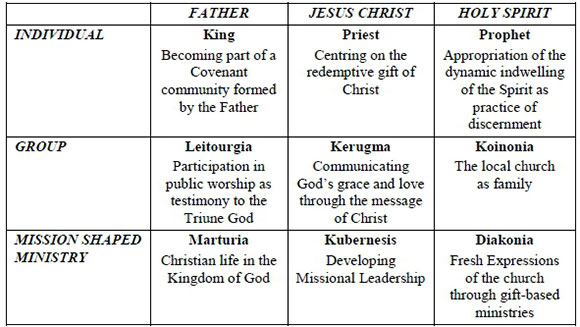
Let us attempt a short elaboration while simultaneously refraining from oversimplification. Unfortunately, the constraints placed by the format of this presentation demand a limitation; therefore we will be focusing on only three central theses of this relational hermeneutic.
- A relational hermeneutic seeks to understand missional ecclesiology from the perspective of the Triune God
The word ' hermeneutic' suggests a process of understanding, of critically reading a text, or situation, with the aim of better insight, not providing a tidy system to be available as a correct answer, but as a witness to God's love, through which "the church is built up and energised for mission, the believer is challenged, transformed and nurtured in the faith, and the unbeliever is confronted with the shocking but joyful news that the crucified and risen Jesus is the Lord of the world." (Wright 2009:40). Perhaps we could take our cue from ancient Mediterranean culture: The future was experienced in the present; tomorrow is tackled when it arrived; the past thus served as a mirror held up to the present and problems were solved in the light of the past (Malina, Joubert & Van der Watt 1996:105).
Stated in other words, hermeneutics as an aspect of theological study is the process of theoretical justification (or explanation) - in a credible and critical manner - about the Christian religion (Van Huyssteen 1987:2). By following the contours of the biblical witness, Christians tell the story of God's actions in human history through their testimony. They testify about God's goodness, a goodness He has made known, revealed and which defines His purposes (Güder 2000:29). Moltmann-Wendel & Moltmann (1983:88) aptly summarized the New Testament testimony as "the great love story of the Father, the Son and the Holy Spirit" in which the whole creation and humankind are all together. This lead Migliori (2004:68) to state that God's love was presented originally through Him as Father, is humanly enacted in this world by the Son and becomes vital and present until today through the Spirit.
When missional ecclesiology is viewed through this filter we can build into the framework the notion that Christians share in the ministry by following Christ's example as Prophet, Priest and King (Leith 1993:159). God's children are called individually as well as collectively to participate in the life of the Trinity. Thus we can distinguish this vocation through a cross-grid matrix pertaining to the individual Christian's sharing of the prophetical, priestly and regal functions, the community of believers' participation in these functions, and the way the church's mission is aligned with that of God in the way his Kingdom is presented to this world.
- A relational hermeneutic seeks to understand missional ecclesiology through the filter of the local church
Hybels (2002:27) stated that the local church is the hope for the world. Viewing missional ecclesiology through the filter of the local church, we are reminded of the ancient history of faith communities in a tumultuous time, when the Christian religion was a marginalised, persecuted grouping of the Roman Empire (Mead 1991:9). The early church was aware of itself as a religious community surrounded by a hostile environment to which each witness was called to witness about God's love in Christ. They viewed themselves as bearers of the euanggelion, a term that in this time was frequently used as description for the good news about the Kingdom of God that was being personified in Jesus.
The local church functioned at the centre of this task. It was a community that lived by the power and values of Jesus (Mead 1991:10). These values and power were preserved and shared within the intimate community through apostolic teaching and preaching, the fellowship of believers and ritual acts such as the breaking of bread and wine in the Eucharist. Kreider (1999:23) showed how these early churches attempted to nurture communities whose values would be different from those of conventional society. It was assumed that people would live their way into a new kind of thinking. Thus, the socialisation, professions and life commitments of candidates for church membership would determine whether they could receive what the Christian community considered to be good news.
On congregational level this hermeneutic reading of missional ecclesiology enables better understanding in the way the local church builds up its members to participate in ministry: through acts of worship and prayer, through teaching and equipping and through the way the church is structuring itself relationally as God's family. In this regard, biblical passages to be re-read through the filter of a relational hermeneutic need to be revisited, such as the gospel of John - where Van der Watt (2000) successfully showed how the family metaphor is utilised, Acts, Ephesians and Revelation 4-5.
- A relational hermeneutic seeks to understand missional ecclesiology as participation in God's missional ministry to this world
According to Mittelberg (2000:49-61) a gap exists between contemporary church culture and secular society. The church has become so far removed from postchristian society that its own culture has become an obstacle in communicating God's message, needing to cross an additional bridge towards the secular worldview and human consciousness in order to be able to engage in God's mission. Therefore, the contextual filter for a missional hermeneutic is an intentional choice to understand the church from the viewpoint of God's work in the community, rather than the needs of the congregation.
This mission-shaped ministry approach -borrowing a phrase coined by the Church of England - is a way of describing the different ethos and style of ministries traditionally conducted by the local church, as they are designed to reach a different group of people than those already attending the original church. This approach correlates with the trend towards creativity identified by Niemandt and is innovative in its essence. It is "creating spaces for the invitation to follow Jesus to be heard in new ways..." (Drane 2010:160).
This hermeneutic is more fully developed when the church invests in the Kingdom of God, the intentional developing of missional leaders and the freedom of expression of church members to start ministries according to their particular gifts and passion.
Conclusion
How, then, should a relational hermeneutic look - one that takes the integration between theological paradigms and scientific disciplines seriously?
A relational hermeneutic takes as its first cue the common purpose with which theology is practiced. As a whole the aim is to take part in God's mission to the world and our engaging with the brokenness that He wishes to mend. This shared vision serves as the focal point of all theological reflection.
A second cue is taken from the essence of the church's ministry to the world. As living testament of God, we are a communicative organism, honour-bound to go and share what God is doing. Within the different narratives we all share the common bond of being one in Christ (Eph. 4:1-6). To this extent the church is essentially an interpersonal organism -focused on the restoration of people's relationship with God as well as with each other. The New Testament has approximately 96 different 'one another' texts filled with imagery depicting the relational character of Christ's body. In the context of my own theological tradition the Confession of Belhar testifies to the fact that the Bible demands the visible unity of God's people through reconciled relationships as one of the prerequisites for the world to believe in God.
The third cue for a relational hermeneutic grows from the realisation that every one of the three paradigms has the challenge to develop theories of ministry practice for our current context. Since we live in an oxymoronic culture, the developers of these practices would do well to start listening to one another. As there is no one correct way of doing ministry, no single possibility to interpret biblical texts, or a definitive manner with which pastoral care is accomplished, a relational hermeneutic will seek to draw from each paradigm the most authentic developments, in its quest to bridge the chasms. Faced with the reality of the South African context, a unified voice should be sought for the public discourse that demands from the church reasons for the hope it propagates (cf 1 Pet 3:15). Therefore the modernist churches of the well-to-do suburbs should humble themselves before the township voices that cry out the plight of the poor and destitute. The pre-modern fundamentalists should start to listen to the echoes of dignity that cannot be trapped in legalist language. And the late-modern dreamers should utilise their capacity to create meaning through concrete deeds of service in communities beyond their comfort zones.
Finally, a relational hermeneutic cannot be anything else than personal. Taking time to cross cultural, social and economic boundaries can only affect the scientific scope of theological reflection positively. The prophetic voice of public theology will sound with increasing clarity when God's people now, trust and love one another regardless of their race, gender or social standing.
BIBLIOGRAPHY
Barker, JA 1985. Discovering the Future, St Paul, ILI Press. [ Links ]
Bird, A 2011. Thomas Kuhn, In Stanford Encyclopaedia of Philosophy, viewed 2014-06-30 from http://plato.stanford.edu/entries/thomas-kuhn/#pagetopright. [ Links ]
Bosch, DJ 1991. Transforming Mission: Paradigm Shifts in Theology of Mission, New York, Orbis Books. [ Links ]
Burger, C 1999. Gemeentes in die kragveld van die Gees: Oor die unieke identiteit, taak en bediening van die kerk van Christus, Wellington, Lux Verbi/BUVTON. [ Links ]
Caputo, JD 1997. The prayers and tears of Jacques Derrida: Religion without religion, Bloomington, Indiana University Press. [ Links ]
Drane, J 2010. 'Resisting McDonaldization: Will 'Fresh Expressions' of church inevitably go stale?', in C Mortenson & A0 Nielsen (eds.), Walk humbly with the Lord: Church and mission engaging plurality, pp. 150-166, Grand Rapids, William B Eerdmans. [ Links ]
Fowler, SE 1995. "The New Testament, Theology, and Ethics," In Hearing the New Testament: Strategies for Interpretation, pp. 394-410, Grand Rapids, William B Eerdmans. [ Links ]
Green, JB 1995. "The Practice of Hearing the New Testament", In Hearing the New Testament: Strategies for interpretation, pp. 411-427, Grand Rapids, William B Eerdmans. [ Links ]
Güder, DL 2000. The Continuing Conversion of the Church, Grand Rapids, William B Eerdmans. [ Links ]
Guillemette, L & Cossette, J 2006. Deconstruction and différance, viewed 2012-08-15 from http://www.signosemio.com. [ Links ]
Hairston, M 1982. "The Winds of Change: Thomas Kuhn and the Revolution in the Teaching of Writing", In College Composition and Communication, Volume 33, no 1. pp 76-88. [ Links ]
Hassan, R 2008. The information society: Digital media and society series, Polity Press, Cambridge. [ Links ]
Heitink, G 1993. Praktische Theologie, Kok, Kampen. [ Links ]
Hirsch, A 2006. The Forgotten Ways: Reactivating the missional church, Grand Rapids, Brazos Press. [ Links ]
Hybels, B 2002. Courageous Leadership, Grand Rapids, Zondervan Publishing House. [ Links ]
Keifert, PR 2006. Ons is nou Hiér: 'n Nuwe era van gestuur-wees, Wellington, Bybelmedia. [ Links ]
Kreider, A 1999. The Change of Conversion and the Origin of Christendom, Harrisburg, Trinity Press International. [ Links ]
Kuhn, T 1996 (3rd ed.). The Structure of Scientific Revolutions, Chicago, University of Chicago Press. [ Links ]
Leith, JH 1993. Basic Christian Doctrine, Louisville, Westminster John Knox Press. [ Links ]
Lyotard, JF 1984. The Postmodern Condition: A Report on Knowledge, Manchester, Manchester University Press. [ Links ]
Malina, BJ & Joubert, SJ & van der Watt, JG 1996. A Time Travel to the world of Jesus: A modern reflection of ancient Judea, Halfway House, Orion Publishers. [ Links ]
McKnight, S 2008. The Blue Parakeet: Rethinking How You Read the Bible, Grand Rapids, Zondervan Publishing House. [ Links ]
McLaren, BD 2000. The Church on the Other Side: Doing ministry in the Postmodern Matrix, Grand Rapids, Zondervan. [ Links ]
Mead, LB 1991. The Once and Future Church: Reinventing the congregation for a new mission frontier, New York, The Alban Institute. [ Links ]
Migliori, D 2004 (2nd ed). Faith Seeking understanding: An Introduction to Christian Theology, Grand Rapids, William B Eerdmans. [ Links ]
Miller, MR 2004. The Millennium Matrix: Reclaiming the past, reframing the future of the church, San Francisco, Jossey Bass. [ Links ]
Mittelberg, M 2000. Building a Contagious Church: Revolutionizing the Way we View and Do Evangelism, Grand Rapids, Zondervan. [ Links ]
Moltmann-Wendel, E & Moltman, J 1983. Humanity in God, New York, Pilgrim Press. [ Links ]
Morrison, C.C., 1910, "The World Missionary Conference", In Christian Century, viewed 2014-07-007 from http://www.religion-online.org/showarticle.asp?title=471. [ Links ]
Niemandt, CJP 2012. 'Trends in missional ecclesiology' , HTS Teologiese Studies/Theological Studies 68(1), Art. #1198, 9 pages. http://dx.doi.org/10.4102/hts.v68i1.1198. [ Links ]
Osmer, RR 2008. Practical Theology: An Introduction, Grand Rapids, Wm B Eerdmans. [ Links ]
Pettersson, R 1989. Visuals for Information: Research and Practice, Englewood Cliffs, Educational Technology Publications. [ Links ]
Ricoeur, P 1991. From Text to Action: Essays in Hermeneutics, Evanston, Northwestern University Press. [ Links ]
Saxby, S 1990. The Age of Information: The Past Development and Future Significance of Computing and Communications, New York, New York University Press. [ Links ]
Smit, G 1997. Ekklesiologie en Gemeentebou: 'n Prakties-teologiese studie (Ecclesiology and Congregational Development: A Practical Theological Study), DD-dissertation (unpublished), Pretoria, University of Pretoria. [ Links ]
Smit, G 2008. "Die ontwikkeling van 'n strategiese gemeentelike ekklesiologie: Oppad na 'n missionerende bedieningspraxis (Developing a strategic congregational ecclesiology, Towards a Missionary Ministry Practice)", Acta Theologica, Volume 28(1):161-175. [ Links ]
Sweet, L 1999. Soul Tsunami: Sink or Swim in new Millennium Culture, Grand Rapids, Zondervan Publishing House. [ Links ]
Van der Ven, JA 1993. Ecclesiologie in Context, Kok, Kampen. [ Links ]
Van der Watt, JG 2000. Family of the King: Dynamics of metaphor in the Gospel according to John, Leiden, Brill. [ Links ]
Van Huyssteen, W 1987. Teologie as Kritiese Geloofsverantwoording, (Theology as Critical Religious Accountability), Pretoria, Human Sciences Research Council. [ Links ]
Wright, CJH 2006. The Mission of God: Unlocking the Bible's Grand Narrative, Downers Grove, Intervarsity Press. [ Links ]
Wright, NT 2009. Justification: God's Plan & Paul's Vision, Downers Grove, Intervarsity Press. [ Links ]
^rND^sBird^nA^rND^sDrane^nJ^rND^sFowler^nSE^rND^sGreen^nJB^rND^sHairston^nM^rND^sMorrison^nC.C.^rND^sNiemandt^nCJP^rND^sSmit^nG^rND^1A01 A02^nMusa W^sDube^rND^1A01 A02^nMusa W^sDube^rND^1A01 A02^nMusa W^sDubeARTICLES
Translating cultures: The creation of sin in the public space of Batswana
Musa W DubeI, II
IDepartment of Theology and Religious Studies University of Botswana
IIDepartment of Biblical and Ancient Studies UNISA
ABSTRACT
This article seeks to trace the fussy boundaries of religion and the public space in the modern colonial archive of southern Africa. It investigates how drawing such boundaries became a central strategy in translating indigenous cultures into sin and creating guilt in communities that did not observe the sacred and secular boundaries. The article uses the attestations of the 19th century letters to Mahoko a Becwana, a London Missionary Society public paper, printed from Kuruman. While the Batswana worldview kneaded religion and all spheres of individual and collective public space, modern western colonial perspectives claimed otherwise. This paper analyses the letters for the intrusion of colonial religion into the public space of Batswana; the colonial agenda to translate key cultural beliefs and activities into the realm of evil and the various responses it initiated - thereby uncovering that perhaps the separation of religion from state has always been a mythological and ideological construction.
Key words: Translation studies; Postcolonial; Culture; Public Theology; Religion and the State; Translation Theory; Botswana; Sin
When we attempted to convince them of their state as sinners, they would boldly affirm ... that there was not a sinner in the tribe (Robert Moffat 1842:254).
Introduction: Colonial Border-crossing and New Boundaries
A colonial context and its subsequent postcolonial settings generate multiple border-crossings and translations. In his Sociology of Colonies: An Introduction to the Study of Race Contact Vol 1, Rene Manuier thus says, "This is the conception of Empire: ... to know no bounds" (1949:19). Manuier cites the example of the Babylonian sovereign Hammurabi who gave himself the title of "King of the four corners of the world" (19). That is, the empire and its colonial project involves crossing multiple boundaries into other people's lands and drawing many new boundaries to claim the lands as its own, especially where there are competing colonial powers. We all know the agenda of the Berlin Conference of 1884, which sought to co-ordinate the process of crossing various boundaries into African lands and drew new boundaries for claiming what the colonisers had named for themselves as 'a big blank map' of Africa (Moffat 1842:2; Conrad 1902:4). And so there was a 'colony rush' to claim some pieces of the supposedly big blank map, and to draw boundaries of claim by various imperial powers. Today we bear upon our bodies this history of drawing and redrawing of colonial boundaries as we identify ourselves as English-speaking Africa, French-speaking Africa and Lusophone Africa. Most, if not all, contemporary national boundaries are products of modern colonial agenda. Of course there was no such thing as a big blank map, since the African continent was fully occupied by African people. The colonising powers needed to sanctify their conscience through constructing an ideology of 'a big blank map.' The ideology of a big blank map was painted in various hues such as racial, cultural, economic and religious superiority of the colonising powers. The modern colonial project therefore involved multiple border-crossing into other people's lands and social spheres as well as drawing new boundaries on top of various existing boundaries.
As Manuier's subtitle, "An Introduction to the Study of Race Contact" highlights, the colonial border-crossing is all about contacts of various races - for the map is never blank. Any colonial border-crossing thus generates a contact-zone (Pratt 1992:6-7). Mary Louise-Pratt defines the contact-zone as, "the space of colonial encounters, the space in which people geographically and historically separate come into contact with each other to establish ongoing relations" (6-7). It follows that the colonial multiple border crossing is, as always, more than just physical border-crossing. It always includes the cultural, political, economic, social, sexual and religious border-crossing, for all lands are also bearers of cultural constructions of their inhabitants and visitors. Border-crossing is a power-laden activity which involves the identities of those who cross and their reasons. Hence in my article, Batswakwa: What Kind of Traveller are you? I have argued that various travellers must identify their power and the reasons behind their border-crossing (2000:89-99). In this postcolonial era, the theory of border-crossing is championed by former colonised subjects as they find their way to the imperial centres (Azandula 1999 & Bhabha 1994). Just as Salmon Rushdie coined the famous phrase, "the Empire writes back" (Ashcroft, Griffiths & Tiffin 1989) we could say in the contemporary era, "the Empire travels back," to the metropolitan centres many times as powerless, but insistent travellers, who will not be deterred by various border patrollers (Guardiola-Saenz 1997:69-81). They enter imperial centres as undocumented workers, students, migrants, politically and economically displaced persons or highly trained professionals, searching for greener pastures (Brah 2003:613-634). Today border-crossing is intensely theorised, as the former colonised subjects return to imperial centres to claim back what was taken from them by their colonial masters (Spencer-Miller 2004:209-238); to share in the commonwealth. Border-crossing, as theorised by the former colonised, is a framework that challenges the established western-based paradigms and insists on looking beyond the established boundaries to other historical, cultural or canonical realities (Said 1992:317).
Translation as Creative Rewriting
As bearers of self-proclaimed superior social structures, modern colonial travellers claimed for themselves the right to redraw all boundaries of the colonised - psychically, economically, politically, socially, culturally and religiously. Clearly border-crossing is a power-laden game within which both the travellers and the hosts find themselves entangled. Both the traveller and the host come to a new boundary, if not multiple boundaries, where new languages of being and survival are needed. Translation thus becomes a central part of border-crossing because one' s own language(s) becomes insufficient to communicate with the various border-crossing communities. According to Edwin Gentzler, "traditional definitions of translations invariably include a border over, or through which translation is carried across" (2012:1) normally between two sources: the source text and target culture. The source text is often regarded as the original which should be preserved while the target text or culture is supposedly the passive recipient of the latter. A translation, in such frameworks of understanding must be faithful to the original text. This understanding of translation is far from being ideologically neutral, for the target cultures are supposedly instrumental and passive recipients of the culture of the original source, while the original source is to be preserved at all costs. In short, the original source crosses over and sub-plants itself in the target-culture. The targeted culture supposedly makes room for the new original source. In the colonial context, it was the colonial language, culture, religion, political and economic systems that became the original text. As Bassnett and Trivedi highlight, in the colonial context "Europe was regarded as the great Original, the starting point, and the colonies were therefore copies, or 'translations' of Europe, which they were supposed to duplicate. Moreover, being copies, translations were evaluated as less than originals" (1999:4).
The Imposed Categories of the Secular and the Sacred
It follows that the colonial contact-zone of the Batswana and the Europeans was a huge translational project, one that turned cultures at the contact zone inside out and upside down, multiple times and continuously. It was characterised by continuous multiple border-crossings, from both races, especially where religious beliefs were concerned. First, concerning religion, it is important to highlight that in so far as Batswana or Bantu people of Southern Africa were concerned, there was no division between the secular and the sacred. If such a division existed, it was not marked in dualistic forms. The worldview of Batswana and Bantu people in general was marked by interconnections of the dead and the living, of culture and religion, of people and the environment. The Batswana (and most Bantu people of Southern Africa) did not have a theological concept that regarded all human beings as inherently sinful and in need of repentance and saving. Rather, the Batswana and most Bantu people had a concept of acceptable relational living, which was measured by one's relationship to family, community, the environment and the Divine powers (Ancestors and God). This relational perspective is best captured by the popular saying, "motho ke motho ka batho," in Sotho-Tswana or "umuntu ngu muntu nga bantu " in Nguni languages. The saying holds that a human being is only human through other human beings. One's goodness and humanity were measured by the capacity to relate to others. What could pass as 'sinful' would be the disruption of these relationships, which necessitated rituals of reconciliation.
This dualistic framework, which is still held by many translation theorists and practitioners, has been critiqued from multiple angles for its ideological trappings and shortcomings. From a feminist standpoint, this is a gendered perspective, which views translation as an act of the male depositing his seed in the womb of a female body, which is thought of as nothing but a recipient and carrier of the planted seed. Contemporary translation studies have complicated this picture of translation. It is recognised that "the borders transgressed in translation tend to be more multiple and permeable than traditionally conceived" (Gentzler 2012:1). Originals are already translations of translations. Moreover, the so-called originals translate themselves at the borderlands to new identities. Hence many prisoners, outlaws, prostitutes and low class peasants in colonial contexts played the imperial race card and assumed a new cocoon of superiority in the colonies (Strobel 1991:1-16). Similarly target cultures are far from being passive recipients of the seeds of so called original sources. They too translate themselves whenever the situation demands. If a target culture can be viewed as a woman's womb receiving the seed of the original source, the woman's womb will feed the baby from its own supply for nine months, give it her genes and give birth to a child who is not a duplicate of the father but a product of both. If we imagine that the baby is also externally nurtured by the mother feeding it from her own breast then far from being a duplicate of the original source, a translation is always a hybrid product - a new product. Target cultures, far from being passive recipients who must remain faithful to the so-called originals, are also active potters who reshape the colonial mud in their hands. So every translation is a creative rewriting of both the original and receiving cultures. It is a new product.
Accordingly, one did not have to make a choice to become a believer, since one was never outside belief as long as one was living according to the communal norms. Similarly there was no division between the public and private spheres of religion or separation of religion and state. Faith was kneaded together with community beliefs and practices of daily living, such that drawing lines of division between religion and civic matters in the public and individual context creates imposed categories. The duty of a Kgosi, as the leader or King of Morafe, or the people, was often also that of a religious leader, who surrounded himself with religious leaders, dingaka (Moffat 1842:208; Schapera 1948:60-69). Faith was manifested as public, political and economic practice in the rituals that consisted of the well-being of Morafe. As noted by Isaac Schapera in his book, A Handbook of Tswana Law and Customs, this included performing rituals for rainfall in times of drought or at the beginning of the rainy season, doctoring mephato, the army, in preparation of war and in the installation of a new Kgosi (1948:70).
The arrival and introduction of Christianity would thus encounter new boundaries of belief and practice as well as attempt to draw new ones upon the Setswana culture. Since a major Christian assumption is that all humanity has sinned and fallen short of God's glory, the first major challenge confronting early missionaries was that the idea of an inherently sinful human being did not exist among the Batswana. The salvation of Jesus Christ was thus rendered unnecessary and irrelevant. So Robert Moffat writes that "when we attempted to convince them of their state as sinners, they would boldly affirm with full belief in their innate rectitude that there was not a sinner in the tribe" (1842:254).
Robert Moffatt records that he was sometimes laughed at, told that his preaching was maaka hela (just lies), asked if he did not tire of speaking about this certain Jesus, while at other times, he was empathetically advised to cease his teaching, for he risked been taken for mad. Likening preaching to Batswana as the art of trying to break water from a granite rock, Moffatt lamented: "Oh when shall the day-star arise in their hearts? We preach, we converse, we catechise, we pray, but without the least apparent success..." (285). The process of rewriting or translating Batswana's self-understanding, for them to understand themselves as inherently sinful and in need of the salvation became crucial for the Christian gospel to sell (Dube 2013:88).
Clearly, before the concept of an inherently sinful individual could be cultivated, it was important to construct a sinful community. My research regarding the colonial Bible translation into Setswana showed that colonial translation rewrote Badimo (ancestors) as demons to convince Batswana that they were evil and in need of Christian salvation (1999:33-59). So in the Setswana New Testament translation, Jesus went around casting Badimo out. The translation was one of the most powerful ways of creating sin among Batswana, for by the time the first Batswana read the Setswana Bible translation they discovered that that which they held sacred was in the realm of evil in the biblical text.
How did the cultural translation occur and how did the Batswana respond to it? How does such a translation reflect Christian religion in the public space? To explore these questions, I will largely read the letters that the Batswana sent to the editor of Mahoko a Becwana, a newspaper that was published by the London Missionary Society (henceforth LMS) from Kuruman, between 1883-1896. A number of 'literate' Batswana wrote letters on various subjects, which gives us a window into how Batswana responded to translation of Setswana culture and how it reflects religion in the public space. The editors occasionally published letters concerning correct Christian practice, which often stimulated long discussions. These letters were recently collected and made available in the volume Words of Batswana: Letters to Mahoko a Becwana 1883-1896, edited by Part T Mgadla and Stephen C Volz. I wish to examine the case of: Bogadi (bridewealth) and Magosi and Thuto (rulers and the biblical/Christian teaching) closely as well as highlight some debates on wedding dances (mmero le setapa), initiation schools (Bogwera le Bojale) and crop medicine. I must underline that in reading these letters, written between 1883 and 1896, we are quite a distance from Robert Moffat's days, where he was ridiculed and ignored for his Christian teachings. The fact that these Batswana wrote letters to the editor speaks for itself. It means that they had undergone the missionary teaching and school and most probably were Christians, although even the unconverted had learnt how to write and read from those who went to school. Politically, Botswana was now officially a British Protectorate. These letters attest to the centrality of religion in the public space of Botswana (then Bechuanaland) and are important for highlighting what was finally defined as sin and how it was accepted and contested by others. The various letters that are analysed and cited in this article are found in the Mgadla and Volz compilation of 2006.
Bogadi: Bridewealth
The section opens with a letter from Alfred Wookey, the editor, dated October 1883. He writes:
The teaching (Bible//Christian teaching) has encountered the Tswana law called bogadi, bride wealth... It was written by one person, and he said to me, "If a person has taken bogadi what is wrong with that?"... God simply gave Adam a woman in the beginning and also gave him children; there is no bogadi at all other than thanking God for his gifts. Today also, God has appointed the man for the woman and the woman for the man not by payment. If God pleases, he gives them children, they are not bought. Psalm 127:3 says children are inheritance of Jehovah: I say why do believers want to return to the deeds of the darkness such as these? This practice of bogadi was an activity that was done by the people of long time ago who did not know anything about God... This is shameful. God has not commanded such a thing... We have been bought by the blood of the son of God, who is Jesus. And things of the darkness should be thrown away, along with each and every one of their remnants (Mgadla & Volz 2006:139).
Editor Wookey uses the biblical text to dismiss bogadi. He argues that the creation story (Genesis 1-2) does not feature bogadi and the Psalms state that children are a blessing from God. Categorising bogadi as 'a shameful' act, which is among "deeds of the darkness," Wookey argues that it "should be thrown away." Of course, Wookey's selective reading of Genesis notably overlooks that patriarchs, such as Isaac and Jacob, had to offer some bridewealth for their wives Rebekah, Leah and Rachel. Jacob had to offer fourteen years of service to his uncle, Laban, for his two wives. Wookey's letter was followed by fifteen letters, the dates of which range from 1883 to 1890. Some writers agreed with the editor, naming bogadi as a 'bad and evil' practice of buying women or children (141-142) which apparently persists among believers and non-believers alike. As Morolong Monnaakanye asserts, "there isn't any believer who is not involved in this evil deed of Bogadi ... because the believer will take bogadi and the one who does not believe will take bogadi" (142). Apparently the bogadi had been discussed over a long time and still the resolution could not be reached. Part of the complication was that in the Setswana legal system, bogadi constituted a confirmation of a marriage, without which the relationship did not qualify as a marriage among Batswana.
Bogadi was the proof of marriage, the legal seal. Consequently, the people who choose not to receive or give bogadi entered a marriage that was not legally recognised and it created multiple complications to participants and their children in the event of death or divorce.
Respondents who wrote in defence of the practice gave several reasons. First, they argued that bogadi is not buying children or a wife, rather it is a confirmation of marriage, just as in the Western manner, marriage is confirmed through a church or magistrate wedding, where a couple exchanged rings (2006:157). Second, since cows are central to Botswana culture, they feature in all important occasions, including marriage. Third, bogadi is an expression of gratitude to the parents and relatives who raised the bride. Fourth, the translation of bogadi in commercial terms is strongly rejected as a Western imposition. Against such claims that bogadi is 'buying' a woman or children, Baruni Makutle writing in May 1884 argues, "I don't know how bogadi changed into buying...You know that the practice of Batswana is not to buy a person. If one of them comes from a journey, and he has gone to buy a person, he will be shunned. It will be said, 'It is a bad omen, we will perish.' We discovered the buying of a person through the Europeans, and that is how we saw that a person can be bought" (147). Underlining that bogadi is not about buying children or women, and contesting the slavery language, Joseph Molokwane writes in January 1891:
Regarding bogadi, we Batswana do not say that it is buying. We understand very well that a person cannot be bought by anything in this world. But you say that bogadi is buying. Go and get some cattle, even more than hundred, and buy the child of some man with them. Even if her father is embarrassingly poor, I don't believe that you can see such a person anywhere... how can a person be sold, since she has a soul in the image of God? (157).
Notably he also employs the creation story of Genesis 1, just as Wookey did, but for a different interpretation of bogadi. This section closes with a letter from Kgosi Montshiwa, who underlines the centrality of bogadi. He writes, "Bogadi is not wrong; it should be paid. Of all Tswana things, it is the one that establishes marriage" (161).
Turning to the case of magosi le thuto (rulers and the biblical/Christian teaching), the letter of editor Alfred Wookey opens the debate. Its contents, as we shall see below, highlight the centrality of religion in the public space of Batswana of colonial times, while it also demonstrates how indigenous cultures and worldviews were re-written as evil, but not without strong resistance from Batswana writers of the time.
Dikgosi le Thuto: Translating Government
... the issue of rulers and (Christian) teaching. Rulers have been saying, "the teaching destroys; it is destroying villages and people." Dikgosi have feared the teaching for a long time and fought against it. So today, some dikgosi regard teaching simply as a snake that should be killed. However, Christian teaching has remained firm and has been difficult to kill. Many people have believed, and there are many congregations and school buildings. There are many people who know the books. Rulers are divided; some have believed and others do not believe. And perhaps among the rulers who don't believe, there are many people who believe, and a missionary and Christian teaching are regarded by dikgosi only as an enemy.
Because it has been difficult to kill Christian teaching and remove it, now dikgosi have changed and are saying that the teaching should be regulated. A teacher should be supervised in a way that he teaches and in a way that he works. It is said that a congregation should only be governed by dikgosi... It is said that when a church is built, it should be built by dikgosi conscripting people to work. Even those who do not believe should pay and do manual labour. It is said that the house of God should be that of dikgosi and that they should order it to be opened or closed and for teaching or no teaching to take place inside. It is said that dikgosi should be told the secrets of the congregation, and that no one should be cut off for an offence and no one admitted without the agreement of the rulers... in some villages we see that the one who is the elder of the village is also the elder of the congregation. Even those who are believers are divided... [But] when a person tries to mix ruling the village with managing the congregation, that is how he destroys it. ... You know the congregation is for God; it is not for the missionary, it is not for anyone, it is for God. Christian teaching came to earth as a different thing, not from dikgosi. Faith is a feeling in a person's heart that cannot be restrained and controlled by anyone.... We will not be stubborn, but we plead with dikgosi to leave us alone and allow us to pray to God, congregate, advise one another, teach people and build churches as we like. Dikgosi allow us to pay taxes and have us do tasks that are appropriate for you to order. But don't try to intervene in that which is of God, our faith.What we are sure of is this: chieftainship will not control anything in the house of God. It cannot control things of the congregation. No one should say that a congregation is his. A congregation belongs to God, and churches belong to the congregations that have built them (237-239. See also 247-249).
This letter, quoted at length, was written in November 1889 by Wookey when he was serving as the editor of the newspaper (xxiii). John Brown, who assumed the editorship in 1891, also returned to the same issue in a letter written in 1892 entitled, 'evil leaven' (247). Wookey's letter is crucial for it highlights the multiple border crossings and redrawing of the social boundaries that occurred with the introduction of Christianity into the public space of the Batswana. It is also crucial in the sense that it highlights how the Batswana social fabric was translated and how they translated themselves several times to deal with the new phenomenon. First, we note that the major agent of change is named as thuto, or biblical/Christian teaching. The introduction of thuto, and what he calls books, namely the Bible, has drawn a new major boundary in the public space of Batswana: dividing the community into two categories of those who believe and those who do not believe the teaching, thuto. In a society that did not separate the sacred and the secular and where public leaders also held some priestly roles, or worked hand in glove with the indigenous religious leaders (dingaka), this division had a major impact on the public space of Batswana communities, as the letter itself attests.
Since dikgosi were initially unifying figures and the Setswana cultures were communal, Christian teaching had planted a major division, which questioned and weakened the power of dikgosi and Setswana culture. As Wookey states: "the law that governs a congregation is in the scriptures of God" (239). There were now some sections of the society, which were supposedly outside the jurisdiction of dikgosi and Setswana culture and were under another authority. Major aspects of the Setswana culture had been translated to the realm of evil. The thuto brought with it books and resulted in believers, congregations, the missionaries, God, church and school buildings, which were defined as outside the powers of dikgosi, the rulers of the people. With the introduction of the thuto, believers could now solve their own disputes without involving the Kgosi.
These new believers-non-believers boundaries were received with tension, resistance and/or outright rejection. As the letter attests, dikgosi named the thuto, or Christian teaching, an enemy and a snake and accordingly tried to kill it. They had fully grasped its poison. The thuto, however, continued to thrive, forcing the dikgosi to revise their strategy to translate themselves from being opponents of the thuto to become its patrons. They sponsored the church and school buildings and reasserted their authority by insisting that Christian institutions and structures remain under the authority of dikgosi, and by continuing to adjudicate cases of disputes between believers who had been tried in the church. Clearly, the public space had become a contested space due to the introduction of thuto, Christian teaching. The writer is clear that dikgosi have overstepped their boundaries by attempting to extend their leadership powers to the believers and their institutions. There is now a place in the society where dikgosi's powers had no mandate. Thus he insists, "faith is a feeling in a person's heart that cannot be restrained and controlled by anyone ..." (239) thereby employing the private or individual space versus the public space to distance dikgosi's power over believers. Wookey goes on to give an imperative: "don't intervene in that which is of God ... chieftainship will not have anything in the house of God" (239). This letter seems to suggest the separation of religion from the state, particularly where the writer says: "Dikgosi, allow us to pay taxes and have us do tasks that are appropriate for you to order. But don't try to intervene in that which is of God, our faith... What we are sure of is this: chieftainship will not control anything in the house of God" (329). Writing in the post Bechuanaland Protectorate of 1885, Wookey notably exudes great authority in his speech towards dikgosi.
The editor's letter was followed by a flurry of letters (about twelve), taking various positions: some confirming that dikgosi interference is indeed undesirable; others highlighting that believing dikgosi continue to hold on traditional roles (See Molefi Mogapi 1893). Other writers, however, contested Wookey's attempt to separate the church from the state. One such letter was written by Molema Moshwela, who adopts a non-contentious tone while appreciating how different dikgosi have supported the work of the church by hosting travelling evangelists, building churches and schools (242-243). In so doing he underlines that he does not regard the involvement of dikgosi in thuto as inherently problematic, nor does he regard dikgosi as enemies of thuto - Christian teaching. Others contested Wookey's letter by underlining that missionaries and evangelists' adjudication of disputes between believers is often unfair and leads to unfair expulsion of people from the churches (243 & 247). Other writers wrote back in defence of their dikgosi, who had been named as unworthy believers, for they still carry out rainfall rituals (249-254). In his letter of June 1893, Mhiko Segadika adopted the Setswana perspective of Kgosi ke kgosi ka batho, (all decisions of a Kgosi are only through his people and by his people) to insist that dikgosi do not act on their own - rather they fulfill the demands of their people, morafe (249-253). In so doing, Segadika underlines that dikgosi (their decision and acts) cannot be separated from the people. Others sought to underline that dikgosi can and have furthered the gospel and used bogosi (leadership) to further Christian goals, hence linking faith and bogosi does not always disadvantage the goals of Christian teaching. One such letter was written by Rratshosa M Segokotlo in April 1896 about Sir Khama Sekgoma and his government. He asserts:
I am trying to record the accomplishment of the government of Sir Khama Sekgoma, the way he is ruling us as his nation. Khama has ended all the practices of his forefathers. Our forefathers used to say, rain is made to fall by the rainmaker and kgosi. A woman was married with cattle, a person could be killed without any thought, people were forced to be initiated, alcohol was drunk.when it did not rain, like this year, it was said that it was being withheld by a person, and some person and his wife would be taken and put in the sun. There were also charms, sacrifices and many taboos about things of the world. When Sekgoma ruled, these things were being done but he sought the teaching of the word of God for his children. Khama, Khamane, Seretse and Kebailele all studied. In 1872 when Khama came to power, he told his morafe, "I am informing you that I am stopping childish things," meaning those things that I have listed (Mgadla and Volz. 259).
Notably there was no letter from the missionaries contesting Khama's use of bogosi to further the missionaries' biblical/Christian teaching! Religion thus remains in the public space before and after the thuto, or Christian teaching.
To Dance or not to Dance and Other Cultural Translations
Sebotseng Leoabile writes in April 1884, "I am asking about a song called mmero or setapa, and I say, isn't this song a useless song? How is it that I see it being danced by the believers? I say it is a useless song like the ones that I was dancing when I was still a heathen, but now I have left them because they are useless songs that do not honour God" (217). The editor missionary responds, "Sebotseng is right to ask about the song. It seems it is sometimes a source of evil, sometimes missionaries reject it" (217). The editor explains that one group of believers came to seek permission to dance to it, and they were permitted to dance a little. However, they danced so much that "they were found to be exhausted from all the dancing so that the young women and men nearly fainted. How can missionaries relax the laws if people continue to be wild when the law is relaxed just a little?" (217). Endorsing this perspective, Yob Mosieleng wrote in July 1884 that "we saw young women and men (believers) who were dancing a song called Setapa... We explained to them that the setapa was sinful. Even though they did not listen to us..." (217). Resistance was plenty even amongst the believers. This particular group of dancers had been confronted by other believers who sent them off to go and think things over; namely, "to repent or not to repent" (219) concerning their participation in the wedding dance. After reflection, they said "they did not see how they could stop setapa" (219).
Such contestations over day to day indigenous cultural practices were daily bread. Writing in September 1890, Bananni Diphafe states: "the way I know crop medicine, it is a great heathenism" (199). Michael Tshabadira Moroka writes back: "I want to understand correctly. Are you saying that crop medicine is sinful or heathenism? Or is it against the laws of God or of Europeans?" (203). It is clear that believers and the general public were quite aware that some restrictions had very little to do with biblical teaching, but much to do with selling Western civilisation as the norm. So several writers express doubt concerning the foundation of the prohibitions. Indeed Brown's comment on the wedding dance is quite telling, when he names it as ' wild.' Believers are prohibited to participate in the wedding dance lest they overstep the boundaries of Western civilisation and appear to be wild. But judging from the response of the above-mentioned group of dancers, many believers were resisting believers.
Concerning the initiation schools, Gaabuiwe Masige in his July 1891 letter begins the debate, which was followed by a very long letter from the editor John Brown dated September 1981. Brown tabulates the tensions between parents and sons and between dikgosi and missionaries concerning participation in initiation schools. While earlier on editor Brown had characterised the involvement of rulers in church matters as the 'evil leaven,' he concludes his long letter by hoping for the intervention of the colonial government: "We heard from the magistrate that the government has agreed to consider the laws regarding boys' and girls' initiation; they want to see how they might be changed. Even the Administrator's secretary has written us so. We hope that a law that helps believers to protect their children from evil ways will in the meantime be enacted" (229) (emphasis mine). The writer does not provide us with information on whether missionaries had submitted a proposal to the colonial governing power regarding initiation schools. But it is strongly implied, since it seems the colonial government had taken advice from someone; namely "the government has agreed." It is also implied that the colonial government regarded them as partners in the project, for both the magistrate and the Administrator's secretary kept them informed as interested parties. Brown's letter highlights religion in the public space and the definition of sin as the rewriting of indigenous cultures into the realm of evil. But as always there were voices of protest. Mosimanyane, for example, writes, "I know you are not God. You can prohibit your own children from attending boys' and girls' initiation, but leave me alone. Mine will be going. I do not want Christian faith. It is lies that it promotes. Europeans have long been deceiving us" (129).
Conclusion
In the above-mentioned debates and counter arguments, it is apparent that sin was defined according to practices that were found unacceptable to Western missionaries. Such activities could have religious connotations or could be plain cultural activities - if such a demarcation exists at all. Examples are evident in questions concerning such issues as biblical teaching (thuto), wedding dances, (setapa or mmero), initiation schools (bogwera and bojale) and crop medicine raised in Letters to Mahoko a Becwana. The outline of these various debates highlights that when sin was finally defined, it was the customs and norms and practices of Batswana that were translated into sin. These were now labelled as darkness, great heathenism, sinful, useless, source of evil, evil ways and, according to Alfred Wookey, "things of the darkness, which should be thrown away" (139). Since these were accepted communal practices, naming them as evil painted the whole community as sinful. As my investigation into the Setswana Bible translation has shown, the crucial desire to convict Batswana as sinful and in need of Christian salvation, included translating the word demons, with Badimo, that is, ancestors (1999:33-59).
The translation was one of the most powerful ways of creating inherent sin among Batswana, for when the first Batswana readers read the Holy Book in their own language, they discovered that that which they held sacred supposedly belonged in the realm of evil in the Bible. This translation of general norms of Batswana into evil was in fact not just the creation of guilt in individuals; it was also the translation of the public space through Christian religion. Gone were the days that Batswana could tell Moffatt that there was not a single sinner in their midst! In Christian teaching, as in the indigenous worldview, religion was central to the public space - which became an arena of power struggles in the modern colonial context. But such a colonial translation never went unnamed, uncontested or disconnected from colonial strategies by Batswana writers. As underlined by Mosimanyane's above-mentioned assertion, ("I do not want Christian faith. It is lies that it promotes. Europeans have long been deceiving us"), there was resistance, collaboration and outright rejection.
BIBLIOGRAPHY
Anzandula, G 1999. Borderlands/La Frontera: The New Mestiza. Aunte Lute Books: San Francisco. [ Links ]
Ashcroft, B, G Griffiths & H Tiffin 1989. The Empire Writes Back: Theory and Practice in Postcolonial Literatures. New York: Routledge. [ Links ]
Bhabha, H 1994. The Location of Culture. Routledge: New York. [ Links ]
Bassnett, S & Trivedi H (eds.) 1999. Postcolonial Translation: Theory and Practice. New York: Routledge. [ Links ]
Brah, A 2003. "Diaspora, Border and Transnational Identities," in: Reina Lewis and Sara Mills (eds.), Feminist Postcolonial Theory: A Reader. Routledge: New York 2003:613-634. here, 613. [ Links ]
Conrad, J 1902. Heart of Darkness. New York: Bantam Books. [ Links ]
Dube, MW 2013. "The Bible in the Bush: The First 'Literate' Batswana Bible Readers," in: Translation: Issue 2:79-104. [ Links ]
Dube, MW 2000. "Batswakwa: Which Traveller Are You (John 1:1-18;?" Journal for Theology for Southern Africa. 108:79-89. [ Links ]
1999. "Consuming a Colonial Cultural Bomb: Translating Badimo into 'Demons' in the Setswana Bible," in: Journal of Society of New Testament 73:33-59. Gentzler, E 2001. Contemporary Translation Theories (2nd edit.). Clevedon: Multilingual Matters.
Guardiola-Saenz, L 1997. "Borderless Women and Borderless Texts: A Cultural Reading of Matthew 15:21-28," in: Semeia 78 1997:69-81, here 71-72. [ Links ]
Louise-Pratt, M 1992. Imperial Eyes: Travel Writing and Transculturation. New York: Routledge. [ Links ]
Maunier, R 1949. The Sociology of Colonies: An Introduction to the Study of Race Contact. Vol 1. London: Routledge. [ Links ]
Mgadla, P & Volz SC (translators/compilers) 2006. Words of Batswana: Letters to Mahoko a Becwana 1883-1896. Cape Town: Van Riesbeck Society. [ Links ]
Moffat, R 1842. Missionary Labours and Scenes in Southern Africa. London: J Snow. [ Links ] Said, E 1993. Culture and Imperialism. Alfred Knopf: New York. [ Links ]
Schapera, L 1938. A Handbook of Tswana Law and Custom. London: Frank Cass. [ Links ]
Spencer-Miller, A 2004. "Lucy Bailey meets the Feminists," in: Kathleen O'Brien Wicker, Althea Spencer Miller and Musa Dube (eds.), Feminist New Testament Studies: Global and Future Perspectives. New York: Palgrave, 209-238. [ Links ]
Strobel, M 1991. European Women and the Second British Empire. Bloomington: University Press. [ Links ]
^rND^sBrah^nA^rND^sDube^nMW^rND^sDube^nMW^rND^sGuardiola-Saenz^nL^rND^sSpencer-Miller^nA^rND^1A01^nDavid N^sField^rND^1A01^nDavid N^sField^rND^1A01^nDavid N^sFieldARTICLES
John Wesley as a public theologian: The case of Thoughts upon Slavery
David N FieldI, II
IResearch Institute for Theology and Religion University of South Africa
IIAcademic Co-ordinator Methodist e-Academy, Switzerland
ABSTRACT
Public theology has become an important mode of theological engagement in secular and pluralistic contexts yet there is debate as to the character of this engagement. This article argues that an analysis of the nascent public theology developed by John Wesley can contribute to the development of a prophetic public theology. This nascent prophetic public theology is best demonstrated in his booklet Thoughts upon Slavery. Wesley's argument is critically analysed in the context of eighteenth century Britain. On the basis of this analysis eight propositions for a prophetic public theology are developed.
Key words: John Wesley; Slavery; Public Theology; Prophetic Theology; Methodist Theology
Public theology can be defined as the theological engagement in public conversation and debate within a pluralistic society in order to contribute "to the formation of personal decisions and collective policy-making in economic, political, religious and social realms."1This definition hides considerable debates as to the nature of the theological contribution, the public that is addressed, and the goals of that contribution.2 One approach to addressing these issues is to examine examples of pubic witness critically.
John Wesley, an eighteenth century evangelist and holiness preacher, may not appear to be an obvious example of a public theologian. Methodism has, however, been characterised by an engagement with society which can in part traced back to Wesley. Moreover, between 1768 and 1778 Wesley published a number of pamphlets addressing public issues such as poverty, the American Revolution, liberty, political power and the slave trade.3While these pamphlets use some theological argument they include broader, non religious, arguments. Further the public sphere as a location of discourse and debate emerged in seventeenth and eighteenth century England. Wesley's pamphlets can be interpreted as nascent public theology.
Wesley's Thoughts upon Slavery - An Example of Eighteenth Century Public Theology
Wesley's pamphlets attempted to influence public opinion with the aim of fostering a society characterised by justice, mercy and truth. While some appear to be misdirected and problematic, his 1774 booklet Thoughts upon Slavery was not only influential but provides a thought-provoking example of his nascent public theology. Its significance for the contemporary contexts is intensified in that it addresses an early manifestation of globalisation which continues to impact upon contemporary societies.
Wesley's Context4
The complex intertwining political and religious factors unleashed by the English Reformations led to two centuries of political instability prior to Wesley; there had been a civil war, the establishment of a republic which became a dictatorship, the re-establishment of the monarchy, the Glorious Revolution which replaced James II with William and Mary and a number of unsuccessful uprisings to restore the house of Stuart to the throne.
Arising out of these events was the growing entrenchment of "English Liberties" -freedom of speech, freedom from arbitrary arrest, freedom of the press, increasing tolerance of confessional differences, the right to one's private property, the growing power of parliament and the limiting of the authority of the king. The pre-eminent legal scholar of the time, William Blackstone, argued that English law had become a system directed towards the protection and promotion of liberty.5 "Liberty" had become integral to English national identity even while its meaning and significance was debated. In the 1760s these debates became increasingly contentious within England and America resulting in civil unrest which in America culminated in the American Revolution. It is probable that this growing contention about liberty provided the catalyst for Wesley to enter the public debate.
England was no democracy; its constitution balanced the powers of the King, the House of Lords and the House of Commons. The House of Commons was elected by a small minority of the population. Patronage, nepotism and other forms of corruption were rife. There were no uniform qualifications to vote but the basic requirements were that one had to be male, over 21, and own property. The exception to the requirement of property ownership was to be found in Oxford and Cambridge where all graduates of the universities, and hence John Wesley, had the right to vote. Many members of the House of Commons had close links to members of the House of Lords either through family relationships or patronage. The king chose his own ministers and was not required to choose a ministry that had the support of the majority in parliament. At the time of Wesley's public interventions there was considerable tension between parliament and the ministries selected by George III.
Since the Reformation it had become common in England to write and distribute pamphlets and address religious and political themes. In 1695 the Licensing Act, which had regulated the printing industry and publications, lapsed. The result was an explosion in the print media, newspapers were established and a vast array of pamphlets and books were published. The eighteenth century saw an increase in literacy so that the reading public was extended to include many people in the urbanised lower classes. Despite the limitations on voting rights and the restriction of parliamentary membership to communicants of the Church of England; eighteenth century Britain was characterised by widespread discussion of political and social themes fuelled by the flood of literature. This discussion was located in debating societies, gentlemen's clubs, political clubs, coffee houses and taverns. Moreover, towards the middle of the eighteenth century there was an increase in extra-parliament politics. Non-voters were mobilised to influence parliament through various forms of support for candidates during elections; through protests and mass action, and through petitions. The enormous national debt gave considerable power to the emerging merchant classes who owned government bonds and who were not always represented directly in parliament. It was this nascent public sphere - deeply divided by class, status and power - that Wesley addressed in his pamphlets.
A Brief Summary of Thoughts upon Slavery6
Wesley's Thoughts upon Slavery provided a clear and concise argument against slavery as an institution. While he made extensive use of the work of others, notably that of the Quaker Anthony Benezet,7 the ethical core of the argument is Wesley's own.8 Wesley sought to refute the arguments of the defenders of slavery and to argue positively that slavery, and not just practices associated with it, was inherently unjust and immoral.
He began with an idealized description of Africa before the disruption of the slave trade based on the reports of explorers and traders. He argued that the African societies were characterised by justice, peace, prosperity, equity and reverence for God. The people were cultured, honest, rational and friendly. Wesley attributed these positive features to the worship of God either in Islam or African traditional religion.
He provided a description of the cruelties of slavery and the slave trade. He made the brief theological point that such suffering could not be the intention of the Creator and described the blood of the slaves as crying out to God. He described slave rebellions as the enslaved people "asserting their native liberty, which they have as much right to as to the air they breathe".9
Wesley developed his ethical argument against the institution of slavery itself and not just its associated practices as it could not be reconciled with justice and mercy. This was a response to arguments that while the slave trade was evil and that slaves were treated cruelly, the institution was not inherently evil and could be implemented justly. He began his argument that the institution of slavery is inherently evil by explicitly setting "the Bible out of the question"10 and developed an argument from natural law and natural liberty. He argued the following:
• Firstly, slave-holding as an institution is inconsistent with justice. Wesley argued that one cannot justly deprive someone of their natural liberty and hence all "slave-holding" is inconsistent with natural justice.11 He stated: "Liberty is the right of every human creature, as soon as he breathes the vital air, and no human law can deprive him of that right he derives from the law of nature."12 Justice required that liberty must be given to all.
• Secondly, the cruelty involved in capturing and enslaving people as well as the treatment of enslaved people are inconsistent with mercy.
• Thirdly, he rejected the argument that slavery was an economic necessity, and even it if was this could not override the ethical demands of justice and mercy.
• Fourthly, he rejected the argument that it was necessary to mistreat slaves in order to make them work. He argued that Africans are naturally intelligent and what the owners described as their stupidity was a product of the system of slavery. Moreover, what the masters described as their stubbornness and wickedness was their response to their enslavement. He asked slave owners: "What wonder if they should cut your throat? And if they did, whom could you thank for it but yourself? You first acted the villain in making them slaves whether you stole them or bought them".13
• Finally he applied his argument to various groups of people involved in the slave trade.
John Wesley's Non-Religious Argument
What is striking about Wesley's argument is that, while the text contains numerous biblical allusions, he deliberately set the bible aside as the basis for his argument. This is even more significant when compared with numerous contemporary tracts written in support of and opposition to slavery. Appeals to biblical texts were significant components of most of their arguments14 and further biblical arguments appeared in the sources that Wesley used.15Wesley's non-religious argument has two major components. The first is the description of African societies and the contrasting cruelties of the slave trade and slavery. The second is an argument based on natural law and liberty.
The descriptive dimension is based on what Wesley believed to be accurate eyewitness accounts and his own observations of slavery in America. This empirical argument made available the information about the realities of slavery and its consequences. This had three functions. Firstly, it described the phenomenon which was being ethically evaluated. Secondly, it falsified the understanding of slavery put forward by its supporters. Slavery was not an act of mercy on the part of slavers to deliver African prisoners of war from some worse fate.16 Thirdly, as Wesley held that all knowledge was derived from experience,17slavery was the reality that was experienced by slaves and as it was described by those who observed it. This contrasted with the arguments of slavery's supporters that cruelty was an aberration that could be reformed and that an ideal ethical slavery was possible. For Wesley there was no ideal form of slavery; the slavery that was to be evaluated ethically was the actually existing slavery as testified to by eyewitnesses. Moreover he viewed slavery from the perspective of its impact on its victims and not its beneficiaries.
The argument based on natural law and natural liberty is best understood as a strategic move designed to widen the appeal he is making. This can be seen from three perspectives. Firstly, the discourse of natural rights and natural law had, under the influence of Grotius, Locke, Hume and others, become the dominant intellectual discourse for discussing the organisation of human society. Wesley' s argument would have resonated with the educated elite in a way that a simple appeal to the Bible would not have done. Secondly, this discourse had not remained the property of the elite but had become integral to English national identity. In the political unrest that characterised the decade in which Wesley wrote the rallying cry of opposition to the political establishment was liberty. Wesley had sensed the mood of the time. Thirdly, paradoxically, issues of liberty and natural rights had been central to a debate within the slave trade from the time of the Glorious Revolution. This was not in relation to the liberty and rights of the slaves but to the liberty and rights of the traders. The Royal African Company had been given a royal charter guaranteeing it the exclusive right to trade with the African continent. This right was challenged by independent traders who wanted a part in the lucrative slave trade. They appealed to parliament against the prerogatives given by an absolute monarch on the basis of the English liberties - that is that every English person had the right to engage in trade and hence in the buying and selling of Africans.18 Wesley's argument is that Africans have the same right to liberty as the English.
The appeal to natural rights and liberty was not uncontested. Significant natural law thinkers who in general rejected slavery made exceptions: Hugo Grotius accepted the validity of selling oneself into slavery and John Locke affirmed the legitimacy of slavery for prisoners of war.19 Some pro-slavery writers argued that while Africans had natural liberty it was legitimately taken from them as a punishment for criminality or as a consequence of war.20 Many Americans, as Wesley noted, who justified their demand for independence by an appeal to natural liberty, practiced slavery.21
The argument based on the empirically determined cruelties and injustices of slavery and the appeal to natural law and liberty led to a surprising radicalisation of Wesley's position. Wesley was a political conservative who strongly criticised political mass action, rejected democracy and feared a return to political chaos.22 Here, however, he legitimated slave resistance and rebellion as an expression of natural liberty in contradiction of biblical injunctions to slaves and in a context in which slave rebellions were regular occurrences.
Wesley's Continuing Response to Slavery23
Wesley's contribution to the struggle against slavery did not end with the publication of Thoughts upon Slavery - he continued to condemn slavery as the major sin of the British nation. He became a supporter of the Society for Abolition of the Slave Trade when it was founded in 1787. He used the Arminian Magazine - which he published as a means of instructing and encouraging his followers - to persuade Methodists to oppose slavery, to support the Society for the Abolition of the Slave Trade, and to petition parliament to end slavery. In a short and cryptic letter to one of his travelling preachers, Henry Moore, he referred to a note that Moore had sent to the other preachers with the statement: "I would do anything that is in my power toward the extirpation of that trade which is a scandal not only to Christianity but humanity."24 Presumably the note encouraged the preachers to oppose slavery. Symbolically the last letter he wrote before his death was to William Wilberforce supporting him in his struggle to have the slave trade abolished.
The Theological Roots of Wesley's Public Theology
While Wesley's writings addressing public issues are small in number and come from a relatively short period in his life, they are deeply rooted in two key aspects of his theology.
The first aspect is his theology of sanctification. The pursuit and promotion of holiness was central to Wesley's understanding of his vocation and that of Methodism. The central dynamic of Wesley's theology was that human beings were created in the moral image of God; the moral image had been destroyed as a consequence of the fall, and God was now at work restoring the moral image in human beings who responded in faith to the gospel. This restoration of the moral image is sanctification. The moral character of God is love and hence God created human beings to be characterised by love. Human beings who encounter God's love in Christ enter into a path of transformation through which their lives become increasingly characterised by love for God and neighbours (friends, strangers and enemies). 25 This transformation had two dimensions. The first is the transformation of inner attitudes, character and motivations. The second is concrete action which Wesley regularly described with the triad of "justice, mercy and truth".26 To be transformed by the Spirit into the moral image of God is to lead a lifestyle characterised by "justice, mercy and truth". Wesley's argument against slavery is rooted in an appeal to these virtues. Hence the struggle against the slave trade is a concrete expression of holiness in the face of the injustice, cruelty and deception of slavery.
The second theological root of Wesley's engagement with public issues is his theology of prevenient grace. 27 Wesley held that as a consequence of the fall, all human beings have lost the moral image of God and are pervasively affected by sin. However, as an outworking of the universal consequences of the death of Christ, the Spirit is at work in all human beings, countering the consequences of sin; restoring moral accountability; providing knowledge of God's moral requirements of justice, mercy and truth, and enabling them to respond to God. As a consequence all human beings, regardless of religion or culture, are enabled to practice to varying extents justice, mercy and truth. Human ability to do so is dependent upon human response to God's grace. Positive responses lead to an upward spiral of greater achievements of justice, mercy and truth while persistent rejection of God's grace leads to a negative spiral. On the basis of his understanding of prevenient grace Wesley could address people within the public sphere, regardless of whether or not they were professing Christians, in the expectation that God was at work and would enable people to respond to the call for justice, mercy and truth.
Wesley and Contemporary Public Theology
Wesley's incipient public theology is more than an item of historical interest as his writings continue to have an influence on global and South African Christianity through the churches of the Methodist and Wesleyan tradition. Hence a critical re-examination of his incipient public theology in dialogue with contemporary debates can contribute to reflection on the public witness of churches within this tradition. Moreover, while Wesley's intervention against slavery is not without its problems, it makes an important contribution to the discussion of the public witness of the church which transcends denominational identity. It models an approach to the public witness of the church which has affinity with both public theologies, as they have emerged in North America and Europe, and the prophetic critique of society found in South African struggle theologies. Hence it suggests the mode of a prophetic public theology.
Toward a Prophetic Public Theology with John Wesley
Wesley's diverse political and public interventions are occasional responses to particular issues and contain a variety of affirmations and perspectives with different theological roots that in some cases complement each other but in others stand in tension, contrast and even contradiction to each other. Not all of these writings contribute to the development of a prophetic public theology, hence the focus of the following discussion is on his response to slavery and we will relate this to some of his other writings. The examination of his intervention against slavery gives rise to five propositions which describe the contours of a prophetic public theology.
Firstly, Wesley's intervention had a clear theologically rooted goal. This goal was twofold. The broad goal was the establishment of a society characterised by "justice, mercy and truth". This triad recurs regularly as an ethical norm in Wesley's writings which evaluated contemporary national and social issues.28 It summed up, for Wesley, God's moral requirements for inter-human relationships. Importantly for Wesley its presence in society was theologically grounded in his understanding of the moral character of God described in the Bible and in the universal influence of prevenient grace. This triad of virtues transcends particular forms of society and government; critiquing all social projects and acting as a lure drawing them to fuller embodiments of them. As a consequence it displays a relative freedom from and a critique of the project of modernity which was emerging in Wesley's time. Moreover, these virtues were independent from the religious affiliation or lack of affiliation of a given society. The promotion of this triad was thus not directly linked to the promotion of Christianity and as he argued in Thoughts upon Slavery, they were often absent from societies which profess allegiance to Christianity and present in societies dominated by other religions.
Wesley moved beyond affirmation and promotion of this broad goal to a narrower concrete goal which was the eradication of what was for him the most significant violation of justice, mercy and truth in British society - the slave trade. It may have been possible to develop a social consensus around the values justice, mercy and truth; and the obviousness of Wesley's references to this triad suggests its broad public acceptance. However, the move from the obviousness of moral consensus to concrete violation of this consensus in slavery exposed the fractured character of society and the entrenched interests of the beneficiaries of slavery. It is precisely this concretisation in relation to a particular issue that challenged the society to fuller embodiments of these virtues. This dual goal gives rise to the first proposition: Prophetic public theology includes both a theologically-rooted vision for society that can be shared by the majority of its members and the penetrating critique of its specific failure to implement this vision.
Secondly, by virtue of his family heritage and education Wesley was a member of the social elite. His Oxford education provided him with social status, intellectual skills and the right to vote. However, when he addressed the issue of slavery he not only spoke on behalf of excluded and oppressed people but in significant ways he portrayed slavery and its consequences from their perspective. He used his social and educational privileges to give voice and visibility to those who were absent and excluded from the public sphere which discussed and presided over their fate. Within the contest of diverse and contradictory knowledge claims Wesley, probably unconsciously, opted to hear and articulate the cry of the victims. This standing in solidarity with the excluded and the victims is present in some of Wesley's other writings, notably in his Thoughts on the Present Scarcity of Provisions where he addressed poverty. 29 Paradoxically, it is also present in his critique of the American struggle for independence, where he argued that the oppressed in America were not the middle class settlers calling for independence but the enslaved Africans. 30 It is, however, missing from his writings dealing with political reform in Britain. 31 The recognition that the public sphere is fractured and exclusive, and in many cases society's victims are invisible and absent from the public sphere, confronts public theology with the challenge of standing in solidarity with the excluded and the victims, and in doing so it conflicts with those who benefit from the exclusion and exploitation of others. Hence the second proposition: A prophetic public theology stands in solidarity with the victims, the excluded and silenced; it hears their cry, and attempts to articulate this voice in the public sphere addressing issues from their perspective and is thus brought into conflict with the beneficiaries of the status quo.
Thirdly, Wesley's critique of slavery is rooted in a description and a limited historical analysis of African society, the slave trade and the cruelties experienced by enslaved people. His analysis is characterised by a naive empirical realism which assumed that the honest witness reports the truth. His acceptance of these witnesses was undoubtedly influenced by his personal observation of slavery and interaction with enslaved people while he was in America. However, advocates of slavery also appealed to their experience and to the testimony of others. The anonymous author of Slave Trade: The Negro and the Freeborn Britain Compared or a Vindication of the Slave Trade claimed: "I was a merchant and ship owner of 24 years, during which time I gained no small share of experimental knowledge in the trade".32 They argued that slaves were prisoners of war or criminals; that the conditions under which they were transported and worked were humane, and that while mistreatment might occur this was the exception.33 Supporters of slavery questioned the accuracy of Wesley's "facts" about African cultures and those of Anthony Benezet whose work he used. 34 In a later letter written to Samuel Hoare, one of the founding members of the Society for the Abolition of the Slave Trade, Wesley warned that the pro-slavery forces would "employ hireling writers" to support slavery. 35 Wesley had moved from the naive expectation that his analysis of slavery would be accepted because it was based on eyewitness accounts, to the recognition, to some extent, of the contested character of knowledge. Since Wesley the sociology of knowledge has uncovered the numerous ways in which a person's social location, material interests, ideological presuppositions, cultural background and numerous other factors influence knowledge production. The third proposition is a prophetic public theology based on a thorough analysis of the issues, that is fully aware of the contested character of human knowledge
Fourthly, Thoughts upon Slavery provides a model of addressing an issue in non-religious language in a way that resonated deeply with his context. This is in striking contrast to Wesley's sermons addressed to his followers, which are filled with religious and biblical arguments. Appeals to biblical authority also appear in his other political writings but here they are absent; Wesley chose to use the concepts of liberty and natural law. This choice is significant for, on the one hand, the language of civil liberties and natural rights was a dominant form of public discourse and had become an integral part of British national identity. Political debates revolved, not around the acceptability of the discourse of liberty, but on its application to specific cases. On the other hand, it resonated with fundamental aspects of Wesley's theology. Fundamental to his theological anthropology and soteriology was his understanding that human beings are responsible and accountable to God for their actions, their lives, their bodies and their possessions. While human freedom to act has been devastated by sin, prevenient grace restores to all human beings the ability to live and act responsibly. Hence all human beings have the responsibility and the right to make decisions about their own lives before God. No human institution has the right to take this away. Hence no human institution has the right to constrain human liberty.36 Wesley's theological account of liberty differed substantially from the various philosophical accounts that were common in the seventeenth and eighteenth century. In these accounts natural rights were rooted in understandings of what inherently belongs to a person by virtue of the person being human.37 In contrast, Wesley's account arises out of his understanding of humanity created in the image of God and therefore being responsible to God. Hence while their theoretical roots were different there was sufficient commonality at the level of policy to argue for a common praxis; this made cooperation possible in a pluralistic context. The fourth proposition is: A prophetic public theology adopts a discourse which resonates with both the public that is being addressed and with central theological convictions of the public theologian.
Fifthly, following the publication of Thoughts upon Slavery in 1774 Wesley continued to condemn slavery; he encouraged the early Methodists to do the same and later became an active supporter of political efforts to abolish slavery. Towards the end of his life his writings show an increasing awareness of the power of the political and economic forces that supported slavery. It is possible that this motivated him to move from public discourse to involvement in political action. Wesley's influence led the early Methodist movement to oppose slavery. In 1780, when the Methodist Episcopal Church was established in America it rejected slavery and instructed its members to free their slaves.38 After Wesley's death British Methodism maintained a tradition of opposing slavery despite a general policy of non-involvement in politics.39 Hence the fifth proposition is: A prophetic public theology combines involvement in public discourse with the praxis of social transformation.
Toward a Prophetic Public Theology beyond John Wesley
Wesley's public intervention against slavery has particular weaknesses and the development of a prophetic public theology in the tradition of John Wesley needs to take account of these and move beyond them. This moving beyond Wesley can be summarised in three further propositions.
Firstly, we noted above that Wesley's critique of slavery is based on an analytical description of slavery; he does not, however, provide any analysis of the place of slavery in the British economy nor of its place in the complex network of economic and political power structures. As a result his appeal at the end of the booklet is for personal conversion of people involved in the slave trade. He later recognises to some extent the power of the supporters of slavery and hence the need for political struggle. In contrast his Thoughts upon the Present Scarcity of Provisions contains an analysis of the structural causes of poverty as Wesley understood them, and thus the solutions he proposes are structural in character.40 Yet even here his analysis does not question the political status quo which ordered society to serve the interests of the wealthy landowners and the early capitalists. A prophetic public theology needs to move beyond Wesley in this respect. Hence the sixth proposition: A prophetic public theology must be rooted in a thorough social analysis of the network of power structures which shape a society exposing the relationships of exploitation, beneficence and oppression.
Secondly, Wesley dismissed the argument that the slave trade was necessary for England's economic prosperity arguing that such prosperity could not override the demands of justice, mercy and truth. While Wesley's rejection was clearly directed toward the wealthy beneficiaries of slavery, the abolition of slavery would have had a major impact on the economy of England and hence on the working poor whose wellbeing was an important focus of Wesley's ministry. Wesley appears to show no awareness that his opposition to slavery entails a choice which has the potential to affect negatively other people who were poor and powerless; this maybe a consequence of the inadequacy of his social analysis. Intervention in complex societies requires making choices that can be defended yet which are often fraught with problems. This gives rise to the seventh proposition: A prophetic public theology involves making responsible choices in complex socio-economic contexts -such choices are not without negative consequences.
Thirdly, in the texts that we have from Wesley there is no theological argument that articulates his understanding of liberty in the context of slavery or of how he correlated this with the relevant biblical texts. Moreover, while we can discern a link between his opposition to slavery and his understanding of holiness, in the light of his other writings, he does not make the connection explicit. Hence the relationship between his public theology and his church theology remained ambiguous. Later in the debates within American Methodism over slavery this was to prove a significant problem, as those who promoted the tolerance of slavery appealed to the Bible to support their arguments.41 This inadequacy in Wesley's theology highlights the importance of integrating public theology and church theology, political praxis and church praxis. Hence our final proposition is: When a prophetic public theology addresses the public sphere it must simultaneously address the church, demonstrating that what is being advocated in the public sphere is deeply rooted in the gospel.
Conclusion
Wesley's argument against slavery presents us with a nascent prophetic public theology. The seven propositions drawn from a critical engagement with his work are not a complete description of a prophetic theology but are presented rather as broad contours for the development of such a theology and as a stimulus to further reflection and development. The contemporary context in South Africa and globally is vastly different from eighteenth century England and hence the adequacy of these propositions, as well as their further development and supplementation must arise out of an engagement in public witness in our contemporary contexts.
BIBLIOGRAPHY
Anonymous 1789 (?). Slave Trade. The Negro and the Freeborn Britain Compared or a Vindication of the Slave Trade Proving that it is Lawful and Right in a Religious, in a Political, and in a Commercial View. J Stockdale, J Straham, M Folingsby, J Johnson and W Richardson, London. [ Links ]
Anonymous 1774. A Supplement to Mr Wesley's Pamphlet Entitled Thoughts upon Slavery. H Reynell, London. [ Links ]
A Pennsylvanian 1773. An Address to the Inhabitants of the British Settlements in America, Upon Slave-Keeping. John Dunlap, Philadelphia. [ Links ]
An African Merchant 1772. A Treatise upon the Trade from Great Britain to Africa. R Baldwin, London. [ Links ]
Baker, F 1984. "The Origins, Character and Influence of John Wesley's Thoughts upon Slavery" Methodist History, Vol. 22:2:75-86. [ Links ]
Blackstone, W 1979. Commentaries on the Laws of England: Facsimile of the First Edition 1765-1769, Volume 1, Of the Rights of Persons. University of Chicago Press, Chicago and London. [ Links ]
Brendlinger, IA 2006. Social Justice through the Eyes of Wesley: John Wesley's Theological Challenge to Slavery. Joshua, Ontario. [ Links ]
Brendlinger, IA 2007. To be Silent... would be Criminal: The Antislavery Influence and Writings of Anthony Benezet. Pietist and Wesleyan Studies, No 20, Scarecrow, Lanham. [ Links ]
Buckle, S 1991. Natural and the Theory of Property: Grotius to Hume. Clarendon, Oxford. [ Links ]
Collins, KJ 2007. The Theology of John Wesley: Holy Love and the Shape of Grace. Abingdon, Nashville. [ Links ]
Crofford, JG 2010. Streams of Mercy: Prevenient Grace in the Theology of John and Charles Wesley. Emeth, Lexington. [ Links ]
Crutcher, TJ 2010. The Crucible of Life: The Role of Experience in John Wesley's Theological Method. Emeth, Lexington. [ Links ]
De Gruchy, J 2007. "Public Theology as Christian Witness: Exploring the Genre." International Journal of Public Theology, Vol. 1:1:26-41. [ Links ]
Dickson, HT (ed.) 2002. A Companion to Eighteenth Century Britain. Malden: Blackwell. [ Links ]
Hay, D, Rogers, N 1997. Eighteenth Century English Society. Oxford University Press, Oxford. [ Links ]
Hynson, LO 1994. "Wesley's 'Thoughts Upon Slavery': A Declaration of Human Rights" in Methodist History 33:1:46-57. [ Links ]
Hynson, LO 1983. "Human Liberty as Divine Right" A Study in the Political Maturation of John Wesley" in Journal of Church and State 25:1: 57-85. [ Links ]
Kim, SCH 2011. Theology in the Public Sphere. SCM, London. [ Links ]
Langford, P 1989. A Polite and Commercial People: England 1727-1783. Clarendon, Oxford. [ Links ]
Lindström, H 1996. Wesley and Sanctification: A Study in the Doctrine of Salvation. Francis Asbury, Nappanee. [ Links ]
Maddox, RL 1994. Responsible Grace: John Wesley's Practical Theology. Kingswood, Nashville. [ Links ]
McEwan, DB 2015. The Life of God in the Soul: The Integration of Love, Holiness and Happiness in the Thought of John Wesley. Paternoster, Milton Keynes. [ Links ]
Monod, PK 2009. Imperial Island: A History of Britain and its Empire 1160-1837. Wiley-Blackwell, Chichester. [ Links ]
Pettigrew, WA 2013. Freedom's Debt: the Royal African Company and the Politics of the Atlantic Slave Trade, 1672-1752. University of North Carolina Press, Chapel Hill. [ Links ]
Porter, R 1991. English Society in the Eighteenth Century. Penguin, London. [ Links ]
Richy, RE, Rowe KE, Schmidt, JM 2010. The Methodist Experience in America: A History. Vol.1, Abingdon, Nashville. [ Links ]
Runyon, T 1998. The New Creation: John Wesley's Theology for Today. Abingdon, Nashville. [ Links ]
Seewall, S 1700. The Selling of Joseph: A Memorial. Green and Allen, Boston. [ Links ]
Sharp, G 1764. A Representation of the Injustice and Dangerous Tendency of Tolerating Slavery or of Admitting the Least Claim of Private Property in the Persons of Men in England. Benjamin Wright and Robert Horsfield, London.
Smit, D 2007. "What does 'Public' mean? Questions with a View to Public Theology" in Len Hansen (ed.), Christians in Public: Aims, methodologies and Issues in Public Theology. SUN, Stellenbosch. [ Links ]
Smith, WT 1986. John Wesley and Slavery. Abingdon, Nashville. [ Links ]
Thompson, T 1772 (?). The African Trade for Negro Slaves, Shewn to be Consistent with the Principles of Humanity and the Laws of Revealed Religion. Simmons and Kirkby, Canterbury.
Webber, TR 2001. Politics in the Order of Salvation: Transforming Wesleyan Political Ethics. Kingswood, Nashville. [ Links ]
Wesley, J 1979. The Works of the Rev. John Wesley, M.A., ed. Thomas Jackson, Vol. 11. Baker Book House, Grand Rapids. [ Links ]
Wesley, J 1931. The Letters of John Wesley. edited by John Telford, volume 8, Epworth, London.
Wesley, J 1986. The Works of John Wesley (Bicentennial Edition). Vol. 3, Sermons III:71-11, Abingdon, Nashville.
Wesley, J 1985. The Works of John Wesley (Bicentennial Edition), Vol. 2, Sermons II:34-70. Abingdon, Nashville.
Woolman, J 1754. Considerations on the Keeping of Negroes. Tract Association of Friends, Philadelphia. [ Links ]
1 Sebastian CH Kim, Theology in the Public Sphere, London: SCM, 2011:3.
2 See for example Kim, Theology, 3-26, and Dirkie Smit, "What does 'Public' mean? Questions with a View to Public Theology" in Len Hansen (ed.), Christians in Public: Aims, Methodologies and Issues in Public Theology. Stellenbosch: SUN, 2007:11-46, and John De Gruchy, "Public Theology as Christian Witness: Exploring the Genre" International Journal of Public Theology 1.1 2007:26-41.
3 These texts can be found in John Wesley, The Works of the Rev. John Wesley, MA, (ed.) by Thomas Jackson, Grand Rapids: Baker Book House, 1979, vol. 11.
4 Detailed information on Wesley's context can be found in: HT Dickson (ed.) A Companion to Eighteenth Century Britain, Malden: Blackwell, 2002; Douglas Hay and Nicholas Rogers, Eighteenth Century English Society, Oxford: Oxford University Press, 1997; Paul Langford, A Polite and Commercial People: England 1727-1783, Oxford: Clarendon, 1989; Paul Kléber Monod, Imperial Island: A History of Britain and its Empire 1160-1837, Chichester: Wiley-Blackwell, 2009 and Roy Porter, English Society in the Eighteenth Century, London: Penguin, 1991.
5 See William Blackstone, Commentaries on the Laws of England: Facsimile of the First edition 1765-1769, Volume 1, Of the Rights of Persons, Chicago and London: University of Chicago Press, 1979:6, 7, 119-125.
6 Thoughts upon Slavery, in Wesley, Works (Jackson), vol. 11:59-79.
7 See Iva A Brendlinger, Social Justice through the Eyes of Wesley: John Wesley's Theological Challenge to Slavery, Ontario: Joshua, 200:19-33 and To be Silent... would be Criminal: The Antislavery Influence and Writings of Anthony Benezet, Pietist and Wesleyan Studies, No 20, Lanham: Scarecrow, 2007.
8 For details of the sources see Frank Baker, "The Origins, Character and Influence of John Wesley's Thoughts upon Slavery" in Methodist History 22 1984:75-86.
9 Wesley, Thoughts upon Slavery §3:8 in Works (Jackson), vol. 11:68.
10 Wesley, Thoughts upon Slavery §4:1 in Works (Jackson), vol. 11:70.
11 Wesley, Thoughts upon Slavery §4:2, Wesley draws upon William Blackstone's work to refute arguments that justified slavery as being compatible with natural law. See Blackstone, Commentaries, Vol. 1:411, 412.
12 Wesley, Thoughts upon Slavery 5.6 in Works (Jackson), Vol. 11:79.
13 Wesley, Thoughts upon Slavery 4:9 in Works (Jackson), Vol. 11:75.
14 See for example Samuel Seewall, The Selling of Joseph: A Memorial, Boston: Green and Allen, 1700; John Woolman, Considerations on the Keeping of Negroes, Philadelphia: Tract Association of Friends, 1754; A Pennsylvanian, An Address to the Inhabitants of the British Settlements in America, Upon Slave-Keeping, Philadelphia: John Dunlap, 1773; "An African Merchant", A Treatise upon the Trade from Great Britain to Africa, London: R Baldwin, 1772 and Thomas Thompson, The African Trade for Negro Slaves, Shown to be Consistent with the Principles of Humanity and the Laws of Revealed Religion, Canterbury: Simmons and Kirkby, [1772 ?].
15 See Benezet, A Short Account of the Part of Africa Inhabited by the Negros, and Some Historical Account of Guinea in Brendlinger, To be Silent, 123-135 and 137-204 and Granville Sharp, A Representation of the Injustice and Dangerous Tendency of Tolerating Slavery or of Admitting the Least Claim of Private Property in the Persons of Men in England, London: Benjamin Wright and Robert Horsfield, 1764.
16 Wesley, Thoughts upon Slavery 4.4, Works (Jackson) 11:71; compare Thomson, African Trade 21 & 25-26.
17 For details of Wesley's empiricism see Timothy J Crutcher, The Crucible of Life: The Role of Experience in John Wesley's Theological Method, Lexington: Emeth, 2010.
18 See William A Pettigrew, Freedom's Debt: the Royal African Company and the Politics of the Atlantic Slave Trade, 1672-1752, Chapel Hill: University of North Carolina Press, 2013.
19 See Stephen Buckle, Natural and the Theory of Property: Grotius to Hume, Oxford: Clarendon, 1991:47-52, 167-168, 178-179, 289-290.
20 See, for example, Thompson, The African Trade, 23-31.
21 See his discussion in A Calm Address to our American Colonies, Works (Jackson), Vol. 11:81.
22 See Theodore R Webber, Politics in the Order of Salvation: Transforming Wesleyan Political Ethics, Nashville: Kingswood, 2001:41-388.
23 Details of Wesley's continuing involvement in the struggle can be found in Brendlinger, Social Justice, 33-43, 147-170 and Warren Thomas Smith, John Wesley and Slavery, Nashville: Abingdon, 1986:104-112.
24 John Wesley, The Letters of John Wesley, edited by John Telford, Volume 8, London: Epworth, 1931:207.
25 See Harald Lindström, Wesley and Sanctification: A Study in the Doctrine of Salvation, Nappanee: Francis Asbury, 1996 and David B McEwan, The Life of God in the Soul: The Integration of Love, Holiness and Happiness in the Thought of John Wesley, Milton Keynes: Paternoster, 2015.
26 See for example his sermon "On Former Times" in The Works of John Wesley (Bicentennial Edition), Vol. 3, Sermons III: 71-114, Nashville: Abingdon, 1986:448.
27 For details of Wesley's theology of prevenient grace see Randy L Maddox, Responsible Grace: John Wesley's Practical Theology 1994:83-93, Kenneth J Collins, The Theology of John Wesley: Holy Love and the Shape of Grace, Nashville: Abingdon, 2007, J Gregory Crofford, Streams of Mercy: Prevenient Grace in the Theology of John and Charles Wesley, Lexington: Emeth, 2010.
28 See for example the sermon "The Mystery of Iniquity", John Wesley: The Works of John Wesley (Bicentennial Edition), vol. 2, Sermons II:34-70, Nashville: Abingdon, 1985:467-468.
29 See Wesley, Works (Jackson), vol. 11:53-59.
30 See his A Calm Address to out American Colonies, in Works (Jackson), Vol. 11:80-90.
31 See Thoughts upon Liberty and Thoughts Concerning the Origin of Power in Works (Jackson), Vol. 11:34-53.
32 Slave Trade. The Negro and the Freeborn Britain Compared or a Vindication of the Slave Trade Proving that it is Lawful and Right in a Religious, in a Political, and in a Commercial View , London: J Stockdale, J Straham, M Folingsby, J Johnson and W Richardson, [1789 ?]), the emphasis is in the original.
33 See A West Indian, Slavery Not Forbidden, 15-20.
34 With regard to Benezet see An African Merchant, A Treatise, 30-33 and to Wesley the anonymous A Supplement to Mr Wesley's Pamphlet Entitled Thoughts upon Slavery, London: H Reynell, 1774.
35 Wesley, Letters, vol. 8:275.
36 See Weber, Politics, 303-352; Theodore Runyon, The New Creation: John Wesley's Theology for Today, Nashville: Abingdon, 1998:170-184; Leon O Hynson, "Wesley's 'Thoughts Upon Slavery': A Declaration of Human Rights" in Methodist History 33:1 1994:46-57, and "Human Liberty as Divine Right" A Study in the Political Maturation of John Wesley" in Journal of Church and State 25:1 (1983), 57-85, and Collins, Theology of John Wesley, 267-270.
37 See Buckles Natural Law, 38-31, what belongs to someone is not private property as defined by positive law but refers to one's life, body and liberty. Legally defined private property is an extension of this; see.
38 See Warren, John Wesley, 112-117.
39 See Brendlinger, Social Justice, 158-170.
40 See Wesley, Works (Jackson), vol. 11:53-59.
41 See Russel E Richy, Kenneth E Rowe and Jean Miller Schmidt, The Methodist Experience in America: A History, Vol.1, Nashville: Abingdon, 2010:175-196.
ARTICLES
Reconceptualising eucharist as subservient ritual: A missiological response to public violence in Africa
Chammah J Kaunda1
University of South Africa
ABSTRACT
In this article, I argue that the church as Christ's symbolic presence in the world is a Missiological expression of God loving non-violent involvement and witnessing presence in the world permeated with violence. Through two case studies that exemplify the relationship between public speech and public violence - the 1994 Rwandan genocide and the 2015 xenophobic attacks in South Africa - the article demonstrates the potential of liminality of Eucharistic encounter to inspire and empower African Christians prophetically to respond non-violently to the plague of public violence in many African countries.
Key words: Public Speech; Missiological; Public Violence; 1994 Rwandan Genocide; 2015 South African Xenophobia; Eucharist; Liminality
People Came to Mass Each Day to Pray, Then They Went Out to Kill (WCC 1994:778)
Introduction
It appears easier to imagine the end of the world today than the total elimination of violence in postcolonial Africa2. The nature of contemporary conflict violence3 in Africa poses profoundly disturbing questions: How do people who are alike in almost every way learn to see one another as enemies? What makes people become convinced that they should kill their innocent neighbours? What force is so strong as to mobilize large numbers of people to engage in conflict violence? How do so many people become easily bewitched by mere 'words' of an individual and engage in such despicable violence? To what extent does the public speech contribute to public violence in Africa? How can Missiological praxis facilitate African Christian response to public violence?
This article has two main intentions: first to show the ways in which public speech4 in public spheres5 of those who have socio-political authority is entangled with the logic and pervasiveness of public violence in some African societies. This is achieved through examining two case studies on recent xenophobic attacks in South Africa and genocidal hatred of Tutsis in Rwanda. The second is to suggest the ways in which African Christians can respond missiologically to public violence.
Prophetic Witness to Public Violence: A Missiological Praxis
In this context of pervasive conflict violence, the task of missiology is to enable African churches to re-examine missiologically their social constitutions and realign them with its Missiological calling through mediation of the Holy Spirit. The mission of God in the world is a mission of life. It originates in the heart of the interpersonal relational Triune God as an overflow of unconditional love and the life that binds the Holy Trinity to all humanity and creation, as antidote against violence and injustice. In his What is Mission? (2000:28), Andrew Kirk writes "The mission of God flows directly from the nature of who God is ... God's intention for the world is that in every respect it should show forth the way he is - love, community, equality, diversity, mercy, compassion and justice." This resonates with David Bosch's (2011/1991:10) earlier assertion in Transforming Mission, that mission is an attribute of God and a radical "participation in God's existence in the world." This means that "The Church is commissioned to celebrate life," as Jooseop Keum (ed.) (2013:4) argues, "through resisting and transforming all life destroying forces, in the power of the Holy Spirit."
The mission of the Triune on earth was epitomised through Christ's violent public death on the cross which unveiled once and for all the logic of mimetic violence since the dawn of humanity. By refusing to engage in a vengeful cycle of violence, Jesus critiqued the language of violence promoted through religious and political structures by which public violence is fomented. It unveils that violence can never be an instrument to bring about socio-political and economic transformation. The violent death of Jesus on the cross reveals a God who reconciles the world to himself by rejecting violence as means for bringing peace into the world. Rather, he absorbed all forms of human violence in his body. In dying on the cross Jesus turned upside down the logic of violence through absorption "within himself the power of sin, death, and violence and then destroyed them" (Cameli 2012:90).
God detests violence, but chooses to undergo violence, to reveal God's great love for the world (Mt. 26:52 - "Put your sword back in its place," Jesus said to him, "for all who draw the sword will die by the sword."). Here we see Jesus extending peace to his enemies. It shows that only genuine love can triumph over violence. By choosing to become a victim of human injustice and violence, Jesus reveals the God who does not abandon humanity in the brokenness of injustice but suffers with them as they search for the ways of overcoming injustice and violence through the efficacy of the Holy Spirit.
The Holy Spirit is a Trinitarian or Triune Spirit who witnesses to the paradox of Christ's resistance to violence and while he yet dies a violent death on the cross in order to reconcile the world to God. The Spirit of God offers resistance against violence and destruction of life. In his The Spirit of Life, Jürgen Moltman (1992:xi) argues that the efficacy of the Spirit is universal "and ministers to life and resists its destruction." The significance of missiology of the Spirit is captured by Amos Yong (2014:230), who argues that "pneumato-missiology does not rely on Christians having or exercising political authority but on their capacity to promote the healing reconciliation essential to a peaceful, just, and beautiful world order." It requires believers to stand in the face of violence and death as the affirmation of life. It is through radical affirmation of life that the Church experiences the Holy Spirit. In other words, the Church's missional response to violence and injustice is effective only when it 'is informed by' what Yong (2014:225) calls, 'pneumatological intuitions.' In this way, the Spirit of God inspires and empowers the Church to witness to violence and injustice in the world through rearticulating certain aspects of their doctrines of theology in order to make them responsive to the context of the Church's engagement. This is called prophetic reconfiguration. The mission of God as prophetic resistance to violence means that the Church creatively renovates and upgrades its theological resources to enable her to discern and openly reject potential violent symbols, signs, speeches, movies, sculptures, cartoons, children's toys, video games, references, rhythms and actions within public spaces by calling to account those who are directly involved and exposing them for what they are. This also involves a struggle to fight the fetters of poverty, sociopolitical injustice, economic exploitation, gender inequality, capitalism and consumerism. In this way, Missiological praxis brings an interface between Christian faith and existential realities. This is significant in the search for ways of overcoming violence which is an indispensable aspect of the mission of the Spirit in the world. To show the pertinence of violence in the mission in African societies the following section discusses two case studies to show the pervasive of public violence and how it is entwined with the logic of public speech.
The Public Discourse and Ethno- and Xenophobia: Two Case Studies
The aim of this section is to demonstrate concisely how public speech foments public violent conflicts in African countries and serves as means for self-identification, articulation of grievances, verbalisation of existential challenges and definition of some form of expectations for uncertain futures.
'The Tutsi-phobia': The Hutu Power Discourse
On 6 April 1994 the plane carrying the Rwandan president Juvenal Habyarimana and Burundian president Cyprien Ntaryamira was shot down over Kigali airport, killing everyone on board. In the aftermath, Rwanda erupted into one of the most horrendous cases of mass murder the world has witnessed since World War II. The majority ethnic group in Rwanda, the Hutus (about 85 percent) descended on the Tutsi (who were only about 12 percent of the population) and the moderate Hutu. The genocide was perpetrated over the course of a hundred days, during which an estimated total of 800 000 Tutsi and moderate Hutu were systemically attacked, robbed, raped and murdered (Longman 2010; Katongole 2009; Grunfeld and Huijboom 2007; Kuperman 2001). In the aftermath, scholars considered what kind of force could instigate ordinary (including Christian) Hutus to commit such atrocious crimes against neighbours who had done nothing to them.
The answer to the question is complex, but one reason was given by a former Génocidaires who was influenced by the Hutu anti-Tutsi public speeches. In the early 1990s most Hutu power public speeches were implicit and vague. But in November 1992 Leon Mugusera, the Gisenyi MRND vice-president, made a public extremist speech to over 1 000 people that would reverberate throughout the whole country because of its Tutsi-phobic content. He denounced the Tutsis and the opposition parties as follows:
Cockroaches talking to other cockroaches ... exterminate this scum! ... What are we waiting for to execute the sentences? ... What are we waiting for to decimate these families? ... Destroy them. No matter what you do, do not let them get away ... The fatal mistake we made in 1959 was to let them get out ... They belong in Ethiopia and we are going to find them a shortcut to get there by throwing them into the Nyabarongo River ... We have to act. Wipe them all out (Adelman and Suhrke (eds.) 1999:77).6
This speech was distributed on cassette to the Hutus throughout Rwanda. During the same period, the Hutu extremists acquired control of the mass media. In the early 1990s, 66 percent of the Rwandan population was illiterate; 29 percent of households had radios, and large populations listened to the radio in public places (Mann 2005:444). The anti-Tutsi Rwandan radio station, the Radio-Television Libre des Mille Collines (RTLM) in Kigali, began broadcasting on 8 July 1993. The station closed just after the genocide on 31 July 1994 (Kuperman 2001). This genocidaires radio became an epicentre for propagating Tutsi-phobic speeches. It is important to remember that the radio functioned in the context that was experiencing enormous socio-political frustrations and resentment. Hutu youth faced a situation where many had no land, no jobs, little education, and no hope for the future. Mamdani (2001:51) writes of drastic economic decline in the late 1980s and early 1990s as well as the 'massive corruption' in the government. He observes (2001:146) that by the end of the 1980s, "the World Bank was citing Rwanda as one of the three worst performing sub-Saharan countries when it came to food production." In contrast to the majority of Hutu who were experiencing disgraceful socio-economic conditions, the Tutsi were in a seemingly economically more advantageous position during this period. Mamdani (2001) argues that the apparent privileged economic status of the Tutsi could have been easy to objectify and construct in colonial terms as privileged colonialists taking away their jobs, exploiting their economy and relegating the Hutu to perpetual impoverishment.
This is evident in the argument of the former Génocidaires who stressed that the public speeches were used as means for constructing the Tutsis not just as the other but objectifying them as things - 'cockroaches' - which could easily be killed without remorse. He narrates that "they kept saying Tutsis were cockroaches" (Timmermann 2005:258). The Hutu extremists preached the gospel of the "oppressed against the oppressors, but included all Tutsi, regardless of social class, in the latter category" (Morrock 2010:65). The Hutu ideology which begun as ethnic consciousness, affirming "intrinsic worth of being Hutu," the "need to follow a moral Christian life," and the "uselessness of politics which should be replaced by hard work" (Morrock 2010:66), progressed into ethnocentric ideology or 'Tutsi-phobia' (Bamurangirwa 2013:60). It promoted a Hutu mind-set in which ethnicchauvinism and Tutsi hatred was verbalised and normalised as a political ideology. "The division of Hutu and Tutsi entrenched fear and suspicion of the Tutsi and fabricated the perception that the Tutsi population had to be destroyed in order to safeguard the political gains that had been made by the Hutu majority" (Timmermann 2005:270).
Wibke Timmermann (2010:266, 276) argues that the distinction must be made between the "discussion of ethnic consciousness and the promotion of ethnic hatred". For instance, the RTLM broadcast declared that the Tutsi:
"...are the ones who have all the money." They were constantly portrayed as "ruthless killers who have it in their nature to murder" and this meant that "pre-emptive action to avoid such killing" was regarded as the only choice ... further enhanced by the media's persistent warnings of Tutsi 'infiltration' of the economy, their monopolisation of credit at the banks, and their alleged taking of a disproportionate share of all kinds of desirable professions.
This kind of propaganda is often engendered as Philip Gourevitch (1998:66, see also Morrock 2010:66) argues by "a deep, almost mystical sense of inferiority which persisted among Rwanda's new Hutu elite..." Thus, the public speeches were used as means of "political indoctrination that demonised the Tutsi and convinced many Hutu that Tutsi elimination was the country's economic and political remedy" (Magnarella 2002:34). Political indoctrination used the pretence of self-protection to call for extermination:
RTLM broadcast a message of fear ... and encouraged [listeners] to defend and protect themselves, incessantly telling them to 'be vigilant', which became a coded term for aggression in the guise of self-defence (Timmermann 2005:269).
The International Tribunal for Rwanda (ICTR) concluded that if downing the plane triggered genocide in Rwanda, then public speeches "were the bullets in the gun. The trigger had such a deadly impact because the gun was loaded" (Timmermann 2005:270).
The Rwandan genocide happened 21 years ago but is connected to the recent xenophobic violence in South Africa by the role public speech played in instigating people to xenophobic violence.
The King's Public Discourse and South African Xenophobia
In the deadly xenophobic violence of April 2015, the King of the Zulu people7 of KwaZulu-Natal, Goodwill Zwelithini was implicated as inciting public violence against African foreign nationals in South Africa. In a public speech in Pongola, northern KwaZulu-Natal, the King stated:
[W]e talk of people [South Africans] who do not want to listen, who do not want to work, who are thieves, child rapists and house breakers.... When foreigners look at them, they will say let us exploit the nation of idiots. As I speak you find their unsightly goods hanging all over our shops, they dirty our streets. We cannot even recognise which shop is which, there are foreigners everywhere. I know it is hard for other politicians to challenge this because they are after their votes. Please forgive me but this is my responsibility, I must talk, I cannot wait for five years to say this. As king of the Zulu nation ... I will not keep quiet when our country is led by people who have no opinion. It is time to say something. I ask our government to help us to fix our own problems, help us find our own solutions. We ask foreign nationals to pack their belongings and go back to their countries (Time Live 2015, see also De Vos 2015).
I am not trying to demonstrate whether these remarks can be classified as hate speech as defined in the Equality Act of the Constitution of South Africa. But Pierre de Vos (2015), a South African constitutional law scholar, has demonstrated from a Constitutional Law perspective that "in the context which the words were uttered it is difficult to avoid the conclusion that the King would be found guilty of hate speech if charged." In his speech, the king diagnosed the problem in contemporary South Africa as twofold: laziness among locals and foreigners making dirty the streets. He then proposed a remedy as "foreign nationals (legally or illegal) to pack their belongings and go back to their own countries." But the king does not show how the deportation of foreigners will cure the perceived pathological laziness. What these remarks seem to demonstrate is an entrenched xenophobia in the king to such an extent that he puts the words in the mouths of the foreigners: "they [foreigners] will say let us exploit the nation of idiots." President Jacob Zuma's eldest son, Edward Zuma, supported the king's remarks, stressing that "we [South Africans] need to be aware that as a country we are sitting on a ticking time bomb of them [foreigners] taking over the country" (City Press 2015).
Some people believe that the king's statement may be blamed for the xenophobic violence that erupted in parts of KwaZulu-Natal, spread to Gauteng and left at least seven people dead and thousands displaced. On the contrary, the king argued that the remarks he made in the Zulu language were misinterpreted, claiming that he only called for the repatriation of illegal immigrants. He argued that the media chose "to deliberately distort what was an innocent outcry against crime and destruction of property" (City Press 2015). He argued further that if he had given orders to kill foreign nationals "this country [South Africa] would be reduced to ashes" (The Guardian 2015). This stance is defended by Prince Mangosuthu Buthelezi, a politician and Zulu tribal leader who founded the Inkatha Freedom Party (IFP). He argued that "regardless of how one interprets what his majesty said, one thing is clear. He never decreed violence, mayhem, looting, murder or arson" (The Guardian 2015).
Contrary to this, The Socio-economic Rights and Accountability Project (Serap) (cited in City Press 2015) argues that the statement cannot be justified under any law. It is classified as ' hate speech' which "generated fear and hatred that created the conditions for violence and discrimination against Nigerians and other African citizens." Serap (cited in City Press 2015) further stresses that too often crimes against humanity are followed by speeches such as the king's, "once the climate of violence has been created, direct and public incitement to crimes builds on it, exacerbating the situation by further heating up passions and directing South Africans' hatred towards African foreign nationals." Ralph Mathekga (2015:1), a political analyst, feels that "while xenophobic attacks may subside and totally dissipate, the sentiments and hatred against the foreign nationals will remain. All that it takes for the hatred to ignite into open violence is just another episode of frustration." In an interview, the Wits University researcher Jean-Pierre Misago (cited in Eye Witness News 2015) stated that such a statement cannot be easily quoted out of context or be lost in translation as defended. He stressed that the issue of xenophobia is complex because "even people high up in the government share the same feelings as people in the street and when those pronouncements come from the political and country leaders, people on the ground take them as a directive."
As observed above, the context in which the speech arose is similar to the socioeconomic conditions in which anti-Tutsi speeches found fertile ground. King Zwelithini's public speech emerged in the context of political frustration and dissatisfaction which makes his audience (which was grassroots majority) vulnerable to his remarks. Current studies of the pathway to genocide have demonstrated how remarks such as the one from the king are poisonous to the minds of a socio-economically and politically frustrated population (Mann 2005; Verwimp 2003; Andre and Platteau 1998; Longman 1995). Any public speech with socio-economic implications - when directed against any particular group of people - can be construed as calling for economic reversal through the mechanism of public violence. The growing frustrations of some black South Africans living in poverty, witnessing economic exploitation and leadership crises have created a volatile atmosphere where any form of public speech can easily be misconstrued as a directive for engaging in public violence. In most cases, it is not what is said that matters but who says it, the way it is said, and to whom it is said. During Adolf Hitler's reign Nazi fascism anti-Semitic speeches found fertile ground in repressed feelings of socio-economic frustrations and fear of weakness (Morrock 2010).
The foregoing discussion shows that public violence in Africa is a Missiological challenge as it is not only perpetuated by those outside the Church but by members of the Church as well. As a comparative analysis of the link between poisonous public speeches and violent conflicts, unfortunately reveals, genocide in Rwanda and xenophobic attacks in South Africa are neither irreplaceable nor mysterious, but rather phenomena that are too common in many postcolonial African societies and in most of these violent conflicts, Christians are among the perpetrators (Katongole 2009). Mamdani (2001:226), a Muslim scholar, categorised the Church in Rwanda as an "epicenter that radiated violence." How can a Missiological framework help African Christians to reconceptualise Eucharistic encounters missiologically as ritual of subversion against human violence?
Eucharistic Ritual of Subservience against Human Violence
If churches had prepared their members for the possibility of poisonous public speeches in the two case studies referred to above, would it have made a difference? I cannot tell. What appears clear is that the aftermath of these violent conflicts unveils how the African Church is - as Luther King, Jr. (1963) noted - "largely adjusted to the status quo, standing as a tail-light behind other community agencies rather than a headlight leading [humanity] to higher levels of justice." It shouts and prophecies in the aftermath of tragedies of violence to readjust back to the status quo once some form of calm appears.
The quotation from the World Council of Churches (WCC 1994:778) above appears to suggest that some individuals who engage in public violence in most African countries are or were adherents of the Christianity, who may have participated in one way or another in Eucharistic encounter with the Lord Jesus Christ. I have decided to utilise Eucharistic encounter as prophetic resistance against human violence because it is one of the sacraments that is practiced equally in all Christian traditions. I will draw some resources from cultural liminality to demonstrate how Eucharistic encounter can function as a catharsis space and Missiological conscientisation for prophetic resistance against human violence. The Eucharistic encounter happens in a space separated from the normative social order.
In his famous book, The Rites of Passage, Arnold van Gennep (1960/1908) outlines a threefold mnemonic phase which defines every ritual process. The liminal participants (Eucharistic partakers) go through a transition period which always begins with separation from social normality and moves into the liminal space to encounter the Lord and get reintegrated into normal society, to live out and demonstrate God's unconditional love in and for the world. The focus of this section is on the stage of liminality, a notion which British anthropologist Victor Turner (1967, 1969)8 rediscovered in the works of Van Gennep. Turner witnessed that during ritual performances the initiates are often isolated from social structural spaces and traditionally spent a lengthy period in anti-structural and temporary spaces, which Van Gennep classified as a liminary state. The liminal participants are considered 'no longer/not yet' or both 'dead and living' - "neither here nor there; they are betwixt and between the positions assigned and arrayed by law, custom, convention, and ceremonial" (Turner 1969:95). Turner describes this as the stage of being between phases. The liminal entities are neither in the ordinary social spaces nor outside them; they are betwixt and between. They are neither living nor dead; they are both sinners and righteous, experience both hatred and love and are both violent and non-violent. This is the ambiguity of the anti-structural period. They are all treated equally as pure spirits or holistic beings with no hierarchy and receive instructions only from their liminal guardian(s). The significance of liminal experiences depends partly on their difference from social normal realities. In the liminal, power and privilege, status and role, law and institution no longer determine social relations. The only thing they are subjected to is the holy teaching of Jesus Christ. It is a time outside of time and space outside space or timeless time and spaceless space where alternative identities and subjectivities are constructed and new modalities of liminal relations appear. Johan Cilliers (2009:25, 2013:1)9 notes that the "liminal experience is filled with potential and creativity, but also with risk and danger." Turner calls this new model of relationship a communitas (must be distinguished from community) - characterised by equality, immediacy and the lack of social ranks and roles. Jeffrey Rubenstein (1992:251) sees the liminal as "a levelling process [which] brings about the dissolution of structure, the absence of social distinctions, a homogenisation of roles, the disappearance of political allegiance, the breakdown of regular borders and barriers. With the suspension of status distinctions, human beings recognise the core humanity they share." The struggle of every liminal participant is to realise his/her humanity - a humanity which is perceived as always becoming more and more like Jesus (Roman 8; 2 Cor. 3). The liminal stage is significant for the formation of social bond and experience of interrelatedness.
This is how the rite of Eucharist functions as a liminary stage. It is a movement from social structures plagued by daily violence into the space where the believers can symbolically experience and re-experience injustice, violence, death through contemplating and participation in the Eucharist and thereafter symbolically experience and re-experience rebirth, regenerative renewal and empowerment to re-enter normal society to bear witness for non-violence through lifestyle and actions of resistance to violence. The argument here is that when believers encounter God through Eucharist, they also encounter their inner violence and generic violence in the world. Louis Cameli (2012:91) observes that "although our Eucharistic setting may be tranquil and undisturbed, we know that the Eucharist is a sacrament" wrought through violence and death of an innocent human being. It is a ritual of reconciliation for the estranged human beings. This is a table on which human violence is poured on Jesus who alone can absorb its destruction in his body. Kevin Kelly (2005:25)10argues that the remembrance "in Eucharist is keeping alive the memory of a bloody and cruel act of violence. 'Do this in memory of me' commits the Christian Church and every Christian to never forgetting a horrendous act of violence against the person of the one whom they believe to be the Son of God." This re-enactment of remembering human violence is a form of catharsis that is meant to enable Eucharistic participants to vent their inner rage, anger and violence unto one who bears human pain, injustice and violence.
The foregoing shows that the rite of Eucharist is essentially the rite of passage from violence and estrangement to reconciliation, unconditional acceptance and unconditional love. Therefore, those who participate in the Eucharist have the right to know the nature of human violence and injustice and how these have resulted in fundamental alienation of human beings from one another, creation and God. In participating in the Eucharist, believers are called to re-enact in their lives and the world, injustice and violence that take a daily toll on human life (Cameli 2012). It confronts believers with the reality of deep wounds and divisions of human struggles. It presents the enduring violence and injustice in the world, which is a source of distress, poverty, terrorism, ecological crisis, Ebola, HIV and AIDS, gender injustice and inequality, rape, civil wars, religious violence, ethnicity, racism, greediness, xenophobia, corruption, capitalism, consumerism and many other life-destroying forces, which all bear witness to the devastation of human violence. The Eucharistic liminal encounter with Jesus, the violence bearer, the peacemaker and reconciler, empowers believers to make a fresh commitment to work with the Spirit of life for the full liberation of human consciousness from violence. The continuous separation from normal society and re-enactment of violence through Eucharist and constant re-incorporation into the general society means that Eucharistic participants can be relentlessly and consistently exhorted, reminded, re-empowered, reinspired and reinvigorated to struggle over and over again to develop a lifestyle of non-violence by implementing nonviolent behaviour in their own lives, families, communities and in all walks of life. The communitas - the bond of trust and interrelatedness formed as a result of incessant encountering and re-encountering one another through the liminal reigns of Eucharist - also means that they are accountable and have a responsibility to challenge one another to radical peace and a non-violent lifestyle. This is a testimony to the world searching for peace and a resistance to prevailing violence in the social order (Ephesians 4:15-16; Colossians 3:9-10).
Conclusion
In conclusion: I have used two case studies - the 1994 Rwandan genocide and the 2015 xenophobic attacks in South Africa - to demonstrate the interplay between poisonous public speech performance and public violence that occur in many African countries. I have also suggested the Missiological reconceptualisation of Eucharist as a ritual of subservience against human violence to encourage re-enactment of violence in the liminal spaces where Jesus absorbs within himself violence. This approach to Eucharist has potential for catharsis and promotion of a changed lifestyle, behaviour and attitude for both individual and public violence.
BIBLIOGRAPHY
Adelman, Howard and Astri Suhrke (eds.) 1999. The Path of Genocide: the Rwanda Crisis, from Uganda to Zaire. Uppsala: Nordiska Afrikainstitutet. [ Links ]
Andre, Catherine, Jean-Philippe Platteau 1998. "Land Relations under Unbearable Stress: Rwanda caught in the Malthusian Trap," Journal of Economic Behavior & Organization 34/1:1-47. [ Links ]
Bamurangirwa, Patrick 2013. Rwanda Yesterday. Leicestershire: Matador. [ Links ]
Bayart, Jean-François, Stephen Ellis, Béatrice Hibou 1999. The Criminalization of the State in Africa. Oxford: James Currey & Indiana University Press. [ Links ]
Benson, B Ellis, Malinda E Berry, Peter G Heltze (eds.) 2012. Prophetic Evangelicals: Envisioning a Just and Peaceable Kingdom. Grand Rapids, MI: William B Eerdmans. [ Links ]
Berkeley, Bill 2001. The Graves are not Yet Full: Race, Tribe and Power in the Heart of Africa. New York, NY: Basic Books. [ Links ]
Bosch, David J 2011/1991. Transforming mission: Paradigm Shifts in Theology of Mission, 20th Anniversary edition. New York: Orbis. [ Links ]
Cameli, Louis J 2012. Bread of Life: Exploring the Presence of Eucharist in Our Lives. Chicago: Liturgy Training Publications. [ Links ]
Chabal, Patrick, Ulf Engel, Anna-Maria Gentili (eds.) 2005. Is Violence Inevitable in Africa? Theories of Conflict and Approaches to Conflict Prevention. Leiden and Boston: Brill. [ Links ]
Cilliers, Johan H 2009. "Worshipping in the 'in-between' Times of Transition: Reflections on the Liminality of Liturgy," in Pieterse H & C Thesnaar (eds.). A Faithful Witness: Essays in Honour of Malan Nel. Wellington: Bybel Media, 167-179. [ Links ]
Cilliers, Johan H 2013. "Between Fragments and Fullness: Worshipping in the in-between Spaces of Africa," HTS Teologiese Studies/Theological Studies 69/2:1-6. [ Links ]
City Press, 2005. "King Zwelithini's 'xenophobic' remarks 'lost in translation," http://www.citypress.co.za/news/king-zwelithinis-xenophobic-remarks-lost-in-translation/. [ Links ] [Accessed 29 April 2015.]
City Press, 2005. "Xenophobia: ICC gets Hate-speech Complaint against King Zwelithini," http://www.citypress.co.za/news/xenophobia-icc-gets-hatespeech-complaint-against-king-zwelithini/. [ Links ] [Accessed 29 April 2015.]
Comaroff, Jean, John L Comaroff (eds.) 2006. Law and Disorder in the Postcolony. Chicago and London: The University of Chicago Press. [ Links ]
De Vos, Pierre 2015). "Xenophobic Statement: Is King Zwelithini Guilty of Hate Speech? http://constitutionallyspeaking.co.za/xenophobic-statement-is-kingzwelithini-guilty-of-hate-speech/". [ Links ] [Accessed 29 April 2015.]
Eye Witness News, 2015. "Zulu King Faces More Criticism over Controversial Comments," http://ewn.co.za/2015/04/16/Zulu-Kings-comments-taken-to-task. [ Links ] [Accessed 29 April 2015.]
Fanon, Frantz 1963. The Wretched of the Earth. London: Penguin. [ Links ]
Gourevitch, Philip 1998. We Wish to Inform You that Tomorrow We Will Be Killed with Our Families. New York: Picador. [ Links ]
Grunfeld, Fred, Anke Huijboom 2007. The Failure to Prevent Genocide in Rwanda: The Role of Bystanders. Leiden/Boston: Martinus Nijhoff Publishers. [ Links ]
Katongole, Emmanuel M 2009b. Mirror to the Church: Resurrecting Faith after Genocide in Rwanda. Grand Rapids: Zondervan. [ Links ]
King, Martin L Jr. 1963. "Letter from the Birmingham Jail," http://www.stanford.edu/group/King/Docs/birmingham.html. [ Links ] [Accessed 14 Aug. 15.]
Kuperman, Alan J 2001. The Limits of Humanitarian Intervention: Genocide in Rwanda. Washington, DC: Brookings Institution Press. [ Links ]
Longman, Timothy 1995. "Genocide and Socio-Political Change: Massacres in Two Rwandan Villages," Issue: A Journal of Opinion, 23/2:18-21. [ Links ]
Longman, Timothy 2010. Christianity and Genocide in Rwanda. Cambridge: Cambridge University Press. [ Links ]
Magnarella, Paul 2002. "Explaining Rwanda's 1994 Genocide," Human Rights & Human Welfare, 2:1:25-34. [ Links ]
Mamdani, Mahmood 2001. When Victims Become Killers: Colonialism, Nativism, and the Genocide in Rwanda. Princeton, NJ: Princeton University Press. [ Links ]
Mann, Michael 2005. The Dark Side of Democracy. Cambridge: Cambridge University Press. [ Links ]
Mathekga, Ralph 2015. "Political Power Vs Monarch," Press Reader: 1 FrontPage. http://www.pressreader.com/south-africa/the-new-age-free-state. [ Links ] [Accessed 29 April 2015.]
Moltmann, Jürgen 1992. The Spirit of Life: A Universal Affirmation, trans. Margaret Kohl. London: SCM Press. [ Links ]
Morrock, Richard 2010. The Psychology of Genocide and Violent Oppression: A Study of Mass Cruelty from Nazi Germany to Rwanda. Jefferson, North Carolina, and London: McFarland & Company, Inc. [ Links ]
Ndlovu-Gatsheni, Sabelo J 2012. "Beyond the Equator There Are No Sins: Coloniality and Violence in Africa," Journal of Developing Societies 28/4:419-440. [ Links ]
Nhema Alfred and Patrick T Zeleza (eds.) 2008. The Roots of African Conflicts: The Causes and Costs. Addis Ababa: OSSREA, Oxford: James Currey, Athens: Ohio University Press and Pretoria: UNISA Press. [ Links ]
Rubenstein, Jeffrey 1992. "Purim, Liminality, and Communitas," AJS Review, 17/2:247-277. [ Links ]
Rucyahana, John 2007. The Bishop of Rwanda. Tennessee: Thomas Nelson. [ Links ]
Squires, Catherine R 2002. "Rethinking the Black Public Sphere: An Alternative Vocabulary for Multiple Public Spheres, " Communication Theory, 12/4:446-468. [ Links ]
The Guardian, 2015. "Zulu leader suggests media to blame for South Africa's xenophobic violence," http://www.theguardian.com/world/2015/apr/20/southafrica-xenophobic-violence-zulu-king-goodwill-zwelithini. [ Links ] [Accessed 29 April 2015.]
Thompson, Allan (ed.) 2013. The Media and the Rwanda Genocide. London: Pluto. [ Links ]
Times Live, 2015. "Listen to exactly what King Goodwill Zwelithini said about foreigners," http://www.timeslive.co.za/local/2015/04/16/listen-to-exactlywhat-king-goodwill-zwelithini-said-about-foreigners. [ Links ] [Accessed 29 April 2015.]
Timmermann, Wibke K. 2005. "The Relationship between Hate Propaganda and Incitement to Genocide: A New Trend in International Law towards Criminalization of Hate Propaganda?" Leiden Journal of International Law, 18:257-282. [ Links ]
Turner, Victor W 1967. The Forest of Symbols: Aspects of Ndembu ritual. Ithaca, N.Y.: Cornell University Press. [ Links ]
Turner, Victor W 1969. The Ritual Process: Structure and Anti-structure. Ithaca, N.Y.: Cornell University Press. [ Links ]
Townsley, Jeramy 2003. "Rene Girard's Theory of Violence, Religion and the Scapegoat." www.jeramyt.org/papers/girard.html [accessed 14 Aug. [ Links ] 15].
Van Gennep, Arnold. 1960/1908. The Rites of Passage. Chicago: University of Chicago Press. [ Links ]
Verwimp, Philip. 2013. Peasants in Power: The Political Economy of Development and Genocide in Rwanda. Dordrecht: Springer. [ Links ]
Verwimp, Philip 2003. "An Economic Profile of Peasant Perpetrators of Genocide: Micro-level evidence from Rwanda," Journal of Development Economics, 77/2:297-323. [ Links ]
WCC 1994. "Rwandan Churches Culpable, says WCC," Christian Century, 111/24:778 [ Links ]
Yanagizawa-Drott, David 2014. "Propaganda and Conflict: Evidence from the Rwandan Genocide," The Quarterly Journal of Economics, 129/4:1947-1994. [ Links ]
Yong, Amos 2014. The Missiological Spirit: Christian Mission Theology in the Third Millennium Global Context. Eugene, Ore. Cascade Books. [ Links ]
Young, Crawford 1994. The African Colonial State in Comparative Perspective. New Haven: Yale University Press. [ Links ]
Žižek, Slavoj 2009. Violence: Six Sideways Reflections. London: Profile Books. [ Links ]
1 Chammah J Kaunda (PhD) is currently a Postdoctoral Research Fellow in the College of Humanities, University of KwaZulu-Natal, South Africa. Kaunda's professional interests cover a wide range of topics within the African and Systematic Theologies. He is particularly interested in how anthropological ideas and approaches developed in colonial Africa can inform contemporary African Theology by focus on intersection of African Religions and Christianity, politics, theological education, African Pentecostal Theology, African Ethics, Missiology and Ecumenical Theology.
2 In this study, 'Africa' and its adjective 'African', unless specified refers to the black people of Buntu ancestry occupying the Sub-Saharan continent.
3 There is an influx of edited volumes, all trying to develop theories of violence in postcolonial Africa: such as Adebayo Adedeji (ed.) (1999), Comprehending and Mastering African Conflicts; Jean Comaroff and John L Comaroff (eds.) (2006), Law and Order in the Postcolony; Alfred Nhema and Patrick Zeleza (eds.) (2008), The Roots of African Conflicts; Patrick Chabal Ulf Engel and Anna-Maria Gentili (eds.), Is Violence Inevitable in Africa? Pal Ahluwalia, Louise Bethlehem and Ruth Ginio (eds.) (2007), Violence and NonViolence in Africa and many others.
4 In this article, unless specified, public speech refers to any utterance to any particular audience either through media or public gatherings. These are public speeches from authoritative speakers, endowed with specific socio-political authority which explicitly or implicitly mediate and justify violence ideologically. Sabelo J Ndlovu-Gatsheni (2012) and Slavoj Zizek (2009) refers to the violence embedded in the public speech (words and language) as 'symbolic'. This violence "exists like the dark matter of physics, and are the motive force of (Ndlovu-Gatsheni 2012:421) "what otherwise seem to be 'irrational' explosions of subjective violence" (Zizek 2009:2).
5 In this article the concept of "'public sphere' refers to a set of physical or mediated spaces where people can gather and share information, debate opinions, and tease out their political interests and social needs with other participants" (Squires 2002:448). These spaces are never neutral but highly contested.
6 The same quotation can also be found in Mann (2005:444), Rucyahana (2007:57) and Verwimp (2013:127).
7 The Zulu people are one of the most dominant ethnic groups in South Africa.
8 Victor Turner discusses in detail the meaning of liminality using empirical evidence from the Ndembu people of Zambia.
9 In these two studies Johan Cilliers gives a detailed discussion of the link between liminality and Eucharist.
10 Kevin Kelly gives a full discussion which demonstrates the interplay between Eucharist and violence.
ARTICLES
The 'Calvinist Patriarch' Cyril Lucaris and his Bible translations*
Antony J Khokhar
Université catholique de Louvain Belgium
ABSTRACT
Cyril Lucaris ' Bible translation is a curious case from the Middle Ages. This article attempts to bring to the fore Lucaris ' efforts in translating the Bible and its aftermath. We begin by unfolding a few pages from the life of Lucaris in order to situate him in the context of his so-called grand endeavour. Our article then concentrates on his teachings on the Bible. Here focus is placed on his initiatives to translate the Bible into Modern Greek, a language of the masses. This enormous task, however, could not be accomplished individually. It required assistance and collaboration - political as well as intellectual - in order to gift his flock with a translated copy of the Bible. The last part of the essay presents the corrective measures taken by the Eastern Church to condemn the erroneous teachings of Cyril Lucaris. Various anathemas silenced his voice and reaffirmed orthodox teachings on the Sacred Scriptures.
Key words: Cyril Lucaris; Bible Translation; Confession of Faith of Cyril; Dositheus; the Patriarch of Jerusalem
Introduction
Martin Luther, through his Ninety-Five Theses, aimed at bringing about a 'renewal' within the Roman Catholic Church. When the Western Church was struck hard by the tsunami of Reformation, its waves also reached the shores of Constantinople.1
While the Orthodox Church faced the brunt of Muslim domination, some Orthodox Church leaders were open to the Reformers' ideas of breaking the shackles of traditions. The headway was made in this regard by Cyril Lucaris (Maloney 1976:125), who is also labelled 'the Calvinist Patriarch' (Runciman 1968:272). This essay is aimed at opening a few pages of history from the Early Modern Era, which shows the influence the Western Reformers had on the mind of Cyril Lucaris. Our essay is divided mainly into three parts. The first part is an attempt to introduce Cyril Lucaris to our readers. In doing so, we shall unwrap some of the important events associated with his life, particularly his connection with the Western Reformers and its resultant effects. The second section concentrates on the works and teachings of Cyril on the Bible. The third part of our work highlights the corrective measures undertaken by the Eastern Church to 'condemn the erroneous teachings' of Cyril on the one hand, and to reaffirm its teachings on the Sacred Scriptures on the other. We sum up our article with a short conclusion presenting the silencing of Lucaris' voice through various anathemas.
Life Sketch of Cyril Lucaris
No attempt to see the efforts of Cyril Lucaris can be made without at first looking at his life. This is important insofar as it helps us understand better his teaching that he tried to propagate and the repercussion it had in the years to follow.
Early Life
Lucaris was born on 13 November 1572 in Candia, on the island of Crete (Maloney 1976:125). It has been said that his childhood was marked with great poverty owing to which he had to become an apprentice to a fisherman in Alexandria when he was barely twelve years of age. There he came into contact with his uncle, Meletios Pegas, who was later to become the Patriarch of Alexandria. Thanks to his uncle, he was afforded the opportunity of a good education, first in Venice and then in Padua (Hadjiantoniou 1960:4). In Venice it was Maximos Margunios, the Bishop of the island of Cythera, who taught him Greek, Latin, Italian and philosophy. This bishop was not allowed to exercise his office on the island of Cythera, under Venetian dominance, for reasons unknown. So he settled in Venice in 'self-imposed exile.' Bishop Maximos Margunios is believed to have had 'a few strange ideas,' however, which had put him in trouble and very close to being put in a Roman prison. However, young Lucaris was much devoted to him and considered him as his second father, while Margunios called him his 'son in Christ.' The influence of Margunios on the young mind of Lucaris was so stupendous that 'Margunizing' thoughts later reflected in his own letters (Hadjiantoniou 1961:9-11). It has also been said that during his stay in Venice and Padua at the feet of Maximos Margunios, "the spirit of Italian renaissance humanism with its elegant scepticism rubbed off onto his delicate character" (Maloney 1976:125).
After his studies in Venice and Padua, Lucaris went back to Alexandria, absorbing what some call "a positive view of Roman Catholicism" (Williams 1975:269) and in the year 1594 was ordained a priest in Constantinople. At his ordination, he gave up his secular name 'Constantine' and adopted an ecclesiastical name ' Cyril' (Fortescue 1929:264; Hadjiantoniou 1961:27).
Poland Mission
After his ordination, his uncle Meletios Pegas, then the Patriarch of Alexandria, made Cyril Lucaris Exarch - the special envoy of the Patriarch of Alexandria - and sent him to Poland with a mission to help the Greek Orthodox Church there. The reason for this mission needs special attention here. A group within the Greek Orthodox Church, under the leadership of Michael, the Metropolitan of the Greek Orthodox Church in Poland, and Ignatius Potsi, the Bishop of Vladimir, expressed their desire for union with Rome. A council was held to this effect, well-known as the first Council of Brest in June 1595, where it was decided and agreed upon to:
...submit to the authority of the Pope and accept the doctrine of the Roman Church, retaining, however, the Eastern form of liturgy, Communion in both forms, the Julian calendar, and the marriage of the priesthood (Hadjiantoniou 1961:27-31).
Hence, the Council commissioned the Bishops to go to Rome, where they submitted their allegiance to Pope Clement VIII (Hadjiantoniou 1961:27-31). This uniate took place on Christmas day of 1595 (Hadjiantoniou 19604).
The main task entrusted to Cyril by the Patriarch of Alexandria was to stop such union of the Greek Orthodox Church with Rome (Vischer 1986:167). Since Cyril arrived late in Poland, he could not attend the first Council of Brest. However, he was a witness to the second one held in 1596, which endorsed the union settlement. His participation in this council was futile though (Cooper 1978:425). But one thing is worth mentioning. He came to learn that it was due to the low standard of knowledge of the Greek Orthodox clergy as well as the faithful that such 'incidents' had taken place in Poland. Therefore, staying in Poland for five years, he set up a printing house at Wilna to publish books for his people, and founded a Greek school in Lwow for the education of the Greek Orthodox people (Hadjiantoniou 1961:33). His stay in Poland, moreover, convinced him that 'Counter Romanization' Reformation was direly needed, which could be achieved only through an Orthodox-Protestant alliance (Siecienski 2011:173; Zernov 1961:137).
Cyril Lucaris: The Patriarch
His five year mission to Poland came to an end when he was called back by Meletios, who died later in 1601. Cyril was elected the new Patriarch of Alexandria in 1601 when he was barely 29 years of age, and served in this capacity for about two decades (Hadjiantoniou 1961:36). In 1620, he was elected to the Ecumenical Throne of Constantinople. This election is believed to have taken place in the Dutch embassy in Constantinople. Cyril served as the Patriarch of Constantinople for the next 18 years (Trevor-Roper 1978:227). Cornelius van Haga, the Dutch ambassador in Constantinople, played his supportive role in this election of Cyril as the Patriarch and remained Cyril's closest ally until the end of his life (Tsakiris 2012:478-479). However, as we shall see in the later part of this article for reasons, Cyril's patriarchate in Constantinople was not one of pleasant times. It was, on the contrary, marked by a number of controversies, for which he had to pay a price during several phases of his life.
Due to controversies that followed him (or vice-versa?)2, Cyril was banished from his patriarchate as many as four times. It all began in February 1623, when he was banished for the first time, but was reinstated in 1624. The second banishment took place in October 1633; however, he was quickly reinstated this time. A third similar incident occurred in March 1634. He was reinstated three months later in June 1634. Another banishment that came his way was in March 1635. This time, he was reinstated only more than a year later in July 1636 (Toynbee 1954:154).
Lutheran and Calvinist Influences
During his travels to Poland, Cyril established friendly relations with the Lutherans and the Calvinists. So great was their influence on him that he is said to have started adopting their ideas. It is believed that he was in Wittenberg as well as in Geneva (Fortescue 1929:264; Binns 2002:81).3 Apart from this, he also established good relationships with the English Reformers. Once he became the Patriarch, Cyril thought it necessary to seek help of the Reformed Churches in order to protect the interests of his own flock. The first step towards this was to obtain some books of Reformers' theology from Holland and to correspond with the Dutch theologians. His intermediary for this task was Cornelius van Haga. Establishing relationships with the English ambassadors, Edward Barton and Sir Paul Pindar, he wrote a letter to the archbishop of Canterbury, George Abbot, in 1612 with a request to allow some of his clergymen to study in England. His request was approved by none other than James I. In this way, his relationships with England expanded (Davey 1985:7). All his correspondences and relationships with the Reformed Churches as well as with the English Church were, as some believe, not intended at joining any type of Protestantism that was already set up. On the contrary, he wanted to bring about a reformation of the Orthodox Church, just as the Western Protestants had aimed at doing in the Roman Catholic Church (Fortescue 1929:265).
Some scholars hold that the Calvinists wanted to use Cyril as a means to propagate Calvinism in the Orthodox Church. Hence, people such as Van Haga, through the advice of Antoine Léger,4 proposed three things to Cyril, namely to:
■ Establish schools, which could be run and directed by the Protestants;
■ Publish a confession of faith that would clearly show that the Orthodox and Calvinists share a common belief;
■ Translate the Bible into the spoken or common Greek language (Vaporis 1977:232).5
Through his association with Cornelius van Haga, he came into contact with the famous Dutch Calvinist theologian, Johannes Uytenbogaert, whose literature highly influenced the mind of Cyril. David Le Leu de Wilhem was another Dutch Calvinist with whom Cyril corresponded between 1617 and 1619. All these contacts began showing their effects (Maloney 1976:126). What is more, Cyril did found a Greek school in Constantinople for which he appointed a widely-known and outspoken Calvinist, Theophilus Corydalleus (Hadjiantoniou:1960:7). In his sermons in 1610, one could sense, for the first time, citations from Calvin's Institutes. Such was the impact of these Reformers on Cyril that he is said to have written in a letter that he had "recognized the Reformer's cause as the more correct," (Vischer 1986:167-168) and "found the doctrines of the Reformation truer to the spirit of the scriptures than those of the Orthodox and Catholic churches" (Kitromilides 2006:195). He began denying the effectual power in the sacraments. Sacraments have their effectual power insofar as the recipient believed. Cyril also held that there are in reality only two sacraments, which have scriptural foundation - Baptism and Eucharist (Maloney 1976:126).
As the Reformers' ideas began creeping into his mind, Cyril felt that a printing press itself would be a boost for his people. Therefore he began taking measures to bring to actuality his desired thoughts.
Setting up a Printing Press at Constantinople - The Confession of Faith
Cyril realised the need of raising the educational standards of the faithful in Constantinople. To actualise this desire, a printing press in Constantinople was the need of the hour. Hence, in 1627, with the help of Nicodemus Metaxas,6 a Cephalonian, who had learned the art of printing in London, Cyril achieved his much-desired aim - a printing press, the first of its kind in the Greek world (Kitromilides 2006:196). Once the press was installed, Metaxas, under the instructions and guidance of Cyril, began to print a number of theological works in Greek. Most of these works were anti-Roman in nature (Runciman 1968:272). The setting up of the printing press is considered as a "distinct innovation in the East" (Roberts 1967:13). This printing press, however, could not remain in Constantinople for long. The Congregatio de Propaganda Fide had already set up a Greek press in Rome a year before. It is alleged that the Ottoman authorities, at the behest of Brèves de Cessy, the French ambassador, who had close association with the Jesuits, sent a military detachment and razed the printing press to the ground in 1628 (Hadjiantoniou 1960:7; Davey 2000:27). When the printing press at Constantinople was destroyed, Cyril found a sympathiser in one of his Calvinist friends, Antoine Lèger, who was appointed a new chaplain at the Dutch embassy in Constantinople. Since Léger himself was educated in Geneva, he assured Cyril that his works would be printed and published by the Genevan press (Runciman 1968:275).
Cyril set out to write his Confession of Faith7- another suggestion of his Calvinist friends -which was published in Latin at Geneva in March 1629. Cyril dedicated this work to Cornelius van Haga (Runciman 1968:276). According to Lukas Vischer, this "text was a clear confessional expression of the teaching of Calvin" (Vischer 1986:170), a document, David Cooper would call "strongly Calvinistic in emphasis" (Cooper 1978:426).8 It remains to be seen whether the remarks of Vischer and Cooper attempt to emphasise Lucaris' orthodoxy and to clear him from all too outspoken Calvinist ideas! The work was later translated into Greek and French in 1631 (Maloney 1976:130)9 and the English translation appeared in 1671 (Runciman 1968:276). Cyril's Confession of Faith is divided into eighteen articles with four questions appended to it (Hadjiantoniou 1960:8). Cyril makes scriptural references at the end of each article in order to strengthen his position and argument (Maloney 1976:130). For our interest, we shall concentrate mainly on Article II, which deals principally with the Sacred Scriptures.
Cyril's Teachings and Works on the Bible
While the slogan of Sola Scriptura was raised in the West by Martin Luther, its reverberation can clearly be seen in Cyril Lucaris. This will become clear to us as we move ahead in our reading of his teachings.
Scriptures are Infallible
As stated above, Article II of the Confession of Faith is devoted to the Sacred Scriptures. In this article, Cyril holds that the Sacred Scriptures have supreme authority in matters pertaining to faith:
We believe ... the testimony of the Holy Scriptures to excel that of the authority of the Church. It is not the same to be instructed by the Holy Spirit and by men. A human may sin or be deceived through ignorance. Holy Scriptures cannot deceive nor be deceived; they are not liable to err for they are infallible and have an eternal authority (Maloney 1976:131).
So emphatic was Cyril to stress the superiority of the Sacred Scriptures that he reiterated that "church can stray from the path and choose error instead of truth," but "the doctrine and illumination of the Holy Spirit," which "was given in Scripture, could counteract this error" (Pelikan 1974:284).
In three of the four questions appended to the Confession of Faith, Cyril deals with various issues concerning the Sacred Scriptures. In his vehement exhortation to read the Scriptures, he stressed that every one of the faithful should read the Bible. Depriving a Christian any opportunity to read the Bible was, for Cyril, a real injury. It cannot be suggested that the Scriptures are beyond understanding. They are, rather, intelligible to anyone who has been regenerated and enlightened (Runciman 1968:278). Therefore, he appealed that:
All faithful Christians ought to know, believe, and confess, what is in the Sacred Scriptures; if not in their entirety, at least the necessary parts, and to proclaim what is therein. For neither can we learn from any other source than from the Sacred Scriptures, whether it be by reading the same, or by hearing what is therein expounded by faithful men. For as it is forbidden to no Christian to hear what is in the Sacred Scriptures, so neither is it forbidden to him to read them. For the word is nigh them, and in their mouth, and in their heart. Therefore, the faithful Christian, of whatever rank he be, is manifestly wronged if he be deprived and prohibited, of either the hearing of the Sacred Scriptures, or the reading thereof. For it is the same to deprive a hungry soul, and to forbid it to touch spiritual nourishment (Balmer 1982:53).
In this clarion call Cyril portrays before the reader his bold and loud appeal for access to the Sacred Scriptures by the common masses. He was, nevertheless, conscious also of the fact that there are difficult passages in the Bible. But he argued that:
...the dogmas of the faith therein contained are plain and clear to those who are regenerated and enlightened by the Holy Spirit. Whence it is obvious that the reader may indeed fall into some difficulty; but when enlightened by the grace of the All-holy Spirit, may by analogously comparing the verbal interpretation and the literal sense, derive from the same Scriptures both the solution, and therewith the right meaning; wherefore the Scriptures are a lamp and a light enlightening the understandings of the Faithful, and driving away darkness (Balmer 1982:53-54).
In this way, Cyril vehemently supported the idea that any individual who has been inspired and regenerated by the Holy Spirit, could in fact interpret the Scriptures (Cooper 1978:426).
Moreover, he advised that in the case of passages which faithful find difficult to understand, they should seek the help of teachers who are Orthodox. Nonetheless, that does not presuppose that Scriptures are the monopoly of the few learned teachers (Vaporis 1977:233).
In the article on the Sacred Scriptures in his Confession of Faith, Cyril also maintained that only those books, which had been approved and accepted as canonical by the Synod of Laodicea in 360 AD should be included in the Bible. He rejected the deutero-canonical books "because they have not the authority of the Holy Spirit" (Hadjiantoniou 1960:8). Moreover, these "books ... our east had not only never seen but had not even heard of" (Pelikan 1974:284).
In one of his writings to Mark Antonio de Dominis, an Italian Catholic archbishop who later became a Protestant, Cyril acknowledged that he had left the Fathers and had taken the Sacred Scriptures as his sole guide. In this writing to De Dominis, Cyril was also critical of men who spoke of commentaries on the Bible (Maloney 1976:127).10 Cyril stressed that there is a dire need for the Greeks to replace superstition by what he called 'evangelical simplicity' and to depend on the authority of the Scriptures and the Holy Spirit alone for that matter. He also held that the doctrines which the Reformers were propagating, were more in accord with the Scriptures than those of the Greek Orthodox or Roman Catholics (Runciman 1968:267).
Cyril did not remain a man of words alone. He wanted to actualise what he wrote concerning the Bible in his Confession. This is clear from what we shall see in the following section.
Cyril's Works on the Bible
The launching pad for the works on the Bible was set up with the New Testament. In what follows we shall try to analyse how this work began and what the text of the New Testament in Modern Greek looked like.
■ The New Testament in Modern Greek
The most important pastoral initiative undertaken by Cyril Lucaris, in the words of Paschalis Kitromilides, is the translation of the New Testament (Kitromilides 2006:200). Cyril wanted his flock to have access to the Sacred Scriptures in Modern Greek.11 This would serve a double purpose: it would enable his people to read the Bible on the one hand and help in the eradication of illiteracy on the other, thus illuminating their minds (Vaporis 1977:233). To this effect, he commissioned Maximus Kallipolites, a Greek monk from Gallipoli and a devoted follower of Cyril, to translate the New Testament. Maximus set on this grand endeavour staying in the Dutch embassy at Constantinople, collaborating closely with the Dutch Chaplain, Antoine Léger. Paschalis Kitromilides suggests that Maximus used Giovanni Diodati's modern Italian version of the New Testament as a model for his own translation (Kitromilides 2006:200).
The ground-breaking work on the translation of the New Testament began in March 1629. But Maximus died in 1633 (Vaporis 1977:236), leaving Cyril himself to read the proofs (Runciman 1968:275). The printing of this New Testament finally took place five years later at Geneva in 1638 (Vaporis 1977:236) and it was published by Pierre Aubert (Hadjiantoniou 1961:93). The expenses were met by the Dutch government, "the States General of the United Provinces of the Netherlands" (Mackridge 2010:69) to be precise. Unfortunately, Cyril himself could not see the first copy of his work, as he was executed by the Ottoman authorities on 27 July 1638 (Vaporis 1977:236) because he was accused of inciting the Cossacks against the Turks.12
Cyril's efforts to render the New Testament in Modern Greek was seen by many Orthodox as unacceptable, for the Sacred Writing cannot be tampered with (Runciman 1968:275). Some others looked at this work as a kind of innovation (Vaporis 1977:235). Cyril viewed the opposition to his endeavour as nothing but sheer envy, since no one before him had undertaken this daunting task. He was convinced that his work was for the glory of God, and he hoped that this would benefit the Church at large. In the preface of the translated text, Cyril also came out openly against "those who would keep this treasure [the Bible] away from the people." He described them as 'employing satanic tools' (Vaporis 1977:235).
The New Testament: Physical Product13
Glancing through a digitalised version of the New Testament in Modern Greek14 we observe some interesting facts. The title of the text is ""ΗΚαινήΔιαθήκητουΚυρίουημώνΙησούΧριστού: Δίγλωττος, Ενηαντιπροσώπωςτοτεθείονπρωτότυπονκαιηαπαραλλάκτωςεξεκείνουειςαπλήνδιάλεκτον, διάτουμακαρίτουκυρίουΜαξίμουτουΚαλλιουπολίτουγενομένημετάφρασιςάμαετυπώθησαν,""ΗΚαινήΔιαθήκητουΚυρίουημώνΙησούΧριστού: Δίγλωττος, Ενηαντιπροσώπωςτοτεθείονπρωτότυπονκαιηαπαραλλάκτωςεξεκείνουειςαπλήνδιάλεκτον, διάτουμακαρίτουκυρίουΜαξίμουτουΚαλλιουπολίτουγενομένημετάφρασιςάμαετυπώθησαν,"15 in which "ΗΚαινήΔιαθήκητουΚυρίουημώνΙησού,"16 'Δίγλωττος'17 and 'Μαξίμου'18 are inscribed in 'all caps.' There are two prefaces.
The first is written by Maximus, with the title "ΜαξιμοςΕλαχιστοςενΙερομοναχοιςΚαλλιουπολιτης, 19 while the second one by Cyril himself commences with the heading, "ΚυριλλοσΟικουμενικοσΠατριαρχησ…"20 The text is arranged in two parallel columns - the Old Greek, with the header 'Αὐθεντικόν,' 21 written in the inside while the text in Modern Greek with the header "Nέov"22 is written in the outside. Both the texts are distinguished from each other in another way insofar as the text type of the New Greek translation is larger than the Old Greek text. One also notices a number of comments in the margins.
In his preface, Cyril stated that the main task of translating and publishing this work was that the "faithful would be able to read the Bible alone and by themselves" (Karalis 2007:161).23 He stressed that "the Scriptures themselves were written in various languages because it had always been God's wish that all people should read the Scriptures in their spoken language" (Karalis 2007:161). Moreover, his attempt in particular would help the cause of the education and illumination of the Greeks, as he stated:
It is enough for us to concern ourselves with the Lord's glory and the benefit of the Church, both of which come to pass with the translation of the Holy Gospel in the simple language and with its continuous reading. This will in time bring forth the results and the benefit we hope for to the Eastern Church (Karalis 2007:161).
Cyril refused to accept that the Gospel has to be read only in its original language, Atticistic Greek, on account of the alleged inadequacy of other languages (Karalis 2007:161). He made it clear that it is the duty of every believer to know the message and the contents of the Gospel. Since the people are now being provided with the text of the New Testament in their own language which they can easily understand, they are duty-bound to read it. Coming down heavily on those who forbade the study of the Bible to the ordinary people and those who opposed the translation of the Bible, Cyril argued, "If we speak or read without understanding, it is like throwing our words to the wind" (Hadjiantoniou 1961:94). He exhorted the readers to profit from the Bible and also to pray for those who made this treasure available to them. In his concluding words of the preface, Cyril wrote: "While you are all reading this divine and holy Gospel in your own tongue, appropriate the profit derived from its reading, and pray for those who have made this benefit possible for you, and may God ever lighten your way to that which is good. Amen" (Hadjiantoniou 1961:94).
In his preface, Maximus too argued that the translation of the New Testament was not something new that he had undertaken. On the contrary, translations were already done in many languages before. In his appeal to everyone to read the Scriptures, Maximus evoked the testimony of Scripture itself (mainly of St. Paul) along with the Patristic fathers such as St. John Chrysostomos, St. Athanasios, St. Basil, who themselves had held that everyone needs to have knowledge of the Word of God (Vaporis 1977:235).
Maximus noted that although all Christians are required to grasp knowledge of the Bible, this comprehension was not found among the Greeks because they were not able to understand the language of the Bible either when they read it themselves or when they heard it being read in the Church. Over and above:
"...this situation was getting progressively worse, due not only to the 'Turkish tyranny', but to the 'villainous' hierarchs of the Church, who earned this epithet due to their attitude toward education in general and the translation in particular" (Vaporis 1977:235).
It is, therefore, absolutely necessary, held Maximus, that every Christian understands the Scriptures. This would enable them acquire virtue to fight against heresies. It would also help Christians to rise up from 'ignorance to wisdom.' Maximus also argued that "the language of the Scriptures was a foreign one and, therefore, "it is better to speak five words that are intelligible to the common people than tens of thousands in a foreign tongue'" (Vaporis 1977:235).
Maximus also claimed that those people who opposed the translation wanted to prevent the ordinary masses from acquiring biblical knowledge so that they could hide their erroneous doctrines. For him it was nothing but an irony that "the Greeks 'who have lost their wisdom because of the barbaric yoke, and had to suffer and work hard before they could re-acquire wisdom for the common good' were among those who were persecuting wisdom" (Vaporis 1977:236).
■ Commentary on the Book of Job and Gifting of Codex Alexandrinus
Apart from the translation of the New Testament, Cyril was also working on the books of the Old Testament. Since he had established a good rapport with the English, he sent his manuscripts to England to be printed there. In 1632, he sent a manuscript commentary on the Book of Job to the king of Sweden. Although this manuscript was presented as a complimentary gift, he had his other motives too. Cyril suggested to the king that he could "submit the work to his theologians, and if they agree, have it printed for distribution in the east, where it would be very welcome" (Trevor-Roper 1978:235).
Cyril also gifted the valuable Codex Alexandrinus to Charles I, the King of England in 1628. The ultimate motive of this gift is uncertain, although some speculate that it was out of gratitude to the English ambassador, Sir Thomas Roe, who had rendered protection to the Patriarch. This Codex Alexandrinus is now preserved in the British Library, London (Whitney 1940:472; Hadjiantoniou 1960:3-4).24 It is suggested by some that Sir Thomas Roe had been helpful to Cyril in his struggles to safeguard his patriarchate, hence this gift (Spinka 1936:1718). The Codex Alexandrinus, once it arrived in England, inspired many to search for similar texts on Mount Athos, the supposed location from where Cyril is believed to have found this codex. Some would speculate that this codex was brought by him from Alexandria, where he had been the Bishop until 1620. Whatever may be the case, one thing is very clear: this gift "generated the belief that this was 'the true Septuagint, or at least nearest to the true Septuagint of any now extant'" (Mandelbrote 2004:150-151).
The Fate of Cyril's Works
The storm let loose by Cyril's Confession of Faith, and particularly by the position he held with regard to the Sacred Scriptures, was silenced after his death through condemnations by the synods of Constantinople (1638, 1642), Jassy (1642) and Jerusalem (1672) (Trevor-Roper 1978:239). Barely three months after his death, in September 1638, the Synod of Constantinople was convened which anathematised both Cyril and his so-called Confession of Faith. A formal declaration came from the Synod of Jassy in 1642 (Hadjiantoniou 1961:101), condemning the Confession of Faith as Calvinistic and "very far removed from the Christian and Apostolic religion" (Michaelides 1943:119). The Synod held that Cyril was guilty of "receiving the holy Scriptures stripped as it were of the expositions of the holy Fathers of the Church" (Balmer 1982:54) and also of denying "the traditions which have obtained all along from the beginning throughout the whole world, without which our preaching would be reduced to an empty name" (Balmer 1982:54).
The second Synod held at Constantinople in 1642 witnessed the refutations of Cyril on the Scriptures by none other than one of Cyril's close associates, Meletios Syrigos, whom Cyril had appointed during his life-time in the church of Chrysopeghe to counter the Jesuits (Maloney 1976:142). Participating in the Synod, Syrigos declared that it is not permissible for all Orthodox to read the scriptures because "some were <<babes in knowledge>>" (Vaporis 1977:237). This was particularly true with regard to the Old Testament which has difficult and vague passages for all to grasp (Vaporis 1977:237). Syrigos also rejected the claims that Bible reading was essential for salvation. For him, this principle was nothing but an unbearable yoke upon the common masses, for not all were able to read on account of their different life situations. However, many have been saved without reading the Bible due to their faith lives (Vaporis 1977:238). This can be seen as one of the well-known arguments to deny the people the right to read the Scriptures by themselves.
Another declaration of condemnation came thirty years later in 1672 through the Synod of Jerusalem, held at Bethlehem, which was convened by Dositheus II Notarius, the Patriarch of Jerusalem. It is also known as the Synod of Bethlehem (Hadjiantoniou 1961:102). This Synod is of great significance because, while condemning the Confession of Faith of Cyril, it drew up what is today known as Confession of Dositheus. Moreover, after this synod, no more is heard of Protestantism within the Orthodox Church (Fortescue 1929:268). In the modern history of the Eastern Church, this synod is also compared to the Council of Trent.25
The Confession of Dositheus is also arranged in the style of Cyril's Confession of Faith, viz. divided into eight chapters, with an appendix of four questions and answers, similar to those of Cyril, namely: Can one read the Sacred Scriptures? What are the rules to avoid false interpretation of the Bible? What books are canonically inspired? Can we legitimately venerate saints? (Maloney1976:153-154)
The Synod of Jerusalem and Dositheus' Arguments on Sacred Scriptures
Affirming the sacredness and divine authorship of the Sacred Scriptures, but "not otherwise than as the Catholic Church hath interpreted and delivered the same" (Balmer 1982:54) Dositheus argued that there were tendencies to misconstrue, twist and abuse the Bible (Balmer 1982:54). He was vociferous in declaring that:
... every foul heresy receiveth, indeed, the Divine Scriptures, but perversely interpreteth the same, using metaphors, and homonymies, and sophistries of man's wisdom, confounding what ought to be distinguished, and trifling with what ought not to be trifled with. For if (we were to receive the same) otherwise, each man holding every day a different sense concerning the same, the Catholic Church would not (as she doth) by the grace of Christ continue to be the Church until this day, holding the same doctrine of faith (Leith 1982:486; Balmer 1982:55).
Dositheus also emphasised that the Catholic Church cannot be considered inferior to the Divine Scriptures. Nor is it correct to hold that the Church can err.
For one and the same Holy Spirit being the author of both, it is quite the same to be taught by the Scriptures and by the Catholic Church. Moreover, when any man speaketh from himself he is liable to err, and to deceive, and be deceived; but the Catholic Church, as never having spoken, or speaking from herself, but from the Spirit of God - who being her teacher, she is ever unfailingly rich - it is impossible for her to in any wise err, or to at all deceive, or be deceived; but like the Divine Scriptures, is infallible, and hath perpetual authority (Leith 1982:487).
On the question of whether the Bible could be read in vulgar tongues by all Christians, Dositheus replied in the negative. For him, Scriptures are to be read by those who have a thorough familiarity with matters of faith, viz. :
....only by those who with fitting research have inquired into the deep things of the Spirit, and who know in what manner the Divine Scriptures ought to be searched, and taught, and in fine read. But to such as are not so exercised, or who cannot distinguish, or who understand only literally, or in any other way contrary to Orthodoxy what is contained in the Scriptures, the Catholic Church, as knowing by experience the mischief arising therefrom, forbiddeth the reading of the same (Leith 1982:506-507; Balmer 1982:55)
Declaring that it is difficult to grasp the meaning of the Bible, Dositheus held that "the Scriptures are very profound, and their sense lofty." Therefore, it is essential to get the help from the "learned and divine men" in order to grasp the true meaning contained in them (Leith 1982:507).
On the question regarding the canonicity of some of the books of the Bible which Cyril had rejected in his Confession of Faith, Dositheus vehemently declared that Cyril had ' foolishly,' 'ignorantly,' and 'maliciously' called these books 'Apocrypha.' But in reality, they are genuine parts of the Bible. They were delivered as parts of the Scriptures by ancient custom, or rather the Church. To deny these books as genuine is, therefore, equal to rejecting the ancient custom or rather the Church (Leith 1982:508).
Hence, it is evident from the Confession of Dositheus26that the so-called 'Calvinistic' interpretations of Cyril on the issues pertaining to the Sacred Scriptures were tied to the millstone and thrown into the sea. However, as NM Vaporis remarks, neither the Confession of Dositheus nor any other synodal declaration in fact did settle the issue of the translation of the Scriptures into the vernacular. This is clear from the fact that work on Maximus Kallipolites' translation was carried on, because a new edition of this translation by Serapheim of Mytilene appeared in London in 1703. Serapheim revised Maximus' translation and made a number of changes to it. Coming out heavily on "the hierarchs of the Church, who tried to monopolize learning," Serapheim stressed that this translation was being offered to "all pious and Orthodox Christians, even to priests and bishops... so they might be helped in conveying the message of the Gospel for the benefit and salvation of all" (Vaporis 1977:238-239). Another edition of Maximus' original work appeared in Halle, Saxony, in 1710, which was accomplished by Anastasios Michaelos of Naousa, Macedonia (Vaporis 1977:239). Both editions, which were printed outside the Orthodox world, in Protestant countries, met the same fate as that of Maximus' translation undertaken at the behest of Cyril Lucaris. Condemnations were issued to these two editions by the Patriarchs of Constantinople, Antioch and Jerusalem. So severe were these condemnations that both "clergy and laity were prohibited under pain of suspension and excommunication" (Vaporis 1977:241) if anyone bought, received or read these texts. In this way, in the words of Vaporis, "the question of a translation of the Scriptures into the spoken language died with the other Loukarian reforms" (Vaporis 1977:241), although a revised version of the Greek New Testament prepared by Maximus under the instructions of Cyril Lucaris was republished by the British and Foreign Bible Society in 1810 (Konstantinou 2012:177; Anderson 1830:280).
Conclusion
Sacred Scripture had been a bone of contention in the Middle Ages and the Early Modern Era. While the Western Church was swept by the tsunami of the 'Sola Scriptura' slogan of Martin Luther and the Reformation, its effects were also felt in the East. Indeed strong effects! In our analysis of Cyril Lucaris' life, we find that his story is tellingly substantial insofar as it presents how important an influence Reformation had had even on the minds of the 'Orthodox. ' More so, it also shows us that the tendencies of bringing about renewals were not spared among the Greek Church.
As head of the Church, Lucaris' intentions of raising the educational standards of his clergy (in particular as regards matters of faith and Scriptures) as well as that of the laity were not unsound though. The methods he adopted were, however, baffling and defective to others. To meet his own desired ends, he could go to the extent of 'joining hands' with the Reformers. In this way, as we have seen, he could sacrifice the age old orthodox legacy and teaching at the altar of his 'reform' initiatives, subduing the authority of the Church and upholding prominence of the Bible. As some historians observe, the Greek printing press too 'played some part' (Roberts 1967:40) in this whole process.
The 'erroneous' teachings of Cyril Lucaris were condemned and the age old traditional teachings of the Eastern Church re-affirmed that silenced the storm let loose by the 'Calvinist Patriarch.' The Confession of Dositheus at the Synod of Jerusalem in 1672 was the last nail in the coffin of Cyril's 'reform movement.'
BIBILOGRAPHY
Books and Articles
Anderson, R 1830. Observations upon the Peloponnesus and Greek Islands, made in 1829. Boston: Crocker and Brewster. [ Links ]
Balmer, RH 1982. "Sola Scriptura: The Protestant Reformation and the Eastern Orthodox Church." Trinity Journal 3, 1:51-57. [ Links ]
Binns, J 2002. An Introduction to the Christian Orthodox Churches. Cambridge, UK: University Press. [ Links ]
Cooper, DJC 1978. "The Eastern Churches and the Reformation in the Sixteenth and Seventeenth Centuries." The Scottish Journal of Theology 31, 5:417-433. [ Links ]
Davey, C 1985. "Anglicans and Eastern Christendom." Sobornost incorporating Eastern Churches Review 7, 2:6-17. [ Links ]
Davey, C 2000. "Cyril Loukaris and his Orthodox 'Confession of Faith'." Sobornost 22, 2:19-29. [ Links ]
Downey, G 1961. Review of Protestant Patriarch: The Life of Cyril Lucaris (1572-1638); Patriarch of Constantinople, by George A. Hadjiantoniou. Theology Today 18, 3:386-387. [ Links ]
Fortescue, A 1929. The Orthodox Eastern Church. London: Catholic Truth Society. [ Links ]
Hadjiantoniou, GA 1960. "Cyril Lucaris: The Greek Reformer." The Reformed and Presbyterian World 26, 1:3-14. [ Links ]
Hadjiantoniou, GA 1961. Protestant Patriarch: The Life of Cyril Lucaris (1572-1638) Patriarch of Constantinople. Richmond, VA: John Knox Press. [ Links ]
Karalis, V 2007. "Greek Christianity after 1453," in Parry, K (ed.) The Blackwell Companion to Eastern Christianity, 156-185. Oxford: Blackwell. [ Links ]
Kitromilides, PM 2006. "Orthodoxy and the West: Reformation to Enlightenment," in Angold, M (ed.) The Cambridge History of Christianity, Vol. 5, 187-209. Cambridge: University Press. [ Links ]
Konstantinou, M 2012. "Bible Translation and National Identity: The Greek Case." International Journal for the Study of the Christian Church 12, 2:176-186. [ Links ]
Layton, E 1967. "Nikodemos Metaxas, the First Greek Printer in the Eastern World." Harvard Library Bulletin 25, 2:140-168. [ Links ]
Leith, JH (ed.) 1982. Creeds of the Churches: A Reader in Christian Doctrine from the Bible to the Present. Louisville: John Knox Press. [ Links ]
Mackridge, P 2010. Language and National Identity in Greece, 1766-1976. Oxford: University Press. [ Links ]
Maloney, GA 1976. A History of Orthodox Theology Since 1453. Belmont, MA: Nordland. [ Links ]
Mandelbrote, S 2004. "The Authority of the Word: Manuscripts, Print and the Text of the Bible in Seventeenth-Century England," in Crick J and Walsham A (eds.) The Uses of Script and Print, 1300-1700, 135-153. Cambridge, UK: University Press. [ Links ]
Michaelides, GP 1943. "The Greek Orthodox Position on the Confession of Cyril Lucaris." Church History 12, 2:118-129. [ Links ]
Morris, Archpriest JW 2011. The Historic Church: An Orthodox View of Christian History. Bloomington, in: AuthorHouse. [ Links ] Patrick, JA 2007. "Bibles," in Patrick JA (ed.) Renaissance and Reformation, Vol. 1, 102-110. Tarrytown, NY: Marshall Cavendish. [ Links ]
Pelikan, J 1974. The Spirit of Eastern Christendom (600-1700), 2. Chicago: The University of Chicago Press. [ Links ]
Roberts, RJ 1967. "The Greek Press at Constantinople in 1627 and its Antecedents." The Library s 5-XXII, 1:13-43. [ Links ]
Runciman, S 1968. The Great Church in Captivity: A Study of the Patriarchate of Constantinople from the Eve of the Turkish Conquest to the Greek War of Independence. Cambridge: University Press. [ Links ]
Siecienski, AE 2011. "Cyril Lukaris, Patriarch of Constantinople (1572-163)," in McGuckin JA (ed.) The Encyclopedia of Eastern Orthodox Christianity, Vol. 1, 173-174. Oxford: Wiley-Blackwell. [ Links ]
Toynbee, AJ 1954. A Study of History, Vol. 8. London: Oxford University Press. [ Links ]
Trevor-Roper, H 1978. "The Church of England and the Greek Church in the Time of Charles I," in Baker D (ed.) Religious Motivations: Biographical and Sociological Problems for the Church Historian, 213-240. Oxford: Basil Blackwell. [ Links ]
Tsakiris, V 2012. "The 'Ecclesiarum Belgicarum Confessio' and the Attempted 'Calvinisation' of the Orthodox Church under Patriarch Cyril Loukaris." The Journal of Ecclesiastical History 63, 3:475-487. [ Links ]
Tsirpanlis, CN 1989. "Cyril Loukaris's Vision of Unity and Relations with the Western Churches." The Patristic & Byzantine Review 8, 2:85-99. [ Links ]
Vaporis, NM 1977. "Patriarch Kyrillos Loukaris and the Translation of the Scriptures into Modern Greek." Ekklesiastikos Pharos 59, 1-4:227-241. [ Links ]
Vischer, L 1986. "The Legacy of Kyrill Loukaris: A Contribution to the Orthodox-Reformed Dialogue." Mid-Stream 25, 2:165-183. [ Links ]
Whitney, JP 1940. The History of the Reformation. London: Society for Promoting Christian Knowledge. [ Links ]
Williams, GH 1975. "New England Puritan Interest in the Christian East." Andover Newton Quarterly 15, 4: 267-277. [ Links ] Zernov, N 1961. Eastern Christendom: A Study of the Origin and Development of the Eastern Orthodox Church. London: Weidenfeld and Nicolson. [ Links ]
Digital Sources
Archbishop Chrysostomos of Etna, "The Myth of the "Calvinist Partiarch." http://www.orthodoxinfo.com/inquirers/ca4_loukaris.aspx [accessed on 20 December 2011]. [ Links ]
Creeds of Christendom, with a History and Critical notes. Volume I: The History of Creeds. http://www.ccel.org/ccel/schaff/creeds1.html [accessed on 16 November 2011].
"Cyril Lucaris." http://www.britannica.com/EBchecked/topic/350478/Cyril-Lucaris [accessed on 15 November 2011].
http://anemi.lib.uoc.gr/metadata/9/3/f/metadata-375-0000000.tkl [accessed on 16 December 2011].
* Sincere thanks to Prof Dr Wim François who encouraged me to work on this topic and provided me with an opportunity to present this paper in the "Vernacular Bible and Religious Reform" Colloquium held at KU Leuven from 29 November to 1 December 2012. Going through the text, he gave his necessary comments and corrections. I also place on record my gratitude to Prof Dr Bénédicte Lemmelijn, my guide at the Masters' level, for her encouragement and support in going ahead with this project. A special word of thanks to Prof Dr Hans Ausloos, my promoter, for his suggestion for the publication of this article.
1 The history of Cyril Lucaris is a very complex one and therefore, our aim in this essay is neither to side with his adversaries nor to pass any personal judgement on his character by any means. Of late it is being seen that the Greek scholars look at Lucaris as the one who has been misinterpreted down the centuries. See for example, a reply of Archbishop Chrysostomos of Etna to Chris Schlect's articles Confessio Fidei and The Reformation that Failed. Cf. Archbishop Chrysostomos of Etna, "The Myth of the Calvinist Patriarch," http://www.orthodoxinfo.com/inquirers/ca4_loukaris.aspx [accessed on 20 December 2014]. We do not intend to venture into the complexity of this issue at stake. Our chief purpose here is to try to show how Cyril Lucaris gave an impetus to the translations of the Sacred Scriptures into the ordinary language of the masses, i.e. Modern Greek, and the repercussions this venture had had in the years that followed.
2 Some Church historians present a rather ambiguous character of Lucaris, seemingly oscillating the pendulum of his stances at various intervals. At one point, in order to escape from some political persecution, he is believed to have written a letter to the Latin Archbishop of Lvov, Demetrius Sulikowski, in which he clarified his position against the Protestants, while emphasising that the division between the Church of the East and that of the West was due to a few ignorant individuals. On the other hand, in his letter to Antoine Léger, the Calvinist chaplain of the Dutch embassy in Constantinople, he accepted that he approved and embraced the teachings of John Calvin. Perhaps, on account of these dubious stances, some have even branded him as an 'enigmatic figure.' For more details, see Glanville Downey, review of Protestant Patriarch: The Life of Cyril Lucaris (1572-1638): Patriarch of Constantinople, by George A. Hadjiantoniou, Theology Today 18, 3 (1961):386; Maloney 1976:128-129.
3 There is no unanimity though with regard to Cyril's visits to Wittenberg and Geneva. Some even add France as a place of his visit. While some historians accept that Cyril did visit Wittenberg and Geneva, they contend that he never travelled further west than Geneva. Some other historians believe that the alleged visits of Cyril to Wittenberg and Geneva are also nothing but apocryphal, and that he never visited any protestant centre in Western Christendom whatsoever. For further reference, see Toynbee 1954:155.
4 NM Vaporis seems to have erroneously written 'Cornelius Leger' as the chaplain at the Dutch embassy in Constantinople. All other literature suggests Antoine Léger to be the said person. See NM Vaporis, "Patriarch Kyrillos Loukaris and the Translation of the Scriptures into Modern Greek," Ekklesiastikos Pharos 59, 1-4 1977:232.
5 It is said that these same proposals were also made to Patriarch Gerasimos Spartaliotes of Alexandria, who would succeed Cyril Lucaris in that See. However, Gerasimos is said to have declined and rejected such proposals (cf. Vaporis 1977:232).
6 Nicodemus Metaxas was a native of the island of Cephalonia, who met Metrophanes Kritopoulos in London, where the latter was sent by Cyril Lucaris. It is through Kritopoulos' friendship with Metaxas that Cyril could come to know him and a printing press could arrive in Constantinople. For more details, see Evro Layton, "Nikodemos Metaxas, the First Greek Printer in the Eastern World," Harvard Library Bulletin 25, 2 (1967):140, 144-145.
7 There are doubts about the authenticity of the Confession of Faith. Some hold that the Confession of Faith was the work of the Jesuits to malign Cyril. A Diomedes Kyriakos is one among such thinkers. M Gedeon and Chrysostom Papadopoulos suggest that it was the work of the Protestants in the name of Cyril Lucaris. A Diamantopoulos argues that it was in fact a malicious act of Léger. For further reference, see Hadjiantoniou 1961:102-103; Kitromilides 2006:197-198. The majority, however, supports the argument that the Confession of Faith is indeed the authentic work of Cyril, because he himself signed the Greek text at Geneva. This text has been preserved in the public library at Geneva. Cf., Toynbee 1954:157.
8 Nearly a decade ago, Colin Davey published an article in which he placed before his readers the Orthodox Confession of Faith of Cyril Lucaris. Davey is of the opinion that prior to the publication of his Confession of Faith, Lucaris in fact wrote 16 articles of, what Davey calls Orthodox Confession, that are, according to him, true and authentic writings of Lucaris, but of a text which could not be published. For more details, see Davey 2000:19-29.
9 Vasileios Tsakiris has recently contended that the Greek translation of the Confession appeared in 1633. For further elaboration, cf. Tsakiris 2012:476.
10 It has been suggested that letters of this type clearly manifest how Cyril was so extensively influenced by the Reformation literature and theological ideas. Cf. Constantine N Tsirpanlis, "Cyril Loukaris's Vision of Unity and Relations with the Western Churches," The Patristic & Byzantine Review 8, 2 (1989):92.
11 Although this was not the first ever attempt to translate the Bible into Modern Greek, this was the first effort to result in a complete New Testament and in, as Vaporis remarks, "controversy which carried into the twentieth century." There had already been attempts to translate individual books into Modern Greek for non-Greeks. Cf. Vaporis 1977:232-233.
12 'Cyril Lucaris' http://www.britannica.com/EBchecked/topic/350478/Cyril-Lucaris [accessed on 15 November 2014].
13 The term ' physical product' is borrowed from Marc Vervenne. Cf. Marc Vervenne, "Current Tendencies and Developments in the Study of the Book of Exodus," in Studies in the Book of Exodus: Redaction-Reception-Interpretation, Marc Vervenne (ed.). BETL 126. Leuven: University Press, 1996:33.
14 http://anemi.lib.uoc.gr/metadata/9/3/f/metadata-375-0000000.tkl [accessed on 16 December 2014].
15 A rough translation of the title would read thus: "The new covenant of Our Lord Jesus Christ: in two languages, one with the face towards the divine original and precisely similar to the other in a simple language, through the blessed lord Maximus Kallioupolitos a translation was made and simultaneously written down."
16 The new covenant of Our Lord Jesus.
17 Two languages.
18 Maximus.
19 Little Maximus, a monk of Kallioupolitos.
20 Kyrillos, Ecumenical patriarch.
21 Original.
22 New.
23 This Greek New Testament was later made the basis for the Greek New Testament printed by the British and Foreign Bible Society. Cf. Rufus Anderson, Observations upon the Peloponnesus and Greek Islands, made in 1829. Boston: Crocker and Brewster, 1830:280.
24 Codex Alexandrinus also included a "series of commentaries on the Book of Job." It is held that Cyril was curious "to provide the Greek church with commentaries on Job - no doubt a valuable text for a suffering church." Cf. Trevor-Roper 1978:235. The Codex was later transferred from the king's library to the British Museum in 1753. See in this regard, Creeds of Christendom, with a History and Critical Notes. Volume I: The History of Creeds, http://www.ccel.org/ccel/schaff/creeds1.html [accessed on 16 November 2014], 65. There are some, however, who hold that this Codex was presented to King James I. Cf. e.g., Scott Mandelbrote, "The Authority of the Word: Manuscripts, Print and the Text of the Bible in Seventeenth-Century England," in The Uses of Script and Print, 1300-1700, Julia Crick and Alexandra Walsham (eds.). Cambridge, UK: University Press, 2004:150; James A Patrick, 'Bibles,' in Renaissance and Reformation, vol. 1, James A Patrick (ed.). Tarrytown, NY: Marshall Cavendish, 2007:109.
25 Creeds of Christendom, with a History and Critical note, 68.
26 Some scholars allege that Dositheus was heavily influenced by the Latin sources in this writing. Cf. e.g., Archpriest John W Morris, The Historic Church: An Orthodox View of Christian History. Bloomington, IN: AuthorHouse, 2011:296; Kitromilides 2006:201 ; Miltiadis Konstantinou, "Bible Translation and National Identity: the Greek Case," in International Journal for the Study of the Christian Church 12, 2 (2012):181.
ARTICLES
Jeremiah 31:34, new covenant membership, and baptism1
Christian Locatell
Department of Ancient Studies Stellenbosch University
ABSTRACT
The promise of Jeremiah 31:34 that "all of them will know me, from the least of them to the greatest of them, " has been of crucial importance for the paedo - vs. credobaptism debate. However, there has been little discussion of what the quantifier means based on Jeremiah's repeated and thematically linked uses. Throughout his prophecy, Jeremiah consistently uses this quantifier in reference to a group about which something is pervasively, though not exhaustively, true. Therefore, the quantifier in Jeremiah 31:34 should not be understood as presenting subjective knowledge of the Lord as the necessary condition of New Covenant membership to the exclusion of infant membership in that community and infant baptism as the sign of membership.
Key words: Baptism; New Covenant; Ecclesiology; Sacramentology; Jeremiah 31
Introduction
While there are many complex issues in the baptism debate, the nature of the New Covenant community - whether it is mixed or purely regenerate - seems to be at its heart. And perhaps the single most important text (at least in the Old Testament) for this issue is the New Covenant promise in Jeremiah 31:34 that "all of them will know me, from the least of them to the greatest of them."2 If, as credobaptism maintains, this promises a completely regenerate New Covenant community where all members, without exception, know the Lord, then the infants of believing parents cannot be counted as members and should not receive the sign of membership (baptism).3 If, however, as paedobaptism maintains, the New Covenant community continues to be mixed, then this objection fails.
The goal of this article is not to present a comprehensive interpretation of Jeremiah 31:34, nor to deal with every issue raised by that text.4 Rather, the aim is to present an understanding of the quantifier "all of them ... from the least of them to the greatest of them" that is more contextually informed than common uses of this text in the baptism debate. This article is also not a case for paedobaptism per se. Rather, it is argued that a more contextually informed interpretation of this phrase in Jeremiah 31:34 reveals that it does not actually present a necessary condition of New Covenant membership, and therefore cannot be used as an argument against paedobaptism. In fact, this contextually informed interpretation turns out to be more consistent with the notion of a mixed New Covenant community. Therefore, the credobaptist will now have to account for why Jeremiah describes the New Covenant community with a phrase that he exclusively uses to designate a mixed group.
Jeremiah 31:34 and the Baptism Debate
The centrality of this text to the baptism debate is made evident by representative writings from each major camp. The following is not an extensive review of the literature. References from some of the most popular texts on the subject will suffice to make the point. Reformed paedobaptist authors are aware - sometimes bashfully - of the key role this text plays in the debate.5 For example, Pratt notes the apparent problem that Jeremiah 31:34 poses for the paedobaptist position:
In effect, infant baptism introduces unregenerate, unbelieving people into the new covenant community. But this practice appears to contradict Jeremiah's prophecy that salvation will be fully distributed in the new covenant. How can it be right for infants to receive the covenant sign of baptism when they often do not and may never "know the Lord"?6
Along these same lines, approximately a third of Geerhardus Vos's chapter on the Covenant of Grace in his Reformed Dogmatics is devoted to the problem of whether it includes non-elect members.7 In answering the question "With whom is the covenant of Grace established?" Vos, citing Jeremiah 31:31-34, answers, "between God and the elect."8
At the same time, he also says it is "with believers and their seed."9 He then goes on to say that the great difficulty of the doctrine of the Covenant of Grace lies "in reconciling these two aspects with each other."10
Reformed Baptists also see this text as foundational. As noted by Neil GT Jeffers, this is seen perhaps most acutely in Samuel E Waldron's A Reformed Baptist Manifesto, which bases the entire argument for credobaptism on the interpretation of Jeremiah 31:34 as presenting a purely regenerate New Covenant community.11
Likewise, proponents of credobaptism from a New Covenant or Progressive Covenantalism perspective agree that this text is foundational. In the very popular Believer's Baptism, Wellum's chapter, "Baptism and the Relationship between the Covenants," represents the volume's theological defense of credobaptism. Wellum says that a successful argument for credobaptism must adequately respond to the paedobaptist claim that the New Covenant community continues to be mixed.12 In his critique of paedobaptism and positive case for credobaptism, nearly every major point in Wellum's argument hinges (directly or indirectly) on the claim that the New Covenant is an exclusively regenerate community. And, as he says elsewhere: "The best place to demonstrate this point is the famous new covenant text of Jeremiah 31."13 Wellum goes so far as to say that Jeremiah 31:34, and its putative teaching that the New Covenant community is purely regenerate, is "the heart of the credobaptist position" and "the heart of the baptismal divide."14 Thus, Wellum's central claim is, "Because the church, by its very nature, is a regenerate community, the covenant sign of baptism must only be applied to those who have come to faith in Christ."15 And, perhaps more than any other single text, it is his interpretation of Jeremiah 31:34 that is most crucial for his argument.16
Even credobaptist proponents coming from the very different hermeneutical tradition of dispensationalism acknowledge the central role of Jeremiah 31:34 and its description of the New Covenant community for the baptism debate. For example, John MacArthur has said that Jeremiah 31:34 and its supposed restriction of the covenant community to a purely regenerate membership is ".. .the watershed issue, I believe, on this whole discussion... The essence of the New Covenant is everybody in it knows God savingly."17
Again, the paedo- vs. credobaptist debate is complex with a huge number of issues. However, a cursory survey of major representatives from the major positions reveals the central role of Jeremiah 31:34 and its statement that in the New Covenant, "all of them will know me, from the least of them to the greatest of them." Therefore it is surprising that there is relatively little discussion in this debate of what the quantifying phrase - "all of them ... from the least of them to the greatest of them" - means in light of its repeated and thematically linked uses in the context of Jeremiah's message. But before presenting a more contextually informed interpretation of this phrase in Jeremiah, it will be helpful to survey briefly two of the most common responses to the credobaptist argument from Jeremiah 31:34, as well as a third, more recently developed approach.
Traditional Paedobaptist Responses
One common response to a credobaptist reading of Jeremiah 31:34 is to move to other texts in order to argue that even the New Covenant community is mixed, especially the warning passages in Hebrews 6:4-6 and 10:28-29. These passages, they maintain, treat apostates who where never truly regenerate as, nevertheless, true covenant members. Here, the distinction between internal and external covenant membership is employed.18 It is argued that these texts present the New Covenant community as mixed; that is, as including those who are really covenant members, but who have never inwardly apprehended the saving benefits of Christ - regeneration, justification, and other benefits only enjoyed by the elect. So, it is argued, the New Covenant community is mixed and therefore, Jeremiah 31:34 cannot be teaching a purely regenerate membership (at least not before the return of Christ) to the exclusion of infants in believing households.19
Vos's Reformed Dogmatics, as noted above, offers an extensive discussion of this issue. While only citing the warning passages in Hebrews peripherally, Vos's resolution of the problem posed by Jeremiah 31:34 is essentially the same. He concludes that while Jeremiah may be referring exclusively to the elect, the New Covenant community is mixed, nevertheless. Vos's treatment is of particular value since, in offering a solution to the difficulty of non-elect covenant membership supposedly posed by Jeremiah 31:34, he also marshals the writings of Olevianus, Witsius, Braun, Lampe, Mastricht, A Marck, Franken, A Brakel, Turretin, and Koelman. 20 However, despite Vos's facility in the original languages and his breadth of secondary reading in Reformed dogmaticians, there is no discussion of what the quantifier means in the light of its parallel uses in Jeremiah and whether it actually refers to a purely regenerate New Covenant community. In fact, he proceeds with his discussion from the conviction that it does (citing in support Olevianus, Witsius, Mastricht, A Brakel, and others).21
Another common paedobaptist response, as hinted at above, is the claim that Jeremiah 31:34 does indeed teach a purely regenerate membership, but that this will only be realised when Christ returns at his second coming. Therefore, the nature of the New Covenant community before the return of Christ is still mixed and thus allows for non-regenerate infant members.22
Now, while these arguments may be sound, it cannot be denied that the most satisfying interpretation of Jeremiah 31:34 would be one that finds support from the immediate context as well. Moreover, these arguments tacitly capitulate to, or at least leave unchallenged, the assumption that "all of them ... from the least of them to the greatest of them" must be interpreted in absolute terms. That is, paedobaptists generally agree that Jeremiah 31:34 does in fact teach a purely regenerate New Covenant membership. They simply disagree about when that will be realised. It is in regard to these two points that the next proposal moves in the right direction.
A third, more recent, interpretation of Jeremiah 31:34, as it relates to New Covenant membership and the proper subjects of baptism, while noted by others, has been more fully developed by Neil GT Jeffers.23 His argument is more contextually based and challenges the assumption that Jeremiah intends to predict a purely regenerate New Covenant community, whether pre- or post-consummation.24 His approach is to interpret Jeremiah 31:31-34 alongside the parallel New Covenant promise in Jeremiah 32:37-41. Jeffers argues that in these parallel New Covenant promises, "from the least of them to the greatest of them" in Jeremiah 31:34 corresponds to "for their good and their children after them" in Jeremiah 32:39. Therefore, based on the parallel promise in the following chapter, he argues that Jeremiah 31:34 cannot be excluding children from the New Covenant community.25
Moreover, Jeffers' helpfully suggests that "all . from the least of them to the greatest of them" need not refer to all without exception, but all without distinction, and employs this interpretation for a better understanding of New Covenant membership and the proper subjects of baptism.26 Jeffers also considers the use of this and similar phrases elsewhere in Jeremiah and other passages. However, his argument centres on the claim that "from the least of them to the greatest of them" in Jeremiah 31:34 is parallel to "their good and the good of their children" in Jeremiah 32:39. Therefore, his analysis of the phrase focuses on arguing that it expresses the nuance of age distinctions, thereby including covenant children.27 For this reason, Jeffers stops short of considering whether it is even exegetically viable at all to interpret the phrase as referring to a group about which something is exhaustively true - in this case, knowledge of the Lord. In fact, Jeffers actually suggests the possibility that Jeremiah 31:34 is saying that even infants will know the Lord based on the concept of 'seminal faith.'28
Again, without calling into question the merits of what this argument does have to offer, I want to go one step further and argue that, based on Jeremiah's previous uses of the quantifier, the New Covenant promise that "all of them will know me, from the least of them to the greatest of them" cannot be presenting a necessary condition or a sine qua non of New Covenant membership to the exclusion of infants in believing households.
A Contextual Interpretation
At the outset, it is interesting to note that the consensus of commentaries (even from Baptist traditions) seems to present the democratisation of the knowledge of the Lord beyond demographic boundaries as the main thrust of the promise in Jeremiah 31:34.29 Likewise, the standard lexicons and theological dictionaries describe the collocation generally as a merism, or, as the NIDOTTE states, an idiom used to refer to a group, "irrespective of race or prominence."30 It seems that it is only texts arguing for credobaptism that press Jeremiah 31:34 as a description of the necessary condition for New Covenant membership. More importantly, a survey of the standard reference material on Jeremiah 31:34 and the collocation in question reveals that they do not characterise it as quantifying a group for which a sine qua non of membership obtains. It turns out that this is for good reason, since Jeremiah employs thematically linked uses of this quantifier consistently in reference to a group about which something is pervasively, though not exhaustively true.
The classic Protestant paedobaptist interpretation is from John Calvin, Jeremiah and Lamentations, Crossway Classic Commentaries; Wheaton, IL: Crossway Books, 2000:188. Lundbom points out that commentators generally follow Calvin's interpretation of this phrase in Jeremiah 6:13 as transcending class distinctions, JR Lundbom, Jeremiah 1-20, AB 21A; New York, NY: Doubleday, 1999:430. Also see Matthew Poole, Annotations Upon the Holy Bible, vol. 2; New York: Robert Carter and Brothers, 1853:592; Carl Friedrich Keil and Franz Delitzsch, Commentary on the Old Testament, vol. 8; Peabody, MA: Hendrickson, 1996:283-284; JA Thompson, The Book of Jeremiah, NICOT; Grand Rapids, MI: Eerdmans, 1980:581; William Lee Holladay, Jeremiah: A Commentary on the Book of the Prophet Jeremiah, chapters 26-52, vol. 2; Hermeneia; Minneapolis: Fortress Press, 1989:198-199; Brueggemann, Walter, To Build, to Plant: A Commentary on Jeremiah 26-52, Grand Rapids: Eerdmans, 1991:72; Lundbom, Jeremiah 21-36, AB 21B New York, NY: Doubleday, 2004:470; Ryken, Jeremiah and Lamentations, 472.
Compare the NET note on Jeremiah 31:34 which says the phrase should be understood in light of its previous uses (citing 8:8-9; 5:1-5; 9:3-9) and explicitly describes the phrase as referring to "all without distinction." Biblical Studies Press, The NET Bible First Edition Notes, Biblical Studies Press, 2006. Also see Barclay M Newman, Jr. & Philip C Stine, A Handbook on Jeremiah, UBS Handbook Series; New York: United Bible Societies, 2003:190-191. In reference to Jeremiah 6:13 (to which the note on the parallel phrase in Jer. 31:34 directs readers), they write: "From the least to the greatest (see also 8:10; 16:6; 31:34; 42:1) is a Hebrew way of including people of all social levels. Similarly from prophet to priest is inclusive, without suggesting different levels of status within the religious order." Beale connects Jeremiah 31:33-34 to Leviticus 26:9-12; Joel 2:28-29, and to Jesus' priesthood in the context of its quotation in Hebrews 8:8-12. From these connections he argues that the thrust of Jeremiah's promise is 'priestly democratization', GK Beale, A New Testament Biblical Theology: The Unfolding of the Old Testament in the New, Grand Rapids, MI: Baker Academic, 2011:731-736).
The phrase, "all of them ... from the least of them to the greatest of them" has five parallels in the text preceding Jeremiah 31:34, each describing the apostate Mosaic Covenant community.31 In 5:4-5, Jeremiah speaks of the knowledge of the Lord among the 'poor' and the 'great.' He expects the poor to not have a knowledge of the Lord (v. 4) but is shocked to find that even the great do not know the Lord (v. 5).32 Jeremiah's description of the utter apostasy of the covenant community continues to 6:13 when God himself declares, "from the least of them to the greatest of them, everyone makes unjust profit; and from prophet to priest, everyone practices deceit." The next usage appears in 8:10 where again, God declares, "from least to greatest, everyone makes unjust profit; from prophet to priest, everyone practices deceit." In 9:3-6, the Lord declares in inverse parallelism, "they do not know me" (A, v. 3 [MT v. 2]) and "every brother utterly betrays and every friend goes about as a slanderer" (B, v. 4 [MT v. 3]). "Everyone deceives his friend" (B', v. 5 [MT v. 4]) and "they refuse to know me" (A', v. 6 [MT v. 5]). Finally, in 16:6, God says that the judgment for his covenant people's apostasy is that "great and small will die."
These passages clearly do not mean that no member of the Mosaic Covenant without exception knew the Lord or that every single Covenant Member (including the infant) had turned aside to unjust profit and deception. In other words, the collocation קטן + גדול does not in those texts designate a group for which its predicate was the necessary condition of membership. If credobaptist proponents were to interpret this phrase consistently throughout the flow of Jeremiah's message and these previous uses were pressed as presenting the sine qua non of membership in the Mosaic Covenant community, that would mean anyone who knew the Lord, did not pursue unjust profit, or did not deceive and slander was not actually a covenant member. This would exclude Jeremiah himself and the entire Israelite remnant from being true members of the Mosaic Covenant. Clearly this cannot be what the phrase means. This calls into question the legitimacy of interpreting Jeremiah's use of this same phrase in 31:34 as presenting the sine qua non of New Covenant membership.
Additionally, there does not seem to be any indication that the meaning of this quantifying phrase suddenly shifts in the progression of Jeremiah's message. In fact, the phrase occurs later in Jeremiah at 42:1, 8 and 44:12 with the same force. That is, even these subsequent uses are in contexts where it seems clear that it does not mean all without exception. "All the people from the least to the greatest" in 42:1 are said to plead with the Lord in 42:2. Since all the people in this verse included children (see 41:16), it is doubtful that Jeremiah intended to say that every single member of that assembly without exception, including the infant, was engaged in a verbal plea.33 This same group is also in view when the phrase is used in 42:8.34 And 44:14 explicitly gives an exception to the phrase used in 44:12. The text says, "... all ... From the least to the greatest" would die by sword and famine (44:12), ".. .except those who escape" (44:14; compare verse 28).
There are also several other passages in the OT that employ this collocation in the same way. Of particular interest is Jonah 3:5, which says, "And the people of Nineveh believed God, proclaimed a fast, and put on sackcloth, from the greatest of them to the least of them." On the credobaptist reading, it seems this would have to mean that everyone, without exception, believed God and put on sackcloth, and anyone that did not (e.g. infants) was not really a Ninevite.35
In addition to the fact that previous uses cannot be understood as presenting a necessary condition of covenant membership, these previous uses are directly related to the parallel quantifier, Jeremiah 31:34. The intentional repetition of this quantifying phrase in Jeremiah contributes to a thematic progression culminating in the New Covenant promise in the Book of Consolation (Jeremiah 30-33), the conclusion of which has Jeremiah 31:31-34 as its chiastic centre. 36 The content of the Book of Consolation is directly related to the preceding message of Jeremiah ".. .because it gives expression to hopes for the future rather than judgment which characterises earlier chapters".37 Lundbom points out that the poetic structure of the passage also serves to highlight this theme of contrast between the present state of affairs in Jeremiah's day and the future hope.38 Holladay notes that each section of 31:31-34 is chiastic, "the first section centering on the old covenant, the second on the new."39 In fact, this theme of contrast between the present dismal state of affairs and the future hope constitutes a major structuring element of the entire book. Jeremiah 1:10 introduces the two-fold message that God will both 'pluck up' and 'break down' but that he will also 'build' and 'plant.' After elaborating on God's judgment against covenant-breaking Israel who would be plucked up and broken down, we read in the Book of Consolation, containing the New Covenant promise, that God would again build and plant (Jeremiah 31:28).40
This overarching structure of Jeremiah's prophecy and the structure of the New Covenant promise in particular serve to tie it directly to the preceding descriptions of the Old. In other words, Jeremiah clearly seems to intend for his readers to interpret this phrase in 31:34 in connection with its preceding uses. But now we read of the hope for a future reversal of the pervasive lack of knowledge of the Lord among God's people. God uses the same language of 16:6, 9:3-6, 8:10, 6:13, and 5:4-5. However, this time, God declares that his people will know him - "all of them ... from the least of them to the greatest of them."
Thus, on a more contextual reading, it becomes clear that the Old/New Covenant contrast in Jeremiah 31:34 is between present pervasive lack of knowledge of the Lord and the future pervasive presence of the knowledge of the Lord. In the coming days the present situation in Israel would be flipped on its head. While at that time Jeremiah was amazed by the pervasive lack of the knowledge of the Lord even among the great, the time was coming when he could expect to find a pervasive presence of it even among the least. While at that time there was a pervasive lack of knowledge of the Lord among God's people that affected everyone without distinction, the days were coming when such knowledge would be poured out on all without distinction.
But, crucially, each instance of this quantifying phrase in the flow of Jeremiah's message designates a mixed community. In other words, the thing predicated of the group designated by the quantifying phrase "all ... from the least of them to the greatest of them" (e.g. not knowing the Lord, deceiving, slandering, or knowing the Lord) was not true of every single member of the group. So, while there are certainly profound new features in the New Covenant, Jeremiah's use of the same quantifying phrase in reference to both Old and New strongly suggests that he does not intend to posit faith as a sine qua non of membership to be one of those new features. Simply put, that's not Jeremiah's point.
When Jeremiah 31:34 is approached in this way, the paedobaptist does not have to hurry quickly to other passages that support a mixed New Covenant community (though that may be legitimate) or point out that the New Covenant community will be purely regenerate at the consummation (though that is true). There is no need to posit seminal faith, fides aliena, presumptive regeneration, or to reinterpret "knowledge of the Lord" in some 'non-saving' way in order to squeeze covenant children into the New Covenant promise of Jeremiah 31:34. Rather, the paedobaptist can simply interpret Jeremiah 31:34 consistently with the way Jeremiah invariably uses the quantifier throughout his prophesy - in reference to a community about which something is pervasively, though not exhaustively, true. If, on the on the other hand, credobaptists want to push this quantifier as demanding a necessary condition of New Covenant membership, they must show where in the context of Jeremiah's message the phrase picked up that notion which is absent from every other use.
Conclusion
When reading the main sources on the baptism debate, it does not take long to realise the central role played by Jeremiah 31:34 for the credobaptist argument that the New Covenant has a purely regenerate membership. However, when interpreted in light of the thematically linked uses of this quantifying phrase in the progression of Jeremiah's message, it becomes clear that Jeremiah does not intend to present knowledge of the Lord as a sine qua non of New Covenant membership to the exclusion of infants.
The Baptist may still seek to argue that the New Covenant community is not mixed. However, it seems clear that it can no longer be viably argued from this quantifying phrase in Jeremiah 31:34. If this phrase is to be used in defining the necessary condition(s) of New Covenant membership, the credobaptist will need to explain where that meaning comes from, given the numerous, consistent and thematically linked uses of the quantifier in the previous context, where that cannot be what it means. With the contextual evidence in view, it seems that the credobaptists turn out to be the ones who must account for the inconsistency between their view of the New Covenant community and Jeremiah's own consistent use of this phrase in reference to a mixed community - that is, a community about which something is pervasively, though not exhaustively, true.
BIBLIOGRAPHY
Augustine of Hippo 1887. "A Treatise on the Spirit and the Letter." Saint Augustine: Anti-Pelagian Writings. Edited by Philip Schaff, Translated by Peter Holmes. Vol. 5. A Select Library of the Nicene and Post-Nicene Fathers of the Christian Church, First Series. New York: Christian Literature Company. [ Links ]
Bavinck, Herman 2008. Reformed Dogmatics: Holy Spirit, Church, and New Creation. Edited by John Bolt and Translated by John Vriend. Vol. 4. Grand Rapids, MI: Baker Academic. [ Links ]
Beale, Gregory K 2011. A New Testament Biblical Theology: The Unfolding of the Old Testament in the New. Grand Rapids, MI: Baker Academic. [ Links ]
Berkhof, Louis 1933. Manual of Christian Doctrine. Grand Rapids, MI: Eerdmans. [ Links ]
Berkhof, Louis 1938. Summary of Christian Doctrine. Grand Rapids, MI: Eerdmans. [ Links ]
Berkhof, Louis 1938. Systematic Theology. Grand Rapids, MI: Eerdmans. [ Links ]
Biblia Hebraica Stuttgartensia: SESB Version 2003. Electronic (ed.) Stuttgart: German Bible Society. [ Links ]
Botterweck, Gerhard Johannes, and Helmer Ringgren 1974. Theological Dictionary of the Old Testament. Vol. 2. Grand Rapids, MI: Eerdmans. [ Links ]
Botterweck, Gerhard Johannes, Helmer Ringgren, Heinz-Josef Fabry, and David E. Green 2004. Theological Dictionary of the Old Testament. Vol. 13. Grand Rapids, MI: Eerdmans. [ Links ]
Brack, Jonathan M, and Jared S Oliphint 2014. "Questioning the Progress in Progressive Covenantalism: A Review of Gentry and Wellum' s Kingdom Through Covenant." The Westminster Theological Journal. 76. 1:189-218. [ Links ]
Brown, Francis, Samuel Rolles Driver and Charles Augustus Briggs 2000. Enhanced Brown-Driver-Briggs Hebrew and English Lexicon. Oak Harbor, WA: Logos Research Systems. [ Links ]
Brueggemann, Walter 1991. To Build, to Plant: A Commentary on Jeremiah 26-52. Grand Rapids: Eerdmans. [ Links ]
Brueggemann, Walter 1997. Theology of the Old Testament: Testimony, Dispute, Advocacy. Minneapolis: Fortress Press. [ Links ]
Calvin, John 2000. Jeremiah and Lamentations. Crossway Classic Commentaries; Wheaton, IL: Crossway Books. [ Links ]
Church of Scotland 1831. The Confessions of Faith and the Books of Discipline of the Church of Scotland. London: Baldwin and Cradock. [ Links ]
Clark, R Scott 2006. "Baptism and the Benefits of Christ: the Double Mode of Communion in the Covenant of Grace," Confessional Presbyterian, 2:3-19. Available at http://www.cpjournal.com/wp-content/uploads/2007/06/CPJ2-RSClark.pdf. [ Links ]
Clines, David JA and John Elwolde 1995. The Dictionary of Classical Hebrew. Vol. 2. Sheffield: Sheffield Academic Press. [ Links ]
Clines, David JA, David Stec, Jacqueline CR de Roo and Helen Spurling 2010. The Dictionary of Classical Hebrew. Vol. 7. Sheffield: Sheffield Phoenix Press. [ Links ]
Erickson, Millard J 2013. Christian Theology. Grand Rapids, MI: Baker Academic. [ Links ]
Ferguson, Sinclair B 2009. "Believer's Baptism View: Infant Baptist Response" in Baptism: Three Views. Edited by David F. Wright, 51-60. Downers Grove, Ill: IVP Academic. [ Links ]
Gentry, Peter J and Stephen J Wellum 2012. Kingdom through Covenant: A Biblical-Theological Understanding of the Covenants. Wheaton, IL: Crossway. [ Links ]
Grudem, Wayne A 2000. Systematic Theology: An Introduction to Biblical Doctrine. Grand Rapids, MI: Zondervan. [ Links ]
Harris, W Hall (ed.) 2006. The NET Bible First Edition Notes. Biblical Studies Press. [ Links ]
Holladay, William L 1989. Jeremiah: A Commentary on the Book of the Prophet Jeremiah, chapters 26-52. Vol. 2. Hermeneia; Minneapolis: Fortress Press. [ Links ]
Holstrom, Bryan 2008. Infant Baptism and the Silence of the New Testament. Greenville, SC: Ambassador International. [ Links ]
Honeyman, Alexander M 1952. "Merismus in Biblical Hebrew." Journal of Biblical Literature. 71.1:11-18. [ Links ]
House, Paul R 1998. Old Testament Theology. Downers Grove, Ill: InterVarsity Press. [ Links ]
Huey, FB 1993. Jeremiah, Lamentations. Vol. 16. The New American Commentary; Nashville: Broadman and Holman Publishers. [ Links ]
Jeffers, Neil GT 2009. "'And Their Children After Them': A Response to Reformed Baptist Readings of Jeremiah's New Covenant Promises." Ecclesia Reformanda, 1.2:125-152. [ Links ]
Jenni, Ernst and Claus Westermann 1997. Theological Lexicon of the Old Testament. Translated by Mark E. Biddle. Vol. 1. Peabody, MA: Hendrickson Publishers. [ Links ]
Keown, Gerald L, Pamela J Scalise, and Thomas G Smothers 1995. Jeremiah 26-52. Edited by John D. W. Watts. Vol. 27. Word Biblical Commentary; Waco, Tex: Word Books. [ Links ]
Kingdon, David 1973. Children of Abraham: A Reformed Baptist View of Baptism, the Covenant, and Children. Cambridge: Carey Publications. [ Links ]
Koehler, Ludwig, Walter Baumgartner, MEJ Richardson and Johann Jakob Stamm 1996. The Hebrew and Aramaic Lexicon of the Old Testament. Vol. 3. Leiden; New York: Brill. [ Links ]
Keil, Carl Friedrich and Franz Delitzsch 1996. Commentary on the Old Testament. Vol. 8. Peabody, MA: Hendrickson. [ Links ]
Krašovec, Jože 1977. Der Merismus im Biblisch-Hebràischen und Nordwestsemitischen. Rome: Biblical Institute Press. [ Links ]
Lundbom, Jack R 1975. Jeremiah: A Study in Ancient Hebrew Rhetoric. Missoula, MT: Society of Biblical Literature. [ Links ]
Lundbom, Jack R 1999. Jeremiah 1-20. Vol. 21A. The Anchor Yale Bible. New York, NY: Doubleday. [ Links ]
Lundbom, Jack R 2004. Jeremiah 21-36. Vol. 21B. The Anchor Yale Bible. New York, NY: Doubleday. [ Links ]
MacArthur, John F 1998. "Case for Believer's Baptism: The Credo Baptist Position." In R C Sproul and John F MacArthur. The Baptism Debate. Orlando, FL: Ligonier Ministries. Available at http://www.gty.org/resources/articles/a360/case-for-believers-baptism-the-credo-baptist-position. [ Links ]
Malone, Fred A 2008. The Baptism of Disciples Alone: A Covenantal Argument for Credobaptism Versus Paedobaptism. Revised and expanded, 2nd edition. Cape Coral, FL: Founders Press. [ Links ]
Marcel, Pierre Charles 1953. The Biblical Doctrine of Infant Baptism: Sacrament of the Covenant of Grace. Translated by Philip Edgcumbe Hughes. London: J Clarke. [ Links ]
Martens, EA 1986. Jeremiah. Believers Church Bible Commentary; Scottdale, PA: Herald Press. [ Links ]
McConville, Gordon 2002. Exploring the Old Testament: The Prophets. Vol. 4. London: Society for Promoting Christian Knowledge. [ Links ]
McKane, William 1986. A Critical and Exegetical Commentary on Jeremiah. Vol. 2. International Critical Commentary. Edinburgh: T&T Clark. [ Links ]
Newman, Barclay M Jr. and Philip C Stine 2003. A Handbook on Jeremiah. UBS Handbook Series. New York: United Bible Societies. [ Links ]
Niell, Jeffrey D 2003. "The Newness of the New Covenant." In The Case for Covenantal Infant Baptism. Edited by Gregg Strawbridge, 127-155. Phillipsburg, NJ: Presbyterian and Reformed. [ Links ]
Poole, Matthew 1853. Annotations upon the Holy Bible. Vol. 2. New York: Robert Carter and Brothers. [ Links ]
Pratt, Richard L Jr.2003. 'Infant Baptism in the New Covenant.' In The Case for Covenantal Infant Baptism. Edited by Gregg Strawbridge, 156-174. Phillipsburg, NJ: Presbyterian and Reformed. [ Links ]
Ryken, Philip Graham 2001. Jeremiah and Lamentations: From Sorrow to Hope. Preaching the Word; Wheaton, IL: Crossway Books. [ Links ]
Schreiner, Thomas R and Shawn D Wright 2006. "Introduction." In Believer's Baptism: Sign of the New Covenant in Christ. Edited by Thomas R Schreiner, Shawn D Wright, and E Ray Clendenen. Nashville, TN: B&H Academic. [ Links ]
Thompson, JA 1980. The Book of Jeremiah. The New International Commentary on the Old Testament. Grand Rapids, MI: Eerdmans. [ Links ]
Vangemeren, Willem A (ed.)1997. New International Dictionary of Old Testament Theology and Exegesis. Vol. 3. Grand Rapids, MI: Zondervan. [ Links ]
Vos, Geerhardus 2013. Reformed Dogmatics. Edited by Richard B Gaffin and Richard de Witt. Translated by Annemie Godbehere, Roelof van Ijken, Kim Batteau, Daan van der Kraan, and Harry Boonstra. Vol. 2. Bellingham, WA: Lexham Press. [ Links ]
Ware, Bruce A 2009. "Believer's Baptism View." In Baptism: Three Views. Edited by David F. Wright, 19-50. Downers Grove, Ill: IVP Academic. [ Links ]
Waymeyer, Matthew W 2008. A Biblical Critique of Infant Baptism. The Woodlands, TX: Kress Christian Publications. [ Links ]
Wellum, Stephen J 2006. "Baptism and the Relationship Between the Covenants." In Believer's Baptism: Sign of the New Covenant in Christ. Edited by Thomas R Schreiner, Shawn D Wright and E Ray Clendenen, 97-161, Nashville, TN: B&H Academic. [ Links ]
Welty, Greg 2001. A Critical Evaluation of Paedobaptism. Fullerton, CA: Reformed Baptist Publications, Available at http://www.founders.org/library/welty.html [ Links ]
Wenthe, Dean O (ed.) 2009. Jeremiah, Lamentations. Vol. 12. Ancient Christian Commentary on Scripture. Downers Grove, Ill: InterVarsity Press. [ Links ]
Witsius, Herman 1823. Sacred Dissertations, on What Is Commonly Called the Apostles' Creed. Translated by Donald Fraser. Vol. 2. London: Khull, Blackie and Company. [ Links ]
1 I would like to thank Professors David VanDrunen, John Fesko, and Christo van der Merwe, as well as two anonymous reviewers, for their helpful comments on a previous version of this article. Any deficiencies remain my own. I would also like to thank Dan Warn for valuable research assistance.
2 Translations are the author's.
3 It also important to note that a credobaptist reading of this text applies the quantifying phrase "all of them ... from the least of them to the greatest of them" to every New Covenant blessing listed in Jeremiah 31:31-34. These are commonly delineated as including (1) the law of God written on the heart, (2) saving knowledge of God, and (3) the forgiveness of sins. Therefore, the credobaptist claim that these benefits extend to every New Covenant member without exception also depends on their understanding of this quantifying phrase. See, for example, Fred A Malone, The Baptism of Disciples Alone: A Covenantal Argument for Credobaptism Versus Paedobaptism (revised and expanded, 2nd edition; Cape Coral, FL: Founders Press, 2008:84, 87-90.
4 A detailed historical account of Jeremiah's context and the textual history of the book are beyond the scope of this article and do not seem crucial for the present discussion. For these issues, see the treatments in the standard academic commentaries, several of which are listed in the bibliography of this article.
5 Neil GT Jeffers notes, "In response, paedobaptists have often appeared to be on the defensive, almost apologetically massaging the text to permit infant baptism" (Neil GT Jeffers, "'And Their Children After Them': A Response to Reformed Baptist Readings of Jeremiah's New Covenant Promises," Ecclesia Reformanda 1.2 2009:126. Sometimes the text is cited without any indication of the potential problem it poses. For example, Berkhof simply states, "And in view of the rich promises in the Old Testament, Isa. 54:13; Jer. 31:34; Joel 2:28, it is inconceivable that they (children) would be excluded in the New Testament", Louis Berkhof, Manual of Christian Doctrine, Grand Rapids, MI: Wm B Eerdmans Publishing Company, 1933:320. Compare Louis Berkhof, Summary of Christian Doctrine, Grand Rapids, MI: Eerdmans, 1938:171; and Louis Berkhof, Systematic Theology, Grand Rapids, MI: Eerdmans, 1938:633. In other instances, the text is not brought up at all. For example, the well-known case for paedobaptism made by Pierre Charles Marcel does not even mention this text in his discussion of "The Unconverted in the Covenant and the Church", Pierre Charles Marcel, The Biblical Doctrine of Infant Baptism: Sacrament of the Covenant of Grace, trans. Philip Edgcumbe Hughes, London: J Clarke, 1953:124-136.
6 Richard L Pratt Jr., "Infant Baptism in the New Covenant," in The Case for Covenantal Infant Baptism, (ed.) Greg Strawbridge, Phillipsburg, NJ: Presbyterian and Reformed, 2003:161. Cf. Jeffrey D Niell, "The Newness of the New Covenant," in The Case for Covenantal Infant Baptism, (ed.) Gregg Strawbridge, Phillipsburg, NJ: Presbyterian and Reformed, 2003:129-130.
7 Geerhardus Vos, Reformed Dogmatics, (ed.) Richard B Gaffin and Richard de Witt; trans. Annemie Godbehere et al.; vol. 2; Bellingham, WA: Lexham Press, 2013:58-68.
8 Vos, Reformed Dogmatics, 59. Berkhof seems to follow Vos here directly and raises the same concerns, Berkhof, Systematic Theology, 276. Earlier, on p. 54, Vos says: "The most and best Reformed theologians answer: with the elect sinner." This understanding of Jeremiah 31:34 seems to go back at least as far as Augustine where he specifically discusses the meaning of "all, from the least unto the greatest of them" and concludes that it includes only the elect, Augustine of Hippo, "A Treatise on the Spirit and the Letter," in Saint Augustine: Anti-Pelagian Writings. (ed.) Philip Schaff; trans. Peter Holmes; vol. 5; A Select Library of the Nicene and Post-Nicene Fathers of the Christian Church, First Series; New York: Christian Literature Company, 1887:99-100).
9 Vos, Reformed Dogmatics, 59.
10 Ibid. Compare the discussion of this difficulty within Reformed theology in Peter J Gentry and Stephen J Wellum, Kingdom through Covenant: A Biblical-Theological Understanding of the Covenants, Wheaton, IL: Crossway, 2012:65-71.
11 Samuel E Waldron with Richard C Barcellos, A Reformed Baptist Manifesto: The New Covenant Constitution of the Church, Palmdale, CA: Reformed Baptist Academic Press, 2004, cited in Neil GT Jeffers. "'And Their Children After Them' : A Response to Reformed Baptist Readings of Jeremiah's New Covenant Promises." Ecclesia Reformanda 1.2 2009:126. Waldron says Jeremiah 31:34 is "the only passage in the Old Testament that clearly and explicitly speaks of the relationship of the Old and New Covenants", Waldron, A Reformed Baptist Manifesto, 67. See also David Kingdon, Children of Abraham: A Reformed Baptist View of Baptism, the Covenant, and Children, Cambridge: Carey Publications, 1973:34, 76.
12 "Ultimately, if Baptists want to argue cogently against the paedobaptist viewpoint and for a believer's baptism, we must, in the end, respond to this covenantal argument." Stephen J Wellum, "Baptism and the Relationship Between the Covenants," in Believer's Baptism: Sign of the New Covenant in Christ, (ed.) Thomas R Schreiner, Shawn D Wright, and E Ray Clendenen, Nashville, TN: B&H Academic, 2006:106.
13 Gentry and Wellum, Kingdom through Covenant, 686.
14 Wellum, Baptism, 113. Compare his statement on p. 122: "What does this understanding of the nature of the church have to do with infant baptism? Everything." And on p. 150, he writes: "The real issue centers on whether there is a fundamental change in the structure and nature of the new covenant community in contrast to the old." Compare Gentry and Wellum, Kingdom through Covenant, 65, where, regarding Jeremiah
31:29-34, they write: "it is here that various understandings of the nature of the church begin to part paths." Also see Thomas R Schreiner and Shawn D Wright, 'Introduction,' in Believer's Baptism: Sign of the New Covenant in Christ, (ed.) Thomas R Schreiner, Shawn D Wright, and E Ray Clendenen, Nashville, TN: B&H Academic, 2006:3.
15 Wellum, Baptism, 146. Cf. Gentry and Wellum, Kingdom through Covenant, 510.
16 In fact, his response to the paedobaptist argument of a mixed New Covenant community from the warning passages in Hebrews is simply to question the validity of that interpretation based on his understanding of Jeremiah 31:34, Wellum, Baptism, 160-61. In Kingdom through Covenant, Gentry and Wellum continue to employ Jeremiah 31:34 as the most foundational text for a credobaptist ecclesiology and sacramentology. "They base a key ecclesiological structural change from old covenant to new covenant primarily on Jer 31:29-34 ... If one scans the rest of this section of KTC for other OT texts that support such a radical structural change, they will not be found. Thus, this seems to be a 'Jer 31-centered' ecclesiology. To put it another way, if Jer 31 can be shown to mean something other than what Gentry and Wellum take it to mean, the textual support for their radical structural change will be absent", Jonathan M Brack and Jared S Oliphint, "Questioning the Progress in Progressive Covenantalism: A Review of Gentry and Wellum's Kingdom Through Covenant," The Westminster Theological Journal. 76, no. 1 2014:205-206 (emphasis mine).
17 John F MacArthur, "Case for Believers' Baptism: The Credo Baptist Position" in RC Sproul and John F. MacArthur, The Baptism Debate, Orlando, FL: Ligonier Ministries, 1998. Accessed October 14, 2014, http://www.gty.org/resources/articles/a360/case-for-believers-baptism-the-credo-baptist-position. Cf. Bruce Ware, "Believers' Baptism View" in Baptism: Three Views. (ed.) David F Wright, 43-45 and Matthew W Waymeyer, A Biblical Critique of Infant Baptism, The Woodlands, TX: Kress Christian Publications, 2008:75-77.
18 For a very thorough discussion of this concept, see R Scott Clark, "Baptism and the Benefits of Christ: the Double Mode of Communion in the Covenant of Grace," Confessional Presbyterian, 2, 2006:3-19.
19 A more recent defense of paedobaptism along these lines can be seen in Bryan Holstrom, Infant Baptism and the Silence of the New Testament, Greenville, SC: Ambassador International, 2008:47. Cf. Philip Graham Ryken, Jeremiah and Lamentations: From Sorrow to Hope, Preaching the Word; Wheaton, IL: Crossway Books, 2001:472.
20 Unfortunately, Vos does not provide references to particular texts from these authors. However, the place to which he is referring in Witsius seems to be Sacred Dissertations 2.24, especially sections 11-13.
21 Vos, Reformed Dogmatics, 58-68. More contemporary systematic theologies from authors on both sides of the baptism debate generally seem unconcerned with Jeremiah 31:34 as it relates to the nature of New Covenant membership and the proper subjects of baptism. Some representative credobaptist systematic theologies of which this is true include Millard J Erickson. Christian Theology, Grand Rapids, MI: Baker Academic, 2013, who doesn't even cite Jeremiah 31:34 at all, let alone in reference to ecclesiology and baptism, and Wayne A Grudem. Systematic Theology: An Introduction to Biblical Doctrine, Grand Rapids, MI: Zondervan, 2000, who cites the text twice (451-453 and 752), but in service of other points. Paedobaptist systematic theologies also generally seem uninterested in raising the issue with this particular text.
22 For example, Pratt writes: "We can have confidence that after Christ returns in glory, everyone in the new creation will have the law of God written on his or her heart... In this sense, we expect Jeremiah's prophecy to find complete fulfillment when Christ returns. At the present time, however, this expectation is only partially fulfilled" (Pratt, "Infant Baptism," 171. Compare Berkhof, Manual, 161). This interpretation even finds confessional support in the Geneva Confession of Faith, article IV in Church of Scotland, The Confessions of Faith and the Books of Discipline of the Church of Scotland, London: Baldwin and Cradock, 1831:132-133. This view goes back at least as far as Theodoret of Cyrrhus (c. 393-c. 460) quoted in Dean O Wenthe. Ancient Christian Commentary on Scripture, 12, Downers Grove, Ill: InterVarsity Press, 2009:217, citing PG 81:668.
23 Jeffers, "And Their Children after Them," 125-152.
24 However, as will be discussed below, his argument does not actually necessitate this point.
25 Cf. Marcel, The Biblical Doctrine of Infant Baptism, 107; Sinclair Ferguson, "Believer's Baptism View: Infant Baptist Response" in Baptism: Three Views. (ed.) David F Wright, Downers Grove, Ill: IVP Academic, 2009:57-58; and Brack and Oliphint, "Questioning the Progress," 207, 209.
26 Jeffers notes what seems to be a pervasive absence of this observation in the relevant literature in service of its ecclesiological and sacramental implications (Jeffers, "And Their Children after Them," 142). It is interesting to note, however, that commentators from both sides of the debate interpreting the passage without a view to baptism seem consistently to characterise the main thrust of Jeremiah 31:34 to be the dissolution of class distinctions rather than a presentation of the necessary condition of New Covenant membership (more on this below). The latter interpretation seems to be offered only when the baptism debate is in view.
27 Similarly, Niell, "The Newness of the New Covenant," 51-55 very helpfully argues that other instances of the concept "least to the greatest" in Jeremiah and other passages (including the NT) show that the concern is 'classes' of people. However, it is not entirely clear how that is necessarily inconsistent with a credobaptist reading. In other words, it seems that the credobaptist can affirm that knowledge of the Lord will cut through the demographic boundaries characteristic of the Mosaic Covenant and that every member without exception will know the Lord savingly. This may be why the potential force of this point seems lost on Malone in his critique of Niell's argument. In fact he doesn't interact with Jeremiah's other uses of this quantifier at all, Malone, The Baptism of Disciples Alone, 247-248. Greg Welty seems to be the only one to respond directly to the idea that Jeremiah 31:34 is referring to "all types of people." However, he merely asserts that, since different classes of people were saved in the Mosaic Covenant (e.g. 'lowly Hanna,' citing 1 Sam. 1-2), that cannot be what Jeremiah 31:34 has in mind for the New Covenant. However, he overlooks the crucial concept of pervasiveness in the quantifying phrase in question. This is not surprising in light of the fact that he does not even acknowledge Jeremiah's other, thematically linked uses of the quantifier, which, as is argued below, consistently refer to a group about which something is pervasively, though not exhaustively true, Greg Welty, A Critical Evaluation of Paedobaptism, Fullerton, CA: Reformed Baptist Publications: 2001. Accessed October 15, 2014 at http://www.founders.org/library/welfy.html.
28 Jeffers writes: "Even if it were concerned with every individual member of the New Covenant possessing the subjective knowledge of God, then infants and children should be included in that promise. This is not a difficulty for Reformed paedobaptists because of the systematic understanding of seminal faith in covenant children outlined later", Jeffers, "'And Their Children after Them,'" 143-144. Niell makes a similar move when he suggests that Jeremiah 31:34 can be referring to 'non-saving knowledge', Niell, "The Newness of the New Covenant," 153, fn. 37. Along these lines, there is a long-held view in paedobaptist traditions (Protestant and otherwise) that infants should be counted as believers by virtue of the faith of their parents, or at least, the 'disposition' of faith. For a discussion of this view from several different perspectives, as well as citations of proponents going back to the ancient church, see Herman Bavinck, Reformed Dogmatics: Holy Spirit, Church, and New Creation, (ed.) John Bolt and trans. John Vriend, vol. 4; Grand Rapids, MI: Baker Academic, 2008:522-525. But again, trying to fit infants into Jeremiah's New Covenant category of those who know the Lord is an implicit capitulation to the idea that the quantifier Jeremiah uses ("all . from the least of them to the greatest of them") presents a group about which something is exhaustively true - in this case, knowledge of the Lord.
29 From the credobaptist side, see, for example, Elmer A Martens, Jeremiah, Believers Church Bible Commentary; Scottdale, PA: Herald Press, 1986:196; compare FB Huey, Jeremiah, Lamentations, vol. 16; The New American Commentary; Nashville: Broadman and Holman Publishers, 1993:286.
30 קטן in NIDOTTE vol. 3:911. Also see the קטן in HALOT vol. 3, גדול and קטן in DCH vols. 2 and 7,respectively, גדול in TDOT vol. 2, גדול in TLOT vol. 1, and גדול and קטן in BDB. For a particularly extensive list of occurrences and nuances of this collocation, see lop in TDOT vol. 13. For an extensive discussion of merism in Hebrew, see Alexander M Honeyman, "Merismus in Biblical Hebrew," Journal of Biblical Literature, 71.1 1952:11-18, as well as Jože Krašovec, Der Merismus im Biblisch-Hebràischen und Nordwestsemitischen, Rome: Biblical Institute Press, 1977.
31 The phrase in the BHS text of Jeremiah 31:34 is גדולםועדלמקטנםאותיידעוכולם . Compare this to the דלים and הגדלים in 5:4-5; כלוועד־גדולםמקטנם in 6:13; כלהגדולועדמקטן in 8:10; and the וקטניםגדלים in 16:6. 9:3-6 should also be considered a close parallel. While קטן + גדול is not used, the repeated concepts 'every brother', 'every neighbour,' and the knowledge of the Lord provide strong thematic and verbal links between 9:3-6 and 31:34. For a list of the various forms in which this merism occurs elsewhere, see TLOT vol. 1, 303. This merism does appear in slightly different forms throughout Jeremiah (e.g. including prepositions vs. simple syndetic connection, the presence vs. absence of pronominal suffixes, etc.). However, these are common variations that do not change the fundamental unity of meaning between its thematically linked usages (see the discussion in TDOT vol. 13:399, compare Krasovec, Der Merismus, 140). Given the strong thematic ties to Jeremiah's repeated usage of this quantifying phrase (discussed below), it seems the burden of proof would fall on detractors to demonstrate that these slight differences undermine the basic unity of meaning. Furthermore, if the slight variations in the uses of this collocation are pressed to suggest a different meaning, that would contradict the fact that variations also occur even when we know they refer to the exact same group - e.g. the Mosaic Covenant community in the uses preceding Jer 31:34.
32 In addition to their conceptual parallel, Holladay notes that 'the least' and 'the greatest' in Jeremiah 31:34 also has a strong lexical tie to 'the poor' and 'the great' in 5:4-5 since these are the only two texts in Jeremiah where forgiveness is described with the word סלח , Holladay,, Jeremiah, 199.
33 If they were included in some way, it is hard to see why they should be excluded from Jeremiah 31:34.
34 In fact, in 42:10, the New Covenant language of 31:28 is applied to this group that included the Israelite children.
35 However, since Jeremiah's own use is most important for understanding the meaning of 31:34, that is the focus of this article. For other OT and NT uses of this type of quantifier, see Gen. 19:4, 11; 27:15; Deut. 1:17; 1 Sam. 5:9; 25:36; 30:2, 19; 1 Kings 22:31; 2 Kings 23:2; 25:26; 1 Chron. 25:8; 2 Chron. 15:13; 18:30; 31:15; 34:30; Esth. 1:5, 20; Acts 8:11; 26:22; Heb. 8:11; Rev. 11:18; 13:6; 19:5, 18; 20:12.
36 The conclusion of the book of consolation contains five oracles of which Jer. 31:31-34 is the centre. "The first (vv. 23-26) and fifth (vv. 38-40) oracles are about Jerusalem. The second (vv. 27-30) and fourth (vv. 35-37) form a contrasting pair", Keown, Jeremiah, 126.
37 Thompson, The Book of Jeremiah, 551. Also see Gordon McConville, Exploring the Old Testament: The Prophets, vol. 4; London: Society for Promoting Christian Knowledge, 2002:60.
38 עוד + imperfect ties verses 23 and 34a together, while the repetitionof באיםימיםהנה + לא imperfect עוד in the verse pairs 27, 29 and 31, 34b create a structure that highlights the contrast between the old and new state of affairs, Jack R Lundbom, Jeremiah: A Study in Ancient Hebrew Rhetoric, Missoula, MT: Society of Biblical Literature, 1975:35. Cf. William McKane, A Critical and Exegetical Commentary on Jeremiah, vol. 2 International Critical Commentary; Edinburgh: T&T Clark, 1986:817.
39 Holladay, Jeremiah, 197. He divides 31:31-34 into two sections: the prose section of 31-33aα and the poetic section of 33aβ34.
40 Walter Brueggemann, Theology of the Old Testament: Testimony, Dispute, Advocacy, Minneapolis: Fortress Press, 1997:308. Compare Paul R House, Old Testament Theology, Downers Grove, Ill: InterVarsity Press, 1998:317.
ARTICLES
Unbounded Christologies: The case of widows' Christology - 'Jesus Christ is breath'
Loreen Maseno
Department of Biblical and Ancient Studies University of South Africa
ABSTRACT
This article draws upon African widowhood for theological reflection. It shows that experiences of widowhood characterize widows in rural western Kenya as liminal individuals located at a threshold. These widows experience deep loneliness besides other hardships. Further, they feel an existential lack of appeasement of loneliness, which opens up room for the emergence of variant Christologies that are fluid and concern intermediate ('in between ') areas of experience. Thus this new dynamic of specific embodied experiences by African widows and the intermediacy they experience create the possibility for widows to see Jesus Christ in a manner which is similarly fluid, shifting, ' in between' and on the threshold. In order to capture this new Christology that is unbounded and creative, through metaphoric theology, "Jesus Christ is breath" articulates who widows in rural western Kenya say Jesus Christ is.
Key words: Widows; Unbounded Christology, Breath; Widow's Experiences; Embodied Experiences; Feminist Christology; Liminality; Metaphoric Theology
INTRODUCTION1
Experiences of widowhood are varied. Widows are women at the intersections of categories and exposed to multiple subordinate positions.2 Granted this, widows could be understood as liminal individuals on the threshold and in 'in between'. In this capacity Kenyan rural widows encounter deep loneliness which is attested to in this study. This article seeks to interrogate the kinds of Christologies that may emerge from this liminal position. Further, it will show that widows' Christologies are unbounded, fluid and on the threshold. Such Christologies may best be captured through metaphors such as 'Jesus Christ is breath. '
This article shall attend to the theoretical perspective of liminality and how it is applicable to widows in rural Kenya. From fieldwork data the article shall present widows' experiences, with particular emphasis on their experience of deep loneliness. Further, it shall give widows a voice by localising their experiences within a particular context for Christological reflection. This shall serve the purpose of enlarging the data for theological reflection by attending to the norm for women's experiences. Consequently, this article turns to Christologies that emanate from widows in rural Kenya and the metaphors that best capture such unboundedness.
African Women's Experiences versus African Widow's Experiences
Some characteristic assumptions and commitments have been considered as being fruitful for theological reflection labelled feminist. According to Rosemary Ruether, "The uniqueness of feminist theology is not in its use of the criterion of experience but rather in its use of women's experience, which has been almost entirely shut out of theological reflection in the past."3
The experience of women is regarded both as a norm and source for feminist/African women' s theological reflection. Other sources for feminist theology include historical culture and the Bible. However, the theologians Paula Cooey4 and Rebecca Chopp5 argue that there is a lack of theory on their experiences that can balance the current stock of feminist theories about women' s experiences.
In looking at women's experience as a source and norm for African women's Christology, arguments are presented at two levels. First, the notion of normativity is used to reflect the historical voice of women on behalf of women. Second, the data for theological reflection need to be enlarged.6 This second argument is taken further in the successive parts of this article.
Women's experience is a problematic category in feminist theory. It is often argued that such a reference presupposes a stable female nature which is one and universal. At the same time, it is sometimes unclear in feminist discourses whether the experiences referred to are 'inner experience' or 'outer experience'. Though this remains problematic, I propose to localize what we refer to as women' s experience, taking note of the various contexts of women.
I introduce ' widow' as a new field which calls for an even further differentiation from the category ' African women'. This new field ought to be understood as a departure from versions of gender essentialism that have defined women as a single group. This article shall steer a middle course by consistently engaging both empirical and theoretical studies that use finer subdivisions of categories.
So far, African women's theology has maintained the large category of 'African women' , thereby accepting uncritically large group boundaries for its purposes of evaluation. Such a perspective fails to account for lived experience at 'neglected points' of intersection and experiences which often bring forward multiple subordinate locations for research purposes. This is the novelty that the concept of the 'widow' presents in this study.
In order to enlarge the data for theological reflection on African women I incorporated methods and approaches from ethnography and sociology. I engaged extensively in the social life of widows in rural Vihiga. I lived in the community for three months, observing behaviour, listening to and engaging in what was said in conversations and asking questions. I sought to understand the culture of the people in the area and the widows' behaviour within the context of the Abanyole culture. Thereafter, I wrote up accounts of that setting and my interactions.7 The Christian religious widows involved in this study will be shown as producers of Christologies, which are theirs, are useful to them and by which they live. The data gathered in this way served to inform scholarship in theology, gender studies and anthropology.
Widowhood and Liminality
In order to 'see' Abanyole widows, it is not enough to use terms such as 'a bereaved woman' , ' an African single woman' , ' a rural African woman' , or even ' a poor African woman' . Rather, widows here occupy an intersection, a new space and place, unique since it displays a variety of modes of oppression and possibilities of empowerment. Consequently, this article will proceed to characterise the life conditions of widows as liminal.
For the purpose of this section, I dwell on widows as a subset of the group of rural Kenyan women.8 The word liminality is etymologically derived from the Latin word, limen, 'threshold,' and as such associated with marginality. From Van Gennep's important work, Victor Turner exemplified and reformulated liminality, where he brought into sharp focus the 'statuslessness' of initiation subjects. Turner focuses his attention on rites of passage which tend to have well-developed liminal periods, such as initiation rites into cult membership or social maturity with well-marked and protracted marginal or liminal phases.
To Turner:
The subject of passage ritual is, in the liminal period, structurally if not physically, invisible... The transitional-being or liminal persona is defined by a name, and by a set of symbols...The structural invisibility of liminal personae has a two-fold character. They are at once no longer classified and not yet classified. 9
The liminal person is 'in between', being transitional, and can be said to be occupying a fluid place within the social structure. Liminality introduces ambiguity, paradox and confusion of all the customary categories and the resulting status challenges the logic of dualistic classification systems. Turner also explains that:
The attributes of liminality or of liminal personae (threshold people) are necessarily ambiguous, since this condition and these persons elude or slip through the network of classifications that normally locate states and positions in cultural space. Liminal entities are neither here nor there; they are betwixt and between the positions assigned and arrayed by law, custom, convention and ceremonial.10
Turner points out that liminal people introduce the possibility of slipping into a new structure and back into the old. They are therefore neither here nor there, thus, they cannot be pinned to one position and can be characterised by anonymity. But the concept liminality has been reworked by other scholars who have applied it in various ways. The anthropologist Mary Douglas uses liminality to denote 'matter out of place': her usage stems from classifications that define people and objects, hence exclude liminal people or objects who subsequently fail to fit in the classificatory categories which society constructs, hence dirt and pollution is attached to these people or objects. 11
In the same vein, the anthropologist Karin Harsløf Hjelde applies liminality to young refugees.12
When doing his study in the hills of West Sepik District, New Guinea the anthropologist Gilbert Lewis applied the concept to the sick.13 In sum, the examples above indicate how selected authors have used the concept liminality productively to characterize the life conditions of the sick, sufferers of chronic pain and refugees.
In this article, the concept of liminality is used to characterize the life conditions of Abanyole widows. I delimit liminality to widows in three senses. Firstly, the widows featuring as the study population are not confined within a single position but may be classified according to various categorisations, revealing the inadequacies of Abanyole kinship classification. Their position is 'betwixt and between', since they are not clearly unmarried single women, nor, according to kinship categories, are they married women. As such, they occupy a fluid place and can easily shift to either status.
Secondly, the widows are marginalised and consider themselves accorded an inferior status when compared to their previous state of being the wife of a living man. Thirdly; they have an 'outsider status'. As widows, they are liminal in this sense because every Abanyole woman should theoretically be in the custody of either her father or her husband. Being under no specific person's custody in either of these lineages they are thus rendered liminal.
Widowhood Experiences of Deep Loneliness
As widows pass through the various experiences, the prominent one is loneliness, since they experience the loss of a significant other. After the demise of their husbands, they are left alone to plan matters, and they wish that their loved one could be present to continue his former tasks. On occasions, during important meetings in the home they find that there is void and then they need to call for an elderly male relative to be there when they want land divided, or when cows are to be taken by their son for bride wealth, etc.
Many widows feel deserted, having no-one to encourage them to continue, and especially when their friends leave them they become desperate. They feel that people who were around them seem to have abandoned them, considering them a burden. It is in the midst of such loneliness that prayers help.14 This feeling of loneliness could be explained in various ways. It is possible that widows become overwhelmed by day-to-day parenting responsibilities; at the same time, they may feel uncomfortable with old friendships, since they feel uneasy being around married couples with their children and jealous of happy couples who are still together. For some widows, instead of enduring such mixed emotions, they deliberately remove themselves from common activities in order to avoid rejection, thus intensifying their loneliness.15
One widow said that it was right after the funeral that people just left her and went away. As for the in-laws with whom she used to interact, they tried to keep away. The wives of her brothers-in-law would start questioning when she received any help from her brothers-in-law and this became a big problem. This led her to realize that Jesus Christ was with her, close to her. According to Mae:
One of the young Pastors told me, 'Sister Mae, you are alone, but you will never be lonely'. I wanted to tell him, 'No. It's just the opposite. I will never be alone - God has promised never to leave me nor forsake me. But I am lonely! '16
Another widow had some advice to fellow widows.17 According to her, widows ought to avoid isolating themselves, because that leaves time for so many thoughts, especially for widows who were financially dependent on their husbands. To her, widows need to take time to pray and read the Bible, say the books of Psalms and Proverbs.18
Another widow said that it was very difficult when she fell ill, which happened often, as medical treatment requires money. In her misery over this, as she goes to bed to sleep, she prays:
Lord, it is You who will thoroughly examine me, touch me and keep me today. I have no one else who can do this for me.
She then added:
After that prayer, I think that I may not wake up the next day; but the next day, I just find that I have woken up and have some strength. The Lord has strengthened me and breathed in me.
This widow has been on and off medication for a while. She missed some meetings and explained to the group of other widows that she had been unwell. She expressed her daily experience of being near death, that her daily retiring to bed may be her final action in this life. Her prayer tells us that she is conscious that she could be a breath away from another state and that lingering in her mind is the possibility of not reawakening. But just how does this widow live this way? On whom or on what does she rely to cope with the reality of her daily existence?
It is inevitable that from her prayers we get a glimpse of her ideas about divinity. Indeed, when asked who Jesus Christ is to her, she stated:
There are times I can be weak and my children take me to hospital and after that I get some strength to walk. Jesus is my guardian because after I cry, if I die, how shall this home be? Jesus treats me through the doctors and I get some health. I then try to do the work that I was doing.
This widow names Jesus as a guardian whom she cries to when thoughts of death emerge. She is convinced that Jesus treats her and grants her wellness and wholeness through the doctors. She exhibits her dependence on Jesus, who sustains her by breathing in her and granting her daily life. This sustenance is a daily breath of life, and this widow is convinced that she arises each morning having some strength due to daily breathing of the divine into her, granting her inner strength together with wellness.
As such, she relates to Jesus as the One to whom she cries. Jesus is close enough to hear her cry, treat her and be everything to her. This widow stated that Jesus has to be everything and ever-present to her, even as she is convinced that the breath of life she has daily is not from herself.19
African Women's Christologies
This section considers the Christologies expressed by widows in Kenya and how these resonate in part with other Christologies expressed by African women theologians in Africa. Feminist Christologies have progressed in leaps and bounds. Lisa Isherwood asserts that feminist Christology is positioned within a liberative approach where the concern is how one's understanding of the life of Jesus can help alter present circumstances and how one may be empowered to fight for change. To do this, the starting point is the lived realities of women and men, then biblical stories and other forms of literature are added to the reflection in order to find ways ahead.20
The widows understood and expressed Jesus Christ as their friend, their keeper, provider, healer, life giver and close kin. These Christologies do resonate with what African women theologians also indicate. Several women theologians on the African continent have given names to Jesus Christ.21 Primarily but not exclusively, Mercy Oduyoye,22 Nasimiyu Wasike23, Teresia Hinga24 and Teresa Okure25 show us that Jesus Christ is significant to many Christian women in Africa. They proceed variously on the theme of Christology and apply new perspectives to Christological reflection in Africa.
Teresia Mbari Hinga shows how in the African's woman's Christology, the perceptions of Christ include Christ as a personal friend who helps African women bear their grief, loneliness and suffering. Another perception of Christ is that of an iconoclastic prophet who stands out as a critic of the status quo, an image often found within African Independent Churches.26For Okure, African women's description of Jesus as mother derives from the cultural view of the woman as the embodiment of life, the one who gives birth to life. Indeed even the continent Africa is fondly called ' Mama Africa' .27 Jesus is a nurturer of life, especially the life of the weak. Jesus' motherhood is characterized by nourishment, protection and care for the poor, the vulnerable, the oppressed and the marginalized.28
For Nasimiyu, the African women's experience calls for a Christology that is based on a holistic worldview. She needs a Christ who affects the whole of her life. Nasimiyu points out Christological models that emerge in African women's reflections as being eschatological, anthropological, liberating and cosmological.29 In general, according to Nasimiyu, for African women, "Jesus Christ is the victorious conqueror of all spiritual forces; He is the nurturer of life and totality of their being. Christ is the liberator of the sufferers, the restorer of all those who are broken, the giver of hope and courage to be".30
African women's theology draws much from context and experience, thus it is not remote and removed from daily living. As such, there are unique experiences and insights that come from individuals such as widows in their contexts. In general, the life experiences of widows, which differ in certain ways from the master category, ' women', inform their understanding of the person of Christ. The female theologians referred to above attest to the fact that Christologies on the African continent are multiple. Some reflections on widows' Christologies are described subsequently.
Widows' Christologies
My method of social research was to place the lived experience of Abanyole widows at the centre of my theological task and reflection31 as the source of theology in my work, thereby moving beyond traditional theology, which is often controlled by the dominant group. This made it possible for the widows with whom I worked to be self-defining and to give fresh answers to the Christological question, ' Who do you say I am?' Through their particular lenses, due to their social contexts, widows invite us to meet Jesus Christ in various ways.
African women' s Christology as currently expressed may not entirely subsume widows' Christology,32which tends to prioritise Jesus Christ as ever-present, and this originates from a different way of knowing beyond the binary oppositional categories. The widows interviewed for this study describe Jesus Christ as so close and real to them that even as they sleep, they know that Jesus Christ is with them.
This closeness is not physical nor temporary, such as can be obtained from a human friend. Rather, as these Christian widows struggle with their thoughts and anxieties, they experience Jesus Christ as being with them, thinking through these issues with them, with a closeness that is difficult to verbalise or even attempt to capture using limited language.
Widows describe Jesus Christ as sustaining, not being completely 'the other', nor the very same as themselves, but their language emphasises his closeness. There is need to develop language that would capture this embodied phenomenon and the widows interviewed resorted to the means of metaphor.33
According to Kaufman, Christ has been narrowly defined as a result of the exclusive association with Jesus.34 Constructive theology and feminist theology intersect in that they approach theology as an imaginative construction.35 Sallie McFague works with metaphors and models that challenge and critique orthodox traditions.
According to McFague:
A metaphor is a word or a phrase used inappropriately. It belongs properly in one context but is being used in another: the arm of the chair, war is a chess game, God the father... Increasingly, however, the idea of metaphor as unsubstitutable is winning acceptance:
what a metaphor expresses cannot be said directly or apart from it, for if it could be, one would have said it directly. Here, metaphor is a strategy of desperation, not decoration; it is an attempt to say something about the unfamiliar in terms of the familiar, an attempt to speak about what we do not know in terms of what we do know... Metaphor always has the character of 'is' and 'is not' : an assertion is made but as a likely account rather than a definition.36
In order to describe widows'unbounded Christology, a plausible metaphor used is Jesus Christ as breath.
Unbounded Christology- 'Jesus Christ Is Breath'
How do widows in Africa cope with deep loneliness? Psychoanalysts explain that there is an 'in-between' intermediate space which all humans have which helps them overcome stressful situations of detachment. Various transitional objects or phenomena allow individuals to come to terms with distress in life. These items may be pets, dolls or objects of religious devotion. These items allow individuals to expand their activity of relating the outer and inner reality.37
Using insight from the field of psychology, the void between body and mind may be reached through mapping - by which Cooey means the micro-logical level of human existence that refers to the interaction between body as site and body as sign in the making of the body's significance for human experience and identity. In general Cooey points to the way in which through mapping we can get ' space' in which to dwell meaningfully.38This space is the field of human experience that is the centre of human meaning and agency, and has been given different names.
According to the psychoanalytic theoretician Winnicott39, this space is 'the in between,' the intermediate area of human experience, an area between the inner and outer reality, a field of human experiencing. The theologian and psychologist Thandeka calls this space 'the embodied self'.40 According to Thandeka, this space is neither the inner subjective world of human experience nor the outer objective world. Rather, it is a place of engagement characterised by magic, mystery, illusion and creation.
For Thandeka, the space in which we dwell meaningfully is an intermediate area of cooperative space, where contact is experienced as union, and various metaphors may be used to name this space such as air, oxygen, breath of life, stream of life, a tributary and spring of life. To her, intersubjective psychoanalytical theory focuses on the keeping together or apart of the internal and external worlds of experience. Thandeka thus takes us to embodied experiences being more than ideas since they are the felt identity that combines body, soul, mind and others into one unit of lived experiences.41
During a group discussion, a widow told the others to be encouraged, that even when there is no trouble, they needed to get used to knowing that Jesus is there. The presence of Jesus Christ was important to these widows, and the assurance that Jesus Christ was with them was very significant. Among all the widows' Christologies that I gathered during fieldwork, the most prominent was that of Jesus Christ with them.
One widow declared that the Lord was breathing in her each morning so that she was able to awake from sleep. To the widows involved in this study, Jesus Christ was felt to be ever with them, ever present, and they are incorporated in Jesus Christ into a common life. I have already indicated that this closeness is not the temporary physical closeness, such as proximity to a human friend. Rather, as widows struggle with their thoughts and anxieties, Jesus Christ is with them, thinking through these issues with them. Jesus Christ is close to them, by them, with them, energising them, breathing in them. The concept eludes precise articulation, and I choose to denote it using the metaphor of breath.
In order to capture these Christologies that arise from widows' experiences of loneliness, I take up the metaphor of breath for Jesus Christ, to suggest a vital corporation between widows and Jesus Christ. A sharp description of this intermediate space is difficult and at the same time, widows' Christologies are dynamic. Therefore a plausible metaphor for widow' s Christological reflection, is of Jesus Christ as breath. This metaphor does not pretend to preclude or define who Jesus Christ is, but rather represents an imaginative leap across a distance, in order to give both a shock and a shock of recognition.
What the widows feel and explain as their relationship with Jesus Christ is their embodied experience. The conviction felt even when they are in deep sleep, that Jesus Christ is close to them, talking to them, eating with them, giving them inner strength, begs the question of where this Jesus Christ is at any one moment. Is Jesus Christ in them or by them or is with them, through them, around them, over them ........etc? When the widow is being energised or revitalised, where is Jesus Christ while this occurs? When the widow is in deep sleep and unconscious but attests to Jesus Christ being with her, just where is Jesus Christ? When the widow is deep in thought and later admits that Jesus Christ helped her through her thinking, thinking through the issues with her, was Jesus Christ in her or outside her? This is what is difficult to capture using words, and is what is denoted using the metaphor of breath.42
The Dictionary of Biblical Imagery depicts the necessity of breath as an image of total dependence upon God. Breath is life and without it, death is inevitable. In considering Jesus as breath as a likely metaphor, it is useful to consider that breath meaningfully evokes God's original connection to all creation, both corporate and individually.43
' Jesus Christ as breath' may be understood as that which is sustaining, but which is not fully the other, nor is it the same as, nor is it a totality, but so close. To the widows Jesus Christ is ever with them, ever-present and they are incorporated in Jesus Christ as into a common life with which they share and from which they draw resources and powers. In general, to the widows Jesus Christ is substance, essence, both something and everything, everywhere and in all things.
The ' Jesus as breath' metaphor is not entirely new, however, and has been appropriated in other religions, such as Islam. When considering images of Jesus Christ in Islam and particularly in the poetry and meditative discourses of Sufi Maulana Jalal Al-Din Rumi, the theologian Oddbjørn Leirvik points out that Jesus is recognised clearly by his life-giving breath which renews, restores and transforms human life.44 This resonance may be fruitful for inter-religious dialogue.
Conclusion
The quest for an African Christology has led to several Christologies which try to interpret in categories of our time, the Christ who meets us in our culture. By opting for ethnography as a method in order to pay attention to how widows account for their lives and how they position themselves in relation to their experiences, it is clear that widows in Africa show us another way of looking at Jesus Christ. They bring to full view the creative and unbounded possibilities inherent in Christology.
The Christology, 'Jesus Christ is breath' helps toward meaningful understanding of African widows and also forms an integral part of their dependence on Jesus Christ for their survival. These widows constructively make alive the possibility for a Christology that is fluid and shifting. Indeed such possibilities may offer ways for further interreligious dialogues among peoples of different faiths.
African women' s Christologies emphasise the person, a bounded person with form and shape. As such, boundedness is central in African women's Christological reflection.45Widows, however, assert that Jesus Christ is more fluid, on the threshold, 'in between' and shifting. The identified alternative of Jesus as breath affirms the place in widows' lives where definitions that restrict their bodies and restrain their minds lose their hold, allowing for encounters full of life.
BIBLIOGRAPHY
Chopp, Rebecca 1997. 'Theorizing Feminist Theology. ' In Chopp, R, and S Davaney. (eds.). Horizons in Feminist Theology. Minneapolis: Fortress Press, 215-231. [ Links ]
Cooey, Paula 1994. Religious Imagination and the Body: A Feminist Analysis. New York: Oxford University Press. [ Links ]
Davaney, Sheila 1997. 'Continuing the Story, but Departing the Text: A Historicist Interpretation of Feminist Norms in Theology'. In Chopp, R, and S Davaney (eds.). Horizons in Feminist Theology. Minneapolis: Fortress Press, 198-214. [ Links ]
Fensham, Charles 2012. 'The Sacrament of the First Child of God: a Renewed Christian Eco-imaginary.' Scriptura 111 3:323-332. [ Links ]
Hinga, Teresia 1992. 'Jesus Christ and the Liberation of Women In Africa'. In Oduyoye, M, and K Kanyoro (eds.). The Will to Arise: Women, Tradition, and the Church in Africa. Maryknoll, NY: Orbis Books. [ Links ]
Hinga, Teresia1992. 'An African Confession of Christ: The Christology of Legio Maria Church of Kenya.' In Pobee, JS (ed.). Exploring Afro-Christology. Bern: Peter Lang. [ Links ]
Hjelde, Karin 2004. Diversity, Liminality and Silence: Integrating Young Unaccompanied Refugees in Oslo. PhD Thesis, University of Oslo. [ Links ]
Isherwood, Lisa 2002. Introducing Feminist Christologies. London: Sheffield Academic Press. [ Links ]
Jackson, Jean 2005. 'Stigma, Liminality and Chronic Pain: Mind-Body Borderlands.' American Ethnologist 2005:32, 332-353. [ Links ]
Leirvik , O 1999. Images of Jesus Christ in Islam: Introduction, Survey of Research, Issues of Dialogue. Uppsala: Swedish Institute of Missionary Research. [ Links ]
Maseno-Ouma, L 2014. How Abanyole African Widows Understand Christ: Explaining Redemption through the Propagation of Lineage. NewYork: Edwin Mellen Press. [ Links ]
Maseno-Ouma, Loreen 2011. Gendering the Inculturation Debate in Africa, Berlin: Lambert Academic Publishing. [ Links ]
Maseno, Loreen 2004. Gendering Inculturation in Africa: A Discussion of Three African Women Theologians' Entry into the Inculturation Scene. Norwegian Journal for Missions. 4:225-236. [ Links ]
Maseno, Loreen 2004. Feminist theology in West and East Africa: Convergences and Divergences. St. Sunniva, 3-4:125-135. [ Links ]
McFague, Sallie 1987. Models of God: Theology for an Ecological, Nuclear Age. London: SCM Press. [ Links ]
Oduyoye, Mercy 2001. Introducing African Women's Theology. Sheffield: Sheffield Academic Press. [ Links ]
Okure, Teresa 2001. 'The Global Jesus'. Cambridge Companion to Jesus. Bockmuehl, M (ed.). Cambridge: Cambridge University Press. [ Links ]
Reggy-Mamo, Mae 1999. Widows: The Challenges and the Choices. Nairobi: Salamta. [ Links ]
Ruether, Rosemary 1983. Sexism and God Talk: Toward a Feminist Theology. USA, Boston: Beacon Press. [ Links ]
Ryken, L et al. 1998. Dictionary of Biblical Imagery. Downers Grove: Intervarsity, 120. [ Links ]
Schrein, Shanon 1995. Constructivist and revisionist feminist Christology in Conversation: Sallie McFague and Elizabeth A Johnson. Milwaukee, Wis., Marquette University. [ Links ]
Thandeka 1979. 'The Self Between Feminist Theory and Theology'. In Chopp, R, and S Davaney, (eds.). Horizons in Feminist Theology: Identity, Tradition, and Norms. Minneapolis: Fortress Press. 79-98. [ Links ]
Turner, Victor 1996. 'Betwixt and Between: The Liminal Period in Rites de Passage'. In Eriksen, TH (ed.). Sosialantropologiske grunntekster. Oslo, Gyldendal. 509-523. [ Links ]
Turner, Victor 1969. Schism and Continuity in an African Society. Manchester: University Press. [ Links ]
Wasike, Nasimiyu 1989. 'Jesus and an African Woman's Experience'. In Mugambi, J, and L Magesa (eds.). Jesus in African Christianity. Nairobi, Initiatives Publication. [ Links ]
Wasike, Nasimiyu 2005. 'Christology and an African Woman's Experience'. In Schreiter, R, (ed.). Faces Of Jesus in Africa. Maryknoll NY: Orbis Books, 2005:70-81. [ Links ]
1 This article is a section reworked from a PhD manuscript, Maseno, Loreen. 'Widows' Christologies: A Preliminary feminist analysis of Abanyole widows' Christologies considering kinship, gender and the power of naming'. Oslo: Unipub AS, 2008.
2 The category, 'women's experiences' cannot entirely subsume 'widow's experiences'. Therefore, 'women's experiences' in feminist theory must be localised within a specific context.
3 Rosemary Ruether. Sexism and God Talk: Toward a Feminist Theology. USA, Boston: Beacon Press, 1983:10.
4 Paula Cooey. Religious Imagination and the Body: A Feminist Analysis. New York: Oxford University Press, 1994.
5 Rebecca Chopp.'Theorizing Feminist Theology. Horizons in Feminist Theology. Chopp, R, and S Davaney (eds.). Minneapolis: Fortress Press, 1997:230.
6 Sheila Davaney, 'Continuing the Story, but Departing the Text: A Historicist Interpretation of Feminist Norms in Theology'. Horizons in Feminist Theology: Identity, Tradition, and Norms. Chopp, R, and S Davaney (eds.). USA: Fortress Press, 1997:200-201. For this study, my sample population consisted of a total of 16 widows who were practising Christians. Besides them, I conducted successive in-depth interviews, attended church services with some of them and also had focus group discussions with some of them. The ages of the 16 widows with whom I worked varied from 27 years to 77 years, thus spanning an interval of 50 years. In this population the duration of their marriages varied from 3 to 42 years. The number of children ranged from 2 to 10, and one widow had none. 11 widows lost their spouses between 2000 and 2004 while the other 5 lost their husbands earlier.
7 Due to my involvement with primarily widows in my field area, I opt to call my field work a feminist ethnography which focuses on particular aspects of the community.
8 An ethnography arising from fieldwork in rural Kenya among widows gives further details of the study among widows. Of the widows in my sample 13 were Anglicans, 1 was a member of a Pentecostal Assembly, 1 from an African indigenous Church, and 1 was a Catholic. Maseno-Ouma, L. (2014) How Abanyole African Widows Understand Christ: Explaining Redemption Through the Propagation of Lineage. NewYork: Edwin Mellen Press.
9 Victor Turner. Betwixt and Between: the Liminal Period in Rites de Passage'. In: Sosialantropologiske grunntekster. Ed. byEriksen, T. H. (Oslo: Gyldendal, 1996), 510-511.
10 Victor Turner. Schism and Continuity in an African Society. (Manchester: University Press, 1969:95.
11 Victor Turner, Betwixt and Between, 512.
12 Karin Hjelde, Diversity, Liminality and Silence: Integrating Young Unaccompanied Refugees in Oslo. University of Oslo (PhD Thesis), 2004:92-95. For her, the life situation of young unaccompanied refugees could best be understood as marginal, according to both Van Gennep's and V. Turner's applications. She maintains that the concept liminality for these young refugees is fruitful since they are between and betwixt belonging in any part of society and constantly moving.
13 Jean Jackson, 'Stigma, Liminality and Chronic Pain: Mind-Body Borderlands'. American Ethnologist, 2005:32, 332-338. According to Lewis, sick people are liminal beings since they occupy a transitional phase between two normal states, health and death. For him, the sick are separated from normal social life and the sick person may acquire a negative aura. This usage of liminality for the sick has been taken up and developed more recently by Jean Jackson, who did ethnographic research among people with chronic pain at a pain centre. Jackson maintains that chronic pain sufferers are liminal individuals betwixt and between since they are seen to transgress the categorical division between mind and body and are also marginalised.
14 These examples are derived from parts of conversations with widows during fieldwork.
15 Mae, Reggy-Mamo. Widows: The Challenges and the Choices. Nairobi, Kenya: Salamta, 1999:74-76
16 Ibid., 76.
17 This information was obtained in a focus group with several widows.
18 My reading of this advice from one of the widows is that the Books of Proverbs and Psalms are preferred by some widows , because they embody symbolism and imagery for God. This is a possible area for inquiry in another study.
19 The terminology of breath arose during our conversations and remains useful for unbounded Christologies.
20 Lisa Isherwood. Introducing Feminist Christologies. London: Sheffield Academic Press. 2002:11. Here Isherwood is prioritising life experiences of women and men for Christology before biblical stories.
21 I make an immediate leap into feminist/African women's Christology and deliberately circumnavigate hundreds of years of doctrinal tradition by avoiding the subtle changes and nuances inherent in the history of Christian tradition.
22 Mercy Oduyoye,Introducing African Women's Theology. Sheffield: Sheffield Academic Press, 2001.
23 Nasimiyu, Wasike. 'Christology and an African Woman's Experience'. Faces of Jesus in Africa. Shreiter, R (9th ed.). Maryknoll, NY: Orbis Books, 2005:70-81.
24 Teresia Hinga, 'Jesus Christ and the Liberation of Women in Africa'. The Will to Arise: Women, Tradition, and the Church in Africa. Oduyoye, M, and K Kanyoro (eds.). Maryknoll, NY: Orbis Books, 1992. See also Teresia Hinga, 'An African Confession of Christ: The Christology of Legio Maria Church of Kenya.' Exploring Afro-Christology. Pobee, JS (ed.). Bern: Peter Lang, 1992.
25 Teresa Okure, 'The Global Jesus'. Cambridge Companion to Jesus. Bockmuehl, M, (ed.). Cambridge: Cambridge University Press, 2001.
26 Teresia Hinga, 'An African Confession of Christ: The Christology of Legio Maria Church of Kenya.' Exploring Afro-Christology. Pobee, JS (ed.). Bern: Peter Lang, 1992.
27 Teresa Okure 'The Global Jesus'. 242-243.To her, the explosive manifestation of faith in the global Jesus proclaimed in the gospel is evidenced among the evangelical and charismatic churches in Third world countries. In these circles Jesus is seen as a worker of miracles, Lord and Master, victor over sin and a personal saviour.
28 Loreen Maseno.'Gendering inculturation in Africa: A discussion of three African women theologians' entry into the inculturation scene.' Norwegian Journal for Missions. 2004 4:71-72.
29 Nasimiyu, Wasike. 'Christology and an African Woman's Experience', 72. Following interviews conducted by Nasimiyu about women's experiences in relation to Jesus, several factors emerge. These include, their Christian concepts of Jesus which they learnt from their catechism, their holistic view of life where Jesus affects the whole life, their belief in the reality of evil powers from which Jesus has to save them and the courage to suffer and endure hardships with the hope that soon all these will be over.
30 Nasimiyu, Wasike. 'Jesus and an African Woman's Experience'. Jesus in African Christianity. Mugambi, J and L Magesa (eds.). Nairobi: Initiatives Publication, 1989:133-134.
31 Further discussions can be obtained from Maseno-Ouma, L. How Abanyole African Widows Understand Christ: Explaining Redemption through the Propagation of Lineage. New York: Edwin Mellen Press, 2014.
32 Ibid.
33 See Charles Fensham who suggests that together with Sally McFague's metaphor or the earth as God's body, creation as child of God provides a powerful sacramental image for contemporary Christian communities to work towards the wholeness of the earth. 'The sacrament of the first child of God: a renewed Christian Eco-imaginary.' in Scriptura 2012:3 111:324. Metaphoric theology is not new within the circles of constructive theological methods. Constructive theological method values pluralism by valuing critical approaches to theological reflection. Theologians such as Gordon Kaufman maintain that constructive theology brings into being what has not been there before. As such, theology is an activity of human imaginative construction and is impossible without employing symbols, metaphors, models and theories.
34 Kaufman' s constructive theology is guided by several principles, first: theological assertions cannot be given the advantaged position they once had. Second; theology can no longer be seen as working from an authoritative divine revelation. Third; theologians need to be accountable for all the concepts they use and for every claim they advance. Using these principles, Kaufman proceeds to discuss issues related to humanity, the world, God and Christ. Therefore, he questions the importance of the Chalcedon creed in view of contemporary life and in relation to the world. Kaufman's constructive ideas find a meeting point within the feminist Christology that Sallie McFague espouses. See Shanon Schrein, SW, Constructivist and Revisionist Feminist Christology in Conversation: Sallie McFague and Elizabeth A Johnson. Milwaukee: Marquette University. (PhD Thesis), 1995:11-12, 13-54.
35 Ibid., 269-272.
36 Sallie McFague. Models of God: Theology for an Ecological, Nuclear Age. London: SCM Press, 1987:33.
37 Thandeka 'The Self between Feminist Theory and Theology'. In: Horizons in Feminist Theology: Identity, Tradition, and Norms. by Chopp, R and S Davaney (eds.). Minneapolis: Fortress Press, 1997:89.
38 Cooey. Religious Imagination and the Body: A Feminist Analysis. New York: Oxford University Press, 1994:119.
39 Donald Winnicott coined the term transitional object to describe how an object is used as a psychological bridge. He pointed out that throughout life the transitional object is often reserved in intense experiencing and this may be linked also to religion and to imaginative living. See Thandeka 'The Self Between Feminist Theory and Theology' .
40 Thandeka 'The Self between Feminist Theory and Theology', 85-89.
41 Thandeka 'The Self Between Feminist Theory and Theology', 88.
42 A detailed discussion of this is presented Maseno-Ouma, L. How Abanyole African Widows Understand Christ: Explaining Redemption through the Propagation of Lineage. NewYork: Edwin Mellen Press, 2014.
43 Ryken, L et al. Dictionary of Biblical Imagery. Downers Grove: Intervarsity, 1998:120.
44 Oddbjørn Leirvik. Images of Jesus Christ in Islam: Introduction, Survey of Research, Issues of Dialogue. Uppsala: Swedish Institute of Missionary Research, 1999:92-94.
45 Mercy Oduyoye, Introducing African Women' s Theology. 57-63. See also Nasimiyu, Wasike. 'Christology and an African Woman' s Experience' , 72-80.
ARTICLES
Jürgen Moltmann and the theology of the cross in the Johannine priestly prayer
Matthew Michael
Stellenbosch University ETSK, Nigeria
ABSTRACT
Based on the cross-centred ecumenism of Moltmann, this article describes the problems of ecumenism among the churches of the global south. While acknowledging the paradigmatic shift in the centre of Christianity to these regions, it notes the problematic character of this shift for ecumenism especially in Africa. Situating Moltmann in discourse to the Johannine priestly prayer, it explicates some defining aspects of Moltmann's cross-defined ecumenism for the African church. In this regard, the paper describes the problems as well as prospects that this christocentric mapping of Moltmann' s thought provides for the unity of the churches in Africa.
Key words: Moltmann; Ecumenism; Christology; Johnanine Gospel;African Church
"The ecumenical unity of the Church can only be a unity in Truth, and this Truth which enables (and demands) unity is the all-embracing and all-saving truth of his sacrificial death on the Cross at Golgotha. The internal basis of the ecumenical movement is found in the Priestly Prayer of Christ himself: that they may be one'" (Jn. 17:21).
- Jürgen Moltmann
I. Introduction
Within the contemporary discourses on church's growth in the global south, there is an obsession with the numbers and statistics, which for better or worse, has described the sensational movement of Christianity from the West to the regions of Africa, Asia and Latin America.1 In the excitement of this paradigm shift, there are three important oversights which this excitement has failed to address clearly.2 First, the increasing presence of Christianity in these regions comes also closely at the heel of political and religious instabilities which had historically exploited the precarious scenarios for parochial local or tribal politics.3 In this same region, there are also the direct duplications of the various confessional conflicts of the European and American types which are restaged with new converts taught to see and treat people of other Christian confessional traditions as the 'other' who are either treated with certain degree of suspicion or kept best at arm's-length.4 Not surprisingly then, the inter-denominational battles of the European and American churches are given expressions and recharged significance on the African continent, with African Christians fighting each other on the basis of their differing confessional traditions.5 It is ecumenically frustrating that African Christians of Roman Catholic and Protestant camps in the twenty-first century still live in perpetual suspiciousness of each other, thereby recreating the enmity of the sixteenth century Protestant reformation or the direct equivalent of this same reformation by the Council of Trent.6 It appears that the ghost of Luther and the debates at the Diet of Worms in the sixteen century have continually haunted the African Christians till now, often dividing them into differing confessional camps.7 It is spiritually disturbing that African Protestant and Roman Catholic intellectuals live in sixteenth century European-defined mental and ecclesiastical space where the policies of exclusion and isolation are the chief norms.8 Significantly, it seems we have denominationally 'imprisoned' ourselves 'in an ecclesiastical monologue' which had sentimentally barred inter-confessional discourses.9 In this ideological role, confessional beliefs are traditionally promoted, and these narrowed teachings are passed on to unsuspecting members of our different denominations.10
Unfortunately, this divisive confessional landscape did not allow the harnessing of the human and Christian resources of this region for the blessing of the church universal.11 In addition, this religious terrain also continually renegotiates and sabotages the universal claims of the Christian faith and its inter-denominational status by the narrow focus on the individual character of the denomination under a limited scope of reference.12 Through this restrictive prism, the universal inter-connectedness among Christians is lost and in its place a myopic vision of the church is imposed on her membership.13 This narrowed perspective often does not celebrate the unity of the Christian church and the common biblical heritage which binds together all Christians in time and space.14 It is within this projected variegated denominationalism that engagement of Jürgen Moltmann and the Johannine priestly prayer assumes an important function.15 Consequently, in this article, we engage the place of the cross in Moltmann's reading of the Johannine priestly prayer and the attending importance of his theological constructions in addressing the inter-denominational identity of the African church, particularly in its new status as the powerhouse of the 'Next Christendom. '16
The Johannine Priestly Prayers and Moltmann's Thought on Ecumenism
Christian unity is neither an appendix nor an addendum in Moltmann's theology, but occupies a central importance in his thinking as clearly attested in his personal involvement in global ecumenism. In his work, 'Ecumenism beneath the Cross' for example, Moltmann suggested two bases for Christian unity namely the internal and external bases.17 He located the internal basis of Christian unity primarily in the Johannine priestly prayers of Jesus, when Jesus says, "That They may be one, Father, just as you are in me and I am in you. May they also be in us so that the world may believe that you have sent me" ( John 17:21).18 For Moltmann, the heart of Christian unity in all its dimensions should be located in this prayer of Jesus. However, he also underscored the necessity of unity based on what he described as 'external stimulus.' He observed, "The external stimulus for the communion of Christians upon earth lies in the catastrophic ' sufferings of this age.' Only through ecumenical communion within itself, can Christianity witness the peace of God to this divided, oppressed and disturbed world."19 In this thought, Moltmann surmises that Christians should be united in attending to the healing of the world, in caring for the sick, helping the poor, and reaching out across the structured divisions along race, gender, denomination or religions.20 In spite of the significance of this basis for Christian unity in meeting the general needs of humanity, Moltmann placed greater significance on the internal basis of Christian unity, thus in this sense, reiterating the importance of Jesus' priestly prayer.21 On this, he said:
However, the inward basis [of Christian unity] takes precedence over all external motives; for the renewal, liberation and unification of the Church of Christ upon earth will result not primarily from theological strategy and ecclesiastical tactics of drawing together, but rather from the very root and well-spring of the Church, namely from the power of Christ's own Passion; since in his outpoured blood and in his opened heart the Church is already renewed, liberated and one. The ecumenical movement towards the unity of the Church is, in its essence, a movement coming from the Cross of the one Lord (emphasis in the original).22
Located on this internal premise, Moltmann emphasizes the basis of Christian unity in the revealed truth of the gospel, particularly the events of the cross.23 From this perspective, Moltmann situated ecumenism in Christology and not in the arena of practical theology or other forms of social services from the church to the world. Christology, in this sense, becomes a framework around Christian unity. Considering this Christological commitment, Christian unity ceases to originate from a humanistic quest to better the lots of other human beings, but it must be established, according to Moltmann, on the person and works of Christ. Moltmann's Christological template further covers five theological areas which further exemplify the priestly prayer of Jesus and thus underscore the unity of the church. In fact, there is a sense in which Christian unity is considerably predicated on Moltmann' s Christological template. First, Moltmann notes that Christian unity must move from eccle-siologies and confessional traditions in order to resituate itself in commitment to the person of Christ.24 In this regard, he observed:
We have recognised that we can make no genuine progress towards unity by merely comparing our various conceptions of the Church' s essence and the traditions inextricably bound up therewith. It has become clear that we approach each other, to the extent that we approach Christ. Hence we must penetrate through our divisions to a deeper and richer understanding of the mystery of unity given us by God in Christ, with the Church. ' This movement from purely external comparison of ecclesiologies to an inwardly-binding, christological ecclesiology has since then pointed the way for ecumenism: The nearer we come to Christ, the nearer we come together (emphasis in the original).25
Consequently, for Moltmann, there should be a movement away from the temptations to compare and to contrast the different confessional positions and their theological traditions rather than coming 'nearer' to Christ. Significantly, hidden in this assertion lies a polemics against various Christian ecclesiastical traditions because it seems from Moltmann' s analysis, that ecclesiastical traditions could conceal from its membership the lordship of Jesus and his centrality in Christian unity. In this premise, the church should shift away from its ecclesiastical practices which often tend to conceal the centrality of Jesus in its ecclesiastic ministries, and move in a newer direction whereby the person of Jesus is discovered and his uniting power engaged. In addition, Moltmann encourages closeness to Christ as a remedy against the feeling of alienation which many Christians of different confessional stands feel in the company of one another. For Moltmann, the statement "the nearer we come to Christ, the nearer we come together" has formidable truth because our distance from Christ is often reflected in our experience of distance from each other. Our distance from Christ is ~seen proportionately in the many incidences of failed ecumenical fellowships. Consequently, divisions and sectarian interests in the church are clear reflections of the spiritual distance between the persons in a particular ecclesiastical tradition from the person of Jesus Christ because closeness to Christ entails also closeness to other people who share this same faith.
Another important aspect of Moltmann' s internal basis for Christian unity lies in the cross of Jesus. According to Moltmann, the cross and its image of suffering become a rallying point of unity for all Christians. In this frame, the cross contributes and helps to enhance the sense of unity of Christians in respect of their confessional or ecclesiastical backgrounds. While the cross of Christ showcases the suffering of the deity to the world and it might prove a stumbling block to some, Moltmann saw in the cross a perfect opportunity which levelled all people and placed them in need of Christ.26 In the cross, the Christian community sees and understands each person in his/her need of Christ, and together we become a community because, and through, the transforming power of the cross. Conceived in this sense, the cross ceases to be an object of mere devotion, it becomes an element of unity. To this end, Moltmann observed:
For the Cross is not just one object among others about which we may speak objectively. Christ's Cross is the place where we are assembled and brought together and made more deeply one than we could ever become by thought alone. Hence no dialogue concerning the Cross without standing together beneath the Cross - and no ecumenical discussion about church unity without the liberating discovery of the Church' s unity within the self-offering of Jesus for the salvation of the separated. But this means yet again: the nearer we come to the Cross of Christ, the nearer we come together.27
While the former observation highlights the need to come to Christ, this immediate point encourages the need to celebrate the cross of Christ and to make the cross an object of unity. He also notes that Christian unity should be freed from the limitations and the present human obsession with the theme of unity which stems from human ideology or philosophy. For Moltmann, "Ecumenism - ecumenical church - does not come into existence because of a human vision of unity, albeit such a utopia of peace is important for humanity today, headed for a collapse on account of its divisions." Importantly, he observed, "Basically, it is not unity which brings salvation, but salvation which brings unity."28 In this way, Moltmann separated unity from salvation and underscored the importance of salvation by given it precedence over unity.
Considering this, Christian unity, according to Moltmann, has its source in salvation and the cross. It is different from the noble quests and unified ventures by various human societies which are aimed at saving the world. On this ground, unity in Moltmann's thought is freed from human ingenuity or utopia, but it is directly linked to the cross of Jesus Christ, particularly in the saving power of Christ and its attending ability to unite people from different places. Consequently, Moltmann dismissed all human clichés such as "United we stand and divided we fall," and readjusted the focus of unity from human sphere to a divine sphere. In doing this, Moltmann thrust unity into a divine space by the withdrawal of this entity from human sphere, and its transposition to the foot of the cross. Whether one disagrees with Moltmann here is irrelevant because his re-conceptualizing and transferal of unity from the usual human domain to one of divine space comes from the realization that human history has in spite of the ingenuity of the human spirit failed to build a unified society. Again and again, the human quest for unity has been shattered, and many human visions of lasting utopia have not been realized.29 Seeing this reoccurring failure, one would definitely agree with Moltmann that unity in any form must seek new location in divine economy and not within human dreamed projects.
Connected to the cross of Christ, Moltmann turned his attention to the place of God's powerful love which is expressed at the foot of the cross. In this regard, Moltmann noted the need to rediscover the power of love which the cross exemplifies and to reject the love for power which often stands as a barrier to lasting unity. He observed:
But the true Christian quality that leads to unity is not the love of power, but the power of love. Ecumenism comes into being wherever...we find ourselves beneath the Cross of Christ, and there recognize each other as brothers and sisters, hungry in the same poverty (Rom. 3:23), imprisoned in the self-same sin. Beneath the Cross we all stand empty-handed. We have nothing to offer except the burden of our guilt and the emptiness of our hearts. Beneath the Cross no count is made of Protestants, Catholic or Orthodox. There, rather, is where the godless are justified, enemies are reconciled, prisoners are set free, the poor are enriched and the sad are filled with hope. Therefore, we discover ourselves beneath the cross both as children of the same freedom of Christ and as friends in the same fellowship of the Spirit. The nearer we come to Christ' s Cross, the NEARER we come together. How can our divisions and our enmities be maintained in the sight of his bitter suffering and death? How, in the light of Christ's pierced heart, can we remain closed, and be fearful about the Church? And how can we, grasped by the outstretched arms of the suffering God upon the Cross, tighten our fists or with unrelenting fingers hold fast to our confessional separations? (Emphasis in the original). 30
Working on this premise, Moltmann described the foot of the cross as a level field where individual status, economic class, confessional affiliations and diverging doctrines do not arise. In this space, everyone stands and falls not on his or her own merits but on the merits of Christ's sacrificial death. At the foot of the cross, therefore, we find a levelled place to build and to formulate a new vision of unity which is devoid of class considerations and social hierarchies. Founded on this playing field, a Christian sense of unity must rediscover the oneness and unity that comes from our sense of sinfulness at the foot of the cross. In this place we must also recover our sense of redemption as provided by the death of Jesus Christ in this same liminal space. Consequently, on this important note, Moltmann placed Christian unity at the foot of the cross and thereby seeks to distance Christian unity from the imposing influences of personality, ego, denominational pride and ecclesiastic self-centeredness.
Thirdly, Moltmann also saw Christian unity connected to the passion of Christ. He began his discourse on the passion of Christ by investigating the origin of the church. For Moltmann, the church did not originate only on the day of Pentecost, but it came into existence at the pain and suffering of Jesus Christ through the cross. He observed:
The true origin of the Church lies in the self-giving of Christ unto death upon the Cross. The Passion of Christ is representative suffering for the pardon and redemption of the world. Christ's death-pangs are thus the birth-pangs of the Church, which extends his services of reconciliation in this unredeemed world. From the suffering of the Messiah, the messianic People is born. 31
Within this premise of Christian unity, Moltmann saw the church as the product of Christ' s passion on the cross. In this sense, the pains and sufferings of the church gave birth to the church. He also noted the necessity of every true church to return to this common origin. The different confessions and endless doctrinal positions must be reconstructed in order to experience the unifying power of Christ' s passion. For Moltmann, this is the only tradition that supersedes all other ecclesiastical traditions. He said, "Whenever in the ecumenical movement, separated Churches go back from their differing traditions to this one tradition from which they all live, at that moment they come back from their branching streams to the one fountainhead" (emphasis in the original).32 For Moltmann, "this original Paradosis is the handing-over of the Son by the Father in order to grant acceptance to the rejected and lost among mankind, at the Cross on Golgotha."33 He added, "All Christian tradition draws life from this salvific Tradition (= handing-over) of Christ by God his Father, to death in abandonment."34
Fourth, Moltmann retrieved the unifying power of the Eucharist/mass to assert and underscore a powerful base for Christian unity. For Moltmann, the 'invitation' of Jesus Christ at the Lord's Supper "is without limits and without conditions."35 He further observed:
The invitation to the eucharistic meal is the inciting request of the dying Christ, who was handing himself over for us. It is the crucified Christ himself who invites the poor and the guilty to the table of God's Kingdom. That is why his welcoming hands are just as wide open at the eucharistic meal as were his outstretched arms upon the Cross. The invitation to eucharistic fellowship in his name is open to all the world, excluding nobody but including all. However, it is still a qualified openness. It is qualified by the bitter sufferings and death of the Son of Man.36
Like many of the parables of Jesus about the invitations to eat at the banquet of God's kingdom, the Eucharist is seen by Moltmann as having similar unconditional invitation to all. In the Eucharist meal, the church is called to exemplify or to serve as the foretaste of this kingdom to come.37 He noted that it is the 'Lord's supper,' and not 'the church's supper.'38 Moltmann dismissed the disunity promoted by various confessions who bar people from partaking from the Lord's Table.39 From the preceding reflections, Moltmann places the essence of Christian unity in Christology particularly in the person, cross, and Eucharist of Jesus Christ. In situating Christian unity in Christology, Moltmann also underscored and explicated the significance of the priestly prayer of Jesus Christ where Jesus prayed for the Church to be united with the same degree of unity which characterizes the three persons of the Trinity. In relocating unity to the centre of Christology, Moltmann further described the significance and particular instances in the life of Jesus Christ where unity is reflected. However, he gave priority to the cross of Jesus. In this way, the cross ought to provide the theological resources needed by the church in order to enhance and to build its need of unity. For Moltmann, the foot of the cross provides a neutral ground where each denomination could work with each other in order to achieve and realize a true Christian identity. Three merits of this proposal by Moltmann are worth noting. First, it seeks to take every Christian denomination away from the intricate web of doctrinal confessions and affiliations and to the centrality of Jesus Christ as the corner of Christian unity. In this regard, the proposal by Moltmann achieves a degree of unified framework on which the unity of the church could be formed.
Secondly, Moltmann's proposal opens the doors of the church to the world rather than the exclusion of the world from the Eucharist and other activities of the church which Moltmann saw as a part of the self-giving of Christ to the world. Third, Moltmann rejected any form of human visions and utopiac ideologies as foundation for Christian unity; instead he saw the world's inability to bring about the unity of the human race on the basis of human endeavours. Lastly, in Moltmann's proposal there lies an element of optimism or hopeful belief that the church could be united if she placed and emphasized the cross as the basis for the church's unity.40 In this optimism, one sees a hope-oriented worldview in Moltmann's proposal which has now become the trademark of his theology.
In spite of these merits, three weaknesses of Moltmann's proposal readily emerge. First, there is no gain-saying that the cross forms an important part of the universal church' s faith; however, often even this central element is seen and treated differently by various Christian communities, so that it becomes almost impossible to assert a unifying framework as suggested by Moltmann. Secondly, Moltmann's thesis that Christian unity lies in the appropriation of the Christ-events places Christology at the centre of the modern quest for church unity. Moltmann sounded as if this alone should be the basis for Christian unity. Is it not also possible to create a framework of Christian unity from pneumatology, theology proper, or even eschatology? Are there not elements within these spheres of theology which could be employed also in order to build a theology of Christian unity? It appears his Christocentric direction for the church' s unity did not fully harness the theological resources in the related doctrinal confessions of the church. Lastly, Moltmann's proposal fails to account adequately for the role of external factors such as the tradition and ecclesiastic practices of the church in harnessing and the development Christian unity among different churches. For Moltmann, the internal basis of unity transcends the external forms and thus appears to neglect the critical role complementing traditions could play in forging the desired Christian unity.
In spite of the preceding flaws, Moltmann showcased or articulated fully the details in the priestly prayer of Jesus, particularly in the desire of Jesus that his followers should be one. Even though the Johannine text rightly placed the unity of the church by drawing its attention to the godhead, Moltmann departed from here and asserted the defining role of the cross and Christian unity. It appears Moltmann saw the extension of the priestly prayer of Jesus beyond the confinement of his immediate life to include his death on the cross. In this way, Moltmann seems to have suggested that the entire atonement of Christ is and become the basis for the unity of individuals in the church. Seen in this way, the priestly prayer of Jesus is resituated from its trinitarian location in the godhead primarily to define the person and work of Jesus particularly his sacrificial death on the cross. 41
Considered in this way, the cross of Jesus becomes the true expression as well as foundation for the realization of the priestly prayers of Jesus. In the cross, according to Moltmann, Jesus provided all the spiritual resources needed to realize his priestly prayer. Consequently, Moltmann saw the death of Jesus in respect to its unifying power and directly perceived the cross as the realization of Jesus' prayer "that they may be one." For Moltmann, the cross answers this prayer and every person who continually stands beneath the cross will see all other persons there as brothers and sisters. The cross becomes the main path by which the priestly prayers of Jesus were answered because there we are giving the necessary spiritual motivation to see and experience the unifying power of the cross of Jesus.
The African Church and Moltmann's Template of Hope
The African church is located at the spiritual latitude of increasing ecclesiastical complications with emerging churches and the existing ones lacking the fundamental resources to enhance as well as underscore the unity within the body of Christ. The priestly prayer of Jesus is far from being realized. The orthodox, Pentecostal and African Independent churches have failed to see each other as brothers and sisters in Christ. Describing this scenario, NH Ngada and KE Mofokeng said, "[i]n the process of becoming free and independent, we became very divided and even, at times isolated from one another. Much of our struggle in recent times has been for unity and cooperation amongst the indigenous Churches themselves."42 The situation is exacerbated with increasing doctrinal and confessional emphases which further estranged
In spite of these merits, three weaknesses of Moltmann's proposal readily emerge. First, there is no gain-saying that the cross forms an important part of the universal church' s faith; however, often even this central element is seen and treated differently by various Christian communities, so that it becomes almost impossible to assert a unifying framework as suggested by Moltmann. Secondly, Moltmann's thesis that Christian unity lies in the appropriation of the Christ-events places Christology at the centre of the modern quest for church unity. Moltmann sounded as if this alone should be the basis for Christian unity. Is it not also possible to create a framework of these churches from one another. There is also the increasing suspicion of African ecclesiastical leaders of each other which make dialogue and ecumenical aspirations difficult to realize. In addition, the political apparatus of the state often engineered and exploited these confessional tensions for political ends, thereby further putting at jeopardy the little rays of hope in the midst of this estrangement among the different confessional stands of the African society. Coming from this context, it becomes nearly impossible to talk of unity and the unifying power of Jesus Christ.
However, it is in the midst of this tension, mutual suspicion and increasing interdenominational estrangements that the theology of Moltmann becomes not only relevant but also appropriate by its powerful relocation of Christian unity from our individual confessions or churches to the levelled space at the foot of the cross. The African church needs to recover the theology of the cross particularly in the unifying power of the cross, to bring together people from different racial, confessional and even religious stands. The theology of the cross takes every denomination or confession back to the basics or the starting point before the ecclesiastical complications and religious bureaucracies, which often conceal the common heritage shared by every Christian, namely we that were forgiven, cleansed and reconciled at the foot of the cross. Therefore, we could also engage in the work of forgiving others and reconciling with others because we have experienced the power of the cross. The cross is the essence of Christianity and it is necessary for the African church to daily experience and resituate itself beneath the cross of Jesus Christ, and to receive the spiritual resources needed to enhance or even engender the needed cooperation and unity among various confessions that emphasized the lordship of Jesus Christ. Applying Desmond Tutu's insight in speaking of the unity of the South African people is appropriate here. Tutu described the South African people as a 'rainbow nation. ' He observed:
We have sought to point out that a rainbow is a rainbow precisely because it has different colors. We are a rainbow nation because of our diversity. We should celebrate our differences, we should affirm them because they make us need one another since it is clear none of us is self-sufficient. We need others in order to be human.43
We also need a ' rainbowed ecclesiology' whereby all the beautiful colorations in various African Christian communities are deliberately blended and duly celebrated. Within this viewpoint, the African church must be willing to experience as well as communicate the power of love exhibited at the cross. She must also be willing to share this same forgiving and reconciling love with the other brothers and sisters in her midst who confess the same or different confessional stands. Importantly too, we must be united in seeking justice for the oppressed and providing hope for African people across denominational divides. In this sense, unity should also transcend mere ecumenical pronouncements, but should include a collective desire to address the unjust conditions of the African people. Maluleke observed, "...aspiring to some grand unity of all ...was a warped and deficient form - a 'catholicity' without justice, dignity, coherence or a sound eschatology..."44 Consequently, we must rise above denominational self-centredness, the false security of ecclesiasticism, and the confessional illusions which keep the African church variegated and divided against itself. Here, Moltmann provides us with important grounds for unity by pointing us back to the cross as the basis of Christian unity in respect of denominational differences or confessional divisions. In doing this, the African church would seek to negotiate or even renegotiate its present shattered identity by offering hope and care to the many members of different confessions at the foot of the cross. Offering hope of unity in the absence of the cross is no hope at all. Moltmann rightly observed that "there is no true theology of hope which is not first of all a theology of the cross."45The theology of the cross should give rise to hope - particularly the hope of unity among the African churches. Consequently, the African church as the "Next Christen -dom" must move from the many intra and inter-denominational squabbles in order to assert its relevance and importance on the religious map of the global church.
Conclusion
Moltmann considered Christian unity in Christocentric perspectives. He rejected the tendencies in human societies to seek unity outside of Christ. For Moltmann, it was only as the church lives again and again within the purview of the cross that it becomes and realizes the unifying divine intention of its essence. According to Moltmann, the nearer we are to Christ, the nearer we are to each other and to see each other as brothers and sisters in respect of our individual perceptions or confessional convictions. Unfortunately, the distance from Christ often increases distance experienced between different confessions within the Christian communities, thereby making Christian unity unattainable. As members of different confessions, we must also realize that the cross defines our common destiny in God. For example, Moltmann said, "We come from different traditions and live in different cultures, but we are going to meet the one, same parousia of God' s kingdom, which binds us all together. Our origins are very different, but our future in God is one."46 In this common destiny 'in God' and future, and our common heritage in Christ at the cross, we can now in trinitarian perspective allow the power of the Holy Spirit to steer our hearts toward engendering unity among us. This unity cannot be founded on the various ecclesiastical apparatus or distinctive confessional stands of our different churches, but upon the common heritage at the cross and the recognition of our common destiny as people of God, who will live together at the eschaton where in Isaianic vision the lion will dwell together with the lamb (11:6-9). Viewed in this way, the priestly prayer of Jesus is actually an expression of our common heritage at the cross and our common destiny as God's people at the end of time. Consequently, the priestly prayer ceases to be a prayer from this perspective but the essence, heritage and destiny of all God' s people.
1 See Philip Jenkins, The Next Christendom: The Coming of Global Christianity, Oxford and New York: Oxford University Press, 2002; idem, The New Faces of Christianity: Believing the Bible in the Global South, Oxford and New York: Oxford University Press, 2006; Idem, God's Continent: Christianity, Islam, and Europe 's Religious Crisis, Oxford and New York: Oxford University Press, 2007. On the other hand, several studies have suggested the growth of African initiated churches in Europe, thus underscoring the global character in the growth of African Christianity. For example, Jehu Hanciles has studied the exportation of African Christianity to the West through migration [See Hanciles, Beyond Christendom: Globalization, African Migration and the Transformation of the West, Maryknoll: Orbis, 2008:350-73, 207-28]. Similarly, Adogame Afe and Kwabena J Asamoah-Gyadu have underscored the thriving of African Christianity in the former Soviet Republic [Adogame Afe, "Up, Up Jesus! Down, Down Satan! African Religiosity in the Former Soviet Bloc - the Embassy of the Blessed Kingdom of God for All Nations," Exchange 37, no. 3 2008:310-334].
2 Concerning this excitement in the shift of Christianity from the West to Africa see Kwame Bediako, Christianity in Africa: The Renewal of Non-western Religion, Edinburgh: Edinburgh University Press Ltd, 1995; Idem, "Jesus in the African Culture: A Ghanaian Perspective," Emerging Voices in Global Christian Theology, (ed.) William A Dyrness, Grand Rapids, Michigan: Zondervan Publishing House, 1994; idem, "Understanding African Theology in the 20 Century," Themelios 20 1994:14-20. See also Andrew Walls, "Of Ivory Towers and Ashrams: Some Reflections on Theological Scholarship in Africa," Journal of African Christian Thought 3, no. 1 2000:12-23; idem, The Missionary Movement in Christian History. Studies in the Transmission of Faith, New York, NY: Orbis Books, 1996.
3 For example, see Piet Konings, "Religious Revival in the Roman Catholic Church and the Autochthony-Allochthony Conflict in Cameroon," Africa 73, no. 1 2003:31-56; See also Robert Mbe Akoko and Timothy Mbuagbo Oben, "Christian Churches and the Democratization Conundrum in Cameroon," Africa Today 52, no. 3 2006:25-48.
4 On the place and location of 'otherness' and oneself in a context of conflict see Miroslav Volf, Exclusion and Embrace: A Theological Exploration of Identity, Otherness, and Reconciliation, Nashville: Abingdon Press, 1996.
5 John Pobee and Gabriel Ositelu speak of the "Euro-American captivity of the gospel as represented by the historic churches." See John Pobee and Gabriel Ositelu, African Initiatives in Christianity, Kenya: Action Publishers, 1998:3. John Parratt also ,mentions "the regional differences of theological emphasis that have come about as result of the history of missionary penetration." See John Parratt, Reinventing Christianity: African Theology Today, Grand Rapids: Wm B Eerdmans Publishing Company, 1995:18.
6 We often forget that the story of the Council of Trent, and one could also add, the reformation is " as much a political as a theological and ecclesiastical story," John WO'Malley, Trent: What Happened at the Council, Cambridge, MA: Harvard University Press, 2013.
7 In the history of the church in Africa, the church has played a divisive and ambiguous role. For example, rather than quelling ethnic, political and confessional tensions, the church often exacerbates them. See Gérard Prunier, "The Catholic Church and the Kivu Conflict," Journal of Religion in Africa 31, no. 2 2001:139-162; see also David P Sandgren, Christianity and the Kikuyuland: Religious Divisions and Social Conflict, New York: Peter Lang, 1989.
8 Unfortunately even in the West where these confessional exclusions originated, they have now given way for more interaction and discourse across different confessional divides. For discourse between Moltmann and Roman Catholics see for example, Timothy Harvie, "Jürgen Moltmann and Catholic Theology: Disputes on the Intersections of Ontology and Ethics," The Heythrop Journal LV 2014:364-374.
9 See Warren A Quanbeck, "Editorial," Theology Today 24, no. 1 1967:5.
10 There are other contextual factors which enhance this volatile confessional background. For example, in Nigeria ethnic, political factors often informed religious tensions or even violence in intra as well as inter-religious conflicts. Considering this, Sunday Agang has suggested the impact of these varying dimensions to the problem of religious violence in Northern Nigeria. On this study see Agang, The Impact of Ethnic, Political and Religious Violence on Northern Nigeria, and a Theological Reflecti on on its Healing, Carlisle, Cumbria: Langham Partnership International, 2011.
11 In tandem to this also, the church of the global south has increasingly received a negative image in the silence and siding of the church's leadership with the elites in power against the teeming masses that attend her worship. Similarly, in many places in Africa, the elites are the direct creation of the church through her initiative in pioneering education, thus most elites have sympathetic feelings towards the church. When appropriate, African churches often take advantage of this sentiment, in order to exercise a direct confessional influence over a particular region, which often sabotages the ministries of other confessions. This scenario usually exacerbates renewed interdenominational tensions. For example see JF Ade Ajayi, Christian Missions in Nigeria 1841-1891: The Making of a New Élite. Ibadan History Series, London: Longmans 1965.
12 Rather than defining our worldviews and religious convictions in a narrowed space, we need to see the broadness of realities. For example, Moltmann saw his life in this broad perspective rather than the product of a narrowed confession. See Jürgen Moltmann, A Broad Place: An Autobiography, London: SCM Press, 2007.
13 While the problems of suspicion, division and sectarian concerns are not particularly unique to the African church, the work engages these problems as manifested in Africa and shows the expressions of these global problems in the African church. Similarly, the use of Moltmann is appropriate here because of the importance of Moltmann in modern Christian theology. Consequently, the article provides an engagement of a global problem from its local expression in Africa, and uses the thought of Moltmann on Jesus' priestly prayer to understand this global problem.
14 On the study of time see Jürgen Moltmann, "What is Time? And How Do We Experience It?" Dialog: A Journal of Theology 39, no. 1 2000:27-34.
15 Moltmann has become a defining figure in modern theology particularly in his ability to engage the Majority world. Several works underscore Moltmann's interest in the Majority World. See for example, Geiko Müller-Fahrenholz, The Kingdom And The P ower: The Theology Of Jürgen Moltmann trans. John Bowden, Minneapolis: Fortress Press, 2001; Susanne Hennecke, "Related By Freedom: The Impact of Third-World Theologians on the Thinking of Jürgen Moltmann," Exchange 32 no. 4 2003:292-309; Leopoldo Cervantes-Oritz, "God, the Trinity, and Latin America Today," Journal of Reformed Theology 3 no. 2 2009:157-173.
16 Jenkins, The Next Christendom, 1-17.
17 He presented this paper in WCC conference at Nairobi, Kenya in December, 1975. For the second part of this paper on Ecumenism see Moltmann, "Ecumenism Beneath the Cross: Part II," AFER no. 2 1977:1-9.
18 Moltman's experiences were defining in the formation of his thought on unity and hope. For this investigation see Agang, The Impact of Ethnic, Political and Religious Violence, 131-142.
19 Moltmann, "Ecumenism Beneath the Cross : Part I," AFER no. 1 1977:314.
20 Moltmann has saliently engaged the Pentecostals in discourse. He greatly applauds their holistic pneumatology. See Moltmann, The Spirit of Life, London: SCM Press, 1992; idem, The Church in the Power of the Spirit: A Contribution to Messianic Ecclesiology, London: SCM Press, 1977; Moltmann, "The Mission of the Spirit: The Gospel of Life', in Timothy Yates, (ed.) Mission - an Invitation to God's Future, Sheffield: Cliff College Publishing, 2000), 19-34. On the response to Moltmann's discourse with Pentecostalism see Andrew Lord, "The Pentecostal-Moltmann Dialogue: Implications for Mission," JPT 11, no. 2 2003:271-287.
21 In Moltmann, one finds a blending of theological doctrines which complement each other. For example, Moltmann has described the intersecting connection of theology thus, "There can be no Christology without eschatology and no eschatology without Christology." See Bauckham, (ed.) The Theology of Jürgen Moltmann, Edinburgh: T&T Clark, 1995:100.
22 Moltmann, "Ecumenism Beneath the Cross," 314.
23 Similarly, Moltmann also proposed a Christological engagement of the modern society in the context of renewed violence and terrorism. On this study see Moltmann, "Hope in a Time of Arrogance and Terror," ICJ 3, no. 2 2003:157-167.
24 Moltmann is critically anti-monotheistic in his theological orientation. He places emphasis on the trinitarian character of God rather than the monotheistic description. On the critique of this anti-monotheistic thought see Randall Otto, "Moltmann and the Anti-Monotheism Movement," International Journal of Systematic Theology 3, no. 3 2001:293-308.
25 Moltmann, "Ecumenism Beneath the Cross," 315.
26 See Ryan Neal, "Minority Report: Reconsidering JürgenMoltmann's Turn to a Theology of the Cross," International Journal of Systematic Theology 14, no. 1 2012:26-43.
27 Moltmann, "Ecumenism Beneath the Cross," 315.
28 Moltmann, "Ecumenism Beneath the Cross," 315.
29 See Moltmann, Theology of Hope: On the Grounds and Implications of a Christian Eschatology, trans. James Leitch, Minneapolis: Fortress Press, 1993, idem, The Coming of God' s Christian Eschatology, London: SCM, 1996; On the critique of the same work see Richard Bauckham, God Will Be All In All: The Eschatology of JürgenMoltmann, Edinburgh: T&T Clark, 1999.
30 Moltmann, "Ecumenism Beneath the Cross," 316.
31 Moltmann, "Ecumenism Beneath the Cross," 317.
32 Moltmann, "Ecumenism Beneath the Cross," 317.
33 Moltmann, "Ecumenism Beneath the Cross," 317.
34 Moltmann, "Ecumenism Beneath the Cross," 317.
35 Moltmann, "Ecumenism Beneath the Cross," 319.
36 Moltmann, "Ecumenism Beneath the Cross," 319.
37 See Harvie, "Living the Future: The Kingdom of God in the Theologies of Jurgen Moltmann and Wolfhart Pannenberg," International Journal of Systematic Theology 10, no. 2 2008:149-164.
38 Moltmann, "Ecumenism Beneath the Cross," 319.
39 He added, "Hence, I see no reason why any church should hold back the open and pierced hands of Christ which are outstretched towards all. I find no right to refuse eucharistic fellowship to anyone who hears and answers the invitation of the Crucified One. It is not the eucharistic fellowship of all Christians which must be justified; that is already justified by the right of Christ's grace upon the Cross. Rather, what does need to be justified is each exclusion, each refusal, and each holding-back. But how can these be justified, when we are dealing with the Lord's Supper and not with something arranged by a church? The Lord himself invites the poor to his meal in order to enrich them through his poverty; it is not just the invitation of a Confession to its own members. The invitation is from the friend of sinners and tax-gatherers - to grant freedom and justification to the abandoned - and not from a particular group to its participants. Whoever takes the Cross seriously begins to feel pain at the division of the churches. He takes part in the suffering of Christ who through these divisions is himself 'divided' (I Cor. 1:13); but this situation is intolerable and must be overcome." Moltmann, "Ecumenism Beneath the Cross," 319.
40 For Moltmann' s critique of optimism in the present modern society see Moltmann, "The Crucified God," Theology Today 31, no. 1 1974:6-18.
41 Several critiques of Moltmann's descriptions of the unifying essence of Trinity have been made. For example see John Meyendorff, "Reply to Jurgen Moltmann's 'The Unity of the Triune God,'" ST. Vladimir's Theological Quarterly 28, no. 3 1984:183-188.
42 Ngada and Mofokeng, African Christian Witness, Pietermaritzburg: Cluster Publication, 2001:18.
43 Tutu, "Horizons," Diogenes 44, no. 4 1996:205.
44 Maluleke, "Of Collapsible Coffins and Ways of Dying: The Search for Catholic Contextuality in African Perspective," Ecumenical Review 54, no. 3 2002:315.
45 Moltmann, "The Crucified God," 8.
46 Moltmann, "The Blessing of Hope: The Theology of Hope and the Full Gospel of Life," Journal of Pentecostal Theology 13, no. 1 2005:148. [ Links ]
ARTICLES
In search of a theoretical framework towards intercultural awareness and tolerance
MA van der WesthuizenI; T GreuelII; CH ThesnaarIII
IHuguenot College, Wellington Stellenbosch University
IIMusic Didactics Evangelische Fachhochschule Rheinland-Westfalen Lippe Bochum, Germany
IIIDepartment of Practical Theology and Missiology Stellenbosch University
ABSTRACT
Even if legalised segregation (i.e. Apartheid) has ceased, individuals, groups and communities remain sensitive owing to past experiences. Furthermore communication obstacles lead to on-going misunderstandings that result in mistrust (Williams, 2002:5167). Without a process to stimulate intercultural awareness and tolerance, the legacy of the past cannot be undone. The question therefore is: How can we approach intercultural misunderstanding and mistrust so as to find a way to work towards intercultural awareness and tolerance? The aim of this contribution has been to identify a theoretical framework that could pave the way to finding practical ways of addressing the remaining misunderstandings and mistrust in present-day South Africa. The authors, working from a trans-disciplinary framework, first did a review of the literature in search of a theoretical framework. The contribution concludes with a proposed theoretical framework and some recommendations for further exploration of this topic.
Key words: Awareness; Intercultural Relations; Multicultural Communities; Tolerance; Trans-disciplinary
Introduction
Multicultural communities are a reality in our present-day society. At an international level, Portera (2008:482) explains this phenomenon in terms of the influence of technology and the media, "...increasing geo-political changes and a greater mobility that leads to new and diverse migration tendencies". Apart from the above-mentioned influences, the diverse nature of the South African society is illuminated by its population distribution. According to the most recent statistics, 52.98 million people are living in South Africa, of which 79.8% represents the Black; 9% the Coloured; 8.7% the White- and 2.5% the Asian ethnic groups. It should also be noted that each ethnic group consists of different cultural groups and that a minimum of 11 languages are spoken in the country (Statistics South Africa, 2013). Another aspect to consider is the 2.2 million foreigners living in South Africa, which adds another component to the multicultural dynamics of the country, requiring a paradigm shift to ensure intercultural awareness and tolerance (Statistics South Africa, 2013:3; Mbu, 2014).
Intercultural relations in South Africa have been affected by the segregation laws of the Apartheid system, for example, the Prohibition of Mixed Marriages Act of 1949 and the Population Registration Act of 1950. These entailed that different ethnic groups were kept apart, resulting in mistrust and fear (Motloung, 2013:2). With the demise of Apartheid in 1994, it was envisaged that this would be the start of a journey towards social justice and healing. In this regard, the transition period could be perceived as rather peaceful. One effort to deal with the past was the establishment of the Truth and Reconciliation Commission (TRC). Thesnaar (2012:1) reflects on this and states that: "It was evident that South Africans consciously chose to add 'reconciliation' to the term 'truth commission'. The objective was not merely to deal with the truth, but to work actively towards reconciling the sharply differing sections of society, thereby contributing to building a new nation". The mentioned author concurs that although the TRC tried its utmost to achieve the goal of reconciling the South African nation, it became evident that it required more than one single event. Williams (2002:51-67) explains that even if legalised segregation had ceased, individuals, groups and communities remained sensitive owing to past experiences of a level of misunderstanding that had bred mistrust. Within the South African context, the hurt of the past was simply too deep for the TRC to deal with extensively within the limited time it had at its disposal.
In an effort to contribute to the on-going process of working towards a tolerant South African nation, the authors of this contribution engaged in a process of finding a theoretical framework from which one could identify practical ways to work towards intercultural awareness and tolerance. In the light of the above remarks, this contribution will be structured as follows: firstly, it will explain the trans-disciplinary conversation that informed the contribution; and secondly, it will describe a review of the literature that would inform the choice of theoretical framework. Thirdly it will provide a description of a proposed theoretical framework, which will be followed by recommendations for further exploration of the topic.
A Trans-disciplinary Conversation
As mentioned in the introduction, South African society has not only been challenged by the legacy of Apartheid, but also by its diverse nature. Steyn (2011:7) explains that the country's socio-economic capacities and the demographics of the population contribute to an ongoing struggle to find ways to assist people to live and work together. This author argues that "...the challenge therefore is how to value what different groups may bring to the collective while, at the same time, maintaining cohesive societies". The mentioned challenge may be addressed by different disciplines and in different fields.
This contribution focuses on the disciplines of social work, theology and the arts. The discipline of social work is challenged with comprehending the needs of clients, and addressing these needs within the context of continuous social changes resulting from past intercultural experiences within the Apartheid context, globalisation and migration (Van der Westhuizen & Kleintjes, 2015:120). The discipline of theology is also faced with a challenge to contribute to the healing of relationships. George (2012:5) refers to the term 'intercultural theology' that is seen as a "...response to the post-colonial developments in the world and in the church respectively". With a specific focus on the praxis of theology, the challenge is to find a "... a locus of doing theology in the context of pluralism (i.e. an intercultural context) and globalisation" (George, 2012:17). The arts form a bridge between the challenges faced by the disciplines of social work and theology, serving as a creative tool to create awareness and to promote communication between individuals, groups and communities. The utilisation of the socio-cultural education model in the Arts is specifically aimed at creating opportunities for becoming aware of each other, including differences and common ground (Kinnunen & Kaminski, 2003:7). The European Commission (2014:5) refers to the need to address tensions in intercultural contexts, which places social cohesion at risk. The said Commission's Directorate General for Education and Culture reports that cultural diversity should be viewed as an asset and an opportunity for communities to learn from each other. The Directorate continues to highlight the role of the arts, in that the reality of diverse communities does not only challenge economic and social structures, but also involves symbolic and cultural issues.
As mentioned before, the authors of this contribution came from the disciplines of social work, theology and the arts. As such, a conscious choice was made to work from a trans-disciplinary approach towards finding a theoretical framework for intercultural tolerance and awareness within the South African context. In this regard, Leiner and Flämig (2012:11) particularly favour the concept of 'trans-disciplinarity' above 'inter-disciplinarity,' due to the fact that the latter departs from the concrete co-operation of several disciplines working on a particular topic and functioning as a mere addition. The trans-disciplinarity acknowledges the complexity of conflict and requires continuous cooperation between the different disciplines for solutions. The essence or requirement of this continuous co-operation is to willingly '...accept changes in the orientation of their scholars and the boundaries of disciplines in the process of co-operation' (Mittelstraß, 2005:18-23).1 This requires, more or less, four new research orientations to which the various disciplines need to adhere:
1. The unlimited will to learn from other disciplines and the acceptance to change the concepts and theories of one's own discipline;
2. The gain of inter-disciplinary competence, up to the point where one can productively discuss the work of the other disciplines;
3. The capacity to reformulate the approaches of one' s own discipline in the light of inter-disciplinary competence; and
4. The formulation of a common text in which the unity of trans-disciplinary argumentation replaces the simple aggregation of different results from several academic disciplines.2
In relation to the above, Leiner and Flämig (2012:13) emphasise that trans-disciplinary research as a whole (practical research and the sciences) has to remain aware of being embedded in the life-world (Lebenswelt) in which the sciences and we are living and operating. According to these authors, scientists need to accept that the various sciences are abstractions from the life-world. Scientists can therefore contribute to a common image by discussing the interpretation of the experiences in the life-world (Leiner & Flämig, 2012:14). The above description of trans-disciplinary work informed the authors' approach to find a theoretical framework.
In Search of a Theoretical Framework
The segregated society of the Apartheid-era in South Africa resulted in a lack of awareness between the different groups. This influenced the meaning individuals, groups and communities attached to situations/contexts of others (i.e. a lack of understanding of what is perceived as 'foreign'), thereby guiding social attitudes and behaviour. Gibson and Gouws (2005:2) explain this lack of understanding and assert that although Post-Apartheid South Africa led to a greater mobility between the different cultural groups, divisions between groups remain. These divisions hinder interaction processes, which prevent the different groups from understanding each other. Thus, a lack of awareness makes it difficult to develop an understanding of the whole context in which one functions and therefore, leads to mistrust (Williams, 2002:51-67).
As a result of the mentioned mistrust one possible conclusion is that the lack of understanding is often interpreted (i.e. perceived) as a sense of threat; an expectation of an intention to inflict harm. Although this sense of threat does not imply that there is a definite intention to harm, it impacts seriously on tolerance levels among groups (Gibson & Gouws, 2005:2). Ojambo (2009:3-4) explains that this intolerance is based on political intolerance on the one hand, and on social functioning on the other hand. The author accentuates that political intolerance has often been the cause of violence between members of different political parties, even in the recent past. It is deduced that intolerance could be a result of a perceived threat, based on misunderstanding and mistrust. The experience of being threatened impacts on the achievement of universal human needs (i.e. survival needs) and hampers the move to a better understanding of each other. Examples of areas where human needs are affected could be the following threats:
• Group esteem threat: This is also known as a collective threat that is linked to lower self-esteem, implying that an individual feels threatened because he/she is associated with a group that is being stereotyped (Cohen & Garcia, 2005:566). It refers to anything that represents a threat to a group's sense of worth, value or self-esteem (Branscombe & Wann, 1994:641).
• Distinctiveness threat: This threat refers to something that threatens the uniqueness of a group (Riek, Mania & Gaertner, 2006:337).
• Realistic threats: This is represented by anything that is seen as a potential danger to the economic and physical well-being of a group (Renfro, Duran, Stephan & Clason, 2006:43).
• Symbolic threat: Something that is perceived to be a potential danger to a group' s values, beliefs, norms and general way of life (Stephan, Ybarra, & Bachman, 1999:2225).
Threat, however, was not found to be the main cause of intercultural intolerance in South Africa, according to a study conducted by Ojambo (2009:36). Two strong predictors of intolerance were identified to be the strength of the group's sense of identity and the nature /and amount of contact between cultural groups. The latter would contribute to interaction that has the potential to enhance awareness that can lead to increased tolerance. In terms of social functioning, different social groups are formed based on shared lifestyles, perceptions and experiences (Tropman, Erlich & Rothman, 2008:141). In this contribution, the emphasis is on social intolerance as it is a very specific legacy of our past based on our sense of identity as a group and the nature of the amount of contact between the different cultural groups.
The importance of dealing with the past is accentuated by a report by the Institute for Justice and Reconciliation that focused on the South African youth, which points to "...a disconnect and a rising cynicism between younger South Africans, the born-free generation, and this country's past" (Lefko-Everett, 2012:49). It is recommended that the youth should be encouraged to develop an awareness of the past in order to develop a healthy vision of the future. In support of this, Buccus (2013:3) argues that "...defensive work of exposing intolerance and offering legal support to its victims is essential if the political elite are to be brought under social control. But, ultimately, defensive work, as important as it is, is not enough on its own. We also need to develop a positive vision of a more inclusive society".
The importance of developing a clear vision through an understanding of one's own cultural identity and an awareness of other cultural identities thus becomes clear. Professional helpers (for the purpose of this contribution, including the social service and theology disciplines) who aim to create positive change among individuals, groups and communities should therefore find creative ways to include intercultural practices. This entails, among others, community-orientated actions and activity-driven programmes (Du Preez, 2000:48-49). This focus on engaging in an African context implies an intercultural hermeneutical perspective, which Louw (2008:153) describes as dynamic and risky critical openness, without losing the tension between continuity and discontinuity, or the identity of the ultimate (the eschatological truth of the Christian faith) within and through the particular we encounter in culture.
Based on the above discussion, and for the purpose of this contribution, as well as with the focus on professional helpers in the social service and theology disciplines, the above-mentioned actions/programmes should, among others, aim at encouraging 1) intercultural practices, within 2) multicultural communities, with the goal of contributing towards an inclusive African culture. The contribution by the discipline of the arts is to explore possible creative practices that could assist professional helpers in this regard.
Portera (2008:283-284) explains that multicultural communities are those where there is space to practice different cultural activities alongside each other. It also means that the different cultures will be aware of each other and that they will, from time to time, join each other. Intercultural practices mean that communities find a way of developing a shared identity, including the different cultural activities. The latter, therefore, leads to change through shared experiences (United Church of Canada, 2011:1-2). Whitesel (2013:3-4) goes further and distinguishes between the terms 'assimilation' and 'accommodation'. Assimilation is perceived as the situation where one tolerates the other, with one group being viewed as the dominant group. Accommodation refers to when one attempts to develop a common experience where there is no dominant group that directs practices. In this regard, Bosch (1991:452) proposes the term 'inculturation'. Within this term, it is argued that "...a plurality of cultures presupposes a plurality of theologies". This would mean that the common experience in accommodation is taken one step further. The common experience should direct future beliefs and practices. In other words, the groups/communities develop meaning through shared experiences that would lead to an awareness of themselves and others and that this would form the foundation for positive change. This inevitably raises the question of responsibility.
Reflecting on the issue of responsibility, Hope and Timmel (2003:221) address the question of who is responsible for the transformation and healing of a nation. The authors refer to the role of government to provide an infrastructure and opportunities that would enable communities to develop their full potential. This contribution would, however, also wish to emphasise that government cannot be solely responsible, and therefore, civil society (including NGOs and FBOs) should be co-responsible. The former minister in the presidency, Trevor Manuel, very recently (19 September 2013) remarked that the citizenry in our country is passive and not engaged in current South African societal issues. For democracy to flourish, there has to be a strong, active and vocal non-governmental sector, frequently interacting with a responsive government. The role of active citizenry is to continue to put the core issues of healing, justice, reparation and reconciliation on the nation's agenda. The authors of this contribution wish to emphasise that the role of civil society should always be to seek to enter into constructive discourse with government in order to engage with the challenges of individuals, communities and nations in a constructive way.
The accessibility of structures and/or systems (such as the TRC) is one aspect to consider, but in terms of Hertnon's theory (2005) it should also be enabling in nature -meaning that it should relate to the needs of community members to ensure happiness and satisfaction. Danesh (2011:1) supports this viewpoint, arguing that although the concepts of human need, conflict and peace are interrelated, they are often addressed in a fragmented manner. In terms of this author' s argument, one needs to include human needs in efforts to work towards intercultural awareness and tolerance. Intercultural awareness and tolerance are, for the purpose of this contribution, linked to universal human needs. It is concluded that when all human needs are being met, different levels of life are affected and that it essentially leads to a sense of satisfaction. Based on this viewpoint, the potential role of the helping professions is highlighted. Hertnon's theory on universal human needs proposes that individuals, groups and communities (including civil society and government) are supported with eight fundamental needs that are linked with four goals. The first four needs (i.e. physical and mental health, a safe and healthy environment and reproduction) are linked with survival that is needed to attend to the last four betterment' needs (i.e. respect for others, a positive self-image, valuing life and opportunities and doing good deeds for others). Addressing all these needs leads to a holistic approach.
The focus on betterment is related to the assumption that intercultural awareness leads to tolerance. When working towards intercultural awareness and tolerance, the focus is therefore on betterment needs. Once survival needs have been met, one can start to address intra- and interpersonal relations. Zhang (2011:51-52) accentuates that the move towards intercultural awareness begins with a cultural awareness of oneself, and that it requires knowledge and competence in effective and creative communication (i.e. the arts) that should ultimately lead to a better understanding of oneself and of others. For the purpose of this contribution, this better understanding is aimed at the development of tolerance (i.e. acceptance) of other cultural practices.
In conclusion and based on the review of the literature above, the assumption that formed the foundation for the search for a theoretical framework to start a journey towards intercultural awareness and tolerance, is therefore that the development of awareness of one's own culture and the culture of others can lead to an acceptance and tolerance of each other. The rationale for the search for such a theoretical framework is: One legacy of the Apartheid era is the mistrust and sense of threat that remains between cultures. Past segregation led to a lack of understanding of each other, even within the present-day multicultural communities. This lack of understanding still impacts on intercultural relations and prevents a move towards betterment. The proposed theoretical framework that will be discussed in the next section is based on this viewpoint and will be aimed at finding a framework that will contribute to:
• Individual awareness,
• Intercultural awareness and
• Tolerance between cultural groups.
Proposed Theoretical Framework
The aim of this contribution was not to find solutions to all societal problems, but rather to explore a theoretical framework from which practical ways to work towards betterment of intercultural relations through awareness and tolerance can be found. Based on the above-mentioned search for a possible framework, the authors made a conscious decision for an intercultural hermeneutical perspective supported by an eco-systemic approach as a possible theoretical framework to address intercultural awareness and tolerance. It is envisaged that it could serve as the conceptual structure (Tavallaei & Mansor, 2010:570) from which these practical ways could be discovered (see figure below).

As illustrated above, this theoretical framework serves as a structural construct based on an intercultural hermeneutical perspective that provides a framework from which applications based on an eco-systems approach can be planned and implemented. The desired outcome is to find practical ways for the helping professionals to assist individuals, groups and communities to develop an awareness of their own, as well as cultural identities of others. This awareness should then contribute to the development of tolerance.
Within the context of this contribution, it is necessary to clarify the terms 'hermeneutical' and 'eco-systemic'. Hermeneutics is the theory that includes written, verbal, and non-verbal communication (Audi, 1999:377). It includes various disciplines in the humanities and social sciences (i.e. trans-disciplinary conversation) and serves as a perspective that illustrates the way one perceives the process that could be used to develop a new understanding of intercultural awareness and tolerance. This process places the emphasis on understanding and interpreting before any contribution to reach intercultural awareness and tolerance should be attempted. This perspective provides a basis (i.e. a process to follow) from which one can identify a suitable approach to find practical applications for practice.
The hermeneutical process could further be described by means of the hermeneutical cycle, which refers to the idea that we can only understand the whole by also understanding the individual parts related to the whole. Neither the whole nor any individual part can be understood without reference to one another, and therefore it is a cycle (Ramberg & Gjesdal, 2005). Taylor (1985:18) explains hermeneutics within an interpretive approach and notes that our understanding of a society is supposed to be circular in an analogous way: we can only understand, for example, some part of a political process if we have some understanding of the whole, but we can only understand the whole, if we have already understood the parts (Anderson, 2005:186). Schockel and Bravo (1998:74) assert that any form of reflection or interpretation must include interaction between the particular and general. In this regard, Shklar (2004:658) points out that interpreters have multiple and sometimes conflicting cultural attachments, yet ". this does not prevent intercultural and/or interdisciplinary dialogue".
In line with the above-mentioned description of a circular use of the hermeneutical perspective, Osmer (2008:11) uses the concept of the hermeneutical spiral to clarify the relationship between four tasks of practical theology. These tasks are: 1) Exploration (descriptive and empirical) of the context/situation, 2) interpretation, 3) explaining and understanding (normative), and 4) pragmatic (finding ways to address the context/ situation). The author stresses that although the four tasks are distinct, they are also connected, and therefore portray a process of transformation. When working from this perspective one must constantly move between tasks, which leads to an interpretive spiral. The author continues to place specific emphasis on the fact that hermeneutics is not neutral and objective, but that pre-understanding based on past experiences is key to the interpretive spiral. Cole and Avison (2007:823) support this description and advise that Gadamer' s (1975) five-stage depiction of a hermeneutical experience be considered when working from this perspective. These stages are: (a) pre-understanding, (b) being brought up short, (c) dialogical interplay, (d) fusion of horizons and (e) application. Cole and Avison (2007:824) integrated these stages into a practical process by highlighting the need to move between the following three stages, each consisting of a specific task:
• Understanding (prejudice, reflection and conversation);
• Explanation (reflection, reconstruction and conversation) and
• Interpretation (conversation and fusion).
The decision to choose the three stages as described by Cole and Avison (2007) was based on the focus of this present contribution, namely, the development of awareness (i.e. understanding and explaining) and tolerance (i.e. new interpretation).
Considering the tasks and stages described above, the authors aimed not only to find a theoretical framework for the injustices that result from intercultural intolerance, but also to assist communities to find meaning through a process of positive change. The argument was that a lack of awareness of oneself and of others (in terms of beliefs and behaviour) leads to intolerance. In this regard, and also related to the hermeneutical spiral proposed by Osmer (2008:11) Thesnaar (2012:4) argues that one should not work from a limited perspective that seeks only solutions or ' quick fixes' . The author proposes the hermeneutical spiral as a process of transformation. This framework, as explained by the hermeneutical spiral focuses on the development of understanding and interpretation of human problems. Based on this description, the hermeneutical spiral is viewed as a perspective from which one could discover a practical way to "...actively transform and reconstruct the society we live in. To achieve this, the hermeneutical cycle needs to focus on being contextual, eco-systemic and intercultural" (Thesnaar, 2012:2).
The work done by the Institute for the Healing of Memories (2004) with a focus on healing and reconciliation (including awareness, tolerance and transformation) is a practical example of addressing this mammoth task from an intercultural hermeneutical perspective by providing a space for the different groups to journey together. This is explained in the following steps:
• Reconciliation should be viewed as a process, which could start with a workshop in a safe place where victims and offenders can engage in an effort to start the journey of reconciliation and healing.
• The process is both an individual and a collective experience with the emphasis on emotional, psychological and spiritual levels of functioning. It is advised that participants on this journey need enough time to deal with harmful memories that impact on their functioning. The aim is to deal effectively with the memories, so as to prevent the negative part of their histories from repeating (i.e. breaking the cycle).
• Activities include individual reflection, creative exercises and opportunities to share in small groups. Participants are encouraged to find 'common ground' related to shared feelings about the past.
• The workshop, serving as a first step of the journey, should be closed with a celebration that provides the platform to develop hope for the future.
For the purpose of this contribution the above-mentioned description was related to the description given by Koelsch (2012:190) on the social functions of music (as one of the arts). According to this author, in the helping professions music is based on activities that enhance awareness and tolerance as follows:
• When individuals make music, they come into contact with each other.
• Music automatically engages social cognition. When listening to music, individuals automatically engage in efforts to figure out the intentions, desires and beliefs of the individuals who actually created the music.
• Music-making can engage co-pathy in the sense that inter-individual emotional states become more homogeneous, thus decreasing conflict and promoting cohesion of a group.
• Music always involves communication.
• Music-making also involves co-ordination of actions. This requires individuals to synchronise to a beat, and to keep a beat. The co-ordination of movements in a group of individuals appears to be associated with shared pleasure.
• A convincing musical performance by multiple players is only possible if it also involves co-operation between players. Co-operation implies a shared goal, and engaging in co-operative behaviour is an important potential source of pleasure.
• As an effect, music leads to increased social cohesion of a group.
The social functions above relate to the hermeneutical process in that it involves a give-and-take process through presenting the self through music and through listening to the musical stories of others. This requires an understanding of oneself and is aimed at moving from prejudice to understanding and communication. For successful understanding, communication and reflection to take place, emotional learning is facilitated through portraying and receiving images by means of musical elements and activities. Reflection should lead to the ability to explain and reconstruct, and result in further communication that would contribute to interpretation and fusion. Musical activities are therefore followed by a joint reflection to understand and interpret. Lastly, in an effort to attain a higher level of mutual cultural acceptance, a mutual musical experience is facilitated (Kinnunen & Kaminski, 2003:7-10).
By using the theoretical description of Cole and Avison (2007) as a hermeneutical lens, the link was made between theory and practice and is illustrated in the table below.

The table above provides a description of the relevance of working from an intercultural hermeneutical perspective. In terms of the hermeneutical spiral, as well as the practical examples above, the authors of this contribution were interested in understanding and interpreting how human beings discover meaning in relation to their own and other's cultural identity and intercultural relations. Human action/behaviour is a form of expression as it represents meanings and thoughts related to specific experiences and contexts (Greuel & Van der Westhuizen, 2013:2-6). In this regard, Grondin (1994:21-22) refers to Dilthey's description of hermeneutics. Dilthey argued that experience means that one feels a specific situation personally, and that one can begin to attach meaning once the experience is explored. Expression then converts experience into meaning by means of verbal and/or non-verbal sharing with others. In this regard, Dilthey specifically referred to misunderstanding; meaning that the way we express ourselves may not be interpreted by others as we intended. The relevance to this contribution is that a lack of personal awareness, combined with misinterpretation and misunderstanding by others, could lead to intolerance that influences inter-relations.
The eco-systems approach supports the hermeneutical perspective of finding a practical application (i.e. a way of dealing with a situation) that could lead to intercultural awareness and tolerance. This approach is embedded within the hermeneutical cycle of understanding and interpreting, and could be viewed as an approach guided by the examples provided above (Institute of the Healings of Memories, 2004; Koelsch, 2012). With specific reference to the context in which people function, the eco-systems approach, for the purpose of this contribution, implies that different cultural groups within a community affect one another's functioning - the meaning they attach to certain contexts, as well as the well-being of the community as a whole. According to this approach, those aspects (e.g. cultural practices, language and beliefs) that explain the reciprocal relationships between individuals, groups and/or communities should be included when attempting to develop a positive-change environment. It is aimed at the promotion of social functioning, addressing environmental impacts and developing problem-solving skills. This aspect also addresses the issue of responsibility discussed in the previous section, as it enables civic society to become active seekers of solutions to problems. Problems are solved through the technique of ' systems thinking,' where problems are approached in such a manner as to assist the different parts to contribute to a ' better whole' . The aim is to create a different way of thinking/perceiving (through an exploration of meaning) that would lead to constructive behaviour (i.e. forms of expression) to contribute to long-term change. The approach uses a cyclical rather than linear cause and effect view (Lars, 2006:36). Therefore, problems are solved through a process (see description of the hermeneutical process), where changes in different systems influence the changes that take place in the whole context (Timberlake, Zajicek-Faber & Sabatino, 2008:5; Ackoff, 2010:12). In terms of this contribution, it refers to addressing intercultural intolerance by mobilising different cultural groups towards an awareness of their own and foreign cultural identities, thereby influencing the meaning they attach to certain contexts, that will create the space towards positive change.
To be able to work from an eco-systems approach and to implement systems thinking, the term ' system' should be understood. A system (for example, a multicultural community) can be described as an entity with a specific purpose and consisting of various interrelated or interdependent factors, such as activities and interactions. Ackoff (2010:13) describes the term 'interpretive systems' as a form of systems thinking that models 'reality' based on differing views of the individuals, groups and communities associated with the system (i.e. a multicultural community). The meaning and interpretations regarding a specific context, as perceived by a variety of interrelated sources, provides us with ". emergent processes addressing system contradictions and participant expectations". The theologian Augsburger (1986:178) defines a systemic approach as an inclusive process of relationships and interactions. He further explains that a system is a structure in process; in other words, a pattern of elements undergoing patterned events. The human person is a set of elements undergoing multiple processes in cyclical patterns as a coherent system. Thus, a system is a structure of elements related by various processes that are all interrelated and interdependent. Added to this, Louw (1998:74) refers to Friedman's (1985:14-15) definition of a systems approach as follows: "...A (He) draws attention to the fact that a systems approach focuses less on the content and more on the processes: less on the cause-and-effect connections that link bits of information and more on the principles of organisation that give data meanings." In this regard, systemic thinking within the pastoral encounter does not only take note of the person and psychic composition, but notices especially the position held by a person within a relationship.
Both the hermeneutical perspective and the eco-systems approach place the emphasis on the meanings individuals, groups and communities attach to certain contexts/situations and the inter-relations that could be the focus of a process of moving towards awareness and tolerance.
In a multicultural context, and when working from this theoretical framework, the professional helper assists groups to mobilise the strengths of their relationships to address social, mental and spiritual well-being (Stratton, 2010:5). Moreover, the eco-systems approach acknowledges the importance of the environment in which people function, including cultural practices. The challenge for professional helpers is to find a practical way to examine relevant societal issues critically so as to create a better understanding of societal contexts and needs (White & McCormack, 2006:122).
Conclusive Recommendations
This contribution aimed to contribute to the on-going process of journeying towards intercultural awareness and tolerance within the South African society. It specifically argued that government and civil society should take co-responsibility to work towards this goal. It is recommended that a responsible way to engage in this journey is by means of a trans-disciplinary process, therefore, including all possible helping professions, e.g. the disciplines of social services, theology and the arts.
With this background, the first section of this article focused on the value of a trans-disciplinary conversation. The second section built on the trans-disciplinary dialogue in an effort to find a theoretical framework from which to approach intercultural awareness and tolerance. This section provided descriptions related to the on-going lack of awareness between the different groups in post-Apartheid South Africa; intercultural intolerance; awareness of one' s own, as well as other culture; the need for collective responsibility; a shift towards an intercultural hermeneutical perspective when working in multicultural communities and using intercultural practices; and the universal human need for betterment. This assisted the authors to describe how the eco-systems approach could be utilised when working from an intercultural hermeneutical perspective to engage in a journey towards intercultural awareness and tolerance. It is envisaged that the recommendations could lead to a further exploration of the practical implementation of the recommended theoretical framework.
The use of the eco-systems approach towards intercultural awareness and tolerance should be utilised within the hermeneutical spiral as a perspective and a guiding process. Within this framework, it is recommended that further exploration regarding ' how' to develop pragmatic guidelines for implementation should take place. The authors, using the proposed theoretical framework and the hermeneutical process described by Cole and Avison (2007:824), as well as guidelines given by the Institute of the Healings of Memories (2004) and Koelsch (2012), also recommend that such practical guidelines should focus on:
• Exploring all the relevant components of a specific context to develop an understanding of the self and others,
- Exploration (descriptive and empirical) of the context/situation,
• Identifying techniques to assist individuals, groups and communities to interpret the relevant components,
- Moving from prejudice to understanding through conversation, interpretation and reflection,
• Identifying techniques to become able to explain and understand situations,
- Explaining and understanding (normative) and reconstruction through ongoing conversation,
• Developing the ability to find ways to heal (a movement towards happiness and satisfaction) and
- Pragmatic (finding ways to address the context/situation): Further conversation that encourages interpretation and that leads to fusion (i.e. integration and healing).
It is envisaged that the above-mentioned recommended focus areas for further investigation could make a valuable contribution to provide professional helpers with a practical framework from which to work to encourage intercultural awareness and tolerance.
BIBLIOGRAPHY
Ackoff, RL 2010. Systems Thinking for Curious Managers. Triarchy Press, Devon. [ Links ]
Anderson, JR 2005. Cognitive Psychology and its Implications, 6th edition. WH Freeman and Company, New York. [ Links ]
Audi, R 1999. The Cambridge Dictionary of Philosophy, 2nd edition. Cambridge University Press, Cambridge. [ Links ]
Augsburger, D 1986. Pastoral Counselling across Cultures. Westminster, Philadelphia. [ Links ]
Bosch, DJ 1991. Transforming Mission: Paradigm Shifts in Theology of Mission. Orbis Books, New York. [ Links ]
Branscombe, NR & Wann, DL 1994. 'Collective self-esteem Consequences of Out-group Derogation when a valued social Identity is on trial. ' European Journal of Social Psychology, Vol. 24:641-657. [ Links ]
Buccus, I 2013. Political Tolerance on the Wane in South Africa. University of KwaZulu Natal, School of Politics, Durban. [ Links ]
Cohen, GL & Garcia, J 2005. 'I am Us: Negative Stereotypes as Collective Threats.' Journal of Personality and Social Psychology, 89(4):566-582. [ Links ]
Cole, M & Avison D 2007. 'The Potential of Hermeneutics in Information Systems Research.' European Journal of Information Systems, Vol. 16:820-833. [ Links ]
Danesh, HB 2011. Human needs Theory, Conflict and Peace: In Search of an integrated Model. Viewed 13 June 2014, from Academia Edu Online Journal. http://www.academia.edu/6985348/Human_Needs_Theory_Conflict_and_Peace.
Du Preez, GT 2000. 'Teaching Homiletics in a multi-cultural Context: A South African Perspective.' Paper delivered at the 27th International Faith Seminar in Thailand, 2-15 December 2000, Institute for Christian Teaching, Old Columbia Pike, Silver Spring. [ Links ]
European Commission, 2014. European Agenda for Culture. European Commission: Directorate General for Education and Culture, Brussels. [ Links ]
George, J 2012. Intercultural Theology: An Approach to Theologizing in the Context of Pluralism and Globalization. Unpublished Master of Theology Degree Thesis, Toronto School of Theology, Toronto. [ Links ]
Gibson, JL & Gouws, A 2005. Overcoming Intolerance in South Africa: Experiments in Democratic Persuasion. Cambridge University Press, New York. [ Links ]
Greuel, T & Van der Westhuizen, MA 2013. Music in the Fields of Social Work: An Introduction. Evangelische Fachhochschule Rheinland Westfalen Lippen (Bochum, Germany) and Huguenot College (Wellington, South Africa). [ Links ]
Grondin, J 1994. Introduction to Philosophical Hermeneutics. Yale University Press, New Haven. [ Links ]
Hertnon, S 2005. Theory of Universal Human Needs. Viewed 24 November 2012, from http://www.nakedize.com/universal-human-needs.cfm#article.
Hope, A & Timmel, S 2003. Training for Transformation: A Handbook for Community Workers. Book 4. ITDG Publishers, London. [ Links ]
Institute for Healing of Memories, 2004. 'Journey to healing and wholeness.' Robben Island Conference report, IHM, Cape Town, Claremont. [ Links ]
Kinnunen, K & Kaminski, W 2003. Enhancing Cultural Awareness through Cultural Production. Kauniainen Unit of Humanities Polytechnic and the Korpilahti Unit of Humanities Polytechnic & University of Applied Sciences, Cologne.
Koelsch, S 2012. Brain and Music. Wiley-Blackwell, West Sussex. [ Links ]
Lars, S 2006. General Systems Theory: Problems, Perspective, Practice, 2nd edition. World Scientific Publishing Company, London. [ Links ]
Lefko-Everett, K 2012. South African Reconciliation Barometer: Ticking Time Bomb or Demographic Dividend? Institute for Justice and Reconciliation, Cape Town. [ Links ]
Leiner, M & Fläming, S (ed.) 2012. Latin America between Conflict and Reconciliation. Van den Hoeck & Ruprecht, Göttingen. [ Links ]
Louw, DJ 1998. A Pastoral Hermeneutics of Care and Encounter. Lux Verbi, Cape Town. [ Links ]
Louw, DJ 2008. Cura Vitae, Lux Verbi, Cape Town. [ Links ]
Mbu, J 2014. 'The Story of Pretoria Faith Community and PEN creating Space for the Foreigner'. Paper delivered at the Forum for Intercultural Ministries, February 2014. Pretoria. [ Links ]
Mittelstraß, J 2005. "Methodische Transdisziplinarität", Technikfolgenabschätzung.' Theorie und Praxis, Vol. 14(2):18-23. [ Links ]
Motloung, B 2013. Cultural Tolerance and the South African Experience. South African Embassy in Bulgaria, Sofia. [ Links ]
Ojambo, MAN 2009. Exploring Political Intolerance in South Africa. Unpublished Honours Thesis, Department of Psychology, University of Cape Town, Cape Town. [ Links ]
Osmer, RR 2008. Practical Theology: An Introduction. William B Eerdmans Publishing Company, Cambridge. [ Links ]
Portera, A 2008. Intercultural Education in Europe: Epistemological and Semantic Aspects. Intercultural Education, Vol. 19(6):481-491. [ Links ]
Ramberg, B & Gjesdal, K 2005. 'Hermeneutics'. Stanford Encyclopaedia of Philosophy.' Viewed 1 January 2013, from http://plato.stanford.edu/entries/hermeneutics/. [ Links ]
Renfro, CL, Duran, A, Stephan, WG & Clason, DL 2006. 'The Role of Threat in Attitudes toward Affirmative Action and its Beneficiaries.' Journal of Applied Social Psychology, Vol. 36:41-74. [ Links ]
Riek, BM, Mania, EW & Gaertner, SL 2006. 'Intergroup Threat and out-group Attitudes: A meta-analytic Review.' Personality and Social Psychology review, Vol. 10:336-353. [ Links ]
Schokel, LA & Bravo, J 1998. A Manual of Hermeneutics (Biblical Seminar). Sheffield Academic Press, Sheffield. [ Links ]
Shklar, JN 2004. 'Squaring the Hermeneutic Circle.' Social Research, Vol. 71(3):657-658. [ Links ]
Statistics South Africa, 2013. Statistical Release: Mid-year Population Estimates. Statistics South Africa, Pretoria. [ Links ]
Stephan, WG, Ybarra, O & Bachman, G 1999. 'Prejudice towards Immigrants.' Journal of Applied Social Psychology, Vol. 29:2221-2237. [ Links ]
Steyn, M 2011. Being different together: Case Studies on Diversity Interventions in some South African Organisations. University of Cape Town, Cape Town. [ Links ]
Stratton, P 2010. The Evidence Base of Systemic Family and Couples Therapy. Association for Family Therapy, United Kingdom. [ Links ]
Tavallaei, M & Mansor, AT 2010. 'A General Perspective on the Role of Theory in Qualitative Research' . Journal of International Social Research, Vol. 3(11):570-577. [ Links ]
Taylor, C 1985/ 'Interpretation and the Sciences of Man.' Philosophy and the Human Sciences, Philosophical Papers, Vol. 2:15-57. [ Links ]
Thesnaar, CH 2012. 'A Pastoral Hermeneutical Approach to Reconciliation and Healing: A South African Perspective.' In M Leiner & S Fläming (ed.), Latin America between Conflict and Reconciliation, Van den Hoeck & Ruprecht, Göttingen, 215-229. [ Links ]
Timberlake, EM, Zajicek-Faber, M & Sabatino, CA 2008. Generalist Social Work Practice. A Strengths-based problem-solving Approach. Allyn and Bacon Publishers, Boston. [ Links ]
Tropman, JE, Erlich, JL & Rothman, J 2008. Tactics and Techniques of Community Intervention, 7th edition. Wadsworth Publishing, Belmont California. [ Links ]
United Church of Canada, 2011. Defining Multicultural, Cross-cultural, and Intercultural. The United Church of Canada/L'É [ Links ]glise Unie du Canada.
Van der Westhuizen, MA & Kleintjes, L 2015. Social Work Services to Victims of Xenophobia. The Social Work Practitioner-Researcher, Vol. 51(1):115-134. [ Links ]
Williams, L 2002. It' s the little Things: Everyday Interactions that anger, annoy, and divide the Races. Harcourt Publishing, New York. [ Links ]
White, C & McCormack, S 2006. 'The Message in the Music: Popular Culture and Teaching in Social Studies.' The Social Studies, Vol. 97(3):122-127. [ Links ]
Whitesel, B 2013. The Healthy Church: Practical Ways to Strengthen a Church's Heart. Wesleyan Publishing House, Fishers IN. [ Links ]
Zhang, X 2011. 'On Interpreters' intercultural Awareness.' World Journal of English Language, Vol. 1(1):47-52. [ Links ]
1 See the article by Jürgen Mittelstraß, (2005:18-23) in this regard.
2 See the article by Jürgen Mittelstraß, (2005:18-23) in this regard.
ARTICLES
Semiotic interpretation of selected Psalms inscriptions (23, 35, 121) on motor vehicles in Nigeria
David Tuesday AdamoI, II, 1
IOld and New Testament Stellenbosch University
IIOld Testament Kogi State University' Anyigba, Nigeria
ABSTRACT
Semiotics is defined as 'thinking in signs' that is, a set of theories and analytical practices concerned with the process of 'production of meaning.' Hence, semiotics is anything that is used to tell or communicate. Semiotic exegesis is the application of semiotic paradigms to critical biblical studies. The path of semiotic analysis as applied to the critical study of the Bible took off in the seventies and the turning points came in the eighties and continued in the nineties into the present. The inscriptions of Psalms 23, 35, and 121, represent the presence of the Almighty God who is believed to be travellers'r escort and that such signs or inscriptions on vehicles sanctify the vehicles against accidents, deaths, armed robberies and kidnappings on many of Nigeria's dangerous roads where no one is actually sure of any safe trip, because these are signs of protection, healing and success.
Key words: Semiotics; Exegesis; Inscriptions; Nigeria; Psalms; African Tradition
Introduction
An inscription refers to something inscribed or engraved on a letter, stone or monuments. An inscription is a marking, such as the wording on a coin, medal, monument, or seal that is inscribed; a piece of material; such as a stone or metal tablet, that is inscribed, an enrolment or a registration of names or a short, signed message in a book or on a photograph given as a gift. It may be a short message or informal dedication in a book. It could be a message, usually brief, communicating a written or signalled message to mean more than its ordinary surface assessment or value. Inscriptions portray deeper meaning as well as communicate truths about someone or something.
Inscriptions in one form or another are written on about 70% of the commercial vehicles plying Nigerian roads. Most of these inscriptions are biblical quotations mostly from the book of Psalms, such as "The Lord is my Shepherd" (Psalm 23); "I will lift up my Eyes upon the Hills" or simply "Psalm 121;" "Oluwa O Seun' (Lord, Thank you); "In God we Trust;" "Glorify the Lord." Some others are God-centred expressions such as "Olu Chukwu" (The work of God); "God's Favour;" "God is good;" "God's Case no Appeal;""God is my Protector." Such inscriptions are not limited to any particular area in Nigeria and are written in different Nigerian languages.
The problem is that some readers admire only the aesthetics of these inscriptions (signs) while others see them as mere identification of the vehicles. However, they are not only useful for these things. They are signs that represent the religious commitments and beliefs of the vehicle owners and drivers. In sum, they are expressions of the faith of the drivers, owners of the vehicles, passengers and readers of the inscriptions.
The purpose of this article is to examine critically - using semiotic exegetical methodology - some selected psalm inscriptions on motor vehicles in Nigeria. It examines the hidden religious meaning of the psalms that are inscribed on motor vehicles in many parts of Nigeria. Although there are many inscriptions from other various books of the Bible that are written in the three major Nigerian languages (Hausa, Ibo and Yoruba), this author limits this investigation to inscriptions from three Psalms 23, 35, and 121 that are written in the English language. Although these various inscriptions on vehicles are not limited to a particular part of Nigeria, the inscriptions examined in this article are primarily from Kogi and Ondo States and Abuja, the Federal Capital of Nigeria.
What is Semiotics and Semiotic Exegesis?
Since the article is using a semiotic approach to examine the psalms inscriptions on motor vehicles in Nigeria, it is important to discuss briefly the meaning and concept of semiotics and semiotic exegesis. The word 'semiotic' originated from the Greek word for semeion which means sign. According to Fawcett, John Locke was the first person to use the word 'semiotic' in modern times to suggest a third section of science (Fawcett 1984:xv). Margaret Mead describes semiotics as "patterned communication in all modalities" (Mead in Sebeok et al 1964:275). De Saussure's statement which sees semiotics as "A science that studies the life of signs within a society, semiology..." is often quoted to justify the establishment of the field of Semiotic (De Saussure 1966:16). In semiotic study, the notion of sign is central (Adamo 2009:10). According to Umberto Eco, a 'sign' is everything that can be taken as standing for something else (Eco 1976:16).A sign is one of the six factors in communication which separately and together makes up the rich domain of semiotic research (Sebeok 1977:16). Signs, therefore, are generally perceived as functioning in a communication process as vehicles or carriers of meaning (Adamo 2009:12). Semiotics involves an analysis of signs and sign systems and their meanings especially in the area of communication (Wales 1990:416).
Peirce's notion of semiotics involves a sign which consists of representatum, its object and its interpretant. This notion is important for this research. The representatum is the visible/present part of the sign which in this research refers to the visible inscriptions written on motor vehicles. The object is that to which the representatum refers which in this article is the owners and the drivers of the vehicles. The interpretant is the meaning conveyed by representatum which is the meaning of these signs to the drivers/owners, passengers or the writers of the representatum in the African context. Peirce, therefore, sees a sign as a triadic process rather than a dyadic structure and he views meaning as essentially relation rather than difference (Peirce 1986:46). A sign has meaning only in the context of a continuing process of interpretation and according to him the interpretant is another sign that translates and explains the first one and so on (Peirce 1986:46). It is assumed that Peirce - for this reason - calls semiotics "the doctrine of the essential and fundamental varieties of possible semiosis" (Peirce 1986:46-48).
Morris' sign theory is probably influenced by Peirce in the sense that the process by which something functions as a sign involves three factors called sign vehicle, the designatum, and the interpretant. According to Morris three branches of semiotics are related to three basic factors: sign, referents and users. In semiosis, one thing takes account of something else through mediation of a third thing. Eco defines semiotic as anything that can be used to tell (Eco 1976:16). Thus the inscriptions on motor vehicles in Nigeria are used to convey different messages and meanings and this is the concern of this article.
Semiotic Exegesis
Semiotic exegesis is the application of semiotic paradigm to critical biblical studies. The path of semiotic analysis as applied to the critical study of the Bible took place in the 1970s and the turning points came in the 1980s (Delorme 1998:27-67). Semiotics does not replace exegesis but reminds the exegetes of the multiple tasks that they are first and foremost readers. The practice of semiotics can facilitate an apprenticeship in reading and how to read in order always to face the unknown; 'the' unexpected (Greimas 1978:227-237).
Toward the end of 1970s, decisive progress was made especially when the two levels of transformation in the narrative were distinguished (Delorme 1998:31). It is also remarkable that during this whole period the parables became the privileged places of analysis and research (Chabrol and Marin 1971:71-178).
The 1980s were characterised by dealing with "multiple figures of becoming within the texts, as well as aspectualisation of time and space to the punctual or the continuous and the accomplished or unaccomplished" (Delorme 1998:32). It was also the period of dealing with the study of "the modes of inscribing passions and emotions in the discourse, the figures of surprise and anger, of love, jealousy and hatred" (Delorme 1998:32). The stage was also set for the discussion of enunciation.
According to Olivette Genest, Greimassian semiotics has helped to address the issues left unresolved by traditional exegesis, that is, the production of meaning. Thus, it opened new hermeneutical possibilities (Genest 1998:95-114).
The pragmatic dimension of reading the Bible is an important aspect of semiotic exegesis from the 1980s to the present. This has to do with relating the Bible to personal lives with the expectation that the text will have applications to concrete lives as instruction. This is the pragmatic dimension of reading which is neither text-centred nor fusion-centred, but life-centred. These pragmatic readers allow the biblical text to ' read' their life-experiences (Patte 1998:15). From the 1990s to the present, semiotic exegesis has assumed interesting dimensions, that is, from text, discourse and meaning, from signs to signification and from signification to reading. The dimension of signification to reading entails an attitude of openness to reading without leading to a single meaning that would be complete and final.
Semiotic Interpretation of the Various Inscriptions in an African Context
As it is difficult to deal with all the quoted inscriptions from all the books of the Bible this article will focus on a semiotic exegesis of only three examples from the psalms - Psalms 23:1, Psalms 35, Psalm 121. The reason is that inscriptions from the book of Psalms on motor vehicles outnumber quotations from any other books of the Bible. Such quotations on motor vehicles have hidden meanings beyond the literal sign seen by the public. They are interpreted in the light of African indigenous religion and culture. One will therefore need to clarify some religious concepts in African religion and tradition.
The existence of evil people is real in African indigenous tradition. Witches, sorcerers, wizards, evil spirits and all ill-wishers are considered enemies. The consciousness of the existence of these enemies is a major source of fear and anxiety in the African indigenous society. Among the Yoruba people of Nigeria, for example, there is a belief that every person has an enemy ota which may be known or unknown. The activities of such enemies can be deadly. Enemies as the main sources of all evil and bad occurrences are so pervasive that nothing happens naturally without a spiritual force behind it. Enemies can kill, can cause fatal accidents and inflict pain on people anywhere at any time. The African way of dealing with such enemies is for one to learn some 'potent words' (incantation) and/or medicine. There is a strong belief in the power of words spoken correctly, in the right place, and at the right time. Such words in Yoruba tradition are called ogede. The 'potent words' are ' performative words' that attain the desired effect when chanted and repeated two, three or more times without any addition. These words can also be written in parchments and worn on the specific part of the body for protection, healing and success.
Before the advent of Christianity and Western medicine, Africans had developed certain effective ways of rescuing themselves from various types of diseases which include the use of herbs, mysterious or potent words, animals parts, living and non-living things, water, fasting, praying and laying on of hands, and other rituals for restoration of harmony among the people and the wider environment.
However, when Western missionaries arrived in West Africa, they condemned the indigenous therapeutic methods as barbaric and even abominable for converts, but they did not provide any substitute. With the total devotion of missionaries who left their countries to the so-called African jungle, and with the emphasis on the importance of the Christian book, the converts believed that there must be something equally potent that could be used for healing in the Bible which the missionaries did not want to tell them. The indigenous churches took laws into their own hands and started searching the Bible. The book of Psalms was specifically identified as the most potent part of the Bible which can be used for healing, protection and success and against these deadly enemies.
While Psalms 1, 2, 3, 20 and 40 are identified as Therapeutic Psalms, 13, 46, 91, 116, 121 and 125 as protective, Psalms 4, 8, 9, 23, 24, 20, 26, 27, 45, 46, 51, 108, 119, 133, 134 and 140 among others are classified as success Psalms (Adamo 2005:48-108). The examination of the classification of some psalms into therapeutic, protective and success psalms will be more readily understood and intelligible within the context of the discussion on the use of medicine and potent words to enhance protection, healing and success in all aspects of life in African indigenous traditions. Success in every area of life is an important aspect of African society. Lack of success is viewed with all seriousness. Medicine or potent words are employed for success in academic life (especially passing exams), business, embarking on a journey and securing love or favour from a person. Such medicine for success in academic work and business, among the Yoruba people of Nigeria, is called isoye and awure respectively. Isoye in Yoruba practically means "quickening the memory or intelligence" (Ademiluka 1990:88) while Awure means that which activates or uncovers success.
Whenever an important venture is being embarked upon among the Yoruba, a strong awareness exists that the enemies (mankind or spirits, seen and unseen) are struggling to bring bad luck to particular groups of people. This thought is indisputable in a typical African traditional society. Hence, when an important venture is undertaken such as business, building houses, marriage, hunting for a new job, or attending an interview, a ' medicine-man' is often consulted to narrow down the chances of failure and increase success. Unfortunately, the missionaries did not provide a substitute for securing success when they condemned the African indigenous traditions.
The methods of indigenous belief and interpretation of healing, protection and success have been applied to the interpretation of the book of Psalms. In other words, psalms can be used for protection, healing and success. The words of the psalms are considered performative. The psalmists burst out with shouting, singing, screaming, crying, walking, trembling, dancing, bowing, praying and lifting of hands, and Africentric2 reading of the words of the psalms in the inscriptions on motor vehicles confirms this. In line with Alter's view, the inscriptions are "perhaps, ultimately rooted in a magical conception of language as potent performance" (Alter 1985:9). Its performative power lies not so much in the eye of the beholder but in the mouth of the readers or inscribers. Through recitation, the psalmist's words become the reader's or writer's words both individually and communally. The inscribers and the readers, that is, the drivers/owners of the vehicle and the passengers are compelled to take up the position of the speaker of the specific psalms (Brown 2010:61).
Psalm 23
"The Lord is my shepherd" is one of the animal metaphors in the Bible. Forms of animal imagery in the Old Testament have been classified as mammal and pastoral metaphors (Foreman 2011). The shepherd belongs to the category of pastoral metaphors.
Psalm 23 is one of the most familiar psalms in the Bible (Crenshaw 1993:127-135). According to McCann Jr. "Everyone knows Psalm 23" (2008:42-48). William Holladay calls Psalm 23 an American icon because of its familiarity (1993:359). Allusion to the divine shepherd is an important one as the concept symbolically represents God. There is a similarity between Psalm 23 and the African (Egyptian) poem, Admonition of Ipuwer, probably written during the seventeenth century BCE.
Based on Western interpretation Psalm 23 is classified as a Psalm of Confidence or Trust (Brueggemann1984:154). Brueggemann also sees it as one of the "Psalms of New Orientation" (Brueggemann 1984:123). The psalm has a grip on deep biblical and genuine spirituality. It describes a life of trustful receptivity of God's gifts (Brueggemann 1984:154). In this psalm the author uses pronouns and names and as in several other psalms, in Psalm 23 the presence of God transforms everything.
In the ancient Near Eastern context, a shepherd represents the authority and care exercised by a deity (e.g. Marcum) or a king who represents these gods. In the Babylonia hymn to Marduk, Marduk cares for the weak as a benevolent shepherd (Hilber 2013:26). Similarly, in a hymn to Shamash, the Mesopotamian sun god it is written, "You shepherd all living creatures together, you are their herdsman above and below" (Hilber 2013:26). An Egyptian God also praises the sun god as the "Brave Protector who tends his flocks" (Hilber 2013:26). King Hammurabi (1750 BCE) claimed that he had received his kingship from the gods and that he fulfilled his royal duty as a shepherd by providing 'pastures' and water to the people by settling them in a peaceful place (Hilber 2013:26). Assurbanipal (650 BCE) also declared that he had been appointed to overthrow his enemies. This image of a shepherd not only implied protection but also the authority to rule. For the psalmist, there is only one shepherd, Yahweh. For the users of these biblical texts as 'signs' on motor vehicles, the Christian God in whom they believe is the divine protector and guide on dangerous Nigerian roads.
In Psalms 23:5, preparing a table or setting out food as a gesture of hospitality is what Yahweh has done in the presence of enemies who had wished to overturn the motor vehicles on which the signs are written.3 Yahweh is the host and the psalmist/writer/readers of the 'signs' are the guests. The image of protection is indisputable in these 'signs.' Anointing with oil in 23:5 is an important pointer to God's hospitality, kindness and mercy. Olive oil could be used to treat dry skin or cracked skin. But it was also used in the coronation of a king. A text from an Aramaic community in Africa/Egypt dating to about 300 BCE used the word oil to speak of the 'invigorating' power it bestows on an old man (Hilber 2013:27). A diplomatic letter from Assurbanipal to his vassal tribes in Arabia boasted of his good treatment of them and illustrated this by his putting oil on them and turning his friendly face toward them. Thus, the psalmist, like the Africans writing the text of Psalm 23 on motor vehicles, talked about being refreshed in God's hospitable presence without fear of enemies.
Psalm 23:6 mentions dwelling forever in the house of Yahweh. This image calls to mind what happened in Mesopotamia where true worshippers dedicated statues in the temple of their god to symbolise the individual continuous presence before their god that would guarantee divine safety, peace and goodness. This resembles the theology of inviolability of Jerusalem during the period of the Prophet Jeremiah when the temple symbolised safety. The people of Israel thought that as long as the temple stood in Jerusalem, the city would not be destroyed. Thus, every worshipper longed to be in the temple. Certainly the psalmist was aware of this symbol of protection in the house of the Lord when he says, "Surely Goodness and mercy shall follow me and I will dwell in the house of the Lord forever and ever." Perhaps the Nigerian authors or readers (in this case, drivers and passengers) of this text on motor vehicles ('sign') strongly believe that their safety is guaranteed in the vehicles where such signs are written and are convinced that with the guarantee of goodness and mercy, appreciation/thanksgiving should be rendered in the house of the Lord. Since according to Yoruba culture, appreciation and thanksgiving guarantee people mercy and protection so much that if one gives you a gift, and one does not say thank you on the spot, not only that day alone, but the second day or whenever they meet, the receiver of the gift will say thank you for yesterday or the other day. Thus, a proverb says, Eniti a se l'oore fun ti ko dupe, o dabi olosa ko ni l'eru lo (when one gives a gift and the receiver expresses no gratitude it is as if one has been robbed of one's property).
In African semiotic interpretation, the inscription with the statement "The Lord is my Shepherd," on Nigerian motor vehicles is a 'sign' that represents the entire poem of Psalm 23. It encompasses the whole chapter even though. This entire chapter can be seen through the eye of the mind of the inscriber, the drivers and some readers who are familiar with the totality of psalms. Right in this short sentence inscribed on motor vehicles, there is in it, "Yea, though I walk through the valley of the shadow of death, I will hear no evil: for thou art with me; thy rod and thy staff they comfort me" (Psalms 23:4).
The inscription ('signs') symbolically represents symbolic protection. In fact, in African indigenous churches Psalm 23 is a protective Psalm that can be chanted, written on parchment and worn on the waist, arm or neck or hung on motor vehicles as a talisman. In other words, the inscription is 'worn' as symbol of protection and it represents the presence of the Almighty God. Therefore, vehicles with this ' sign' are immune to accident, death, armed robbery and hijacking on the dangerous Nigerian roads where no one is actually sure of a safe trip. Inscribing this sign or index therefore guarantees safety.
Psalm 35
According to its Eurocentric classification Psalm 35 is a complaint or lament Psalm. There are more psalms of complaint or lament than any other type (Murphy and Carm 1977:16). Psalm 35 also belongs to the group called imprecatory Psalms, which express a desire for God's vengeance on their enemies (Brueggemann 1977:63). Imprecatory Psalms are also known as "cursing psalms," "psalms of vengeance," "psalms of violence" (Zenger 1996:13), and "psalms of hate." Brueggemann also calls them psalms of disorientation (Brueggemann 1977:51-122). Psalm 35 is also one of the most troublesome parts of the Bible because of its imprecatory nature. The fact that the psalmist calls for vengeance on his enemies and the enemies of God make many Christians consider them 'unchristian' psalms, to be avoided totally since the Christian teaching is to love one's enemies and bless them (Matt. 5:44; Rom. 12:14).
To solve the problem of the harshness and the hatred contained in the imprecatory Psalms several solutions have been suggested:
1. The most troubling sections of imprecatory psalms are quotations and not the exact words of the psalmist (Kraus 1989:338; Cherian 1982:115);
2. The psalms are personal words of the psalmists and expression of vindictiveness and hatred and a personal reaction to evil and pain and sentiments (Zenger 1996:78, Craigie 1983:41; Holladay 1995:32-38);
3. Imprecatory psalms are viewed as a prophetic prediction, that is, a divine proclamation on enemies and not an affirmation of personal sentiments (Lockyer Jr. 1993:446-447);
4. Covenant is considered to be the basis of these imprecatory psalms (Laney 1981:35-45).
5. They are prophetic judgment on the enemies (Luc. 1999:395-410).
This writer thinks that none of these theories solve the problem of relevance of these imprecatory psalms for the African Christian Community because such communities operate with a different world view where the presence of witches, wizard, evil spirits are painfully real and constitute enemies who are always ready to cause harm.
As noted above, in African indigenous heritage fighting these enemies requires one to obtain potent words (incantation) called ogede in Yoruba tradition, traditional medicine or a combination of potent words and charms.
This writer has previously referred to the use of charms (amulets) as a way of obtaining protection against enemies in African societies. Amulets or charms (tira in Yoruba) are usually obtained from medicine men who are regarded as healers and diviners. They are used for diverse purposes but mainly as protective devices to prevent enemies in the guise of witches, wizards, and evil from entering a house or from attacking a person. Charms or amulets are also used to nullify any attempt by these enemies, who are sorcerers, to harm a person in any way. The charms and amulets are prepared with different ingredients according to the purpose for which they are meant. Some charms are wrapped with animal skin and sewn round it. Other charms are wrapped inside pieces of cloth or paper and tied with black and white threads. In order to be effective, some charms also require the recitation of potent words (Adamo 2008:575-592) and prayer (Ademiluka 1990:71-72) recited according to the instruction given by the diviner.
Thus, writing Psalm 35 on motor vehicles in Nigeria is a symbol of protection, success and healing and is seen mostly as a prayer to God to arise and fight for the righteous and the poor instead of leaving them to consult witch doctors, herbalists or diviner to secure potent words, medicine and power to destroy the enemies.
One notices that this inscription has just a name of a book and the chapter, "Psalm 35." Again this is a ' sign' on the vehicle representing the whole chapter. In other words, the inscription, "Psalm 35" includes a vigorous person who has suffered unjustly and wants God to take vengeance on his enemies:
Plead my cause, O LORD, with them that strive with me: fight against them that fight against me. Take hold of shield and buckler, and stand up for mine help. Draw out also the spear, and stop the way against them that persecute me: say unto my soul, I am thy salvation (Ps. 35:1).
Beyond that, in African Indigenous Churches using African traditional culture the sign representatum, sign vehicle, or index does not only represent the content of the entire text, but also protection, vengeance and salvation.
This is protection from dangerous enemies who afflict others, as also protection from motor accidents, armed robbers and hooligans on dangerous Nigerian roads where there is no certainty of safety. Witches and wizards are enemies which can cause motor accidents. Other enemies can use charms or incantations to cause accidents or diseases and lack of success. The implication is that writing this reference "Psalm 35" on a motor vehicle assures the owners, drivers and those who are in the vehicle that they are protected from accident or dangerous enemies who may cause accidents, lack of success and diseases. The text could also be written on parchment and worn or hung on the part of the vehicle, doorpost of a house, or recited over and over against to ward off impending attacks of the evil ones before embarking on a journey.4
Psalm 35 is used instead of visiting the diviner to obtain incantations or medicine to destroy one's enemies and for protection, and to ask God to fight for the Christian who is driving the vehicle. In other words, this is not a psalm of curse or vengeance by the writer. It only asks Yahweh to do justice to the enemies.
Psalm 121
Psalm 121 is classified in traditional Western scholarship as a hymn used for worship. Of the Pilgrim collection, this psalm is admired for its eloquence and poetic beauty which is matched by few others. It focuses on the universal question of where man's real help comes from. It comes out with the correct answer, from Yahweh in heaven (C Allen 1971:421-424). Psalm 121 functions as a psalm of trust, and in form it is a lament that ends with a promise.
This psalm has been interpreted in various ways. Even though the text does not specify the nature nor the destination of the journey, this psalm has been regarded as a father's blessing upon his son who was preparing to go to Jerusalem (Volz quoted by V Allen 1983:152). Another interpretation is that the psalm is a collection of cultic dialogue between a priest and a pilgrim on his way to Jerusalem. It is also read as a priestly farewell liturgy with blessing of an oracle of salvation, or an entrance liturgy (C Allen 1971:152). It shows that it is a blessing to the representative of the people of Israel before God (C Allen1983:153). Additionally, it is seen as a priestly encouragement to a convert to Yahwism, to continue steadfastly in his new faith (V Allen 1983:153). Psalm 121 is also a song of Ascents which contains some parallelism and belongs to Psalms 120-134 which are unified as a sub-collection of the Psalter with the common title "A song of ascents" (DeClaisse-Walford 2004:120). The word, 'ascents' in the superscription has many interpretations and in Hebrew it is related to the verb alah which means going on a pilgrimage. Going up to Jerusalem is regarded as going on a pilgrimage because the city is situated on the hills. Ezra uses the same term to describe his journey from exile in Babylon to Jerusalem, so this term may recall Ezra's journey from Babylon. What appears to be the most common view is that pilgrims on their way to Jerusalem for the annual feasts sang this song which reminded them of the festivities ( Ex. 23:14-17; 34:18-24; Lev. 23:4-44; Deut 16:1-17) (Hilber 2013:110). The word accents can also mean steps, imaging, the term used by Ezekiel to refer to the staircase of the temple. It appears that the first meaning in which the pilgrims looked up to the temple in Jerusalem for help and protection is more appropriate in the light of the African situation.
The reference to the sun and moon reflects the scorching heat of the sun as a common human experience (Isa. 49:10; Jonah 4:8). The sun and the moon could cause some sickness for those who travelled bare-footed to Jerusalem in the same way some Africans trekked to the farms and nearby villages and eventually contracted certain diseases such as skin cancer. In Africa, the only help is to look for divine healing from God since many in Africa still do not have access to standard healthcare.
The references to the hills appear to invoke images of dangers, difficulties and trouble in a rugged terrain of the hill country when approaching Jerusalem. Like some parts of Nigeria, armed robbers seemed to have inhabited these hills. In that case, any pilgrim going to Jerusalem had no choice but to look to Yahweh who could send help. The hills could also be a figure of speech for the location of Jerusalem on the hilltop where Yahweh dwelt in his temple. Looking up to the hills עָלָה then means searching for divine help as is in the case when ancient Israelites who travel to Jerusalem for pilgrimage looked up to the abode of Yahweh for protection and safety.
Again, this inscription consists of only a biblical reference without a single word from the text but this reference is a sign representing the entire content of the text. Even though not a single word of the text is written on the motor vehicle, the sign/reference written on the motor vehicle also symbolises protection, deliverance and coverage during dangerous journeys on the Nigerian roads. The inscription is a sign for safety for the owner of the vehicle, the driver and the passengers.
The biblical reference is chosen on occasion as the name of the transport company to ensure safety. The first two verses of this psalm is the voice of an individual believer speaking out of the devotion of his heart when his faith has been well-established and quickened by the participation in the celebration of the festival of the temple worship. He has experienced the helplessness of being alone on the journey of life and affirms the need for divine help to overcome the difficulty of everyday life to which he/she will shortly return, having discovered this holy mountain where Yahweh dwells in his temple - the creator of heaven and earth. After the writer has rediscovered that the whole world lies in Yahweh's hands, he responds with a renewed faith in Yahweh's claim that he never sleeps nor slumbers. In verses 3-8, the confirmation message resembles the priestly blessing bestowed at the end of the worship in the Jerusalem temple (Num. 6:24-26). At the end of the worship service he or she has been given a confirmation of his faith to take home. In all the dangers of life's journey, he is given the assurance of "the ever-vigilant protection of God," of his "constant presence, ever living, never sleeping," and as he wards off the threats which beset his daily life, that would stop life fulfilling its positive potential such as the "sun and the moon, the armed robbers, and other threats" (Allen 1983:154). Day and night, there is assurance that Yahweh stands and guards the psalmist (vss. 3 and 6). Yahweh is a match for all of life's dangers. He is able to keep his own safe in his loving care. Just as the pilgrim leaves Jerusalem festival with the message of the potent promise, Yahweh's words, "I will be with you," are not only for the heroes of faith like Moses, Joshua and Abraham, but for everyone who trusts in him and holds that promise. The Lord is their escort. It is not unusual in situations of danger to see passengers recite the passage each in his/her own language.
Thus, the drivers and the passengers in the vehicle on which Psalm 121 is inscribed believe that Yahweh will guard them, will be their escort and be with them. The traditional Africans who wear this inscription, Psalm 121, whether on a parchment or on the body, believe in the power of this psalm to protect them.
Conclusion
This article has defined semiotics as a science that studies the nature of signs in a society. Semiotics therefore, is the analysis of sign systems and their meanings for the purpose of communication whereas semiotic exegesis is the application of semiotic paradigm to critical biblical studies. From the 1990s to the present semiotic exegesis took a new dimension as it focused on parables and the pragmatic dimension of biblical interpretation. While this pragmatic dimension has been criticised as not objective and dismissed by some exegetical scholars, semiotic exegesis sees it as useful and appropriate because it emphasises how the text itself (sign) and its subject-matter (object) affect the readers in their life contexts. Semiotic biblical studies require that any critical scholar should know that critical biblical studies are "a didactic discourse and the interpreters have an ethical responsibility for the effect that the chosen interpretation has upon people." In sum, "a critical biblical study is a didactic discourse which brings to critical understanding faith interpretations of biblical texts and not a production of new interpretations as most usually believe" (Patte 1998:19).
There is a temptation for scholars, especially Western scholars, to dismiss this type of interpretation as fetish and unscholarly, but a closer examination of semiotic exegesis in the African context shows that care must be taken before criticising the approach. This writer believes that there is the likelihood that ancient Israel actually interpreted and used the words of psalms in their worship for healing, protection and success. A very important piece of evidence supporting the use of the words of psalms this way is the existence of a handful of Phoenician and Punic amulets from the first millennium with the same verbs 'guard,' (smr) and 'protect' (nsr) inscribed on their surfaces (Schmitz 2002:818-822; 2010:421-432; Smoak 2011:75-92). The presence of these two verbs in both West Semitic inscriptions and the book of Psalms shows some common cultural and religious practices and common purpose for invoking the deity's protection or help (Smoak 2011:75-92). Inscribing words on metal and apotropaic magic in ancient Israel was not uncommon, as uncovered by archaeologists (Smoak 2011:72-92). Several 7th to 6th century Punic gold bands which were discovered in the excavations at Carthage are also inscribed with the same two verbs as part of the protective formula as those in these psalms (Smoak 2011:7292; Barnett & Mendelsson 1987; Krahmalkov 2000:471-472).
The understanding of the culture of the ancient Near East makes one believe that the words of the Psalter were memorised and recited not for fun, aesthetic or scholarly purposes, but there was a faith behind the recitation or singing of the psalms with the expectation that they would achieve a desired effect. In ancient Israel, those words of the Psalms were potent and performative and invoked particular results. Like the ancient Israelites who were the original authors of the Psalter, many biblical scholars - including the author of this article and members of African Indigenous Churches - see the Psalter as divine, potent and performative. They can be used to protect, heal diseases and bring about success in the same way as words (ogede) are used in Africa. A few eminent biblical scholars (E Jacob, W Eichrodt, O Prockesh, G von Rad, GAF Knight and R Bultmann) would agree with African biblical scholars that the spoken word in ancient Israel was "never an empty sound but an operative reality whose action cannot be hindered once it has been pronounced" (Jacob 1958:127; Eichrodt 1967:69; Von Rad 1969:85; Knight 1953:14-16).
As magical as it may sound, it is very likely that such was the belief of the ancient Israelites and the people of the ancient Near East generally.
Semiotic biblical interpretation emphasises the necessity for scholars or all biblical interpreters to assume responsibility for their interpretations. It calls for an ethic of biblical interpretation, emphasises communication with others, and contributes to the recognition of the mysterious otherness of others. It also calls for ethical responsibility in biblical interpretation in every pragmatic and political way. The approach also stresses that biblical interpretation matters affect people deeply (Schussler 1988:3-17; Patte 1995). Critical biblical scholars cannot afford to ignore the character of interpretation, that is, the pragmatic effects of this interpretation and their theological dimension. Any biblical interpretation which overlooks faith-interpretation would lead to excesses and could promote parochialism, anti-Semitism, oppression, injustice, colonialism and sexism, among others (Patte 1986:22). The attitude of rejecting other interpretations as "somehow legitimate and plausible" is unjustifiable. The ultimate goal of critical biblical studies is to teach interpreters of the Bible to assume responsibility for their interpretations and not condemn other interpretations (Patte 1986:23).
This article has made a substantial attempt to apply semiotic exegesis to the inscription of Psalms on motor vehicles in Nigeria in a way that has not been done before. It contributes to the production of meaning of the Psalms and the use of African culture to interpret the Bible.
BIBLIOGRAPHY
Adamo, David T 1990. "African Cultural Hermeneutics," in Vernacular Hermeneutics, (ed.) RS Sugirtharajah Sheffield: Sheffield Academic Press, 5-11. [ Links ]
Adamo, David T 2005. Africa and the Africans in the Old Testament. Benin: Justice Jeco Press and Publishers Ltd. [ Links ]
Adamo, David T 2008. Reading Psalm 109 in African Christianity. Old Testament Essays, New Series, 21 no. 3. [ Links ]
Adamo, Grace Ebunlola 2009. "An Analysis of Student Slang in Delta State University: A Semiotic Approach." PhD Thesis, University of Benin. [ Links ]
Ademiluka, Sola 1990. "The Use of Psalms." MA dissertation, University of Ilorin, Nigeria. [ Links ]
Alter, Robert 1985. The Art of Biblical Poetry. New York: Basic Books. [ Links ]
Allen, Clifton (general editor) 1971. The Broadman Bible Commentary, Esther-Psalms, Vol. 4 Nashville: Broadman Press. [ Links ]
Allen, Volz 1983 (quoted by Leslie V). "Psalms 101-150." Word Biblical Commentary, Vol. 2 . Waco, TX: Word Books Publisher. [ Links ]
Barnett, RD, Mendelssohn, C 1987. Tharros: A Catalogue of Material in the British Museum from Phoenician and other Tombs at Tharros, Sardinai. London: British Museum Publications. [ Links ]
Brueggemann, Walter 1977. "The Formfulness of Grief." Interpretation 31:265-275. Reprinted in the Psalms and the Life of Faith, ed. Patrick Miller, 1995:84-97. Minneapolis: Augsburg Fortress Publishing. [ Links ]
Brueggemann, Walter 1984. The Message of the Psalms: A Theological Commentary. Minneapolis: Augsburg Fortress Publishing. [ Links ]
Brown, William 2010. Psalms. Nashville: Abingdon Press. [ Links ]
Cherian, CM 1982. "Attitude to Enemies in the Psalms." Bible Bhashyam. 8 1982. [ Links ]
Chabrol, C, Marin L 1971. "Semiotique narrative: recits biblique." Languages 6/22; [ Links ]
Craigie, PC 1983. Psalms 1-50: Word Biblical Commentary. Waco: Word Publisher. [ Links ]
Crenshaw, James L 2001. The Psalms: An Introduction. Grand Rapids: William B Eerdmans. [ Links ]
deClaisse-Walford, Nancy L 2004. Introduction to the Psalms. St Louis, Missouri: Chalice Press. [ Links ]
Delorme, Jean 1998. "Orientations of a Literary Semiotics Question by the Bible." Semeia, Daniel Patte (ed.) Atlanta: Society of Biblical Literature, 27-81. [ Links ]
De Saussure, F 1977. Course in General Linguistics. New York: McGraw-Hill. [ Links ]
Eco, Umberto 1976. A Theory of Semiotics. Bloomington: Indiana University Press. [ Links ]
Eichrodt, W 1967. Theology of the Old Testament, II. London: SCM Press, 69, in G Kittel, Theological Dictionary of the New Testament, IV. Grand Rapids, MI: Eerdmans. [ Links ]
Fawcett, Robin, Lamb, SM, Sydney, M and Makkai, Adams 1984. The Semiotics of Culture and Language. London: Frances Publishers Ltd. [ Links ]
Foreman, Benjamin A 2011. Animal Metaphors and the People of Israel in the Book of Jeremiah. Göttingen: Vandenhoeck and Ruprecht. [ Links ]
Genest, Olivette 1998. "From Historical-critical Exegesis to Greimassian Semiotics: A Christological Issue, The Meaning of Jesus' Death." Semeia 81:95-114. [ Links ]
Greimas, AJ 1978. "Postface." Signes et Paraboles. Semiotique et Texte Evangelique. Groupe d'Entrevernes. Paris Seuil, translated G Phillips, Signs and Parables. Pittsburg: Pickwick, 227-237. [ Links ]
Hilber, John 2013. Psalms. Grand Rapids: Zondervan. [ Links ]
Holladay, WL 1995. Long Ago God Spoke: How Christian may hear the Old Testament Today. Minneapolis: Augsburg. [ Links ]
Holladay, WL 1993. The Psalms through Three Thousand Years: Prayer Book of a Cloud of Witnesses. Minneapolis: Fortress. [ Links ]
Jacob, E 1958. Theology of the Old Testament. Translated Arthur W Heathcote and Philip J Allcock. New York: Harper & Row, 127. [ Links ]
Knight, GAF 1953. A Biblical Approach to the Doctrine of the Trinity Edinburgh: T&T Clark. [ Links ]
Krahmalkov, CR 2000. Phoenician-Punic Dictionary. Leuven: Peeters, 471-472. [ Links ]
Kraus, HJ 1989. Psalms 60-150. Translated HC Oswald. Minneapolis: Augsburg. [ Links ]
Laney, CJ 1981. "A Fresh Look at Imprecatory Psalms." Bibliotheca Sacra, 138:35-45. [ Links ]
Lockyer Jr. H 1993. Psalms: A Devotional Commentary. Grand Rapids: Kregel. [ Links ]
Luc, A 1999. "Interpreting the Curses in the Psalms." Journal of Evangelical Theological Society, 43/3:395-410. [ Links ]
McCann, Clinton Jr. 2008. "Preaching the Psalms: Psalm 23." Journal for Preachers, 42-48. [ Links ]
Morris, Charles 1938. Foundation of the Theory of Signs. Chicago: University of Chicago Press. [ Links ]
Murphy, Roland E, Carm O 1977. Proclamation Commentaries. Philadelphia: Fortress Press. [ Links ]
Patte, Daniel 1998. "Critical Biblical Studies from a Semiotic Perspective." Semeia, D Patte (ed.). Atlanta: Society of Biblical Literature, 3-26. [ Links ]
Patte, Daniel 1995. Ethics of Biblical Interpretation: A Re-evaluation. Louisville: Westminster/John Knox. [ Links ]
Peirce, CS 1986. "Logic as Semiotic: A Theory of Signs." In Semiotics: An Introductory Anthology, RE Innes (ed.), 4-27. Bloomington: Indiana University Press. [ Links ]
Sebeok, TA 1977. A Perfusion of Signs. Bloomington: Indiana University Press. [ Links ]
Sebeok, TA, Osgood Ch. (eds.) 1964. Approaches to Semiotics. The Hague: Mouton. [ Links ]
Schmitz, Philip C 2002. "Reconsidering a Phoenician Inscribed Amulet from the Vicinity of Tyre. " Journal of the American Oriental Society. 122:817-22. [ Links ]
Schussler, Fiorenza Elizabeth 1988. "The Ethics of Interpretation: De-Centering Biblical Scholarship." Journal of Biblical Literature, 107:3-17. [ Links ]
Smoak, Jeremy D 2010. "Amuletic Inscriptions and the Background of YHWH as Guardian and Protector in Psalm 12." Vetus Testamentum 60:421-432. [ Links ]
Smoak, Jeremy D 2011. "Prayers of Petition in the Psalms and West Semitic Inscribed Amulets: Efficacious Words in Metal and Prayers for Protection in Biblical Literature." Journal for the Study of Old Testament 36.1:75-92. [ Links ]
Von Rad, Gerhard 1965. Old Testament Theology, II. Edinburgh: T&T Clark. [ Links ]
Wales, Katie 1990. A Dictionary of Stylistics. New York: Longman. [ Links ]
Zenger, Erick 1996. A God of Vengeance? Understanding the Psalms of Divine Wrath. Translated Linda M Maloney Louisville: Westminster John Knox Press. [ Links ]
1 This article was originally presented as a paper at the annual meeting of the Society of Biblical Literature in Chicago held from 17 to 20 November 2012.
2 This writer prefers "Africentric" instead of Afrocentric because one is referring to "Afri-ca" and not "Afro-ca."
3 According to the Yoruba tradition everyone has an enemy, known or unknown, called ota.
4 See Deuteronomy 6:1-9 and 11:13-21, which refer to the Jewish custom in which the text is written on doorframes and a small vessel called a mezuzah is attached to the door post with a scroll containing the biblical text and God's name Shaddai which may also represent Yahweh's presence and his power that ensure not only moral behaviour, but also protection, healing and the success of the household.
ARTICLES
Eat and/or be eaten: The evolutionary roots of violence?1
Ernst M Conradie
Department of Religion and Theology University of the Western Cape
ABSTRACT
This contribution raises the question about where things have gone wrong in evolutionary history. In classic Christian discourse it is typically assumed that the primary problem is human sin, while the problem of natural evil is emphasised elsewhere. It seeks to test the distinction between natural suffering and socially-induced forms of suffering by exploring the roots of violence between species with reference to the emergence of the act of eating in evolutionary history. It draws on a corpus of recent literature on the consumption of food, with specific reference to the work of Edward Farley, Sallie McFague and Norman Wirzba, in order to address the following question: Is the violence associated with what Christians would redescribe as sin merely an extrapolation of the 'violence' embedded in the act of eating? The conclusion from this survey seems to be that an Augustinian approach is indeed less plausible and more counter-intuitive than Manichean or Pelagian assessments of where things have gone wrong in evolutionary history. If so, this would have far-reaching consequences for moral formation. The conclusion is offered here in the hope that it would be refuted by others!
Key words: Evolution; Food; Violence; Human Sin; Edward Farley; Sallie McFague; Norman Wirzba
Where have Things gone wrong in Evolutionary History?
Where have things gone wrong in the evolution of life on earth? Is there a sense in which nature too has to be redeemed (irrespective of human impact), for example with reference to the brutality that characterises relationships between non-human animals? Would a Christian emphasis on human sin as the root of evil not underestimate the problem of natural suffering, even where it is allowed that human pride, greed, subjugation, alienation and moral failure have greatly exacerbated such suffering? What exactly is the problem from which the world has to be saved? Consider the following possibilities as to where things may have gone wrong:2
■ Contingency and chance in a world in flux that is not characterised by some eternal essence. Does God play dice? Is salvation then the eradication of contingency?
■ Entropy and the arrow of time implying the transience of everything in the universe (including stars, planets, continents, mountains and rivers). The cosmological transience of the earth itself - which is destined to melt away when the sun becomes a supernova in about 5 billion years' time. Is salvation then 'eternal' salvation from temporality?
■ The very basis of biological functioning in terms of living organisms absorbing inorganic materials. Eating organic leftovers (like fruit and nuts). Eating living organic material (grass, vegetables). Eating other living organisms (meat). Does ' eternal' life still imply eating and the violence embedded in such eating? Is eternal life then still a form of life?
■ The pre-programmed, limited life cycle of multi-cellular organisms and their cells (planned obsolescence). Aging, vulnerability, fragility, degeneration and the decay of possibilities. The eventual mortality of every form of life but also of species. Is death God's own doing? Is salvation then to be understood as biological perfection or longevity?
■ The contingency, dead-ends, chaotic and experimental nature and incredible wastefulness of evolutionary drivers. Does God support the survival of the fittest?
■ Pain impulses. Sentient suffering. Anxieties over the possibility of future suffering among the 'higher' mammals. Is the very notion of God perhaps born from (human) anxiety over finitude (in the form of vulnerability together with limited power and knowledge)? Are we to be saved from such anxiety? Would it help if all tears were wiped from our eyes?
■ Killing for food. Excessive violence, brutality and 'torture', also among non-human species. Are 'selfish genes' inscribed in God's good creation? May mammals terminate other forms of life (also vegetables) to obtain food for themselves as long as this is done without brutality? Are we only saved from excessive brutality so that the violence embedded in most forms of eating is maintained, also eschatologically? Did the resurrected Christ not eat fish on the beach?
■ (Only) the destructive presence of humans in ecosystems. Is nature only to be redeemed from anthropogenic destruction? Is sin (and the evil effects of sin, especially in terms of structural violence) our only problem? Is it only unnecessary suffering, imposed deficiencies and premature death that are to be avoided, while other forms of natural suffering are to be embraced, also eschatologically?
In Christian theology it was traditionally maintained that the primary problem from which the world needs to be saved is human sin (i.e. only the last one mentioned in the list above). Accordingly, all other forms of suffering are related to the accumulated results of human sin (structural violence3). The wages of sin is death (Rom 6:23). However, given insights from evolutionary biology, this position can hardly be maintained. Pain and death have formed part and parcel of sentient life throughout evolutionary history.
Those who still wish to claim that mortality (as distinct from 'death' as alienation from God) is the result of sin would need to argue against ample scientific evidence of sickness and death amongst other species long before there were human beings on earth. As Gijsbert van den Brink (2011:765) observes, "Death and decay, suffering and starvation have been part of the natural world long before humanity appeared on the scene so that nature did not 'fall' into such a state as a result of human behaviour ... we human beings ourselves seem to have been aggressive savages from the very beginning of our existence. Rather than having fallen it seems that we were 'created fallen'." Although the fall as a singular historical event may need to be ' dropped' , one may still wish to retain something like the Christian category of sin to redescribe forms of violence that may be regarded as inappropriate, excessive, unnecessary or downright evil. This indicates the need for and the possibility of moral judgements.
In twentieth century theologies that have recognised evolutionary insights one finds a widespread recognition that (human) finitude implies forms of vulnerability, fragility, pain, suffering and mortality. Such finitude, it is widely asserted, is not the result of sin but forms part and parcel of biological existence. Re-described in theological categories, finitude is a dimension of God's good creation and is implied in the very distinction between Creator and creature. Human finitude has several dimensions, including limited power and knowledge and the anxiety that this induces, but also a sense of transience (perpetual perishing), mortality and the anxiety that this induces, also in perfectly healthy organisms.4Accordingly, the experience of pain is an evolutionary advantage in sentient organisms, while sickness and death form an inevitable part of biological functioning. The suffering implied therefore cannot be attributed to the consequences of human sin although it may certainly be aggravated by sin. Biological evidence for mortality is therefore theologically accepted as God's doing, even as God's gift to creatures. As Arnold van Ruler (2008:301) puts it metaphorically, if the leaves fell from the trees in the Garden of Eden, death was already present in God's good creation.
I would concur with such a theological affirmation of pain, suffering and mortality as part of the created order. Clearly, a distinction between mortality and death as judgement and alienation from God is required (see Jüngel 1971). Likewise, a distinction between pain impulses and experiences of injustices is necessary. This suggests the need for a distinction between so-called natural suffering (sometimes described as 'natural evil') and socially-induced suffering (social evil) that is found widely in contemporary literature (see, e.g. Drees 2003).5 The difficulty with this distinction is that human beings form part of nature so that the human ability to sin originates in the evolution of life (Gestrich 1997:146). Yet, the distinction may help humans to distinguish between evil (and suffering) that can be avoided and that which cannot be avoided, what we need forgiveness for and what we need to come to terms with.
Such a distinction between natural suffering and socially-induced suffering allows one to focus on the primary social problems that are presumably caused by human sin, such as economic injustices, violent conflict and anthropogenic environmental destruction (implied in the ecumenical call for "Justice, Peace and the Integrity of Creation"). Such issues are addressed in many contemporary theologies including liberation theology, feminist theology, black theology, eco-theology and so forth. Put differently, our primary problem is not vulnerability but rape, not service but slavery, not death but murder, not sickness but the spread of preventable diseases, not economic scarcity or even inequality but capitalism, not being ruled but Empire, not the evolution of species but the loss of biodiversity, not an always changing climate but anthropogenic climate change, not hunger due to inadequate food production but due to its skewed distribution and/or the over-supply of fast food with high-sugar and high-fat contents. Accordingly, such forms of oppression, subjugation and evil are not necessary, can in principle be avoided and therefore should be resisted.
By contrast, in other forms of theological discourse (especially in conversation with the so-called 'natural' sciences) there is (in my view) an unhealthy interest in natural suffering as seemingly the primary problem that has to be confronted. The presence of social forms of evil is acknowledged, if not taken for granted, but the intriguing problem of natural suffering often dominates debates. This leads to an acute interest in the theodicy problem (justifying God in view of natural suffering) instead of the required interest in liberation from oppression, forgiveness for guilt and complicity, reconciliation amidst alienation and victory over evil.6
In some secular discourses there is a temptation to minimise human accountability for evil and to treat humans as the 'innocent' victims of forces beyond their control. This pathologises evil according to the dominant cultural trends where ' remedies' may be prescribed to overcome 'diseases' in 'patients'. Of course this cannot and does not take away legal accountability or social and political responsibility so that the roots of such evil remain contested. However, one also finds a temptation to treat the material reality, being embodied and the need for consumption,7 with Manichean (if not anorexic) disdain so that the suffering embedded in evolutionary history itself becomes the primary problem from which we have to be rescued, presumably in a radically 'new creation'.
In this contribution I will test the distinction between natural suffering and socially-induced forms of suffering by exploring the roots of inter-species violence with reference to the emergence of the act of eating in evolutionary history. I will draw on a corpus of recent literature on the consumption of food, especially in the context of Christian eco-theology, in order to address the following question: Is the violence associated with what Christians would redescribe as sin merely an extrapolation of the violence embedded in the act of eating? In other words: Is there a way in which eating can be understood without such violence - so that the Protestant intuition that sin is the root cause of evil can be maintained? Can the focus on economic injustices, violent conflict and anthropogenic environmental destruction as the primary problems that have to be addressed then be maintained?
Given this focus on the relationship between natural suffering and socially-induced forms of suffering I cannot assume any all too tidy distinctions between animals and human animals, nature and culture, biological evolution and cultural evolution, facts and values, pre-moral awareness and moral awareness - since such assumptions are precisely under investigation. There is obviously some discontinuity between these pairs - so that it would be reductionist to equate violence amongst humans with violence in the form of predation between non-human species. Be that as it may, there is clearly also some continuity here. It is the significance of this continuity that will be assessed here. To say that something has gone ' wrong' in evolutionary history is therefore not necessarily a moral judgement since that would assume that things have only gone wrong with the emergence of moral agents -which presumably applies only to human beings but not to all human beings (infants, the insane, the comatose and the senile need not be regarded as morally accountable). What has gone ' wrong' could also refer to weather cycles, the scarcity of resources, viral infections, cancer and so forth. Likewise, the term ' violence' has to be used here in a minimalist sense. It does not necessarily entail moral agency or even intentional agency. Violence may be understood provisionally as harm done by one metabolism to another metabolism.8 This is exemplified by predation and the act of eating, but is also applicable to parasites.
The category of ' sin' is in my view best regarded as a religious and more specifically a Christian redescription of what has gone wrong in the world. It would be reductionist to regard sin as a moral category only - as it includes connotations of a relatedness with God. However, sin clearly also includes moral connotations. Likewise, a moral judgement cannot be reduced to a biological or medical diagnosis of what has gone wrong, but it is not unrelated to biological and environmental categories either. How, then, is the act of eating (maintaining a metabolism) related to a theological redescription of what has gone wrong in the world in terms of human sin?
How is Eating related to Human Sin?
The distinction between natural suffering and social evil seems to underplay the ' violence' associated with eating. This is expressed in the saying ' eat or be eaten' captured in the title of this contribution. Technically, one should say eat and be eaten since all organisms that eat are eventually eaten themselves (admittedly with some exceptions such as cremation -the refusal to be eaten). For some ' eat or be eaten' expresses the law of the jungle where only the fittest survive, for others the golden rule of corporate America and for yet others the name of a board game, a Japanese homoerotic novel or a topic in National Geographic. If eating necessarily implies violence, can the contingency of sin be defended? Or is sin merely an extrapolation in human evolution of forms of violence that are deeply embedded in evolutionary history?
One may argue that amongst humans eating does not necessarily entail violence or killing. Eating is necessary for multi-cellular organisms but predation is only necessary for carnivores; others can rely on organic leftovers (e.g. seeds, fruit and nuts).9 Eating fruit that fell from the tree hardly involves killing other living organisms (plants or other animals), terminating the functioning of their metabolisms. At most such eating prevents the ability of such seeds to reproduce but even that is not necessarily the case: one may eat an apple and in the process help distribute its seeds. In any case, given the conditions of spatial finitude, not every acorn produced in one season can become a full-grown oak tree. One may condone eating the eggs of some birds on the same basis. In the case of grains (maize, wheat, rice, corn), a one-year plant is perhaps cut prematurely to harvest its seeds but it seems that violence remains restricted. The growth of some plants may be stimulated by cutting (and eating) their leaves so that some symbiosis is possible between herbivores and the plants on which they feed. It is a different matter with vegetables and roots - where the carrot has to be uprooted in order to be eaten. To grow fruit and vegetables also require some pest control regarding insects, snails and rodents.
The real difficulty comes with eating other living organisms in the form of fish or meat. The issue here is not so much a plea for self-induced vegetarian or vegan diets amongst humans (see Grumett, & Muers 2010), but that human eating habits are in continuity with a long lineage of carnivores and omnivores. Hunting and fishing (and not only gathering) evidently formed part of the earliest human cultures so that the consumption of food is governed by the relationship between predator and prey. Hunting may be said to be beneficial for both predator and prey, but this assumes the need for killing and an acceptance of the need for the survival of the fittest. Numerous studies in animal ethology have rightly pointed out that an emphasis on competition is one-sided since relationships within and between species are also characterised by symbiosis, cooperation (for hunting!) and also compassion. Animals rarely kill except in hunger or self-defence. When they threaten it is precisely for the sake of avoiding combat.10 However, the role of hunting and preying in food consumption can hardly be denied. In early hominid evolution eating meat evidently contributed much towards the proteins necessary for growth in brain size. Vegetarian or vegan eating habits are now possible, but humans would not have evolved without hunting for meat.
Such eating entails killing and induces anxiety amongst those sentient animals that are to be killed and swallowed. If so, this raises deeper theological problems. Are we to be redeemed from eating meat and fish? Should all carnivores confess their sins and change their ways, as the imagery in Isaiah 11 seems to suggest? Should herbivores refrain from eating living plants and restrict themselves to organic leftovers from fallen leaves and dead plants? Would this make any sense in terms of evolutionary history? Moreover, is it not a fallacy to assume that not eating meat can avoid the death of other organisms through gardening (including vegetables, micro-organisms and killing rodents and other 'pests')? Why are the lives of other animals regarded as more precious than the lives of plants and other organisms? Does this not re-introduce hierarchical thinking with humans at the top of the food pyramid? To assume that eating does not imply death may well hide a Gnostic if not a Manichean tendency, a refusal to accept creation on God's terms (Wirzba 2011:135).
If eating inevitably involves killing, is a sharp distinction between the suffering embedded in evolution and that which is induced by sin still possible? Put succinctly, is human sin merely a way of aggravating the violence that is embedded in evolutionary processes and expressed through the need of complex organisms to obtain food through eating? If so, nature is then included in the fall of humanity, not merely in terms of the impact of sin but also in the gradual progression of falling in sentient, mammalian, hominid and human evolution. Then nature and evil, creation and fall become conflated so that the contingency of sin is abandoned. Falling is unavoidable, indeed inevitable.
One may still argue that all human forms of eating are historically embedded in societal structures that have greatly exacerbated violence. This has developed in line with population growth and conflict over resources. Agriculture was necessary to accommodate such population growth and was enabled by human cooperation, but it also aggravated the nature and scale of conflict between societies. This line of thinking would allow and indeed invite a critique of the injustices and inequalities underlying the production, distribution and consumption of food (the elitism of eating fruits and nuts, the transport of vegetables out of season, commercialised meat production, the undermining of soil fertility through the use of irrigation, fertilisers and pesticides, etc.).11 The Protestant intuition is that these are the primary problems to be addressed and that the way eating is portrayed in the previous paragraph remains hypothetical since it is abstracted from current economic systems. Nevertheless, the danger is that capitalist food systems can justify their practices precisely in the name of a survival of the fittest: Eat or be eaten!
Another way of addressing such problems, going back a few billion years in evolutionary history to the earliest forms of life, is to consider the patterns through which bacteria sustain themselves. Three such patterns emerge: Parasitic bacteria feed themselves by killing their hosts. Others live in their hosts but help their hosts, for example to digest food. Some heterotrophic bacteria absorb dead organic material such as decomposing leaves and flesh. By contrast autotrophic bacteria create their own food. Some autotrophs feed themselves through photosynthesis, i.e. by using sunlight, carbon dioxide, water, metallic elements such as calcium, potassium and sodium and other chemicals such as nitrogen, ammonia, phosphorus and sulphur to synthesise food and to release oxygen in the process, while others perform chemosynthesis.
From a theological point of view this raises the possibility of locating the fall from grace within early evolutionary history, i.e. the emergence of parasitic bacteria that not only live off their hosts but also kill their hosts in order to obtain food. Is God therefore responsible for allowing such parasitic bacteria to emerge so that humans and other omnivores may claim that their way of eating is God's doing, according to their Creator's will?
Let me pause here for a moment to consider the theological questions that are at stake:
It is clear on the basis of evolutionary biology and studies on animal ethology that prehuman evolution is characterised by a capacity for both conflict on the basis of self-interest and cooperation.12 Both are illustrated by eating patterns: killing others for food, cooperating with others in doing so and providing food for others (for off-spring and micro-organisms living inside an organism but also through the death of any organism). It is also clear from human history that we have a capacity for compassion and conflict, for forming social contracts and for structural violence that victimises others (and not only human others). Again both are illustrated by the production, distribution and consumption of food in the wake of the agricultural and industrial revolutions. There is clearly some continuity between pre-human evolution and further developments in human history. There is also some discontinuity that may be associated with the emergence of consciousness, self-consciousness and symbolic consciousness, with the evolution of various degrees of freedom, with a sense of anxiety over finitude, with the emergence of forms of culture, religion, and complex societies that allowed for further population growth.
The Christian category of sin has been used to capture and redescribe this discontinuity by indicating what is wrong in the world, to identify the roots of evil and to judge the interplay between compassion and conflict. The moral assessment is clear: things are not what they could be and should be. On this assessment there might well be consensus between different brands of Christianity, different religious traditions, social analysts and secular critics alike.
However, within Christianity itself, there have emerged rather different ways of interpreting this assessment, leading to very different ways of telling the story of creation, sin and salvation.13 Historically, the Augustinian version of the story has been dominant. One may say that it is built on four core intuitions, namely a sense of original righteousness (based on an affirmation of the goodness of God's creation), the contingency of the fall as an event in history (expressed in the motto of posse non peccare),14 the inescapable impact of sin and evil (expressed in the motto of non posse non peccare) - prompting a recognition of the need for God's grace (salvation understood as God's work, not as ours, in Christ extra nos and through the Spirit in us). Amongst those who affirm the Augustinian version of the story, despite its inherent inability to explain the origin of sin,15 some of the details of Augustine's position are deeply contested and even widely discarded, e.g. the literal interpretation of Genesis 1-3, the historicity of Adam's fall, the assumption that mortality is the result of the fall, the transmission of guilt through sexual intercourse and the quasi-material understanding of grace. Nevertheless, both the historical contingency and the contemporary inescapability of sin are maintained in order to affirm human complicity for the many manifestations of evil in society. This is held together by the notion of the fall as a historical process, if not as an isolated punctiliar event. If creation and fall are not regarded as separate historical events, then the contingency of sin is lost - so that Manichean dualism or Pelagian optimism seems to be the only viable options (see Williams 1985:213).
Can this Augustinian approach be maintained in the light of the violence associated with eating - i.e. given the continuity between pre-human evolution and the contemporary interplay between compassion and conflict? In other words: Can the contingency of human sin be maintained in the light of the violence embedded in evolutionary history - which is for example manifested in predation and most forms of eating?16 And can the Protestant emphasis on sin as the primary problem at which the message of salvation is directed (leading to a confession of sin) still be maintained in the light of our evolutionary heritage? In short then: is the Augustinian posse non peccare plausible given the functioning of predation in the food chain?17
One may well raise the question whether a Manichean approach is not more plausible in order to recognise the inevitability of forms of violence in evolutionary history? Such an approach is not easy to avoid once the continuity of violence associated with eating throughout evolutionary history is recognised. In response to this recognition, one may follow different routes, including the hope for Gnostic forms of redemption that eschew embodiment altogether through an escape into virtual reality, social Darwinism that legitimises the struggle for the survival of the fittest in a neo-liberal capitalist context, a pathologising of evil that seeks therapy for the always innocent victims of evil, or even a return to authoritarian military rule to minimise the violence associated with conflict or to protect access to scarce resources. One may also argue that the world is not necessarily evil, but that there is at least a tragic dimension in all forms of life - for which human beings are not responsible - and which requires a distinction between goodness and perfection. This tragic aspect entails vulnerability, finitude and anxiety but cannot be equated with sin. This is indeed the line followed by many contemporary theologians but it is not clear (to me) whether this can be reconciled with an Augustinian approach. This seems possible only if killing for food is underplayed.
Alternatively, is a Pelagian approach not even more plausible in the light of evolutionary history? This will allow one to affirm that there is indeed "something good in everything I see" and that this helps one to "cope with anything" (as ABBA sings in "I have a dream")? Does the good not outweigh evil, despite the tendencies towards violence that may also be found in each human and indeed in other animals? Should we not rather embrace our mixed evolutionary heritage, the inclinations towards compassion and towards conflict, so that we need to muster the forces of goodness in us (emphasising the human will on the basis of the emergence of human freedom) in order to overcome evil, with some help from the 'medicine' of God's grace, if not with the appropriate management of the best available technologies? Does it not make more moral sense to save ourselves and to emphasise our capabilities for doing so? Should we not heed the activist calls to "save the earth" from anthropogenic destruction, relying on our collective efforts to do so? Or, more pessimistically, do we have to do the best we can under the circumstances in order to create a somewhat better world, with some guidance from God's Word? One may then interpret the fall as the inability to rise towards a higher vision (not a fall from a pristine beginning) that became possible through the emergence of human freedom. In other words, is the Christian dialectic between being created in God's image and the fall not best understood as a symbolic rendering of our ambiguous evolutionary past that is constituted by both our genes and our cultural heritage?18
If so, although creation and fall may become conflated here (so that 'sin' is regarded as more or less inevitable, even as necessary), unlike classic Pelagian positions where sin is regarded as purely contingent so that it is possible to avoid sin, human freedom can still be affirmed in evolutionary terms, following the emergence of self-consciousness. In revised Pelagian terms sin then has to be understood as our inability/unwillingness to do the best we can to make the world a better place, while salvation is probably best regarded in terms of the imitation of Christ's inspiring kenotic example. This will help to emphasise our genetic tendency towards compassion rather than conflict. In other words: eating (and killing) others may be condoned as long as this is done with limited violence, for the sake of altruism and as long as one allows oneself to be eaten in the end.
In the subsequent discussion I will investigate three paths to address the question as stated above, namely: Is the violence associated with sin merely an extrapolation of the ' violence' embedded in the act of eating? The subtext of this question is whether a Manichean or Pelagian approach to address this question is not more plausible than an Augustinian one.19
The Human Condition: Striving for Food
In his book Good and Evil: Interpreting a Human Condition (1990), the late Edward Farley maintains an Augustinian intuition that sin is best understood as a distortion of reality and more specifically of three overlapping spheres of human reality that he identifies and describes, namely the inter-personal, the societal and individual agency. He argues that the tragic character of human existence is given under the conditions of finitude and that well-being, together with aspects such as creativity, affection and the experience of beauty, are only possible and are interdependent with situations of limitation, frustration, disappointment, vulnerability, challenge and suffering (p. 29). He argues that sin cannot be identified with the tragic dimension of our phylogenetic heritage (our vulnerability to injury, disease, pain, degeneration and death), our social needs and vulnerabilities or the very fact and act of individual consciousness. That would be tantamount to Manicheism (p. 61). Sin, however, is also not purely related to the realm of consciousness or the subject. That would amount to dualism (p. 77). What is evil is not the body, the personal and the social, but evil appropriates and corrupts all these spheres.
In a chapter on "The biological aspect of personal being" Farley describes 'striving' as the most general feature of the human biological condition. Humans have to cope with a dangerous environment where they have to avoid what could prey on them, harm them and compete with them. We strive for nourishment and space and against whatever may interfere or withhold what is needed. We have survival-oriented needs for fresh air, water, food, warmth and safety and genetically rooted tendencies for reproduction and acceptance that are clothed in cultural wrappings (pp. 89-91). Such needs and tendencies imply a degree of aggression to resist, defend and oppose where need be. However, Farley maintains that there is a distinction between benign and malignant aggression (pp. 92, 94) so that such aggression (self-assertiveness if not anger) is not by itself an expression of human sin. There is no one-way causality between genes and behaviour since that would ignore the role of flexibility, human self-transcendence and acculturation (p. 93). We are biochemically equipped to maintain the conditions of our existence so that our biology disposes us towards a range of satisfactions and to oppose whatever threatens that (p. 95). That forms part of what Farley calls ' tragic existence' (the inescapable interplay between satisfaction and suffering) under the conditions of finitude - which can become distorted but should not be conflated with evil. Sin is therefore a contingent and malignant expression of such striving.20
For Farley, human evil therefore has a distinctive dynamics that is different from tragic existence and its vulnerabilities and from the dynamics of pathology and therapy (p. 117). He argues that the intrinsic vulnerability and tragic character of human existence form the background and the place of origin (but not so much the necessary cause) that allows for and evokes the dynamics of evil (p. 118). Tragic existence entails vulnerability (injury, suffering death), competitiveness, worry, anxiety, the fragility of one's social world and self-conscious experiences of discontent (pp. 121-124). Farley observes that the differentiation between sin and tragedy is one of the seminal insights of the Hebraic tradition (p. 125). Evil is not a fateful inevitability but a contingent response to the anxiety and discontent that characterise tragic existence (pp. 126, 128). It is a response that seeks to overcome such vulnerability and to provide a securing foundation (e.g. through religion, science, art, the nation, institutions, social movements - p. 133). The desperate attempt to find something, anything that can remove the discontent and vulnerability of human existence through penultimate satisfaction is idolatry (pp. 134-135). Farley therefore insists that evil is a contingent response to tragic existence. He identifies at least three other responses to tragic vulnerability, namely to regard vulnerability as pathological injury, to dull the discontent through various distractions and bravado. He thus resists contemporary tendencies to regard expressions of evil as a form of pathology (symptoms of stress, neurosis, phobias, syndromes, depression) that requires therapy for the somehow innocent perpetrators (p. 137).
In another chapter Farley explores the ways in which bodily life is corrupted through the sin of idolatry. He insists that being embodied is not the culprit for human life (as maintained in Manicheism), but that it can indeed be corrupted so that wickedness is not merely a sickness or pathology that requires therapeutic treatment (p. 212). He argues that our bodily needs and desires for food, comfort, survival, healing and sexual intimacy imply tendencies towards satisfaction and competition but that neither may be associated with sin. All these strivings are rooted in our biological make-up but are also shaped by symbolic language and culture. He adds that "Biologically rooted but culturally extended urges towards various satisfactions constitute the primary form of our natural egocentrism" (p. 214). Such egocentrism is associated with primary urges to maintain the integrity of life, the elemental passions and the subtle pleasures of human culture but are not sinful or evil, not even harmful. Given the fragility of the body, striving for also implies striving against various perils such as inclement weather, insects and bacteria and the predatory behaviour of other animals (p. 215). Farley acknowledges that we hunt, gather, harvest and kill for food and that we also compete with each other for food and also for mates, territory, status and rights with a degree of antipathy, anger and aggression (p. 215). However, he insists that "Being biologically equipped to oppose our own kind does not mean that our hormones and enzymes have fated us for murder and warfare" (p. 215). Such physiological equipment for opposition is not itself evil or the cause of evil. He concludes that "Because we desire well-being, we are ready to oppose, to have antipathy for those who would threaten our mate, our child, or our lives. And this readiness originates not from the dynamics of evil but our evolutionary heritage" (p. 216). Evil does not come from the impulses that our phylogeny has fostered on us (p. 216). Evil can co-opt bodily urges but such urges are not by themselves corrupt or even corruptible (in the same way that one's skeleton or lungs cannot become morally corrupted - p. 218). The corruption of biologically rooted desires has to do with reified cultural expressions of the frustration of such desires (p. 222). Our need for food does not determine what we eat, how much we eat, when and where we eat or in whose company we eat. Sin therefore remains contingent. Our bodily needs, drives and desires are not the cause of evil although these may at least be a sine qua non for the distortions effected by sin (p. 221). Wickedness does not flow directly from anger or aggression, but distorts that through stories, traditions and institutions of war, violence and revenge (p. 223).
In this way Farley defends what I describe as the contingency of evil. Pain, suffering and death form an integral part of life, as do self-affirmation, aggression and a certain egocentrism. However, cruelty, evil and injustice, while rooted in human capabilities are distortions of the human condition. Does Farley perhaps underestimate the violence embedded in acts of eating with his notion of tragic existence?
Eating as Intimacy: A Kenotic Evolutionary Principle?
We are not only genetically related to other forms of life but also dependent upon them. Although there may be competition for food and security among species and specimens, the very existence of food chains suggests an inter-dependence between species. As Thomas Berry suggests somewhere, this constitutes a form of intimacy, not enmity. Trillions of micro-organisms form a necessary part of our own bodies. We share the same space which other species inhabit. From before birth until after death we form part of an intricate food chain. Or in the words of Martin Versfeld: "Partaking of food is the partaking of reality."
This suggests the need to undermine binary oppositions regarding eating as if the absorption of food can be classified in terms of enmity and intimacy, what is inside and what is outside. When animals eat, they transfer energy derived from bacteria into another organism but in the process also feed numerous organisms living inside them. They themselves form part of larger ecosystems that are more fluid and interdependent than is often assumed. Our human bodies have porous boundaries, as eating and the excretion of body fluids indicate. This is illustrated precisely by intimacy - as is the case of mothers nursing babies, between lovers and in sport. It is therefore facetious to make clear distinctions between subjects and their bodies, materials and meaning. The food that we eat not only shapes our bodies, our moods and our self-image but also our physiology and in the long run, the evolution of our species.21 From the perspective of ecosystems it is not possible to identify discrete, individual organisms since the life of any one organism is intertwined with that of others. In the language of deep ecology the Self is not restricted to an individual self but to the emergence of Life itself. In the human species the evolving universe has to come to self-consciousness.
Sallie McFague (2013:21) refers to the example of a nurse log, i.e. lying down trees that have lived standing up for hundreds of years and now provide a nutrient-rich environment for young saplings to grow. The nurse log can live another several hundred years as the giver of new life. She concludes: "It all works by symbiosis - living off one another. Nothing in an old-growth forest can go it alone; nothing could survive by itself; everything in the forest is interrelated and interdependent: all flora and fauna eat from, live from the others" (2013:21). From this perspective, eating does not so much imply the killing of individual organisms but a transfer of energy through absorption and excretion to support the flourishing of the whole ecosystem.
On the basis of such a perspective a significant number of scholars in the field of eco-theology have detected a kenotic principle in evolutionary history - and indeed underlying cosmic history.22 The argument here is that evolution is not characterized only by competition towards the survival of the fittest but also by self-giving. This is already evident in the 'death' of stars since planets are made from the 'ashes' of 'dead' stars. It is especially characteristic of the death of individual living organisms that ' give' their bodies to become food for other organisms. It should be noted that kenosis is treated as a principle here. It is not a contingent response to the impact of evil (see below), but a description of "the moral nature of the universe" (Ellis and Murphy 1996).
A more nuanced treatment is found in Sallie McFague's Blessed are the Consumers (2013). Following Holmes Rolston (2001), she is careful not to identify a continuity of kenotic tendencies in nature (p. 146). She recognises the role of competition and interdependence. Evolution is the process of life preying on life. Advanced life requires food pyramids; eating and being eaten (p. 146). If organisms 'sacrifice' their lives for others in their environment, this does not take place consciously: "it works in a self-interested fashion but within a system of interdependencies that demands 'sharing'" (pp. 146-147). She adds that one cannot have life without losing it. To receive energy is at once to live and to kill other lives before they enter our mouths (p. 148). Inversely, all living creatures have to die and in the process contribute to the lives of others beyond their own. This is radicalised in the Christian faith which embraces a God who dies so that new life may be possible (p. 159). It is the power of love to let others be. With Dorothy Sölle she states that her wish is that creation should remain alive more than to remain alive herself while everything else should die to make that possible. McFague thus ventures to suggest:
What we love is not individual eternal life for ourselves so much as the continuation of the entire awesome, beautiful abundance of creatures, great and small, that causes us to gasp in wonder and thanksgiving that we have, at least for a short time, been a part of this glorious creation. We wish it to continue, not only in our nearest and dearest (our children, our tribe, our country and our species) but also in all the forms, from slugs to stars, that lie outside our daily appreciation but are necessary to the health of the whole (pp. 165-166).
On this basis McFague proposes a kenotic theology as a body theology through the sharing of scarce resources among the needy. It focuses on food as most basic need that organisms have for survival (p. 171). A kenotic theology, she says, "is not a lofty theology glorifying 'God or man'; rather it is a theology that begins with need, both God's need and ours, a need that runs all the way from the most elemental biological processes of the energy transformation to understanding the Trinity (the being of God) as one of continuous and total exchange of love" (p. 172). Life is only possible through the shared sacrifice of all for others (p. 185). Indeed when we die we become food for others and so we are "received back into the great sea of life and love which is God" (p. 186). Creation is about bodies, about flesh and food and therefore about the economics of just, sustainable sharing of the world's resources for all the needy (p. 198). To give oneself is ultimately to give one's body as food for other bodies in order to keep such bodies flourishing (p. 201). The kenotic love at the heart of the Christian faith is therefore captured by the symbol of food (p. 202). She says:
Food is the sine qua non of existence; it sums up the entire corporeal planet, which is created by energy and is sustained by food; the evolutionary story is the tale of who gets food and who does not; and wars increasingly will be fought over food. As we consider the dual crises facing our planet - climate change and unjust resource distribution - we see that they are all about food. If we take the mother-child relationship as a quintessential example of what we mean by compassion or empathy - responding to the deepest need of another - then the mother's giving food from her body to the infant can be seen as the model of radical kenotic love. It is no accident, then, that food appears so frequently in the Christian story and that its central ritual, the Eucharist, is a common meal in which the disciples give food to one another as Christ gave his body as bread and wine for all (p. 202).
On this basis McFague concludes:
The classic doctrine of Christian discipleship, that, made in the image of God, human beings should embody the kenotic love of God, means that our bodies must be on the line. In other words, food (and the whole planetary apparatus that goes to produce food for billions of creatures) should become the central task at all levels, personal lifestyle choices, and public policies (p. 203).
Although McFague seeks to avoid a continuity between kenotic tendencies in nature, the kenotic love of God and Christian discipleship, she does not regard kenosis as a contingent response to human sin. Instead, kenosis seems to be a self-conscious expression of a tendency also found in others forms of life that counter-balances the tendency towards aggressive self-affirmation found in eating by absorbing other living organisms. How should sin then be understood? McFague does discuss sin in several of her works, e.g. as "the refusal to accept our place", the refusal to know and to accept our limitations (1993:112) and therefore as the human encroaching on the space, the habitats of other species (1993:100-101). Salvation is then understood accordingly, namely in terms of the imitation of Christ's example of self-sacrifice.23 What it means to be a human being is simply to choose to be what one is: a participant in the God's very own life of love (McFague 2013b:31). She explains this in terms of a kenotic view of God:
Jesus' whole life was a lead-up of total giving to others, culminating in the cross where he sacrificed his life, not for the atonement of humanity's sins, but as a witness to the totally unexpected and overwhelming gift of God's own self as the answer to our questions about who we are and how we should live (McFague 2013b:29).
And:
We live by participating in God's very own life (since this is the only reality there is), but not simply as parts of God; rather, human life is learning to live into the relationality of God's own life, which is one of self-emptying love for others ... And, according to the kenotic paradigm, this is what 'salvation' is: not release from punishment for our sins, but a call to relate to all others (from God to homeless persons and drought-ridden trees) as God would and does (McFague 2013b:33).
The Eucharist as a Contingent Self-sacrifice
In his significant book entitle Food and Faith: A Theology of Eating (2011), Norman Wirzba responds to the degraded understanding of the meaning of food in advanced industrial societies where speed, convenience and cheap prices have become the most valued drivers in food consumption. He observes that eating has become thoughtless and irresponsible, lacking the sensitivity, imagination and understanding that come from growing, preserving and preparing food: "though everyone chews, relatively few eat with much understanding of or sympathy for the widespread destruction of the world's agricultural lands and communities or for the misery of billions of factory-produced chickens, sheep, pigs and cattle" (p. xiii). His focus is clearly on a critique of consumerist patterns in North America so that issues of food security and hunger are recognised but not foregrounded (the term 'hunger' does not appear in the index!). In response he sets out to develop a theological vision of the ways in which we grow and taste food and of what eating is meant to be in the kingdom of God (p. xv).
To his credit Wirzba recognises from the outset that eating (for the sake of preserving life), also vegetarian eating, depends on death. Death is eating's steadfast accomplice (p. 1 ). There is no such thing as 'cheap' or 'convenient' food. Eating is a movement that takes place through the death of others and ends up in death. Wirzba says: "Eating is the daily reminder of creaturely mortality. We eat to live, knowing that without food we will starve and die. But to eat we must also kill, realizing that without the deaths of others - microbes, insects, plants, animals - we can have no food" (pp. 110-111).
Wirzba recognises that accepting the gift of life, to acknowledge that suffering and death accompanies every diet, is an extraordinarily difficult thing to do if one is conscious that this implies receiving the deaths of others. Nevertheless, Wirzba assumes that eating is not itself an effect or sign of a fallen creation, although eating takes on a different character after the fall (see p. 1, note 3). Eating reminds us that we are not self-subsisting gods, "that we participate in a grace-saturated world, a blessed creation worthy of attention, care and celebration" (p. 2). To receive food as a gift and as a declaration of God's love and joy is to understand food in a theological manner (p. 11). This, Wirzba believes, transforms the way we eat. Eating is not merely reducible to the consumption of others; we eat in order to share, sustain and nurture life, to accept responsibility for another's well-being. Eating implies hospitality, to enter into communion and to be reconciled with each other: "To eat with God at the table is to eat with the aim of healing and celebrating the memberships of creation" (p. 11). Food is a gift from God to be gratefully received and generously shared (p. 12).
This theological vision of eating implies that the goal of eating is not to worship food or to bow down before the modern idols of control, efficiency and convenience (p. 11). Where eating becomes idolatrous the result is degraded habitats, miserable animals, abused workers, unjust trade agreements and lonely eaters (p. 12). By contrast, through the spiritual consciousness of a prayer of gratitude, food ceases to be merely fuel or a commodity; "Eating becomes the sharing in and a sharing of the blessings of God" (p. 33). Eating places us within the garden and it within us (p. 59).
Wirzba treasures the image of a garden with God as the first Gardener and us as gardeners to indicate that sustainable food production is possible. This implies the recognition of boundaries. To live as if there are no boundaries is to claim to be a god (p. 75). To treasure one's membership of the garden that makes life possible is to acknowledge the responsibility to serve and protect the garden. To eat from the garden is to understand that we cannot thrive alone and that we depend on others for our sustenance and health (pp. 75, 109). Life itself is resurrection from the death of others - of chickens, chicory and chickpeas. To live is to be perpetually rising from the dead. To reject death is to reject the soil from which life comes forth (p. 133, drawing from Robert Farrar Capon).
If eating implies killing, how can one then eat without sinning? The message of the gospel does not address this speculative question. Instead, it responds to and transforms current destructive food patterns. How does that take place? In a chapter entitled "Life through death: Sacrificial eating" (pp. 110-143) Wirzba also draws on the concept of kenosis in order to place life and death in a Trinitarian perspective. The death of Jesus symbolises a life that gives itself completely for the sake of others. Biological death is therefore not an unqualified evil. Death is only evil if it becomes a force that degrades life and despises the gift of nurture, not when it follows a fulfilled life (p. 115). Good death is the kenotic passage through which life moves (p. 111). Physiological death is therefore not merely the expiring of bodily organs and the obliterating of an autonomous self. Viewed Christologically, "death is a self-offering movement in which the individual gives himself or herself to another for the furtherance of another's life... Rather than viewing life as a possession, the person inspired by Christ understands that life is a gift to be received and given again" (p. 112). In other words, by death (except in cases of cremation) one becomes food for other organisms on which one has been feeding. On this basis Wirzba can state that:
Creation is an altar on which creatures are offered to each other as the expression of the Creator's self-giving care and provision for life. To be made in the image of this Triune Creator is to be invited to share in the shaping of this world as an offering of love. The passage from death to genuine life is a loving movement of self-offering in which people lay down their lives for others in gestures of nurture and help (1 John 3:14-16) (p. 112).
Death understood as the failed attempt to prevent the extinction of the ego implies a refusal to participate in the community of life. For Wirzba this is what sin entails: self-enclosure and self-glorification (p. 114). It is a way of being "that represents a fundamental violation of what it means to be a creature in relation with others altogether dependent upon God. To sin is to refuse to receive the world as gift. It is to reject love as the means through which the gifts of food and life are perpetually transformed into offerings that nurture creation and bring glory to God" (p. 114).
In response, Wirzba retrieves a notion of sacrificial eating in order to help people understand that eating is a matter of life and death and to help turn Christian communities into more responsible, caring and grateful eaters (p. 116). Sacrifice is not a socially approved ritual to legitimise hunting and killing as a cathartic release of an aggressive instinct, but (for farmers) a form of self-sacrifice (giving up the best fruits that they have) in order to nurture a relationship with God (p. 119). It is best understood as an expression of gratitude before God. Wirzba explains:
No matter how resourceful we are, we are not the sources of our own or any other life. How should we receive and become worthy of the countless lives that are given as a means for our sustenance and good? When we ponder this question we discover an overwhelming disproportion between the extent and cost of gifts received and the human ability to adequately express gratitude for them. We sense a fundamental inability to comprehend our own experience as maintained and continually intersected by the living and dying of countless others... To offer food to another, especially the precious and costly food of animal flesh, is to acknowledge that life is not to be taken for granted or hoarded as a possession to be used however one wills... To offer food to another expresses a profound insight into the gifted and interdependent character of the human condition. In this offering people acknowledge that as creatures they are beneficiaries of an incomprehensible and costly generosity and hospitality... To share food is fundamentally to share life (pp. 120-121).
From such insights Wirzba seeks to develop a notion of Eucharistic sacrifice symbolised by the eating of bread and the drinking of wine. He captures the meaning of this meal for membership: "Eating, in other words, was the occasion in which Christ's followers could witness to his ongoing presence in the world. To remember Jesus is to join in a remembering of a world dismembered by sin" (p. 150). Indeed, the whole of creation may be regarded as "an immense altar upon which the incomprehensible self-offering love of God is daily made manifest" (p. 126). This is symbolised by the seed that has to die in the ground in order to bear fruit. This becomes the paradigm to understand the death and resurrection of Christ - which is also a pattern for Christian sacrificial living (p. 127). Wirzba thus concludes:
The food we consume is God's creation, a vast and unfathomably deep community of creatures that is sustained by God's sacrificial love. Every time we eat, we are called to recognize the profound mystery that God created a world that, from the beginning (even in something like a pre-fallen state), lives through the eating of its members (p. 134).
It should be clear that Wirzba, like McFague, employs the category of kenosis to come to terms with the consumption of food and becoming food for others. However, he does not treat kenosis as a cosmic moral principle since he links it much stronger to the sacrificial death of Jesus Christ and the resurrection of new life in Christ. This is necessary and possible given a sharper distinction between creation and fall. Life and death, eating and being eaten, killing other forms of life to eat and giving one's own body to be eaten by others, form part and parcel of God's good creation and should not be regarded as macabre or understood in a Manichean way. Feasting is the joy of life if appreciated with gratitude, hospitality and mercy and not gluttony, not taken for granted or exploited (p. 141). Sacrificial, Eucharistic eating is then a Christian response to the distortions associated with the production of food through commercialised agriculture and the consumption of food in a consumerist society (pp. 144-178). Eating bread and drinking wine involves relatively little violence - which encourages us towards a lifestyle that minimises violence although it cannot be completely avoided. It transforms eating in general so that it can become hospitable at its core and lead to a communion of life (p. 149).
In a somewhat macabre sub-section Wirzba (while noting the criticism that early Christians were cannibals) speaks of 'eating Jesus'. He explains that there is a physiological form of eating in which the other is absorbed into me to meet my nutritional needs so that I can live. However, 'eating Jesus' takes place in such a way that Jesus 'abides' in us (John 15). In this case the other is not absorbed in me (signalling the end of a relationship) but remembered and hosted so that I "invite and welcome them to enter into my affective and moral imagination, and so I am transformed from within. With this kind of eating I am inspired, corrected and nourished by the other without the order being completely destroyed" (p. 157). 'Eating Jesus' results in the mutual indwelling that Paul describes as Christ dwelling in me. In a sense (drawing on Bernard of Clairvaux) we are also ' eaten by Jesus', even chewed and digested, breaking down what was eaten, so that we can be transformed by Jesus from within and thus become the food that nurtures the world and so that we can celebrate and embrace the world as given by God (pp. 160-161). Wirzba links the process of eating (or being eaten by Jesus), chewing, absorbing nourishment and excreting what is harmful with the dialectic between cross and resurrection: "Resurrection life, the life that is true, abundant and eternal, goes through the crucifixion. When people are properly chewed by Christ, that is, when they are properly corrected, instructed and trained by Christ, this sin that divides and harms the body is destroyed so that each member can serve the other with a spirit of sympathy and gladness. With the destruction of sin we can become the nutritious food that will heal and strengthen the world" (p. 162).
Wirzba clearly blends the physiological and metaphorical meaning of eating here, but given his own focus on appropriate forms of nourishment, one wonders whether such 'abiding' would not lead to indigestion or constipation! He argues that "when people eat as those trained at the Eucharistic table, no life is simply fuel to be absorbed. All life becomes a sign and sacrament of God's love, a witness to the costliness and mystery of life and death, and so becomes the inspiration to greater attention and care" (p. 158). However he adds that "The opening through which another is welcomed into my mouth and life is also the opening through which my life is moved to respect and respond to what is other than me - starting with the humble word of thanks, but then extending to the implementation of food economies that care for life" (p. 158). This should lead to the virtues of gratitude and hospitality, but since the meaning of food as nourishment returns here, one has to ask whether such eating does not still involve killing the other, even if this is qualified by grateful remembrance.24 Are the evolutionary roots of violence overcome by saying that "whenever we eat, those we eat and those we eat with will have been welcomed and cherished as manifestations of God's love" (p. 178)?
This begs the question of how eating is understood eschatologically. Will there be eating in heaven? Will resurrected bodies eat? To his credit Wirzba addresses such question in the final chapter of his book. He is clearly still aware that eating vegetables and meat involves some form of ' violence' (killing other metabolisms), but also appreciates that eating is a symbol for hospitality and intimacy - in the gospel narratives and in agrarian communities alike. If the whole of creation manifests God's primordial hospitality, then this has to apply also eschatologically. He therefore assumes that there will indeed be eating in ' heaven' and speculates that such eating will not necessarily imply consuming and destroying other forms of life - in the same way that the presence of God in the burning bush did not 'consume' the bush (Exodus 3:2). If eating implies intimacy, then it requires responsibility and affection for the other. So Wirzba concludes: "Eating is about accepting the reality of another - its life and death, its history of struggle and success, its dignity and grace - into our lives, into our mouths, into our bodies, and into our stories and hopes" (p. 233). To enjoy a proleptic foretaste of heaven is to participate in a Eucharistic community where people live lives based on sacrificial self-offering, grateful reception and reconciled relationships (p. 234).
An Inconclusive Postscript
Is the violence associated with sin merely an extrapolation of the ' violence' embedded in the act of eating? All three the main authors selected for discussion in this essay would deny that this is the case. All three accept that death, eating and killing form part of parcel of the evolution of life on earth. Evil is then best understood as a radical distortion of the cycle of eating and being eaten. Sin is a contingent response to the conditions of creaturely finitude that has had disastrous consequences. This leaves one with the question of how to interpret such 'violence' (terminating other metabolisms) associated with most acts of eating (except perhaps for eating fruit, nuts and seeds).
The three selected authors follow rather different strategies in this regard. Farley employs a notion of being a finite creature in order to recognise a 'tragic' dimension in human existence. That is not to be equated with evil so that the dialectic between sin and salvation is focused on the tension between idolatry and (in his terminology) 'being founded' (Farley 1990:139-153). McFague finds a kenotic principle at work in being eaten and suggests that this principle overrides the violence that may also be found. She regards this kenotic principle as core to the ethos promoted by the gospel. Being eaten therefore has salvific significance if that allows ecosystems to flourish. Wirzba also acknowledges the need for kenosis but understands that Christologically in terms of a conscious (and contingent) act of sacrifice in response to the ' violence' embedded in eating (which he recognises quite acutely). He imagines that such violence will be removed from eating eschatologically, even though this cannot be imagined protologically.
Does any one of these strategies avoid either a Manichean or a Pelagian assessment of the human condition?25 Is there not something cooperative and something aggressive in all forms of eating? If so, are we to be saved from part of our own genetic heritage? Do we have to save ourselves (and the Earth) by minimising violence and enhancing a spirit of cooperation? What would this mean for human eating habits? The conclusion seems to be that an Augustinian approach is indeed less plausible and more counter-intuitive than Manichean or Pelagian assessments of where things have gone wrong in evolutionary history. If so, it seems that we cannot avoid fluctuating between Manichean pessimism (we have to eat and will be eaten) and Pelagian optimism (in eating and being eaten we can maintain the virtues of hospitality and reciprocity).
If we indeed have to acknowledge a mixed evolutionary heritage that includes both a need for violence and a need for cooperation, then the contemporary food industry can claim some continuity with pre-human and early human evolution. It is indeed a collaborative enterprise on a gigantic scale that produces more food than ever before, although it comes at the price of skewed distribution amongst humans and considerable environmental costs. One may then seek to minimise the embedded structural violence, including unnecessary suffering for sentient animals, but the violence embedded in evolutionary history in the form of killing for food cannot be avoided. The danger here is that one may all to easily claim that the violence of industrialised capitalism is an extrapolation of our evolutionary heritage.
One may observe that such violence can indeed be minimised through appropriate human habits but that carnivores can scarcely be eliminated from evolutionary history. One may of course reserve the term 'violence' for actions with evil intention and then argue that eating by itself does not entail such violence. Eating does entail killing (absorbing other living organisms so that they no longer exist as discrete metabolisms), but that takes place in the interest of allowing life to flourish. Distinct metabolisms do exist but only within the context of larger ecosystems where absorbing another or becoming integrated in another is not a sign of death but of the flourishing of life within ecosystems. Either way, my attempt in this contribution is to test the distinction between natural suffering and socially-induced suffering without seeking escape routes from the 'violence' that is embedded in evolutionary history, ensuring that the test is made as hard as possible. One may rightly wish to emphasise the discontinuity between the violence associated with predation and inter-human violence, but the focus here was on assessing the significance of the continuity between biological evolution and cultural evolution.
I need to add that I truly hope that such conclusions are wrong both on logical and on theological grounds. I therefore submit these inconclusive observations in the hope of being corrected by other scholars working in the field.
BIBLIOGRAPHY
Bimson, John J 2006. "Reconsidering a 'Cosmic Fall'". Science & Christian Belief 18:1:63-81. [ Links ]
Brink, Gijsbert van den 2011. "Should we Drop the Fall? On Taking Evil Seriously". In: Van der Borght, EAJG (Eddy) & Van Geest, Paul (eds.): Strangers and Pilgrims, 761-777. Leiden: Brill. [ Links ]
Conradie, Ernst M 2005. Hope for the Earth - Vistas on a new Century. Oregon: Wipf & Stock. [ Links ]
Conradie, Ernst M 2006. "On Responding to Human Suffering: A Critical Survey of Theological Contributions in Conversation with the Sciences". In: Du Toit, Cornel W (ed.): Can Nature be Evil and Evil Natural? A Science-and-Religion View on Suffering and Evil, 165-188. Pretoria: Unisa. [ Links ]
Conradie, Ernst M 2013a. "Darwin's Ambiguous Gift to Reformed Theology: The Problem of Natural Suffering and Calvin's Meditation on Future Life". In: Van der Belt, Henk (ed.): Restoration through Redemption: John Calvin Revisited. Studies in Reformed Theology 23:95-112. Leiden: Brill. [ Links ]
Conradie, Ernst M 2013b. Saving the Earth? The Legacy of Reformed Views on "Re-creation". Studies in Religion and the Environment Vol. 8. Berlin: LIT Verlag. [ Links ]
Conradie, Ernst M 2015. The Earth in God's Economy: Creation, Salvation and Consummation in Ecological perspective. Studies in Religion and the Environment Vol. 10. Berlin: LIT Verlag. [ Links ]
Drees, Willem B (ed.) 2003. Is Nature ever Evil? Religion, Science and Value. London: Routledge. [ Links ]
Durand, JJF (Jaap) 1978. Die Sonde. Pretoria: NGKB. [ Links ]
Edwards, Denis 2014. Partaking of God: Trinity, Evolution, and Ecology. Collegeville: Liturgical Press. [ Links ]
Ellis, George FR & Murphy, Nancey 1996. On the Moral Nature of the Universe: Cosmology, Theology, and Ethics. Minneapolis: Fortress Press. [ Links ]
Farley, Edward 1990. Good and Evil: Interpreting a Human Condition. Minneapolis: Fortress Press. [ Links ]
Gestrich, Christof 1995. The Return of Splendor in the World: The Christian Doctrine of Sin and Forgiveness. Grand Rapids: WB Eerdmans. [ Links ]
Grumett, David & Muers, Rachel 2010. Theology on the Menu: Ascetism, Meat and the Christian Diet. London: Routledge. [ Links ]
Hefner, Philip 1993. The Human Factor: Evolution, Culture and Religion. Minneapolis: Fortress Press. [ Links ]
Jonas, Hans 1966. The Phenomenon of Life: Towards a Philosophical Biology. Evanston: Northwestern University Press. [ Links ]
Jüngel, Eberhard 1971. Tod. Stuttgart: Kreuz Verlag. [ Links ]
McFague, Sallie 1993. The Body of God: An Ecological Theology. London: SCM Press. [ Links ]
McFague, Sallie 2013a. Blessed are the Consumers: Climate Change and the Practice of Restraint. Minneapolis: Fortress Press. [ Links ]
McFague, Sallie 2013b. "Falling in Love with God and the World: Some Reflections on the Doctrine of God". The Ecumenical Review 65:1:17-34. [ Links ]
Midgley, Mary 1978. Beast and Man: The Roots of Human Nature. London & New York: Routledge. [ Links ]
Northcott, Michael 2007. A Moral Climate: The Ethics of Global Warming. Maryknoll: Orbis Books. [ Links ]
Plantinga, Cornelius 1995. Not the Way it's Supposed to Be: A Breviary of Sin. Grand Rapids: WB Eerdmans. [ Links ]
Polkinghorne, John (ed.) 2001. The Work of Love: Creation as Kenosis. Grand Rapids: WB Eerdmans. [ Links ]
Rolston, Holmes III 1994. "Does Nature Need to be Redeemed?" Zygon 29:2:205-229. [ Links ]
Rolston, Holmes III 2001. "Kenosis and Nature". In: Polkinghorne, John (ed.): The Work of Love: Creation as Kenosis, 43-65. Grand Rapids: WB Eerdmans. [ Links ]
Ruler, Arnold A van 2008. Van Schepping tot Koninkryk (edited by Gijsbert van den Brink & Dirk van Keulen). Barneveld: Serie Klassiek Licht. [ Links ]
Versfeld, Marthinus 1983. Food for Thought: A Philosopher's Cook-book. Cape Town: Tafelberg. [ Links ]
Wallace, Mark I 2010. Green Christianity: Five Ways to a Sustainable Future. Minneapolis: Fortress Press. [ Links ]
Williams, Robert R 1985. "Sin and Evil". In Hodgson, Peter C & King, Robert H (eds.): Christian Theology. An Introduction to its Traditions and Tasks, 194-221 . Philadelphia: Fortress Press. [ Links ]
Wirzba, Norman 2011. Food & Faith: A Theology of Eating. Cambridge: Cambridge University Press. [ Links ]
Wrangham, Richard 2009. Catching Fire: How Cooking made us Human. New York: Basic Books. [ Links ]
1 This article is based on a paper delivered at a conference on "Re-imagining the Intersection of Evolution and the Fall", Garrett-Evangelical Theological Seminary (Evanston, IL), 26-28 March 2015.
2 More or less the same list may also be found in my Saving the Earth? (Conradie 2013b: 19-20), in a section that explains the difficulty of doing justice to both God's work of creation and of salvation. See also an essay on "Darwin's ambiguous gift to reformed theology" (Conradie 2013a: 100-101).
3 The term 'original sin' is best used not as an account of the origins of sin but for the planetary consequences of sin that have become 'universal' and inescapable. The term structural violence is a secular equivalent in that it describes a situation is which all human beings (and other forms of life) are caught, under which they suffer (albeit not equally so) and to which they have contributed (again not equally so). There may well be consensus on the universality of sin, if not on an explanation as to why sin has become so universal (Durand 1978:126). It should be noted that, given this misnomer this contribution therefore does not contribute to literature on evolution and 'original sin'. For a recent discussion, see Edwards (2014:130-146).
4 For the distinction between the predicaments of sin (and the evil consequences of sin), finitude in time (mortality and transience) and spatial finitude (the limits of human knowledge and power), see Conradie (2005).
5 In German a distinction is made between Böses (human guilt) and Übel (natural evil). Leibniz already distinguished between moral evil (human sin), physical or natural evil (suffering) and metaphysical evil (the imperfection of things). For Leibniz, moral evil is the result of metaphysical evil, while suffering (natural evil) follows from moral evil. For others, human guilt follows from natural suffering so that humans incur such guilt as victims. For a discussion, see Gestrich (1997:145-150).
6 For a critique of such positions, see Conradie (2006).
7 For Martin Versfeld an appreciation for the material is the equivalent of the spiritual. He states: "The good life, then, is ... where the water or wine we drink ... has not lost its corporeality because it is the eternal drink which will take away all thirst. Hence we talk of tasting life, of tasting God, the gustation of God, when our flesh and blood call for the Living God - our flesh and blood, not a meagre spiritual ego born of desire and abstraction and attempting to nourish itself on the thin soup of success" (1983:17). And: "Eating is not only a physical process; it is also a spiritual process. Your food could not enter your mouth did it not first enter your mind. You are what you eat, but you also eat what you are. You pour a spiritual sauce on what enters your mouth, like an act of sex which is clothed with imagination" (1983:52).
8 For a remarkable phenomenological description of the absorption of food by plants and animals, see Jonas (1966:102-104). All living organisms require continuous self-renewal through the metabolic process. Plants dissolve and absorb nutrients through their roots by a process of osmosis. By contrast, animals require a mechanical stage of conveying and shredding before the direct chemical stage of metabolic appropriation. Through their roots plants are relieved of the necessity of movement, while such mobility enhances the freedom of animals but this implies a more precarious metabolism, an inability to become fully integrated in its environment and a temporal discontinuity between need and satisfaction. This gap between animal organism and environment is spanned by the role of perception, emotional embeddedness and mobility. All animal life is therefore parasitic on plant life. Jonas comments: "Thus animal metabolism makes mediate action possible; but it also makes it necessary. The animal, feeding on existing life, continually destroys its mortal supply and has to seek elsewhere for more. In the case of flesh-eaters, whose food is itself motile, the need is increased in proportion and forces the mutual development of that agility in which so many other faculties of the animal must participate" (p. 105).
9 Admittedly, a world without carnivores is hard to imagine. Holmes Rolston (1994:213-214) rightly insists that "Even grazers are predators of a kind, though what they eat does not suffer. Again, an Earth with only herbivores and no omnivores or carnivores would be impoverished - the animal skills demanded would be only a fraction of those that have resulted in actual zoology - no horns, no fleet-footed predators or prey, no fine-tuned eyesight and hearing, no quick neural capacity, no advanced brains. We humans stand in this tradition, as our ancestors were hunters. We really cannot envision a world, on any Earth more or less like our own, which can give birth to the myriad forms of life that have been generated here, without some things eating other things."
10 See for example the classic study by Mary Midgley (1995), especially the chapter on "Animals and the Problem of Evil" (pp. 25-49).
11 A discussion of such problems related to the production, distribution and consumption of food is found widely in the literature on contemporary Christian eco-theology. See, for example, Northcott (2007:232-266), Wallace (2010:77-97), Wirzba (2011:71-109)
12 Denis Edwards (2014:142) rightly observes that, amongst humans, cooperation is not necessarily virtuous (we can cooperate in economic exploitation), while self-affirmation is not necessarily a vice (it can be based on a sense of dignity, it can aid an exercising of moral conscience and can help to resist conformity).
13 I have discussed different ways of telling the story of God's work in a long-term project on "The Earth in God's economy". See Conradie (2015).
14 See the comment by Cornelius Plantinga (1995:88): "Sin is an anomaly, an intruder, a notorious gate-crasher. Sin does not belong to God's world, but somehow it has gotten in."
15 The classic Augustinian position rejects both dualist explanations (a rival power as the cause of sin - which undermines God's sovereignty) and monist explanations (which render God ultimately responsible for human sin). Instead sin is regarded as incomprehensible, as something that should not have been, could not have been but nevertheless is. The problem is that sin is either rendered impossible by the created perfection of human beings (implying their presumed original righteousness) or is made inevitable by the recognition of some inherent flaw that renders them vulnerable to temptation (which ultimately makes God responsible for sin). As Williams (1985:209) observes, "The classic doctrine is impaled on the first horn of the dilemma (original righteousness excludes sin), while modern theological reconstructions are confronted with the other (to acknowledge a flaw seems to equate finitude with sin."
16 As Gijsbert van den Brink (2013:772) notes, "if sin is a historically contingent rather than a metaphysically necessary phenomenon, it is not bound up with human nature and therefore we can in principle be liberated from it without losing our humanity."
17 While Theophilus of Antioch believed that predation resulted from the fall, Augustine in fact argued that it was simply an aspect of the created order that one animal is the nourishment of another. To wish that it were otherwise would not be reasonable. Likewise, Thomas Aquinas criticised those who thought there had been no predation among animals before the Fall. The question is nevertheless whether human sin may be regarded as an extrapolation of the violence embedded in predation. Bimson (2006:73) concludes that, "Unlike many in the modem West, estranged from nature and inclined to sentimentalise it, the Hebrew poets had no problem with the natural world's being the way it is. They were fully aware of nature's redness in tooth and claw, and its apparent wastefulness, but did not find this incompatible with belief in a wise and loving Creator; they thus saw no need to invoke a 'cosmic fall' to excuse those aspects that we find offensive." Indeed, it is the wisdom of Qoheleth that prevails: "There is nothing better for mortals than to eat and drink, and find enjoyment in their toil. This also, I saw, is from the hand of God; for apart from him who can eat or who can have enjoyment? For to the one who pleases him God gives wisdom and knowledge and joy; but to the sinner he gives the work of gathering and heaping, only to give to one who pleases God. This also is vanity and a chasing after wind" (2:24-26, NRSV). This may well be sound counsel, as long as it is recognised that, in an evolutionary context, eating also implies being eaten!
18 See the comment by Philip Hefner (1993:139), "What we have called sin is inherent in human being because it is a constituent of the process that makes life possible in the first place and that contribute to life's development. Thus, even though we are aware of sin and feel its pain (guilt), sin is not present because of some prior evil action or evil nature. The guilt is better understood as a response to our inherent inability to satisfy all the messages that are delivered to our central nervous systems, rather than as a response to an evil act committed in primordial past of the race."
19 The other available options would be to condone the survival of the fittest along neo-Darwinian or Nietzschean lines, or to radicalise an ascetic prescription, namely to become food for others sooner rather later.
20 In another chapter Farley discusses the role of 'elemental passions' for survival and well-being, for inter-human confirmation and intimacy, and for a sense of reality. He argues that in the same way that self-assertion and even aggression form part of tragic existence (given the unbridgeable gap between desiring and the satisfaction of such desires) and cannot be equated to sin, desire (and a certain egocentrism) may become distorted through sin but cannot be equated with sin. Here too he resists a Manichean tendency to equate sin with the conditions of finitude and the desires and anxieties associated with being self-consciously finite (see p. 101 in conversation with Wolfhart Pannenberg). The passions are structured tragically but not evil (against Manicheism; they are nevertheless corruptible and corrupted (and not merely subject to pathology and redeemable though therapy - see p. 172).
21 One may even argue that cooking food played an important role on human evolution. Wrangham (2009) observes that humans are the only species that cook their food and that this had a profound evolutionary impact since it increased food efficiency and allowed our human ancestors to spend less time foraging for food.
22 There are too many scholars to mention here, but the volume edited by Polkinghorne (2001) certainly set the tone for others to follow. Besides the work of Sallie McFague discussed here, one may also mention contributions by Denis Edwards, George Ellis, John Haught and Christopher Southgate - who are involved in discourse on theology and the sciences
23 Elsewhere McFague (2013:23) critiques the classic Christian view of God's actions. She says: "This mythic story focuses on God's actions - God is the protagonist of the world drama - and ... speaks to our concerns about why the world was made, who is in charge of it, why it is no longer harmonious, and how it is made ' right' again. This story does not speak to our interest in the world or how we should act toward our neighbours. Human beings are, in fact, minor players in the classic Christian story of creation and providence. Moreover, the action does not occur in our physical neighbourhoods, the actual spaces and places we inhabit, but over our heads, as it were, in the vast panoramic historical sweep of time, with its beginning (creation), middle (redemption), and end (eschatology). In each of these events God is totally in charge; we, at most, like good children are grateful to our all-mighty, all-loving Father and try to follow his will. Even when sin and evil divert the drama from its triumphant course (and cause us to lose faith and hope), the lord of history will prevail, the king will be victorious.
24 One is reminded of an old joke here: In the African savannah a tourist is chased by a lion. Panicking, the tourist prays: "God, please grant that this would be a truly pious lion." The prayer is answered. The pious lion kills the tourist and then prays: "For what we are about to receive, Lord, make us truly thankful."
25 Robert Williams (1985:196) astutely observes on the eclipse of the Christian doctrine of sin and the contemporary interest in the problem of evil that "Modern culture presents a generally secular view of evil with optimistic and pessimistic variations. It is of particular theological interest that the types of views concerning evil against which classic Christian thought struggled - the optimistic Pelagian view and the pessimistic Manichean view - have tended to displace the Christian doctrine of sin."
ARTICLES
Hol(e)y texts; hol(e)y lives: On the Psalms and spirituality, with particular attention to Thessalonia DePrince, Thomas Merton and Beat Weber - described, compared and evaluated1
Christo Lombaard
Christian Spirituality, University of South Africa
ABSTRACT
Continuing from the author's previously published research track on Biblical Spirituality, in this paper three different approaches to reading the Psalms in relation to faith experience are taken into review. First, the theoretical framework for the analyses to be conducted, is presented. Then, three specific works that focus on the Psalms and faith experience, but in quite different ways, are discussed: DePrince's generally esoteric approach, Merton's more spiritual approach and Weber's exegetically-grounded approach. Each of these approaches are, in turn, described and analysed, after which comparisons are drawn to indicate similarities and differences. Based on the initially presented theoretical framework, an evaluation is offered of each of the three approaches. In conclusion, the evaluative difficulty of the interaction between Bible text and reader's faith is touched upon.
Key words: Psalms; Spirituality; Exegesis; Interpretation; Esotericism
Thither and Hither: Holiness and 'Psalmliness'
The sense of the holy has its beginning - with each individual, at the dawn of a religious tradition, and since the traceable origins of homo sapiens itself (cf. van Huyssteen 2006) -in the sense that there is an Other,2 a non-human above-human, with whom/which one experiences a foundationally transformative3 relationship. Classically formulated in modern scholarship by Otto (1917 in German and 1923 in English) as mysterium tremendum,4the intent with this formulation was to express the Transcendent foundationally re/forming the person, group and society affected by a revelatory encounter with the divine; revelatory both in the sense that the divine becomes tangible beyond all limits to presence, and that an awareness dawns of the implications in the world of this above-world (Lombaard 2015a:1-7).
From within this kind of framework, the two sides of holiness and its related expressions of spirituality (cf. especially Waaijman 2000) and mysticism (cf. especially Krüger 2006) become clear: a concrete supra-worldliness,5 and an equally real this-worldliness6. The unreservedly-related dynamics of these two 'worlds' have found expression through the Christian centuries in various ways, one of which has been engaging with the Bible as the Word of God (since at least the events reflected in Nehemiah 8 -Lombaard 2015d). Such engagement is experienced, variously, as holy words that speak directly to the lives of the holy. As is well known, though, not all parts of the Scriptures have been equally beloved in this respect (Lombaard 2012a:1-26); in this sense, there have been 'holes' in the wholeness of the revelation of Scripture usually confessed to in religious circles. Whether each such instance of oversight is a 'God-shaped hole' (if a little playfulness with the title of the popular book, DeBartolo 2002, may be excused) or a case of 'absence makes the heart grow yonder', time may tell.
Especially beloved among the texts of the Old Testament that have, however, often been included in Christian faith practice, have historically been the Psalms. Among the many reasons that are given so often for this preference (to the point of academic refrain, almost -to give only three, and widely divergent, examples: Delitzsch 1876:45-54, Gunkel 1917:vii and Westermann 2011:11-12) , is that - again the two non-distinct 'worlds'6 - so many of the experiences, both positive and negative, of life are related in these (usually) 150 poems/lyrics/songs to God (cf. also Pemberton 2014 & Pemberton 2012). Life, in many of its dimensions, is in the Psalms related to God. In concert, the Holy One speaks to the lives of the holy ones in a way that is experienced as something central; or better: centripetal.
The sense by believers of themselves as broken, imperfect, unworthy in the face of the divine (cf. e.g. Otto 1923:56, which he calls 'creature-consciousness' in Otto 1923:10), then yet to be addressed in the Psalms by the divine, adds to the transformational experience of the Holy/Holy Scriptures. Experiencing themselves as imperfect in the presence of the Perfect, holey humans sense wholeness in the presence of the Holy/Holy Words (cf. e.g. Caputo 1998:201-204 on Marion 1992:79-128; less philosophically and giving a brief overview of Bible, mostly Old Testament, texts: Smith 2012:1-18).
Little surprise, then, that much has been written about spirituality and mysticism related to the Psalms; keeping for the moment just to books in the first half a decade of the current millennium (for an evaluative overview, cf. Lombaard 2012:53-82):
■ Brueggemann, W 2002. Spirituality of the Psalms. Minneapolis: Fortress Press.
■ Eaton JH 2004. Meditating on the Psalms. Louisville: Westminster John Knox Press7.
■ Firth, DG 2005. Hear, o Lord. A spirituality of the Psalms. Calver: Cliff College Publishing.
■ Stuhlmueller, C 2002. The spirituality of the Psalms. Collegeville, Minnesota: Liturgical Press.
■ Waaijman, K 2004. Mystiek in de psalmen. Baarn: Uitgeverij Ten Have.
Also in other academic formats, publications have touched on this and related aspects, such as, recently8:
■ Bezuidenhout, LC 1995. Perspektiewe uit die Psalms wat lig werp op die wese van die geloofsgemeenskap. HTS Teologiese Studies /HTS Theological Studies 51/3, 712-719. [ Links ]
■ De Villiers, P 1999. The Psalms and spirituality. Old Testament Essays 12/3, 416-439.
■ Endres, JC 2002. Psalms and spirituality in the 21st century. Interpretation 56, 143-154.
■ Firth, DG 2001. Stages of prayer through the Psalms. South African Baptist Journal of Theology 10, 1-9.
■ Le Roux, J 2003. Augustine and the study of the Psalms. (Or: the Psalms as a book of enjoyment and as an answer to a question). Old Testament Essays 16/3:624-633.
■ Sipkema, E & Lelyveld, K 2000. De Regel van de H. Benedictus en het gebruik van de Psalmen. Een spiritualiteit van de Psalmen. Amsterdamse cahiers voor exegese van de Bijbel en zijn tradities 18:131-138.
The question arises: how does one evaluate these at times quite divergent publications? With the scholarly ideals and ideologies of objectivity not only having been found wanting, but also undesirable, and replaced with the influential paradigmatic understanding of what constitutes scholarship (Kuhn 1970 and Popper 1963; cf. Lombaard & Froneman 2006:151-158), it has become important within the inter-subjective nature of the scholarly enterprise that each interpretative framework be briefly explained, itself to be weighed by colleagues in the intellectual enterprise.
Present Imperfect: A Methodological Note
With an orientation to the this-wordliness-other-worldliness as an experienced unity (again, footnote 6 above), and with neither aspect trumping the other, a thoroughly historical orientation presents itself as the most viable option (as e.g. in Lombaard 2014a:472-488). This, as much with the modern 'application' of the texts to life as with the analysis of the ancient Bible texts as they came into being. Naturally, this implies highly specialised knowledge of the ancient texts in their world/s and of the manners in which these texts may be brought to bear with validity on later contexts. (That is precisely the service that Biblical Spirituality as a discipline9 intends to render - to broader society as much as to the academic enterprise.) This, not with any naivety discounting the highly interrelated aspects of the analyses of what texts (may have) meant and what texts (may now) mean (cf. le Roux 1993:35-63). The inescapable hermeneutical situatedness (cf. Thiselton 1980), as much as the self-implicatory nature of a study such as this within the field of Spirituality (cf. Liebert 2002:30-49) ought never to be ignored. We are what we are; we have become what we have been made - not meant here in a fatalist sense, but as an acknowledgement in humility that our engagement with any subject matter is never context-free.
The latter leaves open, in this contribution as much as in the whole theological-intellectual enterprise, the intellectually mature dynamic that the interpreter be interpreted. Being right or wrong, correct or mistaken - though still viable categories of evaluation -are paradigmatically more realistically to some extent supplanted by the criterion of the validity of one's understanding, as presented within a given intellectual framework. That framework, in what follows, is a historically-analytical and phenomenological orientation towards both the texts of the Bible and the spirituality of believers in its wake, with a specific view to the manifestation of impulses of faith (with Lombaard 2014a:472-488 providing an example of such an approach).
In what follows, then, three approaches to the Psalms as spiritual texts are taken into review. Quite different as these three approaches are, they share the implicit understanding that from these texts the voice of the divine for the believer may be discerned10. This shared understanding is therefore not the point under investigation here; yet, as sympathetic readings offered below, this orientation is well appreciated. Rather, the divergent ways -from esoteric, to spiritual, to exegetical - are demonstrated in the three pertinent publications. The diversity we will see exhibited here, probably the point of mutual incompatibility, will give us pause to reflect on whether there are, perhaps, boundaries to hearing the divine legitimately from the Psalms. Whether there are such borderlines, or not, what could they conceivably be, and: set by whom?
The three works discussed below, are:
■ DePrince, T 1993. The mystical key to the Psalms. New York: The United Spiritual Temple Inc.
■ Merton, T 1954. Bread in the wilderness. London: Burns and Oates.
■ Weber, B 2010. Werkbuch Psalmen III. Théologie und Spiritualität des Psalters und seiner Psalmen. Stuttgart: Verlag W Kohlhammer.
DePrince, The Mystical Key to the Psalms
DePrince is alleged to be a controversial figure in his professional capacities; certainly, his writings will not find easy acceptance within academic milieux. With titles including The secrets of attracting good luck (1994) and Six lessons in crystal gazing (1986), and operating a voodoo consultancy, the observation is inescapable that his life orientation is different from the other authors discussed here. The mystical key to the Psalms (1993) is no longer available in print, but an e-version of the book is available for purchase at www.supervoodoospells.com/KeyTothePslams.htm (the misspelt 'Pslams' in the URL is relayed here accurately).
In this work, DePrince's esoteric leanings as they relate to the Psalms come to the fore quite clearly. It is namely not the text of the Psalm that is of interest: neither the historical background, nor the structure (to keep for the moment to that traditional division in South Africa - cf. Le Roux 1993), nor the meaning of the words for today (always a major concern when encountering a text), nor an inherent but secret meaning that is to be discerned by means of divine revelation, as is the case in allegorical and some forms of mystic or even numerological readings of the Bible texts. Rather, in this work (i.e. DePrince 1993), the text is a powerful totem of sorts, channeling magical powers for the sake of solving real-life concerns of the reader, or, better: the user of the Psalm.
The applications of the texts are thus highly contextual, relating to practical difficulties. This, though, not in ways that for instance a sermon would seek to 'apply the Word' anew. Rather, like a talisman, a Psalm text acts as a charm that, when 'applied' correctly - that is, to the correct issues in the correct ways - miraculously solves issues. In the Psalms, then, God does not speak, really; rather, through the Psalms, God acts magically - though this is not stated explicitly, this is the implied understanding.
The latter analysis may, even if loosely, be applied to many non-specialist cases when a Bible text is related to by someone seeking divine guidance on a matter of importance in his/her life. An example will, however, demonstrate that what we have here, with DePrince 1993, is something non-traditional:

With perhaps the most beloved Psalm, Psalm 23, too, for instance, no hint is given of any traditional understandings of its meaning. Rather, this Psalm is "To Receive Secret Information From A Dream Or Spirit" (DePrince 1993:15-16). Almost all 150 Psalms are covered in similar vein, though with some Psalms combined, usually in groups of two, but at times in larger groupings. Psalm 119 receives the most extensive attention; Psalm 134, like a few others, is given a kind of aphoristic treatment: "To Excel In Studies And Pass Tests. Repeat this Psalm daily to help you excel in your studies and pass tests" (DePrince 1993:52). Here and there, a Psalm is omitted, and, rarely, a Psalm may be employed twice.
A brief bibliography of some esoteric works concludes this small volume, although none of the bibliographic entries are referred to in the text. Accusations of plagiarism have been made against the book as a whole (cf. Peterson 2008), which apart from the usual legal and ethical concerns, also raises questions in this case on competing/alternate concepts on text, authorship and related matters, which in non-Western, non-Modern voodoo-cultural constructions may well be construed differently. Certainly, the notions of what the Psalm texts can do and how such 'results' are effected, lie beyond Western/ised boundaries of the ordinary. Here, God works in stranger ways than the usual...
Merton, Bread in the Wilderness
Merton, the influential mid-20th century monk and writer had published at least twice elsewhere on the Bible (Merton 1972) and on the Psalms (Merton 1956) as they relate to faith. In these works, as in Bread in the wilderness (1953), Merton does not write about the Bible text in the sense that he offers exegeses of selected passages. He writes more hermeneutically, about what the Bible texts (can) do to its faithful readers. Spiritual reflections on the ways in which the Bible texts (may) steer faith is perhaps an accurate characterisation of his writings on this matter. Merton (1953:140) thus writes on "the spiritual sense of Scripture". Not what the Bible texts said, but how they speak is the focus now.
Merton does not shy away from the difficulty the Bible texts pose for their readers: "It is of the very nature of the Bible to affront, perplex and astonish the human mind" (Merton 1972:11). Anticipating the popular 21st century Brueggemann (2002:24-45) analysis of the Psalms in his Spirituality of the Psalms, Merton (1972:11) continues: "Hence the reader who opens the Bible must be prepared for disorientation, confusion, incomprehension, perhaps outrage". Why then continue reading the Psalms book? Because of its "primitive sincerity and perfection", Merton (1956:7) writes; "not because it is old but because it is young"; the Psalms have a "youthful strength and directness".
Casting his "pious application of the text" in the service of the Church and mentioning by name the encyclical Divino Afflante Spiritu11 (Merton 1953:140), Bread in the wilderness is presented clearly as a monk's reflection on "perhaps the most significant and influential collection of poems ever written" (Merton 1953:3). Monastic life, liturgy and Catholic orders are recurring themes; holy mass and pilgrimage receive special attention; references to influential figures from the history of Christian spirituality such as Theresa of Avila and John Cassian are found frequently; Church and Holy Spirit form the sphere of understanding.
Within this theological ambience, Merton (1953:23) recommends that the Scriptures be meditated on, in silence as much as in Psalm song. The word of God is the primary orientation of the mystic in seeking the divine will, but with the typical or hidden meaning of the Bible text which can be revealed only by God (Merton 1953:28-29). The Psalms do offer practical daily wisdom (Merton 1953:27), but extracting the sense of Scripture is no straightforward matter without possibilities of misinterpretation, for instance in allegory (Merton 1953:30-38). Yet, engagement with the Psalms is of profound importance, since the mystical or revealed sense of Scripture is what the Church "studies ... lives and is" (Merton 1953:37). Symbolism in the Psalms (though not analysed in any detail) and the voice of the church fathers (Merton 1953:53-64 & 73-77, respectively) lend the Psalms their transformative nature. This occurs through the identification of the reader with Christ, in suffering and in joy - not through a Christological interpretation of the Palms, but as a mystical union of the believer with Christ while reading the Psalms (Merton 1953:127130). Experience, rather than exegesis, is the theological key here.
The vitality of the Psalms therefore lies therein that, as much as they spoke to ancient Israel, they speak to the modern Church (Merton 1956:8-9). The challenge that the Bible poses for understanding is not about its shattering its readers' preconceptions and divisiveness, but about the readers finding wholeness in faith and in humanity (Merton 1972:13-15).
Weber, Werkbuch Psalmen III. Théologie und Spiritualität des Psalters und seiner Psalmen
A Swiss pastor and academic, Weber's volume under discussion here lies in a stream of publications which, in retrospect (and fully visible in the text of Werkbuch Psalmen III), prepared the way for it:
■ Weber, B 2001. Werkbuch Psalmen I. Die Psalmen 1 bis 72. Stuttgart: Verlag W Kohlhammer.
■ Weber, B 2003. Werkbuch Psalmen II. Die Psalmen 73 bis 150. Stuttgart: Verlag W Kohlhammer.
■ As contributor to: Heinrichs, W & Haubeck, W (Hrsg.) 2007. Geistlich leben: Spiritualität in Gemeinde und Alltag. Witten: Bundes-Verlag.
His Werkbuch Psalmen III. Théologie und Spiritualität des Psalters und seiner Psalmen (Weber 2010) is about to be published in English as:
■ Weber, B 2015. Theology and Spirituality of the Psalms. Winona Lake, In.: Eisenbrauns.
This kind of thorough academic grounding that prepared the way for Werkbuch Psalmen III... (Weber 2010), is constitutive also of the way each of these volumes has been written. In Werkbuch Psalmen III... (Weber 2010) we see it too, as by far the most voluminous, thoroughly researched and structurally most integrated of the three books under discussion. Here intellect and faith meet, with the former much more on the foreground than in the previously-discussed two works; not in the sense that the intellectual aspect predominates all -Weber's orientation faith is too pronounced for that; however, this aspect is much less overtly present than in Merton's work discussed above.
The commitment to a faith orientation is demonstrated in various ways in Weber's volume. It is stated directly in the introduction that he intends to combine scholarship and theology with spirituality and practice (Weber 2010:5). The Bible sciences indeed ought to serve church, school and society (cf. Weber 2014). This is then demonstrated by way of studies on selected Psalms, with the book at the same time structured to reflect considerably on aspects of liturgy in church and nature (Weber 2010:55-98), the relationship between God and humanity (Weber 2010:98-133), and the oft-recurring themes in Old Testament scholarship of kingship and prophecy, wisdom, and prayer (respectively, Weber 2010:155177, 177-200 & 200-213). A both substantial and substantive closing section (Weber 2010:213-286) reflects on the relationship between the Psalms, history and spirituality in what should in my opinion become standard reading for all interested in the intersection between Bible and faith.
As example, the discussion of Psalm 1 (Weber 2010:29-38) demonstrates the specific manner in which exegesis and spirituality come to the fore in Weber's volume. A translation of Psalm 1 is followed by a thorough discussion of its key term, Torah, which is constitutive for understanding this text among the Torah psalter - Psalm 1, 19, 119, and perhaps more - and within the very active theological debate within post-exilic Israel as reflected across the Old Testament collection (Lombaard 2014a:472-488). Other key terms and their implications are discussed, as well as a central difficulty in this Psalm: the way the just and unjust are juxtaposed - a philosophical and ethical question with this Psalm which should never be skirted. A brief indication of the reception of Psalm 1 closes the discussion, with a concluding sentence which, in non-directive mode, makes the point that the way of Yahweh in Psalm 1 is therefore something that transcends time, across the centuries. The implication is clear, though left unsaid: the way of God should in turn be sought and followed by modern believers.
To be expected as a reaction to such an analysis, is the criticism that here we have too little spirituality. Where is the explication or application? To which the answer would be, in the mode of Calvinist application, often: by implication. By understanding the text in these aspects outlined above, the reader's faith is in/formed. The fuller implications are left, again in non-directive mode, to be discerned by the contemporary believer. The fact that this is done with particularly Psalm 1, is indeed poetic, since that is precisely the way Psalm 1 exerts its influence on the Psalms collection and within the theological debate within which it stands: by implication (cf. Lombaard 2000:506-514). This isbecomes even clearer when read against the backdrop of the Psalms-history - spirituality reflection in the closing section of this volume (particularly, here, Weber 2010:240-252).
All Together Now
As just the briefest comparison of these three works, the immediately obvious difference between the works discussed is their general orientation, which may be characterised in broad terms as, respectively, esoteric, DePrince; spiritual, Merton; and exegetical, Weber. On a sliding scale of - on one side - historical cognizance being taken of the text, to - on the other side - interest in application of the Psalms to the lives/faith lives of the intended readership, the DePrince work shows no inclination to the former, and a full orientation to the latter. The that of what may be termed the contemporary efficacy of the Psalms has prime focus. Merton's discussed work shows awareness of the difficulties of Bible interpretation, and proceeds without exegetical demonstration to sketch ways in which the Psalms may be experienced within life, most particularly monastic faith life. The how of the influence of the Holy Word on believers' lives is outlined in experiential aspects. Weber's approach takes great care exegetically to understand the texts in their ancient contexts, and then to imply only that there are parallel aspects to what happens in the text to the lives/faith lives of the faithful. The how is not reflected upon; the that is assumed, and the manner in which is left to be deduced.
The appeal of these three approaches would be quite dissimilar; few people would be attracted to these three books in equal measure. Clearly, three quite different spiritualities are at work here. Equally, three quite different spiritualities are at work here - faith shows its presence as constitutive to all three approaches. Though apparent in distinctive ways, awareness of (the possibility of) the presence of the Above-human in the Psalms, and through the Psalms12 in the lives/faith lives of people today, is present in all three of these works.
Not to beg the question, then: is critical evaluation of these three approaches possible? In this presentation, a preference for a more historically oriented grounding as point of departure, from which of course should then be continued to the contemporary-experiential, has been implied throughout. That reflects, however, the evaluation of only one interpreter, which is moreover based on the admittedly limited criteria of valid historically-oriented exegesis and valid experientially-oriented explication/application (criteria which are, and must always remain, themselves open to debate). Here, much reflection is still required: can evaluative judgments be made, and if so, how, in judging relative merit amongst spiritualities?
Conclusion: Hol(e)y Texts; Hol(e)y Lives
"After all, to say that God or any other thing is wholly other is, strictu sensu, impossible" (Caputo 1998:191). We require assistance to say the unsayable - even though what we then say about the divine is, as we know in the same instant, better unsaid. Perhaps therefore silence remains the most valid human response to the Holy (cf. Lombaard 2012b:929-951; contra Karle 2004:147). When the faithful have dared to speak of God, and of themselves coram Deo, many ways have presented themselves, with re-saying the holy words from the Scriptures as a midway of sorts between assertion and silence. Praedicatio verbi Dei est verbum Dei - here, however, not understood as Bullinger had intended, that sermons by the ordained are God's words, nor as reinterpreted by Barth, that preachers are God's messengers (cf. Karle 2004:140-147), but meant rather as Von Rad (1962:134) understood biblical preaching: "(d)ie legitimste Form theologischen Redens (ist) ... immer noch die Nacherzählung". In this respect, the heart of Reformed spirituality is fully accurately formulated by Karle (2004:146; cf. also Jonker 1989:288-299): "Die Reformatoren gingen davon aus, dass Gott primár im zirkulierenden Wort des Evangeliums erfahren wird" (emphasis added). If we are to talk of God or life coram Deo, then 'Praying the Psalms' (cf. e.g. Brueggemann 1982) or in some other form re-living/re-livening the Psalmistry, is perhaps as fully an act of faith as is humanly possible. Holy texts give word to holy lives; perhaps also: holy texts give life to holy lives.
BIBLIOGRAPHY
Barth, K 2010 [1922]. Der Römerbrief (2. Fassung). Zürich: Theologischer Verlag Zürich.
Bezuidenhout, LC 1995. Perspektiewe uit die Psalms wat lig werp op die wese van die geloofsgemeenskap. HTS Teologiese Studies / HTS Theological Studies 51/3:712-719.
Brueggemann, W 2002. Spirituality of the Psalms. Minneapolis: Fortress Press. [ Links ]
Brueggemann, W 1982. Praying the Psalms. Winona, Minn.: Saint Mary's Press. [ Links ]
Caputo, JD 1998. God is wholly Other - almost: 'différance' and the hyperbolic Alterity of God, in: Summerell, OF (ed.) The otherness of God. Charlottesville, Va.: Th University Press of Virginia, 190-205. [ Links ]
DeBartolo, T 2002. God-shaped hole. Naperville, Ill.: Sourcebooks. [ Links ]
Delitzsch, F 1876. Biblischer Commentar über die Psalmen (neue ausarbeitung). Leipzig: Dörffling und Franke. [ Links ]
DePrince, T 1994. The Secrets of attracting Good Luck. New York: The United Spiritual Temple Inc. [ Links ]
DePrince, T 1993. The mystical Key to the Psalms. New York: The United Spiritual Temple Inc. [ Links ]
DePrince, T 1986. Six Lessons in Crystal Gazing. New York: The United Spiritual Temple Inc. [ Links ]
De Villiers, P 1999. The Psalms and spirituality. Old Testament Essays 12/3:416-439. [ Links ]
Eaton JH 2004. Meditating on the Psalms. Louisville: Westminster John Knox Press. [ Links ]
Eaton, JH 2003. The Psalms: A historical and spiritual Commentary - with an Introduction and New Translation. London: T&T Clark International. [ Links ]
Endres, JC 2002. Psalms and Spirituality in the 21st century. Interpretation 56:143-154. [ Links ]
Firth, DG 2005. Hear, o Lord. A spirituality of the Psalms. Calver: Cliff College Publishing. [ Links ]
Firth, DG 2001. Stages of Prayer through the Psalms. South African Baptist Journal of Theology 10:1-9. [ Links ]
Fox, M 1982. Creative teaching. Educating for Transformation: The Spiritual Task. Horizons 9/1:74-80. [ Links ]
Gunkel, H 1917. Ausgewählte Psalmen. Göttingen: Vandenhoeck & Ruprecht. [ Links ]
Habermas, J 2008. Secularism's Crisis of Faith: Notes on Post-Secular Society. New Perspectives Quarterly 25, 17-29. [ Links ]
Jonker, W 1989. Die eie-aard van die Gereformeerde spiritualiteit. Ned. Geref. Teologiese Tydskrif 30/3, 1989:288-299. [ Links ]
Karle, I 2004. "Praedicatio verbi dei est verbum dei". Bullingers Formel neu gelesen. Evangelische Théologie 64/2:140-147. [ Links ]
Krüger, K 2006. Sounding Unsound. Orientation into Mysticism. Pretoria: Aurora Press. [ Links ]
Kuhn, T 1970. The Structure of Scientific Revolutions (2nd ed.). Chicago: University of Chicago Press. [ Links ]
Le Roux, J 2003. Augustine and the Study of the Psalms. (Or: the Psalms as a Book of Enjoyment and as an Answer to a Question). Old Testament Essays 16/3:624-633. [ Links ]
Le Roux, J 1993. The Nature of Historical Understanding (or Hermeneutics and History). Studia Historiae Ecclesiasticae XIX/1:35-63. [ Links ]
Le Roux, JH 1993a. A Story of Two Ways. Thirty Years of Old Testament Scholarship in South Africa (Old Testament Essays Supplement Number 2). Pretoria: Verba Vitae. [ Links ]
Liebert, E 2002. The role of Practice in the Study of Christian Spirituality. Spiritus 2/1:30-49. [ Links ]
Lombaard, C 2015a. Deus exMachina? Religious Texts, Spiritual Capital and Inequalities: In Continuation of a current Debate (a response to colleague Farisani). Verbum et Ecclesia 3611, Art. #1378, http://dx.doi.org/10.4102/ve.v36i1.1378. [ Links ]
Lombaard, C 2015b. Godness, Goodness and Scriptures: the Interlinked Societal Experience of Faith, Morality and the Bible. Presentation at LCC International University, Klaipeda, Lithuania, 17 April 2015. [ Links ]
Lombaard, C 2015c. Biblical Spirituality and Transformation. Presentation at the Marburger Bibelseminar (www.mbs-akademie.de), 7 November 2012, to be published in the In die Skriflig /In Luce Verbi special edition for JA du Rand, 2015. [ Links ]
Lombaard, C 2015d. Discernment and Biblical Spirituality - an Application: Discernment in the Milieu and Wake of Nehemiah 8. Journal for the Study of Religion, May 2015 (forthcoming). [ Links ]
Lombaard, C 2014a. Mysticism and Understanding: Murmurs of Meaning(fulness) -Unheard Silences of Psalm 1. Old Testament Essays (special edition for Harry van Rooy), 27/2:472-488. [ Links ]
Lombaard, C 2014b. Discernment: Context, Orientation, Definition. Ekklesiastikos Pharos Dec. 2014 (special edition for Ben Hendrickx). [ Links ]
Lombaard, C 2013. Faith Matters: Two Aspects of the present Theological Scene in South Africa. Studia Historiae Ecclesiasticae (special supplement for Cornél du Toit), XXXIX:113-128. [ Links ]
Lombaard, C 2012a. The Old Testament and Christian Spirituality. Theoretical and Practical Essays from a South African Perspective (International Voices in Biblical Studies 2). Atlanta, Georgia (USA): Society of Biblical Literature. [ Links ]
Lombaard, C 2012b. Om die Skrif tot stilte te bring... Gewaarwordinge oor Afrikaanse Bybelse spiritualiteit. Litnet Akademies (Godsdienswetenskappe), Desember 2012:9/3 , 929-951 / http://litnet.co.za/assets/pdf/Lombaard_9_3_GOW1.pdf [ Links ]
Lombaard, C 2000. By Implication. Didactical Strategy in Psalm 1. Old Testament Essays (Special Number for WS Prinsloo), 12/3:506-514. [ Links ]
Lombaard, C & Froneman, J 2006. Three Broad Approaches to the Study of Religious Communication. Tydskrif vir Christelike Wetenskap / Journal for Christian Scholarship 42/3:151-158. [ Links ]
Marion, J-L 1992. Le phénomène saturé, in: Courtine, JF (ed.) Phénoménlogie et Théologie. Paris: Criterion, 79-128. [ Links ]
Merton, T 1972. Opening the Bible. London: Allen and Unwin. [ Links ]
Merton, T 1956. Praying the Psalms. Collegeville, Minn.: The Order of St. Benedict. [ Links ]
Merton, T 1953. Bread in the Wilderness. London: Burns and Oates. [ Links ]
Otto, R 1923. The Idea of the Holy: an Inquiry into the non-rational Factor in the Idea of the Divine and its Relation to the Rational (2nd ed). Oxford: Oxford University Press. [ Links ]
Otto, R 1917. Das Heilige: über das Irrationale in der Idee des Góttlichen und sein Verhältnis zum Rationalen. Breslau: Trewendt & Granier. [ Links ]
Pemberton, G 2012. Hurting with God: Learning to Lament with the Psalms. Abilene, Texas: ACU Press. [ Links ]
Pemberton, G 2014. After Lament: Psalms for learning to trust again. Abilene, Texas: ACU Press. [ Links ]
Popper, KR 1963. Conjectures and Refutations. London: Routledge & Kegan Paul. [ Links ]
Sipkema, E & Lelyveld, K 2000. De Regel van de H Benedictus en het gebruik van de Psalmen. Een spiritualiteit van de Psalmen. Amsterdamse cahiers voor exegese van de Bijbel en zijn tradities 18:131-138. [ Links ]
Smith, BD 2012. The indescribable God. Divine Otherness in Christian Theology. Eugene, Or.: Pickwick Publications. [ Links ]
Sorg, R 1948. The spirituality of the Psalms. Orate Fratres XXII/12, Oct. 21, 1948:529-541. [ Links ]
Stuhlmueller, C 2002. The Spirituality of the Psalms. Collegeville, Minnesota: Liturgical Press. [ Links ]
Thiselton, AC 1980. The Two Horizons. Exeter: PaterNoster. [ Links ]
Van Huyssteen, JW 2006. Alone in the World? Human Uniqueness in Science and Theology. Grand Rapids: William B Eerdmans Publishing Company. [ Links ]
Von Rad, G 1962. Théologie des Alten Testaments (Band 1; 4. Auflage). Munchen: Chr. Kaiser Verlag. [ Links ]
Waaijman, K 2004. Mystiek in de psalmen. Baarn: Uitgeverij Ten Have. [ Links ]
Waaijman, K 2002. Spirituality. Forms, Foundations, Methods. Dudley, Ma: Peeters. [ Links ]
Waaijman, K 2000. Spiritualiteit: vormen, grondslagen, patronen. Gent: Carmelitana. [ Links ]
Waaijman, K 1981. Psalmen by ziekte en genezing. Kampen: JH Kok. [ Links ]
Weber, B 2015. Theology and Spirituality of the Psalms. Winona Lake, In.: Eisenbrauns. [ Links ]
Weber, B 2014."Wie ein Baum, eingepflanzt an Wasserrinnen ..." (Psalm 1,3). Beiträge zur Poesie und Théologie von Psalmen und Psalter für Wissenschaft und Kirche. Leipzig: Evangelische Verlagsanstalt. [ Links ]
Weber, B 2010. Werkbuch Psalmen III. Theologie und Spiritualität des Psalters und seiner Psalmen. Stuttgart: Verlag W Kohlhammer. [ Links ]
Weber, B 2003. Werkbuch Psalmen II. Die Psalmen 73 bis 150. Stuttgart: Verlag W Kohlhammer. [ Links ]
Weber, B 2001. Werkbuch Psalmen I. Die Psalmen 1 bis 72. Stuttgart: Verlag W Kohlhammer. [ Links ]
Welzen, H 2011. Contours of Biblical Spirituality as a Discipline, in: De Villiers, P & Pietersen, L (eds.) 2011. The Spirit that inspires. Perspectives on Biblical Spirituality (Acta Theologica Supplementum 15). Bloemfontein: University of the Free State Press, 37-60. [ Links ]
Westermann, C 2011. Ausgewählte Psalmen. Göttingen: Vandenhoeck & Ruprecht. [ Links ]
Wölber, H-O 1976. Der Königsweg der Spiritualität. Gedanken zur Frömmigkeit aus der Bibel. Evangelische Kommentare 9/12:724-727. [ Links ]
1 A methodological note: much effort was taken with regard to the quality control of this article amongst Spirituality scholars, Psalms scholars and by the persons whose work are discussed in the article. After presenting this article as a paper at a Spirituality conference in Johannesburg, it was e-mailed for evaluation to the persons discussed in it. In the case of Merton, † 1968, the paper was on the recommendation of Paul Pearson, Director and Archivist, of the Thomas Merton Center, Bellarmine University, Louisville, Kentucky, sent to Merton specialist (and one of his former students), Paul Quenon. In all cases the respondents were asked to evaluate whether the works discussed were treated accurately and fairly in the paper. After three requests in this regard were, however, not responded to by one of the persons discussed, Dr DePrince, the recommendations received were included in a reworked version of the paper, for presentation at a Psalms seminar in Germany, as a final round of peer evaluation.
2 I use this terminology of "the Other" despite recent objections to and refinements of its usage in cultural-anthropological and sociological literature, because of the older religious tradition than the social-scientific usage of this concept. This kind of language in Theology includes perhaps most famously Barth's formulation of God as the "ganz andere" (Barth 2010 [1922]:66, 47 [as editorial footnote 4 in this Barth edition indicates, he may well have been influenced by Rudolf Otto in this formulation]). In the discipline of Christian Spirituality, Waaijman's terminological choice for "Wezer", translated as "Be-er" (cf. respectively Waaijman 2000 & 2002, but for which translation I in Lombaard 2013:116 prefer the phrase "the [great] Be-ing"), offers an alternative.
3 As I point out in Lombaard 2015c:
In the South African political landscape the term "transformation" has been commandeered into almost exclusive service in the racial and gender equality measures of the present government. Though of course transformation certainly has important dimensions of social justice to it (Fox 1982:76), in the way the term is employed within Spirituality Studies, it has more deeply-existential overtones. Transformation, understood within the agenda of spirituality, is an encounter with the Divine that brings about profound change in an individual's relationship with the Holy, to the extent that this changes his/her whole life in such a way that it touches the immediate and the broader social and other circles fundamentally too (Waaijman 2002:456-481 fleshes out these aspects in great detail).
4 Otto is associated almost by reflex with the expression mysterium tremendum et fascinans. However, he never uses this exact expression in his most famous works of 1917 and 1923. He only approaches this formulation in 1917:98, 112, 126 and 179, and the formulation never comes as close in the 1923 publication. In work to follow on this, the history of the expression mysterium tremendum et fascinans will be traced.
5 An empiric orientation, beloved in modernism, would make this kind of statement impossible. However, the intent with the formulation here is post-secularist (cf. e.g. Habermas 2008:17-29): the experience of the encounter is so overpowering that it transcends the (usually trusted) boundaries of logic - Lombaard 2015b.
6 These two sides of the same proverbial coin form one reality; the analytical distinction should not be taken as implying an experienced distinction.
7 This volume is part of a simplification of Eaton, JH 2003. The Psalms: A historical and spiritual commentary - with an introduction and new translation. London: T&T Clark International.
8 Older works include: • Sorg, R 1948. The spirituality of the Psalms. Orate Fratres XXII/12.(October 21, 1948:529-541. • Waaijman, K 1981. Psalmen by ziekte en genezing. Kampen: JH Kok (as one example from Waaijman's series on the Psalms). • Wölber, H-O 1976. Der Königsweg der Spiritualität. Gedanken zur Frömmigkeit aus der Bibel. Evangelische Kommentare 9/12:724-727.
9 For an overview of approaches to the discipline of Biblical Spirituality, see Welzen 2011:37-60.
10 On the complex issue of discernment, cf. Lombaard 2014b, where this tentative definition is concluded to:
Discernment is the process or event of Divine-human interaction in which the Holy will on certain key matters is (sought and) conveyed to the person/s involved, usually in an everyday manner, but which may at the same time assume a raised awareness of profound magnitude. In whichever case, the person/s, their closer circles and broader society find themselves altered toward a greater state of wellbeing, living a more deeply meaningful, fulfilling life in the light of the Divine guidance (sought and) found.
11 Here, though, one cannot help but suspect an editorial insertion: that the confession of ecclesial loyalty on this page was meant to ward off possible criticism of remarks on the interpretation of the Scripture and the Church in especially chapter 3, titled "Meanings in Scripture".
12 The implication here is, the presence of the Holy (which would with greater ease be specified as "God" by Merton and Weber than, one suspects, DePrince would do reflexively).
ARTICLES
The Eurocentric, christian patriarchal structural system approach of the southern African Catholic Bishops' conference (SACBC): A critical engagement with the book God, Love, life and sex
Itumeleng Daniel Mothoagae
Department of Biblical and Ancient Studies University of South Africa
ABSTRACT
In 2013 the Southern African Catholic Bishops' Conference released the book. "God, Love, Life and Sex: Guide and Resource for Christian Living Marriage and Family. " In chapters five and six of this book assumptions are made on reasons why women choose to cohabit and have children outside of marriage. It further states that the African tradition and customs still need to be studied, thus objectifying and locating the African tradition within the categories of time, space and subjectivity. This categorisation of African tradition is an exercise of power and epistemic hierarchies within the colonial global normativity. In other words, they could not say anything on African tradition, precisely because, according to Canon Law, the Catholic Church does not recognise African traditional marriages as sacramental. For a Catholic and an African, such blanket statements made by the Catholic Bishops raise serious problems on the hermeneutical approach used by these bishops on the matter. It is the intention of this article to critically engage with the process of categorisation as an exercise of power. The socially constructed categories such as homosexuality, cohabitation, marriage and African tradition as outlined in the book God, Love, Life and Sex, indicate how patriarchy is a critical issue that negatively affects the lives not only of Black women, but of Black men as well. I will therefore argue that the approach of the Bishops is a Eurocentric, Christian Patriarchal Structural System of the West. Moreover, I maintain that these concepts are based on epistemic racism of the West, which continues to locate African tradition and worldview in the zone of non-being. The article will use two theories, Intersectionality and Decoloniality. Conclusions will be drawn as well as pointers for further research. This is not in line with the thinking of John Henry Newman who made the following assertion regarding the laity: " Really desire to know the opinions of the laity on subjects in which the laity are especially concerned.'"1
Key words: Homosexuality; Cohabitation; Marriage; African Tradition; Eurocentric; Christian Patriarchal Structural System; Epistemic Racism
Introduction
The history of the book is extremely problematic, because it points to what Grosfoguel describes as follows: "Epistemic privilege and epistemic inferiority are two sides of the same coin. The coin is called epistemic racism/sexism."2
In this article I will argue that what Grosfoguel is pointing out could be found throughout the book. As a result, epistemic privilege is seen in the categorisation of people and other sources of knowledge. Moreover, I will maintain that it is through such an approach that one can clearly identify the culture of clericalism found in the Catholic Church in South Africa today. The claim to have consulted the laity is a further indication of clericalism based on the notion that the priest acts in the person of Christ. For the sake of this paper I did not deal with the whole book but chose aspects of the book such as cohabitation, divorce, African traditional marriage and single parenting. I argue that the constant concern with pelvic issues makes the bishops lose sight of the very important things in the lives of the people of God. Thus, there is a clear need for a Kairos consciousness in the church so that the church, rather than measure the people in terms of how far they have kept the doctrine, can respond to the daily experiences of the people.
In my Master's thesis I argue the following with regard to Pauline churches: Meeks, according to Glancy, argues that 'the Pauline churches were especially attractive to persons of inconsistent status, including freed persons and women who controlled significant wealth'.3
With this in mind one can speak without doubt of the contemporary church as having the same characteristics as the Pauline churches. Punt raises three critical issues regarding how body theology enabled Paul to formulate his moral teachings. Firstly, Paul later appropriated the images of the divine, by referring not to the God of Israel, but related also to Jesus Christ, thus adding at least two further aspects to the divine body. Secondly, an important aspect of the social location of Paul's life and theology was the increasing impact of the ideas and values of Hellenism. In other words, the body in terms of the ideas and values of Hellenism was generally viewed in a negative light. Thirdly, one cannot ignore the dominance of the patriarchal system in the first century CE. This is because, according to Punt, Christianity was shaped in a world characterised by patriarchy, whether Jewish or Hellenistic. Punt makes a very compelling observation when he links Pauline body theology as a moral theology, by arguing the following:
Since the first century, the body was perceived as belonging to some entity or power,' [t]he impact of redemption upon the body is for Paul above all else to transfer it from one form of slavery to another'. Ownership brings of course its own imperatives, with the owner's exerting and exacting morality is commensurate with the owner's expectations.4
It is within this context that I will maintain that failure to recognise the various aspects that contributed towards the formation of texts that we are reading today is an injustice to the laity and this constitutes clericalism at its best. It is therefore the task of theologians to challenge this custom by emulating people such as John Henry Newman who saw the laity as people who could contribute and help the church to respond in a constructive way to the issues that are affecting the people of God.
Background and Outline of the Book
According to the letter of the five archbishops in the book God, Love, Life and Sex, there was an inter-diocesan pastoral forum in 2000. It is worth noting that not all the bishops agreed with the stance and approach of the book. Its eventual publication in the name of the five archbishops appears to be a fudge to mask the dissension amongst the bishops themselves about the appropriateness of publishing the book. At this forum delegates from various dioceses chose marriage and family, faith formation of the laity and youth ministry as the most urgent pastoral priorities for the Catholic Church in Southern Africa. The letter further states that in 2008 marking the 40th anniversary of the controversial encyclical letter of Pope Paul VI, Humanae Vitae a good number of Catholics5asked the Bishops to speak out more clearly on the teaching of this important letter concerning marriage and responsible family planning.6 The letter specifically states that:
We, your bishops, have responded by publishing this book. It is based on the teachings of the Scriptures, Vatican Council II, the Catechism of the Catholic Church and several documents of the Popes and the Holy See.7
The archbishops in the letter refer to the fact that many Catholics are confused about many of the deep issues dealt with in the book. They maintain that part of this confusion has to do with the different views and arguments discussed in the contemporary world and that are increasingly influenced by Western culture. As a result they see it as imperative for them to take up these issues and try to explain what the Catholic Church teaches, and why the Church differs from Western culture on many issues. The Bishops refer to the Church as differing from Western culture, yet they do not actually say what they mean by the Church. Is it the African Church in Southern Africa or the whole Catholic Church? The letter also gives an outline of the book by stating that:
The first five chapters concentrate on marriage and married love. Much more attention is given to them in the hope that, in future, more attention will be given to the issues covered in chapters 6 to 12, and even to issues that we have not yet addressed in this book.8
It is within this context that one should locate the supposed reasons for such a book, with its peculiar title, as well as the politics within the Southern African Catholic Bishops Conference regarding the approach taken by the archbishops. Moreover, as I will show later there are serious claims made by the archbishops which raise questions on their hermeneutical approach, including the epistemic privilege and epistemic inferiority as a process of categorisation which is an exercise of power based on the notion of a Eurocentric, Christian Patriarchal Structural System as well as the challenges facing the Black Church.
Emerging Problems
In his critique of the book, Clohessy, points out twelve critical problems. I will briefly outline a few of these emerging problems. I will later attempt to engage further with some of these issues so as to illustrate the process of categorisation, epistemic privilege and inferiority, and a Eurocentric Christian Patriarchal Structural System. Firstly, Clohessy points to the structure of the book as inconsistent. Secondly, the book is prefaced with an imprecise introduction, which according to him raises more questions than it attempts to answer. Thirdly, the book begins with the study of marriage and suggests that the Holy Family of Nazareth is an ideal model of Christian family. Fourthly, regarding cohabitation and sex outside of marriage, it gives the following analysis: Southern African marriage and the family are in deep crisis for several reasons, such as social and economic, cultural and religious. Fifthly, on the issue of sexual assault and rape the book maintains that sexual abuse of children happens at all levels of society and is widespread especially in families. Sixthly, according to Clohessy, the chapter on same-sex issues is the weakest and the worst section in the whole book. It uses same-sex attraction, same-sex friendship and same-sex relationships almost interchangeably despite these being very different things9
The issues outlined by Clohessy are important in this article as they point to methodological discrepancies that characterise a Eurocentric Christian patriarchal structural system. This is illustrated by the dichotomies such as: what the Catholic Church teaches, and why the Church differs from Western culture on many issues, the Church and traditional African marriages, marriage and cohabitation, same-sex attraction, same-sex friendship and same-sex relationships. It is evident from the above-mentioned notions, particularly on what the Catholic Church teaches, and why the Church differs from Western culture, that the Church in South Africa is not the product of what Grosfoguel refers to as a capitalist/ patriarchal/ western-centric/ Christian-centric/modern/colonial/world-system.10
The very term 'Western culture,' moreover, seems to denote that there is one Western culture, static and not dynamic, universalistic and not pluralistic. Such an assertion by the bishops indicates an exercise of power through the process of categorization and epistemic privilege. In other words, their reason why there are these problems is because of Western culture. Yet at the same time, the book does not define Western culture, nor does it spell out the essential differences from other cultures.
Another dichotomy is the Church and traditional African marriages. Here one sees very clearly the process of categorisation and epistemic privilege, on which I will expand in the next section. In Chapter Six 6.4 of the book the Bishops make the following assertion:
In civil and African traditional marriages there is a commitment by the couple to stay together and there is a sense of security for the future. For Catholics, however, both these forms of marital union are not sacramental marriages until they invite Christ into their lives through the Sacrament of Matrimony.11
The above citation points to the categorisation of civil and African traditional marriages as inferior epistemologies. This inferior categorisation is what Grosfoguel and Maldonado-Torres identify as the zone of non-being, where Catholic marriage falls within the zone of being.12 In other words, anything that falls within the zone of non-being cannot be intelligible and it therefore should rely on the representation of the zone of being. This, according to Crenshaw, is a representational intersectionality failure to acknowledge the significance of the other, and the power relations that each attempts to challenge are strengthened.13 Such an approach sees no value in the African spiritualities and rituals as expressions of a pluralist manifestation of God's active role in salvation history.
The Structural Location of African Tradition in the Zone of Non-being
The failure of the Bishops to recognise the legitimacy of African traditional marriages as expressed in the sacrament of marriage symbols and rituals raises serious concerns. Yet, at the same time, it points to the fact that the Catholic Church in South Africa still seems to be a foreign Church. The question could be: what roles do Post-Synodal documents such as Ecclesia in Africa and the Synod of African bishops play in sustaining the stance of the bishops? It is precisely in these synods of Africa that the model of the Church in Africa identifies and acknowledges as 'Family'. The pertinent question is what African values of family did the bishops espouse in these Synods - and yet, the book in taking the Eurocentric approach contradicts Synod and post-Synodal promulgations. In their book the bishops maintain that:
In the case of traditional African marriage, we as Church need a deeper study and a better understanding of the whole process leading up to marriage and including the early years of marriage.14
The above-mentioned citation points to the view that African traditional marriage or anything African is primitive and has nothing to offer. As a result, knowledge is universalised and is measured in relation to what Grosfoguel refers to as epistemic racism in the following manner:
The knowledge produced from the social/historical experiences and world views of the Global South, also known as 'non-Western,' are considered inferior and not part of the canon of thought.15
From this thinking it would seem that the bishops see it as proper for them to measure and categorise African traditional marriage practice as not sacramental marriages until they invite Christ into their lives through the Sacrament of Matrimony.16 Such an approach is an indication of a lack of understanding of social justice, particularly concerning its clientele (the laity). One can further add that such an approach is a pre-Vatican II conceptual way of thinking. The latter laid emphasis on culture as a prepaeratio evangelicae - a preparation for evangelisation - and gave impetus to the process of inculturation. I would like to submit that such an approach illustrates a worldview of the nineteenth century missionaries and of the colonisers of Africa who saw the continent as a barren land waiting to be penetrated and fertilised with the gospel. This is expressed, for example, in the attitude of Moffat regarding the whole of Batswana - and it would seem the whole of Southern Africa - as ignorant and godless. For Moffat, the Black people are ignorant and godless, and yet there is hope for them under the hand of a gardener-farmer to cultivate their parched souls into the fertile fields of salvation. Moffat states precisely that:
Satan is obviously the author of the polytheism of other nations; he has employed his agency with fatal success in erasing every vestige of religious impression from the mind of Bechuan, Hottentots and Bushmen, leaving them without a single link to unite them to the skies. Thus the missionary could not make appeal to legends, or altars, or to an unknown God or to ideas kindred to those he wished to import.. Their religious systems are like those streams in the wilderness, which lose themselves in the sand and entirely disappear. It devolves on the missionary to prepare for the gracious distribution of the waters of salvation in that desert soil, sowing the seed of the word, breathing many prayers, and shedding many a tear, till the Spirit of God should cause it to vegetate, and yield fruits of righteousness.17
This is the complete opposite of the document Ecclesia in Africa. Paragraph 43 of the document asserts the following regarding African culture and tradition:
In African culture and tradition the role of the family is everywhere held to be fundamental. Open to this sense of the family, of love and respect for life, the African loves children, who are joyfully welcomed as gifts of God. "The sons and daughters of Africa love life. It is precisely this love for life that leads them to give such great importance to the veneration of their ancestors".18
The citation above to some extent contradicts the position of the bishops in the sense that the document Ecclesia in Africa suggests that the Church has some knowledge of African tradition as well as its contribution, particularly on the family and other aspects of spirituality. It is for this reason that I am inclined to believe that the Catholic Church in South Africa has always been a South African Church expressing in its worship and symbols African spirituality. Moreover, how can the Church serve people that it does not understand? These and many more questions are imperative in contextualising the attitude of the bishops towards cohabitation, HIV & AIDS, single parenting, homosexuality, bisexuality, trans-sexuality, contraception, traditional marriage as authentic and acceptable to Christianity, and divorce.
This is in complete opposition to one of the statements of Pope Francis on the issue of the need for the Church to have better bishops. He asserted that:
The Church does not need apologists for their own agendas or crusaders for their own battles, but humble and faithful sowers of the truth.19
I would like to submit that another dimension that the Pope offers is the notion of being dirty as a bishop; in other words, living with those who are in the margins, stigmatised, and ridiculed by society, rather than using a measuring stick to determine the extent of their sin; or not being in line with the doctrine of the Church. In his address to some newly-appointed bishops Pope Francis said the following:
The second thought the Holy Father explained was to 'walk with the flock' or rather 'walking alongside the faithful and all those who turn to you, sharing joys and hopes, difficulties and sufferings'.20
The only thing that matters or that seems to matter with the authors of this book is a capitalist/ patriarchal/Western-centric/Christian-centric/modern/colonial/world-system which contains within itself absolute knowledge in determining what makes a 'religion' a 'religion' - with all its symbols and rituals an authentic religion. It follows then, that, there is a clear location of African spirituality by the Catholic bishops in South African within the zone of non-being.21The assertion by the Catholic Church's leadership that African traditional marriage still needs to be studied, as I have argued previously, is a model that was used by the missionaries. Yet at the same time there is a claim that the Church needs to be Africanised. What do they mean by Africanisation of the Church whilst those who are supposed to pioneer this, are more Western than the Western church itself?
Such an attitude is contrary to the statements made by Pope Francis regarding the role of a bishop or the clergy. Addressing the Congregation for Bishops, Pope Francis remarked: To choose such ministers we all need to raise our sights, to move to a higher level.22
This points to the fact that there is a greater need to move from clericalism to servant leadership. This type of attitude is clearly missing in the book under review. It is for this reason that the assumption is that we have the answers and we know what is good for you though we are not living the type of life you are living. In other words, we know it better than you because we were ordained so that we could shepherd you and 'lead' you to Christ. Such a view is challenged by Pope Francis when he asserts that:
Bishops should be guardians of doctrine, not to measure how far the world lives from the truth it contains, but to fascinate the world, to enchant the world with beauty of love, to seduce it with the free gift of the Gospel.23
The statement by the Pope is the complete opposite of the approach of the bishop-writers of this book. This is because in their view they measure how far the people of the local church live from the truth ' the church' contains. As a result they do not fascinate, nor enchant the local church with the beauty of love by loving those in cohabiting relationships, living with HIV & AIDS, divorced and homosexuals. Moreover, one can say there is no listening to the Catholic laity. This view is asserted by Newman in his letter On consulting the faithful in matters of Doctrine (July 1859).
In his letter Newman argues that Catholic Bishops should listen to the Catholic laity. He further insists that:
The laity have abilities in their own sphere, to insist, essentially, that the consensus of the faithful may preserve important doctrines even when the bishops fail.24
I fail to see in the claims of the bishops that they have consulted the laity in the content of the book based on the arguments presented in the previous section by Clohessy. This is because had they done so, they would have known that issues such as divorce, HIV & AIDS, contraception, homosexuality, cohabitation and African traditional marriage are complex and that there is no clear right or wrong answer. Amongst the black communities there is still the widespread practice of African traditional marriages. In other words the practice of lobola or bogadi is still part of the community's culture and tradition. For that reason it still earns to be respected and acknowledged as part of the daily lives of Black Church practice. In an article I published (2013) I argued as follows:
When one deliberates on the unwarranted amount of time and energy the church has devoted to what Chris Marshall calls "Pelvic issues, sexuality, reproduction, and abortion - which receive nothing like the same degree of attention in scripture".25
It is evident from the citation that the Catholic Church's leadership in South Africa is busily concerned with pelvic issues rather than socio-political and economic conditions to which their followers are subjected. It is for this reason that the capitalist/patriarchal/Western-centric/ Christian-centric/modern/colonial/world-system is used as a model and supposedly an answer to the issues that are affecting the Black Church.26 Such an approach then suggests that the zone of being contains all what it is to be human, while the zone of non-being contains all what is not human. This notion privileges the zone of being (Catholic Church) over the other groups (African tradition) by inferiorising the latter.
I would like to deal with the categorisation of the following: cohabitation, single parenting, African traditional marriage and rape. I will argue that the categorisation of these issues contributes to the disempowerment of those who are affected by them. The book fails to see how these issues intersect with each. It sees no link between these issues and race, geopolitical, economic, social, structural, and institutional factors, precisely because the Church in South Africa is still a colonial product. The colonial aspect of it is to claim to be providing a guide and resource for Christian living, a concept located in the zone of being the 'I' and 'Other'. It uses a capitalist/patriarchal/Western-centric/Christiancentric/modern/colonial/world-system as a measurement of categorising where and how these issues are to be addressed.
Thus, by the use of Eurocentric, a Christian Patriarchal Structural System method it does not take into account the events that take place at the zone of being and non-being. Precisely because as Grosfoguel puts it:
The 'I' in the imperialist/capitalist/patriarchal global system is western, heterosexual, masculine, metropolitan elites and/or westernized, heterosexual, masculine elites in the peripheries of the world-system.27
This problematises the attitude and approach used by the five Bishops in attempting to provide what they call 'guide and resource for Christian living'. In their 'guide' the Catholic Church in South Africa fails to recognise and differentiate intersectionalities - or rather entanglements -between the zones of being and non-being.28 This illustrates the world system that the five Bishops are operating from, which is the imperialist, capitalist and patriarchal system. Thus, according to Grosfoguel, class, gender, and sexual oppression lived within the zone of being and non-being and are not the same. What this means, according to Grosfoguel, is that in the South African context there has always been the privileged and the unprivileged, superior and inferior, oppressed and free, external and internal racial/colonial subjects. These markers make it difficult to want to address the issues, particularly because of how they are stratified.
In other words, using the same principle of gender and sexual oppression in Grosfoguel and Crenshaw, Western women and gays/lesbians disproportionately enjoy greater access to resources, wealth and power than the oppressed non-Westernised women or gays/lesbians in the zone of non-being.
Clericalism a Barrier to responding Pastorally to the Changing Times of Society
In his article Prior (2013) argues that for the past 50 years there has been a number of the laity in the Catholic Church that have taken on leadership positions in their various parishes. He maintains the following regarding the involvement of the laity:
This is seen as a response to the teaching of Vatican II (1962-1965) which proclaimed that all Christians are equal through their baptism.29
According to Prior, this is a reversal of centuries of clerical power on the one hand and passivity of the laity on the other hand. He asserts that there is a strong movement from the Catholic Church's centralised authority to reverse this recent progress. One could say, then, that the stance of the bishops regarding 'pelvic issues' is an illustration of these developments. Moreover their lack of responding to these issues pastorally with care and sensitivity is also an expression of wanting to centralise and authenticate the present clerical culture in the church and at the same time deny the baptised equality as well as the teaching of Vatican II. Clericalism is located within the functionality of the clergy according to Prior's definition. As a result, he argues that clericalism seeks to draw the distinction between the laity and the ordained on the basis of the theology of the priesthood, which emphasises that a priest acts in the name of Christ (in persona Christi capitas) as well as the hierarchical structure of the church. It is such a theology that centralises clergy, particularly the magisterium, as people who can and should teach, guide and refute on matters of faith and morals. According to Canon Law paragraph number 752 says the following:
While the assent of faith is not required, a religious submission of intellect and will is to be given to any doctrine which either the Supreme Pontiff or the College of Bishops, exercising their authentic magisterium, declare upon a matter of faith and morals, even though they do not intend to proclaim that doctrine by definitive act. Christ's faithful are therefore to ensure that they avoid whatever does not accord with that doctrine.30
Thisprovides one of the examples of clericalism in the church. Moreover, the laity is to adhere to the teachings of the Magisterium. The implication of that is that as intelligent people the laity is not to ask questions but rather see to it that they avoid whatever does not accord with that doctrine. This contrasts to the concept of sensus fidelium31as espoused by Newman. Prior maintains that:
In an 1854 letter he (Newman)32 explained that he had wished to know the sentiments of the people as well as those of the clergy. If the Pope thus consults the laity regarding a matter of dogma, how much more should lay people not be consulted in matters which affect them and their daily lives?33
It is without doubt that the intention of the bishops was not what Newman had in mind. This is seen clearly in the way the content of the book does not reflect the existential experiences of the faithful. Rather, it reflects their own experiences separate from the sheep, meaning the people of God. One can say that they lacked in their approach what Swart (2013) refers to as Kairos consciousness. Swart makes the assertion that:
My point of departure in this article is one that duly wants to acknowledge what appears to be visible signs of a reviving kairos consciousness in the present-day post-apartheid socio-religious landscape. At the same time, however, this acknowledgement also leads me to go one step further by observing how this new development appeals strongly to my own interest in researching the nexus between religious change and social change in post-apartheid South African society. This research focus is as much concerned with how religion and religious traditions manifest themselves as dynamic, changing phenomena over time as with how religion and religious traditions also hold the potential to act as catalysts of social change (both negatively and positively) in broader society.34
It is for this reason that I argue that failure to reflect on the existential experiences of the people blinds the bishops to responding to the post-apartheid socio-religious landscape. This in a way renders them irrelevant to the people, precisely, because their point of departure is that of teach, guide and refute, rather than that of Newman's sensus fidelium and consensus. Prior concludes the following regarding Newman's exhortation to the bishops:
Newman's concluding exhortation to the bishops could also be seen as a warning and, perhaps also, a description of what happened historically, as we can see in many countries today. Where the laity have remained passive, and even uncommitted to the church, they become 're-connected' only for occasions of infant baptism, First Communion and perhaps burial. When well-read lay persons are not listened to they either 'back off because their potential contribution is not recognised, or they leave the institution altogether.35
What Prior is pointing to is the extent to which clericalism could become a barrier. I would like to draw attention to the fact that the bishops maintain that they involved the laity and asked the laity for inputs. Yet, the views of the laity were overlooked precisely because of the clerical culture that is found in the church. One couple responded to the draft manuscript in the following manner:
We take up a few specific examples of blatantly untrue positions in the booklet.
-
There is an assertion that those who practice natural family planning have far fewer divorces than those who use contraceptives. This is unadulterated twaddle, worthy of the most devious of politicians. It is a blatantly incoherent argument, and the writer(s) know it. There is no evidence whatsoever that contraception causes divorce, as insinuated by this false correlation. Both the lower divorce rate and the use of natural family planning methods are characteristics of people who are strongly loyal to the church.
-
Natural family planning is touted as being natural, and therefore good. By implication, contraceptives are bad because they are unnatural. This begs the question: "Where does natural start and end?" What parts of technology are unnatural and therefore bad? Is it bad to use artificial sweeteners to reduce weight rather than to abstain from sugar? Are genetically modified seeds unnatural and therefore bad, despite the green revolution they have wrought? The argument from 'natural law', endorsed by Humanae Vitae, has no persuasive force whatsoever. The hierarchy applies it only to human sexuality but nowhere else. And in doing so, the differing parties are arbitrarily and vaguely classified as "open to human life" or not. But you can be completely closed to human life and practice natural family planning. And you can be open to new life, and use contraceptives. To suggest otherwise is an insult to those who use contraceptives in good conscience to plan their families in a socially responsible fashion. In point of fact, the bishops have no business injecting their abstract notions of morality into the bedrooms of married couples.
-
The recommendation that married couples in an AIDS context should abstain from sex rather than use condoms seems premised on an abhorrence of condoms. Their data cited from Trajillo and Clowes is not from a peer-reviewed medical source, but from an openly pro-life (actually just anti-condom) forum. It will fool and scare the ignorant, but it won't make an impact on those informed about research methodology. It is akin to voodoo science.
It is also in conflict with the views of a fellow bishop. The following is taken from The Tablet (that awful liberal Catholic magazine): "The Catholic Church should update its teaching on the use of condoms to prevent the spread of HIV, and allow them to be used in certain cases," the Bishop of Sankt Pölten, Klaus Küng, said. Küng, who is a former vicar-general of Opus Dei and a qualified gynaecologist, argued in a long article in the German conservative, Tagespost, that in the case of married couples where one partner is infected, for example, condoms "could be allowed or indeed prescribed in order to protect the partner who was not infected."
-
The grandstanding of the hierarchy in trying to differentiate between divorce and annulment is deeply suspect. As a matter of fact, it seems entirely plausible to make a case for annulling just about any marriage. The condition for a valid marriage: "Not committed to remaining married for life" is an escape hatch that can almost always be invoked, and probably almost always applies. How do you credibly prove such a claim - one way or the other? How do you ascertain that each individual had whole-heartedly committed to a life-long relationship when there would be a hesitancy and angst in the soul of every thinking person. Existentially, in such moments, most of us just take a plunge and hope for the best - just as young men do when they decide to become priests. There is almost always doubt and uncertainty. It seems as if the hierarchy is thinking and regulating in terms of abstract categories that do not correspond to daily existential experience.
-
The audacity of wanting to publish the following kind of bigotry in the name of the Catholic Church is breathtaking:
"It is God's plan that love-giving and life-giving belong together in the marital act. In other words, sex and children belong together. The breaking of this link through contraception has opened wide the door to all kinds of sexual immorality and perversions with disastrous consequences, such as infidelity in marriage, premarital sex, extra-marital sex, abortion, test-tube babies, homosexuality and paedophilia."
The non sequiturs in this passage abound. Contraception within marriage no more opens up a gap between sex and children than does natural family methods. Furthermore, there is no scientific correlation between contraception and the list of 'perversions'. It is bizarre and insulting to include homosexuality in a list of ' perversions' alongside paedophilia, since one involves consenting adults, whereas the other involves adult abuse of innocents.
Rather being attributable to contraception, it is widely accepted that both these proclivities are not a matter of will and are not reversible. Even the Catechism of the Catholic Church acknowledges that. Besides, apart from the modern phenomenon of test-tube babies, the listed ' perversions' have been around since the dawn of time. You rightly protest when an attempt is made to link celibacy and paedophilia. Your inferences and innuendos above are equally perverse and bigoted.36
The above citation clearly points to the challenges that the church faces and the ignorance of the leadership to address these issues. Moreover, it indicates without doubt that clericalism37 is at the centre, precisely because by its very nature clericalism assumes knowledge, hierarchy and separates the 'sheep' from the 'goats', 'grace' from 'defiled', 'anointed' and 'chosen' from 'secular'. I would like to submit that the basis for clericalism in the church, as I have pointed out, is the separation between the laity and the clergy based on functionality and the notion that a priest is in persona Christi. The latter is regarded as part of tradition. In his article (2013) Moss reflects on tradition as fixed and mobile, and maintains the following:
In the next two senses, 'dramatic development' and 'incipient development', Thiel accounts for the more radical mutations in tradition from the apostolic church to the contemporary church. 'Dramatic Development' is a sense of tradition which refers to the process by which an aspect of belief passes beyond the first or second sense and either falls away or changes significantly.38
Thiel, as cited by Moss, further maintains that:
This sense judges a particular belief, doctrine or practice is developing in such a way that its current authority as the authentic teaching of the Magisterium, and thus its status as either the literal sense or the sense of development-in-continuity, will be lost at some later moment in the life of the Church and that such a teaching or practice exhibits signs in the present moment that this final loss of authority has begun to take place.39
The argument presented above points to the past examples on the church's teaching regarding usury, slavery, religious freedom, as well as the exclusion of separated churches from membership in one, true Church. As a result one can therefore deduce that the teachings on birth control, as well as priesthood are current examples of dramatic developments, argues Moss. 40 I wish to maintain further that even teachings on African traditional marriages, homosexuality, single parenting, divorce and cohabitation are some of the current examples of dramatic developments and therefore they are bound to change.
According to Thiel, as cited in Moss, the following are three criteria for dramatic development:
Magisterial teaching judged not to have been widely accepted by the faithful, teaching that presents rational justification for its position through theological argument and which does not enjoy support from a wide segment of Catholic theologians. 41
Based on the above-mentioned argument Moss maintains that one can therefore conclude that in theory dramatic development could occur among non-infallible doctrine on the one hand. On the other hand Thiel maintains that because there is lack of explicit definition of infallible teaching, it therefore makes it difficult to know what doctrines are infallible and which are not.42 It is for this reason that I argue in the next section that these form part of the challenges facing the black church in South Africa. Yet at the same time the book argues that it is responding to these challenges which to them (leadership) are pelvic challenges, while there are socio-political, economic challenges with which the majority of the churches membership are struggling.
The Challenges Facing the Black Church in South Africa
The Catholic Church in South Africa faces many challenges. The book (2013) points out these challenges, but omits pointing out clericalism. For example:
We, your bishops, have responded by publishing this Book. It is based on the teachings of the Scriptures, Vatican Council II, the Catechism of the Catholic Church and several documents of the Popes and the Holy See. It presents the teaching of the Catholic Church on marriage and family, as well as on other important issues concerning life, relationships and human sexuality.43
Moreover, the back cover of the book suggests that the book has all the answers to contemporary moral issues. One of the bishops asserts:
During the Synod of Bishops in October and again during the Conference of the Pontifical Council for Catholic Healthcare, I kept saying to myself: We really must get our Book out soon; it has so many of the answers.44
What one can draw from the above-mentioned quotations is that the clerics of the Church claim to have solutions for contemporary society. Moreover, this is a medieval tendency of thinking that the leadership of the church could have 'answers; for society'. Another indication of clericalism in the approach of the bishops is found in the fact that although they consulted a number of lay professionals, including some who are not mentioned in the book, there have been some reservations on the part of many of the laity concerning the content of the book. The response of the bishops was to ignore the advice from those they consulted - they opted to continue with the book's publication without heeding the call not to publish it as it is.
In my Master's dissertation (2013) I argue the following regarding the issue of cohabitation, namely, that according to Mokomane within the traditional Tswana system for social organisation, there is no place for unions in which couples cohabit without the approval of their respective families.45 For the church leadership to be unable to recognise the role of tradition within the lives of its people is a denial of the relevance and existence of such traditions. Moreover, this indicates failure to recognise that in South Africa there are two systems that claim authority over an individual amongst black South Africans, namely, the church in a broad sense and African tradition. These two systems do not complement one another. As a result, the Catholic Church uses clericalism as a measure - or rather the doctrine of the Church, which is a Eurocentric, Christian Patriarchal Structural System of the West, to argue against other traditions. Such an approach by the Bishops compels one to question their pastoral response on matters of cohabitation, homosexuality, single parenting and divorce.
The Use of Biblical Texts in the Book
Throughout the book the bishops use biblical texts to argue that issues such as divorce, contraception, homosexuality, premarital sex, and so on, are against the teaching of Christ. Yet one thing that they miss is that each biblical text, be it Hebrew or Christian, has its own context. Moreover, one cannot use the biblical texts as a norm. In chapter five, the bishops argue the following regarding divorce:
In the Old Testament the Prophet Malachi condemns divorce: "for I hate divorce, says the Lord, God of Israel" (Mal. 2, 16). Jesus, in the Sermon on the Mount, gives his very clear teaching rejecting divorce: "It was also said, whoever divorces his wife must give her a bill of divorce. But I say to you, whoever divorces his wife (unless the marriage is unlawful) causes her to commit adultery and whoever marries a divorced woman commits adultery" (Mt. 5, 31-32; see also Mt. 19:3-9).46
Undoubtedly the texts cited above have their own context. They were meant to respond to the social conditions of the recipients, thus could they be normative to contemporary society? It is for this reason that in my Master's dissertation I maintain that:
First century marriage practices in the Graeco-Roman world and in early Christianity were diverse. This is because each region had its own practices.47
These citations point to the diversity within the Graeco-Roman world. As a result what we find is that there were various marriage practices which can be found on Jewish, Greek and Aramaic marriage and divorce papyri, as well as on the Graeco-Roman marriage and divorce papyri. It is within these papyri that one comes to an insight into the type of approach the ancient people had towards marriage and divorce. Moreover they point without doubt to the fact that the "one size fits all" type of marriage practices did not work in ancient times. Yet this seems to be the approach and practice of the "Church since missionaries came to this continent". Yet, even though Christianity has been in South Africa since the arrival of the Dutch and subsequently filtered through to the African people through the work of the missionaries, they all seem to see anything African as primitive, heathen and savage. Another aspect that the bishops are overlooking in their blind quoting of biblical texts is the fact that, as I argue in my thesis:
In her investigation [of], premarital cohabitation in ancient Judea: the evidence [derives from] the babatha archive and the Mishnah. Tal Ilan raises the following question as to whether a man and a woman could or would cohabit before they were officially married. She limits herself to the matrimonial practice in second century CE Judea by studying a marriage contract that was discovered in the Judean desert. In this contract, there is a clause that mentions that a couple had lived together before marriage.48
The abovecitation actually puts into question the very attempt by the bishops, who seem to condemn everything that is deemed to be outside 'orthodoxy' as if anything else is non-authentic or 'unorthodox'. It is without doubt that such an approach by the bishops is first and foremost a categorisation of God's people as well as an exercise of power. The result of this type of approach attempts to construct people's identity based on divorced or married, single or cohabiting, homosexual or heterosexual - rather than looking at people as people, as the redeemed. It is through categorisation that they fail to see the incarnation of Christ as an ongoing event rather than something that happened once in time and space.
Conclusion
In this article I attempted to engage critically the book, God, Love, Life and Sex. I have argued that first and foremost the church's leadership has failed to listen to the people, because as far as they are concerned they know what the people need. Yet they miss the basic foundation of Christianity which is the incarnation. Such failure to recognise the incarnate God in every person has led them to believe that theirs is to safeguard the teaching of the church rather than the salvation of souls. Hence they used the doctrine of the church to measure how far the people of God have violated and disregarded the doctrine, without focusing on their faith. I have shown that the use of epistemic privilege is present throughout the book as if other sources of knowledge such as the Africa traditional marriages cannot offer a deeper understanding of the concept of marriage within the African tradition.
The continual categorisation of people into divorced, remarried, cohabiting, homosexual, heterosexual point to the church' s obsession with pelvic issues rather than how the church can effectively respond to the social, religious, political and economic situation that the majority of the people are experiencing. This is in many ways a further indication that the church' s leadership is not aware of these issues and as a result they seem to lack the Kairos consciousness, of which the church needs to be at the forefront. The continual use of biblical texts without taking into cognisance the context in which the text is written is problematic. It is therefore the task of theologians in South Africa to develop the type of approach used by John Henry Newman, who advocated for the voice of the laity to be heard. Such an approach will further reform the church and thus challenge the cancer of clericalism that seems to be eating up the church. This will lead to the decoloniality of power and identity construction that is determined by which category one belongs.
BIBLIOGRAPHY
A response to the draft manuscript of the book "Lay Couples Personal Perspectives on 'A Guide for Christian Living.'" July 2010. [ Links ]
Canon Law Society Trust 1997. The Code of Canon Law. London: HarperCollins. [ Links ]
Clohessy, CP 2013. "A Response to the Bishops' Book on God, Love, Life and Sex." Cape Town: Southern Cross Catholic News Paper. [ Links ]
Crenshaw, K 1991. "Mapping the Margins: Intersectionality, Identity Politics, and Violence against Women of Color." Stanford Law Review, Vol. 43, No. 6, 1991:1241-1299. [ Links ]
Gibson, D 2014. "Pope Francis: The Church needs better bishops; go find them." Religion News Service, Feb 27. [ Links ]
Grosfoguel, R 2014. "Racism", Intersectionality and Migration Studies. Decoloniality Summer School notes. [ Links ]
Grosfoguel, R 2013. "The Structure of Knowledge in Westernised Universities Epistemic Racism/Sexism and the Four Genocides/Epistemicides of the Long 16th Century." Journal of the Sociology of Self-Knowledge XI, Issue 1:74-75. [ Links ]
John Paul II 1995. "Ecclesia in Africa: Post-Synodal Apostolic Exhortation." Vatican: Libreria Editrice Vaticana. [ Links ]
Moffat, R 1842. Missionary Labours and Scenes in Southern Africa. London: J Snow. [ Links ]
Mothoagae, ID 2013. New Testament as Normative: The Morality of Cohabitation with Specific Reference to 1 Corinthians 7. Unpublished Master' s dissertation. Pretoria: University of South Africa. [ Links ]
Mothoagae, ID 2013. "Expelled and Peripheral: The Resistance of the Black Marginalised Majority and the Call for a New Liberation in Post-Apartheid South Africa." Scriptura 112:1:8. [ Links ]
Moss, R 2013. The Living Tradition of the Church: Fixed and Mobile. In Tradition: Fixed and Mobile: Essays in Honour of Rev Prof Rodney Moss. (Ed.) Itumeleng D Mothoagae & Laurence Prior. Pretoria: Research Institute for Theology and Religion. [ Links ]
Newman, JH 1859. "On consulting the Faithful in Matters of Doctrine". http://www.fordham.edu/halsall/mod/newman-faithful.asp [ Links ]
Prior, LA 2013. The Development of Clericalism and the Need for a Theology of Secularity. In Tradition: Fixed and Mobile: Essays in Honour of Rev Prof Rodney Moss. (Ed.) Itumeleng D Mothoagae & Laurence Prior. Pretoria: Research Institute for Theology and Religion. [ Links ]
Punt, J 2005. "Paul, Body Theology, and Morality: Parameters for a Discussion. Neotestamentica, 39(2):359-388. [ Links ]
Southern African Catholic Bishops' Conference 2013: God, Love, Life and Sex: Guide and Resource for Christian Living Marriage and Family. Pretoria, Gauteng: Southern African Catholic Bishops' Conference. [ Links ]
Swart, I 2013. Revival of a Kairos Consciousness: Prolegomena to a Research Focus on Religious and Social Change in Post-apartheid South Africa. Studia Historiae Ecclesiasticae, vol. 39, no. 2:85-111. [ Links ]
1 John Henry Newman, "On Consulting the Faithful in Matters of Doctrine". July 1859. http://www.fordham.edu/halsall/mod/newman-faithful.asp
2 Ramón Grosfoguel, "The Structure of Knowledge in Westernized Universities Epistemic Racism/Sexism and the Four Genocides/Epistemicides of the Long 16th Century." Journal of the Sociology of Self-Knowledge XI, Issue 1, 2013:74-75.
3 Itumeleng Daniel Mothoagae "New Testament as Normative: The Morality of Cohabitation with specific Reference to 1 Corinthians 7." Master's dissertation, University of South Africa, 2013:19.
4 Ibid., 12-13.
5 The use of Italics in this text is to illustrate the hermeneutical approach as well as epistemic privilege and epistemic inferiority as a process of categorization which is an exercise of power based on the notion of a Eurocentric, Christian Patriarchal Structural System.
6 Southern African Catholic Bishops' Conference, God, Love, Life and Sex: Guide and Resource for Christian Living Marriage and Family. Pretoria, Gauteng: Southern African Catholic Bishops' Conference, 2013:v.
7 Ibid., v-vi.
8 Ibid., vii-viii.
9 Christopher P Clohessy, A response to the Bishops' Book on God, Love, Life and Sex. Cape Town, 2013:1-5.
10 Ramon Grosfoguel, "Racism", Intersectionality and Migration Studies. Decoloniality Summer School, 2014:2.
11 Southern African Catholic Bishops' Conference, God, Love, Life and Sex: Guide and Resource for Christian Living Marriage and Family. Pretoria, Gauteng: Southern African Catholic Bishops' Conference, 2013:88.
12 Ramon Grosfoguel, "Racism", Intersectionality and Migration Studies. Decoloniality Summer School, 2014:2.
13 Kimberlé Crenshaw, "Mapping the Margins: Intersectionality, Identity Politics, and Violence against Women of Color." Stanford Law Review, Vol. 43, No. 6, 1991:1282.
14 Southern African Catholic Bishops' Conference, God, Love, Life and Sex: Guide and Resource for Christian Living Marriage and Family. Pretoria, Gauteng: Southern African Catholic Bishops' Conference, 2013:88.
15 Ramon Grosfoguel, "The Structure of Knowledge in Westernized Universities Epistemic Racism/Sexism and the Four Genocides/Epistemicides of the Long 16th Century." Human Architecture: Journal of the Sociology of Self-Knowledge, 2013:75.
16 Italic is inserted to emphasis categorisation and epistemic racism underlining the statement of the bishops in the quotation.
17 Robert Moffat, Missionary Labours and Scenes in Southern Africa. London: J Snow, 1842:244.
18 John Paul II "Ecclesia in Africa: Post-Synodal Apostolic Exhortation." 1995:16.
19 David Gibson, "Pope Francis: The Church needs better Bishops; go find them." Religion News Service, Feb 27 2014.
20 Ibid.
21 African spirituality is used here as the totality of African tradition. To isolate one aspect of African spirituality namely marriage, is decadent. Since African tradition is not universalistic as the church is, hence it does not claim epistemic privilege nor does it use the process of categorisation as an exercise of power.
22 David Gibson, "Pope Francis: The Church needs better bishops; go find them." Religion News Service, Feb 27 2014.
23 See footnote 22.
24 John Henry Newman, "On Consulting the Faithful in Matters of Doctrine. " July 1859. http://www.fordham.edu/halsall/mod/newman-faithful.asp
25 Itumeleng Daniel Mothoagae, "Expelled and Peripheral: The Resistance of the Black Marginalised Majority and the Call for a New Liberation in Post-Apartheid South Africa." Scriptura 112, 2013:1:8.
26 I use Black church here to intentionally draw attention to the notions of race, geo-political, economic, social, structural, institutional location of the black church. At the same time black church denotes the space that it occupies in the broader church (Catholic Church). Black church further implies the 'incorporation' of African tradition (spirituality) within the Church. In South Africa the Catholic Church has contributed much in terms of the fight against apartheid. It is also important that there has always been the white, Indian, coloured and black church. It is for this reason that priesthood training was separate until the Bishops decided, as a stand against apartheid, to amalgamate the two institutions - one for the whites and one for the Blacks.
27 Ramon Grosfoguel, "Racism", Intersectionality and Migration Studies." Decoloniality Summer School notes, 2014:6.
28 Grosfoguel uses this concept from Fanon's book Black Skin White Mask. See footnote 27.
29 Laurence Prior, "The Development of Clericalism and the Need for a Theology of Secularity". In Tradition: Fixed and Mobile: Essays in Honour of Rev Prof Rodney Moss. (Ed.) Itumeleng D Mothoagae & Laurence Prior. Pretoria: Research Institute for Theology and Religion, 2013.
30 Canon Law Society Trust. The Code of Canon Law. London: HarperCollins, 1997:175.
31 Newman gives an example of the Pius IX and maintains that the hierarchy should seek to know what the belief of the people is. This according to him is their witness to apostolic tradition. This is seen in the statement of the Pope when he was proclaiming the dogma of the Immaculate Conception, by asserting that he already knew the sentiments of the bishops, still he had wished to know the sentiments of the people also concerning this teaching, argues Prior (see footnote 29, 37).
32 Author' s own insertion.
33 See footnote 29, 36.
34 Ignatius Swart, Revival of a Kairos Consciousness: Prolegomena to a Research Focus on Religious and Social Change in Post-apartheid South Africa. Studia Historiae Ecclesiae, 2013:86.
35 See footnote 29, 39.
36 A response to the draft manuscript of the book Lay Couples Personal Perspectives on "A Guide for Christian Living." July 2010.
37 I follow Prior's definition of clericalism in the following manner: lay people are merely 'participating in the apostolate of the hierarchy' or' helpers of Father', who can withdraw their services when he feels they are not needed (see footnote 29:29).
38 Rodney Moss, "The Living Tradition of the Church: Fixed and Mobile." In Tradition: Fixed and Mobile: Essays in Honour of Rev Prof Rodney Moss. (Ed.) Itumeleng D Mothoagae and Laurence Prior. Pretoria: Research Institute for Theology and Religion, 2013:21.
39 Ibid., 38.
40 Ibid., 38.
41 Ibid., 38.
42 Ibid., 22.
43 Southern African Catholic Bishops' Conference, God, Love, Life and Sex: Guide and Resource for Christian Living Marriage and Family. Pretoria, Gauteng: Southern African Catholic Bishops' Conference, 2013 :v, vi.
44 Ibid., refer to the back cover of the page.
45 Itumeleng Daniel Mothoagae, "New Testament as Normative: The Morality of Cohabitation with Specific Reference to 1 Corinthians 7." Master's diss., University of South Africa, 2013:4.
46 Itumeleng Daniel Mothoagae "New Testament as Normative: The Morality of Cohabitation with Specific Reference to 1 Corinthians 7." Master's diss., University of South Africa, 2013:75.
47 Ibid., 83.
48 Ibid., 89.
ARTICLES
An evaluation of the canonical approach: Is it adequate for the task of Old Testament theology in Christian hermeneutic endeavour?
GC (Piff) PereiraI, II
INorth West University
IIBiblical Studies, Baptist Theological College of SA
ABSTRACT
The overarching question is: "How do we make the biblical text relevant for our present context?" The answer ultimately resides in reading the text theologically. Therefore, the question must be: "How do we read the Old Testament theologically?" This article shows that the canonical approach to Scripture brings out the theological significance of the text because it allows a number of windows to illuminate the exegetical task. In the article's consideration of literary form, it acknowledges that narrative is a sizeable window into both the historical and theological. Another window to Scriptural intentionality is found in the given shape of the Canon. The unity and, therefore, continuity of the text provide a large window to theological relevance. This article also intimates a smaller, but significant, window in aspects of biblical tradition, through programmatic themes. The Canon, however, with its varied literary forms, its tentative historical facts, and its veiled traditions, must stand out as the only constant in the theological task. Therefore the canonical approach to reading the text is indispensable to Old Testament exegesis and to Christian hermeneutics.
Key words: Canon; Canonical Shape; Canonical Approach; Narrative; History; Historic-Critical; Critical Analysis; Exegesis; Christian; Tradition
Introduction
The meaning and the rationale of the topic title must be clarified before we continue our discussion. Its plain statement is that the main aim of the article is to evaluate whether the canonical approach is adequate for doing Old Testament theology and Christian hermeneutics. Old Testament theology is to be distinguished from Christian hermeneutics, even though the latter depends on the former; firstly, because the Old Testament is not a Christian document and secondly, because Christians have adopted it as part of their Scriptures from the earliest times of the New Testament. In the New Testament they demonstrate ways in which the Old Testament is employed as Christian Scriptures. So therefore, I must first bolster my preference for the canonical approach as a method of exegesis, and then demonstrate how it allows its 'inadequacies' to be compensated for in the task of theology. Then I must show that Old Testament theology has implications for Christian hermeneutics.
The first decision for a theoretical framework is whether one uses a diachronic or a synchronic approach to the text. The former looks at the development of the text over time, while the latter looks at the text as it exists at one point in time. That is the essential difference between the Historical-Critical approach and the Canonical approach. Each has its advantages and its disadvantages. Nevertheless, our quest is for the best theological reading of the Old Testament, and that is immensely stifled by the diachronic approach's natural text-atomising tendency.
In an earlier paper1 of mine, I demonstrated that biblical scholarship is becoming more and more disenchanted with Historical-Criticism as a method due to its text-atomising character. German scholar Eckart Otto admits that a purely diachronic methodology at times loses the given text in its analysis (2007:24). Even though Vervenne (1994:80-98) states that synchronic biblical analysis is not very common among German scholars, there are some who admit to its advantages. Another German scholar, Martin Noth, for instance, agrees with the idea that theology is best explicated from the 'final form' of the text (1959:18). An admitted pro-historical-critical Old Testament scholar, Jurie le Roux, addresses this and the pastoral concerns when he advises: "Een so 'n moontlikheid (vir die studie van die Pentateug) is om voorlopig literêre-kritiese analise te vermy en eerder op die groot vorm (Enneateug) en teksblokke (soos die aartsvaders en die uittog) te fokus. In dié proses kan die pastorale waarde van die Pentateugkritiek ook beklemtoon word"2(2005:27). With this statement he shows a preference for a synchronic reading in order to emphasise any pastoral value.
The critical method is unable to provide relevance and is inadequate for the theological tasks. It is unable to span the distance between the 'then' and the 'now' because it tends to imprison the text in the past (Klingbeil 2003:403). As indicated above, it is also inadequate for life's practicability and the pastoral task. Marion Carson (2010:340) cites Stephen Pattison: "This minute, historical, critical and analytical perspective has yielded many benefits, but it has also had the effect of making it very difficult to integrate specific textual insights with broad theological concerns, or with Christian life in general". Its problem is that it regards only empirical reality at the expense of transcendent reality, because, as Ebeling states, "it has no room for transcendence" (1963:79-97). Nevertheless, historical observation can neither demonstrably prove nor disprove the operative providence in history (Henry 1999:2:316).
Many of those disenchanted with the Historical-Critical method have found in Brevard Childs' canonical approach the answers to their need for history and theology to work in tandem for the benefit of the faith community. The revelatory and historical aspects of Scripture require both a theological and historical method of investigation, because faith and fact are not mutually exclusive terms. It recognises that any investigation into Scripture must treat both as necessary (Pereira 2013:2). The canonical approach understands that canonisation is chiefly an expression of faith in its whole process (Childs 1970:104), which starts with revelation, through inspiration, enscripturation, recognition, collection, canonisation, and the whole process is circumscribed by divine providence. 'Revelation' reflects the concern to be open to the theological dimensions of the biblical canon (Pereira 2010b:5)
Yet, it must be admitted that the Historical-Critical method is not without significance in the task of exegesis, and that the Canonical approach is not without inadequacies of its own. The Canonical approach is still subject to the possibility of a too narrow application. It is therefore necessary for the biblical student to take up the challenge to employ the broadest applications possible that will produce the most comprehensive and most accurate exegetical results. He must find the necessary historiographic confidence and accuracy on the one hand, and the meaningful inner-relationship of the text on the other. He must also realise that theological reflection is necessary for deriving contemporary relevance; thus allowing for a Christian interpretation of the Old Testament. A Christian interpretation will reinforce the necessary continuity between the Testaments, and also between Israel and the Church (Pereira 2013:11).
Historical-Critical findings have obscured the intentionality heard by the New Testament, and have prevented the Old Testament from speaking as Christian Scripture (Seitz 2004:157). After all, the Old Testament was used by our Lord Jesus and the Apostles without tension. Fleming (2005:21) comments that the Apostles moved from an Old Testament monotheistic-creationist-redemption paradigm to preach Jesus within their context. I will therefore critically evaluate the Canonical approach with the aim of suggesting ways to improve its exegetical and kerygmatic results, taking my prompt from Gorman's (2009:12) attitude when he says that exegesis is both a science and an art, not forgetting its supernatural character as well; and from Goldingay's (2001:113) observation:
The assured results of modern criticism have all ceased to be assured... The Old Testament scholarly world corporately does not know anything about when those books [the Pentateuch] were written or what their historical value might be. Perhaps it has moved from the pre-modern position (Moses wrote the Pentateuch) through the modern position (JEDP wrote the Pentateuch) to the post-modern position (we do not know who wrote the Pentateuch, and it was probably the wrong question).
The exegete's basic enquiry must first observe the inner character of the biblical text, and how it was meant to address the faith community before it can look at the detail of the text. The ideas of literary form, canonical shape, historical necessity and Christian tradition will be considered here.
Narrative in the Biblical Text
From a Literary Form perspective, the inner character of the biblical text is essentially narrative. The Bible is in fact a collection of written documents with a variety of literary forms by a multiplicity of authors in a variety of contexts at different times. It is framed within Israel's and the Church's historical narratives. The dominance of the narrative form is utilised to tell stories, all part of a big story about God and the people of God (in the first testament, Israel, and in the second testament, the Church). That narrative is also the substrate for other forms in the text such as divine speech, Law, the Didactic, Wisdom, Poetry, etc. Biblical narrative is written with theological purpose. The other forms are given meaningful theological shape within that narrative substrate.
Goldingay (2008:5) demonstrates that narrative makes possible the discussion of theological questions. In fact, narrative makes possible a number of responses. Douglas S Earl (2011:38-39) states that narrative is able to guide the reader subtly and carefully towards deliberate perspectives and themes. Even underlying narrative structure and symbols take the reader in new directions, encouraging the desired changes and responses. The stories told in the Old Testament narrative include events that actually happened in the life of Israel. These stories in the Old Testament chiefly tell about the acts and pronouncements of God, mainly in relation to Israel, and sometimes in relation to the surrounding nations. Israel's identity is defined chiefly by the historical narrative of the Old Testament. Narrative, thus, is that by which history is recorded; by which moral promptings are given; by which other literary forms are encased; and by which theological truths are proffered. So, narrative can do more than record history. Narrative is such that it is often not easy to distinguish between history and non-history. This is where historical analysis is necessary. The place in exegesis for historical analysis must always be open.
Canon and Narrative
In our discussion on canonical shape, we must first broadly define Canon. The Canon of the Old Testament is the body of divinely inspired Scriptures, which are accepted by the community of faith (Jewish and Christian) as authoritative for belief and practice. House (1998:57) defines it as the Old Testament message which is God-centred, inter-textually oriented, authority-conscious, historically sensitive and devoted to the pursuit of the wholeness of its content. It is the norm and the resource for the spiritual formation and common identity of the people of God. More definitions can be heaped up, with a nagging consciousness that much more reflection is needed on this topic. Kruger believes that a single definition fails to capture the depth and the breadth of canon and may end up bringing more distortion than clarification (2012:1-2). His concern is not the word 'Canon' itself, but the concept to be derived from socio-historical and theological phenomena.
Those who hold the exclusive definition of 'Canon' believe that it is a body which has a fixed list of books to which nothing can be added or from which nothing can be taken away. J Barton, for instance, preferring the exclusive definition, says: "Much clarity could be gained if we agreed to distinguish sharply between two concepts [of scripture and canon]" (2003:202). The implication of this statement is that there are those who hold to the idea that the canon is open. Their argument is that as there was no canon in the fourth century, we cannot speak of a canon even today (Kruger 2012:6). Some posit various canons, and in that way ascribe relative authority or no authority.
The whole discussion on Canon is greatly reduced with the Old Testament. This is so because it is the Jewish Scriptures; the Scriptures that Jesus and the Apostles used. By the time of Christ the Jewish Scriptures were 'stabilised'.3 It can be established with a fair amount of certainty that the Old Testament canon was what Christians have inherited from first century Judaism. The order of books may differ slightly, but that is not serious in my opinion. Seitz (2008:28), responding to Goldingay, reminds us that the actual fact is that the only order that settles down in the history of the Old Testament's reception is the tripartite of the Hebrew order (with some movements in the Writings). We need to take Seitz's concern seriously; that recourse to narrative must not unduly loosen theological points made by the present arrangements (2008:30).
Nevertheless, Childs contradicts the exclusive definition. saying that the term 'Canon' encompasses the whole process by which the formation of the church's sacred writings took place (1984:25). Because he argues against a distinction between Scripture and Canon, he believes that the term 'Canon' can be employed as soon as a book was regarded as 'Scripture' by early faith communities. This is the functional definition of canon. Goldingay (2008:2-4) cites Childs as saying that the individual books of the Old Testament have been shaped to function as Canon. The providential process towards a comprehensive Canon is always in view.
There is also the ontological definition, which is retrospective in nature. Kruger says, "It focuses on what the canon is in and of itself, namely the authoritative books that God gave his corporate church". He continues, "It says that books do not become canonical -they are canonical because they are the books God has given as a permanent guide for his church" (2012:14). We can see that the Canon is 'a theological issue' (Filson 1957:42). The Canon is therefore our authoritative Scriptures. Contra William Abraham (1998:51), I believe that the Canon is both a rule and criterion for truth and a means of grace for salvation.
The canonical shape (form) of the Old Testament is to be studied in its own right as Scripture. It has its own voice that comes from its ordering and form to provide its own theology for the benefit of the community of faith. The Old Testament has to be allowed to function as canon because this is the only established form from which we may move forward. We need to hear Israel's testimony (Seitz 2008:32).
Yet, the study of the Old Testament presupposes that there is a New Testament. It predates the New Testament, and is therefore to be read for its own message. We are not to reinterpret immediately the Old Testament theologically in the light of the New Testament. We must only allow the New Testament to agree with the Old Testament where it does so naturally, or where it says something completely new. Yet, because we can notice a connection between the two Testaments, we may also accept that there must be a reciprocal illumination between them. Canonical interpretation must allow each Testament to have its own distinctive 'voice'. We would do well to heed Brueggemann's conviction: "Old Testament theological articulation does not conform to established church faith" (1997:107). Seitz (2008:31) shares the same sentiment when he says, "...what the church believes it believes reliably, because it has a living testimony going back to the apostles."
There seem to be two views about the idea of a ' canon within the canon'. In the one sense certain portions are excluded from the divine Scriptures, while the rest of the Canon is said to be human Scripture. To this attitude Meier (1977:50) warns that Scripture does not permit itself to be separated into a ' divine Scripture' and 'human Scripture'. Linemann (1990:85-88) also expresses a contrary attitude when she says that critical reason should not decide what is reality in the Bible and what cannot be reality. The other sense of 'canon within the canon' does not exclude the 'outer canon' as Canon; it simply allows a suspicious hermeneutic to be applied to certain texts that may be categorised as allowances made for human stubbornness (Goldingay 2008:16-17). It is still part of Scripture. The term 'canon within the canon' must then be stated with qualification; the one way of thinking excludes some scripture as authoritative, and the other way of thinking distinguishes between the 'absolute' will and the 'foreign' will of God; but nevertheless the will of God and authoritative.
We should do Old Testament theology on the basis of the books' canonical form rather than on a basis of Critical hypotheses about their origins [as historical-criticism postulates]. Goldingay (2008) continues by admitting that it can be enlightening to consider the theological implications of the ordering of the books in the Canon (p. 3). He goes further by positing that the Canon, being dominated by narrative, signifies for Old Testament theology that Israel's faith is a gospel, a story declaring good news about what God has done (p. 4).
I had to defend my canonical stance to my supervising professor when I was doing my second doctorate. Here is an excerpt from a letter addressed to Professor Le Roux:
We strongly disagree with the notion that a canon has not been finalised. We can talk about a final text for the communities of faith. The final text is the majority text, accepted generally in both Judaism and Christianity. The history of the Church adequately demonstrates that the matter was debated and laboured until a majority consensus was reached. Ante-Nicene fathers like the outstanding translator, exegete and theologian, Jerome in the fourth century played an influential role in settling the issue of canon. The canon for Judaism was also pretty much settled by the time of Christ. The canon was never settled by a sanction, but only by listing the writings that were already acknowledged. From where we stand, we can certainly speak about a final text, acknowledged early in the church's history, even if it is by the universally accepted connotations of 'canonical' and 'deutero-canonical'. In fact, we even accept that the process was providential; we have a finalized text by God's providence. (Pereira 2008:1-2).
As we have said, the Canon is dominated by narrative in framework and in substrate, and includes other forms. Goldingay (2008:5) demonstrates that that fact makes possible the discussion of theological questions. Old Testament narrative has theological implications because it is written with a theological purpose. Narrative makes it possible, for instance, to discuss the relationship between divine identity and requirements; divine sovereignty and human free will; divine presence and relationships; divine promise and fulfilment; etc. The canonical shape of [the] given text has a theological purpose and has a theological effect (Jolley 1987:36). According to Snyman (2002:179-181) the theological effect allows the narrative to be used for moral meaning gleaned from timeless principles which are not enforced by an epistemological framework. Such timelessness, he continues to say, is possible because human societies always have features that resemble those of others and because "narrative is part of being human" (p. 197). Although narrative enables us to do all these things, we cannot overlook the importance of canonical order. This will be discussed further below.
Canonical Shape and Order
In his discussion on the Twelve, Seitz (2004:159-160) reminds us that three questions were crucial in encouraging scholarly interest in 'the larger book'. Obviously, he was referring to the Twelve, but the principle clearly also applies canonically in its broader context. Firstly, why does it circulate as one book? Secondly, how does one honour individual prophetic books, but also a given organisation and sequence?4 And thirdly, how may the final form editing of one match move into the other?
The first question highlights the tension that must be faced in questions of authenticity with reference to the seriousness about theological matter on the one hand, and of literary-critical issues on the other. There is, for instance, the case of one prophet using language from another - e.g. "... the Lord roars from Zion and thunders from Jerusalem" (Joel 3:16 cf. Amos 1:2). We must notice such literary peculiarities, which are often also points of theological connectedness.
The second question forces us to think about the canonical shape and order, which posit a meaningful inner relationship within the text. The matter of order is accepted for what it is, thus seeing different relationships; with what goes before, and with what comes after. It regards the collective witness of the final form presentation as bound to the individual witness. The converse is also true.
The third question is closely linked to the second; namely, that matters of interdependence and association are important. There is a larger organisational coherence in the canonical shape. The editorial and compositional factors must be understood as important hermeneutical signals for the theological task. Nogalski (2007:115) agrees with Seitz when he observes: "While some scholars express caution about how much can be said regarding editorial cohesion, most working in this field have postulated that, to some degree, this tradition of unity reflects the theological and literary agendas of the editors of the Twelve, not merely a convenient repository for twelve prophetic writings". Seitz speaks of an intentional speech-act in the literary given-ness, and the ability of the Bible to relate as its own system of cross-reference intratextually (2004:157). I believe that it is in order for me to appropriate Seitz's comment for my broader canonical agenda (and against a diachronic agenda) at this point:
My more contentious point is that those who claim that their reading is more historically appropriate - a reading in which the individual prophets are isolated from one another, recast according to date, and placed in a reconstructed temporal context - are actually the ones who are not reading the prophets sufficiently historically. For final canonical form is also a piece of history, belonging to decisions made in the past about how an ancient prophetic witness is finally to be heard (2004:161).
The point is that the individual prophet (author) belongs to a larger and inter-related history of other prophetic voices and of the people of God.
Finally, if the canonical order may have theological influence, then one must pay careful attention to the Hebrew order of the Old Testament. Seitz (2008:30) is justifiably worried that recourse to narrative could unduly loosen theological points made by the present arrangement. Narrative must therefore be the narrative derived from the canonical order, rather than the other way around. The Canon must occupy the primary position over theology and narrative.
History and Narrative
We now consider the issue of historical necessity. Israel's faith is founded upon its self-understanding and an identity derived from its history. Most influential is the Exodus story in this history. This fact is demonstrated by the repeated reference to their redemption story throughout the Old Testament - and in the New Testament (e.g. 1 Kg. 8:51; Neh. 9:9-12; Ps. 78:11-16; Is. 51:10; Mi. 6:4; Hab. 3:8-10; Hg. 2:4-7 and Acts 7:17-37). Their faith comes from a theological reflection based on the narrative in the Old Testament text and not the events or experiences behind the text. The story told in that narrative must also refer to things that have actually happened with ongoing theological significance. The story is a telling of what God has done for them. God made promises to them (e.g. Dt. 4:31); he delivered them (e.g. 1 Kg. 8:51); he sustained them in the wilderness (e.g. Jos. 24:7-8); he covenanted with them (e.g. Ex. 24); and so the story is recorded in Scripture. Goldingay agrees that "An Old Testament narrative theology is dependent on the factuality of the events it refers to" (2008:7). He concludes that the basic historicity of the events related in the Old Testament is important to the validity of its theology, and this is one reason why the study of Israelite history deserves investigation (p. 7).
Unfortunately Old Testament study is never going to establish what events lay behind the canonical Old Testament narrative. For the two centuries spent by critical scholarship on their quest for the historical Israel, little progress has been made and little possibility of real 'break-through'. Goldingay (2001:114) observes the emergence of a sobering fact from the story of biblical criticism over the past two or three decades5 - in that critical study will never come to definitive conclusions about Old Testament history. This is so because they were looking for historical facts in a text that was not written to be a history book. They did not give due consideration to the matter of historiography and the distinction and tension between Historie and Geschichte. Pereira (2013:7-8), also citing Childs, states that from a canonical context the question of Geschichte or Historie is settled, because the canonical approach views history from the perspective of Israel's faith-construal. Kerygmatic history and Salvation History (Heilsgeschichte) place themselves in the Geschichte camp. Although different dimensions of history are recognised freely, by focusing on Israel's historical role as the bearer of the traditions of faith, these two aspects of history (Geschichte and Historie) are held together in a subtle balance within the shape of the Canon, and should not be threatened by some overarching theory of history (Childs 1985:16). Brueggemann (2012:33) prefers to put historicity in abeyance, reminding us of GE Lessing's famous 'ugly ditch' in which the crossing from 'history' to 'meaning' is difficult and even impossible. The endless sorting out of Historie and Geschichte adds little to the theological endeavour. Even though Brueggemann is hesitant to speak about canonical shape as does Childs, he does speak about biblical testimony as a speech-event with theological relevance (2014:36).
Israel's history is framed in narrative. The narrative framework clearly indicates a story of their calling (through Abraham), redemption (from Egypt), favour (with Presence), relationship (by Covenant), possession (of the Promised Land), monarchy (rather than theocracy), captivity (in Babylon) and restoration (to the Land). The Law and prophetic proclamations/injunctions are present within this narrative substrate, and reciprocatingly influences and regulates the ongoing story of the Israelites. There is sufficient historical value in the Old Testament to justify the theology that is built on them. Even though he sees the careful pontifical formulation as partly theoretical, Eugene Ulrich concedes that the statement, "It is the canonical text in its final stage which is the expression of the word of God" requires empirical analysis (2004:17). His call for empirical analysis in this context can be interpreted as meaning that historical analysis must also have theological concern.
Goldingay (2008:9) is convinced that Old Testament theology allows the Canon itself to be the Canon. Old Testament theology does not require only a narrative form, or only historical data. In fact narrative is not always easily recognised as historical. Old Testament theology recognises that not everything in the Old Testament needs to be historical fact. The canon has the freedom to have parables, poetry and fiction from which theology and theological ethics may be derived. The Canon is the constant factor and the historical facts still to be discovered have to be tentative. While this is so, we urge that historical enquiry should not be stifled, nor stifling. We now consider the issue of Christian tradition as part of the canonical approach to exegesis and theology.
Tradition and the Canonical Approach
We could have discussed the aspect of tradition under the heading of history, but I wish to define it here as history that may include history outside the canon. When we refer to tradition we are concerned with ecclesiastical and theological traditions. While Childs6 does interact with the history of theological interpretation in his canonical approach, he always sees it as an addendum to actual Old Testament theology. Ecclesiastical tradition and doctrine also have to be treated as tentative. Yet, it is not without significance in the task of Old Testament theology. Let us demonstrate this by Evangelical tradition as a case in point.
Goldingay (2001:99) is convinced that Evangelicals should do Old Testament study within the framework of the Gospel. The New Testament authors did so. Paul, for instance, spoke about a relationship with God made possible by salvation through categories of Righteousness (the OT holiness-motif), Redemption (the Exodus-motif) and Reconciliation (the Atonement-motif). These Old Testament categories are all bound within the programmatic Heilsgeschichte theme. Other programmatic themes in the Old Testament -extending into the New Testament - include, but are not exhausted by, ' Presence' and ' God' s People' . A brief demonstration of these two themes will suffice to make my point. Firstly, in the Old Testament God's presence is displayed in instances of divine speech, theophanies, symbols and powerful acts. In the New Testament God's personal presence came to be with humans when God became a man in the person of the Son. When the Son ascended to heaven, the Spirit of God came to indwell and empower all believers. Adrio König summarizes the unfolding 'Presence programme' as "God for us; God with us; God in us" (1989:11). Secondly, both the Old Testament and the New speak about a relationship with God in the core covenant statement, "...and I will be their God, and they will be my people."7 Here, many Evangelicals speak about continuity between Israel and the Church.
Gordon Fee (1993:422) asserts that all hermeneutics is done within a circle, or circles, of tradition. He demonstrates that 'tradition' through Church history was often given equal status and authority with Scripture, an understanding which those within the Evangelical tradition reject, but who nonetheless frequently interpret Scripture through the lenses of their own personal and theological traditions. Evangelicalism is divided into Evangelical, Pentecostal, Charismatic traditions, and the like. Beyond that, one's personal history (experiences, sociology, culture, family, ecclesiastical and national histories) also bears on one's own hermeneutics. We are predisposed toward a given theological system. We accept that a presupposition-free exegesis is not possible. We are therefore culpable of being selective in our hermeneutics.
Fee goes on to state that problems emerge when these traditions are not recognised as such and therefore often intrude upon or impede the exegetical and hermeneutic enterprise (1993:423). He continues to say that the positive thing is that the ability to hear the texts through the ears of other traditions may serve as one of the best exegetical or hermeneutical correctives we can bring to the task (p. 432). We do not, for instance, have to look at the text with the presuppositions of 19th Century Idealism. Evangelicals will admit that the personal history alluded to by Fee (1993:433), is not to be considered as canonical, nor as authoritative.
Theology resides in the text. The biblical text of one Canon must hold the place of priority (Green 2002:10). John Goldingay (2001:100) correctly states that the structure of Old Testament faith is itself the structure of the Gospel - or rather, the structure of the Gospel is the structure of Old Testament faith. This is supported by the recognition of programmatic themes in the Old Testament. The Gospel story is a continuation of the Old Testament story. Evangelical study assumes that God gave the Bible in its entirety. Therefore they consider the whole Canon with absolute seriousness. The canonical approach is a basic Evangelical approach to the study of the Old Testament, and indeed, for the whole Bible. Therefore this Evangelical tradition is actually regarded as biblical (and thus canonical). I think that Qumran Scrolls expert, Eugene Ulrich's statement on Scripture and tradition is an apt one at this point: "Helpful to the discussion of Scripture and tradition is the perception that Scripture is tradition" (2004:20).
While every book in the Canon is considered as the inspired Word of God, we know that not every detail is historical fact. Historical fact matters to Evangelical study and every effort must be made to establish historical facts, but faith allows them to understand that not all textual narrative needs to be historical, and to accept that the Canon has sufficient fact for theological investigation.
So, we see that the Canon and history are important. But we also see that factual history is not going to hamstring Evangelical exegetical endeavour. Some will be more insistent on historical fact on all matters than others. Each one will approach the text with his particular emphasis - as for example according to Goldingay (2001:112), Childs is concerned with right thinking and belief, and Brueggemann with right behaviour and social relevance. Holmes (2009:53) having compared Evangelical attitudes about the Bible on both sides of the Atlantic, comes to the conclusion that: "North American Evangelicalism, with a broad commitment to inerrancy, views the Bible primarily as a collection of facts to be believed; [while] British Evangelicalism, stressing instead authority, views the Bible primarily as a collection of rules to be obeyed."
Fee's comment is important here: "Exegesis and hermeneutics, even when worked on or worked out in the privacy of one's own study, must finally be the product of the Christian community at large. At this point it must be said that we all stand indebted to that long history of orthodox consensus" (1993:433).
Conclusion
We have shown the importance of reading the Old Testament theologically. In order to maintain a historiographic confidence and accuracy on the one hand and a meaningful inner-relationship of the text on the other, Scripture must be approached canonically. We see that narrative plays an important part in providing both historical and theological insight, and allows itself to be a substrate for other literary forms in the text. The realised aim of the canonical approach is the endeavour to keep the Scripture intact as a unified and continuous text. The shape of the Canon holds together in balance the two aspects of history (Geschichte and Historie), allowing no real impediment to the theological endeavour. History and theology must work together because fact and faith are not mutually exclusive terms. We have seen that we must maintain the Canon's shape and order. The very shape has historical significance and brings out the theological intentionality, which the biblical student must hear. The canonical shape provides the Bible its ability to relate its own intra-textual system of cross-referencing. It is in this shape that programmatic themes are revealed in order to establish what we might call 'canonical traditions'. Here, we admit that the canonical approach needs to hear Christian tradition too. The canonical approach recognises that historical analysis need neither be stifled nor stifling in the exegetical task. The canonical approach of Old Testament study, not only keeps history and theology together, but also provides relevance for today. The Old Testament and its theology can thus be interpreted as Christian Scripture and made relevant to the Church.
BIBLIOGRAPHY
Abraham, William 1998. Canon and Criterion in Christian Theology. Oxford: OUP. [ Links ]
Barton, J 2003. "Canonical Approaches Ancient and Modern" in The Biblical Canons. Leuven: Leuven University Press. [ Links ]
Brueggemann, W 1997. Theology of the Old Testament. Minneapolis: Fortress Press. [ Links ]
Carson, Marion 2012. "Deep Heat and Bandages? Historical criticism, bounded indeterminacy, and pastoral care" in Evangelical Quarterly 82:4:340-352. [ Links ]
Childs, Brevard 1970. Biblical Theology in Crisis. Philadelphia: Westminster Press. [ Links ]
Childs, Brevard 1984. The New Testament as Canon: An Introduction. London: SCM Press. [ Links ]
Childs, Brevard 1985. Old Testament Theology in a Canonical Context. London: SCM Press. [ Links ]
Earl, Douglas S 2011. "Towards a Christian Hermeneutic of Old Testament Narrative: Why Genesis 34 Fails to Find Christian Significance" in The Catholic Biblical Quarterly 73:1:30-49. [ Links ]
Ebeling, G 1963. Word and Faith. London: SCM Press. [ Links ]
Fee, Gordon D 1993. "Exegesis and the Role of Tradition in Evangelical Hermeneutics" in Evangelical Review of Theology 17:4:421-436. [ Links ]
Filson, Floyd 1957. Which Books Belong in the Bible? A Study of the Canon. Philadelphia: Westminster Press. [ Links ]
Fleming, Dean 2005. Contextualization in the New Testament. Leicester: Apollos. [ Links ]
Goldingay, John 2001. "What Are the Characteristics of Evangelical Study of the Old Testament?" in The Evangelical Quarterly 73:2:99-117. [ Links ]
Goldingay, John 2008. "Old Testament Theology and the Canon" in Tyndale Bulletin 59:1:1-26. [ Links ]
Gorman, Michael 2009. Elements of Biblical Exegesis. Peabody: Hendrickson Publishers. [ Links ]
Green, Joel B 2002. "Scripture and Theology - Failed Experiments, Fresh Perspectives" in Interpretation 56:1:5-20. [ Links ]
Henry, CFH 1999. God, Revelation, and Authority. Wheaton: Crossway Books. [ Links ]
Holmes, Stephen 2009. "Evangelical Doctrines of Scripture in Transatlantic Perspective" in The Evangelical Quarterly 81:1:38-63. [ Links ]
House, Paul 1998. Old Testament Theology. Downers Grove: IVP. [ Links ]
Jolley, MA 1987. The Canonical Approach of Brevard Childs. Michigan: Southern Baptist Theological Seminary. [ Links ]
Klingbeil, GA 2003. "Historical Criticism" in Dictionary of the Old Testament -Pentateuch. Alexander and Baker (eds.). Leicester: IVP. [ Links ]
König, Adrio 1989. The Eclipse of Christ in Eschatology. Grand Rapids: WB Eerdmans. [ Links ]
Kruger, Michael 2013. "The Definition of the Term 'Canon'" in Tyndale Bulletin 63:1:1-20. [ Links ]
Le Roux, JH 2005. "Die Pentateug tussen deel en geheel" in Old Testament Essays, Vol.18/2:265-280. [ Links ]
Linnemann, Eta 1990. Historical Criticism of the Bible: Methodology or Ideology? Grand Rapids: Baker Books. [ Links ]
Meier, Gerhard 1997. The End of the Historical Critical Method. USA: Concordia Publ. House. [ Links ]
Nogalski, James D 2007. "Reading the Book of the Twelve Theologically" in Interpretation 61:1:115-122. [ Links ]
Noth, Martin 1959. Exodus. London: SCM Press. [ Links ]
Otto, Eckart 2007. "A Hidden Truth behind the Text or the Truth of the Text: At a Turning Point in Biblical Scholarship Two Hundred Years after De Wette's Dissertation Critico-Exegetica" in South African Perspectives on the Pentateuch - Between Diachrony and Synchrony. Le Roux, JH and Otto, E (eds.). London: T&T Clark. [ Links ]
Pereira, GC 2013. "The Need for a Canonical Reading of the Exodus Narratives in Finding its Present-day Theological Significance" in Verbum et Ecclesia. Pretoria: University of Pretoria. [ Links ]
Pereira, GC 2013 (2010). A Letter to Professor Jurie le Roux dated 22 September 2010. Unpublished. [ Links ]
Pereira, GC 2013 (2010b) "The Application of the Exodus Divine Presence Narratives as a Biblical Socio-ethical Paradigm for the Contemporary Redeemed." Pretoria: Unpublished Doctoral Thesis - Pretoria University. [ Links ]
Seitz, Christopher 2008. "Canon, Narrative, and the Old Testament's Literal Sense" in Tyndale Bulletin 59:1:27-34. [ Links ]
Seitz, Christopher 2004. "On Letting a Text 'Act Like a Man'- The Book of the Twelve: New Horizons for Canonical Reading, with Hermeneutical Reflections" in Scottish Bulletin of Evangelical Theology 22:2:151-172. [ Links ]
Snyman, Gerrie 2002. "Narrative rationality, morality and readers' identification" in Old Testament Essays 15/1:179-199. [ Links ]
Ulrich, Eugene 2004. "Our Sharper Focus on the Bible and Theology Thanks to the Dead Sea Scrolls" in The Catholic Biblical Quarterly 66:1:1-24. [ Links ]
Vervenne, Marc 1994. "The Sea Narrative Revisited" in Biblica Vol.75/1:80-98. [ Links ]
1 "The Need for a Canonical Reading of the Exodus Narratives in Finding its Present-day Theological Significance" in Verbum et Ecclesia, 2013.
2 A fairly literal translation in English reads: "One such a possibility (for the study of the Pentateuch) is to provisionally avoid literary-critical analysis and to rather focus on the larger form (Enneateuch) and texts (such as the patriarchs and the exodus). In this process the pastoral value of Pentateuch-criticism may also be emphasised."
3 This concept is used by Childs (1979:93), 'When the Hebrew text of the Jewish community reached the point of stabilization in the first century AD, and the term "canonical text" could be applied to it'.
4 The rabbis counted the words of the whole collection, and the earliest reference in Sirach speaks of the Twelve as a whole, and not as isolated men in a more accurate chronological order (Seitz 2004:160).
5 Now, more than four decades.
6 Childs, Brevard. 1985 Old Testament Theology in a Canonical Context. London: SCM Press.
7 This statement in its varied kindred forms is first promised to Abraham in Gen. 17:8, and occurs throughout the Bible until its culminating mention in Rev. 21:3.
ARTICLES
Barnabas or Saul: Who is describing Saul's conversion in Acts 9:27?
Mark Wilson
Old and New Testament Stellenbosch University
ABSTRACT
This article examines a problem of translation in Acts 9:27 regarding who should be the subject of the sentence - Barnabas or Saul. Through a close examination of the Greek text in its broader pericope, it explores whether Barnabas was the one who told the apostles in Jerusalem about Saul's conversion. It also discusses the importance of eyewitness testimony to Luke in his Gospel and Acts. The article closes with a fresh observation about the conversion account's significance within the narrative structure of Acts.
Key words: Barnabas; Saul; Eyewitness Testimony; Conversion
Introduction
In his 2010 article entitled "The Role of Barnabas in the Book of Acts," Murphy discusses Paul's conversion in Acts 9 wherein "Barnabas is portrayed in the narrative not only as an advocate for Saul but also as an intermediary between him and the people. Barnabas told the apostles of Saul's encounter with the Lord as well as his courageous proclamation of Jesus in Damascus. Barnabas used his relationship with the apostles to speak up for Saul."1This article will explore whether it was indeed Barnabas who told the apostles about Saul's conversion, by examining afresh the text in Acts 9:26-28. Introduced into the discussion is the significance of eyewitness testimony in antiquity as it relates to the early church. The article will close with a fresh observation about the account's contribution to the narrative structure of Acts.
Barnabas in Acts
Joseph, called Barnabas by the apostles, is introduced in Acts 4:36-37 as a Levite from Cyprus. He generously sold a piece of land to provide for the needs of the nascent community of believers, unlike Ananias and Sapphira whose parsimonious dissimulation follows. Luke's depiction of Barnabas in the early chapters of Acts, according to Bonneau, functions in two ways: he is a model for the community and he is a model for all the believers.2 The first thirty verses of Acts chapter 9 present the account of Saul's conversion. The pericope ends with his escape from Damascus and his return to Jerusalem. The church there is skeptical about the arrival of this interloper who had formerly persecuted them. Barnabas lived up to his appellation as "Son of Encouragement" and introduced Saul to the apostles.3 The apostles were now told the account of Saul's conversion on the road to Damascus.
Who is the Storyteller?
But is it Barnabas or Saul who is telling the story? The Greek text of 9:27 is ambiguous: 

 . Most contemporary translations resolve the ambiguity by making Barnabas either the implicit or explicit subject of
  . For example, the NIV reads: "But Barnabas took him and brought him to the apostles. He told them how Saul on his journey had seen the Lord..." The NLT translation reads similarly. The ESV translates: "But Barnabas took him and brought him to the apostles and declared to them how on the road he had seen the Lord..." The KJV, NASB, and NRSV read similarly to the ESV in their translations. Only the NKJV translation provides a more literal translation by preserving the ambiguity in the Greek text: "But Barnabas took him and brought him to the apostles. And he declared to them how he had seen the Lord on the road.. "
So is Barnabas or Saul the subject of  ?A look at the broader pericope can perhaps provide a clue:

Barnabas or Saul: Who is Describing Saul's Conversion in Acts 9:27? 3
24But their plot became known to Saul. Day and night they were closely watching the gates so that they might kill him. 25But one night his followers took and let him down through the wall by lowering a large basket. 26After arriving in Jerusalem he tried to join the disciples, but everyone feared him because they did not think he was a disciple. 27But Barnabas took and brought him to the apostles, and he described fully to them how he had seen the Lord on the road and had spoken to him, and how in Damascus he had preached boldly in the name of Jesus. 28And he was with them going in and going out of Jerusalem preaching boldly in the name of the Lord. 29He began to speak and argue with the Hellenistic Jews, but they attempted to kill him. 30When the believers learned this, they brought him to Caesarea and sent him off to Tarsus.6
Using a bold font, we see that Saul is last named as an explicit subject or object in verse 24. In the verses that follow he is the understood pronoun, subject, or object six times before verse 27 where Barnabas is the named subject of the sentence. In the narrative that follows  Saul is again the implied subject or object twelve times, although there is no explicit antecedent identifying Saul except back in verse 24.
So the question still remains whether the subject of  should be understood as Barnabas or Saul. Schnabel translates
  as "explained," which rather suggests the nuance of reported speech.7 However, of Luke's five uses of
  (Luke 8:39; 9:10; Acts 8:33; 9:27; 12:17) two of them are used of direct address (Luke 9:10; Acts 12:7) and one implies such (Luke 8:39). Thus a better translation is simply "tell, relate, describe," 8which is how the contemporary translations cited above translate it. Bock is typical of translators and interpreters who understand Barnabas as the speaker: "There is debate about the subject of the verb here, but that Barnabas speaks up for Saul is the most natural way to read the passage."9 However, like recent interpreters he fails to discuss the ambiguity in the Greek text.10
Burchard objects to this prevailing view: "According to today's most represented opinion, it is Barnabas, the subject of the previous verb, [who is reporting,] not Paul, the subject of the following, even there, where you, in the then given indirectness of the reporting, cannot find evidence of the mediation of Paul, as it is done by Klein ... then Barnabas may know nothing he could tell, and the characteristics of the report should suggest to the reader to choose as the subject of 'told' the one who alone knew everything."11 Marshall similarly suggests: "It may be that we should translate the sentence differently, so that it was Paul himself who gave his testimony before the apostles."12Barrett's objection to making Saul the subject is that "Barnabas's role is reduced to very small proportions."13 But the initial introduction of Barnabas in 4:36-37 was small in comparison to the space given to the entire pericope of 4:32-5:11 in which Ananias and Sapphira feature. Barnabas remains a minor character, so to speak, until the first missionary journey begins in Acts 13.
Christoph Burchard Der dreizehnte Zeuge. Göttingen: Vanderhoeck & Ruphrecht, 1970:147-48. German text: "Wer erzählt, ist umstritten. Nach der heute meist vertretenen Meinung ist es Barnabas, das Subjekt des vorhergehenden Verbs, nicht Paulus, das subject der folgenden, auch da, wo man in der dann gegebenen Indirektheit der Berichterstattung nicht ein Anzeichen fur Mediatisierung des Paulus findet, wie es Klein tut.... Dann kann Barnabas nichts wissen, was er erzählen könnte, und der Duktus des Berichts dürfte dem Leser nahelegen, als Subjekt zu "erzählte den zu nehmen, der allein Bescheid weiß. "
Eyewitness Testimony in Luke-Acts
Eyewitness testimony was important for Luke in his two written documents.14 Writing about the significance of autoptai, Bauckham states that "there is no doubt, from the total context in Luke-Acts, that it carries the historiographic meaning of people who witnessed firsthand the events of Luke's gospel story."15 Köstenberger writes similarly, "From the very outset of his Gospel Luke stresses the importance of eyewitness testimony (Lk. 1:1 -4; cf. Acts 1:3)."16 Just as witnesses introduce primary evidence in Luke's Gospel, for example, Mary (Luke 1:5-80) and Peter (Luke 5:3-8),17 witness is an important theme in the book of Acts as well.18 As Soards writes, "Indeed, one encounters the theme of Spirit-empowered witness from the beginning (1:8) to the end (28:23) of Acts and all along the way, so that the speeches either articulate this witness, attack the witness (as testimony or person), or affirm some dimension of the validity of the witness."19 Jesus' familiar charge to the apostles in Acts 1:8, just mentioned, states that "you will be my witnesses in Jerusalem, and in all Judea and Samaria, and to the end of the earth." The replacement for Judas had to be a witness of the resurrection (Acts 1:22). Speaking to the crowd on the day of Pentecost, Peter declared: "God has raised this Jesus to life, and we are all witnesses of the fact" (Acts 2:32). In his subsequent speeches first in Solomon's stoa (3:15) then twice before the Sanhedrin (Acts 4:20; 5:31), and to Cornelius and household (10:39-41) Peter emphasised that he and the apostles were witnesses of the Jesus events about which they were testifying.
Likewise in his address at the synagogue in Pisidian Antioch Paul made the same point: "And for many days he was seen by those who had traveled with him from Galilee to Jerusalem. They are now his witnesses to our people" (Acts 13:31). Although Paul could not testify to the earthly ministry of Jesus, his eyewitness testimony about seeing the risen Christ was important for Luke.20 In the second retelling of Paul's conversion before the Jewish crowd in Jerusalem Paul recounts the words that Ananias told him: "You will be a witness for him to all people of what you have seen and heard" (Acts 22:15).21 Paul then recounts a vision that he received in the temple after his return to Jerusalem (unmentioned in Acts 922) in which Jesus warned him: "Hurry and depart Jerusalem quickly because they will not accept your testimony about me" (Acts 22:18).23 When Paul relates his conversion story before Festus, Agrippa, and Bernice, he states that Jesus himself gave him a charge on the road to Damascus: "For this reason I have appeared to you: to appoint you as a servant and a witness both of what you have seen and what I will show you" (Acts 26:16).
Given the importance of eyewitness testimony for Luke24 and the early church, would the apostles have wanted or even allowed Barnabas to recount Saul's conversion account with Saul present beside him? Burchard makes a significant observation: "Moreover, it is according to style that a person who is affected by a supernatural experience should tell it himself."25 Indeed protocol and civility within eastern Mediterranean culture suggest that Saul himself was the narrator. A comparable narrative situation is found in 2 Kings 8:4 -6 where Gehazi is recounting to the king of Israel Elisha's wondrous works including the raising of the Shunammite woman's son from the dead. At that moment the woman herself appears before the king to appeal for the restoration of her property. Gehazi introduces the woman and her son to the king who then asks her to finish telling the story of her son's resurrection. Since the Shunammite and her son - the subject of Gehazi's story - are now present to provide a firsthand account, the king wants her and not Gehazi to complete the story since she witnessed this event firsthand. Similarly, Saul would have told his own story.
A Fourth Conversion Account
The description of Saul's conversion in Acts 9:27 is clearly an abridgment of the longer accounts in chapters 9, 22, and 26.26 Nevertheless, it shares three features with them. First, on the road to Damascus "he had seen the Lord." Each describes how Paul saw a light (9:3; 22:6; 26:13). In 9:17 and 22:14 it is Ananias who declared that Saul had seen the Lord/Righteous One, while in 26:16 Jesus himself announced his appearance to Saul. Second, he spoke to the Lord (9:5, 22:8; 26:15).27 And third, he had spoken boldly in Damascus in the name of the Lord. Though the verb  is not used in the other three accounts, Luke uses it five in other places in Acts to characterise Paul's preaching as bold and fearless: Jerusalem (9:28), Pisidian Antioch (13:45), Iconium (14:3), Ephesus (19:8) and Caesarea (26:26).28
An observation often made in commentaries on Acts is that Luke records three accounts of the conversions of Cornelius and of Saul. For example, Keener writes: "This is a strategic section of Acts, which includes two events that Luke ultimately reports three times: the conversions of Paul (9:1-8; 22:4-16; 26:6-18) and Cornelius (10:1-48; 11:5-15; 15:7-9)."29 Why such repetition? Haenchen affirms: "Luke employs such repetitions only when he considers something to be extraordinarily important and wishes to impress it unforgettably on the reader."30 Although unstated by Luke, there may be an assumption that "a matter must be established by the testimony of two or three witnesses" (Deut. 19:15).31
Nevertheless, a significant observation to make here is that Acts 9:27 provides a fourth account of Saul's conversion regardless of whether Barnabas or Paul is the speaker. Like Peter's third retelling of the conversion of the Gentiles at the Apostolic Council (Acts 15:7-9), this fourth retelling of Saul's conversion is brief. Apart from the initial narration of each conversion, either Peter or Paul is the speaker for subsequent recountings of these conversions. This observation lends further support for the interpretation that Saul is likewise the speaker in 9:27.
Conclusion
This article has demonstrated that the preferred subject of Acts 9:27 is Saul, not Barnabas, as is stated in many English translations. Various arguments have been offered to show that the ambiguity of the sentence's unstated subject is better resolved as a reference to Saul. The significance of eyewitness testimony in Luke-Acts suggests that individuals recounted their own experiences rather than have others tell the story. Thus in this case Saul recounted his conversion story to the apostles rather than Barnabas. This account provides a fourth telling of Saul's conversion in Acts, an observation previously overlooked by most commentators.
1 S Jonathan Murphy, "The Role of Barnabas in the Book of Acts," Bibliotheca Sacra 167, July-September 2010:323. [ Links ]
2 Guy Bonneau, "Le Fils du réconfort: La construction du personnage de Barnabas dans les Actes," in Analyse Narrative et Bible C Focant and A Wénin (eds.); Leuven: Leuven University Press, 2005:316-17; French text: "Un modèle la communauté de Luc" and "Un modèle pour tous les croyants."
3 Which "apostles" they are is not specified. In Galatians 1:17-18 Paul claims that he only saw Peter and James, the Lord's brother, at this time. FF Bruce, The Acts of the Apostles. Grand Rapids: Eerdmans, 1990:243, sees "apostles" as a generalising plural wherein Peter represents all the apostles. Martin Hengel and Anna Maria Schwemer, Paul between Damascus and Antioch. Grand Rapids: Eerdmans, 1997:138, write dismissively: "At all events the scene in which Luke has Paul appearing 'before the apostles' is unhistorical."
4 Whether this earliest, and most difficult, reading is correct or the reading  is adopted, the referent is still Saul. See Bruce M Metzger, A Textual Commentary on the Greek New Testament. New York: United Bible Societies, 1975:366, and Darrell L Bock, Acts. Grand Rapids: Baker, 2008:367 Additional Note.
5 The translation of  has also been questioned. Is it "the Lord spoke to Saul" (as in NIV, NLT, ESV, NRSV) or "he (Saul) spoke to the Lord?" The KJV again preserves the ambiguity: "that he had spoken to him," while the NKJV interprets by capitalising the first pronoun: "that He had spoken to him." In the account of Saul's conversion just narrated, both Saul and Jesus speak (Acts 9:4-6). According to CK Barrett, Acts 1-14. London: T&T Clark, 1994:1.469, "[t]he grammar of the sentence gives no indication of a change of subject and this suggests that
  has the same subject as
  and
and  - Saul." Nevertheless, Barrett concedes that "Luke is not so rigidly bound by the rules of grammar as to invalidate the thought that may indicate the initiative of Jesus, who in the conversion story opens the conversation (9.4)." Since Saul is primary referent in this pericope, it is preferable to understand him as the subject, not the Lord.
6 The translations from the Greek texts are my own unless otherwise identified. This translation is more literal since Greek uses pronouns more sparingly than English.
7 Eckhard J Schnabel, Acts. Grand Rapids: Zondervan, 2012:456.
8 Frederick William Danker, A Greek-English Lexicon of the New Testament and other Early Christian Literature. Third edition.; Chicago: University of Chicago Press, 2001:245.
9 Bock, Acts, 369.
10 These others include Mikeal Parsons, Acts. Grand Rapids: Baker, 2008:134. Craig S Keener, Acts. Grand Rapids: Baker, 2013:2:1689. William S Kurz, Acts of the Apostles. Grand Rapids: Baker, 2013:160.
12 I Howard Marshall, Acts. Grand Rapids: Eerdmans, 1980:175 n. 1. Ernst Haenchen, The Acts of the Apostles. Philadelphia: Westminster, 1971:332. likewise comments: "Wikenhauser (Apg. 91) suggests that the subject of  may be Paul!"
13 Barrett, Acts 1-14, 1.469, also believes that the "subject of is usually, and probably rightly taken to be Barnabas."
14 This is also true for the greater Christian community. Papias expresses this sentiment well: "For I did not think that information from books would profit me as much as information from a living and surviving voice." Eusebius Hist. eccl. 3.39.4.
15 Richard Bauckham, Jesus and the Eyewitness. Grand Rapids: Eerdmans, 2006:119.
16 AJ Köstenberger, "Witness," in Dictionary of Jesus and the Gospels. (Ed.) Joel B Green; 2nd edition.; Downers Grove: IVP Academic, 2013:1002.
17 Speaking of Jesus' resurrection appearance to the disciples in Luke 24:39, Peter Bolt, "Mission and Witness," in Witness to the Gospel (ed.) I Howard Marshall and David Petersen (Grand Rapids: Eerdmans, 1998:196), writes: "In language appropriate to the eyewitness, they are asked to see  , feel
  , and take note
  of what they observe."
18 The "two" witness motifs that Köstenberger, "Witness," 1002, discusses in Luke's Gospel is also apparent in Acts. For example, in the conversion account of Saul Ananias serves as the second witness to the events that transpired in Damascus (Acts 9:10-18).
19 Marion L Soards, The Speeches in Acts. Louisville, Westminster/John Knox, 1994:199.
20 Eyewitness testimony was also important to Paul as he recounts those who have seen the resurrected Lord including himself as "last of all he appeared  to me, as to one with an untimely birth" (1 Cor. 15:8).
21 These words of Ananias are unmentioned in the initial account in chapter 9, although Jesus' statement to him about Saul, "This man is my chosen instrument to carry my name before the Gentiles and kings and the people of Israel" (Acts 9:15), is functionally equivalent. In the third account in Acts 26:17-18 Jesus himself gives the call.
22 A narrative feature of Luke is to add details to subsequent retellings of an event, which has caused some scholars to question their historicity rather than recognise this as a literary device of ancient storytellers and historiographers; see Keener, Acts, 2:1598.
23 In his conversation with the Lord in Acts 22:20 Paul mentions to his shame that he was an eyewitness to an event that he would rather forget: the murder of Jesus' witness Stephen.
24 Speaking about the well-known "we" passages in Acts in which the author purports to be an eyewitness, F Scott Spencer, Journeying through Acts: A Literary-Cultural Reading. Peabody: Hendrickson, 2004:172-73, writes: "Whatever the historical cause of introducing 'we' at this juncture (which in the absence of synoptic sources remains indeterminable), the rhetorical effect injects a fresh sense of both intimacy and legitimacy into the narrative. "
25 Burchard, Der dreizehnte Zeuge, 147-48; German text: "Im übrigen ist es stilgemäß, daß eine von einem übernatürlichen Erlebnis betroffene Person dieses selbst erzählt."
26 For a detailed discussion of the similarities and perceived differences in these three versions using a comparison chart, see Ben Witherington, Acts. Grand Rapids: Eerdmans, 1998:303-15.
27 See note 5 regarding the translation issues behind this interpretation.
28 These bold proclamations, as Bruce, The Book of Acts, 243, suggests, were "perhaps under the Holy Spirit's impulsion." Apollos is likewise characterised as someone who spoke fearlessly (Acts 18:26)
29 Keener, Acts, 2:1598; see note 7. Witherington, Acts, 303 likewise notes that there are three full treatments of Paul's conversion, but in his discussion of 9:27 (326) he fails to mention the brief treatment there or Barnabas's role in it.
30 Haenchen, The Acts of the Apostles, 327. JM Everts, "Conversion and Call of Paul," in Dictionary of Paul and his Letters (eds.) Gerald F Hawthorne and Ralph P Martin; Downers Grove: InterVarsity, 1993:158-59, likewise writes, "The fact that the conversion/call account occurs three times suggests that this event has major significance for Luke's narrative."
31 Paul himself cites this verse, not in the context of a capital crime (Deut 17:6; cf. Heb 10:28), but rather warns of corrective measures to the Corinthians on his third visit (2 Cor 13:1; cf. Matt 18:16; 1 Tim 5:19). For Paul's use here, see Frank J Matera, II Corinthians. Louisville: Westminster/John Knox, 2003:305-6.
ARTICLES
Religious intersections in African Christianity: the conversion dilemma among indigenous converts
Joel Mokhoathi
Department of Religion Studies University of the Free State
ABSTRACT
The conversion of indigenous converts to Christianity is often perceived as a linear process, which marks individuals' rebirth and assumption of a new identity as they are assimilated into the Christian fold. This simplistic view, however, seems to undermine the intrinsic technicalities that are involved in the process of conversion, particularly for indigenous converts who already embrace a unique worldview, which is different from and sometimes contradictory to the conservative Christian outlook. This paper uses a qualitative research approach in the form of document analysis to critically explore the religious intersectionalities between Christianity and African Traditional Religion (ATR), and discusses some dilemmas that are inherent in the conversion of indigenous converts. It concludes by suggesting a paradigmatic model for re-viewing and reinterpreting the coming together of Christianity and African Traditional Religion in Africa south of the Sahara, particularly in South Africa.
Keywords: African Christianity; African Traditional Religion; Conversion; Indigenous converts; Hybridity
1. Introduction
Conversion, as a transformative process, does not occur in a vacuum (Masondo 2015:93). It is significantly influenced by the "interplay of identity, politics and morality" (Hefner 1993:4). That is why social scientists continue to show interest in the notion of conversion, especially Christian conversion, as a religious experience that solidifies faith and transforms the believer's life (Staples and Mauss 1987:146). This is because conversion implies "the acceptance of a new locus of self-definition, a new, though not necessarily exclusive, reference point for one's identity" (Hefner 1993:17). This paper, therefore, critically explores the religious intersectionalities between Christianity and African Traditional Religion (ATR), and discusses some dilemmas which are inherent in the conversion of indigenous converts. A paradigmatic model according to which the intersection between Christianity and ATR can be understood and interpreted, is also suggested. This paradigmatic model rests upon the premise of hybridity rather than syncretism as a popular concept.
2. The intersection of Christianity and ATR
The developed awareness that Christianity in Africa, particularly in South Africa, has generally been merged with African Traditional Religion, does not seem to excite, and tends to generate some agitation in both conservative Christians and rigorist African religionists. The central consensus between these two religious traditions is that Christianity and ATR are a paradox and cannot therefore be reconciled (Mndende 2009:8). This perception, however, appears to controvert the nominalist view, which advocates that the two religious traditions - Christianity and ATR - are compatible and are, in fact, two related systems of thought and practice (Mlisa 2009:8). These erratic perceptions therefore appear to ground understanding and interpretation of the intersectionalities between Christianity and ATR.
In most cases, these interpretations tend to be absolute and often seem to undermine the insider view - the views of the practitioners. This means that both conservative Christians and rigorist African religionists tend to see a clear divide between Christianity and ATR, but nominal Christians often allude to a grey area, which is not necessarily acknowledged or explored by non-practitioners. In their view, Christianity and ATR are two related systems of thought and practice (Hirst 2005:4).
The opponents of this nominalist view argue that this intersection implies syncretism (Bediako 1994:14). Thus, it is argued that the syncretism of Christianity and ATR distort the originality of both systems, since the elements of one religion are expressed through the other (Hastings 1989:30-35).
What is often undermined in this debate, however, is the evaluation of how Christianity made its way into Africa. According to Ferguson (2003:115), Bosch (1991:227) and Oduro, Pretorius, Nussbaum and Born (2008:37), Christianity arrived in Africa riding on the wings of colonisation and Western civilisation.
Therefore, subversion, potency and military strength were part of this crusade (Reill and Wilson 2004:294). African converts were often obligated to accept Christianity (Chingota 1998:147). Their religious and cultural heritage was ridiculed and commonly classified as heathenism (Carey 1792:93; Brown 1970:3). They were forced to acknowledge Christianity, as early missionaries were set on destroying their cultural and religious heritage (Hoschele 2007:262). The external pressure which Christianity imposed upon the structural functioning of their society was so great that it could not simply be ignored (Mlisa 2009:9). They had to adapt, and juxtaposing Christianity and ATR was an alternative way of doing so.
3. Critiquing the intersectionality - Christianity and ATR
Initially, the intersectionality of Christianity and ATR appears to have grown out of the missionary error of not recognising the value of African traditional customs and religious systems (Willoughby 1970: xviii-xix). However, its endurance so far, even after the missionary pressure has ended, seems to beg an enquiry. It makes one wonder how this phenomenon moved beyond the stages of pretense (if it was ever used to garner social recognition, acceptance and material gains from missionaries), to a level where indigenous converts willfully and purposely prefer to juxtapose Christianity and ATR.
Could this be a new form of expression which African converts were denied during the missionary epoch, which is now manifesting in the form of the intersectionality between Christianity and ATR? Or is it the basic search for a true African Christian identity, which is generated by the search for a way in which one may truly be an African Christian within an African cultural context? If this realism is indeed a search for an Afro-Christian identity, then it is comprehensible. African Christians must try to find ways in which they may rally express their Christian identity within their cultural context.
If this comes about by trial and error, then it is also sensible - as long as they discover themselves in the process. But if this is a new form of expression, then one must enquire how this realism is lived, and how the practitioners of this reality describe it. An inside view is therefore imperative in this form of enquiry. But since this paper deals with the technicalities inherent to the conversion of indigenous converts, this inquiry will be reserved for another time.
Some scholars, however, feel that the intersection of Christianity and ATR is a form of hypocrisy, in which African people use Christianity and its symbols to revive their religious practices (De Gruchy 1990:46). But other scholars, such as Ray (1976:3), see this as an account of ignorance. Indigenous converts had no alternative means by which to resisthe influence of Christianity other than incorporating Christian values systems into their African traditional belief systems (Mbiti 1969:223). They sought to acknowledge the Christian influence without denying their cultural identity. Mugambi (2002:519-520) notes that "[o]n the one hand, they [indigenous converts] accepted the norms introduced by the missionaries who saw nothing valuable in African culture. On the other hand, the converts could not deny their own cultural identity". This implies that indigenous converts were often put in a position where they had to choose between denominational belonging and cultural identity.
Their dilemma is clear, "[t]hey could not substitute their denominational belonging for their cultural and religious heritage. Yet they could not become Europeans or Americans merely by adopting some aspects of the missionaries' outward norms of conduct" (Mugambi 2002:519-520). A reasonable solution to this dilemma was to juxtapose the two religious traditions - Christianity and ATR. This, however, was not an easy process. It required that African converts live double lives: They professed to be Christians in public but were also supporters of ATR in private (Ntombana 2015:110).
They lived this double life because early missionaries forbade them from practicing their African traditional rites and customs (Afeke and Verster 2004:50). Those who were found contravening the regulations of the missionaries were harshly and publicly disciplined (Mills 1995:153ff). Elaborating on this idea, Ntombana (2015:110) notes that in 1881 the Wesleyan Methodist clerics James Lwana and Abraham Mabula were disciplined for accepting Lobola (dowry) for their daughters. Another Methodist cleric, Nehemiah Tile, was found guilty of contributing an ox for the circumcision of the Tembu paramount heir, Dalindyebo. After this incident, Nehemiah Tile is said to have withdrawn from the Methodist Church (Mills 1995:153ff). This indicates that the missionary campaign was hostile towards the African cultural and religious heritage. It sought to replace traditional norms with Western cultural values (Jafta 2011:61). That is probably why scholars such as Prozesky (1991:39) note that:
It is important for Christians to remember that in the experience of black people, the gospel arrived here in tandem with deeply destructive political and commercial forces which have succeeded in making two of South Africa's indigenous faiths, those of the Khoikhoi and the San, extinct within our boarders, have destroyed all the once-independent polities of the pre-European period and massively exploited all their survivors, and have extensively eroded the ancestral faiths of the Bantu-speaking peoples.
Therefore, when critiquing the intersectionality between Christianity and ATR, scholars ought to consider the historical context from which this realism was born: It is the direct consequence of the supremacy of Christianity over indigenous religions in Africa. As Lado (2006:8) contends, Christianity was ethnocentric. It was characterised by the dominance of Western culture over African cultures. This ethnocentric attitude elevated the status of Christianity, but at the expense of indigenous religions - such as ATR.
Indigenous religions, like those of the Khoikhoi and San, were massively undermined and ultimately extinguished (Prozesky 1991:39). The spirituality of indigenous people was seen as barbarism or heathenism (Bediako 1992:225). Their conversion to Christianity was viewed as a form of "liberation from a state of absolute awfulness [...]." (Hastings 1967:60). But, as Ray (1976:3) contends, these early missionary perceptions of African people were "based on inaccurate information and cultural prejudice".
Early missionaries should have attempted to understand the cultural and religious context of indigenous people. William (1950:15) appears to have understood the importance of this compromise:
The evil of institutions "often lies on the surface while the good only becomes apparent as the result of prolonged and painstaking investigation": but "the more a missionary knows his people, the more he finds to admire" and marvel at even in the lowliest forms of religion. It is impossible to regard the religious systems of savage and barbarous peoples as merely the work of the devil.
This implies that early missionaries hastily judged the embodiment of African traditional cultures and religious systems without proper, prolonged or painstaking investigation. As a result, they basically rejected a great number of African ideals and traditional customs. Yet scholars such as Mugambi (2002:517) note that Christianity cannot be fully expressed or adequately communicated without a cultural medium. This implies that Christianity can find expression in any cultural medium, including the African culture. In this manner indigenous converts should be allowed to experience Christianity or Christ within their cultural context.
4. Conversion as a dilemma for indigenous converts
The conversion of indigenous converts to Christianity is often seen as a linear process that marks the rebirth of an individual into the new faith and is characterised by the assumption of a new identity. But this simplistic view tends to undermine the intrinsic details inherent to the conversion of people who already possess a unique worldview, which is based on the rationality of the African traditional religious heritage and its socio-cultural norms. This worldview is different from, and sometimes appears to contradict, the conservative Christian view. The conservative Christian outlook1 places Christ at the centre of everything, whereas the ancestors play a dominant role in the African traditional worldview.
Conversion, as the "transformation of one's self concurrent with a transformation of one's basic meaning system" (McGuire 2002:73), either consolidates or challenges these worldviews. This implies that conversion has the ability to reinforce or challenge the sense of who people are and their sense of belonging within a social setting. This happens to be the case with radical transformation. Radical transformation occurs when people make a radical change through conversion to a different religious tradition and when this change affects both their self-actualisation and social affiliations (McGuire, 2002:74).
A clear example of this is when a Muslim person converts to mainstream Christianity, or vice versa, through marriage. This form of conversion has both the ability to change the sense of who people are and their sense of belonging within the social context. This is because the new identity often demands that people break away from their old or previous identity in order to fully submerge themselves within the current. This break away from the old identity may easily bring about some form of alienation from their previous community, as their new identity no longer aligns with their former way of life and traditional beliefs.
Therefore, the conversion of indigenous converts who are practitioners of ATR to Christianity has the same drastic implications for the converting individuals. They often feel obliged to break with their old self or previous identity in order to fully submerge themselves within the new Christian identity, thereby running the risk of being alienated from their traditional communities. William (1950:4), a former Bishop of Masasi in Tanzania (1926-1944), describes this dilemma as follows:
The new Christian rises from the waters of the font and goes back to his home in the village with his fellow tribesmen, men of his own nation and race: what is to be the practical relation between the new life and the old? As a catechumen he has tried to face it, but now, white from the laver of regeneration, it comes home to him with a new urgency, how shall he walk worthy of the vocation wherewith he is called? In grace he has come into a new society, his life has been raised to a new plane. But though no longer of the world, he is still in the world: he has to live out his faith in everyday life. Again and again situations will arise in which he may easily imperil his soul's new health. Custom will demand his participation with his relatives and kindred in much of which he may feel a real distrust, and yet, if he refuses to be associated with his fellow tribesmen in what are regarded as essential acts of citizenship and duties to the community, he begins to be in danger of cutting himself off completely, and at the end becoming an outcast. If his own tribe into which he was born no longer recognizes him, it is impossible for him to become a real member of any other tribe or people. He can indeed do his best to imitate the ways of another race, and another race may do their best to offer him comradeship and make him their associate to the utmost extent to which this is possible; but more than an associate he cannot become.
This denotes that, for indigenous converts, converting to Christianity often gave rise to the damning concern of breaking away from their former identity and thereby incurring the possibility of social denunciation. Thus, no matter how much indigenous converts sought to live up to Christian principles or may have embraced western precedence, when judged according to social norms and communal expectations, they quickly gained the status of outcasts. They were obligated to choose between their former lives and their new Christian identity.
If they refused to be associated with their fellow tribesmen in what was regarded as essential acts of citizenship and duties to the community, they were in danger of cutting themselves off completely from their tribes (William 1950:4). The "[t]raditionalists understood such an act as betrayal because it meant the rejection of traditional customs and practices" (Masondo 2015:94). In agreement with this, Hastings (1994:61) observes that "[i]n the nineteenth century Christian converts tended by and large to be ex-slaves, outcasts from their society, [and] refugees looking for a safe haven".
These converts were seen as amambuka2(traitors), or amagqobhoka3. In order to deal with such demands of identity loss and social denunciation, William (1950:4-5) notes that indigenous converts often considered two options:
[E]ither he will come to the missionary and ask for guidance, what he may do and what he may not do; or, if his conscience is only barely awakened or his faith has not led to a true conversion of heart, he will acquiesce too easily in the ways of the old life and lapse from religion, behaving at times as barely more than a baptized heathen, losing his sonship in slavery to the old life.
According to this first option, the indigenous convert would go to the missionaries for guidance on "what to do" or "what not to do". This involved the verbal transmission of Christian teachings and ethical guidelines (Ray 1976:5). In order to demonstrate their commitment and sincerity to the new Christian faith, they were expected to make public declarations of faith and had to exchange their indigenous names for Christian ones. According to Ntombana (2015:109), Christian names like "John, Joseph and Timothy" were given to them to reflect their new Christian identity. They were also expected to uphold all the principles and values of western culture - such as education, clothing, behaviour, etc. They were kept under close scrutiny not to disobey the teachings and guidelines of the missionaries (Matobo, Makatsa and Obioha 2009:15). Those who appeared to contravene the teachings and guidelines of the missionaries were suspended from the church (Ray 1976:5). They were "only allowed back to the Church after undergoing the church ritual of repentance and cleansing, which included public confession and assurance that they would not do it again" (Ntombana 2015:109).
This made some indigenous converts choose the second option - "acquiescing too easily in the ways of the old life and lapsing from religion [Christianity], behaving at times as barely more than a baptized heathen, losing his sonship in slavery to the old life" (William, 1950:5). This so-called "lapsing from religion" was characterised by the
Willoughby (1970:xix) rightly states that "[t]o cut a man completely away from the heritage that his ancestors left him, the mental and spiritual environment of his earlier years, would be to sever him from all that he has hitherto held sacred". In order to avoid this form of alienation from the heritage of their ancestors, indigenous converts resorted to the secret practice of the ATR. As Mndende (2009:1) remarks, they resolved to "sit on the fence", becoming Christians in public, but supporters of ATR in private. This gives the impression that indigenous converts were pressured into incorporating Christian values systems into their African religious and socio-cultural value systems.
These effects, however, are usually less drastic with consolidation (McGuire 2002:74). Consolidation is another form of conversion which entails the consolidation of an already existing identity and its meaning system with another similar religious identity. For instance, this happens when a Roman Catholic church member converts to an Anglican church member. These two religious traditions are similar and convey corresponding systems of meaning and belief. In this regard, consolidation does not challenge, but re-enforces identity.
But among indigenous converts to Christianity, the most common form of conversion is radical conversion which radically challenges the way they perceive themselves and their personal belonging within their society. In order to avoid this form of disorder, indigenous converts often tended to intersect Christianity and ATR, thereby blending the two religious systems.
This two-way process of blending and borrowing from one religious tradition to another is generally perceived as "hybridity" (Spielmann 2006:1). The process of hybridisation is by nature unapologetic and intentional (Müller 2008:1), whereas that of "syncretism" tends to suggest "the blending of foreign, non-Christian elements with (putatively 'pure', 'authentic') Christian beliefs and practices" (McGuire 2008:189).
5. Hybridisation as a developing paradigmatic model
The concept of religious "hybridity" is an ingenious metaphor to describe the African religious discourse. This is because the concept of hybridity denotes the socio-cultural exchange of various traditions from one group to the other (Bohata 2004:129). Scholars such as Spielmann (2006:1) note that "[h]ybridity has become a term commonly used in cultural studies to describe conditions in contact zones where different cultures connect, merge, intersect and eventually transform".
Hybridisation therefore denotes "the two-way process of borrowing and blending between cultures, where new, incoherent and heterogeneous forms of cultural practices emerge in translocating places - so-called third spaces" (Spielmann 2006:1). Cieslik and Verkuyten (2006:78) further note that hybridity is "predominantly used to describe cultural phenomena and identities", and this paradigmatic approach is relevant to the study of indigenous cultures.
Unlike Cieslik and Verkuyten (2006:78), who emphasise that hybridity refers "to the different lifestyles, behaviours, practices and orientations that result in multiple identities", I prefer Spielmann's description (2006:1) of hybridity as "a term [that is] commonly used in cultural studies to describe conditions in contact zones where different cultures connect, merge, intersect and eventually transform", because the coming together of various cultural traditions does not automatically imply the assumption of multiple identities, as Cieslik and Verkuyten (2006:78) suggest.
But hybridity can denote the consolidation of identity by incorporating or supplementing certain external components of culture which do not fully find adequate expression within the immediate cultural tradition. Therefore, the notion of hybridity features strongly where two or more cultural or religious traditions intersect and result into an altogether new hybrid. Homi Bhabha (1994: 211) describes this process in the following manner:
[T]he importance of hybridity is not to be able to trace two original moments from which the third emerges, rather hybridity [...] is the "third space" which enables other positions to emerge. This third space displaces the histories that constitute it, and sets up new structures of authority, new political initiatives, which are inadequately understood through received wisdom.
African Christians often fall into this category. They often espouse their African worldviews to supplement their Christian beliefs. For instance, cultural elements like witchcraft, oohili/thokolosi4, or ukuthwetyulwa5, are often undermined by mainstream Christianity, whereas these are taken seriously in African religion. Prayers are sometimes simply not enough to protect people against these, so they use charms or fetishes as additional means of protection. These protective elements do not find an interpretive paradigm within the Christian context, hence it is often difficult for Christians to understand the dynamics of African spirituality and mysticism. They cannot easily tap into African worldviews, which exist outside the scope of the Christian system, in order to understand these dynamics.
Thus, some traditional components of African cosmology are essential and necessary for African Christians to supplement the expression of Christianity within the African context. Fasholé-Luke (1978:366), for instance, notes that African theologians have begun to demonstrate "that the African religious experience and heritage were not illusory, and that they should have formed the vehicle for conveying the Gospel verities to Africa". These theologians argue that it is the rehabilitation of the African cultural and religious heritage that may regain the self-respect of Africans (Fasholé-Luke 1978:366).
Some African scholars strongly argue that in this reconstructive process the coming together of Christianity and ATR should not be categorised as "syncretism" (Mokhoathi 2017:4-5). This is because many Christian theologians still consider the dialogue between Christianity and ATR as a step towards syncretism (Adamo 2011:16). According to this perception the syncretising of Christianity and ATR denotes the corruption of Christianity. On the other hand, the notion of hybridity seems "to evoke an unapologetic sense oí blending, whereby two different traditions contribute in roughly equal measure to a new cultural/religious product" (Müller 2008:1).
I am of the opinion that this is where constructive dialogues should be based with regards to the merging between Christianity and ATR. African Christians must be empowered to find ways in which to authentically express and experience their Christian identity within their cultural context. This should evoke an unapologetic sense of blending, whereby two different traditions - the Christian and the African - contribute in equal measure to facilitate a new socio-cultural and religious end product. This end product, however, should be measured against and founded on solid biblical hermeneutics, which uphold scriptures as the standard critique of culture and its traditional practices.
In this sense, no cultural traditions which contravene the authoritative voice of scriptures, no matter how viable, may be considered or acknowledged. The scriptures must serve as a filter for indigenous customs and practices that may produce a conducive environment for African converts to experience Christianity within their cultural context. The seamless model of hybridity therefore appears to be a constructive paradigm in which to base and interpret the coming together of Christianity and ATR.
6. Conclusion
It is clear that conversion, as a transformative process, does not occur within a vacuum. Rather, it occurs within a socio-cultural and/or religious context as a result of which the converting individual already possesses a particular worldview. This worldview may be consistent with or different from (and sometimes contradictory to) the new worldview being undertaken. The conversion of indigenous converts to Christianity often mirrors the latter rather than the former situation. The former refers to the consolidation of identity through conversion, whereas the latter pertains to the alteration of identity through radical transformation. Radical conversion has the ability to drastically challenge the way converts perceive themselves and how they belong in society, thereby giving rise to issues such as identity crises or internal conflicts. These are inherent complexities of conversion. Against this background, the linear approach, which tends to characterise conversion as rebirth and the assumption of a new identity, seems to be too simplistic. It tends to undermine the dilemmas that are inherent in the conversion of indigenous converts. This is because the old identity often does not dissipate but tends to be incorporated into the new Christian identity. Therefore, this form of intersectionality is complex and needs to be re-evaluated. Hence a new paradigmatic model, which is based on the premise of hybridity, may be useful for the exploration of such an intersectionality.
BIBLIOGRAPHY
Adamo, D.T. 2011. Christianity and the African Traditional Religion(s): The postcolonial round of engagement, Verbum et Ecclesia 32:1 -10. [ Links ]
Afeke, B. and Verster, P. 2004. Christianisation of ancestor veneration within African Traditional Religions: An evaluation, In die Skriflig 38(1):47-61 . [ Links ]
Bediako, K. 1992. Theology and identity: The impact of culture upon Christian thought in the Second Century and modern Africa. Oxford: Regnum Books International. [ Links ]
Bediako, K. 1994. Understanding African theology in the 20th Century, Themelios 20:14-20. [ Links ]
Bhabha H. 1994. The location of culture. London: Routledge Publications. [ Links ]
Bohata, K. 2004. Post-colonialism revised: Writing Wales in English. Cardiff: University of Wales Press. [ Links ]
Bosch, D.J. 1991. Transforming mission: Paradigm shifts in mission theology. Maryknoll: Orbis Books. [ Links ]
Brown, W.H. 1970. On South African frontier: The adventures and observations of an American in Mashonaland and Matabeleland. New York: Negro University Press. [ Links ]
Carey, W. 1792. An enquiry into the obligations of Christians, to use means for the conversion of the heathens. Didcot, Oxfordshire: Baptist Missionary Society. [ Links ]
Chingota, F. 1998. A historical account of the attitude of Blantyre Synod of the Church of Central Africa Presbyterian towards initiation rites. In James L. Cox (ed.), Rites of passage in contemporary Africa: Interaction between Christian and African Traditional Religions. Cardiff, UK: Cardiff Academic Press, pp. 146-55. [ Links ]
Cieslik, A. and Verkuyten, M. 2006. National, ethnic and religious identities: Hybridity and the case of the Polish Tatars, National Identities 8(2):77-93. [ Links ]
De Gruchy, J.W. 1990. The church struggle in South Africa. Grand Rapids, Michigan: William B. Eerdmans Publishing Company. [ Links ]
Fashole-Luke, E.W. 1978. Christianity in independent Africa. London: R. Collings Publications. [ Links ]
Ferguson, N. 2003. Empire: How Britain made the modern world. London: Allen Lane Publications. [ Links ]
Hastings, A. 1976. African Christianity. London: Geoffrey Chapman. [ Links ]
Hastings, A. 1989. African Catholicism - An essay in discovery. London: SCM Press. [ Links ]
Hastings, A. 1994. The church in Africa 1450 - 1950. New York: Oxford University Press. [ Links ]
Hefner, R.W. 1993. Introduction: World building and the rationality of conversion. In Robert. W. Herfer (ed.), Conversion to Christianity: Historical and anthropological perspectives on a great transformation. Oxford: University of California Press, pp. 3-46. [ Links ]
Hirst, M.M. 2005. Dreams and medicines: The perspective of Xhosa diviners and novices in the Eastern Cape, South Africa, Indo-Pacific Journal of Phenomenology 5:1-22. [ Links ]
Höschele, S. 2007. Christian remnant - African folk church: Seventh-day Adventism in Tanzania, 1903-1980. Boston, MA: Brill Publication. [ Links ]
Jafta, L. 2011. The Methodist Church of Southern Africa: The establishment and the expansion of the mission. In Itumeleng Mekoa (ed.), The journey of hope: Essays in honour of Dr. Mmutlanyane Stanley Mogoba. Cape Town: Incwadi Press, pp. 56-65. [ Links ]
Lado, L. 2006. The Roman Catholic Church and African religions: A problematic encounter, The Way 45:7-21. [ Links ]
Masondo, S. 2015. Indigenous conceptions of conversion among African Christians in South Africa, Journal for the study of Religion 28(2):87-112. [ Links ]
Mathema, Z.A. 2007. The African worldview: A serious challenge to Christian discipleship, Ministry, International Journal for Pastors 79:5-7. [ Links ]
Matobo, T.A, Makatsa, M. and Obioha, E.E. 2009. Continuity in the traditional initiation practice of boys and girls in contemporary Southern African society, Studies of Tribes and Tribals 7:105-13. [ Links ]
Mbiti, J.S. 1969. African religions and philosophy. London: Heinemann Educational Books. [ Links ]
Mbiti, J.S. 1992. African religions and philosophy (rev. ed.). London: Heinemann Educational Books. [ Links ]
McGuire, M.B. 2002. Religion: The social context. London: Wadsworth Thomson Learning. [ Links ]
McGuire, M.B. 2008. Lived religion: Faith and practice in everyday life. Oxford: Oxford University Press. [ Links ]
Mills, W.G. 1995. Missionaries, Xhosa clergy and the suppression of traditional customs. In C. Bredenkamp and Robert J. Ross (eds), Missions and Christianity in South African history. Johannesburg, RSA: Witwatersrand University Press, pp. 153 -72. [ Links ]
Mlisa, N.L. 2009. Ukuthwasa, the training of Xhosa women as traditional healers. PhD dissertation, University of the Free State. [ Links ]
Mndende, N. 2009. Tears of distress: Voices of a denied spirituality in a democratic South Africa. Dutywa, RSA: Icamagu Institute. [ Links ]
Mokhoathi, J. 2017b. From contextual theology to African Christianity: The consideration of adiaphora from a South African perspective, Religions 8(266):1-14. [ Links ]
Mugambi, J.N.K. 2002. Christianity and the African cultural heritage. In Jesse N.K. Mugambi (ed.), Christianity and African culture. Nairobi: Acton Publications, pp. 516-42. [ Links ]
Müller, R. 2008. Rain rituals and hybridity in South Africa, Verbum et Ecclesia JRG 29(3):819-31. [ Links ]
Ntombana, L. 2015. The trajectories of Christianity and African ritual practices: The public silence and the dilemma of mainline or mission churches, Acta Theologica 35:104-19. [ Links ]
Oduro, T., Pretorius, H., Nussbaum, S. and Born, B. 2008. Mission in an African way: A practical introduction to African instituted churches and their sense of mission. Wellington: Christian Literature Fund and Bible Media Publication. [ Links ]
Prozesky, M. 1991. The challenge of other religions for Christianity in South Africa, Journal of Theology for Southern Africa 74:35-45. [ Links ]
Ray, B.C. 1976. African religions: Symbol, ritual and community. Englewood Cliffs, New Jersey: Prentice-Hall Inc. [ Links ]
Reill, P.H. and Wilson, E.J. 2004. Encyclopedia of the Enlightenment. New York: Facts On File Incorporated. [ Links ]
Sanneh, L. 1993. Encountering the West: Christianity and the global cultural process - the African dimension. Maryknoll, New York: Orbis Books. [ Links ]
Schineller, P. 1990. A handbook on inculturation. New York: Paulist Press. [ Links ]
Spielmann, H. 2006. Hybridity: Arts, science and cultural effects, Leonardo 39(2):23- 39. [ Links ]
Staples, C.L. and Mauss, A.L. 1987. Conversion or commitment? A reassessment of the Snow and Machalek approach to the study of conversion, Journal for the Scientific Study of Religion 26(2):133-47. [ Links ]
Stromberg, P.G. 2008. Language and self-transformation: A study of the Christian conversion narrative. Cambridge: Cambridge University Press. [ Links ]
William, V. 1950. Christianity and native rites. London: Central Africa House Press. [ Links ]
Willoughby, W.C. 1970. The soul of the Bantu: A sympathetic study of the magico- religious practices and beliefs of the Bantu tribes of Africa. Westport, Connecticut: Negro University Press. [ Links ]
1 The phrase "conservative Christian outlook" is used in this paper to refer to Christians who tend to follow conservative values, in contrast to liberal Christian viewpoints. The label "conservative", however, does not necessarily imply the acceptance of all basic conservative values. Rather, it designates Christian groups who are more traditional than other members of the same faith family.
2 Among amaZulu tribes, Christian converts were referred to as amambuka (traitors) because they were seen to be rejecting the ways of their forefathers, as well as their community. They literally ran away and settled in mission stations (see Sibusiso Masondo 2015:94).
3 Among amaXhosa tribes, a Christian convert was referred to as igqobhoka. This term has no direct translation into English. But Mndende (1998:9) describes igqobhoka as a container with a hole in it, that is letting out what is good and valuable, while letting in what is evil and undesirable. She argues that amagqobhoka are untrustworthy because they serve two masters - Christ and the ancestors.
4 There is no direct translation of this term into English. But oohili/thokolosi may be described as dwarf-like creatures that are used by witches to pursue evil ends, or to cause harm to other people, including their enemies.
5 There is no direct translation of this term into English. But ukuthwetyulwa may imply abduction through witchcraft to alien places, such as forests, rivers, deserts, or mountains, while family members assume that the victim has died.


