




Services on Demand
Journal

Article
 English (pdf)
 Article in xml format
 Article references
 Automatic translation
 Send this article by e-mail
Indicators
Related links
-
 Cited by Google
 -
 Similars in Google
Share

 Permalink
Journal of Student Affairs in Africa
On-line version ISSN 2307-6267Print version ISSN 2311-1771
JSAA vol.11 n.2 Cape Town 2023
https://doi.org/10.24085/jsaa.v11i2.4918
REFLECTIVE PRACTICE
Diaries of establishing an entrepreneurship incubator at a health sciences university
Zviri kuitika mukugadzwa kwenzvimbo yekusimudzira bhizinesi payunivhesiti yehutano
Taurai HungweI; Vimbai Mbirimi-HungweII; Solly M. SeeletseIII
ISenior Lecturer: Department of Computer Science and Information Technology, Sefako Makgatho Health Sciences University, Pretoria, South Africa. Email: taurai.hungwe@smu.ac.za. ORCid: 0000-0003-2719-0839
IISenior Lecturer: Department of Language Proficiency, Sefako Makgatho University of Health Sciences, Pretoria, South Africa. Email: vimbai.hungwe@smu.ac.za. ORCid: 0000-0002-2018-5028
IIIProfessor: Department of Statistical Sciences, Sefako Makgatho Health Sciences University, Pretoria, South Africa. Email: solly.seeletse@smu.ac.za. ORCid: 0000-0001-7728-3748
ABSTRACT
Entrepreneurship Development in Higher Education (EDHE) conferences and students' entrepreneurial intervarsity competitions have brought awareness and insight to students, academics, and other higher learning institution (HEI) stakeholders to the value that entrepreneurship can provide them and their communities. A reflective practice account on entrepreneurship development interventions at a South African health sciences university was conducted using a qualitative ethnography research method and living theory. This study reflects efforts in integrating entrepreneurship at a university that does not offer management and economic sciences. The method was to benchmark and emulate occurrences at universities leading in entrepreneurship and the use of qualitative inputs from the EDHE. Integration of entrepreneurship into the mainstream university core functions is grounded in futuristic curriculum theory which recognises the necessity of re-organising current needs to meet future global changes and trends, traverse existing circumstances, and the imagined future and challenges. The current South African environment is faced with high unemployment, especially of the youth. This has also necessitated HEI to review their graduate attributes and refocus students' mindsets towards entrepreneurship. Entrepreneurship education can be demonstrated through business start-ups and incubation initiatives that might provide the missing gaps for growing an entrepreneurial university. This article presents views, challenges and experiences on the implementation of an entrepreneurship incubator at a health sciences university in South Africa.
Keywords: Business, entrepreneurship, innovation, entrepreneurial university, unemployment
GWARO MUCHIDIMBU
Bazi rehurumende rinoona nefundo nezvemabasa emaoko nemabhizimusi rakabatana nemainisitichusheni edzidzo yepamusoro vari kubatsira vana vechikoro, vadzidzisi nevamwe pamayunivhesiti nevamwe wadau kuti vaone kukosha kwemabasa emaoko nemabhizimusi munharaunda dzavanogara uye munyika mavanogara. Tsvakurudzo yakaitwa mugwaro rino, pakashandiswa univhesiti iri kukurudzira vana vechikoro kuti vaite mabasa emaoko vachitanga mabhizimusi. Asi zvisinei, univhesiti iyi haina zvidzidzo zvinodzisa zvemabhizimusi zvinowanikwa mune mamwe maunivhesiti. Tsvakurudzo yegwaro rino inoratidza kuti kudzidzisa vana vari kuyunivhesiti zvidzidzo zvinozovabatsira kutanga mabhizimusi ndiwo uchava mugariro kupota pasi rese munguva inotevera. Gwaro rino rinotsanangura zvakare kuti nyika ye South Africa yakatarisana nekushayika kwamabasa saka zvinotoda kuti vechidiki vadzidziswe kupinda mune zvemabhizimusi nekuita mabasa emaoko kuti vawane kuzviraramisa. Nekudaro,vana vechikoro vanenge vachifanira kuti varatidzwe gwara rekutanga mabhizimusi zvikuru sei zvichibva mumainisitichusheni edzidzo yepamusoro. Asizve, gwaro rino richada kuratidza zvibingamupinyi nemaonero arikuitwa kudzidzisa zvemabhizimusi nemabasa emaoko payunivhesiti inodzidzisa zvekurapa huye zvinoenderana nehutano.
Mazwi Ekurangarira: Bhizimusi, yunivesiti inokuridzira zvidzidzo zvemabasa emaoko; zvidzidzo zvemabasa emaoko, utsanzi, kushaikwa kwemabasa
Introduction
The acquisition of a formal qualification, especially from a university, used to afford graduates guaranteed access to employment. Of late, however, finding employment for South African university graduates has become a daunting task. Attaining academic qualifications in modern-day South Africa does not guarantee degree holders immediate employment in the job sector. The unemployment rate currently sits at about 32.9% (Statistics South Africa, 2023), which is viewed by some as an undercount. Initiatives are needed to enhance capacity among university academics and students to create jobs and self-employment. Entrepreneurship Development in Higher Education (EDHE) is a platform initiated by the South African Department of Higher Education and Training (DHET) that organises entrepreneurial conferences, workshops, discussions, exposures, and meetings, and holds entrepreneurial intervarsity competitions for students. They have fostered an awareness of the value entrepreneurship can add to HEIs.
This article on the establishment of an entrepreneurship centre at a health sciences university (HSU) in South Africa takes the reader through a recent process of establishing such a centre, from its initiation, the role of EDHE, the role of stakeholders within HEIs and the challenges that were encountered.
Initiating the health science university into entrepreneurship
University students have become increasingly vocal about their concerns regarding limited employability after completing their qualifications. This particularly applies to students who do not follow programmes at the HSU that conclude with professional qualifications in medicine, nursing, pharmacy and oral health. Students with these professional qualifications are deployed to hospitals even before leaving the university. As many science students in non-professional degree programmes struggle to get employed, they may become demoralised in their pursuit of science qualifications.
In order to respond to students' concerns, the HEI had to search for ways to address such problems. Fortunately, in 2018 EDHE commenced with a conference to chart the way forward on entrepreneurship in higher education. This is how it all began. Academics have since then been on this journey to develop and nurture an entrepreneurial health sciences university. By and large, universities need to evolve from teaching and learning, research and engagement to being drivers of innovation and entrepreneurship (Clarke & Cornelissen, 2011; Hackman & Johnson, 2009; Zahra, 2009) as the fourth university mission.
The role of EDHE in entrepreneurship
The DHET introduced the EDHE programme to promote a culture of entrepreneurship at South African universities. The EDHE programme is coordinated by Universities South Africa (USAf), which is an umbrella body of South Africa's 26 public universities. The EDHE aims to respond to the issues of graduate unemployment as well as the need for universities to become more entrepreneurial. EDHE's role and focus is to advance entrepreneurship development and support entrepreneurial activities across universities thus equipping students, academics, other staff members with skills and abilities to participate in the economy as well as the provision of support to teaching, research, innovation, and the commercialisation of businesses, intellectual property (IP) and patents.
The entrepreneurial university
In higher learning, entrepreneurial universities (EntrU) provide knowledge that is up to date and research-driven, and their graduates do not struggle to find jobs or careers (Clark, 2004). An EntrU produces graduates who are job creators, and who are sought after by employers. Many of the universities in South Africa are not (yet) entrepreneurial (Ncanywa, 2019).
An EntrU is a HEI that contributes to the development of the wider entrepreneurial and innovative environment, on a regional, national, and international level (Azeez & Aliu, 2023). A university can only be entrepreneurial if it has a business incubator for students, academics and community entrepreneurs (O'Gorman et al., 2008) According to Delic et al. (2012), in a centre for entrepreneurship, there needs to be a culture of innovation and entrepreneurship. The centre should be able to sell their expertise, such as consultation services for entrepreneurship, to enable other businesses to thrive. Delic et al. (2012) highlight the merit of an entrepreneurial environment, which is a conducive setting for entrepreneurial activities such as a centre for incubating small businesses. The centre should establish networking relationships with both the public and government sectors. The staff of the centre should be hands-on and base their innovation on research and experimentation. The centre for entrepreneurship should be a supportive ecosystem for start-ups and entrepreneurs on and off campus and should commit to social impact and sustainability. More so, an EntrU is defined as a university that has the capacity to innovate, recognise and create opportunities, work as a team, take risks, and respond to challenges. An EntrU is based on the commercialisation of personalised education courses, consultancy services, and extension activities, as well as on commoditisation of patents or start-ups. Other initiatives of an EntrU could come through supporting local small businesses through community engagement programmes. An EntrU involves the creation of new enterprises by university professors, technicians, and students.
The six (6) key elements of an EntrU are:
1. A culture of innovation and entrepreneurship.
2. A focus on commercialisation and technology transfer.
3. Strong partnerships with industry and government.
4. An emphasis on experiential learning and hands-on training.
5. A supportive ecosystem for start-ups and entrepreneurs.
6. A commitment to social impact and sustainability.
A health entrepreneurial ecosystem
The ecosystem entrepreneurial programme is proposed in line with the DHET's EDHE programme. This programme is designed to serve as an effective vehicle for the HEI to implement the EDHE programme. The aim of the entrepreneurship programme is to create a collaborative platform between different stakeholders in the university such as management, staff and students to harness universities as spaces of innovation, collaboration and entrepreneurship.
The role of an HEI's entrepreneurship programme unit is to support the implementation of the activities of the programme (Delic et al., 2012). This includes promotion of business start-ups and building and maintaining of sustainable businesses by providing access to extra-curricular activities, workshops, experiential learning opportunities, entrepreneurship research, entrepreneur mentorship programmes and a supportive start-up ecosystem for students, staff, and communities surrounding the institution. The envisaged activities for the ecosystem are: student entrepreneurship, specialised programmes, enterprise development for the external business community, and communities of practice, among others. For example, the hosting of student entrepreneurship week events which showcase the achievements of student entrepreneurs.
Entrepreneurship
Entrepreneurship refers to the creation and extraction of value using creative and innovative ideas by following a change that entails risk beyond what is normally encountered in starting an enterprise, which may include values other than the simply economic (Yetisen et al., 2015). Being entrepreneurial can refer to being business-minded, innovative, tactical, not being scared to take risks, or being capable of fostering ground-breaking outcomes. An entrepreneurial enterprise operates beyond the norm to do things differently from similar enterprises to deliver outcomes that are not easily matched (Klein & Pereira, 2020). Such an enterprise would have a culture of innovation, and focus its resources on innovation.
Entrepreneurship is the creation of economic value mainly by spotting an opportunity, creating a change, commonly involving taking risk by starting a business (Gaddefors & Anderson, 2017). It can be viewed as the activity of establishing a business or businesses, taking mainly financial risks hoping to make profit. Yetisen et al. (2015) consider entrepreneurship as the innovative process of developing, consolidating, and managing a new business to generate profit while taking on financial risk. According to Wilden et al. (2018), the concept of entrepreneurship revolves around five key concepts of (1) business creation, (2) innovation, (3) new value creation, (4) opportunity, and (5) uncertainty. All these demonstrate how entrepreneurship is defined differently, but common key items are innovation, value creation, the profit-making objective, and the process happens under uncertain conditions. The pioneer in entrepreneurship is the entrepreneur, an individual creating or investing in a business, who bears the most risk and enjoys the most reward from their investment (Backes-Gellner & Moog, 2013). Due to innovation being inherent in entrepreneurship, and being the main source of business, goods, new ideas, procedures, and services, Backes-Gellner and Moog (2013) regard the entrepreneur as an innovator.
Being entrepreneurial
The main prerequisite to being an entrepreneur is being business-minded. This means having extensive knowledge of the industry and having the ability to exploit that knowledge to create new opportunities (Shane & Nicolaou, 2013). An entrepreneurial person shares ideas freely and celebrates failure as an opportunity for learning and growth (Hisrich, 2011). An entrepreneur is not easily intimidated when sharing the ideas. They communicate knowing that they can always improve performance and introduce new ideas when copied, and this is why they communicate freely and with authority (Euler et al., 2011). Maintaining this attitude requires creativity, courage and wisdom. However, Euler et al. (2011) counsel that in order to be successful, and remain successful during progressively turbulent times, SMEs and entrepreneurs should obtain certain success factors. On the other hand, Shane (2008) points out that practical introduction of new ideas under financial and time resource constraints may remain an illusion.
Graduate attributes in entrepreneurial students
The emergence of graduate attributes has been ascribed to the marketability of graduates of higher education. These attributes include abilities for job creation and self-employment, which will be imparted during entrepreneurship week and conference, among others. Due to increasing demand from employers and the knowledge economy for highly skilled labour, governments and higher education policies around the world have entrusted universities with the mission of providing an employable graduate workforce (Hill et al., 2016). Graduate attributes are referred to as the qualities, skills and understandings that a university community agrees would be desirable for its students to develop during their time at the institution (Bowden et al., 2000), which are linked to employability (Jorre de St Jorre & Oliver, 2018). Graduate attributes indicate the range of skills and qualities that they should develop by graduation, regardless of their degree discipline (Barrie, 2004), which will help them to stand out, especially from non-graduates. These graduate-level skills are marketed by universities as desirable by employers and will strengthen students' employment positions (Green et al., 2009).
In the field of entrepreneurship, graduate attributes should go beyond preparing students to launch their own businesses and instead upskill them with the fundamental abilities required to thrive in the dynamic job market (Olumuyiwa et al., 2023). Graduates from EntrUs do not experience pressure to search for jobs. They can create their own companies and give themselves jobs, and then extend job opportunities to other people. Such universities should, on a daily basis, assist in the repositioning of struggling businesses, positioning emerging ones, assisting start-ups, and have a dedicated centre for undertaking such operations, be resourced with equipment for business consulting, and be resourced with people who can effectively undertake activities of a business-related nature. A dedicated office could be created to coordinate entrepreneurial activities run through different divisions such as student affairs, research and teaching and learning among others.
However, many universities in Africa, South Africa included, offer entrepreneurship educational programmes that are not sufficiently evaluated in terms of efficacy and effectiveness (Ikuemonisan et al., 2022). Morselli (2018) explains that entrepreneurship education in any institution of learning should be evaluated on a regular basis to determine how well it enables students to develop competencies such as work-ready skills, innovative attitudes, and knowledge applicable to the diverse vocations for the advancement of individual social and economic well-being. Scott and Ivala (2019) submit that graduates from HEIs should be exposed to experiential learning in order to enable them to make significant contributions to nation-building. With this in mind, the essence of higher education is to develop human capital, which could then translate to societal development. In addition, Sansone et al. (2021) posit that the global economy requires graduates that are equipped with a range of transversal skills and entrepreneurial competencies that will enable them to succeed in practically any productive enterprise. Entrepreneurial competencies, according to Canton (2021), include the capacity to think constructively, solve problems creatively and communicate effectively, among others. Consequently, graduates require both academic credentials and a range of fundamental skills to succeed in the job market. Hence, the overarching challenge herein is for universities to identify the drivers of entrepreneurial skills acquisition amongst university students. This will offer insights for policies aimed at improving levels of entrepreneurship in academic settings, especially in South African university contexts.
Theoretical framework
This section discusses the theoretical frameworks used in the study: living theory and futuristic curriculum theory.
Living theory
Whitehead and McNiff (2006) define living theory as the creation of new knowledge that leads to enhanced professional practice. The living theory was introduced in relation to action research, with the contribution intended for educational knowledge. Living theory encompasses the idea that each person can create their own living theory in the descriptions and explanations that they may offer in order to manage their professional practice. Living theory in this article refers to entrepreneurial experiences of the leaders at EntrUs. In an effort to make living theory effective in improving professional lives, Hawkins and Hollinworth (2004) explain that new knowledge emerges as a result of six interlinked stages. The stages are: (1) reflection on and evaluation of known knowledge; (2) integration of newly taught and relevant knowledge; (3) self-exploration; (4) new knowledge emerging from self-exploration; (5) reflecting on the implications of the other stages for personal and professional practice; and (6) their application to new professional experiences. The emergence of new knowledge, and acknowledgement of its impact on the practitioner enhances improvement of professional practice.
Value of living theory and its usefulness for EntrU
Keedy (2005) avers that the main research objective is to produce theory; the eventual purpose of which is to make professional practice more efficient. Theory is learnt for improving practice and connects meaningful activity in research with daily life by positioning values to practice. In fact, a theory that cannot help to improve people's life circumstances is worthless. With living theory, each practitioner approaches practice differently, especially after learning the basics of the trade. In this theory, practical explanations are particularly influential, as they form an essential part of striving to improve the quality of professional practice. Practice involves the practitioner's reflection on and evaluation of actions in their effort to bring about enhancement by working to reduce the gap between their values and their practice. This process leads to the emergence of new knowledge, which may be sustained over time because it was informed by practice. The cycle is established by which sustainability of knowledge leads to enhancing and improvement of the individual's professional practice.
A longer research process to accomplish a worthy result may be necessary, and often outweighs obtaining hurried or ad hoc results that lack the necessary value to humans and in their lives. For instance, this study may have taken longer than we initially intended, but the situation predicted it to be necessary. We obtained experiences from EDHE workshops and guidance to a point where we could deliver when given a responsibility. So far we have mobilised participation of students and staff into entrepreneurship activities. One highlight is that there are small companies running on campus and outside campus that are registered with CIPC (the Companies Intellectual Property Commission, previously CIPRO) and paying taxes. We also had internal campus entrepreneurship workshops. Learning should be relevant/useful to the local situation. In the process, we learned that living theory accepts that global practices and achievements should be viewed and understood in order for the local environment to benefit through our contextualisation of the important results. Focus of the contribution is given to the local environment.
Evidence of our development
This study gathered research data to explain the state of affairs at our institution. In line with Whitehead and McNiff (2006), initial data consist of the personal experiences that can be described to show why researchers are concerned about engaging in a particular field of study. Delong (2002) informs that living theory action research requires continuous monitoring of performance, data gathering and generating evidence. Monitoring entails continually observing the processes planned in order to minimise or eliminate deviations and wastages. This helped us in deciding on the kind of information we needed to gather to show the limitations/concerns about EntrUs and HSU's potential through the EntrU route. The data collected contained relevant information on funding, such as Small Enterprise Development Agency (SEDA) funds, and on the useful ways to create and manage a business incubator. The lessons learnt from the data assisted during funding applications, stimulated and encouraged HSU to establish a business incubator despite lacking a business faculty. The funds were secured, and the centre was erected. The process leads to policy formulation, and a move towards operating the centre.
An important finding is that despite the case university lacking a business faculty, there are already expertise and skills within the university that could enable entrepreneurship development and entrepreneurship. In addition, students were vocal about the HSU requiring an entrepreneurial drive, especially in the science and technology field that offers non-professional study programmes. This finding inspired a funding application, which was a joint effort between staff and students, and the intention to establish an incubation centre.
Futuristic curriculum theory
The concept of a futuristic curriculum (FC) fits in the development of an EntrU and leads to attainment of the requisite graduate attributes envisaged for an EntrU. FC development should lead to the main functions of university education in the development of an entrepreneurial graduate. FC trains students to face challenges and problems in the now and of the future such as the problems of unemployment (Yusuf, 2023; Fensham, 2016; Siraj & Ali, 2008; Wang, 2019). This calls for the integration of entrepreneurship into the mainstream university curriculum (Siraj & Mei, 2015). The justification behind FC is reorganising current curricula to meet futuristic global changes such as incorporation of entrepreneurship in a health sciences university, the fourth industrial revolution (4IR) and the digital age, among others, in order to traverse existing requirement, and the imagined future. FC development enables academia to adopt transforming ideas from research and the world of work. The future outcomes not yet prevailing require curriculum expert projections and other stakeholders, such as industry collaboration among them, to provide guidance on future models (Mei & Siraj, 2019). Furthermore, the emphasis is on the need for the curriculum to be grounded on emergent trends.
Thus, the FC is future-orientated and at the same time servicing current requirements. It, therefore, enables the production of graduates who can do well in the current circumstances and graduate skills which will still be relevant in the future. FC entails an instructional strategy that relocates learning activities, including the ones that may have customarily been regarded as homework and industrial work, into the classroom. Apart from this, FC has immense benefits guided by a mentor through a learner-centred model in which class time investigates topics in more depth and generates meaningful learning opportunities and experiences. Moreover, FC increases student engagement, stimulating positive learning attitudes, confidence and provides for a kind of blended learning (BL) approach (Drake & Burns, 2004; Yujing, 2015; Hungwe & Dagada, 2013; Osguthorpe & Graham, 2003; Singh, 2003). BL involves the considerate mingling and integration of classroom face-to-face and online learning experiences. Thus, it provides a balance of in-class and out-of-class pursuits. FC and BL become effective enhancers of modern learning without which a competitive curriculum cannot survive.
Methodology
The study followed an ethnographic methodology, which is the scientific description of people, their cultures, customs, habits, and mutual differences (Moschella, 2023). The respondents were student entrepreneurs and their academic guidance team from faculty. The cultures under study were the way they conducted their entrepreneurship practices. As for the entrepreneurship habits, these referred to their routines as entrepreneurs. As we could not visit the EntrUs, we took notes on the core issues of EntrUs each time we attended the EDHE conferences and sessions presented by representatives of these universities. In total we attend six conferences, one per year, with each conference lasting up to five days. There were also six student sessions.
Ethnography, through living theory, assisted in the collection of data through observing what other EntrUs presented at the conferences. We then went on to experiment with knowledge that we gathered. The delegation from HSU engaged with those from the universities of Cape Town and the Witwatersrand (hereinafter UCT and Wits, respectively), who were the leading EntrUs. Their incubation centres were visited, and discussions were held directly seeking advice on becoming an entrepreneurial university. The delegates from UCT made presentations regularly, sharing their experiences and ideas. These inputs constituted parts of the text data, which were analysed using thematic content analysis as this reflective practice account is qualitative in nature.
Experimental ethnography is a mode of fieldwork, in which social researchers venture into the collaborative production of venues for knowledge creation that turn the field into a site for the production of anthropological knowledge (Berglund & Criado, 2018). In this study, fieldwork was conducted through taking notes during encounters in EDHE and with EntrU staff attending the conferences.
Entrepreneurship became the answer to resolving unemployment challenges faced by our students especially in the School of Science and Technology (SST). The observations provided us with the knowledge, skills and tools to introduce entrepreneurship on campus. The entrepreneurship team of our HEI who attended EDHE activities took notes on examples given of what the leading South African EntrUs did to reach their standing. The team also collected more notes when they interacted with representatives from SEDA in the Department of Small Business Development (DSBD). From these experiences, we applied for funding to establish our own entrepreneurship incubator.
The dean of the SST supported the entrepreneurship team with funds and time to attend EDHE conference sessions. After each conference session, the team updated the dean of the school on what EDHE sentiments were, and on the possibilities of establishing an entrepreneurial centre. Part of the methodology in 2018 saw the entrepreneurship team of our HEI apply to SEDA for funding that would assist in establishing an incubation centre on campus.
Results
This section presents the results of the study encompassing funding, creation of an incubation centre, staffing of the centre, progress made to date, planned operations and critical reflection.
Funding
The application to SEDA for funding was successful, and a total of ZAR 3 million was allocated for the project. There were conditions accompanying the fund, which the HEI first had to meet before the agreement to release the funds could be made. The process for the project to start an incubation centre was then initiated. At the initial stage of ensuring fulfilment of the conditions, especially of the structures and team member composition of the project, our HEI experienced internal challenges and disputes as research and teaching each wanted sole ownership of the project. On the other hand, the entrepreneurship team viewed the project as suitable for mutual ownership as both teaching and research would benefit. However, the hurdle was finally overcome, and the project set in motion. This being done allowed the entrepreneurship team to begin looking for space on campus that would fit the stipulated conditions of the incubator.
Creation of the entrepreneurship incubation centre
After establishing the internal project structure and approval by SEDA that the conditions were met, the site for the centre was identified. SEDA was then invited to campus to assess whether the site would suit its conditions, and to advise on the way forward based on their experiences from the EntrUs they had been working with. These were incorporated as further inputs. The diary of the centre is illustrated below with only the major deliverables shown.
The incubation centre was established to accelerate the pace of HSU's qualification as an EntrU. The HSU is dominated by the health sciences, with only a meagre offering of science and technology; and no business, economic or management sciences. The centre was intended to function as a faculty related to the business sciences would. Applications were made to SEDA for funds, and they were granted. Data were analysed thematically by selecting from the experiences provided for creating a business incubation centre and benchmarking these against the experiences of EntrUs. Incubation creation on the HSU campus is at an advanced stage, however, operations have started at a slow pace due to a lack of policies and guidelines, as only the EDHE programmes and mandates are being attended to or addressed. There is already buy-in from HSU management, and the board of governance is being constituted.
Stage 1: Site identification in 2019
The site photographed in figures 1 and 2 below was identified in 2019. It was an abandoned building that was used by the veterinary science faculty to train with or keep animals many years ago.
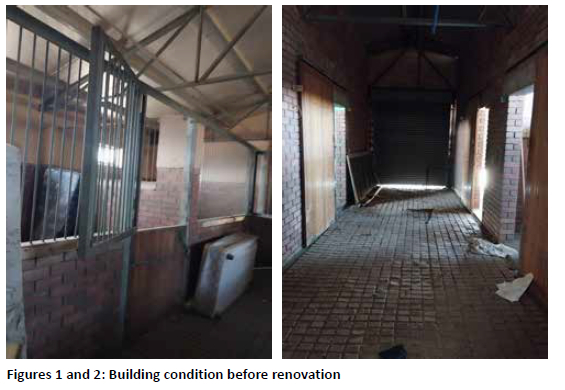
As shown, we initially found it with only the building and halls, no partitions or offices. Outside, the building was overgrown with weeds, and the road leading to it was also not suitable for vehicles. There was absolutely nothing about it in this form that suited SEDA specifications. The building would require major refurbishment to satisfy these specifications.
Stage 2: Site progress in 2020 to 2022
The building was not secure enough to meet SEDA requirements. Water and sanitation infrastructure were also not in the desired state. Lights were not fully compliant or were unfinished. During this time our HEI had adapted and placed people in charge of the development of the centre as required by SEDA. There was no activity in 2020 due to COVID-19 lockdown. Nothing much happened in 2022 as well, because of a move from SST to a different division whose members had to start by familiarising themselves with what was required.
Stage 3: Site progress in 2023
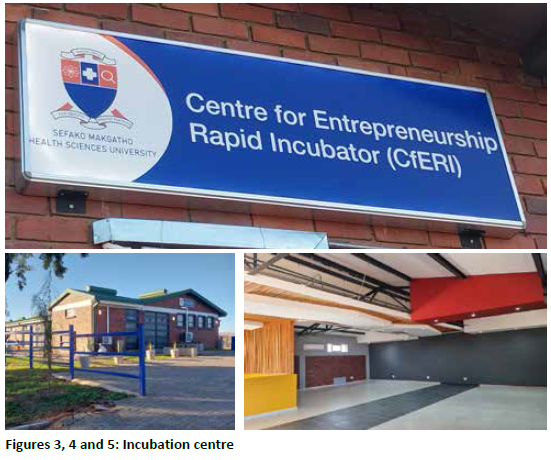
This is how the incubation centre appears, outside and inside (see figures 3, 4 and 5). Outside there will be poster boards for marketing and showcasing the centre's offerings. The centre also plans further advertising with billboards on the main road for the attention of commuters driving between town and township. Inside are offices for the key role players and a large working space for admission of clients and students, and space to demonstrate and train the would-be entrepreneurs.
Staffing of the centre
Staffing the centre is in progress, with the appointment of some key personnel, including the acting centre manager, being completed. The acting manager is tasked with the operationalisation of the centre in line with the university strategic objectives. This, however, has added additional work and responsibilities, as the appointed person still has to fulfil their academic responsibility of teaching and learning, community engagement and research. On the complementary office to the entrepreneurship incubator, an acting manager for the technology transfer office (TTO) was also appointed. The TTO acting manager oversees the strategic objective of increasing commercialisation and together with the entrepreneurship acting manager, they will complement each other in realizing the university's aim of translating research and innovation to driving economic and social impact. The stages that are still outstanding in personnel placement and appointments is the formalisation of the two positions into permanent university positions and the appointment of complementary staff in the entrepreneurship spaces, such as administrators, business development officers, among others.
Progress so far
Achieved milestones include completion of the Centre for Entrepreneurship Rapid Incubator (CfERI), the establishment of the TTO, and the appointment of acting managers for the two units. However, some outstanding items for the full creation of the centre are coming up with new business and operational plans, policies and procedures for the operationalisation of the CfERI and appointment of complementary staff. Oversight visits from SEDA and DSBD have been conducted. These representatives who were conducting oversight visits have been impressed with the achievements of the health sciences university so far on the CfERI. SEDA, as the centre's initial main funder, plays a mentoring and monitoring role. The centre officially began operating in September 2023.
Planned modes of operating the centre
Key personnel will be able to undertake the key functions of the units by creating awareness on entrepreneurship, entrepreneurial workspaces and its ecosystems, assist on an ad hoc basis to develop enterprises and to organise and run EDHE activities on campus. Our HEI does not have a faculty for economic sciences, hence theoretical expertise on the aspects of business and management will be outsourced. The planned mode to do this is through solicitation of expertise from neighbouring HEIs with similar objectives on the development of entrepreneurs and the entrepreneurial university.
Critical reflective analysis
A policy draft was developed in line with SEDA governance guidelines. The policy took about five years due to internal disagreements on the placement of the entrepreneurship ecosystem in the university's organogram. Strategic implementation of key performance areas are only emerging in the 2024 to 2028 university strategic plan. The late delivery of the policy and implementation strategy had a negative impact on entrepreneurship progress on campus. Integration of entrepreneurship into the curriculum did not take place in this time. During the delays, the sponsor threatened to recall the initial seed funding.
However, from 2024, the integration of entrepreneurship into academic departments will be a requirement and departments have therefore developed internal operational policies for entrepreneurship. This might move the university towards the achievement of entrepreneurial activities.
The information found to be most useful from EDHE conferences and interactions with EntrUs related to funds, policies and operations as well as valuable skills and knowledge pertaining to commercialisation of start-up ideas and that are worthy to operate a business incubator. Currently, the incubation centre in HSU has been established to accelerate the pace of HSU's qualification as an EntrU. The centre is playing a key role in closing the gap that could have been filled by a faculty related to economic and business sciences.
Discussion
There has been remarkable progress and major achievements in the development of the CfERI, despite the challenges faced. The major aspects have been completed. The journeys, toils of academics with the limited resources at their disposal has seen the light of day. This endurance for the purpose of making a difference and an impact in society can be replicated in other institutions with minor modifications. That said, the major challenges of funding and budgetary allocations from HEIs is a major concern and slows the pace of achieving the required strategic objectives of HEIs, EDHE and DHET at large. The other challenges faced related to the issues of governance and situating the CfERI within the university structure. These power struggles contributed to project delays. A clear mandate at the onset of the establishment of such centres and allocation of budgetary support would have gone a long way in resolving such unpleasant instances.
SEDA provided the guidelines and plans for the centre and staffing. This assisted in the conversion of the allocated building for the centre to SEDA specifications. Compared to other universities, it was difficult to emulate the placement of the centre in economic and management sciences as our HEI is limited to health and sciences. Hence, we sourced help from universities that were exemplary EntrUs.
Conclusion
EDHE conferences have brought awareness to students, academics, universities and other stakeholders that mindsets and practices, curriculum and communities should be transformed in the direction of entrepreneurship. There are possibilities and opportunities in the higher education landscape for bringing incubation and start-up centres to fruition. Well-defined strategic objectives, governance structures and budgetary outlays are required at the onset. Setting up an incubation hub which has made an impact on entrepreneurial universities and university communities has been a fruitful achievement and experience.
The team from HSU engaged with those from other universities such as UCT and Wits which had well established entrepreneurial ecosystems. Visits to some university incubators were conducted, and discussions were held directly seeking advice. A lot of information and ideas were also shared through presentations by the visited universities.
For those interested in realizing a similar project, we recommend that they look at policies, standard operation procedures for establishment and operationalisation of centres for entrepreneurship rapid incubators. There is also a need to create awareness of funding models and various funding entities available to undertake such tasks. More research needs to be done, more stories told, and diaries shared on growing entrepreneurial universities.
Ethics statement
This article contains no content that is libelous or infringing the copyright of other parties.
Potential conflict of interest
The authors have no conflict of interest to declare.
Funding acknowledgement
No funding was received for the research leading to the development of this article.
References
Azeez, R. O., & Aliu, F. (2023). Leading universities entrepreneurially post COVID-19: How leaders should foster creativity among university staff. In W. J. Aloulou (Ed.), Handbook of research on entrepreneurship and organizational resilience during unprecedented times (pp. 394-412). IGI Global.
Backes-Gellner, U., & Moog, P. (2013). The disposition to become an entrepreneur and the jacks-of-all-trades in social and human capital. Journal of Socio-Economics, 47, 55-72. DOI: 10.1016/j.socec.2013.08.008. [ Links ]
Barrie, S. C. (2004). A research-based approach to generic graduate attributes policy. Higher Education Research & Development, 23(3), 261-275. [ Links ]
Berglund, E., & Criado, T. S. (2018). Experimental sites and encounters: Open formats as catalysts for the renewal of ethnographic arts. SYNNYT/ORIGINS, 2018(3), 259-279. [ Links ]
Bowden, J., Hart, G., King, B., Trigwell, K., & Watts, O. (2000). Generic capabilities of ATN University graduates. Australian Government Department of Education, Training and Youth Affairs.
Canton, H. (2021). International Labour Organization-ILO. In The Europa directory of international organizations. Routledge.
Clark, B. R. (2004). Sustaining change in universities: Continuities in case studies and concepts. Society for Research into Higher Education and Open University Press.
Clarke, J., & Cornelissen, J. (2011). Language, communication, and socially situated cognition in entrepreneurship. Academy of Management Review, 36(4), 776-778. DOI: 10.5465/AMR.2011.65554783. [ Links ]
Delic, A., Alpeza, M., & Peterka, O. (2012). Role of entrepreneurship support institutions in development of the economy of eastern Croatia-case of Centre for Entrepreneurship OSIJEK. Economy of Eastern Croatia - Yesterday, Today, Tomorrow, 1, 32-42. [ Links ]
Delong, J. D. (2002). How can I improve my practice as a superintendent of schools and create my own living educational theory? [Unpublished doctoral thesis]. University of Bath. [ Links ]
Drake, S. M., & Burns, R. C. (2004). Meeting standards through integrated curriculum. Association for Supervision and Curriculum Development. <http://2018/Research%202017/2018/What%20Is%20Integrated%20Cu rriculum_.html >
Euler, M., Vollmar, B. H., & Kraus, S. (2011). Communication matters: Network constellations in entrepreneurship. International Journal of Economics and Business Research, 3(3), 283-301. DOI: 10.1504/ijebr.2011.040021. [ Links ]
Fensham, P. J. (2016). The future curriculum for school science: What can be learnt from the past? Research in Science Education, 46(2), 439-467. [ Links ]
Gaddefors, J., & Anderson, A. R. (2017). Entrepreneurship and context: When entrepreneurship is greater than entrepreneurs. International Journal of Entrepreneurial Behaviour & Research, 23(2), 267-278. [ Links ]
Green, W., Hammer, S., & Star, C. (2009). Facing up to the challenge: Why is it so hard to develop graduate attributes? Higher Education Research & Development, 28(1), 17-29. [ Links ]
Hackman, M. Z., & Johnson, C. E. (2009). Leadership: A communication perspective (5th ed.). Waveland.
Hawkins, J., & Hollinworth, H. (2004). Living theory: Enhancing the psychological support of patients. British Journal of Nursing, 12(9), 543-548. [ Links ]
Hill, J., Walkington, H., & France, D. (2016). Graduate attributes: Implications for higher education practice and policy. Journal of Geography in Higher Education, 40(2), 155-163. [ Links ]
Hisrich, R. D. (2011). Entrepreneurship. McGraw-Hill Education.
Hungwe, T., & Dagada, R. (2013). Blended learning approach - Perceptions in higher education. LAP LAMBERT Academic Publishing.
Ikuemonisan, E. S., Abass, A. B., Feleke, S., & Ajibefun, I. (2022). Influence of agricultural degree programme environment on career in agribusiness among college students in Nigeria. Journal of Agriculture and Food Research, 7, 100256. [ Links ]
Jorre de St Jorre, T., & Oliver, B. (2018). Want students to engage? Contextualise graduate learning outcomes and assess for employability. Higher Education Research & Development, 37(1), 44-57 [ Links ]
Keedy, J. L. (2005). Reconciling the theory and practice schism in educational administration through practitioner-developed theories in practice. Journal of Educational Administration, 43(2), 134-153. https://doi.org/10.1108/09578230510586551 [ Links ]
Klein, S. B., & Pereira, F. C. M. (2020). Entrepreneurial university: Conceptions and evolution of theoretical models. Revista Pensamento Contemporâneo em Administração, 14(4), 20-35. [ Links ]
Mei, C. W., & Siraj, S. (2019). Designing a futuristic business studies curriculum. The Malaysian Online Journal of Educational Science, 1(2). https://files.eric.ed.gov/fulltext/EJ1086223.pdf [ Links ]
Morselli, D. (2018). Teaching a sense of initiative and entrepreneurship with constructive alignment in tertiary non-business contexts. Education + Training Emerald Publishing Limited.
Moschella, M. C. (2023). Ethnography as a pastoral practice: An introduction. The Pilgrim Press.
Ncanywa, T. (2019). Entrepreneurship and development agenda: A case of higher education in South Africa. Journal of Entrepreneurship Education, 22(1), 1-11. [ Links ]
O'Gorman, C., Byrne, O., & Pandya, D. (2008). How scientists commercialise new knowledge via entrepreneurship. The Journal of Technology Transfer, 33(1), 23-43 [ Links ]
Olumuyiwa, O. A., Kimweli, K. M., & Modise, M. A. (2023) Comparative factors influencing entrepreneurial skills acquisition amongst students in rural universities of sub-Sahara Africa's developing nations. Education Sciences, 13(3), 229. https://doi.org/10.3390/educsci13030229 [ Links ]
Osguthorpe, R. T., & Graham, C. R. (2003). Blended learning environments. Definitions and directions. The Quarterly Review of Distance Education, 4(3), 227-233. [ Links ]
Sansone, G., Battaglia, D., Landoni, P., & Paolucci, E. (2021) Academic spinoffs: The role of entrepreneurship education. International Entrepreneurship and Management Journal, 17(1), 369-399. [ Links ]
Shane, S. A. (2008). The illusions of entrepreneurship: The costly myths that entrepreneurs, investors, and policy makers live by. Yale University Press.
Shane, S., & Nicolaou, N. (2013). The genetics of entrepreneurial performance. International Small Business Journal, 31(5), 473-495. [ Links ]
Scott, C. L., & Ivala, E. N. (2021). Transformation of higher education institutions in post-apartheid South Africa. Routledge.
Singh, H. (2003). Building effective blended learning programs. Educational Technology, 43(6), 51-54. [ Links ]
Siraj, S., & Ali, A. (2008). Principals projections on the Malaysian secondary school future curriculum. International Education Studies, 1(4), 230-250. [ Links ]
Siraj, S., & Mei, C. W. (2015, May). Futuristic business studies curriculum: A framework [Conference paper]. 6th International Conference on Educational Technology (ICETA 6), Surabaya, Indonesia. https://www.researchgate.net/publication/283349073_FUTURISTIC_BUSINESS_STUDIES_CURRICULUM_A_FRAMEWORK
Statistics South Africa. (2019). Quarterly labour force survey. Quarter 1:2019. http://www.statssa.gov.za/?p=12121 [ Links ]
Wang, T. (2019). Competence for students' future: Curriculum change and policy redesign in China. ECNU Review of Education, 2(2), 143-156. [ Links ]
Whitehead, J., & McNiff, J. (2006). Action research living theory. Sage Publications.
Wilden, R., Garbuio, M., Angeli, F., & Mascia, D. (2018). Entrepreneurship in healthcare. Routledge.
Yetisen, A. K., Bob Volpatti, L. R., Coskun, A. F., Cho, S., Kamrani, E., Butt, H., Khademhos, A., & Yun, S. H. (2015). Entrepreneurship. Lab Chip, 15(18), 3638-3660. [ Links ]
Yujing, N. (2015). Influence of flipped classroom on learner's empowerment - A study based on English writing courses in China. Journal of Literature, Languages and Linguistics, 12, 1-27. [ Links ]
Yusuf, F. A. (2023). Futuristic curriculum concept for generation alpha in Indonesia: A case study. Educational Administration: Theory and Practice, 29(2), 130-149. [ Links ]
Zahra, S. A. (2009). A typology of social entrepreneurs: Motives, search processes, and ethical challenges. Journal of Business Venturing, 24(5), 519-532. [ Links ]
Received 20 June 2023
Accepted 30 November 2023
Published 14 December 2023
