




Services on Demand
Journal

Article
 English (pdf)
 Article in xml format
 Article references
 Automatic translation
 Send this article by e-mail
Indicators
Related links
-
 Cited by Google
 -
 Similars in Google
Share

 Permalink
Journal of Student Affairs in Africa
On-line version ISSN 2307-6267Print version ISSN 2311-1771
JSAA vol.12 n.1 Cape Town 2024
https://doi.org/10.24085/jsaa.v12i1.4710
RESEARCH ARTICLE
"Did 'Step-Up' help in stepping up?" Transition programmes as a factor to improve student academic performance
"Het 'Step-Up' werklik 'treë' vorentoe moontlik gemaak?' Oorgangsprogramme as 'n inisiatief om die akademiese prestasie van studente te verbeter
Nina Rossouw
Senior Lecturer: Teaching and Learning, School of Management Studies, Faculty of Commerce at the Independent Institute of Education, Varsity College, South Africa. Email: nrossouw@varsitycollege.co.za. ORCID: 0000-0001-9559-2069
ABSTRACT
The transition into higher education is a challenging process for many students. Students are often underprepared academically (amongst other aspects). This under-preparedness influences students' subsequent academic performance, and ultimately, overall student success. Research has shown that successful student transition into higher education can set the foundation for success at university. A transition programme (Step-Up) was offered to Bachelor of Commerce students before the start of the first semester to better prepare students academically and assist with the transition into higher education. The causal-comparative research design that was adopted demonstrated that in their first semester, the students who attended the transition programme consistently performed better academically than those who did not. Transition programmes can be a valuable form of early academic intervention that can and should be employed to cultivate student success and furthermore enable students to feel more prepared for higher education.
Keywords: First-year students, transition programme, early academic intervention, causal-comparative research design, academic performance
OPSOMMING
Die oorgang na hoër onderwys is 'n uitdagende proses vir baie studente. Studente is dikwels (onder andere) akademies ondervoorbereid. Hierdie onvoorbereidheid beïnvloed die studente se daaropvolgende akademiese prestasie, en ook uiteindelike algehele studentesukses. Dit is egter bewys dat suksesvolle studente-oorgang na hoër onderwys die grondslag vir sukses op universiteit kan lê. 'n Oorgangsprogram (Step-Up) is voor die aanvang van die eerste semester aan BCom studente aangebied om hulle sodoende beter voor te berei vir universiteit, asook om te help met die oorgang na hoër onderwys. Die oorsaaklike-vergelykende navorsingsontwerp wat aangeneem is, het getoon dat studente wat die oorgangsprogram bygewoon het, deurlopend akademies beter presteer het as diegene wat dit nie bygewoon het nie. Oorgangsprogramme kan 'n waardevolle vorm van vroeë akademiese intervensie wees wat aangewend kan en behoort te word om studentesukses te kweek en studente verder in staat te stel om meer voorbereid vir hoër onderwys te voel.
Sleutelwoorde: Eerstejaarstudente, oorgangsprogram, vroeë akademiese intervensie, oorsaaklike-vergelykende navorsingsontwerp, akademiese prestasie
Introduction
For many students, the transition to higher education is a challenging process (Pownall et al., 2022; Thomas, 2011; Van Herpen et al., 2020; Wollscheid et al., 2021). Successful student transition into higher education can set the foundation for success at university (Hassel & Ridout, 2018; Thomas, 2011). Higher education is both a new and different learning environment; students need to build new relationships with peers and lecturers and might need to redefine their learner identities and develop independent working skills (Van Herpen et al., 2020; Wollscheid et al., 2021). Literature demonstrates that there continues to be a gap between students' expectations of higher education and their experiences in higher education (Hassel & Ridout, 2018; Tate & Hopkins, 2013; Thomas, 2011; Van Herpen et al., 2020). First-year undergraduate students often struggle to adapt to the academic expectations of higher education and may have difficulties grappling with the structure, independence, and content of university-level learning (Pownall et al., 2022). These first-year students may also struggle with a sense of belonging and the shift in identity that they often experience when entering university (Van Herpen et al., 2020).
Pre-tertiary teaching and learning experiences often form the foundation for expectations about tertiary education and can assist in providing students with a sense of capability and belonging (Hassel & Ridout, 2018; Van Herpen et al., 2020). Even with pre-tertiary experiences providing the opportunity to foster a sense of capability about higher education, in reality, students are often underprepared academically to enter higher education (Hassel & Ridout, 2018; Van Herpen et al., 2020), even though they may meet the entrance requirements for higher education. Insufficient student support, inequality in the schooling system (specifically in South Africa), insufficient support for academic and social adjustment were some of the reasons identified by the Department of Higher Education and Training (2020) that affected students in their transition to tertiary education and subsequent academic performance. According to Lombard (2020), there is considerable evidence that current preparation at the school level, particularly in South Africa, is inadequate in ensuring a successful transition from high school to higher education. A significant number of students find the transition difficult or lack the necessary skills and motivation to succeed in higher education (Joynt, 2018; Lombard, 2020; Nel et al., 2009).
Underprepared students entering higher education is not a new issue (and not unique to South Africa). It has remained a longstanding challenge that continues to demand attention (Hassel & Ridout, 2018; Mungal & Cloete, 2016; Nelson et al., 2012). Higher education institutions have a part to play in assisting first-year students build the academic competencies necessary on entering higher education (Kift et al., 2010; Nel et al., 2009; Van Herpen et al., 2020). Development education, preparatory studies, learning assistance, basic skills programmes, and academic support programmes are some of the suggested interventions that can help students successfully transition into higher education (Kift et al., 2010; Nel et al., 2009; Van Herpen et al., 2020). It is imperative for both institutional and student success that higher education institutions support students to successfully transition into higher education (Coertjens et al., 2017; Gale & Parker, 2014). This successful transition can partly be achieved through the implementation of initiatives such as transition programmes. To facilitate healthy and productive transitions into higher education, students should also be provided with the opportunity to actively participate in their transition experiences (Pownall et al., 2022; Richardson & Tate, 2012). The literature cited above demonstrates that students often struggle with the transition to higher education and therefore often struggle to adapt to their first year of study.
It is argued in this study that transition programmes can assist to prepare students more effectively for higher education. Additionally, transition programmes can be regarded as a form of early academic intervention, if it enables students to be academically better prepared and subsequently lead to increased academic performance. This study, therefore, contributes to the knowledge regarding the effectiveness of student transition programmes, as a form of early academic intervention, on the subsequent academic performance of the students.
Given the problem discussed above, the following research question guided the present study: Does attending a transition programme affect the academic results of first-year BCom students at a private higher education institution?
Literature review
Transition into higher education
Higher education institutions should assist students entering higher education with the transition into higher education (Kift et al., 2010; Nel et al., 2009; Van Herpen et al., 2020), as an effective transition could assist student success. Student retention can be promoted through the implementation of support systems that foster environments that promote student success (Ferris, 2018; Tinto, 2006). Tinto (2006) argues that higher education institutions should aim to help students continue with their studies to enable student success. As discussed above, one way that institutions can provide students with support systems is through the adoption of transition programmes (Joynt, 2018). One of the main threats to student retention is academic failure, which can result from various factors, including under-preparedness (Council on Higher Education, 2013). Although it can be a challenging phenomenon to mitigate (Joynt, 2018), under-preparedness can be addressed through the implementation of transition programmes (Joynt, 2018; Nel et al., 2009). During the transition from high school to tertiary education, students need support to navigate the processes of separation, transition and incorporation (Tinto, 1988). Tinto (1988) further recommends that this engagement with students should happen within the first six weeks of the start of the first year, for them to receive maximum benefit from such support.
The transition process into higher education comprises four phases (Clercq et al., 2018; Coertjens et al., 2017; Nicholson, 1990). These are preparation, encounter, adjustment and stabilisation. During the preparation phase, students think about and decide on their chosen qualification and where to enrol. Students who are accepted to study then enter the encounter phase, where they are exposed to a new learning environment and a different academic culture (Van Herpen et al., 2020). The encounter phase usually takes place during the first few weeks at university and often requires students to deal with the friction between their perceptions and their current experiences, and the subsequent formation of their identities as university students (Van Herpen et al., 2020). Furthermore, they are likely to struggle with the ability to navigate the demands and opportunities higher education presents (Coertjens et al., 2017; Gale & Parker, 2014). The adjustment phase occurs when students gradually adjust their attitudes and behaviours during the first year. Finally, when students demonstrate the behaviours and attitudes necessary for obtaining satisfying social and successful academic outcomes, the stabilisation phase occurs (Christie et al., 2016).
The present study investigated the effect of an intervention that occurred between the preparation and encounter phases of the transition into higher education. As illustrated above, this is a vulnerable and unstable time for students, but it also presents a window of opportunity, as students are open to learning and taking on new learning patterns and behaviour and defining their learner identities (Van Herpen et al., 2020). If transition programmes have the ability to assist students in achieving better academic results (or at least enabling students to be more academically prepared for higher education), they can be considered as a form of early academic intervention that ultimately enables and promotes higher levels of student success and retention in higher education.
Early academic interventions
Tinto (2014) argues that if access is given to higher education, the responsibility, or even obligation, rests with the institution to do everything in its power to ensure that the student gets the necessary support to be successful in their studies. This underlines the need to implement effective interventions that will assist and improve student success (van Zyl et al., 2020). Interventions within higher education institutions can exist for various motives, including behavioural, financial, personal and academic reasons (Campbell & Hussey, 2015). Interventions in higher education can broadly be categorised as non-academic and academic (Braun & Drew Sellers, 2012; Flinchbaugh et al., 2012). Non-academic interventions are typically centred around generic skills or motivational techniques. Academic interventions on the other hand aim to address an academic deficiency: either filling gaps in inadequate prior knowledge or attempting to prepare students for future academic endeavours (Joynt, 2018). Academic interventions are primarily directed towards improving student academic performance (Campbell & Hussey, 2015). Academic interventions can vary in duration and timing (i.e. when the intervention takes place): before, during or as extended-term interventions (Joynt, 2018). For the present study, the intervention was implemented during the transition phase into higher education and aligns with Tinto's (1988) recommendation about engaging students within the first six weeks of their first year in higher education.
Studies done in the fields of accounting (Jones & Fields, 2001; Joynt, 2022) and microeconomics (Campbell & Hussey, 2015; Smith & Ranchhod, 2012) have illustrated a positive association between attending an intervention and subsequent academic performance.
This suggests that if potentially underprepared students have been identified and an intervention is effective, offering an early academic intervention can be a proactive solution to addressing under-preparedness (Ferris, 2018; Joynt, 2018). This type of intervention can be defined as an academic activity in addition to the main curriculum, aiming to prepare students to be better equipped for survival in the mainstream curriculum by providing support before the introduction of the mainstream curriculum (Maphosa, 2014). The present study investigated a transition programme (referred to as the Step-Up programme) that was offered on a voluntary participation basis to all first-year Bachelor of Commerce students before the start of their first semester at a campus of a multi-campus private higher education institution in South Africa. Since all students met the entrance requirements for a Bachelor of Commerce degree, and Step-Up was offered during the transition phase into higher education, the intervention was not regarded as a bridging course or 'boot camp' (Jackson, 2014) or a requirement to gain access to further studies. The rationale behind the Step-Up transition programme (discussed below) is to better prepare students academically (amongst other aspects of development), and the current study argues that if the attendance of Step-Up produced better academic results, then it could be regarded as a (valuable) early academic intervention.
The Step-Up transition programme
The Step-Up transition programme aims to address the shift between secondary school and higher education. Transition programmes have proven to help students connect to peers and lecturers, feel at home in higher education, and perform better academically (Thomas, 2011; Van Herpen et al., 2020). However, it is suggested that the extent to which transition programmes affected academic performance varied according to the type of programme, the measures adopted, and the group characteristics (Porter & Swing, 2006; Cabrera et al., 2013). The focus of the Step-Up programme was to better prepare students academically by introducing students to various topics dealt with in three of the key modules of the first semester of study, and at the same time, prepare the students more effectively for tertiary education generally.
First-year Bachelor of Commerce students were provided with the opportunity of registering for and attending Step-Up sessions for two weeks before the start of the first semester. The modules presented were Business Management, Economics, and Accounting (traditionally challenging modules for first-year students). Each module was presented by an experienced first-year lecturer, with lecturing material that was developed and adapted from the prescribed materials for the various modules. Lectures took place in the mornings with two-hour time slots per module, with a total of between ten and fourteen hours per module during the two weeks. The aim of the Step-Up programme was to deal with the basic concepts and principles of each of these modules and serve as an introduction to the formal academic work that would be dealt with in the first semester. Many of the concepts taught in the Step-Up programme are introduced at secondary school level, however, many Bachelor of Commerce students do not necessarily complete these modules at secondary school level.1 Therefore, there is often very little foundational knowledge for students to refer to when these modules are taught during the semester. The Step-Up programme aims to address this 'foundational knowledge problem' by introducing some of these concepts before they are covered in detail during the semester as part of the formal curriculum. Step-Up furthermore aims to assist with the successful academic transition to higher education by making students comfortable with the notion of higher education, the expectations and responsibilities of students, attending lectures, and how work is taught.
It is hoped that the experience and the knowledge that students gain during these two weeks will help them (amongst other areas of holistic development) to be better prepared academically for higher education, which may subsequently lead to better academic performance during the semester. Various studies found that student transition programmes were an example of good practice, applicable to a variety of learning contexts and that the positive results from such transition programmes are sustained for at least 12 months, positively influencing student retention (Nelson et al., 2012), shaping students' expectations and preparing them academically for the transition into higher education (Joynt, 2022; Mungal & Cloete, 2016; Thomas, 2011).
Methodology
A causal-comparative research design was adopted for this study. A causal-comparative study aims to explore and identify relationships between attending the intervention (Step-Up) and the first-semester academic results (Salkind, 2010; Terre Blanche et al., 2006; Tudor, 2018) to determine reasons for the current status of the phenomenon under study (Johnson, 2000; Salkind, 2010). Causal-comparative studies are also referred to as ex post facto research as the study is done retrospectively because the event or intervention already occurred (Creswell & Creswell, 2018; Johnson, 2000; Tudor, 2018). Causal-comparative studies investigate whether individuals in one group are different in one or more characteristics than the individuals in another group (Morris & Wester, 2018).
The aim of this study was to determine the effect of the Step-Up transition programme on a group of students by comparing the academic results of the students who chose to attend the programme with the results of those who did not attend the programme (Salkind, 2010). This causal-comparative study cannot state that a true cause-and-effect relationship exists between attending Step-Up and first-semester academic results (as many factors can potentially influence academic performance), but it does provide insight into what may have caused a difference to occur (or not) and provides an answer when investigating the possible differences between the control and experiment groups (Salkind, 2010).
It is also relevant to note that groups being compared in causal-comparative research studies are already formed (Johnson, 2000; Morris & Wester, 2018), the researchers have no control over who is placed in the control and experimental groups, therefore sampling is not completely random (Salkind, 2010), and results cannot be generalized. As the semester results of both the control and experimental groups were available, no sampling was done: the complete datasets of the two groups were compared. Using the complete datasets of the groups contributes to strengthening the validity and reliability of the results of the study. Matching was furthermore adopted to strengthen validity by comparing the results at various assessment points, and module by module, instead of just the overall averages of all three modules (Salkind, 2010; Terre Blanche et al., 2006).
Causal-comparative studies present certain limitations, and these relate to this study in the following manner: the research took place ex post facto, therefore the team could not manipulate the implementation of the Step-Up programme (Salkind, 2010). There could be other factors that influence the academic performance of students, such as the lecturer, class attendance, support for students at home, adapting to higher education in general and so on, therefore it can never be certain that attending Step-Up is the cause of better academic results (Salkind, 2010). A counter-argument to this could be that both the attending group and the non-attending group would be exposed to these other factors in equal measure.
Data collection
The population for this study was first-year students enrolled for a Bachelor of Commerce degree at a private higher education institution in South Africa. As discussed above, certain students chose to be part of the Step-Up programme and these formed the experiment group, whilst others did not or registered too late into the academic year to be a part of the Step-Up programme, and they formed the control group. Existing data were used for this study, in the form of the average of various assessment scores of both the experiment and control groups throughout the first semester of 2022.
Various assessment points exist throughout the first semester at the institution. Typically, two formative assessments are held (which can either be a test or an assignment) and a summative assessment (exam) concludes the semester. The scores of these three assessment points were used as data and analysed. A distinction was made between the scores of the three modules that formed part of the Step-Up programme (to ensure matching). Descriptive statistical methods were used to test and compare mean, mode and median score differences between the control and experiment groups to determine whether one group is on average greater or less than the other group (Morris & Wester, 2018; Salkind, 2010).
A total of 227 students registered for the first year of a Bachelor of Commerce degree; 168 of whom completed all three assessment points for all three of the modules that formed part of the study. Of the 168 students who completed all three assessment points for all three modules, 192 students attended the Step-Up programme, and 149 students did not. The other 59 students that either deregistered, changed qualifications, missed a formative assessment opportunity, or did not write the first summative exam opportunity, were excluded from the study.
Results and analysis
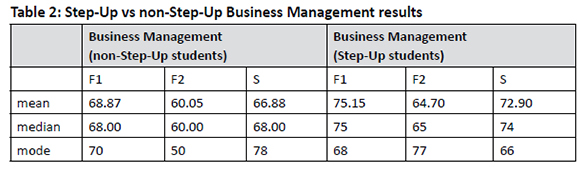
The descriptive statistical analysis that was done by calculating the mean, median and mode of each module illustrates that all three modules present normal distribution characteristics around the mean (as illustrated below). This normal distribution is mostly consistent for all three modules, in all three assessment points, irrespective of whether it is the Step-Up or non-Step-Up group. This normal distribution characteristic enhances the validity of the two datasets (Salkind, 2010). It can further be noted that in all three modules, students who attended the Step-Up programme, performed, on average, consistently better than those who did not attend the Step-Up programme.
The results and analysis presented below take into consideration only the number of the Step-Up students who attended or wrote all the assessments (19 students). Also included in these results and analysis are those students who did not participate in the Step-Up programme (149 students).
For Accounting (results below), formative assessment 1 (F1) is done by way of an open-book assignment, so these marks are often higher than those obtained for a closed book, timed test, such as formative assessment 2 (F2).
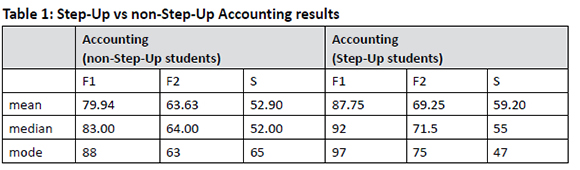
The formative assessment 2 (F2) marks are the interesting ones to note as it can be argued that with open-book assignments all students have the same resources available to them while completing the assignment. However, in a test, learned knowledge needs to be reproduced under exam conditions. Step-Up aimed to introduce certain key concepts students often struggle with, especially later in the module. The effect of Step-Up can be seen in these results as the introduction to these concepts during Step-Up assisted students to have a better understanding of the 'basics' of Accounting. The conditions that exist in the test would also be present during the summative assessment (S) (exam). The Step-Up group yet again performed better than the non-Step-Up group in the summative assessment.
In the Business Management module (results below), the first formative assessment (F1) is written as a closed-book test, and the results again demonstrate students' ability to reproduce learned knowledge. It can be argued that the initial exposure to key terms and concepts during Step-Up, which were (again) later taught during formal lecturers (that these students then had the benefit of learning about for a second time), might have helped students become more familiar with concepts that they were required to study for the test. The Step-Up students performed better in the first formative assessment (F1), as well as in the second formative assessment (an assignment), and that trend continued through to the summative assessment.
The Economics module (results below) only has tests as part of the formative assessment structure (F1 and F2), requiring students to reproduce knowledge under exam conditions for all assessments in this module. A consistent mark difference can be observed: Step-Up group performing on average better than the non-Step-Up group. It can also be argued, as mentioned above for Business Management, that the introduction to key concepts during Step-Up could have helped the students understand them better, which enabled them to obtain higher marks for Economics than the students who did not attend Step-Up.
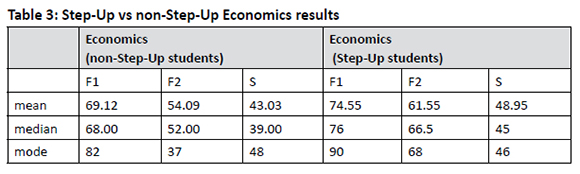
As discussed in the methodology section, causal-comparative research does not prove cause-and-effect results, however, it does provide valuable insights into the causal relationship between the variables (Salkind, 2010). Through a comparison of results for three different modules for the group that attended Step-Up with those who did not attend Step-Up, the results of this study demonstrate that there is a causal relationship between attending the Step-Up programme and subsequent academic performance during the first semester.
Discussion
The results above are significant on various levels. They illustrate that students who attended Step-Up performed consistently better academically than those who did not. It can be argued that the introduction of the Step-Up programme influences the subsequent academic performance of first-year students. As demonstrated in the literature review, students are typically underprepared for tertiary education (Lombard, 2020), and this has dire consequences for the success rate of first-year students (Moosa & Aloka, 2022). It is clear that the two-week intervention programme can provide support to better prepare these students for tertiary education. This can also then serve as an important first step in the direction towards addressing the low pass rates among first-year students.
Confidence is an important ability in most endeavours but especially so in tertiary education, and it is inextricably connected to student success (Clercq et al., 2018; Jackson, 2014; York et al., 2015). The results above may also implicitly reflect some of the confidence that students have gained by attending the Step-Up programme. Having participated in Step-Up, a student's confidence in their abilities at tertiary level may be boosted as it grants them prior knowledge of and time to understand the subject at a more convenient pace. It can therefore be argued that the student would be more likely to be successful in that subject. This introduction of 'prior knowledge' is a key component of the intended outcomes of Step-Up, and students who attended the programme would also now possess the prior knowledge that translates to higher levels of confidence. Lastly, on a personal level, the results confirmed the convictions the presenters of the Step-Up programme have always had - that the attendees are indeed provided with a chance to 'step up' into their tertiary studies. While the programme has been running for about six years, this is the first conclusive evidence to have assessed that the programme has lasting academic merit.
It is, however, also relevant to consider other possible reasons that the Step-Up students performed better academically. One important consideration is that the more diligent students would have chosen to attend Step-Up,3 and it could therefore be argued that it is logical that they would then perform better academically. On the other hand, this could be balanced out by the students who may have had one or more of the Step-Up subjects offered at school and therefore opted to not attend Step-Up as they believed that they had the required prior knowledge. Similar to the discussion on confidence above, it is relevant to consider that the students gained the appropriate mentality for tertiary education from attending Step-Up, so participating in Step-Up had the effect of leaving students feeling more prepared for their studies. This feeling of being better prepared can be what contributed to their subsequent academic success (Thomas, 2011; Van Herpen et al., 2020). Therefore, the importance and relevance of Step-Up might lie not just in introducing students to prior (academic) knowledge, but rather fostering the correct mentality and feeling of preparedness.
One other factor that might be relevant is that students who registered late for the academic year would automatically not have been able to attend Step-Up, as only students who had registered about one month before the start of the semester received invitations to attend Step-Up. This would also mean that students who registered late might have even missed a part of the semester (and that influenced subsequent academic performance), while students in Step-Up would have all been ready to attend class from the first day. A further argument can also be made that the students who were registered on time attended Step-Up and were therefore (as discussed above) more prepared for their tertiary studies, as they would have been well-informed and comfortable with the new environment by the end of the Step-Up programme. This would have given them a two-week head start to get comfortable with the new environment as opposed to other students - so it can be argued that the phases of transition discussed above (Clercq et al., 2018; Coertjens et al., 2017; Nicholson, 1990) occurred earlier for the students attending Step-Up. This initial introduction (irrespective of the academic goals) would have made them more prepared for the new phase, and they would have felt more integrated into the system of tertiary education.
Since participation in the Step-Up programme comes with no academic risks (no assessments, homework), it can be regarded as a valuable platform that affords students the time to find their feet, understand how tertiary education works and adjust their expectations to the experience (Hassel & Ridout, 2018; Tate & Hopkins, 2013; Thomas, 2011; Van Herpen et al., 2020). With adjusted expectations, students are more prepared in terms of what to expect when the first formal lecture starts and can therefore more easily adjust to their roles as tertiary students.
Conclusions
It is evident that there are distinct benefits to students attending an academic transition programme. The benefits are seen at several levels, but this study focussed on the increased academic performance of those students attending the Step-Up transition programme. For the institution, the question can now justifiably be asked whether the programme should be extended to other campuses, other qualifications, or possibly even made mandatory for certain students, given the benefit that it can have on improving students' transitions into tertiary education. Other higher education institutions may also take note of the results and use the present as a case study to guide them in their deliberations on introducing transition programmes to their incoming first years (that go further than merely 'orientation' and spend time on crucial academic preparation) to ensure student success.
There are several other topics relating to the above that warrant further research. For example, the results of future Step-Up participants should be analysed similarly to the above to create longitudinal evidence of the academic influence that Step-Up has had. What would also be valuable would be getting to hear from Step-Up attendees in their own words how they experienced the programme and whether they left the programme feeling more or less equipped and prepared for tertiary education.
Transition programmes such as Step-Up serve as an early academic intervention and have an immediate and potentially lasting effect on students' subsequent academic performance. It can lay the foundation for successful student transition into higher education and therefore equip the student to be academically successful in their first year of tertiary studies.
Ethics statement
Ethical clearance for the study was obtained within the institution in which the study took place [R. 00007 (REC)]. All participant information was anonymised throughout by using only student numbers as identifiers when working with the data. To ensure the accuracy of the reported data, two other researchers performed statistical analysis of the data.
Potential conflict of interest
No conflict of interest.
Funding acknowledgement
No funding was obtained for this study.
References
Braun, K. W., & Drew Sellers, R. (2012). Using a 'daily motivational quiz' to increase student preparation, attendance, and participation. Issues in Accounting Education, 27(1), 267-279. https://doi.org/10.2308/iace-10219 [ Links ]
Cabrera, N. L., Miner, D. D., & Milem, J. F. (2013). Can a summer bridge program impact first-year persistence and performance?: A case study of the new start summer program. Research in Higher Education, 54(5), 481-498. https://doi.org/10.1007/s11162-013-9286-7 [ Links ]
Campbell, D., & Hussey, A. (2015). Experimental evidence of the effects of an early intervention programme on economics student achievement. Applied Economics Letters, 22(11), 895-899. https://doi.org/10.1080/13504851.2014.985367 [ Links ]
Christie, H., Tett, L., Cree, V. E., & McCune, V. (2016). 'It all just clicked': A longitudinal perspective on transitions within university. Studies in Higher Education, 41(3), 478-490. https://doi.org/10.1080/03075079.2014.942271 [ Links ]
Clercq, M. De, Roland, N., Brunelle, M., Galand, B., & Frenay, M. (2018). The delicate balance to adjustment: A qualitative approach of student's transition to the first year at university. Psychologica Belgica, 58(1). https://doi.org/10.5334/pb.409 [ Links ]
Coertjens, L., Brahm, T., Trautwein, C., & Lindblom-Ylänne, S. (2017). Students' transition into higher education from an international perspective. Higher Education, 73(3). [ Links ]
Council on Higher Education (CHE). (2013). A proposal for undergraduate curriculum reform in South Africa: The case for a flexible curriculum structure. CHE.
Creswell, J. W., & Creswell, J. D. (2018). Research design: Qualitative, quantitative & mixed methods approaches. SAGE Publications Inc.
Department of Higher Education and Training (DHET). (2020). Department of higher education strategic plan 2020-2025. DHET.
Ferris, E. (2018). Bridge to student success? An evaluation of the effectiveness of the University of Mississippi's JumpStart summer bridge program. University of Mississippi.
Flinchbaugh, C. L., Moore, E. W. G., Chang, Y. K., & May, D. R. (2012). Student well-being interventions: The effects of stress management techniques and gratitude journaling in the management education classroom. Journal of Management Education, 36(2), 191-219. https://doi.org/10.1177/1052562911430062 [ Links ]
Gale, T., & Parker, S. (2014). Navigating change: A typology of student transition in higher education. Studies in Higher Education, 39(5), 734-753. https://doi.org/10.1080/03075079.2012.721351 [ Links ]
Hassel, S., & Ridout, N. (2018). An investigation of first-year students' and lecturers' expectations of university education. Frontiers in Psychology, 8(JAN). https://doi.org/10.3389/fpsyg.2017.02218 [ Links ]
Jackson, M. (2014). Accounting 'boot camp'. Journal of Accounting Education, 32(1), 88-97. [ Links ]
Johnson, B. (2000). It's (beyond) time to drop the terms causal-comparative and correlational research in educational research methods textbooks. Annual Conference of the American Educational Research Association, 2-19.
Jones, J. P., & Fields, K. T. (2001). The role of supplemental instruction in the first accounting course. Issues in Accounting Education, 16(4). [ Links ]
Joynt, C. M. (2018). The impact of pre-undergraduate preparation courses in accounting on academic performance. University of Pretoria.
Joynt, C. (2022). How to assess the effectiveness of accounting education interventions: Evidence from the assessment of a bridging course before introductory accounting. Meditari Accountancy Research. https://doi.org/10.1108/MEDAR-01-2022-1571
Kift, S. M., Nelson, K., & Clarke, J. A. (2010). Transition pedagogy: A third generation approach to FYE - A case study of policy and practice for the higher education sector. The International Journal of the First Year in Higher Education, 1(1), 1-20. https://doi.org/10.5204/intjfyhe.v1i1.13 [ Links ]
Lombard, P. (2020). Factors that influence transition from high school to higher education: A case of the JuniorTukkie programme. African Journal of Career Development, 2(1). [ Links ]
Maphosa, C. (2014). Towards a mainstream curriculum embedded student academic development programme in South African universities. International Journal of Educational Sciences, 6(1), 11-18. [ Links ]
Moosa, M., & Aloka, P. J. (2022). Motivational factors as a driver for success for first-year students at a selected public university in South Africa. Student Success, 14(1), 21-35. https://doi.org/10.5204/ssj.2415 [ Links ]
Morris, C. A., & Wester, K. L. (2018). Making research relevant. Routledge.
Mungal, A., & Cloete, M. (2016). Preparing underprepared students for higher education and beyond: The development and implementation of an integrated project. Accounting Education, 25(3), 1-25. [ Links ]
Nel, C., Troskie-de Bruin, C., & Bitzer, E. M. (2009). Students' transition from school to university: Possibilities for a pre-university intervention. South African Journal of Higher Education, 23(5). https://doi.org/10.4314/sajhe.v23i5.48811 [ Links ]
Nelson, K., Quinn, C., Marrington, A., & Clarke, J. (2012). Good practice for enhancing the engagement and success of commencing students. Higher Education, 63(1), 83-96. [ Links ]
Nicholson, N. (1990). The transition cycle: Causes, outcomes, processes and forms. In S. F. & C. L. Cooper (Eds), On the move: The psychology of change and transition (pp. 83-108). Wiley.
Porter, S. R., & Swing, R. L. (2006). Understanding how first-year seminars affect persistence. Research in Higher Education, 47(1), 89-109. https://doi.org/10.1007/s11162-005-8153-6 [ Links ]
Pownall, M., Harris, R., & Blundell-Birtill, P. (2022). Supporting students during the transition to university in COVID-19: Five key considerations and recommendations for educators. Psychology Learning and & Teaching, 21(1), 3-18. [ Links ]
Richardson, M., & Tate, S. (2012). University is not as easy as A , B , C How an extended induction can improve the transition to university for new undergraduates. Emerge, 4, 11-25. [ Links ]
Salkind, N. J. (Ed.). (2010). Encyclopedia of research design Volume 1. SAGE Publications Inc.
Smith, L. C., & Ranchhod, V. (2012). Measuring the impact of educational interventions on the academic performance of academic development students in second-year microeconomics. South African Journal of Economics, 80(3), 431-448. https://doi.org/10.1111/j.1813-6982.2011.01287.x [ Links ]
Tate, S., & Hopkins, P. (2013). Re-thinking undergraduate students' transitions to, through and out of university: Examples of good practice in GEES disciplines. The Higher Education Academy.
Terre Blanche, M., Durrheim, K., & Painter, D. (Eds.). (2006). Research in practice: Applied methods for social science (2nd ed.). UCT Press.
Thomas, L. (2011). Do pre-entry interventions such as 'Aimhigher' impact on student retention and success? A review of the literature. Higher Education Quarterly, 65(3), 230-250. [ Links ]
Tinto, V. (1988). Stages of student departure: Reflections on the longitudinal character of student leaving. The Journal of Higher Education, 59(4), 438. https://doi.org/10.2307/1981920 [ Links ]
Tinto, V. (2006). Research and practice of student retention: What next? Journal of College Student Retention: Research, Theory & Practice, 8(1), 1-19. [ Links ]
Tinto, V. (2014). Tinto's South Africa lectures. Journal of Student Affairs in Africa, 2(2), 5-28. https://doi.org/10.14426/jsaa.v2i2.66 [ Links ]
Tudor, D. (2018). A causal comparative study of student success and retention in an undergraduate program offered online and on campus. Eastern Kentucky University.
Van Herpen, S. G. A., Meeuwisse, M., Hofman, W. H. A., & Severiens, Sabine. E. (2020). A head start in higher education: The effect of a transition intervention on interaction, sense of belonging, and academic performance. Studies in Higher Education, 45(4), 862-877. [ Links ]
van Zyl, A., Dampier, G., & Ngwenya, N. (2020). Effective institutional intervention where it makes the biggest difference to student success: The University of Johannesburg (UJ) Integrated Student Success Initiative (ISSI). Journal of Student Affairs in Africa, 8(2), 59-71. https://doi.org/10.24085/jsaa.v8i2.4448 [ Links ]
Wollscheid, S., Lødding, B., & Aamodt, P. O. (2021). Prepared for higher education? Staff and student perceptions of academic literacy dimensions across disciplines. Quality in Higher Education, 27(1), 20-39. https://doi.org/10.1080/13538322.2021.1830534 [ Links ]
York, T. T., Gibson, C., & Rankin, S. (2015). Defining and measuring academic success. Practical Assessment, Research & Evaluation, 20(2). [ Links ]
Received 14 August 2023
Accepted 22 March 2024
Published 22 July 2024
1 Completing Business Management, Economics and Accounting at secondary school level is not included among the entrance requirements for a Bachelor of Commerce degree at the institution in which the study was conducted.
2 While 29 students attended Step-Up, the aim was to study the Step-Up students who wrote all assessment points, and that was 19.
3 Step-Up attendance was voluntary.
