




Services on Demand
Journal

Article
 English (pdf)
 Article in xml format
 Article references
 Automatic translation
 Send this article by e-mail
Indicators
Related links
-
 Cited by Google
 -
 Similars in Google
Share

 Permalink
Journal of Student Affairs in Africa
On-line version ISSN 2307-6267Print version ISSN 2311-1771
JSAA vol.12 n.2 Cape Town 2024
https://doi.org/10.24085/jsaa.v12i2.5452
RESEARCH ARTICLE
Using action research and grounded theory techniques to design an evidence-based academic advising programme
Riashna Sithaldeen
Deputy Director: Academic Development Programme, University of Cape Town, South Africa. Email: riashna.sithaldeen@uct.ac.za. ORCID: 0000-0003-3921-7373
ABSTRACT
Academic advising, if done effectively, can play a significant role in supporting student retention. However, as a relatively new field in South Africa, there is limited locally contextualised research into advising interventions and their effectiveness. So, there is a need for evidence-based approaches that will lead to more intentionally structured, and shareable practices that meet the needs of the South African context. Accordingly, this article outlines a methodology for designing an evidence-based advising programme that is both effective and academically rigorous. The article shows how the principles of action research, supported by grounded theory analytical techniques, were used to develop a programme for students facing exclusion at a South African university, the University of Cape Town (UCT). During the implementation of the programme, feedback was collected in cycles, with the student 'voice' from one cycle (n=352) informing the design of the next cycle. Programme evaluation data (n=122) from a third cycle was then used to assess the effectiveness of the approach. The results indicated a positive association between the new capabilities developed in students and the designed learning activity, which suggests that this approach to developing an advising programme was effective. The method described to design this programme has application across a wide variety of student development initiatives and could be used to support effective, intentionally designed initiatives and the sharing of effective, evidence-based practices.
Keywords: Academic advising, action research, grounded theory analysis, evidence-based intervention design
Introduction
South African universities face a distinct imperative to forge new pathways for student success that are inclusive, and transformative; as well as responsive, and relevant (Wilson-Strydom, 2015). To this end, new holistic ways of thinking about student support must be embraced (Bangeni et al., 2023; Torres et al., 2019; Schreiber, 2014; Sithaldeen & Van Pletzen, 2022; Wildschut & Luescher, 2023) and there must be acknowledgement that student success is shaped both in the classroom and beyond it. Students come to university with many needs that can impact on their prospects of achieving successful academic outcomes (Kuh et al., 2006; Maslow, 1978; Strayhorn, 2018; Tinto, 1997). Meeting these needs has traditionally been the mandate of student affairs staff, who offer a range of co-curricular services including academic advising (AA) (Schreiber, 2014). Co-curricular initiatives provide safe spaces for students to connect with others, share experiences, and build support networks (Bowman & Rosser, 2019); and the informal nature of such programming means it can be adapted quickly to meet emerging student needs (Schreiber, 2014). However, the perceived informality of such provision can also promote a less than academically rigorous mindset and undermine efforts to produce scholarship on the practices adopted. The problem here is that, in the absence of proper scholarship, it becomes difficult to share sound practices and furnish empirical evidence of how and why impacts are achieved which is required to promote institutional investment in effective strategies.
In this context, scholars have called for student affairs professionals to prioritise producing credible, evidence-based scholarship so that the efforts undertaken can be more effective and the profession can move forward (Luescher et al., 2023; Madiba, 2022; Schreiber, 2014; Wildschut & Luescher, 2023). This call has particular relevance for the practice of academic advising which has begun to take root in Africa (Ogude et al., 2012; Strydom et al., 2016; Fussy, 2018), since this is a relatively new field in South Africa, and there has been only limited research into academic advising initiatives and their effectiveness (Tiroyabone & Strydom, 2021). While there is an understanding that academic advising is a useful practice (Nayager & de Klerk et al., 2024), there remains a need for evidence-based approaches that will lead to intentional, structured and coherent set of policies and actions that are sustainable over time (de Klerk & Dison, 2022 and references therein) in relation to this practice. Credible research entails meeting standards of academic rigour (Kreber, 2003) so that the knowledge that is produced can withstand scrutiny and may form the basis for the work of others in the field (Brew, 2001).
Rigor refers to the meticulousness, consistency, and transparency of the research process, ensuring that the findings accurately reflect the phenomenon being studied. This includes meeting the standards of credibility, dependability, confirmability, and transferability of the research findings. (Kalpokas, 2024)
To achieve rigour, researchers must apply systematic and disciplined methods, such as careful coding of data and consistent documentation of themes. Transparency in qualitative research entails clear, detailed, and explicit documentation of all stages of the research process. It further entails researchers making their work available to be scrutinised, critiqued, and improved upon, thereby contributing to the ongoing development of knowledge in their field (Kalpokas, 2024).
Against this background, this article describes the design of an academic advising intervention that draws on the principles of action research (Lewin, 1948; Stewart, 2024) and grounded theory analysis (Chun Tie et al., 2019) to produce a programme that enables students to develop or enhance capabilities that empower them to meet challenges faced in their academic lives. The present study proposes that the intentional and structured approach of this programme comes close to meeting the standards of academic rigour, producing results that are actually representative of the participants' experiences; featuring clear, logical, dependable documentation of the design process; and allowing for evidence-based confirmation of the findings. The approach adopted also allows for transparency (Kalpokas, 2024).
What is academic advising?
Academic advising, based in the teaching and learning mission of higher education, is a series of intentional interactions with a curriculum, a pedagogy and a set of student learning outcomes. Academic advising synthesizes and contextualizes students' educational experiences within the frameworks of their aspirations, abilities and lives to extend learning beyond campus boundaries and timeframes. (NACADA, 2024)
Academic advising (AA) initiatives offer a form of accessible, holistic support that can address the academic, mental-health and social needs of students (Nayager & de Klerk, 2024; Chiteng Kot, 2014; Swecker et al., 2013; Young-Jones et al., 2013) and can help students to curate an individual support experience. As such, AA can play a significant role in promoting student retention (Shelton & Yao, 2019; Bean & Eaton, 2002; Kuh et al., 2006) and offers opportunities outside the formal curriculum for promoting student success - for example by enabling students to draw on African values, such as ubuntu, as a means of improving their prospects of success. (Le Grange, 2007; Sithaldeen et al., 2022).
In South Africa, it has been stated that the goal of academic advising is "to empower students in their learning development process to explore and align their personal, academic and career goals" (Siyaphumelela, 2017, p. 4). In this context, the function of academic advising is to improve student engagement and conceptual understanding (Centre for Teaching and Learning, 2018; Strydom et al., 2017; Tiroyabone & Strydom, 2021). As a system, academic advising should "contain support mechanisms, structures and practices that complement the university's Teaching and Learning ecosystem" (Academic advising framework, University of Cape Town, unpublished). However, in order to promote AA as core university business and part of the academic agenda, practitioners must be able to point to how research on AA has indicated its effectiveness (de Klerk et al., 2021; Van Pletzen et al., 2021; NACADA, 2024).
Action research as a principle for designing an academic advising intervention
Action research (AR) has been widely adopted in the classroom (Cain, 2011; Mertler, 2021) due to its emphasis on collaboration; practical outcomes; and evidence-based continuous improvement (Mertler, 2021). The methodology is cyclical and includes a series of steps (Stewart, 2024; George, 2024):
• The first step is to identify the problem or issue that one is trying to solve. This requires understanding both the context in which the problem exists, as well as its impact on students.
• The next step is to develop a plan to solve the problem. At this point, one should also set objectives for the work and describe how achievement of these objectives may be measured. Then an intervention to address the problem is designed.
• Then the planned intervention or actions are implemented while simultaneously collecting data.
• Then the collected data is analysed, and consideration is given to what worked, what did not, and why. The plan is then revised and improved for the next cycle.
• This process is undertaken iteratively to promote continuous improvement.
The AR approach is often used to solve actual problems in real situations and should be used when some action, change or improvement on an issue is needed (O'Brien 1998; Pain et al., 2019). It therefore represents an ideal approach for designing new academic-advising interventions that speak to the critical challenges students face.
Deploying grounded theory (GT) analytical techniques in the design process
GT is an inductive methodology that provides systematic guidelines for gathering, synthesising, analysing and conceptualising qualitative data for the purpose of theory construction (Charmaz, 2001; Glaser & Strauss, 1967). The aim is to develop theories or insights that are grounded in empirical data. The obvious benefit of this is that the insights produced are specific to the context, students or challenges under study. In addition, Canlas and Karpudewan (2020) propose that GT, by virtue of its strong analytical approach, can bolster the validity of a process, furnishing it with academic rigour that may otherwise be considered lacking.
Fundamental to GT is the process of analysing the data, or coding. Chun Tie et al. (2019) provide a comprehensive, practical framework for novice researchers so that they can conduct grounded theory research. The framework is designed to guide researchers through the essential stages of GT analysis and emphasises its iterative and non-linear nature. Taken from Chun Tie et al. (2019), the analytics elements of the framework that were utilised in the present study in order to develop insights from student feedback were:
• Purposive sampling: identifying the sample that will help one to answer one's questions.
• Data collection: generating or gathering the data from the sample in whatever form is appropriate.
• Initial coding: breaking down the data into initial codes, identifying key concepts that assign meaning to the data.
• Intermediate coding: developing core categories and subcategories, relating them to each other. Where initial coding breaks up the data, intermediate coding starts to bring it together so that the data may generate meaning.
• Advanced coding: integrating categories to form cohesive insights /theory.
• In addition, there are the iterative elements of:
• Theoretical sensitivity: being sensitive to what is really important to the work going forward; and
• memoing: which is how ideas and reflections are stored throughout the process.
The present case study deployed action research, supported by GT analytic techniques, to design and evaluate an advising curriculum for academic recovery. In this regard, a key aim was to assess whether this methodology for tailoring a 'fit-for-purpose' intervention would result in an effective activity that built new student capability. Another aim was to ascertain whether, through this approach, important standards of academic rigour could be met.
The case study
The COVID-19 pandemic significantly disrupted tertiary education, particularly impacting students in transition from high school (Ojo & Onwuegbuzie, 2020). Unlike previous cohorts, these students faced an 'unusual year' without access to the traditional learning communities that foster academic growth and academic capital (Sithaldeen et al., 2022). Internal data from students at the UCT under study confirmed that their learning processes and journey had been disrupted due to a lack of online infrastructure; social isolation; and a loss of support networks, all of which had negatively impacted their academic performance and mental well-being, leaving them feeling disadvantaged and stigmatised (UCT, 2020, p. 85). Although academic exclusions take place every year, there was a dramatic increase in the number of students facing exclusion in 2021 -the year after the COVID-19 pandemic arrived in South Africa - prompting the UCT to temporarily suspend exclusions and establish interventions to help students get back on track. At this time, no specific, structured programmes existed to help students reengage with their studies, or at least not at the scale required. Therefore, the challenge was to develop suitable support interventions that would address the impacts of the 'unusual year' and enable academic recovery and retention.
One such intervention was the Phambili programme which was developed by the Academic Advising Initiative (AAI) at UCT with the aim of offering advising in support of academic recovery to students from all faculties and across all levels of study. Under the Phambili programme, a team of professional AAI advisors would train peer advisors on how to facilitate group sessions among students and guide them to submit a task at the end of each cycle (for more details on this programme, see Sithaldeen et al., 2022). However, the programme had to be developed and implemented quickly; and given that action research allows for implementation of a solution while investigating the problem further and making improvements along the way (George, 2024), this was considered an appropriate approach for the design of this programme.
Planning and objective setting
The overarching aim of the Phambili initiative was to motivate students to reconnect with their studies thereby enabling student retention. The Phambili development team comprised an academic development practitioner, a clinical social worker, a learning experience designer, and a research assistant (all with professional advising qualifications). Once there was clarity about the context of the initiative and its objective, the process of planning the intervention began.
First, there was a drive to source relevant literature and secondary data that would help those establishing the programme develop a better understanding of the UCT and its students. To this end, secondary student data on the student experiences under COVID-19 was sourced from UCT (2020) which provided an overview of the broad range of challenges that students had faced during the pandemic. In addition, the programme drew on an earlier study of academic advising at UCT (Sithaldeen et al, 2022) that had recommended that a strengths-based (Soria & Stubblefield, 2015) academic advising curriculum drawing on elements of capability theory (Sen, 1999; Walker & Unterhalter, 2007; Wilson-Strydom, 2015) would improve students' outcomes at the UCT. Strengths-based advising is an approach in academic advising that focuses on identifying and leveraging students' inherent strengths, talents and positive attributes to help them achieve their academic and personal goals. Capability theory considers what people are able to do and be, highlighting the importance of enhancing individual capabilities to ensure a successful life (Soria & Stubblefield, 2015; Sen, 1999; Walker & Unterhalter, 2007).
Acting and analysing
In the acting stage of the action research approach, the first programme cycle was implemented and the students were asked the following questions:
• What would you say were the three biggest challenges that you faced in achieving academic success in 2021?
• What support do you think you would need to enable you to activate your strengths?
Applying the principle of purposive sampling (Chun Tie et al., 2019), submissions (n=352) were collected from the students in the programme. These were treated confidentially and anonymously. The aim was to gain insights that would shape the design of the next programme cycle.
A structured deductive approach was adopted in the analysis of the 352 student responses with the intention of ascertaining:
• What specific obstacles were the students facing on their journey to success?
• What capacities would students need to develop to overcome these obstacles?
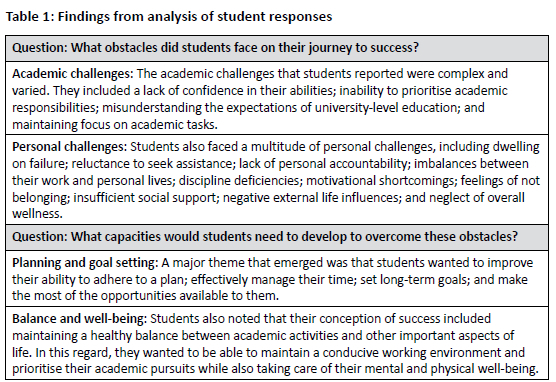
The student submissions were analysed using the methodology from Chun Tie et al. (2019). Referencing the above questions relating to obstacles, open coding was used to find initial codes in the student responses, and a number of key obstacles were identified including 'lack of confidence' and 'struggles with focus'. Intermediate coding was then deployed to develop core sub-categories and categories to find meaning in the data. This was achieved using NVIVO software. Finally, advanced coding was deployed to integrate categories to form cohesive insights. Meanwhile, any analytical thoughts and insights that arose during the process were documented. The findings from the intermediate and advanced coding stages are summarised in Table 1.
Planning and acting again
Cycle 2 was planned based on the insights that emerged from Cycle 1 (see Table 1). It was decided that the focus should be on addressing students' self-reported inability to prioritise academic responsibilities, particularly given that any activity that addressed this challenge would also promote understanding of the expectations of university-level education and how to maintain focus on academic tasks. Accordingly, the students were guided to design an academic action plan so that they would be better able to prioritise academic responsibilities. Given that an academic action plan must include a study plan; set specific, achievable academic goals; and address the issue of effective management of time and task prioritisation (Shelton & Yao, 2019), the students were asked to:
• Visualise and articulate plans for the remainder of the academic year.
• Outline steps and actions to achieve the academic goal that they set.
• Define a timeline for achieving the academic goal and identify specific milestones and deadlines within the academic year.
• Identify observable signs indicating progress towards the established goal.
• Develop a system for tracking and recognising positive developments.
• Assess and articulate the support necessary to execute the academic game plan effectively.
Evaluating the effectiveness of action research as a means of designing interventions
In addition, self-evaluation activities were incorporated into the programme with students being asked to score themselves on how effectively they had used their academic plan. They self-reported on how well they believed they had 'stuck to their game plan', giving themselves a score from 1 to 5 (with a score of 1 indicating low adherence to the plan and a score of 5 indicating a more disciplined approach). They were also asked to provide an explanation for this score.
A total of n=122 responses on this were received from the students, who were then divided into focus groups based on their self-scores. The reflections that emerged from each of these groups were analysed separately, using the grounded theory coding process (Chun Tie et al., 2019).
Results
Of the 122 responses received, 2% (n=3) students reported a very low score of 1, while 9% (n=11) students gave themselves a score of 2. A further 3% (n=4) reported a score of 3. The majority of students 66% (n=81) gave themselves a score of 4; and 19% (n= 23) students gave themselves a score of 5.
Students with a very low score of 1 (n=3) attributed this to a combination of impractical study strategies; insufficient personal engagement; missed classes; and challenges related to internet connectivity. Students with a score of 2 (n=11) showed awareness of their challenges and a willingness to seek help to overcome them. Students with a score of 3 (n=4) acknowledged that they had not really used the planning tool despite less-than-ideal first-semester results. In this group, some students reported that personal challenges had led to academic setbacks that were still prevalent, while others noted some progress in finding discipline and focus.
The majority of students gave themselves a score of 4 (n=81). In this group, students indicated greater proactivity and a positive attitude towards their academic studies. They also exhibited significant goal-driven behaviours, including in relation to time management and personal accountability. Their academic progress was also quite evident in relation to the achievement of goals; improved grades; and consistent management of coursework. Students with a score of 5 (n=23) described a positive academic journey characterised by consistent accountability and a keen sense of responsibility. Many reported being proactive in seeking help; and some said their mindsets had changed as a result of participation in the Phambili programme.
Discussion
Many student affairs practitioners are unable to show a direct correlation between their work and measurable student outcomes such as throughput and pass rates. One reason is that student development work may not lend itself to traditional, empirical research methods. However, several scholars have called on student affairs and services staff at universities to assert the credibility of their community of practice; develop and build the capacity of their profession; and contribute to the knowledge-production function of higher education institutions (Wildschut & Luescher, 2023). Responding to this call, practitioners in this field may need to challenge traditional research cultures; redefine the nature of scholarship and promote alternative indicators of impact, including qualitative ones measuring sense of belonging and increased capacities among students (e.g. Sithaldeen et al., 2022). Such endeavour may also entail practitioners rethinking their design practices when developing their interventions, including by using academically rigorous, evidence-based approaches that can be readily evaluated and shared. The deployment of such approaches can both enhance the effectiveness of student support interventions and contribute to the credibility and development of the profession.
In the present case, the challenge was to develop an academic-advising solution at speed for students who urgently needed to reengage meaningfully with their studies. Action-based research aims to address specific problems or challenges within a particular context and often involves collaboration between researchers and practitioners to understand, diagnose and solve practical problems, while simultaneously generating new knowledge (George, 2024). Although this method is primarily intended to produce research (Canlas & Karpudewan, 2020), it has a long history of use in educational design (Mertler, 2021) because it focuses on finding relevant solutions to specific problems through engagement with participants who are best placed to articulate their own needs (Canlas & Karpudewan, 2020).
The methodology for this study deployed analytical techniques provided by grounded theory to anchor the intervention in the actual environment and realities of the students. In this regard, student views on their educational development must be addressed in order to improve pedagogy and promote a better understanding of its impacts on student learning (Seale, 2016). The incorporation of such student views also ensures that the design is relevant, inclusive, valid and more likely to be impactful. As Strydom and Loots (2020, p. 31) point out: "If our high-impact practices are continuously informed by students, we can improve the quality of outcomes". Accordingly, the methodology deployed for the programme under study used grounded theory analytical techniques in an effort to embed student voices in the programme design in a systematic, methodical way that was both credible and transparent.
Deploying action research and grounded theory, a customised intervention was designed which was tailored to the specific needs of the UCT students in question - an intervention which was found to have positively impacted their academic confidence and ability to engage with their academic responsibilities. Of the 122 students who responded, approximately 85% indicated a score of 4 or 5, reflecting strong adherence to the programme. These students also expressed a proactive, positive attitude towards their academic goals. They noted that they were clear about the nature of their goals and were committed to achieving them. In this regard, a significant number of students said that positive benefits accrued from setting deadlines, and demonstrated an ability to adapt their plans as needed, leading to better stress management. Within the sample, several students attributed improved grades and consistent course work management to their newfound discipline; capacity for effective time management; and sense of personal accountability. Some directly linked the acquisition of a new, positive mindset to their participation in the Phambili programme.
In order to produce credible, shareable scholarship, student services practitioners should employ detailed methodologies in the design of their practices, collecting and presenting data transparently, and being open about the potential limits of their work. Establishing an intentional, structured approach that deployed analytical techniques derived from grounded theory to capture student voices, the designers of the Phambili programme were able to posit a credible connection between their results and the experiences of the programme participants. In addition, they were able to document the design process (e.g. in the form of this manuscript) clearly and logically, confirming the links between the findings and the data. Through such academic rigour, the designers of the programme were able to be explicit about what they did; why and how they did it; and what was achieved. Looking to the future, the acquisition of the capacity to design (and justify) programmes in this way is likely to be increasingly important for academic-advising practitioners, as well as student affairs professionals, as they strive to provide effective, relevant support to a growing student population in an increasingly resource-constrained environment.
Limitations of the study
Although 122 students responded as part of evaluation undertaken in implementing the Phambili programme, this sample size is likely not large enough to capture the full diversity of student experiences and outcomes, especially as Cycle 1 of the programme initially engaged 352 respondents. Additionally, the sample may not be representative of all students on academic probation or in need of academic recovery. Accordingly, in order to take this work going forward, there should be recruitment to include a sample from outside the study group and to ensure representative sampling from faculties and across years of study.
In addition, the study primarily captures short-term outcomes and immediate impacts on students' academic confidence and engagement; and long-term effects on academic success and retention rates might not be fully addressed or measured. In this regard, it would be worth conducting a longitudinal study to track students' progress and outcomes over a longer period, providing insights into long-term impacts.
Furthermore, the inclusion of a more diverse and larger sample size from different institutions and academic settings would improve the generalisability and transferability of the findings, which is another important criterion for academic rigour (Kalkopas, 2024).
In terms of academic rigour this work would also have been strengthened by more reflexivity as part of the process; and planning for triangulation to cross-check and validate findings - for example, by engaging lecturers or tracking student-performance data.
Ethics statement
Ethical clearance (CHED2022_6_Author) for this work was provided by one of UCT's faculty research ethics committees. Student submissions were treated confidentially and analysed anonymously.
Potential conflict of interest
There are no conflicts of interest to declare.
Funding acknowledgement
The Phambili programme was funded by a grant from UCT and the Siyaphumelela Initiative of the Kresge Foundation.
References
Bangeni, B., Sithaldeen, R., & Hunma, A. (2023). Locating academic development within the decolonial turn in higher education: The affordances of systems thinking for decolonial practice. Critical Studies in Teaching and Learning (CriSTaL), 11(2), 65-84. https://doi.org/10.14426/cristal.v11i2.2004 [ Links ]
Bean, J., & Eaton, S. B. (2002). The psychology underlying successful retention practices. Journal of College Student Retention: Research, Theory & Practice, 3(1), 73-89. https://psycnet.apa.org/doi/10.2190/6R55-4B30-28XG-L8U0 [ Links ]
Bowman, K. J., & Rosser, S. (2019, June) Enhancing gender diversity in STEM requires support from all [Paper presentation]. 2019 ASEE annual conference & exposition, Tampa, Florida. https://peer.asee.org/32746
Brew, A. (2001). The nature of research: Inquiry in academic contexts. Routledge
Cain, T. (2011). Teachers' classroom-based action research. International Journal of Research & Method in Education, 34(1), 3-16. https://doi.org/10.1080/1743727X.2011.552307 [ Links ]
Canlas, I. P., & Karpudewan, M. (2020). Blending the principles of participatory action research approach and elements of grounded theory in a disaster risk reduction education case study. International Journal of Qualitative Methods, 19. https://doi.org/10.1177/1609406920958964 [ Links ]
Centre for Teaching and Learning. (2018). https://www.ufs.ac.za/ctl/home-page/research-in-ctl/key-publications/reports
Charmaz, K. (2001). Grounded theory: Methodology and theory construction. In N. J. Smelser, & Paul B. Baltes (Eds.), International encyclopedia of the social & behavioral sciences (pp. 6396-6399). Elsevier.
Chiteng Kot, F. C. (2014). The impact of centralized advising on first-year academic performance and second-year enrollment behavior. Research in Higher Education, 55, 527-563. https://doi.org/10.1007/s11162-013-9325-4 [ Links ]
Chun Tie, Y., Birks, M., & Francis, K. (2019). Grounded theory research: A design framework for novice researchers. SAGE Open Medicine, 7. https://doi.org/10.1177/2050312118822927 [ Links ]
de Klerk, D., Krull, G., & Maleswena, T. (2021). Rapid orientation of students for emergency remote learning during the Covid-19 lockdown. Journal of Student Affairs in Africa, 9(1), 61-76. https://doi.org/10.24085/jsaa.v9i1.1428 [ Links ]
de Klerk, D., & Dison, L. (2022). Demystifying the work of South African academic advisors: An exploration of students' structural and material constraints. Journal of Student Affairs in Africa, 10(2), 129-147. [ Links ]
Fussy, D. S. (2018). The status of academic advising in Tanzanian universities. KEDI Journal of Educational Policy, 15(1), 81-98. https://repository.udsm.ac.tz/server/api/core/bitstreams/c218df01-e47d-4680-a573-a62823f3026a/content [ Links ]
George, T. (2024, January 12). What is action research? | Definition & examples. Scribbr. https://www.scribbr.com/methodology/action-research/
Glaser, B., & Strauss, A. (1967). The discovery of grounded theory. Aldine Publishing Company.
Kalpokas, N. (2024). Rigor and transparency in research: Explanation & guide. ATLAS.ti. https://atlasti.com/guides/qualitative-research-guide-part-3/rigor-transparency
Kreber, C. (2003). The scholarship of teaching: A comparison of conceptions held by experts and regular academic staff. Higher Education, 46(1), 93-121. [ Links ]
Kuh, G. D., Kinzie, J. L., Buckley, J. A., Bridges, B. K., & Hayek, J. C. (2006). What matters to student success: A review of the literature (Vol. 8). National Postsecondary Education Cooperative.
Le Grange, L. (2007). The scholarship of integration (re) considered. South African Journal of Higher Education, 21(5), 506-514. https://hdl.handle.net/10520/EJC37371 [ Links ]
Lewin, K. (1948). Action research and minority problems. In G. W. Lewin (Ed.), Resolving social conflicts: Selected papers on group dynamics (pp. 201-216). Harper & Brothers.
Luescher, T. M., Moja, T., & Schreiber, B., (2023). 10 Years of contributing to the professionalization of student affairs in Africa. Journal of Student Affairs in Africa, 11(1), v-xi. https://doi.org/10.24085/jsaa.v11i1.4689 [ Links ]
Madiba, M. (2022). Embracing SAASSAP scholarship. Journal of Student Affairs in Africa, 10(2), ix-xvi. https://doi.org/10.24085/jsaa.v10i2.4363 [ Links ]
Maslow, A. H. (1987). Motivation and personality (3rd ed.). Pearson Education.
Mertler, C. A. (2021). Action research as teacher inquiry: A viable strategy for resolving problems of practice. Practical Assessment, Research & Evaluation, 26(1), 19. https://doi.org/10.7275/22014442 [ Links ]
NACADA: The Global Community for Academic Advising. (2024). NACADA concept of academic advising. https://nacada.ksu.edu/resources/pillars/concept.aspx
Nayager, A., & de Klerk, D. (2024). Towards a social realist framework for analysing academic advising in Global South contexts. Journal of International Students, 14(2), 44-57. [ Links ]
O'Brien, R. (1998). An overview of the methodological approach of action research. https://homepages.web.net/~robrien/papers/xxarfinal.htm
Ogude, N. A., Kilfoil, W. R., & Du Plessis, G. (2012). An institutional model for improving student retention and success at the University of Pretoria. The International Journal of the First Year in Higher Education, 3(1), 21-34. https://doi.org/10.5204/intjfyhe.v3i1.97 [ Links ]
Ojo, E. O., & Onwuegbuzie, A. J. (2020). University life in an era of disruption of COVID-19: A meta-methods and multi-mixed methods research study of perceptions and attitudes of South African students. International Journal of Multiple Research Approaches, 12(1), 20-55. [ Links ]
Pain, R., Whitman, G., & Milledge, D. (2019). Participatory action research toolkit: An introduction to using PAR as an approach to learning, research and action. Practice Guide. Durham University.
Schreiber, B. (2014). The co-curriculum: Re-defining boundaries of academic spaces. Journal of Student Affairs in Africa, 2(1), 75-78. https://doi.org/10.14426/jsaa.v2i1.54 [ Links ]
Seale, J. (2016). How can we confidently judge the extent to which student voice in higher education has been genuinely amplified? A proposal for a new evaluation framework. Research Papers in Education, 31(2), 212-233. https://doi.org/10.1080/02671522.2015.1027726 [ Links ]
Sen, A. (1999). Development as freedom. Oxford University Press.
Shelton, L. J., & Yao, C. W. (2019). Early career professionals' perceptions of higher education and student affairs graduate programs: Preparation to work with international students. Journal of College Student Development, 60(2), 156-172. https://doi.org/10.1353/csd.2019.0016 [ Links ]
Sithaldeen, R., Phetlhu, O., Kokolo, B., & August, L. (2022). Student sense of belonging and its impacts on help-seeking behaviour. South African Journal of Higher Education, 36(6), 67-87. http://dx.doi.org/10.20853/36-6-5442 [ Links ]
Sithaldeen, R., & Van Pletzen, E. (2022). Applying systems principles to achieve greater integration of student support at a decentralised institution. Perspectives in Education, 40(4), 38-54. https://doi.org/10.38140/pie.v40i4.6005 [ Links ]
Siyaphumelela. (2017) Academic advising and student engagement. https://www.siyaphumelela.org.za/documents/5b30f4f776a1b.pdf
Soria, K. M., & Stubblefield, R. (2015). Knowing me, knowing you: Building strengths awareness, belonging, and persistence in higher education. Journal of College Student Retention: Research, Theory & Practice, 17(3), 351-72. https://doi.org/10.1177/1521025115575914 [ Links ]
Stewart, L. (2024). Action research: Steps, benefits, and tips. ATLAS.ti. https://atlasti.com/research-hub/action-research
Strayhorn, T. L. (2018). College students' sense of belonging: A key to educational success for all students. Routledge
Strydom, F., Loots, S., Oosthuizen, A., Hen-Boisen, L., Henn, M., & Posthumus, H. (2016). Engaging the #Studentvoice: SASSE annual report. SASSE. https://www.ufs.ac.za/docs/librariesprovider42/sasse-documents/reports/sasse-report-2016.pdf?sfvrsn=9b1e8321_2
Strydom, F., Kuh, G., & Loots, S., (2017). Student engagement in South African higher education: Taking stock and moving forward. In F. Strydom, G. Kuh, & S. Loots (Eds.), Engaging students: Using evidence to promote student success (pp. 219-235). SUN PRESS.
Strydom, F., & Loots, S. (2020). The student voice as contributor to quality education through institutional design. South African Journal of Higher Education, 34(5), 20-34. [ Links ]
Swecker, H. K., Fifolt, M., & Searby, L. (2013). Academic advising and first-generation college students: A quantitative study on student retention. NACADA Journal, 33(1), 46-53. https://doi.org/10.12930/NACADA-13-192 [ Links ]
Tinto, V. (1993). Leaving college: Rethinking the causes and cures of student attrition. University of Chicago Press.
Tiroyabone, G. W., & Strydom, F. (2021). The development of academic advising to enable student success in South Africa. Journal of Student Affairs in Africa, 9(2), 1-16. https://doi.org/10.24085/jsaa.v9i2.3656 [ Links ]
Torres, V., Jones, S. R., & Renn, K. (2019). Student affairs as a low-consensus field and the evolution of student development theory as foundational knowledge. Journal of College Student Development, 60(6), 645-658. https://doi.org/10.1353/csd.2019.0060 [ Links ]
University of Cape Town (UCT) (2020). Senate teaching and learning report. https://ched.uct.ac.za/teaching-learning
Van Pletzen, E., Sithaldeen, R., Fontaine-Rainen, D., Bam, M., Shong, C. L., Charitar, D., Dlulani, S., Pettus, J., & Sebothoma, D. (2021). Conceptualisation and early implementation of an academic advising system at the University of Cape Town. Journal of Student Affairs in Africa, 9(2), 31-45. https://doi.org/10.24085/jsaa.v9i2.3688 [ Links ]
Walker, M., & Unterhalter, E. (2007). The capability approach: Its potential for work in education. In A. Sen (Ed.), Capability approach and social justice in education (pp. 1-18). Palgrave Macmillan US.
Wildschut, A., & Luescher, T. M. (2023). Developing student affairs as a profession in Africa. Journal of Student Affairs in Africa, 11(1), 19-34. https://doi.org/10.24085/jsaa.v11i1.4586 [ Links ]
Wilson-Strydom, M. (2015). University access and success: Capabilities, diversity and social Justice. Routledge.
Young-Jones, A. D., Burt, T. D., Dixon, S., & Hawthorne, M. J. (2013). Academic advising: Does it really impact student success? Quality Assurance in Education, 21(1), 7-19. https://doi.org/10.1108/09684881311293034 [ Links ]
Received 25 September 2024
Accepted 5 December 2024
Published 18 December 2024
