




Services on Demand
Journal

Article
 English (pdf)
 Article in xml format
 Article references
 Automatic translation
 Send this article by e-mail
Indicators
Related links
-
 Cited by Google
 -
 Similars in Google
Share

 Permalink
Journal of Student Affairs in Africa
On-line version ISSN 2307-6267Print version ISSN 2311-1771
JSAA vol.12 n.2 Cape Town 2024
https://doi.org/10.24085/jsaa.v12i2.5451
RESEARCH ARTICLE
Exploring student representative councils' experiences at historically white universities: A meta-narrative review
Kitso Morgan
Intern: Health and Wellness Centre, University of the Free State, South Africa. Email: kitsomorgan@gmail.com. ORCID: 0000-0001-7928-535X
ABSTRACT
Student representation has been conceptualised and studied in different ways and by different researchers for more than 10 years. However, there are too few meta-narrative reviews indicating the main developments that have taken place in student representative councils (SRCs). Against this background, this article offers a summary of the events and actions that affected student representatives at historically white universities (HWUs) from 2011 to 2022. The data underpinning this summary, which is presented as a meta-narrative review, derive from a search of the literature conceptualising and studying student representation experiences including electronic sources, journal articles and book chapters. Synthesis and analysis of the data revealed a number of themes, including experiences of diversity; experiences of disruption; the use of protests; and the development of policies promoting transformation at HWUs. The review concludes by highlighting the significance of understanding the experiences of student representatives through the pursuit of a scholarship of integration that identifies and consolidates the university governance efforts that have a major impact on the prospects of holistic student success.
Keywords: Student representative councils, historically white universities, disruption, diversity, meta-narrative review
Introduction
Studies on student representation in South African universities include the works of Klemencic et al. (2015); Luescher et al. (2020); and Speekman (2015). These studies show how student representation has evolved over the years. For instance, Klemencic et al. (2015, p. 2) state that student representation is "the formal structures and processes of appointed student representatives acting on behalf of the collective student body in higher education governance within a higher education institution". Speckman (2015) conceptualises student representation as student organization of leadership that has been formally recognised by universities. This article conceptualises student representation as the trust and confidence granted by students and demonstrated through electing other students to represent their voices in institutions. Student representation thus plays a significant role in promoting inclusivity and changing previously exclusive higher education policies and processes.
This article further frames student representation as referring to student representative councils (SRCs) as the umbrella structure for student governance. These councils are composed of university students who are elected democratically by other university students to ensure the presence of student voices and considerations in university decision-making. SRCs occupy different positions and roles that can complement each other in the representative councils' engagement with university management (Kouba, 2017).
Student representation has been studied for more than 10 years and represents a growing topic for study across different areas of research (Kamsteeg, 2016; Moja et al., 2014). Nevertheless, the literature that has been produced offers only a relatively disjointed account of how the research into student representative councils has developed (Khan, 2011). In this context, the present research sought to produce a meta-narrative review to consolidate research on student representation. It undertook this by surveying the different theories and approaches used to study student representation and finding commonalities and differences among them with the aim of forming networks of understanding about student representation (Wong et al., 2013).
The current scholarly review aims to summarise events that affected historically white universities (HWUs) from 2011 to 2022 and serve as a guide for HWUs to envision and promote a scholarship of integration in pursuit of impactful and holistic student success.
Diversity and disruption at historically white universities
The term 'historically white universities' refers to universities that, historically, mostly accommodated only white students and excluded students of other races (Collins & Milliard, 2013). Following the introduction of the white paper on education and the Higher Education Act in 1997, historically white universities were required to implement transformation policies (Department of Education, 1997; Republic of South Africa, 1997). These policies led to HWUs improving their educational systems and improving their diversity and inclusivity. However, the transformation was also accompanied by disruptions at HWUs (Pattman, 2007; Walker, 2005). For example, Kamsteeg (2016) refers to a video of racist behaviour at the University of the Free State (UFS) that was distributed in 2008, which resulted in protests and sparked disruption. The video depicted four white UFS students at the university's traditionally white, male Reitz residence "initiating" five black university cleaners by getting them to drink urine (Cloete & Sapa, 2008).
The Reitz incident and its aftermath indicate the existence of disruption and diversity prior to 2011. However, this article's focus is on the prevalent instances of disruption and increased level of protests demanding transformation at HWUs which occurred at these universities from 2011 to 2022. Several issues were raised during this period of disruption, including those related to a need for free education (Griffiths, 2019); the language of instruction (Beukes, 2010); curriculum transformation (Griffiths, 2019); student access and student disadvantage (Cross & Carpentier, 2009; Gore, 2020); diversity and inclusivity of historically white universities in the wake of transformation (Bazana & Mogotsi, 2017); and how lectures were delivered under the COVID-19 pandemic (Champagne & Granja, 2021; Kele & Mzileni, 2021). Broadly, the disruptions gave voice to a number of institutional and structural factors affecting SRCs (Gore, 2020; Rupande & Bukaliya, 2012; Seabi et al., 2014).
In this context, it should be noted that in relation to the transformation goals established by the 1997 white paper and the Higher Education Act, actions were taken by HWUs, prior to #FeesMustFall, to implement efforts to address a lack of diversity and transformation at their respective institutions (Macupe, 2022; South Africa History Online, 2020).
SRC responses to disruption and diversity
SRCs commonly organized protests as a means of navigating disruption and diversity from 2011 to 2022 (Luescher et al., 2020). Protests are actions directed at solving issues in a social situation that may be seen as representing a collective systematic effort to bring about change notwithstanding their potentially violent and disruptive character (Mavunga, 2019). Protests also facilitate the representation of students' voices in formal decision-making at universities. The student protests during this period may be characterised as a recurring and, in some places, violent response to actions taken at HWUs (Luescher et al., 2020). For example, the #FeesMustFall movement which spread nationwide began as a response to a proposed rise in student fees (Griffiths, 2019; Mutekwe, 2018) but widened to address larger issues of transformation at higher education institutions that were flagged by students and student representative councils (Keet et al., 2021). The protests involved considerable violence and destruction: university infrastructure was burned, and police used stun grenades against protesting students including SRC members. In addition, protesting SRC members and students were arrested (Mavunga, 2019).
The protests may be seen as has having produced a number of positive outcomes, including reductions in tuition-fee hikes; the provision of additional tuition assistance; and the provision of support for students from disadvantaged backgrounds. In addition, new language policies were been established to promote multilingualism and integration in transforming HWUs (Amato, 2021; Griffiths, 2019); and universities removed structures associated with colonialism and changed the names of buildings (Kekana, 2015; Marais, 2016) in an effort to promote inclusivity and correct the institutional culture that had underpinned HWUs before the advent of democracy in South Africa in 1994 (van Marle, 2022).
Methodology and methods
Planning phase
The planning phase entailed the researcher determining the applicability of a meta-narrative approach to the present study in terms of four questions:
• Has the topic been studied by different scholars?
• Has the topic been studied in different academic disciplines?
• What different methods were used to study the topic?
• How has the understanding of the topic changed over time?
Under this phase, literature about student leadership and HWUs from 2011 to 2022 that was accessed from different disciplines and sources was examined to establish a foundation for the review.
Searching and mapping phases
Under the searching phase, the review moved from being a general systematic one to being grounded as a meta-narrative review through the deployment of appropriate research.
Student representation has been conceptualised and studied in different ways and the literature on the topic highlights the contrasts and similarities between the ways in which the subject has been studied. In this context, the literature chosen for the review generally incorporated studies that were applicable to historically white universities in South Africa.
In addition, a number of keywords were used to search for sources. The abbreviation 'SRC' and the keyword 'student leadership' were used in database searches. Additional key phrases that informed the search were 'SRCs in historically white universities'; 'student leadership in historically white universities'; 'diversity and disruption in South African universities from 2011 to 2022'; and 'SRC protests from 2011 to 2022 in South African universities'.
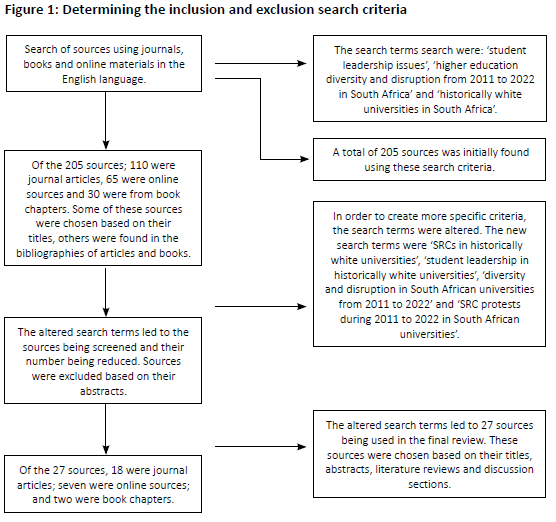
Inclusive search criteria were created based on the deployment of the keywords for the period 2011 to 2022; although, some searches were made for the years before 2011 to produce evidence of the presence of protests and examples of diversity and disruption before 2011. The searches generated 205 relevant sources, which were then refined to 30 sources. A total of 70% of the sources were chosen on the basis on their titles and abstracts; 10% were picked based on their keywords and their relevance in terms of the study background; and 80% were chosen on the basis of their reporting of incidents and actions at HWUs from 2011 to 2022.
The deployment of the keywords mainly generated results from online news channels, including EWN, News24, the Mail & Guardian, and eNCA, as well as the South African History Online (SAHO) website. The online news channels and SAHO were used because of the large scale of their reporting about university protests and incidents involving student leadership. The South African web-based news sources were considered trustworthy because they offer information produced by reporters who are bound to the Independent Communications Authority of South Africa's (ICASA's) code of ethics (ICASA, n.d.).
In addition, six databases were used for journal articles, including those of Transformation in Higher Education, Journal of Student Affairs in Africa, Humanities and Social Sciences Communications, Studies in Higher Education, International Journal of Educational Research, Government Gazette, and Cogent Education. These databases were used because of the frequency with which they produced literature on South African student affairs. In addition, a number of books were used as sources, including #Hashtag: An Analysis of the #FeesMustFall Movement at South African Universities, University on the Border: Crisis of Authority and Precarity, and Reflections of South African Student Leaders, 1994 to 2017.
The mapping phase of the meta-narrative review was guided by a number of questions:
• What is the reach of the studies on student leadership? For instance, how has student leadership been studied in the past and at present?
• What methods have mostly been used to study student leadership?
• What results have been yielded about student leadership, and how have these results contributed to the development of student leadership?
• How has studying student leadership led to the growth of the concept; and how has this growth been documented and used to influence the direction of student leadership?
Figure 1 below show the process that was used to decide which sources should be included and excluded from the meta-narrative review.
Appraisal phase
In the appraisal phase, the researcher develops codes and themes (Wong et al., 2013). At this point in the process, sources that mentioned South African universities but did not include historically white universities as a central issue were excluded. Also, sources that focused entirely on COVID-19 were excluded on the basis that this study sought to explain incidents and actions affecting historically white universities specifically, and how they had affected the development of their student representative councils.
Synthesis phase
During the synthesis phase, the researcher is required to compare and contrast how different paradigms conceptualise and theorise the topic in question, and the methods they use to study it (Wong et al., 2013). When synthesising the literature, it was found that the different sources were mostly qualitative in nature and that student representative councils had been conceptualised and studied differently by different researchers. The identified differences and similarities guided decisions about which sources should be used, with the similarities indicating consistency in the literature and the differences indicating areas for further research.
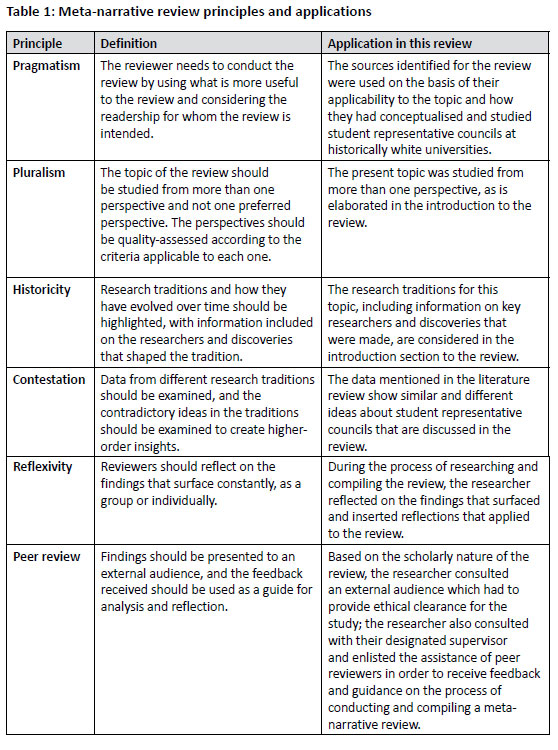
The synthesis stage also entailed adhering to six principles that should guide how a researcher undertakes their work, as recommended under RAMSES publication standards (Wong et al., 2013).
Recommendations phase
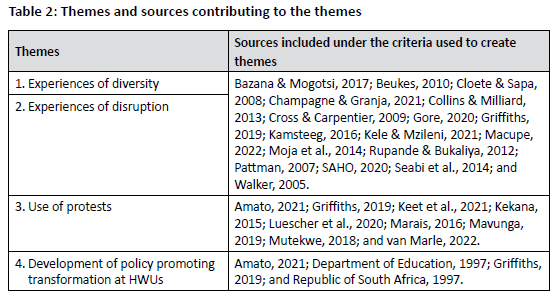
The literature used for the review comprised 27 sources. Table 2 below describes which sources contributed to which theme.
Discussion of findings
Since the first democratic elections in 1994, there has been an influx of non-white students into HWUs which introduced new 'experiences of diversity' at these institutions. At the same time and notwithstanding a national drive for transformation, HWUs were slow to change, which, in hindsight, led to 'experiences of disruption' at these places.
Such disruption has been characterised as a form of disapproval on the part of students and their elected leaders (Mavunga, 2019) who felt that their complaints about how historically white universities functioned had not led to the introduction of methods or procedures that improved their university experiences. In this regard, it should be noted that the struggle for equality and fair treatment at HWUs had waged for many years, both before and after democracy in South Africa.
From 2011 to 2022, the conflict within HWUs was made manifest in a number of ways, with SRCs taking a leading role by banding together to tackle issues, including through the 'use of protests' (which is a prominent theme in the literature).
Despite peaceful intentions, the 'use of protests' led to significant disruption at universities. Infrastructure with colonial associations was burned and police used stun grenades on protesting students and SRC members. In addition, SRC members and students were arrested while protesting against student exclusions on the basis of outstanding fees (Mavunga, 2019).
SRCs also voiced their concerns over a lack of discussion with management; budgetary restrictions; academic workloads; conflicts at university councils; and their lack of pastoral capacity to address students' issues as expected of them (Moepya, 2021). SRC representatives said that the challenges they faced were a product of institutional governance structures in which they had no say in decision- and policymaking.
In this context, SRC leaders justified protest violence as a means of forcing the government and university authorities to listen to their demands in defiance of a dominant neoliberal ideology in higher education that opposed giving anything to anyone for free (Malabela, 2016). At the same time, there has been acknowledgement that the justification of violence in the 'use of protests' and as a response to dissatisfaction can be problematic due to the trail of destruction to university property and the disruption to university processes wrought by such violence, which can prevent students from learning and hinder opportunities for conflict resolution.
At the same time and notwithstanding the violence associated with protests, there has been 'development of policy promoting transformation in historically white universities' (which is one of the themes that emerged from the present review). Such development has been attributed to the 'fight' led by SRCs and the students against a university system which they felt was excluding them and in which they did not feel incorporated. It was also understood that the system did not encourage the protesting students to excel or to resolve past injustices which were viewed as underpinning and continuing to promote persistent disadvantage at HWUs (Luescher, 2005; Akomolafe & Ibijola, 2011).
By contrast with this quite pessimistic approach to the 'fight', the 'use of protests' had historically been viewed as a form of problem-solving by protesting students during apartheid and the early year of democracy's implementation (Nyundu et al., 2015). In this context, the more recent use of protests by student representatives may even be seen as counter-productive and anti-transformational.
In an effort to address this situation, programmes should be established that can equip SRCs with effective problem-solving skills so that they can pursue transformation within their own structures and across the university. The implementation of such programmes can foster leadership characteristics and styles that may be deployed by SRCs to forge effective ways of addressing diversity and disruption (Moreku, 2014). Such an approach would undermine some of the dynamics shaping the 'experiences of disruption' theme - such as the inability to learn new, improved ways of responding to a situation which can lead to adverse results that actually reproduce the difficulties being faced. Instead, the aim should be to promote collaboration and a scholarship of integration through which student representative councils may learn to employ different, less violent methods of problem-solving.
In this respect, Luescher-Mamashela (2013) noted that students lack the experience necessary to participate formally in universities. This paucity of experience has been, in part, attributed to students' lack of understanding of governance, inferring that important practical and academic information, skills, and capabilities are not being imparted to students engaged in governance. In this regard, Mafa (2016) asserts that the problem is not a lack of understanding but rather a lack of information being imparted to student representatives, which is symptomatic of a larger failure to promote a holistic view of student success. In this context and given the diffuse structural character of university administration (Planas et al., 2013), SRCs lack the capacity to realise the extent to which they should be involved in governance and the benefits that may accrue from increased involvement in university governance.
In response, Luescher-Mamashela (2013) suggests that universities should establish strategies to promote the involvement of students in institutional decision-making. Scholars have also concluded that universities should revise their policies on student involvement to ensure that all students - not just those interested in governance -should receive information about university structures and their stance on student involvement in decision-making. This is another principle underpinning the scholarship of integration that is highlighted in the findings from this review.
At the same time, notwithstanding the positive outcomes produced by new policies and programmes promoting student development, there remains a significant shortfall in leadership capacity among students at the institutional, university level (Luescher-Mamashela, 2013; Tshauambea, 2023), which may, to an extent, be traced back to the ways in which student representative councils navigated their way through events and actions at historically white universities.
Recommendations
Based on the findings of the present review it is recommended that:
• Student representative councils should find and implement different strategies to navigate disruption and diversity through a scholarship of integration that focuses on the holistic treatment of student success.
• Student representative councils should adopt an integrated approach and increase their collaboration with university students and management so that issues at HWUs may be addressed in more harmonious ways.
• The strategies implemented by universities should be more applicable in the context of disruption and diversity so that the integration of university processes may be improved, and holistic student success is promoted more effectively.
• Student representatives should participate in individual and group-oriented programmes, promoting group work and sharing decision-making power for an enhanced scholarship of integration.
Limitations
The research for this review was mainly undertaken by one student which limited the range of sources deployed. The credibility and trustworthiness of the data presented would be enhanced through the use of a larger number of sources. In this regard, consideration may be given to recruiting external agencies to help conduct, analyse and document such research.
Conclusion
The literature documented in this study indicate that HWUs in South Africa faced similar transformation challenges prior to their efforts to implement transformational programmes, and that SRC responses to the lack of transformation at these institutions took the form of protests. In addition, the literature indicates that, notwithstanding a number of adverse effects produced by the protests, HWUs responded by increasingly implementing transformational programmes at the institutional level and for their SRCs. These programmes have played a significant role in promoting a scholarship of integration in support of holistic student success.
This meta-narrative review has shown the importance of documenting the experiences of SRCs at HWUs and other tertiary institutions and how such documentation can help SRCs to develop or adjust the approach that they have adopted over the past more than ten years in pursuit of student success. In addition, the review has indicated the need to apply the scholarship of integration to student governance so that universities can be more proactive in developing student leadership as a way of promoting holistic student success.
Ethical considerations
Not relevant to this article.
Potential conflict of interest
The review was completed as part of a degree being undertaken at the University of the Free State, and, as such, the views expressed herein do not necessarily represent those held by the University of the Free State.
Funding acknowledgement
No specific funding was provided for this review.
References
Akomolafe, C. O., & Ibijola, E. Y. (2011). Students' participation in university governance and organizational effectiveness in Ekiti and Ondo States, Nigeria. American Journal of Social and Management Sciences, 2(2), 231-236. [ Links ]
Amato, B. (2021, August 21). Reinventing higher education. Research News. https://www.wits.ac.za/news/latest-news/research-news/2021/2021-08/reinventing-higher-education.html
Bazana, S., & Mogotsi, O. P. (2017). Social identities and racial integration in historically white universities: A literature review of experiences of black students. Transformation in Higher Education, 2, a25. https://doi.org/10.4102/the.v2i0.25 [ Links ]
Beukes, A.-M. (2010). 'Opening the doors of education': Language policy at the University of Johannesburg. Language Matters, 41(2), 193-213. https://doi.org/10.1080/10228195.2010.525787 [ Links ]
Champagne, E., & Granja, A. D. (2021, April 6). How the COVID-19 pandemic may have changed university teaching and testing for good. The Conversation. https://www.google.com/amp/s/theconversation.com/amp/how-the-covid-19-pandemic-may-have-changed-university-teaching-and-testing-for-good-158342/
Cloete, H., & Sapa (2008, February 26). UFS horror race video surfaces. News24. https://www.news24.com/News24/UFS-horror-race-video-surfaces-20080226
Collins, K., & Milliard, M. (2013). Transforming education in South Africa: Comparative perceptions of a South African social work learning experience. Educational Review, 65(1), 70-84. https://doi.org/10.1080/00131911.2011.648168 [ Links ]
Cross, M., & Carpentier, C. (2009). "New students" in South African higher education: Institutional culture, student performance and the challenge of democratisation. Perspectives in Education, 27(1), 6-18. [ Links ]
Department of Education (DoE). (1997, August 15). Education white paper #3: A programme for the transformation of higher education. Government Gazette, 386 (18207). [ Links ]
Gore, O. T. (2020). "Student disadvantage": Key university stakeholders' perspectives in South Africa. International Journal of Higher Education, 10(1). https://doi.org/10.5430/ijhe.v10n1p214 [ Links ]
Griffiths, D. (2019). #FeesMustFall and the decolonised university in South Africa: Tensions and opportunities in a globalising world. International Journal of Educational Research, 94, 143-149. https://doi.org/10.1016/j.ijer.2019.01.004 [ Links ]
Independent Communications Authority of South Africa (ICASA). (n.d.). Our services. https://www.icasa.org.za/pages/our-services
Kamsteeg, F. (2016). Transformation and self-identity: Student narratives in post-apartheid South Africa. Transformation in Higher Education, 1(1), 1-10. http://dx.doi.org/10.4102/the.v1i1.10 [ Links ]
Keet, A., Nel, W., & Sattarzadeh, S. D. (2021). '#MustFall-TheEvent: Rights, student activism and the transformation of South African universities. In L. Lange, V. Reddy, & S. H. Kumalo, University on the border: Crisis of authority and precarity. African Sun Media. https://doi.org/10.52779/9781991201355/03
Kele, K., & Mzileni, P. (2021). Higher education leadership responses applied in two South African comprehensive universities during the COVID-19 pandemic: A critical discourse analysis. Transformation in Higher Education, 6(0), a114. https://doi.org/10.4102/the.v6i0.114 [ Links ]
Khan, M. B. (2011). Student governance in higher education institutions in the Western Cape, South Africa: A case study [Unpublished doctoral thesis]. University of KwaZulu-Natal. http://hdl.handle.net/10413/11050
Klemencic, M., Luescher, T. M., & Jowi, J. O. (2015). Student power in Africa. Journal of Student Affairs in Africa, 3(1). https://doi.org/10.14426/jsaa.v3i1.99 [ Links ]
Kouba, K. (2017). Determinants of student participation in higher education governance: The case of student turnout in academic senate elections in Czechia. Higher Education, 76(1), 67-84. [ Links ]
Luescher, T. M. (2005, April 1). Student governance in Africa: A preliminary assessment of the scholarly universe [Paper Presentation]. Seminar on improving governance and student leadership of the Centre for Higher Education Transformation, University of Stellenbosch, South Africa. Retrieved from: https://www.academia.edu/7271788/Student_Governance_in_Africa_Thematic_Summary_of_Key_Literature
Luescher, T. M., Webbstock, D., & Bhengu, N. (2020). Reflections of South African student leaders 1994 to 2017. African Minds.
Luescher-Mamashela, T. M. (2013). Student representation in university decision-making: Good reasons, a new lens? Studies in Higher Education, 38(10), 1442-1456. https://doi.org/10.1080/03075079.2011.625496 [ Links ]
Macupe, B. (2022, May 17). Blade Nzimande tells Stellenbosch University not to be a 'sanctuary to racists'. News24. https://www.news24.com/citypress/news/blade-nzimande-tells-stellenbosch-university-not-to-be-a-sanctuary-to-racists-20220517
Mafa, O. (2016). Involving students in university governance: Perceptions of open and distance learning students. Journal of Research & Method in Education, 6(2), 49-54. [ Links ]
Malabela, M. (2016). We are violent but just demanding free decolonised education: University of Witwatersrand. In M. Langa (Ed.), #Hashtag: An analysis of the #FeesMustFall movement at South African universities (pp. 132-148). Centre for the Study of Violence and Reconciliation.
Marais, M. (2016, March 23). Names at UFS to change. News24. https://www.news24.com/news24/names-at-ufs-to-change-20160322
Mavunga, G. (2019). #FeesMustFall protests in South Africa: A critical realist analysis of selected newspaper articles. Journal of Student Affairs in Africa, 7(1), 81-99. https://doi.org/10.24085/jsaa.v7i1.3694 [ Links ]
Moepya, P. (2021). Participation of student leaders in governance of a transforming university [Unpublished master's dissertation]. University of Pretoria. https://repository.up.ac.za/bitstream/handle/2263/80165/Moepya_Participation_2021.pdf?sequence=1
Moja, T., Schreiber, B., & Luescher-Mamashela, T. (2014). Contextualising student affairs in Africa: The past, present and future. Journal of student affairs in Africa, 2(1), 1-8. https://doi.org/10.14426/jsaa.v2i1.46 [ Links ]
Moreku, C. (2014). The involvement and participation of student representative councils in co-operative governance in higher education institutions in South Africa [Unpublished doctoral thesis]. Free State University of Technology. https://1library.net/document/y4jj44vy-involvement-participation-representative-councils-operative-governance-education-institutions.html
Mutekwe, E. (2018). Unmasking the ramifications of the fees-must-fall-conundrum in higher education institutions in South Africa: A critical perspective. Perspectives in Education, 35(2), 142-154. [ Links ]
Nyundu, T., Naidoo, K., & Chagondu, T. (2015). 'Getting involved on campus': Student identities, student politics, and perceptions of the student representative council (SRC). Journal of Sociology and Social Anthropology, 6(1), 149-166. [ Links ]
Pattman, R. (2007). Student identities, and researching these, in a newly 'racially' merged university in South Africa. Race Ethnicity and Education, 10(4), 473-492. https://doi.org/10.1080/13613320701658480 [ Links ]
Planas, A., Soler, P., Fullana, J., Pallisera, M., & Vila, M. (2013). Student participation In university governance: The opinions of professors and students. Studies in Higher Education, 38(4), 571-583. https://doi.org/10.1080/03075079.2011.586996 [ Links ]
Republic of South Africa. (1997). Higher Education Act, 197 (Act No. 101 of 1997). Government Gazette, 390(18515). https://www.gov.za/sites/default/files/gcis_document/201409/a101-97.pdf [ Links ]
Rupande, G., & Bukaliya, R. (2012). Assessing the effectiveness of student representative councils in open and distance learning: A case for the Zimbabwe Open University. International Journal on New Trends in Education and Their Implications, 3(1), 8. [ Links ]
Seabi, J., Seedat, J., Khoza-Shangase, K., & Sullivan, L. (2014). Experiences of university students regarding transformation in South Africa. International Journal of Educational Management, 28(1), 66-81. https://doi.org/10.1108/IJEM-01-2012-0017 [ Links ]
South African History Online (SAHO). (2020, April 1). Debating Stellenbosch University's language policy. https://www.sahistory.org.za/article/debating-stellenbosch-universitys-language-policy#:~:text=The%20Stellenbosch%20protests%20were%20led%20by%20black,at%20public%20universities%20and%20inclusivity%20of%20black%20students
Speckman, M. (2015). Student leadership and advocacy for social cohesion: A South African perspective. African Journal on Conflict Resolution, 15(3), 61-84. [ Links ]
Tshauambea, T. (2023, October 4). Cultivating a culture that promotes student success through meaningful co-curricular experiences. Stellenbosch University News. https://www.sun.ac.za/english/Lists/news/DispForm.aspx?ID=10222
van Marle, K. (2022). University spaces as sites of conscience. Space and Culture, 25(2), 205-218. https://doi.org/10.1177/12063312211065263 [ Links ]
Walker, M. (2005). Race is nowhere and race is everywhere: Narratives from black and white South African university students in post-apartheid South Africa. British Journal of Sociology of Education, 26(1), 41-54. [ Links ]
Wong, G., Greenhalgh, T., Westhorp, G., Buckingham, J., & Pawson, R. (2013). RAMSES publication standards: Meta-narrative reviews. BMC Medicine, 11(20), 1-15. https://www.biomedcentral.com/1741-7015/11/20 [ Links ]
Received 25 September 2024
Accepted 5 December 2024
Published 18 December 2024
