Services on Demand
Journal

Article
 English (pdf)
 Article in xml format
 Article references
 Automatic translation
 Send this article by e-mail
Indicators
Related links
-
 Cited by Google
 -
 Similars in Google
Share

 Permalink
R&D Journal
On-line version ISSN 2309-8988Print version ISSN 0257-9669
R&D j. (Matieland, Online) vol.17 Stellenbosch, Cape Town 2001
Development of a numerical vortex method for calculation of the 2D water impact problem
N.V. KornevI; G. MigeotteII; K.G. HoppeIII
IProfessor, Department of Hydromechanics, Marine Technical University of St. Petersburg
IIPhD student, Department of Mechanical Engineering, University of Stellenbosch
IIIProfessor, Department of Mechanical Engineering, University of Stellenbosch, Private Bag XI, Matieland, 7602 South Africa
ABSTRACT
A vortex method was developed for calculating the 2-dimensional water impact problem. The theory relating to this problem is presented and the well- known test case of a wedge impacting the water surface is considered. The solution of the problem using both the linear and non-linear free surface boundary conditions are presented. Results show good agreement with other numerical methods and it is shown by considering the splash-up coefficient that consideration of non-linear effects is not essential. In addition, the influence of the Froude number is considered and it is shown that at small Froude numbers (Fn < 0.3) the appearance of detached waves makes it essential to consider Froude number effects.
Introduction
This work presents efforts of authors directed at the development of a computational vortex method for calculating planing ships with hydrofoil assistance, such as the Hysucat.1 In previous works of the authors,2 a 3-dimensional vortex method, based on non-linear wave theory, was presented for modelling planing hydrofoil- assisted catamarans. The method includes models for calculating hydrofoil forces and wave surface elevations behind a hydrofoil including the vortex roll-up process. The wing analogy of Wagner3 was applied to model the planing hull surfaces. Within the framework of Wagner's theory, the hull is considered as a common lifting surface moving on the free surface disturbed by the front foil.
This approach proved to be efficient and accurate for high Froude numbers (Fn > 3.0 based on vessel displacement) making it a suitable design tool for planing hydrofoil-assisted ships such as the Hysucat. A very important question concerning Hysucat design is the transition regime that includes hump resistance speeds. At these moderate Froude numbers (1.5 < Fn
 < 3.0), the effect of gravity (which is not important at planing speeds) needs to be considered. The vortex method applicable to arbitrary Froude numbers therefore became the next important goal in the theoretical developments of the authors. Compared with the source and doublet panel methods, the vortex method is the most suitable for modeling hydrofoil-assisted catamarans because all elements of the vessel are lifting surfaces generating a vortex wake. The combination of lifting surfaces and the vortex wake is treated in the most natural and simple way within the framework of vortex methods.
Development of such a method started with the 2-dimensional case concentrating on the well-known canonic problem concerning the impact of a two-dimensional wedge. In addition to results necessary for validation of the method, some new data were obtained relating to the influence of the Froude number on the impact process.
Governing equations and numerical method
The mathematical formulation of the problem is based on the Laplace equation

where, φis the potential, n is the normal unit vector to the body and free surface, pa is the atmospheric pressure and subscripts ± denote the limits of quantities on different sides of the surfaces.
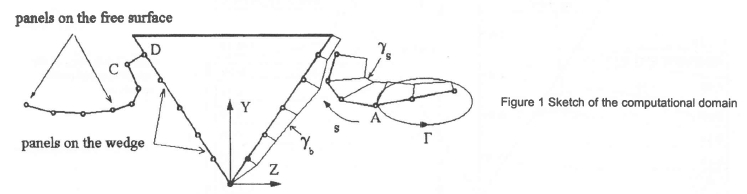
To solve the problem specified by equations (1) to (5), a vortex sheet with unknown intensity ϒS on the free surface and ϒb on the wedge is used. The vortex sheet intensities, ϒS and ϒb are found from the boundary conditions (2) and (4). The kinematic boundary condition (3) is satisfied automatically if one assumes that the free surface follows trajectories of fluid particles lying on the free surface:

where  is the radius vector of a fluid particle marked by a Lagrangian coordinate a and
  and is the flow velocity on the free surface.
Using Bernoulli's equation, the dynamic free surface boundary condition (4) can be rewritten in a reference system moving with the velocity  :
:

where y is the wave elevation, d/dt is the substantial derivative, and φand V are, strictly speaking, the potential and the velocity under the free surface, respectively. The velocity and potential under the vortex sheet are satisfied according to simple relations:

where Γis the circulation around the tip end of the vortex sheet (see Figure 1):  is the direct value of the potential on the vortex sheet. Substituting (8) into (7) one obtains:

where  . In what follows the derivations proposed by Molyakov4 are utilized with the only difference, noted by one of the authors, that differentiation of integrals of any function y along a moving contour gives:

where  and ρis the radius of curvature on the free surface. Considering this, differentiating (9) with respect to the arc length and integrating the results in time, the final expression is derived:

In (11) and (12) all lengths are referred to a unit length L, velocities and ϒs are referred to the impact speed W and the Froude number is defined as  Non-dimensional time is obtained by multiplying time by a factor W/L.
In the numerical implementation of the method, the free surface and the wedge are represented by a set of straight segments (panels) with a piecewise distribution of the vortex intensity (Figure 1). At every time instant, the computational cycle consists of the following steps:
• Assuming the free surface being known, the intensities ϒsand ϒB are calculated iteratively from eqs. (2) and (11). The velocities are found from the Biot-Savart law.
• The free surface elevation is calculated from eq. (6).
• The free surface form is analysed and smoothed. The jet area is cut off if the angle between the free surface and the body surface is less than some predefined value and section CD (Figure 1) is introduced (a technique proposed by Zhao & Faltinsen).5
• The panels on the free surface are redistributed so that the length of each panel is equal to a given value.
The forces on the body are then calculated from Bernoulli's equation.
Applying the jet cut off as a necessary procedure to avoid numeric instabilities, we admit that the intensities ϒs and ϒb do not match at the point of intersection D.
Results
Numerical results for the pressure distribution and the forces are in a good agreement with similar calculations by Zhao & Faltinsen,5 Mei et al.6 and Dobrovolskaya7 as shown in Figure 2. The motion of the free surface is shown in Figure 3 for a wedge with deadrise angle of 45° for two Froude numbers: 0.25 and 1000. The water rise on the body relative to its submergence, expressed as the splash-up coefficient: 1.47, is indicated on the figure by the horizontal line: 1.47 Y0. Remember that the solution is the result of an improvement to the theory of Wagner.3 The improvement introduced is that the boundary conditions are enforced on the actual wedge, thus taking into account the wedge deadrise angle. The line indicating the water rise obtained from non-linear theory lies a little higher. The water rise in non-linear theory is determined as an intersection between the wedge and the line, which is perpendicular to the wedge and tangential to the water surface (see Figure 3). The discrepancy between the two levels, i.e. 1.47 Y0 and the nonlinear solution is acceptably small.
An essential advantage of this work compared with those of Zhao & Faltinsen5 and Mei et al.6 is the consideration of the influence of the Froude number. An interesting phenomenon, which was observed in the numerical simulation, is the appearance of detached waves at small Froude numbers Fn < 1. Initially, the water splash-up occurs in a similar way for all Froude numbers (compare sections A and B of Figure 3).
At time t ≈ 0.59, the wave created by the splash-up mechanism detaches from the wedge and propagates away. Afterwards the wave elevation takes place close to the wedge but the splash-up is not pronounced.
As seen from Figure 4, the results for Froude numbers 1 and 1000 are almost the same within the investigated time interval. The influence of the Froude number resulting in the appearance of detached waves becomes essential for Froude numbers less than 0.3. An advantage of the proposed numerical scheme characterizing its stability, is that the numerical calculation has the correct limit when Fn →0.
Non-linearity makes the solution algorithm more difficult and very often causes instability. Its contribution is not essential for high Froude numbers, as indicated in Figure 5.
Conclusion
A vortex lattice method, which considers the effects of gravity has been developed and applied to the problem of a wedge impacting the water surface. The results show that the vortex lattice method is in good agreement with the results of others obtained using different numerical methods and is suitable for modelling impact problems. Furthermore, the numerical results show that consideration of gravity is important at low Froude numbers for resolving the wave formation on free surface properly, whilst consideration of the fully non-linear free surface boundary condition is not essential.
Having successfully solved the 2D wedge impact problem, the method is currently being further developed to solve the similar 3D problem associated with the bow-wave formation of high-speed ships such as hydrofoil-assisted catamarans operating at speeds covering the transition from displacement to planing mode of operation.
References
1. Hoppe KG. Performance Evaluation of High Speed Surface Craft with Reference to the Hysucat Development. Fast Ferry International, 1991, 30. [ Links ]
2. Kornev NV, Migeotte G, Hoppe KG, Nesterova A. Design of Hydrofoil Assisted Catamarans using a Non-Linear Vortex Lattice Method. Proceedings of the High Performance Marine Vehicle Conference HIPER 2001, Hamburg, 2001.
3. Wagner H. Über Stoss-und Gleitvorgange an der Oberflache von Flussigkeite. Z. angew. Math. Mech, 1932, 12, pp.193-215. [ Links ]
4. Molyakov NM. Unsteady flow around a profile under a free surface separating fluids of different densities. Transactions of the Zhoukovsky Air Force Academy, 1985, 1313, pp.336-347. [ Links ]
5. Zhao R, Faltinsen O, Aarsnes J. Water Entry of Two-Dimensional Sections with and Without Flow Separation. Proceedings 21st Symposium on Naval Hydrodynamics, 1996.
6. Mei X, Lui Y, Yue DKP. On the Water Impact of General Two-Dimensional Sections. Applied Ocean Research, 1999, 21, pp.1-15. [ Links ]
7. Dobrovolskaya ZN. On some problems of similarity flow of fluids with a free surface. Journal of Fluid Mechanics, 36, pp.805-829. [ Links ]
First received May 2001
Final version September 2001