




Services on Demand
Journal

Article
 English (pdf)
 Article in xml format
 Article references
 Automatic translation
 Send this article by e-mail
Indicators
Related links
-
 Cited by Google
 -
 Similars in Google
Share

 Permalink
R&D Journal
On-line version ISSN 2309-8988Print version ISSN 0257-9669
R&D j. (Matieland, Online) vol.28 Stellenbosch, Cape Town 2012
Performance Characteristics of an Air-Cooled Steam Condenser with a Hybrid Dephlegmator
J.A. HeynsI; D.G. KrögerII
IDepartment of Mechanical and Mechatronic Engineering, University of Stellenbosch, Private Bag X1, Matieland, 7602, South Africa. E-mail: jaheyns@gmail.com
IIDepartment of Mechanical and Mechatronic Engineering, University of Stellenbosch, Private Bag X1, Matieland, 7602, South Africa. E-mail: dgk@sun.ac.za
ABSTRACT
This study evaluates the performance characteristics of a power plant incorporating a steam turbine and a direct air-cooled dry/wet condenser operating at different ambient temperatures. The proposed cooling system uses existing A-frame air-cooled condenser (ACC) technology and through the introduction of a hybrid (dry/wet) dephlegmator achieves measurable enhancement in cooling performance when ambient temperatures are high. During these periods the hybrid (dry/wet) condenser operating in a wet mode can achieve the same increased turbine performance as an oversized air-cooled condenser or an air-cooled condenser with adiabatic cooling (spray cooling) of the inlet air at a considerably lower cost. For the same turbine power output the water consumed by an air-cooled condenser incorporating a hybrid (dry/wet) dephlegmator is at least 20 % less than an air-cooled condenser with adiabatic cooling of the inlet air.
Additional keywords: Power plant economics
Nomenclature
G mass velocity [kg/sm2]
L length [m]
m mass flow rate [kg/s]
P power [W]
p pressure [N/m2]
Q heat transfer rate [W]
T temperature [°C or K]
v velocity [m/s]
Subscripts
a air, or based on air-side area
atm atmosphere
av mixture of dry air and water vapor
gen generated
i inlet
o outlet
v vapor
w water
1. Introduction
Due to the decreasing availability and rising cost of cooling water, dry-cooling towers or air-cooled steam condensers are increasingly being used to reject heat to the environment in modern power plants incorporating steam turbines. Unfortunately, with an increase in the ambient temperature, the effectiveness of these cooling systems decreases resulting in a corresponding reduction in turbine efficiency. The reduction in turbine output during hot periods may result in a significant loss in income, especially in areas where the demand and cost for power during these periods is high.
Maulbetsch and DiFilippo1 conducted a study on four different 500 MW gas-fired, combined-cycle power plants (170 MW produced by the steam turbine), located at different sites in California, and compared the cost of wet-and dry-cooling at each site. They found that although dry-cooling reduces the annual water consumption on average by 95 % to 96 %, the total plant cost is 5 % to 15 % higher if dry-cooling instead of wet-cooling is used. They also note that for dry-cooled systems, due to their performance penalties during periods of high ambient temperature, the reduction in the potential annual income may be 1 % to 2 % or amount to $ 1.5 to $ 3 million. The utilization of dry-cooling systems is therefore highly dependent on the availability and/or cost of water at a particular site.
Dry/wet or wet/dry cooling systems utilize characteristics of both dry- and wet-cooling towers. These systems' overall water consumption rates typically vary between 20 to 80 percent of those normally required for all-wet systems, but unlike air-cooled systems are not subjected to the dramatic loss in efficiency during periods of higher ambient temperatures (Maulbetsch2). The performance characteristics of the dry/wet cooling systems are highly dependent on the chosen configuration. In the design of dry/wet cooling systems, it is desirable to achieve the highest possible thermodynamic efficiency while utilizing the smallest amount of cooling water in the most cost-effective manner.
The dry and wet sections, in the dry/wet systems, may be arranged in different combinations that will differ in capital cost and operating capabilities. Maulbetsch2 briefly summarized the different dry/wet system arrangements described by Lindahl and Jameson3 and Mitchell 4. Some of the possible cooling tower arrangements include
□ Single-structure combined tower (hybrid) or separate dry and wet towers
□ Series or parallel airflow path through the dry and wet systems
□ Series or parallel connected cooling water circuits while possible condenser arrangements are:
□ Common condenser
□ Divided water box separating the cooling water flows from the wet and dry towers
□ Separate condensers
De Backer and Wurtz investigated the use of mechanical draft wet-cooling towers connected in parallel to direct dry-cooling systems. They state that for a particular parallel dry/wet cooling system, during the warmest periods, the turbo-generator can operate at a 20 % lower steam back pressure than when an all-dry-cooling system is employed. The overall amount of water consumed by the particular dry/wet cooling system is only 4 % of the water an all-wet-cooling system will consume.
Boulay et al.6 conducted a study to determine whether it would be more economical to oversize air-cooled systems or use alternative dry/wet systems to achieve lower backpressures during summer time and generate additional revenue when energy prices peak. The cost and performance were compared at two sites: Northeastern USA (Harrisburg, PA) and a hotter and drier Southwestern location (Phoenix, AZ). The dry/wet systems offered better paybacks than over-sizing the air-cooled condensers, but due to their high capital cost, only had a marginal return at the Northeastern site and proved not to be economical for the Southwestern site.
Dry/wet systems provide relatively good thermal performance characteristics during hot ambient conditions, while maintaining a low overall water consumption rate. The initial capital costs as well as the operating and maintenance costs of these systems are relatively high due to the fact that they consist of both dry and wet cooling towers. Utilization of the wet-cooling tower only during short periods of high ambient temperatures tends to reduce the lifecycle economic viability of dry/wet cooling systems.
To enhance the performance of dry-cooling systems, the air-side of the heat exchanger surface can be deluged with cooling water. Deluge systems make use of both sensible and latent heat transfer. The latent heat transfer takes place through the evaporation of a small amount of deluge or cooling water into the air stream. By deluging the heat exchanger with cooling water and enabling evaporative cooling, the heat transfer rate may be improved significantly (Kröger7). A problem associated with deluge cooling is the fouling and corrosion of the air-side of the tubes; this can, however, be limited in the case of plain tube bundles, so that its influence does not drastically inhibit thermal performance.
The performance of dry-cooled systems can also be enhanced by passing the entering air through a wet tower fill or by introducing a fine spray into the air upstream of the heat exchanger, adiabatically cooling the air. Evaporation of the water cools the air to near its wetbulb temperature, resulting in a thermal performance improvement of the air-cooled heat exchanger.
Investigating adiabatic enhancement of air-cooled power plants in California, Maulbetsch and DiFilippo8 conducted tests on various low-pressure nozzles and the arrangement of the nozzles. They also investigated the effect of introducing a drift eliminator to reduce the amount of unevaporated droplets entering the finned tube bundle. Tests showed that during periods of high ambient temperatures it is possible to achieve between 60 % and 100 % of the prevailing wet-bulb depression and 75 % of the output losses can be recovered through the use of spray enhancement during the 1000 hottest hours of the year.
Under these conditions the installation payback period will be between a year and two and a half years. However, for the nozzles tested only between 60 % and 70 % of the spray water is evaporated and even the introduction of the drift eliminator cannot ensure that the finned surfaces remain dry. The unevaporated water droplets accumulating on the structure lead to corrosion of the structure surfaces as well as undesirable rainback that cause surface and ground water contamination.
Finer sprays may be achieved with smaller high pressure nozzles. Due to practical and cost considerations spray cooling of inlet air is, however, not likely to find application in large air-cooled condensers.
A practical cost effective hybrid (dry/wet) cooling system is described in the following section. The thermal performance characteristics of the hybrid (dry/wet) condenser are evaluated and compared to other condenser configurations in section 3.
2. Proposed Hybrid (Dry/Wet) Cooling System
The thermal performance characteristics of a cost effective direct dry/wet cooling system that makes use of existing A-frame air-cooled condenser technology is investigated. The system maintains good thermal performance during periods of high ambient temperatures, while only utilizing a minimum of the limited water resources available.
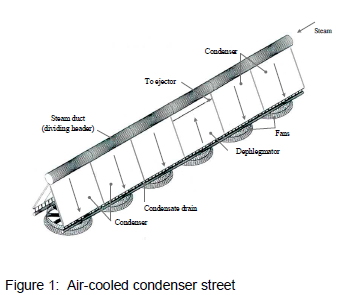
As in a direct A-frame air-cooled system, the steam is fed via steam header to the primary condenser units; excess steam leaving the primary condenser units is condensed in the dephlegmator (secondary reflux condenser to remove non-condensable gases) as shown in figure 1. It is proposed that the air-cooled dephlegmator be replaced by a hybrid (dry/wet) dephlegmator, consisting of two stages connected in series: It consists firstly of an air-cooled condenser with somewhat shortened inclined finned tubes, similar to those used in the A-frame configuration, and a second stage consisting of smooth galvanized steel tubes arranged horizontally. The configuration of the proposed hybrid dephlegmator is shown schematically in figure 2. The second stage can be operated either as an air-cooled condenser (dry) or the air-side surface of the tube bundle can be deluged with water, thus to be operated as an evaporatively cooled condenser.
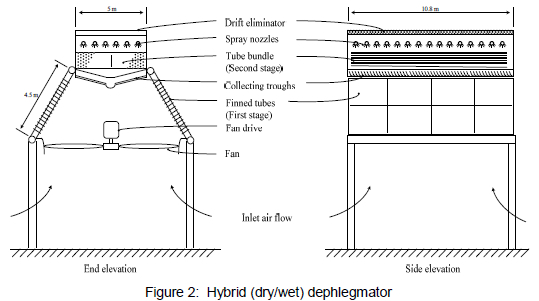
The operation of the second stage depends on the ambient conditions. During periods of low ambient temperatures where air-cooling is sufficient, the second stage is operated in a dry mode. However, during hotter periods deluge water is sprayed over the galvanized steel tubes and the second stage is operated as an evaporative condenser. The deluge water is collected under the tube bundle in troughs.
This system has the potential of enhanced thermal performance during periods of high ambient temperatures, while having a lower overall water consumption rate than a spray cooled system (adiabatic pre-cooling of inlet air) giving the same performance enhancement. It is estimated that the capital cost of the hybrid (dry/wet) dephlegmator will be only slightly more than that of a standard A-frame air-cooled dephlegmator. Furthermore, the finned tubes of the unit remain dry, reducing the risk of corrosion as well as scaling while the galvanized wetted plain tube surface will be rinsed with clean water on a regular basis to minimize fouling.
3. System Performance Analysis
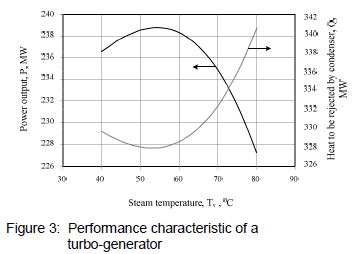
Consider a power plant in which the turbine exhaust steam is fed to three air-cooled condenser streets as shown in figure 1. The turbo-generator power output can be expressed in terms of the steam temperature, Tv, i.e.

while the corresponding heat to be rejected by the condenser is

where Tv is in oC. These curves are shown in figure 3.
For the present analysis, the one-dimensional numerical solution presented by Kröger7 is used for predicting the thermo-flow performance characteristics of an A-frame finned tube air-cooled condenser. A-frame details are given in Kröger7.
The turbo-generator power output for the steam turbine with three streets of A-frame air-cooled condensers is shown in figure 4.
Consider three streets of A-frame air-cooled condensers incorporating a hybrid (dry/wet) dephlegmator as shown in figure 2. thermo-flow performance characteristics of the different sections of the dry/wet condenser are analyzed employing a one-dimensional approach. The different components are:
□ A-frame finned tube air-cooled primary condensers
□ first stage of the hybrid dephlegmator, which is an air-cooled reflux condenser with inclined finned tubes
□ second stage of the hybrid dephlegmator consists of a horizontal plain tube bundle. mode of operation varies according to the performance requirements and the ambient conditions. The unit can either be operated dry as a secondary air-cooled condenser or it can be deluged with water and operated as an evaporative condenser
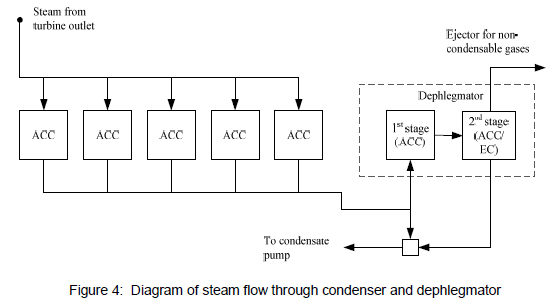
A schematic flowchart of the steam flow through one of the three streets of the condenser array is shown in figure 4.
Kröger's7 approach is also used in the analysis of the thermal-flow performance characterisitcs of the inclined finned tube bundles in the first stage of hybrid (dry/wet) dephlegmator.
Heyns and Kröger9 experimentally investigated performance characteristics of an evaporative cooler. Their results together with the one-dimensional Merkel type analysis were used to determine the performance characteristics of the evaporative condenser.
The thermal-flow performance characteristics of the horizontal galvanized steel tube bundle operated dry, are evaluated using a one-dimensional analysis employing the correlation Zukauskas and Ulinskas1 recommend for determining the convective air-side heat transfer coefficient for tube bundles in cross-flow and the pressure drop correlation recommended by Gaddis and Gnielinski11.
From the turbine performance characteristics given, the turbo-generator power output of the steam turbine with three streets of air-cooled condensers incorporating a hybrid (dry/wet) dephlegmator (operated in wet mode) is evaluated and shown in figure 5.
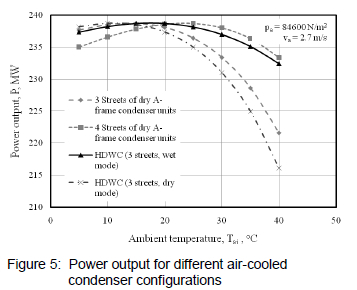
To reduce the water consumption, the second stage of the hybrid (dry/wet) dephlegmator need only be deluged with water during periods of high ambient temperatures or peak demand periods. The turbo-generator power output of the air-cooled condenser incorporating a hybrid (dry/wet) dephlegmator when operated in dry mode is shown in figure 4. Although, the power output when the hybrid (dry/wet) dephlegmator is operated dry at higher ambient temperatures is slightly less than that of the conventional A-frame arrangement, there is no noticeable difference at the design temperature (Ta ) 15.6 °C.
Based a study done by Boulay et al.6 on the oversizing of the air-cooled condensers, it was also decided to investigate the performance characteristics of the plant with four A-frame air-cooled condenser streets. As shown in figure 5, at higher ambient temperatures, the turbo-generator power output with three streets can be improved with the addition of a further street. At an ambient temperature of 40 °C, the increase in the power output for the turbine with this extra street is approximately 5 %. The increase in power output is only 1.7 % if the number of condenser streets is increased to five. Boulay et al.6 stated that the increase in the initial capital cost of the air-cooled condenser is directly proportional to the condenser size.
The power output for the hybrid (dry/wet) condenser (HDWC) operating in wet mode is almost the same as that for the dry air-cooled condenser with four streets. It is expected that the initial capital cost of the air-cooled condenser incorporating a hybrid (dry/wet) dephlegmator will, however, be considerably less than the cost of an additional street.
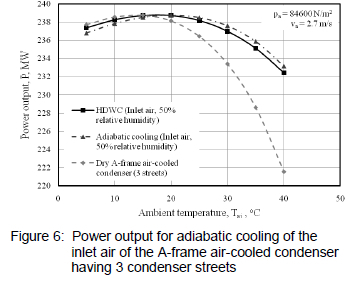
In section 1 the enhancement of an air-cooled condenser through the adiabatic cooling of the inlet air was discussed. The performance characteristics of the three street A-frame air-cooled condenser with adiabatic cooling (spray cooling) of the inlet air is compared to that of the three street A-frame air-cooled condenser incorporating a hybrid (dry/wet) dephlegmator. For the adiabatic cooling of the inlet air (assumed to be at a 50 % relative humidity), it is assumed that a 100 % wetbulb depression is achieved i.e. the drybulb temperature of the inlet air is lowered to the wetbulb temperature. Figure 6 shows that the power output is approximately the same for the air-cooled condenser with adiabatic cooling of the inlet air to that of the air-cooled condenser incorporating a hybrid (dry/wet) dephlegmator. In his studies Maulbetsch8 stated that wetbulb depression varied between 60 % and 100 %. The heat rejected by the air-cooled condenser shown in figure 6, where the inlet air is adiabatically cooled, will be lower when the wetbulb depression is not 100 %.
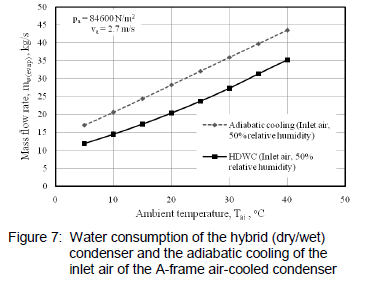
The water consumption of the air-cooled condenser incorporating a hybrid (dry/wet) dephlegmator and the air-cooled condenser with adiabatic cooling of the inlet air (having three condenser streets) is shown in figure 7. For ideal adiabatic cooling of the inlet air, it is assumed that all the water is evaporated. At high ambient temperatures where these systems would be considered, the water consumption of the air-cooled condenser with adiabatic cooling of the inlet air is more than 20 % higher than that of the air-cooled condenser incorporating the hybrid dephlegmator. Maulbetsch8 states that in reality only between 60 and 70 % of the water evaporates and the rest is lost in the form of entrained droplets in the air flow, increasing the effective water consumption rate of the air-cooled condenser with adiabatic cooling of the inlet air.
4. Conclusion
During periods of high ambient temperatures, a direct air-cooled condenser incorporating a hybrid (dry/wet) dephlegmator can provide the same increased turbo-generator performance as an over-sized air-cooled condenser or an air-cooled condenser with adiabatic cooling of the inlet air. It is expected that the increase in the capital cost of the air-cooled condenser incorporating a hybrid (dry/wet) dephlegmator will be considerably less than over-sizing the air-cooled condenser. For similar turbo-generator power outputs the water consumed by an air-cooled condenser incorporating a hybrid (dry/wet) dephlegmator is at least 20 % less than an air-cooled condenser with adiabatic cooling of the inlet air.
Acknowledgements
The authors would like to thank the California Energy Commission and the Centre for Renewable and Sustainable Energy Studies, Stellenbosch University, for their financial support.
References
1. Maulbetsch JS and DiFilippo MN. Cost and Value of Water Use at Combined-Cycle Power Plants. California Energy Commission, PIER Energy-Related Environmental Research, 2006.
2. Maulbetsch JS, Comparison of Alternative Cooling Technologies for California Power Plants: Economic, Environmental and other Tradeoffs, EPRI, Palo Alto, CA, and California Energy Commission, Sacramento, CA, 2002.
3. Lindahl P and Jameson RW, Plume abatement and water conservation with wet/dry cooling towers, CTI Journal 1993, 14(2). [ Links ]
4. Mitchell RD, Survey of Water-Conserving Heat Rejection Systems, EPRI report, Palo Alto, California, 1989.
5. De Backer L and Wurtz WM, Why Every Air-cooled Steam Condenser Needs a Cooling Tower, CTI Report, 2003.
6. Boulay RB, Miroslav JC and Massoudi M, Dry And Hybrid Condenser Cooling Design to Maximize Operating Income, ASME Report, Chicago, Illinois, 2005.
7. Kröger DG, Air-cooled Heat Exchangers and Cooling Towers, Tulsa, Oklahoma, USA, PennWell Corporation, 2004. [ Links ]
8. Maulbetsch JS and DiFilippo M, Spray Enhancement of Air Cooled Condensers, EPRI, Palo Alto, CA, California Energy Commision, Sacramento, CA and Crockett Cogeneration, 2003.
9. Heyns JA and Kröger DG, Experimental investigation into the thermal-flow performance characterisitcs of an evaporative cooler, Applied Thermal Engineering, 2010, 30 (5), 492-498. [ Links ]
10. Zukauskas A and Ulinskas R, Heat Transfer in Tube Banks in Crossflow, Wasington, DC: Hemisphere Publishing Corporation, 1988. [ Links ]
11. Gaddis ES and Gnielinski V, Pressure drop in cross flow across tube bundles, International Chemical Engineering 1985, 25, 1-15. [ Links ]
Received 7 September 2011
Accepted 27 August 2012
