



Services on Demand
Journal

Article
 English (pdf)
 Article in xml format
 Article references
 Automatic translation
 Send this article by e-mail
Indicators
Related links
-
 Cited by Google
 -
 Similars in Google
Share

 Permalink
South African Journal of Occupational Therapy
On-line version ISSN 2310-3833Print version ISSN 0038-2337
S. Afr. j. occup. ther. vol.55 n.3 Pretoria Dec. 2025
https://doi.org/17159/2310-3833/2025/vol55no3a11
MAPPING REVIEW
Exploring the Vona du Toit Model of Creative Ability: Applications, strengths, and weaknesses in occupational therapy - A systematic mapping review
Daleen CasteleijnI; Wendy SherwoodII; Kate CoulsonIII
IDepartment of Occupational Therapy. School of Health Case Sciences, Faculty of Health Sciences, University of Pretoria, Bophelo Road Gezina, Pretoria, Gauteng, South Africa. https://orcid.org/0000-0002-0611-8662
IIInternational Creative Ability Network (ICAN), Hillcroft Crescent Watford Hertfordshire, United Kingdom. https://orcid.org/0000-0002-5844-3037
IIINorth Somerset Council, Clevedon, United Kingdom. https://orcid.org/0009-0000-4964-7188
ABSTRACT
The Vona du Toit Model of Creative Ability (VdTMoCA) is an occupational therapy practice model rooted in the work of South African occupational therapist Vona du Toit in the 1960s and 1970s. While the model is increasingly applied in predominately South Africa and the UK and included in several pre-registration occupational therapy curricula, there is limited published literature exploring its use in clinical practice. To date, only one publication addresses its presence in occupational therapy education, and no comprehensive review has mapped its clinical application. This study aimed to fill that gap through a Systematic Mapping Review, which is suited to broad topics and provides an overview of existing literature without focusing on a single research question. A total of 30 papers were retrieved and charted. Findings indicate that the VdTMoCA is used across diverse clinical and non-clinical settings and supports therapists throughout the entire occupational therapy process. It offers a structured approach to assessing and treating clients with varying levels of volition, motivation, and occupational performance, particularly in complex mental health and forensic contexts. The model enhances clinical reasoning, justifies intervention choices, and strengthens professional identity. This review also highlights gaps in research that warrant further investigation to support evidence-based practice.
IMPLICATIONS FOR PRACTICE
• The VdTMoCA is an occupational therapy practice model that guides the entire therapy process, supporting therapists in diverse clinical and non-clinical settings.
• The model demonstrates utility in addressing varying levels of motivation and action, and occupational performance among clients, enhancing assessment and outcome measurement capabilities.
• By enabling therapists to justify interventions based on clinical reasoning, the VdTMoCA enhances therapists' professional value and identity, particularly in addressing neglected aspects of occupational therapy, such as engagement of and effective therapy for individuals whose volition, motivation and occupational performance is severely impaired in mental health and forensic services.
Keywords: motivation and action, health and well-being, clinical reasoning, occupational therapy intervention, evidence-based practice, levels of volition, occupational performance, mental health
INTRODUCTION
The Vona du Toit Model of Creative Ability (VdTMoCA)1 is an occupational therapy practice model originating from the work of the South African occupational therapist Vona du Toit in the 1960s and 1970s2. It has been referred to as the Model of Creative Ability3, the Model of Creative Participation and the Model of Motivation and Action before being revised and published in full as the VdTMoCA by Van der Reyden et al.1. The VdTMoCA is purported to guide occupational therapy assessment, intervention and outcome measurement, and to be applicable to all individuals across the lifespan, in ill-health and in wellness, in clinical and non-clinical contexts1,3.
The VdTMoCA explains the relationship between a person's volition and corresponding action. From a developmental perspective, changes in volition and action are observable in sequential levels of creative ability, meaning one's ability to create something new in the form of tangible or intangible products of one's effort in activity participation. Each level has three phases through which development, recovery or decline in creative ability occurs: therapist-directed, patient-directed and transitional phase. As part of the occupational therapy assessment, the Creative Participation Assessment form and the Creative Ability Assessment grid 1 are tools for identifying a person's level and phase of creative ability. The VdTMoCA is a practice model which, based on practice theory (theory of creative ability), provides a means for understanding the relationship between occupational therapy interventions and occupational performance1,4. Hence, in addition to guiding assessment, the VdTMoCA provides a detailed intervention guide to grading intervention to achieve stated therapy aims to sustain, recover or grow/improve a person's creative ability. Change in creative ability can be recorded on the assessment form, the grid and/or on the Activity Participation Outcome Measure (APOM)5.
Although the model has been used for over 50 years in South Africa6, the historical context of apartheid isolated occupational therapists internationally between 1960 to 1994 and the model was barely known outside of South Africa7. The introduction of the VdTMoCA to UK practice in 2003 stimulated revived interest in the model in South Africa, prompting research and publication activity. With a 22-year history in the UK8 , the VdTMoCA has become increasingly widespread in application and is known to be included in the curriculum of several pre-registration occupational therapy programmes predominantly in the UK and South Africa. However, the VdTMoCA has not been widely published, and to date, the model only features in one publication on the teaching of occupational therapy models in pre-registration occupational therapy education in South Africa9.
No review has been conducted on the use of the VdTMoCA by occupational therapists, therefore it is unclear where, how and why the VdTMoCA is used and to what effect. It is important for educators and clinicians to assess its relevance to current practice and inform occupational therapists seeking to engage in evidence-based practice. A systematic mapping review (SMR) was conducted to describe and graphically display the application of the VdTMoCA according to the occupational therapy process, its strengths and weaknesses and research gaps.
Review question
What is known about the use of the Vona du Toit Model of Creative Ability (VdTMoCA) by occupational therapists?
METHOD
Study Design
A systematic mapping review (SMR) is an organised method for gathering, analysing, and presenting data on a broad range of studies related to a particular topic10,11. An SMR review was chosen because rather than concentrating on a single research question or theory, it usually covers a large body of literature on a broad topic. This enabled mapping of the VdTMoCA's application as a practice model and identifying gaps in research of the model. Furthermore, the main goal of an SMR is to provide a descriptive summary of the evidence by classifying and summarizing previous studies12,13. In order to show the distribution of studies, techniques, findings, and important themes and trends, mapping review results are frequently displayed graphically using charts, graphs, or tables10,12,13. This facilitates the concise communication of complex information.
Finding gaps in the literature is a major result of an SMR, which can assist stakeholders in determining what further research is required and guide research goals10-13. Since SMRs concentrate more on outlining existing research than assessing the robustness of findings, included studies do not require the same degree of quality assessment as systematic reviews10,11.
A mapping review uses systematic techniques for finding, selecting and evaluating material, much like any other review. According to James et al.10 and Vanhala et al.11, this entails a well-defined search strategy, inclusion and exclusion criteria, and thorough documentation of the review procedure. Additionally, it is an iterative process in which researchers may modify their search tactics in response to preliminary results10. Therefore, the SMR was chosen as a suitable methodology to capture the breadth of literature on the VdTMoCA, including unpublished sources and low-level evidence studies.
The mapping process as described by Petersen et al.12 and James et al.10 were combined and comprised the following six stages.
Stage 1: Identifying the research question and the research team
The broad research question of this review was: what is known about the use of the VdTMoCA by occupational therapists? The broad question was split into four sub-questions:
1. In what clinical and non-clinical fields is the VdTMoCA applied to occupational therapy practice?
2. For which stages of the occupational therapy process is the VdTMoCA used?
3. What are the strengths and weaknesses of the VdTMoCA?
4. Where are the gaps in research in the VdTMoCA?
Stage 2: Conducting a search for the primary studies in the VdTMoCA
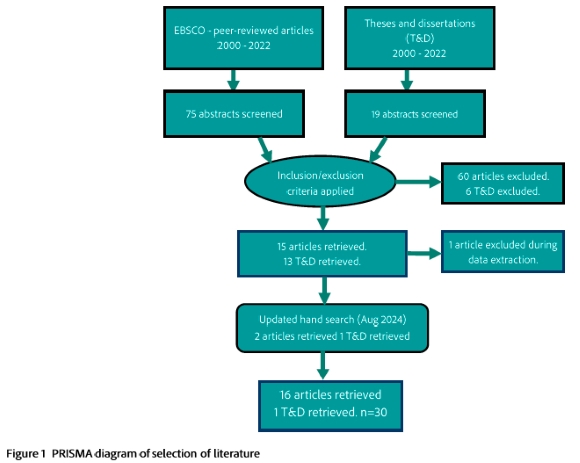
A health systems librarian was consulted to support the development and accuracy of the search strategy. Nine electronic database searches were completed on the 4th February 2022 using Ultimate, Africa-wide Information, APA Psyclnfo, Cinahl Complete, Medline Complete, Psychology & Behavioural Science Collection and SoclNDEX for literature published between 2002-2022 The search terms were "Vona du Toit" AND "Creative Ability" AND "creative participation"; "Occupational Therap*" AND "Creative Ability" AND "creative participation"; "Assessment" OR "intervention" OR "Outcomes" AND "Creative Ability" AND "creative participation". Relevant peer-reviewed literature in the form of research papers, editorials, theses (PhD) and dissertations (master's) were included in the search. A hand search was also completed of grey literature known to the authors. No reviews which summarise the literature on the VdTMoCA have previously been published. In August 2024, an update search was conducted, and three more publications were added.
Stage 3: Screening and identifying the primary papers
Literature was included if the application of the VdTMoCA in the occupational therapy process was described in any population. Opinion pieces had to focus on or discuss the VdTMoCA in more than 50% of the article. Theses and dissertations had to focus on aspects of the VdTMoCA and its application to practice. Two authors evaluated each piece of evidence to see if it met the inclusion criteria using a checklist (Appendix A, page...). Any conflicts of opinion were resolved ata final meeting with all three authors to confirm eligibility.
Stage 4: Coding and generating a systematic map database
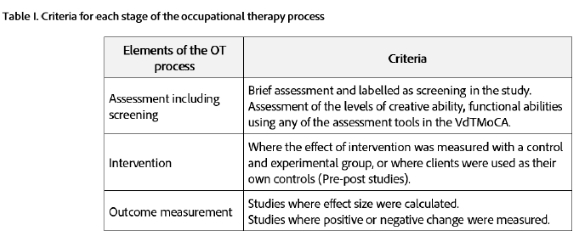
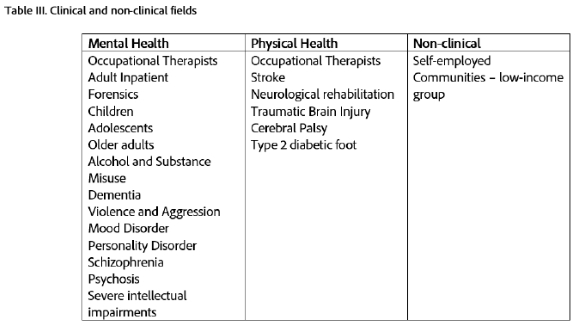
The Covidence software program was used to chart and code the data systematically and consistently according to set inclusion/exclusion criteria (Appendix A, page...) linked to the sub-questions of the study. Once consensus was reached between the three authors, full text articles were uploaded. The coding template (Table I, page 3) was used to extract the data consistently and objectively to increase the reliability of the extracted data. Clinical and non-clinical settings were coded as mental health, physical health or non-clinical. The occupational therapy process was coded as assessment or screening, intervention and outcomes measurement. Stages of the occupational therapy process were used to chart the application of the model (Table I, page 3). One study could have had more than one of the elements of the occupational therapy process.
Strengths and weaknesses were charted relating to any aspect of the VdTMoCA. Two authors charted information into the template of the Covidence software. All three authors met to get consensus resulting in the final data extraction. Data were then exported to an Excel spreadsheet and checked for errors.
We identified key areas requiring further study by comparing well-researched topics with those that were underrepresented or absent. These gaps were documented after data charting and narratively synthesised in the results and discussion sections.
Stage 5: Critical appraisal
Although critical appraisal of included studies are not usually done in SMRs, James et al.10 included this as an optional stage to identify robustness of the evidence base of the topic. We chose to include this step to report on the level of evidence of VdTMoCA studies using the Oxford Centre for Evidence-Based Medicine (OCEBM) scale for quantitative research13. This scale ranges from one (high level of evidence) to five (low level of evidence). For qualitative research we used the Critical Appraisals Skills Programme (CASP)14. The CASP uses 29 criteria questions that cover the entire research process. These are rated with a simple scale scoring one (no to the criteria question), two (can't tell) and three (yes to the criteria question).
Stage 6: Describing the findings
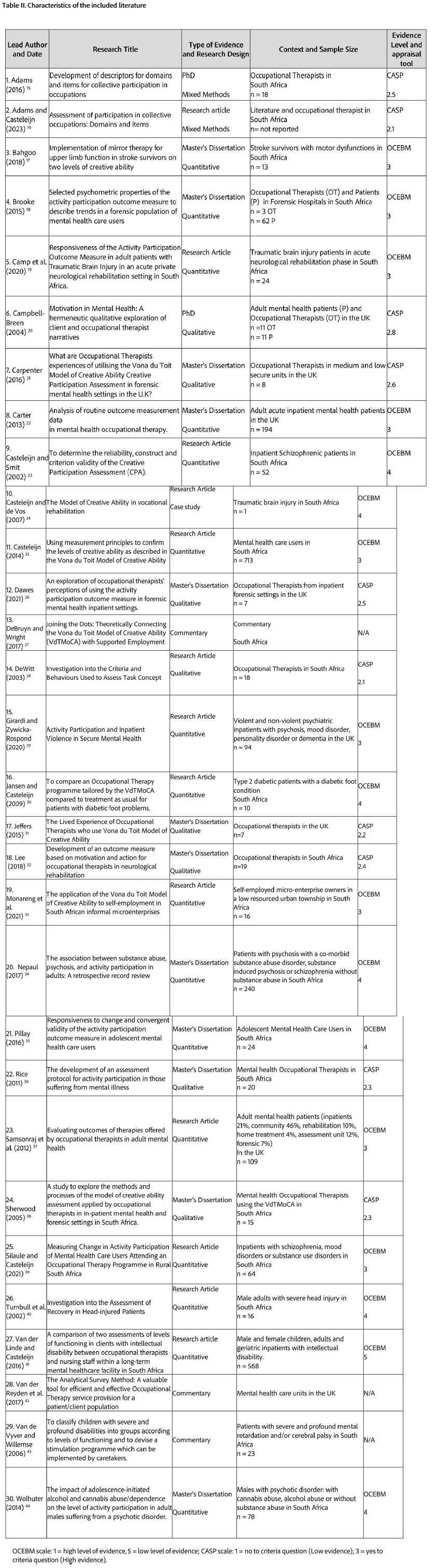
Characteristics of the included literature were collated (Table II, below) while data relating to the sub-questions of our review were coded as explained in the coding template (Table I, below). The results are presented in tables and figures.
Ethics:
No ethical clearance was required as no human participants were involved in the study.
RESULTS
A total of 30 papers were retrieved and charted. The PRISMA diagram (Fig. 1, below) shows the process of selecting articles as well as theses and dissertations (T&D) for the study.
Literature on the VdTMoCA covered a 22-year period from 2002-2024. Table II (below) shows the characteristics of the papers. The majority of research was completed in South Africa (n=20) and the UK (n=9). One cross-national study was done in South Africa and the UK.
Sixteen papers were published in peer reviewed journals, of these three were commentaries. There were 14 master's dissertations and PhDs in total. There was a mix of study designs with most research applying quantitative designs (n = 18), followed by qualitative studies (n = 6), and one case study. Critical appraisal of the quantitative studies highlighted that they range between 3 and 4 on the OCEBM, indicating a medium to poor level of evidence. In general, the qualitative studies were of a higher level of evidence, ranging from 2.1 - 2.8 using the CASP tool (Table II, below).
The results of the review are presented according to the four broad questions as outlined in the Method section.
Table III below summarises the clinical and non-clinical fields that were reported in the studies included in this mapping review.
1. In what clinical and non-clinical fields is the VdTMoCA applied to occupational therapypractice?
2. For which stages of the occupational therapy process is the VdTMoCA used?
The literature reports on the use of the VdTMoCA in the assessment (including screening), intervention and outcome measurement stages of the occupational therapy process. Of all the stages, assessment was reported on the most.
Assessment
The VdTMoCA's Creative Participation Assessment (CPA)1 was most frequently reported. Validity and reliability of the CPA have been established in a mental health patient population, but further investigations were recommended 23 , particularly in the field of intellectual impairment41. Carpenter21 found the CPA is suitable for use with patients of various diagnoses and presentations in forensic mental health. In adult mental health services, Samsonraj et al.37 found a good correlation between scores on the CPA and the Global Assessment of Functioning, but no correlation with the Canadian Occupational Performance Measure. In stroke rehabilitation and forensic mental health, the assessment is holistic19,40, and flexible for use with differing client populations without losing an occupational therapy focus 21,38. The VdTMoCA assessment informed risk management in forensic mental health services28,31,40 and a high security hospital23, and was a holistic presentation of clients' abilities.
The Creative Ability Assessment grid was used by Turnbull et al.40 for assessing adults with traumatic brain injuries and correlating the levels of creative ability with the Glasgow Coma Scale in 16 clients. The study suggests parallels between recovery of creative ability and neurobiological recovery in head-injured patients. Van der Linde and Casteleijn41 found excellent correlation between the CPA and the nursing tool, the FSHS, indicating their potential to both guide suitable activity design for occupational therapy and guide nurses in executing appropriate care plans and intervention. Rice36 developed the Activity Participation Assessment to assess domains of the model's APOM and showed good content validity. Adams15 developed a tool to assess creative ability in groups of people, i.e., collective participation. Adams' tool showed good content validity. Van der Vyver and Willemse43 used the VdTMoCA to inform the development of a screening tool which may help in formulating a sensory-based treatment approach for children with profound disabilities.
Intervention/Treatment
Informed by assessment of creative ability, therapists apply the VdTMoCA's level-specific treatment principles, which support clinical reasoning, and provide focused intervention at the 'just right' challenge, promoting engagement and meeting patients' needs19,20,28,31,33,40,44. In stroke rehabilitation, Bahgoo17 found the VdTMoCA useful for setting achievable treatment outcomes, creating a therapeutic environment, and designing and facilitating intervention, which enables clients to experience success and increase their motivation to further participate. Several studies underscored the importance of intervention to the lower levels of functioning as they often present with challenging behaviours19,21,26,42,45, or are unresponsive and unaware of their environment and who previously may have been deemed too unwell to receive occupational therapy services41 . The VdTMoCA thereby addresses an under-explored aspect of occupational therapy. Van der Reyden et al.42 developed a tool, the Analytical Survey Method for occupational therapy managers to evaluate and develop their service to ensure cost-efficiency and maximise therapeutic input in mental health service delivery.
Outside of clinical settings, Monareng33 found that the VdTMoCA is valued for predicting successful self-employment in a low-resourced community and predicting the support, supervision and therapeutic intervention needed to facilitate self-employment in South Africa. De Bruyn & Wright27 outlined the potential of the VdTMoCA to enable occupational therapists to provide suitable intervention to support clients in job roles through graded activities targeting levels of creative ability.
Outcome Measurement
The APOM was the most reported outcome measure5,19,20,21,24,28,31,35,36,38,41,46, followed by the CPA21 30·37. The APOM has sensitivity for detecting small change in patients with traumatic brain injuries, enabling identification of small changes in clients to justify service funding19. The APOM identified improvement post VdTMoCA-informed intervention in acute mental healt22 , and post usual occupational therapy in adolescent mental health35 . When used routinely to monitor changes in activity participation over periods of time, outcomes raised awareness that institutionalisation may account for no overall change in forensic clients after a certain period of time18 ; changes in violent and nonviolent patients29, and the optimal length of stay before inpatient adolescents ceased to make significant further progress 35. APOM scores were used to make predictions: about the ability of clients with psychotic disorders and substance abuse to live independently in the community34 44; potential acute mental health re-admission for clients in certain circumstances22; and the minimum level and phase of creative ability for adolescents in a mental health service to cope effectively within the school environment35.
Lee17 developed an outcome measure to determine clients' levels of creative ability in the field of neurology, and Adams15 developed a measure of collective participation, but both require testing in practice.
3. What are the strengths and weaknesses of the VdTMoCA?
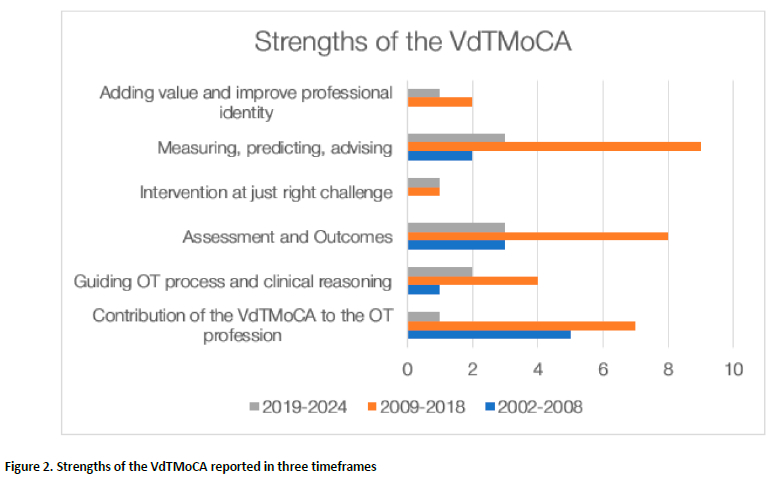
The strengths were analysed in themes of contribution of the VdTMoCA to the occupational therapy profession, guiding the occupational therapy process and facilitating clinical reasoning, providing relevant and sensitive assessment and outcome measurement tools, guiding intervention and the just right challenge, measuring, predicting and advising about patients' intervention and discharge, and adding value and increasing professional identity. Figure 2 (page 9) depicts the strengths of the VdTMoCA in three timeframes: 2002-2008,2009-2018, 2019-2024. Most strengths were reported in 2009-2018.
The utility of assessment and outcome measurement tools were the most reported strength, followed by the ability to measure, predict and advise on patient intervention and discharge. Within the theme of measuring, predicting and advising, several papers mentioned that the VdTMoCA enables clinicians to assess all clients, including the most significantly impaired for whom assessment has historically been problematic.
Similarly, the VdTMoCA enables intervention provision for all clients including the most severely impaired 32 38 41. Through utilising the model, therapists are confident in defining and demonstrating their professional identity and value, and to gain recognition for the valuable contribution occupational therapy makes to multidisciplinary teams and a service as a whole 21,26,31. Ultimately, job satisfaction as occupational therapists was experienced to a degree that was previously lacking before use of the VdTMoCA26.
Challenges and weaknesses
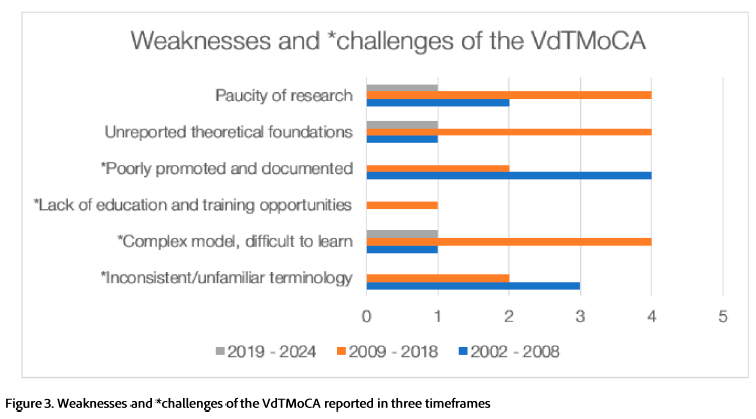
Only one study aimed to identify weaknesses of the VdTMoCA38 . However, the authors looked at all literature for mention of difficulties in understanding and utilising the VdTMoCA due to inherent shortcomings of the model. Issues emerged that were not indicative of weaknesses but challenges, related to learning and implementing it. As a result, a new category was established to encompass challenges. Figure 3 (page 9) indicates weaknesses, and challenges (indicated with *), most of which were reported between 2002-2018.
Prior to 2019, the VdTMoCA was poorly documented17,26,30,32 and was known by differing names, the inconsistency of which caused confusion for newcomers24. Some constructs lacked definitions at the time of the study31, and perceived as open to subjective interpretation21. Before 2019, the absence of a published Creative Participation Assessment form, made the model difficult to use15. In the period 2002-2018, VdTMoCA terminology was experienced as unfamiliar and complicated, posing a challenge to learning the model21
Table IV - Findings of the Systematic Mapping Review. (See attached documents)
Research gaps
The need for research was predominantly stated in relation to the findings of research undertaken. The most mentioned research needs were effectiveness or validation of the VdTMoCA with different client groups, in various contexts38,41 as well as in wellness43, and further testing of the CPA and APOM with different client groups23,25. The call for further validation of the CPA may be considered as superseded by Casteleijn's25 study, however, the omission of the last three levels of creative ability from this study means that their existence still needs to be established25.
Only nine papers mentioned the need for research. The majority were listed by Carpenter21 in relation to the field of forensic mental health and not all clearly arising from Carpenter's research findings, but research ideas. Carpenter21 suggests that research is needed into the benefits of the Model, specifically benefits to the multidisciplinary team of occupational therapists using the VdTMoCA and its compatibility with the Model of Human Occupation; facilitators and challenges of embedding the VdTMoCA within forensic services, the levels of creative ability as indicators of risk; and the VdTMoCA's terminology. New tools need a standardised protocol for their use40 . Guidelines need developing for enabling self-employment for people with disabilities 33 and for the application of the VdTMoCA with stroke patients17. Equally, the authors note that the testing of new assessment tools/approaches that utilise the VdTMoCA38,42, Lee's32 new outcome measure, and the utility of new VdTMoCA-informed intervention43 and the Analytical Survey Method42, are yet to be reported.
DISCUSSION
Our study is the first to identify and describe the literature on the use of the VdTMoCA by occupational therapists, its strengths, weaknesses and challenges.
VdTMoCA across a broad range of clinical and non-clinical populations
The VdTMoCA shows versatility in its applicability in clinical and non-clinical setting. While the model is known to be used with older persons47,48, and is purported to be applicable to young children45, there is a lack of VdTMoCA literature on the model's utility with these client groups.
In non-clinical settings, the levels of creative ability have enabled therapists to predict a person's readiness for work, influencing various community projects27,33. Given the prevalence of vocational training as an occupational therapy intervention in the UK46 , exploring the usefulness of the VdTMoCA in vocational rehabilitation47 and supporting employment is worthy of exploration.
Adams15 devised a tool to gauge creative ability levels within non-clinical community settings. The tool includes five domains and 19 items that help occupational therapists understand and assess the motivation, abilities, and dynamics of collectives to guide effective intervention and health promotion16. Uniquely, this study delves into creative ability within collective involvement rather than individual achievement. Communities frequently harbour invaluable local and indigenous knowledge and skills, which can be leveraged through collective engagement. Adams' tool holds the possibility to investigate and promote collective participation in communities, particularly in low and middle-income countries, to facilitate sustainable development that is inclusive and community drive1718.
The VdTMoCA in the assessment stage of the occupational therapy process
A strength of the VdTMoCA is that its assessment is flexible for use with a broad range of clients and presentations, enabling rapid intervention to promote recovery. This is partly due to being non-standardised, identified by some therapists as a benefit23,26,40. Non-standardisation allows individuals the time and freedom to show their volition and abilities24, which is important for assessing creative ability in any moment38. This is particularly relevant to therapists working with clients experiencing acute mental health disturbance48, as therapists must engage with rapidly fluctuating needs49,50. Some therapists perceived non-standardisation as a weakness because they are externally pressured to use standardised assessments31. If occupational therapists hope to show the true value of occupational therapy, what is needed are assessments and measurement tools that focus on the person, not the instrument51. This review indicates that therapists value the VdTMoCA non-standardised occupation-based assessment for enabling assessment of all clients, including the most impaired and difficult to engage.
The VdTMoCA and risk assessment
A strength of the VdTMoCA is the value of the levels of creative ability in predicting and advising on clients' occupational behaviour and performance. Of particular note, is therapists' contribution of level of creative ability knowledge to risk assessment in forensic practice29. The levels are useful for facilitating MDT discussion and gaining a shared understanding regarding clients' readiness for changes to risk management, and to test readiness before making major risk management decisions 21. Similarly, Dawes26 reported that therapists clinically reason the link between clients' levels and risk, putting meaning to risk behaviour and advising on what therapy resources should be made available to manage risk. Through the lens of the levels of creative ability, therapists are empowered to challenge other discipline's underlying assumptions regarding risk and readiness to engage with staff, and provide a different insight into reasons for particular behaviours21,29. As a result, therapists enable the MDT to realise a more sympathetic and less critical approach towards clients, which enhances staff support and prevents the team from setting unachievable patient goals21.
Using the 'just right' challenge in VdTMoCA-informed intervention
The concept of the just right challenge, pioneered by Ayres and Marr52, was consistently highlighted as a crucial component of intervention. The principle of grading challenges and facilitating satisfying participation is essential for enabling an experience of success and accomplishment, increase motivation for continued participation and ultimately, facilitate growth from one level and phase to the next19,20,26,28,31,33,40. Rebeiro and Polgar53 describe the just right challenge as essential for enabling initial and sustained occupational engagement.
An important strength of the VdTMoCA is that it enables occupational therapy at the 'just right challenge' for clients on the lowest levels, presenting as'low functioning', difficult to motivate, or with erratic and unpredictable behaviour and experienced by therapists as difficult to assess and treat24. Therapists identify what is and is not the 'just right challenge' in terms of intervention and in clients' daily living experience. This is a significant finding, as there is an absence of occupational therapy literature on this aspect of practice. The literature suggests that the VdTMoCA fills a gap in knowledge for therapists, despite use of other models31.
The levels and phases of creative ability enable therapists to anticipate or predict challenging situations for clients, assisting in smooth transitioning from hospital to community integration. Using the APOM as a measure, Wolhuter44 and Nepaul34 found that the overall level of creative ability for clients with psychotic disorders and substance abuse predicts difficulties living independently in the community, prompting targeted intervention. In adolescent mental health, trends in activity participation captured on the APOM indicated a minimum score (Passive Participation level, therapist-directed phase) for clients to be able to cope within the school environment 35 . APOM data also identified degree of decline in function on discharge and the need for ongoing community services39. Carter's22 research in acute mental health revealed that changes in phases within a level were more prevalent than shifts in entire levels, providing valuable insights to expectations of improvements from admission to discharge.
Furthermore, Carter22 suggests that it is possible to predict acute mental health re-admission for clients discharged below the Passive Participation level. Monareng33 also suggested a benchmark of Passive Participation is required before exploring self-employment as a work option for clients in rehabilitation.
The VdTMoCA and Outcome Measurement
The use of VdTMoCA tools has underscored the significance of outcome measurement in occupational therapy. The delineation of phases within levels of creative ability is a key feature of the VdTMoCA assessment and outcome measurement tools, enhancing its sensitivity in detecting subtle changes in occupational behaviour and activity participation. Casteleijn25 confirmed that the levels of creative ability with the phases in each level, follow a hierarchical order which resembles the characteristics of a linear or interval scale. This feature makes the APOM sensitive to change. Multiple studies have emphasised the APOM's sensitivity and responsiveness, particularly in illustrating changes during and after intervention20,21,24,28,37,41. Demonstrating the effectiveness of interventions has long been a focal point in occupational therapy research54,55. The VdTMoCA has emerged as capable of capturing and showcasing changes pre- and post-intervention, with potential to evidence the impact of intervention.
Clinical reasoning and professional identity
The VdTMoCA is valued for enabling clinical reasoning with confidence, justification of interventions to the MDT23,28,33, resulting in a positive professional identity23,28,33,40, and job satisfaction26. However, the lack of published research limits the implementation of the VdTMoCA, therefore there is a need for research and publication on the application to practice.
Learning the VdTMoCA: weaknesses and challenges
The VdTMoCA is a complex model requiring reading and experiential learning, preferably through an apprenticeship approach, but certainly over an extensive period28,33,40,60. This is challenging, particularly for occupational therapists in contexts where the VdTMoCA is not well-known8, as is the case in the UK20,21. Introducing the VdTMoCA to UK practice commenced in 20038, however, few qualifying therapists know it21. This impacts therapists' progress in developing their VdTMoCA knowledge as service provision is interrupted by teaching the model to new staff21 . Education must prepare students for practice, hence Carpenter21 calls for the VdTMoCA to be taught in pre-registration UK education. However, teaching a model is reliant upon educators' personal preferences56 and having adequate knowledge to do so, but such competence is only recently emerging in the UK
No terms were specified, but VdTMoCA terminology was experienced as unfamiliar and complicated, posing a challenge to learning the model23,40. Some terms lacked definitions, leaving them open to subjective interpretation23,33. Addressing this weakness has been critical through research Sherwood57 and the publication of the VdTMoCA text. Grasping new professional terminology and/or different interpretations of the profession's axioms is a known challenge in learning a new occupational therapy model58 . Each occupational therapy model should extend the knowledge of the profession59. This review indicates that the VdTMoCA is valued for its contribution to the knowledge and practice of occupational therapy, only possible through contributing new conceptualisations which in turn, necessitates new terms.
Need for research
As expected with a practice model purported to be applicable to all individuals and guide the entire occupational therapy process, there are many areas of the Model requiring research. It is important to recognise the significant differences in the economic, socio-cultural contexts of research and that not all research is generalisable. There is a need for more studies in different contexts and client groups. While there is valuable research utilsing the Model's outcome measures to discover important factors affecting client outcomes, it is essential to establish that positive outcomes are the result of the effectiveness of the VdTMoCA. As a practice model which details the what, how and why of occupational therapy, together with its outcome measures the VdTMoCA provides all that is needed to demonstrate the effectiveness of occupational therapy and identify what brings about change. There is therefore, tremendous scope for research that uses control groups and for detailed service evaluations42 . Finally, the need to testing and develop theory, although not explored in this review, should not be overlooked.
CONCLUSION
Our findings support Van der Reyden et al.'s1 assertion that the VdTMoCA is an occupational therapy practice model that guides the whole occupational therapy process. Occupational therapists can apply this model broadly for various client needs within clinical and non-clinical contexts. The VdTMoCA has good utility for serving individuals with varying degrees of volition, motivation and occupational performance, changes in which can be captured by the model's assessment and outcome measurement tools. The VdTMoCA enables therapists to provide clinically reasoned justification of interventions, improving therapists' sense of value and professional identity. The model's effectiveness in working with clients at lower levels of creative ability and those exhibiting challenging behaviours underlines its value in addressing a neglected aspect of occupational therapy, especially in mental health services. This suggests that the VdTMoCA is filling a gap in therapists' knowledge. Similarly, the VdTMoCA is making a significant contribution to occupational therapy and multidisciplinar/ service delivery in forensic services, previously highlighted as an area potentially needing a new occupational therapy model60. The model's weaknesses appear to relate to the limited extent of its documentation. As these weaknesses are only evident in literature pre-dating the 2019 publication of the VdTMoCA in full, it is unclear whether they have been adequately addressed. Findings regarding challenges support the assertion that the VdTMoCA is not a simple model which can be learned quickly. Research which provides insight into what it takes to learn and know the VdTMoCA is needed, taking into consideration the influence of pre-registration occupational therapy education. In preparing students for practice, occupational therapy programmes are encouraged to explore the extent to which the VdTMoCA is used in local services and consider the need to include the VdTMoCA in its curriculum.
Given the breadth of this review's aims, relatively little literature was found and much of it was unpublished. A valued uniqueness of the VdTMoCA is that it provides theory-driven, occupation-focused detail on how to design interventions for defined outcomes which can be captured by the APOM. Therefore, to meet an occupational therapy research priority to demonstrate the effectiveness of occupational therapy, develop evidence-based practice and demonstrate the value of occupational therapy, this review strongly encourages occupational therapists to undertake rigorous high-quality research into the link between VdTMoCA-informed intervention and outcomes. Furthermore, publication is essential.
Author Contributions
Daleen Casteleijn and Wendy Sherwood conceived the study and developed the protocol for the review. Daleen Casteleijn obtained the software to screen and chart the data and accessed the library resources of the University of Pretoria. All listed authors participated in the searching and screening of the literature, as well as charting the data. All three listed authors contributed to the writing up of the manuscript.
Conflicts of Interest
Daleen Casteleijn and Wendy Sherwood independently provide paid services for training in the VdTMoCA.
Acknowledgements
We acknowledge the support from the information specialist of the University of Pretoria who assisted with the search strings and database searches.
REFERENCES
1. van der Reyden D, Casteleijn D, Sherwood W, de Witt P. The Vona du Toit Model of Creative Ability: Origins, Constructs, Principles and Application in Occupational Therapy. Cape Town: Vona and Marié du Toit Foundation; 2019. [ Links ]
2. Watson L, Coetzee Z. Background and origins of the Vona du Toit Model of Creative Ability 1962-1974. In: D van der Reyden, D Casteleijn, W Sherwood, Witt Pd, editors. The Vona du Toit Model of Creative Ability: Origins, Constructs, Principles and Application in Occupational Therapy. Cape Town: Vona and Marié du Toit Foundation; 2019. p. 26-42. [ Links ]
3. de Witt P. Creative ability: a model for individual and group therapy for clients with psychosocial dysfunction, in (2014) In: R Crouch, Alers. V, editors. Occupational Therapy in Psychiatry and Mental Health. 5th ed. London: Wiley Publishers; 2014. [ Links ]
4. McColl MA, Law MC, Debra S. Theoretical basis of occupational therapy: Taylor & Francis; 2024. [ Links ]
5. Casteleijn D. Development of an outcome measure for occupational therapists in mental healthcare settings Pretoria: University of Pretoria; 2010. Retrieved from http://hdl.handle.net/2263/28019 [ Links ]
6. Joubert R. Theoretical paradigms and influences underpinning the development of the Vona du Toit Model of Creative Ability. In: D van der Reyden, D Casteleijn, W Sherwood, P de Witt, editors. The Vona du Toit Model of Creative Ability: Origins, Constructs, Principles and Application in Occupational Therapy. Cape Town: Vona and Marié du Toit Foundation; 2019. p. 44-56. [ Links ]
7. Joubert R. Exploring the history of Occupational Therapy's development in South Africa to reveal the flaws in our knowledge base. South African Journal of Occupational Therapy. 2010;40(3):21-6. [ Links ]
8. Sherwood W, Wilson S. International perspectives: an illustration of the VdTMoCA beyond South Africa. In: D van der Reyden, D Casteleijn, W Sherwood, Witt. Pd, editors. The Vona du Toit Model of Creative Ability: Origins, Constructs, Principles and Application in Occupational Therapy: Vona and Marié du Toit Foundation; 2019. p. 246-64. [ Links ]
9. Casteleijn D. The use of core concepts and terminology in South Africa. World Federation of Occupational Therapists Bulletin. 2012;65(1):20-7 https://dx.doi.org/10.1179/otb.2012.65.1.005. [ Links ]
10. James KL, Randall NP, Haddaway NR. A methodology for systematic mapping in environmental sciences. Environmental Evidence. 2016;5(1):7 https://dx.doi.org/10.1186/s13750-016-0059-6. [ Links ]
11. Vanhala E, Kasurinen J, Knutas A, Herala A. The Application Domains of Systematic Mapping Studies: A Mapping Study of the First Decade of Practice With the Method. IEEE Access. 2022;10:37924-37 https://dx.doi.org/10.1109/ACCESS.2022.3165079. [ Links ]
12. Petersen K, Vakkalanka S, Kuzniarz L. Guidelines for conducting systematic mapping studies in software engineering: An update. Information and Software Technology. 2015;64:1-18 https://dx.doi.org/10.1016/j.infsof.2015.03.007. [ Links ]
13. Howiek J, Chalmers I, Glasziou P, Greenhalgh T, Heneghan C, Liberati A, et al. Explanation of the 2011 Oxford Centre for Evidence-Based Medicine (OCEBM) Levels of Evidence (Background Document) Oxford Centre for Evidence-Based Medicine; 2011 [Available from: https://www.cebm.ox.ac.uk/resources/levels-of-evidence/ocebm-levels-of-evidencel. [ Links ]
14. Critical Appraisal Skills Programme (2019) CASP Checklist:. 10 Questions to help you make sense of a qualitative research 2019 [Available from: https://casp-uk.net/casp-tools-checklists/qualitative-studies-checklist/j. [ Links ]
15. Adams F. Development of descriptors for domains and items for collective participation in occupations. Johannesburg: University of the Witswatersrand; 2016. Retrieved from http://wiredspace.wits.acza/handle/10539/21262 [ Links ]
16. Adams F, Casteleijn D. Assessment of participation in collective occupations: Domains and items. South African Journal of Occupational Therapy. 2023;53(2):86-94 https://dx.doi.org/10.17159/2310-3833/2023/vol53n2a9. [ Links ]
17. Bahgoo B. Implementation of mirror therapy for upper limb motor function in stroke survivors on two levels of creative ability. Johannesburg: University of the Witwatersrand; 2018. Retrieved from https://hdl.handle.net/10539/25268 [ Links ]
18. Brooke C. Selected psychometric properties of the activity participation outcome measure to describe trends in a forensic population of mental health care users. Johannesburg: University of the Witwatersrand; 2015. Retrieved from http://hdl.handle.net/10539/18684 [ Links ]
19. Camp AL, Casteleijn D, Thupae D. Responsiveness of the Activity Participation Outcome Measure in adult patients with Traumatic Brain Injury in an acute private neurological rehabilitation setting in South Africa. South African Journal of Occupational Therapy. 2020;50(2):70-6 https://dx.doi.org/10.17159/2310-3833/2020/vol50no2a9. [ Links ]
20. Campbell-Breen T. Motivation in Mental Health: A hermeneutic qualitative exploration of client and occupational therapist narratives. Norwich: University of East Anglia; 2004 [ Links ]
21. Carpenter C. What are Occupational Therapist's experiences of utilising the Vona du Toit Model of Creative Ability: Creative Participation Assessment in forensic mental health settings in the U.K? : Oxford Brookes University; 2016 [ Links ]
22. Carter M. Analysis of routine outcome measurement data in mental health occupational therapy. Northampton: University of Northampton; 2013 [ Links ]
23. Casteleijn D, Smit C. The psychometric properties of the creative participation assessment. South African Journal of Occupational Therapy. 2002;32(1):6-11. [ Links ]
24. Casteleijn D, de Vos H. The Model of Creative Ability in vocational rehabilitation. Work. 2007,-55-61. [ Links ]
25. Casteleijn D. Using measurement principles to confirm the levels of creative ability as described in the Vona du Toit Model of Creative Ability. South African Journal of Occupational Therapy. 2014;44(1):14-9. [ Links ]
26. Dawes C. An exploration of occupational therapist's perceptions of using the APOM (Activity Participation Outcome Measure) in forensic mental health inpatient settings [Dissertation]. Northampton: University of Northampton; 2021 [ Links ]
27. de Bruyn M, Wright J. Joining the dots: Theoretically connecting the Vona du Toit Model of Creative Ability (VdTMoCA) with supported employment. South African Journal of Occupational Therapy. 2017;47(2):49-52 https://dx.doi.org/doi.org/10.17159/2310-3833/2017/v47n2a10. [ Links ]
28. de Witt P. Investigation into the criteria and behaviour used to assess task concept. South African Journal of Occupational Therapy. 2003,-33(1):4-7. [ Links ]
29. Girardi A, Zywicka-Rospond M. Activity Participation and Inpatient Violence in Secure Mental Health. Occupational Therapy in Mental Health. 2020;36(4):394-410 https://dx.doi.org/10.1080/0164212X.2020.1831418. [ Links ]
30. Jansen M, Casteleijn D. Applying the model of creative ability to patients with diabetic foot problems. South African Journal of Occupational Therapy. 2009;39(3):26-32. [ Links ]
31. Jeffers C. The Lived Experience of Occupational Therapists who use Vona du Toit Model of Creative Ability [Dissertation]. Northampton: University of Northampton; 2015 [ Links ]
32. Lee S. Development of an outcome measure based on motivation and action for occupational therapists in neurological rehabilitation. Pretoria: University of Pretoria; 2018. Retrieved from http://hdl.handle.net/2263/69879 [ Links ]
33. Monareng LL, Franzsen D, Casteleijn D, van Biljon HM. The application of the Vona du Toit Model of Creative Ability to self-employment in South African informal microenterprises. South African Journal of Occupational Therapy. 2021;51 (2):74-81 https://dx.doi.org/10.17159/2310-3833/2021/vol51n2a10. [ Links ]
34. Nepaul Q. The association between substance abuse, psychosis and activity participation in adults: A restrospective record review. (MSc dissertation).. Johannesburg: University of the Witwatersrand; 2017. Retrieved from https://hdl.handle.net/10539/25608. [ Links ]
35. Pillay S. Responsiveness to change and convergent validity of the Activity Participation Outcome Measure in adolescent mental health care users. Johannesburg: University of the Witwatersrand; 2016. Retrieved from http://hdl.handle.net/10539/21311. [ Links ]
36. Rice C. Activity participation assessment (APA): The development of an assessment of activity participation for those suffering from mental illness. Johannesburg: University of the Witwatersrand; 2011. Retrieved from http://wiredspace.wits.ac.za/handle/10539/11692 [ Links ]
37. Samsonraj RSP, Loughran MFE, Seeker J. Evaluating outcomes of therapies offered by occupational therapists in adult mental health. Journal of Mental Health. 2012;21(6):531-8 https://dx.doi.org/10.3109/09638237.2011.638000. [ Links ]
38. Sherwood W. A study to explore the methods and processes of the model of creative ability assessment applied by occupational therapists in in-patient mental health and forensic settings in South Africa.: University of Greenwich; 2005 [ Links ]
39. Silaule O, Casteleijn D. Measuring change in activity participation of mental health care users attending an occupational therapy programme in rural South Africa. South African Journal of Occupational Therapy. 2021;51(3):63-73 https://dx.doi.org/10.17159/2310-3833/2021/vol51n3a8 [ Links ]
40. Turnbull AI, de Witt PA, Concha M. Investigation into the Assessment of Recovery in Head-Injured Patients. South African Journal of Occupational Therapy. 2002;32(1):2 -18. [ Links ]
41. Van der Linde J, Casteleijn D. A comparison of two assessments of levels of functioning in clients with intellectual disability between occupational therapists and nursing staff within a long-term mental healthcare facility in South Africa. Curationis. 2016;39(1):a1665 https://dx.doi.org/10.4102/curationis.v39i1.1665. [ Links ]
42. van der Reyden D, Wilson S, White B. The Analytical Survey Method: A valuable tool for efficient and effective Occupational Therapy service provision for a patient/client population. South African Journal of Occupational Therapy. 2017;47(3):53-62 https://dx.doi.org/10.17159/2310-3833/2017/v47n3a10. [ Links ]
43. Van der Vyer T, Willemse I. Paediatric Multiple Disability Screen (PMDS): A screening tool for the profoundly disabled individual. South African Journal of Occupational Therapy. 2006;36(2):14-8. [ Links ]
44. Wolhuter KA. The impact of adolescence initiated alcohol and cannabis abuse/dependence on the level of activity participation in adult males suffering from a psychotic disorder. Johannesburg: University of the Witwatersrand; 2014. Retrieved from http://hdl.handle.net/10539/17399. [ Links ]
45. Janse Van Rensburg EJ. School readiness and creative ability. In: Sherwood W, editor. Perspectives on the Vona du Toit Model of Creative Ability: practice, theory and philosophy. 2nd ed. Watford: International Creative Ability Network; 2024. [ Links ]
46. O'Connell JE, McKay EA. Profile, Practice and Perspectives of Occupational Therapists in Community Mental Health Teams in Ireland. British Journal of Occupational Therapy. 2010,73(5):219-28 https://dx.doi.org/10.4276/030802210x12734991664228. [ Links ]
47. Van Heerden C. Vocational Rehabilitation in the UK: How occupational therapy can contribute. In: McKay EA, Craik C, Lim KH, G. R, editors. Advancing Occupational Therapy in Mental Health Practice. Oxford: Blackwell Publishing; 2008. [ Links ]
48. Bryant W, Cordingley K, Sims K, Dokal-Marandi J, Pritchard H, Stannard V, et al. Collaborative research exploring mental health service user perspectives on acute inpatient occupational therapy. British Journal of Occupational Therapy. 2016,79(10):607-13 https://dx.doi.org/10.1177/0308022616650899. [ Links ]
49. Birken M, Bryant W. A Photovoice study of user experiences of an occupational therapy department within an acute inpatient mental health setting. British Journal of Occupational Therapy. 2019,-82(9):532-43 https://dx.doi.org/10.1177/0308022619836954. [ Links ]
50. Lloyd C, Lee Williams P. Occupational therapy in the modern adult acute mental health setting: a review of current practice. International Journal of Therapy and Rehabilitation. 2010,17(9):483-93 https://dx.doi.org/10.12968/ijtr.2010.17.978038. [ Links ]
51. Velozo CA. Using Measurement to Highlight Occupational Therapy's Distinct Value. The American Journal of Occupational Therapy. 2021,75(6) https://dx.doi.org/10.5014/ajot.2021.746001. [ Links ]
52. Ayres AI, Marr DB. Sensory integration and praxis tests. In: AG. Fisher, EA Murray, Bundy. AC, editors. Sensory Integration: Theory and Practice. Philadelphia: F. A. Davis; 1991. [ Links ]
53. Rebeiro KL, Polgar JM. Enabling occupational performance: optimal experiences in therapy. Can J Occup Ther. 1999;66(1):14-22 https://dx.doi.org/10.1177/000841749906600102 [ Links ]
54. Estrany-Munar MF, Talavera-Valverde M, Souto-Gómez Al, Márquez-Álvarez U, Moruno-Miralles P. The Effectiveness of Community Occupational Therapy Interventions: A Scoping Review. Int J Environ Res Public Health. 2021;18(6) https://dx.doi.org/10.3390/ijerph18063142. [ Links ]
55. Plastow N A, de Wit M, Brown M, de Kock M, Pretorius P, Pienaar S, et al. Mapping Effectiveness Studies of Occupational Therapy in Africa: A Scoping Review. Occup Ther Int. 2023;2023:6688222 https://dx.doi.org/10.1155/2023/6688222. [ Links ]
56. Vermaak ME, Nel M. From paper to practice - academics and practitioners working together in enhancing the use of occupational therapy conceptual models. South African Journal of Occupational Therapy. 2016;46(3):35-40. [ Links ]
57. Sherwood W. An investigation into the theorectical construction of effort and maximum effort as a contribution to the theory of creative ability. Johannesburg: University of the Witwatersrand; 2016. Retrieved from http://hdLhandle.net/10539/21261 [ Links ]
58. Seymour A, Boniface G, Ingham L. Myths around using theory in occupational therapy practice. Using Occupational Therapy Theory in Practice. 2012:180-7. [ Links ]
59. Creek J, Feaver S. Models for practice in occupational therapy: Part 2, what use are they? British Journal of Occupational Therapy. 1993;56(2):59-62. [ Links ]
60. Duncan EAS, Munro K, Nicol MM. Research priorities in forensic occupational therapy. British Journal of Occupational Therapy. 2003;66(2):55-64. [ Links ]
 Correspondence:
Daleen Casteleijn
Email: Daleen.casteleijn@up.ac.za
Submitted: 1 July 2025
Reviewed: 7 August 2025
Accepted: 9 August 2025
EDITOR
Blanche Pretorius
https://orcid.org/0000-0002-3543-0743
DATA AVAILABILITY
Upon reasonable request, from corresponding author
FUNDING
This research received no specific grant from any funding agency in the public, commercial, or non-profit sectors
Supplementary Data
The supplementary data is available in pdf: [Supplementary data 1] [Supplementary data 2]