




Services on Demand
Journal

Article
 English (pdf)
 Article in xml format
 Article references
 Automatic translation
 Send this article by e-mail
Indicators
Related links
-
 Cited by Google
 -
 Similars in Google
Share

 Permalink
Critical Studies in Teaching and Learning
On-line version ISSN 2310-7103
CRISTAL vol.12 n.2 Cape Town 2024
https://doi.org/10.14426/cristal.v12i2.2091
ARTICLES
Sharing vulnerability: A duoethnographic enquiry into the development of digital competencies at a South African university
Kristien Andrianatos; Janelize Morelli
North West University, South Africa
ABSTRACT
The duoethnographic enquiry discussed in this article grapples, in a dialogical way, with our experiences of professional learning while seeking to increase our digital competencies. The process involved happened while we were learning to use Mentimeter, an interactive presentation software. The purpose of this duoethnographic enquiry is not to provide solutions or shortcuts through a sharing of our professional learning journey. Rather we share our experiences in the hope that other higher education (HE) educators will join the conversation and reflect on their digital competencies journey. In this paper, we first present the background followed by a brief discussion of the HeDiCom framework of HE educators' digital competencies. Then we briefly discuss duoethnography as a method. Our three main findings are presented as conversations, followed by a discussion in which we weave the insights from our conversations into a critical reflection on the applicability of the HeDiCom framework.
Keywords: digital competencies, duoethnography, educational technology, interactive presentation software, HeDiCom framework, pedagogical vulnerability
A poetic introduction1
Being vulnerable together: A two-voice poem by HE educators
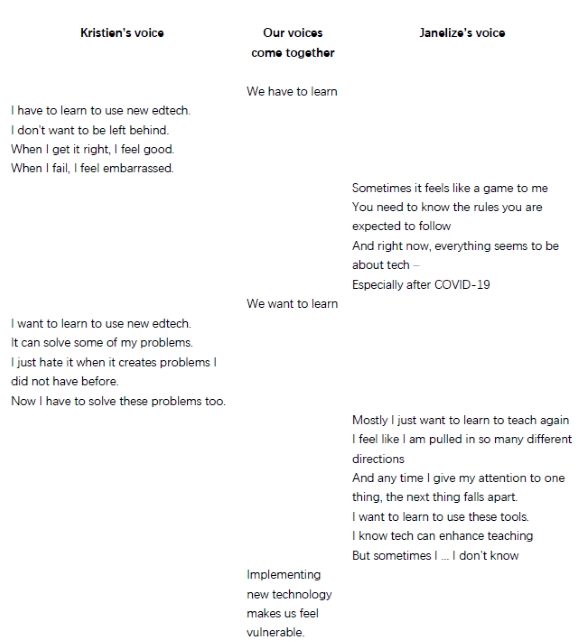
In this duoethnographic enquiry, we, Kristien and Janelize, view ourselves, as researchers and educators, as the site of research. The duoethnographic research method enabled us to construct understandings of our professional learning journey towards developing digital teacher competencies. The duoethnographic enquiry was informed by our monthly discussions, our own professional experience, our own theorisation, and our reading of scholarly work. We believe that a duoethnographic approach was well suited to conducting this study, as duoethnographers view their lived experiences as part of a learning curriculum (Norris & Sawyer 2016; Sawyer & Norris 2015). Our intended readers are our fellow lecturers who grapple with developing their digital competencies. In this paper, we present the background to the study, a brief discussion of the Higher Education Digital Competency (HeDiCom) framework of higher education teachers' digital competencies, a section on duoethnography, our three main findings in the form of conversations, a discussion and, finally, a conclusion.
Background
The digital revolution is impacting and shaping the world around us (Kwet & Prinsloo, 2020). Globally, Higher Education (HE) institutions are on a 'shifting landscape' (Gartner Insights, 2021), as they harness or plan to harness rapidly advancing technology in pursuit of their strategic goals. One such goal is the enhancement of teaching and learning (Khlaif, et al., 2023). In South Africa, the drive to harness technology in HE was accelerated by the COVID-19 pandemic. In the years after the pandemic, the drive has a continuing momentum, due to factors such as the opportunities for broader access, expanding possibilities for generating and sharing knowledge, and innovation and creativity in teaching and learning practices (Dos Santos, et al., 2023; Mhlanga, et al., 2022; Rof, et al., 2022). HE educators are important role players in universities and need to embrace the opportunities offered by advancing technologies by developing their own digital competencies. Indeed, Tondeur, et al. (2023) emphasise the increased focus on digital competencies in HE. These researchers also point out that there is an expectation that HE educators must be able to 'adequately use digital technologies to strengthen their teaching practice and enhance their educational practice' (Tondeur, et al., 2023: 34). Furthermore, Farias-Gaytan, et al. (2023: 8) explain that digital competencies 'involve not only the mastery of technology but also the improvement of teaching practice with the appropriate pedagogical use of technology to contribute to student learning'. Two examples of such digital competencies are the use of digital technologies to interact with students during the learning process and the continuous evaluation of the effectiveness of digitally enhanced teaching strategies (Redecker, 2017).
The emphasis on acquiring digital competencies is also apparent at the South African university where we are employed. The university has published a digital business strategy, that outlines how our institution 'will transform its culture and coordinate its efforts to maximise opportunities afforded by the Fourth Industrial Revolution technologies ... to achieve its mandate and position itself for the future' (North-West University, 2023: 4). Phrases in the strategy document such as 'digital dexterity gaps must be addressed', and 'attract digitally savvy academics', communicate certain expectations regarding HE educators (North-West University, 2023: 13, 16). Such expectations, as well as other considerations, like the benefits of educational technologies (edtech) (Akour &Alenezi, 2022; Luckin & Cukurova, 2019), steer educators towards the need for professional learning to better implement edtech in our teaching and learning practices. Learning the requisite competencies came with challenges that, in our case, rendered us vulnerable (Mangione & Norton, 2023). It was this mutual sense of vulnerability that spurred us to consider more deeply our own experiences when developing our digital competencies.
We agree with Naylor and Nyanjom (2020) that HE educators' experience in teaching with technology has not been well researched. This ties in with the recommendation that more attention should be given to the development of HE educators' digital competencies (Tondeur et al., 2023). Cutri and Mena (2020) also point to the need for a better understanding of HE educators' personal experiences in dealing with unfamiliar edtech. This need links with Ter Beek and colleagues' (2022: 2) acknowledgement that implementing unfamiliar edtech 'is a complex, multilayered and social process'. With this paper, we contribute to filling this lacuna, using the method of duoethnography to present firsthand accounts of our experiences. We chose to document our professional learning journey in terms of digital competencies with Mentimeter (mentimeter.com), as an example of edtech software to which we have access.
Theoretical framework
The Higher Education Digital Competency (HeDiCom) framework speaks to the process of developing digital competencies in higher education (Tondeur, et al., 2023). The framework was created in response to the growing importance of digital competencies in higher education, especially after the COVID-19 pandemic. The context in which the HeDiCom framework was developed relates directly to the context in which this study is situated - making it an appropriate framework for this article. Unlike other frameworks, which focus on secondary education or general digital literacy, the HeDiCom framework specifically addresses the needs of HE institutions and teachers (Tondeur, et al., 2023). The HeDiCom framework provides a clear roadmap for professional learning regarding digital literacies.
Furthermore, this framework emphasises the role of university teachers in creating digitally enriched learning environments (Tondeur, et al., 2023). This framework revolves around four core dimensions (Albashiri, et al., 2024). These dimensions address educators' comprehensive digital literacy needs in the rapidly shifting higher education landscape. The four dimensions of the HeDiCom framework are:
1. Teachers' Digital Practice: This dimension focuses on designing and implementing technologically enriched learning environments. Teachers must integrate digital technologies into their teaching strategies by creating ICT-rich environments aligned with institutional objectives and educational goals. The backbone of this dimension is the ability to design, implement, facilitate, and evaluate digital learning activities (Tondeur, et al., 2023). Creating such activities necessitates that the HE teachers develop strong digital competencies.
2. Empowering Students: This dimension emphasises teachers' critical role in preparing students for a digitally driven world. It highlights the need for students to develop digital literacy for academic success and to thrive in an increasingly digital world. HE teachers are encouraged to guide students in developing the skills necessary for responsible digital participation, including ethical use of digital tools, personal data management, and information literacy. This dimension also addresses the need to ensure students are well-versed in the technologies that apply to their professions (Tondeur, et al., 2023).
3. Digital Literacy: An HE teacher's ability to incorporate digital tools effectively into their teaching practices is essential for the success of the HeDiCom framework. Beyond only requiring higher education teachers to develop the skills and knowledge of applicable ICTs, this dimension also requires critical reflection on the ethical dimensions of including ICTs in the higher education classroom, such as concerns relating to student data privacy and the ethical use of technologies (Tondeur, et al., 2023).
4. Professional Learning and Development: The final dimension addresses the continuous professional growth of HE teachers, focusing on their ability to innovate in their teaching practices through ICTs. This dimension stresses the importance of professional networks, online learning communities, and research to maintain a forward-looking approach to digital education. Continuous learning ensures that HE teachers can adapt to the fast-paced changes in digital education and lead the way in implementing innovative digital teaching practices (Tondeur, et al., 2023).
Each of these dimensions is interconnected, highlighting the integrated nature of the HeDiCom framework. HE teachers' competencies in one dimension may influence their competencies in another dimension. Therefore, improving teachers' digital literacy could develop their capacity to empower students in a digital society or to communicate more efficiently in a digitised institution. The interdependencies of dimensions in this framework highlight the reality that digital competencies are not developed in isolation but form part of a complex ecosystem. We believe this framework is valuable because it acknowledges that interdependencies and complex systems are part and parcel of developing digital competencies as a HE teacher. However, we also wish to use our experiences to highlight concerns about the framework and the uncritical acceptance of this or other digital competencies frameworks. An in-depth discussion of this issue will take place in this article's discussion section.
Duoethnography
Campbell-Chudoba (2024) defines duoethnography as a social phenomenological research method, rooted in ethnography. She succinctly summarises the tenets of this methodology as follows: 'prescriptive approaches are to be avoided, individual voices should be explicit, differences are strengths, and shifts in perspectives are vital' (Campbell-Chudoba, 2024: 2).
In duoethnography, the researchers aim to unravel the tacit process of learning and becoming through their reflexive dialogue. As the authors are also participants in the study, the necessary ethics approval was obtained from the Basic and Social Sciences Research Ethics Committee of the North-West University.
Since duoethnography is a dialogic research strategy, we believe that this inquiry's strategy supported our critical understanding of our own learning experiences regarding our digital teacher identity development (Sawyer & Norris, 2015). The emergent nature of deuoethnographies also enabled us to explore our developing digital competencies in the flux of teaching and learning (Deckman & Ohito, 2020). We used monthly collaborative meetings as anchor points to provide a useful structure for the inquiry.
These monthly meetings also helped us to ensure that our using the experiences of the self as a curriculum (curere) remained 'mutual and reciprocal' (Norris & Sawyer, 2016: 13). Due to the reciprocal exchange of experience and learning we were able to tell a story that is autobiographical in nature but also gives 'meaning to a given phenomenon and how those meanings were transformed over time' (Breault, 2016: 778). Our different teaching contexts further support the critical exploration of our experiences. Janelize is in the School of Music, primarily teaching small contact classes with about 10 students in a class. Kristien is in the School of Languages and facilitates up to 800 students per course online. Our different positionalities within the same HE institution makes duoethnography an appropriate strategy of inquiry.
The data consisted of written reflections before and after using the edtech in our classes. These reflections were then captured as dialogues between us on Microsoft Teams (MS Teams). The dialogical nature of our data gathering enabled us to ensure that the individual voices remained explicit (Breault, 2016). Furthermore, we recorded and transcribed our online meetings as part of the data set. We also included the Mentimeter presentations we created for our classes and used these presentations as elicitation devices during our online meetings. During the online meeting, one of us would open our Mentimenter presentation and share the screen. Then we discussed aspects that interested us.
Trustworthiness is often questioned in a duoethnographic study. We employed the following six measures to try to ensure the trustworthiness of our findings: 1) ensuring internal coherence between the research problem, strategy of inquiry and theoretical frameworks employed (Carter, 2010); 2) we employed an adapted construct validity framework (Ellis, et al., 2011); 3) we collaboratively coded and negotiated the meanings we ascribed to the data (Leavy, 2020); 4) we added to reflexivity by documenting our respective internal dialogues, specifically focusing on moments of discomfort and exploring the vulnerability attached to these moments (Ellis, 2004); 5) we employed memo-writing to add transparency during the study's data analysis stage and to ensure that this study makes a substantive contribution to the discipline; and 6) we presented initial findings at a teaching and learning conference.
The following section of the article is presented in a dialogic manner. Three conversations are presented in the form of dialogic storytelling, organised by question prompts. In the first conversation, we discuss our need for enhancing student participation with edtech. In the second conversation, we discuss the thematic analyses of our documented experiences and in the third conversation we discuss new insights.
Conversation 1: Origin of our story
Whiere did our journey begin?
Kristien: Our collaboration began with an invitation on an electronic sign-up form that I sent out to HE educators in my faculty, to join a community of practice (COP) that centered on teaching with technology. You responded quickly Janalize, expressing your enthusiasm to join and then drew my attention to an error on my electronic sign-up form. I felt embarrassed by this error, as the convenor of a COP about technology should at least be able to set up an electronic sign-up form correctly, but I was grateful that you wanted to join. During an online meeting of the COP, both of us expressed our interest to use new software in teaching and learning and document our experiences. I think that the COP created a safe space for us to get to know each other and to learn together.
To meet the institutional expectations of my role as an educator for online students, I have undergone training in online facilitation but, although (on paper) I am pedagogically prepared for this environment (Burke, et al., 2022), I do not think of myself as technologically competent. The course is mostly asynchronous, but I have a number of optional synchronous sessions with my students in MS Teams. In past sessions, I experienced very little student participation. My camera was always on, but I only saw the names or pseudonyms of the attending students as they kept their cameras and microphones switched off. I typically take the students through my prepared slides and I use a questioning technique (Buchanan Hill, 2016) to encourage students to participate. To my dismay, students rarely turned on their microphones to answer and there were limited responses in the chat. It seems that this is a tendency recorded by other online teachers as well (Ermawati, et al., 2021; Kohnke & Moorhouse, 2022). This lack of interaction made me feel very incompetent in the online environment. I had expectations of myself as a presenter of online sessions that I could only meet when I could interact with my students. This made me realise that I needed a tool to increase the online participation of students who choose to attend the synchronous sessions.
Janelize: It is so funny to see what impact that first interaction had on you because I cannot even remember you making the mistake on the form. I just remember being very excited to join the community of practice because I felt so isolated in my School where I was the only one trying to figure out the stuff around teaching with technology. My isolation made me reflect even more on the importance of relationality in teaching. I have always thought of my teacher identity relationally - through the lens of an ethic of care (Noddings, 2018). I do not feel particularly inept - perhaps it is because I grew up professionally with tech around me. I have used an iPad as part of my teaching since the first day I walked into my first job as high school teacher. But I had not thought critically enough about the possibilities and limitations of using technology as part of my teacher-ness before the pandemic. During the pandemic I started feeling really lonely (Van der Merwe, et al., 2021). In the context of COVID-19 and the major issues we face regarding access to learning, I suddenly felt alone. As a HE educator who teaches in a small on-campus contact program, I felt isolated. I think this is, at least in part, where my interest in engagement through technology began. I wanted to know how I could connect with my students and continue to foster participation despite being geographically removed from them. Furthermore, many of my students enter the university from rural communities. This means that they can easily feel alienated or silenced in the university (Timmis, et al., 2019). It is important to find ways to draw these students in so that they readily take part in academia by, for example, voicing their opinion in class. This can be extremely difficult, since most of my students do not speak English as their first language. I have found that it can be quite challenging to walk the line between encouraging students to express themselves and not putting too much pressure or creating situations students may experience as humiliating. This is further compounded by the Eurocentric environment in South African HE (Zembylas, 2023). The epistemological violence students experience when entering HE (Heleta, 2016) could lead to a fear of participating in class discussions - something which can be detrimental to students in the classes I teach. To some extent then, I also see developing my own competencies with educational technologies as a social justice issue. I ask myself: 'To what extent can or should I be responsible for creating an environment where my students feel safe to participate and share their opinions?' Research has found that this participation is beneficial to students. According to Bond, et al. (2020), participation is the top-ranking indicator of student engagement and student engagement positively impacts student satisfaction and study success (Bowden, et al,. 2021; Burke, et al., 2022; Miller, et al., 2021; Searle, et al., 2021).
Kristien: This might sound selfish, but I need student interaction to meet my own expectations of being a good online session presenter. I want to think of myself as a competent online lecturer and if students do not participate, I feel like a failure. I agree with Mayhew, et al. (2020) that online participation will create a sense of togetherness and partnership between myself and my students. In those uncomfortable silences, while I waited for a student to respond, I felt very isolated and I started doubting myself. I needed to gauge if I am reaching my students and adding value. In front of an almost static MS Teams screen, I struggled to keep presenting content with my usual rigor and enthusiasm. Teaching online is my reality and this motivated me to look for ways to improve participation in my online sessions.
Why Mentimeter?
Kristien: All members of our COP had access to Mentimeter pro licences, funded by the larger community of practice project. Mentimeter is interactive presentation software, also referred to as student response systems (Trees & Jackson, 2007). According to Vallely and Gibson (2018), this software enables students to participate in online discussions with devices such as smartphones and laptops, and their input is displayed on the presenter's screen, almost instantly. I showcased Mentimeter during an online meeting of our COP. Using the unfamiliar edtech in front of my peers was a very daunting experience. On the one hand, I felt proud of myself for being able to showcase a new technology, but on the other hand, I was scared to look incompetent if the interactive slides did not work. I wanted my presentation to inspire a firm sense of the value of new software.
Janelize: Initially, when I first saw your showcase of Mentimeter I was very excited. Due to my small classes and the academic freedom I experience in my teaching context, I can easily adopt new technologies in my teaching and learning. I guess that is why I see myself as an early adopter (Liu, et al., 2020). Of course, I also inform my decision to adopt new technologies through pedagogic reflection, but I strongly believe that my context allows for a more fluid approach to incorporating new technology. I immediately saw Mentimeter as a possible way to increase student reflection and student participation in my classes. I think it is important to allow students to participate in different ways. I like the fact that Mentimeter allowed me to ask students to share their experiences working in the field anonymously. In Mentimeter, when you respond with your smartphone, no identification appears when the presenter shares student feedback. I think there is much we can learn if we acknowledge all our students as epistemological contributors (Mathebula, 2019). In particular, I think that acknowledging their epistemological contributions will help them feel heard. In my experience this was a little easier due to the immediate feedback, response, and recognition students experienced when sharing in class using Mentimeter.
Kristien: Mentimeter pro has multiple options for interactive slides and also allows existing presentations to be imported into the program. While I was excited about the possibilities, I was overwhelmed by the task of learning how to use the pro version of Mentimeter. I can relate to the term 'perpetual novice' used by Naylor and Nyanjom (2021: 1238), as I usually feel very incompetent when I have to, or want to, learn how to use a new edtech. I found the paper of Cutri and Mena (2020) on faculty readiness for online teaching, insightful. Although I figuratively 'ticked all the boxes' on an online teaching competency checklist, I doubted my readiness for Mentimeter. I believe that this doubt was rooted in unfamiliarity with the software and fear of the unknown.
Janelize: The availability of a pro license also played a role in my decision to incorporate Mentimeter into my modules. I guess it is another contextual factor that made it possible for me to adopt the application so quickly (Liu, et al., 2020). Despite finding myself in an enabling environment, the process of adopting a new teaching and learning technology definitely challenged perceptions I had about myself as an HE teacher and about the teaching and learning in my modules. In my context I used the Socratic approach very often. The Socratic approach refers to employing uncertainty as part of the learning process by using constantly probing questions to elicit deeper reflection (Frick, et al., 2010). This approach is often facilitated in a more traditional classroom setting through dialogue; therefore, in learning to use Mentimeter I also faced the challenge of thinking how I could adapt and adopt the tool to ensure that my pedagogical approach remained student centric and adhered to my own beliefs around the role of education in the conscientization and emancipation of students (Narita, 2014). I fully agree with Dison and Collett (2023: 90) that one's pedagogical approach should be 'infused with an ethic of care'.
Conversation 2: Reinterpreting our experiences and beliefs
The dialogic conversation in this section is the result of several documented discussions and MS Teams chat messages over four months. In this section, we weave a new text with a number of 'threads' (Sawyer & Norris, 2015: 9). These threads include a reinterpretation of our personal stories and beliefs as well as our diverse ways of understanding the three themes that we identified. The three themes are our goals with Mentimeter, emotional responses, and conflicts we experienced as we learned how to use Mentimeter. We phrase these themes as questions because in the spirit of duoethnography, we are not reaching definitive conclusions, but rather continuously exploring the emergent knowledge born from our collaborative reflection. The juxtaposition of different views within a theme is deliberate and we do not offer a resolution to all our challenges (Norris & Sawyer, 2016). We invite you, the reader, to recall and reconceptualise your own experiences as you synthesise our message, based on your unique life history.
What goals were we trying to achieve by implementing a new edtech in our classes?
Janelize: When I teach, I place a large emphasis on students setting their own learning goals. To me, setting goals is an integral skill my students need to master to enable them to successfully enter the workplace (Tseng, et al., 2019). So, for me as an educator it is similarly important to be very clear about my goals and objectives when I make pedagogical decisions. In this case, using edtech to enhance student participation in class discussions was a clear goal. I used it frequently to facilitate lectures with different student groups and also once during a professional development session I was leading for teachers. I particularly enjoyed using Mentimeter to facilitate student discussions around capita selecta topics. I had set up a poll to ask students to indicate their interest in four possible study topics. We then discussed their interests to eventually choose the two special topics to be included in the curriculum for that semester. I found it interesting that they chose one topic I resonated with and the other was the topic I least resonated with. Despite this, I was really glad that they used the poll freely and gave input into their own learning. I saw this type of self-directed learning as an initial step towards the kinds of social-justice pedagogies I wished to implement in the class in general. As such, using Mentimeter in this way laid the foundation for the kinds of social-justice oriented group work (Flemming & Ward, 2017) I wished to build in the class. In this instance I felt happy with the way in which I could build on my own digital competencies to support my pedagogical approach. In the past, when I had given students similar opportunities to make decisions about their own learning, they were often quiet, and the discussion was at times stilted. Learning a new skill and improving my own digital competency, in this instance at least, was very closely aligned with the general educational goals I have for my students.
Kristien: My main goal with using the edtech was to create a sense of togetherness between myself and the students who chose to attend the online sessions. Several researchers have emphasised the importance of this sense of community in an online environment (Bakardjieva, 2003; Bellamy, et al., 2021; Marino, 2015). I agree with what you mentioned earlier J, that participation is important for student engagement and ultimately student success, but in my opinion that pertains more to engagement with the content, as you did with the capita selecta topics. In my non-compulsory online sessions, my goal with the edtech was more to bring the students and myself together as a learning community than it was about students engaging with the content. In my context, the engagement with the content happens mostly asynchronously, when students should study the content and watch the explanatory videos.
Janelize: What I found interesting in reflecting on our pedagogical practices is that we had many similar objectives in our teaching. We both wanted to improve student participation. That seemed to be at the forefront, but when we discussed our experiences with learning to use Mentimeter I also noticed that we both wanted to have fun teaching (Mee Mee, et al., 2020) and that we wanted our students to have fun learning. I enjoyed using Mentimeter to create little gamified activities. This aligned with another goal I had set - to have fun.
Kristien: My subgoal in using Mentimeter was our university's digital transformation strategy. Not only was it important for me to use edtech to improve the sense of togetherness during my sessions, but I wanted to become knowledgeable for future decision making around existing and emerging edtech like this interactive software and how I can use it in my teaching and learning practices. Prior to this research project, I participated in an institutional awards programme focused on excellence in online teaching and learning. For my portfolio of evidence, I scrutinised our institution's documentation detailing the drive for digital transformation and the needed cultural change. When I reflected on my goal with Mentimeter, I realised that the knowledge I gained by reading these documents motivated me subconsciously to take action and become knowledgeable in edtech, as my employer expected this of me.
Janelize: I always find the drive for digital transformation in HE in South Africa a little puzzling. On the one hand, I understand that we live in a globalized world and that we are preparing students to become active citizens in this world. On the other hand, I am confronted by the epistemic shock students from rural areas experience when they first come to our institution (Adonis & Silinda, 2021; Heleta, 2016; Mzileni & Mkhize, 2019). I wonder what role technology in education can play in the decolonisation of South African HE and to what extent technology, such as Mentimeter, may further entrench the Eurocentric values of HE. I wonder to what extent interactive software such as Mentimeter may be a new site for coloniality (Zembylas, 2023). In formulating the learning goals for my courses and thinking about ways that Mentimeter can help me achieve those goals, I found myself constantly wondering if I was collaborating in hegemonic technocratic education by using 'information technology and the internet ... as a means of indirect control or influence over a marginalized group or country' (Adam, 2019: 370). This feeling was in direct conflict with my sense of teacher identity and my pedagogical goals. In some part of myself, I thought that it was possible that my developing digital competency could be damaging to the emancipatory and transformative goals I have always treasured as an educator. I have had similar fears with other digital tools I have learned over the last two years -in particular, I have wondered about privacy (Schlosser, et al., 2022), digital citizenship (Al-Abdullatif & Gameil, 2020), and creative and intellectual ownership (Michel-Villarreal, et al., 2023). On the other hand, I want to continue building on my digital competencies because I am excited by the opportunities these educational technologies provide for the development of critical thinking skills and creativity (Meirbekov, et al., 2022). I think in some ways I am at times almost fearful of developing digital competencies because the possible ethical implications of these technologies can feel overwhelming but at the same time, I feel like a kid in a candy shop.
What emotions did we experience on this journey and why?
Kristien: Naylor and Nyanjom (2020: 1236) describe teaching as 'an emotional experience'. I think of myself as a passionate HE educator and I am always emotionally involved when I teach. I do not consider myself to be very tech-savvy, and I felt scared to use Mentimeter 'in front' of my students for the first time. I used the words stressful and nervous in our first discussion just hours before my first online session. My biggest fear at the time was that the students would not be able to enter the Mentimeter platform. There are similarities between my emotions and a study by Bennett in 2014. She documents a range of emotions experienced by teachers in an online environment. The negative emotions she identifies include fear and humiliation. These negative emotions fit in with Kelchtermans' (1996) theory of professional vulnerability as employed by Cutri and Mena (2020) in the context of HE educators' readiness for online learning. In this context, professional vulnerability refers to the questioning of one's professional identity as a teacher and as a consequence, one's workplace conditions become threatened.
Janelize: As someone who studies the role of care in music-making, I find the role emotion plays in teaching and learning fascinating. Exploring the emotions we experience as educators made me aware of the exhaustion I felt towards the end of the semester. Experiencing emotional exhaustion can lead to students experiencing more negative emotions in the learning environment (Uitto, et al., 2015). I think this feeling of exhaustion may have been due to the amount of stress caused by implementing a new educational tool such as Mentimeter.
Kristien: Yes, it was stressful for me as well. More specifically, I suffered from technostress. Khlaif, et al. (2023: 867) define technostress as 'pressure brought on by the use of technology and the skills and knowledge necessary to integrate technology effectively in one's teaching practice', an adaptation problem caused by individuals' inability 'to cope with new ICT and requirements associated with the use of ICT in a healthy way'. I did not feel in control, despite showcasing Mentimeter to my peers in Teach-In-Touch and previewing my presentation before the class. I was scared that if students failed to connect their devices to Mentimeter, participation would not be possible, and I did not want to be embarrassed by such a scenario. Curti and Mena (2020) explain that HE educators' identity as experts can be disrupted when we learn to teach with technology, and I think the technostress I experienced was a symptom of this disruption.
Janelize: I have read various studies that cite the importance of self-confidence for learning with technology (Asad, et al., 2020). However, I think it is also important for educators to provide good examples of confident adoption of new technologies to their students (Amhag, et al., 2019). When faced with administrative pressure in HE (Smith, et al., 2023), I sometimes find it difficult to exercise the emotional control needed to learn new skills such as using Mentimeter or other teaching technologies.
Kristien: I agree with Naylor and Nyanjom (2021: 1248) that our emotions can 'make the change process slow and laborious or progressive and rewarding'. In the first session where I used Mentimeter, the students easily joined and participated in the environment, and the fear I initially felt proved to be ungrounded. I received their input almost instantly and this led to my perception that students were eager to take part. From the analyses of our conversations at the end of the four months, after I had used Mentimeter multiple times, I used the words 'fun' and the phrase 'I really enjoyed this slide'. According to Tews and Noe (2019), the fun element can have a positive effect on students' learning. J, in that same conversation you also referred to using the interactive breathing slide and you said it was 'pretty cool'. Your labelling of 'cool' was an affirmation for me that both of us had positive experiences using Mentimeter and that our confidence was increasing in the use of this edtech. The positive emotions that came to the fore during our conversations strengthened my sense of accomplishment in terms of the increased student participation in my online sessions.
Janelize: I think the support provided by collaborative reflection and the sharing of ideas enhanced that positive emotional experience for me. Before I was part of the community of practice and before this research project, I found myself constantly having these conversations with myself after teaching classes. Not monologues, but actual conversations. And playing both parties was tiring. I needed a space to reflect on the changes I was making about teaching and implementing technology in my teaching. Gosling (2014: 19) refers to 'peer-supported review' as a type of learning where the purpose is not evaluative but collaborative. According to this researcher, this is an effective way of 'work-based' learning, as it centres on conversations and focuses on developing professional practice without judgment.
Kristien: In my opinion, this project stimulated our emotional growth as well. The more we used Mentimeter, the more confident we became, and I felt proud of myself. The sharing of this confidence led to contentment with the way the participation improved when I used the interactive software. No negative emotions were evident in our dialogue after three months and I was and still am energised and motivated to keep exploring new edtech and learning to use it well. My technostress disappeared as I felt that my identity as an online HE educator was reaffirmed.
What conflicts did we experience while learning to implement Mentimeter?
Janelize: At times I felt like I was in conflict with Mentimeter. As an artist, I have certain expectations of how my artistry should be reflected in my teaching. Although I teach music, I also believe that the representation of learning within a multimodal environment is very important (Mutlu-Bayraktar, et al., 2019) . At least initially, I found it difficult to express myself fully using Mentimeter. It was almost as though I was having a conflict with the virtual environment. I also found that I wanted the software to interact with other apps I was using more seamlessly. For instance, I wish it was easier to import Google Slides into Mentimeter and that it was possible to edit the slides once they were imported. It can be difficult to adopt new technology in your teaching if there are compatibility issues between this new technology and your existing technological tools (Almaiah & Al Mulhem, 2019).
Kristien: I had no issue with the look and feel of the Mentimeter template slides or app integration. To me, it was important to create the interactive slides as quickly as possible and I did not pay attention to the aesthetics of the slide colours and layouts. The first conflict I experienced was implementing Mentimeter in my online sessions knowing that my group of students were diverse. Firstly, my students have varying levels of technological competence. Dube (2020) found that there is a lack of computer literacy, internet network connection and devices in rural areas in South Africa, while students in cities have more resources at their disposal and generally higher levels of technological competence. My students are situated all over South Africa and I suspected that many students in remote areas face the challenges noted by Dube (2020). Secondly, my students are diverse in age. In an online noticeboard that students completed at the start of the course, it was clear that the ages of my students ranged from those who just finished their secondary education all the way to pensioners. I struggle to address this diversity as I have limited feedback from my students, and I feel conflicted about implementing an edtech that may not be suitable to all my students in their contexts. In the first session where I used Mentimeter, three students noted that they could not 'get into' Mentimeter. Due to budget constraints, I do not have a technical assistant during my online sessions, and I found it impossible to assist the three students while almost 80 students successfully entered the interactive environment. Thus, the three students were left behind in terms of participation, even though they could still follow the online session.
Janelize: Luckily, I faced very few access problems. This might be because my classes were smaller, and it was easier to assist students in contact sessions than it would have been for me to provide assistance online. If HE teachers are not adept at providing adequate support to students, it may lead to conflict and negative learning experiences. If I were in a situation where conflict arose due to access problems, I would probably focus on maintaining open channels of communication, thereby providing richer learner support (Bruggeman, et al., 2021).
Kristien: The second conflict I experienced was the performance culture of academia. I agree with Curti and Mena (2020: 367) that the promotional trends in HE do not create 'safe environments' for HE educators to acknowledge that they are hesitant to implement technology or have challenges with a new edtech. In reality, learning a new edtech like Mentimeter led to several challenges which I felt I needed to sort out behind the curtain, to keep my sense of identity as an online HE educator intact. During my performance appraisals, for example, I tend to focus on my successes, and I feel uncomfortable raising issues like struggling to cope with technology.
Conversation 3: New insights
Kristien: Looking back on our journey, I realise that I underestimated my competence in learning how to use Mentimeter in my online sessions. I also underestimated my students, as most of the participants in a session managed to participate in the interactive slides without any problems.
With this edtech, the online participation in my sessions increased dramatically, and from my perspective this resulted in a sense of togetherness I had not experienced before.
Janelize: I agree that I experienced an increase in participation in my contact sessions. At the end of this process, I am convinced that Mentimeter can increase student participation. However, my fears regarding the possibility of technology-enhanced education creating further barriers to participation for students from marginalized communities are still there. In future, I still need to grapple with the fine balance between including various technologies in the teaching-and-learning environment and all the challenges, particularly regarding technology literacy and academic literacy, that many of our students bring to the classroom. I wonder to what extent an edtech such as Mentimeter may add to the epistemological shock they experience when entering HE. On the other hand, I wonder to what extent this edtech has allowed these same students to make their voices heard in my class - where they may already experience fear, anxiety and possible imposter syndrome.
Kristien: Writing about the conflicts made me aware of knowledge gaps that still exist about the use of edtech in South Africa, and especially in the distance education context. Mentimeter created opportunities for my students to participate in a way that they could not before, and the software enabled me to reach them so that we could connect better as a group during an online session.
Discussion
While the HeDiCom framework (Tondeur, et al., 2023) offers a structured approach to developing digital competencies for HE educators, our duoethnography project highlights several concerns that warrant critical reflection. One of the primary shortcomings of the HeDiCom framework is its failure to account for the emotional and psychological toll that developing digital competencies can impose on HE educators. This toll was especially pronounced during the COVID-19 pandemic, when many HE teachers faced a steep learning curve and had to develop their digital competencies quickly (Gultom, et al., 2022). In the neoliberal university environments, we as HE teachers are already subjected to immense pressure to meet ever-evolving performance targets, including research outputs, teaching evaluations, and administrative responsibilities (Orphan, 2018). The framework's focus on digital competencies adds yet another layer of expectation without acknowledging the impact this might have on HE teachers' wellbeing.
The framework, while focused on developing competencies, overlooks the emotional labour required to adapt to these expectations (Ross & Savage, 2018). As I (Janelize) mention in Conversation 1, while I did not feel technologically inept, the isolation I experienced during the pandemic created a strong desire for connection through technology. Examples of this emotional labour from our conversations include nervousness and concern when using new technologies for the first time and exhaustion at the end of the semester because of implementing new technologies. We feel that it is important to acknowledge the emotional labour involved in developing digital competencies to prevent or solve conflict within the neoliberal university.
Another critical oversight of the HeDiCom framework is its failure to account for the relational dimensions of teaching. It is clear from our conversations that HE is, to us, first and foremost relational. However, the HeDiCom framework focusses on technical competencies. Despite acknowledging the interrelatedness of the four dimensions, according to our analysis the framework does not adequately address the relational aspects of learning digital competencies. From our conversational reflections on the importance of the community of practice in developing our own digital competencies, we strongly support a framework seeking to address the development of digital competencies for HE educators that accounts for the importance of relationships in professional learning.
In emphasising digital competencies as a characteristic of teaching excellence, the HeDiCom framework, in our opinion, could add to the problematic notion of 'excellence' in the neoliberal university. In these environments, there is a constant push to quantify employees' achievements, often without regard for their personal wellbeing. Hodgins and Mannix-McNamara (2021) go as far as to question whether this pursuit of excellence and the resultant emotional toll may be characterised as workplace bullying. The pursuit of excellence, as framed in the HeDiCom framework, reinforces this ideology by suggesting that HE educators must continually improve their digital competencies to stay relevant and competitive in the academic marketplace. However, this framework does not leave space for HE educators to also learn about digital wellbeing and the importance of maintaining balance in their professional and personal lives.
I (Kristien) note in Conversation 2 how I felt pressure from our institution's drive for digital transformation. I acknowledge that this external pressure motivated me to develop my digital competencies, but I also reflect on the stress and 'technostress' (Khlaif, et al., 2023) I experienced as a result. The framework's assumption that digital competency automatically leads to better teaching overlooks how the relentless pursuit of more 'excellence' can lead to burnout and the depreciation of educators' wellbeing (Golab, et al., 2024).
Moreover, as I (Janelize) critique in Conversation 2, the pressure to constantly strive for more digital excellence can also lead to ethical dilemmas, particularly in contexts where technology may exacerbate existing inequalities. This shows that striving for more digital excellence without considering the broader ethical and relational contexts of teaching can have negative consequences for both students and educators. Therefore, especially in the South African HE environment, any framework that addresses the development of digital competencies should account for the digital divide (Lembani, et al., 2020).
From our discussions and the findings we share here, one of the most concerning shortcomings of the HeDiCom framework is the absence of the sense of vulnerability as an important, though often under-valued, part of the professional learning journey towards developing digital competencies. In Conversation 3, I (Kristien) reflect on how developing my digital competencies added to technostress and fed into a fear of failure. This fear of failure or embarrassment highlights the impact that over-emphasising excellence and neglecting the issue of vulnerability can have on HE educators on their professional learning journey.
However, as our stories show, embracing pedagogical vulnerability can foster a more authentic and supportive learning environment for teachers and students (Mangione & Norton, 2023). This is, in part, why we advocate for HE educators to share their stories and to place these stories in dialogue with theoretical frameworks. Taking our stories into account, we advocate for the inclusion of pedagogical vulnerability as an irreplaceable process in the development of digital competencies.
Lastly, the HeDiCom framework oversimplifies the complexities of teaching in HE, particularly given the inequalities and the need to decolonise HE in South Africa. The framework presents a generalised roadmap for developing digital competencies without considering the impact geographies of inequality have not only on students, but also on HE educators' abilities to develop their digital competencies. We acknowledge that we both come from privileged backgrounds and that, to some extent, this privilege may have created the sense of safety we needed to engage with our own learning, and expose ourselves to consequent feelings of vulnerability. HE colleagues from marginalised backgrounds may be even more prone to feelings of vulnerability when engaged in developing their digital competencies
Conclusion
The goal of this duoethnographic enquiry was to present authentic accounts of our professional learning journey as HE educators in South Africa, developing our digital competencies while learning how to use Mentimeter. As indicated by our poetic introduction, we feel that we have to develop our digital competencies, but we also want to as we understand that edtech has the potential to positively contribute to teaching and learning. We were not aiming to provide any solutions or short cuts by sharing our professional learning journey. Rather we shared our authentic experiences in the hope that you, the reader, joined the conversation as you reflected on your own journey. Through sharing our pedagogical vulnerability, we hope we have aided you in expressing your own.
Author Biographies
Kristien Andrianatos (PhD) is a senior lecturer teaching academic literacy in the School of Languages. She holds a doctorate in curriculum design and has published several academic articles in the field of applied linguistics. She is involved in various projects that center around innovative teaching with technology.
Janelize Morelli (PhD) is an associate professor of music with a particular interest in community music, posthuman music education, and the digital humanities. She supervises postgraduate students interested in the intersections between critical posthumanism, arts education, and social transformation through the arts. Janelize is the manager of the Musikhane Community Music Engagement Programme.
References
Adam, T. 2019. Digital neocolonialism and massive open online courses (MOOCs): Colonial pasts and neoliberal futures. Learning, Media and Technology, 44(3): 365-380. [ Links ]
Adonis, C.K. & Silinda, F. 2021. Institutional culture and transformation in higher education in post-1994 South Africa: A critical race theory analysis. Critical African Studies, 13(1): 73-94. [ Links ]
Ahuja, S. 2023. Professional identity threats in interprofessional collaborations: A case of architects in professional service firms. Journal of Management Studies, 60(2): 428-453. [ Links ]
Akour, M. & Alenezi, M. 2022. Higher education future in the era of digital transformation. Education Sciences, 12(11): 784. [ Links ]
Al-Abdullatif, A. & Gameil, A. 2020. Exploring students' knowledge and practice of digital citizenship in higher education. International Journal of Emerging Technologies in Learning, 15(19): 122-142. [ Links ]
Albashiry, N., Al-Smadi, M. & Belhadj, H. 2024. A digital competency framework for university teachers: Towards agile and sustainable curriculum. Proceedings of the International Conference on Educational Technologies and Sustainability in Information Systems (ICETSIS 2024), 1490-1496. Available at: https://doi.org/10.1109/ICETSIS61505.2024.10459701 (Accessed: 21 July 2024).
Almaiah, M.A. & Al Mulhem, A. 2019. Analysis of the essential factors affecting of intention to use of mobile learning applications: A comparison between universities adopters and non-adopters. Education and Information Technologies, 24(2): 1433-1468. [ Links ]
Amhag, L., Hellström, L. & Stigmar, M. 2019. Teacher educators' use of digital tools and needs for digital competence in higher education. Journal of Digital Learning in Teacher Education, 35(4): 203-220. [ Links ]
Asad, M.M., Hussain, N., Wadho, M., Khand, Z.H. & Churi, P.P. 2020. Integration of e-learning technologies for interactive teaching and learning process: An empirical study on higher education institutes of Pakistan. Journal of Applied Research in Higher Education, 13(3): 649-663. [ Links ]
Bakardjieva, M. 2003. Virtual togetherness: an everyday-life perspective. Media, Culture & Society, 25(3): 291-313. [ Links ]
Bellamy, G., Brown, R., Cleland Woods, H., Labrosse, N., Senn, H., Singer, J. & Vezza, M. 2021. Togetherness: The central tenet of an effective institutional online pivot. Journal of Perspectives in Applied Academic Practice, 9(2): 82-90. [ Links ]
Bennett, L. 2014. Putting in more: emotional work in adopting online tools in teaching and learning practices. Teaching in Higher Education, 19(8): 919-930. [ Links ]
Bond, M., Buntins, K., Bedenlier, S., Zawacki-Richter, O. & Kerres, M. 2020. Mapping research in student engagement and educational technology in higher education: A systematic evidence map. International Journal of Educational Technology in Higher Education, 17(1): 1-30. [ Links ]
Bowden, J. L.-H., Tickle, L. & Naumann, K. 2021. The four pillars of tertiary student engagement and success: A holistic measurement approach. Studies in Higher Education, 46(6): 1207-1224. [ Links ]
Breault, R.A. 2016. Emerging issues in duoethnography. International Journal of Qualitative Studies nn Education, 29(6): 777-794. [ Links ]
Bruggeman, B., Tondeur, J., Struyven, K., Pynoo, B., Garone, A. & Vanslambrouck, S. 2021. Experts speaking: Crucial teacher attributes for implementing blended learning in higher education. The Internet and Higher Education, 48(100772), 1-11. [ Links ]
Buchanan Hill, J. 2016. Questioning techniques: A study of instructional practice. Peabody Journal of Education, 91(5): 660-671.
Burke, K., Fanshawe, M. & Tualaulelei, E. 2022. We can't always measure what matters: revealing opportunities to enhance online student engagement through pedagogical care. Journal of Further and Higher Education, 46(3): 287-300. [ Links ]
Campbell-Chudoba, R. 2024. Decolonizing Research Methodologies: Weaving a Third Space With Métissage and Duoethnography. International Journal of Qualitative Methods, 23: 1-12. [ Links ]
Carter, S.M. 2010. Enacting internal coherence: As a path to quality in qualitative inquiry. In Higgs, J., Cherry, N., Macklin, R. & Ajjawi, R. (eds.). Researching Practice: A Discourse on Qualitative Methodologies. Schoningh: Brill, 143-151.
Cutri, R.M. & Mena, J. 2020. A critical reconceptualization of faculty readiness for online teaching. Distance Education, 41(3): 361-380. [ Links ]
Deckman, S.L. & Ohito, E.O. 2020. Stirring vulnerability, (un)certainty, and (dis)trust in humanizing research: Duoethnographically re-membering unsettling racialized encounters in social justice teacher education. International Journal of Qualitative Studies in Education, 33(10): 1058-1076. [ Links ]
Dison, A. & Collette, K.S. 2023. Foregrounding relational dimensions of curriculum and learning design in online and hybrid learning environments. Critical Studies in Teaching and Learning, 11(2): 85-10. [ Links ]
Dos Santos, A., Chinkes, E., Carvalho, M.A., Solorzano, C.M. & Marroni, L.S. 2023. The digital competence of academics in Higher Education: Is the glass half empty or half full? International Journal of Educational Technology in Higher Education, 20: 1-25 [ Links ]
Dube, B. 2020. Rural Online Learning in the Context of COVID-19 in South Africa: Evoking an Inclusive Education Approach. Multidisciplinary Journal of Educational Research, 10(2): 135-157. [ Links ]
Edwards, F.C.E. & Edwards, R.J. 2016. A story of culture and teaching: the complexity of teacher identity formation. The Curriculum Journal, 28(2): 190-211. [ Links ]
Ellis, C. 2004. The Ethnographic I: A Methodological Novel About Autoethnography. Wallnut Creek: Altamira Press. [ Links ]
Ellis, C., Adams, T.E. & Bochner, A.P. 2011. Autoethnography: An Overview. Forum Qualitative Sozialforschung /Forum: Qualitative Social Research, 12(1): 1-18. [ Links ]
Ermawati, E., Nurchalis, N.F. & Sardi, A. 2021. Online EFL Teaching and Learning: Different skills, Different Challenges. IDEAS: Journal on English Language Teaching and Learning, Linguistics and Literature, 9(1): 495-505. [ Links ]
Farias-Gaytan, S., Aguaded, I. & Ramirez-Montoya, MS. 2023. Digital transformation and digital literacy in the context of complexity within higher education institutions: A systematic literature review. Humanities and Social Sciences Communications, 10(1): 1-11. [ Links ]
Fleming, J. & Ward, D. 2017. Self-directed Groupwork-social justice through social action and empowerment. Critical and Radical Social Work, 5(1): 75-91. [ Links ]
Frick, L., Albertyn, R. & Rutgers, L. 2010. The Socratic method: Adult education theories. Acta Academica, 2010(sup-1): 75-102. [ Links ]
Gartner Insights. 2021. Framework for Post-Pandemic Business Planning: Shape strategic responses through the three phases of business recovery. Available at: https://www.gartner.com/en/insights/framework-for-post-pandemic-planning (Accessed: 12 August 2023).
Golab, A., Barratt, T., Yong, J. & Afroz, T. 2024. Teacher wellbeing and teaching excellence in higher education: Exploring the interplay through the lens of the PERMA framework. Higher Education Quarterly, e12563.
Gosling, D. 2014. Collaborative peer-supported review of teaching. In Sachs, J. & Parsell, M. (eds.) Peer Review of Learning and Teaching in Higher Education: International Perspectives. Dordrecht: Springer, 13-31.
Gultom, S., Endriani, D. & Harahap, A. S. 2022. Less emotion but more fatigue: Social-emotional learning (SEL) competencies, and compassion fatigue among educators during the COVID-19 pandemic. Kinestetik: Jurnal Ilmiah Pendidikan Jasmani, 6(1): 146-158. [ Links ]
Heleta, S. 2016. Decolonisation of higher education: Dismantling epistemic violence and Eurocentrism in South Africa. Transformation in Higher Education, 1(1): 1-8. [ Links ]
Hodgins, M. & Mannix-McNamara, P. 2021. The Neoliberal University in Ireland: Institutional bullying by another name? Societies, 11(2), 52. [ Links ]
Jackson, L. 2018. Reconsidering vulnerability in higher education. Tertiary Education and Management, 24(3): 232-241. [ Links ]
Kelchtermans, G. 1996. Teacher vulnerability: Understanding its moral and political roots. Cambridge Journal of Education, 26(3): 307-323. [ Links ]
Khlaif, Z. N., Sanmugam, M., Joma, A. I., Odeh, A. & Barham, K. 2023. Factors influencing teacher's technostress experienced in using emerging technology: A qualitative study. Technology, Knowledge and Learning, 28: 865-899. [ Links ]
Kohnke, L. & Moorhouse, B. L. 2022. Facilitating synchronous online language learning through Zoom. RELC Journal 53(1): 296-30. [ Links ]
Kwet, M. & Prinsloo, P. 2020. The 'smart' classroom: a new frontier in the age of the smart university. Teaching in Higher Education, 25(4): 510-526. [ Links ]
Leavy, P. 2020. Method Meets Art: Arts-based Research Practice. New York: Guilford Publications. [ Links ]
Lembani, R., Gunter, A., Breines, M. & Dalu, M.T.B. (2020). The same course, different access: the digital divide between urban and rural distance education students in South Africa. Journal of Geography in Higher Education, 44(1): 70-84. [ Links ]
Liu, Q., Geertshuis, S. & Grainger, R. 2020. Understanding academics' adoption of learning technologies: A systematic review. Computers & Education, 151(103857): 1-19. [ Links ].
Luckin, R. & Cukurova, M. 2019. Designing educational technologies in the age of AI: A learning sciences-driven approach. British Journal of Educational Technology, 50(6): 2824-2838. [ Links ]
Mangione, D. & Norton, L. 2023. Problematising the notion of 'the excellent teacher': Daring to be vulnerable in higher education, Teaching in Higher Education, 28(2): 373-388. [ Links ]
Marino, S. 2015. Making space, making place: Digital togetherness and the redefinition of migrant identities online. Social Media+ Society, 1(2): 1-9. [ Links ]
Mathebula, M. 2019. Recognising poor black youth from rural communities in South Africa as epistemic contributors. Critical Studies in Teaching and Learning, 7(1): 64-85. [ Links ]
Mayhew, E., Davies, M., Millmore, A., Thompson, L. & Pena, A. 2020. The impact of audience response platform Mentimeter on the student and staff learning experience. Research in Learning Technology, 28: 1-16. [ Links ]
Mee Mee, R. W., Tengku Shahdan, T. S., Ismail, M. R., Abd Ghani, K., Pek, L. S., Von, W. Y., Woo, A. & Rao, Y. S. 2020. Role of gamification in classroom teaching: Pre-service teachers' view. International Journal of Evaluation and Research in Education, 9(3): 684-690. [ Links ]
Meirbekov, A., Maslova, I. & Gallyamova, Z. 2022. Digital education tools for critical thinking development. Thinking Skiils and Creativity, 44: 101023. [ Links ]
Mhlanga, D., Denhere, V. & Moloi, T. 2022. COVID-19 and the key digital transformation lessons for Higher Education institutions in South Africa. Education Sciences. 12(7): 464. [ Links ]
Michel-Villarreal, R., Vilalta-Perdomo, E., Salinas-Navarro, D.E., Thierry-Aguilera, R. & Gerardou, F.S. 2023. Challenges and opportunities of generative AI for Higher Education as explained by ChatGPT. Education Sciences, 13(9): 856. [ Links ]
Miller, A.L., Fassett, K.T. & Palmer, D.L. 2021. Achievement goal orientation: A predictor of student engagement in higher education. Motivation and Emotion, 45(3): 327-344. [ Links ]
Mutlu-Bayraktar, D., Cosgun, V. & Altan, T. 2019. Cognitive load in multimedia learning environments: A systematic review. Computers & Education, 141(103618): 1-22. [ Links ]
Mzileni, P. & Mkhize, N. 2019. Decolonisation as a spatial question: The student accommodation crisis and higher education transformation. South African Review of Sociology, 50(3-4): 104-115. [ Links ]
Narita, F.M. 2014. Music, informal learning, and the distance education of teachers in Brazil: A self-study action research project in search of conscientization. PhD diss., Institute of Education, University of London, London, United Kingdom. Available at: https://discovery.ucl.ac.uk/id/eprint/10020859/1/_d6_Shared$_SUPP_Library_User%20Services_Circulation_InterLibrary%20Loans_IOE%20ETHOS_ETHOS%20digitised%20by%20ILL_NARITA,%20F.M.pdf (Accessed: 3 May 2024). [ Links ]
Naylor, D. & Nyanjom, J. 2021. Educators' emotions involved in the transition to online teaching in higher education. Higher Education Research & Development, 40(6): 1236-1250. [ Links ]
Noddings, N. 2018. Philosophy of Education. New York: Routledge. [ Links ]
Norris, J. & Sawyer, R.D. 2016. Toward a dialogic methodology. In Norris, J., Sawyer, R.D. & Lund, D (eds.), Duoethnography: Dialogic Methods for Social, Health, and Educational Research. New York: Routledge, 9-40.
North-West University. 2023. Digital business strategy. Available at: https://www.nwu.ac.za/sites/www.nwu.ac.za/files/files/i-governance-management/documents/NWU-Digital-Business-Strategy-(Council-Approved-2023-v7c).pdf (Accessed: 23 July 2024).
Orphan, C. M. 2018. Public purpose under pressure: Examining the effects of neoliberal public policy on the missions of regional comprehensive universities. Journal of Higher Education Outreach and Engagement, 22(2): 59-101. [ Links ]
Redecker, C. 2017. European Framework for the Digital Competence of Educators: DigCompEdu. Luxembourg: Publications Office of the European Union. Available at: http://doi.org/10.2760/159770, JRC107466 (Accessed: 5 June 2024).
Ross, S. & Savage, L. 2021. Work reorganization in the neoliberal university: A labour process perspective. The Economic and Labour Relations Review, 32(4):495-512. [ Links ]
Sawyer, R. & Norris, J. 2015. Duoethnography: A retrospective 10 years after. International Review of Qualitative Research, 8(1): 1-4. [ Links ]
Schlosser, L., Hood, C.E., Hogan, E., Baca, B. & Gentile-Mathew, A. 2022. Choosing the right educational technology tool for your teaching: A data-privacy review and pedagogical perspective into teaching with technology. Journal of Educational Technology Systems, 51(2): 236-251.
Searle, M., Ahn, C., Fels, L. & Carbone, K. 2021. Illuminating transformative learning/assessment: Infusing creativity, reciprocity, and care into higher education. Journal of Transformative Education, 19(4): 339-365. [ Links ]
Smith, S.L., Blum, D. & Sanford, A.G. 2023. Expendable and devalued': A snapshot of higher education's COVID-19 response. In Ryan, J.M (ed.), Pandemic Pedagogies: Teaching and Learning During the COVID-19 Pandemic. New York: Routledge, 14-30.
Ter Beek, M., Wopereis, I. & Schildkamp, K. 2022. Don't wait, innovate! Preparing students and lecturers in Higher Education for the future labour market. Education Sciences, 12(620): 1-13. [ Links ]
Tews, M.J. & Noe, R.A. 2019. Does training have to be fun? A review and conceptual model of the role of fun in workplace training. Human Resource Management Review, 29(2): 226-238. [ Links ]
Timmis, S., Mgqwashu, E.M., Naidoo, K., Muhuro, P., Trahar, S., Lucas, L., Wisker, G. & de Wet, T. 2019. Encounters with coloniality students' experiences of transitions from rural contexts into higher education in South Africa. Critical Studies in Teaching and Learning, 7(1): 1-26. [ Links ]
Tondeur, J., Howard, S.K., Van Zanten, M., Gorissen, P., Van der Neut, I., Uerz, D. & Kral, M. 2023. The HeDiCom framework: Higher education teachers' digital competencies for the future. Educational Technology Research and Development, 71(1): 33-53. [ Links ]
Trees, A.R. & Jackson, M.H. 2007. The learning environment in clicker classrooms: Student processes of learning and involvement in large university-level courses using student response systems. Learning, Media and Technology, 32(1): 21-40. [ Links ]
Tseng, H., Yi, X. & Yeh, H.-T. 2019. Learning-related soft skills among online business students in higher education: Grade level and managerial role differences in self-regulation, motivation, and social skill. Computers in Human Behavior, 95: 179-186. [ Links ]
Uitto, M., Jokikokko, K. & Estola, E. 2015. Virtual special issue on teachers and emotions in teaching and teacher education (TATE) in 1985-2014. Teaching and Teacher Education, 50: 124-135. [ Links ]
Vallely, K. & Gibson, P. 2018. Engaging students on their devices with Mentimeter. Compass: Journal of Learning and Teaching, 11(2): 1-6. [ Links ]
Van der Merwe, L., Erasmus, E., Morelli, J., Potgieter, H., Modise, J., Viviers, E., Meyer, J., Engelbrecht, C., Jacobs, D., Shongwe, S. & Lerumo, K. 2022. Stories of the role musicking plays in coping with the COVID-19 pandemic in South Africa. Psychology of Music, 50(4): 1059-1076. [ Links ]
Zembylas, M. 2023. A decolonial approach to AI in higher education teaching and learning: Strategies for undoing the ethics of digital neocolonialism. Learning, Media and Technology, 48(1): 25-37. [ Links ]
 Correspondence:
Kristien.Andrianatos@nwu.ac.za
 Kristien Andrianatos; Janelize Morelli
 Janelize Morelli
Submitted: 8 March 2024
Accepted: 22 November 2024
1 Inspired by the introduction of Deckman and Ohito (2020)
