



Services on Demand
Journal

Article
 English (pdf)
 Article in xml format
 Article references
 Automatic translation
 Send this article by e-mail
Indicators
Related links
-
 Cited by Google
 -
 Similars in Google
Share

 Permalink
Critical Studies in Teaching and Learning
On-line version ISSN 2310-7103
CRISTAL vol.13 spe Cape Town 2025
https://doi.org/10.14426/cristal.v13isi1.2752
SPECIAL ISSUE
To stitch and to teach: A critical reflection on pedagogy as embodied praxis
Karolien Perold-Bull
Stellenbosch University
ABSTRACT
The late Professor Elmarie Costandius contributed to stitching me together as creative practitioner in the field of South African higher education. In her memory, this paper reflects on the practicalities involved in pedagogy as embodied praxis through an autoethnographic lens. I have read memories of our pedagogical interactions through Tim Ingold's theories of embodied making. Ingold believes that making is not a process of imposing preconceived form on the material world but rather involves processes that allow meaningful form to emerge through active engagement with the world's materiality. The result of this autoethnographic enquiry is presented as a patterned memoir; a practical example of stitching together a pedagogical praxis built on the premise of process, trans-disciplinarity, and affecting tangible, real-life change. The purpose of the memoir is to make Elmarie's pedagogical praxis accessible to other educators, thus facilitating her legacy in shaping future education, specifically locally, in productive, tangible ways.
Keywords: Creative practice, education, embodied praxis, pedagogy, stitching
Introduction
To stitch refers to using needle and thread to join things disconnected from one another together, to repair, and/or to make something anew (Merriam-Webster, 2024). It implies intentional action, movement, and being responsive to the materials one is working with - its texture, size, form, structure, strength or vulnerability - as well as to the environments one is working in. Under the guidance of the late Professor Elmarie Costandius, I started working with thread in my own art and design practice as an undergraduate visual communication design student. Stitching, in a variety of forms, remained a key feature of my work on postgraduate level too - both physically and conceptually. After graduating with my PhD under Elmarie's supervision, I continued to work with and alongside her as a colleague in the fields of art, design, and education. She has contributed to stitching me together as a creative practitioner in the field of South African higher education. In her memory, this paper consequently aims to reflect on the practicalities involved in pedagogy as embodied praxis (Costandius, et al., 2020) through an autoethnographic lens. This will be done through reading some memories of my and Elmarie's pedagogical interactions through the theory of embodied making, specifically from the perspective of Tim Ingold who holds that making allows for 'not imposing form on matter but finding the grain of things and bending it to an evolving purpose' (2019: 10).
Methodological Approach
Autoethnography is a qualitative research method that involves critically reflecting on personal experiences within a particular research context (Mendéz, 2013: 289). Tarisayi has argued that this method is of significant value in the field of educational research since it
enables teacher educators to draw on their own affective experiences - feelings, reactions, intuitions, sensory details - as rich data illuminating the human dimensions of classrooms. Autoethnographic teacher narratives can evocatively convey the invisible affective labour involved in building relationships and navigating difference. (2023:60)
Elmarie has left a rich legacy in the context of art education. She will always be remembered for the transformative work she has done in this field, especially in higher education in South Africa (Clark & Costandius, 2020; Costandius & Bitzer, 2015; Costandius, et al., 2020; Costandius & Fourie, 2020; De Villiers, et al., 2023; Fataar & Costandius, 2021). I interacted with Elmarie in a variety of contexts through the course of 2009-2023. I initially got to know her as a lecturer in the undergraduate BA Visual Arts (Visual Communication Design) programme at Stellenbosch University. She supervised my graduate project in this programme and continued to supervise both my MA and PhD in Visual Arts. During my postgraduate studies, I acted as her research and teaching assistant and later continued to teach alongside her in the MA Visual Arts (Art Education) programme she initiated in 2012. From 2016, we were colleagues in the Visual Arts Department at Stellenbosch University. We often co-supervised postgraduate students and published together. These experiences have contributed greatly to shaping me as an educator and academic as it allowed me to learn with her from a range of different subject positions, i.e., from that of student, colleague, and friend. It has consequently provided rich material for autoethnographic enquiry.
In the case of this enquiry, the data collection techniques of memory work, artefact analysis and self-observation (Tarisayi, 2023) have been used to critically reflect on the pedagogical interactions I have had with Elmarie over the course of fifteen years. Through using the work, I produced with, and under, her guidance as prompts for the recollection of memories, I have 'min[ed] [my] past experiences through deliberate, structured recall' (Tarisayi, 2023: 58). An evocative rather than analytic approach to autoethnography was used. The emergent data has been presented in the form of a multimodal narrative composed of a combination of image and text. While it can be argued that this approach to autoethnography 'add[s] nuance, humanity and empathy to traditional teacher education texts' (Tarisayi, 2023: 60), it can simultaneously be critiqued for a lack of rigour, its tendency towards self-indulgence, and ethical issues.
To enhance the rigour of this enquiry, I have decided to read my memories of our interactions through Tim Ingold's theories of embodied making. Anchoring personal experience in a specific theoretical framework can provide 'analytical distance ... to gain new critical insights into taken-for-granted aspects of social life' (Tarisayi, 2023: 54). Furthermore, the specific choice of theoretical perspective - that of embodied making - is well aligned with the strengths of the method, i.e. to 'emotionally immerse readers within the intimate textures and ambiguities of a cultural experience' (Tarisayi, 2023: 54).
Engaging in autoethnography necessarily involves what Ellis refers to as relational ethics, i.e., the ethics involved in reflecting on one's experiences in relation to others (in Mendéz, 2013: 283). In the case of this research, Elmarie could not participate in the reflection, nor could she provide explicit consent for me to reflect on our pedagogical interactions. What Megford refers to as 'an ethic of accountability' (cited in Mendéz, 2013: 284) is hence of crucial importance in this case. In my reflection, I have thus continuously aimed to speak as if Elmarie was listening (in Mendéz, 2013). While trying to be as honest and truthful as possible regarding my personal experiences, I also attempted to 'move beyond descriptive self-focus to situated analysis of [these] experiences' (Tarisayi, 2023: 57) to avoid self-centredness.
In the next section, a brief theoretical account of embodied making will be provided. The emergent concepts will be further elaborated on in the patterned memoir that will follow thereafter.
Embodied making
Recent research supports the theory of embodied cognition, i.e., that the body and its interaction with the environments it finds itself in constitutes cognition (Stanford Encyclopedia of Philosophy, 2021). It can hence be argued that interacting with materials through making processes constitutes a central method of producing knowledge and consequent learning (Gulliksen, et al., 2016). In his paper "Of work and words: Craft as a way of telling", Ingold (2019) likens the notion of embodied making to the habits of crafts people. He argues that crafters possess knowledge of a different kind; the kind of knowledge that is difficult to articulate but that is felt and that one cannot do without. He refers to this kind of knowledge as hapticality, i.e., an awareness of '[one's] own presence and movement, and the presence and movement of the persons and things with whom and with which [one] engages, with heightened rather than diminished intensity' (Ingold, 2019: 12). Habits thus involve the 'thinking ... of a mind that is not confined within the body but that extends outwards to include ... "wideware"' (Ingold, 2019: 11). In this sense habits 'are not embodied; rather the body - in its habitation of a world - is ensounded' (Ingold, 2019: 8).
From this perspective, the notion of embodied making stands in stark contrast to the traditional, Western notion of making, or what Ingold (2010) refers to as the hylomorphic model of making. The hylomorphic model of making conceptualises making as the imposition of preconceived form on inert matter. It focuses on the articulation of discrete entities and, in the process, interrupts feeling (Ingold, 2019). Embodied making, on the other hand, 'assigns primacy to the processes of formation as against their final products, and to the flows and transformations of materials as against states of matter' (Ingold, 2010: 92). Embodied making can be understood as an infinite negotiation between materials and forces, i.e. between 'the material [as] the unity of form and matter' and 'the maker [as] the embodied unity of mind and body' (Gulliksen et al., 2013: 2926). Knowledge emanating from embodied making processes thus cannot be articulated but only told as stories. This is why crafters should be regarded as storytellers:
[S]tories allow practitioners to tell of what they know without specifying it. They carry no information in themselves, no coded messages or representations. They rather offer guidance or directions which listeners, finding themselves in a situation similar to that related in the story, can recognise and follow. (Ingold, 2019: 9)
I believe evocative autoethnography shares close ties with haptic telling or interstitial differentiation, i.e., 'a differentiation that proceeds along the way, in a cycle of attention and response' (Ingold, 2019:10). The next section accordingly constitutes the multimodal narrative that emerged from the autoethnographic account. My hope is that this reflection can provide other educators with felt experience of Elmarie's legacy, i.e. of the 'practical wisdom that transcends pre-defined strategies' (Tarisayi, 2023: 60) that I have had the privilege of experiencing first-hand.
A patterned memoir
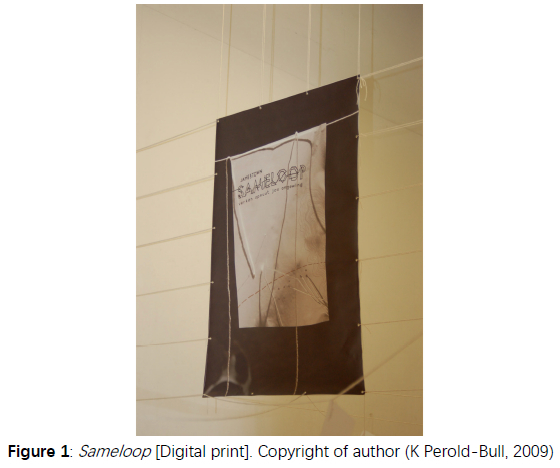
The evening before the final practical exam of my BA Visual Arts (Visual Communication Design) degree, around 19h30, Elmarie showed up at the Visual Arts Building where my classmates and I were all busy installing our exhibitions. She took the time, outside of working hours, to check in with each of us and provide last-minute feedback on the presentation of our work. She also did not hesitate in providing critique. Irrespective of the mere ten to twelve hours that were left before the formal examination would commence, she fearlessly suggested some quite dramatic changes, like suspending a large-scale poster printed on canvas with thread in the passageway where I was installing my work, rather than simply presenting it on the wall.
I regard her fearlessness as demonstrative of how her mind was not confined to her body; of how she continuously strove to extend and challenge the confines of what was comfortable and familiar. From the start, the manner in which she reached to 'wideware' (Ingold, 2019: 11) seemed effortless, almost natural. At this stage I did not quite realise what she was sharing with me. It was only later in our relationship that the lesson she was teaching me crystallised into sensible shape. To act on ideas, to test it out, despite how drastic they may seem, is almost always worth it since it leads you to places, ideas and knowledge you would not have reached otherwise. In retrospect, this was my first lesson in embodied making.
My graduate project was aimed at critically exploring space in the community of Jamestown, Stellenbosch. This is an area that has experienced significant gentrification throughout the past twenty years, i.e.,
a process in which a poor area (as of a city) experiences an influx of middle-class or wealthy people who renovate and rebuild homes and businesses and which often results in an increase in property values and the displacement of earlier, usually poorer residents. (Merriam-Webster, 2024)
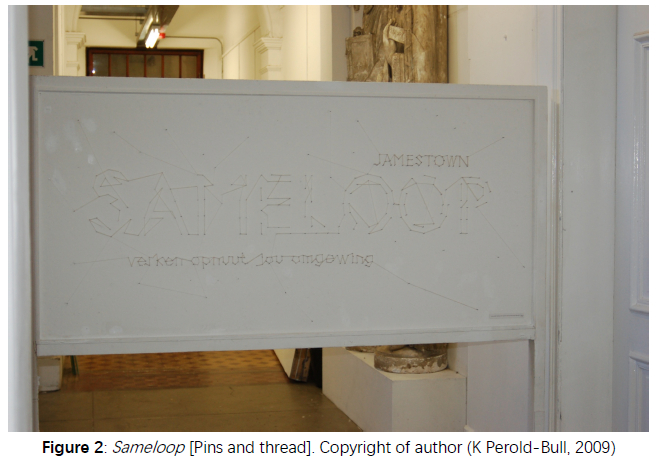
This had resulted in a mixed, diverse community. The initiative was titled Sameloop, translating to coming together or walking together, and its logo emerged from the pattern left at the back of the material into which I threaded the word (see Figure 2).
Elmarie encouraged working physically and always being aware of ambiguity, of what lies beneath that which seems to meet the eye. At that stage, I lived in Jamestown and was classified as an inkommer (the Afrikaans translation for someone coming in from outside the community). The backside of my attempt at threading the word Sameloop onto cloth was much more interesting than the front. The logo ended up representing the mess, the back and forth, of trying to understand my own place in the community.
Elmarie also often advocated for working on large scale. This, I believe, heightens the crafter's experience of his/her own body's role in the making process. It certainly did for me. Planning where to place the pins in this board (see Figure 2) to allow the white thread to pop against the white background (an almost impossible task) was a challenge. It involved planning it out on paper, scaling it up mathematically, and then painstakingly translating it physically with a hammer and a handful of pins onto the board. The threading was the fun part; to see the logo emerge in an almost invisible manner. It did, however, involve numerous processes of trial and error, sore fingers, and paint splotches. But having the logo exist in large, textured, physical form afforded an experience of it that the printed, polished version did not.
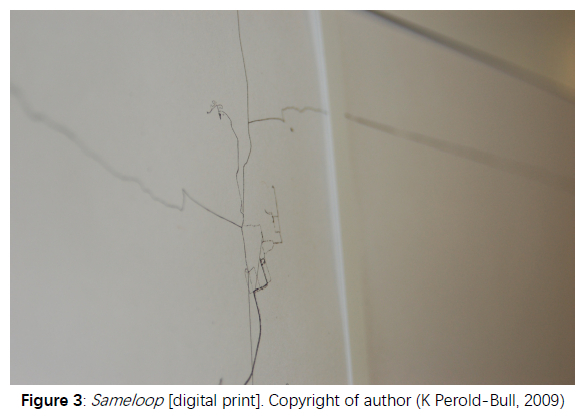
Elmarie encouraged participation, action, and attention to detail. I was using a range of participatory design practices to get out of my comfort zone and interact with the space and local people of Jamestown. I tracked a range of locals' daily routes through Global Positioning System (GPS). This resulted in interesting line drawings highlighting how most of us only move from concrete point to point, seldom exploring beyond predefined paths. Most people's tracks moved from home to work to the mall and back.
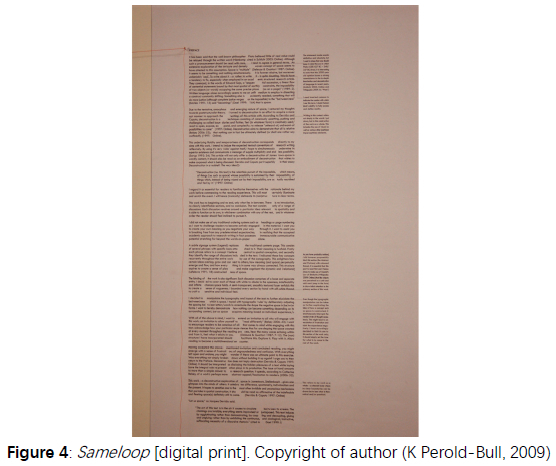
In retrospect, looking at the work I produced during this project, I acknowledge that, even though I was trying to act with concepts related to embodied making - trying to focus on movement and process - how I was working, and what I was finding, still resonated greatly with the hylomorphic model of making, i.e. with articulation rather than telling. It seems like I was, to some extent, trying to force the concept of process and movement into the formal outcomes I was producing, re-presenting rather than embodying it. This can be seen in Figure 3 but specifically in Figure 4 where I physically highlighted an in-between path moving dynamically in the manner I arranged the text of my research article. Despite being a somewhat concrete articulation of the notion of process, I realised that this layout choice affected the consequent reading experience, enabling the text to communicate not only in linguistic, but also in graphic form.
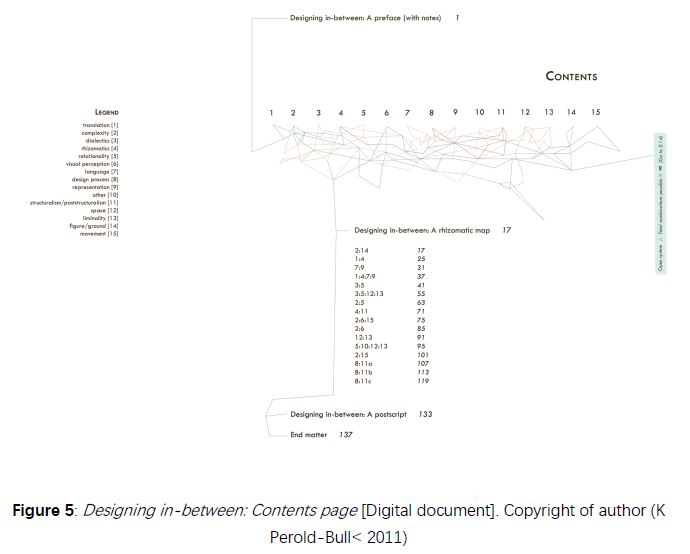
I continued with my MA in Visual Arts under Elmarie's supervision. During this time, I further wrestled with the notion of art as representational versus non-representational1 (McCormack, 2005), i.e., art for art-sake versus art that acts in immediate ways in the "real" world. Elmarie strongly advocated for art being taken down from its pedestal and rather being employed in ways that can contribute to changing the everyday world in productive ways. Through my practice-based research, I was challenging the relationship between theory and practice and aimed to produce a thesis that was crafted as an artwork, and an exhibition that read as a thesis. I wanted to demonstrate that academic research can happen in ways other than traditional text-based research and hopefully contribute to opening spaces for this kind of work within the academy. The thesis took the shape of translating various concepts into one another through writing creatively in integrated image/text formats. Figure 5 shows the content page of the final document and Figures 6-11 some further double-page spreads.
I remember sitting for hours on end, mostly on the floor, with a sore back, cutting, pasting, writing, translating, threading and connecting elements together in a variety of combinations in producing this text. Much of the material used, for example some old maps and glass objects, came from Elmarie. Her office was a treasure chest; a collection of found objects, books, papers, tools. She, for example, made up the most special gifts from her collection. I remember receiving a present from her for my baby boy - a book covered in recycled paper with a beautiful feather attached to it. Her supervision stretched beyond giving formal academic advice and this inspired careful, fine and laborious work in me. I cultivated weeds, worked with collage, photography, drawing, on large as well as small scale, in print as well as digital formats, etc. Although the work ultimately, as presented here, functioned in a fairly abstract manner, the process of producing it allowed me to experience hapticality, i.e., the opportunity to come to know through making; in a deep, felt way (Ingold, 2019).
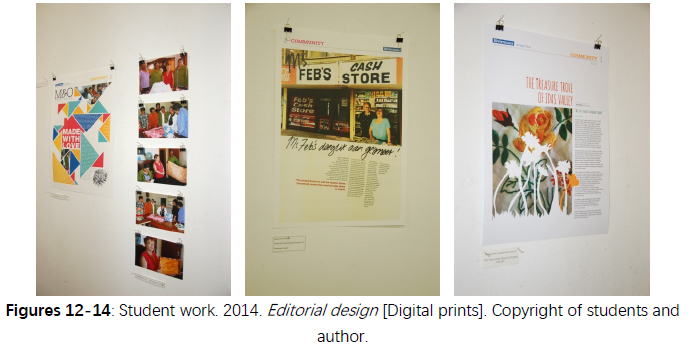
Elmarie always reminded me that the work could not stop there. For her, to put one's knowledge to use in hands-on, practical ways always remained the top priority. She had the ability to always see the big picture in any given situation. She was quiet, but masterful in connecting people and ideas with one another to serve the larger good. I think she also had immense faith in others. I experienced this in how she introduced me to teaching. There was no slow introduction or handholding, only something along the lines of: 'Please teach this editorial design project. I think you should include interaction with the local community. Perhaps contact so-and-so from the local newspaper'. That was it. She trusted that I would figure it out. I had to, and because of that gained such a rich learning experience. I regard this as an example of how she set up a situation within which '[my] body - in its habitation of a world - [could be] ensounded' (Ingold, 2019: 8). I learned through having had to navigate teaching in the messy context of "real" life rather than in the safety of an isolated classroom. Like her approach to supervision, she seemed to teach me more through what she did than what she said. Some examples of the editorial design products that were produced throughout the course of this project can be seen below in Figures 12-14. I believe some of the warmth, generosity and liveliness we experienced in our engagement with a local community can be felt in the work.
After completing my Master's, I began teaching in the MA Visual Arts (Art Education) programme that Elmarie initiated in 2012. Being responsible for teaching the course work component of this programme, it once again felt like I was being thrown into the deep end but, because of the generosity with which Elmarie shared her course content and knowledge, I gained so much. This opportunity also afforded me the chance to co-supervise with her. I remember the initial dissonance I felt as we both worked through a student's thesis. Her comments came back as a range of questions scribbled in pencil on a scaled down, printed-on-recycled-paper version of the thesis, whereas mine were detailed track changes and comments on an electronic Word document. My initial thoughts were that I was approaching the "supervision-thing" in the wrong way; that I was not critical enough, that I was too focused on the details. With hindsight, I realise that experiencing her quiet, confident approach allowed me to see my own weaknesses and strengths in a more focused way. This facilitated a process of honing and practicing my own supervisory skills in a supportive space. Co-supervising with Elmarie also allowed me to experience the value that lies in collaborative work. Elmarie approached everything she did in an energy-efficient manner. This ties in with the great trust she had in others. She was very good at delegating and sharing workload. She would often pass on short bullet-pointed lists to me, breaking down who needed to do what when. She was someone of a few words, but what she said mattered(Barad, 2007); it meant something and mostly affected some sort of action.
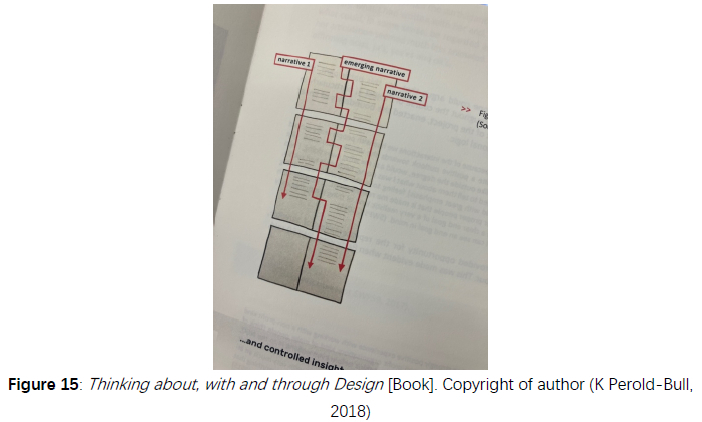
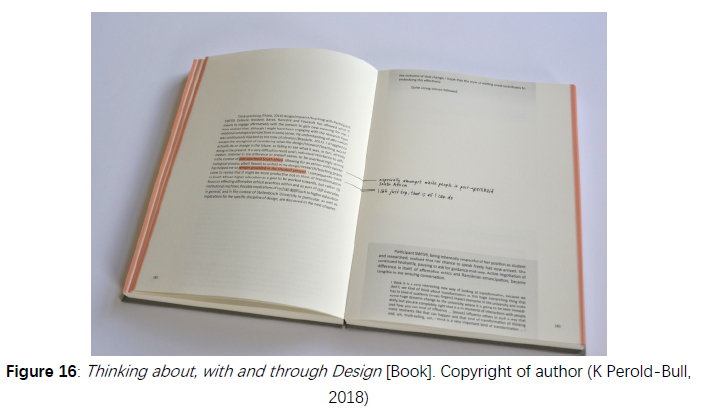
During my PhD, Elmarie said more, but still not much. I remember three key conversations along the four-year journey that strongly directed my work. There were many more, but these three stand out. The first was a conversation about higher education in general, specifically at Stellenbosch University. This was a topic that lay close to her heart and that she invested most of her time in. She used her artistic/creative skills to affect transformative change in her immediate context and, through the process, honed the habit of teaching as a craft. This dawned on me early during my research project and directed my consequent approach. The second conversation involved a nudge towards posthumanism and new materialism as theoretical perspectives. She simply said she thinks I might find it interesting and shared a few key readings with me. Little did I realise then that it would shape much of my consequent thinking and doing, even beyond the PhD journey. During my PhD studies, I aimed to 'explore design education in the context of transformation at Stellenbosch University through practicing design research/education geared at productive change within the institution' (Perold-Bull, 2018: 8). The research constituted my attempt at integrating all the ideas I explored in my previous work in a practical "real" life way. This is why the third conversation I remember having with Elmarie caught me off guard. I was busy with the empirical part of the study where I was teaching design projects and reflecting on the data collected through interviews with students. Elmarie asked, 'Do you just want the students to like you?' At that moment it felt as if everything I was working towards went unrecognised, but once again - in retrospect - I could see that it was another attempt of her to keep me actively engaged, to not have me settle for that which seems apparent, but to keep digging, challenging and turning things upside down. Through asking a question that tied the personal to the academic, an affective response was stirred in me. This served to powerfully direct my research. I believe that, in this instance, Elmarie was approaching her supervision as storytelling since she was directing me without providing any specific details; she was telling and not articulating (Ingold, 2019). This experience affected a process of me experimenting with narrative structure in writing my dissertation. I was exploring how multiple voices and thoughts - some perhaps contradictory - could be allowed to be sensible at the same time, perhaps even allowing a new narrative to emerge in-between. My attempt is explained in Figure 15 and seen implemented in Figure 16.
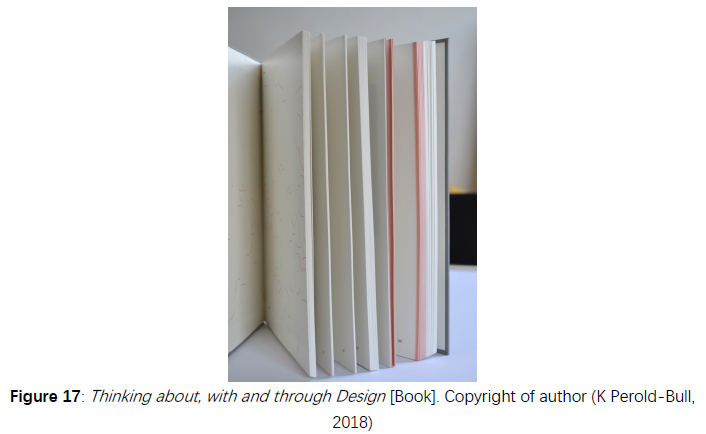
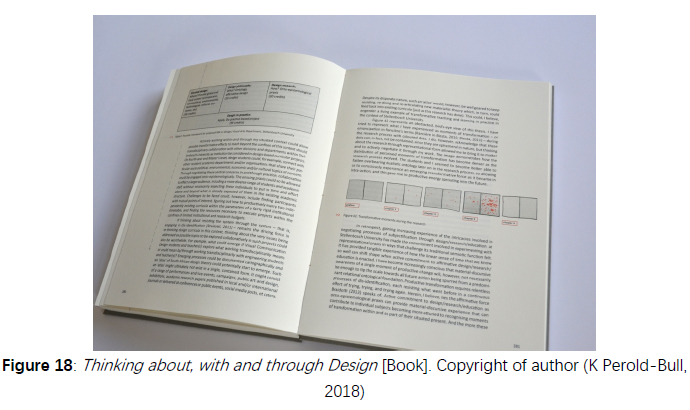
Only the heart of the dissertation was, however, written in this way (see the pink section highlighted in Figure 17). I ultimately tried to thread together a balanced combination of linear (see Figure 18) and non-linear structure to constitute the text. After all, 'what use would it be if no one could access and use the content at the end of the day,' I hear Elmarie saying at the back of my head.
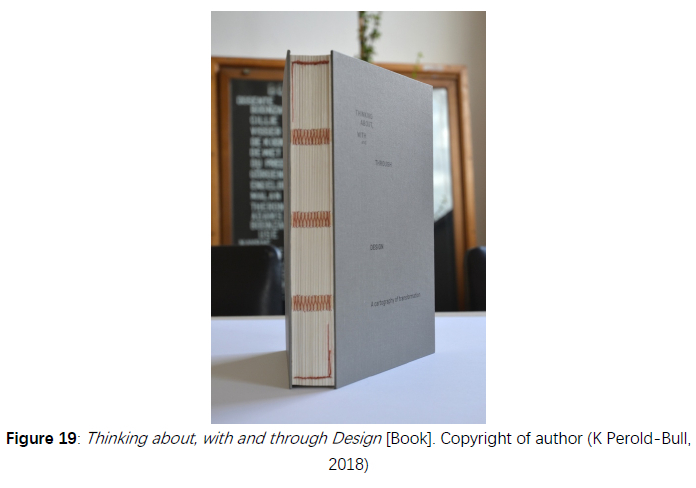
I began this paper by saying that to stitch refers to using needle and thread to join things disconnected from one another together, to repair, and/or to make something anew (Merriam-Webster, 2024). I ended up physically stitching together my dissertation by hand, meticulously punching each hole in the four hundred pages of each of the four copies of the document, continuously waxing the thread, and weaving it through (see Figure 19).
I experienced the mindful, repetitive nature of the binding process as meditative. It was as if the significance of the whole learning my PhD entailed sedimented in my body through feeling the weight of the book materialising.
After Elmarie's tragic passing, I took over the supervision of one of her PhD students. To try and fill her shoes was daunting, but it was similarly joyous to see the fruits of her labour - that of a pedagogy of making, of embodied praxis - take shape in and through the student's work. When we started working together the student and I both felt anxious despite the fact that Elmarie's last thoughts were that the dissertation was almost finished. Collaboratively we did our best to finalise the project and, when the document came back from the language editor, I think we were both amazed at how the seemingly loose ends had come together. What I have come to realise throughout this process was that I need to risk trusting more. I need to reallytrust the process the way Elmarie did. I always thought I had, but now recognise that I constantly need active reminders.
The Craft of Teaching
In conclusion, I want to argue that Elmarie practiced teaching as a craft. Ingold has said:
But if the pianist is truly thinking with his fingers, if his thought flies with the sounds of the keys, if he feels the presence of listeners whose ears stretch to catch every passing sound, and if he and they are truly moved by the experience, then there is all the difference in the world between his performance and - say - that of a player-piano that has been mechanically programmed to reproduce the same piece. (2019: 13)
Elmarie was finely tuned in and responsive to the environments she inhabited. She had deep insight into how education does not simply function on a cognitive level, but integrates all aspects of our worlds, i.e. social, political, environmental, technological, mental, etc. 'It is only when the mind and action in context come together that the affect becomes stronger ... an embodied learning,' she said (Costandius et al., 2020: 100). Elmarie had an unwavering faith in those she worked with (both human and non-human) and always encouraged participation and collaboration between people and the material environment/s they found themselves in, hence channeling the 'agency' of all 'things' involved (Barad, 2007: 33). She was fearless and liked to get her hands dirty while engaging with the physicality of the world around her. She liked to collect and make things and used this as a teaching tool. For her it was never about art per se, but rather about what the process of engaging in art-making could do. She paid attention to detail. Elmarie was quiet. She listened/felt more than spoke and, because of that, communicated powerfully by uttering very little. She was in the habit of teaching. Not a kind of automatic habit, a doing-without-thinking kind of habit, but the kind of habit that can be described as follows:
In our intercourse with the world, Dewey explained, we also inhabit the world. Or in a word, we dwell i n habit. This, perhaps, is as good a definition as any of what it means to practise a craft. A way of telling is also a way of dwelling, of inhabiting. Moreover, it is also a way of using. (Ingold, 2019:13)
Elmarie has taught me a great deal about what it means to craft one's teaching. As a living example, she taught me how to stitch together a pedagogical praxis built on the premise of process, trans-disciplinarity, and affecting tangible, real-life change. I often lose some of the stiches holding me together, and know I will lose more in the future, but I choose to trust (like she did) in others, materials, and processes. I trust that her legacy will continue to ripple through future educators given the many teachers she has already helped form throughout the course of her life.
References
Barad, K. 2007. Meeting the Universe Halfway: Quantum Physics and the Entanglement of Matter and Meaning. Durham & London: Duke University Press. [ Links ]
Clark, M. & Costandius, E. 2020. Redress at higher education institutions in South Africa: Mapping a way forward. De Arte, 55(3): 26-48. [ Links ]
Costandius, E. & Bitzer, E. (Eds.). 2015. Engaging higher education curricuia: A critical citizenship perspective. Stellenbosch: SUN Press. [ Links ]
Costandius, E., Brand, A. & De Villiers, G. 2020. Redress at a higher education institution: Art processes as embodied learning. CriSTaL, 8(1): 92-110. [ Links ]
Costandius, E. & Fourie, C. 2020. Critical citizenship education as praxis: a contribution to decolonize the art curriculum at a South African university. The International Journal of Arts Education, 15(2): 1-20. [ Links ]
De Villiers, G., Van Rooi, L., Biscombe, M. & Costandius, E. 2023. Changing the visual landscape: Reactions of students and staff to visual redress projects at Stellenbosch University. International Journal of Critical Diversity Studies, 5(1): 22-37. [ Links ]
Fataar, A. & Costandius, E. (Eds.). 2021. Evoking Transformation: Visual Redress at Stellenbosch University. Stellenbosch: African Sun Media. [ Links ]
Gulliksen, M., Groth, C., Mäkelä, M. & Seitamaa-Hakkarainen, P. 2016. Introduction: Embodied making and learning. In Lloyd, P. & Bohemia, E. (Eds.). Future Focussed Thinking - DRS International Conference 2016 proceedings. 27-30 June, Brighton, United Kingdom. London: Design Research Society. Available at: https://dl.designresearchsociety.org/drs-conference-papers/drs2016/editorials/8/ (Accessed: 6 December 2024). [ Links ]
Ingold, T. 2010. The textility of making. Cambridge Journal of Economics, 34(1): 91-102. [ Links ]
Ingold, T. 2011. Being Alive: Essays on Movement, Knowledge and Description. London & New York: Routledge. [ Links ]
Ingold, T. 2015. The Life of Lines. London & New York: Routledge. [ Links ]
Ingold, T. 2018. The Arts and Sciences Chair. Art and anthropology for a living world. Available at: https://chaire-arts-sciences.org/wp-content/uploads/2018/05/Art-and-Anthropology-for-a-Living-World-DEF.pdf (Accessed: 13 May 2024).
Ingold, T. 2019. Of work and words: Craft as a way of telling. European Journal of Creative Practices in Cities and Landscapes, 2(2): 5-17. [ Links ]
McCormack, D.P. 2005. Diagramming practice and performance. Environment and Planning D: Society and Space, 23: 119-147. [ Links ]
Mendéz, M. 2013. Autoethnography as a research method: Advantages, limitations and criticisms. Colombian Applied Linguistics Journal, 15(2): 279 - 287. [ Links ]
Merriam-Webster. 2024. S.v. 'stitch', 'gentrification'. Available at: https://www.merriam-webster.com/ (Accessed: 10 December 2024).
Perold-Bull, K. 2018. Thinking about, with and through design: A cartography for transformation. Unpublished PhD dissertation. Stellenbosch: Stellenbosch University. [ Links ]
Standford Encyclopedia of Philosophy. 2024. Sv. 'embodied cognition'. Available at: https://plato.stanford.edu/entries/embodied-cognition/ (Accessed: 6 December 2024).
Tarisayi, KS. 2023. Autoethnography as a qualitative methodology: Conceptual foundations, techniques, benefits and limitations. Journal of Phenomenology and Education, 27(67): 5363. [ Links ]
 Correspondence:
Karolien Perold-Bull
karolien@sun.ac.za
Submitted: 11 December 2024
Accepted: 20 March 2025
1 Non-representational theory is founded on the notion of 'not prioritising representations as the primary epistemological vehicles through which knowledge is extracted from the world,' but rather holds that representation is negotiated as 'active and affective interventions in a world of relations and movements' (McCormack, 2005: 122).
Author biography
Karolien Perold-Bull is a senior lecturer and coordinator of the Visual Communication Design division at the Visual Arts Department, Stellenbosch University. Her research interests are trans-disciplinary and include art and design education, public engagement, design for social change and innovation, and specifically the creative use of arts-based research methodologies.