



Services on Demand
Journal

Article
 English (pdf)
 Article in xml format
 Article references
 Automatic translation
 Send this article by e-mail
Indicators
Related links
-
 Cited by Google
 -
 Similars in Google
Share

 Permalink
Critical Studies in Teaching and Learning
On-line version ISSN 2310-7103
CRISTAL vol.13 n.2 Cape Town 2025
https://doi.org/10.14426/cristal.v13i2.2830
ARTICLES
Language inclusion and neo-colonialism: The impacts of ethnolinguistic admission criteria at South African universities
Mbali Sunrise Dhlamini; Russell H Kaschula
University of the Western Cape
ABSTRACT
Languages in South Africa have always been employed as stimuli to negotiate boundaries of unity and segregation among South Africans. Likewise, universities established before, during, and post-apartheid times were instituted either as key instruments to contrive separation among South Africans or as symbols to mend the segregation walls. This article set out to examine language distribution at South African universities, the language admission criteria and their impacts in promoting language inclusion and social cohesion in Departments of African Languages in the post-apartheid era. IsiNguni language modules were used to contextualise the study. A qualitative research approach was employed to carry out the research, using the interview schedule as an instrument to collect data. The Ethnolinguistic Vitality Theory was used to underpin the study. The findings revealed that African languages were predominantly distributed based on their official status in the South African provinces, while Afrikaans and particularly English were promoted across the country. The grade 12 certificate was the common criterion that was employed to admit or reject potential students' applications to Departments of African Languages based on the home languages studied in grade 12. To some extent, the distribution of South African languages and the language admission approach to Departments of African languages were found to maintain the dominance of certain languages and ethnolinguistic segregation in the country. The article advocates for the promotion of African languages at a national rather than provincial level in order to uproot the ethnolinguistic traces of the apartheid government at South African universities.
Keywords: ethnolinguistic segregation, isiNguni languages, language admission criteria, South African universities
Introduction
The history of the Republic of South Africa narrates a story of language, power, and identity politics that has thrived under Acts of inclusion and exclusion for over centuries. Equal access and inclusion to South African universities have always been influenced by these phenomena. One of the prominent Acts that shaped the linguistic landscape of South African universities was the implementation of the South Africa's Extension of University Education Act of the apartheid National Party (NP). According to Woodrooffe (2011) the South Africa's Extension of University Education Act No. 45 of 1959 imposed that students in universities be separated based on racial and ethnolinguistic affiliations. Consequently, institutions that were considered 'open universities' such as the University of Cape Town and the University of the Witwatersrand for predominantly admitting white students and to a minimum extent accepted black students ceased accommodating black students in their premises to comply with the aforementioned Act (Beale, 1998). This can also be stated for other Historically White Universities (HWUs) such as Rhodes University and the University of Natal.
Historically Black Universities (HBUs) were subsequently created by the apartheid government to further divide black students based on racial and ethnic identifications which corresponded to their first languages (L1s) (Reddy, 2004). For instance, the University of Fort Hare was transferred from Rhodes University to 'a tribal' university that aimed to cater for the Xhosa speech community (Beale, 1998), the University of Zululand was established to serve the Zulu and Swati speech communities (Reddy, 2004), while according to Sehoole (2005) cited in Woodrooffe (2011: 172) the University of the North was established to serve Northern Sotho, Venda, Tswana, Xitsonga as well as the Transvaal Ndebele ethnolinguistic groups.
Although there is a copious number of studies that explore the effect of apartheid regarding race, economy, gender and other social imbalances in the post-apartheid South African universities. There is a dearth of research that investigates the consequences of the apartheid ethnolinguistic dissociation and its impact on ensuring equal access for potential students in Departments of African Languages in the democratic South Africa. This is supported by Woodrooffe (2011) who states that there are insufficient studies investigating "ethnic tensions" stemming from amalgamating the HBUs and the HWUs in modern South African universities. Using the official isiNguni languages (isiXhosa, isiZulu, siSwati, and isiNdebele) to contextualise the study, this article sought to provide insights on African language distributions at South African universities, the language admission criteria and their impacts on promoting language inclusion and social cohesion in Departments of African Languages.
Ethnolinguistic Vitality Theory (EVT)
The study is supported by the Ethnolinguistic Vitality Theory (EVT) of Giles, et al. (1977), who put forward that there are three vital components that determine the vitality of ethnolinguistic groups in intergroup settings viz., status, demographics and institutional support. According to Giles, et al. (1977) status refers to "prestige variables" such as economic, social, sociohistorical and language, while demographics would consider ethnolinguistic group numbers and their concentration in a region, and institutional support refers to the ethnolinguistic group's representation in media, religion, government domains, etc. The reviewed literature in this study was also re-examined through the lens of the EVT as it sheds light on the vitality of the South African ethnolinguistic groups in pre-, during and post-apartheid times.
The status of African languages in South Africa
In the South African context, history indicates that there were African kings who ruled prior to the arrival of the settlers. The African kings capitalised on the number of followers to achieve a high ethnolinguistic group vitality status, especially during conflicts and wars. Fear was a crucial factor that impelled individuals to follow a certain king in quest for protection (Poulos & Msimang, 1998). Giles, et al. (1977) confirm that group members develop a sense of satisfaction when their needs in the group are met. It is particularly important to note that African kings conquered and absorbed numerous groups of people to grow their empires regardless of the individuals' ethnolinguistic affiliations. This is how, for example, the present mighty Zulu nation was formed through amalgamation of various clans and tribes by Shaka Zulu (Mbatha & Cebekhulu, 2022). Shaka Zulu's sociolinguistic acuity was evident when he imposed his language variety to those he subjugated as a marker for distinction and later renamed it to isiZulu, as a tribute to his greatgrandfather, Zulu (Poulos & Msimang, 1998). This historical account corresponds with Giles, et al. (1977), as in his nation building strategy, Shaka clearly fortified the ethnolinguistic vitality of his group through elevating its language status, expanding demographics and providing a platform for institutional support.
Rudwick (2004) observes that because of this rich sociohistorical status, isiZulu has received recognition in various domains compared to the other eight official African languages in South Africa. This view is supported by the survey conducted by Legal Aid South Africa (2017), which confirms that among the isiNguni languages, siSwati and isiNdebele are confined in a few South African regions compared to isiXhosa and isiZulu that are widely dispersed in the country. Consequently, the demographic results of the survey informed the decision of hiring more isiZulu and isiXhosa language practitioners to serve their clientele (Legal Aid South Africa, 2017). Ramuedzisi (2022) also reveals in his study that siSwati, isiNdebele, Xitsonga, and Tshivenda are often disregarded in many South African domains because of their low number of speakers in the country, which contributes to their low status. These studies are consistent with the StatsSA (2022) census results, which demonstrate that isiZulu L1 speakers continue to lead with 24,4% in South Africa followed by isiXhosa with 16,3%, while Xitsonga, siSwati, Tshivenda, and isiNdebele lag behind with numbers ranging between 1.7% and 4.7%.
However, acknowledging the intricate South African sociolinguistic landscape, the demographic variable alone may not always determine an ethnolinguistic group's strong vitality compared to others as it will be shown in the next sections.
Nationalism in South Africa
Rudwick (2004) notes that although African languages are spoken by the vast majority of the South African population, they have a low economic status and institutional support compared to English and Afrikaans. This is due to the plan that was executed by the NP government during the apartheid era. During this period, English and particularly Afrikaans were promoted as languages of formal communication and function in all domains (Mohlahlo & Ditsele, 2022). Various media platforms provided tailor-made language and cultural institutional support to entrench the ideology of nationalism in South Africa (Alexander, 1989). Schooling also became instrumental in ensuring that people of the same ethnolinguistic group viewed themselves as a single entity that is different from other groups (Mesthrie, 2002).
Notwithstanding the fact that missionaries established the groundwork for African language literacy in South Africa, for their competing interest, numerous African language scholars also criticise them for laying the foundation for this literacy to be used as a tool for ethnolinguistic segregation at schools (Alexander, 1989; Poulos & Msimang, 1998; Prah, 2017). The missionaries are blamed for not considering mutually intelligible language varieties but instead introduced the Standard Language Ideology (SLI), even though the transcribed African language varieties were coincidentally selected among many, which were all initially equal in status (Da Costa, et al., 2013; Kaschula, et al., 2023). For instance, at first siSwati and isiNdebele were relegated to be dialects of isiZulu and learners who spoke these language varieties all studied isiZulu as the standard language at schools; subsequently, the apartheid government utilised the ethnolinguistic division in the creation of homelands that effectively taught four isiNguni languages as separate mother tongues (Mesthrie, 2002). It was particularly stressed in the homelands that teachers should speak and teach only the standard language varieties and impose on their learners that only these language varieties were correct and accepted in the classrooms (Arndt, 2019).
The 'mother tongue' education and ethnolinguistic identity strategy transcended the scope of basic education in the homelands to the construction of the HWUs and the HBUs. The apartheid government ensured that racial and ethnolinguistic affiliations based on the locations of the homelands were the principal admission criteria at the universities (Woodrooffe, 2011). Hence, upon attaining democracy the Council on Higher Education (CHE) (1997) commanded universities to design admission and language policies that exterminate all forms of discrimination in order to promote access and social cohesion at South African universities. Thus, merging the HBUs and the HWUs was one of the critical steps towards ongoing rehabilitation to sanitise South African universities (Makalela & McCabe, 2013). Although reconstructing and rebranding South African universities in this manner redress to a significant extent the ills of racial segregation, the blind spot is that majority of these institutions remain physically located within the geographic arrangement of the homelands, which had a direct bearing on ethnolinguistic segregation.
According to South African History Online (SAHO) (2019), the homelands of the apartheid government were not abolished but rather absorbed into the nine provinces of the new South Africa. It is then worth arguing that when the Constitution of the Republic of South Africa in 1996 resuscitated the exact nine indigenous African languages viz., Sepedi, Setswana, Sesotho, Tshivenda, Xitsonga, siSwati, isiNdebele, isiXhosa, and isiZulu including English and Afrikaans as official languages of the Republic of South Africa (which now include the South African Sign Language), this to some extent strategically meant carrying over the ethnolinguistic division of the apartheid government into the 'newly' established provinces and universities. This argument is in line with Wallmach (2014) who also observes that except for English and Afrikaans that are distributed nationally in South Africa, the previously marginalised African languages are mainly promoted in the nine provinces based on the homelands of the apartheid government. This is the case even at higher education institutions where English and to some less extent Afrikaans remain common languages between speakers of different ethnic groups as discussed next.
Language inclusion and exclusion at South African universities
Mkhize and Balfour (2017) maintain that Afrikaans and English continue to dominate African languages at institutions of higher education in post-apartheid South Africa, although African languages are spoken as L1s by the majority of the country's population. In order to fight for the linguistic rights of African language speakers, this has led to some resistance against the dominance of Afrikaans over other official languages at universities (Mkhize, 2018). This has further led to an increase of university language policies that promote selected African languages based on regional demographics alongside English as a viable strategy for the promotion of multilingualism in South Africa.
For instance, the language policy of UKZN revised in 2014 selected only isiZulu and English among the official languages in South Africa in support of multilingualism (Vithal, 2014). The policy of UKZN advances that English is the language that connects its students with the international world, while isiZulu is recognised for nation building in KwaZulu-Natal. Hence, isiZulu is a compulsory module for all first-year students who study at UKZN except for isiNguni L1 speakers (Naidoo, et al., 2018). It is intriguing to note that when Afrikaans is promoted above other languages at South African universities, it is viewed as promoting only Afrikaans and the Afrikaner speech community, but when isiZulu is promoted as the only African language at UKZN, Ndebele and Zulu (2017) and other scholars view this as promotion of other African languages and multilingualism in South Africa. This premise is faulty because the promotion of isiZulu at UKZN does not show a direct link with the promotion of Xitsonga or any other African language, for instance. In this regard, Makalela (2016) rightly observes that multilingualism in South Africa is incorrectly understood from the bilingual setting of the homelands created by the apartheid government.
The issue of isiZulu at UKZN is not an isolated case, as majority of the former HBUs and HWUs seem to promote African languages based on the former designated homelands of the apartheid regime. In this regard, Kaschula, et al. (2013) also observe that at Rhodes University, isiXhosa is primarily promoted alongside English as 'an intercultural approach to implementing multilingualism', as the university is situated in an area where the vast majority of the population speak isiXhosa as their L1. The regional approach to promoting African languages is also endorsed by the National Language Policy Framework for Public Higher Education Institutions published by the Department of Higher Education and Training (DHET) (2020), which asserts that universities should aim to promote South African official languages based on the dominating number of L1 speakers where they are located. The inherent disadvantage of this approach is that the regional distribution of the L1 speakers in these provinces is linked to the former homelands that were absorbed into the nine provinces (SAHO, 2019). Furthermore, it is worth noting that this approach ironically prioritises English over African languages as the ideal lingua Franca in South Africa. Giles, et al. (1977) attest that some languages such as English and French have international recognition as languages of commerce, communication, and technology, although they are primarily spoken as L2s.
A unified approach to African language emancipation
Calls to unify closely related South African languages were made even before the NP seized control in 1948. In this regard, Nhlapo (1944) as also cited by Alexander (1989: 31) posed the following crucial question,
which do you think is going to be easier to do: to get all African children to the school where they will learn English; or to build out of the many Bantu languages in South Africa at least two mother tongues: Nguni and Sotho and to get all Africans to love and freely usethem?
Nhlapo's question envisaged advancing African languages through the lens of African philosophies which promote unity and ubuntu, a vision that could not foresee progress of an African child through English Medium Instruction. Ngügi (1986) also challenged the legitimacy of educating African children through the Eurocentric lens that favours English literature, a language and culture that is not relatable at multiple levels to the African context. Alexander (1989) revisited the notion of language 'unification', pleading that these languages be harmonised at least in writing, as this would provide an economically viable plan for their promotion instead of forcing them to compete. In recent years where intellectualisation of African languages has risen to prominence, Prah (2017) also echoed that development of African languages to the same level as English and Afrikaans is neither logical nor economically feasible if African languages are not harmonised orthographically at a continental level. In the same vein, Kaschula and Maseko (2014: 14) accords that perhaps 'cooperative harmonious development rather than strict harmonisation' is what should be pursued today.
In relation to the EVT of Giles, et al. (1977), these arguments point to the low vitality of African languages under the institutional support variable. It is suggested that it will be impossible for African language speakers to reach their maximum potential while functioning in the colonial language (Alexander, 1989; Ngügi, 1986; Nhlapo, 1944; Prah, 2017). Furthermore, it is argued that this high status will not be reached in isolation, hence, the call for unity and collaborations in the promotion of African languages is made. Louw (2010: 43) rightly advances that Africanisation means to 'confront our own sense of Africanness, transcend our individual identity, seek our commonality, and recognise and embrace our otherness'.
As demonstrated in the reviewed literature, the irony in South Africa is that while some African language scholars are conscious about the dominance of English and Afrikaans over African languages, the dominance of certain African languages over others is overwhelmingly overlooked. There seems to be a misconception that promoting two or a few languages at universities, which is usually English and dominating provincial African language(s) promotes all African languages and the plan for multilingualism in the country. In order to challenge "our own sense of Africanness" this study sought to examine how African languages are promoted at South African universities by examining the language admission criteria and their impacts in the promotion of language inclusion and social cohesion in Departments of African Languages.
Research methodology
The qualitative research approach was employed as a means of investigation for the study. According to Cresswell (2014) this research approach allows the researcher(s) to gain deep insights into the investigated topic. The interview schedule was used as the research instrument to collect data, and the semi-structured interview was chosen over other types of interviews because it permits some flexibility during questioning (Descombe, 1998). The results yielded from the interview questions are captured under the study's findings and discussion.
The purposive sampling method was used to select suitable research participants, as Baker (1999) states that this sampling approach permits the researcher(s) to choose relevant research participants/units who will be able to provide information that will respond to the research questions. This article is based on one of the researchers' PhD study, with research ethics number HS23/1/16 granted at the University of the Western Cape. The study targeted South African public universities that offered any of the four official South African isiNguni languages. Research ethics clearance was first sought at the host university, thereafter, the researchers visited South African public universities' websites to check their language offerings and then sent letters requesting to conduct research to all those that offered any of the official isiNguni languages. Institutions that granted the research ethical clearance are those whose data are captured in the study.
Ten research participants were interviewed, and they were from Departments of African Languages (which include Departments of Languages based on the institutions' setup). The departments were located at eight public universities across South Africa. The names of the universities as well as the names of the research participants are not revealed to comply with the anonymity and confidentiality rules as per the ethics permission letters granted by these universities. The research participants were lecturers who taught the targeted languages, and who were recommended for the interviews at the institutions for being informed about the language admission criteria for each of the languages they taught and how these languages were taught in the classrooms.
Codes to keep the names of the universities confidential were generated based on the similarity of the admission findings as follows: University One, University Two, University Three, etc. The research participants represented the official isiNguni languages as follows: isiZulu (5), isiXhosa (4), and siSwati (1). It should be noted that the researchers did not determine the number of participants per institution, they were based on recommendation at the universities. It is also worth mentioning that due to issues of non-response, the researchers could not interview participants under isiNdebele. On this note, Bryman (2012: 187) explains that non-response 'occurs whenever some members of the sample refuse to cooperate, cannot be contacted, or for some reason cannot supply the required data'. The generated codes for the research participants are based on their education title, sex, the isiNguni language they represented and the number of female/male people representing that language. For instance, the generated code DMS1 stands for Dr, male, siSwati, and the only male interviewed under siSwati.
Thematic analysis was employed as a method for data analysis. The data were first transcribed, saved under the generated codes and sorted according to the observed themes. Kiger (2020) concurs that themes are formed through generated codes from the data that respond to the research questions in order to reach conclusions about the investigated topic.
Findings and discussion
The study sought to explore the language admission criteria and their impacts on promoting language inclusion and social cohesion in Departments of African Languages (and in Departments of Languages) at selected South African universities. The four official isiNguni languages were used to contextualise the study. In order to understand the language admission criteria and their impacts at each of the investigated universities, it was important to first determine how languages were distributed at these universities as shown next.
Language distribution at South African universities
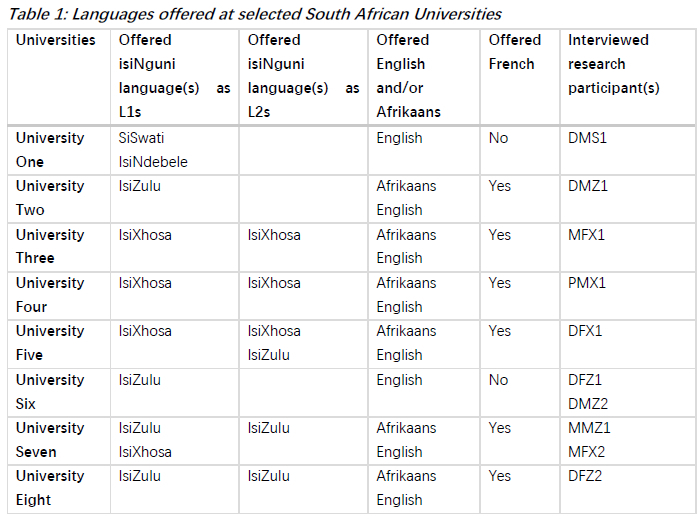
The results revealed that African languages were offered either as elective modules as part of a larger programme such as the Bachelor of Arts (BA) or they were offered as one of the core modules alongside other languages and content modules in a language programme. They were offered either as first languages (L1s) or as second languages (L2s). Table 1 shows how the languages were distributed at the eight universities.
As already mentioned under research methodology, the provinces where these universities were situated are not mentioned as an attempt to keep their names confidential, especially since the languages were not distributed evenly across the country. This means that mentioning the name of the province in some instances would have automatically meant identifying the specific university in the province. Hence, they are simply identified as University One, University Two, etc. The researchers can, however, confirm that based on the results isiZulu was offered at four universities in three provinces (two of the universities were located in one province), while isiXhosa was offered in four universities situated in two provinces (three of the universities were in one province while the fourth university was situated in another province where isiZulu was also offered), and the university that offered isiNdebele and siSwati was in one province. The results are consistent with Legal Aid South Africa (2017) that attests that isiZulu and isiXhosa are more visible in South Africa compared to siSwati and isiNdebele that are left in the periphery because of the number of their L1 speakers. The results further support Ramuedzisi (2022) who also observes that isiNdebele, siSwati, Tshivenda, and Xitsonga are often excluded in many domains compared to other South African languages. Although the results of this study were limited to isiNdebele and siSwati and their offering at the selected South African universities. This finding directly supports the EVT of Giles, et al. (1977) who assert that status, demographics and institutional support variables play a vital role in creating chances for ethnolinguistic groups' success. The results confirm that because of the demographics variable, isiZulu and isiXhosa have strong ethnolinguistic vitality at South African universities compared to isiNdebele and siSwati that are often marginalised.
Based on the offered official isiNguni language(s) at each university, the 10 research participants were questioned whether these languages were promoted equally at South African universities and their responses are captured in the next section.
Research participants' views on promotion of African languages
The 10 research participants concurred that some of these languages were privileged over others and expressed differing views as to whether this was justified as discussed next.
African languages shiould be promoted provincially
DMS1, DMZ1, MMZ1, DMZ2, and DFZ2 stated that these languages were promoted provincially based on the number of speakers and this was justified. They argued that in the Eastern and the Western Cape provinces for example, isiXhosa should be promoted, the same way one would not expect Setswana and isiZulu to be promoted in Limpopo. They argued that this approach enabled universities and provincial language boards to invest in the development of the language(s) of that province without having to spread the resources so thinly trying to accommodate all others, which also meant reinverting the wheel. These views were in line with the National Language Policy Framework for Public Higher Education Institutions published by the DHET (2020), which advocates for the regional promulgation of the South African official languages. This study finds this policy and the views of these research participants to be linked to the South Africa's Extension of University Education Act No. 45 of 1959 which was supported by the establishment of the former homelands that ensured that the South African population was segregated not only racially but also ethnolinguistically. This suggests that while some aspects of this Act were redressed by merging certain universities after 1994, the regional promotion of African languages in South Africa remain overlooked or even encouraged. The findings are in line with the EVT of Giles, et al. (1977), as it is shown that demographics play an important role in determining African languages' ethnolinguistic groups' vitality in each of the provinces.
Ironically, what the policy and this research participants fail to consider is that as demonstrated in Table 1, African languages are the only languages in South Africa that are promoted in designated universities, whereas English, Afrikaans and even foreign languages such as French are not constrained by the provincial L1 population setup. This study suggests that this manner of promoting African languages in South Africa is replication of how languages used to be promoted during the apartheid era. This claim is consistent with Mohlahlo and Ditsele (2022) who also agree that during this period English and Afrikaans were imposed as languages of function in all formal domains while African languages only served in their designated homelands. The results are further consistent with Wallmach (2014) who also confirm that African languages remain confined in provinces that are linked to their former homelands while English and Afrikaans are promoted nationwide. Strangely, this happens at the time when African languages are said to be strategically developed to reach the same level as English and Afrikaans as part of the larger agenda for promoting multilingualism in the country. The overwhelming promotion of French as an L2 at the investigated universities is also in accordance with the EVT of Giles, et al. (1977) who assert that languages such as English and French receive significant attention as L2s because they are recognised as languages of science, business, communication, etc.
Some of the research participants argued that it was not justified to promote African languages based on the provincial L1 criterion as discussed next.
African languages shiou/d not be promoted provincially
DFX1, MFX1, PMX1, MFX2, and DFZ1 indicated that the provincial promotion of African languages in South Africa, which led to the unequal promotion of these languages at South African universities was not justified. The research participants stated that the source of the problem was, indeed, the National Language Policy Framework for Public Higher Education Institutions published by the DHET (2020). They stated that this policy was self-contradictory and impossible to implement. They argued that to some extent the policy encouraged exclusion of other languages, yet upon graduation it states that students should go back to their communities and serve in their own languages. DFX1 stated that "it is even worse at TVET colleges as everything is done in English, yet the students must go back to their communities." The results suggest that the cited DHET (2020) policy does not promote equality of the South African languages, which then raises a question about the authenticity of promoting multilingualism in the country. The results are consistent with Makalela (2016) who also notes that promotion of multilingualism in South Africa is, unfortunately, understood from the apartheid perspective that promoted one African language alongside English. Therefore, it can be argued based on the findings that while there are attempts to promote African languages at South African universities, historical pathways seem to be followed in the process, which inadvertently prioritise English, Afrikaans and even foreign languages over these languages.
Furthermore, MFX2 stated that the promotion of African languages based on the regions of dominance
is also questionable because sometimes isiZulu is offered at some institutions over African languages that are dominating in that province. Therefore, among the isiNguni languages isiZulu is at the top, followed by isiXhosa and then ... it is quiet ... institutions want more students you know; it's a business.
As already explained that the names of the provinces where the selected universities are situated are not mentioned for confidentiality and anonymity reasons, the researchers, can however, confirm MFX2's observations because although isiZulu was the only offered isiNguni language at University Two and at University Eight, isiXhosa and isiNdebele, respectively, were the most spoken isiNguni languages as L1s at the locations where these universities were situated, based on the StatsSA (2022) census results. The results are consistent with Rudwick (2004) who advance that due to its sociohistorical status, isiZulu receives more recognition in most South African domains compared to the other eight official African languages. This suggests a trend that because of its status and demographics, among African languages isiZulu is likely to receive institutional support at South African universities either as the first African language to be introduced as an L1 or L2 in addition to the language(s) of the region or even as the first isiNguni language to be offered at a university located where other isiNguni languages are dominating as L1s.
The findings refute claims made by some African language scholars such as Ndebele and Zulu (2017), Naidoo, et al. (2018), the National Language Policy Framework for Public Higher Education Institutions published by the DHET (2020) and the views of some of the research participants in this study, namely, DMS1, DMZ1, MMZ1, DMZ2, and DFZ2 that concentrating on one or a few African languages in a region promotes all African languages and the plan for multilingualism in the country. Instead, the results indicate that the overall ethnolinguistic group's vitality in relation to others in multilingual settings is what counts the most in the country or even beyond and not just in a specific region, as demonstrated in the cases of isiZulu, English, Afrikaans and French. The results completely support the EVT of Giles, et al. (1977), as these languages are either leading in status, demographics or institutional support compared to other ethnolinguistic groups in South Africa.
Considering these findings, the following section presents data and discussions of how the distribution of African languages at the selected South African universities affected language admission criteria and the consequences thereof.
Language admission criteria at South African universities
The results revealed that the grade 12 certificate was the sole language admission criterion used to admit or reject potential students at the selected South African universities. The grade 12 certificate was used for two main reasons in this regard: firstly, it was utilised to calculate whether potential students met the Admission Point Score to be enrolled in the specific programmes e.g., the BA or other specific language programmes; secondly, it was used to verify the Home Languages (HLs) and First Additional Languages (FALs) that potential students studied in grade 12. The findings disclosed that there were inconsistencies on how different universities utilised the grade 12 certificate to admit or reject potential students' applications based on the studied isiNguni HLs and FALs in grade 12, and this had a bearing in the promotion of language inclusion and social cohesion in the investigated departments and universities as discussed next.
Utilising the HLs studied in grade 12 to promote social cohesion
The research participants from University One (offered isiNdebele and siSwati), University Two (offered isiZulu), University Three (offered isiXhosa), and University Four (offered isiXhosa) indicated that potential students who studied any of the official isiNguni languages as HLs in grade 12 were granted admission to study the specific offered isiNguni language module(s) at their universities. This admission approach is in accordance with the CHE (1997), which stipulates that institutions of higher education should eliminate all discriminative factors (including languages) when assessing potential students' applications for admission. This finding revealed that studying a specific isiNguni HL in grade 12 did not pose any challenges when one wished to study another isiNguni language as L1 at some of the universities in South Africa. The results disclosed that the plan that was suggested by Nhlapo (1944) of allowing speakers of mutually intelligible languages to learn languages within the same language cluster as an attempt to equally promote African languages in South Africa was finally happening at some universities.
When the research participants were asked how they dealt with different isiNguni languages within the same classroom that came as a result of this language admission approach, DMZ1, DMS1, PMX1, and MFX1 indicated that the high level of mutual intelligibility between the isiNguni languages facilitated learning and teaching in the classroom. Interestingly, DMS1 cited himself as an example that although he has taught siSwati for over 17 years at all university levels, he never learnt the language formerly in class because it was not offered at the time. He attested that he studied isiZulu, and he used the knowledge that he acquired learning this language to fulfil his duties as a siSwati lecturer. The findings supported Mesthrie (2002) who states that siSwati and isiNdebele were regarded as dialects of isiZulu in the past due to the missionaries who did not transcribe these languages at first, and speakers of these languages studied isiZulu as L1. The findings in this study reveal a historical trend that isiNdebele and siSwati have always been marginalised and excluded in most language cases, especially compared to isiZulu. Furthermore, the results confirm that indeed, if it were not for political aspirations, all isiNguni languages had a great potential to be linguistically harmonised as per the calls made by Nhlapo (1944), Alexander (1989), and Prah (2017). Furthermore, the results support Kaschula and Maseko (2014) who state that perhaps soft harmonisation could be pursued now for these languages. The results of this study may serve as affirmation to commence with the long process that will eventually achieve the ultimate goal, where African language scholars would collaborate in the promotion of African languages as envisaged by African language scholars such as Nhlapo (1944), Ngügi (1986), Alexander (1989) and Prah (2017) among others.
Furthermore, PMX1, MFX1, and DMZ1 indicated that the language variations that came with this language admission approach added some fun elements during lectures and provided students and lecturers alike the opportunity to learn from each of these languages, which ended up breaking stereotypes that some people had about certain ethnolinguistic groups. PMX1further stated that during assessments,
I contextualise and know the background of the student whose script I am marking because I want them to be in the same mood as the others. I must allow them to use their language, I normally say, can you write the vocabulary of the words that you have used and the meaning of what it means as an appendix...
Correspondingly, DMZ1 advanced that
I am neither an isiXhosa nor a siSwati speaker, so, I consider the background that students of these languages bring to the classroom. I assess their work based on the content that the student is presenting ... and not on language per se.
Moreover, PMX1 stated that
remember, the essence of us is to promote these languages and to make them reach the level of English and Afrikaans. Now, if you are going to suppress the given opportunity how will we get them there?
These findings extend the EVT of Giles, et al. (1977), while the theory is clear on how ethnolinguistic groups distinguish themselves from others and strengthen their vitality through status, demographics, and institutional support; it does not, however, dwell on instances where the dominating ethnolinguistic groups seize an opportunity to accommodate others and assist them to fortify their own ethnolinguistic vitality. The results imply that ethnolinguistic groups that are considered to have strong vitality in specific contexts (such as the lecturers who belong to the offered isiNguni languages at the selected universities) can use the platform to create space that is conducive for other ethnolinguistic groups' growth, where members of the other groups are acknowledged and valued, and thereby strengthen ethnolinguistic relations which promote language inclusion and social cohesion in multilingual contexts. The results present evidence that ethnolinguistic groups that have strong vitality can learn from members of minority groups in a specific context and vice versa without any of the groups having to submit to the other, especially when there is a common goal for growth and embracing diversity. Furthermore, the findings indicate that African language classrooms can be instrumental in developing African languages regardless of the dominating L1 where the university is located, provided that there is a strong will for collaboration and reciprocal learning.
On the other hand, the study also discovered that the isiNguni HLs studied by the potential students as they appear in their grade 12 certificates were also used for language exclusion at some of the selected universities as discussed next.
Utilising the HLs studied in grade 12 for gatekeeping
The findings divulged that the grade 12 certificate was also used as an ethnolinguistic gatekeeper at some of the investigated universities and language departments. The research participants from University Five (offered isiXhosa), University Six (offered isiZulu), University Seven (Offered isiZulu and isiXhosa), and University Eight (offered isiZulu) indicated that their universities granted admission to students who only studied these languages as HLs in grade 12.
When it was enquired how the universities dealt with applications where potential students studied the other official isiNguni languages as HLs in grade 12 but wished to be enrolled for language programmes or modules at these universities, DFZ1 explained that
our admission criteria, in our manual book stipulate that students in this programme can take any language between isiZulu and English.
Implying that they should take English instead. In addition, DMZ2 corroborated that potential students who did not study isiZulu in grade 12
must go to their own universities. There is an isiNdebele university that side, the student should go to the isiNdebele university.
They indicated that their department had a mandate to promote the standard language variety of isiZulu. DFX1 and MMZ1 also agreed that their universities had the responsibility to promote standard isiXhosa and isiZulu respectively, as the only offered isiNguni languages supported by the universities' language policies.
The findings revealed that the language admission practices at these departments were not in accordance with how African kings expanded their kingdoms and promoted their languages in the era before the settlers arrived in Southern Africa. For instance, Poulos and Msimang (1998) attest that Shaka Zulu conquered and absorbed clans and tribes that spoke any language varieties as the idea was to grow the number of his followers, it was only after they were conquered that he forced them to speak his language variety to distinguish themselves from other speech communities. The results demonstrate that the current language admission criteria and learning and teaching approaches of African languages at these universities as well as the views of some of the research participants show a continued legacy of the apartheid government through the implementation of the South Africa's Extension of University Education Act No. 45 of 1959 even after 1994. This finding is in line with Reddy (2004) and Woodrooffe (2011) who concur that this Act prioritised ethnolinguistic segregation for admission and laid a foundation for the 'standard' languages of learning and teaching at the various institutions.
When it was enquired why other isiNguni languages were not offered at these universities if their L1 speakers were not accommodated in the offered isiNguni language classrooms. DFZ1 and DMZ1 responded that siSwati modules used to be offered at the university until the lecturer who was responsible for the siSwati modules left the institution, and their attempts to find replacement were in vain. DFZ1 further argued that isiZulu lecturers cannot teach siSwati, the same way a siSwati lecturer should not teach isiZulu as they would fail to teach the required standard language variety of the language. DFZ1 even mocked the Tekela language feature of siSwati stating that the lecturer "uzotataza izingane, atatitatitati"(meaning that the lecturer will employ the Tekela language feature of siSwati while teaching isiZulu). This finding is consistent with Arndt (2019) who attests that certain speech varieties were excluded in the former homelands as teachers were instructed to speak and teach only the desired 'standard' languages.
Firstly, these results suggest that language inclusion and social cohesion may be undervalued at some Departments of African Languages in South Africa, instead the promotion of standard language varieties may be desired without compromise. Secondly, the results also hint that it may not be easy to find siSwati lecturers in South Africa or institutions may not be trying hard enough to find them. Thirdly, the results also indicate that some academics hold a view that it is impossible for one lecturer to be competent in two African languages, even if these languages are from the same language cluster such as isiZulu and siSwati. Yet, it is not rare to find lecturers who have majored in an African language and English or even Afrikaans in the South African education sector. These points highlight some of the challenges that the country still needs to confront in order to effectively promote African languages and multilingualism at South African universities.
It was also discovered that language departments at the investigated universities were sometimes named Departments of African Languages regardless of the imbalances in language offerings. On this note, DFX1 asked "how do we say that we are a Department of African Languages when we do not offer other African Languages but only isiXhosa? Likewise, DFZ1 stated that "okunye futhiasingathi(another thing let us not say) it is the Department of African Languages but when you get there you find only one language njengoba sihlale sisho nje ukuthi lana sinesiZulu kuphela (as we always say that here, we only have isiZulu) but this is the Department of African Languages." These findings were consistent with Louw (2010) who encourages African language curriculum developers to challenge "their own sense of Africanness" in order to find just solutions for African languages. The results indicate that even when names of departments were changed in order to show transformation that aligns with the new South Africa, there were still some strong ethnolinguistic ties that were entrenched in the apartheid system in practice.
Conclusion and recommendations
In conclusion, the article commends the way that some of the research participants complemented the language admission approach at their universities where students were accommodated in the same isiNguni language classrooms, as this presented an ingenious opportunity to advance African language learning, teaching and assessment pedagogies. This article argues that in addition to the linguistic and professional knowledge that the students gained in relation to their language careers, they were also trained to be good citizens who are culturally and linguistically tolerant. This research concludes that such practices are a giant step towards correcting the ills of ethnolinguistic segregation that were imposed by the apartheid government at the former HWUs and HBUs. On the other hand, this article also concludes that the departments that only accepted students who studied the specific offered isiNguni language(s) were still aligned with the South Africa's Extension of University Education Act No. 45 of 1959 and hindered the process of promoting language inclusion and social cohesion in Departments of African Languages. In essence, they are discriminative and promote the survival of the fittest language approach as illustrated by the EVT variables of Giles, et al. (1977). Based on the results, the study makes the following recommendations:
1. There is a need to establish a national African language proficiency framework instead of relying on the grade 12 HL and FAL bilingual approach that fails to capture the realistic linguistic nature of the multilingual South African population. The proposed framework should be designed to measure potential students' language proficiency in a personalised manner, underpinned by practical genre-based language outcomes.
2. The article is advocating for policy reform to address language inclusion imbalances, especially at South African universities. It is recommended that when 'provincial' official languages are offered as L1s at a particular university then non-dominating African languages should at least be offered as L2s at that university. In other words, Xitsonga could be offered as part of the nation building strategy at the University of KwaZulu-Natal, for instance. The same way universities in the Eastern Cape can offer Setswana as an L2. If universities across the country can offer English, Afrikaans and even foreign languages like French, this means that the same possibility exists for African languages regardless of the L1 number of speakers in the area where the university is located.
3. Departments of African Languages in South Africa should be accurately named based on their language offerings. There should be monitoring and accountability in language inclusion practices before such departments can change their names. Otherwise, they should be correctly identified as Departments of isiXhosa or isiZulu, for example.
Declaration of Generative AI and AI-assisted technologies in the writing process
We, the authors, confirm that we did not use generative AI or AI assisted tools in any section of this research article.
References
Alexander, N. 1989. Language Policy and National Unity in South Africa/Azania. Cape Town: Buchu Books. [ Links ]
Arndt, J. 2019. Engineered "Zuluness": Language, education and ethnicity identity in South Africa. The Journal of the Middle East and Africa, 10(3): 211-235. [ Links ]
Baker, T. 1999. Doing Social Research. 3rd ed. Singapore: The McGraw-Hill Companies. [ Links ]
Beale, M. 1998. Apartheid and University Education, 1948-1970. Unpublished PhD diss., University of the Witwatersrand, South Africa. [ Links ]
Bryman, A. 2012. Social Research Methods. 4th ed. New York: Oxford University Press. [ Links ]
Council on Higher Education (CHE). 1997. Higher Education Act 101 of1997. Pretoria: Council on Higher Education. [ Links ]
Costa, D., Dyers, C. & Mheta, G. 2013. managing Linguistic diversity through standardisation. In Bock, Z. & Mheta, G. (Eds.). Language, Society and Communication: An Introduction. Pretoria: Van Schaik Publishers. [ Links ]
Cresswell, J. 2014. The selection of a research approach. In Cresswell, J. (Ed.). Research! Design: Qualitative, Quantitative, and Mixed Methods Approaches. Indore: Sage. [ Links ]
Department of Higher Education and Training (DHET). 2020. The Language Policy Framework for Public Higher Education Institutions. Pretoria: Department of Higher Education and Training. [ Links ]
Descombe, M. 1998. The good research guide, for small-scale social research projects . Philadelphia: Open University Press. [ Links ]
Giles, H., Bourhis, R. & Taylor, D. 1977. Towards a theory of language in ethnic group relations. In Giles, H. (Ed). Language, Ethnicity and Intergroup Relations. London: Academic Press, 307-344. [ Links ]
Kaschula, R., Maseko, P., Dalvit, L., Mapi, T., Nelani, L., Nosilela, B. & Sam, M. 2013. An intercultural approach to implementing multilingualism at Rhodes University, South Africa. Stellenbosch Papers in Linguistics PLUS, 39: 45-61. [ Links ]
Kaschula, R., Mokapela, S., Nkomo, D. & Nosilela, B. 2023. A socio-political and historical perspective of linguistic prescriptivism in relation to the African languages of Southern Africa. In Beal, J., Lukac, M. & Straaijer, R. (Eds.). The Routledge Handbook of Linguistic Prescriptivism . Abington, Oxfordshire, United Kingdom: Routledge, 321-337. [ Links ]
Kiger, M.V. 2020. Thematic analysis of qualitative data: AMEE Guide. Medical Teacher, 42(1): 117-148. [ Links ]
Legal Aid South Africa. 2017. Integrated annual report 2016-2017. Johannesburg: Legal Aid South Africa. [ Links ]
Louw, W. 2010. Africanisation: A rich environment for active learning on a global platform. UNISA Press, 32(1): 42-54. [ Links ]
Makalela, L. 2016. Ubuntu Translanguaging: An alternative framework for complex multingual encounters. Southern African Linguistics and Applied Language Studies, 34(3): 823-843. [ Links ]
Makalela, L. & McCabe, R. 2013. Monolingualism in a historically Black South African University: A case of inheritance. Linguistics and Education, 24: 406-414. [ Links ]
Mbatha, M. & Cebekhulu, M. 2022. The concept of 'Zulu Tribe' and 'Zulu Nation' and their use towards political aspirations in South Africa. JournalRise, 83(6): 32-41. [ Links ]
Mesthrie, R. 2002. Language in South Africa, Foreign Language Study. Cambridge: Cambridge University Press. [ Links ]
Mkhize, D. 2018. The language question at a historically Afrikaans University: Access and social justice issues. Southern African Linguistics and Applied Language Studies, 36(1): 13-24. [ Links ]
Mkhize, D. & Balfour, R. 2017. Language rights in education in South Africa. South African Journal of Higher Education, 6: 133-150. [ Links ]
Mohlahlo, A.L. & Ditsele, T. 2022. Exploring multilingualism at the national department levels in South Africa post the Use of Official Languages Act of 2012. Literator 43(1): 1-9 [ Links ]
Naidoo, S., Gokool, R. & Ndebele, H. 2018. The case of isiZulu for non-mother tongue speakers at the University of KwaZulu-Natal, South Africa - Is the compulsory language module promoting social cohesion? Journal of Multilingual and Multicultural Development, 39(4): 356-368. [ Links ]
Ndebele, H. & Zulu, N. 2017. The management of isiZulu as a language of teaching and learning at the University of KwaZulu-Natal's college of Humanities. Language and Education, 31(6): 509-525. [ Links ]
Ngügi wa Thiong'o. Decolonizing the Mind. London: James Currey, 1986. [ Links ]
Nhlapo, J. 1944. Bantu Babel: Will the Bantu languages live?Cape Town: The African Bookman. [ Links ]
Poulos, G. & Msimang, C. 1998. A Linguistic Analysis of Zulu. Cape Town: Via Afrika. [ Links ]
Prah, K.K. 2017. The intellectualisation of African languages for higher education. Alternation, 24(2): 215-225 [ Links ]
Ramuedzisi, L. 2022. An analysis of the impact of Section 4(2)(b) of the South African Use of Official Languages Act of 2012 (on previously marginalised indigenous official languages). Southern African Linguistics and Applied Language Studies, 40(3): 275-287. [ Links ]
Reddy, T. 2004. Higher Education and Social Transformation: South Africa Case Study. Pretoria: Council on Higher Eudcation. [ Links ]
Rudwick. 2004. Ethnolinguistic vitality in KwaZulu-Natal. Atternation, 11(2): 101-117. [ Links ]
South African History Online (SAHO). (2019, January 24). South African History Online. Available at: https://www.sahistory.org.za/article/homelands/ (Accessed: 23 June 2024)
Statistics South Africa (StatsSA). 2022. Census 2022.Pretoria: Department of Statistics South Africa. [ Links ]
Vithal, R. 2014. Language Policy of the University of KwaZulu-Natal. Durban: University of KwaZulu-Natal. [ Links ]
Wallmach, K. 2014. Recognising the 'little perpetrator' in each of us: Complicity, responsibility and translation/interpreting in institutional contexts in multilingual South Africa. Perspectives: Studies in Translatology, 22(4): 566-580. [ Links ]
Woodrooffe, D.D. 2011. When visions of the rainbow nation are not enough: Effect of Post apartheid higher education reform on social cohesion in South Africa. Peaboy Journal of Education, 86(2): 171-182. [ Links ]
Submitted: 21 May 2025
Accepted: 2 December 2025
Author Biographies
Dr Mbali Sunrise Dhlamini is a lecturer in the Department of African Language Studies at the University of the Western Cape, South Africa. Her research area covers isiNguni languages, language education, multilingualism in South Africa, historical linguistics, dialectology and more.
Prof Russell H Kaschula is a professor and HOD in the Department of African Language Studies at the University of the Western Cape, South Africa. He also holds the Research Chair in Forensic Linguistics and Multilingualism. His research interests and publications largely cover applied language studies, multilingualism and forensic linguistics. He holds a B1 NRF rating.
# Corresponding author: mdhlamini@uwc.ac.za
 Mbali Sunrise Dhlamini | Russell H Kaschula
 Mbali Sunrise Dhlamini | Russell Kaschula
 Mbali Sunrise Dhlamini | Russell Kaschula