




Services on Demand
Journal

Article
 English (pdf)
 Article in xml format
 Article references
 Automatic translation
 Send this article by e-mail
Indicators
Related links
-
 Cited by Google
 -
 Similars in Google
Share

 Permalink
South African Computer Journal
On-line version ISSN 2313-7835Print version ISSN 1015-7999
SACJ vol.36 n.2 Grahamstown Dec. 2024
https://doi.org/10.18489/sacj.v36i2.17679
RESEARCH ARTICLE
https://doi.org/10.18489/sacj.v36i2.17679
Integrating the TOE framework and DOI theory to dissect and understand the key elements of AI adoption in sociotechnical systems
Danie SmitI, II; Sunet EybersIII; Alta van der MerweI; Rene WiesIV; Nica HumanI, II; Julia PielmeierIV
IDepartment of Informatics, University of Pretoria, Pretoria, South Africa. Email: Danie Smit - d5mit@pm.me (corresponding); Alta van der Merwe - alta.vdm@up.ac.za
IIBMW Group IT ZA Hub, South Africa. Email: Nica Human - Nica.NH.Human@bmwithub.co.za
IIIInformation Systems, School of Computing, University of South Africa, Johannesburg, South Africa. Email: Sunet Eybers - Eeyberss@unisa.ac.za
IVBayerische Motoren Werke AG, Germany. Email: Rene Wies - Rene.Wies@bmw.de; Julia Pielmeier - Julia.JP.Pielmeier@bmw.co.za
ABSTRACT
This study is interested in increasing the likelihood of achieving the organisational adoption of artificial intelligence that has a positive outcome. We argue that the technological-organisational-environmental framework provides a sound theoretical lens for analysing how an organisation's context influences the adoption and integration of artificial intelligence solutions. Furthermore, the diffusion of innovation theory is proposed to identify enablers for transforming organisations. Together with the combination of technological-organisational environmental and diffusion of innovation, the stages of diffusion are proposed as an evaluation paradigm to evaluate the effectiveness of the enabling factors. Furthermore, the elements and objectives of artificial intel ligence adoption in the context of data-driven organisations are included. From this, the research develops a comprehensive framework for studying the technical and social AI adoption elements in an organisational environment where complex symbiotic relationships prevail. This study uses generative artificial intelligence as a novel approach to exploring the framework's usability. The evidence from our research indicates that the developed framework can advance our comprehension of what drives the success or failure of artificial intelligence adoption in organisations. Theoretically, it provides a tool for dissecting and understanding the key elements influencing this process.
Categories · Information systems ~ Information systems applications · Computing methodologies ~ Artificial intelligence
Keywords: Adoption, Organisation, Sociotechnical, Design Science Research, Artificial Intelligence, Generative Artificial Intelligence, ChatGPT
1 INTRODUCTION
Herbert Simon, a pioneer in artificial intelligence (AI), in his landmark study, "The science of the artificial", explained the difference between understanding the natural and the artificial world (Simon, 2019). Factual sciences explore, describe, explain, and predict phenomena in the natural world. Factual sciences can be categorised into natural and social sciences (Dresch et al., 2015). In natural and social sciences, a positivist paradigm can be applied where quantitative research methods are used (Myers, 2020). A disadvantage of quantitative methods is that they treat many social and cultural aspects of organisations as superficial. The context is seen as noise (Myers, 2020). This specific study is not concerned with natural phenomena; it is interested in investigating the suitability of combining two main theoretical underpinnings, technology-organisational-environment framework (TOE) and the diffusion of innovation theory (DOI), with the aim of gaining insights into AI adoption in an organisational setting, when using a qualitative approach. This is important as the context - often referred to as sociotechnical systems - within which AI systems exist cannot be ignored. Also, the challenges companies face regarding AI adoption include workforce and social (Hyder et al., 2018), which can only be fully explored using a qualitative approach. There have been many publications concerning the adoption of technology, which led to the development of many models, theories and frameworks. Examples of such theories are the technology acceptance model (tAM) (Davis et al., 1989), diffusion of innovation theory (DOI) (Rogers, 1995) and the technology-organisational environment (TOE) (Tornatzky & Fleischer, 1990). AI adoption is at the forefront of computational advancements and represents a "moving target" with its constantly evolving capabilities and leads to higher levels of uncertainty (Berente et al., 2021). These are all unique characteristics of AI adoption and add to the challenge of using existing technology adoption techniques. Therefore, adopting AI can be classified as a spectrum (Lacity & Willcocks, 2021). Adoption is complex and becomes even more so with different levels of adoption, individual or organisational, with organisational adoption being more complex (de Ven, 1991; Rogers, 1995).
Stephen Hawking is famously quoted: "AI could be the best or worst thing to ever happen to humanity. We cannot ignore it"1. This study is interested in increasing the likelihood of achieving the organisational adoption of AI that has a positive outcome. Furthermore, organisations that fail to adopt AI, will lose out on new business opportunities or optimisation and efficiency potential. Considering the significance of AI adoption and the complex sociotech-nical environment, the main research question this paper aims to address is: "How can the combination of the TOE framework and DOI theory be leveraged to research and increase organisational AI adoption effectively?". This research question is in the context of data-driven organisations, where the organisation can be defined as one that acts on observed data rather than merely intuition to achieve financial or non-financial benefits (Anderson, 2015). They effectively use data to enable them to achieve their objectives. Data-driven organisations have the expertise, tools and culture to use data to make decisions (Anderson, 2015; Wixom & Someh, 2018). Furthermore, in corporate social responsibility (CSR), a responsible organisation is concerned about a positive relationship between global organisations and the local society in which they reside, including their employees (Crowther & Aras, 2008).
This study directly extends the paper "Exploring the suitability of the TOE framework and DOI theory towards understanding AI adoption as part of sociotechnical systems" presented at SAICSIT 2023 (Smit, Eybers, van der Merwe & Wies, 2023). It adds to the paper by developing a generative AI application to explore the usability of the proposed theoretical framework. The TOE framework and the DOI theory are discussed. From this a comprehensive framework is designed. The framework can be used to study the technical and social AI adoption elements in an organisational environment. After that, the development of a generative AI application is explained, along with how it is used to explore and experiment with the usefulness of the proposed framework. In conclusion, the final section of this paper offers a summary and wraps up the discussion.
2 RESEARCH PARADIGM
In social sciences, qualitative methods offer in-depth insights into cultural and social phenomena, utilising tools like interviews and participant observation (Myers, 2020). Information systems research often adopts a positivist approach focused on identifying patterns and laws in organisational behaviour. However, creating and studying new artifacts expose the limitations of traditional quantitative and qualitative methods (Dresch et al., 2015). Pragmatism, as a philosophical alternative, acknowledges a dynamic reality shaped by human action (Goldkhul, 2012). It diverges from the realism of positivism and shares qualities with interpretivism, both commonly associated with qualitative research. Yet, unlike interpretiv-ism's sole focus on subjective interpretation, pragmatism emphasises active engagement with the world. This is particularly relevant for research on transformational change, where positivism and interpretivism may fall short (Gioia & Pitre, 1990).
The pragmatic philosophical framework emphasises using empiricism for practical purposes while recognising the importance of both physical and social aspects of reality (Litchfield, 2009). In the context of AI adoption, this means that while technical considerations are important, the focus is on the organisational adoption process, which must also account for social factors like culture and human capabilities across the organisation. Pragmatism can be a valuable framework for information system (IS) research as it allows for a holistic approach which allows the researcher to deal with the rapidly changing IS environment (Litchfield, 2009) and focuses not only on what is but also on what might be (Goldkhul, 2012). Therefore, this study's philosophical underpinning is pragmatism.
As pragmatism is about being helpful and valuable, design science research (DSR) can be seen within the pragmatism realm (Goldkhul, 2012). It is appropriate to investigate the use in, for example, "organisational change (as in action research) or building of artifacts (as in design research)" (Goldkhul, 2012). This study aims to explore the suitability of theoretical constructs when considering organisational AI adoption. Future researchers could also consider and explore the appropriate methodology of DSR. In short, DSR is centred around the creation of artifacts (Hevner et al., 2004) and the method that is followed, as it offers practical significance (through its focus on creating functional tools) and scientific rigour (through the development of theoretical frameworks for design) (Baskerville et al., 2018, p. 358). DSR not only supports the development of artifacts but also allows for strengthening existing knowledge. A further, in-depth evaluation of the suitability of DSR for AI adoption, falls outside the scope of this paper. However, the philosophical paradigm and practical relevance of the DSR approach is an important background context to the approach of the research paper.
3 SOCIOTECHNICAL SYSTEMS
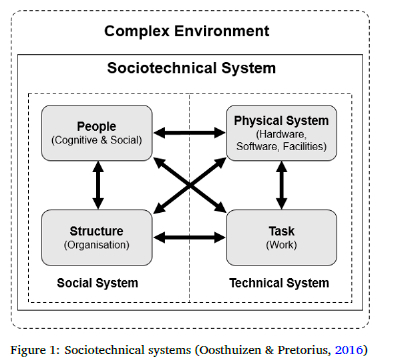
This study examines the organisational adoption of AI sociotechnical systems to ensure a holistic approach that considers technical and social aspects. Sociotechnical systems theories highlight that the construction and interpretation of these systems result from the interplay between their technical and social components (Wihlborg & Söderholm, 2013). A sociotech-nical system has two subsystems: the technical system, which includes the hardware and software and also the actual tasks needed (Oosthuizen & Pretorius, 2016). Both the social and the technical interactions with each other play an important role (Smit, Eybers & Van der Merwe, 2023). The actual tasks might include topics such as operational processes or IT governance. The social system comprises typical soft issues such as organisational structure, people, reward systems, knowledge, skills and attitudes. Complex, unpredictable and unexpected relationships can come from human (socio) and technical interactions (Oosthuizen & Pretorius, 2016). Figure 1 provides a diagram of a sociotechnical system and its relationships. As seen in Figure 1, the sociotechnical system exists within a complex environment. Achieving human-AI symbiosis involves harmonising social and technical elements, working collaborat-ively to accomplish the intended objectives. For example, organisations can use AI to assist with quality checks in their production process. The objective function of the AI would be to minimise quality issues in the assembly, which would align with the production manager's objective. The production manager would, for example, support the AI solution by investing in more labelled data, providing more processing power or routinely maintaining the AI system by updating its algorithms to reflect any changes in production processes or quality standards. In return, the AI system will decrease rework costs and enable the organisation to achieve its production targets. In this example, the objective of the AI system and the humans involved are aligned.
As this study is focused on the suitability of two theoretical underpinnings in AI organisational adoption, a focus on sociotechnical aspects can assist change mediators in managing change between the actors such as firms, organisations and technology as well as the adoption as a whole. Gregor (2006) defines "how-to" theories as theories applicable to design and action. The theoretical "how-to" knowledge is required to assist the mediators of the adoption. For changes to sociotechnical systems, mediators are critical actors in promoting system changes, reducing risks, reducing uncertainties, and thereby improving system sustainability (Wihlborg & Söderholm, 2013). Wihlborg and Söderholm (2013) identify four reflective elements, in which mediators promote change while developing a system in its social context. They translate instead of transferring specific knowledge, function as a singular gateway to knowledge, support the selection process through their interpretive components, and connect knowledge in unexpected ways. Sociotechnical theory is employed as the guiding lens to achieve a holistic approach in investigating the fostering of human-AI symbiosis.
4 TOE FRAMEWORK
The TOE framework is an organisational-level theory which explains the technology context, the organisational context (Tornatzky & Fleischer, 1990), and the environmental context (see Figure 2) as the elements that influence a firm's technology innovation adoption decisions (Dwivedi et al., 2012). It provides a valuable theoretical perspective in examining the integration of information technologies, arguing that the adoption, implementation and assimilation systems in the organisation are influenced by elements associated with technology, the organisation itself, and the external environment (Xu et al., 2017).
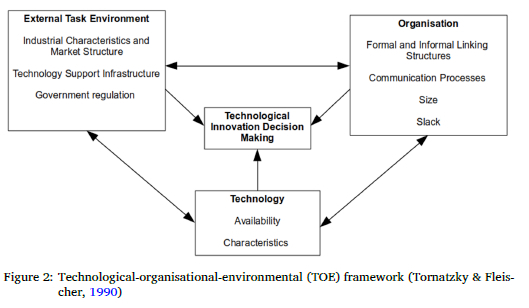
The technology context refers to all the relevant technologies to the organisation. Both the technologies already in use and those not are included in the technology context and influence how organisations can use technology to evolve and adapt (Dwivedi et al., 2012). Technology innovations that are not presently in place in the organisation are categorised into; those that create incremental change, technologies that trigger synthetic change, and those that are radical and produce a discontinuous change (Dwivedi et al., 2012; Tushman & Nadler, 1986). The technology innovations that create incremental change require the smallest learning requirements. Technology innovations that produce a discontinuous change require a substantial learning requirement and, therefore, substantially and dramatically impact the organisation (Tushman & Nadler, 1986). An organisational context is the resources and characteristics of the organisation, including the firm size, internal company communication, structures between employees, and the resource availability level (Dwivedi et al., 2012). The organisational structure (centralised compared to decentralised) and communication processes (management leadership) must be understood to identify the relationship to the innovation adoption process. In the organisational context, the context involves the organisational component and the individual in it (Widyasari et al., 2018). The environmental context refers to the surrounding conditions and factors in which the organisation exists and includes aspects such as the structure of the industry, the service providers, the regulatory environment (Dwivedi et al., 2012), competitor pressures, customer pressures, partner pressures and government pressures (Chen et al., 2019).
Since the TOE contexts significantly impact adoption, including in the case of analytics (Maroufkhani et al., 2020), this study adopts the TOE framework as its conceptual foundation. The framework accounts for external factors directly influencing AI adoption and enables scholars to focus on broader AI adoption characteristics and attributes. Furthermore, the framework complements sociotechnical theory by considering the organisational context of AI adoption.
5 DOI THEORY
A theory often employed to understand and explain technology adoption within the realm of new innovative methods is the DOI theory (Lee et al., 2011; Nam et al., 2019; Rogers, 1995; Xu et al., 2017). Because AI is evolving and can be seen as a constantly changing entity, it remains an innovation. The DOI theory is well-suited for studies that emphasise the dissemination of innovation, as opposed to alternative theories such as the TAM (Davis et al., 1989) and the theory of planned behaviour (Taylor & Todd, 1995), which primarily concentrate on technology or behaviour in a broader sense. Also, because of the continuous evolution of AI technologies, the varying rates of adoption, and the complexity involved in adopting AI, AI adoption is a prime candidate for analysis using DOI (Almaiah et al., 2022; Handoko et al., 2023).
The definition of diffusion in the context of innovation theory is the mechanism through which, over time, innovation is communicated through specific channels among individuals within a social system (Rogers, 1995, p. 5). The concept is that an innovation achieved wide-spread adoption until it becomes self-sustained. The innovation-decision process is the mental progression that an individual experiences. It includes stages such as knowledge, persuasion, decision-making, implementation and confirmation (Rogers, 1995). The innovation diffusion theory encompasses five attributes of an innovation: compatibility, relative advantage, trialability, complexity, and observability. These characteristics explain the adoption of innovations and the decision-making process. In innovation diffusion theory, the extent to which a person's (or unit's) adoption is relative to other members of the social system is classified as innovators, early adopters, early majority, late majority and laggards (Rogers, 1995). It should be noted that in technologies such as generative AI, issue observability could become a challenge. In many cases AI is seen as a black box to the end user (Asatiani et al., 2020).
This study aims to create a theoretical framework to assist researchers with "how-to" knowledge in terms of a theoretical approach to study the enablement of organisational AI adoption. Innovation diffusion theory has been extensively utilised to identify the enablers (variables) of information systems adoption in organisations (Nam et al., 2019; Ransbotham et al., 2019; Xu et al., 2017). When identifying the enablers, organisations need to consider that those focusing only on the technical enablers (variables) tend to neglect the transformational approaches required to obtain sustained business value with AI adoption (Ransbotham et al., 2019). DOI theory is a suitable mechanism for identifying enabling factors for adopting organisational AI.
6 A LENS FOR STUDYING THE ENABLEMENT OF AI ADOPTION
On an enterprise-level view, the most advanced level of data-drivenness and automation, an organisation can be viewed as a giant cybernetic collective (Yolles, 2006). This collective exists within an environment and will impact the people and the natural environment.
To study the enablement of organisational AI adoption, a comprehensive framework that integrates the sociotechnical nature of AI systems is proposed. This framework leverages the TOE framework to identify and analyse the various external and internal factors that influence the adoption of innovations within an organisation (Tornatzky & Fleischer, 1990). The DOI is included to study how knowledge about innovations spreads within social systems, focusing on communication channels and time (Rogers, 1995). The integration of DOI and the TOE offers distinct yet complementary epistemological, ontological, and axiological perspectives critical for understanding AI adoption. Although the focus is on pragmatism, epistemologic-ally, this framework offers flexibility, accommodating various approaches, including positivism and interpretivism. Ontologically, in the context of knowledge representation, the DOI views innovations as entities that move through social networks, interacting with and being shaped by various actors (Rogers, 1995). In contrast, the TOE framework perceives innovations as complex phenomena influenced by the interplay of technological, organisational, and environmental factors (Tornatzky & Fleischer, 1990). Building on this understanding, the value-related considerations of these frameworks are explored. As introduced in Section 2, pragmatism embraces a particular ontological perspective, with actions and change as the essence, in this case, actions to increase AI adoption to bring value to the organisation. Axiologically, the DOI concerns itself with the societal value of innovations and how they are perceived across different adopter categories (Rogers, 1995). The TOE framework concerns how technological advancements, organisational readiness, and environmental pressures align with the organisation's goals, ethics, and strategic priorities. It focuses on the effectiveness and ethical implications of adopting innovations, considering the internal and external consequences for the organisation and its stakeholders (Tornatzky & Fleischer, 1990).
The combination of DOI theory and a TOE framework is familiar to researchers as it offers both a macro (environmental and organisational) and micro (innovation characteristics and adoption process) perspective. DOI theory and the TOE framework have been successfully adopted in several studies (Wei et al., 2015; Wright et al., 2017; Xu et al., 2017; Zhu et al., 2006). "Business analytics adoption process: An innovation diffusion perspective" is one of the more recent studies. The study used DOI theory to understand organisations' business analytics adoption (initiation, adoption, and assimilation) and TOE framework to identify its drivers (Nam et al., 2019). The TOE and DOI are also used in AI adoption studies. However, they do not fully allow organisational conclusions regarding causality (Alsheibani et al., 2020). To understand the causality of elements, we propose including the process steps toward adoption as an integral part of theories studying the organisational adoption of AI (See Figure 3). In DOI theory, the diffusion of innovation involves three main stages: initiation, adoption, and assimilation (Rogers, 1995). These phases are critical. The different phases will have different enablement elements and considerations. In the initiation process, the organisation becomes aware of the innovation, in this case, AI. The second process is the actual adoption process. During this process, AI is implemented and confirmed. The last process is the assimilation process. AI becomes an integral part of the organisation's routines and practices during this process. The process is influenced by factors such as AI complexity, trialability, observability, relative advantage and compatibility with the organisation's existing practices (Rogers, 1995).

As mentioned in the introduction, a data-driven organisation can be defined as an organisation that acts on observed data rather than merely gut feeling and does so to achieve financial or non-financial benefits (Anderson, 2015). AI can act autonomously. Therefore, AI should not be seen as merely a hyper-digital technology (Smit, Eybers & Van der Merwe, 2024). AI, by virtue of its decision-making capabilities and ethical implications (Crawford, 2021). Therefore, it should be considered as possessing a form of agency. This perspective would acknowledge the role of AI role as an active agent in organisational contexts.
Additionally, a data-driven organisation would require AI expertise, tools and a certain culture to adopt and embed AI in the organisation. They effectively use data to enable them to achieve their objectives. Furthermore, the impact of AI is recognised by including the environmental context. The impact can be extensive and includes AI technologies' social, political, and environmental implications. It can go as far as examining the hidden costs of data extraction and labour exploitation (Crawford, 2021).
The proposed theoretical framework is similar to Alsheibani et al. (2020). However, it includes AI expertise, AI tools (including platforms), culture, execution, and benefits of AI. This is included, as a theory should not be limited to the "what", but also includes the "how", "when" or "why " (Bacharach, 1989), Answering research questions such as how did the enabling factor contribute to the initiation of the use of AI tools in the organisation? and when does the enabling factor contribute to an adoption of a data-driven culture in the organisation?, can assist in the evaluation of enabling factors and also be used as a step towards understanding of causality in AI adoption. In the first research question example, how did the enabling factor contribute to the initiation ofthe use ofAI tools in the organisation?, an example of an enabling factor could be the hosting of technology days (Smit et al., 2022).
Framing these questions within a pragmatist paradigm encourages a focus on obtaining information that is of value to practice. We want to emphasise how important pragmatism is for this study as a philosophical foundation, especially in DSR. A pragmatic approach concentrates on the applications and implications of concepts, theories, and deeds in the real world. It emphasises how crucial it is to consider how valuable and applicable research findings are to solving real-world issues. Pragmatism has several significant benefits in the context of this article, which tries to identify and assess enablers for the successful adoption and application of AI within organisations:
Emphasis on practical results: By taking a pragmatic approach, the research will concentrate on producing information that can immediately be implemented to help organisations adopt AI. This strategy fits in well with the paper's objectives: to comprehend the elements that influence the adoption and implementation of AI successfully or unsuccessfully.
Flexibility and adaptability: Pragmatism promotes blending research approaches and methodologies and various theoretical viewpoints (such as TOE and DOI). This adaptability fits in well with the paper's strategy, which mixes several theoretical frameworks to analyse and comprehend the adoption of AI in organisations.
Problem-focused approach: Pragmatism strongly emphasises tackling real-world issues and difficulties, making it especially appropriate for DSR. DSR attempts to develop and assess artefacts (such as models, frameworks, or tools) to address real-world issues. This study shows a clear commitment to solving the practical issues of AI adoption through the evaluation methodology for evaluating the efficacy of enabling variables and the focus on the complex sociotechnical systems within organisations.
Place an emphasis on context: Pragmatism recognises the significance of context in comprehending and solving problems. This is especially pertinent to this article because it is believed that the organisational context significantly impacts the adoption and use of AI. The research can better account for the various and complicated circumstances in organisations' functions by adopting a pragmatic approach, improving the findings' generalisability and application.
Pragmatism enriches the research by focusing on useful results, encouraging methodological flexibility, adhering to the problem-oriented methodology of DSR, and taking context into account. The goals of the article will be met by this philosophical position, which will ultimately contribute to a more thorough and practical understanding of the elements that affect the effective adoption and application of AI within organisations. To support the integration of AI in an organisation, the framework depicted in Figure 3 was utilised in the form of a case study (Smit, Eybers & van der Merwe, 2024). It effectively links theoretical insights with practical applications. It drew upon the DSR methodology, particularly the cycle steps outlined by Vaishnavi et al., to construct an AI Adoption Framework (AIAF) (Vaishnavi et al., 2004). The theoretical foundation for the research was based on the theoretical framework as outlined in this paper. A case study at an IT Hub formed the basis of the empirical work, which was structured around a main DSR cycle and three supporting sub-cycles. These sub-cycles examined socio-enabling factors, technical-enabling factors for AI adoption, and a comparative analysis between AI and traditional data-driven technology adoption.
While evaluating the framework across multiple case studies is ideal, it may not always be feasible. The next section explores generative AI as a potential alternative for assessing the effectiveness of a theoretical framework.
7 GENERATIVE AI AND RESEARCH
True to the pragmatism approach described in Section 6, a flexible problem-oriented way to explore the framework's usefulness is required. Generative AI can be a powerful tool for brainstorming research ideas (Al-Ahmadi, 2023). Therefore, to assess the framework's effectiveness, this research utilises generative AI to generate and explore research ideas based on the proposed framework (See Figure 3).
7.1 Generative pre-trained transformers
In the domain of generative AI, the recent advances in large language models (LLMs) like ChatGPT2, Google's Bard3 and X's Grok4 are taking the world by storm. OpenAI's ChatGPT is one of the most popular LLMs. It is trained on many books, press articles, Wikipedia, and other web content (Teubner et al., 2023). ChatGPT accesses GPT-4, which is a language model based on the generative pre-trained transformer architecture and has been enhanced through a training method known as reinforcement learning from human feedback (Thorp, 2023). GPT-4 allows for new business opportunities and efficiency potential (Teubner et al., 2023). One example is its use by writers to suggest corrections, alternative phrasing or even to write stories (Teubner et al., 2023). GPT-4 can be used to support empirical research (Liang et al., 2024). However, it is also known to make mistakes, for example, referencing scientific studies that do not exist (Thorp, 2023). While fully acknowledging the limitations of LLMs (Al-Ahmadi, 2023; Thorp, 2023); this research utilises LLMs' capabilities to generate text based on prompts, which allows the researchers to apply the theoretical framework experimentally.
7.2 Generative AI prototype that applies the framework
A generative AI application was developed to experiment with the usefulness of the proposed framework (Figure 3). Like a human applying the framework, the generative AI application uses the framework as a lens to study how to enable AI adoption. This application uses the framework as the theoretical basis from which GPT-4 will be called. The user is then allowed to select focus areas from the framework. In the example in Figure 4, the Technical system, Technological context, Assimilation and Analytical tools were selected.
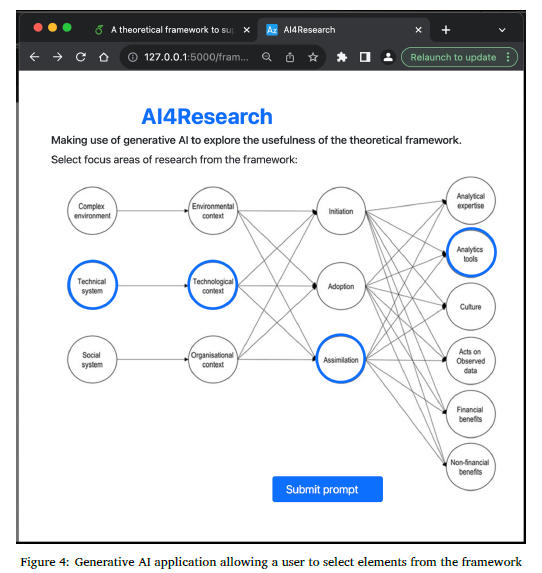
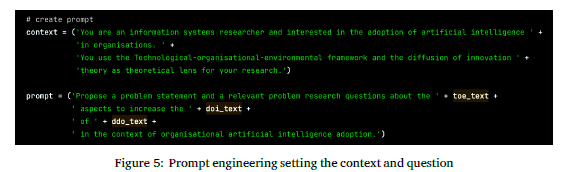
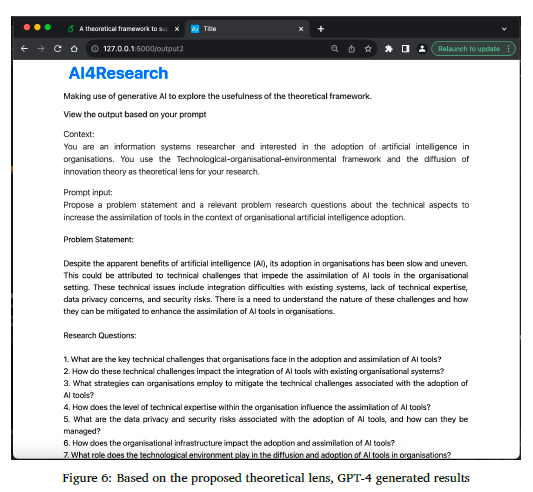
The selection is then used as input to the prompt engineering process. Prompts are instructions given to an LLM to ensure specific qualities of the generated output. It can be seen as a form of programming that can customise the outputs and interactions with an LLM (White et al., 2023). The first step of the prompt engineering process was to set the context as "You are an information systems researcher and interested in the adoption of artificial intelligence in organisations". After that, the selected framework elements are used to define the prompt. A prompt pattern was created from the framework to provide re-usability (White et al., 2023). The code can be seen in Figure 5. As the LLM's ability to generate relevant and accurate responses is directly correlated to the clarity and precision of the prompt provided (Zhou et al., 2023), an iterative process was used to define the prompt's code.
After the prompt engineering process, the application calls a GPT-4 API and requests GPT-4 to create a possible problem statement and related research questions. The context, prompt and result are displayed to the user for review. An example of how the application presents the results can be seen in Figure 6. As can be seen by the following prompts, the generated results by GPT-4 are relevant.
Example 1 prompt: "Propose a problem statement and relevant problem research questions about the environmental aspects to increase the adoption of tools in the context of organisational artificial intelligence adoption".
Example 1 output: "Research Question: What are the key environmental factors that either promote or inhibit the adoption of AI tools in organisations? Problem Statement: Despite the rapid advancements in artificial intelligence (AI), its adoption in organisations remains relatively low. The problem seems to lie in the environmental factors that influence the decision-making process of AI adoption in an organisation. These factors include competitive pressure, technological infrastructure, regulatory climate, and socio-cultural norms within the organisation. The understanding ofthese environmental aspects and their impact on AI adoption is crucial to increase the utilisation of AI tools in organisations".
Example 2 prompt: "Propose a problem statement and relevant problem research questions about the organisational aspects to increase the initiation of financial benefits in the context of organisational artificial intelligence adoption".
Example 2 output: "Research Question: How can organisations strategically align their AI initiatives with their business objectives to maximise financial benefits? Problem Statement: Despite the increasing interest and investment in artificial intelligence (AI) technologies, many organisations are yet to realise significant financial benefits from their AI initiatives. This underperformance may be due to a variety of factors, including technological complexües, organisational readiness, and environmental dynamics. Understanding these factors can provide valuable insights into the initiation of financial benefits from AI adoption in organisations".
A clear and well-defined problem statement and supporting research questions set up a good starting point for a concise and convincing argument for a thesis. Research questions support the problem statement to pinpoint what the study is addressing (Hofstee, 2006). Both examples from the generative AI application provide well-defined and topic-specific problem statements and research questions, which can facilitate a researcher in the first step to a thesis with a compelling argument.
In addition to the examples, all permutations of the section of the framework were submitted via the application. Proposed research questions included a wide range of "how", "when" and "why" questions. Similar to the results found by Sandkuhl et al. 2023, this application illustrates that GPT, in this case, GPT-4, can coexist with domain experts (Sandkuhl et al., 2023). The use of generative AI to support research is still a contentious topic. Still, this small prototype showed that generative AI can be used to explore the validity of proposed frameworks. Generative AI can play an important role in supporting researchers and as tools for the people posing the hypotheses (Thorp, 2023). Even if generative AI is just used in the ideation phase of research, the potential and impact of such tools warrants future research (Stokel-Walker, 2023).
8 CONCLUSION
The paper's main objective was to explore the suitability of the technological-organisational-environmental (TOE) framework and diffusion of innovation (DOI) theory towards comprehending AI adoption as part of sociotechnical systems. This paper explained the requirement of an appropriate theory to assist in identifying enablers for transformations and be useful to support and help the change management and adoption process while having a holistic perspective. Firstly, sociotechnical theory is introduced as a high-level lens for this study to allow for a holistic perspective with the target of human-AI symbiosis. In sociotechnical theory, the TOE framework is proposed to identify elements that influence an organisation's adoption decisions regarding technology innovation. Secondly, DOI theory is suggested to identify the enablers of AI adoption.
The TOE framework, the DOI diffusion processes (initiation, adoption and assimilation) and the elements of data-driven organisations are combined into one framework. This paper contributes on a theoretical level by providing a framework to evaluate the possible impact of the enabling factors and, therefore, contribute to causality knowledge. It can, therefore, be used to identify research questions related to the "how", "when" and "why". However, like all studies, this paper has limitations. The researchers are fully aware that the proposed theoretical model is not close to a grand theory on organisational AI adoption. However, our approach includes the use of the diffusion processes to evaluate the "how", "when" and "why" the enabling factors can contribute to causality knowledge in the field of AI research in Information Systems. Future studies will focus on applying the theoretical framework to support understanding the causality and effectiveness of different enabling factors. The Technology-Organisation-Environment (TOE) framework can be harnessed to enhance AI prompt generation, contrasting it with the Diffusion of Innovations (DOI) theory to produce a coherent contribution to future research. Additionally, the application of generative AI in research remains a relatively novel area. Future studies could further explore how recent advances in LLMs may influence academic research practices and outcomes.
References
Al-Ahmadi, M. (2023). The use of artificial intelligence large language models in scientific research: Blessing or curse? Ethical or immoral? AMCIS 2023 TREOs, 118. https://aisel.aisnet.org/treos_amcis2023/118
Almaiah, M. A., Alfaisal, R., Salloum, S. A., Hajjej, F., Shishakly, R., Lutfi, A., Alrawad, M., Al Mulhem, A., Alkhdour, T., & Al-Maroof, R. S. (2022). Measuring institutions' adoption of artificial intelligence applications in online learning environments: Integrating the innovation diffusion theory with technology adoption rate. Electronics, 11(20), 3291. https://doi.org/10.3390/ELECTRONICS11203291 [ Links ]
Alsheibani, S., Cheung, Y., & Messom, C. (2020). Rethinking the competitive landscape of artificial intelligence. Proceedings of the 53rd Hawaii International Conference on System Sciences, 5861-5870. https://doi.org/10.24251/HICSS.2020.718
Anderson, C. (2015). Creating a data-driven organisation (1st). O'Reilly.
Asatiani, A., Malo, P., Nagb0l, P. R., Penttinen, E., Rinta-Kahila, T., & Salovaara, A. (2020). Challenges of explaining the behavior of black-box AI systems. MIS Quarterly Executive, 19(4), 259-278. https://doi.org/10.17705/2msqe.00037 [ Links ]
Bacharach, S. B. (1989). Organizational theories: Some criteria for evaluation. Academy of Management Review, 14(4), 496-515. https://doi.org/10.5465/amr.1989.4308374 [ Links ]
Baskerville, R., Baiyere, A., Gregor, S., Hevner, A., & Rossi, M. (2018). Design science research contributions: Finding a balance between artifact and theory. Journal of the Association for Information Systems, 19(5), 358-376. https://doi.org/10.17705/1jais.00495 [ Links ]
Berente, N., Gu, B., Recker, J., & Santhanam, R. (2021). Managing artificial intelligence. MIS Quarterly, 45(3), 1433-1450. https://aisel.aisnet.org/misq/vol45/iss3/16/ [ Links ]
Chen, Y., Yin, Y., Browne, G. J., & Li, D. (2019). Adoption of building information modeling in chinese construction industry: The technology-organization-environment framework. Engineering, Construction and Architectural Management, 26(9), 1878-1898. https://doi.org/10.1108/ECAM-11-2017-0246 [ Links ]
Crawford, K. (2021). Atlas of AI. Yale University Press.
Crowther, D., & Aras, G. (2008). Corporate social responsibility. Bookboon.
Davis, F. D., Bagozzi, R. P., & Warshaw, P. R. (1989). User acceptance of computer technology: A comparison of two theoretical models. Management Science, 35(8), 982-1003. https://doi.org/10.1287/mnsc.35.8.982 [ Links ]
de Ven, A. H. (1991). The process of adopting innovations in organizations: Three cases of hospital innovations. In People and technology in the workplace. National Academies Press. https://nap.nationalacademies.org/read/1860/chapter/10
Dresch, A., Lacerda, D., & Antunes, J. A. V. (2015). Design science research: A method for science and technology advancement. Springer International. http://link.springer.com/book/10.1007/978-3-319-07374-3
Dwivedi, Y. K., Wade, M. R., & Scheberger, S. L. (2012). Information systems theory. explaining and predicting our digital society (Vol. 1). Springer.
Gioia, D. A., & Pitre, E. (1990). Multiparadigm perspectives on theory building. Academy of Management Review, 15(4), 584-602. https://doi.org/10.5465/amr.1990.4310758 [ Links ]
Goldkhul, G. (2012). Pragmatism vs interpretivism in qualitative information systems research. European Journal of Information Systems, 21(2), 135-146. https://doi.org/10.1057/ejis.2011.54 [ Links ]
Gregor, S. (2006). The nature of theory in information systems. MIS Quarterly, 30(3), 611-642. https://dl.acm.org/doi/10.5555/2017296.2017300 [ Links ]
Handoko, B. L., Angelus, M., & Mulyawan, A. N. (2023). Diffusion of innovation on auditor adoption of artificial intelligence and machine learning. Proceedings of the 2023 7th International Conference on Software and e-Business, 20-26. https://doi.org/10.1145/3641067.3641073
Hevner, A. R., March, S. T., Park, J., & Ram, S. (2004). Design science in information systems research. MIS Quarterly, 28(1), 75-105. https://doi.org/10.2307/25148625 [ Links ]
Hofstee, E. (2006). Constructing a good dissertation. Sandton, South Africa: EPE. [ Links ]
Hyder, Z., Siau, K., & Nah, F. F. (2018). Use of artificial intelligence, machine learning, and autonomous technologies in the mining industry. MWAIS 2018 Proceedings, 43, 1-5. https://aisel.aisnet.org/mwais2018/43 [ Links ]
Lacity, M. C., & Willcocks, L. P. (2021). Becoming strategic with intelligent automation. MIS Quarterly Executive, 20(2), 1-14. https://aisel.aisnet.org/misqe/vol20/iss2/7 [ Links ]
Lee, Y., Hsieh, Y., & Hsu, C. (2011). Adding innovation diffusion theory to the technology acceptance model: Supporting employees' intentions to use e-learning systems. Educational Technology and Society, 14(4), 124-137. https://www.jstor.org/stable/pdf/jeductechsoci.14.4.124.pdf [ Links ]
Liang, J. T., Badea, C., Bird, C., DeLine, R., Ford, D., Forsgren, N., & Zimmermann, T. (2024). Can GPT-4 replicate empirical software engineering research? Proceedings of the ACM on Software Engineering, 1(FSE), 1330-1353. https://doi.org/10.1145/3660767
Litchfield, A. (2009). Holistic pragmatism as a philosophical framework in information systems research. 15th Americas Conference on Information Systems 2009, AMCIS 2009, 1, 359. https://www.proceedings.com/content/006/006499webtoc.pdf
Maroufkhani, P., Wan Ismail, W. K., & Ghobakhloo, M. (2020). Big data analytics adoption model for small and medium enterprises. Journal ofScience and TechnologyPolicyMan-agement, 11(2), 171-201. https://doi.org/10.1108/JSTPM-02-2020-0018 [ Links ]
Myers, M. D. (2020). Qualitative research in information systems [Accessed: 24 October 2024]. https://www.qual.auckland.ac.nz
Nam, D., Lee, J., & Lee, H. (2019). Business analytics adoption process: An innovation diffusion perspective. International Journal of Information Management, 49(July), 411-423. https://doi.org/10.1016/j.ijinfomgt.2019.07.017 [ Links ]
Oosthuizen, R., & Pretorius, L. (2016). Assessing the impact of new technology on complex sociotechnical systems. South African Journal of Industrial Engineering, 27(2), 15-29. https://doi.org/10.7166/27-2-1144 [ Links ]
Ransbotham, S., Khodabandeh, S., Fehling, R., Lafountain, B., & Kiron, D. (2019). Winning with AI - Pioneers combine strategy, organizational behavior, and technology [Accessed, 19 November 2024]. https://sloanreview.mit.edu/projects/winning-with-ai/
Rogers, E. M. (1995). Diffusion of innovations (4th). The Free Press.
Sandkuhl, K., Barn, B. S., & Barat, S. (2023). Neural text generators in enterprise modeling: Can ChatGPT be used as proxy domain expert? Proceedings ofthe 31st International Conference on Information Systems Development. https://doi.org/10.62036/ISD.2023.44
Simon, H. A. (2019). The science of the artificial (3rd ed.). The MIT Press. https://doi.org/10.7551/mitpress/12107.001.0001
Smit, D., Eybers, S., Sibanyoni, N., & de Waal, A. (2022). Technology days: An AI democratisation journey begins with a single step. In A. Pillay, E. Jembere & A. Gerber (Eds.), Artificial intelligence research: Third southern african conference (pp. 335-347). Springer. https://doi.org/10.1007/978-3-031-22321-1_23
Smit, D., Eybers, S., & Van der Merwe, A. (2023). Exploring the social and technical factors in organisational adoption: A systematic literature review. Proceedings of Society 5.0 Conference 2023, 93, 174-187. http://hdl.handle.net/2263/96307
Smit, D., Eybers, S., & Van der Merwe, A. (2024). AI adoption in the corporate social responsible era: A model for practitioners and researchers. AMCIS 2024 Proceedings, 8. https://aisel.aisnet.org/amcis2024/ai_aa/ai_aa/8
Smit, D., Eybers, S., & van der Merwe, A. (2024). Towards human-AI symbiosis: Designing an artificial intelligence adoption framework. South African Computer Journal, 36(1), 76104. https://doi.org/10.18489/sacj.v36i1.18823 [ Links ]
Smit, D., Eybers, S., van der Merwe, A., & Wies, R. (2023). Exploring the suitability of the TOE framework and DOI theory towards understanding AI adoption as part of sociotechnical systems. Communications in Computer and Information Science, 1878 CCIS, 228-240. https://doi.org/10.1007/978-3-031-39652-6_15
Stokel-Walker, C. (2023). ChatGPT listed as author on research papers: Many scientists disapprove. Nature, 613(7945), 620-621. https://doi.org/10.1038/D41586-023-00107-Z [ Links ]
Taylor, S., & Todd, P. A. (1995). Understanding information technology usage: A test of competing models. Information Systems Research, 6(2), 144-176. https://doi.org/10.1287/isre.6.2.144 [ Links ]
Teubner, T., Flath, C. M., Weinhardt, C., van der Aalst, W., & Hinz, O. (2023). Welcome to the era of ChatGPT et al.: The prospects of large language models. Business and Information Systems Engineering, 65(2), 95-101. https://doi.org/10.1007/s12599-023-00795-x [ Links ]
Thorp, H. H. (2023). ChatGPT is fun, but not an author. Science, 379(6630), 313. https://doi.org/10.1126/science.adg7879 [ Links ]
Tornatzky, L. G., & Fleischer, M. (1990). The processes of technological innovation. Lexington Books.
Tushman, M., & Nadler, D. (1986). Organizing for innovation. California Management Review, 28(3), 74-92. https://doi.org/10.2307/41165203 [ Links ]
Vaishnavi, V., Kuechler, B., & Petter, S. (2004). Design science research in information systems (V. Vijay, K. Bill & S. Petter, Eds.) [Accessed :19 November 2024]. http://www.desrist.org/desrist/content/design-science-research-in-information-systems.pdf
Wei, J., Lowry, P. B., & Seedorf, S. (2015). The assimilation of RFID technology by Chinese companies: A technology diffusion perspective. Information and Management, 52(6), 628-642. https://doi.org/10.1016/j.im.2015.05.001 [ Links ]
White, J., Fu, Q., Hays, S., Sandborn, M., Olea, C., Gilbert, H., Elnashar, A., Spencer-Smith, J., & Schmidt, D. C. (2023). A prompt pattern catalog to enhance prompt engineering with ChatGPT. arXivpreprint arXiv:2302.11382. http://arxiv.org/abs/2302.11382 [ Links ]
Widyasari, Y. D. L., Nugroho, L. E., & Permanasari, A. E. (2018). Technology Web 2.0 as intervention media: Technology organization environment and socio-technical system perspective. Proceedings of 2018 10th International Conference on Information Technology and Electrical Engineering: Smart Technology for Better Society, ICITEE 2018, 124-129. https://doi.org/10.1109/ICITEED.2018.8534744
Wihlborg, E., & Söderholm, K. (2013). Mediators in action: Organizing sociotechnical system change. Technology in Society, 35(4), 267-275. https://doi.org/10.1016/j.techsoc.2013.09.004 [ Links ]
Wixom, B. H., & Someh, I. A. (2018). Accelerating data-driven transformation at BBVA. MIT Sloan Center for Information Systems Research, XVIII(7), 1-4. https://cisr.mit.edu/publication/2018_0701_DataDrivenBBVA_WixomSomeh [ Links ]
Wright, R. T., Roberts, N., & Wilson, D. (2017). The role of context in IT assimilation: A multi-method study of a SaaS platform in the US nonprofit sector. European Journal of Information Systems, 26(5), 509-539. https://doi.org/10.1057/s41303-017-0053-2 [ Links ]
Xu, W., Ou, P., & Fan, W. (2017). Antecedents of erp assimilation and its impact on ERP value: A TOE-based model and empirical test. Information Systems Frontiers, 19(1), 13-30. https://doi.org/10.1007/s10796-015-9583-0 [ Links ]
Yolles, M. (2006). Organizations as complex systems: An introduction to knowledge cybernetics. IAP.
Zhou, Y., Muresanu, A. I., Han, Z., Paster, K., Pitis, S., Chan, H., & Ba, J. (2023). Large language models are human-level prompt engineers. arXiv preprint arXiv:2211.01910. http://arxiv.org/abs/2211.01910
Zhu, K., Kraemer, K. L., & Xu, S. (2006). The process of innovation assimilation by firms in different countries: A technology diffusion perspective on e-business. Management Science, 52(10), 1557-1576. https://doi.org/10.1287/mnsc.1050.0487 [ Links ]
Received: 7 February 2024
Accepted: 9 October 2024
Online: 11 December 2024
1 The best or worst thing to happen to humanity. Cambridge University - https://www.youtube.com/watch?v=_5XvDCjrdXs, [Accessed 18 April 2023].
2 OpenAI's ChatGPT - https://openai.com, [Accessed, November 17 August 2023].
3 Google's Bart - https://bard.google.com, [Accessed, November 17 August 2023].
4 xAI's Grok. https://x.ai, [Accessed, November 17 August 2023].
