




Services on Demand
Journal

Article
 English (pdf)
 Article in xml format
 Article references

 Automatic translation
 Send this article by e-mail
Indicators
Related links
-
 Cited by Google
-
 Similars in Google
Share

 Permalink

Southern African Journal of Environmental Education
On-line version ISSN 2411-5959Print version ISSN 1810-0333
SAJEE vol.40 n.1 Makhanda 2024
https://doi.org/10.4314/sajee.v40si1.02
ARTICLES
THINK PIECE
Donna J. Haraway's ecofeminism revisited: Critical new materialist pedagogies for Anthropoceniccrisis times
Delphi CarstensI; Evelien GeertsII
IUniversity of the Western Cape
IIUniversity College Cork
ABSTRACT
By bringing feminist science studies scholar Donna J. Haraway's A manifesto for cyborgs (1985) and Situated knowledges (1988) in line with contemporary critical new materialist thought (see Colman & Van der Tuin, 2024; Dolphijn & Van der Tuin, 2012; Geerts, 2022), this critical pedagogical and philosophical think piece tackles the problematic of Anthropocenic disruptions of the planetary biosphere for critical pedagogies and higher education (also see Carstens, 2016). It additionally encourages its readers to think through their own pedagogical conceptions and praxes by means of irruptive (Geerts & Carstens, 2024; Koro-Ljungberg, 2015) self-reflection-stimulating questions. Our situated - and thus limited and open-ended - response to this all-encompassing Anthropocenic crisis is rooted in a rethinking of Harawayan cyborgian and situated knowledges and the critical pedagogical lessons drawn from the latter. Rereading Haraway's work through contemporary critical new materialist and related scholarship reveals that it already contained an ecofeminist onto-epistemological shift toward more-than-human agency and relationality. This shift has major consequences for all things critical pedagogical and educational, as our pedagogical thinking-doings are deeply embedded in today's crisis-ridden lifeworld. This rereading exercise furthermore underlines the necessity of an updated critical new materialist pedagogical praxis for learning and teaching, inspired by Harawayan ecofeminism, that takes the entanglements between human, dehumanised, and more-than-human actors seriously.
Keywords: Anthropocene, critical new materialisms, critical pedagogies, Donna J. Haraway, ecofeminism, eco-environmental, (higher) education, irruptive methodology
Introduction: Thinking-with and teaching-with the eco-environmental
As a pluralistic, transversal, and transcontinental undertaking (see Dolphijn & Van der Tuin, 2012), contemporary new materialist philosophies are characterised by a "shared interest in materiality and the non-human" (Geerts, 2022, p. 393), making them explicitly posthumanist as well (also see Braidotti, 2013). Building onto preceding (historical and feminist) materialist but also poststructuralist philosophers, new materialists, and particularly critical new materialist thinkers, such as nomadic posthumanist philosopher Rosi Braidotti (2013), animacy theorist Mel Y. Chen (2012), agential realist philosopher Karen Barad (2007), and environmental thinkers Stacy Alaimo (2016) and Alexis Shotwell (2016), call for more nuanced accounts of our material embeddedness in the world. For them, the eco-environmental, and specifically our potential to ethically acknowledge that what surrounds humans as matter(ing), forms the starting point of their materially-embedded philosophies. Thinking-with the eco-environmental, this think piece is part philosophical but also part critical pedagogical. In addition to providing a rereading of Harawayan ecofeminist philosophy that situates her work at the forefront of contemporary critical new materialist philosophies and pedagogies, as we will soon see, this article experiments with irruptive self-reflection-stimulating questions provoked by these Anthropocenic crisis times. And like true irruptions, these questions are scattered throughout the text (also see Geerts & Carstens, 2024; Koro-Ljungberg, 2015 for this particular methodology).
The need to reflect upon the Anthropocene and the eco-environmental is also emphasised by political theorists Diana Coole and Samantha Frost (2016, p. 1) when stating that critical new materialist positions require theorists and educators alike to take stock of the "microorganisms" and "diverse species" with which humans are co-constituted, the "material artifacts and natural stuff that populate our environment", as well as the "socioeconomic structures that produce and reproduce the conditions of our everyday lives". By putting forward a relational eco-ethics of self and other, human, non-human, and the dehumanised, materiality, immateriality, and extramateriality, and consequently zooming in on "questions of mattering and non-mattering through the intersections of gender, sexuality, and race/ethnicity" (Geerts, 2022, p. 393), critical new materialist perspectives challenge the anthropocentric, universalising, and objectifying tenets of modern Western humanism and thought. While doing so, these environmentally aware philosophies -often labelled as environmental posthumanist (see Daigle, 2022) - ask humans to take on "responsibility and accountability" (Barad, 2007, p. 393) in their theorising and pedagogical praxes "for the lively relationalities of becoming of which we are part" (p. 393). Recognising that worldly, material phenomena are agential, while simultaneously also shaped by a multitude of interlocking systems and power-driven forces, is especially relevant to the central task of rethinking higher education and critical pedagogies. These kinds of pedagogies, here specifically defined as emancipatory social justice-focused critical theories and praxes, pay attention to "questions regarding who has control over the conditions for the production of knowledge, values, and classroom practices" (Giroux, 2011, p. 5). In this think piece, we extend the notion of critical pedagogy to include environmental justice concerns, which are immanent to social justice concerns in the Anthropocene and form a leitmotiv in critical new materialisms and Haraway's oeuvre. "Climate change, water pollution, the rapid disappearance of growing numbers of species ... a desperate shortage of clean water for many people" accentuate and widen the already "enormous disparities between rich and poor" (Shotwell, 2016, p. 111). These are only some of the contemporary complications that indicate rapidly growing fracture lines in the modern socio-economic systems that have emerged from the nexus of free market capitalism, the military-industrial complex, and modern Western not-so-humane humanism. These issues, along with many others (think of increasingly severe hurricanes, droughts, wildfires, and floods), describe an unfolding Anthropocenic - or human-made - crisis that necessitates ditching and rethinking the unworkable humanist modalities that have steered it. The mythos of progressive modernity, disseminated by educational systems around the world, is built on the distinction between "bare life" (zoè) and human(ised) "political existence" (bios) (Agamben, 1995/1998, p. 8; also see Braidotti, 2013), whereby the other is politically dehumanised and framed as exploitable, and, eventually, disposable zoē. This distinction has supported the ongoing brutal expulsion of the dehumanised and those beings regarded as non-human from their life worlds, creating a system in which certain forms of life (and particularly the lives of gendered, racialised, and often also animalised humans) are seen as expendable resources beholden to the endless growth of the economy (see Sassen, 2014).
Contemporary banking models of education, as criticised by critical pedagogues Paolo Freire (1970/2006), bell hooks (1994), and Giroux (2011; 2022), have upheld this faulty idea of progressive modernity benefitting all with their current investment in the Fourth Industrial Revolution in which the lines between the physical and the digital are increasingly blurred and the eco-environmental is brutally pushed aside. Both Freire (1970/2006) and hooks (1994, p. 194) understand the extractive capitalist and now fully neoliberalised banking model of education as downplaying "eros ... as a [pedagogical] motivating force": In such a model, students are merely seen as disembodied, passive, and affectless consumers of easily digestible knowledge soundbites and are taught to conform to societal norms and demands of the marketplace - a situation that is very much in line with what critical theorists Theodor W. Adorno and Max Horkheimer's in their Dialectic of enlightenment (1944/1997) have labelled the regime of technocratic capitalist reason. And as Giroux also states in Pedagogies of resistance (2022), these now neoliberalised banking models - which have neatly adapted themselves to local contexts around the globe - not only keep hegemonic power structures and relations in place, but also reproduce a fascist authoritarianism-engendering public pedagogy. Such a pedagogy - which Haraway would describe as a totalising god trick - is antithetical to critical thinking due to its focus on total obedience to hegemonic and canonical knowledge production. And, because of the powers of present-day social media, it is currently dangerously - and quite virally - spreading its fascist overtones beyond the confines of the classroom.
At the root of this unfolding Anthropocenic crisis are outdated, anti-relational, and extractivist conceptualisations of deemed non-human nature - and all other beings shoved into that category - that continue to inform knowledge production and transmission through education, as well as technoscientific innovation. Contrastingly, critical new materialist thought that is rooted in the eco-environmental and the foregoing critical theoretical and pedagogical critiques (also see Geerts and Carstens, 2019) gives critical thinkers, pedagogues, and higher educational practitioners a gentle push to explore alternative accounts of relationality, accountability, and deep reciprocity by investing their thinking, teaching, and learning practices with an immanent, more-than-human eco-ethics. Such a critical praxis urges theorists and pedagogues alike to integrate the crisis of the Anthropocene directly into their thinking and teaching practices, no matter what field is being taught (see Carstens, 2016). After all, there is no clear disciplinary path leading us out of this crisis. Instead, there is only the possibility of actions taken "from within compromised locations shadowed by futures that will surely need repair", as environmental thinker Stacey Alaimo (2016, p. 188) also puts it. Staying with the trouble of the Anthropocene, to foreshadow Haraway's 2016 motto for a second, means cultivating the difficult "practice of thinking from within and as part of the material world" (Alaimo, 2016, p. 188); a project that "swirls together ontology, epistemology, scientific disclosures, political perspectives, posthuman ethics and environmental activism" into situated and accountable accounts of the material world that are grounded in grids of shared "vulnerability, culpability, responsibility and concern" (p. 188).
Haraway's ecofeminist philosophy in the light of Anthropocenic crisis times
Although the Anthropocene may seem like simply another fancy concept, it is also clearly a game-changer, sparking lively debates across disciplines of learning and knowledge production. For starters, the naming of the Anthropocene (for this, see Crutzen, 2006) unsettles the misapprehension that the Earth is a boundless cornucopia of resources for capitalism to process, exploit, and discard. Whether acknowledged as new geological epoch or figured as an event that highlights the urgent need to search for more liveable futures beyond the ruination (increasing wildfires, droughts, extreme weather, habitat destructions, and so forth) that is already here, the Anthropocene, together with the myriad of interconnected crises it has provoked, is a clarion call to critical theory and higher education to reconfigure possibilities of thinking, teaching, and learning otherwise. We may yet learn to live better with multiple non-human and dehumanised others by considering our inseparability from their fates and entwining our hopes and dreams with theirs.
Donna J. Haraway's (2016) substitute for what could come after the Anthropocene, that is the Chthulucene, anchored in "situated hope" (Geerts, 2022, p. 403) speaks affectively to such dreams of multispecies relationality and justice. The Chthulucene, with its emphasis on relational entanglement, proposes that, as critical thinkers and pedagogues, we must begin the necessary task of forging "concrete proposals for novel ways of being with others" that are less destructive, as Haraway also puts it in When species meet (2008, p. 19). Ecofeminist post-Anthropocenic narratives, such as that of Haraway but also those of Kathryn Yusoff's A billion Black Anthropocenes or none (2018) and Zakiyyah Iman Jackson's (2020) Becoming human, trace the racialised lines of the Anthropocene and propose a "black(ened) humanity" (p. 3) that challenges critical theorists and pedagogues to entangle individual and social issues with broader more-than-human eco-ethical frameworks. While doing so, as Yusoff and Jackson remind us, we must remain vigilant of how the intellectual - and educational - pursuit of so-called pure reason, objectivity, and a singular vision of the human subject has been tied to ecocide, as well as intersecting racialised, gendered, and sexualised forms of violence.
Haraway's ecofeminism revisited: 'A manifesto for cyborgs'
Primarily working as a feminist science studies scholar and critical theorist, and with an interdisciplinary background in zoology, philosophy, and biology, Donna J. Haraway already in her earlier work tried to produce fruitful conversations between philosophical realism, anti-racist socialist feminism, and environmentalism. For her, the oppression of women, as well as of other minority groups, is inextricably linked to the degradation of the environment; both of which are consequences of capitalist globalisation. Unlike some of the ecofeminists of the 1970s, who advocated essentialist nature/nurture positions by associating women's bodies with the feminised body of the Earth, Haraway in her 'manifesto for cyborgs' (1985, p. 102) declared that she "would rather be a cyborg than a goddess". This anti-essentialist stance is repeated in 'Reading Buchi Emecheta' (1990), where Haraway develops her ecofeminist praxis in relation to her inclusive critical pedagogy of difference that focuses on the respecting of differences between all beings, human and non-human.
As an interdisciplinary scholar, Haraway has clearly pushed educators and theorists working across the two-cultures divides in the Arts and Sciences to attend more closely to material agencies that transcend the representational logics of social constructivist philosophies of the late 1980s and 90s. Working against the backdrop of socialist feminism and feminist standpoint theory, the challenge for Haraway (1985, p. 75) consists of imagining a coalitional feminist politics that could embrace "partial, contradictory, permanently unclosed constructions of personal and collective selves", while not presuming to construct a whole identity, such as the identity of 'woman' (which Haraway puts between quotation marks to denote that there are many different types of women). Her cyborg metaphor - "a hybrid of machine and organism" (1985, p. 65; also see Âsberg, 2024) - figures human identity as always partial and shifting, troubling the appropriation of nature as a "resource for the production of culture" (Haraway, 1985, p. 66), while indicating that the "relation between organism and machine has [always] been a border war" whose stakes are "the territories of production, reproduction, and imagination" (p. 66). Serving "as a condensed image of both imagination and material reality" (p. 66), the cyborg identity situates itself firmly outside techno-teleological and progressive "salvation history" (p. 67) by firmly resisting a universalising philosophical theory while, at the same time, refusing an antirealist stance that demonises science and technology.
Taken as a whole, Haraway's manifesto, like 'Reading Buchi Emecheta', is about the crucial pedagogical necessity of finding our "way out of the maze of dualisms" (1985, p. 100) by which "we have explained our bodies and our tools to ourselves" (p. 101). Haraway's 'A manifesto for cyborgs' is surprisingly ecofeminist, as it insists that we keep firmly in touch with the materiality of intra-human struggles. In a move that anticipates contemporary critical new materialist thought, 'A manifesto for cyborgs' moreover argues that identity categories forged in political struggles are entangled with a whole range of institutions, forces, and material processes that do not really determine or get determined by such categories: Identity categories actually co-emerge with these institutions, forces, and processes. Racism, (hetero)sexism, and ableism, to illustrate, are not purely immaterial ideologies but are materialities with life and death consequences that are institutionally and educationally perpetuated, and thus should be tackled through the lens of the critical pedagogical.
Haraway's ecofeminism revisited: 'Situated knowledges'
Taking these matters further in her subsequent 'Situated knowledges' (1988) essay, Haraway insisted on active forms of pedagogical resistance to the disembodied supposedly all-rational Western subject, out to conquer the world. Critical of the Western modern/ scientific "god trick of seeing everything from nowhere" (p. 581), Haraway looks for a third option between radical objectivity-pursuing empiricism's god tricks and sweeping social constructivism: As a scientist, Haraway wants to hold on to scientific realism, yet, as an ecofeminist critical pedagogue, she also realises that the production and exchange of knowledge depends on the contextuality of non-innocent situated perspectives. Inspired by Harding's feminist standpoint theory, Haraway conceptualised her own "feminist version of objectivity" (1988, p. 578). She described the contours of her project - which is highly critical pedagogical in nature - as follows:
Feminists don't need a doctrine of objectivity that promises transcendence ... We don't want a theory of innocent powers to represent the world, where language and bodies both fall into the bliss of organic symbiosis ... We need the power of modern critical theories of how meanings and bodies get made, not in order to deny meanings and bodies, but in order to build meanings and bodies that have a chance for life. (pp. 579-580)
Feminist objectivity refuses the perspective of the god trick and instead spotlights "embodied objectivity" (Haraway, 1988, p. 581): The material body and the environment of the knowledge producer influence the knowledge that is being produced and vice versa, meaning that even when argued otherwise, all standpoints and claims to knowledge are situated, non-innocent, and forever partial. Haraway furthermore insists on an "ethics of mattering" (p. 583) that accentuates "the embodied nature" (p. 581) - and bodily limits -of vision as the first step in accountable knowledge production and education. Vision, as Haraway suggested, "is always a question of the power to see - and perhaps of the violence implicit in our visualizing practices" (p. 585).
As such, Haraway's situated knowledges project prioritised a type of optics that is simultaneously "a politics of position" (1988, p. 586), thus again emphasising the contextual and eco-environmental. In a move that anticipates many contemporary critical new materialist thinkers, including those inspired by Gilles Deleuze and Félix Guattari's (1980/1987) geo-/zoē-based philosophy, Haraway rejected all-conquering and relativising god tricks that proffer "transcendence of all limits and responsibility" (1988, pp. 582583). Feminist objectivity, contrastingly, "turns out to be about particular and specific embodiment" (p. 583), and only by acknowledging partiality are we able to attain actual "objective vision" (p. 583). And this is where the cyborg re-enters the picture: Situated claims to knowledge reject the idea of an "innocent 'identity' politics" (p. 585), because "the partial perspective from which one sees" (Haraway, 1988, p. 585) is never 'pure'. Identities are hybrid, complex, and always evolving, like the relationship between the knowing 'subject' and the to-be-known 'object'. Looked at through Haraway's critical new materialisms-anticipating ecofeminist perspective, the world should not be approached as one large 'object-to-be-known' via violent extraction practices premised on zoè/bios distinctions and the transcendent god-trick of supposed 'objective' knowledge: 'Objects' "do not preexist" (p. 595) their relations; instead, objects' boundaries only fully materialise in socio-ecological interactions. This ecofeminist take makes space for planetary agency, plus reconfigures 'subject'/'object'-relations completely. The modern Western 'subject'/'object' and nature/culture splits have to make way for "partial, locatable, critical knowledges" (p. 584), in which those formerly regarded as the objectified and expendable 'objects' of scientific inquiry or mineable environments are now perceived as "actor[s] and agent[s]" (p. 592) in their own right, resulting in a posthumanist account of agency.
This relational account of how matter comes to matter has laid the groundwork for what philosopher-physicist Karen Barad (2007) has called agential realism - a more-than-human agency-emphasising type of scientific realism often regarded as a subset of critical new materialist thought (see Geerts, 2022). This philosophy helps underline the critical new materialist tenets in Haraway's thinking. Building onto Haraway's (1988; 1997) ideas of situated knowledges, the material-semiotic, and more-than-human agency, agential realism conceptualises the world and its phenomena - human, non-human, and more-than-human - as agential with the power to 'kick back' at any time. Or as Barad put it in Meeting the universe halfway (2007): "Phenomena are constitutive of reality" and everything "is enacted in the ongoing ebb and flow of agency" (p. 338). It is within such a posthumanist critical new materialist framework that the neologism of "ethico-onto-epistem-ology" (Barad, 2007, p. 90) arises. If agency is de-anthropomorphised, and the world and its phenomena are seen as dynamically engaging with one another, then praxes of theorising are also part of that world, implying worldly ethical - or, depending on the context, anti-ethical - engagements. As "mattering is an integral part of the ontology of the world in its dynamic presencing", as Barad told us, then "there is no getting away from ethics" (p. 396).
This accentuation of a deeply eco-ethical engagement, often combined with a careful analysis of power relations and imbalances and critique of totalising - and potentially fascist - god tricks or views from nowhere/everywhere, is what seems to connect Haraway's ecofeminism to that of Baradian agential realism and other contemporary critical new materialisms. In what follows, we investigate the implications of this critical new materialist rereading of Haraway's ecofeminism for higher education and the critical pedagogical in Anthropocenic crisis times.
Haraway's ecofeminism and critical new materialist philosophies, swirling together
The overarching goal of education consists of imparting a knowledge of experiential living; a task for which "multiple forms of thought (aesthetic, philosophical, historical, affective, cognitive and scientific) are needed" (Lorraine, 2011, p. 170). A type of critical thinking-stimulating knowledge that furthermore must be driven by anti-fascist "pedagogies of resistance", as critical pedagogue Henry Giroux (2022, p. 190) put it - pedagogies that basically tackle the rise in authoritarianism we are currently globally experiencing and show us how "the forces of gangster capitalism impact consciousness, shape agency, and normalize the internalization of oppression" (p. 167), while also destroying the environment through extractivist consumerism. The irruptive question that then lingers here, and is pushed forward by Haraway's and related thinkers' philosophical investigations, is how we, as critical thinkers and pedagogues, build the central premise of ecofeminism, namely, that entities do not precede their relations but rather emerge from them, into our critical thinking-stimulating and situated pedagogies?
Critical new materialisms: Transforming critical pedagogies and eco-ethics
Accepting the foregoing challenge and thinking-with the just-described eco-environmental irruption, Haraway has urged educators and their students to develop a transdisciplinary praxis. Her cyborgian rebuttal of anti-science and anti-technology stances urges critical pedagogues working in the (post-)humanities to become sufficiently literate in STEM (science, technology, engineering, and mathematics), while simultaneously urging those in STEM to become sufficiently literate in the (post-)humanities to better understand the nature/culture environments in which processes of internalisation and destruction come into being. Barad's (2007) agential realist philosophy continued along the same situated and cyborgian ecofeminist lines as Haraway's, using contemporary physics to demonstrate radical relationality and a more-than-human eco-ethics. While Haraway's situated knowledges project continued to draw on developments in behavioural, cognitive, and evolutionary biology, the Baradian project utilised developments in quantum physics to reveal that (im)material entities are inherently intra-active; not separate 'things' or 'objects' that then enter into relations, but actually always emerge from - and with - their worldly relations.
This foregrounding of the radical relationality of all agential phenomena is what defines both Haraway's and Barad's project: a simultaneously onto-epistemological and ethical premise that has been given many names in contemporary critical new materialist thought, ranging from viscous porosity (Tuana, 2008), transcorporeality (Alaimo, 2016), to zoè-centred egalitarianism (see Braidotti, 2013) that goes against the differential treatment of various beings. This ontological, epistemological, and ethical shift draws transversally, not only from Harawayan and Baradian situated knowledges, but entangles them with the analogous vitalist onto-ethics first developed by Deleuze and Guattari (1980/1987) and later by critical new materialists Jasbir K. Puar (2012) and Elizabeth Grosz (2017), as well as the critical posthumanist "eco-philosophy of multiple belongings" developed by Braidotti (2013, p. 49).
As has become clear, all critical new materialisms work with a shared situated radical relationality-driven philosophy, by which thought is made immanent to the material and the inseparability of ontology, epistemology, and ethics is emphasised. Education that endeavours to take on board a situated more-than-human eco-ethics based on critical new materialisms, then, should begin with the fundamental awareness that, to paraphrase Haraway (2019), it matters what stories tell stories, and which philosophies are used to think thoughts and decide policies and politics with. Critical pedagogies appropriate for the Anthropocene and post-Anthropocene need to tell more nuanced stories about the world, teaching about the material harms that have resulted from centralising objectifying stories of so-called progress, while taking on board more situated, embodied, and partial forms of objectivity that take into account the transversal interconnections between the three ecological registers (self, society, and the more-than-human environment) identified by Guattari (1989/2000), Haraway (2016), and others. Accounting for the material repercussions of technoscientific dogmas, such critical new materialisms-steered pedagogies will have to spotlight the exploitations and expulsions that have resulted from such creeds, all while simultaneously staying true to expanding scientific accounts of materiality. Eco-ethics-driven critical new materialist scholarship demands that education pay attention to the brutal commodification of (non-) sentient beings that capitalist forms of "technobiopower" (Haraway, 1997, p. 2) have engendered. By updating Michel Foucault's (1976/1990) concept of biopower - namely, the myriad of invasive technologies used by modern Western biopolitical nation states to manage and control populations, supposedly to the advantage of their health and well-being, while making non-wanted populations more easily killable - critical new materialisms, together with Haraway's updated ecofeminism, make themselves relevant to the contemporary socio-economic, political, and pedagogical landscape and its Anthropocene challenges.
Situated knowledges and disruption: Toward an irruptive critical new materialist pedagogy
Critical pedagogies that aim to be Anthropocene-appropriate, resistance-attuned, and critical must pay close attention to the radical relationality, situated perspectives, and more-than-human zoē-egalitarian eco-ethics implied by such positions. Cultivating a situated perspective, as Haraway (1988; 2016) has pointed out, does not mean reflexively retreating from discomforting and defamiliarised questions about the world and our relations toward it. Instead, the tentacular yet decidedly situated and cyborgian Harawayan (2016) notion of the Chthulucene itself implies that education, and knowledge production in general, should strive to pose discomforting pedagogical questions given form by irruptive forces and moments, and that both in the classroom as well as in research. Post-qualitative thinker Mirka Koro-Ljungberg described these irruptive forces and moments as those that queer "linearity and normativity" (2015, p. xviii) or what we have come to take for granted. Irruptions, from the Latin irruptiö or the act of bursting in, can be seen as spacetime-disrupting forces and moments. Philosophically speaking, they can be traced back to Deleuze and Guattari's Anti-Oedipus (1972/2000), where irruptions are coupled to desire and read as disorienting but simultaneously affirmative, since they always also announce the beginning of something new. Irruptions thus seem to possess affective powers that force us to reflect upon where we are, existentially speaking, in the present, and where we might be heading towards should we fail to enact critically disruptive irruptions. Several key self-reflexive questions emerge here for critical pedagogues: What does thinking-with these crisis times mean in terms of our pedagogical praxes (see Carstens, 2016; Geerts & Carstens, 2019)? What tacit assumptions need to be un-thought and un-learned to stay with the trouble of the Anthropocene and potential post-Anthropocene-to-come (see Haraway, 2016)?
In higher education classrooms, engaging with such disruptive, often uncomfortable irruptions may constitute a genuinely productive educational strategy. Using irruptive questions as a framing pedagogical device, we might, as ahuman theorist Jason Wallin (2014, p. 192) also suggested, bring about a radical redefinition of the human and of "human well-being in broader [and more inclusive] terms". As Wallin (p. 152) continued, "the disidentification of the world as given" to privileged humans, the creation of a more-than-human eco-ethics, and the inception of an ethico-aesthetic paradigm, will take place only through the irruptive creation of aesthetic "corridors of disorientating effects and affects" that take us elsewhere.
In line with Haraway's ecofeminism (1985; 1988), we need to bring contemporary scientific aporias about the material world directly into our classrooms and think-with and teach-about the glacial slowness of cosmic, geological, and evolutionary deep time scenarios, contrasting them against the much faster speeds of human-animal lives and the vertiginous pace of the (im)material forces that humans have unleashed upon the world. These forces, enacted at the speeds of light and sound, are the ones that drive the extractive supply chains and stock exchanges of mediated algorithmic capitalism, expelling animals and humans from their symbiotic lifeworlds, while disrupting co-evolved habitats as well as planetary cycles that have been hundreds of millions of years in the making.
Ecofeminist and irruptive critical new materialist educational praxes require us to not only consider the fullness of life, but also its more turbulent affective facets. People and animals cannot always piece their lives back together after exposure to what critical new materialist Jane Bennett (2010, p. 53) has termed the "terror" and "meaninglessness" of "world-annihilating violence" that "make us numb" and induce us to "lose touch with life". To this we might add the violent and often senseless devastation of habitats, the "dead land and dead water [...] sites marked by the expulsion of biospheric elements from their life space" that sociologist Saskia Sassen (2014, p. 150) recorded as happening all around us as the multiple social and environmental expulsions of globalised capitalism take root everywhere. These disruptions form grounds for powerful pedagogical irruptions that can be used to stir up classrooms and stimulate critical reflection. Violence and alienation, after all, speak powerfully to the contemporary mental health crisis, the overwhelming sense of looming socio-ecological horror, as well as to the pedagogical importance of acknowledging, as Haraway (1988) does, the non-innocence of all knowledge-making perspectives. It is by analysing the horror of ecocide through critical pedagogical, new materialist, and Haraway perspectives, that we will also eventually better understand our eco-ethical relation to it.
The looming Fourth Industrial Revolution, with its algorithmic governmentality scenarios, underscores the continued relevance of Haraway's cyborgian and situated knowledges. As the Deleuzian educator Betty Marenko has pointed out, "it is precisely the way our relationships with technological objects is being practiced today which demands a shift in the way we conceptualise our relationship with the 'objects', 'things', bodies and powers of the world at large" (2012, p. 3). Technological vision-enhancing machines (from microscopes and telescopes to screens and software) have enabled radically new forms of noticing and attention to emerge that have, in turn, raised significant questions about the adaptive capacities that worldly agential phenomena might possess. Simultaneously, they draw the attention of educators to the "violence implicit" in such "visualizing practices" and how they might be used to further cement our so-called objective knowledge of and control over non-human nature (Haraway, 1988, p. 585). When we teach about the world, we tend to assume our mastery over it by ironing out its baffling complexities. Too often, we reach unconsciously for outdated comforting essentialisms and oversimplifications, failing to acknowledge that individuals and societies only work in relation to, and in tandem with, their more-than-human environments.
Coming to terms with the fact that human existence is always already entangled with eco-environmental, both STEM and the humanities still have a crucial role to play, provided they readjust themselves into more environmental posthumanist forms (see Daigle, 2022). At the same time, educators and pedagogues need to consider how we can use our classrooms and research practices to heal the disastrous divide between various academic disciplines, and the natural sciences on the one hand, and the social and human sciences on the other. The ecofeminist work of Haraway and critical new materialist thinkers shows how we might go about doing so by engaging in transdisciplinary modes of learning and teaching. Now, at this juncture of climate change, mass extinction, and various crises, educators and pedagogues must 'stay with the trouble' so that we might remedy the most discomforting event of all, namely, complete planetary breakdown.
Conclusion: Rethinking Haraway for Anthropocenic critical new materialist pedagogies
In her "A manifesto for cyborgs" (1985) and "Situated knowledges" (1988) essays, Haraway already anticipated the possibilities of knowledge-making practices and new modes of social reproduction (such as education) as forms of irruptive resistance that can respond well -or at least better - to the ongoing crises of extractive capitalism and the Anthropocene. In these two critical new materialisms-anticipating works, Haraway proposed more robust ways of living and knowing that break from the myths of detached objectivity and search out situated, embodied, and responsively attuned forms of living and knowing. Haraway's ecofeminism breaks away from the extractivist colonial, capitalist, military-industrial logic that has come to govern almost everything, including our now destructive relations to each other and our environments. What education needs to implement and teach as a matter of urgency, is the cultivation of more robust modes of knowing (and living) that can turn our exploitative anti-relationality to each other and the planet around.
"Staying with the human trouble", as ethnographer Deborah Bird Rose (2017, p. 55) wrote, playfully referring to Haraway's 2016 book, means that we not drop human "cruelty" and our "capacity for seemingly endless and wildly indiscriminate killing out of our [classroom] conversations". "At the very least", Rose continued, "we who have not yet been drawn into the vortex of violence" and death-dealing of the Anthropocene "are called to recognise it, name it, and resist it; we are called to bear witness and offer care". Yet it is not only our obvious and unique cruelty - towards members of other species, as well as to members of our own - that requires redress, but our very poisoned hierarchical relations to the agential phenomena, bodies, and powers of this world. Gone, in any event, is the illusory comfort offered by the Western humanist depiction of nature as a boundless cornucopia. The ever-accelerating crisis of the Anthropocene, spurred on by neoliberal economisation, is completely tearing into subjectivities, collectivities, and habitats of all forms.
Education thus finds itself haunted by the ghosts of colonial capitalist pasts and unliveable futures of environmental and social ruin; these are not matters that educators and pedagogues can afford to ignore by hiding behind flimsy conceptual humanist screens that detract from accountability and relational entanglements. Interestingly, students are more aware of the potentially ruinous fate that awaits us than we might think; what they consequently need from educators is "to teach them how to engage with these difficult entanglements" (Carstens, 2016, p. 267). Standard neoliberal banking systems and institutions of education, as Alaimo (2016, p. 187) observed, tend to stress "science, business, engineering and operational efficiency", while undervaluing "philosophical reflection, ethical consideration, social and political analyses as well as literary musings". What ecofeminist and critical new materialist pedagogies contrastingly show us, is that (higher) education must start to disentangle itself from blindly perpetuating destructive capitalist imperatives and put the mass destruction of biodiversity at the core of its teaching practices. And while doing so, as educational theorist Sharon Todd (2003, p. 142) put it, they should also strive to conceptualise a thicker, more relational "ethical orientation" vis-à-vis the praxis of educational itself.
So why not teach, as Rose (2017, p. 55) - in tandem with Haraway and other critical new materialists - has suggested, "that the world is not composed of gears, cogs [and discreet 'objects'] but of multifaceted, multispecies relations and pulses"? Drawing on an Aboriginal Australian Yolngu term, Rose suggested hir'yun (shimmer; or the ability to draw on nature's aesthetic capacity) as a visual metaphor and guideline for ecofeminist critical new materialist theorists and pedagogues. Like Haraway's non-totalising perspectivism that, through its focus on grounded, situated knowledges, highlights the capacity to notice the world in all of its assembled aspects, Rose's reconfiguration of shimmer draws our attention to the possibility of an alternative optics by which we might better parse the more-than-human world. "Shimmering" describes what matter does and "shimmer" denotes a way of grasping the agential capacity of matter; the "capacity to see [the] ancestral power" of the phenomena that make up the world that "calls upon us to bear witness... to tell more truthful accounts", and to "radically rework our forms of attention" toward the more-than-human material world in which we find ourselves embedded (Rose, 2017, p. 55). Or as Haraway (2019), to conclude this think piece, has put it: It matters what stories we use to tell stories and it matters how we teach our students to look at the world. By teaching about a more-than-human world that is entangled, we disrupt the ever-destructive economisation and commodification. In letting other stories about the world enter the pedagogical frame, we allow other (and perhaps better) stories to matter. Haraway's earlier ecofeminist work, and 'A manifesto for cyborgs' and 'Situated knowledges' in particular, when reread through critical new materialist thought, has given us a radical push when it comes to reworking our forms of attention by onto-epistemologically, but also ethically and pedagogically, shifting our learning and teaching practices toward the realisation of a more-than-human eco-ethics.
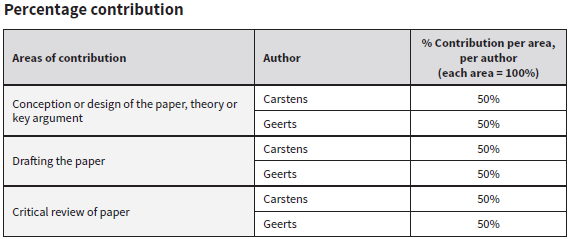
Notes on Contributors and their Contributions
Lead author
Carstens, Delphi
Dr Delphi Carstens is a senior lecturer at the University of the Western Cape with an interest in applying transversal onto-ethico-epistemological methodologies to education.
Co-author
Geerts, Evelien
Dr Evelien Geerts is a Gender, Women's Studies and Philosophy lecturer at University College Cork working at the intersections of feminist, political, and environmental posthumanist philosophy.
References
Adorno, T. W., & Horkheimer, M. (1997). Dialectic of enlightenment (J. Cumming, Trans.). Verso (Original work published in 1944). [ Links ]
Agamben, G. (1998). Homo sacer: Sovereign power and bare life (D. Heller-Roazen, Trans.). Stanford University Press (Original work published in 1995). [ Links ]
Alaimo, S. (2016). Exposed: Environmental politics and pleasures in posthuman times. University of Minnesota Press. [ Links ]
Åsberg, C. (2024). Promises of cyborgs: Feminist practices of posthumanities (against the nested crises of the Anthropocene). NORA - Nordic Journal of Feminist and Gender Research, 1-21. https://doi.org/10.1080/08038740.2023.2294194. [ Links ]
Bennett, J. (2010). Vibrant Matter: A political ecology of things. Duke University Press. [ Links ]
Barad, K. (2007). Meeting the universe halfway: Quantum physics and the entanglement of matter and meaning. Duke University Press. [ Links ]
Braidotti, R. (2013). The posthuman. Polity. [ Links ]
Carstens, D. (2016). The Anthropocene crisis and higher education: A fundamental shift. South African Journal of Higher Education, 30(3), 255-273. http://dx.doi.org/10.20853/30-3-650. [ Links ]
Chen, M. Y. (2012). Animacies: Biopolitics, racial mattering, and queer affect. Duke University Press. [ Links ]
Colman, F., & Van der Tuin, I. (Eds.). (2024). Methods and Genealogies of New Materialisms. Edinburgh University Press. [ Links ]
Coole, D., & Frost, S. (2016). Introducing the new materialisms. In D. Coole & S. Frost (Eds.), New materialisms: Ontology, agency & politics (1-43). Duke University Press. [ Links ]
Crutzen, P. J. (2006). The "Anthropocene". In E. Ehlers & T. Krafft (Eds.), Earth system science in the Anthropocene: Emerging issues and problems (pp. 3-18). Springer. [ Links ]
Daigle, C. (2022). Environmental posthumanities. In S. Herbrechter, I. Callus, M. Rossini, M. Grech, M. de Bruin-Molé, & C. J. Müller (Eds.), Palgrave handbook of critical posthumanism (pp. 881-900). Palgrave Macmillan. [ Links ]
Deleuze, G., & Guattari, F. (1987). A thousand plateaus: Capitalism and schizophrenia (B. Massumi, Trans.). University of Minnesota Press (Original work published in 1980). [ Links ]
Deleuze, G., & Guattari, F. (2000). Anti-Oedipus: Capitalism and schizophrenia (R. Hurley, M. Seem, & H. R. Lane, Trans.). University of Minnesota Press (Original work published in 1972). [ Links ]
Dolphijn, R., & Van der Tuin, I. (2012). New materialism: Interviews & cartographies. Open Humanities Press. [ Links ]
Foucault, M. (1990). The history of sexuality: An introduction. Vol. 1 (R. Hurley, Trans.). Random Books (Original work published in 1976). [ Links ]
Freire, P. (2006). Pedagogy of the oppressed (M. Bergman Ramos, Trans.). Continuum (Original work published in 1970). [ Links ]
Geerts, E. (2022). Navigating (post-) Anthropocenic times of crisis: A critical cartography of hope. CounterText, 8(3), 385-412. https://doi.org/10.3366/count.2022.0281. [ Links ]
Geerts, E. & Carstens, D. (2019). Ethico-onto-epistemology. Philosophy Today, 63(4), 915925. https://doi.org/10.5840/philtoday202019301. [ Links ]
Geerts, E., & Carstens, D. (2024). Neoliberal and (post-)pandemic irruptions: Reconceptualising critical pedagogies for more-than-human crisis times. In Jessie A. Bustillos Morales & Shiva Zarabadi (Eds.), Towards posthumanism in education: Theoretical entanglements and pedagogical mappings (101-120). Routledge. [ Links ]
Giroux, H. A. (2011). On critical pedagogy. London: Continuum. [ Links ]
Giroux, H. A. (2022). Pedagogy of resistance: Against manufactured ignorance. Bloomsbury Publishing. [ Links ]
Grosz, E. (2017). The incorporeal: Ontology, ethics, and the limits of materialism. Columbia University Press. [ Links ]
Guattari, F. (2000). The three ecologies (I. Pindar & P. Sutton, Trans.). Athlone Press. (Original work published in 1989). [ Links ]
Haraway, D. J. (1985). A manifesto for cyborgs: Science, technology, and socialist feminism in the 1980s. Socialist Review, 20, 65-107. [ Links ]
Haraway, D. J. (1988). Situated knowledges: The science question in feminism and the privilege of partial perspective. Feminist Studies, 14(3), 575-599. https://doi.org/10.2307/3178066. [ Links ]
Haraway, D. J. (1990). Reading Buchi Emecheta: Contests for women's experience in women's studies. Women: A Cultural Review, 1(3), 240-255. https://doi.org/10.1080/09574049008578043. [ Links ]
Haraway, D. J. (1997). Modest_witness@second_millenium. FemaleMan meets_OncoMouse: Feminism and technoscience. Routledge. [ Links ]
Haraway, D. J. (2008). When species meet. University of Minnesota Press. [ Links ]
Haraway, D. J. (2016). Staying with the trouble: Making kin in the Chthulucene. Duke University Press. [ Links ]
Haraway, D. J. (2019). It matters what stories tell stories; it matters whose stories tell stories, Auto/Biography Studies, 34(3), 565-575. https://doi.org/10.1080/08989575.2019.1664163. [ Links ]
hooks, b. (1994). Teaching to transgress: Education as the practice of freedom. Routledge. [ Links ]
Jackson, Z. I. (2020). Becoming human: Meaning and matter in an anti-Black world. New York University Press. [ Links ]
Koro-Ljungberg, M. (2015). Reconceptualizing qualitative research: Methodologies without methodology. Sage. [ Links ]
Lorraine, T. (2011). Deleuze and Guattari's immanent ethics. SUNY Press. [ Links ]
Marenko, B. (2012, February 22-25). Neo-animism and design: A new paradigm in object theory [Presentation]. Centennial Conference of the College Art Association (CAA100) (2-14). Los Angeles, USA. [ Links ]
Puar, J. K. (2012). "I would rather be a cyborg than a goddess": Becoming-intersectional in assemblage theory. PhiloSOPHIA, 2(1), 49-66. https://doi.org/10.1353/phi.2012.a486621. [ Links ]
Rose, D. B. (2017). Shimmer: When all you love is being trashed. In A. Tsing, H. A. Swanson, E. Gan, & N. Bubant (Eds.), The arts of living on a damaged planet: Ghosts of the Anthropocene (pp. 51-63). University of Minnesota Press. [ Links ]
Sassen, S. (2014). Expulsions: Brutality and complexity in the global economy. Belknap Press. [ Links ]
Shotwell, A. (2016). Against purity: Living ethically in compromised times. University of Minnesota Press. [ Links ]
Todd, S. (2003). Learning from the other: Levinas, psychoanalysis, and ethical possibilities in education. SUNY Press. [ Links ]
Tuana, N. (2008). Viscous porosity: Witnessing Katrina. In S. Alaimo & S. J. Hekman (Eds.), Material feminisms (pp. 188-213). Indiana University Press. [ Links ]
Wallin, J. (2014). Dark pedagogy. In P. MacCormack (Ed.), The animal catalyst: Towards ahuman theory (pp. 145-162). Bloomsbury. [ Links ]
Yusoff, K. (2018). A billion Black Anthropocenes or none. University of Minnesota Press. [ Links ]
