




Services on Demand
Journal

Article
 English (pdf)
 Article in xml format
 Article references
 Automatic translation
 Send this article by e-mail
Indicators
Related links
-
 Cited by Google
 -
 Similars in Google
Share

 Permalink
Acta Structilia
On-line version ISSN 2415-0487Print version ISSN 1023-0564
Acta structilia (Online) vol.32 n.1 Bloemfontein Jun. 2025
https://doi.org/10.38140/as.v32i1.9383
REVIEW ARTICLE
Primary causes of the condition of public sector fixed infrastructure in South Africa
Kevin Wall
Department of Construction Economics, University of Pretoria, Private Bag X 20, Hatfield 0028, South Africa. ROR: https://ror.org/00g0p6g84, Email: kevinwall468@gmail.com, ORCID: https://orcid.org/0000-0002-0940-7515
ABSTRACT
This fourth article in a series being published in this Journal on the condition of South Africa's public sector fixed infrastructure describes what it identifies as the primary causes of this condition. The first two articles dealt with efforts to monitor the condition, and with studies of the condition and their findings. The third discussed some consequences of that condition. For this article, qualitative research methods were employed, primarily through the application of desktop research and data analysis of grey literature. The findings on the primary causes of infrastructure condition of ten sets of documents dating back to 2006 were reviewed to identify the commonly cited causes of failure (among them, skills shortages, budget constraints, weak systems, poor data, and poor governance) and to understand if there could be underlying factors common to multiple elements on this list of usual suspects. In its findings, the review suggests that factors of leadership and institutional capacity, socio-economic context, and culture underlie the commonly cited causes - that is, the commonly cited causes are profoundly shaped by these underlying factors.
Keywords: Economy, infrastructure condition, operation and maintenance, quality-of-life, service delivery, South Africa
ABSTRAK
Hierdie vierde artikel in 'n reeks wat in hierdie Joernaal gepubliseer word oor die toestand van Suid-Afrika se openbare sektor infrastruktuur, beskryf wat dit identifiseer as die primêre oorsake van hierdie toestand. Die eerste twee artikels het gehandel oor pogings om die toestand te monitor, en oor studies van die toestand en hul bevindinge. Die derde het sommige gevolge van daardie toestand bespreek. Vir hierdie artikel is kwalitatiewe navorsingsmetodes gebruik, hoofsaaklik deur die toepassing van lessenaarnavorsing en data-analise van grys literatuur. Die bevindinge oor die primêre oorsake van infrastruktuurtoestand van tien stelle dokumente wat dateer uit 2006, is hersien om die algemeen aangehaalde oorsake van mislukking te identifiseer (onder andere vaardigheidstekorte, begrotingsbeperkings, swak stelsels, swak data en swak bestuur) en om te verstaan of daar onderliggende faktore kan wees wat verskeie elemente op hierdie lys van gewone verdagtes in gemeen het. Bevindinge uit die oorsig dui daarop dat faktore van leierskap en institusionele kapasiteit, sosio-ekonomiese konteks en kultuur onderliggend is aan die algemeen aangehaalde oorsake - dit wil sê, die algemeen aangehaalde oorsake word diepgaande gevorm deur hierdie onderliggende faktore.
1. INTRODUCTION
The first article in the series, published in this Journal, on the condition of South Africa's public sector fixed infrastructure began by stating that engineering infrastructure is designed and built to deliver a service, but how well the infrastructure is operated and maintained is a major determinant of how effectively it is able to deliver that service (Wall, 2023). It then went on to describe high-level efforts to improve the condition of infrastructure - including the conducting of research on condition, the compilation of guidelines, and the promulgation of legislation (Wall, 2023). The second article reviewed a number of studies over the course of more than 20 years of the condition of South Africa's public sector fixed infrastructure. It reported that this condition has generally not been good, thus hampering service delivery (Wall, 2024a). The third article described how, and the broad extent to which the condition of the infrastructure can harm (or boost) the economy and the quality of life. It gave a number of examples of this, particularly in the agribusiness sector (Wall, 2024b).
The previous three articles outlined the problem of substandard infrastructure condition but had hardly anything to say about the 'why' - what might the causes be. Why is South Africa's public sector fixed infrastructure in the enormously varied condition that it is, depending particularly on the type of infrastructure, its age, location, and the institution responsible for its stewardship? If the causes - the 'why' - are not clearly identified, how can one even begin to solve the problems?
The purpose of this article, the fourth in the series, is to explore those causes. Specifically, it attempts to shed light on the more immediately apparent and frequently cited reasons behind infrastructure deterioration such as lack of monitoring, vandalism and theft, skills shortages, budget constraints, and unstable leadership.
Rather than generating new primary data, this article draws on the findings of a number of documents and reports that seek to understand and explain the primary causes of infrastructure decline or failure. These causes are not asserted as empirically proven in every instance but are instead those that appear consistently across multiple policy, audit, and research documents reviewed. The article concludes by highlighting the most commonly cited or damaging causes, while also noting that deeper, systemic issues - to be explored in a subsequent article - likely underlie many of them.
In doing so, this fourth article lays the groundwork for the upcoming articles in the series, which will delve further into those foundational challenges.
2. METHODS AND REVIEW
Many South African public sector institutions, mandated to provide specific services, are failing due to factors such as funding, financial mismanagement, inadequate governance, lack of accountability, political interference, insufficient skills, and capacity shortages (SAICE, 2022). This article discusses some causes which it identifies as 'primary causes' of that failure, those which underlie the too-frequently inadequate management (i.e. operation and particularly maintenance), and hence the physical condition of the fixed infrastructure on which the service delivery is dependent.
Qualitative research methods were employed for the study, primarily through the application of desktop research and data analysis of grey literature (information produced outside of traditional publishing and distribution channels) (Schmidt et al., 2023). Relevant grey literature used in this review consisted of articles, reports, the Internet, and other documents obtained from the author's extensive personal database of relevant material. Two types of publications were consulted: public sector publications, including annual reports, guidelines, and legislation, and reports, by both public and private sectors, of the condition of public sector fixed infrastructure in South Africa.
The selection criterion was simply whatever was most relevant and also credible in identifying the primary causes of infrastructure condition. Particularly useful sources were reports of the Council for Scientific and Industrial Research (CSIR), Construction Industry Development Board (CIDB), South African Institution of Civil Engineering (SAICE), the Department of Public Works (DPW), the Department of Water and Sanitation (DWS) and its predecessor the Department of Water Affairs and Forestry (DWAF), the Department of Co-Operative Governance and Traditional Affairs (COGTA), National Treasury, the Auditor-General (AG), the Commission on State Capture (the Zondo Commission2), and the Global Initiative Against Transnational Organized Crime (GI-TOC).
First, from these sources, ten influential sets of documents were reviewed to discover what each considers to be the causes of the condition of public sector fixed infrastructure in South Africa. The article summarises their findings. The directly apparent factors affecting infrastructure condition include insufficient maintenance and repair budgets, insufficient skills, inefficiency, vandalism, theft, lack of or suspect data of infrastructure condition, procurement issues, and institutions that cannot cope.
Secondly, the article attempts to delve behind these directly apparent factors, into what gives rise to them or permits them. It mentions the water supply to a town as an example of how some of these evidently less visible factors lead to more than one directly apparent factor to illustrate how failure or omission of any single action in the required sequence of events, regardless of the competence with which the other steps are executed, can jeopardise the infrastructure condition. It references the 2006 Department of Water Affairs project as an example to illustrate the use of cause analysis as a valid method to understand what underlies each symptom of challenges to discover the 'weakest link in the chain'.
In the discussion section, the article suggests that the above-named causes of infrastructure failure are underlaid by other causes and are so heavily influenced by these underlying causes that they may be more accurately viewed as symptoms (of the underlying causes) rather than primary causes in their own right.
3. PRIMARY CAUSES OF INFRASTRUCTURE CONDITION
Over the past two decades (2005-2025), ten influential sets of documents have between them identified the major contributors to the condition of public sector fixed infrastructure in South Africa. While some of these documents assessed infrastructure across the entire public sector, others focused on specific spheres of government or their associated entities. The findings of these documents are summarised below, approximately in the chronological order of their completion or publication.
3.1 Investigations by the CSIR: 2001-2014
A "discussion document", "Towards a framework for the maintenance of municipal infrastructure: in support of government growth objectives" (CIDB and CSIR 2006), "... draw[ing] from an ongoing assessment being undertaken since 2001 by the CSIR of the sustainability of municipal infrastructure" (page 6) identified
"the underlying causes of the ongoing failure of many municipalities to recover maintenance backlogs, run a preventative maintenance programme and deliver a reliable, sustainable service" (CIDB and CSIR, 2006: 27).
"The two principal systemic issues underlying this problem are:
• inadequate budgets (either because of the municipality being in a distressed financial state and thus unable to fund infrastructure maintenance, or, even if the municipality is not distressed, nevertheless infrastructure maintenance is not allocated sufficient budget); and
• inadequate skills (especially technical skills) and experience to plan and implement appropriate maintenance."
Written nearly 20 years ago, but, sadly, just as true nowadays.
The same may be said of the next few pages of the report, which go into more detail on "Limited financial capacity", "Imprudent allocation of funds" and "Loss of intellectual assets" - and again about the entire set (with only minor qualifications) of the "Proposals for the way forward" that follow on pages 33-36.
3.2 The four SAICE infrastructure report cards: 2006, 2011, 2017, 2022
The earlier articles in this series have extensively examined the findings of the SAICE Infrastructure Report Cards, particularly the condition grades assigned to various categories of infrastructure and the trends observed over time. A detailed account of the methodology adopted by SAICE was provided in the second article of the series (Wall, 2024a). However, these articles have thus far offered only brief indications of the underlying causes of the current state of infrastructure. This important omission is now addressed below.
Over the years, what the report cards have identified at the time as the reasons have 'evolved' rather than 'changed' - they have expanded and become more nuanced.
The first report card SAICE (2006: 5) straightforwardly stated that:
"The reasons for the lower of the grades given in this report are numerous and varied in nature. For example, only:
• population growth in the nation as a whole but, more importantly, population movements across the country, together with new household formation over and above population growth;
• a long history of neglect of maintenance of infrastructure;
• the hugely successful rollout of new infrastructure, but generally without concomitant growth in the resources (mainly skills and budgets) allocated to maintaining the infrastructure;
• an overall skills shortage, especially of engineers and artisans, and a slow rate of new entry to the profession;
• institutional changes (for example, in local government), and
• a number of unsustainable investments that have been made."
"Government should not change its focus from providing the new infrastructure to address backlogs from the past. The challenge is to do this and simultaneously maintain both old and new infrastructure, and upgrade or replace infrastructure that is overloaded or has become obsolescent" (SAICE, 2006: 5).
The 2011 report card was the first to include a chapter on "Matters of critical importance". Quoting and paraphrasing this at some length:
"In the 2006 IRC [Infrastructure Report Card], two key themes ran as a thread through all the grades. The first was the severe shortage of skills and the impact of this on planning, procurement, design, construction and care of infrastructure. The second was the inadequate funding of maintenance for the existing asset base and the stream of new assets that are continuously completed. It is not surprising that this situation still pertains.
In addition, systems and sustainability have emerged as the two new key themes within the 2011 Report Card. Both of these themes emphasise the need for a holistic approach to infrastructure and its use, not only by the public sector but by all South Africans" (SAICE, 2011: 11).
Delving deeper into skills and funding, a 'recurring theme' is the inadequate capacity of service providers to fulfil their responsibilities. Factors in this include an ageing population of engineers; constraints on new entrants, due to the "extreme shortcomings" of South African education; "the inefficient deployment of precious [engineering] resources", and "the use of unqualified and experienced personnel in positions requiring technical ability."
"A comprehensive municipal skills survey was undertaken by SAICE in 2007. Of all 283 municipalities surveyed, 83 had no civil engineers, technologists or technicians on staff. A further 48 employed only one civil technician, and municipalities with civil engineering staff reported 35% vacancies (over 1000 professionals), often owing to budget constraints" (SAICE, 2011: 11).
The allocation of maintenance funding is, with very few exceptions, simply not sufficient, especially in circumstances where it is expected to also catch up on a backlog of maintenance neglect. Worse, all too frequently the inadequacy of the allocation is compounded by poor management which may result in these meagre funds going unspent.
Focusing specifically on systems and sustainability, the 2011 report card identified the following contributors to infrastructure condition - either to improve it or detract from it.
"An alarming feature is the dearth of data pertaining to infrastructure - and the problem continues to worsen. Reliable, consistent data is a prerequisite for the urgently required shift to routine maintenance. Data permits planning, prioritisation of targets and adequate budgeting for maintenance and extension."
The importance of life-cycle costing cannot be overemphasised. Yet
"We ... continue to undertake procurement in a way that ignores life-cycle costing, i.e. the bid with the lowest capital price receives preference, which may mean significantly more expensive maintenance costs. Innovative, creative procurement is a specialised process essential to sustainable infrastructure, especially in a country beset with skill and financial constraints. In some instances, this is a result of the removal of procurement power from the engineering departments, who are most cognisant of long-term considerations" (SAICE, 2011: 12).
The 2011 report card also drew attention to two matters of what it termed "the infrastructure environment" that have a bearing on infrastructure condition. The first of these was
"... the extreme absence of awareness regarding the true or user costs of infrastructure and its environmental impact. [Unfortunately], provision of free basic services and years of subsidised infrastructure has rendered this concept alien to South Africans. Thus, users do not pay anywhere near the real costs of water treatment and supply, electricity supply or waste management services, and this encourages high levels of wastage and civic disrespect for and neglect of infrastructure [and] discourages users and suppliers from seeking alternative or more economical long-term outcomes regarding natural resource constraints."
The second, arguing that infrastructure is built on a foundation of scarce natural resources, the report card stated that:
"We must ... take ownership of our infrastructure in order to ensure its sustainability, e.g. through water conservation, recycling and recognition of the necessity of 'user pays' systems, despite the inconvenience or difficulties associated with this change" (SAICE, 2011: 12).
The most recent SAICE infrastructure report card (2022), recalled that the previous report cards had drawn attention to "three key factors that influence infrastructure condition", namely:
• "People and relationships: having sufficient numbers of the appropriate skills in the right places, entrusting them with their responsibilities and a collaborative approach between the public and private sectors. ... The human capacity to monitor, inspect and maintain the current infrastructure, and to plan for renewal and replacement, has not grown at the same high rate as the portfolio of public assets."
o Moreover, even where there are the necessary skills, "an unintended effect of attempts to curb corruption has been the withdrawal of discretionary powers from even those professionals with integrity, rendering them powerless (or fearful) to exercise their judgement developed over years of practice" (SAICE, 2022: 18).
• "Institutional robustness: Clear mandates with corresponding accountability, effective policies and governance systems to carry these out efficiently and a proactive approach to pursue excellence."
o However, that so much of South Africa's infrastructure is "below satisfactory and deteriorating . is attributable to institutional failures in capacity and governance that extend beyond the realm of asset management" (SAICE, 2022: 18). Corruption and electricity load shedding may serve as examples of these institutional failures.
• Data and information on their "age, condition and performance of current assets, backlogs and future needs and innovative solutions."
o Unfortunately, though, the reality is that many public sector institutions do not collect or analyse data that is crucial to their core functions. The SAICE team even found instances where data exists but is concealed, presumably "to avoid embarrassment".
o "Data should also facilitate comparison with best-practice peers and enable policy-makers to build a comprehensive understanding of economic, social and environmental impacts". However, too often, datasets "are not consistent across institutions, making comparison or aggregation difficult3" (SAICE, 2022: 20).
The 2022 report card emphasised the importance of all three of the above to addressing the infrastructure challenge.
"If any one of them is weak, asset management becomes critically unstable. For example, for corruption to be rooted out, competent and ethical executives must operate in institutions with strong governance and management systems. Likewise, for effective planning, those same people must have up-to-date data and information, and with accurate data, institutions can make decisions that are evidence-based rather than being guided by the loudness of popular opinion. Consequently, programmes to capacitate defaulting institutions must address management and leadership shortcomings at the same time as technical incompetence and data analytics. Otherwise, they will continue to have very limited success" (SAICE, 2022: 16-17).
SAICE advised that, where possible, before an institution procures new infrastructure or refurbishes existing infrastructure, it should consider whether it will have the resources to operate and maintain this infrastructure for its design life - bearing in mind other liabilities it might have.
"And if it cannot, it should consider other options, for example, acquiring infrastructure that would be more robust should it not be operated optimally, or which does more or less the same job but at a lower price or requiring lesser skills. Such solutions are frequently available but ignored for a variety of reasons" (SAICE, 2022: 20).
Pleasingly, SAICE found that a significant number of institutions were maintaining their infrastructure more-or-less satisfactorily. These institutions were, it noted, characterised by one or more of the following:
• Stable leadership, e.g. not more than two CEOs in a decade.
• Strategic importance, e.g. pressure is placed on Transnet by major business groupings to operate the heavy haul iron ore line and the oil and gas pipelines efficiently.
• Imposed minimum standards, e.g. if Airports Company of South Africa does not meet international standards for key infrastructure components, international flights will not be allowed to land at its airports.
• Financial solvency, continuity of competent senior staff, and effective management systems, which are common to many of the successful institutions (SAICE, 2022: 21).
3.3 The 2006 National Infrastructure Maintenance Strategy
The aim of the National Infrastructure Maintenance Strategy (NIMS), approved by Cabinet in August 2006, was to identify a high-level path to the improvement of the condition of public sector infrastructure in South Africa, because:
"By improving infrastructure asset management planning, budgeting and implementation, public infrastructure will be maintained in such a way as to enable sustainable service delivery, increased economic growth, and increased access to services and economic opportunities for the poor" (DPW, CSIR & CIDB, 2007: 13).
"Despite the good performance in some sectors", the Strategy noted that
"... there is strong evidence that in other sectors much of the infrastructure, of both pre-and post-1994 vintage, is not being properly maintained. Older infrastructure is often not being refurbished and renewed when it needs to be, and there is inadequate planned preventative maintenance on new infrastructure" (DPW et al., 2007: 4).
The Strategy identified generalised categories of public sector institutions, distinguishing between those that, broadly, did their best to maintain their infrastructure, and those that did not. Of those that did not, it noted that the principal causes of "the inability to catch up on maintenance backlogs and to run preventative maintenance programmes are:
• lack of political and senior administrative direction to maintain facilities and infrastructure in order to sustain delivery of services;
• significant institutional change (including re-demarcation, reorganisation, staff changes and loss of key staff);
• emphasis being laid on capital works to construct new facilities, but inadequate measures to maintain these once they are built;
• overloading (most visibly the overloading of vehicles, causing damage to roads; but also in wastewater treatment works, and health and education facilities which are having to cope with numbers of people for which they were not designed);
• inadequate maintenance budgets (either because the institution is in a distressed financial state and thus unable to fund infrastructure maintenance; or, even if the institution is not distressed, infrastructure maintenance not being prioritised in the planning and budgeting process);
• new facilities often not designed to achieve low maintenance and/ or are poorly built; ... and
• inadequate skills (especially technical skills) and experience to plan and implement appropriate maintenance programmes" (DPW et al., 2007: 11).
3.4 The 2006 National Water Services Infrastructure Maintenance Strategy4
Not surprisingly, given that Phase 1: Status Report of this strategy and the National Infrastructure Maintenance Strategy (NIMS) were developed around the same time and, in part, by the same team,5 the Water Services Infrastructure Maintenance Strategy shares many of the same conclusions as the NIMS regarding the primary causes of poor infrastructure condition. However, it provides a much more detailed analysis focused on the specific challenges facing the water services sector.
This Strategy identified "the two principal systemic issues" underlying inadequate provision for the long-term operation and maintenance of [water and sanitation services] infrastructure":
• "inadequate budgets (either because of the institution being in a distressed state financially, and thus unable to fund infrastructure management; or, even if the institution is not distressed, nevertheless infrastructure management is not allocated sufficient budget), and
• inadequate skills (especially technical skills) and experience" (DWAF, 2006a: 27).
The report also highlighted that both budgets and the number and expertise of municipal staff responsible for managing municipal infrastructure have not kept pace with the growing stock of infrastructure. In many areas, these resources have even declined in absolute terms, let alone in proportion to infrastructure growth - ultimately contributing to the deterioration of infrastructure condition (DWAF, 2006a: 30).
3.5 The Auditor-General reports6
The Auditor-General annual reports in terms of the Public Financial Management Act 1 of 1999 and the Municipal Financial Management Act 56 of 2003 have, in recent years, in addition to their primary purpose of assessing financial management, increasingly widened their scope to include other matters related to service delivery by the institutions audited. A particular focus has been on the condition of infrastructure.
"When municipalities do not maintain their infrastructure assets, the impact can be seen in lower service-level standards (e.g. in the quality of water), increased water and electricity losses, excessive costs for replacing or upgrading infrastructure and equipment, and an increased risk of mechanical breakdowns. It also poses a risk to the health of communities" (Auditor-General, 2024: 52).
Why do so many municipalities not maintain their infrastructure assets and also neglect or perform badly other infrastructure-related duties that directly affect service delivery?
"Based on the insights from our work on service delivery planning and reporting, infrastructure, and financial performance, we identified three main weaknesses that hold back progress:
• Inadequate skills and capacity
• Governance failures
• A culture of no accountability and consequences.
These are the same root causes that we have highlighted consistently since the start of the administrative term" (Auditor-General, 2024: 8).
Auditor-General reports routinely include several pages of brief case studies based on site visits to infrastructure projects. These case studies frequently highlight repeated instances of project mismanagement. Common issues include the appointment of contractors who were unable to deliver the work, frequent changes of contractor, projects left incomplete long after their scheduled completion dates, and payments made for work with no verifiable evidence of delivery. The Auditor-General often attributes these failures to a recurring underlying cause: many municipalities are unable to fulfil the role of a competent client.
Asking "What caused ... the failures in delivering, maintaining and safeguarding infrastructure ..."
"Municipalities had inadequate skills and capacity to manage and deliver on infrastructure projects. Infrastructure units - even at metros - had high vacancy rates and officials did not have the required qualifications and experience. There were instances where junior officials were promoted to senior positions without meeting the requirements because the municipalities could not attract suitable candidates, especially in remote areas. There was little investment in developing the skills required. The staff establishment at most metros was not reviewed and updated to ensure that there were enough positions to deliver on the high infrastructure demands" (Auditor-General, 2024: 56).
However, the Auditor-General was able to find a few examples of good practice, and from these was able to further identify factors favourable to infrastructure and service delivery performance. For example:
"In February 2022, George Local Municipality (Western Cape) began upgrading the George new water treatment works with a planned completion date of February 2024 and a budget of R263,31 million. During our site visits, conducted while the project was still in progress, the construction was at the required level of quality. The municipality has invested in project implementation and management, from planning the project to ensuring it is up and running and ready to serve the public. The project demonstrates the importance of having suitably skilled and experienced staff in key positions. All nine key staff members in the municipality's water unit had engineering-related bachelor's degrees or equivalent qualifications and were registered with a professional body" (Auditor General, 2024: 54).
To conclude this summary of the Auditor-General's most recently published findings, her report on local government audit outcomes opens with:
"An urgent call for performance, accountability, transparency and institutional integrity in local government" (Auditor-General, 2024: 2),
and continues:
"I remain convinced that service delivery improvements in local government will be enabled by stable, capable, cooperative, accountable and responsive municipalities delivering on their mandates, and by leadership creating a culture that values excellence and continuous improvement to bring about positive change in the lives of all South Africans. Thus, the theme of this general report is 'A culture of accountability will improve service delivery'" (Auditor-General, 2024: 3).
"We reported on weaknesses in service delivery planning, reporting and achievement; failing municipal infrastructure; and the increasing pressure on local government finances due to a lack of careful spending, compounded by councils not paying sufficient attention to these matters" (Auditor-General, 2024: 4).
"Poor financial management remained prevalent. Municipalities lost revenue because they were not billing and collecting revenue, and due to water and electricity losses as a result of infrastructure neglect. They were also not careful with their spending practices. The main reasons for the continuing financial losses and waste were poor payment practices, uncompetitive and uneconomical procurement practices, limited value and benefit received for money spent, and weaknesses in project management. Unfunded budgets and high unauthorised expenditure clearly show the weaknesses in financial planning" (Auditor-General, 2024: 6).
3.6 National Treasury reports
The relevant publications of National Treasury do not discuss causes of the condition of infrastructure, but they do warn against the temptation "to forego maintenance in the short term". Particularly, they underline the importance of monitoring the condition of infrastructure and point to the "blind spot" of "historic public sector accounting systems and financial reporting practices [which] generally do not adequately track the deterioration of long-life immovable assets." Rectifying this "requires sound information on asset useful lives, failure patterns, asset failure modes, and life-cycle costs" (National Treasury, 2021: 7).7
3.7 Reports by COGTA on the state of local government
As noted earlier, this article places primary, although far from exclusive, reliance on evidence from local government infrastructure, treating it as broadly representative of public sector infrastructure as a whole. While national and provincial departments, as well as state-owned entities, share many infrastructure-related challenges, there are often significant differences.
The Department of Cooperative Governance (COGTA) has periodically published reports on the state of provincial and local government. At the time of writing this article, the most recent available report on local government was for the 2022/2023 period (COGTA, 2024).8
The 2025 Government Gazette calling for contributions to the review of the White Paper on Local Government summarises four major reviews that focused particularly on infrastructure and service delivery:
• The Policy Review on Provincial and Local Government (COGTA, 2009).
• The 25-Year Local Government Review (COGTA and Department of Planning, Monitoring and Evaluation, 2019).
• The National Planning Commission Reviews (2020 and 2023), which covered all three spheres of government.
• The 21-Year Review on Local Government (COGTA, 2021-22).
The most relevant findings from these reviews, particularly concerning the condition of fixed infrastructure, are summarised in Section 3.10 of this article.
3.8 Green Drop and Blue Drop reports
Much to the relief of water services practitioners, after a decade-long hiatus, the Department of Water and Sanitation (DWS) in 2022 resumed its publication of water and sanitation service delivery assessments. These assessments, known as the Blue Drop (for drinking water) and Green Drop (for wastewater) reports, evaluate infrastructure condition, asset management practices, and treatment processes. Alongside the detailed presentation of results, the reports also provide extensive commentary on the underlying causes of their findings, identifying systemic issues common to both water and wastewater services - as summarised in the bullet points below.
But first, to provide a brief context, the 2022 Green Drop report (DWS, 2022) noted that 334 (39% of the nationwide total) municipal wastewater systems were found to be in a critical state, compared to 248 (29%) in 2013. This clearly indicates a decline in performance during the years when DWS assessments were not conducted.
The following observations are of interest.
• Maintenance and/or operation has been suboptimum, with the inevitable result that the systems fail to meet the regulatory standards (for example, the effluent from a wastewater treatment works does not meet the quality limits specified by its operating licence).
• Related to this is that many water services authorities (WSAs) are unable to undertake the required monitoring of their own operational and compliance parameters.
• Many wastewater systems are operating close to or beyond their hydraulic capacity, and thus a storm event overwhelms them. Consequently, a portion of the inflow perforce bypasses the works and goes, untreated, to a nearby watercourse.
• Non-payment - or very late payment - of contractors, laboratories, and other service providers is widely found, leading to services not being rendered, or delayed, or discontinued.
• Vandalism and theft have been playing an increasing role. Few WSAs have effective counterstrategies or contingency plans in place.
As the Green Drop report also pointed out, much of the above can be ascribed to the WSAs having insufficient capacity and competency in terms of plant managers/superintendents, process controllers, engineers, technicians, technologists, and scientists.
3.9 Reports on corruption and criminality
For the purposes of this article, the two key institutions that have reported on corruption and criminality affecting infrastructure in South Africa are the Judicial Commission of Enquiry into Allegations of State Capture, Corruption and Fraud in the Public Sector and the Global Initiative Against Transnational Organized Crime (GI-TOC).
The former, commonly known as the Zondo Commission, sat from 2018 to 2022 and investigated corruption across all three spheres of government as well as selected state-owned enterprises. While its primary focus was on unlawful activities, particularly corruption,9 it did not specifically investigate contributing factors to infrastructure decline. Obviously, though, operation and maintenance functions are as vulnerable to corruption as capital projects or procurement processes. Typically, corruption manifests in two main ways: budgets allocated for legitimate purposes such as vehicle fleet maintenance or building refurbishment may be diverted to nonproductive uses, resulting in underfunded and incomplete maintenance or refurbishment work; and/or officials may accept substandard materials and poor workmanship. Both outcomes directly undermine infrastructure condition and service delivery.
"The Commission showed the various ways these officials undermined procurement processes and circumvented the rules - or, in some case, simply ignored them. These companies then paid kickbacks to the Gupta enterprise in exchange for their assistance in securing the contracts. Some of these companies also brought on Gupta-linked companies as subcontractors or development partners, allowing them to directly benefit from government work, often without participating in the procurement process at all. This inevitably ended up drastically inflating the costs of the contracts, as everyone involved tried to get a bigger piece of the pie. Without the functioning of proper, competitive procurement processes there was no way to rein in these excesses. Even worse, in many of these cases, the state ended up with poor quality services and products - if any part of the contract was delivered at all" (PARI, 2022: 5).
In other words, the finding of these reports most relevant to the current article is that, while corruption is not an independent cause of infrastructure condition, it has, in particular circumstances, the potential to significantly -sometimes very significantly - retard efforts to improve the said condition.
Two reports by Irish-Qhobosheane10 for the GI-TOC and a third to which she contributed have documented the damage to infrastructure condition through corrupt contracts, vandalism, and theft. These reports also documented the additional costs incurred in providing security to construction and repair teams, the budgets for which could have been better utilised for the improvement of infrastructure.
The reports also referred to the social and financial costs of the communities and authorities when criminal elements and 'mafias' deprive them of services, such as, for example, through cable theft, of electricity, and, through threats to municipal workers, of solid waste collection and infrastructure repair.
One of the reports went so far as to use the phrase 'tipping point' as follows:
"South Africa's critical infrastructure is at a tipping point after years of chronic mismanagement and rampant theft. Every day, huge quantities of copper cable and other crucial metal components are stripped out of the country's railways, electricity grid, and communications network, severely hampering capacity and operation. Thieves have also targeted diesel and petrol pipelines, and water infrastructure, while corruption has eroded capacity across key utilities. As a result, South Africa suffers from huge disruptions to the provision of services, severely impacting the economy and citizens' lives,11 while the bill for fixing criminal depredation runs into billions of rands every year. Unless action is taken soon, the damage to the fabric of the South African state may become irreversible" (GI-TOC, 2022: 104).
3.10 Reasons for revision of the 1998 Local Government White Paper
Some years ago, Wall (2022) argued that the institutional structure - or 'constitution' - of local government is a fundamental obstacle to its effective delivery of mandated services and called for a comprehensive overhaul of the system through which these services are delivered. More than 25 years after the adoption of the White Paper on Local Government, government appears to have come to a similar conclusion, recognising that piecemeal reforms and frequent minor adjustments have failed to address the system's core deficiencies. As stated in the relevant Government Gazette:
"The process of local government reform in South Africa faces two interrelated challenges:
• The persistent and deepening weaknesses of the local government system itself, and
• Policy implementation failure, evidenced by marginal improvements over the past 20 years, despite four local government reviews, scores of recommendations, and many campaigns and interventions" (COGTA, 2025: 48).
While, at the time of writing, this initiative by government is largely confined to the preparation and issuance of a discussion document (COGTA, 2025) and a call for comment on it, it is useful, for the current article, to note a number of the reasons given by government as to why the overhaul is needed. The first of the "four local government reviews", mentioned in 3.7, is the most useful in this regard. This review "highlighted critical concerns, including shortcomings in the following areas":
• Accountability and participation.
• Instability in municipal administration (including "declining experience, poor relations between elected officials and administrators, and high vacancy rates").
• Instability and inefficiency as a result of the two-tier system (district and local municipalities).
• "Underinvestment in infrastructure" and "a preference for new projects over maintenance".
• "High outstanding debts and poor fiscal management".
• "Capacity issues" (COGTA 2009, quoted in "Annex One" of COGTA, 2025: 55).
4. CAUSE ANALYSIS, AND THE WEAKEST LINK IN THE 'CHAIN'
4.1 Cause analysis
There are many possible contributing factors to the condition of a particular element of infrastructure: inappropriate design, ageing and associated wear and tear, overloading, inadequate maintenance, incorrect operation, and more. However, each of these proximate issues is typically underpinned by deeper, systemic causes - often involving multiple contributing factors originating elsewhere in the system.
The widely known concept of root cause analysis is based on the understanding that any observed outcome is the result of preceding factors, themselves caused by deeper underlying conditions (Andersen & Fagerhaug, 2006). Through investigation, it is often possible to identify a small number of primary drivers that trigger a cascade of intermediate effects, ultimately manifesting as the symptom actually observed. In the context of this article, a complication is that even the most straightforward infrastructure failure is usually the result of a sequence of actions - or inactions - aimed (intentionally or not) at producing a specific outcome. The failure or omission of any single action in this chain, regardless of the competence with which the other steps are executed, can jeopardise the final result.
An example might illustrate: Reliable supply of drinking water to a town, 24 hours a day, at adequate pressure requires, at the very least, a raw water supply able to deliver the required quantities of water, a facility to store this water, a treatment process, pipelines of the appropriate capacity and ability to withstand the expected operating pressures, a pump if the water needs to be raised, holding facilities in the town (for the treated water) - and all of this designed, built, and operated in such a way as to ensure sufficient water pressure at the taps. The above-mentioned pump might cease to function because a part broke. However, it broke because, although it is supposed to be lubricated daily, it was not. So why was it not lubricated? For several reasons, it may turn out, one of which was that there was no more lubrication oil in the machine shop. Why was that? Perhaps because procurement staff had taken too long to call for tenders. And why, in turn, was that? Skipping a few steps, one might And that the political leadership had changed, and the new leadership did not like or trust the executive manager responsible for procurement, so they suspended him. In the midst of consequent managerial reshuffling in the procurement office, approvals of tenders had been delayed.
Ensuring that infrastructure is correctly operated, and that measures are in place to deal with unplanned events such as a pipe burst - is no mean feat. Using the same example: it is not enough to focus narrowly on improving the procurement office's tracking of lubrication oil supplies in order to prevent pump failures. A broader approach is required, one that includes painstakingly attempting to uncover and address all contributing factors.
In-depth analyses, peeling back layer by layer what must lie behind each result - what is the 'cause' of something being done (or not being done) -especially in respect of infrastructure and service delivery, are few and far between. However, in 2006, the author led a project12 for the Department of Water Affairs (DWAF) - part of which was a study that included performance of such an analysis - the methodology of which is just as valid today (DWAF, 2006a; 2006b).
4.2 The weakest link in the 'chain'
The purpose of the 2006 study for DWAF was not to discover anything radical or unexpected in terms of failure causation. Rather, it was:
• To verify if the list of the usual suspects of failure, including skills, budgets, and governance, should be modified. (It was found that there was hardly any need to modify this list.)
• To discover what, if anything ultimately underlies more than one of these 'usual suspects of failure'.
The study also served to confirm that all contributing elements (what these would be, would depend on the task) need to be in place, and sufficiently robust for the task, to achieve a result. The converse of this reasoning suggests that a vital part of any attempt to address service delivery failure must be identification of the entire 'chain' and of the weakest 'link' - then the next weakest link, and so on, so that each may be addressed in turn. This is easy to say, but almost certainly extremely difficult to carry out.
Single-purpose interventions, not coordinated with (or possibly not even cognisant of) a broader initiative, and not paying particular attention to addressing the weakest links in the causative chain, are not likely to resolve chronic service delivery issues. This may seem obvious, but it is a concept that the South African government has apparently sometimes not understood. For example, starting 20 years ago, a major pillar of its effort to improve service delivery has been to 'capacitate' municipal officials. Beginning as Project Consolidate (COGTA, 200613), this has undergone several reformulations, becoming for example the Siyenza Manje programme, but the formula has invariably included officials attending short training courses and what has been referred to as "a mix of deploying technical expertise in weak municipalities, closer monitoring, laced with subtle hints of restructuring in the name of financial viability" (De Visser, 2018).
Returning to the 2006 DWAF project, its first phase was a study of the condition of water services infrastructure and its management (DWAF, 2006a). The second phase made use of the data collected in the first phase to identify possible solutions. Over 400 infrastructure asset management problems/challenges were identified and captured into a database and then analysed.
The Phase 2A14 report began by acknowledging that
"Sustainable water services requires more than just infrastructure. It includes various physical / infrastructure elements as well as various human, institutional and financial aspects. The following diagram depicts the key elements to ensure sustainable service delivery" (DWA, 2006b: 3) (see Figure 1).
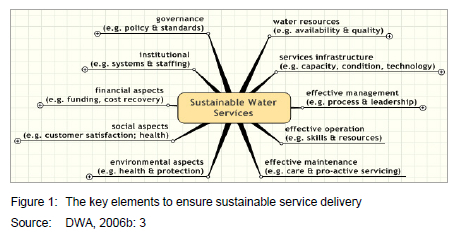
The study undertook a 'problem tree' breakdown15 of this large database, seeking to understand what underlay each symptom (e.g. the broken pump), then what underlay that (e.g. no lubrication), and so on, eventually finding commonality of challenges several 'layers' down (e.g. managerial culture), and grouping these.
As a result of this work, the following underlying factors were identified (DWAF 2006b, abbreviated):
• Insufficient awareness and appreciation of the infrastructure condition challenges
The vast majority of sector16 stakeholders, principally the general public, municipal officials and national sector departments, are not fully aware of the extent of infrastructure condition problems.
"To mobilize appropriate actions, it is necessary to change the modus operandi. The sector cannot continue with its 'business as-usual'! A drastic change of culture is required towards 'caring' and maintaining the services infrastructure. It requires a mind-shift from all stakeholders including, politicians, managers, operators and the communities / customers" (DWAF, 2006b: 5).
• Inadequacy of skills.
• Inadequacy of funding.
"Dedicated / ring-fenced funding for infrastructure asset management is crucial for success. This involves improved budgeting, financial management and cost-efficiency" (DWAF, 2006b: 5).
• Insufficiently competent governance
"The key to sustaining and growing water and sanitation services delivery is to greatly improve the management by water and sanitation institutions of the infrastructure for which they are responsible. A plan of action, embracing awareness, a funding formula, a legislative review, performance management, improved incentives to the owners of the infrastructure to responsibly manage it, and a skills plan, among other measures, needs to be put in place" (DWAF, 2006b: 5).
Thus this 2006 DWAF study, so many years ago, identified many of the same underlying challenges as those identified by later studies.
5. DISCUSSION
It can be argued that the findings presented in the documents discussed in this article - some dating as far back as 2006 (see sections 3.1 to 3.5 and 4.2) - remain largely valid nowadays. These are by no means the only studies over the years to have reached similar conclusions. If this is indeed the case, a legitimate and pressing question arises: If the general direction for improving public sector infrastructure condition in South Africa was identified so long ago, why has hardly any progress been made? This article will not address that question; instead, it will be revisited in a future publication.
The discussion is guided by the following questions:
• To what extent do the causes identified by the various documents outlined in section 3 correlate, considering that the objectives of each, and especially the context and the time that each was performed, differ considerably?
• How does the analysis in section 4 contribute to this discussion?
It is not surprising that several of the causes identified recur across the documents: skills shortages, budgetary constraints, inadequate data and condition monitoring, and deficiencies in various systems. These are consistently highlighted as primary causes. Contributing factors, which are both stand-alone problems and drivers of the issues above, include inefficiency, institutional or managerial instability at all levels, governance failures, corruption and criminality, the expansion of asset stock beyond the capacity to operate and maintain it, a skewed focus on new capital projects at the expense of maintaining existing infrastructure, and poor procurement practices (e.g. neglecting life-cycle costing principles).
A first important observation is that isolated interventions targeting one or a few of these causes, without a strong basis for believing they represent the system's 'weakest link', are unlikely to yield meaningful results. Infrastructure and service delivery challenges are deeply interrelated and systemic. In this regard, a forewarning must be issued regarding a looming major infrastructure condition crisis facing local governments, one that only a well-capacitated municipality could hope to address. Such a municipality would need to possess, at a minimum, a high level of awareness and understanding of the challenges, adequate technical and institutional skills, sufficient funding, and competent governance. Only then could it, first, identify the problem and, secondly, effectively plan for and make the necessary provisions.
A particularly urgent example is the widespread deterioration of asbestos cement (AC) water and sewer pipes, which were extensively installed across South African municipalities between the 1950s and 2002. As Holden (2025, personal communication) notes, these pipes are now reaching the end of their design life and tend to fail along entire sections rather than in isolated spots, requiring large-scale, costly replacements that few municipalities outside of Cape Town are currently prepared for.
The author's perspective from the review of the documents in this article is that many of these more visible causes of infrastructure decline are symptoms of more fundamental issues such as leadership and institutional failure. In the municipal context, this includes the role of elected councillors in critical decisions such as service charges and revenue enforcement, budget allocation for operations and maintenance, procurement policy and its implementation, and the appointment of senior staff. These governance responsibilities directly shape the functioning and resilience of infrastructure systems.
The broader socio-economic environment, such as of the area where the infrastructure in question is located, is critical. In particular, high unemployment, poverty, and persistent inequality create structural barriers that even the most capable leadership and institutions would struggle to overcome. Realities such as these must temper expectations about what can reasonably be achieved.
One surprising observation from the review of published reports in this article is the limited attention given to culture, specifically, behavioural norms around accountability and care for public assets. Apart from the Auditor-General's reports, which regularly express concern over the lack of a culture of accountability, and DWAF (2006b), this concept is rarely mentioned in South African publications. Yet in international literature on infrastructure asset management, culture such as a 'culture of caring' or stewardship (e.g. of caring - in the current context, caring about infrastructure) features prominently as a critical enabler of effective practice (Amadi-Echendu, 2004; Hastings, 2010; Brunetto, 2014).
Tentatively extending this line of reasoning, a compelling argument emerges. It is suggested that the underlying reasons for infrastructure failure may be best understood as falling into three primary categories, namely leadership and institutional matters, socio-economic context, and culture. Skills, revenue and budgets, systems, data, and other frequently cited challenges are so heavily influenced by - indeed, maybe arise from - these underlying causes that they may be more accurately viewed as symptoms of them rather than causes in their own right.
6. CONCLUSION
The analysis presented in this article confirms that many of the challenges facing South Africa's public infrastructure have long been recognised and repeatedly documented. That these insights have persisted for nearly two decades with limited progress underlines the systemic and deeply embedded nature of the problem. Rather than offering new diagnoses, this article highlights how well-known issues such as skills shortages, funding constraints, poor data, and governance failures are symptoms of more fundamental underlying conditions.
Leadership and institutional capacity, socio-economic context, and organisational culture emerge as the most influential forces shaping infrastructure outcomes. Any reform that fails to address these foundational drivers will likely fall short. Among these, culture, particularly behavioural norms in terms of accountability and care for public assets, remains critically underexplored in South African discourse, despite its prominence in international asset management literature.
Encouragingly, there are still examples where individual and collective commitment can overcome significant constraints, as demonstrated by the Ekurhuleni Water Care Company (ERWAT) in the 2022 Green Drop report. ERWAT emerged as the top performer nationally, with seven of its 19 treatment works receiving the Green Drop award. A particularly notable achievement was the recognition of staff at ERWAT's older facilities, where their technical competence and dedication allowed them to effectively manage ageing infrastructure, mitigating the negative effects of outdated equipment. This serves as a powerful example of how a culture of care -driven by pride, responsibility, and professionalism - can yield exceptional results even in the face of significant challenges, illustrating that when combined with institutional support, individual commitment can truly make a difference.
While systemic reform is essential, progress will also depend on creating environments where such values are nurtured. Building and sustaining a culture that supports stewardship, accountability, and capable leadership may prove to be the most critical and most overlooked dimension of reversing infrastructure decline.
REFERENCES
Amadi-Echendu, J.E. 2004. Managing physical assets is a paradigm shift from maintenance. The South African Journal of Industrial Engineering, 15(2), pp. 23-33. https://doi.org/10.7166/15-2-311 [ Links ]
Andersen, B. & Fagerhaug, T. 2006. Root cause analysis: Simplified tools and techniques. Milwaukee, Wisconsin: ASQ Quality Press. [ Links ]
Auditor General of South Africa. 2024. Municipal Financial Management Act. Consolidated General Report on Local Government Audit Outcomes: 2022-2023. [Online]. Available at: https://www.parliament.gov.za/storage/app/media/OISD/Reports/Auditor_General/2024/august/28-08-2024/MFMA_Report_2022-23_FINAL.pdf [Accessed: 3 May 2025]. [ Links ]
Bruce, D. 2025. Daily Maverick. We should all try to honour the memory of veteran organised crime researcher Jenni Irish-Qhobosheane. [Online]. Available at: https://www.dailymaverick.co.za/article/2025-05-04-tribute-jenni-irish-qhobosheane-veteran-organised-crime-researcher/ [Accessed: 3 May 2025]. [ Links ]
Brunetto, Y., Xerri, M. & Nelson, S. 2014. Building a proactive, engagement culture in asset management organisations. Journal of Management in Engineering, 30(4), article 251. https://doi.org/10.1061/(ASCE)ME.1943-5479.0000251 [ Links ]
CIDB & CSIR (Construction Industry Development Board and Council for Scientific and Industrial Research). 2006. Towards a framework for the maintenance of municipal infrastructure: In support of government growth objectives. Pretoria: cidb. [ Links ]
De Jager, P. & Wall, K. 2022. A pragmatic derivative method to assess the condition of a public health-built infrastructure portfolio. Journal of the South African Institution of Civil Engineering, 64(3), pp. 42-49. https://doi.org/10.17159/2309-8775/2022/v64n3a5 [ Links ]
COGTA (Department of Co-Operative Governance and Traditional Affairs). 2006. Project Consolidate. A Hands-On Local Government Engagement Programme for 2004-2006. [Online]. Available at: https://static.pmg.org.za/docs/2006/060906consolidate.pdf [Accessed: 1 March 2025]. [ Links ]
COGTA (Department of Co-Operative Governance and Traditional Affairs). 2009. The Policy Review on Provincial and Local Government. [Online]. Available at: https://www.cogta.gov.za/index.php/docs/policy-review-on-provincial-and-local-government-2/ [Accessed: 1 March 2025]. [ Links ]
COGTA (Department of Co-Operative Governance and Traditional Affairs). 2024. State of Local Government Report: July 2022/2023. [Online]. Available at: https://www.cogta.gov.za/cgta_2016/wp-content/uploads/2023/10/Published-DCog-AR-20222326.pdf [Accessed: 1 March 2025]. [ Links ]
COGTA (Department of Co-Operative Governance and Traditional Affairs). 2025. White Paper on Local Government 1998: Review of the White Paper on Local Government. Government Gazette number 52498, 10 April 2025. [ Links ]
DPW (Department of Public Works), CSIR (Council for Scientific and Industrial Research) and CIDB (Construction Industry Development Board). 2007. National Infrastructure Maintenance Strategy. [Online]. Available at: https://www.cidb.org.za/wp-content/uploads/2021/07/National-Infrastructure-Maintenance-Strategy.pdf [Accessed: 1 March 2025]. [ Links ]
DWAF (Department of Water Affairs and Forestry). 2006a. WS Infrastructure Asset Management Strategy Study. Phase 1: Status Report. The State of WS Infrastructure and Its Management: a Desktop Strategic Study. For DWAF, by CSIR "in association with" Pula Strategic Resource Management, Matingi and Associates, and Makoleng Projects". [ Links ]
DWAF (Department of Water Affairs and Forestry). 2006b. WS Infrastructure Asset Management Strategy Study. Phase 2A: Action Plan. Proceeding from Fact-Finding to Solution-Identification. For DWAF, by CSIR et al. [ Links ]
DWAF (Department of Water Affairs and Forestry). 2007. WS Infrastructure Asset Management Strategy Study. Phase 2B: Priority Actions. For DWAF, by CSIR et al. [ Links ]
DWS (Department of Water and Sanitation). 2022. Green Drop National Report 2022. [Online]. Available at: https://wisa.org.za/2022/04/01/green-drop-2022-report-release/ [Accessed: 1 March 2025]. [ Links ]
De Visser, J. 2018. Op-ed: Five suggestions to fix local government. [Online]. Available at: https://ggln.org.za/index.php?option=com_k2&view=item&id=201:op-ed-five-suggestions-to-fix-local-government&Itemid=656 [Accessed: 1 March 2025]. [ Links ]
Genesis analytics. 2010. Evaluation of the Siyenza Manje programme: Lessons from the first three years of operation. A report for the Development Bank of Southern Africa. [ Links ]
GI-TOC (Global Initiative Against Transnational Organized Crime). 2022. Strategic organised crime risk assessment: South Africa, September 2022. [Online]. Available at: https://globalinitiative.net/wp-content/uploads/2022/09/GI-TOC-Strategic-Organized-Crime-Risk-Assessment-South-Africa.pdf [Accessed: 5 March 2025]. [ Links ]
Hastings, N.A.J. 2010. Culture and behavior in asset management. Journal of Quality in Maintenance Engineering, 16(4), 398-413. https://doi.org/10.1108/13552511011093364 [ Links ]
Holden, R. 2025. (Business Analyst: Office of the Chief Executive Officer, Trans-Caledon Tunnel Authority). Personal communication on pipe replacement. Email, 23 February. [ Links ]
Irish-Qhobosheane, J. GI-TOC. 2022. GITOC extortion or transformation. The construction mafia in South Africa. June 2022. [Online]. Available at: https://globalinitiative.net/wp-content/uploads/2022/06/GITOC-Extortion-or-Transformation-The-construction-mafia-in-South-Africa.pdf. [Accessed: 4 March 2025] [ Links ]
Irish-Qhobosheane, J. 2023. South Africa's illicit copper economy. GI-TOC. December 2023. [Online]. Avaiable at: https://globalinitiative.net/wp-content/uploads/2023/12/Jenni-Irish-Qhobosheane-South-Africas-illicit-Copper-economy-GI-TOC-December-2023.v2.pdf [Accessed: 4 March 2025]. [ Links ]
National Treasury. 2021. Asset Management Framework for National and Provincial Departments. Pretoria: National Treasury, Republic of South Africa. [ Links ]
PARI (Public Affairs Research Institute). 2022. The Zondo Commission: A bite-sized summary. [Online]. Available at: https://pari.org.za/wp-content/uploads/2022/09/PARI-Summary-The-Zondo-Commission-A-bite-sized-summary-v360.pdf [Accessed: 3 February 2025]. [ Links ]
Schmidt, L., Mohamed, S., Meader, N. Bacardit, J. & Craig, D. 2023. Automated data analysis of unstructured grey literature in health research: A mapping review. Research Synthesis Methods, 15(2), pp. 178-197. https://doi.org/10.1002/jrsm.1692 [ Links ]
South Africa. 2022. Judicial Commission of Inquiry into Allegations of State Capture, Corruption and Fraud in the Public Sector including Organs of State. [Online]. Available at: https://www.sastatecapture.org.za/ [Accessed: 3 February 2025]. [ Links ]
SAICE (South African Institution of Civil Engineering). 2006. The SAICE infrastructure report card for South Africa: 2006. [Online] Available at: https://saice.org.za/irc/ [Accessed: 3 February 2025]. [ Links ]
SAICE (South African Institution of Civil Engineering). 2011. The SAICE infrastructure report card for South Africa: 2011. [Online] Available at: https://saice.org.za/irc/ [Accessed: 3 February 2025]. [ Links ]
SAICE (South African Institution of Civil Engineering). 2017. The SAICE 2017 infrastructure report card for South Africa. [Online] Available at: https://saice.org.za/irc/ [Accessed: 3 February 2025]. [ Links ]
SAICE (South African Institution of Civil Engineering). 2022. The SAICE 2022 infrastructure report card for South Africa. [Online] Available at: https://saice.org.za/irc/ [Accessed: 3 February 2025]. [ Links ]
Wall, K. 2022. The 1998 "'mini-Constitution' for local government": A review of the assumptions of the White Paper on Local Government. Acta Structilia, 29(2) pp. 260-292. https://doi.org/10.18820/24150487/as29i2.9 [ Links ]
Wall, K. 2023. Monitoring the condition of public sector fixed infrastructure in South Africa.Acta Structilia, 30(2), pp. 94-123. https://doi.org/10.38140/as.v30i2.7591 [ Links ]
Wall, K. 2024a. Report cards, and other tracking of South Africa's public sector fixed infrastructure condition. Acta Structilia, 31(1), pp. 194-221. https://doi.org/10.38140/as.v31i1.8017 [ Links ]
Wall, K. 2024b. Some implications of the condition of South Africa's public sector fixed infrastructure. Acta Structilia, 31(2), pp. 224-256. https://doi.org/10.38140/as.v31i2.8824 [ Links ]
Received: November 2024
Peer reviewed and revised: May 2025
Published: June 2025
1 DECLARATION: The author(s) declared no potential conflicts of interest with respect to the research, authorship, and/or publication of this article.
2 For a readable short summary see Public Affairs Research Institute, 2022.
3 Difficult even for experts to make the comparisons: for an example of how inconsistent data sets were, but only with considerable effort, massaged to yield credible data: De Jager & Wall, 2022.
4 This short section 3.4 does not end the contribution of this water services infrastructure asset management strategy to the current article. See section 4 also.
5 In both cases, led by the current author.
6 The Auditor-General annually assesses all national and provincial departments, state-owned entities, and municipalities against predetermined performance indicators. To keep this article concise while still addressing public sector infrastructure condition, section 3.5 confines itself to municipal audits. These cover over 250 institutions nationwide - varying in capacity and "stock" of infrastructure - providing a broad and representative picture across the nation. In contrast, the many Auditor-General audits of other entities reflect only their individual situations which would be difficult to cover in this article.
7 The remainder of this 130-page 2021 Treasury document outlines how this could be achieved in practice.
8 Which, as the report notes on the front cover, "... should be read in conjunction with the following documents: the 2022/2023 Auditor General of South Africa MFMA Audit Outcome, and the National Treasury's "State of Local Government Finances".
9 To recall:
"The Commission concentrated on ... appointments that did not follow official process, improper conduct by the national executive and public officials, the concerted efforts and activities of the Gupta enterprise in gaining control of governance and procurement in state-owned entities (SOEs) and government agencies and general corruption (including fraud, money laundering, racketeering and various other illegal activities) in public entities and government at all levels" (PARI, 2022: 2).
10 Sadly, she passed away during April 2025, while this article was in course of preparation (Bruce, 2025).
11 Emphasis added.
12 The project was part of the Department's planned earliest steps to formulate and then implement a comprehensive water services infrastructure asset management strategy.
13 The author has at various times in the last decade attempted to find independent assessments of the efficacy of this programme which have been undertaken several years into the duration of the programme (as opposed to soon after the start - e.g. Genesis Analytics, 2010). The author has also asked likely agencies if they know of assessments. All without success, other than a senior official of the branch at national Treasury responsible for provincial and local government measures, and therefore very familiar with the programme, who at a project meeting on a related topic, attended by the author, made quite clear his highly negative opinion of the programme.
Certainly, government's continued lamentations on the state of local government, some of them reported in this article, would suggest that COGTA itself would consider Project Consolidate and its successors have largely not achieved their objectives.
14 This is a direct quote from a hardcopy in the author's possession. To the best of the author's recollection, the Phase 2 reports were never publicly released, likely due to internal DWAF politics.
15 It is highly likely that software which has become available since the 2006 study was done would be able to improve on the way in which the sorting and analysis was then undertaken. However, the general principles of the analysis and of the findings remain and are sufficient for the purposes of this article.
16 In the context of the report, only the water and sanitation sector was referred to. But undoubtedly the remarks would have applied to most if not all public sector fixed infrastructure at the time.
