



Services on Demand
Journal

Article
 English (pdf)
 Article in xml format
 Article references
 Automatic translation
 Send this article by e-mail
Indicators
Related links
-
 Cited by Google
 -
 Similars in Google
Share

 Permalink
Town and Regional Planning
On-line version ISSN 2415-0495Print version ISSN 1012-280X
Town reg. plan. (Online) vol.85 Bloemfontein 2024
https://doi.org/10.38140/trp.v85i.8425
RESEARCH ARTICLE
Polycentric governance: Evaluating the relevance of traditional authorities in good governance in South Africa
Polisentriese bestuur: evaluering van die relevansie van tradisionele owerhede in goeie bestuur in Suid-Afrika
Puso e bohareng:ho hlahloba bohlokoa ba balaoli ba setso pusong e ntle ea Afrika Boroa
Samson FaboyeI; Trynos GumboII; Jackson Sebola-SamanyangaIII
IResearch Fellow, Urban and Regional Planning Department, University of Johannesburg, South Africa. Email: sfaboye@gmail.com, ORCID: https://orcid.org/0000-0002-3424-3321
IIProfessor, Urban and Regional Planning Department, University of Johannesburg, South Africa. Email: tgumbo@uj.ac.za, ORCID: https://orcid.org/0000-0003-3617-4996
IIILecturer, Town and Regional Planning Department, University of Pretoria, South Africa. Email: jackson.sebola@up.ac.za, ORCID: https://orcid.org/0000-0002-5292-5617
ABSTRACT
This article explores the role of traditional authorities within the complex governance structures of South Africa, specifically in the North-West and KwaZulu-Natal provinces. Polycentric governance, which involves multiple, interconnected decision-making centres that operate independently yet are interdependent, forms the theoretical foundation for this study. In South Africa, municipal governance faces challenges, due to the ambiguous role of traditional authorities, which has hindered the development of rural areas. There is currently no clear framework in the NorthWest and KwaZulu-Natal provinces outlining how traditional authorities can function effectively within the broader governance system. This research aims to develop a framework that enhances the governance relevance of traditional authorities, drawing on the concept of polycentricity and governance theory. Through qualitative methods, including stakeholder interviews and document analysis, the study examines the contemporary roles of traditional authorities and their interactions with municipal governance structures. It critically assesses the policy framework guiding traditional governance in South Africa and explores how these authorities can be better integrated into governance processes. The study argues that good governance is defined by its ability to meet the needs of the broader populace, not simply select groups. It proposes a formalised polycentric governance framework that elevates traditional authorities as key actors in local government, with a focus on areas such as administrative hierarchy, development planning, land governance, and natural resource management. This framework is expected to support socioeconomic development and improve service delivery, particularly in rural and peri-urban areas of the North-West and KwaZulu-Natal provinces.
Keywords: Polycentricity, South Africa, traditional authorities, municipal governance
OPSOMMING
Hierdie artikel ondersoek die rol van tradisionele owerhede binne die kom-plekse bestuurstrukture van Suid-Afrika, spesifiek in die Noordwes- en KwaZulu-Natal-provinsies. Polisentriese bestuur, wat veelvuldige, onderling gekoppelde besluitnemingsentrums behels wat on-afhanklik funksioneer maar tog interaf-hanklik is, vorm die teoretiese grondslag vir hierdie studie. In Suid-Afrika staar mu-nisipale bestuur uitdagings in die gesig as gevolg van die dubbelsinnige rol van tradisionele owerhede, wat die ontwikkeling van landelike gebiede belemmer het. Daar is tans geen duidelike raamwerk in die Noordwes- en KwaZulu-Natal-provinsies wat uiteensit hoe tradisionele owerhede doeltreffend binne die breër regeringstelsel kan funksioneer nie. Hierdie navorsing het ten doel om 'n raamwerk te ontwikkel wat die bestuurs-relevansie van tradisionele owerhede verbeter, met behulp van die konsep van polisentrisiteit en bestuursteorie. Deur middel van kwalitatiewe metodes, insluitend onderhoude met belangheb-bendes en dokumentontleding, ondersoek die studie die hedendaagse rolle van tradisionele owerhede en hul inter-aksies met munisipale bestuurstrukture. Dit beoordeel die beleidsraamwerk wat tradisionele bestuur in Suid-Afrika rig, en krities ondersoek hoe hierdie owerhede beter by bestuursprosesse geïntegreer kan word. Die studie voer aan dat goeie bestuur gedefinieer word deur sy vermoë om aan die behoeftes van die breër bevolking te voldoen, nie net uitgesoekte groepe nie. Dit stel 'n geformaliseerde polisentriese bestuursraamwerk voor wat tradisionele owerhede as sleutelakteurs in plaaslike regering verhef, met 'n fokus op areas soos administratiewe hiërargie, ontwikkelingsbeplanning, grondbestuur en natuurlike hulpbronbestuur. Hierdie raamwerk sal na verwagting sosio-ekonomiese ontwikkeling ondersteun en dienslewering verbeter, veral in lande-like en buitestedelike gebiede van die Noordwes- en KwaZulu-Natal-provinsies.
KAKARETSO
Sengoliloeng sena se hlahloba karolo ea balaoli ba setso ka har'a likarolo tse rarahaneng tsa puso ea Afrika Boroa, haholo liprofinseng tsa Leboya-Bophirima le KwaZulu-Natal. Puso ea polycentric, e kenyelletsang litsi tse ngata tsa ho etsa liqeto tse hokahaneng tse sebetsang ka boikemelo empa li itsetlehile ka tse ling, li theha motheo oa thuto-thuto ena. Afrika Borwa, puso ya bomasepala e tobane le diphephetso, ka lebaka la karolo e sa hlakang ya bal-aodi ba setso, e sitisitseng ntshetsopele ya dibaka tsa mahaeng. Hajoale ha ho na moralo o hlakileng liproflnseng tsa Leboya-Bophirima le KwaZulu-Natal o hlalosang kamoo balaodi ba setso ba ka sebetsang ka katleho ka hara tsamaiso e pharalletseng ya puso. Patlisiso ena e ikemiselitse ho theha moralo o ntlafatsang bohlokoa ba puso ea balaoli ba setso, ho latela mohopolo oa polycentricity le theory ea puso. Ka mekhoa ea boleng, ho kenyeletsoa lipuisano le bankakarolo le tlhahlobo ea litokomane, phuputso e hlahloba mesebetsi ea sejoale-joale ea balaoli ba setso le likamano tsa bona le mekhatlo ea puso ea masepala. E hlahloba ka hloko moralo oa leano le tataisang puso ea setso Afrika Boroa le ho hlahloba hore na babusi bana ba ka kopanngoa hamolemo joang le lits'ebetso tsa puso. Boithuto bona bo bolela hore puso e ntle e hlalosoa ke bokhoni ba eona ba ho fihlela litlhoko tsa sechaba ka bo-phara, eseng feela ho khetha lihlopha. E sisinya moralo o hlophisitsoeng oa puso ea li- polycentric tse phahamisang balaoli ba setso joalo ka batsehetsi ba ka sehloohong pusong ea libaka, ho tsepamisitsoe maikutlo libakeng tse kang bolaoli ba tsamaiso, moralo oa nts'etsopele, puso ea mobu, le tsamaiso ea mehloli ea tlhaho. Letlhomeso leno le solofetswe go tshegetsa tlhabololo ya ikonomi ya loago le go tokafatsa kabo ya ditirelo, segolobogolo kwa dikgao-long tsa metseselegae le tse di fa thoko ga ditoropo tsa diporofense tsa Bokone-Bophirima le KwaZulu-Natal.
1. INTRODUCTION
Effective administration of municipal governance involves the collaboration of community stakeholders to ensure efficient service delivery. Within the broader milieu of postcolonial societies across much of sub-Saharan Africa, traditional authorities are critical actors in local governance coexisting with local governments. These governance powers, alongside other local governance stakeholders such as community-based organisations, form a nexus of polycentric local governance. Prior to European colonial intrusion into Africa's political systems, traditional authorities were at the core of development in their respective domains. However, colonial rule emerged with new urban centres characterising 19th- and 20th-century African urbanisation and the entrenchment of European-styled municipal governance systems (Gugler & Flanagan, 1978; Coquery-Vidrovitch, 1991). These gradually reduced the sociocultural and economic influence of historic settlements governed by traditional authorities. As sub-Saharan African countries began to gain political independence in the mid-20th century, there were dilemmas regarding the governance roles of traditional authorities. Like Sudan in 1971, some African countries abolished the 'native administration system' in favour of regional and area councils (Van Wyk, 2007). Nevertheless, there have been emerging debates since the close of the 20th century to reinvent the roles of traditional authorities in the governance of postcolonial African societies (Dastile & Ndlovu-Gatsheni, 2013; Cross & Ndofirepi, 2017). Similarly, Watson (2016: 437) refers to the New Urban Agenda, which identifies four key themes that are particularly relevant to the emerging scholarship in this field "promoting multi-level and inclusive governance, countering impacts of gentrification, including a focus on culture, and balanced territorial planning and development".
Relating the polycentric concept to governance in post-apartheid South Africa, there are ambiguities about the roles of traditional authorities within the context of modernity, constitutionalism, and democratic governance. This ambiguity is noted in the 1996 Constitution of the Republic of South Africa. Section 211(2) of the 1996 Constitution regards traditional leaders "as primary agents of development" but with no clearly defined role in municipal governance (South Africa, 1996). The legislative outlay for the categorisation of South Africa's municipalities delineates rural and low urban intensity areas (where traditional authorities are often extant) under 'Categories B and C' municipalities (South Africa, 1996; 1998; 2000). Studies by Maditsi, Katerere and lya (2019) and Mawere et al. (2022) assert that rural residents have high regard for traditional authorities and view the institution as relevant in the present time. Nzimande (2022) noted ambiguity in traditional authorities' governance roles as causing the absence of coordination between government departments and traditional institutions. This implication is deeply felt in rural areas with a growing lack of community consultation. Communities are getting government services that are unsuitable for their current needs. As a result, residents' quality of life in rural areas suffers from detached leadership (Nzimande, 2022).
There is a strong link between effective service delivery and good governance, both of which are essential for improving the living standards of community residents. This aligns with the polycentric governance model, in which multiple power structures within a community operate independently but work together to manage governance. According to Marawu, Utete and Zhou (2023), good governance is a result of the synergy of all government and governance stakeholders from the national to the local tier. Despite being a middle-income country, South Africa shares the same developmental problems as sub-Saharan African countries and is rated as one of the most unequal societies globally (Hartell & Steyn, 20192018; Herrington & Coduras, 2019). These challenges are evident in the uneven distribution of socio-economic opportunities and infrastructure comparatively between urban, peri-urban, and rural areas. South Africa's inequality problem is historically linked to apartheid, which, by extension, is a result of European colonial intrusion. Apartheid governance in South Africa instituted race-based discriminatory governance. Under this scheme, Black Africans were categorised according to ethnic affiliations into homelands (Bantustans) governed by traditional authorities. However, South African traditional authorities were answerable to the apartheid-led national government. Traditional authorities were at the core of facilitating development, providing social and infrastructural facilities such as schools, health facilities, security, and judicial services in areas within their jurisdictions during the apartheid era (Khunou, 2006). Post-apartheid legislation sidelined traditional authorities from active governance but rather as advisory auxiliaries to national, provincial, and municipal authorities (Ainslie & Kepe, 2016). In South Africa, traditional authorities mostly exist in rural areas, most of which struggle for socio-economic and infrastructural development. As existent in other parts of rural Africa, Adejumo-Ayibiowu (2020) relates rural underdevelopment to the neglect of indigenous knowledge and the weakening of traditional institutions, which impacts on good governance delivery.
Although traditionally marginalised in political administration, traditional authorities remain crucial to South Africa's development priorities. Their roles are particularly vital in areas designated as 'tribal lands', where they oversee land administration and allocation. These areas exemplify a polycentric governance structure, where multiple centres of power such as traditional authorities, municipal governments, and other agencies1coexist and function collaboratively. Although traditional authorities hold some degree of administrative legitimacy in tribal areas, they face significant challenges in managing development within their domains. These challenges include issues related to spatial and economic planning, public finance management, and conflicts with municipal authorities over the exercise of administrative powers.
Post-apartheid legislation framing national, provincial, and municipal governance has been repeatedly criticised for undermining or neglecting the governance roles of traditional authorities. For instance, while the 1996 Constitution 'recognises' traditional authorities, it does not allocate specific governance roles to them. Similarly, the Spatial Planning and Land Use Management Act (SPLUMA) of 2013 does not acknowledge the customary land-governance systems in areas where traditional authorities operate. However, there have been efforts to define the roles of traditional authorities through dedicated legislation, although these have been marked by legal controversies and repeals. For example, the Communal Land Rights Act of 2004 was struck down by the Constitutional Court in 2010, and the Traditional Courts Bill of 2008 has faced ongoing legal challenges since its draft. The Traditional Leadership and Governance Framework Act (TLGFA) of 2003, which was the first law to define the role of traditional authorities in post-apartheid South Africa, aimed to support traditional leadership in assisting municipalities with identifying community needs (South Africa, 2003). This Act has undergone several amendments and was replaced by the Traditional and Khoi-San Leadership Act of 2019. Notably, Section 24 of this new Act allows traditional councils to enter into partnerships with various entities, including mining companies, without the consent of landowners or those whose land rights might be affected (South Africa, 2019). Duda (2023) warns that this provision could lead to rural inhabitants losing land involuntarily.
Contemporary governance in South Africa presents challenges for effective service delivery, particularly in rural and non-metropolitan areas. Traditional governance systems operate alongside municipal, provincial, and national governments, as well as corporate organisations, creating a complex governance landscape. In this context, the convergence of multiple institutional domains working together to govern a commune illustrates the concept of polycentricity, which is central to this study. Polycentric governance, where various centres of power coexist and collaborate, provides a framework to explore the role of traditional authorities within South Africa's broader governance structure. This study focuses on identifying gaps in good governance and service delivery within rural districts, where traditional authorities play a key role. By examining secondary policy documents and primary qualitative data from interviews with traditional and municipal authorities in the North-West and KwaZulu-Natal provinces, the research highlights the limitations of current policies and shows the need for a formalised polycentric governance framework. Such a framework is necessary to effectively manage rural and peri-urban areas, where traditional authorities continue to hold influence.
2. LITERATURE REVIEW
To understand polycentric spaces in municipal governance and the relevance of traditional authorities in good governance delivery in South Africa, it is important to introduce the concepts of polycentricity as applicable to urban governance, drawing from the governance theory. This is then linked to the core themes identified and applied in the study, namely administrative hierarchy structure, development planning, land governance, and natural resource management. The comparative of polycentricity with federalism, as applicable to multilayered hierarchical governance, forms the basis of the intended recommendation for a formalised polycentric framework in governing traditional communities in South Africa.
2.1 Governance
Governance is intimately linked to organisational (public and private) management and broadly refers to formal and informal systems. Although governments are the bedrock for making the state-system framework, there is a dichotomy regarding the meaning of government and governance. Both terms are closely related yet unique and stand alone in a sense. In Kjaer (2011), the meaning of both terms is differentiated within the purview of their complementarity. Government is typified by hierarchies defining a clear division of the State from society, whereas governance refers to a network of frameworks between public and private societal players (Hamman, 2019). Inferences drawn from governance theory can be used to analyse how societies are organised and governed. Governance theory, particularly in the context of urban and regional governance, examines how multiple, often overlapping, authorities and institutions collaborate to manage public affairs. According to Le Galès (2011: 748), the components of governance are "all the institutions, networks, directives, regulations, norms, political and social usages, and public and private actors that contribute to the stability of a society and of a political regime". Deductions from this imply the ability of administrations to make choices, uphold their legitimacy, providing service delivery to the public (Le Galès, 2011). Emanating from the process of the administration of the modern urban space is an agglomeration of diverse actors who can exert subtle and coercive power over residents (Rode, Terrefe & da Cruz, 2020). In recognition of multiple actors in societal governance, Ansell and Torfing (2022) argue against the idealism of expected hierarchical collaboration from governance theory. They assert that the multiplicity of governance actors holds great potential for conflicts among these stakeholders. As such, much attention should be paid to studies on how governance actors can collaborate. This speaks specifically to inclusion themes and the management of power dynamics among governance actors and systems (Adejumo-Ayibiowu, 2015; Ansell & Torfing, 2022). The quality of governance offered by governments around the world has come under more intense scrutiny from the close of the 20th century to the present. As such, 21st-century literature discusses governance notably as comprising 'effective governance' and 'good governance'. Effective governance is attributed to the capacity of governments to formulate and execute policies to enhance the overall welfare of the citizenry (Tushnet & Khosla, 2022). Bouckaert (2023) asserts that the quality of governance should not only be assessed as good but also based on its effectiveness. This concept of assessing governance vertically and horizontally applies to the workings of subnational governments (local and regional levels of governance) and horizontal levels (private sector and civil society) in promoting social advancement (Bouckaert, 2023). Dawood (2022) pushes the argument for effective governance as ensuring the preservation of democracy, thereby preventing authoritarianism.
Governance is herein defined essentially as the ability of governments to cater to basic service delivery and economic development and have the general well-being of the citizenry at the core. This governance approach aims to achieve desirable social and economic results for people. The World Bank introduced the notion of good governance in its 1989 study, 'Sub-Saharan Africa: From crisis to sustainable growth'. The research identified mismanagement as a governance issue in Africa and criticised aid governance as ineffectual (World Bank, 1997). Good governance initiated a fresh discussion among political leaders about sustainable development. Political leaders reassessed government operations under liberalisation, privatisation, and globalisation. Key attributes such as citizen involvement, adherence to the rule of law, openness, and accountability manifest in good governance (Gyong, 2014). Addink (2019) asserts these as being the legal principle that is fundamental to the functioning of a modern state. This is associated with the rule of law and democratic practices in the administration of government. Inferences from the examination of the concept of 'governance' reveal that 'effective' and 'good' governance refers to the community's political and administrative component, particularly in service delivery supply (Dawood, 2022; Tushnet & Khosla, 2022; Bouckaert, 2023). While the government is the bedrock for state-governance, increasingly modern governance exudes pluralism. Governments, though prime, do not serve as the sole feature of governance. Governments are traditionally at the helm of governance, maintaining control; nevertheless, depending on the societal context, there are multiple administrative nodes which, although independent from the government, derive legitimacy and are regulated by the government (Le Galès, 2011; Hamman, 2019).
2.2 Relationship between polycentricity and urban governance
The term 'polycentricity', as applicable to urban governance, refers to many formal independent centres of decision-making present within a society (Ostrom, Tiebout & Warren, 1961; Carlisle & Gruby, 2019). Critical to polycentric governance are four pillars, namely (i) numerous independent decision-making entities operating simultaneously and interdependently (ii) whose governance interactions are based on constitutionalism;, (iii) whose operations inevitably lead to spontaneous ordering due to the evolutionary rivalry among the centres of power, and (iv) the individual as the basic analytical unit (Stephan, Marshall & McGinnnis, 2019; Ostrom, 1973; Ostrom, 1987). Within the course of this section, themes for this study - administrative hierarchy structure, development planning, land governance, and resource management - are introduced within the context of polycentricity. The case for polycentricity is based on self-government - a beneficial phenomenon arising when complementary organisational authorities work together to address service delivery challenges in society (Stephan et al., 2019). These complementary authorities - various institutional systems operating at different levels - support the development of liberal governance models in complex societies, by promoting flexibility, local autonomy, and collaborative decision-making.
In the context of polycentricity, 'administrative hierarchy' refers to the way in which power, authority, and responsibilities are structured and distributed across different levels or tiers of government such as local, regional, and national governments. It reflects the organisational framework that outlines how decisions are made, who holds power, and how duties and functions are allocated within a government system (Cartier & Wu, 2023). According to McGinnis and Ostrom (2012), a complicated mix of numerous levels and various entities intersecting from the public and private corporations, community-based organisations, and nonprofit sectors are needed for polycentric governance, since their functional capabilities and responsibility spheres overlap. However, their modes of community impact need not be formally ascribed (McGinnis & Ostrom, 2012). The legitimacy of polycentric governance depends on whether the interacting entities operate independently or as autonomous systems, which necessitates examining their relationships in terms of cooperation, competition, and dispute-resolution mechanisms (McGinnis & Ostrom, 2012). Popescu (2011) suggests that administrative hierarchies are most effective when combined with decentralised governance structures, interdependence, and self-organisation. In a polycentric system, where power is organised across different levels of government, this hierarchy becomes less rigid and allows for more flexibility, cooperation, and shared responsibility between the different tiers of governance.
Urban planning scholars use the term 'polycentric' to describe metropolitan regions with multiple suburban centres and one major urban centre, contrasting with 'monocentric' regions dominated by a single city (Stephan et al., 2019). According to McGinnis (1999), polycentricity in governing urban systems synthesises relationships between public policy and the institutions affected. Metropolitan areas, as complex socio-economic and governance hubs, require nuanced approaches to planning and development, as they serve as critical economic nodes and centres of innovation. Within the context of development planning, polycentricity advocates for the decentralisation of urban functions, encouraging more balanced growth across multiple centres to improve liveability, sustainability, and resilience (Deslatte, Helmke-Long, Stokan & Chung, 2024). According to Zonneveld (2005), such a model strengthens societal resilience, by distributing resources, decision-making, and community engagement across diverse centres, rather than concentrating power in a single urban centre.
In the context of polycentric urban governance, contemporary governments and traditional authorities serve as key centres of administrative power. However, a closer analysis reveals that the roles and responsibilities of these governing bodies have evolved, especially with the rise of neoliberal policies in the 20thcentury, which reshaped urban governance structures (Bouckaert, 2023; Afenah, 2009). Neoliberalism, characterised by a shift from redistribution to competition, institutional rescaling (empowering sub- and supranational entities), and the revitalisation of urban economies through privatisation, liberalisation, decentralisation, deregulation, and fiscal discipline, significantly altered the functioning of urban centres (Afenah, 2009: 3). As a result, the social contract between governments and citizens has shifted from direct provision of infrastructure and basic services to a focus on regulatory oversight and tax collection (Jessop, 2002). In this new governance landscape, private and non-governmental organisations have increasingly taken on the responsibility of providing public goods. For developing economies adopting neoliberal approaches, there is a tension between sustaining welfare provision and managing fiscal constraints, while pursuing development goals (Caffentzis, 2002; Sager, 2011). Despite opening the urban system to a wider range of service-delivery providers, challenges in ensuring effective and equitable service provision persist. Global initiatives such as the Sustainable Development Goals (SDGs) emphasise the need for collective action in service delivery, given the capital-intensive nature of these processes (Kapucu & Beaudet, 2020; Annan-Aggrey, Bandauko & Arku, 2021).
Polycentricity, within a broader national governance context, can be understood as a democratic framework where various stakeholders cooperate formally or informally, publicly or tacitly, to address specific policy challenges (Araral & Hartley, 2013). However, an opposing view suggests that polycentricity, with its diversity of institutional units, can be viewed as a 'pathological phenomenon' - one that results in an overabundance of governments but not enough effective governance (Ostrom et al., 1961; Aligica and Tarko, 2012). By contrast, Vincent Ostrom highlights the potential of polycentric systems to promote self-governance, where communities and individuals take on roles traditionally held by the state, thereby addressing gaps in governmental service delivery (Aligica & Boettke, 2011). This view is supported by Elinor Ostrom's work on common-pool resources (CPRs), where she demonstrates that local communities, drawing on their unique knowledge and resources, considering their social and environmental situations, can successfully manage shared resources without relying on state or private intervention (Ostrom, 1990).
In the context of land governance and resource management, the principles of polycentricity offer valuable insights. Land governance refers to the institutions, policies, and processes that regulate land use and access (Azadi, 2020), and polycentric systems may be particularly effective in addressing land-use challenges, by incorporating diverse stakeholder perspectives and expertise in decision-making (Pedersen, 2016). Harrison et al. (2023) further support this idea, arguing that sustainable land management is best achieved through integrated governance levels that align different policies. Similarly, in natural resource management, polycentric governance frameworks can help design comprehensive strategies such as water quality management, wastewater reclamation, and sustainable mining practices that ensure the efficient use and preservation of resources, contributing to broader goals of environmental sustainability (Aswathanarayana, 2012). In this way, polycentricity offers a flexible and adaptive approach to both land governance and resource management, promoting cooperation across multiple governance levels to address complex environmental and social challenges.
Urban governance in South Africa is shaped by a national constitutional framework, which incorporates the role of traditional authorities. In this context, governance must accommodate the complexities of multi-ethnic societies, requiring a broader framework that considers the decentralisation or centralisation of governance powers. Federalism, in its ideal form, can be viewed as one manifestation of a polycentric order within a national governance structure. Rauhut (2017) describes polycentricity as the intersection of local, regional, and global governance, highlighting the interaction of multiple governance layers. However, while polycentricity is necessary for federalism to function effectively, it is not sufficient on its own to ensure benefits such as conflict reduction and the promotion of democratic governance (Candela, 2019). The dynamics of polycentricity and federalism should be understood in terms of the interaction among various spheres of authority, rather than solely focusing on the level of decentralisation. Competitive federalism, where power is distributed across levels of government, encourages negotiation and accountability, while cartel federalism encourages collaboration among oligopolistic political interests that limit competition and broad-based participation (Wagner & Yokoyama, 2013). In this regard, Ostrom's concept of polycentricity provides valuable insights into good governance, offering a framework for designing laws and institutions that foster competition, innovation, and accountability in the provision of public goods and services.
Overall, Ostromian thoughts on polycentricity offer useful insights into good governance's fundamentals and practices. It offers a framework for formulating laws and institutions that support competition, innovation, and accountability in the delivery of public goods and services.
3. STUDY AREA
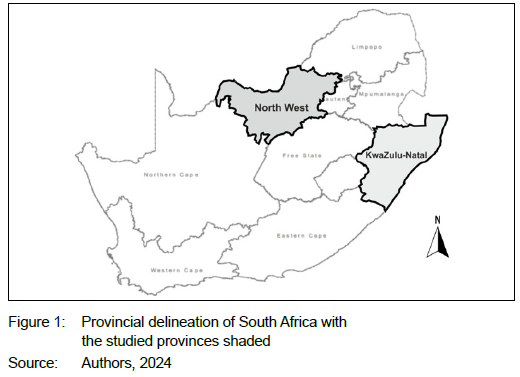
Section 2 of the 2019 Traditional and Khoisan Leadership Act outlines the criteria for recognising traditional communities, which must adhere to customary law and be acknowledged as distinct historical groups (South Africa, 2019). Following the end of apartheid in 1994, approximately 800 traditional chiefs were granted authority over 17% of South Africa's land (Friedman, 2017). Traditional authorities are found in eight of the nine provinces, with the Western Cape being the exception. Despite regional variations in customary norms, all traditional councils are governed by the national legislative framework, currently the Traditional and Khoisan Leadership Act. This study explores the context of traditional governance in South Africa, acknowledging the diversity of traditional authorities across provinces. Case studies focused on governance in North-West and KwaZulu-Natal provinces, as shown in Figure 1. North-West is primarily governed by Tswana traditional authorities, while KwaZulu-Natal is dominated by Zulu traditional authorities.
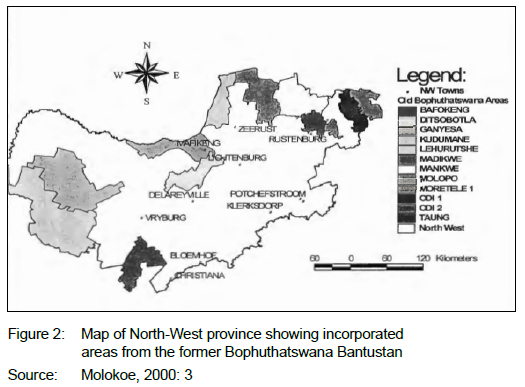
The North-West province includes most of the parts of the former Bophuthatswana Bantustan area (Molokoe, 2000), now part of the 104,882km2 province (Figure 2) (South Africa, 2022). Approximately 20,001km2 of this area is administered by traditional authorities (DALRRD, 2024). There are 56 traditional councils spread across three of North-West province's four district municipalities (NWPG, 2022).
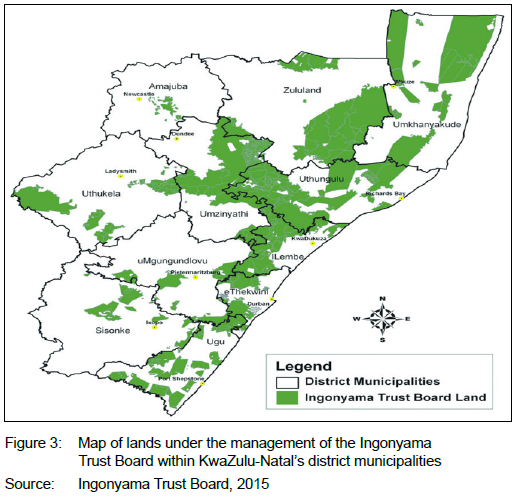
In KwaZulu-Natal, traditional authorities operate alongside customary law under the KwaZulu-Natal Ingonyama Trust Act No. 3KZ of 1994, amended by the Ingonyama Trust Amendment Act No. 9 of 1997. The Ingonyama Trust Board administers approximately 29.67% of the province - equivalent to 2.8 million hectares of land - on behalf of the Zulu monarch, as shown in Figure 3 (Ingonyama Trust Board, 2024). Alongside, there are 303 traditional councils in the province present on the lands administered by the Ingonyama Trust Board (KZNCOGTA, 2020).
4. RESEARCH METHODOLOGY
4.1 Research design
A case study research design was adopted for this study, employing a qualitative research approach to explore traditional and municipal governance systems in the North-West and KwaZulu-Natal provinces. This design was chosen for its flexibility in capturing the perceptions and experiences of participants regarding governance in these areas. Qualitative methods, including observations, focus group discussions, and in-depth interviews, were used to gather data (Saunders, Lewis & Thornhill, 2019). Interviews provided insights into the historical context, municipal governance structures, existing policy and legal frameworks, and future recommendations from participants. Relevant documents guiding the governance of municipal and traditional authorities were also reviewed. Thematic data analysis was employed to analyse the data (Byrne, 2022). The results revealed four key themes that shape the relationship between traditional authorities and governance in the case study regions, namely 'administrative hierarchy structure', 'development planning', 'land governance', and 'natural resource management'. These themes formed the basis for developing the Polycentric Spaces Framework for Independent and Collaborative Local Governance in South Africa.
4.2 Research population and sampling
The study did not have a defined population but targeted individuals and institutions with professional involvement in traditional and municipal governance in South Africa. The sample frame included traditional council members, municipal council officials (from North-West and KwaZulu-Natal provinces), academic and professional experts, and institutional representatives. NorthWest province has 56 traditional councils across three of its four district municipalities, while KwaZulu-Natal has 303 traditional councils spread across its single metropolitan and 10 district municipalities (NWPG, 2022; KZNCOGTA, 2020). A non-probability sampling approach, specifically, volunteer self-selection and snowball sampling, was employed. Saunders, Lewis and Thornhill (2015) recommend a minimum of 30 interview participants for diverse populations. Similar studies by Yakubu, Spocter and Donaldson (2021), Korbéogo (2021), and Fuseini (2021) used qualitative case study designs with semi-structured interviews, with sample sizes ranging from 28 to 50 respondents. This study involved 37 interviews, which included three academic experts, eight traditional council representatives (from both provinces), six municipal councillors, 15 municipal officials, and five institutional representatives from organisations such as the South African Local Government Association (SALGA), the Department of Corporate Governance and Traditional Affairs (COGTA), the Municipal Demarcation Board (MDB), the Ingonyama Trust Board, and the Department of Land Reform and Rural Development. A detailed list of respondents, their official designations, and interview dates is provided in Table 1. In addition, four focus group discussion sessions were conducted, as shown in Table 2.
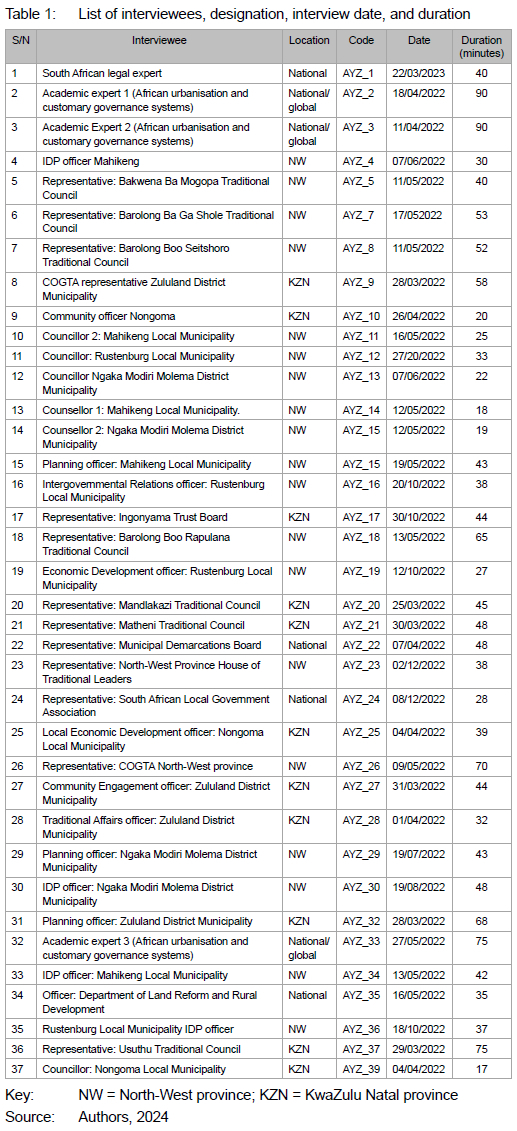
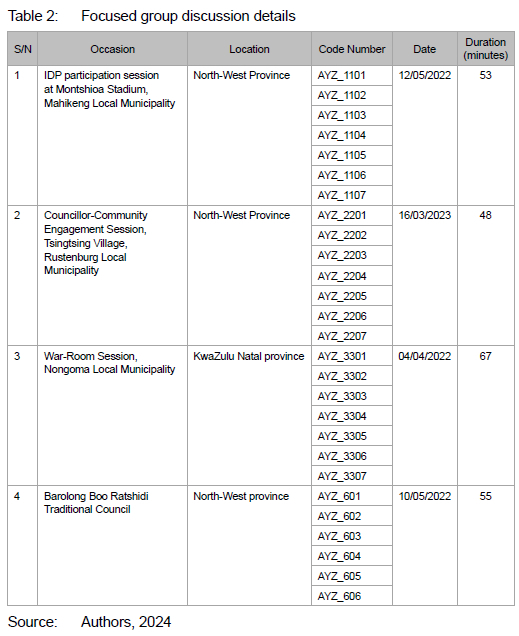
In accordance with the ethical guidelines of the University of Johannesburg's Faculty of Engineering and the Built Environment, as well as its Ethics and Plagiarism Regulations, respondents' anonymity was ensured. This is reflected in the use of unique code numbers assigned to each participant, as shown in the code number column of Tables 1 and 2 (e.g., AYZ_respondent number).
4.3 Data collection
Field research was conducted at the case study locations from March 2022 to March 2023. Interview guides were developed to cover four key themes, namely historical background, municipal governance structures, existing policy and legal frameworks, as well as future recommendations. Each thematic section included at least three open-ended questions, designed to prompt in-depth responses. The interviews were semi-structured, allowing for follow-up questions to explore issues further.
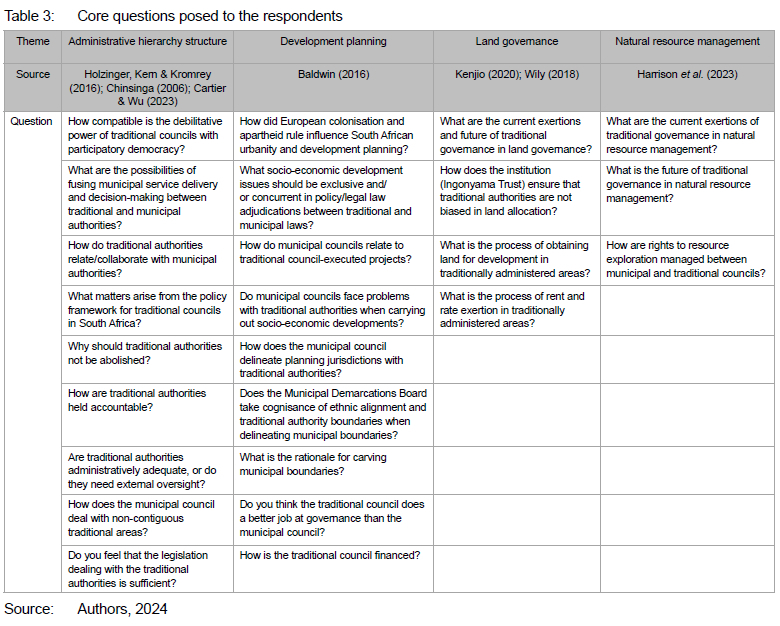
Focus group discussions followed a similar structure, using the same open-ended questions to address the thematic sections. Each session involved seven volunteer participants with relevant expertise. Table 3 outlines the core questions posed to respondents, supported by relevant literature.
Documentary review was used to gather secondary qualitative data, ensuring that the documents were relevant and aligned with the research objectives (Wagner, Kawulich, & Garner, 2012). The reviewed documents were key texts guiding the governance frameworks of municipal and traditional authorities in South Africa. These included the 1996 South African Constitution, the Spatial Planning and Land Use Management Act (SPLUMA) (No. 16 of 2013), the Traditional and Khoisan Leadership Act (No. 3 of 2019), the Ingonyama Trust Act, the Municipal Structures Act (No. 117 of 1998), and the Municipal Systems Act (No. 32 of 2000).
4.4 Data analysis and interpretation
Primary data collected during field research, including audio recordings and fleld notes, were digitally stored and used to provide insights into the administrative hierarchy and socioeconomic disparities between rural and urban South Africa. The thematic data analysis procedure used to analyse the data involved several steps and followed Creswell's (2007) approach, involving transcription, thematic organisation, coding, and presentation. Audio recordings were transcribed using Otter.ai software, producing 37 transcripts, which were proofread and compared with field notes for accuracy. Each transcript was assigned a unique code to maintain respondent anonymity.
Keywords such as 'land', 'culture', 'governance', and 'management', identified by Otter.ai, were matched to corresponding text segments and assigned codes to capture both direct and implied meanings. Key themes such as 'administrative hierarchy structure', 'development planning', 'land governance', and 'natural resource management' were derived from both the transcribed data and relevant literature (e.g., Adejumo-Ayibiowu, 2020; Duda, 2023; McGinnis & Ostrom, 2012). Non-relevant codes were discarded, and the refined data was organised to guide the study's analysis and discussions on traditional authorities in local governance. The researchers emphasise that, as noted by Braun and Clarke (2006), software is a tool that complements, rather than replaces, rigorous analysis and ethical research practices.
4.5 Limitations to the study
This study examined a limited sample of traditional councils from KwaZulu-Natal (3 of 303) and NorthWest (5 of 56), which restricts the generalisability of the findings. The smaller sample from KwaZulu-Natal is due to the centralised oversight of the Ingonyama Trust Board, while North-West's decentralised structure allowed for broader inclusion.
Although the study provides valuable insights into traditional councils in these provinces, its findings cannot be generalised to all South African councils, due to regional variations in governance. Furthermore, as the Traditional and Khoi-San Leadership Act (2019) is still in the early stages of implementation and has not been fully localised, its impact on traditional leadership structures remains uncertain.
5. FINDINGS AND DISCUSSION
5.1 Administrative hierarchy structure
Emerging from nearly a century of colonial and apartheid rule in 1994, South Africa adopted a new Constitution to establish a democratic governance framework, safeguard citizens' rights, and redefine relations between the state and its citizens. Prior to 1994, traditional authorities, despite having ceded sovereignty to colonial powers, retained some administrative autonomy within their domains during apartheid. In the post-apartheid democratic dispensation, traditional authorities, with the exception of the Zulu monarchy in KwaZulu-Natal, are now primarily integrated into municipal governance structures, as the entire country is divided into municipal areas. In contrast to the Tswana traditional councils in North-West province, which are self-governing (autocephalous), the Zulu traditional system is headed by a central monarch, with local traditional councils, led by chiefs (Inkosi), subordinated to the authority of the monarch. Consequently, all previously autonomous traditional areas are now incorporated within municipal boundaries, as defined by the current governance framework.
The 1996 South African Constitution recognised traditional leadership as a customary institution, but subject to the Constitution and any relevant legislation (South Africa, 1996). Section 212 of the Constitution defines the role of traditional leaders, stating that national legislation may allow traditional leadership to influence local governance (South Africa, 1996). The Municipal Structures Act (1998) and the Municipal Systems Act (2000) mandate that traditional authorities support municipalities in service delivery (South Africa, 1998; South Africa, 2000). However, the governance framework for traditional authorities highlights both cooperation and misunderstandings between municipal and traditional administrations. Under SPLUMA Regulation 19, traditional councils are required to establish service level agreements with local municipalities to delegate certain planning responsibilities (South Africa, 2013). However, SPLUMA does not clearly define which municipal planning duties can be outsourced to traditional councils.
Findings from the study areas reveal that 'ward systems' established by customary authorities are based on clan settlement patterns, in contrast to municipal ward delineations, which are determined by population density and socio-economic factors for revenue generation and sustainability. As shown in Figure 4, multiple traditional authorities can exist within a municipality, each with its own distinct ward boundaries. In NorthWest province, wards are governed by hereditary chiefs (kgosana, plural: dikgosana), also referred to as mong wa motse (chief of the village), who hold both administrative and judicial authority. The kgotla serves as the consultative assembly for the Kgosi, the paramount leader of Tswana communities, with each clan represented in the traditional council (AYZ_7). A similar structure exists in KwaZulu-Natal, where Indunas (headmen) lead local wards (Izibonda), selected by their clans and ratified by the Inkosi. Traditional ward heads hold their positions for life or until permanent disability (AYZ_20). Thus, the key difference is that traditional wards are culturally and customarily defined, while Municipal Demarcation Board wards are part of the formal municipal system, created for administrative, electoral, and service-delivery purposes.
The policy framework governing traditional councils, as outlined in the 1996 South African Constitution and the Local Government Municipal Structures Act (1998), stipulates that traditional councils consist of 60% selected and 40% elected members, with one-third of council members being women (Suth Africa, 2019). The tenure of traditional council members aligns with that of municipal councillors, running for a period of five years. Informal collaboration and consultation between municipal and traditional ward councillors were observed in the study areas, which echoes McGinnis and Ostrom's (2012) concept of 'polycentric governance', where multiple authority structures coexist with contractual relationships and mechanisms for dispute resolution. However, the current governance framework has led to a power imbalance, with municipalities often assuming supervisory superiority over traditional authorities, directing the pace of development. As one respondent noted, municipalities often view their institutional authority as more valid than that of traditional leaders (AYZ_3). Despite being granted reserved membership in municipal councils, traditional authorities do not hold voting rights, a provision that has led to frustration and resentment within the traditional leadership. This dissatisfaction, however, is directed more towards the policy framework itself rather than the implementation of constitutional provisions by government institutions. On the other hand, traditional authorities are guaranteed active participation in municipal council committees and ward committees, where specific local issues are discussed and managed. In addition, municipal councils are legally required to seek the consent of traditional councils before making decisions that affect areas under traditional authority. This provision is meant to respect the authority of traditional governance while integrating it into the broader municipal system. As AYZ_14 pointed out, these committees provide a platform for traditional leaders to engage in decision-making processes, even though they do not have plenary voting rights. This suggests that, while traditional authorities may not have formal voting power, they remain integral to discussions and decisions within these forums.
Ostrom et al. (1961) define polycentricity as multiple independent governance structures with influence over a community. While South Africa's 1996 Constitution acknowledges traditional authorities managing 'traditional communities', they are not recognised as formal governance tiers. Despite this, traditional authorities often claim informal governance roles, especially in areas such as customary land governance. This ambiguity raises legal concerns regarding service delivery and community decision-making. According to the findings from this study, regardless of national constitutional ambiguities, contextual formalisation of the recognition of traditional authorities as functional governance parties is established, as is the case between Rustenburg Local Municipality and its traditional authorities in the North-West province. In this regard, there is a memorandum of understanding (MoU) agreement between the municipal and traditional authorities establishing the recognition of institutional independence of both parties and a framework for collaborating towards societal governance and service-delivery provision. Signed on 14 August 2014, the MOU was the result of ongoing discussions about the need to reconcile the distinct governance structures within the municipality, a dialogue that began in 2003. Although the MOU has a specified start date, it does not include an expiry date, as provided to the researchers.
The same scenario applies between the Ingonyama Trust Board and the provincial government of KwaZulu-Natal. This implies the autonomy of the Ingonyama Trust Board over administration and management of customary lands within KwaZulu-Natal province. However, in this case, contextual recognition of traditional authorities, as represented by the Ingonyama Trust Board, is at the provincial level. This aligns with Rauhut (2017) as replicating federalism, in which vertical government tiers collaborate and coordinate administration and service delivery while maintaining their autonomy.
5.2 Development planning
There is a significant socio-economic divide between urban and peri-urban/rural areas in South Africa, particularly in municipalities where both traditional and municipal authorities coexist. Scepticism exists about the accelerated socioeconomic development of traditionally governed areas, mainly due to the lengthy land-access process and the interference of traditional authorities in project implementation, even after land is allocated for specific purposes (AYZ_29; AYZ_4). For instance, traditional authorities in certain North-West communities have delayed government projects through protracted litigation, ultimately halting them. In response, traditional authorities argue that they prioritise the well-being of their communities and believe that government (at all levels) should involve them in both the planning and implementation stages of projects in their areas. In addition, slow development in traditionally governed areas is often attributed to the poor implementation of the SPLUMA (2013) and the Township Establishment Act (1991) (AYZ_36).
Traditional authorities similarly accuse municipal authorities of failing to deliver on developmental promises, particularly regarding service and infrastructure provisions outlined in Municipal Development Plans (Integrated Development Plans). As a result, local communities often hold traditional authorities accountable for the shortcomings of municipal service delivery. By contrast, some traditional authorities, especially those receiving royalties from mining activities, have successfully implemented community service projects (AYZ_26; AYZ_12). While their constituents praise the efficiency of these efforts, some of these projects fall under Social and Labour Plans (SLPs), particularly in the North-West province. This highlights the financial capacity disparity existing among traditional councils. Traditional councils such as the Royal Bafokeng and Bakwena Ba Mogopa in North-West province with significant royalty earnings from mineral resource exploration can assert autonomy over the management of their finances and accruing royalty earnings. By contrast, other traditional councils in North-West with no significant mineral resource exploration in their domain depend on government grants. In the case of KwaZulu-Natal province, the finances of traditional councils are managed by the Ingonyama Trust Board. SLPs are often shrouded in secrecy, as noted in the case of traditional authorities in Rustenburg Local Municipality (AYZ_16). Despite this, notable projects by traditional authorities such as those by the Royal Bafokeng include schools, roads, stormwater systems, and water provision. SLPs, like IDPs, are short- to medium-term strategic documents developed by mining companies in collaboration with local communities (AYZ_16). These plans are part of local economic development initiatives required by the Department of Mineral Resources and Energy (DMRE) towards the approval of mining licenses (South Africa, 2002; CALS, 2016). It is aimed at revitalising mining towns to prevent neglect, due to mining activities (Faboye, Gumbo, and Sebola-Samanyanga, 2023). It is also expected that SLPs be integrated with municipal IDPs as part of the mining companies' corporate social responsibility.
Traditional councils such as the Royal Bafokeng Nation in North-West province are reported to develop and implement autonomous development plans that are not coordinated with municipal authorities (AYZ_16; AYZ_12). These councils create and execute development strategies independently, with traditional leadership playing a central role in both driving local development and preserving the cultural norms and customs that govern their communities. This practice is particularly prevalent in areas with significant mining activities, where traditional authorities receive royalties from mining companies, granting them financial autonomy beyond government control. This financial independence allows traditional councils to undertake service-delivery initiatives without reliance on municipal authorities, creating challenges for local governments in forecasting services and addressing infrastructure maintenance gaps associated with projects led by traditional authorities. A key issue in this dynamic is the misalignment between SLPs and IDPs. In the case of Rustenburg Local Municipality, North-West province, the 2014 MoU has been established between municipal and traditional authorities. This agreement formally acknowledges the legal and institutional autonomy of both parties, outlining areas of cooperation, including IDP alignment, revenue collection, investment promotion, water and sanitation management, and agricultural and rural development, as well as mechanisms for dispute resolution.
There is a growing recognition of the role and capacity of traditional authorities in driving rural development. In particular, traditional authorities located near urban peripheries have increasingly acknowledged the importance of community development plans and the need for consultation with built-environment professionals (land surveyors, urban planners, and architects) when planning for their territories. In response, municipalities have expressed a willingness to provide consultancy services upon request, viewing this collaboration as a means to support the implementation of municipal spatial development frameworks. This collaboration is viewed as an alternative to the limitations of municipal planning ordinances, including SPLUMA, in areas governed by traditional authorities.
The issue of service delivery, as a core function of government, is central to the question of whether traditional authorities are currently effective in governance. McGinnis (1999) frames contemporary governance as being driven by public policy, with urban centres (municipalities) serving as key economic nodes. In South Africa, municipalities are constitutionally required to prepare IDPs and SDPs, which outline socio-economic and spatial strategies for local development. However, these plans often face challenges in implementation, particularly in areas under traditional leadership, where friction with traditional authorities can hinder progress. Traditional leaders assert control over land and insist on consultation before any development projects are undertaken. The significant socioeconomic deficits in these areas require collaborative action from multiple stakeholders to address, yet caution is necessary to avoid duplicating functions. As Ostrom and Parks (1999) emphasise, the technical efficiency of development actors is critical. It is, therefore, suggested that public administration be viewed as an integrated system, rather than through a binary opposition between traditional and modern governance approaches.
5.3 Land governance
South Africa's implementation of the municipal wall-to-wall concept, as outlined in SPLUMA (South Africa, 2013), divides the entire country into municipalities. This system, however, conflicts with the prevailing customary land-tenure system in traditional areas, where landownership is vested in traditional councils, headed by chiefs, rather than being based on freehold ownership. While SPLUMA was intended to have national applicability, it has been critiqued by traditional authorities for undermining customary land tenure. As a result, spatial planning in traditionally governed areas is impeded, as the principles of freehold land tenure are at odds with customary practices. In response, traditional authorities are increasingly being integrated into planning processes through advocacy initiatives such as the development of village action plans, which are being successfully implemented by groups such as the Royal Bafokeng and Bakwena Ba Mogopa in North-West province. However, this approach has not been widely adopted in KwaZulu-Natal, as noted in the study.
While the South African municipal governance framework does not grant full political powers to the traditional authorities, they retain significant influence within their designated spheres. This ambiguousness in traditional authorities' sociopolitical relevance fuels conflict between traditional and municipal authorities. For instance, traditional authorities assert why the SPLUMA is ineffectual in their domain, alluding to their exclusion from land-related decision-making bodies such as the land tribunals. The restricted role of traditional authorities within municipal governance coupled with their limited political agency, has contributed to a deepening mistrust between them and the broader South African government. Traditional authorities "are not fully happy regarding the issue of land; only 13% [of the land] has been returned... We've made commitments to the President, made a lot of reservations, and spoken with ministers in the Department of [Agriculture] Land [Reform and Rural Development], but we still lack our land" (AYZ_601). As such, the Minister for Land Reform and Rural Development holds land on behalf of traditional authorities, thereby being genuinely in charge of the land that is alleged to be administered by traditional authorities (AYZ_35).
Historically, occupants of lands under traditional authority have relied on permission to occupy (PTO) certificates as proof of land tenure. However, PTOs are often regarded as insufficiently legitimate for securing access to credit, which inhibits socio-economic development in these areas (AYZ_19). This issue is particularly pronounced for land owned by the Department of Land Reform and Rural Development but managed by traditional authorities, where the cumbersome process of securing formal leases further complicates matters. The absence of a standardised PTO system exacerbates these challenges, hindering the socio-economic progress of communities on traditionally administered land. By contrast, land under the custodianship of trust boards such as the Ingonyama Trust Board in KwaZulu-Natal often provides more secure tenure in the form of long-term leases (AYZ_17). These leases offer potential avenues for business and investment opportunities. In addition to their role in land custodianship, trust boards also perform land-registration functions for lands administered according to customary law in KwaZulu-Natal. Nevertheless, these trust boards do not assume responsibility for development planning or land-use regulation, which remain under the purview of the respective traditional authorities (AYZ_32). While some traditional authorities have proactively engaged in community-level development planning - sometimes in collaboration with municipal authorities - land-use planning remains largely unregulated and ad hoc in many areas under traditional jurisdiction (AYZ_16; AYZ_20; AYZ_27). This lack of formal regulation is compounded by the relatively low level of technical expertise among traditional leaders (indunas [headmen/ women]), particularly in rural areas, which limits the effectiveness of local development initiatives.
Polycentric governance offers potential solutions to the tensions surrounding land management between government entities and traditional authorities. As Pederson (2016) suggests, this approach involves integrating multiple stakeholders into land-governance decisions. Further support for this model is provided by Harrison et al. (2023), who advocate for the development of cohesive, multi-tiered governance frameworks that can enhance the sustainability of land-management practices across South Africa.
5.4 Natural resource management
Control over natural resources and revenue generation has emerged as a key issue in calls for greater governance powers for traditional authorities. While oversight of natural resource management, including water bodies, forests, and mineral resources, falls under the national government's jurisdiction -specifically through the Department of Mineral Resources and Energy and the Department of Forestry, Fisheries, and the Environment -traditional authorities retain authority over land use up to 300 meters below the surface (AYZ_20). However, traditional leaders are advocating for increased control over the revenues generated from mineral exploration within their territories. It is interesting to note that, although tax collection is not within their formal remit, traditional authorities are able to impose rates and royalties on land rents, particularly from individuals and corporations, including mining companies.
Natural resource governance is a key factor in the socio-economic disparities observed in areas governed by traditional authorities. In regions where mining operations are active, traditional authorities have the potential to exercise a degree of financial autonomy. By contrast, areas without mining activities remain heavily dependent on government funding. As noted by AYZ_32, even in the absence of mining revenue, traditional authorities have not effectively leveraged their land resources for commercial ventures. Furthermore, AYZ_3 argues that insufficient attention has been paid to the organisational hierarchies and inherent structures within traditional authorities that could be better harnessed for effective resource management. AYZ_18 further highlights the efforts of the National House of Traditional Leaders, which is now pushing for programmes that aim to empower traditional authorities, promote their corporatisation, and support partnerships with the private sector to stimulate local economic activities. This approach aligns with neoliberal governance trends in the late 20th and early 21stcenturies, where governmental bodies are increasingly perceived as regulators overseeing private sector service providers (Jessop, 2002). In this context, Afenah (2009) emphasises the importance of capacity development, particularly in flscal discipline, for governance actors. Moreover, the devolution of governance powers, a central tenet of neoliberalism, which Afenah (2009) describes as 'institutional rescaling' to subnational levels, shows the need for strengthening the capacity of traditional authorities in natural resource management.
6. PROPOSED POLYCENTRIC SPACES FRAMEWORK
Despite the legal ambiguity of traditional authorities in governance, this study establishes that they can be a disruptive or catalysing force for development. Traditional authorities are important for rural development and could be co-opted as development enforcers at that tier. Currently, the financial disparity between traditional authorities hosting mining exploration and those who have not has created a financial disparity in the ability of traditional authorities to provide service delivery for their constituents.
The vast majority of South African traditional authorities are registered as councils, a status that does not provide the financial capacity necessary to function as corporate entities. However, some traditional councils operating under a trust framework present a more corporate structure in their administrative functions. This approach enables them to navigate the complexities of modern governance while effectively representing the interests of the communities they oversee. The corporatisation of all traditional councils could unlock numerous benefits, particularly in the context of an agricultural revolution. Such a transformation could empower small-scale farmers, facilitate market access, and enhance the storage and commercialisation of agricultural products, thereby improving traditional subsistence farming practices.
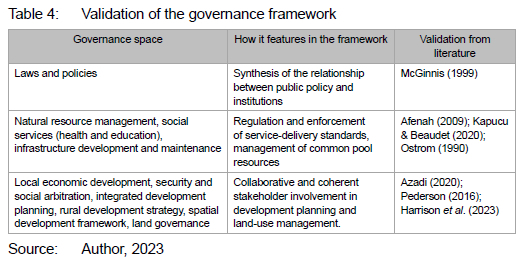
Although not universally accepted, several perspectives in public administration argue that the situational context and the social-ecological framework of public policy should influence how government operates. Governance based on norms and customs, as advocated by traditional authorities, can be refined and integrated into the modern framework of corporatised traditional councils. This approach would blend constitutional and cultural norms into an adaptive organisational design for traditional councils. Within this corporate structure, traditional legal systems could be renewed and aligned with contemporary realities through collaboration with academic institutions and government departments for training and development. Based on the findings of this study, the proposed framework in Figure 5, validated in Table 4, is recommended as a means to ensure the continued relevance of traditional authorities in municipal governance. These governance 'spaces' allow traditional and municipal authorities to function both independently and collaboratively. Areas for cooperative governance within this framework are identified as polycentric spaces, which enable local authorities to maintain independence in service delivery, while also supporting collaboration, as discussed by Stephan et al. (2019).
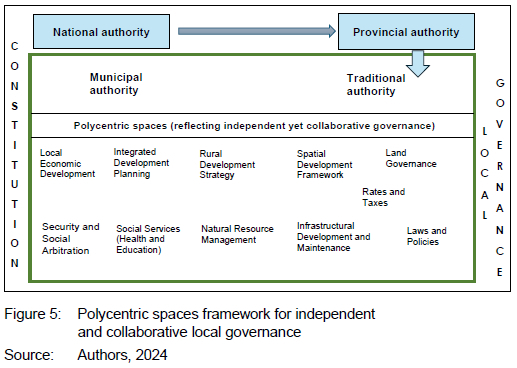
The proposed framework is designed to align with the national constitutional framework, which would require amendments to sections that currently only 'recognise' traditional authorities. Within this framework, national authority maintains overarching governance, followed by provincial authority. The concept of 'polycentric governance' is most evident at the local government level, where municipal and traditional authorities share responsibilities. Areas for collaborative governance within the proposed framework are defined as polycentric spaces, where the roles of both authorities will be clearly delineated, yet mutually reinforcing.
7. CONCLUSION
The practical implications of this study suggest that adopting the concept of 'polycentric governance' in municipal settings could involve constitutionally empowering traditional authorities to assume formal roles in community development. Such an approach would enable these authorities to participate in the management of CPRs such as land, and contribute to broader socio-economic development. Evidence supports the argument that polycentric models offer more effective management of CPRs compared to the current top-down, centralised frameworks governing national legislation.
Polycentric governance is typically characterised by multiple decision-making centres, with no single authority having exclusive control over collective choices. In the South African context, however, the existing governance structure is largely monocentric, with the national government setting laws that are then adapted for provincial and municipal (metropolitan, district, and local) implementation. This hierarchical model complicates the administration of social goods and CPRs, as it is difficult to assign responsibility to specific entities within a multi-tiered system. The implementation of SPLUMA and SDFs highlights the ongoing tensions, particularly regarding the control of land by traditional authorities, which has direct implications for rural development.
The potential for collaborative governance between traditional and municipal authorities presents a promising avenue for enhancing development outcomes. By combining indigenous knowledge from traditional councils with the technical expertise of municipal councils and government departments, this collaborative model could support more adaptive and effective governance. Despite efforts by the national government to address rural underdevelopment post-apartheid, progress has been slow and uneven. Polycentric governance offers an opportunity for traditional authorities to regionalise development and administrative policies, allowing for more context-sensitive approaches to governance.
However, the integration of multiple administrative frameworks within South Africa's provincial and national governance structures is likely to present challenges, particularly in terms of overlapping jurisdictions and resource-allocation conflicts. Nevertheless, the prospective benefits of collaborative governance such as improved resource management, flexibility, and enhanced socio-economic development suggest that polycentric models could provide a more sustainable and inclusive pathway for governance in rural areas.
ACKNOWLEDGEMENT
This research was supported by a grant from the Mercatus Center of the George Mason University, USA and is part of the 2023/24 Social Science Research Council Next Generation Social Sciences in Africa Doctoral Dissertation Completion Fellowship.
REFERENCES
ADDINK, H. 2019. Good governance: Concept and context. London, UK: Oxford University Press. https://doi.org/10.1093/oso/9780198841159.001.0001 [ Links ]
ADEJUMO-AYIBIOWU, O.D. 2015. A theoretical basis for good governance. Africanus, 45(2), pp.1-27. https://doi.org/10.25159/0304-615X/1179 [ Links ]
ADEJUMO-AYIBIOWU, O.D. 2020. Good governance and rural development in Africa: Finding the missing link. In Mafukata, M. (Ed.). African perspectives on reshaping rural development. Hershey, PA: IGI Global, pp. 67-93. https://doi.org/10.4018/978-1-7998-2306-3.ch004 [ Links ]
AFENAH, A. 2009. Conceptualising the effects of neoliberal urban policies on housing rights: An analysis of the attempted unlawful forced eviction of an informal settlement in Accra, Ghana. DPU Working Paper No. 139, University College, London. [ Links ]
AINSLIE, A. & KEPE, T. 2016. Understanding the resurgence of traditional authorities in postapartheid South Africa. Journal of Southern African Studies, 42(1), pp. 19-33. https://doi.org/10.1080/03057070.2016.1121714 [ Links ]
ALIGICIA, P. & BOETTKE, P. 2011. The two social philosophies of Ostroms' institutionalism. The Policy Studies Journal, 39(1), pp. 29-49. https://doi.org/10.1111/j.1541-0072.2010.0000395.x [ Links ]
ALIGICIA, P. & TARKO, V. 2012. Polycentricity: From Polanyi to Ostrom, and beyond. Governance, 25(2), pp. 237-262. https://doi.org/10.1111/j.1468-0491.2011.01550.x [ Links ]
ANNAN-AGGREY, E., BANDAUKO, E. & ARKU, G. 2021. Localising the Sustainable Development Goals in Africa: Implementation challenges and opportunities. Commonwealth Journal of Local Governance, 24, pp. 4-23. https://doi.org/10.5130/cjlg.vi24.7739 [ Links ]
ANSELL, C. & TORFING, J. 2022. Introduction to the Handbook on theories of governance. In: Ansell, C. & Torfing, J. (Eds). Handbook on theories of governance. Cheltenham, UK: Edward Elgar Publishing, pp. 1-16. https://doi.org/10.4337/9781800371972.00007 [ Links ]
ARARAL, E. & HARTLEY, K. 2013. Polycentric governance for a new environmental regime: Theoretical frontiers in policy reform and public administration. In: international Conference on Public Policy, 26-28 June, Grenoble, France, pp. 1-32. [ Links ]
ASWATHANARAYANA, U. (Ed.). 2012. Natural resources - Technology, economics and policy. London: CRC Press. https://doi.org/10.1201/B11827 [ Links ]
AZADI, H. 2020. Monitoring land governance: Understanding roots and shoots. Land Use Policy, 94, article 104530. https://doi.org/10.1016/j.landusepol.2020.104530 [ Links ]
BALDWIN, K. 2016. The paradox of traditional chiefs in democratic Africa. New York: Cambridge University Press. https://doi.org/10.1017/CBO9781316422335 [ Links ]
BOUCKAERT, G. 2023. Effective local governance. In: Teles, F. (Ed.). Handbook on local and regional governance. Cheltenham, UK: Edward Elgar Publishing, pp. 27-39. https://doi.org/10.4337/9781800371200.00011 [ Links ]
BRAUN, V. & CLARKE, V. 2006. Using thematic analysis in psychology. Qualitative Research in Psychology, 3(2), pp. 77-101. https://doi.org/10.1191/1478088706qp063oa [ Links ]
BYRNE, D.A. 2022. Braun and Clarke's approach to reflexive thematic analysis. Quality & Quantity, 56, pp. 1391-1412. https://doi.org/10.1007/s11135-021-01182-y, 2023 [ Links ]
CAFFENTZIS, G. 2002. Neoliberalism in Africa, apocalyptic failures and business as usual practices. Alternatives: Turkish Journal of international Relations, 1(3), pp. 88-104. [Online]. Available at: https://dergipark.org.tr/en/download/article-flle/19385 [17 August 2024]. [ Links ]
CANDELA, R. 2021. Institutional analysis, polycentricity, and federalism in the Bloomington School: Social order through evolution or design? In: Lemke J. (Ed.). Elinor Ostrom and the Bloomington School: Building a new approach to policy and the Social Sciences. Newcastle upon Tyne, UK: Agenda Publishing, pp. 153-170. https://doi.org/10.1017/9781788211253.010 [ Links ]
CARLISLE, K. & GRUBY, R. 2019. Polycentric systems of governance: A theoretical model for the Commons. Policy Studies Journal, 47(4). https://doi.org/10.1111/psj.12212 [ Links ]
CARTIER, C. & WU, P 2023. From the administrative hierarchy to the system of administrative divisions. In: Ergenc, C. & Goodman, D.S.G. (Eds). Handbook on local governance in China. Structures, variations, and innovations. Cheltenham, UK: Edward Elgar Publishing, pp. 30-47. https://doi.org/10.4337/9781800883246.00010 [ Links ]
CALS (CENTRE FOR APPLIED LEGAL STUDIES). 2016. The Social and Labour Plan Series Phase 1: System Design Trends Analysis Report. Johannesburg. [ Links ]
CHINSINGA, B. 2006. The Interface between Tradition and Modernity. Varia, 50, pp. 255-274. https://doi.org/10.4000/civilizations.498 [ Links ]
COQUERY-VIDROVITCH, C. 1991. The process of urbanization in Africa (From the origins to the beginning of independence). African Studies Review, 38(1), pp. 1-98. https://doi.org/10.2307/524256 [ Links ]
CRESWELL, J.W. 2007. Qualitative inquiry and research design: Choosing among five approaches. International student edition. Thousand Oaks, CA: Sage Publications. [ Links ]
CROSS, M. & NDOFIREPI, A. (Eds). 2017. Knowledge and change in African universities. Rotterdam: Sense Publishers. https://doi.org/10.1007/978-94-6300-842-6 [ Links ]
DALRRD (DEPARTMENT OF AGRICULTURE, LAND REFORM AND RURAL DEVELOPMENT). 2024. NorthWest Traditional Authorities Extent. Unpublished document. [ Links ]
DASTILE, N.P. & NDLOVU-GATSHENI, S. 2013. Power, knowledge and being: Decolonial combative discourse as a survival kit for Pan-Africanists in the 21st century. Alternation, 20(1), pp. 105-134. [ Links ]
DAWOOD, Y. 2022. Effective government and the two faces of constitutionalism. In: Jackson, V. (Ed.). Constitutionalism and a right to effective government? Cambridge: Cambridge University Press, ebook. https://doi.org/10.1017/9781009158541.004 [ Links ]
DESLATTE, A., HELMKE-LONG, L., STOKAN, E. & CHUNG, J. 2024. Economies of inequality? Polycentric metropolitan governance and strategic sustainability choices. Urban Affairs Review, article10780874241252755. https://doi.org/10.1177/10780874241252755 [ Links ]
DUDA, T. 2023. Traditional and Khoi-San Leadership Act that 'recreates the Bantustans' heads to ConCourt, Land Portal. [Online]. Available at: https://landportal.org/node/113554 [Accessed: 15 September 2023]. [ Links ]
FABOYE, S.O., GUMBO, T. & SEBOLA-SAMANYANGA, K.J.P. 2023. Co-creating development in mining towns: The nexus between social labour plans and integrated development plans for urban development planning in Rustenburg, South Africa. In: Proceedings of REAL CORP 2023, 28th International Conference on Urban Development, Regional Planning and Information Society (pp. 125-132). CORP (Competence Centre of Urban and Regional Planning). [Online]. Available at: http://repository.corp.at/id/eprint/998 [18 August 2024]. [ Links ]
FRIEDMAN, S. 2017. South Africans in rural areas are saying 'no more'. Why it matters, The Conversation. [Online]. Available at: https://theconversation.com/south-africans-in-rural-areas-are-saying-no-more-why-it-matters-87028 [Accessed: 5 November 2022]. [ Links ]
FUSEINI, I. 2021. Navigating traditional and modern institutions in city governance: The role of chieftaincy in spatial planning in Tamale, Ghana. African Studies, 80(2), pp. 230-248. https://doi.org/10.1080/00020184.2021.1911623 [ Links ]
GUGLER, J. & FLANAGAN, W. 1978. Urbanisation and social change in West Africa. CUP Archive [ Links ]
GYONG, J.E. 2014. Good governance and accountability in a democracy. European Scientific Journal, 7(26), pp. 71-89. [Online]. Available at: https://core.ac.uk/download/pdf/236408354.pdf [18 August 2024]. [ Links ]
HAMMAN, P. (Ed.). 2019. Rethinking hierarchy in sustainability governance: A literature review. In: Hamman, P. (Ed.). Governance and hierarchy. London, UK: Routledge, ebook. https://doi.org/10.4324/9780367187903 [ Links ]
HARRISON, J., HOYLER, M., DERUDDER, B., LIU, X. & MEIJERS, E. 2023. Governing polycentric urban regions. Territory, Politics, Governance, 11(2), pp. 213-221. https://doi.org/10.1080/21622671.2022.2083011 [ Links ]
HARTELL, C. & STEYN, M. 2019. Challenges influencing the professional context of the foundation phase teachers in rural and township schools in South Africa. CICE Series 6, pp. 175-195. [ Links ]
HERRINGTON, M. & CODURAS, A. 2019. The national entrepreneurship framework conditions in sub-Saharan Africa: A comparative study of GEM data/National Expert Surveys for South Africa, Angola, Mozambique and Madagascar. Journal of Global Entrepreneurship Research, 9(1), pp. 1-24. https://doi.org/10.1186/S40497-019-0183-1 [ Links ]
HOLZINGER, K., KERN, F. & KROMREY, D. 2016. The dualism of contemporary traditional governance and the state: Institutional setups and political consequences. Political Research Quarterly, 69(3), pp. 469-481. https://doi.org/10.1177/1065912916648013 [ Links ]
INGONYAMA TRUST BOARD. 2015. Strategic Plan: 2015-2020. Pietermaritzburg: Ingonyama Trust Board. [ Links ]
INGONYAMA TRUST BOARD. 2024. Home - We are the landowner in law of approximately 2.8 million hectares in the province of KwaZulu-Natal. [Online]. Available at: https://www.ingonyamatrust.org.za/ [Accessed: 11 November 2024]. [ Links ]
JESSOP, B. 2002. Liberalism, neoliberalism, and urban governance: A state-theoretical perspective. Antipode, 34(3), pp. 452-472. https://doi.org/10.1111/1467-8330.00250 [ Links ]
KAPUCU, N. & BEAUDET, S. 2020. Network governance for collective action in implementing United Nations Sustainable Development Goals. Administrative Sciences, 10(4), article 100. https://doi.org/10.3390/ADMSCI10040100 [ Links ]
KENJIO, J.W. 2020. Decolonizing land tenure systems in sub-Saharan Africa: The path to modern land policy reforms. Journal of Land Management and Appraisal, 7(1), pp. 1-9. https://doi.org/10.5897/JLMA2020.0017 [ Links ]
KHUNOU, S.F. 2006. A legal history of traditional leadership in South Africa, Botswana and Lesotho. Unpublished PhD dissertation, North-West University, South Africa. [Online]. Available at: https://repository.nwu.ac.za/handle/10394/1144 [18 August 2024]. [ Links ]
KJAER, A.M. 2011. Rhodes' contribution to governance theory: Praise, criticism and the future governance debate. Public Administration, 89(1), pp. 101-113. https://doi.org/10.1111/j.1467-9299.2011.01903.x [ Links ]
KORBÉOGO, G. 2021. Traditional authorities and spatial planning in urban Burkina Faso: Exploring the roles and land value capture by moose chieftaincies in Ouagadougou. African Studies, 80(2), pp. 190-206. https://doi.org/10.1080/00020184.2021.1920365 [ Links ]
KZNCOGTA (KWAZULU NATAL DEPARTMENT OF COOPERATIVE GOVERNANCE & TRADITIONAL AFFAIRS). 2020. State of readiness for traditional council elections. Media Briefing Remarks by Mec Sipho Hlomuka. [Online]. Available at: https://www.kzncogta.gov.za/archives/4196 [Accessed: 2 November 2024]. [ Links ]
LE GALÈS, P. 2011. Urban governance in Europe: What is governed? In: Bridge, G. (Ed.). The New Blackwell Companion to the City. West Sussex, UK: John Wiley & Sons, pp. 747-758. https://doi.org/10.1002/9781444395105.CH65 [ Links ]
MADITSI, M.E., KATERERE, D.R. & IYA, P.F. 2019. The state of traditional leadership in South Africa from colonialism and apartheid to democracy. In: Katerere, D. (Ed.). Traditional and indigenous knowledge for the modern era. Boca Raton, FL: CRC Press, pp. 285-302. https://doi.org/10.1201/b21965 [ Links ]
MARAWU, N.M., UTETE, R. & ZHOU, S. 2023. Good governance as an economic driver for service delivery: Lessons for South African Government. International Journal of Management, Entrepreneurship, Social Science and Humanities, 6(2), pp.71-93. https://doi.org/10.31098/ijmesh.v6i2.1219 [ Links ]
MAWERE, J., MATSHIDZE, P.E., KUGARA, S.L. & MADZIVHANDILA, T. 2022. The role and significance of traditional leadership in South African local governance. In: Tshifhumulo, R. (Ed.). Handbook of research on protecting and managing global indigenous knowledge systems. Hershey, PA: IGI Global, pp. 249-273. https://doi.org/10.4018/978-1-7998-7492-8.ch014 [ Links ]
McGINNIS, M.D. 1999. Polycentricity and local public economies: Readings from the workshop in political theory and policy analysis. Ann Arbor, MI: University of Michigan Press. https://doi.org/10.3998/mpub.16061 [ Links ]
McGINNIS, M.D. & OSTROM, E. 2012. Reflections on Vincent Ostrom, public administration, and polycentricity. Public Administration Review, 72(1), pp. 15-25. https://doi.org/10.1111/J.1540-6210.2011.02488.X [ Links ]
MOLOKOE, B.K.M. 2000. Bophuthatswana and its impact on the North-West province, 1974-1998. Unpublished PhD dissertation, NorthWest University, South Africa. [ Links ]
NWPG (NORTH WEST PROVINCIAL GOVERNMENT). 2022. NW officially launches Traditional Council Elections. [Online]. Available at: https://www.nwpg.gov.za/news/nw-officially-launches-traditional-council-elections/ [Accessed: 3 November 2024]. [ Links ]
NZIMANDE, M.T. 2022. Exploration of traditional leaders' roles in the provision of public services: A case of Nhlangwini Traditional Council. Master's dissertation. Durban University of Technology. [ Links ]
OSTROM, C. 1987. The political theory of a compound republic. 2nd edition. Lincoln: University of Nebraska Press. [ Links ]
OSTROM, E. 1990. Governing the commons: The evolution of institutions for collective action. Cambridge, UK: Cambridge University Press. https://doi.org/10.1017/CBO9780511807763 [ Links ]
OSTROM, E. & PARKS, R. 1999. Neither Gargantua nor the Land of Lilliputs: Conjectures on mixed systems of metropolitan organisation, in polycentricity and local public economies: Readings from the workshop in political theory and policy analysis. Ann Arbor, MI: University of Michigan Press, pp. 284-305. [ Links ]
OSTROM, V. 1973. Can federalism make a difference? Publius: The Journal of Federalism, 3(2), 197-237. [Online]. Available at: https://www.jstor.org/stable/3329443 [18 Agusut 2024]. https://doi.org/10.1093/oxfordjournals.pubjof.a038279 [ Links ]
OSTROM, v., TIEBOUT, C. & WARREN, R. 1961. The organization of government in metropolitan areas: A theoretical inquiry. American Political Science Review, 55(4), pp. 831-842. https://doi.org/10.2307/1952530 [ Links ]
PEDERSEN, R.H. 2016. Access to land reconsidered: The land grab, polycentric governance and Tanzania's new wave land reform. Geoforum, 72, pp.104-113. https://doi.org/10.1016/j.geoforum.2015.12.010 [ Links ]
POPESCU, L.G. 2011. Structural dynamic of the public sector and multilevel governance: Between hierarchies, market and network forms. Revista Administratie si Management Public, 17, pp. 47-63. [ Links ]
RAUHUT, D. 2017. Polycentricity - One concept or many? European Planning Studies, 25(2), pp. 332-348. https://doi.org/10.1080/09654313.2016.1276157 [ Links ]
RODE, P., TERREFE, B. & DA CRUZ, N.F. 2020. Cities and the governance of transport interfaces: Ethiopia's new rail systems. Transport Policy, 91, pp. 76-94. https://doi.org/10.1016/j.tranpol.2020.03.004 [ Links ]
SAGER, T. 2011. Neo-liberal urban planning policies: A literature survey 1990-2010. Progress in Planning, 76(4), pp. 147-199. https://doi.org/10.1016/j.progress.2011.09.001 [ Links ]
SAUNDERS, M., LEWIS, P. & THORNHILL, A. 2015. Research methods for business students. 7th edition. London: Pearson Education. [ Links ]
SAUNDERS, M., LEWIS, P. & THORNHILL, A. 2019. Understanding research philisophy and approaches to theory development. In: Saunders, M., Lewis, P. & Thornhill, A. (Eds). Research methods for business students. Harlow: Pearson, pp. 128-171. [ Links ]
SOUTH AFRICA. 1996. Constitution of the Republic of South Africa Act 108 of 1996. Pretoria: Government Printer. [ Links ]
SOUTH AFRICA. 1998. Local Government Municipal Structures Act 117 of 1998. Pretoria: Government Printer. [ Links ]
SOUTH AFRICA. 2000. Local Government Municipal Systems Act 32 of 2000. Pretoria: Government Printer. [ Links ]
SOUTH AFRICA. 2002. Mineral and Petroleum Resources Development Act 28 of 2002. Pretoria: Government Printer. [ Links ]
SOUTH AFRICA. 2003. Traditional Leadership and Governance Framework Act 71 of 2003. Pretoria: Government Printer. [ Links ]
SOUTH AFRICA. 2013. Spatial Planning and Land Use Management Act 16 of 2013. Pretoria: Government Printer. [ Links ]
SOUTH AFRICA. 2019. Traditional and Khoi-San Leadership Act 3 of 2019. Pretoria: Government Printer. [ Links ]
SOUTH AFRICA. 2022. South Africa Yearbook 2022/23. Pretoria: Department of Government Communication and Information System. [Online]. Available at: https://www.gcis.gov.za/resources/south-africa-yearbook-202223 [18 August 2024]. [ Links ]
STEPHAN, M., MARSHALL, G. & MCGINNIS, M. 2019. An introduction to polycentricity and governance. In: Thiel, A. (Ed.). Governing complexity: Analyzing and applying polycentricity. London, UK: Cambridge University Press, pp. 21-44. https://doi.org/10.1017/9781108325721.002 [ Links ]
TUSHNET, M. & KHOSLA, M. 2022. Courts, constitutionalism, and state capacity: A Preliminary inquiry. American Journal of Comparative Law. 70(1), pp. 95-138. https://doi.org/10.1093/ajcl/avac009 [ Links ]
VAN WYK, J.A. 2007. Political leaders in Africa: Presidents, patrons or profiteers? The African Centre for the Constructive Resolution of Disputes (ACCORD) Occasional Paper, 2(1), pp. 1-38. [ Links ]
WAGNER, R. & YOKOYAMA, A. 2013. Polycentrism, federalism, and liberty: A comparative systems perspective. Journal of Public Finance and Public Choice, 31(1-3), pp. 179-197. https://doi.org/10.1332/251569213X15664519748668 [ Links ]
WAGNER, C., KAWULICH, B. & GARNER, M. 2012. Doing social research: A global context. Berkshire, UK: McGraw-Hill Higher Education. [ Links ]
WATSON, V. 2016. Locating planning in the New Urban Agenda of the urban sustainable development goal. Planning Theory, 15(4), pp. 435-448. https://doi.org/10.1177/1473095216660786 [ Links ]
WILY, L.A. 2018. Collective landownership in the 21st century: Overview of global trends. Land, 7(2), article 68. https://doi.org/10.3390/land7020068 [ Links ]
WORLD BANK. 1997. World Development Report 1997: The state in a changing world. Washington, DC: OUP for World Bank. [ Links ]
YAKUBU, I., SPOCTER, M. & DONALDSON, R. 2021. I cannot stand up to my chief nor the state: Reflections on development-induced housing mobility in pro-poor housing systems in Tamale, Ghana. African Studies, 80(2), pp. 207-229. https://doi.org/10.1080/00020184.2021.1910487 [ Links ]
ZONNEVELD, W. 2005. Polycentricity. In: Elgar Encyclopedia in Urban and Regional Planning and Design. Cheltenham, UK: Edward Elgar Publishing, pp. 289-293. https://doi.org/10.4337/9781800889002.0000101 [ Links ]
Received: August 2024
Peer reviewed and revised: November 2024
Published: December 2024
* The author(s) declared no potential conflicts of Interest with respect to the research, authorship, and/or publication of this article
1 Some of these organisations/agencies include the Ingonyama Trust, Moroka Trust which administer communal lands on behalf of traditional authorities.