




Services on Demand
Journal

Article
 English (pdf)
 Article in xml format
 Article references
 Automatic translation
 Send this article by e-mail
Indicators
Related links
-
 Cited by Google
 -
 Similars in Google
Share

 Permalink
The Independent Journal of Teaching and Learning
On-line version ISSN 2519-5670
IJTL vol.19 n.2 Sandton 2024
ARTICLES
Investigating discourses inspiring ICT integration in primary schools in Lesotho: The case of three teachers
BM Taolane; T Jita
University of the Free State, South Africa
ABSTRACT
Scholars have discovered that as technology advances, additional opportunities for improving classroom learning utilising information and communication technology (ICT) advance. A policy-practice gap was identified on ICT integration especially in developing countries including Lesotho. Even though many countries invested in provision of ICT resources, there is a mismatch between policy intentions and teachers practices of ICT integration. This qualitative case study grounded in the technological pedagogical content knowledge (TPACK) framework, explores discourses of ICT-integration shaping practices of teachers in Lesotho. The paper shows how three purposively selected teachers were exposed to productive discourses. Findings show mutually reinforcing and sometimes competing discourses in the context of Lesotho. Findings show inequity in teachers' acquisition of ICT pedagogy and that ICT integration was successful due to diverse communities of practice which incorporated use of mobile phones. The paper recommends continuous teachers' support on fundamental ICT infrastructure and pedagogy, and more research in schools' contexts.
Keywords: classroom practice, ICT discourses, ICT integration, ICT pedagogy, TPACK
INTRODUCTION
Scholars emphasise that teachers in developing countries face a significant problem of lack of access to ICT resources and ICT pedagogy while confronted with teaching 21st century learners. According to Oyier et al. (2015) and Dlamini and Rafiki (2023), emerging technologies are fast transforming classroom instruction. Dlamini and Rafiki (2023) further stress that even though South Africa is more advanced with ICT integration, some teachers are confronted with the issues of access and pedagogy and negative attitude to ICT integration. Howie (2010) argues that the strategy used for implementing ICT in South Africa schools which was different from the successful Chilean strategy could have contributed to the experienced challenges. Spaull and Jansen (2019) argue that there is persisting inequality in schooling in South Africa. Lesotho, like other developing countries, faces information and communication technology (ICT) infrastructure and pedagogy limitations, yet using technologies has the potential to alleviate inequalities in education (Dlamini & Rafiki, 2023). Since 2007, some programmes have been launched in the country to provide instructors with ICT-integration skills (Jita & Akintunde, 2021).
Even though many secondary schools in Africa including Lesotho participated in ICT skills training projects such as the School Net Lesotho, Microsoft School Technology Innovation Centre Project, the NEPAD e-School and benefited from the provision of ICT infrastructure, the use of ICT devices is minimal to date (Jita & Akintunde, 2021; Kawonga, 2023; Saka 2021). The studies attribute the limited use to hurdles such as a lack of infrastructure, teachers' ICT competency, a lack of access to available ICT resources in schools, and individual teachers' opinions and attitudes towards ICT integration. Mndzebele (2013) emphasises the challenges of sustainability by developing countries beyond the period of interventions. Gulati (2008) argues the challenges experienced by deprived populations in developing countries as more investments are conducted on ICT integration. Ke and Hsu (2015) discovered a gap between instructors' ICT-integration methods and expectations about how ICTs could be used in classroom practices. Furthermore, the scant literature on technology in education in Lesotho highlights the difficulties teachers face (Lisene & Jita, 2018; Makuru & Jita, 2022). The implication is that teachers could benefit from sharing their experiences with ICT integration in the context of schools. The purpose of this study is to explore the discourses informing ICT integration and to establish the productive discourses teachers rely on for effective use of ICTs in classroom practices using the WHAT and HOW questions. In this light, the study addresses the following research questions:
1. What are the discourses of ICT integration in basic education in Lesotho?
2. How are teachers exposed to productive discourses of ICT integration?
THEORETICAL AND CONCEPTUAL BACKGROUND
The theoretical framework for this study draws from literature about discourses of ICT integration globally and in the context of Lesotho. The study is grounded in the upgraded technological pedagogical content knowledge (TPACK) framework (Mishra, 2019), as explored by numerous researchers as it expands to encompass questions of the teachers' knowledge of the context of ICT integration (XK). Mishra (201 9) contends that teachers with established TPACK have the capacity to develop rich, innovative, technology-oriented instruction provided they also have thorough knowledge of factors in the context in which they integrate ICTs. Furthermore, Liu (201 6) emphasises that including the context factor stimulated qualitative studies about the TPACK framework.
The upgraded TPACK framework by Mishra (2019) comprises eight knowledge areas; Pedagogical Knowledge (PK), Content Knowledge (CK), Technological Knowledge (TK), Technological Content Knowledge (TCK), Technological Pedagogical Knowledge (TPK), Pedagogical Content Knowledge (PCK), Technological Pedagogical Content Knowledge (TPACK), and the surrounding teachers' Contextual Knowledge (XK). The knowledge categories of the framework place a strong emphasis on the requirement that teachers possess ICT literacy and competence in order to support students' development of digital literacy and ICT usage skills in the classroom. Dlamini and Rafiki (2023) emphasised that the effective ICTintegration classroom instruction is created by teachers who have knowledge on TPACK areas in a study in the context of South Africa. The majority of studies concentrated on teachers' TPACK development and the challenges to successful ICT integration in education. In this study, we examined discourses which guide teachers' ICT integration into science and technology classroom practices using the TPACK framework. During the course of this study, ethical concerns were realised. Ethical clearance was sought with the University of Free State and the Ministry of Education and Training, Lesotho granted permission to collect data in primary schools. The teachers participated on a voluntary basis and were informed that they are free to quit the study any time.
ICT-integration discourses in the teaching space
Discourse is defined by McCormick and Scrimshaw (2001) as the language of the classroom, encompassing the ways in which topics, classroom cultures, and behaviours are expressed through speech and behaviour in specific classroom circumstances. It is further stressed that this pertains to how pupils respond and conduct themselves throughout classroom instruction in various classroom and educational settings. This suggests that ICT-integrated teaching methods have their own classroom discourses as well. Inferring from this perspective, it could be argued that in science instruction that incorporates ICT, it is expected that a specific scientific language will be enhanced with technology-oriented practices and that students and teachers will demonstrate specific behaviours and cultural practices that demonstrate their use of ICT.
The following are some of discourses that emerged in the literature. Even though technology has afforded improving classroom practices such as interaction, collaboration and learner-centred approaches, teachers in South Africa and developing countries struggle with ICT integration-oriented pedagogy (Dlamini & Rafiki, 2023). Lesotho is no exception. Cha et al. (2020) revealed factors for developed ICT integration models for the context of developing countries, arguing that a gap exists on the development of a working environment for ICT integration in developing countries. ICT includes items such as computers, the internet, the web, cell phones, digital motion and still cameras, robots, and all digital devices that store and play music, videos and games. According to the literature, many schools continue to face challenges of ICT integration (Dalal et al., 201 7; Günes & Bahçivan, 201 6; Ohei et al., 2023). Cha et al. (2020) argue that this is more significant in developing countries when they struggle to implement ICT integration models suitable for developed countries environments. These impediments reduce instructors' ability to effectively employ ICTs in instruction. The majority of those impacted are in developing countries. Lesotho is no exception, having teachers across the country who are struggling to overcome obstacles in their school settings.
The ICT-integration space in the present study
The use of ICT integration discourse in this study refers to both the written and verbal expressions of teachers about their opinions towards using ICTs in primary school science teaching and learning, as well as the documented communication information found in Lesotho policies that informs ICT integration. Though the Lesotho Ministry of Education and Training (MoET, 2009) recognised the importance of technology in education when drafting the Lesotho Curriculum and Assessment Policy (CAP), primary schools have yet to significantly integrate ICTs into classroom operations. The policy emphasises aspects of the Science and Technology Curriculum targeted at equipping students with ICT capabilities. According to MoET (2009) Curriculum Action Plan, the curriculum should provide learners with scientific and technological knowledge and skills that will enable them to communicate effectively, respond to environmental challenges, and interact with the environment in a sustainable manner, while also enhancing production. However, research indicates that the majority of schools face challenges, such as a lack of ICT infrastructure and ICT-skilled staff. This necessitates greater efforts to improve ICT integration in education in order to help learners fit into the global workplace. It is assumed that the existing teachers' acquired ICT abilities are used inefficiently in the Lesotho school system. The implication is that the methods of ICT-savvy and active teachers may be revealed in order to inform practice.
METHODOLOGY
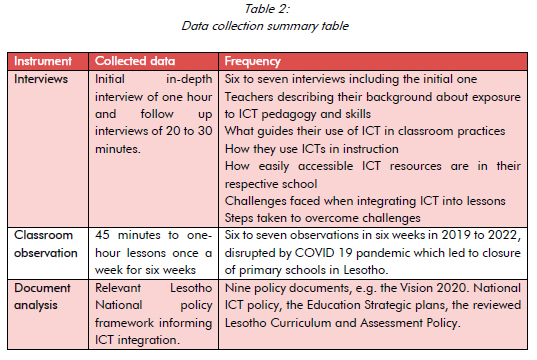
For this investigation, a qualitative approach was used. This is advocated by Creswell and Creswell (2018), who contend that in qualitative research, the investigator is the primary instrument for data collection, and it allows the researcher to acquire information in the participants' natural contexts. To create a thorough analysis of science teachers' ICT-integration discourses, the current study used a multiple-case-study technique from an interpretive perspective. For the purpose of providing rich data, three science teachers, coded - Thupa, Lethu and Nasi - were selected using purposeful sampling (Cohen, Manion & Morrison, 2018; Creswell & Creswell, 2018). Data were gathered through lesson observations and interviews of the three teacher-participants, and through document analysis of the relevant ICT policy framework in Lesotho as detailed in Table 2. Content analysis was utilised to analyse the generated data (Creswell & Creswell, 2018), more specifically to establish emerging themes about the ICT-integration discourses influencing science teachers at basic education level. The researcher analysed the relevant policy documents for establishing discourses of ICT integration in the context of Lesotho. The three participants were also interviewed to reveal further discourses of ICT integration through their views as reform implementers in classroom practices.
Participants
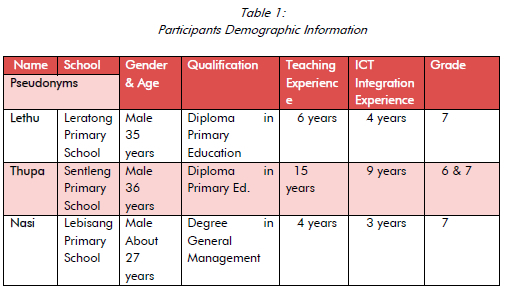
The target group was in-service teachers at primary schools in one district of Lesotho. The participants comprised three teachers who volunteered to take part and were either teaching G7 or G6. Regarding ICT-available resources in their individual schools, the teachers were either using mobile phones or computers. The demographic data, including background in technology-related pedagogy, is shown in Table 1.
The purposeful selection of three male participants, as indicated in Table 1, was based, among other things, on the teacher's use of ICTs in science and technology instruction in Grades 6 and/or 7. During the time of data collection, these were the teachers for the target grade level. Although one of the participants could not disclose his age, it is believed that he is in his late 20s. With the use of the qualitative data, the aim was to acquire a thorough understanding of the participating teachers' perspectives on how ICT integration in primary schools is shaped by discourse. This would result in documenting these teachers' perspectives on innovations in the Lesotho Education system.
Data collection
Data for this study were gathered through interviews, document analysis, and the classroom observations covered in this section. Table 2 shows the summary of how the instruments were engaged.
The data were presented using the three methods - interviews, classroom observations, and document analysis as detailed in Table 2; in so doing they complimented one another.
Data analysis
The productive discourses and the competing discourses of ICT integration were identified through content analysis of teachers' responses to interview questions that focused on learning about their opinions on ICT integration and the pertinent policy papers. To gain a thorough understanding of how the developing discourses were transformed into ICT-integrated lessons, the participant instructors were then observed in ICT-oriented classroom practices. Along with the observations, the findings from the content analysis of policy documents and interviews are discussed.
RESULTS
Emerging discourses of ICT integration in primary schools
The first research question - what are the discourses of ICT integration in basic education in Lesotho? - focuses on ICT-integration discourses in Lesotho's primary education. The results from interviews, document analysis and classroom observations show discourses informing ICT integration in the context of Lesotho schooling. Data from the pertinent policy documents were analysed, and the information was divided into three categories: (i) general emerging data about technology plans for the education sector; (ii) important technology plans for basic education/primary; and (iii) emerging data about teachers and students regarding ICT integration into classroom practices. In the context of Lesotho, the pertinent policy framework, and perspectives of the selected teachers on ICT integration reveal a variety of mutually reinforcing and occasionally conflicting discourses of ICT integration in basic education. Despite certain gaps in the translation to classroom practice, a content analysis of the policy framework reveals that the nine pertinent national ICT policy documents contained an ICT-integration policy message. The accessed policy documents include: National Vision 2020, a National ICT Policy (2006), the Lesotho Education Sector Strategic Plan (ESSP, 2005-2015), a MoET Curriculum and Assessment Policy (MoET, 2009), the revised Lesotho Basic Education Curriculum Policy (2021), the Lesotho National Strategic Development Plan (2013-2017), the Lesotho Country Working Document (2017), the Education Sector Plan (2016-2026), and the Integrated Primary Curriculum for Grade 7. Table 3 shows some policy messages that support ICT integration:
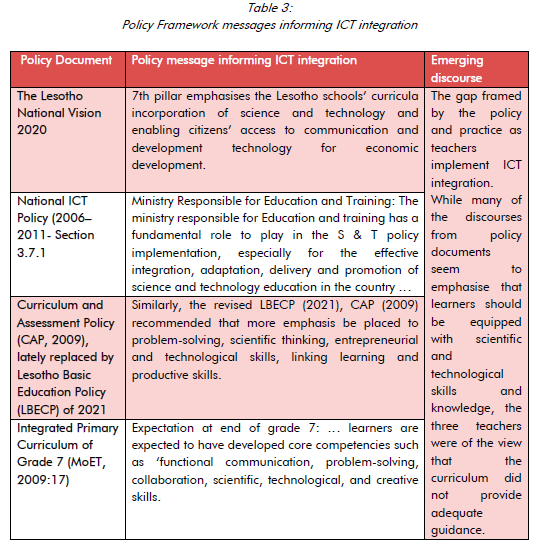
The policy document excerpts in Table 3 demonstrate that the Lesotho relevant policy papers had ICT integration messages that needed to be prepared for translation into instructional practices. The Science and Technology Curriculum was utilised by the teacher-participants, who facilitated ICT integration in Grades 6 and 7. Participants' declarations of their feelings about integrating ICTs into their lessons served as a source of additional discourses that shaped the findings of the current study. The policy requirements for ICT integration at elementary schools were, overall, known to the teacher-participants and principals. The idea that ICT integration in classroom practices has a significant positive impact on students is one that permeated the policy texts.
The advantages of incorporating ICTs into lesson plans were emphasised by the three participating teachers. They did, however, express dissatisfaction with insignificant teachers' support on the use of ICTs in education, particularly in the Grade 7 Science and Technology Syllabus, which demands teachers use of ICTs in the current curriculum. The three teacher-participants believed that teachers who were not familiar with ICT pedagogy would typically struggle significantly to plan how to employ ICTs in instruction using the current curriculum. These are some of their comments:
Lethu: [I] am able to use ICTs because I already have computer skills ... Most teachers here do not manage to use the available ICTs.
Thupa: [Schools] do not have digital tools ... It is up to teachers to make teaching practice enjoyable.
Nasi: [L]earners want to be in the computer room, but we have fewer computers than learners.
The extracts show that the participants' opinions are consistent with research on the theory of TPACK, which emphasises that the integration of ICT in teaching and learning is successful if there is thoughtful integration of technology and pedagogical processes as well as the commitment by every teacher to possess TPACK in the current period of education (Santos & Castro, 2021). The TPACK framework emphasises that teachers can use ICT in classes effectively provided they have a combination of the seven knowledge domains (TK, CK, PK, PCK, TCK, TPK, TPACK). The existing literature further attests to the fact that teachers are unable to demonstrate their TPACK due to a number of ICT-integration challenges, such as the lack of infrastructure and pedagogy for ICT integration (Günes & Bahçivan, 2016; Margolin, Pan & Yang, 2019; Ngwane & Mbatha, 2017). The consequence is that obstacles in educational environments and exposure to ICT pedagogy prevent teachers from demonstrating their TPACK and from assisting in the growth of students' digital literacy and skills. Table 4 demonstrates teachers' responses to interviews and views from classroom observations revealing ICT integration discourses.
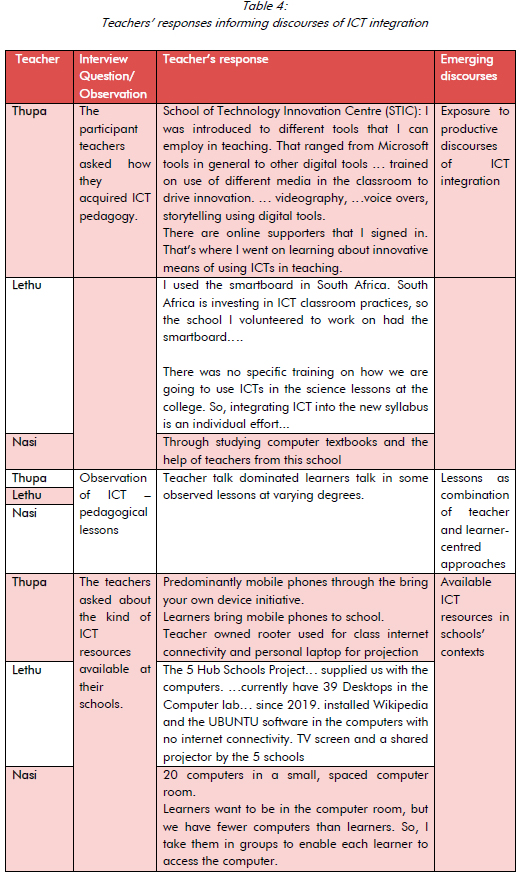
The three participants had differing degrees of proficiency in using ICTs in instruction, which may be inferred from their various types of exposure to ICT pedagogy. It is important to note though, that all three of the participants were eager to learn more about how to use ICT in the classroom effectively. The three participants further embraced the discourse promoting use of ICTs in instruction to motivate learner-centredness. It was observed that all participants were aware that the present curriculum required them to employ ICTs in instruction in learner-centred classes. The implication is that teachers are expected to facilitate learning by giving learners the tools needed to become autonomous learners. However, the competing discourse is that teachers were not empowered to develop ICT pedagogy and competencies to a large extent.
Nevertheless, utilising the ICT resources at their disposal, the three participants were successful in involving students in a range of activities.
What was also evident in this study was that there were indications that their lessons combined learner- and teacher-centred methods. This is alluded to by Chigona (2018: 377), who cautions, 'most teachers are stuck in their old ways of teaching . they lack the skill and knowledge on how and when to integrate the digital classroom into their pedagogy.' This is also highlighted by the Lesotho Education Sector Plan (2016-2026) policy document, which stipulates that there is a 'lack of Continuous Professional Development' on issues of teacher development, supply, and management in Lesotho (MoET, 2016).
According to the TPACK theory, using ICTs in the classroom motivates teachers to abandon their traditional methods of instruction and adopt the teaching and learning techniques seen in ICT pedagogy lessons (Hunter, 2017). This change from traditional methods of instruction supports learner-centred teaching approaches. The classroom practices of the three participants showed some indications of the techniques. Additionally, it showed that all of the teachers benefited from the support of the school administrators, which helped them overcome some of the obstacles to ICT integration in the context of the classroom. The assistance included, among other things, encouraging parents to assist schools with ICT-integration resources that fostered the creation of communities of practice (CoPs) and provided Lethu and Nasi with access to a conducive working environment in the computer laboratories.
A gap between policy and practice was discovered that affects how well teachers are supported in ICT pedagogy and prepared for using ICTs in the classroom as required by the current curriculum. Most often, the curriculum gave the idea that one of the resources for the courses was the internet. The three participants credited their prior learning of how to use ICT resources in classroom activities for their ability to handle ICT integration. The consequence is that instructors who have not been trained in ICT pedagogy and are not exposed to it may find it difficult to administer the curriculum as intended. This affects the development of the expected competencies for learners at this level.
Teachers' exposure to productive discourses of ICT integration
The second research question is: how are teachers exposed to productive discourses of ICT integration? To determine how the participants were exposed to ICT pedagogy, data from the first and follow-up interviews were further triangulated with data from lesson observations. This was done with reference to the first research question, which focused on discourses of ICT integration. Thematic and narrative content analysis exposed the participants' TPACK knowledge from their classroom ICT-integration practices. Emerging themes showed that the participants' ICT pedagogy was obtained from several sources, specifically pre-service training for Thupa, in-service professional development for Lethu, and apprenticeship of observing colleagues at work for Nasi, which enabled them to handle ICT integration. Additionally, data show that the participants' success with the adoption of ICT integration was a result of the diverse CoPs at each of their individual schools. Table 5 shows teachers responses revealing the CoPs.
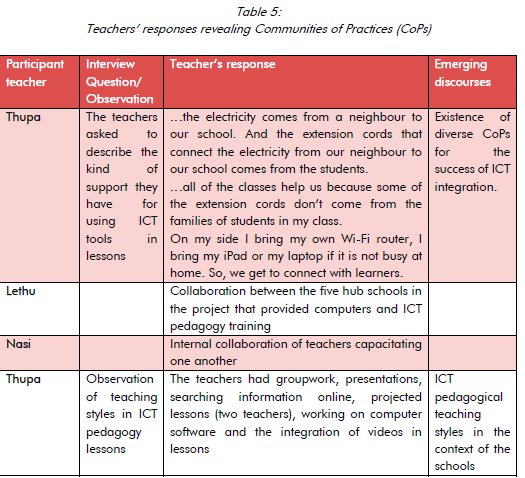
The study discovered differences between how teachers engaged in CoPs as highlighted in Table 5. However, all the three participants complained of inadequate MoET exposure of primary teachers to ICT pedagogy. In their views, they cope with ICT integration because of their background experience. The implication is that teachers in Lesotho require continuous training on ICT pedagogy to cope with ICT integration.
DISCUSSION
Discourses of ICT integration within the context of the selected schools
The results of this study on discourses of ICT integration point to ICT-integration policy statements being explicitly articulated and serve to encourage ICT integration into basic education in Lesotho. However, the teachers noted some gaps in putting policy into reality, such as the lack of enough support for teachers acting as implementers in the classroom, issues with ICT pedagogy, teacher preparation, and the accessibility of ICT resources in primary schools. The implication is that Science and Technology Curriculum requirements are not properly implemented in teaching and learning, which has a detrimental impact on learners' ability to develop the skills they need to pursue professions in science at a higher level of learning. As a result, teachers' efforts to include ICTs into their lesson plans are negatively impacted (Jita & Akintunde, 2021; J ita & Munje, 2020; Margolin et al., 2019). Technology access for teachers and learners in developing countries continues to be a barrier to effective ICT integration as argued by Dalal et al. (2017). This circumstance is analogous to what scholars refer to as impediments to effective ICT integration. In other words, although the ICT-integration policy requirements were made clear in numerous pertinent policy documents, it is possible that actors such as instructors and curriculum creators did not fully adhere to them.
Since the national policy framework was established, Lesotho has had a policy requiring the use of ICTs in the classroom. According to Lisene and Jita (2018), the Lesotho General Certificate of Secondary Education (LGCSE) curriculum for secondary schools encourages the use of ICT in educational activities. The Lesotho Basic Education Curriculum Policy (Lesotho. MoET, 2021 emphasises ICT integration. To put it differently, primary school teachers are expected to assist students in enhancing their digital literacy and skills. This is consistent with national goals to support students in developing 21st century skills to prepare them for work and further education levels. It may be assumed that before the curriculum was implemented, teachers had acquired digital literacy and skills to help students gain knowledge and abilities akin to what UNESCO (2011) refers to as an ICT competency framework for teachers. This framework offers guidelines for ICT integration for the kind of teacher best suited for students in the 21st century. In addition to having ICT resources available in schools, as was previously mentioned in the literature review, training teachers in ICT pedagogy is what makes ICT integration effective (Jita & Akintunde, 2021). This viewpoint is consistent with the TPACK framework recommendations for teachers, which outline seven knowledge areas in which they should be proficient to handle ICT integration. As has been previously demonstrated in the literature, effective instruction is best achieved when instructors are given the tools and ICT pedagogy they need to do their jobs well.
According to a study conducted during the COVID 19 pandemic by Juanda, Shidiq and Nasrudin (2021), the pandemic served as a wake-up call for all instructors to create TPACK and be prepared for ICT integration in order to prevent disruptions caused by school closures. According to the literature, integrating ICT encourages a learner-centred teaching approach, improves higher order thinking skills, and engages learners in self-directed learning (Fu, 2013; Ngwane & Mbatha, 2017; Trust, 2018). Programmes for ongoing professional development could help in-service teachers create effective teaching strategies that include ICT. The support of principals and parents for teachers' ICT-integration activities is another factor in the current study that contributes to effective ICT integration. The need for equipping teachers with continuous ICT pedagogy to deliver the curriculum to meet the current needs of learners seems to have been overlooked, resulting in low ICT-integration efforts in schools.
Furthermore, a major concern from recent studies about ICT integration using the TPACK model is that constraints of ICT resources within the context of a school disadvantage teachers from utilising the acquired ICT pedagogy. This is to an extent that it is challenging to map their espoused TPACK, and the ICT-integration classroom practices observed (Tsakeni & Jita, 2019). This disconnection between teachers who acquired ICT pedagogy, and a working school environment contributes to teachers' decisions on the use of ICTs in instruction. The presented submissions from the literature assist in understanding teachers' readiness for ICT integration vis-à-vis policy framework stipulations. Recommendations on how to close the existing policy- practice gap on ICT integration in developing countries are presented by Howie (2010) who emphasise that schools should provide detailed plans of their commitment to ICT integration before being provided with the ICT resources. This will reduce the challenges of schools provided with advanced technologies without using them due to reasons such as negative attitudes towards ICT integration (Ohei et al., 2023)
Teachers' uneven exposure to productive discourses of ICT integration
A conclusion to be drawn from participants' exposure to discourses of ICT integration is that teachers are not equally exposed to productive discourses of ICT integration. The three participants managed to use ICTs in classroom practices due to acquired ICT pedagogy from varying sources. For Thupa, Lethu and Nasi, respectively, this involved preservice training from STIC, in-service training as a volunteer teacher at a primary school in South Africa, and on-the-job training through observation of colleagues. Studies on ICT integration through the TPACK lens stress that its implementation is successful when there are ICT resources and teacher support, especially leadership support.
The observed teacher-participants were supported by the principals and colleagues for overcoming experienced ICT integration challenges in classroom practices. There was a difference in the support also. One principal had exposure to ICT pedagogy and could easily resolve challenges experienced, while the other two principals could support mobilisation of ICT resources and provision of data only. This suggests that teachers require support to sustain ICT integration. It is therefore necessary to ensure that principals are continuously sensitised to the requirements of changing curricula during the implementation process. The principals may only have had once-off sensitisation workshops like the teachers, who had once-off training workshops. This has a negative impact on teachers and principals who are employed some years after the implementation year.
What enabled the teacher-participants to cope with the demand of ICT integration in the curriculum appeared to be engagement in CoPs, offering them support within the context of their schools. What also contributed to the success of ICT integration of the three participants was their competency and access to the available ICT resources at the respective schools, as attested by Chigona (2018). It is important to realise that the three participants experienced several challenges of ICT integration within the context of their schools. What enabled them to sustain the challenges was the collaborative practices with colleagues and school communities and the determination to continue using ICT in classroom practices. Extant literature views teachers' exemplary practices of ICT integration as characterised by individuals' ability to engage in CoPs for sharing ICT pedagogy skills (Hunter, 2017; Padayachee, 2017). Of the three participants, Thupa was exemplary in participation in the CoPs with colleagues from other schools. Lethu and Nasi were active in the creation of communities of practice (CoPs) within the context of their schools. The CoP initiatives assisted the three participants to cope with adapting ICT integration to the context of their schools.
The relevant policy documents for ICT integration make it evident that there was insufficient knowledge driving teacher preparation for ICT pedagogy. How can the ICT-integration efforts of the teachers in the schools under observation be justified? According to Juanda et al. (2021) and Rosenberg and Koehler (2015), the best instructors who could design lessons that use ICTs, are those that have TPACK. The additional teaching strategies and activities from the high possibility classroom (HPC) model can be used in classrooms that integrate ICT by instructors who have built ICT pedagogy. Extant literature further shows that even if ICT resources are available in schools, teachers' access to such resources contributes to their decisions to use the ICT resources in classroom practices. It was apparent at the three schools observed that teachers freely access the available ICT resources supported by the school administration.
CONCLUSION
Analysis of data from the three case studies in this study led to the conclusion that there are discourses that affect whether ICT integration in Lesotho's primary schools is successful. These discourses reveal how teachers in the selected schools manage or struggle with the use of the ICTs present in their educational environments. Some discourses draw their information from authoritative policy publications, which fall short of supporting teachers in their lesson plans. ICT pedagogy training for teachers may be detrimental to some students at this level of education. Since Lesotho started integrating ICT into learning and teaching, some discourses suggest that not all primary school teachers have benefited from ICT pedagogy initiatives. During pre-service training, one participant in the study benefited from ICT pedagogy from the STIC initiative. Another participant currently benefits from ICT resources and ICT pedagogy from the 5 Hub Schools project, which supports a group of five schools in one region of the country, while the third participant learned how to use ICT in instruction from colleagues. This leads to the conclusion that there is inequity in teachers' acquisition of ICT pedagogy, which may disadvantage some learners at this level of education. The implication is that Lesotho should rethink the approach for effective ICT integration using lessons learnt from experiences of countries such as South Africa and other developing countries that have made positive progress.
RECOMMENDATIONS AND LIMITATIONS OF THE STUDY
As this study was based solely in one district and had only three participants, future research should broaden the range of discourses around ICT integration by including teachers from all 10 districts of Lesotho. The findings of this study indicate that to create an environment that will allow teachers to sustain ICT integration at this level, it is necessary to address both productive and conflicting discourses for ICT integration in basic education. For pre-service and in-service teachers to develop and improve their ICT pedagogy and competencies, the study recommends regular and ongoing professional development programmes, both formal and informal. An atmosphere that supports effective ICT integration needs to be created by providing teachers and learners access to ICT tools for classroom activities holistically, incorporating deprived learners and teachers due to their location in the country and other factors. Lessons learned from implementing the present curriculum in primary schools are informed by the findings of this study, which serve as a foundation for future research on ICT integration in primary schools in Lesotho and developing countries such as Malawi that have similar challenges of coping with ICT integration at this level (Saka, 2021).
REFERENCES
Cha, H., Park, T. & Seo, J. (2020). What should be considered when developing ICT-integrated classroom models for a developing country? Sustainability, 12(7), 2967. [ Links ]
Chigona, A. (2018). Digital fluency: Necessary competence for teaching and learning in connected classrooms. The African Journal of Information Systems, 10(4), Article 7. https://digitalcommons.kennesaw.edu/ajis/vol10/iss4/7 [ Links ]
Cohen, L., Manion, L. & Morrison, K. (2018). Research methods in education. New York: Routledge. [ Links ]
Creswell, J. W. & Creswell, J. D. (2018). Research design: Qualitative, quantitative and mixed methods approaches. Thousand Oaks, CA: Sage. [ Links ]
Dalal, M., Archambault, L. & Shelton, C. (2017). Professional development for international teachers: Examining TPACK and technology integration decision making. Journal of Research on Technology in Education, 49(3-4), 117-133. [ Links ]
Dlamini, R. & Rafiki, M. (2022). Teachers' Perspectives on the Integration of Information and Communication Technology: The Case of a Teachers' Union. Africa Education Review, 19(1), pp. 34-55. [ Links ]
Fu, J. (2013). Complexity of ICT in education: A critical literature review and its implications. International Journal of Education and Development Using ICT, 9(1), 112-125. [ Links ]
Graham, R. C., Burgoyne, N., Cantrell, P., Smith, L., St Clair, L. & Harris, R. (2009). Measuring the TPACK confidence of in-service science teachers. Tech Trends, 53(5), 70-79. [ Links ]
Gulati, S. (2008). Technology-enhanced learning in developing nations: A review. The International Review of Research in Open and Distributed Learning, 9(1), 1-16. [ Links ]
Günes, E. & Bahçivan, E. (2016). A multiple case study of preservice science teachers' TPACK: Embedded in a comprehensive belief system. International Journal of Environmental and Science Education, 11(15), 8040-8054. [ Links ]
Howie, S. J. (2010). ICT-supported pedagogical policies and practices in South Africa and Chile: emerging economies and realities. Journal of Computer Assisted Learning, 26(6), 507-522. [ Links ]
Hunter, J. (2017). High possibility classrooms as a pedagogical framework for technology integration in classrooms: An inquiry in two Australian secondary schools. Technology, Pedagogy and Education, 26(5), 559-571. https://doi.org/10.1080/1475939X.2017.1359663 [ Links ]
Jita, T. & Akintunde, M. A. (2021). Pre-service teachers' competence to teach science through ICTs: A case study of Lesotho. The International Journal of Science, Mathematics and Technooogy Learning, 28(1), 2740. https://doi.org/10.18848/2327-7971/CGP/v28i01/27-40 [ Links ]
Jita, T. & Munje, P. N. (2020). Teaching science through information and communication technologies: 'Enablers' and 'constraints' on beginning teachers. The Independent Journal of Teaching and Learning, 15(2), 107-120. [ Links ]
Juanda, A., Shidiq, A. S. & Nasrudin, D. (2021). Teacher learning management: Investigating biology teachers’ tpack to conduct learning during the COVID-19 outbreak. Journal Pendddikan IPA Indonesia, 70(1), 48-59. [ Links ]
Kawonga, E. (2023). Exploring the Use of Media and Technology in the Teaching of English in Secondary Schools in Malawi: A Case Study of Selected Secondary Schools in Northern Education Division (NED). Doctoral dissertation, Mzuzu University, Malawi. [ Links ]
Ke, F. & Hsu, Y. C. (2015). Mobile augmented-reality artefact creation as a component of mobile computer- supported collaborative learning. The Internet and Higher Education, 26, 33-41. [ Links ]
Koh, J. H. L., Chai, C. S. & Tay, L. Y. (2014). TPACK-in-Action: Unpacking the contextual influences of teachers' construction of technological pedagogical content knowledge (TPACK). Computers & Education, 78, 20-29. https://doi.org/10.1016/j.compedu.2014.04.022 [ Links ]
Lesotho. Ministry of Education and Training (MoET). (2009). Curriculum and Assessment Policy (CAP). Maseru: Government Printing.
Lesotho. Ministry of Education and Training (MoET). (2016). Education Sector Plan 2016-2026. Maseru: Government Printing.
Lesotho. Ministry of Education and Training (MoET), (2021). Lesotho Basic Education Curriculum Policy. Maseru: Government Printing.
Lisene, N. & Jita, T. (2018). Exploring the integration of modern technologies in the teaching of physical science in Lesotho. Perspectives in Education, 36(1), 111-127. https://doi.org/10.18820/2519593X/pie.v36i1.8 [ Links ]
Liu, P. (2016). Technology integration in elementary classrooms: Teaching practices of student teachers. Australian Journal of Teacher Education, 41(3), Article 6. http://dx.doi.org/10.14221/ajte.2016v41n3.6 [ Links ]
Makuru, B. & Jita, T. (2022). Information and Communication Technology Practices Biology Teaching in Lesotho High Schools. International Journal of Information Technology, 12(7), 668-677. [ Links ]
Margolin, J., Pan, J. & Yang, R. (2019). Technology use in instruction and teacher perceptions of school support for technology use in Iowa high schools. Regional Educational Laboratory. Midwest. Retrieved 30 July 2021 from https://ies.ed.gov/ncee/edlabs/regions/midwest/pdf/REL_2019004.pdf
Mishra, P. (2019). Considering contextual knowledge: The TPACK diagram gets an upgrade. Journal of digital learning in teacher education, 35(2), 76-78. [ Links ]
Moursund, D. G. (2005). Introduction to information and communication technology in education. University of Oregon, Eugene, US.
Mndzebele, N. (2013). Teachers readiness in using ICT in the classroom: The case of a developing country. International Journal of Information and Education Technology, 3(4), 409. [ Links ]
Ngwane, K. S. & Mbatha, B. (2017) Information and communication technology as agents of change for teaching and teacher development: A case study of a secondary school, KwaZulu-Natal. International Technology, Education and Development Conference. Retrieved 18 May 2023 from https://www.researchgate.net/publication/315352525
Ohei, K., Mantzaris, E., Ntshangase, B. A. & Olutade, E. O. (2023). Incorporating new technologies into teaching in South Africa. International Journal of Research in Business and Social ScIence (2147-4478), 72(6), 286-295. [ Links ]
Oyier, C. R., Odundo, P. A., Lilian, G. K. & Wangui, K. R. (2015) Effects of ICT integration in management of private secondary schools in Nairobi County, Kenya: Policy options and practices. World Journal of Education, 5(6) 4-22. https://doi.org/10.5430/wje.v5n6p14 [ Links ]
Padayachee, K. (2017). A snapshot survey of ICT integration in South African schools. South African Computer Journal, 29(2) 36-65. https://doi.org/10.18489/sacj.v29i2.463 [ Links ]
Rosenberg, J. M., & Koehler, M. J. (2015). Context and technological pedagogical content knowledge (TPACK): A systematic review. Journal of Research on Technology in Education, 47(3), 186210. https://doi.org/10.1080/15391523.2015.1052663 [ Links ]
Saka, T. W. (2021 ). Digitalization in teaching and education in Malawi Digitalization, the future of work and the teaching profession project. https://www.ilo.org/wcmsp5/groups/public/---ed_dialogue/---sector/documents/publication/wcms_783666.pdf
Santos, J. M. & Castro, R. D. (2021). Technological pedagogical content knowledge (TPACK) in action: Application of learning in the classroom by pre-service teachers (PST). Social Sciences & Human/tees Open, 3(1), 100-110. https://doi.org/10.1016/j.ssaho.2021.100110 [ Links ]
Spaull, N. & Jansen, J. D. (2019). South African schooling: The enigma of inequality. A study of the present situation and future possibilities. Springer: Switzerland. https://doi.org/10.1007/978-3-030-18811-5
Trust, T. (2018). 2017 ISTE standards for educators: From teaching with technology to using technology to empower learners. Journal of Digital Learning in Teacher Education, 34(1), 1-3. https://doi.org/10.1080/21532974.2017.1398980 [ Links ]
Tsakeni, M. & Jita, T. (2019). Classroom information and communications technology integration by preservice and in-service teachers in rural ecologies. In M. M. Dichaba and M. A. O. Sotayo (Eds), Proceedings of the South Africa International Conference on Education (SAICEd). September 2019 conference. Pretoria: The African Academic Research Forum.
UNESCO. (2011). UNESCO ICT competency framework for teachers. Retrieved 16 June 2021 from http://hdl.voced.edu.au/10707/217813
Date of Submission: 31 July 2023
Date of Review Outcome: 4 March 2024
Date of Acceptance: 14 August 2024
