



Services on Demand
Journal

Article
 English (pdf)
 Article in xml format
 Article references
 Automatic translation
 Send this article by e-mail
Indicators
Related links
-
 Cited by Google
 -
 Similars in Google
Share

 Permalink
Journal of Education (University of KwaZulu-Natal)
On-line version ISSN 2520-9868Print version ISSN 0259-479X
Journal of Education n.99 Durban 2025
https://doi.org/10.17159/2520-9868/i99a02
ARTICLES
Over-aged learners burden school resources: An analysis of a Gauteng education district
Gene ErasmusI; Jean Veronica FourieII
IDepartment of Educational Psychology, Faculty of Education, University of Johannesburg, Johannesburg, South Africa. generasmus@mweb.co.za. https://orcid.org/0009-0009-3067-7155
IIDepartment of Educational Psychology, Faculty of Education, University of Johannesburg, Johannesburg, South Africa. jeanf@uj.ac.za. Corresponding author. https://orcid.org/0000-0002-1367-0156
ABSTRACT
The Department of Education's National Policy on Promotion Requirements is often circumvented when learners repeat grades frequently thus becoming older than their grade peers. We aimed to quantify the number of over-aged learners and describe their influence in the classroom in a Gauteng Education District. We used a quantitative research approach, with purposive, convenient, non-probability sampling, in an education district comprising 187 schools (n=407 347 learners), representing 6% of the schools in the Gauteng province. Data was collected on learner ages, grades, and number of years over-aged for three consecutive years from the Department of Education database. Descriptive statistics were used to determine means, modes, and frequencies. Findings revealed that the number of over-aged learners increases annually with the mean age of x=15 and the Mode Mo=18. One-third of learners were over-aged, 60% were male, with some learners 14 years over-aged for their grade. The large number of over-aged learners causes over-crowded classrooms and heavy teacher workload, and often leads to aggressive behaviours, teenage pregnancy, and alcohol and drug abuse. Complex classroom dynamics result when there are different developmental stages in the same grade. We identified the need for over-aged learners to be supported since there is insufficient space in special needs and vocational schools. We exposed the inappropriate provision of career guidance that caused vulnerable learners to drop out. We urge education authorities to stringently implement the progression policy to enforce age-appropriate secondary school exit levels to curb the huge number of over-aged learners.
Keywords: admissions policy, developmental theories, Gauteng education district, inclusive education, over-aged learners, progression policy, psycho-social challenges, school resources
Introduction
According to the Constitution of the Republic of South Africa (1996), "everyone has the right to a basic education, including adult basic education; and to further education, which the state, through reasonable measures, must make progressively available and accessible" (chapter 29). Schooling is compulsory for all children aged seven to 15 which includes Grades 1-9 (South African Schools Act 84, 1996). However, learners who are 16 years and over are no longer of compulsory school-going age, so they may be declined admission to schools. Schools are not compelled to admit over-aged learners, and may be unable or unwilling to accommodate them. Every year, provincial education departments struggle to find space for Grades 1 learners in primary school and grade 8 learners in secondary schools, who are of compulsory school-going age, and this may in part be attributable to the large numbers of over-aged learners in schools.
School entry and exit ages were prescribed by the Gauteng Department of Education (GDE) (1998). The statistical age norm per grade was gazetted as the grade number plus six (Department of Basic Education, 1998), thus: Grade 1+6 = age 7; Grade 9+6 = age 15; and Grade 12+6 = age 18. Learners who are older than the calculated norm for the grade are considered over-aged or progressed. In this study, we investigated the burden over-aged learners place on the education environment, including psycho-social challenges, the problems presented by defiant classroom behaviour, and difficulties in classroom management.
Scientific value
In this study we report on statistical evidence from schools in a particular district that indicates an alarmingly increasing number of progressed learners. Despite the National Policy on Promotion, Progression and Retention (NPPPR, Department of Basic Education, 2011) which manages progressed learners, the number of over-aged learners in the educational system is increasing rapidly (Stott et al., 2015). Learners are permitted to progress through grades regardless of their level of skills and academic readiness for the next grade. The correct implementation of the NPPPR would see the age of a learner being no more than two years higher than the normal age cohort of the grade (Department of Basic Education, 2011). However, schools have young adults of 21 years and older still at school because they have not exited at the appropriate age. Placement in alternative curricula like the General Education Certificate: Technical Occupational (GEC:TO) and skills-related schools are not considered timeously, and this leads to high drop-out rates because of frustration, the lack of financial support, as well as psycho-social and academic challenges. The NPPPR and the policy of the Department of Basic Education (2014) on Screening, Identification, Assessment and Support (SIAS) are designed to assist with the placement of learners in the most appropriate curriculum, but the effective implementation of these policies is questionable. This leads to learners facing unemployment because they are unskilled and unqualified to enter the formal labour market, and this adds to the challenges of poverty (Burger et al., 2015). We address the magnitude of this problem and its related challenges in relation to policy implementation.
Rationale
The ongoing struggle to place learners in schools prompted this study. For example, in 2021, 16,117 Grade 8 learners and 8,982 Grade 1 learners had difficulty finding school placement in South Africa (Macupe, 2022). In 2023, frustrated parents of Grade 1 and Grade 8 learners expressed their discontent with the GDE for failing to place their children more than three weeks after the reopening of schools. One solution was to increase capacity at some schools and the other was to register satellite schools (Mabuza, 2023). We suggest that the struggle for learners to be admitted to schools despite being the correct age for the grade for which they seek admission may be a result of the over-crowding of schools by over-aged learners.
The difficulties with placement continue yet some schools stand empty. For example, construction of a school budgeted at R36 million began in 2017 in Kempton Park, yet it remains incomplete and is now surrounded by overgrown grass and thickets (Sadike, 2024). This meant that grade 8 learners from overcrowded high schools in the area were transferred to full local primary schools whose principals were informed in January that they were being sent mobile classrooms to accommodate these grade 8 learners (Van Zyl, 2024).
Burger et al. (2015) reported that teachers at a Tshwane school told those who were going to turn 21 the following year, that they could not repeat Grade 10. The learners were not given formal written notices but simply told that their school years "were done", so they were forced to drop out. The age cohort for Grade 10 should be 16 years, so these learners were thus over-aged by five years for the grade, and this is against the prescription of the NPPPR.
According to Dieltiens and Meny-Gilbert (2012), many SA youths have chosen to stay in school beyond the average school-going age because of late school entry, high repetition rates, drop-out and drop-in rates, and high unemployment among youth with an incomplete secondary education. Research conducted in 2010 reported that 14% of learners in Grade 9 and 22% of learners in Grade 12 were three or more years above the age norm for the grade (Human Sciences Research Council, 2014). The high number of over-aged learners has contributed to maintaining large class sizes in schools and to using up scarce resources in the education system (Burger et al., 2015). The DBE implemented policies in the late 1990s to rectify this situation and reduce the number of over-aged learners in the school system.
Policy framework
The NPPPR provides guidelines for the progression of learners from one grade to the next and this has an impact on the status of progressed learners in the education system. The policy applies to ordinary public schools, special schools, and independent schools that offer the National Curriculum Statement Grades R-12 (Department of Education, 2012a).
The Admissions Policy (Department of Education, 1998) states that learners must be admitted to Grade 1 if they turn seven during that calendar year, and a learner younger than seven may not be admitted. A learner wishing to attend Grade R may be admitted only if they turn six during that calendar year (Department of Basic Education, 1998). The age requirements for learners with special education needs who can be admitted to ordinary public schools are the same as for other learners. This policy gives guidelines for ages in each grade and over-aged learners can thus be identified and should be supported.
Provincial education departments adopt their age-related policies in line with the national regulations. The SA Schools Act (Act No 84 of 1994) requires a learner to stay in school until the age of 15 and, once the age of 16 is reached, admission may be refused if it is the learner's first application to a school, or an application for re-admission after having dropped out because of not being the appropriate grade age. If a learner is enrolled at a school and is not age-appropriate for the grade, they should approach an adult education centre for their educational needs (Arendse, 2021).
Psycho-social challenges
The psycho-social problems related to learners who are more mature by a few years than their class peers are systemic and prevalent primarily in the higher grades because of the selective implementation of the NPPPR in lower grades. Over-agedness is related mainly to schools that under-perform in literacy and numeracy, where learners as old as 22-24 have been found in Grades 10-12, and, in one case a 48-year-old individual was found in Grade 10 (Khulisa Management Services, 2012). Even with starting a year late, and given two repeated years, a learner should not be older than 20 in Grade 10. The effect of older learners on younger learners in the same grade is a cause for concern.
Poor employment prospects
The DBE expressed concern about the large number of over-aged learners who are not only leaving school with poor employment prospects since they are unlikely to pass matric but are also simultaneously diverting resources from younger learners (Burger et al., 2015). There is a cost factor attached to this situation because these over-aged learners should be active in the labour market. Arguably, the taxpayer is responsible for the cost of keeping these learners in school. In her budget speech for 2022/23, the Minister of Education, Angie Motshekga, increased the education budget by 4.9% from 2021/2022 to a total budget of more than R29.6 billion. An amount of R58,2 million was included for National Certificate Learner Retention Programmes; this was an increase of 0.6% compared with the previous year (Motshekga, 2022). This indicates that the burden on the taxpayer has been increased and is an acknowledgement that learners are not coping academically.
Bullying
Macupe (2019), in challenging the statement made by the Northwest Member of the Executive Council (MEC), Mmaphefo Matsemela, that the presence of over-aged learners leads to bullying and gangsterism in schools, argued that the sources of bullying are varied and should not be attributed to only one factor. The MEC stated that governing bodies of schools should manage the process of admission to schools to prevent over-aged learners from attending school with younger learners by admitting them to school only according to their age-appropriate grade since significant age gaps between learners in one classroom lead to complicated dynamics, including the enforcement of discipline, that are challenging for teachers (Macupe, 2019). Bullying is an ongoing problem in the lives of many children at school (Jan & Husain, 2015). Bullying affects all learners-the bullies, the victims, and the witnesses to the bullying behaviour (Juan et al., 2018). Statistics on bullying suggest that 28% of learners from grades 6 to grade 12 have a history of having been victims of bullying; 30% of high school learners acknowledge having bullied others; and about 10% to 14% of learners have been victims of bullying for more than six months (Dryden-Edwards, 2024). Bullying creates a barrier to learning with adverse outcomes for learners and schools since learners involved in bullying are at increased risk of misbehaviour, abuse, and absenteeism from school, decreased academic performance, increased mental health problems, and physical injury (Theepe, n.d.).
Substance abuse
Another severe problem associated with over-aged learners is substance abuse since some school premises are permeated with various drugs (Mokwena & Sindane, 2019). It is estimated that one in three learners aged between 13 and 18 years engage in the abuse of various substances at school and 66% of secondary school learners consume different alcoholic substances (Nzama & Ajani, 2021). The South African National Council on Alcoholism and Drug Dependency (SANCA, 2015) stated that the number of learners who abuse various substances in SA schools is becoming worrisome, especially when this involves underage learners. Learners can access intoxicating substances at home, in their communities, and also in school to sustain their addiction (Maserumule et al., 2019). More than 60% of 18-year-olds regularly drink alcohol, and 30% of teenagers stay away from school to drink alcohol (Mamabolo, 2020). Statistics released by the South African Police Service (SAPS) indicate that illegal drug consumption is increasing rapidly, and this leads to crime and unemployment, with drug abuse accounting for 60% of all crimes in various parts of the country, and substance abuse by high school learners provoking criminal behaviour (Nzama & Ajani, 2021). Misbehaviour or the harmful behaviour of learners caused by their substance abuse include: a lack of concentration; disrespect for school authorities; vandalism; physical violence; theft; graffiti spraying; and verbal abuse (Mokwena & Sindane, 2019). As a result of the behaviour of learners engaging in criminal and unruly activities, innocent learners may be affected, and their academic achievement and school performance may deteriorate. The president of South Africa, Cyril Ramaphosa, has urged citizens to be involved in curbing alcohol usage by children under 18 years old (Shomolekae, 2022).
Teenage pregnancies
Over-aged learners in schools are associated with the increase in teenage pregnancies which are a troubling challenge in the SA education system. The Gauteng Department of Health (GDH) recorded 23,226 teenage pregnancies between April 2020 and March 2021, with 934 girls between the ages of 10 and 14 having given birth, and 2,976 girls between the ages of 10 and 19 choosing to terminate the pregnancy (Bhengu, 2021). The Gauteng province recorded over 24,941 pregnancies between April 2022 and March 2023 (Malogadihlare, 2024).
Furthermore, Bhengu (2021) cited a statement by the Democratic Alliance (DA) that these
numbers are sad and incredibly troubling considering that these young girls still have bright futures . . . teenage pregnancy remains a serious social and health problem in SA . . . a health risk to both mother and child, and it also has social consequences such as continuing the cycle of poverty and early school drop-out.
Mkhize (2022a) cited a spokesperson from the DA who indicated that the age of sexual consent is between 16 and 18 years so there is a concern about sexual crimes, such as statutory rape, not being reported to the police. Furthermore, sexual abuse and sexual crimes may have a lasting effect on the psycho-social and emotional well-being of girls which can have a direct impact on their academic progress and achievement. Teenage pregnancies and cases of sexual harassment place additional burdens on school resources as supportive processes are implemented according to the Integrated School Health Policy (Department of Education, 2012b).
Absenteeism
Over-aged learners are at high risk of being absent from school (Balkis et al., 2016). Absenteeism is defined as a learner not being in class or not participating in a school activity when the register is marked (Department of Basic Education, 2010). Risk factors that may cause absenteeism are family health, low income, poor school climate, drug and alcohol use, transportation problems, and community attitudes towards education (Koen et al., 2021). Absenteeism may be associated with personal issues, academic challenges, family relationships, school environment, and has the potential to lead to low academic performance (Balkis et al., 2016). Absenteeism impacts not only students' educational progress but also affects their social development (Balkis et al., 2016). Absenteeism may have a direct impact on academic achievement since non-attendance can cause a backlog in schoolwork and difficulty in grasping concepts taught while the learner is absent.
Conceptual framework
Over-agedness in classrooms is viewed in the context of stage theories of childhood development. Physical, emotional, and sexual development are relevant to all learners at school. Sexual abuse is a concern since over-aged learners threaten younger learners in the same grade given the difference in developmental stages and behaviour patterns relative to age. Sexual development goes together with physical and hormonal development; the limbic system, which regulates emotion and reward, is linked to hormonal changes at puberty (Tyler, 2020). Physical growth refers to an increase in body size, length, height, weight, and the size of organs, which, after toddler growth, slows until adolescence (Graber, 2021). Growth spurts in boys occur during mid-adolescence, between the ages of 12 to 16 years, approximately at age 13½ and in girls between the ages of about 9½ and 13½ years, usually at about 11½; gross and fine motor skills are developed and related to brain growth and experience during this developmental period (Tyler, 2020). The reproductive system has a brief growth spurt just after birth, then changes very little until just before puberty (Graber, 2021). Girls tend to grow faster than boys, and boys attain half their adult height by about age two and girls, at 19 months (Graber, 2021).
Puberty is a period of rapid growth and sexual maturation, and this period is characterised by risky behaviour, poor decision-making, and weak emotional control (Lally & Valentine-French, 2022). At about the age of 10 or 11, most children experience increased sexual attraction to other children, and this affects social life in and out of school (Tyler, 2020). Girls begin puberty at around 10, boys start approximately two years later, and puberty changes take about three to four years to complete (Tyler, 2020). Interest in sexual anatomy points to the start of puberty and sexual maturation or puberty begins at different ages, depending on genetic and environmental factors (Graber, 2021). As adolescents mature emotionally and sexually, they may begin to engage in sexual behaviours, and by late adolescence, sexuality shifts from experimentation to an expression of intimacy and sharing, which may lead to adolescents facing many challenges as their sexual and gender identities develop (Graber, 2021). People in their mid-twenties are in early adulthood and by this time, physical maturation is complete, and they are at the peak of their physiological development and their reproductive system and motor skills are functioning optimally (Tyler, 2020). Arguably, if developmental patterns are considered, it seems evident that these young adults should not be in the same classroom and grade in the school system as young learners since this could lead to psycho-social problems.
Having over-aged learners in school may lead to sexual abuse of, and inappropriate sexual behaviour with, younger learners. Physical development theories indicate different needs at different ages. An eight-year-old in class with an 11-year-old could be a potential psychosocial problem. Sexual behaviour and pregnancy statistics should be considered since learners at different stages of physical and sexual development indicate different needs at various ages, and if placed together in grades and classes because of their academic progress or lack thereof, this can lead to psycho-social problems.
Aim of the study
This study aimed to quantify the over-aged learners in a GED for three consecutive years and analyse their impact on the educational environment.
Methodology
The methodological framework was based on Critical Theory, and we used a pragmatic research approach (Davies & Fisher, 2018). The methodology followed that of a quantitative study with data on over-aged learners collected from schools.
Setting, study population, and sampling strategy
Sampling of participants was by geographical area in a particular education district known to us and easily accessible, and we used purposive, convenient, and homogeneous sampling. The sample size (n=187 primary and secondary schools, 407,437 learners) represented 6% of the schools in the Gauteng Province. These schools consisted of: primary; secondary; combined; LSEN (Learners with Special Educational Needs); town; township; rural schools that represent different quintiles. The learners were representative of age, gender, race, and grade. It was assumed that all schools had over-aged learners.
Data collection and analysis
Quantitative data of learners in schools, including number of years over-aged, from 2017 to 2019 in a GDE district were collected from the Data Driven Districts (DDD) dashboard of the DBE, and schools provided statistics on over-aged learners. Internal reliability was attained by verifying and cross-checking the statistical data from the dashboard against promotion schedules data collected directly from the schools. External reliability was met since similar results should in all probability be reproduced if this study is repeated. Data reliability was determined by comparing names of over-aged learners appearing on the promotion schedules submitted by schools at the end of the year with over-aged learners on the DDD. The results were measured over three years, and the data proved to be stable over this period. We captured, sorted, and cleaned the data collected. The cleaning process included checking for and correcting errors.
We used descriptive statistics to summarise the variables. The analysis of the raw data was done with Statistical Consultation Services (Statkon) at the University of Johannesburg using the Statistical Package for Social Sciences (SPSS), developed as a statistical package for the social sciences offering researchers tools for better, easier research (Pickard, 2013).
We presented the data in frequency graphs, tables, pie charts, histograms, and scatter plots to report data and indicate relationships between quantitative variables (Whatley, 2022). Drawing on Creswell and Creswell (2022), cross-tabulation was used to provide links between variables over a three-year period, while contingency tables show the relationships between two or more categorical variables by crossing rows and columns.
We analysed results by measures of central tendency such as modes, means, and medians. Following Whatley (2022), we used measures of dispersion to provide a short-hand way of describing the dispersion of values in a distribution, and statistical methods used were standard deviation and range. Drawing on Carter (2018), we used means since they are easily understood and calculated; means represent each score in the distribution equally, are fundamental to further calculations of standard deviation, and are the most stable of measures of central tendency. Furthermore, medians were used since they are insensitive to extreme scores when the distribution is skewed, provide a dividing line between upper and lower values, are easy to obtain, and are unaffected by extreme scores in a skewed distribution (Carter, 2018).
Ethical considerations
Ethical considerations were based on guidelines cited in Creswell and Creswell (2022) and were observed throughout the research process.1 Approval was granted by the GDE to conduct this study and collect relevant data. The anonymity of the district, schools, management teams, and learners was ensured. People are autonomous, so researchers should obtain informed consent and respect their choice to participate in a study (Terre Blanche & Durrheim, 1999). However, in this study, there was no direct contact with participants and no identifiable information was disclosed. No learner, principal, or school names were used, and the name of the district was not published. The security and confidentiality of the information collected was protected since we did not discuss any information about participants that could lead to their identification. The data collected has been used only for the stated purposes of this study. Furthermore, the research was conducted in a socially responsible manner and the collection of harmful information was avoided. This study is value-free from any personal constructs, and the statistical data is objective. The results are generalisable to other education districts in the GDE since the sample used was large, and the context relative to progressed learners in the GDE is similar across all districts and can be transferred to the greater population.
Results
Findings are presented in graphs and tables. The data presented includes over-aged learners in primary, secondary, combined, and LSEN schools. Results are presented for the period 2017 to 2019.
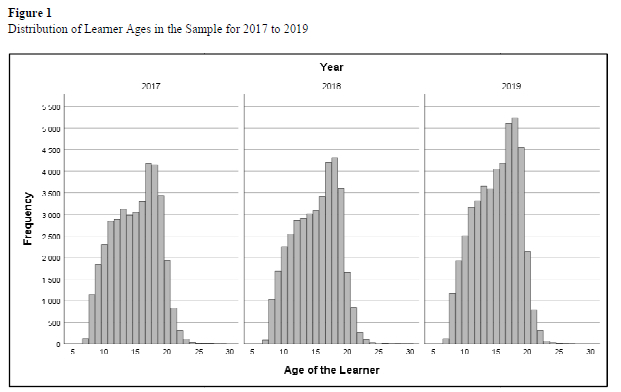
Table 1 indicates that over-aged learner numbers decreased from 2017 to 2018 by 645 learners but increased from 2018 to 2019 by 7,996. The mode increased by one year from 17 years to 18 years indicating that the age occurring most is 18 years. The ages ranged from 7-30 years. A learner reaching an age of 30 indicates school attendance for 23 years, whereas it should be about 12 to13 years if the learner is promoted each year. The mean age of learners increased from 14.88 (SD = 3.577) years in 2017 to 15 years (SD = 3.448) in 2019.
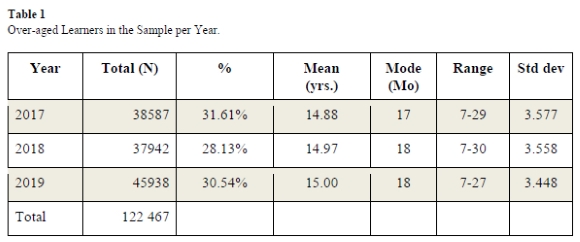
Figure 1 gives a bar graph representation of learner ages for the three-year period.
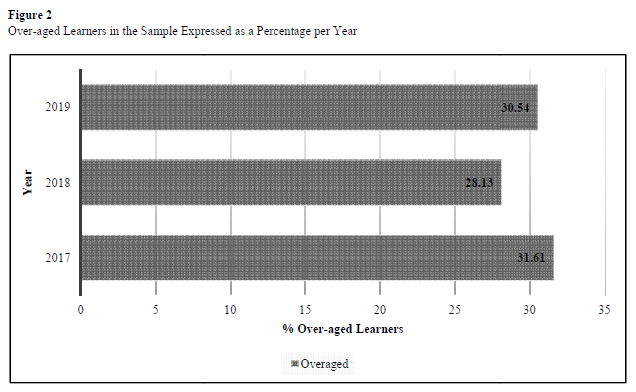
Figure 2 indicates the percentage of over-aged learners ranging between 28.13% and 31.61% from 2017 to 2019. Thus, the over-aged percentage constitutes approximately a third (30.3%) of the entire learner population in schools in this GED over the three years.
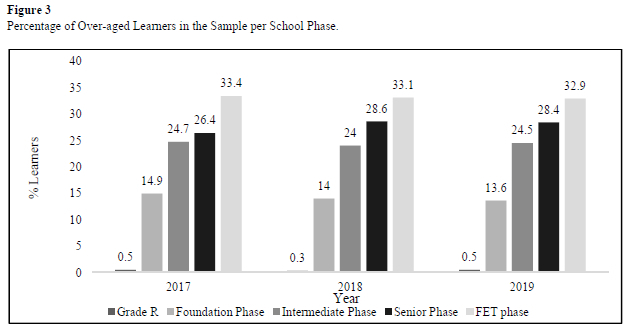
Figure 3 shows the number of over-aged learners increased in every school phase from Grade R to the FET phase from 2017 to 2019. The largest increases are shown from Grade R to the Foundation Phase, and from the Foundation Phase to the Intermediate Phase. The over-aged numbers increase with every new school phase. The increase in the Foundation Phase could be related to learners not attending Grade R and entering school for the first time in Grade 1 and possibly entering school later that the prescribed school-going age.
The highest percentage of over-aged learners are in the Further Education and Training (FET) phase (Grades 10-12, Figure 3). Most Grade R learners entering the system are the correct age, with low percentages of over-aged learners, but as learner's progress through the education system the number of progressed learners increases over time, peaking in the FET phase.
Over-aged learners indicated more male over-aged learners than female ones. From 2017 to 2019, there was an average of 26% more male over-aged learners in schools in this GED. The number of male over-aged learners increased by 1% over the three-year period, and the number of female over-aged learners decreased by 1%.
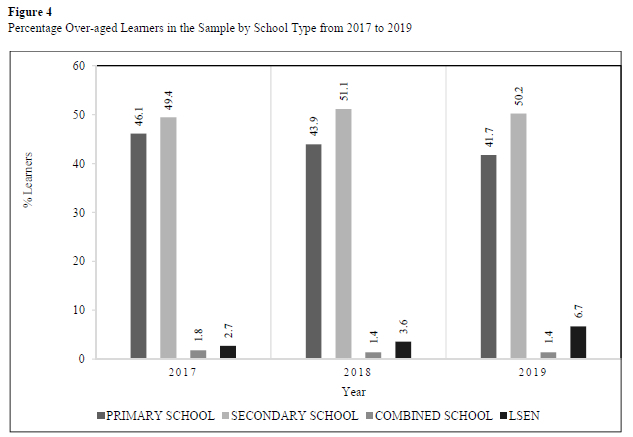
Figure 4 indicates that the highest percentage of over-aged learners was in secondary schools (51.1%), followed by primary schools (49.4%). The percentage growth in secondary schools is higher than in primary schools. The difference in the percentage of over-aged learners in primary and secondary schools was 3.3% in 2017 and increased to 8.5% in 2019. The percentage of over-aged learners in LSEN schools indicates an increase of 4% from 2017 to 2019. This is possibly because of intervention after failure in mainstream schools and referral to LSEN schools to support learners presenting with barriers to learning.
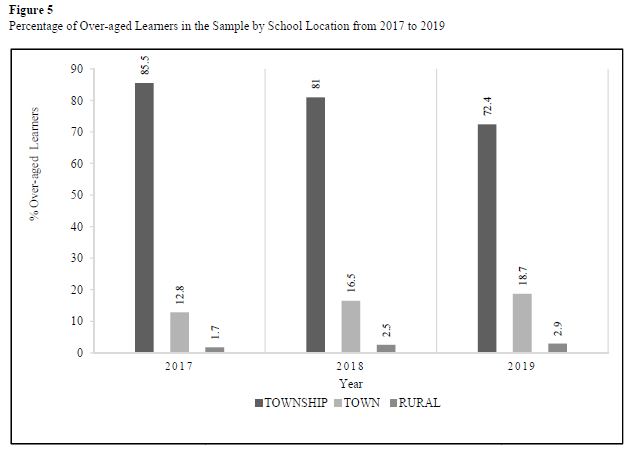
Figure 5 demonstrates that the largest number of over-aged learners was in township schools. From 2017 to 2019, an average percentage of 79.6% learners were in township schools and 16.0% in town schools. Few over-aged learners were in rural schools (2.4%). The percentage of over-aged learners decreased by 13.1% in township schools and increased in town schools by 5.9% over the three-year period. This is possibly because parents are seeking better educational opportunities for learners since many black families are moving into urban areas for better facilities.
Most learners are one year over-aged for the age norms for their grades. The number of learners one year over-aged for their grade increased by 4,311 (28,642-24,331) from 2017 to 2019. There was an increase in all years over-aged for the grades up to 10 years.
The average number of years learners over-aged in primary schools from 2017 to 2019 was 1.31 (SD = 0.726), with over-aged years ranging between 1 and 11 years. Secondary schools indicated that the average number of years learners were over-aged was 1.8 years (SD = 1.080), with over-aged years ranging between 1 and 13. LSEN schools indicated that the average number of years was 1.98 years over-aged (SD = 1.067) with an over-aged range between 1 and 14 years. The statistics indicated by LSEN schools could be because of the differentiated curriculum followed, the exit age at LSEN schools of 21 years, and the disability classification.
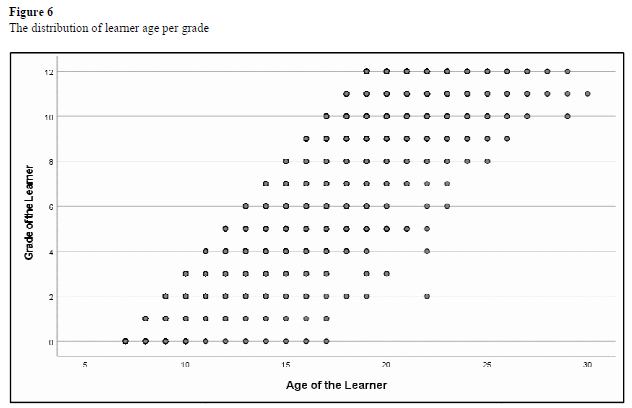
The distribution of learner age per grade is shown in Figure 6. Over-aged learner ages range from seven years in Grade R to 30 years in Grade 11. Age ranges per grade can also be seen in Figure 6. Ages between seven and 17 years can be seen in Grade 1 and will possibly be found in LSEN schools because of the disability classification and the differentiated curriculum. Ages from 17 to 30 years found in Grade 11 could be related to late enrollments and undocumented learners.
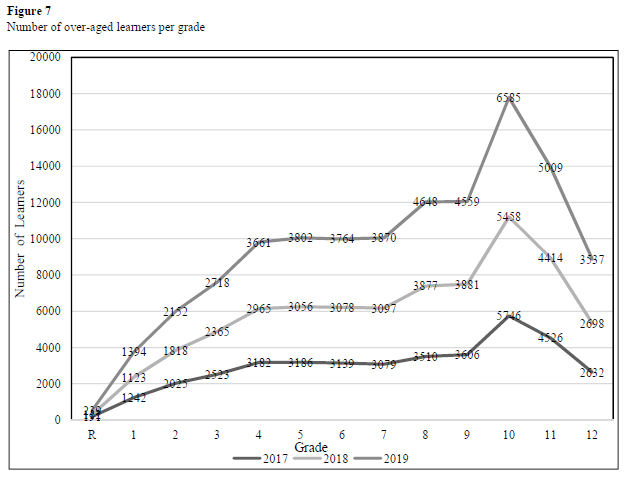
Figure 7 is a graphic representation of the number of over-aged learners per grade. The increase in learner numbers peaking in the FET phase increased to a peak of 6585 in 2019 in Grade10, possibly because learners progressed from Grade 9. Learners may repeat once in a phase according to the NPPPR and if a learner repeated Grades 7 or 8 they may not be progressed in Grade 9. The decline in progressed learner numbers in Grade 10 could possibly be because of learners repeating Grade 10, being a new phase, or as learners dropped out of school.
Discussion
The NPPPR prescribes progression according to age cohort to prevent learners from being over-aged in their grades. The compulsory schooling age begins the year before the calendar year in which a learner turns seven, which implies a learner should reach Grade 1 by age seven. The learner would spend eight years in primary school, which ends in Grade 7, followed by five years of secondary school, to be completed by the time the learner reaches age 18. Compulsory schooling ends at age 15, typically the completion of Grade 9, depending on which event occurs first (Statistics South Africa. 2016). The norm for repetition is one year per school phase where necessary, and many repetitions in one grade are not permissible (Department of Basic Education, 2011).
A learner who repeats once in each school phase as prescribed by the NPPPR will be three years over-aged by the time they reach the FET phase. If they fail in the FET phase, a learner will be four years over-aged when they reach matric. These learners will complete Grade 12 at the age of 22 years which should be the maximum age of a learner at school. In 2017, 50% of the matriculants were older than 18 and 766 were 27. In the SA General Household Survey of 2017, 33.8% of youth aged 18-24 attended educational institutions; 22.2% attended school; and 11.6% post-school educational institutions (Statistics South Africa, 2018). Arguably, at age 19, learners are adults who could be contributing to the country's economy, but these learners are still at school while the taxpayer continues to support them.
According to Statistics South Africa (2022), in 2021, nearly 3% of 15-year-olds and almost 9% of 17-year-olds dropped out of school. Although most 18- and 19-year-olds were still attending secondary school, 29.3% of 18-year-olds and 46.3% of 19-year-olds had dropped out of school with the main reasons for non-attendance cited as illness and disability (22.7%), poor academic performance (21.2%), and lack of money for fees (19.6%) (Statistics South Africa, 2022).
Progression and the implementation of the NPPPR should prevent learners being more than one year over-aged for the grade, but from this study's findings it does not seem to be the case. This is because learners should be progressed after repeating one year in a phase, and age cohort progression should apply to prevent repetition which leads to learners being over-aged for the grade. The results of this study indicate the cumulative number of over-aged learners attending school in this GED for the three years under study totalled 122,267, making up 30% of learners in the education district for the period. The increase of 7,351 over-aged learners from 2017 to 2019 is alarming. The mean age of learners ranged between 14.88 and 15 years for the three years, the mode age was 18, and the age ranges were between 7 and 30 years for the three years (Figure 2).
Over-aged learners may present challenges in schools since there are then different developmental stages in the same classroom. Exposure of younger learners to behaviour and social activities not relevant to their developmental phase can lead to their involvement in psycho-social problems like substance abuse, inappropriate sexual behaviour, discipline problems, bullying, and school drop-out. Over-aged learners can impact learning negatively and cause tension in class, leading to possible security concerns (United Nations Educational Scientific and Cultural Organisation, 2022). Amusala and Were (2022) argued that over-aged learners may affect younger learners' morals negatively, disregard school rules, influence younger learners with bad habits such as being rude, and uncooperative, bully others, tell lies, steal, disrespect teachers, and make the maintaining of discipline challenging. Therefore, implementation of policies should be regarded as urgent to provide support for all learners and contribute to safe schools.
Furthermore, educators from both primary and secondary schools have voiced the concern that learners were becoming more ill-disciplined and disrespectful, directly impacting teaching effectiveness, with discipline problems including: bullying; intimidation; sexual harassment; drug and alcohol abuse; carrying dangerous weapons to schools; lack of parental involvement; dysfunctional home and family background; abuse; and peer pressure (Nene, 2013). More severe disciplinary problems that impact teaching and learning include: destruction of school property; examination malpractices; the verbal and sexual assault of fellow learners and educators; the watching of pornographic films and looking at such pictures; incidents of learners burning down classrooms and setting educators' cars on fire; and physically attacking educators, principals, and co-learners (Obadire & Sinthumule, 2021).
An example of learner misbehaviour is provided by an incident in September 2022, when a Grade 10 learner at a school in KwaZulu-Natal set the Deputy Principal's car alight because he was reprimanded for having his cell phone on school property (Mkhize, 2022b). Another incident in the Western Cape, reported by Schreuder (2020), in which two learners were stabbed, and others were physically wounded, was pre-planned; learners hid weapons on the school premises and involved 14 learners from various grades who were chasing each other with weapons including pangas, knives, and scissors. The Youth Risk Behaviour Survey (YRBS) clearly outlines the prevalence of key risk behaviours among SA youths from Grades 8 to 11 (Reddy et al., 2015). The YRBS indicated that: 13% of learners carried weapons to school; 16% belonged to gangs; 27% were involved in physical fights; 19% considered suicide; 17% attempted suicide; 41% reported being bullied; 49% consumed alcohol; 23% had engaged in binge drinking; 13% used dagga; 12% used heroin; 11% used inhalants; and 6% used Mandrax. We contend that more updated surveys should be conducted.
Sexual harassment was another problem revealed in classes with over-aged learners influencing younger learners into engaging in inappropriate behaviour (Amusala & Were, 2022). Geldenhuys and Youngleson (2014) reported that 41% of learners engaged in sex, 54% had had more than one sexual partner, 29% used condoms, and 16% fell pregnant. Stats SA (2022) published concerning results from the YRBS, in which 36% of learners indicated having had sex, with 12% of these under the age of 14 years, 18% of the learners were pregnant, 14% had given birth, 8.8% were forced to have sex, and 7.6% indicated they forced someone to have sex. Furthermore, the prevalence of pregnancy increased with age, rising from 1.7% for females aged 15 to 6.8% for females aged 19 years (Reddy & Mahavidyalaya, 2016. Disturbing research for the age group 10 to 19 shows that 130,000 babies were born in 2019; 136,386 in 2020; and the first quarter of 2021 recorded 36,000 births in this age group (O'Regan, 2021). Amnesty International reported that rape and sexual abuse are the driving factors behind SA's soaring number of child pregnancies, with statistics indicating that 90,037 girls between the ages of 10 and 19 gave birth between April 2021 and March 2022 and these numbers do not include termination of pregnancy, home births, miscarriages, and unregistered births (Lanka, 2022). A 48.7% increase in births to young girls between the ages of 10 and 14 is reported (Lanka, 2022). We claim that many of these increases in psychosocial ills and alarming teenage pregnancy statistics could be linked to the presence of over-aged learners in schools with poor policy implementation.
According to the results of our study, the number of years over-aged in a grade ranged from 1 to 13 years in 2017 and 2018, and from 1 to 14 years in 2019. Some learners are spending 26 years in school, denying them the opportunity to be economically active, placing a burden on the taxpayer, and possibly contributing to psycho-social and emotional challenges.
Developmental theories suggest that learners should progress within their age cohorts. A learner 13 years over-aged for the grade leads to the possibility of a 13-year-old learner in class with a 26-year-old. Arguably, socially, intellectually, emotionally, and psychologically, this could create imbalances and is a clear indication that policies are not being implemented effectively. If policy were implemented correctly, the maximum age a learner could be over-aged would be four years.
Figure 1 shows the large age ranges in grades, which may explain the cases in the daily media that report sexual abuse, physical abuse, teenage pregnancies, and discipline problems. When learners in large age ranges are grouped together in a grade in one classroom, there are economic, psycho-social, and emotional impacts not only on the education system, but also on educators and learners. All learners are influenced by the large age differences because of different stages of development and phases of life. Implementation of policy seems to have failed many learners, causing them to be trapped in a curriculum not suited to their needs.
The online admission system of the GDE accepts applications of all learners for Grades 1 and 8, regardless of age. Learners aged 5 to 10 are admitted to Grade 1 despite being under-aged or over-aged. Subsequently, the over-aged Grade 1 learners are expected to be fast-tracked and placed age appropriately, despite not having the scholastic foundation. Learners seem to fall further behind when compared with international standards, such as the Progress in International Reading Literacy Study, as the literacy level of learners is deteriorating (Department of Basic Education, 2023).
Based on this study's results, over-aged learners from the Foundation to the Intermediate Phase doubled yearly. This was possibly because of learners entering school late and the retention of learners in the Foundation Phase. We found cases where the NPPPR was not implemented correctly, and learners who repeated specific grades twice in the foundation phase because of scholastic delays are still unable to read and write. There is a slight increase in the over-aged numbers from the intermediate to the senior phases. From the Senior Phase to the FET Phase, there is an increase in the number of over-aged learners. The large number of over-aged learners in secondary schools impacts the country and families economically since these learners are young adults who could be contributing to and earning a living in the labour market.
In summary: we found that 30% of the learners in the district under study were over-aged; over-aged numbers increased by 7,351 over the three-year period; years over-aged ranged between 1 and 14 years for the grade; and ages of learners in schools ranged from seven to 30 years. Most over-aged learners were male, in secondary schools, township schools and in the FET phase. Psycho-social problems including teenage pregnancy, violence, ill-discipline, and increased substance abuse in schools are causing educators to deal with discipline challenges in classroom management and this results in inadequate curriculum delivery.
Conclusion
The increase in over-aged learner numbers leads to overcrowded classrooms and the inability of educators to support learners adequately, thus compromising the quality of education. The deviation from policy and adjustments to improve pass rates seems to reduce the level of learners' education. Educators face challenges in supporting learners because of time constraints, challenging classrooms with large age ranges, and learners lacking the academic foundation for the grade. Learner drop-out from school is high leading to rising unemployment figures. Policies should be reviewed and adapted for efficient practical implementation to meet the needs of learners, parents, educators, and society. This can, over time, possibly improve the quality of education leading to a more prosperous future for learners, schools, and the country.
References
Amusala, C. M, & Were, D. (2022). The influence of overaged learners' moral behavior on class three pupils in Kakamega South sub-counties, Kenya. International Journal of Applied Psychology, 12(1), 9-15. http://article.sapub.org/10.5923.j.ijap.20221201.02.html https://doi:10.5923/j.ijap.20221201.02 [ Links ]
Arendse, L. (2021). Falling through the cracks: The plight of "over-aged" children in the public education system. De Jure Law Journal, 54(1), 105-126. https://doi.org/10.17159/2225-7160/2021/v54a7 [ Links ]
Balkis, M., Arslan, G., & Duru, E. (2016). The school absenteeism among high school students: Contributing factors. Educational Sciences: Theory and Practice, 16(6), 1819-1831. https://doi.org/10.12738/estp.2016.60125 [ Links ]
Baloyi, T. (2023, September 11). Schools characterised as warzones. Caj news Africa. https://www.cajnewsafrica.com/2023/09/11/south-african-schools-characterised-as-warzones/
Bhengu, L. (2021, August 17). Gauteng records more than 23 000 teen pregnancies in one year, some moms as young as 10. News24. https://www.news24.com/News24/gauteng-records-more-than-23-000-teen-pregnancies-in-one-year-some-moms-as-young-as-10-20210817
Burger, R., van der Berg, S., & von Fintel, D. (2015). The unintended consequences of education policies on South African participation and unemployment. South African Journal of Economics, 83(1), 74-100. https://doi.org/10.1111/saje.12049 [ Links ]
Carter, C. (2018). Successful dissertations: The complete guide for education, childhood and early childhood studies students. Bloomsbury Academic.
Constitution of the Republic of South Africa: Act 108 of 1996. (n.d.). https://www.justice.gov.za/legislation/acts/1996-108.pdf
Creswell, J. W., & Creswell, J. D. (2022). Research design: Qualitative, quantitative and mixed methods approaches (6th ed.). SAGE.
Davies, C., & Fisher, M. (2018). Understanding research paradigms. Journal of the Australasian Rehabilitation Nurses Association, 21(3), 21-25. https://search.informit.org/doi/10.3316/informit.160174725752074 [ Links ]
Department of Basic Education. (2010). Policy on learner attendance (National Education Act 27 of 1996 notice 36 of 2010). https://www.education.gov.za/Portals/0/Documents/Policies/Policy%20on%20Learner%20Attendance%202010.pdf
Department of Basic Education. (2011). National policy pertaining to the programme and promotion requirements of the National Curriculum Statement Grades R-12. https://www.education.gov.za/Portals/0/Documents/Policies/PolicyProgPromReqNCS.pdf
Department of Basic Education. (2012a). Approval of the regulations pertaining to the national curriculum statement grades R-12. https://www.google.com/search?q=Department+of+Basic+Education.+(2012a).+Approval+of+the+regulations+pertaining+to+the+national+curriculum+statement+grades+R-12
Department of Basic Education. (2012b). Integrated School Health Policy. https://www.education.gov.za/Portals/0/Documents/Policies/INTEGRATED%20SCHOOL%20HEALTH%20POLICYB-W_1.pdf?ver=2014-06-14-172322-000
Department of Basic Education. (2014). National policy on Screening, Identification, Assessment and Support (Government Gazette Vol. 1044 No. 38356 of 2014). https://www.gov.za/sites/default/files/gcis_document/201412/38356gon1044.pdf
Department of Basic Education. (2023). PIRLS 2021: South African Preliminary Highlights Report. https://www.up.ac.za/media/shared/164/ZP_Files/2023/piirls-2021_highlights-report.zp235559.pdf
Department of Education. (1998). National Education Policy Act No.27 of 1996. Notice number: 2432. https://www.education.gov.za/Portals/0/Documents/Policies/INTEGRATED%20SCHOOL%20HEALTH%20POLICYB-W_1.pdf?ver=2014-06-14-172322-000
Dieltiens, V. & Meny-Gilbert, S. (2012). In Class? Poverty, social exclusion and school access in South Africa. Journal of Education, 55:127-144. https://pari.org.za/wp-content/uploads/2018/05/20120000_InClassSocialExclusionAndAccess_Journal-Articles_DieltiensGibert.pdf [ Links ]
Dryden-Edwards, R. (2024, January 31). Bullying. https://www.medicinenet.com/bullying/article.htm#how_common_is_bullying_how_common_is_hazing
Geldenhuys, P., & Youngleson, A. (2014). A description highlighting the psychosocial problems experienced by learners in three secondary schools in the Western Cape. Social Work/Maatskaplike Werk, 46(3), 343-357. https://doi.org/10.15270/46-3-163 https://socialwork.journals.ac.za/pub/article/view/163 [ Links ]
Graber, E. (2025). Physical growth of infants and children. MSD Manual. https://www.msdmanuals.com/professional/pediatrics/growth-and-development/physical-growth-of-infants-and-children?ruleredirectid=742ruleredirectid=450
Human Science Research Council. (2014). South African Social Attitudes Survey 2010. In https://www.datafirst.uct.ac.za/dataportal/index.php/catalog/490/study-description(zaf-hsrc-sasas-2010-v1).
Jan, A., & Husain, S. (2015). Bullying in Elementary Schools: Its causes and effects on students. Journal of Education and Practice, 6(19), 43-56. https://www.iiste.org/Journals/index.php/JEP/article/view/24163/24736 [ Links ]
Juan, A., Zuze, L., Hannan, S., Govender, A., & Reddy, V. S. (2018). Bullies, victims, and bully-victims in South African schools: Examining the risk factors. South African Journal of Education, 3S(Supplement 1), S1-S10. https://doi.org/10.15700/saje.v38ns1a1585. https://www.sajournalofeducation.co.za/index.php/saje/article/view/1585/792 [ Links ]
Khulisa Management Services. (2012). Research factors contributing to dropout among Grades 10 and 11 in Gauteng. www.education.gov.za (GT/GCRA/79/2010).
Koen, V., Robertson, N., & Tsabedze, W. (2021). Incidence of psycho-social well-being in a rural community of South Africa. Journal of Community Psychology, 50(3), 1549-1563. https://doi.org/10.1002/jcop.22734. https://onlinelibrary.wiley.com/doi/abs/10.1002/jcop.22734 [ Links ]
Lally, M., & Valentine-French, S. (2022). Lifespan development: A psychological perspective (4th ed.). https://open.umn.edu>opentextbooks>textbooks
Lanka, G. (2022, October 5). Pregnancy rate in South African young girls keep on increasing. SABC News. https://www.sabcnews.com/sabcnews/pregnancy-rate-in-south-african-young-girls-keeps-on-increasing/?hilite=Pregnancy.
Mabuza, E. (2023, January 30). All but 176 pupils have been placed in schools in Gauteng. Timeslive. https://www.timeslive.co.za/news/south-africa/2023-01-30-all-but-176-pupils-have-been-placed-in-schools-in-gauteng/
Macupe, B. (2019, August 19). Education MEC blames overaged learners for violence in schools. Mail and Guardian. https://mg.co.za/article/2019-08-19-education-mec-blames-overaged-learners-for-violence-in-schools/
Macupe, B. (2022, January 17). Weak matrics culled for better results. Mail and Guardian. https://mg.co.za/education/2020-01-17-weak-matrics-culled-for-better-results/
Maserumule, O.M., Skaal, L., & Sithole, S. L. (2019). Alcohol use among high school learners in rural areas of Limpopo Province. South African Journal of Psychiatry, 25, 2078-6786. https://sajp.org.za/index.php/sajp/article/view/1183/1506 [ Links ]
Mkhize, M. (2022b, September 7). Disgruntled KZN Pupil allegedly sets teacher's car alight. https://www.dailydispatch.co.za/news/2022-09-08-watch-disgruntled-kzn-pupil-allegedly-sets-teachers-car-alight/#google_vignette
Mkhize, P. (2022a, July 4). Motshekga admits that 90037 schoolgirls gave birth in past year. Sunday World. www.Sundayworld.co.za
Mokwena, A., & Sindane, P. (2019). Cigarette smoking and alcohol intake among high school learners in Pretoria, South Africa. Psychology and Educational Journal, 57(7), 531-536. https://doi.org/10.17762/pae.v57i7.83 [ Links ]
Motshekga, A. (2022, May 20). Basic Department of education budget vote 2022/2023 [Press release]. https://www.gov.za/news/speeches/minister-angie-motshekga-basic-education-dept-budget-vote-202223-20-may-2022
Nene, F. Z. (2013). The challenges of managing learner discipline: The case of two schools in Pine Town district [Master's dissertation, University of KwaZulu Natal]. [ Links ]
Nzama, M. V., & Ajani, O. A. (2021). Substance abuse among high school learners in South Africa: A case study of promoting factors. African Journal of Development Studies. 219-224. https://doi.org/10.31920/2634-3649/2021/sin1a12 https://journals.co.za/doi/abs/10.10520/ejc-aa_affrika1_v2021_nsi1_a12
O'Regan, V. (2021, September 7). School girl births unacceptably high in South Africa. Daily Maverick. https://www.dailymaverick.co.za/article/2021-09-10-sexual-violence-driving-high-pregnancy-rate-among-10-19-year-olds-in-sa/
Obadire, O. T., & Sinthumule, D. A. (2021). Learner discipline in the post-corporal punishment era: What an experience! South African Journal of Education, 41(2), 1-8. https://doi.org/10.15700/saje.v41n2a1862 https://www.sajournalofeducation.co.za/index.php/saje/article/view/1862/1067 [ Links ]
Pickard, A. J. (2013). Research Methods in Information. Facet Publishing.
Reddy, M.S., & Mahavidyalaya, P. (2016). Importance of English language in today's world. International Journal of Academic Research, 3, 179-184. http://www.ijar.org.in/stuff/issues/v3-i4(2)/v3-i4(2)-a021.pdf [ Links ]
Reddy, S. P., James, S., Sewpaul, R., Sifunda, S., Ellahebokus, A., Kambaran, N. S., & Omardien, K. G. (2015). Umthente Uhlaba Usamila: The 3rd South African National Youth Risk Behaviour Survey 2011. https://repository.hsrc.ac.za/handle/20.500.11910/2487
Sadike, M. (2024). Seven years and still waiting for a school. Sunday Independent. https://sundayindependent.co.za/news/2024-01-07-seven-years-and-still-waiting-for-a-school/
South African Council on Alcoholism and Drug Dependence. (2015). Substance abuse in South African schools: A situation analysis. www.sancanational.info.
Schreuder, B. (2020, February 19). WCED Warning to Learners regarding discipline in schools. https://wcedonline.westerncape.gov.za/news/wced-warning-learners-regarding-discipline-schools
Shomolekae, T. (2022, July 4). Ramaphosa urges citizens to address under-aged drinking. https://www.polity.org.za/article/ramaphosa-urges-citizens-to-address-under-age-drinking-2022-07-04
South African Schools Act 1996 (Act 84 of 1996). https://www.education.gov.za/LinkClick.aspx?fileticket=aIolZ6UsZ5U%3D&tabid=185&mid=1828
Stats SA. (2016). Education report focussing on the Eastern Cape. https://www.statssa.gov.za/?p=6213
Stats SA. (2018, June 21). General Household Survey 2017. Zaf-statssa-ghs-2017-01. https://www.statssa.gov.za/publications/P0318/P03182017.pdf
Stats SA. (2022). General Household Survey 2021. https://www.statssa.gov.za/?p=15482
Stott, A., Dreyer, H. P., & Venter, P. (2015). Consequences of the progression law in the FET phase: A case study. Journal of Education, 63, 89-110. https://doi.org/10.17159/i63a04. [ Links ]
Terre Blanche, M., & Durrheim, K. (1999). Research in practice: Applied methods for the social sciences. University of Cape Town Press.
Theepe, A. (n.d.). A school psychologist's response to bullying. https://www.wyschoolpsych.org/school-psychologists-and-bullying/
Tyler, S. (2020). Human behaviour and the social environment. University of Arkansas Libraries.
United Nations Educational, Scientific and Cultural Organisation. (2022, September 30). Too old for school? Tackling Liberia's overage school problem. https://webarchive.unesco.org/web/20221005014855/https://www.iiep.unesco.org/en/too-old-school-tackling-liberias-overage-school-problem-14315 www.iiepunesco.org.za
Van Zyl, S. (2024). Laarskole hoor hulle moet gr 8 inneem. (Primary schools hear they must take in grade 8.) https://www.netwerk24.com/netwerk24/nuus/onderwys/laerskole-in-kempton-park-moet-glo-kinders-van-oorvol-hoerskool-akkommodeer-20240112
Whatley, M. (2022). Introduction to quantitative analysis for international educators. Springer Nature.
Received: 4 May 2024
Accepted: 6 March 2025
1 Approval was granted by the University of Johannesburg, Faculty of Education Ethical Clearance Committee REC-110613-036 with Ethical Clearance Number: Sem 1-2022-002 allocated.