




Services on Demand
Journal

Article
 English (pdf)
 Article in xml format
 Article references
 Automatic translation
 Send this article by e-mail
Indicators
Related links
-
 Cited by Google
 -
 Similars in Google
Share

 Permalink
Journal of Education (University of KwaZulu-Natal)
On-line version ISSN 2520-9868Print version ISSN 0259-479X
Journal of Education n.99 Durban 2025
https://doi.org/10.17159/2520-9868/i99a07
ARTICLES
Teachers' perceptions on the use of ChatGPT in teaching grade 12 mathematics
Puleng MotsekiI; Zingiswa JojoII
IDepartment of Mathematics Education, College of Education, University of South Africa, Pretoria, South Africa. motsepd@unisa.ac.za. https://orcid.org/0000-0001-6996-3225
IISecondary and Post-School Education, Faculty of Education, Rhodes University, Makhanda, South Africa. Zingiswa.jojo@ru.ac.za. https://orcid.org/0000-0002-4949-1694
ABSTRACT
The purpose of this qualitative study was to explore how grade 12 mathematics teachers in a certain District in Eastern Cape perceive the use of artificial intelligence in relation to mathematics education, particularly in relation to ChatGPT's debut. We used a single case study research design to explore teachers' experiences on the use of ChatGPT in teaching geometry. Following a qualitative approach, we collected data through interviews and lesson observations from a purposive sample of 10 Further Education and Training Phase mathematics teachers. Our aim was to gain deeper insights into their experiences with ChatGPT when teaching geometry. We used thematic analysis to identify and analyse the data. Findings in this study reveal that educational discourses support the use of ChatGPT since it provides thorough guidance and support for geometry instruction. Reception to ChatGPT is varied, with some educationalists and users being excited about the ease of use and access, while others are cautious about its potential negative consequences in teaching mathematics. Additionally, ChatGPT is well-known for improving mathematical skills and has the capacity to enhance understanding by giving teachers basic knowledge of geometry, but the tool is limited in relation to geometry and is not effective in correcting misconceptions. Furthermore, the accuracy of the geometry solutions derived from ChatGPT depend on the cognitive demand of the question, the input data, and the instructions given. Findings from this study suggest various directions for research that can be explored to guarantee informed decisions in integrating ChatGPT into mathematics teaching.
Keywords: ChatGPT, artificial intelligence, mathematics, teaching, geometry
Introduction
In the constant evolution of educational technologies, the arrival of artificial intelligence driven discourses has ushered in an interesting change in relation to prospects and challenges. Specifically, in the discipline of mathematics education, the integration of ChatGPT has compelled a review of the in-service and pre-service teachers' programmes (Hidayat et al., 2021). ChatGPT has the capability to solve several mathematical problems that would have been solved previously only by humans, with its prowess extending beyond the basic arithmetic and algebra that are the strengths of the standard calculator (Hodge-Zickerman & York, 2024). Moreover, it can handle complex calculus, solve equations in linear algebra, evaluate statistical data, provide answers to discrete mathematics issues, and even dabble in creating mathematical proofs (Wardat et al., 2023). Hence, Mhlanga (2023) suggested that it can be used as an additional tool to support learning outside of the classroom or as a means of getting immediate feedback on a mathematical problem.
Although ChatGPT can solve a system of differential equations or compute the integral of a complex function with ease, there is growing concern that ChatGPT may substitute learners' relational understanding of mathematical concepts with the instrumental understanding because of the shortcut provided by the technology (Pardos & Bhandari, 2023; Rudolph et al., 2023). This is because ChatGPT can produce written mathematics content that closely resembles human writing and conversations about its ramifications have arisen because of its capabilities (Tenhundfeld & ChatGPT, 2023). In the context of assessments, this is of particular concern to teachers because mathematical assessments that adhere to the learn-calculate-regurgitate approach typically prioritize the how above the why (Eke, 2023; Gilat & Cole, 2023). In a traditional classroom, in which learners learn a topic, for example on quadratic equations, they are then assessed on their abilities to answer similar problems in different contexts and the use of ChatGPT has the potential to disrupt this process because it offers quick solutions without requiring a thorough comprehension of the underlying mathematical concepts (Lim et al., 2023). ChatGPT seems to add value to learners' procedural understanding of mathematics concepts.
In this paper, we seek to respond to the research question:
• What are the perceptions of grade 12 mathematics teachers when using ChatGPT in teaching geometry?
Integration of educational technology in mathematics has evolved over the years from the use of software applications such as GeoGebra, graphic calculators, and Sketchpads to potentially disruptive innovations such as ChatGPT (Sánchez-Ruiz et al., 2021; Santos-Trigo et al., 2021). It is therefore important to understand ChatGPT based on its potential affordances, limitations, and ramifications in relation to education, especially in mathematics education. It is essential that teachers and other education stakeholders can make informed decisions regarding the integration of ChatGPT in mathematics classrooms and design policies that minimise the risks while maximising the benefits.
Literature review
The integration of AI-based ChatGPT in the teaching and learning of mathematics by teachers is gaining ground (Warda et al., 2023) since ChatGPT enriches mathematics teaching by offering innovative tools and resources that complement traditional teaching approach (Mhlongo et al., 2023). Affordances of AI-based ChatGPT are opening new avenues for acquiring disciplinary knowledge and solving problems (Egara & Mosimege, 2024). ChatGPT demonstrates exceptional capacity to generate text that closely matches human writing, thus surpassing traditional question-answering systems. In mathematics, teachers and learners can identify, investigate, and support mathematical relations among objects using dynamic modeling, measuring the object's attributes, and dragging the elements in the object while locating the object's specific loci (de Winter, 2023). AI-based tools such as ChatGPT allow learners to ask questions on mathematical concepts and get solutions beyond the classroom setting. Additionally, ChatGPT provides a range of materials including explanations that elucidate mathematical concepts and facts that help learners expand and enhance their understanding (Guo et al., 2024). But it is important to consider that ChatGPT technology has limitations and that it has ethical implications that need to be carefully considered along with possible resolutions. For instance, the effectiveness of ChatGPT is examined in a number of natural language processing (NLP) activities by Bang et al. (2023), who concluded that ChatGPT performs better than other language models on most of these tasks. Yet, the study also pointed out some restrictions on the capabilities of ChatGPT to reason and noted the existence of hallucination concerns. Nonetheless, Aljanabi (2024) emphasised that despite the challenges, ChatGPT offers a noteworthy advancement in the field of artificial intelligence language processing in having the capacity to revolutionise the different sectors and provide timely and personalised support for teaching and learning tasks, such as answering questions, providing feedback, and facilitating collaboration.
ChatGPT is an artificial intelligence chatbot that uses natural language processing to create text like human writing (Guo et al., 2024) for research papers on education, for example, and on several topics such as video games, customer care, and others. It was developed from 175 billion parameters using a Generative pre-trained transformer 3 (GPT-3) framework that makes it a massive language model (Rudolph et al., 2023). Research (Guo et al., 2023) has revealed that ChatGPT can solve mathematical problems and help teachers and learners generate personalised teaching and learning content. In addition, the model can also be used as a tool to develop mathematics assessment tools and teachers can use it to assess learners' tests and assignments and provide feedback (Crust, 2023; de Winter, 2023).
ChatGPT is regarded as a powerful interactive technology that facilitates the teaching and learning of mathematics effortlessly because of its distinct feature of processing formulas and concepts without underlying mathematical expertise for its operations (Wardat et al., 2023). Using this progressive innovation, teachers can pose mathematical questions using natural language and receive immediate responses from ChatGPT.
While ChatGPT presents innovative capabilities in the educational landscape, Wardat et al. (2023) have pointed out its shortcomings in generating incorrect responses given its inability to grasp the contexts of certain subjects. Specifically, in the disciplines of science, technology, engineering, and mathematics (STEM), Sánchez-Ruiz et al. (2023) have found that ChatGPT is incapable of solving certain mathematical and scientific problems so cannot provide reliable answers. However, Tenhundfeld and ChatGPT (2023) cautioned that ChatGPT is a language model, simply a tool and should not be seen as a replacement for human teachers. While anyone can use ChatGPT to invalidate the process of calculations without learning anything, Hodge - Zickerman and York (2024) pointed out that the tool can be used to answer open-ended questions so that teachers and learners can analyse, discuss, and critique the outputs. Thus, we suggest that it is important to integrate ChatGPT into mathematics so that learners can experience how it can be used as a learning tool when coupled with open-ended questions.
While the emergence of AI tools such as ChatGPT is a significant turning point in mathematics education, its integration in the classroom might weaken the learning process by hindering the learners' deep assimilation of techniques and results. One disadvantage of using ChatGPT is that a mathematical background is needed if one is to identify the problem to be solved, using the proper command or function, and correctly interpret the outputs (Sánchez-Ruiz et al., 2023).
In summary, although ChatGPT can enhance education and student learning, it is crucial to use it as a complementary tool alongside a human educator. Educators can use ChatGPT to generate personalised content, assess student learning, and provide feedback to learners, but it is crucial for us to understand its limitations and use it in an ethical and responsible manner (Pardos & Bhandari, 2023; Rudolph et al., 2023; Shahriar & Hayawi, 2023).
Theoretical framework
In this study, we used the Technological Pedagogical Content Knowledge (TPACK) framework by Mishra and Koehler (2006) as a perspective from which to understand mathematics teachers' perceptions about using ChatGPT when teaching geometry. The knowledge of how various technological advances can be used in teaching and understanding that using technology may alter the way teachers teach geometry (Mishra & Koehler, 2006) was also important to this study. The TPACK framework represents "the blending of content and pedagogy into an understanding of how particular topics, problems, or issues are organised, represented and adapted to the diverse interests and abilities of learners, and presented for instruction" (p. 8). According to Mishra and Koehler (2006), in teaching a particular subject matter, teachers require not only the knowledge of the content, but an understanding of the complex reciprocal inter-relationship between and among the three essential units of knowledge (content knowledge, pedagogical knowledge, and technological knowledge) and teaching content using appropriate pedagogical methods and technologies.
The TPACK framework is an extension of Gudmundsdottir and Shulman's (1987) pedagogical content knowledge developed to consider the role that technology plays to advance teaching (Schmidt et al., 2009). The six main assumptions that are central to the development of TPACK are (i) Content Knowledge (CK), which refers to any subject matter knowledge that the teacher must to have to teach effectively, (ii) Pedagogical Knowledge (PK), which refers to the teacher's awareness about a range of instructional practices, strategies, and methods to promote effective learning, (iii) Technology Knowledge (TK), which refers to the knowledge that the teacher must have regarding the old and newer technologies that can be included during the instructional process, (iv) Technological Content Knowledge (TCK), which refers to the knowledge of the reciprocal relationships between technology and content and the understanding that disciplinary knowledge is often advanced or constrained by technologies and their representational and functional capabilities, (v) Pedagogical Content Knowledge (PCK) which considers Shulman's (1986) notion of "an understanding of how particular topics, problems, or issues are organised, represented, and adapted to the diverse interests and abilities of learners, and presented for instruction" (p. 8), and (vi) Technological Pedagogical Knowledge (TPK) which points to the teacher's awareness of how technology can constrain and afford specific pedagogical practices. Thus, Technological Pedagogical Content Knowledge (TPACK) refers to knowledge about complex relations among technology, pedagogy, and content that enable teachers to develop appropriate and context-specific teaching strategies in teaching mathematical concepts. Figure 1 below represents the three primary forms of knowledge that are central to the TPACK framework.
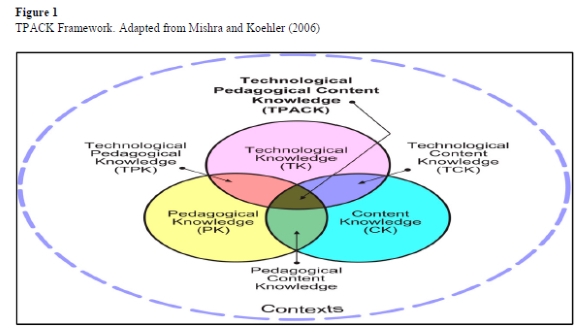
The TPACK framework proposes that teachers are required to understand the different but interrelated forms of knowledge as indicated above to orchestrate and manage technology, pedagogy, and content in teaching (Valtonen et al., 2017). We found this theory appropriate for this study because of the blended nature of instruction that participants in this study would need to use. These include Support for Autonomy in which ChatGPT offers mathematics teachers the freedom to look for resources on their own and modify their lesson plans to suit the needs of their learners (Wardat et al., 2023). ChatGPT empowers mathematics teachers to develop confidence and expertise in teaching mathematics, in providing detailed explanations and resources for professional growth (Lai et al., 2023), and facilitates connections among mathematics teachers, allowing them to engage in sharing best practices, and offers a sense of belonging within the mathematics education community (Kilinç, 2023).
Methodology
Sample
The population of this study was limited to 103 high school mathematics teachers in Alfred Nzo District in the Eastern Cape, South Africa. The focus on this specific geographic area ensured a local analysis of the use of AI-based ChatGPT among grade 12 mathematics teachers. We used an interpretive paradigm, with a qualitative approach, to detail the experiences of teachers who teach mathematics by blending in technological media during lessons. We employed a purposive sample of ten mathematics teachers. This approach aims to account for the information-rich cases related to the phenomenon of interest (Creswell and Báez 2020). Of these, 40% were teachers with more than 20 years of experience in teaching high school mathematics. In this group, participants were teaching mathematics using the traditional chalk and board approach and had limited exposure to AI tools. Of these teachers, 30% had had eight years of teaching experience. In this group, participants had had some exposure to AI tools. One participant had been teaching for less than a year but was highly knowledgeable about AI tools. Participants were purposively chosen (see Creswell, 2014) based on their experiences and their advanced degree of familiarity with using technology in teaching mathematics to guarantee the validity of the data collected. Participants provided recorded consent to participate in the study. To gain in-depth narratives from participating teachers, the semi-structured interviews and lesson observations were used as the main data collection techniques for this study (see Creswell, 2014). During April 2023, we conducted the semi-structured interviews with ten teachers to gain insights into their experiences of teaching mathematics by blending ChatGPT as an AI tool during lessons. Teachers were grouped into two groups of five teachers per group. Interview sessions lasted for one hour and thirty minutes per slot. The interview schedule consisted of twelve interview questions which were grouped into sections. The first section consisted of four questions based on participants' general knowledge of AI tools including ChatGPT. The second set focused on participants experiences in interacting with ChatGPT, and the last four questions focused on participants' perceptions on the use of ChatGPT in relation to solving mathematical problems. The interview questions and observation schedule were adapted from a scientifically based research instrument used by Davis and Thompson (2005) to evaluate grade 12 teachers' perceptions on the use of ChatGPT when teaching geometry. We asked the following open-ended questions: (1) Are you aware of ChatGPT? (2) How did you learn about ChatGPT? (3) Have you ever used ChatGPT in teaching? If so, in which topic? (4) How has ChatGPT influenced your teaching? In September 2023, after the teachers had been exposed to some AI tools, we conducted observations to evaluate their experiences of using ChatGPT. The two phases allowed for an in-depth analysis by enabling the exploration and probing of issues identified in observations. Table 1 below is an observation tool that we used in collecting the data.
Data was collected in April 2023, and in September 2023. The two phases allowed for an in-depth analysis by enabling the exploration and probing of issues identified in observations. During the field conversations, we used a maximum variability approach to access as many different points of perception as possible on the issues of interest. The information power principle (Malterud et al., 2016) guided the data collection process by diverting attention from the sample size to the information power contained in the sample. The process of data collection focused on participants' experiences with the use of ChatGPT in teaching during mathematics lessons. The qualitative data from the semi-structured interviews and observations was analysed using an inductive analysis approach.
Findings
As mentioned above, an inductive data analysis approach was used as the analytical framework underpinning this study. According to Bell et al., (2022, p. 411), the inductive analytical framework considers "contextual understanding" which accentuates researchers' attempts to understand the "behaviour, values, beliefs, and other attributes, in terms of the context in which the research is conducted." In using the inductive approach to analysis, we sought to understand teachers' narratives on the potential affordances and consequences of integrating ChatGPT in grade 11 mathematics classrooms. A qualitative inductive approach to analysis assists researchers to interpret complex cultural and institutional settings of the mathematics instruction (Birkinshaw et al., 2011). Therefore, qualitative research is more likely to provide meaningful contexts and clarity to the research questions and concepts within social settings instead of providing the hypothesis and testing of variables.
The results of the inductive thematic analysis indicated that teachers perceived ChatGPT as a useful tool with prospects to transform the teaching of mathematics. However, there were also several concerns regarding the output provided based on the data input to ChatGPT. The section that follows presents the summary of the themes that emerged from the data. In the first section of the data analysis, we present the themes based on observations.
Teachers' experiences with AI
This theme focused on the broader experiences of teachers in encompassing their acquaintance with web-based integrated applications. The goal of establishing the teachers' proficiency levels was to understand how they were using AI tools and what was expected of them (see Beccari & Oliveira, 2011), together with obtaining knowledge about different artificial intelligence applications ranging from low level to digital technologies such as the internet, chatbots, and software programs (Schmidt et al., 2009). Four of the ten educators shared their experiences using Google Assistant for a variety of tasks, including preparing essays, playing online games, and sending birthday, bereavement, and wedding cards. Three educators mentioned how helpful Bing is for finding files, building addresses, and laptop data. One teacher indicated that they use ChatGPT to help in developing lesson plans. Teacher A said,1
I use ChatGPT when I have run out of ideas in developing my lesson plans. I type, 'Help me with the development of the lesson plan for the topic inverse functions.' I then use the results to beef up my existing lesson plan.
Teacher J said, "Google assistant helps me to create messages based on the occasion. I can ask it to create a message for a birthday celebration, or to wish a friend well." For Teacher C, "Bing normally helps me with physical locations for buildings such as municipal offices, malls, and general directions. Teacher F explained, "I enjoy playing games using Google Assistant. These games are addictive."
Teachers' beliefs on the use of ChatGPT to improve mathematics problem solving
Teachers expressed their perceptions on the use of ChatGPT in improving mathematics problem-solving. The theme was important to their understanding of how using ChatGPT can change the way learners use, understand, and practise concepts in mathematics (Schmidt et al., 2009). Differing reactions emanated from this theme. Some teachers were impressed with ChatGPT's capability to solve mathematics problems. This is because of the wide range of Gen-AI data repositories such as texts, videos, images, and codes (Sanchez-Ruiz et al., 2023) that produce answers at a very fast processing speed. However, most of the participants had reservations about ChatGPT in performing mathematical calculations. One example is the difficulty of the software to provide shortened alternative answers. For Teacher B, "Over-dependence on ChatGPT for learning and problem-solving, because learners may use it blindly, this hamper their ability to think critically and be independent mathematics problemsolvers." Teacher E said,
I am cautious of introducing the ChatGPT during class. Learners may use it to finish homework and out of class activities, weakening the teaching, learning processes, and hampering the development of critical problem-solving competencies. Long answers do not make it easier for some learners. As such they tend to copy and paste without analysing the answer provided.
For Teacher H, "ChatGPT is user-friendly. A user copy and paste the question onto the interface, the tool analyses the problem and provides several ways of solving it." Teacher I said,
It is easier to understand the solution to the problem. Using ChatGPT is much better and faster to get to solutions, unlike the traditional paper and pencil approach to problem-solving. But I could not get a shortened alternative answer to the question.
For Teacher G, "ChatGPT release updates to enhance the capability to improve mathematics problem solving."
ChatGPT's capability to solve mathematical problems
This theme focused on participants' perceptions of the effectiveness of ChatGPT in providing solutions to a mathematical question. Teachers' responses were based on firsthand interactions with the tool, as well as on the possibility of determining potential inconsistencies in the solution strategies. The theme was important to teachers' understanding of how ChatGPT can be used in teaching and how the tool can change the way in which the instructional process is managed (see Schmidt et al., 2009). Teachers were impressed with ChatGPT's capability to solve some mathematics problems with accuracy, its aptitude for performing mathematical operations, its manipulating of algebraic expressions, and its solving complex mathematics problems with ease. One teacher used the following mathematical problem.
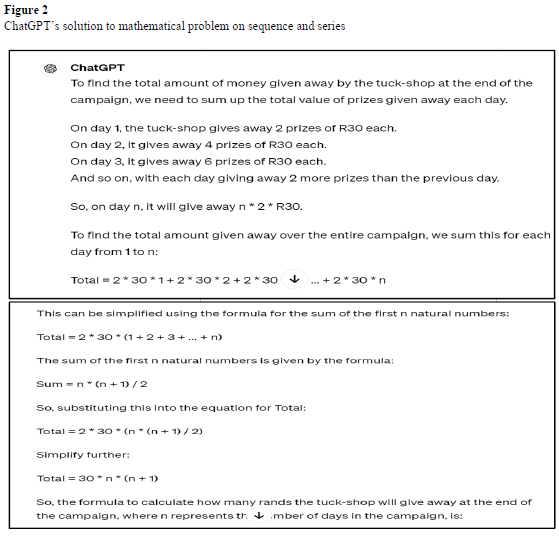
The school tuck-shop offers to give away two R30 prizes on day one, beginning of 1st February 2024. They will give away four R30 prizes the next day, six R30 prizes and so on, giving away more R30 prizes each day than the previous day. If n represents the number of days in the campaign, find the formula to calculate how many rands will the tuck-shop give away at the end of the campaign. Each problem solution is presented below. Participants reflected on the output to questions (input) to the ChatGPT.
Figure 2 shows how ChatGPT can clearly and intelligibly explain the solution strategy for the sequence and series concept in a manner that is appropriate for grade 12 mathematics teaching. For example, ChatGPT produced an explanation in less time than it would have taken a person to write it down by hand (see Von Hippel, 2020). The efficiency of ChatGPT is impressive. However, breaking up the two lengthy statements into smaller ones would have been preferable. When asked to comment on the solution strategy as presented in figure 2, Teacher A said, "The solution strategy is easily broken down and simplified, making it easier for the user to understand"
I always verify the output generated by ChatGPT to ensure that the answers it provides is the same as the one I get. Most of the time the generated answer is correct. While I appreciate the solutions generated by ChatGPT, the solution path tends to be too long.
Recent version of ChatGPT enables it to perform complex mathematical calculations with precision and provide more accurate results. But, the solution could have been

Using an inquiry approach to teaching, teachers enable learners to discern and evaluate essential information embedded in a mathematical scenario, arrange, and depict information, recognise trends, create hypotheses, and provide evidence for mathematical conclusions. To bolster the study, we contend that in a problem-solving situation, teachers and learners consider the coordinated use of digital tools and online advancements to involve them in an inquiry-based learning process that allows them to explore ideas and solve mathematical puzzles. Figure 3 below depicts the prompt for a question on trigonometry in grade 12 mathematics.
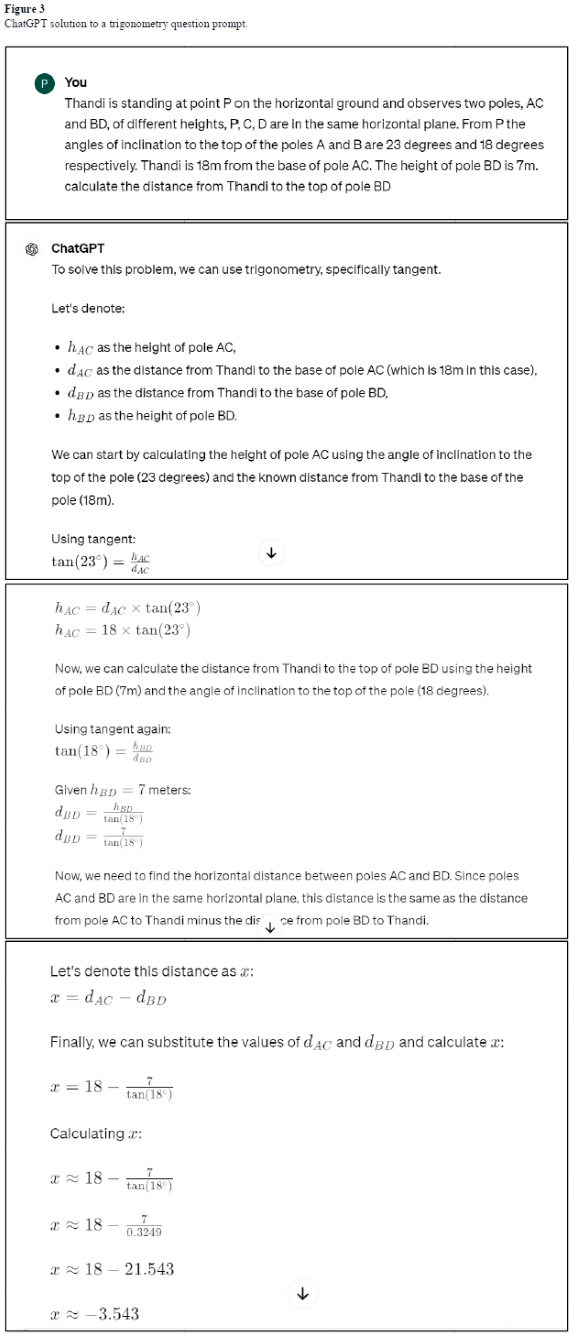
From Figure 3, ChatGPT participants used the prompt to seek the solution to the question. The aim was to evaluate the chatbot's capability to solve the problem. It is important to note that the way the question is written affects the AI's ability to understand the problem. In figure 3 above, ChatGPT provided a detailed solution with relevant explanations in problem solving which is a significant advantage regarding its use. Participants' reactions are noted below in relation to figure 3 above.
For Teacher H, "ChatGPT breaks down the question into smaller parts to understand the context of the question to analyze each part using the series of steps embedded in the data repository before it can generate the solution approach." For Teacher G,
I considered using ChatGPT when I realized that it is beneficial in solving mathematics problems and provides guidance. Online programs such as YouTube and Khan academy are helpful, but they are always prerecorded videos that offer solutions to general problems. Unfortunately, these prerecorded videos are unable to provide solutions to unique problems that may be encountered during teaching and learning.
Teacher D said, "ChatGPT is a useful resource for teachers and learners who require reliable mathematical solutions quickly." And for Teacher J, "Every time I enter the problem scenario differently to persuade ChatGPT to respond otherwise, it will still give the same accurate answer."
ChatGPT has been confirmed to be a useful tool for mathematics education in a short period. Problem-solving approaches generated by the tool have been rigorously evaluated to measure their effectiveness (Gilat & Cole, 2023). Integrating ChatGPT into a traditional mathematics classroom as a learner-centered approach allows for greater flexibility in how, when, and where learners learn, promoting the creation of customised learning experiences (Alser & Waisberg, 2023; Shen et al., 2023). The capacity of artificial intelligence to perform intricate mathematical processes demonstrates the advancements made by AI, which would not have been feasible in conventional educational approaches.
Discussions and implications
Synergies between teachers' perceptions of the use of ChatGPT for mathematics in grade 12 raise several implications for practice. In this section, we present the implications that stakeholders in mathematics education should take into consideration when integrating ChatGPT into the mathematics teaching and learning process. As reported in various studies (Lozano & Blanco Fontao, 2023; Rahman & Watanobe, 2023; Rospigliosi, 2023), findings revealed that ChatGPT possess the capabilities to transform the teaching of geometry in several ways. Rahman and Watanobe (2023) recommended targeted professional development initiatives to raise an awareness of mathematics teachers' knowledge and skills in incorporating ChatGPT in mathematics classrooms. Nevertheless, this study identified and discussed the potential and concerns from teachers regarding the use of ChatGPT in teaching mathematics.
Based on the experiences with ChatGPT, it appears that teachers are aware of the paradigm shift involving the introduction of AI-based technologies but in their personal lives and not in the classroom. This paradigm shift emphasises the importance of upskilling teachers' competencies with chatbot technology. Chatbots in education can be integrated into mathematics education spaces easily based on personal and everyday use in solving practical daily problems. This concurs with the strong belief among researchers (Erekson, 1992; Mathew-Thomas, 2017; Savage & Sterry, 1990), that technology is one of the types of formal knowledge that teachers require if they are to articulate the disciplinary knowledge and provide authentic expression of the curriculum.
As an AI language program, ChatGPT was found to be capable of improving mathematics problem-solving for teachers who participated in this study. However, it is important to recognise the extent to which it can be integrated into the instructional process. This should be done not only to improve problem solving in teaching geometry, but also to address the apprehensions indicated by teachers that over-dependence on the use of ChatGPT can hamper the understanding of mathematical concepts and inhibit critical and logical thinking skills when used in a teaching-learning environment that is not properly controlled. This is a sensitive issue especially with the mathematics teaching and learning activities that are planned to reinforce the assimilation of the learning content (Sanchez-Ruiz et al., 2023). Nonetheless, these challenges can be overcome through collaboration between teachers and developers to create clear AI tool interfaces that reduce concerns that prevent teachers from implementing ChatGPT in teaching. Adapting the teaching modalities that involve face-to-face instruction that include direct communication and immediate feedback, collaboration that promotes engagement among learners for knowledge sharing is necessary to balance the use of ChatGPT and remediate over reliance on it. The face-to-face teaching and learning modality aims to foster active engagement during the learning process with the goal of encouraging learners to master the required problem-solving skills and enhance their performance and critical thinking skills. However, the findings in this study indicate that ChatGPT can provide responses to geometry problems in the blink of an eye, so learners do not have to develop and engage critical thinking skills.
Teachers' opinions on the capability of ChatGPT to evaluate and decompose complex geometry problems into smaller manageable constituents using the natural language processing indicated that the tool can be trusted to provide accurate solution strategies within a few seconds of providing input data. Data generated from ChatGPT in the form of figures 2 to 4 revealed that the tool can perform geometry problem-solving. But the correctness of the solution strategy depends on the accuracy of the input data, the instructions given to the AI, and the complexity of the question. In addition, ChatGPT was initially developed for natural language processing activities such as language generation, translation, and the answering of questions (Wardat et al., 2023) and was not developed for complex mathematics problem-solving tasks. Therefore, teachers are encouraged to recheck the responses and solution paths before accepting them as correct. Similarly, it is recommended that extensive training programs that go beyond technical challenges to enable teachers to overcome challenges in integrating ChatGPT in teaching geometry, be provided for teachers.
Conclusions
In this paper we have tried to present teachers' perceptions on the use of ChatGPT in teaching grade 12 mathematics. We were prompted by the realisation that artificial intelligence has become more prevalent in education, creating efficient teaching strategies that make use of the potential of these technologies while recognising their limitations will become more difficult. As the results of using these tools become more evident, the influence of AI's development in mathematics education requires constant evaluation. It is anticipated that the employment of AI in these same regulated settings will be anecdotal, entirely unsuitable, and repugnant in its application during the course since learners are required to demonstrate the acquisition of knowledge and competencies at several mathematics assessment points. The results of the study revealed the capability of the ChatGPT in teaching mathematics, as believed by most of the participants given their positive perceptions. Additionally, ChatGPT improves comprehension of the problem-solving process by providing a step-by-step explanation of the procedure needed to solve the mathematical problems in addition to solutions. However, it is crucial to remember that using ChatGPT may affect how well the instructional process is designed to improve the ability to think critically and solve problems. As a result, it is crucial for a teacher to strike a balance between using ChatGPT affordances and ensure that learners acquire the skills required to thrive in academic space. In summary, ChatGPT presents both the benefits and drawbacks based on different teaching and learning contexts. Although technology provides simple access to a wealth of knowledge and educational resources, it also raises questions about the accuracy of the assessments of learners' learning progress, the moral application, and simplifying of the educational process. Integration that works well on successful integration of ChatGPT requires a balanced approach, where it complements human interaction and guidance. Teachers and educational institutions must monitor its use carefully to ensure that it supports the learning process rather than hindering it.
References
Ali, J., Shamsan, M., Hezam, T., & Mohammad, A. (2023). Impact of ChatGPT on learning motivation: Teachers and students' voices. Journal of English Studies in Arabia Felix, 2(1), 41-49. https://doi.org/10.56540/jesaf.v2i1.51 [ Links ]
Aljanabi, M. (2024). Assessing the Arabic parsing capabilities of ChatGPT and Cloude: An expert-based comparative study. Mesopotamian Journal of Arabic Language Studies, 16-23. https://doi.org/10.58496/MJALS/2024/002
Alser, M., & Waisberg, E. (2023). Concerns with the usage of ChatGPT in academia and medicine: A viewpoint. American Journal of Medicine Open, 9, 100036. https://doi.org/10.1016/j.ajmo.2023.100036 [ Links ]
Bang, Y., Cahyawijaya, S., Lee, N., Dai, W., Su, D., Wilie, B., Lovenia, H, Ji, Z, Yu, T, Chung, W, Do, Q, Xu, Y, & Fung, P. (2023). A multitask, multilingual, multimodal evaluation of ChatGPT on reasoning, hallucination, and interactivity. https://doi.org/10.48550/arXiv.2302.04023
Beccari, M. N., & Oliveira, T. L. (2011, July 9-14). A philosophical approach about user experience methodology [Conference session]. DUXU 2011 International Proceedings, Orlando, FL. United States. https://doi.org/10.1007/978-3-642-21675-6_2
Bell, E., Bryman, A., & Harley, B. (2022). Business research methods. Oxford University Press.
Birkinshaw, J., Brannen, M. Y., & Tung, R. L. (2011). From a distance and generalizable to up close and grounded: Reclaiming a place for qualitative methods in international business research. Journal of International Business Studies, 42, 573-581. https://doi.org/10.1057/jibs.2011.19 [ Links ]
Creswell, J. W. (2014). Research design: Qualitative, quantitative and mixed methods Approaches (4th ed.). Sage.
Creswell, J. W., & Báez, J. C. (2020). Thirty essential skills for the qualitative researcher. Sage.
Crust, G. (2023). ChatGPT employability study skills and curriculum development. https://doi.org/10.13140/RG.2.2.35643.28960
Davis, N., & Thompson, A. (2005). The evaluation of technology-related professional development, Part 2. In Society for Information Technology & Teacher Education International Conference (pp. 825-830). Association for the Advancement of Computing in Education (AACE). Retrieved February 3, 2024, from https://www.learntechlib.org/primary/p/19115/
de Winter, J. C. (2023). Can ChatGPT pass high school exams on English Language Comprehension? International Journal of Artificial Intelligence in Education, 1-16. https://doi.org/10.1007/s40593-023-00372-z
Egara, F. O., & Mosimege, M. (2024). Exploring the integration of artificial intelligence based ChatGPT into mathematics instruction: Perceptions, challenges, and implications for educators. Education Sciences, 14(7), 742. https://doi.org/10.3390/educsci14070742 [ Links ]
Eke, D. O. (2023). ChatGPT and the rise of generative AI: Threat to academic integrity? Journal of Responsible Technology, 13, 100060. https://doi.org/10.1016/jjrt.2023.100060 [ Links ]
Erekson, T. (1992). Technology education from the academic rationalist theoretical perspective. Journal of Technology Education, 3(2), 6-14. https://doi.org/10.21061/jte.v3i2.a.2 [ Links ]
Gilat, R., & Cole, B. J. (2023). How will artificial intelligence affect scientific writing, reviewing, and editing? The future is here. . . Arthroscopy, 39(5), 1119-1120. https://doi.org/10.1016/j.arthro.2023.01.014 [ Links ]
Gudmundsdottir, S., & Shulman, L. (1987). Pedagogical content knowledge in social studies. Scandinavian Journal of Educational Research, 31(2), 59-70. https://doi.org/10.1080/0031383870310201 [ Links ]
Guo, Q., Cao, J., Xie, X., Liu, S., Li, X., Chen, B., & Peng, X. (2024, February,). Exploring the potential of ChatGPT in automated code refinement: An empirical study. [Conference session]. 46th IEEE/ACM International Conference on Software Engineering, Lisbon, Portugal. https://doi.org/10.1145/3597503.3623306
Hidayat, H., Sukmawarti, S., & Suwanto, S. (2021). The application of augmented reality in elementary school education. Research, Society and Development, 10(3), e14910312823-e14910312823. [ Links ]
Hodge-Zickerman, A., & York, C. S. (2024). Humanizing mathematics in online learning environments. In E. Gray & D. Dunn Shernette (Eds.), Incorporating the human element in online teaching and learning (pp 114-136). ProQuest Ebook Central. https://doi.org/10.4018/979-8-3693-4131-5.ch006
Kilinç, S. (2023). Embracing the future of distance science education: Opportunities and challenges of ChatGPT integration. Asian Journal of Distance Education, 18(1), 205-237. https://doi.org/10.5281/zenodo.7857396 [ Links ]
Lai, C., Wang, Q., & Huang, X. (2023). The evolution of the association between teacher technology integration and its influencing factors over time. Journal of Research on Technology in Education, 55(4), 727-747. https://doi.org/10.1080/15391523.2022.2030266 [ Links ]
Lim, W. M., Gunasekara, A., Pallana, J. L., Pallant, J. I., & Pechenkina, E. (2023). Generative AI and the future of education: Ragnarök or reformation? A paradoxical perspective from management educators. The International Journal of Management Education, 21(2), 100790. https://doi.org/10.1016/j.ijme.2023.100790 [ Links ]
Lozano, A., & Blanco Fontao, C. (2023). Is the education system prepared for the irruption of artificial intelligence? A study on the perceptions of students of primary education degree from a dual perspective: Current pupils and future teachers. Education Sciences, 13(7), 733. https://doi.org/10.3390/educsci13070733 [ Links ]
Malterud, K. (2016). Theory and interpretation in qualitative studies from general practice: Why and how? Scandinavian Journal of Public Health, 44(2), 120-129. https://doi.org/10.1177/1403494815621181 [ Links ]
Mathew Thomas, T. (2017). An investigation of the integration of science, mathematics and technology within a technological design context [Doctoral dissertation, University of Waikato]. [ Links ]
Mhlanga, D. (2023). Open AI in education, the responsible and ethical use of ChatGPT towards lifelong learning. Available at https://papers.ssrn.com/sol3/papers.cfm?abstract_id=4354422
Mhlongo, S., Mbatha, K., Ramatsetse, B., & Dlamini, R. (2023). Challenges, opportunities, and prospects of adopting and using smart digital technologies in learning environments: Systematic Review and Meta-analysis, 9(6) 1-20. https://doi.org/10.1016/j.heliyon.2023.e16348 [ Links ]
Mishra, P., & Koehler, M. J. (2006). Technological pedagogical content knowledge: A framework for teacher knowledge. Teachers' College Record, 108(6), 1017-1054. https://doi.org/10.1467-9620.2006.00684.x [ Links ]
Pardos, Z. A., & Bhandari, S. (2023). Learning gain differences between ChatGPT and human tutor generated algebra hints. Arxiv. https://doi.org/10.48550/arXiv.2302.06871
Rahman, M. M., & Watanobe, Y. (2023). ChatGPT for education and research: Opportunities, threats, and strategies. Applied Sciences, 13(9), 5783. https://doi.org/10.3390/app13095783 [ Links ]
Rospigliosi, P. A. (2023). Artificial intelligence in teaching and learning: what questions should we ask of ChatGPT? Interactive Learning Environments, 31(1), 1-3. https://doi.org/10.1080/10494820.2023.2180191 [ Links ]
Rudolph, J., Tan, S., & Tan, S. (2023). ChatGPT: Bullshit spewer or the end of traditional assessments in higher education? Journal of Applied Learning and Teaching, 6(1), 342-363. https://doi.org/10.37074/jalt.2023.6.1.9 [ Links ]
Sánchez-Ruiz, L. M., Moll-López, S., Moraño-Fernández, J. A., & Roselló, M. D. (2021). Dynamical continuous discrete assessment of competencies achievement: An approach to continuous assessment. Mathematics, 9(17), 2082. https://doi.org/10.3390/math9172082 [ Links ]
Sánchez-Ruiz, L. M., Moll-López, S., Nuñez-Pérez, A., Moraño-Fernández, J. A., & Vega-Fleitas, E. (2023). ChatGPT challenges blended learning methodologies in engineering education: A case study in mathematics. Applied Sciences, 13(10), 6039. https://doi.org/10.3390/app13106039 [ Links ]
Santos-Trigo, M., Barrera-Mora, F., & Camacho-Machín, M. (2021). Teachers' use of technology affordances to contextualize and dynamically enrich and extend mathematical problem-solving strategies. Mathematics, 9(8), 793. https://doi.org/10.3390/math9080793 [ Links ]
Savage, E., & Sterry, L. (1990). A conceptual framework for technology education.
Shahriar, S., & Hayawi, K. (2023). Let's have a chat! A Conversation with ChatGPT: Technology, applications, and imitations. Arxiv. https://doi.org/10.48550/arXiv.2302.13817
Shulman, L. S. (1986). Those who understand: Knowledge growth in teaching. Educational Researcher, 15(2), 4-14. https://doi.org/10.3102/0013189X015002004 [ Links ]
Schmidt, D. A., Baran, E., Thompson, A. D., Koehler, M. J., Mishra, P., & Shin, T. (2009). Technological pedagogical content knowledge (TPACK): The development and validation of an assessment instrument for preservice teachers. Journal of Research on Technology in Education, 42(2), 123-149. https://doi.org/10.1080/15391523.2009.10782544 [ Links ]
Shen, Y., Heacock, L., Elias, J., Hentel, K. D., Reig, B., Shih, G., & Moy, L. (2023). ChatGPT and other large language models are double-edged swords. Radiology, 307(2), e230163. https://doi.org/10.1148/radiol.230163 [ Links ]
Tenhundfeld, N. L. (2023, October 23-27 October). Two Birds with One Stone: Writing a paper entitled "ChatGPT as a tool for studying human-ai interaction in the wild" with ChatGPT [Presentation]. The Human Factors and Ergonomics Society Annual Meeting, Los Angeles, CA, United States. https://journals.sagepub.com/doi/10.1177/21695067231192916
Valtonen, T., Sointu, E., Kukkonen, J., Kontkanen, S., Lambert, M. C., & Mäkitalo-Siegl, K. (2017). TPACK updated to measure pre-service teachers' twenty-first century skills. Australasian Journal of Educational Technology, 33(3). https://doi.org/10.14742/ajet.3518 [ Links ]
Von Hippel, P. T. (2020). How many imputations do you need? A two-stage calculation using a quadratic rule. Sociological Methods & Research, 49(3), 699-718. https://doi.org/10.1177/0049124117747303 [ Links ]
Wardat, Y., Tashtoush, M. A., AlAli, R., & Jarrah, A. M. (2023). ChatGPT: A revolutionary tool for teaching and learning mathematics. Eurasia Journal of Mathematics, Science and Technology Education, 19(7), em2286. https://doi.org/10.29333/ejmste/13272 [ Links ]
Received: 20 May 2024
Accepted: 27 May 2025
1 The teachers' responses have not been edited.
