




Services on Demand
Journal

Article
 English (pdf)
 Article in xml format
 Article references
 Automatic translation
 Send this article by e-mail
Indicators
Related links
-
 Cited by Google
 -
 Similars in Google
Share

 Permalink
Wits Journal of Clinical Medicine
On-line version ISSN 2618-0197Print version ISSN 2618-0189
WJCM vol.7 n.3 Johannesburg 2025
https://doi.org/10.18772/26180197.2025.v7n3a
OPINION PIECE
Nanomedicine for infectious diseases, oncology, and neurotherapeutics
Lisa C. du ToitI, II; Yahya E. ChoonaraI, II
IWits Advanced Drug Delivery Platform Research Unit, Department of Pharmacy and Pharmacology, School of Therapeutic Science, Faculty of Health Sciences, University of Witwatersrand, Johannesburg, Parktown 2193, South Africa
IIInfectious Diseases and Oncology Research Institute (IDORI), Faculty of Health Sciences, University of the Witwatersrand, Johannesburg, South Africa
INTRODUCTION
In 1959, Richard Feynman delivered his groundbreaking lecture "There's Plenty of Room at the Bottom," envisioning nanoscience to control matter at the atomic level. (1) The 1980s saw significant advancements with the emergence of crucial instruments like the Atomic Force Microscope (AFM), which served as both the "eyes" and "fingers" for precise nanoscale measurement of materials. These developments laid the foundation for scientists to visualize nano-matter and explore it at an atomic level, paving the way for the nano-revolution and innovations in nanomedicine. Nanotechnology is an enabling technology that permeates modern life. In medicine, it exploits the unique functional properties of materials on the nanometre scale (1-100 nm) to enable targeted drug delivery, imaging, and diagnostics. For instance, gold, once valued for its lustre in jewellery, is now being used in nanomedicine for its ability to absorb light, enabling applications like photo-thermal therapy for cancer treatment.
In a world where nanomedicine achieves its full potential, treatments could precisely target diseased cells only, delivering the minimum effective dose, thereby minimising or eliminating side effects and improving treatment outcomes and patient quality of life. A key value proposition of nanomedicine is its ability to enhance drug efficacy for patients by improving the solubility, stability, and bioavail-ability of drugs, unlocking the full potential of existing and new drug therapies.
The nanomedicine industry has made significant progress and is projected to reach $410 billion by 2030, driven by innovations in targeted drug delivery, cancer treatment, and vaccine development.(2) Notably, lipid nanoparti-cles (LNPs) played a crucial role in the development of COVID-19 mRNA vaccines, showcasing how nanomedicine can address global health challenges. Figure 1 provides an overview of selected clinically relevant nanomedicines since 1975.

More precise, efficient, versatile, and personalised drug delivery can be achieved by engineering nanoparticles to target diseased cells or tissues, while reducing off-target effects. These nanoparticles can be functionalized to bind to specific cell surface receptors, and multifunctional nanoparticles are also able to serve as imaging tools for diagnostics. More tailored nanoparticle designs can meet individual patient needs, considering genetic profiling and disease characteristics. In addition, certain nano-archetypes can facilitate real-time monitoring to release drugs only in response to specific physiological signals. The majority of nanomedicine advances have been made in three clinical domains, i.e., infectious diseases, oncology, and neurotherapeutics.
NANOMEDICINE FOR INEFECTIOUS DISEASES
Nanomedicine has emerged as a transformative strategy in infectious disease therapeutics. Progressive research covers various aspects, ranging from HIV prevention and treatment to nanocarriers for tuberculosis (TB) and fighting antimicrobial resistance (AMR).
du Toit et al. (4) discussed nano-microbicides as topical prophylactic interventions against HIV transmission. They examined nano-formulation strategies to encapsulate antiretrovirals for mucosal delivery to enhance bioavailability and prolong local vaginal residence. Aspects of patient ethics, cultural acceptance, and intellectual property are often overlooked dimensions, and informed consent, stigmatisation, and equitable access were emphasised as critical determinants of nano-microbicide adoption. Furthermore, the authors highlighted that IP restrictions limit affordable access in high-burden, low-to-middle-income countries (LMICs), undermining public health impact. These concepts were further explored by Pillay et al.,(5) reiterating that effective microbicide development requires pharmacological efficacy and user acceptability with compliance. The socio-behavioral factors often determine real-world impact.
The investigation ofMashingaidze et al. (6) brought these theoretical requisites to fruition by designing nano-matrices embedded in a polymeric caplet for sustained intravaginal delivery of the model drug zidovudine (AZT). The nano-enabled system achieved mucosal compatibility and extended AZT release over several days, addressing adherence limitations of conventional dosing.
Advancements in nanomedicine for TB treatment are also pertinent to LMICs. Foundationally, du Toit et al. (7,8) developed an aerosolisable isoniazid nanosystem via an innovative salting-out and crosslinking approach using green synthesis, producing a scalable technology. The work was further advanced by developing super-stable polymeric nanoparticles for sustained anti-TB drug delivery (9) using augmented sophistication in nanoparticle engineering for greater structural stability and controlled drug release. The emphasis on "super-stability" is critical in TB, where mul-tidrug regimens require prolonged exposure. Stable carriers that resist premature degradation ensure consistent delivery, reduce systemic peaks, and mitigate drug resistance by maintaining inhibitory concentrations.
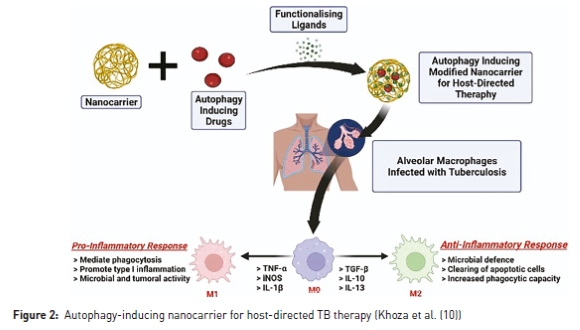
Khoza et al. (10) reviewed recent strategies against drug-resistant TB, emphasising host-directed therapy and autophagy-inducing nanoparticles (Figure 2); highlighting that nanoparticle modifications that enhance immune responses, promote intracellular drug delivery, and stimulate autophagy, offering promising adjunctive approaches to overcome resistance, improve treatment efficacy, and reduce reliance on conventional antibiotics.
The next iteration following this success is the use of functionalised bio-inspired polydopamine nanoparticles for TB.(11) Polydopamine has strong adhesion with facile surface functionalisation to target infected macrophages using pH-sensitive anti-TB drug release for the phago-lysosomal environment of Mycobacterium tuberculosis. This nanosystem provides a modular and responsive approach that integrates with multiple anti-TB agents and underscores the ongoing shift toward stimuli-responsive and multifunctional immune-modulatory nanosystems.
A study by Harilall et al. (12) extended nanomedicine into the challenging domain of neuro-HIV management using a nano-enabled scaffold as a brain insert for sustained ARV delivery into the CNS to treat AIDS Dementia Complex (ADC). As the blood-brain barrier (BBB) restricts drug penetration, a localised delivery system helped accumulate the drug at the BBB and achieved therapeutic concentrations of the drug in the brain tissue. Notably, this investigation began integrating tissue engineering principles with nanomedicine using scaffolds that provided sustained drug release with neurodurability. Preclinical data confirmed drug delivery over an extended period to address CNS reservoirs of HIV that drive persistent infection and neuro-cognitive decline.
These investigations illustrate a progressive trajectory in nanomedicine for infectious diseases from foundational nano-formulation science to conceptual framing within a socio-ethical context. The recognition of ethical and translational barriers is essential, with a steady movement toward clinically validated nanomedicines being the next hurdle to successful translation.
NANOMEDICINE FOR ONCOLOGY
Cancer nanomedicine continues to evolve as a multidiscipli-nary field, offering progressive solutions to limitations in conventional chemotherapy such as poor drug solubility, systemic toxicity, rapid drug clearance, chemo-resistance and tumour heterogeneity. Various nanomedicine strategies for drug, protein, and gene delivery are being advanced across different cancers, therapeutic modalities, and design approaches.
Recently, Hélder Santos (13) highlighted the growing interest in protein and RNA-based therapeutics in oncology, especially as immunotherapy and apoptosis-inducing strategies. Despite their promise, such macromolecules are limited by in vivo instability, immunogenicity, and poor intracellular uptake. Santos underscores the value of nan-oparticles (e.g. nanoliposomes, polymeric nanoparticles, nano-sized dendrimers, and hybrid nanosystems) to protect fragile biologics, prolonging systemic exposure, and enhancing endosomal escape. This includes combination therapies, where nanocarriers co-deliver biologics with chemotherapeutics or immune modulators to maximise efficacy, highlighting nanomedicine as a carrier technology and a therapeutic integrator that aligns biological specificity with delivery precision.
Early investigations by Sibeko et al. (14) re-engineered conventional chemotherapy into nanomedicine to reduce dosing frequency and systemic side effects. The team developed methotrexate-loaded polylactic-methacrylic acid copolymer nanoparticles with sustained release, improved solubility, and reduced cytotoxicity to non-cancerous cells in vitro.
Advances in cancer nanomedicine also include innovative leveraging of tumour-derived exosomes as drug nanocarriers by Yong and colleagues.(15) Exosomes inherently possess homotypic targeting capabilities, preferentially accumulating in their parental tumour cells. The study demonstrated efficient loading of doxorubicin into exosome-based nanoparticles, which significantly improved delivery efficiency and therapeutic outcomes in murine models (Figure 3). This investigation highlighted biomimetism in nanomedicine, i.e. the design of nanocarriers inspired by, or directly derived from, natural vesicles to bypass immune clearance and exploit endogenous signalling pathways. The scalability and reproducibility would need to be further investigated for clinical translation.

Silveira and colleagues (16) reviewed the mechanisms by which nanomedicine could enhance immunotherapy for colorectal cancer, which is often marked by immune evasion and poor checkpoint-inhibitor responses. Nanoparticles can co-deliver tumour antigens with adjuvants, modulate tumour-associated macrophages, or target suppressive regulatory T cells. This gap was underscored by the few engineered nanosystems developed for precise immune modulation. There is a need to expand nanomedicine from drug-centric to immunologically intelligent platforms for more durable cancer control.
Further progressive research in this area is evident by Adeyemi and co-authors (17) who developed a thermo-sonic organogel embedding 5-fluorouracil-loaded solid lipid nanoparticles for intracervical administration. The nanosystem combined thermal and ultrasound triggers to enhance drug penetration and increase intratu-moral concentrations with a minimally invasive approach for cervical cancer therapy. This prototype is a further step towards personalised non-systemic nanomedicine for cervical cancer.
Ngema and co-workers (18) formulated mesoporous polydopamine 'nano-bowls' loaded with paclitaxel for non-small cell lung cancer. The nano-bowls demonstrated high drug entrapment and pH-responsive release, exploiting the acidic tumour microenvironment to trigger drug unloading. In vitro studies showed significant inhibition of A549 lung cancer proliferation.
Benderski, Lammers, and Sofias (19) examined the design and clinical implications of multi-drug nanomedi-cines, co-encapsulated at fixed ratios. The authors proposed that nanocarriers can enforce optimal pharmacokinetic synchrony, a major limitation in free-drug combinations. By coordinating the release kinetics, multi-drug nanomed-icines may improve synergy and reduce resistance.
Adeyemi, Ngema, and Choonara (20) surveyed emerging nanomedicine strategies in haematological malignancies, focusing on nanomedicine for immune-therapeutics and gene modulators. Their review emphasised that the unique microenvironments of blood cancers (e.g., circulating cells, bone marrow niches) demand specialised nanocarrier engineering. Advances such as antibody-functionalised nan-oparticles and responsive release platforms are promising strategies to improve selectivity and overcome chemore-sistance in leukaemia and lymphoma.
Emerging trends in cancer nanomedicine highlight the transition from small-molecule chemotherapy to protein, RNA, and immunomodulatory therapies, with nanomed-icine central to overcoming delivery barriers. Biomimicry and responsiveness are increasingly applied facets, with exosome-inspired nanocarriers and stimuli-responsive designs (pH, heat, ultrasound) representing the cutting edge of translational innovation. The next decade will likely witness nanomedicine shift from proof-of-concept formulations to integrated therapies capable of transforming cancer care.
NANOMEDICINE FOR NEUROTHERAPEUTICS
The application of nanomedicine to neurodegenerative disorders has gained increasing traction, as conventional drug delivery methods often fail to overcome the BBB and achieve neurotherapeutic concentrations in the CNS. The potential of nanomedicine to treat neurodegeneration was elaborated by Mazibuko et al.,(21) providing a foundation on nanotechnology in Amyloid Lateral Sclerosis (ALS) treatment, extrapolating lessons from Parkinson's and Alzheimer's therapies. Nanostructures facilitate traversing the BBB, prolong circulation, and deliver neuro-active agents more effectively.
Building on this conceptual groundwork, several investigations by Mufamadi and colleagues (22-24) focused on the nano-enhanced delivery of galantamine, an acetylcho-linesterase inhibitor used in Alzheimer's disease therapy. In the study of Mufamadi et al.,(21) ligand-functional-ised nanoliposomes demonstrated targeted CNS delivery with improved specificity to reduce peripheral side effects. Subsequent research (23,24) enabled site-specific delivery with functionalised nanoliposomes embedded in a neuro-scaffold to provide extended drug release with intracellular accumulation of galantamine in PC12 cells, defining a translational trajectory from nano-formulations to hybrid delivery platforms capable of multimodal functionality.
Investigations focusing on innovative brain delivery routes for precision CNS targeting were brought to the fore by the study of Akilo et al.,(25) which elaborated a carmus-tine-loaded Nano-co-Plex for magnetic-targeted intranasal delivery to the brain as a non-invasive strategy to traverse the BBB for glioblastoma multiforme (GBM) therapy. Cell studies revealed enhanced uptake and internalisation of carmustine-loaded Nano-co-Plex in human glioblastoma cells in the presence of an external magnetic field (Figure 4). In complementary system developments, Akilo et al. (26) developed an in situ thermo-co-electro-responsive mucogel for localised, stimuli-responsive drug release. This nanosys-tem demonstrated pulsatile drug release under electrical stimulation, affording precise and controlled drug delivery.

Further significant nanomedicine developments for neurotherapy include the study of Martins et al.,(27) introducing a multifunctional, stimuli-responsive nano-platform for GBM therapy. Their system enhanced BBB penetration and tumour targeting by integrating multistage trafficking, a strategy that optimised drug release within the tumour microenvironment. This work exemplifies the cutting edge of neuro-oncological nanomedicine, emphasising adaptability and responsiveness as essential design features.
Together, these studies highlight key advances in nano-medicine as neurotherapeutics, with a paradigm shift from symptomatic relief to precision-targeted, multifunctional treatments. These investigations also underscore the importance of multidisciplinary collaboration, specifically between pharmaceutical and clinician scientists, to translate these nanomedicines toward clinical use.
In the realm of neurotherapeutics, nanomedicine is also significantly advancing ocular drug delivery. du Toit et al. (28) provided an early conceptual framework by exploring nano-bioadhesives for ocular applications, emphasising the potential of mucoadhesive nanomaterials to enhance precorneal residence time and drug penetration. This built the groundwork for the team (29) to design a nanocomposite with inflammation-targeting to treat posterior segment eye disorders. Preclinical evaluation of the nanosystem in inflamed New Zealand Albino rabbit eyes demonstrated that this nanosystem functioned aptly as an inflammation-responsive matrix for improved patient-specific care. Similarly, Hayiyana et al. (30) introduced ester-based cyclodextrin-based nanosponges to enhance the solubility of hydrophobic drugs for ocular therapeutics.
Further addressing posterior segment disorders, du Toit et al. (31) developed an injectable nano-enabled thermogel for controlled delivery of the p11 peptide, targeting ocular angiogenesis. The thermo-responsive nanosystem ensured localised and sustained delivery, offering a minimally invasive approach for age-related macular degeneration. Most recently, Naik et al. (32) reported in vivo evaluation of a nano-enabled vitreous substitute for triamcinolone delivery possessing dual-functionality as a vitreous tamponade and delivery system. This translational research demonstrated controlled drug delivery to the posterior segment, with potential to reduce the requirement for repeated intravit-real injections.
Collectively, these investigations demonstrate the versatility of nanomedicine in ocular drug delivery, showing promise for improved patient compliance, targeted therapy, and translation toward clinical application.
CONCLUSIONS
Nanomedicine is a rapidly growing field that offers tangible hope for treating previously untreatable diseases, but requires careful stewardship to ensure safe and effective applications. As nanomedicine advances for infectious diseases, cancers, and neurological diseases, a greater focus on safety, toxicity, and regulatory frameworks is crucial to mitigate risks while fostering innovation. Future developments in nanomedicine may include breakthroughs in gene delivery, such as ocular gene therapy, and the increased use of stable bio-metals and hybrid nanomaterials. The integration of AI and biomaterials could lead to innovative solutions like nano-robots, potentially addressing healthcare gaps and improving patient access. However, it is essential to consider the unique challenges and contexts of LMICs and ensure that nanomedicine innovations are accessible and beneficial to diverse populations worldwide.
REFERENCES
1. Grand View Research. Nanomedicine Market Size, Share & Trends Analysis Report by Application (Drug Delivery), by Indication (Clinical Oncology, Infectious Diseases), by Molecule Type, by Region, and Segment Forecasts, 2023-2030. Report ID: 978-1-68038-942-5. https://www.grandviewresearch.com/industry-analysis/nanomedicine-market [ Links ]
2. Feynman RP. There's plenty of room at the bottom. Lecture presented at: Annual Meeting of the American Physical Society; December 29, 1959; Pasadena, California. Eng Sci. 1960; 23(5):22-36. [ Links ]
3. Liu Q, Zou J, Chen Z, He W, Wu W. Current research trends of nanomedicines. Acta Pharm Sin B. 2023; 13(11):4391-4416. [ Links ]
4. du Toit LC, Pillay V, Choonara YE. Nano-microbicides: challenges in drug delivery, patient ethics and intellectual property in the war against HIV/AIDS. Adv Drug Deliv Rev. 2010; 62:532-546. [ Links ]
5. Pillay V, Kumar P, Ndesendo VMK, Choonara YE, du Toit LC. Dosage forms for microbicide formulations: advantages and pitfalls; In: das Neves J, Sarmento B, editors. Drug delivery and development of anti-HIV microbicides. Singapore: Pan Stanford Publishing Pte. Ltd.; 2014. 193-219. DOI: 10.1201/b17559-7. [ Links ]
6. Mashingaidze F, Choonara YE, Kumar P, et al. Submicron matrices embedded in a polymeric caplet for extended intravaginal delivery of zidovudine. AAPS J. 2017; 19:1745-1759. [ Links ]
7. du Toit LC, Pillay V, Danckwerts MP. Tuberculosis chemotherapy: current drug delivery approaches. Respir Res. 2006; 7:118:1-18. [ Links ]
8. du Toit LC, Pillay V, Choonara Y, Iyuke S. Formulation and evaluation of a salted-out isoniazid-loaded nanosystem. AAPS PharmSciTech. 2008; 9:174-181. [ Links ]
9. Choonara YE, Pillay V, Ndesendo VMK, et al. Polymeric emulsion and crosslink-mediated synthesis of super-stable nanoparticles as sustained-release antituberculosis drug carriers. Colloids Surf B Biointerfaces. 2011; 87:243-254. [ Links ]
10. Khoza LJ, Kumar P, Dube A, Demana PH, Choonara YE. Insights into innovative therapeutics for drug-resistant tuberculosis: host-directed therapy and autophagy inducing modified nanoparticles. Int J Pharm. 2022; 622:121893. [ Links ]
11. Okafor NI, Nnaji P, Nnolum-Orji NF, Choonara YE. Functionalized polydopamine nanoparticles: a promising drug delivery platform for the treatment of tuberculosis. Drug Dev Res. 2025; 86:e70109. [ Links ]
12. Harilall S, Choonara YE, Tomar LK, et al. Development and in vivo evaluation of an implantable nano-enabled multipol-ymeric scaffold for the management of AIDS dementia complex (ADC). Int J Pharm. 2015; 496:863-877. [ Links ]
13. Santos HA. Nanomedicines for gene and protein delivery. Lecture presented by Hélder A. Santos; 10 February 2025, hosted by Mariana Köber at the Institute of Materials Science of Barcelona (ICMAB). Available at: https://icmab.es/helder-a-santos-nanomedicines-for-gene-and-protein-delivery. [ Links ]
14. Sibeko B, Choonara YE, du Toit LC, et al. Composite poly-lactic-methacrylic acid copolymer nanoparticles for the delivery of methotrexate. J Drug Deliv. 2012; 579629:1-18. [ Links ]
15. Yong T, Zhang X, Bie N, et al. Tumor exosome-based nanoparticles are efficient drug carriers for chemotherapy. Nat Commun. 2019; 10:3838. [ Links ]
16. Silveira MJ, Castro F, Oliveira MJ, Sarmento B. Immunomodulatory nanomedicine for colorectal cancer treatment: a landscape to be explored? Biomater Sci. 2021; 9:3228-3243. [ Links ]
17. Adeyemi SA, Zardad A, Choonara YE. In vitro prototyping of a nano-organogel for thermo-sonic intra-cervical delivery of 5-fluorouracil-loaded solid lipid nanoparticles for cervical cancer. AAPS PharmSciTech. 2023; 24:123. [ Links ]
18. Ngema LM, Acter S, Adeyemi SA, et al. Mesoporous poly-dopamine nano-bowls demonstrate a high entrapment efficiency and pH-responsive release of paclitaxel for suppressing A549 lung cancer cell proliferation in vitro. Pharmaceutics. 2024; 16:1536. [ Links ]
19. Benderski K, Lammers T, Sofias AM. Analysis of multi-drug cancer nanomedicine. Nat Nanotechnol. 2025; 20(8):1163-1172. [ Links ]
20. Adeyemi SA, Ngema LM, Choonara YE. Advances in targeted therapies and emerging strategies for blood cancer treatment. RSC Pharm. 2025; 2:950-961. [ Links ]
21. Mazibuko Z, Choonara YE, Kumar P, et al. A review of the potential role of nano-enabled drug delivery technologies in amyotrophic lateral sclerosis: lessons learned from other neu-rodegenerative disorders. J Pharm Sci. 2015; 104:1213-1229. [ Links ]
22. Mufamadi MS, Choonara YE, Kumar P, et al. Ligand-functionalized nanoliposomes for targeted delivery of galan-tamine. Int J Pharm. 2013; 448:267-281. [ Links ]
23. Mufamadi MS, Choonara YE, Kumar P, et al. Functionalized nanolipobubbles embedded within a nanocomposite hydro-gel: a molecular bio-imaging and biomechanical analysis of the system. AAPS PharmSciTech. 2017; 18:671-685. [ Links ]
24. Mufamadi MS, Kumar P, du Toit LC, et al. Liposome-embedded, polymeric scaffold for extended delivery of galan-tamine. J Drug Deliv Sci Technol. 2019; 50:255-265. [ Links ]
25. Akilo OD, Choonara YE, Strydom AM, et al. An in vitro evaluation of a carmustine-loaded nano-co-plex for potential magnetic-targeted intranasal delivery to the brain. Int J Pharm. 2016; 500:196-209. [ Links ]
26. Akilo OD, Kumar P, Choonara YE, et al. In situ ther-mo-co-electroresponsive mucogel for controlled release of bioactive agent. Int J Pharm. 2019; 559:255-270. [ Links ]
27. Martins C, Araújo M, Malfanti A, et al. Stimuli-responsive multifunctional nanomedicine for enhanced glioblastoma chemotherapy augments multistage blood-to-brain trafficking and tumor targeting. Small. 2023; 19:e2300029. [ Links ]
28. du Toit LC, Pillay V, Choonara YE, Govender T, Carmichael T. Ocular drug delivery - a look towards nanobioadhesives. Expert Opin Drug Deliv. 2011; 8:1. [ Links ]
29. du Toit LC, Govender T, Carmichael T, et al. Design of an anti-inflammatory composite nanosystem and evaluation of its potential for ocular drug delivery. J Pharm Sci. 2013; 102:2780-2805. [ Links ]
30. Hayiyana Z, Choonara YE, Makgotloe A, et al. Ester-based hydrophilic cyclodextrin nanosponges for topical ocular drug delivery. Curr Pharm Des. 2016; 22:6988-6997. [ Links ]
31. du Toit LC, Choonara YE, Pillay V. An injectable nano-en-abled thermogel to attain controlled delivery of p11 peptide for the potential treatment of ocular angiogenic disorders of the posterior segment. Pharmaceutics. 2021; 13:176. [ Links ]
32. Naik K, du Toit LC, Ally N, Choonara YE. In vivo evaluation of a nano-enabled therapeutic vitreous substitute for the precise delivery of triamcinolone to the posterior segment of the eye. Drug Deliv Transl Res. 2024; 14:2668-2694. [ Links ]
 Correspondence:
yahya.choonara@wits.ac.za
