




Services on Demand
Journal

Article
 English (pdf)
 Article in xml format
 Article references
 Automatic translation
 Send this article by e-mail
Indicators
Related links
-
 Cited by Google
 -
 Similars in Google
Share

 Permalink
Journal of Vocational, Adult and Continuing Education and Training
On-line version ISSN 2663-3647Print version ISSN 2663-3639
JOVACET vol.7 n.2 Cape Town 2024
https://doi.org/10.14426/jovacet.v7i2.418
ARTICLES
Technical and vocational education and training (TVET) colleges and industry: Strengthening partnership-building practices
Tuletu NjengeleI; Penelope Engel-hillsII; Chris WinbergIII
ILovedale TVET College, King William's Town, South Africa ORCID link https://orcid.org/0000-0003-3919-3658 (Tuletu.Njengele@lovedale.org.za)
IIProfessional Education Research Institute, Bellville Campus, Cape Peninsula University of Technology, Cape Town, South Africa ORCID LINK https://orcid.org/0000-0002-1084-769X (engelhillsp@cput.ac.za)
IIIProfessional Education Research Institute, Bellville Campus, Cape Peninsula University of Technology, Cape Town, South Africa ORCID LINK https://orcid.org/0000-0001-6234-7358 (winbergc@cput.ac.za)
ABSTRACT
Partnerships between technical and vocational education and training (TVET) colleges and industry play an important role in enhancing the quality of TVET education, both in South Africa and globally. Effective college-industry partnerships enable TVET colleges to stay abreast of technological advancements and changing practices, ensuring their relevance in a time of rapid technological, social and economic change. This study was guided by the research question: How can TVET college-industry partnerships be strengthened to benefit students, colleges and industry? The research aimed to identify strategies for initiating and sustaining mutually beneficial partnerships. Using Activity Theory and a responsive evaluation methodology, the study uncovered challenges in building, maintaining and expanding TVET partnerships but also highlighted successful practices and examples of emerging transformative agency among management teams.
Keywords: TVET college; college-industry partnerships; Activity Theory; expansive learning; transformative agency
Introduction: What we know about TVET college-industry partnerships
Partnerships matter in the technical and vocational education and training (TVET) sector and they are key to improving the quality and outcomes of TVET provision in both South Africa (Petersen et al., 2016) and internationally (Beddie & Simon, 2017). Strong partnerships enable TVET colleges to be responsive to new technologies and new practices across occupations and fields and to maintain relevance in a time of rapid technological, social and economic change (Amey & Eddy, 2023). The primary beneficiaries of partnerships are therefore the TVET colleges themselves. Additional beneficiaries include students who are provided with enhanced learning experiences and also the employers, businesses, industries and communities linked to the partnerships. Because partnerships (with employers, industries and communities) play a role in financing, educational provision and employment opportunities in TVET, productive partnerships are commonly understood as having a multiplier effect in improving the quality of TVET, besides leading to social, economic and personal outcomes (Beddie & Simon, 2017).
There has been considerable growth in the number and variety of TVET and industry partnerships in South Africa (Petersen et al., 2016) and these have had benefits for both the TVET colleges and industry partners. Partnerships enhance graduates' employability but can also provide opportunities to generate new knowledge and capabilities which add to the competitive positioning of the stakeholders involved (Grollmann & Rauner, 2007). The aim of this study was to build knowledge about TVET college-industry partnership-building practices for the purposes of enabling colleges to initiate, sustain and expand partnerships that are mutually beneficial. The research question guiding this study is this: How can TVET college-industry partnerships be strengthened to benefit students, colleges and industry?
Review of the literature on partnership management
This review of the literature focuses on managing partnerships for productive collaboration between TVET colleges and industry. Much of the literature on partnerships is international. Therefore, it does not generally take into account the dynamics underpinning partnerships in the South African context. This applies particularly to the 'contradictory and countervailing policies' in the TVET sector (Needham, 2019:83) that have a negative impact on public-private partnerships; it also pertains to the challenges posed by the need for capacity-building and more flexible systems in the TVET sector (Keevy et al., 2021).
Partnerships are co-configurations that require continuous attention as needs change (Amey & Eddy, 2023). To establish a successful partnership, TVET colleges must assess their readiness (Duncan, 2017), clarify their vision, mission and values (Billett & Seddon, 2004), and fulfil industry partners' requirements (Abdullah, 2013). In both South African and international contexts, key indicators of college readiness for partnerships include prior industry linkages (Duncan, 2017), adequate preparation (De Paor, 2018), and a commitment to aligning college and partner requirements (Sappa & Aprea, 2014). Incentives and government measures can be effective in initiating and sustaining partnerships (Remington, 2018; Keevy et al., 2021).
The most well-known form of college-industry partnership is the dual-education system that is employed in several European countries, most notably in Germany (Taylor, 2009). It is a system that governments in many countries, including the United States, Russia, China and South Africa, are seeking to adopt to improve the ways in which colleges and industries relate to one another (Remington, 2018; Wiemann & Fuchs, 2018). In the dual-education system, periods of theory-based classroom study are alternated with block periods of supervised work experience. Dual-education systems evolved over time and extensive negotiations 'between employers, unions government, and schools over control of training and the value of that training in the labour market' (Taylor, 2009:146). The success of this model has been widely acknowledged but is difficult to replicate as it is 'dependent on employer engagement' (Smith et al., 2011:365) and affected by economic conditions (Smith et al., 2011:374).
The successful collaboration between a college and an industry partner depends on the partner's skills (Sappa & Aprea, 2014; De Paor, 2018; Keevy et al., 2021) and leadership abilities (Remington, 2018; Amey & Eddy, 2023). College staff are expected to play a role in orienting students to the field of practice (Watt-Malcolm & Barabasch, 2010; Mesuwini, Thaba-Nkadimene & Kgomotlokoa, 2021), while industry partners provide the necessary training and supervision (Jansen & Pineda-Herrero, 2019). Support and mentoring are also essential, with dedicated support staff being made available for internships and colleagues. The assessment of student interns is a key aspect of partnerships (Yusop et al., 2023), with industry partners usually possessing the knowledge and skills to assess students' work practices (Pillay, Watters & Hoff, 2013). Industry certification can also be beneficial to all parties (Suroto & Hung, 2018).
The selection of college and industry representatives is crucial to successful TVET college-industry collaboration (Sappa & Aprea, 2014): these representatives should have expertise and clear policies to guide roles, responsibilities and expectations. They exercise various functions, such as orientation and induction training and supervision, support and mentoring, assessment, certification (Flynn, Pillay & Watters, 2016; Mesuwini et al., 2021) and communication (Polesel et al., 2017). Both college and industry partners have roles to play in preparing students for work (Jansen & Pineda-Herrero, 2019).
Partnership-building, with attention being paid to the management and administration of the partnerships, is crucial to the success of collaborations (Huddleston & Laczik, 2018). Early planning (Mesuwini et al., 2021), staff development (Higham & Farnsworth, 2012) and sustainability (Huddleston & Laczik, 2018; Pfeifer & Backes-Gellner, 2018) are key indicators of successful partnership-building. Industry partners should be involved in planning activities, student selection, facility preparation, teacher development (Grollmann & Rauner, 2007) and teaching materials (Pillay et al., 2013). A clear communication strategy, including TVET and industry contact persons, is essential to maintaining a successful partnership (Polesel et al., 2017). Future planning, such as identifying future partners and expanding networks, can build on existing partnerships (Marock, Hazell & Akoobhai, 2016). Monitoring and evaluation are necessary for assessing the effectiveness of partnerships (Lee, 2010) and for understanding how partnerships might be changing (Tjiptady & Yoto, 2019; Gekara et al., 2020). Extending a partnership as new areas of mutual interest emerge is usually an important issue for effective partnership development (Petersen et al., 2016; Bolli et al., 2018).
The process of setting up and managing partnerships is time-consuming, involving as it does scoping, matching students and facilitating the student-industry match (Armatas & Papadopoulos, 2013). Successful partnerships also undergo expert peer review and strive to understand the different partners' objectives, constraints and expectations (Makgato & Moila, 2019). In the South African context, productive partnerships would need to include 'the private sector, communities, industry and labour market experts, civil service organizations and students' (Keevy et al., 2021:22). The contributions of the partners is to
continuously maintain a responsive and agile TVET system, keep it relevant for the economy, and to make people capable and resilient to tackle current and future challenges in their working and private lives (Keevy et al., 2021:9).
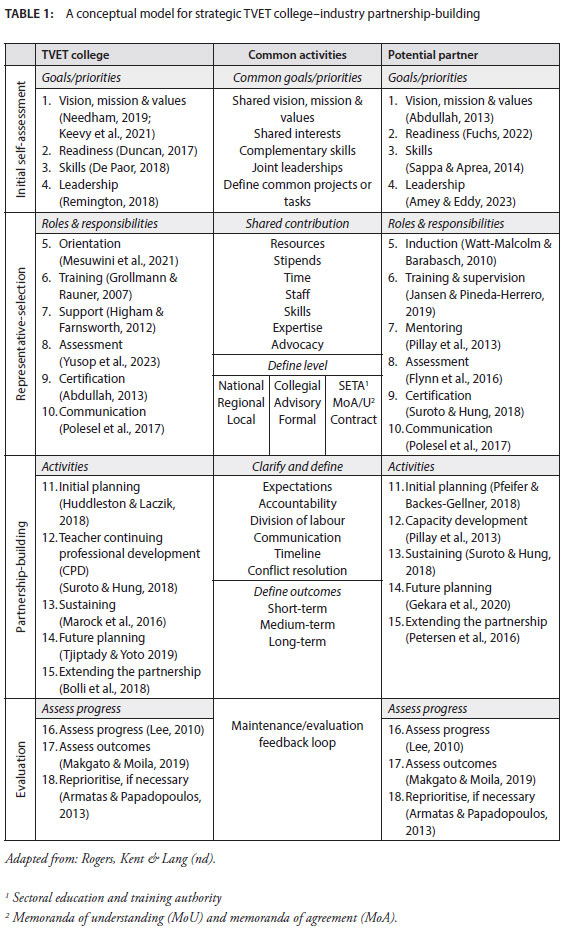
A conceptual model for managing strategic partnerships was developed from the South African and international literature in an attempt to understand the phases of partnership-building and the indicators of successful partnership maintenance, extension and evaluation.
The conceptual model for managing strategic TVET college-industry partnership-building was derived from Rogers, Kent and Lang's (n.d.) flexible partnership model, which was contextualised for the South African TVET sector. Rogers et al's model was designed for use with a single partner and for large coalitions for the purpose of guiding partners through the life cycle of successful collaborations.
Theoretical framework for studying the management of TVET college-industry partnerships
Activity Theory was chosen as a theoretical framework for this study of TVET college-industry partnerships as it is a system-level theory of practice (Daniels et al., 2010). Third-generation Activity Theory (Engeström, 2015) explains and provides key concepts for understanding managerial work across multiple activity systems. It was therefore useful for framing college and industry partnerships as interactions across systems involving various subjects (e.g. students, lecturers, industry-based practitioners and policymakers) who or which engage in collaborative activities to achieve desired outcomes (e.g. student development and workforce preparation). Activity Theory can help with identifying the different components of activity systems, including the division of labour, the tools or resources used, the rules and norms governing interactions, and the roles of the various stakeholders.
In this study, Activity Theory provided a deep, systemic understanding of the factors influencing TVET college-industry partnerships - and interconnections. Activity Theory was used to identify 'contradictions' or challenges in the system and to formulate more effective strategies for managing partnerships that could ultimately benefit all concerned. TVET college and industry partnerships often rely on various tools and artefacts (e.g. curriculum frameworks, internship programmes and technology platforms) to support collaboration and facilitate learning and skill development. Activity Theory helped to identify and analyse the ways in which different tools, documents and resources (including human resources) mediate interactions between different stakeholders and shape the dynamics of partnership activities.
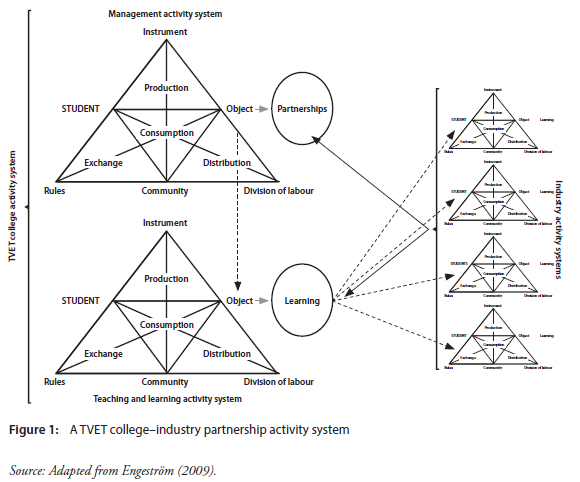
Activity Theory emphasises the importance of the historical and cultural context in which activities take place. The framework is therefore useful for considering how historical factors (e.g. policy decisions and economic trends) and cultural norms shape college-industry partnerships, influencing the goals, structures and outcomes. Figure 1 shows how a TVET college on the left-hand side - comprising a management activity system and a teaching and learning activity system - could interact with multiple industry partners. 'Industry' is used as a generic term; the potential partners would include business enterprises, banks, hotels, hospitals, clinics, communities, and so on. The industry activity systems on the right-hand side of the diagram represent potential industry partners and workplaces where students might gain work experience and might possibly find employment.
Teaching and learning activity system
In the activity system of a TVET college (bottom left of Figure 1), the subjects are students, whose purpose (or 'object') it is to learn. The object of the TVET teaching and learning activity system is the quality of student learning. Lecturers and industry coordinators are located among the 'instruments' that mediate the quality of learning. There are other mediational means, such as curricula, facilities, equipment and other resources. For all in the teaching and learning system to work successfully on this object, human and other resources are needed. The lecturers and students work within a TVET culture that has rules and hierarchies of decision-making (rules and divisions of labour, respectively). The rules and divisions of labour may enhance or inhibit students' and staff members' ability to work towards the improvement of student learning, particularly that regarding industry experience. The outcome flows from the activity, which, in Figure 1, is represented by dashed lines that show the subject progressing from the learning object to occupy roles as subjects in the industry activity systems. Activity Theory tells us that the outcome - in this case, the employability of students - will improve if the participants do not lose sight of the object (Engeström, 2001), which, in this case, is the provision of high-quality vocational learning. The necessary tools and resources need to be available and appropriate rules and divisions of labour should guide the system. The community of an activity system comprises those entities and individuals that are affected by the system - for instance, the potential industry partners - but who are not directly involved in the work of achieving the object.
TVET college management system
The management activity system shown at the top left in Figure 1 has the primary object of developing policies and providing a conducive working environment to enable the teaching and learning system to achieve its object of quality student learning. This is represented by the dotted line linking the management and the teaching and learning objects. The management activity system, in this case, also has an object of partnership-building. The managers in the TVET college who are responsible for the administration and management of TVET-industry partnerships are the subjects of the activity system. These managers might include a deputy principal and a director of partnerships and/or placement and learnership officers.
For the subjects to succeed in executing the mandates, instruments, which might include human and material resources, would be required. The object of the activity system is building TVET college-industry partnerships and the desired outcome is partnerships that are mutually beneficial and sustainable. The division of labour involves dividing roles and responsibilities among those deputy principals who are responsible for partnerships, directors, placement and learnership officers, and workplace mentors. The community comprises both potential industry partners and other stakeholders, while the rules include DHET (Department of Higher Education and Training) policies, TVET college policies and legislation relevant to skills development in South Africa.
Many TVET colleges are undergoing significant transformation under new policy directives (Buthelezi, 2018) and enhancement initiatives (Sithole, 2019) and they are generally becoming more responsive to industry needs (Marock et al., 2016). Many of these initiatives require industry partners to:
• Support colleges in improving their infrastructure to include industry-equivalent training facilities (Lee, 2010);
• Facilitate teacher sabbaticals in industry (Duncan, 2017);
• Offer industry training (Abdullah, 2013);
• Provide industry certification (Suroto & Hung, 2018);
• Accommodate student placements (Sappa & Aprea, 2014);
• Provide industry representatives to co-assess practical subjects (Pillay et al., 2013);
• Facilitate cultural change (Flynn, Pillay & Watters, 2016); and
• Develop leadership in individuals (Badenhorst & Radile, 2018).
This partnership-focused activity system was the focus of this study.
Contradictions
Figure 1 represents the ways in which the TVET college and industry activity systems could interact. In any activity system - and, more particularly, when more than one activity system is involved in attaining a shared (or partly shared) object - there are likely to be contradictions and tensions that would need to be resolved in order to align the two systems (Taylor, 2009). This would be the case in partnership-building ánd a key aspect of partnership-building work should involve negotiations between the partners that investigate the contested terrain (Watt-Malcolm & Taylor, 2007). There are essentially three types of contradictions: primary, secondary and quaternary:
• Primary contradictions are those that arise in the elements of the activity system. In the case of partnerships, a primary contradiction may arise in subjects if there is insufficient capacity or willingness among the subjects to maintain or sustain a partnership.
• Secondary contradictions are often caused when instruments are inappropriate to, or insufficient for, attaining the object. In the TVET college activity system, there could be insufficient resources or the absence of a budget for partnership-building activities. Tertiary contradictions could arise between a TVET management activity system and what Engeström (2001) calls 'its historically evolving trajectory'. This could involve conflicts between the current practices or norms of the activity system and its future developmental path as set out in policy documents. Overcoming this contradiction is challenging as it requires the subjects to embrace new approaches and technologies for the future.
• Quaternary contradictions often arise between multiple activity systems, such as when there are conflicts between the goals, norms or practices of activity systems that are interconnected or interdependent. For activity theorists, such misalignments, challenges and other disturbances 'hold within them the possibility of the collective propelling themselves forward to search for new ways of doing and achieving what is not yet there' (Engeström, 2018:14).
Partnerships are always dynamic processes that evolve over time in response to changing external conditions and internal dynamics. Activity Theory offers insights into the ways in which partnerships develop, adapt and transform over time. These insights highlight the role of learning, innovation and collective problem-solving in driving change. Activity Theory therefore provides a valuable lens for the present study.
Boundary-crossing
Whereas Activity Theory predicts that every activity system will include contradictions, it also emphasises the importance of mediation and of resolving contradictions through collaborative and transformative processes. Boundary-crossing is one way in which contradictions can be resolved. Engeström (2009:313) explains it this way: 'Human beings are involved in multiple activities and have to move between them.' Boundary-crossing also occurs between 'collective activity systems and organisations' (Engeström, 2009:314); it could therefore be viewed as the interactions between at least two distinct activity systems and it could occur in those moments when different activity systems come into contact and influence each other (Engeström, 2015). This could involve individuals, tools or ideas moving between the systems.
Typically, boundary-crossing is needed when one activity system seeks resources or expertise from another activity system. Finding out about the different practices or tools of different activity systems could spark new ideas and lead to improvement and innovation. Consequently, when two or more activity systems collaborate towards a shared goal, as in partnership-building, boundary-crossing is likely to occur (Flynn et al., 2016) and it is therefore likely to play a role in developing and transforming activity systems.
Knotworking
Knotworking is another strategy that could be employed to resolve contradictions within an activity system (Engeström, 2018). It involves engaging in collaborative problem-solving in order to deal with contradictions that hinder an activity system's effectiveness. Knotworking - a metaphor that brings together the idea of something 'not working' and an image of the interwoven, tangled nature of a knot - brings diverse perspectives and expertise to bear on a contradiction in an activity system. It can, for instance, help the subjects of activity systems to overcome any limitations in the current system. In the case of a primary contradiction, such as a lack of capacity in a subject group, knotworking could involve collaboration with others who possess the necessary expertise; and when conflicting rules create a barrier, knotwork might involve communication and negotiation to find a workable solution.
In knotwork, diverse subjects, tools or even different activity systems are interconnected to achieve the object. It has been pointed out that this collaborative approach is especially useful in situations that require knowledge to be sourced and applied from various domains (Kerosuo, Mäki & Korpela, 2015). Knotwork is therefore a dynamic and evolving process, and successful knotwork usually requires support from outside the activity system to recognise and facilitate the development of these practices. The interconnected and dynamic nature of knotworking allows for speedier adaptation in a context that is undergoing significant change (Engeström, 2009).
Expansive learning
The concept of expansive learning describes the processes of transformative change and development within activity systems (Engeström, 2015). It is distinguished from other forms of learning by its focus on learning in diverse contexts (which are often very different from those of formal schools or universities) and involving diverse groups of people (Engeström, 2015). Expansive learning could be understood as being a creative form of learning in which diverse subjects bring their different perspectives, experiences and knowledge to an object, which enables innovation. It involves 'essentially learning something that does not yet exist' (Engeström, 2015).
The metaphor of expansion depicts the multidirectional movement of the subjects who are engaged in constructing and implementing a new, broader and more complex object for their activity. This type of learning can lead to transformation both 'at the level of individual actions and at the level of the collective activity and its broader context' (Sannino, Engeström & Lemos, 2016:603). It occurs when
individuals and groups confront and resolve contradictions, leading to the restructuring of activity systems and the creation of new forms of practice and knowledge, or the exchange of resources, ideas, and practices, potentially leading to innovation, learning, and improved outcomes (Sannino, et al., 2016).
Transformative agency
Engeström (2015) explains that engagement in expansive learning (including boundary-crossing and knotworking) can foster transformative agency. This involves individuals and groups transforming their work practices and adapting to changing circumstances through collaborative learning. Engeström (2015) considers expansive learning to be core to transformative agency in wider communities and work settings. Transformative agency is thus a quality of expansive learning: learning expansively requires individuals or groups to break away from a given frame of action and to take the initiative to transform it. The new concepts and practices generated in an expansive learning process 'carry future-oriented visions loaded with initiative and commitment by the subjects' (Sannino et al., 2016:603).
Research methodology: Responsive evaluation
Evaluation research is the approach that was selected for the present study as it can both build knowledge and contribute to the improvement of practice in a field (Stake, 2012). In the TVET context, the use of evaluation research findings can support meaningful change towards improved outcomes for colleges, educators and students. The intention behind the use of evaluation research in this study was both to build knowledge about the management of partnerships and to provide a guiding framework that educational managers could use to improve practices.
There are many different approaches to, and types of, evaluation research. It can play a formative role, identifying areas for improvement, or a summative role (Savin-Baden and Major, 2023), judging the effectiveness of a practice or an intervention. However, the approach selected for the present study was 'responsive evaluation' (Stake, 2012), an approach that pays particular attention to 'the needs of those involved in the evaluation' (Savin-Baden and Major, 2023:277). A responsive evaluation design can include both formative and summative elements. In this study, because partnerships are ongoing and changing, a formative approach was considered appropriate to improving the way TVET college-industry partnerships are managed, taking into account the caveat that there are no simple answers to the typical formative evaluative questions of: What is working? What is not working? In which contexts? With which groups? And how can it be improved?
Defining the merits of existing practices, separating out the parts played by the various factors - such as the geographical location of a college, the availability of industry partners or the needs of the participants - while appraising their value and making recommendations for improvements are complex undertakings in evaluation research, and particularly so in responsive evaluation (Stake, 2012). There are always confounding and complicating effects in each stage of implementing an evaluation. Yet, despite the many complexities in the formative evaluation of management practices, there is a strong need to evaluate both the existing practices and the actual or potential outcomes of improving both new and existing practices and interventions.
Data collection
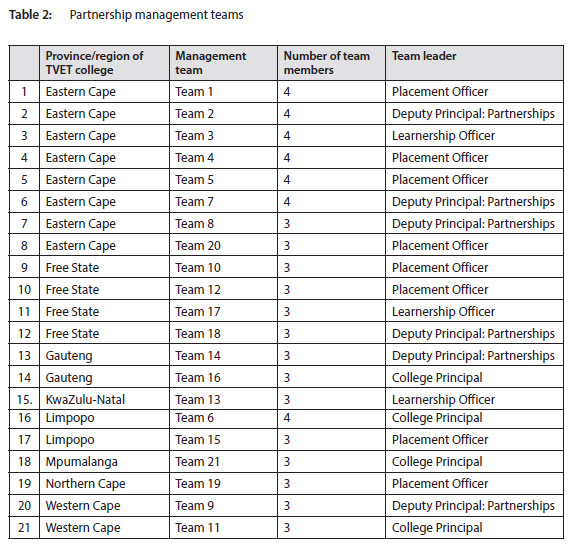
The data-collection method used for this study was 'survey interviewing' (Singleton & Straits, 2012; Fowler, 2014:110), which, as its name suggests, is a hybrid approach that combines a survey or questionnaire with individual or focus-group interviews. The questionnaire typically contains predetermined questions, which could be both fixed-response options (such as multiple-choice, yes/no, or rating scales) and open-ended questions that enable participants to express opinions or to provide detailed responses (Singleton & Straits, 2012). In this case, the 70 participants were drawn from the management teams at 21 different public colleges. Survey interviewing produces richer data than standard questionnaires for several reasons: it is facilitated by interviewers; questions seeking clarification can be dealt with directly; the participants can be prompted; reflection can be encouraged (Singleton & Straits, 2012:81), while consistent data collection across sites is also more likely (Fowler, 2014:120). Structured interviewing is widely used in research, surveys, market research, public-health studies and the social sciences; it is also useful for collecting quantitative data and for studies 'where comparability is important' (Fowler, 2014:115).
Sampling
Purposive sampling was applied in which partnership management teams (deputy principals of partnering institutions, directors and industry liaison officers or placement officers) across the 50 public TVET colleges in South Africa were invited to participate in the partnership survey. The TVET division of DHET assisted with the arrangements that had to be made for the survey focus-group interviews. While not all of the invitees took part in the survey interviews, the actual participants are typical of the partnership management teams that have been established in most public TVET colleges.
This research was commissioned by the TVET division of DHET as a subproject of a Five-Year TVET Research Programme that focuses on the evaluation of public TVET colleges in South Africa.
Ethical considerations
Ethical clearance for this sub-study was received from a university research ethics committee. All the necessary site permissions were obtained through the TVET Directorate. The survey interview sessions were attended voluntarily and informed consent was provided. The participants were informed that they had the right to terminate their participation in the study at any time without any negative consequences. The key ethical dimensions of the study were informed consent, confidentiality, the protection of personal information, data storage and transparency to enable the transfer of relevant knowledge to all those who could benefit from the findings of this study on the management and administration of college-industry partnerships.
Data analysis
There were three levels of data analysis: the first level identified elements of the activity system evident in the data; the second level explained the contradictions in the activity system, and the third level focused on indicators of boundary-crossing, knotworking, expansive learning and the emergence of transformative agency.
Findings: The TVET partnership management activity system
The findings from the survey interviews are presented below, through the lens of Activity Theory.
Subjects: Dedicated partnership management teams
The subjects were management teams comprising college principals, deputy principals in charge of partnerships, and learnership and placement officers. Each partnership had a project team, sometimes called an 'implementation team' (Team 7) that was 'responsible for the partnership' (Team 16). The teams had varying levels of experience: Team 3 had 'been working with TVET-industry partnerships for about 12 years whereas Team 21 had been working with partners for a year and only '10% of their key performance [was] weighted towards this objective' (Team 21).
Object: Partnerships to serve a wide range of purposes
All of the teams were either seeking or working on partnerships, for many different reasons. Many partnerships were sought for the purpose of providing work-based learning for college students:
Some of the partnerships [falling] under my unit deal with placement of learners for workplace-based experience or for experiential learning, internships; others deal with funding of the placement and also ... psychosocial support (Team 4).
As Team 20 explained, placing students in workplaces required funding, so partnerships also had to be set up for 'funding purposes - [bursaries], WIL, learnerships, institutional development, etc.'. Some partnerships had as their purpose institutional development in which an industry partner provided a 'workshop upgrade' (Team 4) or 'infrastructural development' (Team 7). Fewer partnerships were intended for lecturer development - in fact, Team 5 was 'not aware of any' partnerships created for this purpose. There were, however, teams working with SETAs and industry partners for the purpose of obtaining industry experience for lecturers (Team 18) and, in one case, providing 'international exchange' experiences (Team 7).
Tools for finding and sustaining partnerships
A variety of tools were implemented when seeking and consolidating partnerships. The initiating of partnerships usually happened informally
[b]y contacting industry directly ... using electronic communication, walk-ins; and we also ^ held a business breakfast event in which we invited potential partners and current stakeholders (as explained by Team 5).
Team 6 similarly described a 'face-to-face approach and presentation, breakfast meetings'.
To consolidate a partnership, teams used various means such as: (a) questionnaires to assess the relevance of the partnership; (b) an expression-of-interest letter to the partner; (c) a partnership agreement; and (d) a register of all the partnerships concluded. One team member elaborated that 'with each MoU or agreement, there are clear deliverables with specified time frames for each deliverable' (Team 20). Standard partnership contracts had a starting date and an end date, with quarterly reports being used to monitor the progress of partnerships against key deliverables.
Division of labour: Who is responsible for what?
All of the teams agreed that clarification of each partner's role and responsibilities was crucial to the success of a partnership, and that partnerships were functional when there was clarity about these elements:
The roles and responsibilities must be clearly defined in the founding agreement, and at the conclusion of a project, meetings are convened (Team 8).
There might be some flexibility regarding the division of labour, as explained below:
The college is responsible for payment of the stipends while the partners are responsible for the hosting and training of learners. The industry partner provides students with relevant workplace training and development; and, sometimes, the industry partner provides funding for necessary training interventions (Team 3).
Whatever arrangements are made, 'the purpose of the relationship is working towards shared goals through a division of labour that all have agreed upon' (Team 19).
Community of potential partners
The community of potential and actual industry partners included those from fields such as insurance, banking, telecommunications, the retail trade, agriculture, engineering, the automotive trade, tourism and hospitality, human resources (HR), construction, nongovernmental organisations (NGOs) and non-profit organisations (NPOs), as well as universities, national and regional government departments and local municipalities. A wide range of sectoral education and training authorities (SETAs) were named: AGRISETA, BANKSETA, CATHSSETA, CETA, CHIETA, ETDPSETA, FASSET, FOODBEV, INSETA, LGSETA, MERSETA, MICTSETA, PSETA, SERVICESETA and WRSETA. The SETAs mainly provided the funding and stipends for students engaged in work-based learning, but they also supported other partnership-related activities.
Rules: Partnership governance
Partnerships were regulated in accordance with several official 'rules' that emanated both from the DHET and from the partners, as Team 3 explained in detail:
TVET institutions are mandated, amongst other things, to provide training interventions in ... the form of learnerships, apprenticeships, internships, and skills programmes. The aforesaid interventions necessitate that the TVET institutions forge partnerships with ... industry. Appointments were made with key personnel of ... industry to discuss the need for the partnerships, and a memorandum of agreement/memorandum of understanding and a service-level agreement were signed depending on the type of partnership.
Outcome: 'Mutual benefits for both entities'
Most teams commented positively on the outcomes of partnership-building, which, in some cases, had been 'very effective but with a few challenges' (Team 13). Some partnerships had existed for many years. Team 10, for example, had 'effective industry partnerships, with some partnerships which had been established in 2013'. For some teams, effective partnerships were those that were 'still going' (Team 15) or that provided 'student and lecturer placement' (Team 6). An example of a partnership that had progressed 'quite excellently' enabled 'some college learners [to] receive employment' (Team 5). In effective partnerships, as one team member commented, there were 'mutual benefits for both entities' (Team 14). Therefore, to varying extents, the college-industry partnerships had worked. As one team member said: 'On a scale of 10 in terms of effectiveness I will give it an 8' (Team 12).
Discussion: From challenges to emerging transformative agency
Although attitudes were largely positive towards partnerships, the teams had also experienced challenges, which are described below in terms of contradictions in the partnership-building activity system.
Contradictions: Identifying the challenges
Primary contradictions in the TVET activity system occurred in the form of inadequate resources for sustainable partnerships. As might be expected, secondary contradictions arose from the severe shortage of resources and created conflict as a result of the inability of the available resources to support the object of partnership-building. For example, there was inadequate 'funding for WIL and work placement opportunities for students requiring WIL' (Team 19); or there were 'delays with SETA payment of stipends and limited funds' (Team 5); or simply a lack of 'reliable funding' (Team 13) more generally. One team explained that a successful partnership had placed students 'every year' but could only 'keep going ... when the college received funding' (Team 15). Similar views were expressed by other teams, such as the comment that partnerships were 'very effective when hosting students [but] stipends are the issue' (Team 10). The lack of resources had an impact on almost all the elements of the activity system. For example, the partners were 'hesitant to take interns if there [are] no stipends available for students. This also causes transport challenges' (Team10).
Primary contradictions are contradictions that arise within the elements of the activity system. With reference to partnerships, a primary contradiction may arise within subjects if there is insufficient capacity or willingness amongst the subjects to maintain or sustain a partnership. Secondary contradictions are often caused when instruments are not appropriate or are insufficient, for the attainment of the object. In the TVET college activity system, there could be insufficient resources or the absence of a budget for partnership-building activities. Tertiary contradictions could arise between a TVET management activity system and what Engeström (2001) calls 'its historically evolving trajectory'. This could involve conflicts between the current practices or norms of the activity system and its future developmental path as set out in policy documents. Overcoming this contradiction is challenging, as it requires subjects to embrace new approaches and technologies for the future. Quaternary contradictions often arise between multiple activity systems, such as when there are conflicts between the goals, norms or practices of activity systems that are interconnected or interdependent. For activity theorists such misalignments, challenges and other disturbances 'hold within them the possibility of the collective propelling themselves forward to search for new ways of doing and achieving what is not yet there' (Engeström, 2018:14).
Tertiary contradictions typically occur when an activity system is expected to incorporate practices and technologies that arise from other activity systems, such as using the 'German Model' (Team 18) in a South African TVET context or introducing the idea of 'students becoming entrepreneurs' into a system that had previously focused on 'employment opportunities' (Team 18). Tertiary contradictions are challenging because they usually involve major changes to the system. One team member felt that 'industries may initiate projects with initial outcomes set to be too high and not considering successive plans' (Team 13). Such tertiary contradictions are common when subjects collaborate across activity systems that have different expectations or use different technologies.
Also typical in collaborations are quaternary contradictions, such as the lack of cooperation between (potential) partners, which was experienced by teams as 'some industries not being open to the TVET college sector' (Team 18) or 'companies not responding positively to requests, hence the limited number' (Team 8). One team stated: 'We would love to partner with the nearby mines, but mines are reluctant, citing issues of security, etc.' (Team 6).
While many industries were able to partner with colleges and provided 'good support' for the 'placement of learners for work-based experience and to run projects together', others were found to be 'very difficult' or not supportive (Team 17). One team member described such conflict as 'a lack of communication with some partners and unwillingness to work with colleges' (Team 18). Some of the quaternary contradictions could be ascribed to factors beyond the subjects' control, such as 'companies closing because of COVID-19 and lack of projects' (Team 6). In the South African context, the historical location of some colleges disadvantaged them in their attempts at partnership-building, such as a college being 'in a semi-urban area, which means the majority of the host employers are not found within this area' (Team 2) or a college 'is situated in a semi-rural area where there is a lack of well-capacitated industry partners and, as a result, industry partners are likely not to cover all areas that must be covered in the training' (Team 4). Some quaternary contradictions could be caused by conflicting values or priorities, which is suggested by subjects' descriptions of industry partners as 'difficult' (Team 17) or not 'open' (Team 18), or there being 'poor participation of mentors' (Team 15). One team expressed the view that a conflict of values existed between the college and industry, claiming that 'many industries only participate when clear financial gain can be promoted' (Team 13).
Boundary-crossing: 'Dovetailing with partners'
Boundary-crossing is an indicator of problem-solving when multiple activity systems are involved in attaining an object. In this case, the differences between the interests and values of colleges and industry have to do with their different objects. The industry partners were focused on production and services, while the colleges were focused on students' education. This is essentially a theory-practice divide which both partners need to understand before it can be bridged. For example, the 'security' issue expressed by the mining company could be negotiated if each partner found out more about the other's needs and concerns. Visits to industry partners might initiate boundary-crossing activities to resolve some of these challenges. Teams explained that 'the college provides the industry partner with students to get exposure to how the industry works for a particular period' (Team 5). Another team reflected that 'the partnerships provide services that the college cannot offer' (Team 7), such as the practical component of the qualification; and, in some cases, 'they sponsor college activities such as graduation and the issuing of performance awards to the best graduating top ten Financial Management students as an example' (Team 5). Raising awareness of the value of partnerships could help partners to collaborate at a deeper level. One team used the metaphor of 'dovetailing with partners' (Team 5), which perfectly expresses the spirit of boundary-crossing: each partner needs to intrude somewhat into the territory of the other to strengthen their connection, as in a dovetail joint.
Knotworking: 'Nourishing' the partnership
Knotworking occurred when the management teams worked together to overcome any barriers to partnership-building. One strategy was to 'share information' (Team 11); as a participant explained: 'Once the partnership is established, then we constantly keep communicating and nourishing the partnership and also deal with issues as and when they arise' (Team 12).
Expansive learning: A 'bigger scope of partnership'
A key indicator of expansive learning is when subjects begin to think beyond the constraints of their own activity system. So, if local placements for TVET lecturers were not available, then one might provide 'international experiences' instead (Team 7). Or when student placements were not available, one might request industry partners to engage in 'guest lecturing' (Team 6). Those engaged in expansive learning seemed to see new vistas opening, as expressed by Team 20: 'Fine for now, but there is ... room for improvement and development to a bigger scope of partnership.' Another team expressed the need for 'many more partnerships to make the colleges more effective' (Team 17). Yet another team member wanted to 'expand' the partnerships to '[help] the institution to get more industry partners and placement of students to the industry for workplace exposure' (Team 3). Another envisaged an 'extension of the partnership scope specifically for the [rural college's] provision of resources such as equipment and buildings' (Team 20). Expansive learning entails engaging in transformative practice.
Emerging transformative agency: 'We can still do more'
Transformative agency is the desired outcome of collective problem-solving through expansive learning. For example, many teams expressed the view that TVET curricula do 'not meet industry needs' (Team 16), but only some participants took action to overcome this problem. One manager asked industry partners to 'review the college curriculum to respond to the needs of the market' (Team 2). Another included the 'DHET and industry engagement when curricula are developed' (Team 16), while another requested the 'involvement of business and industry in curriculum development' (Team 21). These are examples of emerging transformative agency in which managers recognise their ability to innovate and improve for mutual benefit. This is a start, but as one team put it, 'yes, but we can do more' (Team 19).
Conclusion: Towards enhanced partnership-building
The aim of the present study was to provide an empirical basis for initiating and sustaining partnerships that are mutually beneficial for colleges and industries. Using the lens of Activity Theory and the responsive evaluation methodology, the study responded to the research question: How can TVET college-industry partnerships be strengthened to benefit students, colleges and industry? The TVET managers and teams involved in partnership-building were surveyed and interviewed about their practices. In the study, the concepts provided by Activity Theory, such as 'activity system', 'contradictions', 'boundary-crossing', 'knotworking' and 'expansive learning' (Engeström, 2009; Engeström, 2015) were used to analyse the practices described by the teams and to understand their potential for effective partnership-building. By dealing with the research question in this way, the study has contributed to knowledge in the field of TVET college-industry partnership management and administration. It has also contributed to partnership-building practice. The study has shown how management teams could effectively engage in collaborative processes of expansive learning through boundary-crossing and knotworking, even without formally understanding these terms or processes. These intuitive processes enabled partnership management teams, in many cases, to improve the experiences of students, colleges, colleagues and industry partners. In some cases, there were signs of emerging transformative agency as managers set about innovating and changing existing practices. We can only imagine the impact on colleges if more management teams were to engage in such potentially transformative practices.
REFERENCES
Abdullah, H. 2013. The role of VET providers in training partnerships with industry in East Java, Indonesia. TVET@ Asia, 1:1-14. Available at: <https://tvet-online.asia/wp-content/uploads/2020/03/abdullah_tvet1.pdf> [ Links ].
Amey, MJ & Eddy, PL. 2023. Creating strategic partnerships: A guide for educational institutions and their partners. London: Taylor & Francis. [ Links ]
Armatas, C & Papadopoulos, T. 2013. Approaches to work-integrated learning and engaging industry in vocational ICT courses: Evaluation of an Australian pilot programme. International Journal of Training Research, 11(1):56-68. Available at: <https://doi.org/10.5172/ijtr.2013.11.1.56> [ Links ].
Badenhorst, JW & Radile, RS. 2018. Poor performance at TVET colleges: Conceptualising a distributed instructional leadership approach as a solution. Africa Education Review, 15(3):91-112. Available at: <https://doi.org/10.1080/18146627.2017.1352452> [ Links ].
Beddie, FM & Simon, L. 2017. VET applied research: Driving VET's role in the innovation system. Adelaide: National Centre for Vocational Education Research. Available at: <https://files.eric.ed.gov/fulltext/ED576660.pdf> [ Links ].
Billett, S & Seddon, T. 2004. Building community through social partnerships around vocational education and training. Journal ofVocational Education and Training, 56(1):51-68. Available at: <https://doi.org/10.1080/13636820400200245> [ Links ].
Bolli, T, Caves, KM, Renold, U & Buergi, J. 2018. Beyond employer engagement: Measuring education-employment linkage in vocational education and training programmes. Journal of Vocational Education & Training, 70(4):524-563. Available at: <https://doi.org/10.1080/13636820.2018.1451911> [ Links ].
Buthelezi, Z. 2018. Lecturer experiences of TVET college challenges in the post-apartheid era: A case of unintended consequences of educational reform in South Africa. Journal of Vocational Education & Training, 70(3):364-383. Available at: <https://doi.org/10.1080/13636820.2018.1437062> [ Links ].
Daniels, H, Edwards, A, Engeström, Y, Gallagher, T & Ludvigsen, S. 2010. Activity theory in practice. London: Routledge. [ Links ]
De Paor, C. 2018. Supporting change in VET: Teachers' professional development and ECVET learner mobility. Empirical Research in Vocational Education and Training, 10:1-13. Available at: <https://doi.org/10.1186/s40461-017-0062-3> [ Links ].
Duncan, K. 2017. Developing lecturers at VET institutions through engagements with industry: The South African experience. In F Eicker, G Haseloff & B Lennartz (eds), Vocational education and training in sub-Saharan Africa: Current situation and development. Germany: W Bertelsmann Verlag GmbH & Co, 67-73.
Engeström, R. 2009. The future of activity theory: A rough draft? In A Sannino, H Daniels & KD Gutiérrez (eds), Learning and expandingwith activity theory. Cambridge: Cambridge University Press, 257-273. [ Links ]
Engeström, Y. 2001. Expansive learning at work: Toward an activity theoretical reconceptualization. Journal of Education and Work, 14(1):133-156. Available at: <https://doi.org/10.1080/13639080020028747> [ Links ].
Engeström, Y. 2015. Learning by expanding: An activity-theoretical approach to developmental research (2nd ed). Cambridge: Cambridge University Press. [ Links ]
Engeström, Y. 2018. From design experiments to formative interventions. Theory & Psychology, 28(5):586-604. Available at: <https://doi.org/10.1177/0959354311419252> [ Links ].
Flynn, MC, Pillay, H & Watters, J. 2016. Industry-school partnerships: Boundary crossing to enable school-to-work transitions. Journal of Education and Work, 29(3):309-331. Available at: <https://doi.org/10.1080/13639080.2014.934789> [ Links ].
Fowler, FJ, Jr. 2014. Survey research methods (5th ed). London: Sage Publications. [ Links ]
Fuchs, M. 2022. MNCs' open international strategy-local dynamics: Transfer of German 'vocational education and training' to emerging economies. Critical Perspectives on International Business, 18(1):97-114. Available at: <https://doi.org/10.1108/cpoib-12-2019-0106> [ Links ].
Gekara, V, Snell, D, Molla, A & Karanasios, S. 2020. International scan of approaches taken by select economies to build the digital skills of the existing workforce in response to the digital transformation of industry. The Skills Training and Industry Research Network, RMIT University. Document No TD/TNC 144.587. Available at: <https://digitalskillsformation.org.au/wp-content/uploads/2020/09/FINAL-International-Scan-Report_Approved.pdf>.
Grollmann, P & Rauner, F. 2007. Exploring innovative apprenticeship: Quality and costs. Education+Training, 49(6):431-446. Available at: <https://doi.org/10.1108/00400910710819091> [ Links ].
Higham, J & Farnsworth, V. 2012. What makes a course vocational? School-based work-related programmes in Canada in dialogue with a community of practice. Journal of Education and Work, 25(4):443-471. Available at: <https://doi.org/10.1080/13639080.2012.708728> [ Links ].
Huddleston, P & Laczik, A. 2018. 'In the driving seat', or reluctant passengers? Employer engagement in qualifications development: Some evidence from two recent 14-19 qualification reforms in England. Journal of Education and Work, 31(3):262-276. Available at: <https://doi.org/10.1080/13639080.2018.1463086> [ Links ].
Jansen, A & Pineda-Herrero, P. 2019. Dual apprenticeships in Spain-Catalonia: The firms' perspective. Vocations and Learning, 12(1):129-154. Available at: <https://doi.org/10.1007/s12186-018-09217-6> [ Links ].
Keevy, J, Shiohira, K, Matlala, R & Molokwane, P. 2021. TVET delivery: Providing innovative solutions. New qualifications and competencies for future-oriented TVET, Vol 3. UNESCO-UNEVOC International Centre for Technical and Vocational Education and Training. Available at: <https://eric.ed.gov/?id=ED619363>.
Kerosuo, H, Mäki, T & Korpela, J. 2015. Knotworking and the visibilization of learning in building design. Journal of Workplace Learning, 27(2):128-141. [ Links ]
Lee, J. 2010. Partnerships with industry for efficient and effective implementation of TVET. International Journal ofVocational Education andTraining, 17(2):45-46. Available at: <https://www.ijvet17(2)-libre.pdf> [ Links ].
Makgato M & Moila, O. 2019. Partnerships between TVET colleges and industry to enhance work-related skills. World Transactions on Engineering and Technology Education, 17(3):332-337. Available at: <http://www.wiete.com.au/journals/WTE&TE/Pages/Vol.17.%20No.3%20(2019)/20-Moila-O.pdf> [ Links ].
Marock, C, Hazell, E & Akoobhai, B. 2016. What will it take to turn TVET colleges around? Evaluation of a large-scale college. In A Kraak, A Paterson & K Boka (eds), Change management in TVET colleges. Johannesburg: African Minds, 103-119. [ Links ]
Mesuwini, J, Thaba-Nkadimene, KL & Kgomotlokoa, L. 2021. Nature of TVET lecturer learning during work-integrated learning: A South African perspective. Journal of Technical Education and Training, 13(4):106-117. Available at: <https://penerbit.uthm.edu.my/ojs/index.php/JTET/article/view/9301> [ Links ].
Needham, S. 2019. TVET policy in South Africa: Caught between neo-liberalism and privatisation? Journal of Vocational, Adult and Continuing Education and Training, 2(2):82-101. Available at: <https://hdl.handle.net/10520/EJC-1ba524e12a> [ Links ].
Petersen, IH, Kruss, G, McGrath, S & Gastrow, M. 2016. Bridging skills demand and supply in South Africa: The role of public and private intermediaries. Development Southern Africa, 33(3):407-423. Available at: <https://doi.org/10.1080/0376835X.2016.1156518> [ Links ].
Pfeifer, H & Backes-Gellner, U. 2018. Another piece of the puzzle: Firms' investment in training as production of optimal skills inventory. Empirical Research in Vocational Education and Training, 10:1-17. Available at: <https://doi.org/10.1186/s40461-018-0067-6> [ Links ].
Pillay, H, Watters, JJ & Hoff, L. 2013. Critical attributes of public-private partnerships: A case study in vocational education. International Journal of Adult Vocational Education and Technology, 4(1):31-45. Available at: <https://www.igi-global.com/article/content/76914> [ Links ].
Polesel, J, Klatt, M, Blake, D & Starr, K. 2017. Understanding the nature of school partnerships with business in delivery of vocational programmes in schools in Australia. Journal of Education andWork, 30(3):283-298. Available at: <https://doi.org/10.1080/13639080.2016.1165344> [ Links ].
Remington, TF. 2018. Public-private partnerships in TVET: Adapting the dual system in the United States. Journal of Vocational Education & Training, 70(4):497-523. Available at: <https://doi.org/10.1080/13636820.2018.1450776> [ Links ].
Rogers, M, Kent, L & Lang, J. nd. Strategic partnering: A guide to the conceptual framework. US Centers for Disease Control and Prevention. Available at: <https://www.cdc.gov/dhdsp/programs/spha/roadmap/docs/strategic-partnering-conceptual-framework_ac.pdf>.
Sannino, A, Engeström, Y & Lemos, M. 2016. Formative interventions for expansive learning and transformative agency. Journal of the Learning Sciences, 25(4):599-633. Available at: <https://doi.org/10.1080/10508406.2016.1204547> [ Links ].
Sappa, V & Aprea, C. 2014. Conceptions of connectivity: How Swiss teachers, trainers, and apprentices perceive vocational learning and teaching across different learning sites. Vocations and Learning, 7(3):263-287. Available at: <https://doi.org/10.1007/s12186-014-9115-y> [ Links ].
Savin-Baden, M & Major, C. 2023. Qualitative research: The essential guide to theory and practice. London: Routledge. [ Links ]
Singleton, RA & Straits, BC. 2012. Survey interviewing. In JF Gubrium, JA Holstein, AB Marvasti & KD McKinney (eds), The SAGE handbook of interview research: The complexity of the craft. London: Sage, 77-98. [ Links ]
Sithole, MD. 2019. Enhancing management structure at the TVET colleges: A case study of uMgungundlovu TVET college. Doctoral thesis. Westville: University of KwaZulu-Natal. [ Links ]
Smith, E, Comyn, P, Kemmis, RB & Smith, A. 2014. Contemporary apprenticeship. London: Routledge. [ Links ]
Stake, R. 2012. Responsive evaluation. In T Kellaghan & DL Stufflebeam (eds), International handbook of educational evaluation. Dordrecht: Springer Netherlands, 63-68. [ Links ]
Suroto, S & Hung, NT. 2018. Management of an industry standard class in vocational high schools. Journal Pendidikan Teknologi dan Kejuruan, 24(1):46-51. Available at: <http://dx.doi.org/10.21831/jptk.v24i1.14710> [ Links ].
Taylor, A. 2009. Mapping the field of VET partnerships. Vocations and Learning, 22:127-151. Available at: <https://doi.org/10.1007/s12186-009-9021-x> [ Links ].
Tjiptady, BC & Yoto, T. 2019. Improving the quality of vocational education in the 4.0 Industrial Revolution by using the teaching factory approach. International Journal of Innovation, 8(1):7. Available at: <https://ijicc.net/images/vol8iss1/8104_Tjiptady_2019_E_R.pdf> [ Links ].
Watt-Malcolm, B & Barabasch, A. 2010. Tensions in the Canadian apprenticeship sector: Rethinking Bourdieu's analysis of habitus, field, and capital. Research in Comparative and International Education, 5(3):289-301. Available at: <https://doi.org/10.2304/rcie.2010.5.3.289> [ Links ].
Watt-Malcolm, B & Taylor, A. 2007. Get them young and train them right: Negotiations in a VET partnership. Canadian Journal for the Study of Adult Education, 20(2):57-70. Available at: <https://cjsae.library.dal.ca/cjsae/article/view/1107> [ Links ].
Wiemann, J & Fuchs, M. 2018. The export of Germany's 'secret of success' dual technical VET: MNCs and multiscalar stakeholders changing the skill formation system in Mexico. Cambridge Journal of Regions, Economy and Society, 11(2):373-386. Available at: <https://doi.org/10.1093/cjres/rsy008> [ Links ]
Yusop, SR, Rasul, MS, Mohammad, YR & Hashim, HU. 2023. Identifying and validating vocational skills domains and indicators in classroom assessment practices in TVET. Sustainability, 15(6):5195. Available at: <https://doi.org/10.3390/su15065195> [ Links ].
