



Services on Demand
Journal

Article
 English (pdf)
 Article in xml format
 Article references
 Automatic translation
 Send this article by e-mail
Indicators
Related links
-
 Cited by Google
 -
 Similars in Google
Share

 Permalink
Southern African Field Archaeology
On-line version ISSN 2789-1844Print version ISSN 1019-5785
South. Afr. Field Archaeol. vol.20 Johannesburg 2025
https://doi.org/10.36615/safa.20.3561.2025
PEER-REVIEWED RESEARCH REPORT
Morphological and functional variability of the geometric microlithic backed tools from the late Holocene at Pomongwe Cave (Matobo, western Zimbabwe)
Precious Chiwara-MaenzaniseI, II, III, *; Ancila NhamoIII, IV; Guillaume PorrazV
IHuman Evolution Research Institute (HERI), University of Cape Town, Private Bag X3, Rondebosch 7701, South Africa
IIDepartment of Geological Sciences, University of Cape Town, Private Bag X3, Rondebosch 7701, South Africa
IIIDepartment of History, Heritage and Knowledge Systems, University of Zimbabwe, P.O. Box MP 167, Mount Pleasant, Zimbabwe
IVResearch Innovation and Industrialisation Directorate, University of Zimbabwe, P.O. Box MP 167, Mount Pleasant, Zimbabwe
VCNRS, Aix-Marseille Université, UMR 7269, Laboratoire Méditerranéen de Préhistoire Europe Afrique (LAMPEA), 13094 Aix-en-Provence, France
ABSTRACT
Microlithic backed tools are a key feature of the Later Stone Age late Holocene period in southern Africa. These tools were widely distributed and produced in various geometric shapes and sizes. Despite extensive study and classification, questions remain regarding whether their morphological variability was driven by functional, technological, or stylistic factors. This study investigates the variability of microlithic backed tools from Pomongwe Cave in Matobo, western Zimbabwe, during the Amadzimba phase (ca. 5800 to 2300 BP). We classified the microlithic backed tools into three main morpho-functional categories, which we interpret as reflecting different hafting designs and tool functions. We propose that microlithic backed tools were part of a composite system and likely served as projectile weapons. The creation of specialised tools for specific tasks demonstrates a high level of innovation and provides insight into hunter-gatherer hunting strategies during the late Holocene in Matobo.
Keywords: Later Stone Age, Matobo, morpho-functional, composite technology, hunting weapon
1. Introduction
The Later Stone Age (LSA) late Holocene represents an important period of economic and social transformation in southern Africa, beginning around 4000 bp (Mitchell 2005, 2024; Lombard et al. 2012, 2022; Sadr 2015, 2019; Forssman 2017; Stewart & Mitchell 2018; Kinahan 2019; Guillemard 2020a). This period is generally categorised into two industries: the final LSA, spanning approximately 4000-100 bp, and the ceramic final LSA, which emerged after 2000 bp (Lombard et al. 2012). Around 4000 bp, some hunter-gatherer groups produced diverse lithic technologies, reflecting shifts in subsistence strategies and social organisation. By 2000 bp, the emergence of domesticated sheep and the use of ceramics further transformed these societies, marking a significant economic and social transition (Guillemard 2020b, 2024). One way to investigate how LSA late Holocene hunter-gatherers were structured and organised on a sub-continental scale is to examine the artefacts they created and used (Parkington et al. 1980; Parkington 1987; Barham 1992; Guillemard 2020a, 2024). Stone tools, in particular, offer valuable information on subsistence strategies and technological adaptations. Lithic studies play a crucial role in characterising the history and development of late Holocene human societies (Parkington et al. 1980; Mazel 1989; Guillemard 2020a, 2024).
Microlithic backed tools are one of the hallmarks of the late Holocene in southern Africa (Deacon 1984; Mazel 1989; Walker 1995; Close & Sampson 1998a; Ambrose 2002; Hiscock et al. 2011). These miniaturised tools, characterised by steep blunting retouch on one edge, appear in a wide range of geometric shapes and sizes, prompting discussions on how to interpret their variability (Parkington et al. 1980; Close & Sampson 1998b; Lewis 2015; Pargeter 2016). They are often seen as components of composite tools, glued into shafts and used for cynegetic activities (Yaroshevich et al. 2013; Fullagar 2016; Goldstein & Shaffer 2017; Tomasso et al. 2018; Taipale et al. 2022). However, alternative interpretations suggest their use in cutting activities (Wadley & Binneman 1995; Charrié-Duhautet et al. 2016). Some researchers further argue that stylistic factors may help explain variations in shape and size during manufacture (Wiessner 1983). Additionally, their presence across various sites has sparked debate, with some arguing that they indicate social connectedness (Way et al. 2022), while others propose mere convergence (Clarkson et al. 2018).
The late Holocene in southern Africa is characterised by a diversity of stone tool knapping methods and techniques employed by various hunter-gatherer groups, continuing until the gradual disappearance of stone tools and LSA sites (Guillemard 2020a). During this period, hunting techniques varied widely across regions, with evidence of bow-and-arrow use and various trapping methods, including pit traps found at ^Gi in Botswana and others as seen at the Keimoes desert kite sites in South Africa (e.g., Brooks & Yellen 1977; van der Walt & Lombard 2018; Lombard & Badenhorst 2019; Lombard et al. 2020, 2021; Lotter et al. 2023). In coastal sites in South Africa, there is evidence of marine resource exploitation, with extensive middens highlighting the importance of marine life in the diet (Miller et al. 1995; Sealy 2006). Similarly, in the Thukela Basin, the widespread presence of marine shell during the late Holocene suggests shifting social strategies among hunter-gatherer communities (Mazel 1989). In more arid regions such as the Kalahari Basin, hunter-gatherers exploited resources from freshwater habitats and seasonal wetlands, as evidenced by sites near the Boteti River (Denbow 1986). In the Eastern Cape, Hall (1990) highlights an intensification in the exploitation of freshwater mussels, crabs, fish, and tortoises, alongside the creation of storage facilities to prolong availability of seasonally scarce, nutrient-rich seeds. This intensification of resource exploitation may have contributed to the development of more sedentary lifestyles, particularly in the Kalahari and Eastern Cape regions (Denbow 1986; Hall 1990). Together, these examples underscore the profound social and economic changes that occurred across southern Africa during the late Holocene. Diversity in subsistence strategies, technological adaptations, and settlement patterns reveals that these changes were shaped by distinct local conditions and resources.
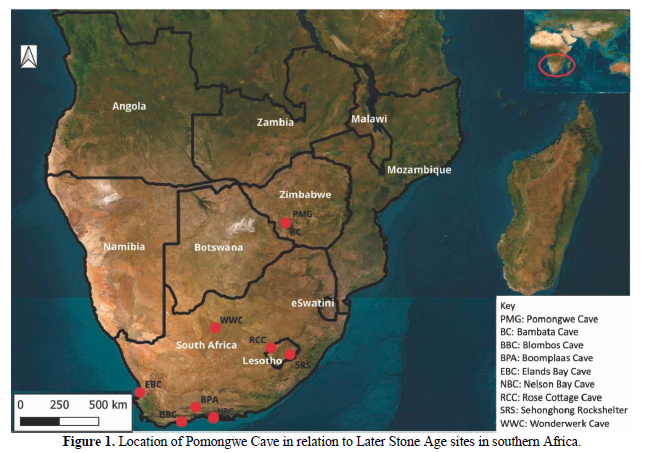
In this study, we focus on the Zimbabwean late Holocene period referred to as the Amadzimba phase (ca. 5800 to 2300 BP; Walker 1995), named after the type site of Amadzimba and located in Matobo (Fig. 1). It is regarded as the final stage of hunter-gatherer communities, before the onset of herders and farmers in the region. Evidence of this phase has been identified at key sites, including Pomongwe and Bambata Caves in Matobo, as well as at sites outside Matobo, such as Duncombe Farm, Diana's Vow, and Nyazongo. While knowledge on the Amadzimba remains limited, this study aims to investigate its distinctive characteristics within the Matobo region. By examining microlithic backed tools, a defining feature of the Amadzimba, we seek to explore how this phase in Matobo may relate to other late Holocene cultural and social expressions in southern Africa and beyond. However, we acknowledge that a comprehensive understanding of the late Holocene in Matobo requires a complete analysis of multiple assemblages and all their components, an endeavour for the future when additional data are available.
In Matobo, the Amadzimba phase is associated with large game hunting and the use of poisonous plants (Walker 1995). Storage pits, believed to have been used for storing marula fruits and caterpillars also occur during this phase, and based on the analysis of their botanical remains (primarily the marula fruits), Walker (1995) proposed that occupations occurred from spring to autumn. The high amount of marula fruit remains during this period is linked to population growth in the region, indicating increased consumption to sustain larger groups and expanding settlement sites (Walker 1995).
The Amadzimba phase coincided with a warm and wet climate, enhancing environmental productivity and providing abundant food and resources (Walker 1995). This climatic amelioration supported population growth and the sustenance of larger groups in Matobo (Walker 1995). Elsewhere during the late Holocene, population expansion is observed in the Thukela Basin where Mazel (1989) noted changes in subsistence strategies, the development of new lithic tools, and the emergence of three distinct social regions. Walker (1995) further highlights the significance of the back of the Matobo Caves during the later stages of forager history. These areas were used for storing valuable items, such as protein-rich caterpillars, and they functioned as central spaces for family activities like cooking, eating, and sleeping. In contrast, the front and central sections of the caves served more communal purposes.
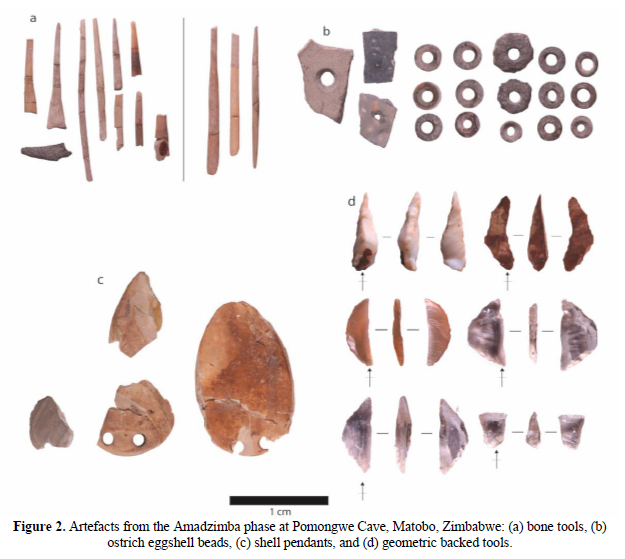
The late Holocene Amadzimba phase at Pomongwe Cave is characterised by the proliferation of bone technology, as evidenced by numerous bone tools comprising points, arrows, rods, and shafts (Walker 1995). This period is also notable for an increase in ornamental artefacts, such as shell pendants, cylindrical, disc and oblate bone beads, along with numerous ostrich eggshell beads (Fig. 2). Rock art was likely an integral part of the daily lives of these populations as well (Bourdier et al. 2020; Dudognon et al. 2021). Regarding the technological tradition, the Amadzimba is known for its production of small blanks and bladelets, as well as prevalent microlithic backed tools (Walker 1995). These geometric backed tools are found in various forms including points, segments, trapezoids, triangles, and truncates.
In this study, we build upon previous research by Walker (1995) and investigate the morphological variability of the microlithic backed tools at Pomongwe Cave. Our analysis prompts a broader inquiry into the mechanisms driving the observed variability, questioning whether it is the result of functional objectives and designs (i.e., form follows function), technological adaptations (i.e., form reflects production stages), or stylistic preferences (i.e., form reflects individual and collective choices). Consequently, this paper seeks to clarify how societies in southern Africa were technologically and socio-economically organised during the late Holocene.
Pomongwe Cave
Pomongwe Cave (20°32'46" S, 28°30'54" E) is located within the Matobo World Heritage Site in Matabeleland Province, western Zimbabwe. Matobo is a hilly area characterised by natural rock shelters formed beneath large boulders. Since the 1930s, it has been a focal point for Stone Age studies, resulting in the discovery of several Middle Stone Age (MSA) and LSA sites, including Amadzimba, Cave of Bees, Bambata, Nswatugi, and Pomongwe Caves (Armstrong 1931; Cooke & Robinson 1954; Cooke 1963; Walker 1995; Walker & Thorp 1997; Jones 2013).
The cave is a 20-metre-long by 20-metre-wide apsidal formation, created through negative exfoliation, a characteristic feature of areas comprising granite. Archaeological research at Pomongwe Cave began with Cooke's (1963) excavation, during which he uncovered three trenches, labelled Trench I-III, revealing well-stratified MSA and LSA occupations extending to a depth of four metres. Cooke's (1963) work laid the foundation for defining Zimbabwe's MSA and LSA chrono-cultural phases, including what has been termed the Bembesi or Proto-Stillbay, Magosian, Pomongwe, and Nswatugi (Cooke 1963; Walker 1995). However, some terminology, such as Proto-Stillbay and Magosian, was revised by Walker (1995) and is no longer used in contemporary Stone Age studies in Zimbabwe.
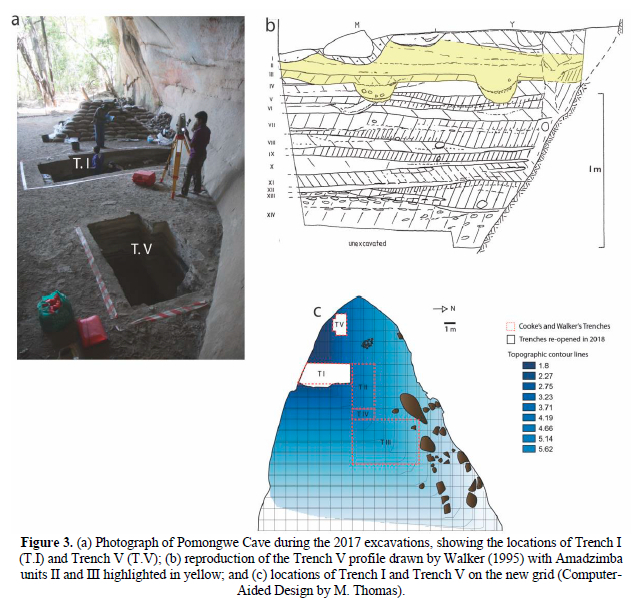
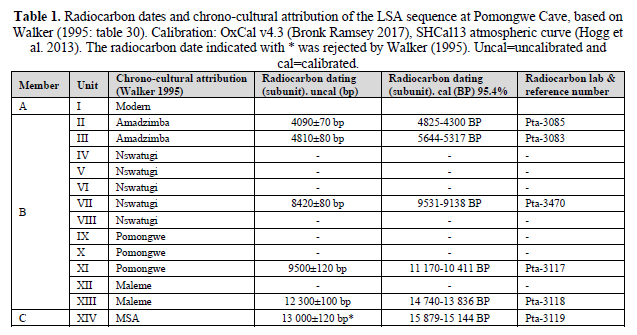
Pomongwe Cave was later excavated by Walker (1995), who dug two trenches labelled Trench IV and Trench V, exposing 1.4 metres of stratigraphy with well-stratified LSA occupations (Walker 1995; Fig. 3). Organic materials, including faunal and botanical remains, are well-preserved throughout the sequence. Walker (1995) organised the sedimentary sequences into members (A to C), which were further subdivided into stratigraphic units and subunits. Trench V contains 12 LSA units, which have been dated and classified into four industries from top to bottom: Amadzimba, Nswatugi, Pomongwe, and Maleme (Table 1; see also Walker 1995). Walker's (1995) work forms the basis for the chrono -cultural sequences used in the study of the Zimbabwean LSA today.
In 2017, the Matobart project was initiated at Pomongwe Cave, aiming to deepen our knowledge of the region's population prehistory (see Bourdier 2019; Porraz et al. 2023). This project integrates the analysis of excavated finds with the study of Pomongwe's rock art (Bourdier 2019; Porraz et al. 2020, 2023). An essential aspect involves recording the art, a crucial initial phase for any artistic study (Bourdier et al. 2020; Dudognon et al. 2021). This documentation was complemented by the reopening of previous excavations to better understand the context of the collections, re-examine site formation processes, and establish absolute dates (Porraz et al. 2023). Additionally, the project includes studying existing Pomongwe Cave collections housed in museums, such as fauna, lithic artefacts, ochre, and painted spalls (see Chiwara-Maenzanise 2018; Matembo 2019; Mnkandla 2019; Nhunzvi 2019; Nhunzvi et al. 2020).
This study analyses the existing Amadzimba collections from Pomongwe Cave, focusing specifically on the microlithic backed tools associated with units II (comprising eight subunits) and III (comprising three subunits) of Trench V, as excavated by Walker (1995). Trench V contains well-stratified sediments with very good organic preservation. Walker (1995) noted the presence of numerous pits closely associated with Units II and III, as illustrated in the drawing of his main profile (Fig. 3). Notably, in Unit II, a piece of cordage was discovered in a pit alongside grass and marula stones (Walker 1995). Unit II, composed of white ash soil, was directly dated to 4825-4300 BP (Pta-3085); Unit III, consisting of brown ash soil, was directly dated to 5644-5317 BP (Pta-3083; Table 1).
During Walker's (1995) excavations, sediments were sieved through a 2 mm mesh, ensuring the recovery of most artefacts. These artefacts were meticulously curated, preserving their context more effectively than the finds from Cooke's (1963) excavations. According to Walker's (1995) publication, a total of 64 409 artefacts were recovered throughout the Trench V sequence, including 17 144 artefacts from the Amadzimba phase. Of those from the Amadzimba phase, 66% (n=11 322) are from Unit II, and 34% (n=5822) are from Unit III. Lithic pieces constitute the largest portion of the Amadzimba assemblage (93%, n=15 908), followed by faunal remains (6%, n=1066) and bone tools (1%, n=170).
2. Materials and methods
Walker (1995) documented a total of 57 799 lithics from the Trench V sequence, with 98% (n=56 557) classified as flakes, blades, cores, chunks, and chips, and the remaining 2% (n=1242) categorised as formal tools. Within the Amadzimba phase, 15 908 lithics were recorded, including 2913 flakes, 477 blades, and 147 cores. Furthermore, 11 897 lithics were classified as chunks and chips. Formal tools comprised 474 specimens, of which 72% (n=342) were recovered from Unit II and 28% (n=132) from Unit III (Table 2). The data outlined in Table 2 indicate a significant disparity in artefact sample sizes between the two units. Unit II yielded a notably larger assemblage of lithics compared to Unit III, suggesting an expansion in lithic production during the late Holocene phase. Quartz, particularly filonian and crystal quartz, emerges as the predominant raw material across both units.
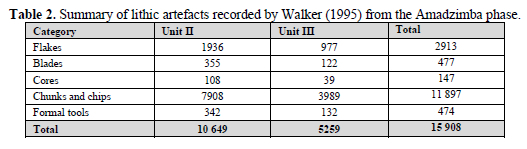
Interestingly, the proportional percentages of formal tools relative to the total number of artefacts in both Unit II and Unit III remain consistent at 3% (Unit II: n=342/10 649; Unit III: n=132/5259). Of the formal tools, 32% (n=150) are backed pieces, 19% (n=90) are small convex scrapers, and 49% (n=234) are other types of tools, such as anvils, grindstones, rubbing stones, and polishing stones.
The microlithic backed tools analysed in this study were sourced from squares PM, PY, and PZ, within the aforementioned units. Following a thorough review of the boxes from these squares, we identified 138 pieces, slightly fewer than the 150 recorded by Walker (1995). Of the 138 that we identified and examined, 80% (n=110) originated from Unit II, while 20% (n=28) came from Unit III. The backed pieces include 100 complete tools, with segments (28%, n=38) comprising the largest portion, followed by points (22%, n=31), triangles (18%, n=26), trapezoids (3%, n=4), and tranchets (1%, n=1), based on Walker's (1995) classification. Additionally, 38 pieces (28%) were categorised as broken or miscellaneous.
For the purposes of this study, a segment is defined as a tool with a convex or semi-circular retouched back and a straight or convex edge ending in one or more points. A point features two straight edges, with one or both being retouched, making it single or double-backed. A triangle has an angular back formed by abrupt retouch and a straight edge terminating in points, and symmetry was used to subdivide these pieces into scalene (with sides of different lengths) and isosceles (with two equal sides) shapes. A trapezoid is characterised by two distinct angles at the back, with the distal and proximal parts retouched while the mesial part remains unretouched; it also has a straight edge ending in points. Lastly, a tranchet is a small axe head with a short edge and two points.
Morpho-functional classification
We adopted a morpho-functional classification to analyse the microlithic backed tools, as developed by Chesnaux (2013, 2014). This method classifies lithic tools based on their functional attributes, aiming to overcome the limitations of traditional typologies (Chesnaux 2013, 2014). The advantage of the morpho-functional approach lies in its ability to distinguish between a tool's intended purpose or function and its operational mechanism. While the intended purpose answers the question, "What was it designed to do?", the operational mechanism explores, "How does it perform its task?" (Chesnaux 2013, 2014; Guillemard & Porraz 2019).
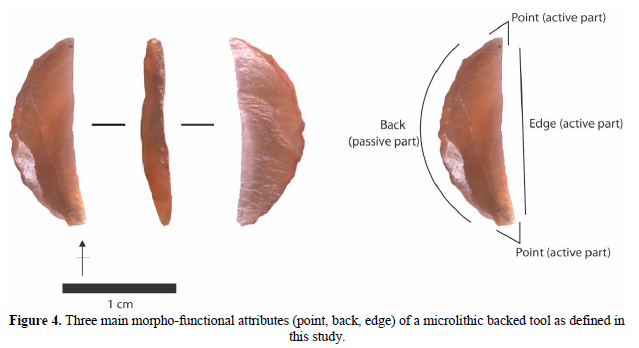
To achieve this, the morpho-functional analysis involves distinguishing the three main functional parts of a backed tool: the point(s), the edge, and the back (Fig. 4). The point and edge are considered the putative active parts as they play a direct role in the tool's function (e.g., when tools are used as projectiles, or in drilling or cutting-related activities; Chesnaux 2013, 2014). The point is the sharp or rounded end of the backed tool, where the edge and back converge to form an angle of less than 90°. The edge is the sharp side of the backed tool, typically characterised by an angle ranging from 20° to 50°. The back, on the other hand, is the passive component, characterised by a surface that is intentionally blurred by backing. The back is usually the gripping part of the tool, typically hafted into a handle (Chesnaux 2013, 2014). This approach has also been applied in southern Africa, at Balerno Main Shelter for the study of Wilton scrapers, which will facilitate future inter-site comparisons (see Guillemard & Porraz 2019).
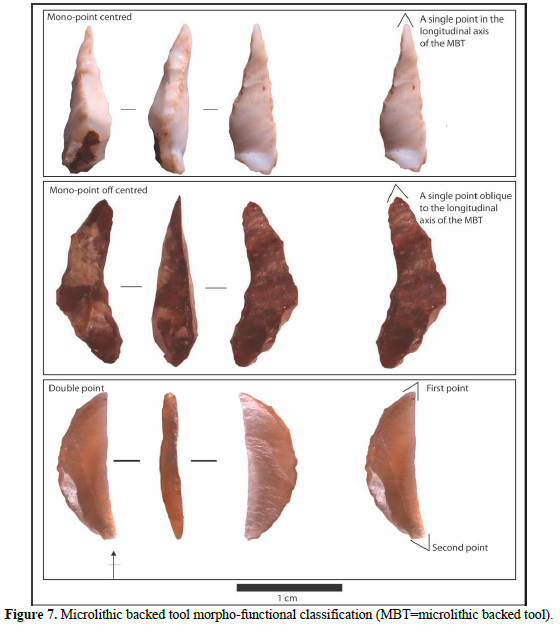
Using the morpho-functional classification described here, we differentiated geometric backed pieces based on the number of pointed parts: double points (those with two opposing pointed parts) and mono-points (those with a single pointed part). Mono-points were further classified by symmetry, which refers to the proportional distribution of a tool's morphology, resulting in mono-point centred (a single point along the longitudinal axis) and mono-point off centred (a single point oblique to the longitudinal axis). Broken microlithic backed pieces with no identifiable active parts were classified as indeterminate.
General attributes
Additional data were recorded for each backed piece, including the type of raw material, the type of blank modified into the backed piece (flake, blade, or bladelet), profile shape (flat, curved, or twisted), and retouch type (direct or crossed). Crossed removals originate from both faces of the piece, while direct removals are made from the lower face (see Inizan et al. 1999). We also examined the distribution of retouch, considering whether it was partial, total, continuous, or discontinuous. Continuous retouch refers to a series of uninterrupted removals along an edge, whereas discontinuous retouch involves one or more interruptions along the same edge. The term partial retouch applies when the retouch does not extend across the entire length of an edge, while total retouch denotes retouching that spans the full length of the edge (Inizan et al. 1999). Metric measurements were recorded using a vernier calliper and included maximum length from the percussion point (or platform centre, if not visible) to the distal end along the flaking axis, width perpendicular to the length, and maximum thickness. For broken pieces, length measurements were taken for left and right lateral backed pieces only. Width and thickness measurements were only taken for pieces with mesial and proximal parts, or mesial and distal parts. No measurements were recorded for indeterminate backed pieces. The angles of the points were measured using a goniometer, specifically the angle between the two edges that converge to form the pointed part of the piece. Finally, we noted the geometric form of each piece (point, segment, triangle, trapezoid, or tranchet) as classified by Walker (1995) to facilitate future data comparisons with earlier works, such as those by Deacon (1984).
Functional analysis
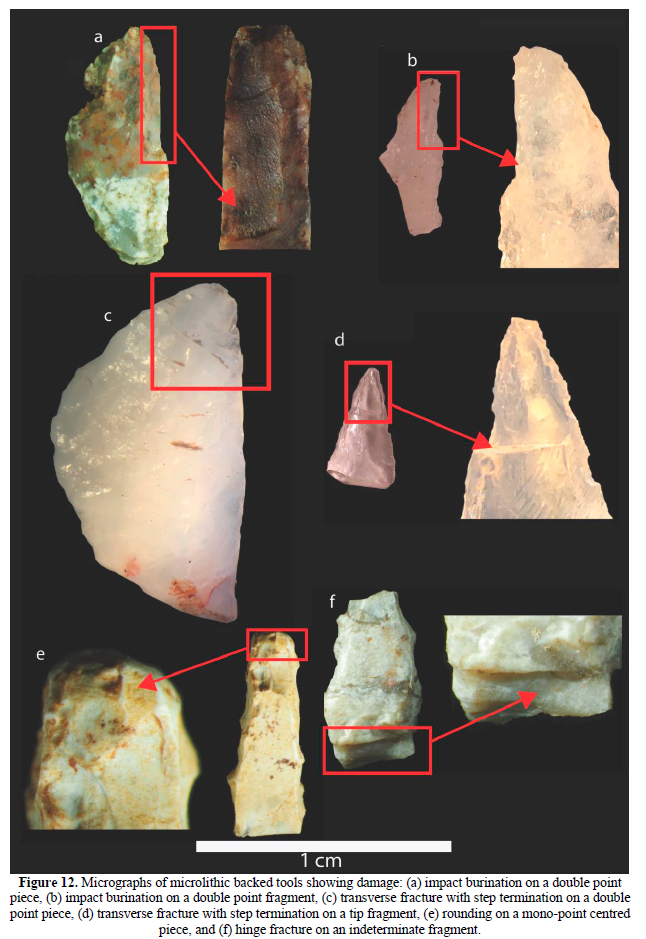
Macro-fracture, residue, rounding, and scar analyses were conducted on the microlithic backed tools to explore tool function. Macro-fractures, defined as wear traces visible to the naked eye or under a low-powered microscope, were identified using the methods outlined by Fischer et al. (1984), Sano (2009), Chesnaux (2013, 2014), and Coppe and Rots (2017). Two main classes of macro-fractures were recorded: cone and bending fractures (Chesnaux 2013, 2014). Cone fractures, including spin-off fractures, result from concentrated force applied to a small area and are typically found near the contact area. Bending fractures, which include impact burinations, transverse fractures with step terminations, as well as snap, feather, and hinge-terminating fractures, occur when force is distributed over a larger surface, with the fracture not necessarily beginning near the contact area (Fischer et al. 1984; Sano 2009; Chesnaux 2013, 2014; Pargeter 2011; Coppe & Rots 2017).
Spin-offs exceeding 2 mm (Chesnaux 2013), impact burinations, and step-terminating fractures, along with other functional traces, are considered diagnostic impact fractures (Fischer et al. 1984; Sano 2009; Chesnaux 2014; Coppe & Rots 2017). In contrast, spin-offs smaller than 2 mm (Chesnaux 2013), as well as snap terminating, feather, and hinge fractures, are classified as non-diagnostic fractures (Fischer et al. 1984; Sano 2009). In this study, spin-offs exceeding 2 mm were identified as being diagnostic of impact damage, following Chesnaux's (2013) experimental framework, which was specifically designed for microliths. We did not adopt the criteria of Fischer et al. (1984) and Sano (2009), which classify spin-offs exceeding 6 mm as diagnostic of impact damage as their experiments were based on larger artefacts, whereas microliths from LSA assemblages are often only slightly larger than 6 mm in maximum length. Diagnostic impact fractures are typically associated with the use of tools as projectile weapons, whereas non-diagnostic fractures are not necessarily related to hunting and may result from a range of other processes, including post-depositional factors.
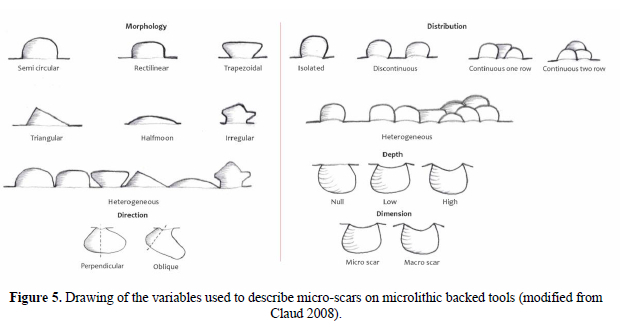
We also observed rounding on the pointed parts of the microlithic backed tools. These rounded surfaces, characterised by their smoothness and fine polish, may indicate the contact material and the manner in which force was applied (Rots 2005). Additionally, micro-scar analysis on tool edges was conducted following Claud (2008). The recorded attributes, as presented in Figure 5, include (a) morphology, (b) distribution, (c) direction, (d) depth, and (e) dimension.
Macro-residues were identified on the backs of the backed pieces. The analysis involved identifying both organic and inorganic residues, such as adhesives, using the naked eye or a low-powered microscope (Marreiros et al. 2015). Such analysis is essential for detecting traces of glue related to hafting on backed pieces, particularly given the excellent organic preservation at Pomongwe Cave. To examine fractures, residues, rounding, and scars, we utilised a Madell MC binocular microscope with magnifications ranging from 7X to 45X. Micrographs were captured using an Olympus microscope with magnifications from 5X to 50X.
3. Results
Raw material exploitation
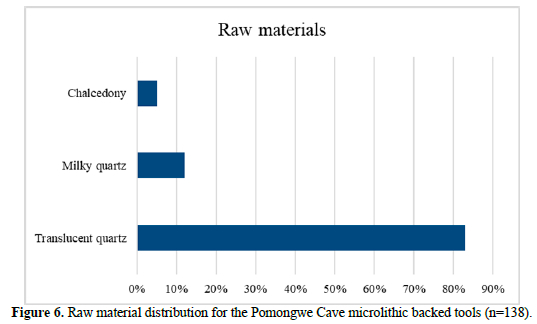
Three raw materials were used in the production of microlithic backed tools at Pomongwe Cave, with a noticeable preference for translucent quartz that accounts for 83% (n=115) of the assemblage. This is significantly higher than the use of milky quartz (12%, n=16) and chalcedony (5%, n=7; Fig. 6). The preference for quartz can be attributed to its local availability, as noted by Walker (1995; also see Matembo 2019). Chalcedony, on the other hand, is not naturally found in Matobo, and Walker (1995) suggested that it was imported from outside the area.
Classifying microlithic backed tools
Combining the major morpho-functional attributes (point, edge, and back) resulted in the individualisation of three morpho-technical classes:
• Type 1 Mono-point centred: this includes backed tools with a single point aligned with the longitudinal axis, formed by abrupt rectilinear retouch that converges to create a sharp distal point.
• Type 2 Mono-point off centred: this consists of backed tools with a single point not aligned with the longitudinal axis, where the back is shaped by abrupt rectilinear retouch, also leading to a sharp distal point.
• Type 3 Double point: this comprises backed tools with two opposed points, with the back of the tool formed by abrupt, rectilinear, or convex retouch (Fig. 7).
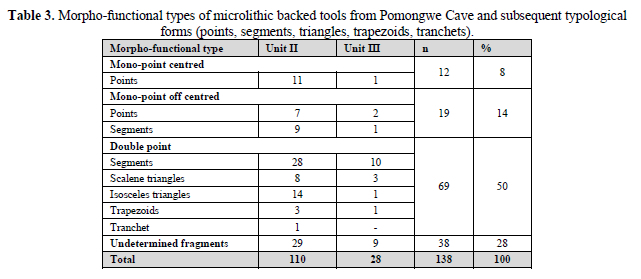
The morpho-functional classification of the backed tools from Pomongwe Cave indicates that double point backed pieces represent the majority of the assemblage at 50% (n=69), followed by mono-point off centred microliths, which make up 14% (n=19). Mono-point centred backed tools constitute 8% (n=12). Additionally, 28% (n=38) are indeterminate (broken) pieces that could not be classified into any of the categories.
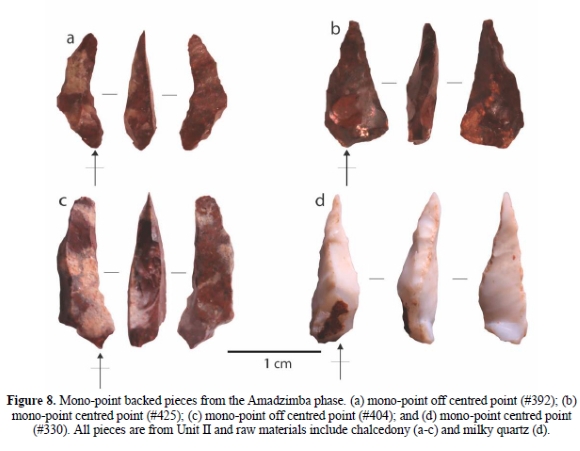
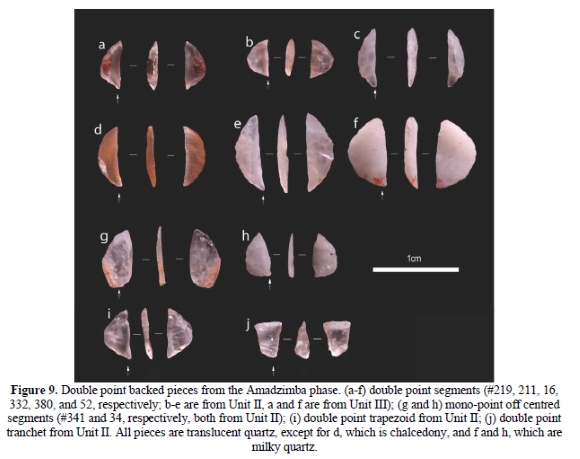
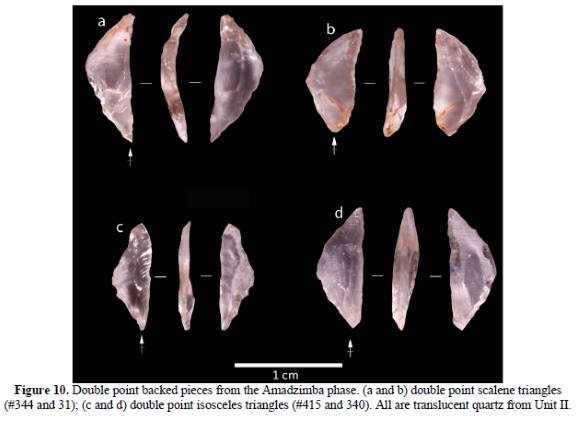
Table 3 shows that, when classifying the backed tools based on their active and passive parts (point, edge, and back), the mono-point centred category includes some of the backed tools from Walker's (1995) point class, while the mono-point off centred class combines backed tools that Walker (1995) classified as both points and segments. Lastly, the double point category encompasses backed tools that Walker (1995) classified as segments, triangles, trapezoids, and tranchets (Figs 8-10).
General attributes per morpho-functional category
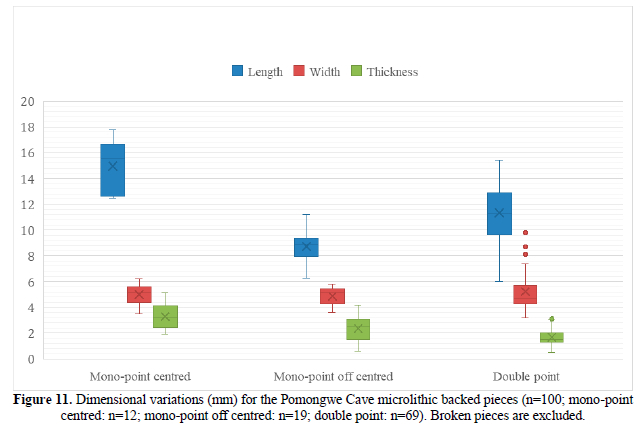
In terms of measurements, mono-point centred pieces have a mean length of 15 mm (SD=2.1), a width of 5 mm (SD=0.8), and a thickness of 3.3 mm (SD=1). Mono-point off centred pieces have mean dimensions of 8.7 mm (length, SD=1.2), 4.9 mm (width, SD=0.7), and 2.4 mm (thickness, SD=1.1). Double point pieces average 11.3 mm (length, SD=2.2), 5.2 mm (width, SD=1.5), and 1.7 mm (thickness, SD=0.6).
The boxplot (Fig. 11) shows that mono-point centred pieces differ from the other two categories of backed pieces in that they are longer. The box plot also shows that length varies the most, with mono-point centred having the highest mean and mono-point off centred the smallest. The length of the double point category comprises a broader range of data values when compared with the other two. Width is relatively consistent across all categories, while thickness is similar but slightly greater (based on larger mean values) in the mono-point centred pieces.
The microliths were made from non-cortical bladelets. The backing is total and continuous and predominantly features crossed retouch (91%; n=126), while 9% (n=12) exhibit direct retouch. The profile shapes of mono-point centred pieces are mostly flat, while mono-point off centred pieces are primarily twisted. Double points typically have flat profiles, with few exhibiting curved shapes. The pointed angles of the backed pieces range between 40° and 60°, with a mean of 50°.
Functional analyses
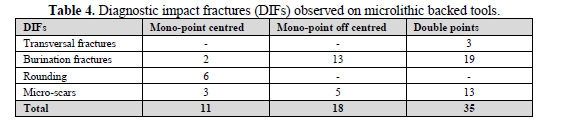
The macro-fracture analysis of the backed tools indicates diagnostic impact fractures on 27% (n=37) of the pieces, while non-diagnostic damage was recorded on 41% (n=57). The remaining 32% (n=44) showed no fractures. Among those with diagnostic impact damage, 60% (n=22) are double points, 35% (n=13) are mono-point off centred, and 5% (n=2) are mono-point centred backed pieces. The majority (86%, n=19) of double points with diagnostic impact fractures exhibited impact burinations, whereas only 14% (n=3) displayed transverse fractures with step terminations. All 13 mono-point off centred pieces displayed evidence of impact burinations, while the two mono-point centred microliths exhibited impact burinations as well. Rounding was observed on six mono-point centred pieces (Table 4, Fig. 12).
As previously highlighted, non-diagnostic damage was recorded on 57 backed pieces. Of these, a small proportion (7%, n=4) of mono-point centred backed pieces exhibited snap terminating fractures. In the mono-point off centred category, 9% (n=5) displayed snap terminating fractures, while 4% (n=2) showed hinge fractures. Within the double point category, 14% (n=8) exhibited snap terminating fractures, and 23% (n=13) displayed spin-offs smaller than 2 mm. In the category of broken or indeterminate pieces, 31% (n=18) exhibited snap terminating fractures, followed by 7% (n=4) with spin-off fractures smaller than 2 mm, and 5% (n=3) with hinge fractures (Table 5).

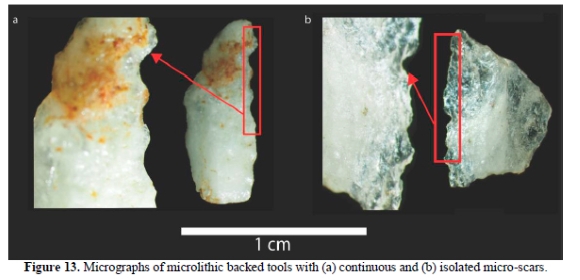
Micro-scar analysis revealed that 56% (n=77) of the analysed backed tools showed no scar traces. Among those with scars, 92% (n=56) were isolated and discontinuous, while only 8% (n=5) exhibited continuous micro-scars. These scars have a semi-circular morphology, are mostly perpendicular in direction, and vary in depth (Fig. 13).
Results from the macro-residue analysis showed that the majority (90%, n=124) of the pieces did not retain any residues, while a smaller percentage (10%, n=14) exhibited black residues (possibly adhesives) on the mesial and proximal parts of the back. The residues were observed on 2 mono-point centred pieces (14%), 3 mono-point off centred pieces (21%), and 9 double point pieces (65%).
4. Discussion
Function of geometric backed tools at Pomongwe Cave
We begin by discussing the mono-point centred pieces, which are distinct within our sample of microlithic backed tools. Of the eight mono-point centred tools exhibiting visible damage, six display rounding on their tips, indicating that they may have been used in rotational activities such as drilling. This distinction is further reflected in their dimensional variability, as they are longer than the other backed tool types. Moreover, these tools show a clear preference for chalcedony (believed to have been sourced from outside the Matobo) and milky quartz, in stark contrast to the other two categories that were made from translucent quartz. Based on these observations, we hypothesise that the backing of the mono-point centred pieces was likely intended to shape and align the tip along the longitudinal axis of the tool. Furthermore, two additional mono-point pieces exhibited impact burination fractures, but it is difficult to confirm whether mono-point centred pieces were used as hunting tips because of the low incidence of diagnostic damage.
We therefore cautiously propose that these mono-point centred points were likely employed to perforate materials, for example, when drilling small, circular holes into shells and ostrich eggshells to create beads and pendants, which are abundant in the Amadzimba levels at Pomongwe Cave. Walker (1995) documented 537 ostrich eggshell beads, 3 pendants, 2 bone disc beads, and 1 bone cylinder bead from the Amadzimba units, some of which are illustrated earlier in this paper (Fig. 2). Similarly, at Little Muck Shelter in Limpopo, South Africa, experimental work and use-wear analysis suggests that early foragers likely employed microliths to drill beads (Sherwood & Forssman 2024).
Mono-point off centred backed pieces exhibit residues and impact burinations, with no transverse fractures. Given the sporadic diagnostic impact damage, and drawing on Chesnaux's (2013, 2014) experimental model, we tentatively suggest that the combination of impact burinations, the absence of transverse fractures, and the offset single point along the longitudinal axis of these backed pieces, likely indicates that they were laterally hafted as barbs on an arrow shaft. Lateral hafting would enhance the tool's potential for laceration, thereby improving its stability during hunting (Chesnaux 2013, 2014).
Moreover, double point microlithic backed tools display evidence of residues, impact burinations, and transverse fractures with step terminations. Based on Chesnaux's (2013, 2014) experimental model, we propose two possible hafting methods for these tools. First, the prevalence of burin-like fractures over transverse fractures in double points from Pomongwe Cave suggests they may have been hafted laterally on the shaft as barbs. Second, the presence of transverse fractures with step terminations indicates that some double points may have been hafted disto-laterally, meaning they were attached near the tip of the shaft but along the side (see Fig. 14). Similar to mono-point off centred tools, double points hafted laterally would likely enhance laceration and retention during hunting, while those hafted disto-laterally would have provided additional penetration, laceration, and retention.
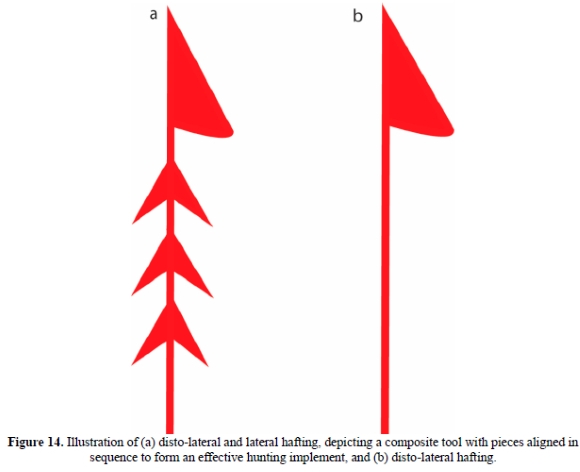
We propose that mono-point off centred and double point backed tools from Pomongwe Cave were integral components of a hafting system that employed lateral and disto-lateral hafting techniques. These tools likely functioned as barbs, affixed to a shaft with adhesives in a composite system. This system aligned multiple interchangeable components in sequence, allowing damaged parts to be replaced. The need for such interchangeability likely drove the consistent production of repetitive forms and similar dimensions, resulting in reliable and effective hunting weapons.
The moderate variation in forms and sizes suggests that these tools were designed to fit similar weapon systems. Variations in the shapes of double points, such as segments, triangles, and trapezoids, may reflect stylistic choices. However, the creation of composite tools appears to have encouraged standardised production, ensuring functional consistency. This does not preclude the variability that existed but highlights the balance between functionality and stylistic expression.
While this study clarifies the mode of insertion, other functional parameters remain unexplored and warrant further analysis. Once the functional decision-making processes are fully understood, cultural and stylistic interpretations can be more effectively addressed. Additionally, aspects such as the form, size, and shape of the shaft, its materials, and methods of construction have not been examined in detail. Additionally, details concerning the hunting context, including prey size and behaviour, are not thoroughly explored in this study. These unexamined aspects highlight significant avenues for future research to deepen our understanding of the design and use of composite tools within broader ecological and cultural frameworks.
We propose that the composite tools from Pomongwe Cave were likely used to hunt the animals represented in the Trench V faunal assemblage. With excellent organic preservation in Walker's (1995) Trench V, faunal remains constitute the largest portion of the Amadzimba artefact assemblage and include bovids such as the common eland (Taurotragus oryx), impala (Aepyceros melampus), tsessebe (Damaliscus lunatus), sable antelope (Hippotragus niger), and black wildebeest (Connochaetes gnou; Walker 1995).
The discussion above suggests that tools with similar active and passive components were likely hafted in the same position and manner, supporting their classification through a morpho-functional approach. For instance, tools with a single point aligned along the longitudinal axis were likely used for drilling, as their shape and hafting configuration allowed for effective rotational force and penetration into various materials. In contrast, backed pieces with double points, such as triangles, segments, and trapezoids appear to have served comparable roles on an arrow shaft. Their symmetrical design and dual points may have enhanced aerodynamic efficiency, penetration, and incision capabilities upon impact. This suggests that backed tools were likely strategically hafted to maximise efficiency in hunting or combat, whereas mono-point centred backed tools were likely optimised for tasks requiring precision and controlled force application. Thus, classifying them as double points or mono-points based on function is entirely appropriate, as it reflects the intentional design choices made by past toolmakers. The potential use of these backed tools as cutting implements, as suggested by Walker ( 1995), is not entirely dismissed in this study, as our analysis of the scars was preliminary. The observed scars are mostly isolated, discontinuous, and shallow, making it difficult to interpret cutting motions based on these initial results. Therefore, a more comprehensive microwear analysis is needed in the future.
Non-diagnostic impact fractures are typically difficult to interpret due to their ambiguous characteristics, as they can result from multiple processes beyond intentional use. However, a portion of the microlithic backed tools from Pomongwe Cave, exhibiting snap terminating fractures, spin-offs smaller than 2 mm, and hinge fractures, are likely to have resulted either from stone tool manufacture or post-depositional processes, such as trampling. These types of fractures often occur when tools are subjected to mechanical stress, either during their initial production, where forceful blows may cause unintended breakage, or through natural taphonomic processes that alter artefacts over time. We base this interpretation on several experimental studies (Fischer et al. 1984; Sano 2009; Chesnaux 2013) that have explored these processes in greater detail. These studies have demonstrated that similar breakage patterns can emerge from both human activities, such as knapping and tool maintenance, and natural disturbances, making it essential to consider multiple lines of evidence when assessing non-diagnostic impact damage.
When comparing the Pomongwe Cave Amadzimba assemblage with other late Holocene examples in southern Africa, such as the Wilton technocomplex at Balerno Main Shelter in Limpopo, South Africa, a shared characteristic among these toolkits is the predominance of scrapers and backed pieces within the formal tool categories (e.g., Guillemard & Porraz 2019). The morpho-functional characteristics of the Balerno Main Shelter scrapers suggest they were often hafted and employed in tasks like scraping, which was integral to various economic and social contexts (Guillemard & Porraz 2019; Guillemard 2020a). Guillemard (2020a) suggests that the presence of microlithic industries across southern Africa during the late Holocene can be attributed to a combination of vertical and horizontal cultural transmission, as well as possible independent innovations.
Despite these similarities, a notable distinction between the Amadzimba assemblage and other southern African collections is the higher frequency of backed pieces relative to scrapers. This discrepancy may reflect unique subsistence strategies and social transformations, suggesting that the Amadzimba assemblage represents a distinct regional expression. For instance, scrapers predominate the typological composition of assemblages from sites such as Balerno Main Shelter, Rose Cottage Cave, Boomplaas, and Jubilee Shelter during the late Holocene (Deacon 1984; Wadley 1996, 2000; Guillemard & Porraz 2019; Guillemard 2020a).
Beyond the African context, the European Upper Palaeolithic provides compelling evidence of microlithic backed pieces integrated into composite tools. Analyses of use-wear and residues, supported by experimental studies, demonstrate that these composite barbed points were meticulously crafted from multiple microlithic components. Their design was tailored to target particular prey and align with seasonal hunting strategies, highlighting the advanced planning, adaptability, and ingenuity of these human populations (see Pétillon et al. 2011; Tomasso et al. 2018; Taipale et al. 2022).
In Australia the situation is similar, where the emergence of microlithic backed tools during the mid-to-late Holocene are interpreted as barbs that were hafted into composite systems (Hiscock 1994). Their development is thought to reflect strategies aimed at minimising the risks associated with environmental changes, increased mobility, and the colonisation of previously uninhabited areas (Hiscock 1994, 2006). A notable example comes from southeastern Australia, at Mussel Shelter in the Sydney Basin, where a significant rise in the use of backed tools is observed between 4000 and 3500 BP. These tools, integrated into composite systems, served a variety of functions such as cutting, drilling, and potentially as projectiles (Attenbrow et al. 2009). This increase in the use of backed tools is closely associated with elevated foraging risks and societal restructuring, both driven by a transition to cooler and drier climatic conditions (Attenbrow et al. 2009). In contrast, the increase in backed tools during the late Holocene in Matobo is linked to warmer and wetter conditions, which are argued to have contributed to population growth (Walker 1995). Consequently, the need to sustain this population increase likely led to the development of new hunting strategies, resulting in the production of numerous backed pieces during this period. This suggests both shared technological innovations and distinct regional adaptations during the late Holocene.
Despite the limitations outlined in this study, our findings provide some clarity on potential hunting weaponry in the Matobo region. There is a general lack of evidence and interpretations regarding the use of backed pieces in a composite arrangement within Zimbabwe, despite the well-established record of composite, multi-component tool technologies in southern Africa, spanning from the MSA to the LSA (see Veall 2022). Therefore, our findings have the potential to stimulate future discussions on related topics in Zimbabwe, serving as a foundation for understanding late Holocene hunting strategies in Matobo. Our study may also contribute to comparative studies of late Holocene innovations across southern Africa.
While our study has the potential to stimulate discussions on hunting weaponry in Zimbabwe, future research should explore the role of processes such as trampling in combination with appropriate experimental studies. Experiments should also use local raw materials, such as translucent and milky quartz. This study relied heavily on Chesnaux's (2013, 2014) macro-fracture experiments, which were based on flint, to interpret the diagnostic impact fractures. Therefore, future studies should incorporate use-wear experiments, particularly with the most preferred translucent quartz. Additionally, experimentation should explore tool designs, hafting strategies, and hunting systems. While we have proposed that microlithic backed tools were likely used as projectiles, the broad variability in hunting weapons warrants further examination through experimentation.
We recommend analysing other formal tools in the Pomongwe Cave assemblage, such as scrapers, to better understand their technology and function. This would provide a more comprehensive view of hunter-gatherer life during the final phases of the LSA at the site and in Matobo. Furthermore, we suggest examining the full chaîne opératoire of the blanks and cores from the Amadzimba phase to better understand the technological mechanisms behind the production of these tools. Additionally, we recommend investigating the abundant Amadzimba bone tools to complement this research and supplement the data on Amadzimba cultural expressions. Future research could also expand to other sites in Matobo, such as Bambata, where Walker (1995) recorded a significant number of geometric backed pieces and other material culture. Conducting use-wear analysis on Bambata's backed tools would facilitate comparisons between the Matobo sites and provide a more complete picture of the regional Amadzimba. Collectively, these future studies would contribute to a more thorough understanding of the Amadzimba in the Matobo and across Zimbabwe.
5. Conclusion
Microlithic backed tools are characteristic formal tools that occur in most late Holocene lithic assemblages in southern Africa. In Zimbabwe, the late Holocene Amadzimba, dated between ca. 5800 and 2300 BP, is marked by a proliferation of these tools of various shapes and sizes. They are found at sites such as Bambata and Pomongwe Caves and they predominate formal tool samples, which suggests they were commonly used by populations in the Matobo during this period.
The present study focused on the microlithic backed tools from Pomongwe Cave, and a sample of 138 specimens were analysed from units II and III, which correspond to the late Holocene phase. We moved away from the previously used typological system that classified these tools based on geometric shapes and instead, adopted a morpho-functional approach, classifying the tools based on morphometric criteria and summarising the observed variations in their structure (active versus passive parts).
Our findings demonstrate that mono-point centred backed tools were likely used for drilling, while mono-point off centred and double points were laterally and disto-laterally hafted as barbs on an arrow shaft. We further propose the existence of composite tool technology at Pomongwe Cave, where backed pieces were hafted in sequence to form hunting weapons designed to maximise penetration, laceration, and retention, and where hafting components could be substituted when damaged to ensure a successful hunt.
These results fill a gap in understanding late Holocene hunting weaponry at Pomongwe Cave, where evidence has been limited. The study also opens avenues for future discussions on hunting weaponry in the Matobo. Compared to other regions, the Amadzimba at Pomongwe Cave may represent a unique expression, with the proliferation of backed tools possibly linked to changes in subsistence strategies, population growth, and improved climate. Our study thus contributes knowledge about the intricate behaviours and complex cultures of hunter-gatherers during the final phases of the LSA. Further investigation into microlithic backed tools and lithic assemblages from other late Holocene sites in Matobo is essential for deepening our understanding of the social and cultural transformations occurring during this period on a broader regional scale.
Acknowledgements
We acknowledge that this paper is based on research from Precious Chiwara-Maenzanise's Master's dissertation, completed at the University of Zimbabwe in 2018. We extend our gratitude to the University of Zimbabwe for providing a tuition waiver to Precious Chiwara-Maenzanise. The analysis of microlithic backed tools in France was funded by the Matobart project, led by Camille Bourdier, for which we are thankful. Additional financial support was provided by the French Ministry of Foreign Affairs and the Agence Nationale de la Recherche (project ANR-21-CE27-0030-01). Special thanks to Lorene Chesnaux for her guidance and support during the use-wear analysis in France and to Alexandra Legrand Pineau for allowing us to take photographs using their microscopes at Nanterre University in Paris. We also thank Humphrey Nyambiya for the map, and the reviewers and editors of Southern African Field Archaeology for their insightful comments that have improved the manuscript.
References
Ambrose, S.H. 2002. Small things remembered: Origins of early microlithic industries in sub-Saharan Africa. Archaeological Papers of the American Anthropological Association, 12(1): 9-29. [ Links ]
Armstrong, A.L. 1931. Rhodesian archaeological expedition 1929: Excavations in Bambata Cave and research on prehistoric sites in Southern Rhodesia. Journal of the Royal Anthropological Institute, 61: 239-276. [ Links ]
Attenbrow, V., Robertson, G. & Hiscock, P. 2009. The changing abundance of backed artefacts in south-eastern Australia: A response to Holocene climate change? Journal of Archaeological Science, 36(12): 2765-2770. [ Links ]
Barham, L.S. 1992. Let's walk before we run: An appraisal of historical materialist approaches to the Later Stone Age. South African Archaeological Bulletin, 47: 44-51. [ Links ]
Bourdier, C. 2019. Peintures rupestres et environnements culturels des Matobo, Zimbabwe. Lesedi, 23: 25-29. [ Links ]
Bourdier, C., Dudognon, C., Frouin, M., et al. 2020. Approche interdisciplinaire de la paroi ornée: Pomongwe Cave et le program Matobart. Lesedi, 23: 13-18. [ Links ]
Bronk Ramsey, C. 2017. Methods for summarising radiocarbon datasets. Radiocarbon, 59: 1809-1833. [ Links ]
Brooks, A.S. & Yellen, J.E. 1977. Archaeological excavations at ≠Gi: A preliminary report on the first two field seasons. Botswana Notes and Records, 9: 21-30. [ Links ]
Charrié-Duhaut, A., Porraz, G., Igreja, M., et al. 2016. Holocene hunter-gatherers and adhesive manufacture in the West Coast of South Africa. Southern African Humanities, 29(1): 283-306. [ Links ]
Chesnaux, L. 2013. Microliths from 62 rue Henry-Farman, Paris (15th arrondissement): Specific arrows for different types of game hunted in particular places. In: Valentin, B., Souffi, B., Ducrocq, T., et al. (eds) Mesolithic palethnography research on open-air sites between Loire and Neckar, proceedings of the international round-table meeting, Paris, November 26-27, 2010: 119-132. Paris: Société préhistorique française. [ Links ]
Chesnaux, L. 2014. Variability in the manufacturing of triangular geometric microliths during the early Mesolithic: Toward a simplification of barb manufacturing? A comparative techno-functional analysis of microlithic assemblages from Saint-Lizier at Creysse (24) and La Grande Rivoire at Sassenage (38). Palethnologie. Archéologie et Sciences Humaines, 6: 55-63. [ Links ]
Chiwara-Maenzanise, P. 2018. Morpho-functional variability of the late Holocene microlithic backed tools from Pomongwe Cave, Matobo, Western Zimbabwe. Masters Dissertation. Harare: University of Zimbabwe. [ Links ]
Clarkson, C., Hiscock, P., Mackay, A., et al., 2018. Small, sharp, and standardised: Global convergence in backed microlith technology. In: O'Brien, M., Buchanan, B. & Eren, M. (eds) Convergent Evolution in Stone -tool Technology: 175-200. Cambridge: MIT Press. [ Links ]
Claud, E. 2008. Le statut fonctionnel des bifaces au Paléolithique moyen récent dans le Sud-Ouest de la France. Étude tracéologique intégrée des outillages des sites de La Graulet, La Conne de Bergerac, Combe Brune 2, Fonseigner et Chez-Pinaud / Jonzac. Doctoral Thesis. Bordeaux: University of Bordeaux. [ Links ]
Close, A.E. & Sampson, C.G. 1998a. Backed microlith clusters in late Holocene rock shelters of the Upper Karoo. South African Archaeological Bulletin, 53: 63-72. [ Links ]
Close, A.E. & Sampson, C.G. 1998b. Recent backed microlith production in central South Africa. Lithic Technology, 23(1): 5-19. [ Links ]
Cooke, C.K. 1963. Report on excavations at Pomongwe and Tshangula Caves, Matopo Hills, Southern Rhodesia. South African Archaeological Bulletin, 18 (7): 73-151. [ Links ]
Cooke, C.K. & Robinson, K.R. 1954. Excavations at Amadzimba Cave, Matopo Hills, Southern Rhodesia. Occasional Papers of the National Museum of Southern Rhodesia, 2(19): 699-728. [ Links ]
Coppe, J. & Rots, V. 2017. Focus on the target. The importance of a transparent fracture terminology for understanding projectile points and projecting modes. Journal of Archaeological Science: Reports, 12: 109-123. [ Links ]
Deacon, J. 1984. The Later Stone Age of Southernmost Africa. Oxford: British Archaeological Reports Publishing. [ Links ]
Denbow, J. 1986. A new look at the later Prehistory of the Kalahari. Journal of African History, 27(1): 3-28. [ Links ]
Dudognon, C., Frouin, M., Touron, S., et al. 2021. Recherche, conservation et valorisation d'un patrimoine mondial: Des défis multiples dans les Matobo, Zimbabwe. In: Favel, B., Gaultier-Kurhan, C. & Heimlich, G. (eds) Art Rupestre et Patrimoine Mondial en Afrique Subsaharienne: 67-90. Paris: Hemispheres Editions. [ Links ]
Fischer, A., Hansen, P.V. & Rasmussen, P. 1984. Macro and micro wear traces on lithic projectile points: Experimental results and prehistoric examples. Journal of Danish Archaeology, 3(1): 19-46. [ Links ]
Forssman, T. 2017. Foragers and trade in the middle Limpopo Valley, c. 1200 BC to AD 1300. Azania: Archaeological Research in Africa, 52: 49-70. [ Links ]
Fullagar, R. 2016. Uncertain evidence for weapons and craft tools: Functional investigations of Australian microliths. In: Iovita, R. & Sano, K. (eds) Multidisciplinary Approaches to the Study of Stone Age Weaponry. Vertebrate Paleobiology and Paleoanthropology: 159-166. Dordrecht: Springer. [ Links ]
Goldstein, S.T. & Shaffer, C.M. 2017. Experimental and archaeological investigations of backed microlith function among mid-to-late Holocene herders in southwestern Kenya. Archaeological and Anthropological Sciences, 9: 1767-1788. [ Links ]
Guillemard, I. 2020a. Change and continuity in the lithic technologies from final to ceramic final Later Stone Age, Limpopo Basin, South Africa. Doctoral Thesis. Johannesburg: University of the Witwatersrand. [ Links ]
Guillemard, I. 2020b. Equating language, genes and subsistence? The appearance of herding in southern Africa. Azania: Archaeological Research in Africa, 55(1): 97-120. [ Links ]
Guillemard, I. 2024. Exploring Wilton microlithic technologies: New analyses from Rose Cottage Cave, South Africa. Quaternary Science Reviews, 333: 108679. [ Links ]
Guillemard, I. & Porraz, G.E. 2019. What is a Wilton scraper? Perspectives from the late Holocene assemblage of Balerno Main Shelter, Limpopo Province, South Africa. Southern African Humanities, 32: 135-162. [ Links ]
Hall, S.L. 1990. Hunter-gatherer-fishers of the Fish River Basin: A contribution to the Holocene prehistory of the Eastern Cape. Doctoral Thesis. Stellenbosch: Stellenbosch University. [ Links ]
Hiscock, P. 1994. Technological responses to risk in Holocene Australia. Journal of World Prehistory, 8: 267-292. [ Links ]
Hiscock, P. 2006. Blunt and to the point: Changing technological strategies in Holocene Australia. In: Lilley, I. (ed.) Archaeology in Oceania: Australia and the Pacific Islands: 69-95. Oxford: Blackwell Publishing. [ Links ]
Hiscock, P., Clarkson, C. & Mackay, A. 2011. Big debates over little tools : Ongoing disputes over microliths on three continents. World Archaeology, 43(4): 653-664. [ Links ]
Hogg, A.G., Hua, Q., Blackwell, P.G., et al. 2013. SHCal13 southern hemisphere calibration, 0-50,000 years cal BP. Radiocarbon, 55(4): 1889-1903. [ Links ]
Inizan, M.L., Reduron-Ballinger, M., Roche, H., et al. 1999. Technology and Terminology of Knapped Stone. Nanterre: CREP. [ Links ]
Jones, N. 2013. The Prehistory of Southern Rhodesia. Second Edition. Cambridge: Cambridge University Press. [ Links ]
Kinahan, J. 2019. The origins and spread of pastoralism in southern Africa. Oxford Research Encyclopedia of African History. Available from: https://doi.org/10.1093/acrefore/9780190277734.013.678 (Accessed: 2025). [ Links ]
Lewis, L. 2015. Early microlithic technologies and behavioural variability in southern Africa and South Asia. Doctoral Thesis. Oxford: University of Oxford. [ Links ]
Lombard, M. & Badenhorst, S. 2019. A case for springbok hunting with kite-like structures in the northwest Nama Karoo bioregion of South Africa. African Archaeological Review, 36(3): 383-396. [ Links ]
Lombard, M., Wadley, L., Deacon, J., et al. 2012. South African and Lesotho Stone Age sequence updated (I). South African Archaeological Bulletin, 67(195): 123-144. [ Links ]
Lombard, M., Caruana, M.V., van der Walt, J., et al. 2020. The Keimoes 3 desert kite site, South Africa: An aerial lidar and micro-topographic exploration. Antiquity, 94 (373): 197-211. [ Links ]
Lombard, M., Lotter, M.G., van der Walt, J., et al. 2021. The Keimoes Kite Landscape of the trans-Gariep, South Africa. Archaeological and Anthropological Sciences, 13: 1-22. [ Links ]
Lombard, M., Bradfield, J., Caruana, M.V., et al. 2022. The Southern African Stone Age sequence updated (II). South African Archaeological Bulletin, 77(217): 172-212. [ Links ]
Lotter, M.G., Forssman, T., Bielderman, S., et al. 2023. Using aerial survey to record new sites in the Keimoes kite landscape of South Africa. Southern African Field Archaeology 18: 2421. [ Links ]
Marreiros, J., Mazzucco, N., Gibaja, J., et al. 2015. Macro and micro evidences from the past: The state of the art of archaeological use-wear studies. In: Marreiros, J., Gibaja Bao, J. & Ferreira Bicho, N. (eds) Manuals in Archaeological Method, Theory and Technique: Use-Wear and Residue Analysis in Archaeology: 5-26. New York: Springer. [ Links ]
Matembo, J. 2019. The Middle and Later Stone Age crystal quartz technologies of Pomongwe Cave, Matopos (Zimbabwe). Masters Dissertation. Johannesburg: University of the Witwatersrand. [ Links ]
Mazel, A.D. 1989. People making history: The last ten thousand years of hunter-gatherer communities in the Thukela Basin. Southern African Humanities, 1: 1-168. [ Links ]
Miller, D., Yates, R.J., Jerardino, A., et al. 1995. Late Holocene coastal change in the southwestern Cape, South Africa. Quaternary International, 29/30: 3-10. [ Links ]
Mitchell, P. 2005. Modelling Later Stone Age societies in southern Africa. In: Stahl, A.B. (ed.) African Archaeology: A Critical Introduction: 150-117. Oxford: Blackwell Publishing. [ Links ]
Mitchell, P. 2024. The Archaeology of Southern Africa. Cambridge: Cambridge University Press. [ Links ]
Mnkandla, T. 2019. A reconstruction of palaeoenvironmental conditions in Matobo World Heritage landscape: A geoarchaeological perspective. Masters Dissertation. Harare: University of Zimbabwe. [ Links ]
Nhunzvi, J. 2019. Diversity in Late Stone Age Art in Zimbabwe. An elemental and mineralogical study of pigments (ochre) from Pomongwe Cave, Matobo Hills, Western Zimbabwe. Masters Dissertation. Harare: University of Zimbabwe. [ Links ]
Nhunzvi, J., Nhamo, A., Dayet, L., et al. 2020. Diversity in Late Stone Age Art in Zimbabwe. Lesedi, 23: 23-26. [ Links ]
Pargeter, J. 2011. Assessing the macrofracture method for identifying Stone Age hunting weaponry. Journal of Archaeological Science, 38(11): 2882-2888. [ Links ]
Pargeter, J. 2016. Lithic miniaturisation in late Pleistocene southern Africa. Journal of Archaeological Science: Reports, 10: 221-236. [ Links ]
Parkington, J.E. 1987. Changing views of prehistoric settlement in the western Cape. In: Parkington, J.E. & Hall, M. (eds) Papers in the Prehistory of the Western Cape, South Africa: 4-23. Oxford: British Archaeological Reports. [ Links ]
Parkington, J.E, Cable, C., Carter, P.L., et al. 1980. Time and place: Some observations on spatial and temporal patterning in the Later Stone Age sequence in southern Africa [with comments and reply]. South African Archaeological Bulletin, 132: 73-112. [ Links ]
Pétillon, J.M., Bignon, O., Bodu, P., et al. 2011. Hard core and cutting edge: Experimental manufacture and use of Magdalenian composite projectile tips. Journal of Archaeological Science, 38(6): 1266-1283. [ Links ]
Porraz, G.E., Chiwara-Maenzanise P., Haaland, M., et al. 2020. Les sous-sols de l'art rupestre à l'abri Pomongwe (Matobo, Zimbabwe). Lesedi, 23: 18-22. [ Links ]
Porraz, G., Nhamo, A. & Bourdier, C. 2023. Pomongwe Cave, Zimbabwe. In: Beyin, A., Wright, D.K., Wilkins J., et al. (eds) Handbook of Pleistocene Archaeology of Africa: Hominin Behaviour, Geography, and Chronology: 1225-1237. Springer: Cham. [ Links ]
Rots, V. 2005. Wear traces and the interpretation of stone tools. Journal of Field Archaeology, 30(1): 61-73. [ Links ]
Sadr, K. 2015. Livestock first reached southern Africa in two separate events. PLoS ONE, 10(8): e0134215. [ Links ]
Sadr, K. 2019. Atop Kasteelberg: Social complexity in the Later Stone Age of South Africa. African Archaeological Review, 36: 89-103. [ Links ]
Sano, K. 2009. Hunting evidence from stone artefacts from the Magdalenian Cave site Bois Laiterie, Belgium: A fracture analysis. Quartär, 56: 67-86. [ Links ]
Sealy, J. 2006. Diet, mobility and settlement pattern among Holocene hunter-gatherers in southernmost Africa. Current Anthropology, 47(4): 569-595. [ Links ]
Sherwood, N.L. & Forssman, T. 2024. Ostrich eggshell beads: Hole drilling technology at Little Muck Shelter, South Africa. Journal of Archaeological Science, 172: 106091. [ Links ]
Stewart, B.A. & Mitchell, P.J. 2018. Late Quaternary paleoclimates and human-environment dynamics of the Maloti-Drakensberg region, southern Africa. Quaternary Science Reviews, 196: 1-20. [ Links ]
Taipale, N., Chiotti, L. & Rots, V. 2022. Why did hunting weapon design change at Abri Pataud? Lithic use-wear data on armature use and hafting around 24,000-22,000 BP. PLoS ONE, 17(1): e0262185. [ Links ]
Tomasso, A., Rots, V., Purdue, L., et al. 2018. Gravettian weaponry: 23,500-year-old evidence of a composite barbed point from Les Prés de Laure (France). Journal of Archaeological Science, 100: 158-175. [ Links ]
van der Walt, J. & Lombard, M. 2018. Kite-like structures in the Nama Karoo of South Africa. Antiquity, 92(363): 1-6. [ Links ]
Veall, M.A. 2022. Hafting technology in the Stone Age of southern Africa. Oxford Research Encyclopedia of Anthropology. Available from: https://doi.org/10.1093/acrefore/9780190854584.013.60. (Accessed: 2025). [ Links ]
Wadley, L. 1996. Changes in the social relations of precolonial hunter-gatherers after agropastoralist contact: An example from the Magaliesberg, South Africa. Journal of Anthropological Archaeology, 15: 207-217. [ Links ]
Wadley, L. 2000. The Wilton and pre-ceramic post-classic Wilton Industries at Rose Cottage Cave and their context in the South African sequence. South African Archaeological Bulletin, 55(172): 90-106. [ Links ]
Wadley, L. & Binneman, J. 1995. Arrowheads or pen knives? A microwear analysis of mid-Holocene stone segments from Jubilee Shelter, Transvaal. South African Journal of Science, 91(3):153-155. [ Links ]
Walker, N.J. 1995. Late Pleistocene and Holocene Hunter-gatherers of the Matopos: An Archaeological Study of Change and Continuity in Zimbabwe. Uppsala: Societas Archaeologica. [ Links ]
Walker, N.J. & Thorp, C. 1997. Stone Age archaeology in Zimbabwe. In: Pwiti, G. (ed.) Caves, Monuments and Texts. Zimbabwean Archaeology Today: 9-32. Uppsala: Societas Archaeologica. [ Links ]
Way, A.M., de la Peña, P., de la Peña, E., et al. 2022. Howiesons Poort backed artefacts provide evidence for social connectivity across southern Africa during the Final Pleistocene. Scientific Reports, 12(1): 9227. [ Links ]
Wiessner, P. 1983. Style and social information in Kalahari San projectile points. American Antiquity, 48(2): 253-276. [ Links ]
Yaroshevich, A., Nadel, D. & Tsatskin, A. 2013. Composite projectiles and hafting technologies at Ohalo II (23 ka, Israel): Analyses of impact fractures, morphometric characteristics and adhesive remains on microlithic tools. Journal of Archaeological Science, 40(11): 4009-4023. [ Links ]
Received October 2024
Revised January 2025
Published April 2025
* Corresponding author email: precious.maenzanise@uct.ac.za