



Services on Demand
Journal

Article
 English (pdf)
 Article in xml format
 Article references
 Automatic translation
 Send this article by e-mail
Indicators
Related links
-
 Cited by Google
 -
 Similars in Google
Share

 Permalink
Southern African Field Archaeology
On-line version ISSN 2789-1844Print version ISSN 1019-5785
South. Afr. Field Archaeol. vol.20 Johannesburg 2025
https://doi.org/10.36615/safa.20.3573.2025
PEER-REVIEWED CRITIQUE/DISCUSSION
Unearthed potential: Reflecting on the past and shaping the future of Middle Stone Age research in Zimbabwe
Precious Chiwara-MaenzaniseI, II
IHuman Evolution Research Institute (HERI), University of Cape Town, Private Bag X3, Rondebosch 7701, South Africa
IIDepartment of Geological Sciences, University of Cape Town, Private Bag X3, Rondebosch 7701, South Africa
ABSTRACT
Zimbabwe is home to numerous well-preserved deposits spanning from the Earlier to the Later Stone Age. However, research on the Middle Stone Age has been limited, with most studies conducted during the colonial era. Following independence, economic decline and political challenges have led to sporadic research efforts, leaving Zimbabwe marginalised in discussions on Homo sapiens' origins. As a result, key questions about early human behaviours and adaptations remain unresolved. Renewed Middle Stone Age research could provide valuable insights into behavioural evolution, contributing to a more nuanced understanding of human origins and supporting polycentric theories of our species' emergence.
Keywords: Middle Stone Age, early modern humans, economic downturn, understudied, future prospects
1. Introduction
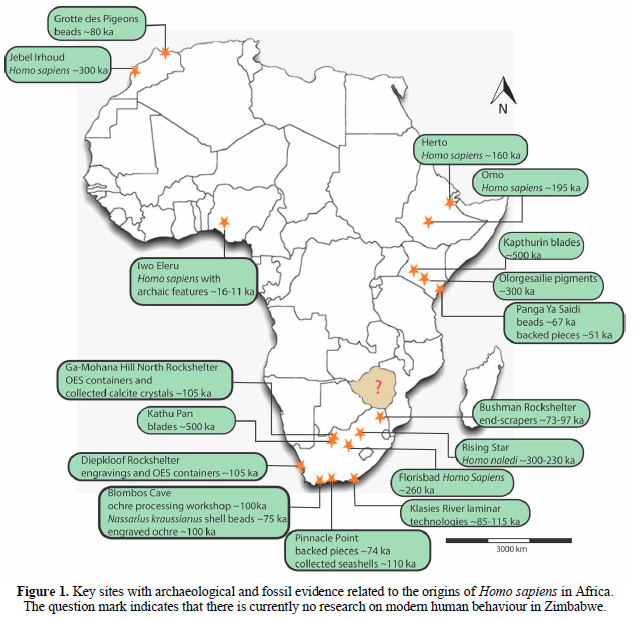
The Middle Stone Age (MSA; ~300-20 ka) is a pivotal period in African prehistory, crucial for investigating the emergence and spread of intricate human behaviours (McBrearty & Brooks 2000; d'Errico 2003; Willoughby 2006; Wadley 2015; Sahle et al. 2019; Bader et al. 2022; Blackwood & Wilkins 2022; Sahle & Wilkins 2024; Chiwara-Maenzanise et al. 2025). Fossil and archaeological evidence strongly support the emergence of Homo sapiens during the MSA (Fig. 1; e.g., Grün et al. 1996; Bouzouggar et al. 2007; Johnson & McBrearty 2010; Harvati et al. 2011; Wadley 2015; Dirks et al. 2017; Hublin et al. 2017; Brooks et al. 2018; Wilkins 2021; Wilkins et al. 2021). Notable fossils include the Florisbad cranium (~260 ka) and Homo naledi remains from the Rising Star Cave in South Africa (~330-230 ka; Grün et al. 1996; Dirks et al. 2017). Additional Homo sapiens remains have been found at Herto (~160 ka) and Omo Kibish (~195 ka) in Ethiopia (White et al. 2003; McDougall et al. 2005), as well as at Jebel Irhoud, Morocco (~300 ka; Hublin et al. 2017). The discovery of a calvaría from Iwo Eleru, Nigeria (~16-11 ka), further expands our understanding of early human distribution across the African continent (Harvati et al. 2011).
These fossil discoveries are supported by archaeological evidence reflecting complex, innovative technologies linked to Homo sapiens across Africa. In southern Africa, key examples include a ~100 ka ochre-processing workshop, geometric engravings on ochre, and ~75 ka evidence of shell beads at Biombos Cave (d'Errico et al. 2005, 2015; Henshilwood et al. 2009, 2011). Other significant findings include geometric engravings at Diepkloof Rockshelter (~105 ka; Porraz et al. 2021), calcite crystals at Ga-Mohana Hill North Rockshelter (~105 ka), and collected seashells from Pinnacle Point (~110 ka; Jerardino & Marean 2010; Wilkins et al. 2021). The utilisation of ostrich eggshells (OES) at Diepkloof and Ga-Mohana Hill North Rockshelters (~105 ka; Parkington et al. 2005; Wilkins et al. 2021), early blade production at Kathu Pan (~500 ka; Wilkins & Chazan 2012), and laminar stone tool reduction at Klasies River (~85-115 ka; Wurz 2002) further highlight advanced behaviours. The emergence of formal tools, such as scrapers at Bushman Rockshelter (~73-97 ka; Porraz et al. 2018), underscores the complexity of early human technologies.
Similar patterns emerged in eastern Africa, where blade production is evident at Kapthurin (~500 ka; Johnson & McBrearty 2010). Pigment use at Olorgesailie, Kenya (~300 ka; Brooks et al. 2018), and evidence of beads (~67 ka) and backed pieces (~51 ka), possibly used as multicomponent hunting weapons at Panga Ya Saidi (Ranhorn & Tryon 2018; Shipton et al. 2018), further highlight the technological sophistication of MSA populations. In northern Africa, seashell beads at Grotte des Pigeons (~80 ka; Bouzouggar et al. 2007) provide additional evidence. These discoveries have fuelled debates about whether early human populations originated from a single location or multiple regions (Wilkins 2021). Current evidence supports a wide distribution for Homo sapiens, with cultural exchange and genetic intermingling also suggesting a multi-locational origin (Wilkins 2021).
Despite the possibility that early modern humans were widely distributed across Africa and may have had a multi-location origin, MSA research in southern Africa has been largely concentrated in South Africa, even though over a century has passed since Stone Age research began in Zimbabwe (e.g., see early research by White 1900, 1905; Mennen 1904; Arnold & Jones 1919). During the colonial period, MSA research in Zimbabwe was comparable with research being conducted in South Africa (Nhamo-Katsamudanga & Chiwara-Maenzanise 2023). However, since Zimbabwe's independence, progress in MSA research has been limited. The foundation of MSA research was laid in the 1930s, with the most significant contributions occurring between the 1950s and 1970s (e.g., Armstrong 1931; Jones 1933, 1938, 1940, 1949; Cooke 1950, 1957, 1963, 1971, 1975a, b, 1978; Brain & Cooke 1967; Brain 1969; Cruz-Uribe 1983). Only occasional efforts have been made in the ensuing decades (e.g., Walker 1995; Klimowicz & Haynes 1996; Larsson 2001; Chiwara-Maenzanise et al. 2017; Matembo 2019).
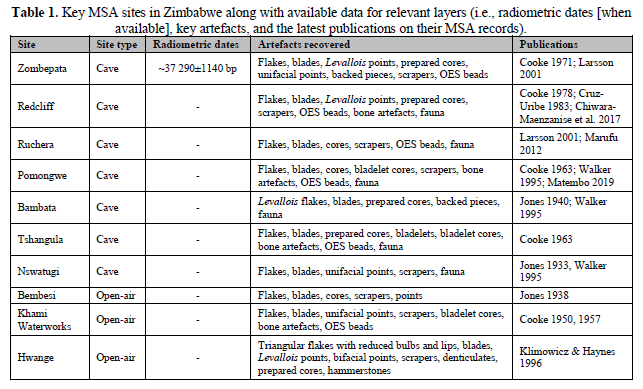
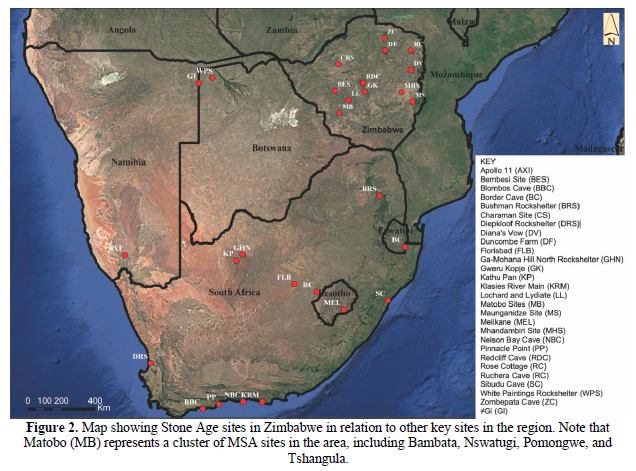
Nevertheless, Zimbabwe hosts well-preserved cave deposits with long cultural sequences that could provide valuable data on early modern human development in this interior region (Table 1). Notable cave sites include Zombepata, Redcliff, Ruchera, and the Matobo Cave cluster, which includes Pomongwe, Bambata, Tshangula, and Nswatugi (Fig. 2; Jones 1933; Cooke 1963, 1971, 1978; Walker 1995; Larsson 2001). MSA open-air sites are also found at Bembesi, Khami Waterworks, and in Hwange (Jones 1938; Cooke 1950; Klimowicz & Haynes 1996). However, these cave and open-air sites have not been extensively studied. No radiometric dates exist for the MSA layers at these sites as most research predates the development of dating techniques that extend beyond the radiocarbon range. Additionally, while the MSA field has advanced across Africa with the introduction of new analytical methods, these techniques have not been applied in Zimbabwe due to the lack of ongoing research. As significant questions about MSA human behaviour are now being explored elsewhere, Zimbabwe remains absent from the conversation on early complex human behaviour. This lack of updated research has created a substantial knowledge gap, not only in Zimbabwe's MSA record but also in the broader interior of southern Africa. Given evidence supporting the widespread presence of Homo sapiens across different African regions, revitalising MSA research in Zimbabwe is essential for a fuller understanding of human evolution in the interior of southern Africa. While research in South Africa has provided invaluable insights into early human behaviour and technological advancements, it is crucial to explore MSA adaptations in these understudied regions.
In addition, while MSA research has begun to expand in the interior regions of southern Africa, such as the Kalahari, Lesotho, and Limpopo (e.g., de la Peña et al. 2018; Porraz et al. 2018; Pazan et al. 2020; Wilkins et al. 2020, 2021; Chiwara-Maenzanise et al. 2025), much of it remains concentrated in South Africa's coastal and near-coastal areas (e.g., Wurz 2002; Thompson & Marean 2008; Henshilwood et al. 2009, 2011; Thompson et al. 2010; Tribolo et al. 2013; Will et al. 2013; Mackay et al. 2015; Rots et al. 2017; Wilkins et al. 2017; Schmid et al. 2019; Niespolo et al. 2021; Porraz et al. 2021; O'Driscoll & Mackay 2023). These regions are often regarded as more hospitable to human populations compared to the arid and semi-arid interior (Wilkins et al. 2021). The well-preserved and datable rockshelter sites found in coastal regions, along with their extensive cultural sequences, have yielded invaluable insights into early human behaviour, significantly enhancing our understanding of when and how modern humans first exhibited advanced capacities for innovation. Wilkins (2021), however, highlights the potential of interior regions to further enrich our knowledge of human origins.
From a Zimbabwean perspective, post-colonial archaeological research has tended to emphasise Iron Age studies in recent years, with comparatively less attention given to deep-time heritage, particularly Stone Age research. Zimbabwe has attracted considerable interest for its Iron Age and stone-walled sites, including Great Zimbabwe, Khami, Chumnungwa, and recent studies on the Nambya (e.g., Chirikure et al. 2018; Mukwende et al. 2018; Chirikure 2020; Machiridza 2020; Shenjere-Nyabezi & Gronenborn 2021; Shenjere-Nyabezi et al. 2023; Nyamushosho et al. 2024). While the significance of these studies in advancing our understanding of later cultural developments is widely recognised, there is also a pressing need to explore Zimbabwe's MSA record. This holds key evidence for the evolution of Homo sapiens and the emergence of distinct early human behaviours that predate the advent of farming communities.
Some of the challenges contributing to the imbalance and stagnation of Zimbabwean MSA research stem from the interplay of post-colonial economic and political difficulties that have profoundly impacted the country. Issues such as political dysfunction have led to economic decline, creating an environment in which scientific research, including archaeology, is severely constrained. Economic stagnation limits funding for research, with scientific endeavours competing against more immediate concerns like basic survival. In such situations, essential research often loses out to bread-and-butter issues. Even when funding is allocated by local organisations or governing bodies, it is often eroded by high inflation rates before it can be used for meaningful research.
In addition, these economic and funding issues pose significant challenges to conducting meaningful analytical work in Zimbabwe due to underdeveloped laboratory infrastructure. The scarcity of financial resources hampers the acquisition of advanced equipment for universities and museums, including equipment for dating and other essential research tools. The lack of well-equipped laboratory spaces further restricts researchers from analysing material culture effectively. For example, X-ray fluorescence (XRF) analysers, which are critical for the geochemical analysis of artefacts, are largely unavailable. Similarly, the absence of high-resolution imaging microscopes or scanning electron microscopes (SEM) hinders detailed use-wear studies on stone tools. Furthermore, studying faunal remains is difficult given the lack of isotope laboratories, hindering efforts to reconstruct past environments. These challenges often compel researchers to rely on external collaborations, or on sending samples to neighbouring South Africa, where the economy has enabled the development of advanced laboratory facilities in universities. In some cases, samples must be sent abroad, requiring extensive paperwork to secure export permits, which inevitably delays progress and increases costs. Such limitations not only impede the advancement of MSA research but also reduce opportunities for the development and training of specialised personnel within Zimbabwe.
These economic challenges have not only disrupted local research, but they have also created an unfavourable environment for international researchers interested in the MSA. Such instability complicates financial planning, limits access to essential research resources, and increases logistical difficulties, making research collaborations challenging. With scarce funding opportunities and insufficient infrastructure, the potential for groundbreaking discoveries is severely hindered. As a result, many international researchers have opted for more stable environments like South Africa, where the political and economic conditions are more favourable. This shift further under-represents Zimbabwe in the broader context of MSA studies, skewing the regional focus and leaving a significant gap in the understanding of human evolution in the area.
Furthermore, the uncertainty surrounding funding, political, and economic limitations has created an environment in which many local researchers have been forced to leave the country in search of better opportunities. This exodus of talent exacerbates the already limited capacity for research within Zimbabwe. Many skilled archaeologists and related professionals have sought positions in other African countries or abroad, where research funding, academic resources, and career prospects are more secure. This brain drain has a direct impact on the availability of local expertise necessary for robust research, further deepening the disparity in regional representation and leaving Zimbabwe's MSA research largely underexplored.
The fact that Zimbabwe's institutions are often underfunded leaves them ill-equipped to support ambitious archaeological projects. Even when research is undertaken, it is frequently hindered by outdated technology, insufficient training opportunities, and a lack of collaboration with international partners. These factors create a cycle of underdevelopment in research capacity, which not only affects the quantity of MSA studies but also limits their quality. To break this cycle, there is an urgent need for investment in both local infrastructure and collaborative international partnerships, alongside political and economic reforms to stabilise the environment for scientific research. Only through such measures can Zimbabwe's significant role in the understanding of human prehistory be fully realised.
This historical and ongoing trend has left Zimbabwe's MSA archaeology heavily reliant on research conducted during the colonial era. Much of this work was carried out by white male archaeologists who, influenced by the prevailing colonial ideologies of the time, may have interpreted Zimbabwe's MSA archaeological record through biased or Eurocentric perspectives. Consequently, the foundational understanding of Zimbabwe's MSA heritage is based on interpretations and methodologies that were developed during the colonial era. In the following sections, I provide a synthesis of existing research and propose future directions for advancing the field.
2. A retrospective on Zimbabwe's MSA research
Research on the MSA in Zimbabwe dates back to the early 20th century, when Franklin White first noted stone flakes scattered among the Khami Ruins (White 1900, 1905). However, research remained in its infancy until the 1930s and 1940s, a period marked by significant discoveries of Stone Age artefacts in the Matobo Hills. In 1931, Jones and Armstrong conducted the earliest excavations at the renowned Bambata Cave, uncovering a 3.2 m sequence of Stone Age occupations (see Armstrong 1931; Jones 2013). This was followed by investigations at Nswatugi in the Matobo Hills (Jones 1933), as well as sporadic discoveries at Gweru Kopje and Bembesi in central Zimbabwe (Gardner & Stapleton 1934; Jones 1938).
A renewed phase of research began in the second half of the 20th century, particularly during the 1950s and 1960s and led by the significant work of Cran Cooke. This period saw important advancements at Matobo. Building on earlier work at Bambata Cave, major excavations were carried out at sites such as Khami Waterworks (Cooke 1950, 1957), Tshangula, and Pomongwe (Cooke 1963). These excavations uncovered a rich archaeological record, and a series of technocomplexes were developed, later synthesised by Walker and Thorp (1997). Cooke's (1963) research laid the foundation for defining MSA chrono-cultural sequences in Zimbabwe and classified the MSA into two industries - Bambata and Tshangula - which are still in use today. This body of work, largely based on benchmark sites and assemblages from the Matobo, has become a key reference for Zimbabwe's MSA.
Outside the Matobo region, Cooke, Brain, and Cruz-Uribe spearheaded MSA research at Zombepata and Redcliff Caves, in northern and central Zimbabwe, respectively (Brain & Cooke 1967; Brain 1969; Cooke 1971, 1978; Cruz-Uribe 1983). Both sites are characterised by long cultural sequences and typical MSA artefacts, such as Levallois points, prepared cores, blades, and flakes, as well as formal tools like points, backed pieces, and scrapers. These discoveries played a crucial role in expanding MSA research in Zimbabwe beyond the Matobo region. However, the assemblages from Zombepata and Redcliff were classified into the Bambata and Tshangula industries, named after type sites in the Matobo, in western Zimbabwe. The Zombepata assemblages were radiocarbon dated to between 30 and 40 ka, although Cooke (1971) noted that many of the finds were beyond the range of radiocarbon dating, making the existing dates questionable.
The 1970s marked the beginning of Nicholas Walker's pivotal excavations in Matobo. His work, later published in 1995, focused on the terminal Pleistocene and Holocene phases, with emphasis on the Later Stone Age (LSA; Walker 1995). His research remains a key source for studying the LSA in Zimbabwe, utilising a range of archaeological evidence and providing a developmental and palaeoecological framework from the end of the Pleistocene to the final phases of the Holocene. Although Matobo has long been a focal point for Stone Age research given its renowned archaeological sites with extensive cultural sequences and exceptionally well-preserved organic materials, research there, like much of Zimbabwe, has remained disconnected from the latest findings and interpretations in southern Africa's MSA.
As previously mentioned, post-independence MSA research in Zimbabwe is limited. One of the contributions during this period came from Klimowicz and Haynes (1996), who excavated open-air MSA sites in Hwange. Their work uncovered typical MSA artefacts, including prepared cores, Levallois points, flakes, and blades with reduced bulbs and lipping, suggesting the use of soft-hammer percussion. This excavation advanced our understanding of MSA technological behaviours in the region, and particularly, of open-air MSA sites in Zimbabwe. However, their chronological context remains uncertain given the lack of radiometric dates.
Since 2000, MSA research in Zimbabwe has included Larsson's (2001) re-examination of materials from Zombepata, focusing on the transition from the MSA to the LSA and the Tshangula industry, which Cooke (1971) identified as being transitional. Marufu (2012) also conducted research at Ruchera Cave, which, while primarily centred on the Holocene, examined events marking the end of the MSA at the site. Additionally, Chiwara-Maenzanise and colleagues (2017) revisited museum collections from Redcliff and suggested that MSA lithics were likely used for various tasks, including butchery. In the same year, the multidisciplinary Matobart project was initiated to study rock art and the associated Stone Age record across the Matobo landscape (Bourdier 2019; Bourdier et al. 2020; Porraz et al. 2020, 2023). The project aimed to reopen trenches previously excavated by Cooke (1963) and Walker (1995) for chronometric dating, geoarchaeological analysis, and site formation studies. Additionally, there are ongoing examinations of the Matobo MSA museum collections (e.g., Matembo 2019), in addition to recent geoarchaeological investigations (Mnkandla 2019). A re-examination of late Holocene LSA-backed artefacts (Chiwara-Maenzanise 2018) and research on rock art from Pomongwe under the Matobart (Nhunzvi et al. 2020) project have further contributed to enhancing the understanding of Zimbabwe's Stone Age record.
3. Key issues and the foci of the discipline, going forward
The synthesis above underscores that, despite Zimbabwe's rich array of cave sites with MSA deposits, MSA research in the country remains sporadic in the 21st century. Interest has diminished over the past five decades, resulting in Zimbabwe's MSA research failing to keep pace with advancements in the field. In this section, I propose a forward-looking synthesis outlining key areas of focus for the discipline, questions that should be addressed to fill critical knowledge gaps, and how to ensure that the country's archaeological narrative better reflects its rich and diverse past, interpreted through contemporary and inclusive perspectives.
Dating and chronology
There is an urgent need to establish comprehensive dating frameworks for MSA sites in Zimbabwe. Only a few sites have reliable chronometric age estimates, with the most widely used method being radiocarbon analysis, which dates layers up to approximately 40-50 ka. An example is Cooke's (1971) radiocarbon date of ~37 290±1140 bp for the later MSA layers at Zombepata Cave. There are no radiometric dates for older deposits in the country, thus the absence of reliable MSA dates presents significant challenges for understanding early human history. Without accurate dating, it is impossible to establish a clear timeline of technological and cultural developments, which hinders efforts to connect local findings to broader regional or global patterns. This temporal uncertainty prevents meaningful comparisons between sites, complicates interpretations of innovation and adaptation, and limits the identification of synchronicities or divergences in human behaviour across different environments. Additionally, the lack of precise chronologies diminishes the scientific value of these sites, making it harder to attract research funding or collaborations.
I propose the re-excavation of these sites to establish a reliable chronological sequence using modern geochronological techniques for dating older deposits, such as optically stimulated luminescence, electron spin resonance, palaeomagnetic, and uranium-series dating. Efforts to address this issue have already begun with the Matobart project, which aims to provide a chronology for Matobo sites, particularly Pomongwe and Bambata (Bourdier et al. 2020; Porraz et al. 2023). Additionally, there is a need to extend dating efforts beyond the Matobo region. Establishing a robust chronology for the MSA will also help refine the poorly defined MSA industries, namely Bambata and Tshangula, as their timing and defining characteristics remain unclear. Revisiting these sites would not only address these issues but would also help to establish whether the Named Stone Tool Industries (NASTIES) system (Shea 2014; Wilkins 2020) is the best way to characterise the MSA in Zimbabwe.
Technology
As highlighted earlier, the MSA is associated with the development of numerous technologies, typically linked to the appearance of early modern humans (Wadley 2015). Revisiting the MSA in Zimbabwe will help illuminate these technologies, such as lithic reduction techniques. Cooke's (1963, 1971, 1978) and Walker's (1995) excavations at key MSA sites have yielded several Levallois products, attesting to the use of these technologies in the region. Therefore, I am confident that these sites have the potential to provide valuable insights into innovative lithic technologies.
Re-excavation is also needed to obtain clear contextual lithic artefacts, as many curated finds have lost their context. In cases where context is still preserved, curated museum collections can be reanalysed. The analysis should employ modern lithic analytical frameworks, such as the chaîne opératoire, a methodological framework that outlines all phases of an artifact's life, from the acquisition of raw materials to its eventual disposal (Inizan et al. 1999). This approach illustrates the structure of a technological system within a prehistoric setting (Brenner 2019). It has been extensively applied in South Africa (e.g., Wurz 2000; Soriano et al. 2007; Porraz et al. 2018; Brenner 2019) and would thus enable comparisons between Zimbabwe's findings and those from nearby South Africa, providing a fuller picture of human evolution in the region.
I further suggest the use of methods such as use-wear and residue analysis to gain insights into technologies associated with the MSA, including hafting and hunting weaponry. Several MSA sites have yielded backed pieces in MSA layers (see Table 1). These sites may reveal how early humans adapted their technologies to different environmental and ecological contexts, shedding light on the innovation and spread of critical practices. Such findings not only fill gaps in understanding the development of complex toolmaking but also offer a more nuanced view of the technological ingenuity that characterised the MSA.
Subsistence
Homo sapiens is defined by the ability to exploit diverse food sources across a wide and adaptable ecological niche (Marean 2016; Wilkins 2021). Early excavations have shown that MSA sites in Zimbabwe exhibit excellent preservation, as evidenced by the large quantities of faunal and plant remains recovered at sites such as Redcliff, Pomongwe, and Bambata (Cooke 1971; Cruz-Uribe 1983; Walker 1995). Renewed research has the potential to uncover additional markers of subsistence strategies in the region. Animal remains and hunting weapons offer insights into prey selection, hunting methods, and meat processing techniques. Meanwhile, plant remains can reveal the role of plant resources in the diet, clarifying foraging strategies and seasonal patterns, and reflecting how MSA populations adapted to their environments and sustained themselves through flexible dietary practices.
Trade and interactions
Evidence of trade and social networking is present in the MSA record (Blackwood & Wilkins 2022; Chiwara-Maenzanise et al. 2025). Sites like Zombepata and Pomongwe yield large quantities of OES beads, which, if further explored, may reveal trade and social interactions between groups. In addition, the presence of non-local raw materials at Pomongwe (Walker 1995) may facilitate the exploration of long-distance trade, if studied in more detail. Analysis of similarities in tools, ornaments, and cultural artefacts may uncover social connections, including alliances and the transmission of technological knowledge. This research could clarify whether social networks were essential for the survival and development of early human societies in Zimbabwe.
Symbols and rituals
Renewed research on symbols and rituals in Zimbabwe can address important questions, such as how early humans used symbolic expression and ritualistic practices to communicate, form social bonds, and navigate their environments. It can also provide insights into the role of symbols in identity formation, belief systems, and group cohesion, as well as how these practices might have evolved in response to changing environmental and social conditions. I recommend a more detailed analysis of symbolic artefacts, decorative items like beads, pendants, and engraved tools, that are available in Zimbabwe's MSA sites given their potential for symbolic meaning. Such analysis will offer a more comprehensive view of the cognitive and social development of early humans in Zimbabwe.
Environmental adaptations
Renewed research can address key questions, such as how early humans in Zimbabwe adapted to diverse and challenging environments, including semi-arid and savanna ecosystems. It can also provide insight into the strategies they used to cope with fluctuating climates, shifting landscapes, and varying resource availability, and whether they modified their behaviour or technology to thrive in these conditions. I suggest applying palaeoenvironmental methods, such as the analysis of stable isotopes (e.g., oxygen, carbon, nitrogen), pollen analysis, and sediment core analysis, to reconstruct past vegetation and climate changes. These methods will offer a deeper understanding of how the environment influenced early human adaptation.
Demographic trends
New research can also address questions related to population sizes, density, and mobility patterns of early humans, and how these trends evolved over time in response to social and environmental changes. Archaeological evidence, such as site distribution, artefact density, and the presence of habitation structures, can provide clues about these patterns, contributing to the broader understanding of human evolution in the interior of southern Africa.
4. Conclusion
To address the gaps and key issues in MSA research, it is vital to navigate the challenges posed by Zimbabwe's declining economy and political instability. Asking innovative and cutting-edge questions, applying advanced analytical techniques, and dating archaeological sites are undeniably necessary. However, these activities ideally need to take place within Zimbabwe and, ultimately, be spearheaded by Zimbabwean specialists. Achieving this requires the active involvement of the government, universities, and museums in fostering the national growth of the discipline.
While institutional support within the country remains limited, local researchers can explore alternative avenues, such as applying for international grants to secure funding and resources. This approach enables scholars to access financial support beyond the constraints of the national economy, reducing reliance on Zimbabwe's limited local resources. Additionally, international researchers can play a pivotal role by collaborating with local academics, offering both financial and logistical assistance. Such partnerships can facilitate access to advanced technologies and specialised expertise, ensuring the continuity and advancement of MSA research in Zimbabwe.
In summary, Zimbabwe preserves rich MSA sites with significant potential. The abundance of these sites indicates that early humans once inhabited the region. To gain a fuller understanding of what occurred in these areas, distant from South Africa's coastal zones, further research is essential. Instead of being marginal to discussions on the origins of our species, I have emphasised the important role these well-preserved sites can play in addressing key questions. While several challenges to MSA research have been identified, there is still an opportunity to overcome them. Revitalising research in Zimbabwe is crucial if the country is to be recognised as one of the contributors to human evolution studies in Africa; currently, it is absent from these discussions. Various cross-disciplinary research groups can examine this rich record using advanced excavation, dating, and analytical techniques to produce essential new data and deepen our understanding of the emergence of Homo sapiens in this region.
Acknowledgements
Thank you to the two reviewers and the editors of the Southern African Field Archaeology Journal for their comments, which greatly improved this manuscript. Thank you to Joseph Mujere for valuable discussions and for going through the manuscript draft. Precious Chiwara-Maenzanise is supported by GENUS (DSI-NRF Centre of Excellence in Palaeosciences, Grant No. 86073), the Palaeontological Scientific Trust (PAST Africa), and the French Institute of South Africa (IFAS).
References
Armstrong, A.L. 1931. Rhodesian archaeological expedition 1929: Excavations in Bambata Cave and researches on prehistoric sites in Southern Rhodesia. Journal of the Royal Anthropological Institute, 61: 239-276. [ Links ]
Arnold, G. & Jones, N. 1919. Notes on the Bushman cave at Bambata, Matopo. Proceedings of the Rhodesian Scientific Association, 17(1): 5-19. [ Links ]
Bader, G.D., Schmid, V.C. & Kandel, A.W. 2022. The Middle Stone Age of South Africa. Oxford Research Encyclopedia of Anthropology. Oxford: Oxford University Press. [ Links ]
Blackwood, A.F. & Wilkins, J. 2022. The African Middle Stone Age. Oxford Research Encyclopedia of Anthropology. Oxford: Oxford University Press. [ Links ]
Bourdier, C. 2019. Peintures rupestres et environnements culturels des Matobo, Zimbabwe. Lesedi, 23: 25-29. [ Links ]
Bourdier, C., Dudognon, C., Frouin, M., et al. 2020. Approche interdisciplinaire de la paroi ornée: Pomongwe cave et le program Matobart. Lesedi, 23: 13-18. [ Links ]
Bouzouggar, A., Barton, N., Vanhaeren, M., et al. 2007. 82,000-year-old shell beads from North Africa and implications for the origins of modern human behaviour. Proceedings of the National Academy of Sciences, 104(24): 9964-9969. [ Links ]
Brain, C.K. 1969. New evidence for climatic change during Middle and Late Stone Age times in Rhodesia. The South African Archaeological Bulletin, 24(96): 127-143. [ Links ]
Brain, C.K. & Cooke, C.K. 1967. A preliminary account of the Redcliff cave site in Rhodesia. The South African Archaeological Bulletin, 21(84): 171-187. [ Links ]
Brenner, M.J. 2019. The MIS 5 lithic assemblages of Klasies River. Doctoral Thesis. Johannesburg: University of the Witwatersrand. [ Links ]
Brooks, A.S., Yellen, J.E., Potts, R., et al. 2018. Long-distance stone transport and pigment use in the earliest Middle Stone Age. Science, 360(6384): 90-94. [ Links ]
Chirikure, S. 2020. New perspectives on the political economy of Great Zimbabwe. Journal of Archaeological Research, 28: 139-186. [ Links ]
Chirikure, S., Nyamushosho, R., Bandama, F., et al. 2018. Elites and commoners at Great Zimbabwe: Archaeological and ethnographic insights on social power. Antiquity, 92(364): 1056-1075. [ Links ]
Chiwara-Maenzanise, P. 2018. Morpho-functional variability of the late Holocene microlithic backed tools from Pomongwe Cave, Matobo, Western Zimbabwe. Masters Dissertation. Harare: University of Zimbabwe. [ Links ]
Chiwara-Maenzanise, P., Nhamo, A. & Chikumbirike, J. 2017. A functional analysis of lithic material from Redcliff Cave, central Zimbabwe. In: Manyanga, M. & Chirikure, S. (eds) Archives, Objects, Places and Landscapes. Multidisciplinary Approaches to Decolonised Zimbabwean Pasts: 83-100. Bamenda: Langaa RPCIG. [ Links ]
Chiwara-Maenzanise, P., Schoville, B.J., Sahle, Y., et al. 2025. The Marine Isotope Stage 5 (~105 ka) lithic assemblage from Ga-Mohana Hill North Rockshelter and insights into social transmission across the Kalahari Basin and its environs. Journal of Human Evolution, 202 (103654): 1-20. [ Links ]
Cooke, C.K. 1950. The Middle Stone Age site at Khami Southern Rhodesia: A further examination. The South African Archaeological Bulletin, 5(18): 60-68. [ Links ]
Cooke, C.K. 1957. The Waterworks site at Khami, Southern Rhodesia: Stone Age and proto-historic. Occasional Papers of the National Museum of Southern Rhodesia, 21(A3): 1-43. [ Links ]
Cooke, C.K. 1963. Report on Excavations at Pomongwe and Tshangula Caves, Matopo Hills, Southern Rhodesia. The South African Archaeological Bulletin, 18(7): 73-151. [ Links ]
Cooke, C.K. 1971. Excavation at Zombepata Cave, Sipolilo District, Mashonaland, Rhodesia. The South African Archaeological Bulletin, 26(103): 104-126. [ Links ]
Cooke, C.K. 1975a. Two parts of arrowshafts: Pomongwe Cave excavations, 1960-61. The South African Archaeological Bulletin, 30: 41. [ Links ]
Cooke, C.K. 1975b. The Rhodesian Stone Age succession. Pan African Congress for Prehistory, 6: 36-46. [ Links ]
Cooke, C.K. 1978. The Redcliff Stone Age site, Rhodesia. Occasional Papers of the National Museum of Southern Rhodesia, 2: 43-73. [ Links ]
Cruz-Uribe, K. 1983. A mammalian fauna from Redcliff Cave Zimbabwe. The South African Archaeological Bulletin, 38(137): 7-16. [ Links ]
de la Peña, P., Val, A., Stratford, D.J., et al. 2018. Revisiting Mwulu's Cave: New insights into the Middle Stone Age in the southern African savanna biome. Archaeological and Anthropological Sciences, 11: 3239-3266. [ Links ]
Dirks, P.H., Roberts, E.M., Hilbert-Wolf, H., et al. 2017. The age of Homo naledi and associated sediments in the Rising Star Cave, South Africa. Elife, 6: e24231. [ Links ]
d'Errico, F. 2003. The invisible frontier. A multiple species model for the origin of behavioural modernity. Evolutionary Anthropology: Issues, News, and Reviews, 12(4): 188-202. [ Links ]
d'Errico, F., Henshilwood, C., Vanhaeren, M., et al. 2005. Nassarius kraussianus shell beads from Blombos Cave: Evidence for symbolic behaviour in the Middle Stone Age. Journal of Human Evolution, 48: 3-24. [ Links ]
d'Errico, F., Vanhaeren, M., Van Niekerk, K., et al. 2015. Assessing the accidental versus deliberate colour modification of shell beads : Case study on perforated Nassarius kraussianus from Blombos Cave Middle Stone Age levels. Archaeometry, 57(1): 51-76. [ Links ]
Gardner, T. & Stapleton, P. 1934. Gwelo Kopje-S Rhodesia. Proceedings and Transactions of the Rhodesian Scientific Association, 33: 4-14. [ Links ]
Grün, R., Brink, J.S., Spooner, N.A., et al. 1996. Direct dating of Florisbad hominid. Nature, 382(6591): 500-501. [ Links ]
Harvati, K., Stringer, C., Grün, R., et al. 2011. The Later Stone Age calvaría from Iwo Eleru, Nigeria: Morphology and chronology. PLoS ONE, 6(9): e24024. [ Links ]
Henshilwood, C.S., d'Errico, F. & Watts, I. 2009. Engraved ochres from the Middle Stone Age levels at Blombos Cave, South Africa. Journal of Human Evolution, 57(1): 27-47. [ Links ]
Henshilwood, C.S., d'Errico, F., Van Niekerk, K.L., et al. 2011. A 100,000-year-old ochre-processing workshop at Blombos Cave, South Africa. Science, 334(6053): 219-222. [ Links ]
Hublin, J.J., Ben-Ncer, A., Bailey, S.E., et al. 2017. New fossils from Jebel Irhoud, Morocco and the pan-African origin of Homo sapiens. Nature, 546(7657): 289-292. [ Links ]
Inizan, M.L., Reduron-Ballinger, M., Roche, H., et al. 1999. Technology and Terminology of Knapped Stone. Nanterre: CREP. [ Links ]
Jerardino, A. & Marean, C.W. 2010. Shellfish gathering, marine paleoecology and modern human behaviour: Perspectives from cave PP13B, Pinnacle Point, South Africa. Journal of Human Evolution, 59(3-4): 412-424. [ Links ]
Johnson, C.R. & McBrearty, S. 2010. 500,000 year old blades from the Kapthurin Formation, Kenya. Journal of Human Evolution, 58(2): 193-200. [ Links ]
Jones, N. 1933. Excavations at Nswatugi and Madiliyangwa, and notes on new sites located and examined in the Matopo Hills, Southern Rhodesia, 1932. Occasional Papers of the National Museum of Southern Rhodesia, 1: 1-35. [ Links ]
Jones, N. 1938. The Bembesi industry. Occasional Papers of the National Museums and Monuments of Zimbabwe, 7(1): 7-31. [ Links ]
Jones, N. 1940. Bambata Cave: A reorientation. Occasional Papers of the National Museum of Southern Rhodesia, 9: 11-28. [ Links ]
Jones, N. 1949. The Prehistory of Southern Rhodesia. Cambridge: Cambridge University Press. [ Links ]
Jones, N. 2013. The Prehistory of Southern Rhodesia. Second Edition. Cambridge: Cambridge University Press. [ Links ]
Klimowicz, J. & Haynes, G. 1996. The Stone Age of Hwange National Park, Zimbabwe. In: Pwiti, G. & Soper, R. (eds) Aspects of African Archaeology. Papers from the 10th Congress of the Pan African Association for Prehistory and Related Studies: 121-128. Harare: University of Zimbabwe Press. [ Links ]
Larsson, L. 2001. The Middle Stone Age of northern Zimbabwe in a southern African perspective. Lund Archaeological Review, 2000: 61-84. [ Links ]
Machiridza, L.H. 2020. Landscapes and ethnicity: An historical archaeology of Khami-Phase sites in southwestern Zimbabwe. Historical Archaeology, 54(3): 647-675. [ Links ]
Mackay, A., Jacobs, Z. & Steele, T.E. 2015. Pleistocene archaeology and chronology of Putslaagte 8 (PL8) Rockshelter, Western Cape, South Africa. Journal of African Archaeology, 13(1): 71-98. [ Links ]
Marean, C.W. 2016. The transition to foraging for dense and predictable resources and its impact on the evolution of modern humans. Philosophical Transactions of the Royal Society B: Biological Sciences, 371(1698): 20150239. [ Links ]
Marufu, H. 2012. Foraging communities of the Murewa-Mutoko landscape: An archaeological study of human behaviour during the terminal Pleistocene and Holocene epochs. Doctoral Thesis. Dar es Salaam: University of Dar es Salaam. [ Links ]
Matembo, J. 2019. The Middle and Later Stone Age crystal quartz technologies of Pomongwe Cave, Matopos (Zimbabwe). Masters Dissertation. Johannesburg: University of Witwatersrand. [ Links ]
McBrearty, S. & Brooks, A.S. 2000. The revolution that wasn't: A new interpretation of the origin of modern human behaviour. Journal of Human Evolution, 39(5): 453-563. [ Links ]
McDougall, I., Brown, F.H. & Fleagle, J.G. 2005. Stratigraphic placement and age of modern humans from Kibish, Ethiopia. Nature, 433(7027): 733-736. [ Links ]
Mennen, F.P. 1904. Some stone implements in the Rhodesian Museum. Rhodesian Museum Annual Report 3, 6-7. [ Links ]
Mnkandla, T. 2019. A reconstruction of palaeoenvironmental conditions in Matobo World Heritage Landscape: A geoarchaeological perspective. Masters Dissertation. Harare: University of Zimbabwe. [ Links ]
Mukwende, T., Bandama, F., Chirikure, S., et al. 2018. The chronology, craft production and economy of the Butua capital of Khami, southwestern Zimbabwe. Azania: Archaeological Research in Africa, 53(4): 477-506. [ Links ]
Niespolo, E.M., Sharp, W.D., Avery, G., et al. 2021. Early, intensive marine resource exploitation by Middle Stone Age humans at Ysterfontein 1 rockshelter, South Africa. Proceedings of the National Academy of Sciences, 118(16): 1-12. [ Links ]
Nhamo-Katsamudanga, A. & Chiwara-Maenzanise, P. 2023. Pleistocene archaeology of Zimbabwe: An overview. In: Beyin, A., Wright, D.K., Wilkins J., et al. (eds) Handbook of Pleistocene Archaeology of Africa: Hominin Behaviour, Geography, and Chronology: 1203-1224. Cham: Springer. [ Links ]
Nhunzvi, J., Nhamo, A., Dayet, L., et al. 2020. Diversity in Late Stone Age art in Zimbabwe. Lesedi, 23: 23-26. [ Links ]
Nyamushosho, R.T., Moffett, A.J., Chirikure, S., et al. 2024. Chumnungwa glass beads: New insights into the geochemistry, circulation, and consumption patterns of pre-European glass beads in Iron Age southern Africa, CE 980-1650. African Archaeological Review, 41: 373-403. [ Links ]
O'Driscoll, C.A. & Mackay, A. 2023. Middle Stone Age technology from MIS 6 and MIS 5 at Klipfonteinrand 1, South Africa. Quaternary Science Reviews, 318: 108289. [ Links ]
Parkington, J., Poggenpoel, C., Rigaud, J.P., et al. 2005. From tool to symbol: The behavioural context of intentionally marked ostrich eggshell from Diepkloof, Western Cape. In: d'Errico, F., Backwell, L. & Malauzat, B. (eds) From Tools to Symbols: From Early Hominids to Modern Humans: 475-492. Johannesburg: University of Witwatersrand Press. [ Links ]
Pazan, K.R., Dewar, G. & Stewart, B.A. 2020. The MIS 5a (~ 80 ka) Middle Stone Age lithic assemblages from Melikane Rockshelter, Lesotho: Highland adaptation and social fragmentation. Quaternary International, 611: 115-133. [ Links ]
Porraz, G., Val, A., Tribolo, C., et al. 2018. The MIS 5 Pietersburg at '28' Bushman rockshelter, Limpopo Province, South Africa. PloS ONE, 13(10): e0202853. [ Links ]
Porraz, G., Chiwara-Maenzanise P., Haaland, M., et al. 2020. Les sous-sols de l'art rupestre à l'abri Pomongwe (Matobo, Zimbabwe). Lesedi, 23: 18-22. [ Links ]
Porraz, G., Parkington, J.E., Schmidt, P., et al. 2021. Experimentation preceding innovation in a MIS 5 Pre-Still Bay layer from Diepkloof Rockshelter (South Africa): Emerging technologies and symbols. Peer Community Journal, 1: 1-33. [ Links ]
Porraz, G., Nhamo, A. & Bourdier, C. 2023. Pomongwe Cave, Zimbabwe. In: Beyin, A., Wright, D. K., Wilkins J., et al. (eds) Handbook of Pleistocene Archaeology of Africa: Hominin Behaviour, Geography, and Chronology: 1225-1237. Cham: Springer. [ Links ]
Ranhorn, K., & Tryon, C.A. 2018. New radiocarbon dates from Nasera Rockshelter (Tanzania): Implications for studying spatial patterns in late Pleistocene technology. Journal of African Archaeology, 16(2): 211 -222. [ Links ]
Rots, V., Lentfer, C., Schmid, V.C., et al. 2017. Pressure flaking to serrate bifacial points for the hunt during the MIS 5 at Sibudu Cave (South Africa). PloS ONE, 12(4): e0175151. [ Links ]
Sahle, Y., Reyes-Centeno, H. & Bentz, C. 2019. Modern Human Origins and Dispersal. Tübingen: Kerns Verlag. [ Links ]
Sahle, Y. & Wilkins, J. 2024. Africa, South: Middle Stone Age. In: Rehren, T. & Nikita, E. (eds) Encyclopaedia of Archaeology. Second Edition: 21-28. London: Academic Press. [ Links ]
Schmid, V.C., Porraz, G., Zeidi, M., et al. 2019. Blade technology characterising the MIS 5 D-A layers of Sibudu Cave, South Africa. Lithic Technology, 44: 199-236. [ Links ]
Shea, J.J. 2014. Sink the Mousterian? Named stone tool industries (NASTIES) as obstacles to investigating hominin evolutionary relationships in the Later Middle Paleolithic Levant. Quaternary International, 350: 169-179. [ Links ]
Shenjere-Nyabezi, P. & Gronenborn, D. 2021. The Zimbabwe Culture and the development of the Nambya state in north-western Zimbabwe. Antiquity, 95(384): e34. [ Links ]
Shenjere-Nyabezi P., Pwiti, G. & Gronenborn, D. 2023. The Past in the Present: The Archaeology of North-western Zimbabwe and the Nambya State. Harare: Weaver Press. [ Links ]
Shipton, C., Roberts, P., Archer, W., et al. 2018. 78,000-year-old record of Middle and Later Stone Age innovation in an East African tropical forest. Nature Communications, 9(1): 1832. [ Links ]
Soriano, S., Villa, P. & Wadley, L. 2007. Blade technology and tool forms in the Middle Stone Age of South Africa: The Howiesons Poort and post-Howiesons Poort at Rose Cottage Cave. Journal of Archaeological Science, 34(5): 681-703. [ Links ]
Thompson, E. & Marean, C.W. 2008. The Mossel Bay lithic variant: 120 years of Middle Stone Age research from Cape St Blaize Cave to Pinnacle Point. Goodwin Series, 10: 90-104. [ Links ]
Thompson, E., Williams, H.M. & Minichillo, T. 2010. Middle and Late Pleistocene Middle Stone Age lithic technology from Pinnacle Point 13B (Mossel Bay, Western Cape Province, South Africa). Journal of Human Evolution, 59(3-4): 358-377. [ Links ]
Tribolo, C., Mercier, N., Douville, E., et al. 2013. OSL and TL dating of the Middle Stone Age sequence at Diepkloof Rockshelter (South Africa): A clarification. Journal of Archaeological Science, 40(9): 3401-3411. [ Links ]
Wadley, L. 2015. Those marvellous millennia: The Middle Stone Age of southern Africa. Azania, 50(2): 155-226. [ Links ]
Walker, N.J. 1995. Late Pleistocene and Holocene Hunter-gatherers of the Matopos: An Archaeological Study of Change and Continuity in Zimbabwe. Uppsala: Societas Archaeologica. [ Links ]
Walker, N.J. & Thorp, C. 1997. Stone Age archaeology in Zimbabwe. In: Pwiti, G. (ed.) Caves, Monuments and Texts. Zimbabwean Archaeology Today: 9-32. Uppsala: Societas Archaeologica. [ Links ]
White, F. 1900. On the Khami ruins, near Bulawayo. Rhodesia Science Association, 1: 11-18. [ Links ]
White, F. 1905. Notes on rock paintings and stone implements near World's View, Matopos. Proceedings of the Rhodesian Scientific Association, 5: 7-10. [ Links ]
White, E.T., Asfaw, B., DeGusta, D., et al. 2003. Pleistocene Homo sapiens from Middle Awash, Ethiopia. Nature, 423(6941): 742-747. [ Links ]
Wilkins, J. 2020. Is it time to retire NASTIES in southern Africa? Moving beyond the culture-historical framework for Middle Stone Age lithic assemblage variability. Lithic Technology, 45(4): 295-307. [ Links ]
Wilkins, J. 2021. Homo sapiens origins and evolution in the Kalahari Basin, southern Africa. Evolutionary Anthropology: Issues, News, and Reviews, 30(5): 327-344. [ Links ]
Wilkins, J. & Chazan, M. 2012. Blade production ~500 thousand years ago at Kathu Pan 1, South Africa: Support for a multiple origins hypothesis for early Middle Pleistocene blade technologies. Journal of Archaeological Science, 39(6): 1883-1900. [ Links ]
Wilkins, J., Brown, K.S., Oestmo, S., et al. 2017. Lithic technological responses to late Pleistocene glacial cycling at Pinnacle Point Site 5-6, South Africa. PloS ONE, 12(3): e0174051. [ Links ]
Wilkins, J., Schoville, B.J., Brown, K.S., et al. 2020. Fabric analysis and chronology at Ga-Mohana Hill north rockshelter, southern Kalahari Basin: Evidence for in situ, stratified Middle and Later Stone Age deposits. Journal of Paleolithic Archaeology, 3(3): 336-361. [ Links ]
Wilkins, J., Schoville, B.J., Pickering, R., et al. 2021. Innovative Homo sapiens behaviours 105,000 years ago in a wetter Kalahari. Nature, 92(7853): 248-252. [ Links ]
Will, M., Parkington, J.E., Kandel, A.W., et al. 2013. Coastal adaptations and the Middle Stone Age lithic assemblages from Hoedjiespunt 1 in the Western Cape, South Africa. Journal of Human Evolution, 64(6): 518-537. [ Links ]
Willoughby, P.R. 2006. The Evolution of Modern Humans in Africa: A Comprehensive Guide. Lanham: Rowman Altamira Press. [ Links ]
Wurz, S. 2000. The Middle Stone Age at Klasies River, South Africa. Doctoral Thesis. Stellenbosch: Stellenbosch University. [ Links ]
Wurz, S. 2002. Variability in the Middle Stone Age lithic sequence, 115,000-60,000 years ago at Klasies River, South Africa. Journal of Archaeological Science, 29(9): 1001-1015. [ Links ]
Received October 2024
Revised January 2025
Published March 2025
* Corresponding author email: precious.maenzanise@uct.ac.za