




Services on Demand
Journal

Article
 English (pdf)
 Article in xml format
 Article references
 Automatic translation
 Send this article by e-mail
Indicators
Related links
-
 Cited by Google
 -
 Similars in Google
Share

 Permalink
Southern African Field Archaeology
On-line version ISSN 2789-1844Print version ISSN 1019-5785
South. Afr. Field Archaeol. vol.20 Johannesburg 2025
https://doi.org/10.36615/safa.20.3962.2025
SHORT NOTE (NON-PEER-REVIEWED, BUT THE JOURNAL INVITES DISCUSSION)
Sheep before cattle: The 'colonial' enterprise in the expansion of herding throughout southern Africa
Andrew B. Smith
Department of Archaeology, University of Cape Town, Private Bag X3, Rondebosch 7701, South Africa
Keywords: Herding, Sheep, Cattle, Southern Africa, Pastoralism, Livestock dispersal
1. Introduction
If a man owns 100 sheep and one of them wanders away, will he not leave the 99 and go into the mountain to look for the one that wandered off? And, if he finds it he will be happier about that one sheep than all the others that did not wander (Matthew 18: 12-14).
Southern Africa historically was seen as a major cattle producer, as this was the product highly prized by the indigenous herders met by Europeans in the 15th century. The Portuguese visitors to the south coast, Bartolomeu Dias and Vasco da Gama, called their contact point Angra dos Vaqueiros (Bay of Cows) at Mossel Bay. The cattle of the Khoekhoen at the Cape became a major source of wealth to the first Dutch colonists after 1652 with the indigenous herders being subjugated and their lands expropriated.
In the early Holocene, climatic conditions in the Negev were amenable to pasture growth, including cereals used by humans (Horowitz 1977). Both cattle and sheep came into Africa via Gaza as noted in the domestic animal bones and pottery found at Qatif (Smith 1989) and Egypt. This occurred initially via the 'Green Sahara' 8000-9000 years ago. Another attraction of the Sahara at this time was the growth of wild sorghum and millet, which would have attracted people like the Natufians in Palestine (Marks & Larson 1977). As North Africa dried up ca. 4500 BP the herders moved southwards to East Africa, then on to southern Africa before 2000 BP (Smith 2022).
The connection between East and southern Africa has been confirmed by aDNA analysis of the skeleton of a young girl from Kasteelberg. She died 1300 years ago and shared 40% of her genome with a pastoralist skeleton from Tanzania (Skoglund et al. 2017). The movement to the Cape was primarily with sheep, although a few cattle bones have been identified (Orton et al. 2013). At first these were thin-tailed, but fat-tailed sheep came later (da Silva et al. 2024). Smaller animals may have been easier to handle as people moved into new lands. It is suggested that the Kalahari might have had more rainfall around 2300 BP (Thomas & Shaw 1991; Nash et al. 2006), and this could have facilitated herders moving through the area before modern drier conditions set in. Coming south into new areas also meant having to deal with the vagaries of vegetation, particularly if poisonous plants might have been encountered (Smith 2014). To maintain breeding flock numbers and food off-take, a minimum of 100 animals would have been needed (Dahl & Hjort 1976). Thus, migration was not a simple matter, requiring significant attention to the needs of the flocks.
The importance of sheep to the earliest pastoralists 2000 BP, however, has been shown by skeletal evidence and aDNA down along the west coast from Namibia (Smith & Jacobson 1995; Kinahan 2016) to Spoegriviermond (Webley 2001; Coutu et al. 2021), and on to Kasteelberg (Smith 2006). Even though sheep might be more vulnerable to predation, one major advantage of them being introduced first is that they have a reproductive rate up to four times that of cattle (Dahl & Hjort 1976). Additionally, they may also have two breeding periods in the year (Balasse et al. 2003), which would have encouraged the shepherds in maintaining their flocks. It is possible that the first shepherds into southern Africa had dogs (Mitchell 2014). If so, this would have made it easier to protect the flocks, even in new lands. It is estimated that with a dog, a herder might be able to handle as many as 500 animals. Without dogs the flock size would be limited to 300-400 (Dahl & Hjort 1976), but this would be in terrain known to the shepherds. Certainly, to just maintain flocks in good condition and have off-take, while keeping numbers secure, would require over 100 animals (Dahl & Hjort 1976)1.
"Small stock, especially sheep, have to be watered more frequently than large stock"; in some areas "sheep need to be watered every fourth day in the dry season" (Dahl & Hjort 1976: 249). The West Coast route of introduction was first suggested by Schapera (1930) and Elphick (1977). The latter also showed the Kimberley area as a possible interior route where five rivers come together (Orange, Vaal, Modder, Riet, Harts), and on to the South Coast via the Seacow River Valley (Sampson 1984; Henshilwood 1996) and the Sundays River.
Another important element in the adaptation of herders to their environment and herd maintenance, is the need for their animals to have access to salt. "The need for a constant, preferably daily, supply of salt is particularly important for small stock" (Dahl & Hjort 1976: 250). Among modern farmers salt licks are provided, but what about transhumant herders arriving from elsewhere? Access to this mineral would have been easy on the West Coast, but moving south in the interior? Barrow (1801: 114, 122-126) notes that the "Sundays River in summer season is strongly impregnated with salt", and a further attraction might have been the salt lake at Algoa Bay, which still exists and was described by Barrow in 1797.
It took almost 1000 years before cattle became the dominant herded animals in southern Africa. By then herders knew more about the land their animals were adapting to. This was also the time when Late Iron Age farmers were keeping their animals in stone enclosures (Hall 1986). Does this coincidence mean that cattle, generally associated with the Khoekhoen at the Cape, were first introduced from the Eastern Cape along the South Coast?
2. Moving through uncharted waters: herd control and management in 'virgin soil' environments
Whether we can use modern examples as analogies for the initial spread of domesticated animals into new areas will depend on how closely the modern conditions match those when the animals first arrived. Certainly, the colonisation of North Africa and the Sahara would have been very different from a migration through East to southern Africa. North of the tsetse belts of West Africa, across the northern fringes of the equatorial forest, the effect of most biomes would have been fairly similar to what domestic stock had already encountered coming into Africa from the Levant or Arabian Peninsula, especially when conditions were ameliorated during the early Holocene. By contrast, those domestic animals entering East Africa, either through Ethiopia or the Sudd of Southern Sudan, would have been subject to a range of epizootic diseases to which they were totally unprepared (Gifford-Gonzalez 2000).
Thus, the initial immigration of alien species required major ecological adjustments, such as learning to avoid critical diseases unfamiliar to the new arrivals. Those diseases prevalent in cattle, sheep and goats that would have affected traditional pastoralist systems would have included epizootic threats, deficiency diseases, and toxic plants (Kellerman et al. 1988). The immigrant herders would have needed to learn to avoid such pitfalls, as do the Maasai today who empirically know the relationship between the proximity of new-born wildebeest and malignant catarrhal fever in East Africa, or East Coast fever and foot-and-mouth disease carried in wild African buffalo populations (Kellerman et al. 1988). This barrier to easy colonisation is suggested as the reason why there was a delay of 1000 years in the spread of cattle to southern Kenya and northern Tanzania by stock keepers as they learned to adjust and avoid the fatalities that could occur in these new lands (Kellerman et al. 1988).
Since both wildebeest and buffalo were to be found traditionally in southern Africa, we can assume that the experience of pastoralists in East Africa would have helped in adjusting to the new lands of the south. In fact, Andersson (1856) saw wildebeest in the Swakop River along the Namibia Coast, which would suggest the former distribution would have been nearer the coast than that indicated in Gifford-Gonzalez (2000: fig. 1). Similarly, buffalo distribution in South Africa was wider than indicated in Gifford-Gonzalez (2000: fig. 2). Several travellers at the end of the 18th century saw buffalo herds east of Cape Hangklip (False Bay) along the south coast (cf. Skead 1980; Rookmaker 1989).
Another potential threat would have been the blue-tongue virus transmitted by the midge Culicoides sp. (also known as horse sickness, but it affects all ruminant livestock, as well as ' scab' or brandziekte in sheep) (Wallace 1896). The horse sickness was well-known to the Boers during the South African War (1899-1901), who knew to camp on top of hills or keep their horses in barns to avoid the midge (W allace 1896). The British Army, however, did not know this, and, of course, were conducting a 'scorched earth policy' by torching farm buildings, so had no buildings to hold their horses at night, and over two-thirds of their horses died (Swart 2010).
The potential threat of toxic plants would have been an additional issue. Naudé et al. (1996) make the comparison in flora between East and southern Africa, noting a great deal of similarity. This can be seen in the incidence of Senecio sp. in both areas. Seneciosis is a hepatotoxicosis of stock which causes high mortality across its range, particularly: "...in stock grazing newly sprouted Senecio plants on veld denuded by droughts, overstocking or burning" (Naudé et al. 1996: 9). The distribution of Senecio in South Africa is mostly in the east and so would not have been important in new stock arriving via the route of dispersal to the Western Cape suggested here. Another toxic plant found in both areas is Dichapetalum sp. or gifblaar, which, in cattle, can cause: "sudden cardiac arrest a few hours after ingestion" (Naudé et al. 1996: 10). These would have required adjustment on the part of immigrating cattle keepers to East Africa, however, and must be added to the potential impediments listed by Gifford-Gonzalez (2000). Kellerman et al. (1988) describe 110 plants which are toxic to livestock in southern Africa. While some of these are exotic and introduced during colonial times, and others of minor significance, there are a considerable number which might give any introduction by inexperienced animals and their herders some anxious moments.
Different animals use different levels of the herb layer, and, of course, immigrant stock would be in competition with wild game. Studies of rate of intake by ungulates, in particular a selective grazer like sheep, showed reduced intake by the presence of unwanted or unpalatable components of the vegetation. One advantage of the arrival of domestic animals into the drier and western areas of South Africa south of the Zambesi would have been a tsetse-free environment. Once adjustment to local conditions had taken place, particularly with the hardy varieties of indigenous thin-tailed sheep, southern Africa was a good place for herding, albeit with vagaries of annual rainfall to which the herds would need to accommodate, either by movement, or access to groundwater sources.
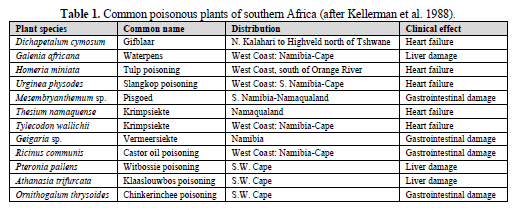
Although 'scab' or brandziekte was a major disease threat to sheep farmers in the 19th century (Wallace 1896), the prevalence of death among sheep by ingesting poisonous plants must have been obvious for Brown (2007) to state that this caused higher mortality up to the 1920s than from contagious or infectious diseases. Kellerman et al. (1988: table 1) list the toxic plants that might have been of significance to domestic animals entering southern Africa from the north, to the northern Kalahari, then via northern Namibia before moving south to the Western Cape (Coutu et al. 2021). Of these, perhaps gifblaar and tulp poisoning would have been most dangerous. Gifblaar, from Dichapetalum cymosum, has a restricted distribution from the northern Kalahari to the Highveld north of Tshwane. Incoming herders could have moved through this area fairly rapidly and avoided or limited the effects of this plant: ".. .young leaves are more toxic in spring (August to November) and autumn (March) when new shoots appear" (Kellerman et al. 1988: 110). Tulp poisoning comes from two genera of plants, Moraea and Homeria sp., both widespread from Zimbabwe, Botswana and Namibia to the western and southern Cape: "Tulp poisoning is commonest in winter or early summer before the onset of rains, when sprouting Homeria or Moraea sp. might be the only greenery on the barren veld...[o]ne of the most important features of tulp poisoning is that newly introduced or hungry stock are most at risk" (Kellerman et al. 1988: 90). However, sheep passing through the Northern Cape may have been less affected, as Snyman et al. (2011) note that toxicity levels are low in this area, which might explain the absence of yellow tulp poisoning there.
3. The 'colonial' enterprise in the expansion of herding in southern Africa
"Colony: settlement...in new country...fully or partly subject to mother state; Colonial: state department in charge of the colonies" (Oxford Dictionary 1970: 237). These dictionary meanings show that colonialism is directly tied to the 'motherland'. In South Africa this would have been the initial Dutch headquarters of the Vereenigde Oostindische Compagnie (VOC; Dutch East India Company) in Amsterdam after 1652, and the Colonial Office in London after 1795 when the British took over. These definitions imply that colonisation only took place within the ambit of formal structures, and, as Brink (2004) has noted, this came with mapping and the allocation and ownership of space. This in turn allowed owners to have the rights to fence their properties.
While this became a formal definition, it limited the actual colonial experience to paperwork drawn up to allocate land, as this could then be documented back in the controlling state network in Europe. This was formal colonialism at the Cape. The original inhabitants (Sonqua=Bushmen hunters) were already almost invisible, and the Khoekhoen were losing their pasture territory as parcels of land were being allocated by the Dutch leaders along the Liesbeek River.
The procedure was following what had been decreed by Pope Urban II in 1095 to occupy 'terra nullius' (empty land) by the First Crusade that assumed territory being used by hunters and transhumant pastoralists was 'empty', i.e., not being 'properly used' for agriculture. The order later sanctified the partition of Africa by European nations at the end of the 19th century.
Defining colonialism strictly by the association with formal political structures based in Europe would ignore the previous loss of land and livelihood that was invested by the original inhabitants of southern Africa. There is good archaeological evidence for hunters in the landscape for well over one million years (Mitchell 2002), so any group coming from the outside would have to be considered as intrusive, particularly with the arrival of domestic animals.
If we expand the definition of 'colonialism' to mean any intrusion into southern Africa by people and economies from the outside, then the arrival of herders into the Kalahari 2000 years ago would have to be considered. These people, known to linguists as Khoe-Kwadi, as they were identified in southern Angola (Güldemann et al. in press), had connections with East Africa, and brought both sheep and cattle with them.
Looking at colonialism as a form of intrusion offers a different perspective on what is usually meant by 'colonialism', i.e., only defined by the Colonial Office. This way we might suggest that colonial expansion would have occurred in several phases:
1. Arrival of cattle and sheep in the Kalahari, and sheep on to the southwestern and southern Cape by 2000 BP,
2. First appearance of Urewe farmers in southern Africa (Silver Leaves), Mozambique and Swaziland with sorghum and millet, then cattle, after 1700 BP,
3. Cattle arrive in numbers in the southwestern Cape ca. 1000 BP,
4. The Cape focus by the VOC, AD 1652 (mapping, firearms),
5. Occupation of the Cape by the British, AD 1795; Colonial Office in London takes charge of allocation of land (taxes) and expansion towards northeast and east by farmers (Laband 2020).
4. Discussion
The movement of food production from the north inspired Sadr (2003) to suggest a 'Neolithic' development in southern Africa using the model of 'hunters-with-sheep', i.e., local southern African hunters becoming pastoralists. This was followed by Gronenborn (2004) who compared the expansion of food producers out of the Near East to Europe with what happened in Africa. The similarities are the expansion of domesticates into lands already occupied by hunter-gatherers, and Sadr (2015) offered a two-step process for how this occurred. In both cases there was initial overlap where hunters and herders worked together. This meant that incoming males bringing the sheep, and possibly taking local wives, were able to learn about the landscape to the food producers' advantage. One aspect of this might have included the use of local fynbos plants, such as Watsonia, whose bulbs become cooked during veld fires and can be eaten.
Linguistic study of the arrival of the first herders, known as Khoe-Kwadi in southern Angola, indicates that "Khoe-Kwadi has special status in that it shows a northeast-to-southwest adaptation...the family as having expanded from the northeast, whereby pre-Khoe incorporated a Kx'a (northern Bushman) substrate and subsequently pre-Khoekhoe a Tuu (southern Bushman) substrate" (Güldemann et al. in press: 626). This indicates that the "spread of Khoe-Kwadi is a complex process involving extensive interaction with indigenous populations rather than a simple demic colonisation that spread among other things [a] new language[s]" (Güldemann et al. in press: 638).
This led to debates on the emergence of food production in southern Africa: were large numbers of newcomers arriving with stock, or did local hunters gradually become herders as they acquired sheep? The latter was certainly not the case when Lord Macartney introduced sheep to the hunters of the northern frontier hoping to make them herders at the end of the 18th century. This was an attempt to stop them raiding the colonial farmers as they expanded northwards, but the hunters just killed the sheep and ate them (Penn 2005).
I have previously argued against the idea of hunters becoming herders (Smith 2017), and here I have tried to show that there is a minimum flock size needed to maintain breeding and off-take. The dating of the movement was fast enough to suggest the herders with their flocks were constantly on the move southwards. This would argue against small, isolated numbers of sheep and shepherds trickling all the way from East Africa and ending up at the Cape, but, as the linguistics suggest, does not mean there was a single migration of people and animals.
Dewar and Marsh (2019) identified three phases of pastoral occupation in Namaqualand: 1) early AD 80-210; 2) middle AD 490-790; 3) late AD 1180-1690, which they suggest was the result of climatic shifts. The gap between the early and middle phases corresponds to a similar gap of non-occupation at Kasteelberg (Sadr et al. 2017). This is when there is a shift in pottery style from spouts to lugs. The lugged pottery may also be when cattle arrived at the Cape in larger numbers and the herders were later identified as Khoekhoen (Smith 2006). The arrival of cattle at the Cape in numbers allowed the food producers to become socially dominant over local hunters, as noted in Simon van der Stel's journal of his expedition to Namaqualand on 16 September 1685: ".. .these Sonquas [hunters] are just the same as the poor in Europe, each tribe of Hottentots2 [Khoekhoen] having some of them and employing them to bring news of the approach of a strange tribe. They steal nothing from the kraals of their employers, but regularly from other kraals.. .possessing nothing.. .except what they acquire by theft" (Waterhouse 1932: 122).
Without some help from local hunters the migration of shepherds through 'virgin soils' would have been all that more difficult, particularly when negotiating a landscape with poisonous plants. Since the migration southwards seems to have happened fairly rapidly, this lends support for a relatively easy passage.
Acknowledgments
The fieldwork for this paper was conducted while I was a member of staff of the Archaeology Department, UCT, prior to my retirement in 2006. I am grateful for the help of both staff and students, as well as Karim Sadr from Wits, for their input.
References
Andersson, C.J. 1856. Lake Ngami; or Explorations and Discoveries during Four Years' Wanderings in the Wilds of South Western Africa. London: Hurst & Blackett. [ Links ]
Balasse, M., Smith, A.B., Ambrose, S.H., et al. 2003. Determining birth seasonality by analysis of tooth enamel oxygen isotope ratios: The Late Stone Age site of Kasteelberg (South Africa). Journal of Archaeological Science, 30: 205-215. https://doi.org/10.1006/jasc.2002.0833 [ Links ]
Barrow, J. 1801. An Account of Travels into the Interior of Southern Africa in the Years 1797 and 1798. London: Cadell & Davies. [ Links ]
Brink, Y. 2004. The transformation of indigenous societies in the southwestern Cape during the rule of the Dutch East India Company, 1652-1795. In Murray, T. (ed.) The Archaeology of Contact in Settler Societies: 91-108. Cambridge: Cambridge University Press. [ Links ]
Brown, K. 2007. Poisonous plants, pastoral knowledge and perceptions of environmental change in South Africa c. 1880-1940. Environment and History, 13(3): 307-332. https://www.istor.org/stable/20723625 [ Links ]
Coutu, A.N., Tauruzzi, A.J., Mackie, M., et al. 2021. Palaeoproteomics confirm earliest sheep in southern Africa ca. 2000 BP. Scientific Reports, 11: 6631. https://doi.org/10.1038/s41598-021-85756-8 [ Links ]
Dahl, G. & Hjort, A. 1976. Having Herds: Pastoral Herd Growth and Household Economy. Stockholm: Stockholm Studies in Social Anthropology 2. [ Links ]
da Silva, A., Ahbara, A., Baazaoui, I., et al. 2024. History and genetic diversity of African sheep: Contrasting phenotype and genomic diversity. Animal Genetics, 56(1): e13488. https://doi.org/10.1111/age.13488 [ Links ]
Dewar, G. & Marsh, E.J. 2019. The comings and goings of sheep and pottery in the coastal desert of Namaqualand, South Africa. Journal of Island and Coastal Archaeology, 14: 17-45. https://doi.org/10.1080/15564894.2018.1438538 [ Links ]
Elphick, R. 1977. Kraal & Castle. New Haven: Yale University Press. [ Links ]
Gifford-Gonzalez, D. 2000. Animal disease challenges to the emergence of pastoralism in sub-Saharan Africa. African Archaeological Review, 17(3): 95-139. https://doi.org/10.1023/A:1006601020217 [ Links ]
Gronenborn, D. 2004. Comparing contact-period archaeologies: The expansion of farming and pastoralist societies to continental temperate Europe and to southern Africa. Before Farming, 4: 22-60. https://doi.org/10.3828/bfarm.2004.4.3 [ Links ]
Güldemann, T., Bajic, V. & Smith, A.B. in press. The archaeolinguistics of Kalahari Basin Area languages. In: Robbeets, M. & Hudson, M. (eds) The Oxford Handbook of Archaeology and Language: 619-647. Oxford: Oxford University Press. [ Links ]
Hall, M. 1986. The role of cattle in southern African agropastoral societies. More than bones can tell. South African Archaeological Society Goodwin Series, 5: 83-87. https://doi.org/10.2307/3858150 [ Links ]
Henshilwood, C. 1996. A revised chronology for pastoralism in southernmost Africa: New evidence of sheep at c. 2000 BP from Blombos Cave, South Africa. Antiquity, 70: 945-949. https://doi.org/10.1017/S0003598X00084210 [ Links ]
Horowitz, A. 1977. Pollen spectra from two Early Holocene Prehistoric sites in the Har Harif (West Central Negev). In: Marks, A.E. (ed.) Prehistory and Paleoenvironments in the Central Negev, Israel, Volume II: 323-326. Dallas: Southern Methodist University Press. [ Links ]
Kellerman T.S., Coetzer, J.A.W. & Naudé, T.W. 1988. Plant Poisonings and Mycotoxicoses of Livestock in Southern Africa. Oxford: Oxford University Press. [ Links ]
Kinahan, J. 2016. Archaeological evidence of domestic sheep in the Namib Desert during the first millennium AD. Journal of African Archaeology, 14: 7-17. https://doi.org/10.3213/2191-5784-10280 [ Links ]
Laband, J. 2020. The Land Wars: The Dispossession of the Khoisan and AmaXhosa in the Cape Colony. South Africa: Penguin Random House. [ Links ]
Marks, A.E. & Larson, P. 1977. Test excavations at the Natufian site of Rosh Horesha. In: Marks, A.E. (ed.) Prehistory and Paleoenvironments in the Central Negev, Israel, Volume II: 191-232. Dallas: Southern Methodist University Press. [ Links ]
Matthew, The Holy Bible, New Testament, Chapter 18. Oxford: Oxford University Press. [ Links ]
Mitchell, P. 2002. The Archaeology of Southern Africa. Cambridge: Cambridge University Press. [ Links ]
Mitchell, P. 2014. The canine connection II: Dogs and southern African herders. Southern African Humanities, 26: 1-19. https://hdl.handle.net/10520/EJC158003 [ Links ]
Nash, D.J., Meadows, M.E. & Gulliver, V.L. 2006. Holocene environmental change in the Okavango Panhandle, northwest Botswana. Quaternary Science Reviews, 25(11-12): 1302-1322. https://doi.org/10.1016/j.quascirev.2005.11.004 [ Links ]
Naudé, T.W., Kellermann, T.S. & Coetzer, J.A.W. 1996. Plant poisonings and mycotoxicosis as constraints in livestock production in East Africa: The southern African experience. Journal of the South African Veterinary Association, 67: 8-11. https://hdl.handle.net/10520/AJA00382809 1614 [ Links ]
Orton, J.D.J., Mitchell, P., Klein, R.G., et al. 2013. An early date for cattle from Namaqualand, South Africa: Implications for the origins of herding in southern Africa. Antiquity, 87: 108-120. https://doi.org/10.1017/S0003598X00048651 [ Links ]
Oxford Concise Dictionary of Current English. 1970. Fifth Edition. Oxford: The Clarendon Press. [ Links ]
Penn, N. 2005. The Forgotten Frontier: Colonist and Khoisan on the Cape's Northern Frontier in the 18th Century. Cape Town: Double Storey Books. [ Links ]
Rookmaaker, L.C. 1989. The Zoological Exploration of Southern Africa 1650-1790. Rotterdam: Balkema. [ Links ]
Sadr, K. 2003. The Neolithic of southern Africa. Journal of African History, 44: 195-209. https://www.jstor.org/stable/4100863 [ Links ]
Sadr, K., Bousman, B., Brown T.A., et al. 2017. New radiocarbon dates and herder occupation of Kasteelberg B, South Africa. Antiquity, 91: 1299-1313. https://doi.org/10.15184/aqy.2017.102 [ Links ]
Sampson, C.G. 1984. A prehistoric pastoralist frontier in the Upper Zeekoe Valley, South Africa. In: Hall, M., Avery, G., Avery, D.M., et al. (eds) Frontiers: Southern African Archaeology Today: 96-110. Oxford: BAR International Series 207. [ Links ]
Schapera, I. 1930. The Khoisan Peoples of South Africa: Bushmen and Hottentots. London: Routledge & Kegan Paul. [ Links ]
Skead, C.J. 1980. Historical Mammal Incidence in the Cape Province, Vol. 1: The Western and Northern Cape. Cape Town: Department of Nature and Environmental Conservation. [ Links ]
Skoglund, P., Thompson, J., Prendergast, M., et al. 2017. Reconstructing prehistoric African population structure. Cell, 171: 1-13. https://doi.org/10.1016/j.cell.2017.08.049 [ Links ]
Sadr, K. 2015. Livestock first reached southern Africa in two separate events. PLoS One 10(8): e0134215. [ Links ]
Smith, A.B. 1989. The Near Eastern connection: Early to Mid-Holocene relations between North Africa and the Levant. In: Krzyzaniak, L. & Kobusiewicz, M. (eds) Late Prehistory of the Nile Basin and the Sahara. Studies in African Archaeology 2: 69-77. Poznan: Poznan Archaeological Museum. [ Links ]
Smith, A.B. 2006. Excavations at Kasteelberg and the Origins of the Khoekhoen in the Western Cape, South Africa. Oxford: BAR International Series 1537. [ Links ]
Smith, A.B. 2014. The Origins of Herding in Southern Africa: Debating the 'Neolithic' Model. Saarbrücken: Lambert Academic Publishing. [ Links ]
Smith, A.B. 2017. Why would southern African hunters be reluctant food producers? Hunter-Gatherer Research, 2(4): 415-435. https://doi.org/10.3828/hgr.2016.28 [ Links ]
Smith, A.B. 2022. First People: The Lost History of the Khoisan. Cape Town: Jonathan Ball Publishers. [ Links ]
Smith, A.B. & Jacobson, L. 1995. Excavations at Geduld and the appearance of early domestic stock in Namibia. South African Archaeological Bulletin, 50: 3-14. https://www.jstor.org/stable/3889054 [ Links ]
Snyman, L.D., Schultz, R.A. & van den Berg, H. 2011. Variability of yellow tulp (Moraea pallida Bak.) toxicity. Journal of the South African Veterinary Association, 82: 131-132. https://doi.org/10.4102/jsava.v82i2.48 [ Links ]
Swart, S. 2010. Horses in the South African War, c.1899-1902. Society and Animals, 18: 348-366. [ Links ]
Thomas, D. & Shaw, D.A. 1991. The Kalahari Environment. Cambridge: Cambridge University Press. [ Links ]
Wallace, R. 1896. Farming Industries of Cape Colony. Cape Town: Juta. [ Links ]
Waterhouse, G. 1932. Simon van der Stel's Journal of his Expedition to Namaqualand, 1685-6. Dublin: Hodges, Figgis & Co. [ Links ]
Webley, L.E. 2001. The re-excavation of Spoegrivier Cave on the west coast of South Africa. Annals of the Eastern Cape Museums, 2: 19-49. [ Links ]
Received February 2025
Revised July 2025
Published September 2025
* Corresponding author email: andrew.smith@uct.ac.za
1 Among shepherds, learning to look after the flocks can occur at a very young age, and is not limited to sex as both girls and boys can help their families. I met two 10-year-old boys in the Malian Sahel who were looking after about 200 sheep. All they had with them was a short shirt and a wooden cup tied around their waist which they would have used to milk the ewes for food. They had not seen their families for a few days at this point.
2 The term is employed in accordance with the original source, without any derogatory or superficial intent.
