



Services on Demand
Journal

Article
 English (pdf)
 Article in xml format
 Article references
 Automatic translation
 Send this article by e-mail
Indicators
Related links
-
 Cited by Google
 -
 Similars in Google
Share

 Permalink
Southern African Field Archaeology
On-line version ISSN 2789-1844Print version ISSN 1019-5785
South. Afr. Field Archaeol. vol.20 Johannesburg 2025
https://doi.org/10.36615/safa.20.3653.2025
RESEARCH REPORT (PEER-REVIEWED)
A cave with agency: Ochre, blood and women at Keurbos 4
Emily-Jane VowlesI, ; John ParkingtonII,
IHeritage Western Cape, Department of Cultural Affairs and Sports, Cape Town City Centre, 8000, Cape Town, South Africa
IIArchaeology Department, University of Cape Town, Private Bag, Rondebosch, 7700, Cape Town, South Africa
ABSTRACT
Keurbos 4 is a located on the Rondegat River in the Western Cape Province of South Africa. Rich in painted imagery, it is distinctive for several reasons. Its morphology and position atop a steep incline offer views from inside looking out, but not outside looking in, and afford a level of inaccessibility and seclusion. Within the cave, the rockface is pigmented by a prominent geologically formed red smear and, whilst having little by way of Later Stone Age domestic content, has a notable painted assemblage. The assemblage is predominated by female figures, particularly rows of splayed-legged, squatting or crouching figures shown in the front-facing perspective with one arm extended towards the groin. Alongside these squatting women are an elephant herd, and a series of parallel vertical lines of geologically formed and applied ochreous pigment. Given the location, morphology, geology, and painted contents of the site, we suggest that Keurbos 4 was a place chosen by women for women in the context of ritual and didactic events. Further, we believe the transformation of the space into this place is accompanied by an invoking of agency from the cave, which was far from a passive accident and much more an active participant.
Keywords: rock art, placemaking, ritual, gender, performance
1. Introduction
"Places not only are, they happen" (Casey 1996: 13).
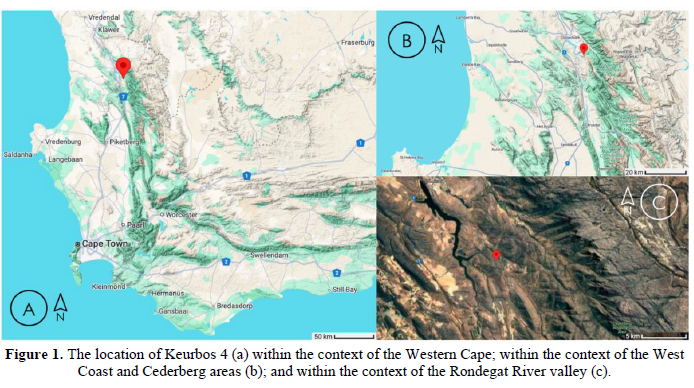
In this article we address the identification of painted themes and of painter identities and motives in Holocene rock paintings at one of the sites at Keurbos along the Rondegat River in the northern Cederberg, Western Cape (Fig. 1). More specifically, we argue that this site, labelled Keurbos 4 in our surveys was, on several occasions, a place where paintings were made by women, about women and for women with didactic intent. In pursuing this objective, we consider the location of the cave in the landscape, the hypothesised feel of the cave for those painting, the minimal signs of domestic occupation at the cave and the character of some of the painted imagery. We conclude that this was an opportunity for women to engage in secluded, gendered behaviours that relate to the dynamic concept of womanhood that appears to be the prevailing thematic scheme around which the rock art at Keurbos 4 is structured. The theme may have incorporated instruction and guidance from older to younger women. We draw this conclusion while recognising that there were likely many motivations behind the million or so images distributed across the Folded Mountains of the Western Cape that were produced across many millennia.
As we have explained elsewhere (Parkington & Alfers 2022; Parkington & Paterson 2022) and following the lead of Martin Porr (2018) in his study of Australian Aboriginal art, we consider the paintings of the Northern Cederberg through a phenomenological lens; a lens that allows us to extract the meaning of things (phenomena) from the way people experienced them. We apply this lens while considering the relational ontological lens through which the San experienced this place. Through this lens the boundaries of being appear undefined and indefinite, and all forms and phenomena lack independent existence outside of their interactions and relations with each other. As others have done elsewhere, we expand the suggestions of Mathias Guenther (2015) that the San painters of the area experienced the landscape in ways that differ from recent rock art recorders and archaeologists. Most importantly, this difference lies in their belief in 'other than human persons', a materialisation of their relational rather than classificatory approach to the empirical world and the way it is perceived to work. Binaries including nature/culture and animal/human were blurred so that a leather bag made from a steenbok skin remained a steenbok as well as a bag, a cloak made from an eland remained an eland as well as a cloak (Parkington & Paterson 2022), and an elephant may be at the same time a person (Parkington & Alfers 2022). Such ideas were introduced into archaeology as the new animism (Bird-David 1999; Dowson 2007; Low 2014; Guenther 2015), and encourage us to rethink relations between people, animals, plants and other, to us inanimate, natural, phenomena. In this 'other' we include rock shelters and argue that this shelter actively participated in the events that took there, sensu Morris (2022).
To better understand the behaviours of past forager San people, we accept that we should ask how they experienced the environment in which they lived, looking for lived experiences and probing how painters saw themselves in their world alongside other beings and contexts. San ethnographies, as well as those from hunter-gatherer groups across the globe, support the idea that this is what indigenous groups have been explaining to Western recorders for some time (Hallowell 1960; Martin 1987); this should surely shape our analyses of the archaeological record? In light of this we focus on the crucial differences between a site as a location where we find this record and a place as a location given meaning by dwelling (sensu lato) and giving meaning to dwelling (to use Ingold's [2000] term). Hence Martin Porr can use the phrase "Australian Aboriginal enactment of landscape" (2018: 396) and we can expand (or contract?) this here to the San 'enactment of place'. Using Collingwood's (1946) phrasing we seek to re-enact the past at a place that we call Keurbos 4, a painted cave with a suggestive geomorphology and some very specific and repeated rock painting images.
Porr (2018) contrasts the storied knowledge of Aborigines with the classificatory knowledge of Western science and urges us to seek these stories. The implication of a posited relational ontology is that we can investigate and hypothesise what a place can do, as well as simply what people can do at a place. Once a place has evolved meaning through dwelling it can preserve and give it back, acting on people with agency. "In effect, there is no place without self and no self without place" (Casey 2001: 684). We seek to understand what that agency might have looked and felt like for the painters at Keurbos 4.
2. Images, events and representation: the enactment of place
Images on cave walls have obviously not moved since they were painted: they are where they were intended to be, and we may ask why their place should not be as significant as their time and their form?
This question is as important at the small scale (where the image is in the site) as at a larger one (where the site is in the landscape). If images have to be where they are, we may ask why? What is significant about that place? Does the image sometimes, or in some sense, reflect an occasion, or occasions, with relevance to that place? What, we can ask, is the connection between image, place and event? Whilst difficult, attempts to understand these relationships are facilitated by improved levels of detail from enhanced imagery, digital mapping of sites along with their surroundings, and the development of virtual reality models (Wessels et al. 2023). We now have the capacity to re-imagine landscapes as they were made by painters by fixing memories of place and occasion.
The stability of the place-to-painting relationship encourages us to look for the nature of that relationship in the lasting character of the place. In effect we seek to add practice to place and painting. Why are these paintings there and not somewhere else? And, what is it that has made this place appropriate for these paintings? This largely means understanding the feel of Keurbos 4, envisaging possible responses to its ambience and, as we argue later, its personality.
3. Site and place
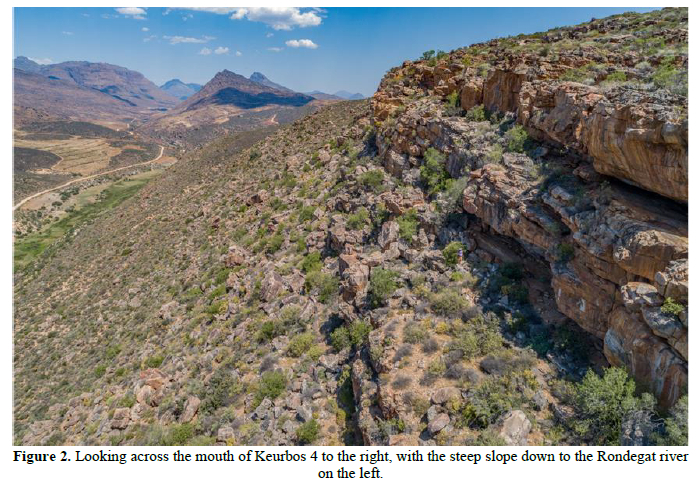
There are many painted caves and rock shelters in the valley of the Rondegat River, a substantial east bank tributary of the Olifants River, but no other has such a steep, difficult approach as does Keurbos 4 (Fig. 2).
All others are relatively easily accessible. Nor are many of the other sites so secluded in the sense of being shielded from the public gaze, yet with such a commanding view across the Rondegat topography. Any actions inside the cave would be private.
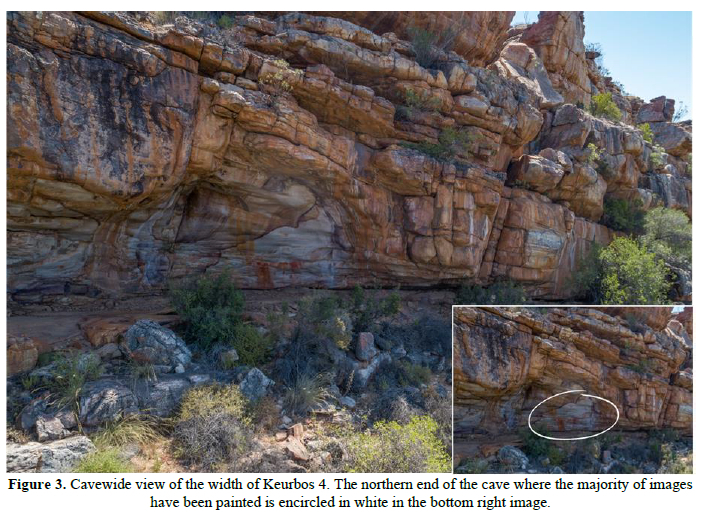
The overhang faces east-southeast, is long at 22 metres along the dripline, but shallow, only about 6 metres from the drip line to the rear wall (Fig. 3) Paintings are distributed across the whole width of the cave, but mostly at the right hand (looking in), northern end (encircled in white in Fig. 3), with few or no examples of superpositioning. Preservation of paint is reasonable, though residual, and not all images are easy to resolve or differentiate even with photographic enhancement. The result is a good deal of uncertainty about image outlines, making it difficult to offer a clear list of subject matter.
The floor of the cave is a mix of loose, superficial sand overlying a rocky bedrock exposure with almost no sign of excavatable deposit and no traces of hearths or bedding patches. A previous recorder (van Rijssen 1980) identified a broken bored stone from the cave, on which there are signs of two ostrich eggshell bead-shaping grooves. Bead making was an important contribution to San communities, a contribution made primarily by women, alongside plant food gathering aided by weighted digging sticks. There is no suggestion either inside the cave or below the cave on the talus slope that artefacts or other domestic debris have been deposited but failed to survive inside, and no dripline concentration of flaked stone artefacts. Inspection of the cave floor has revealed only a very small assemblage of flaked stone tools, with almost all of them likely of quartzite Middle Stone Age character. The implication is, we believe, that this place has been occasionally, almost certainly repetitively, used for painting but, in the late Holocene at least when Later Stone Age tools and rock paintings might have been expected, was very rarely used for domestic activities of any duration. The evidence suggests that this is a site to which people came to paint, perhaps because there were other domestic alternatives closer to the stream below. Our objective is to describe the place-making behaviours that changed the location into a particular place, perhaps a persistent place (sensu Schlanger 1992).
Of course, the morphology of every cave is different, a particular outcome of geological events that shaped the form, appearance and potentials for would-be painters. Keurbos 4 is no exception and presents a canvas with a very specific set of physical aspects and affordances. Following a phenomenological path, we would like to understand the response of a painter or painters to these prompts and to propose the feel of the site. Considering that the canvas is never neutral, how did painters experience the physical location and turn it, by painting, into an experienced place?
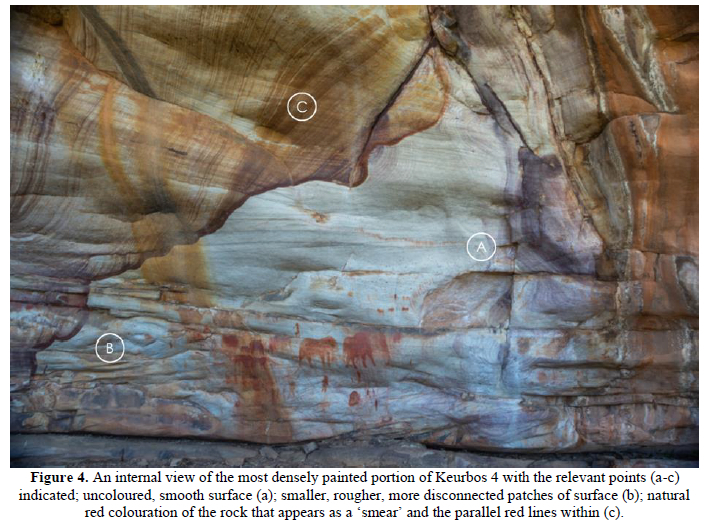
The area to the right of the cave offers a naturally uncoloured, smooth surface while to the left you find smaller, rougher, more disconnected patches of surface (points A and B in Fig. 4, respectively). Dividing these two distinct areas is a prominent vertical crack in the rock, visible in Figure 3, that extends from the cave roof overhang down to the ground where water follows a natural gravitational route. Vegetation grows in this crack. Dominating the cave wall, is a red internal feature of the rock that appears to flow down and away from either side of the crack (point C in Fig. 4). While we recognise this to be a natural feature of the bedrock caused by variations in sedimentary mineralogy, now exposed, this red colouration manifests as a very substantial smear of natural pigment. It is redder and thicker at the leading edge and flows almost tangibly across the rock surface, rather like a painted feature. Internal to the smear are sets of parallel red lines characteristic of Cederberg quartzites, locally and superficially hard to distinguish from painted red lines.
How would this feature have been understood, explained, and perhaps utilised by people contemplating contributing their own imagery to the canvas? Painters experienced the landscape through a relational ontological perspective in which distinctions were not made between animate and inanimate, natural and cultural, living and non-living, and similar binaries that we might ourselves entertain (Guenther 2015). For San painters this was a living canvas, part of a living landscape and as agential as any other element contributing to this landscape (see for example, Riley 2007).
Red iron oxide stratified colourations, usually sets of linear parallel lines in the rock, are fairly common in this region, but this configuration is meaningful in our experience. We suggest that painters were influenced by this very noticeable feature whilst they were in the cave and painting because of the impression it gives of flowing blood. As Janette Deacon notes in her seminal paper on the Power of a place when quoting from an Australian parallel: "Rapoport (1975: 49) has expressed the concept of meaning and places in Australian Aborigines' beliefs as the congruence of natural features and mythical structures to humani[s]e the landscape" (1988: 138). Both she in the /Xam homeland and David Morris, describing the context of rock engravings on the bed of the Riet River at Driekopseiland (Morris 2022), refer to the active participation of natural features in the development of mythical narratives that enable and enrich ritual and life history practices. As Morris continues "strands from /Xam oral literature and historical sources indicate the way in which landforms embody or give substance to myths and legends" (Morris 2022: 256).
4. Place and painting
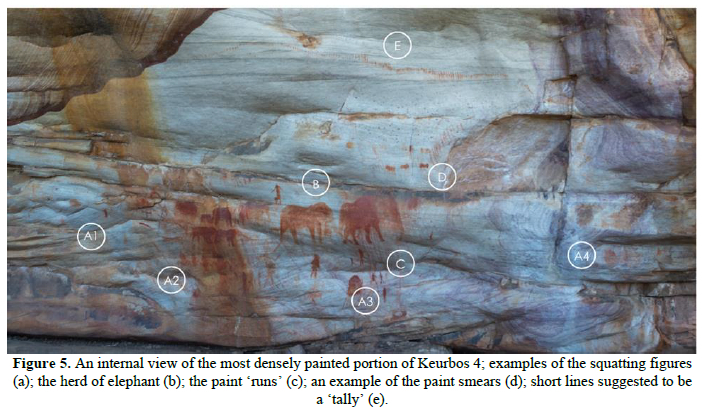
Within Keurbos 4, paintings are predominantly placed to the right of the red geological smear on the uncoloured surface while none seem to engage with or directly respond to this natural feature. They include, but are not limited to, human figures, elephant figures, intentional or unintentional paint runs, intentional paint smears, and intentional, short painted lines (Points A, B, C, D and E, respectively, in Fig. 5).
The human figures at Keurbos 4 (exemplified in Points A1-A4 in Fig. 5) are scattered and varied in posture, but arguably include only one (out of about 30) possibly anatomically male individual, painted in a very unusual cartwheeling posture; all the remaining figures appear to be female. Significantly, almost half of these female figures are organised into five rows across the site and are painted in a highly standardised form (Fig. 6).
They appear as front facing, squatting or crouching, with their legs parted. They are almost all clearly (some more faintly) anatomically female due to the presence of breasts depicted on either side of the torso, and with one arm, their right one, shown reaching down toward the groin, the other outstretched left (the viewer's right) of the torso at about 30° to 40° (Fig. 7).
Paintings of this form have previously been linked to the 'mythic women' concept proposed by Anne Solomon (1994, 1995, 1996a), following Elisabeth Goodall's (1962) lead. Having been earlier recorded by WJJ (Bill) van Rijssen (1980), Vowles (2021: 27) notes:
Solomon identifies a possible 12 mythic women figures at Keurbos, identifiable as anthropomorphs unusually depicted in the frontal perspective, with splayed legs and raised arm/s, and the possible inclusion of a combination of other characteristics such as steatopygia, holding a stick, bow, or crescent-shaped object aloft, and genital emissions or genital emphasis (Solomon 1995).
They were hypothesised to represent a mythological female figure from San folklore (Solomon 1995).
Probably because she was referring to a geographically widespread set of imagery with examples from Zimbabwe, the Drakensberg as well as the Western Cape, Anne Solomon rightly spent some time justifying the coherence of the group of mythic women, not least the issue of whether all are female. We suggest that hers was a polythetic set (Clarke 1968) in which several variables play a role in category definition but none of them on their own define or exclude membership (Needham 1975). The complications faced by Solomon are far fewer when reference, as here, is only to the Keurbos 4 images, where none are male, none are armed, none carry objects in the hand and none have lines or streams emanating from the groin, although there may be paint smears below the groin on some figures (see illustrations in Solomon 1995: figs 9-41). Our intent here is to refer to the coherence of what we have informally called 'squatting women' at Keurbos 4 and to delay comment on how widespread and how variable the group might become if we extend our attention across the Cederberg, southern Africa, or even more widely (Sutterlin 1989; Garlake 1995; Chaloupka 1999; Hodder 2010). In our view this near global ubiquity of front-facing female squatting (sensu lato) figures reflects the near universality of ritual associations of female genitalia and their extension to gendered approaches to ritual seclusion and avoidance rules. There are other squatting figures in nearby northern Cederberg painted caves, perhaps 25 known so far, but nowhere else is there a duplicated concentration at a single site such as at Keurbos 4. Importantly, where Solomon has located the origins of the female figures in the mythic realm, we suggest rather that these squatting women reflect actual, living women, their gendered experiences, and the ontologies through which they structured their womanhood.
We argue that these squatting women were painted in such a manner so as to draw attention to the groin and, by extension, to associations with female genitalia. These associations include menstruation, sexual intercourse, pregnancy and birth and their relationship with notions of womanhood. Choice of posture, orientation toward the viewer, preference for a stationary perspective and insistence on female identity contribute to an apparent communicative or instructional intent. These are, at least at one level, props for use in verbal instruction and education. Established women used these intentionally private opportunities to impart their experience and knowledge onto menarcheal women while they were in the process of coming to terms with their newfound womanhood and the cultural association therein. The very variable body morphologies within this coherent set, perhaps even within a single row (Figs 6-8), leads us to suggest revisitation of the site on a number of occasions, and multiple painting events and multiple painters informed by the same, pedagogic, intent.
As is demonstrated by the preponderance of female figures, we suggest that Keurbos 4 was a place dedicated to female ritual. The likelihood of separate and isolated male and female ritual initiation spaces among San groups is well supported in the ethnographic and ethno-historic literature (e.g., Schapera 1930; Hewitt 1986; Barnard 1992). In a region marked by rock outcrops and numerous caves and shelters, we suggest that these secluded spaces were designated for use by sexually segregated subgroups as the locations for ritual events. Such scenarios would accord well with events described among San groups further afield (e.g., Viestad 2018). That they were not described locally by early colonial observers at the Cape may well be a function of the isolation of the area and the subsequent speed of social destruction (Parkington & Paterson 2021; Parkington & Alfers 2022).
Just below the red, geological discolouration of the cave there is a prominently placed group of about 11 elephants (some distinctions are not clear) (Point B in Fig. 5; see Figs 9 and 10). They are all painted to face the right, and the inclusion of presumably adult, sub-adult, juvenile and infant individuals, based on their size in juxtaposed positions within the painted herd, suggest that it is a domestic, matriarch-led group. As we have explained elsewhere (Vowles 2021), within San ontologies there is a conflation of women with elephants. One such conflation allows women and elephants to be meat but not the meat that you eat. Ontologically, women were the equivalent of herbivores and prey, while men were carnivores and hunters who kill and eat this prey, where hunting is conflated with courtship and sex with eating (Biesele 1993). Fables from the mythopoeic time where society was not yet differentiated into people and animals warned against men confusing the meat they marry with the meat they eat. As we have detailed elsewhere (Vowles 2021), amongst the Ju/'hoansi, these fables often revolve around the elephant-girl; a character who is both elephant and girl, eaten by her husband when he confuses her with meat (Biesele 1993). The San continued to view the elephant as meat one cannot eat due to their ontological conflation with women and the recognition of physical and behavioural similarities between them (Biesele 1993).
Additionally, both women and elephants have a similar relationship with rain. Rain animals, typically large herbivores like elephants, are metaphorically slaughtered for the spilling of their blood ushers in the spilling of the rain (Solomon 1996b). Women, specifically pubescent, menstruating and pregnant women, had a similar potency. "The menstruating woman, in /Xam mythology, produces blood imbued with potency similarly to that of the rain-animal whose blood must be spilled to produce desirable rain (Bleek 1933)" (Vowles 2021: 40). Due to the centrality of the mother-child relationship to the organisation of their respective societies, the San also revered women and female elephants for their child-rearing capacities (Parkington & de Prada-Samper 2021; Vowles 2021). As the latter author concludes, the conflation of women with elephants throughout San ontologies suggests that the elephant imagery at Keurbos 4 may contribute to a gendered intention for the painted assemblage.
The elephants and female figures are painted alongside three distinguishable types of vertical imagery. The first are paint 'runs', which may be unintentional and the result of too much pigment being applied to the surface of the cave, or its consistency being too thin (Fig. 9). The second are intentional fingerwidth smears of pigment, some of which are juxtaposed over other imagery (Point D in Fig. 5). And the third are intentional, short, somewhat perpendicular, finger-width lines (Point E in Fig. 5). The addition of this vertical, red imagery may contribute to the gendered associations of rain and blood established within the cave by the female figures and elephants. We posit that the short lines may be tally marks which suggests a counting motive. Both the menstrual cycle and gestation period are structured by the measurable passing of time. The menstrual cycle is typically 30-days long with significant fertile and infertile phases, while the gestation period is 9-months long. The tallies may reflect the counting of the days and months associated with these two physiological cycles in response to gendered understandings of time and its quantification.
5. Discussion: Living landscapes and the agency of the cave
David Morris has wrestled with the meaning of the rock art-place relationship (Morris 2022), in his case the rock engravings at Driekopseiland on surfaces in the bed of the Riet River. We quote him here (Morris 2022: 257, 258, 262):
Through the lens of a relational or new animist perspective (Bird-David 1999), the interpretation [Morris here refers to his 2002 dissertation] proposed that Driekopseiland, as a powerful place (Deacon 1988), was a site used in rituals, arguably those specifically linked with the "new maiden", who according to +Kamme-an, mother of Dia!kwain, possessed "the rain's magic power" (Lewis-Williams 2000: 273). It was proposed that the place itself became an active element in the rites, no longer as mere physical space but indeed becoming a virtual subject in itself, as Michael Houseman (1998) would argue with reference to the redefinition of social personhood that initiation entails.
One of the conclusions of the new interpretation of Driekopseiland was that a metaphorical understanding of landscape and a relational appreciation of how particular places may take on a form of emergent personhood - and the possibility that different parts of the landscape could vary in ritual significance (hilltops in different assemblages associated with rain-making rites, for instance) - may be factors more germane to the questions of variability in the rock art here than the repeated attempts to work out the ethnic and cultural affinities of the engravings.
Houseman (1998: 461), cited earlier, writes of the way particular places in landscapes become powerful adjuncts in rites of passage, becoming no longer mere objects, but virtual subjects themselves. It is not that rituals create the links between individuals and places, Houseman emphasises, for initiates would already know the landscapes in which they live. Rather, the rites, as emotionally laden haptic events, re-contextualise the pre-existing links, instituting particular locations as depositories of "social personhood" (Houseman 1998).
Morris and Houseman introduce place as a participant in ritual, imbuing it with personhood. This coincides with our reading of the existential feeling of Keurbos 4 as a place and our suggestion here of the lived experiences of women in the cave (Ingold 2000). That this phenomenological and ontological perspective on enacting the place and the landscape was one held by San, in this case /Xam, people is supported by an oft-quoted poem/song offered by Dia!kwain to Lucy Lloyd in July 1875 included below. The poem/song repeats the words "feel" and "place" in reference to each other in a manner that suggests that a place has a "feel" as equally as people impart feeling to a place (Bleek & Lloyd 1911: 236-237 original lineation):
The Broken String
People were those who
Broke for me the string.
Therefore,
The place became like this to me
On account of it
Because the string was that which broke for me.
Therefore,
The place does not feel to me
On account of it.
For,
The place feels as if it stood open before me
Because the string has broken for me.
Therefore,
The place does not feel pleasant to me
On account of it.
6. Ochre, blood and ritual
The nexus of our argument for repetitively held events at Keurbos 4 focused on and for women, and their menstrual rituals, lies in the symbolic connection between ochre (haematite) and blood (haemoglobin) and the requirements of seclusion, intimacy and privacy. In an intellectual lineage stretching back to Durkheim (1915), in the wider evolutionary sense this nexus has been argued forcibly by Watts (2009) and his colleagues (Knight 2009; Power 2009) who have shown that San conceptually link the blood of women's menstruation with the blood of a hunting kill. This linkage leads to a wide range of prohibitions and observances relating to the dangers of menstruating and menarcheal women for active hunting males.
The Bleek and Lloyd literature associates powdered ochre with the activities of the new maiden, reliably thought to be a newly menstruating young girl, who is isolated, particularly from men of the age to participate in hunting, and who is cared for by the other mature women in the group. In Hewitt's words (1986: 281), on her release from isolation she:
Had to treat all the members of her household with buchu and give the women of the band red haematite with which they were to paint their cheeks and decorate their harasses. She was also expected to paint haematite stripes 'like a zebra' on the young men of the band to protect them from death by lightning caused by !Khwa (a mythical water being or, in some views, the animated water itself [de Prada Samper 2018]).
He goes on to say that "apart from the treatment of members of the band, the water source in current use also had to be thoroughly sprinkled with powdered haematite to appease !Khwa, who, it was believed, might cause the pool to dry up completely" (Hewitt 1986: 281). !Khwa took a special interest in new maidens who had to be extremely careful not to anger this potent force. These observances underline the intimate connections thought to link menstruants, blood, ochre, and the potency of rain and water.
The underlying structures of these menstruation rituals, we argue, are privacy, intimacy, female social cohesion and the presence of ritual danger. In a topographic circumstance differing from that of the flat, arid karoo of the /Xam, we might expect women to take advantage of the availability of an isolated and very private cave, as van Rijssen suggested (1980). A cave naturally exhibiting strong haematite-like, seemingly artificial, but actually geological, mural patterns of red colouration might have been particularly appropriate for the locating of ritual events, with the place itself acting in the way Houseman (1998) and Morris (2022) describe above.
We therefore suggest that the secluded locality of Keurbos 4 and the preponderance of female-associated imagery therein are related to the pigmented rockface. With the rockface being naturally imbued with blood-like stains that could be conceptually referential to the lived experiences of woman and concepts of womanhood, where "...the canvas itself may have attracted San women as they sought a secluded and sheltered site in which to produce art meant only for themselves and generations of women to come" (Vowles 2021: 43). In this light, we view the women as actual, living women rather than mythic, seemingly involved in repeated ritual of a gendered nature, situated in a place embedded with a feel. And that place could only be Keurbos 4 as "places not only are, they happen" (Casey 1996: 13).
Acknowledgements
We are very grateful to Royden Yates and Stephen Wessels for advice and help with the visualisation and interpretation of the Keurbos 4 imagery. Heinz Reuther led the original laser scanning initiative, for which we thank him. We recognise the valuable insights drawn by Bill van Rijssen 40 years ago that were ahead of their time and by Anne Solomon within the 'mythic women' framework. We are grateful to Jeremy Hollmann, David Morris, and an unnamed reviewer for their contributions to this paper and the process.
References
Barnard, A. 1992. Hunters and Herders of Southern Africa. A Comparative Ethnography of the Khoisan Peoples. Cambridge: Cambridge University Press. [ Links ]
Biesele, M. 1993. Women Like Meat: The Folklore and Foraging Ideology of the Kalahari Ju/'hoan. Johannesburg: University of Witwatersrand Press. [ Links ]
Bird-David, N. 1999. "Animism" revisited: Personhood, environment and relational epistemology. Current Anthropology, 40(Supplement): S67-91. [ Links ]
Bleek, D.F. 1933. Beliefs and customs of the /Xam Bushmen: Part V, the rain. Bantu Studies, 7: 297-312 [ Links ]
Bleek, W.H.I. & Lloyd, L.C. 1911. Specimens of Bushman Folklore. London: George Allen. [ Links ]
Casey, E.S. 1996. How to get from space to place in a fairly short stretch of time: Phenomenological prolegomena. In: Feld, S. & Basso, K.H. (eds) Senses of Place: 13-52. Santa Fe: School of American Research. [ Links ]
Casey, E.S. 2001. Between geography and philosophy: What does it mean to be in the place-world? Annals of the Association of American Geographers, 91(4): 683-693. [ Links ]
Chaloupka, G. 1999. Journey in Time. Sydney: Reed New Holland. [ Links ]
Clarke, D.L. 1968. Analytical Archaeology. London: Methuen. [ Links ]
Collingwood, R.G. 1946. The Idea of History. Oxford: Oxford University Press. [ Links ]
Deacon, J. 1988. The power of a place in understanding Southern San rock engravings. World Archaeology, 20(1): 129-140. [ Links ]
de Prada Samper, J. 2018. "I have already seen in the clouds": The nature of the water-creature among the /Xam Bushmen and their modern descendants. Folkloristika, 3(1): 13-37. [ Links ]
Dowson, T.A. 2007. Debating shamanism in southern African rock art: Time to move on. South African Archaeological Bulletin, 62(183): 49-61. [ Links ]
Durkheim, E. 1915. The Elementary Forms of Religious Life. London: George Allen and Unwin Limited. [ Links ]
Garlake, P. 1995. The Hunters Vision: The Prehistoric Art of Zimbabwe. Seattle: University of Washington Press. [ Links ]
Goodall, E. 1962. A distinctive mythical figure appearing in the rock paintings of Southern Rhodesia. In: Mortelmans, G. & Nenquin, J. (eds) Actes du IV Congress Panafricain de Prehistoire: 399-405. Tervuren: Musée Royale. [ Links ]
Guenther, M.G. 2015. 'Therefore their parts resemble humans, for they feel that they are people': Ontological flux in San myth, cosmology and belief. Hunter-Gatherer Research, 1(3): 277-315. [ Links ]
Hallowell, A.I. 1960. Ojibwa ontology, behaviour and worldview. In: Diamond, S. (ed.) Culture in History: Essays in Honour of Paul Radin: 19-52. New York: Columbia University Press. [ Links ]
Hewitt, R.L. 1986. Structure, Meaning and Ritual in the Narratives of the Southern San. Quellen zur Khoisan-Forschung 2. Hamburg: Helmut Buske Verlag. [ Links ]
Hodder, I. (ed.) 2010. Religion in the Emergence of Civilization. Cambridge: Cambridge University Press. [ Links ]
Houseman, M. 1998. Painful places: Ritual encounters with one's homelands. Journal of the Royal Anthropological Institute, 4(3): 447-467. [ Links ]
Ingold, T. 2000. The Perception of the Environment: Essays on Livelihood, Dwelling and Skill. London: Routledge. [ Links ]
Knight, C. 2009. Language, ochre and the rule of law. In: Botha, R. & Knight, C. (eds) The Cradle of Language: 281-303. Oxford: Oxford University Press. [ Links ]
Lewis-Williams, J.D. (ed.) 2000. Stories That Float From Afar: Ancestral Folklore of the San of Southern Africa. Cape Town: David Philip. [ Links ]
Low, C. 2014. Khoe-San ethnography, 'new animism' and the interpretation of southern African rock art. South African Archaeological Bulletin, 69: 164-172. [ Links ]
Martin, C. (ed.) 1987. The American Indian and the Problem of History. Oxford: Oxford University Press. [ Links ]
Morris, D. 2002. Driekopseiland and the 'rain's magic power': History and landscape in a new interpretation of a Northern Cape rock engraving site. Masters Dissertation. Cape Town: University of the Western Cape. [ Links ]
Morris, D. 2022. River, rock and 'the rain's magic power': Rock art and memory in the Northern Cape, South Africa. In: Zubieta, L.F. (ed.) Rock Art and Memory in the Transmission of Cultural Knowledge: 245267. Cham: Springer Nature. [ Links ]
Needham, R. 1975. Polythetic classification: Convergence and consequences. Man, 10(3): 349-369. [ Links ]
Parkington, J. & de Prada-Samper, J. 2021. When elephants were people. In: Abadia, O.M. & Porr, M. (eds) Ontologies of Rock Art: Images, Relational Approaches, and Indigenous Knowledges: 233-244. London: Routledge. [ Links ]
Parkington, J. & Alfers, J. 2022. Entangled lives, relational ontology and rock paintings: Elephant and human figures in the rock art of the Western Cape, South Africa. Southern African Field Archaeology, 17: 1228. [ Links ]
Parkington, J. & Paterson, A. 2022. Cloaks and torsos: Image recognition, ethnography and male initiation events in the rock art of the Western Cape. Azania, 56(4): 463-481. [ Links ]
Porr, M. 2018. Country and relational ontology in the Kimberley, Northwest Australia: Implications for understanding and representing archaeological evidence. Cambridge Archaeological Journal, 28(3): 395409. [ Links ]
Power, C. 2009. Sexual selection models for the emergence of symbolic communication: Why they should be reversed. In: Botha, R. & Knight, C. (eds) The Cradle of Language: 257-280. Oxford: Oxford University Press. [ Links ]
Rapoport, A. 1975. Australian Aborigines and definition of place. In: Oliver, P. (ed.) Shelter, Sign and Symbol: 38-51. London: Barrie and Jenkins. [ Links ]
Riley, E. 2007. The hunting ground's doings: /Xam narratives of animals, hunting and the veld. In: Skotnes, P. (ed.) Claim to the Country: 291-311. Johannesburg: Jacana. [ Links ]
Schapera, I. 1930. The Khoisan Peoples of South Africa. London: Routledge and Kegan Paul. [ Links ]
Schlanger, S.H. 1992. Recognizing persistent places in Anasazi settlement systems. In: Rossignol, J. & Wandsnider, L. (eds) Space, Time and Archaeological Landscapes: 91-112. New York: Plenum Press. [ Links ]
Solomon, A. 1994. 'Mythic women': A study in variability in San art. In: Dowson, T.A. & Lewis-Williams, J.D. (eds) Contested Images: Diversity in Southern African Rock Art Research: 331-372. Johannesburg: Wits University Press. [ Links ]
Solomon, A. 1995. Rock art incorporated: An archaeological and interdisciplinary study of certain human figures in San art. Doctoral Thesis. Cape Town: University of Cape Town. [ Links ]
Solomon, A. 1996a. 'Mythic Women': A response to Humphreys. South African Archaeological Bulletin, 51(163): 33-35. [ Links ]
Solomon, A. 1996b. Rock art in southern Africa. Scientific American, 275(5): 106-113. [ Links ]
Sutterlin, C. 1989. Universals in apotropaic symbolism: A behavioural and comparative approach to some medieval sculptures. Leonardo, 22(1): 65-74. [ Links ]
van Rijssen, W.J.J. 1980. Ways of seeing: Some aspects of the interpretation of rock paintings. Honours Report. Cape Town: University of Cape Town. [ Links ]
Viestad, V.M. 2018. Dress as Social Relations. An Interpretation of Bushman Dress. Johannesburg: Wits University Press. [ Links ]
Vowles, E-J. 2021. Women by women for women: An engendered ontological approach to the gynocentric San rock art of Keurbos. Honours Report. Cape Town: University of Cape Town. [ Links ]
Watts, I. 2009. Red ochre, body painting and language: Interpreting the Blombos ochre. In: Botha, R. & Knight, C. (eds) The Cradle of Language: 62-92. Oxford: Oxford University Press. [ Links ]
Wessels, S., Maape, S., Schoville, B.J., et al. 2023. The drone, the snake, and the crystal: Manifesting potency in 3D digital replicas of living heritage and archaeological places. Archaeologies, 19: 395-429. [ Links ]
Received November 2024
Revised July 2025
Published September 2025
* Corresponding author email: emily.vowles@westemcape.gov.za/john.parkington@uct.ac.za