




Services on Demand
Journal

Article
 English (pdf)
 Article in xml format
 Article references

 Automatic translation
 Send this article by e-mail
Indicators
Related links
-
 Cited by Google
-
 Similars in Google
Share

 Permalink

Communicare: Journal for Communication Studies in Africa
On-line version ISSN 2957-7950Print version ISSN 0259-0069
JCSA vol.44 n.1 Johannesburg May. 2025
https://doi.org/10.36615/ka65me09
ARTICLES
Strategic Communication and Metamodernism, Shall We Dance? - Towards Complexity Beyond Linear Compromise
Howard NothhaftI; Nina Overton-de KlerkII
ILund University, Sweden https://orcid.org/0000-0003-4576-6205
IIUniversity of Johannesburg, South Africa https://orcid.org/0000-0001-7466-8837
ABSTRACT
This article is the result of further joint reflection by the authors, building on their previous arguments that the shifts that gave rise to strategic communication as a discipline suggest linear compromises between modernism and postmodernism. It also provides a scrutiny of metamodernism as a contemporary academic agenda within a complexity framework, and explores whether strategic communication has to an extent not always shown elements of metamodernism. Following an analysis of key figures of metamodern thought and introducing the "dance" of the double pendulum as a metaphor, the authors discuss key challenges that metamodern thinking poses to strategic communication scholars. These require, among other things, a commitment to the species, ironic sincerity, a commitment to complexity on the problem as well as on the solution side, and a "both-and" realist epistemology and constructionist epistemology at the same time. In conclusion, implications for strategic communication are put forward.
Keywords: Complexity, constructionist epistemology, double pendulum, human nature, imagined communities, ironic sincerity, linear compromise, metamodernism, modernism, oscillation, postmodernism, realist epistemology, strategic communication
INTRODUCTION
This article wants to open the floor for a broader, philosophical discussion of strategic communication. The idea we develop is meant as a stimulus, not as an authoritative contribution. Our argument, perhaps provocative, is that strategic communication has been a metamodern academic project without knowing it. Many of the identity issues the discipline suffers from are because the metamodern tensions at its core are inadequately understood - by us, but also by outside observers.
The key issue is and has always been complexity. The second author has pointed out in several contexts that predictions based on current, largely postmodernist-inspired social theory are not borne out by the current state of the world, and even appear downright naïve in retrospect (Overton-de Klerk, 2023). It can be argued, therefore, that macro-level strategic communication theory - largely based on postmodernist-inspired social theory - in turn, does not reach the levels of complexity it requires to adequately treat its chosen topics.
On an abstract level, it has been argued that applied communication disciplines are "pulled down" into intellectual poverty by other forces (Peters, 1986; see also Dühring, 2015; Ferguson, 2018), and here we agree. Specifically, the applied communication disciplines' practical focus has been identified as the millstone around our neck that prevents us from reaching adequate theoretical heights (Nothhaft and Zerfass, 2023). Here we disagree. Our countersuggestion is that strategic communication is being held back by its attempts to achieve a linear compromise between the modernist and postmodernist influences built into the discipline. In other words, strategic communication tries too hard to simultaneously meet modern and postmodern expectations of a "proper" academic discipline.
To take the next step after postmodernism, to go beyond a compromise between the two, is, of course, the essence of the metamodern project that has been gaining traction since around 2010. Consequently, if we seek to unlock the potential of strategic communication as an intellectual agenda, we should perhaps engage in some metamodern theorising. There are two ways to do so, as pursued in the article's second and third sections. In the second section, we trace the emergence of metamodernism as an academic agenda. The underlying assumption here is that the way to understand metamodernism is to understand the Zeitgeist that led to its formulation. The question we ask of readers is whether or not the argumentative patterns of metamodernism appear strangely familiar to strategic communication scholars. In the third section, we follow a different path by presenting key figures of metamodern thought. Here the question is whether or not the answers given to metamodern questions could be answers for strategic communication theory as well. In the fourth section, we challenge strategic communication theorists with a reimagined agenda consisting of five questions, followed by some proposed answers in the fifth and final section with respect to the potential implications of these questions for strategic communication.
Clarification: Being metamodern without knowing it
What does it mean to say that strategic communication "is" or "has been" metamodern; how does a phrase such as "without knowing it" relate to an academic discipline; and what do we mean by strategic communication's metamodern rationality? To say that strategic communication is and always has been metamodern must not be misunderstood as the postulation of some hitherto hidden, immutable quality. What the academic project strategic communication is or does obviously results from discursive processes. However, even if one grants that, one can still ask what forces shaped the discourse. Why did the discourse gravitate towards specific figures of thought and not others? It is here that our diagnosis lies.
At the time of its inception - roughly the decade leading up to the inaugural issue of the International Journal of Strategic Communication (IJSC) in 2007 - the social sciences in general, and the applied communication disciplines in particular, faced shifts in society that existing paradigms did not capture adequately. These shifts included a new media-communication fluidity, the exponential rise of social media platforms, the power shift from institutional communicators to individual recipients and the great financial crisis of 2007-2008, which wreaked havoc in financial markets around the world (Overton-de Klerk and Verwey, 2013). Strategic communication, to a large degree, is the result of trying to theoretically and empirically grasp these shifts.
At the same time, strategic communication was formulated in response not only to societal upheavals, but also to an intellectual climate in academia that became increasingly global, relativist, activist -"progressive". Given the necessity to carve out a niche for a new subdiscipline in the concert of the applied communication disciplines, strategic communication theorists had to deal with the indeterminate and confusing coexistence of postmodern and late modern intellectual streams. In this sense, in trying to take the next step after postmodernism, strategic communication is metamodern.
To speak of strategic communication as metamodern then captures a congruence between the way strategic communication and metamodern theorists come to grips with shifts in society and conceptualise adequate social theory. To date, the terms "metamodern", "metamodernism" or "metamodernity" do not appear even once in the IJSC, so it is not a matter of self-identifying as metamodernist. However, we do not believe it necessary for a scholarly community or research agenda to self-identify as metamodern to be so. What counts, once again, is determination to go beyond the vague and indeterminate coexistence of late modern and postmodern theorising.
The dangers of half-baked compromises
The dangers of half-baked compromises warrant further investigation. The issue can be made clearer by making it concrete. While we do not wish to go into definitional debates here, we believe it is symptomatic of strategic communication's current "semi-metamodernist" state that the seminal article in the IJSC's inaugural issue in 2007 (Hallahan et al., 2007) seemingly effortlessly brought together authors radically different in outlook. With Anthony Giddens as a major influence (Zerfass, 1996) and a background in hard-nosed strategic management, Ansgar Zerfass is late modernist in outlook. In contrast, Derina Holtzhausen can lay claim to some of the most radical postmodern contributions to the field (Holtzhausen, 2012; Holtzhausen & Voto, 2002). Yet, after both contributed to the inaugural issue, Zerfass and Holtzhausen would go on to edit the first edition of the Routledge Handbook of Strategic Communication together. There are many signs of a metamodern approach here: Tolerance for the coexistence of contradictory views, both-and thinking and oscillation without the need to dissolve everything in relativism. Ironic sincerity - taking our field seriously, but not so seriously that you cannot cooperate with someone who disagrees with you - is another hallmark of metamodernism.
One has to be careful, however. The strategic communication handbook was a grand attempt to unite many colleagues with many different interests in applied communication - marketing, organisational communication, public relations and many others. This horizontal integration, moreover, went bravely hand-in-hand with an attempt at vertical integration, that is, the hope for a shared epistemology and ontology. Obviously, many of the colleagues involved hoped that this compromise would be only temporary, and that the new discipline would usher in a turn towards their preferred agenda. We are a case in point. While the second author hoped for strategic communication to be the vehicle to achieve a break with the functionalist, modernist-inspired Grunigian paradigm (Overton-de Klerk and Verwey, 2013), the first author hoped for almost the opposite, namely that strategic communication would become public relations supercharged with a serious understanding of strategy and strategic management.
What unites us is the acknowledgement that major disruptions, such as the pandemic, the climate crisis and other events, revealed not only the shortcomings of modernist thinking but also the limitations of postmodern thought. We are well into the third decade of the 21st century, and it seems clear that postmodernism will not overcome modernism, just as modernity never overcame premodernity. The title of Bruno Latour's famous "anthropology of science" Nous n'avons jamais été modernes (We have never been modern), expressed the idea succinctly in 1991 (Latour, 1991). Predictably, it was followed by a similarly-titled volume, Steve Redhead's We have never been postmodern: Theory at the speed of light 20 years later (Redhead, 2011).
Once again, it is here that the connection to metamodernism lies. The very least that strategic communication and metamodern social theory have in common is a vague awareness that some conceptualisation of post-postmodernity is required. It seems to us that many strategic communication scholars are currently casting around for a middle-of-the-road approach. This is what concerns metamodern social theorists. The tale of the man whose wife wanted him to wear black shoes while he preferred brown should serve as a warning here. The linear solution, one shoe brown and one black is clearly not the answer.1 Oscillation between certain days of the week is a better answer. Although the man hates black shoes, he knows it is the right thing to do on Fridays when everyone in the organisation wears black to create collegiality and build culture. Thus, irrespective of his personal preference, he chooses to wear black shoes on Fridays because he truly believes it is the correct solution in this situation. He is, however, not simply compromising to keep someone else happy. One of the big divides in the future of the field, we surmise, will be between those who envision the next step as a compromise between modernity and postmodernity, and those who envision a leap towards something else.
METAMODERNISM AS A CONTEMPORARY ACADEMIC AGENDA
As outlined earlier, our way into metamodernism does not begin with the key figures of thought but with the way metamodernism positioned itself as an academic agenda. Despite enthusiasm, as strategic communication scholars, we cannot help noticing that metamodernists follow the tried and tested recipes of contemporary academic marketing. Variations in the sub streams notwithstanding, the metamodern movement, like many other new paradigms, boils down to making the case that 1) the world has changed; 2) the old ways of thinking are not appropriate and complex enough anymore for the new conditions; 3) scholarly dedication to human progress requires us to adopt new ways of thinking in order to 4) ward off impending catastrophe and/or achieve the full potential of humanity.2
On the following pages, we trace metamodernism on the four levels of buy-in. However, as we use only the broadest of brushstrokes, three preliminary remarks are in order:
1. First, to avoid confusion, we refer to "metamodernism" and not "metamodernity" although these terms are often used interchangeably by many of the authors we discuss.
2. Second, we devote very little effort into tracing subtle differences within the movement.
3. Third and conversely, we do not limit ourselves to authors who self-identify as metamodernist. As for the first point, it is noted that, according to some theorists, the -ity suffix (e.g. metamodernity,
modernity and postmodernity) indicates a historical period, while the -ism suffix (e.g. metamodernism, modernism or postmodernism) indicates a cultural movement or worldview (Clarke, 2006; Irvine, 2014; Jerath, 2021). According to Daniel Görtz, main author of the Hanzi Freinacht series, metamodernism is not a "period" but more of a qualitative category, a meaningful explanatory and descriptive category. Metamodernism so far only truly exists in the realm of art and culture and is slowly taking form as a philosophy and a type of scientific and academic perspective. "Hence, it is too early to meaningfully speak of 'metamodernity' (a stage of society) other than as a potential - first it has to start to inform greater agency and more projects in the world, then take on institutional and governance forms, and begin to shift norms and sensibilities of more significant populations" (Görtz, 2024). Görtz cautions, therefore, "Only once these criteria are met, there could be something more concrete to point towards as 'metamodernity'" (Görtz, 2024; also see Freinacht, 2024).
As for the second point, metamodernism remains a small theoretical field with a handful of authors who do not refer much to one another, focus on different areas and insist that there is no "one" perspective. Vermeulen and van den Akker and the authors gathered in the Notes on Metamodernism project (www.metamodernism.com) are mostly interested in arts and popular culture. Storm (2021) pursues a philosophical project with the emphasis on new epistemology and ontology. Hanzi Freinacht3considerably expanded metamodernism into a comprehensive philosophical paradigm with a more robust theoretical framework, also described by interdisciplinary researchers as the basis for a new scientific inquiry called "archmodernity" (Barker et al. 2023-2024). Freinacht's work can be described as an ambitious emancipative, pedagogical-cultural agenda with strong ties to universal history. It currently consists of extensive blog writing on multiple topics in social theory under the headline Metamoderna and Medium blog, and three books The Listening Society (Freinacht, 2017), Nordic Ideology (Freinacht, 2019) and 12 Commandments: For extraordinary people to master ordinary life (Freinacht, 2022).
The Nordic Bildung project is similar in outlook, although perhaps more conventional. Lene Andersen (2019) of Nordic Bildung, it should be noted, now uses the term "polymodernity" instead of metamodernity to include premodern (traditional or indigenous) codes as well (Andersen, 2023). Görtz (2024), while believing it has merit, warns however that inclusion of premodern codes too often in practice becomes "a trojan for falling back into magical thinking, New Age ideation, cult-like social dynamics, and dogmatic religion, in practice increasingly insulating the 'integral' movement from engagement with the mainstream modern world, academia particularly".
Within the metamodern community, others have taken up the baton of expanding upon spirituality and religion from a metamodern perspective. "Metamodern Spirituality" is quite a lively community on Facebook. The prime mover in this context is Brendan Dempsey, editor of the Metamodern Spirituality Series, a focus point for metamodern contributions, although contributions such as Emergentism: A Religion of Complexity for the Metamodern World (Adyahanzi and Dempsey, 2022) are not always easily digestible.
Despite the variety, there is enough agreement, in our view, to treat the work of the various metamodernists as concerned with the same thing: sketching post-postmodernity as a universal human agenda. In fact, and this is the third point, we would even count in a number of other, seemingly unrelated authors as metamodern or proto-metamodern. Many pages of Lene Andersen's Metamodernity: Meaning and hope in a complex world (2019) draw heavily on arguments familiar from Yual Noah Harari's bestsellers Sapiens (Harari, 2011) and Homo Deus (Harari, 2017), for example. Harari offers a universal history of humanity - if ever there was an author that acknowledges the coexistence of the postmodern, modern and premodern human in one, it is Harari's. Similarly, it is not a coincidence that Storm's disciplinary home lies in religious studies, a field which acknowledges the universality of religious practices as an enabler of human civilisation. Many of the arguments fielded by Harari, and by extension Andersen and Storm, in turn, are drawn from evolutionary psychology, that is, authors such as John Tooby, Leda Cosmides, David Buss, Robin Dunbar and Edward Wilson. Moreover, Harari also stands in the tradition of works that construe humanity's cultural and political achievements as results of environmental pressures, for example Jared Diamond's Guns, Germs and Steel (Diamond, 2017 [1997]).
First level of buy-in: A networked, interconnected world
On the first and most fundamental level, metamodernism offers the diagnosis that the world has fundamentally changed, and analyses in which ways it has changed. Although there is certainly something to learn from metamodernists' take on popular culture - especially from Vermeulen and van den Akker as well as Freinacht - the metamodern analysis is not particularly surprising for strategic communication scholars. Metamodernism does not differ radically from other attempts in its understanding of our time. Many figures of thought are well known to strategic communication researchers who read their Castells (Castells, 1996; Castells, 1997; Castells, 1998), and have since followed the development of the communicative constitution of organisations (CCO) perspective (e.g. Bisel, 2010; Cooren, Kuhn, Cornelissen & Clark, 2011; Schoeneborn & Vásquez, 2017). Colleagues in strategic communication will not be surprised to hear, for example, that the new world is a world of networks, and that the nodes of the network may not only be humans.
It is fair to say that postmodernists and metamodernists overlap in their analysis of the challenges facing humanity. But there are also differences. With far less at stake, metamodernist-inspired thinkers find it easy to admit that the world has not followed the postmodern projection. Overton-de Klerk draws attention to the fact, for example, that many societies are sliding back into typically modern (nationalism, hierarchic or top-down-management of the pandemic, for example) or premodern patterns (witchhunts and pogroms, religious extremism). She advocates for a move towards metamodernism exactly for that reason, as it is becoming increasingly obvious that postmodernism does not provide adequate answers to new questions arising from observable developments (Overton-de Klerk, 2023). Similarly, in their recent work on archdisciplinarity, Barker et al. (2023-2024:38-39) describe metamodernism as "not only the next movement in culture temporally (i.e., the way Modernism followed Romanticism, and Postmodernism followed Modernism, etc.), but developmentally and logically". The authors write: "In this way, metamodernism is not only different, but normatively progressive, since it integrates more of what came before' (2023-2024:38-39).
Second level of buy-in: The years of plenty, pastiche and parataxis
A similar overlap between postmodernist and metamodernism exists in the analysis of what went wrong, what the "old" is in the old world. Metamodernism is indebted to postmodernism in its analysis of the old ways of thinking, and why they are not appropriate for the new world. What is new (apart from a concern with artificial intelligence that was simply not on the agenda earlier), is the criticism of postmodernism as belonging to the old world. Vermeulen and van den Akker begin their Notes on Metamodernism, perhaps the most important "manifesto" of metamodernism, with the assertion that "the postmodern years of plenty, pastiche, and parataxis are over" (Vermeulen and van den Akker, 2010:1).
The relationship between postmodernism and metamodernism is complex then. Many metamodern arguments have clearly developed as a counter to postmodernism, yet metamodernists are careful not to exhaust themselves in mere opposition. Above all, they tend to refuse to meet postmodernism on its own relativist, subjectivist grounds. One could accuse metamodernists of sometimes grossly oversimplifying postmodernism but, then again, postmodernism can be accused of grossly overcomplicating itself. Andersen's straightforward attempt at defining modernism and postmodernism, respectively, is symptomatic of metamodern refusal to be drawn into self-referential language games. Postmodernism is defined pragmatically by its impact: "Younger generations who grew up in the West in the 1990s, grew up in a highly postmodern world with few solid norms and moral values" Modernism, similarly, is defined by the attitudes of the ordinary citizen as shaped by their respective youth: "Older generations grew up in a modern world with rather solid norms and trusting science, democracy and their respective nation states" (Andersen, 2019:16).
The one thing metamodernists agree on is that postmodernism was too powerful, and still is, to be simply dismissed as passé. "Postmodernism left behind a set of philosophical challenges and models that linger in academic life". Storm (2021:2) cautions if you are a scholar in the humanities or social sciences today you have almost certainly imbibed, without realizing it, a set of unquestioned convictions that originated in postmodernism". In the most condemning moments, then, postmodernism is retrospectively construed as an unhelpful language game dreamed up by a rather parochial elite. Lene Andersen (2019:111) of Nordic Bildung remains rather benign in her criticism: "Postmodernism is a bit like taking a clock apart and not having any clue about how to put it back together again; afterwards, you have no idea what time it is". Storm (2021:6), perhaps the most nuanced metamodern critic, appears the most frustrated:
This is a book for people who are sick of "Theory". People who are tired of gratuitous namedropping; anti-authoritarian arguments from authority; shallow insights masked in obscurantism; self-loathing humans claiming to represent the agency of microbes; Americanization masquerading as diversification; and most crucially, theory that is merely jargon overlaid on predetermined political judgments. This a book for people who wish that more scholars in the humanities and social sciences chose theories based on empirical adequacy instead of prior ideological commitments.
Storm points out that postmodernist theory can be traced back to a few elite thinkers comfortably ensconced in academic and cultural privilege: "Even at its heights, postmodernism seemed to refer not to a global pattern, but to narrow and selective groupings of Euro-American cultural production" (Storm, 2021:12). He does not deny good intentions, in principle, but asserts that postmodernism is in a dead end: "Postmodern skepticism was supposed to be liberating, but it failed us" (Storm, 2021:2). Probably unknowingly, he echoes the criticism formulated by Wilson a quarter century ago in response to postmodernism's overused metaphor of dreaming: "Scientists, awake and held responsible for what they say while awake, have not found postmodernism useful" (Wilson, 1998:45).
However, in the most appreciative moments, postmodernism is also acknowledged by the very same authors as a necessary interim stage: slightly neurotic perhaps, but also cathartic. By and large, this is also our personal view. For all the confusion it sowed, postmodernism brought a lot of healthy questioning - except, of course, when it came to questioning itself. But Storm believes in taking the next step: "Postmodern doubt can be made to doubt itself".' he contends, "and when cleansed of its negative dogmatism and lingering longing for lost certainties it can show us the way toward humble, emancipatory knowledge" (Storm, 2021:4) Even Wilson acknowledges it, albeit tongue in cheek: "Nevertheless, here is a salute to the postmodernists. As today's celebrants of corybantic Romanticism, they enrich culture. They say to the rest of us: Maybe, just maybe, you are wrong" (Wilson, 1998:46). He cannot help adding, however, that postmodernists will not leave much of lasting value: "Their ideas are like sparks from firework explosions that travel away in all directions, devoid of following energy, soon to wink out in the dimensionless dark. Yet a few will endure long enough to cast light on unexpected subjects" (Wilson, 1998: 46).
As for the criticism of modernism and premodernism, many of metamodernism's key arguments, once again, are well known from postmodernism. At the end of the day, the metamodernist argument is that the institutions of modernism and premodernism all suffered from one flaw: over the millennia, the blessings won through the sufferings of many, at the expense of the planet and its eco-system, accrued only to few. Humanity can do better for itself and the rest of the planet.
Third level of buy-in: New ways of thinking
Metamodernism's greatest strength, in our view, lies on the third level: new ways of thinking. Contrary to many other paradigms, metamodernism does not simply offer a linear extrapolation of the current trajectory, which would be more deconstruction, more relativism, more subjectivism, more emergence. Metamodernism potentially offers some materially new ways of dealing with challenges, which departs from linear, one-dimensional solutions (Overton-de Klerk, 2023). That is not always easy to see, however. Admittedly, metamodernism continues the time-honoured tradition of identifying "complexity" as the root of all evils and postulating it as the solution, much as the systems theorists of the 1970s did. Metamodernism also does so by building on the well-known pattern of the conjunctio oppositorum, the Hegelian pattern of thesis-antithesis-synthesis. Freinacht makes very clear that this is indeed the formula, but he also points out that the synthesis is by no means a linear formula of splitting the difference or finding a middle ground: "It is not just taking the best from modernity and postmodernity, or finding a middle ground between these two poles, nor is it the ability to reach a compromise" Freinacht (2023) writes. "No, it is the ability to synthesize apparent opposites and from theses and anti-theses construct new syntheses: we are 100% biological animals and 100% culturally adapted beings, not 50/50."
Thus, the real question is whether the synthesis remains a bland, generic linear extrapolation, or whether it illuminates questions of the time in a non-linear fashion. We would argue that metamodernism is helpful here. Consequently, large parts of the rest of the article are devoted to key figures of thought.
Fourth level of buy-in: Key to overcoming the current challenges
Finally, as for the fourth level, the issue of warding off impending catastrophe and unlocking humanity's potential, metamodernism once again offers a familiar cocktail of gloom and hope. Predictably, the new paradigm is presented as the key to overcoming the current challenges, unlocking humanity's full potential and realising a better world for all. One stream, Nordic Bildung, runs under the headline Metamodernity: Meaning and hope in a complex world.4 Given the enthusiasm that accompanied the advent of social media in the wake of the "Arab Spring" in the 2010s, and the disillusionment with social media-induced disinformation and polarisation a decade later, it is not always clear where the new metamodernist argument for rejuvenation lies. As Görtz pointed out earlier, it is perhaps simply too early to tell. While we believe that metamodernism offers some new tools of the mind (new, yet strangely familiar to strategic communication scholars), one should admit that it remains to be seen whether these tools work.
KEY FIGURES OF METAMODERN THOUGHT
If our critical analysis left the impression that metamodernism is rather unsurprising, it should be remembered what our point of departure was. Many of the metamodern arguments for new ways of thinking are the very same strategic communication scholars have fielded for at least a decade to turn organisations towards more "communicative" ways of thinking: a networked society, a co-creational economy, etc.5 For that reason, our analysis focuses on the areas of overlap with strategic communication, and the contributions that are materially, rather than merely rhetorically, new.
A commitment to the species
One of the most noticeable differences between postmodernist and metamodernist texts lies in the way the two traditions refer to the human being. With their strong emphasis on subjectivity, postmodernists tried to avoid biological categories. The denial of human nature in postmodern social theory, often at the cost of considerable argumentative contortion, is exhaustively documented in Pinker's The Blank Slate (Pinker, 2003).
Metamodernists, in contrast, embrace an understanding of humanity as a biological species with a specific evolutionary history. At the same time, metamodernists agree with postmodernists in deconstructing hard-and-fast conceptions of race, nationality or other categories. The acknowledgement of shared ancestry as a genetic fact has far-reaching implications. One is that the commitment to the species provides a basis for solidarity that goes beyond relativist constructs such as culture, ethnicity or nationality. Demagogues may come up with all kinds of explanations why a particular culture, religion or skin colour is special, but our shared genetic ancestry reminds us that everyone's blood is red.
A second, subtler and perhaps more problematic assertion is that defining humans as a species removes the aura of unfathomability from human affairs. If humans are a biological species, it should be possible, as with any other species, to determine the conditions that keep individuals as well as collectives happy. In the age of AI, this conjures up images of the mental slavery of The Matrix or Aldous Huxley's soma-induced ignorant bliss in Brave New World. But things might be more complicated. We suspect that happiness criteria for humans contain reflexive conditions such as self-determination and open-endedness. Humans will not be happy if someone else tries to engineer their happiness. Homo sapiens apparently needs mystery and enchantment in its life. In any case, what is relevant for our argument is the underlying conviction that modern science is making progress. We might never know a formulaic answer to the question about what makes humans happy, but modern science has narrowed down the search considerably. Andersen (2019: 37), in her short overview of metamodernism, raises "Who do we want to be as a species?" as one of the key questions of metamodernism. We would like to think that the qualifier "as a species" conveys the idea of "fitting in with other species"
Commitment to complexity on the problem as well as the solution side
Postmodernism has admittedly always placed considerable emphasis on complexity. We argue, however, that postmodernists have only ever engaged halfway. Postmodernists were always quick to acknowledge complexity on the problem side of the equation, that is, postmodern thinking delivered increasingly nuanced and sophisticated renderings of the problem. But when it came to the solution side, postmodern thinkers tended to talk themselves out of putting their cards on the table. Probably, that was the reason postmodernism worked well in arts and culture but did not have a major impact on science and engineering. The novels by the postmodern Italian medievalist, philosopher and novelist Umberto Eco are enjoyable because of playfulness and ambiguity, but the management of electricity grids or the control of pandemics does not benefit from a playful spirit of ambiguity.
As a consequence, one of the differences between complexity in the postmodern and metamodern sense, respectively, is the way complexity is construed in relation to science. Postmodernists have tended to use complexity as a signifier for a world beyond the hard-and-fast rules of modern science, a realm where science breaks down. Given the revelations of the Sokal Affair (Sokal, 2010) and the Grievance Studies Project (Pluckrose & Lindsay, 2020), Wilson perhaps polemically, but not entirely unfairly, summarises postmodernity's "posture" towards scientific knowledge as "one of subversion": "There appears to be a provisional acceptance of gravity, the periodic table, astrophysics, and similar stanchions of the external world, but in general the scientific culture is viewed as just another way of knowing, and, moreover, contrived mostly by European and American white males" (Wilson, 1998:45). Metamodernists acknowledge that the scientific method delivers much more than an "alternative" way of thinking yet remain aware that scientific explanations are simply not all there is. As Overton-de Klerk (2023:13)puts it:
Complexity thinking is not in conflict with or opposed to empiricism or the scientific replication of results as found in a positivist approach or quantitative methodology. The difference is that, unlike in strictly positivist research paradigms, findings are - from a complexity thinking perspective - not seen as absolute or fixed, but relative to the context in which they occur.
Put very concretely: The sinking of the Titanic (Nothhaft & Seiffert-Brockmann, 2023) can be explained as caused by a collision with an iceberg which resulted in a 90m long gash in the ship's side and led to flooding of six of its 16 watertight compartments. However, it can also be meaningfully understood as the result of the hubris (excessive confidence and self-assurance) of the time. The important thing is that the two alternative perspectives are interconnected.
Ironic sincerity and oscillation: Pendulum and double pendulum
One of the more playful figures of thought in metamodernism is the idea of ironic sincerity or, alternatively, "informed naivety". Put very simply, metamodern macro-diagnosis ascribes to modernity a "feeling" of hope, sincerity and enthusiasm. At some point during the 1990's, this zeitgeist broke and was replaced by postmodernity's relativist-nihilist cocktail of end-of-history ennui. Around 2010, metamodernism emerged, in Luke Turner's words, as "the resurgence of sincerity, hope, romanticism, affect, and the potential for grand narratives and universal truths, whilst not forfeiting all that we've learnt from postmodernism" (Turner, 2015).
The significance of ironic sincerity lies in the fact that metamodernists do not, after postmodernism's irony and nihilism, simply return to innocence and sincerity. Umberto Eco famously explained the postmodern attitude as one where a man in love with a very cultivated woman found himself unable to simply say "I love you madly" because he knew, and knew she knew - and she knew that he knew she knew - that this is the kind of expression romance writers like Barbara Cartland put to paper. The only way out in the age of lost innocence, Eco argued, lay in the typically postmodern stance of irony and pastiche, that is, in saying: "As Barbara Cartland would put it, I love you madly" (Eco, 1994:67-68).
The alternative metamodernism offers is to say it and mean it, right here and now, in this moment - while aware and conscious that there will be other moments when such a thing is indeed unsayable and un-meanable. Put very simply, metamodernists acknowledge that humans have existential "mood swings". As has been pointed out earlier, it is indeed the pendulum and its oscillation between two extreme amplitudes that is central to metamodernism. Vermeulen and van den Akker (2010) observe, however, that the swings are not limited to irony and sincerity: "Ontologically, metamodernism oscillates between the modern and the postmodern. It oscillates between a modern enthusiasm and a postmodern irony, between hope and melancholy, between naïveté and knowingness, empathy and apathy, unity and plurality, totality and fragmentation, purity and ambiguity" (Vermeulen and van den Akker, 2010:5,6).
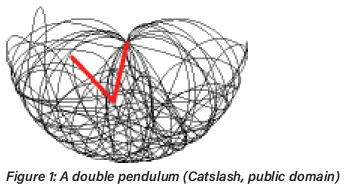
It is tempting to leave it at that. But from the point of view of complexity theory, Vermeulen and van den Akker must be taken a step further. Eco's account already factored in reflexivity: the man knowing that the woman knows, and she knowing that he knows she knows. "Is he being sincere or ironic?" becomes "Is he thinking I'm sincere while I'm in fact ironic?" and its permutations. Thus, if one takes a step back and centres on the communication between the lovers as a system, one arrives not at a pendulum but at a double pendulum, that is, a pendulum attached to a pendulum.
The double pendulum, as illustrated in Figure 1, is a well-known figure in the mathematical study of chaos. The fundamental difference between a pendulum and a double pendulum is that the former's movements are regular, the latter's complex and chaotic.6 Yet, the complexity of the double pendulum's "dance" emerges from the regularity of the single pendulum's swing and the initial conditions. Viewed in opposition to modernity, the swing of the pendulum illustrates why a shifting point of view is not necessarily incoherent, opportunistic or hypocritical. Or, alternatively expressed: incoherence, opportunism and hypocrisy are typically human. In contrast to the postmodern stance, this take reminds us that a seemingly arbitrary array of viewpoints might still be rule governed or at least bounded by realities.
Coexistence of indigenous, premodern, modern, postmodern cultural codes
Although authors do not always acknowledge it, metamodernism draws heavily on universal history in the style of Harari's Sapiens, Diamond's Guns, Germs and Steel and Wilson's The Social Conquest of Earth. One of the features that distinguishes metamodernism from its predecessors is that metamodernists do not tell a tale of overcoming, transcending or arriving, but of coping. In fact, Vermeulen and van den Akker (2010) go so far as to locate the meaning of the meta- in metamodernism not in "overcoming" but in "moving" (deriving from Plato's metaxis indicating oscillatory movement between poles.) The problem, however, with metaxic oscillation that Abramson (2015b) points out, is that it "merely re-entrenches postmodern dialectics by convincing us that every problem is fundamentally bipolar". As mathematician and logician Chris Brink (2007) once remarked: "You cannot play a leading role in a complex situation if your choices are always limited to one of two". The problem with poles is that it implies binary opposites and linearity. It has thus become preferable to see things on a plane (thus multidimensionally) and not in a line, which is why we prefer the dance of the double pendulum.
It is perhaps instructive to briefly consider root metaphors. Put simply, modernity drew an arrow for humankind that pointed towards a bright future, perhaps slightly sterile and devoid of mysteries, but lit by progress. Nations that were not yet there fell into the category of "developing" countries, a term indicating that they, too, must leave the premodern squalor behind. The key figure for postmodernism, conversely, is perhaps the ouroboros, the snake that bites its own tail. Discourse goes on and on, according to postmodernists, and the only thing it really feeds on is previous discourse. Interestingly, the root metaphor of the indigenous cultural codes is also circular: nature's circle of seasons, birth and death. But for metamodernists neither the directed arrow nor the circular ouroboros capture the challenge we are currently facing. The metamodern metaphors are the oscillation of the pendulum and the "dance" of the double pendulum.
Although there is an element of "healing" in metamodernism, the key is not to leave modernity and postmodernity behind or to close one's eyes. Metamodernists accept that premodern, modern and postmodern cultural codes will always co-exist in society. Wilson (2012:7) diagnosed the malaise very graphically in The Social Conquest of Earth in 1996: "We have created a Star Wars civilization, with Stone Age emotions, medieval institutions, and godlike technology. We thrash about. We are terribly confused by the mere fact of our existence, and a danger to ourselves and to the rest of life".
For social scientists and scholars, the instinctive reaction to Wilson's diagnosis is time to upgrade our institutions, then. However, the medieval institutions are to a large degree the expressions of the Stone Age emotions: the biological fact that underpins the institution of blood feud, for example, is that humans care more for kin than non-kin - which is evolutionarily necessarily so. Thus, what humanity needs to cope with, in Giddens's words (1990), is not only the "juggernaut" of modernism, with its quantum computing, genetic engineering, artificial intelligence and killer drones. The problem is the figure perched atop the juggernaut: a rather clueless hunter-gatherer trying to appear in control, but de facto only clinging on.
As the figure of the double pendulum's "dance" indicates, dynamic, not static, balance is key. On a more concrete, less metaphorical level, metamodernists see clearly that premodern, modern and postmodern cultural codes have positive as well as negative impacts. However, metamodernism is not to be confused with a political new-age movement where one would naively celebrate indigenous and premodern knowledge as on par with modern science. We therefore agree with Freinacht's perhaps more conservative approach to metamodernism which strives to be humble given the magnitude of the task; by firstly oscillating between modernism and postmodernism and establishing this axis properly, before incorporating and reconstructing premodernism in ways that avoid "pathological or regressive expressions" (Görtz, 2024).
The more radical postmodernists maintained cultural relativism. They held that any tale or "narrative" is as good as any other; therefore, attempts to privilege one story as "better" or only "better supported by evidence" were simply exercises in power. The spirit of radical subjectivity led to a deference to indigenous and premodern traditions, which was perhaps commendable for tolerance but put horrible practices beyond rational criticism as well. For example, female genital mutilation is part of some cultures, as is cannibalism. Again, Wilson (1998:201) pinpointed the problem a good while ago, and in no uncertain terms: "...if ethical standards are molded by culture, and cultures are endlessly diverse and equivalent, what disqualifies theocracy, for example, or colonialism? Or child labor, torture, and slavery?"
Attuned to the realities of the prehistoric human as far as the best of our knowledge goes, metamodernists are aware that, despite heavy romanticising in the tradition of Rousseau, indigenous and premodern cultures are not only about living in harmony with nature (Gat, 2006). Moreover, if any tale is as good as any other, the talk of universal human rights - one of the key achievements of modernism -would become just another tale among others. A culture that espouses our neighbours as an inferior race whom we are entitled to enslave, would become, if truly and genuinely believed by the respective group, equivalent in value to the UN's loftiest goals. Insofar as cultural relativism leads to conclusions that even its proponents would not accept, it cannot be the answer.
Imagined communities, collective imaginarles, warts and all
Imagined communities and collective imaginaries hardly need introduction in strategic communication circles; they are central to theory and practice. The actual term "imagined communities" goes back to historian and political scientist Benedict Anderson who employed it to explore nationalism in the late 18th century (Anderson, 1991). The phrase "collective imaginary" or "social imaginary" goes back to the work of Charles Taylor (2003). Imagined communities and collective imaginaries capture, then, that the social world around us is socially constructed: social orders are not divinely instituted or results of the inexorable laws of history; collective efforts can bring about new and better orders.
With the phrase "imagined community" coined in 1983, one may ask on what grounds metamodernism claims originality. Social constructionism has been going strong for quite a while. What does the renewed talk about imagined communities and collective imaginaries offer that was not offered by Castoriadis, Berger & Luckmann or even Sartre?
The answer we would suggest is based on the earlier figures of thought but also goes slightly beyond the explicitly formulated position of metamodernists here. It is that metamodernism, more solidly grounded in an understanding of the human being as a species, offers a more realistic, "bounded" social constructionism not plagued by the inherent contradictions of radical relativism. It seems to us that postmodernity tried to make the straightforward social constructionism of the 1960s a bit more daring. Once everybody accepted that social institutions such as courts of law, monogamous heterosexual marriage, canons of classical literature or social classes (for instance, nobility) only exist as long as we believe in them, one had to go one step further. Postmodernists did so by subtly turning construction by collective belief into what we would call "imagination-constructionism" Imagination-constructionism, although its authors often carefully avoided saying it explicitly, suggested that many physical and material states are "constructions" as well. Seemingly "hard" scientific diagnoses such as "insanity" in Foucault's accounts and "schizophrenia" and "psychosis" in the work of existentialist psychiatrist Ronald D. Laing, were easy targets at the beginning. Deconstruction ran into trouble, however, when the scientific search for cause and effect proved successful in more and more areas (Wilson, 1998). In order to stay plausible, imagination-construction withdrew into avantgarde social theory, that is, the imagination of grand alternative schemes of society - in Foucault's famous phrase, what could be otherwise? (Huffer, 2013). At some point, postmodernists crossed the thin line between imagining alternative human conditions and imagining a different human altogether.
Believing vs imagining
What we sense in metamodernism, in contrast, is a much narrower, more demanding "belief-constructionism" that emerges from the question, why is this so and not otherwise? Both forms agree that social arrangements are socially constructed insofar as they require widely shared buy-in for them to become "real" - contrary to gravity which acts on mass independently of beliefs and imaginaries. Belief-constructionism, however, finds the "real" beliefs on which people actually act more interesting than avantgarde imaginations. To take an example: colonial rule, as opposed to gravity or brute-force, boots-on-the-ground occupation, only works when a majority of the colonised population either believes in the superiority of the coloniser's culture or acts as if they believe, be it out of fear or opportunism. Attempts to overcome colonial rule may begin with imagination, but the ability to imagine otherwise is not sufficient. What is required is the spreading of the genuine, future-oriented, non-hypothetical belief that affairs can be otherwise, will be otherwise. Admittedly, this requires someone daring enough to begin imagining. The problem with imagination-constructionism (and our critique does not apply to all postmodern authors equally here), is that it deproblematises the step from imagining something to genuinely believing it, that is, believing sufficiently to act on it. If you can imagine freedom from colonial rule, imagination-constructionists suggest, belief and consequently action are only a comparatively trivial step away.
Metamodernism does not deny the importance of imagination, to be sure. Lene Andersen (2019:37) makes this very clear:
When historical circumstances such as war or famine challenge these deep values, and when economic prosperity makes old privileges meaningless and new technologies break down power structures; that is when artists start expressing new sentiments and ideas in new ways, and philosophy and science start imagining and exploring if things could be different.
What Andersen does not capture, and where strategic communication is far stronger and aware, is that art, philosophy and science tend to produce a pool of conflicting ideas, only a few of which prevail. For us, as belief-constructionists, there is a huge gulf between being able to imagine something on one side, and firm belief that supports willingness to act, take risks or perhaps even die, on the other. Although there is overlap in the cognitive apparatus involved, counterfactual or hypothetical imagination is not the same mental state as genuine belief that something is factual; one can imagine unicorns and be fully aware that they do not "really" exist. To anchor genuine belief, considerable effort over considerable periods of time as well as congruence with experienced facts is required. No amount of propaganda will convince citizens of the blessings of socialism when the shelves in the shops are empty. Just as it remains to be seen whether the Trump imaginaries will make America great again.
Nothing is as powerful as an idea communicated strategically and sustainedly
A closer look at the historic facts of any liberation movement, be it the African decolonisation of the 20th century or the French revolution of the 18th century, reveals one thing: that large parts of the liberated do not go through some spiritual transformation after which every decision is clear, every action unambiguous. If it appears so, it is because of retrospective myth construction. The majority of people do not suddenly see the light by way of "the 'unforced force' of rational argument".' to use Habermas's famous expression (Habermas, 1996:306). In the beginning, the majority almost always is dragged along a path which is by no means self-evident, and sometimes brutally prodded along the way. At the moment of victory, liberation movements all too often have to drag the enraged populus in the opposite direction, away from the chaos of mob rule that has very little to do with the beautiful collective imaginary.
Acting as if
Yet again, even the insight that ideas are made powerful by sustained, painful and often violent efforts, does not capture the complexity. At the tip of the one pendulum, metaphorically speaking, sits another.
One must still make allowances for the average, tragically savvy member of the species. While humans are capable of the most noble acts of altruism, they are also well capable of opportunism and dissembling. The historical record suggests very strongly that the ones that do the dragging and prodding, are not necessarily the ones that believe most genuinely. In witch-hunts, pogroms and genocides, one almost always sees opportunists who settle personal scores with neighbours and enrich themselves. (For a thorough investigation of the Rwandan genocide see, for example, Prunier 2009.) Instead of trying to imagine away these unsavoury human traits, strategic communication should rather investigate under what circumstances it happens and, perhaps even more importantly, under what circumstances it does not.
STRATEGIC COMMUNICATION REIMAGINED
Our metamodern take on the field results from decades of grappling with the subjective impression that something is not yet in place with strategic communication as an academic discipline. We arrived at this observation independently of each other on different hemispheres of the planet. Despite moving in very different circles, the impression we gained in countless conversations with colleagues from inside and outside our field converged very clearly nevertheless: something is "off"
Our suggestion here is that the discipline appears "off" precisely because of an undigested problem: the coexistence of modern and postmodern streams. The problem of strategic communication is that it has been trying to fit the modern as well as the postmodern mould - anyone's mould, really. Metamodern thought makes us aware that instead of aiming for half-baked compromises, we should rather break the mould and ask whether we are looking for answers in the right place.
If strategic communication is pervaded by metamodern thought already, committing to a metamodern perspective should be not so much about adopting new, hitherto unimaginable figures of thought. The key point is to apply the metamodern perspective - commitment to the complexity of the species, both-and thinking, ironic sincerity, double-pendulum oscillation - to come to an acceptance that the discipline is made by the dynamic interplay of seemingly incompatible ideas and concepts. There are many areas of dynamic interplay that warrant further exploration here, of course. However, utilising the five areas of interest in the third section, we concentrate on major points. To challenge strategic communication theorists, five questions will be asked, following which some answers will be ventured.
Take reality seriously: reality and "reality"
Our first question: What if we developed an epistemology-ontology nexus that reflects the objectivity of the world as well as the subjectivity of human life? Not a compromise between the poles of constructionism and realism, to be sure, but a multidimensional framework that captures why the social world is obviously socially constructed, yet again obviously not arbitrarily so; why quantitative as well as qualitative research has its place, yet obviously do different things.7
The postmodern spirit has left the field in confusion about the "constructedness" of reality, with strawmen being erected on both sides. While the insight that institutions such as colonial rule are not God-given may have been eye-opening to some at some time, not even hardcore positivists today would doubt the social construction of social institutions in principle (it is just that they prefer to research something else). That the rule of a certain class is socially constructed in principle does not mean that it can be deconstructed at will, by any given actor, at any time, simply by disbelieving. To humanity's great misfortune, this applies even where the majority does not genuinely believe but act "as if" As has been argued by various authors, enduring social arrangements are evolutionary stable strategies (Seiffert-Brockmann, 2018); they might not be the best arrangements, but they prevail as long as there is not a critical mass that subjectively perceives an incentive to be the first to step out of line.
Deconstruction, we have argued, rests on imagining alternative realities which, despite overlaps in the cognitive apparatus involved, is a far cry from believing and having others believe. Foucault's famous question was: What could be otherwise? For us, strategic communication seems ideally suited to inquire into an alternative question: Why is this so and not otherwise? To do so, however, strategic communication research must go beyond the suggestion that society is the product of arbitrary, self-referential discourses predicated on the assumption that the human being is infinitely malleable. While discourses sometimes do follow their own logic - and more often than not follow the logic of the powerful - there is also a logic of adapting communities and collectives to changing circumstances (Nothhaft & Seiffert-Brockmann, 2023). Some social institutions are universal, others common (polygynous marriage), yet again others rare (polyandrous marriage). All known human societies have funeral rites, for example (Brown, 2004). They might be very different from culture to culture but there is clearly a material level of humans dying, relatives grieving and an implicit knowledge that safe disposal of corpses prevents infectious diseases.
Take the human being seriously I
Our next question: What if strategic communication research took the complexity of the homo sapiens seriously? Again, we sense this is reflected in the argument that qualitative researchers make against statistically sophisticated, yet psychologically trivial, quantitative research. Does it really make sense to confront respondents with questions about matters they never gave a thought to before being asked?
The curious thing about the discourse in large swathes of our discipline is the disconnect. On the one hand, we insist that the human is highly complex, in principle. On the other, we sometimes underpin our research with conceptualisations that are under-complex compared to the mental machinations of a nine-year old trying to talk mum into buying candy. Despite the occasional lip service to the affective turn, strategic communication frequently remains pervaded by a clinical sterility that conceptualises "stakeholders" and their "issues". Lest we forget, stakeholders and humans are not the same animal. Stakeholders resemble humans outwardly, but their inner workings appear to be more related to the simpler, more manageable homo economicus. At the same time, Homo sapiens is not unfathomable either. Cognitive science is puzzling together an increasingly sophisticated understanding of humanity's curious dual nature of an individualistic as well as a collective species. But what we have learnt suggests very strongly that stakeholder theory has to up its game.
Take the human being seriously II: The good, the bad and the human
Stakeholder theory is an analytical tool, of course, and for the purposes of plotting a course of action, simplifications are necessary. What worries us is when analytical simplifications are compounded by ideological ones that reintroduce fairy-tale dualistic archetypes - in Storm's words, "theory that is merely jargon overlaid on predetermined political judgments" (Storm, 2021:6). What has become quite typical is the binary ideological assumption that stakeholders come in a good and a bad variety. The ostensibly powerless and marginalised ones are good; the ostensibly powerful and privileged ones are bad. Stakeholders of the good kind are always innocent victims, their beliefs always genuine. They never lie or dissemble, never opportunistically misunderstand or take "strategic umbrage". Stakeholders of the bad kind, conversely, are always crooks. They always lie. They can never be trusted.
Humans apparently find the duality of good vs evil comforting, but comfort is not a good basis for analytical methodology. What we have learnt from the 20th century is that under certain circumstances, horrible atrocities can be committed by well-meaning, decent people, that is, people who are not psychopathic or sociopathic, could have seen the evil of their ways, but did not - or acted as if they had not.
The authors belong to those who, in Storm's words, "wish that more scholars in the humanities and social sciences chose theories based on empirical adequacy instead of prior ideological commitments" (Storm, 2021:6). Although it happens horrifyingly often that truly innocent minorities are scapegoated in gruesome ways by majorities, there are many other cases where a closer look reveals the clean-cut good vs bad as a convenient construction. The mutually perpetuating forces of Yin and Yang depicting good in bad and bad in good are far more real in humanity. Moreover, the seemingly powerless are as prone to lying and dissembling as the powerful. Why should they not? It might matter less and be more forgivable, but it remains that the everyday struggle for existence normally makes people wilier and more opportunistic, "smarter" in a necessarily short-sighted, individualistic way. Yet again, sometimes one has to ask whether parties posing as the powerless, be it on the left or the right, are indeed as downtrodden as they wish to appear. At times, the ostensibly oppressed are surprisingly effective and "strategic" in elevating their predicaments higher on the agenda.
Take the human being seriously III: A species adapting like everyone else
From a metamodern point of view, one can readily concede that imaginaries may look like seemingly arbitrary results of seemingly self-referential discourse; no-one doubts creative minds could easily imagine alternative states of affair. All of this holds only on the proximate level, however. On the ultimate level, discourses in society and the imaginaries that result from these discourses are responses to environmental challenges (Nothhaft & Seiffert-Brockmann, 2023). These environmental challenges are -at least here and now, at a given point in time - realities. They can be communicatively reconstructed in this or that way. One can close one's eyes to them, but they will reassert themselves anyway.
One could argue that our account is plausible as long as the realities we insist on are physical realities. Say water gets scarce and a region that supported two tribes in coexistence now only supports one - a development we de facto see on global scope due to climate change. If there is no way to move away and access alternative sources, war between the two tribes is inevitable: war rhetoric will follow, and each tribe's spiritual leaders will inevitably point out how despicable and degenerate the other is. But even here, deconstructivists could hold, the underlying problem is not physical reality. It lies in socially constructed reality: in categories of "tribe" of "them vs us" Surely, with a little goodwill and imagination, one could find ways of sharing increasingly scarce resources?
The point here is to admit that such a solution is highly unlikely while acknowledging at the same time that it is not, in principle, impossible. This is where metamodernism's trait of collaboration becomes relevant. Metamodernism encourages not only dialogue but collaboration. As Abramson (2015a) points out: "In a world in which we are constantly being influenced by innumerable forces....metamodernism literalizes this experience by encouraging us to consciously join our efforts and perspectives with those of others" Pipere and Martinsone (2022) apply metamodernist principles and the ontological metamodern principle of paradoxical simultaneity to the social sciences to showcase how meta crises and complex problems can be overcome through collaborative transdisciplinary approaches. Simultaneity refers to the idea that the metamodernist does not move between paradoxical positions but, in fact, can inhabit all of them at once (Abramson 2015a). Embracing both dialogue and dialectics, even between differing parties, with collaboration as the ultimate goal, is a metamodern characteristic.
Take complexity seriously: Non-linear methodology
We argued earlier that there is no lack of acknowledgement of complexity on the problem side. What is missing, we sense, is an adequate understanding of complexity on the solution side. Storm contends that postmodernism, despite its relativism, was driven by a "lingering longing for certainties" (Storm, 2021:6) And he has a point: as long as one entertains imagination-constructionism, wicked problems (Hassenstein et al., 2022) - problems from which no escape seems to exist - appear not nearly as wicked. From a purely relativistic point of view, even the most intractable political conflict is always self-chosen; the removed scholarly observer remains secure in his or her knowledge that to think differently is always the solution. Similarly, some of our strategic communication colleagues seem convinced that the solution to each and every problem lies in communication.
This binary perspective exacerbates the problem because it ignores the complex interplays between process and content. Metamodernism, in contrast, is aware that humans, in Schopenhauer's words, can do what they want, but cannot want what they want. To take a relevant contemporary example: in 1903, the Jewish diaspora was offered settlement in Uganda and Kenya instead of Palestine. It is not surprising that the 7th Zionist Congress rejected the British offer despite painful (and correct) predictions that settlers in Palestine were in for a century of conflict. The dispersed Jews considered Palestine their ancestral land, they could not be brought to build a new state of Israel in Africa. In that sense, the choice did exist and did not exist at the same time.
At the same time, the years 1903 to 1905, when the offer was made, was perhaps the closest the issue came to an alternative solution. The important point here is non-linearity and emergence. Although the trajectory of affairs is often more set than it seems and there is by no means always a communicative solution, the unpredictable, chaotic "dance" of the double pendulum, metaphorically speaking, will inevitably offer bifurcation points (Nothhaft & Wehmeier, 2007). There are moments when the double pendulum stands still at the very top and might fall to the left or right. Similarly, bifurcation points are moments in time - opportunities, chances - where things might get on a completely different track, where interventions might be successful, where new solutions emerge.
IMPLICATIONS FOR STRATEGIC COMMUNICATION
It can well be asked what the implications of all these challenges are for strategic communication. In a future publication, we hope to spell out more concretely and practically what a metamodern turn in strategic communication could look like on the meso-level of practice and research. To open the floor, we offer the following preliminary answers:
Begin to oscillate but accept that the movement will more likely become a "dance"
It is time that we begin to see things on a plane and not on a line - where our options are not always limited to one of two. And where we accept the existence of complexity, contradictions (of both-and) as a starting point. Where things are not black or white, but black and white and many shades in between. Where stakeholders are not good or bad but good and bad and human. Where we accept that in the workplace, collaboration can (and obviously does) co-exist with competition, diversity with excellence, accountability with freedom, and effect with affect. Where we can deconstruct as well as reconstruct, and where we embrace dialectics as well as dialogue.
Oscillate between a realist epistemology and a constructionist epistemology
Without a realist epistemology, without the ability to say "this is how things are here and now" differentiation between good and bad strategy becomes meaningless, and no stable patterns can be developed. Without a constructionist epistemology, it is hard to see how the higher functions of strategic communication, such as brand and identity-building, could be construed.
Nurture interdisciplinary relationships, instead of drawing disciplinary boundaries
Given the juggernaut humanity must cope with, disciplinary fluidities have become unavoidable, and the blurring of communication genres has truly arrived (for example, between media and communication). Endless paradigm wars - what Tomaselli (2018:295) calls "epistemological schizophrenia" - can no longer be tolerated, unless we wish to sink into oblivion. No longer can we devote our loyalty only to the discipline. We owe it to the greater crises science in society faces. As Freinacht (2023) shrewdly observes, humans are "wholeparts" The figure perched on top of the juggernaut can do with some help. We need to collaborate, and to consciously join our efforts and perspectives with those of others through inter- and transdisciplinary approaches.
Find a new strategic communication discourse
A new discourse is one that acknowledges oscillation between and beyond and is, ultimately, the dance of the double pendulum. It is the discourse of "both-and" which steers clear of binary traps or linear compromises. A discourse in which we also ask ourselves the following questions:
. How are things here and now?
. How do we want things to be?
. How do/can we respond?
. With whom do/can we collaborate?
. And, what evidence can we bring?
Closer conceptual and methodological collaboration across various disciplines is needed, and we must not let one preferred methodology dominate
We need to oscillate between both unique interpretations - too often "obscured by the discourse of emergence" (Nothhaft et al. 2018) - and the search for stable patterns. To that end, if we want to bring something to the table that others can tap into, we need research in height and breadth and depth. It remains the optimal way in which a unifying, well-respected strategic communication theory can be bolstered, also to the advantage of the applied communication disciplines.
In recent years, postmodernist researchers in strategic communication openly expressed their preference for qualitative research without which "no rich description...of complex interrelationships" is possible (Verwey & Benecke, 2021:24). We remain wary of such strong preferences, as excluding the one for the other encourages more epistemological polarities, which in a metamodern context is neither desirable nor necessary. While rich descriptions of the unique are needed, explanatory power is needed as well. Concepts must not only be thrown in the ring, "soon to wink out in the dimensionless dark" but need to be operationalised, refined and built upon - preferably with replicability. Science is a search for stable patterns among seemingly unique phenomena. To that end, ongoing measurement and evaluation through robust quantitative (cause-and-effect) methods, qualitative (interpretive) research, and mixed methods, including valid measuring instruments and databases, should be encouraged.
In a way, an oscillation between modern and postmodern communication research tools can, in itself, be regarded as "strategic". Corporate environments tend to prefer quantitative (or modernist) frameworks, while social change efforts may rely more on postmodern values. Metamodernists are not "allergic" to either modern or postmodern ways of communicating and research. Encouraging students to learn from both science and humanities - both hugely in demand on the labour market - may be the way forward.8 It thus stands to reason that methodology preferences and priorities are dictated not only by solid underlying theory but also by context, as long as the decisions taken based on the findings also remain contextual and provisional. The Titanic did sink because of a gash in her hull. The tale of the Titanic is also a tale of hubris.
Become agile enough to live with complexity and to cope with perpetual organisational upheaval
Conventional readings of strategic communication's perhaps most widely-used definition, by Hallahan et al. (2007), tend to interpret the keyword "purposeful" as "underpinned by a mission" - with the mission conceived as rather static, such as "move from A to B". McKinsey (2024) may not be the favourite wellspring of wisdom for progressives, but even the most technocratic management consultancy has departed from linear thinking and offers a reinterpretation of "purposeful" in one of their key take-aways from Davos 2024: "In our complex systems and in this complex era, solutions are rarely straightforward. Instead of telling your team to move from point A to point B, join them in a journey toward a general direction. Lead yourself, and your team, with purposeful vision, not just objectives".
CONCLUSION
The South African scholar Mamphela Ramphele famously remarked: "We cannot control, or even completely figure out, the complex systems of the world, but we can dance with them."9 We have tried to sketch, thus, where and how strategic communication needs to learn to dance.
Having been realistic to the point of cynicism, we are perhaps, in conclusion, granted a moment of dreamy-eyed imagination. In our strange new world, strategic communication graduates face a seemingly paradoxical situation. With one foot in the modern world, they are taught about authentic brands, how to implement a genuine CSR-strategy, how to stimulate real dialogue. With the other foot in the critical postmodern world, they are told that corporate talk of authenticity, genuine engagement or meaningful dialogue is inevitably "bullshit". Puzzled, some students want to know who is right and who is wrong. Others, equally puzzled, quickly arrive at the conclusion that there is no truth. A metamodern stance might help to realise that the solution does not lie in such simplifications. Our vision for strategic communication, then, would be that the discipline substantially adds to our understanding of the contradictory, incoherent human being as it is and goes about its life. Our hope is that this understanding will be used for the purpose of identifying chances and opportunities, for creating a more peaceful, sustainable and fun world. It seems clear to us that we need to let go, embrace what we don't know and radically reframe our questions.
One of which can be to ask ourselves what the "strategic" in strategic communication means.
REFERENCES
Abramson, S. (2015)a. Ten basic principles of metamodernism. https://www.huffpost.com/entry/ten-key-principles-in-met_b_7143202 [ Links ]
Abramson, S. (2015)b. Five more principles of metamodernism. https://www.huffpost.com/entry/five-more-basic-principle_b_7269446 [ Links ]
Adyahanzi and Dempsey, B.G. (2022). Emergentism: A religion for the metamodern world. Ontario: Palimpsest Press. [ Links ]
Andersen, L.R. (2019). Metamodernity. Meaning and hope in a complex world. .Copenhagen: Nordic Bildung. [ Links ]
Andersen, L.R. (2023). Polymodernity. Meaning and hope in a complex world. Copenhagen: Nordic Bildung. [ Links ]
Anderson, B. (1991). Imagined communities: Reflections on the Origin and Spread of Nationalism. Verso. [ Links ]
Barker, C.D., Dempsey, B.G., Hedlund, N., Esbjörn-Hargens, S., Ranefors, J., Poledna, P., Kleineberg, M., Alderman, B., Henriques, G. & Leider-Wiley, S. (2023-2024). Foundations of archdisciplinarity - Advancing beyond the meta. Minnesota: Archdisciplinary Research Centre. [ Links ]
Bisel, R.S. (2010). A communicative ontology of organization? A description, history, and critique of CCO theories for organization science. Management Communication Quarterly, 24(1):124-131. [ Links ]
Brink, C. (2007). Anatomy of a Transformer. Stellenbosch: Sun Press. [ Links ]
Brink, C. (2024). Personal correspondence, 2 and 8 February 2024. [ Links ]
Brown, D.E. (2004). Human universals, human nature & human culture. Daedalus, 133(4):47-54. [ Links ]
Castells, M. (1996). The rise of the network society (The information age: Economy, society and culture, Volume I). Oxford: Blackwell. [ Links ]
Castells, M. (1997). The power of identity (The information age: Economy, society and culture, Volume II). Oxford: Blackwell. [ Links ]
Castells, M. (1998). End of millennium (The information age: Economy, society and culture, Volume III). Oxford: Blackwell. [ Links ]
Clarke, S. 2006. From enlightenment to risk. Social theory and contemporary society. New York: Palgrave Macmillan [ Links ]
Cooren, F., Kuhn, T.R., Cornelissen, J P. & Clark, T. (2011). Communication, organizing and organization: An overview and introduction to the special issue. Organization Studies, 32(9):1149-1170. [ Links ]
Diamond, J. (2017 [1997]). Guns, germs and steel: The fate of human societies. 20th Anniversary Edition. London: W.W. Norton. [ Links ]
Dühring, L. (2015). Lost in translation? On the disciplinary status of public relations. Public Relations Inquiry, 4(1):5-23. [ Links ]
Eco, U. (1994). Reflections on The Name of the Rose. trans. William Weaver, London: Minerva, p. 67-68. [ Links ]
Ferguson, M.A. (2018). Building theory in public relations: Interorganizational relationships as a public relations paradigm. Journal of Public Relations Research, 30(4):164-178. [ Links ]
Freinacht, H. (2017). The Listening Society. Metamoderna. [ Links ]
Freinacht, H. (2019). Nordic Ideology. Metamoderna. [ Links ]
Freinacht, H. (2022). 12 Commandments: For extraordinary people to master ordinary life. Metamoderna. [ Links ]
Freinacht, H. (2023). 5 Things that make you Metamodern. medium.com. [ Links ]
Freinacht, H. (2024). An open invitation to a metamodern sociology. Metamoderna [ Links ]
Gat, A. (2006). War in human civilization. Oxford: Oxford University Press. [ Links ]
Giddens, A. (1990). The consequences of modernity. Cambridge: Polity/Blackwell. [ Links ]
Görtz, D. (2024). Personal correspondence. 13 October 2024. [ Links ]
Habermas, J. (1996). Between facts and norms. Contributions to a discourse theory of law and democracy. Translated by William Rehg. Cambridge, Mass.: The MIT Press. [ Links ]
Hallahan, K., Holtzhausen, B., van Ruler,B., Verčič, D. & Sriramesh, K. (2007). Defining strategic communication. International Journal of Strategic Communication, (1):3-35. [ Links ]
Harari, Y.N. (2011). Sapiens. A brief history of humankind. [Kindle Edition]. London: Penguin. [ Links ]
Harari, Y.N. (2017). Homo Deus: A brief history of tomorrow [Kindle Edition]. New York, London, Sydney, etc.: HarperCollins. [ Links ]
Hassenstein, K., Ritz, C. and Sandhu, S. (2022). Wicked problems. Herausforderung für PR und organisationskommunikation. Wiesbaden, Germany:SpringerVS. [ Links ]
Holtzhausen, D.R. & Voto, R. (2002). Resistance from the margins: The postmodern public relations practitioner as organizational activist. Journal of Public Relations Research, 14(1): 57-84. https://doi.org/10.1207/S1532754XJPRR1401_3 [ Links ]
Holtzhausen, D.R. (2012). Public relations as activism. Postmodern approaches to theory and practice. New York: Routledge. [ Links ]
Huffer, L. (2013). Foucault: What could be otherwise. Economic and Political Weekly, 21-23. [ Links ]
Irvine, M. (2014). Approaches to Pro-Mo. http://faculty.georgetown.edu/irvinem/theory/pomo.html [ Links ]
Jerath, K.S. (2021). Modernity and modernism. In Science, technology and modernity. Springer, Cham. https://doi.org/10.1007/978-3-030-80465-7_3 [ Links ]
Latour, B. (1991). Nous n'avons j'amais été modernes. Essai d'anthropologie symétrique. Paris: La Découverte. [ Links ]
McKinsey. (2024). 10 Key take-aways from Davos. https://www.mckinsey.com/featured-insights/themes/10-key-takeaways-from-davos-2024 [ Links ]
Meyer, I. & Barker, R. (2020). A metamodern model for managing stakeholder relationships in non-profit organisations. Communicare, 39(1):56-70. [ Links ]
Meyer, I. (2021). The resurrection of modernistic public relations - a metamodern perspective. Journal for Communication Studies, 14,1(27):15-36. [ Links ]
Nothhaft, H. & Seiffert-Brockmann, J. (2023). Peacocks, penknives and power: On the implications of evolutionary psychology for strategic communication. International Journal of Strategic Communication 17(3):163-180. [ Links ]
Nothhaft, H. & Wehmeier, S. (2007). Coping with complexity: Sociocybernetics as a framework for communication management. International Journal of Strategic Communication, 1(1):151-168. [ Links ]
Nothhaft, H. & Zerfass, A. (2023). Public relations in a postdisciplinary world: On the possibility of establishing a constitutive theory within the tribal struggles of communication disciplines. In C.H. Botan & E.J. Sommerfeldt (eds). Public relations III: In the age of publics. London, New York: Routledge. [ Links ]
Nothhaft, H., Werder, K.P., Verčič, D. & Zerfass, A. (2018). Strategic communication: Reflections on an elusive concept. International Journal of Strategic Communication, 12(4):352-366. [ Links ]
Overton-de Klerk, N. & Verwey, S. (2013). Towards an emerging paradigm of strategic communication: Core driving forces. Communicatio, 39(3):362-382. [ Links ]
Overton-de Klerk, N. (2023). Reflections on the current state and future of strategic communication as paradigm and practice. Communicare, 42(1):4-21. [ Links ]
Peters, J.D. (1986). Institutional sources of intellectual poverty in communication research. Communication Research, 13(4):527-559. [ Links ]
Pinker, S. (2003). The blank slate: The modern denial of human nature. [Kindle Edition]. New York: Penguin. [ Links ]
Pluckrose, H. & Lindsay, J. (2020). Cynical theories: How activist scholarship made everything about race, gender, and identity-and why this harms everybody. Durham, NC: Pitchstone Publishing. [ Links ]
Prunier, G. (2009). Africa's world war. Congo, the Rwandan genocide, and the making of a continental catastrophe. Oxford: Oxford UP. [ Links ]
Ramphele, M. Vogel, C. & Reddy, D. (2022). Special SFSA plenary debate; the future of transdisciplinarity; how do we relearn to be human in new ways. South African Journal of Science, 18(Special Issue: Radical Reason):20-23. [ Links ]
Redhead, S. (2011). We have never been postmodern: Theory at the speed of light. Edinburgh: Edinburgh University Press. [ Links ]
Schoeneborn, D. & Vasquez, C. (2017). Communication as constitutive of organization. In C. R. Scott & L. K. Lewis (eds). International encyclopedia of organizational communication. Hoboken, NJ: Wiley. [ Links ]
Seiffert-Brockmann. J. (2018). Evolutionary psychology: A framework for strategic communication research. International Journal of Strategic Communication, 12(4):417-432, DOI: 10.1080/1553118X.2018.1490291 [ Links ]
Sokal, A. (2010). Beyond the Hoax. [Kindle Edition]. Oxford: Oxford University Press. [ Links ]
Storm, J.Â.J. (2021). Metamodernism: The future of theory. [Kindle Edition]. Chicago: University of Chicago Press. [ Links ]
Taylor, C. (2003). Modern social imaginaries. Durham, NC: Duke University Press. [ Links ]
Tomaselli, K. (2018). Science vs. constructivism: Creating or finding reality. In K. Tomaselli. (ed.). Making sense of research. eBook. Pretoria: Van Schaik, 290-315. [ Links ]
Turner, L. (2015). Metamodernism: A brief introduction. Notes on Metamodernity, blog 12 January 2015. [ Links ]
Vermeulen, T. & van den Akker, R. (2010). Notes on metamodernism. Journal of Aesthetics & Culture, 2(1):5677. [ Links ]
Verwey, S. & Benecke, D.R. (2021). Paradigms, perspectives and paradoxes. In S. Verwey, D.R. Benecke & T. Phumo (eds). Strategic Communication. South African Perspectives. Cape Town: Oxford University Press, 5-32. [ Links ]
Wilson, E. (2012). The social conquest of earth. [Kindle Edition]. New York: Liveright. [ Links ]
Wilson, E.O. (1998). Consilience. The unity of knowledge. New York: Vintage. [ Links ]
Zerfass, A. (1996). Unternehmensführung und Öffentlichkeitsarbeit. Grundlegung einer Theorie der Unternehmenskommunikation und Public Relations. Opladen: Westdeutscher Verlag. [ Links ]
Submitted August 2024
Accepted March 2025
1 Our thanks go to Alessandra Sossini, PhD student at Lund University, for pointing this out.
2 For example, Meyer and Barker (2020:59-60) and Meyer (2021:16) argue that a metamodern approach is the most agile and feasible approach to deal with the intricacies of the current reality riddled with volatility, uncertainty, complexity and ambiguity (VUCA).
3 Hanzi Freinacht ostensibly is a political philosopher, historian and sociologist who spends most of his time in quiet contemplation in the Swiss Alps. In reality, it is the penname used by author sociologists Daniel Görtz and Emil Ejner Friis.
4 Andersen, as has been noted, renamed her book Metamodernity: Meaning and Hope in a Complex World (2019) to Polymodernity: Meaning and Hope in a Complex World (2023).
5 Taken together, Overton-de Klerk & Verwey (2013) and Overton-de Klerk (2023) offer a comprehensive overview.
6 Credit for pointing this out to us goes to mathematician and logician Chris Brink with gratitude.
7 Critical realism, by and large connected to the work of Roy Bhaskar, would be a good starting point here.
8 Credit goes to Daniel Görtz for pointing this out.
9 See the discussion on transdisciplinarity and Radical Reason in Ramphele et al., 2022:20.
