




Services on Demand
Journal

Article
 English (pdf)
 Article in xml format
 Article references
 Automatic translation
 Send this article by e-mail
Indicators
Related links
-
 Cited by Google
 -
 Similars in Google
Share

 Permalink
Journal of Construction Project Management and Innovation
On-line version ISSN 2959-9652Print version ISSN 2223-7852
JCPMI vol.14 n.2 Johannesburg 2024
https://doi.org/10.36615/jcpmi.v14i2.3065
ARTICLES
International research collaboration - how powerful is it really?
Sascha DüerkopI; Jakob GrubmüllerII; Rana BadranIII
IDepartment of Economy, University of Applied Sciences, Fulda, Germany, 2028. Email: sascha.dueerkop@w.hs-fulda.de
IIDepartment of Economy, University of Applied Sciences, Fulda, Germany, 2028. Email: jakob.grubmueller@w.hs-fulda.de
IIIGerman-Jordanian University, Madaba, Jordan, 2028. Email: rana.badran@gju.edu.jo
ABSTRACT
Countries that do participate in International Research Collaboration (IRC) are placed in advantageous positions to promote scientific and technological advancements. This advantage is known to be particularly high for countries outside of Europe or North America. Subsequently, international organizations do actively promote and support the emergence of collaborative research platforms, in particular in these countries. But how can the success of such a platform be measured? Do the benefits always outweigh the costs? This paper seeks to define a framework for assessing the success of a research collaborative platform. As a case study, a bilateral research platform implemented by the authors will be critically assessed.
Keywords: international research collaboration; collaboration; innovation; logistics; transportation
1. INTRODUCTION
1.1 Context
The main German development agency, GIZ, argues that "collaborative innovation brings actors with different perspectives and skills together in fostering innovation for the good" and thus perfectly summarized what seems to be a consensus among scholars, political and business leaders around the world: Teams are more innovative than individuals and the more diverse the background of the team, the more likely is a valuable output. One dimension of diversity can be the location or the nationality of the team members and one way to ensure a high diversity in that dimension is collaborating with partners from abroad. Likewise, one route to innovation can be research and its application into practice. International Research Collaboration, which brings together scholars from different countries to work on a common topic for an extended period of time, will be the main topic of this study.
The remainder of Chapter 1 provides an initial overview of policy and scientific papers on international research collaboration (IRC) and defines the term IRC. Chapter 2 then provides a work report from a research project that in itself is IRC, but, beyond this fact, also is meant to further research collaboration in different forms to create a sustainable and transferable IRC cluster or centre structure. In an effort to generalize the findings from the case study, Chapter 3 then presents some theoretical and practical implications for IRC as a research field. In particular, a fictional example is constructed in Chapter 3.2 to demonstrate the methodology to assess the output of an IRC. Finally, Chapter 4 concludes this work and provides a number of topics for further research. It is noted that this paper is, in parts, a report about work in progress. It shall present the status quo of a major international research collaboration project and critically reflect on its findings so far. Being aware of this preliminary status, the authors particularly want to emphasize Chapter 4 and the importance of further research that has to be conducted to extend the field.
1.2 Policy review
In 2014, the African Heads of State and Government adopted the Science, Technology and Innovation Strategy for Africa (STISA-2024), a continental policy that wants to accelerate the transition of African economies into an innovation-led, knowledge-based economy (African Union 2014). One of the pillars of the strategy is to "encourage collaboration within and between states in the area of innovation" (ibid, p.28). Similarly, the Arab League Education, Cultural and Scientific Organisation, a subsidiary of the League of Arab States, calls for more collaboration to "change the way science and research is done" (Liu et al. 2021). The latter argues that a fostering of international research collaboration directly addresses Goal 17 ("Partnership for the goals") of the United Nations' Sustainable Development Goals (SDGs). Indeed, sub-target 17.6 of the SDGs calls for an "enhanced North-South, South-South and triangular regional and international cooperation on and access to science, technology and innovation" (UN General Assembly 2015).
All the above policies highlight the potential of international research collaboration to result in innovations and thus contributing to closing existing development gaps, often directly between the collaborating partners. However, some policies also stress the urgent and strong need for more international research collaboration on eye-level to maintain the current state of development and become more resilient about upcoming challenges. One such example is the EU (European Commission 2021), which emphasized that international research collaboration is not a one-way development effort but rather a platform for "exchanging best practices" and "finding global responses to global challenges" (ibid).
1.3 Defining international research collaboration
The term' research collaboration' is intuitively understood as any form of cooperation of at least two actors that conduct research together. While that might sound trivial, it is complex to unwrap the meaning of the term and define it in a way that can serve as a basis for further research. Research collaboration itself can describe the daily cooperation between two scholars that work together. It can refer to interdisciplinary co-working setups. It may refer to the collaboration of entities, such as different universities in the same or different countries. It might, however, also refer to the collaboration between actors from governmental institutions, universities and the industry. All these forms of collaboration are very different in form and nature.
A first step towards a definition of the term international research collaboration (IRC) is focusing on the actors of such a collaboration. Following (Katz and Martin 1997), this study considers the following as collaborators:
• Those who work together on the research project or topic at hand throughout the duration of the research and make frequent contributions to it.
• Those whose names appear in the proposal for the research.
• Those whose names appear on the outputs of the research, e.g. scientific publications.
Based on this definition, international research collaboration can then be defined as the collaboration of collaborators in the above meaning from at least two different countries. In particular, these collaborators may be working at research institutions like universities, or in private businesses, non-profit organisations or state agencies, which can often contribute to applied research.
Beyond the above definition, it has to be clarified that the term collaboration is meant to describe a mutually beneficial cooperation on eye-level. In particular, partnerships in which one partner is conducting the research while the other partner is applying it to retrieve some form of test results is not considered research collaboration. In their research study "Africa-as-a-service", (Umlauf and Burchardt 2022) describe one example of such an innovation partnership between developers and test field providers.
It is important to note that an eye-level collaboration on a specific research topic or project does not necessarily define the general relation between the collaborators. The collaborators might be part of the same overarching structure, e.g. when two teams from different company locations or two researchers from state universities of the same state collaborate. The collaborators might as well be partnered or even twinned in a long-term relation that extends the research topic or project. The collaborators might also be in competition with each other. Scholars that conduct research on the same topic could compete for research grants or positions, while companies may collaborate despite being direct competitors in the market. As (Ricciardi et al 2022) detail, there often is not just one simple level on which relationships between stakeholders can take place, but multiple. Hence, there is no contradiction in competing but cooperating in some aspects (research or innovation) at the same time. The authors even claim: "[...] a successful coopetition [portmanteau of cooperation and competition] configuration must focus primarily on cooperation rather than competition." (Ricciardi et al. 2022). An existing example for such a coopetition can be the formation of clusters, in which (partially) efforts of cooperation are undertaken by competing actors of a sector (Klimova et al. 2016), a concept common in both research and business innovation.
1.4 Defining international research collaboration
One main hurdle for international research collaboration that truly is on eye-level seems to be the huge gap in funding of scholars in Europe or North America compared to Africa, Asia or South America. Looking particularly at Africa, international research collaboration has increased over the last decades, as it has globally, but the collaborations are overwhelmingly between one African researcher and one from another continent, mostly Europe or North America (see Onyancha 2020). The main factor for African scholars to be involved in international research collaboration is still if he or she has spent time abroad, as (Confraria et al. 2020) conclude. Similarly, researchers from the MENA (Middle East and Northern Africa) region are most likely to collaborate with fellow scholars from Europe or North America, while East Asian partners play a growing role in the region (El-Ouahi et al. 2021). (Katz and Martin 1997) note that collaboration can help build ties between nations or regions - providing successful research collaboration after the second world war as examples.
International Research Collaboration (IRC), as defined above, is increasingly becoming a research subject itself. So much so that (Chen et al 2019) provided a first literature research paper of the field in 2019. One main finding of the study was that many research questions remain open, including rather generic ones: Depending on the countries looked at, there is varying evidence regarding the benefit international research collaboration provides. Accordingly, the measurement of the IRCs' impact becomes a valuable indicator - leading (Katz and Martin 1997) to include the necessity to be able to measure it in their short list of assumptions on (successful) research collaboration. An attempt to define such measurements in a running research project is discussed below.
2. CASE STUDY
2.1 Nesting sub-sections
The authors of this study participate in international research collaboration between a European (Germany) and a MENA country (Jordan), with the goal to investigate the benefits for both partners and their own scientific networks. Beyond the international dimension of the collaboration, the project presented in the following puts a strong focus on collaboration between different stakeholders, namely state agencies, universities and private businesses. In a research program which is ongoing at the time of publication, the authors receive funding to conceptualize how exactly a regional research centre for the Mashreq (defined as "a geographic region that extends from western Egypt to the western border of Iran" by (Everett-Heath 2018) region surrounding Jordan could be established, set up and linked to partners beyond the region.
2.2 Context
The project, titled JOINOLOG, is a three-year effort undertaken by Hochschule Fulda of Germany and German-Jordanian University (GJU) of Jordan. Before this, a one-year feasibility study was conducted by the project team to determine its necessity and use as perceived by relevant stakeholders. The project goals are the promotion of excellent research through furthering collaboration, improving governance as well as fostering innovations that are qualified to penetrate the Jordanian as well as the Mashreq markets, and thus benefit the local economies and societies. It is located in the realm of Supply Chain Management and logistics, a sector in which local partners in workshops associated little with research and innovation, the potential of which they therefore deemed as going unused. To achieve the project's goals, policy makers, scholars and industry leaders from the transport and logistics sector in Jordan were involved in the process from day one.
After positive results regarding feasibility and necessity, the project started in 2021, aiming to conceptualize an innovation centre for logistics in Jordan, based on existing and successful IRCs. Furthermore, the JOINOLOG centre would include projects and training not only of an academic nature, but with practical uses and partners, including businesses and public actors in the collaboration practice. Finally, the construction of a physical centre is not part of the project. It rather focuses entirely on defining the framework of a future centre and building the underlying network to sustain such a future centre. The authors are team members of the JOINOLOG project and, therefore possess detailed insights concerning the progress of and hurdles to the approach.
2.3 Obstacles to collaboration and measurements of their success
Since collaboration in this IRC is not only desired between scientific partners on an international basis but also among and with private businesses and public actors, there are complex relationship networks to be untangled before being able to understand the current lack of collaboration and vice versa, how research success can be achieved and ultimately measured.
The logistics sector in Jordan rarely cooperates among itself beyond necessary Supply Chain coordination, driven by direct profit incentives. While Jordan harbours a thriving scientific community and a high number of young and educated researchers (Schwab 2017), the stakeholders interviewed in JOINOLOG workshops perceived the collaborations between universities and businesses as lacking (Project Consortium JOINOLOG 2019). There are multiple dimensions to this problem, which the JOINOLOG centre aims to address. Scientific research and education regarding Supply Chain Management (SCM) or logistics is still being perceived as an emerging (applied) science by the workshop participants. The last thirty years saw the establishment of SCM in business administration, but Jordan's extensive landscape of scientific institutions has - according to local stakeholders - not caught up (Project Consortium JOINOLOG 2019). Few courses are taught regarding the topic and even fewer universities offer related degrees. As a result, the sector in question is reduced to its application, receiving innovations from external sources. As local partners from the industry reported, the senior staff is regularly sent abroad to Europe, China or neighbouring Saudi Arabia to receive further and more specific training.
Another dimension of lacking collaboration in the Jordanian logistics landscape is a focus on competition in businesses. While the necessity to compete with each other is grounded in the roots of our shared economic system, collaboration (especially with academic and public partners) is still often just an option to possibly innovate. While other sectors are able to embrace 'coopetition' (combining competition and cooperation), logistics is fiercely fought over the market. Dwindling margins convince profit-oriented stakeholders to guard their business secrets and thus avoid closer ties with others, while the benefits of cooperation, even in circumstances like those, potentially do exist. In other words, there is a tradeoff between the discretion required to protect one's own business secrets and remain in a favourable market position and the willingness to pool resources or share data, which stakeholders identified as being required for some scientific advancements. According to (Kunttu 2017), the basis of knowledge sharing, which can be considered a crucial part of all forms of collaboration, is trust and commitment from all parties involved. Given the circumstances described above, this kind of relationship is difficult to reach between competing actors, both in business and in research institutions. Still, a clustering approach is feasible and summarizes JOINOLOG's goals in its cooperation strategy: Entities which build relationships in the centre's sphere of influence are not meant to collaborate completely, to become one entity and share business secrets. Rather, cooperation opportunities can be extended by adding the insights of (Ricciardi et al. 2022) regarding 'coopetition'. In practice, successful applications of cooperation are still hindered by the overarching individual goals of involved organisations, meaning that collaboration is hindered by the reluctance of businesses. This was observed in the case study in Jordan as well.
Despite these and other obstacles to collaboration in the Jordanian logistical sector, both universities initiating the project decided to tackle them by going forward in establishing JOINOLOG. The great potential of collaboration among stakeholders of the sector became evident in the feasibility study: In multiple workshops in the Jordanian capital of Amman, representatives of public offices, private businesses and research/education facilities approved the project goal to further cooperation efforts among each other. Early on, this led to the research questions this paper poses as well: How can the results of research collaboration be quantified? At which point can the centre be considered a success?
Measurements of success in this instance depend on multiple factors, which are interwoven into the JOINOLOG concept. To be able to quantitatively determine the results of undertaken efforts, a simple approach is the number of scientific outputs, i.e., research papers. On a national basis, Jordan's biggest collaboration partner in this indicator is the USA, followed by Germany (UNESCO, 2016), the partner country in this project. In this instance, an approach purely dedicated to the quantity of this scientific output would be lacking: Practice based innovation, involving potentially only the application of scientific methods, are to be measured as well. The extension of seeking collaboration not only between nations in an academic sector but regional and in the practical sector of logistics differentiates JOINOLOG from other IRCs and potentially complicates the measurement options. JOINOLOG's measurement of innovative success, therefore, needs a more holistic approach to quantifying the output, considering the obstacles at hand.
2.4 Case study approach: measuring IRC output
The JOINOLOG project plan revolves around results and goals, leading up to the innovation centre. Multiple work packages included the need to define, implement and measure this output of the overarching project itself, but also of the activities, being guided by JOINOLOG in the future. The categories for these outputs are so-called JOINOLOG-projects, meaning collaboration of two or more stakeholders, initiated by the JOINOLOG centre (through events, calls or other matchmaking/networking). Since a balance of power, ongoing competition between businesses and a clear temporal framework had to be considered in all future collaborations in the centre, the derived internal working definition of collaboration is:
"Pursuing a temporarily shared goal, which is achieved by several equal partners, who will continue to compete in other aspects."
On this basis, practical output groups were drafted. The four groups, "Innovation", "Training", "Academic Output", and "Start-Ups", included all results that were desirable to the project, based on workshops, expert input and the coordination with the project's advisory board. The groups each contained two clearly distinguishable outputs (except "Trainings", which contained three). These outputs can either be achieved or not be achieved, making the results of JOINOLOG's activities quantifiable on a very simple basis. The centre's success can, as a result, be measured on the started collaboration projects (aiming for one of the defined outputs), on the achieved results (successful completion of the objective) or, maybe most informative, the relationship of the two possibilities. A relative ratio of achieved outputs measured on the ones started can not only inform about enthusiasm regarding the prospect of collaborating, but the success of the centre in supporting stakeholders in reaching their goal - therefore tracking its effectiveness. While a limitation to recording the started collaborations would be as meaningless as counting the first bricks of multiple houses without finishing them, the total number needs to be considered when mentioning the ratio as a measurement. An impressive 100 percent completion rate is not sufficiently telling, if the number of collaborations could be equal to one.
An example: 15 projects were started in a frame of time, aiming to achieve any of the earlier defined distinguishable outputs. This fact alone only contains the information that sufficient efforts were undertaken to bring together collaborating partners which want to achieve a common goal (output). The interesting measurement, of course, is the relative success rate of these projects. Assuming that 12 of these projects were able to reach their self-set objective in the given frame, this results in a success rate of 80 percent. While this seems like a high rate, there would be no other centres with the same concept and measurements this could be held up against. A comparison can only be achieved in the temporal dimension: The rate of successful (finished) collaborations over time should rise as high as possible to indicate a professionalization of the centre's activities in supporting the collaborations.
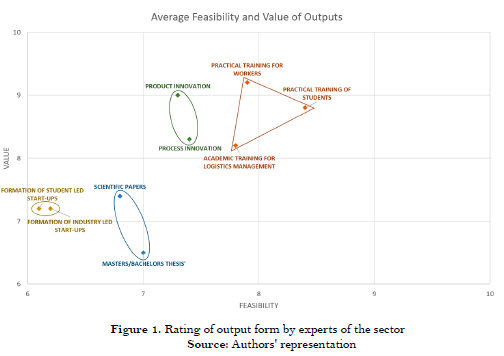
A qualitative measurement of JOINOLOG's results turned out to be a challenging goal. Since the centre aims to breed very different kinds of innovation, including academic impact, technological product innovation or formation of new business entities, there are little defining factors other than the pure success of achieving output at all, making the measurement exclusively dichotomous, 0 or 1 (a paper was published or not, a prototype was built or not, a start-up was established or it wasn't). To ensure a high percentage of finished outputs, the project team further conducted an open survey among stakeholders. The forms of output were to be rated both in feasibility and value to the logistics sector, from zero points to ten points (the latter indicating a very high value or feasibility). When observing the survey results, the clustering of the output groups indicates clear differences in preference and practicability as assessed by the participants, see Figure 1.
The JOINOLOG project plan revolves around results and goals leading up to the innovation centre. Multiple work packages included the need to define, implement and measure this output of the overarching project itself, but also of the activities, being guided by JOINOLOG in the future. The categories for these outputs are so-called JOINOLOG-projects, meaning collaboration of two or more stakeholders initiated by the JOINOLOG centre (through events, calls or other matchmaking/networking). Since a balance of power, ongoing competition between businesses and a clear temporal framework had to be considered in all future collaborations in the centre, the derived internal working definition of collaboration is:
"Pursuing a temporarily shared goal, which is achieved by several equal partners, who will continue to compete in other aspects."
On this basis, practical output groups were drafted. The four groups, "Innovation", "Training", "Academic Output", and "Start-Ups", included all results that were desirable to the project, based on workshops, expert input and the coordination with the project's advisory board. The groups each contained two clearly distinguishable outputs (except "Trainings", which contained three). These outputs can either be achieved or not be achieved, making the results of JOINOLOG's activities quantifiable on a very simple basis. The centre's success can, as a result, be measured on the started collaboration projects (aiming for one of the defined outputs), on the achieved results (successful completion of the objective) or, maybe most informative, the relationship of the two possibilities. A relative ratio of achieved outputs measured on the ones started, can not only inform about enthusiasm regarding the prospect of collaborating but the success of the centre in supporting stakeholders in reaching their goal - therefore tracking its effectiveness. While a limitation to recording the started collaborations would be as meaningless as counting the first bricks of multiple houses without finishing them, the total number needs to be considered when mentioning the ratio as a measurement. An impressive 100 percent completion rate is not sufficiently telling if the number of collaborations could be equal to one.
An example: 15 projects were started in a frame of time, aiming to achieve any of the earlier defined distinguishable outputs. This fact alone only contains the information that sufficient efforts were undertaken to bring together collaborating partners which want to achieve a common goal (output). The interesting measurement, of course, is the relative success rate of these projects. Assuming that 12 of these projects were able to reach their self-set objective in the given frame, this results in a success rate of 80 percent. While this seems like a high rate, there would be no other centres with the same concept and measurements this could be held up against. A comparison can only be achieved in the temporal dimension: The rate of successful (finished) collaborations over time should rise as high as possible to indicate a professionalization of the centre's activities in supporting the collaborations.
A qualitative measurement of JOINOLOG's results turned out to be a challenging goal. Since the centre aims to breed very different kinds of innovation, including academic impact, technological product innovation or formation of new business entities, there are little defining factors other than the pure success of achieving output at all, making the measurement exclusively dichotomous, 0 or 1 (a paper was published or not, a prototype was built or not, a start-up was established or it wasn't). To ensure a high percentage of finished outputs, the project team further conducted an open survey among stakeholders. The forms of output were to be rated both in feasibility and value to the logistics sector, from zero points to ten points (the latter indicating a very high value or feasibility). When observing the survey results, the clustering of the output groups indicates clear differences in preference and practicability as assessed by the participants, see Figure 1.
The forms of output were to be rated both in feasibility and value to the logistics sector, from zero points to ten points (the latter indicating a very high value or feasibility). When observing the survey results, the clustering of the output groups indicates clear differences in preference and practicability as assessed by the participants, see Figure 1.
Potential collaborations in the JOINOLOG centre will use this resulting matrix to find an output suitable for their individual level of expertise (or confidence). The measurement of collaboration results will still be purely based on successful output, but the ratio of this figure could be improved by this two-dimensional assessment. When trying to measure the impact in a quantifiable way, the value score of the realized output could further be included in weighted calculations, as shown in the exemplified IRC application in section 3.2
2.5 Assessment
The JOINOLOG project will be concluded in 2024, with the establishment of the innovation centre a continued and conceptualized IRC for logistics. Its overarching output is supposed to be a running centre (platform) for innovation and research, bringing collaboration to the logistics sector of Jordan. Both project goals, generating innovative output, and JOINOLOG-trainings, providing valuable sector skills to different groups of participants, will be regularly conducted by then. This project outcome is a soft goal with little measurable parts, but the approach of a relative success rate over time is a helpful tool in estimating the centre's efficiency. While the project is not near its conclusion yet, there have already been learnings regarding its capacity to foster related advancements. The results of JOINOLOG's approach to the measurement of innovative activity are discussed below.
The efforts to promote and implement JOINOLOG as a network, open to all logistics related entities, are time consuming and resource intense: Over three years, the public funding by a German ministry provided the workforce of two full time equivalent research assistants (in Jordan and Germany), to coordinate, conduct feasibility study and research, structure and implement an organisational basis. Without an income flow of any kind, there was no way to implement these first steps without this initial funding. International efforts were restricted by covid regulations for a significant time of the project's beginning (Initial Phase). This potentially reduced the positive impact of the project's resources. Other unpredictable influences affected the conduction, including further manifestation of firstly enthusiastic reactions to the project, which were not always followed by matching contributions of effort. The attraction of an invested audience of supply chain stakeholders of the targeted region proved to be challenging in these circumstances, the utilization of social media turned out to be an effective and cost neutral tool to this end. Communication in both directions is feasible and encouraged through this channel, while internal topics continue to be discussed bilaterally with the project's advisory board. The implementation of training and projects under the centre's influence (umbrella) are planned to take place in the third year of the funding horizon, which is starting just as this paper is being published. Therefore, no international collaborative output has been achieved yet, which could be quantified or judged by the introduced system. A definitive proof of concept will be included in the project's final report, when pilot projects and output can be reviewed.
Nevertheless, a positive conclusion can be drawn from the endeavor and the project team expects to finish the work on JOINOLOG as expected, despite obstacles. Since the project is ongoing, a reflection in comparison to the outcome would be premature - the expected outcome, as projected by the current state of the matter, can in this case definitely justify the effort that was undertaken. There will be improved networking and collaboration in the logistical sector, bringing applied research to the logistical sector and establishing SCM practices. The financing of the operationalize centre, after the project horizon ends is being researched and discussed momentarily. A careful balancing of cost and benefit will be part of this process.
3. IMPLICATION FOR IRC
3.1 Theoretical Implications
This paper explores the concept of IRC, its perceived benefits and a case study of the authors' attempt to implement a related centre, furthering research in a specific sector and region. These aspects are observed to answer the question if collaboration in research centres can be considered beneficial and how this benefit could be measured reliably.
The gain of collaboration continues to be a challenging factor to determine, especially in research, where impact is often of qualitative nature and unfolds with time. As the saying "standing on the shoulders of giants" indicates, the body of research which enables conclusions and practical innovations is usually extensive and includes shifting or blurred collaborations and benefits thereof. Reliable quantification of this collaborative influence on research results are hard to find and usually use workarounds to attempt the illustration of benefits, like the relative success rate of projects and training in the case study of JOINOLOG. It would, therefore, be improper to suggest that the advantages of collaboration in IRCs will, in any case, exceed the related costs.
In the authors' qualified opinion, there are factors which support a net positive outcome in collaborative research procedures. Mainly, the integrity of involved organisations and institutions cannot be endangered by the collaboration, and, maybe more importantly, this principle is to be communicated clearly to all parties involved. Reluctance to participate in applied research measures was observed to stem from reservations in regard to trade secrets - a suiting legal framework (including NDAs) can possibly put these reservations to rest. A well formulated agreement will also tackle two more factors, which, if not considered, could be detrimental to collaborative research and its benefits: A transparent distribution of the workload in the shared project and a clear plan in the exploitation of its results. Both directly concern the resources of the involved entities and therefore, greatly influence the success and further collaborations between parties. At the same time, the agreements beforehand should be kept to a low threshold. The insistence on complicated negotiations and legal documents could deter parties from involvement with each other and third parties. There is to be a balance between defining a reasonable allocation of rights and obligations while designing the process of achieving this goal as lean as possible.
With these conclusions, it becomes evident that communication and agreement before the start of collaboration is vital in the success of research, both among international partners and in other constellations.
3.2 Practical Implications
In an attempt to visualize the proposed procedure in measuring an IRCs impact, below the practical implications for application is run as a fictional example for an IRC in Livingstone, Zambia. Due to the city's proximity to the Kazungula Border, an IRC for logistics, providing insights and furthering the impact of collaboration between institutions of multiple countries seems like a fitting example to consider. A step-by-step process description summarizes the author's approach and learnings.
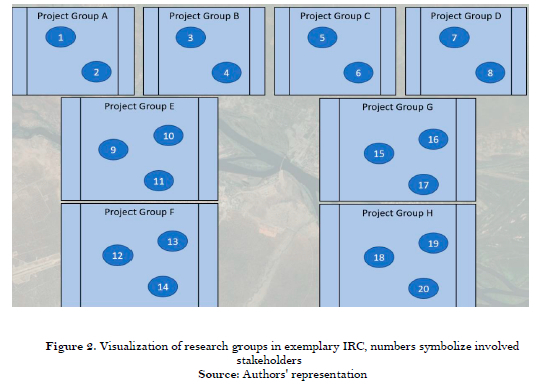
When establishing a network for an IRC, the consideration of stakeholders should be among the first measures taken. In this, there should be no distinction between actors. The sector should be represented in its complete diversity, bringing together logistics service providers of the region, transport ministries, universities, public transport companies and tourism agencies in a single network. In this broad group of stakeholders, connections, as well as competitive relations, might already exist. The IRC will try to identify combinations of actors which do not collaborate in research yet and encourage them to consider shared research projects via events or other matchmaking opportunities. In our fictitious example, 20 different stakeholders found a common interest in groups, four groups of two and four groups of three, resulting in eight project groups with shared logistical visions. A visualization of this gathering of groups can be observed in figure 2.
The project groups will, instructed by the IRC, define goals of their collaboration. An output matrix, as shown in the case study, supports this task while already providing the numeric value of the impact of each output (which was provided by survey results in the sector). Let us assume, in our example, the four smaller groups A, B, C and D aim for research papers of their respective fields, an output, valued by the matrix with a score of seven. The larger project groups E, F, G and H would like to hold training activities in their logistical niche, an output valued at a score of eight. The potential weighted innovation score (PWIS) of this IRC's activities could, therefore reach the following number:

A subsequent vital part in the practical application of IRC activity is the next step of the process, the arrangement of collaboration. A clear and, if possible measurable definition of the respective goals is drafted, including limits of the collaboration (business secrets, NDAs) and resource allocation. Once all partners agree to these definitions, the projects can begin their research and other activities. A timeframe for the objective's realization is necessary to prevent indefinite delay in conduction, the IRC supports the conduction of the projects to the degree of its design.
When the agreed upon timeframe of project execution is over, some activities were successfully realized, while others failed. It is assumed that a clear distinction can be made between these two different outcomes by meaningful documentation before the respective project starts (see also section 4.2 on further research). The impact of the realized research can be measured by putting the PWIS above in relation with the realized weighted innovation score (RWIS), the number of finished projects in the IRC and their value. In our example IRC, most projects were successful. Just the project groups D and G failed and did not produce a research paper or training, respectively, despite the centre's support. Our measurement in this case would look like this:

By establishing the relation of the potential and realized score, we extract the final measurement and conclusion, the innovation ratio:

This practical example shows how innovation of IRC activities could be measured in a quantified way. It is based on the pre-emptive evaluation of each possible output of the centre and on the rate of their realization. As stated in the case study, the result derives meaning from the ratio's development over time - our IRC in Livingstone should aim for a higher ratio in the coming review period. Note that this measurement, while quantitative, is highly subjective. It does, most of all, measure the ability of the IRC to set realistic innovation targets and pursue them. An IRC with a high innovation ratio did not necessarily produce many innovations in numbers. However, it produced as many innovations as initially aimed for or even exceeded all expectations and thus indicates that the environment and framework that the IRC created is productive. The aspects of this approach which deserve further attention by researchers are discussed below.
4. CONCLUSIONS AND FURTHER RESEARCH
4.1 Conclusions
The main conclusion of both the desk research study and the case study is that innovation seems to depend primarily on two factors: The effort invested in and the resulting ratio of innovation of the IRC at hand. That said, it is of utmost importance to invest significant time and funding into the set-up phase of an IRC. In this phase, the targets of the IRC, as well as measurable KPIs shall be defined and understood and agreed on by all partners. If this phase is done hastily or lacks effort or investment of one or multiple partners, there is a significant risk that the entire IRC becomes skewed and mostly favours the partner that puts in the most effort into this defining phase. Additionally, as demonstrated in section 3.2, overestimating the targets of the IRC bears the risk of creating an IRC that is far less innovative than hoped.
Another conclusion is that state agencies, as well as private businesses, seem to be happy to invest or at least participate in IRCs and into collaboration between different stakeholders. Such funding, on the other hand, has proven to be vital. Without a steady presence of at least one partner from each country of the IRC, third parties are significantly harder to convince of the IRC itself. Beyond that, the networking itself is extremely time consuming and easily underestimated. Without at least one employee who can invest all his or her efforts into promoting the IRC full time, it is likely to lose traction.
An often-underestimated factor that hinders IRC activities is the strong competition between research institutions like universities and states from the same region to get involved in inter-regional IRC, and the lack of cooperation or the concept that has been previously mentioned. In the case study, but also beyond this, it could be observed that there is a certain reluctance of all potential partners to involve "close by" partners and often prefer to be the sole participant from their area of expertise or business type. As JOINOLOG is designed to be a platform for the whole Mashreq or even MENA region, while at the same time conceptually limited to be located in Amman, it is challenging to attract other partners from the MENA region or even Jordan itself. The underlying reason seems to be that all these partners are competing for relations with European research partners in some capacity. Likewise, no other German institution joined the IRC yet, for much the same reason. One way to overcome this reluctance to involve close by potential partners in an IRC would be to build relations between existing local, regional or national networks as IRC from the beginning rather than between singular entities.
4.2 Further Research
The attempts in this paper to measure the impact of IRC research are imperfect and inspire a deeper engagement with the topic. Two major areas for further research can be derived from the findings in this paper.
First, the concept regarding a coordinated and pre-emptive documentation of a planned collaboration should be explored. Examining the experiences of the case study in combination with the literature and policy review above, the initiation of collaborative research seems to impact the outputs which can be achieved, while lacking attention in current research. The authors suggest the development of a standardized legal tool to tackle both insufficient coordination before the start of collaborative research in and around IRCs and the obstacle of needing to individually calibrate aspects of the shared project. This development could potentially be achieved via a toolkit, a framework or an iterative method. A successful implementation could immensely simplify the process of setting up collaboration in research and, therefore, stimulate competition in fields of applied research. At the same time, the clearly defined success criteria of the initiation documentation can help in the sought for measurement of the IRCs performance. The concept for a Letter of Intent, declaring intention to e.g. collaborate, strikes the authors as an example for a realization of this concept - it is estimated that further research should aim for an arrangement which is more accurate in its formulation and, potentially, more binding in a legal sense, for allocated resources by the involved parties are impacted by it. In the remaining project run time of JOINOLOG, the authors will explore possibilities for agreements as described here, possibly publishing the results in the future.
The second area of further research the authors suggest is the establishment of reliable and new Key Performance Indicators (KPIs), which can be used in agreements and objectives of research collaborations. The challenges in measuring successful research by IRCs are evident in the paper and case study; introduced concepts, like the calculations in section 3.2 on practical implications, might not be generally applicable or fail to sufficiently represent qualitative and quantitative success. By exploring and developing numeric and, therefore, verifiable indicators, the measurement of IRC output could become increasingly easy and comparable. Arrangements towards collaboration via competition could be based on these verifiable goals, simplifying initiation and documentation, even between actors, which would compete in other aspects of their work. These KPI would probably mostly be limited to areas of research: financial sciences would quantify their results differently from social sciences. The most interesting KPI would possibly be the interdisciplinary ones which could be shared by IRCs, regardless of research sector. Accordingly, and ironically, interdisciplinary research collaboration would be required to identify these generally valid values. The authors encourage readers to pursue this goal to improve the measurement and, therefore the efficiency of international research collaboration.
Finally, this publication is among the first that proposes a meta-method that can help to quantify the success of an international research collaboration. This field would require further attention and could significantly help to justify the political and scientific will to collaborate that exists without a doubt. Even more, it could help focusing efforts and funding on IRCs that have the potential to really lead to breakthrough innovations that are capable of disrupting the economies and societies involved in the IRC. The authors of this paper do appreciate that the measuring methodology presented here is very simplified and might not do the complexity of IRC full justice. It rather is meant to serve as a first proposed methodology that hopefully inspires more scientific debates and publications on measuring innovation by IRCs.
5. ACKNOWLEDGEMENTS
The research that led to this publication was financed by the German Ministry of Education and Research under the research grant "JOINOLOG".
REFERENCES
African Union (2014). Science, Technology and Space. Accessible online: https://au.int/sites/default/files/newsevents/workingdocuments/33178-wd-stisa-english_-_final.pdf. Last accessed 10.03.2023
Chen, K., Zhang, Y., and Fu, X. (2019). International research collaboration: An emerging domain of innovation studies?. Research Policy, Vol. 48, No. 1, pp. 149-168 [ Links ]
Confraria, H., Blanckenberg, J., and Swart, C. (2020). Which factors influence international research collaboration in Africa? In M. Ramutsindela and D. Mickler (Eds.), Africa and the sustainable development goals (pp. 243-255). Springer.
El-Ouahi, J., Robinson-García, N., Costas, R. (2021). Analyzing scientific mobility and collaboration in the Middle East and North Africa. Quantitative Science Studies 2021, Vol. 2, No. 3. pp. 1023-1047
European Commission (2021). Communication from the commission to the European Parliament, the Council, the European Economic and Social Committee and the Committee of the Regions on the Global Approach to Research and Innovation. COM(2021) 252
Everett-Heath, J. (2018). Mashriq. In: The Concise Dictionary of World Place-Names. Oxford University Press.
GIZ (2021). What is collaborative innovation? Accessible online: https://collaborative-innovators.org/about. Last accessed 10.03.2023. Last accessed 10.03.2023
Katz, S., Martin, B. (1997). What is research collaboration? Research Policy, Vol. 26, No. 1, pp. 1-18 [ Links ]
Klimova, N., Kozyrev, O., Babkin, E. (2016) Innovation in Clusters. Springer International Publishing, Cham.
Kunttu, L. (2017). Educational Involvement in Innovative University-Industry Collaboration. Technology Innovation Management Review, Vol. 7, No. 12, pp. 14-22 [ Links ]
Liu, D., Jemni, M., Huang, R., Wang, Y., Tlili, A., and Sharhan, S. (2021). An overview of education development in the Arab region: Insights and recommendations towards Sustainable Development Goals (SDGs). Beijing: Smart Learning Institute of Beijing Normal University. [ Links ]
Onyancha, O.B. (2020). Regional international research collaboration and citation impact in selected sub-Saharan African countries in the period 2000 to 2019. Global Knowledge, Memory and Communication, Vol. 70, No. 6/7, pp. 577-594 [ Links ]
Project Consortium JOINOLOG (2019): SWOT Analysis - Jordanian Logistics Landscape, JOINOLOG Workshop 1. 22./23.1.2019, King Hussein Business Park, GJU's Graduate School of Business Administration.
Ricciardi, F.; Zardini, A.; Czakon, W.; Rossignoli, C.; Kraus, S. (2022). Revisiting the cooperation- competition paradox: A configurational approach to short- and long-term coopetition performance in business networks. European Management Journal, Vol. 40, No. 3, pp. 320-331 [ Links ]
Umlauf, R. and Burchardt, M. (2022). Africa-as-a-service: Digital Health and the Rise of Drone Infrastructures. Working Paper. Collaborative Research Centre (SFB) 1199.
UN General Assembly (2015). Transforming our world: the 2030 Agenda for Sustainable Development. A/RES/70/1
