




Services on Demand
Journal

Article
 English (pdf)
 Article in xml format
 Article references
 Automatic translation
 Send this article by e-mail
Indicators
Related links
-
 Cited by Google
 -
 Similars in Google
Share

 Permalink
South African Journal of Agricultural Extension
On-line version ISSN 2413-3221Print version ISSN 0301-603X
S Afr. Jnl. Agric. Ext. vol.53 n.4 Pretoria 2025
https://doi.org/10.17159/2413-3221/2025/v53n4a17685
ARTICLES
Perceptions of Smallholder Farmers on the Effectiveness of Extension Services in Enhancing Knowledge and Skill Development: The Case of Binga, Gokwe North and Hurungwe Districts, Zimbabwe
Madzokere F.I; Madududu P.II; Ruzhani F.III; Chawarika A.IV; Murimbika A.V
ILecturer: Department of Agricultural Economics and Development, Faculty of Agribusiness Management, Manicaland State University of Applied Sciences, Stair Guthrie Road, P.O. Bag 7001 Fernhill, Mutare, Zimbabwe. fmadzokere69@gmail.com, ORCID ID 0000-0002-0017-812X
IILecturer: Department of Agricultural Economics and Development, Faculty of Agribusiness Management, Manicaland State University of Applied Sciences, Stair Guthrie Road, P.O. Bag 7001 Fernhill, Mutare, Zimbabwe. matarutsepamela@yahoo.com, ORCID ID 0000-0002-8462-7796
IIILecturer: Department of Agricultural Economics and Development, Faculty of Agribusiness Management, Manicaland State University of Applied Sciences, Stair Guthrie Road, P.O. Bag 7001 Fernhill, Mutare, Zimbabwe. freddy.ruzhani@staff.msuas.ac.zw, ORCID ID 0000-0003-1345-2113
IVLecturer: Department of Crop and Soil Science, Faculty of Agricultural Sciences, Lupane State University, P.O. Box 170, Lupane, Zimbabwe. admirechawarika@yahoo.com, ORCID ID 0000-0002-3548-1030
VMonitoring and Evaluation Department, Catholic Agency for Overseas Development (CAFOD), 88 Broadlands Road, Emerald Hill, Harare, Zimbabwe. agrippamurimbika@gmail.com, ORCID ID 0009-0005-5136-9734
ABSTRACT
The study examined smallholder farmers ' perceptions of the effectiveness of extension services for knowledge and skill development in Zimbabwe. Using binary logistic regression for quantitative data and narrative analysis for qualitative data, the study analysed farmers' perceptions of agricultural extension services in Zimbabwe. The study used a convergent parallel mixed-methods design, involving 306 respondents from Binga, Gokwe North, and Hurungwe districts selected using random sampling for quantitative analysis. Qualitative data were collected from 10 key informant interviews conducted with purposively selected participants using a semi-structured interview. Farmers' perceptions were significantly influenced by their district, the number of private and NGO extension staff visits, farm visits by public extension staff, and telephone technical assistance by public extension staff. Although farm visits remain the most popular extension form in Zimbabwe, access to extension services is still limited. Extension services from the government, private sector, and NGOs are crucial for agricultural development. Phone extension can enhance access to these services, complementing in-person services. Enhancing positive farmer perceptions of extension services is crucial for improving extension impact in Zimbabwe and boosting agricultural output. The study's findings help policymakers understand farmers ' perceptions of extension services, identifying potential intervention areas for improvement.
Keywords: Extension Services, Perceptions, Smallholder Farmers, Knowledge and Skill Development.
1. INTRODUCTION
Agriculture is a crucial aspect of rural development and contributes significantly to Zimbabwe's economic growth. Extension services are essential for enhancing agricultural production and providing knowledge services that bridge the gap between research and production (Mahlangu et al., 2020). They help farmers improve their operations, increase their activities, and generate income. However, government extension service provision in developing countries is often seen as ineffective due to a lack of resources, personnel, training, and support (Mapiye et al., 2021).
Extension services provide guidance and support in marketing produce, aiming to increase farmers' activities, production, and income (Al-Zahrani et al., 2019; Sylla et al., 2010). They also have social, educational, and economic components, linking farmers to markets, developing competence, and promoting environmental sustainability (Nyawo & Mubangisi, 2021). However, agricultural output remains low in developing countries, particularly Zimbabwe (Mkuki & Msuya, 2020). Zimbabwe's agricultural sector experienced a decline from 19.02% to 5.07% in productivity between 2008 and 2018, affecting the country's overall output (Setoboli et al., 2024). Ministry of Lands, Agriculture, Water, Climate and Rural Resettlement (2018) noted that Zimbabwe's agricultural productivity is significantly low, mainly due to low investment in time, working capital, and productive assets, and a high perception of agricultural risks.
Extension services rarely provide innovations to farmers, and there is a need to objectively assess the effectiveness of extension services for small-scale farmers. According to Sylla et al. (2019), perceptions refer to how people finally view the world, influenced by how they interpret stimuli they are exposed to. Al-Zahrani et al. (2019) noted that farmers' perceptions are important in influencing behaviour to adopt improved agricultural technologies. Farmers' perceptions of extension programs influence their commitment to suggested activities and adoption of new farming techniques. Studies have shown that farmers' perceptions are influenced by factors such as credit facilitation, input provision, technical support, and market access (Sylla et al., 2019). Understanding farmers' perceptions of the efficacy of extension services is critical for developing strategies to improve the status of extension services and boost productivity. This study examines smallholder farmers' perceptions of the effectiveness of extension services for knowledge and skill development in Zimbabwe.
2. METHODOLOGY
2.1. Study Area
The study focused on three neighbouring districts in Zimbabwe: Hurungwe, Binga, and Gokwe North. For this reason, the three were chosen as the study would cover a wider area by targeting the three conveniently located neighbouring districts in three different provinces. Hurungwe district is in Mashonaland West Province and lies between 16.3255oS and 29.6035Έ. It is a farming district specialising in producing cotton, tobacco, and cereals (WFP, 2022a). Binga district is located in Matabeleland North Province of Zimbabwe and lies between 17.6229oS and 27.3398oE. The primary sources of income are maize, groundnuts, and cotton; additional food and financial income are obtained from animal husbandry (WFP, 2022b). Cotton and maize are among the most common crops farmed in the Gokwe North district of the Midlands Province, which is located between 17.4638° S and 28.8597° E (WFP, 2022c).
2.2. Research Approach
Both quantitative and qualitative methodologies were used to collect the data for this research study. The study utilised a structured questionnaire to collect quantitative data and key informant interviews to collect qualitative data. The structured questionnaire interviews gathered information on farmers' opinions on access to different forms of extension services and their perceptions of extension services as effective for knowledge and skill development, profitability, and demography. A semi-structured questionnaire was also used to gather related information qualitatively. The given data was then utilised to produce tables that offered a more thorough examination of the results.
2.3. Research Design
The study used a convergent parallel mixed-methods design, combining qualitative and quantitative data. A survey was used to gather quantitative data, whilst qualitative insights were collected through key informant interviews. Initially conceptualised as a triangulation design, the convergent design combines the strengths and weaknesses of both methods (Patton, 1990). This design is useful when researchers have limited time and need both forms of information from participants (Creswell & Plano Clark, 2018). It was therefore useful for this study, as it required timely and adequate data collection. For qualitative and quantitative data collection, different individuals were used in this study to synthesise information from various role players in the small-scale farming sector in Zimbabwe.
2.4. Sampling Method and Size
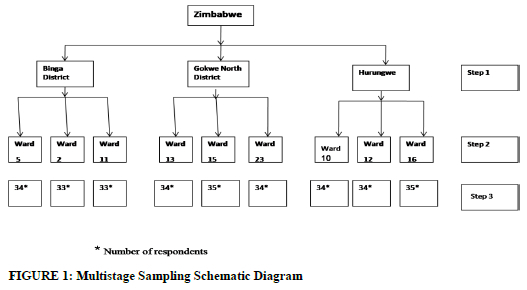
Using a structured questionnaire, data were collected from 306 farmers randomly selected from Binga, Gokwe North, and Hurungwe Districts of Zimbabwe. This study employed multistage sampling consisting of three stages. In the first step, three districts from three separate provinces were purposively selected, and three wards were randomly chosen from each district, from which the sample was randomly selected. Figure 1 shows the multistage sampling schematic diagram for the questionnaire interviews. Singh and Masuka (2014) concluded that a minimum sample size of 100 is sufficient for statistical analysis. Hence, our sample size of 100 respondents in Binga, 103 in Gokwe North, and 103 in Hurungwe district can be considered scientifically adequate for the statistical analysis. Key informant interviews were held with 10 purposively selected farmer representatives and local leaders. The smaller sample size for the qualitative data collection ensured depth over breadth in our data collection (Sandelowski, 1996). Furthermore, saturation was also anticipated between 9 and 17 respondents, given that the study was from a homogeneous population (Hennink & Kaiser, 2022).
This paper enquired about types and levels of access to extension services provided by the three extension service providers (government, private, and non-governmental organisations). The main extension interventions were farm visits, telephone extension advice, training, demonstrations, and marketing advice. Some socioeconomic and production factors were also considered, as they can influence farmers' perceptions.
2.5. Data Analysis
For the quantitative analysis, SPSS version 23 was employed to conduct descriptive statistics and binary logistic regression. On the qualitative side, key informant interview responses were examined through narrative analysis to uncover common themes about farmers' experiences with extension services, particularly their perceived effectiveness for knowledge and skill development (Riessman, 2008). Initially, the mean was used to measure central tendency for continuous variables. In contrast, frequency distributions were used for the categorical variables in the statistical analysis of the data generated from questionnaire interviews. Binary logistic regression analysis was then performed to evaluate socioeconomic, demographic, and access to extension variables that influence farmers' perceptions of the usefulness of agricultural extension services in Zimbabwe for knowledge and skill development. Only components with a significant association with the dependent variable were evaluated in the Binary regression model. The binary logistic regression model used for this investigation is as follows:

Where;
PERCEPTION = perception of the effectiveness of extension towards skills and knowledge development (1=yes, 0=no)
DIST = District of respondent (2= Hurungwe, 1= Gokwe North, 0=Binga)
NUMVSTSPVTEXTN = Number of visits by private extension staff.
NUMVSTSNGO = Number of visits by NGO.
FARMVSTPUBEXT = Face-to-face farm visits by public extension staff (1=yes, 0=no).
ASSPHNPUBEXT = Assistance on the phone by public extension staff (1=yes, 0=no).
3. RESULTS AND DISCUSSION
3.1. Respondents' Socioeconomic Characteristics
The sample consisted of 76% male and 24% female respondents, reflecting broader gender disparities in agricultural participation in Zimbabwe (Pindiriri & Zwizwai, 2022). Perelli et al. (2024) observed that, in sub-Saharan Africa, women face significant gender-specific limitations and have limited involvement in farm decision-making systems. The participants comprised 83% married, 12% widowed, and 5% single farmers. In farming communities, marital status often intersects with other factors that could shape perceptions (Acheampong et al., 2023). However, this particular study did not explore these potential relationships in depth. Most respondents attained secondary level (58%), while 5% had no formal education, 35% attained primary school level, and only 2% went up to tertiary education level. The head of household's education level determines households' human capital level and ability to interpret information. This has an impact on influencing the farmer's impression of skill and knowledge growth, as well as the farmer's capacity to appreciate the significance of the information supplied by extension officers. Table 1 shows the frequency distributions for the categorical variables (sex, level of education, and marital status) of the household head.
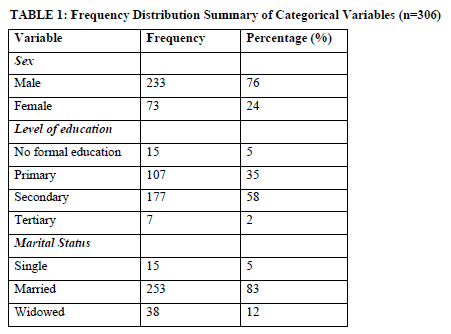
Table 2 shows the results for continuous variables. The variables included demographic and production factors to characterise the farmers under study.
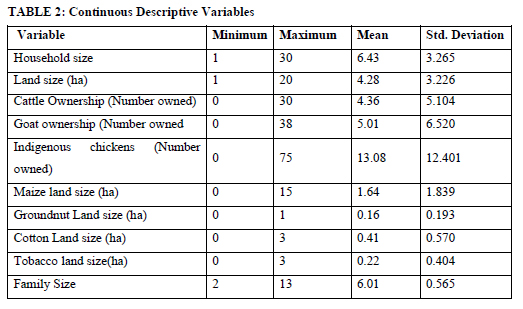
Results in Table 2 show that the average land size was four (4) ha per household and the average family size was six people. The average family size is higher than the average family size of four to five people as reported by the Zimbabwe National Statistics Agency (ZIMSTAT) (2022) and ZIMSTAT (2019). The large family size is unsurprising considering that smallholder agriculture relies primarily on family labour. The average land size was higher than the Zimbabwean smallholder sector average of two ha (ZIMSTAT, 2019). The most commonly raised livestock species was cattle, with an average herd size per farmer of five cattle. On the cropping side, the most grown crop was maize with an average of 1.6 Ha.
3.2. Farmers' Access to Extension Services
Table 3 shows the respondents' reported frequency of using extension services from the three extension service providers: public extension, private enterprise extension, and NGO extension.
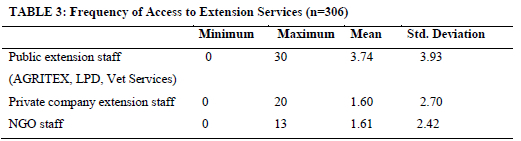
Table 3 shows that most respondents accessed extension services from public extension staff rather than from the other two extension service providers. Farmers were getting an average of four visits from public extension service providers and two visits each on average from private and NGO extension staff. This indicates that public extension workers are the major providers of extension advice in the three districts. This is attributed to the fact that the government of Zimbabwe employs staff stationed near the farmers, increasing the frequency of extension provision by public extension officers. According to Sylla et al. (2019), public extension has always been the most accessible extension service provider in underdeveloped nations. However, as the production of private goods grows, the private sector is increasingly contributing. In the district of Gujranwala, Riaz et al. (2022) concluded that public sector extension services performed better than private sector ones. In the Punjab province of Pakistan, Abbas et al. (2021) observed that farmers are more satisfied with private sector advisory services for crop harvesting than the public sector, indicating a need for more development and institutionalisation in the public sector to improve farming community performance. Sylla et al. (2019) emphasise the importance of using the benefits of public and private sector extension services to overcome the inadequacies of previous extension models. However, access to extension services is limited in developing countries, with Sebeho & Stevens (2019) and Nyawo & Mubangizi (2021) reporting a lack of access to extension services in their studies in South Africa.
3.3. Types of Extension Services and Their Access from Different Service Providers
Respondents were then asked to reveal what technical assistance their households received during the 2017/18 season. The findings are summarised in Table 4.
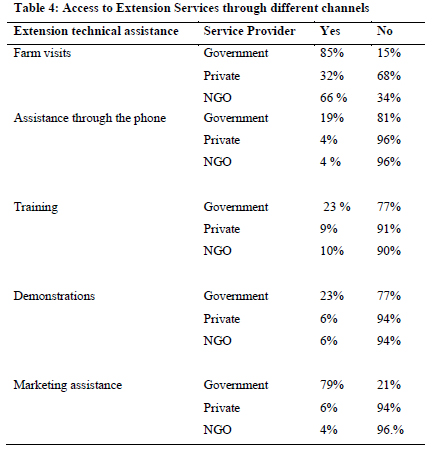
Farm visits were the most popular extension approach, particularly among public extension officers (85%) and non-governmental organisation extension officers (66%). A farmer representative in Gokwe North reported, "Frequent visits from extension staff working for private and NGOs significantly increased technical knowledge and use of new farming practices'" Similarly, a local leader in Hurungwe remarked, "Smallholder farmers in this district have benefited a lot from extension knowledge and skill enhancement efforts by all three extension service providers."
Marketing assistance (79%) was another extension service often given by public extension employees. The other methods were not commonly used, with demonstrations and training tied at a distant third, with public extension officers (23%) also utilising this method more than the other two extension service providers. Extension services provided through the phone were the least popular. This is not surprising given the slow progress in technological development in developing countries like Zimbabwe.
Farm visits were the most preferred technical support, particularly from public extension staff. In their study conducted in South Africa, Nyawo & Mubangizi (2021) discovered that face-to-face extension outperformed all other communication modalities with smallholder farmers. Marketing assistance by extension staff is provided mostly by public extension staff, but is rarely provided by private companies and NGO extension staff. In an earlier study, Muchesa et al. (2019) concluded that farmers are more satisfied with NGO marketing than public sector marketing support. Extension services have a modest role in distributing marketing information to smallholder farmers (Nyawo & Mubangizi, 2021). Although training is a vital extension tool, respondents poorly accessed it during the period in question. Training is a very effective strategy since it gives farmers extensive instruction supported by in-person visits to track progress and provide additional guidance. The extension workers are competent since they are also consistently taught (Maulu et al., 2021). Because of agriculture's dynamic nature, farmers and extension personnel should be regularly trained (Sebeho & Stevens, 2019). Demonstrations were the least popular form of technical assistance in the three districts.
3.4. Factors Affecting Farmers' Perception of Extension Services as Effective for Knowledge and Skill Development
A binary regression model was used to determine the factors affecting farmers' perception of whether extension services are effective for knowledge and skill development as the dependent variable. Demographic, socioeconomic, and access to extension services were the independent variables. The Hosmer and Lemeshow test showed that the model was a good fit. The model findings presented in Table 5 show the beta coefficients, odds ratios, and significance levels.
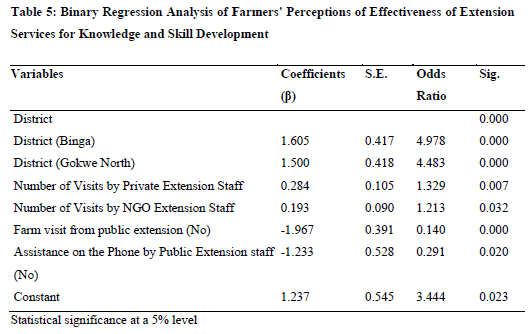
Farmers' perceptions of extension services' effectiveness in knowledge and skill development are influenced by factors such as the district and the number of visits by private, NGOs, public, and telephone staff. A thorough examination of the results in Table 5 above reveals that farmers in the Binga district are 1.6 times more likely to have a positive impression of extension services as useful for knowledge and skill development than farmers in the Hurungwe district. On the other hand, farmers in Gokwe North District are 1.5 times more likely to have a good impression of extension services as useful for knowledge and skill development than farmers in Hurungwe District. The study concludes that farmers' perceptions differ due to variances in geography, which can be ascribed to the effectiveness of extension personnel, which varies by district, with personal characteristics of the extension agents influencing this perception.
Farmers' perception of extension services as effective for knowledge and skill development increases by 0.28 times for every unit increase in extension visits by private extension employees. A unit increase in the frequency of extension visits by NGO extension professionals, on the other hand, improves farmers' likelihood of having a positive impression of extension services as effective for knowledge and skill development by 0.19 times. Farmers who did not receive public extension employees' on-farm visits are twice as likely as those who did receive public extension personnel's farm visits to have a positive impression of extension services as useful for knowledge and skill development. This finding shows that farmers desire increased engagement with extension service providers to gain significantly from timely knowledge to boost productivity. "Extension services are important in improving farm production, but I believe more effort is needed to make sure all smallholder farmers get access to the extension services'", remarked a Binga farmer representative. Baloch (2018) noted that the yield achieved by small-scale farmers who utilised extension services was superior to that of medium- and large-scale farmers who did not access extension services.
Telephone assistance from extension professionals was also found to substantially impact farmers' perceptions of the effectiveness of extension services. Farmers' opinions of the efficacy of extension services were also significantly impacted by the phone support they received from extension professionals. Farmers who did not receive technical assistance from public extension agents via phone are 1.2 times less likely to positively perceive extension services as effective for knowledge and skill development than those who did receive technical assistance from public extension agents via phone. This means that phone extension services are a significant modality that improves the effectiveness of extension services from the farmers' standpoint. A local leader (in Binga) commented, "Extension advice through the phone complements the face-to-face extension services that are common in the area". Islam et al. (2017), in a study in the Manikganj district of Bangladesh, found a positive correlation between training exposure, information use, job satisfaction, and ICT utilisation in agricultural extension services, suggesting the potential of modern mobile technology. In a study in Western Uganda, Masuki et al. (2010) highlight mobile phones' significant role in improving agricultural efficiency for rural farmers. Mobile phones are increasingly accessible to lower-income groups, allowing them to access information on agriculture, natural resources management, and marketing.
In this study, the frequency of extension visits by NGOs and private extension staff and face-to-face visits by public extension staff substantially impacted farmers' assessments of the efficacy of extension services for knowledge and skill development. The results are consistent with the findings of Davis et al. (2019) in South Africa, who reported that individual extension work was favoured above group labour. However, the findings contrast those of Sebeho & Stevens (2019), who discovered that group extension approaches are favoured by farmers over individual farm visits in their study in South Africa. According to a study by Riaz et al. (2022), sociodemographic characteristics such as age, farm size, and educational attainment, as well as the availability, quality, and relevance of necessary technology, all contribute to the perception of Gauteng's public extension and advisory services as being inefficient.
4. CONCLUSIONS AND RECOMMENDATIONS
The study's major conclusion is that farmers perceive extension services as effective for knowledge and skill development. This perception is influenced by: the farmer's district, the number of extension visits by private extension staff, the number of extension visits by NGO extension staff, farm visits by public extension staff, and telephone technical assistance by public extension staff. Several other conclusions can be drawn from this study. Firstly, although farm visits are the most common extension methods in Zimbabwe, the level of extension access is still low. Secondly, study findings imply that extension services provided by all service providers are important and that efforts to enhance access to such services should be improved.
Based on the above findings, the study recommends the following;
• Efforts to create positive perceptions of farmers on extension services should be enhanced. The government and private sector stakeholders should support the various methods that can be used in extension, especially face-to-face extension services that have proved popular with farmers. As a result, to provide efficient extension services, the government should establish strong partnerships with the private sector.
• Extension officers should also be encouraged to visit farmers frequently, as this is a crucial method for disseminating extension messages to farmers.
• Many extension strategies can help farmers get the information they need. In particular, face-to-face extension services can be effectively complemented by telephone extension, and these two modes of extension can significantly enhance access to extension services.
• In line with the above recommendation, the government should find ways to capacitate extension personnel with well-serviced and adequate working tools, like transport, to enhance their mobility levels as they seek to improve face-to-face visits. Building up the capacity of extension service providers is essential because it will significantly alter farmers' opinions about how beneficial extension services are, increasing their receptivity to programs targeted at their level of productivity.
REFERENCES
ABBAS, S., KHAN, G.A., SHAHBAZ, B. & SIDDIQUI, M.T., 2021. Comparative effectiveness of agricultural advisory services rendered by public and private sectors in the Punjab, Pakistan. Int. J. Agric. Ext., 8(3): 181-188. [ Links ]
ACHEAMPONG, P.P., YEBOAH, S., ADABAH, R., ASIBUO, J.Y., NCHANJI, E.B., OPOKU, M. & LUTOMIA, C.K., 2023. Gendered perceptions and adaptations to climate change in Ghana: what factors influence the choice of an adaptation strategy?. Front. Sustain. Food Syst., 7: 1091812. [ Links ]
AL-ZAHRANI, K.H., KHAN, A.Q., BAIG, M.B., MUBUSHAR, M. & HERAB, A.H., 2019. Perceptions of wheat farmers toward agricultural extension services for realizing sustainable biological yields. Saudi J. Biol. Sci., 26(7): 1503-1508. [ Links ]
BALOCH, M.A. & THAPA, G.B., 2018. The effect of agricultural extension services: Date farmers' case in Balochistan, Pakistan. J. Saudi Soc. Agric. Sci., 17(3): 282-289. [ Links ]
CRESWELL, J.W. & PLANO CLARK, V.L., 2018. Designing and conducting mixed methods research (3rd edition). Sage Publications. [ Links ]
DANSO-ABBEAM, G., EHIAKPOR, D.S. & AIDOO, R., 2018. Agricultural extension and its effects on farm productivity and income: Insight from Northern Ghana. Agric. Food Secur, 7(74): https://doi.org/10.1186/s40066-018-0225-x. [ Links ]
DAVIS, K., LANDINI, F., VAN NIEKERK, J., GREEN, K. & TERBLANCHE, S.E., 2019. Extension officers' perceptions of extension and innovation in South Africa. S Afr. Jnl. Agric. Ext., 47(4): 152-161. [ Links ]
HENNINK, M. & KAISER, B.N., 2022. Sample sizes for saturation in qualitative research: A systematic review of empirical tests. Soc SciMed., 292: 114523. [ Links ]
ISLAM, M.S., HAQUE, M.E., AFRAD, M.S.I., ABDULLAH, H.M. & HOQUE, M.Z., 2017. Utilization of ICTs in agricultural extension services of Bangladesh. Asian J. Agric. Ext. Econ. Sociol., 16(1): 1-11. [ Links ]
JAMIL, M.H., IBRAHIM, T., TENRIAWARU, A.N., ANISA, A. & HY, A.H., 2021. Farmers' perceptions of the role of agricultural extension agents in Taroada Village, Turikale District, Maros Regency. IOP Conf. Ser: Earth Environ. Sci., 807(3): 032-070. [ Links ]
KESMODEL, U.S., 2018. Cross-sectional studies-what are they good for? Acta Obstet. Gynecol. Scand., 97(4): 388-393. [ Links ]
KOMBA, N.C., MLOZI, M.R. & MVENA, Z.S., 2018. Socioeconomic factors influencing farmers' perception on effectiveness of decentralized agricultural extension information and services delivery in Arumeru District, Tanzania. Int. J. Eng. Res. Adv. Dev., 6(2): 594-602. [ Links ]
MAAKE, M.M.S. & ANTWI, M.A., 2022. Farmer's perceptions of effectiveness of public agricultural extension services in South Africa: An exploratory analysis of associated factors. Agric. Food Secur., 11(1): 34. [ Links ]
MAHLANGU, S.A., MASEMOLA, M., MATSAUNYE, L.B.T., LETSAOLO, S. & LUVHENGO, U., 2020. Reviewing the current state of extension in Gauteng Province: Case of Food Security Sub-Directorates. J. Crit. Rev., 7(13). [ Links ]
MAPIYE, O., MAKOMBE, G., MOLOTSI, A., DZAMA, K. & MAPIYE, C., 2021. Towards a revolutionized agricultural extension system for the sustainability of smallholder livestock production in developing countries: The potential role of ICTS. Sustain., 13(11): 58-68. [ Links ]
MASUKI, K.F., TUKAHIRWA, J., KAMUGISHA, R., MOWO, J., TANUI, J., MOGOI, J. & ADERA, E.O., 2010. Mobile phones in agricultural information delivery for rural development in Eastern Africa: Lessons from Western Uganda. World Agroforestry Centre. [ Links ]
MAULU, S., HASIMUNA, O.J., MUTALE, B., MPHANDE, J. & SIANKWILIMBA, E., 2021. Enhancing the role of rural agricultural extension programs in poverty alleviation: A review. Cogent Food Agric., 7(1): 1886663. [ Links ]
MINISTRY OF LANDS, AGRICULTURE, WATER, CLIMATE AND RURAL RESETTLEMENT., 2018. Reimagining Zimbabwe's Agricultural Sector: National Agriculture Policy Framework 2019 - 2030. Available from https://www.harvestplus.org/wp-content/uploads/2021/12/Zimbabwe_NAPF_2019-2030.pdf [ Links ]
MKUKI, Z.H. & MSUYA, C.P., 2020. Agricultural extension officers' perceptions towards their roles: A case study of Simiyu Region. Tanzan. J. Agric. Sci., 19(2): 56-66. [ Links ]
MUCHESA, E., NKOSI, B.D., ZWANE, E.M. & VAN NIEKERK, J.A., 2019. The role of extension support in a communal farmers' market system in Mhondoro-Mubaira, Zimbabwe. S Afr. Jnl. Agric. Ext., 47(2): 72-80. [ Links ]
NYAWO, J.C. & MUBANGIZI, B.C., 2021. Perception of agricultural smallholder farmers on public extension and advisory services in Ethekwini Municipality, KwaZulu-Natal Province. J. Southwest Jiaotong Univ., 56(3): 499-518. [ Links ]
PATTON, M.Q., 1990. Qualitative evaluation and research methods (2nd edition). Newbury Park, CA: Sage. [ Links ]
PERELLI, C., CACCHIARELLI, L., PEVERI, V. & BRANCA, G., 2024. Gender equality and sustainable development: A cross-country study on women's contribution to the adoption of the climate-smart agriculture in Sub-Saharan Africa. Ecol Econ., 219: 108145. [ Links ]
PINDIRIRI, C. & ZWIZWAI, B., 2022. Land inequality, gender land disparity and poverty in rural Zimbabwe, AERC Working Paper GIZ-002. Nairobi: African Economic Research Consortium. [ Links ]
RIESSMAN, C.K., 2008. Narrative methods for the human sciences. CA, USA: Sage. [ Links ]
RIAZ, I., ASHRAF, I., USMAN, M., USMAN, S. & EJAZ, R., 2022. An analysis of comparative effectiveness of public and private extension services regarding potato production in district Gujranwala. J. Agric. Res., 60(4): 363-367. [ Links ]
RUNGANGA, R. & MHAKA, S., 2021. Impact of agricultural production on economic growth in Zimbabwe, MPRA Paper 106988. Germany: University Library of Munich. [ Links ]
SANDELOWSKI, M., 1996. One is the liveliest number: The case orientation of qualitative research. Res Nurs Health., 19(6), 525-529. [ Links ]
SEBEHO, M.A. & STEVENS, J.B., 2019. An overview of perceptions and attitudes towards extension service delivery in Fezile Dabi District, Free State Province. S Afr. Jnl. Agric. Ext., 47(1): 61-72. [ Links ]
SETOBOLI, T., TSHUMA, N. & SIBANDA, E., 2024. Improving agricultural efficiency in Zimbabwe: A labor productivity analysis. Int. J. Res. Inn. Social Sc., 8(3): 2193-2208. [ Links ]
SINGH, A.S. & MASUKU, M.B., 2014. Sampling techniques & determination of sample size in applied statistics research: An overview. Int J Econ Commer Manag., 2(11): 1-22. [ Links ]
SYLLA, A.Y., MAHAMA AL-HASSAN, R., EGYIR, I.S. & ANIM-SOMUAH, H., 2019. Perceptions about quality of public and private agricultural extension in Africa: Evidence from farmers in Burkina Faso. Cogent Food Agric., 5(1): 1685861. [ Links ]
WANG, X. & CHENG, Z., 2020. Cross-sectional studies: Strengths, weaknesses, and recommendations. Chest., 158(1): S65-S71. [ Links ]
WFP., 2022a. Hurungwe District Food and Nutrition Security Profile. [ Links ]
WFP., 2022b. Binga District Food and Nutrition Security Profile. [ Links ]
WFP., 2022c. Gokwe North District Food and Nutrition Security Profile. [ Links ]
ZIMSTAT., 2022. 2022 Population and Housing Census (PHC): Preliminary Report on Population Figures. Available from https://zimbabwe.unfpa.org/sites/default/files/pub. [ Links ]
ZIMSTAT., 2019. Zimbabwe Smallholder Agricultural Productivity Survey 2017 Report. Available from https://documents1.worldbank.org/curated/en/132391555925729892. [ Links ]
ZIMBABWE NATIONAL STATISTICS AGENCY., 2012. Zimbabwe Population Census 2012 National Report. Available from http://www.zimstat.co.zw/wp-content/uploads/publications/Population/population/census-2012-national-report.pdf [ Links ]
 Correspondence:
F. Madzokere
Correspondence Email: fmadzokere69@gmail.com
